Tag: topic-link-auto

  • How Josh Shapiro’s early embrace of data centers is testing his high popularity in Pennsylvania

    How Josh Shapiro’s early embrace of data centers is testing his high popularity in Pennsylvania

    Gov. Josh Shapiro made a declaration in the early days of his administration: Pennsylvania is open for business.

    The move would ultimately include promises to slash bureaucratic red tape, cut permit wait times, and offer a new direct line to Shapiro’s office for major corporations hoping to set up shop in Pennsylvania.

    Pennsylvania would “move at the speed of business” and “get stuff done,” the new mottos used by his administration, he said. He’s campaigning for reelection in November on the same catchphrases, and boasting major successes like the 12-day repair of I-95 in 2023 that traditionally would have taken months to reopen as an example of how he can think outside the box to solve problems.

    What’s more: He sees delivering for residents — showing them government can actually solve problems — as the future of the national Democratic Party, while it searches for an effective message and messenger heading into the 2028 presidential primary, which he is widely expected to enter.

    It was with this same spirit last summer that Shapiro announced the largest single private sector investment in Pennsylvania history: Amazon committed $20 billion in Pennsylvania that included two data center campuses in Luzerne and Bucks Counties. Pennsylvania scored the project because of its promise to fast-track permitting and use tax breaks for the massive developments.

    “Pennsylvania’s gonna be better off. I think America’s gonna be better off, because we’re going to win the battle of AI supremacy and it’s going to be done right here in the commonwealth of Pennsylvania,” Shapiro said in an interview on CNBC’s Squawk Box on the day he announced the deal.

    Gov. Josh Shapiro announces a $20 billion investment by Amazon in Pennsylvania data centers in Salem Township and Falls Township on June 9, 2025.Commonwealth Media Services

    But in a year’s time, the politics — and public opinion on both sides of the aisle — have dramatically shifted on data center development. Shapiro’s early welcome of data centers has created an opening for criticism from his gubernatorial opponent and members of his own party.

    Yet efforts to cut red tape have proven to be slow and overblown: Only six data centers are actually under construction in Pennsylvania since the announcement, and 10 have received at least one state-level permit approval, according to Shapiro’s office. Still, Shapiro’s popularity is being evaluated by some voters and anti-data center activists on a perception that he moved too quickly and sacrificed the state’s safety in favor of Big Tech.

    “I am all about legislators and decision makers getting s— done. This version of it is reckless and it’s irresponsible and it’s not actually serving our people,” said Carrie Santoro, the executive director of progressive advocacy group Pennsylvania Stands Up who has been holding town hall meetings in communities around the state on data centers.

    As public opposition to data center development has grown over the last year, Shapiro has begun to soften his position, citing his personal evolution on the projects. He’s gone from consulting Amazon and the data center industry earlier this year to draft data center incentives, to vowing his own executive actions to curb the projects in communities that oppose them.

    “Governor Shapiro intends to use all the tools available to him to stop the dozens of speculative data center projects that do not meet community needs and Pennsylvania should expect to hear more from him on that in the coming weeks,” said Shapiro’s press secretary, Rosie Lapowsky.

    Now Shapiro, who otherwise maintains vast popularity ratings in the state, faces a vulnerability on one of voters’ top priorities as he heads into November, and a particularly sensitive concern among Democrats as he potentially vies for the party’s nomination in two years.

    A liability among some voters

    Data centers were not broadly known or understood by many until this year, as public outcry continues to grow.

    Many states, including Pennsylvania, had already begun welcoming the major projects, and some hyperscale developers plan to spend billions of dollars to build them. Pennsylvania’s General Assembly first approved a sales tax exemption for data center developments in 2021, when Shapiro’s predecessor, Democratic Gov. Tom Wolf, was still in office.

    Shapiro, for his part, initially embraced data centers as an economic opportunity for Pennsylvania, bringing union jobs for construction workers to build out the physical infrastructure for the computers running AI software. He also wanted to position Pennsylvania to inherit the most benefit from providing space for AI to operate, leading not only other states but also other countries in the race to advance new technology. He and U.S. Sen. Dave McCormick (R., Pa.) appeared together as early embracers of the technology and the massive buildings needed to power it, speaking together during McCormick’s first AI summit in Pittsburgh last summer.

    Sen. Dave McCormick shakes hands with Gov. Josh Shapiro at a panel discussing state investment and infrastructure at the Pennsylvania Energy and Innovation Summit at Carnegie Mellon University in Pittsburgh on July 15, 2025.Kaiden J. Yu / Staff Photographer

    But as communities began to push back against the rapid proliferation of data center proposals, in part to protect their water and energy resources, Shapiro adjusted.

    Shapiro, like many elected officials, has changed his positions and rhetoric on the unpopular developments. He announced his Governor’s Responsible Infrastructure Standards (GRID) as a way to incentivize developers to follow transparency and environmental requirements in order to receive tax breaks. And when the General Assembly failed to approve his GRID standards or any substantial data center restrictions, Shapiro said he’d act on his own, though it’s still unclear what that will entail.

    “You want to build a data center there? You’ve got to bring your own power; you’ve got to pay for your own power. You’ve got to be transparent with the local community — tell them who the hyperscaler is, tell them what’s going to go on there. You’ve got to have a local benefits agreement to help that community. You’ve got to protect the water sources that are used to cool off those facilities,” he said in a June interview with GZERO.

    The Democratic governor has been lauded nationally for challenging PJM Interconnection, which is the electric grid operator for Pennsylvania and 12 other states over its efforts to raise prices on ratepayers. He capped the price Pennsylvania consumers could pay through 2029, as residents fear rate hikes due to the data center boom.

    But Shapiro’s plan on data centers is too little, too late, Santoro said.

    “I saw the GRID proposal as him moving on this issue, and the thing that I am concerned about is he didn’t move enough to keep up with how much voters have moved on this issue,” she said.

    Some of those voters would agree. A Quinnipiac University poll of Pennsylvania voters, conducted in early June, found just 24% of those surveyed — and 40% of Democrats — approved of “the way Gov. Josh Shapiro is handling data centers in Pennsylvania.” It’s a stark contrast to Shapiro’s overall approval numbers, in which he’s maintained above 50% approvals — record-high favorability ratings for a first-term Pennsylvania governor.

    People sign in and head into an East Vincent Township supervisors meeting where an agenda item involved a data center proposal at the former Pennhurst state hospital grounds on Dec. 17, 2025, in Spring City, Pa. Marc Levy

    Joanna Tenney, 36, of East Vincent in Chester County, held a sign at a June rally in the state Capitol that read: “Shapiro: Amazon’s bootlicker.” A registered Democrat, she voted for him in 2022, and believes he should be held accountable for supporting data center development in Pennsylvania that led to the fast-tracking of a now-stalled 125-acre data center project near where she lives.

    She’s so fed up with Shapiro’s approach to data centers that she said will be writing in the name of her state senator, Sen. Katie Muth (D., Chester), who has been on the front lines of advocating for many state environmental issues, for governor on her November ballot. Tenney said she and a few other anti-data center advocates plan to run a write-in campaign for Muth.

    “We’ve elected somebody that we thought was going to make the right choices by us, and we don’t really see that happening,” Tenney said.

    Muth, who took office in 2018, said she would not be supporting Shapiro or “any elected official who puts the interests of Big Tech ahead of the health, safety, and future of Pennsylvania communities.”

    If Shapiro changes his stance on data centers, she would support him, Muth said. She is the prime sponsor of a bipartisan bill to place a three-year moratorium on hyperscale data center development.

    “Get right on the issue, Right your wrongs. If you can’t be on the side of science and people, my support is MIA,” she added.

    Emily VanFleet, 26, lives in Archbald in Northeastern Pennsylvania, where six data center projects are underway comprising more than 50 buildings that, when completed, will cover 14% of the town. VanFleet, who is an unaffiliated voter, said she also supported Shapiro in 2022. But because of his public support for speeding up data center development in Pennsylvania, she is “certainly not going to vote for him this upcoming election,” she said. She isn’t sure she’s going to vote at all.

    “I want Shapiro to stop being a coward,” VanFleet said in June. “I have emailed him, I have called him, I have reached out to him so many times. I have not heard back, not once. I see his videos all over social media that he has an open-door policy, but I have yet to see it.”

    (In May, Shapiro’s administration announced that one of the unpopular Archbald developments, Project Gravity, was removed from a fast-track permitting program for failing to properly engage with the community.)

    But negative attitudes toward Shapiro’s position on data centers may be limited statewide and his position is unlikely to dramatically knock down his high popularity or reelection odds: The June Quinnipiac poll found 56% of those surveyed approve of the way he is handling his job as governor overall, and recent polling shows Shapiro ahead 53% to 40% against his Republican challenger, state Treasurer Stacy Garrity.

    The data center pitfall

    Shapiro’s political opponents — both immediate and prospective — are also seizing on the issue.

    Garrity, the GOP nominee endorsed by President Donald Trump, made her first TV ad an attack on Shapiro’s support for the Amazon project and other data center developments — even as Trump himself has remained open and excited about AI and data centers.

    Garrity, of Athens in Northeastern Pennsylvania, has also led a statewide listening tour on the topic. In June, she convened one of those sessions in Hatfield with a group of commissioners, zoning planners and emergency responders to talk about how they have been impacted by data centers. She blasted Shapiro for his role in attracting Amazon and said his proposed new requirements amount to a “flip flop.”

    “Josh Shapiro has failed on this topic. He was the biggest cheerleader for data center development in Pennsylvania, until he wasn’t,” Garrity said at the June 24 meeting.

    Pennsylvania Treasurer Stacy Garrity participates in the podcast “Ruthless” during an event hosted by Americans for Prosperity, Concerned Veterans for America, and the Libre Initiative at the National Constitution Center in Philadelphia on Jan. 29. Elizabeth Robertson / Staff Photographer

    Garrity has her own mixed record on data centers.

    At the time of the Amazon announcement, Garrity called the investment “great news” that would bring “historic investment” and “create thousands of jobs.” And her current position remains unclear. She has said she opposes a statewide moratorium but wants “a pause” on development instead.

    Like Republicans running in districts that supported Trump in 2024 but oppose data centers, she appears to be attempting to find a pro-business and pro-regulation path.

    “We want to make sure data centers are an addition to the grid, not a contraction. If there’s infrastructure that needs to be added to the grid, rate payers shouldn’t be paying for it,” she said. “I’m not opposed to data centers, but we have to do them the right way, and we haven’t done it. It’s because of a lack of leadership from the government.”

    Garrity’s “long record of supporting completely unregulated data center development makes it clear that she just can’t be trusted,” said Manuel Bonder, a spokesperson for Shapiro’s campaign.

    More recently, Garrity has said she would prevent data centers construction on prime agricultural fields.

    Local government leaders said at Garrity’s campaign roundtable in June that there has been lack of guidance around issues, especially around power demand, water use, infrastructure, environmental impacts, and community compatibility.

    Kathie Doyle, a Republican on the Richland Township Board of Supervisors, said confusion around data centers have “set off a firestorm” in her community. Earlier this year, warnings of a supposed proposal for a data center in the Bucks County township circulated on social media, but turned out to be a “business park” with two buildings.

    “Our residents don’t understand that we just cannot say no,” she said. Municipalities in Pennsylvania cannot outright ban data center development.

    Santoro said Shapiro’s inconsistency is a liability that could sway some voters away from casting their ballot for him.

    “Certainly he is giving her an ‘in’ by staying on the wrong side of this,” she said.

    And it’s not just Republicans seizing on Shapiro’s position. The early reputation Shapiro earned as a champion of data centers may become a point of attack among other Democratic contenders for the presidency in 2028, too. In a veiled jab at Shapiro in June, Illinois Gov. JB Pritzker, knocked Pennsylvania on a business podcast for allowing Constellation Energy to restart Three Mile Island nuclear plant just to power Microsoft’s data centers.

    “My guess is that’s going to be a reasonably unpopular thing to have done,” Pritzker said, without noting Shapiro by name on the Prof G Markets podcast.

    Vulnerability for down-ballot Democrats

    With a $50 million campaign war chest and high approval ratings, Shapiro is widely favored to win reelection this year. But his record on data centers could prove a liability for those he’s hoping to pull along, some advocates, like Santoro, say.

    Shapiro has been staking much of his national political clout on his ability to flip four House districts in Pennsylvania for Democratic control of the U.S. House, drawing voters to the polls with his name at the top of the ticket. He’s also aiming to flip Pennsylvania’s Senate into Democratic control for the first time since 1993, giving him a Democratic trifecta in Harrisburg, as the state’s split legislature has blocked many of Democrats’ priorities from becoming law.

    Santoro predicted that could be in jeopardy “if he does not change course.”

    “Shapiro’s leadership on data centers will be the thing that costs us the first Democratic trifecta in 31 years, and I think that while he will likely win reelection with this wildly unpopular position on data centers, other elected officials and candidates will not,” she said.

    Other Democratic candidates aware of data centers’ deep unpopularity are differentiating themselves on the issue, despite remaining otherwise aligned with Shapiro. Scranton Mayor Paige Cognetti, who is running in Pennsylvania’s 8th Congressional District, released a new ad last month putting data center developers on notice.

    “Big Tech needs to pay their own way, not hide behind [nondisclosure agreements]. No tax breaks. Don’t raise our electric bills. Don’t poison our water. And hire local union labor,” she said, in the ad spot. “You can’t meet that? Then get out.”

    Cognetti’s stance isn’t vastly different from Shapiro’s — both want to end blanket tax breaks — but her rhetoric is much stronger, and she’s putting the issue at the forefront of her campaign.

    Democrats insist Republicans, including those running at the state level, don’t have the moral high ground on data centers after failing to pass through several measures that would have enacted stricter controls for their approval.

    Sam Silverman, a former congressional aide and founder of Silverman Strategy Group, a strategic communications firm focused on technology and politics, said Shapiro’s approach to data centers — proposing a plan rather than enacting a moratorium — presents a risk that could either pay off and become the model for other states, or fail to fully address all future concerns and is unpopular.

    “Shapiro is going out in front by proposing a bargain now. If the standards protect ratepayers, produce visible benefits, and hold bad actors accountable, Pennsylvania could have a model others can follow,” he said. “But because he is putting forward the deal now, he will be judged on whether it delivers.”

    Taking a risk involves trust, though. Shapiro can afford to make a big swing at one of the hottest issues in politics because voters put so much faith in him, Silverman said.

    “Most politicians do not have the amount of trust and political capital to take a risk, either,” Silverman said.

    Whether the governor is triumphant will come down to what standards go into effect and whether bad actors are held accountable, he said, “and whether Pennsylvanians believe those standards are working.”


  • Record-breaking ticket prices, player reactions and more buzz surrounding the Sixers-Knicks season opener

    Record-breaking ticket prices, player reactions and more buzz surrounding the Sixers-Knicks season opener

    An advisory warning to 76ers fans: Don’t expect tickets to the Sixers’ season opener if you’re not ready to pay big money.

    The NBA announced Tuesday that the Sixers will play the New York Knicks on Oct. 20 as part of league’s triple-header to open the season.

    And if the buzz around the Sixers wasn’t big enough already with LeBron James and Jaylen Brown making their debuts, the matchup against the defending champion Knicks at Madison Square Garden certainly adds some allure.

    After being swept by New York in the Eastern Conference semifinals, the Sixers watch the Knicks raise their first championship banner in 53 years.

    And tickets are set to break NBA records, with third-party sites showing get-in prices for nearly $2,000. If that number stands, the game would be the most expensive NBA home opener ever.

    Here’s what social media is saying about the matchup, ticket prices, James and Brown’s Philly debuts, and more …

    The hottest ticket in town

    There are several reasons this opener is a hot ticket. The combination of it being championship ring night for the Knicks, James and Brown’s first game as Sixers, and a rematch between an already bitter rivalry are driving prices up.

    However, tickets haven’t yet gone on sale from the teams’ primary box offices. Prices being shared online are from resellers and secondary markets.

    Still, many fans are outraged and worried about what this means for tickets for the rest of the season.

    Even the team’s home opener at Xfinity Mobile Arena against James’ first team, the Cleveland Cavaliers, on Oct. 22, has high prices due to increased demand.

    New and improved

    On July 1, it seemed like the trade that delivered Brown would be the Sixers’ marquee event of the offseason. That was until James signed with the Sixers a few weeks later.

    So naturally, their first game in a Sixers jersey will cause a stir, as fans finally get to see Mike Gansey’s offseason moves step onto the court.

    And again, the matchup only adds to the excitement of it all, as the Sixers seek revenge in New York with a new — and what’s expected to be an improved — team.

    While NBA fans will have to wait a little longer to find out when Brown will face his former team in the regular season, the Sixers will see the Boston Celtics in preseason games on Oct. 10 and 16. As for James, there is a Christmas Day game to look forward to against the Lakers. But not only will James be facing old teammates, he’ll also be facing his son.

    James will have to deal with the Knicks first, which usually makes for a good matchup. But now Sixers fans are expecting it to be even better.

    Even Knicks shooting guard and Villanova alum Josh Hart weighed in with his reaction to the match up.

    But he wasn’t the only star that’s been mentioning the Sixers lately. During her stop in Philly, Hilary Duff compared her tour route to James’ career, with stops in Florida and Los Angeles before heading to Philly.

    ‘The team to beat’

    While Hart shared his reaction on X, fellow New York Knick and Villanova teammate Jalen Brunson spoke on the third-hour of the Today Show.

    When host Craig Melvin called the Sixers “the team to beat in the East,” Brunson didn’t try to dispute it.

    “I mean, rightfully so,” Brunson said. “They have a lot of firepower. But we’re going to focus on what we’ve got to do, and we’ll see what happens.”

    When Melvin asked Brunson’s thoughts on the opening night matchup, Brunson said he thinks the game will be “fireworks for sure.”

    “They’re going to be electric, they’re going to be definitely a team to keep your eye on,” Brunson said. “They reloaded this year, so it’s going to be a tough test, but we’ll be ready.”

  • How a friendly offseason wager with Vic Fangio transformed Eagles defensive tackle Jalen Carter

    How a friendly offseason wager with Vic Fangio transformed Eagles defensive tackle Jalen Carter

    Believe it or not, Jalen Carter’s biggest offseason distraction was not his contract situation or rehabbing the injuries that plagued him in 2025.

    It was the friendly wager he had with Vic Fangio.

    “Me and Coach Vic had a little thing going where he wanted me to come in at a certain amount of weight, and I made that weight,” said Carter, who is listed at 6-foot-3, 314 pounds but noted that he’s down 10 pounds since last season. “That also shows that the contract extension wasn’t my biggest focus. My biggest focus was putting a smile on Coach Vic’s face. … And he was happy and we dapped up and we hugged it out.”

    Ten days into Eagles training camp, observers can see how this body transformation is helping the two-time Pro Bowler return to form. Carter, 25, looks as dominant as ever entering his fourth season. He consistently blasts through the Eagles’ interior offensive line to create pressure on quarterback Jalen Hurts and he even outraced all defensive linemen in sprints on Tuesday.

    This certainly wasn’t the case last season. In 2025, Carter generated a career-low 7.7% pressure rate while facing a double-team on a career-low 41.7% of his pass rushes, according to Next Gen Stats. This came after a wildly successful 2024 season, during which he played 79.4% of the defensive snaps and was a key contributor in Super Bowl LIX.

    So, how did this change come to be? Carter attributes his weight-loss journey to fewer “big daddy meals” — which he said is when you “just fill the plate up” — and cutting out Minute Maid brand blue raspberry juice.

    How, exactly, has a slimmer frame helped Carter in the early days of camp?

    “I just feel better out there,” he said. “Getting out of the stacks feels much better, especially with what I was going through last year with the shoulders and all that. Everything just feels good right now.”

    Getting Carter back to peak form is excellent news for an Eagles team that’s built around a tough defensive front. With Carter, Jordan Davis, and Moro Ojomo all looking sharp in camp, the Eagles should have one of the top defensive tackle rooms in the NFL in 2026.

    Eagles defensive coordinator Vic Fangio challenged Jalen Carter to improve his body this offseason and has been pleased with his defensive tackle’s progress. Elizabeth Robertson / Staff Photographer

    Carter’s transformation even drew public praise from Fangio, who rarely goes out of his way to dish out compliments.

    “[Carter has] had a good offseason of lifting,” Fangio said. “I think he started that earlier than normal for him and you can see the difference in that regard. I think he’s in a better spot now than he was.”

    The next challenge for Carter is making sure he can stay locked in mentally. The Patriots are hosting the Eagles in a joint practice ahead of their preseason game on Aug. 22, which could lead to tempers flaring between the two clubs. When asked how he can stay composed, Carter said he’ll try his best.

    “If I was to get into any altercations, I don’t try to start them, I just finish them,” he said with a wry smirk. “I think I pretty much know the lines. … There’s really ain’t too much I can do. You know, it’s football.

    “It’s definitely fighting, that’s the main thing: We don’t want to fight. We want to get contact, get aggressive and all this, but fighting is the last thing we want.”

  • National hunger fighter visits Northeast Philly to criticize ‘a dangerous double whammy’ of SNAP cuts and rising prices

    National hunger fighter visits Northeast Philly to criticize ‘a dangerous double whammy’ of SNAP cuts and rising prices

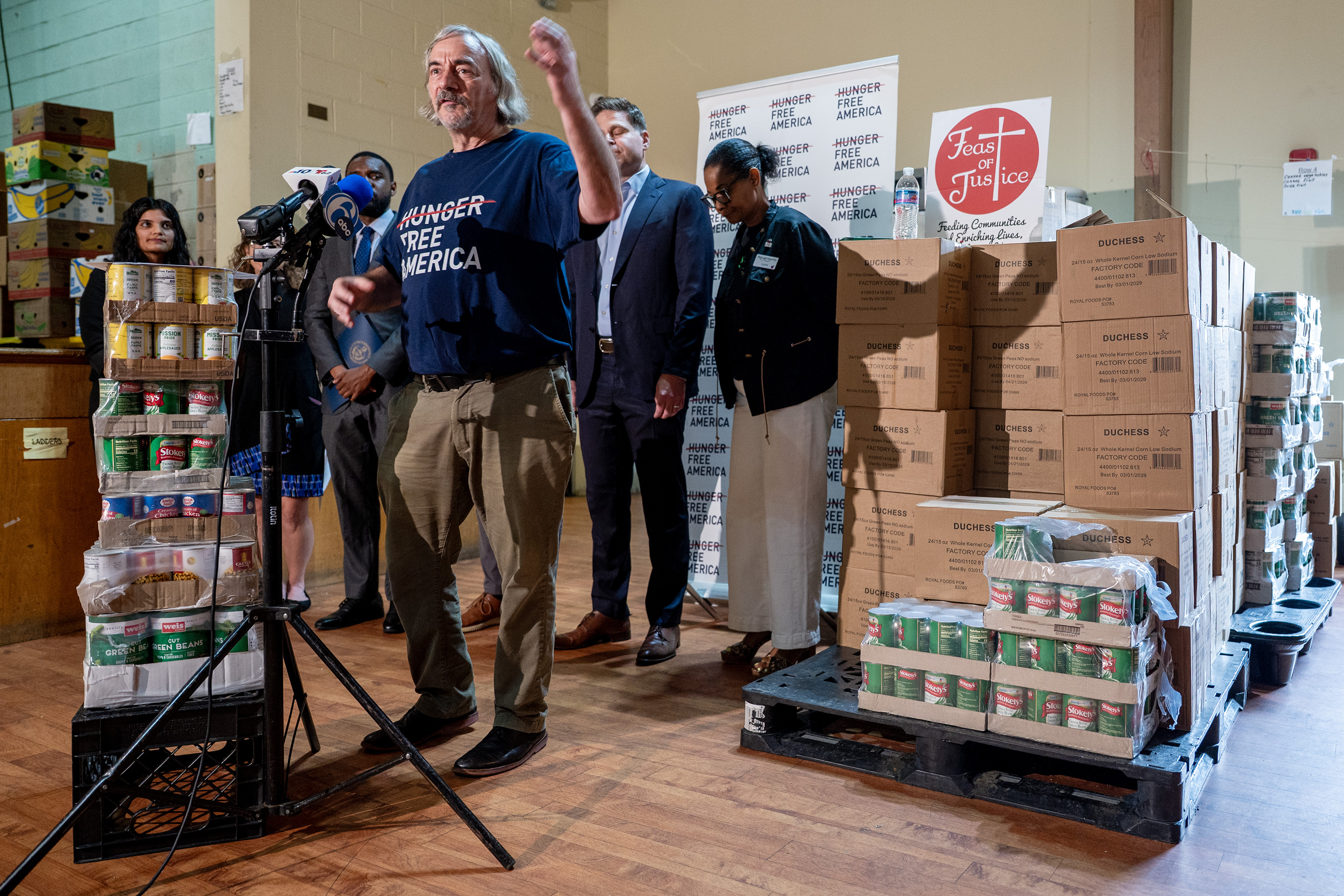
    People throughout the Philadelphia region, hampered by cuts to federal food aid and soaring prices, are “facing a dangerous double whammy causing a skyrocketing hunger crisis,” said Joel Berg, a national hunger fighter, speaking in Northeast Philadelphia on Tuesday.

    Berg, CEO of the New York-based nonprofit Hunger Free America, was visiting Feast of Justice, one of the largest food pantries in the city with “probably the most diverse food pantry clientele in the nation,” he said. That is proof, according to Berg, that food insecurity can affect anyone, from any background.

    Feast of Justice, he added, “is the food affordability issue in the flesh.”

    Especially critical of the One Big Beautiful Bill Act, signed into law by President Donald Trump on July 4, 2025, Berg noted that it included more than $1.1 trillion in cuts to Medicaid and the Supplemental Nutrition Assistance Program (SNAP).

    Roughly 4 million Americans are expected to lose SNAP benefits in 2026 under the law. Many of them do not meet work or age requirements newly added to the anti-hunger program. The reductions in SNAP and Medicaid benefits helped pay for tax cuts ordered by Trump.

    Alahallak Abdelmenim and his children Asil (left), 6, and Hasan (right), 8, load groceries into their shopping cart at the Feast of Justice Food Pantry Tuesday, Aug. 11, 2026.Tom Gralish / Staff Photographer

    In Pennsylvania, around 144,000 SNAP recipients could see benefits cut this year — an estimated 45,000 in Philadelphia and 12,000 in its collar counties, according to Pennsylvania Department of Human Services estimates. In New Jersey, around 50,000 individuals could lose SNAP benefits, New Jersey Department of Human Services figures show.

    It’s not “rocket science,” said Berg, who used a pallet of canned beans and apple sauce as a lectern as he addressed a small crowd at the pantry. “When there’s a drought and you take away water, the drought’s going to get worse. When there’s a hunger crisis, and you take away food, the hunger crisis is going to get worse, especially after you throw in inflation,” he added.

    In response, Trump spokesperson Anna Kelly said Tuesday that Trump is “strengthening” SNAP to sustain it into the future. Changes to SNAP “crack down on waste, fraud, and abuse,” she said. Kelly added that Trump is “uplifting every American’s financial situation by passing the largest tax cut in history — which every congressional Democrat opposed — and bringing historic numbers of jobs and investments into our country.”

    Pastor Tricia Neale, executive director of Feast of Justice, said Tuesday that since the enactment of the One Big Beautiful Bill Act, an additional 1,850 families in Northeast Philadelphia have turned to the pantry for help. Overall within the last five years, she said, the number of households the pantry supports has grown from 2,750 to 6,425, a more than 200% increase.

    “And,” Neale added, “the crisis is accelerating.”

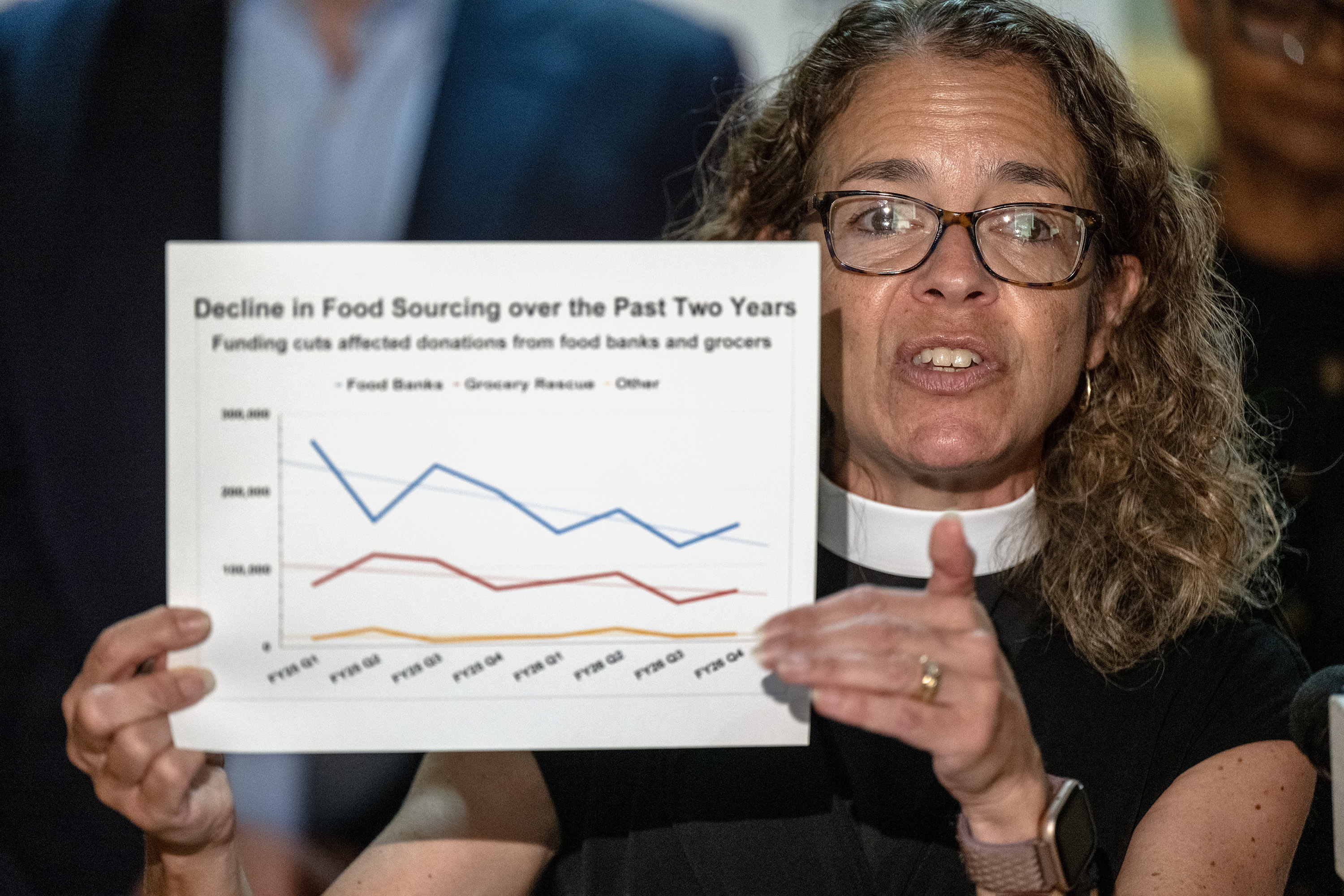
    Pastor Tricia Neale, executive director at Feast of Justice, displays a chart showing the decline in food sourcing as she speaks at a press conference at the food pantry Tuesday, Aug. 11, 2026. Tom Gralish / Staff Photographer

    The pantry has been forced to absorb a 35% decline in donated food it receives, in part because of cuts to federal and state food programs that have been so vital, she added.

    Even with diminished supplies, Feast of Justice is an essential institution, according to Angie Bryant, 55, of Tacony, a client. Formerly a phlebotomist who can no longer work, Bryant said she recently lost her SNAP benefits because new age restrictions exclude her participation.

    “In the body, hunger is hurtful,” she said. “Without this place, I don’t know how I could make it.”

    Food banks such as Philabundance and Share Food Program do their best to provide Feast of Justice whatever food they can, Neale emphasized.

    Volunteer Daniel Khan (center) restocks the shelves as clients load groceries into their shopping carts at the Feast of Justice Food Pantry Tuesday, Aug. 11, 2026. Tom Gralish / Staff Photographer

    If SNAP is the safety net, “we’re the safety net of the safety net,” said Loree Jones Brown, CEO of Philabundance, who joined Berg and Neale at Feast of Justice on Tuesday. “But we can’t make up for the cuts.”

    She added that “this is a crucial time for food banks, legislators, and community organizations to stand together for our neighbors and against hunger.”

    That Feast of Justice does its best to beat back hunger is widely appreciated in the community, said client Anthony Morales, 27, of Mayfair. Laid off from a warehouse job, he said he is responsible for feeding his 7-year-old daughter and his partner, and he needs the pantry’s support.

    “When you fall,” he said, “this place lifts you up. You have a lot of fear and anxiety without enough food. It can give you hope and confidence that tomorrow could be better.”

  • Jalen Hurts’ wide receiver group looks different from what was expected in camp. His preparation keeps moving forward.

    Jalen Hurts’ wide receiver group looks different from what was expected in camp. His preparation keeps moving forward.

    Jalen Hurts has been preparing for this situation.

    On Tuesday, the Eagles offense entered its second week of training camp without DeVonta Smith and Makai Lemon, two of the top (if not the top) receivers on the team. Both pass catchers have missed time with hamstring injuries. While their exact timelines for return are unclear, their ailments are not considered long-term concerns.

    Such is life in the NFL, as Hurts knows. In 2023, for example, he lacked top receiver A.J. Brown for the wild-card blowout loss to the Tampa Bay Buccaneers.

    Smith had 148 receiving yards in that game. No other receiver had more than 32.

    Building chemistry with every receiver, not just the top targets, is critical for a quarterback’s success in the passing game during a long, unpredictable season, according to Hurts. The injuries to Smith and Lemon are reminders of that reality.

    That process of building chemistry doesn’t start during the offseason program, take a break in late June, then pick back up with training camp. Hurts spent time with his receivers, including the tight ends, over the summer for workouts and off-the-field bonding in Orlando, Fla.

    “I put an onus on the time that we spend in the summertime, and that’s always been a very important thing to me,” Hurts said Tuesday. “So the time that we’ve been able to take advantage of in that time and carry that on to where we are now, and the game happens, injuries happen, and so in all, it’s about how you respond, who steps up, and who’s able to fill that void.”

    A variety of receivers are attempting to fill that void, including newcomers Dontayvion Wicks, Hollywood Brown, and Elijah Moore. But perhaps none of the active roster contenders among the receivers corps are more unheralded than Darius Cooper, the 2025 undrafted free agent out of Tarleton State.

    Cooper, 24, made the initial 53-man roster out of training camp last year, but his role on the team wasn’t prominent. Nick Sirianni labeled him one of the “dirty work guys” of the Eagles offense last season, primarily responsible for blocking.

    He had just 11 targets in 2025, resulting in nine receptions for 92 yards. But with Smith and Lemon absent, Cooper’s targets have exploded in training camp. He had his best day on Monday, when he hauled in several impressive catches that ran the gamut of the route tree.

    How good can Cooper be in Year 2?

    “I think he’s pretty good already, and I think he’s going to continue to grow,” Hurts said. “I can’t make you a promise and say that he’s going to be X, Y, Z. Just think he’s going to continue to develop into the player he’s shown he is, and he has very strong hands. He’s always been really good at the deep ball from his time back in small-college Texas ball.

    “He’s got a hunger and he’s got a diligence about himself. And I think those are great competitive qualities, competitive traits that you can have.”

    Hurts also lauded Cooper’s physicality and his “really big catch radius.” Both traits allow him to make contested catches, a skill set he has displayed through two weeks of camp.

    “I just think I’m excited to see him grow, continue to grow, and grow with him,” Hurts said.

    But Smith and Lemon aren’t out of sight, let alone out of mind, as Sean Mannion irons out the offense. Both receivers have been present on the sideline during camp, often listening to the play calls through a headset during team drills.

    The offense is new, but Smith is a seasoned, proven veteran who has missed time during training camp before. Lemon, the first-rounder out of USC, is not. Hurts has been impressed with how the rookie has handled his acclimation to the NFL despite being sidelined.

    He noted that Lincoln Riley, his former coach at Oklahoma and Lemon’s coach at USC, told him that the rookie receiver brings an intensity to his preparation.

    Hurts can sense that intensity, too, even though he isn’t suited up on the field.

    “The way he’s been engaging himself and doing the things that Smitty’s doing, and being right there in the huddle,” Hurts said. “He may not be getting these reps, but am I in the huddle? Am I feeling it? Am I getting that same vibe and that same energy as if I am playing and I do have my pads on? So I just think it’s all in the preparation.”

    The Eagles will have to wait until Lemon recovers from his injury for that preparation to pay off.

    Hurts, while grateful for the increased reps with his other receivers, was hopeful that he wouldn’t have to wait much longer.

    “Hopefully, we can get that ball rolling here soon, get everybody healthy, and see who all we have,” Hurts said.

  • For those playing, the Danny Rumph Classic men’s final was ‘bigger than basketball’

    For those playing, the Danny Rumph Classic men’s final was ‘bigger than basketball’

    Collin Gillespie wasn’t supposed to be in Philadelphia on Monday night.

    The Phoenix Suns point guard’s flight out of his hometown got canceled. With a suddenly clear schedule, Gillespie, who starred at Archbishop Wood and Villanova, looked to make a surprise appearance at the Danny Rumph Classic.

    He did not disappoint.

    Gillespie’s 19 points and six assists helped catapult Team Training By Brunner (TBB) over Team Rumph Center, 103-101, in the men’s final. Fans packed into Drexel’s Daskalakis Athletic Center were treated to a closely contested matchup. TBB led for the majority of the game, but the Rumph Center trailed closely behind until the final whistle.

    Ultimately, it was the heroics of Gillespie and Tyrese Martin, who made nine appearances with the 76ers last season, that allowed TBB to come out on top. Martin, who was named the game’s most valuable player, finished with 33 points and 14 rebounds.

    “I’m here for the people,” Martin said. “That’s what the offseason, the summer’s for. Put on a show for the people at home. So that’s all I’m doing down here, and it was fun to do.”

    Added Gillespie: “It’s always a great environment. Great experience playing here for [something] bigger than basketball.”

    The namesake for the classic is Danny Rumph, a Philadelphia native who died in 2005 from hypertrophic cardiomyopathy — a condition that makes it harder for the heart to pump blood. Rumph went into sudden cardiac arrest while playing pickup basketball at the Mallery Recreation Center in Germantown. He was 21.

    Team TBB’s Collin Gillespie goes for a layup against Team Rumph during the Rumph Classic men’s final.Yong Kim / Staff Photographer

    If Mallery — now renamed the Rumph-Mallery Recreation Center — had a defibrillator on site, Rumph’s life may have been saved. To honor his life, the Daniel E. Rumph II Foundation has provided every Boys & Girls Club and recreation center in Philadelphia with a defibrillator. It also provides regular HCM screenings and CPR training to members of the community. The foundation’s biggest fundraiser is the annual Classic, a five-day pro-am basketball tournament.

    Monday night, which boasted two youth exhibition games alongside the men’s final, was a sellout. The event brought in a crowd made up of mostly families. There also were a few notable names present.

    Rapper Meek Mill and social media star Nasir “Gillie Da King” Fard sat courtside. At halftime of the men’s final, both spent time taking photos with fans. Meanwhile, La Salle forward Anthony Finkley and Villanova guard Tyler Perkins were in attendance. Newly acquired Sixer Jaylen Brown made a surprise appearance on Friday.

    Shark in the water

    Early in Monday’s final, it looked like it would be smooth sailing for Gillespie and company, but there was a shark in the water: Rumph Center point guard Josh Sharkey.

    The Archbishop Carroll graduate willed Rumph Center back into the game after trailing by as many as 12 points in the opening minutes. With under seven minutes to go in the first half, Sharkey drilled a step-back three-pointer and was fouled. The ensuing free throw cut TBB’s lead to three.

    As the Jaws theme song — a nod to his last name — blared through the DAC, the crowd cheered loudly for Sharkey, a Philadelphia native.

    “This is an amazing environment,” said Sharkey, who finished with 22 points. “I don’t get to do this often. I don’t get to play in front of the city. So any chance that I get, I like to put on a show. I’ve been seeing these people since I was like 8, 9, 10 years old. This is a special event. It’s for a good cause, celebrating Danny Rumph, and it’s kind of like a basketball family reunion.”

    Team TBB takes on Team Rumph during the Rumph Classic men’s final at the Daskalakis Athletic Center.Yong Kim / Staff Photographer

    Along with leading Rumph Center in scoring, the 5-foot-10 Sharkey made it his mission to face guard Gillespie.

    “Me and Colin been playing against each other since we was little kids,” Sharkey said. “Man, it’s always a fun battle. I got nothing but love and respect for him, and it’s vice versa. It’s always fun to compete against him. And obviously, he’s a high-level pro, so it’s good to challenge myself and try to compete with him out here.”

    Trying to shake Rumph Center’s swarming defense, Gillespie took a couple of hard falls. He also suffered a small cut on his left cheek.

    “It was super intense,” Gillespie said. “I almost got hurt a couple times, so that wasn’t in the plans. But it got close, and those guys are competitive. They play hard, and it was fun.”

    Former Providence forward and Philadelphia native Clifton Moore was clutch for TBB. He scored all eight of his points in the second half, and blocked a shot in the game’s closing minutes.

    “I know we’re going to stick it out because we’re talented,” Moore said. “We’re a good group of guys. We’re hungry, and it felt good, man. Felt [good] to get one in my hometown.

    Next Bright Stars

    Before the men’s final, Monday acted as a showcase for the next generation of Philadelphia hoopers.

    Local girls’ and boys’ high school players highlighted two 20-minute games. Along with its health-related work and advocacy, the Rumph Foundation has made it its mission to invest in the area’s youth. Last week, the foundation held an event that was centered around using basketball to bridge the gap between generations.

    Viola Owens (right) meets with Team TBB member Tyrese Martin before the Rumph Classic men’s final.Yong Kim / Staff Photographer

    Monday’s youth exhibitions acted as an extension of that goal.

    “Danny Rumph, it’s a legendary league,” Rocky Johnson, a rising junior at Imhotep Charter, said. “It means a lot to me because I was the little kid in the crowd watching the Danny Rumph. Now I’m playing, and it’s surreal to me.”

  • Philadelphia paid $2.3 million to victims of a retired police officer who is behind bars for sexual assault

    Philadelphia paid $2.3 million to victims of a retired police officer who is behind bars for sexual assault

    Patrick Heron is in prison, but Philadelphia’s taxpayers continue to pay for the former police officer’s heinous crimes.

    The city paid $2.3 million last month to settle a lawsuit brought by two women who were sexually abused by Heron when they were children a decade ago.

    A lawsuit by another victim is ongoing in Common Pleas Court.

    Heron, who retired from the Philadelphia Police Department in 2019, was sentenced in 2023 to 15 to 40 years in state prison after pleading guilty to avoid a trial on more than 200 counts of child sexual assault, pornography, kidnapping, and related offenses.

    The 56-year-old was arrested in 2022 and accused of using his position for years to lure girls, often targeting victims who had run away, been arrested, or struggled with addiction.

    The women’s lawsuit accused the city of “reckless disregard for the safety of the public” by allowing a “morally corrupt sexual predator” to remain on the force and victimize at least 48 women and girls, despite years of sustained complaints of misconduct against him starting shortly after he joined the department in 1995.

    The department even began the process to terminate Heron in 2008, the complaint says, following sustained allegations that included “associating with known criminals,” “little to no regard for his position as a police officer,” and having been detained by police officers for soliciting a sex worker in Kensington.

    But Heron maintained his badge and went on to assault the two girls, among other victims.

    “Instead of just firing him, they were moving him around different districts,” said Joshua Van Naarden of VSCP Law, the firm representing the two plaintiffs.

    Heron eventually resigned in 2019 following an internal affairs investigation into an allegation that a uniformed Heron was caught by a CVS surveillance camera attempting to steal a phone charger.

    Heron assaulted one of the two women in 2016 when she was 9 years old. He held her captive in his bedroom, took 22 illicit photographs while she was unconscious, and sexually assaulted her, according to the complaint.

    The former officer sent her a Facebook message in 2021, when the victim was 15, and solicited photos from her as well as sex for money, the suit says.

    And when the teen accused him of acting inappropriately, Heron threatened to have her arrested.

    Heron assaulted the second women in 2016 while on duty. He picked her up from Temple University Hospital’s emergency department when she was 11 years old, after responding to a report that she had run away from home.

    After she was discharged from the hospital to Heron while he was on duty, with instructions to take her home, Heron gave her a laced drink and took photos of the unconscious child.

    Two days later, Heron picked up the 11-year-old from her house and again took illicit photographs of her.

    Both women were involved in Heron’s prosecution, the complaint says, and he pleaded guilty to counts resulting from his crimes against them.

    The woman who was victimized as an 11-year-old did not know about the abuse, which took place while she was unconscious, until law enforcement found photos of her on Heron’s devices, Van Naarden said.

    “There are tons of other victims out there that may not even be aware that they were victimized by him,” Van Naarden said.

    The city deserves credit for settling the lawsuit, which was filed in December 2024, relatively quickly to prevent the women from having to relive their trauma through depositions, testimony, and court hearings, the attorney said.

    The lawsuit was settled in April and the city paid $1.3 million on July 31 to the woman Heron assaulted when she was 9 and $1 million to the woman assaulted when she was 11, a spokesperson for the city’s law department said. There were no other conditions as part of the agreement.

    The city declined to comment further on the settlement or on the ongoing lawsuit.

    A second lawsuit from an alleged victim of Heron was filed in April in the Philadelphia court and tells of similarly harrowing abuse.

    The victim was a 16-year-old mother of a newborn when she met Heron in a courthouse in 2014, the suit says.

    “She was, by every measure, among the most vulnerable individuals Defendant Heron could have encountered in his capacity as a uniformed Philadelphia Police Officer,” the complaint says.

    Heron groomed her, the suit says, and starting in 2015 assaulted at least once a month for a period of four years, often drugging her “to prevent her from accurately recounting or reporting what had been done to her.” The assault included rape, according to the complaint.

    The lawsuit says Heron threatened the girl to secure her silence.

    “He repeatedly reminded her of his status as a police officer and his ability to weaponize that status against her, her child, and her incarcerated family member,” the lawsuit says.

    Ashley Garland, an Anapol Weiss attorney representing the unnamed victim, said her client deserves the same accountability as the two victims who received payment.

    “We are continuing to pursue justice on her behalf,” Garland said in a statement, “and we hope the city changes how it handles officers with sustained misconduct records, preventing them from harming the residents they are supposed to protect and serve.”

  • Janet Klein, celebrated longtime historic preservationist and philanthropist, has died at 96

    Janet Klein, celebrated longtime historic preservationist and philanthropist, has died at 96

    Janet Klein, 96, of Rydal, Montgomery County, former member of the Philadelphia Historical Commission, historic program director for the Fairmount Park Commission, regional project coordinator for the National Trust for Historic Preservation, chair of the Pennsylvania Historical and Museum Commission, volunteer, and philanthropist, died Tuesday, Aug. 4, of age-associated decline at her home.

    Born in Philadelphia, Mrs. Klein earned degrees at Philadelphia High School for Girls and the University of Pennsylvania. She and her husband, Lewis, traveled the world after they married in 1952, and she told The Inquirer in 1973 that she became interested in local historic preservation after returning from abroad in 1964.

    “I felt something was lacking here,” she said. “There was no pride nor a thorough knowledge of what we really have in Philadelphia to share with visitors.”

    So she joined the Philadelphia Museum of Art’s tour guide program, rose to chair of guides for the Fairmount Park house tours, and conducted hundreds of tours for thousands of visitors to the eight historic houses in the park. “The guides,” she said in 1973, “can’t help but sense that somehow they have passed on to the visitors the continuing life of historic Philadelphia.”

    Eventually, Mrs. Klein became historic program director for the Fairmount Park Commission, was appointed to the Philadelphia Historical Commission by then-Mayor Wilson Goode in the 1980s, and served as chair of the Pennsylvania Historical and Museum Commission from 1997 to 2003. Friends called her “formidable” and compared her to the Energizer Bunny.

    Keen to spark public interest in historic sites, Mrs. Klein forged partnerships between site officials and schools, community groups, businesses, and the media. In 1997, she oversaw filmmakers as they shot scenes for the movie Beloved at the Landis Valley Museum in Manheim Township.

    She appeared often in The Inquirer and said in 1989: “We often find that people who live just around the corner from a house museum don’t know it existed.”

    At Fairmount Park, she redefined the commission’s operating procedures and enlisted students as volunteers at its public mansions. At the city historical commission, she led walking tours of Old City and helped determine the historic designation of the old Lit Bros. building, the Boyd Theatre, the Dilworth house, and other significant structures.

    This story and photo of Mrs. Klein (right) was published in The Inquirer in 1973.Newspapers.com

    With the state historical and museum commission, she erected historical markers across the state, helped designate the Art Museum as a Commonwealth Treasure in 2002, and directed the commission’s public relations, tourist promotions, and preservation efforts.

    “History doesn’t have to be dead,” she said in 1998. “Historical markers represent the people and their interests. They are a way for young people to learn about their heritage and gain a personal respect for the past.”

    She also led the Comprehensive Historic Assistance Program for the National Trust for Historic Preservation in the 1980s, helped create the Liberty Trail near Independence Hall, and directed the restoration of the first historic home in the Lukens National Historic District of Coatesville.

    She served on the board of visitors at Temple University’s Ambler campus and Klein College of Media and Communications, on the collections committee at the Union League, and as a guide at the Winterthur Museum in Delaware. She was active with the Pennsylvania Department of Conservation and Natural Resources, the Museum Council of Philadelphia, and other groups.

    This story and photo of Mrs. Klein appeared in The Inquirer in 1998.Temple University

    She was honored for her service by the Women’s Center of Montgomery County in 1999 and by the Preservation Alliance for Greater Philadelphia in 2001, and was named a Distinguished Daughter of Pennsylvania in 2000. In 2018, she earned an award for service and philanthropy from Coatesville’s National Iron and Steel Heritage Museum.

    As philanthropists, Mrs. Klein and her husband supported what became, named after them, the Klein College at Temple, the National Association of Television Program Executives, the Police Athletic League, the American Heart Association, and other organizations dedicated to education, healthcare, youth development, and social service. They created the Janet and Lew Klein Making A Difference Award for the Pennsylvania Association of Broadcasters and donated his professional papers to Temple.

    “She was an inspirational community leader,” said David Boardman, dean of Temple’s Klein College, “who inspired others through her generosity, her brilliance, and her warmth.”

    Janet Surman was born March 3, 1930. She grew up in Oak Lane and earned a bachelor’s degree at Penn.

    Mrs. Klein (left) appeared with others in 2007 to celebrate a historical marker at the corner of 9th and Christian Streets.Alejandro A. Alvarez / Staff Photographer

    She met Lewis Klein in college, and they married in 1952. They had a son, Stephen, and a daughter, Ellen, and lived in Melrose Park and Rydal. Her husband, a pioneering TV broadcaster and cofounder of Gateway Communications, died in 2019.

    Mrs. Klein and her husband traveled the world for decades and attended dozens of galas and fundraising events. She enjoyed gardening, was an avid reader, and liked to play Scrabble.

    In 1993, Inquirer columnist Clark DeLeon called her “a wonderful, funny, vivacious lady.” Temple’s Boardman said: “She was truly one of the best human beings I’ve ever had the privilege to know.”

    In addition to her children, Mrs. Klein is survived by a granddaughter, two great-grandchildren, and other relatives.

    A celebration of her life is to be held later.

    Donations in her name may be made to the Abington Police Athletic League, 1166 Old York Rd., Abington, Pa. 19001.

    Mrs. Klein grew up in Oak Lane and earned a bachelor’s degree at Penn. Courtesy of the family
  • Edwin López Cornejo prayed for another year to see his daughter grow up. He died in ICE custody.

    Edwin López Cornejo prayed for another year to see his daughter grow up. He died in ICE custody.

    Half a year into fatherhood, Edwin Jeovanny López Cornejo found the sight of his daughter, Ashley, revitalizing after a long day at work.

    It was 2014. López Cornejo, an immigrant from El Salvador, had been working at a packaging company in South Plainfield, N.J., for about seven years. He came to the United States in 2007, filed an asylum claim, and received employee authorization from the federal government after being deported the year prior, according to court documents.

    As he would often do in the years that followed, he took to Facebook to express his gratitude to God and his love for his daughter.

    This past Friday, Ashley Lopéz, now 12, wore all black. She stood between her paternal grandparents as they held each other and wept at her father’s wake at Crescent Avenue Presbyterian Church in Plainfield.

    López Cornejo had died in ICE custody just under a week earlier at the age of 39 after experiencing what the federal agency called a medical emergency at Delaney Hall, an ICE detention center in Newark run by the private company GEO Group.

    Ashley has barely been speaking. Or eating. And she does not want to be around people, María Cornejo, her paternal grandmother, told The Inquirer in an interview on Monday, speaking in Spanish.

    Letters of support submitted to the court after his June arrest, remarks from his family, and more than a decade of public Facebook posts written in Spanish paint the picture of a father who deeply loved his daughter.

    Twelve years ago, Lopéz Cornejo and his then-girlfriend were expecting twins, but the boy died in the fifth month of pregnancy, Cornejo said.

    “She is the only child he had. You should have seen him when she was born. That man was the most joyful man with his daughter in his arms,” Cornejo said. “It was his first time being a father, and he wouldn’t even sleep so he could watch her sleep and make sure she was OK.”

    López Cornejo was unable to see his daughter at Delaney Hall. He had been there for about six weeks.

    Delaney Hall has been the site of high-profile political clashes representing the national conflict between Trump’s supporters and immigrant rights advocates. The detention center serves a critical role for the president’s mass deportation agenda, and complaints of poor and unsanitary conditions have sparked continuous protests, uproar from Democratic lawmakers, and a reported hunger strike inside, which the Trump administration denied happened.

    In December, a 41-year-old Haitian national named Jean Wilson Brutus died one day after entering Delaney Hall, and U.S. Rep. Rob Menendez (D., N.J.) recently said another person died at the hospital after a potential seizure at the facility earlier this summer. Nationally, at least 23 fatalities in ICE custody have been reported this year as the rate has increased during Trump’s second term.

    López Cornejo’s asylum claim was still pending — 19 years after he filed it — when ICE agents arrested him, according to a habeas corpus petition challenging his detention.

    An undated photo of Edwin López Cornejo and his daughter, Ashley, in a pool.Courtesy family of Edwin López Cornejo

    Around 9 a.m. June 18, López Cornejo headed out to pick up his car from a towing company, where it had been taken for being parked for too long, his mother recounted Monday. She urged him to take a taxi and avoid walking, given a heightened fear of running into ICE in the community.

    She said goodbye, unaware it would be the last time she would hug her son.

    Lopéz Cornejo ended up walking because roads were closed.

    Masked agents stopped him and asked for his ID. When he produced his Salvadorian identification, they put him in an unmarked vehicle with two other people who had already been detained, his lawyer Ingrid Echeverria recounted in the habeas corpus petition.

    Cornejo said her son called her from inside Delaney Hall that evening. The first question he asked was about Ashley.

    According to his family and court documents, he took medicine for diabetes, epilepsy, and high blood pressure. Interruption of his strict medication schedule carries the risk of breakthrough seizures and associated harm, according to the petition. That July 24 court document did not accuse ICE of denying him his medication but expressed concern over potential medical risks if he was transferred to another facility, as the agency at one point planned.

    On. Aug. 1, Cornejo got a call from University Hospital in Newark. The person on the phone told her that her son’s heart was not beating by the time he arrived, after he collapsed at Delaney Hall. ICE has not released an official cause of death, but U.S. Sen. Andy Kim (D., N.J.) said it was a heart attack and cardiac arrest. Days after his death, Kim and fellow New Jersey Democratic U.S. Sen. Cory Booker put forward legislation that would require the shuttering of Delaney Hall.

    New Jersey Attorney General Jennifer Davenport said last week that her office was launching a civil rights investigation into Delaney Hall, citing reports of “alarming conditions” and recent deaths.

    Sen. Andy Kim (D., N.J.) stands between federal agents and demonstrators in an attempt to prevent a clash outside the Delaney Hall migrant detention center in Newark, N.J., on May 25.DAKOTA SANTIAGO

    In response to López Cornejo’s death, ICE put out a statement saying that everyone in ICE detention gets proper, around-the-clock medical care, and that López Cornejo “was seen by medical professionals.”

    His family doesn’t buy it. They blame ICE for detaining him and accuse the agency of failing to provide him proper medical care. Danilo López, his brother, said at a news conference that his brother told him over the phone that he had to fill out a form to just get Tylenol at Delaney Hall and it could be days before he received it, a claim ICE did not directly address when asked.

    “He lived a normal life and worked normally while taking his medicine and with a proper diet, working more than eight hours a day, and had no problem,” Cornejo said in the interview.

    Just days after her father died, Ashley López said at a news conference: “On the same day, we were both dead. The only difference was his heart stopped beating. I am going to grow up without a father.”

    Family members of Edwin López Cornejo including (from left) his mother Maria Cornejo, daughter, Ashley, and his former wife, attend a news conference on Tuesday, Aug. 4, 2026, in Highland Park, N.J. Yuki Iwamura

    ‘The true love of my life’

    On his daughter’s first birthday, López Cornejo wrote on Facebook that Ashley gave him “one more reason to live.”

    “I want to tell you that when I learned you were going to be born it felt like it would be forever before I had you in my arms,” he wrote. “I will never forget the first day that I changed you and gave you a feeding bottle. Wow my girl, those moments I will never forget and now you are turning one. Wow how the time passes.”

    An undated photo of Edwin López Cornejo with his daughter, Ashley.Courtesy family of Edwin López Cornejo

    On her third birthday, he called her “the true love of my life,” and said she motivated him to be strong and keep moving forward.

    “I would be willing to give my life for yours,” he wrote.

    On his own birthday, he often thanked God for another year of life. And as a birthday wish, he asked for another year to see his daughter grow.

    Ashley, a U.S. citizen, was born in New Jersey, according to the petition, which includes her birth certificate and public school records to support his lawyer’s argument that López Cornejo has community ties. The documents show she received a certificate of achievement for math at 9 years old “for demonstrating fluency of division” in less than six seconds. And shortly after she turned 10, she was crowned “Art Leader of the Week.”

    Ashley lived with her dad half the week, but he picked her up from school every day, and she would run into his arms to greet him, Cornejo said. He took pride in her success in school.

    “He would tell her, ‘I want you to be a doctor so you can cure me one day,’” she said.

    Family members of Edwin López Cornejo arrive at an Aug. 4 news conference in Highland Park, N.J.AP Photo/Yuki Iwamura

    A hard worker

    López Cornejo started working in construction just three weeks before his detention after the warehouse he worked at changed locations, his mother said.

    Court documents show he worked at UpperClass Warehouse in South Plainfield from March 2021 until this May, and he previously worked multiple restaurant jobs in New Jersey. He paid taxes to the state of New Jersey and the federal government.

    Jesse Fischbein, vice president of finance at Just Packaging, where López Cornejo worked from 2007 to 2015, said in a letter of support attached to the petition filed with the court last month that he “truly was a company-first employee, who didn’t believe that the workday was simply 7 AM to 3:30 PM.”

    “He was punctual, always pitching in to help other employees when his tasks were completed, and always asked management if there was more to be done,” Fischbein wrote.

    People detained inside Delaney Hall stand at windows in Newark, N.J., as demonstrators gather outside on May 28, 2026. The protests were fueled by reports of detainees staging a hunger strike over the conditions of their confinement.TODD HEISLER

    But Fischbein said there was one thing López Cornejo would always be better at than his job: being a father.

    “From what I know about him outside of work — he is a father, and that is the job he excels at more than any function he performs for my company,” Fischbein said.

    A coworker-turned-friend, Juan Zavala, said in another letter of support that López Cornejo had “earned the respect of everyone around him” through kindness, compassion, respect, and honesty.

    “He is a loving, responsible, and caring parent who is deeply involved with his daughter’s life and always puts her well-being first. It is very clear that his family means everything to him,” Zavala wrote.

    One of the ways López Cornejo expressed himself to his loved ones was by sharing links to music on Facebook. He dedicated love songs to his daughter and others, he shared reflections during the pandemic with a Christian worship song, and he said the music video for “Pose” by Daddy Yankee — the singer known for the hit song “Gasolina” — inspired him to learn to dance reggaeton.

    López Cornejo and Ashley dreamed about dancing together at her quinceañera, a celebration for her 15th birthday.

    “He just wanted to dance the waltz with his little girl, and they so looked forward to that party,” Cornejo said, crying. “Now my little girl won’t have her dad.”

    Family members walk to the church side entrance during the wake of Edwin López Cornejo, after his death in ICE custody in New Jersey on Aug. 7 in Plainfield N.J.Max Blease / For The Inquirer

    ‘Profoundly difficult consequences’

    In the July 24 petition, his lawyer called on ICE to explain why he was detained, and consider either his immediate release or a hearing in front of an immigration judge.

    His lawyer said that he was served with documents in English he could not read, and that he did not have a criminal record and always showed up for his court dates.

    His friends and family described him in similar terms in letters of support submitted to the court last month.

    Kelvin E. Urquilla Flores, who met López Corneja at Just Packaging nearly 20 years ago, described him as “a peace-loving, law-abiding individual” who is “an asset to this country and to his community.”

    Edgar Fabián Guaman, who said he had known López Cornejo for almost two decades, said that his family friend did not present a risk to the community — but instead improves the well-being of those around him.

    “I respectfully express that a possible separation of Mr. López Cornejo from his family unit would have profoundly difficult consequences for his daughter and his mother, who depend on his presence, support, and emotional stability,” Guaman wrote.

    An undated photo of Edwin López Cornejo and his daughter, Ashley.Courtesy family of Edwin López Cornejo

    Through his Facebook posts, López Cornejo shared a deep appreciation for his parents. In May 2016, he thanked God for giving him “an exemplary mother,” whom he also described as a “second mother” to his own daughter.

    “Maybe I’m not the perfect son, but I try to behave at your level, mother,” he wrote. “I know you gave me the greatest gift, life, and I will never be able to repay you, mother.”

    The last post that shows up on López Cornejo’s Facebook page was a message directed to God and his daughter on her 12th birthday last November.

    Staff writer Abraham Gutman contributed to this article.

  • Gov. Sherrill targets ‘big tech’ with new law aimed at kids’ social media use

    Gov. Sherrill targets ‘big tech’ with new law aimed at kids’ social media use

    Social media platforms will face a bevy of new restrictions in New Jersey that limit their use of children’s data, restrict algorithmic content recommendations to minors, and block notifications during school hours, among a range of others.

    The new restrictions, which are set to take effect in September 2027, flow from legislation Gov. Mikie Sherrill signed Tuesday and are New Jersey’s bid to regulate tech giants the governor said federal policymakers had largely left to their own devices.

    “Big tech isn’t just the big tobacco of our era. They are worse. They designed platforms that highjacked our kids’ attention spans,” Sherrill said at a bill signing ceremony in Jersey City. “The typical American teen spends about 35 hours a week, almost a full-time job, on platforms like TikTok, Instagram, and YouTube.”

    The restrictions in the New Jersey Kids Code Act would require privacy settings on minors’ social media accounts be set to their strictest mode and would limit platforms’ ability to request minors change those settings.

    It would restrict platforms’ use of children’s data to the purposes for which it was collected and bar algorithmic content recommendations unless a minor specifically requests more or less content from a given account or of a specific type.

    The restrictions mandate that social media platforms limit the discoverability of children’s accounts, both to adults on their own sites and through search engines.

    And the law will bar social media platforms from sending notifications to minors between 8 a.m. and 4 p.m. on school days between Labor Day and Memorial Day and block notifications between 10 p.m. and 6 a.m. at all times of the year.

    Assemblywoman Andrea Katz was a chief sponsor on the bill to restrict how social media platforms deliver content to children.Anne-Marie Caruso / New Jersey Monitor

    “Half of parents say their children’s mental health has suffered over the past year because of social media,” said bill sponsor Assemblywoman Andrea Katz (D-Burlington). “Nearly half of teenagers say they lose sleep every single night because they feel stuck on these platforms.”

    The law permits both parents and the New Jersey attorney general to sue over violations. If they’re victorious, courts could award $5,000 per violation or treble damages — an amount equal to three times the harm suffered — whichever is greater, plus attorney fees.

    They can also order punitive damages for reckless or knowing violations and injunctions to bar offending conduct.

    Lawmakers on Tuesday described a social media landscape that had sold children’s mental health for engagement and shifted threats that once appeared in physical spaces to digital ones.

    “When I was a kid, our parents worried about strangers and who’s talking to us at the park or at the mall,” said bill sponsor Sen. Raj Mukherji (D-Hudson). “Today, we have to worry about who’s DMing them, what algorithms are pushing into our kids’ feeds, and what sensitive information is being collected, used, even sold before they’re old enough to understand what they’re giving away.”

    Meta, which operates Facebook, Instagram, and other social media platforms, did not immediately respond to a request for comment.

    Other bills Sherrill signed Tuesday order the creation of a social media research center at one of the state’s public four-year universities and direct it to begin studying the efficacy of social media warning labels and disclaimers in curbing social media addiction among children.

    The state’s higher education office began accepting proposals for the center Tuesday and aims to open it sometime this fall with a $500,000 appropriation from the state’s budget.