Ben Folds will be on hand in December to celebrate the 25th anniversary of the Kimmel Center. The singer-songwriter will perform with the Philadelphia Orchestra and conductor Steven Reineke in the center’s Marian Anderson Hall Dec. 16 in a concert benefiting the orchestra musicians’ retirement fund.
Philadelphia’s arts center opened Dec. 14, 2001 with a series of concerts that included Elton John, Denyce Graves, and Yo-Yo Ma.
Folds has been a frequent visitor to Philadelphia ensembles, most recently in 2025 for the Independence Day concert by the reconstituted Philly Pops. This will be his third performance with the Philadelphia Orchestra. His first, in 2014, featured his Piano Concerto and orchestral arrangements of his songs.
Folds was artistic adviser to the National Symphony Orchestra and was among a number of artists who canceled appearances or ended relationships with the John F. Kennedy Center for the Performing Arts after Pres. Trump took control of the center.
Folds ended his 2025 appearance on Independence Mall prematurely when rained arrived and he broke into “Raindrops Keep Falling On My Head.” He did have time to perform “Kristine From the 7th Grade,” a work about a one-time classmate who begins sending him all-cap emails laced with dark memes and pseudoscience.
“Oh, what a shame, Kristine, this disease that makes strangers of friends,” the song went. “It’s such a short and sad and beautiful life. Do you ever see it that way?”
The program for Folds’s upcoming Philadelphia Orchestra concert is still under development, a spokesperson said. His 2019 program featured his own tunes, including “Brick,” “Zak and Sara,” “Jesusland,” “You Don’t Know Me” and “The Luckiest.”
Tickets — which range in price from $69 to $159 (plus fees) — go on sale for subscribers and members Oct. 5 at noon, with general tickets available beginning Thursday at noon. philorch.org, 215-893-1999.
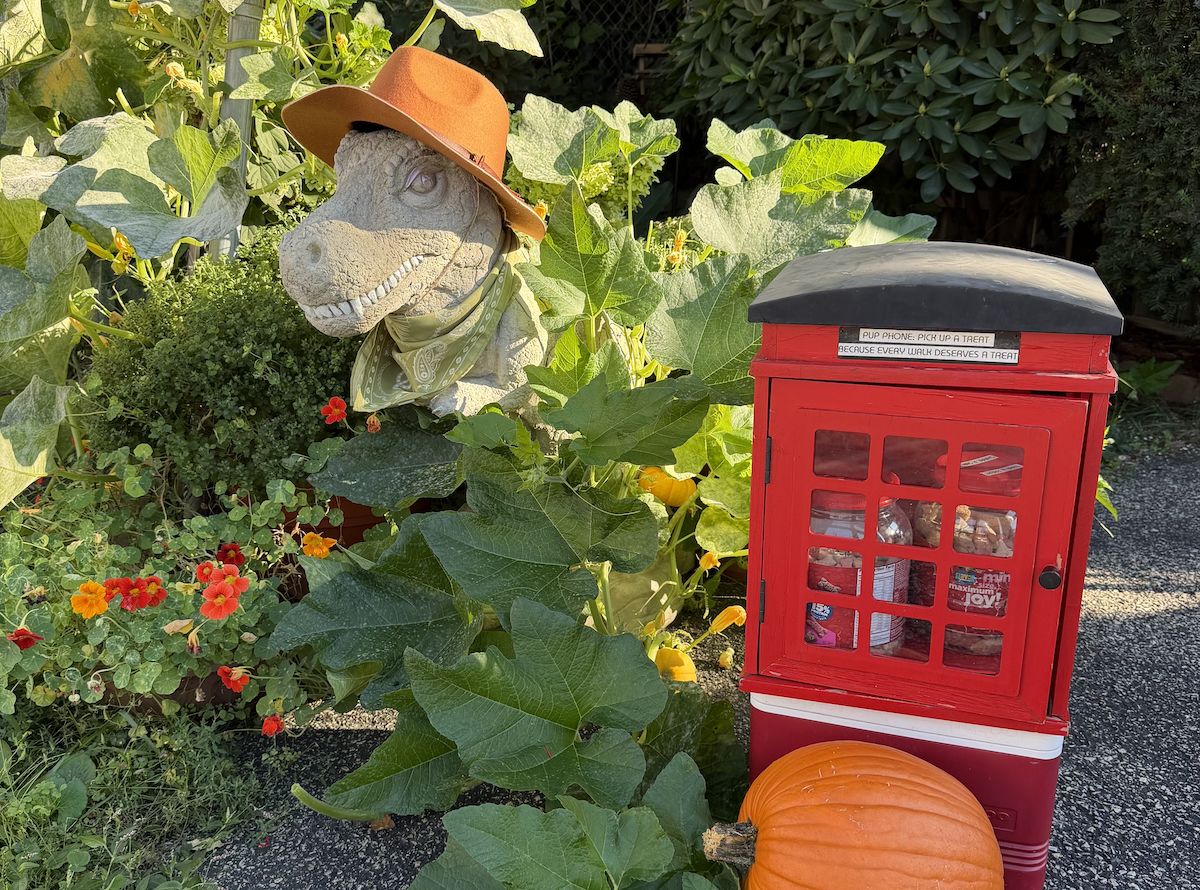
Roxborough and Manayunk residents have ushered the latest tale into the Philadelphia canon with the proliferation of 3-foot-tall, 300-pound concrete Tyrannosaurus rexes on neighborhood lawns. Or “Tyrannosaurus Rox,” as some say.
People outside the neighborhood may have heard of the lawn ornaments after the toppling and decapitation of “Bridget the Dino,” one of the community’s favored dinosaur statues, last year (a new dinosaur, Manny, soon took over Bridget’s watch of the Manayunk Bridge Garden).
Manny the dinosaur, wearing a mustache, goatee, and beaded necklaces, oversees the Manayunk Bridge Garden on Sept. 29. Manny is the successor of Bridget, who was toppled over in 2025, and oversees the garden as its protector and mascot.Henry Savage / Staff
But questions remained about why the neighborhood is drawn to these toddler-sized lawn creatures, leading one Mount Airy resident, Liz Pride, to undertake an unofficial survey of dozens ofdino statue owners in Northwest Philadelphia.
“Going into this project, I was just really curious about the people who own the statues,” Pride said. “I think one of the things I was surprised by is that children were not a big factor in people deciding to get one.”
Of the 40 dino statue owners who responded, 19 live in Roxborough and six in Manayunk, with a handful each from East Mount Airy, East Falls, Germantown, and the Philly collar counties, giving Pride a geographical range. Her survey also got responses from Pittsburgh, New Jersey, and even as far as Massachusetts.
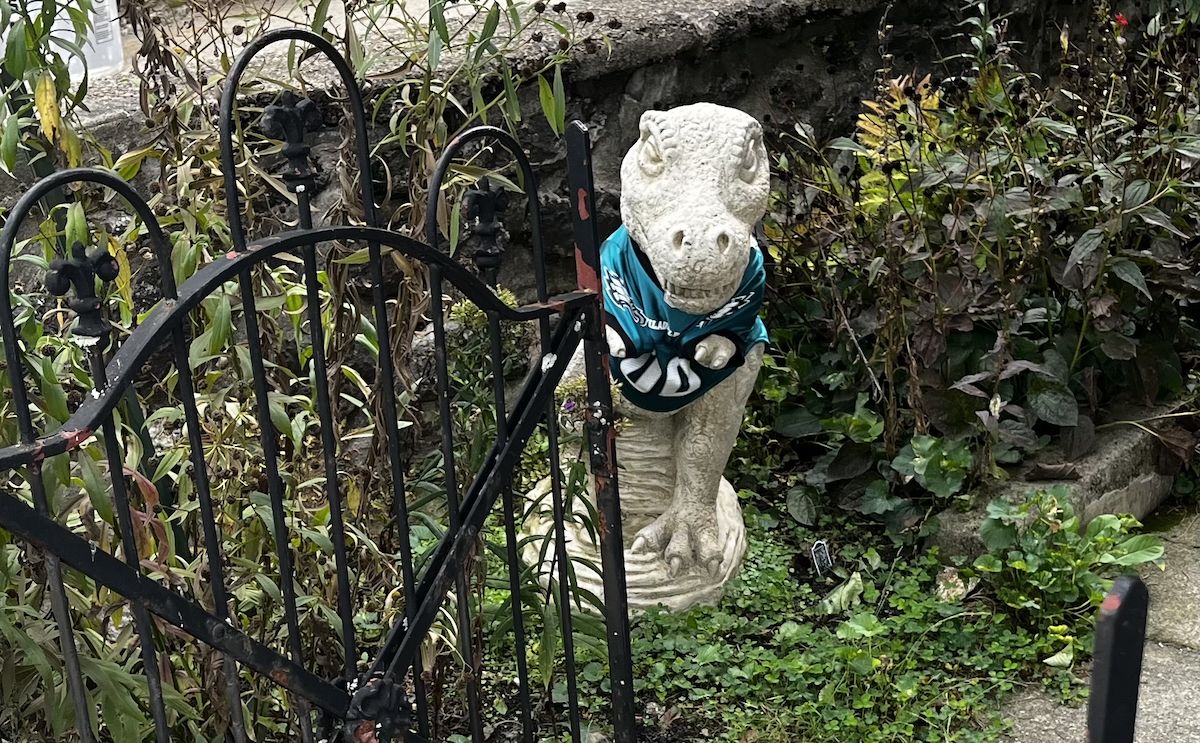
A Holod’s dinosaur lawn statue wearing a Philadelphia Eagles jersey in Roxborough on Sept. 29. The Tyrannosaurus rex concrete statues are a fascination of the Roxborough/Manayunk community.Henry Savage / Staff
Pride soon found that the dino statues connect neighbors through an inside joke shared on morning commutes and afternoon walks as they pass painted and costumed dinosaurs, whether it’s Hans and Roberta one day, or Steve and Sir Salvatore Rexington another (yes, those are real names of Roxborough dinos).
Dinosaur owners are committed to the bit, since each statue costs roughly $200, depending on the model.
“The statues seem to bring joy to everyone that comes across them to either snap a pic or make them a part of their daily walk. It’s kids, their parents, adults, and dogs alike, all love them,” said Melissa Hojnacki, who has a Roxborough-style dino at her Bridgeport home.
Just over half of respondents said they knew someone else with a dino statue, and at least a third said they were pressured into it by a friend or gifted the statue, Pride found, which she detailed in her newsletter blog, “Ur Fictional Boyfriend” (a nod to her viral Tumblr post that garnered its own Wikipedia page covering the joke).
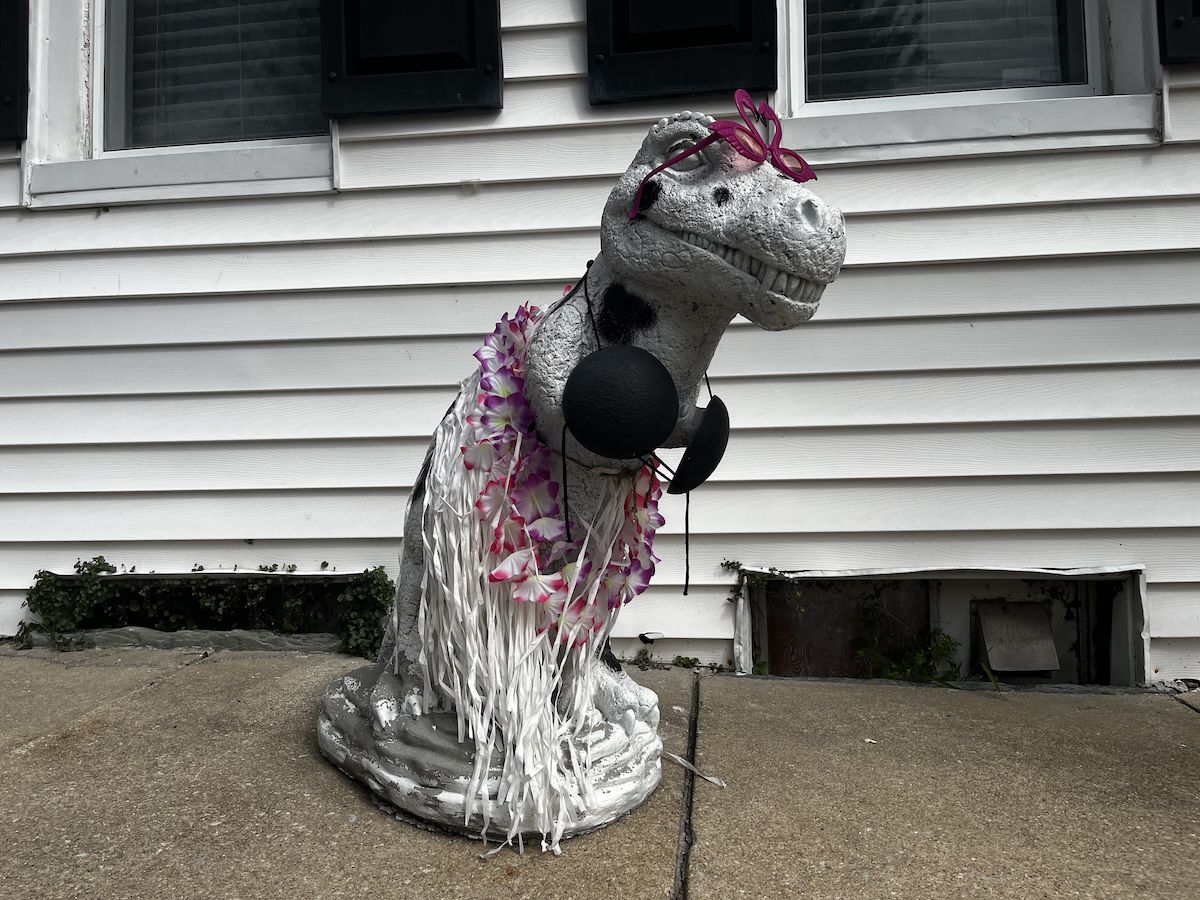
Becca Didio, a Manayunk resident and parent to Roberta, a T. rex draped in a hula skirt, coconut bikini top, and flamingo sunglasses, said she got Roberta simply because she loves dinosaurs. In her kitchen sit a dinosaur cookie jar containing tea bags named “Tea-rex” and a salt-and-pepper shaker set with a bow tie-wearing T. rex.
Roberta the dinosaur, dressed in a hula skirt, coconut bikini top, and flamingo sunglasses, in front of Becca Didio’s Roxborough home on Sept. 29. Didio often submits Roberta in Holod’s annual dinosaur costume contest around Halloween.Henry Savage / Staff
“It’s just something fun and goofy,” Didio said. “It’s become a thing that Manayunk-Roxborough is known for, so much so that it’s a coveted thing now.”
The dinosaur has grown to become a symbol of neighborhood gatherings, like the logo for Roxyunk Porchfest. During holidays, dinosaurs become draped in spooky Halloween costumes and Santa Claus outfits. But, most importantly for the support of Philly sports teams, the dinosaurs will often wear Eagles and Phillies jerseys, Didio said.
A Holod’s dinosaur lawn statue wearing a Philadelphia Eagles jersey in Roxborough on Sept. 29. The Tyrannosaurus rex concrete statues are a fascination of the Roxborough/Manayunk community.Henry Savage / Staff
But where do the dinosaur statues come from?
These stubby-armed, toothy-grinned statues with a thousand-mile stare largely come from one place: Holod’s Garden Center on Ridge Pike in Lafayette Hill.
Many of Pride’s survey takers recounted a commonly told myth of how Holod’s acquired these beauties: “Legend has it that Holod’s ordered birdbaths and got a whole stack of dinosaurs instead. They became popular because we’re a fun bunch here,” one respondent wrote.
A Holod’s dinosaur lawn statue overseeing a resident’s front lawn garden in Manayunk on Sept. 29. The Tyrannosaurus rex concrete statues have become a symbol for some of the Roxborough/Manayunk community.Henry Savage / Staff
While Roxyunk residents are indeed a fun bunch, “That’s urban legend,” said owner Louis Holod, named after his father, Louis Holod Jr., and grandfather, Louis Holod Sr., who founded Holod’s in 1958 as a roadside gas station.
However, the dinosaurs’ backstory is much simpler and dates further back than what most locals remember.
In 2009, when the Holod family opened its gift shop, LouisHolod Jr. knew to trust the lawn ornament sales reps at trade shows better than his own tastes, his son said, and asked for their top sellers. The T. rex happened to be one of them.
When the first shipment of lawn ornaments came in, two T. rex statues came with it. When those sold, they ordered four more, and so on, until today, 17 years later, when they order them by the hundred.
Holod is happy to see the mythos grow with a neighborhood that embraces the dinosaurs as something more.
Now the dinosaur statues — and the latest set of baby dinosaur statues, so lawns, Holod said, can have “a whole dino family” — are an integral part of the brand. And don’t miss out on the annual Halloween costume contest.
Jeff Lipscomb, a high school orchestra director in Kanawha County, West Virginia, has been doing a lot of math.
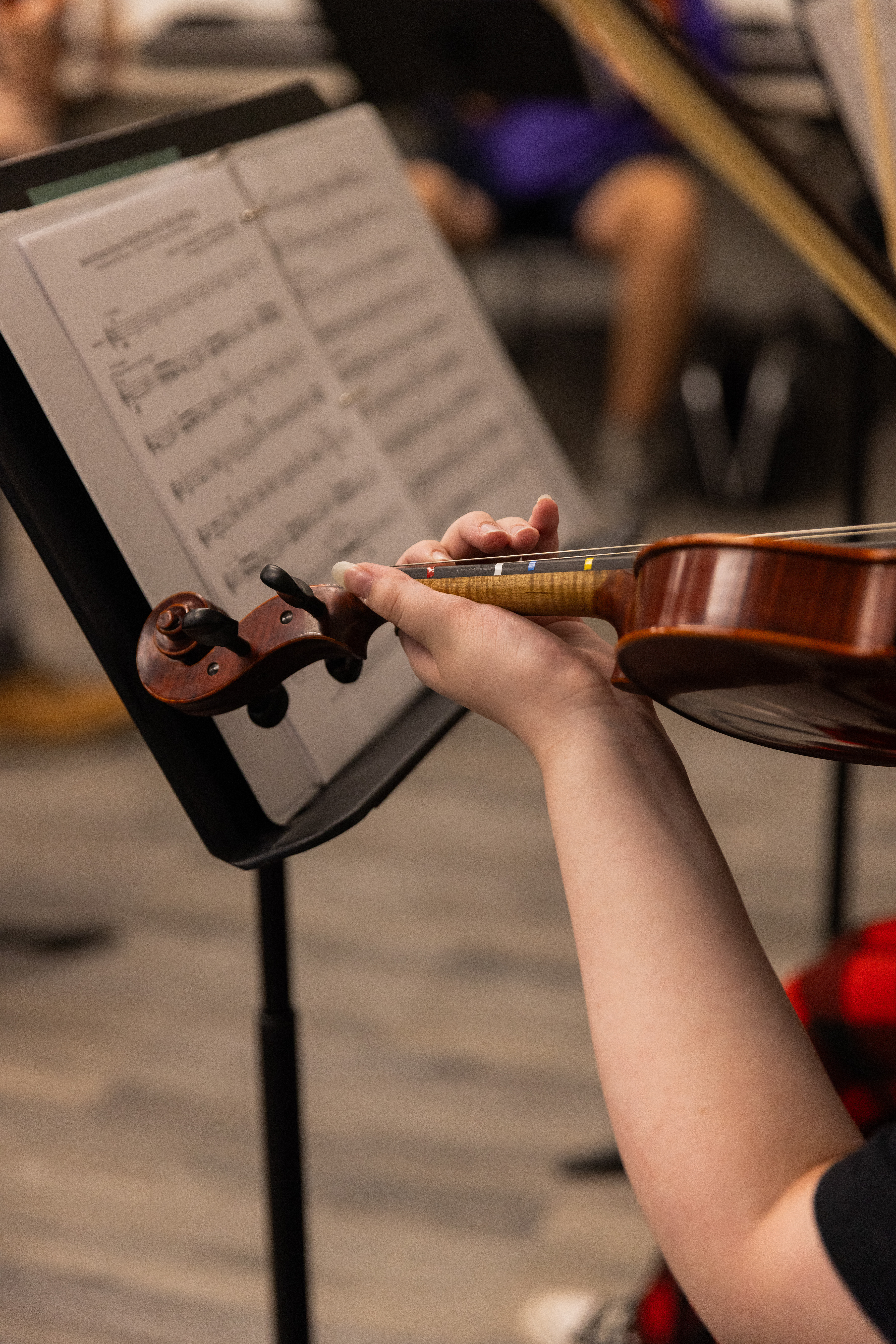
For example, he has 12 cellists but only 10 cellos. If the school district gives him a total budget of $500 to $600 for the year, but one new cello costs more than $1,000, what should Lipscomb do? What if he needs some new violins and violas, too?
“I’ve actually had to buy instruments out of my own pocket,” Lipscomb said from his classroom at South Charleston High School on the first Monday of the school year. “I just kind of have to.”
Like many music teachers, Lipscomb has become attuned to tight budgets. Lately, though, the cost of instruments has ballooned beyond his ability to make do.
Pandemic-era supply chain snarls lifted prices for goods across the board. President Donald Trump’s global tariffs further swelled the cost of foreign-made instruments. Then in August, the Trump administration proposed additional 25% tariffs on trumpets, tubas and other brass instruments, citing “national security threats” under a provision it has used to impose duties on foreign metals.
The consequences have reverberated across the country. Higher instrument prices are a particular threat to lower-income districts where enrollment and budgets are shrinking.
An elementary school music teacher in Beaverton, Oregon, has considered 3D printing ukuleles because she cannot afford them. In Passaic, New Jersey, an arts administrator is doubling down on encouraging students to clean and care for their instruments so they last longer. The superintendent of a small district in Washington County, Pennsylvania, has taken to scouring eBay and Facebook Marketplace for used instruments.
Proponents of musical education say the tariffs are endangering school music programs and threatening to push the extracurricular activity out of reach for many families. John Mlynczak, the CEO of the National Association of Music Merchants, a trade group, warned that higher instrument prices could lead to “empty music classrooms.”
“The camaraderie that happens in a community when everyone goes and supports the Friday night football game?” he said. “Imagine that without a marching band.”
Some instruments, such as higher-end Fender and Gibson guitars, are made in the United States. But most elementary, middle and high schools rely on less expensive beginner instruments that are largely made in China. Many school districts own or rent instruments they lend to students at no or little cost.
As Trump escalated his trade war with China last year, music teachers grew wary.
Schools were already dealing with a confluence of challenges, including the end of federal pandemic aid, budget cuts and declining enrollment. Inflation was driving up costs.
“It’s kind of like a perfect storm of all these different things happening at once that can cause a bigger mess,” said Annamarie Bollino, a seasoned public school arts administrator who sits on the executive board of the National Association for Music Education, an advocacy group.
She said she expected that the proposed tariffs on brass instruments would further push up prices.
The effective tariff rate on instruments in June was about 13%, said Cullen Hendrix, a senior fellow at the Peterson Institute for International Economics. That was down from a peak of nearly 24% in September 2025 but more than twice as high as before Trump’s second term.
Band and orchestral instruments have been hit the hardest, he said. In the second quarter of this year, imports of instruments were down nearly 20% from the same period in 2024. Imports of orchestral string instruments, including violins, violas and cellos, dropped 50%. Brass instruments fell 43%.
“It’s hitting the horns, it’s hitting the strings, it’s hitting the percussion,” Hendrix said. “All of those things combined are kind of sapping the available pool of tools that we can provide these children to begin their journey.”
Carolynn Langston has been teaching music at low-income elementary schools in Oregon for two decades. Her room this year, at a school in Beaverton, has a colorful rug surrounded by a rainbow of paw prints to indicate where her students should stand. In one corner are patterned drums and other percussion instruments. She described her musical philosophy as “sing, dance, play.”
Schools like hers will feel the higher instrument prices most.
“I don’t even have a budget,” Langston said. “Zero money.”
When she wants to buy instruments — or a carpet, for that matter — she applies for grants, including from a local educational foundation. Sometimes she requests money from people directly. She considered using a 3D printer to make plastic ukuleles. At least they would be more durable.
In May 2025, Langston asked the local foundation for $700 to replace a large bar on one of her xylophones. “It’s one note you can play — it’s very loud and very low,” she said.
By the time she went to buy the part that fall, the cost had jumped to $750. The foundation agreed to pay the extra, but the increase stung.
“Instruments are more expensive, which then squeezes even tighter on somebody like me,” she said.
Latasha Casterlow-Lalla, the supervisor of visual and performing arts for Passaic Public Schools in northern New Jersey, said many instruments had doubled or tripled in price since the pandemic. A student saxophone that used to be $420 is more than $900. Tubas are at least $9,000, and the high school band wants four. If the proposed brass tariffs go into effect, she said, buying all of them would probably take her five or six years. By then, the would-be tuba players would have graduated.
Students are hard on their instruments, and Casterlow-Lalla estimated that each one lasted 10 years at most, and often less. Anticipating that costs will continue to rise, she is pushing principals for better storage to keep instruments functioning longer. She is also emphasizing proper cleaning and care to students and parents.
She worries above all that she will not have enough instruments for all the students who want to play. If registration in school music programs falls as a result, it could create a domino effect where the district pulls funding.
“We’re going to eventually hit our rubber-meets-the-road moment,” she said.
When Lipscomb was growing up, he variously wanted to be a paleontologist, an astronaut or a computer programmer. But from the moment he graduated from high school, he dreamed of teaching music. He got a college degree, a teaching degree and a master’s degree and then a doctorate in music composition from Louisiana State University.
“I like how it sounds — I like how it makes me feel,” he said. “I’m normally an introverted person, but it’s one of the few times that I actually enjoy being around people.”
For 15 years, Lipscomb has taught orchestra classes in Kanawha County’s high schools, including Capital High School, his alma mater. The only full-time orchestra director in the district, he spends a lot of time driving from one school to the other.
His music program is small, typically around 60 students. When he has a particularly strong class, he teaches it a challenging repertoire. Otherwise, he focuses on scales and technique.
The district provides instruments for some students who cannot afford to buy or rent them, but Lipscomb’s $500-to-$600 annual budget is not enough. He spent all of the money he was allocated last year and this year on two cellos.
One student, a freshman viola player, told him shortly after the school year began that she had to drop his class because her family could not afford to rent her instrument. He said he could lend her one free of charge, but she declined.
Lipscomb worries that rising instrument prices mean the students who stay will be stuck playing old instruments. He knows that when children play on instruments that sound bad, they do not blame the instruments. They blame themselves.
But the district is in a budget crunch, in part because it is losing students. He wishes he had thought to buy more instruments earlier in his career, before prices rose so much.
“It’s tough for me to say, but you got to work with what you’ve got,” Lipscomb said. “Unfortunately a lot of these old instruments, it’s what I got.”
You asked for a more emotive Jalen Hurts. You got it.
Last week, Hurts was seen on the sideline cussing out officials and doctors for making him take a concussion test during the game. Backup quarterback Andy Dalton threw an end-zone interception while Hurts was off the field. Hurts was cleared almost immediately.
Jalen Hurts has to check into the blue tent, gets pissed at the independent evaluator and Nick Sirianni is yelling at Bears players #eagles#bears#sports#nfl#football
Then, on Sunday, he was caught screaming at receiver Elijah Moore for lining up improperly before a first-quarter snap: “Get off the [bleeping] ball!”
Hurts, in his sixth full season as the starter, typically has been cryptic and protective when asked about teammates’ mistakes. After Sunday’s loss, he did not hold back.
Before the most crucial play of the game — a failed pass attempt on fourth-and-goal from the 2 in the fourth quarter — second-year center Drew Kendall and Hurts botched a routine, under-center snap. It appeared that Kendall fired early. It looked like the play call was a handoff to Tank Bigsby, and it looked like there was a lane to the end zone over the right guard. But the botched snap threw off the timing and Hurts ran, for no gain. It also appeared that left guard Cam Jurgens might have bumbled his way into the play early and further doomed it.
“We had a bad exchange on the snap the play before,” Hurts said, unprompted, when asked about the fourth-down play, not the third-down play. “It comes down to very little things. Executing at a high level.”
This isn’t skewering teammates at the Aaron Rodgers level, but it’s not nothing, and it’s a good thing.
This is the sort of leadership most folks expect from a franchise quarterback. Perhaps now, with renegade receiver A.J. Brown gone, Hurts — who was (as usual) critical of himself as well — feels more comfortable wielding a heavier hand. Maybe he feels safer showing us how he really feels.
Will we see more of it? More on-field command? More off-field honesty?
Were this Sunday, and last Monday, milestone moments in Hurts’ maturation as a leader?
Let’s hope so.
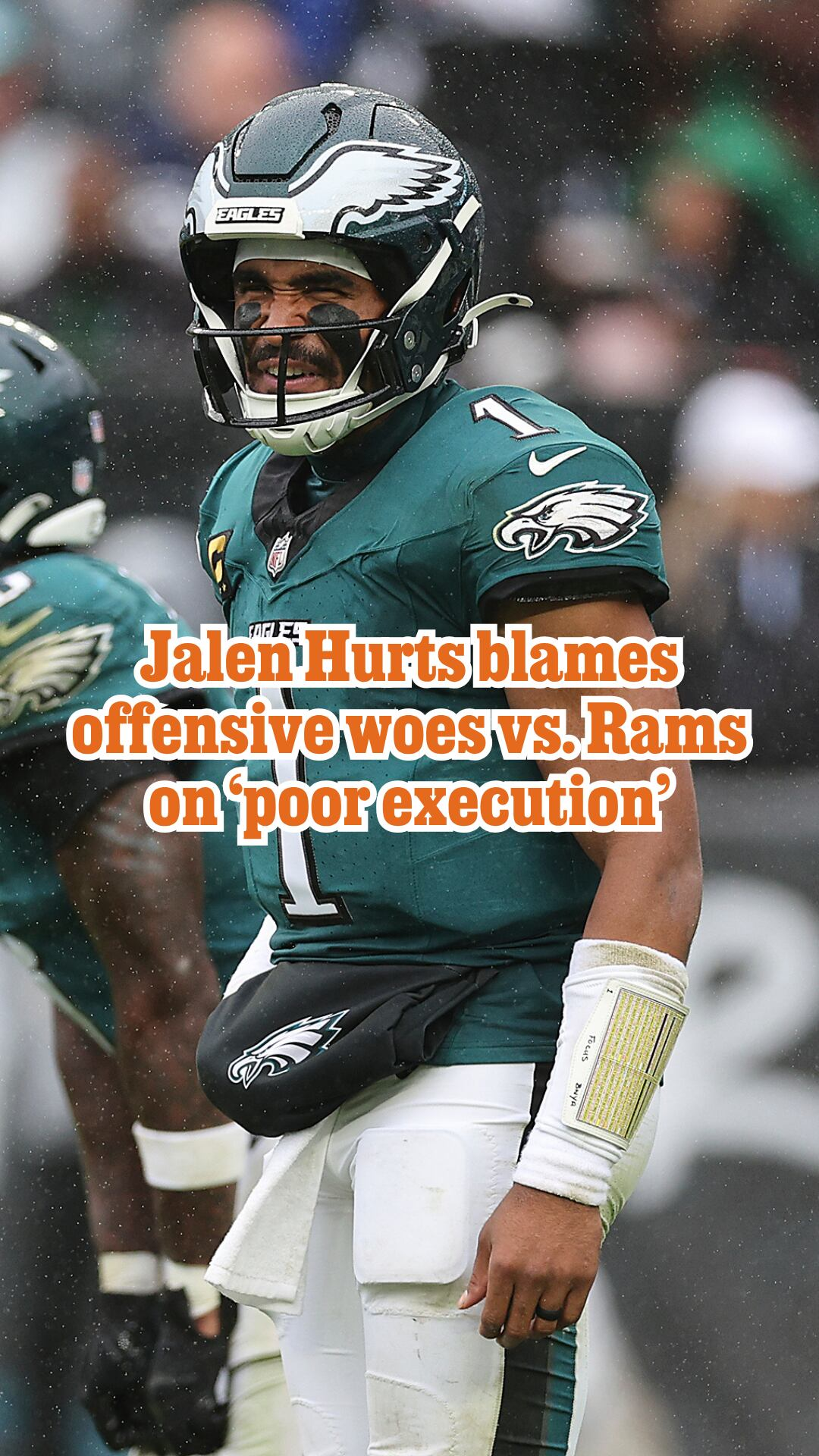
Video: Jalen Hurts blames offensive woes vs. Rams on ‘poor execution’
Bright spots
Between the injuries and the penalties, failing to convert any of their 12 third downs, not scoring in the second half for a second straight loss, and blowing a 10-point lead late in the fourth quarter to an undermanned Rams team playing in a time-zone deficit, Sunday’s 24-20 collapse by the Eagles, headlined by two failed and foolish fourth-down attempts, landed like an anvil on the hopes of a team with Super Bowl aspirations.
Still, amid all the raindrops and ball drops, there were a handful of encouraging signs.
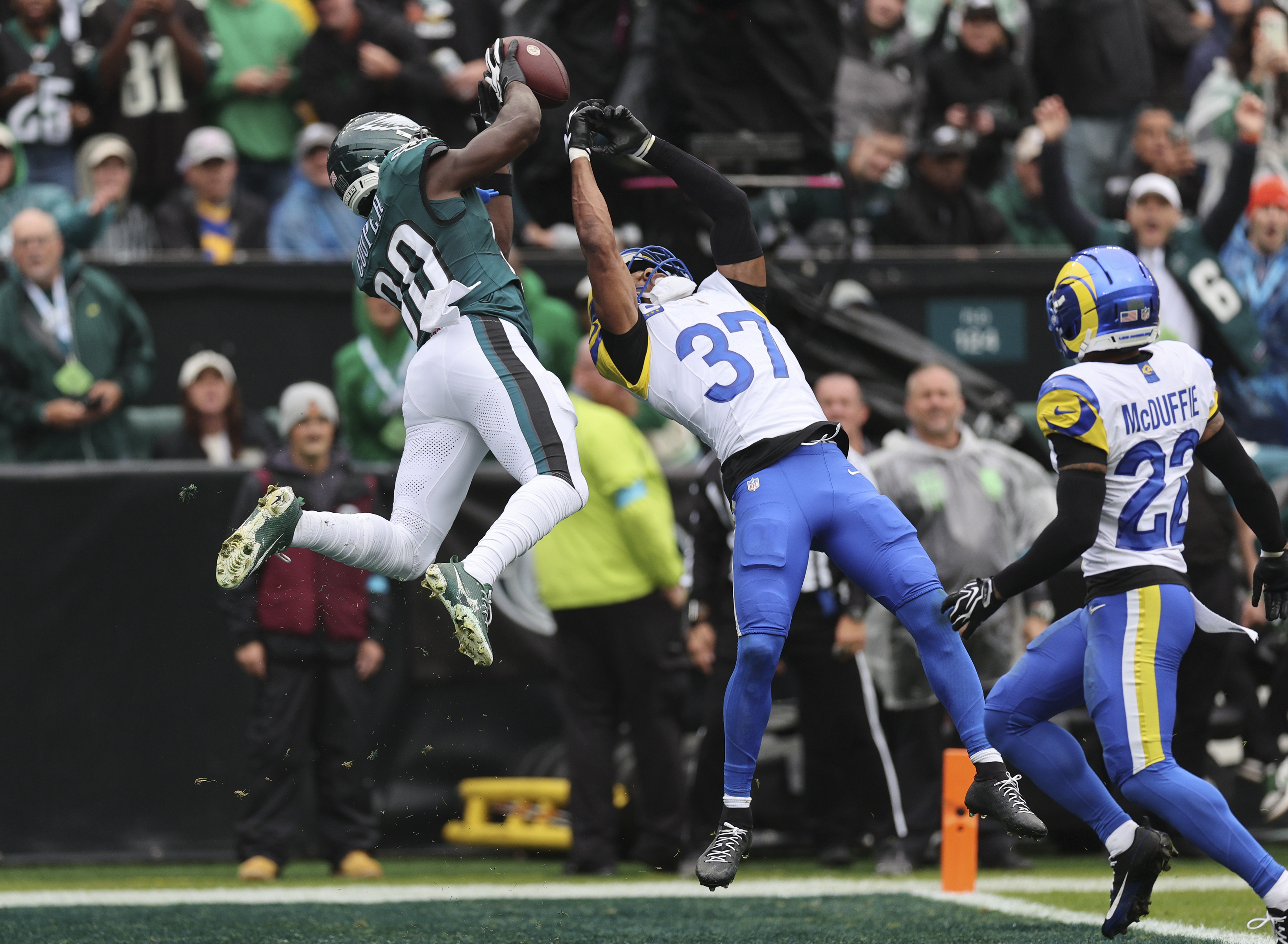
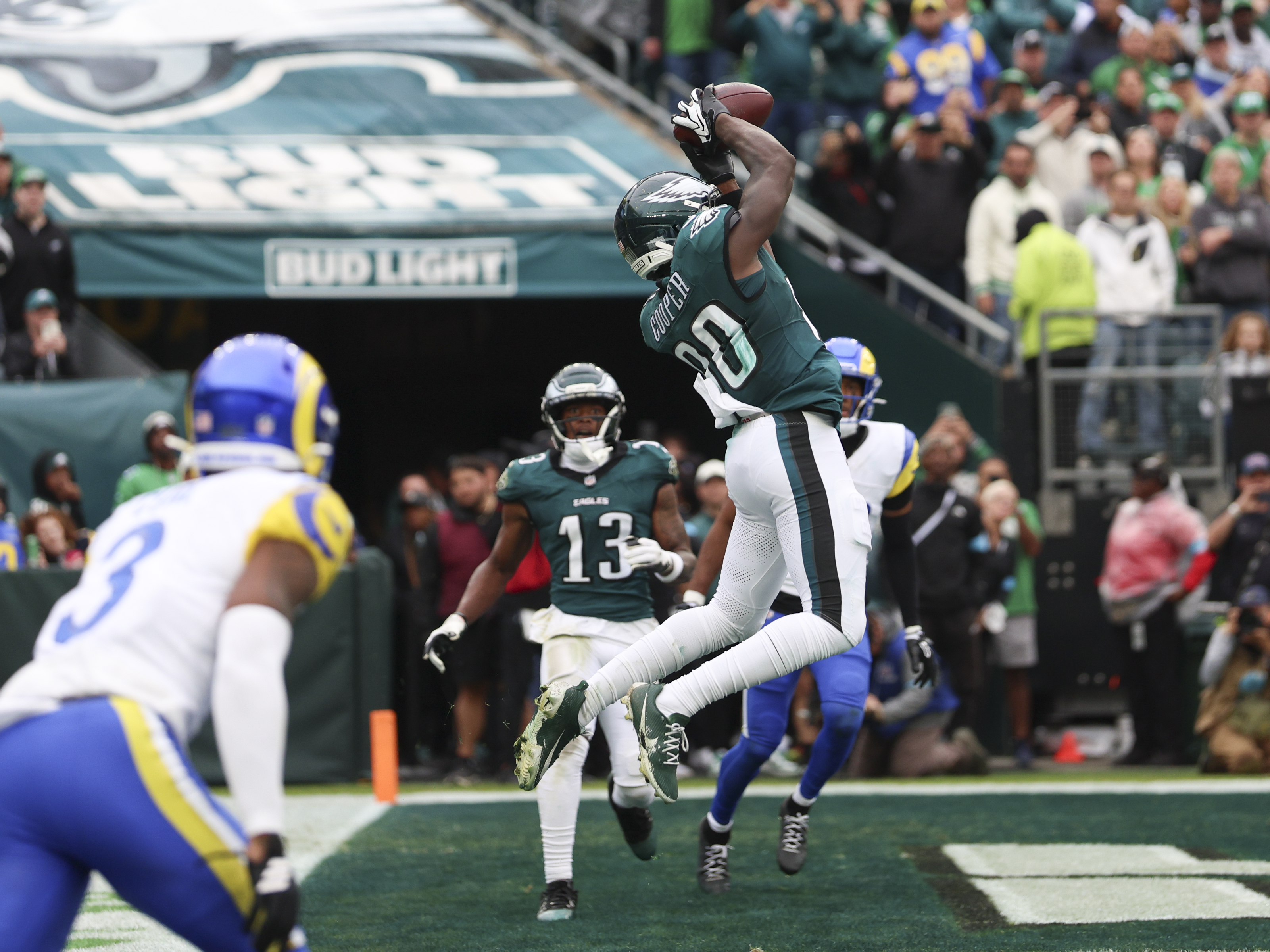
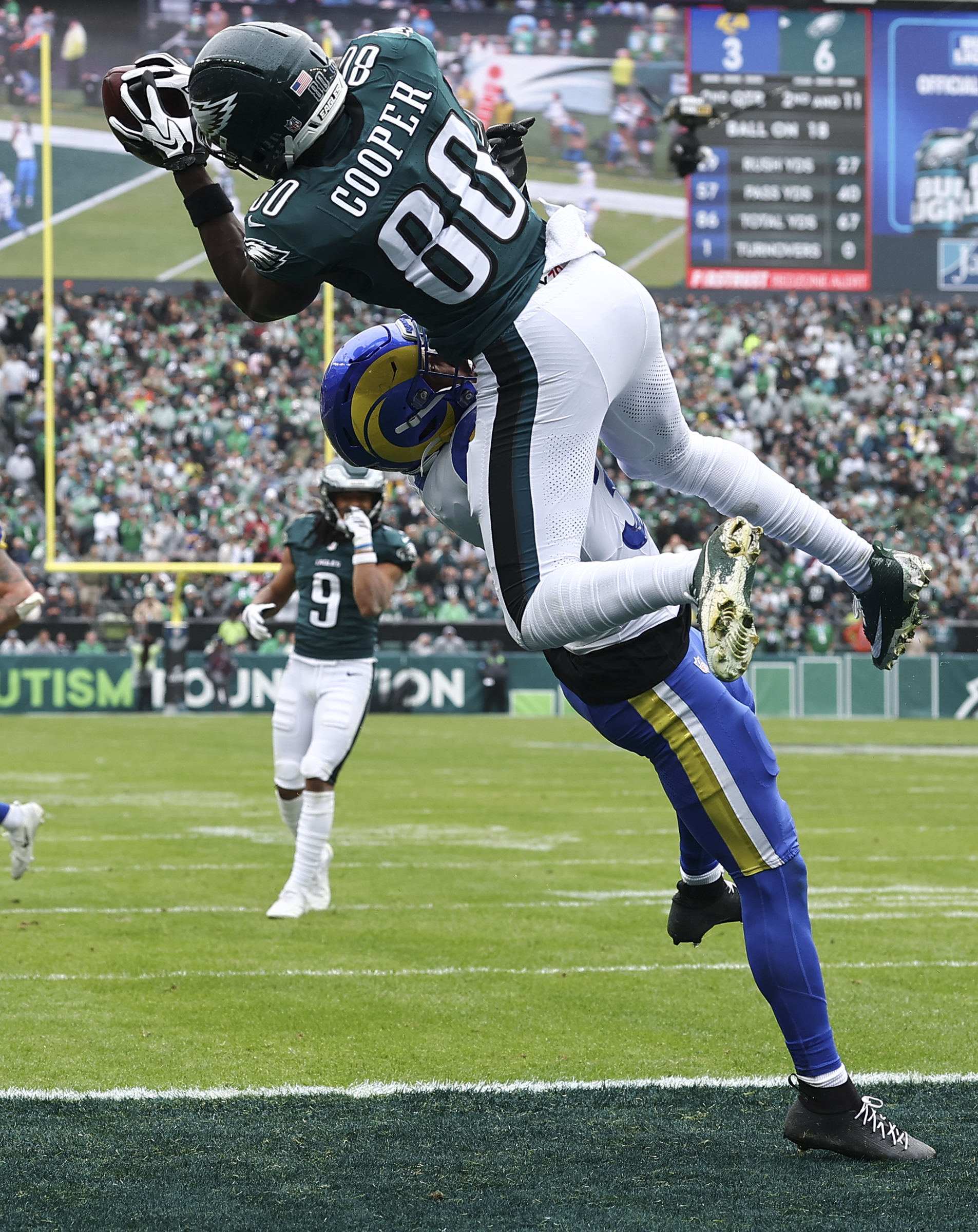
Two touchdown catches from second-year backup receiver Darius Cooper resonated most obviously, the first plucked over the back of an intercepting defender — the best airborne maneuver by a Cooper since D.B. jumped out of that plane with the money he took.
The catches might indicate unanticipated depth at a position left decimated when Brown forced a trade in June. Cooper, an undrafted FCS player last year, started in place of DeVonta Smith, who missed the game with a hamstring injury. Cooper also caught the game-winner in Tennessee, and his overall game demonstrated the capacity for further contributions.
He was not alone.
The most scrutinized performance belonged to Markel Bell, the 6-foot-9, 346-pound third-round rookie who stepped in for right tackle Lane Johnson, who missed the game at the last minute for personal reasons. Bell did not know he would be starting until about two hours before the game. He was little noticed, which is the best indicator that a tackle did not struggle; even the sack he surrendered on the Eagles’ penultimate play was a coverage sack.
Eagles wide receiver Darius Cooper makes a leaping touchdown catch over Rams safety Quentin Lake (center) and cornerback Trent McDuffie (right) on Sunday.David Maialetti / Staff Photographer
The most alarming (and probably the most popular) performance came in the middle of the defense, where Jeremiah Trotter Jr. replaced linebacker Zack Baun. Trotter is the son and namesake of the Eagles’ legendary linebacker, who was nicknamed the “Axe Man” and who was the heart and soul of the Eagles defenses Brian Dawkins captained more than 20 years ago.
Even the Axe Man might not be as good as Baun, the captain of the defense and the best player on the team for the past three seasons. Baun suffered a concussion in Chicago and failed protocols before Sunday’s game.
A fifth-round pick in 2024, Trotter’s first start in a fully meaningful game was Sunday. He showed up.
Trotter had 15 tackles, which matches Baun’s career high, and 10 solo stops, one shy of Baun’s best day.
This might matter more at family reunions: Trotter Jr.’s 15 tackles are three more than his daddy ever had, and the 10 solos are twice as many as Senior’s best day.
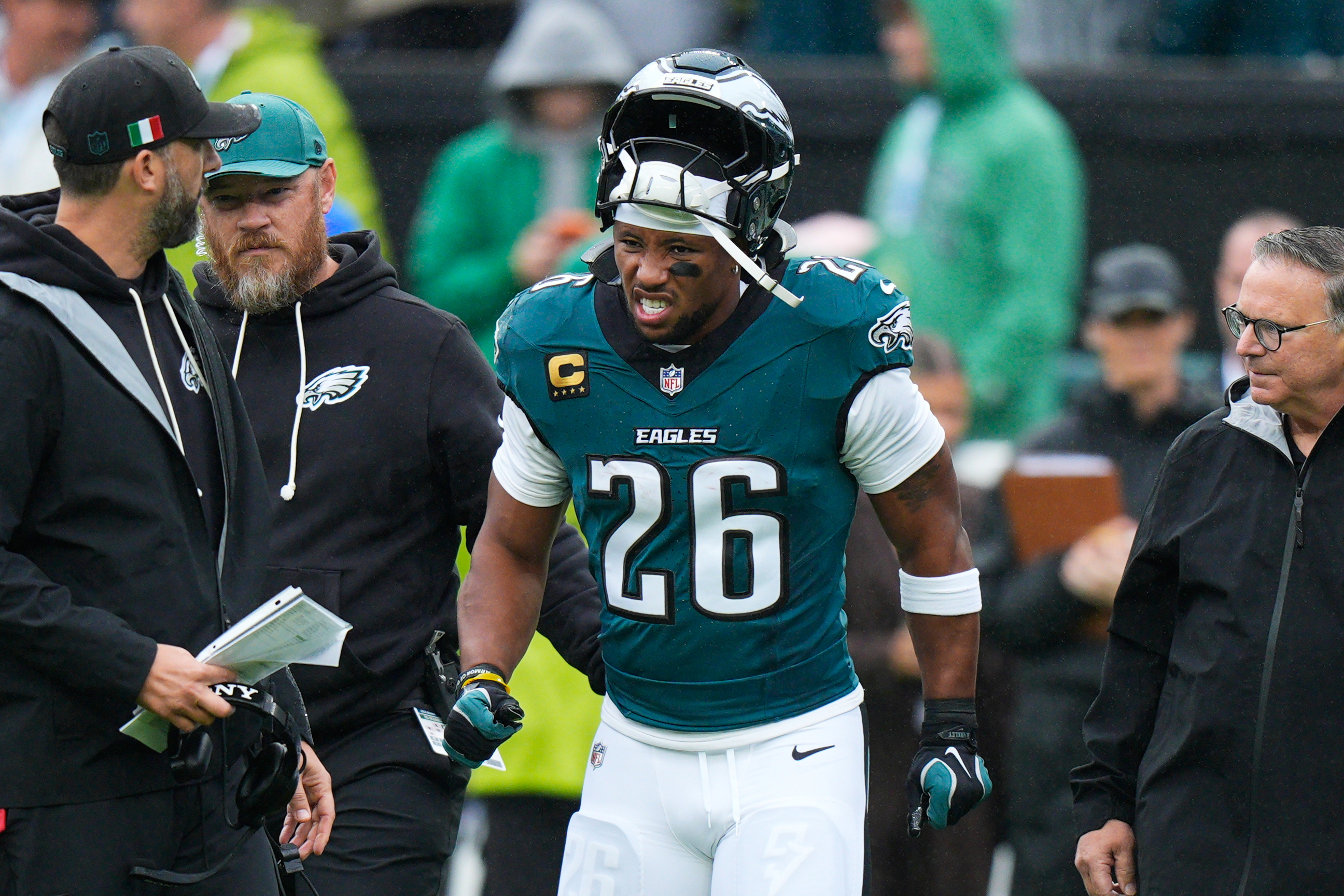
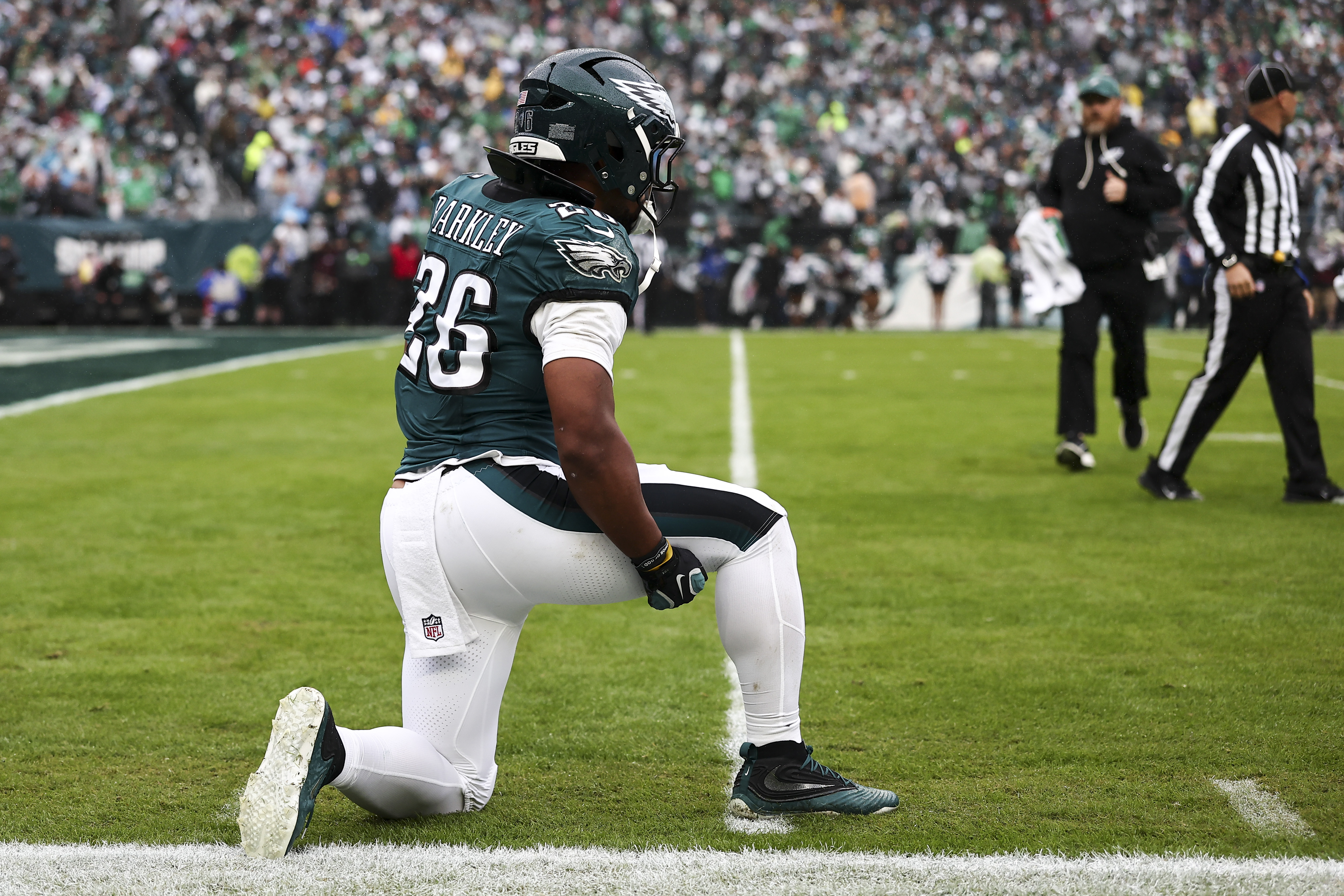
A hamstring injury suffered in the first quarter kept Eagles running back Saquon Barkley out for the rest of the game on Sunday.Chris Szagola
Falling stars
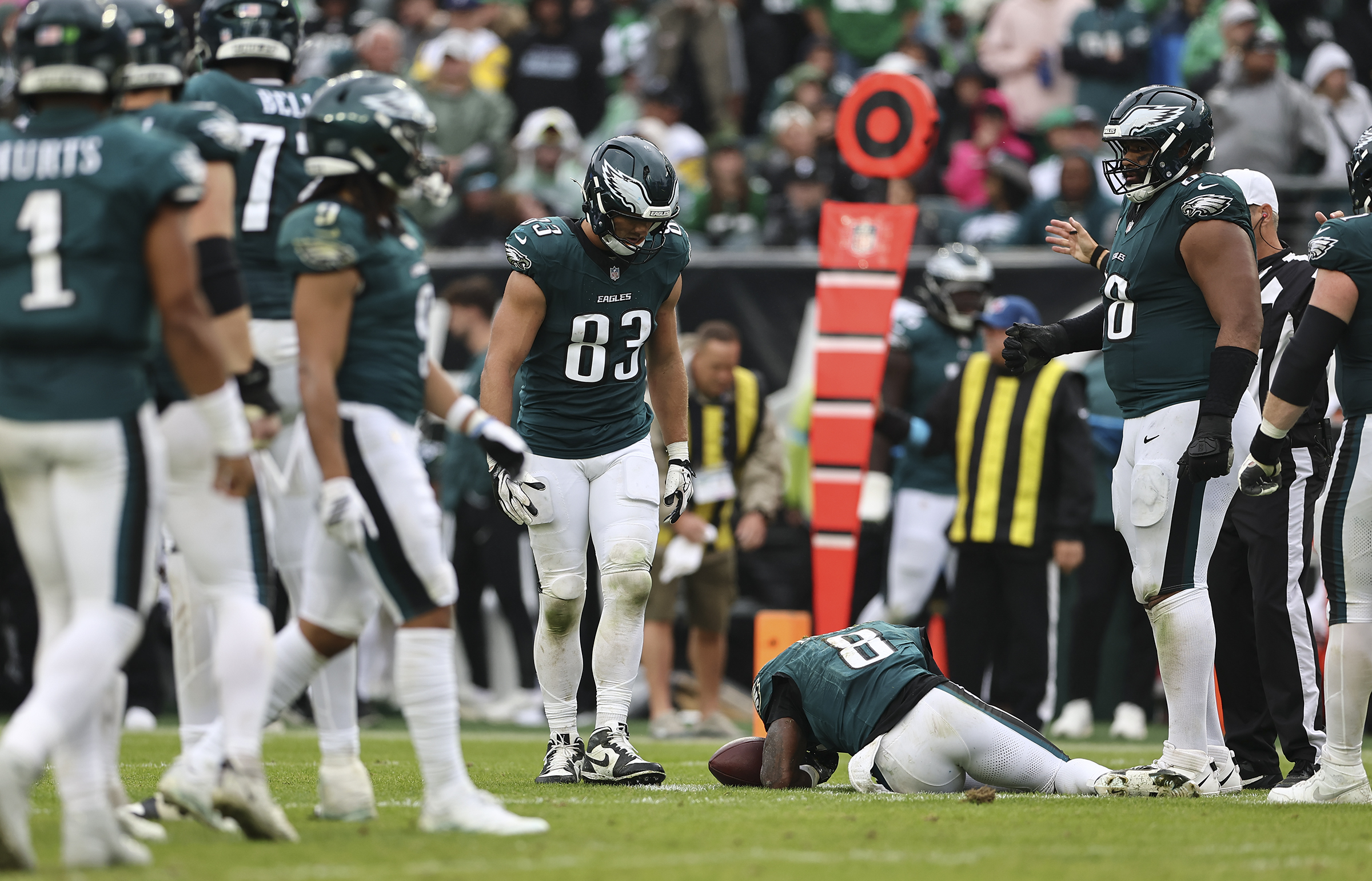
Nine of the Eagles’ top 23 players missed all or part of Sunday’s loss due to injury, including receiver DeVonta Smith, running back Saquon Barkley, Baun, edge rusher Jonathan Greenard, and cornerback Quinyon Mitchell. While the Eagles might be the team with the most injured frontline players, they are not alone.
Stars keep falling.
Lamar Jackson, a two-time MVP and the league’s most dynamic quarterback, missed the second half of the Ravens’ 24-18 home win over the terrible Titans. The Bengals have the AFC’s best receiving tandem, but both Ja’Marr Chase (concussion) and Tee Higgins (groin) were injured in a 22-17 loss to visiting Jacksonville. Broncos cornerback Patrick Surtain II, the 2024 Defensive Player of the Year, injured his ankle at the end of the first half of a 24-14 loss at San Francisco.
Add these marquee losses to Rams defensive end Myles Garrett, the reigning Defensive Player of the Year who underwent knee surgery after Week 1, and defensive tackle Aaron Donald, the unretired former DPOY whose aged back kept him out of Sunday’s win in Philadelphia. Commanders quarterback Jayden Daniels, who dislocated his left elbow for a third time in a year, already was on the shelf, where he was joined Sunday by backup Marcus Mariota (knee).
On the other end of the spectrum, Puka Nacua (groin), the NFL’s best receiver the past two years, missed the last two games but rejoined the Rams in time to catch nine passes for 125 yards and score a rushing touchdown.
Extra points
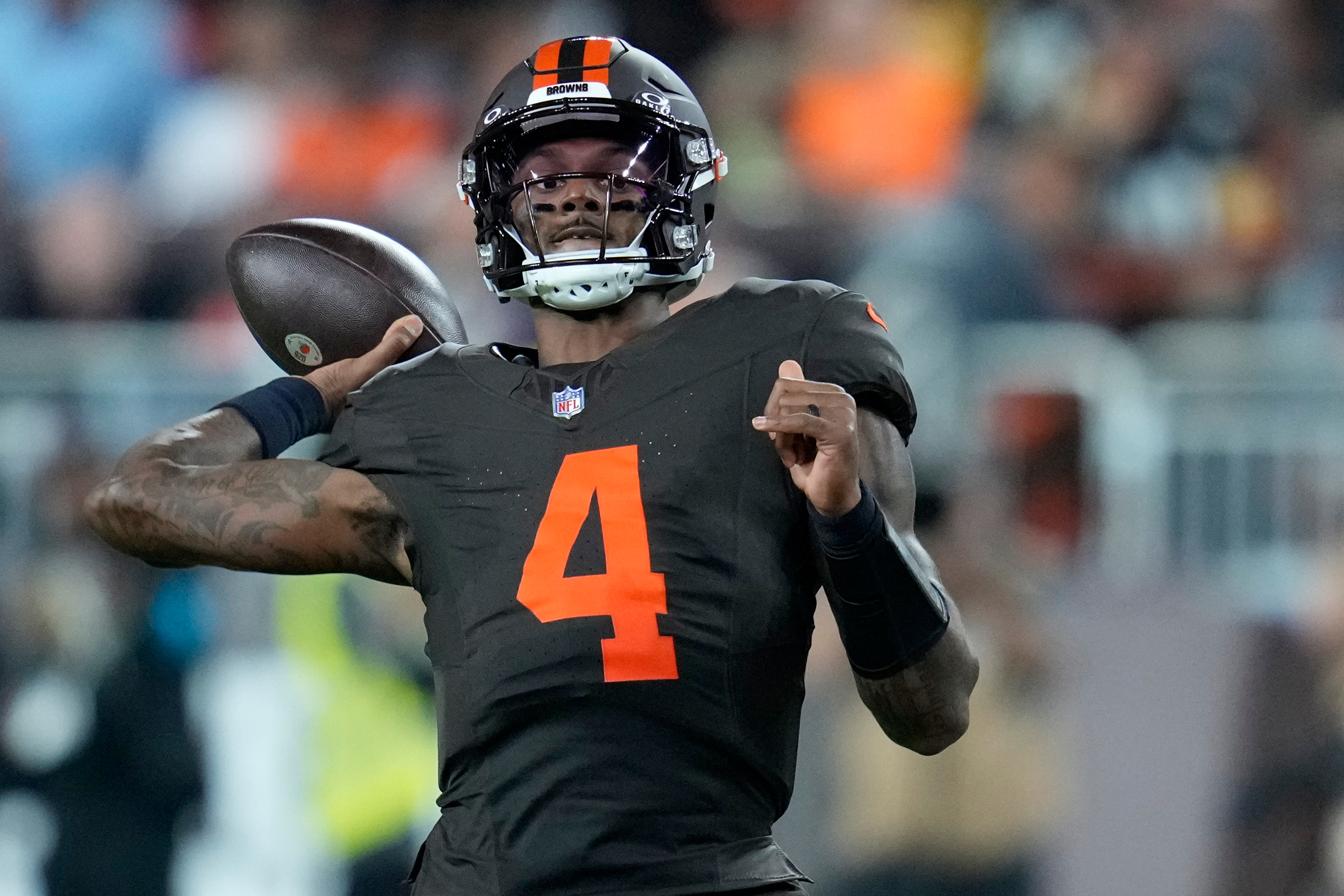
Controversial quarterback Deshaun Watson and the surprising Browns beat the Steelers to move to 3-1 on Thursday.Sue Ogrocki
In the Battle of Insufferable Signal Callers, Deshaun Watson and the Browns beat Aaron Rodgers and the Steelers on Thursday night. Since a pedestrian season-opening loss, the Browns are 3-0 and Watson’s passer rating is 102.0. A suspension relating to accusations of sexual misconduct against massage therapists, along with a series of injuries, cost Watson most of the past four seasons. … John Harbaugh and his Giants are atop the NFC East at 3-1 after a win over the visiting Cardinals, punctuated by a last-second pick-6. … Kyler Murray, understudy Carson Wentz, and the Vikings are 4-0 after a win over Miami, but the QBs are almost coincidental; the Vikings allow a league-best 12.8 points per game. … In a battle of unlikely unbeatens, the Chiefs won at the Raiders. … Dak Prescott logged his 20th career fourth-quarter comeback with the Cowboys, and his 27th game-winning drive and CeeDee Lamb caught 17 passes for 189 yards and the winning touchdown with 40 seconds to play to beat DeMeco Ryans and the Texans, now 0-4. … The Jets ended an NFL-record 20-game interception drought but still lost to the Bears, who got 146 rushing yards and two touchdowns on 30 carries from Kyle Monangai. … Tetairoa McMillan, last year’s Offensive Rookie of the Year, caught 14 passes for 192 yards and two TDs for the Panthers, who beat the Lions. Both teams are 2-2.
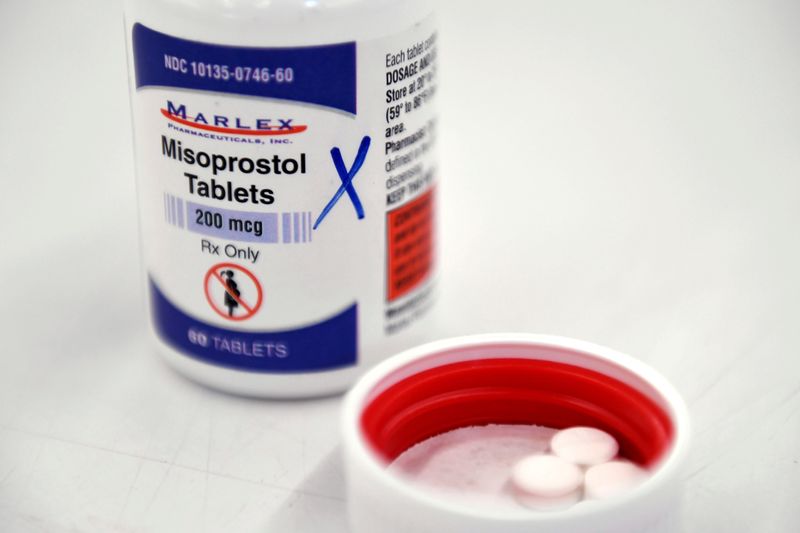
A woman in Pennsylvania can see a telehealth prescriber, never leave her house, and have misoprostol arrive in her mailbox to end a pregnancy.
House Bill 2520 would make it unlawful for the trained woman kneeling beside her bed to carry that same drug to stop her bleeding to death after she gives birth.
Same molecule. Same state. Same woman. Which path is lawful depends on which outcome she is having.
I am not writing about abortion. I am writing about incoherence, and about what it is going to cost women in the counties where our hospitals have closed.
Here is why that drug matters enough to write about.
Outside ofpregnancy, about 15 milliliters of blood reach a woman’s uterus every minute. At the end of pregnancy, it is 500 to 600. A tenth of everything her heart pumps goes to one organ. After the baby is born, one thing closes those vessels: the uterus clamping down on itself. When it does not, and in most hemorrhages it does not, nothing is holding them shut.
Obstetricians put the threshold for postpartum hemorrhage at 1,000 milliliters. At the rate blood moves through a uterus at term, a woman reaches that level in under two minutes.
Hold that against the next number. In 23 of Pennsylvania’s 67 counties, there is no hospital where a baby can be born. Fifty-six of our hospitals stopped delivering babiesbetween 2005 and 2026, taking us from 121 birthing hospitals to 79.
For a growing number of Pennsylvania women, the nearest labor and delivery unit is 40 minutes away.
Two minutes against 40. No transfer, however well organized, is fast enough. Whatever is going to save her has to already be in the room.
We have decided this six times already
Pennsylvania does not usually insist that only a licensed clinician may act while someone is dying.
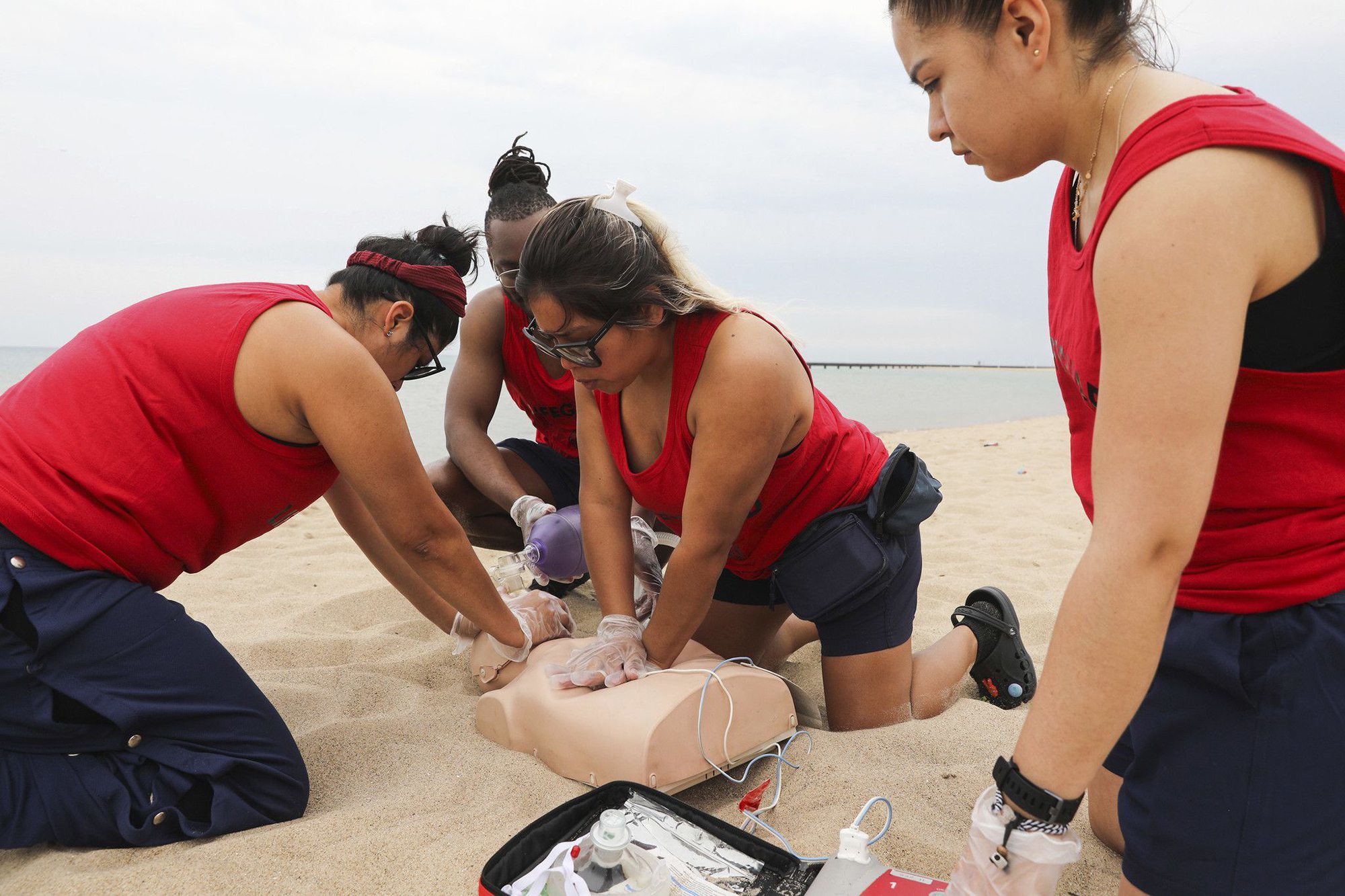
In the minutes before professional help arrives, a trained ordinary person can save a life by performing chest compressions or using a defibrillator. OB-GYN Naomi Whittaker believes that lay midwives should be able to carry misoprostol in their bags for the same reason. The legislators who have proposed House Bill 2520 disagree.Jose M. Osorio / MCT
Any bystander may do chest compressions. Any bystander may take a defibrillator off a wall in a shopping center and use it on a stranger. Any bystander may perform abdominal thrusts on a choking person. Public buildings hang bleeding-control kits beside the defibrillators, and we teach ordinary people to pack a wound and apply a tourniquet. Trained school staff carry epinephrine.
And in 2014, this commonwealth decided that any member of the public should be able to reverse an opioid overdose with naloxone. Not a nurse. Anyone.
We were right to do it.
Every one of those laws has the same shape. Name the emergency. Name the drug or the device. Require training, not a license. Grant immunity. They rest on one judgment: In the minutes before professional help arrives, a trained ordinary person acting beats nobody acting.
There is no such law for a woman bleeding after childbirth. She can hemorrhage to death in a building with a defibrillator in the lobby and naloxone behind the front desk.
The drug is not exotic
The medicine that stops most of these hemorrhages is not a controlled substance. Misoprostol sits on the World Health Organization’s Essential Medicines List for exactly this purpose. It is stable at room temperature, swallowed or placed under the tongue, and needs no refrigeration, no needle, and no operating room.
The better drug, oxytocin, has to be kept refrigeratedbetween 2 and 8 degrees Celsius (35.6 and 46.4degrees Fahrenheit). That is precisely why the WHO recommends misoprostol for births far from hospitals — which is most births in the world, and a growing share of births in rural Pennsylvania.
So this bill would remove the one uterotonic that survives the setting in which it is mostneeded.
Which brings me back to where I started. That same molecule is, in practice, one of the more obtainable prescription drugs in America. It moves through telehealth services and mail networks, and much of the public conversation of recent years has been about how much easier that access has become.
I have no quarrel with a woman reaching a doctorvia telehealth instead of driving for two hours. That is the same problem I am describing, solved.
My quarrel is that Pennsylvania is preparing to solve it in one direction and criminalize it in the other.
What the bill does
HB 2520 creates a category called “lay midwife” and makes four things unlawful for anyone in it. Three concern disclosure and recordkeeping, and there are reasonable arguments for them.
The fourth is that she may not administer a prescription medication in the practice of midwifery. The bill then requires her to hand the mother a signed form saying so, in advance, in her own name.
I understand the impulse. Someone looked at unlicensed practice and reached for the tool that says stop.
But the women this impacts are not choosing between a midwife and a hospital. In 23 counties, there is no hospital to choose. They are choosing between an attendant who carries a lifesaving drug and an attendant who does not.
The answer to a maternity desert is not fewer drugs in the bag.
We have known the other answer for a decade, and we wrote it down six times. Name the emergency. Name the drug. Require the training. Grant the immunity.
We did it for a stranger on a shopping center floor. We have not done it for a mother.
Naomi Whittaker is a board-certified obstetrician-gynecologist in Lewisberry, Pa.
The Eagles travel to London in Week 5 to face the Jacksonville Jaguars (3-1).
// Timestamp 10/05/26 5:08pm
Tank Bigsby to undergo surgery, will head to IR
#Eagles RB Tank Bigsby has a core muscle injury that will require surgery, an NFL source confirmed @RapSheet report.
Bigsby is headed to injured reserve with the hope that he will be back later in the season. He further aggravated an abdominal injury late in Sunday’s game vs.…
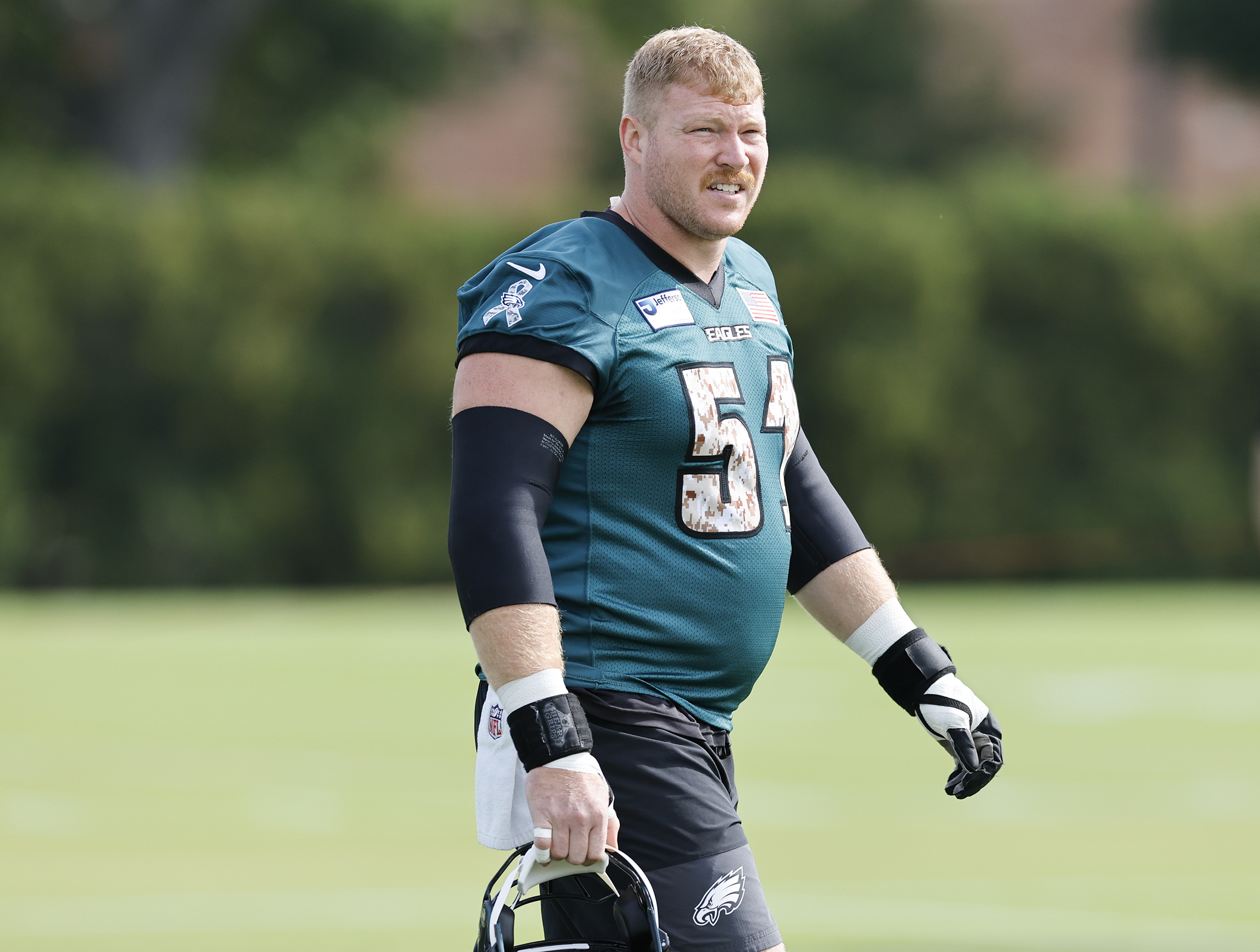
Cam Jurgens, seen here during training camp, was moved from center to guard in Week 2. Yong Kim / Staff Photographer
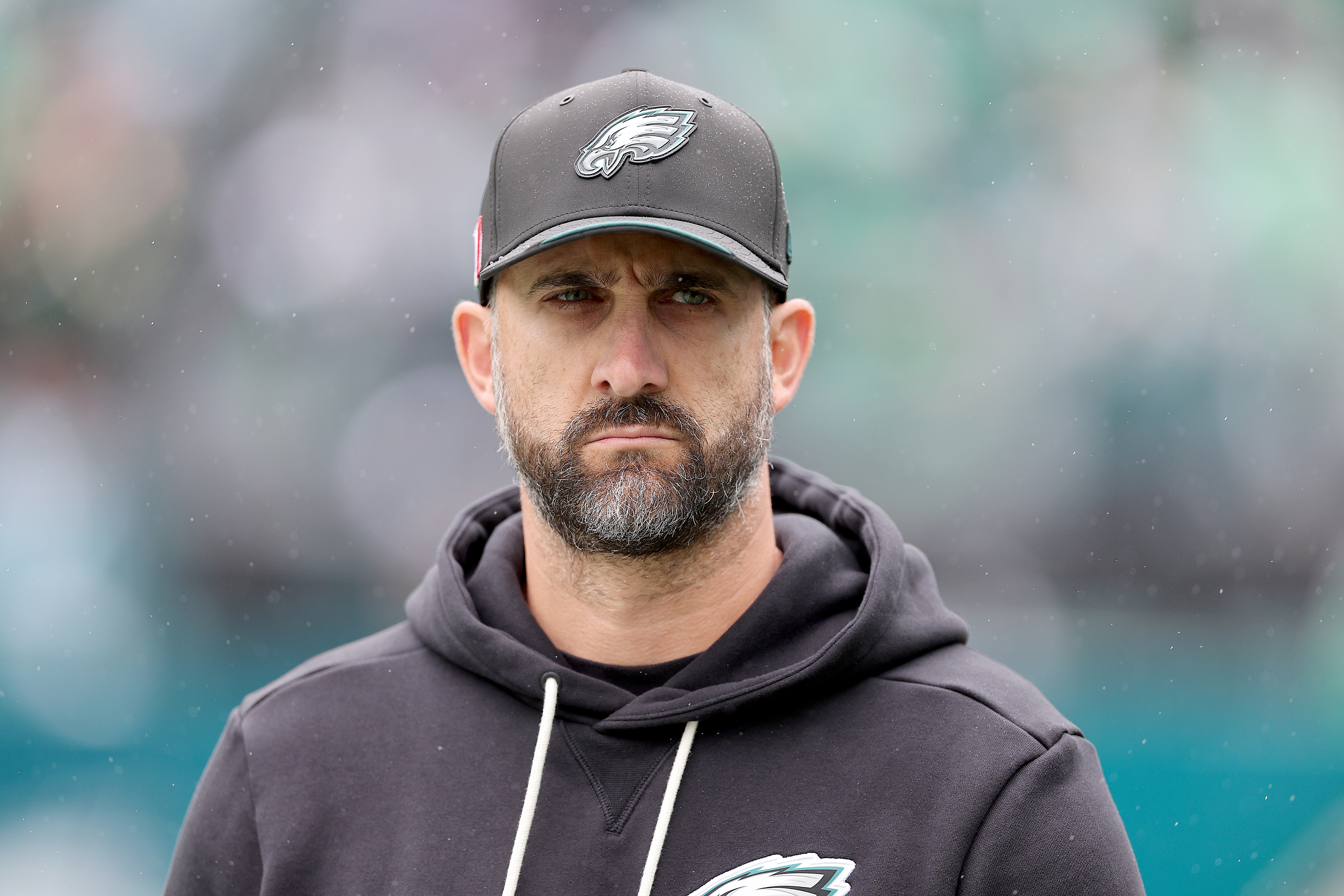
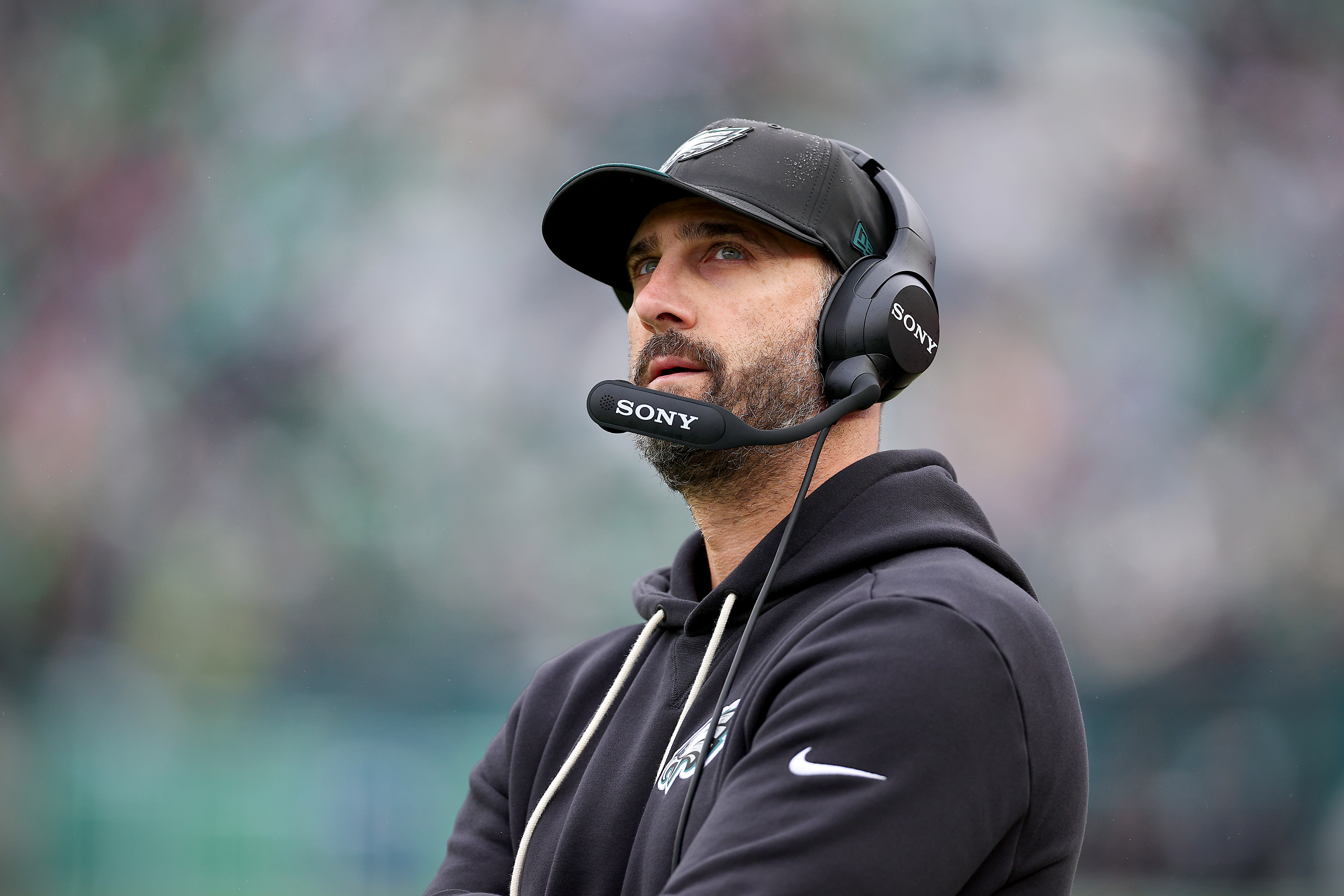
Eagles head coach Nick Sirianni defended offensive lineman Cam Jurgens Monday afternoon and said there are no plans to move him after struggling at times during Sunday’s loss.
“I’m pleased with where Cam is,” Sirianni told reporters Monday afternoon. “Cam is definitely doing good things. Like us all, he’s got to be more consistent at times as well.”
The Eagles moved Jurgens from center to left guard in Week 2 after placing Landon Dickerson on the injured reserve.
Nick Sirianni: No updates on Saquon Barkley, Lane Johnson
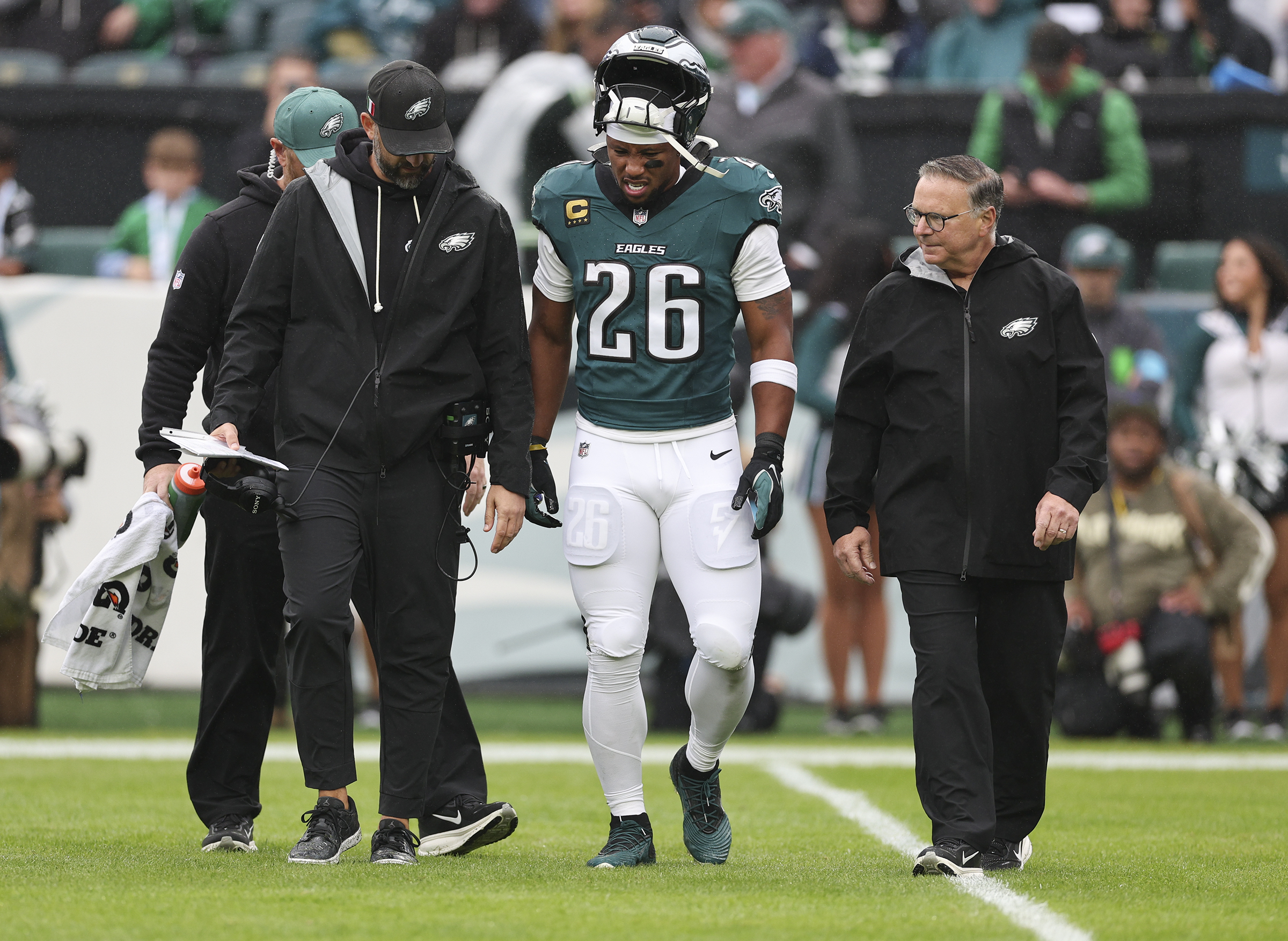
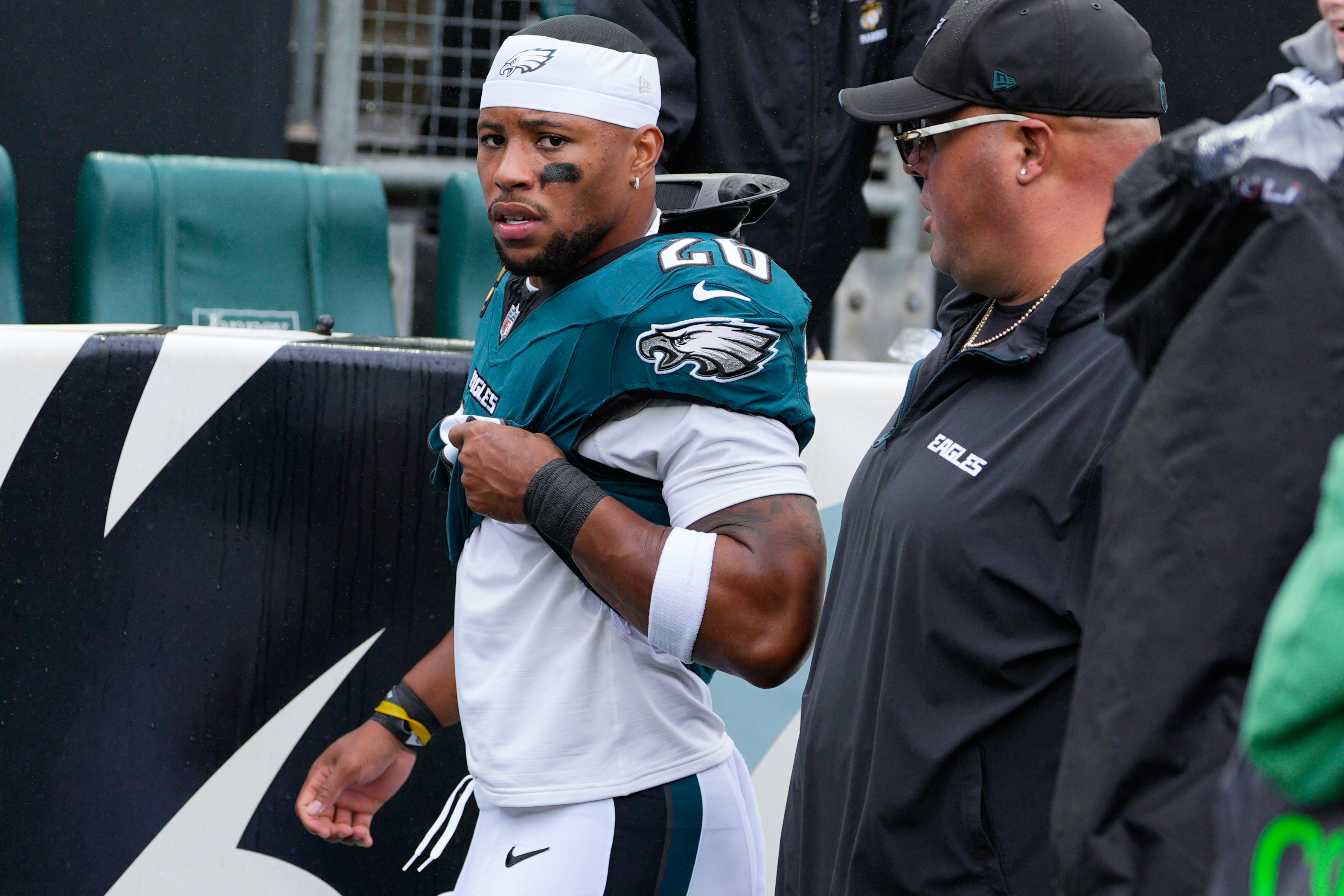
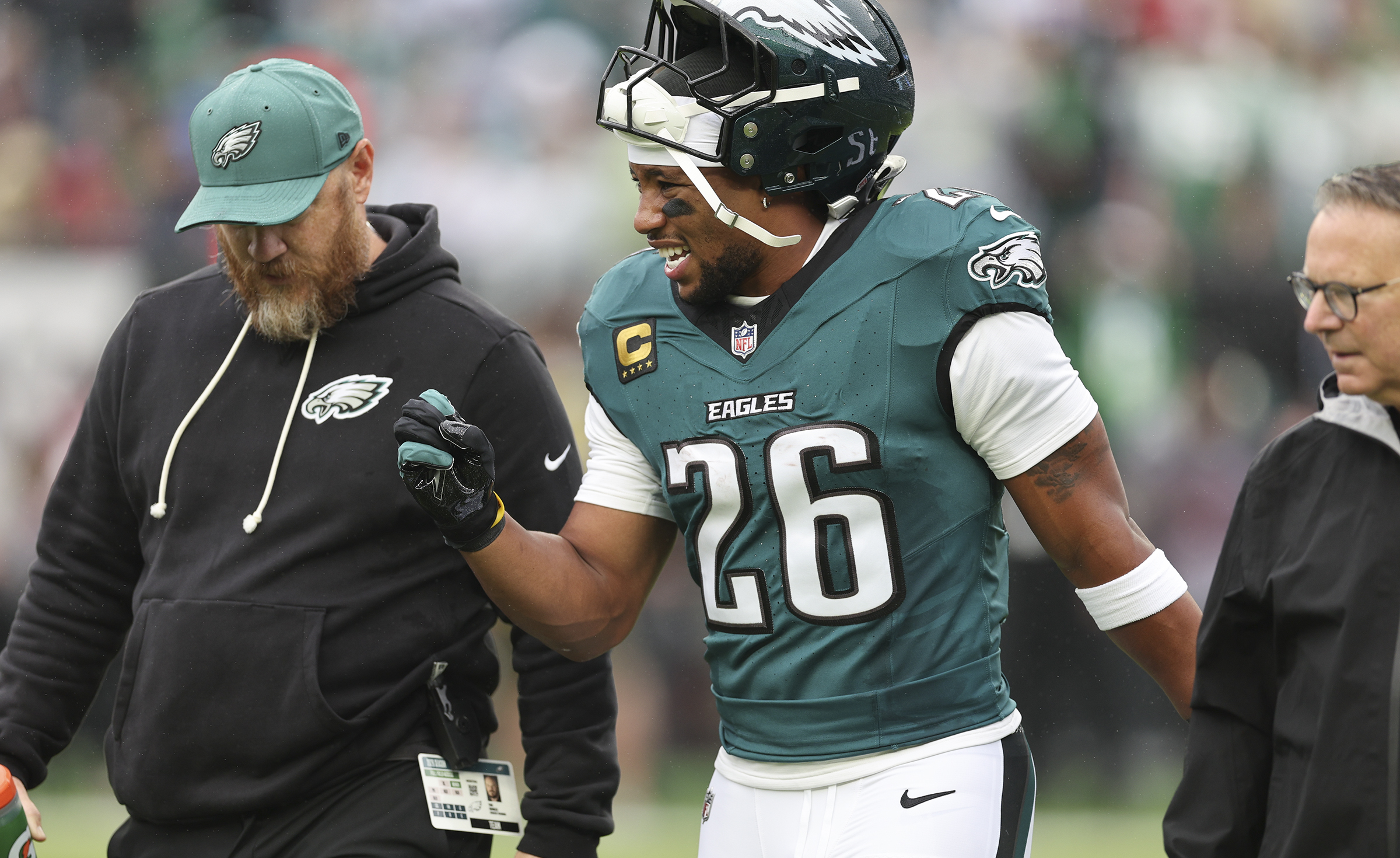
Eagles running back Saquon Barkley walks off the field Sunday. David Maialetti / Staff Photographer
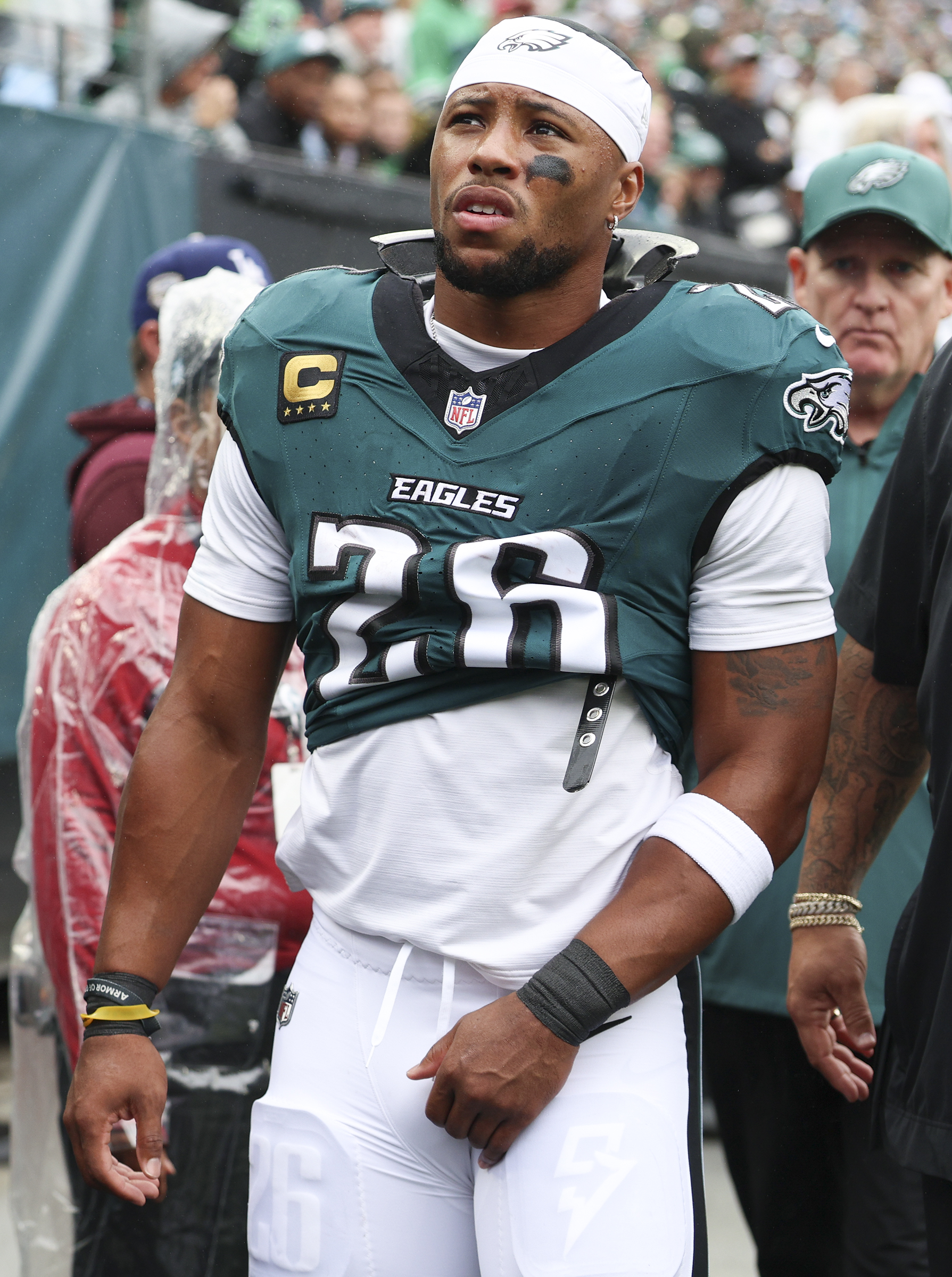
Nick Sirianni did not have an update Monday on the status of Saquon Barkley, who left Sunday’s game after four plays with a hamstring injury.
Sirianni said Barkley and other injured Eagles were going through testing and treatment and more information would be available on Wednesday, when the team has its first practice and issues its first injury report ahead of its Week 5 game.
“I know he’ll do everything he can do to get himself back,” Sirianni said of Barkley.
Sirianni also declined to provide an update on Lane Johnson, who was a late scratch from Sunday’s game due to what the team called a personal matter. It’s unclear if Johnson will rejoin the team this week.
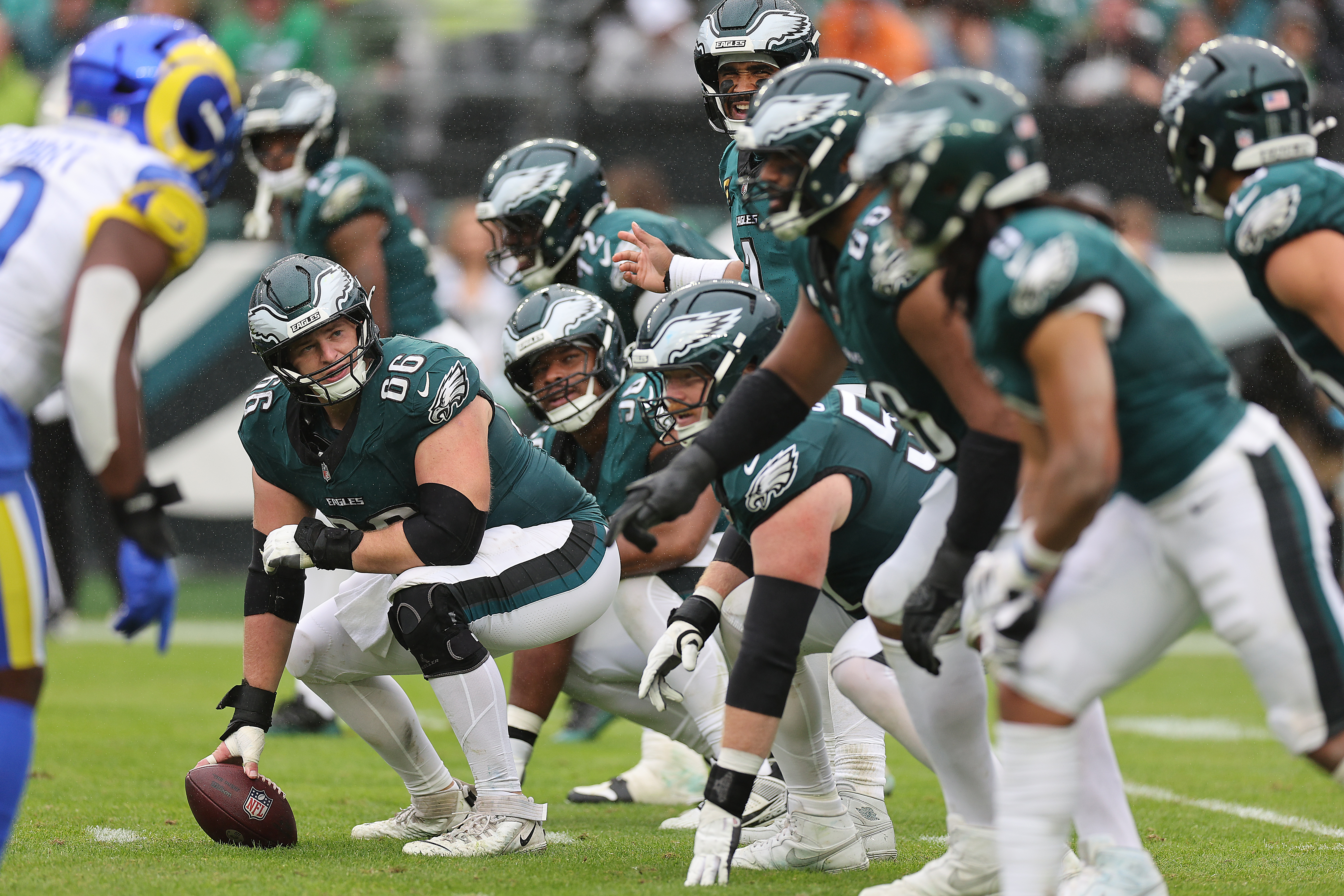
The Eagles offensive line struggled during Sunday’s loss.David Maialetti / Staff Photographer
After the Eagles took an early lead Sunday, they were held scoreless in the second half.
The Eagles struggled offensively, with both their touchdowns coming after the defense and special teams gifted them great field position — their two touchdown drives combined for just 52 yards. They finished the game 0-for-12 on third downs; dating back to the Bears game, they have now failed on 17 straight third-down attempts. The Eagles also added two more failed fourth-down attempts in the second half Sunday — first on a fourth-and-1 at their own 38-yard line late in the third quarter, and then on a fourth-and-goal at the Rams’ two-yard line in the fourth quarter that would’ve likely iced the game.
On ESPN’s Get Up show, Domonique Foxworth was asked what’s wrong with the team’s offense.
“This is the first time where I feel like they kind of have a legitimate excuse,” Foxworth said. “Their whole offensive line is broken. Their best receiver is out. Their best running back is out. That gives them a little excuse to not be as good as they’ve been in the past.
“But you got to convert a first down. Like, you’re all NFL players. I understand you don’t have great players out there at this moment, but you have enough to be able to close the game out and finish on that fourth down. That was the big moment. You got to finish on that spot.”
Nick Sirianni and the Eagles are underdogs in Week 5 against the Jaguars.David Maialetti / Staff Photographer
The Eagles are a team coming off two losses in the last week — first on Monday night in Chicago and then again Sunday at home against the Rams.
Meanwhile, the Jaguars (3-1) are coming off two straight wins — a 35-6 rout of the New England Patriots, followed by a 22-17 victory over the Cincinnati Bengals.
Now, the two teams will travel to London for their Week 5 matchup. They last played each other in November 2024, when the Eagles defeated the Jaguars at home in a game that is remembered more for one specific play than the actual result: Saquon Barkley’s iconic backward hurdle.
As they prepare to meet again Sunday, the Eagles enter the neutral-site matchup as 5.5-point underdogs at both FanDuel and DraftKings.
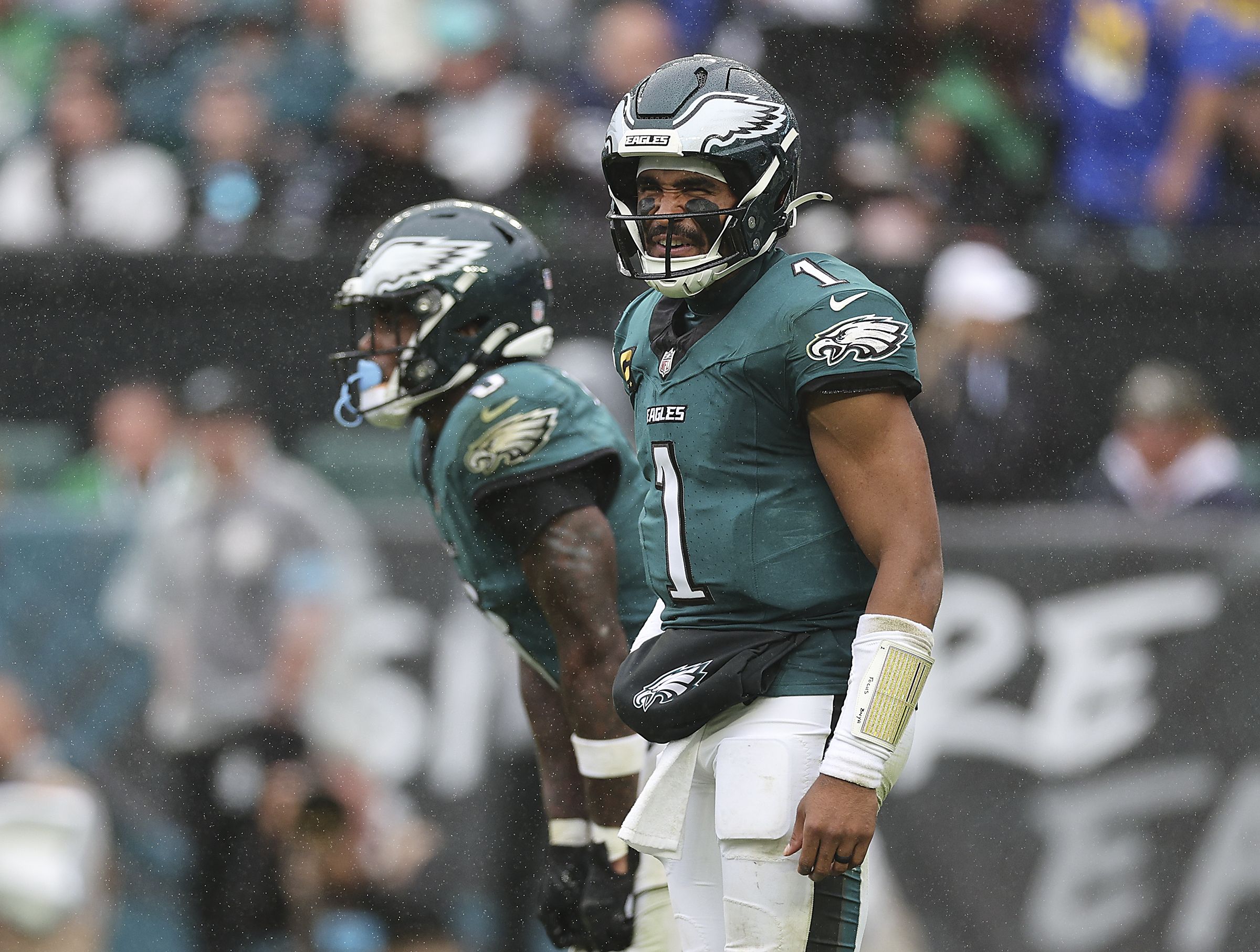
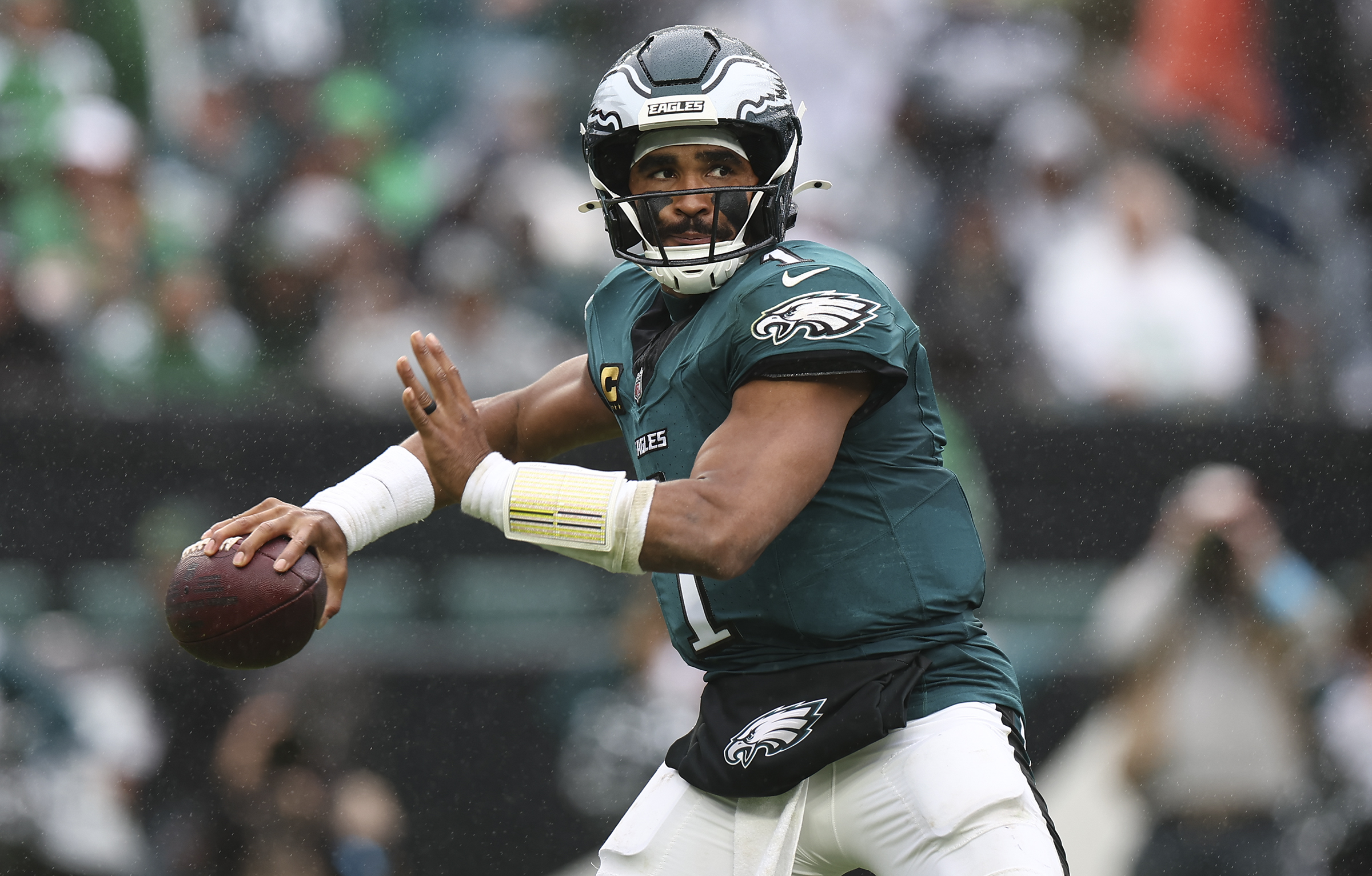
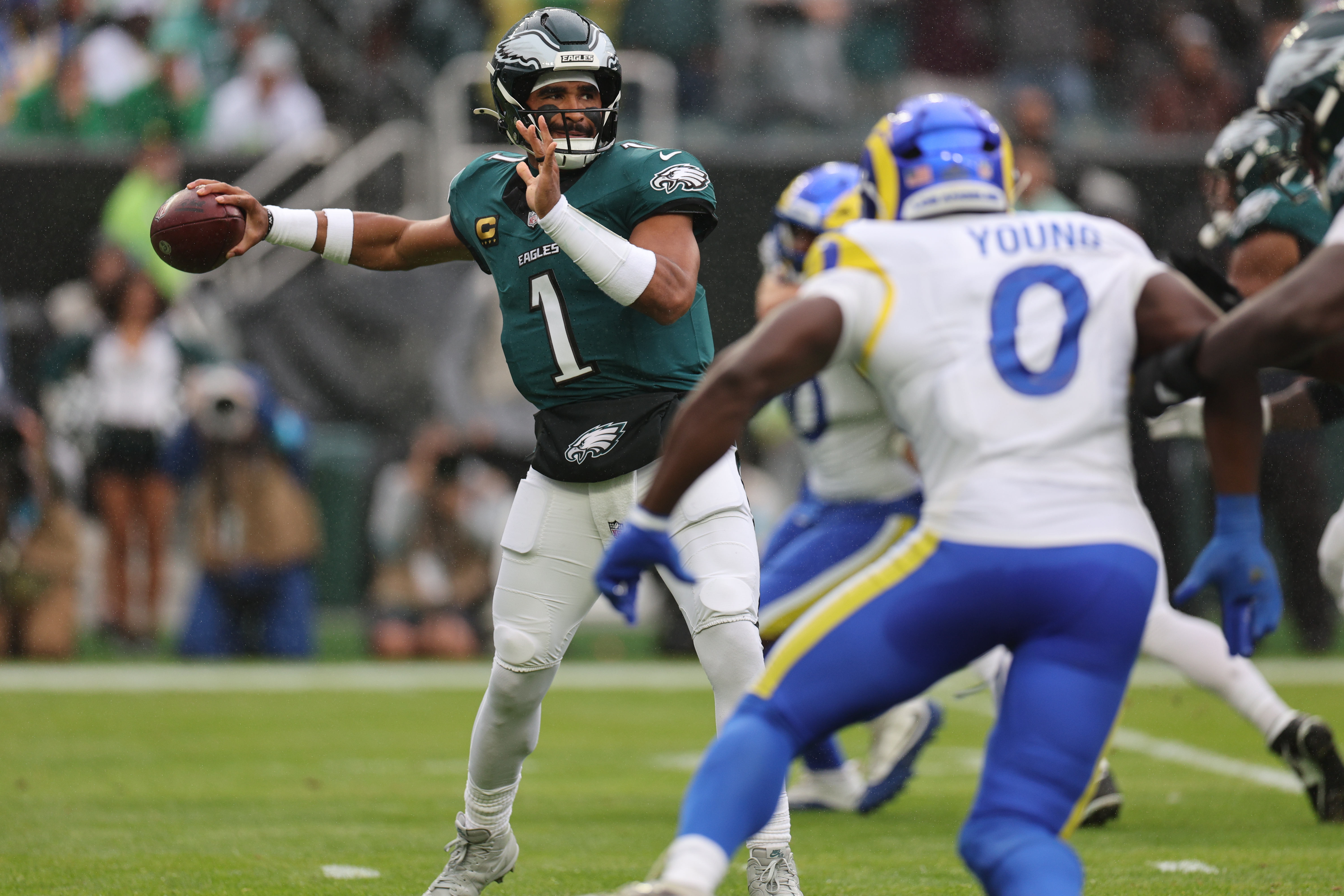
Jalen Hurts showed some emotion during the Eagles’ loss to the Rams.David Maialetti / Staff Photographer
You asked for a more emotive Jalen Hurts. You got it.
Last week, Hurts was seen on the sideline cussing out officials and doctors for making him take a concussion test during the game. Backup quarterback Andy Dalton threw an end-zone interception while Hurts was off the field. Hurts was cleared almost immediately.
Then, on Sunday, he was caught screaming at receiver Elijah Moore for lining up improperly before a first-quarter snap: “Get off the [bleeping] ball!”
Hurts, in his sixth full season as the starter, typically has been cryptic and protective when asked about teammates’ mistakes. After Sunday’s loss, he did not hold back.
Before the most crucial play of the game — a failed pass attempt on fourth-and-goal from the 2 in the fourth quarter — second-year center Drew Kendall and Hurts botched a routine, under-center snap. It appeared that Kendall fired early. It looked like the play call was a handoff to Tank Bigsby, and it looked like there was a lane to the end zone over the right guard. But the botched snap threw off the timing and Hurts ran, for no gain. It also appeared that left guard Cam Jurgens might have bumbled his way into the play early and further doomed it.
As such, Hurts was hot.
“We had a bad exchange on the snap the play before,” Hurts said, unprompted, when asked about the fourth-down play, not the third-down play. “It comes down to very little things. Executing at a high level.”
This isn’t skewering teammates at the Aaron Rodgers level, but it’s not nothing, and it’s a good thing.
Eagles head to London, where NFL owners hate the economics
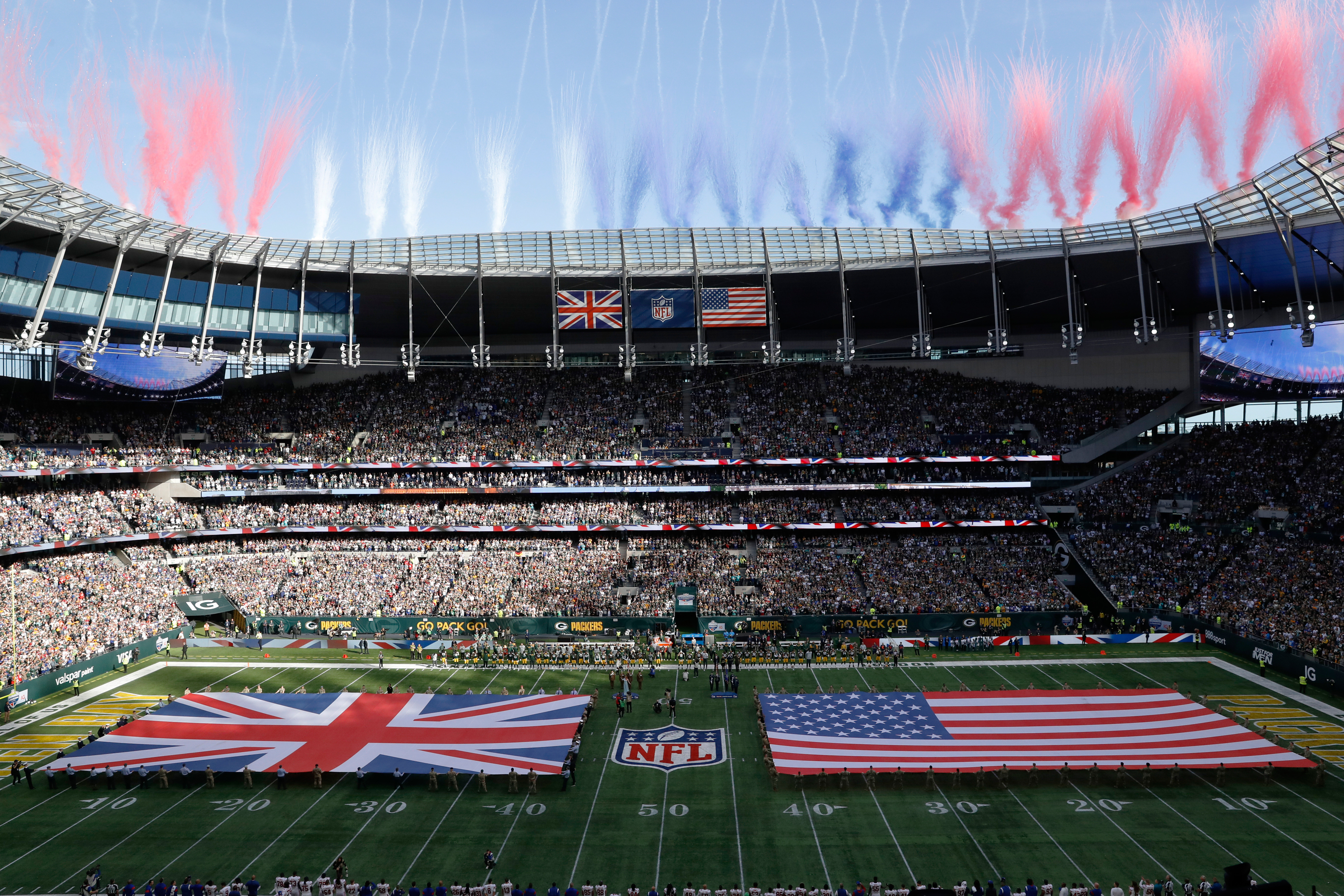
The NFL began playing regular-season games in London in 2007.Steve Luciano
Eagles fans and team owner Jeffrey Lurie have one thing in common: both are happy the Eagles are not losing out on a home game to play in London.
The Jaguars, London’s de facto home team, are hosting next week’s game at Tottenham Hotspur Stadium. This past Sunday, the Commanders “hosted” the Colts in London. Commanders owner Josh Harris offered a blunt response to reporters when asked about the economic impact of being the home team in London.
“It’s not good,” Harris, who also owns the Sixers, told Sportico. “It’s bad in a lot of ways, but I’m not so much focused on economics, honestly. I’m focused on being part of the NFL community and growing the game internationally.”
For typical games played in the U.S., the NFL keeps 66% of revenue from ticket sales. The remaining 34% is pooled and split evenly among the league’s 32 franchises. The primary revenue that home teams playing internationally miss out on is from on-site sales. This includes food, merchandise, parking, and virtually anything fans can purchase at a game.
Previously, the league paid a set payment to home teams playing internationally, but that changed in 2022. Now, the NFL just covers the teams’ travel costs.
Super Bowl LII MVP Nick Foles also showed there were opportunities for big plays Sunday that Jalen Hurts missed because of timing and progression issues.
“We watched Case Keenum against the Eagles on Monday Night Football do this every single play. On time and in rhythm,” Foles said on The SZN podcast he co-hosts with Evan Moore. “[Hurts has] got to take that next stop in his progressions.
“This is a deficiency in his game that once he gets better, it’s going to be unstoppable,” Foles added. “But he’s got to get better reading those … key defenders in the concept and then being on time and rhythm.”
Eagles linebacker Jonathan Greenard left Sunday’s game with an ankle injury. Yong Kim / Staff Photographer
Jonathan Greenard was slated to see an uptick in snaps Sunday after the Eagles had him on a pitch count last week in his first game back from the pectoral injury that forced him to miss all of training camp. But Greenard’s snap count increased by just one on Sunday, from 18 to 19, as the veteran edge rusher left the game with an ankle injury and did not return.
Greenard was effective before leaving. He had three pressures on 16 pass rushes, and one of them led to Matthew Stafford’s errant throw that Andrew Mukuba picked off.
Greenard left in the third quarter, and his absence meant a lot of work for Nolan Smith (64 snaps, 76%) and Jalyx Hunt (63, 75%). Arnold Ebiketie also saw his highest workload so far this season (21, 25%).
Jonathan Jones saw his first extended run as a member of the Eagles. Quinyon Mitchell left with a knee injury after 36 snaps, leading Jones to play the rest of the game (48 snaps) at outside corner.
Saquon Barkley left after four snaps with a hamstring injury, leaving Tank Bigsby and Will Shipley as the only healthy backs. Bigsby later left the game in the fourth quarter. Both backups played 29 snaps.
Here are some other notes from the snap counts:
Michael Carter II started at safety and played a ton as the Eagles mostly lived in nickel. Carter played 76 snaps (90%).
DeVonta Smith’s absence did not mean a lot more work for Makai Lemon. Darius Cooper saw a big increase, from 10% of the work last week to 90% this week. Lemon played 74% of the snaps.
Zach Ertz was on the field for 21% of the snaps (13 of 61) after playing 38% in Week 4. Johnny Mundt’s workload increased from 52% to 80%.
Moro Ojomo, meanwhile, played more (71% from 54% last week) while Jordan Davis (35% from 58%) played less.
Jeremiah Trotter Jr. played all 84 defensive snaps as a fill-in starter for the injured Zack Baun.
Eagles injury report: Updates on Saquon Barkley, Lane Johnson, and more
Saquon Barkley walks to the locker room during Sunday’s loss to the Rams.Chris Szagola
The Eagles are a banged-up squad heading into their Week 5 matchup against the Jacksonville Jaguars in London.
Here’s what we know and don’t know about a number of injured Birds players:
Saquon Barkley, running back: Barkley suffered a hamstring injury early in the first quarter of Sunday’s loss and did not return to the game. Coach Nick Sirianni didn’t offer an update on Barkley’s status following the loss. Barkley suffered a stinger in Week 2 that knocked him out of the game. NFL Network’s Ian Rapoport reported Barkley will undergo tests Monday and that “on the outset, [the injury] does not seem to be overly serious.”
DeVonta Smith, wide receiver: Smith was ruled out of Sunday’s game earlier last week after he was unable to practice because of a hamstring injury. His status for Sunday’s game remains unclear, but Jeff McLane reported Smith was expected to miss multiple games. At best, he’d be “questionable” for Week 5, according to the NFL Network’s Mike Garafolo.
Lane Johnson, offensive tackle: Johnson was a late scratch from Sunday’s loss. After the game, Sirianni called Johnson’s absence “a personal matter” but didn’t offer any further information or a timeline when he’s expected back.
Quinyon Mitchell, cornerback: Mitchell was knocked out of the game early in the third quarter after suffering a knee injury on a tackle near the sideline. His status for Week 5 is unclear. NFL Network’s Ian Rapoport reported the team’s hope is he only suffered a “bruised bone” and that he’ll undergo testing Monday.
Tank Bigsby, running back: Bigsby suffered a hip injury in the fourth quarter of Sunday’s loss following a hard hit. He did not return. Coming into the game Bigsby had been dealing with an abdominal issue.
Zack Baun, linebacker: Baun missed Sunday’s game (his first time missing a regular-season game) because he was in the concussion protocol. It’s unclear when he’ll be allowed back to play.
Marcus Epps, safety: Epps also didn’t play Sunday after suffering a groin injury following the Week 3 loss to the Chicago Bears.
Jonathan Greenard, edge rusher: Greenard left Sunday’s game in the third quarter with an ankle injury.
Social media twists Brandon Graham’s comments about Lane Johnson
Eagles offensive tackle Lane Johnson didn’t play Sunday because of what coach Nick Sirianni described as a “personal matter.”Jose F. Moreno / Staff Photographer
Stop me if you’ve heard this one before: you can’t trust what you read on social media.
Speaking on PHLY’s postgame show, former Eagles defender Brandon Graham expressed frustration about his former teammate’s absence.
“I’d hate for [Lane Johnson] to go out like this,” Graham said. “I know it’s your last year, man, but let’s go out with a bang with it. I know more than what I can really say right now, but it’s just like, come on man, we need you.”
It’s that “I know more than what I can really say” part that took fire on social media following the game. One X user, with fewer than 800 followers, went viral after incorrectly claiming that Graham said Johnson was “considering retirement, immediately.”
Eagles head to London to face the first-place Jaguars
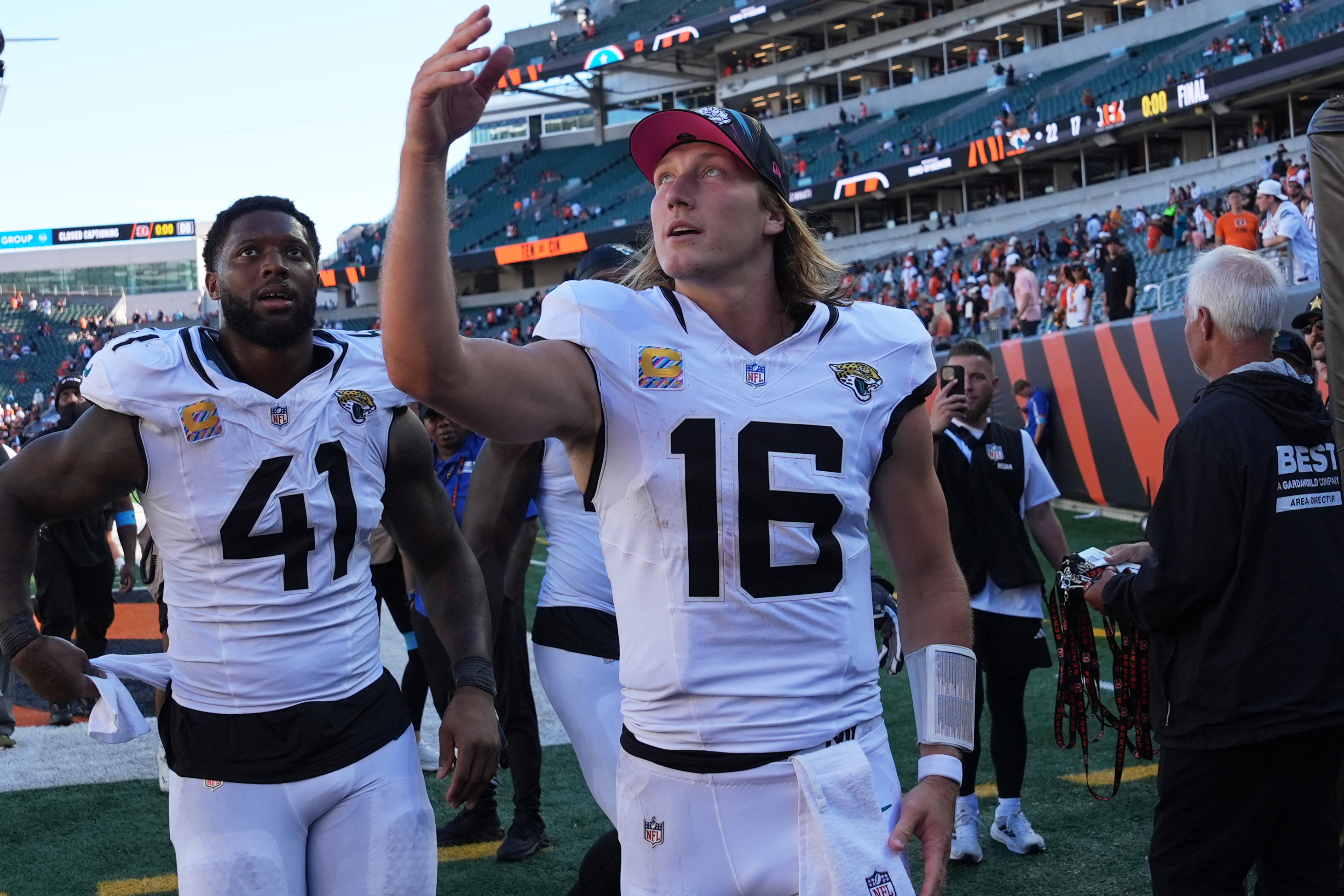
Jaguars quarterback Trevor Lawrence leaves the field after their Week 4 win against the Bengals.Joshua A. Bickel
Things aren’t going to get any easier for the Eagles this week, as they head out to London to face the first-place Jacksonville Jaguars Sunday in Week 5 (9:30 a.m., NFL Network).
They are 16-5 under second-year head coach Liam Coen, lead the AFC in point differential (plus-51), and quarterback Trevor Lawrence is having the best season of his career. Meanwhile, the Eagles’ point differential is minus-18.
The Eagles enter the game as underdogs after being underdogs at home for the first time since 2023. It’s the first time since Weeks 13 and 14 of the 2023 season the Eagles are slated to be underdogs in consecutive games.
For some perspective, the Eagles were underdogs in just one of their 2025 games — a road contest in Buffalo they won.
A loss would drop the Birds below .500 for the first time since the 2021 season, Nick Sirianni’s first as head coach.
Rams defense offers a blueprint the Jaguars could follow against the Eagles
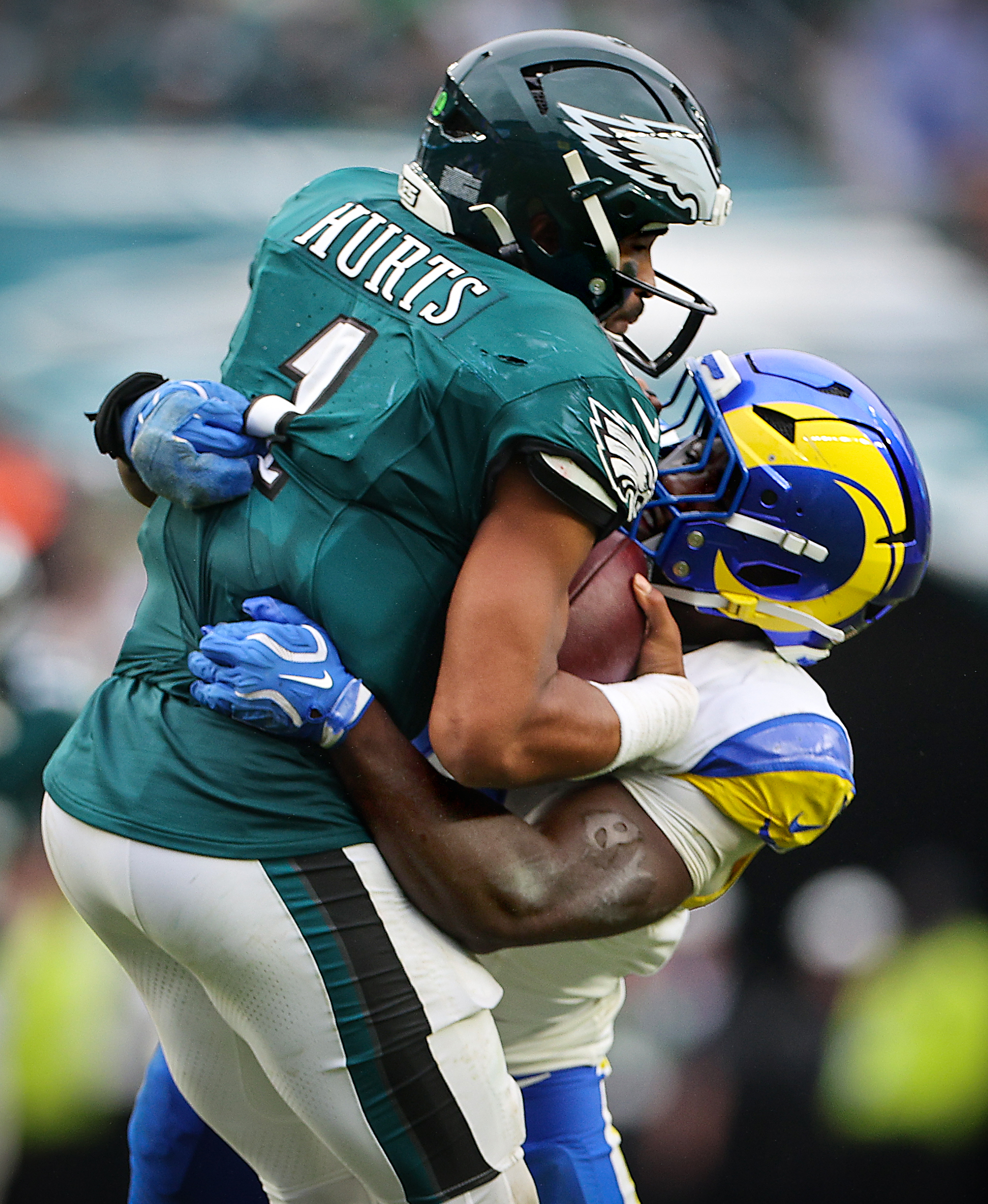
Rams linebacker Byron Young sacks Jalen Hurts on the Eagles’ final drive of the game Sunday.David Maialetti / Staff Photographer
The Jacksonville Jaguars boast one of the best scoring defenses in the league. They have allowed just 53 points this season, which is the second fewest in the NFL and the team’s fewest through four games since 2007, when they conceded just 41.
They’re up to six interceptions through four games, which is tied for the NFL lead going into Monday night.
They might look to the Rams for inspiration for their defensive game plan against the Eagles. The Rams entered Sunday’s game as the most blitz-heavy team in the league on third-and-long (7+ yards) at a 69.2% rate, according to Next Gen Stats. Hurts was blitzed on every third down drop back (11 of 12 drop backs) except for the final attempt, as the Rams generated six pressures and a sack on those blitzes.
Will the Jaguars follow their formula for success? They used their own exotic looks to their benefit in their 22-17 win against the Cincinnati Bengals on Sunday. In the second quarter, a simulated pressure on third-and-6 still generated pressure, as Jaguars defensive end Josh Hines-Allen bull-rushed his way into a quarterback hit on Joe Burrow.
The pressure forced Burrow into making an errant throw over the middle, which was picked off by Jaguars cornerback Jourdan Lewis. The Jaguars turned that interception into points with a 7-yard touchdown reception for wide receiver Brian Thomas, which proved critical in their 5-point win.
Through four games this season, the Jaguars have only blitzed on third-and-long at a 21.1% clip, but until the Eagles can prove they can succeed against it, they should expect to continue to see those pressure looks in those obvious passing situations.
Eagles offense struggles, but defense blames themselves for loss
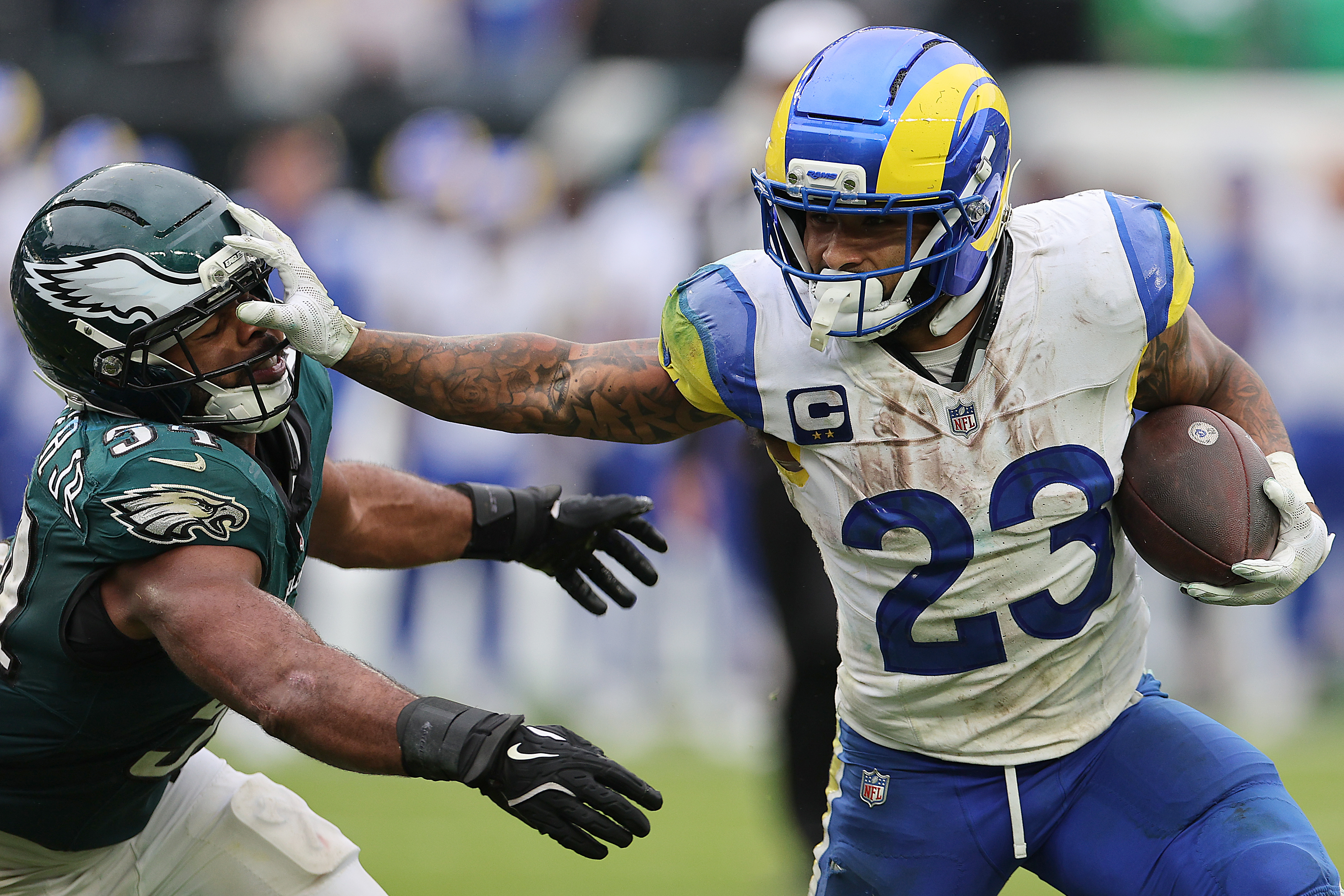
Eagles linebacker Jeremiah Trotter Jr. is stiff-armed by Rams running back Kyren Williams.David Maialetti / Staff Photographer
The Eagles offense may have been held scoreless in the second half of their 24-20 loss to the Los Angeles Rams on Sunday night, but the defense still pointed the finger at themselves for allowing the Rams’ fourth-quarter comeback.
With eight minutes, 17 seconds remaining in the fourth quarter, the Rams’ win probability reached its lowest point at 3.2%, according to Next Gen Stats. The Eagles were up, 20-10, and faced a third-and-goal on the 2-yard line.
But they failed to score on consecutive plays, turning the ball over deep in Rams territory. The Rams went on to score touchdowns on back-to-back series. Matthew Stafford completed 12 of 15 passes for 140 yards on his final two drives, and the Eagles helped him out by committing penalties, too.
“We’ve got to finish drives at the end of the game to hold our lead, whatever’s going on in the game,” Cooper DeJean said after the game. “It was on defense, it was on us. We got to be able to close it out.”
Despite losing two straight games, DeJean didn’t express a sense of panic about the state of the team.
“I think there’s a lot of things we can take away from this game. I don’t think anybody’s worried,” DeJean said. “I still feel like there’s a lot of confidence in this locker room, and there’s definitely things we can build off of that we did in this game, and obviously things that we can clean up. The biggest thing is finishing the game.”
(function(){function e(){window.addEventListener(`message`,function(e){if(e.data[`datawrapper-height`]!==void 0){var t=document.querySelectorAll(`iframe`);for(var n in e.data[`datawrapper-height`])for(var r=0,i;i=t[r];r++)if(i.contentWindow===e.source){var a=e.data[`datawrapper-height`][n]+`px`;i.style.height=a}}})}e()})();
The New York Giants moved into first place in the NFC East thanks to their 36-24 win against the Arizona Cardinals, capped by Deonte Banks’ 98-yard pick-6 to seal the victory.
The Cowboys are tied with the Eagles in second place after coming back to defeat the Houston Texans 34-30 Sunday.
The Washington Commanders dropped to 1-3 thanks to their 30-13 loss to the Indianapolis Colts in London.
The Eagles will play three straight divisional games beginning in Week 7, when they take on the Cowboys on Monday Night Football. The Birds will face the Commanders again in Week 8 on Sunday Night Football, followed by their first game against the Giants in Week 9.
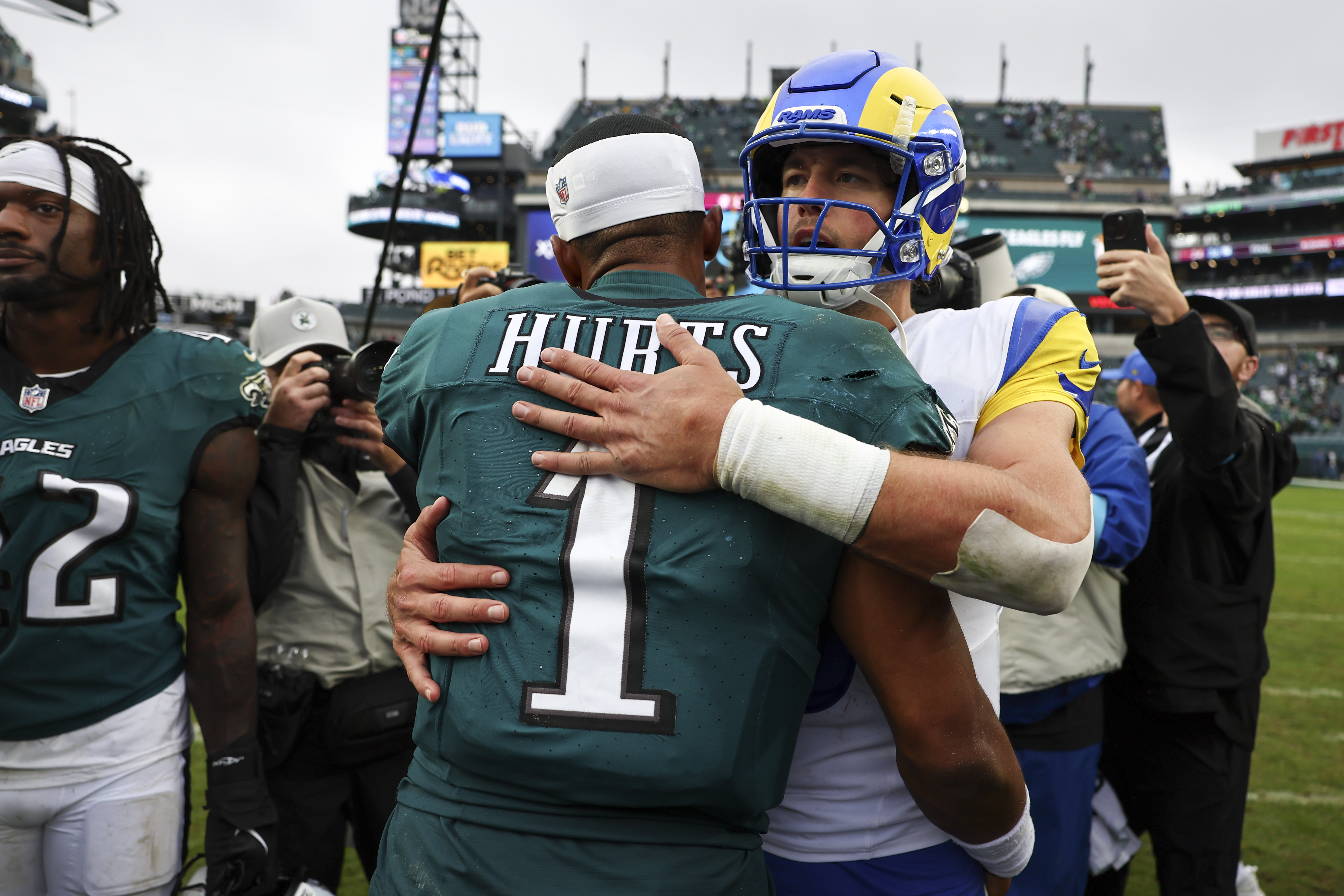
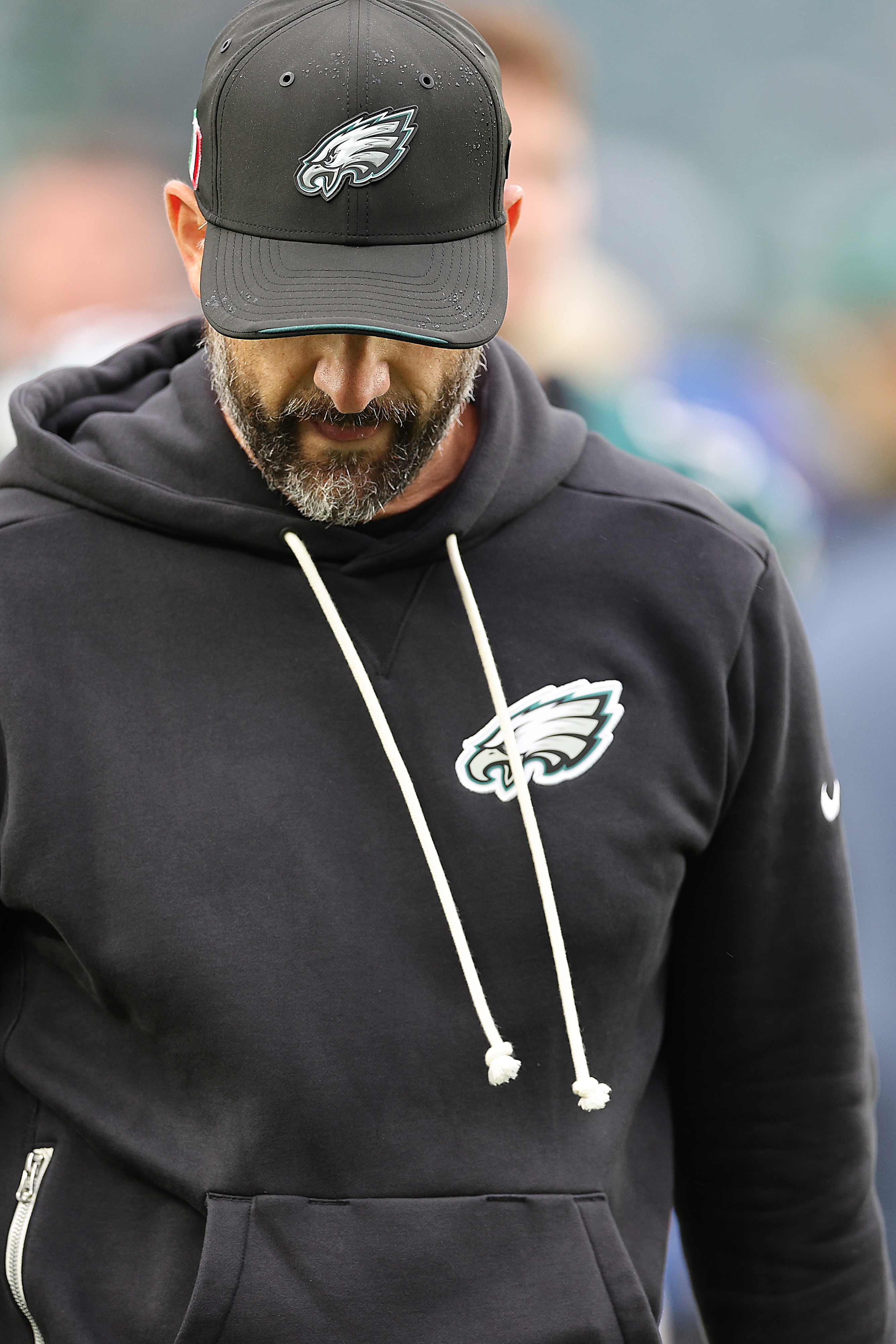
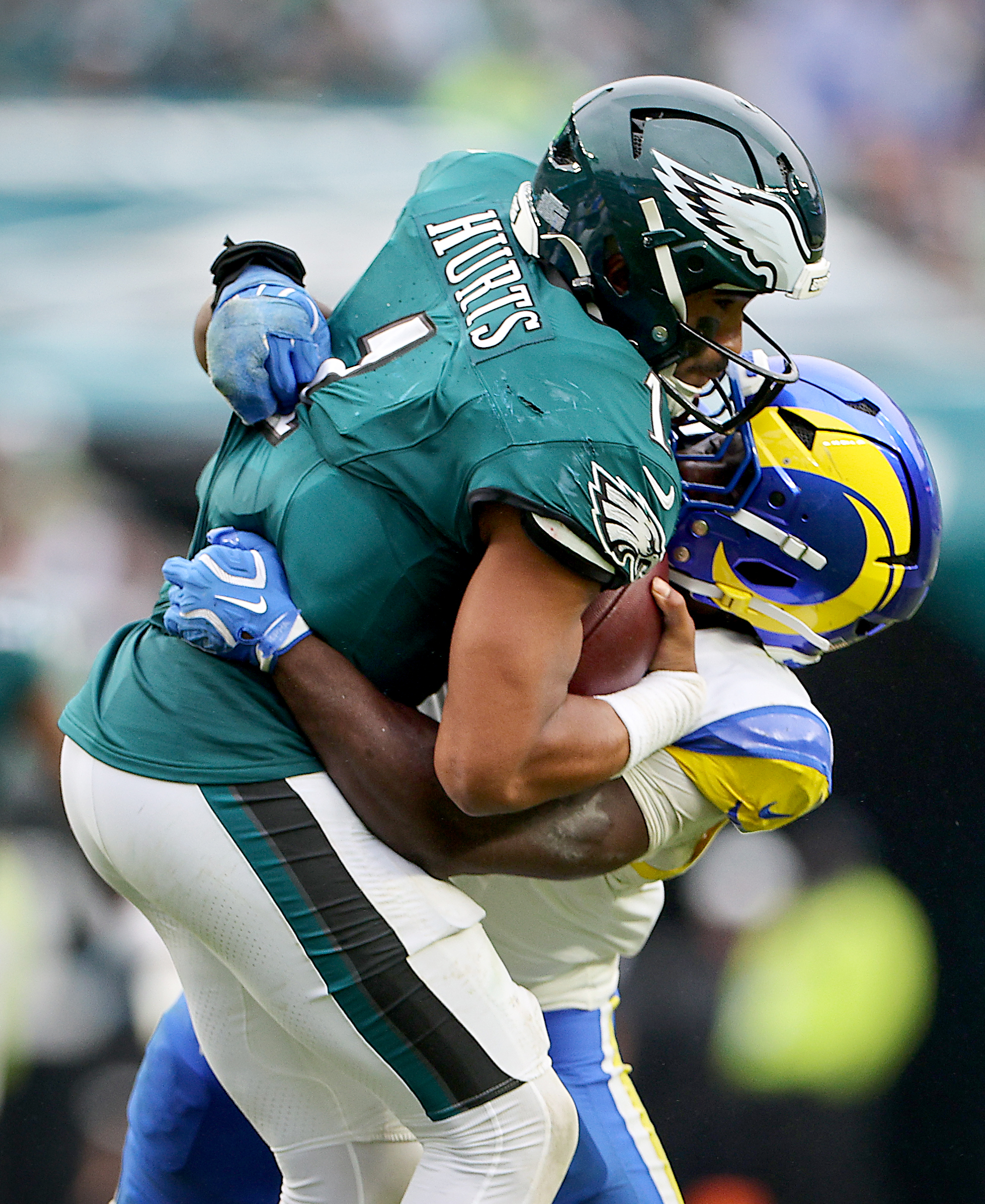
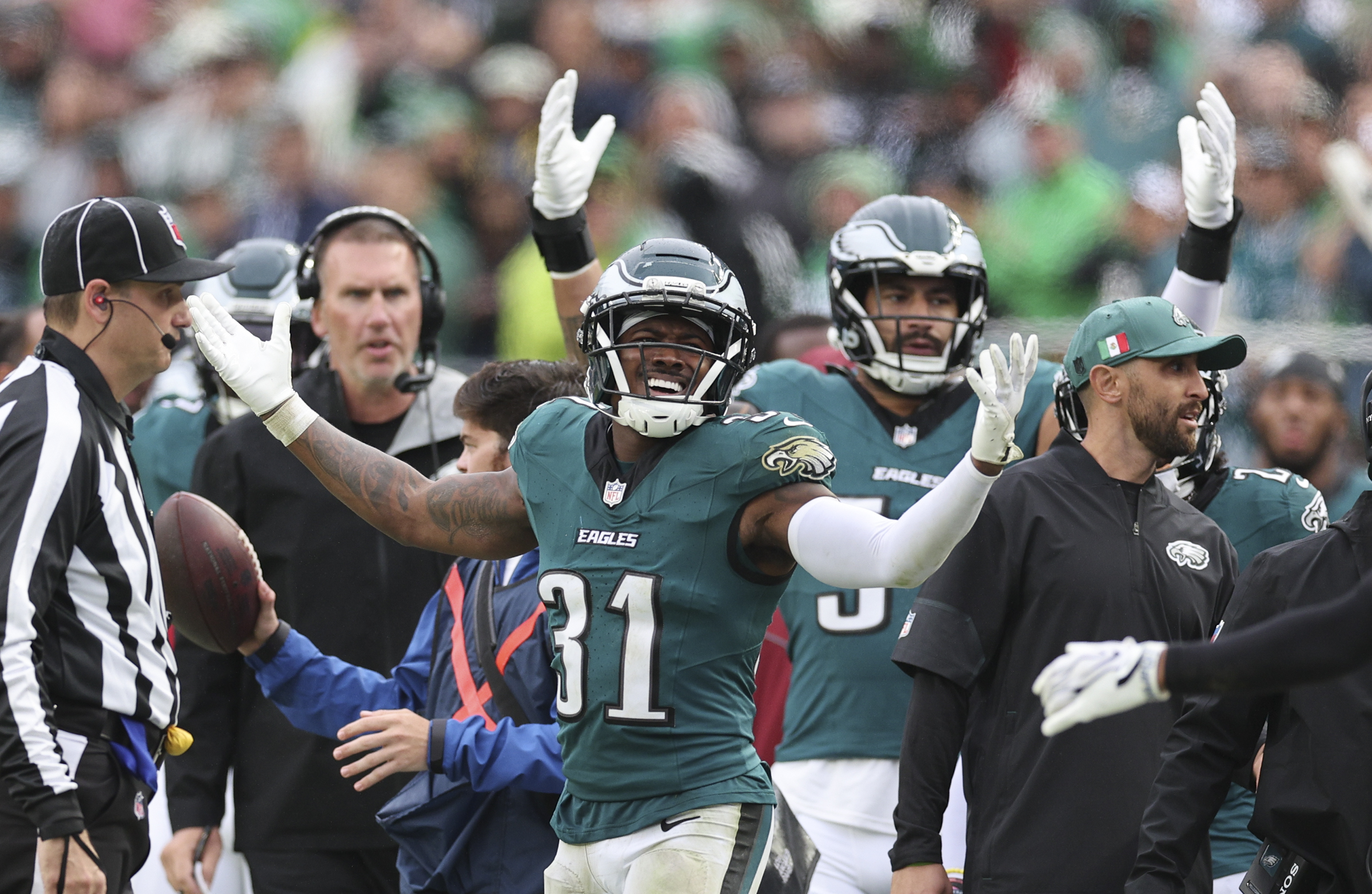
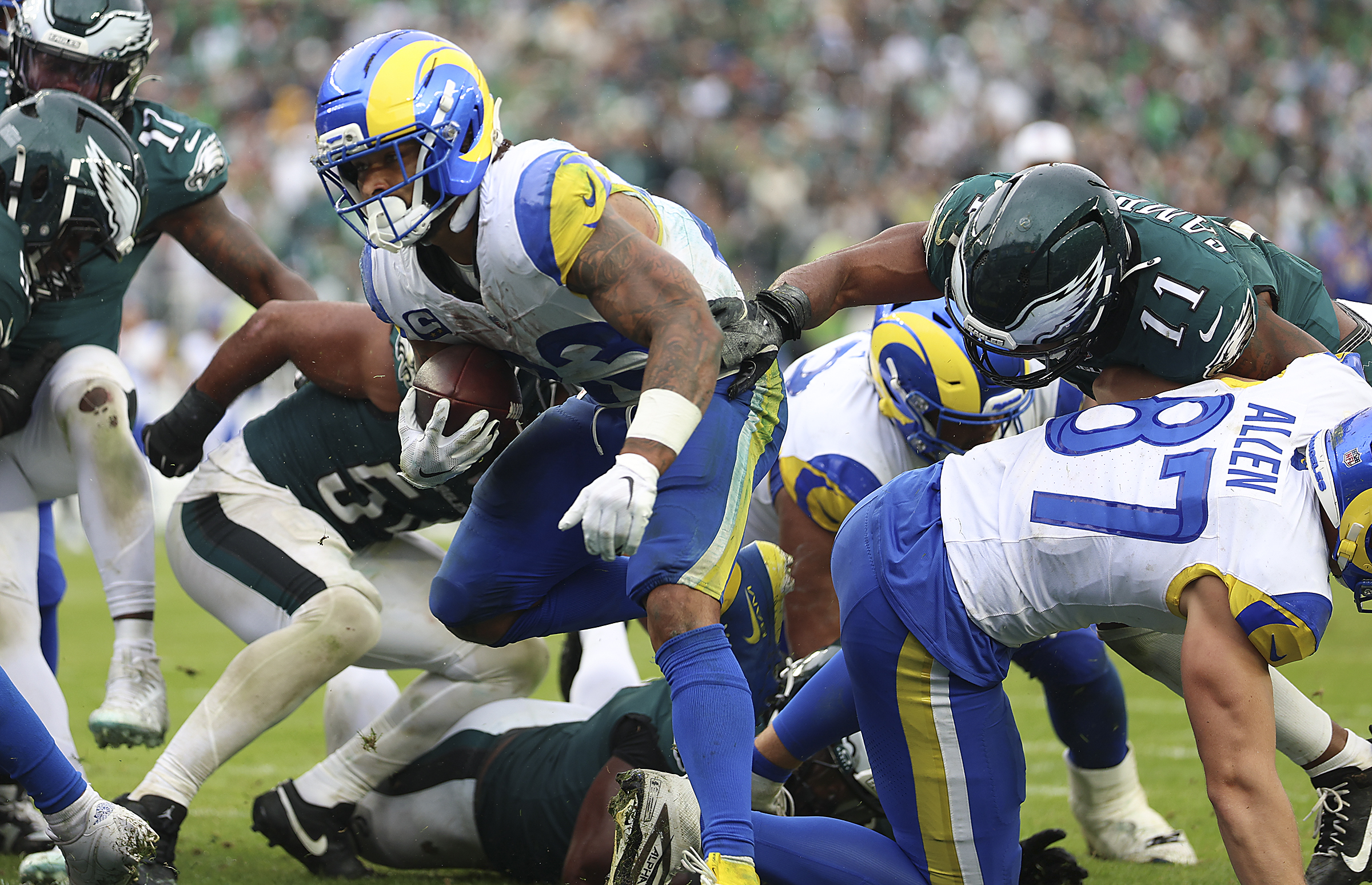
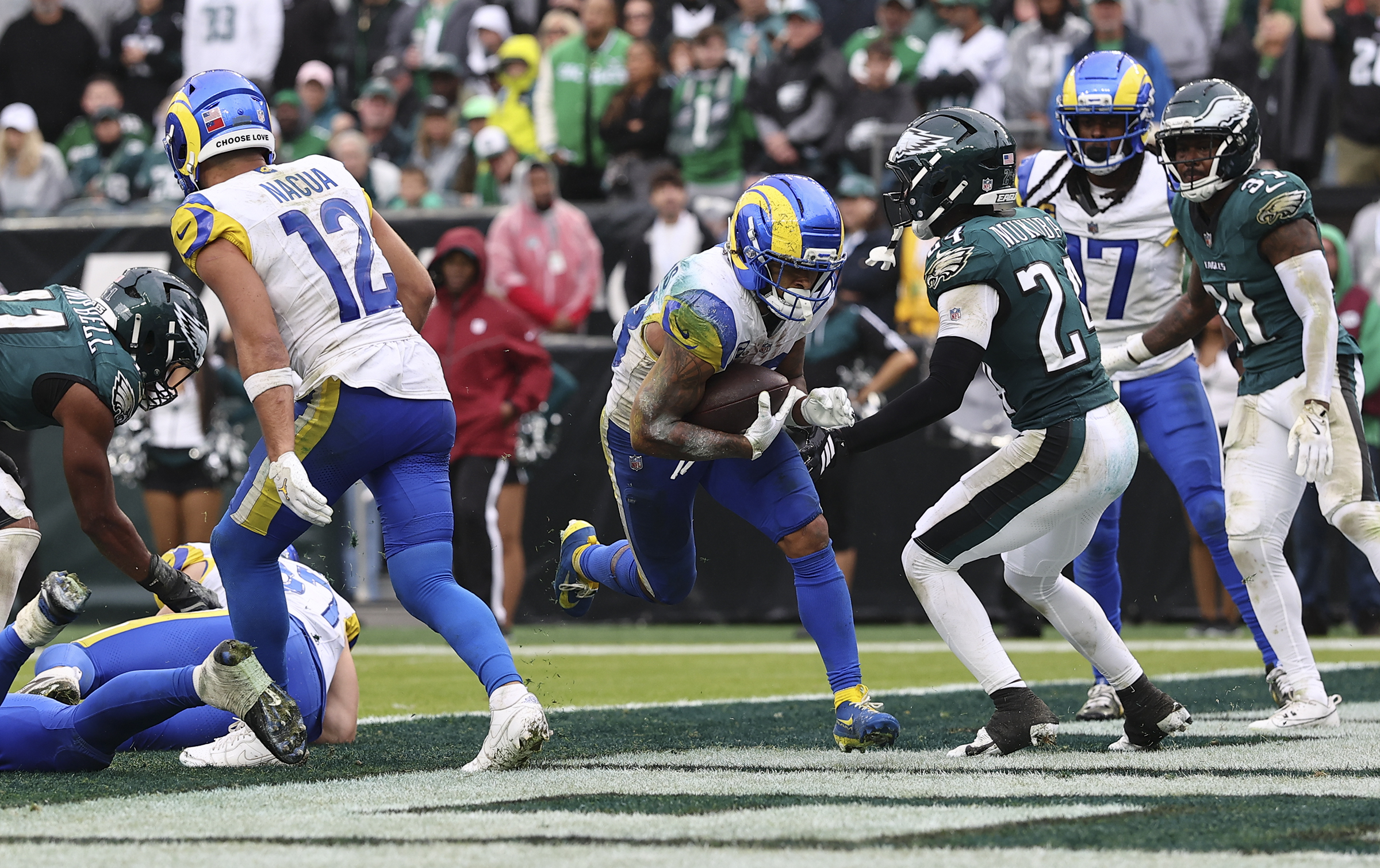
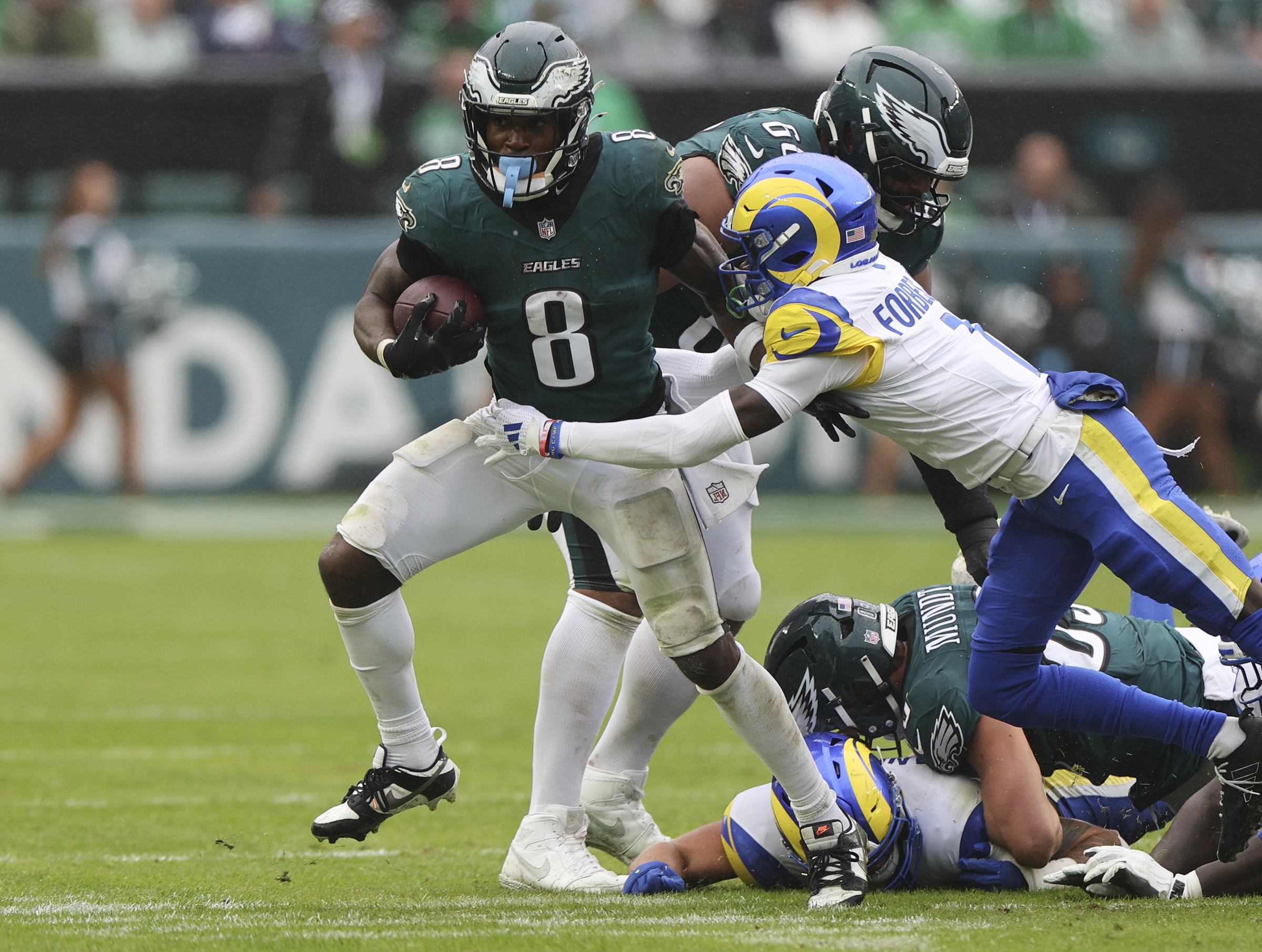
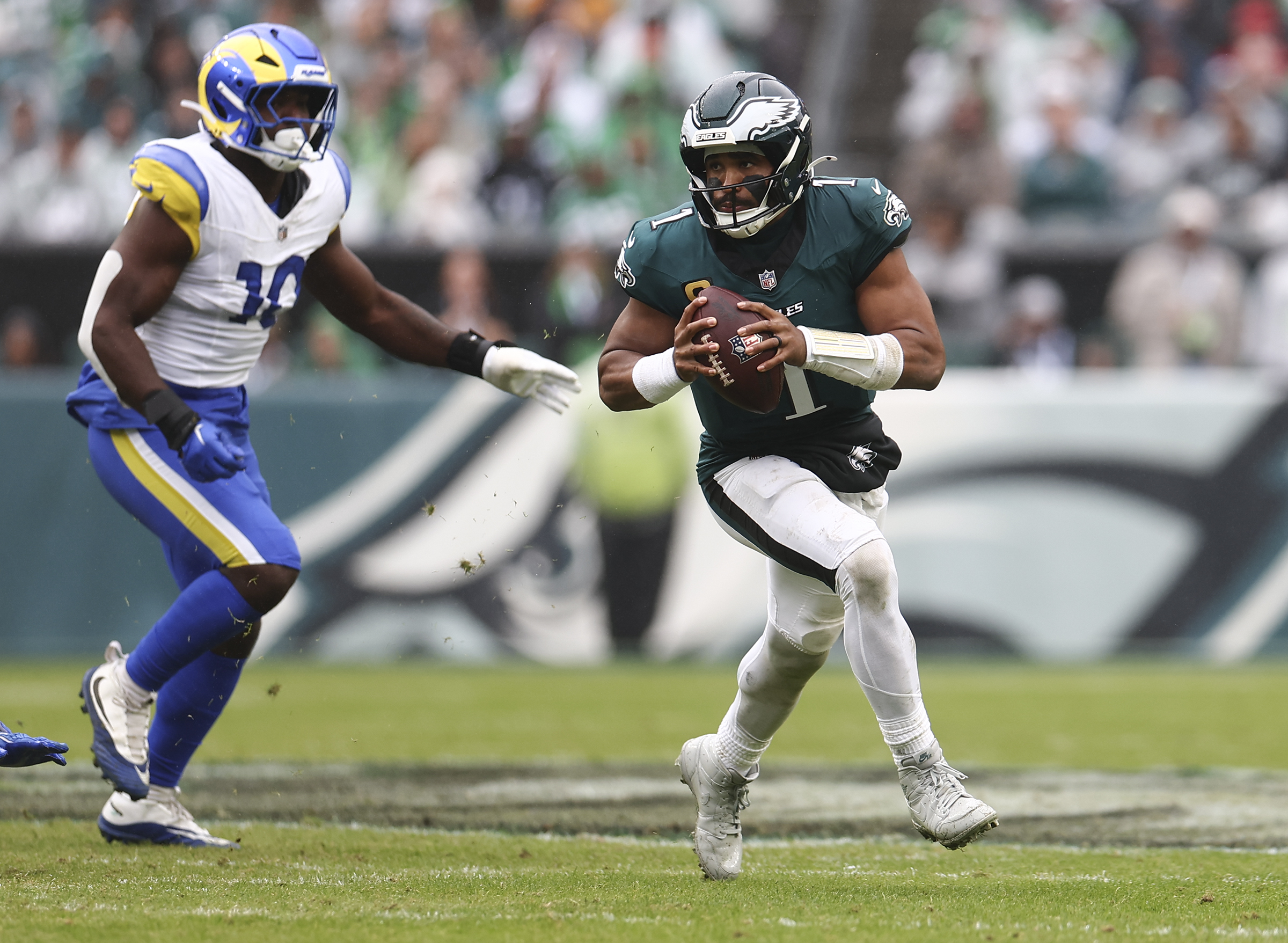
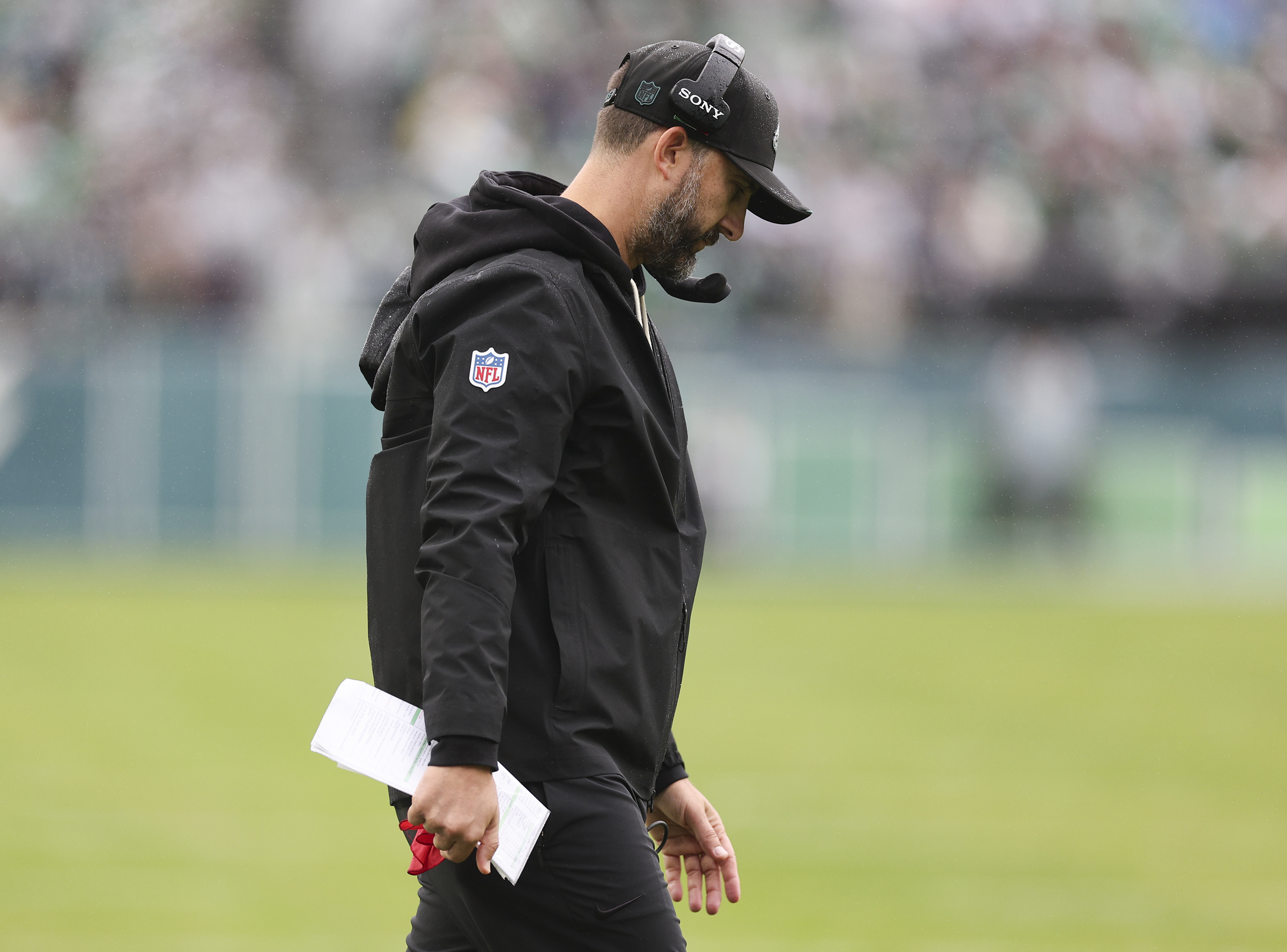
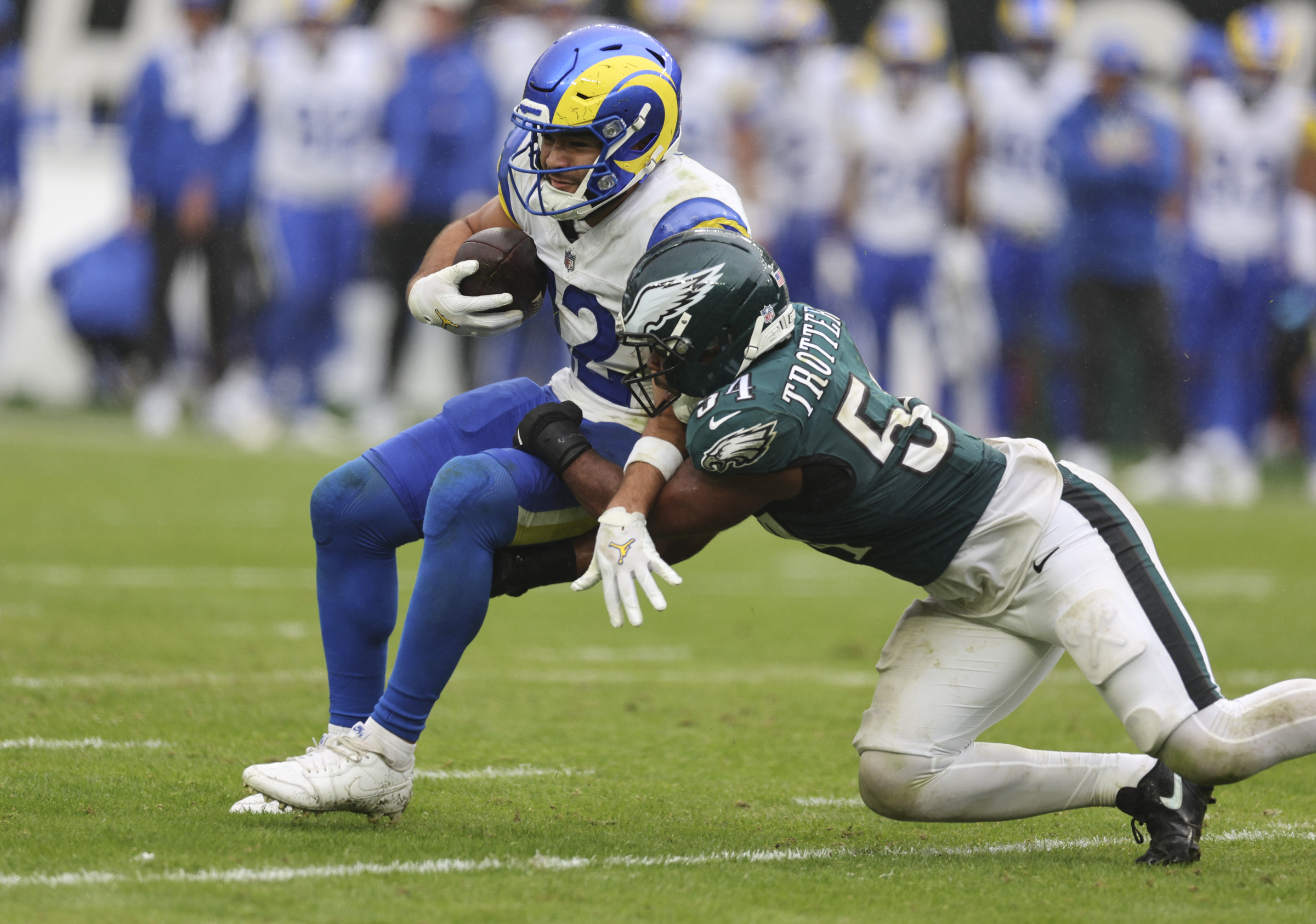
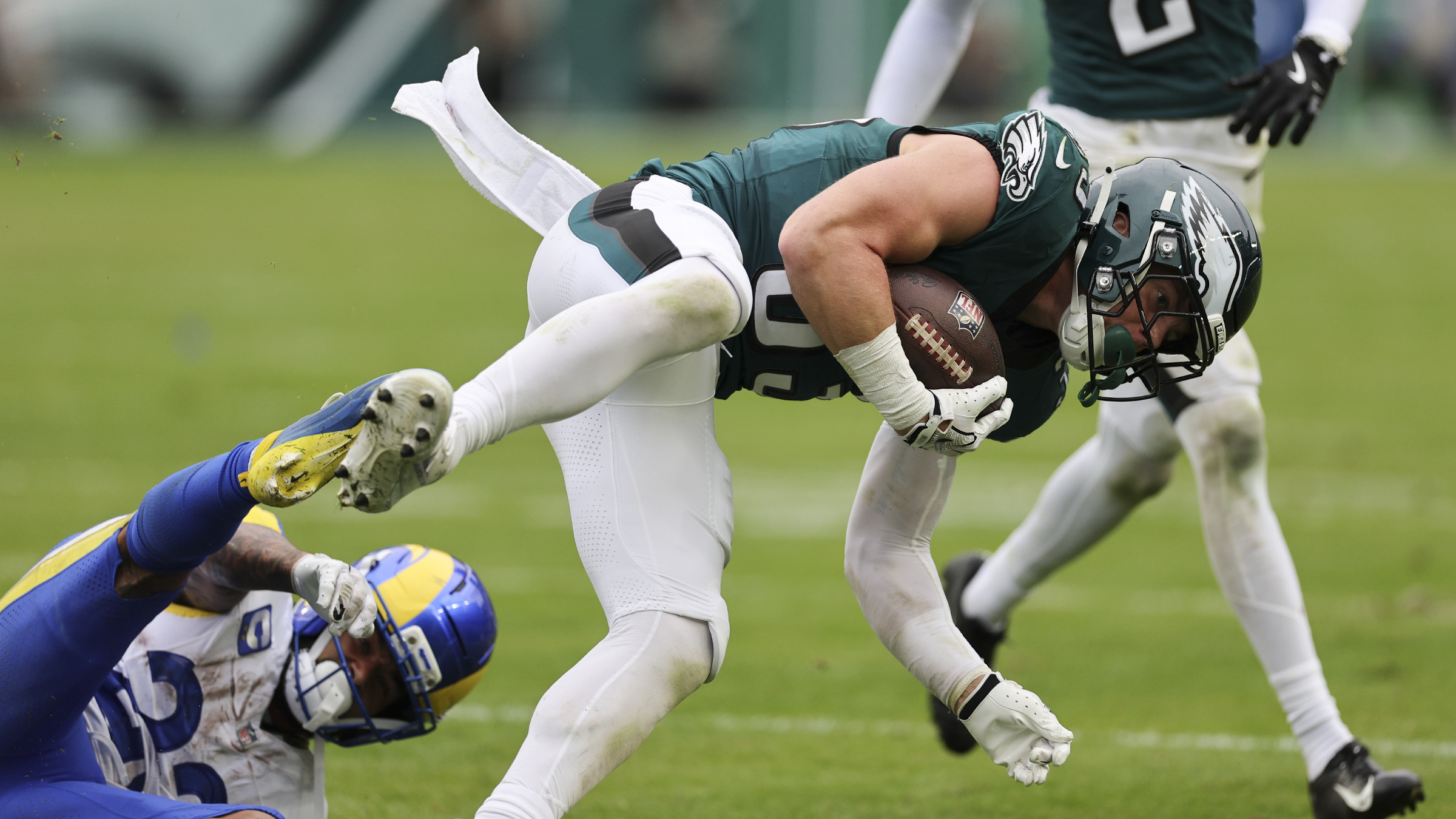
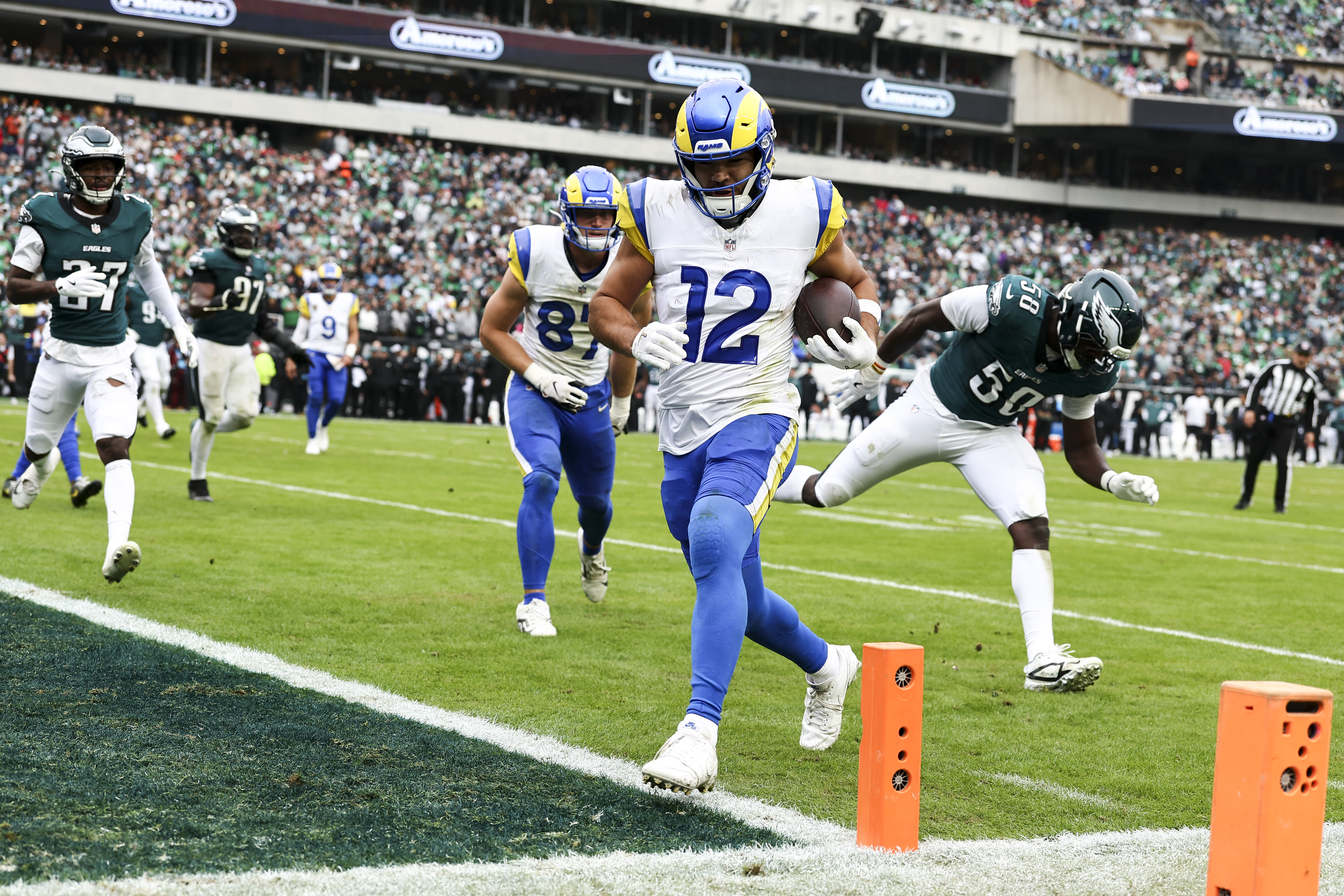
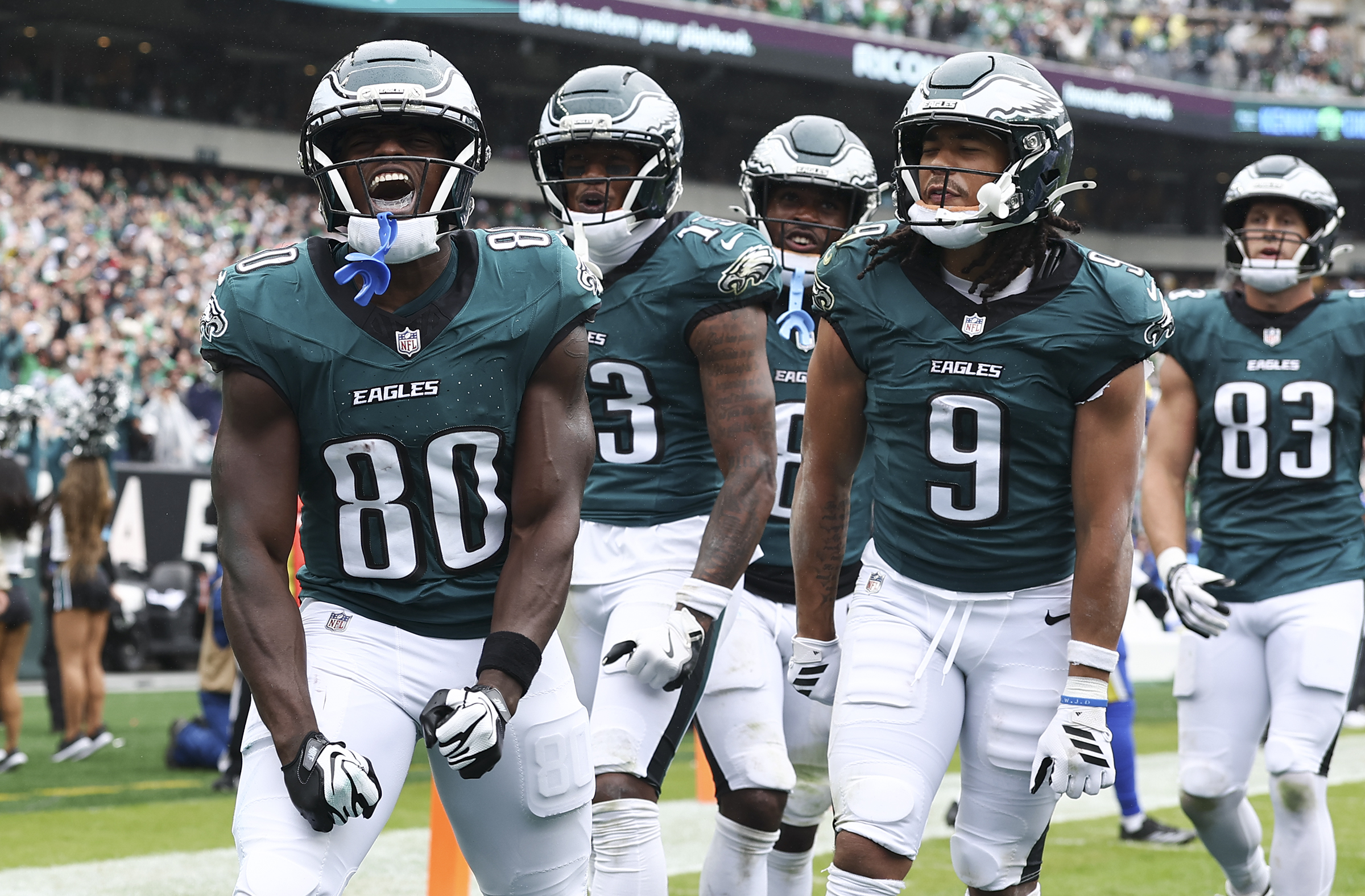
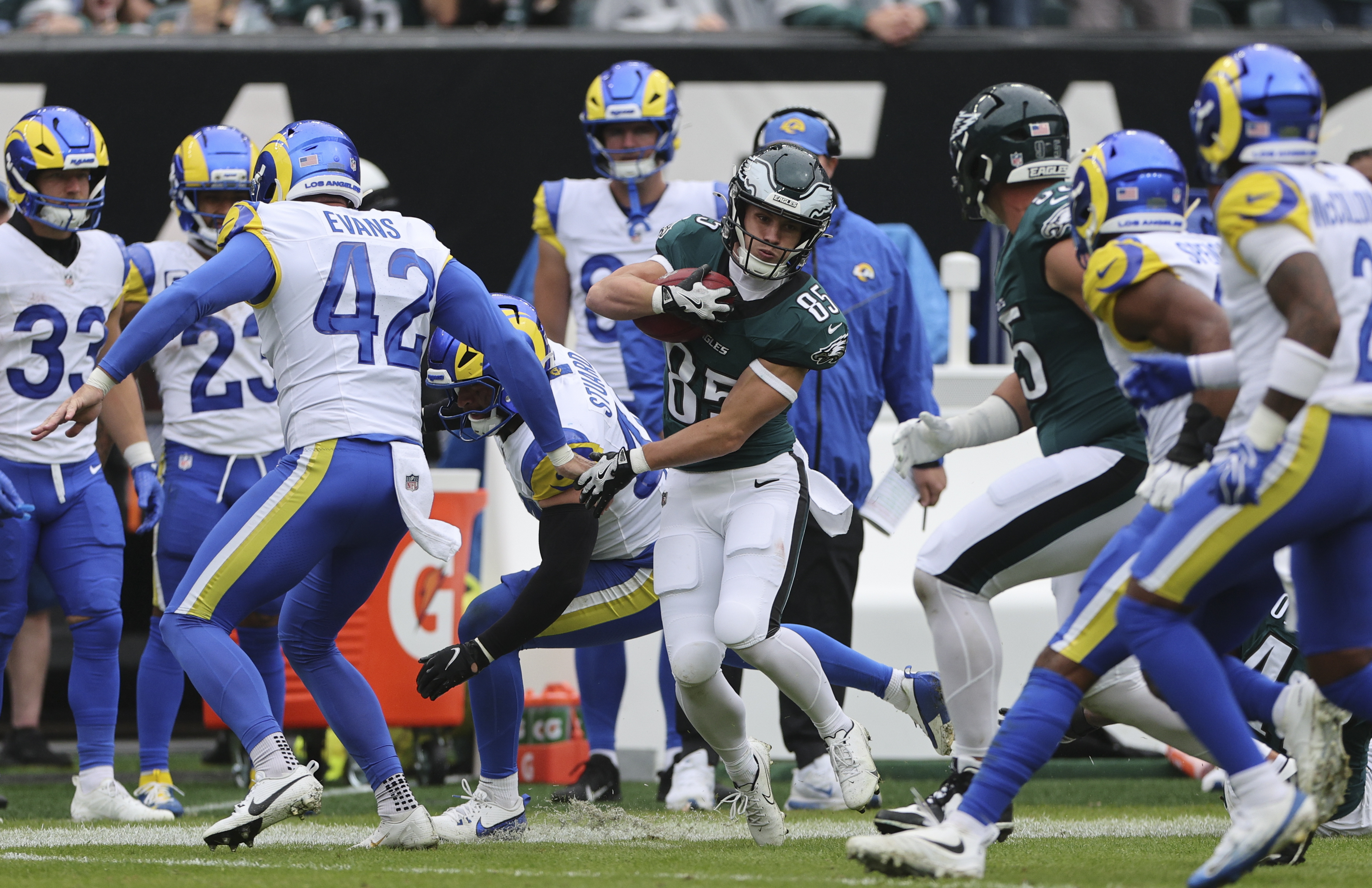
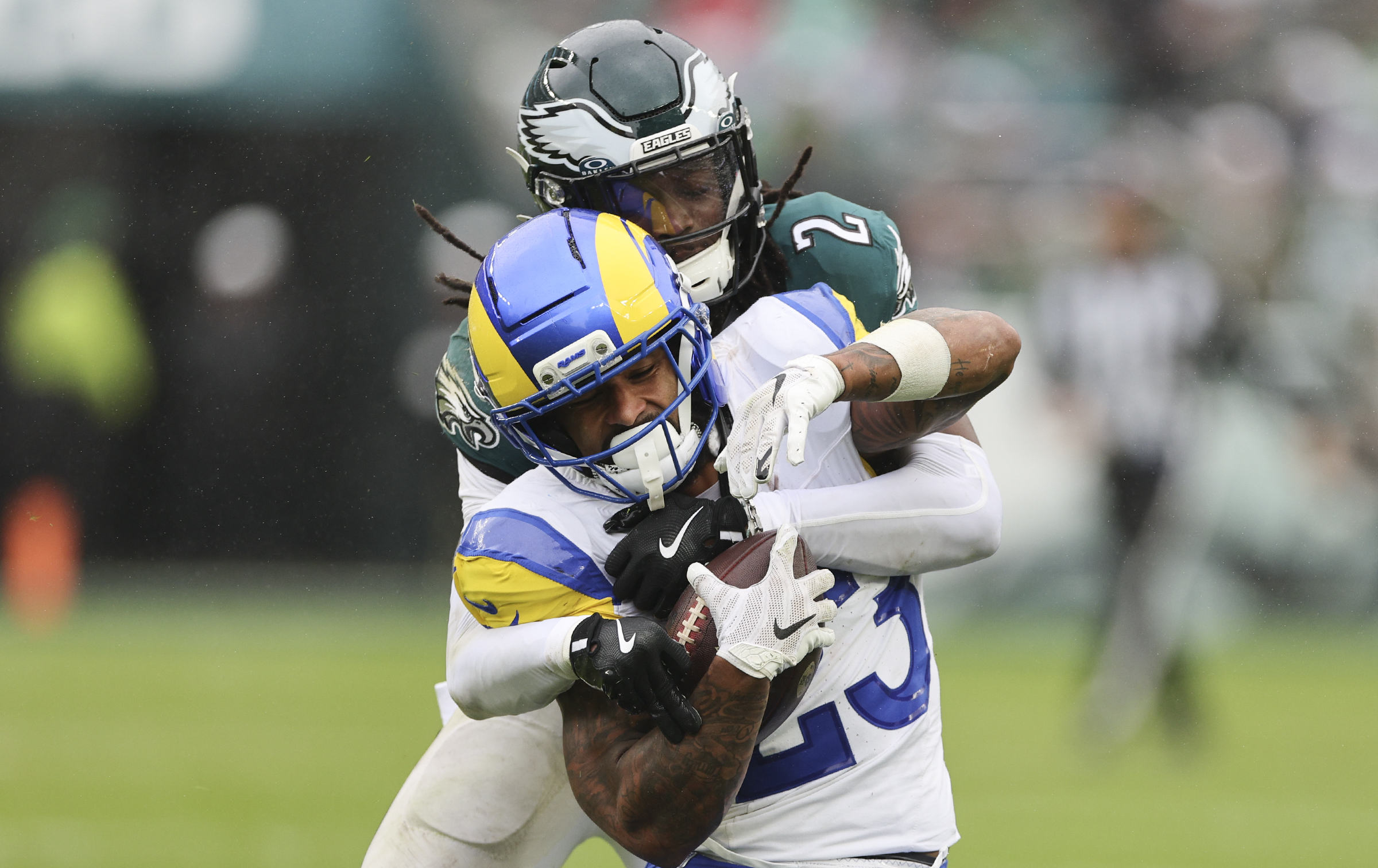
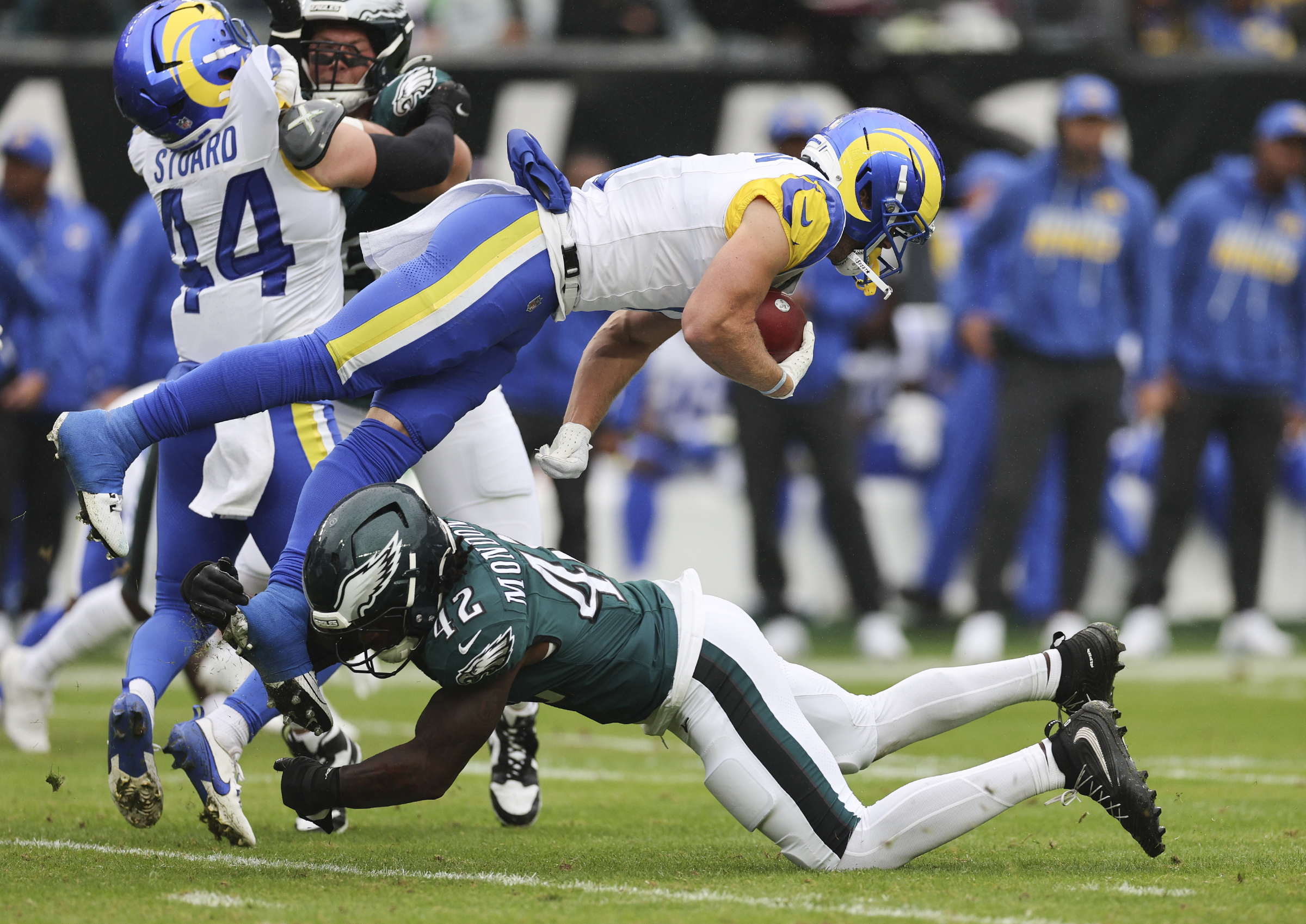
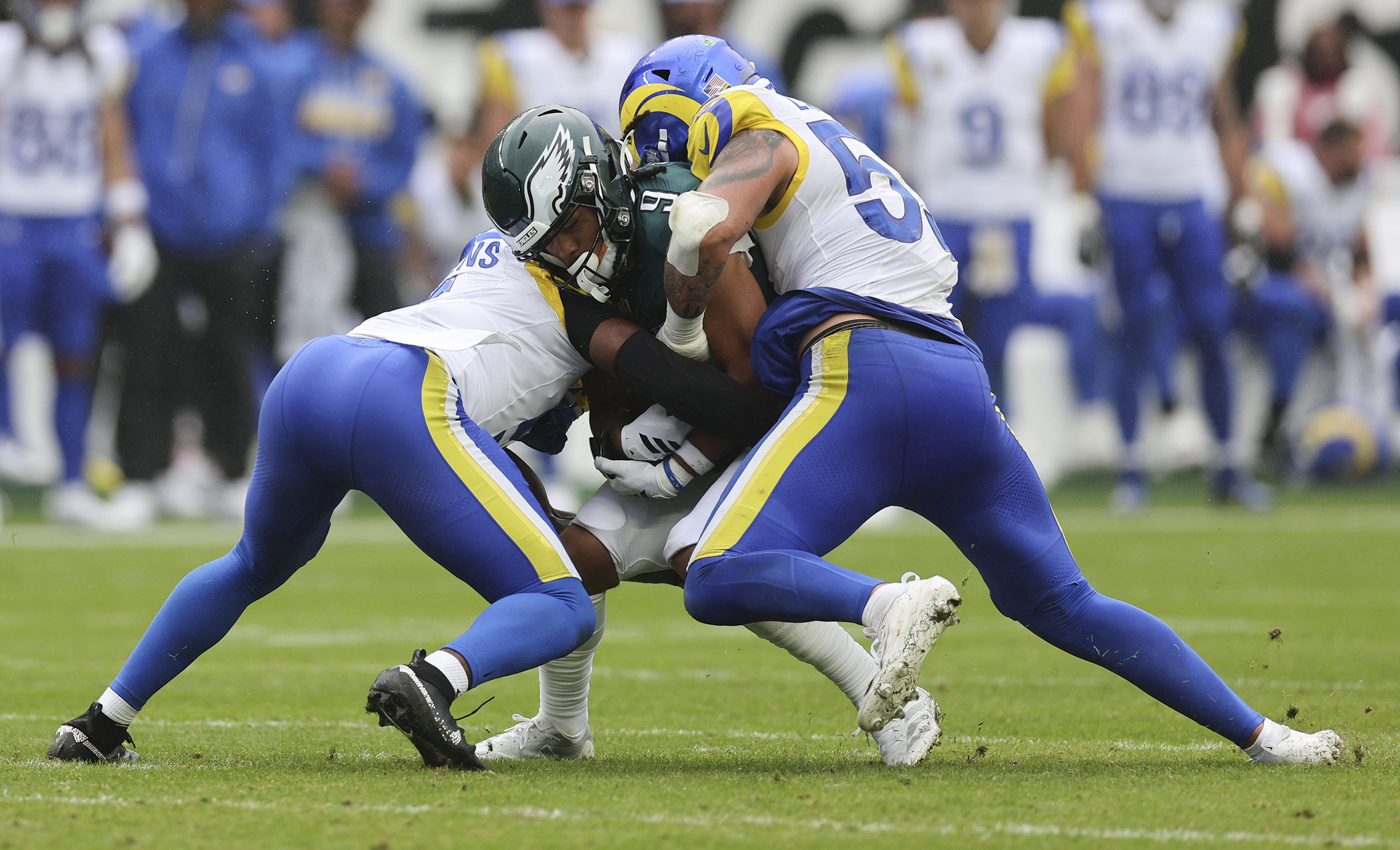
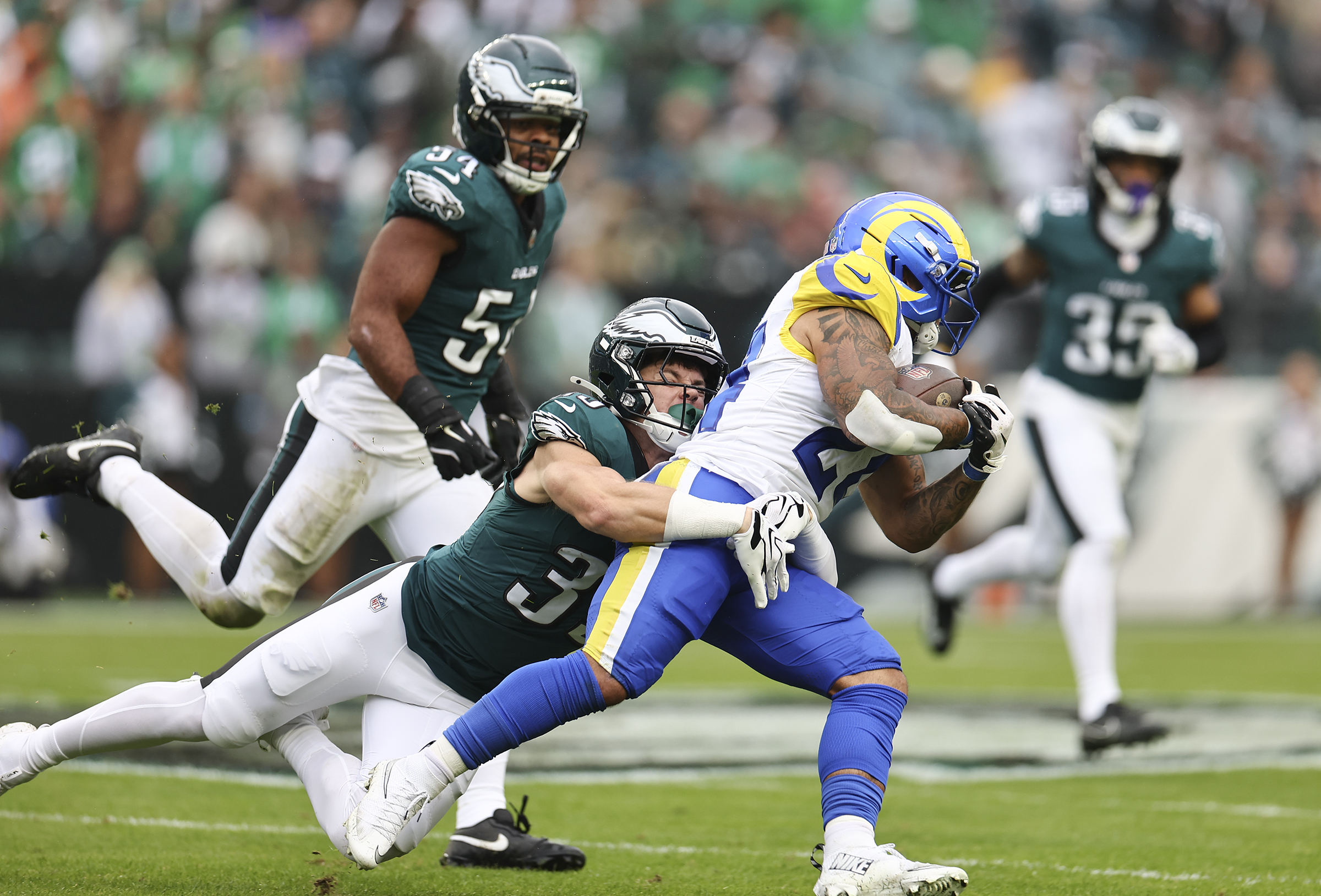
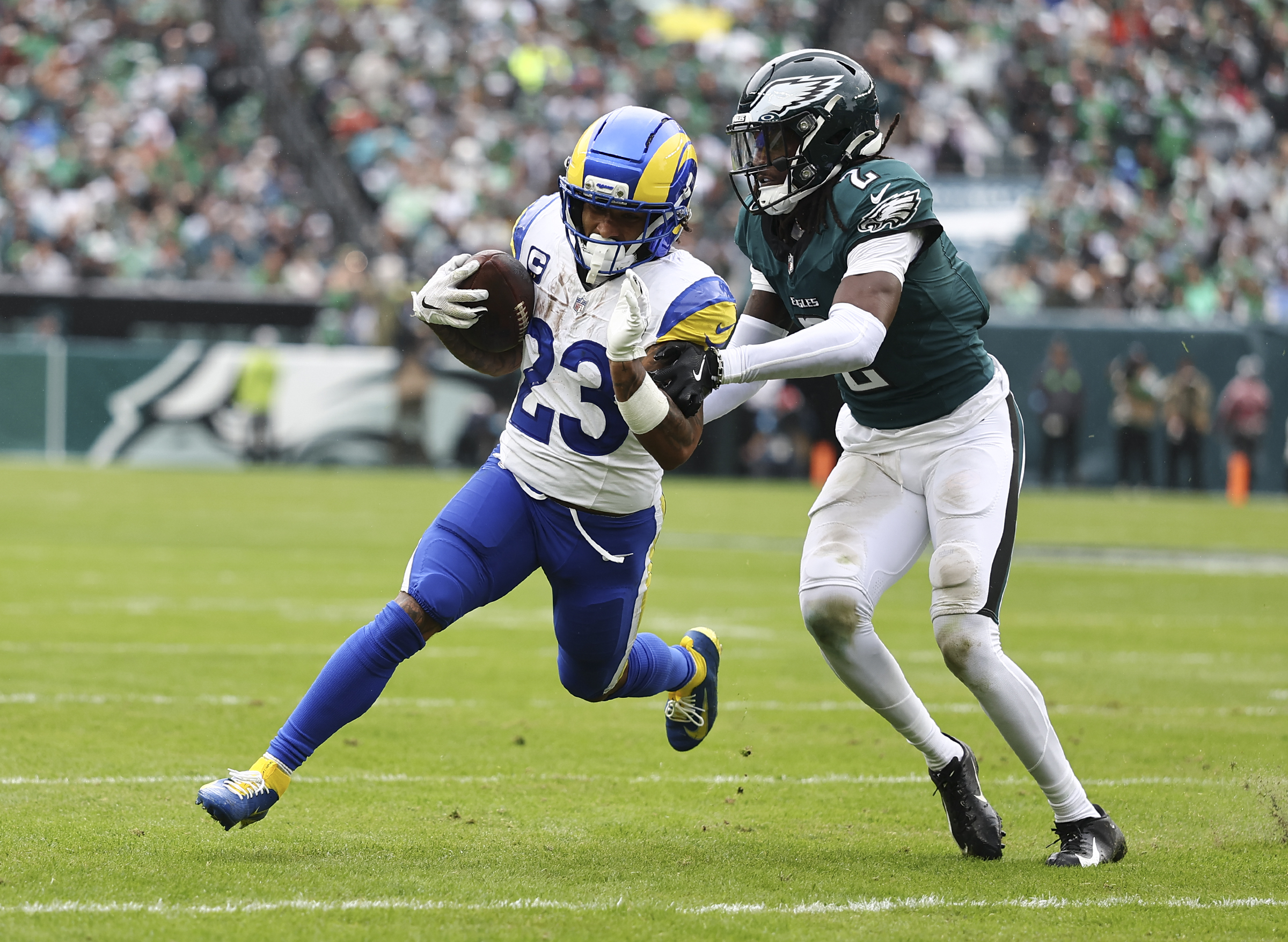
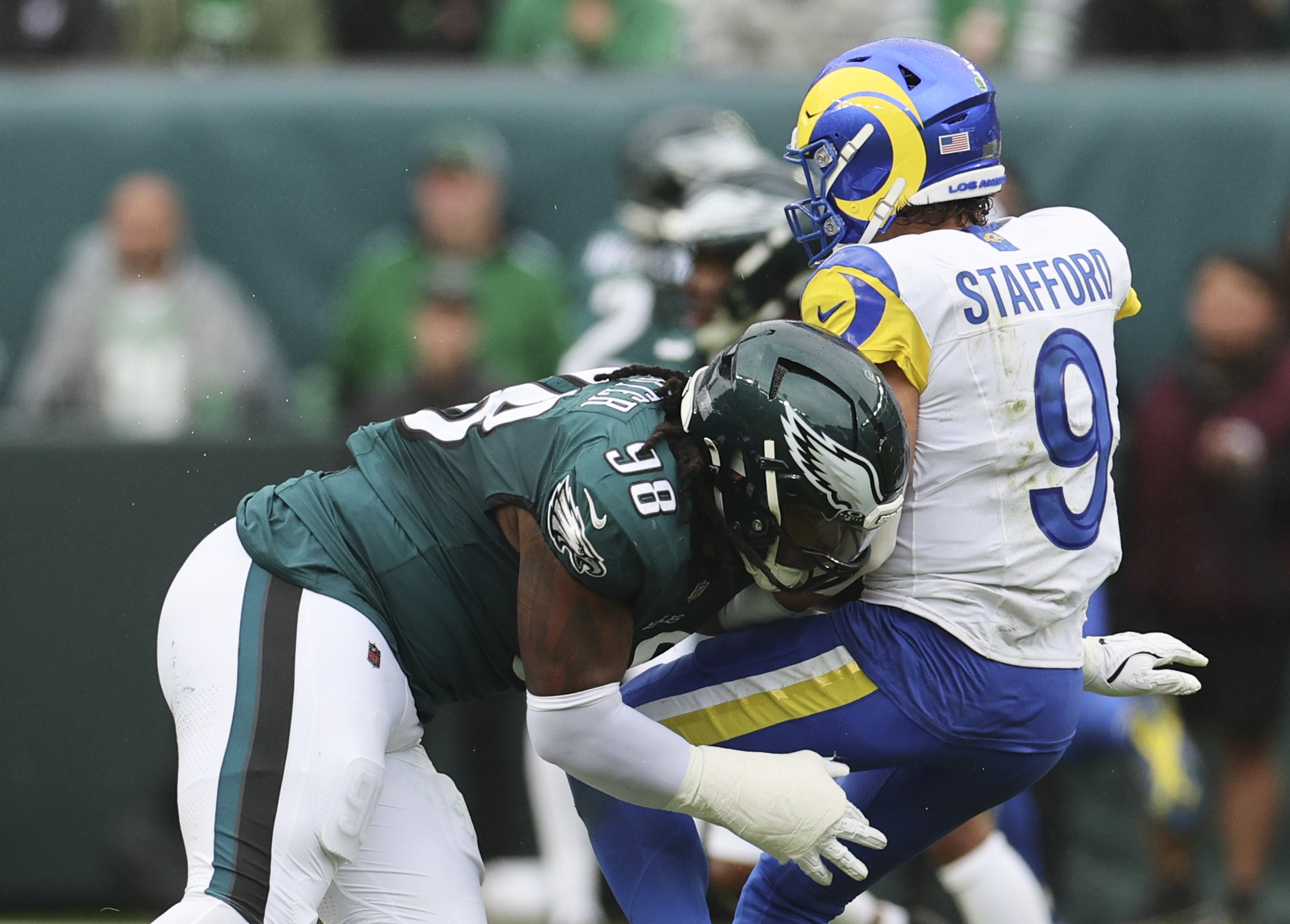
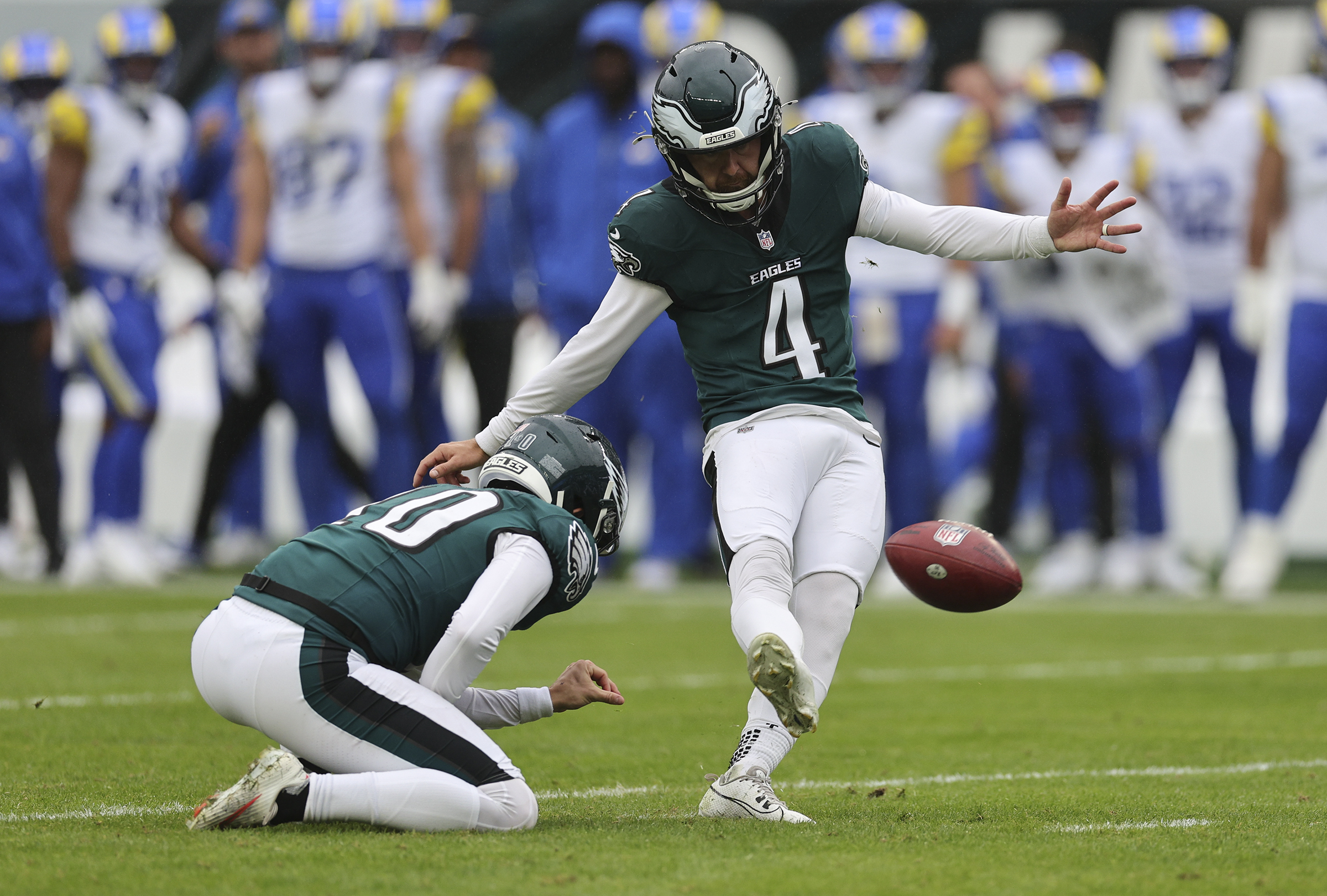
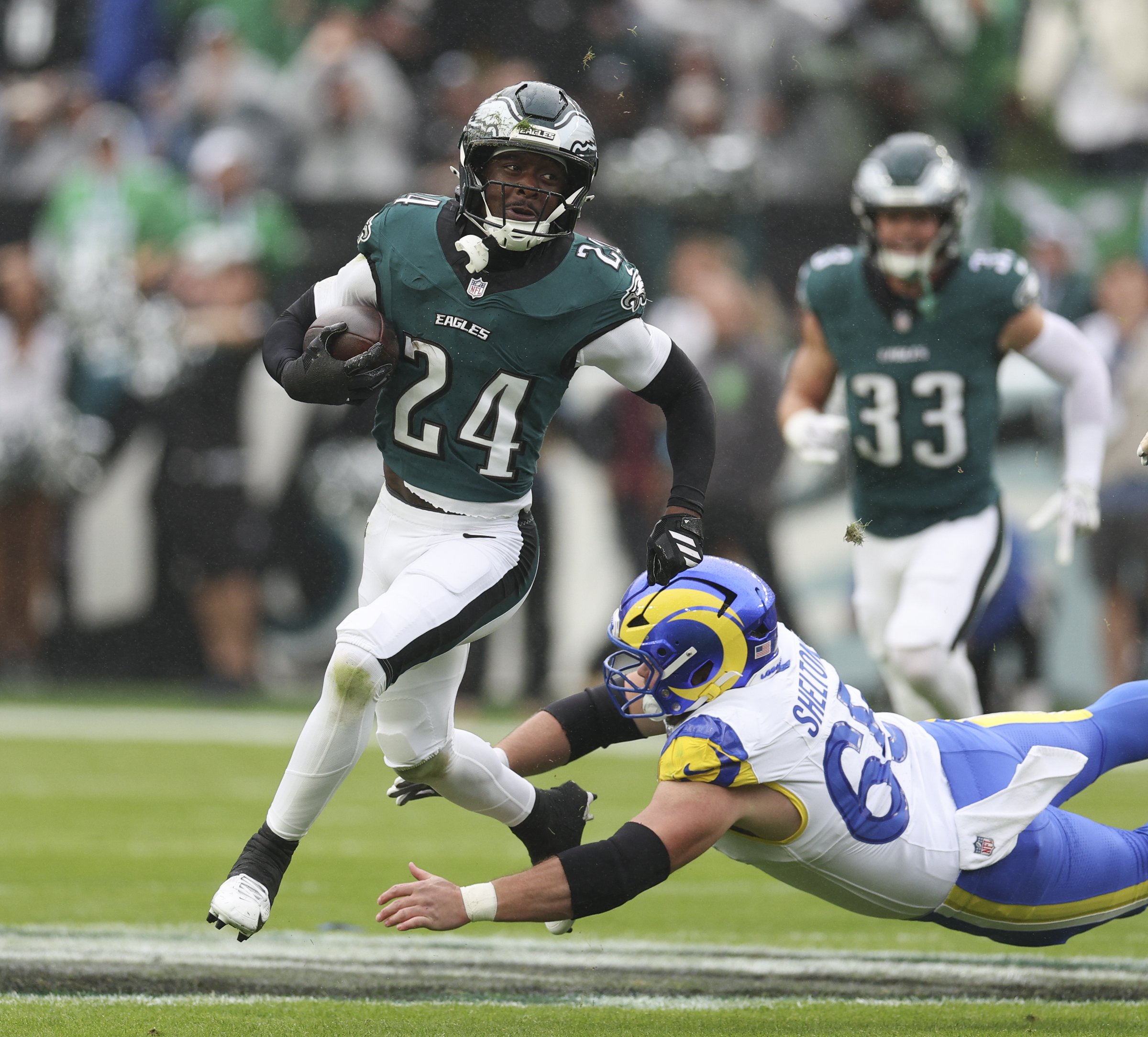
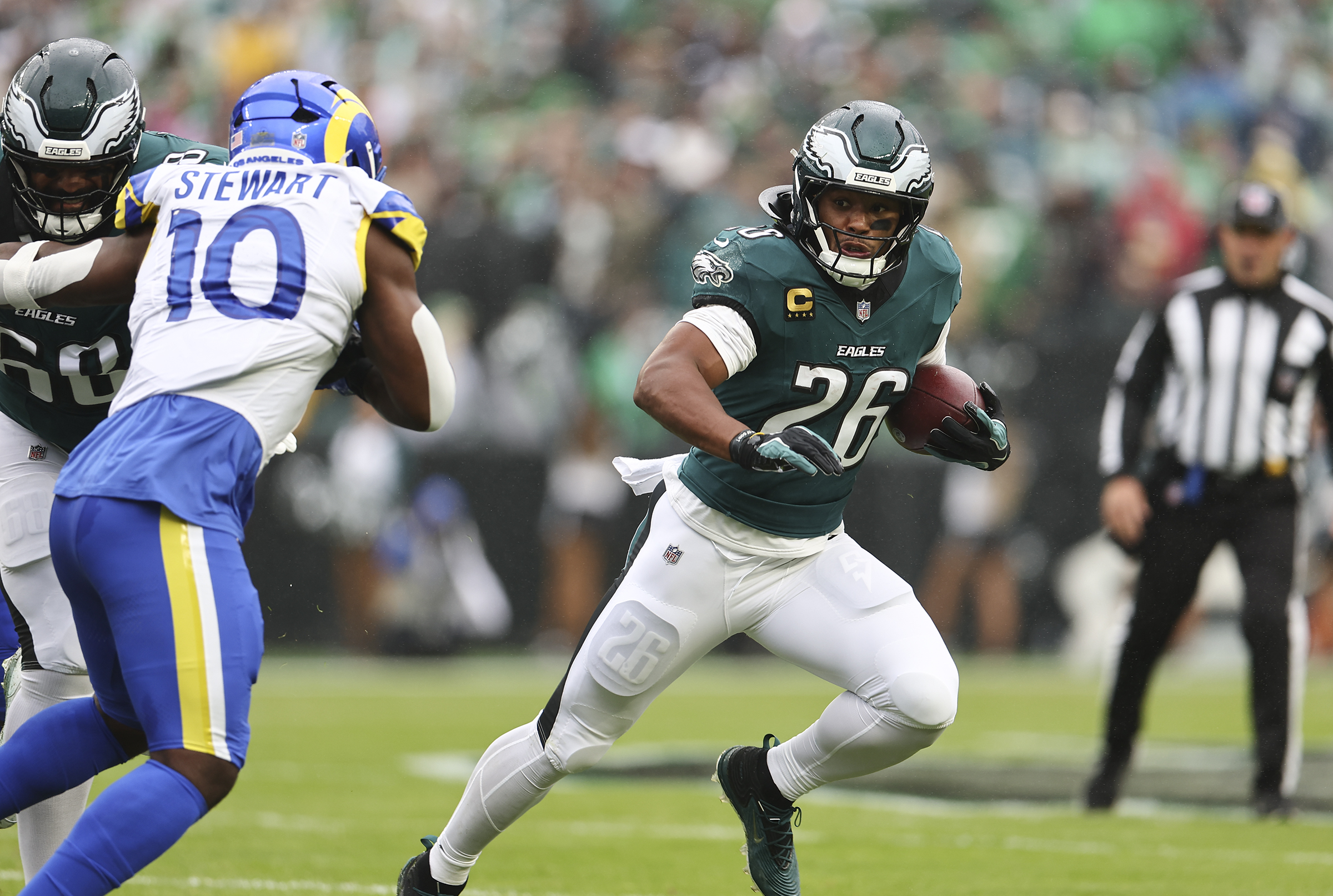
Eagles quarterback Jalen Hurts greets Rams quarterback Matthew Stafford after the Eagles lost to the Rams, 24-20.Monica Herndon / Staff PhotographerEagles head coach Nick Sirianni walks off the field after their loss to the Rams.David Maialetti / Staff PhotographerRams linebacker Byron Young (right) sacks Philadelphia Eagles quarterback Jalen Hurts on their final drive of the game.David Maialetti / Staff PhotographerRams running back Kyren Williams stiff-arms Eagles linebacker Jeremiah Trotter Jr. on his touchdown run late in the fourth quarter.David Maialetti / Staff PhotographerEagles defensive back Jonathan Jones reacts after getting called for personal foul penalty in the fourth quarter.David Maialetti / Staff PhotographerRams running back Kyren Williams scores a fourth quarter touchdown past Eagles linebacker Jihaad Campbell.David Maialetti / Staff Photographerrunning back Kyren Williams scores a fourth quarter touchdown against Eagles safety Andrew Mukuba.Monica Herndon / Staff PhotographerEagles running back Tank Bigsby runs with the football against Rams cornerback Emmanuel Forbes in the fourth quarter.David Maialetti / Staff PhotographerEagles quarterback Jalen Hurts runs with football past Rams linebacker Josaiah Stewart in the fourth quarter.Monica Herndon / Staff PhotographerEagles head coach Nick Sirianni looks down at the turf with his team on the goal line during the fourth quarter. The Eagles gave-up the football on downs.David Maialetti / Staff PhotographerEagles linebacker Jeremiah Trotter Jr., stops Rams wide receiver Puka Nacua in the third quarter.David Maialetti / Staff PhotographerEagles cornerback Cooper DeJean intercepts the football past Rams running back Kyren Williams during the second quarter.David Maialetti / Staff PhotographerEagles wide receiver Darius Cooper catches a second quarter touchdown against the Rams. The touchdown was Cooper’s second during the second quarter.David Maialetti / Staff PhotographerRams wide receiver Puka Nacua scores during the second quarter against the Eagles.Monica Herndon / Staff PhotographerEagles wide receiver Darius Cooper (left) celebrates his first, second quarter touchdown with his teammates.Monica Herndon / Staff PhotographerEagles wide receiver Darius Cooper catches his first second quarter touchdown against Rams safety Quentin Lake (center) and cornerback Trent McDuffie.David Maialetti / Staff PhotographerEagles wide receiver Darius Cooper catches his first second quarter touchdown against Rams safety Quentin Lake.Monica Herndon / Staff PhotographerEagles kick returner Britain Covey runs with he football in the second quarter.David Maialetti / Staff PhotographerEagles cornerback Riq Woolen stops Rams running back Kyren Williams in the second quarter.David Maialetti / Staff PhotographerRams Alex Bachman flies during a second quarter kick-off return against Eagles linebacker Smael Mondon Jr..David Maialetti / Staff PhotographerEagles wide receiver Makai Lemon catches the football against Rams safety Kam Curl (left) and linebacker Nate Landman in the second quarter.David Maialetti / Staff PhotographerEagles cornerback Cooper DeJean goes after Rams running back Blake Corum in the first quarter.Monica Herndon / Staff PhotographerRams running back Kyren Williams runs past Eagles cornerback Riq Woolen in the first quarter.Monica Herndon / Staff PhotographerEagles defensive tackle Jalen Carter goes after Rams quarterback Matthew Stafford in the first quarter.David Maialetti / Staff PhotographerEagles kicker Jake Elliott kicks a first quarter field goal with holder Braden Mann.David Maialetti / Staff PhotographerEagles safety Andrew Mukuba runs with the football during a first quarter interception against Rams center Coleman Shelton.David Maialetti / Staff PhotographerEagles running back Saquon Barkley walks off the field in the first quarter. Barkley got hurt against the Rams.David Maialetti / Staff PhotographerEagles running back Saquon Barkley leaves the field with members of the medical staff in the first quarter.David Maialetti / Staff PhotographerEagles running back Saquon Barkley kneels in pain during the first quarter.Monica Herndon / Staff PhotographerEagles running back Saquon Barkley runs with the football against the Rams during the first quarter.Monica Herndon / Staff PhotographerEagles quarterback Jalen Hurts throws the football during the first quarter.David Maialetti / Staff Photographer
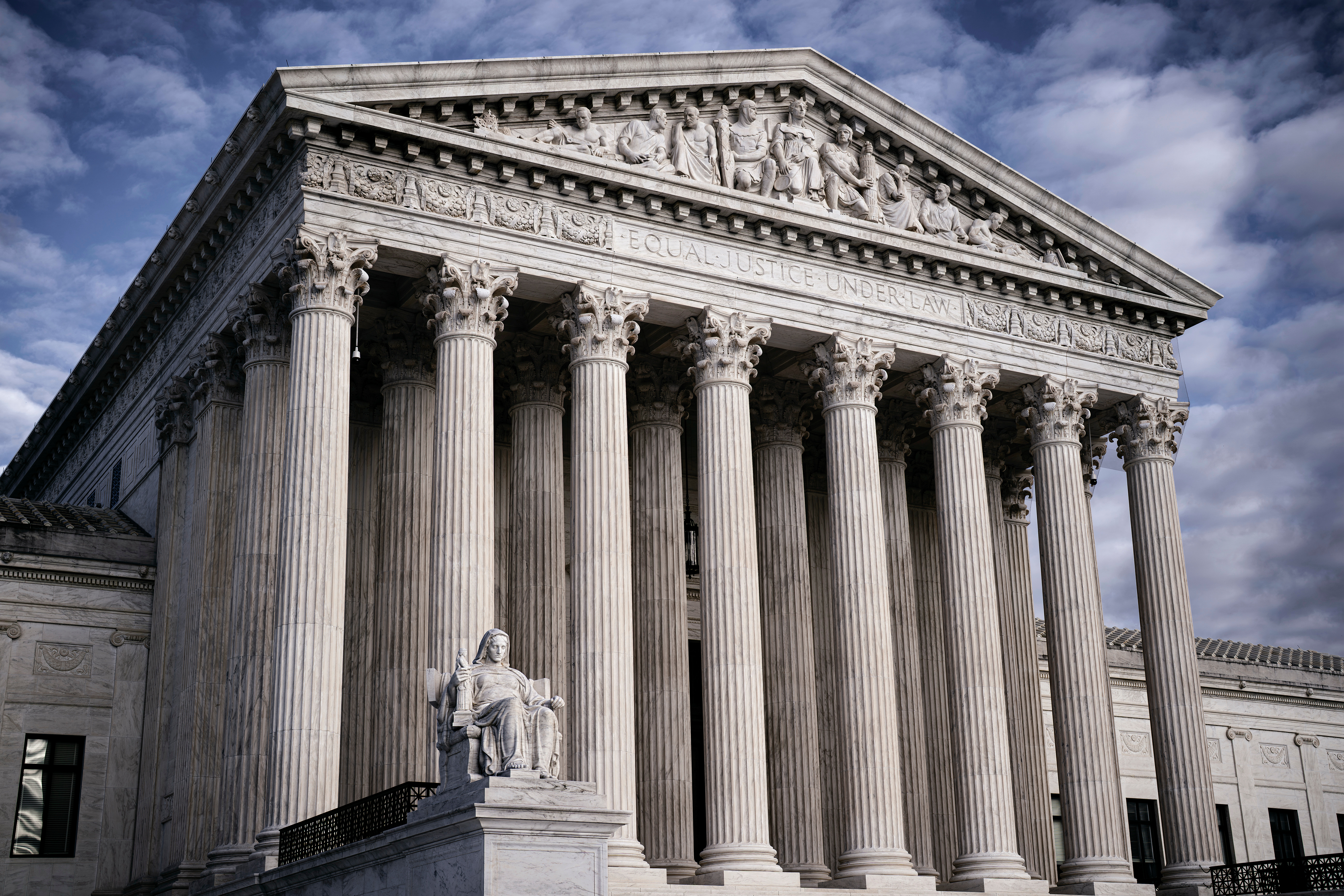
The Supreme Court kicked off a new term Monday that could significantly shift the law on guns, religion, and immigration.
The court may take up additional cases involving a range of controversial policies by President Donald Trump. And it could load up on other big constitutional issues, such as a Texas law that requires the Ten Commandments to be posted in public school classrooms.
Also be on the lookout for potential retirements by Republican-appointed justices, and for a push by Democratic lawmakers to implement changes to the Supreme Court. Both may depend on how the midterms shake out.
Oyez, oyez, oyez. Here’s what you should know as the new term begins.
1. Trump’s immigration policies face more tests
Last week the justices agreed to review two major Trump immigration policies in cases that could turn into blockbusters.
One involves the legality of sending noncitizens to “third countries” where they are not citizens — a policy the court has allowed to continue as it decides the case. The second centers on Trump’s mandatory detention policy for immigrants awaiting removal proceedings. Both have been critical to Trump’s sweeping immigration crackdown.
Other Trump policies that could land on the docket: the president’s ban on transgender people serving in the military and the administration’s maneuvers to install loyalists to U.S. attorneys offices while bypassing the Senate confirmation process. The legality of Trump’s newest round of tariffs and his renewed push to limit birthright citizenship could also return to the high court.
2. The court could become enmeshed in the midterms
The stakes are high for November’s midterm elections, which will determine control of the House and Senate. Voters will decide races at the ballot box, but the Supreme Court could play a notable role, too.
The Supreme Court has already decided a flurry of cases related to voting and the election in the run-up to November, some dealing with the Trump administration’s aggressive efforts to restrict voting.
Given Trump’s penchant for claiming voter fraud, it’s a good bet that challenges will roll in as the ballots are counted, particularly in closely contested elections.
Democratic attorneys general in about 20 states have already been war-gaming on how to respond if federal agents are sent to polling places or voters are blocked from voting. Any fights could go up to the Supreme Court.
3. Another landmark test on guns
The Supreme Court in recent years has transformed few areas of law as much as gun rights. This term brings the next major chapter in that fight: whether states can ban AR-15-style semiautomatic rifles.
The fight is significant legally, but also culturally. The AR-15 has become a symbol of Second Amendment rights for some gun enthusiasts, and a target for those who want stricter gun controls because that type of firearm has been used in so many mass killings.
The Supreme Court will weigh restrictions on semiautomatic rifles in Illinois and Connecticut, which are being challenged by gun owners and gun rights groups. The Connecticut law was passed in the wake of the 2012 mass shooting at Sandy Hook Elementary, where a gunman killed 20 children and six school staff members.
In recent terms, the conservative majority has greatly loosened restrictions on firearms, most notably in a 2022 case that struck down a New York law requiring a license to carry a firearm in public. That decision, New York State Pistol and Rifle Association, Inc. v. Bruen, found that any gun restrictions must have roots in the nation’s history and traditions.
4. The expansion — and limits — of religious rights
The justices have accepted multiple cases for this term brought by religious groups. One has attracted particular attention: St. Mary Catholic Parish v. Roy. It involves a Catholic preschool in Colorado that says it is being unfairly excluded from a state prekindergarten program because it does not admit children of gay and transgender parents.
The high court led by Chief Justice John G. Roberts Jr. has generally ruled in favor of religious plaintiffs in such cases, and experts say St. Mary has a good chance of winning.
The court is also widely expected to take up a case involving a Texas law that requires all public school classrooms to display the Ten Commandments. The case challenges a 46-year-old precedent holding that such displays of religious content in public schools violate the separation of church and state.
5. Will a justice retire? It can’t be ruled out.
Rumors swirled for months earlier this year that Samuel A. Alito Jr. might retire, before the conservative justice knocked down the talk in an interview with the Wall Street Journal in August. Still, speculation could soon flare again.
With the midterm elections in November, Democrats have an opportunity to take control of the Senate, which must confirm any nominee to the high court. If Democrats triumph, that means Trump’s last opportunity to get a nominee through a Republican-controlled Senate will be during the lame-duck period between November and January.
A Republican shellacking in November could put pressure on Alito, 76, or Clarence Thomas, 78, the other older conservative, to step aside for a younger nominee.
Many court watchers do not expect Thomas to retire because he has a chance to become the longest-serving justice in the history of the court if he remains on the bench through May 2028. So all eyes will be on Alito.
6. A push to overhaul the Supreme Court
Democrats have pledged to overhaul the high court should they take control of Congress. They have already introduced a slew of proposals, including imposing term limits on the justices, increasing the number seats on the bench from nine to 13, and creating an enforceable code of ethics.
Those efforts might still be a long shot unless the filibuster is eliminated. Otherwise, any proposal would require 60 votes in the Senate, which is highly unlikely. Still, the efforts reflect record dissatisfaction with the high court — especially among liberals — and Democrats have said any proposal is fair game.
If President Donald Trump’s earlier political rallies felt like standing-room-only rock concerts, the latest ones are starting to feel like the first stops of a farewell tour.
The events are a ritual. He will attack Democrats. His words will probably stop making actual, logical sense for a moment, or for many moments. (It’s “the weave,” you see.) He will accuse Democrats of rigging the 2020 election (they didn’t). He will attack the news media. Then he will dance to a Village People song.
At a time when embattled Republican candidates could use concentrated attention — and money — to elevate a prospective new crop of leaders, Trump is clinging to an old strategy that has served him for years: talking mostly about himself. With a month until the midterms, he is again rallying, talking up his record, offering cash prizes and asking supporters to play pretend.
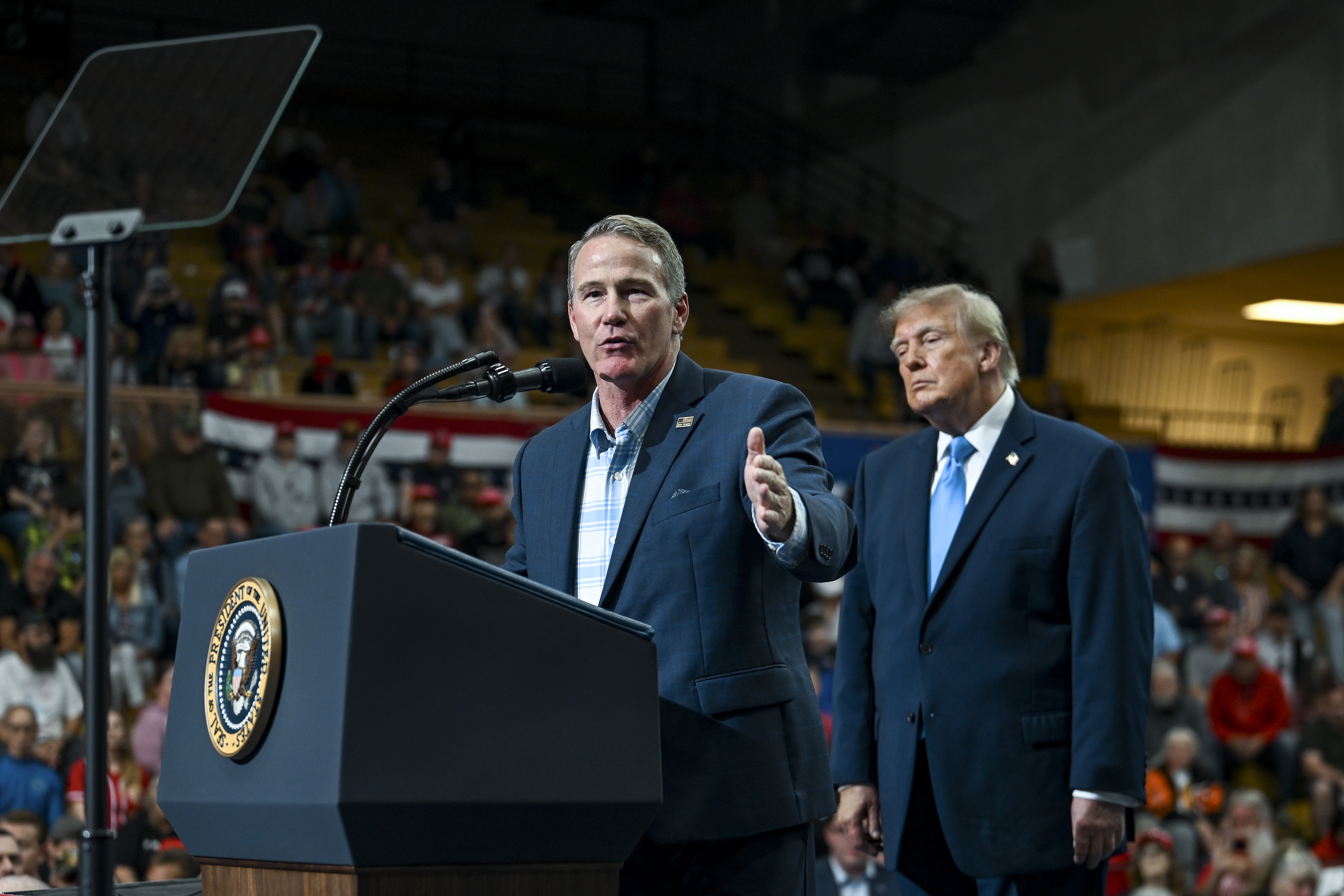
“I’m really in to win it. We want to win the midterms,” Trump told a crowd at a high school student center in Vandalia, Ohio, on Saturday evening. “If you don’t mind, please pretend that I’m on the ballot.”
I have been covering Trump rallies, on and off, for almost a decade, including one held in the packed, 7,300-person-capacity gymnasium of my former middle school in Indiana. I have covered them as three-act plays, as formulaic festivals, and as laboratories for Trump to road test misinformation, insult a Democratic opponent or gauge the bond he has forged with a potent slice of American voters.
Trump was in Oklahoma, Alabama and Ohio this past week for rallies, with a brief stop in Texas. On this last road tour, there are hints that he understands he has ground to make up: He has featured at each event a midterm-convention promise that he will give every American adult $5,000 if Republicans keep control of Congress — a pledge that would face a steep fiscal hurdle even in the event that his party defies polls showing that big Democratic gains are likely.
Here are a few takeaways from his week campaigning.
Trump is betting it all on his brand
Trump suggests that his mere presence will be enough to carry several embattled Republicans to victory. He believes that when he runs, Republicans win. That was true in 2016 and 2024. In Ohio, Trump called polls forecasting a tough road ahead for his party “fake.” Besides, he added, they hadn’t factored in his campaign appearances.
“They don’t account for the fact that Trump is out campaigning,” Trump said. “They never thought this was going to happen.”
Ohio is home to a tight race that could help determine whether Republicans keep control of the Senate in November, but at one point during a 90-minute speech, the president complained that he had to be out working hard on a Saturday night to help get others — in this case, Sen. Jon Husted of Ohio — elected.
But, mirroring the dynamic in other states where he is campaigning, the Senate race in Ohio is about issues that go beyond Trump’s brand. Most Ohioans blame data centers for rising utility costs, a recent New York Times/Siena poll showed that they trust Husted’s Democratic challenger, former Sen. Sherrod Brown, more to address the problem.
Onstage, Trump offered his support for a bill that Husted has introduced to control energy costs. But he also said he supported data centers, a position that is at odds with the majority of Americans.
“We want them,” Trump said of data centers. “Look, there’s so much money to be made for Ohio, you can’t just turn them off. They’ll go to China.”
In this moment, the crowd was quiet.
In a statement Sunday, Davis Ingle, a White House spokesperson, said the president was an effective communicator who had built “one of the most robust coalitions in political history.”
“President Trump is the unequivocal leader, best messenger and unmatched motivator for the Republican Party, and he is committed to maintaining Republican majorities in Congress,” Ingle added.
Trump rallies are not standing-room-only anymore
Trump can still draw crowds. People still wait all day to see him. They still go wild at the mention of Trump’s immigration policies, his opposition to transgender athletes in women’s sports and his support of voter-identification laws. They cheer when he uses profanity, as they did in Ohio when the president called Democrats an expletive.
The president has maintained that the events have “sold out” and that there are overflow crowds in each town. The rallies are, in fact, more modest — and at times more sedate — than they used to be.
In Oklahoma, visitors nearly filled an event center on a casino complex with a capacity of 4,920. In Alabama, the same state where 30,000 people attended a Trump rally in a 30,000-person stadium in August 2015, there were swaths of empty seats at the 10,000-capacity athletic center where Trump spoke Friday. In Ohio a day later, several areas of an upper deck were empty by the time Trump finished speaking at a 4,500-capacity high school student activity center.
It was not the old norm of standing room only. Instead, attendees close to the stage were seated in neat rows. In Oklahoma, security guards kept walkways clear and told people not to stand on their seats.
Natalie Baldassarre, a spokesperson for the Republican National Committee, responded to a request for crowd sizes at each event by saying Sunday that the rallies were “drawing some of our highest ticket demands to date,” adding that “our Republican candidates will continue to build off this momentum and drive voters to the polls as we approach Election Day.”
The president is unhappy with his rally coverage
On Sunday morning, Trump posted an angry message on social media aimed at Fox News, complaining that its morning program “Fox & Friends” had not adequately promoted his events.
“These Election Rallies were representative of what is really happening with our great Republican Party,” Trump wrote. “Our people want to see our Rallies, and reports on our Rallies, on FoxNews, or they will very quickly stop watching (like I am doing right now!).”
Later, he posted another update, saying that polls had always underestimated his political movement.
At the rally in Ohio, two Republican voters said the thing that would help candidates like Husted was not the president, but other administration figures. In other words, some in the party are beginning to look beyond Trump for star power.
“I think JD and Rubio need to get out there more and help Jon,” Jenni Worthington, 48, said from the stands, referring to the vice president and the secretary of state. “We need big names. It really needs more. A lot of people don’t know Jon.”
Her husband, Todd Worthington, suggested there might not be anything the White House could do. Several Republican friends, he said, have already decided not to vote this fall.
His rally speeches are still riddled with half-truths, falsehoods and claims that need context
Trump has used his recent rallies to accuse Democrats of meddling in elections, an assertion he often makes. He has no evidence for this. In Ohio, the president said that Democrats “rigged” the 2020 election. That did not happen. It remains a popular line of attack.
When he is not disparaging Democrats — or talking about random topics, like the large aspirin dose he “psychologically” needs to take daily, or claiming that he has one of the highest IQs “anywhere in the world” — he is talking about the economy. He sometimes exaggerates the numbers.
There are plenty of bright spots, and Trump tells his crowds about thousands of new manufacturing jobs, a strong stock market and trillions in investment coming into the country. In Alabama, Trump touted $21 trillion in investments for the United States, though a different number is listed on the White House website, which calculates the investments at $11.2 trillion. Some of that money is dedicated to multiyear projects or earmarked as future investment.
In Oklahoma, he said that “more Americans are working today in our country than at any time, by far, in history.” In raw numbers, this is true, because the country’s population has grown over the course of its history.
Still, Americans are frustrated by high prices and slow job growth. This concern goes largely unacknowledged at Trump’s rallies, unless he is blaming Democrats for those problems.
Occasionally, Trump glimpses toward his post-midterm future.
In Oklahoma, he told some of his most loyal supporters that he would be impeached if they didn’t vote for Republicans. At the midterm convention last month in Dallas, he pondered someday standing alongside the Front Row Joes, a band of his most loyal followers, when he is finished with the presidency. And, on Saturday, he called out to a man who has been attending every rally. He wears a suit with a brick-wall print.
“Someday, probably in my final appearance, I’m going to put a jacket on like that,” Trump said, talking directly to the man. “Because after that, I won’t be able to get elected.”
And several times this past week, Trump referred to his 2024 rally in Butler, Pennsylvania, where a gunman nearly killed him.
“Perhaps I’ll try a couple of years of being nonconsequential, if you don’t mind, because this is a dangerous position,” Trump said in Ohio.
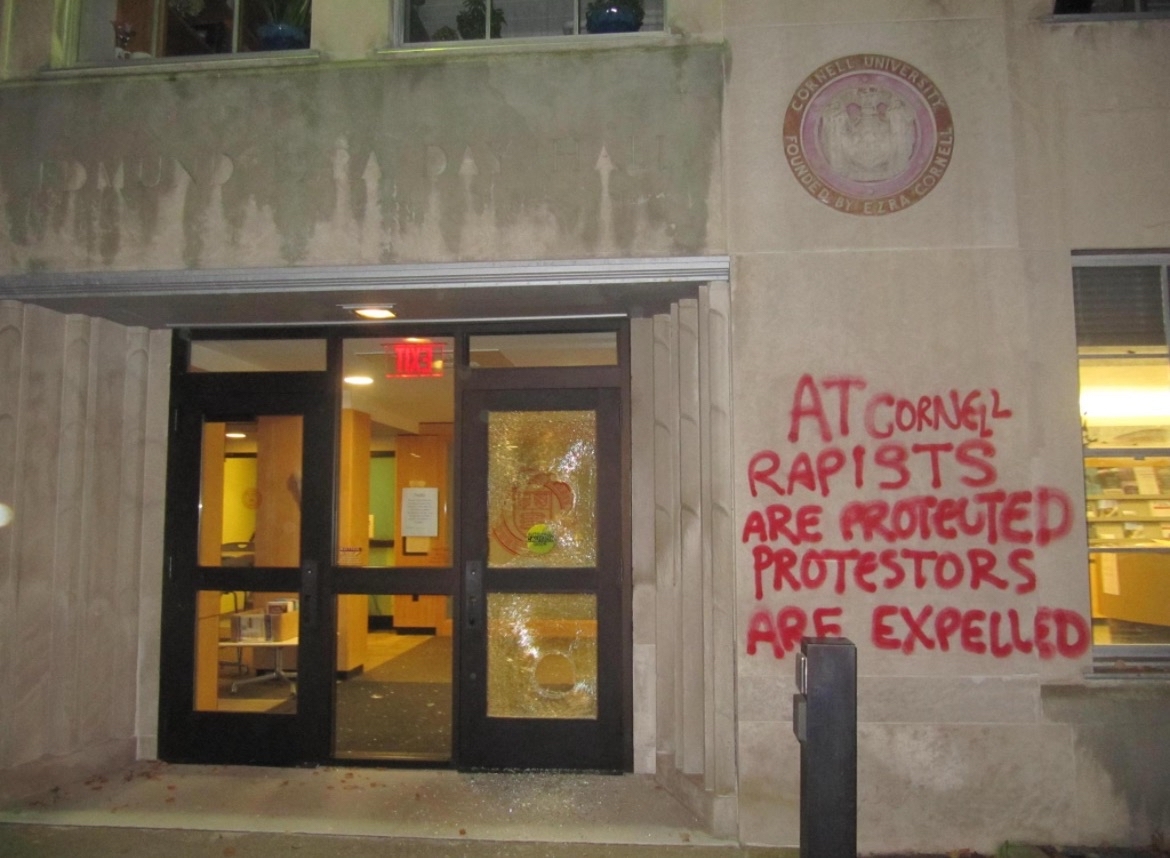
ITHACA, New York — Cornell’s main administration building was splashed with graffiti and a glass door was broken overnight as the university faces anger over allegations of sexual assault at a fraternity house.
Holes were knocked into one of the administration hall’s glass doors, and the walls beside them were marked with red-painted messages condemning patriarchy and the Ivy League school’s handling of sexual assaults, news media photos showed. Later Monday the graffiti was removed and the door was boarded up.
Student groups planned a protest Monday over the university’s handling of the alleged 2024 fraternity-house gang rape that has ignited a firestorm of reactions on campus and beyond.
Cornell spokesperson Kyle Kimball said in a statement that the university was investigating and that “damaging property is not the answer” to Cornellians’ “frustration and strong emotions.” Campus police referred questions to his office, which declined to provide more detail on the incident.
Meanwhile, a roster of student organizations planned a late-afternoon “Justice for Survivors” demonstration to push for changes in the university’s process for handling sexual assault complaints and for more punishments connected to the one that followed a party at the Chi Phi fraternity in October 2024.
A then-student alleges that she was sexually assaulted there by multiple men after being pressured into drinking and taking drugs.
The woman, identified in court documents as Jane Doe, recently sued the university, seven former students, the fraternity, and others. Her lawsuit said that she became fully incapacitated as fraternity members assaulted her, and that one man sent others a message inviting them to participate.
“I felt like bait. I felt like lions around me. It just was a totally debilitating place to be in,” she told Cornell investigators last year, according to records reviewed by the Associated Press.
Lawyers for two of the former students denied they participated in a sexual assault. Attempts by the Associated Press to reach the other men or their representatives have been unsuccessful. Court records show that some of the accused students, when interviewed by Cornell investigators, described the sexual activity as consensual.
ABC: Jane Doe recorded a phone call with one of the men
Shortly before she went to Cornell police in November 2024, Jane Doe recorded a phone call with one of the men she says raped her, ABC News reported Monday, saying it had obtained the recording. The network played portions, containing only what it said was his voice, and recounted other parts of the conversation in writing.
The woman asked on the call how the man and, at first, one of his fraternity brothers initiated sexual contact with her, according to ABC. The man told her that after dancing with her for five minutes or less, he suggested a three-person encounter. He maintained that she agreed to it, and that he then fetched the second Chi Phi member from the dance floor.
Her lawsuit says she was too intoxicated to give consent.
On the call, she tried to pinpoint who else later came into the room, ABC said. The man suggested both he and she might be misremembering something that’s “not true,” but she countered that she recalled looking up and seeing “too many people” there.
“What y’all did would be classified as gang rape,” she told him at one point, according to the network, which said she had provided the recording to the university.
Students are demanding transparency, accountability
The suit has drawn national attention to what Cornell, its police force and the local district attorney did after she told the campus police in November 2024 she “can say with 100% confidence I was raped.”
No criminal charges have been filed. The Chi Phi chapter at Cornell was shut down, and the Ivy League university has said it expelled some students and suspended others. In a statement last week, the administration bristled about the “false narrative that there were minimal consequences in this case.”
Students, however, have demanded more accountability and transparency, and New York Gov. Kathy Hochul has said Jane Doe was “failed by people and institutions” including the Cornell police and local District Attorney Matthew Van Houten.
After the week’s developments, Cornell President Michael Kotlikoff released an apologetic video Saturday, saying that Jane Doe’s account “raises heartbreaking and troubling issues about sexual assault, dehumanization, and aspects of party culture, alcohol, and drug use.”
Kotlikoff reaffirmed his support for an independent review of the university’s actions and vowed more transparency and a commitment to “finding the answers our community deserves.”
STOCKHOLM — The Nobel Prize in medicine was awarded Monday to three scientists whose work led to a tool that uses light to help unravel how the brain works.
Karl Deisseroth, Peter Hegemann, and Georg Nagel carried out research that opened a new field with the wonky name optogenetics, combining light with genes to switch on and off neurons in living brains.
Separate research from the trio — one of whom lives in the U.S. and two in Germany — resulted in a technique that helps to identify neural pathways responsible for behavior and disease. It could lead to treatments, such as restoring some vision in people with a genetic form of blindness.
Experts said the advancements greatly expanded the understanding of how the brain is organized.
“It has let us go from a ‘Rand McNally’ road atlas of the brain to something more akin to ‘Google Earth,’” neuroscientist Patrick Forcelli of Georgetown University said in an email.
Deisseroth, 54, is a Howard Hughes Medical Institute investigator and Stanford University professor in California. Hegemann, 71, is at Humboldt University in Berlin, and Nagel, 73, most recently worked at the University of Würzburg, also in Germany, the assembly said.
Winning research shines a light into the brain
The breakthrough began when Hegemann explored how a single-cell type of green algae can swim toward light. He and Nagel discovered a particular protein that, when illuminated by blue light, opens a channel to create an electrical impulse. Putting that protein into other cells makes them light-sensitive.
Brain cells use electrical signals to communicate with each other, but normally they don’t respond to light, Deisseroth told the Associated Press. He used what he calls “a trick from nature,” putting the gene that controls that microbial protein into certain cells in the brains of living mice.
Beaming light at those cells — first by using tiny fibers, now with noninvasive methods — can turn neurons on or off while animals do various tasks.
“People usually think about light as a way of collecting information to observe things,” he told the AP. “But this is the opposite of that. This is using light to control things, to make things happen, and to do it in a very precise way.”
Optogenetics is mostly a research tool to learn how specific neurons and neural circuits work.
That “gives you, inevitably, ideas for how to correct things that go wrong,” Deisseroth said. “Once you know the cells that are causal, that actually matter for a symptom or for correcting a symptom, you can devise medications or other methods that target those cells.”
Findings could help treat blindness, other problems
Already companies have studies underway trying to treat a form of inherited blindness called retinitis pigmentosa by inserting a light-activated protein into a patient’s retina and then outfitting the person with special light-emitting glasses.
Deisseroth, a physician-scientist, pointed to other scientists pursuing possible treatments for autism and schizophrenia based on information gleaned from optogenetics, he said.
Experts say optogenetics has transformed neuroscience around the world, becoming a mainstay in labs trying to understand the brain pathways involved in behavior and disease — and hopefully leading to ways to fix those that go awry.
“It’s a very precise set of tools for doing experiments about how the brain works that are pretty hard to do any other way,” said the University of Pittsburgh’s Jeremy Berg. He was at the U.S. National Institutes of Health in the early 2000s when it awarded Deisseroth major funding for “this vision of optogenetics that was pretty much spot-on the way it played out.”
Brain cells communicate in milliseconds, and optogenetics for the first time offered scientists a way to control them at the same speed in a laboratory, said Forcelli, Georgetown’s chairperson of pharmacology and physiology. That helped the field move from using fixed maps of brain activity to building functional wiring diagrams, and jump-started additional techniques to explore neural complexity.
“It has also helped reveal how specific brain circuits are disrupted, with implications for conditions such as blindness, depression, addiction, and dementia,” said Abdel El Manira, a member of the Nobel Assembly. ”Yet despite these extraordinary advances, the brain still holds countless mysteries, with much more left to learn and discover. And optogenetics has given us a powerful means to take on these challenges.”
Deisseroth had just gone to bed when he got the Nobel call
Deisseroth, a self-described night owl, said he was up late in his Northern California home working on papers and emailing students. He had just gone to lie down when he got the call from the Nobel Assembly.
He was so surprised that “I almost couldn’t speak for a little bit,” he told the AP. “I almost felt as if I’d lost the power of forming words.”
But he recovered quickly, pointing out that amid all the congratulations that morning, he still had to pack school lunches for his children once they woke up.
“That’s my one obligation I have in the next few hours, to make sure I make their sandwiches,” he said.
Thomas Perlmann, the secretary of the medicine committee, said he reached all three winners Monday. The AP could not immediately reach Hegemann and Nagel.
Medicine prize kicks off Nobels week
The prize was announced at the Karolinska Institute in Stockholm, kicking off Nobels week. The prize money this year is 12 million Swedish kronor (about $1.2 million), whether for an individual, small group of laureates, or organization.