Tag: topic-link-auto

  • JPMorgan is relocating its Philly office, with plans to hire 100

    JPMorgan is relocating its Philly office, with plans to hire 100

    JPMorgan Chase & Co. is moving Center City operations to larger quarters at 2400 Market St., the black-boxes building above the Schuylkill’s east bank that also houses Aramark, Audacy, and the Fitler Club.

    The largest U.S. bank is leaving its Philadelphia outpost at One Liberty Place, nine blocks east, for the 62,000-square-foot fifth floor at 2400, doubling space at its main corporate offices for the region.

    Aramark is giving up the space as it consolidates in-office staff. JPMorgan CEO Jamie Dimon says the company expects its workers to be in-office every day.

    The floor will house 370 workers when it’s full, said Stephen Wright, JPMorgan private bank managing director and co-chair of its Delaware and Philadelphia leadership team. That includes more than 250 JPMorgan workers now based at Liberty Place and 1735 Market St., including corporate and investment bankers, securities traders, and wealth managers, plus more than 100 new hires expected over the next few years, the bank announced Tuesday.

    The nearby Amtrak station at 30th Street, which gives JPMorgan employees easy access to trains to their Manhattan headquarters, is “a huge plus,” Wright said. “We also have a big hub in D.C. and 12,000 people in Delaware,” also served by Amtrak.

    The bank says it expects 200 construction workers will help transform the 2400 Market space over the next 18 months.

    Jamie Dimon, CEO of JPMorgan Chase & Co. since 2006, at the Philadelphia Navy Yard business park in July.JPMorgan Chase & Co.

    JPMorgan managed $5 trillion in loans and other assets, plus just over $5 trillion in investments, as of June 30.

    The company has been boosting its Philadelphia-area Chase network — it now has 80 branches — since opening the first in 2018, and plans at least 20 more. JPMorgan has nearly 5,000 branches nationally and has been opening more while rivals such as Wells Fargo and PNC have been shutting offices.

    The bank employs more than 600 in Philadelphia and its suburbs, including its branches. They offer loans, investments, and financial advice, and other services to small and midsize companies, according to Wright.

    JPMorgan also plans a central office for services to wealthy customers on the fifth floor, and a branch open to the public a block away at a former 7-Eleven at 22nd and Market Streets.

    The bank’s large corporate customers in the region include Philadelphia-based Comcast, whose co-chief executive officer Michael Cavanagh is a former JPMorgan chief financial officer, and South Korea’s Hanwha Group, which has plans to invest $5 billion in expanding its Hanwha Philly Shipyard.

    Dimon, the bank’s CEO since 2006, visited the Hanwha yard last summer to announce it is helping finance the neighboring Rhoads Industries shipyard expansion and Chamber of Commerce-backed shipyard and construction worker training programs. He said he hoped to finance larger Hanwha projects.

    JPMorgan typically manages relations with multinational companies like Comcast and Hanwha through investment banking groups based at its Manhattan headquarters and other major offices.

    Wright said Philadelphia-area local bankers serve individual corporate employees and small and midsize business owners and executives, as well as homebuyers, student borrowers, and other mass-market customers.

    JPMorgan’s “private” banking unit, targeting rich customers, has doubled its Philadelphia staff since 2021 and plans to double again by 2031, Colin Wetherill, head of investments and advice for the bank’s Mid-Atlantic region, said in a statement.

    The company estimates that it has more than 250,000 individual consumers and nearly 23,000 small-business customers in the Philadelphia region, which has a total population of around 6 million.

    JPMorgan’s largest employment center is in the Dallas area. Its office and technical centers in northern Delaware are substantially larger than its Philadelphia presence, employing more than 12,000. The Wilmington area is a major employment center for the company’s credit card and technology businesses and other operations.

    Editor’s Note: A previous version of this story misstated the year Jamie Dimon became CEO of JPMorgan. The error has been corrected.

  • Trump faces stiff bipartisan pushback to Russian diesel import deal

    Trump faces stiff bipartisan pushback to Russian diesel import deal

    Amid strong bipartisan pushback to an agreement to import Russian oil, President Donald Trump defended the deal with Russian President Vladimir Putin.

    “The European Union paid Russia 250 Billion Dollars for Energy, and the Fake News Media doesn’t want to get near that story. I made the right choice for the American People,” Trump wrote in a post on Truth Social on Monday morning.

    Some lawmakers have been publicly pushing back on Trump’s announcement that Russian President Vladimir Putin had agreed to supply diesel fuel to the global marketplace, an effort to bring down diesel prices.

    Seven senators on the Foreign Relations Committee, four Republicans and three Democrats, released a statement arguing that the agreement violates a 2022 law that bans Russian energy imports “to prevent American dollars from financing Putin’s brutal war against Ukraine,” which began in February that year.

    “President Trump’s decision to allow Russian diesel imports to the U.S. runs directly counter to that law,” they said. “The United States should not provide Putin with a financial lifeline while Russia continues to kill Ukrainian civilians. The Administration must immediately reverse course.”

    Sen. Jerry Moran (R-Kansas) agreed on Monday that the U.S. “should be tightening sanctions further, not undercutting them by allowing the import of Russian diesel” in a statement on the social media platform X.

    In the U.S. House, Rep. Don Bacon (R-Nebraska) said Trump is “weak on Putin” and Rep. Brian Fitzpatrick (R-Pennsylvania) said he would introduce bipartisan legislation to block all purchases of Russian oil.

    The Treasury Department temporarily lifted sanctions on Russian diesel Friday, allowing the fuel to be imported into the U.S. until April. Trump also said Sunday that Russia and Ukraine agreed to an “energy ceasefire,” though Ukrainian President Volodymyr Zelensky said neither side agreed to and that Russia was still hitting Ukrainian energy infrastructure.

    Persistently high energy prices driven primarily by the Iran war have been a major challenge for Republicans in the midterm elections. The economy has consistently ranked as the top issue for voters in the midterm elections, according to recent polling from the Pew Research Center, which also found that voter confidence in Trump’s ability to make good decisions about the economy has dropped.

    GOP criticism around Trump’s move has built in recent days.

    Sen. Thom Tillis (R-North Carolina) told NBC’s “Meet the Press” on Sunday that the decision could have “deadly consequences.”

    “This guy has a murderous rap sheet. He cannot be trusted. And I will guarantee you, at the first opportunity Putin has to embarrass or undermine President Trump, he will,” said Tillis, who was also part of the Foreign Relations Committee letter.

    Former vice president Mike Pence said the decision to lift sanctions is “throwing a lifeline to Putin’s war machine.”

    Democrats similarly hammered the White House, including Senate Minority Leader Chuck Schumer (New York) calling it “a deal with the devil” enacted to help Trump’s “flailing political fortunes.”

    Russia is one of the world’s largest oil exporters and was a major provider of fuel to European countries before the E.U. and other members of the Group of Seven countries implemented sanctions on Russia in 2023 in response to its war against Ukraine.

    Some Republicans defended the president’s agreement as a needed compromise to bring down fuel prices.

    “The president is focused on getting down the cost of energy,” Sen. John Barrasso (Wyoming), the second-ranking Republican in the Senate, said on CBS News’ “Face the Nation” on Sunday. Trump “has to make tough decisions. He’s balancing his effort to stop and end Putin’s war in Ukraine and lowering prices for American families.”

    Rep. Anna Paulina Luna (R-Florida) said it will “massively benefit the American people.”

  • Why it was wrong to name the accused Cornell assailants

    Why it was wrong to name the accused Cornell assailants

    Like millions of other Americans, I was appalled by the news of a gang rape at a Cornell University fraternity house. But I’m glad the victim came forward and sued the university along with the seven men who allegedly assaulted her in 2024. And I’m grateful to the student newspaper, the Cornell Daily Sun, for its intrepid reporting of the story.

    But I still don’t think it should have named the seven accused men. And if you think otherwise, I’ve got one name for you: Matthew Ingalls.

    A Cornell student by that name was one of the seven men whom the Sun identified. And a very different Matthew Ingalls has had to pay the price for that.

    I’m talking about 23-year-old Marine Corps Sgt. Matthew Ingalls, a New York native with no connection to Cornell. But after the Sun’s report, his mother said, he started to receive “crazy aggressive messages.” So did Ingalls’ sister, who likewise had no link to Cornell.

    The attacks stepped up when lawyers for the Cornell victim mistakenly served him with her lawsuit on Sept. 26. The attorneys admitted their error and amended the suit to reflect the correct person’s address. But the flawed filing was still publicly available.

    And that meant it was open season on Sgt. Ingalls and his family. People posted their home address and phone numbers. They threw trash onto the family’s property. They sent death threats.

    That should scare anyone who cares about due process and justice in the United States. By releasing the names of the accused men, the Sun encouraged people to take the law into their own hands.

    A banner hangs from student housing at Cornell University in Ithaca, N.Y., on Thursday in support of the woman known as Jane Doe.LAUREN PETRACCA

    I understand the impulse to do that, and I’ve been tempted to do the same. The reported behavior of these men was truly heinous. They treated the victim like a piece of trash. Why shouldn’t we throw trash — literal and verbal — at them?

    Because in America, you’re still innocent until proven otherwise. You can’t call for a more transparent and thorough investigation — as the Sun did in its editorial naming the assailants — and then presume they’re guilty. Why ask any new questions, when we already know the answers?

    Quoting Cornell president Michael Kotlikoff’s 2024 letter to the university community, the Sun noted that “‘only those who perpetuate sexual violence benefit from its concealment.’” But Kotlikoff made that comment in an appeal asking students who had experienced sexual assault to report it. In the Sun’s editorial, by contrast, it meant that only the seven accused men would benefit from keeping their names out of the papers.

    But that’s not true. Sgt. Matthew Ingalls would have benefited, too, if the names hadn’t been published. Ditto for a small consulting firm in Texas, which was flooded with invective after internet vigilantes wrongly identified it as a company that another accused Cornell assailant owned.

    Again, I have only the deepest respect for the dogged reporting by the Cornell Daily Sun. One of their writers spent 23 months on the story, even while she was studying abroad in Australia. Without her efforts, we might not be talking about this case at all.

    But identifying the accused men by name actually detracted from the Sun’s own case against Cornell: its flawed Title IX investigation, its failure to keep the victim informed, its toothless task force on sexual assault, and more.

    Indeed, if I were the university, I would be glad the Sun named the accused assailants. That keeps the focus on them instead of on the culture of Cornell and what the institution has done — or not done — about the wider problem of campus sexual assault.

    Forty years ago, when I was the editor-in-chief of the student newspaper at Columbia, we reported that a female student had been sexually abused at a fraternity. She said she had been “held prisoner” for two hours at a late-night “naked man’s meeting,” as her assailants called it. Some of them masturbated in front of her, she said.

    We interviewed a fraternity member who insisted that all of this was in good fun. After the incident, he claimed, the victim “was laughing and joking with the guys.” We then ran an editorial, denouncing the idea that she had consented to the abuse.

    “A woman who shows up at a fraternity at 2:30 in the morning is not ‘asking’ for such treatment, as some warped commentators on campus have alleged,” we wrote. “Their perverted argument reduces to the same nauseating rationale invoked for hundreds of years by men who have sexually abused women: ‘She wanted it.’”

    But we refrained from publishing the names of the fraternity members she charged, even though we knew several of them. We didn’t want to indict anyone who might have been innocent, which could have triggered a different kind of abuse. Just ask Sgt. Ingalls about that.

    Jonathan Zimmerman teaches history and education at the University of Pennsylvania. His next book, “Schooling Citizens: How Education Can Save Our Democracy,” will be published in the spring by the American Philosophical Society Press.

  • Six Flags closes 9 rides after 1 person dies in an incident involving a roller coaster in Georgia

    Six Flags closes 9 rides after 1 person dies in an incident involving a roller coaster in Georgia

    Six Flags temporarily closed nine roller coasters across six amusement parks on Monday after one person died and several others were injured in an incident involving a coaster in Georgia.

    Officials did not confirm how the person died, nor how the others were injured or their medical conditions after the incident at Six Flags Over Georgia, about 15 miles northwest of Atlanta.

    Cobb County Police Department major crimes unit detectives are investigating.

    Attractions at the parks that are similar to the coaster in Austell, Georgia, were closed “out of an abundance of caution,” according to a Six Flags Entertainment Corporation spokesperson, who said staff members and local authorities responded immediately and the park is cooperating with the investigation.

    “We are deeply saddened by the guest incident at our park today,” the spokesperson said, adding that the company is providing support to guests and staff who were impacted.

    Authorities and Six Flags did not identify the roller coaster. However, local TV stations showed video of passengers being evacuated from the Goliath coaster.

    Goliath, which was opened in 2006, reaches a top speed of 70 mph (113 kph) with a height of 200 feet (61 meters), according to the park’s website.

    During about 3 1/2 minutes, riders “navigate through razor-sharp turns and soar over colossal hills,” the website says.

    Lisa Cupid, Cobb County Board of Commissioners chairwoman, said next of kin of the deceased person have been notified.

    “I cannot imagine the horror the patrons and employees witnessed today, and my heart aches for the family who lost a loved one,” Cupid said. “We are all grappling with how something so devastating could happen at a place that has given generations of families such happy memories.”

    The park is a major part of the county’s tourism and brings in visitors from across the Southeast, Cupid said.

    The death would be at least the seventh at the Georgia park, including one in 2006 in which a man had a likely heart attack on the Goliath coaster, according to the Doan Law Firm, which tallies amusement park accidents and represents victims.

    It also comes less than two weeks after Six Flags Magic Mountain in Southern California announced the retirement of its famous X2 roller coaster following lawsuits alleging serious brain injury caused by the ride. The park settled one wrongful-death lawsuit from the family of a 22-year-old man who died after riding the coaster in 2022.

    Last year, a 32-year-old man died from blunt impact injuries after riding a high-speed roller coaster at the Universal Epic Universe theme park in Florida. His death was ruled accidental.

  • Trump says he is ‘looking at’ firing Kimberly Guilfoyle

    Trump says he is ‘looking at’ firing Kimberly Guilfoyle

    President Donald Trump said Monday that he was “looking at” firing Kimberly Guilfoyle, the U.S. ambassador to Greece, following revelations that she had asked a Republican donor to pay her credit card bill in exchange for access to senior Trump administration officials.

    “Well, we’re looking at it, yeah,” Trump said when asked by a reporter whether he was thinking of firing Guilfoyle. “We’re not happy.”

    The donor, Eric Deters, said last week that Guilfoyle had asked him to wire $100,000 to pay off her American Express card just before her Senate confirmation hearing in July 2025. She promised to serve as his “ride or die in Trump world” if he did, according to what appeared to be screenshots of their correspondence that Deters provided to The New York Times.

    “Honey please I need you to get this done for me today,” she wrote in what appeared to be a text message.

    Guilfoyle, who was once engaged to Trump’s oldest son, Donald Trump Jr., was one of the first ambassadors to be nominated in the president’s second term.

    The texts suggest that Guilfoyle warned Deters to call her on Signal and to keep their interactions private. “You’ll literally cost me my ambassadorship,” she wrote, according to one of the screenshots.

    Neither the State Department nor the U.S. Embassy in Athens responded immediately to requests for comment late Monday. A lawyer for Guilfoyle previously declined to comment on the correspondence.

    The accusations against Guilfoyle are the latest allegations of misconduct to emerge against her. Greeks interviewed in Athens in recent days have expressed exasperation and cynicism over reports of her dealings.

    This article originally appeared in The New York Times.

  • How the Trump administration is eroding airline passengers’ rights

    How the Trump administration is eroding airline passengers’ rights

    For years, U.S. airline passengers have been gaining ground against annoyances like misleading prices, hidden fees and flight disruptions. But now the tide appears to be turning.

    The Department of Transportation is aiming to water down long-standing passenger protections, pushing, for example, to change how prominently airlines display prices in advertising and to clamp down on compensation for disrupted flights.

    These recent steps have alarmed consumer groups and elected officials, with some saying that the proposals tilt the scales in favor of the airline industry. In addition, they say, the department is steadily taking a more hands-off approach to policing airlines, and that could end up hurting passengers.

    “We’re in really new territory with consumer protection regulations,” said Paul Hudson, president of FlyersRights.org, one of the largest U.S. advocacy groups for air travelers. “It’s shaping up to be a wholesale reversal of consumer protection for airline passengers.”

    When Sean Duffy was sworn in as transportation secretary in January 2025, he pledged to help usher in a “golden age” of transportation by immediately taking action to remove what he called government overreach.

    Since then, advocates say, the department has consistently worked to roll back passenger rights in areas like cash compensation, wheelchair handling and hidden, or “junk,” fees. It has also adopted a markedly gentler approach for addressing bad behavior by airlines compared to previous administrations: Under Duffy, the department has not yet issued a single fine to an airline.

    In a statement, the Transportation Department rebutted the claims. “No passenger rights have been diminished,” a spokesperson wrote.

    Font sizes and hidden fees

    Two of the biggest changes have taken place in how the Transportation Department aims to regulate junk fees and pricing information.

    In June, the department abandoned a Biden-era rule on hidden fees that would have forced airlines to show charges for extras like checked bags and ticket changes alongside the full fare during the booking process. Airlines sued in 2024 to block the rule, which a federal court later vacated on procedural grounds.

    A month later, the department moved to undo a 15-year-old requirement that airlines display a ticket’s final price more prominently and in a larger font size than other components of the price, such as taxes and fees.

    “The department proposed a common sense adjustment to protect passengers from misleading pricing information by allowing parts of airfare, such as government taxes, to be displayed just as prominently as the total price, but not more so,” the department spokesperson said, adding that public comments are currently being reviewed.

    In September, Sen. Richard Blumenthal, D-Conn., sent a letter of opposition to Duffy, stating that the new rule would allow airlines to advertise “false or misleading ticket prices.”

    “If the rule is implemented, it is inevitable that more consumers will need to invest additional time searching for the full fare or government charges, and will be surprised by unexpected, mandatory fees,” he wrote.

    The department has taken steps to undo other rules drafted under former Transportation Secretary Pete Buttigieg. It has dropped early-stage efforts to let families sit together at no extra charge and to make airlines pay passengers cash for significant flight disruptions. And it has carved out more exceptions for flight disruptions in which airlines would not need to compensate travelers.

    It has also repeatedly delayed enforcement of a landmark rule that expands the rights of disabled travelers, including making airlines liable for mishandled wheelchairs. Airlines sued over that rule, and the department has pushed back the enforcement of key sections of it to next year.

    Backing away from fines

    Past administrations have made headlines for penalizing airlines with hefty fines for failures like delays on the tarmac, false advertising of fares and mistreatment of passengers who use wheelchairs.

    Each year from 2002 to 2025, the Transportation Department assessed at least $500,000 in fines against airlines. But in the two years since Duffy took over, the department has not issued any against them.

    Three previous transportation secretaries — Ray LaHood, Anthony Foxx and Buttigieg — said in interviews that they used fines as a way to keep airlines accountable.

    “We leveled tough, stiff penalties,” said LaHood, a Republican who served as transportation secretary during President Barack Obama’s first term. “It sends a loud message that the DOT is serious about the No. 1 priority, which is safety.”

    Under Duffy, the department has walked away from its own investigations into airlines for operational and customer service failures. In May 2025, it dropped a lawsuit against Southwest Airlines, in which it accused the carrier of illegally operating chronically delayed flights in 2022. A month later, it ended an inquiry into Delta Air Lines stemming from the 2024 CrowdStrike software meltdown.

    The department also waived at least $25 million in fines owed by airlines, softening the impact of penalties like a $50 million fine against American Airlines for its “undignified” treatment of passengers with disabilities and a record $140 million fine against Southwest for an operational debacle in 2022.

    Asked about its view on enforcement, a department spokesperson said in a statement that “fines are only one tool” and that the department “focuses on airlines fixing the root causes of travel disruptions.”

    Others have a different view.

    “Simply not enforcing anything is like a backdoor way of repealing regulations,” said Hudson, of FlyersRights.org.

    A ‘dark period’ for passengers

    At the same time that the Transportation Department is loosening up on airlines, its relationship with the industry appears to be growing more harmonious.

    “The airlines never really loved the rules we were putting forth and in some cases litigated against some of the rules,” Foxx said.

    Several of the department’s recently proposed rules and actions appeared on a list of recommendations from Airlines for America, the industry trade association. These include undoing the junk-fee rule, changing the font size and prominence of fees, and contesting liability for mishandled wheelchairs.

    Several Democratic lawmakers have questioned Duffy’s relationship with the airlines, noting his time as an airline lobbyist for BGR Group in 2020. In December, a group including Rep. Jerrold Nadler, D-N.Y.; Sen. Elizabeth Warren, D-Mass.; and Blumenthal wrote a letter to the Transportation Department’s Office of Inspector General to request an investigation into whether Duffy had violated federal ethics law by “improperly assisting” an industry he had previously lobbied for.

    “We are very concerned that Secretary Duffy may have eliminated protections for American travelers not based on impartial policy assessments and the good of the flying public, but, at least in part, as a result of conflicts of interest and potential bias related to his former client’s airline members,” the lawmakers wrote.

    A spokesperson for the department’s Office of Inspector General declined to comment.

    Buttigieg, whose department levied the most fines against airlines by a significant amount, said consumer protections are either being “quietly picked apart or just not enforced.”

    A Transportation Department spokesperson said that Duffy had briefly represented the Partnership for Open Skies, a coalition of domestic carriers funded by United Airlines, American Airlines and Delta Air Lines. He worked to encourage “access for U.S. carriers into foreign markets,” not on domestic aviation policy, the spokesperson added.

    The secretary has taken “clear, decisive regulatory actions” to hold airlines accountable, the spokesperson said.

    Consumer rights advocates say the department’s stance is costing passengers money, even as some aspects of flying have significantly deteriorated. Last year, a combination of cancellations and delays led to the industry’s worst on-time performance since 2014, according to a report by the U.S. PIRG Education Fund, a nonprofit consumer advocacy group. There were more tarmac delays last year than in any year since 2010.

    The department is currently tracking 90 tarmac delay incidents for potential violations, a spokesperson said.

    “It’s a really dark period for airline passengers right now as far as consumer rights,” said William McGee, a senior fellow for aviation at the American Economic Liberties Project, a progressive-leaning nonprofit research and advocacy group.

    “Clearly, the big airlines have access,” he added. “They have the ear of the department, and the interests of consumers are not being heard.”

    This article originally appeared in The New York Times.

  • The Kibitz Room calls itself a Jewish deli. To the State of New Jersey, that’s not quite kosher.

    The Kibitz Room calls itself a Jewish deli. To the State of New Jersey, that’s not quite kosher.

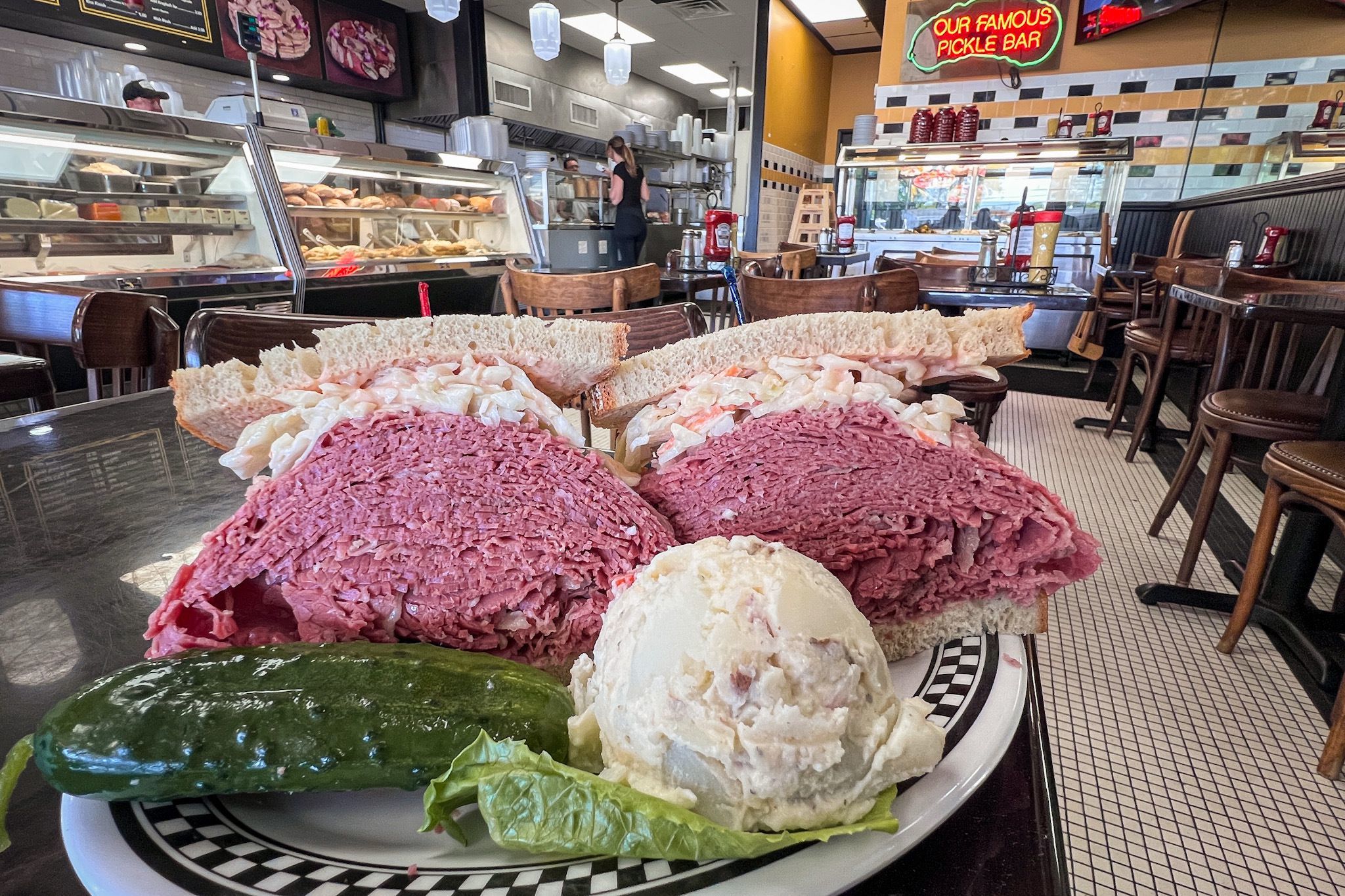
    The Kibitz Room has served Jewish-style deli fare in Cherry Hill for decades. Now, it finds itself in a pickle with New Jersey regulators over one word:

    Jewish.

    The state Division of Consumer Affairs is seeking a $1,000 civil penalty against the restaurant in the Shoppes at Holly Ravine on Springdale Road, alleging that its website and menu describe it as a Jewish deli and advertise a “Jewish cheesesteak” without a disclaimer that explicitly states its food is not represented as kosher.

    The state is not accusing the Kibitz Room of passing off nonkosher food as kosher. The dispute centers on a consumer-protection rule requiring such notice when businesses use terms such as Jewish, Hebrew, or kosher-style to advertise food, even if they make no claim to being kosher.

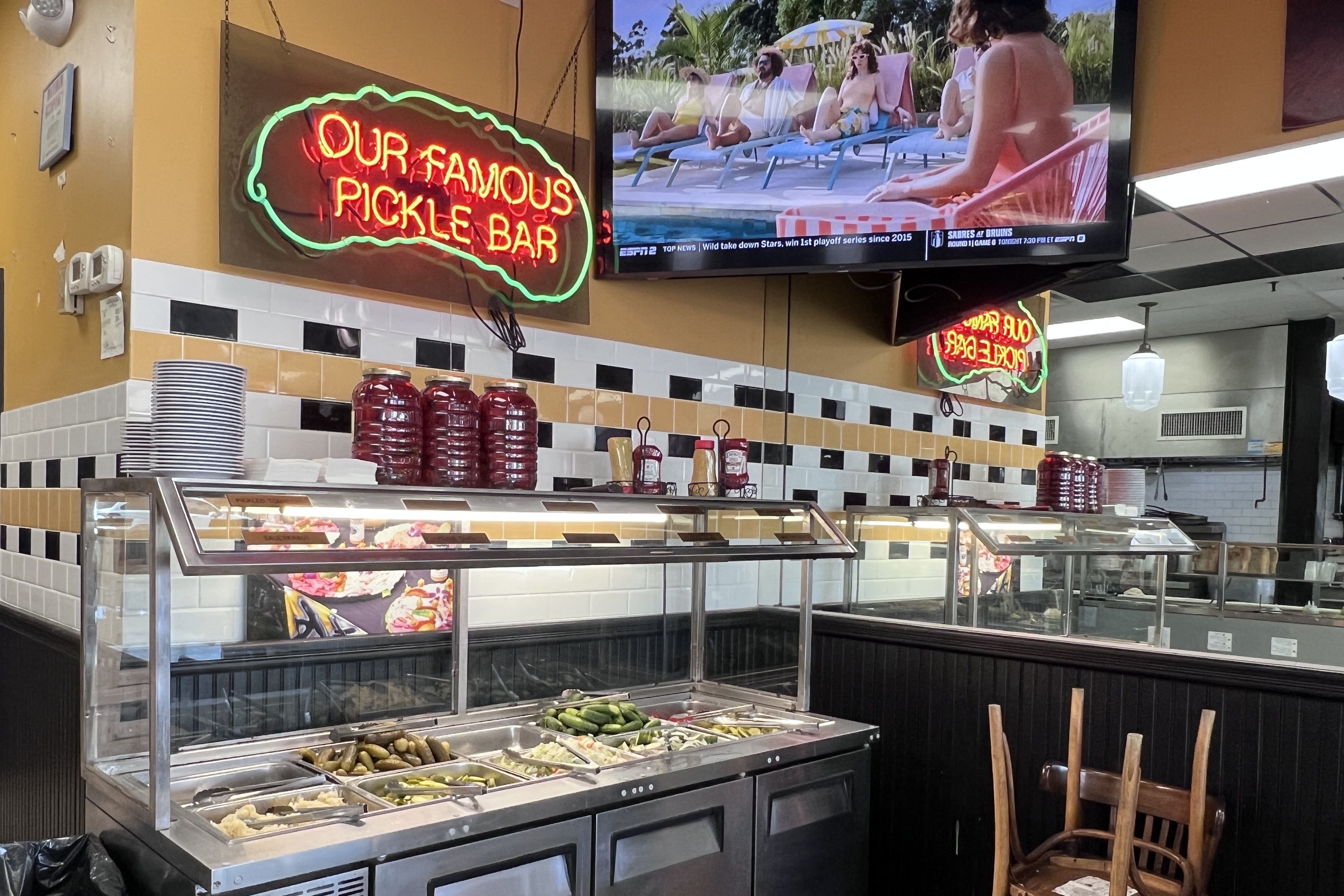
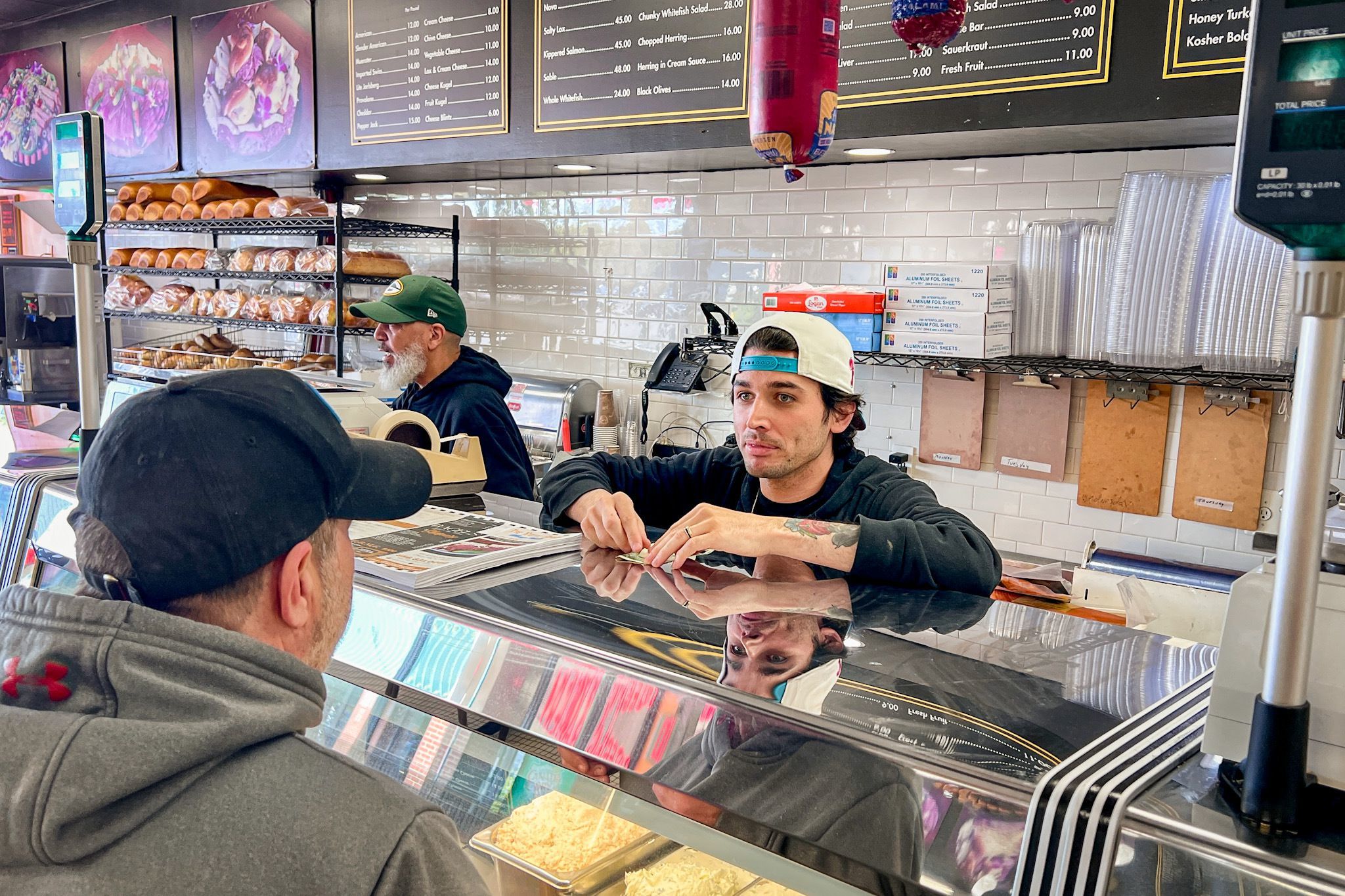
    The pickle bar at the Kibitz Room, 100 Springdale Rd., Cherry Hill.Michael Klein / Staff

    “I think it’s totally ludicrous,” said Brandon Parish, who took over the restaurant earlier this year. “There is a distinction between being Jewish and being kosher. We claim to be a Jewish-style delicatessen. That doesn’t mean we’re kosher.” The proposed sanctions are a “schmear campaign,” Parish said, wryly.

    But the regulation, N.J.A.C. 13:45A-21.7, specifically covers businesses that do not represent their food as kosher. It requires conspicuous disclaimers, with rules governing their size and placement on menus, signs, and advertisements.

    Brandon Parish (right) waiting on a customer at the Kibitz Room in May.Michael Klein / Staff

    The allegations stem from a Sept. 16 inspection by Division of Consumer Affairs investigator Aaron Leff, according to the citation, which Parish posted in full on the Kibitz Room’s Facebook page.

    In a certification accompanying the Oct. 7 notice of violation, Leff cited the Kibitz Room’s website — which describes the restaurant as a “New York-style Jewish deli serving overstuffed sandwiches, hand-cut pastrami, and traditional favorites since 1996” — as well as its menu, including its Jewish cheesesteak, which contains brisket, coleslaw, Russian dressing, and pepper jack cheese.

    Leff noted in the certification that attempts to resolve the issue during his visit and a phone call the next day were unsuccessful.

    “I was told both times the menu will not change,” Leff wrote.

    Parish acknowledged the visit but said the restaurant was busy during a Jewish holiday and had asked Leff to return.

    “We can’t do this right now,” Parish recalled telling him. “You have to come back.”

    Parish now plans to post a notice on the door or window and add one to the menu stating, “We are not a kosher facility.” He intends to contest the penalty, with his attorney joining him for an Oct. 28 hearing by Zoom.

    “It’s not about the fine,” he said. “It’s merely the principle.”

    What other New Jersey delis do

    There does not seem to be a uniform approach to the disclosure among other New Jersey delis. Goodman’s Deli in Berkeley Heights advertises “kosher-style” and “Jewish-style” food on its website, which also states, “Not Kosher.” Eppes Essen in Livingston calls itself “New Jersey’s Jewish deli” on its homepage, while its About page says it is not kosher-certified. Whether that disclosure satisfies the regulation is unclear.

    Russ Cowan, owner of the nearby Radin’s Delicatessen in Cherry Hill, said New Jersey’s rule is misguided because describing a restaurant as Jewish or kosher-style does not mean it serves kosher food. Cowan said he has deliberately avoided calling Radin’s a Jewish deli or describing its food as kosher. His website mentions “Jewish delicatessens,” but only in recounting his family’s history of operating delis in New York. “I’ve been exposed to this my whole life. And Jewish does not mean kosher. Kosher-style does not mean kosher.”

    The state has offered to settle the Kibitz Room case for $1,000. No finding of liability has been made, and a spokesperson did not immediately reply to a request for comment because of Monday’s holiday.

    Parish said customers who keep kosher generally know the Kibitz Room is not for them. It’s open on Saturdays and serves shrimp, bacon, and Reubens combining meat and cheese.

    “There are so many dead giveaways that somebody who keeps kosher would know, ‘Oh, I can’t go there,’” he said.

  • House of the Week: A Victorian in Merchantville for $650,000

    House of the Week: A Victorian in Merchantville for $650,000

    Real estate agent Andrew Mascieri liked Victorian houses, and in 2020, he settled on an 1868 house in Merchantville that he set out to totally renovate.

    He started by replacing outdated knob-and-tube wiring with a 200-amp system, but then COVID-19 hit, and getting contractors was virtually impossible. “It was definitely scary,” he recalled six years later.

    Now the renovation is complete, the house is up for sale, and Mascieri is ready for a new project and new life in Philadelphia.

    The living room of the house, which was built in 1868.Kent Media

    Mascieri said the house had been for sale only three times in 70 years — the previous owners had lived there six decades.

    He had wanted something to renovate, and the five-bedroom, 1½-bathroom home, with just under 3,000 square feet of space, was perfect.

    He has a bachelor’s degree in architecture from Temple University and designed everything himself, including picking out the finishes.

    The den.Kent Media

    “Everything was curated, and there’s custom-made furniture,” he said.

    By 2023 the front porch had been rebuilt, new air-conditioning was installed, and there was a new roof over the den. The back porch was rebuilt this year.

    The kitchen is built around an Italian range, and the dining room has a backlit, antiqued mirror bar built by a Fishtown glass artisan.

    The kitchen, which is built around an Italian range.Kent Media

    There is a powder room on the first floor, plus a den, study, and laundry room.

    The house went from five bedrooms to four in the renovation. The second floor has two bedrooms, including the primary bedroom, which has a walk-in closet with an island and a large bathroom.

    The third floor has two other bedrooms, plus a small room that could be used as a reading nook or office.

    The walk-in closet in the primary bedroom.Kent Media

    The house looks out onto the Merchantville bike path, built over old railroad tracks.

    The house is listed by Andrew Mascieri of Compass New Jersey for $650,000.

  • A Delaware hub dedicated to ‘Human-AI cooperation’ launches with $21.5 million to study AI in healthcare

    A Delaware hub dedicated to ‘Human-AI cooperation’ launches with $21.5 million to study AI in healthcare

    Scientists at a new Delaware research hub envision a future where AI-powered sensors assess a patient’s injury from the moment they enter an exam room.

    As the patient climbs onto the table, the system detects a subtle tremor that might otherwise go unnoticed.

    Backed by a five-year, $21.5 million federal grant, the NSF AI Institute for Human-AI Cooperation (HAIC) will focus specifically on applications like these in physical therapy and healthcare.

    The team includes researchers from the University of Pennsylvania and the University of Delaware who are working to design AI technologies that can help with decision-making, monitoring of symptoms, and other aspects of care.

    They imagine a clinical environment where the provider, patient, and AI system are all working together.

    “We are not trying to replace people in any way,” said Eric Eaton, the managing director of the institute and a research associate professor at Penn. “This is an opportunity to really explore how AI can become an adaptive teammate.”

    Experts in computer science, AI, robotics, physical therapy, medicine, and ethics work in tandem at the institute, which celebrated its launch with a ribbon-cutting this month. The collaboration also includes Delaware State University, Princeton University, and the University of Florida.

    Headquartered at the University of Delaware’s Newark campus, it is the 30th AI research institute nationwide established by the U.S. National Science Foundation.

    The institute will also focus on workforce development and designing courses and degree programs at the intersection of AI and health.

    “We want to achieve the ultimate goal of personalized healthcare,” said Cathy Wu, the director of HAIC and a professor in the computer & information sciences department at the University of Delaware.

    The NSF AI Institute for Human-AI Cooperation (HAIC) held a ribbon-cutting event at the University of Delaware, where it is headquartered, on Oct. 7.Courtesy of Penn Engineering

    Learning to cooperate

    In the field of AI, “alignment” refers to the practice of designing AI to match human goals, intentions, and decision-making.

    “We want to make sure that the human is in the driver’s seat,” Wu said.

    The researchers envision AI getting incorporated as a partner, rather than a replacement for clinicians.

    In physical therapy, AI-powered sensors could help the physical therapist recommend the best set of exercises, and adapt those exercises as the patient recovers.

    AI could also monitor patients as they perform exercises independently, to “get the complete picture,” Eaton said. A physical therapist managing multiple patients at once may be unable to monitor each one throughout a session.

    As a patient walks on a treadmill, for example, AI-powered motion-tracking cameras could continuously evaluate their movements.

    In the exam room, sensors could measure how well a patient’s knee injury is healing, starting when the patient enters the room. As the patient climbs onto the bed, the sensors could detect a subtle tremor that might indicate Parkinson’s disease.

    “If no one else was in the room with you, that would never have been noticed at all,” he said.

    By tracking changes over time, an AI system could help assess cognitive decline or signs of depression.

    AI could also identify a patient’s concerns and ensure that the provider addresses each one before the visit ends. It could pull up relevant medical records in real time — for example, locating a test the patient had two years ago that could be relevant.

    The researchers will work on developing the foundational AI technologies to support these scenarios. At the same time, they will work with stakeholders and ethicists on AI guardrails.

    “I don’t want to build a system that I wouldn’t be comfortable using in a clinical exam room,” Eaton said.

    Guardrails

    The institute will study how to integrate AI into healthcare without compromising patient privacy or the doctor-patient relationship.

    For example, the system could convert the image of a person walking into a privacy-preserving skeleton or wire-frame.

    Researchers may also develop training to help healthcare workers understand the nuances of AI, including “when to trust it, when not to,” Eaton said.

    An AI tool that provides recommendations or decision support for the clinician must be clear on its level of confidence and access to relevant medical information, as well as any uncertainty in its recommendation.

    Doctors should be able to examine the system’s decision-making process and verify that it is auditable, Eaton said.

    The same principle applies to the need for patients to understand how AI reaches its conclusions.

    Stakeholder advisory boards will help the institute ensure its technologies address these concerns.

    “We need to bring a lot of checks and balances,” Wu said.

  • Time for tough love | Sports Daily Newsletter

    Time for tough love | Sports Daily Newsletter

    We all strive to be nice people — or at least I like to think we do — but what’s that old saying? Nice guys finish last?

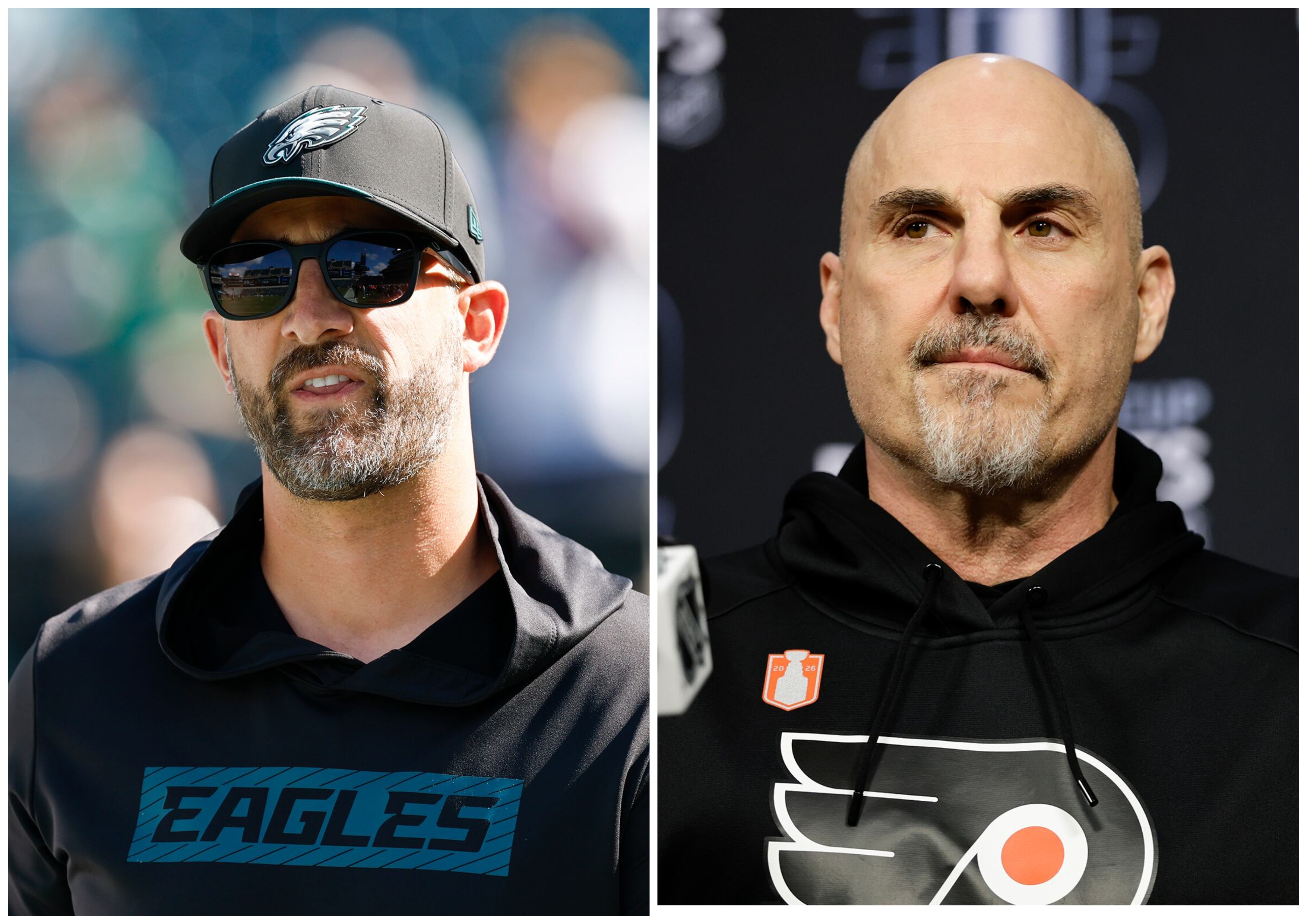
    There’s an argument to be made that’s unfolding in real time here in Philly, as both the Eagles and Flyers flounder early in their seasons. The Flyers set a franchise record with their seventh straight loss to start the season. The Eagles are under .500 for the first time half a decade and can’t seem to remember there are two halves to a football game. Both teams have coaches with a similar style that may not be right for the teams they currently oversee.

    “It’s fair to say that [Nick] Sirianni and [Rick] Tocchet are players’ coaches,” writes Mike Sielski in his latest column. ”All the cliches about modern team-building apply to them at their best: They get guys to buy in. They create a healthy culture or change a bad one to a good one. They are authentic.”

    But sometimes that’s not what’s needed, Sielski argues. Sometimes, players need a wake-up call. Especially when your general manager says you’ve “been too casual” and questions your “compete level.” Sometimes, they need the fundamentals drilled home. Especially when your rookie wide receiver doesn’t know to go down in bounds. Sometimes, they need both.

    With 10 straight losses between the Eagles and Flyers, maybe both wouldn’t hurt in this case.

    — Matt Mullin, @phillysport, sports.daily@inquirer.com.

    If someone forwarded you this email, sign up for free here.

    ❓When will the Flyers get their first win? Email us back for a chance to be featured in the newsletter.

    Won’t back down

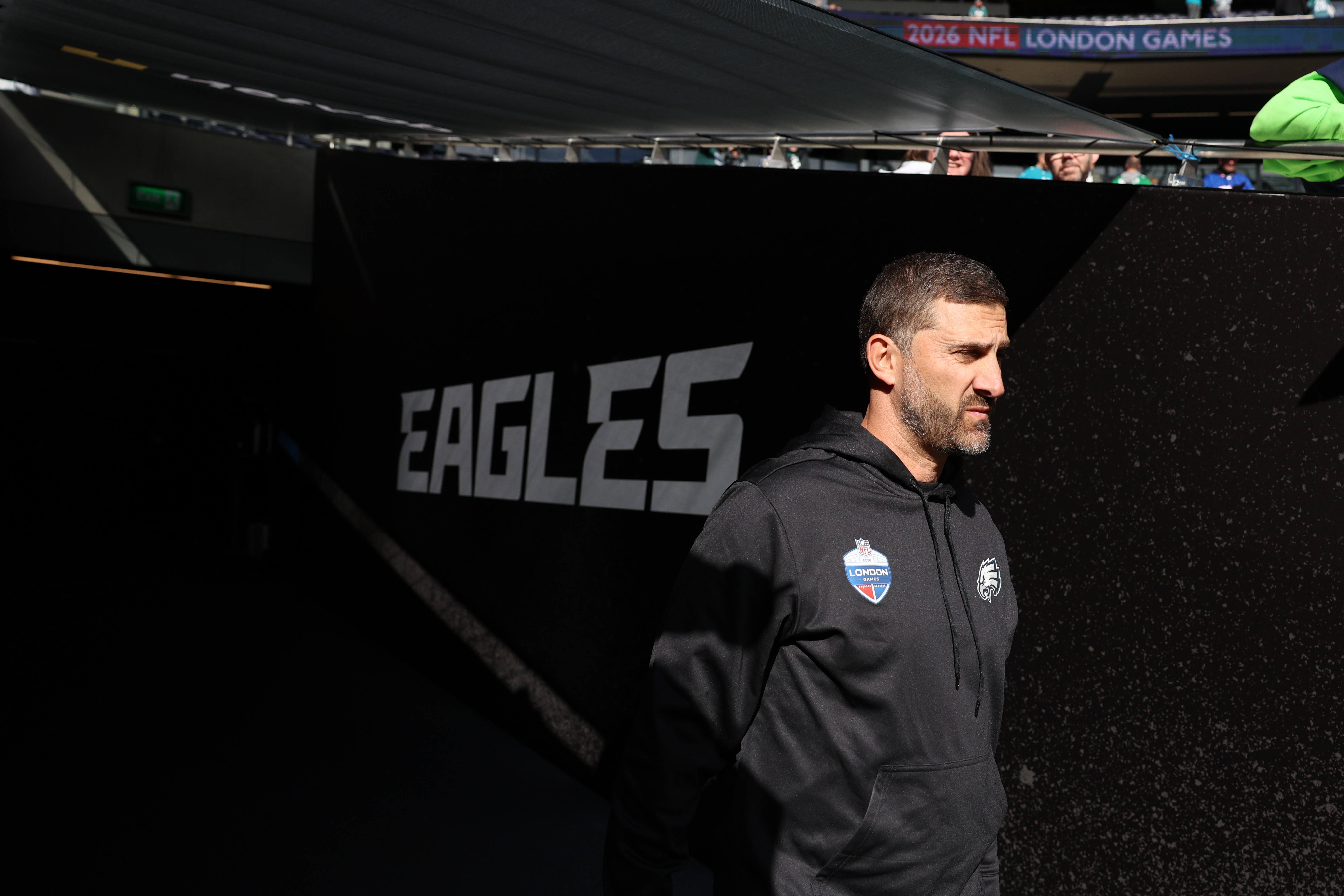
    Nick Sirianni is under .500 for the first time since his first season as the Eagles coach (2021).David Maialetti / Staff Photographer

    After 24 hours — and a trans-Atlantic flight — to reconsider, Sirianni maintained that his decision on the Eagles’ final kickoff Sunday cost his team the game. What he wouldn’t concede, however, was that his clock management in the lead up to Jake Elliott’s go-ahead field goal with eight seconds left was flawed. Not everyone agrees.

    As for the offense’s struggles in recent weeks, the Eagles coach didn’t offer the strongest endorsement of first-year offensive coordinator Sean Mannion on Monday.

    “I think right now offensively we all have to be better,” Sirianni said. “We’re not worried about gauging where this person is, where that person is. We’re worried about growth. … Obviously, it hasn’t been good enough.”

    Now the Eagles turn their attention to the Carolina Panthers, who are coming off a bye and have gotten some impressive play from quarterback Bryce Young. Despite a three-game losing streak, the Eagles are early 1.5-point favorites ahead of their Week 6 game at the Linc. Sirianni said he’s hopeful the team gets Saquon Barkley and DeVonta Smith back from their hamstring injuries, but wouldn’t go into specifics. In the case of Barkley, the Eagles could really use him. It was reported Monday that Will Shipley will miss several weeks with a foot injury.

    Something’s gotta give

    Rick Tocchet and the Flyers are still looking for their first win of the season.Elizabeth Robertson / Staff Photographer

    The Flyers hit a new organizational low when they lost to the Carolina Hurricanes. The loss was their seventh straight to open the season, one worse than the 1999-2000 and 2008-09 teams that were able to turn their seasons around and make the playoffs. They’re still far from the worst start in NHL history — or among Philly’s professional sports franchises — but they’re quickly running out of time to flip the script.

    Worse, it doesn’t even sound like the team knows where to begin.

    “It’s basic hockey right now,” captain Sean Couturier said. “One-on-one hockey, we’re dumb, honestly. We’re not winning enough battles. We’re making the wrong reads. I don’t know. We’re slow. We’re playing slow. … We’re not winning races. We’re just making it harder on ourselves.”

    Something needs to change, and based on the “Fire Tocchet” chants that rained down on Sunday, the fans have an idea of where to start.

    Next: The Flyers will look to snap their skid tonight when they host the Seattle Kraken (7 p.m., NBCSP).

    Why can’t we be friends?

    Trinity Rodman and the U.S. women’s national soccer team play at Subaru Park tonight.Nick Wass

    It may be called a friendly, but don’t tell that to the Spanish or U.S. women’s national soccer teams. With the 2027 World Cup on the horizon, the USWNT’s 2-0 loss to defending champion Spain Saturday in Washington had the feel of a match with real stakes. And there’s no doubt that both sides want to win tonight’s second leg at Subaru Park (7 p.m.).

    “There are no such things as friendly matches for these two teams. We both come to games to win,” Spain manager Sonia Bermúdez said.

    If the first match was any indiction, the second should bring some fireworks to Chester.

    Marcus Hayes’ take

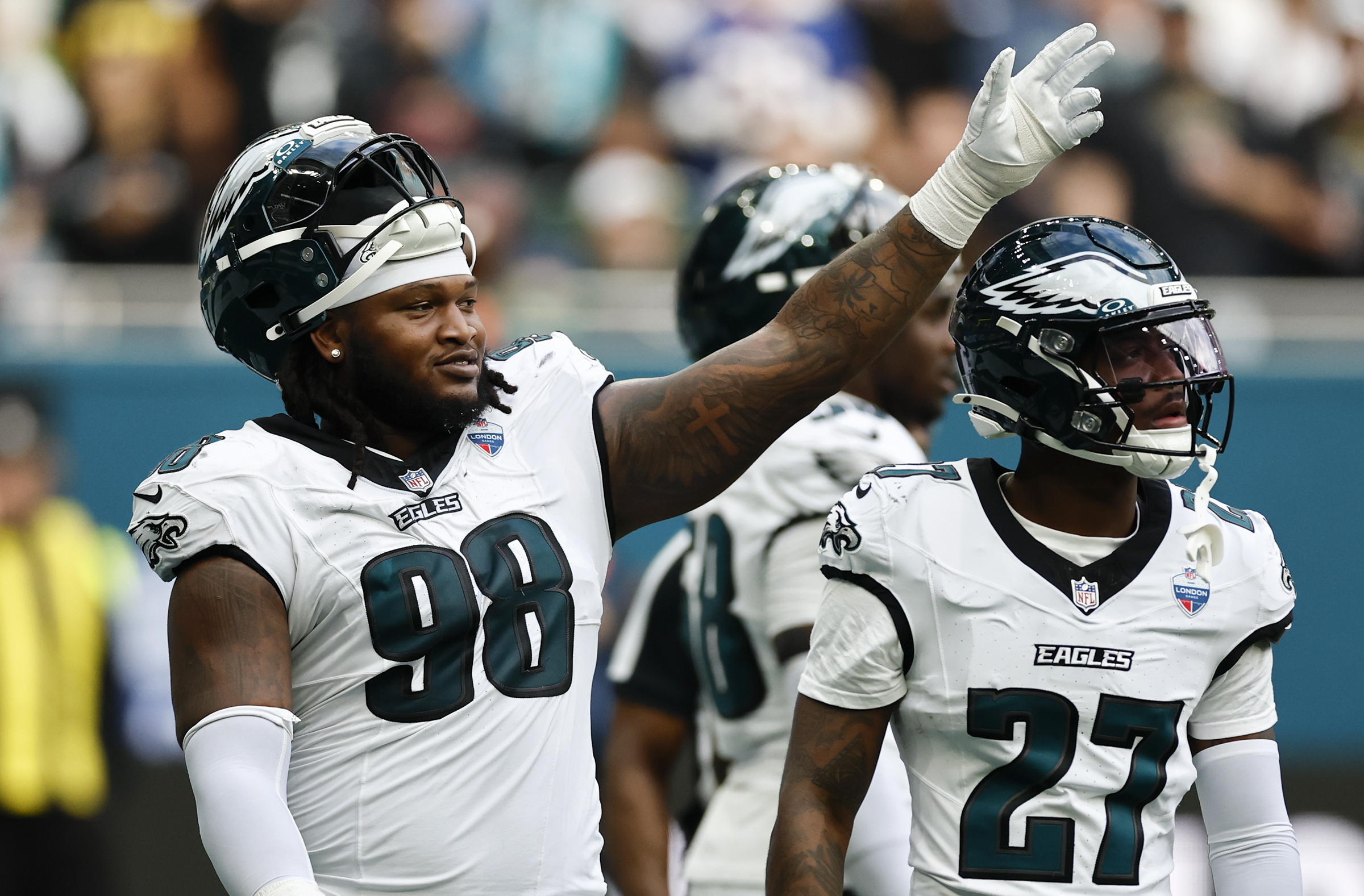
    Eagles defensive tackle Jalen Carter (left) was a menace against the Jaguars, finishing with two sacks and two forced fumbles. Cornerback Quinyon Mitchell (right) had a game-high two passes defended.Yong Kim / Staff Photographer

    The big takeaway from Sunday’s loss in London will be Sirianni’s poor decision-making late in the game against the Jaguars. Sirianni admitted himself that it’s the reason they lost. But it’s also worth noting that the injury-riddled Eagles were in the position to win the game in the first place, thanks in large part to a great game from the defense, especially Jalen Carter and Zack Baun.

    “This is excellent news for the Eagles going forward. If they can be this effective against one of the league’s better offenses, they needn’t worry as much when the potent Panthers visit Sunday, or when the Cowboys arrive eight days later,” Marcus Hayes wrote in his latest column.

    Here’s more from Marcus on the improvement in Vic Fangio’s defense, the state of the Eagles offensive line, and the dumpster fire that is the NFC Least.

    Stat that matters

    22 … That’s the number of rushing yards by the entire Eagles offense in their loss to Jaguars — not for a drive or a quarter or even a half, but for the whole game. With Saquon Barkley and Tank Bigsby out — and with Will Shipley knocked out of the game after five carries — and an offensive line in disarray, the Eagles finished with their lowest rushing total in a game since they ran for seven yards against the Cowboys in Week 2 of the 2015 season. With 22 yards on 18 carries, the Eagles averaged 1.2 yards per carry.

    On this date

    Lenny Dykstra (center) and the Phillies celebrate after winning Game 5 of the 1993 NLCS.AP FILE

    On Oct. 13, 1993, the Phillies clinched the National League pennant for just the fifth time in the team’s first 110 seasons, and the first time since 1983. The Braves took a 2-1 lead in the National League Championship Series thanks to wins by future Hall of Fame pitchers Greg Maddux and Tom Glavine. But then the Phillies beat the third member of Atlanta’s big three and another future HOFer, John Smoltz, in Game 4; they won in extra innings in Game 5 thanks to a Lenny Dykstra home run in the 10th inning; and then returned home to beat Maddux in Game 6 and clinch a World Series berth.

    Curt Schilling was the NLCS MVP, and Mitch Williams, who picked up the win in Game 5 and had two saves in the series, recorded the final out by striking out Bill Pecota. We don’t have to talk about what happened next.

    But we can mention that 15 years later, to the day, Matt Stairs ripped one “into the night, deep into right” on the way to the Phillies winning their first NLCS since.

    🧠 Trivia time answer

    Question: The Eagles’ loss to the Jaguars was their third straight. Including their current skid, how many times have they lost three games in a row (including the playoffs) since Sirianni took over in 2021?

    Answer: D. Despite all of the winning the Eagles have done under Sirianni — and it’s been a lot — they have had five three-game losing streaks since 2021. One each in 2021, 2025, and 2026, and twice in 2023, with the second one including their season-ending playoff loss to the Buccaneers.

    What you’re saying about Nick Sirianni

    We asked: Should Nick Sirianni be on the hot seat?

    “Nick should not be on the hot seat. Actually, he should be fired … two consecutive losses as a result of his inept decision-making vs. Rams and Jags. Time to cut ties.” — William B.

    “Sirianni being on the hot seat is ridiculous. His winning percentage since becoming the Eagles coach is outstanding and making the playoffs every year and the Super Bowl twice including winning one is phenomenal. And he might be on the hot seat? Absolutely ridiculous.” — Bob A.

    “Sirianni is a high school coach at best. He contributes very little to a non-creative offense and zero on the defensive side of the ball. … The best head coaches have high IQ’s. Sirianni is not one of them.” — Jack D.

    “Sirianni has been a tremendous success in his young career so far. Nick did take the blame for this loss but should not lose his job over it, no matter the outcome of this season.” — Michael L.

    “It is always hard to know, did Nick take them to two Super Bowls or did the players take him? The remainder of the season will answer the question as to whether or not Nick should stay or go.” — Everett S.

    “[He] certainly should be held accountable for the lost. … The receivers, who dropped passes throughout the game, should be held accountable as well.” — Tom G.

    We compiled today’s newsletter using reporting from Mike Sielski, Rob Tornoe, Matt Mullin, Ariel Simpson, Olivia Reiner, Jeff Neiburg, Jackie Spiegel, Conor Smith, Jonathan Tannenwald, and Marcus Hayes.

    By submitting your written, visual, and/or audio contributions, you agree to The Inquirer’s Terms of Use, including the grant of rights in Section 10.

    That’s it from me today. Kerith will be back in your inboxes on Wednesday morning. Have a great week! — Matt