A developer that planned to build six homes on the site of the closed Barton Run Swim Club in Evesham would sell the property to the township to preserve it as open space, according to a letter of intent from the town.
The 3.84-acre property on Lakeside Drive would be cleared by developer Orleans Investment Land Associates and Evesham would pay between $670,000 and $810,000 for the land, according to the township, which on Wednesday announced it had secured a $405,000 New Jersey Green Acres Program grant to help fund the purchase.
Evesham has budgeted from Township Open Space funds the balance of the purchase price, which is a range because it requires a Green Acres appraisal, Zane Clark, Evesham director of public information, said in an email.
Township council authorized the letter of intent at its meeting earlier this month.
“Once formal closing proceedings on the property are completed, and the land is restored to open space, the Township will begin engaging the community so residents can help plan for the future uses at the new park,” Clark wrote.
Orleans would be responsible for demolishing the clubhouse and pool, filling the land and planting grass at the club, which closed about 10 years ago.
Clark said the township also is seeking grants to finance rain gardens on the site.
“By securing this Green Acres funding and approving this letter of intent, we are protecting the neighborhood from further development and creating new open space for the public to enjoy,” Mayor Jaclyn Veasy said in a statement. “Once the land is under municipal ownership, the Township will ensure its safe upkeep and long-term care,” she added.
In recent years, Evesham Township has been aggressive about acquiring land to preserve as open space.
Projects have included preserving 176 acres of the former Beagle Club property on North Elmwood Road and purchasing 18 acres from the Board of Education off Greenbrook Drive in the Country Farms neighborhood.
However the town’s landmark preservation project, announced earlier this year, was the $15-million acquisition of 835 acres next to the Black Run Preserve by the New Jersey Conservation Foundation. After the purchase, the township will assume ownership and oversee the preservation of the land. The Black Run Preserve, also owned by Evesham, covers 1,300 acres.
70and73.com is a hyperlocal news site focused on South Jersey, including the communities of Cherry Hill, Evesham, Mount Laurel, Voorhees, Medford, Medford Lakes, and Moorestown.
Three members of Congress renewed their criticism of FanDuel Sportsbook on Thursday, accusing the company’s leaders of providing “misleading and incomplete” responses to a recent inquiry about the VIP services and rewards that it offers to customers.
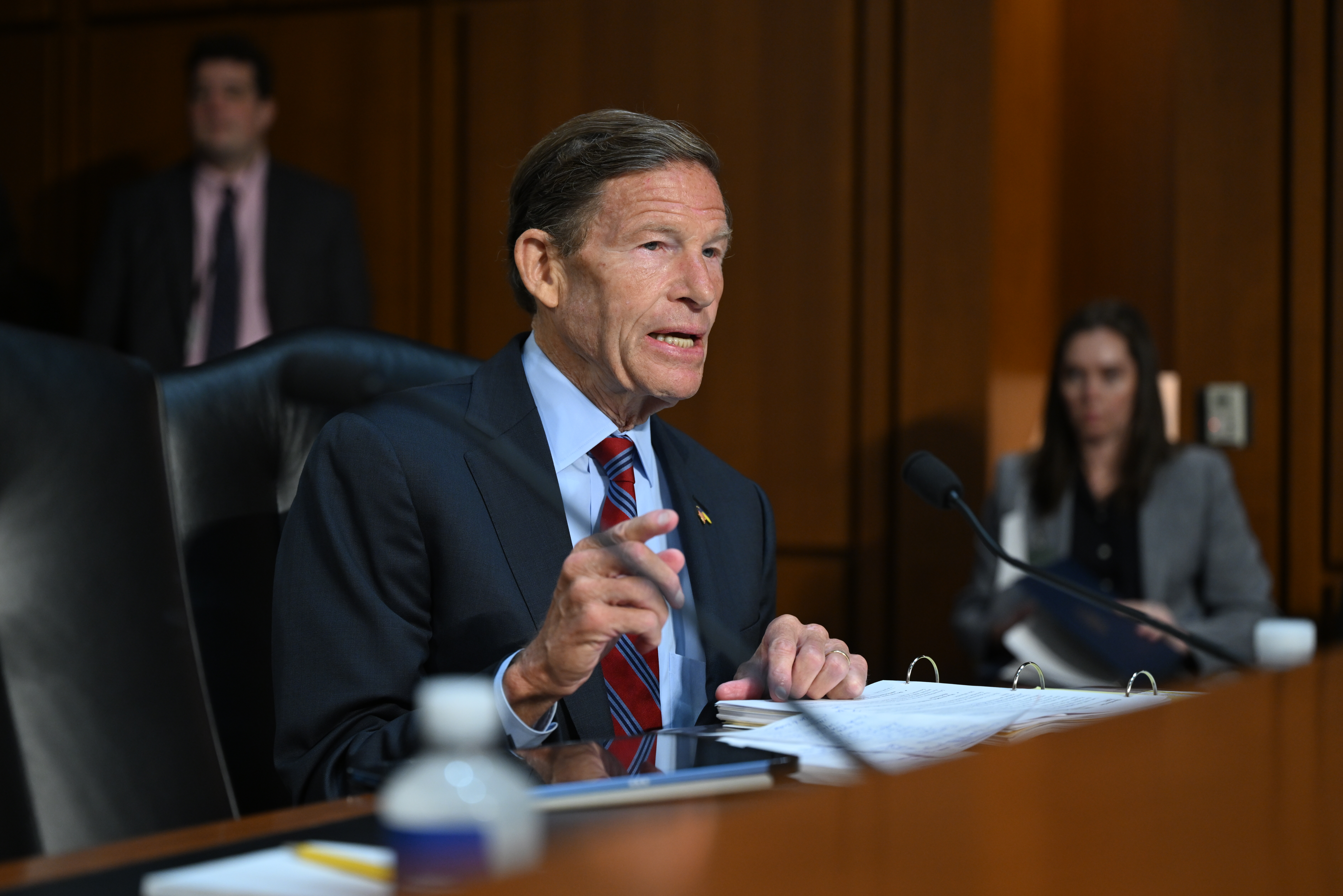
In a letter to FanDuel chief executive officer Christian Genetski, U.S. Sen. Richard Blumenthal (D., Conn.) and U.S. Reps. Paul D. Tonko (D., N.Y.) and Valerie P. Foushee (D., N.C.) wrote that they “remain unconvinced that FanDuel is making an active effort to protect bettors from harmful gambling and instead appears to be promoting addiction.”
The lawmakers had initially sent letters on Aug. 10 to FanDuel, Major League Baseball, and the Major League Baseball Players Association, and demanded that each make policy changes following an Inquirer story about a personal video greeting from Phillies star Bryce Harper that a FanDuel VIP manager sent in 2024 to a bettor who had a gambling addiction.
In response, the MLBPA said last week it would support banning players from doing promotional work for sportsbook VIP programs in the union’s next collective bargaining agreement.
The lawmakers had called on FanDuel to eliminate its VIP rewards and disclose information about those services, including whether the company had sent videos of other athletes to VIP bettors, or offered promotions to gamblers who experienced losing streaks and attempted to cut back on wagering.
In an Aug. 14 response, FanDuel wrote that it is “committed to being a transparent and cooperative partner” but did not directly respond to many of the lawmakers’ questions.
The company said it spent $158 million on responsible gaming in 2025, and that it extensively reviews customers’ betting history before offering them VIP status.
Though professional sports leagues were once deeply opposed to legalizing sports betting, leagues and many franchises have now entered into lucrative partnerships with gambling entities.Elizabeth Robertson / Staff Photographer
“Sports wagering is one of the most heavily regulated industries in the United States,” wrote Cory Fox, a FanDuel senior vice president, “and FanDuel operates a licensed online sportsbook in 26 U.S. jurisdictions.”
The lawmakers seized on this point, writing that FanDuel also has a prediction market, FanDuel Predicts, “which undermines the integrity of — if not bypasses — those very regulations.”
A FanDuel spokesperson said he was looking into the matter Thursday morning, but did not respond to follow up requests for comment.
Prediction markets allow customers to wager on a range of subjects: sports, politics, Hollywood award shows, the weather. They’re regulated by the federal Commodity Futures Trading Commission, which thus far has enforced few limitations on companies like Kalshi and Polymarket.
Critics — including former New Jersey Gov. Chris Christie, who works as a strategic adviser to the American Gaming Association — contend that prediction markets are running illegal sports betting operations. New Jersey Attorney General Jennifer Davenport earlier this week petitioned the U.S. Supreme Court to decide whether states should have the authority to regulate the markets.
In their latest message to FanDuel, the lawmakers described the company’s “VIP perks, constant push notifications, and personalized promotions” as exploitative, and demanded the company provide a written response to eight questions by Sept. 17.
Sportsbook VIP rewards and push notifications are a central thread in a lawsuit that the nonprofit Public Health Advocacy Institute filed in March in Common Pleas Court of Philadelphia against FanDuel, DraftKings, the NFL, and the data company Genius Sports on behalf Montgomery County resident Terry Thompson and Delaware County resident Christopher Sage, VIP bettors who each developed ruinous gambling addictions.
FanDuel, DraftKings, the NFL, and Genius Sports have each sought to have the case dismissed.
Thompson, who received the 21-second video of Harper, lost more than $1.8 million on sports bets, and planned to die by suicide earlier this year, rather than reveal to his family the scope of his losses.
Harper has said that he recorded the message through the video service Cameo, but didn’t know that Thompson had an addiction, or that FanDuel intended to use it as a VIP reward.
The Inquirer will continue to report on issues related to the growth of gambling addiction — among teens and adults — across Pennsylvania. If you, or someone you know, wants to speak with a reporter, please contact David Gambacorta or William Bender at dgambacorta@inquirer.com and wbender@inquirer.com
Burlington Stores, the discount retailer named for its longtime South Jersey home, is spending millions on new corporate offices in Philadelphia, marking the first time in decades the city has welcomed the headquarters of a Fortune 500 company.
In all, Burlington plans to spend $370 million on the move, and is set to receive another $30 million in state grants. The city is also providing a $7 million forgivable loan, a job-creation tax credit, and a $1 million investment that will give Burlington workers free SEPTA passes for a year.
Burlington eventually plans to relocate 1,500 employees from New Jersey to the new Philly headquarters, a spokesperson said, and hire another 500. The company has no plans for layoffs.
They plan to gradually move employees by team. The moves will begin no earlier than late 2028.
Pennsylvania Gov. Josh Shapiro called the move “one of the largest corporate relocations ever in the commonwealth,” at an event Thursday in the lobby of Burlington’s new headquarters.
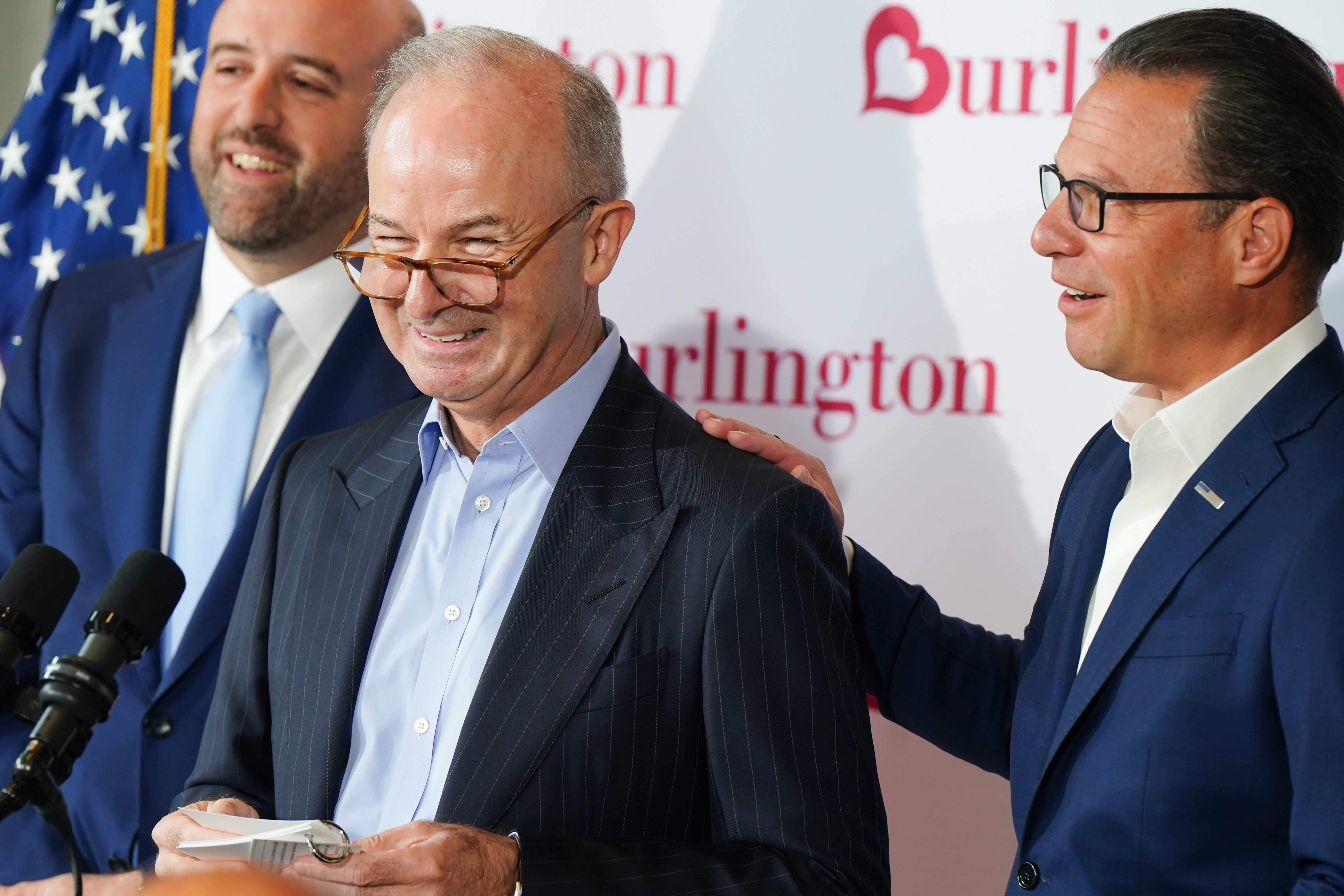
Burlington CEO Michael O’Sullivan, Gov. Josh Shapiro, and Mayor Cherelle L. Parker announce the retailer’s forthcoming move to Philadelphia.Jessica Griffin / Staff Photographer
“It’s going to put West Philly and our growing downtown district on the map as a premier spot for some of the largest companies in the world,” said the governor, who announced the news Thursday alongside Mayor Cherelle L.Parker, Burlington CEO Michael O’Sullivan, Brandywine Realty Trust CEO Jerry Sweeney, and other state and local officials.
Philly’s gain comes at a loss for New Jersey: Burlington has been based in its namesake Burlington Township for more than half a century. It opened its first store there in 1972.
New Jersey Gov. Mikie Sherrill’s office said in a statement that they were “disappointed by Burlington’s decision to relocate its headquarters.” But “the company will continue to maintain a significant presence and thousands of jobs here in New Jersey.”
Burlington Stores headquarters in Burlington, N.J., as seen in 2025.Jose F. Moreno / Staff Photographer
About 4,700 people worked at Burlington’s corporate campus and warehouses in Burlington County as of last year, with 2,100 people employed in Philly-area stores. A company spokesperson said Thursday that the company employs 8,000 across New Jersey.
As for its current headquarters on U.S. Route 130 North, Burlington intends to have it rezoned for warehouse space and turn some of the property into farmland. The company plans to keep its New Jersey warehouse and distribution centers in Burlington, Edgewater Park, Florence, and Logan Township.
Burlington’s move is the latest win for Parker and Shapiro, who is up for reelection in November, as well as the governor’s Department of Community and Economic Development (DCED). Earlier this week, Shapiro’s administration announced $50 million in state grants and loans to help fund the yogurt company Chobani’s expansion into Allentown.
“This is another day in what’s been just a monster week,” DCED Secretary Rick Siger said. “It’s another proof point of Pennsylvania’s strength as a business destination.”
“What we’ve seen today is what can happen through a public-private partnership when leaders have a shared vision, a dedication to cause, and an unwavering commitment to the exciting future we can create by working together,” said Sweeney, Brandywine’s CEO, on Thursday.
(function() { var l = function() { new pym.Parent( ‘burlington-move__graphic’, ‘https://media.inquirer.com/storage/inquirer/ai2html/burlington-move/index.html’); }; if(typeof(pym) === ‘undefined’) { var h = document.getElementsByTagName(‘head’)[0], s = document.createElement(‘script’); s.type = ‘text/javascript’; s.src = ‘https://pym.nprapps.org/pym.v1.min.js’; s.onload = l; h.appendChild(s); } else { l(); } })();
Burlington was initially drawn to Philly because of the city’s history and culture, including its food scene, artistic institutions, and sports fandom, according to O’Sullivan. But the CEO said conversations with Shapiro and Parker “pushed this decision over the line.”
“We found the vision that they laid out for the city and the state hugely compelling,” he said. “We were very impressed by their clear priorities and their focus on getting stuff done around economic development, education and training, public transportation, public safety, and fiscal responsibility.”
Burlington has been expanding in recent years as more consumers, including higher-income shoppers, flock to discount retailers.
Shoppers and employees at the Burlington Store at 833 Market St. in Philadelphia in 2018.Jessica Griffin / Staff Photographer
As of August, the company operated 1,300 stores in 47 states, including eight in Philadelphia and dozens across the region. By the end of the year, the company plans to open another 115 stores and hire 5,000 more employees, O’Sullivan said Thursday.
The chain’s growth has paid off, with a 21% increase in net income and a 9% jump in sales last year.
In an earnings call, O’Sullivan attributed those numbers to the company’s tariff response, which included inventory reductions, price increases on certain items, and an aggressive cutting of expenses.
Burlington has continued to report strong earnings in the first half of 2026, with a boost from $55 million in tariff refunds. O’Sullivan has said the company plans to put that money toward more markdowns for customers.
Shapiro and Parker both said they had shopped at Burlington, with Shapiro patronizing the Jenkintown store and Parker frequenting the location at the former Cheltenham Mall in Wyncote.
O’Sullivan said with a laugh: “The mayor and the governor got my full attention when they independently confirmed that they both exclusively wear clothes from Burlington.”
Gloria Steinem — the author, activist, and feminist icon — died on Wednesday, Sept. 2, 2026, at the age of 92.
In 1982, Steinem traveled to Philadelphia to receive an award. During her trip, she met with The Inquirer’s Kathy Hacker, who wrote this profile. Hacker died in January of 2021.
The Equal Rights Amendment was ratified by 38 states well after the original deadline mentioned in this article, and the legal and congressional debate continues. It is not recognized as part of the Constitution.
For a woman who has so often disavowed the label of “celebrity,” the scene probably was a bit discomfiting. First came the makeup man, intent on penciling her eyebrows and sponging suntan-colored goo over an already classically beautiful face.
Then came the television cameras, attached by a tangle of electrical wiring to a perspiring crew from NBC’s “Today” show.
And, finally, there were the fans, a zealous flock of devotees angling for a closer look, perchance a word and — the ultimate coup — an autograph.
If it didn’t quite qualify as a Hollywood-style welcome, the hoopla yesterday was sufficient nonetheless to jolt the modest sensibilities of that most private of public persons, Gloria Steinem.
“Sure, you feel a little foolish — you begin wondering what to do with your teeth,” sighed the premier philosopher-scribe of the women’s movement during a rare respite in a daylong visit to Philadelphia.
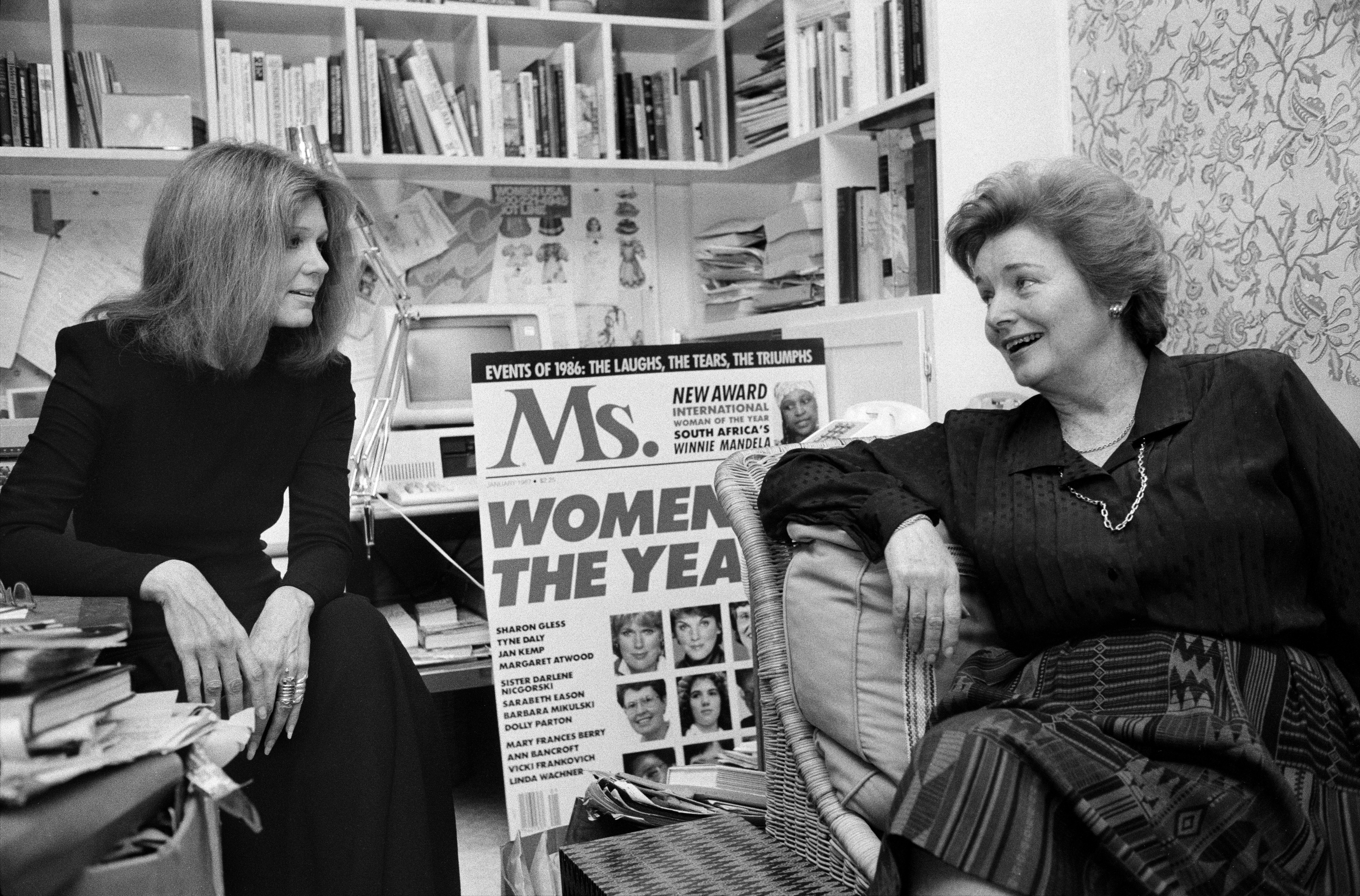
From left, Gloria Steinem with Patricia Carbine, a fellow founder of Ms. magazine, in New York on May 7, 1987. ANGEL FRANCO
As she spoke, an entourage pored over her frenetic schedule, which had her popping up in places as disparate as the Women Organized Against Rape offices in Center City and the furniture department in Bloomingdale’s King of Prussia emporium.
Just as pressing, they debated whether to rush out and buy Steinem a dressier blouse.
In the midst of the hubbub, with a microphone dangling nearby, she shrugged:
“It’s difficult. But if there’s one thing I don’t want to do, it’s let anyone down at a time like this.”
Gloria Steinem in New York on Sept. 23, 2015. CAITLIN OCHS
The attention did not necessarily take her by surprise. It was, for starters, Lucretia Mott Day, a major feminist observance called by Womens Way in honor of the l9th-century Quaker who devoted her life to the advocacy of women’s rights and the abolition of slavery.
And so, as the sun was peeking over Manhattan yesterday morning, Steinem climbed out of bed, pulled on a pair of boots, chocolate-brown wool slacks and a matching silk shirt, hopped aboard an Amtrak train and chugged to Philadelphia for the celebration, which culminated last night in the fifth annual Lucretia Mott Award gala at the Bellevue Stratford hotel.
This year, Womens Way chose none other than Steinem as the recipient of its medal. Like Mott herself, she is a fighter — and for a cause that, while certainly not lost, seems painfully far from being won.
As summer begins, the 48-year-old Steinem finds herself in a situation that is, at best, bittersweet. Come June, she and her fellow feminists on the staff of Ms. magazine will be marking the 10th anniversary of the publication, which she helped found and has since served dutifully as editor and writer.
For the occasion, she’ll be throwing a bash at the Armory in New York and then will be jetting off to all corners of the country to appear as a guest on the Merv Griffin, Phil Donahue and “Today” shows (hence, the omnipresent cameras). Another bit of sweetness in Steinem’s life: “She’s Nobody’s Baby,” a documentary on 20th-century women that she and her Ms. colleagues produced for Home Box Office, just received a prestigious Peabody Award.
Chances are, however, that Steinem will not be raising her glass in a toast on June 30. On that day, the deadline for ratification of the Equal Rights Amendment will come . . . and, by the looks of things, go, with approval by three state legislatures still lacking. She is, understandably enough, angry.
But beaten? Never.
“It’s important to say that there’s still a possibility of ratification,” she pointed out. “The odds are slender, I know. But remember, there are only about a dozen aging white men who have to change their minds. It’s still possible.”
Having said that, Steinem voiced what is virtually inevitable: “OK, let’s say it doesn’t get ratified this time around.” The people who worked before, she guaranteed, will continue working. And furthermore, she vowed, they will fight to reintroduce the amendment in Congress before this fall’s elections.
“It isn’t as if the country doesn’t support it, since opinion polls have shown just the opposite to be true,” she said, then added vigorously: “We are going to stay. We are not going away.”
Steinem’s battle cry echoed yesterday afternoon through Bloomingdale’s third-floor furniture department, converted into an auditorium for her lecture and a twin showing of “She’s Nobody’s Baby.” If Bloomie’s seemed at first an odd choice of forums, Steinem assured that suburban department stores are a logical arena.
“Shopping malls,” she smiled, “are what churches once were to Black women in the South. It’s where everybody goes.”
To be sure, a record-breaking crowd of 200 suburban women, children and a smattering of men had gathered there to hear her — and to pick up free samples of shampoo and copies of Ms. magazine’s May issue.
To the assembled throng, Steinem preached organization and demonstrated her caustic “lip.”
“Some of us are having flashes of revelation,” she noted wryly. “It’s dawned on us that we’re becoming the men we wanted to marry.”
Before dashing back to Center City, where Mayor [William] Green was waiting with an official proclamation in hand, Steinem exacted a promise from the crowd.
“You’ve gotta do one thing,” she urged. “Promise me that, within the next 24 hours, you’ll do one outrageous thing in the cause of simple justice. I don’t care what it is. It could be saying, ‘Pick it up yourself.’ If you’re employed outside the home, it could be comparing salaries.”
Her parting words, delivered with a mischievous grin: “Just one outrageous thing.”
2026 Volkswagen Tiguan SEL R-Line Turbo vs. 2026 Chevrolet Equinox ACTIV AWD: Midsize SUVs flying under the radar.
This week: Volkswagen Tiguan
Price: $45,410 as tested. The fancy paint cost $850 and was the only option, but we’re getting within shouting distance of 50 grand.
What others are saying: “Highs: Rich with features, gutsy turbo engine, interior that punches above its station. Lows: Annoying haptic interfaces, some brake pedal mush, ride could be more compliant,” said Car and Driver.
What Volkswagen is saying: “Say hello to the good life.”
Reality: It’s a pretty good life in the Tiguan, but that could be vacation brain talking.
What’s new: The Tiguan gets a new turbocharged four-cylinder engine that we try for this test; it received updates aplenty when the third generation debuted in 2025.
A long beach vacation weekend with friends in North Carolina was the scene of our test.
Up to speed: Landing on a Saturday morning in Raleigh for a two-hour drive to the beach, we definitely wanted to get there as fast as North Carolina law enforcement would allow.
The new 2.0-liter turbocharged four-cylinder engine did its darnedest to get us soaking up some rays as quickly as possible. Horsepower is up 67 from the base four-cylinder to 268; 0-60 mph time falls to 6.7 seconds, the leader of its class, according to Car and Driver. The trim level tested is the only way to get the turbo, which seems patently unfair, but read on.
Shifty: The Tiguan borrows a piece from Volkswagen’s EVs, with a twister stalk for the transmission gear selector. Steering wheel paddles handle shifting if you are inclined to, but I wasn’t; the eight-speed automatic took care of its own needs nicely.
On the road: The Tiguan definitely handled highways proficiently; nothing upset its composure. It was easy to get used to after leaving RDU. We saw a few curves when we ventured off to Burney’s Sweets & More for glazed, cream-filled croissants (always buy these if you’re within 50 miles), and the Tiguan slid through those turnsjust like a knife gliding into one of oursoft, tasty treats.
Once we were at the beach and full of sugary goodness, I did get a chance to corner quickly here and there. Picture it: Mr. Driver’s Seat chauffeuring around four women like an aging, designated-driver, U.S. version of James fromDerry Girls, and so their sassiness was turned up to 11. There were comments on many a corner, though with fewer f-bombs than the hit Irish series.
In the weather: On our trip from the airport to the beach, we drove through some heavy downpours, and the Tiguan handled road ponding delightfully. I slow down for bad weather but the sure-footed Tiguan kept us moving faster than almost all the other cars out there. That’s a reassuring feeling from the 20-inch all-season tires.
Back at the airport, the Tiguan also maintained its composure through some flight-canceling torrential storms that delayed our return to Pennsylvania. These kind of storms seemed more suited to a boat, and while being careful, again I led the pack and the slipping was minimal.
The interior of the 2026 Volkswagen Tiguan tested also matched this press photo nicely. See how nice?ANDREW TRAHAN PHOTOGRAPHY LLC
Driver’s Seat: If the horsepower alone isn’t worth the money, the upgraded SEL seating adds a serious bonus for that $5,000 premium. As soon as I sat down my herniated disc felt a great sense of relief, and the massage option helps further subtract the aches and pains. Heating and ventilation were the final piece of the puzzle.
The seats hold you in place nicely as well.
Friends and stuff: Those same friends who complained about Mr. Driver’s Seat’s extreme cornering maneuvers changed their tune when it came to the seat comfort — they all found that to be as delightful as the front. Even the middle-seat passenger felt well accommodated.
Cargo space is 69.8/33.8 cubic feet, depending on the seat position. There is no longer a three-row option as there was in the 2018-2024 model years.
The wide rear doors that are held over from the previous version drew one friend’s attention, noting it would be easy to get dogs in and out.
Play some tunes: The Harman Kardon stereo offered great reproduction of long-forgotten songs from the Psychedelic Furs, REM, and Tom Petty for the group, and we took the inspiration to recall stories of high school days. This system gets an A, but doesn’t uncover a lot of new pieces required for an A+ — unlike our stories, where we uncovered all new dimensions of our past lives.
The system offers only a large volume dial in the console; everything else happens in the huge 15-inch touchscreen, and it works pretty well.
Keeping warm and cool: Here’s a sad change from the 2018 model reviewed — the beloved VW three-dial system has been co-opted by the touchscreen.
The temperature settings sit along the bottom of the touchscreen, and a bigger screen opens for blower controls. Some versions of this arrangement actually function well, but not this one. Sigh.
Fuel economy: The Tiguan averaged 27 mpg in much highway and some beach driving, a great showing, especially for all that oomph.
Where it’s built: Parts are 37% Mexican, 15% U.S. and Canadian.
How it’s built:Consumer Reports predicts the Tiguan reliability to be a 3 out of 5.
Next week: Is the new trim of the Chevrolet Equinox worth a 10% discount over this Tiguan?
NEW YORK — Gloria Steinem, the celebrated author and activist who became one of the most visible symbols and potent voices of the U.S. women’s movement and a fierce advocate for feminist causes throughout her life, has died. She was 92.
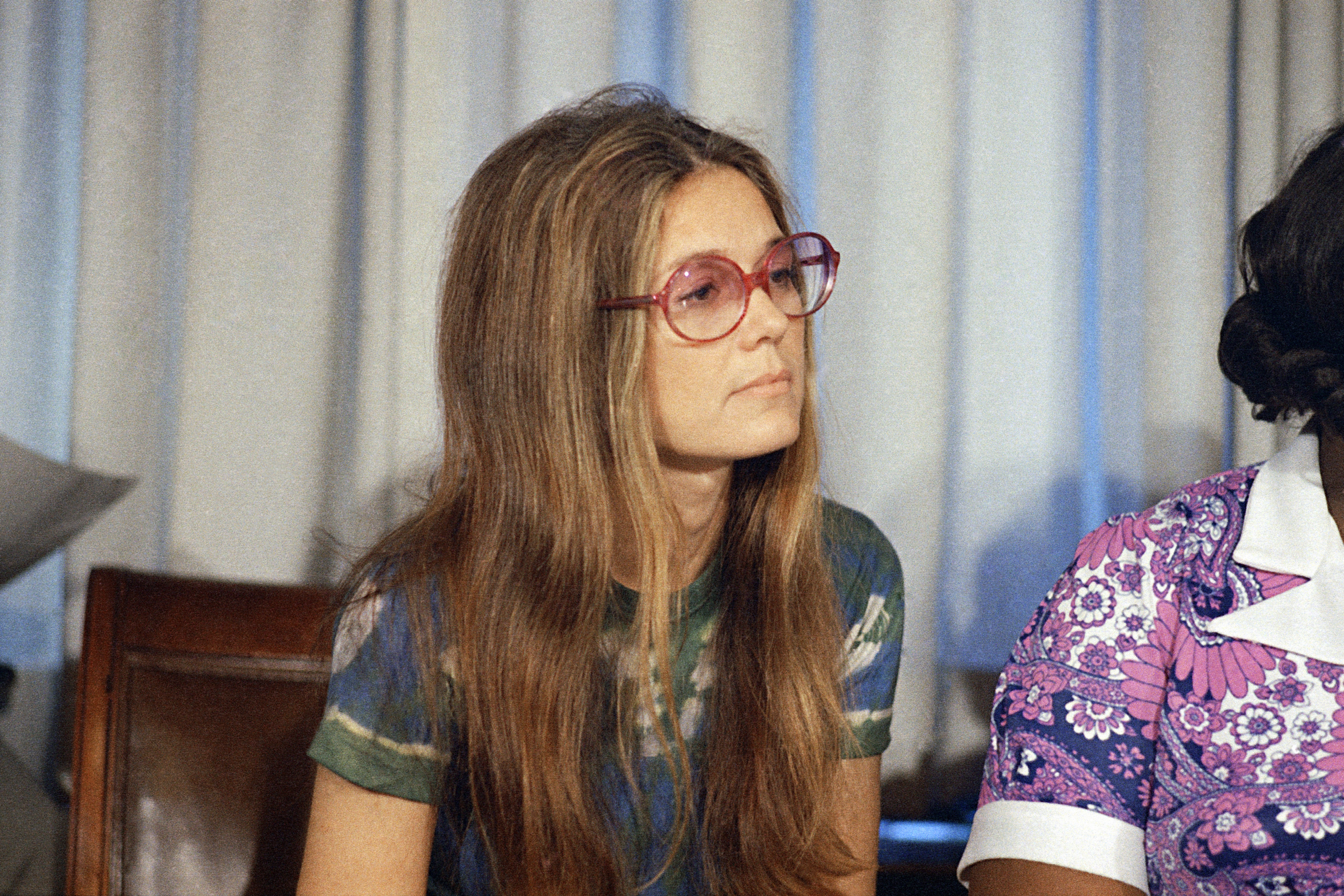
With her trademark streaked hair parted down the middle and large aviator glasses, Ms. Steinem, a co-founder of Ms. Magazine, was a hugely recognizable presence wherever she went. And she went everywhere: Much of her life as an advocate was spent on the road, speaking at college campuses and community centers, at rallies and marches.
She died Wednesday at her home in New York City, according to her and her foundation’s social media pages.
“Gloria’s greatest gift was her ability to listen to others, to make others feel seen and heard,” the posts said. “Her words, actions, and example gave people permission to be their truest selves. Gloria lived true to her independent spirit, always with curiosity and a great sense of humor.”
Ms. Steinem enjoyed writing and spending time in the community in recent years, the posts said. She also hosted talking circles for hundreds of people in her home. She died just before a planned memoir was to be released this fall.
“You can’t do it on the phone or on the web,” she told The Associated Press in a 2015 interview. “You have to be there with all five senses. It should be obvious that people can’t empathize with each other unless we’re in the same room.”
Ms. Steinem changed her career path after a start as a journalist
Ms. Steinem at an Equal Rights Amendment rally outside the White House on July 4, 1981.Scott Applewhite
She began her career as a journalist, notably one who reported, in 1963, on degrading conditions in Hugh Hefner’s Playboy empire, an undercover assignment she came to later regret. She credits a meeting six years later, where women spoke out boldly in favor of abortion rights, with changing her career path.
“That speak-out was the beginning of activism for me,” Ms. Steinem, who had undergone a secret illegal abortion herself at age 22, told the AP in an email in 2022, reflecting on the reversal of Roe v Wade. “Either our control over our own bodies is equal, regardless of sex or race, or we’re not living in a democracy.”
Though she soon became a known activist, those who watched Ms. Steinem denounce discrimination for so many years likely never suspected that she’d had to overcome a deep fear of public speaking. She would have simply stuck to writing, she said, if only editors at the time had been willing to let her write about the women’s movement.
But they weren’t interested, she told the AP in 2015. “So I ended up going out and speaking, which was my nightmare,” she said. “I mean, I was terrified. But I’m grateful, even though I still get scared even now.”
Ms. Steinem’s visibility endured throughout her life
Ms. Steinem claps as she walks on the stage during an International Women’s Day event in Abu Dhabi, United Arab Emirates, in 2023.Kamran Jebreili
Time hardly slowed Ms. Steinem down; well into her 80s she was traveling the globe and speaking out on issues of importance to her. These included everything from genital mutilation to Korean reconciliation, but it was equality for women that took precedence. “Being a feminist means that you see the world as whole instead of half,” she once said. “It shouldn’t need a name, and one day it won’t.”
As the years went on, Ms. Steinem’s visibility endured. At 83, she sat in the front row of her first fashion show, guest of designer Prabal Gurung. A few days after her 85th birthday, she was leading a women’s “talking circle” at an off-Broadway play celebrating her life, where one by one, women in the audience — many fighting tears — rose to thank her and tell their own stories of discrimination. In 2020, her life was the subject of a feature film, The Glorias, A Life on The Road, based on her 2015 memoir and starring Julianne Moore.
And at 91, she collaborated on a picture book with Liberian peace activist and Nobel laureate Leymah Gbowee aimed at inspiring young people to change the world. Rise, Girl, Rise: Our Sister-Friend Journey. Together for All was published in February.
The constant visibility came with a price; even into her older years, Ms. Steinem expressed frustration that despite her accomplishments, she was often described as beautiful or glamorous (A 1992 Vanity Fair profile even noted her “spectacular racehorse legs.”) It was a label she said unfairly detracted from her message.
“Nobody ever called me beautiful until I was publicly a feminist, and that was in my mid-30s,” she told AP in a 2011 interview. “It was clear that label was being assigned to me. The most hurtful part is that you work very hard, and people say it’s because of your looks.”
Ms. Steinem dealt with hostility from many directions
Of course, Ms. Steinem also had to deal with hostility. Sometimes it came from surprising places. Appearing on Larry King’s talk show on CNN in 1990, she was visibly stunned when a female caller greeted her cheerfully, then told her to “rot in hell” because she had ruined “the beautiful American family.”
But by then, she noted, at least people were taking feminists seriously. That wasn’t the case in 1972 when she co-founded Ms. Magazine and many commentators — especially male — dismissed it as ridiculous, predicting an early demise. (The magazine continues to this day, published by the Feminist Majority Foundation.)
Among Ms. Steinem’s detractors was President Richard Nixon, who was caught on an Oval Office tape ridiculing both her and the “Ms.” title. The ridicule was mutual: In a 1972 National Press Club speech, Ms. Steinem called Nixon “the most sexually insecure chief of state since Napoleon.”
It was just one example of Ms. Steinem’s trademark wit. Before she married at 66, she often explained her singlehood by saying “I can’t mate in captivity.” Laughter, she wrote, was “the only free emotion — the only one that can’t be compelled.”
In 2013, Ms. Steinem was awarded the Presidential Medal of Freedom by President Barack Obama. “Because of her work across America and around the world, more women are afforded the respect and opportunities that they deserve,” he said, “but she also changed how women thought about themselves.”
Ms. Steinem ‘read everything I could get my hands on’ growing up
Gloria Marie Steinem was born on March 25, 1934, in Toledo, Ohio. Her father was a traveling antique salesperson; she spent her early years on the road with her parents, not attending regular school. “I just read everything I could get my hands on,” she told an audience at Manhattan’s 92Y in 2026. “Which was frequently completely unsuitable … just everything and anything. I also was in love with the movies — my idea of heaven was a movie and a malted.”
In 1944 her parents divorced, and 10-year-old Gloria was left to take care of her mother. a once-promising journalist who struggled to combine her work with running a household, and eventually suffered a nervous breakdown.
As a young girl she excelled at tap dancing — it was even going to be her “ticket out of Toledo,” she said. Although she remained a good dancer, that particular career didn’t materialize. She attended Smith College in the ’50s, a time when, she has said, women were being educated to be mothers and wives.
But marriage was not on Ms. Steinem’s mind. “I was engaged to a very nice man. It wasn’t his fault, but I just didn’t want to get married,” she told her 2026 audience. Instead, she took advantage of a modest fellowship to travel to India. After that, Ms. Steinem headed to Manhattan, where she couldn’t rent her own apartment because, she said, landlords avoided single women, assuming “if you could earn enough, you must be a hooker.”
The aspiring journalist wanted to write about politics. But editors gave her assignments on food, fashion, and, in what she jokingly called “the low point of my life,” an article about textured stockings. Even more demoralizing was her experience with an editor who, she said, gave her a choice one day: Spend the afternoon in a hotel with him, or mail his letters on the way out.
She chose to mail the letters. “There was no word for sexual harassment then,” she has said. “It was just life.”
But one assignment in 1963 sounded compelling: posing as a Playboy Bunny, for an exposé in the now-defunct Show magazine. Ms. Steinem went through the audition process, assuming she’d be weeded out. But she was given her bunny costume — “so tight, it would give a man a cleavage,” she joked — and worked in the job for about a month.
“I could not have made a bigger mistake,” she told the AP in 2011. “It was personally and professionally a disaster. In the short term, it was much harder to get assignments, and in the long term it’s been used to ridicule me.”
Ms. Steinem’s writing became more political in her 30s
Ms. Steinem was in her 30s when she joined the editorial board of New York magazine, and her writing became more political. In 1969, she went to cover an abortion rights hearing. She had never told anyone about her illegal abortion at 22, in London. That was the moment, she has said, that triggered her career as a women’s rights activist. “I don’t think I had ever felt part of a group before,” she said in a 1970 TV interview.
Ms. Steinem founded the National Women’s Political Caucus in 1971 along with Betty Friedan, Shirley Chisholm and Bella Abzug. The latter became a dear lifelong friend — “the woman I wished I had had as a mother,” she said at Abzug’s funeral.
Unlike Abzug, Ms. Steinem was naturally reserved, not comfortable in front of a crowd. Gradually, with her early speaking partner Dorothy Pitman Hughes, a Black feminist and child welfare advocate, she found her footing. The two formed a powerful partnership at a time when feminism was viewed as largely a white, middle-class movement. In an iconic photo, the two raise their right arms together in the Black Power salute.
As she grew more famous, Ms. Steinem drew attention not just for her work but for a glamorous Manhattan life. Asked once about her streaked hair and aviator glasses, she explained that the hair was inspired by Holly Golightly, the free-spirited character played by Audrey Hepburn in Breakfast at Tiffany’s. The glasses? They were “more about hiding,” she said.
When reaction was hostile, Ms. Steinem would try to reason that it was a step above ridicule. But sometimes it stung, like a snarky Esquire profile in the early ’70s, so hurtful that she cried, and colleagues called a news conference to defend her.
Ms. Steinem co-founded Ms. Magazine and stayed with it as an adviser
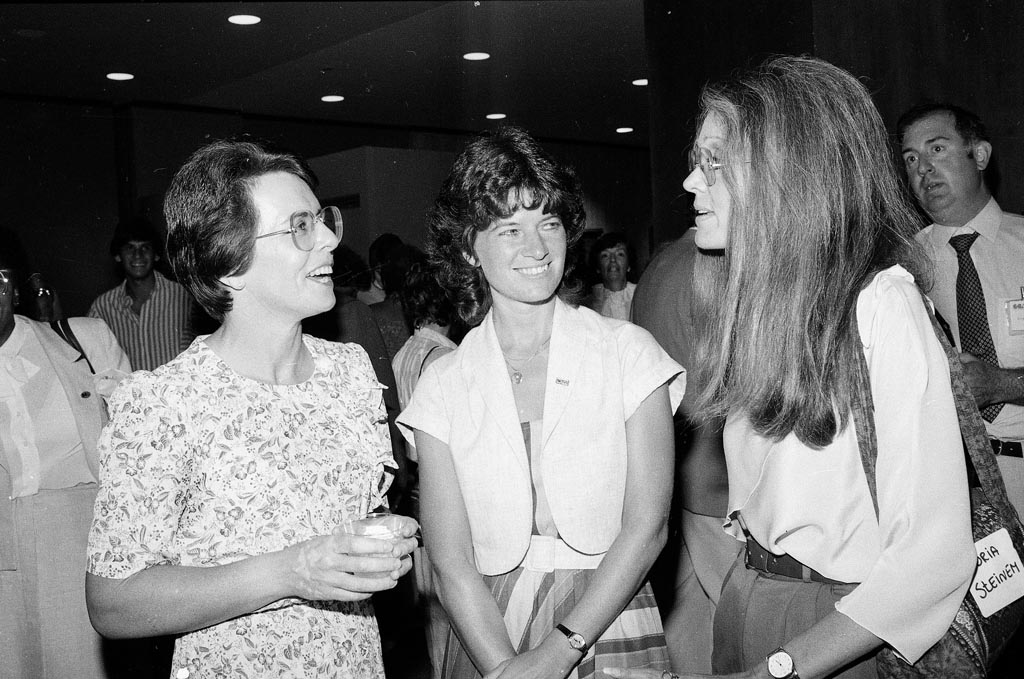
(From left) Tennis star Billie Jean King, astronaut Sally Ride, and Ms. Steinem at a reception hosted by the Girls Club of America and Ms. Magazine to honor Ride in 1983.ASSOCIATED PRESS
Then came Ms. Magazine in 1972, a magazine by women, for women. “I was so obsessed with the fear that it would fail and be a disgrace to the movement,” Ms. Steinem, age 37 when it launched, told the AP in 2011. And opponents hoped that would happen. TV newsman Harry Reasoner, an especially tart critic, later apologized on air. Ms. Steinem continued with Ms. until it was bought in 2001 by the Feminist Majority Foundation, and remained an adviser.
By 1977, numerous gains had been made for women, including Roe in 1973. But the Equal Rights Amendment, which had passed the House and Senate in 1972 but needed to be ratified by three-quarters of state legislatures, remained elusive. The issue was front and center at the 1977 National Women’s Conference, convened on a congressional mandate to examine women’s rights.
“If they want us to become the radicals that they fear we are, just let them stop the ERA and we will become those radicals,” Ms. Steinem said there.
Among groups Ms. Steinem co-founded were the Women’s Action Alliance, which was active through the 1990s; the Women’s Media Center in 2004, the Voters for Choice political action committee in 1977, and the Ms. Foundation for Women. She also helped establish the Take Our Daughters to Work Day.
Ms. Steinem never had her own children, and said she never regretted it. “No, not for a millisecond,” she told the AP, describing an incident in which she was afraid to answer that question in front of a group of women in India, fearing they wouldn’t like the answer. “But they applauded,” she said. “It’s important that some of us not have children, to show that we have a choice.”
In 2000, Ms. Steinem she did something she’d never planned to: She got married, at 66, to British activist and businessman David Bale, whom she met at a fundraiser (Bale was the father of actor Christian Bale.)
“I thought, ‘I haven’t changed, marriage had changed,’” Ms. Steinem said. “David and I wanted to be together, we loved each other. He needed a green card.” They married at a Cherokee ceremony in Oklahoma. Several years later, he became ill with brain lymphoma, and Ms. Steinem cared for him until his death in 2003.
Ms. Steinem said she had few regrets in life, but did miss being present when her father died. She received word that he’d been in a serious car accident, but did not respond in time, and he died alone. “I had taken care of my mom as a child, and I feared I’d never come back,” she explained. She was also sorry that she didn’t become closer to her mother. “I was so fearful of becoming her,” she said in an HBO documentary, Gloria: In Her Own Words.
Ms. Steinem’s books included ‘A Life on the Road’
Ms. Steinem’s books included the 2015 road memoir A Life on the Road — but she wryly noted at the time that she’d actually never learned to drive. It would have taken away, she said, from her ability to converse with her hosts, who would pick her up from airports or train stations. And, she noted, she always loved to chat with taxi drivers.
On Jan. 21, 2017, when hundreds of thousands of women gathered in Washington in their pink “pussy hats” for the historic Women’s March, it surprised nobody that the keynote speaker, and the most rousing, was Ms. Steinem.
“We are linked,” she told the crowd. “And this is a day that will change us forever because we are together.”
For many women, Ms. Steinem was the galvanizing voice that day. She would go on to advocate fiercely. But, though many saw her as a singular figure in history, she often liked to say that if she hadn’t come along, someone else would have accomplished the same things.
By the same token, she said, it was less important that younger people listen to her, and more important that they listen to themselves.
“The primary thing is not that they know who I am,” she said, “but that they know who THEY are.”
This is not the America we thought we were. As nurses, we’re sensitive to negative shifts in compassion and empathy. Almost two years of multiple, relentless attacks on America’s core values have left us morally distressed.
It is not like us to set a weekly quota of arresting 2,000 of our law-abiding neighbors seeking asylum in the United States. It’s not like us to propose spending $20 million in taxpayer dollars on a device that will allow immigration agents to deliver painful electric shocks to any human being. It’s not like us to put those without criminal records in jails and provide them with less than adequate medical care that has now resulted in the deaths of at least 50 innocent human beings.
Values out of whack
As a nation, our actions are out of alignment with our values.
As nurses, we have seen how words are used to evoke false beliefs. We have never seen a “vat” of solution injected into any person — let alone an infant, asPresident Donald Trump recently claimed about the childhood vaccination regimen. We have witnessed the fear and confusion of parents related to the mixed messages coming from non-pediatricians about the value of childhood vaccinations. Why change the vaccination schedule without evidence?
President Donald Trump and his former press secretary Karoline Leavitt at the White House earlier this year. Both have brought a new level of coarseness and personal denigration to official public discourse.Tom Brenner
These developments are not mutually exclusive, and they represent a troubling sign for a country where trust in the values of public institutions and in government leaders and workers is being eroded by outright lies and a lack of mutual respect. In 2025, only 17% of Americans trusted the government to do “what is right.”
Moral distress occurs when one’s values are constrained because of institutional, social, political, or other barriers.
The concept is often applied to healthcare workers, such as nurses. For example, moral distress has been widely documented when nurses are unable to deliver a treatment they know is best because of restraints imposed by the healthcare system in which they work.
Repeated experiences of moral distress often lead to a sense of disillusionment, disengagement, moral outrage, burnout, and apathy. When this moral distress and resulting harm is experienced by a broad swath of the general population, we call this civic moral distress.
So what can we do?
We know respectful dialogue instead of derision advances collaborative agendas and builds solid coalitions. We know public health is key to the prevention of disease. We know respect for the dignity of our fellow humans has nothing to do with their age, race, gender, political ideology, or immigration status. We know a lack of basic healthcare leads to emergency room visits and higher costs. We know the average citizen is not being heard by those who represent them to address the broader societal and moral problems at home and feels powerless to change any of it.
Don’t be disillusioned
There are no easy antidotes to civic moral distress. Experts coalesce around key principles, grounded in a foundation of trust, that could move us from a morally distressed nation to one characterized by moral strength and integrity.
For everyone: Be kind, be truthful, perform one random act of kindness every day, care for your neighbors. For newspapers: Publish one issue a week that focuses on local community issues. For all government officials: Don’t break everything just because you can; stay in your lane and do not make healthcare recommendations out of your area of expertise.
For all Americans: Do not be disillusioned.
Advancing this agenda will require significant moral courage. Failing to do so will further erode our society, our humanity. And although civic moral distress is our current reality, it need not be our future.
Connie M. Ulrich is a registered nurse and professor of nursing and of medical ethics and health policy at the University of Pennsylvania School of Nursing. She is a Hastings Center Fellow. Mary D. Naylor is a registered nurse and professor of gerontology and nursing at Penn’s School of Nursing. Martha A.Q. Curley is a registered nurse and professor of pediatric nursing at Penn’s School of Nursing.
WARSAW, Poland — Russia will close German cultural centers on its territory, Foreign Minister Sergey Lavrov said Thursday in a retaliatory measure reflecting the deepening tensions between Moscow and European countries that are helping Ukraine resist the Kremlin’s 4 ½-year-old invasion.
Lavrov’s announcement came after Berlin blamed Moscow for an attempted drone attack at Leipzig/Halle Airport on Aug. 4. The explosives-laden drone was found near a Ukrainian plane at the airport, a major international freight hub used for providing support to Ukraine. The drone was later defused.
Earlier Thursday in Munich, several incendiary devices were thrown at a construction site near a building where several companies, including from the defense sector, are located, the Bavarian State Criminal Police Office said. There was a brief fire that caused no significant damage, police said, adding they suspect the target was one of the companies in the area.
Two Bulgarian nationals were arrested, police said, but their suspected involvement was not confirmed.
Western officials have repeatedly accused Moscow of conducting a campaign of sabotage and disruption in their countries with the aim of undermining support for Ukraine and destabilizing European nations, something Russia denies.
Germany says it has become a “daily target” of the Kremlin’s hybrid campaign.
It said Wednesday it was closing both the Russian Consulate in Bonn and the Russian House cultural center in the German capital.
Lavrov countered that cultural centers belonging to Germany’s Goethe-Institut would be closed in Moscow, St. Petersburg, and Yekaterinburg, adding that any other response would show a lack of “self-respect” on Russia’s part.
He told an economic forum in the far east city of Vladivostok that Germany “could not have failed to understand” that closing the center in Berlin would “signify the end of their cultural presence in Russia.”
Russian President Vladimir Putin said Berlin wants to distract from its own failings and dissatisfaction among voters. Any proof being offered “has been planted,” Putin said.
Europe increasingly views itself as facing what it calls hybrid attacks by Russia, marked by cyberwarfare and disinformation as well as a conventional military threat. Each side accuses the other of state terrorism.
The tension has continued for months and grown into a major foreign and defense policy challenge for countries in the European Union.
Putin is testing the West with tactics that fall “just below the threshold of war” and is determined to “harass NATO members,” the head of Britain’s MI6 spy agency said last year.
European countries seek to counter Russia’s threat
Following Germany’s claims, Poland, Denmark, Finland, the U.K., the Czech Republic, and Lithuania have summoned Russian diplomats stationed in their countries.
In Norway, authorities on Wednesday seized a Russian vessel in the Arctic archipelago of Svalbard at the request of Ukraine’s state-owned Naftogaz energy group.
A Norwegian court ordered the seizure as part of efforts by Naftogaz to recover a $4.22 billion arbitration award stemming from Russia’s 2014 illegal annexation of Crimea and its seizure of Ukrainian energy assets, including gas fields and pipelines. After Moscow refused to pay the 2023 award, Naftogaz petitioned national courts for orders to seize Russian commercial assets.
Putin on Thursday compared it to “state terrorism,” and Russia’s Foreign Ministry summoned Norway’s ambassador to Moscow, Heidi Olufsen, to protest the seizure of the vessel, which it said belongs to the state weather and environmental monitoring agency.
It carried workers, scientists, and cargo to Russian settlements on one of the islands in Svalbard, the ministry said, adding that Moscow “will seek to lift the vessel’s arrest.”
In Finland, meanwhile, more than 2,000 people took part Thursday in the biggest civil defense exercise in Europe since the end of World War II. Among the threats envisioned were missile strikes from neighboring Russia.
EU weighs how to respond further
EU ministers on Wednesday weighed how best to respond to the attempted drone attack but struggled to find new ways to meet the challenge without resorting to military means.
The EU has slapped almost two dozen packages of sanctions on Russia over the war, targeting over 3,000 officials, oligarchs, and entities including banks, energy companies, and drone makers.
One senior EU official said the bloc’s anti-terrorism procedures could be put to effective use.
“If we list individuals as terrorists, we can deploy a range of instruments to actually target those individuals and to track them, all their activities, and people associated with those individuals,” EU Counter-Terrorism Coordinator Bartjan Wegter said.
He told The Associated Press that EU methods for combating terrorist financing and money laundering, as well as boosting the resilience of infrastructure like airports, could be put to good use.
“It is a very worrying development,” Wegter said of the failed Leipzig drone attack. But he noted that “it is not new what we’re seeing.”
Both Russia and Iran have used hybrid warfare methods before, he said.
“They’re actually deploying terrorist tactics” that are meant to “destabilize our society,” Wegter added.
Denmark sounds alarm about Russian sabotage plans
Danish security services are warning that Russian acts of sabotage against the country’s defense industry may be imminent.
Intelligence services have seen signs of specific planning by Russia to conduct sabotage operations in Denmark, Emil Græsholm, head of counterintelligence at the national security and intelligence service PET, told the Berlingske newspaper.
The targets are primarily companies in the defense industry and especially those associated with delivering military components to Ukraine, he said.
Russian Ambassador Vladimir Barbin said PET has not presented any concrete evidence that Moscow was preparing sabotage acts in Denmark. He said Græsholm’s comments were actually an acknowledgement of Denmark’s involvement in Ukraine.
The transformation of Danish territory into a production and logistics base for the Ukrainian military posed a security risk to Denmark, he added.
Italy’s Defense Minister Guido Crosetto told AP on Wednesday that the German airport incident was “a very serious act that could have very grave consequences.”
But he said the threats aren’t discouraging Italy from further helping Kyiv as Rome weighs whether to send SAMP/T air defense batteries. As in other Western countries, limited weapons production capacity is hampering efforts to supply more to Ukraine, he said.
WASHINGTON — A plan by the Environmental Protection Agency could make it harder for the public to learn about and comment on proposed AI data centers that have sparked backlash in communities across the United States and transformed the midterm election landscape.
The EPA proposal would eliminate a federal requirement that states notify the public and seek comment before issuing air pollution permits for data centers and other industrial facilities. States could still offer opportunities for public comment, but the EPA would no longer mandate them as a condition for states to grant permits.
Critics say the move could thwart local residents from learning about proposed data centers or making their voices heard before projects are approved and construction begins. The move comes during a widespread backlash as tech giants build hundreds of massive server warehouses to fuel artificial intelligence and cloud computing.
“By eliminating the long-standing federal requirement for public notice, this proposal continues efforts by the Trump administration to turn its back on the fundamental EPA principle of transparency,” said Mike Koerber, a former deputy director of EPA’s air quality office.
If made final, the plan could create “an unlevel playing field where citizens in one state are kept completely in the dark about new data centers and heavy industrial emissions in their backyards, while neighboring states maintain oversight,” he said.
Under the EPA plan, states with weak or no requirements for public comment could speed permits for data centers, power plants and other pollution sources without consulting the public or even informing communities where the facilities are located, Koerber and other critics said.
Communities deserve a chance to weigh in, advocates say
“Data centers and other industrial sources should not be able to get their air pollution permits in secret,” said Keri Powell, senior attorney for the Southern Environmental Law Center, an advocacy organization that leads a coalition of nearly 200 environmental, health and community groups that filed comments with the EPA opposing the plan. “Communities deserve a chance to weigh in” before potentially harmful projects are approved.
An EPA spokesperson called that a false narrative.
“In our proposal we are saying that states get to pick how they want their permitting process to go for minor sources” of air pollution, spokesperson Carolyn Holran said.
The EPA proposal does not specifically identify data centers, she said, noting that the plan also would apply to laundromats, car repair shops and even landfills and steel mills that are considered “minor” pollution sources under the federal Clean Air Act.
The proposal does not demand that states make particular changes to their programs, nor does it alter federal emission standards or weaken environmental protections, Holran said. “Rather, the proposal simply aligns the national program with the Clean Air Act language to ensure that states are in the lead regarding their programs.”
EPA Administrator Lee Zeldin, who has made U.S. leadership in AI a top agency priority, said in a statement that the plan is aimed at “cutting unnecessary and burdensome red tape, unleashing American energy and advancing cooperative federalism” with states. The EPA is expected to make the rule final next year.
President Donald Trump continues to stick up for data centers, even as politicians from both parties criticize them and many communities try to block them. Trump said on social media this week that U.S. communities that don’t have data centers will “end up being backwards and poor.”
Trump says data centers are crucial in the AI race against China
Trump has acknowledged that data centers need “a little public relations help” and has pushed tech companies to generate their own electricity to shield consumers from higher utility bills. The Republican president calls data centers critical to winning the AI race against China.
Environmental groups and other critics say the EPA proposal ignores the reality that many states, particularly in the South and Midwest, don’t require public notice or hearings beyond those set by federal agencies. The federal plan would leave many communities in the dark before data centers show up in their backyards, they said.
“It’s beyond cruel for Trump’s EPA to silence front-line communities who bear the brunt of unhealthy air,” said Brandon Jones-Cobb, a senior attorney at the Center for Biological Diversity, another environmental group.
The EPA “has already turned its back on science, cut enforcement against industrial polluters and eliminated life-saving air pollution measures,” he said. “Now it wants to shut the public out of decisions to build or expand facilities that expose communities to dangerous air pollution, including data centers.”
Powell, whose organization focuses on six Southern states from Virginia to Alabama, said many states “only do what is required by federal law” when it comes to public notice of land-use projects and other environmental concerns.
“We rely on a minimum federal requirement to ensure we have environmental protections and a voice,’’ she said in an interview, calling regulation of data centers a crucial issue in a region where the energy-hungry behemoths are proliferating. Virginia and Georgia are both among states with the highest concentration of current and proposed data centers.
Americans worry data centers could cause pollution, job losses
Besides powering AI and cloud computing, data centers are often sources of nitrogen oxide, which helps form ozone, as well as carbon monoxide and other air pollutants. Local communities also have expressed concerns about excessive water use and noise from data centers. Many Americans worry that AI could increase economic disparities and cause widespread job losses.
Data center advocates stress that local taxes paid by the centers can help fund public schools, reducing the financial burden on homeowners.
Jane Williams, executive director of California Communities Against Toxics, said even if data centers ultimately are approved, “every community should be able to participate robustly in governmental decisions that can pollute our air.’’
Rolling back the EPA rule “pulls a dark cloud, filled with soot and toxic chemicals, over communities’ right to know what polluting facilities are planned in their community,” she said.
A federal judge in Maryland temporarily blocked much of President Donald Trump’s latest effort to withhold citizenship from babies born in the United States to noncitizen parents, ruling that the Supreme Court had already settled questions reopened by an executive order Trump signed in August.
While the decision was limited to children born after Feb. 19, 2025, including those born in the future, Judge Deborah L. Boardman wrote that the order would likely affect babies the Supreme Court had already defined as citizens. The ruling delivered a sharp rejection of the president’s renewed efforts to restrict birthright citizenship, after the Supreme Court ruled 6-3 in July that a previous, more sweeping, executive order from 2025 was unconstitutional.
“No presidential executive order can undo what the Supreme Court has done,” she wrote.
Boardman’s order took a dim view of the Trump administration’s reasoning, which she characterized as a thinly veiled attempt to get around the Supreme Court’s decision. She wrote that the president and others named in the lawsuit “completely misread” the majority’s opinion and embraced a “distorted interpretation” of its conclusions.
In a 35-page opinion, she described the latest order as only the most recent attempt to curtail birthright citizenship by any means that could survive legal scrutiny.
“Since his second term in office began on January 20, 2025, the president has tried, through executive order, to upend our country’s longstanding tradition of birthright citizenship and eliminate, for large swaths of Americans, the right to citizenship by birth, a right enshrined in the Citizenship Clause of the Fourteenth Amendment,” she wrote.
Boardman described a number of ways that children covered by the lawsuit could have their citizenship rescinded, including if the Trump administration moved to label their parents members of terrorist groups or “alien enemies” under arbitrary legal determinations. She cited a pattern in which the administration has accused Venezuelan nationals of being affiliated with the criminal organization Tren de Aragua, often without evidence, in deportation proceedings.
While she stressed that it was too soon to find that the order itself was unconstitutional, she wrote that it already appeared clear that it was unconstitutional as applied to the class of babies defined when immigration groups initially sued last year to block Trump’s first order.
The order this year had included other measures to create novel categories of babies that could be disqualified from citizenship, including those born to parents engaged in so-called “birth tourism,” through which mothers deliberately traveled to the United States to give birth.
It was unclear how the Trump administration planned to tag those it suspected of traveling to the United States to have their children. But Boardman noted that the executive order was broad, describing anyone who engaged in a “commercial transaction” — such as purchasing a plane ticket — as traveling to access birthright citizenship.
The Supreme Court’s decision upholding birthright citizenship “is the law of the land,” Boardman wrote. “The President must follow it.”