Tag: topic-link-auto

  • In Opera Philadelphia’s ‘Mitridate’ you can catch a 14-year-old Mozart in the act of becoming great

    In Opera Philadelphia’s ‘Mitridate’ you can catch a 14-year-old Mozart in the act of becoming great

    Among the many risks taken by Opera Philadelphia over the past two years, none has been greater than the current production of Mitridate, re di Ponto — the quirk of it all being that such a risk is attached to the name “Mozart.”

    Yes, the ever-beloved composer is his ingratiating self in the rarely-heard, remarkably-evolved opera composed at age 14. Age is not an issue so much as the genre that prevailed in 1770 Milan, well before Mozart left behind stock plots about antique royalty that were once standard procedure.

    Arias go on for as much as 10 minutes with false endings and expansive postscripts, requiring extraordinary virtuosity and stamina in an age where opera was as much about Olympic-style recreation as artistic communion.

    Tenor Lawrence Brownlee in Opera Philadelphia’s production of Mozart’s “Mitridate” at the Academy of Music. The work opened the company’s 2026-27 season.Dominic Mercier

    Thanks partly to often electrifying singing in the cast led by star tenor Lawrence Brownlee, the audience seemed fully engaged Wednesday at the Academy of Music, even laughing with the recitatives that focused the characters and made the opera seem far less distant. In his customary pre-curtain speech, general director and president Anthony Roth Costanzo (who was also in the cast) suggested that Mozart was working out his father issues. Opera as psychotherapy? I won’t argue.

    What emerged, for me, were parallels with King Lear in this story of the rage-prone monarch Mitridate, ca. 63 BC in the Crimea, whose one son is loyal and the other is plotting an overthrow with aggressive support from Rome. Romantic complications abound — in vocal writing that expects every voice to do everything — in arias that unfold with the dramaturgical formality of a chess game.

    Without a lot of direct character interaction, soprano Brenda Rae was able to replace the previously scheduled Lauren Snouffer in the leading role of Aspasia with less-than-usual strain: Mostly, she needed to just show up for her arias, which exist like islands of characterization.

    Lengthwise, the opera ranges from two-and-a-half to three-and-a half hours, this version coming in under three. With such flexibility, singers, in theory, can use the opera as a quarry, selecting what best suits them.

    Soprano Brenda Rae as Aspasia in Opera Philadelphia’s fall 2026 production of Mozart’s “Mitridate, re di Ponto” at the Academy of Music.Dominic Mercier

    With the convincingly brisk tempos of conductor Corrado Rovaris, the score felt a bit like Philip Glass — with Mozart inhabiting an infectious groove that suddenly changes complexion with the addition and subtraction of a well-targeted note. Long harpsichord-accompanied recitatives can sap the overall momentum, though Leon Schelhase revealed all manner of harmonic richness, creating a space where singers could give their characters greater specificity.

    To her credit, stage director Emma Griffin basically left the singers alone — giving their characters a visual context but little physical stage business that would distract them from what they were there to do — sing.

    It’s true that countertenor Costanzo (in the role of Farnace, the bad son) was able to sing with astounding accuracy and expressivity while being taken down and tied up. But that can’t be expected of any one else. It’s also true that Griffin had Brownlee’s angry king breaking various objects onstage, but always between phrases, and never stealing focus from his trademark high notes that take off like a skyrocket.

    Among all cast members — including Meredith Wohlgemuth as Sifare, Nola Richardson as Ismene, and Sarah Coit as Arbate — the singing was effective but not always tidy, the heat of performance being much more important.

    In Opera Philadelphia’s “Mitridate,” from the left: Lawrence Brownlee (Mitridate), Brenda Rae (Aspasia), Meredith Wohlgemuth (Sifare), Sarah Coit (Arbate), Nola Richardson (Ismene), and Anthony Roth Costanzo (Farnace). Dominic Mercier

    Two special mentions: The emerging tenor Minghao Liu, as the Roman invader Marzio, is singing lots of Rossini in regional opera but is clearly headed for the top with the remarkable ease of his coloratura technique. In a somewhat different way, Rae is perhaps doing her best work in her middle years with a voice that’s showing some wear but is ever more interesting with the kind of shading she brings to what she sings.

    She is able to encompass her entire character in a single cadenza. The depth of meaning she brought to her great Act II aria “Pallid’ombre, che scorgete” (roughly translated “Ghosts who look down from heaven” in which she contemplates the end of her life) was the opera’s most entrancing moment.

    That and a number of other Act II arias for other characters (such as “Lungi da te, mio bene” with its horn obbligato) showed Mozart periodically leaping ahead in his maturity, creating music at a level of sophistication that would become customary a decade later. One can hear one of Western civilization’s great artists emerging before your very ears.

    “Mitridate, re di Ponto” is performed Thursday at 7 p.m. and Sunday at 2 p.m. at the Academy of Music, Broad and Locust Sts. Tickets are $11-$250. The company’s next opera, “Suddenly Last Summer by Courtney Bryan,” opens Oct. 22 at the Forrest Theatre. operaphila.org, 215-732-8400.


  • Philly music this week with Charli XCX, Lil Wayne, Rod Wave, Margo Price, Iron Maiden and more

    Philly music this week with Charli XCX, Lil Wayne, Rod Wave, Margo Price, Iron Maiden and more

    September is concert season. Summer tours are still going, while fall tours are just getting started. This week in Philly music features both Charli XCX and Rod Wave launching tours in South Philly, plus Lil Wayne in Camden, John Fogerty and Steve Winwood in Atlantic City, Iron Maiden in Hershey, and Margo Price in King of Prussia.

    Friday, Sept. 11

    Charli XCX

    “Yeah, we’re on to the next, I think the dance floor is dead,” Charli XCX sings on the opening track of her new album. “So now we’re making rock music.” The pivot isn’t quite radical for the woman behind the Brat summer of 2024. There is still music you can dance to on Music, Fashion, Film, the whip-smart British pop star’s eighth album, which represents its three titular disciplines with a photo of John Cale, Marc Jacobs, and Martin Scorsese on the cover. What will this tour look and sound like? I can hardly wait to find out. 8 p.m. Xfinity Mobile Arena, 3601 S. Broad St., xfinitymobilearena.com.

    Rapper Lil Wayne performs during the Roots Picnic Philadelphia at The Mann in Fairmount Park on Sunday, June 2, 2024.Elizabeth Robertson / Staff Photographer

    Lil Wayne

    Lil Wayne has released 14 albums since making his debut in 1999 with Tha Block Is Hot. Six of those releases have been Tha Carter iterations, most recently with Tha Carter VI in 2025. (The New Orleans rapper’s given name is Dwayne Michael Carter Jr.) Wayne is calling this concert trek, which has 2 Chainz as the opening act, the “Carter Classics Tour,” meaning he will focus on selections from those six albums, no doubt including cuts like “A Milli,” “Lollipop,” “Mrs. Officer,” and “Money on My Mind.” 8 p.m., Freedom Mortgage Pavilion, 1 Harbour Blvd., Camden, freedommortgagepavilion.com.

    Mdou Moctar

    Nigerien Tuareg guitar hero Mdou Moctar comes to Bryn Mawr for an outdoor show under a gazebo. This solo show is likely to draw from Tears of Injustice, Moctar’s 2025 reworking of his 2024 electric album Funeral for Injustice. Always intriguing Philly guitarist Tim Motzer opens. 7 p.m., Bryn Mawr Twilight Concerts, 9 S. Bryn Mawr Ave., Bryn Mawr, brynmawrtwilightconcerts.com.

    John Fogerty & Steve Winwood

    Last year, John Fogerty released Legacy: The Creedence Clearwater Revival Years, an album of new versions of his old songs. That might have seemed cheesy coming from another artist, but Fogerty spent decades battling to regain control of his music, finally winning ownership of his songs in 2023. For the “Legacy Tour,” the “Proud Mary” and “Fortunate Son” songwriter is teaming up with his late-1960s contemporary Steve Winwood, who has his own legacy with the Spencer Davis Group, Traffic, and his “Higher Love” solo career. 8 p.m., Ovation Hall, Ocean Resort, 500 Boardwalk, Atlantic City, theoceanac.com.

    Jeff Bradshaw plays the National Anthem before Sixers play Game 6 against the Celtics in a first-round NBA playoffs basketball series Thursday, April 30, 2026, in Philadelphia. Bradshaw will perform as part of the Atlantic City Jazz Festival this weekend.Monica Herndon / Staff Photographer

    Friday, Sept. 11 to Sunday, Sept. 13

    Atlantic City Jazzfest

    This smooth jazz weekend takes place at Sound Waves at Hard Rock Hotel & Casino Atlantic City. On Friday, Memphis sax player Kirk Whalum headlines a show hosted by Patty Jackson. Saturday, Philly trombonist Jeff Bradshaw tops the bill, and on Sunday morning, sax man Reggie E. Harris makes a jazz brunch go down easy. 7 p.m. Friday and Saturday; 11 a.m. Sunday at Hard Rock Hotel & Casino, 1000 Boardwalk, Atlantic City, theatlanticcityjazzfest.com.

    Margo Price plays Concerts Under the Stars in King of Prussia on Saturday.Yana Yatsuk

    Saturday, Sept. 12

    Ray LaMontagne

    Last week at the Ryman Auditorium in Nashville, Ray LaMontagne collapsed on stage, leaving audience members fearing for his life. But no worries: The cause apparently was dehydration, and the New Hampshire-born rustic rock songwriter, who is on tour celebrating the 20th anniversary of his Trouble album, was back on stage the next night in Louisville. Tara Lindeman’s environmentally conscious Canadian folk-rock band the Weather Station opens. 8 p.m., Met Philly, 858 N. Broad St., themetphilly.com.

    Spring Garden Sunflower Fest

    This third annual free fest — on Fairmount Avenue, not Spring Garden Street — will feature a full day of bands and DJs. Rising indie songwriter Maxwell Stern & the Good Light Band headline, and the lineup includes Celtic folk and Americana group the John Byrne Band, salsa group Un Toque de Cache, and a performance by the youngsters of Rock to the Future. Noon, Fairmount Avenue between 17th and 19th Sts., springgardensunflowerfest.com.

    Margo Price

    Margo Price got back to her country roots on Hard-Headed Woman, her 2025 album that includes a George Jones cover called “I Just Don’t Give a Damn.” It also offers some life advice with “Don’t Let the Bastards Get You Down,” which was written with her husband, Jeremy Ivey, and Rodney Crowell, plus a posthumous Kris Kristofferson credit. Price is calling this her “Wild at Heart Tour,” and Ivey opens the show. 7 p.m., Concerts Under the Stars, King of Prussia, 175 W. Valley Forge Road, King of Prussia, concertsunderthestarskop.com.

    Saturday, Sept. 12 and Monday, Sept. 14

    Rod Wave

    Trap-soul rapper and singer Rod Wave — born Rodarius Green — has been rising so high of late it’s no wonder he’s titled his new album and tour “Don’t Look Down.” The St. Petersburg, Fla., native cites Tupac Shakur and Kanye West as influences on one hand, and Ed Sheeran and Adele on the other. He last played an arena show in South Philly in December, and now is back for two more to kick off the tour in support of the 24-track Don’t Look Down, which came out last month. Philly hip-hop singer Francis Leblanc — better known as Friday — is the opener. 8 p.m., Xfinity Mobile Arena, 3601 S. Broad St., xfinitymobilearena.com.

    FILE – Sandra Denton, left, and Cheryl James, of Salt-N-Pepa, perform at the IHeartRadio Music Awards in Los Angeles on March 26, 2026. Salt-N-Pepa play the Freedom Mortgage Pavilion on Sunday. (AP Photo/Chris Pizzello, File)Chris Pizzello

    Sunday, Sept. 13

    TLC, Salt-N-Pepa & En Vogue

    This triple bill — dubbed the “It’s Iconic Tour” — teams up three acts that were standout women in hip-hop and R&B beginning in the 1980s and into the 2000s. In their prime, TLC included Lisa “Left Eye” Lopes, who grew up in the Logan section of Philadelphia and died in a car crash in Honduras in 2002. Some dates on the tour so far have not included TLC’s Tionne “T-Boz” Watkins and have gone on with only Rozonda “Chilli” Thomas because Watkins has been ill with what the band’s manager called “a sickle cell crisis.” Hip-hop heroines Salt-N-Pepa, who were inducted into the Rock and Roll Hall of Fame in 2025, are co-headliners. Vocal group En Vogue opens. 7:30 p.m., Freedom Mortgage Pavilion, 1 Harbour Blvd, Camden, FreedomMortgagePavilion.com.

    Canadian musician Rufus Wainwright returns after speaking to broadcasters outside Christ Church Cathedral for the National Commemorative Ceremony in honour of Queen Elizabeth II, in Ottawa, Ontario, on Monday, Sept. 19, 2022. He plays three nights at City Winery Philadelphia next week. (Justin Tang/The Canadian Press via AP)Justin Tang / AP

    Tuesday, Sept. 15

    Iron Maiden

    British heavy metallers Iron Maiden was formed in East London in 1975. Now the Bruce Dickinson-fronted band is on its 50th-anniversary “Run for Your Lives World Tour,” which kicked off last year and makes its way to Hershey on Tuesday. Megadeth opens. 7:15 p.m., Hersheypark Stadium, 100 W. Hersheypark Drive, Hershey, hersheyentertainment.com.

    Rufus Wainwright

    Rufus Wainwright is always up to something interesting. There’s Hadrian, his opera about the last day of a Roman emperor, Dream Requiem, the singer and pianist’s work based on a text by Lord Byron, and recent albums like Unfollow the Rules in 2020 and Folkocracy in 2023, as well as projects like Rufus Does Judy (Garland), Rufus Does (Kurt) Weill. (How about Rufus does Kurt Vile? Now there’s an idea.) On Tuesday, Wainwright begins a three-night stand in which he can do whatever he wants. 7:30 p.m., City Winery Philadelphia, 990 Filbert St., citywinery.com/philadelphia.

  • The ultra-quiet Atlantic hurricane season is setting records, thanks to El Niño

    The ultra-quiet Atlantic hurricane season is setting records, thanks to El Niño

    Those hurricane outlooks posted by the major forecasting services agreed this was going to be a quieter-than-normal hurricane season.

    But they didn’t call for it to be this quiet.

    With the season at its climatological peak, it is about to set a record for the longest wait for the development of a first hurricane in the satellite era, dating to the 1960s, according to the National Oceanic and Atmospheric Administration.

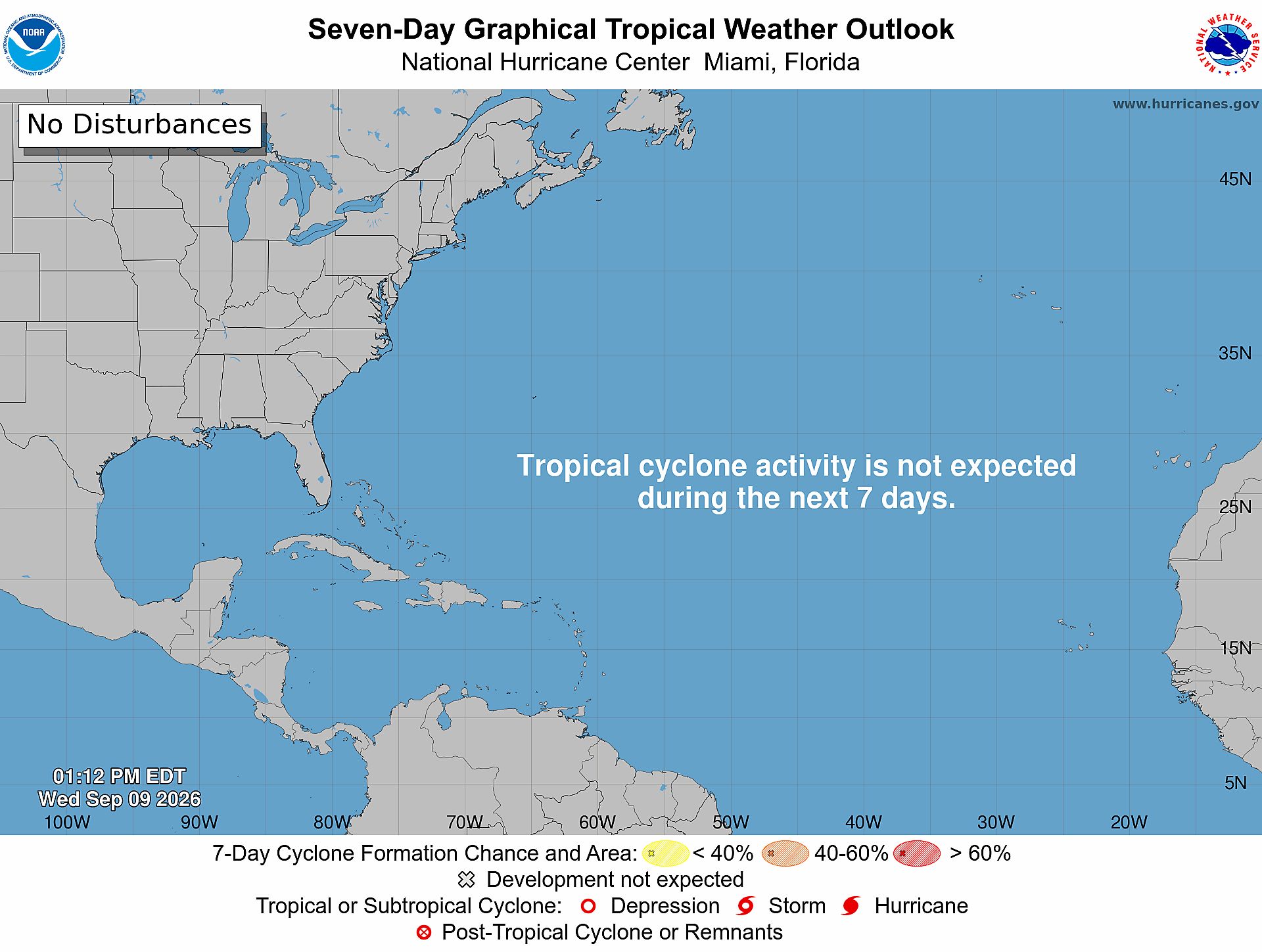
    The standing record, Sept. 11, was set in 2002 and 2013, and this year the National Hurricane Center is seeing zero chances that a hurricane forms in the basin, which includes the Gulf and Caribbean, during the next seven days.

    As the hurricane season approaches a peak, the National Hurricane Center map sums up the quiet of the Altantic Basin. National Hurricane Center

    In 2013, only two hurricanes — storms with winds of at least 74 mph — formed during the season, which spans from June 1 to Nov. 30. That tied 1982 for the fewest number of hurricanes, said Matt Rosencrans, a scientist at NOAA’s Climate Prediction Center.

    The 2026 season might make a run at that record, and the state of the atmosphere and history suggest it has a shot.

    Who hit the mute button?

    The explanation “is almost 100% El Niño,” said Philip Klotzbach, a hurricane specialist at the Colorado State University’s Tropical Meteorology Project, which has been issuing outlooks for over 40 years.

    Would-be hurricanes in the Atlantic haven’t had a snowball’s chance to reach maturity.

    El Niño already is shearing records

    NOAA has said the periodic El Niño warming in the equatorial Pacific has a chance to be the most potent on record.

    Sea-surface temperatures in the vast, key El Niño monitoring zone have been running more than 3 degrees Fahrenheit above normal. That anomalous warmth is affecting the overlying atmosphere in such a way as to generate powerful upper-air winds from the west that are inhibiting the development of tropical storms in the Atlantic Basin.

    For the strength of vertical shear across the western Atlantic, “we continue to crush” records, Klotzbach said, in observations dating to 1979.

    How important is El Niño to the Atlantic hurricane season?

    The El Niño effect on Atlantic hurricanes is evident in the available records. In the six years with El Niños of comparable intensity since 1950, hurricane activity has been well below normal.

    Rosencrans cautions, however, that the data have limits. The era of satellite observation did not begin until 1966, and the credible El Niño records start with 1950.

    Satellites have lifted the qualities of observation to dramatically different heights.

    Klotzbach noted that in 1941 a first hurricane was not observed until Sept. 21, but neither satellite data nor aircraft reconnaissance was available. Plus transatlantic shipping, an important observation source, likely was limited because of the war. Thus, it is entirely possible that a hurricane had occurred earlier.

    One of the strongest El Niño years, 1982, coincided with the record-low number of hurricanes.

    But during the other record holder, 2013, the Pacific waters actually were slightly cooler than normal.

    Even the strongest El Niño would not act in isolation in the chaotic environment of the atmosphere.

    Early in this season, layers of Saharan dust in the atmosphere may have inhibited tropical storm development, said Benjamin Kirtman, dean of the University of Miami Rosenstiel School of Marine, Atmospheric, and Earth Science.

    But the evidence of El Niño’s power over the Atlantic season is “pretty clear-cut.” And this one, he said, was especially precocious.

    “Whereas El Niño episodes typically ramp up toward the peak of hurricane season, this event was already in place and strengthening well before the season’s most active months,” Kirtman said, creating “hostile shear conditions.”

    Take the career of Dolly, which was knighted one of the season’s five tropical storms at 11 a.m. Aug. 27 and demoted to a remnant at 11 a.m. Aug. 28. The hurricane center said it had entered “a hostile environment with significant … shear.”

    What does (or doesn’t) happen next?

    The likelihood of El Niño’s retaining strength into the winter and the limited historical record argue against a late hurricane rally.

    On average, six tropical storms, those with winds of at least 39 mph, have formed after Sept. 11, and four hurricanes. A total of only five hurricanes formed during all six of the comparable El Niño years.

    “I fully expect there to be additional storm threats as the season progresses,” Kirtman said, “but the effects of El Niño remain, so it is unlikely that the season will suddenly become very active.

    “That being said, it only takes one storm to affect where you live.”

  • Coroner releases details of infants who died amid growing Pennsylvania measles outbreak

    Coroner releases details of infants who died amid growing Pennsylvania measles outbreak

    NEW YORK — The two measles-related deaths in Pennsylvania last month involved infants, and the virus itself caused one of the deaths, a Pennsylvania coroner confirmed Wednesday.

    Lancaster County’s coroner, Dr. Stephen Diamantoni, said he told the Centers for Disease Control and Prevention of his conclusions. CDC officials, however, have not said whether they will count either death as measles-associated, and the agency’s website still carries a disclaimer about them.

    Ivan Miller died on Aug. 14 shortly after his birth of a ruptured spleen, Diamantoni said.

    Mary Stoltzfus was 6 weeks old when she died Aug. 18 at her home. She was born with a genetic birth defect that left her highly vulnerable to an infection. A measles infection killed her, Diamantoni told The Associated Press.

    He said he was releasing the information in response to a state right-to-know law request by WPMT-TV, Fox 43.

    The causes of death differed

    Diamantoni’s office didn’t perform an autopsy on the girl. The cause of death was determined by the doctors caring for her, he said.

    She had been born with a condition called Amish lethal microcephaly that causes an unusually small head and underdeveloped brain. Children with the condition typically live 6 months or less.

    The girl’s immediate cause of death was listed as a cardiac arrest, due to hypoxemic respiratory failure, measles, and Amish lethal microcephaly, according to a coroner’s report obtained by The Inquirer through a right-to-know request. The manner of death was listed as “natural.”

    Diamantoni’s office did autopsy the boy, and determined he died from a ruptured spleen. Exactly how and when that happened is still under investigation, Diamantoni said.

    The boy was infected with measles, which is listed on the death certificate as a contributing factor. But Diamantoni said measles did not contribute to what happened to the spleen, and that measles is noted only because it was considered “a significant condition” that the boy had at the time of death.

    Ivan Miller’s death was attributed to a “traumatic torso injury,” and his manner of death was “pending investigation,” according to another document signed by the coroner and provided to The Inquirer through a public record request.

    Neither child was old enough to be vaccinated; the first dose is typically given at around 1 year of age.

    Because of the ongoing measles outbreak, Pennsylvania health authorities in recent months have recommended that children receive a first dose of a measles vaccine as early as six months old.

    The deaths have received outsized attention

    Details of the deaths have come under unusual national scrutiny and became the focus of a furious political battle between Pennsylvania’s Democratic governor, Josh Shapiro, and officials in Republican President Donald Trump’s administration.

    Pennsylvania officials announced the deaths last month, with Shapiro stressing that vaccinations could have averted the deaths.

    Soon after, U.S. Health Secretary Robert F. Kennedy Jr., a Trump administration appointee with a history of raising alarms about established vaccines, attacked Shapiro and suggested the deaths “may even have been altogether fabricated.”

    Kennedy’s statements echoed ones he made last year, when three measles-related deaths were recorded. Kennedy questioned whether one of the children who died was killed by measles.

    The health secretary oversees the CDC, and some public health experts have voiced concern about whether the CDC can still be counted on to post public health data that clashes with Kennedy’s worldview.

    “Frankly, the CDC is not to be trusted in sharing information,” Dr. Georges Benjamin, executive director of the American Public Health Association, told the AP last week. “People are questioning their motives.”

    CDC website still doesn’t show the deaths

    That worry was fueled by some unusual edits to the CDC’s measles webpage. At one point, the webpage noted two measles-associated deaths but then was changed to say that the CDC was not counting the two deaths until it reviewed additional information.

    The page, which was last updated Friday, now says, “CDC will update its reporting as additional information becomes available and relevant reviews are completed.” It still doesn’t reflect either Pennsylvania death.

    In a social media post last week, Kennedy acknowledged Diamantoni’s conclusion that one of the deaths was due to measles.

    Meanwhile, Pennsylvania’s measles outbreak continues to expand, with more than 620 cases across 37 counties this year, state officials said Wednesday.

    The U.S. eliminated the domestic spread of measles in 2000 by maintaining high vaccination rates, but they have fallen in recent years to below the 95% coverage needed to prevent outbreaks. Meanwhile, measles infections have been surging in recent years.

    In November, international health officials will meet to determine if the U.S. and Mexico have lost their measles-free status.

    Inquirer staff reporter Aubrey Whelan contributed to this article.

    Editor’s note: This article has been updated with additional information obtained by The Inquirer through a public records request.

  • Clementon’s century-old amusement and water park is closing again

    Clementon’s century-old amusement and water park is closing again

    A historic amusement park in Camden County has closed its gates and will soon be back on the market just five years after it was purchased at a bankruptcy auction.

    After more than a century in South Jersey, the future of Clementon Park & Splash World is uncertain as its owner works to “find a buyer who shares our love for Clementon Park and will carry its history and legacy forward,” the amusement park’s owner said when announcing the closure on its website and social media accounts Wednesday. The park’s final day of operation was Labor Day.

    “After five memorable years, we are saddened to announce that we have made the difficult decision to close the park and plan to offer the park for sale,” the statement said. “It has been a privilege to care for a place that has meant so much to generations of families.”

    The park’s owner, IB Parks & Entertainment, did not respond to requests for comment.

    The company bought the park for roughly $2.37 million in a 2021 public bankruptcy auction after financial struggles led to its sudden shutdown two years earlier.

    Clementon Park is one of five amusement properties owned by IB Parks & Entertainment across the country, including West Berlin’s Sahara Sam’s.

    During Clementon Park’s heyday in the early 20th century, it was a popular destination for families across South Jersey, who could be shuttled directly to the park’s entrance by a trolley running from Camden.

    Opened in 1907 by state Assembly member Theodore B. Gibbs and his sons, the park was independently owned by various local families over the years before it was bought by its first private amusement park operation company in 2007.

    Various management companies expanded the park over the next decade, adding multiple thrill rides, coasters, children’s attractions, and a 23,000-square-foot wave pool to the 52-acre park.

    The most notable of the park’s long-standing attractions was the Jack Rabbit, a wooden coaster that was considered state-of-the-art when it opened for riders in 1919. After 83 years, the popular ride was one of the oldest operating roller coasters in the world by the time it closed in 2002.

  • Professional gaming is brutal on the body – inside the growing field of treating esports injuries

    Professional gaming is brutal on the body – inside the growing field of treating esports injuries

    Chinese esports player Jian “Uzi” Zi-hao was more than a star “League of Legends” player: He was so talented that his team structured its entire strategy around his abilities, funneling resources to him and another teammate, Shi “Ming” Sen-Ming, so the duo could lead the team to victory. Over the course of his career, he earned more than $500,000 in tournament prize money.

    And yet in 2020, Jian announced his retirement, his storied career cut short by chronic wrist and arm injuries.

    He was 25 years old.

    Video games have a reputation for keeping people glued to the couch. But for those who compete against the best players in the world, gaming can be surprisingly physically and mentally taxing.

    The strain of ‘climbing the ladder’

    The best esports players often have grinding schedules. They’re expected to regularly practice, participate in scrimmages, and compete in official matches. Even at the recreational level, esports players cite the mental toll: playing for hours a day, every day, to hone their skills so they can “climb the ladder.”

    A 2021 study of Portuguese esports players found that 37% experienced anxiety and depression, and 45% experienced sleep disturbances. The most common physical injuries in esports generally fall under eye problems and musculoskeletal issues.

    Prolonged screen time leads to many types of vision problems in gamers, from the more common eye fatigue to a decreased ability to focus. Furthermore, the light emitted from screens appears to contribute to sleep disturbances by disrupting the release of melatonin, the hormone that helps regulate your sleep-wake cycle.

    Many esport players — professional or otherwise — also battle hand and wrist pain, with repetitive button-smashing causing injuries such as carpal tunnel syndrome, tendonitis, and “gamer’s thumb,” which arises from overuse or irritation of the tendons around the thumb and wrist. Many of the overuse injuries seen among video game players are also familiar to assembly-line workers, whose jobs can involve similarly repetitive movements.

    Then there are the back injuries. Players can remain seated for three or more hours without a break, and this prolonged sitting can take a toll on the lower back and spine.

    The sedentary nature of esports has also led to a lesser-known — sometimes fatal — injury called deep vein thrombosis: a blood clot, often in the leg, that can become life-threatening if it travels to the lungs. In 2011, British gamer Chris Staniforth – who would play for as long as 12 hours at a time – died of the condition.

    Ellis Celia and other students starting Staffordshire University’s esports degree course play “Counter-Strike” in the school’s London digital studio in 2019. A number of Universities launched degrees in esports to capitalize on the booming industry’s growing demand for skilled professionals. (AP Photo/Kelvin Chang)Kelvin Chang / AP

    Preventive measures

    As more esports injury research has been published, more treatment and prevention strategies have emerged.

    Top esports teams now have physical therapists, performance psychologists, athletic trainers, and even massage therapists on staff to optimize the performance and recovery of their players.

    Teams often incorporate group exercise activities to both build rapport among players and reduce the risk of injuries. During competition, proper positioning of the spine and limbs has become an essential injury prevention strategy. For example, selecting a chair that encourages an upright posture can reduce pain and injury risk, especially when gamers couple ergonomics with an exercise program that centers on functional strength, mobility, and stretching of the upper limbs.

    Looking to the stage

    When esports began gaining mainstream popularity in the 1990s and early 2000s, its proponents were eager to draw comparisons to traditional sports and athletic competition. The parallels helped establish esports’ legitimacy and gave non-gamers a familiar framework for understanding the competition.

    As esports became a big business and a lucrative career path, players and teams hired a web of support staff — trainers, coaches, and therapists — that mirrored the structure of professional sports. In this vein, a lot of esports injury research has pulled from the training methods of traditional sports.

    However, as a scholar of exercise science, I think injury treatment and prevention strategies could be further improved by seeing esports competitors as more like musicians and dancers than football players and basketball players.

    Performance optimization and injury research on professional performing artists has existed for centuries, and I think it represents a valuable, untapped resource. That’s because the physical and mental stresses experienced during musical performance have a lot in common with esports competition: long stretches of sitting; small, dexterous hand movements; and performing without the real-time input of a coach.

    For example, biomechanics research has found similar patterns of forearm muscle fatigue among esports players and piano players. However, no studies to date have directly compared the two groups.

    And what if the interest in joint hypermobility or hand size among performing artists were translated to esport populations? Could popular piano warm-up exercises be effective for esports athletes who use keyboards?

    Even research on sports like car racing might offer valuable insights. As with gamers, many people overlook how physically demanding car racing can be — and, yes, that includes sitting for extended periods of time.

    Prevention and rehabilitation techniques continue to improve. Even Jian, the player who retired in 2020, returned to play for a few splits, or partial seasons, in 2022 and 2023.

    “League of Legends” star Lee “Faker” Sang-hyeok was once relegated to the bench due to cubital tunnel syndrome, but came back just a month later after physical therapy.courtesy of Riot Games

    In July 2023, “League of Legends” star Lee “Faker” Sang-hyeok was relegated to the bench due to cubital tunnel syndrome, an injury that emerges from arm and hand overuse.

    Through a treatment plan that included changing his gaming posture and intensive physical therapy, Lee was able to return to play just a month later. He went on to win three consecutive world championships, with his support team helping prevent recurrence of injury throughout each season.

    Thanks to his rehabilitation, Lee’s fans will be able to follow his hunt for his fourth “League of Legends” World Championship, which kicks off in October 2026 in the United States.

    Sienna Cinti assisted with the research and writing of this article.

    Erica D. Henn is an assistant professor of kinesiology and exercise science at Temple University.

    Reprinted from The Conversation.

  • U.S. Supreme Court again rejects push to use Trump-backed congressional map in Missouri

    U.S. Supreme Court again rejects push to use Trump-backed congressional map in Missouri

    Missouri is poised to hold its November election with congressional districts passed after the last census, after the U.S. Supreme Court on Thursday again rejected a new map backed by President Donald Trump that Republicans hoped could help them win an additional seat in the pivotal midterms.

    The Supreme Court’s decision marked a defining moment in a pitched legal battle that has lasted nearly a year and caused confusion for voters. Citing the court’s latest action, Missouri’s chief election official directed local authorities to use U.S. House districts passed in 2022, as the state’s highest court had ordered.

    The Trump administration had urged courts to allow use of the president’s preferred map, drawn at his request last year.

    The decision means Missouri could run the November general election with different U.S. House districts than were used in the August primary — an extremely rare situation that could switch the candidate choices for more than a million potential voters, or nearly 1 in 4 voters statewide, according to an Associated Press estimate.

    No Supreme Court justices publicly dissented from the brief order. It did not detail the court’s legal reasoning, as is typical in emergency appeals.

    The White House did not immediately respond to a request for comment on the U.S. Supreme Court decision.

    Missouri’s highest court scrutinizes secretary of state’s actions

    Earlier Thursday, Missouri’s top court convened a hearing on whether to hold Republican Secretary of State Denny Hoskins in contempt for not following its orders to use the districts passed after the last census. Hoskins had instead told local election authorities to use the new Trump-backed map, pointing to a competing order from a federal judge on Tuesday that forbade him from using anything other than the new districts.

    Missouri Supreme Court judges, while questioning a state attorney representing Hoskins, repeatedly pressed for Hoskins to send out guidance Thursday to use the 2022 version of the congressional districts.

    “We’re in a precarious situation,” Chief Justice W. Brent Powell said.

    Hoskins later released a statement acknowledging the U.S. Supreme Court decision, saying “my Office is directing local election authorities to use the 2022 congressional map.”

    The court then reconvened, finding Hoskins in contempt for violating its order not to use the Trump-backed map but then quickly declaring that he had corrected the problem with his latest order to use the 2022 map. The court imposed no consequences on Hoskins.

    Voters could face significantly different districts

    Outside the court, progressive activist Keith Rose stood in the rain protesting Hoskins’ legal maneuverings to try to use the Trump-backed map. Rose, who helped gather petition signatures to put the new map to a statewide vote, said he hopes the U.S. Supreme Court’s decision Thursday ends the uncertainty.

    “We need some finality. We need to focus on the real issues that Missourians care about,” Rose said.

    Candidates who won Missouri’s August primary already have been certified for the November ballot according to the number of the district they won. But those districts could substantially change shape.

    The 5th Congressional District encompasses only the Kansas City area under the 2022 map that Republican lawmakers passed after the last census. Under the revised map backed by Trump, portions are shed to neighboring districts and the remainder is stretched into rural Republican areas. About 59% of the potential voters are new to the district under that version, according to an AP estimate.

    Some other states that have switched congressional districts after their primaries have redone their primary votes. Alabama held a new primary in August under revised districts when the U.S. Supreme Court allowed a change to occur after voting in the original May primary.

    In Missouri’s case, however, no court has suggested redoing the primary.

    Redistricting battle began over a year ago

    Missouri’s battle over its congressional districts has spanned more than a year and spawned confusion over which districts will be in place for voters.

    It was the second Republican-led state, after Texas, to enact new districts after Trump urged Republicans last year to redraw House districts to their advantage ahead of the midterm elections.

    The revised districts target a Kansas City-based seat held by Democratic Rep. Emanuel Cleaver of Kansas City, aiming to help Republicans win seven of the state’s eight House seats in the midterm elections.

    Redistricting opponents collected hundreds of thousands of petition signatures seeking to force a statewide vote on the new districts. They submitted the signatures in December. But Hoskins waited until August — on the same day as Missouri’s primary — to reject the petition. Hoskins asserted that a referendum petition could not be used for congressional redistricting.

    The delay allowed Missouri to use the new districts in its August primary. Cleaver was unopposed for the Democratic nomination. State Sen. Rick Brattin won the Republican primary for the right to challenge Cleaver. Brattin was among those suing in federal court to try to prevent the state from reverting to the prior districts.

    Republican U.S. Rep. Bob Onder, who was also among those suing, said Thursday, “This isn’t over.” He noted that the 8th U.S. Circuit Court of Appeals will hear arguments on the merits of his case.

    Republican state officials have argued it would violate voters’ federal rights to switch districts before the general election.

    But the Missouri Supreme Court last week ordered Hoskins to put the redistricting referendum on the November ballot, which he did. It also ruled that the new districts never became law and instead were suspended retroactively to the December petition submission. The court barred Hoskins from using the new map and said the old map — passed by Republican lawmakers in 2022 after the last census — must be used in the November election.

    The state then appealed to the U.S. Supreme Court to block the state court decision. Justice Brett Kavanaugh rejected the request.

    The group People Not Politicians Missouri, which sponsored the redistricting referendum, applauded the Supreme Court decisions that left the state court ruling in place.

    “The law is the law, the Missouri constitution is clear as was the Missouri Supreme Court,” said Executive Director Richard von Glahn. “The courts have settled this, now it’s up to Missouri voters to finish the job and vote NO on Proposition A.”

  • Prison lifers asked Pennsylvania’s top court to change how unconstitutional sentences are undone

    Prison lifers asked Pennsylvania’s top court to change how unconstitutional sentences are undone

    Nearly six months after Pennsylvania’s highest court struck down automatic life sentences for second-degree murder, four prisoners have asked the justices to extend that ruling to everyone still serving one — and to change how the state handles unconstitutional punishments going forward.

    The court’s landmark ruling in March ended a practice most other states had abandoned or never adopted, and it required judges to weigh a defendant’s role in the crime in every second-degree murder case moving forward. But it left unanswered a consequential question: Does it also apply to the roughly 1,100 people already serving these sentences?

    The four requests, filed Thursday in petitions to the court, are a coordinated effort to force an answer.

    But the prisoners want more. They are also asking the justices to adopt a statewide rule that any sentence the court strikes down as cruel punishment would automatically become void for everyone already serving it.

    As things stand, even after the state Supreme Court has declared a sentence unconstitutional, people whose cases closed long ago have no legal path to a new one until the high court declares its ruling retroactive or lawmakers pass a law that covers them — a process that can take years.

    The proposed rule would eliminate that wait.

    That broader request is, “in the most literal sense of the word, an extraordinary request for relief,” said Marsha Levick, cofounder of the Juvenile Law Center in Philadelphia, an organization at the center of a similar fight after the U.S. Supreme Court struck down mandatory life-without-parole sentences for juveniles but did not say whether the ruling applied retroactively.

    The Pennsylvania Supreme Court’s ruling striking down the mandatory sentences came in the case of Derek Lee, a Pittsburgh man convicted in the 2014 killing of Leonard Butler, who was shot by Lee’s accomplice during a home-invasion robbery. Lee argued the automatic sentence violated the state constitution’s ban on cruel punishments. The justices agreed, saying a judge must weigh each person’s individual role before imposing life without parole.

    The court, however, did not say whether the decision applied to people who had already been sentenced. Instead, it put the ruling on hold for 120 days to give lawmakers time to write a new sentencing law and, if they chose, to settle that question themselves. The deadline passed July 24 without a new law.

    The four prisoners argue lawmakers’ inaction has left the courts as the only branch of state government able to resolve the issue. And, so that prisoners are not stranded like this again, they want future rulings of this kind to take effect for everyone automatically.

    “The legislature has made it manifest that they are not going to be prioritizing fixing this constitutional injustice,” said Bret Grote, a lawyer with the Abolitionist Law Center who represented Lee before the state Supreme Court and now represents the four petitioners, along with lawyers from the Pennsylvania Innocence Project and the law firm Phillips Black. “So it is now on the courts to do that.”

    A punishment the state constitution forbids, Grote said, cannot be imposed on anyone — including, he argued, people already serving it. A rule recognizing that from the start, he said, would spare prisoners a separate legal fight that “only prolongs a constitutional crisis.”

    The prisoners filed their requests as what are known as King’s Bench petitions, invoking a power that lets the state Supreme Court take up a case directly, skipping the lower courts, when a matter of public importance cannot wait. In June, the court used that power to require the Philadelphia District Attorney’s Office to notify the state attorney general whenever it declines to oppose a prisoner’s bid to overturn a conviction, giving the attorney general a chance to step in, after allegations of widespread malfeasance.

    King’s Bench petitions are rarely filed and even more rarely taken up, said David Rudovsky, a senior fellow at the University of Pennsylvania Carey Law School. Still, he said, these petitions have a real chance: The circumstances are exceptional, the issue is urgent, and courts statewide need a uniform answer.

    And the prisoners making the request, he added, present compelling cases.

    The prisoners — Cecil Holmes, 70; Lori Ann Lassiter, 62; John Marshall Payne III, 70; and Marsha Scaggs, 62 — have served about 160 years combined.

    Of the four, only Payne has been accused of killing the victim himself. At his 1986 trial, prosecution witnesses testified he had admitted to beating Elsie Rishel, 90, with a telephone during a 1981 burglary of her York County home. No physical evidence tied him to the crime, however, and he has long maintained his innocence. The other three were convicted related to crimes in which, prosecutors said, someone else killed the victim.

    At least two of the petitioners — Holmes and Scaggs — have faced serious medical problems that underscore the urgency of resolving the question, Grote said.

    Holmes, a Philadelphia man, was convicted in 1980 in the death of Joseph Melvin, a taxi driver who was fatally stabbed at a gas station during an attempted robbery the year before. Prosecutors said Holmes had served as an unarmed lookout across the street.

    He now has advanced dementia and is confused about where he is, said Jennifer Merrigan, a Phillips Black lawyer who represents Holmes. Without action from the high court, Merrigan said, his future “looks really bleak.”

    Two of the petitioners’ cases come from Philadelphia, one from Lawrence County, and one from York County. If the court takes up the petitions, prosecutors in those counties would typically argue the state’s side.

    District Attorney Larry Krasner, whose office supported Lee’s challenge, said Thursday that while “retroactivity is necessary,” prosecutors would need to review the four prisoners’ petitions before taking a stance on them. More than 500 of the roughly 1,100 people serving the sentence were convicted in Philadelphia.

    Other prosecutors have signaled resistance. For example, John Adams, the Berks County district attorney and communications chair of the Pennsylvania District Attorneys Association, said in August that district attorneys would not concede the ruling applies retroactively without a new sentencing law. Attorney General Dave Sunday, a Republican, backed a Senate bill that would have made most people already serving the sentence eligible for parole only after 35 years. He warned in July that legislative inaction would be “dangerous.”

    It was unclear whether Sunday’s office would weigh in on the petitions. The attorney general’s office did not immediately respond to questions Thursday.

    Even if the court agrees to hear one or more of the petitions, a decision could be months away, Rudovsky said. That would leave time for lawmakers to act, which some stakeholders predict could be more likely after the Nov. 3 midterm elections.

    The Republican-controlled Senate passed a bill in June that would have set a 35-year mandatory minimum for second-degree murder. The Democratic-controlled House passed its own version in July, which would have made people already serving life eligible for release after 30 years. Neither bill, which made it the state parole board’s responsibility to determine whether a prisoner was fit to be released, cleared both chambers.

    “We’ve no substantive preference as to whether the remedy is through the courts or the legislature,” Grote said. “If something changes in the legislature and they pass a law that applies to everybody … then we would welcome that.”

    If the state Supreme Court considers the petitions and rules in the prisoners’ favor, trial judges would have an opportunity to resentence them and everyone else currently serving the life sentences. But they would do so without sentencing guidelines on Pennsylvania’s books — until lawmakers act.

    That could produce starkly different resentencing outcomes in otherwise similar cases, depending on the county where a case is heard and the judge who hears it, some stakeholders have warned.

    Levick, the attorney whose work helped end life sentences for juveniles, said that although some people may prefer letting the parole board decide, the high court’s ruling requires judges to weigh individual culpability.

    With juvenile lifers, she said, judges “did a great job.”

  • Unrivaled is returning in 2027 after record-setting Philly debut: ‘It was a no-brainer to come back’

    Unrivaled is returning in 2027 after record-setting Philly debut: ‘It was a no-brainer to come back’

    After a record-setting debut at Xfinity Mobile Arena in 2026, Unrivaled will return to South Philadelphia on Feb. 15, 2027.

    The South Florida-based three-on-three women’s basketball league hit the road for the first time in 2026, bringing four of its eight teams to Philadelphia for its inaugural tour stop.

    “It was our first tour stop ever, and because we broke every attendance record, it was a no-brainer to come back to Philly,” Unrivaled commissioner Micky Lawler said. “It felt like Philly was part of our family, and we’d worked hard to get there and to do what we did there. So it was like Thanksgiving coming back.”

    The Philly stop was the most-attended women’s professional basketball game in history and set venue attendance records at Xfinity Mobile Arena.

    Celebrities like Dawn Staley, Kylie and Jason Kelce, Kyle Lowry, Robin Roberts, and Leslie Jones were in the building, and big names like Paige Bueckers, Marina Mabrey, and locals Natasha Cloud and Kahleah Copper were on the court for the 2026 doubleheader.

    The Unrivaled doubleheader that included the Breeze and Phantom set attendance records at Xfinity Mobile Arena.Yong Kim / Staff Photographer

    “It was unbelievable,” cofounder Napheesa Collier said. “You could feel the love tonight. I’m so glad we came here. I just can’t explain it more than I was just so filled up with joy. It was amazing.”

    Lawler could not confirm which of Unrivaled’s teams or players would play in the 2027 tour stop. The four clubs will be finalized later in December.

    The event was such a success that Unrivaled moved the semifinals of its playoffs to the Barclays Center and is embarking on a multicity road trip this winter, starting with Boston.

    Ashley Lunkenheimer, vice president of the Philadelphia Sisters, an organization dedicated to bringing professional women’s sports to Philadelphia, said attendees from last year’s event already are inquiring about purchasing suites, and there’s increased sponsorship interest. Tickets go on sale at 3 p.m. for Unrivaled newsletter subscribers and 4 p.m. for the general public.

    The Sisters played a critical role in attracting Unrivaled to Philly, which provided proof of concept that women’s sports can be successful in the city. Lunkenheimer hopes Unrivaled’s continued presence in the city helps to lay the foundation for Philadelphia’s WNBA team, which is set to begin play in 2030.

    “For Philadelphia specifically, it’s the makings, I hope, of a season ticket list, right?” Lunkenheimer said. “… We need to build back the awareness for the broader crowds, so they all know when the WNBA comes.”

    Unrivaled was the first major pro women’s basketball event in Philly since 1998. Philly’s embrace of it ensured it won’t be the last.

    “It was a mutual opportunity to showcase that we believed in our city and in Unrivaled,” Lunkenheimer said. “I’d like to believe that’s why New York and Barclays said, ‘Let’s jump on that.’ Now they’re going to all these other cities because every other city is saying, ‘We want it.’ They could have said, ‘Well, we’re going to skip Philly. We already did that.’ But they didn’t. They value that partnership.”

  • Unoaked chardonnay is overtaking its buttery, barrel-aged counterpart

    Unoaked chardonnay is overtaking its buttery, barrel-aged counterpart

    In California, oaked chardonnay was once the norm, with its faint accents of butterscotch. Nowadays, the unoaked style has come into its own, and this seems likely to continue. Almost all of the world’s white wines are unoaked, and the current fashion favors refreshment over richness, so it’s no surprise that even chardonnay specialists known for an oakier style might want to broaden their portfolio.

    Kendall-Jackson is not just known for its chardonnay — the brand has helped to define California chardonnay as an oaky white wine in the minds of Americans. Their “Vintner’s Reserve” bottling has been the top-selling chardonnay brand in the U.S. for over 30 years. That wine has always featured the bright apple-pear profile of the chardonnay grape itself, intensified and enriched with a layer of flavors derived from fermentation and aging in new oak barrels, adding a taste similar to butter pecan ice cream.

    Applying new oak to a chardonnay wine results in the kinds of flavors you get when you add butter and sugar to fresh apples and bake them. So when chardonnay is labeled as “unoaked,” shoppers should not expect that caramelized quality. Instead, they will find a flavor profile that is lighter and more tangy — closer to that of fresh apples and pears than to baked fruit desserts — since no new toasted oak is involved.

    The grapes for Kendall-Jackson’s Avant chardonnay are sourced entirely from coastal counties of California, adding a bright lemony freshness and hints of pineapple to chardonnay’s apple-pear core that make it a great partner for seafood and poultry.

    Kendall-Jackson “Avant” Unoaked ChardonnayKendall-Jackson

    Kendall-Jackson “Avant” Unoaked Chardonnay

    California; 13.8% ABV

    PLCB Item #3697 – on sale for $14.99 through Oct. 4 (regularly $17.99)

    Also available at: Total Wine & More ($12.99, totalwine.com) in Wilmington and Claymont, Del.; Hopewell Super Buy Rite ($13.99, buyrite.wine) in Pennington, N.J.; WineWorks ($14.98, wineworksonline.com) in Marlton, N.J.