Tag: topic-link-auto

  • ‘If you were in a stadium, you were a target’: Larry Bowa, Hugh Douglas, Doug Glanville recall 9/11 in Philadelphia

    ‘If you were in a stadium, you were a target’: Larry Bowa, Hugh Douglas, Doug Glanville recall 9/11 in Philadelphia

    As he commuted from South Jersey into Philadelphia on the afternoon of Sept. 11, 2001, Hugh Douglas kept glancing at the skies.

    “I remember driving across the Ben Franklin Bridge, I was looking in the air for those planes. You know, the next planes,” Douglas said. “Because that bridge is the biggest way into Philly, and I thought they would attack that next.”

    Douglas, then a star defensive end for the Eagles, was driving to the practice facility, summoned for a team meeting to address an emergency. By then, of course, the skies were empty. The FAA had closed U.S. airspace at 9:42 that morning, and by 12:15, only birds flew over America.

    Terrorists had hijacked four commercial flights that brilliant Tuesday morning and turned them into missiles.

    At 8:46 a.m., American Airlines Flight 11 crashed into the 92nd floor of the World Trade Center’s north tower. At 9:03 a.m., United Airlines Flight 175 crashed into the south tower. At 9:37 a.m., American Airlines Flight 77 crashed into the Pentagon. At 10:02 a.m., after a struggle between heroic passengers and hijackers, United Airlines Flight 93 crashed into an empty field in Shanksville, Pa., 200 miles west of Philadelphia.

    Nearly 3,000 people died as a result of the attacks, still the largest death toll of any terrorist attack on U.S. soil. It stunned the world, and it left the nation shocked and terrorized, and it left the sporting world in turmoil.

    Douglas had just turned 30. In his lifetime America had seemed invincible. Impenetrable. It was, by far, the most traumatic event he’d known.

    “I thought it was the end of days,” Douglas said.

    He was not alone.

    Phillies center fielder Doug Glanville is a year older than Douglas. He grew up in Teaneck, N.J., less than 20 miles from what became to be known as Ground Zero, where the towers collapsed. He’d visited the towers frequently as a boy.

    On 9/11, Glanville was with the Phillies in Atlanta, preparing for an important series against the Braves. When he heard that the terrorists targeted sites beyond New York, he worried about what might come next, and whether ballparks and stadiums were vulnerable.
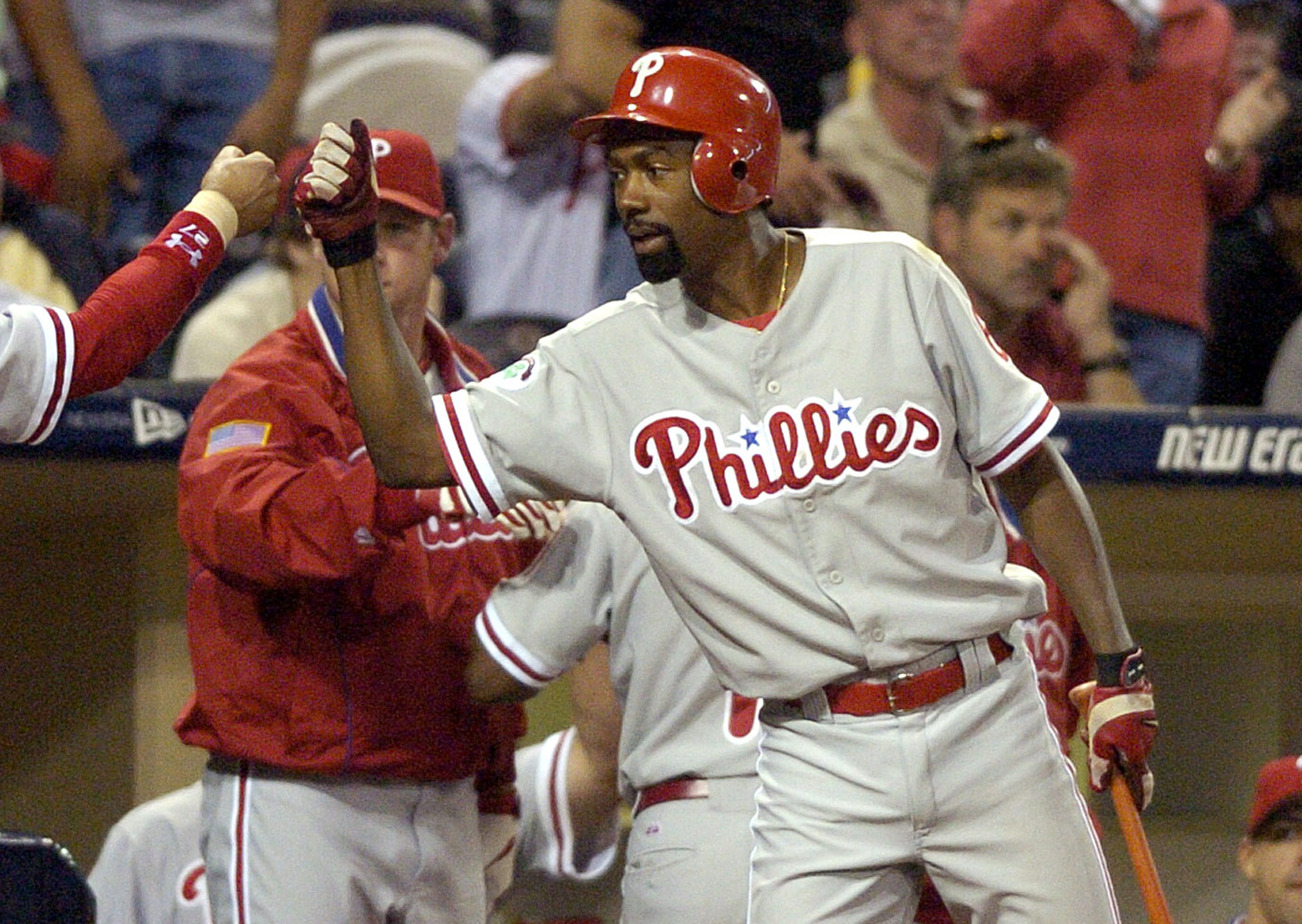
    Doug Glanville, here in a 2004 game in San Diego, played six seasons with the Phillies.DENIS POROY

    “We didn’t know what imminent threats were still there. We heard that they might attack Atlanta,” Glanville said.

    That worry persisted even when games resumed six days later, and beyond.

    “You felt like, if you were in a stadium, you were a target.”

    ‘I thought it was a movie’

    Douglas learned of the attacks from the movers helping him settle him and his wife at the time, Simona, into their town house in Marlton, N.J.

    “They blew up the tower,” one mover told Douglas. He wasn’t quite sure what the guy meant. The cable company hadn’t arrived yet, so the mover began to jerry-rig an antenna onto a television. Before he finished, another mover, still listening, announced, “They hit the other tower.”

    Finally, a fuzzy image appeared on the screen, the towers burning. A few minutes later, at 10:28, the north tower collapsed.

    Glanville had much better reception.

    Baseball players are a nocturnal breed, but Glanville is one of the few who relishes a hearty breakfast. Also, he’s a reader — he has an engineering degree from the University of Pennsylvania — so he rarely turns on his hotel TV.

    “There aren’t a lot of players who get up that early, except Kevin Jordan. So I go out of my room, get in the elevator, and Nina Jordan’s there, Kevin Jordan’s wife,” Glanville said. “I’m, like, ‘Good morning,’ with a smile. She’s like, ‘They hit the towers.’ ”

    Glanville flashed back to Feb. 26, 1993, when terrorists attempted to take down the north tower with a car bomb. They failed. Seven people died. Glanville assumed this was similar.

    “The first thing I thought is, ‘Oh, again?’ ”

    Not exactly.

    “We were in CNN country, so I came out of the elevator, I saw banks and banks of TVs,” Glanville said. “And then, of course, we were just, like, locked in.”

    Phillies manager Larry Bowa wasn’t watching TV in his room, either, but, with a teenage daughter, he always kept his phone close. When it buzzed that morning and he saw her number he was concerned, of course, but not as concerned as he soon would be.

    “She said, ‘Did you see the TV?’ And I said, ‘No.’ She says, ‘Turn it on,’ ” Bowa said. “And when I turned it on, I thought it was a movie.”

    ‘We took a vote’

    What happened in the next couple of days is a blur for most of us who lived through 9/11, and most of us weren’t star entertainers and their bosses walking the thin line of propriety.

    Would baseball be played Tuesday night? Would baseball or football, either college or pro, be played on the weekend?

    Flights resumed sporadically just two days after the attacks, but it was about a week before air travel resumed full throat. The Eagles and the rest of the NFL hunkered down.

    “We knew pretty quick we weren’t going to Tampa that weekend,” Douglas said. “So we just practiced. And it was weird, right? You get planes flying over South Philly all the time, because the airport is so close. There were, like, no planes that week.”

    It was as if everyone held their breath, just as they’d done after President John F. Kennedy was assassinated in November 1963, which paused most of college football and briefly paused the NBA and NHL.

    “Nobody knew what was the right time,” Bowa said. “Some people were saying they might cancel the whole season.”
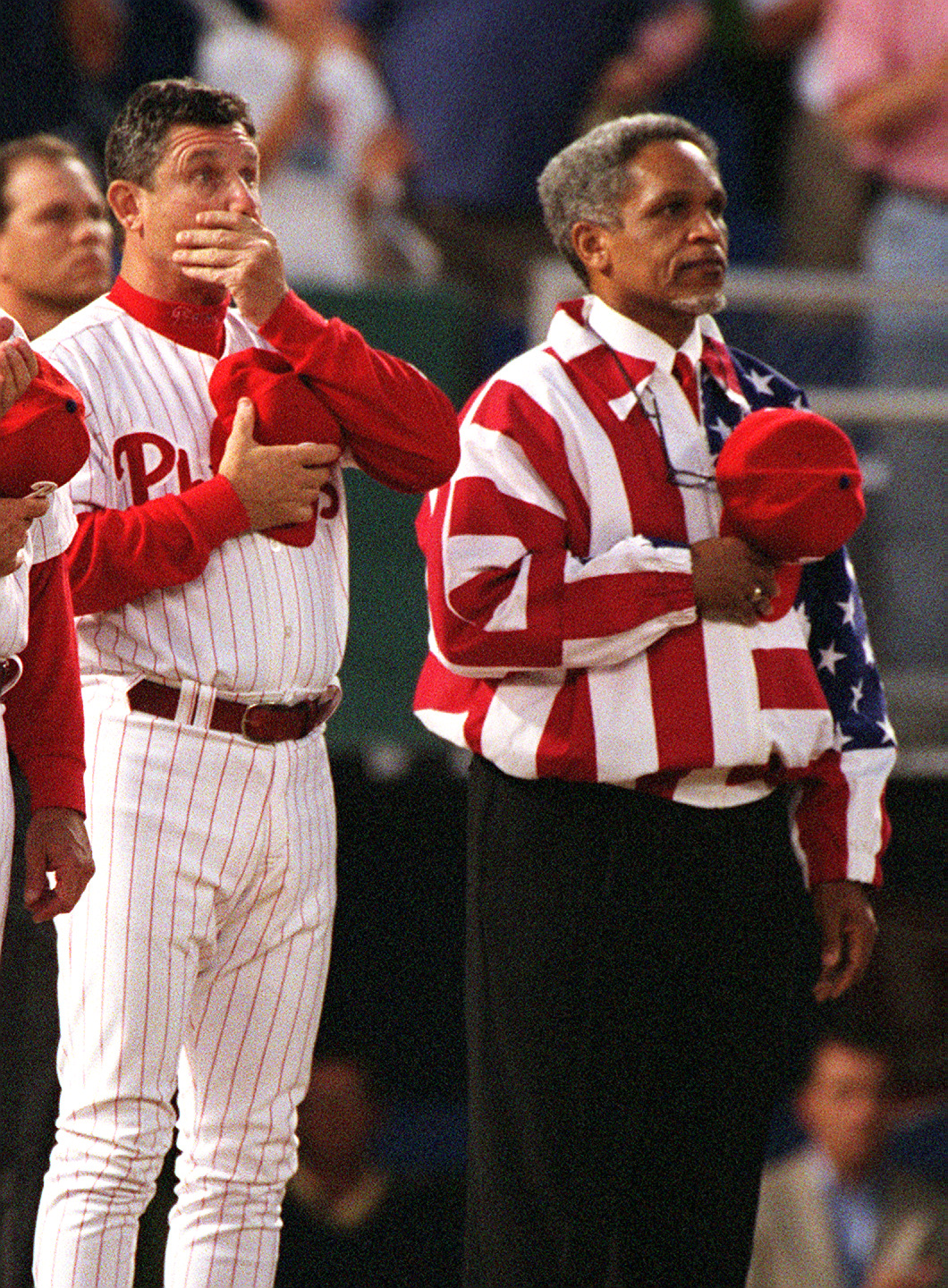
    Phillies manager Larry Bowa wipes his face standing next to Philadelphia Mayor John Street during a moment of silence before the Phillies-Braves game on Sept. 17, 2001 at the Vet.D

    As it turned out, baseball games resumed Sept. 17. The Expos hosted the Marlins with the first pitch thrown at 7:10 p.m., so baseball officially resumed first in Canada. But the Braves visited the Phillies and the Mets visited the Pirates, and both games went off at 7:19 p.m., so Pennsylvania co-hosted the return of America’s game in America.

    ‘We took a vote’

    Getting from 9/11 to 9/17 was quite a journey for the Phillies.

    Games were suspended immediately, but MLB dithered regarding when they would resume. The Phillies spent three days in Atlanta, then decided to bus to Cincinnati, where they were scheduled to play over the weekend. They were outside of Knoxville, Tenn., when they heard that those games might not happen, either.

    What now?

    They pulled the two buses into a rest stop. Players disembarked to try and get cellphone reception, which was poor on the buses, and check in with their families. At that point, mild chaos ensued.

    Should they reroute to Philadelphia? Should they return to Atlanta, where flights would be easier to arrange? Should they just continue to Cincinnati and maybe ride out the weekend?

    They couldn’t take the buses to Philadelphia because the bus driver had logged too many hours.

    “We took a vote,” Glanville said. “It was everybody, 40 or whatever, to 2. And the two were Bowa and (reliever) Dennis Cook, and Cook lived in Atlanta.”

    So, on to Cincinnati, where they discovered those games were, in fact, postponed. Inimitable traveling secretary Frank Coppenbarger, now retired, wheedled a chartered plane for the next day. The Phillies were home for supper on Sept. 15.

    MLB delayed the playoffs for a week. The Phillies made up the postponed games in Atlanta and Cincinnati after the regular season ended. Like their NFL counterparts, they played the rest of the season in a daze of heightened security and heightened anxiety.

    ‘A sense of pride’

    NFL players were used to being treated like royalty on their charter flights to games. A week and a half after 9/11, they found out what it was like on tarmacs in countries where terrorism is a constant threat.

    “We used to just park our cars at the facility, get on a bus, ride to the airport, get off, and walk right on the plane,” Douglas said. “Now, you went to the airport, man, and everybody was on high alert. There’s guys with machine guns or whatever, there’s tons of security. Even on the plane. And you had to watch your mouth.

    “I went to the bathroom and came back and told the fellas I blew it up,” he recalled, and was quickly admonished by security. “Yeah, you couldn’t say you ‘blew up the bathroom’ anymore.”
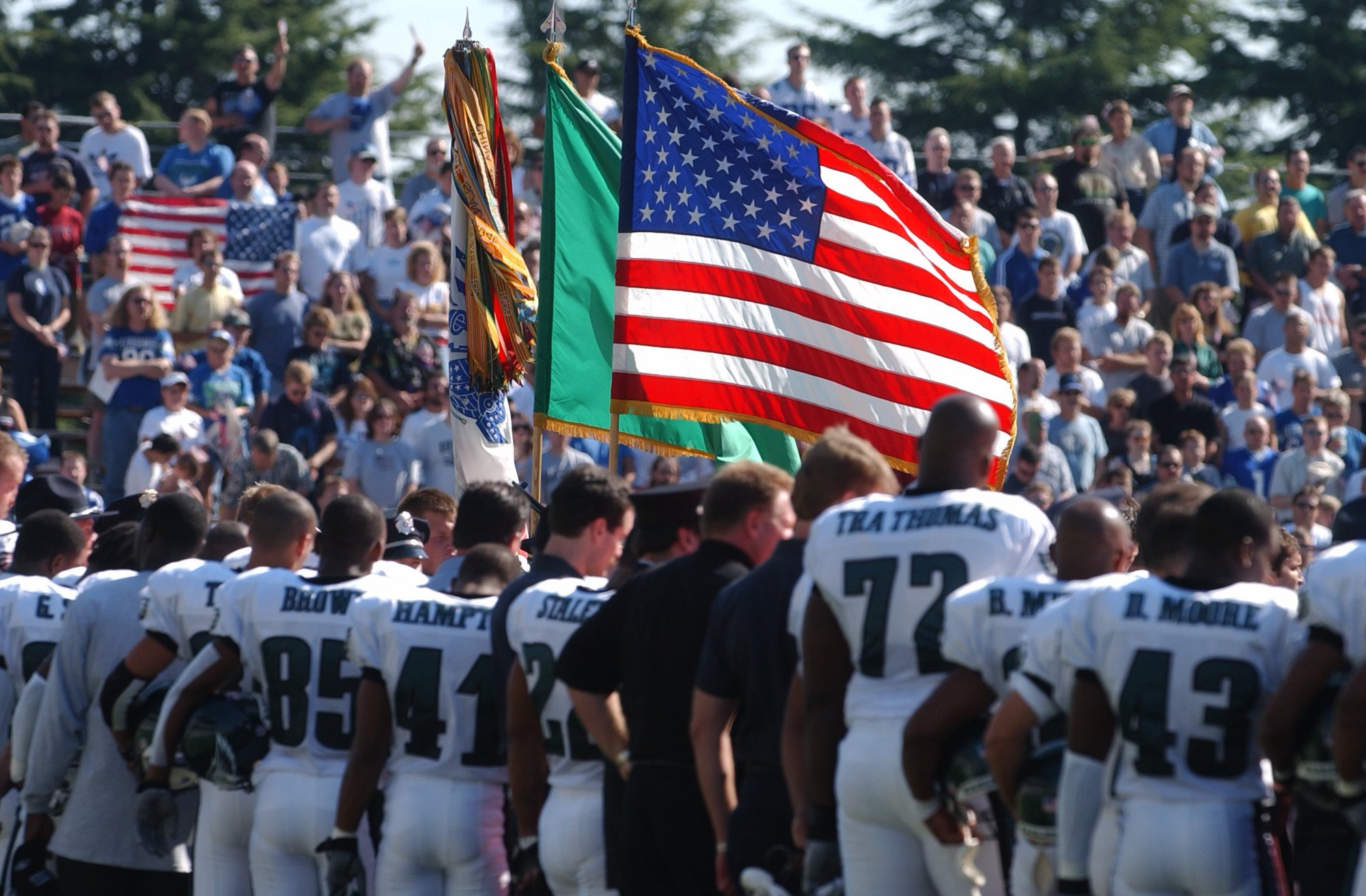
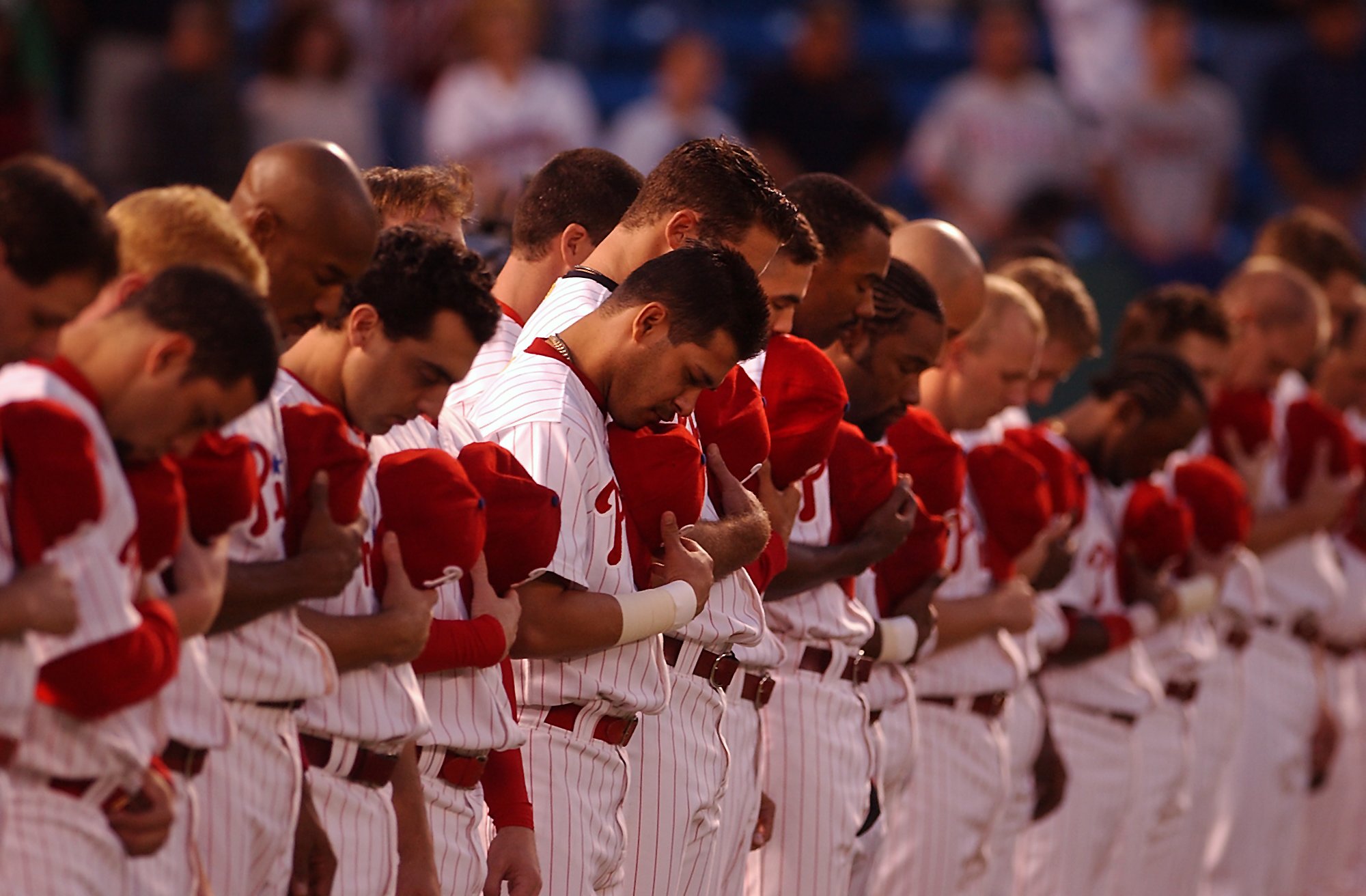
    Eagles players line up during pregame ceremonies before the Eagles-Seahawks game on Sept. 23, 2001, the teams’ first game after the attacks.Ron Cortes / Staff Photographer

    As with MLB, NFL playoffs were delayed by a week, so the Eagles made up their postponed game at Tampa in January after their final scheduled game of the regular season. Their first game after the attacks was in Seattle, where they played the Seahawks at the University of Washington stadium while their new stadium was being built. As in many stadiums that day, the pregame national anthem was performed as a giant flag that covered the entire field.

    Who held it? Douglas, his teammates, and his coaches joined their counterparts from the Seahawks and dozens of first responders. Douglas had a hand on that flag, and he remains moved by that ceremony to this day.

    “Just, I don’t know,” Douglas said. “Just a sense of pride.”
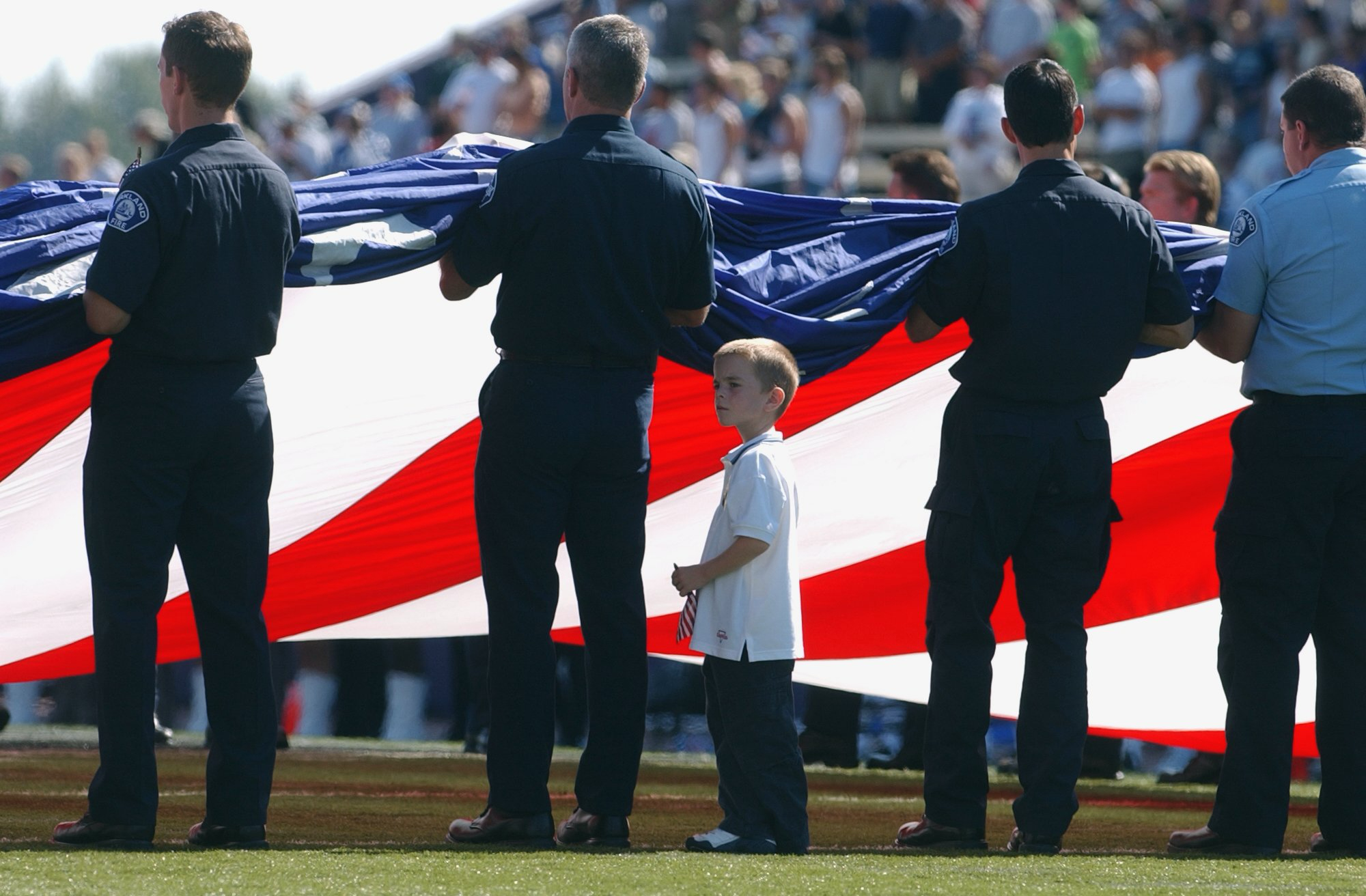
    A giant American flag covers the field before the Eagles-Seahawks game at the University of Washington stadium during pregame ceremonies on Sept. 23, 2001.Ron Cortes / Staff Photographer

    ‘Tip your cap’

    Pride: That’s what Bowa felt on Sept. 17. He’s proud that Philadelphia, the cradle of American democracy, was part of the return to sport. He’s proud that the franchise he played for and managed was, with the Pirates, the first team in the U.S. to resume, and he’s proud that baseball, America’s game, was the first front-line sport to restart.

    Bowa is a hard man, but he understood the situation. He held a team meeting before the game and told the players that anyone who didn’t feel like playing didn’t have to; he understood. No takers.

    The pregame left Bowa and Glanville shaken. As late Phillies broadcaster Harry Kalas delivered a moving pregame address to viewers, a montage compiled by “Video” Dan Stephenson helped settle the 27,910 fans at Veterans Stadium into their seats.

    “People were in tears over that,” Glanville said.

    It was the music that got to Bowa. He’d served in the U.S. Army Reserve as a young man, and his patriotism runs deep.

    First, he recalled, there was Lee Greenwood’s “God Bless the USA” Then, right before the first pitch, with the teams lined up on the baselines, came “God Bless America” and the national anthem, performed back-to-back by — who else? — the star-spangled Valley Forge Chorus.

    Then, the game.

    Phillies ace Robert Person went eight innings, gave up two runs, Jose Mesa got the save, and the Phillies won, 5-2, and drew to within two games of the Braves in the National League East.

    Who’d they beat?

    Braves legend Greg Maddux.

    Glanville got a hit, Pat Burrell got two, rookie All-Star Jimmy Rollins scored a run, and MVP candidate Bobby Abreu tripled. But all of them — Person, Mesa, Glanville, Rollins, Abreu — they were just co-stars.

    Nobody in baseball met the moment like Scott Bruce Rolen.

    Chipper Jones’ homer gave the Braves a 1-0 lead in the first inning, but Rolen tied it with a leadoff homer in the second. He drove in Abreu from third base in the fourth for a 2-1 lead.

    Then, with two out in the bottom of the sixth inning, Rolen homered again. The Phillies led, 3-2. The Vet rocked and rolled as Rolen returned to the dugout and, as ever, humbly took off his helmet. The crowd was nearly tearing the old stadium down, begging for a curtain call, but that just wasn’t the sort of thing Rolen did. Ever.

    Bowa called Rolen over.

    “Scotty,” he said, “you got to go out and tip your cap.”

    Rolen replied, “Well, you know I don’t do that.”

    “Scotty,” Bowa said, “this is something different.”

    Rolen stood there. Paused. Relented: “OK, you’re right.”

    He scooted up the steps. Tipped his cap. The crowd went crazy. Even Bowa lost himself for a few minutes:

    “I can honestly say, as competitive as I was, that’s the first time I really didn’t care about winning or losing a baseball game.”

  • Letters to the Editor | Sept. 11, 2026

    Letters to the Editor | Sept. 11, 2026

    Reflections

    As we remember the tragedy of the 9/11 attacks 25 years ago, standing united on the principles of justice remains as vital today as it has been for the past 25 years. With the spread of misinformation, fearmongering, and political polarization, it has unfortunately become far too easy to focus on our differences and forget the struggles shared by all our fellow Americans. We are witnessing countless innocent lives lost around the world — each one reminding us of the devastating consequences of war.

    As an Ahmadi Muslim American, it is my duty not only to condemn those who twist religion for their own political gain, but to stand up for all those whose rights are being usurped and attacked, be it a Muslim or non-Muslim alike. In his Farewell Sermon, the Holy Prophet Muhammad (may the peace and blessings of God be upon him) said, “Hurt no one so that no one may hurt you,” reaffirming the importance of all human life. In this crucial time when the most vulnerable among us are under attack, let us reaffirm our nation’s commitment to justice for all.

    Ataul Wadood Bhatti, Philadelphia

    . . .

    I was getting ready to head to Northeast Philadelphia to photograph a story for The Inquirer, where I had been a staff photojournalist since 1993. With a cup of coffee in hand, I remember being somewhere between the kitchen and the living room when the phone rang.

    The calm, distinct voice of Berford Gammon, assignment editor at the newspaper, came through at 8:55 that morning.

    “I want you to head to New York,” he said.

    “What’s going on?” I asked.

    “Turn on your TV.”

    I clicked on the remote, and a picture of smoke billowing from a tower of the World Trade Center framed against the background of a deep blue, cloudless New York skyline filled the screen. My eyes locked onto the grainy image as my wife stood close.

    I remember saying, “What a tragic accident,” thinking a small plane probably had navigated off course. That thought vanished as quickly as it arrived at 9:03 a.m., when United Airlines Flight 175 slammed into the World Trade Center’s south tower. The morning talk shows quickly abandoned their banter as the unsettling words of terrorism, attacks, and deliberate filled the airwaves.

    I grabbed my cameras and stepped out into the cool 60-degree morning.

    I stopped briefly in the newsroom to pick up extra equipment. Small groups of people were gathered around television sets as American Airlines Flight 11 was identified as the first plane to hit the north tower.

    I heard reports that hijackers had crashed American Airlines Flight 77 into the western facade of the Pentagon in Washington, D.C., at 9:37 a.m. Stunned, I instantly thought of Pearl Harbor and my father, who had told me what it was like on the morning of Dec. 7, 1941.

    As I headed to New York, a report of a fourth plane, United Airlines Flight 93, had crashed at 10:07 a.m. into a field in Shanksville, Pa., with 40 passengers and crew on board.

    As I pulled off the New Jersey Turnpike to take photographs, a changed New York skyline missing its twin vertical icons filled the viewfinder. It was hard to imagine the lives lost and the damage done.

    The north tower burned for about 102 minutes and then collapsed. The south tower burned for almost an hour and then imploded. In the attacks on Sept. 11, nearly 3,000 lives were lost, and 10,000 people were treated for injuries.

    I stayed in New York for the next seven days working with reporters from the paper and photographing what followed an unthinkable event.

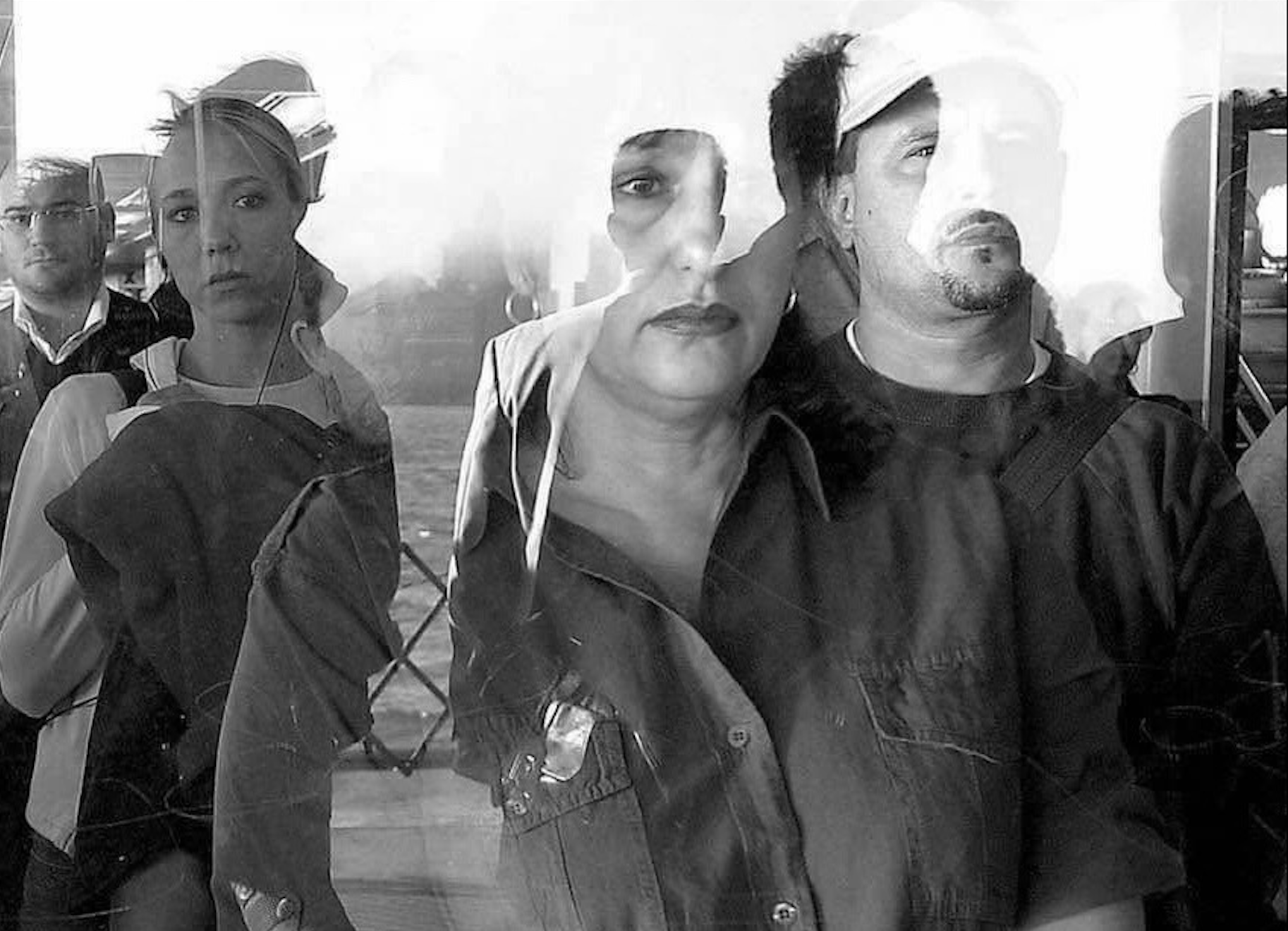
    On Sept. 17, I caught a ferry from Staten Island with people heading back to the southern tip of Manhattan for the first time since the attacks. The mood was somber. Two men spoke a couple of sentences. Most passengers were silent for the 25-minute ride.

    The world was a different place.

    Peter Tobia, Philadelphia

    The writer is a former visual journalist at The Inquirer.

    . . .

    Twenty-five years after 9/11, America needs to remember what once held us together.

    For two weeks after the attacks, we opened the doors of our church in New York City every night. People came to pray, share their stories, search for information about friends and family members, and grieve. Some simply needed somewhere to sit with other people who understood what they were experiencing. The church was packed.

    Those who did not live through those days in New York may not fully understand how quiet the city became. Manhattan was virtually cut off. Cell service was extremely limited. The normal machinery of everyday life simply stopped; fighter jets flew overhead. Smoke continued to rise from Lower Manhattan, and everywhere there were reminders that our city and our nation had been attacked.

    Yet, amid the fear and devastation, something remarkable happened. We came together.

    New Yorkers, famous for their impatience, became more patient. Strangers talked, and people helped each other. Churches filled. First responders ran toward danger while thousands of ordinary citizens searched for ways to serve. Political labels suddenly seemed less important. Race, class, neighborhood, and status became secondary to something larger. We knew we were together. We were New Yorkers, but more importantly, we were Americans.

    As we mark the 25th anniversary of Sept. 11, I find myself wondering what happened to that spirit, not the fear or grief of that terrible day, but the unity that followed it. We don’t need another attack to remind us that there are things more important than our political parties, ideological tribes, and personal ambitions. But somehow that spirit must be recovered. America needs a new breed of patriotism — a mature patriotism that rises above personalities and political parties, allows honest disagreement, and acknowledges America’s failures while remaining committed to its promise and founding ideals.

    Differences and debate are not the problem; they are essential to a free society. Americans will disagree about taxes and spending, immigration, education, the size and role of government, and a host of other issues. What concerns me is that disagreement has increasingly been replaced by distrust, contempt, and even hatred.

    We no longer simply believe the other side is wrong. Too often we assume they are evil, stupid, un-American, or determined to destroy the country. Once we reach that point, compromise becomes impossible, friendships across political lines become suspect, and winning becomes more important than the principles we supposedly want our politicians to defend.

    Michel J. Faulkner, Philadelphia

    . . .

    In the autumn of my mother’s sixth grade school year, an enemy of this country attacked Pearl Harbor and sent the world she knew into a spiral.

    In the autumn of my sixth grade year, an enemy of democracy assassinated President John F. Kennedy and filled the world of my generation with sadness, anger, anxiety, and apprehension.

    In the autumn of my daughter’s sixth grade year, an enemy of freedom used planes as missiles on Sept. 11, and the shockwaves from their attacks rippled across her small world — spilling into Girl Scout meetings and coursing over sidewalk playdates.

    In each of those instances, the message being sent to each child was that the normal, the dependable, and the safe could be shaken — because there “were no innocent people.”

    My mother got through it, I got through it, and my children have, too — with each of us carrying our own “I remember what it felt like when it happened” moment.

    I have a 5-year-old grandson. Can’t help but wonder what will happen when he hits sixth grade. Or, in this accelerated world, sooner.

    Keith Mason, Cinnaminson

    Join the conversation: Send letters to letters@inquirer.com. Limit length to 150 words and include home address and day and evening phone number. Letters run in The Inquirer six days a week on the editorial pages and online.

  • Horoscopes: Friday, Sept. 11, 2026

    Horoscopes: Friday, Sept. 11, 2026

    ARIES (March 21-April 19). When you trust that all things are connected, you will find that every path eventually leads to the desired destination. And yet… if there’s a map — and there is — it’s more efficient to get it and use it to figure out the most direct route.

    TAURUS (April 20-May 20). It’s easier to love who you are when you’re not constantly bombarded by other options. Options are only useful at the intersections of life. You don’t need them when you’re content on the correct road. Prevent distractions.

    GEMINI (May 21-June 21). Today points out once again your supertalent for versatility. You’ll blend when you need to, stand out when it’s advantageous and make your group proud the whole way. Your value to them is undeniable.

    CANCER (June 22-July 22). It falls on you to make a sale by closing a deal in the traditional sense, selling yourself as an option for a role, or selling an idea. Whatever the goal, your influence will work best when it’s practically undetectable.

    LEO (July 23-Aug. 22). Just when you think you know how you’ll feel when certain events come to pass, you discover that your emotions will not be predicted or controlled. But they will submit to being sorted, tolerated, managed and above all, felt.

    VIRGO (Aug. 23-Sept. 22). As for the thing you weren’t able to accomplish back there, it just wasn’t time yet. Keep at it in whatever small way is currently possible, and more will be possible in the future. The key is simply knowing that this isn’t over.

    LIBRA (Sept. 23-Oct. 23). You’ll be reminded how much easier it is to give good advice than to live by it. You know what the right thing for you is; the trick is getting your whole self to agree, because you do contain multitudes. Following your own wisdom will be so satisfying today.

    SCORPIO (Oct. 24-Nov. 21). The world measures success by various metrics. You find yourself valuing contribution more than recognition. It feels good to know your time and energy have made someone else’s path a little smoother.

    SAGITTARIUS (Nov. 22-Dec. 21). You got this long ago, but some around you are still learning: To accept that there are things in life you can’t change is to accept adulthood. You’ll watch immature notions of power give way to reality.

    CAPRICORN (Dec. 22-Jan. 19). Favors get passed around, and not always fairly. They may not go to the ones who worked hardest, but rather to the ones who have pleased the boss. “Whoever obeys the gods, to him they particularly listen.” — Homer

    AQUARIUS (Jan. 20-Feb. 18). There’s a time for transformation, and that time is when the cycle you’re in comes to a close. To transform all the time is a waste of the great amount of energy, and the considerable risk that transformation demands.

    PISCES (Feb. 19-March 20). Do you wish you could sidle up to the person in your dream role, just to get a feel for what that experience is really like? Today you’ll realize that you can have a version of that, if you actively seek it out.

    TODAY’S BIRTHDAY (Sept. 11). It’s your Year of Three Crossroads where you’ll learn you can absolutely trust your inner guidance. Your conscience will braid with your passions and preferences, steering you to a dream destination. Others may have resources, but your own improvisational skills are all you need. More highlights: Freedom from an obligation and the funds to invest in your ideas. Holding hands with a soulmate. Sagittarius and Taurus adore you. Your lucky numbers are: 5, 38, 4, 11 and 29.

  • Dear Abby | Good friend dies during ‘off-again’ phase

    Dear Abby | Good friend dies during ‘off-again’ phase

    DEAR ABBY: My friend “Ben” and I had many ups and downs in our 30-year friendship. Three years ago, we had one of our periodic blowouts and stopped speaking. I found out recently that he passed away a year later, and I was never informed. The obituary I found online does not mention a cause of death.

    I wrote a letter of condolence to his wife, but it was returned, and I found out that she moved away from the house where she and Ben had been living. I would like to know what happened to my friend, as he was only in his early 50s. Although we were not speaking at the time of his death, we had many years of friendship under our belts, and I cared about him. I found a Facebook page for his wife, but this seems an impersonal way of reaching out on such a sober topic. Any suggestions?

    — CARED FOR HIM IN THE SOUTH

    DEAR CARED: If you and Ben had mutual friends, a way to find out the information you’re looking for, including his widow’s address, might be through them. Do it privately. To approach her online asking for the details of his death would be off-putting, insensitive and possibly hurtful in light of the fact that you were estranged at the time of his death.

    ** ** **

    DEAR ABBY: My 63rd birthday is coming up. I do not like celebrating my birthday and never have. I would prefer that the day be ignored. I know my wife of almost 38 years, our two boys and their significant others are planning something. I would prefer they spend the money on themselves or at least donate it to some worthy charity rather than spend it on me. Given that birthdays are important to them, must I just grin and bear it, or should I say something and risk causing ill will?

    — OLDER IN ISRAEL

    DEAR OLDER: Surely your wife, who has been with you for nearly four decades, knows your feelings on this subject. Tell her you know something is afoot, and gently mention that you would prefer that the celebration be kept small. Name the charity of your choice, and tell her you hope the birthday budget will be sent there rather than spent on you.

    If your wife ignores your plea and a massive fete does materialize, do your best to endure it with grace and a smile. Remember that these people are celebrating you because they love you.

    ** ** **

    DEAR ABBY: I’m married, and I’ve recently started developing a crush on my co-worker. We have worked together for four years. I’m not going to pursue anything, because cheating is against my morals. I just feel bad for having these feelings. What can I do to get my feelings toward my co-worker in check?

    — CRUSHING IN ILLINOIS

    DEAR CRUSHING: The guilt you are experiencing is a good thing; it has kept you from making a terrible mistake. If it’s any comfort, bear in mind that crushes like this usually lessen in time, even if they make the present somewhat uncomfortable.

    ** ** **

    TO MY READERS: Happy New Year to my friends of the Jewish faith! During this time of repentance, observant Jews reflect on their lives and make amends, seeking a closer relationship with God. Happy Rosh Hashanah!

    — LOVE, ABBY

  • Republican Ryan Mackenzie had the narrowest win in Pa. two years ago. He’s betting Trump will help him again.

    Republican Ryan Mackenzie had the narrowest win in Pa. two years ago. He’s betting Trump will help him again.

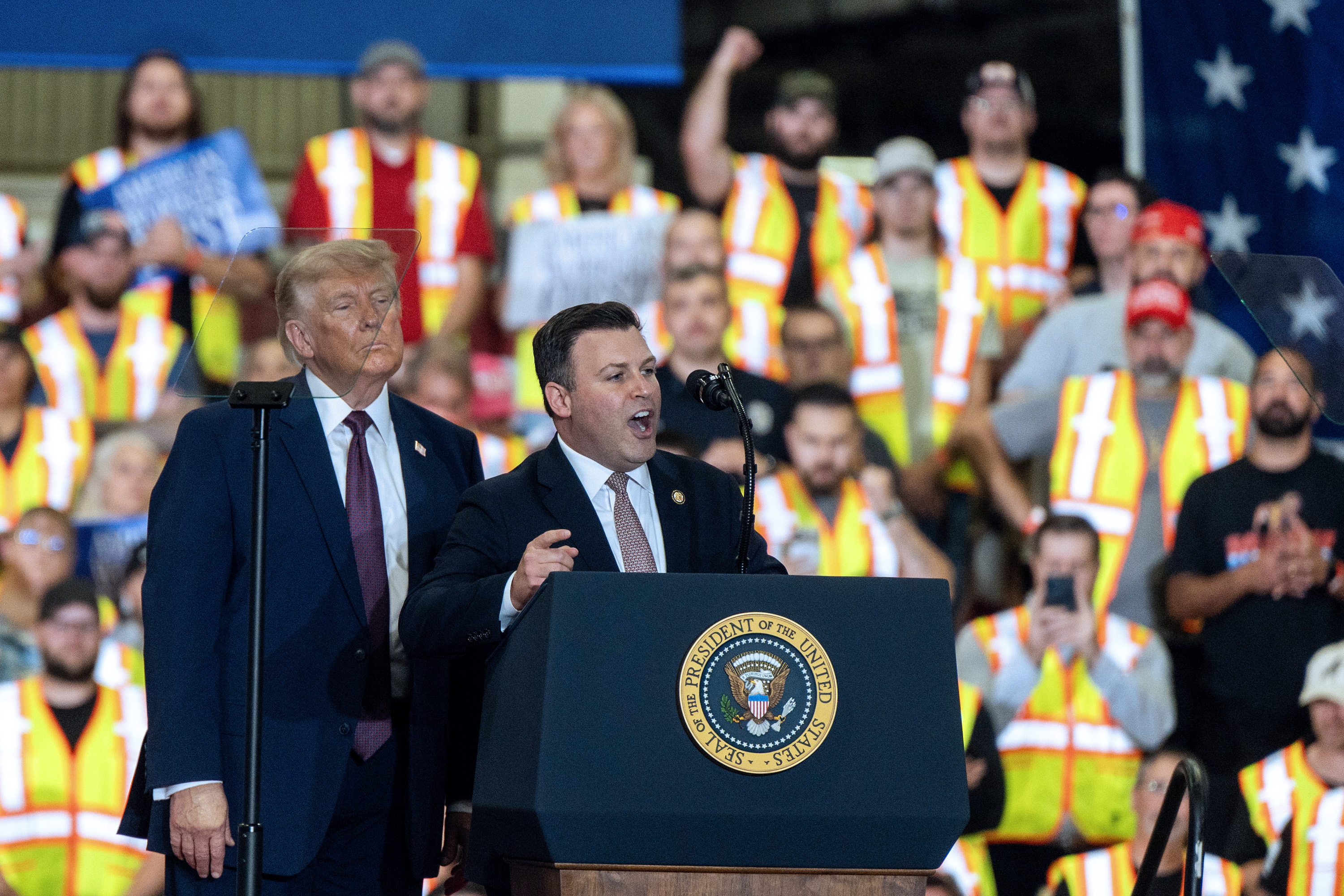
    DALLAS, Texas — As Republicans look to keep their narrow control of Congress by defending the seats they flipped in 2024, there aren’t many places where they can afford to lose fewer votes than in U.S. Rep. Ryan Mackenzie’s district covering the Lehigh Valley and Poconos.

    Mackenzie’s takedown of a three-term Democrat by a mere 4,000 votes two years ago was the narrowest congressional race in Pennsylvania — his 1% margin of victory was the seventh smallest out of 435 House districts across the country.

    Standing Thursday on the Republican Party’s biggest stage of the year — and likely staring down another razor-thin result this fall — Mackenzie didn’t hold back when laying out the potential stakes.

    “I’m running in one of the top races again, and it will determine the future direction for our nation,” Mackenzie said on the second day of the first-ever Republican midterm convention. “Now we must get to work, we must go out and win in November, and we must save America.”

    Like one of Pennsylvania’s other vulnerable Republican incumbents who spoke a day earlier, Mackenzie embraced the convention known as “Trump-a-palooza” even as the president’s low poll numbers threaten to hurt their party in the elections.

    In an interview after a brief speech that focused on the president’s signature tax cuts, Mackenzie said Democrats’ threats to repeal those cuts and other Trump policies meant the president is, in a sense, on the ballot — so it makes sense to campaign in that way.

    “We know the history of American politics is the party who has the White House, their voters end up being less energized in midterm elections, and so I think it was a smart idea to try something like this, a midterm convention, to energize our voters,” Mackenzie said.

    Generating enthusiasm for the Republican ticket could be a tough task for Mackenzie and other incumbents, with polling in Pennsylvania showing widespread frustration with Trump’s handling of key issues, including the cost of living.

    “Everybody is getting gouged,” said Ron Jones, 79, an Allentown Democratic voter and Navy veteran who said he feels stretched relying on his Social Security and pension checks. “You just can’t afford to live. Period.”

    Jones said he hasn’t been following the congressional race closely, but said he plans to help “get rid of all incumbents.”

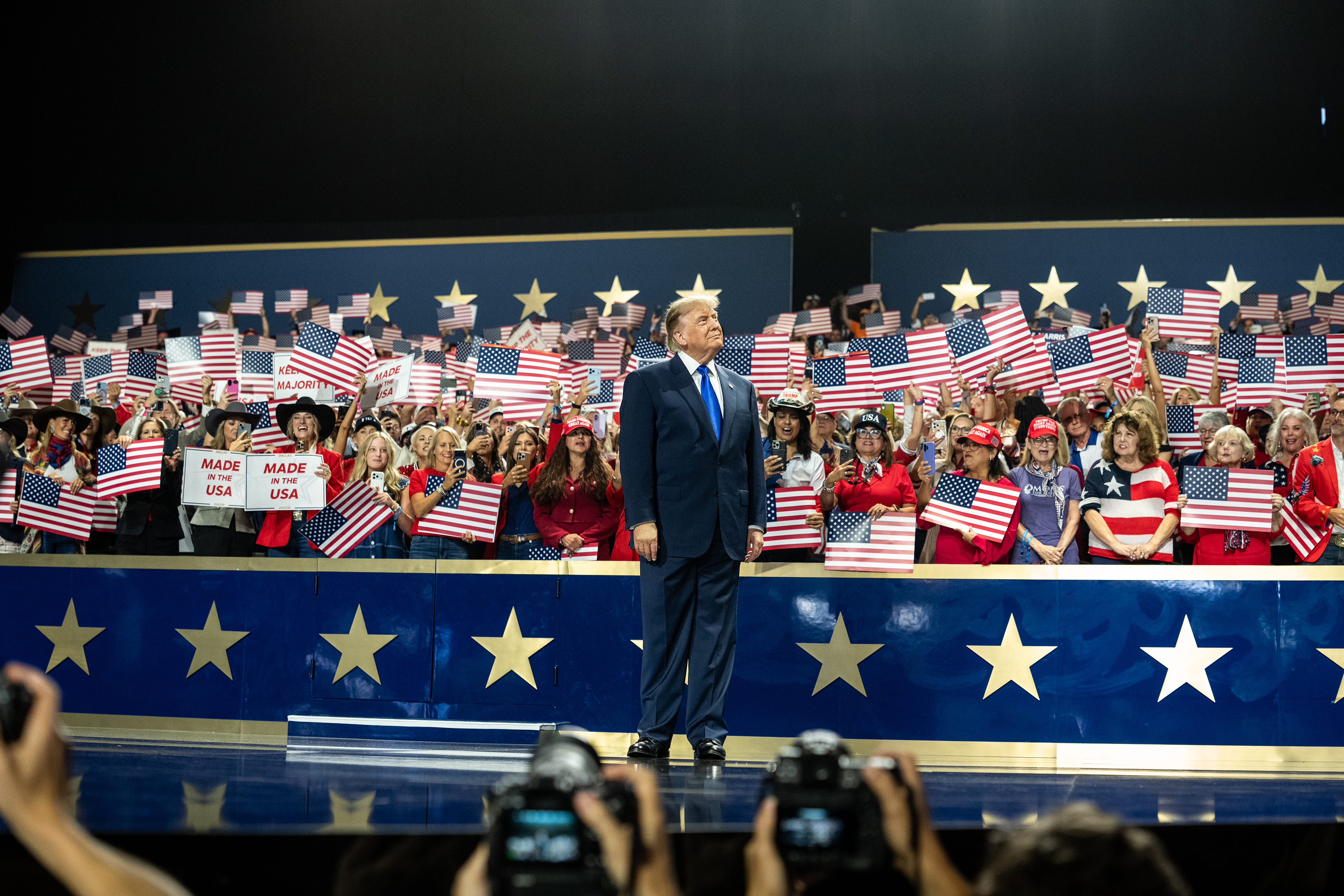
    President Donald Trump onstage during the Republican Party’s unusual midterm convention in Dallas on Wednesday, Sept. 9, 2026. (Haiyun Jiang/The New York Times)HAIYUN JIANG

    Going after Brooks on a national stage

    Mackenzie told The Inquirer his phone started blowing up with text messages immediately after his speech. The lawmaker said he welcomed the opportunity to have a national audience to talk about his work, and his opponent.

    Mackenzie didn’t just applaud Trump’s policies during his speech, he also imitated the president’s ferocious style of politics by blasting his Democratic challenger Bob Brooks as a scandal-ridden, “far-left nutjob.”

    Brooks, he contended, was “handpicked by the Democratic establishment,” and has spoken critically about nonunion firefighters. He also accused Brooks of stealing money from his own family, a claim based on a lawsuit brought by Brooks’ former mother-in-law and involving a decades-old debt she says that he owes.

    “That’s what crazy looks like,” Mackenzie said.

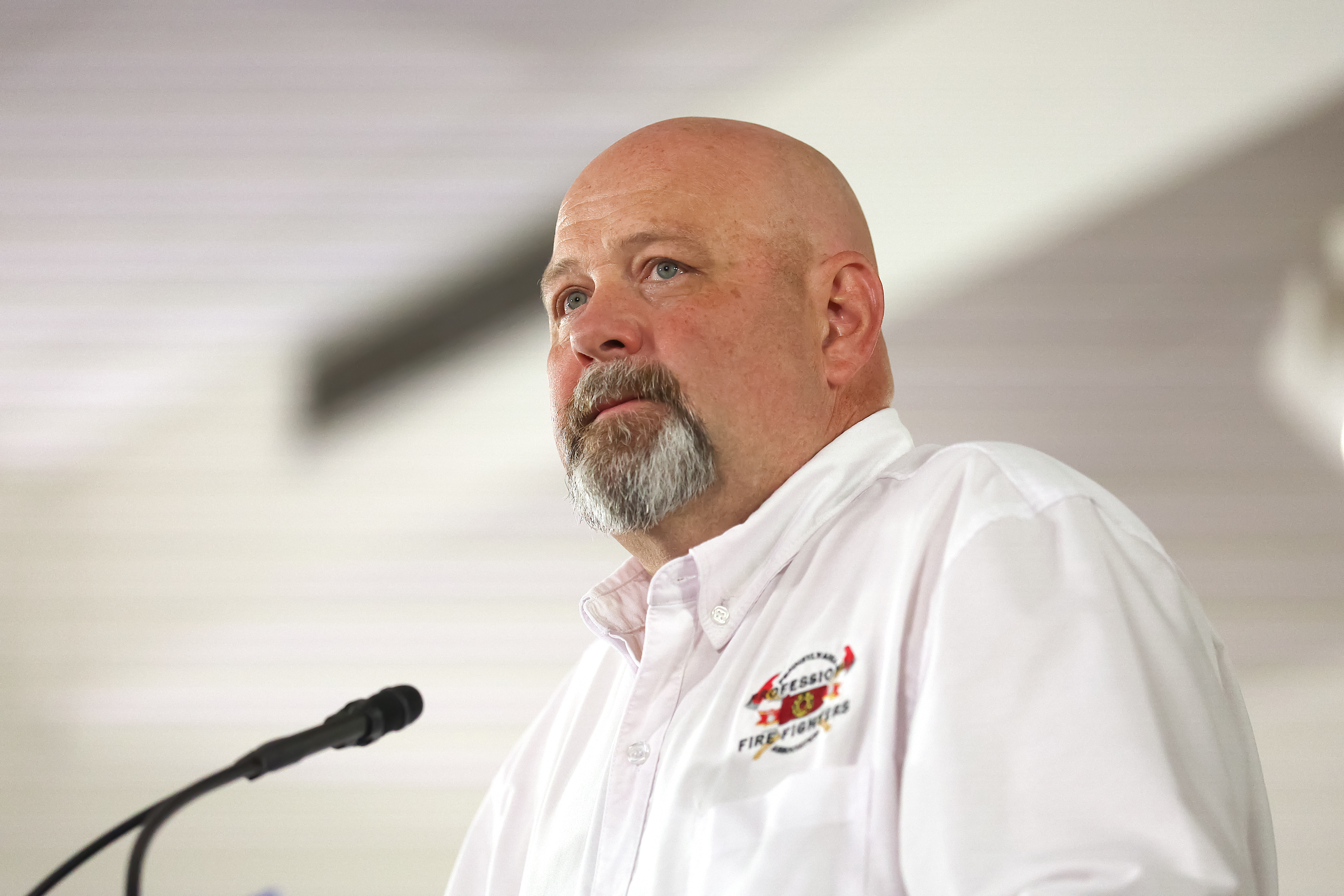
    Brooks, a retired firefighter in Bethlehem and the Pennsylvania Professional Fire Fighters Association president, was recruited last year by prominent Democrats, including Gov. Josh Shapiro and U.S. Rep. Chris Deluzio. He quickly got a groundswell of support from moderates and progressives alike, including U.S. Sen. Bernie Sanders and former Transportation Secretary Pete Buttigieg.

    Those high-profile supporters, and Brooks himself, leaned into his working-class image — highlighting his history of working multiple jobs and his insistence, even as he ran for Congress, on continuing to drive a snowplow and coach high school baseball.

    Mackenzie and national Republicans who’ve invested resources into his campaign have repeatedly targeted Brooks for the lawsuit involving his family and for old social media comments.

    In one post, Brooks lambasted volunteer firefighters working in areas where other union firefighters operate as “scabs” and other pejoratives.

    Brooks has dismissed those and other attacks on his old posts, saying he never thought he would be a candidate for office when he made them.

    The Democrat did not directly address those issues in a comment after Mackenzie broadcast them to a national audience.

    “Ryan Mackenzie got his wish today: a big boy speaking slot on stage at Trump’s party in Dallas,” Brooks said in a statement that blamed Mackenzie for rising costs and voting against restricting Trump’s attacks in Iran, the two areas that polls show Trump performing the worst among both Republicans and Democrats.

    “Mackenzie’s trip to Dallas is a reminder of who he is: a lap dog for Donald Trump, for his party bosses, and for anyone with power and money,” Brooks said.

    Bob Brooks, who is running for Pennsylvania’s 7th Congressional District, addresses the audience during a rally at the United Steelworkers Union Hall in Bethlehem, Pa., on Sunday, July 26, 2026.David Maialetti / Staff Photographer

    Just steps from the convention location earlier in the day, a small group of House Democrats that included U.S. Rep. Madeleine Dean (D., Montgomery) protested by, mainly, hitting Republicans on affordability.

    “If you listen to what’s being said across the street, you might feel like you’re living in some separate reality. Here’s the reality check,” Dean said as she rattled off the higher cost of groceries, electricity and gasoline since Trump took office.

    Dean targeted Mackenzie as well as U.S. Rep. Rob Bresnahan (R., Luzerne) and U.S. Sen. Dave McCormick (R., Pa.) — who each spoke at the convention on Wednesday — specifically, saying they were among the Republicans “happy to coddle a president who is unfit and unwell.”

    “Here at the heel of Donald Trump, I don’t know what they think they’re doing,” Dean said behind a podium with a sign reading, “Fighting for an affordable America.”

    Both Bresnahan, who is running in a competitive race against Democratic Scranton Mayor Paige Cognetti, and Mackenzie focused on an economic message during their speeches.

    They did not directly address concerns about inflation, or the Iran war’s effects on the rising cost of gas.

    U.S. Rep. Jason Smith, a Missouri Republican who joined Mackenzie onstage, contended the GOP majority had focused its agenda on the working class. He pointed to the tax exemptions for tips and overtime pay.

    “If you don’t believe me, just ask yourself, how many billionaires do you know that are tipped employees?” said Smith, the House Ways and Means Commitee chair.

    But neither he nor Mackenzie addressed the cuts to Medicaid and food assistance that were included in the same legislation to help pay for the tax cuts they repeatedly touted.

    “We delivered tax relief for every American by locking in lower rates and expanding the standard deduction,” Mackenzie said.

    Staff writer Alfred Lubrano contributed reporting.

  • Sean Mannion’s vision for the Eagles offense is coming into sharper focus: ‘Confident and excited for Week 1′

    Sean Mannion’s vision for the Eagles offense is coming into sharper focus: ‘Confident and excited for Week 1′

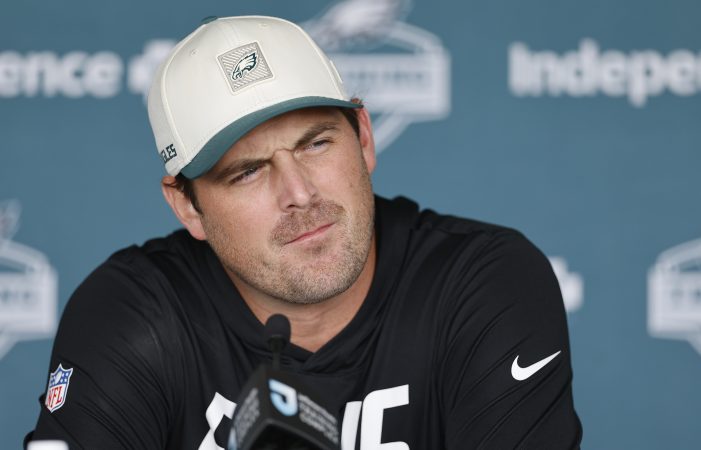
    At the outset of the offseason program in April, Sean Mannion began to install the foundation of the Eagles offense, a brand new scheme from a first-time coordinator.

    Those early days, Mannion said Thursday, feel like “ancient history” compared to where the team is now.

    He said it jokingly, but acknowledged what has felt like eons between now — just four days before his first regular-season game as a play-caller — and then is a reflection of the work that Eagles staff and players have put into learning the scheme.

    The group started with the foundation of the offense in the spring, then added one layer after the other, gradually incorporating different wrinkles and adjustments. Mannion said he is satisfied with the progression, leaving him feeling like the team is in a “great position” heading into Week 1 against the Washington Commanders.

    “There’s been so much work, and we’re working relentlessly, and ultimately that builds your confidence, knowing that I’ve spent hours and hours and hours thinking about the plan, preparing the plan, preparing the players,” Mannion said. “I feel confident and excited for Week 1.”

    After installing the broader offense throughout the offseason program and training camp, Mannion will narrow the game plan to a more select menu. The Eagles offensive coordinator’s desire to put the players in the best position to succeed helps inform how to pare down the offense.

    He has spent the last five months evaluating the strengths and weaknesses of his personnel. Mannion has built what he calls a “library” of plays since April, which includes new plays and familiar ones from past Eagles offenses.

    As he game plans, he’s pulling different books from the shelves, so to speak, of the Eagles’ vast play library. Part of his consideration in selecting plays also includes a study of the Eagles’ opponent to determine how to best attack them.

    Sean Mannion’s time with the Vikings crossed over with that of current Commanders defensive coordinator Daronte Jones. Jack Dempsey / AP

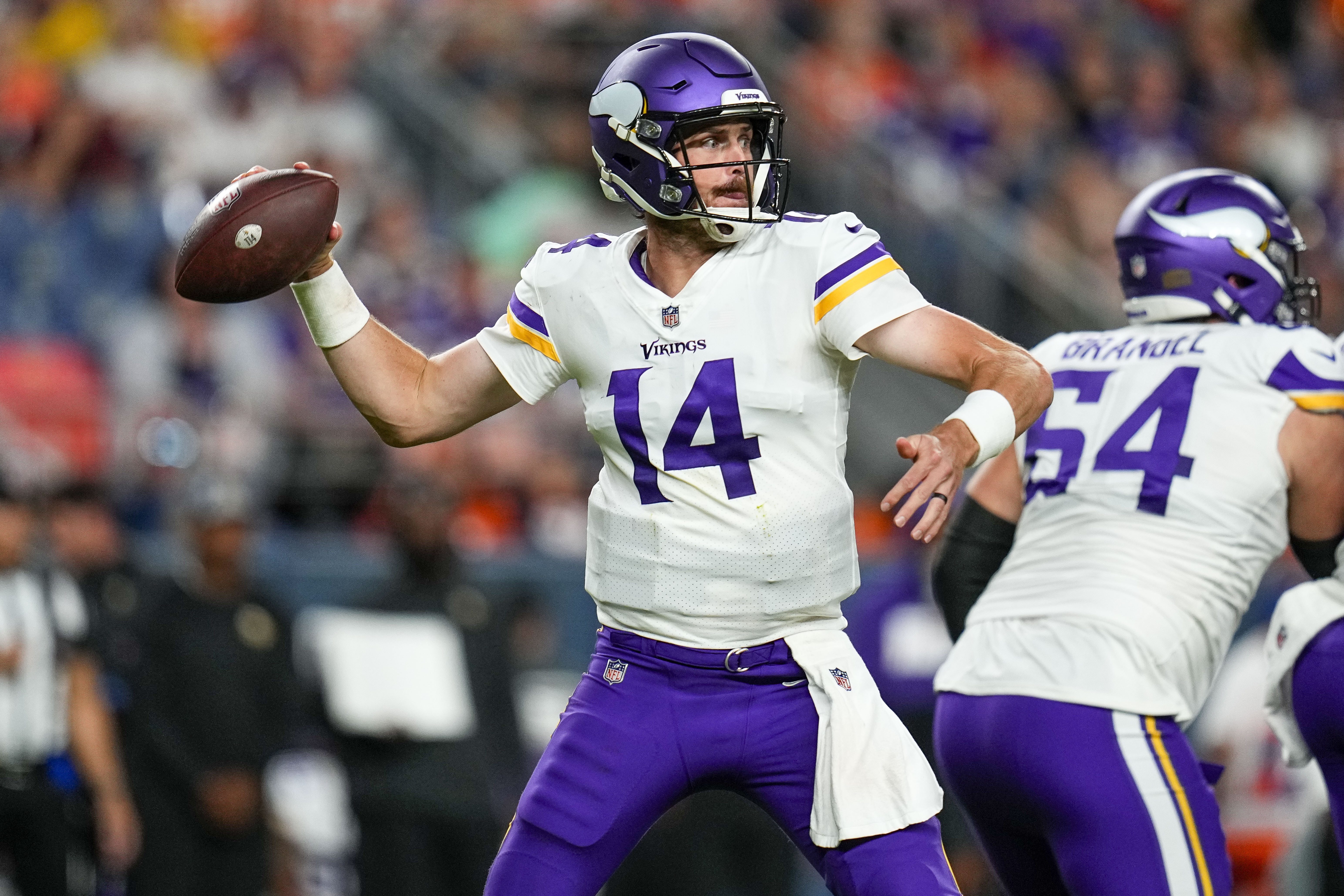
    That aspect of the preparation is shrouded in mystery, as the Commanders have a new defensive coordinator in Daronte Jones, who spent the last four years with the Minnesota Vikings as defensive backs coach and pass game coordinator. Mannion is familiar with the Brian Flores-led Vikings defense, as he played in Minnesota briefly in 2023 (Flores’ first season as defensive coordinator) and coached against him twice a year with the Green Bay Packers for the last two seasons.

    Whether or not the Commanders take on more of a Vikings flavor, Mannion said he will be prepared for anything the defense throws at them.

    “We’ve really used this extra practice time, kind of the bonus week, to our advantage,” Mannion said. “We want to be ready for everything. … And like any opponent, whether it’s a new coordinator into Week 1 with new wrinkles, or if it’s a first-time coordinator at a place, you’re always ready to adjust in-game, and we have contingencies laid out for different things we might be anticipating.”

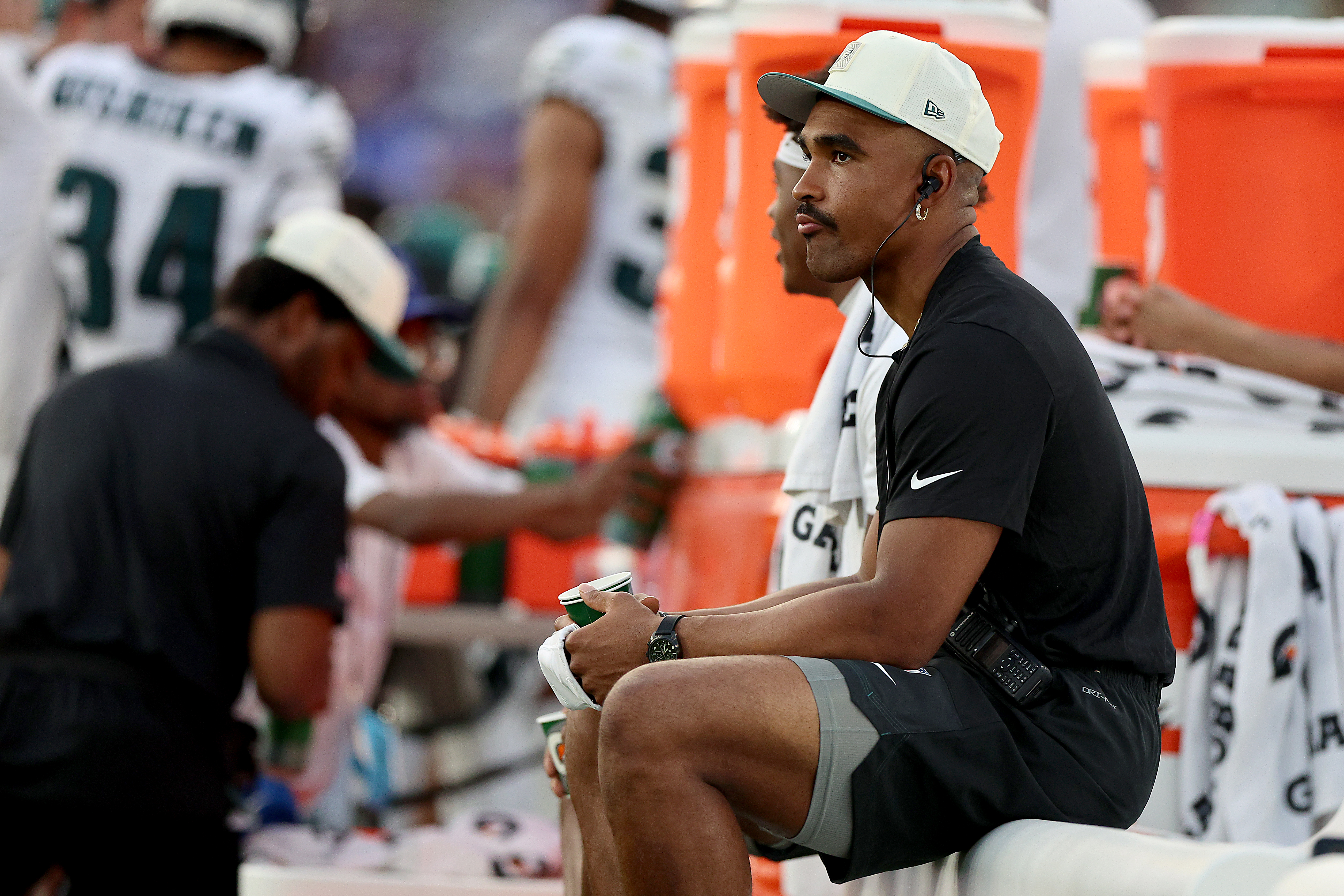
    Mannion will make those hypothetical adjustments from the coaching box. He experienced calling plays from both the box and the sideline during the preseason and the public practice at Lincoln Financial Field during training camp. He ultimately decided it was the “best decision” for the team to call the game upstairs.

    While there are pros and cons to either location, Mannion acknowledged he has more space in the box to operate. Plus, he called the point of view “unique” given the higher vantage point up top.

    He even went through the long list of play-callers he had as a player, or worked with as a coach, and tallied up their in-game location. Mannion said it was almost 50-50.

    “If there was one thing as I was thinking it through, I realized, you know what?” Mannion said. “There’s plenty of great play callers who have done it from either spot.”

    Jalen Hurts said on Wednesday that he hasn’t had a play-caller sit in the box since he was in college. Still, he emphasized that he would support Mannion in his decision, even if his communication with his offensive coordinator between drives might be altered given his location.

    Jalen Hurts said earlier this week that he’s OK with not having Sean Mannion on the sideline during games. David Maialetti / Staff Photographer

    Mannion noted that one of the advantages of calling plays from the box is his ability to talk to each of his staff members at any time, instead of being fixed in one place and speaking to them individually. Then, his staff members can quickly disseminate information to their respective position groups.

    “I think really more than anything, it speaks to [quarterbacks coach] Parks [Frazier], he does a great job with Jalen every day,” Mannion said. “I’m in constant communication with him and all of our position coaches, and then it allows for, I think, everybody to coach their units, and I can kind of survey from up top and distribute information from there, and they take it the rest of the way.”

    Mannion has praised the work of the staff and the players as they have learned a new offense. Come Sunday, the details that defined the last five months — from designing the offense, to planning meetings and practice schedules, to teaching the offense, to executing in practice — will come to fruition on the field.

    Is there an aspect of the job that keeps Mannion up at night? As he reflected on his work over the last five months, he showed he looks at his myriad responsibilities from a perspective of gratitude.

    “Those are the things that you love about coaching,” Mannion said. “There’s so many different elements to it, but football’s a beautiful game because they all come together. I stay awake thinking about that, but I wouldn’t say it keeps me awake. It’s the enjoyable part for me. That’s what I love about it.”

  • 2 men charged with rape of student at Eastern University in Delaware County

    2 men charged with rape of student at Eastern University in Delaware County

    Two men have been charged in the sexual assault of a student at Eastern University inside a dorm room earlier this year, Delaware County District Attorney Tanner Rouse announced Thursday.

    Dontae Williams, who turns 20 on Friday, and Chase Thompson, 19, surrendered to Radnor Township police on Thursday to face charges of rape of unconscious person and related offenses. Bail was set at $150,000 unsecured for both men.

    The assaults allegedly occurred in the Kea Hall residence of Naeem Turner, a friend of the victim, Rouse said. Turner was issued a summons to appear in court on three counts of invasion of privacy for allegedly recording video of the victim.

    Robert C. Keller, a lawyer representing Williams, said his client “has been cooperating since the beginning.”

    Keller said he will review the criminal case against Williams and pursue an appropriate defense.

    No lawyers could be identified Thursday evening for the other two men.

    Eastern University, a private Christian institution located in St. Davids, said in an emailed statement Thursday evening:

    “Student safety remains our highest priority. Sexual assault is not tolerated at Eastern University. The university took this incident very seriously, acting swiftly and fully cooperating with the Radnor Police Department throughout their investigation.”

    Eastern University continued: “We are grieved by this situation and the impact it has had on those involved. As a Christian university, we are committed to the safety and well-being of our students.”

    The university said Naeem Turner was no longer enrolled at Eastern.

    On Feb. 1, Radnor Township police responded to Eastern University for a report of a rape, Rouse said. The officers met with the student, who said that after a night out drinking, she reached out to Turner, her friend.

    Turner said he had cousins visiting his dorm room, but she could come over, the police criminal complaint said.

    The student, who already was intoxicated, arrived at Turner’s residence and was given tequila to drink, the complaint said. The student then said she fell asleep.

    She was then allegedly sexually assaulted by Williams and Thompson, the complaint said.

    Investigators collected DNA evidence that matched both men, the complaint said.

    Turner had recorded video of himself engaged in sexual activity with the student, and twice the victim is seen pushing the phone camera away and indicating that she did not want to be recorded, the complaint said.

    Turner, who was not charged with rape or any other assaults, said he had consensual sex with the victim, the complaint said.

    The student said she did not remember having consensual sex with Turner and that she did not consent to being recorded, the complaint said.

    Turner later allegedly sent two video clips to a contact on his phone, the complaint said.

    “This incident is an appalling violation of a person’s safety, dignity, and trust,” Rouse said in statement.

    “No one should ever have to fear being sexually assaulted by someone they know, and especially not by someone they consider a friend. It can be frightening to come forward after an experience like this, and we commend the victim for having the courage to report what happened,” Rouse said.

    “Sexual violence is never acceptable, and my heart goes out to a young woman that will live with this trauma for the rest of her life. No one should have to fear that someone they trust will violate their safety or boundaries. There will be accountability,” Rouse said.

  • Eagles edge rusher Jonathan Greenard unsure on Week 1 status but hopeful: ‘We’re close, I know that’

    Eagles edge rusher Jonathan Greenard unsure on Week 1 status but hopeful: ‘We’re close, I know that’

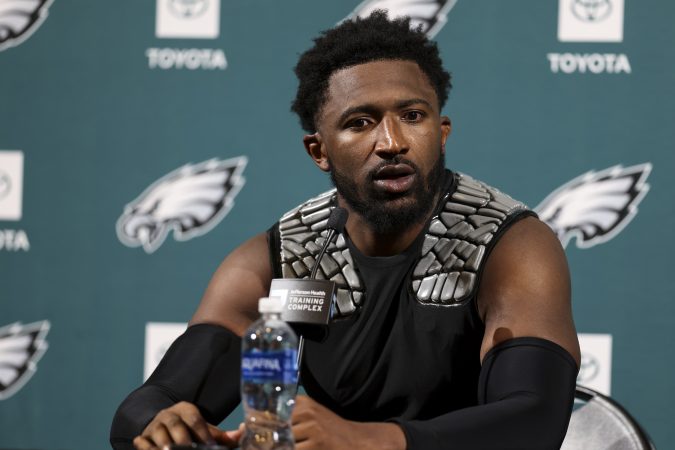
    Edge rusher Jonathan Greenard said he “feels good” after missing all of training camp with an injury, though he’s still unsure if he’ll be ready for Sunday’s Week 1 game vs. the Washington Commanders.

    Greenard, who practiced in a limited capacity on Wednesday and Thursday, confirmed that he did not need surgery after suffering the pectoral strain while lifting ahead of camp.

    “It’s one of those freak things,” Greenard said from his locker room stall Thursday. “Stuff happens and thank God I didn’t need surgery. Just a matter of just trying to work back in there, get it back to full strength.”

    Greenard wouldn’t tip his hand about his availability for Sunday, instead repeating “that’s up for [the Eagles coaching staff] to decide.” He emphasized that he’s improving after the injury.

    “I feel good, though. I will say, I feel I’m in a good spot,” Greenard said. “Just know that. I know that I’m working every day to continue to try to get this thing stronger. We’re close, I know that.”

    Greenard echoed the earlier words of defensive coordinator Vic Fangio, who noted the importance of the edge rusher getting up to game speed ahead of Thursday’s practice,

    “It’s day by day,” Fangio said. “He hasn’t practiced a whole lot yet, so we’ll be careful with that. There’s a minimal amount of real practice that you have to go through, especially for a guy coming off an injury. It’s like the guy [Aaron] Donald with the Rams. He’s just coming off rustiness, no injury, and he wasn’t ready this week. We’ll see.”

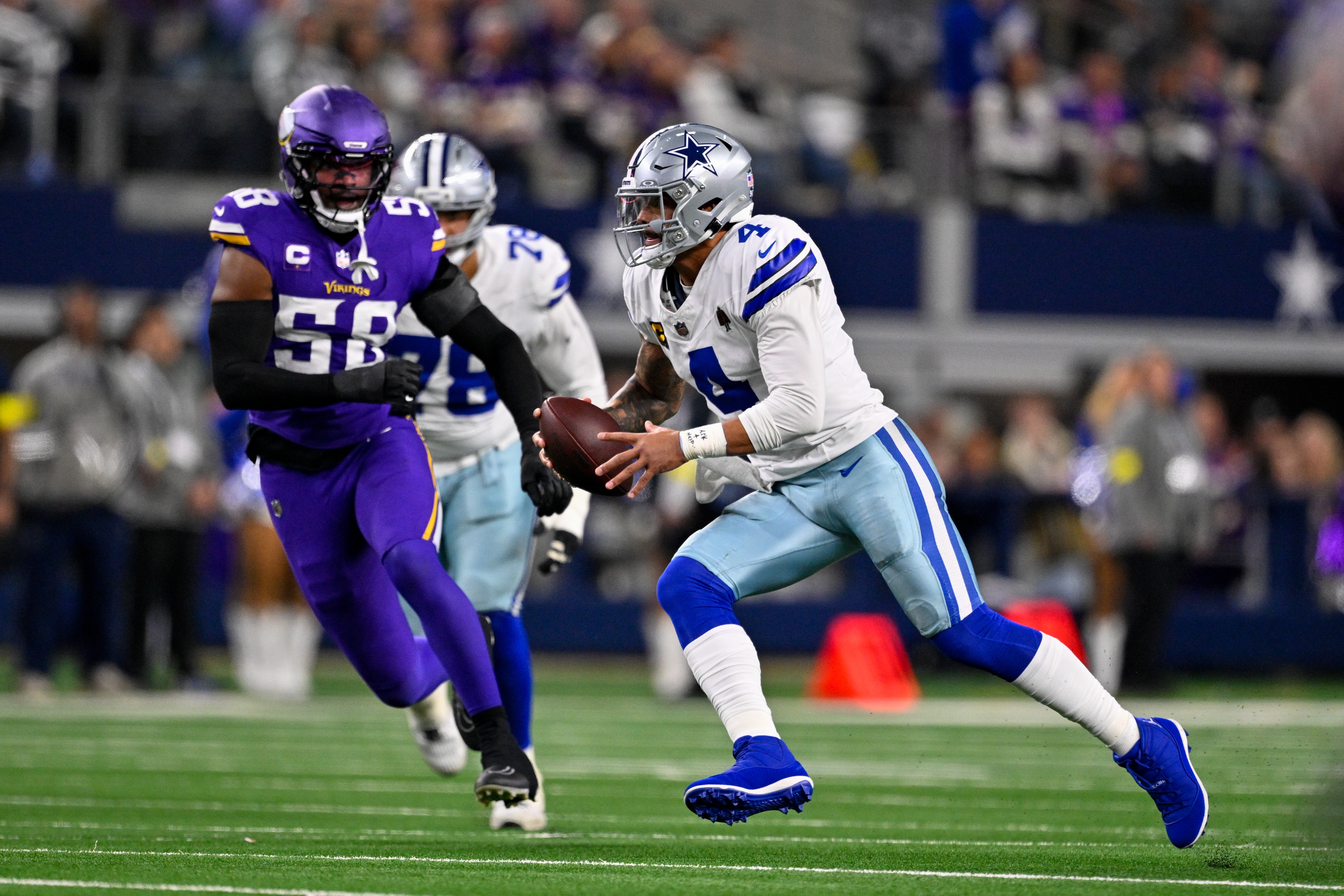
    Jonathan Greenard (58) last played in a game of any kind on Dec. 14, 2025 against the Cowboys. Jerome Miron / AP

    Greenard, 29, is a major piece for the Eagles’ defense. General manager Howie Roseman traded third-round picks in 2026 and 2027 for the star edge rusher on April 24. He then signed a four-year, $100 million contract that included $50 million guaranteed. They acquired him to fill the void left by Jaelan Phillips, who signed with the Carolina Panthers in free agency.

    Does Greenard feel like he’s comfortable with Fangio’s playbook, even if he might not be in game shape?

    “Yeah, it’s kind of similar to Flo [Vikings defensive coordinator Brian Flores] when I was in Minnesota,” said Greenard, who spent the last two seasons with the Vikings. “Just learning different terminology. You know, it’s English and Spanish, pretty much…
I’ve dropped before, I’ve covered people before, I’ve rushed. It’s still football, just a different terminology. I didn’t feel like it wasn’t that difficult to grasp the playbook.”

  • Sixers’ Jabari Walker promotes reading at South Philly elementary school: ‘It is powerful to read’

    Sixers’ Jabari Walker promotes reading at South Philly elementary school: ‘It is powerful to read’

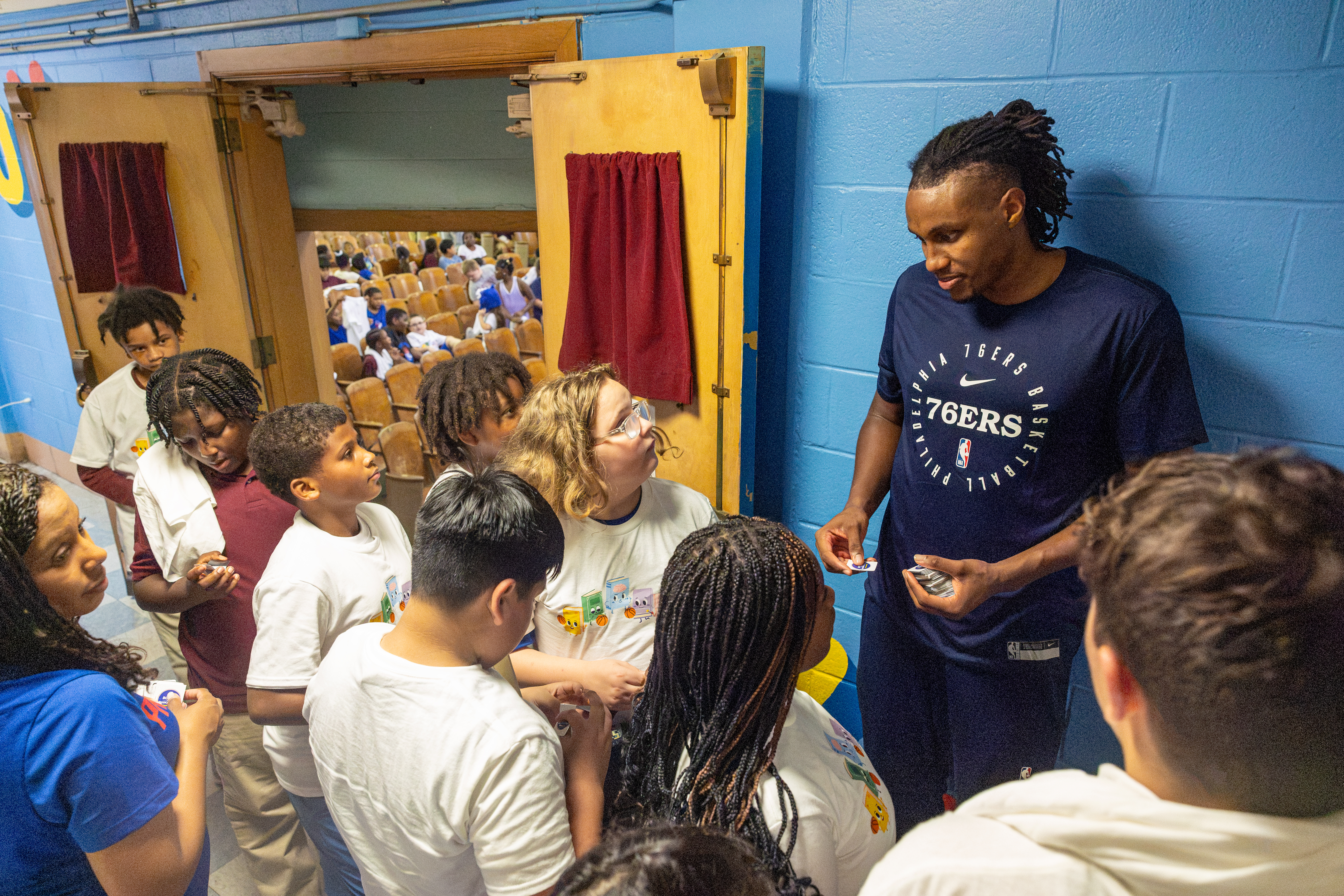
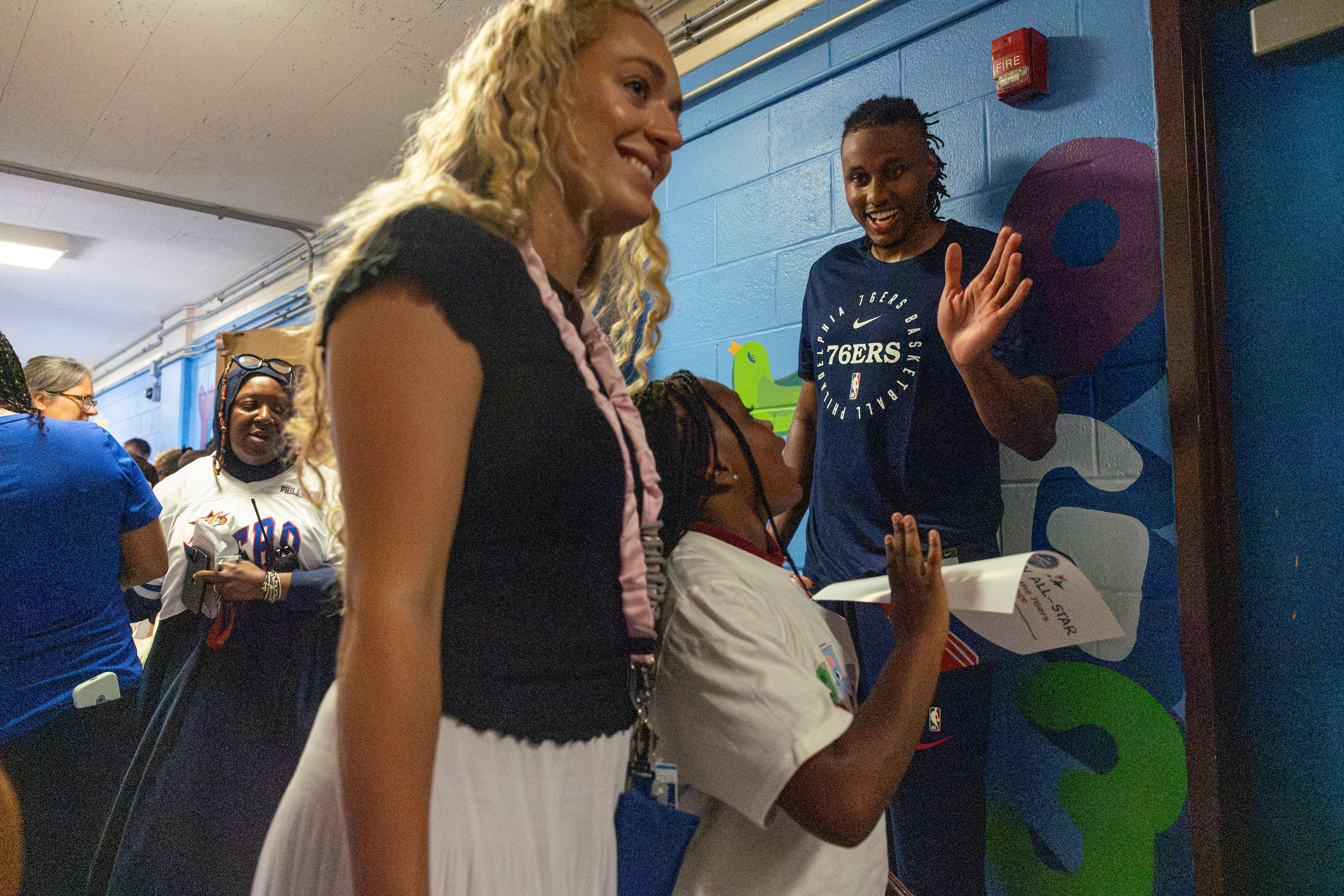
    Students filled Stephen Girard Elementary school’s auditorium in South Philly for a pep rally presented by the 76ers and Morgan & Morgan Law Firm on Thursday afternoon to promote reading among the youth.

    After a dance party with students to start the assembly, 200 children were treated to a surprise when Sixers forward Jabari Walker showed up as a guest reader to read Dog Breath: The Horrible Trouble with Hally Tosis.

    Walker and Sixers in-arena host, Lee Farrell, hosted a Q&A to discuss the importance of reading for the students.

    “I’m an athlete, and I lift every day to get stronger,” Walker told the students. “The brain is a muscle, so you have to train it every day. You have to get smarter.”

    Morgan & Morgan and the Sixers partnered last season and will do so again for the 2026-27 season for the Books & Basketball program, which included the Boards for Books. Morgan & Morgan donates $7.60 for every rebound the Sixers had during the season.

    A $15,000 donation was presented to the school for its library and reading program, while a $12,192 donation was made to BookSmiles, an organization that collects and distributes books to promote childhood literacy. The $27,000 total donation for the over 3,500 rebounds the Sixers had during the 2025-26 season is expected to equate over 20,000 books for students in the Philadelphia area.

    Hannah Molitoris, an attorney with Morgan & Morgan, said it’s especially important to get the next generation excited about reading because of the access they have to technology and social media.

    Jabari Walker shows the ending illustration of the children’s book ‘Dog Breath’ alongside Sixers in-game host Lee Farrell at Stephen Girard Elementary School on Thursday.Aidan T. Gallo / Staff Photographer

    “Whereas many people grew up with books in their hands, we see a lot of younger people these days growing up with cellphones and iPads in their hand,” Molitoris said. “So, to get a younger generation excited about reading and the benefits of reading will only serve all of us in the future.”

    Having an athlete like Walker there to further the message only helped.

    “I think that there is a misconception that if you like to read and you’re an avid reader, then that means that you’re a loser or a nerd,” Molitoris said. “I think hearing someone like Mr. Walker tell these children that it is OK and it is strong and it is powerful to read and to like to read, it’s like your hero telling you that it’s OK to be yourself.”

    Through BookSmiles, each child left the assembly with a free book and bookmark, which Walker helped hand out as they exited the auditorium. The students also received Basketball & Books T-shirts before the pep rally.

    Although Walker said he’s unsure if he would have shared the same excitement as the students over reading when he was their age, he’s become “super passionate about” as an adult and appreciates how the program translates results on the court to a positive outcome for kids in the area, giving him “extra motivation.” Walker said he currently prefers the self-help genre and books that teach financial literacy, but he related to the students over his love for the Diary of a Wimpy Kid books.

    Jabari Walker waves goodbye to an elementary school students after Thursday’s pep rally.Aidan T. Gallo / Staff Photographer

    Being able to see the students’ excitement in person and make this connection face-to-face is something that Walker said made the experience “even more special.”

    “They could watch a video or this could be over Zoom, but I don’t think it hits the same,” Walker said. “For me to take my time and come here, I think it rubs off, and they understand that. So now they all have a personal connection with me, and I’m glad.”

  • Members of Congress tour EMR in Camden, push for oversight of fire-causing lithium-ion batteries

    Members of Congress tour EMR in Camden, push for oversight of fire-causing lithium-ion batteries

    Two New Jersey Congress members appeared alongside EMR’s CEO on Thursday to call for more oversight on lithium-ion batteries, which the company blames for causing fires at its Camden scrap metal site.

    U.S. Rep. Donald Norcross, a Camden Democrat, introduced the Battery Fire Prevention Act nearly a year ago, inspired by fires at the Camden facility. But it hasn’t made progress in the Republican-dominated Congress. He toured the EMR site Thursday with U.S. Rep. Frank Pallone Jr., of Monmouth County, the top Democrat on the House Energy and Commerce Committee.

    “Today it’s Camden. Yesterday was North Carolina and Minnesota. It’s literally all 50 states and quite frankly, a global problem,” Norcross said of lithium-ion battery fires.

    “The United States Congress has failed in this,” he added. “When we understand that China is more progressive in finding batteries in their waste streams, you know we have a big problem.”

    Standing in front of gigantic piles of old household appliances, damaged cars, and other kinds of scrap metal with a view of the Philadelphia skyline, Norcross said his bill will advance once Pallone becomes committee chair in the coming months — if Democrats win back the House in this year’s midterm elections.

    The bill would create a 30% tax credit for waste and recycling companies to purchase technology to help identify lithium-ion batteries and a 5% tax on the sale of lithium-ion batteries. It would also direct the Department of Energy and the Environmental Protection Agency to develop a battery buyback program. Using money from the battery tax, the program would award grants to facilities — like schools, local governments, or recycling plants — to collect batteries from consumers, who would get paid for returning their batteries. Those batteries would then be properly disposed of or recycled.

    EMR’s machinery separates and shreds large pieces of metal and spits them out into new piles of knuckle-sized scrap. Lithium-ion batteries, which are found in everyday technology like phones, watches, and e-bikes, aren’t supposed to land at the site but end up in the waste streams anyway.

    A crane at the EMR scrap metal shredding site in Camden on Thursday.Aliya Schneider / Staff

    Joe Balzano, the CEO of EMR Metal Recycling USA, said that the company has mechanisms to detect batteries that are about to burst, but the technology that identifies the batteries in the first place that he could apply at his site hasn’t been invented yet. Instead, employees sort through objects and set aside items that could have the batteries, which are prone to catching on fire if they become damaged or overheated. Those fires can spew out of control when hidden in a giant pile of metal.

    Norcross said research to solve this problem is currently underway.

    “Necessity is the mother of invention, so I’m hoping that invention comes quick,” Balzano said in an interview.

    While suppliers and workers have gotten better at detecting items with the batteries, “things that didn’t have a battery yesterday have a battery today,” he said.

    Part of the issue is there isn’t an obvious way for consumers to easily dispose of these batteries, so they end up in the trash or on the curbs, he said.

    “They get picked up by peddler scrappers, or they enter into the municipality waste streams, and then they make themselves through the recycling process, and they come here,” Balzano said.

    Frustrated residents who have suffered the impacts of repeated fires at the site have called for the closing of EMR in Camden. The facility temporarily shuttered earlier this summer and the company entered a legal battle with the city before a judge allowed the site to reopen.

    Norcross, who appeared alongside Balzano on Thursday, said shutting down EMR in Camden won’t solve the core problem.

    “If this disappears tomorrow, it goes to the next community, and then they’ll be fighting the same thing,” Norcross said in an interview. “So we want to fix the problem before it turns into a fire.”

    Pallone said another bill in his committee that would create federal waste rules for recycling lithium-ion batteries has bipartisan support. He said seeing the site firsthand helped him understand the issue.

    “The batteries come here, they’re essentially coming in secret,” he said.

    Norcross pointed a finger at the corporations that manufacture the batteries for not taking a proactive role in preventing improper disposal.

    “The manufacturers of batteries can’t walk away from the problem of just selling their product, and it ends up wherever it does, causing fires,” the lawmaker said.