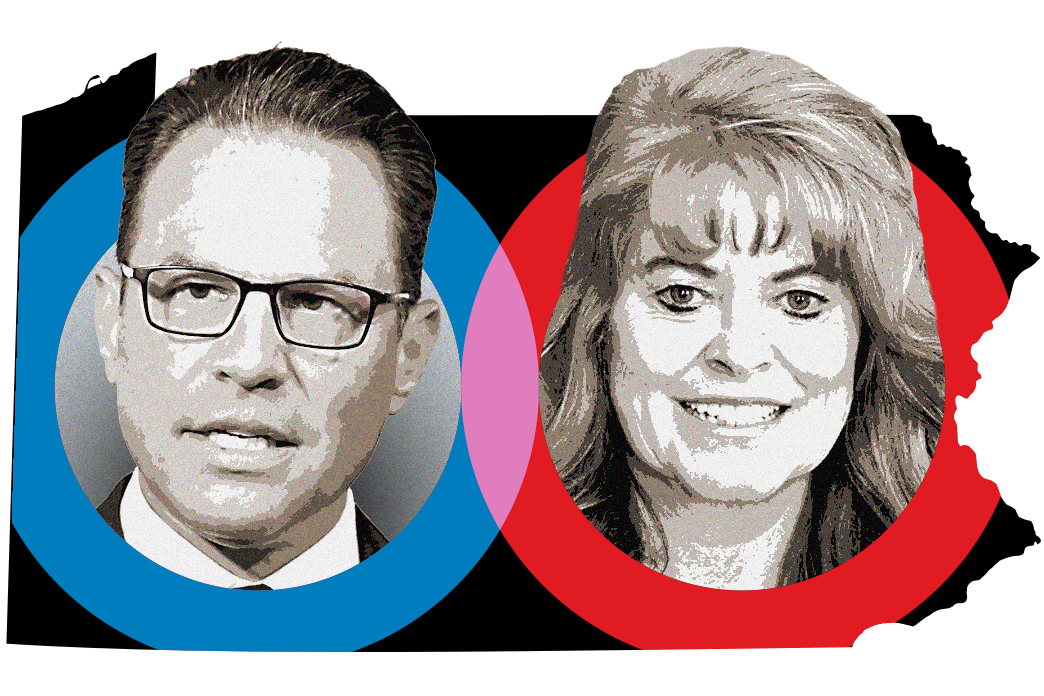
In a video shared to his social media platform on Friday, President Donald Trump reinforced his endorsement for Republican Stacy Garrity in her bid for Pennsylvania governor, while panning Democratic Gov. Josh Shapiro as an incumbent “who does not have what it takes.”
“Stacy has been really special [and] has my complete and total endorsement,” Trump said in the video, posted Friday afternoon to Truth Social, praising her tenure as the state’s treasurer and applauding her military service and career in business. “She’s somebody that is going to do a fantastic job.”
The video was posted in a string of more than a dozen similar endorsements on Friday afternoon for Republican congressional candidates in Alaska, Florida, Georgia, Michigan, North Carolina, and Texas.
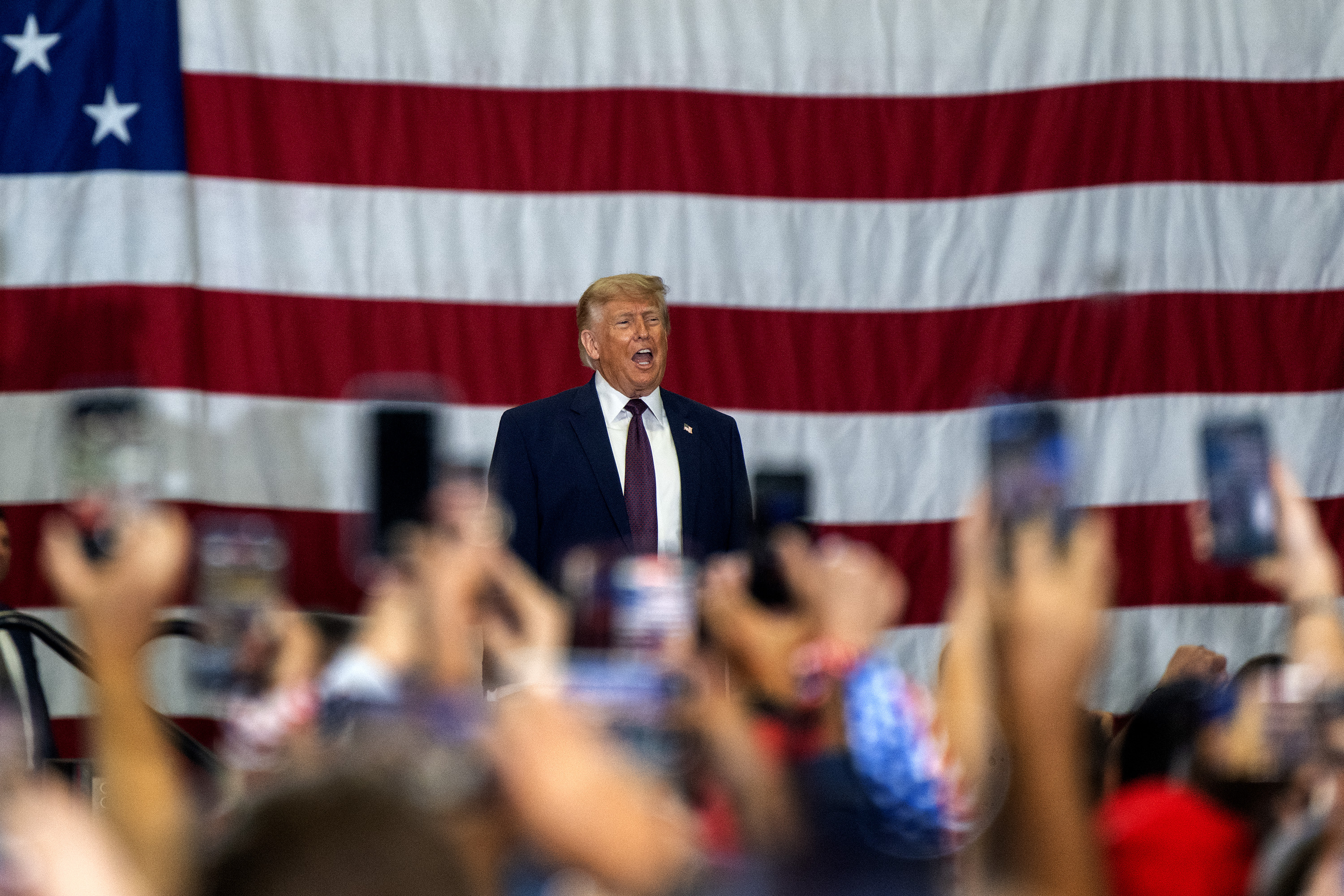
President Donald Trump visits Mack Trucks in Macungie in the Lehigh Valley Tuesday, June 23, 2026.Tom Gralish / Staff Photographer
Trump followed the endorsement videos on Truth Social with a post about his approval ratings, and another post featuring a video touting his own accomplishments in office. The endorsement blitz came less than seven weeks before the Nov. 3 midterm elections, in which Democrats are vying to retake control of Congress.
In Pennsylvania, Shapiro — who has maintained a double-digit lead over Garrity in multiple public polls and has a commanding fundraising advantage — is seeking to use his advantage to secure Democratic wins in four nationally watched congressional seats, and to flip the state Senate to Democratic control for the first time in more than 30 years.
In the video Friday, Trump swiped at Shapiro, who is viewed as a likely contender for the 2028 presidency and who has been critical of the president’s administration.
“Your current governor does not have what it takes,” Trump said. “His reputation is far better than he is — that I can tell you and everyone knows it.”
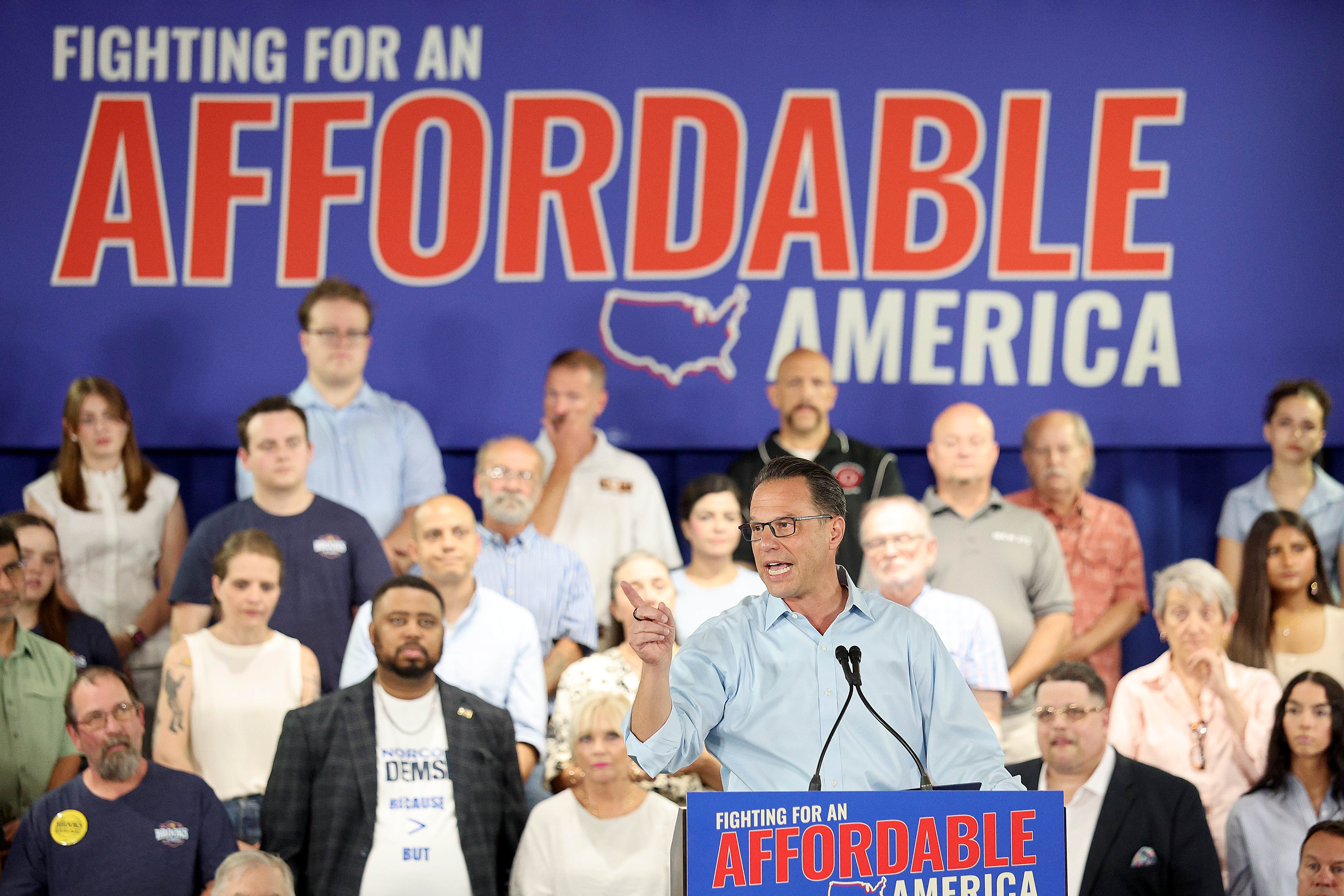
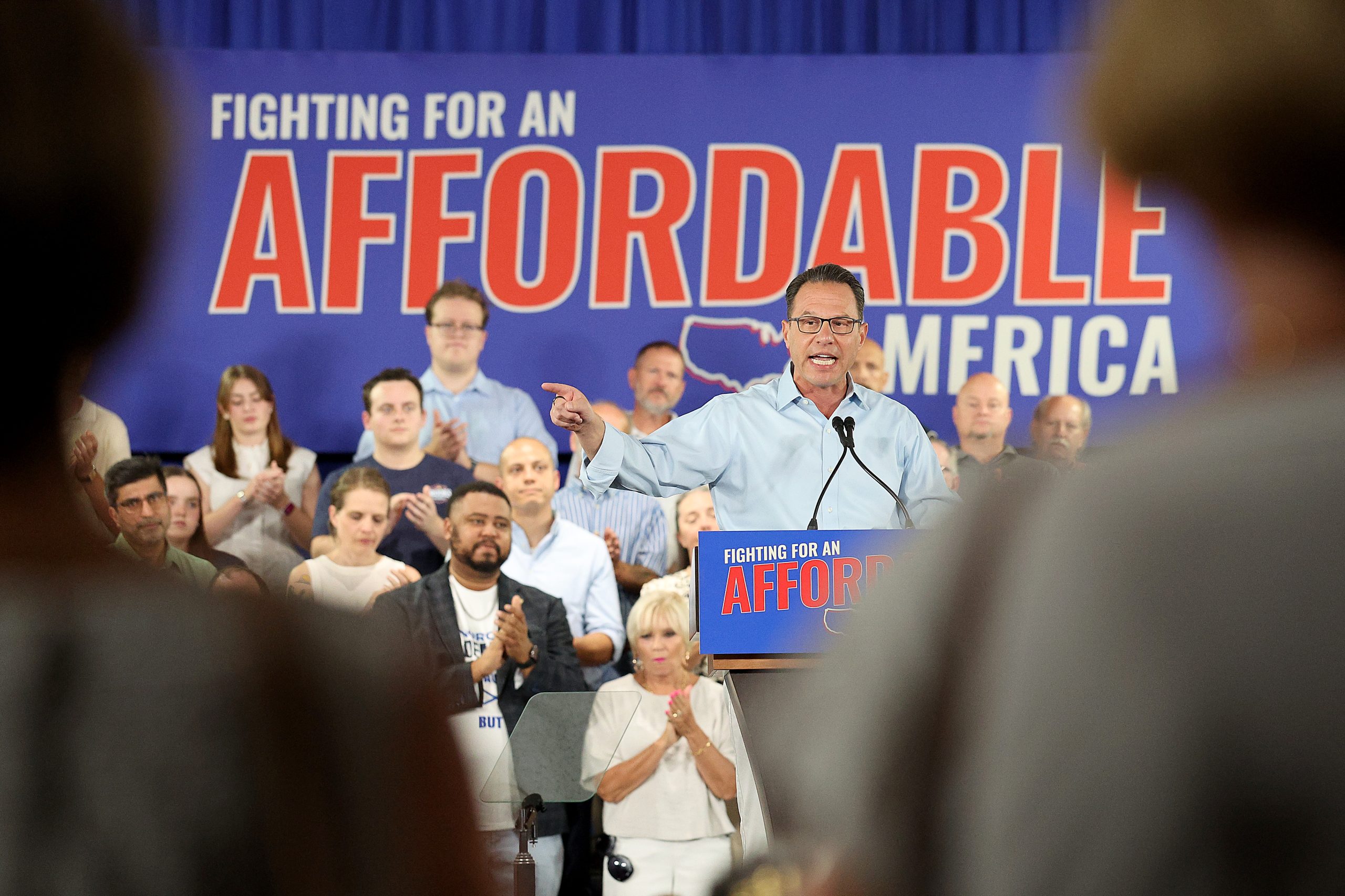
Gov. Josh Shapiro addresses the audience during a rally for congressional candidate Bob Brooks at the United Steelworkers Union Hall in Bethlehem, Pa. on Sunday, July 26, 2026.David Maialetti / Staff Photographer
It remains to be seen whether Garrity will receive additional national support or financial backing in the weeks before the election.
In June, he seemed to forget her altogether duringa speech in Macungie, Pa., where he celebrated Republican U.S. Rep. Dan Meuser and even name-checked Shapiro but did not mention Garrity.
On Friday, Trump said Garrity “will work tirelessly to grow Pennsylvania’s economy, cut your taxes, slash regulation and bring jobs, opportunity, and wealth to the Commonwealth of Pennsylvania.”
A spokesperson for Garrity did not immediately respond to a request for comment about Trump’s video, but she reposted his endorsement video on her X account.
Gov. Josh Shapiro is dominating Pennsylvania’s media markets in his reelection campaign, spending more than $24 million with less than seven weeks left until the Nov. 3 election — and trouncing his GOP challenger, State Treasurer Stacy Garrity, who has spent a small fraction of that on ads.
Shapiro, a Democrat seeking reelection and potentially a 2028 White House bid, has spent more than $2.4 million on advertisements per week since Aug. 25 from his campaign war chest of more than $50 million, according to media tracking firm AdImpact. One ad pitches Garrity as “Pennsylvania’s #1 fan ofdata centers,” and in another, Shapiro boasts about his efforts to cap energy costs. He has also released a number of audience-specific ads to reach Black and Latino voters, including a radio advertisement in Spanish in the Lehigh Valley.
A clearer picture of Shapiro’s full campaign haul will become public this week, with updated campaign financial filings due Tuesday. The last filing deadline for state candidates was in June. But Shapiro’s multimillion-dollar flurry of ad buys offers early insight into his strategy heading into November in a race where he holds a double-digit polling lead — and where he is hoping to achieve downballot wins in the statehouse and critical congressional districts.
Garrity has spent just $743,000 on ad buys so far, and paid out only $672 last week, according to AdImpact. No top GOP groups, such as the Republican Governors Association or the Jeffrey Yass-backed Commonwealth Leaders Fund, have purchased TV ads supporting Garrity, and she has struggled to fundraise to compete with Shapiro, a popular incumbent who has raised more money than any governor since at least 2010.
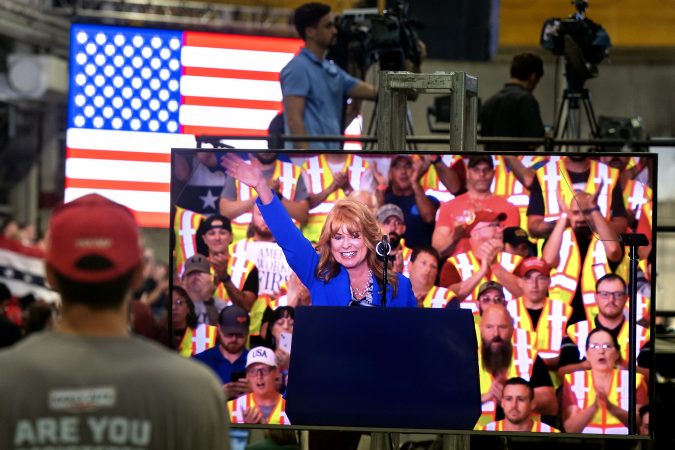
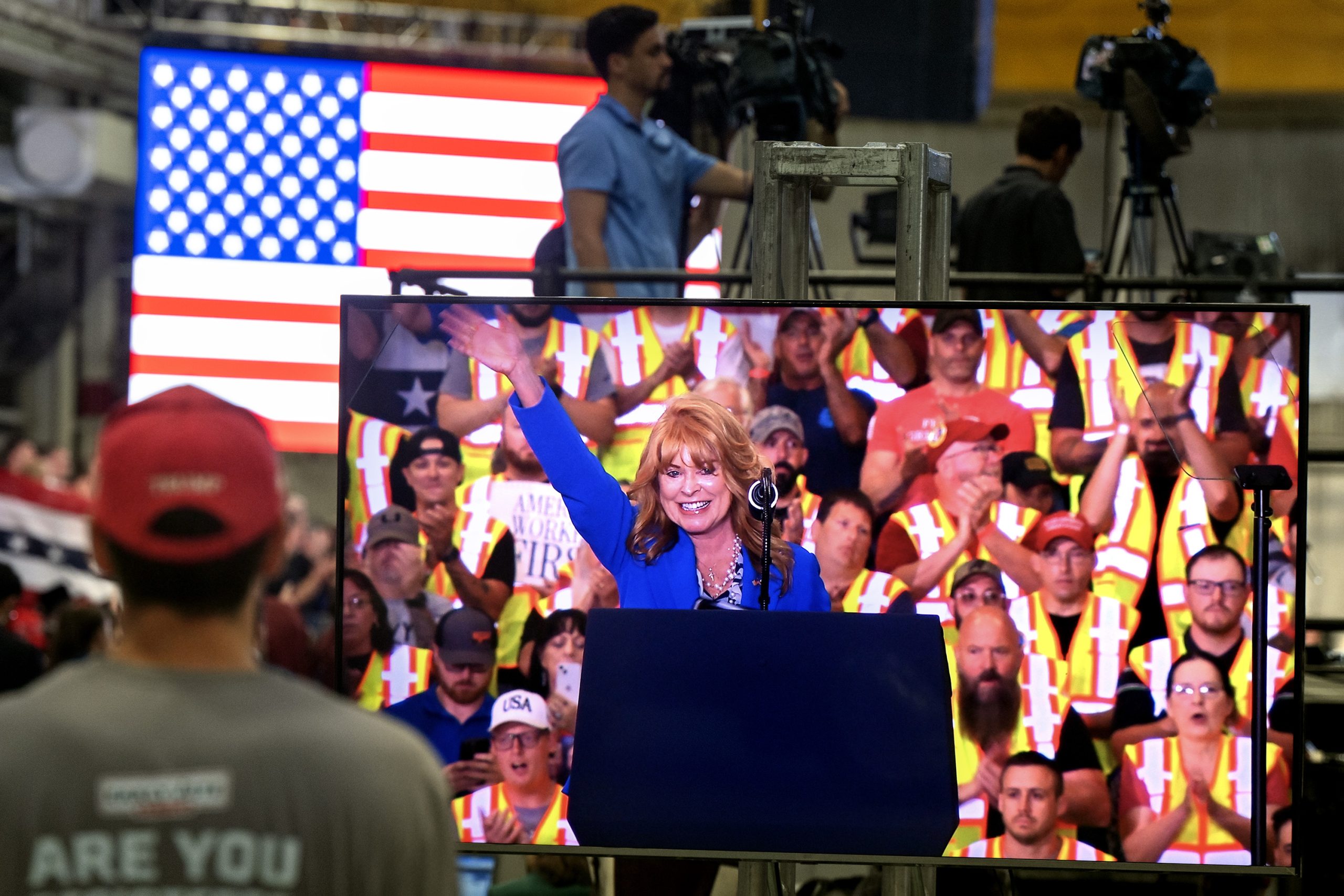
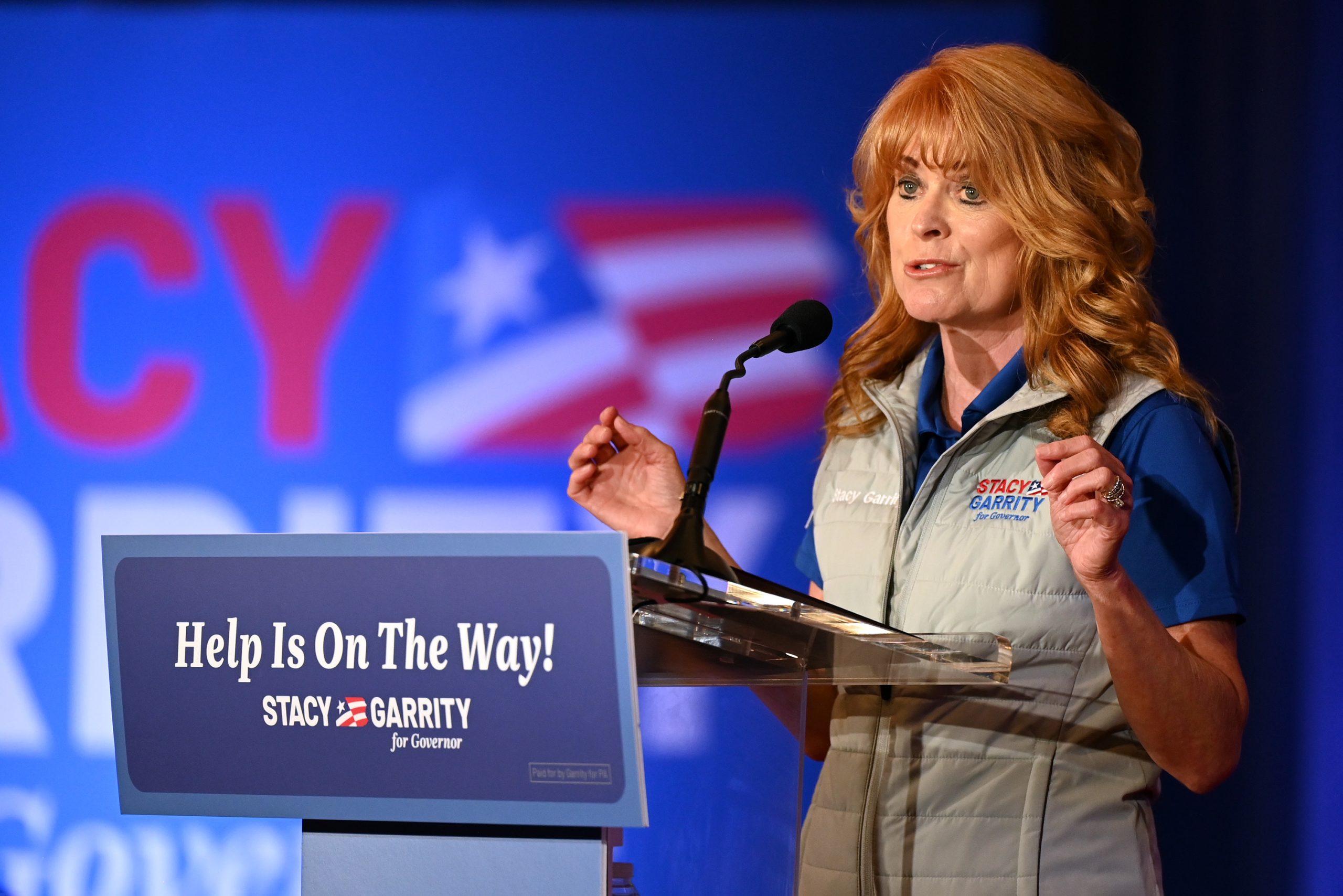
State Treasurer and Republican candidate for governor Stacy Garrity is seen on a big screen as she speaks to supporters before the arrival of President Donald Trump at Mack Trucks in Macungie Tuesday, June 23, 2026. Tom Gralish / Staff Photographer
Shapiro’s mass ad buys despite his commanding lead in the polls indicate the governor is a risk-averse politician, said Christopher Borick, a political science professor at Lehigh University.
“He’s cautious. He wants to make sure nothing goes awry, and to do that, you buy insurance,” Borick said.
“The governor has also been clear that the midterms run through Pennsylvania — and he is leading the fight to win critical races up and down the ballot in order to flip the House, put a check on Donald Trump’s chaos, cruelty, and corruption, and get even more stuff done,” said Manuel Bonder, a spokesperson for Shapiro’s campaign.
Garrity, meanwhile, has spent the lion’s share of her ad buys on a digital social media video campaign called “Twilight Justice,” which promises the future release of bombshell details about Shapiro. She has also released an attack ad about Shapiro’s past support for data centers, but it has been seen by far fewer eyes than those Shapiro is reaching in his multimillion-dollar ad campaigns. Both Shapiro and Garrity initially embraced data centers, though both shifted their positions as the projects became increasingly unpopular among Democrats and Republicans.
Matthew Beynon, a spokesperson for Garrity’s campaign, declined to comment on whether top GOP groups will get involved in the Pennsylvania governor’s race in the coming weeks. But he said any pro-Shapiro mailer or TV ad “is just another reminder to the people of Pennsylvania that Josh Shapiro sold them out.”
“All the money in the world will not help Josh Shapiro paint over his administration’s failed economic record or erase his ethics scandals that have cost the taxpayers of Pennsylvania and embarrassed the entire commonwealth,” Beynon added.
Data center power play
The regulation of data centers and artificial intelligence have become key issues in midterm races nationwide, including in the Pennsylvania governor’s race, where Shapiro’s past support for the projects appeared to be the biggest test of his popularity.
Shapiro changed his position last month and subsequently began running attack ads against Garrity for her past support of the unpopular centers. Garrity has also changed her position, from initially advocating for the rapid development of data centers around Pennsylvania to now calling for “a pause” on their development. Shapiro, in an executive order signed last month, will now require any prospective data center developers to meet a number of environmental and energy factors in order to build in Pennsylvania.
“That’s why you’ve seen this enormous ad buy that she can’t even come close to matching, when, in reality, he’s as exposed as her on the issue, but she doesn’t have the resources,” Borick said.
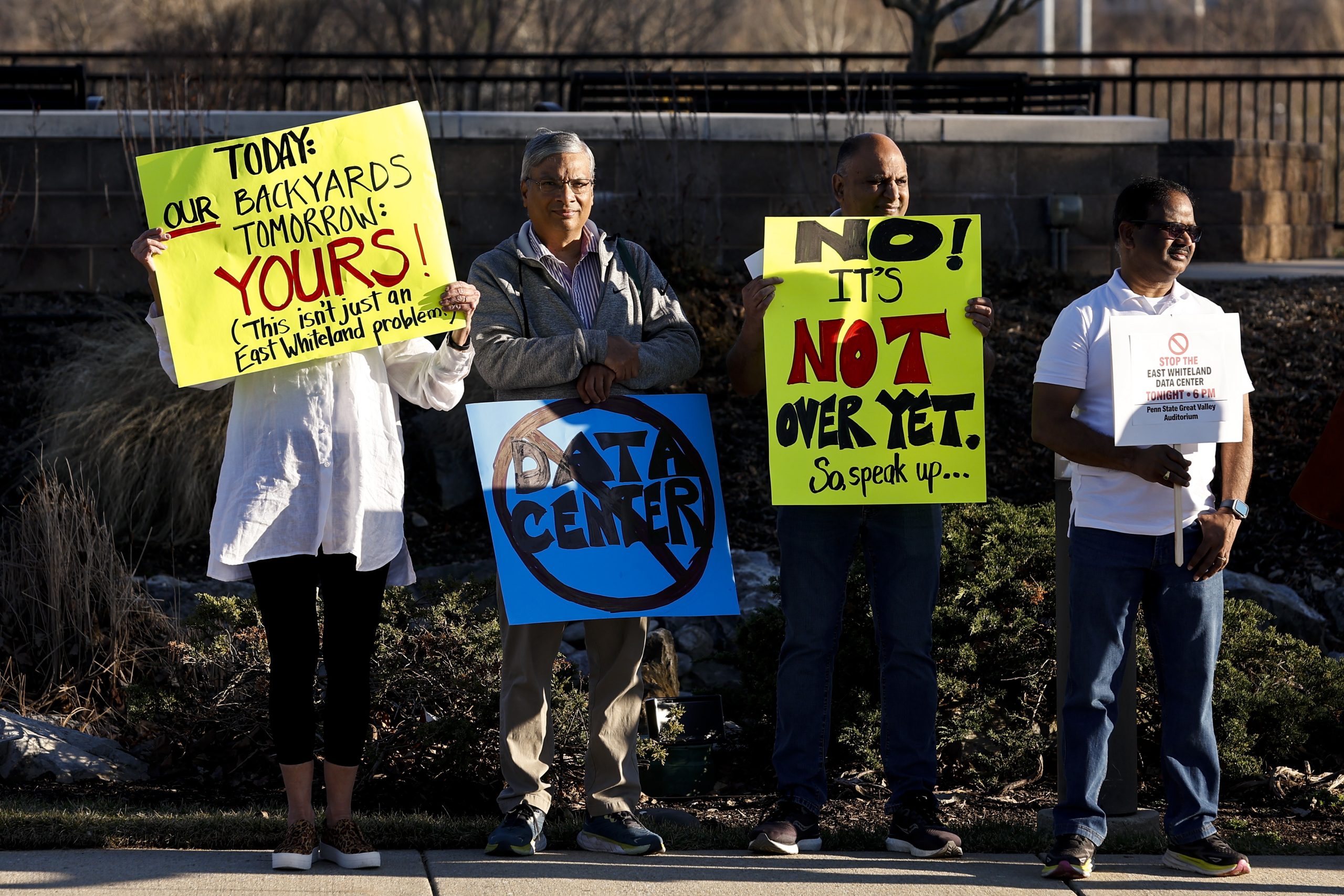
People protest the expanded data center before the East Whiteland Planning Commission meeting held at Penn State Great Valley on Monday, March 9, 2026 in Malvern, Pa.
Pennsylvania Republicans endorsed Garrity in September 2025 — an unprecedented early nod that helped clear the field for her as the party’s nominee. President Donald Trump endorsed her in January, calling her an “America First Patriot.” She ran unopposed in the primary election, and top GOP leaders said they wanted to wage a stronger fight against Shapiro this time than in 2022, when far-right State Sen. Doug Mastriano (R., Franklin) won the endorsement in a crowded field and the state GOP largely did not financially support his candidacy.
Despite all of the additional time to drum up support, Garrity has struggled to raise funds and has yet to be able to cash in on Trump’s backing. As of Thursday, she had spent just $300,000 more than Mastriano had at this point in the race. Shapiro, meanwhile, has spent less this election than he did at the same point in 2022, when he spent $28 million as of mid-September.
“When you’re making comparisons to the amount of money Doug Mastriano raised, it’s a really troubling sign,” Borick added.
In what might have been unheard of just two years ago, the Democrat in Bucks County’s key congressionalrace does not mention abortion or reproductive rights by name on hiscampaign website.
Instead, Bob Harvie, the county commissioner challenging U.S. Rep. Brian Fitzpatrick (R., Bucks) in the crucial 1st Congressional District race, largely highlights affordability issues, like tax cuts for the middle class and raising the minimum wage, on his list of 12 priorities.
It’s not that Harvie is suddenly against abortion — he has been vocal about his support forreproductive rights — but it exemplifies a broader shift in how Democrats are fine-tuning their message for must-win races in the county this fall.
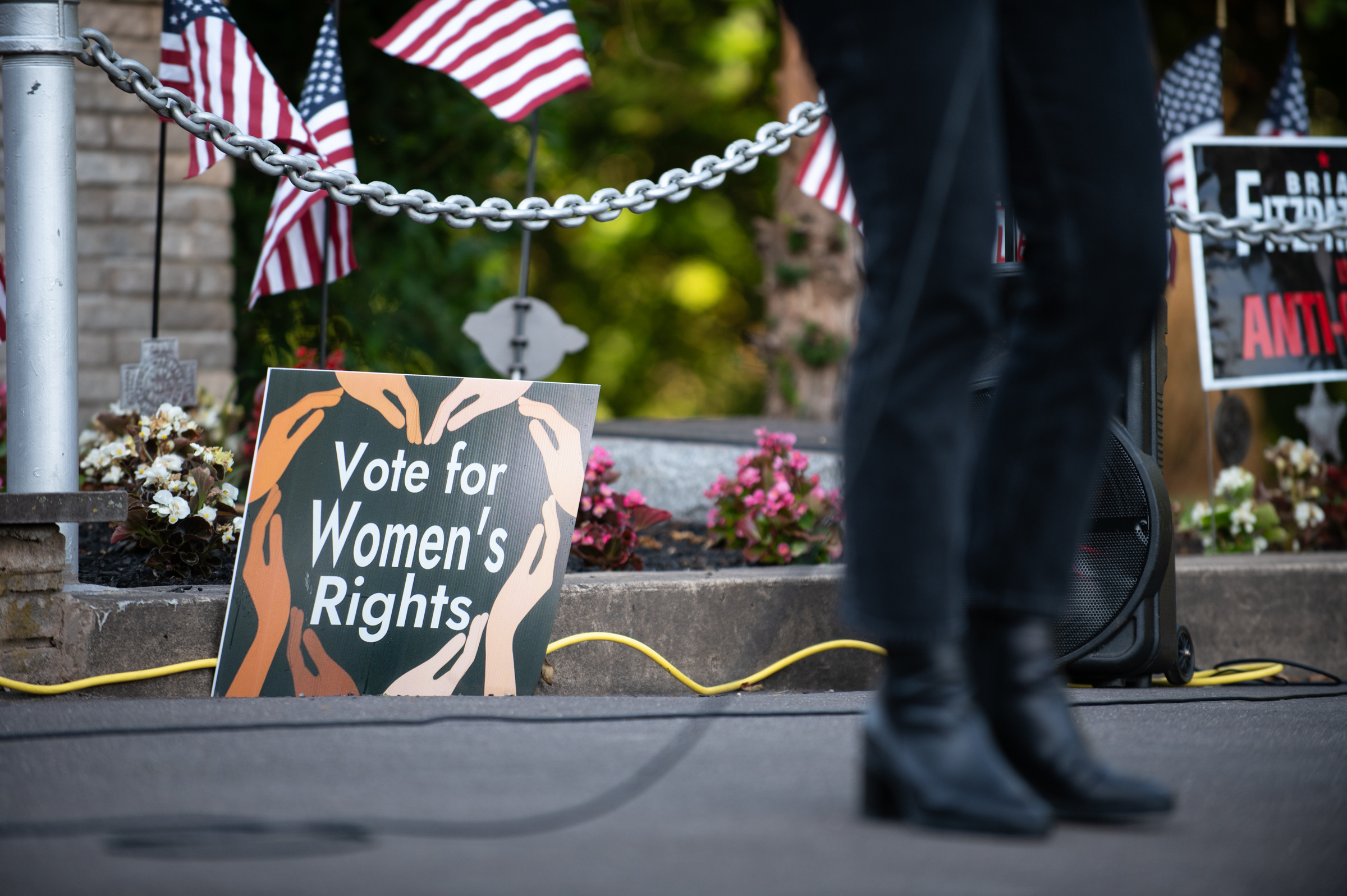
Once a top-line issue for Democratic candidates in Bucks — one of theswingiest counties in Pennsylvania — discussion of abortion and reproductive rights has faded into the background in local political campaigns in favor of issues related to the economy and the cost of living.
“People [are]feeling that right now they’re living in an America that’s not fair for them,” Harvie said.
The issue has also been so far been absent from Fitzpatrick’s campaign and his website. The Republican currently holds a moderate view on abortion, though he has previously voted for restrictions.
For Harvie, discussions surrounding access to affordable healthcare — which is his No. 1 listed campaign priority — includes abortion. All of these issues reflect a broader struggle, he argued.
“They’re losing their rights, they’re losing their power over their own futures, they’re losing the American dream, all of that is combined,” Harvie said.
It’sa noticeable shift from Fitzpatrick’s last challenger Ashley Ehasz’s strategy in 2022 and 2024 whenabortion and reproductive rights served as the focal point in both of her campaigns, which followed thebacklash to the U.S. Supreme Court’s decision to strike down Roe v. Wade in 2022.
“Folks are pretty pragmatic when it comes to the politics here, and if something isn’t working, we’re not going to just keep doing it over and over again,” said Kierstyn Zolfo, co-leader of the progressive group Indivisible Bucks County, which supported Ehasz and is now backing Harvie.
Pennsylvania voters’ overwhelming disapproval of President Donald Trump and his handling of economic-related issues, as highlighted in a recent Inquirer/New York Times/Siena University poll, offers Democrats an opportunity as they target key state Senate seats in addition to the congressional contest.
“The point is to move the needle with the voters,” Zolfo said.
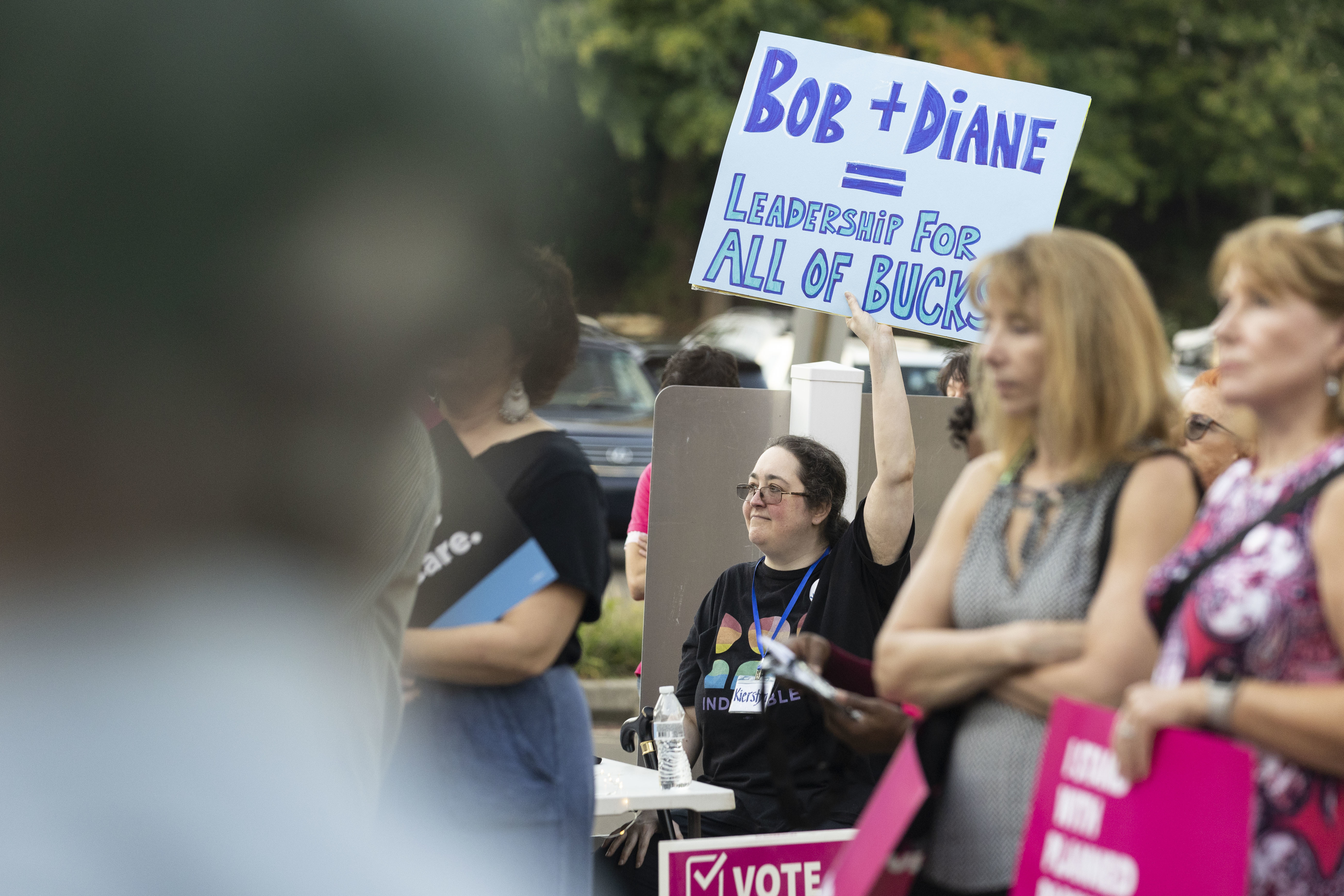
Kierstyn Zolfo, from Indivisible Bucks County, holds a sign that reads “Bob + Diane = Leadership for All of Bucks,” during a rally outside of the Middletown Township Police Department and Administrative Offices in Langhorne on Oct. 5, 2023. Harvie was running for county commissioner.Monica Herndon / Staff Photographer
How abortion became a ‘dormant’ issue in the midterms
The League of Women Voters of Pennsylvania has thousands of volunteers and members talking to voters across the state ahead of the midterm elections.
And leaders of the nonpartisan organization are hearing very little about reproductive rights. Instead, they’re getting feedback on crucial cost-of-living issues and concerns about democracy.
Abortion has become a “dormant” issue, said Amy Widestrom, executive director of the League of Women Voters of Pennsylvania.
“Nobody’s coming to us saying I need talking points on reproductive health in Pennsylvania,” Widestrom said.
The shift reflects a national trend, with ads related to abortion drastically receding amid Democrats’ focus on bread-and-butter issues, NOTUS reported.
The midterms are mainly about serving as a “referendum” on Trump’s economic agenda and foreign policy, said State Sen. Steve Santarsiero, chair of the Bucks County Democrats, though reproductive rights “must always be a central plank” of the party and its candidates, noting that majority of the country support a woman’s right to choose.
“Affordability is really the key issue, so you would expect candidates to talk about that, and then you know they’re obviously going to talk about other issues as well, and abortion rights would be one of those,” said Santarsiero, who is also up for reelection this year.
In The Inquirer/New York Times/Siena poll, Pennsylvania’s likely voters in November’s gubernatorial election between Shapiro and Republican challenger Stacy Garrity indicated that the economy and the cost of living were the two most important issues.
Abortion was ranked fourth.
Democrat Eileen Hartnett Albillar, a social worker and the county’s clerk of courts who is running to unseat state Sen. Frank Farry in the 6th state Senate district, said she doesn’t see abortion and the economy as “competing issues,” though conversations with voters have primarily focused on making ends meet. People, she said, will engage in discussion over protecting abortion rights and related topics if she raises the issue.
“They want to protect reproductive freedom,” Hartnett Albillar said. “But you know, the cost of living is just so incredibly crushing for so many people. Just because they’re quiet about it, doesn’t mean it’s not important.”
Reproductive rights took center stage in the 2022 election after several GOP-led states enacted restrictions on abortion following the Supreme Court’s decision to overturn Roe v. Wade.
In Pennsylvania, the issue helped motivate voters to turn out for Democrats Josh Shapiro and John Fetterman in the contests for governor and Senate. But as the procedure remains protected in the state under Shapiro, the topic has faded from focus.
Lehigh County Controller Mark Pinsley, a Democrat who is challenging GOP State Sen. Jarrett Coleman in the 16th district straddling Bucks and Lehigh Counties, still believes reproductive rights can motivate voters. But while he thinkshis party doesn’t talk about abortion enough, he acknowledged the dynamic is different now than it was then.
“I think you could win on that issue by itself,” Pinsley said. “I don’t think that’s true in the moment.”
Brianna Twofoot, vice president of organizing, elections and campaigns at Planned Parenthood Votes, said abortion and reproductive rights still matter to voters even if it’s not taking center stage this year.
“We’re not asking for anyone to make abortion or reproductive healthcare the number one issue, but we do think that voters want to hear about it,”Twofoot said. “And we do think that elected officials should be standing publicly on the issue.”
But any discussion of abortion will come amid what’s shaping up to be an apparent rebrand of the topic, folded into conversations about access to basic needs.
Signe Espinoza, executive director at Planned Parenthood Pennsylvania Advocates, said it’s key to look at reproductive rights through the lens of affordability, especially if health centers are defunded or closed.
“If Planned Parenthood doors close, where are you going to get your healthcare?” said Espinoza, whose organization is planning some days-of-action in Bucks. “It’s going to become more expensive. Everything’s going up.”
Bucks County Commissioner Bob Harvie hosts a veterans roundtable in May at Middletown Township Building in Langhorne.
How is the issue playing out in Harvie vs. Fitzpatrick?
Past elections in the Bucks County swing district have shown the abortion argument does not work against Fitzpatrick, who has been known to survive blue wave after blue wave.
Harvie, a twice-elected county commissioner backed by groups like Reproductive Freedom For All and Planned Parenthood Action Fund, said voters in the district already know where he and Fitzpatrick stand on abortion. The Democrat criticized Fitzpatrick and the Republican Party for supporting “pretty extreme restrictions on abortion.”
“I think that’s the reason why you’re not hearing it very much because everybody knows the positions and knows who’s on what side,” Harvie said.
Heather Roberts, a spokesperson for Fitzpatrick, said the Bucks County Republican has long supported “full reproductive freedom” for the first five to six months of pregnancy, as is outlined by Pennsylvania law.
“We also note that the Congressman’s position is the position held by the overwhelming majority of PA-1 residents,” Roberts said.
His campaign also noted Fitzpatrick’s backing of legislation in recent years that aimed to protect the right to cross state lines for an abortion as well as bills that protect access to contraception and in vitro fertilization and support of pregnant workers and women’s rights.
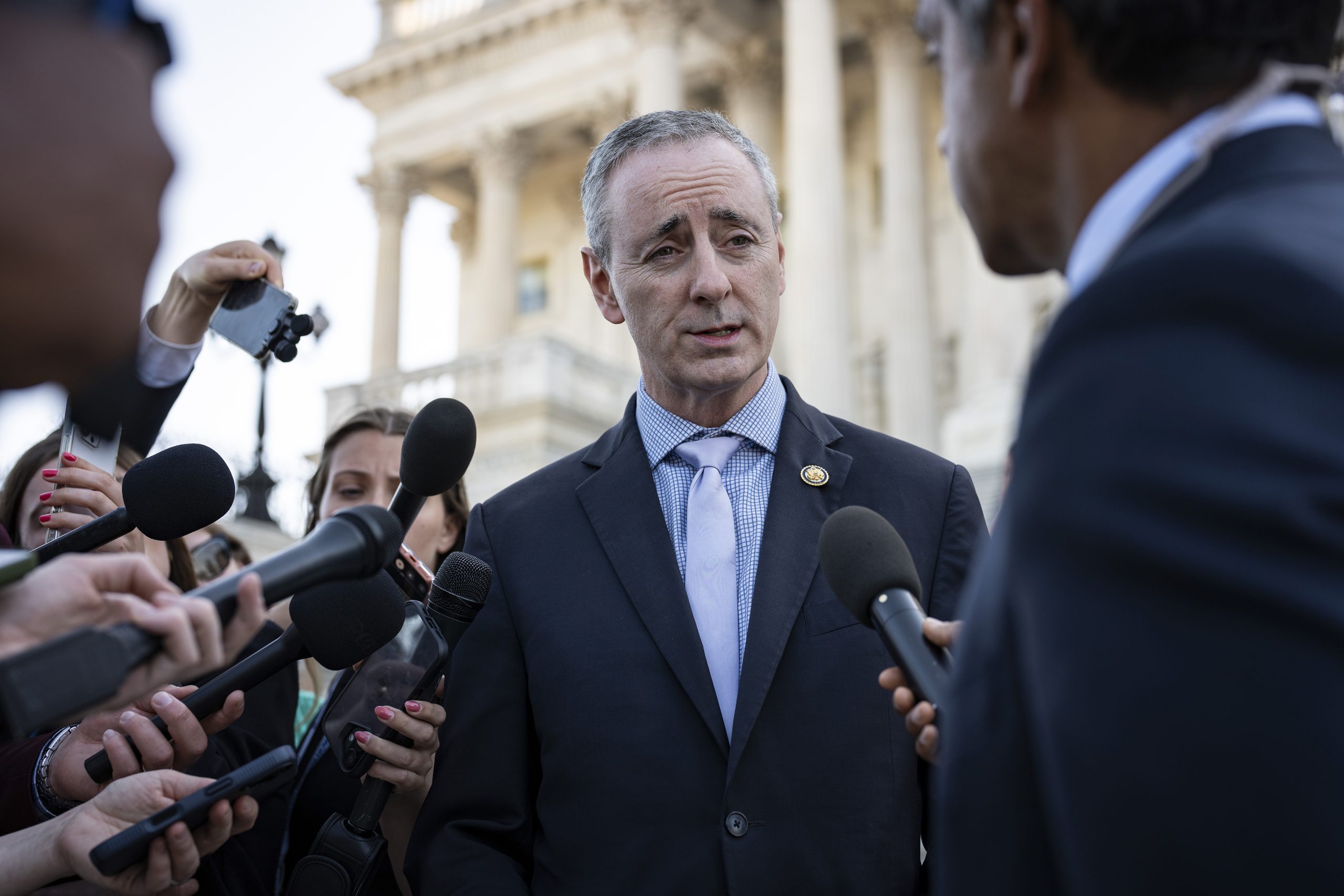
Rep. Brian Fitzpatrick (R., Pa.) speaks to reporters on June 3 on Capitol Hill after the House passed an Iran war powers resolution.
But he has also voted for abortion restrictions, including a 20-week abortion ban in 2017 and twice against the Women’s Health Protection Act, which would have codified protections to access abortion into law.
The issue is absent from Fitzpatrick’s campaign website, which does not reference abortion in sections about healthcare or empowering women.
Widestrom, the executive director of Pennsylvania’s League of Women Voters, said Fitzpatrick has found a way to “neutralize” issues related to his position on abortion by continuing to win races where his opponents wage such arguments and refraining from touting a “hardcore pro-life” agenda.
“By not staking a claim, by not talking about it, it loses saliency in voters’ minds,” Widestrom said.
Ben Hummer would like to own a house one day in Pittsburgh. He dreams of a two-bedroom, one-bathroom town house where he can live near his job.
But for now, Hummer, 29, rents his 500-square-foot, one-bedroom apartment, and his monthly rate since he moved in has continued to increase by $50 each year, making the goal seem further out of reach.
“Anything that could increase the supply and affordability of housing in the Pittsburgh area would be massive,” said Hummer, who works in human resources.
Like most voters in Pennsylvania, according to a recent poll from The Philadelphia Inquirer, the New York Times, and Siena University, the economy and cost-of-living concerns are the most important issues deciding Hummer’s vote in the 2026 governor’s race between incumbent Democratic Gov. Josh Shapiro and his Republican challenger, state Treasurer Stacy Garrity.
And as Election Day draws nearer, both campaigns are focusing their messaging on these kitchen table issues.
(function() { var l = function() { new pym.Parent( ‘nyt-afford__graphic’, ‘https://media.inquirer.com/storage/inquirer/ai2html/nyt-afford/index.html’); }; if(typeof(pym) === ‘undefined’) { var h = document.getElementsByTagName(‘head’)[0], s = document.createElement(‘script’); s.type = ‘text/javascript’; s.src = ‘https://pym.nprapps.org/pym.v1.min.js’; s.onload = l; h.appendChild(s); } else { l(); } })();
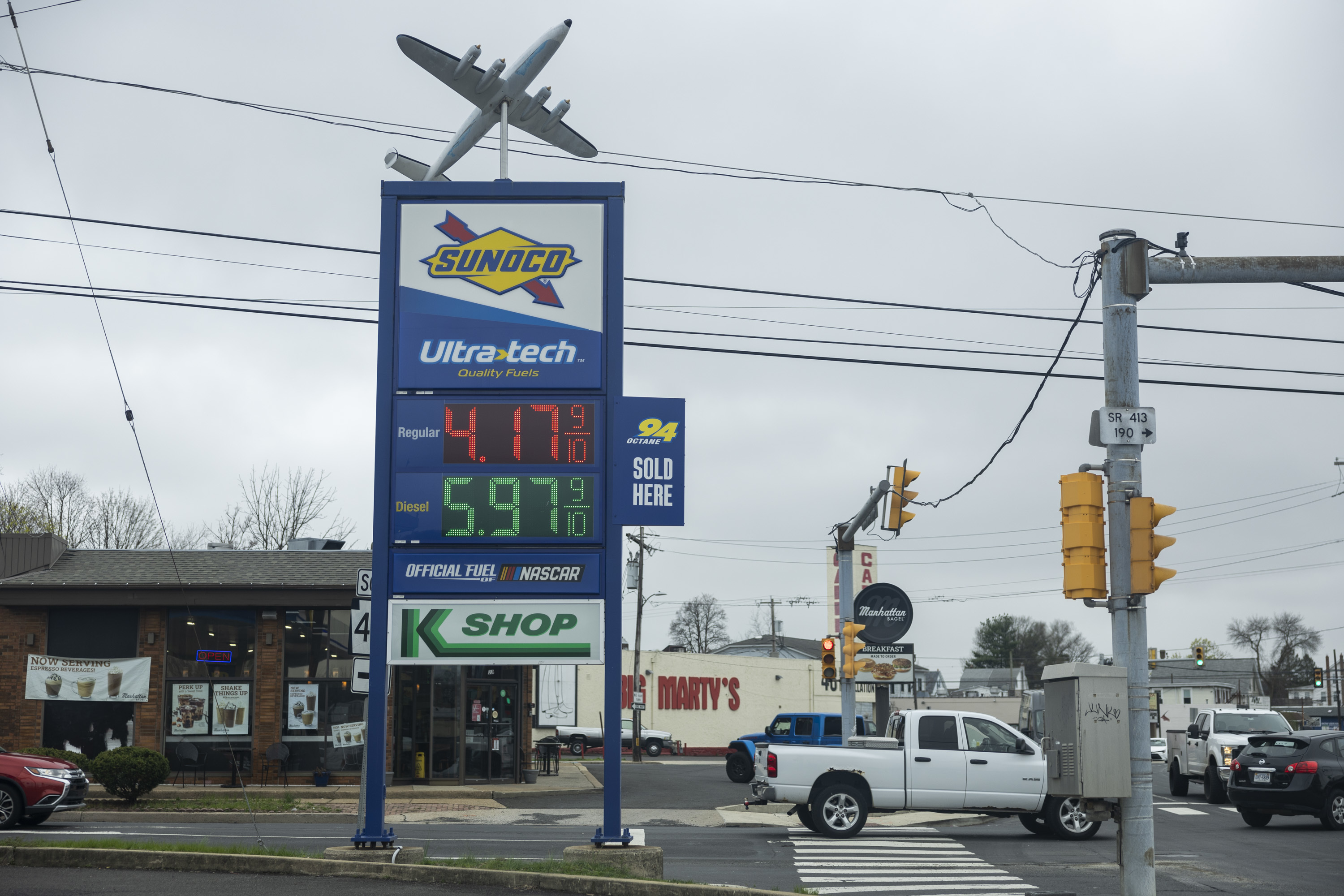
Two years ago, it was the cost of eggs, gas, and groceries that were top priorities among the electorate in Pennsylvania and elsewhere. Voters’ trust in President Donald Trump’s ability to bring down high prices propelled him back to the White House, sending Democrats scrambling to hone an affordability pitch that could land in time for the high-stakes 2026 midterm elections. But in that same time, prices have continued to climb; gas prices have topped $4 per gallon; and tariffs instituted by Trump — who called affordability “a hoax” at a Pennsylvania rally last year — have driven up the cost of every day life. Now both parties are latching on to a focus on affordability.
As he mounts a reelection campaign, Shapiro — who holds a commanding lead in polls — is highlighting his accomplishments during his first term that his campaign says has given Pennsylvanians more money back through tax cuts and wage increases for childcare workers.
Meanwhile, Garrity has recently shared her own plan, called “Turnaround PA,” to make living more affordable with an outline of how she’d lower prescription drug costs, reduce property taxes, and aim to cut energy bills to get there. But she’s also closely aligned with Trump, who has endorsed her in the race and has dismal markings from voters on two of their top priorities: the economy and cost of living.
(function(){function e(){window.addEventListener(`message`,function(e){if(e.data[`datawrapper-height`]!==void 0){var t=document.querySelectorAll(`iframe`);for(var n in e.data[`datawrapper-height`])for(var r=0,i;i=t[r];r++)if(i.contentWindow===e.source){var a=e.data[`datawrapper-height`][n]+`px`;i.style.height=a}}})}e()})();
That puts her in a difficult spot to challenge Shapiro, said Mark Zandi, the chief economist at Moody’s Analytics.
There’s no easy answer for Republicans to win on economic issues in the midterms, but Zandi said his best advice is to focus on what is in the governor’s control and draft ideas that mitigate the fallout from Trump’s policies.
Hummer, a Democrat who plans to vote for Shapiro this fall, said he trusts the governor to handle the economy and cost of living issues better. More than half of likely Pennsylvania voters in the Inquirer/New York Times/Siena poll agree.
Fifty-five percent said Shapiro would do a better job of handling the state’s economy, and 56% said they think Josh Shapiro would do a better job of handling cost-of-living issues.
“I’m well aware he’s limited in his options to do things, but I would say he’s kept a steady hand on the wheel of the Pennsylvania economy — to the extent that he can,” he said.
Garrity pitches affordability as Republicans seek to overcome Trump’s ratings
Among other proposals, Garrity has pitched a “first-time homebuyer assistance initiative,” which could help house seekers like Hummer and would provide qualified buyers 3% mortgage interest rate support from the state.
She also has proposed cutting taxes by seeking a constitutional amendment that exempts Pennsylvania seniors from paying school property taxes and gives voters the final say over whether to increase property taxes. Her plan would also “reprioritize state spending for property tax relief.”
State Treasurer and Republican candidate for governor Stacy Garrity holds a rally in Bucks County on Sept. 25, 2025, at the Newtown Sports & Events Center.
But there’s no free money, Zandi said. “If you’re giving tax cuts over here,” he said, “you’ve got to figure out how to pay for it … and that means you’re cutting spending.”
Garrity’s plan also would address rural healthcare, and she would “aggressively pursue available federal funding to strengthen rural healthcare.”
But there’s little money left in the pot after Trump cut government spending in last year’s federal budget. His One Big, Beautiful Bill Act directed a reduction in Medicaid spending by $1 trillion over 10 years, starting after the midterm elections, and rural hospitals and nursing homes are more dependent on federal funds. Additional dollars would likely need to come from Harrisburg.
For Pennsylvanians like Caitlyn Needham, 28, the consequences of an unexpected medical bill on top of a limited income meant she went without substantial meals for weeks.
“I have a rabbit, and she had a medical emergency [in November],” she said. “So for two months, the only thing I could afford to eat while paying off those bills was peanut butter and jelly sandwiches for breakfast, lunch, and dinner.”
Needham, a cake decorator in Pittsburgh, said she’s always been frugal and saved a little bit of money from each paycheck, but increasing expenses are pushing her budget to the limit. She said she plans to vote for Shapiro this November.
“Pennsylvanians need a relief valve before things get worse,” she said. “So many people are one bad week away from not being able to keep their housing, or losing their medical coverage, or losing their job because their car broke down and they can’t afford to get service. It’s like everyone is just one accident away from not being able to live.”
(function(){function e(){window.addEventListener(`message`,function(e){if(e.data[`datawrapper-height`]!==void 0){var t=document.querySelectorAll(`iframe`);for(var n in e.data[`datawrapper-height`])for(var r=0,i;i=t[r];r++)if(i.contentWindow===e.source){var a=e.data[`datawrapper-height`][n]+`px`;i.style.height=a}}})}e()})();
“If you’re trying to infer I’m out of line with the president, I don’t think I am,” she said last month during a news conference she held on data centers.
In a statement, she blasted Shapiro’s handling of the economy, saying he has put a tax burden on families and tied businesses up with unnecessary regulations.
“Josh Shapiro’s Pennsylvania is simply unaffordable for the commonwealth’s hardworking families,” Garrity said. “He allowed utility and energy costs to skyrocket due to his unwillingness to expand generation capacity and instituting policies that benefit our neighboring states instead of us.”
Shapiro emphasizes his record is separate from national picture
Shapiro, the incumbent, is leaning on his record on economic policy.
According to his campaign, his administration created more than 25,000 jobs during his first term and brought in $41 billion in private-sector investment.
“Governor Shapiro is fighting for all Pennsylvanians — and he has a track record of creating jobs and economic opportunity, putting money back in Pennsylvanians’ pockets, and standing up to Washington’s reckless, cost-raising policies,” said Samantha Reposa, a spokesperson for the campaign. Garrity, she said, “fully supports the failed economic policies that are raising costs and hurting working families across the commonwealth.”
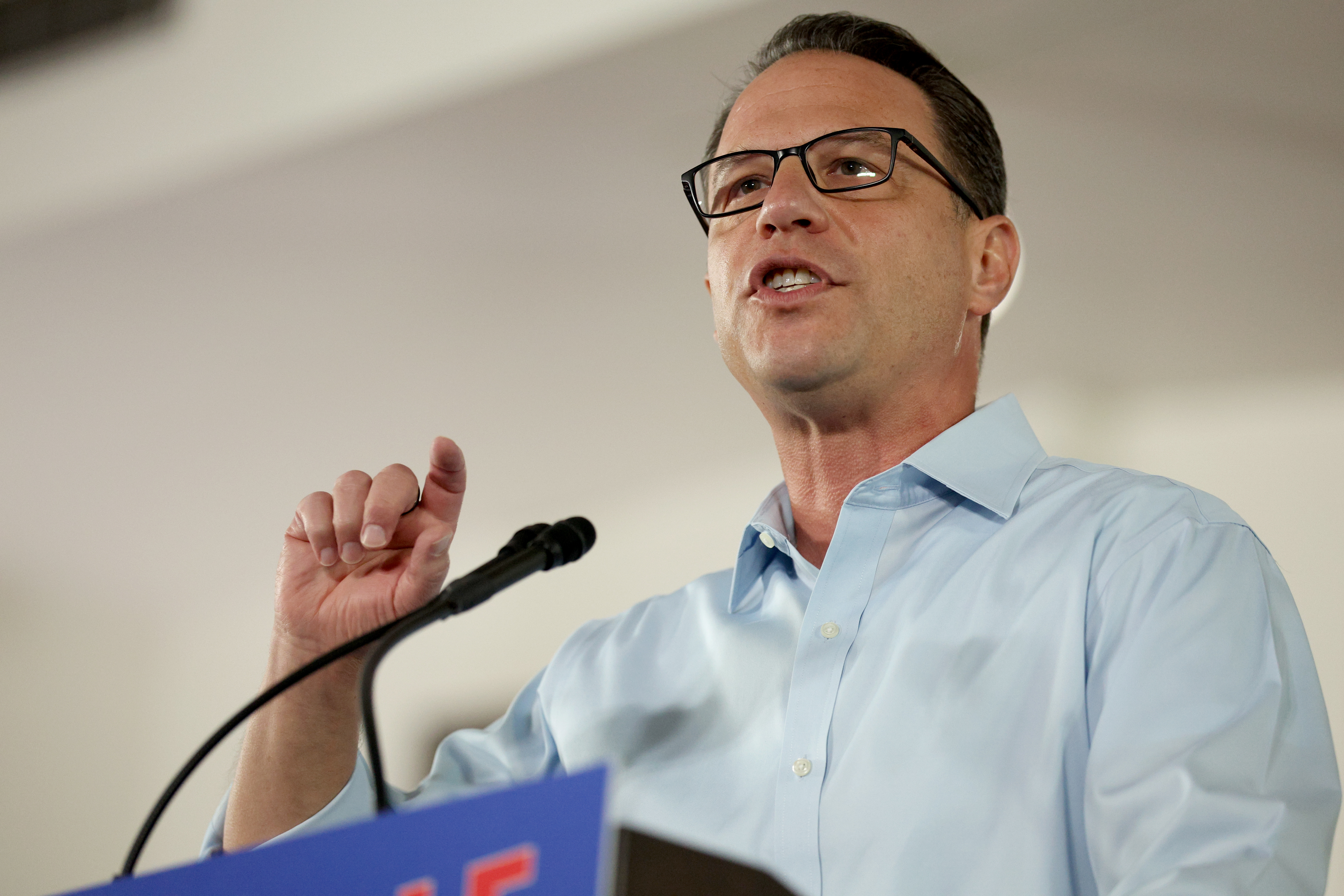
Gov. Josh Shapiro addresses the audience during a July 26 rally for congressional candidate Bob Brooks at the United Steelworkers Union Hall in Bethlehem.David Maialetti / Staff Photographer
His campaign released a Spanish-language digital ad focused on benefits of the Working Pennsylvanians Tax Credit and the Property Tax/Rent Rebate Program, which is targeted toward seniors and people with disabilities.
“If you’re working, you get to keep more of your money. Up to $800 more, more money in your pocket. And right now, every little bit helps,” a woman in the commercial said in Spanish.
Ultimately, Zandi said, “it’s very difficult for lawmakers at any level of government to change the picture on affordability, at least any time quickly,” because those issues are due to broader national and international forces.
There’s also no one-size-fits-all approach for a governor to tackle the costs of education, housing, energy, childcare, elder care, healthcare, and groceries.
“Each issue that makes up the affordability crisis requires its own set of solutions and efforts, so it feels like a laundry list of policy steps, and it is,” he said. “But that actually is probably the only way to make a difference.”
For many Pennsylvanians, paychecks feel like simply treading water: By the time all expenses are covered, there’s little money left to save and build toward the future.
“It just seems that money doesn’t go as far as it used to,” said Thomas Schank, 49, of Scranton. “I’ve gotten raises at work over the last two years, but everything else went up also, so really, no net gain.”
In the country’s premier battleground state, Pennsylvania Democrats believe they’re in striking distance of a tidal-wave victories that would dramatically shift the balance of power in both Washington and Harrisburg.
For the first time in decades, the party could take full control of the legislature. That would give Democratic Gov. Josh Shapiro — seeking reelection with a wide polling gap on his Republican challenger Stacy Garrity— significantly more power to shape the direction of the state as he potentially pursues a White House bid in 2028.
Democrats also see a chance to flip four congressional seats and take control of the U.S. House. Republicans, meanwhile, are prioritizing defending the Pennsylvania seats with their House majority on the line as President Donald Trump, who won the state justtwo years ago, sinks in popularity.
The path forpower in Washington inthe high-stakes midterms runs through Pennsylvania and its results will be closely watched as both parties prepare for a presidential race in two years when the state promises to play a pivotal role.
Voters across Pennsylvania will head to the polls in November to cast their ballots for races that will decide the balance of power in the state and nation.
Here are the races to watch and how to vote.
Shapiro’s November could dictate his 2028
Shapiro, widely viewed as a likely contender for the 2028 presidency, has big ambitions this fall when he’ll stand for reelection against Garrity, the state’s treasurer.
More than just securing his own reelection, Shapiro hopes to run up the margin and carry downballot Democrats across the finish line.
Another double-digits win and a string of coattail victories would be ashow of strength about his ability to perform in a key swing state that his party lost in the last presidential election.In a presidential primary, Shapiro could use that result to make an argument that he’s a strong general electioncandidate who can boost the Democratic brand.
Will Republicans hold on in competitive congressional seats?
There are four U.S. House districts in the eastern portion of Pennsylvania, targeted by both parties as must wins. In each, the Republican incumbents are seeking to fend off highly financed challengers amid deep frustration among voters with the leader of their party that could translate into a wave of Democratic victories down ballot.
7th Congressional District: Freshman Republican U.S. Rep. Ryan Mackenzie narrowly flipped the Lehigh Valley district two years ago and is widely seen as one of most vulnerable incumbents in Congress. He’s facing a challenge Democrat Bob Brooks, a retired firefighter and union leader whose blue-collar campaign has attracted support across the party’s ideological spectrum with endorsements from Shapiro and U.S. Sen. Bernie Sanders.
10th Congressional District: Republican U.S. Rep. Scott Perry, a close ally of Trump, faces a November rematch against Democrat Janelle Stelson, a former TV anchor, in the Harrisburg area district. Stelson has consistently outraised Perry after narrowly losing in 2024.
In addition to these four races both national parties have targeted, Shapiro has argued that the 9th Congressional District, where Democrat Rachel Wallace is taking on incumbent GOP U.S. Rep. Dan Meuser, is flippable — despite the strong GOP lean in the district, which stretches from Berks County to the New York state border. The district is home to two warehouses that ICE was planning to convert into detention centers before abandoning the plan after a backlash from residents.
This year, Shapiro wants to flip the chamber and win a trifecta to push forward his key priorities, such as codifying abortion access, raising the state’s minimum wage, and increasing funding for transit.
Republicans currently hold 27 of the chamber’s 50 seats. Democrats, who currently hold 23 seats, need to win at least two additional seats and the governor’s office to win control of the chamber with the lieutenant governor as a tiebreaking vote.
The seats, drawn advantageously for Republicans, have been stubbornly resistant to political change for decades.
But this year a blue wave could usher in Democratic pickups in Philadelphia suburbs and the Lehigh Valley.
Races to watch include:
Bucks County’s 6th District, where Republican incumbent State Sen. Frank Farry faces a challenge from Democrat Eileen Hartnett Albillar.
Montgomery County’s 24th District, where incumbent Republican State Sen. Tracy Pennycuick is up for reelection against Democrat Chris Thomas.
Bucks and Lehigh County’s 16th District, which will see a rematch race between incumbent Republican State Sen. Jarrett Coleman and Democrat Mark Pinsley, the Lehigh County controller.
What are the important dates to know?
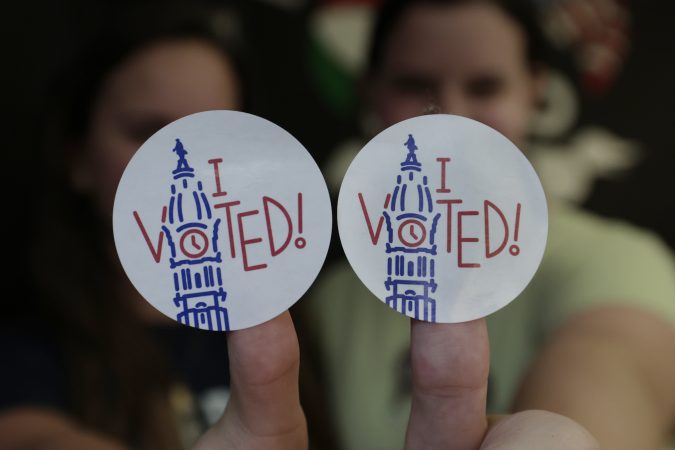
Election Day is Nov. 3.
The deadline to register to vote is Oct. 19. You must be at least 18 years old, a resident of Pennsylvania and a citizen of the United States to vote. You can register online, by mail, at your county elections office, or at one of several other government buildings.
Pennsylvanians can vote by mail with no excuse required. To apply, fill out an application by mail, online, or in-person and send it into your county election office. Applications must be received by Oct. 27 at 5 p.m. and the completed mail ballot must be received — not just postmarked — by 8 p.m. on Election Day.
An application and mail ballot can be completed in one visit at an election office, essentially functioning as early voting.
Staff writer Fallon Roth contributed to this article.
Democratic Gov. Josh Shapiro and Republican Treasurer Stacy Garrity, both candidates running to be Pennsylvania’s next governor, have agreed to face off next month in the first and only scheduled televised debate between them.
The debate — scheduled for 8 p.m. on Oct. 7 and hosted by ABC 27 — will be held in Harrisburg and will air live on several stations owned by Nexstar across Pennsylvania, including WPHL-TV in Philadelphia.
Both campaigns said they look forward to meeting face to face to discuss issues important to voters.
“Game on,” said Matthew Beynon, a spokesperson for Garrity.
Manuel Bonder, communications director for Shapiro’s campaign, said “we look forward to continuing to make the choice in this election clear.”
As the November election approaches, Shapiro — who is a rumored contender for president in 2028 — has focused on translating his popularity to downballot Democratic candidates in four, nationally watched congressional districts and those running for seats in the Pennsylvania state Senate, which has been under Republican control for more than 30 years.
Garrity, meanwhile, has struggled to gain traction among voters and to compete with Shapiro’s massive campaign funds. A quarter of likely Republican voters did not know who she was or know enough about her to form an opinion of her, The Inquirer/New York Times/Siena poll found.
Next month’s debate could present Garrity with a fresh chance to introduce herself to voters statewide and make her case on why Shapiro should not be reelected.
October’s debate is the only one scheduled between the candidates, though Garrity’s campaign have proposed several more. In 2022, Shapiro and his Republican challenger, State Sen. Doug Mastriano, did not debate after the two could not agree to terms.
Topics likely to surface during the debate include data centers, the measles outbreak, and President Donald Trump.
Garrity has also blasted Shapiro for his handling of the rollout of public health information in announcing two measles-associated deaths in Pennsylvania, saying he has stepped in front of verified facts. Shapiro has been critical of the Trump administration, saying the nation’s health secretary was responsible for the influx of measles cases by stoking misinformation.
Trump has endorsed Garrity in the governor’s race, and Shapiro has repeatedly sought to tie her to some of his unpopular policies, highlighting her support for his tariffs on imported goods and unpopular war in Iran.
ABC 27 anchor and reporter Dennis Owens will moderate the debate, which will also be available to view on streaming platforms.
Philadelphia’s police union on Tuesday endorsed Gov. Josh Shapiro’s reelection bid, announcing its continued support for the first-term Democratic governor while touting his commitment to law enforcement.
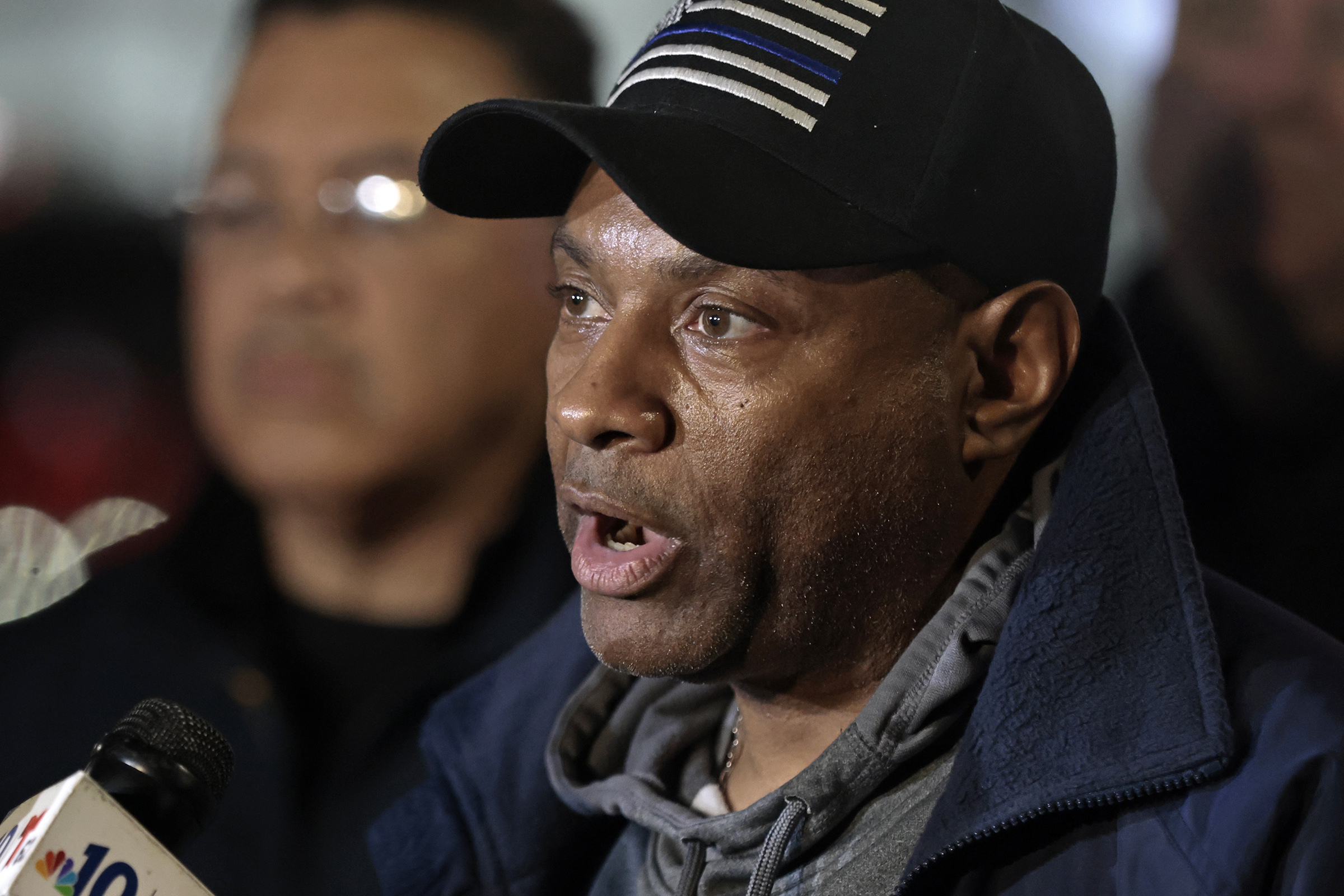
“Every day, he has shown a commendable ability to work with local law enforcement and deliver the resources and support we need to protect and serve our friends, families, and neighbors,” said Roosevelt L. Poplar, president of the Fraternal Order of the Police Lodge 5, which represents over 14,000 active and retired Philadelphia police officers and sheriff’s deputies.
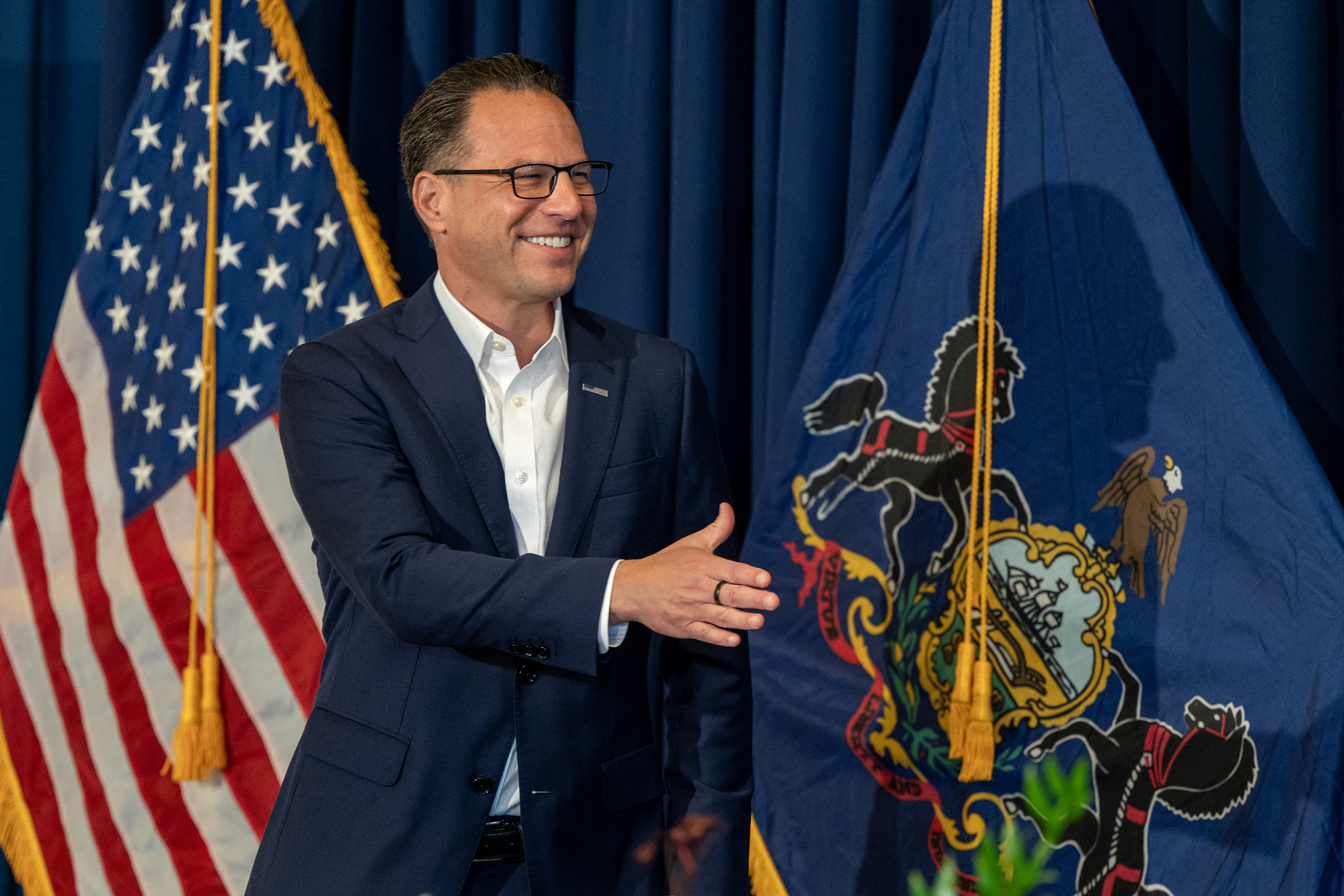
In a statement, Shapiro said he was “honored” by the endorsement.
“I’m going to keep fighting for the brave law enforcement officers who work to keep Philadelphia safe every single day,” he said. “I believe all Pennsylvanians deserve to be safe and feel safe in their communities — and we have focused every day on funding law enforcement and supporting the men and women that protect and serve our Commonwealth.”
It marks the second time the police union has embraced Shapiro for governor after endorsing him in 2022 over Republican candidate Doug Mastriano, who the then-president of the union said couldn’t be trusted to protect their collective bargaining rights. Shapiro, a former state attorney general, was a reliable government official who the union said was “there to help us with whatever we need to do.”
This election cycle, Shapiro holds a commanding lead over his Republican opponent, Treasurer Stacy Garrity, according to a recent poll from The Philadelphia Inquirer, the New York Times, and Siena University. The union has previously supported President Donald Trump, but Shapiro attracted its backing over Garrity, who Trump has endorsed in the Pennsylvania governor’s race.
Shapiro has also received support from other organized labor unions, including the Pennsylvania AFL-CIO and the Pennsylvania Professional Fire Fighters Association. On Monday, he received the backing of the Pennsylvania State Troopers Association.
Shapiro has maintained a comfortable relationship with law enforcement, and his campaign noted that he has signed multiple state budgets funding 2,000 additional officers across Pennsylvania and allocated more than $1 billion in community-based violence prevention grants.
Roosevelt Poplar, president of Fraternal Order of Police Lodge 5, on Jan. 26, 2024.Elizabeth Robertson / Staff Photographer
In his statement, Poplar also commended Shapiro for providing funding for police department needs.
“The Governor has delivered on his promise to invest in public safety, he has shown up with us in times of tragedy, and he has proven his commitment to keeping our officers and the communities we serve safe,” he said.
The police union’s endorsement of Shapiro is notable for an organization that just a few years ago was seen by some Philadelphia Democrats as politically toxic.
In the aftermath of the 2020 Minneapolis police killing of George Floyd, protests by racial justice activists swelled in Philadelphia and across the country with many of the movement’s participants calling to “defund” or abolish the police. They pressed local lawmakers to redirect police funding to social services, and Philadelphia City Council in June 2020 canceled a planned increase to the Philadelphia police budget.
Amid the calls for reform, the FOP was a major point of contention, as was its bombastic former leader, John McNesby. Activists — and many of their allies in elected office — said the union was too resistant to change and protected bad cops.
Former FOP president John McNesby holds a news conference on Oct. 19, 2022.Joe Lamberti
At the time, Shapiro was running for reelection as the state attorney general, and his campaign presented him as a “progressive reformer” who had established a unit in his office to review criminal convictions that may have been unfairly applied and a council to support people leaving prison with housing and employment opportunities. The FOP endorsed Shapiro’s 2016 and backed his 2020 campaign for attorney general.
Unlike some Philadelphia Democrats, Shapiro — who has rumored ambitions for a presidential run in 2028 — did not embrace the “defund” movement. He argued during a 2020 trip to Philadelphia that addressing structural inequities in the department and having strong law enforcement, especially in communities with high levels of poverty, were not mutually exclusive endeavors.
“We reject that poverty or institutionalized indifference and marginalization should mean that some people don’t get to have a safe community to live in,” he said. “We won’t give up on the belief [of] law enforcement showing up in a community to make people feel safer.”
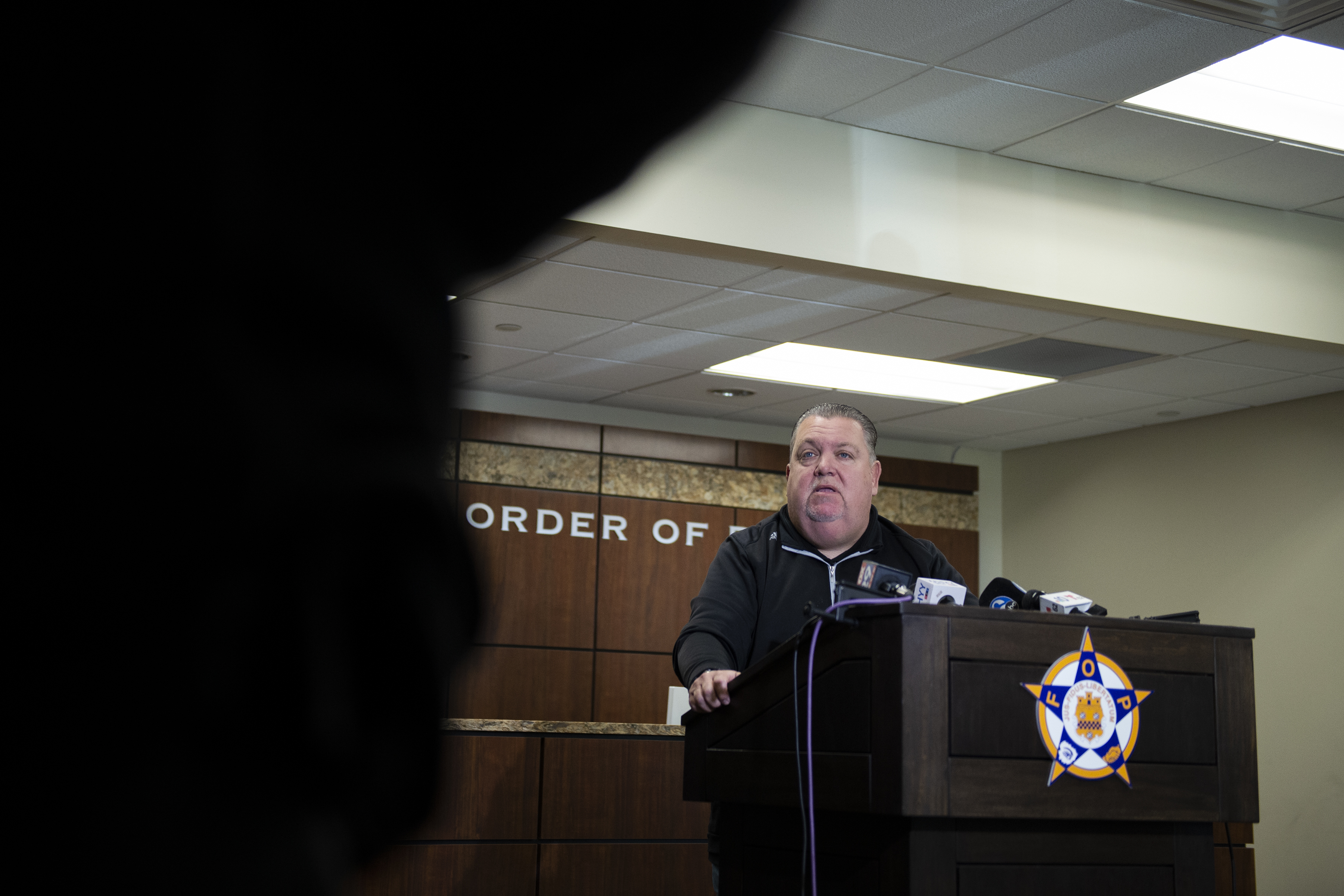
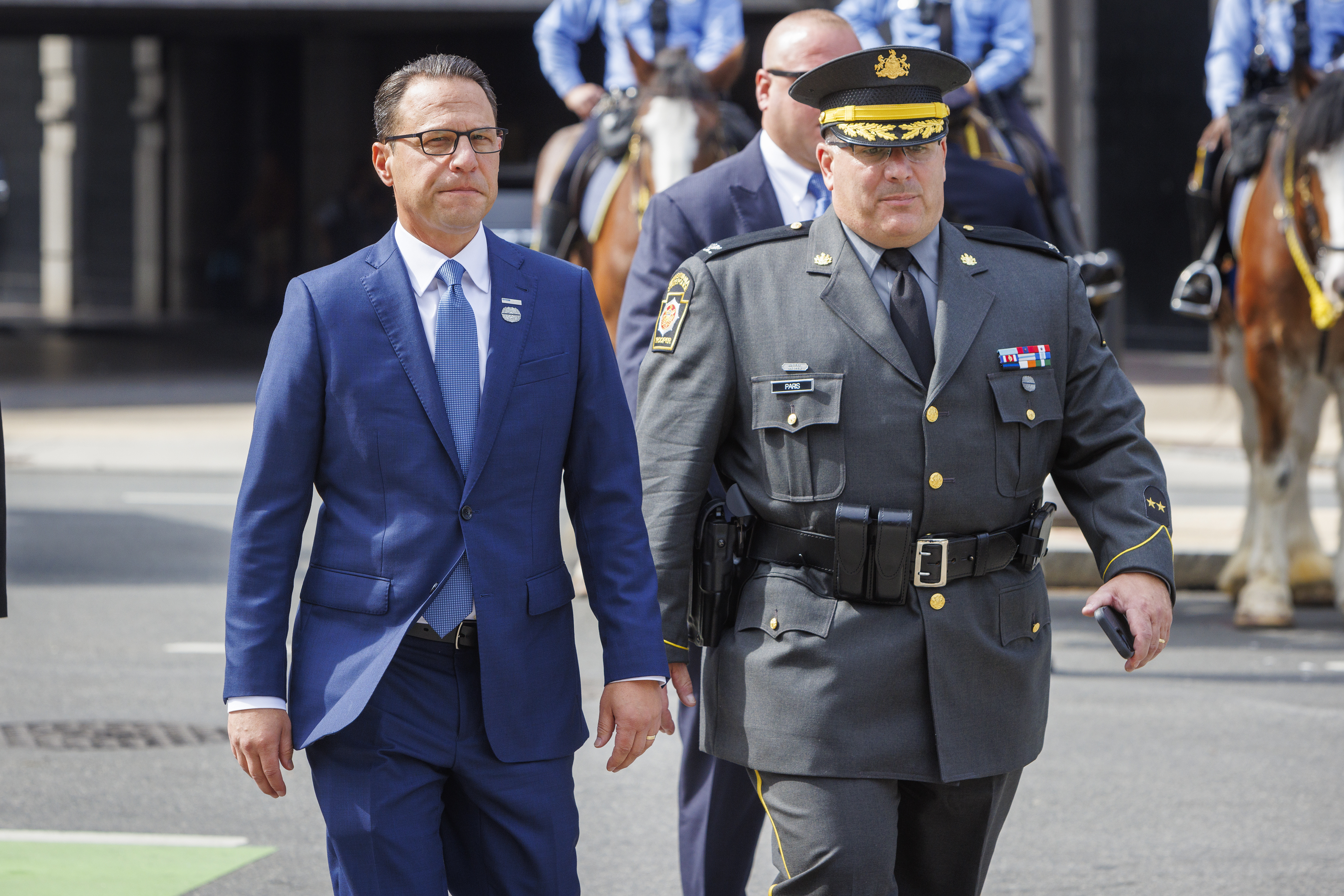
Gov. Josh Shapiro with Pennsylvania State Police Col. Christopher L. Paris. They were attending the funeral for Philadelphia police officer Jaime Roman at the Cathedral Basilica of SS. Peter and Paul on Sept. 19, 2024.Alejandro A. Alvarez / Staff Photographer
In the years following 2020, public support for police in Philadelphia appeared to grow. The city saw a historic spike in gun violence, and Republicans nationally portrayed Democrats as soft-on-crime. When a half-dozen Democrats were fighting for the mayoral nomination in 2023, polling showed that most voters saw public safety as the No. 1 issue driving the race. None of the candidates embraced “defund,” and most of them supported proposals to provide additional resources to the police department as it sought to solve shootings.
In the end, the tough-on-crime mayoral candidate — then-City Councilmember Cherelle L. Parker — won decisively.
President Donald Trump says he’s holding Canada accountable for “ripping off” the United States through unfair trade practices.
But by imposing new tariffs on Canadian goods and prompting retaliation from one of America’s largest trading partners, U.S. businesses and consumers could face higher costs, analysts said — including in key electoral battlegrounds like Pennsylvania.
Pennsylvania sold $13.4 billion in goods last year to Canada — its largest export market.
About $2 billion worth of those goods, or 16%, will be subject to higher tariffs — some as high as 50% — starting Sept. 8 after Canada this week announced new levies, according to an Inquirer analysis of trade data. Some of the state’s top exports facing new tariffs include raw aluminum, lumber, and passenger vehicles.
(function(){function e(){window.addEventListener(`message`,function(e){if(e.data[`datawrapper-height`]!==void 0){var t=document.querySelectorAll(`iframe`);for(var n in e.data[`datawrapper-height`])for(var r=0,i;i=t[r];r++)if(i.contentWindow===e.source){var a=e.data[`datawrapper-height`][n]+`px`;i.style.height=a}}})}e()})();
Canadian officials said the tariffs on hundreds of U.S. goods worth a total of $20 billion are meant to protect its workers in response to increased U.S. levies on the same amount of Canadian imports. That affects a relatively small share of trade between the two countries, but analysts said the situation is still evolving.
“There’s so many things that go back and forth, some of it multiple times. The effect and the amplification of these tariffs, we’ll definitely feel,” said Lauren Swartz, CEO of the nonprofit World Affairs Council of Philadelphia. “When we think about what that means for Pennsylvania, it’s going to be loud.”
“My sense is the rhetoric that we’re hearing, and the fact that it’s already being labeled a trade war, is that both countries are reserving the right to escalate the level, the percentage of tariffs, as well as the scope of goods that will fall under the new trade war,” she said. “So it will expand.”
Steel, dairy, electronics impacted
The new tariffs came after talks between the U.S. and Canada over a trade deal fell apart last weekend. Trump imposed 50% tariffs on goods such as hockey sticks, national flags, and building materials.
“Canada has been ripping off the United States for decades — and President Donald J. Trump is done letting them get away with it,” the White House said on Tuesday. It said the U.S. had offered Canada “the most preferential market access of any country on Earth” but that the country chose “unreasonable demands, walk-backs, and flat-out rejection.”
Canadian officials said the country’s counter tariffs would protect the country’s workers and businesses. They said the levies on U.S. goods targeted sectors such as appliances, steel, dairy, and electronics.
(function(){function e(){window.addEventListener(`message`,function(e){if(e.data[`datawrapper-height`]!==void 0){var t=document.querySelectorAll(`iframe`);for(var n in e.data[`datawrapper-height`])for(var r=0,i;i=t[r];r++)if(i.contentWindow===e.source){var a=e.data[`datawrapper-height`][n]+`px`;i.style.height=a}}})}e()})();
Influence on midterms?
The trade dispute could inject new uncertainty into the economy less than three months before the U.S. midterm elections decide control of Congress and statehouses around the country. Republicans are seeking to retain control of the U.S. House and Senate. Pennsylvania has several competitive House races in which Republican incumbents are seen as vulnerable.
Pennsylvania Gov. Josh Shapiro, a Democrat who is running for reelection against Republican state Treasurer Stacy Garrity, has repeatedly criticized Trump’s tariffs.
“Donald Trump’s reckless tariffs are a tax on Pennsylvanians — and Gov. Shapiro has been fighting back against them from day one,” said campaign spokesperson Manuel Bonder.
“This President has raised costs for families, screwed over our farmers, and shut down markets for businesses — all with Stacy Garrity’s 100% support,” Bonder said in a statement.
Garrity’s campaign didn’t respond to requests for comment. She has in the past said Trump’s tariffs could result in some “short-term pain” but would ultimately bring jobs to America. “It’s going to be fantastic,” she said in a clip that Shapiro’s campaign has highlighted. More recently, Garrity told reporters in July she would “do the tariffs a little bit differently.”
Canadian officials appeared to target some goods that are important in electoral battlegrounds, such as seafood in Maine, the Wall Street Journal reported.
Analysts said Pennsylvania didn’t appear to be a principal target. “But unfortunately, it’s one of the states that does a lot of goods transfer with Canada, and unfortunately, they’re hit in the crossfire,” said Kyle Peacock, a trade expert and founder of Peacock Tariff Consulting.
Peacock said that after previous rounds of tariffs, many businesses were able to absorb the costs.
But now that some products face 50% levies, that will likely change, he said. “Not a lot of industries or products have 50% margin that you can just eat,” he said. “So I think you’re going to see that this time, unfortunately, that’s going to be passed on to the consumer.”
A majority of Pennsylvania voters oppose data center development in the United States, according to a new poll, as the issue has quickly become a flash point in the state’s gubernatorial race and other midterm elections.
Six in 10 likely Pennsylvania voters do not want the U.S. to construct data centers to house artificial intelligence, according to a poll conducted from Aug. 17 to 21 by The Inquirer, the New York Times, and Siena University. The poll, which surveyed 760 likely voters in Pennsylvania, found that Democratic and independent voters oppose data centers at higher rates, while just over half of Republicans support their construction.
(function(){function e(){window.addEventListener(`message`,function(e){if(e.data[`datawrapper-height`]!==void 0){var t=document.querySelectorAll(`iframe`);for(var n in e.data[`datawrapper-height`])for(var r=0,i;i=t[r];r++)if(i.contentWindow===e.source){var a=e.data[`datawrapper-height`][n]+`px`;i.style.height=a}}})}e()})();
The United States is in an international race to lead advancements in AI, with $2.3 trillion in data center projects underway or in the planning stages across the country. Pennsylvania, with more than 100 proposed projects, is among the hot spots targeted by developers for its key location near top U.S. metropolitan areas, vast rural space for building, and significant energy resources.
Gov. Josh Shapiro originally welcomed data center developments to the state, and last year championed a $20 billion investment from Amazon to build at least twodata center campuses in Bucks and Luzerne Counties. He also offered developers fast-track permitting in an attempt to establish Pennsylvania as a leader in AI development.
But in a year’s time, public animosity toward data centers has grownin Pennsylvania and beyond, as residents say they fear the facilities will drive up electricity costs, overuse water supplies, depreciate home values, and disrupt their daily lives. Last week, Shapiro, a Democrat running for reelection in November and a 2028 presidential prospect, announced plans to restrict data center development in the state.
Shapiro said his position on data centers evolved as he listened to more constituents who live in areas like Archbald, a small northeastern Pennsylvania town with six data center campuses under construction, and pointed to a developer in Montgomery County who he said is “bullying” residents to push projects through amid public opposition.
(function(){function e(){window.addEventListener(`message`,function(e){if(e.data[`datawrapper-height`]!==void 0){var t=document.querySelectorAll(`iframe`);for(var n in e.data[`datawrapper-height`])for(var r=0,i;i=t[r];r++)if(i.contentWindow===e.source){var a=e.data[`datawrapper-height`][n]+`px`;i.style.height=a}}})}e()})();
Pennsylvania’s youngest voters were most likely to reject data centers, according to the poll: 83% of likely voters ages 18 to 29 opposed their development, as did 71% of voters ages 30 to 44. Opposition, while above 50% for all age groups, decreased among older voters.
Kelly Harrington, 29, of Conshohocken, who participated in the poll, said she has been attending Plymouth Township Council meetings to oppose a controversial proposal for a 2 million-square-foot data center project there.
“Some of my concerns about that specific data center are selfish in the sense that I think my home value is going to go down, I think it’s going to be loud and obstructive, I think it’s going to pollute the air that I want to breathe every day,” Harrington said. “But in a wider sense, I’m also concerned about the environmental impacts of data centers.”
Front and center in the Pa. governor’s race and beyond
Data centers have become a key issue in the Pennsylvania gubernatorial election, where Shapiro hopes to ride his high popularity to reelection and usher in Democratic gains in down-ballot races for the statehouse and Congress.
Both Shapiro and his Republican opponent, State Treasurer Stacy Garrity, have released ads criticizing the other’s past support for data center development.
Democratic and Republican politicians across the country have reversed course on data centers in recent months as the projects have grown increasingly unpopular.
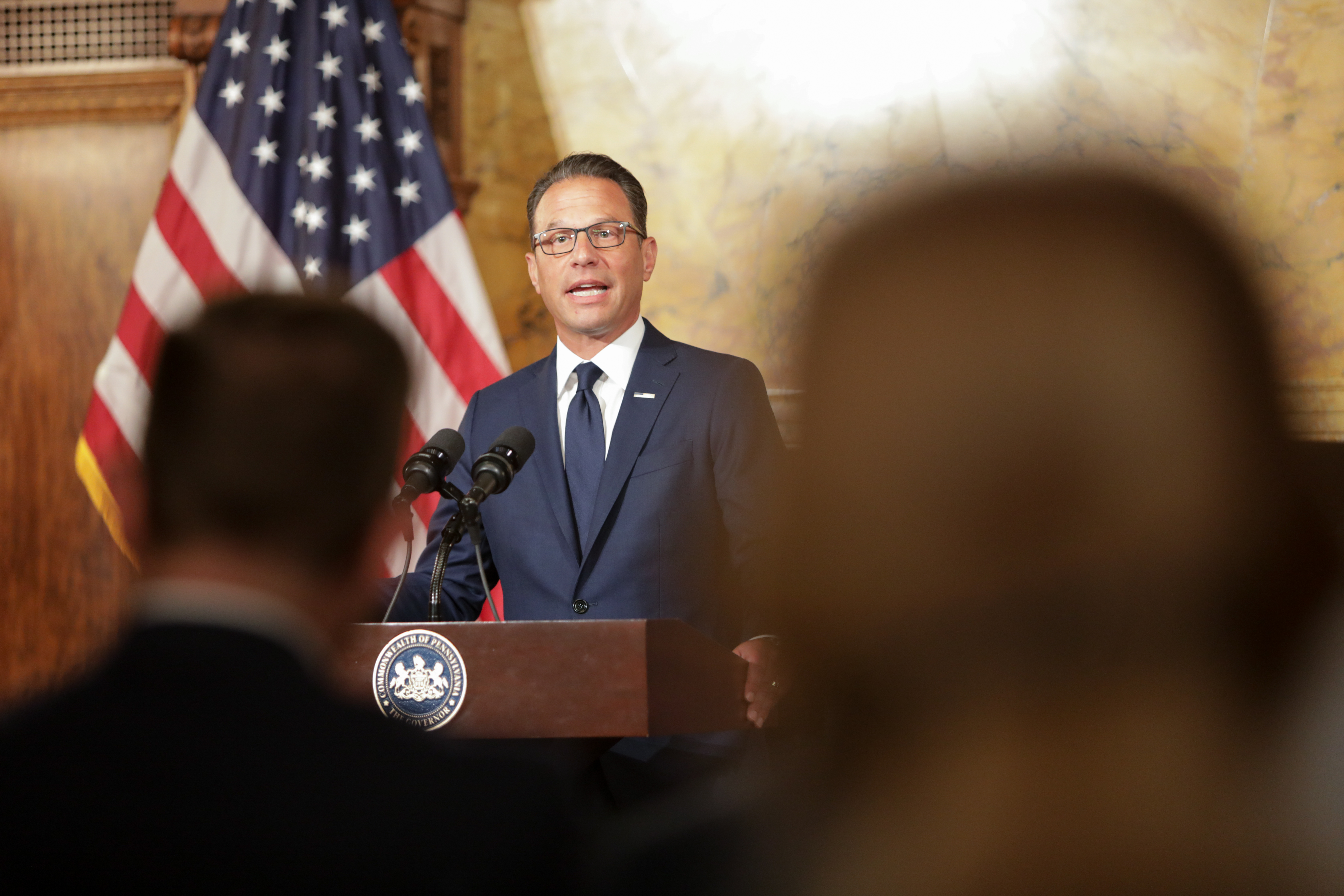
Gov. Josh Shapiro answers questions after signing an executive order restricting data centers in Pennsylvania during a ceremony in the Capitol in Harrisburg, Pa., Tuesday August 18, 2026.Kalim A. Bhatti / For The Inquirer
Prior to Shapiro’s announcement last week touting the “strictest guardrails in the nation” for data center development, his support for the projects appeared to be one of the major tests of his popularity. A Quinnipiac University poll published in July found that while 56% of voters approved of Shapiro overall, only 24% approved of how he was handling data center development in Pennsylvania.
Andsome Pennsylvanians who had voted for Shapiro in 2022 said his support for the developments had caused them to contemplate sitting out the November election or writing in a different candidate for governor.
For some voters, like Montiese McKenzie, Shapiro’s change in position has been enough.
“I’m very proud of Gov. Shapiro for being anti-data center,” said McKenzie, 48, of West Philadelphia. The Democratic voter said she fears that poor communities will face disproportionateconsequences of the construction of AI data centers.
“What happens will be very important for how I see him as a future leader,” McKenzie said.
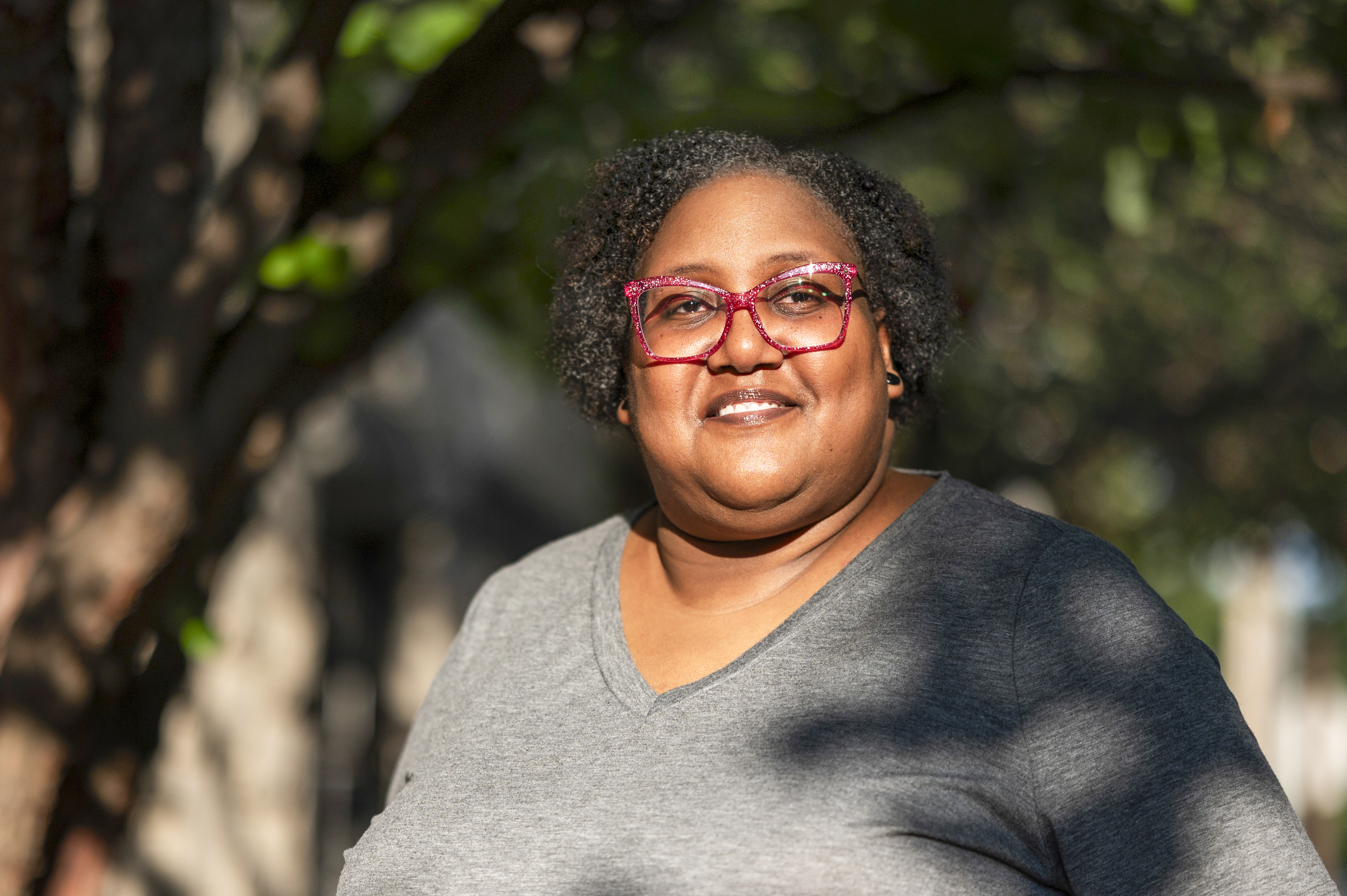
Montiese McKenzie, 48, poses for a portrait near her home in West Philadelphia on Monday, Aug. 24, 2026.Allie Ippolito / For The Inquirer
Still, Shapiro’s recent change in position has not wooed all Pennsylvania voters.
Maryann Klaus, 82, a Democrat in Upper Bucks County, supported Shapiro in 2022. But, she said, his initial embrace of data centers in the region without consulting the community was “just not good governance.” Despite Shapiro’s recent moves to restrict data center development, Klaus said, she is still reconsidering her vote for his reelection this fall.
The executive order Shapiro signed last week is a “a start,” Klaus said. “But, unfortunately, when you open the door, too many things occur and then you can’t walk them back.”
Others, like Steven Keenan of Ridley Township, say they want more data center development in the state.
Keenan, 60, a Republican who is supporting Garrity in November, said he wants Pennsylvania to lead on data centers.
“I’m not afraid of advancement in technology,” Keenan said. “I think we need all that [development]. We’re in a race with other countries that we want to dominate.”
Keenan said Shapiro’s change in position reaffirmed his support for Garrity. The shift in stance, he said, showed Shapiro was reacting to public opinion instead of doing what is right for the state. (Garrity, too, has moved away from her public support for data centers. She has called for the state to temporarily pause all data center development.)
“He goes where the wind blows,” Keenan added.
Staff writer Fallon Roth contributed to this article.
With a little more than two months until Election Day, Democratic Gov. Josh Shapiro has a double-digit lead over his Republican challenger, Stacy Garrity, among likely Pennsylvania voters in the race to lead the critical swing state — an election that could also serve as an audition for the 2028 presidential primary.
Shapiro holds a 16-percentage-point lead over Garrity, the state treasurer, according to a new poll of 760 likely voters conducted from Aug. 17 through 21 by The Inquirer, the New York Times, and Siena University.
The numbers could foreshadow another commanding victory for Shapiro, as he hopes his popularity trickles into other down-ballot races, including four congressional districts that national Democrats think they can flip. Shapiro is also trying to flip the state Senate for the first time in 30 years and deliver a Democratic trifecta in the statehouse.
(function() { var l = function() { new pym.Parent( ‘nyt-shapiro2__graphic’, ‘https://media.inquirer.com/storage/inquirer/ai2html/nyt-shapiro2/index.html’); }; if(typeof(pym) === ‘undefined’) { var h = document.getElementsByTagName(‘head’)[0], s = document.createElement(‘script’); s.type = ‘text/javascript’; s.src = ‘https://pym.nprapps.org/pym.v1.min.js’; s.onload = l; h.appendChild(s); } else { l(); } })();
A majority of Pennsylvania voters — 60% — have a favorable opinion of the governor, compared with Garrity, who is viewed favorably by just 37% in the state.
Shapiro’s popularity also eclipses that of President Donald Trump, according to the poll. Sixty percent of likely Pennsylvania voters approve of the job Shapiro is doing as governor, while 39% approve of Trump, who won the state two years ago.
Lora Peluso, 63, a Democrat and retired catering director from Pittsburgh, said Shapiro has been a shield in Pennsylvania against some of Trump’s most harmful policies affecting low-income and older people.
“I think [Shapiro] is trustworthy,” said Peluso, who participated in the poll. “His policies are things that actually benefit people, the average working person, seniors.”
Garrity still unknown by some Republicans
Pennsylvania Republicans this year had hoped to avoid another walloping by Shapiro, who has won three times statewide, with fears that a weak gubernatorial candidate could negatively affect the rest of the Republican ticket. So the state GOP took the unprecedented move of endorsing Garrity in September 2025 — approximately 14 months before the election — to try to raise her profile.
Despite securing Trump’s endorsement, Garrity has struggled to raise money, attract support from national Republicans, or compete with Shapiro’s $13 million in ad buys so far this cycle. Her campaign has spent $679,000 on ad buys thus far, according to media-tracking firm AdImpact, as it seeks to introduce the candidate to voters.
Now, with 70 days until the election, a quarter of likely Republican voters still did not know Garrity or know enough about her to form an opinion of her, according to the poll.
Meanwhile, Shapiro maintains favorable opinions among 27% of Trump’s 2024 supporters, and 35% of registered Republicans approve of the job he is doing as governor, the poll found.
(function(){function e(){window.addEventListener(`message`,function(e){if(e.data[`datawrapper-height`]!==void 0){var t=document.querySelectorAll(`iframe`);for(var n in e.data[`datawrapper-height`])for(var r=0,i;i=t[r];r++)if(i.contentWindow===e.source){var a=e.data[`datawrapper-height`][n]+`px`;i.style.height=a}}})}e()})();
Michael Patterson, a Republican from Trumbauersville, Bucks County, who supported Trump in 2024, said he plans to support Shapiro in November because he likes the job the governor is doing and because he does not know much about Garrity besides what he has seen on social media.
“Honestly, I don’t know much about her,” Patterson, 60, said. “I guess I don’t see advertisements on the TV. Other than Facebook, I really don’t see her. The stuff I see on Facebook is just typical partisan stuff.”
Shapiro, on the other hand, appears more moderate and independentfrom his party in Patterson’s eyes.
“He’s kinda doing his own thing. I have a lot of respect for that. He’s not playing partisan games,”Patterson said, contrasting Shapiro with Democrats in California and New York.
Michael Patterson, a Bucks County Republican voter pictured in his Trumbauersville home, plans to vote for Democratic Gov. Josh Shapiro over Republican nominee Stacy Garrity. William Thomas Cain / For The Inquirer
This attitude shows up among other Republicans, too, said Don Levy, the director of the Siena Research Institute.
“Shapiro is seen as sufficiently middle of the road,” Levy said. “He’s got 35% of Republicans approving of the job that he’s doing as governor. That’s a really impressive number in today’s world.”
Other Republicans like Steven Keenan, 70, of Ridley Township, are all in for Garrity, citing her military experience and support for Trump.
“[Shapiro’s] a big phony. He’s a politician,” Keenan said. “She is, too, but she’s been through the wars. I think she’s earned her place. I think we should give a woman a chance.”
A majority of Pennsylvania voters trust Shapiro over Garrity to handle top issues facing the state, including the economy, cost-of-living increases, the Trump administration, immigration, and doing what is best for ordinary Pennsylvanians.
Tina Hoffert, 68, of Lenhartsville, Berks County, said she has not heard much about Garrity, but plans to vote for her in November because she is unsatisfied with Shapiro’s leadership.
“He’s forever bashing Trump,” Hoffert, a Republican, said. “I’m sorry, I don’t care whether you like him or not, he’s our president. You work with him. You don’t fight him. And if there’s things you don’t like that he’s doing, then you go in there and you have discussions.”
Shapiro’s presidential prospects
If Shapiro is reelected in a landslide victory this November, it becomes even more likely that he jumps into the 2028 presidential race as the governor of a key swing state with19electoral votes.
Among those surveyed who said they plan to vote in the Democratic primary in two years, 86% said they would be likely to support him — though the poll did not compare him with other potential primary candidates.
Other prospective candidates include former Vice President Kamala Harris, Govs. Gavin Newsom of California and JB Pritzker of Illinois, U.S. Sens. Mark Kelly of Arizona and Jon Ossoff of Georgia, and U.S. Rep. Alexandria Ocasio-Cortez of New York.
(function(){function e(){window.addEventListener(`message`,function(e){if(e.data[`datawrapper-height`]!==void 0){var t=document.querySelectorAll(`iframe`);for(var n in e.data[`datawrapper-height`])for(var r=0,i;i=t[r];r++)if(i.contentWindow===e.source){var a=e.data[`datawrapper-height`][n]+`px`;i.style.height=a}}})}e()})();
Shapiro has brushed off questions about his ambitions and told a reporter Saturday, in response to whether he would commit to serving a four-year term in office, that “the only thing that I’m focused on — and the only thing anybody should be focused on — is winning in November and being a check on this president’s chaos, cruelty, and corruption.”
Most voters in the poll — 58% — said that if Shapiro decidesto run for president, doing so either would not distract from his role as governor or would not keep him from being effective at governing.
“I mean, it would be a distraction, of course, but I think he’s a professional and a hard worker, and he would figure it out. It seems like he hires good people, too,” said Peter Hewitt, 62, of Devon, a Democrat who supports Shapiro’s reelection bid.
(function() { var l = function() { new pym.Parent( ‘nyt-trump2__graphic’, ‘https://media.inquirer.com/storage/inquirer/ai2html/nyt-trump2/index.html’); }; if(typeof(pym) === ‘undefined’) { var h = document.getElementsByTagName(‘head’)[0], s = document.createElement(‘script’); s.type = ‘text/javascript’; s.src = ‘https://pym.nprapps.org/pym.v1.min.js’; s.onload = l; h.appendChild(s); } else { l(); } })();
Shapiro’s potential candidacy has largely centered on his electability, especially his ability to win the top office in the nation’s premier swing state. He has pitched himself as a Democratic governor more interested in working with Republicans to make meaningful improvements to the state than in picking partisan fights, and voters agree: 58% of respondents said he is neither too far to the left nor to the right.
“He’s done a good job of just being more of a moderate, middle-of-the-road Democrat,” said Andrew Perez, a 58-year-old self-described independent voter in Pittsburgh. He said he appreciated Shapiro’s focus on improving roads and highways and not “just blindly disagreeing” with Trump.
“I think we need a strong presidential candidate who will try to unite the country instead of just keeping it being divisive, so I think that I’d be pretty likely to vote for him [for president],”said Perez, a physician.
Montiese McKenzie, 46, of West Philadelphia, said she is supporting Shapiro for a second term, but is not quite yet sold on a presidential run. She said she has not seen him rise to the level of “fighter” she thinks the Democratic Party needs, and believes as of now, she would be more likely to support someone else in the Democratic primary.
“You see people like Jon Ossoff and JB Pritzker, and they’re not putting up with it. They don’t make it pretty anymore,” McKenzie said. “If I saw some of that in Shapiro, I might be more likely to support him as a presidential candidate. Until then, I’m not sure he has the gumption.”
Shapiro has signed on to dozens of lawsuits against Trump’s administration on a host of issues, from tariffs to gender-affirming care.
But to win the party’s nomination, Shapiro would have to defeat more progressive candidates and make the case for his more centrist approach.
Montiese McKenzie, 48, poses for a portrait near her home in West Philadelphia on Monday, Aug. 24, 2026. McKenzie is a supporter of Gov. Josh Shapiro’s reelection, but is hesitant to back his potential presidential run in 2028.Allie Ippolito / For The Inquirer
Nearly half, 47%, of respondents said he has been just “about right on support of Israel,” with 14% saying he has been too supportive and 19% saying he has been not supportive enough.
Should Shapiro launch a presidential campaign, Hewitt wants to see him “come out on the right side.”
Hewitt, who emphasized his support for Jewish people in his community, said he considers the Israeli government’s actions toward Palestinian people in Gaza to be genocidal. More than 73,000 Palestinian people have been killed in Gaza since the war began nearly three years ago, and multiple international institutions have said Israel’s actions violate human rights.
“I don’t think it’s really that big of a deal for governors per se. He’s not going to vote on national policy as the governor of Pennsylvania,” Hewitt said. But he added: “He does have a voice, and if he’s thinking about a next step beyond Pennsylvania, then he will have to come out in regard to that issue.”