Tag: Stacy Garrity

  • Trump was welcomed to Pa. by Stacy Garrity. He didn’t mention her at all.

    Trump was welcomed to Pa. by Stacy Garrity. He didn’t mention her at all.

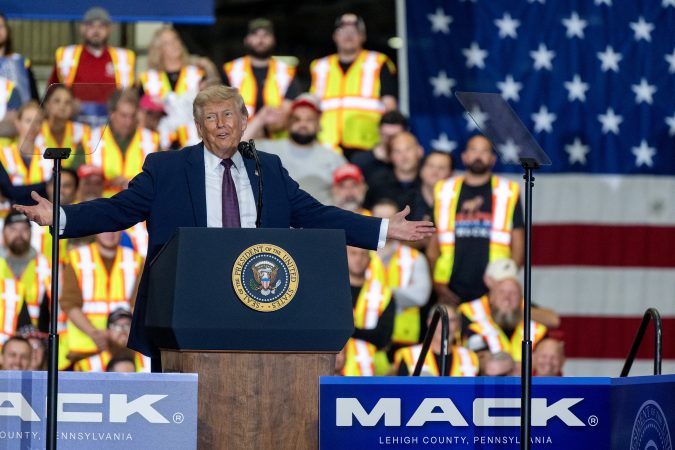
    MACUNGIE, Pa. — President Donald Trump’s speech on manufacturing in a key Pennsylvania swing district repeatedly veered into other topics and musings about elections in other states, like Maine and California.

    It took the president nearly an hour to even reference by name GOP U.S. Rep. Ryan Mackenzie, the vulnerable incumbent whose district Trump was visiting to boost his chances in this year’s midterm elections.

    And GOP gubernatorial nominee Stacy Garrity did not even get a mention during Trump’s speech to roughly 1,500 attendees, including workers at the Mack Trucks facility in Macungie in Lehigh County.

    Trump’s visit came just days after the company received $47 million through a Defense Department contract.

    And while he touted the trucks, he spent just as much time meandering about weight-loss drugs, immigration, firearms, the role of transgender athletes in women’s sports, and the UFC fight recently held on the White House lawn. He also repeated conspiracy theories about the races for Los Angeles mayor and California governor, saying he had asked the U.S. attorney in that state to investigate after conservative mayoral candidate Spencer Pratt did not advance to the general election.

    And he threw jabs at Pennsylvania Gov. Josh Shapiro amid 2028 speculation and appeared to undermine Shapiro’s Republican opponent, Garrity.

    Speaking about recent victories by democratic socialist candidates around the country, Trump quipped that “Shapiro is not that much better, to be honest with you.”

    He referenced the Democratic governor’s potential presidential aspirations, warning that “a guy like Shapiro is going to be forced on the left, otherwise he’s not going to get the nomination.”

    But though he weighed in on Shapiro, the governor’s Republican challenger’s name was noticeably absent from Trump’s list of shout-outs to GOP officials, despite the fact that Garrity spoke earlier in the event.

    Trump instead heaped praised on U.S. Rep. Dan Meuser, a Pennsylvania Republican who considered a run before ultimately opting against it and enabling the state party to coalesce around Garrity.

    “Meuser’s another great guy who was thinking about running for governor. I think he would have won. He was thinking of running for governor, and I said ‘I want you to stay in Congress,’” Trump said.

    Trump endorsed Garrity earlier this year, but the lack of acknowledgment Tuesday was striking given the election year focus of the event and Garrity’s own promises to support Trump’s agenda.

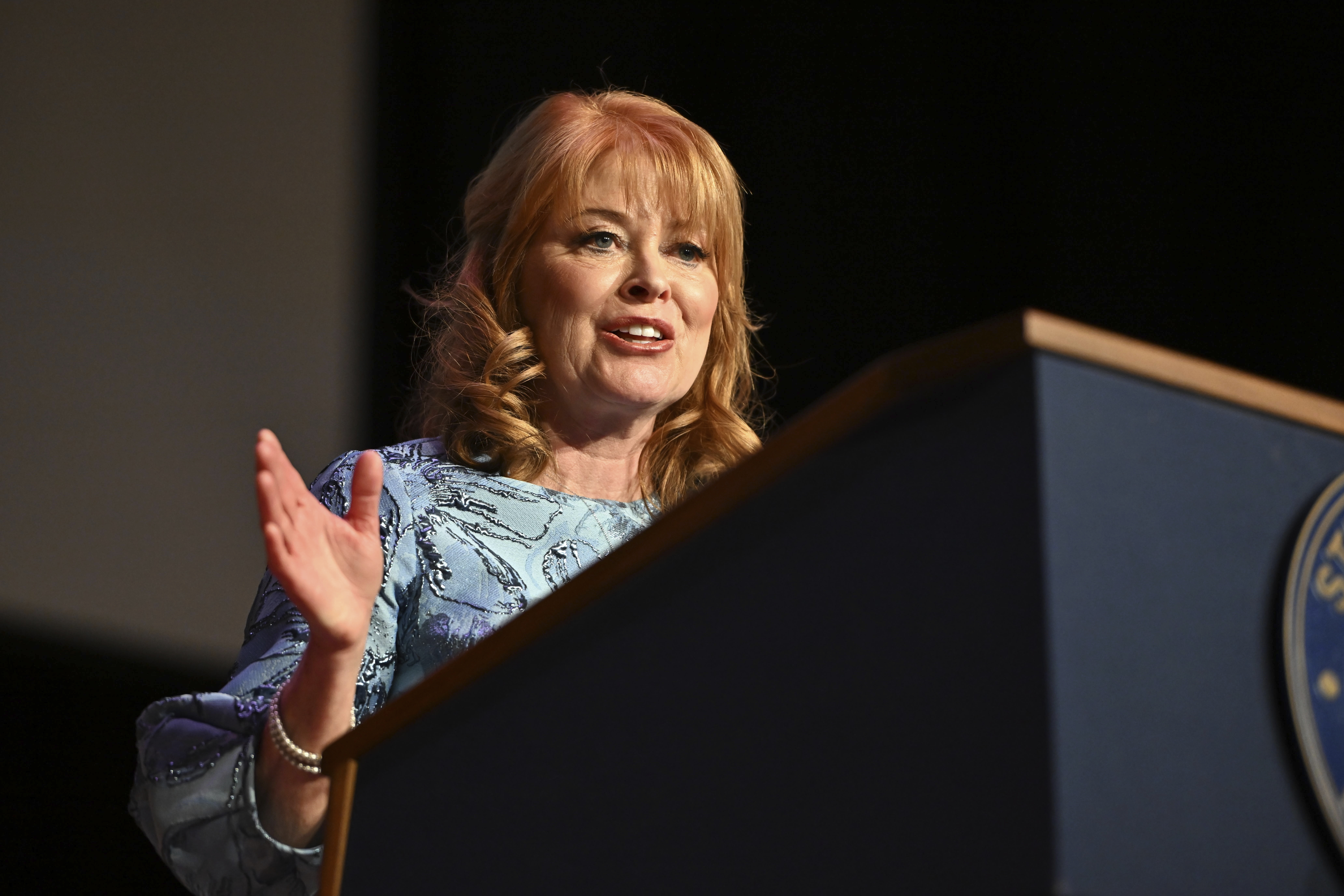
    “We need a governor in Harrisburg who will be a partner with President Trump in Washington, not an opponent in the courtrooms,” she said before Trump took the stage. “We need a governor who will fight for Pennsylvania jobs, like right here at Mack Trucks.”
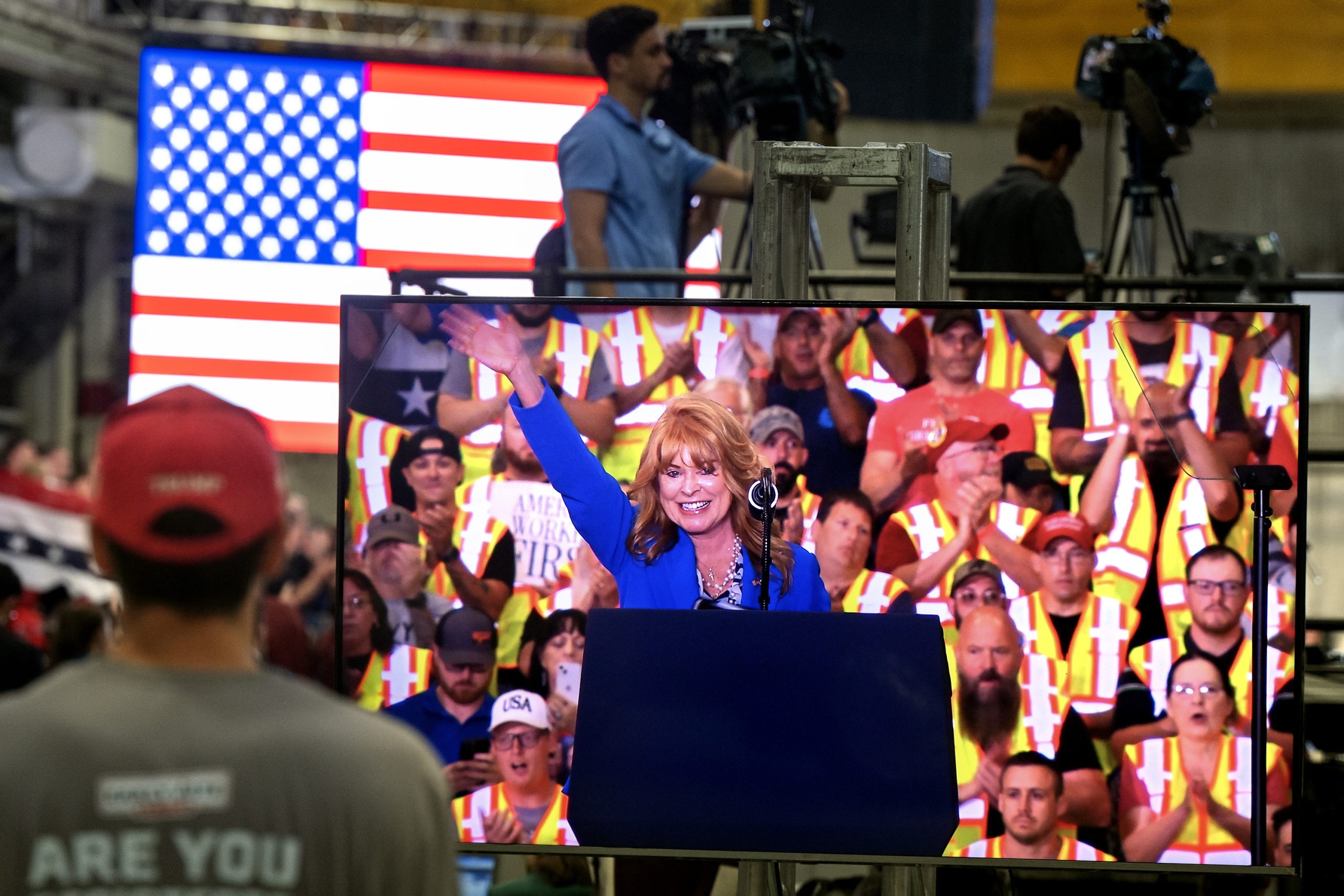
    State Treasurer and Republican candidate for governor Stacy Garrity is seen on a big screen as she speaks to supporters before the arrival of President Donald Trump at Mack Trucks in Macungie Tuesday, June 23, 2026. Trump did not mention Garrity when he later spoke to the crowd in the Lehigh Valley.Tom Gralish / Staff Photographer

    Trump restated his belief that tariffs have revitalized and would further boost the U.S. economy, though gas prices have reached new heights since he began a war with Iran, stymieing the flow of oil. (The Strait of Hormuz has reopened, following a tentative peace deal struck this month.)

    “I placed a 25% tariff on foreign automobiles and very importantly posed a 25% tariff on medium and heavy-duty trucks, so Mack Trucks could do very well with this factory in Pennsylvania,” he said.

    “They weren’t gonna come in from foreign lands and steal your jobs,” Trump added.

    However, the company cited Trump’s tariffs last year as contributing to its decision to lay off hundreds of workers at its Lehigh Valley operations center, the Pennsylvania Capital-Star reported at the time.

    Tuesday marked Trump’s fourth Pennsylvania appearance in his second term and his first this year ahead of November’s high-stakes midterm elections. The visit was billed as an official event as part of Trump’s American Workers First tour, but the event had the feel of a campaign rally.

    Four U.S. House districts in Pennsylvania are considered competitive, the most of any state, and the event took place in the 7th Congressional District, which is viewed as one of the most likely to flip to Democratic control.

    “We have to reelect a certain congressman,” Trump told the crowd.

    In 2024, Mackenzie won the seat by 1 percentage point, while Trump defeated Democrat Kamala Harris and won Pennsylvania in the presidential race.

    “Workers, like the ones here at Mack, are spearheading the great American comeback,” Mackenzie said.

    Bob Brooks, a union leader and firefighter who won the Democratic nomination to challenge Mackenzie, praised the union workers at Mack ahead of the event for building “the literal engine for the American economy,” but he blasted Trump and Mackenzie for failing to bring down prices.

    “No speech from Mackenzie can change the fact that his time in Congress has been an absolute disaster for the hardworking people of the Lehigh Valley,” Brooks said in a statement ahead of Tuesday’s event.

    Lt. Gov. Austin Davis, in a media call earlier Tuesday, said Trump’s choice to rally at Mack Trucks specifically signals he and his party recognize a “real political danger” because of Trump’s policies.

    “Donald Trump’s agenda is putting Congressman Mackenzie at serious risk,” Davis said. “They’re circling the wagons and trying to save that seat.”

    Affordability is likely to be a key issue on voters’ minds as they choose between Mackenzie and Brooks.

    Steve Leiby, 52, who works for Mack and attended Tuesday’s event, said he understands the tariffs Trump enacted are controversial, but he still supports them.

    “It’s a big risk, if we had a war, that we didn’t make a lot of war supplies in the U.S.,” he said.
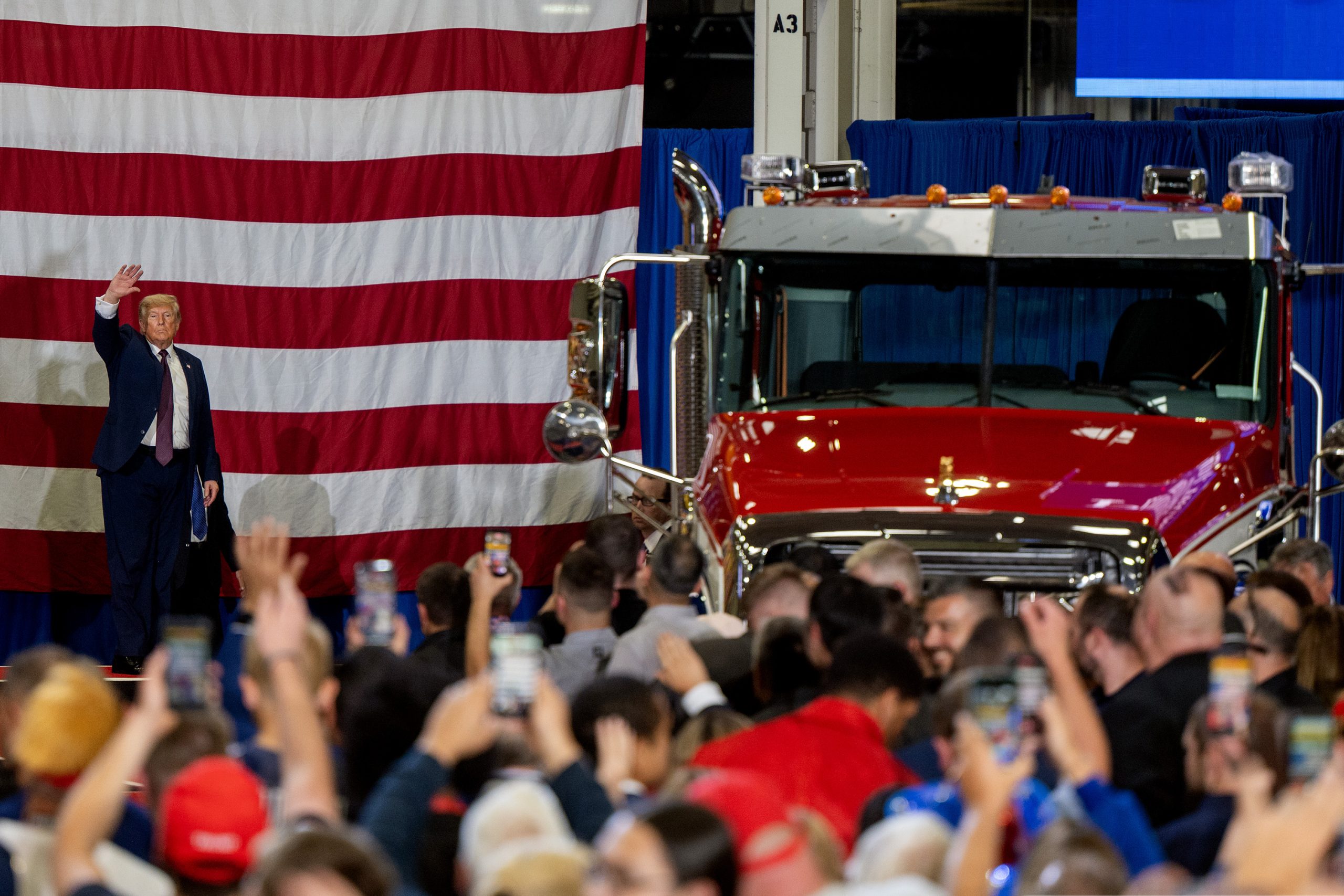
    President Donald Trump leaves after a visit to Mack Trucks in Macungie, in the Lehigh Valley Tuesday, June 23, 2026.Tom Gralish / Staff Photographer

    Brent and Francine Stanley, both 60, from New Tripoli, said they support Mackenzie because he shares their conservative values. His office organized an elder-care symposium that Francine Stanley attended because the couple have a 23-year-old child with disabilities, and they were able to get connected to resources.

    But they both know how competitive this election is, noting the stack of pro-Brooks mailers they have already received and predicting that Democrats will be knocking on their doors as November approaches.

    “They’re really persistent, and if you don’t answer, they follow up,” Francine Stanley said. Mackenzie, she said, should consider doing the same.

    Staff reporters Andrea Padilla and Sam Janesch contributed to this article.
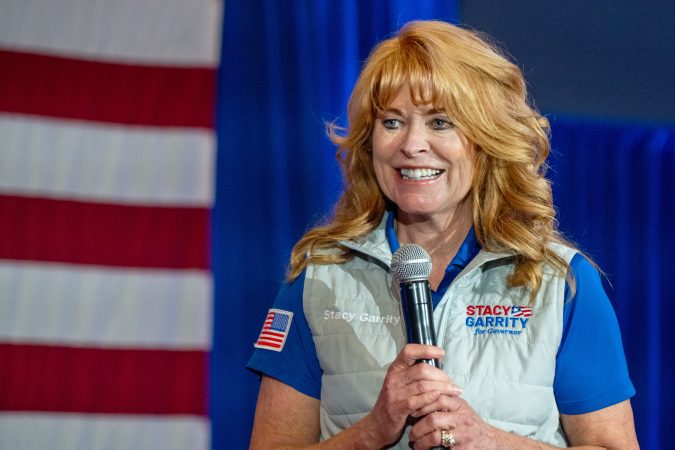
  • Stacy Garrity on potentially being the first female governor of Pennsylvania: ‘It’s my least favorite thing to talk about’

    Stacy Garrity on potentially being the first female governor of Pennsylvania: ‘It’s my least favorite thing to talk about’

    If elected in November, Stacy Garrity would become Pennsylvania’s first female governor in the state’s 238-year history.

    Even now, she is one of only two women in history to receive the Republican Party’s nomination for the job.

    The state has never had a woman as its governor; no woman has been elected as U.S. senator; and both times a woman ran for president, she lost the state. Over the last two centuries, Pennsylvania’s political glass ceiling has proven stubbornly resistant to cracks.

    But on the campaign trail against Democratic Gov. Josh Shapiro, Garrity, 62, said she doesn’t give that too much thought.

    “It’s my least favorite thing to talk about,” she said. “I was the oldest of four daughters, and we were just told that we were expected to work hard.”

    Navigating gender dynamics in politics can prove to be a particularly fine balance. Republicans, in particular, often emphasize that candidates should rise on their skills and talent, not personal identity.

    Garrity emphasized her attention is on issues like the power grid, education, and reining in spending, though she recognizes the historic significance of a potential win.

    “Republicans, for the most part, are based on merit, and that’s how I was raised,” said Garrity, who spent decades serving in the Army Reserve and as an executive in the manufacturing industry before becoming state treasurer. When she was reelected in 2024, she broke the record in Pennsylvania for the most number of votes cast in her favor for a statewide office, a distinction formerly held by Shapiro.

    In addition to taking on centuries of male-dominated leadership, Garrity will face other challenges in November.

    She is a Republican who has aligned herself closely with President Donald Trump — including campaigning at his Mar-A-Lago Club in Florida — at a time when Trump has been experiencing historic dissatisfaction among voters and the national political environment favors Democrats.

    And she is running against Shapiro, a Democratic incumbent with a rising national star who is popular even among independents. He has $38 million banked as of May, vastly outpacing Garrity’s $2.8 million. Shapiro is also counting on a strong showing in the midterms to help Democrats win the majority in the U.S. House.

    “I think [voters] are excited to have a first female governor, but I don’t think that is the reason anybody would vote for me,” she said.

    In Pennsylvania and 16 other states

    It is hard to be what you can’t see. And for voters who have never experienced a woman at the top of the hierarchy, it is difficult to imagine what that could look like, experts said.

    It has been 300 years since a woman led Pennsylvania — before it was a state.

    Hannah Callowhill Penn led the colony of Pennsylvania, governing first while her husband, William Penn, suffered several strokes, and then alongside a group of trustees after he died. Over 14 years, she settled boundary disputes, appointed and replaced government officials, and navigated relations with the monarchy in England.

    Other Pennsylvania women made attempts to break gender barriers but came up short. Barbara Hafer ran as a Republican against Democratic incumbent Bob Casey Sr. in the 1990 governor’s race, but lost with just 32% of the vote.

    Former U.S. Rep. Allyson Schwartz lost to Tom Wolf during the Democratic primary for governor in 2014, and Laura Ellsworth was defeated by Scott Wagner in the 2018 Republican gubernatorial primary.

    “It could just be a coincidence, but also it’s very hard to break political traditions, and one of those traditions in Pennsylvania, unfortunately, is male leadership,” said Nichola Gutgold, a professor at Pennsylvania State University’s Lehigh Valley campus, who has researched women in politics.

    Pennsylvania, however, is not alone. There are 17 states that have never had a female senator, and 17 states have never had a female governor, according to the Pew Research Center. That distinction spans geographic ranges and party control.

    Still, Pennsylvania is one of just four states that has never had either, along with Idaho, Indiana, and Colorado. Among them, only Colorado went for Democrats Hillary Clinton and Kamala Harris for president.

    “We have certain variables at play in the Commonwealth of Pennsylvania that make it more challenging for women to run for elected office,” said Dana Brown, executive director of the Pennsylvania Center for Women and Politics.

    The role of the parties on the state and county levels means they have a strong influence on recruiting candidates and pushing them up through the pipeline. Historically, recruiting tended to come from more masculine bases — such as fire stations or township supervisor positions.

    Now, though, “both sides of the aisle recognize that women can win here in Pennsylvania, and so Republicans and Democrats have been purposely recruiting more women,” she said.

    Women have made strides in other Pennsylvania elected offices.

    In Harrisburg, State Rep. Joanna McClinton (D., Philadelphia) is the first woman and second Black person to serve as speaker of the Pennsylvania House. Republican State Sen. Kim Ward of Westmoreland County is the first woman in Pennsylvania history to serve as Senate president pro tempore and Senate majority leader.

    When former Democratic U.S. Rep. Susan Wild, the first woman to represent the Lehigh Valley in Congress, was elected in 2018, “it took a real concentrated effort from [political action committees] and from groups that really wanted to see a woman win to make that happen,” Gutgold said.

    In other cases, as in neighboring New Jersey or Virginia, women have ascended with a combination of fortunate timing, skill, experience, and deft campaigning.

    When Gov. Mikie Sherrill last year became the second woman elected to lead New Jersey, Brown said, “it was a change election for New Jersey, and it was a sign of pushing back against what the federal government is doing with ICE and immigration and also with the economy.”

    Even though Sherrill, a Democrat, shares the same party as her predecessor, Phil Murphy, New Jersey’s vote for a woman represents change, Brown said. “She also worked really, really hard for it, as most women do,” she added.

    Sometimes, female candidates succeed by pushing against expected norms for women by emphasizing military experience or work in male-dominated trades, Gutgold said. Garrity has emphasized her military and business experience on the campaign trail, holding a Veterans for Garrity rally last week.

    “I think that, rhetorically speaking, it would be easier to elect a woman who appears to hold more conservative views, because of the way we, the electorate, still views women’s role in society,” Gutgold said.

    Republican women have scored victories in the Deep South by upholding conservative values such as opposition to abortion and support of gun rights. Kay Ivey holds the governor’s mansion in Alabama, and Nikki Haley previously led South Carolina for two terms. In Tennessee, U.S. Sen. Marsha Blackburn has represented the state since 2018 and publicly repudiated gender-specific titles, such as congresswoman vs. congressman.

    Garrity, on the campaign trail, has also vowed to clean up the “boys will be boys” culture in Harrisburg and has criticized Shapiro’s handling of a sexual harassment case involving a longtime aide.

    The aide, Mike Vereb, abruptly stepped down in 2023, while the administration quietly agreed to pay $295,000 to settle claims from an employee in the governor’s office that Vereb had made repeated sexual advances toward her, and made lewd claims about her and other women.

    “We don’t need to settle for a governor who will sweep sexual harassment and abuse charges under the rug. We don’t need to accept that our state government is a cesspool where intimidation is the norm and public employees fear retribution,” Garrity said during a news conference this year.

    Manuel Bonder, a spokesperson for Shapiro, rejected those accusations.

    “Governor Shapiro has a track record of taking on powerful institutions, exposing sexual abuse, and putting predators behind bars — and he continues to fight to deliver real accountability and justice for survivors here in Pennsylvania,” he said.

    Could Pa. women give Garrity a boost?

    Nationally, women voters tend to lean more toward the Democratic Party, Pew Research Center data show, so it’s unlikely that the Republican Party will attract a huge turnover — even with a female candidate on the top of the ticket.

    Sometimes, however, the gender divide can become even more entrenched. In 2024, for example, when the candidates were broadly polling neck-and-neck, Harris saw a 17-point advantage with Pennsylvania women, while Trump led with men in the state by 11 points, according to a Philadelphia Inquirer/New York Times/Siena College poll.

    Garrity said she is putting together agendas that speak to various coalitions of voters, such as veterans, Latinos, and small-business owners.

    “I don’t think we’ve done specifically females, but that might be a good idea,” she said. A campaign spokesperson added that Garrity would be rolling out women-focused events in the coming weeks.

    Campaigns can target women by speaking directly to certain issues. Democrats have often focused their message on support for reproductive access and abortion rights, especially since the 2022 Supreme Court decision overturning Roe v. Wade.

    According to a Pew Research Center report in March, 64% of women and 55% of men say abortion should be legal in all or most cases. But Garrity has been inconsistent on the issue. She said “Roe was wrong from the beginning” on the day the ruling came out and sold T-shirts on her campaign website that opposed abortion. But in an interview last September, Garrity said she would “respect” Pennsylvania’s current abortion law and would not support a state ban.

    Republicans, meanwhile, often promote public safety and have sought to make women’s sports a wedge issue in recent elections by pushing restrictions on the participation of transgender athletes.

    It is a tactic Garrity will use against Shapiro, who has called attempts to silo transgender athletes discriminatory.

    “A lot of people think that he’s moderate because he likes to be all things to all people, and they don’t understand, he is really for boys competing against girls in sports,” Garrity said.

    There are other issues women candidates are often seen as more trusted on, such as education, healthcare, and children’s needs, Gutgold said.

    Amy Widestrom, executive director of the League of Women Voters of Pennsylvania, said top of mind for members of her organization right now is the right to vote. She said some women have expressed concern that requiring documentary proof of citizenship, which Republicans say is meant to ensure immigrants in the country illegally do not vote, could affect those who change their legal name and do not have matching identification records.

    Appealing to women on these issues can pay off, as they represent a significant voting bloc. Among registered voters in Pennsylvania, 52% are female. Of registered Democrats, 59% are female, and 47% of registered Republicans are female. Roughly 40% of unaffiliated voters are female, according to Widestrom, via voter data.

    But Macy Charles of Concerned Women for America, a socially conservative political nonprofit focused on women, said candidates should speak more expansively when courting women voters.

    “It’s pretty offensive to assume that when we’re talking about issues women care about, it’s only women’s specific issues, like abortion,” said Charles, a legislative strategist. “Women care about the economy, women care about the U.S. borders. Because they have maternal instincts, they care about their families, they care about the well-being of America’s future.”

    Rather than leaning into identity, Charles said, Garrity is reinforcing her reputation of competence.

    “More than just her identity as a woman, she is willing to stand up for common sense and truth and really put families first,” she said.

    Still, Garrity recognizes the achievement her potential victory could bring.

    To be Pennsylvania’s first female governor, “I think it would be great,” she said, “but I think it will be because I am absolutely the best candidate.”

  • New Pa. poll shows Shapiro leading handily against Garrity, trouncing Trump in popularity

    New Pa. poll shows Shapiro leading handily against Garrity, trouncing Trump in popularity

    Democratic Gov. Josh Shapiro has a commanding lead against his Republican rival Stacy Garrity in a head-to-head matchup, and he maintains steady job approval ratings five months ahead of the November election, according to a new poll of Pennsylvania voters from Franklin and Marshall College.

    Shapiro leads Garrity 50% to 28% in the 2026 governor’s race, a crushing advantage well outside of the survey’s margin of error of 5.1 percentage points. It is the first major poll released since both candidates officially secured their parties’ nominations in uncontested primaries last month.

    The survey, conducted June 8-14 by the Center for Opinion Research on behalf of Franklin and Marshall, involved 546 registered Pennsylvania voters. Roughly 42% were Democrats, about the same percentage were Republicans, and about 16% were independents.

    Shapiro won almost half of independents and just over a quarter of Republicans, who rated his performance as excellent or good.

    (function(){function e(){window.addEventListener(`message`,function(e){if(e.data[`datawrapper-height`]!==void 0){var t=document.querySelectorAll(`iframe`);for(var n in e.data[`datawrapper-height`])for(var r=0,i;i=t[r];r++)if(i.contentWindow===e.source){var a=e.data[`datawrapper-height`][n]+`px`;i.style.height=a}}})}e()})();

    About an equal proportion of all voters — 48% — said Shapiro is doing an excellent or good job as governor as those who said he is doing a fair or poor job.

    Shapiro’s approval comes as he continues building a national profile, likely with ambitions for higher office.

    He also boasts relative popularity despite voters’ deep concern with their personal finances and the state of the economy, the top issue among every partisan group.

    “The big concern that people face is economic, and even though that’s the problem that we see facing us, the blame goes outside of Pennsylvania,” said Berwood Yost, the director of the Center for Opinion Research. “People don’t see [Shapiro] as being responsible for the economic concerns that they have.”

    But people do blame President Donald Trump.

    Just 29% of voters said Trump is doing an excellent or good job, while 71% said he is doing a fair or poor job. It marked a 10-percentage-point drop from March, when his positive approval rating was 39%.

    While 63% of Republican voters gave Trump positive reviews in the new poll, that number was almost 80% in March.

    Just under half of respondents said they are “worse off” financially than one year ago, and 35% of voters said the economy, including unemployment, housing and real estate costs, and higher gas and utility prices, is the most important problem facing the state.

    “Pennsylvania should be doing so much better,” Garrity said in a previous interview with The Inquirer. “[Voters] know we’re falling behind. They know that we have a governor who’s more interested in Pennsylvania Avenue than helping Pennsylvania families. They’re very worried about utility prices because their electric bills are going up, up, up. Groceries are expensive.”

    But among those who mention economic problems, voters in the poll trust Democrats over Republicans, 42% to 24%, as the party that can best handle the issue.

    Shapiro’s campaign released a new TV and digital ad Tuesday focusing on his expansion of workforce opportunities, such as apprenticeships in trades like welding.

    “Governor Shapiro bet on workers like me. I’m proof that bet’s paying off,” said Ryan, a worker in Western Pennsylvania, in the ad.

    (function(){function e(){window.addEventListener(`message`,function(e){if(e.data[`datawrapper-height`]!==void 0){var t=document.querySelectorAll(`iframe`);for(var n in e.data[`datawrapper-height`])for(var r=0,i;i=t[r];r++)if(i.contentWindow===e.source){var a=e.data[`datawrapper-height`][n]+`px`;i.style.height=a}}})}e()})();

    Yost said Garrity is a “high-quality candidate” with a great resume that may keep down-ballot Republicans afloat, but she is competing against a popular incumbent in a year where Democrats are poised to win seats.

    “It’s rough to be a Republican at the moment,” he said. “You’re facing those headwinds, no matter what office you’re running.”

    On the economy, the issue voters care most about, a mere 17% of voters approve of how Trump’s administration is handling inflation.

    “The concerns about personal financial circumstances, the economy, and the cost of living — they’re paramount in people’s minds, and they’ve become more pronounced since March,“ Yost said. “That’s had an effect on the president’s job approval ratings in the state, which have declined pretty substantially.”

    In the last four gubernatorial races, the average margin of victory has been about 13 percentage points, Yost said, while presidential races tend to be much tighter — about 2.2 points.

    “What’s essential to understand is that these races happen in a different context than the presidential races. There are a lot of things different about them, and typically incumbent governors have a real advantage,” he said.

    State issues show more consensus

    Many of Shapiro’s budget priorities, such as restricting cell phones in schools and taxing skill games, have widespread public support.

    Almost nine out of 10 people support limiting access to cell phones in classrooms, which follows Shapiro’s urge for legislation to “get distractions out of the classroom and create a healthier environment in our schools.”

    And 71% of registered voters favor regulating and taxing so-called skill games, the slot machine look-alikes around Pennsylvania — an 11-percentage-point increase compared with previous F&M polling in 2024.

    The Pennsylvania Supreme Court ruled Monday the skill games are, in fact, slot machines and should be regulated as such, clearing the way for the state to place new rules on the devices. The decision was celebrated by Democrats who view the machines as “predatory.”

    Most voters, 70%, also support having an independent redistricting commission to draw state legislative districts, and 59% oppose mid-decade redistricting.

    Texas redrew its congressional maps last August at Trump’s urging, shifting five seats to lean more heavily Republican. California voters approved a constitutional amendment in November to permit the adoption of replacement maps that would favor Democrats. Other states have also voluntarily redrawn or created new maps following litigation.

    Shapiro said he also opposes mid-decade redistricting, telling reporters last August: “It’s not on the table here in Pennsylvania.”

    As parties compete for control of the U.S. House of Representatives this midterm election season, the poll found that voters prefer Democrats over Republicans by 12 points, 47% to 35%. Shapiro has personally backed several candidates and is hoping to use his influence to help Democrats win the majority this November.

  • Pa. will pay for security upgrades to Gov. Josh Shapiro’s home but treasurer was right to initially deny $1 million payment for the bill, AG says

    Pa. will pay for security upgrades to Gov. Josh Shapiro’s home but treasurer was right to initially deny $1 million payment for the bill, AG says

    HARRISBURG — Pennsylvania Treasurer Stacy Garrity acted lawfully when she declined to pay more than $1 million in bills related to security upgrades made on Gov. Josh Shapiro’s personal home in Abington Township following an arson attack on his state mansion, the Pennsylvania Attorney General’s office announced Friday.

    In a memo detailing a settlement agreement between the state and the unpaid contractors who provided security upgrades to Shapiro’s private home, the attorney general’s office said that Pennsylvania would foot the $1 million bill “on a one-time basis,” noting the extraordinary circumstances and the threat on Shapiro’s life that led to the upgrades being requested.

    Current state law does not account for the increasingly dangerous position public officials face in today’s political climate, and the GOP-led state attorney general’s office encouraged the General Assembly to find a legislative solution for these issues going forward.

    However, Shapiro’s administration and Pennsylvania State Police failed to follow proper procurement processes and should have approached the legislature for approvals for the security upgrades, according to the memo authored by Executive Deputy Attorney General Eisenberg and Chief Deputy Attorney General Amy Elliott.

    “Going forward, we expect that such expenditures will result from specific legislative appropriation or new general laws,” they wrote in the memo. “We looked forward to working with the administration to accomplish these goals.”

    Shapiro’s personal home received more than $1 million in security updates, including a new security system and landscaping that Pennsylvania State Police determined was necessary after a man attempted to murder Shapiro by setting several firebombs inside the governor’s residence in Harrisburg while he and his family slept.

    Pennsylvania Gov. Josh Shapiro speaks during a news conference at the governor’s official residence about a suspected arson fire that forced him, his family and guests to flee in the middle of the night on the Jewish holiday of Passover, Sunday, April 13, 2025, in Harrisburg, Pa. (AP Photo/Marc Levy)Marc Levy

    Garrity, a Republican who is challenging Shapiro in November’s gubernatorial election, announced in April she could not pay the security upgrade bills, arguing that state law prohibits her from approving payment on work done on a privately owned property without legislative approval. The move was criticized by the incumbent Democratic governor’s office at the time, arguing it was a “shamefully political action.”

    In a statement Friday, a spokesperson for Shapiro said the governor appreciates the attorney general’s office acting “without political interference” to approve the settlement so the contractors can be paid.

    “As the Attorney General demonstrated, the safety of the governor and his family should never be weaponized for partisan gamesmanship, and our administration will continue to work with law enforcement and elected officials across the commonwealth to keep our leaders safe,” said Shapiro spokesperson Rosie Lapowsky.

    After Garrity declined to pay the bills, the state had two options to address the outstanding payments: a review and settlement by the attorney general’s office or legislative approval of the funds. Shapiro’s administration chose the review by the state AG’s office, which is led by Attorney General Dave Sunday, a Republican who supports Garrity’s bid for governor.

    Pennsylvania State Treasurer Stacy Garrity speaks to the audience after taking the oath of office for her second four-year term in the Forum Auditorium across the street from the Capitol, Jan. 21, 2025, in Harrisburg, Pa. (AP Photo/Marc Levy)Marc Levy

    The security upgrades on Shapiro’s personal home — plus $32 million in upgrades to the state-owned governor’s residence — were made under emergency contracts, which allow state agencies to quickly respond to emerging problems without waiting for legislative approval. However, Garrity argued — and the state attorney general’s office on Friday affirmed — that the emergency process does not allow the state to spend taxpayer funds on private property, such as Shapiro’s personal residence.

    “Current procurement law does not account for the increasing reality of threats to public officers and their families,” the AG’s office wrote in the settlement agreement. “Because the law does not allow for public funding of construction on private residences, the Treasurer had no legal option other than to deny payment.”

    In a statement Friday, Garrity said the settlement makes it clear “my sworn duty is to uphold the law, protect taxpayers, and only act with explicit legal authority.”

    Her office has not yet received a request to pay the contracts, she said. Once it does, she will “carefully review each one” and pay the outstanding bills.

    “Safety and security matter to everyone, but good intentions can never excuse ignoring the law,” Garrity added.

    Shapiro has faced scrutiny from some Republican lawmakers over his administration’s rapid and sweeping response following the arson, while Democratic lawmakers rallied around him to ensure his and his family’s safety. Republican legislators have said they believe Shapiro and his family should be safe, but should follow proper channels and regulations when spending taxpayer funds.

    A committee in the Republican-controlled state Senate in December took the unprecedented step to subpoena Shapiro over the security upgrades to his personal home, arguing that his administration had not been transparent in previous inquiries about how state taxpayer dollars were being used to upgrade security there.

    Shapiro’s personal property upgrades also resulted in a land dispute with one of his neighbors, who argued in federal court that Shapiro was violating their constitutional rights by using his power as governor to seize a portion of their property. Shapiro, in a separate suit filed in the Montgomery County Court of Common Pleas, argued that the disputed land had been his for years.

    Shapiro and his family split their time between the state-owned governor’s residence in Harrisburg and their Montgomery County home, where his two youngest children still attend school.

    This story was updated to note Sunday supports Garrity’s campaign for governor.