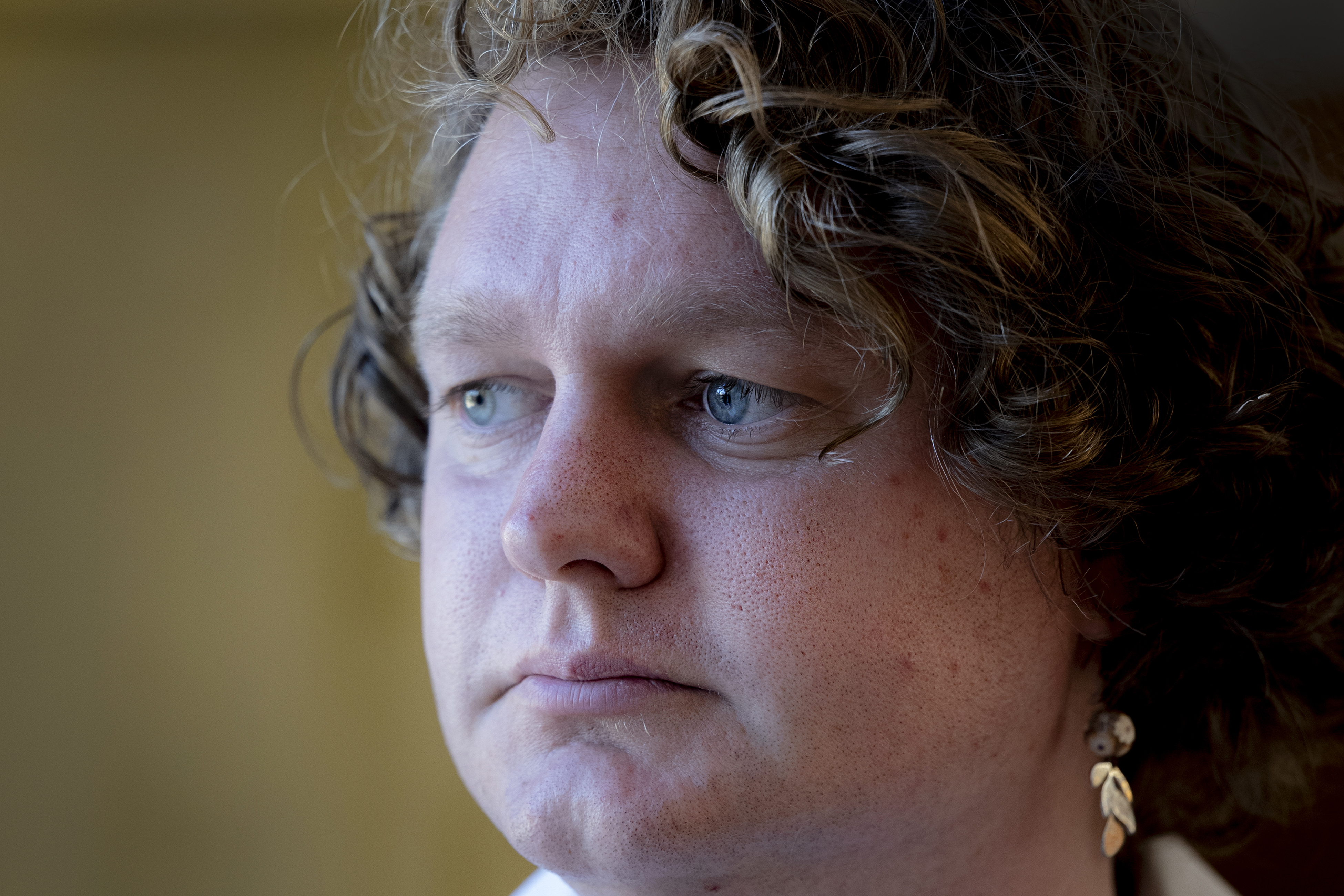
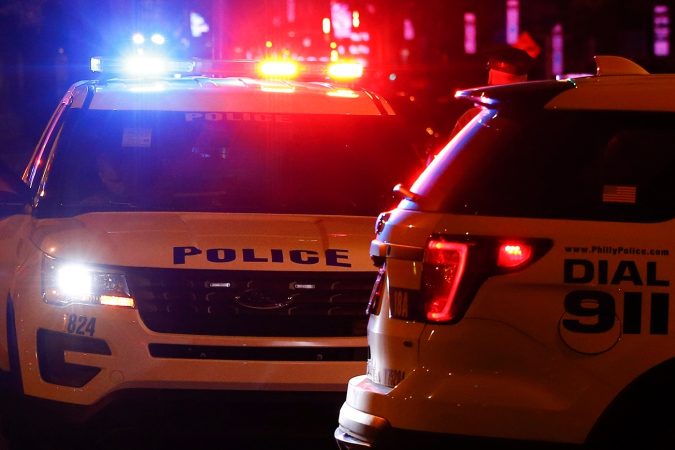
The Rev. Jay Bergen was at the sign-in table inside the Friends Center, where No ICE Philly was holding its regular public meeting last week, when a police civil affairs officer appeared.
Bergen asked what was happening, and said the officer responded, “We’re just here to make sure everyone’s safe.”
The activist group was preparing to serve cake, to celebrate its one-year anniversary.
Bergen, who leads No ICE Philly, was concerned that the officer brought his gun into the Center City facility, which includes a Quaker meetinghouse. The pastor escorted the officer down the hall to the door, explaining that he could attend the public meeting if he wished ― then noticed a second civil affairs officer outside.
The two officers stayed there, watching, for the duration of the three-hour gathering, Bergen said, their presence leaving those inside feeling confused, intimidated, and surveilled.
“Who gave the order, and what was the goal?” Bergen asked in an interview. “Why are we more of a threat than ICE agents are? … It’s another instance of the Philadelphia police being interested in targeting Philadelphians instead of protecting Philadelphians.”
The police department said in a statement last week that “the Sept. 9 event was identified as a scheduled protest.” Civil affairs officers routinely attend demonstrations as part of their duty to public safety and the First Amendment, and “their presence was not specific to No ICE Philly,” the statement said.
But on Monday, Staff Inspector Frank Palumbo, who oversees the civil affairs unit, said he would open an investigation into the matter.
Palumbo said he did not know why an officer would have entered the Friends Center. That would be outside department policy, he said, unless there was a disturbance inside.
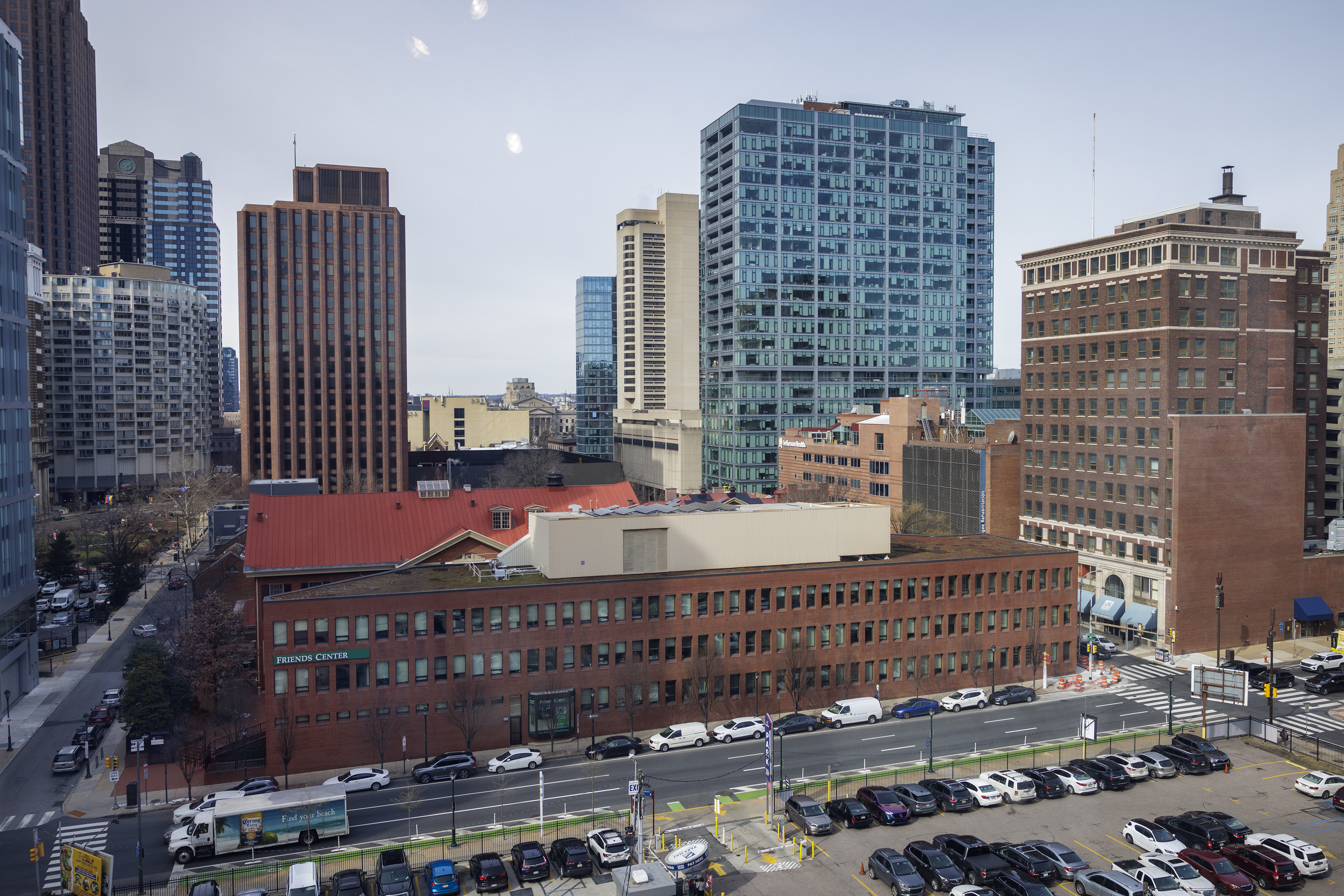
The Friends Center at 15th and Cherry Streets.Alejandro A. Alvarez / Staff Photographer
If the group had gathered outdoors, Palumbo said, the department would have sent more officers ― including some in uniform. It did not do so, he said, because “there was no indication whatsoever that there would be destruction of property, violence, or anything that would even result in civil disorder.”
He added, “This will not continue to occur.”
Civil affairs units are specialized teams of officers designed to act as neutral liaisons between sides during what might be contentious protests, labor actions, or big public gatherings. Like other officers, they always carry their guns while on duty.
In Philadelphia, the police department says, civil affairs officers operate in a diplomatic and impartial capacity to ensure that constitutional rights are protected for all. The officers prioritize protection of life and property while preventing vandalism, assaults, or other illegal acts not covered by First Amendment rights, the department says.
Niles Wilson of the Center for Policing Equity, a California-based research and reform group, said a key question of any investigation into the matter should be why the officers were at the meeting at all.
“What intelligence did the police department have that would either lead these officers to do this, or were these officers acting on their own?” he asked. “That needs to be answered.”
The stakes reach beyond any particular meeting, he said.
A civil affairs unit is an asset, one that can help “towards transparency and building trust between the police department and the community,” Wilson said. But “anytime the public trust is lost in that service, then it disrupts public safety everywhere.”
Philadelphia civil affairs officers are commonly present at demonstrations led by No ICE Philly, which in the last year has emerged as perhaps the boldest and most visible of the city’s pro-immigrant organizations.
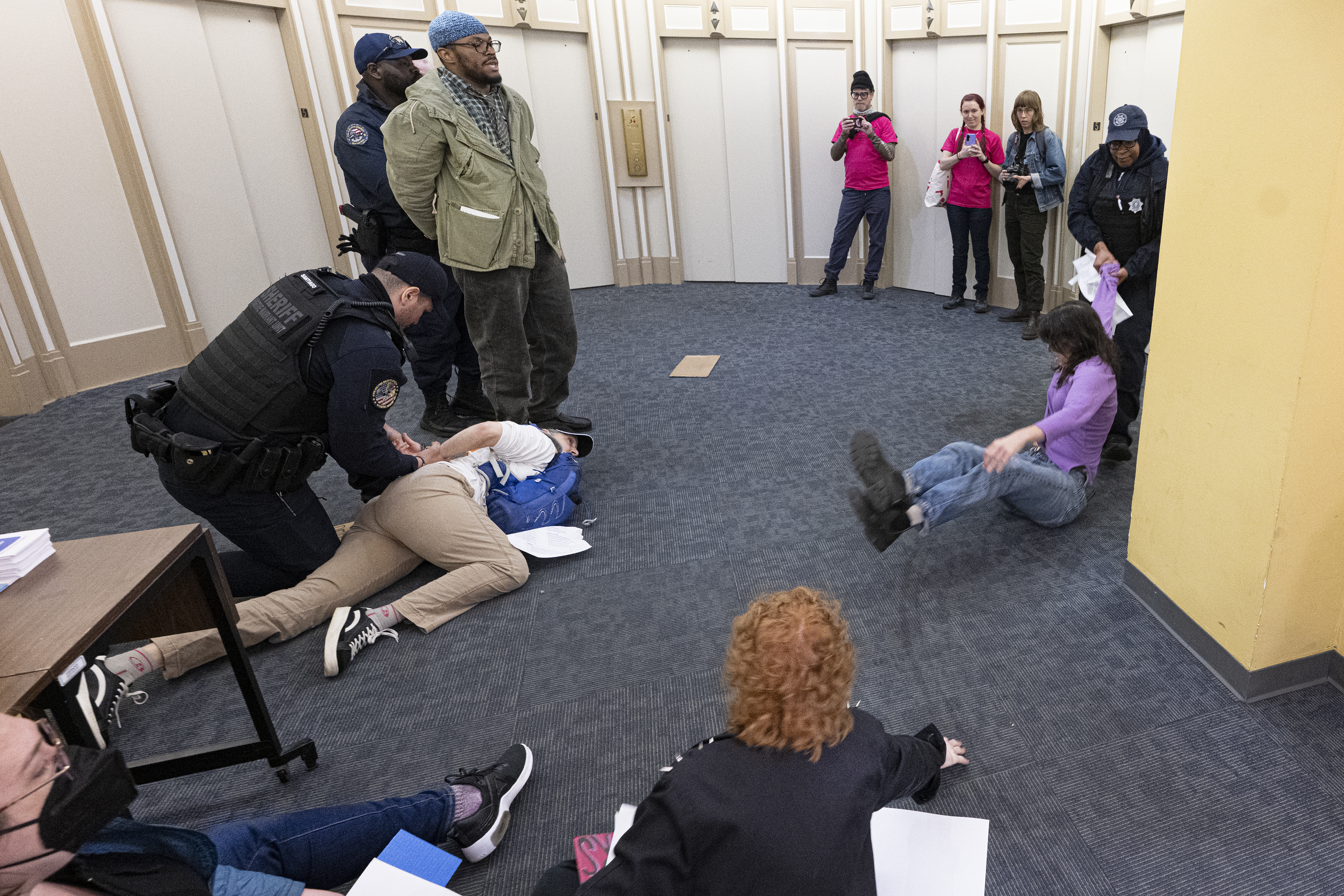
No ICE Philly activists and supporters are handcuffed and taken into custody at a sit-in outside the office of Sheriff Rochelle Bilal in April 2026.Jose F. Moreno / Staff Photographer
The Sept. 9 gathering, however, was a regular meeting, generally held twice a month, open to all, and advertised in advance on social media. Other meetings have drawn far more people than the 60 or so present at this one, organizers said, which made the police presence puzzling.
“It felt kind of like a threat, like, ‘We’re watching,’” said Em Auerbach, a group member who attended. “It made people feel on edge.”
As the meeting was ending, Auerbach said, one of the officers approached a Friends Center employee at the front desk and asked: “Are you good? Do you need anything?”
The worker answered that she was fine, Auerbach said.
No ICE Philly members waited for the employee to finish her work, and then everyone left together, Auerbach said.
“It was weird,” Auerbach said of the officers’ presence. “I think they were there to intimidate us. … Unless there was a threat against our group, I don’t think this was a good use of taxpayer funds.”
Bergen described at one point asking the officers, “‘Why are you surveilling us?’ They said, ‘We’re not surveilling.’ I said, ‘That’s what a body camera is for.’”
The pastor said that as people entered the meeting, they said the police officers had asked who they were and why they were there.
Palumbo said if that happened, it would fall outside department policy, that even at combative street demonstrations people generally are not asked their names “unless it is necessary to determine who they are for the purposes of an investigation. This was not an investigation.”
Palumbo said the relationship between the police and No ICE Philly has been cordial. He estimated that police have cited protesters twice in the last year, issuing citations with $100 penalties that are similar to parking tickets.
Those citations, he said, are “the most extreme police enforcement we’ve ever done with this group.”
Correction: This story has been updated to correct the pronouns used by Rev. Jay Bergen and Em Auerbach.
Retired Philadelphia Police Capt. Mark Fisher gets winded and lightheaded while emptying the dishwasher or pushing his gas-powered lawnmower, his lungs forever scarred by the ankle-deep ash that he trudged through at ground zero.
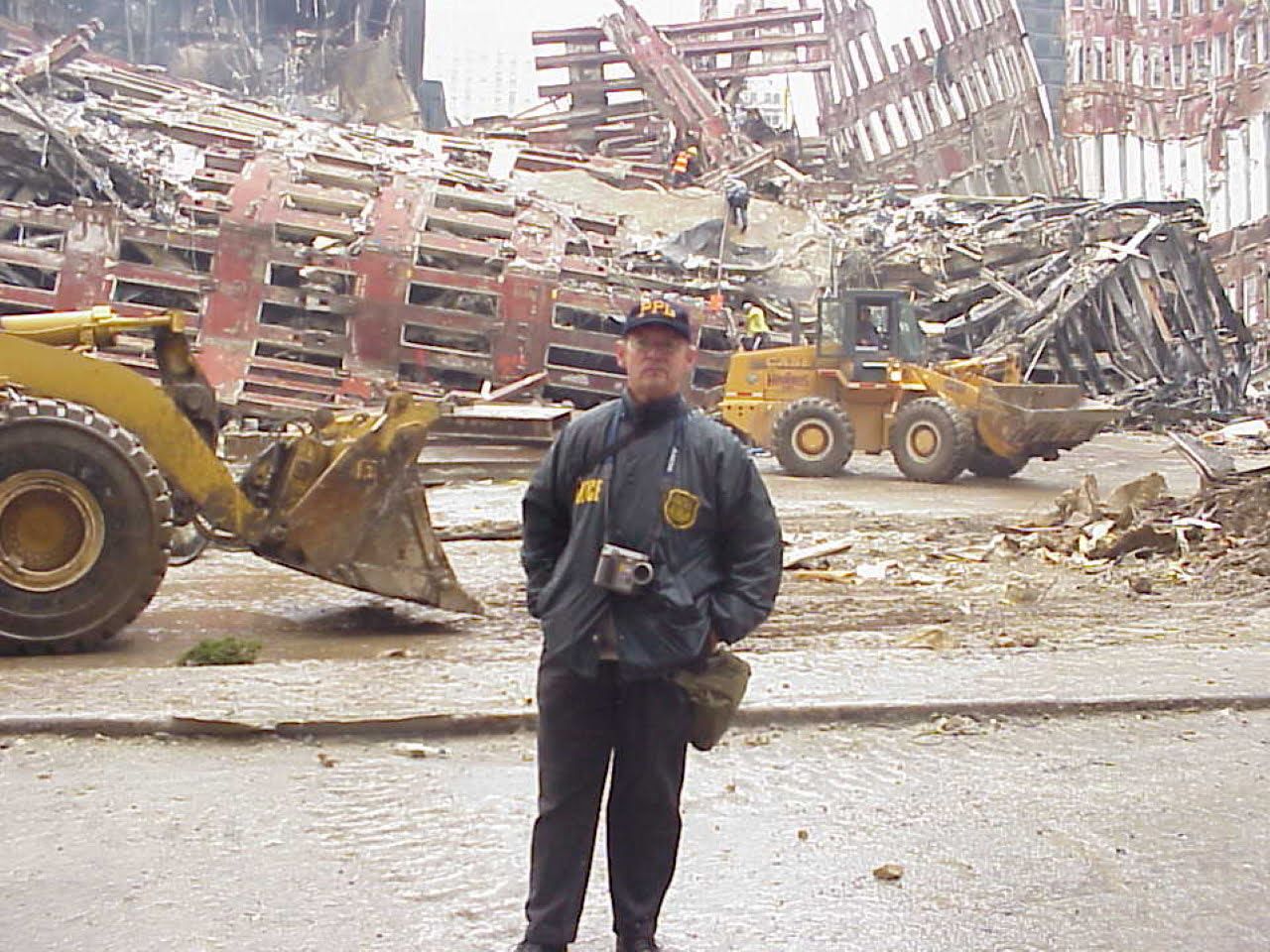
WhenFisherarrived at the nation’s worst crime scene, two days after the Sept. 11, 2001, terrorist attacks, each step he took kicked up a powdery plume, coating his tan work boots. Dense smoke from fires burning beneath the rubble of the World Trade Center site stung his eyes and clogged his lungs.
Then a lieutenant in charge of the Philadelphia department’s crime scene unit, Fisher scoured the wreckage for nearly two weeks. He helped recover the lifeless body of a firefighter crushed under concrete. A torso. The severed arm of a businessman.
The coughing fits started about a year later. Then, about six years after 9/11, a chest X-ray revealed a thick, hardened fluid around his lungs, makingit difficult to breathe. He developedsevere pulmonary disease linked to exposure to toxins.
Fisher, 69, needs a double lung transplant soon, his doctors say, that at best will extend his life by five to seven years. His deteriorating health shows how grossly federal and local health officials underestimated the environmental hazards.
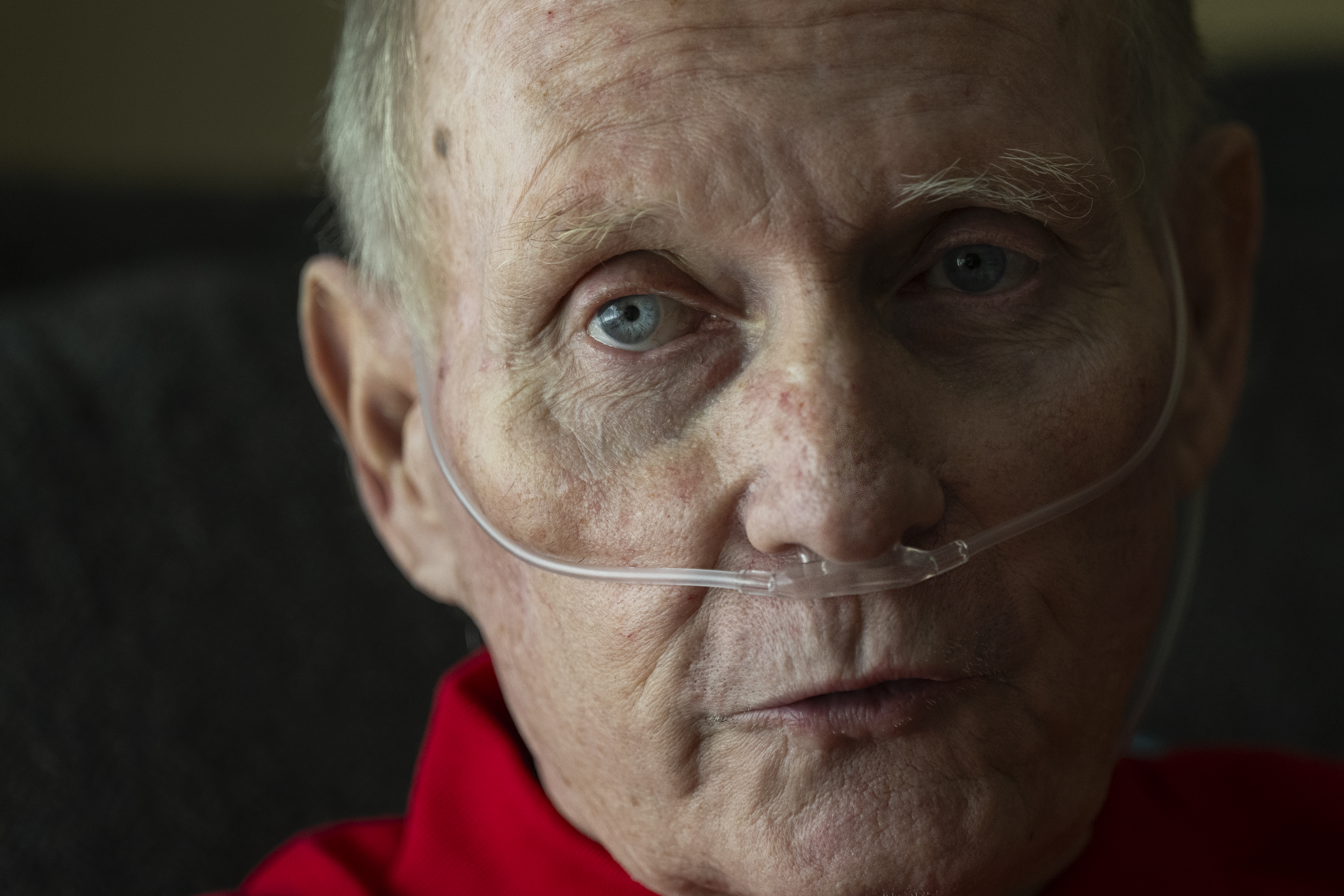
“I can’t breathe worth a darn. My lungs just aren’t going to last,” Fisher said, as he sat in his Northeast Philadelphia home with oxygen prongs in his nostrils and a heating pad against his back.
“Everything aches,” he rasped, coughing relentlessly.
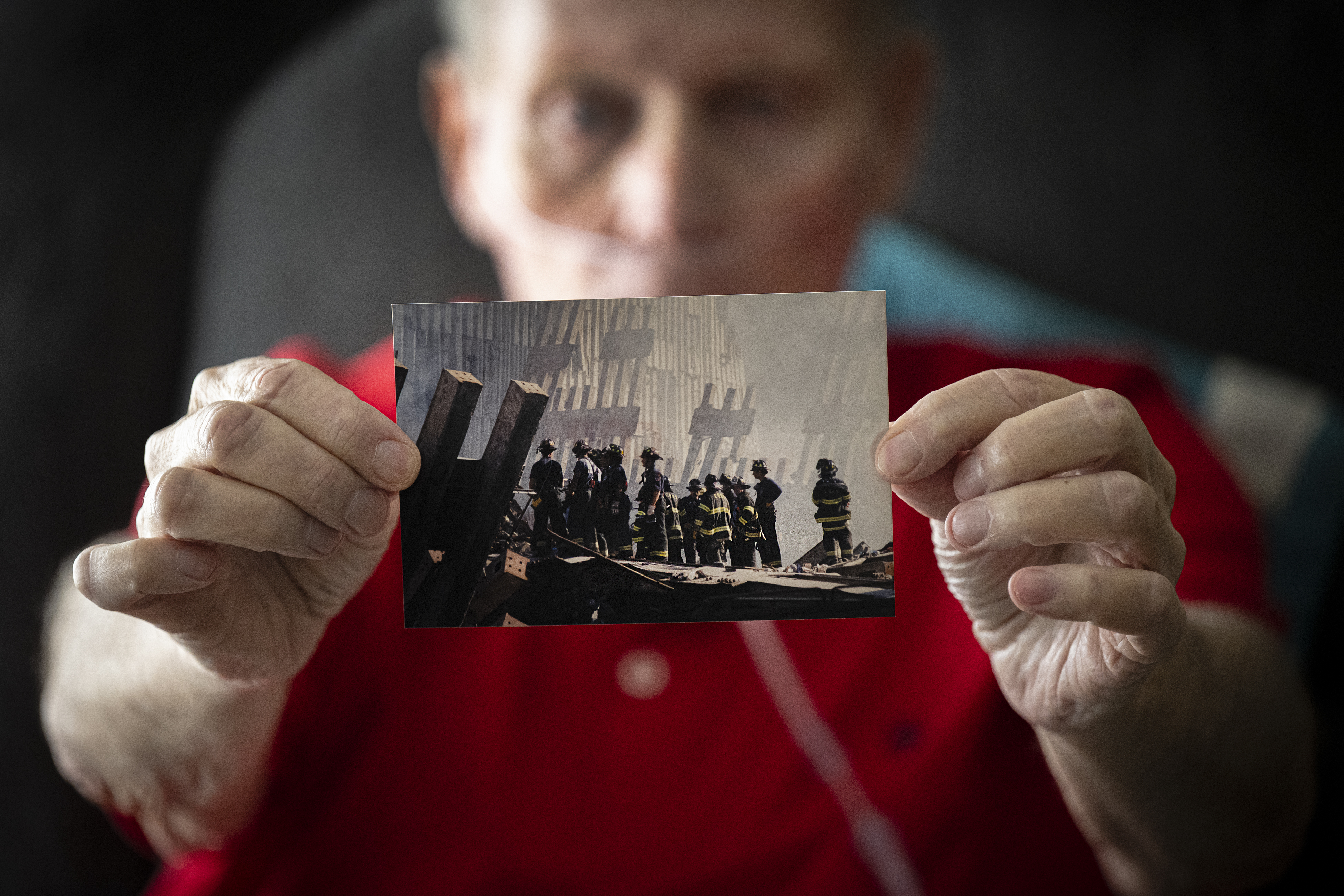
Retired Philadelphia Police Captain Mark Fisher, 69, shows a photograph he took while working as a crime scene investigator at ground zero.Jose F. Moreno / Staff Photographer
Cancer is the fastest-growing diagnosis, now that enough years have passed for tumors and other abnormalities to emerge, soaring from about 3,200 cases to more than 57,000 within the last 11 years.
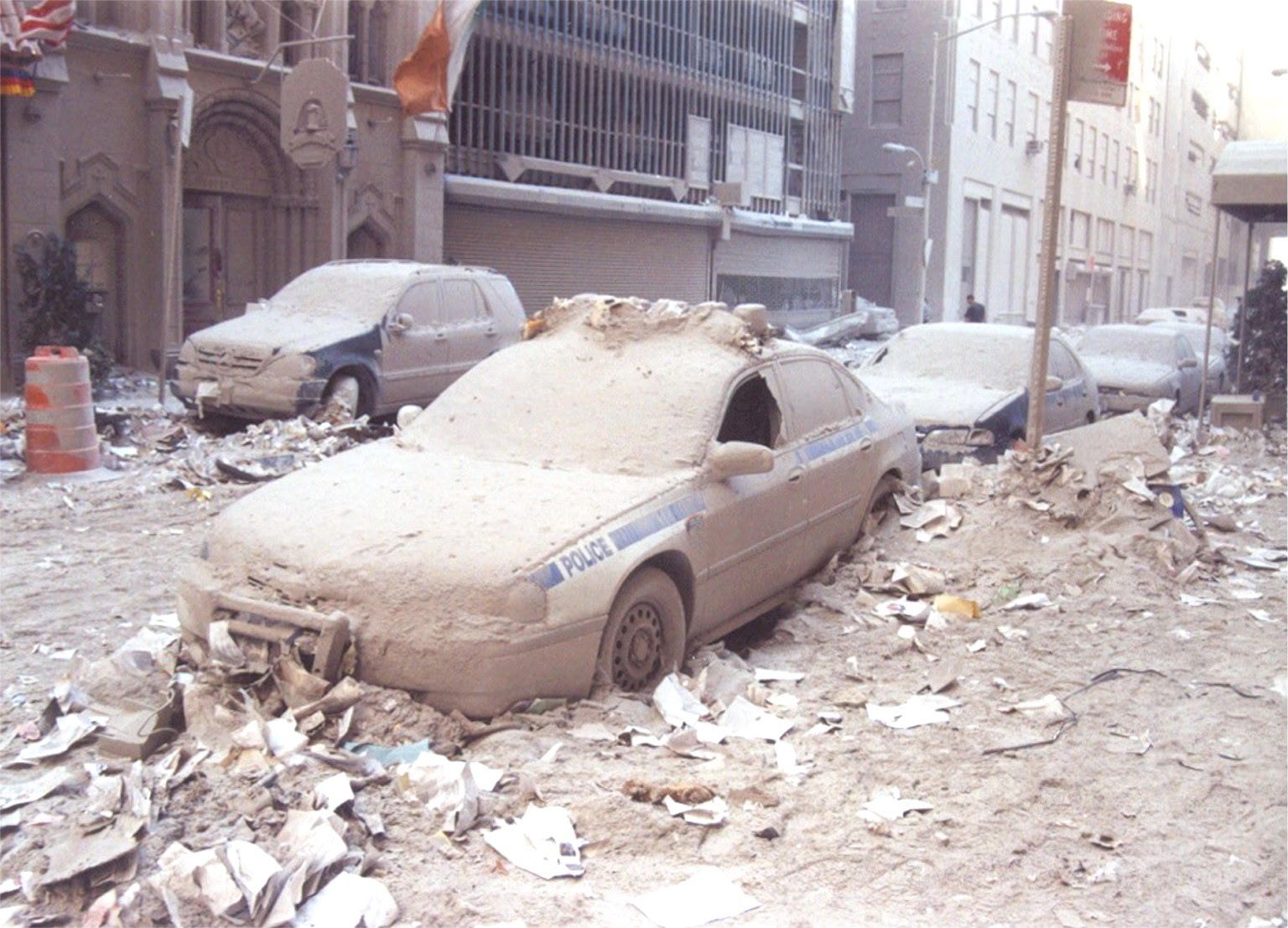
Most of the toxic dust — as deep as snow drifts in spots — formed when the concrete floor slabs of the 110-story towers collapsed on top of one another in quick succession. The wreckage, known as “The Pile,” contained more than 350 chemicals andmineral agents:potassium hydroxide in concrete, calcium sulfate in wallboard, jet fuel, asbestos, glass insulation fibers, heavy metals — all finely groundand aerosolized.
“It was such a mixture of stuff, like a witch’s brew,” said Iris Udasin, a Rutgers Health doctor who treats 9/11 responders and studies the long-term health effects of the attack.
The alkaline alone in “the cement from all these buildings was toxic in and of itself,” she said. “It basically burned holes in people’s noses and made them more likely to absorb other chemicals and gases that were in the air.”
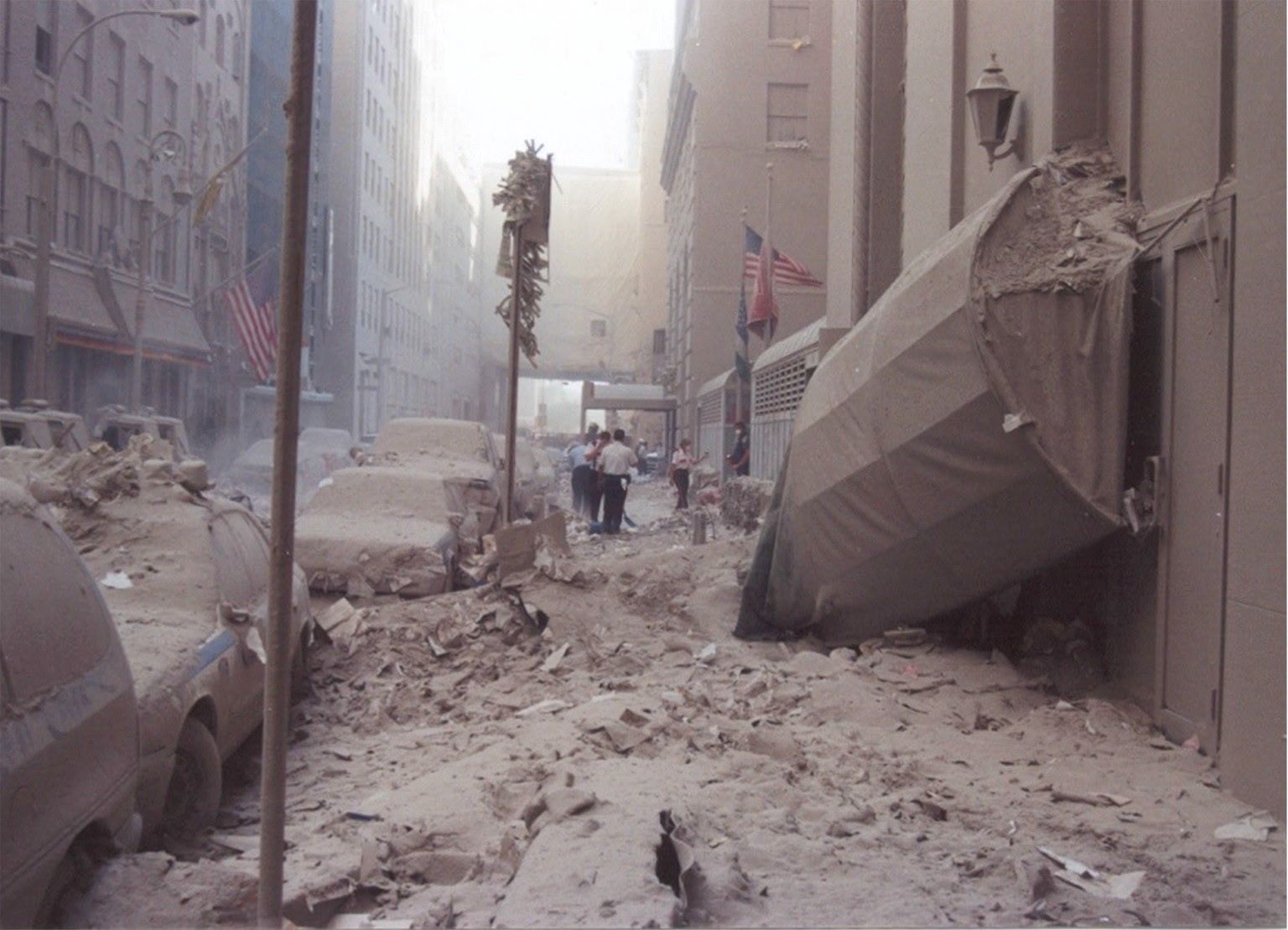
While at ground zero, then-Philadelphia Police Sgt. Greg Masi took photos of the dust and debris. When Masi started wheezing and coughing a few years later, he thought, “I’m just getting old. I didn’t want to believe that the days I was there affected me,” he said. He’s since been diagnosed with asthma, lung nodules, and a type of blood cancer linked to breathing toxic dust. Courtesy of Greg Masi
From WTC cough to lifelong disease
Udasin directs the WTC Health Program at Rutgers University in Piscataway, N.J. — one of six clinics created nationally to treat 9/11 responders.
When it opened in 2003, Udasin mostly treated responders for what she calls “World Trade Center cough,” a dry and persistent hacking that improved with asthma medication.
Now their cases are far more complicated and life-threatening, often requiring referrals to medical specialists, from pulmonologists to oncologists.
Udasin can name many of the roughly 3,000 responders she treats annually by their faces alone. She prefers to relay test results, both good and bad, to patients herself, rather than delegate.
On a recent morning,she escorted an older man from an exam room to the clinic’s lobby and asked: “Do you want me to call you with the results? If you are going to be scared, I can have somebody else call you with the results.”
Her patients, hailed as heroes after 9/11, could not have anticipated how working at ground zero would impact their long-term health.
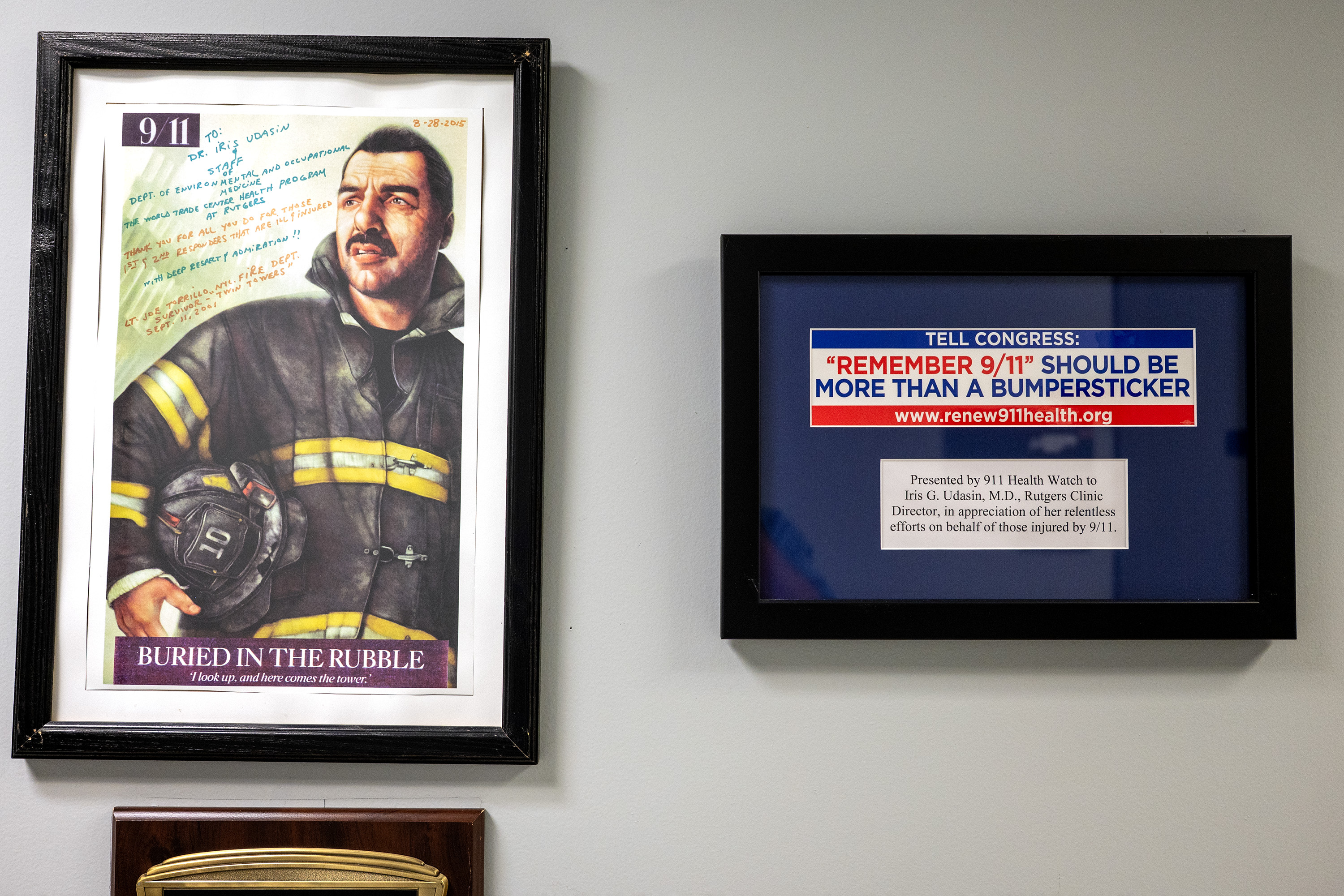
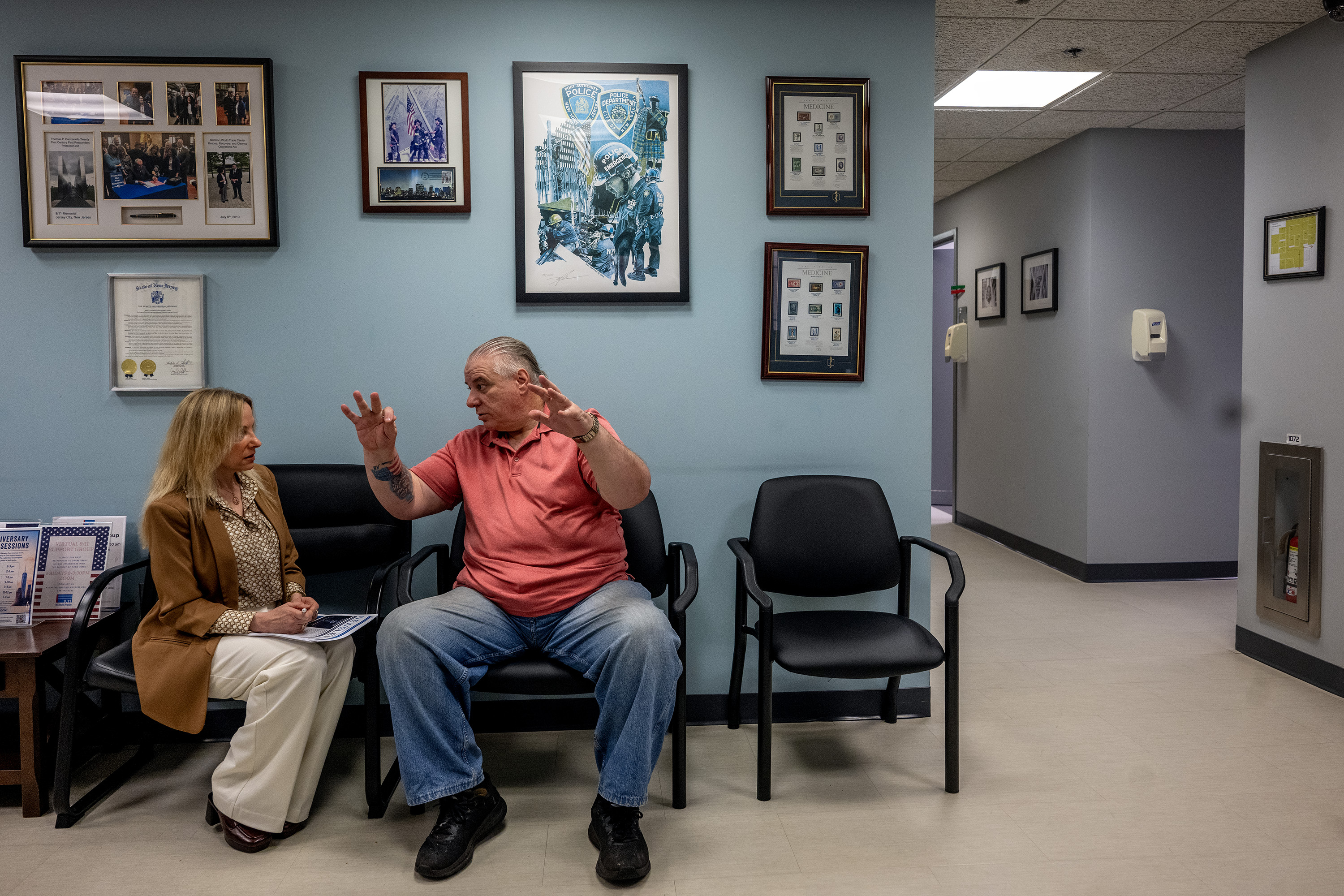
A plaque (right) presented to Iris Udasin, medical director of the World Trade Center Health Program at Rutgers University, hangs on the wall of the patient waiting room. Udasin’s federally funded clinic provides medical monitoring and free treatment to 9/11 responders. Tom Gralish / Staff Photographer
Local and federal officials initially minimized the environmental health hazards. Christine Todd Whitman, who was the head of the Environmental Protection Agency under President George W. Bush, infamously assured the public within days of the attack that the air around the WTC was “safe to breathe.”
“The [EPA] scientists did the best they could with the data that they had and with the knowledge they had at the time,” said Whitman, who had previously served as New Jersey governor.
“It’s a case of you don’t know what you don’t know,” Whitman added in an interview with The Inquirer late last month.
Whitman said her agency did urge responders on “The Pile” to wear protective gear, preferably respirators. The EPA distributed masks, but many refused to wear them, she said.
In hindsight, she said, the masks were not protective enough. Responders are now paying “the price” of breathing toxic air: “It sickens me to say it,” Whitman said.
The Rutgers program grew out of early alarms about air quality hazards, of which details are still emerging. On Tuesday, New York City officials publicly released a trove of documents revealing that toxins lingered in the air for months after the attacks.
Medical monitoring and free healthcare forresponders continue to evolve as the responder population ages.
Researchers evaluated more than 5,000 WTC responders, with an average age of 53 at the start of the eight-year study.
“As this population ages, we are seeing increasing concerns related to memory, attention, and executive functioning, sometimes at ages when the responders themselves are surprised to be experiencing them,” said Jodi Streich, mental health director at Rutgers’ WTC Health Program.
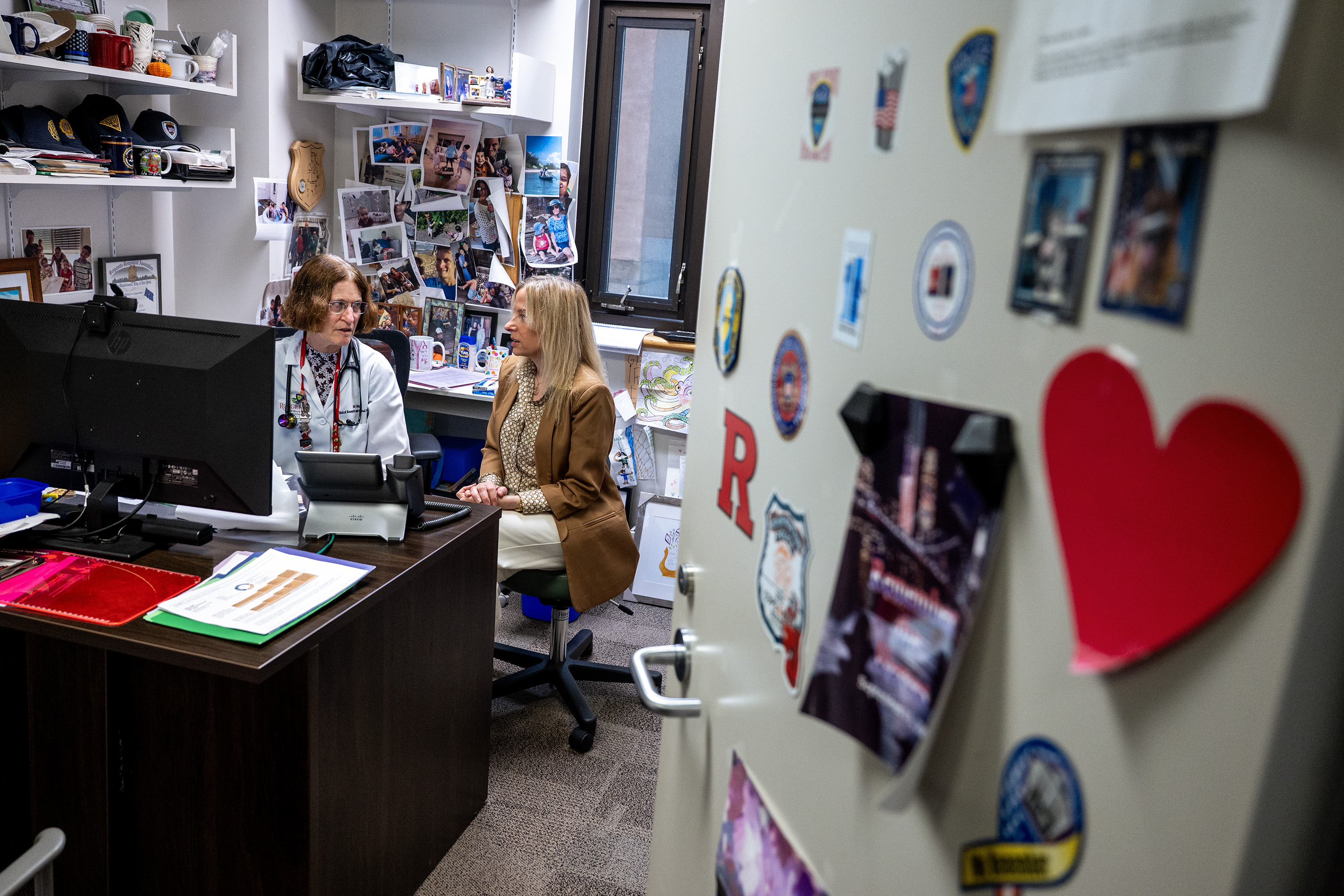
Iris Udasin, medical director, and Jodi Streich (right) mental health director, of the World Trade Center Health Program at Rutgers University sit together in Udasin’s office. They treat responders with WTC-related illnesses at the medical clinic, which is funded by the National Institute for Occupational Safety and Health (NIOSH) within the Centers for Disease Control (CDC). Tom Gralish / Staff Photographer
A stubborn and spreading blood cancer
Udasin’s clinic currently treats 1,177 cancer patients. Research shows that 9/11 responders suffer from thyroid, prostate, lung, and blood cancers at higher rates than the general population.
“The question is: Are certain cancers higher because we looked for them, or are they higher because they’re really higher?” Udasin said. “We really don’t know the answer to that, but my job is to treat everybody.”
In 2023, Udasin successfully lobbiedto have gynecologic cancers, including uterine, included on the list of WTC-related conditions.
Philadelphia Police Department Sgt. Greg Masi at ground zero just days after the twin towers fell. Then-Police Commissioner John Timoney dispatched Masi to New York City because of his expertise in radio communications. He’s developed asthma, lung nodules and T-cell lymphoma from breathing in toxic fumes and dust.Courtesy of Greg Masi
Greg Masi, 71, a retired Philadelphia police sergeant from the Northeast, was diagnosed with a form of blood cancer known as T-cell lymphoma in 2019.
First, red bumps appeared on his left arm. A scaly rash hassince spread over much of his body, killing hair follicles. His oncologists worry the cancer will find “a road map” into his organs.
Light therapy and topical medications did not work. Chemo and radiation would be a last resort. Since there is no cure, the goal is to slow it down.
Masi, an expert in radio communications, can still hear the horns that blared each time responders thought they found someone still alive beneath the rubble at ground zero, or to signal an imminent structural collapse.
The dust that caked cars and blanketed fire escapes struck himas a mere nuisance.
“We figured it was just dust, like dirt,” Masi said. “We had no idea it had harmful toxins in it.”
An avid runner and marathoner, Masi developed bad chest colds with wheezing about five years after Sept. 11. He was later diagnosed with asthma and nodules on his lungs, both common afflictions among responders.
He recently learned that one nodule has doubled in size, and doctors plan to monitor it for signs of cancer.
Then-Philadelphia Police Department Sgt. Greg Masi captured photos of the dust during his time at ground zero. Masi and three other department staffers have been diagnosed with WTC-related illnesses from breathing in deadly dust.Courtesy of Greg Masi
Mental health toll still mounting
Multiple diagnoses are commonly seen in 9/11 responders. Frank Geffre Jr., a retired firefighter from Central Jersey, has asthma, two types of cancer, and post-traumatic stress disorder.
In 2013, surgeons removed a “grapefruit-sized tumor” and parts of his colon and stomach to treat his stage-four colon cancer. Two years later, he learned the cancer had spread to his rectum.
After more than a decade of chemotherapy and radiation, his cancer is in remission. He credits Udasin, his primary care doctor, with saving his life.
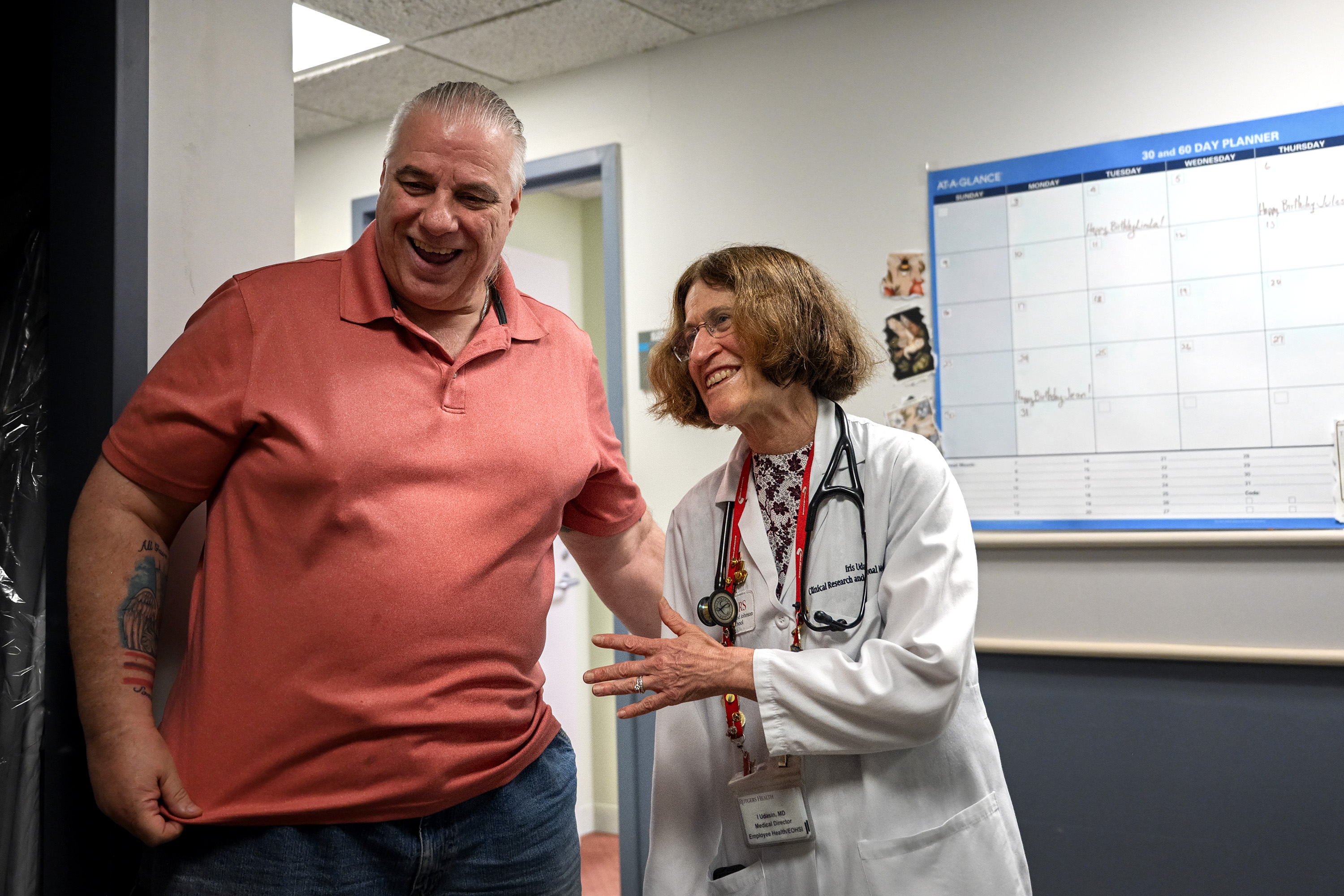
Retired Piscataway firefighter Frank Geffre Jr. shares a laugh with Iris Udasin, medical director at the World Trade Center Health Program at Rutgers University. Geffre credits Udasin and her team at Rutgers with saving his life after he was diagnosed with colon and rectal cancer. “Dr. Udasin is like the quarterback of the team,” he said.Tom Gralish / Staff Photographer
He sees a psychiatrist and a therapist for PTSD, which he finds especially hard to manage as Sept. 11 approaches each year. He lies awake after a recurring nightmare in which he is trapped in Manhattan with his family amid a terrorist attack, and he can’t get them out.
After the first plane struck on 9/11, Geffre and five other firefighters from Fire District No. 3 in Piscataway were immediately dispatched. His team got to ground zero shortly after the second tower violently pancaked.
“It was dark as can be, even though it was daylight. You had smoke clouds so thick you couldn’t even see your hand in front of your face,” Geffre said. “The dust was so thick it was like you had two foot of snow the night before.”
He initially wore respiratory gear, but the oxygen tank ran out as he worked nonstop over the first 30 hours. He saved roughly a dozen people after putting out fires that were blocking their exit from the burning buildings within the World Trade Center complex.
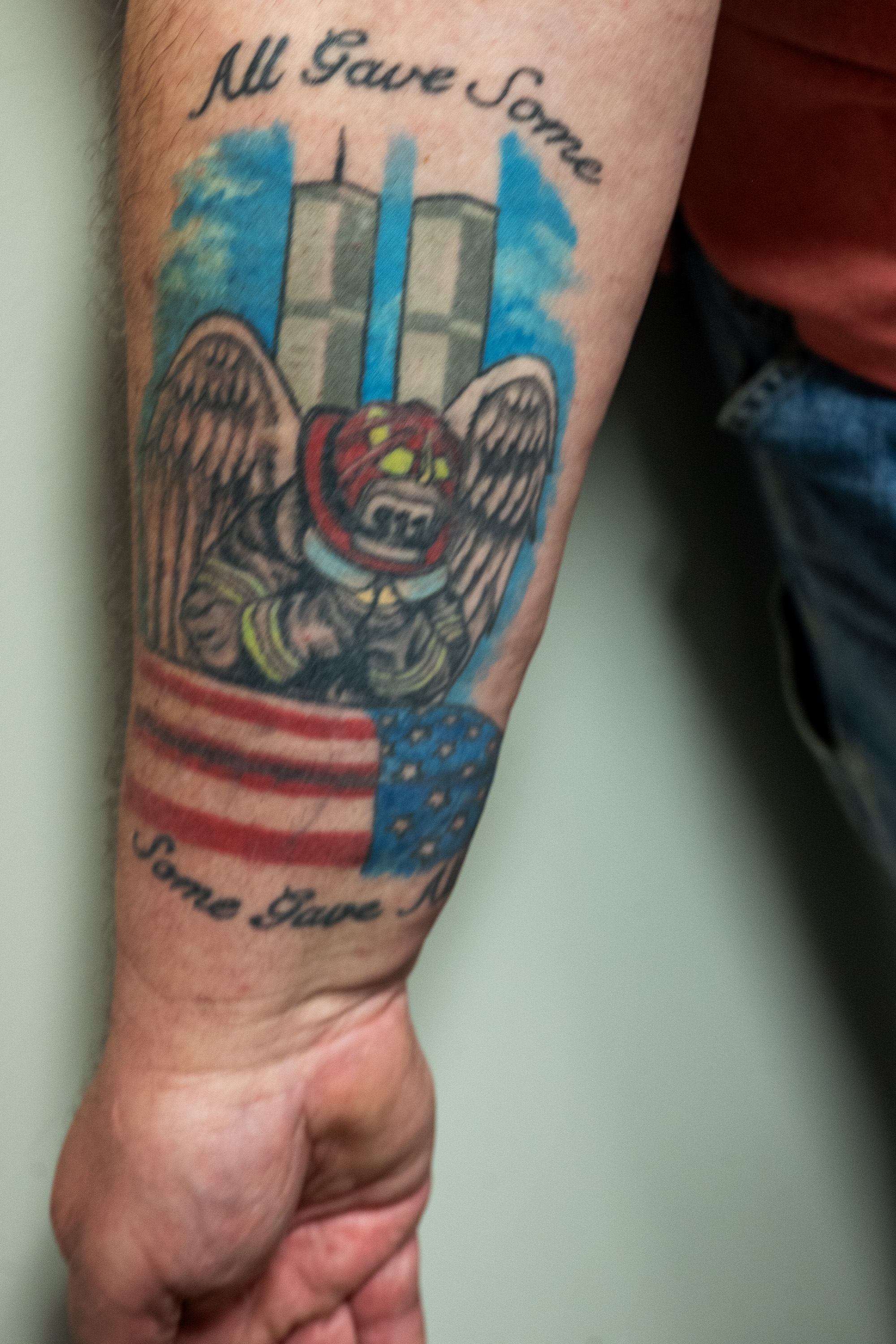
Retired firefighter Frank Geffre Jr. displays his 9-11 tattoo – “All Gave Some – Some Gave All” – during an appointment at the World Trade Center Health Program at Rutgers University. He designed the tattoo from a photo of himself splashing water on his face to rinse off dust and debris from ground zero. His wife said he looked like he was praying in the photo.Tom Gralish / Staff Photographer
He vividly recalls findinga brown dress shoe with a foot still in it. A blue polyester suit jacket with a torso seared to its lining. A wristwatch. A ring.
In all, he worked The Pile for 20 days, smearing Vicks VapoRub under his nose to cope with the“unforgettable, unbearably horrid smell of burning human flesh,” he said.
Now he can’t use the menthol and eucalyptus goo for his bouts of sinusitis, because the scent stirs bad memories.
“It feels like it was yesterday and a lifetime ago,” Geffre said. “The ‘Never Forget’ vow is not for first responders. We won’t ever forget. It’s embedded in us.”
He is ever-vigilant, prone to panic attacks. He avoids movie theaters and other places with crowds. “Too many variables,” he said.
He has a second home in Florida but drives back and forth. He won’t get on a plane. “I get paranoid that somebody on the plane is going to hijack it,” he said.
Two of the five firefighters with him on Sept. 11 have since died of cancer. He keeps in touch with four of the people he helped out of burning buildings. One committed suicide in recent years.
Retired firefighter Frank Geffre Jr. talks with Jodi Streich (left), mental health director of the World Trade Center Health Program at Rutgers University. Rutgers is one of six federally funded health clinics that monitors and treats 9/11 responders, as the health impacts continue 25 years later. The patient waiting room at the Rutgers clinic is adorned with photos of responders. Tom Gralish / Staff Photographer
Geffre, enrolled in the Rutgers program since its start, gets his mental healthcare through the clinic, which has seen a significant increase in demand for these services.
As more responders become ill or die from 9/11-related diseases, some have developed “heightened anxiety and vigilance about their own health,” Streich said.
Having more unstructured time in retirement, along with the loss of job identity and camaraderie, can be detrimental for mental health, she said.
“Things that we once buried — they come fully alive during retirement,” Streich said, adding that the support group she runs for retirees is now the most widely attended after the cancer support group.
Emergency responders who had felt too embarrassed or ashamed to seek help while working — because they feared being seen as weak — are coming in for the first time. Many are unable to eat or sleep, Streich said.
“We see them when they are at rock bottom,” Streich said. “They’ll come in and say, ‘I’m ready to talk about what I’ve been holding in for 25 years.’”
‘Exhaustion, desperation and heartache’
When asked if he regrets being dispatched to ground zero, Mark Fisher is emphatic: “Absolutely not.”
But he is tormented by images of people standing outside makeshift morgues with photos of their missing loved ones.
Fisher recalls becoming so distraught that a Red Cross volunteer pulled apart two tables piled with fresh clothes for responders to reach and embrace him.
“She hugged me for the longest time,” Fisher recalled, blowing air through his lips to steady his breathing and control tears. “I’m an Irish Catholic, so I wear my heart on my sleeve and face. I just had that look of exhaustion, desperation, and heartache.”
These days, he feels exhausted both emotionally and physicallyas his lung disease progresses. Fisher spent most of this summer in the hospital with a kidney infection that required two surgeries.
Five days after he got out of the hospital, his gall bladder became infected. “If I die, I want to die in a Catholic hospital,” he told his wife. Doctors removed his gall bladder in July.
The once-burly cop is rail-thin. He’s lost 35 pounds.
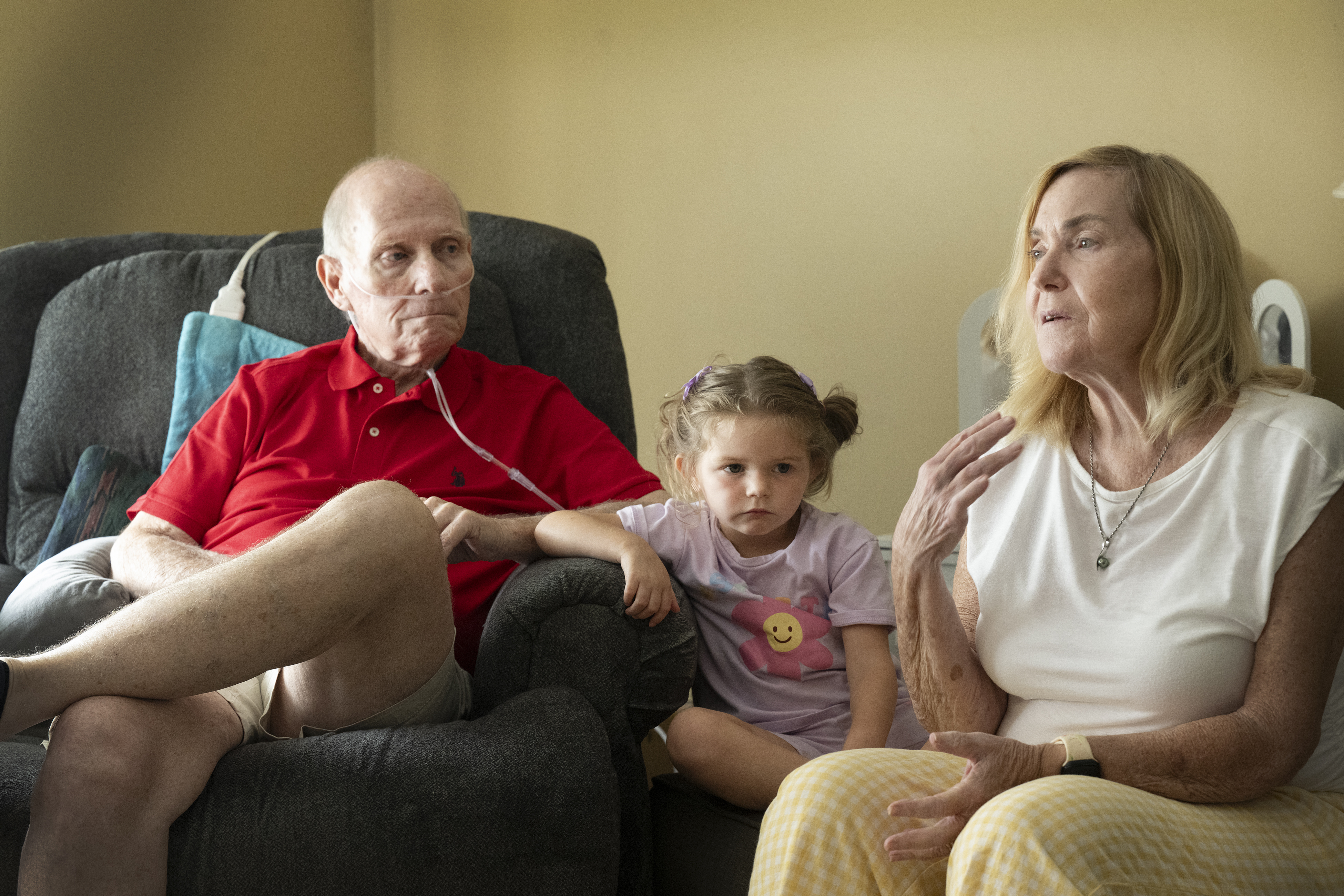
Inside their Northeast Philadelphia home, Sue Fisher (right) talks about the day she learned her husband, Mark Fisher, would need a double lung transplant. The couple’s 3-year-old granddaughter, Morgan Elizabeth Fisher, sits between them. Mark Fisher needs to use a portable oxygen tank to take walks with Morgan. Jose F. Moreno / Staff Photographer
Fisher’s priority right now is spending time with his wife and former sweetheart at Archbishop Ryan High School, and making sure she will be in decent financial shape when he dies.
Fisher, Masi, and two other responders from the Philadelphia Police Department are seeking written assurances from the city that if they die from their World Trade Center-related illnesses, their families will receive line-of-duty death benefits.
The status would enable their spouses to collect their full pensions, rather than half.
City officials said their families can apply to the Philadelphia Board of Pensions and Retirement, which would review each case individually after death.
Sue Fisher tries not to cry in front of her husband of 42 years;she’ll do it behind the shed in their backyard or on a walk with their golden retriever, Bentley.
He wants to delay as long as possible a double lung transplant, for which the survival rate is about five to seven years. “If they say that’s all he’s got, I’ll take it,” SueFisher said. “It’s better than him suffering the way he is.”
At night, she lies awake listening for the sound of Fisher’s breathing. Sometimes, she fears he has stopped. Then she nudges him with her toe until he stirs.
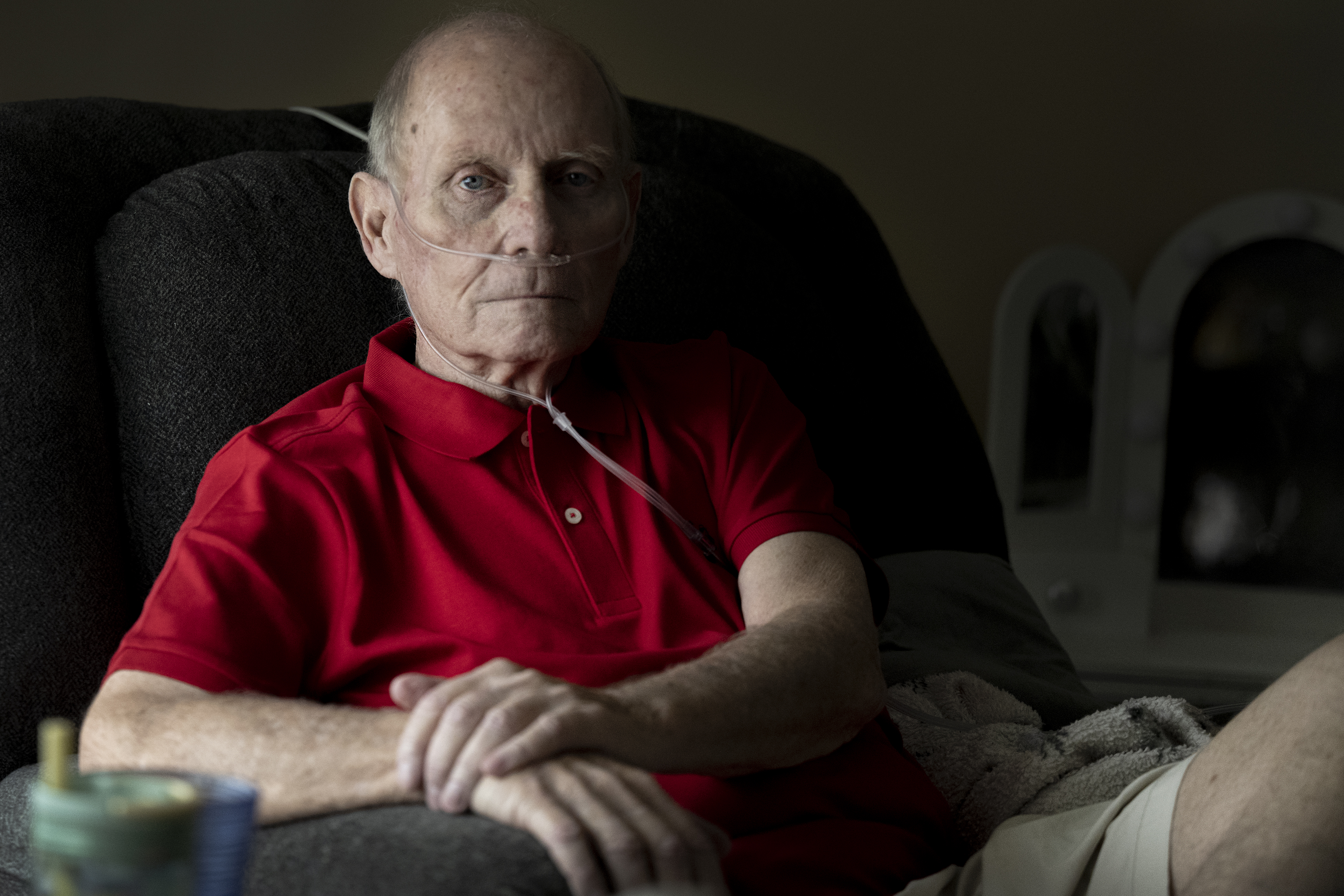
Retired Philadelphia Police Captain Mark Fisher wants the city’s word that if he dies of lung disease from his time at ground zero, his wife will get line-of-duty death benefits. City officials have said that his wife can apply to the pension board after he dies. Jose F. Moreno / Staff Photographer
A man serving life in prison for a 2010 first-degree murder conviction will be released from prison after pleading no contest to lesser crimes for his role in a fatal North Philadelphia shooting.
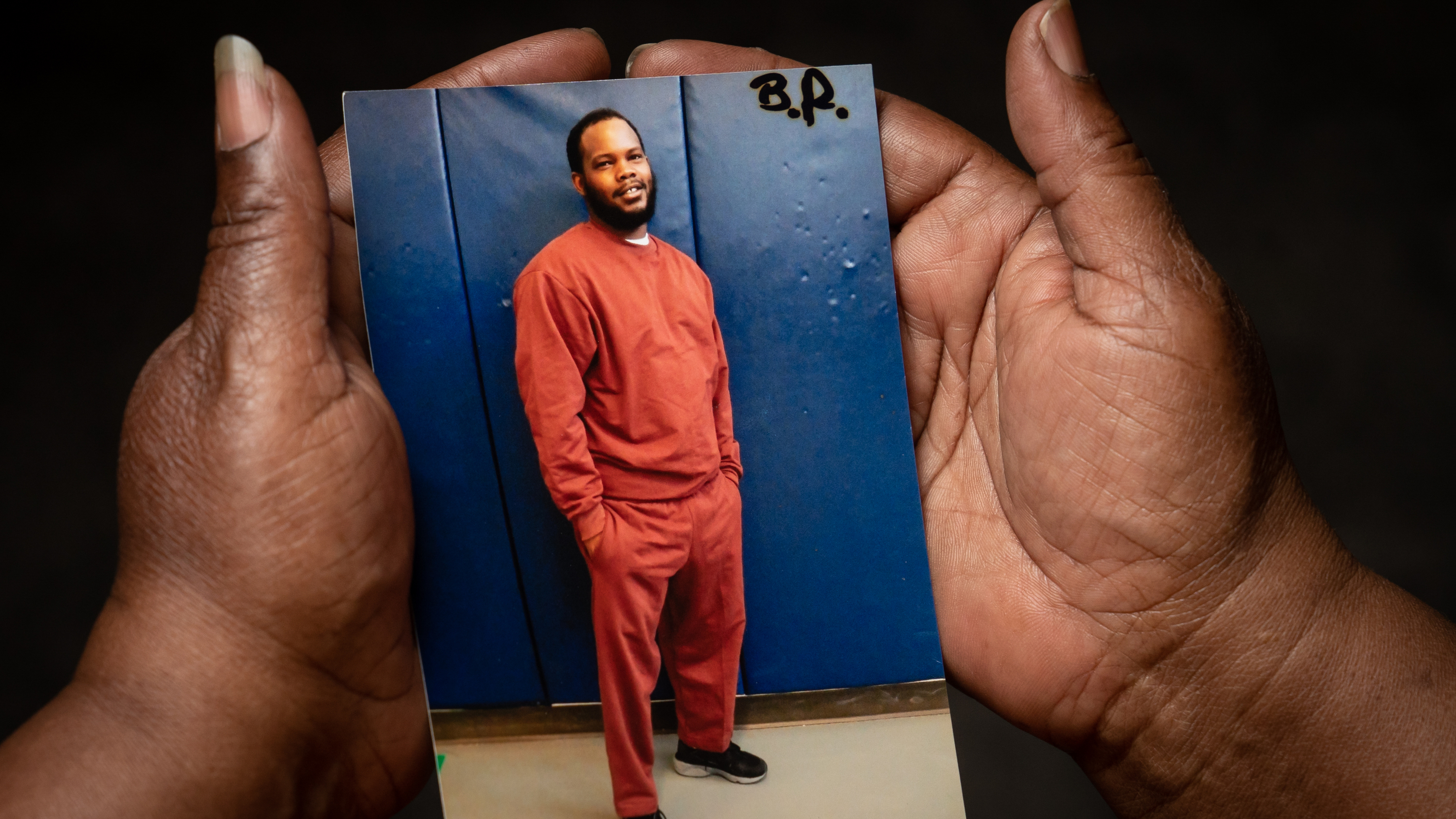
Rasheem Hall, 42, was granted the right to a new trial in April after a judge agreed with his defense attorney that prosecutors had withheld evidence that could have aided Hall’s ongoing effort to appeal his conviction.
They said prosecutors’ main witness had been an unreliable jailhouse informant who had recanted statements he’d made about Hall’s involvement in the 2007 shooting that left 34-year-old Ronald Kennel dead.
Rather than retry the case, however, prosecutors agreed to conditions Friday that allowed Hall to plead no contest to aggravated assault and a firearms violation. During the hearing, Common Pleas Court Judge Diana L. Anhalt approved a sentence of nine to 18 years in prison in exchange for Hall’s plea.
Because he had already served that time in custody, he could be released as early as Friday afternoon, she said.
Hall’s family members reacted to the news with a mixture of smiles and tears.
“I’m just happy for Rasheem, I’m just happy for his family,” Hall’s defense attorney, Robert Gamburg, said after the hearing.
The development comes as District Attorney Larry Krasner’s office faces scrutiny of its handling of post-conviction cases. Last week, a federal judge said actions city prosecutors took in another case could amount to perjury, conspiracy, or obstruction of justice.
Friday’s hearing ended a yearslong campaign by Hall to appeal his conviction.
That effort centered on issues with Deric Williams, an informant who was recorded on a jailhouse phone line telling his mother he had wrongfully implicated Hall in the crime and that he had tried, unsuccessfully, to recant his statements to detectives.
Earlier this year, Gamburg told a judge prosecutors had failed to hand over that recording of Williams to Hall in 2013 during his appeal, though prosecutors contended that jurors had heard similar remarks from Williams at Hall’s 2010 trial.
Judge Rose Marie DeFino-Nastasi sided with Hall, saying that in addition to the phone recording, emails between prosecutors with details of their relationship with Williams should have been turned over to his defense team.
On Friday, Assistant District Attorney Trey Flynn told Anhault that while prosecutors accepted Hall’s plea, they stood by their earlier assertions about the case.
He said prosecutors would have told jurors that Hall and another man, David Satchell, only fired guns during the May 20, 2007, incident after being shot at by another person first.
Hall’s gunfire struck a bystander, Charlene MacDonald, in the leg, Flynn said.
“It was individuals firing at Hall who actually struck Ronald Kennel, who was standing behind them,” Flynn said.
Still, prosecutors would have argued that Hall was responsible for Kennel’s death via transferred intent, Flynn said. The legal theory holds a defendant responsible for injury or death based on their intent to harm, regardless of who was actually affected.
Flynn said he had spoken with Kennel’s brother “at length” about prosecutors’ decision to accept Hall’s plea. And he said District Attorney Larry Krasner agreed with the decision as well.
Outside the courtroom, Hall’s family members were moved to tears by his imminent release and return home for the first time since his early 20s.
“It’s been almost 19 years,” said Hall’s father, Ronald. “He’s got a daughter, he’s got nieces, nephews. People that passed away. It’s a lot of time lost, time you can’t get back.”
Ronald Hall said his son only learned of the opportunity to plea to lesser charges last week, and that the gravity of the news is still fresh.
There’s a special place in hell for a cop who leaves a human being lying in the street, and they get run over by a car.
It doesn’t matter who the person is, or if they are under the influence of a substance. It doesn’t matter if they resist. They need to be escorted to safety. If needed, rescue workers or a behavioral health expert should be summoned. No one — and I mean no one — should be left lying in the street.
If the police officer who encountered the 48-year-old pedestrian who wound up lying in the bike lane in the 5500 block of Rising Sun Avenue in the wee hours of Aug. 27 had a shred of humanity left in his soul, that man would still be alive today.
Instead of being a hero and saving that man’s life, the officer talked to the victim as he lay on his back in the roadway, then got into his police cruiser and drove away. Minutes later, the man was fatally injured by a hit-and-run driver. Two unidentified people pulled the man out of the street and contacted authorities.
The same officer who had encountered the man earlier was the first to respond. Did he even try to make up for what happened? Not according to First Deputy Commissioner John Stanford, who said at a news conference on Friday that the officer didn’t administer first aid or file a police report. “That goes against everything that we stand for,” Stanford told reporters. “We talk about empathy. We talk about compassion as an organization, and none of those things were on display.”
The officer, whose name hasn’t been released, has since been placed on administrative leave and is still on the Philadelphia police force.
He shouldn’t be.
His job is to serve and protect. But he lacks the human decency and compassion it takes to do that.
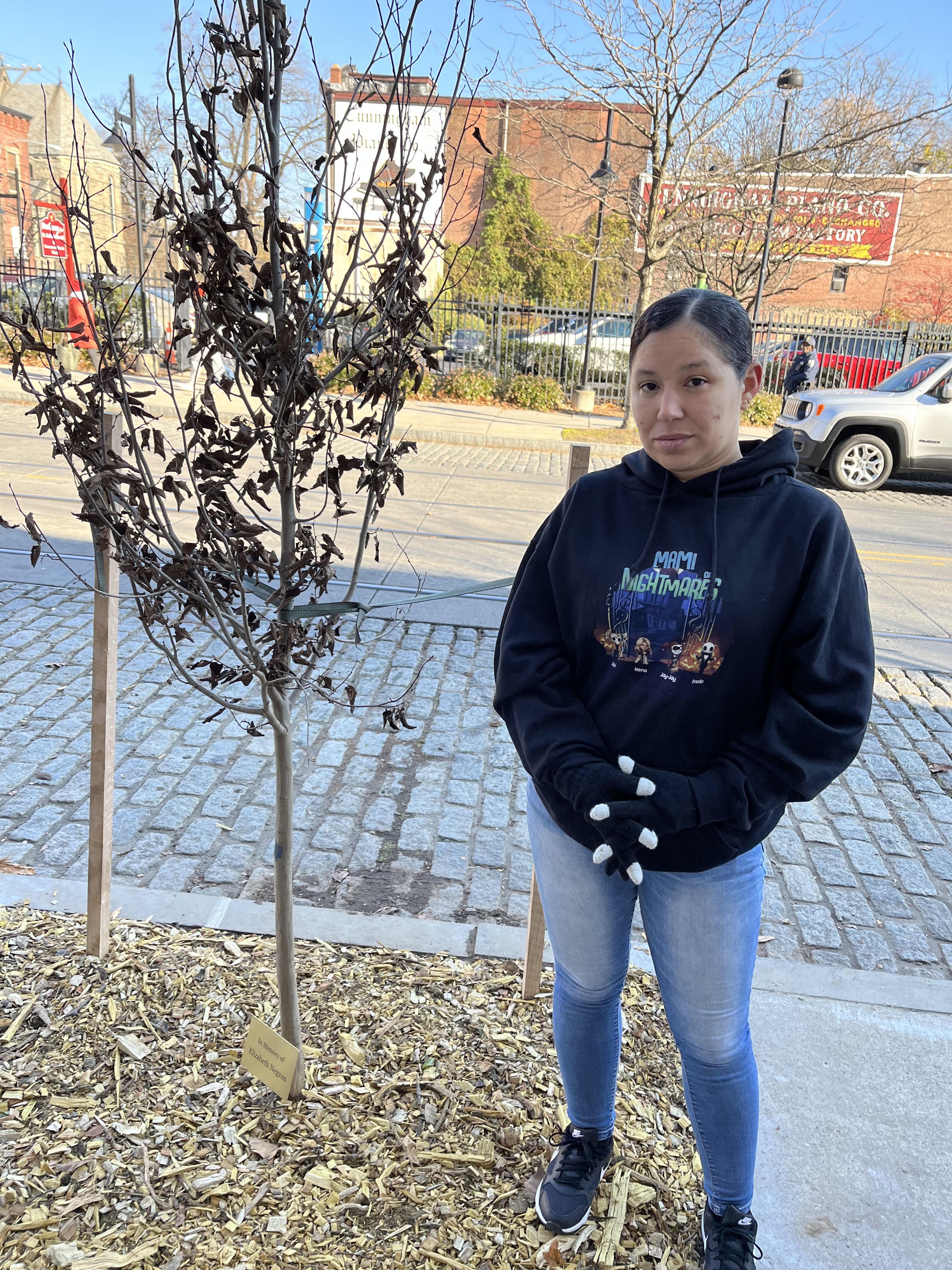
What happened last week reminds me of a similar incident that took place four years ago, which I also wrote about. In that case, Elizabeth Negron had wandered into the middle of Germantown Avenue near Coulter Street around midnight one hot summer night in 2022.
It’s unclear what exactly was going on with her, but clearly something was off. She stood in the roadway and blocked the path of a SEPTA bus as vehicles veered around her in different directions. Soon, a police car arrived. Officers got out of their vehicle and interacted with her briefly before driving off, leaving Negron still in the roadway.
They left her in the street like an old discarded shoe. At one point, Negron can be seen lying on her back. A video, recorded by a nearby business, ends shortly thereafter, leaving viewers to imagine what happened next as a passing car ran her over and then fled the scene.
I’ve had the privilege of meeting and interviewing many incredible police officers over the years. Most are good people both on and off the job. But there are some who forget that the people they encounter out on the streets acting oddly are as human as anyone else. They matter, too.
Negron was loved by her two young daughters, a devoted sister, and others who still mourn and miss her. Her sister, Jackie Martinez, told me she had been scrolling on her phone when she learned someone else had suffered a similar fate. “I’m hanging in there and trying my best to not let it bother me,” she said.
Martinez said she would never just walk by someone in harm’s way. “You put them somewhere safe,” Martinez said. “If you walk away and they end up back in the middle of the street, at least you know that was on them.”
Jackie Martinez poses next to a tree planted in honor of her sister, Elizabeth Negron, who was killed on Germantown Avenue near Coulter Street by a hit-and-run driver in July 2022.Jenice Armstrong
David Fisher, a 29-year veteran of the Philadelphia Police Department and president of the National Black Police Association, agreed, saying, “You don’t leave somebody on the street needing care.”
It’s really that simple. It should be obvious. But apparently it isn’t.
Philadelphia police are investigating a fatal hit-and-run that took place early Thursday morning in the Olney section of the city, minutes after an officer left the 48-year-old victim lying on the ground in a bike lane.
Police are treating the case as two separate matters — a search for the hit-and-run driver led by crash investigators, and an internal disciplinary probe into the officer’s conduct leading up to the crash.
First Deputy Commissioner John Stanford, at a news conference on Friday, criticized the officer for failing to help the man and leaving him in a vulnerable state on the roadway.
“[It’s] very troubling to see that there is an officer that responds to this location and fails to render any type of aid to the individual prior to that individual being struck by the vehicle, being run over by that vehicle, driven over by that vehicle and that’s troubling for us,” he said.
The officer’s name has not been released. He is assigned to the 35th District and has two years on the force, Stanford said. The department placed the officer on administrative leave while the incident is investigated, Stanford said.
Police have also not released the victim’s identity as they are trying to contact relatives.
At about 1:40 a.m., a man with an “unsteady gait” was seen walking down the 5500 block of Rising Sun Avenue, Stanford said.
Video shows the officer pull his police vehicle next to the man and engage with him. During that encounter, the man falls to the ground, lying in the bike lane and partially in the traffic lane, Stanford said.
The officer pulls his patrol car in front of the man, Stanford said, and gets out to speak with him. Then the officer leaves.
Minutes later, a car stops before reaching the man, Stanford said. But a second vehicle drives into the bike lane to go around the first car, running over the man and driving away. The victim was pronounced dead hours later at approximately 6:15 a.m.
Police are searching for a 2023 to 2026 green Kia Sportage X Line series with black-and-chrome rims.
Stanford said passersby pulled the 48-year-old man out of traffic and called police.
The officer who had first engaged with the victim and then left him in the road mere minutes before was the first officer to respond to the scene, Stanford said.
Stanford said the officer did not make a police report, waiting for medics to arrive. Stanford said the officer did not render aid during this time.
Stanford said the officer did not check whether the victim was impaired or having a medical condition, calling the officer’s behavior “very troubling, very disturbing, and to be quite blunt about it, extremely disappointing.”
“It goes against everything we stand for,” he said.
A day after U.S. marshals captured the man accused of menacing pedestrians in Center City while wearing a Chucky-style mask, Philadelphia District Attorney Larry Krasner urged victims to come forward, saying prosecutors are eager to pursue additional charges against the man whose antics terrorized people and went viral.
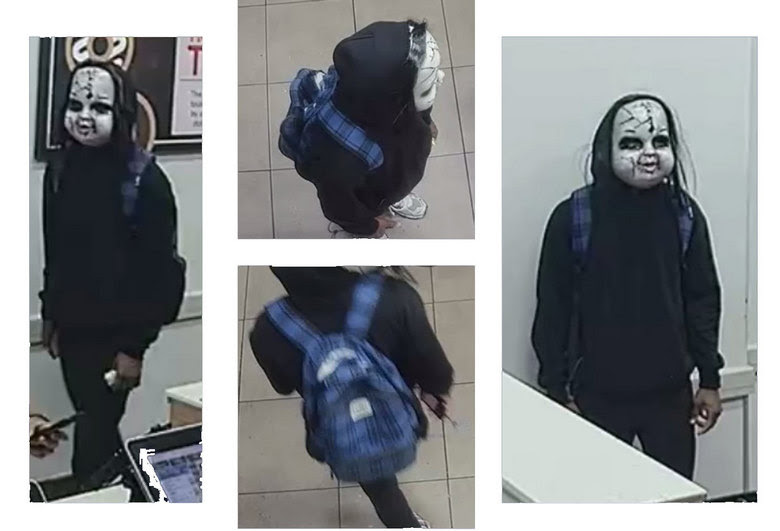
Zymire Hughes, 22, was taken into custody on Tuesday night in Las Vegas by marshals who tracked him across the country. Authorities said Hughes wore a frightening mask to harass and scare more than a dozen people, including a woman he approached while she was jogging near City Hall earlier this month and asked, “Are you ready to die?”
As the 40-year-old woman ran from him, Krasner said, she fell and suffered injuries that required hospitalization and weeks of recuperation.
Hughes faces aggravated assault and other charges in connection with that incident, the district attorney said, and prosecutors are reviewing as many as 15 other reported incidents involving the masked man that same morning.
“If more victims are identified,” Krasner said, “we look forward to prosecuting him in other cases as well.”
He added: “Who’s scared now?”
Authorities have not identified most of the people who appear to have been confronted or frightened by the masked man. But in a widely publicized incident, Jameka Wilson, a 25-year-old actress, told several news outlets that a man wearing a similar mask approached her on her way to an exercise class near City Hall and that she kicked him in the chest.
Philadelphia police said that Hughes did not display a weapon during the incidents and that the woman who fell was the only person known to have been injured. Investigators have said they believe he may have been frightening people to create social media content.
On Wednesday, Krasner dismissed the idea that Hughes could characterize the crimes as online entertainment.
“You can’t just say, ‘I’m an influencer,’ and commit crimes,” he said. “You can’t just terrorize people, terrorize a community, because the reaction of someone who believes she might die at any second, you find funny.”
Hughes remained in custody Wednesday in the Clark County Detention Center in Las Vegas, court records show, and was scheduled for a court hearing Thursday.
After Hughes is extradited to Philadelphia, prosecutors will seek “very high bail” in an effort to keep him in custody while the case proceeds through court, Krasner said.
“One of the questions that bail answers is: Will this person run?” Krasner said. “I mean, yes. Obviously, he already has. … Running away is the ultimate way to high bail.”
Hughes’ extradition could take as little as a week or stretch into months, depending largely on whether he contests his return, Krasner said.
Hughes’ flight from Philadelphia took him from New Jersey to Florida and then Nevada, authorities said.
He left the Philadelphia area Aug. 19 from Trenton-Mercer Airport in Ewing, N.J., according to the U.S. Marshals Service. He flew to Orlando and then to Las Vegas.
Philadelphia and Las Vegas deputy marshals began working together Friday, said Robert Clark, a supervisory deputy U.S. marshal, and spent the weekend trying to locate him.
Investigators eventually tracked Hughes to an apartment complex in southeast Las Vegas, where they believe he had been staying for about five days, Clark said.
Marshals arrested Hughes about 8 p.m. Tuesday. Clark said Hughes tried to pull away from his handcuffs and had to be subdued by deputy marshals.
Hughes’ arrest followed a week of intense public attention after Philadelphia police released images of him and asked residents for help in finding him. The case had already gone viral because of photographs and videos showing a man wearing a cracked, baby-faced mask resembling the horror character Chucky from the movie Child’s Play.
Prosecutors are continuing to review evidence, Krasner said, and “will be pursuing all charges that apply.”
Anyone who was approached or menaced by the masked man can contact the district attorney’s office at 215-686-8000.
When Capt. John Walker joined the Philadelphia police force decades ago, prospective officers rarely applied to more than one department, let alone four or five.
Today, job candidates may apply to up to half a dozen departments before choosing where to begin their careers. And competition to hire them is fierce.
After years of the department vying for recruits amid staffing shortages and waves of officer departures, its ranks are rebounding. And Walker, who oversees the police academy’s recruiting efforts, credits that in part to a faster and more efficient method of getting potential officers through the door.
The department has scrapped its long-standing tradition of paper applications and is instead using software that speeds up what was once a monthslong hiring process.
Before, getting an applicant from an introduction with hiring managers to the first day of police training could take up to seven or eight months — or sometimes a year, Walker said.
“The process to get hired here was cumbersome,” he said. “It took almost 118 days after you applied for us to even make contact with you. That was a big problem.”
After rolling out the software, called Guardian, the department says it is ushering recruits into the academy in as little as 54 business days — and it hopes to reduce that span even further.
While Guardian is not solely responsible for the increase in applicants, Walker said, it has nudged the department closer to record recruitment numbers.
In 2025, the department enrolled 468 officers in training at the police academy, the second-highest number in the 21st century.
Captain John Walker of the Philadelphia Police Department’s recruitment and background investigations unit.John Walker
Walker is adamant that there has been no drop in the quality of applicants. The California-based company whose software the department is relying on maintains high standards, he said, and is used by more than a thousand law enforcement agencies across the country.
The new system has helped reverse a hiring dearth that began after the widespread protests over police brutality and racial justice in 2020 and continued through the COVID-19 pandemic and beyond.
A year before the protests, the department was at 99% of full staffing, according to Walker. But the numbers soon began to dwindle as diminished interest in policing combined with an uptick in officers leaving the force.
In 2021 alone, 581 of the department’s more than 5,000 officers hung up their uniforms. Officials attributed the drop to retirements, a COVID-era closure of the police academy, and strict local residency rules for prospective officers.
While the department now stands at around 83% of full staffing, Walker said, officials are beginning to see something of a reversal.
Recruitment drives have increased in frequency to more than several times a year, yielding between 1,000 and 2,000 applications each round.
That is a notable step up from 2022, when the department received just 942 applications overall.
Changing technology
Gone are the paper applications of old.
In their place is Guardian’s hiring portal, where prospective recruits can upload copies of their IDs, lists of references, and other documents via computer or on their phones. And the lengthy personal history questionnaires that are standard in the law enforcement industry are now available online, as opposed to requiring a trip to a local police station for paper copies to fill out by hand.
Police recruiters, in turn, use the software to review documents, conduct video interviews, and keep track of a recruit’s medical, physical, psychological, and polygraph exams.
The Guardian software debuted in the city in late 2023, and since then, the time it takes for prospective recruits to go from application to training at the police academy has fallen sharply, to fewer than 60 business days.
Department officials hope to speed things up even more, to about 35 days, Walker said, but it is difficult to schedule the required medical tests and interviews quickly enough to accommodate that time frame. The department plans to hire more doctors to meet demand.
Justin Biedinger, who founded Guardian Alliance Technologies in 2016, said that the company contracts with around 1,300 of the nation’s roughly 18,000 police departments, and that Philadelphia is one of its largest clients.
Biedinger, a former Stockton, Calif., police officer, said the service not only has quickened hiring timelines, but also has increased scrutiny of officers who might not be cut out for a career in law enforcement.
The software allows recruiters to see whether an applicant has been reported for misconduct by another department. And the company uses artificial intelligence to scan social media accounts for red flags such as inappropriate content, guns, or drug use.
“With Guardian,” he said, “these applicants can’t lie.”
To Walker, the biggest benefit of the new system has been the ability to move quickly and hire people who otherwise might have accepted jobs in other departments while they awaited word on applications to work on the Philadelphia force.
“In today’s world, people are not going to wait a year and a half to join this profession, as I did,” he said.
Another benefit of the automated process, he said, is making it easier for out-of-state applicants to apply, drawing candidates as far away as California, Colorado, and Missouri.
And even if the department does not reach its goal of a 35-day timeline, Walker said, the current 55 days “is one of the best in the country. If not, close to it.”
Editor’s note: This story was updated to include information from an interview conducted with Michael van der Veen and William Brennan after the story was published. van der Veen, Brennan, and their attorney, George Bochetto, did not responded to multiple interview requests in the days leading up to publication.
A newly formed local group sued the Gayborhood’s Bar X this month, alleging it is a public nuisance. The group wants to shutter the decade-old business, whose clientele is largely Black.
The lawsuit asks a Philadelphia Common Pleas Court judge to order the Camac Street bar to cease operations. It arrives at a time of increased police presence on the nightlife strip and heightened tension between the city’s Black LGBTQ+ community and police.
Bar X has “repeatedly generated excessive noise, disorderly conduct, disturbances, violence, public intoxication” and requires a constant police presence, the complaint says. It also claimed neighbors have observed “public displays of drunkenness and sexual activity” outside the bar.
The city failed by maintaining the establishment’s business license, the suit says, urging a judge to revoke it.
Behind the lawsuit is Michael van der Veen, a 62-year-old high-profile Center City lawyer whose office is in the building across from Bar X on Camac Street.
The bar has been using the office’s parking spot for years, van der Veen said, despite repeated requests to remain off the lawyer’s private property.
But things escalated in July when, according to van der Veen, he was assaulted while leaving his office around 9 p.m. at night.
“When I got jumped from behind and got coldcocked, I was done,” he said.
Days later, veteran criminal defense lawyer William Brennan incorporated Save Our Neighborhood for Tomorrow Inc., the group that filed the lawsuit against “the dive bar of the Gayborhood,” as Bar X pitches itself.
“This changed when passive-aggressive behavior became assaultive-aggressive behavior,” Brennan said. “It can’t be tolerated.”
Save Our Neighborhood for Tomorrow does not appear to have a website or social media presence.
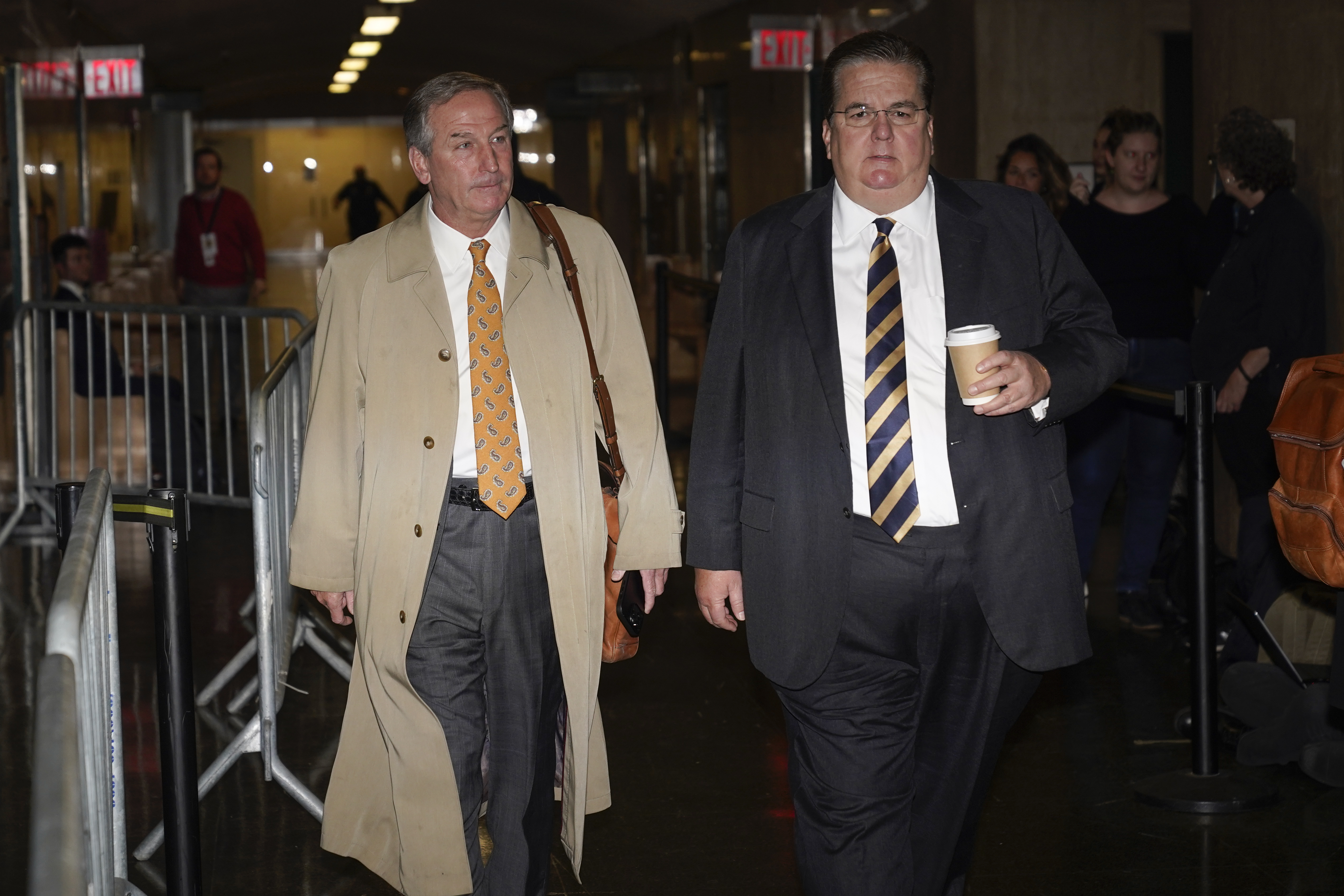
Defense attorneys Michael van der Veen, left, and William Brennan arrive to criminal court in New York in 2022 for Trump’s tax fraud case. Seth Wenig
George Bochetto, the attorney who filed the lawsuit on behalf of the newly formed group, did not respond to repeated requests for an interview. Bochetto is also representing a different group of Pine Street and Spruce Street residents who won an injunction to pause safety upgrades to bike lanes.
The lawsuit against Bar X names owner Tony Tsang, business entities associated with the bar, the city, and the commissioner of the Philadelphia Department of Licenses and Inspections, Bridget Collins-Greenwald. The city did not respond to requests for comment.
Tsang disputed the allegations of public drunkenness and sexual activity and said the bar is a longtime fixture of the block.
“You don’t like it, you like it quieter, how come you don’t move out of the city?” Tsang, 59, said in a recent interview at the bar. “One block, three bars, how come they’re only complaining about us?”
A ‘very homey’ gay bar
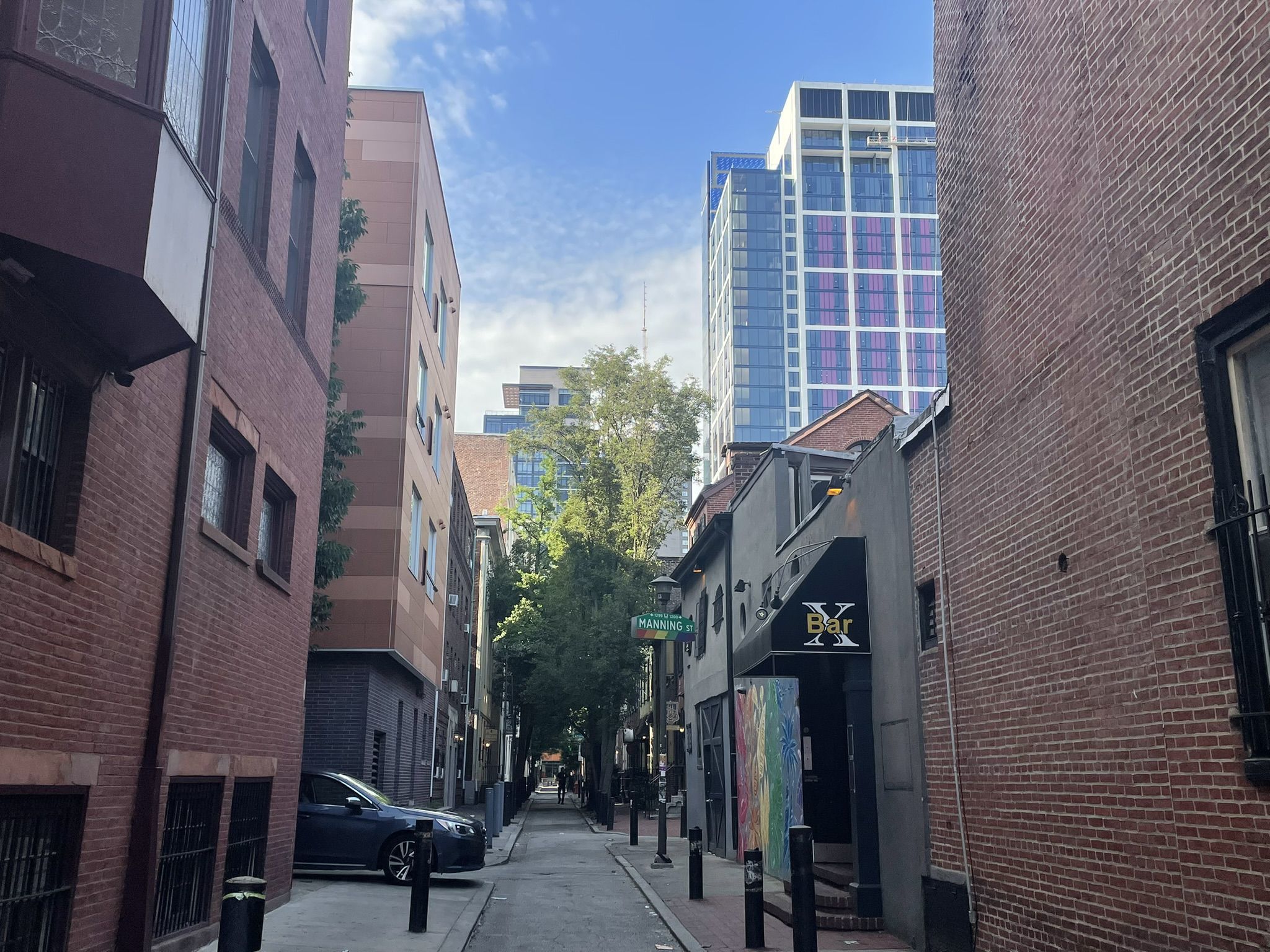
Bar X sits between Locust and Spruce on Camac, a narrow, 200-year-old street that is home to two other gay bars, Tavern on Camac and UBar. It is also around the corner from the bar 254, which replaced Tabu. Those three bars are all owned by the Tavern Group.
Tsang said the majority of his clientele is Black and suggested that the lawsuit had more to do with his identity and that of his patrons than the noise or disturbance allegations.
“To me, it’s the color. I’m Asian. My English isn’t too good. They want to play a game with me,” Tsang said.
Tsang opened his bar in 2016, naming it Bar X so it would be easy for people to remember. The bar’s exterior features a rainbow mural of tropical leaves; inside Tsang hung Ikea posters of Audrey Hepburn and James Dean. He said he stocks the bar himself, buying whatever club soda is on sale at the supermarket.
The bar has a large dance floor and a DJ booth that abuts the alley.
Joseph Ward, a part-time bartender at Bar X who also runs its social media and marketing, said the bar stands out because it’s “very homey,” with Taco Tuesdays and twice-weekly karaoke. (There’s also a male revue every Thursday night.)
Bar X owner Tony Tsang said he stocks the bar himself with whatever club soda is on sale at the supermarket.Elizabeth Robertson / Staff Photographer
“You [can] just chill and not have to worry about the hustle and bustle of a nightclub,” Ward, 36, said. He said the bar is one of the last minority-owned clubs in the Gayborhood and hosts a largely nonwhite crowd.
The lawsuit cites negative Google reviews from people purporting to be Bar X customers, including accounts of stolen phones and allegations that a bartender gave patrons drinks containing sedatives.
The remedy to the situation, the suit says, is for the city to shut down the bar.
Ward said that rumors of drugged drinks at the bar had gained traction online earlier this year, but that staff had not been able to verify any crimes, despite reaching out to those making the accusations. In response, the bar ordered covers for customers’ drinks.
“We take pride in it being a safe place in the Gayborhood,” Ward said, “so we obviously want to keep it that way.”
A new police deployment
Bar X’s block has seen an increase in crime incidents this year, according to Philadelphia Police Department public data.
The lawsuit claims that since last summer there have been nearly 70 crime incidents at the property, including “multiple reports of a person with weapons, assaults, robbery, and disorderly conduct.”
<iframe title="Crime Incidents On Bar X's Block" aria-label="Column Chart" id="datawrapper-chart-LCiYX" src="https://datawrapper.dwcdn.net/LCiYX/1/" scrolling="no" frameborder="0" style="width: 0; min-width: 100% !important; border: none;" height="477" data-external="1"></iframe><script type="text/javascript">(function(){function e(){window.addEventListener(`message`,function(e){if(e.data[`datawrapper-height`]!==void 0){var t=document.querySelectorAll(`iframe`);for(var n in e.data[`datawrapper-height`])for(var r=0,i;i=t[r];r++)if(i.contentWindow===e.source){var a=e.data[`datawrapper-height`][n]+`px`;i.style.height=a}}})}e()})();</script>
In April, the Washington Square West Civic Association hosted a meeting with residents, city officials, and Tsang in an attempt to address neighborhood complaints. Councilmember Mark Squilla, who represents the area and attended the meeting, estimated that more than 40 people attended.
In response, the city experimented with one-off street cleanings of Camac to address litter, Squilla said. Police also began clearing the street of people on weekend nights after 2 a.m., when the bar closes.
“We’ll continue to work on compliance and whatever else is needed there,” Squilla said.
A Philadelphia Police Department spokesperson confirmed there is currently a “bar/nightclub” deployment in the bar’s general area. The department has used similar deployments throughout the city for decades to respond to community concerns and public safety needs, Sgt. Eric Gripp said in a statement.
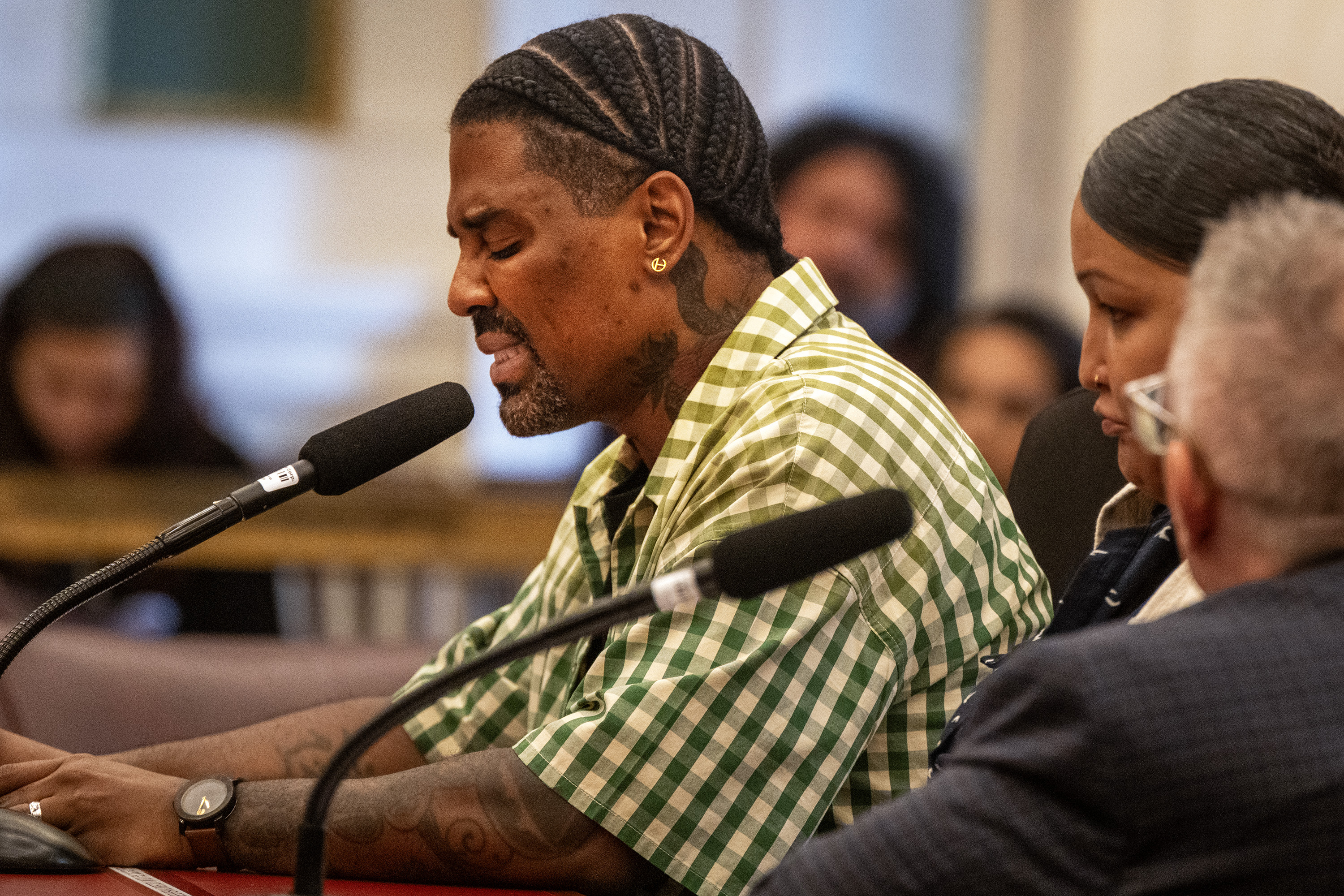
Jacen Bowman, president of Philly Black Pride, testified earlier this month at a City Council Committee on Legislative Oversight hearing into the Philadelphia Police tactics used during Pride celebrations in June.Tom Gralish / Staff Photographer
“Black and brown LGBTQ+ people are watched differently. We are approached differently. We are policed differently,” Jacen Bowman of Philly Black Pride said at the hearing. “Too often we are made to feel like visitors in a neighborhood that is promoted as the heart of Philadelphia’s LGBTQ+ community.”
The 56-year-old was arrested in 2022 and accused of using his position for years to lure girls, often targeting victims who had run away, been arrested, or struggled with addiction.
The women’s lawsuit accused the city of “reckless disregard for the safety of the public” by allowing a “morally corrupt sexual predator” to remain on the force and victimize at least 48 women and girls,despite years of sustained complaints of misconduct against him starting shortly after he joined the department in 1995.
The department even began the process to terminate Heron in 2008, the complaint says, following sustained allegations that included “associating with known criminals,” “little to no regard for his position as a police officer,” and having been detained by police officers for soliciting a sex worker in Kensington.
But Heron maintained his badge and went on to assault the two girls, among other victims.
“Instead of just firing him, they were moving him around different districts,” said Joshua Van Naarden of VSCP Law, the firm representing the two plaintiffs.
Heron eventually resigned in 2019 following an internal affairs investigation into an allegation that a uniformed Heron was caught by a CVS surveillance camera attempting to steal a phone charger.
Heron assaulted one of the two women in 2016 when she was 9 years old. He held her captive in his bedroom, took 22 illicit photographs while she was unconscious, and sexually assaulted her, according to the complaint.
The former officer sent her a Facebook message in 2021, when the victim was 15, and solicited photos from her as well as sex for money, the suit says.
And when the teen accused him of acting inappropriately, Heron threatened to have her arrested.
Heron assaulted the second women in 2016 while on duty. He picked her up from Temple University Hospital’s emergency department when she was 11 years old,after responding to a report that she had run away from home.
After she was discharged from the hospital to Heron while he was on duty, with instructions to take her home, Heron gave her a laced drink and took photos of the unconscious child.
Two days later, Heron picked up the 11-year-old from her house and again took illicit photographs of her.
Both women were involved in Heron’s prosecution, the complaint says, and he pleaded guilty to counts resulting from his crimes against them.
The woman who was victimized as an 11-year-old did not know about the abuse, which took place while she was unconscious, until law enforcement found photos of her on Heron’s devices, Van Naarden said.
“There are tons of other victims out there that may not even be aware that they were victimized by him,” Van Naarden said.
The city deserves credit for settling the lawsuit, which was filed in December 2024, relatively quickly to prevent the women from having to relive their trauma through depositions, testimony, and court hearings, the attorney said.
The lawsuit was settled in April and the city paid $1.3 million on July 31 to the woman Heron assaulted when she was 9 and $1 million to the woman assaulted when she was 11, a spokesperson for the city’s law department said. There were no other conditions as part of the agreement.
The city declined to comment further on the settlement or on the ongoing lawsuit.
A second lawsuit from an alleged victim of Heron was filed in April in the Philadelphia court and tells of similarly harrowing abuse.
The victim was a 16-year-old mother of a newborn when she met Heron in a courthouse in 2014, the suit says.
“She was, by every measure, among the most vulnerable individuals Defendant Heron could have encountered in his capacity as a uniformed Philadelphia Police Officer,” the complaint says.
Heron groomed her, the suit says, and starting in 2015 assaulted at least once a month for a period of four years, often drugging her “to prevent her from accurately recounting or reporting what had been done to her.” The assault included rape, according to the complaint.
The lawsuit says Heron threatened the girl to secure her silence.
“He repeatedly reminded her of his status as a police officer and his ability to weaponize that status against her, her child, and her incarcerated family member,” the lawsuit says.
Ashley Garland, an Anapol Weiss attorney representing the unnamed victim, said her client deserves the same accountability as the two victims who received payment.
“We are continuing to pursue justice on her behalf,” Garland said in a statement, “and we hope the city changes how it handles officers with sustained misconduct records, preventing them from harming the residents they are supposed to protect and serve.”
A 61-year-old woman was shot and killed in North Philadelphia after a shooting Sunday night.
Philadelphia Police Department officers responded to the 2800 block of N. 24th Street around 11:49 p.m. for a report of a person with a gun. Officers found Michelle Wilson, 61, on a porch suffering from gunshot wounds to the neck and back. Wilson was transported to Temple University Hospital, where she was pronounced dead at 12:04 a.m. on Monday.
A second person, a 67-year-old man, was found on the same porch suffering from gunshot wounds to his backside. Police transported the man to Temple University Hospital and was placed in stable condition.
Anyone with information is urged to contact the Homicide Unit at 215-686-3334 or call the PPD tip line at 215-686-8477. As with all homicides in the city of Philadelphia, there is a $20,000 reward for information that leads to an arrest and conviction.
This section of North Philadelphia has already experienced two fatal shootings this summer in June, according to the most recent data supplied by the City Controller, and in that same month, a 16-year-old was shot and injured one block from where Sunday night’s shooting occurred.
According to police, at least seven shootings occurred this past weekend, including the fatal shooting of 70-year-old Felix Serrano, who was found shot in the chest while sitting in his car near Hunting Park.