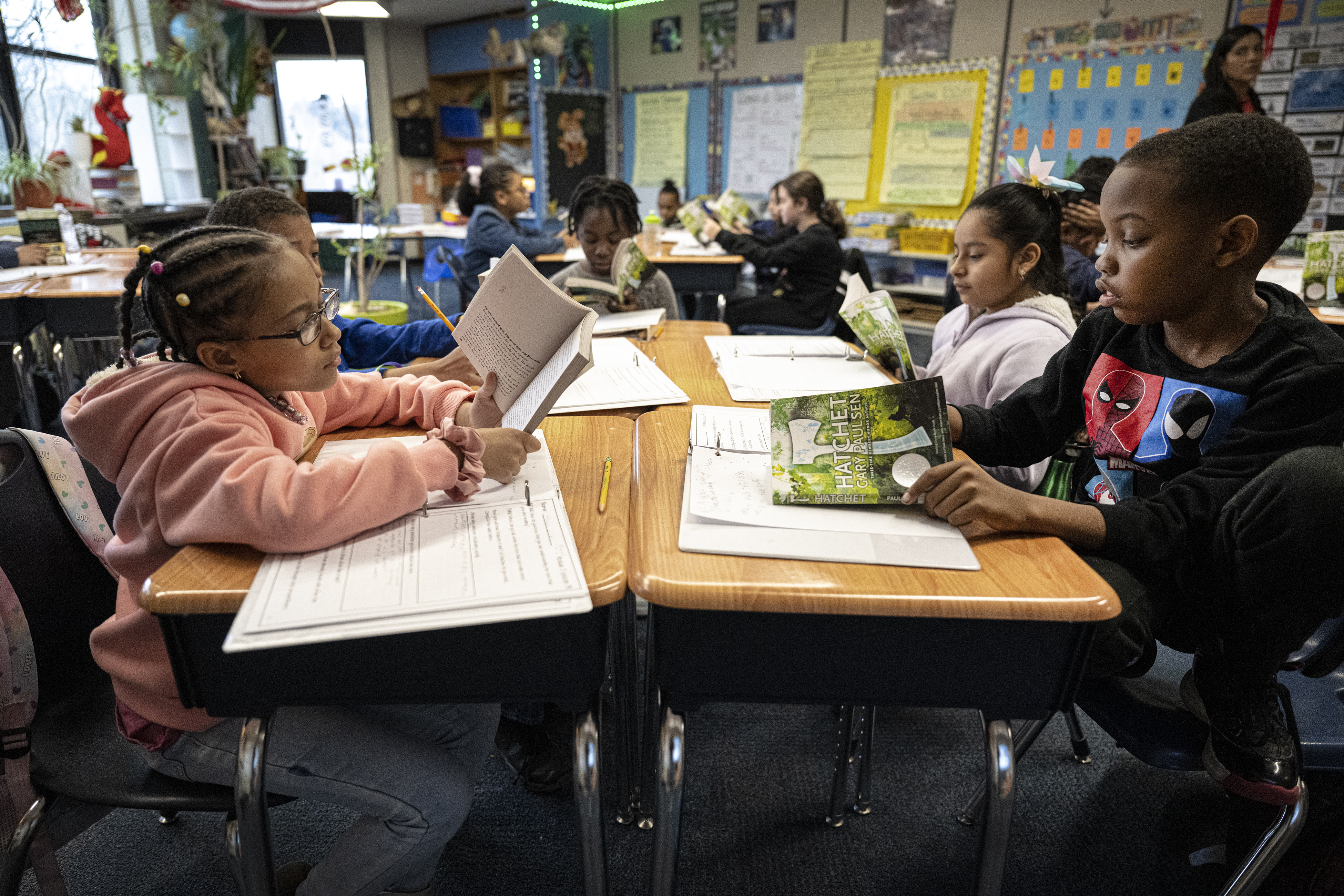
Nearly half of educator preparation programs are failing to adequately train future teachers in how to teach reading, according to a new report, even as states across the country have passed laws to overhaul reading instruction.
And in Pennsylvania, even more teacher preparation programs may be falling short, according to the National Council on Teacher Quality, which released a report this week reviewing whether colleges and universities had aligned their instruction for future teachers with the so-called science of reading.
Of 23 graduate and undergraduate programs evaluated in Pennsylvania, five received A’s, according to the report. Just as many received F’s.
Pennsylvania is “among the lowest-performing states in this analysis,” said Ron Noble, NCTQ’s director of teacher preparation.
Most of the state’s programs declined to participate in the review — including some, like the University of Pennsylvania, that were ranked poorly when the group last released a report in 2023.
Some colleges have criticized the group’s methodology, and literacy advocates had mixed reactions to the findings.
Still, progress has been made since 2023, Noble said, as more states have made changes to how reading is taught amid fierce debate over best practices and deepening concern about poor reading scores. Here is what the group found, and how Pennsylvania universities and colleges fared:
How reading instruction is evaluated
For decades, the predominant approach to reading in many schools, balanced literacy, sought to foster a love of reading in children by focusing on stories and de-emphasizing skills-based instruction.
But literacy experts say most kids need explicit instruction in connecting sounds to letters to learn how to read. In recent years, a growing movement has successfully pushed states, including Pennsylvania, to require schools to adopt structured literacy, which aims to teach kids to read with evidence-based practices.
The National Council on Teacher Quality scored education programs on how well they prepare teachers in the “five core components” of scientifically based reading instruction: phonics, fluency, vocabulary, comprehension, and phonemic awareness — the ability to identify units of sounds in spoken words.
The group, which evaluated course syllabi, curricula, and lecture schedules, also considered whether programs taught debunked practices, including “three-cuing” — prompting students to guess words based on context clues — and running records, an assessment that involves listening to a child read aloud to determine what level of book is appropriate.
Programs that earned A’s are adequately covering all five core components, Noble said, while not teaching more than three practices “that run counter to the science of reading.” Those that received F’s, meanwhile, are not adequately covering more than one of the core components, or teaching enough contrary practices that their letter grades were reduced, Noble said.
How Pa. colleges scored
Nationally, the percentage of programs receiving A’s more than doubled from 2023, from 26% to 53%.
In Pennsylvania, the number of programs receiving A’s grew from two in 2023 to five.
(function(){function e(){window.addEventListener(`message`,function(e){if(e.data[`datawrapper-height`]!==void 0){var t=document.querySelectorAll(`iframe`);for(var n in e.data[`datawrapper-height`])for(var r=0,i;i=t[r];r++)if(i.contentWindow===e.source){var a=e.data[`datawrapper-height`][n]+`px`;i.style.height=a}}})}e()})();
Among them was East Stroudsburg University. Brooke Langan, dean of the university’s College of Education, said the school had produced more records in this review.
East Stroudsburg also reviewed its coursework after Pennsylvania required structured literacy competencies to be embedded in teacher preparation programs in 2022, Langan said.
“It really made us take a moment and think about: Did we structure those correctly? Are they scaffolded well for our students developmentally?” Langan said.
Other schools getting top grades were Carlow University, Millersville University, Pennsylvania Western University, and Shippensburg University.
At the other end, Cheyney University, the Commonwealth University of Pennsylvania, Lincoln University, West Chester University, and Widener University’s graduate education program received F’s.
Julie Stellfox, a spokesperson for Commonwealth University, said the school “does not subscribe” to NCTQ’s research methodology. She noted a statement about the report from the American Association of Colleges for Teacher Education, which voiced concern about relying “primarily on document review as a proxy for the quality of educator preparation.”
Nancy Gainer, a spokesperson for West Chester, said that school also disagrees with NCTQ’s methods. She noted that West Chester complied with an “open source request” from the group in 2023 and received a B in its report then; this time, the school did not receive such a request, and West Chester did not supply information, she said.
An NCTQ spokesperson said the group submitted a formal records request to West Chester.
Mary Allen, a Widener spokesperson, said the university had asked NCTQ to reassess the graduate education program “and include additional courses that focus on reading instruction, which were not included in their review.”
“Academic rigor and student success are our top priorities, and we have aligned our teacher education programs to all the required competencies related to structured literacy and the science of reading outlined in Pennsylvania Department of Education guidelines,” Allen said.
Noble acknowledged the criticism of a review process limited to records. But, he said, NCTQ is evaluating whether colleges adequately cover foundational reading skills, and it was “highly unlikely that something that doesn’t appear in course materials” is being taught.
Fewer Pennsylvania programs agreed to be evaluated by NCTQ this year — the program reviewed 33 in 2023, compared with 23 in the latest report. Overall, 63% of Pennsylvania teacher preparation programs did not participate.
Of schools nationally that declined to be reviewed after participating in 2023, NCTQ said, more than 60% had received F’s previously.
It also said that it identified textbook requirements for more than 80% of nonparticipating programs, and found they used textbooks misaligned with the science of reading at the same rates as programs receiving D’s and F’s.
Noble noted that the four largest teacher preparation programs in Pennsylvania either did not participate in this year’s review — Pennsylvania State and Temple Universities — or received F’s, in the case of West Chester and Commonwealth.
“It’s even more concerning: The places producing many of Pennsylvania’s newest teachers are either a black box for us or did not perform well,” Noble said.
Calls for more state oversight
Rachael Garnick, Pennsylvania Literacy Coalition manager with the Teach Plus group, which advocates for structured literacy implementation, said there was value in the report’s effort to evaluate how well colleges are preparing future teachers.
But “I don’t think it’s a conclusive verdict,” including about schools that did not participate, Garnick said, noting that one university she had spoken with said NCTQ had sent its request for information to the incorrect administrator.
Pennsylvania itself needs to do more to hold teacher preparation programs accountable for reading instruction, Garnick said. While the state now requires structured literacy in teacher preparation programs, it does not set requirements for the number of courses or hours of instruction.
And the state’s certification exam for new teachers has not been aligned with the science of reading. For instance, it still includes questions on three-cueing, Garnick said — even though Pennsylvania has banned that practice. The coalition is pushing the state to adopt a standalone exam to test teaching candidates on reading.
The failure of teacher preparation programs to adopt the science of reading has ripple effects, said Kate Mayer, a consultant with Keystone Structured Literacy Partners. Mayer, who has advocated for many Philadelphia-area families whose children are struggling with reading, said she sees area school districts working with universities to make changes to their reading instruction that still are not best practices.
“In my experience, the bar is even lower than it should be for what we’re looking at,” said Mayer, who served on a committee that worked with NCTQ on its scoring rubric in 2019. She said “there should be no excuses” for universities that are not adequately covering the five reading components.
Some states, including Ohio and Indiana, have significantly improved teacher preparation programs through new accountability measures, including audits and the prospect of revoking accreditation, Noble said.
“When you’re providing teacher preparation programs with really clear standards” and consequences for not meeting them, “that’s a recipe for pretty dramatic” changes, Noble said.