Tag: no-latest

  • How to avoid a Social Security cut? Lawmakers are floating ideas for what to do

    How to avoid a Social Security cut? Lawmakers are floating ideas for what to do

    WASHINGTON — With the few months they have left as senators, Democrat Dick Durbin and Republican Bill Cassidy have embarked on a mission to save tens of millions of Social Security beneficiaries from a projected 22% cut in their benefits, starting in just six years.

    It is one of the most perilous political efforts that a member of Congress can undertake, so it is telling that the push is being led by two lawmakers who have little to lose at this stage of their careers.

    “We’ve been at this six years, eight years. It’s incredible how long I’ve been at it,” Cassidy said. “But Durbin came up to me and he goes, ’Bill, I’m leaving the Senate soon. We need to take a ride at it.’”

    Their idea to extend Social Security’s solvency is one of a few that have been formally offered this Congress. None has gained much traction, but it is a start as more lawmakers weigh in on a problem that will likely confront the group of senators elected this fall as well as the next president. Pressure for action is sure to grow as 2032 draws closer.

    Senate bill seeks 50 years of Social Security solvency

    The measure that Durbin, D-Ill., and Cassidy, R-La., are pushing would not dictate an outcome, but instead set up a process for Congress to take action. It calls for the bipartisan Social Security Advisory Board to collect public input and submit draft legislation to Congress that would keep the program’s retirement trust fund solvent for at least 50 years.

    The resulting bill would then be introduced by the majority leaders of the Senate and House. If they do not want to go along, any member could sponsor the bill. It would then be referred to the two committees with jurisdiction over Social Security — the Senate Finance Committee and the House Ways and Means Committee.

    Both committees would have the chance to debate the bill and amend it if they wish. If not, the original bill drafted by the advisory board would be placed on the Senate and House calendars for consideration. Lawmakers could offer substitute proposals, with final votes after 100 hours of debate. Passage would require a three-fifths vote in the 100-member Senate and a simple majority in the 435-member House.

    Even though the bill does not prescribe a solution for replenishing Social Security, sponsors have struggled to win support. Cassidy voiced exasperation in a recent floor speech.

    “For some people, the time to do Social is never,” Cassidy said. “Don’t disturb Congress. They don’t want to take a tough vote. Even if that vote only sets up a process.”

    AARP has come out against the bill, saying that the effort amounts to “fast-tracking” Social Security changes through a process that limits what type of amendments are offered and sets arbitrary procedural deadlines.

    A different bill proposes an investment fund for older adults

    Separately, Cassidy has a proposal with Sen. Tim Kaine, D-Va., that calls for the creation of a $1.5 trillion fund that would be invested in stocks and other higher-risk assets over 75 years.

    The seed money would be financed by the Treasury Department through additional borrowing. At the end of the 75 years, the fund’s assets would be used to repay the Treasury for the seed money as well as the borrowing that would occur over those years to keep Social Security payments going out — now projected at about $26.6 trillion.

    Cassidy projects such an investment fund would earn enough to cover about two-thirds of that $26.6 trillion in borrowing, meaning other actions such as raising payroll taxes or cutting benefits would still be required to completely close the gap. But those tax increases or benefit cuts would be smaller than otherwise necessary without the investment fund.

    “The advantage of the ‘Save Our Seniors Fund’ is that it lessens your political battle,” Cassidy said.

    Debt watchdogs are worried.

    The Committee for a Responsible Federal Budget said “this is a dangerous, debt-funded gamble that would come with huge risks and costs.”

    Some propose lifting the payroll tax cap

    Sens. Elizabeth Warren, D-Mass., and Bernie Moreno, R-Ohio, do not agree on much, but they have joined forces in calling for lifting the cap on the Social Security payroll tax.

    Currently, the payroll tax that funds Social Security applies to a maximum of $184,500 in income. That means most people pay Social Security taxes on all of their income, but the wealthier do not.

    “Why should a middle-class nurse pay a larger share of her paycheck than a wealthy corporate lawyer?” the two senators wrote in The New York Times.

    But while the two promised forthcoming legislation on the matter, they have not filed it yet. Some conservative groups have forcefully pushed back on the idea, saying the tax increase would lead to lower wages and fewer jobs at businesses seeking to offset the additional tax burden.

    Eliminating the cap would generate more than $3.2 trillion for the trust fund over the course of a decade, according to the Peter G. Peterson Foundation, a nonpartisan debt watchdog.

    Others have called for lifting the cap, but only above a certain income threshold. For example, a bill from Sen. Sheldon Whitehouse, D-R.I., and Rep. Brendan Boyle, D-Pa., would apply the payroll tax to income above $400,000. The bill would require those making more than $400,000 to contribute more to Medicare.

    Others are calling for lifting the cap and increasing benefits

    Progressives in the House and Senate have sponsored a bill that would lift the payroll tax cap to cover all earnings above $250,000, including capital gains and dividends, and increase the tax that high earners must pay on investment gains.

    The bill would boost payments to Social Security beneficiaries by roughly $2,400 a year and increase the annual cost-of-living adjustment. The effort is being led by Sen. Bernie Sanders, a Vermont independent, and Rep. Val Hoyle, D-Ore. The House version has 39 cosponsors, all Democrats.

    In a recent letter to colleagues, Sanders said expanding benefits and requiring the wealthiest in the United States to pay the same percentage of their income into Social Security as tens of millions of working people is “how we extend Social Security’s solvency for generations to come. That is how the Democratic Party begins to regain the trust of the American people.”

  • Trump administration sends Saudi nuclear deal to Congress for review

    Trump administration sends Saudi nuclear deal to Congress for review

    WASHINGTON — The Trump administration has submitted to Congress a nuclear cooperation agreement with Saudi Arabia that could allow the kingdom to enrich its own fuel for nuclear reactors, according to two officials with firsthand knowledge of the transmission of the agreement.

    The accord, announced by the White House last month, would deepen ties between the United States and Saudi Arabia at a moment when the war with Iran has strained the relationship between the two countries. The 30-year agreement would give U.S. companies a central role in developing Saudi Arabia’s civilian nuclear infrastructure while largely shutting out foreign competitors.

    The submission formally begins a congressional review process required under Section 123 of the Atomic Energy Act, which gives such nuclear cooperation accords their shorthand name, “123 agreements.” Unlike treaties, they do not require approval by two-thirds of the Senate. Instead, the Senate Foreign Relations Committee and House Foreign Affairs Committee review the agreement during a period totaling 90 days that Congress is in continuous session. Unless Congress passes a joint resolution rejecting the agreement during that period, the accord can take effect without an affirmative vote by either chamber.

    The transmission of the agreement to Congress was reported earlier by The Wall Street Journal.

    The prospect that Saudi Arabia could enrich uranium — the technology at the center of the conflict with Iran — has drawn sharp opposition from some Democratic lawmakers and revived long-standing concerns about nuclear proliferation in the region.

    “This deal is the starting gun for a Middle East nuclear arms race,” Sens. Edward J. Markey of Massachusetts and Jeff Merkley of Oregon, along with Reps. John Garamendi of California and Donald S. Beyer Jr. of Virginia, wrote in an essay last month. The four Democrats contended that the agreement should require Saudi Arabia to forgo the production of weapons-grade uranium and accept the International Atomic Energy Agency’s most stringent inspection standards.

    “Congress must reject it,” they wrote.

    The lawmakers also said that President Donald Trump’s launching a war with Iran over the country’s nuclear ambitions while negotiating a nuclear agreement with Saudi Arabia was a fundamental contradiction to U.S. nuclear policy in the region. “That contradiction doesn’t make America stronger,” they wrote. “It makes American policy impossible to take seriously.”

    Energy Secretary Chris Wright and Prince Abdulaziz bin Salman, the Saudi energy minister, signed the agreement last month as part of a broader package of cooperation on civilian nuclear power. The two officials also signed what the administration described as a bilateral agreement on nuclear safeguards.

    This article originally appeared in The New York Times.

  • Graham, and Trump, triumph: Six takeaways from South Carolina’s Senate runoff

    Graham, and Trump, triumph: Six takeaways from South Carolina’s Senate runoff

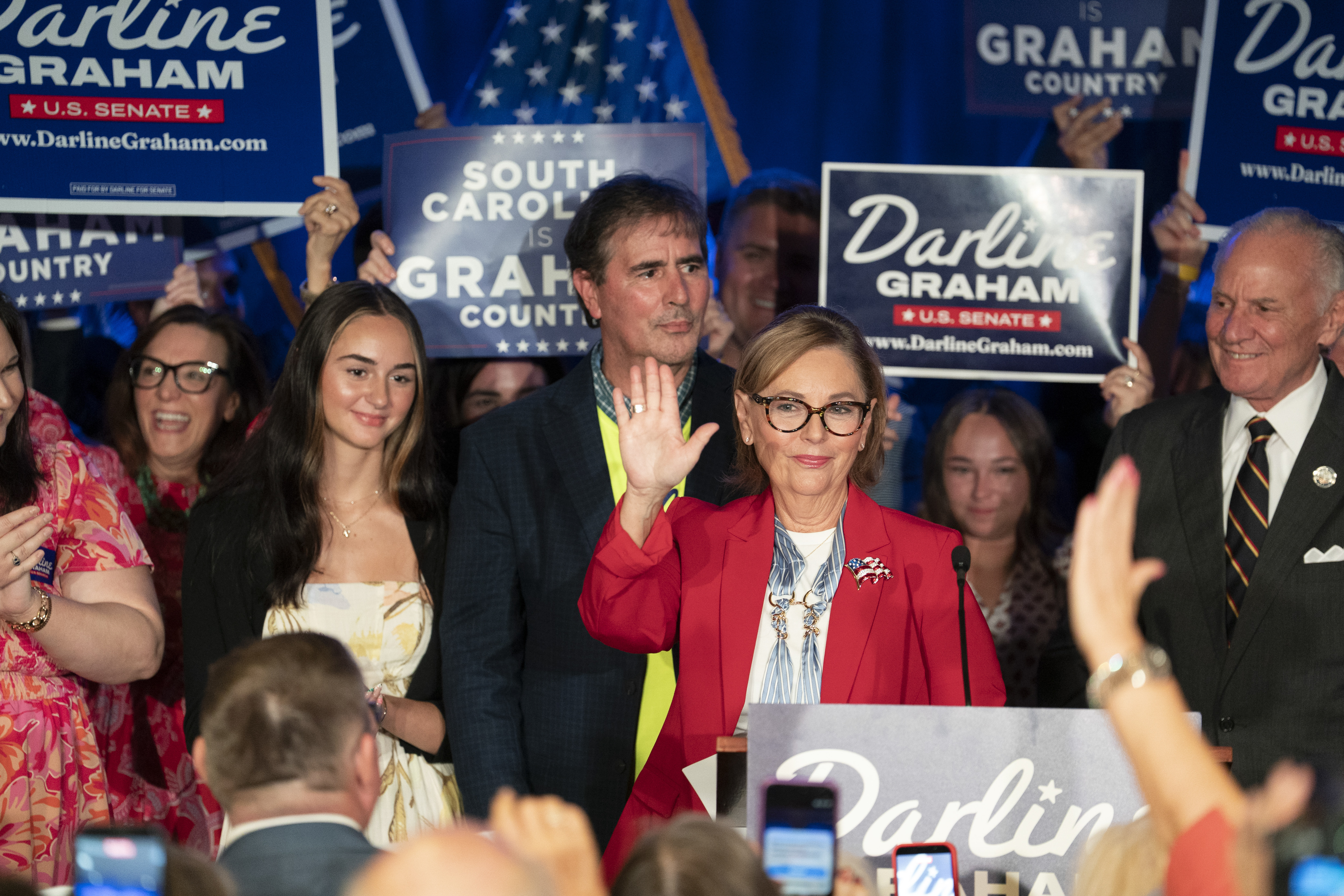
    ROCK HILL, S.C. — Sen. Darline Graham won the Republican Senate nomination in South Carolina on Tuesday, relying on the strength of President Donald Trump’s political capital to overcome her inexperience as a first-time candidate for public office.

    Graham defeated Rep. Ralph Norman, a five-term member of Congress, in deeply red South Carolina after Trump did more to support her than he has for any other Republican candidate this year — out of apparent affection for her late brother, Lindsey Graham, who died last month.

    Her win showed the president’s continued ability to move Republican primary voters, especially when he goes all in on a race. His chosen candidates won a series of key primaries in the spring, but a few of his picks have more recently lost, putting the power of his endorsement in question. That he could lift Graham, who is poised to win a six-year Senate term after being virtually unknown six weeks ago, may have settled that question, for now.

    Trump’s pick also prevailed in Oklahoma’s Republican primary for governor, where Mike Mazzei, a former state lawmaker, defeated Gentner Drummond, the state’s attorney general. Mazzei was ahead by less than half of a percentage point when The Associated Press called the race.

    Here are six takeaways from Tuesday night’s primaries:

    Trump’s support faced a big test in South Carolina. He aced it.

    Trump won South Carolina by more than 18 percentage points in 2024. But twice in the past six months, candidates he endorsed have fallen in the state.

    Graham looked like she could become one of only a handful of Trump-backed Senate candidates to lose their primaries nationwide since 2017. She initially struggled to introduce herself to voters in the extraordinarily short campaign and flubbed a debate answer about national security.

    But on the campaign trail, she said, voters asked her about kitchen-table issues, not national security. And she wrapped her candidacy around her support for Trump and his for her. She will now face Dr. Annie Andrews, a pediatrician and the Democratic nominee, in the November general election, where Graham will be heavily favored.

    Trump-backed candidate prevailed in a tough fight in Oklahoma

    Mazzei, the president’s pick to succeed Oklahoma’s term-limited governor, Kevin Stitt, won the Republican nomination after a neck-and-neck race against Drummond, a former Air Force pilot who is in his first term as attorney general.

    Trump not only endorsed Mazzei but also went out of his way to attack Drummond during the campaign.

    “Everybody I know dislikes him,” Trump told supporters in a telephone rally for Mazzei on Monday.

    A key issue in the race was a $4 billion aluminum smelter project that has been a priority of Trump’s. Mazzei initially opposed it and then reversed his position. Drummond campaigned against it.

    Where Trump goes, his voters vote

    Trump rallied for Graham last Friday in Myrtle Beach, an area where the candidate who came in third place in the primary, Rep. Russell Fry, performed best. On Tuesday, Graham trounced Norman in Horry County, home to Myrtle Beach.

    Graham also did well across the eastern part of South Carolina, including in Charleston County, which had been a base of support for another rival, Mark Sanford, in the primary.

    When Trump’s allies send texts, his voters vote

    Trump’s super political action committee, MAGA Inc., spent more than $800,000 on the special primary runoff, nearly a third of the organization’s total spending in this election cycle. And South Carolina Republicans had the evidence on their cellphones: They said they received repeated text messages, including Tuesday, urging them to cast ballots for Graham.

    Republicans nationwide have fretted about MAGA Inc. not spending as quickly as some in the party would like to help vulnerable Republicans. The organization’s investment in South Carolina may not stop the grumbling, given the ongoing battle for control of Congress and the fact that the Senate seat was expected to stay in Republican hands regardless of who won the nomination. But it will allow MAGA Inc. to say that when it does enter a race, it does so decisively.

    Winning South Carolina’s most conservative region was not enough for Ralph Norman

    Norman performed best in the Upstate region of northwest South Carolina, which includes Greenville and Spartanburg and surrounds his congressional district. The area is rich in Republican voters who lifted him into second place in the crowded primary two weeks ago.

    But the rest of South Carolina went for Graham, leaving Norman without the broader support needed to win a two-way runoff. His supporters pinned much of their hopes Tuesday on Greenville County. But they were not enough.

    Norman told supporters in Rock Hill on Tuesday night that he “couldn’t have done anything different,” but he did lament that Trump took sides in the race.

    “He has that right,” he said, as his supporters booed. “He has that prerogative.”

    Lindsey Graham’s legacy didn’t sink his sister

    Graham, who was running for reelection when he died, won his Republican Senate primary in June with 56% of the vote. That was a low ceiling for a four-term incumbent, and one he reached only after he and his allies spent more than $18 million on the race. He had long struggled with some Republican voters who were skeptical of his past support for immigration reform and for Trump’s rivals in the 2016 presidential primary.

    When Darline Graham entered the race to succeed him, her ceiling was even lower: She was a first-time candidate known to voters only as the sister of a senator they had complicated feelings about. And many Republican voters said they disliked the perception of nepotism.

    Graham said she knew she had to earn voters’ support. She tried to break with her brother, saying she was more focused on domestic policy and would take a harder line on immigration.

    “I continue to miss Lindsey every day, and there is still a big hole in my heart,” she told supporters in Columbia, South Carolina, on Tuesday night. “But I know he’s looking down right now very proud of everyone in this room.”

    Time to brush up on foreign policy.

    This article originally appeared in The New York Times.

  • Letters to the Editor | Aug. 26, 2026

    Letters to the Editor | Aug. 26, 2026

    Protect Head Start

    As developmental and behavioral pediatricians at Children’s Hospital of Philadelphia who care for children with disabilities, we know our patients are well served by Head Start — including the regulations that ensure their inclusion in the program. Head Start programs, which must reserve at least 10% of their enrollment slots for children with disabilities, serve many of our patients when other preschool programs fail to do so. As the article points out, many children will be harmed by the proposed regulations, and we argue that children with disabilities will be disproportionately negatively impacted.

    Rates of suspension and expulsion from preschool for children with disabilities are high, and a local Head Start program may be the only place that can accommodate their needs. Head Start programs cannot expel children for their behavior, and must engage mental health and community support before considering suspension.

    Developmental screening in trusted locations such as Head Start can identify delays, which, if addressed early, may resolve before a child enters kindergarten. Early intervention therapies for children ages 3 to 5 years old are delivered in preschools, including Head Start, allowing our patients to receive speech/language, occupational, or physical therapies. Head Start programs also help families coordinate care when their children need ongoing therapies.

    Lastly, all children benefit from inclusion — by learning and playing alongside each other, regardless of ability or disability. Head Start provides our patients and their families with critical access to programs that help them thrive. We urge our leaders to reconsider.

    Sarah Revak, Wilmington, and Kate E. Wallis, Philadelphia

    No extra innings

    The Phillies gave us an exciting ninth-inning, come-from-behind win Sunday — exciting because they kept getting on base and kept scoring before Kyle Schwarber’s walk-off home run. A friend of mine texted me, with a Philadelphian’s typically guarded optimism, “Phillies look to be peaking toward playoffs!” The media provided an extra-inning recap to revel in the moment. NBC Sports Philadelphia’s analysis noted the significance of getting runners on base to keep the pressure on the defense, while chalking up RBIs. The Inquirer was able to give us its great morning-after reporting, allowing those of us who watched the ending live to bask in the memory for a second or third time.

    Wayne Williams, Malvern

    Right to life, thrive

    Republicans claim to be the “right to life” party. They have not learned that being the pro-life party means they must protect their fellow Americans from birth until death. They have worked diligently to eliminate a woman’s right to terminate a pregnancy. They pride themselves on saving the lives of unborn children. Sadly, they are only the protectors of fetuses. When it comes to supporting life outside the womb, they have done little. The overhaul of programs like the Supplemental Nutrition Assistance Program has resulted in roughly four million fewer people receiving food stamps. Funding cuts for childcare and social services have taken billions of dollars away from the Temporary Assistance for Needy Families program. Regulatory changes threaten the future of early childhood development efforts like Head Start. The Trump administration has implemented funding cuts that target senior citizens, starting with Medicare long-term and in-home care. The cuts contained in the One Big Beautiful Bill mean millions will lose health insurance, and rural hospitals will be placed in jeopardy.

    We have to stop electing officials to both state and federal offices who claim to be pro-life and then put in place legislation that opposes safety net programs, health access, and commonsense gun laws — all of which sustain and protect life. When voters go to the polls in November, I urge them to think carefully about whether their senators and representatives deserve to be reelected. It is time to put in place elected officials who are not just pro-life in name only.

    Celeste D’Alonzo, Marlton

    Simply ballroom

    Last week, Chief Justice of the United States John Roberts once again stomped on the scales of justice by issuing a temporary order that allows construction of Donald Trump’s massive ballroom to continue. This ruling is in direct opposition to both a lower-court ruling and an appeals court ruling that directed that aboveground construction of Trump’s ballroom should be stopped, as the construction lacked congressional authorization for the massive project.

    In the vast majority of dispute cases, and as directed in the prior rulings related to this case, most judges’ initial instructions would be for the parties to temporarily stop what they are doing (i.e., do no further harm). Unfortunately, Chief Justice Roberts decided to put his thumb on the scales and, with a wink, essentially said, “Hey, Donald, keep building.”

    Roberts will claim that his “temporary” order does no harm and is only in place while the U.S. Supreme Court considers an emergency appeal. The problem is that he and everyone else in America knows it could take months for the case to be resolved, and meanwhile, taxpayer dollars are being spent every day on this unpopular Trump vanity project. Roberts and Trump know that by the time the court gets around to deciding the case, the ballroom will be substantially built, and it is unlikely to be torn down.

    I find it interesting that in his Supreme Court confirmation hearings, Roberts famously claimed that “a judge’s job is to call balls and strikes, not to pitch or bat.” Unfortunately, it seems Roberts needs to get his eyes checked, as he has a hugely distorted strike zone whenever Trump is at the plate.

    Kent Kingan, Malvern

    Untold history

    Thank you for the educational article in the Sunday Opinion section written by Cory James Young about President George Washington and how the complex relationship between enslaved and enslaver during colonial times is such an important part of our American history.

    Perhaps one day we will learn the name of the American veteran who Washington enslaved, who died from battle wounds near Pennsylvania’s Fort Necessity. I can’t help but think that the research that led to the opening of the President’s House on Independence Mall in 2010 has been an inspiration to the work of Young, perhaps especially given the debate over how the government has changed it. Let’s keep learning, Philly.

    Anne Patricia Minicozzi, Villanova

    Broken promise

    New Jersey Rep. Jeff Van Drew, who represents Salem, Cumberland, Cape May, Atlantic, and parts of Gloucester and Ocean Counties, said the Republican Party will “get killed” in the 2026 midterms if it does not address rising healthcare costs.

    “We need to deal with [healthcare] now because, No. 1, it’s the right thing to do, just morally,” Van Drew said on Nov. 7 on Fox Business’ Maria Bartiromo’s Wall Street. “No. 2, we’re going to get killed [in 2026].”

    A recent editorial from the New York Times provides one of the clearest explanations I’ve seen of how Republicans, including Van Drew, have slashed healthcare: They did it passively, by allowing the Affordable Care Act subsidies to expire, and they did it actively (with Van Drew’s vote) by slashing Medicaid in the One Beautiful Bill (although they cleverly provided that the cuts do not take effect until after the midterm election).

    Van Drew knows cutting healthcare is immoral — he essentially said so himself — yet he followed Donald Trump’s orders and voted for these cuts in one of the poorest districts in New Jersey. Van Drew put his “undying support” for Trump above the interests of his constituents. In his words, Republicans deserve to “get killed” in the upcoming election.

    Rich Hluchan, Cherry Hill

    Join the conversation: Send letters to letters@inquirer.com. Limit length to 150 words and include home address and day and evening phone number. Letters run in The Inquirer six days a week on the editorial pages and online.

  • Dear Abby | Fiancée entertains lawyer with dishonorable intentions

    DEAR ABBY: I am a 63-year-old man. My fiancée (57) and I have been dating exclusively, or so I thought, for four years. I just found out she has a male friend she has been seeing without my knowledge. They go to lunch and dinner and other activities.

    She says they are just friends. He is her attorney, and he wants a romantic relationship. She lied by omission, and now my trust is damaged. I’m worried about her dishonesty and the viability of our relationship. She thinks it’s not a big deal. Your thoughts?

    — SIMMERING SUSPICION IN FLORIDA

    DEAR SIMMERING SUSPICION: A woman who is engaged has no business spending time alone with another man who has expressed a romantic interest in her. This is a big deal, made bigger by her attempts to hide it and downplay it. Warning: If you go through with this wedding, there’s a good chance you’ll need to start seeing a lawyer of your own.

    ** ** **

    DEAR ABBY: My husband and I have been married for 34 years. Ten years ago, my husband had to take custody of his then 56-year-old brother, “Clay,” because back in 1987 he fried his brain on PCP. For a decade, our life has been a daily living hell.

    Clay has frightened off one of our cats. He lies, steals from us, can’t and won’t clean up after himself and doesn’t wash his hands. He is the most disgusting person I have ever met. He’s spoiled rotten and lazy and expects the only woman in the home to do everything. This is an ingrained behavior that he has had for years.

    I want a divorce. My husband will not put Clay into an assisted living facility or a mental institution. I love my husband, but I refuse to be disrespected by anyone. I told him I wouldn’t ever allow any member of my family to disrespect him the way I, our marriage and our home have been disrespected by his brother. Abby, would you divorce your husband for subjecting you to this daily living hell for 10 years?

    — DONE IN MONTANA

    DEAR DONE: I certainly wouldn’t have put up with your mess of a brother-in-law for an entire decade! Still, if you are considering divorce, you must mention that to your husband. Offer him a final opportunity to make other arrangements for his brother. Be clear that if he continues to value Clay’s comfort over yours, the marriage is over.

    ** ** **

    DEAR ABBY: I am a boy in South Korea who likes boys. When I was in middle school, I loved girls just like everyone else, but it changed after entering high school. When I see boys in school now, I have started to feel the charm of them. These days, I’m scared that if I reveal it, I’ll be mocked by my friends and others. What should I do?

    — NOT STRAIGHT IN SEOUL, S. KOREA

    DEAR NOT STRAIGHT: If you don’t feel comfortable or safe coming out to your friends, it’s OK to wait. All of this gets a bit easier after you graduate, especially if you are able to attend a university. For now, focus on your studies so you can make that happen. To find gay or gay-friendly people to talk to outside your school, look up an organization called Dding Dong at ddingdong.kr.

  • SEC joins Big Ten in banning pros from returning to college, includes basketball players

    SEC joins Big Ten in banning pros from returning to college, includes basketball players

    The Southeastern Conference passed a rule Tuesday banning players who have been drafted by NFL, NBA or WNBA teams or listed on rosters in those leagues, joining the Big Ten in taking a strong stand against this month’s unexpected surge of pro players trying to return to college.

    The SEC’s rule differs from the one adopted by the Big Ten, which only included football in its decision released earlier in the day.

    Combined, it leaves little doubt about where the nation’s two biggest conferences stand in the wake of court orders that were allowing players who had been on pro rosters, then released, to return back to college.

    It puts LSU on notice. This week, Tigers coach Lane Kiffin added Dae’Quan Wright and Zxavian Harris, a pair of undrafted players out of Mississippi who had tryouts in the NFL over the summer, but were released by their teams during training camp.

    The rule would also apply to basketball player R.J. Luis, who Monday won a court ruling that allowed him to sign with Will Wade’s program at LSU despite having briefly been under contract with the Jazz and Celtics of the NBA.

    There was no immediate comment from LSU.

    The Big Ten’s penalties for violating its rule include a half-season suspension for the head coach and a fine to the school. The SEC did not immediately divulge its penalties.

    The burst of rulemaking marked the latest chapter in a remarkable month for college sports, which was suddenly faced with the once-unthinkable but now court-approved return to college of players who had signed and sometimes played for professional teams.

    “I feel like I took a freaking gummy,” said Sean McVay, the coach of the Los Angeles Rams, when asked about the prospect of a player he released returning to college. “I don’t even understand it.”

    Kiffin was much more in tune with the change, suggesting in a news conference Monday that if LSU didn’t take such players, other teams certainly would. Now, nobody can — at least not among the 34 teams that make up the two biggest leagues in college and play an outsize role in spearheading policy across the industry.

    Another Power Four league, the Atlantic Coast Conference, was set to discuss the issue Wednesday.

    They are reacting to a series of losses in state courts around the country, where judges are granting players who graduated high school in 2022 a fifth year of eligibility. In June, the NCAA passed a rule giving most players five years to finish five seasons of eligibility in college, but did not grandfather in the Class of ’22.

    Hundreds of those players saw their fourth — and supposedly final — year of eligibility run out last spring. They are arguing in courts that they’re being denied educational opportunities and the chance to earn name, image and likeness money that they could get in a fifth year.

  • Watchdog files bar complaint against Jeanine Pirro over bid to indict 6 Democratic lawmakers

    Watchdog files bar complaint against Jeanine Pirro over bid to indict 6 Democratic lawmakers

    WASHINGTON — A legal watchdog says it filed bar complaints on Tuesday accusing U.S. Attorney Jeanine Pirro and two lieutenants of violating their ethical duties in seeking to charge six Democratic lawmakers with federal crimes for appearing in a video that called on troops to resist unlawful orders.

    The Legal Accountability Center’s bar complaints, filed in New York and Virginia, claim Pirro and her subordinates, Carlton Davis and Steven Vandervelden, abused their prosecutorial powers to seek “meritless” indictments against President Donald Trump’s “perceived political enemies.”

    Tim Lauer, a spokesperson for Pirro’s Washington-based office, noted that it’s a grand jury’s job — not prosecutors’ — to decide whether to hand up an indictment.

    “Attempting to weaponize the disciplinary process against prosecutors for doing their jobs amounts to nothing more than a frivolous complaint,” Lauer said in a statement.

    In February, a grand jury in Washington refused to indict Sens. Mark Kelly and Elissa Slotkin and four House Democrats for urging U.S. service members to follow established military protocols and reject orders they believe to be unlawful. All six lawmakers previously served in the military or at intelligence agencies. Trump accused them of sedition “punishable by DEATH” in a social media post.

    A grand jury’s refusal to return an indictment is extraordinarily rare, but it has become increasingly common in Washington during Trump’s second term. Pirro’s critics have accused her of pursuing other legally dubious and politically motivated cases at the Republican president’s behest, such as the recently abandoned felony charge against a former Olympian who was accused of defacing the Lincoln Memorial Reflecting Pool.

    The center has filed complaints against other Trump administration officials, including Ed Martin Jr., Pirro’s predecessor as U.S. Attorney for the District of Columbia. Martin has been a leading figure in Trump’s campaign to use the Justice Department to prosecute his political opponents.

    In its complaint against Pirro, the center asks bar officials to investigate whether she and her colleagues violated rules of professional conduct for attorneys — and to “pursue appropriate discipline” against them. Its complaint against Pirro says her office had no legal basis for its “patently improper effort” to secure an indictment against the six lawmakers.

    “The only purpose could have been political animus and a desire to intimidate perceived enemies of the federal government and the President, who personally criticized the lawmakers’ video as seditious and punishable by death,” the complaint says.

    Defense Secretary Pete Hegseth has tried to punish Kelly, a former Navy pilot representing Arizona, for participating in the video. Kelly sued in federal court to block the censure from Hegseth. A district court judge ruled in his favor. Hegseth has asked an appeals court to review the decision.

    The center filed its complaint against Pirro and Vandervelden with a grievance committee based in White Plains, N.Y. In New York, the state Supreme Court’s appellate division governs ethical complaints against attorneys. The center filed its complaint against Davis with the Virginia State Bar.

    “Prosecutors have enormous power, and with that power comes an obligation to exercise independent legal judgment rather than use the criminal justice system to carry out a president’s political demands,” the center’s co-founder, Michael Teter, said in a statement.

    Pirro, who served as a county prosecutor and judge in New York, left her Fox News hosting job to become the top federal prosecutor for Washington last year.

  • FEMA crew broke law by skipping homes with Trump signs, federal watchdog says

    FEMA crew broke law by skipping homes with Trump signs, federal watchdog says

    A crew of Federal Emergency Management Agency staffers working on the response to Hurricane Milton in 2024 violated the law and agency policy by skipping nearly a dozen homes displaying signs supporting then-presidential candidate Donald Trump, a federal watchdog said Tuesday.

    The new report by the Department of Homeland Security’s Office of Inspector General found that the decision by a crew with the agency’s Disaster Survivor Assistance program “eroded public trust in FEMA’s ability to treat everyone impartially, offer unbiased and consistent assistance, and ensure equal access to resources and tools.”

    Back-to-back hurricanes hit Florida within two weeks of each other in late September and early October 2024, prompting emergency declarations and federal assistance. FEMA Disaster Survivor Assistance crews canvassed 744,288 homes and other sites in response, according the report, and did not contact “555,374 locations for reasons such as private property signs or safety concerns.”

    During FEMA’s hurricane response, which was unfolding during the last few weeks of the pivotal election, a FEMA crew lead instructed team members to avoid homes with Trump signs due to safety concerns. The same crew bypassed those 11 homes in Florida, according to survey notes obtained by the inspector general’s office.

    At the time, the crew leader did not feel safe given the heightened tension and “was looking for ways to define safety. People were not getting good guidance, so she made her own way,” said a former senior FEMA official with direct knowledge of the situation.

    After several FEMA workers filed a complaint, the agency started its own investigation and officials referred the complaint to the Office of Special Counsel and DHS’ inspector general office. Gov. Ron DeSantis (R) blamed the Biden administration, writing online that it represented a “blatant weaponization of government by partisan activists in the federal bureaucracy.” FEMA quickly fired the crew leader and several other staffers involved in the incident.

    The watchdog found that the incident highlighted weaknesses in “FEMA’s training, documentation, and oversight.” Those Disaster Survivor Assistance crews did “not receive ethics and Hatch Act training before deploying to disasters,” the report said, nor was there a policy that required “crews to explain why they skipped homes.”

    Deanne Criswell, who headed FEMA during the Hurricane Milton response, said in a Signal message Tuesday that the report “validates the actions we took at FEMA when this incident was brought to our attention. Politics should never play a role in disaster response, and even one home skipped is unacceptable.”

    Criswell said that after they learned that the crew had bypassed those homes, officials ensured the “neighborhoods were recanvassed.”

    The agency did not have a formal system for reporting potential safety threats at the time, said the senior official, who spoke on the condition of anonymity because they were not authorized to speak publicly about the internal investigation. The inspector general report also identified this as a hole in the agency’s operations.

    Criswell and the other former official noted that FEMA’s internal review found that the Hurricane Milton incident was isolated to that crew.

    “FEMA personnel conducted more than 744,000 canvassing visits following Hurricanes Helene and Milton, and the Inspector General identified 11 homes skipped for political reasons by the same crew — findings that reinforce my confidence this was an isolated incident and not a systemic practice within FEMA,” Criswell said.

    However, safety concerns during disaster response are common, the former senior official said, with most of the encounters that FEMA canvassers faced involving guns.

    The inspector general report said that after FEMA learned of the crew skipping homes, it provided mandatory training to all disaster survivor teams, including those deployed in the field.

    FEMA concurred with all of the inspector general recommendations. In a letter from July, the agency said that “when concerns were raised regarding adherence to law and policy in performance of this work — FEMA leadership acted swiftly to investigate, remediate, and strengthen training and oversight. As a result, FEMA increased mission readiness training and no longer conducts FEMA-led door-to-door outreach efforts. Staff now provide support to survivors from fixed locations determined by state and local officials through a data-informed approach.”

  • FBI sets $25,000 minimum reward for dozens of unsolved Indian Country cases

    FBI sets $25,000 minimum reward for dozens of unsolved Indian Country cases

    SIOUX FALLS, S.D. — The Federal Bureau of Investigation has established a minimum reward of $25,000 in cases where people went missing or were killed in Indian Country, part of a broader effort to address high rates of violence affecting Native American communities.

    The new minimum applies to more than 50 unsolved homicides and missing-person cases in tribal communities. Most of the cases are less than 10 years old, though a dozen have been unsolved for more than two decades, an AP analysis found.

    Victims’ families and experts are unsure the higher amounts will be enough to get tipsters to come forward, citing people’s fears and distrust of the federal government.

    “Everybody’s scared in Oglala,” said Lisa Carlow, whose father, Patrick Carlow Sr., was found dead in his Pine Ridge Reservation home in 2023. “So to me it’s like, OK, what do you guys know that you’re not saying?”

    The FBI investigates federal crimes on nearly 200 Native American reservations, along with the U.S. Bureau of Indian Affairs. At the end of 2025, the FBI’s National Crime Information Center recorded just under 1,500 active cases involving missing Native Americans, though not all become federal cases. There isn’t a minimum reward that applies across all FBI cases.

    The FBI cited several cases in its recent announcement, including that of 8-year-old Maleeka Boone, who it said was likely struck by a vehicle on the Navajo Nation, and San Carlos Apache teenager Emily Pike, whose body was found after she disappeared from an Arizona group home.

    Higher rewards could stir new interest

    Mary Kathryn Nagle, a citizen of the Cherokee Nation of Oklahoma and an attorney who advocates for families of missing Native Americans, said federal investigators often “parachute in” to investigate crimes in tight-knit communities where witnesses may stay silent because of distrust and fear of retribution.

    Still, she said, larger rewards could provide an incentive for people to talk, and show families their loved ones’ cases are being taken seriously.

    “We have people in Indian Country who know what happened to our relatives,” she said.

    Luana Ross, who is Bitterroot Salish and a co-director of the Native Voices program at the University of Washington, said cash rewards could boost interest but often aren’t paid out.

    “It is my opinion that in reservation communities, people would be extremely reluctant to turn a friend or relative into a criminal justice system that hasn’t served them well,” she said.

    Lisa Foster’s longtime friend Mona Renee Vallo was found dead after a suspected hit-and-run along historic Route 66 in Laguna Pueblo, N.M., in 2022. Foster hopes the higher reward money will renew interest in the investigation.

    Foster described Vallo as a positive, bubbly friend who could have fun no matter what. She was a member of the Confederated Tribes and Bands of the Yakama Nation.

    “Someone knows something there,” Foster said. “They have to. I mean, it’s weird that she went to work and then all of a sudden this happened to her.”

    Frustration mounts as families seek answers

    The reward in Carlow’s case was increased to $25,000 in July, up from $10,000.

    Carlow’s family says the 73-year-old rancher was respected in the Oglala community. He mowed the grass for others and spent time with his grandchildren. The family said more calls started coming in after the reward was increased, but the wait for answers continues.

    Meanwhile, the FBI declined to provide the Associated Press an update on the case.

    “It’s so hard to get your hopes up like that and think, ‘This is it, we finally got Dad’s killer.’ And then nothing comes of it,” Lisa Carlow said.

    She said fear keeps community members who may have information from contacting authorities.

    “I think that’s like deep-rooted within our people,” said her sister, JoDee Carlow. “It’s not just on Pine Ridge. It’s on every reservation.”

    Relatives don’t want cases to be forgotten

    The FBI initially offered $5,000 for information in the deaths of two brothers from Ohio, Matthew and Philip Reagan. The reward was later doubled and now will hit $25,000. Though not Native Americans, they were killed on the Navajo Nation and are featured on the FBI’s Indian Country cases website.

    The brothers planned to visit Canyon de Chelly National Monument during a trip to California. Authorities believe their SUV got stuck in mud after GPS sent them off course near Sawmill. They were shot multiple times while walking to seek help, authorities said.

    Matthew Reagan’s wife, Faye Wurstner-Reagan, said she doubts a $25,000 reward will persuade anyone in the small community to come forward.

    “You would have to promise someone, like, actual protection,” she said. “I mean, they brutally murdered two men.”

    She suggested the FBI instead put resources toward law enforcement to keep the cases from going cold and for liaisons to keep families informed.

    FBI spokesperson Brooke Brennan in Phoenix said investigating crimes in Indian Country often is complex because of the remoteness, limited resources, and extensive workload.

    Wurstner-Reagan hopes that families united in pain and grief over missing loved ones and unsolved killings might one day see justice.

    “We’re just getting forgotten, like no one is remembering any of us, and we’re just told it’s an active investigation,” she said.

  • Iran may have little to lose as U.S. tries to squeeze its economy

    Iran may have little to lose as U.S. tries to squeeze its economy

    Facing a fresh economic assault from the United States, Iran’s leaders are gambling that they can weather the coming storm and make the cost of their suffering felt in an oil-rich region that is critical to the global economy.

    As Iran’s ever more devastating economic crisis deepens, experts warn, Iranian leaders may feel they have little to lose by responding to U.S. pressure with the kind of military escalation President Donald Trump now seems keen to avoid.

    “The danger is that ‘economic D-Day’ is being presented almost as a substitute for further war when it may instead become another mechanism for escalating it,” said Sina Toossi, an Iran expert at the Center for International Policy. “The harder Washington pushes third countries to sever Iran’s remaining lifelines, the stronger Tehran’s incentive becomes to demonstrate that participating in Iran’s isolation carries costs of its own.”

    Treasury Secretary Scott Bessent on Monday announced a new package of U.S. measures to disrupt Iran’s economy, although he offered few details. The success of the U.S. efforts will also depend on how much the Trump administration can persuade other countries to go along with its plan — especially critical trade partners for Iran, such as Turkey, Russia, and China.

    Still, as the Trump administration reached for military metaphors to convey the severity of its plans — calling them an “economic D-Day”— Iran responded in kind. Iranian officials have labeled the U.S. campaign the next phase of the war that Washington has waged since U.S.-Israeli strikes were launched in February.

    Economic warfare is the “main battlefield” in the current confrontation, Iran’s Revolutionary Guard was quoted as saying in a statement Monday cited by Press TV, an Iranian state news outlet.

    In statements broadcast after Bessent’s news conference, Iran’s economy minister, Ali Madanizadeh, warned that the country would find ways to push back.

    “The enemies intend to launch an economic terrorist attack on us, but we also have our own tools and know how to play the game,” he said, in comments carried by the semiofficial news agency, Tasnim.

    A day before Bessent’s announcements, Iran’s top security chief, Mohsen Rezaei, vowed that “not a single drop” of oil would leave the region if its Persian Gulf neighbors joined the U.S. effort, and that they would be considered enemy states.

    The severity of the Iranian warnings also highlights just how bad Iran’s current economic crisis is — and it is worsening by the day.

    A report Monday by Iran’s most prominent economic newspaper, Donya-e-Eghtesad, said Iran’s rial has depreciated to new lows. It has plummeted 41% since December, when the currency rate sparked protests that morphed into weeks of nationwide unrest. Iranian security forces responded with a deadly crackdown.

    Inflation and unemployment have soared, with prices of everyday goods increasingly out of reach for many Iranians. At the same time, the U.S. strikes that damaged Iranian energy infrastructure and the ongoing U.S. naval blockade have intensified an ever-worsening fuel supply crisis — an issue that sparked massive protests in 2019.

    But Iranian officials are projecting confidence that their leadership can survive because this new wave of U.S. measures looks similar to old ones. For decades, U.S. leaders have vowed to devastate the Iranian economy through ever harsher sanctions that the Islamic Republic’s leaders have learned to withstand.

    Iran’s leadership “has been planning to confront U.S. sanctions for a long time and is fully prepared for new sanctions,” Madanizadeh said late Monday. He said the government had a two-year plan in place for dealing with such sanctions.

    Iran’s ability to withstand the Trump administration’s economic pressure campaign will depend on the attitude of Iran’s key trading partners.

    Mahdi Ghodsi, an economist at the Vienna Institute for International Economic Studies, said that “faced with sufficiently credible secondary-sanctions risks,” those trading partners may “prefer to protect their much more important financial and commercial interests with the United States and reduce the services they provide to Iranian entities.”

    Some analysts also warn that the brunt of further economic pain is likely to be borne by ordinary Iranians, not Iran’s leaders.

    Among the sectors Bessent identified as being targeted in the new U.S. campaign were gold, digital assets, technology, aviation, and shipping — sectors that Esfandyar Batmanghelidj, who heads the Bourse & Bazaar Foundation, a London-based think tank focused on Iran’s economy, called “lifelines for the Iranian people.”

    “Digital assets and gold are how ordinary Iranians protect their savings from inflation,” he wrote in a social media post. “Technology keeps Iranians connected with the world. Aviation keeps Iranian families connected with loved ones across borders. Shipping is how essential goods, including food and medicine, reach Iran.”

    This article originally appeared in the New York Times.