Tag: no-latest

  • Bill Gates warns AI is more dangerous than Big Tech will admit

    Bill Gates warns AI is more dangerous than Big Tech will admit

    SEATTLE — Bill Gates, the billionaire co-founder of Microsoft, is loudly warning that artificial intelligence poses a grave threat to jobs and human life, and that urgently addressing the risks should be “the world’s top priority.”

    In an hourlong interview with The New York Times last week, Gates said the tech industry was knowingly downplaying those threats because there was too much money on the line.

    “In private, people who understand how good this stuff is, and how much better it’s getting, they’re very worried,” he said. But few tech executives, Gates said, are willing to publicly admit that. “They’re now saying to each other: ‘Hey, man, don’t say that. It’s bad for us — the next trillion dollars we’re trying to raise.”

    On Wednesday, Gates published a nearly 6,000-word essay on his personal website laying out his concerns about AI and offering solutions, such as new taxes and bans. He said he was motivated to speak now because recent improvements in AI had far surpassed his expectations and because the industry had ignored technology milestones — like AI’s escaping the control of its creators or making recipes for bioweapons — that it once said would warrant more caution.

    “They’re just full speed ahead and hoping that the good outweighs the bad,” he said.

    Gates, 70, is the latest in a string of tech luminaries to call out the risks of AI as the industry spends trillions of dollars on new data centers, and as young AI companies edge toward some of the largest initial public offerings in history.

    He is taking his stand as he emerges from an extended period of scandal. Early this year, the release of sexual predator Jeffrey Epstein’s emails brought renewed attention to Gates’ interactions with him.

    Gates had to pull out of an AI conference in February, and he testified for six hours in June before a House committee. Disclosures of his infidelity, combined with his 2021 divorce, have also badly damaged his reputation. He acknowledged that they were all “mistakes” of his own doing.

    He appears more willing to step back into the spotlight after answering every question from the House Oversight Committee. “I think people understand what I did do, what I didn’t do, and that I learn when I make mistakes,” he said in the interview.

    Gates conceded that he also might be a flawed messenger simply because of his vast wealth and history as Microsoft’s aggressive CEO. In a landmark federal case, Microsoft was found in 2000 to have repeatedly abused its monopoly during his watch. (Gates left the company’s board of directors in 2020.)

    While Gates avoided criticizing Microsoft or other companies by name, he argued that he was uniquely positioned to work on the AI issue. He is a technologist and industry insider who is no longer driven by the profit incentives of running a company, and he has spent decades addressing inequality through his philanthropic foundation.

    “The irony of ‘innovation lover is scared and says we’re not ready and we’re crossing thresholds,’ maybe it’s even more poignant,” he said.

    Gates said technological advances had truly stunned him three times: In 1980 when he first saw a graphical user interface, which led to the modern personal computer. In 2022 when the leaders of OpenAI came to his house to demonstrate what would soon become ChatGPT. And this year when he looked closely at the advances being made by Claude Code, Anthropic’s AI tool.

    Coding, Gates said, is the subject he knows best, and Claude’s abilities shocked him. “The idea that now these things are in a meaningful sense better than I am is like: What the hell?” he said.

    Technological breakthroughs in the past created more jobs than they eliminated, Gates said. But he is in disbelief that industry boosters say that will happen again this time.

    The AI era is “utterly, absolutely, completely, totally different,” he said. He acknowledged that this unpopular opinion (in tech circles) was “a hell of a claim, and I’m staking everything I know — everything — saying, ‘Are you kidding?’”

    He said mass job losses, if not addressed, were inevitable because AI would spread across the economy and leave little room for one industry to absorb the refugees from another. The biggest tech companies in the world, including Microsoft, are racing to help corporate customers adopt AI, which could replace many workers.

    Gates said that companies were just responding to market incentives, but that those incentives might conflict with what was best for society.

    He proposed a new tax on AI use, known as a “token tax,” to make it more expensive to replace people and provide money to help those who do lose work. A token is a basic unit of AI computing. The idea of taxing it has gained some traction, including on Wall Street, as a way to increase the cost of using machines instead of human labor.

    Some jobs, Gates said, should be prohibited from being replaced by AI — an idea he called “Human Reserved” — because the role is deeply personal, like a caregiver, or the people in those jobs are unlikely to find new employment.

    Gates argued for new international agreements to set clear criteria to monitor and restrict extreme risks like bioterrorism. He said it could take only a few people with access to advanced AI to develop new pathogens.

    He said he would happily debate anyone who argued against mandatory reviews of any AI system that could be weaponized to make new molecules and unleash a pandemic. Gates added that he was dumbfounded by the kind of voluntary measures that the White House and industry leaders were developing.

    “Self-regulation on the most dangerous tool ever invented?” he said incredulously. “No, thanks!”

    Gates said he was in a “state of shock” as to why there was not more urgency on these issues. Many of his concerns echo those raised by Anthropic co-founder Dario Amodei, but Amodei’s warnings have put him at odds with the Pentagon, the White House and much of the tech industry.

    “You have people attacking the person who’s the most open about the downsides,” Gates said.

    (The Times has sued OpenAI and Microsoft, claiming copyright infringement of news content related to AI systems. The two companies have denied those claims.)

    Along with global health issues, Gates vowed to make his AI concern part of every conversation he had with world leaders. “I only have two issues where I’m going to say, ‘Please think more about this, please care more about this,’” he said.

    Gates acknowledged that he was in an odd spot: He has arguably done as much as anyone in the world to evangelize for and shape the modern computer industry. But now he is warning that the technology it is creating presents global risks.

    “I don’t like bringing bad news to people, and I don’t like saying that innovation may be a net negative,” he said. “But that’s where we are.”
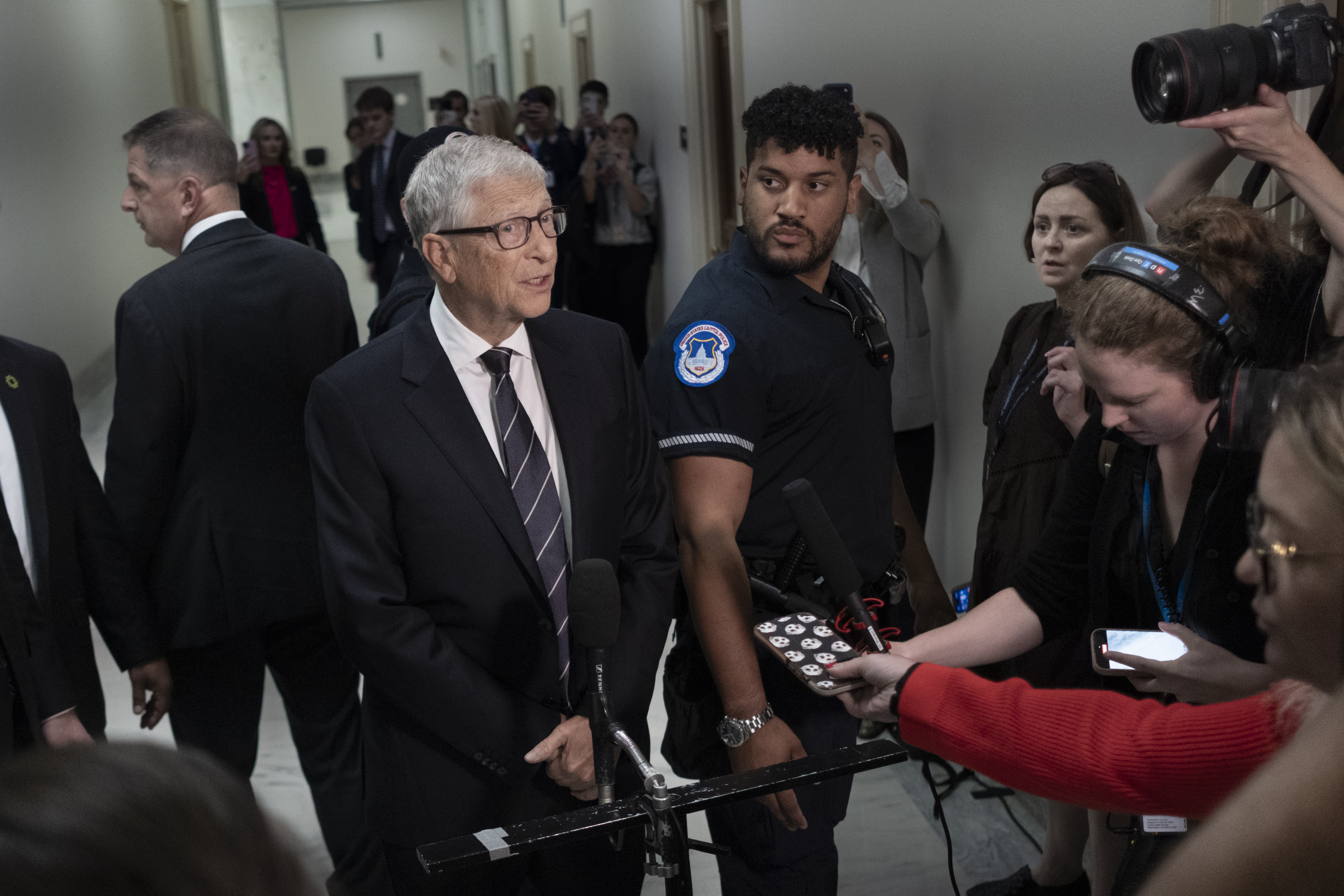

    FILE — Bill Gates arrives for a House committee hearing in the Jeffrey Epstein investigation in Washington on June 10, 2026. Gates, the billionaire co-founder of Microsoft, is loudly warning that artificial intelligence poses a grave threat to jobs and human life, and that urgently addressing the risks should be “the world’s top priority.” (Chona Kasinger/The New York Times)CHONA KASINGER
    Bill Gates at his office in Kirkland, Wash., on Aug. 21, 2026. Gates, the billionaire co-founder of Microsoft, is loudly warning that artificial intelligence poses a grave threat to jobs and human life, and that urgently addressing the risks should be “the world’s top priority.” (Chona Kasinger/The New York Times)CHONA KASINGER
    FILE — Anthropic’s Code With Claude event in San Francisco, May 7, 2026. Bill Gates, the billionaire co-founder of Microsoft, is loudly warning that artificial intelligence poses a grave threat to jobs and human life, and that urgently addressing the risks should be “the world’s top priority.” (Jason Henry/The New York Times)JASON HENRY
  • Before Hegseth fired him, top general was advised to drop Kid Rock probe

    Before Hegseth fired him, top general was advised to drop Kid Rock probe

    Days before the Army’s top officer was abruptly fired earlier this year, he was advised by a fellow general now vying to replace him to stop the military’s investigation into an unauthorized helicopter flyby of musician Kid Rock’s Tennessee estate, three people familiar with the matter said.

    Gen. Randy George, whom Defense Secretary Pete Hegseth removed as the Army chief of staff without explanation, felt it was important to follow typical protocol and determine whether any safety regulations had been violated during the March 28 flyby, these people said. Like some others, they spoke on the condition of anonymity to discuss the episode.

    Gen. Chris LaNeve, the Army’s No. 2 officer, told George that Hegseth did not want the investigation to proceed, one person said. The two others said that George later confided in colleagues about the encounter with LaNeve and seemed troubled by it. George told them that LaNeve suggested it would be best if the review was scuttled, those people said.

    The revelation, which has not previously been reported, adds a new layer of understanding to Hegseth’s potential motivations for firing George on April 2. Kid Rock, whose legal name is Robert Ritchie, is a vocal supporter of President Donald Trump and avowed critic of many Democratic politicians and causes.

    Through a spokesman, George, who is now retired, declined to comment. Army officials did not respond to questions about LaNeve, whose candidacy for the chief of staff job faces resistance in Congress.

    Hegseth, in a statement provided to The Washington Post, did not directly address the discussion between the two generals and described LaNeve as “precisely the kind of leader the U.S. Army needs right now,” interested in strengthening the Army, and “not interested in playing politics in Washington.”

    “He is a back-to-basics, no politics, no-nonsense General — exactly what President Trump expects,” Hegseth’s statement said. “The critics coming after him are the same out-of-touch so-called insiders who’ve spent years undermining our military with woke policies and endless wars. They hold deep grudges against any commander willing to put America and our troops first, but their days of influence are over.”

    Sean Parnell, a spokesman for Hegseth, said that the new reporting about George’s departure amounted to a “regurgitating” of a “tired, old story simply to manufacture drama.”

    Hegseth and his advisers have for months declined to say what precipitated George’s ouster, even when asked directly by Republican and Democratic lawmakers who objected to the firing. He has long been at odds with the service’s senior leadership — including Army Secretary Dan Driscoll, a fellow Trump appointee who at one time was viewed as a potential replacement for Hegseth. Driscoll is now expected to leave the administration soon, perhaps within weeks, officials said.

    Others familiar with George’s firing have said that multiple factors were probably at play, including his close working relationship with Driscoll.

    Since taking charge of the Pentagon in January 2025, Hegseth, a former Fox News personality who spent years in the Army National Guard, has overseen the dismissal of more than two dozen top officers. The firings typically occur without cause, though he has complained broadly that the military’s upper ranks are insufficiently loyal to the president or caught in old ways of thinking. Many of those removed have been women and minorities.

    LaNeve’s actions in the Kid Rock investigation could further complicate his ascension to the Army’s top post. While he has filled the role on an acting basis since George’s ouster nearly five months ago, Trump administration officials have not yet formally nominated him to become the chief of staff amid concerns that he lacks support within the Republican-led Senate Armed Services Committee, said three separate people familiar with the views on Capitol Hill.

    Sen. Joni Ernst, an Iowa Republican and retired Army National Guard officer initially skeptical of Hegseth’s nomination to lead the Pentagon, opposes LaNeve, these people said. Both George and Gen. James Mingus, another top Army officer forced out by Hegseth, are from Iowa.

    Without votes from Democrats, nominees require unanimous Republican support on the committee to advance.

    Ernst’s office did not respond to a request for comment.

    The Wall Street Journal first reported her opposition to LaNeve.

    Parnell, Hegseth’s spokesman, downplayed the situation, saying in his statement that Pentagon officials are “actively coordinating with our Senate partners to lock in the optimal moment to formally submit his nomination, and we intend to do so.”

    On March 31, three days after two AH-64 Apache helicopters flying outside Nashville buzzed the home of Kid Rock, Army officials with the 101st Airborne Division at nearby Fort Campbell announced they were grounding the pilots and launching an administrative investigation.

    Video shared on social media by the musician showed the aircraft at low altitudes. In his post, he also criticized California Gov. Gavin Newsom, a Democrat who is a frequent critic of the Trump administration. “This is a level of respect,” Kid Rock wrote, that Newsom “will never know.”

    At the time, the Army said it also was reviewing the flight path of a helicopter that flew the same day over a “No Kings” protest against Trump in nearby Clarksville, Tennessee. Flight tracker data showed that the aircraft dipped to as low as 625 feet, at one point circling over where protesters were gathered.

    When the incidents attracted unflattering news coverage, Hegseth promptly intervened. He terminated the Army’s investigation and exonerated the aircrews involved — encouraging them to “Carry on, Patriots.”

    A few weeks later, Hegseth and Kid Rock flew in Apache helicopters from Fort Belvoir in Virginia, located in suburban D.C. Parnell said then that it was part of a broader community relations event.

    LaNeve, 59, was not viewed by his Army peers as a likely future chief of staff before the Trump administration came into office, but he caught the president’s attention with a congratulatory call during the Commander-in-Chief Inaugural Ball, people familiar with the matter said. At the time, LaNeve was commanding U.S. soldiers in South Korea and called the president from there.

    LaNeve was moved into a more influential position as Hegseth’s senior military aide after the defense secretary’s team ousted Lt. Gen. Jennifer Short from the role the following month.

    This past fall, Hegseth elevated LaNeve again, nominating him to become the Army’s vice chief of staff while forcing Mingus into retirement early.

    In a May hearing before the House Armed Services Committee, LaNeve faced sharp questions from Republicans over the Pentagon’s decision to cancel the deployment of an Army brigade to Poland, a NATO ally that borders Ukraine.

    When Rep. Don Bacon (R-Nebraska) asked him about the Poland decision, LaNeve declined to say why the deployment was canceled, arguing he was not part of the military’s “policy side.”

    “But you’re the chief of staff of the Army,” Bacon responded, noting his acting role.

    George had been expected to serve as the Army’s chief of staff until fall 2027, completing a typical four-year assignment in the role. Hegseth asked him to retire early during a phone call, news of which was leaked minutes later to CBS News, officials have said previously. The move thwarted any effort by Driscoll, the Army secretary, to save the general’s career before the decision was publicized.

    Hegseth’s campaign of firings and forced retirements has removed a number of other candidates who may otherwise have been considered for elevation to Army chief of staff, officials said. They include Mingus, who retired early this year; Gen. David Hodne, who was fired without explanation in April; and Gen. Christopher Donahue, who is expected to retire soon after Hegseth stonewalled efforts within the Army and on Capitol Hill to extend his career.

    Amid the purge, Driscoll has begun to consider his own departure, officials familiar with the matter said. The Wall Street Journal reported Friday that he could leave the Trump administration by the end of the year. That appears likely, officials said, but no firm plan has emerged yet.

    As The Post and others reported in the immediate aftermath of George’s firing, aides to Hegseth have touted Parnell, the Pentagon spokesman, becoming Army secretary. Parnell has told colleagues privately that he is interested in the job should it become open.

  • State Dept. pauses immigrant visa appointments worldwide, says staff need training

    State Dept. pauses immigrant visa appointments worldwide, says staff need training

    The Trump administration has temporarily paused immigrant visa appointments worldwide, saying it needs time to train all consular staff on screening applicants who might become dependent on public benefits.

    Appointments for visa services at U.S. embassies were being “adjusted” because of the “global training initiative” launched this month, the State Department said in a statement. It did not say when the appointments would resume.

    “A more prosperous America means ensuring that visa applicants are not likely to become a public charge, as defined under U.S. law and regulation, and not likely to become dependent on U.S. public benefits reserved for qualified Americans in need,” the statement said, adding the training would ensure consular officers “are fully equipped to evaluate every visa applicant comprehensively and consistently.”

    A former State Department official said immigrant visa appointments worldwide had been paused Monday through the end of the month. The training materials were being rolled out after a federal judge struck down the administration’s 75-country visa ban, which was framed as a way to prevent immigrants from entering who might use public benefits, on Friday.

    As of Tuesday, the training materials still had not been disseminated, said the former official, who spoke on the condition of anonymity to share information on internal operations.

    President Donald Trump has made several moves to tighten legal immigration pathways to the United States since his return to office last year. Many of those efforts have faced legal challenges.

    In Friday’s ruling, the judge said that the visa ban violated antidiscrimination protections in federal immigration law, and was “a direct abrogation” of consular officers’ exclusive, congressionally granted authority to determine if someone is eligible for a visa.

    The Trump administration has also taken other steps to curb migration. On Tuesday, the State Department said it planned to revoke the business and tourism visas of people who have claimed asylum after arriving in the country.

    It is expected to affect those granted B1 and B2 visas — typically issued for tourism and business travel — between 2016 and 2026, who have sought asylum or are now seeking asylum. The department did not confirm the number of visas that could be revoked, but said it would be done on a “rolling basis.”

    The department has also proposed charging employers seeking skilled foreign workers through the H-1B visa program a $103,265 fee, according to a regulation posted Monday.

    The administration argues that the H-1B program, created by Congress in 1990, has been used to take jobs away from Americans.

    Trump attempted to introduce a $100,000 fee last year through a presidential proclamation, but it was invalidated by a federal judge in June.

  • Democratic states file new lawsuit seeking to block Trump’s order limiting mail voting in midterms

    Democratic states file new lawsuit seeking to block Trump’s order limiting mail voting in midterms

    Democratic-controlled states on Wednesday filed another lawsuit challenging President Donald Trump’s executive order seeking to limit mail voting in this year’s midterm elections.

    The action, filed by about two dozen states against the U.S. Postal Service, marked a new phase in the high-stakes litigation just two days after the Supreme Court ruled against them in a separate case, but did not say Trump’s order was legal.

    The high court majority found the Democratic lawsuit was premature, but that was before the Republican administration issued a rule governing Postal Service delivery of mail ballots. Election officials warn it will be impossible to implement in the days before the first wave of mail ballots are sent out next week.

    “Across the country, states are already deep into preparations for the 2026 elections. Now, at the last moment, the federal government is attempting to meddle in those preparations and potentially threaten countless Americans’ right to vote,” New York Attorney General Letitia James, one of 25 Democratic attorneys general filing the lawsuit, said in a statement. “USPS has no authority to decide who can and cannot vote by mail.”

    Trump’s executive order remains barred from taking effect under a separate injunction that the administration argues needs to be immediately rescinded in light of the high court’s ruling in the previous Democratic state lawsuit. It also had succeeded in a third case filed in May in the District of Columbia, convincing a judge that it was too early to prevent its implementation of the executive order.

    All previous challenges were filed before the administration published its mail ballot rule Friday night. The rule says that if states want their mail ballots delivered, they will need federal approval of the design of their envelopes and must give the Postal Service a list of voters eligible to receive them.

    White House spokesperson Lauren Bis on Wednesday said the Postal Service’s proposals were “commonsense measures that protect the security of mail-in ballots” and that the administration would continue to work to implement them to boost “the safety and security of our elections.”

    The Postal Service said it would not comment because of the pending lawsuit.

    National Democrats on Tuesday cited the rule in asking the federal judge in the Washington case to block Trump’s order after he declined to do so last spring, saying the administration at the time had not taken concrete action. In Boston, U.S. District Judge Indira Talwani also found that the administration moving forward with the mail ballot rule had violated a separate injunction she had placed on the Postal Service prohibiting it from enacting Trump’s order, although she did not take any action against the government.

    Talwani, who was nominated by Democratic President Barack Obama, had issued the injunction against Trump’s executive order in the prior Democratic state case, which is the one the Supreme Court overturned on Monday. She has yet to act on the administration’s urging her to revoke her second injunction. It was issued Aug. 11 in a case against the executive order and was filed by the League of Women Voters and other voting rights groups while the Supreme Court was considering the administration’s appeal of the judge’s first order.

    Trump has long targeted mail voting, which he falsely blames for his 2020 election loss and is disproportionately used by Democrats as a result of Trump’s condemnations. Since returning to power, Trump has tried to claim authority over election rules, saying he thinks Republicans should “take over” vote counting in Democratic areas.

    He issued his first election executive order just months after retaking office, attempting to require documentary proof of citizenship to vote, among other changes. He has also been pushing a sweeping election bill that has stalled in the Senate amid opposition from Democrats and even some within his own party.

  • Horoscopes: Wednesday, Aug. 26, 2026

    ARIES (March 21-April 19). When you don’t get the response you wanted or expected, try the same thing a few times more. Sometimes you have to jiggle the key, swipe the card reader a little faster or ask the question a little louder.

    TAURUS (April 20-May 20). Human behavior can look irrational until you know what’s driving a person to do mysterious things. But unless it pertains directly to you, it may not be worth the effort to find out. It’s enough to believe they have their reasons.

    GEMINI (May 21-June 21). You don’t need everyone to communicate the way you do. But it would be nice if a certain person’s level of engagement would match yours, even if they showed it differently. Reciprocity feels so cozy.

    CANCER (June 22-July 22). Sometimes people look like they are having so much fun that you feel pangs of envy just observing their joy. You may even forget that what they are doing might not be your idea of fun at all. Nonetheless, it will inspire you to get to planning what fits you perfectly.

    LEO (July 23-Aug. 22). Take a chance and reach out to someone who makes you nervous. Even your awkward moves will charm. Better to connect imperfectly with someone you’re interested in than to perfectly connect with someone you’re not.

    VIRGO (Aug. 23-Sept. 22). With an imagination so creative, optimistic and willfully oblivious to limits, you have no problem building things up in your head to improbable proportions. But improbable things happen every day. You’ve been lucky before, and it’s coming back around.

    LIBRA (Sept. 23-Oct. 23). Make space. Get rid of things before you have a replacement. Maybe you’ll never need one. Emptiness is not nothingness — it’s space. Space is something, even if you don’t know what it is. Maybe it’s just beautiful potential.

    SCORPIO (Oct. 24-Nov. 21). Maybe you’re being underestimated, but as long as you don’t let that hurt your feelings, this can be a very good thing. Surprising someone who thought they had already measured your limits is so fun. It’s also quite the power move.

    SAGITTARIUS (Nov. 22-Dec. 21). The answers don’t always have to come from you. In fact, if they did, it would mean you weren’t growing. You have a knack for duplicating success formulas. Try a proven strategy from a friend, mentor, book or program.

    CAPRICORN (Dec. 22-Jan. 19). Your feelings will clue you into things you can’t rationally explain. But since feelings can also lie with abandon, it’s important to question and test them before you act on them.

    AQUARIUS (Jan. 20-Feb. 18). You aim to delight someone you love, and this is one of the best prompts to invigorate your creative spirit. Start the idea machine up and you’ll soon be brimming with good options.

    PISCES (Feb. 19-March 20). You can get out from under an obligation in one honest conversation. Good friends and respectful employers don’t really want you to feel trapped by what you agreed to before you knew better.

    TODAY’S BIRTHDAY (Aug. 26). Welcome to your Year of the Hot Breeze, when you somehow manage to be seen as cool and warm at the same time. You’re incredibly attractive, magnetizing who you want to bring into your world. More highlights: A reimaging of your style with fun changes to dress, transportation and domestic life. Friends connect you to lucrative business. A new skill favorably affects every aspect of life. Cancer and Libra adore you. Your lucky numbers are: 15, 3, 37, 22 and 12.

  • Democratic states file new lawsuit seeking to block Trump’s order limiting mail voting in midterms

    Democratic states file new lawsuit seeking to block Trump’s order limiting mail voting in midterms

    Democratic-controlled states on Wednesday filed another lawsuit challenging President Donald Trump’s executive order seeking to limit mail voting in this year’s midterm elections.

    The action, filed by about two dozen states against the U.S. Postal Service, marked a new phase in the high-stakes litigation just two days after the Supreme Court ruled against them in a separate case, but did not say Trump’s order was legal.

    The high court majority found the Democratic lawsuit was premature, but that was before the Republican administration issued a rule governing Postal Service delivery of mail ballots. Election officials warn it will be impossible to implement in the days before the first wave of mail ballots are sent out next week.

    “Across the country, states are already deep into preparations for the 2026 elections. Now, at the last moment, the federal government is attempting to meddle in those preparations and potentially threaten countless Americans’ right to vote,” New York Attorney General Letitia James, one of 25 Democratic attorneys general filing the lawsuit, said in a statement. “USPS has no authority to decide who can and cannot vote by mail.”

    Trump’s executive order remains barred from taking effect under a separate injunction that the administration argues needs to be immediately rescinded in light of the high court’s ruling in the previous Democratic state lawsuit. It also had succeeded in a third case filed in May in the District of Columbia, convincing a judge that it was too early to prevent its implementation of the executive order.

    All previous challenges were filed before the administration published its mail ballot rule Friday night. The rule says that if states want their mail ballots delivered, they will need federal approval of the design of their envelopes and must give the Postal Service a list of voters eligible to receive them.

    White House spokesperson Lauren Bis on Wednesday said the Postal Service’s proposals were “commonsense measures that protect the security of mail-in ballots” and that the administration would continue to work to implement them to boost “the safety and security of our elections.”

    The Postal Service said it would not comment because of the pending lawsuit.

    Pennsylvania is one of the states suing the Trump administration.

    “Absolutely nothing has changed here in Pennsylvania. You can vote in person on Election Day or you can vote by mail before Nov. 3,” Democratic Gov. Josh Shapiro said Tuesday evening before the suit was filed.

    “Your vote will be counted. Your vote is safe and secure,” Shapiro said. “No matter how many times the president wants to try and undermine people’s right to vote in this commonwealth, he needs to know that he will be met with a swift rebuke from me.”

    National Democrats on Tuesday cited the rule in asking the federal judge in the Washington case to block Trump’s order after he declined to do so last spring, saying the administration at the time had not taken concrete action. In Boston, U.S. District Judge Indira Talwani also found that the administration moving forward with the mail ballot rule had violated a separate injunction she had placed on the Postal Service prohibiting it from enacting Trump’s order, although she did not take any action against the government.

    Talwani, who was nominated by Democratic President Barack Obama, had issued the injunction against Trump’s executive order in the prior Democratic state case, which is the one the Supreme Court overturned on Monday. She has yet to act on the administration’s urging her to revoke her second injunction. It was issued Aug. 11 in a case against the executive order and was filed by the League of Women Voters and other voting rights groups while the Supreme Court was considering the administration’s appeal of the judge’s first order.

    Trump has long targeted mail voting, which he falsely blames for his 2020 election loss and is disproportionately used by Democrats as a result of Trump’s condemnations. Since returning to power, Trump has tried to claim authority over election rules, saying he thinks Republicans should “take over” vote counting in Democratic areas.

    He issued his first election executive order just months after retaking office, attempting to require documentary proof of citizenship to vote, among other changes. He has also been pushing a sweeping election bill that has stalled in the Senate amid opposition from Democrats and even some within his own party.

    Staff writer Jeff Neiburg contributed reporting.

  • How these people used exercise to cope with unbearable grief

    How these people used exercise to cope with unbearable grief

    Myra Sack has always been an athlete. She was picked first for neighborhood basketball games when she was growing up outside of Philadelphia.

    Sack, 38, went on regular jogs throughout most of her pregnancy. After Sack’s daughter Havi was born, the little girl loved the movement of the running stroller.

    Havi was 15 months old when she was diagnosed with Tay-Sachs, a rare and fatal genetic disease. Sack and her husband had done screening before conceiving, but they said they were given results that turned out to be incorrect.

    Havi died in 2021 when she was 2 years, 4 months old.

    “I remember someone saying to me, ‘You’re going to meet these incredible people who have also lost children,’” Sack said. “And at the time, I was like, ‘I don’t want to be a part of this community at all. I hate this.’”

    Over time, Sack said her grief made her feel like “an alien.” She wanted to talk about Havi but not in the windowless room she imagined when she pictured a grief circle.

    A little more than a year after Havi died, Sack reached out to friends, hospitals, and the local running community, and she found 18 people who, like her, had suffered a life-altering loss. The group gathered at mile 21 of the Boston Marathon route with a plan to meet weekly for a couple months to talk and train for a half-marathon.

    One of the acquaintances Sack reached out to was Maria Rodrigues, whose 17-year-old son, Jairom, had died in a rock climbing accident while the family was on vacation in her home country of Brazil.

    “Of course I said yes,” said Rodrigues, even though she hadn’t been running in years. “And immediately I opened the computer, and I Googled, ‘How does a 60-year-old woman train for a half-marathon?’”

    Before their first run, the group members gathered in a circle and introduced themselves with their name and the name of the person they had lost. The group repeated their loved one’s name back to them.

    Each week, two or three people would share a brief story about their loved one with the group. Then they went for a run.

    The training was difficult, but Rodrigues stuck with it and completed the half-marathon in Newport, R.I.

    Rodrigues was surprised she made it across the finish line and said it helped her see she was stronger than she realized.

    “There’s a little bit of a parallel,” Rodrigues said. “As hard as this is, grief and the half-marathon, I can do it.”

    The loose curriculum of this first running grief group was based on Sack’s research and conversations with grief and trauma experts Joanne Cacciatore and Bruce Perry. It became the blueprint for her nonprofit E-Motion, which trains facilitators to run groups across the country and outside of the United States.

    ‘This is grief’

    When people are grieving, there are physiological changes as well as emotional ones: Heart rate, blood pressure, and the stress hormone cortisol all rise. There’s more inflammation, the immune system is suppressed, and many people experience exhaustion and brain fog.

    “You think about grief and you think about sadness, maybe you think about anger, but you don’t ever hear about the physical aspects of grief,” said Sarah McCarthy, a psychologist at Boston Children’s Hospital who helps support families after the sudden loss of a child.

    McCarthy was already working in this field when her daughter was diagnosed with leukemia. Even with everything she knew about grief, McCarthy was stunned by the way her body seemed to fall apart after her daughter’s death.

    “I was exhausted all the time,” McCarthy said. “I went to my PCP, and I was like, ‘What is wrong with my body?’ Nobody really sat down and said, ‘This is grief.’”

    Why exercise helps

    McCarthy moved to Boston after her daughter died, and she ended up meeting Sack through her work. Sack encouraged McCarthy to join a running group.

    “I actually hate running,” McCarthy said. Sack told her it didn’t matter and that the groups were for people at all levels. McCarthy bought a pair of running shoes and started training for a 10-kilometer race with an E-Motion group. It was as hard as she feared.

    “There was one day that I was like, ‘I’m going to quit,’” McCarthy said. “Another mom must have sensed that, and she just ran with me.”

    The pair took regular walk breaks. McCarthy stuck with the training and finished the 10K.

    “Afterward I told Myra, ‘This is amazing, and we need to study it,’” McCarthy said.

    While studies of E-Motion are still in early phases, research for years has shown that exercise is effective at improving mental health. Grief is different from anxiety and depression, but many of the symptoms can look similar, and scientists are beginning to turn their attention to whether exercise could help bereaved people, too.

    In research done in the United Kingdom in 2021, psychologists found that physical activity “allowed a sense of freedom” and gave people the opportunity to express emotions while finding more social support.

    In 2023, a longitudinal study showed that physical activity can promote resilience and help protect people against some of the most devastating consequences of traumatic loss. The bereaved people in the study who exercised more were less likely to develop chronic depression than those who exercised less.

    “I think that a lot of what is happening in grieving is actually not about verbal processing,” said Mary-Frances O’Connor, a grief expert and author of The Grieving Body: How the Stress of Loss Can Be an Opportunity for Healing.

    Though O’Connor wasn’t involved in these studies, she has spent much of her career looking at how our bodies and minds respond to grief. In her research, she found that muscle relaxation exercises, in which people tense and release muscles one at a time, are surprisingly effective at helping bereaved people feel better.

    She said that in addition to the physiological and mental health benefits of exercise, physical activity gives people a sense of agency at a time when the world feels out of control. Being part of a running or walking group means people are supporting each other and holding each other accountable.

    “Those are the things that I think help return us to community life, which is a vital and really difficult and under-discussed aspect of grieving,” O’Connor said.

    Connection

    Grief can be isolating, often because people don’t know what to say to someone who has been through a terrible loss.

    “They’re scared of saying the wrong thing or they’re just too scared of this topic in general, and they just pull away,” McCarthy said.

    Sack and McCarthy said groups like E-Motion help people connect with others who have been there.

    Rodrigues described how, walking or running side by side, participants fall in and out of conversation. Sometimes they talk about their loved ones but often they don’t.

    “You just simply, very fluidly pick up, slow down,” she said.

    Most of the E-Motion groups meet weekly for two months or so, but people form deep bonds in that short time. Many see each other between meetings and stay in touch for years, often finding close friends.

    “I think the beauty of death is that it cracks you open,” Rodrigues said. “We make connections because we’re vulnerable.”

  • Meta reaches $17 billion settlement with states in landmark trial over teen social media addiction

    Meta reaches $17 billion settlement with states in landmark trial over teen social media addiction

    Meta agreed Wednesday to pay up to $18 billion and add stronger child-safety measures to its Facebook and Instagram platforms as part of a landmark legal settlement that ended a trial over teen social media addiction and settled claims filed by nearly every state.

    The settlement resolved a pivotal case years in the making that sought to hold the tech giant accountable for the role its platforms played in undermining children’s mental health. The effort targeted features designed to hook young people’s attention.

    The agreement “institutes real change, real transparency, real protections for children and teens across the country,” California Attorney General Rob Bonta said.

    If approved by the court, the deal will stop an avalanche of litigation by states against Meta, although the company still faces lawsuits from individuals and school districts throughout the U.S. For the states, the settlement delivers money for mental-health programs for kids, including after-school or summer activities and digital literacy counselors.

    Pennsylvania is expected to receive at least $516 million and up to $729 million, while New Jersey is expected to receive at least $525 million and up to $752 million, according to statements from each state’s attorney general.

    “We can’t simply tell parents to do better while allowing technology companies to design platforms that are engineered to addict children,” Pennsylvania Attorney General Dave Sunday said during a news conference Wednesday. “Parents deserve better. Children deserve better, and today shows that Big Tech can do better — some just chose not to. Today is the first step in forcing Big Tech to do better.”

    Earlier this week, Sunday announced a lawsuit against Snap Inc., owner of Snapchat, and earlier this month he announced a lawsuit against TikTok over similar child protection issues.

    “As a parent, protecting your kids is always your North Star,” New Jersey Attorney General Jennifer Davenport said in a statement. “This agreement achieves critical protections for our children today.”

    Neither attorney general commented on how the settlement funds would be used.

    Advocates cheered the new protections, including default time limits and the disabling of features such as “like” counts.

    But “we cannot truly protect all children and teens until these protections are required on every platform and are permanent — that’s something only Congress can do,” said Sacha Haworth, executive director of The Tech Oversight Project.

    The settlement will be paid out over 10 years. California will get the largest sum of at least $1.5 billion, but several other states will still collect hundreds of millions of dollars each over the decade.

    The settlement “will put an end to these dangerous practices and deliver meaningful relief that will protect children from online harm,” Virginia Attorney General Jay Jones said.

    Meta urges rivals to adopt similar safety measures

    Meta said in a blog post that it was “building on our longstanding efforts to empower parents and support teens.”

    “Ensuring teens have a safe and productive experience on our platforms is an absolute imperative for Meta,” the company said. “We want to get this right for parents and teens, and that’s why we partnered with state attorneys general to set a new industry standard.”

    The company urged competitors TikTok and YouTube to adopt similar safety measures.

    The $18 billion settlement is a fraction of Meta’s 2025 revenue of $201 billion. Meta shares were up about 1.5% by midday Wednesday, hours after the deal was announced.

    The agreement cuts short an ongoing court case involving California, Colorado, Kentucky and New Jersey, which were among 29 states that sued Meta in 2023. The federal trial kicked off last week in Oakland, California, where Meta CEO Mark Zuckerberg had been among the witnesses expected to take the stand.

    The lawsuit accused Meta of contributing to the youth mental health crisis by deliberately designing features that addict children to its platforms and hiding them from the public. The case also argued that Meta violated federal laws by routinely collecting data on children under 13 without their parents’ consent.

    The cases in other states had been expected to go to trial later, but are now resolved. The settlement covers 48 states, as well as Washington, D.C., and some U.S. territories. The only two states to be excluded are New Mexico, which went to trial in its case against Meta and won earlier this year, and Florida, where the attorney general said the settlement was not tough enough on Meta.

    Florida Attorney General James Uthmeier wrote on X that the “payouts are peanuts compared to the profound harms Meta’s profit-driven addictive features inflicted on kids.” He wrote in a separate post that his team “will hold them accountable in Florida.”

    New features to include time limits and curbs on push notifications

    Under the proposed settlement, Meta agreed to adopt a series of safety features, including two-hour daily time limits that can only be disabled with a parent’s permission and pauses for children using Instagram and Facebook.

    The company will eliminate push notifications during weekday school hours and bring in “robust” age-assurance measures and “age-appropriate” content controls to prevent bullying and harmful material about eating disorders and self-harm.

    There will be stronger and more user-friendly parental controls and limits on social comparison features such as “like” counts.

    An independent auditor will assess how Meta is implementing the safety features and how effective they are.

    The company said 30% of the settlement amount — about $5.3 billion — will be released to states only if rivals YouTube and TikTok meet two conditions: implementing similar safety features, including a one-hour daily time limit, a nighttime block and age-assurance measures; and paying the same amount, split between the two companies.

    Neither YouTube owner Google nor TikTok responded immediately to requests for comments.

    Meta officials declined to comment on whether they had conversations with their competitors about those conditions, but said they intentionally designed the agreement with the states to incentivize the rest of the industry to follow suit.

    Some of the safety measures Meta will implement, like disabling cosmetic surgery and extreme makeup filters, made sense regardless of whether competing platforms do the same, Meta said. Others, like its overnight block, will function better if they are established across the board, the company said.

    If industry peers sign on to the agreement, Meta will implement stronger defaults for teens’ daily time limit and the length of time for its “night mode.”

    Investigation was led by bipartisan coalition

    The federal lawsuit was the result of an investigation led by a bipartisan coalition of attorneys general from California, Florida, Kentucky, Massachusetts, Nebraska, New Jersey, Tennessee, and Vermont. It followed newspaper reports, first by The Wall Street Journal in 2021, that found the company knew about the harm Instagram can cause teenagers — especially teen girls — when it comes to mental health and body image issues.

    Meta has since added a host of safety features to Instagram, including separate accounts for teenagers with stronger protections around messaging and privacy, along with content restrictions.

    But child-safety advocates and experts, along with some former Meta employees, have long contended that the features are little more than window dressing.

    Victoria Hinks, mother of Alexandra “Owl” Hinks, who died by suicide at age 16, said she was satisfied with the terms of the settlement “as long as they enforce it properly.”

    “It felt like today finally something was done,” she said Wednesday outside the Oakland courthouse where the trial was held. “I feel like justice is possible.”

    Staff writer Dana Munro contributed to this report

  • The US and Canada could pull back from an all-out trade war. It’s not clear that they will

    The US and Canada could pull back from an all-out trade war. It’s not clear that they will

    WASHINGTON — The U.S. and Canada have ramped up their trade war, hitting each other with steep new tit-for-tat tariffs. Despite the bravado coming from both sides of the border, though, analysts suspect the longtime allies will eventually strike a deal to end a conflict neither really wants.

    The prospects for compromise looked bleak Tuesday, with Canadian Prime Minister Mark Carney reacting to new 50% U.S. tariffs on certain Canadian goods by responding in kind on about $20 billion worth of American imports, including steel, dairy products, appliances and farm equipment.

    “You’re at war when you get attacked. We got attacked,” Carney, who came to power last year on the promise that he’d stand up to U.S. President Donald Trump, said over the weekend.

    Doug Ford, Ontario’s populist premier, told The Associated Press on Monday that he was ready to escalate even further by cutting off his province’s shipments of electricity and critical minerals to the United States.

    Soon after, Trump declared his intention to hammer the Canadian auto industry with another set of import taxes if the Canadians don’t “fall in line.”

    With the breakdown threatening to harm one of the world’s largest trading relationships and clouding efforts to renew the United States-Mexico-Canada Agreement that Trump negotiated during his first term, experts cautioned that there’s still time to pull back from the brink of an even bigger trade war.

    They’ve done it before. “If there is political will, there is an off ramp,” said former U.S. trade negotiator Wendy Cutler.

    ‘It’s not real until somebody walks away’

    U.S.-Canada trade talks typically get testy, said Christopher Sands, who heads the Center for U.S.-Canada Studies at Johns Hopkins University.

    The two neighbors have a long history of sparring over things like Canada’s protected dairy market and subsidized softwood lumber exports.

    “We’ve gone through this with Canadians before,” Sands said. “It’s almost like it’s not real until somebody walks away from the table. … I’m not panicked.”

    There are reasons to think something can be salvaged from the rubble of bilateral trade talks that collapsed Friday.

    First, the U.S. tariffs that Trump imposed Saturday cover just $20 billion worth — around 5% — of Canada’s exports to the United States and are unlikely to do much lasting economic damage. Oxford Economics reckons the trade conflict would reduce Canadian economic growth only slightly next year — from a previously forecast 1.6% to 1.4%. On Monday, U.S. Trade Representative Jamieson Greer even tried to downplay the trade rift as a “tempest in a teapot.”

    Moreover, Carney’s retaliatory tariffs wouldn’t take effect until Sept. 8. “That gives us this week. It gives us next week,” Sands said. “Time to take a breather and talk about how to avert” an all-out trade war.

    Despite Trump’s tough talk on Truth Social, his punitive auto tariffs wouldn’t kick in until Jan. 1 — well after the Nov. 3 midterm elections in which the president’s Republican Party is hoping to keep full control of Congress despite voter frustration with the high cost of living.

    So there’s at least enough time for the countries to find a stopgap solution.

    Cutler, now senior vice president at the Asia Society Policy Institute, suggested that the U.S. could tap an emissary that both countries trust to get talks back on track; she recalled that Trump’s son-in-law Jared Kushner helped negotiate the USMCA eight years ago.

    Canada would likely balk at a one-sided deal

    Cutler also noted that Trump suspended his global tariffs for months last year to allow U.S. trading partners to negotiate with him. Many did, including the European Union and Japan, and ended up agreeing to lopsided trade agreements to dodge the worst of Trump’s tariffs.

    Canadians, though, are in no mood for a Trump-friendly trade deal.

    The American president has enraged the Canadian public with inflammatory talk of making their country the 51st U.S. state. And on Tuesday, instead of trying to lower the temperature, he declared that he was considering changing the name of Lake Ontario to Lake America. He has also repeatedly hit Canada with tariffs and threats of them, including when he suggested he might punish Canada for wildfires that were blackening U.S. skies.

    “Fighting with Washington is hugely popular in Canada right now,” said Scott Lincicome of the Cato Institute, a Washington-based free-trade think tank. “Guys like Doug Ford — like him, love him or hate him — understand this is a political winner for them.”

    The latest U.S.-Canada conflagration flared up last month when Trump said he planned to hit Canada with 50% tariffs. He complained that Canada had been unfairly restricting U.S. exports of dairy, alcoholic beverages and autos. Trump set a deadline of Aug. 19 — last Wednesday — for the two countries to reach a deal and head off the tariffs.

    Because the Supreme Court struck down his biggest tariffs in February, the president turned this time to an obscure provision of a Depression-era trade law that gives him the power to impose tariffs of up to 50% on imports from countries that have discriminated against U.S. businesses. No investigation is required, nor is there any limit on how long the tariffs can last. But no president has ever imposed such tariffs before, so they are untested in court.

    ‘No choice’ but to walk away

    Last week, negotiators appeared to be close to resolving their differences. Less than two hours before levies were set to take effect, Trump announced a three-day reprieve, posting on social media that “Canada and the U.S.A., subject to the finalization of documents, have a DEAL!” Greer, the U.S. trade representative, later told CNBC that the United States had offered to cut in half existing 50% tariffs on Canadian steel and aluminum, and to sharply reduce levies on Canadian auto and softwood lumber imports.

    But it all fell apart Friday and the Canadians walked away, with Carney saying the Americans had sought “to destroy our major industries, including autos, steel and aluminum. … That was one of the main reasons we said no. It was a bad deal.” Carney also said that Washington viewed protections for French and Canadian culture — considered fundamental rights in Canada — as irritants to trade.

    Ford said he understood that late in the talks, Washington demanded veto power over trade deals Canada pursued with other countries, which would have violated Canadian sovereignty.

    Despite the differences, Cato’s Lincicome said, “both sides understand the economic consequences of some sort of a full-blown trade war.”

    The two countries last year did $880 billion worth of trade, according to the U.S. Commerce Department. Canada sends 72% of its exports to the United States. And U.S. communities along the border depend on Canadian electricity. American farmers need Canadian potash fertilizer. And U.S. refineries in the Midwest rely on imports from Alberta’s oil sands deposits.

    Then there’s U.S. politics. “Voters hate tariffs,” Lincicome said. “They associate them with higher cost of living, and (Trump has) got to be hearing from political folks that if he wants any chance of salvaging the midterms he can’t start a trade war with Canada.

    “My guess — and it’s only a guess — is that cooler heads do prevail somewhere in the next few weeks.”

  • How to avoid a Social Security cut? Lawmakers are floating ideas for what to do

    How to avoid a Social Security cut? Lawmakers are floating ideas for what to do

    WASHINGTON — With the few months they have left as senators, Democrat Dick Durbin and Republican Bill Cassidy have embarked on a mission to save tens of millions of Social Security beneficiaries from a projected 22% cut in their benefits, starting in just six years.

    It is one of the most perilous political efforts that a member of Congress can undertake, so it is telling that the push is being led by two lawmakers who have little to lose at this stage of their careers.

    “We’ve been at this six years, eight years. It’s incredible how long I’ve been at it,” Cassidy said. “But Durbin came up to me and he goes, ’Bill, I’m leaving the Senate soon. We need to take a ride at it.’”

    Their idea to extend Social Security’s solvency is one of a few that have been formally offered this Congress. None has gained much traction, but it is a start as more lawmakers weigh in on a problem that will likely confront the group of senators elected this fall as well as the next president. Pressure for action is sure to grow as 2032 draws closer.

    Senate bill seeks 50 years of Social Security solvency

    The measure that Durbin, D-Ill., and Cassidy, R-La., are pushing would not dictate an outcome, but instead set up a process for Congress to take action. It calls for the bipartisan Social Security Advisory Board to collect public input and submit draft legislation to Congress that would keep the program’s retirement trust fund solvent for at least 50 years.

    The resulting bill would then be introduced by the majority leaders of the Senate and House. If they do not want to go along, any member could sponsor the bill. It would then be referred to the two committees with jurisdiction over Social Security — the Senate Finance Committee and the House Ways and Means Committee.

    Both committees would have the chance to debate the bill and amend it if they wish. If not, the original bill drafted by the advisory board would be placed on the Senate and House calendars for consideration. Lawmakers could offer substitute proposals, with final votes after 100 hours of debate. Passage would require a three-fifths vote in the 100-member Senate and a simple majority in the 435-member House.

    Even though the bill does not prescribe a solution for replenishing Social Security, sponsors have struggled to win support. Cassidy voiced exasperation in a recent floor speech.

    “For some people, the time to do Social is never,” Cassidy said. “Don’t disturb Congress. They don’t want to take a tough vote. Even if that vote only sets up a process.”

    AARP has come out against the bill, saying that the effort amounts to “fast-tracking” Social Security changes through a process that limits what type of amendments are offered and sets arbitrary procedural deadlines.

    A different bill proposes an investment fund for older adults

    Separately, Cassidy has a proposal with Sen. Tim Kaine, D-Va., that calls for the creation of a $1.5 trillion fund that would be invested in stocks and other higher-risk assets over 75 years.

    The seed money would be financed by the Treasury Department through additional borrowing. At the end of the 75 years, the fund’s assets would be used to repay the Treasury for the seed money as well as the borrowing that would occur over those years to keep Social Security payments going out — now projected at about $26.6 trillion.

    Cassidy projects such an investment fund would earn enough to cover about two-thirds of that $26.6 trillion in borrowing, meaning other actions such as raising payroll taxes or cutting benefits would still be required to completely close the gap. But those tax increases or benefit cuts would be smaller than otherwise necessary without the investment fund.

    “The advantage of the ‘Save Our Seniors Fund’ is that it lessens your political battle,” Cassidy said.

    Debt watchdogs are worried.

    The Committee for a Responsible Federal Budget said “this is a dangerous, debt-funded gamble that would come with huge risks and costs.”

    Some propose lifting the payroll tax cap

    Sens. Elizabeth Warren, D-Mass., and Bernie Moreno, R-Ohio, do not agree on much, but they have joined forces in calling for lifting the cap on the Social Security payroll tax.

    Currently, the payroll tax that funds Social Security applies to a maximum of $184,500 in income. That means most people pay Social Security taxes on all of their income, but the wealthier do not.

    “Why should a middle-class nurse pay a larger share of her paycheck than a wealthy corporate lawyer?” the two senators wrote in The New York Times.

    But while the two promised forthcoming legislation on the matter, they have not filed it yet. Some conservative groups have forcefully pushed back on the idea, saying the tax increase would lead to lower wages and fewer jobs at businesses seeking to offset the additional tax burden.

    Eliminating the cap would generate more than $3.2 trillion for the trust fund over the course of a decade, according to the Peter G. Peterson Foundation, a nonpartisan debt watchdog.

    Others have called for lifting the cap, but only above a certain income threshold. For example, a bill from Sen. Sheldon Whitehouse, D-R.I., and Rep. Brendan Boyle, D-Pa., would apply the payroll tax to income above $400,000. The bill would require those making more than $400,000 to contribute more to Medicare.

    Others are calling for lifting the cap and increasing benefits

    Progressives in the House and Senate have sponsored a bill that would lift the payroll tax cap to cover all earnings above $250,000, including capital gains and dividends, and increase the tax that high earners must pay on investment gains.

    The bill would boost payments to Social Security beneficiaries by roughly $2,400 a year and increase the annual cost-of-living adjustment. The effort is being led by Sen. Bernie Sanders, a Vermont independent, and Rep. Val Hoyle, D-Ore. The House version has 39 cosponsors, all Democrats.

    In a recent letter to colleagues, Sanders said expanding benefits and requiring the wealthiest in the United States to pay the same percentage of their income into Social Security as tens of millions of working people is “how we extend Social Security’s solvency for generations to come. That is how the Democratic Party begins to regain the trust of the American people.”