Tag: no-latest

  • Mamdani says New York doesn’t have authority to arrest Netanyahu, urges feds to act

    Mamdani says New York doesn’t have authority to arrest Netanyahu, urges feds to act

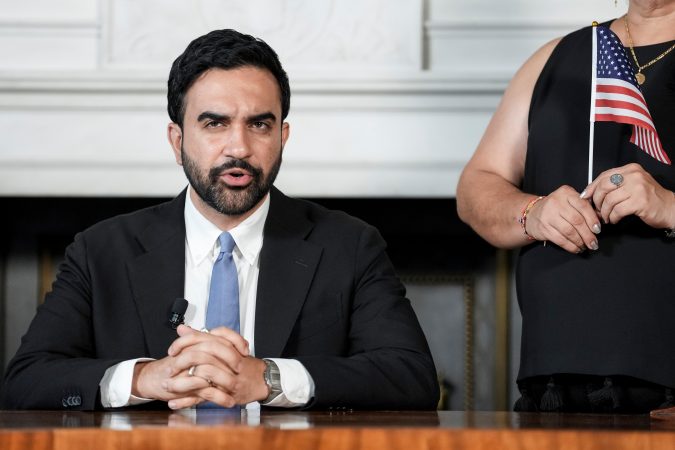
    New York Mayor Zohran Mamdani, who pledged repeatedly during his mayoral campaign to arrest Israeli Prime Minister Benjamin Netanyahu, said Tuesday that he does not have the power to do so.

    In a video posted on X, Mamdani said his administration had reviewed “every avenue available” under the law to determine whether New York authorities have the power to execute an arrest warrant if Netanyahu travels there. But, they concluded, “it is clear that we do not have the independent legal authority to enforce this.”

    He described Netanyahu as the “architect of a horrific genocide against the Palestinian people” for his role in the war in the Gaza Strip and has said he should be tried for war crimes under a 2024 warrant by the International Criminal Court.

    Mamdani called on the federal government — which does have the legal authority to enforce the ICC’s warrant — to arrest Netanyahu, who is expected to travel to New York in September for the United Nations General Assembly.

    President Donald Trump shut down the idea of Netanyahu’s arrest in a Monday post on Truth Social, saying the Israeli prime minister “will not be arrested, in any way, shape, or form, while in the United States of America.”

    The ICC issued an arrest warrant for Netanyahu in 2024, accusing him and his former defense minister Yoav Gallant of war crimes and crimes against humanity stemming from Israel’s military operations in Gaza. The court’s decision obliges 124 countries to arrest the Netanyahu if he enters their territory, but neither Israel nor the United States is a signatory to the court’s key statute that requires this.

    Netanyahu has rejected the allegations, calling them absurd, and accused the court of being a biased and discriminatory political body. On Tuesday his office described the ICC as a “kangaroo court that has no jurisdiction over Americans or Israelis” and the arrest warrant as “bogus.”

    “Under Prime Minister Netanyahu’s leadership, Israel has taken unprecedented wartime measures to minimize harm to civilians while confronting Hamas,” it said.

    Israel’s ambassador to the United Nations, Danny Danon, also hit back at Mamdani’s comments. “Zohran Mamdani, ENOUGH,” he wrote on X. “Enough with the attacks on Jewish organizations. Enough with the outreach to the Iranian regime. You were elected to serve New Yorkers, not Hamas’ propaganda. Do your job!” he wrote.

    Trump and his predecessor Joe Biden have criticized the ICC for the warrant. Both administrations have supported Netanyahu during the war in Gaza, which Israel launched after the Oct. 7, 2023, attacks on Israel by Hamas militants, who killed some 1,200 people and took 251 hostage.

    Israel’s retaliatory strikes have killed more than 73,000 Palestinians, according to Gaza’s Health Ministry, which does not differentiate between civilians and combatants but says the majority of casualties are women and children.

    Mamdani’s continued opposition to Netanyahu comes despite criticism from some Democrats after he said last week that he was in “active conversation” with his legal department to determine whether the Israeli leader could be arrested.

    The mayor’s stance also underscores a shift in the Democratic Party that has seen some members show a greater willingness to criticize Israel or turn U.S. support into a campaign issue. A Washington Post-Ipsos poll conducted earlier this month found while most Americans say the U.S. should reduce or end military support for Israel, the figure rises to 74% among Democrats.

  • James Woolsey, CIA director under Bill Clinton, dies at 84

    James Woolsey, CIA director under Bill Clinton, dies at 84

    R. James Woolsey Jr., a Rhodes scholar and lawyer who led the CIA and the rest of America’s intelligence community for two troubled years during the Clinton administration, as the nation’s spy services struggled to adapt to the post-Cold War era, died Tuesday at his home in Washington. He was 84.

    The cause was a stroke, said his wife, Conchita Sarnoff Woolsey. She added that Mr. Woolsey had been in declining health in recent years as a result of “Havana syndrome,” the mysterious ailment that hundreds of American spies and diplomats have reported experiencing around the world.

    The malady’s symptoms, which the government refers to as anomalous health incidents, include dizziness, memory problems, and other neurological impairments. Mr. Woolsey began experiencing the condition following an incident in Washington in 2017 and in Istanbul the following year, according to his wife.

    “We have traveled the world trying to find a cure and a treatment,” she said, “which sadly we never found.”

    As the director of Central Intelligence in 1993 and 1994, Mr. Woolsey spent much of his time fighting to shore up morale and protect the nation’s intelligence agencies from sharp budget and staffing cutbacks, as Congress sought a so-called “peace dividend” following the collapse of the Soviet Union.

    His tenure was upended by the FBI’s arrest in 1994 of Aldrich H. Ames, a senior CIA counterintelligence official who had spied for nine years for Moscow in what was then the worst known security breach in agency history.

    CIA traitor Aldrich H. Ames in 1994. He was convicted of selling secrets to the Soviets. Michael S. Williamson

    Members of the House and Senate intelligence committees were openly critical when Mr. Woolsey declined to dismiss or demote anyone at the CIA, and instead reprimanded 11 current and former agency officials. Rather than focusing on individuals at fault, he highlighted a pattern of widespread inattention, citing a “systemic failure” in the agency’s inability to catch Ames, who was blamed for the deaths of at least 10 intelligence agents.

    Mr. Woolsey sought to transform the agency’s culture. He was known among some staff as “the vacuum cleaner,” the Washington Post reported at the time, and told senior aides he always wanted to know more than anyone else in the room. He typically began his day reading classified cables at home at 4:30 a.m., and then arrived at CIA headquarters by 7:30 for meetings and briefings.

    But he could be argumentative, even abrasive, and his relations with the White House became so strained that by the time he resigned after 23 months on the job, he complained that he could not get an appointment with the president.

    White House aides said that Clinton had lost faith in his ability to overhaul CIA operations and reshape its priorities.

    Still, the president praised Mr. Woolsey in a statement at the time, calling him “a staunch advocate of maintaining an intelligence capability that is second to none.”

    Robert James Woolsey Jr., an only child, was born in Tulsa on Sept. 21, 1941. His father, a lawyer, was drafted into the Army and fought in the Battle of the Bulge during World War II. His mother was a homemaker.

    Mr. Woolsey attended Stanford University, graduating with high honors and membership in Phi Beta Kappa in 1963. He was awarded a Rhodes scholarship to study at the University of Oxford in England, and then attended Yale Law School, where he was managing editor of the law review and was awarded his degree in 1968.

    Mr. Woolsey served in the Army and came to Washington in the early 1970s, as a military aide to arms control negotiator Paul Nitze. He later served as general counsel to the Senate Armed Services Committee under Sen. John C. Stennis (D., Miss.).

    A so-called “defense Democrat,” Mr. Woolsey was undersecretary of the Navy from 1977 to 1979, during the Carter administration. He later found positions under two Republican presidents, Ronald Reagan and George H.W. Bush, as a part-time, delegate-at-large to strategic arms talks and as chief negotiator of a European arms treaty.

    When not in government, he worked for the Washington law firm Shea & Gardner, where he sometimes represented defense contractors and companies whose interests required that he register with the Justice Department as a foreign lobbyist.

    A trim man with a bald head and thin glasses, Mr. Woolsey was little known to the public when Clinton, soon after taking office in January 1993, named him to lead an intelligence community still trying to find its footing more than a year after the Cold War had ended.

    From the start, he was put on the defensive, forced to justify the need for a strong CIA in a post-Soviet world.

    “Yes, we have slain a large dragon,” he said at his Senate confirmation hearings. “But we live now in a jungle filled with a bewildering variety of poisonous snakes.” He said the CIA should focus on terrorist groups and arms proliferation, as well as adversaries such as Iran and North Korea.

    Mr. Woolsey was initially seen as a politically savvy expert on national affairs. In his first year, he held more than 150 meetings with members of Congress, mostly to discuss his shrinking budget.

    He told the Los Angeles Times in 1994 that despite his efforts, the number of spy satellites had been “substantially reduced,” the civilian staff had been cut by one-fourth, and the military workforce had been cut by one-third.

    “There’s a lot of slimming down that’s taking place,” he said.

    Mr. Woolsey angered one group of senators when he sternly lectured them, pointer in hand, and demanded they not only reverse the cuts but add to his budget. He clashed repeatedly with Sen. Dennis DeConcini (D., Ariz.), who chaired the Intelligence Committee and, after Ames was arrested, charged that Mr. Woolsey acted more like a civil liberties lawyer than the head of a covert agency that had failed to keep its secrets.

    Congress also was unhappy with Mr. Woolsey’s opposition to the creation of a congressionally mandated presidential commission to look at the CIA’s future role, and to Congress’s efforts to resolve a CIA and FBI turf battle over responsibilities for counterintelligence.

    After leaving the CIA, Mr. Woolsey served on corporate boards and foundations and remained active in national security circles, including as a partner at Booz Allen Hamilton. He served as a senior adviser on Donald Trump’s transition team before resigning in January 2017, reportedly amid frustrations over the incoming president’s views on national security.

    To the surprise of some of his former colleagues, he also published a 2021 book, Operation Dragon: Inside the Kremlin’s Secret War on America, in which he and coauthor Ion Mihai Pacepa, a top Cold War defector from Romania, claimed that the assassination of President John F. Kennedy was rooted in a KGB plot sponsored by no less than Nikita Khrushchev, the Soviet leader.

    Mr. Woolsey’s marriage to Suzanne Haley, a former official of the National Academy of Sciences, ended in divorce. Mr. Woolsey was later married to Nancye Miller, a lobbyist, until her death in 2019. The following year, he married Conchita Sarnoff, an advocate for victims of trafficking, who had written a book about Jeffrey Epstein after covering his crimes in a series of articles for the Daily Beast.

    In addition to his wife, survivors include three sons from his first marriage, Robert, Daniel and Benjamin Woolsey; two stepchildren, Cristina and Nicholas Sarnoff; and 10 grandchildren.

    Mr. Woolsey had a wry sense of humor. Long after he left the CIA, he happily reminded interviewers about the pilot who stole a small airplane and crash landed on the South Lawn of the White House. The pilot was killed, but Mr. Woolsey found a punch line.

    “Remember the guy who in 1994 crashed his plane onto the White House lawn?” he told an interviewer in 2002. “That was me trying to get an appointment to see President Clinton.”

  • This city is getting homes built twice as fast — and others want to copy it

    This city is getting homes built twice as fast — and others want to copy it

    CLAREMORE, Okla. — Aaron Sprik has been building houses for 25 years. Recently, he experienced something new.

    He applied for a city permit to build four duplexes, side by side. And within 24 hours, he had the permit in hand.

    “I’ve never had anything even close to that fast” from a city, he said. Construction on the eight homes, a row of matching sky-blue fronts meant to revitalize one of his hometown’s historic blocks, is well underway.

    Building a house is a slow and expensive process, and many housing advocates are concluding that if the nation wants to fix its housing affordability problem, it needs to figure out how to build faster. The United States needs upward of 2 million more homes, and many of the finicky behind-the-scenes construction steps need to get a lot smoother if those homes are going to be built anytime soon.

    Some urban planners have started looking to Claremore, an Oklahoma town of about 20,000 people along historic Route 66 outside Tulsa, as an example of how to do it.

    In most of the country, a developer needs to submit architectural plans for municipal approval every time they build a house — even if they’ve already built an identical house next door. The wait for the approval can take months, leaving land sitting empty.

    Claremore is one of the leaders of a small but growing movement to change that. The city has a catalog of 29 preapproved architectural plans for houses, duplexes, and small apartment buildings. Anybody who wants to build a house can ask the city to use the preapproved plans for free, and the city will give the builder a permit in just a day or two.

    Since 2022, builders have constructed 27 homes in Claremore, almost 4 in every 10 structures built in the city’s historic core, using preapproved plans.

    Claremore is one of just 21 cities or counties in the country offering preapproved plans for single-family homes, according to a recent Pew report. About the same number offer preapproved plans only for accessory dwelling units, the backyard homes sometimes called “granny flats” or “carriage houses.”

    Claremore’s program is four years old and one of the most extensive in the country, offering far more of the free designs than any other up-and-running program except Hawaii County’s. The tiny city has offered guidance to larger ones, including South Bend, Ind., which has built 223 homes from preapproved plans since starting up a year after Claremore.

    A major housing bill that has passed the House and the Senate in different forms includes federal grants to any city willing to start offering preapproved plans.

    “Preapproved plans are something cities and towns can actually fix,” said Matthew Petty, whose company, Pattern Zones, has helped establish preapproved-plan programs in nine cities, including Claremore. “They can’t solve interest rates or labor markets or the cost of sticks and bricks. But permitting, they have almost unilateral authority over.”

    He said it costs a small town at least $50,000 to buy custom plans to give to developers for free, and a large city could spend $500,000 on a robust set of plan options.

    “If you just count the number of small towns that are out there, there are hundreds and hundreds and hundreds across the country” that might use the federal grant money to buy architectural plans, Petty said. “We’re really talking about a whole new industry.”

    Arizona passed a law last year requiring local governments to create preapproved housing plans, and California requires cities to offer such plans for accessory dwelling units. Oregon recently passed a law intending for the state to create preapproved plans for cities to use, and at least five states have pending legislation.

    Pew cited studies showing that permitting delays added as much as $30,000 to the cost of a new unit in Seattle and $50,000 in New York City.

    The Pew report said preapproved plans can generally reduce builders’ costs by 1 to 2%. The houses that result might be slightly cheaper for home buyers and available much faster. Pew estimated that the actual construction time is less than half the time spent on the home-building process. Drastically cutting design time and removing the need to get approval from city boards and commissions could mean houses get built twice as fast.

    Pew’s analysis of research on thousands of projects found that for the average home, it takes two to three months to obtain a permit, or more than four months if it needs to go before a discretionary board. In the 10% of cities with the slowest permitting processes, it takes 10 months to get a permit just to start building an apartment.

    Memphis intends to offer preapproved plans in the future. In the meantime, the city has started giving developers a rare option: If they build one house, they can go through a process to automatically get approval to build the same design as many times as they’d like.

    “If we’re using the same stock plans, why are we going through the plan review process every time, when you’re just looking at the same plans?” said John Zeanah, Memphis’s chief of development and infrastructure. But that’s the norm in almost every city in the country.

    As an incentive to use preapproved plans, Claremore allows developers using the drawings to build a few feet closer to the lot line than zoning would otherwise allow. “It’s giving them an advantage to actually get homes to market,” planning director Kyle Clifton said. “A lot of these developers were having to put in requests to the board of adjustment to reduce side setbacks or reduce front setbacks. And all of that is a loss of time.”

    Since the city started offering the free plans, the board of adjustment went from hearing 13 cases a year to just one.

    As a developer, Randy Highfill normally builds entire subdivisions, with homes on larger lots. He said the smaller setbacks were key to persuading him to build townhouses on urban lots in Claremore, and he’s proud of his contributions to the town. “It allows the community to update and do away with these old structures, and something nice is built there in an expedited manner,” he said.

    Clifton is the force behind the program. The burly Army veteran first took a job for the city involving the geographic information system he’d learned to use while stationed in Germany. Before long, he found himself coming to care so much about the look of Claremore’s streetscape that he ended up earning a master’s degree in urban design and seeking out artists from across the country to come splash two-story-tall bursts of color on the dusty brick walls near Route 66, 26 murals in all.

    As a design enthusiast, Clifton became a champion of preapproved plans not only to spur development, but also to exert influence over what gets built. Since launching the program in Claremore, he has been traveling the country promoting the idea to other urban planners.

    Claremore is a century-old town, home to a museum memorializing comedian and commentator Will Rogers. In the heart of town, nearly every house is a single-story family home built around 80 years ago.

    It’s a place where even the smallest derivation from the norm can attract opposition. A decade or so ago, developers built a smattering of similar duplexes all over town — two single-story homes on each side of a connected two-car garage. The duplexes looked much like the homes around them, if two of them were put alongside each other with a garage glued in between. But some neighbors disliked the look, especially their garages facing the street. Some people also objected to the fact that the duplexes more often were rented, not owned.

    Clifton listened and emphasized designs for the preapproved plans that fit into the neighborhood. “What’s going on inside the structure is not as important to us as what we see when we’re driving on the street or we’re walking past it. We’re really looking at the urban fabric,” he said.

    Seva Rodnyansky, who co-wrote the Pew report, said preapproved plans can work in communities where existing homeowners tend to object to new development. “There are ways to make building housing more opposition-proof,” he said. The preapproved plans let cities promise that they’ll only promote development that looks a certain way. In several cities, he said, “housing quality and housing look is one of the reasons that drove them to do the plan sets.”

    Tulsa-based architect Jennifer Griffin worked on the preapproved-plan programs in South Bend and Kalamazoo, Mich. She also consulted on a forthcoming plan set in Tulsa, inspired in part by little neighbor Claremore.

    She said the homes respond to community concerns. “If it’s a single-family neighborhood and they hear … ‘duplex’ or ‘multifamily’ or ‘rental,’ anything that’s outside of a single-family-home context, I think people can, at times, think of those examples that haven’t been done well,” Griffin said. “In South Bend … folks in the neighborhood were like, ‘I don’t know if we want duplexes in here.’”

    But when they saw it and liked it? “People can look at it and say, ‘Actually, I would love these in my neighborhood,’” she said. “It’s a pathway to show them that things other than single-family homes actually can contribute really well.” And the same preapproved plan can be used to fast-track the building of similar units.

  • Tropical Storm Bertha expected to make landfall in Louisiana on Wednesday

    Tropical Storm Bertha expected to make landfall in Louisiana on Wednesday

    Tropical Storm Bertha, the second storm of the season in the Atlantic Ocean, was slowly approaching Louisiana early Wednesday.

    As of 5 a.m. Wednesday morning, the storm was about 110 miles southeast of New Orleans, had winds of 50 mph and was moving westward at around 5 mph.

    Bertha is forecast to make landfall in southeastern Louisiana on Wednesday, where 1 to 3 or 2 to 4 feet storm surge, dangerous rip currents, tropical-storm-force winds and slow-moving downpours are all possible.

    Tropical storm warnings spanned the coastline from the western Florida Panhandle to eastern Louisiana, while tropical storm watches covered portions of far southern Mississippi as well as some of Louisiana.

    Winds gusted up to 60 mph in the Florida Panhandle on Tuesday, as beaches were closed along the Gulf Coast and sandbags were distributed in some communities.

    Early Wednesday, a disorganized Bertha continued to battle harsh winds that were displacing most of its thunderstorm activity well offshore. However, conditions are expected to worsen — especially near the immediate coastline in Louisiana.

    “Bertha is expected to produce total rainfall amounts of 1 to 4 inches with isolated higher totals to 6 inches through Thursday along the central to the western Gulf Coast from western Florida to southern Texas. This rainfall may produce isolated flash flooding, especially in urban areas,” wrote the National Hurricane Center.

    By Thursday morning, Bertha will probably still be inching along the Louisiana coastline and moving toward Texas, where scattered downpours are expected into Thursday night — potentially including places such as Houston and Galveston.

    Bertha may ingest wildfire smoke

    In an unusual twist, wildfire smoke that’s drifting across the country, mostly from numerous fires in the Northwest, may contribute to Bertha’s weakening from Wednesday into Thursday.

    This cooler, drier air could also help minimize impacts from Bertha on Thursday across Texas, where deadly floods occurred last week.

  • Letters to the Editor | July 22, 2026

    Letters to the Editor | July 22, 2026

    Garden State bound?

    As I weigh the decision of whether to move my family to New Jersey or stay in Philadelphia, the newly signed Pennsylvania state budget makes moving across the Delaware River just that much more appealing. In Pennsylvania, House Bill 504, a solar energy initiative, was supported by Gov. Josh Shapiro but was held back by the Senate leadership.

    But New Jersey is one of 24 states that have passed community solar legislation, enabling residents to save on their utility bills — even renters and others who can’t install solar panels can benefit as subscribers. Community solar facilities provide subscribers with access to clean and cheap solar energy, and a monthly credit on their utility bill. People shouldn’t have to put a solar panel on their own roof to benefit from the electricity it generates. And I want to live in a state where all my neighbors can access solar as a way to reduce their energy bills and live their values.

    Community solar deserves consideration in the next legislative session. In the meantime, I’ll be on Zillow looking at houses in South Jersey.

    Miranda Bennett, Philadelphia

    The Gaza crisis

    I want to thank The Inquirer for having the courage to publish two articles in the July 8 print edition talking about Israel. Being anti-genocide or even pro-Palestinian is not being antisemitic. Accordingly, honest conversations about Israel should not be taboo.

    People may debate specific numbers and whether to use the term genocide, but what is clear is that there has been a hugely disproportionate use of force against Gaza.

    On Oct. 7, 2023, there were a reported 1,200 deaths, 5,430 injuries, and 250 Israelis and other nationalities taken hostage. What occurred that day was horrific and cannot be condoned.

    Since then, Israel has been responsible for a reported 73,000 deaths, 173,000 injuries, and upwards of 1.9 million Gazans being driven from their homes, according to the United Nations Relief and Works Agency.

    While criticizing Israel is an uncomfortable topic, looking away from this Gaza crisis (and what’s also going on in the West Bank and Lebanon) and pretending it is not happening is not going to make it better, so the more we know and talk about it openly and understand what is actually taking place, the better we will be able to decide whether we as taxpayers want to continue providing aid to the oppressor or the oppressed.

    Kent Kingan, Malvern

    Refugee resettlement

    I completely endorse the views in the recent op-ed on refugee resettlement by Kelly Ryan, the head of the Jesuit Refugee Service (JRS) and longtime U.S. government refugee official.

    I remember when JRS started after I had left the U.S. House immigration and refugee subcommittee and started in the federal departments working on refugee matters. The views expressed by Ryan represent those of us who created the Refugee Act of 1980, which opened the legal door to refugees (and really just reestablished an American tradition that had been closed off by changes to our law).

    The idea for the comprehensive 1980 act (the first comprehensive U.S. refugee law) was initiated by our subcommittee staff in the late 1970s, and we persuaded the Senate committee, headed by then-Sen. Edward Kennedy, and the Carter administration to support it.

    The JRS and the events discussed by Ryan are part of a continuing story of the admission of refugees that is not only the humanitarian thing to do, not only consistent with American law and tradition, but also in our national interest in many ways.

    And, as Ryan notes, it is tragic to see the destruction of the program under the current administration, both in the U.S. and abroad. We can correct this situation, and should work to see that we will.

    Mark R. Zecca, Philadelphia

    Labor shortage

    What a disconnect in the print edition of The Inquirer Sunday: An editorial mentions the Trump administration’s target of arresting 2,000 immigrants each day. Meanwhile, an article in another section reports that the United States is facing what’s projected to become one of the largest labor shortages in its history. It quotes a labor market expert as saying this could hobble the American economy for years to come.

    The article says there will be shortages of tens or even hundreds of thousands of nurses, physicians, teachers, engineers, pharmacists, mental health counselors, construction workers, and airplane mechanics. Forty-one percent of home health aids who are increasingly needed to care for the nation’s aging population have historically come from somewhere else, along with a fifth of nursing assistants, dentists, pharmacists, and registered nurses. Right here in Pennsylvania, we will face a shortage of 218,000 workers by the year 2032.

    It seems obvious that a sane and well-managed immigration program is critical to our country’s future economic success. When will Congress figure this out?

    Ann Clausen, Philadelphia

    Zero-waste future

    Thank you for your informative article on the mayor’s plan to renew Philadelphia’s contract to use the Chester incinerator. This renewal will combine waste incineration and landfilling with a rather vague reference to exploring “alternative methods for disposal.”

    I highly recommend, as an alternative method, a citywide zero-waste program for composting food wastes, complemented by active recycling and upcycling of non-compostable wastes. This approach would solve multiple problems at the same time. It would avoid landfill methane emissions, thus proactively reducing the impact of climate change, and would eliminate the need for incineration as well, with its concomitant release of toxic emissions that cause deleterious public health impacts, especially on the citizens of Chester.

    Moreover, my suggested initiative would create many more new jobs in waste handling compared with the current plan, which opponents of Councilmember Jamie Gauthier’s bill claimed would jeopardize 120 jobs. San Francisco, the gold standard for a comprehensive zero-waste program, supports approximately 1,000 union jobs dedicated to collecting, sorting, and processing recyclable and compostable materials. Philly’s population is approximately twice as large, suggesting that a comparable program would create about 2,000 jobs.

    William M. Stigliani, Philadelphia

    Shortsighted

    The recent article about the “short war fallacy” was spot on. Donald Trump and his advisers ignored the Iraq-Iran War of the 1980s, reckoning Iran would quickly crumble when the U.S. attacked it. Iraq invaded Iran in September 1980, spurred by concerns about political and ideological tensions. With a superior military force, Iraq made quick inroads and expected an easy victory. However, by December its offense stalled. Buoyed by resurgent morale and military capability, Iran launched a counteroffensive into Iraq. Iraq’s perceived short war dragged on for years, resulting in a massive death toll. In 1988, the United Nations mediated a ceasefire. Estimates of war dead range from 500,000 to one million. Iran suffered the majority of fatalities. The war ultimately strengthened Iran’s Islamic Revolutionary Guard Corps. Iran’s ability to withstand military setbacks was well-documented and remains intact.

    The administration’s failure to consider that conflict helped suck the U.S. into a war it is attempting to win by air superiority, an increasingly discredited notion. Air superiority isn’t control on the ground. Relying on that strategy exclusively will further draw down key air weapons stockpiles that are already seriously depleted. It may also cause the U.S. to start committing war crimes that military experts were warning against back in April. Trump and his advisers need to seriously consider ending the war with a hollow victory that will extricate the country from another hot spot where a short war victory is proving elusive and likely unattainable absent an escalation in hostilities. Such an escalation wouldn’t guarantee an actual victory. America doesn’t need another win like the ones it achieved in Vietnam, Afghanistan, and Iraq.

    Stewart Speck, Wynnewood, speckstewart@gmail.com

    Join the conversation: Send letters to letters@inquirer.com. Limit length to 150 words and include home address and day and evening phone number. Letters run in The Inquirer six days a week on the editorial pages and online.

  • Horoscopes: Wednesday, July 22, 2026

    ARIES (March 21-April 19). Instead of “I’m playing it cool,” it’s “I’m obsessed!” Even before you share your excitement, people feel its power. Enthusiasm is the ambrosia of the gods, with sweetness that fuels creativity and attracts support.

    TAURUS (April 20-May 20). Instead of “I don’t know,” it’s “I love this.” A clear preference saves time and points you toward opportunities that fit. You don’t need a complete plan before expressing what delights you. Passion often provides the first clue and the next step.

    GEMINI (May 21-June 21). Instead of “I’m secretly working on this,” it’s “I’ll show you the process.” When you let people see the sketches, drafts, experiments and revisions, they feel invested. The audience becomes part of the story, cheering progress and celebrating milestones.

    CANCER (June 22-July 22). Instead of “I wonder whether I’m qualified,” it’s “I have something to offer.” Generosity creates confidence. Focus on helping, entertaining, teaching, building or improving. Contribution shifts attention away from self-consciousness and toward the people who benefit from your gifts.

    LEO (July 23-Aug. 22). Instead of “How do I pay my dues?” it’s “How do I create my own niche?” You’re building something that reflects your originality and voice — your unmistakable point of view. There’s much less competition because no one else sounds like you.

    VIRGO (Aug. 23-Sept. 22). Instead of “I wear a lot of hats to keep this show running,” it’s “I’m known for this one thing I do like nobody else can.” General competence is good, but distinction is what grows your reputation and brings in stellar opportunities.

    LIBRA (Sept. 23-Oct. 23). Instead of “I’m waiting for confidence,” it’s “I’ll gain confidence by doing it.” Confidence grows from experience, not contemplation. Every attempt teaches something useful. You earn your swagger through participation.

    SCORPIO (Oct. 24-Nov. 21). Instead of “I hope someone notices,” it’s “I’ll make it easy to find.” Share the work. Send the invitation. Wear the outfit. Tell the story. Visibility is how opportunities, collaborators, customers and friends discover what you have to offer.

    SAGITTARIUS (Nov. 22-Dec. 21). Instead of “I’ll blend in,” it’s “I’ll bring my flavor.” Every group benefits from people who contribute something distinct. There’s value in your perspective, humor, taste and style. Communities become more interesting when people stop sanding down their most recognizable edges.

    CAPRICORN (Dec. 22-Jan. 19). Instead of “I need more information,” it’s “I know enough to begin.” Action generates questions that study alone cannot. The path reveals itself with each step. Experience teaches lessons no amount of preparation can replace.

    AQUARIUS (Jan. 20-Feb. 18). Instead of “I should be realistic,” it’s “I should dream wholeheartedly.” Realism has its place, but most of the world was created by people who were at least a little delusional. The projects, relationships and adventures that shape us often start with unreasonable expectations.

    PISCES (Feb. 19-March 20). Instead of “What if I fail?” it’s “What if I become excellent?” Success depends on spending less time evaluating possibilities and more time practicing the thing. With repetition, you become masterful.

    TODAY’S BIRTHDAY (July 22) It’s your Year of Forgotten Longings Met, in which things you once wished for now show up as daily events and familiar pleasures. What was once the dream becomes the backdrop. More highlights: The acknowledgment and compensation your work deserves. Healthy choices that add up to greater vitality and confidence. Relationships that feel less like negotiation and more like belonging. Gemini and Aries adore you. Your lucky numbers are: 6, 38, 20, 22 and 17.

  • Dear Abby | New boyfriend has a secret pastime

    DEAR ABBY: I recently started dating a guy I have known for 30 years. He has moved in and asked me to marry him. Our relationship is perfect except for anything having to do with social media. He has an account on TikTok using a sexually suggestive name.

    He’s following 500 women and has just as many following him. I’m worried this will lead to other things, and the fact that he hides this from me makes it worse. Of all the women he follows, I am not on his list, and that hurts, too. I’m sure other readers deal with this issue, and I’m not sure how to handle this situation. Is this a form of cheating, or, because it is social media, should I not worry about it?

    To my knowledge, he doesn’t chat with any of them, or maybe he has that hidden so I don’t see it and will probably never know for sure. Should I end this relationship because of doubt — which I’m worried will turn into trust issues — or shrug it off?

    — UNCERTAIN IN SOUTH CAROLINA

    DEAR UNCERTAIN: How does your partner earn his living? Following 500 women seems time-consuming. If he’s hiding it from you, how do you know this? Your doubt, which is reasonable, already is a trust issue.

    I will assume that you know about his “hobby” because you looked at his computer or phone. If you felt the need to do that, do not shrug it off. Have a heart-to-heart talk with him and ask what he’s seeking from these online relationships. Is he a voyeur or looking for adventure? Once you know the answer to those questions, you will know how to proceed.

    ** ** **

    DEAR ABBY: My mother is 86 years old. She has been widowed for more than 10 years. She works, sings in a choir, volunteers at her church and has three children who dote on her, but she desperately wants a man in her life — and the man she wants is married. They have been together for more than five years on and off. They get together, feel guilty and break up. This has happened more than 20 times. She lies to us, her counselor and her friends about this affair. We are tired of her lies, her crying over the adulterer and her inability to enjoy what she has instead of complaining about what she doesn’t have. Doctors, counselors and church members have all tried to convince her this pattern is destructive, to no avail. Help!

    — OVER IT

    DEAR OVER IT: It sounds like Mom may be in love with the drama more than the man. The best way to deal with it would be to stop engaging. When she starts discussing her affair, change the subject. If she persists, leave the room. Let her know that you really are “over it.” Tell her you refuse to watch her make a fool of herself any longer. Then encourage her to talk about the parts of her life that are not so self-destructive.

  • Bystander severely wounded outside White House says Secret Service failed him

    Bystander severely wounded outside White House says Secret Service failed him

    CHICAGO — An active-duty soldier who was hit by a stray bullet during a shooting outside the White House announced on Tuesday that he plans to sue the Secret Service over his life-threatening injuries.

    Pfc. Benjamin Del Real Jr., 25, was visiting the capital on May 23 and hoping to snap pictures with his sister and father outside the White House when a gunman opened fire. Secret Service fired back, killing the man, and a bullet struck Del Real in the stomach, causing serious injuries that required emergency surgery. Part of his digestive system had to be removed.

    Del Real filed notice of a personal injury claim on Tuesday, saying he plans to sue for $25 million under the Federal Tort Claims Act. He accused the Secret Service of botching its response to the shooting and failing to adequately protect him and other bystanders, he and his lawyer, Joseph Murphy, said Tuesday at a news conference.

    “I, my father, and Benjamin all feared for our lives, and the moment that I saw Ben bleeding was undoubtedly the scariest moment of my life,” said his sister, Sara Del Real.

    The Secret Service has not said whether its agents fired the bullet that struck Del Real. The Metropolitan Police Department said earlier this summer that the ballistics on that bullet had not yet been returned. Metropolitan Police Department spokesperson Lee Lepe said Tuesday the investigation is ongoing.

    Federal law enforcement agencies are generally shielded from legal liability, but there are some exceptions, including some claims of employee negligence.

    The Secret Service does not comment on pending litigation, according to Nate Herring, a spokesperson for the Service. He referred questions to the U.S. Attorney’s Office for the District of Columbia, which did not immediately return a message seeking comment.

    Del Real, of Salina, Kansas, and his family had spent hours that day touring the National Archives, Arlington Cemetery, and other landmarks before passing by the White House at around 6 p.m. on their way to dinner. Just then, Del Real saw the shooter, about 20 yards closer to a Secret Service outpost, take out a gun and fire several rounds at their booth, prompting agents to return “a hail of gunfire,” Murphy said.

    The shooter, 21-year-old Nasire Best, was killed.

    Del Real pulled his father to the ground and dragged him behind a concrete barrier, saving his life, but a bullet struck Del Real in the stomach, causing him “life-threatening injuries,” Murphy said. He underwent an emergency surgery, then another two days later to remove the bullet, and is due for a third surgery next month. Doctors had to remove parts of his colon and small intestine.

    Del Real, who joined the Army a year and a half ago, said he is “without a doubt, concerned” about his ability to continue a military career.

    “He’s a young man, he’s 25 years old, and he’s had part of his digestive system taken out,” Murphy said. “It’s not going to get any better from here.”

  • Senate panel advances Jay Clayton’s nomination to lead U.S. intelligence agencies

    Senate panel advances Jay Clayton’s nomination to lead U.S. intelligence agencies

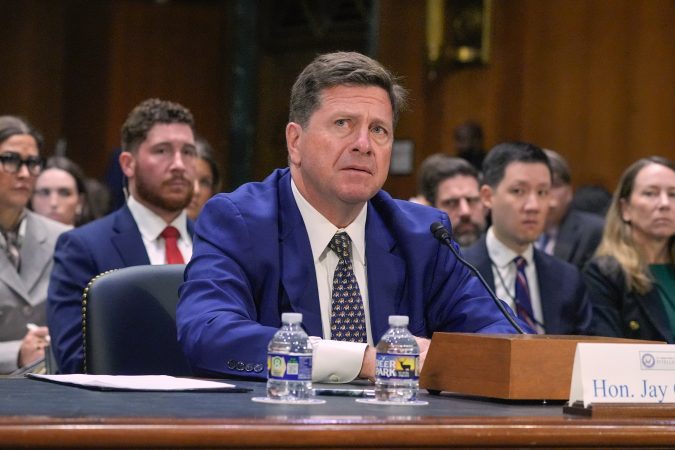
    WASHINGTON — The Senate Intelligence Committee has advanced the nomination of Jay Clayton, President Donald Trump’s pick to head the nation’s intelligence agencies, along party lines.

    The 9-8 vote came after some Democrats had praised Clayton and indicated that they might vote for him. But that shifted after a contentious hearing last week in which Clayton repeatedly refused to say that former President Joe Biden won the 2020 election.

    Virginia Sen. Mark Warner, the top Democrat on the panel, said during the hearing that he was “bitterly disappointed” in Clayton, the U.S. attorney for the Southern District of New York and a former Securities and Exchange Commission chairman, even though he had worked with him in the past.

    The committee’s approval sets up a floor vote on Clayton’s nomination, potentially early next week. The vote took place behind closed doors, as is customary for the panel, and all Democrats voted against Clayton, according to a person familiar with the vote who requested anonymity to disclose it.

    Democrats are unlikely to allow Republicans to speed up a vote on the nomination after the hearing, at which Clayton said many times that the election was “certified” for Biden, declining to say outright that the Democrat won.

    But Senate Democratic Leader Chuck Schumer said after the hearing that he thought Clayton’s performance was “abysmal,” and that “makes it much less likely that he will get Democratic votes.”

    Democrats push back as Trump focuses on 2020

    The Democratic pushback on Clayton comes as Trump has made revisiting the 2020 election, which he lost, a primary focus. On Thursday evening, he delivered a speech from the White House in which he again tried to cast doubts on that election and amplified debunked theories about Biden’s win. Clayton told senators that he had no involvement with that speech.

    Senators in both parties have expressed concerns about the interim director, Bill Pulte, who took over when Tulsi Gabbard resigned last month. Pulte has no known intelligence experience and investigated the president’s perceived enemies in his previous post as a federal housing regulator.

    Republicans were hoping to confirm Clayton in June so he could replace Gabbard without Pulte serving as interim. But Trump delayed Clayton’s nomination before the Senate left for a two-week recess, allowing Pulte to take the job temporarily.

    Clayton did not mention Pulte in the hearing. But he emphasized his own government and national security experience, attempting to assuage senators in both parties.

    “I saw firsthand how a strong national security apparatus depends on decisive judgment, discipline, integrity, and effective communication and cooperation across different branches of the government,” Clayton said in his opening statement. “If confirmed as Director of National Intelligence, I will commit to upholding these principles every day.”

    Arkansas Republican Tom Cotton, who expressed frustration last month when the hearing was delayed, said that Clayton has a reputation for operating with “morality, decency, and integrity” in his previous positions.

    “Jay Clayton is a highly qualified nominee with a deep experience combating a wide range of national security threats. I’m pleased that the Senate Intelligence Committee voted to advance his nomination to be Director of National Intelligence,” Cotton said in a statement on Tuesday.

  • Ukraine’s Zelensky fires military chief after protests and names a replacement

    Ukraine’s Zelensky fires military chief after protests and names a replacement

    KYIV, Ukraine — President Volodymyr Zelensky on Tuesday fired Gen. Oleksandr Syrskyi as commander-in-chief of Ukraine’s armed forces following days of mass protests in Kyiv and other cities nationwide demanding his removal.

    Zelensky appointed Mykhailo Drapatyi as the new army chief, according to a statement on social media. “Our shared wish is one — victory over the enemy and conditions at the front and in pressure on Russia that would force Russia toward peace,” Zelensky said.

    The Ukrainian leader said he made the decision after a series of meetings with military commanders. They began shortly after protests broke out demanding the reinstatement of former Defense Minister Mykhailo Fedorov, seen by demonstrators as a driver of military modernization, and the removal of Syrskyi, who they said embodied the army’s old, Soviet-style command culture.

    Zelensky thanked Syrskyi for his achievements in Ukraine’s fight against Russia and praised him for the defense of Kyiv and for operations in Kharkiv and Kursk. “I am grateful to Oleksandr Syrskyi and to every one of our warriors for Ukraine’s strong front-line positions,” he said. “I am grateful to Mykhailo Drapatyi for holding that same view.”

    On Tuesday, Zelensky separately met with Fedorov and offered him what he called a respected position in government that would unify the country’s technology sector. But it wasn’t clear if Fedorov accepted the offer and whether the latest moves would satisfy protesters and bring peace to the streets.