The fast-rising costs of owning a home have some young Americans questioning whether buying a house is still a good investment.
Take Tony Zhang, 34, who bought a $950,000 townhouse in Irvine, Calif., in 2021 and says he now regrets it. The supply-chain manager says investing his down payment of roughly 30% in the stock market instead would have left him with a portfolio worth as much as $1 million today.
“Had I just taken my down payment and bought Meta, Nvidia, or any growth stock, I probably wouldn’t even be working my 9-to-5,” he said. Even with a more conservative investment that mirrored the S&P 500, he estimates he’d have an extra couple of hundred thousand dollars. In the meantime, renting a comparable two-bedroom apartment in his area would be about $800 cheaper than his $4,300 monthly housing costs, which don’t include maintenance.
Zhang is among many people under 40 who feel that homeownership isn’t the wealth-building tool it used to be. Less than a quarter of Americans aged 18 to 39 say buying a home is a very good investment, compared with 38% of those over 60 years old, a recent survey by the Pew Research Center found. A further 38% of under-40s see property as a “somewhat good” place to park their money.
A separate survey by the Federal Reserve Bank of New York found the proportion of under-50s who consider housing to be a “very good” investment had fallen to about 16% in February, from about 25% five years earlier.
Broadly speaking, homes are a worse investment for first-time buyers today because wages haven’t kept up with surging prices and ownership costs, said Susan Wachter, a professor of real estate and finance at the University of Pennsylvania’s Wharton School.
The median sale price of a U.S. home jumped 53% to $379,000 in the six years to May 2026, Zillow data show, while borrowing costs more than doubled. Those who can afford to buy face outlays including property taxes, insurance, and maintenance bills, which cost the average U.S. homeowner $15,979 in 2025 — a 4.7% increase from the previous year, while household incomes rose just 3.8% over the period.
More than half of U.S. homes also lost value last year — the highest share since 2012, according to Zillow, when the effects of the global financial crisis were still playing out.
“Younger Americans’ more negative view on homeownership reflects the economics of their lived experience, ” said Wachter. “They face an affordability problem and they don’t get the returns.”
Almost nine in 10 Americans agree that buying a home is harder for young adults today than it was for their parents’ generation, the Pew research found.
That said, only 16% of survey respondents aged under 40 went as far as saying a house is a bad investment. Owning a home can provide families with stability and, for those who can afford to hang onto it, a source of intergenerational wealth. Returns vary widely based where a homeowner buys their property and how long they own it, noted Pew senior researcher Richard Fry.
“It’s a complicated calculation and probably one of the most expensive things young adults will ever buy,” he said. “It’s not a one-size-fits-all answer.”
Even those who snag a deal on a property can find the math gets complicated.
Atalyia Ferrara, a 28-year-old teacher, bought a $230,000 four-bedroom Philadelphia townhouse in July 2021 with a $1,485 down payment, thanks to the city’s Keystone Home Loan Program. Her monthly mortgage and taxes have gone up just $335 a month since then, but the maintenance costs have forced her to dip into her savings instead of building a nest egg. She’s already poured more than $28,000 into home improvements, with another $25,000 for electrical repairs looming.
Ferrara now works in neighboring New Jersey and says the house has become a money pit in an inconvenient location. She and her husband are considering selling so they can rent in an area with better access to work and childcare.
“I bought the house at 23, just trying to get my foot in the door of building equity,” said Ferrara. “Instead, I’m stuck with a house that’s kept me where I’m at and paying thousands for repairs.”
Zhang, in California, is planning to stay put until his 8-year-old daughter goes to college, hoping to cash in on his home’s appreciation down the line. After that, he plans to sell up and “rent for sure.”
Still, he can’t help but think of what he could have made in the short term on a different investment.
“Just looking at how the stock market has performed, the opportunity cost of putting that money into a home has absolutely screwed me over,” Zhang said.
BRUSSELS — The European Union on Thursday hit Google with a fine of 890 million euros ($1 billion) after it said the technology behemoth broke digital antitrust regulations by setting up Google Play and its ubiquitous search engine to corral consumers towards its own services and apps to the detriment of competitors.
It was the latest major crackdown on Big Tech by Brussels, which has led the world in reining in some of the world’s largest companies from Silicon Valley to Beijing.
Google had recently lost its appeal of a $4.5 billion antitrust fine imposed by the EU for throttling competition and reducing consumer choice through the dominance of its mobile Android operating system.
The European Commission, the bloc’s executive branch and highest antitrust enforcer, said it was acting in the interest of consumers after running an antitrust investigation of Google.
“The best products should succeed because they’re better, not because they’re owned by the company running the search engine. And European consumers have a right to be told by app developers where to sign up to the best offers, even when the app store owner does not get a cut,” said Teresa Ribera, the commission’s Executive Vice President for Clean, Just and Competitive Transition.
Google’s President of Global Affairs Kent Walker blasted the fine as “product degradation driven by a small group of self-serving complainants” that will have a negative impact on European businesses and consumers.
He said that the EU’s Digital Markets Act forces Google “to strip away real-time search features Europeans love — like instant pricing and direct availability for hotels, flights, and restaurants — and dismantle safety protections on Google Play.”
Brussels has ratcheted up the pressure on U.S. and Chinese tech giants despite the risk of incurring the wrath of President Donald Trump, who has lashed out at the 27-nation bloc’s digital regulations and vowed to retaliate if American tech companies are penalized.
The EU describes the world’s seven tech giants — Amazon, Apple, Google parent Alphabet, Meta, Microsoft and TikTok owner ByteDance — as “gatekeepers” that control access for consumers.
“In the EU, businesses have the right to compete fairly. Gatekeepers have the obligation to ensure a level playing field and consumers the right to choose for cheaper alternative offers,” European Commission spokesperson Thomas Regnier said.
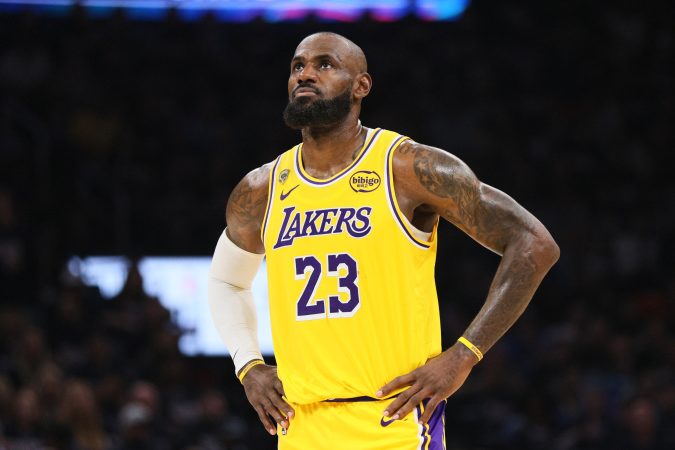
LeBron James has spent two decades turning every move into a major event. This time, he’s not the only one who stands to get paid.
More than $245 million in trading volume tied to where James will play next has accumulated on prediction markets, including more than $200 million alone on Kalshi. The Miami Heat is the favorite, followed by the Cleveland Cavaliers, Golden State Warriors and Philadelphia 76ers.
The enormous sum is striking not simply because so much money is riding on one athlete’s choice. James and a small circle of family members, agents and team executives will determine the outcome, while a larger group of assistants, communications employees, contractors, reporters and others could learn it before the public.
That is precisely the sort of market the NBA has told federal regulators should not exist.
“Markets relating to officiating, injuries, league disciplinary actions, player or team transactions, or fan actions should be prohibited,” Dan Spillane, the NBA’s executive vice president and assistant general counsel, wrote in an April letter to the Commodity Futures Trading Commission (CFTC), the federal agency that regulates derivatives, including prediction markets. “These markets are readily susceptible to manipulation and/or improper use of confidential information and have a negative effect on perceived game and league integrity.”
Prediction markets allow users to buy and sell contracts tied to real-world events, with prices generally reflecting the market’s estimate of an outcome’s likelihood. A contract trading at 50 cents typically pays $1 if the event occurs and nothing if it does not. Trading volume measures the total value of the contracts bought and sold, not the amount committed by users.
Prediction markets offer contracts on nearly anything, but sports have become one of their biggest draws, inviting comparisons to the legal sports-betting industry that has exploded since 2018 and stirred controversy along the way.
The companies resist the sportsbook label, describing their products as federally regulated event contracts and their customers as traders, not bettors. But to consumers, the basic proposition can look much the same: Put money behind a predicted outcome and profit if it occurs. The distinction is blurry enough that FanDuel and DraftKings now advertise during sporting events that their own prediction markets are available in California and Texas — two enormous states where conventional sports betting remains illegal but prediction-market trading is permitted.
The sudden ascent of prediction markets has lawmakers, courts and regulators scrambling to determine whether sports contracts are financial products or just another form of gambling. Meanwhile, the industry’s popularity is soaring, especially among sports fans. Monthly trading volume on Kalshi and Polymarket, its two largest platforms, reached nearly $24 billion as of April, according to a data analysis by the Pew Research Center, which found that sports traders are more active and spend more than those trading on any other single subject, including cryptocurrency and politics.
James is not the first athlete whose free agency has become tradable. But his prolonged decision has pushed the practice into a new frontier, turning a private personnel choice into a market with the scale and volatility more commonly associated with a presidential election or championship game.
Nothing else in sports free agency has come close. On Kalshi, a market involving Kawhi Leonard attracted about $760,000 in trading volume, while one involving Bronny James, LeBron’s son, generated $395,000. Markets involving baseball outfielder Kyle Tucker and NFL edge rusher Jaelan Phillips drew $157,000 and $46,000, respectively.
And in James’s situation, his destination is merely the main event.
Traders can also put money on whether he will announce his decision before Sunday; which conference he will join; whether his next contract will be worth more than $12.5 million; and even who will break the news of his landing spot: James, his agent, NBA Insider Shams Charania of ESPN or perhaps a member of James’s family.
After lamenting sports betting for decades, professional sports leagues have spent the past decade navigating their evolving relationship with sportsbook gambling, striking lucrative sponsorship and data agreements while trying to prevent players, coaches and other insiders from wagering on their sports.
Their relationship with prediction markets is developing unevenly. The NBA and NFL have sportsbook partners but no prediction-market partners. Major League Baseball has partnered with Polymarket, while the NHL has agreements with Polymarket and Kalshi.
Those relationships do not necessarily grant leagues veto power over the contracts or exchange offers. But they provide a direct channel to raise integrity concerns and press those exchanges not to list subjects considered especially vulnerable to manipulation.
“By engaging in this community, we are able to work together to create clear boundaries with the goal of mitigating risk while providing fan engagement opportunities,” MLB Commissioner Rob Manfred said in a March statement.
NBA Commissioner Adam Silver said this spring that the league had maintained an open line of communication with Kalshi and Polymarket and was not necessarily opposed to a licensing or data agreement.
“We’re watching closely the uptick in the amount of sports activity that’s happening on those platforms,” Silver said. “We aren’t necessarily averse to entering into licensing deals with them. But again, the league’s number one role is to ensure the integrity of the competition.”
The NBA has asked the CFTC to prohibit markets involving player transactions, injuries, officiating and disciplinary decisions. The league also urged regulators to require exchanges to consult leagues before introducing new sports contracts, share trading information with league investigators and block athletes and other prohibited insiders from participating.
While traditional sportsbooks are largely barred by state regulators from taking bets on James’s free agency, prediction markets face no such restrictions. The CFTC requires exchanges to police cheating and manipulation but generally lets them launch new contracts after effectively vouching that the offerings comply with federal rules. The agency can later review, challenge or halt them.
In guidance issued in March, the CFTC said sports contracts are generally less susceptible to manipulation when their outcomes depend on the combined performance of many participants over an extended competition. It highlighted greater concerns when the result rests on the actions of one person or a small group — the defining feature of a free-agent decision.
Carl Kennedy, an attorney at Katten Muchin Rosenman who specializes in financial markets, told a House Agriculture subcommittee Tuesday that “the commission has been signaling” skepticism toward contracts whose outcomes can be influenced by a single person. The CFTC’s March advisory warned of heightened manipulation risks when a contract turns on the actions of one individual or a small group, and a proposed rule issued in June went further.
Kalshi chief executive Tarek Mansour has argued that prediction exchanges already possess safeguards comparable to traditional financial markets.
“As a regulated financial market by the CFTC, we have the same rules as the Nasdaq and the NYSE and we have the same mechanism of enforcement,” Mansour said earlier this year on CNBC’s “Squawk Box.”
Yet when asked during the same appearance to consider who should be allowed to trade with advance knowledge of an event, Mansour articulated the ambiguity facing the industry.
“What is information, and what is insider information?” he said.
That ambiguity is not merely theoretical. Federal prosecutors charged an active-duty Army soldier with using classified information about a U.S. operation involving Venezuela to profit on Polymarket. Kalshi disciplined a MrBeast editor who traded on markets involving videos before they were released. And a White House teleprompter operator was placed on leave amid allegations that he used advance access to President Donald Trump’s prepared remarks to trade on which words the president would say.
Polymarket recently partnered with Chainalysis, a blockchain analytics company, to monitor trading activity and flag patterns that might indicate someone was acting on nonpublic information. But James’s free agency also illustrates a harder problem: Market-moving information can surface through an ordinary mistake, without any suspicious trade at all.
On Tuesday night, the Miami Heat posted a link on its YouTube channel to a scheduled live stream titled “LeBron James Introductory Press Conference.” The link was subsequently deleted, and a team spokesperson said the video had been produced preemptively in case James signed with Miami and was mistakenly made public.
Miami’s implied probability on Kalshi quickly rose from about 37 percent to 47 percent. By Wednesday afternoon, Miami was trading at roughly a 50 percent probability, compared with 27 percent for Cleveland, with similar prices on other platforms.
U.S. Rep. Brian Fitzpatrick posted a photo on social media with the caption, “Every child deserves a healthy start — and no family should have to navigate outdated barriers to access the nutrition and care their children need.” As a 28-year Bucks County resident, I found Fitzpatrick’s statement hypocritical.
Fitzpatrick initially supported the OBBBA — despite its deep cuts to benefits for low-income families and children. All his fellow Pennsylvania Republicans — including Reps. Ryan Mackenzie, Scott Perry, and Daniel Meuser — voted for Donald Trump’s bill and its huge cuts to SNAP and Medicaid. Fitzpatrick was only able to vote against the final bill because the Republicans in Congress could pass it without his aye.
Fitzpatrick has shown he can do photo ops but cannot do the right thing for the families and children of Bucks County.
Stephanie Bariahtaris, Wrightstown
Get on the bus
I was pleased to read your article about how state lawmakers were able to find money in the budget to support a prison bus program. I worked for a nonprofit that transported children every two months to their mothers at the Muncy Prison. They had done so for several years — funding 50% from their endowment and 50% from the state. It was year-to-year state funding. We had a part-time social worker and a part-time psychologist working with the children and the guardians. A social worker and a full-time social worker, who volunteered without pay, accompanied the children on the bus to the prison. They also provided counseling to the mothers. Around 2010, the state rescinded the funding, and the program had to stop because the state also cut back on other programs. The agency’s endowment could not cover the differences. Years ago, an accountant for a children’s mental health facility told me that it took three years to get fully reimbursed by Pennsylvania. They were only able to keep running because other states sent their children there and paid promptly. Many good programs for children are regularly abandoned due to inconsistent state and federal payments and funding.
John Marquess,retired auditor and nonprofit accountant, Haddon Heights
Bamboozled
What a prime example of voter fraud! Mike Lindell, endorsed by Donald Trump to run for governor of Minnesota, is registered to vote in Texas.
Karel Kilimnik, Philadelphia
Join the conversation: Send letters to letters@inquirer.com. Limit length to 150 words and include home address and day and evening phone number. Letters run in The Inquirer six days a week on the editorial pages and online.
ARIES (March 21-April 19). You gathered information. You explored possibilities. You changed your mind three times. Now it’s time to pick. You’ll gain more useful information from action than from another week of deliberation.
TAURUS (April 20-May 20). What starts as a curiosity or possible source of entertainment will escalate and transform into something much more substantial and emotional. It could even change you. So be careful what you dabble in now.
GEMINI (May 21-June 21). You don’t have to sort through the noise because the signal is coming through loud and clear. The important information separates itself from distractions and competing narratives. You know what matters and what to do next.
CANCER (June 22-July 22). You’ve spent enough time identifying problems. Now you can focus on what you’re making instead of what you’re fixing. You’re really building something useful here, and this is what will open exciting possibilities.
LEO (July 23-Aug. 22). You’ll have what you need, and that changes everything. Instead of trying to control every outcome, you’ll find yourself responding naturally to whatever the day brings. It’s a peaceful, easy feeling.
VIRGO (Aug. 23-Sept. 22). You see a puzzle from an entirely new angle. You are no longer searching for a missing piece because this is a full picture just as it is. If there’s an opening, consider it a feature, not a flaw — a window of sorts.
LIBRA (Sept. 23-Oct. 23). You’ll do your best work from a relaxed but intentional state. It’s easier to maintain when you’re focused on the moves you’re making, not on whether you’re winning. To play with valiant intentions and handle the struggle with grace is the real triumph.
SCORPIO (Oct. 24-Nov. 21). Discussions, brainstorming and speculation have taken you as far as they can. You’re through talking. Lay the groundwork with a purchase and/or commitment. It won’t be long before this takes on a life of its own.
SAGITTARIUS (Nov. 22-Dec. 21). You feel like you could solve your situation if you just saw it for what it is. What would an outsider notice? A child? The simplest questions often uncover the biggest blind spots and point the way.
CAPRICORN (Dec. 22-Jan. 19). Cherish your key witnesses today. Without a witness, even significant moments can feel surreal — like you’re not sure if they even happened. But when you share the experience, it somehow becomes easier to believe and harder to forget.
AQUARIUS (Jan. 20-Feb. 18). Sometimes you push boundaries just for fun. Today it’s the kind of fun that can lead to a key development. Things fly up and then land back down and settle in an arrangement that works better.
PISCES (Feb. 19-March 20). Instead of giving a detailed account of how you arrived here, you keep it brief, ask for what you want and tell them what you’d like to happen next. Your direct communication style will simplify everything.
TODAY’S BIRTHDAY (July 23). It’s your Year of the Soul Stew in which you are comforted, nourished and fortified by your favorite “ingredients,” including funny friends, affection and adventure. More highlights: New hobbies and interests to explore. A positive turn in your finances. A leadership opportunity lands in your lap. Healthy changes become easier to maintain, and before long you’re feeling stronger than you have in years. Virgo and Leo adore you. Your lucky numbers are: 13, 6, 15, 22 and 50.
DEAR ABBY: My boyfriend, “Adam,” and I have been together for four years. We are very much in love and share similar views on most things. We agree that a marriage license is just a piece of paper and our relationship is already a marriage, so we don’t need one.
We have also discussed the idea of having children in the future, and we agreed we didn’t want any. I have never had the drive to be a mother, although I have been told I would make an excellent one. Even Adam has said it. But we both have been adamant that we don’t want children. We love our freedom way too much (or at least I do), not to mention the finances involved, and we want to travel a lot. Because I can no longer take birth control, I have been considering tying my tubes. Adam volunteered to get a vasectomy because he said he doesn’t want me to go in for surgery. Well, this week he confessed that he hasn’t gone through with it because he’s scared and he still might want a baby.
Adam has flip-flopped back and forth over the last two years about having or not having a child, while I have stayed firm on not wanting any. Should I consider having a child if that’s what he wants? I love him. He’s the man I see myself growing old with, and I don’t want to break his heart.
— PERPLEXED IN CALIFORNIA
DEAR PERPLEXED: Parenthood is a joy that should be embarked upon because you sincerely want a child, not to please your boyfriend. The truth is that motherhood is a lifetime responsibility. It doesn’t end when the child turns 21. I implore you not to make such an important decision to please anyone but yourself, because if something happened to Adam, you would have to raise that child alone.
There are other options besides birth control medications you should discuss with your doctor. Unless you are absolutely certain you want to become a mother, you should utilize them religiously.
As to a marriage license “just being a piece of paper,” let me point out that it is much more than that. It entitles a spouse to participate in medical decisions if a husband or wife becomes incapacitated, and it also guarantees rights of inheritance if, heaven forbid, something should happen to either of you. Yes, I know there is such a thing as common law marriage, but a marriage certificate is better — trust me on that.
** ** **
DEAR ABBY: We have a morbidly obese 30-year-old grandson (at least 300 pounds) coming for dinner along with family. We don’t have any chairs that will accommodate him. We are concerned that he will be embarrassed. Can you help us in handling this dilemma?
— HOSTESS IN CALIFORNIA
DEAR HOSTESS: I’ll try. Go online or start calling around to furniture rental companies or catering companies that may have chairs you can rent that will accommodate your grandson. If that isn’t an option, consider buying something sturdy, perhaps from a secondhand or thrift store, to have available for him during family gatherings.
MADISON, Wis. — As a democratic socialist running for governor in a state Donald Trump won twice, Francesca Hong knew early on that she had doubters.
She knew it before her critics highlighted her past calls to abolish the police. She knew it before Republicans started spending $2 million to get her through the Democratic primary because they viewed her as a weak opponent. And she knew it before Wisconsin’s outgoing Democratic governor backed a candidate to try to halt her surge in support.
“It’s a huge flex for us when I get to go and talk to people, especially when there’s so much skepticism right now around my favorite e-word — electability — and, you know, are we for real?” Hong told two dozen supporters, some in “Hotties for Hong” T-shirts, before they knocked on doors for her on a recent Saturday morning.
Few doubt that her campaign is for real. She’s getting clicks like no one else in the field of five primary candidates. She has locked up support from national figures, inspired the base, and rattled establishment Democrats. And she’s riding high after democratic socialists and progressives won recent primaries in Colorado, New York, and Washington.
Hong, 37, wears Air Jordans and friendship bracelets, sings karaoke at campaign events, and talks to voters about her love of the Milwaukee Bucks and the need to wallop millionaires with higher taxes. She initially lagged behind her opponents in fundraising, but she has seen a recent burst of donations, including some that came after she appeared on controversial liberal streamer Hasan Piker’s show.
Hong, a third-term state representative from Madison, is betting she can thrive in a state where Sen. Bernie Sanders (Ind., Vt.), a self-described democratic socialist, won 71 of 72 counties in 2016’s Democratic presidential primary. While progressives have claimed recent victories around the country, Rep. Greg Stanton (D., Ariz.) easily fought off a primary challenge Tuesday from a democratic socialist.
If Hong wins the Aug. 11 primary, she will next test whether democratic socialists can find support beyond the nation’s urban centers and win a general election in one of the most closely divided states in the country.
Her backers don’t want her to moderate her call for systemic change if she wins the primary.
“We can’t keep settling for crumbs,” said Sam Lies, a 61-year-old pharmaceutical representative who is volunteering for Hong’s campaign.
On the campaign trail, Hong talks about reimagining what government can do, as well as her experience growing up as the child of South Korean immigrants and the challenges she faces as a single mom trying to pay her bills. She recently settled a $30,000 lawsuit over her credit card debt, and she works occasional shifts as a chef and bartender after closing her ramen restaurant two years ago.
Hong is campaigning on “permanent affordability” and a new way of running the state. She wants to more than double the income tax on millionaires and many businesses, provide free school lunches to all students, subsidize childcare, set the minimum wage at $20 an hour, ban police officers from cooperating with U.S. Immigration and Customs Enforcement in many cases, establish a public bank and public grocery stores, put a one-year freeze on building data centers, protect doctors who provide gender transition care, expand union rights, legalize marijuana, and end the state’s school voucher program.
“I will not weakly accept the sellout of Wisconsin to trillionaires, billionaires and big tech,” she told attendees at the Democratic Party’s state convention last month.
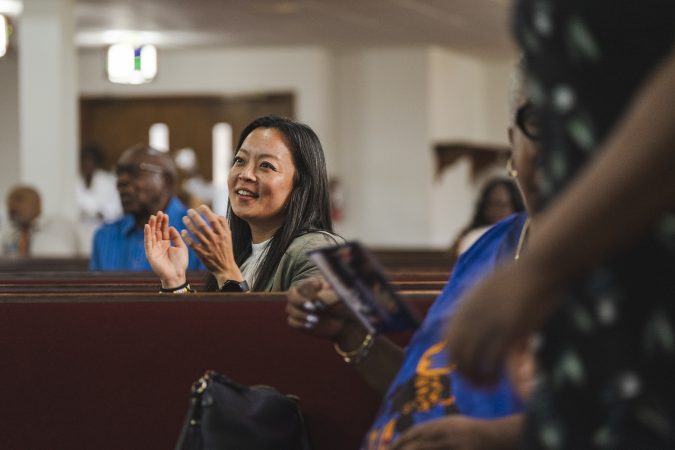
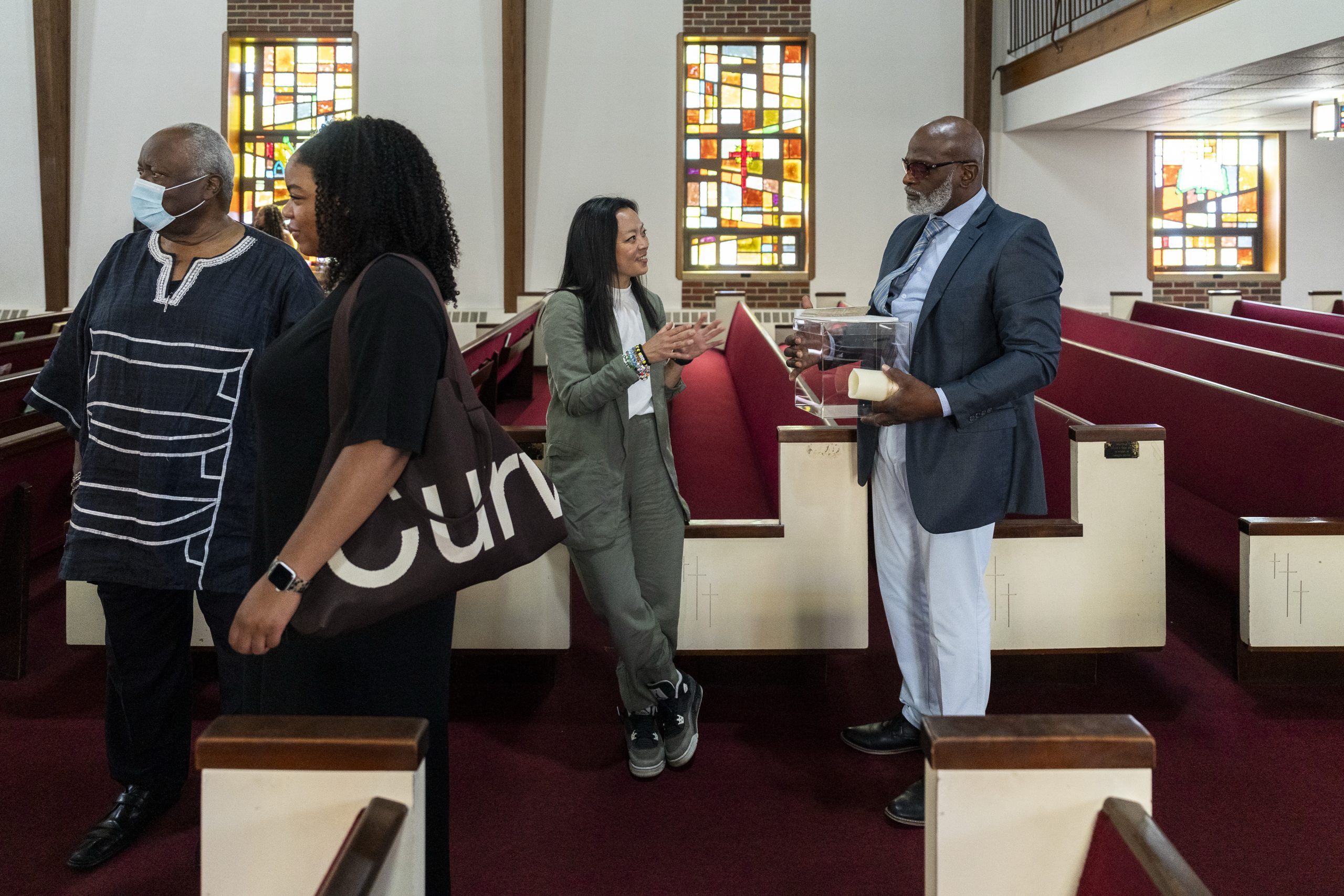
Hong meets parishioners at the church. Sara Stathas
Little known at the start of the race, Hong has seen rising support as she runs against four others, including Mandela Barnes, a former lieutenant governor and the Democrats’ 2022 Senate nominee.
The primary has been tumultuous. A leading candidate, Lt. Gov. Sara Rodriguez, dropped out last week, pointing to faulty campaign finance reports that she blamed on her fired campaign manager. Milwaukee County Executive David Crowley, who had recently quit the race for governor, revived his campaign with support from the current governor, Tony Evers.
Amid the shake-ups, the Republican Governors Association started spending $2 million on ads calling Hong “too liberal for Wisconsin.” While ostensibly attack ads, the spots could boost Democratic support for her and are the clearest signal yet that Republicans believe they have the best chance of winning in November if Democrats nominate Hong.
‘Brooklyn, Wisconsin, not Brooklyn, New York’
Some who like Hong’s ideas worry about how Republicans will portray her in a general election given that she has embraced socialism, used the C-word online and said her ideal world would be one without prisons.
“She’s sort of inviting some controversies,” said Vivian Venish, 28, who attended Hong’s campaign launch party but has been studying other candidates.
The winner of the Democratic primary will face Republican Tom Tiffany, a three-term congressman from northern Wisconsin who has called Hong out of step, saying she “wants to abolish the police and bring socialism to Wisconsin.”
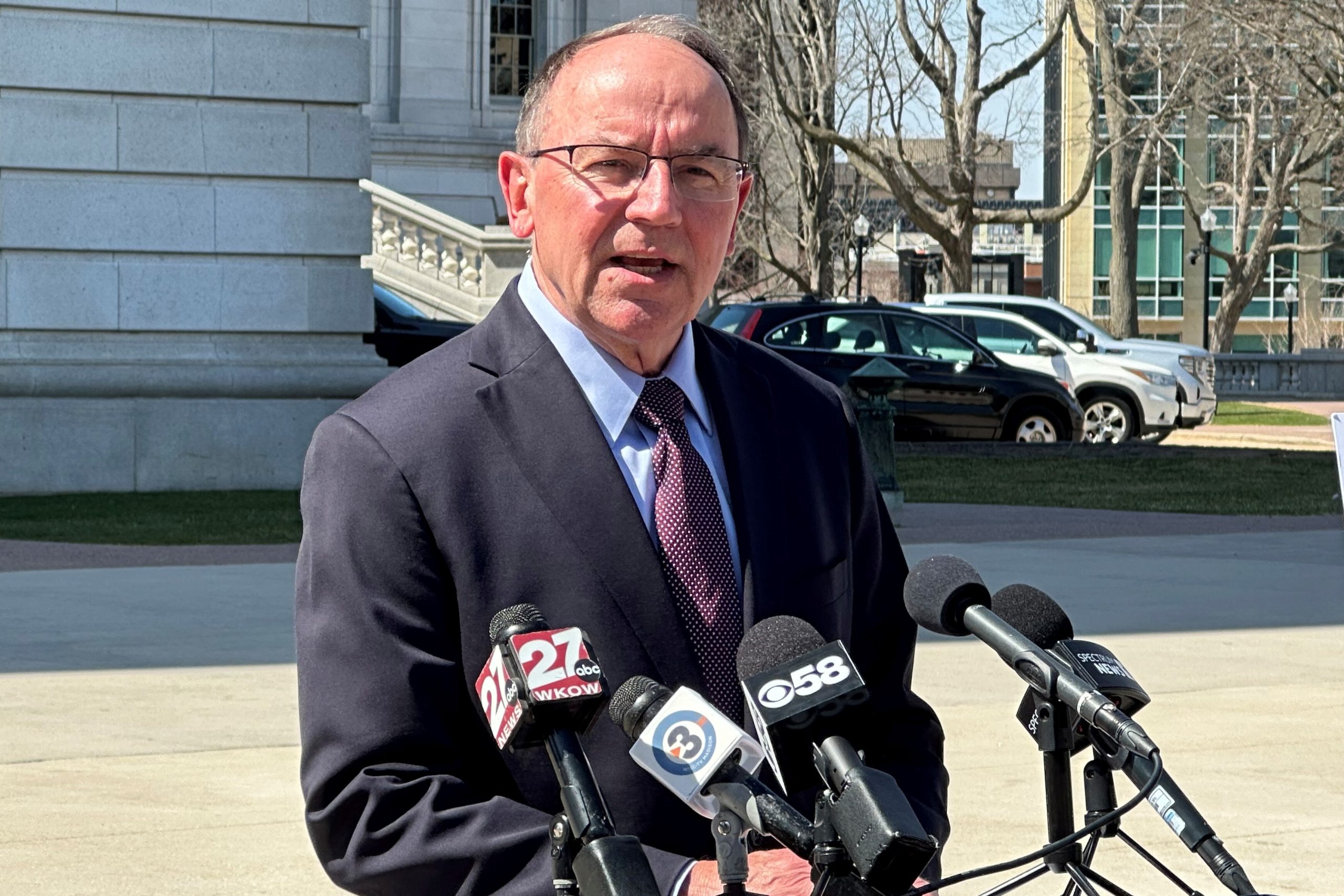
Rep. Tom Tiffany (R., Wis.), a candidate for Wisconsin governor, speaks during an April 8 news conference in Madison about what the GOP needs to do in November.Scott Bauer
Brian Schimming, chairman of the state Republican Party, said he expects a tight race in November no matter whom Democrats select. But he questioned Hong’s appeal.
“We’re in Brooklyn, Wisconsin, not Brooklyn, New York,” he said.
Wisconsin is as politically divided as it gets, with one Democratic senator, one Republican senator, a Democratic governor, and a Republican-led legislature. The last three presidential races were decided by less than 1 percentage point, with Trump winning in 2016 and 2024 but losing in 2020.
While narrowly divided today, Wisconsin has a long history of socialism. For much of the first half of the 20th century, Milwaukee was led by socialist mayors who championed “sewer socialism” by focusing on infrastructure and public housing. Wisconsin voters elected a socialist to Congress and sent others to the state legislature.
In her convention speech, Hong cited progressive iconoclasts like Robert “Fighting Bob” LaFollette, a representative, governor, and senator more than a century ago who “imagined a better world and fought like hell to realize it.”
“These folks were called unreasonable, impractical and unelectable,” she said. “Yet today, they’re considered visionaries.”
Hong poses for a photo with a supporter in Racine. Sara Stathas
She has won the support of Rep. Ro Khanna (D., Calif.), Rep. Ilhan Omar (D., Minn.) and Nina Turner, a co-chair of Sanders’ 2020 campaign for president.
Hong was a prominent supporter of the push to get Wisconsin Democrats to cast “uninstructed” ballots in the 2020 primary to protest President Joe Biden’s backing of Israel. She found new progressive allies last month by appearing on streams with Piker and Michael Beyer, who is known as Mike from PA. Piker has said he would “vote for Hamas over Israel every single time,” and Beyer has said Jewishness is a “demonic ethnicity, wholly invented.”
Hong “is willing to sell out the Jews of Wisconsin for a few bucks,” Ann Jacobs, chair of the state Democratic Party’s Jewish caucus, said in a post on social media.
Hong doesn’t agree with everything the two streamers have said but is willing to talk to anyone to reach more voters, her campaign manager said.
‘This is me being myself’
Voters — especially those born after the end of the Cold War — are ready for something different, not candidates the establishment deems electable, said Dillon Sheehan, a Hong supporter who helps lead the Madison-area chapter of the Democratic Socialists of America. Republicans defanged the term by using it so much, he said.
“They have called Joe Biden a socialist,” he said.
Hong argues voters are hungry for dramatic change, and her history of fierce rhetoric shows she has consistently pushed the Democratic Party to the left. In 2020, she called for “defunding the police as a first step towards abolishing the police.”
Matt Bennett, a co-founder of the center-left Third Way think tank, called the comments “the most toxic thing you could possibly imagine basically anywhere, but especially in a purple place like Wisconsin.”
In an interview, Hong said she believes the best way to reduce crime is to provide more services and treatment. She said that as governor she would increase state aid to towns and cities and let local officials decide whether to use the money to boost police spending.
Hong rarely backs down. She has kept in place incendiary posts, including one in 2020 that called tavern lobbyists the c-word. Last year, she used the same word as an acronym in a post encouraging people to vote for liberals in statewide races.
“This is me being myself,” she said. “I came up through kitchens and a restaurant industry, and now politics, where swearing is pretty normal.”
Hong is campaigning on “permanent affordability” and a new way of running the state.Sara Stathas
Her campaign style, she said, allows her to connect with voters who feel left out. She has held hip-hop parties and craft fairs and arranged for volunteers to meet at a Dungeons & Dragons gathering.
On a recent Thursday, members of a Madison club that caters to women and trans bicyclists took their usual ride around the state Capitol. Afterward, more than a dozen of them spread out in a park and decorated postcards encouraging people to vote for Hong.
The cyclists said they were drawn to Hong’s support for the working class and opposition to data centers. More than anything, they wanted someone ready to shake up the system.
“If there was ever a year for her to win, it would be this year,” said hotel worker Aiya Askana, 28. “So I’m going to go for it.”
WASHINGTON — The House on Wednesday passed a defense policy bill that incorporates President Donald Trump’s request for a historic $1.15 trillion in spending for national security and that would designate the Department of Defense as the Department of War.
It also would provide for a pay raise next year ranging from 5% to 7% for service members, depending upon their rank.
The National Defense Authorization Act is generally one of the more bipartisan bills that Congress takes up on an annual basis. That’s not the case this year. The vote was 216-212.
Democrats took issue with steep spending increases for the Pentagon as Republicans attempted to cut numerous non-defense programs through other bills. They also opposed some of the conservative social policy riders that were included.
For example, the bill includes a prohibition on gender-related medical care under the military health program known as TRICARE. It also eases hurdles for service members to carry a privately owned firearm on base, following Defense Secretary Pete Hegseth’s lead on the issue.
Republican leaders’ decision to attach Trump’s elections overhaul bill to the defense bill upon its passing also amplified the partisan divide. Speaker Mike Johnson is working to accommodate Republican lawmakers who are angry that the Senate won’t pass the SAVE America Act and are insisting that it be included in must-pass bills until the Senate relents.
The House bill is testing a normally bipartisan process
Rep. Mike Rogers, the Republican chairman of the House Armed Services Committee, said he knows there were areas of disagreement, but he emphasized that Wednesday’s vote was a step in a long process. He promised to work in a bipartisan manner on a final product that can pass both chambers and be signed into law.
Rogers said the United States needs to reverse decades of underinvestment and neglect in the nation’s armed forces and defense industrial base.
“This bill will do that and much more,” he said. “It will build the ready, capable and lethal fighting force we need to deter China and other adversaries.”
Rep. Adam Smith, the ranking Democratic lawmaker on the Armed Services Committee, said the defense spending the administration has asked for this year is approaching $1.6 trillion when including separate efforts to pay for the war in Iran and boost weapons stockpiles.
“The American people are struggling to pay their bills and we’re going to put $1.6 trillion into the defense budget. It’s not a reasonable thing to ask,” Smith said.
Smith also expressed concern about the war with Iran and that in supporting the defense bill, lawmakers are “de facto supporting this war with no end in sight.”
“We are in an incredibly, incredibly dangerous time,” Smith said. “I want to maintain the bipartisan nature of this bill. I do. And I know that the chairman does. But if we’re going to do this, we’re going to need some Republicans to stand up to the president of the United States and say, ‘No. No, we’re not going to get you $1.6 trillion. No, we’re not just going to give you a blank check for a war that is totally out of control.”
The White House backs parts of the legislation
The spending increases authorized in the bill would not take effect until Congress follows up with a separate defense appropriations bill. The Senate has not yet approved its version of the defense measure. It’s possible a final product won’t be ready until after the midterm elections.
The White House applauded the spending levels authorized in the House bill and the Department of War designation that it says recognizes the “willingness to fight and win wars on behalf of our nation.”
The president issued an executive order last year renaming the Defense Department, but it’s up to Congress to make the change official. The Congressional Budget Office has projected that the renaming could cost taxpayers as much as $125 million.
The White House’s statement also said that the administration has a number of concerns with certain provisions in the bill and would work with Congress before a final bill is presented to the president. Among those concerns was a section of the bill it said would limit or undermine the president’s ability to name military installations and property.
In 2023, during a national reckoning on issues of race in America, seven Army bases’ names were changed because they honored Confederate leaders. Last year, those bases reverted to their original names, but with different namesakes who share Confederate surnames. The Army found other service members with the same last names to honor.
The Trump administration on Wednesday signed an agreement with Saudi Arabia that gives that country a pathway to enrich nuclear fuel and commits it to using U.S. firms to supply its reactors.
The agreement, which the Energy Department announced had been signed, is certain to spark heated debate in Congress, where many lawmakers have long expressed concern that exporting enrichment capabilities will lead to a proliferation of nuclear arms.
Saudi Crown Prince Mohammed bin Salman has spoken openly about working to develop nuclear weapons if Iran is not stopped from getting them.
While the Trump administration offered little information about the agreement’s contents, three people familiar with it shared details with the Washington Post. The people spoke on the condition of anonymity because they were not authorized to discuss the agreement publicly.
The people familiar with the new agreement say it is designed with safeguards to keep the Saudis from enriching nuclear fuel to weapons-grade level. But they also acknowledge it includes a waiver that exempts the Saudis from the aggressive international inspections required in nuclear reactor deals with other countries, including the United Arab Emirates. Instead, sensitive inspections would be executed by American teams under terms spelled out in the agreement, which was initially worked out when the crown prince visited Washington in November.
“These agreements reflect our two nations’ shared commitment to strengthening U.S.-Saudi commercial relations, delivering prosperity at home and security to our allies abroad,” Energy Secretary Chris Wright said in a statement. “Rest assured, these agreements uphold the highest standards of nuclear safety and nonproliferation, while relying on the world’s best nuclear technology and scientists, designed right here in the United States.”
On Wednesday, Wright and his Saudi counterpart signed what is known as a 123 agreement, which lays out conditions for nuclear energy cooperation and includes stipulations aimed at preventing the spread of nuclear weapons.
Unlike with this agreement, other recent deals between the U.S. and countries that are not already enriching their own fuel have precluded or discouraged them from doing so.
Because the deal does not include conventional international inspections, President Donald Trump had to sign a separate national security waiver for it to go forward, according to the individuals familiar with it. Now that the agreement has been signed, the details will be sent to Congress, which has 90 days to act on it.
Even if Congress votes against implementing the deal, the president could veto that disapproval, and it is unlikely that opponents would have enough votes to block the deal from going forward.
The Wall Street Journal first reported the details of the agreement.
Under the deal, the two countries agree to study for two years whether enrichment on Saudi soil is feasible and necessary. There is enough nuclear fuel manufactured in other countries to power future Saudi reactors. But nuclear energy proponents argue the world’s fuel supply will quickly run out if plans by the Trump administration and other governments to vastly expand nuclear power production around the globe materialize.
They say the deal with the Saudis gives the U.S. an opportunity to expand the enrichment network on its own terms, limiting the associated weapons proliferation risks. The deal stipulates that any enrichment on Saudi soil would be controlled by U.S. companies using technology that is not shared with the Saudis. The aim is to allow Saudi Arabia to achieve its goal of developing a nuclear power economy without giving the kingdom access to tools it could use to develop a nuclear weapon.
Nonproliferation experts have long warned against such a deal, starting back when the Biden administration raised this possibility as part of efforts to establish diplomatic relations between Saudi Arabia and Israel. They continued to speak out as the Trump administration signaled it was heading down the same road, arguing that any safeguards the U.S. establishes will not hold.
“A bad U.S. nuclear deal with Saudi Arabia is coming for congressional review — inexplicably, carried over from the Biden administration,” wrote Andrea Stricker, a nonproliferation scholar at the Foundation for Defense of Democracies, a national security think tank, in a post on X. “Congress should block it. If it does not, one hopes the policy will be reversed by a subsequent administration before too much damage is done in terms of watering down safeguards, setting negative precedents for other states, and failing to contain the spread of enrichment and reprocessing — which we just put back in the box in Iran via force.”
There are currently 14 nations enriching uranium, according to the think tank, nine of which have nuclear weapons.
The agreement is sparking alarm in Israel, where officials have long sought to keep neighboring nations from enriching nuclear fuel. Unlike the Biden administration’s proposed nuclear energy pact with Saudi Arabia, which U.S. officials had predicated on the Persian Gulf state recognizing Israel’s right to exist, there is no such stipulation in the arrangement Trump negotiated.
Naftali Bennett, who had served as Israeli’s prime minister and now chairs the Together party, said in a statement that the deal “joins a series of diplomatic failures in which Israel is losing influence over its own fate.”
Bennett, who is challenging Israeli Prime Minister Benjamin Netanyahu in the upcoming elections, called the deal “a severe strategic failure that jeopardizes our security” by threatening to trigger a regional “nuclear arms race and a dangerous loss of control.”
Israel Ziv, a former head of the Israel Defense Forces Operations Division, wrote in the daily newspaper Maariv that the agreement “is the final diplomatic nail in the coffin for the future of regional normalization.”
Netanyahu’s office did not respond to a request for comment on Wednesday.
Even analysts who concede that the expansion of enrichment to Saudi Arabia and other countries is inevitable — as countries pursue nuclear power amid fast-rising global energy demand — question the structure of the agreement.
Richard Nephew, who advised Presidents Joe Biden and Barack Obama on the Middle East, said in an interview that the sidelining of international inspectors would set a worrisome precedent. He said that while U.S. inspectors are capable of robust review of nuclear activities, adversaries of the U.S. are unlikely to trust their findings and may choose to abandon inspections by the International Atomic Energy Agency.
“The point is not that Americans can’t do a great job at inspections,” he said. “The point is if you were Iran, how much confidence would you have in American inspections of Saudi operations? How would we feel if the Iranians said, ‘Don’t worry. Russians will inspect us.’ We would not accept that.”
“What if the Russians told us not to worry about nuclear facilities in Cuba because they were inspecting them?” he said. “All of this just doesn’t work in a geopolitical environment with as much mistrust and uncertainty as ours.”
One of the biggest beneficiaries of the deal is the legacy U.S. nuclear firm Westinghouse, which builds the large light-water reactors Saudi Arabia is seeking. While officials familiar with the agreement said it does not specifically name the company, the deal’s provisions requiring that U.S. firms are contracted for the nuclear work effectively steer the Saudis to the firm and its AP1000 reactors, each of which is capable of powering hundreds of thousands of homes.
There are also supply chain provisions that aim to give other U.S. firms an advantage, including those mining uranium and building components used in reactor construction.
But the nuclear supply chain in the U.S. has severely atrophied over the years, as utilities stopped building plants following project cost overruns and construction delays that cost ratepayers tens of billions of dollars.
The agreement states a strong preference for U.S. suppliers at all stages in construction and development of nuclear plants, according to the individuals familiar with it, but does not prohibit the Saudis from seeking materials, parts and expertise elsewhere when needed.
Members of Congress are already criticizing the framework. Rep. Brad Sherman (D., Calif.) noted during a House Foreign Affairs Committee hearing Wednesday that Iran’s nuclear program, which the White House says it is now being leveraged by Iranian leaders to build a weapon, is rooted in U.S. technology given to that country when it was still run by the shah.
“We have no idea who is going to be running Saudi Arabia 10 years from now,” Sherman said. “We are bombing Iran because they insist upon enriching and reprocessing. We are entering into an agreement with Saudi Arabia, giving them the green light to reprocess and to enrich, and the only difference I see here is that Westinghouse stands to make an awful lot of money on this deal, whereas the Iranians were not enriching American companies.”
Sherman pointed out that when Secretary of State Marco Rubio served in the Senate, he joined Sherman in co-sponsoring the “No Nuclear Weapons for Saudi Arabia Act,” which would have required that Congress affirmatively approve any deal with the Saudis before it could move forward.
In a gaggle with reporters Wednesday during a trip to the Philippines, Rubio declined to answer questions about the deal in detail, saying the U.S. would not sign any agreement that risks proliferation.
DUBAI, United Arab Emirates — The U.S. military announced Wednesday that it was conducting a 12th night of strikes against Iran as both sides increasingly targeted civilian infrastructure.
U.S. Central Command once again said the attacks were designed to “further degrade Iran’s ability to threaten civilian mariners and commercial vessels transiting regional waters,” as the Americans push to regain control over the Strait of Hormuz and restore the flow of international shipping.
President Donald Trump warned earlier Wednesday that the U.S. will destroy one bridge or power plant each time Iran shoots at a ship in the strait.
“From this point forward, any time the Islamic Republic of Iran shoots at a ship in the Strait of Hormuz, whether it be by Missile, Rocket, Drone, or any other device or weapon, the United States will bomb and destroy ONE BRIDGE OR POWER PLANT,” Trump wrote on social media.
The continued American airstrikes are occurring even as diplomatic efforts show little public sign of progress and officials on both sides have dug in on the dispute over the crucial waterway for global energy that remains largely closed because of Iranian attacks. The unpopular war threatens further worldwide economic disruption and sending fuel prices up ahead of midterm U.S. elections this fall.
Seyed Abbas Araghchi, Iran’s foreign minister, said his country would adopt an “eye for an eye” defense doctrine.
“Any aggression against Iran, including our infrastructure, will compel a powerful and decisive response,” he posted Wednesday on X.
The U.S. carried out a previous wave of strikes on Iran overnight into Wednesday, and air defenses opened fire over the capital, Tehran. Iran launched a missile attack on a Jordanian city on Israel’s doorstep, and alerts were issued in Bahrain and Saudi Arabia.
With negotiations largely stalled, both sides have sought leverage by targeting civilian infrastructure. Iran has responded to U.S. attacks by targeting energy infrastructure and desalination plants that provide drinking water in parched neighboring Gulf countries.
The closure of the strait, through which a fifth of the world’s traded oil and gas passed during peacetime, has jolted the world economy with effects far beyond the Middle East. A new threat by Iran-backed Houthi rebels in Yemen to target Saudi shipping in the Red Sea puts another trade chokepoint at risk.
“From this point forward, any time the Islamic Republic of Iran shoots at a ship in the Strait of Hormuz, whether it be by Missile, Rocket, Drone, or any other device or weapon, the United States will bomb and destroy ONE BRIDGE OR POWER PLANT,” Trump wrote on social media.
Trump traveled to Dover Air Force Base on Wednesday for the arrival of the remains of four U.S. service members. A day earlier, his defense secretary, Pete Hegseth, estimated in a fiery Senate hearing that the U.S. had spent $37.5 billion on the war so far.
Benchmark Brent crude oil rose to more than $93 a barrel in trading. That’s up from less than $72 early this month, which is roughly where it was before the war. Gasoline prices are also climbing.
Iran says it has the right to manage traffic and potentially charge fees in the strait, which was open to all and toll-free before the war. It has attacked ships using a route through the strait that is overseen by U.S. forces and intended to be outside Tehran’s control.
Iran’s parliament speaker, Mohammad Bagher Qalibaf, who has led negotiations with the U.S., appeared to brush off Trump’s threats.
“If our security is not ensured, no infrastructure will be safe, and the security of the strait is in the absence of American forces,” he wrote on social media. “We have repeatedly said that the situation of the strait will not return to prewar conditions.”
Attacks shake Iran and Jordan
Jordan’s military said it intercepted four Iranian missiles over Aqaba, while two others fell in “uninhabited areas.” Plumes of smoke could be seen overhead in videos filmed by people in the nearby Israeli city of Eilat. Jordan said it also intercepted four Iranian drones.
Iran has avoided striking Israel since hostilities resumed last month, apparently hoping to keep it from reentering the war. But the attack on Aqaba, within sight of Israel’s Eilat, raised concerns over a further widening of the conflict after an agreement to halt hostilities collapsed.
Another missile alert sounded in Bahrain, and Saudi Arabia warned residents of the Persian Gulf city of Dammam to seek shelter. Saudi authorities later said the danger had passed, without elaborating.
The U.S. military said earlier Wednesday that it had completed an 11th night of strikes on Iran, with targets including aircraft hangars and drone storage sites.
Iran’s state-run IRNA news agency reported explosions across several provinces. Iran’s Health Ministry says U.S. strikes over the past 11 days have killed 53 people, including six women and three children, and wounded nearly 600 people.
Iran’s paramilitary Revolutionary Guard insisted its retaliatory attacks would continue.
Diplomatic efforts show no signs of progress
Before the latest strikes, Iranian Interior Minister Eskandar Momeni visited Pakistan, a key mediator in the conflict, seeking to revive diplomacy. But it was unclear what new arrangement might be reached to end the war, which lately has become a battle for control over the Strait of Hormuz.
Iran’s Interior Ministry spokesman Ali Zeinivand said “diplomacy isn’t called off” and that messages were still being exchanged, without elaborating, according to IRNA.
An Arab diplomat said Gulf states are increasingly pessimistic about finding an off-ramp for escalating hostilities and are particularly concerned about the latest round of threats in which the two sides have warned they may attack civilian infrastructure.
The diplomat said countries in the region, in addition to Pakistan and Turkey, are continuing to push for de-escalation. But, he said the chances for any improvement currently appear bleak. The diplomat spoke on condition of anonymity due to the sensitivity of the situation.
At a regional summit in the Philippines, U.S. Secretary of State Marco Rubio denounced Iran’s actions in the strait.
“If we create a precedent in the Middle East where a nation state can decide that they are going to control an international waterway, charge a toll and if you don’t pay them, blow up your ships, we have created a very dangerous precedent which will repeat itself in other parts of the world, including in this region,” he said.
Rubio said the U.S. remains open to negotiations with Iran, “but right now they don’t seem to be serious about that” so instead the focus is on protecting shipping.
In response to Iran’s attacks, the U.S. reimposed a blockade on Iranian ports.
Trump signals U.S. may attack underground nuclear site
Speaking from the Oval Office on Tuesday, Trump gave a dim view on possible talks, saying the U.S. had “no interest in meeting.”
The site, known as Pickaxe Mountain, lies on the south side of Iran’s Natanz nuclear enrichment site, which was bombed by the U.S. during the 12-day war between Iran and Israel in 2025. But Pickaxe Mountain has remained untouched as Iran continues to dig at the site.
Iran has always insisted its nuclear program is peaceful, while resuming the enrichment of uranium to near weapons-grade levels since Trump scrapped a 2015 nuclear deal during his first term. The U.S. and others believe Iran had a nuclear weapons program until 2003 and may reconstitute it in the future.