Tag: no-latest

  • A blanket of seaweed smothers coastlines from the Caribbean to Mexico

    A blanket of seaweed smothers coastlines from the Caribbean to Mexico

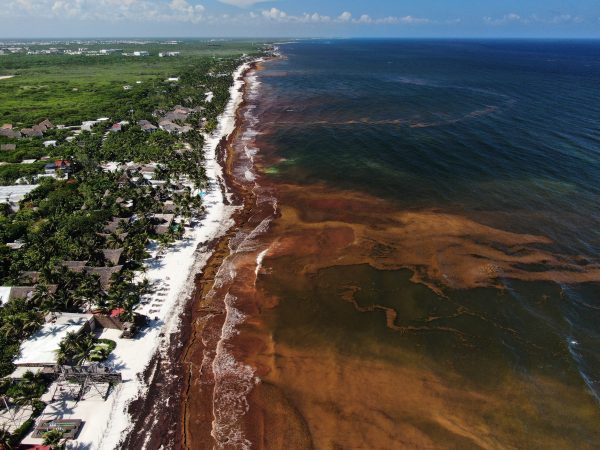
    PUERTO MORELOS, Mexico — Swaths of seaweed are blanketing the beaches and coastlines of the Caribbean and Gulf of Mexico, suffocating shorelines and snuffing out marine life while spooking visitors in areas that depend heavily on tourism.

    Some 27 million metric tons of self-sustaining sargassum have been recorded in the Atlantic, Caribbean, and Gulf of Mexico in July, according to a report released Friday by the University of South Florida’s Optical Oceanography Lab.

    The prickly seaweed covers miles of coastline, releasing a foul smell as it rots onshore.

    This year marks the first time that scientists have observed sargassum growing in large quantities in areas including the Caribbean and Gulf of Mexico, instead of being swept into those areas by ocean currents.

    The algae usually reproduces asexually as it travels from Western Africa, said Brian Barnes, a marine scientist and research assistant professor at the University of South Florida. “None of this is normal,” he said. “Every year is a little bit of a new story.”

    The Great Atlantic Sargassum Belt has been growing since 2011, dumping an increasing amount of seaweed along coastlines in the Caribbean and Gulf of Mexico. Experts have said that agricultural runoff, warming waters, and changes in wind, current, and rain could be factors.

    The sargassum that began reproducing in the region earlier than usual this year stems from a record 40 million metric tons reported last year.

    “The 2025 bloom was so big it never really left,” Barnes said. “It was enough to start a new bloom locally.”

    Seaweed threatens tourism

    Sargassum levels in the Caribbean reached record levels in June, while the amount present in the Gulf hit 5 million metric tons in June, nearly double last year’s record, according to the University of South Florida.

    Scientists expect 2026 to be the second largest amount of sargassum recorded in the Atlantic, Caribbean, and Gulf of Mexico, noting that June alone saw 34 million metric tons, which was only 10% lower than the year-earlier period.

    Mexico said Thursday it plans to invest $115 million to tackle the blooming algae, which poses an environmental and economic threat. The government estimates that up to 9,000 tons reach its Caribbean coastline on the worst days. Given current resources, Mexico says it can only gather 1,200 tons of sargassum a day.

    On a recent evening, Alan Vázquez closed the restaurant where he works as a waiter in the popular tourist town of Playa del Carmen because there were no customers. He had resisted closing for several hours, hoping he would receive a tip and salvage the day, but vast quantities of decomposing sargassum are turning the famed turquoise waters black, driving away tourists.

    “It’s sad that such a beautiful and lively place … has ended up like this,” Vázquez said.

    He fears suffering the same fate as four of his colleagues who were laid off two months ago due to a drop in tourism that has devastated hotels and businesses in the state of Quintana Roo, one of Mexico’s tourism gems, where sales fell 30% in the first half of the year, according to estimates from local businesses.

    In Puerto Rico, sargassum blankets the waters around popular tourist areas, including La Parguera.

    “I don’t recall ever having that much concentration in so many places at once,” said Waldemar Quiles, the U.S. territory’s natural resources secretary.

    Much of the record sargassum reported last year ended up along Puerto Rico’s coastline, prompting the governor to declare a state of emergency.

    It surpassed the previous record set in 2022 with a peak of some 22 million metric tons.

    “It’s not a one-off event anymore,” said Emmanuel Maldonado González, an environmental sociologist at East Carolina University. “It’s becoming a growing hazard.”

    Experts warn proliferation will worsen

    Patches of sargassum in open waters provide a healthy breeding ground for wildlife, including turtles, fish, and seabirds, and can be “a bit of an oasis of life in the middle of the ocean,” Barnes said.

    But once it’s closer to shore, it reduces oxygen in the water, smothers mangrove roots, and blocks sunlight from reaching coral and sea grass.

    Once it washes ashore it can prevent newly hatched sea turtles from reaching the ocean, while the heavy machinery used to remove it from beaches risks destroying fragile turtle nests, scientists say.

    “The coastlines are not built for this,” Barnes said.

    In the U.S. Virgin Islands, people are walking up to 25 feet on mats of seaweed before even reaching the water, according to Amy Dempsey, an environmental consultant.

    “This is by far the worst I’ve seen it in the last five years,” she said. “We are getting slammed in the Virgin Islands.”

    The smell of rotten eggs permeates communities where large piles of decaying sargassum emit ammonia and hydrogen sulfide.

    “The effects of these gases on people can be severe,” warns the U.S. Environmental Protection Agency, noting it can cause nausea, headaches, and lung irritation.

    Used in composting and bioenergy production

    Officials on the French Caribbean island of Martinique recently opened a shelter to temporarily house those affected by the toxic gases after residents protested.

    So far this year, crews in Martinique have collected more than 11,500 tons of sargassum — including 638 tons in four days alone this month — according to government data. Sea barriers catch some of the seaweed, while crews on shore collect the remainder by hand, storing and processing it for composting and bioenergy production.

    Researchers at the University of South Florida and the U.S. National Oceanic and Atmospheric Administration used artificial intelligence and found that from 2003 to 2022, macroalgae blooms increased by more than 13% per year in the tropical Atlantic and Western Pacific.

    Overall, the blooms reached 16.9 million square miles, according to a study published earlier this year.


  • Trump claims breakthrough on Hamas disarmament, Gaza transition

    Trump claims breakthrough on Hamas disarmament, Gaza transition

    The United States has brokered a pathway to a deal between Hamas and the Israeli government for the Palestinian militant group to lay down its arms in Gaza in exchange for an eventual Israeli withdrawal from the territory, U.S. officials said Thursday, a potential breakthrough to end nearly three years of conflict there.

    The framework was a potential step toward an Israeli pullout from Gaza and the eventual rebuilding of the territory, much of which has been reduced to rubble. But on Friday morning, Israel remained conspicuously silent on the deal, and after years of fighting, there was little trust between the sides.

    President Donald Trump portrayed it as “a HISTORIC agreement for the COMPLETE DISARMAMENT of Hamas and all other armed groups in Gaza. This is a monumental step toward lasting PEACE and SECURITY,” in a post on social media.

    He said that the agreement envisioned Hamas disarming in stages, with the Israeli military pulling out of the territory gradually and being replaced by an international stabilization force that would work in partnership with a revamped Palestinian police force to provide security.

    As of Friday, Israeli Prime Minister Benjamin Netanyahu’s office had not commented officially on Trump’s announcement, raising questions about where Israel stands on the latest development.

    Hamas said in a statement Friday that Israel’s “commitment to halting the killing and ending its aggression is the fundamental prerequisite and the first step towards implementation” and that a “framework and timetable for what has been agreed upon” must be established.

    A U.S. official said Hamas had agreed to the framework through Egyptian mediators. The official suggested that the plan didn’t diverge from what Israel agreed to nearly a year ago as part of a deal to free hostages — but acknowledged the possibility that the Israeli position has changed in the meantime.

    “We’re not asking Israel to do anything other than agree to the 20-point plan that they agreed to initially, and so we’re very confident they will adhere to it. If they don’t, obviously, President Trump will be very, very disappointed,” a U.S. official said, speaking on the condition of anonymity to discuss the sensitive negotiations. Israel agreed to the plan in September 2025.

    But the official acknowledged the challenges: “We’re going to try to do something very, very impossible,” the person said.

    The road map leaves major implementation questions unanswered. U.S. officials characterized it as a step-by-step plan to hand power in Gaza to Palestinian authorities that are not Hamas, which launched an attack on Israel on Oct. 7, 2023, that was met by an intense Israeli response. The composition of the new Palestinian administration was not fully clear, for instance, nor which countries would contribute to the international forces, or when they would deploy.

    “This agreement is a critical step towards Gaza finally being governed by a new Palestinian government that will work closely with the Board of Peace to help the Palestinian people. At the same time, Israel will have the security it deserves, with Gaza no longer used as a base for terror attacks,” Trump wrote.

    Israel has long insisted that Hamas disarm first. Hamas had called for Israeli forces to withdraw first. The White House on Thursday did not clarify how that deadlock will be overcome.

    On Friday, an Israeli official, speaking on the condition of anonymity to discuss sensitive diplomatic issues, reiterated Israel’s long-standing position. “Israel demands the complete disarmament of Hamas, including the removal of weapons from Gaza and the full demilitarization of the Strip, as a prerequisite for any process,” the official said.

    That would be a rejection of the step-by-step plan envisioned by Nickolay Mladenov, the director general of the Board of Peace, the Trump-backed group that was set up in the aftermath of the 2025 deal to release the remaining hostages that Hamas seized during the October 2023 attack.

    Hamas said in its statement that any decision to give up heavy weapons was contingent upon a variety of factors, including “a complete cessation of all forms of aggression” and Israel’s “withdrawal from the Gaza Strip.”

    Throughout the week, the Israel Defense Forces have continued to conduct strikes in Gaza, on Friday announcing that the IDF had killed a Hamas supply officer and Hamas supply commander.

    The political calendar in Israel may create a challenge in the short term. Netanyahu faces elections in October and is likely to face political pressure not to take actions that look like concessions to Hamas before then. One U.S. official said that the plan may take “200 to 350 days” to implement, saying that the emphasis was more on the concrete steps required to push the deal forward rather than the calendar.

    Egypt, Qatar, and Turkey have all served as mediators during the extensive negotiations, with Egypt hosting senior Hamas officials in recent weeks for the final drive toward an agreement, U.S. officials said.

    Netanyahu met with Trump on Tuesday while he was in Washington for the funeral of Sen. Lindsey Graham (R., S.C.).

    The mediation efforts have taken place against the backdrop of the war in Iran, which historically was Hamas’ biggest backer. Its ability to support the Palestinian group has suffered over three years of escalating attacks by Israel and the U.S. that culminated in the February joint attack on Tehran and its leadership.

    The humanitarian situation for the up to 2 million Gazans who remain packed in the Hamas-controlled part of the enclave “remains brutal,” according to the World Food Program. Residents in the territory are surrounded by the Israel Defense Forces, and “families lack water, sanitation and medicine,” the group said.

    The question of which side moves first has posed a challenge to disarming Hamas and securing the withdrawal of Israeli forces from Gaza. Some of the elements in the proposal unveiled Thursday echoed ideas that were floated by the Biden administration but never successfully implemented.

    “This potential announcement by Hamas on disarmament could be meaningful,” Ilan Goldenberg, who worked on Gaza issues in the Biden White House, wrote on X. “The million dollar question will be how Israel responds. And I would put good money on Bibi … doing absolutely nothing to reciprocate.”

    The Israeli military has cleared more than 60% of Gaza’s territory of Palestinians, and Netanyahu in May said that he had ordered Israeli forces to extend their control to 70% of the land. Gaza’s Palestinian residents are packed into the remainder of the territory, which is under Hamas control.

    Hamas has previously stated that the group is open to “freezing or storing” its weaponry, but has said that such a move would only be taken once a clear path to a Palestinian state is established. The group has also said even if it disarms it will never forgo the “right to resist.”

    Under the framework, the group would also disclose the extensive underground tunnel network that runs under much of Gaza so that the tunnels could be destroyed.

    The Trump administration has also struggled to stand up a military force that it has said will take over control from Hamas for the management of the territory. The international stabilization force was announced in February, but since then countries that previously committed troops to the force put their commitments on hold indefinitely, including Indonesia, Morocco, Kazakhstan, Kosovo, and Albania.

    The international force would be commanded by U.S. Army Maj. Gen. Jasper Jeffers.

    On the call Thursday, the administration did not provide updates on these specific commitments, but one official stated that the U.S. has “commitments for over 5,000 troops now from different countries that are participating and looking to continue to build it.”

    In a statement on Friday, the National Committee for the Administration of Gaza — which is a technocratic team of Palestinians meant to organize governance of the strip — said that it “welcomes the progress announced yesterday regarding the road map, and the opening of a path toward beginning its implementation.”

  • Tax returns show California’s Newsom earning between $1.7 million and $2 million annually

    Tax returns show California’s Newsom earning between $1.7 million and $2 million annually

    SACRAMENTO, Calif. — California Gov. Gavin Newsom and his wife made between $1.7 million and $2 million annually from 2022 through 2024, and they paid about half a million a year in federal and state taxes, according to tax returns released by his office.

    The Democrat’s office released more than 700 pages of tax filings spanning four years for reporters to review, offering a window into Newsom’s finances as he prepares to leave office and considers a 2028 presidential bid. Newsom’s office did not release returns for 2025, because the couple filed for an extension and will complete those returns in October.

    The returns show the Newsoms’ income has remained relatively consistent since when he took office in 2019, when the couple reported $1.7 million in annual income. The exception was in 2021, when the family sold a house for nearly $6 million in Marin County, making roughly $800,000 from the sale. That year, they made $4.2 million and paid more than $1 million in federal and state taxes. They earned roughly $2 million in 2022.

    The release of the couple’s tax filings comes as their finances have been under scrutiny after the U.S. Justice Department launched investigations into the Newsoms, the governor announced last month. Newsom has blasted the probes as politically motivated.

    It was the first time Newsom released returns since 2022.

    Newsom made nearly $200,000 annually from serving as governor, but most of his income comes from winery and restaurant businesses that he put in a blind trust when he took office. The returns don’t name each individual business, making it impossible to know which ones gained and lost money.

    The PlumpJack Group, a company he owns that includes a suite of wineries and restaurants, is now run by his sister and cousin.

    His wife, Jennifer Siebel Newsom, a film director, lost money most years from Girls Club Entertainment, a production company she founded. The business produced Miss Representation, a 2011 documentary about disparaging portrayals of women and girls in media, and two other films.

    The Newsoms paid between roughly $14,000 and $44,000 a year for childcare for three of their four children, according to the tax filings.

    They gave between $40,000 and $65,000 in gifts to charity each year, mostly through monetary donations. They also donated thousands of dollars worth of clothing, toys, and other items to thrift stores and nonprofits, including in 2022, when they gave away Armani business wear they originally bought for $45,000 to a racial justice organization in Oakland.

  • U.S. spy agencies suspect Iran launched cyberattack on Minnesota water facilities

    U.S. spy agencies suspect Iran launched cyberattack on Minnesota water facilities

    U.S. intelligence agencies have assessed that Iran was likely behind a coordinated cyberattack on more than 30 municipal water systems in Minnesota this week, according to several U.S. officials.

    The FBI is investigating the attack, which comes as a five-month-old military conflict between the United States and Iran threatens to escalate.

    Though intelligence agencies have not definitively concluded that Tehran is responsible, the hack follows urgent warnings by federal cybersecurity officials that Iran for months has been targeting internet-exposed devices that control operations at water, wastewater, and energy facilities in the U.S. and, in some cases, causing disruptions.

    Intrusions have been noted at several water and energy systems across the country since shortly after the war began on Feb. 28, said Joe Slowik, director of threat research for Dataminr, a real-time commercial intelligence platform.

    “It is not a secret that these things have been taking place since the spring,” he said. “There have been disruptions in multiple critical infrastructure sectors. It’s a big deal.”

    The New York Times earlier reported that federal and state investigators believe Iran was likely responsible for the Minnesota attacks.

    At least one system was briefly offline and another saw its remote sensors disrupted, but the state’s information technology agency notes that there are no active requests for Minnesotans to modify their drinking water usage.

    The attacks took place on Sunday and Monday, according to a statement by Minnesota IT Services, the information technology agency.

    The agency, as well as the affected municipalities, are working with state and federal authorities to share threat intelligence and remediate the attack.

    Nate George, the mayor of Braham, Minn., said in an online statement that his city’s public works department discovered the attack early Monday morning. After learning at least four other Minnesota communities were affected, they determined the plant had been hacked.

    “Public works isolated the affected system, restored a backup, and restarted the plant within approximately 90 minutes,” George said of the city’s response, noting that Braham’s residents received water from the city’s water tower while the plant was offline.

    In the city of Plymouth, several devices that control the water and sewer systems’ operations were hacked and taken offline but have now been restored, said Michael Thompson, the city’s public works director. The water supply was not affected, he added. But devices known as programmable logic controllers, or PLCs, which operate on the city’s cellular network and track water level, pressure, pump operations, and equipment alarms, were impacted.

    Iran has been actively targeting the U.S. with cyberattacks since the war started on Feb. 28, but most have not drawn headlines.

    Kurt Gaudette, head of intelligence for Dragos, a cybersecurity firm that specializes in protecting critical infrastructure, noted a pattern with attacks in March and in Minnesota: the targeting of small utilities that use internet-exposed controllers with default passwords. “It’s very low-hanging fruit,” Gaudette said.

    He said he has seen such attacks in the past, notably in late 2023, when a PLC at a municipal water pumping station in Aliquippa, Pa., was hacked. The attack, which caused no major disruption, was claimed by a group affiliated with Iran’s hard-line Islamic Revolutionary Guard Corps and known as CyberAv3ngers.

    The Aliquippa station used PLCs made by an Israeli firm, Unitronics, which were targeted by the hacking group across the U.S., Britain, Israel, and Ireland. Israel had just begun its invasion of Gaza in response to the attack by the Palestinian militant group Hamas that killed about 1,200.

    In general, Iran’s goal with cyberattacks seems to be less outright destruction than to deliver psychological effects to two audiences, said Alex Orleans, head of threat intelligence at Sublime Security, an email security company.

    “The first is the American people, to make us freak out and to turn sentiment against the war by making it look like it’s not worth the costs, when in reality our systems are pretty resilient,” Orleans said.

    The second is the Iranian regime itself, he said. “They want to show their bosses that they’re contributing to the war effort.’’

    Slowik, who tracks foreign cyber threat actors, said that the events in Minnesota and other states, including in the Eastern U.S., are the work of Iran’s Islamic Revolutionary Guard Corps’ Cyber Electronic Command.

    Iran’s actions “reflect a desire or need to say, ‘Hey, we can hit you too, even if it’s not New York City or Los Angeles,” Slowik said.

    The Department of Homeland Security’s Cybersecurity and Infrastructure Agency issued advisories in April and July noted that the IRGC was exploiting PLCs.

    On Thursday, the agency issued a new advisory saying that it is seeing “a significant increase” in cyber threat actors targeting programmable logic controllers in the water and wastewater system sectors. CISA urged they be disconnected from the internet as soon as possible and that default passwords be changed.

    In March, the IT systems of a major medical equipment maker, Stryker, were disrupted for two to three weeks by a hacktivist front group known as Handala, which the Justice Department said is operated by Iran’s Ministry of Intelligence and Security.

    Handala also claimed earlier this year to have hacked the personal email account of FBI Director Kash Patel.

  • A discarded SpaceX rocket is on a high-speed collision course with the moon

    A discarded SpaceX rocket is on a high-speed collision course with the moon

    CAPE CANAVERAL, Fla. — A drifting SpaceX rocket is on a collision course with the moon after launching a pair of lunar landers more than a year ago.

    The rocket’s upper stage will unintentionally slam into the moon on Wednesday, carving out a crater and sending up a plume of dust and rubble that scientists — and skygazers — are eager to observe.

    Space tracking expert Bill Gray predicts an impact of 5,400 mph — seven times the speed of sound — near Einstein Crater on the moon’s sunlit western limb. With the action unfolding in the wee hours, the eastern portions of the U.S. and Canada, and much of South America, should have the best views.

    While scientists are not too concerned about this particular piece of space junk, it highlights the growing threat as more and more items cram into orbit.

    “Things are getting crowded up there,” said Gray, who plans to view the aftermath from New Brunswick, Canada.

    It was never SpaceX’s intent to hit the moon. But space experts said the crash could have been avoided if the upper stage had been nudged into orbit around the sun.

    It will be the second dead rocket known to crash into the moon accidentally. A Chinese rocket segment dug out a pair of craters on the lunar far side in 2022.

    Lucky for astronomers, the upcoming smashup will occur on the moon’s near side, packing the equivalent energy of three tons of TNT.

    The impact flash, lasting less than a second, will probably be too dim to see, according to experts. But the stream of ejected material could stretch for several miles into space and remain visible to telescopes for tens of minutes.

    “The gravity on the moon is low and there is no wind to blow the dust away,” said Los Alamos National Laboratory’s Benjamin Fernando, who’s encouraging observations by professionals and amateurs alike.

    “Part of the reason for our interest in this event is to figure out how much of a hazard debris impacts pose to future astronauts,” he added in an email.

    Fernando anticipates an impact crater nearly 90 feet across and 16 feet deep, too small to see from Earth but visible to spacecraft.

    NASA’s Lunar Reconnaissance Orbiter and South Korea’s Danuri lunar orbiter will gather before-and-after shots of the crash scene. Danuri will stray within a mile or two of the SpaceX rocket just two minutes before impact, according to Fernando and his team.

    The abandoned rocket segment — measuring some 40 feet and weighing around 10,000 pounds — hoisted two private lunar landers on Jan. 15, 2025.

    One of them — Firefly Aerospace’s Blue Ghost — became the first private spacecraft to pull off a fully successful lunar touchdown. The other, Japan-based ispace’s lander, wrecked.

    With meteoroids and other natural objects offering little if any warning before walloping the moon, scientists said there’s much to learn by observing well-tracked strikes by human-made objects like the one coming up. NASA hurled rocket sections and lunar modules into the moon during the Apollo era for seismic measurements. Decades later, in 2009, NASA intentionally crashed its LCROSS spacecraft and upper stage in search of ice near the lunar south pole.

    With the moon as the new travel hot spot, scientists said it’s crucial to improve debris monitoring and traffic control before packs of robots and astronauts arrive.

    The United States and China are racing to land astronauts on the moon in the next few years. Elon Musk’s SpaceX and Jeff Bezos’ Blue Origin are vying to provide the lander for NASA’s yet-to-be-named moonwalkers of Artemis IV, who will succeed the 12 Apollo astronauts who strolled the lunar surface.

    “This impact will not be a problem,” retired astrophysicist Jonathan McDowell said in an email. “But in a future where there are long-term bases on the moon, similar impacts would be an issue and we need not to leave rocket stages in chaotic orbits of this kind.”

  • Seattle mayor defends ousting police chief after festival shooting

    Seattle mayor defends ousting police chief after festival shooting

    SEATTLE — Seattle Mayor Katie Wilson on Friday defended her decision to oust the city’s police chief as the “right decision at the right time,” but she declined to explain why.

    The leadership change came as police continue searching for people involved in a fatal, gang-related shootout at a food festival near the Space Needle last weekend. A 15-year-old was arrested at the scene and has been charged with assault, but charging documents say the gun he was seen firing wasn’t involved in the deaths of two bystanders.

    Wilson and then-Police Chief Shon Barnes faced criticism for being slow to release key information about the shootout on Sunday, including whether suspects remained at large.

    Barnes, who was the city’s second Black police chief, has been credited with boosting the recruitment of officers and helping reduce crime downtown. A number of Black community organizations, a major business group, and several City Council members issued statements criticizing Wilson’s decision to replace him Thursday.

    At a news conference Friday with Andre Sayles, a Seattle deputy chief the mayor named as interim chief, Wilson credited Barnes for his service and said that as mayor she had a clearer window into the operations at the Seattle Police Department than her critics.

    The lack of communication about a mass shooting at a major public event in Seattle was not the only reason she asked Barnes to resign, she said.

    “There were multiple factors,” Wilson said. “The events of Sunday played into it.”

    Sayles told the news conference the department would boost police staffing at public festivals for the remainder of the summer. He also said he believed investigators are close to finding and arresting additional suspects in the shootout.

    The gunfire erupted in the waning hours of the Bite of Seattle, an annual three-day festival that draws hundreds of food and retail vendors and performers. Three people, including a suspect, were killed, and four people were wounded. One of the people injured was a 2-year-old boy.

  • Colorado residents are ratting out neighbors over water use during drought

    Colorado residents are ratting out neighbors over water use during drought

    In Denver these days, it’s the brown lawns vs. the green.

    As Colorado dries up in a historic drought, scofflaws violating water restrictions have sparked tension throughout the state’s largest metropolitan area, turning residential streets into checkerboards of virtue and vice. The emerald green lawns of cheaters now abut the crispy brown grass of the rule-followers — defiance that’s visible for all to see.

    With record hot temperatures following a winter of little snow, the city’s utility had asked that residents cut usage levels by 20% this summer, and mandated that customers only water their lawns twice a week.

    Denverites have so far failed to meet the moment — with only about a 5% reduction by mid-July. And there’s little relief in the forecast, with the furnacelike heat dome that descended on the central United States expected to last through the week.

    More than 4,000 people have reported their neighbors for cheating on the restrictions this summer, the utility said, leading to one story in the Denver Post with thousands of comments, most along the lines of “Snitches get stitches.”

    “Our yard would look so much better if everyone else’s grass was also dead,” said Keifer Hunniford, a tech executive who lives in a quiet neighborhood of mid-century homes on the east side of the city.

    Hunniford, 58, has spent the summer averting his eyes from the big burnt patch in the middle of his yard — it’s too depressing. Meanwhile, his neighbors’ sprinklers whirl on and off many days.

    At a briefing for the state’s drought task force, Russ Schumacher last week outlined the grim circumstances, and said that the time period from October through June was the hottest and fourth driest on record.

    More than 90% of the state remains in a drought condition, according to Schumacher, the state climatologist and director of the Colorado Climate Center. Reservoirs are drying up and the Colorado River, which supplies water to states throughout the Southwest, is at an all-time low at some measuring locations, he said.

    The precipitation numbers “continued to go further and further into a deficit,” Schumacher said.

    Todd Hartman, a spokesperson for Denver Water, said the utility is “quite a way off from our goal” of a 20% reduction in water use. By this point in the season, he said, they had hoped for customers to have used 12,400 acre-feet less of water than normal. Instead, they’ve used 2,900 acre-feet less, which he described as only a “slight improvement.”

    The utility has contacted 3,400 customers to “educate” them on watering restrictions after the more than 4,000 complaints on the new tip line. The first offense results in a warning, the second a $250 fine, and the third a $500 fine, with fines escalating to $1,000 for repeated violations.

    So far, they’ve issued three formal citations that could result in fines.

    Hartman said while they’ve seen “strong conservation efforts” from schools, parks, and multifamily housing units, single-family homeowners remain the worst offenders. The utility hopes to avoid cutting watering restrictions further to just one day a week, which would have a “devastating impact” on landscapes.

    On social media, residents have complained about golf courses that still seem to have pristine greens, and have blamed rapid residential growth and new data centers for straining the water supply. Homeowners associations around the area have added to the confusion by dinging residents for having unsightly lawns, even as the drought has worsened, Schumacher said.

    In Superior, a town about 20 miles from Denver that does not have water restrictions, James Shima, 57, an electrical engineer, said he received a warning email and then a certified letter from his homeowners association in June when he held off on watering due to the statewide drought declaration.

    He was given 30 days to address the problem or face escalation of the violation process, he said.

    “I am now forced to water my lawn two times a day, seven days a week, for two hours during the peak of summer,” he said. His most recent water bill was $300, Shima said.

    Rachel Stanton, the president of the Rock Creek homeowners association, responded in an email that the HOA had “moderated expectations for lawn maintenance in light of conservation concerns” beginning in May.

    “No one is expected to have a lush green lawn right now, but they are expected to do enough maintenance to keep their lawns alive,” Stanton said. She dismissed Shima’s concerns as “a nonstory in which the ‘HOA as villain’ trope does not apply.”

    When Hunniford and his family moved into the neighborhood 12 years ago, it was easy to keep the grass surrounding his two-story mid-century home looking good. Now, it’s almost impossible.

    “Over time we’ve got sick of the stupidity on putting water on this green stuff we don’t really use, and we’ve let ours die,” he said.

    The grass has withered away to bare dirt in some spots. He considered spray painting the remaining brown spears green with turf paint, but his wife said no.

    From his house, Hunniford can look down his street and see some lawns that are dead, some lawns that are green, some that have been replanted with drought-sensitive plants, and his neighbor Pam’s new bright green synthetic turf across the street.

    The brown lawn folks believe the green lawn folks are cheating.

    “There are the known offenders,” Hunniford said. “One of them was watering this morning, and it’s an off day.”

    The brown lawn vs. green lawn debate is one more example of how divided American society has become, he said, and the drought has only added to his malaise and sense of the country in decline. He and his wife, a personal coach, are considering retiring in Mexico.

    Across the street, Pamela Keith, 61, a retired Department of Veterans Affairs counselor, has ripped up her sod and installed $13,000 in synthetic turf, a project that she embraced as a way to preserve the legacy of her mother, Eleanor, who died in 2006 and was an avid gardener.

    Her roses and tulips are long gone, and Keith didn’t even plant any annuals this year as the drought worsened. But she’s managed to save the vegetable garden, including tomatoes, peppers, watermelon, and her mother’s collard greens that still come back every year.

    “We’ve got to keep up with the neighborhood name: Park Forest,” she said, adding that she does worry about her neighbors’ automatic sprinklers frequently running.

    On the days they are allowed to water, she and her husband, Sean, try to beat the other outside “because it’s so enjoyable.”

    But Keith is harboring a secret. For weeks now, she’s been watering her back lawn over the restriction limit, hoping to keep a little grass alive until July 25, when she threw a celebration in honor of her husband, who recently returned after two years on the road as a travel nurse. There was R&B music, and barbecue, and a big-screen TV playing summer movies. She called it “An Evening Under the Stars.”

    She’ll cut back, she said, now that the party’s over.

  • ‘Iran War Participation Trophy’ mocking Trump arrives in New York

    ‘Iran War Participation Trophy’ mocking Trump arrives in New York

    NEW YORK — First D.C., then Manhattan.

    The satirical art group responsible for about a dozen public pieces mocking President Donald Trump in the nation’s capital over the past 20 months has now landed in New York.

    The anonymous artists who call themselves the Secret Handshake left their mark in Lower Manhattan on Wednesday morning, placing a 10-foot-tall trophy, spray-painted gold and emblazoned with a #1 on its side, in Foley Square.

    A large plaque below the “Iran War Participation Trophy” reads: “We hereby award President Donald J. Trump this participation trophy for his enthusiastic involvement in the Iran War. While some concern themselves with military strategy, diplomacy, or measurable outcomes, President Trump demonstrated the courage to participate regardless of the final score.”

    The war in Iran, which began Feb. 28, has resulted in the deaths of 18 U.S. service members and wounded more than 600.

    Walking to catch the subway, Maren Stange, 79, stopped and chuckled as she bent to read the rest of the trophy inscription: “President Trump joins the ranks of children everywhere who received recognition for simply showing up.”

    Stange, who said she had never heard of the Secret Handshake, wasn’t sure the statue would change anything. “It’s funny and it’s smart,” she said. “But what’s it going to do?”

    The installation, which was first displayed in Washington this month, invites anyone to contribute their own participation trophies to the project.

    Arranged around the plinth were more than three dozen mock trophies and awards. One seemed to mock Trump’s electoral history: “Lost Arizona,” read a baby blue Honorable Mention ribbon, dangling from the neck of a tennis trophy.

    A trophy of a martial arts figure, leg raised in a kick, bore the printed message “Most Swollen Cankles” attached to its white base. One small gold chess award was labeled “Smallest Hands Award.”

    “It’s just kind of trolling Donald Trump,” said DJ Hairston, 37, an attorney headed to the nearby criminal court. “It’s definitely funny. Because that’s what this is — this is a participation war. It’s all stupid. It’s all a farce. And this is what Donald Trump wants. He wants a big gold trophy in the middle of Manhattan.”

    Michael Chrzynowski, 46, and his mother, Candace Goudey, 69, stopped to examine the trophy and the trophy spawn.

    “It’s cathartic. They’re mocking him,” Goudey said. “And then you turn around and read, ‘The true administration of justice is the firmest pillar of good government,’” a message engraved in stone across the street, above the entranceway of the New York County Supreme Court building.

    It felt, she said, like that sense of justice was lacking from the Trump administration.

    “These untalented ‘artists’ should stick to their ugly ‘art’ and refrain from weighing in on foreign policy — which they clearly know nothing about, given the fact that the United States Military achieved all of its objectives during Operation Epic Fury,” White House spokesperson Anna Kelly said in an email when the trophy first appeared in Washington on July 13.

    The Secret Handshake, whose members have declined in phone interviews with the Washington Post to provide any identifying information, has previously placed installations at locations across D.C.

    Earlier works by the group include a statue of Trump and Jeffrey Epstein holding hands, a mock tribute to Trump from the world’s authoritarian leaders, and a reproduction of the desk of former House Speaker Nancy Pelosi (D., Calif.) with a pile of fake excrement on it that ridiculed the Jan. 6, 2021, rioters who sought to overturn the 2020 election.

    Many of the previous installations were at prominent spots on the National Mall, including directly in view of the Capitol’s west side. Those received a National Park Service permit for temporary display.

    In Foley Square, some lawyers with briefcases, heading to one of the courthouses nearby, did a double take when they spotted the trophy, then kept walking.

    “That’s a first,” said a New York court officer, who declined to give his name. “Who put that there? The Secret Handshake? I’ve never heard of them.” He shook his head and began walking to work. “Listen, he’s no worse than any other president, I tell you that much.”

    A man in a red T-shirt bearing the message “Peace of Mind” squinted at the trophy, read the plaque, raised his hands and flipped the bird — two of them — which he said was directed at the president.

    Welcome to New York.

  • Dominican Republic’s zoo offers home for confiscated animals as seizures of exotic species soar

    Dominican Republic’s zoo offers home for confiscated animals as seizures of exotic species soar

    SANTO DOMINGO, Dominican Republic — The only zoo in the Dominican Republic is providing a safe haven for confiscated illegal and smuggled animals as a government crackdown aimed at protecting exotic species gathers pace.

    Tucked inside a green oasis in the middle of the capital, Santo Domingo, are crocodiles, flamingos, and even tigers that officials have confiscated from people accused of illegally keeping them. The numbers are growing and threaten to overload the country’s lone zoo.

    “It’s a burden,” said Alfonso Ferreira, deputy director of the city’s National Zoological Park. “People have a predisposition to owning wild animals.”

    Dominican authorities seized 188 animals last year, compared with 30 in 2023, as the government tries to tackle the illegal ownership of certain species. It has also launched educational campaigns to raise awareness about their plight.

    So far this year, officials have confiscated more than 8,900 species, although a majority of those were crickets and young fish to feed animals including seahorses.

    Commonly, flamingos are the most rescued animals, said Nelson García Marcano, head of the Caribbean nation’s Department of Wildlife Regulation and Control.

    Flamingos, which are protected, are often illegally taken from their natural habitat and sold to hotels, which use them as garden ornaments, he said. It’s a trend that individual homeowners have started to follow.

    “People like to copy what they find attractive and beautiful,” said Garcia Marcano, who decried the practice, noting people sometimes amputate a bird’s wings. “It’s a migratory animal,” he said. “It’s an animal that should be free.”

    Nursing animals back to health

    On a recent hot morning, the Associated Press visited a flock of rescued flamingos that sought shade in a private section inside the zoo.

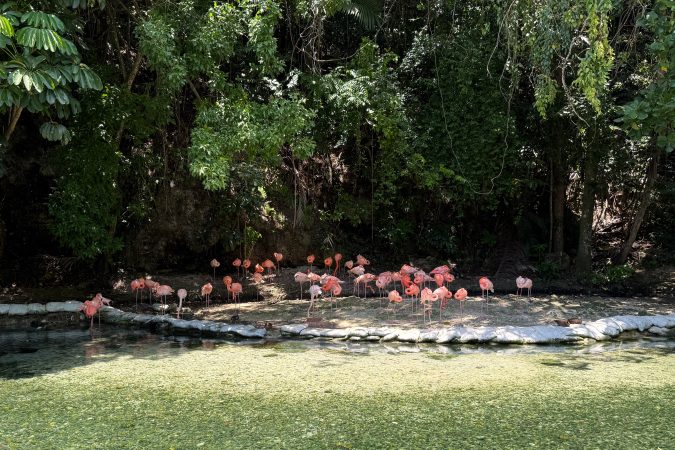
    They had recently been confiscated by authorities, and it showed. Their typically bright coral feathers were white, as if they had been bleached. Ferreira explained that their captors usually feed them white bread instead of the algae and tiny crustaceans their bodies require.

    To reduce the number of flamingos featured at hotels across the Dominican Republic, García Marcano said they have suggested that staff embrace species including the purple gallinule, a cranelike bird with iridescent feathers.

    At the zoo, the rescued flamingos receive carrots and bird feed and are rehabilitated for several months before some are released back into their natural habitat.

    Nearby, several crocodiles sat without blinking in individual cages filled with greenish water. They, too, had been snatched from their natural habitat and kept as pets.

    Encompassing 309 acres, the zoo is big enough that a small train ferries visitors to exhibits, but resources are stretched. Territorial animals such as crocodiles must be isolated, which requires more cages and, in turn, more funding.

    Veterinarians run multiple tests on the rescued animals to determine their health. Many will require a strict diet because their owners would often have fed them the wrong food, weakening an animal’s immune system and causing physical deterioration.

    “Before, we only received parakeets and parrots,” said veterinarian Tatiana Carreño Pinto. “Now we have a much wider range of species arriving at the park.”

    ‘It’s like cat and mouse’

    The zoo also is preparing to take in exotic animals confiscated in neighboring Puerto Rico as part of a deal reached last year, including caimans that have been seized from suspected drug traffickers.

    Puerto Rico, a U.S. territory, is struggling with an overload of exotic species, with nearly 100 animals seized over the July 4 weekend alone. They included 80 boa constrictors, eight native boas, four reticulated pythons, three caimans, and four troupials — Venezuela’s state bird.

    An official with the Rangers Corps of Puerto Rico’s Department of Natural and Environmental Resources did not respond to multiple requests for comment.

    In the Dominican Republic, officials continue to try to save species that once roamed free.

    A project was launched last year to save an endemic parrot, which is under threat and commonly kept as a pet. The government has erected large billboards warning against trade in the parrots. García Marcano said officials are receiving a growing number of calls about this practice as people spot them along roads while traveling.

    The zoo, once again, steps in to help feed and rehabilitate the seized parrots.

    “Operations have been carried out, arrests have been made,” García Marcano said. “It’s like cat and mouse. You have to maintain constant vigilance.”

  • A new media ecosystem is taking root on the left, reshaping Democratic politics

    A new media ecosystem is taking root on the left, reshaping Democratic politics

    NEW YORK — Farah Berent, a physician assistant in Holland, Michigan, used to learn about politics from channels like ABC, CBS and CNN. But that changed as she decided that coverage of the war in Gaza was irreparably biased.

    “I couldn’t stand all the lies on the stations,″ said Berent, arguing that there wasn’t enough attention being paid to Palestinian suffering. “I started going to Instagram to get my news.”

    Berent is among many progressive-minded Americans who have sworn off legacy media institutions. They’re turning to a widening mix of independent podcasts, social media accounts and digital news sites, part of an increasingly influential ecosystem that has boosted this year’s wave of anti-establishment, left-leaning candidates who may not have gotten as much attention otherwise.

    Liberals remain more likely than conservatives to trust mainstream outlets, but the splintering echoes how conservatives skeptical of their party created a collection of insurgent news sites years ago. The shift has elevated individual commentators with opinions on the news, some of whom have proven influential in driving people’s votes.

    Ryan Grim, a co-founder of Drop Site News and a veteran of online political debates, said progressive politicians have sought out his platform to reach voters. In a change from previous election cycles, “they have ways to get covered even if the mainstream just basically ignores them,” he said.

    One of those candidates is Abdul El-Sayed, who is running for U.S. Senate in Michigan and faces the more moderate U.S. Rep. Haley Stevens in the Aug 4. primary.

    “I think in a lot of ways, where traditional media has been gatekeepers, we’re watching that gatekeeping function fall away,” El-Sayed said.

    Anti-establishment media has exploded lately

    These changes have been on display this year in places like New York City, where a slate of progressive congressional candidates endorsed by Mayor Zohran Mamdani defeated establishment-backed candidates.

    Sara Hyler, a policy analyst in East Harlem, originally planned to support incumbent Rep. Adriano Espaillat in last month’s Democratic primary. But then Hyler started learning about progressive outsider Darializa Avila Chevalier through YouTube videos and podcasts, including from the liberal media company MeidasTouch.

    “My actual beliefs are to the left of Democrats. I don’t want a moderate,” said Hyler, who ultimately voted for Avila Chevalier in hopes she could help nudge Congress toward progressive policies.

    The rise of independent media has been part of a digital transformation that transcends politics, as chronically online Americans are turning toward news from social media and content creators. But it’s not just the popularity of smartphones driving that change.

    “There’s a complete lack of trust in any and all institutions now,” said Mike Nellis, a Democratic consultant who hosts a podcast, writes a Substack and posts political analysis on social media. “That has led people to turn to individuals, and so now you’re picking your flavor of person to listen to.”

    Among conservatives, faith in mainstream media and in the more moderate wing of the Republican Party faltered years ago, with the rise of the Tea Party movement paving the way for an alternative right-wing media ecosystem, including sites like the Daily Caller, Breitbart and The Blaze. Trump also tapped into a loose constellation of podcasts, including “The Joe Rogan Experience,” for his successful comeback campaign.

    Reece Peck, a media culture professor at the College of Staten Island, said the left-wing version of that has happened slowly, beginning with the momentum of Sen. Bernie Sanders’ first presidential run in 2016. At the time, left-wing, anti-establishment YouTube accounts and podcasts like “The Young Turks” and “Chapo Trap House” were gaining attention but didn’t reach the majority of Democratic voters.

    Now Democrats have realized their faith in institutions didn’t prevent Trump’s return.

    “The ground has been made fertile for an anti-establishment media politics, where it just wasn’t quite there with the voter base in those previous cycles,” Peck said. Even older, moderate liberals, he said, have started to ″throw their hands in the air and look for alternatives.”

    YouTube accounts like ”Secular Talk” and “Breaking Points,” streamers like Hasan Piker and new digital journalism organizations like More Perfect Union and The Lever are among those that have seen their audiences multiply.

    Grim said Drop Site has amassed 800,000 free and 60,000 paid subscribers since launching two years ago — more than he’d anticipated.

    Saul Levin, a Michigan progressive organizer who recently started his own podcast about artificial intelligence data centers, said Trump’s attacks on the existing media landscape are part of the reason for that growth.

    “The investigations and raids on numerous different journalists, the appointment of specifically aligned billionaires to lead various major news agencies, is very troubling,” he said. “Creators and new media outlets are stepping in and trying to fill gaps.”

    Alternative media is prominent in the Michigan primary

    The Michigan primary will be the latest test of the evolving media ecosystem, which El-Sayed, a longtime podcaster himself, has tried to harness. Various progressive outlets, creators and organizers have aggressively promoted his campaign.

    El-Sayed said the rise of independent media has let voters compare news across different channels and notice biases, but he doesn’t turn down opportunities on legacy media, either.

    “I go on Fox News, I go on podcasts, I Twitch stream, we have a YouTube channel,” he said.

    Stevens, who received endorsements from outgoing incumbent Sen. Gary Peters, Michigan Gov. Gretchen Whitmer and Senate Democratic Leader Chuck Schumer, has a more traditional approach. She’s also backed by the American Israel Public Affairs Committee, or AIPAC, and its affiliated groups, which have spent close to $30 million on the race.

    Stevens’ campaign declined to comment for this story.

    Reporting from progressive outlets has influenced how the race has unfolded. For example, Stevens parted ways with a campaign consultant when Drop Site revealed that she had also worked for tech company Palantir, which is controversial in liberal circles because of its government contracts involving immigration enforcement.

    Democratic officials said Trump’s return to the White House has also revived interest in the party’s official channels. The Democratic National Committee’s relatively new digital media offering, a rapid-response clipping and messaging account with the handle @FactPostNews, has amassed more than 2 billion impressions on Threads, X, Facebook, Instagram and Bluesky in 2026 alone.

    “I remember thinking to myself, there’s a chance that this flops and doesn’t get any traction,” said DNC Deputy Chief Mobilization Officer Paulina Mangubat. “It’s been really, really successful.”

    At times, the mix of new voices on the left has erupted in public tensions.

    Grim recently faced criticism for boosting failed Democratic candidate Graham Platner in Maine, and he was accused of trying to undermine the credibility of the sexual assault allegation that torpedoed Platner’s campaign. Grim said while he recognized people were angry, his reporting on the allegation was meant to share additional context.

    “If we’re going to litigate allegations in the court of public opinion, we can’t pick and choose what details we want to share with the public out of a fear of how they’ll be received,” he said.

    More recently, when Drop Site interviewed progressive U.S. Rep. Ro Khanna of California, one of its journalists pressed Khanna on whether Hamas was justified to attack Israeli soldiers on Oct. 7, 2023. Khanna refused to agree.

    But Grim said those are the kinds of tough questions independent media are there to ask — and that American voters increasingly want to see their representatives in Congress answer.

    “People want to see you being accountable to questions, and if they don’t agree with you, sometimes that’s fine,” he said. “I think the smarter politicians are starting to recognize that.”