Tag: no-latest

  • Letters to the Editor | Aug. 2, 2026

    Letters to the Editor | Aug. 2, 2026

    Facing truth

    The longer I live, the more I see how family difficulties and those that must be confronted in our society have parallels. One mutual theme is denial — in therapist lingo, it is far, far more than a river in Egypt. It is the inability or refusal to see glaring truth. For example, when a daughter speaks up about sexual abuse — most often by a close family member — her mother often refuses to believe her for myriad reasons, usually supported by other family members, including siblings. In time, with support, a violated young person can move on with their own life, even if rejected by blood relatives. Let’s use this lens to look at the sneaky removal of the truth about the people enslaved by George Washington at the President’s House.

    It is not coincidental that it was done in the cover of darkness by those who refuse to face the truth. The panels depict violations endured by human beings treated like chattel. They were ugly things to consider, but they were things America must face. Regardless of the stony path of reality, a country, like a family, must face the truth to move forward together with any semblance of health. Once we find the courage to confront reality together, there is no problem that we cannot solve.

    Of course, a young, abused woman whose family does not face the truth of her hell can move on. But a split on the truth is something America cannot survive. Tragically, this split is being fed by leadership in Congress and the White House. There is only one way to address this cancer in our midst. There is only one way for America to survive. I ask all who support Donald Trump to face the truth: We no longer have a president leading and inspiring America. We have only a dictator, committed to denying us the opportunity to come together and heal.

    SaraKay Smullens, Philadelphia

    Labor loyalty

    The recent article about unions supporting Republican Reps. Brian Fitzpatrick and Rob Bresnahan was infuriating. According to the latest AFL-CIO scorecard, the average score (i.e., the percentage voting with labor) for the seven Pennsylvania Democrats in Congress was 98% for 2025 and 99% for their lifetime. The 10 Republicans in Pennsylvania’s congressional delegation achieved an average 6% in 2025 and 16% in their lifetime. Of those Republicans, Fitzpatrick’s 2025 score was 46% and 58% for his lifetime, whereas freshman Bob Bresnahan attained 8% as both his 2025 and lifetime scores.

    What these statistics tell us is that while the principles of the AFL-CIO and its affiliates are lined up closely with Pennsylvania’s Democrats in Congress, many union leaders still prefer to grade on a curve when considering endorsements for Republicans. Rewarding representatives for work on a particular bill is no way to run a political endorsement campaign. Supporting candidates who will stand consistently with labor is.

    Coleman Poses, Philadelphia

    Join the conversation: Send letters to letters@inquirer.com. Limit length to 150 words and include home address and day and evening phone number. Letters run in The Inquirer six days a week on the editorial pages and online.

  • Horoscopes: Sunday, Aug. 2, 2026

    ARIES (March 21-April 19). What will happen if you trim extra words from your correspondence, your conversations, your stories, your instructions or your requests? Try it and find out. The fortunes favor succinct, purposeful communication.

    TAURUS (April 20-May 20). Those who do nothing invite very little criticism. Those who take initiative attract opinions. Keep that in mind as you sort through the feedback. Give yourself credit for being the one who stepped boldly forward.

    GEMINI (May 21-June 21). Someone can be funny, generous, vain, insecure, ambitious and pretentious all at once because people are mixtures. Seek information without judging. Leave room for people to be complicated.

    CANCER (June 22-July 22). Worry rarely improves the outcome. Experience does, though — and reliably so. Every time you put yourself through a bit more life, you collect another piece of evidence that you’re capable of handling whatever comes next.

    LEO (July 23-Aug. 22). In some restaurants, the food can be ordered on a sliding heat scale of zero to five, with zero being an absence of pepper and five being fire. If today were a dish, it would be hot as they come.

    VIRGO (Aug. 23-Sept. 22). You’ve spent enough time beating yourself up over what didn’t happen, about what went sideways, or didn’t happen at all. Instead of working through the particular situation and psychology, try this one on for size: Who cares?

    LIBRA (Sept. 23-Oct. 23). You don’t have to slow down your thoughts to be happy. A still mind is more of a poetic ideal than a psychological reality. For a mind to wander into anticipation, memory, rando-associations and problem solving… well, that’s just healthy.

    SCORPIO (Oct. 24-Nov. 21). You may feel an urgency today that wasn’t there before. You want life to go faster. Narrow down your options, shorten your lists, forget about some of the rules. When you remove what’s unnecessary, the action accelerates.

    SAGITTARIUS (Nov. 22-Dec. 21). Some like to shop for options, others study and plan, as for you — see the problem, fix the problem, not theoretically but materially. And you do it fast. No wonder you’ll collect customers and fans.

    CAPRICORN (Dec. 22-Jan. 19). It seems you’ve over-obligated yourself — which is just what happens when your generous heart intersects a miscalculation of the amount of time and energy things actually take. But don’t stress. This all fits together when put in the right order.

    AQUARIUS (Jan. 20-Feb. 18). As much as you don’t want to lean on anyone, it may be your best move. People favor those they help. People like those who need them more than those they need. Letting someone assist you today is simply a smart strategy.

    PISCES (Feb. 19-March 20). If the Wright brothers had aligned their expectations with reality, they’d have stayed on the ground. Your life has also been shaped by moments when you expected something that didn’t exist yet. Today, the thing to align isn’t expectation, but prediction.

    TODAY’S BIRTHDAY (AUG. 2). It’s your Year of the Voice Command. Doors open when you speak your wishes. As you develop and share your unique takes, whole rooms reorganize around you. Casual introductions lead to oversized opportunities, which you’ll leverage through this new chapter. More highlights: You’ll make ever-bigger deals. Family both depends on you and elevates you. You’ll be loved back in kind. Pisces and Cancer adore you. Your lucky numbers are: 1, 4, 30, 22 and 15.

  • Dear Abby | Ex’s passing is just a reminder that he was a jerk

    DEAR ABBY: After a nearly 20-year marriage, my first husband, “Lloyd,” told me his feelings for me had changed. He said we needed “some time apart,” but he didn’t want a divorce. He immediately went to a lawyer and executed a financial settlement for me, still insisting he wasn’t going to file for divorce. Six weeks later, I bought a house and moved. Two weeks later, Lloyd’s son told me my husband moved a woman in with him two days after I moved out. Obviously, we divorced.

    In time, I remarried and was very happy for 13 years until my husband died. I took care of him for the last three years. A year later, my older brother became ill, and I went to help him 300 miles away. It also turned into a nearly three-year stay.

    I have been back home for only a year and a half now. I just received a text from a friend of Lloyd’s, telling me Lloyd has passed away. None of Lloyd’s family contacted me, nor did they let me know his brother had died a while back. I have been so hurt by this man. After I moved, he told many lies. He said that I had been cheating, etc., and literally turned the whole community against me. When the true story came out, a lot of people apologized for treating me so badly.

    I feel indifference toward my ex. The bad memories with him far outweigh the good ones, and I don’t want to go to his funeral. It would feel two-faced because I lost all respect for him many years ago. Am I wrong for not acknowledging his death?

    — MOVING ON IN THE SOUTH

    DEAR MOVING ON: You certainly are not wrong. People attend funerals in order to pay their respects and emotionally support the grieving family. Your presence is not required at this one. Lloyd’s family would not welcome it, and neither would the woman who helped to break up your marriage. On that day, do something you would enjoy, ideally with friends who support you.

    ** ** **

    DEAR ABBY: Two years ago, my mother bought a pair of diamond earrings for us to split. She wears one every day, and I wear the other. She tried doing the same thing with my older sister about 20 years ago, but after my sister lost her diamond earring for the second time, they mutually agreed to give up.

    Last summer, my mother gave me a box of old jewelry, odds and ends. I found two diamond earrings that looked similar but weren’t from the same pair, so I took them — who doesn’t like diamonds? Now I am realizing they’re likely Mom’s half of the pairs she split with my sister. Can I wear them? I have a place for each, but would it be an act of bad faith to horn in on what was originally their tradition?

    — BEJEWELED IN NEVADA

    DEAR BEJEWELED: Your mother gave you the box of old jewelry. The items were hers but now they are yours. Your sister lost the mates to those earrings and the tradition ended. Your sister should have no claim on them. Wear them and enjoy them without guilt.

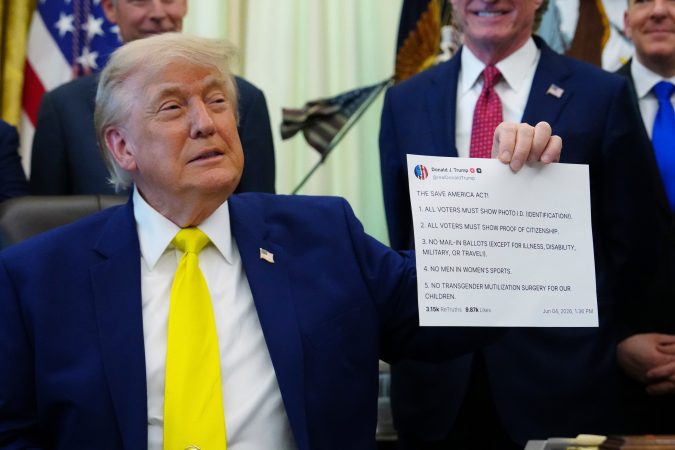
  • Trump stands to profit from U.S. policy announcements by selling fast access to his social media posts

    Trump stands to profit from U.S. policy announcements by selling fast access to his social media posts

    NEW YORK — President Donald Trump knows the world hangs on his every word. Now he wants you to pay for it.

    The social media posts of the world’s most powerful man are going on sale Saturday when his Truth Social business begins offering sneak peeks of them to Wall Street traders willing to pay up. The move raises the prospect of big profits for Trump’s company and big questions about insider trading and using public office for private gain.

    Similar fast speed feeds are sold by other social media firms and media providers, but Truth Social doesn’t just distribute the news, it makes it, regularly rattling markets as Trump posts policy changes on everything from war to central bank leadership to tariffs.

    “If this was the CEO a public company, this would be jail time,” said Irene Aldridge, head of Able Alpha Trading, which doesn’t plan to buy the service. “We have a President of the United States who has the front seat to all the action, who makes all the decisions, and he’s disclosing this ahead of time to a select group.”

    Trump’s company says critics just aren’t capitalist enough

    Asked about the propriety of the new service and whether White House lawyers had vetted it, Trump’s press office declined to comment, referring questions to Truth Social’s publicly traded parent. That company, Trump Media & Technology, issued a statement blasting Democratic critics for mischaracterizing the service “out of ideological opposition to free markets or a failure to grasp the distinction between public and nonpublic information — or, quite possibly, both.”

    A prolific poster, Trump has sent stocks, bonds and currencies soaring and plunging with his online musings and threats. That presents opportunities for so-called high frequency traders that specialize in buying and selling within milliseconds, exploiting tiny, fleeting difference in prices.

    Profits aplenty betting on oil, stocks, and currencies

    Just this month, Trump has threatened on Truth Social to slap higher tariffs on Canada, kill a nuclear deal with Saudi Arabia, and widen the Iran war. With advanced knowledge, traders betting on a plunge in the Canadian dollar, a drop in nuclear energy stocks, and a jump in oil futures could have raked in big profits.

    “For the big guys, it’s going to be something they need,” said Joe Saluzzi, co-founder of Themis Trading, who estimates about 100 of high frequency firms might be willing to pay for the service. “It’s market-moving information.”

    Dubbed Truth API, the service comes as these firms are spending more on feeds and servers that bypass slower internet connections with direct lines to news and data sources. The chance for profits is greater than ever thanks to artificial intelligence’s ability to read posts and articles more accurately for market-making changes and Trump’s penchant for making news online.

    When Trump makes surprise announcements, traders pounce

    Traders profit when prices jump up and down, and with his taste for cliffhangers, threats, and policy reversals America’s first reality-TV president provides plenty of potentially market-moving content.

    The reversals are especially profitable, allowing traders to win both ways — jumping ahead of stocks moving up or down to a post threatening something, then cashing out within thousands of a second, then betting the other way.

    In addition to Trump, the service will include posts from other “high ranking” Truth Social contributors, including possibly his two oldest sons, Donald Jr. and Eric, who along with the father are heavily followed by users.

    Truth Social has said that the information will be released to the traders and the general public at the same time so there really isn’t an issue of fairness. But Themis Trading’s Saluzzi, a critic of high speed trading, says that’s a red herring because when the posts are received, not when they are released, is what matters.

    “Somebody who buys the info and has a system built to process it will be able to act quicker than you and me,” said Saluzzi, adding in reference to everyday, small stock buyers, “The loser is always the retail investor.”

    Trump posts about a company he likes, and stocks jump

    Aside from policy scoops, another reason to sign up has emerged in recent months: Trump is posting more about publicly traded companies, praising ones he likes in a way that sets off buying frenzies.

    “The pimping of specific companies — obviously Wall Street would like to know that before other people,” said Dylan Hedler-Gaudette, a federal ethics rule expert at the watchdog Project on Government Oversight. “It’s a real mess.”

    In April, moments after Trump praised Palantir Technologies in a post that included its stock symbol, the price briefly jumped the most it had in an entire year. Later that month, Trump posted, “Congratulations on Intel doing such a great job,” and the stock immediately jumped in after-hours trading.

    Just which firms are signing up for the feed is unclear. Asked for comment, none of the half dozen most well known high-speed traders, such as Citadel Securities and XTX Markets, replied. If just three sign up for the $100,000 a month fee, that would double revenue at Trump Media, which reported taking in $3.7 million last year.

    Trump Media needs big money customers

    The company can use their business.

    Stock in the Truth Social parent has plunged 75% since Trump took office last year as the company keeps reporting hundreds of millions in losses despite the president’s help driving traffic to its site by posting major decisions there.

    In fact, the president breaks news on Truth Social so often that the White House press office will copy his posts into an email when responding to questions from the media seeking details on policies. If his posts aren’t available yet, journalists are sometimes told, “Wait for the Truth.”

    Another problem for Truth Social is looming if the Democrats take control of Congress and launch investigations, as vowed by Massachusetts Senator Sen. Elizabeth Warren in a statement Friday specifically attacking the new service: “We will haul in those responsible for this open corruption to answer to the American people.”

    If the losses keep mounting for the company, though, some predict the president will push things further, using the platform even more for policy announcements.

    “That’s absolutely going to happen,” warns Craig Holman, a lobbyist for the good government group Public Citizen. “Trump knows how to sell products.”

  • Courts hand NCAA major loss on five-year eligibility rule that could send college sports further into chaos

    Courts hand NCAA major loss on five-year eligibility rule that could send college sports further into chaos

    DENVER — A federal court dealt a perhaps chaos-inducing blow to the NCAA’s new eligibility rule Friday when it ruled that all high school class of 2022 athletes who exhausted their fourth season of college eligibility this spring are eligible for a fifth season this school year.

    The ruling from U.S. District Judge Charlotte Sweeney in Denver, expected to be appealed, undercuts the NCAA’s plan to have the so-called “five for five” rule go into play starting with athletes who enroll in college in fall 2027.

    It also has potential to wreak havoc on rosters across the country — for instance, opening the possibility that an undrafted player in an NFL training camp could decide to try to head back to college for a fifth year this upcoming season.

    In granting the preliminary injunction, Sweeney said the players “will suffer irreparable harm without” it. She did not sign onto the governing body’s argument that applying the new rule retroactively would create “roster chaos.”

    But NCAA President Charlie Baker said it would in responding to the rulings while referencing a bill in Congress designed to provide the NCAA antitrust protection on the eligibility issues.

    “Today’s rulings and the chaos they bring to college sports are exactly why it’s time to pass this bill,” Baker said.

    The Colorado ruling came hours after a Tennessee court granted Jalen Washington, who most recently played at Vanderbilt, and 18 other basketball players a fifth season of eligibility.

    In June, the NCAA approved its new eligibility model for Division I athletes that will allow five seasons of competition over a five-year period that begins with their full-time enrollment or the academic year following their 19th birthday, whichever occurs first.

    While the ruling in Tennessee applied to those 19 basketball players, the one in Colorado cast a wider net, granting the class certification the plaintiffs sought. It means the ruling applies to all Division I players who started their college careers in the 2022-23 season, not just a select list.

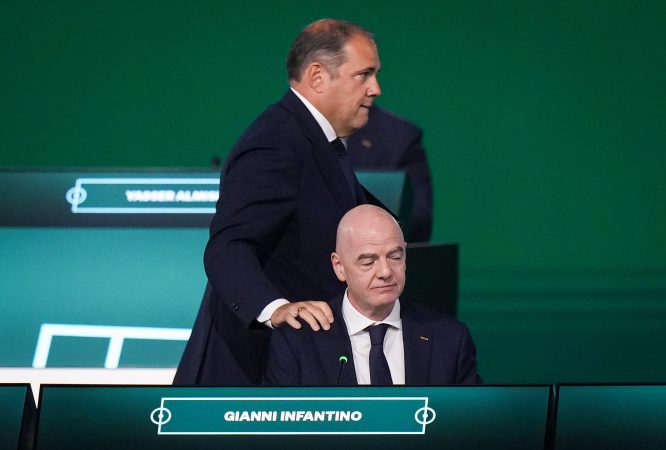
  • Concacaf and UEFA step up attacks on Gianni Infantino, call for a ‘comprehensive reckoning’ with FIFA president

    Concacaf and UEFA step up attacks on Gianni Infantino, call for a ‘comprehensive reckoning’ with FIFA president

    GENEVA — Successfully stopping Gianni Infantino’s FIFA plan to sell World Cup profits to private investors was the first half of a high-stakes game in global soccer politics.

    The second half kicked off Saturday with what seemed a clear aim of ending Infantino’s decade-long presidency.

    “No option should be off the table,” said European soccer body UEFA, whose president Aleksander Čeferin has led the fight against Infantino in a seismic week for FIFA.

    “The current FIFA leadership has not only lost UEFA’s confidence but also that of many other members of the football family.”

    Later Saturday, the governing body for North and Central American and Caribbean soccer (Concacaf) called for accountability, saying: “A (World Cup) proposal of this magnitude does not reach that stage by accident. It is a symptom of leadership that has stopped putting football first. This recent unilateral and egregious act of poor governance and leadership follows a pattern of missteps and similar behavior. A comprehensive reckoning with this presidency is imperative.”

    Infantino had proposed creating a $20 billion company to run the World Cup with private investors but drew backlash that grew every day since Tuesday’s announcement.

    Infantino was forced to scrap the plan early Saturday after his senior adviser who sat on a White House panel resigned and Asia’s soccer body joined Europe and North America in opposing it.

    UEFA, the governing body of European soccer, issued its blistering statement hours after FIFA announced it was withdrawing its private equity plan.

    “We cannot keep going on like this with secret schemes on fast-track timescales, cooked up by faceless individuals and of dubious benefit to the game,” UEFA said. “We must identify those responsible and hold them to account.

    “It is right that, in the coming days and weeks, UEFA will work with its associations and in close cooperation with other confederations to reflect on how this happened and devise a plan to make sure that it cannot occur again.”

    Norwegian soccer federation president Lise Klaveness, an elected member of the UEFA executive committee, said steps must be taken to protect the integrity of the sport.

    “The entire framework of international football cooperation was unnecessarily put at risk in pursuit of individual interests rather than the best interests of the game,” Klaveness said Saturday. ”This has been visible to many for a long time, including those of us elected to positions intended to safeguard checks and balances and provide ongoing oversight. We have to recognize that these mechanisms have not worked well enough.”

    The president of the Asian soccer confederation, Sheikh Salman bin Ibrahim Al Khalifa, said “the future of global football must always be shaped through proper consultation, collective dialogue and respect for the established governance structures of our game.”

    Infantino’s audacious bid fell apart after UEFA’s 55-member nations agreed Thursday to boycott the World Cup and all other FIFA competitions. CONCACAF and the Asian Football Confederation also said they opposed the plan.

    CONCACAF’s statement added that FIFA leaders have “a duty of service over power. Where that duty is not upheld, accountability cannot be optional.”

    There was also an internal revolt.

    Infantino’s senior adviser, Carlos Cordeiro, a former U.S. Soccer federation president and Goldman Sachs banker who represented FIFA on the White House Task Force for the World Cup, resigned on Friday and urged other senior FIFA staff to speak out.

    Hours later, FIFA chief operating officer Kevin Lamour issued a statement to The Associated Press, saying FIFA staff were deceived by Infantino’s lack of openness in planning the sale over recent months and that the project must not continue.

    “It is the project of one person,” wrote Lamour, a longtime colleague of Infantino at both FIFA and UEFA. “Not only must this project not go ahead … but the time has now come for football political leaders to ask themselves the right questions and make the right decisions.”

    Infantino had proposed spinning off FIFA’s commercial businesses — including World Cups and Club World Cups for men and women — into a $20 billion subsidiary with 20% owned by private investors.

    The “anchor investor,” described by FIFA, is a New York-based investment firm launched by Joshua Kushner, the younger brother of U.S. President Donald Trump’s son-in-law, Jared Kushner.

    This is not Infantino’s first big plan to flop

    A tumultuous week in international soccer is at least the third time Infantino has rocked it with an ambitious plan many in the sport saw as reckless.

    But the fallout from FIFA’s Kushner-backed plan is the first time UEFA has acted quickly to create momentum for removing the man who was its former longtime employee.

    Carlos Cordeiro (right) was a frequent presence when Gianni Infantino (second from left) visited the White House.Jacquelyn Martin

    In 2018, Infantino pushed a secretive offer of $25 billion from Japan’s SoftBank to create new competitions, that posed a long-term risk to continental events for clubs and national teams.

    In 2021, Infantino proposed playing World Cups every two years instead of four — an idea that also angered the International Olympic Committee where he is an elected member.

    Both plans created big rifts in the sport and were eventually dropped by FIFA.

    Despite the turmoil, Infantino was reelected unopposed in 2019 and 2023.

    The third time shapes to be different.

    Here is the calendar for the FIFA presidency

    Nov. 18 is the deadline for candidates to enter the next presidential contest, exactly four months ahead of the vote in Rabat, Morocco, where FIFA has its African headquarters.

    FIFA statutes allow Infantino one more four-year term in office. The failed spinoff venture seemed like a way to create a commissioner-like role for Infantino beyond 2031, likely paying much more than his current annual salary and a bonus deal of more than $6 million.

    It would take 106 votes to ensure a majority in a contested election. Continents surely do not vote uniformly en bloc, but most of Europe’s 55, plus Asia’s 46 and CONCACAF’s 35 FIFA members would be a solid base.

    The Qatar FA issued a statement in support of Infantino on Saturday.

    Its president, Sheikh Hamad bin Khalifa bin Ahmed Al Thani, said: “We welcome FIFA President Gianni Infantino’s decision to withdraw the FIFA Forward Enterprise proposal in the interest of the global football community.

    “While the proposal had merit, we applaud the wisdom behind prioritizing unity among Member Associations. The Qatar Football Association fully supports President Infantino’s efforts to continue growing and strengthening the game globally.”

    Inquirer staff writer Jonathan Tannenwald contributed to this article. Associated Press writer Joseph Wilson contributed from Barcelona, Spain.

  • U.S. general warns Pentagon he lacks sufficient forces to protect Israel

    The top U.S. general in Europe privately warned the Pentagon this week that he lacks sufficient naval forces to continue protecting Israel from incoming ballistic missiles, officials said, illustrating how the ongoing Iran war has imposed constraints on the military.

    Gen. Alexus Grynkewich, the head of U.S. European Command, sent written notification to senior Pentagon officials saying that without another Navy destroyer he will be forced to choose defense of the United States “homeland” over that of Israel, said the officials, who like some others spoke on the condition of anonymity to discuss the correspondence.

    A U.S. defense official said Grynkewich’s notification appears consistent with past outreach to the Pentagon from the military’s top generals when they see certain risks that require Washington’s consideration. This can occur, the official said, as commanders compete for finite resources and weapons.

    The Pentagon declined to comment. U.S. European Command did not respond to requests for comment. A spokesperson for the Israeli Embassy in Washington could not be reached for comment.

    The general’s warning comes at a tenuous moment in the five-month conflict, as near-daily attacks have resumed following the collapse of peace talks between Washington and Tehran and the operation’s intensity has drained U.S. supplies of key defensive weapons.

    The Navy has been particularly taxed, as the Trump administration has directed a blockade of Iranian ports in response to Tehran’s closure of the Strait of Hormuz. The standoff has stymied the movement of Middle Eastern oil and other commodities through the narrow waterway, upending the global economy.

    U.S. naval destroyers in the eastern Mediterranean Sea have been employed as a part of Israel’s defense for many years. The vessels, equipped with powerful radar and armed with an array of missiles, have downed missiles aimed at Israel not only by Iran, but by Houthi militants in Yemen that are equipped by Tehran.

    European Command is central to this mission, as it coordinates military operations in the Mediterranean. At the same time, its forces must remain ready for any Russian incursion into territory protected by the NATO military alliance. Russia also poses a ballistic missile threat to the United States, with missiles capable of reaching the U.S. mainland.

    The Navy has five destroyers that deploy from a U.S. port in Rota, Spain, with a sixth expected to arrive there later this year, Pentagon officials have said. But maintenance issues have piled up due to the Iran war’s tempo, complicating matters for Grynkewich, officials said. The Washington Post withheld specific details about the ships’ availability at the request of military officials, who cited security concerns.

    As the Post reported in May, Pentagon assessments conducted earlier in the war showed that U.S. forces have shouldered the brunt of defending Israel from Iranian ballistic missiles. The assessments found that American weapons, including the Terminal High Altitude Area Defense and naval interceptors launched from the eastern Mediterranean, were used far more frequently than Israeli air defense weapons.

    Two destroyers, the USS Paul Ignatius and the USS Roosevelt, were in the Mediterranean Sea on Friday, a U.S. official said. Three destroyers were in Rota: the USS Arleigh Burke, the USS Bulkeley and the USS Oscar Austin.

    Closer to Iran, an armada of additional vessels was in the Arabian Sea, including two aircraft carriers, the USS George H.W. Bush and USS Abraham Lincoln, and at least 15 other warships, this official said. Eleven are destroyers.

    The fleet has been central to the Trump administration’s blockade of Iranian ports. It also has been involved in an effort called Project Freedom, in which the U.S. military has helped protect vessels in the contested Strait of Hormuz.

    Another destroyer, the USS Gonzalez, is in the Red Sea, where Yemen’s Houthis have attempted to enforce their own blockade of commercial shipping in a bid to further the economic pressure facing the U.S. and its allies in the region. Saudi Arabia, a key U.S. partner, has sought to thwart the Houthis, a longtime adversary, by developing a military coalition to ensure freedom of navigation.

    The Iran war is increasingly unpopular among the U.S. public, and members of Congress — from both political parties — have grown frustrated with the administration as top officials struggle to articulate a plan for ending the conflict on terms deemed favorable to the United States. There is a deepening worry among many Republicans, particularly, that the war’s impact on the price of gas, food, and other goods will cost the party in November’s midterm elections.

    Tom Karako, director of the Missile Defense Project at the Center for Strategic and International Studies, a think tank, said the warning issued by Grynkewich highlights the scope of the Pentagon’s challenges.

    “Being on a wartime footing is going to take a toll in terms of readiness and munitions inventory levels,” he said. “Now the question is: What’s the strategy here?”

  • In Trump Gaza deal, Hamas disarms, Israel withdraws. Neither wants to go first.

    In Trump Gaza deal, Hamas disarms, Israel withdraws. Neither wants to go first.

    TEL AVIV — President Donald Trump this week touted “a HISTORIC agreement for the COMPLETE DISARMAMENT” of Hamas. But after his Board of Peace released the text of the 15-point plan Friday, analysts cautioned that there seemed to be a substantial gap between Israel and Hamas on a path forward.

    Under the agreement, the sides have 14 days to agree on the “timetable and implementation mechanisms” for the disarmament of Hamas and the withdrawal of Israeli forces from Gaza. But there was already disagreement on the order in which each should happen.

    Israeli Prime Minister Benjamin Netanyahu, who met with Trump on Tuesday, has been silent on the deal. In a statement to the Post, an Israeli official reiterated Israel’s long-standing position: “Israel demands the complete disarmament of Hamas, including the removal of weapons from Gaza and the full demilitarization of the Strip, as a prerequisite for any process.” The official spoke on the condition of anonymity to discuss the highly sensitive subject.

    Hamas, meanwhile, said Israel must end its military campaign in Gaza as a “first step.” The Israel Defense Forces on Friday announced the killing of men it described as a Hamas commander and a Hamas arms smuggler. Hamas also said that its agreement to surrender heavy weapons was contingent on Israel’s “cessation of all forms of hostility,” among other variables.

    Jonathan Rynhold, a senior researcher at the Begin-Sadat Center for Strategic Studies at Bar-Ilan University, said the effort to move toward disarmament and demilitarization in phases represented “some kind of progress,” but obstacles remained.

    “On a practical level, what Israel wants is for Hamas to disarm, and then for Israel to withdraw. Hamas wants the opposite,” he said. “Israel does not believe that Hamas will voluntarily disarm in a material sense.”

    Under the agreement, the weapons Hamas surrenders are to be held by the National Committee for the Administration of Gaza, run by Palestinian technocrats. The fear in Israel, Rynhold said, is that the militants, who led the surprise attack that killed about 1,200 people in Israel on Oct. 7, 2023, will retain the ability to intimidate whoever is in the government in Gaza.

    Israel responded to the Hamas attack with a military campaign that has killed more than 73,000 people, according to the Gaza health ministry.

    “The bottom line,” Rynhold said, “is that Israel doesn’t think that Hamas has changed its DNA.”

    There will be “no Israeli withdrawal from the Yellow Line before Hamas is disarmed and the Gaza Strip is demilitarized,” the Israeli official said. The line marks territory controlled by Israel since the sides agreed to a ceasefire in October. The territory amounts to about half the enclave.

    Ibrahim Al-Madhoun, a Gazan political analyst seen as close to Hamas, said the plan “represents significant political progress” toward an end to the war.

    “But optimism must remain cautious,” he said in a statement. “Israel has not finalized its position, and Netanyahu is evading and trying to evade the deal’s entitlements.”

    A month ago, Hebrew University political scientist Gayil Talshir noted, Netanyahu was boasting that Israel controlled 70% of the Gaza Strip — implying that the IDF had gone beyond the yellow line.

    Talshir predicted the IDF would first withdraw to the yellow line. Later, “if Hamas is indeed disarmed,” she said, “the IDF will gradually withdraw to the perimeter.”

    With elections in October, Talshir said, Netanyahu doesn’t want to give opponents the opportunity to say he has approved the withdrawal of military forces in either Gaza or Lebanon, where Israel is fighting Hezbollah. Israel has in fact withdrawn from several villages in southern Lebanon, ceding control back to the Lebanese army, and Trump’s announcement suggested more to come.

    There appears to be “a gap between the facts and how Netanyahu is presenting them,” Talshir said. Netanyahu, she said, is trying to portray himself as close to Trump but also able to stand up to him.

    “This is the narrative he sells in Israel — that only Netanyahu can say ‘no’ to an American president. This is both contradictory and makes Trump’s blood boil.”

    Right-wing National Security Minister Itamar Ben Gvir said Friday the agreement will allow “Hamas to organize for the next massacre.”

    Madhoun, the Gazan analyst, said the Israeli elections will complicate implementation of any agreement. “The Gaza war has turned into political and electoral material,” he said.

    Gadi Eisenkot, a leading challenger to Netanyahu, said, “The infuriating gap between [his] promises and reality has been exposed.” The deal stems from his “political weakness,” the former IDF chief of staff said, and will leave Hamas in power in Gaza.

    Michael Milstein, a former adviser on Palestinian affairs to the Israeli military, said there appeared to be a gap between Netanyahu’s claim of an “excellent” meeting with Trump and the details of the agreement. But he said he doubts Trump is “set on the details” of the deal.

    “I say this cautiously, but it seems that what is happening aligns with Hamas’ interests, which is mainly the growing pressure on Israel to begin the withdrawal,” said Milstein, who is now at the Moshe Dayan Center at Tel Aviv University. “No one is conditioning every single bit of progress [in the agreement] on complete disarmament.”

    The government’s mistake, he said, was refusing to “engage with a political track.”

    “The deal ends up being forced on you from the outside.”

    For Netanyahu, he said, the timing is a “nightmare scenario.”

    “If Trump is determined to push this forward — realizing he isn’t securing achievements in Iran, Lebanon, and Ukraine — and Netanyahu remains extremely stubborn about not complying with anything, this opens the door to friction.”

    The question, Madhoun said, is whether the Trump administration can “oblige Israel to implement what is agreed upon.”

    Hussam Al Hwaiti hoped so.

    “After three years of war, killing, destruction and siege, I say ‘enough,’” the Gaza merchant said Friday.

    “We don’t want to resist,” he said. “Hamas is weak now. They are not in a position to continue the fight. … It’s time to return back to our normal life, travel, and send our children to school.”

  • Spain installs sea barrier on Ceuta’s border with Morocco after frontier rush that killed 67

    Spain installs sea barrier on Ceuta’s border with Morocco after frontier rush that killed 67

    CEUTA, Spain — Spain on Saturday installed a 1,600-foot-long barrier on the sea border between its North African territory of Ceuta and neighboring Morocco after tens of thousands of migrants breached the frontier earlier in the week.

    At least 67 migrants died, including some who drowned and others who were killed in a stampede to cross a breakwater barrier, the Spanish government said Saturday.

    Spanish Prime Minister Pedro Sánchez slammed the reaction of some other European Union leaders to the events in Ceuta, saying calls for Spain to be suspended from the EU’s borderless Schengen zone were “driven by prejudice, fake news, ignorance, or political interest.”

    A handful of exhausted migrants who swam to Ceuta’s urban Tarajal beach Saturday morning were met by soldiers who escorted them across the border. Most of the 50,000 to 60,000 migrants who entered the territory between Thursday and Friday soon went back.

    “We are relentless against those who break the law,” Spanish Interior Minister Fernando Grande-Marlaska told journalists Saturday.

    Questioned how the massive border breach could have happened given the heavy security on both sides of the border and whether Morocco posed a threat to Ceuta, Marlaska defended the government in Rabat.

    “The events require an evaluation by Spain and Morocco,” he said. But it was the cooperation with its neighbors that allowed Spain “to revert the situation in 24 hours.”

    “Morocco is not a threat to Ceuta, or to the rest of Spain. It is a reliable partner,” Marlaska emphasized.

    EU leaders call for coordinated response

    The leaders of 22 EU countries called for a coordinated response to the situation. In a letter to top EU officials, released Saturday by the Danish prime minister’s office, the countries asked the EU’s current Irish presidency to urgently convene a videoconference of interior ministers.

    “We cannot allow uncontrolled mass crossings, the instrumentalization of migration, or other hybrid threats to create the perception that illegal entry into the European Union is possible. That a migrant’s illegal entry can turn into legal stay,” the letter said. “Such a perception would encourage further attempts, undermine confidence in our common migration policy and have repercussions for all Member States.”

    Leaders of Italy, Denmark, Austria, Belgium, Bulgaria, Cyprus, Croatia, the Czech Republic, Estonia, Finland, Germany, Greece, Hungary, Latvia, Lithuania, Malta, the Netherlands, Poland, Romania, Slovenia, Slovakia, and Sweden signed the letter.

    Sánchez also asked for a videoconference of EU interior ministers to “enable us to establish a common response to situations of this kind and reaffirm that the security of our external borders is a shared responsibility of all Member States, and not only of those on the Union’s front line.”

    Italian Premier Giorgia Meloni has threatened to suspend Italy’s open-border Schengen agreement with Spain, and Italy was reimposing border controls for people arriving from Spain by air and sea.

    “In the current international context, the European Union cannot afford this kind of selfish, polarizing, and unlawful reaction,” Sánchez wrote in his letter.

    Migrants head back into Morocco

    Hundreds of migrants returned to Morocco on Saturday. Some told an Associated Press reporter they were returning “of their own free will” after what they described as degrading treatment on the Spanish side of the border.

    Migrants walked along a long stretch of wave breakers before slipping into Morocco through a small breach in the border fence that had become an informal entry point. Moroccan police and soldiers watched. Most of the migrants were Moroccans, while a smaller number were from sub-Saharan Africa.

    Hungry and angry, some barefoot or shirtless and others nursing visible injuries, those who returned said they had “seen hell in Ceuta.”

    “I decided to come back on my own,” said Ouail Lamzeiz. “I spent eight days in Ceuta, and I was about to get a bed at the migrant center, but I hadn’t eaten for days. Even the Moroccans there didn’t help,” he added, showing a document supporting his account.

    His friend, Salah Eddine El Arrage, said he decided to return to Morocco after, he said, Spanish police beat him.

    Migrants said they spent their nights sleeping in the forests around Ceuta because they could not find shelter, and that they often fought over food.

    One, Othmane El Merzoug, asked passersby for a phone call so he could reach his family and ask them to send money for the journey back to his hometown, about 189 miles from the border.

    Along Ceuta’s Tarajal beach, sunbathers largely ignored the streams of migrants walking toward the border.

    Ceuta resident Mohamed Abdelatif, 21, said the border rush had ruptured the city’s peace.

    “The reality is, it’s not good,” Abdelatif said, before wading into the water with his girlfriend.

    The road linking the Moroccan town of Fnideq to the border crossing bore the scars of the unrest. Burned-out vehicles sat along the roadside, while the acrid smell of smoke still hung in the air. Police barriers channeled traffic toward the crossing, and water cannons remained stationed nearby.

    “Life in this city has been disrupted as a result of the border incident,” said Ceuta President Juan Jesús Vivas. “The return of people has begun satisfactorily but the process must be completed.”

    In the Moroccan city of Tangier, about 46 miles west of Ceuta, the main railway station was busy with people returning. Some slept on the ground.

    “I tried to cross, but I failed. I stayed near the border with Ceuta for two days, but I couldn’t find anything to eat,” said Abdalah, an aspiring migrant who asked that his last name not be published out of fear of retaliation for trying to cross illegally.

    But some who made it to Ceuta were determined to stay. Among them was Mohamed Hatri, a 23-year-old Moroccan.

    “They’ve closed everything down so that we can’t buy anything to eat, to force us to return to our country,” he said, adding that he and others were determined to stay “whether we’re hungry or not.”

  • Trump’s threat to push ahead on settlement fund injects new uncertainty into attorney general talks

    Trump’s threat to push ahead on settlement fund injects new uncertainty into attorney general talks

    WASHINGTON — President Donald Trump on Saturday threatened to push forward with a fund to compensate his allies if two Republican holdouts will not support his nominee for attorney general, injecting fresh uncertainty into a Senate confirmation vote planned for next week and underscoring once more his interest in securing payouts for supporters who feel unjustly persecuted.

    Trump asserted in his Truth Social post that he would keep acting Attorney General Todd Blanche in his current role and press ahead on the “Anti-Weaponization Fund” if Sens. John Cornyn of Texas and Thom Tillis of North Carolina refuse to back the former federal prosecutor who was a key member of Trump’s defense team when the Republican battled four indictments.

    The administration needs their votes but both lawmakers have protested Blanche’s selection because of a lawsuit settlement that created a $1.8 billion fund to compensate people who feel mistreated by the criminal justice system and provided Trump and his family members with immunity from tax audits.

    In a sign of apparent progress Friday, Trump pronounced the fund “dead.” As negotiations continued into the night, the chairperson of the Senate Judiciary Committee, Sen. Chuck Grassley, rescheduled a committee vote for Blanche that had been postponed earlier in the week.

    A spokesperson for the committee said Grassley (R., Iowa) would like to see Blanche confirmed before the August recess and that putting the Tuesday vote on the calendar “gives more time for the White House to secure the votes for the President’s nominee.”

    But by Saturday morning, those plans were in jeopardy with a new announcement from Trump that appeared to put the fund back on the table — and dinged the two senators who are leaving Capitol Hill when their terms end in January.

    “If Senators Cornyn and Tillis, both upset because I wouldn’t Endorse them (they lost, and quit, respectively!), aren’t going to approve Todd Blanche, one of the most respected professionals, according to everybody, in the Country, to be the United States Attorney General, then I will keep Todd as Acting A.G., and push hard” to restore the fund. The president insisted, as he previously has, that the fund “takes care of those who have been so badly treated” during the administrations of Democratic Presidents Barack Obama and Joe Biden.

    Tillis, who is retiring, took note of the president’s turnabout by saying in a post on X that despite Trump’s comments Friday, he “clearly intends to resurrect the payout pot for punks either by inappropriately establishing another bogus fund or pushing Congress to vote for a bill that the majority of Republicans in the Senate would be against.”

    He added: “It’s unfortunate that Todd Blanche, who I consider qualified for the job, will not be confirmed because of this reversal. Hopefully, we can resolve this by Tuesday.”

    Blanche had said at a hearing two months ago that the anti-weaponization fund would not move forward after Republican senators revolted and held up an immigration funding bill.

    But Tillis and Cornyn, who lost reelection this year after Trump endorsed his primary opponent, said they want to ensure that the White House does not reverse course, especially as Trump continues to argue that a fund is needed.

    The Department of Justice has provided the senators with language that says Blanche’s May 18 order establishing the “Anti-Weaponization Fund” is “rescinded and shall have no force or effect,” according to a document reviewed by the Associated Press.

    Cornyn and Tillis have said they also want some clarifications on a separate piece of the settlement that would grant Trump and members of his family immunity from tax audits. Cornyn said this week that it was his understanding that the audits could extend to more than 100 different Trump organization subsidiaries into the future.

    “Todd Blanche said it was limited to the parties to the litigation — and it was retrospective, not prospective,” Cornyn said. “And all we’re doing is asking them to put that in writing.”