Tag: no-latest

  • Uninsured but undaunted, a surgical patient searched the globe for a deal

    Uninsured but undaunted, a surgical patient searched the globe for a deal

    Around the end of last year, Ronmel Rangel, 63, began to feel a familiar discomfort in his lower abdomen. Twenty-five years earlier, while living in his native Venezuela, he had undergone surgery to repair a hernia on the right side of his groin.

    Now, the same pain had returned — on the left.

    This time, Rangel was in the U.S. and lacked health insurance. In 2019, he moved to Portland, Maine, where one of his daughters lives.

    As a green-card holder, he qualified to purchase health insurance through the Affordable Care Act marketplace. But he quickly realized that the premiums for someone his age were beyond his budget. He decided to go without insurance, even though it had been a priority for him.

    Instead, Rangel signed up for a plan at a concierge practice where patients pay as little as $70 a month for services, including unlimited office visits and minor procedures such as stitches and biopsies.

    But when Rangel was diagnosed with a hernia, surgery became unavoidable. Ben Hagopian, his primary care physician, helped him compile a list of hospitals and surgical centers to consider. Rangel has a PhD in management, a field he pursued while serving in the navy in Venezuela. Armed with that knowledge and a naturally inquisitive mind, he began researching prices.

    His efforts paid off when the bill came.

    The medical service

    Rangel had what is called an inguinal hernia, which occurs when the contents of the abdomen bulge through a weak spot in the lower abdominal wall. The condition is relatively common, particularly among older adults.

    In most cases, surgery is required to fix the muscle wall and can be performed as an outpatient procedure. There are three main surgical approaches to repair an inguinal hernia: open, laparoscopic, and robot-assisted. Studies have shown that the three approaches have similarly low rates of hernia recurrence and are safe and effective.

    Rangel underwent an open repair, an approach often preferred by physicians for recurrent hernias. He said his operation lasted less than two hours, and he walked out of the surgical center shortly afterward.

    The bill

    $2,900: The flat rate Rangel ultimately paid for his hernia repair at an outpatient surgery center in Maryland, including the surgeon’s fee and anesthesia. He said he also paid around $1,800 to travel to the surgery center from his home in Maine, including airfare, meals, and lodging for him and his wife.

    The billing problem: No insurance — but time to shop

    Because Rangel did not have insurance, he had no protections from high costs — except time and his ability to shop for an acceptable price for his procedure.

    Rangel’s first stop was a nonprofit hospital close to home. He scheduled a consultation with a surgeon with MaineHealth, the state’s largest health system, and received an estimate showing it would cost approximately $23,000 to repair his hernia laparoscopically.

    Laparoscopic procedures generally cost more because surgeons use more advanced tools. Still, the average laparoscopic inguinal hernia repair costs nearly twice as much at a hospital as it does at an ambulatory surgery center for a patient covered by Medicare, which pays $5,280 for the hospital-based option.

    “I wasn’t going to mortgage my life just to have surgery and spend the next 30 years paying off the debt,” said Rangel, now 64.

    So, he kept shopping. He considered a surgical center in Oklahoma that was far cheaper, but he ultimately ruled it out because it was so far away. He also explored traveling to Universidad de los Andes in Santiago, Chile, where another of his daughters lives. There, his hernia repair would have cost about $7,000, but once he added thousands of dollars in travel expenses, that option no longer made financial sense.

    Gerard Anderson, a professor who analyzes healthcare spending at the Johns Hopkins Bloomberg School of Public Health, said patients without health insurance are often the ones hit hardest by wide price variations.

    A closer look at any hospital bill helps explain why. “Every hospital is different,” he said, “but generally about half of the total charge is the facility fee,” a charge added to hospital care to help cover overhead costs.

    Anderson said hospitals often mark up prices far more than smaller facilities do.

    Medical billing researchers say the price gap between hospitals and ambulatory surgery centers partially reflects the higher overhead costs of operating a hospital.

    Hagopian, Rangel’s physician, acknowledged that hospitals have higher administrative expenses. “But that doesn’t explain the high costs.”

    MaineHealth declined to comment to KFF Health News, directing questions about the hospital-based procedure’s cost to Jeffrey Austin, president of the Maine Hospital Association.

    Austin said that, unlike surgery centers, hospitals must absorb the costs of providing “money-losing” services, such as behavioral healthcare and care for Medicaid patients. He added that revenue generated by large hospitals in a health system supports other facilities, improving access to care.

    Hospital prices, which can vary widely, are also driven by negotiations with insurers and market concentration. For uninsured patients, those list prices can become the starting point for negotiations — or the full amount owed.

    Anderson noted that standardized payment rates exist for Medicare and Medicaid but not for most privately priced medical services. “In the private sector, providers can charge whatever they want.”

    The resolution

    Rangel has another daughter in Argentina, a son in Venezuela, and other family in Spain. But he decided to stop looking around the globe for a good price, because he finally found what he was looking for in Maryland.

    In April, he traveled to the Affordable Hernia Surgery center in Rockville, where he said “an efficient, well-coordinated system” guided him through the entire process.

    “I received professional and very human care,” Rangel said. He was fully recovered within two weeks, as his surgeon predicted, he said.

    The surgery center charged Rangel a flat fee for his hernia repair. The added travel expenses for the two-day trip with his wife went toward airline tickets, transportation, meals, and one night in a hotel.

    Rangel said he paid about $4,700 total.

    Alan Kravitz, the surgeon who performed Rangel’s operation, said the price difference uninsured patients face compared with insured patients is far from fair. “In the predatory and strategic world of U.S. healthcare pricing, uninsured patients generally get charged more than providers would accept from Medicare or commercial insurance.”

    Kravitz then pulled out an estimate another patient had received for an inguinal hernia repair from a different large health system. The price: $37,000.

    The takeaway

    Without insurance, many patients are on their own to negotiate.

    “With the help of their primary physicians, patients can dig into prices and compare their options to avoid falling into medical debt,” Rangel said.

    That approach, however, is most feasible for elective procedures with several surgical options offering comparable outcomes.

    Patients facing medical emergencies do not have the luxury of comparing prices before seeking care, though many hospitals offer cash-pay discounts or charity care for those paying without insurance.

    Billing analysts say patients who do have time to shop should look beyond cost alone. They recommend checking the quality of hospitals and surgical centers by reviewing publicly available ratings and patient reviews. Research has found that higher prices do not necessarily translate into a better quality of care, but it’s also important to select a reputable care provider.

    Comparison shopping for medical care can be time-consuming. But for patients facing elective procedures, the effort can pay off — sometimes saving thousands of dollars.

    “This was a learning experience for me,” Rangel said, “and I hope it will be for other people, too.”

    Bill of the Month is a crowdsourced investigation by KFF Health News and The Washington Post’s Well+Being that dissects and explains medical bills.

    KFF Health News is a national newsroom that produces in-depth journalism about health issues and is one of the core operating programs at KFF — the independent source for health policy research, polling, and journalism.

  • America’s biggest companies are burning cash on AI. It’s risky for everyone.

    America’s biggest companies are burning cash on AI. It’s risky for everyone.

    Over the past decade, the giants of Silicon Valley became reliable engines of the American economy and the nation’s retirement accounts.

    Must-have digital products like Google and Facebook hooked people and businesses, spewing geysers of cash that made tech giants the new blue chip stocks and fattened investment portfolios as markets soared.

    The finances of America’s technology stalwarts now look very different. To develop and deliver what the companies say is revolutionary artificial intelligence, they’re feeding every available dollar into the cash-incinerating maw of AI machines. Tech superstars that once had oodles of cash left over at the end of each year are now flipping into the red, with enormous stakes for every American and the wider economy.

    To optimists in Silicon Valley, the White House, and beyond, the big AI bet promises an even bigger payoff: huge corporate profits and a societywide boost to wealth and well-being when AI delivers the promised transformation of life, work, and the economy.

    But questions about that AI vision are now growing more urgent: When, if ever, will this payoff arrive? And what will the fallout be for Americans if the titanic investment doesn’t quickly deliver?

    “This AI thing better work out because if it doesn’t … we’re going to have a problem,” said Torsten Slok, chief economist at investment firm Apollo Global Management.

    AI costs and doubts are spreading. The U.S. stock market has swooned this summer over fear of the AI bubble going bust. The AI boom is pushing up inflation, adding to President Donald Trump’s challenges in tackling Americans’ affordability concerns. And there are signs that AI may be widening the economic divide between the country’s haves and have-nots by directing more wealth toward places and people that are already economically ahead.

    The AI gamble sweeping up American fortunes is led by tech companies splurging on hulking data centers packed with computer chips and equipment needed to develop sophisticated AI models and deliver them to customers.

    In investor calls in the past week, Google, Microsoft, Meta, and Amazon pointed to soaring AI-related sales and business deals. Advertisers are using the technology to tailor marketing pitches and corporations and startups are buying access to chatbots and other AI software to boost productivity. The wider U.S. economy, including construction workers and electricians, are getting a lift from the build-out of AI computer hubs.

    But this spending can only continue if AI generates an even larger avalanche of new revenue to pay for it all. Financial results released over the past week show that the AI titans’ mammoth costs are largely swamping the sales boost from the technology.

    At Google, for every dollar of cash its business generated in the past three months, $1.15 went out the door to pay for AI computer chips and equipment, land for AI data centers, and other big-ticket purchases. The company is covering the difference partly by borrowing money and selling more of its stock.

    Next year, five leading AI companies — Google, Amazon, Microsoft, Meta and Oracle — are projected to have negative free cash flow, which measures the cash left over after paying expenses and AI infrastructure costs. The figures, based on investment analyst projections compiled by S&P Global Market Intelligence, show a stunning reversal for what have been some of the world’s most cash-generating corporations.

    On Thursday, Amazon CEO Andy Jassy gave an impassioned defense of the company’s huge spending to capitalize on what he said was sustained zeal from businesses to buy AI. “We have clear line of sight to strong financial returns,” he told investors. (Amazon Executive Chairman Jeff Bezos owns The Washington Post.)

    The companies remain profitable by standard financial accounting measures that spread out the costs of their AI infrastructure spending over many years.

    Silicon Valley’s AI spending spree has become a high-stakes Rorschach test. AI boosters see the mammoth costs of building out computing facilities for AI as a rational, once-in-a-lifetime opportunity to cash in on insatiable demand for history’s most transformative technology. Pessimists see a bet so gargantuan that it cannot possibly pay off.

    The pessimists are growing louder. The Bank for International Settlements, a typically measured institution in Switzerland that advises government bankers around the world, recently warned there was risk of “economywide recessions” if the AI boom falters. That could mean pain for workers and communities across the United States.

    “I’m not saying AI is going to go away, it’s just not clear to me these guys are going to make money on it,” said Christopher Wood, global head of equity strategy at investment bank Jefferies who has correctly predicted past financial bubbles.

    As recently as June 2, exuberance about AI helped lift the S&P 500 stock index to an all-time high. But fear is now winning in what’s become an AI freak-out summer. People who own stock in the biggest losers of recent months, including Elon Musk’s Tesla and SpaceX, business software firm Oracle and computer chip titans Nvidia and SK Hynix, have collectively lost trillions of dollars.

    Matt Orton, chief market strategist of investment firm Raymond James, says the panic is out of control because AI has huge potential. “A lot of investors have lost their minds,” he said.

    At the same time AI is eviscerating Americans’ stock wealth, it’s further straining their cost of living.

    Many executives are lamenting that the companies developing AI are buying so many computer chips for AI calculations that it’s gobbling all the available supplies and driving up their costs. As a result, companies including Apple and Microsoft have raised prices for smartphones, laptops, video game consoles, and other consumer and business products.

    In some parts of the country including the mid-Atlantic, energy demand from data centers is pushing up household electric bills. Some economists and government officials have pointed to those AI-related price increases as one culprit for persistently stubborn inflation.

    NCTA, a trade association representing large internet service providers and cable TV companies, is among the American business groups pleading with the Trump administration to do something about AI-related computer chip price increases.

    Without action, executives say that AI will hold back new products and features or spark even higher prices for home internet equipment, cars, and medical devices. “Consumers are really going to suffer both from costs and from lack of innovation,” said Cory Gardner, CEO of NCTA.

    White House spokesman Kush Desai said that the Trump administration is supporting U.S. computer chip manufacturing to “ensure Americans have access to a ready supply of critical inputs for everyday electronics.”

    Evidence is also emerging that undermines the idea that AI can become a great equalizer that empowers people and businesses of all backgrounds to better their financial circumstances.

    Research by Barbara Denham, lead economist at research and consulting firm Oxford Economics, found that large U.S. metropolitan areas that are already economic winners are benefiting the most from the AI boom.

    Denham said that’s because many of the tech companies developing AI, and the white-collar industries that have been the most avid users of AI, are concentrated in wealthy regions including the Bay Area, New York, Seattle, and Washington, D.C.

    The economic gains of the AI boom are “self-reinforcing,” she said.

    Dan Gallagher contributed to this report.

  • Horoscopes: Saturday, Aug. 1, 2026

    ARIES (March 21-April 19). You can tell that the way things are just doesn’t work. The wrong values are being elevated. Challenge the status quo. It’s OK if someone finds it irritating. People adapt; it’s one of their strongest qualities. Sand makes the pearl.

    TAURUS (April 20-May 20). Most people budget money and forget to budget time. Keep an eye on both now and in the weeks to come. Some things cost $20 and three weekends. Know the full price before you commit.

    GEMINI (May 21-June 21). When everything suddenly feels wonderful or terrible, urgent or pointless, hit pause. Check whether you’re tired, overwhelmed or simply too close to the problem. Black-and-white thinking often accompanies stress. Come back to it later.

    CANCER (June 22-July 22). The point of knowing yourself isn’t to think about yourself more. It’s to think about yourself less, ruminate infrequently and resist second-guessing every decision. You don’t have to figure yourself out. You just have to keep noticing what fits.

    LEO (July 23-Aug. 22). As long as people can change, the world can change. Think of the change you want and test the theory. You’re so powerful these days, and when you apply yourself, you make a difference.

    VIRGO (Aug. 23-Sept. 22). If you can explain a thing simply, you’ll understand it better yourself. And if you can condense it to one line, or a good title, even better. Once you know the short version, the rest comes with less effort.

    LIBRA (Sept. 23-Oct. 23). Stuck? A distraction will help. It brings you back to what matters to you. Your attractions and distractions are clues about your priorities and preferences. When something makes you stop and stare, it’s telling you something about yourself.

    SCORPIO (Oct. 24-Nov. 21). You don’t define people by their worst moment. The proof? You’ve nearly forgotten that someone wronged you because you’ve focused on the many things done right. You naturally notice what’s good in people, and it brings out the best in them today.

    SAGITTARIUS (Nov. 22-Dec. 21). You’re catching on. It’s almost easy for you now. Remember when you were only dreaming of being in this position? Now you’re doing it — not at the level you want to be, but every repetition counts toward that aim.

    CAPRICORN (Dec. 22-Jan. 19). People will check you out, watch what you’re doing or simply take more interest in you. Sometimes their curiosity feels nice, and other times it feels like criticism. Either way, you’re the only one who needs to feel good about your self-expression.

    AQUARIUS (Jan. 20-Feb. 18). Competition isn’t just something people do for fun or reward or the satisfaction of meeting goals. We evolved in social groups where status, skill and cooperation had real consequences. Today a “harmless” contest taps into ancient instincts.

    PISCES (Feb. 19-March 20). Surprisingly, the situation from last week is still on your mind. Something that was said is hard to let go of. Sure, the interpretations are endless. To examine them all would be exhausting. Choose one and move on.

    TODAY’S BIRTHDAY (Aug. 1). It’s your Year of the Puzzle Box when astoundingly complicated things just come together piece by piece, patience pays off and each solution reveals another opportunity. More highlights: A stressor is lifted from you almost by magic and you have room for new interests and relationships. A side project becomes a real source of income. You become the person who brings people together. Scorpio and Capricorn adore you. Your lucky numbers are: 20, 44, 13, 2 and 7.

  • Dear Abby | Long-suffering wife and mother is ready to move on

    DEAR ABBY: I am living in total dysfunction with my daughter (32) and husband (75). I am retired and going on 76. My daughter will not work and is controlling my life. She has OCD and refuses medication. It’s so bad that she has become completely dependent on me. She makes me drive her and yells at me while I do. If she doesn’t get her way, she yells and calls me horrible names. The police have been called to the house in the past, but it only made things worse for me.

    She has been accepted to a college with a partial scholarship for her second master’s degree and wants me to fund her housing. Her father, who is also verbally abusive, leaves home before she gets up and comes home around 8. He then sits in the driveway to avoid her. I have been abandoned to deal with her.

    Abby, I taught school for 40 years, raised three kids and did all the work around here while he worked a cushy job for his parents. I also found on his phone that he has a girlfriend. I am so upset living with him that I want out of this house and away from him.

    I daydream of getting my own apartment and living alone. If I file for divorce, my husband will go after my pension. He has no retirement savings and still works. What can I do?

    — UGLY SITUATION

    DEAR SITUATION: Talk to a lawyer! Have you done so? Your assumption that your pension isn’t safe may not be true, and a good attorney may be able to help protect it.

    Additionally, I urge you to call the National Domestic Violence Hotline at 1-800-799-7233 right away. Even though no one has been physically violent, you are still a victim of emotional (and possibly financial) abuse. No one should have to live under the conditions you have described.

    ** ** **

    DEAR ABBY: I recently found out that the state removed all of my good friend’s children and placed them into protective custody. I got this information from a local news website I was browsing one day. She is being charged with multiple felony counts of child neglect. I knew she didn’t have custody of her kids prior to finding the article, but she never mentioned to me what was really going on. This woman has been like a sister to me for years.

    I’m torn about how to feel. I have yet to tell her I know the true situation. We haven’t spoken since I found out. Do I reach out and ask for her side of things? The article laid out that the neglect had been occurring for years. I feel awful that I never knew how bad it truly was for her kids. Part of me wants to ask what is going on; another part wants to disconnect from her forever.

    — MAY NEVER KNOW THE TRUTH

    DEAR MAY: What have you to gain by contacting this woman and telling her you know the situation? The story has been all over the media, and she likely assumes that everyone knows about it. If, in light of your long relationship, you feel you would like to be supportive, then reach out to her. However, if you’re merely curious, then listen to your gut and step out of the picture.

  • DOJ drops Reflecting Pool charge, citing ‘botched’ work and angering Trump

    DOJ drops Reflecting Pool charge, citing ‘botched’ work and angering Trump

    Federal prosecutors on Friday moved to drop a criminal charge filed against a former Olympian who had been accused of vandalizing the Lincoln Memorial’s Reflecting Pool, suggesting that the damage was instead due to a “botched” and rushed installation.

    Prosecutors said they would dismiss an indictment against David Hearn, an Olympic canoeist, whose arrest last month drew national attention amid questions about why the pool’s new blue liner was peeling. President Donald Trump — who had ordered that officials install the new liner and make other changes to the pool — repeatedly blamed vandals after pieces of the refurbished liner started drifting to the surface.

    A Washington Post analysis earlier this month found that the basin’s peeling was likely due to application errors by workers, a conclusion challenged by Trump administration officials at the time but supported by experts in waterproofing materials.

    According to Friday’s filing in D.C. Superior Court, internal Interior Department documents also chalked up the peeling of the pool liner to contractor errors made during the hurried effort to overhaul the pool ahead of celebrations to mark the nation’s 250th anniversary in July. Justice Department lawyers said the information they received showed that “the damage was the result of a botched installation and not vandalism as initially represented” by the Interior Department.

    “Given all of this newly discovered information, it is difficult to attribute the widespread damage to the Reflecting Pool to vandalism, let alone to establish that fact beyond a reasonable doubt,” according to the Justice Department’s filing.

    The Justice Department also said that officials at the Interior Department initially did not provide sufficient information about contractor errors and turned it over only after “dozens and dozens” of requests from the office of the U.S. attorney for the nation’s capital.

    “Had [the Interior Department] been forthcoming with the information clearly in its possession, the government would not have sought a grand jury indictment,” the filing reads.

    The Associated Press reported Saturday that Trump sharply criticized U.S. Attorney Jeanine Pirro’s assessment that damage to the pool was the result of shoddy construction and not the work of vandals.

    Trump, in a posting on social media, acknowledged that there “may have been some contractor difficulty” in the installation of a new pool liner. But he continues to insist “the major damage was caused by VANDALS!”

    “I disagree 100% with Jeanine Pirro, the U.S. Attorney for the District of Columbia, on the Reflecting Pool,” Trump added in his post.

    Trump on Saturday also posted a nearly four-minute video that appears to have been taken from a security camera, in which three individuals can be seen with their hands in the pool, including one for an extended period.

    The president claimed the video shows “material is being cut with a knife or a box cutter, for all to see!”

    It’s not clear from the video, which appears to be shot from some distance, that any vandalism occurred. Workers can also be seen standing nearby and don’t appear to notice the people sticking their hands in the water.

    The Interior Department did not immediately respond Friday night to questions about the administration’s past accusations against Hearn and others arrested for allegedly damaging the pool, or questions about the Justice Department’s decision to drop the case.

    The contractor, Atlantic Industrial Coatings, also did not immediately respond to a request for comment.

    In a statement on its website dated June 21, the company defended its work, saying that while the U.S. Park Service had identified areas of the pool that required repairs, the areas “are a very small part of the massive 7 acre project, and do not indicate a failure of the liner.”

    Hearn and three others charged with misdemeanors related to Reflecting Pool damage had a status hearing set for next Thursday. Court records show that at least one of those misdemeanor cases, against Justin Carreno, was dismissed Friday.

    “While we are pleased with this result,” Carreno’s attorneys, David Benowitz and Rammy Barbari, said in a statement, “Mr. Carreno is innocent of the charge and should never have been prosecuted in the first place.”

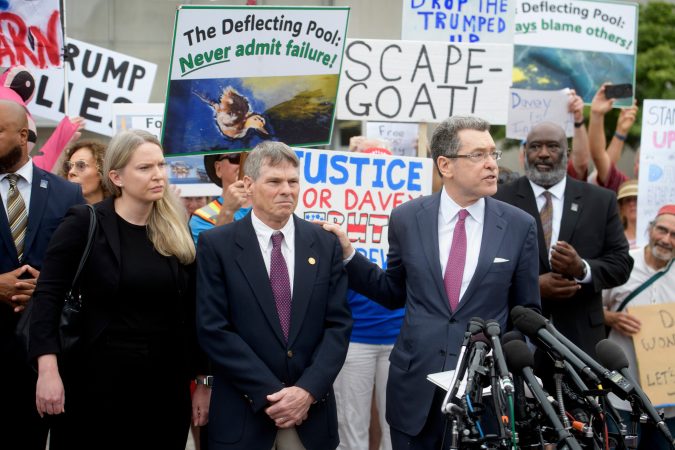
    Hearn’s lawyers and outside watchdog groups said Friday’s move to drop charges was insufficient, and accused the administration of seeking to punish innocent Americans rather than admit its own errors.

    “The Trump administration’s case against Davey Hearn should have never been brought,” Hearn’s lawyers, Norm Eisen, Mary Dohrmann and Steve Levin, said in a statement. “Its dismissal today does not erase the abuse of government power in arresting and charging a patriotic American who did nothing wrong. The government’s approach was ready, fire, aim. The administration owes Mr. Hearn an apology.”

    Hearn told the Post last month that he was cycling past the pool and put his hand in the water only to touch a piece of liner that was already dislodged. Reached by phone on Friday night, he declined to comment.

    The fight over the century-old Reflecting Pool — which sits at the foot of the Lincoln Memorial and has played host to famous speeches and events — has unexpectedly emerged as a major flash point in Trump’s second term.

    Trump announced plans in April to abruptly overhaul the pool, saying that he had personally picked out a new color for the basin, “American Flag Blue,” and had recommended contractors based on his experience managing pools at his various resorts.

    At the time, Trump said the pool renovations would cost less than $2 million and be completed within two weeks. The cost later swelled to more than $14 million, and historic preservationists and other experts repeatedly warned that the rapid renovations could backfire.

    The job was completed within six weeks, with the president and his allies saying it was a symbol of his efforts to remake Washington.

    “I’m very proud of it,” Trump said in the Oval Office as the pool prepared to reopen. “I’m very good at building things and constructing things.”

    The celebrations were short-lived. Within days, the pool was beset by major algae outbreaks and the liner’s peeling. The president responded by alleging that vandals were to blame, accusing them of cutting parts of the pool but providing no evidence.

    “Many additional people have been arrested having to do with the disgraceful Vandalism of our beautiful Reflecting Pool,” the president wrote on Truth Social in June.

    “It was slashed with a knife, or box cutter, high grade colored waterproofing liner — it was VANDALISM!,” Trump wrote in another post this month, criticizing an ABC News report that suggested the liner was peeling.

    A recent visual inspection found damage in the middle of the pool — “where a vandal would not likely attempt to peel the lining” — further indicating that the damage stemmed from mistakes during installation, DOJ lawyers wrote in their filing.

    The administration drained the pool after the July Fourth celebrations on the Mall, with officials saying further renovations would be necessary. In a Justice Department filing Thursday, the administration said the pool would be closed through Aug. 10.

    The Cultural Landscape Foundation, an education and advocacy organization, is suing to block the administration’s continued work on the pool, saying Trump has disregarded long-established processes and federal requirements intended to protect historic sites.

    “Today, the iconic pool sits empty, covered in peeling epoxy after a botched job,” the organization’s lawyers wrote in a court filing Friday, asking a federal judge to halt further changes to the pool until they can go through a formal review process.

  • Jurors in Lindsay Clancy’s trial visit the home where she killed her children

    Jurors in Lindsay Clancy’s trial visit the home where she killed her children

    DUXBURY, Mass. — Jurors walked through the Massachusetts home where Lindsay Clancy strangled her three children, a rare visit Friday that let them see firsthand the place where an outwardly ordinary family life unraveled into tragedy.

    After being driven past two businesses relevant to the narrative of the January 2023 killings, jurors were escorted in groups of six to view the inside of the house, including the basement where the children died. During the roughly 40-minute visit, the jury also saw the yard where Clancy was found after jumping from a second-story window.

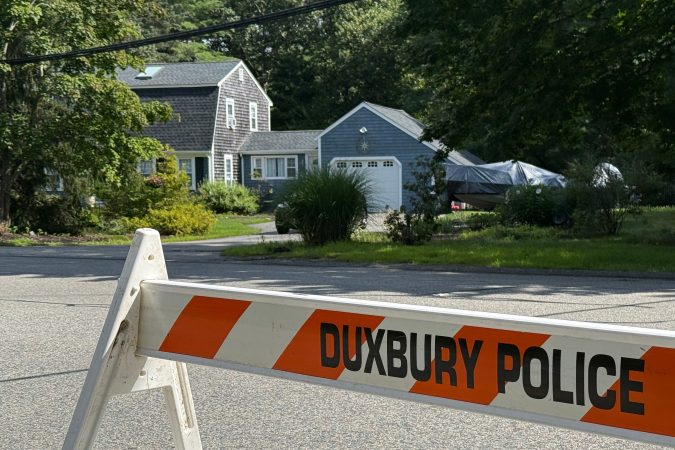
    Journalists were kept away by a police barricade, but court officers could be seen through the trees escorting jurors to and from the bus along the site of the Clancy family’s former driveway. The home now has a new owner.

    Clancy herself did not attend the visit to the home, which she hasn’t seen since the day of the killings. Her lawyers argue she was in the grip of postpartum psychosis, a rare mental illness linked to the stress, sleep deprivation, and hormonal changes that follow childbirth.

    Jurors in U.S. criminal cases often are expressly told not to visit the scene of the events in question. There are a number of rationales for not doing so — among other things, the site may have changed in the interim between an alleged crime and a trial.

    But courts sometimes allow juries to make a supervised excursion as a group, for reasons that can include assessing distances or features that aren’t thought to come across fully in photos.

    Such excursions have happened in a number of high-profile cases, including the 2023 murder trial of South Carolina attorney Alex Murdaugh, the 2022 sentencing trial of Parkland, Fla., school shooter Nikolas Cruz, the 2015 Massachusetts murder trial of former New England Patriots player Aaron Hernandez, and the 1995 murder trial of O.J. Simpson.

    Jurors in Clancy’s trial retraced the route her then-husband, Patrick Clancy, took when she asked him to pick up takeout food and medicine for daughter Cora on the night of the killings. He returned to find the children dead and his then-wife badly injured and bleeding in the yard.

    The panel was driven past the restaurant — about 5.5 miles from the family’s former home in Duxbury, a town south of Boston — and the pharmacy, about a mile from the house.

    Prosecutors say the errands were a ruse to get her husband out of the house. They say Lindsay Clancy, a former labor and delivery nurse, acted intentionally and is criminally responsible for the deaths of children Cora, 5; Dawson, 3; and Callan, 8 months.

    Her lawyers don’t dispute that she killed the children, but they say she had bipolar disorder and her condition worsened while she was on antidepressants prescribed after the birth of her third child. She believed a voice was telling her to “kill the children so you can kill yourself,” according to her lawyers.

    Lindsay Clancy remains paralyzed from the waist down after using multiple methods to try to end her life that night.

    If convicted of murder, she faces life in prison without parole. If found not guilty due to a lack of criminal responsibility, she would be committed to a state mental health facility.

  • Trump hails a ‘unique’ Cabinet meeting at Camp David as he seizes on Spain’s migration crisis

    Trump hails a ‘unique’ Cabinet meeting at Camp David as he seizes on Spain’s migration crisis

    CAMP DAVID, Md. — President Donald Trump took Friday’s cabinet meeting on the road to Camp David, using the historic rustic backdrop of the presidential retreat to boast of his administration’s achievements while seizing on a migrant crisis in Spain to make his case for why voters should keep the Republican Party in power.

    The cabinet meeting, the 13th such gathering of Trump’s second term, came just three months before the November midterm elections that could serve as a check on his power if Democrats take control of one or both chambers of Congress. His warnings about Spain echoed language he used ahead of the 2018 midterms, when he warned of caravans of migrants headed to the southern U.S. border.

    “You know, I saw Spain yesterday, and I watched the catastrophe that took place. It looks like an invasion of a country by hundreds of thousands of people,” Trump said. “And that same thing is going to happen to us if the Republicans don’t get elected. Except worse, much bigger.”

    Some 60,000 migrants crossed from Morocco into Spain’s tiny Ceuta territory over the past 24 hours. Roughly half of them have already made their way back voluntarily, according to the Spanish government, but at least 57 have died on the journey.

    Separately, he deflected blame for a series of cyberattacks that targeted 30 water systems in Minnesota on the state’s “grossly incompetent” Democratic leadership. Officials have not publicly identified who was behind the attacks, though the FBI, the Cybersecurity and Infrastructure Security Agency, and other agencies warned in an advisory last week that Iranian hackers have been targeting water and wastewater systems and the operational controls of other critical infrastructure sectors.

    “They blame it on Iran,” Trump said, without offering evidence. “I don’t think so. I think I blame it on Minnesota because they’re grossly incompetent.”

    The president regularly convenes his cabinet throughout his terms as a setting to promote his administration’s policies while fielding questions on the news of the day, but what made Friday’s meeting unusual was that it was at Camp David, the government-owned retreat nestled in Maryland’s Catoctin Mountains, where Trump held one cabinet meeting during his first term.

    Trump began the meeting by noting it was “something very unique.” The White House called it the first-ever televised cabinet meeting from the presidential retreat.

    “It’s Camp David, and this room is a very, very special room,” Trump said.

    Secretary of State Marco Rubio and Defense Secretary Pete Hegseth were among the cabinet officials who spoke before Trump took questions from journalists. The public portion of the meeting ended after about an hour.

    Trump fields questions on Iran, Hamas deal, and Blanche confirmation

    In the lengthy question-and-answer session, Trump commented on the latest developments regarding the war in Iran and a deal he announced Thursday that he said would lead to the disarmament of the Palestinian group Hamas.

    He also lamented that a $1.8 billion anti-weaponization fund to compensate his allies was “dead” and appeared to back off a pledge he made earlier this month to grant Ukraine a license to manufacture Patriot air defense systems.

    “I don’t think this would ever happen, but, you know, there’s people that, you give that technology, they can someday turn on you,” Trump added. “You look at war, that’s happened a couple of times over the years, right? So we have to be very careful.”

    On the Hamas agreement, Trump acknowledged that the agreement that would also lead to Israel’s withdrawal from Gaza will have “ups and downs.” Still, he called it a “great breakthrough” that has been helped along by the U.S. and Israel’s war with Iran, which has served as Hamas’ prime backer.

    Trump also remarked on the anti-weaponization fund that is holding up the confirmation of Todd Blanche as his attorney general, saying the pot of money is “dead” and that “I wish it weren’t, to be honest with you.”

    The president continued to defend the people who could potentially benefit from the fund, mainly those who stormed the Capitol on Jan. 6, 2021, to stop the certification of Democrat Joe Biden’s victory over him.

    “Their families have been ruined,” Trump said. Those people “wanted to go to a rally or an event and ended up spending the rest of their lives in horror.”

    Trump said Blanche has been a “pawn in this whole thing.” Blanche, who was present, did not speak in the public portion of the cabinet meeting.

    Camp David has been a retreat for presidents since FDR

    The camp’s primary purpose is to provide presidents a place to rest, relax, and recharge. It was established in 1942 during Franklin Roosevelt’s presidency and has been used by every president since.

    Roosevelt had enjoyed relaxing aboard a presidential yacht, but the military and the U.S. Secret Service began to worry about his safety on open water during World War II. As a result, Roosevelt asked the National Park Service to find sites within 100 miles of the White House that he could use for rest.

    He chose what is now known as Camp David. He gave it the original name of Shangri-La, from James Hilton’s novel Lost Horizon. President Dwight Eisenhower renamed it Camp David, after his grandson and father.

    Trump spent more weekends at the retreat in his first term but has visited sparingly in his second, most recently in June for Father’s Day.

    In 2019, during his first term, Trump announced on social media that he had canceled a secret weekend meeting at Camp David with Taliban and Afghanistan leaders — scheduled for just days before the anniversary of the Sept. 11, 2001, attacks — after a bombing in the capital of Kabul killed a dozen people, including a U.S. soldier.

    Presidents throughout history have turned to Camp David when they needed security and privacy for sensitive diplomatic talks with foreign leaders. Jimmy Carter took the leaders of Egypt and Israel there in 1978 for talks that produced the Camp David Accords, a peace agreement between the two countries.

    The 180-acre retreat, which is run by the Navy and guarded by Marines, has a cabin named Aspen that’s reserved for the president, plus about a dozen other cabins for guests. A main lodge has conference rooms, a dining room, and an office for the president.

  • Authorities release early ransom note in Nancy Guthrie case, hoping someone recognizes it

    Authorities release early ransom note in Nancy Guthrie case, hoping someone recognizes it

    TUCSON, Ariz. — Authorities released an early ransom note in the investigation into the disappearance of Nancy Guthrie in hopes that someone will recognize the writing style. A second note released Friday indicated Guthrie died shortly after she was kidnapped.

    Both notes initially went to a Tucson television station days after the 84-year-old mother of Today show host Savannah Guthrie went missing from her home outside Tucson on Feb. 1. Authorities have not said whether Nancy Guthrie is still alive.

    The Pima County Sheriff’s Department said, “We believe these distinctive linguistic characteristics may be recognizable to someone who knows or has interacted with the notes’ writer.”

    The first note, sent Feb. 2, said Guthrie was safe but scared and would be released unharmed once her captors received $4 million in cryptocurrency, with the ransom amount increasing if the first demand was not met.

    It said Guthrie would be released within 12 hours if the payment was received. It also included a threat to kill her if the ransom wasn’t paid.

    “Your mother is aware of this and her life is in your hands,” the first note read. “It is in the best interest of everyone to have this completed as soon as possible.”

    The second note to the family said Guthrie died shortly after she was taken. “She is buried in nature now,” the second note said. “Nothing you could have done could have changed the outcome.” The note ends with an apology, “We are truly sorry.”

    The sheriff’s department said the notes reveal a distinctive pattern of word choices and provide insight into the writer’s mindset. The agency said someone who knows the notes’ writer may recognize the patterns.

    In a statement, the sheriff’s department also went further to appeal to people who may know something about the case, saying it may be difficult to come forward due to a personal relationship with someone involved or just for their own safety.

    “We recognize relationships and loyalties change over time as do people and their perspectives,” the sheriff’s department wrote. “It is not too late to come forward.”

    The sheriff’s office also said Friday that two videos recovered from Guthrie’s doorbell camera might be from two separate days and indicate an unidentified male prepared ahead of when Guthrie was taken. Authorities are seeking information on anyone who was behaving differently, changed their physical appearance, suddenly left the Tucson area, or had a noticeable or unexplained interest or disinterest in the case.

    “Investigators continue to pursue every available technological and investigative lead,” the sheriff’s office said. “However, community members remain a vital resource as we seek to provide answers for Nancy’s family.”

    Also, two men detained and released early in the investigation into Nancy Guthrie’s disappearance are seeking a combined $3 million against a southern Arizona sheriff’s department. In a legal claim, they say they were wrongfully held by law enforcement.

    The claim made Thursday against Pima County Sheriff Chris Nanos’ department centers on the separate detentions of Carlos Alfredo Palazuelos and Daniel Maddow on Feb. 10. It said they were released hours later but have suffered from having been mentioned in the investigation.

    Nanos’ office declined to comment on the notice of claim, a necessary precursor to filing a lawsuit against government entities.

    Despite an intense search involving thousands of law enforcement officers and volunteers, there has been no sign of the mother of three since she was reported missing. Her children, including the NBC host, have made heartbreaking video pleas for help, but to no avail.

  • Hungary braces for a full shutdown of the Paks nuclear plant as the Danube River hits record lows

    Hungary braces for a full shutdown of the Paks nuclear plant as the Danube River hits record lows

    BUDAPEST, Hungary — Hungary’s only nuclear power plant will shut down for the first time in its history due to record-low water levels on the Danube River, Prime Minister Péter Magyar said Friday, adding that the plant may not come back online for several weeks as the river is expected to continue receding.

    The Paks nuclear plant, located around 50 miles south of the capital Budapest, is operating at less than half its normal capacity, producing 965 megawatts of power rather than the usual 2,000.

    The plant uses water from the Danube to cool its reactors, but the exceptionally low water level has tested the ability of pumps to bring sufficient quantities into the plant.

    Speaking at a news conference at the plant on Friday, Magyar said further reductions in output were imminent later Friday and that the entire plant will likely be powered down by Tuesday or Wednesday. He stressed that the shutdown can be performed safely and poses no risk to the public or environment.

    The Soviet-built, four-reactor plant at Paks accounts for nearly half of Hungary’s electricity production. If it is powered down, it will be the first time in its 44 years of service.

    Hungary and much of Central Europe has been in a prolonged period of drought in recent months, disrupting tourism, agriculture, and industry and confronting residents with the realities of climate change. Water levels are not expected to rise on the Danube in the coming days or even weeks as no significant rainfall is forecast.

    Magyar said Friday that the Danube’s water level has only risen on three occasions in the month of August in the last 20 years, and added that the level at Paks could recede to as low as negative 57 inches — far below the previous record of negative 39 inches set in 2018.

    A level of negative 52.7 inches requires the full powering down of the plant, he said. A negative reading means the river has fallen below the gauge’s zero reference level, not that the river is empty.

    Hungary’s government has requested that companies that consume large quantities of energy voluntarily reduce their consumption to help stabilize the energy supply, particularly in peak demand hours between 5 p.m. and 10 p.m.

    Magyar said Hungarian energy conglomerate MOL had committed to reducing its electricity needs by 65 megawatt-hours, a decrease of 40% from its normal consumption.

    Magyar announced Friday that his party had recommended suspending parliamentary sessions planned for Monday and Tuesday in the interest of conserving energy. He also ordered that all state institutions turn off decorative lighting by Monday.

  • Thousands of immigrant children losing legal representation

    Thousands of immigrant children losing legal representation

    SAN ANTONIO — Tens of thousands of immigrant children who arrived in the United States as unaccompanied minors in recent years may be forced to face a judge alone after a federal contract providing them legal representation expired on Friday.

    The leaders of several nonprofit organizations that provide legal services to immigrant children say they will need to scale back or shutter their operations altogether starting next week. Collectively they represent about 24,000 children who crossed the nation’s southern border without a parent. The groups have spent much of the last year providing legal counsel even though the federal government has not reimbursed them.

    Without a renewed contract, the legal aid organizations say many children with pending cases before an immigration judge will have to defend themselves without a lawyer. Most do not have a legal status in the country but can potentially qualify for asylum or a special visa. Many do not speak English as their primary language, and attorneys say they are more likely to be ordered deported if they do not have a lawyer.

    Michael Lukens, executive director of the Amica Center for Immigrant Rights, which provides children legal representation in the Washington, D.C., area, said the contract’s expiration comes as immigration judges and enforcement officers are pressuring unaccompanied minors to return home by signing voluntary departure forms.

    “The best chance that a child has for a fair day in court and due process is to have an attorney at their side,” Lukens said. “It’s very clear the government is trying to take away that one piece of the puzzle.”

    The Office of Refugee Resettlement, which falls under the Department of Health and Human Services and oversees the shelters that house unaccompanied minors, said in a statement Thursday that the agency remains “fully compliant with its legal and regulatory obligations and does not act in any way that could dissuade a child from seeking appropriate legal relief.”

    ORR officials said they offered to extend the existing contract so long as the providers share information about their clients. Several nonprofit leaders said the federal government was asking for confidential information about the children they serve and their sponsors — who are usually parents or relatives seeking family reunification. The organizations said they are legally and ethically unable to disclose such data and fear authorities could use it to target families during enforcement operations.

    The Trump administration tried to halt some funding for attorneys to represent unaccompanied minors shortly after taking office last year. In February 2025, officials notified the Acacia Center for Justice that the organization needed to stop all work related to a $200 million contract that funds various groups providing the children with attorneys. But a few days later, officials reversed course and restored it without explanation.

    Nevertheless, the Trump administration stopped reimbursing legal aid organizations who operate under the contract last November. The groups estimate they are owed $65 million in payments, and some have had to dip into their reserves in order to keep working.

    Congress passed bipartisan legislation nearly two decades ago that mandates the funding to protect children from exploitation. The federal government, providers argue, is obligated to pay these organizations with the money lawmakers appropriated.

    “They are clearly trying to destroy the program by grinding down the financial health of nonprofits,” Lukens said. “We have seen layoffs and furloughs and we will see a lot more of that if these invoices are not paid.”

    The legal services program also allows attorneys to monitor conditions inside federally funded shelters that house unaccompanied minors, some of which are not regulated by state officials. Many of the children in shelters are waiting to be reunited with parents or relatives, who can claim them by providing identification and financial and biometric information to the government to prove their relation.

    Fewer than 2,500 children are currently in federal custody, and on average they are staying there for 117 days — four times longer than they did a year ago, federal data shows.

    Melissa Lopez, the executive director of Estrella del Paso, a legal services provider, said the complexity of the nation’s immigration laws make it necessary for children to have legal representation. She recounted the case of a 7-year-old boy who went before an immigration judge in Texas. He told the judge he wanted to return to his home country, where his father had been deported.

    His lawyer helped him navigate the best way to do that. Immigrants can file for a voluntary departure to leave the country and avoid a deportation order with more severe consequences, but a young child, she said, would not know the difference or how to do that.

    “We cannot expect a child to have the level of understanding of these legal differences,” Lopez said. “It’s absurd.”

    Lopez said her organization will likely have to scale back its services in far west Texas and southern New Mexico. A year ago, Estrella had a team of 30 staff employees and attorneys. She expects just three staff members to continue serving 243 children in the weeks ahead. The organization is still waiting on $1.2 million in federal reimbursements for legal services provided through July, Lopez said.

    “It’s not a question of can philanthropy fill the gap,” Lopez said. “The issue is the federal government is not meeting its obligations under the law.”