Tag: John Fetterman

  • The CDC’s latest measles update still doesn’t include Pennsylvania-reported deaths

    The CDC’s latest measles update still doesn’t include Pennsylvania-reported deaths

    The Centers for Disease Control and Prevention’s latest update Friday on the toll of measles outbreaks nationally continued to omit two measles-related deaths reported last week in Pennsylvania, extending an unusual standoff between federal and state health authorities.

    The agency instead placed an asterisk in a column where, if reported, the Pennsylvania deaths would be recorded as the first in the nation this year. A note below stated that ”available information does not establish whether measles caused or contributed to the deaths or whether the individuals died from other causes while infected with measles.”

    The omission marked a clear departure from the agency’s normal operating procedure, as President Donald Trump’s administration and Democratic Gov. Josh Shapiro continue to clash over how the deaths were characterized.

    States report to the CDC cases and deaths for dozens of infectious diseases, such as hepatitis, influenza, and measles. The CDC has long compiled the data into reports that help epidemiologists monitor outbreaks and risk, and can inform lawmakers’ efforts to improve public health policy.

    In a rare break from that norm, Health and Human Services Secretary Robert F. Kennedy Jr. asked the CDC’s newly appointed director, Erica Schwartz, to omit the Pennsylvania deaths, according to Reuters.

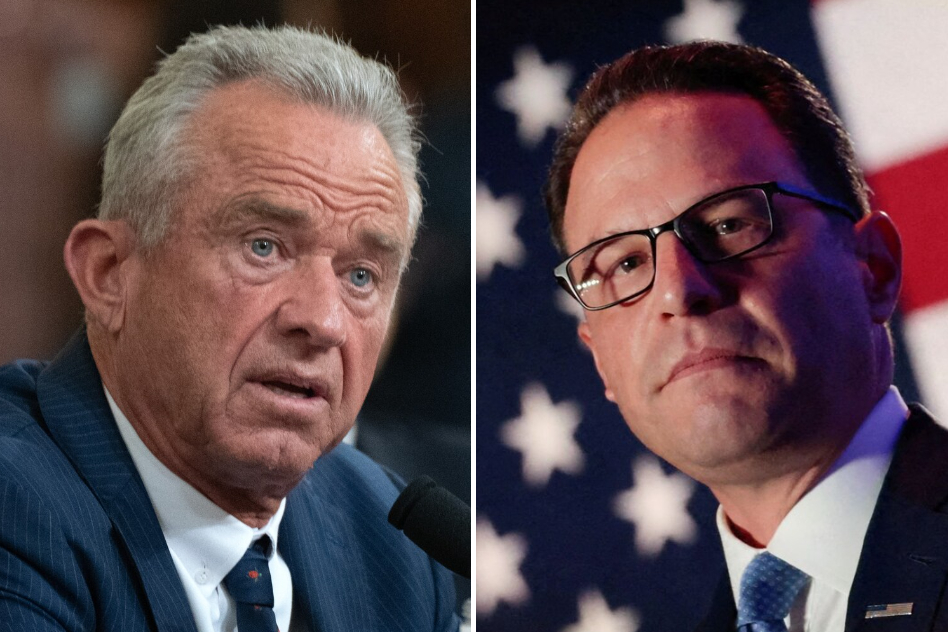
    The move escalated a spat between Kennedy, a longtime anti-vaccine activist, and Shapiro, which began when the governor announced the deaths last Tuesday at a news conference in Lancaster County.

    Shapiro accused Kennedy of spreading vaccine misinformation that has contributed to declining measles vaccination rates, and Kennedy suggested that Shapiro’s office had fabricated the deaths to win political points.

    Public health experts warned that the ongoing political controversy sows doubt in what was designed as an unimpeachable health resource — national disease surveillance — and detracts from the ultimate public health goal of limiting the spread of illness.

    “Every data point is a broken family, a mother crying, a future that’s lost. Instead of grieving that and making sure it never happens again, you’re debating the mechanism of death,” said Brian C. Castrucci, an epidemiologist and president and CEO of de Beaumont Foundation, a community health philanthropy outside Washington, D.C.

    Pennsylvania measles-related deaths

    The Pennsylvania Department of Health reported the two deaths to the CDC the morning of Aug. 25, and professional staff at the CDC “did not express any concern regarding the information,” Neil Ruhland, a department spokesperson, said in an email.

    He described the communication that followed as an extension of the department’s ongoing communications around the state’s outbreak:

    The next day, the state health department discussed the details of each case with CDC professional staff. The CDC requested records containing identifiable information, which the health department did not share, consistent with its past practices.

    Shapiro has cited state privacy laws, and the need to protect the privacy of the families involved to ensure community trust, with limiting his ability to release more information.

    Instead, the health department asked the CDC for a case report form to provide de-identified information. The health department says it has not yet received that form.

    Pennsylvania health officials have a measles outbreak response meeting with the CDC every other week, and most recently met on Tuesday.

    “CDC professional staff have repeatedly made it clear that it has been supportive of DOH’s measles outbreak response,” Ruhland said.

    The CDC’s website says the agency plans to update its measles death count once it has completed its review of Pennsylvania’s cases. But officials have not said what additional information they need from Pennsylvania or when they expect to complete their review.

    The agency did not respond to a request for comment in time for publication.

    Joshua Sharfstein, a physician who served as Maryland’s Health Secretary from 2011 to 2014, said he has never heard of the CDC omitting disease surveillance data reported by states.

    “I wouldn’t say it’s off the table for the CDC to want more information,” but the way the agency went about it in Pennsylvania’s case is unusual, said Sharfstein, who also served as Baltimore’s health commissioner and currently works as a health policy professor at Johns Hopkins University.

    He said he would expect the agency to report Pennsylvania’s data, while alerting officials they are looking for more information. “It’s supposed to be a collaborative relationship,” Sharfstein said.

    Pennsylvania officials initially provided no additional information to the public about the two people who had died, other than they were unvaccinated Lancaster County residents.

    The state’s decision to call the deaths measles-associated came after the state health department’s “epidemiology team thoroughly investigated and verified both individuals tested positive for measles,” Pennsylvania Health Secretary Debra Bogen said in a statement.

    Pennsylvania defines a measles-associated death as deaths of people where evidence of measles is present, even when the disease may not be assessed by the coroner as the immediate cause of death.

    An alert about measles is posted in the window of a medical clinic in Lancaster.Gillian McGoldrick / Staff

    Lancaster County’s coroner, Stephen Diamantoni, added confusion last week when he contradicted the state’s account.

    Diamantoni, a physician and elected Republican, said his office was investigating one death involving a newborn and said postmortem testing showed the infant had a measles infection acquired before birth. But he said he did not believe measles contributed to the child’s death.

    The child died shortly after birth of a lacerated spleen with trauma to the torso, Diamantoni said. He did not know what caused the lacerated spleen or trauma.

    He later said measles was noted on the infant’s death certificate as a significant condition “contributing to death but not resulting in the underlying cause,” because the baby tested positive for measles.

    On Friday, he said a 6-week-old Amish infant who was being treated for a deadly genetic disorder had died of measles in mid-August. He said he did not know if the case was the second measles-related death Pennsylvania reported, saying that he reported the death to the CDC on Friday.

    Pennsylvania’s health department said it was aware of the information the coroner reported Friday and had “no new measles-associated deaths to report at this time.”

    Shapiro reshared a news article about the death on X. In his post, he blamed Kennedy for creating “a firestorm of conspiracy theories that denied these families’ pain, invaded their privacy, and undermined public health.”

    “It’s long past time for RFK to stop playing games with people’s lives, report these deaths accurately on the CDC dashboard, and heed the guidance of actual medical experts so people get accurate information to discuss with their trusted healthcare providers and can best protect themselves and their children against this deadly disease,” he wrote.

    Kennedy fired back, highlighting the Lancaster coroner’s disclosures, in another X post later on Friday: “The facts emerging now demonstrate why CDC waited for the evidence rather than allowing political grandstanding to dictate its reporting.”

    Politicizing public health

    Fixating on whether a patient died “because of” or “with” measles inevitably politicizes the issue and does not benefit people’s health, Jake Scott, a clinical associate professor of infectious diseases at Stanford University, wrote in an opinion piece published online by the Center for Infectious Disease Research and Policy at the University of Minnesota.

    Measles usually kills through the complications it causes, such as pneumonia, encephalitis, secondary bacterial infections, and pregnancy complications, he wrote.

    “A death tally that can be altered by officials whom it embarrasses will not be trusted by anyone, including the officials who edited it,” Scott wrote.

    Diamantoni, Lancaster’s coroner, told The Inquirer earlier this week he did not want “to be dragged into a political fray.”

    “Our role in our office is not political in any way. We’re focused on determining the cause and manner of death, and using objective and scientific methods to do that,” he said. “We’ve worked hard to be sure that the information we’re providing is based on objective things.”

    More than a week into the controversy, lawmakers continue to take political jabs.

    “I am disgusted the Trump administration is putting Pennsylvania families at risk by spreading dangerous misinformation and politicizing these tragic deaths,” U.S. Rep. Brendan Boyle (D., Phila.) said in a statement.

    Pennsylvania’s highest-ranking federal lawmakers — U.S. Sens. John Fetterman, a Democrat, and Dave McCormick, a Republican — did not respond to a request for comment Thursday about the state’s standoff with the CDC. McCormick voted to approve Schwartz as the new CDC director; Fetterman voted against.

    U.S. Rep. Brian Fitzpatrick (R., Bucks), the only federal GOP lawmaker in the Philadelphia region, also did not respond to a request for comment. Neither did U.S. Rep. Lloyd Smucker, the Republican who represents Lancaster County and who blasted Shapiro last week for not providing more information about the measles-associated deaths.

    Cianey Brown, 16, receives an immunization last month during the School District of Philadelphia’s sixth annual Back-To-School Bus Tour stop at Marcus Foster Memorial Stadium. Tom Gralish / Staff Photographer

    Measles outbreak continues

    Public health leaders, doctors, and epidemiologists say that finding a path forward has become an increasingly partisan issue at a time of rising vaccine hesitancy.

    Medical experts will be tasked with trying to rebuild trust in health authorities in order to contain a rapidly spreading outbreak.

    “How can any American citizen begin to make decisions about their health right now, in the milieu of misinformation and falsehoods we’ve created?” said Castrucci, de Beaumont’s CEO. “We have to get back to a point where at least the data can be trustworthy.

    As of Friday, there have been 577 measles cases in Pennsylvania, including 115 reported within the last week, according to the state health department’s online measles dashboard.

    Only South Carolina has reported more measles cases than Pennsylvania so far this year, according to the CDC’s measles webpage. There have been 3,134 cases nationally this year, the agency reported in its latest update Friday.

    Pennsylvania’s measles-associated deaths remain an asterisk.

    Inquirer staff writers Sam Janesch and Aubrey Whelan contributed to this article.
  • John Fetterman reportedly dismissed CHOP leaders, rejected other meetings as he avoids Senate duties

    John Fetterman reportedly dismissed CHOP leaders, rejected other meetings as he avoids Senate duties

    U.S. Sen. John Fetterman privately rejected the concerns of leaders at the Children’s Hospital of Philadelphia who requested a meeting to talk about vaccine policy and Medicaid cuts, speculating to an aide that they “just want free trips to DC,” according to a new report that sparked another wave of criticism aimed at the first-term senator.

    The report from The Wall Street Journal details several meetings or events that while routine for many senators in Washington Fetterman frequently tried to get out of, including the meeting with CHOP and a funeral for three York County police officers who were killed while on duty.

    Claims that Fetterman is not fully performing the role of a U.S. senator have plagued much of his nearly four years in office. His former staffers have publicly and privately said he often cancels meetings at the last minute, including with constituent groups and Pennsylvania officials who would normally be considered allies.

    As he increasingly attacks his own party, the Pennsylvania Democrat has instead appeared regularly on conservative media. He’s prioritized meetings and events about Israel, whose war in Gaza had been a flashpoint in his break with former Democratic allies and supporters, and he does not make regular public appearances across the state he represents.

    Among the new revelations in The Wall Street Journal story is an interaction the senator had with Yechiel Leiter, the Israel ambassador to the U.S. last year.

    After Fetterman said he wanted to craft a Senate resolution that would require his colleagues to vote on whether the war in Gaza was a genocide, Leiter suggested Fetterman instead write an op-ed about why he supported Israel, The Wall Street Journal reported. Leiter’s embassy later “sent over drafted points for Fetterman to consider,” but Fetterman’s staff withheld them from him out of concerns that writing the op-ed based on the talking points “risked violating the Foreign Agents Registration Act,” according to the report.

    Trump administration official comes to Fetterman’s defense as critics react

    Fetterman’s office did not immediately respond to The Inquirer about the claims in the report or about the reactions to it.

    “John Fetterman is a disgrace,” U.S. Rep. Brendan Boyle (D., Phila.) wrote on social media in response to the story. “Our state deserves better than a lazy trust fund baby who is too lazy to do the job.”

    U.S. Rep. Chris Deluzio (D., Allegheny) called Fetterman’s behavior “pathetic.”

    “[B]etween the laziness, disrespect, and willingness to carry water for a foreign government, it shows us something we already know: this man has no sense of duty,” Deluzio wrote on social media. “He is not up for the high office he was elected to — and we in Pennsylvania will do something about it in 2028.”

    Former U.S. Rep. Conor Lamb and State Rep. Malcolm Kenyatta, Fetterman’s opponents in the 2022 Democratic primary, also condemned him.

    “This report is horrifying, but not new to many of us in PA. John barely showed up as [lieutenant governor] and is constantly MIA as our Senator,” Kenyatta, vice chair of the Democratic National Committee, wrote on social media.

    Boyle, Deluzio, Lamb and Kenyatta are among the Pennsylvania Democrats who are considered potential candidates when Fetterman’s seat is on the ballot again in 2028. Fetterman has not said whether he will seek a second term, and he’s rejected speculation that he will switch parties to become a Republican.

    A robust Democratic primary is likely either way. Just one out of every five likely Democratic voters have a favorable view of him, an Inquirer/New York Times/Siena University poll found last month. At the same time, his favorability among Republicans had grown to a higher level than Pennsylvania’s Republican senator, Dave McCormick.

    The Working Families Party, a left-leaning organization that backed Fetterman in the general election in 2022, has said since late last year that it will recruit a Democratic challenger to replace him. And State Rep. Chris Rabb’s sweeping win in Philadelphia’s race to succeed retiring U.S. Rep. Dwight Evans last spring has given some members of the party hope about the chances for a progressive, anti-establishment candidate for the position.

    Fetterman, meanwhile, has also isolated himself from other Democrats in Washington, according to The Wall Street Journal and other reports this year. The party is looking to capture the Senate majority in the midterm elections this fall — a tall task considering the map of competitive races, but one that could make Fetterman a key swing vote depending on how narrow the majority is for either party. Senate Minority Leader Chuck Schumer, who has called Fetterman “an important member of our caucus,” had dinner with Fetterman last month, according to The Wall Street Journal.

    But Fetterman’s detractors in the party — and his former staffers — have indicated they will continue to put pressure on the senator.

    On Friday as the latest story was circulating, an X account claiming to be a group of the senator’s former staffers launched with the message that it would share their experiences.

    “It’s even worse than you thought,” the first post stated, calling the latest news “the tip of the iceberg.”

    One former staffer with insight into the project, and who spoke with The Inquirer on the condition of anonymity, said it was a legitimate group of former staffers who plan to share real accounts of working for the senator.

    The account quickly gained tens of thousands of followers on Friday afternoon, even drawing the attention of a Trump administration official.

    “I’m disgusted by anonymous leakers, actually,” Harmeet Dhillon, an assistant attorney general for the Civil Rights Division of the U.S. Department of Justice, wrote in a response on X.

    Tré Easton, a former legislative director for Fetterman who has frequently criticized him since leaving his staff in early 2025, said it was “sort of extraordinary” to see other former staffers create such an account. He said he is not involved in the effort.

    Easton said the claims in the story aligned with his experience working for Fetterman.

    “A lot of ink has been spilled about John and his time in office,” Easton said. “What this Journal story captured that these other stories really haven’t is how completely disconnected he is from the work and how he just doesn’t care about it — how he doesn’t care about his constituents and doesn’t care about Pennsylvania in a worthwhile way.”

    ‘Why do I have to keep having to meet with chop’

    The newspaper’s report includes text messages between Fetterman and his staff as they discuss meetings and events that senators would normally attend.

    “3 hours??” Fetterman wrote in response to an aide who told him about the length of a funeral last year for three police officers who were killed while serving a warrant in York County, where Fetterman grew up.

    Fetterman wrote that the time “may be a nonstarter” and did not attend, the Journal reported.

    Discussing the meeting with CHOP officials last September, Fetterman wrote, “Why do I have to keep having to meet with chop,” and an aide responded it was to talk about vaccines and Medicaid cuts, according to the report.

    Along with children’s hospitals and health systems nationally, CHOP faces financial pressure from Medicaid cuts starting next year. While the internationally prominent research institution remains financially strong, around half its patients rely on Medicaid for coverage.

    During the debate over President Donald Trump’s signature budget legislation, CHOP circulated form letters to federal lawmakers that warned about the potential for the cuts to harm families, asking staff and patient families to sign them in opposition.

    Vaccines have also become increasingly political as Trump’s health secretary, Robert F. Kennedy Jr., a longtime anti-vaccine activist, has sought to upend longstanding federal recommendations about the timing and number of immunizations that children receive.

    Fetterman has not weighed in publicly about vaccine changes. But he has loudly rejected the Medicaid changes — saying in a statement last year that he was voting “HELL NO” on the Republican bill, which he called “a disaster.”

    About two months later, he wrote to an aide while discussing the CHOP meeting that he was not concerned about, the Journal reported.

    “I’m convinced they just want free trips to DC,” he wrote.

    Asked for comment on Friday, CHOP, in a statement to The Inquirer, did not comment on that text or its relationship with Fetterman in general.

    “We value the productive conversations we have with legislators and government officials at a local, state and federal level,” the statement read. “Their decisions have a direct impact on children’s ability to thrive in Pennsylvania and beyond, and we take our role as a voice for children very seriously.”

    Staff writer Wendy Ruderman contributed to this article.
  • John Fetterman backs Donald Trump on data centers, blames China for ‘misinformation’ on AI

    U.S. Sen. John Fetterman said Monday he agreed with President Donald Trump’s call to “Let Data Reign” after the president made a lengthy post criticizing the widespread backlash to data centers.

    “There’s nothing more damaging to a Democrat than agreeing with Trump AND data centers — but what’s right is right,” said Fetterman, who has repeatedly angered members of his own party by backing Trump’s agenda.

    “We must win the war for AI supremacy over China. They foment the ‘anti’ argument through misinformation,” Fetterman said on X.

    The issue has increasingly taken center stage ahead of the midterm election, including in Pennsylvania. Fetterman, who does not face reelection until 2028, blamed China for fueling the public outcry against data center development in the U.S. as the two nations compete in the AI industry.

    Fetterman has remained supportive of development even as voter sentiment has turned sharply against the industry. Six in 10 likely Pennsylvania voters said they opposed the construction of data centers to support artificial intelligence in a poll released last week by The Inquirer, New York Times, and Siena University.

    Trump made similar arguments on his Truth Social platform earlier in the day, saying that China “could not be happier” with the political movement against data centers.

    “The only reason that communities throughout the U.S.A. should not want Data Centers is if they want to end up being backwards and poor. If they want to be successful and rich, with far lower taxes and jobs all over the place, let Data Reign,” Trump said.

    That Fetterman backed the president on data centers may not have come as a surprise to voters who’ve been following the senator’s moves.

    Two-thirds of Pennsylvania Democrats who are likely to vote this year believe Fetterman supports Trump too frequently, according to last week’s poll.

    Overall, 69% of Democratic voters have an unfavorable opinion of him, which could be trouble if he seeks reelection as a Democrat in 2028.

    And Democrats were also the voters most likely to oppose data centers — with 77% opposing their construction in the Pennsylvania poll.

    Fetterman’s post in support of data centers comes as the state’s other top Democrat, Gov. Josh Shapiro, has been backing away from his previous support.

    Shapiro issued an executive order two weeks ago enacting a host of restrictions for new projects. And the governor has traded attack ads with his Republican opponent Stacy Garrity over who has been more supportive of the industry.

    Fetterman, on the other hand, said in a post last week that China would benefit from an overreaction by U.S. politicians.

    “I reject the political pandering and hyperbole over data centers or AI doomsdaying,” he said.

  • Fetterman gains GOP favor as Pa. Democrats regret electing him, new poll finds

    Fetterman gains GOP favor as Pa. Democrats regret electing him, new poll finds

    Two-thirds of Pennsylvania Democrats who are likely to vote this year believe U.S. Sen. John Fetterman supports President Donald Trump too frequently, while about half say the Democratic senator has been too supportive of Israel, according to an Inquirer/New York Times/Siena University poll published Tuesday.

    Democratic voters’ sharply divided views on Fetterman — with 69% having an unfavorable opinion of him in general — are the latest signs he could face an uphill battle if he seeks reelection as a Democrat in 2028.

    Fetterman has not said whether he will run for a second term.

    But as he weighs his options — which include leaving the Democratic Party because of what he considers its anti-Israel sentiment — the senator’s occasional support of Trump’s agenda has contributed to his declining favorability among voters who helped elect him in the first place, the new survey indicates.

    “I’m so disappointed in him, I can’t even see straight,” said Joseph Jaskula, a retired salesman from Lewisburg, Union County, who participated in the poll of 760 likely voters conducted by Siena University on behalf of The Inquirer and the New York Times from Aug. 17 to 21.

    (function() { var l = function() { new pym.Parent( ‘nyt-fetterman__graphic’, ‘https://media.inquirer.com/storage/inquirer/ai2html/nyt-fetterman/index.html’); }; if(typeof(pym) === ‘undefined’) { var h = document.getElementsByTagName(‘head’)[0], s = document.createElement(‘script’); s.type = ‘text/javascript’; s.src = ‘https://pym.nprapps.org/pym.v1.min.js’; s.onload = l; h.appendChild(s); } else { l(); } })();

    Jaskula, a Democrat who said he voted for Fetterman in 2022, said he is particularly upset about the senator’s votes for several of Trump’s nominees and for the war in Iran.

    Fetterman has been the only Senate Democrat to vote against restricting the president’s use of military force in Iran.

    “He voted with the Republicans on that,” Jaskula, 72, said of the war powers resolutions that aimed to rein in Trump. “And he’s had some other ones where we wonder if he’s a Republican or a Democrat.”

    Fetterman’s standing among Pennsylvania voters overall remains split, according to the poll.

    He is viewed favorably by 49% and unfavorably by 43% of all likely voters in the state. That was nearly the same result as the last time the Inquirer/New York Times/Siena poll asked about Fetterman’s favorability, in May 2024.

    But the difference between now and then — when Fetterman was campaigning against Trump’s election and only two years removed from his own sweeping victory in the Pennsylvania Democratic primary — is who is supporting him.

    Pennsylvania’s U.S. Senators John Fetterman (left) and Dave McCormick appear together at June event in Philly to promote the savings accounts for kids that were part of President Donald Trump’s One Big Beautiful Bill Act.Tom Gralish / Staff Photographer

    Fetterman outperforms McCormick with GOP voters

    In almost the exact opposite breakdown compared with about two years ago, just one in five likely Democratic voters reported having a favorable view of Fetterman, while four out of five likely Republican voters said they have a favorable view.

    Even Fetterman’s Republican counterpart in Pennsylvania — U.S. Sen. Dave McCormick, who was elected in 2024 — is viewed favorably by a smaller share of GOP voters, about 66% compared with Fetterman’s 79%.

    (function(){function e(){window.addEventListener(`message`,function(e){if(e.data[`datawrapper-height`]!==void 0){var t=document.querySelectorAll(`iframe`);for(var n in e.data[`datawrapper-height`])for(var r=0,i;i=t[r];r++)if(i.contentWindow===e.source){var a=e.data[`datawrapper-height`][n]+`px`;i.style.height=a}}})}e()})();

    Don Levy, director of the Siena Research Institute, called the Democratic senator’s numbers “shocking.”

    “If you didn’t know any difference, you would immediately assume that Fetterman and McCormick are both Republicans, and that Fetterman is an extremely popular Republican senator amongst Republicans,” Levy said. “I can’t think of another case exactly like this.”

    Fetterman, citing his voting record in the Senate, which still mostly aligns with Democrats, has said repeatedly that he will not switch his registration to Republican.

    GOP leaders, who are fighting to retain control of the Senate this fall, have said they would welcome the Pennsylvania Democrat into their fold.

    And Fetterman has raised the prospect of leaving the party, possibly becoming an independent, if Democrats oppose Israel as an “official” part of their platform. He has staunchly supported the country in the wake of the Oct. 7, 2023, attack by Hamas, and as Democrats have become increasingly critical of Israel’s counterattack.

    (function(){function e(){window.addEventListener(`message`,function(e){if(e.data[`datawrapper-height`]!==void 0){var t=document.querySelectorAll(`iframe`);for(var n in e.data[`datawrapper-height`])for(var r=0,i;i=t[r];r++)if(i.contentWindow===e.source){var a=e.data[`datawrapper-height`][n]+`px`;i.style.height=a}}})}e()})();

    Fetterman has opposed fellow Democrats’ efforts to end the United States’ assistance to Israel’s offensive measures. He has also become the most vocal Democratic supporter of both countries’ attacks against Iran, an issue that also remains deeply unpopular among Pennsylvania voters.

    At the same time, Fetterman has backed other Trump initiatives, like immigration enforcement and the investment accounts for children known as Trump Accounts.

    “He’s a voice in the party, standing up for what’s right,” said Nicholas Morabito, a 32-year-old warehouse worker in Butler who participated in the poll.

    A registered Republican, Morabito said he would consider voting for Fetterman in 2028, regardless of which party label accompanies his name on the ballot.

    “I don’t think there’s very much difference between the two of us. Just the difference in party,” Morabito said.

    Fetterman has acknowledged the shift in support. He wrote in his 2025 memoir that he was “completely at peace” with the idea that his support of Israel might cost him his Senate seat. And in interviews, he has repeatedly said that, as a swing-state senator, he should work with and not demonize the other party.

    A plurality of likely voters — 47% — say Fetterman is “about right” when it comes to supporting or opposing Trump, according to the poll. About 38% said he supports Trump too much, 6% said he opposes Trump too much, and 9% did not answer.

    (function(){function e(){window.addEventListener(`message`,function(e){if(e.data[`datawrapper-height`]!==void 0){var t=document.querySelectorAll(`iframe`);for(var n in e.data[`datawrapper-height`])for(var r=0,i;i=t[r];r++)if(i.contentWindow===e.source){var a=e.data[`datawrapper-height`][n]+`px`;i.style.height=a}}})}e()})();

    But Democratic voters have indicated a strong desire for their elected officials to push back against Trump, and Fetterman’s declining support among them appears to be due in part to that shift during Trump’s second term. About 67% of likely Democratic voters said Fetterman supports the president too much, while 20% said he gets it “about right.”

    “Fetterman has been such an interesting, unique personality now since he broke onto the scene,” Levy said. “Given the state of play right now, Democrats are just angry that he was elected. Democrats are supposed to act like Democrats, and this shows that their perception of him is that he is not.”

  • I spent 15 years in Head Start classrooms. Cutting the program is a mistake.

    I spent 15 years in Head Start classrooms. Cutting the program is a mistake.

    Once again, Head Start — a program beloved by millions of families and with overwhelming public support — is being threatened by the Trump administration.

    I was a Head Start teacher, administrator, and coach for nearly 15 years, and can attest to the transformative power of the program. I saw children thrive thanks to Head Start’s visionary emphasis on the whole child by providing a high-quality education, welcoming classrooms, healthy nutrition, and dental and health screenings. Through home visiting, regular parent communication, and frequent parent participation in the classroom, I saw families become stronger and more resilient.

    Research has shown, time and again, that Head Start increases high school, college, and postsecondary graduation rates, leads to higher self-esteem for participants, and has a positive effect on future generations, as examined through parents’ practices exhibited decades later.

    Which is why I am astounded by the methodical steps to dismantle a program that is the gold standard when it comes to early childhood programs. Back in 2023, the Heritage Foundation made exaggerated claims of fraud and abuse in its call to eliminate Head Start in the now-infamous Project 2025 plan for the second Trump administration.

    A year later, word leaked that President Donald Trump was planning to use the biased Heritage Foundation report to zero out federal funding for Head Start. Widespread public outcry and political pressure thwarted that plan.

    Undeterred, the Heritage Foundation developed a new strategy to kill off Head Start through death by a thousand cuts: If Head Start can’t be eliminated outright, deregulate it until it’s a skeleton of itself. Trump’s Department of Health and Human Services is proposing changes to Head Start that will do just that.

    In May, Health and Human Services put out a proposal to retract wage increases for Head Start teachers. This move would exacerbate the already significant challenges in recruiting and retaining the standard high-caliber staff, resulting in fewer slots and lower enrollment.

    Recently, Health and Human Services announced another proposed change to Head Start that would lower staff qualifications while raising the teacher-student ratios. The latest proposal would also eliminate some of the structures that keep lines of communication open between parents and providers, like parent-teacher conferences. And a new English-only mandate in instruction, written materials, and family communications would isolate parents and children who are dual-language learners.

    Physical and dental health screenings and follow-up care — instrumental in the identification of vision problems, developmental delays, missed vaccines, and hearing challenges for many low-income children — are also on the chopping block.

    These proposed changes are just a few examples of how Head Start would be hamstrung from providing the care and education that has transformed so many children’s lives. Even Health and Human Services’ own Administration for Children and Families admits that these proposed changes could “introduce some risk.”

    Once again, people-power can successfully defend Head Start. Contact Sens. John Fetterman and Dave McCormick and your representative and tell them to pressure the Trump administration to withdraw these proposed changes.

    Members of the public — like you — are able to voice your opinion, life experiences, academic research, or general passion for Head Start in response to the proposed changes. You can submit public comments on the Health and Human Services website — comments Health and Human Services must read and report on before finalizing anything.

    When President Lyndon B. Johnson established Project Head Start in 1965, he said, “I believe that this is one of the most constructive, and one of the most sensible, and also one of the most exciting programs that this Nation has ever undertaken.” That sentiment continues today.

    Head Start sets up society as we know it for success. We must defend against this tactic of death by a thousand cuts and make sure future generations are able to reap the rewards of this tried-and-true program.

    Zaina Cahill is the early childhood education policy director at Children First.

  • Chris Rabb warns of ‘great peril’ for Democrats if party ignores Michigan’s Abdul El-Sayed and other progressive wins

    Chris Rabb warns of ‘great peril’ for Democrats if party ignores Michigan’s Abdul El-Sayed and other progressive wins

    WASHINGTON — Chris Rabb is on a winning streak.

    Since his victory in Philadelphia’s highly contested Democratic congressional primary in May, the state lawmaker and presumptive successor to retiring U.S. Rep. Dwight Evans has campaigned across the country — going nine for 10 in races where he’s supported progressives against more establishment-backed, moderate Democrats.

    That wave of momentum — for a left-leaning faction hoping to transform the next generation of the Democratic Party — culminated this week in Michigan, where Dr. Abdul El-Sayed won a consequential U.S. Senate primary in the key swing state.

    Though not a self-described democratic socialist like Rabb, El-Sayed ran on a similar anti-corporation, anti-Israel platform that focused on enacting policies like Medicare for All and dismantling U.S. Immigration and Customs Enforcement.

    Rabb, who was on the ground in Detroit for the final push of the campaign and at El-Sayed’s victory party on Tuesday, said the Michigander prevailed “against extraordinary odds.”

    U.S. Rep. Haley Stevens, with establishment support and about $62 million in outside spending on her behalf, had a roughly 9-to-1 spending advantage over El-Sayed, according to The New York Times. Her loss amid that kind of massive spending “is a testament to the power of economic populism and the growing frustration with incrementalism,” Rabb said.

    “His primary win proves that economic populism and bold progressivism has growing support across the ideological spectrum among Democrats whether they’re voting in Michigan or Pennsylvania,” Rabb said.

    The five-term state representative from East Mount Airy has thrown his energy into other campaigns as his own is pretty much complete. In one of the bluest in the country, he defeated a pair of more moderate Democrats — State Sen. Sharif Street and physician Ala Stanford — and will not face a Republican opponent in the November election. The district covers about half of the city, from South Philadelphia through the Northwest.

    Rabb began looking beyond his district borders almost immediately after the primary.

    In New Jersey’s Trenton-based congressional district, he campaigned for Dr. Adam Hamawy, a former combat surgeon who has also provided medical care to Gazans during the war with Israel. In New York, he threw his weight behind Darializa Avila Chevalier and Claire Valdez, two of the democratic socialists also backed by New York Mayor Zohran Mamdani.

    He turned to other candidates in California, Colorado and Michigan as he door-knocked, called voters and appeared in virtual events.

    “Ever since May 19, which was the night I won, I’ve been paying it forward with so many amazing candidates,” Rabb said during a recent virtual fundraiser for El-Sayed in which Rabb said he was signing and giving away the pink “Philadelphia” baseball hat he was wearing to a lucky donor.

    Rabb hasn’t weighed in on every battle between progressives and moderates. He did not endorse Cori Bush, the former member of Congress and democratic socialist who failed in her attempt at a comeback in Missouri this week. He also has not endorsed every congressional candidate promoted by two key national coalitions that supported him — Justice Democrats, which has been a force behind the election of U.S. Rep. Alexandria Ocasio-Cortez and others, and the Democratic Socialists of America.

    The one candidate he endorsed who did not win was Saikat Chakrabarti, a former campaign manager and chief of staff to Ocasio-Cortez who tried to beat former House Speaker Nancy Pelosi’s hand-picked successor in San Francisco.

    And not all of Rabb’s endorsees are guaranteed to join him in Congress next year. Justin Pearson, a Tennessee state lawmaker who won a U.S. House primary on Thursday, will be the nominee in a state where Republicans redistricted this year in an attempt to root out Democratic incumbents. Pearson’s district is considered “solid Republican” by the Cook Political Report, a nonpartisan group that rates competitive districts.

    While some Democrats have questioned whether progressives can win competitive general election races, Rabb said he was “confident that strategically supporting anti-establishment populist candidates who bring with them new, more active and enthusiastic voters will significantly increase turnout in November.”

    “Ignoring the unique strengths of such candidates and campaigns will be at the Democratic Party’s great peril,” he added.

    That sentiment echoed other comments he’s made in recent months as more centrist leaders in his party questioned the progressive momentum. In June, he responded to an interview in which Gov. Josh Shapiro called the democratic socialists who won in New York an example of “performative politics.” Those candidates would now need to govern effectively, he said, adding that they were not indicative of the types of Democrats winning in Pennsylvania.

    “You’re seeing very different-looking congressional races, and certainly very different Democratic candidates here in Pennsylvania,” Shapiro told CNN, prompting Rabb to respond on social media with, “Ummm…”

    Shapiro, a popular figure as he seeks reelection this fall, has been lending his support to Democrats in four competitive congressional seats in Pennsylvania that are held by Republicans, including a swing district in suburban Bucks County. Flipping those seats in a way that could help Democrats capture the U.S. House majority has been a top priority and has further fueled speculation that Shapiro is eyeing a run for the White House in 2028.

    At the same time, Shapiro has not appeared with or supported Rabb during his campaign, though his team has said the governor looks forward to working with whoever replaces Evans.

    As Rabb has crisscrossed the country, he’s also drawn more ire from the state’s other most nationally prominent Democrat — U.S. Sen. John Fetterman, who Rabb dismissively refers to as “the F word.”

    Fetterman has included Rabb in his broad denouncements of progressives who are winning Democratic primaries. Progressives like Rabb, meanwhile, have indicated they hope to replace Fetterman with a progressive candidate in 2028.

    “Rabb, he won, and he ran on being a very, very anti-Israel guy,” Fetterman said in early June at an American Jewish Committee conference in Washington. “It’s actually a virtue (in the modern Democratic Party)… It’s heartbreaking for me.”

    After El-Sayed’s win this week against a candidate who received more money from the American Israel Public Affairs Committee than possibly any other candidate on record, Rabb and the coalition behind him have shown no signs of slowing down.

    “Ground Zero was Chris Rabb in Pennsylvania, winning a key congressional primary,” Adam Green, co-founder of the Progressive Change Campaign Committee said on the livestreamed fundraiser with Rabb this week.

    The “ripple effects of winning a battleground Senate contest,” like in Michigan, Green said, will be significant.

    “The message will be undebatable that we won, that we’re on the rise, and that we can win anywhere,” he said.

  • Philly Haitians and allies march to demand protections as TPS expires

    Philly Haitians and allies march to demand protections as TPS expires

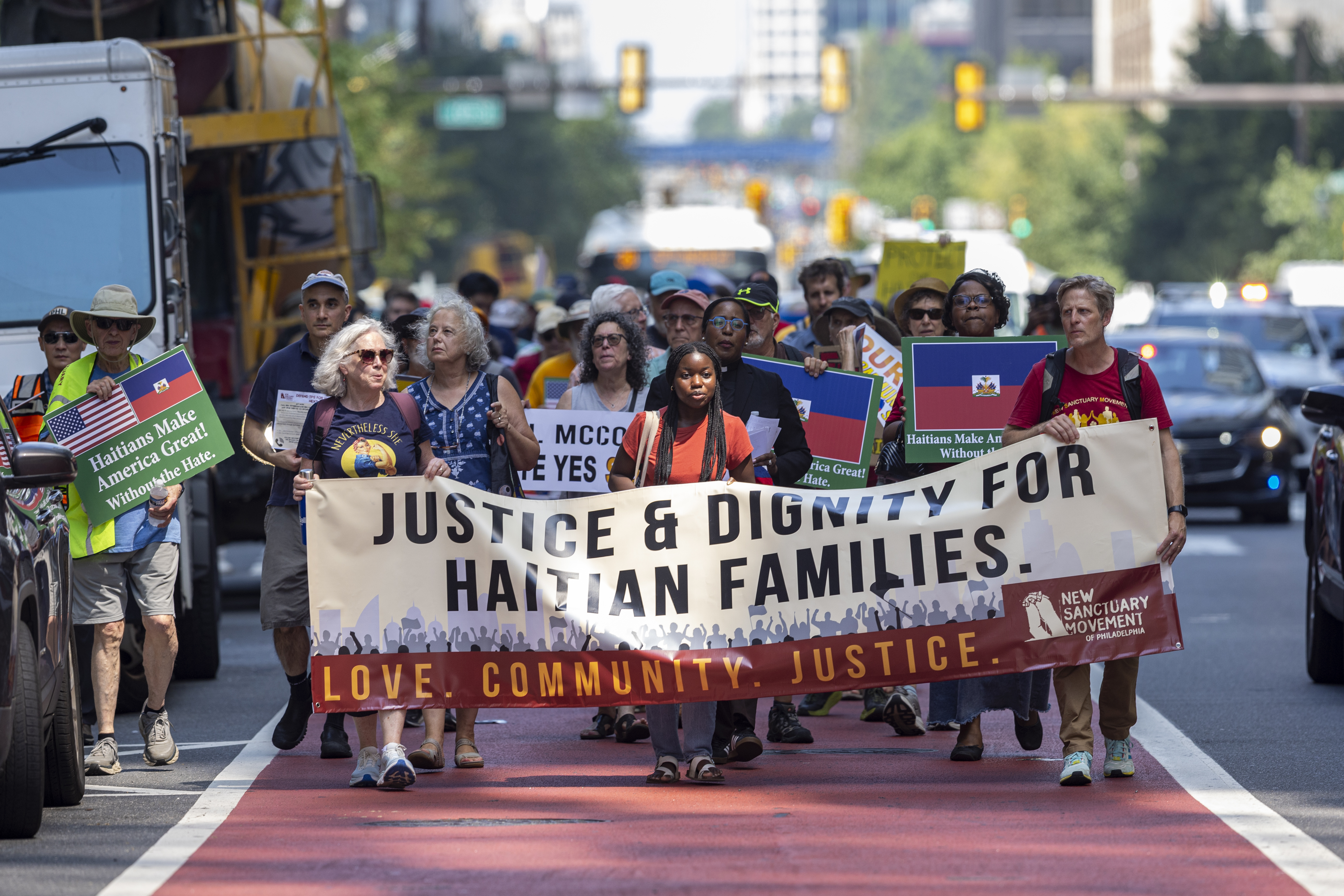
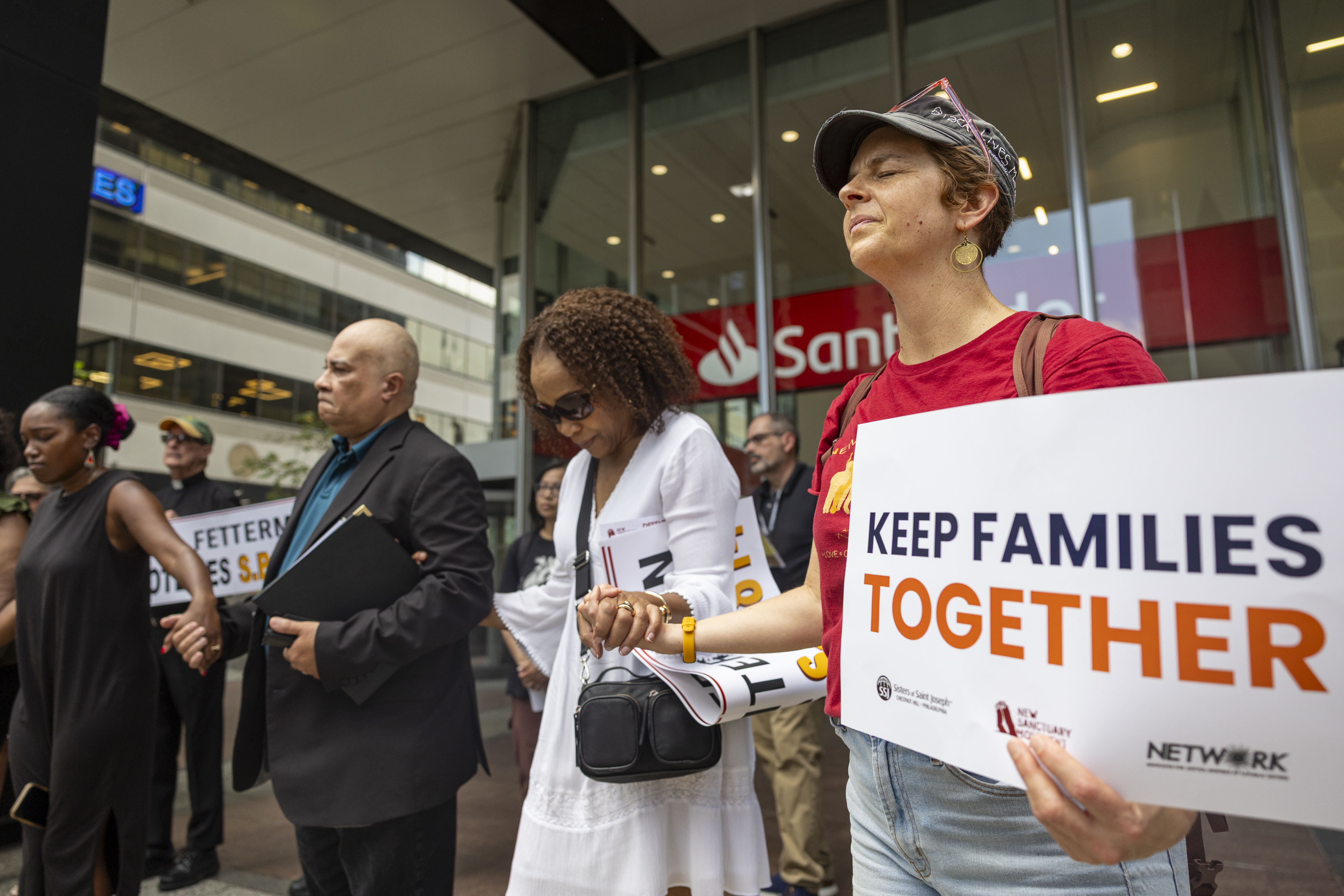
    Dozens of Haitians, allies, and supporters rallied in Center City on Thursday, demanding that Pennsylvania’s U.S. senators help restore temporary protected status (TPS) for thousands now in danger of being deported to the shattered Caribbean nation.

    They gathered outside the office of Republican U.S. Sen. Dave McCormick near 20th and Market Streets, then marched to the office of U.S. Sen. John Fetterman, a Democrat, near Second and Chestnut Streets.

    People held up signs that said, “Our Haitian community is here to stay,” even as protections and work permits have ended for about 350,000 Haitians in the U.S. The Haitian community numbers about 11,000 in Philadelphia, and leaders say it seems everyone knows someone who had TPS or has it themselves.

    Speakers said that TPS is more than an immigration status, that it is what allows neighbors, friends, and family members to live here, to work, pay taxes, and help build the country.

    They called on the senators to help pass Senate Bill 4814, which would require the secretary of the Department of Homeland Security to designate Haiti for TPS through April 2029.

    A spokesperson for McCormick said: “We respect everyone’s right to come together and voice their opinion. We appreciate the input.”

    Efforts to reach a spokesperson for Fetterman were not immediately successful.

    Pastor Kenel Stevenson said he knows of no local Haitians who have been taken into custody by U.S. Immigration and Customs Enforcement, or fitted with ankle monitors, as the ACLU says is happening elsewhere.

    But the mood among his fellow Haitians is grim, he said.

    “There is fear, fear of repatriation, of being returned to a place where there is no safety,” Stevenson said.

    Nearly 100 people gathered before moving east toward Fetterman’s office shortly before noon, filling the breadth of Chestnut Street as police officers stopped traffic for the group to pass. Oppressive heat and humidity caused some older people to lag.

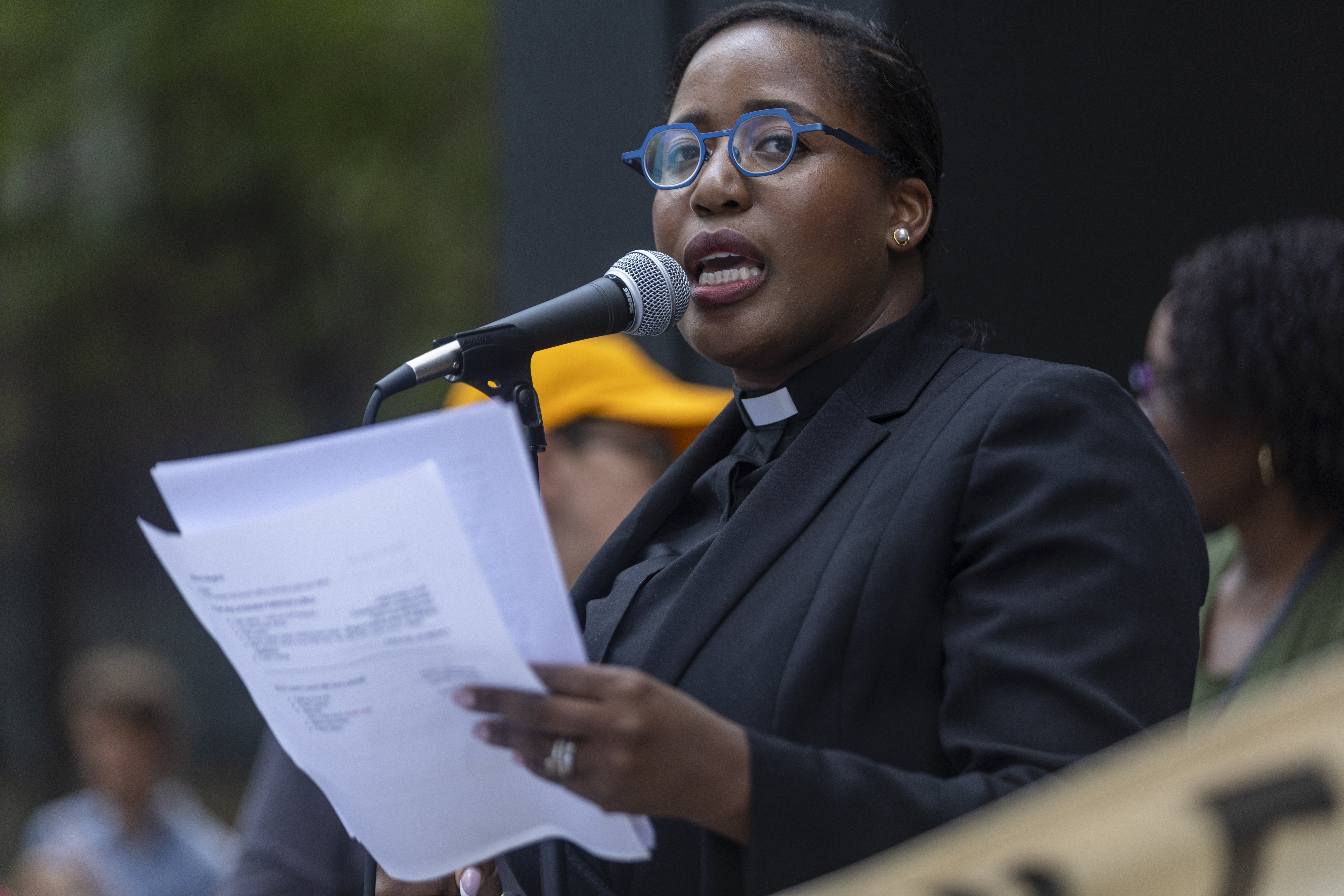
    Reverend Jennifer Joseph of Zion Community Church in Delaware County addresses the crowd outside of U.S. Senator Dave McCormick’s office in Philadelphia on Thursday.Aidan T. Gallo / Staff Photographer

    TPS has expired for an estimated 350,000 Haitians, ending their ability to legally work in this country and putting them at risk of deportation to a homeland riven by natural disaster and violent crime.

    The Rev. Frantz Ulysse, pastor of the First Haitian Church of God of Prophecy in Olney, said fear and uncertainty are not things he expected his parishioners to feel on American soil.

    He searches himself to offer hope at a moment when people are desperate for some sense of tranquility.

    “I had a mother called me the other day and asked if I could take custody of her child if she’s taken away,” Ulysse said.

    Community leaders fear mass family separation, as Haitian nationals have married U.S. citizens and are raising American-born children.

    “We are not criminals,” he said. “We have engineers, doctors, professors,” people who are eager to help and contribute.

    “If people go back to Haiti, they will die, and if they stay as things are, they are in hiding, scared, and can’t leave their house,” he said, joining others outside Fetterman’s office.

    Still, he said, he has not given up hope.

    “America is a country of immigrants, and I believe they will stand with us,” Ulysse said. “Help us fight until the end!”

    Hundreds of Haitian nationals have been told by immigration officials to appear at ICE offices to be fitted with ankle monitors, according to the ACLU.

    Temporary protected status provides permission to live and work in the United States for people whose homelands are riven by war, natural disasters, epidemics, or other extraordinary circumstances.

    Haiti suffered a massive earthquake in 2010 that led the Obama administration to announce that undocumented Haitian immigrants in the U.S. would be eligible for TPS. Thousands more would be welcomed over time under humanitarian programs and become eligible as Haiti grew mired in crisis ― a deadly cholera epidemic, hurricanes, the collapse of basic government functions, and the rise of armed gangs.

    Reverend Katie Aikins, of West Philadelphia, prays for the Haitian people alongside faith leaders and community members before the march begins outside of U.S. Senator Dave McCormick’s office on Thursday.Aidan T. Gallo / Staff Photographer

    Haitian American pastor Ketty Pointe-Jour said Thursday that her immigrant parents would not believe what is happening today.

    They fled Haiti for their lives, she said, and “the U.S. opened its arms for them. The America they knew in the ’60s and ’80s is completely different from what we are seeing now.”

    The Trump administration has sought to end TPS for Haiti and other nations. In June, the Supreme Court ruled that the administration could terminate temporary protected status for countries like Haiti and Syria.

    More broadly, the ruling appears to make Department of Homeland Security decisions about TPS unreviewable by lower courts, creating deep uncertainty for the future. The White House has pledged to deport people who lose legal status, including those who had TPS.

    Haitians are not the only population affected.

    TPS is set to lapse for more than 170,000 people from El Salvador in September, and in October 100,000 from Ukraine face the same termination.

    Advocates say the Trump administration’s promise of deportations will hurt families that include spouses and children who are American citizens.

    What is more, immigration researchers and organizations say, the country will pay a financial price ― in lost taxes, wages, spending, and services, as large numbers of workers and dollars exit the U.S. economy.

    The nation’s 1.3 million TPS holders work at higher proportions than the country as a whole, pay billions of dollars each year in federal and local taxes, and contribute to the solvency of a Social Security system from which they are unlikely to ever draw benefits.

    Outside Fetterman’s office, Dottie Baumgarten said she came from her Cheltenham home to support the Haitian community. She hoped the presence of supporters helped immigrants feel less alone.

    “The Haitian challenge is not just Haitians,” she said, “it’s immigrants in general, and we have to support them. We are destroying their families.”

  • Jon Stewart presses John Fetterman on Israel and playing into ‘Republican caricatures’ when he attacks Democrats

    Jon Stewart presses John Fetterman on Israel and playing into ‘Republican caricatures’ when he attacks Democrats

    U.S. Sen. John Fetterman, in perhaps the most in-depth and toughest interview he has faced in recent memory, defended his unwavering support for Israel and his harsh criticisms of fellow Democrats when pressed by Jon Stewart in a podcast episode released Wednesday.

    The liberal comedian and political commentator repeatedly accused Fetterman (D., Pa.) of “caricaturing” the left wing of his party and the debate around Israel’s handling of the war in Gaza.

    “Jewish community and Israel are not the same thing, brother man. They’re not — that is not the same thing,” Stewart, who is Jewish, said at one point as Fetterman described his full-throated support for the war as being because of “the Jewish community.”

    Asked repeatedly about the United States’ moral obligations about backing the Israeli strikes that have led to the deaths of tens of thousands of Palestinian civilians, Fetterman stood firm.

    He said — as he often has since the Oct. 7, 2023, attack by Hamas that sparked the conflict — that it was necessary to go after Hamas leaders. The killing of civilians was “terrible” and “collateral” damage but not a genocide, Fetterman said.

    Stewart continued to press — questioning why Fetterman was standing so firmly behind a foreign ally that was “dehumanizing” and slowly killing another population.

    “I don’t understand how you have no criticisms over their actions, over their increasingly messianic, ultra-right-wing government that seems to think relentless war is, like, that you can bomb people out of resistance,” Stewart said.

    The roughly 75-minute interview, on The Weekly Show with Jon Stewart, came a week after Fetterman once again met with Israeli Prime Minister Benjamin Netanyahu in Washington.

    Many other elected Democrats have distanced themselves from the Israeli government and criticized its tactics. Fetterman has acknowledged his position has hurt him politically. In the interview with Stewart, he echoed previous comments — which have also become evident in public polls — that he has lost the support of his former Democratic base as his and his party’s stances diverged.

    “I’m aware that if I happen to disagree with the party line, there’s a price to pay,” Fetterman said. “There’s a lot of stories of how I’ve become increasingly more unpopular with Democrats in my state. And I’m aware of it. But these were all very specific choices. … I would rather have people know what I happen to believe.”

    Stewart asked Fetterman several times about how he has voiced those disagreements.

    He said the senator has focused far more on arguing with his own party in a way that has further hurt its brand. And he has broken from the party’s ranks as Democrats try to use even an inkling of leverage that could impact Republicans’ agenda as the GOP controls both Congress and the White House, Stewart said. He pointed to issues like immigration enforcement reforms, which Democrats tried to enact by holding out support for a spending bill earlier this year. Fetterman said he supported the reforms but would not go along with letting part of the government shut down as a strategic move.

    Mark Twain Prize recipient Jon Stewart is introduced at the start of the 23rd annual Mark Twain Prize for American Humor at the Kennedy Center for the Performing Arts, in Washington, April 24, 2022. (AP Photo/Kevin Wolf, File)Kevin Wolf

    Stewart also pressed Fetterman on how his approach to President Donald Trump has softened as he has ramped up his criticism of his own party.

    “You called President Donald Trump a jagoff in 2016,” Stewart said, prompting Fetterman to say that he put the phrase on shirts and sold them.

    “You put it on a shirt. And now you’ve been very complimentary to him. And if your concern with Graham Platner is you didn’t think he was very nice to women, you’re ignoring an awful lot of evidence for the current president about his relationship with women,” Stewart said, referencing Fetterman’s attacks on the Maine Democrat who dropped out after facing allegations of sexual assault. “So my point is, there seems like there’s a way to go about this that embraces, as you said, the 90% of things that you agree with, and try and utilize that energy to reform a party that has a worse public image than herpes in terms of getting things done. This feels like it’s playing into the hands of Republican caricatures.”

    Fetterman pushed back, saying he was trying to stop “extreme” elements of his party in a way that would lead to better success in battleground elections — like in Pennsylvania — after Democratic losses in 2024.

    “We keep losing, and now we keep returning back to some of the extreme things,” Fetterman said. “That’s not a caricature. That is a fair assessment of where we are with these kind of things.”

    Stewart, noting that Vice President Kamala Harris was not the most progressive Democratic option in 2024, rejected the idea that the party lost because of far-left views. In an extended conversation about capitalism and socialism, he also encouraged Fetterman to embrace new ideas presented by democratic socialist candidates who Fetterman, like many Republicans, refers to as communists.

    Fetterman, who frequently appears on Fox News but has not appeared on more liberal programs like Stewart’s Daily Show, described himself as a longtime fan of Stewart and said he believed the interview was “very fair.”

    At the end of the podcast, after Fetterman left, Stewart said he “wasn’t sure what to think” and was “weirdly thrown off right now.”

    “I feel like we all just got out of one of those movies. Do you know those movies where it’s like … there was a weirdly traumatizing scene in the movie,” Stewart said. “And now we’re all just, like, ‘Do you guys, um, do you want to go get something? I guess I’m just going to go get a slice and maybe go home.’”

  • John Fetterman campaigned on ending the filibuster. Here’s why he changed his mind.

    John Fetterman campaigned on ending the filibuster. Here’s why he changed his mind.

    WASHINGTON — U.S. Sen. John Fetterman, doubling down on a position that has already added to Democrats’ frustrations with him in recent months, offered a more detailed explanation this week for his change of heart about eliminating the Senate filibuster.

    The Pennsylvania Democrat wrote in an op-ed for the Washington Post that he had been “horribly wrong” to support ending the practice that requires bills to win 60 votes rather than a 51-vote majority.

    The rule frequently allows members of the minority party to block policies that fail to win bipartisan support, including some of each party’s top priorities — like abortion protections when Democrats have been in control, or the voting restrictions that Republicans are now attempting to pass at President Donald Trump’s urging.

    Fetterman was among many Democrats in recent years to campaign on eliminating the filibuster in order to secure those bigger wins. During his 2022 campaign, he specifically referred to passing abortion protections established under Roe v. Wade as a reason for that position after the Supreme Court overturned its landmark 1973 decision that year.

    “I became one of the first candidates in the country to call for abolishing the filibuster for a reason: it stands in the way of getting things done for [Pennsylvanians],” his active campaign website still read on Tuesday, nearly four years after he won.

    But as he has more frequently sided with Republicans and criticized his fellow Democrats, Fetterman has said repeatedly this year that he had been “wrong.”

    “We were very wrong about that to nuke the filibuster, and we should really humble ourselves,” he said on Fox News in February. In that interview and others, he needled Democrats who opposed the filibuster but now, he said, express a “love” for it as they find themselves in the minority and try to reject Republican policies.

    In the Washington Post this week, Fetterman wrote that Americans who are “horrified” at the policies coming out of the Republican-led Congress and Trump’s administration would be alarmed if the filibuster had been eliminated and every proposal could become law with a simple majority.

    “We’d have the Save America Act by now, which I do not support,” Fetterman wrote. “We could have extreme policies such as nationwide abortion restrictions, backpedaling on LGBT rights, repeal of birthright citizenship and limited voting rights across the country. With a government trifecta firmly in place, many provisions of Project 2025 would have easily been enacted. Republicans could fundamentally change the entire government and country with a simple majority vote.”

    Fetterman’s reference to the SAVE America Act comes as Trump has pressured Senate Republican leaders to eliminate the filibuster in order to pass the bill, which would enact sweeping election changes. It would require individuals to provide proof of citizenship when registering to vote and to show photo ID at the polls, and it would scale back mail voting.

    Opponents of the bill say it would make registering and voting more difficult for millions of people. And Fetterman has opposed the bill because of the changes to mail voting, though he has changed his position to support requiring a photo ID at the polls.

    The bill has failed to receive support from 60 senators, and Trump has demanded that Republicans bypass the filibuster to force it through with only GOP support. U.S. Sen. Dave McCormick (R., Pa.), a Trump ally, has said such a scenario is “very tempting” even though he campaigned against ending the filibuster in 2024.

    “It’s a path to get more things done,” McCormick said during a telephone town hall with constituents last week.

    Fetterman, in his op-ed, called the filibuster “a critical line of defense that prevents President Donald Trump from having a fill-in-the-blank government with new laws, deregulation or procedures of its choosing.”

    He wrote that “history has vindicated” former U.S. Sens. Kyrsten Sinema (D., Arizona) and Joe Manchin (D., W.Va.) for voting with Republicans to block reforming the filibuster when Democrats were in control in 2022.

    Fetterman could potentially play a similar role after the midterm elections this fall if Democrats win control of the Senate with a slim, potentially one-vote majority. Some observers have said Fetterman could also leave his party, becoming a Republican or — as Sinema and Manchin did after serving as Democrats — become an independent.

    “Some of my colleagues, including myself, have been frustrated when engaging with the minority,” Fetterman wrote. “But that process isn’t a bug — it’s one of the best features of the Senate. We have a great democracy that is imperfect, but it requires working together.”

    As Fetterman works more often with Republicans, though, Democrats have become more frustrated with him and vowed to mount a challenge if he seeks a second term in 2028.

    Former U.S. Rep. Conor Lamb — one of the Democrats who has not ruled out another campaign after losing to Fetterman in the 2022 primary — has said the senator’s switch on the filibuster “is probably the worst Fetterman story yet” that most people don’t realize.

    In a social media video in early June, Lamb said eliminating the filibuster was essential for Democrats to “put Roe v. Wade back into law” and to pass legislation on voting rights, gun control, and raising the minimum wage if they regain control of the Senate.

    “When we ran against each other, he promised he would fight for women on this issue and get rid of the filibuster,” Lamb said. “And of course, like so many things, he’s changed his mind.”

  • A new federal judge for Philadelphia was confirmed by the U.S. Senate

    A new federal judge for Philadelphia was confirmed by the U.S. Senate

    A partner at one of the city’s largest law firms who once worked as a federal prosecutor was confirmed Thursday by the U.S. Senate to become the Philadelphia region’s newest federal judge.

    Antonio Pozos’ nomination to join the region’s U.S. District Court was approved by a vote of 49-44. There was no discussion as the Senate voted to approve his nomination, which earns him a lifetime seat on the bench.

    Pozos, 44, most recently a partner at Faegre Drinker Biddle & Reath, is the first person appointed to the region’s district court since President Donald Trump began his second term last year. During his first term, Trump had five judges confirmed to the region’s federal bench.

    Pozos will fill a vacancy created by last year’s retirement of U.S. District Judge Mitchell Goldberg, giving the court 22 district judges and eight senior judges.

    District court judges oversee a variety of criminal and civil cases each year, and typically issue the first rulings on legal questions that can sometimes reach the U.S. Supreme Court.

    Although some of Trump’s recent nominations to judicial posts across the country have been controversial — including his decision to nominate his former personal lawyer, Emil Bove, to the Philadelphia-based U.S. Court of Appeals for the Third Circuit — Pozos’ candidacy received some bipartisan support.

    Shortly after his nomination was announced, Pennsylvania’s Democratic senator, John Fetterman — who, under Senate rules, had the ability to block Pozos’ candidacy from advancing — decided to allow the process to move forward, the first time any Democrat had done so for a district court nominee during Trump’s second term.

    Fetterman also voted Thursday to confirm Pozos.

    During a confirmation hearing last month, U.S. Sen. Dave McCormick (R., Pa.) called Pozos a “successful attorney, a strong Pennsylvanian, a decorated public servant, and he’s eminently qualified for this role.”

    Pozos was criticized by some Democratic senators during the hearing for hesitating to use the word attacked when describing the riot at the U.S. Capitol on Jan. 6, 2021. He instead said it “appeared that there was violence and trespass” that day, and called the events “profoundly troubling.”

    Pozos lives in Bryn Mawr and is a graduate of Harvard College and the University of Michigan Law School, according to a questionnaire he submitted to the Senate Judiciary Committee.

    Before he became a partner at his firm in 2018, the questionnaire said, he spent three years as a prosecutor in the Justice Department’s criminal fraud section in Washington, where he often worked on cases involving healthcare fraud. He previously worked as an associate in a Washington-based firm and clerked for U.S. District Judge Anthony J. Trenga in Virginia.

    In Philadelphia, Pozos has served as a lecturer at the University of Pennsylvania’s Carey Law School and is on the board of Drexel University’s Kline School of Law.

    With Pozos’ confirmation to the bench, Trump has now appointed six of the Philadelphia region’s district judges, who handle cases that arise from the city, its suburbs, and counties in and around Reading and Allentown. Former Presidents Joe Biden and Barack Obama each appointed seven judges to the bench, and two were appointed by George W. Bush.

    Trump has had a more outsize impact on the region’s appellate court, where he has appointed six of the court’s 14 members across his two terms.