Tag: John Fetterman

  • Trump’s judicial nominee from Philly got slammed by a Senate panel for hesitating ‘to tell the truth’

    Trump’s judicial nominee from Philly got slammed by a Senate panel for hesitating ‘to tell the truth’

    WASHINGTON — Antonio Pozos, a Philadelphia lawyer nominated by President Donald Trump to become a federal judge in the Eastern District of Pennsylvania, told a Senate panel on Wednesday that former President Joe Biden won the most Electoral College votes in 2020 — though he declined to say whether Biden won the popular vote or if the Capitol was “attacked” two months later.

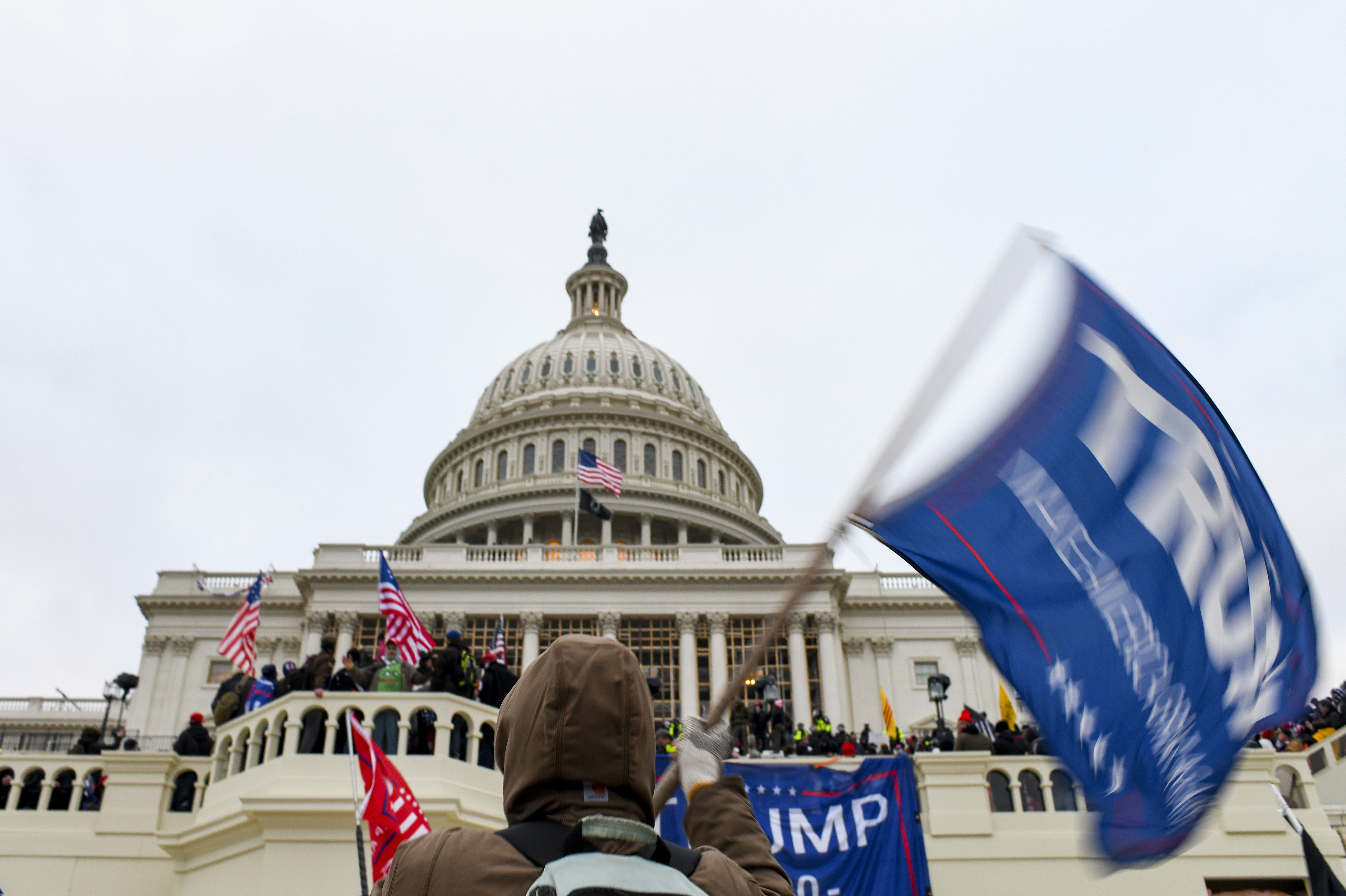
    In a confirmation hearing alongside three other judicial nominees, Pozos said Biden was certified as the president in 2020 and that he’d seen videos from Jan. 6, 2021 in which it “appeared that there was violence and trespass.”

    “It’s profoundly troubling and I abhor violence,” said Pozos, a partner at Faegre Drinker Biddle & Reath and a lecturer at the University of Pennsylvania’s Carey Law School.

    But in the back-and-forth with U.S. Sen. Richard Blumenthal (D., Conn.), Pozos said he would “hesitate to characterize what occurred at the Capitol” when the senator asked directly if the building was “attacked” during the certification of votes.

    “You hesitate to tell the truth here,” Blumenthal responded before shifting to the next nominee.

    The line of questioning has become many Democrats’ main litmus test for those nominated by Trump for lifetime judicial appointments.

    For years, the president has insisted without evidence that widespread voter fraud led to his defeat in 2020, despite Biden winning the popular vote by more than 7 million votes that year on top of his Electoral College win.

    Trump’s history of spreading misinformation about elections has fueled fears that he’ll do it again during November’s midterm elections — as he did after the California primary just last week — and that his judicial appointees will undermine a system of checks and balances.

    When all of the nominees facing the Senate Judiciary Committee on Wednesday echoed each other in only saying Biden won the Electoral College, Blumenthal accused them of having “a new script, a new pre-negotiated effort to thread the needle [and] avoid the question.”

    “You are protecting the lie by failing to acknowledge the truth,” Blumenthal said. “If you’re unwilling to show us you’re independent of the president at this early stage of your service, you disqualify yourself as judicial nominees.”

    At least one Democrat who has signaled he doesn’t believe Pozos should be disqualified is U.S. Sen. John Fetterman.

    The Pennsylvania Democrat decided against blocking his nomination during a traditional process that gives senators the opportunity to approve or reject a federal judicial nominee in their state.

    It was the first time any Democrat declined to use that courtesy — in a process known as a “blue slip” — since Trump’s second term began in January 2025.

    Two other Democratic senators, Elissa Slotkin and Gary Peters, of Michigan, however, followed Fetterman in returning a blue slip for a separate nominee in their state before Wednesday’s hearing. They said their decision was in part because of the nominee’s assurances to them that Biden won in 2020, that there was an attack on the Capitol, and that Trump cannot run for a third term.

    Pozos also acknowledged during the hearing that Trump could not constitutionally win another term, which is something the president himself has declined to say.

    Fetterman, from the 2020 election through Trump’s second election in 2024, frequently and forcefully rejected Trump’s claims of election fraud in Pennsylvania. His office did not provide a comment in response to questions from The Inquirer about why he allowed Pozos’ nomination to advance. The senator has also not said whether he will vote to confirm Pozos when the Republican-controlled Senate decides on the appointment.

    But Fetterman’s move so far in the process was the latest in a series of high-profile moments in which he sided with Trump and the Republican Party while infuriating parts of his own base.

    Demand Justice, a Washington, D.C.-based organization that is critical of Trump’s nominees because of their statements on the 2020 election, joined in the criticism of Fetterman and promised to launch a six-figure ad campaign against him because of the blue slip.

    “John Fetterman just cleared the path for a Trump lifetime judicial nominee,” one of the digital ads states alongside an image of Trump and Fetterman with hearts around them.

    “Our message to Senate Democrats is clear: greenlight Trump’s puppet judges, and we will call you out. No exceptions,” it continued.

    That threat elicited bipartisan criticism at the beginning of the hearing Wednesday.

    U.S. Sen. Katie Britt, an Alabama Republican speaking on behalf of committee chair U.S. Sen. Chuck Grassley, called Demand Justice a “progressive dark money group” that “sought to undermine the blue slip practice and sew further division in our country.”

    U.S. Sen. Dick Durbin of Illinois, the top Democrat on the committee, also said the group was wrong to target senators who work toward agreement across party lines.

    “If we can get bipartisan cooperation for the appointment of lifetime judges, we should do it,” said Durbin, who has voted for Trump’s judicial nominees more than any other Democrat, according to Demand Justice.

    Each of the committee leaders commended Fetterman, Slotkin, and Peters for their decision — with Durbin praising them for “working in good faith with the White House.”

    U.S. Sen. Dave McCormick (R., Pa.) also thanked Fetterman and said Pozos was nominated because of a recommendation from a commission that the pair of Pennsylvania senators put together to vet judicial nominees.

    “Tony’s a successful attorney, a strong Pennsylvanian, a decorated public servant, and he’s eminently qualified for this role,” McCormick said during the hearing.

    Pozos, 44, is a graduate of Harvard College and the University of Michigan Law School who worked as federal prosecutor before becoming a partner at Faegre Drinker in 2018.

    As a trial attorney in the Criminal Fraud Section of the Department of Justice, he focused on corporate and individual healthcare fraud cases. McCormick said he had a “formidable track record of rooting out fraud, prosecuting those who abuse taxpayer dollars, and protecting Americans from predatory healthcare systems.”

    In a questionnaire published by the Senate Judiciary Committee, Pozos also listed active memberships in the Federalist Society — the legal organization that has sought to appoint conservative judges across the country — as well as the Union League of Philadelphia and the Merion Cricket Club.

    In addition to the election-focused inquiries, Pozos also faced questions about applying the False Claims Act — which penalizes individuals and companies from defrauding the government — and the controversial Section 230 of the Communications Decency Act that protects online platforms from liability for what their users post.

    U.S. Sen. John Kennedy (R. La.) grew frustrated when he believed Pozos was not fully answering his question about whether, under Section 230, Facebook should be protected and if it should have the ability to decide what users see. Pozos, like other judicial nominees who say they cannot weigh in specifically on the types of cases they may have to rule on, began answering when Kennedy said he had “no idea what you’re talking about.”

    “You’re better off just answering the question, you really are,” Kennedy said.

    Asked by the Democratic chair about the importance of diversity — which Trump has widely sought to diminish — Pozos said he has mentored young lawyers “from a wide range of backgrounds” and that it was important to “get all pockets of talent wherever they may be in our country and welcome them into the legal profession.”

    Pressed by Durbin if diversity is important in filling positions in the legal system, Pozos said, “If we are true to seeking out excellence wherever it may be, that question will be moot.”

    “I doubt it,” Durbin responded.
  • DA Larry Krasner publicly criticized Mayor Cherelle Parker as he flirts with running for her office

    DA Larry Krasner publicly criticized Mayor Cherelle Parker as he flirts with running for her office

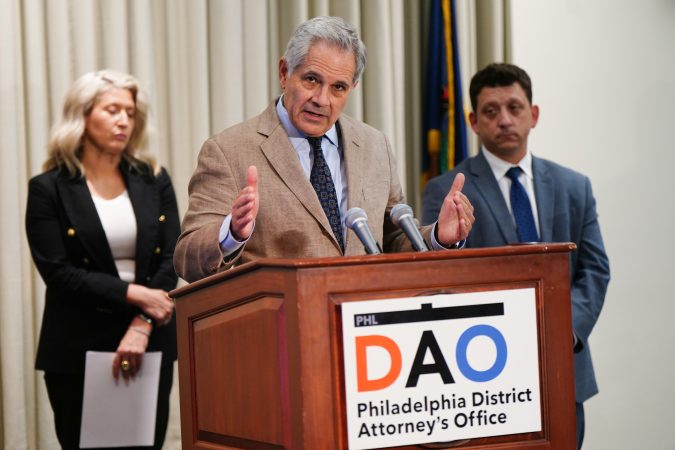
    District Attorney Larry Krasner said Monday that, in the more than two years since Mayor Cherelle L. Parker was sworn in, he has only met with her three times.

    And despite his visit to her City Hall office on Monday in what Krasner described as “the spirit of hopeful collaboration,” that number did not grow to four.

    The district attorney, along with a phalanx of staff and television cameras, walked across the street from his downtown office to the mayor’s suite on the second floor of City Hall, armed with a letter lamenting his budget as inadequate. In it, Krasner wrote that he needs an additional $5.6 million from the city to bolster shootings investigations, domestic violence prosecutions, and victim services.

    Asked why he was delivering a letter to Parker in person, Krasner said: “There is nothing new and nothing inappropriate about civil rights leaders, activists, and politicians getting the word out.”

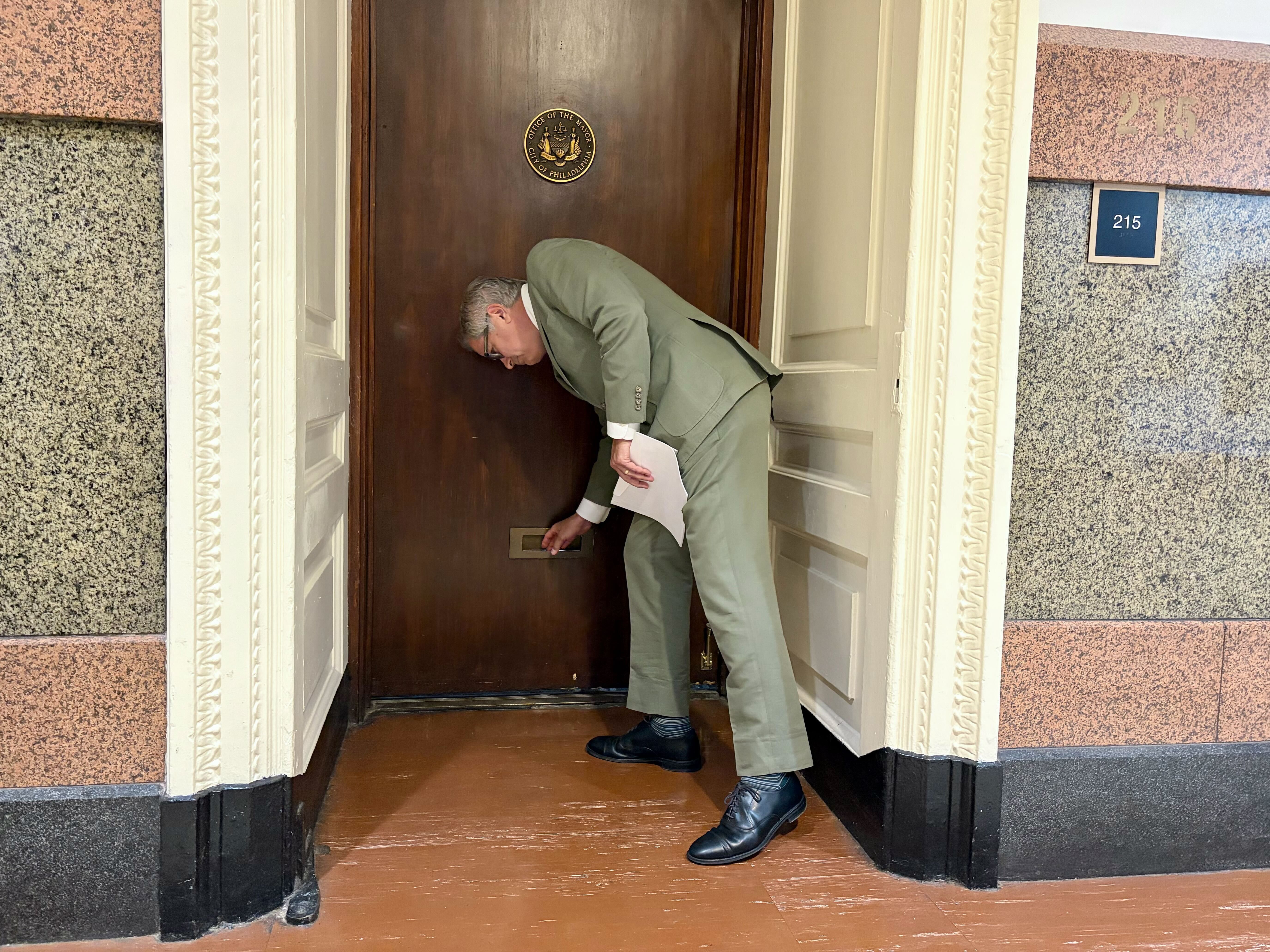
    The mayor did not open her door. Krasner pushed his letter through a mail slot.

    District Attorney Larry Krasner delivers a letter to Mayor Cherelle L. Parker’s office after hosting a news conference to ask the mayor to consider allocating millions more dollars to his office this year.Anna Orso

    The public plea came just days after City Council gave the green light to a city budget for the fiscal year that begins on July 1, including a record-high $62.4 million allocation to the District Attorney’s Office, which is about $3 million more than it received last year.

    Krasner, who called a news conference at the district attorney’s office before his trip to City Hall, said his office needs additional funding to “prevent potential layoffs,” but he did not specify the number of jobs on the line. The city budget will be up for a final vote in Council on Thursday, and it is unlikely to substantially change before then.

    In response to a request for comment, a spokesperson for the mayor shared data showing that the District Attorney’s Office budget has increased by 55% over the last five years.

    Krasner’s televised appeal to Parker on Monday came as rumors swirl that the third-term progressive may run for mayor next year when Parker, a centrist Democrat, is up for reelection. He has also been floated by political observers as a potential candidate for U.S. Senate to run for the seat currently held by Sen. John Fetterman, a Democrat who has angered many in the party and will be up for reelection in 2028.

    Krasner, who is the city’s most prominent progressive and who won reelection to be the city’s top prosecutor last year, said he is not plotting another run for office.

    But he has done little to suppress the speculation. He recently got into a spat with labor leader Ryan N. Boyer, one of Parker’s closest political allies, and he publicly called on former U.S. Rep. Bob Brady, the longtime chair of the city’s Democratic Party, to step aside.

    And on Monday, Krasner, who was reelected to a third term in November, wouldn’t commit to serving out his entire four-year term. (Philadelphia’s Home Rule Charter requires that city officeholders resign to run for higher office.)

    “Am I running for these offices today? No. Do I have a plan to run for these offices today? No,” Krasner said. “But if you’re asking me to say that I would never, under any circumstance, no matter what was going on locally or nationally, consider some other office, it would be foolish for me to completely rule out those possibilities.”

    He is one of several people who progressive leaders in the city may look to next year to challenge Parker, who is backed by much of the city’s Democratic establishment and organized labor. She has been criticized by some on the left for her law enforcement-driven initiatives to address the Kensington drug market and her cautious approach to President Donald Trump.

    The mayor’s race became even more attractive to Philadelphia’s left-wing faction of the Democratic Party last month after State Rep. Chris Rabb, a democratic socialist, won the party’s nomination for an open seat in Congress.

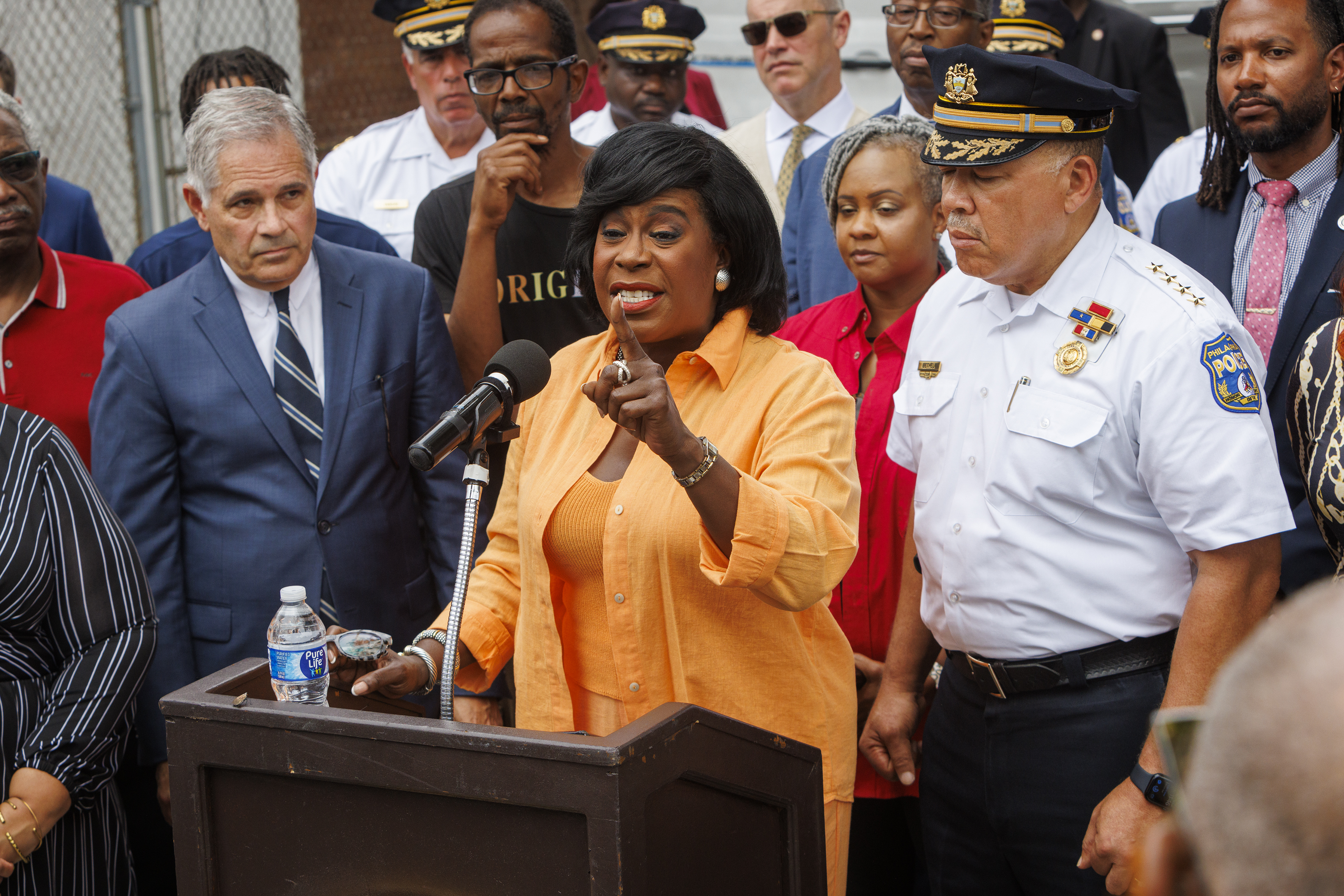
    Mayor Cherelle L. Parker is flanked by Police Commissioner Kevin Bethel and District Attorney Larry Krasner (left) on July 22, 2024.Alejandro A. Alvarez / Staff Photographer

    Krasner’s public criticism of Parker this week is also notable because he and the mayor have, despite not meeting regularly, attempted to maintain a veneer of civility.

    While Parker ran for office on a tough-on-crime message that could be seen as in tension with the district attorney’s progressive platform, she has not directly criticized Krasner. She also campaigned on a promise of close collaboration with other governmental entities after conflict between Krasner and former Mayor Jim Kenney spilled into public view on several occasions.

    Krasner on Monday insisted that his trip across the street to Parker’s office was not intended to inflame hostilities. He cited his letter, which began with thanking the mayor for her “leadership, vision, and goals.”

    The letter ended with Krasner saying that the city’s leaders should “truly model the peace and unity we hope to see within our communities.”

    He added: “We can achieve more together!”

    Staff writer Ellie Rushing contributed to this article.

  • What Chris Rabb’s win in Philly could mean for the 2028 Democratic battle to replace John Fetterman

    What Chris Rabb’s win in Philly could mean for the 2028 Democratic battle to replace John Fetterman

    The euphoria at Chris Rabb’s election night party last month hadn’t even started to wane before the democratic socialist and his supporters — dancing and hugging after capturing a rarely open Philadelphia seat in Congress — spoke of setting their sights even higher.

    Taking on the city’s Democratic establishment to defeat a pair of more centrist candidates in the heated 3rd Congressional District race was a momentous win on its own. But the reckoning, they promised, wouldn’t be confined to Philadelphia’s borders.

    “It’s going to change not just our city, but our entire commonwealth,” Rabb said in an interview amid the celebration at a Germantown banquet hall.

    It was a sentiment echoed that night by key figures in Rabb’s coalition — from the head of the Working Families Party to Pittsburgh’s U.S. Rep. Summer Lee, the only other democratic socialist representing a part of Pennsylvania.

    With the 2026 Pennsylvania Democratic primary in the rearview mirror, that conversation has broadly and quickly turned to the next biggest prize in the state: the U.S. Senate seat held by Democrat John Fetterman.

    The senator has not said whether he will run for a second six-year term in 2028. But in an unusual situation for an high-profile elected official, a robust intraparty competition to replace him is expected to start either way in the next year as Fetterman increasingly sides with Republicans and as polls show that his support among Democratic voters has nose-dived.

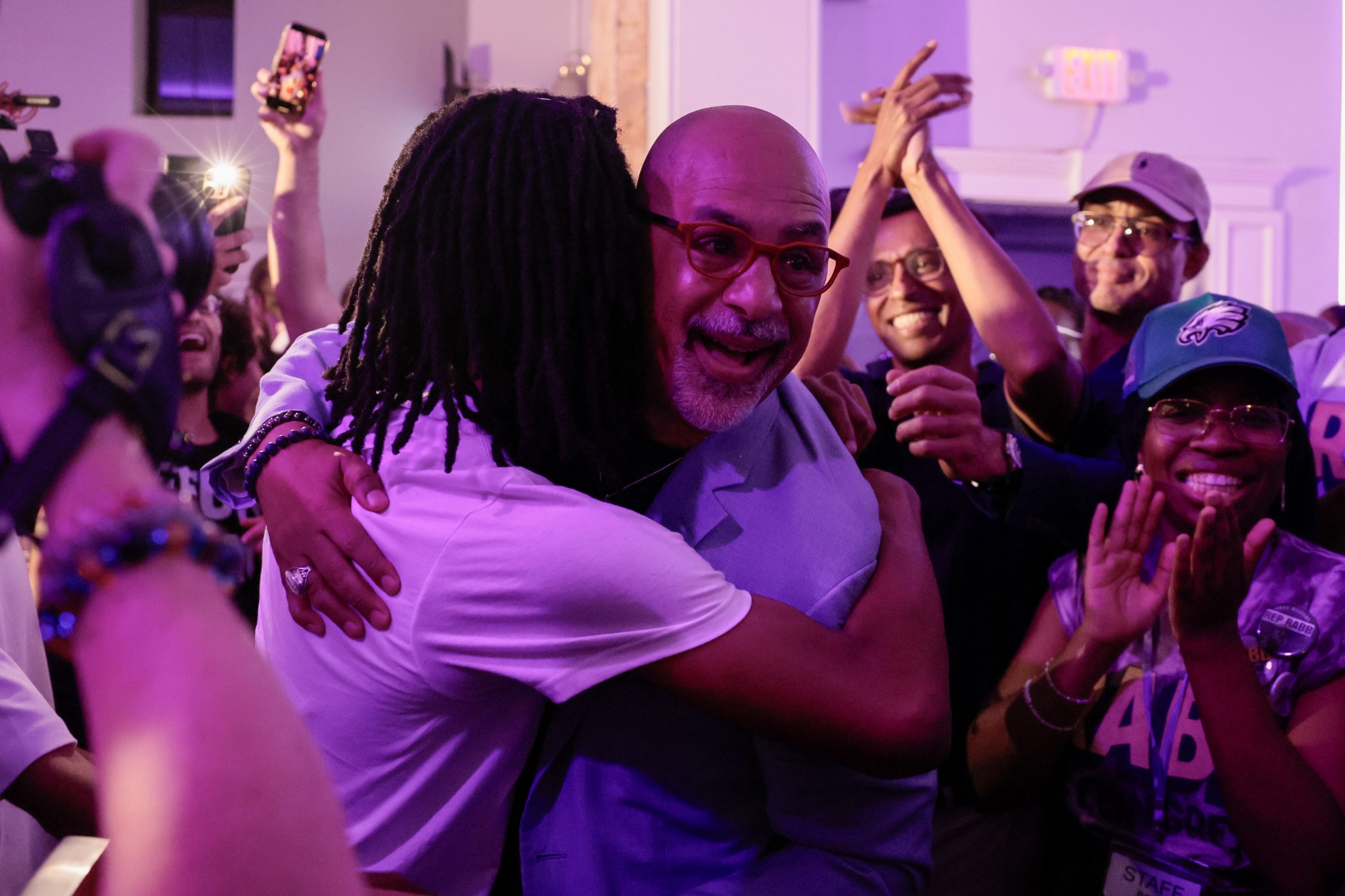
    State Rep. Chris Rabb is hugged by his son, Issa Rabb, during his primary election night event at Victorian Banquet Hall on May 19.Elizabeth Robertson / Staff Photographer

    Some Democrats who watched Rabb emerge from a competitive race, notching one of the left’s biggest wins yet in Pennsylvania, see an opportunity — one that extends the energy and momentum to boost a well-organized, progressive, anti-establishment candidate in the Senate primary.

    Other strategists and activists say that’s a tall task, particularly in a swing state that rarely strays from electing more centrist politicians statewide.

    “Anytime you have success, it breeds enthusiasm, which translates into more volunteers, into more money — everything you need to run a campaign,” said Mike Mikus, a Pittsburgh-based Democratic strategist. “But every election cycle is different. Every campaign’s different. The quality of candidates are different. And anybody who says that any one race signifies a permanent change within a party is mistaken.”

    ‘A huge impact on the political landscape of Pennsylvania’

    In his campaign to succeed U.S. Rep. Dwight Evans, Rabb, a five-term state lawmaker, won 44% of the vote. He was up against State Sen. Sharif Street, who had the backing of the city Democratic apparatus, and physician Ala Stanford, a political newcomer endorsed by Evans.

    Rabb and others have said his success, in part, was the culmination of a decade of progressive organizing that began in the city after U.S. Sen. Bernie Sanders’ 2016 presidential campaign.

    That progressive infrastructure — the coming together of different groups to knock doors, make calls to voters, and unleash a significant independent advertising campaign in a way that rivaled the official Democratic Party organization — is likely the most important way that the left can use the experience of Rabb’s campaign to replicate its success elsewhere, strategists said.

    It’s a template that could have “a huge impact on the political landscape of Pennsylvania,” said Rotimi Adeoye, a Philadelphia-based Democratic strategist who worked in the office of former U.S. Sen. Bob Casey.

    In a district packed with Democratic voters, Rabb’s ability to turn out progressive voters should draw the attention of anyone looking to win the state’s Democratic Senate primary in 2028, Adeoye said.

    “If a Democrat running statewide can learn from some of these organizational groups to build a strong, relational and community-based organizing campaign in Philadelphia and the surrounding suburbs in Montgomery County, Bucks County — they’re going to have a really big chance of winning,” Adeoye said.

    In a sign that those efforts could coalesce around a Senate candidate, one of the groups that helped usher Rabb to victory remains the only major Democratic entity in the state to have publicly started laying the groundwork for a challenge to Fetterman.

    The Working Families Party, which backed Fetterman in the 2022 general election after originally endorsing State Rep. Malcolm Kenyatta in the primary, said in November it would organize an effort to oust him. A “Primary Fetterman” website launched in January is equipped with a “Fetterman sell-out tracker” — highlighting his votes for Trump’s cabinet nominees and opposition to war powers resolutions that would rein in his military strikes, for example — and instructions for donors on how to request a refund from his campaign.

    The website remains the extent of the group’s efforts so far to rally public support and back a new candidate, though its work is expected to pick up after this year’s midterm elections. For now, the party is looking forward to bringing new members who worked to elect Rabb into its fold.

    “Our goal is always to keep building on the work we do each cycle and the success we have each cycle,” said Nick Gavio, the Working Families Party’s Mid-Atlantic communications director.

    One PA, another statewide group in that progressive coalition, has not yet had internal discussions about the Senate race but it supports the Working Families Party’s position as a member of its steering committee, executive director Steve Paul said. He said more than 150 members of One PA mobilized for Rabb by talking to thousands of voters.

    Winning a high-profile congressional race only helps add to that organizational infrastructure, making them “sharper for the next thing,” Paul said.

    “I think it shifts what’s possible, politically — what people can envision,” he said.

    Potential progressive roadblocks

    Mikus said progressives have increasingly surpassed “more establishment Democrats” in their ability to run strong campaigns, including in his area of Western Pennsylvania where candidates like Lee have emerged in the last decade.

    Democratic primary voters are also more progressive than they were 10 years ago, he said. But campaigning on a far-left — or a far-right — platform doesn’t often equate to success on a statewide level in Pennsylvania, a swing state where successful candidates tend to walk a “fine line” that appeals to both swing voters and a message that excites their partisan base, Mikus said.

    “You’ve seen this time after time in presidential elections here in Pennsylvania,” Mikus said. “Hillary Clinton versus Bernie Sanders. Joe Biden versus Bernie Sanders. The vast majority of voters in Pennsylvania will go with the more mainstream Democrat.”

    J.J. Balaban, a Philadelphia-based Democratic strategist and ad maker, said the party runs the risk of “drawing too big of a conclusion” based on a single election — particularly one like Rabb’s where candidates only needed to appeal to Democrats.

    “Democrats really need to think hard about what it will take to win statewide in a purple state, which Pennsylvania clearly is,” Balaban said. “What it will take to win a general election in Pennsylvania is very, very different than what it will take to win in literally the most Democratic congressional district in the country.”

    After recent years of tough losses — including the ousting of Casey by now-U.S. Sen. Dave McCormick, a Republican — Democratic voters will likely have a “tremendous thirst for candidates who have a credible case to make that they can win the general election,” Balaban said.

    Fetterman, whose office did not comment for this story, has insisted that Pennsylvania’s purple state status means he should appeal to both sides of the aisle and not demonize the other side.

    He’s also lamented the direction he sees his party going with candidates like Rabb, particularly around a growing sentiment that Israel has gone too far in its war against Hamas. Fetterman acknowledged last year that his unwavering support of Israel could cost him his Senate seat.

    “Look at the people that are winning the primaries in our party right now, and look at their views on Israel,” Fetterman said at an American Jewish Committee conference in Washington this week.

    On stage with McCormick and the head of the Jewish advocacy organization, Fetterman painted Graham Platner, the expected Democratic nominee for a U.S. Senate seat in Maine, as a “Nazi sympathizer” and connected him to Rabb.

    “People also in our state, too. Rabb, he won, and he ran on being a very, very anti-Israel guy,” Fetterman said. “It’s actually a virtue [in the modern Democratic Party] … It’s heartbreaking for me. And if it isolates me, then so be it.”

    Who might run?

    Of the Democrats widely considered to be eyeing a campaign to replace Fetterman, the public jockeying has so far been limited to criticisms of the incumbent.

    U.S. Rep. Brendan Boyle, a moderate who represents the other half of Philadelphia next to Rabb’s soon-to-be seat, has repeatedly called Fetterman “Trump’s favorite Democrat.”

    Former U.S. Rep. Conor Lamb, a moderate who represented a suburban Pittsburgh district before Fetterman beat him in the 2022 Senate primary, has frequently lambasted him.

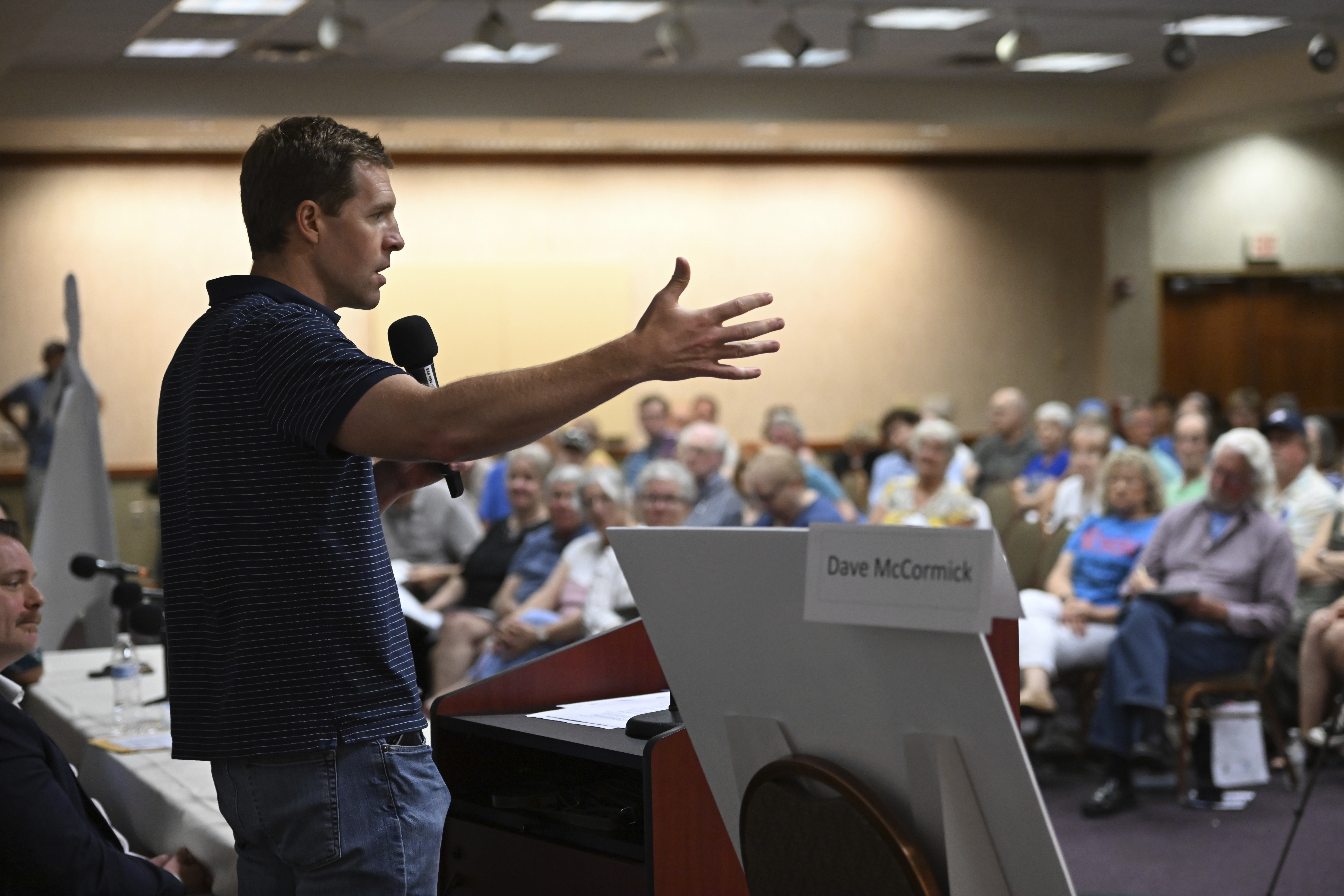
    Conor Lamb speaks to the crowd at a town hall-style event organized by progressive groups at Central Penn College on June 22, 2025, in Enola, Pa. Marc Levy

    And U.S. Rep. Chris Deluzio, who succeeded Lamb and leaned into progressive economic populism, has taken a less direct tack while noting the differences between himself and Fetterman over issues like Trump’s military interventions abroad. Deluzio has occasionally reposted others’ criticisms on social media — including one from Gavio, the Working Families Party spokesperson, last week that called Fetterman’s reversal on eliminating the filibuster “a new low” and “an indescribably massive backtrack from everything he ran on.”

    None of the three have ruled out running.

    Boyle is expected to weigh a Senate campaign vs. staying in the House to take a rare opportunity to lead the powerful budget committee if Democrats win the majority in November. Lamb, who’s remained highly active in Pennsylvania politics, said in an interview that he’s hoping to serve again and would run for office if he feels he “can be of service to the state.” Deluzio, who is also heavily involved in helping Democratic candidates across the state, said he’s focused on his reelection this year and that “we’ll see what 2028 holds.”

    “I am not at all interested in seeing us lose this Senate election, and I certainly have gotten a lot of encouragement to look at 2028,” Deluzio said.

    Progressives have also mentioned Lee, the Rabb ally who’s been a vocal member of the leftist wing on Capitol Hill while taking leadership roles in areas like securing the release of the Jeffrey Epstein files.

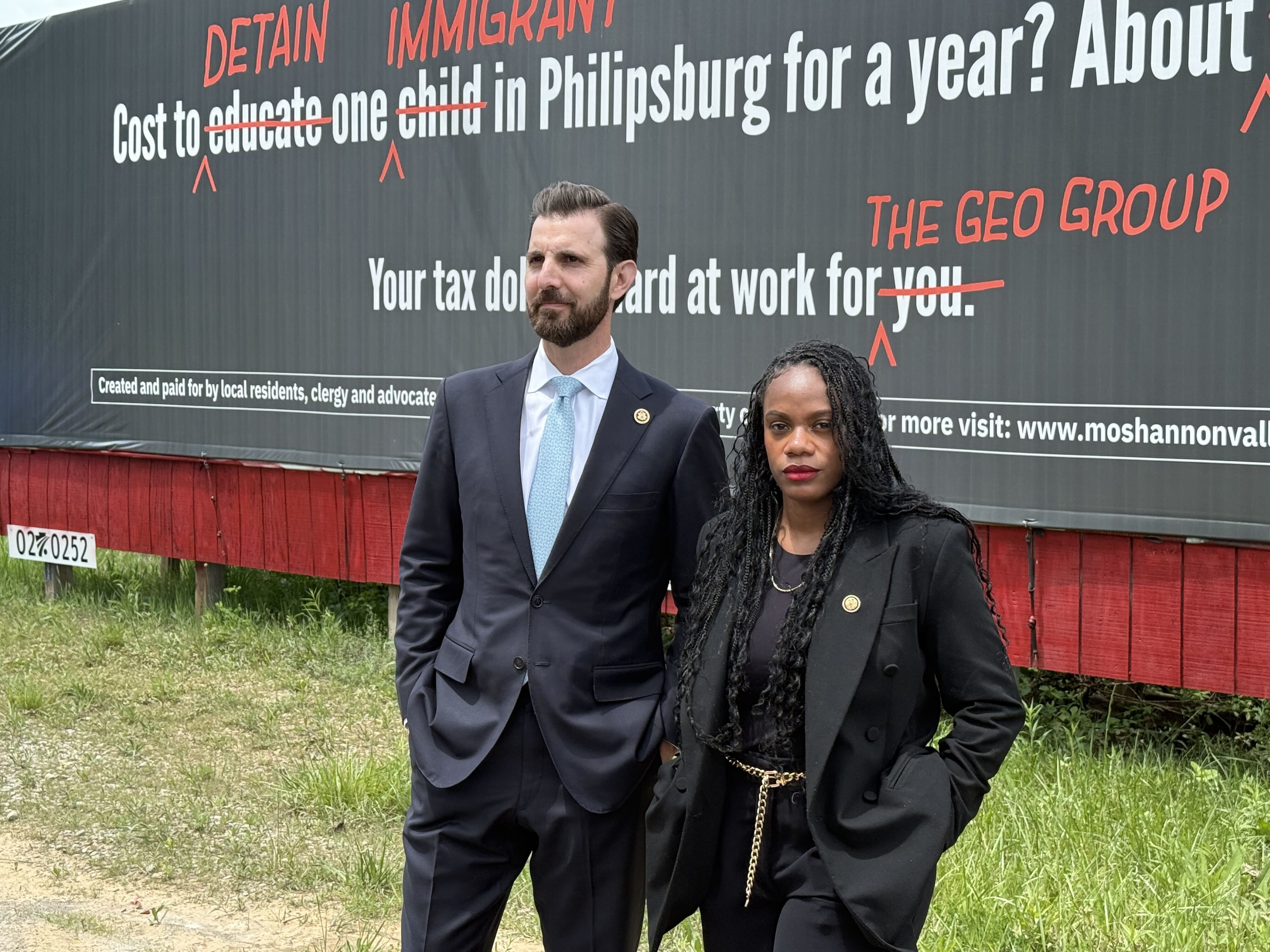
    U.S. Reps. Summer Lee and Chris Deluzio, both Pittsburgh-area Democrats, speak outside the Moshannon Valley Processing Center in Clearfield County on May 28 after getting a tour of the facility, the largest detention center for undocumented immigrants in the Northeast.Sam Janesch / Staff

    With potential candidates still several months away from making their decisions, it’s unclear who might try to take up the progressive mantle if Lee does not run, strategists say.

    The field could also grow considerably. Other potential candidates could jump in, including the three other current Pennsylvania Democrats in Congress or former lawmakers like Susan Wild, who lost a swing congressional district in the Lehigh Valley in 2024. Wild said she’s “not ruling out” a run but she’s more interested in thinking about good female candidates in general since no woman has ever won a Pennsylvania U.S. Senate seat.

    On the prospects of a battle between different factions of the party, Lamb said he believed Democrats had broadly learned a lesson — from Fetterman’s election in 2022, where he ran on being a reliable Democratic vote in the Senate — that was beyond ideological policy tests.

    “Fetterman taught Democrats in Pennsylvania that you have to have a character test. Anybody can run around the state promising you these further left solutions, and that they’re going to be a thumb in the eye of the establishment, and they’re going to channel all your anger and dissatisfaction. And then that person can turn on you on a dime,” Lamb said. “The fact is that we have to evaluate our candidates based on whether they have integrity and they’re going to keep their word and, honestly, whether they have the work ethic to be a senator day in, day out.”