Tag: Jefferson Health

  • These Philadelphians used job benefits to go back to school while working full time

    These Philadelphians used job benefits to go back to school while working full time

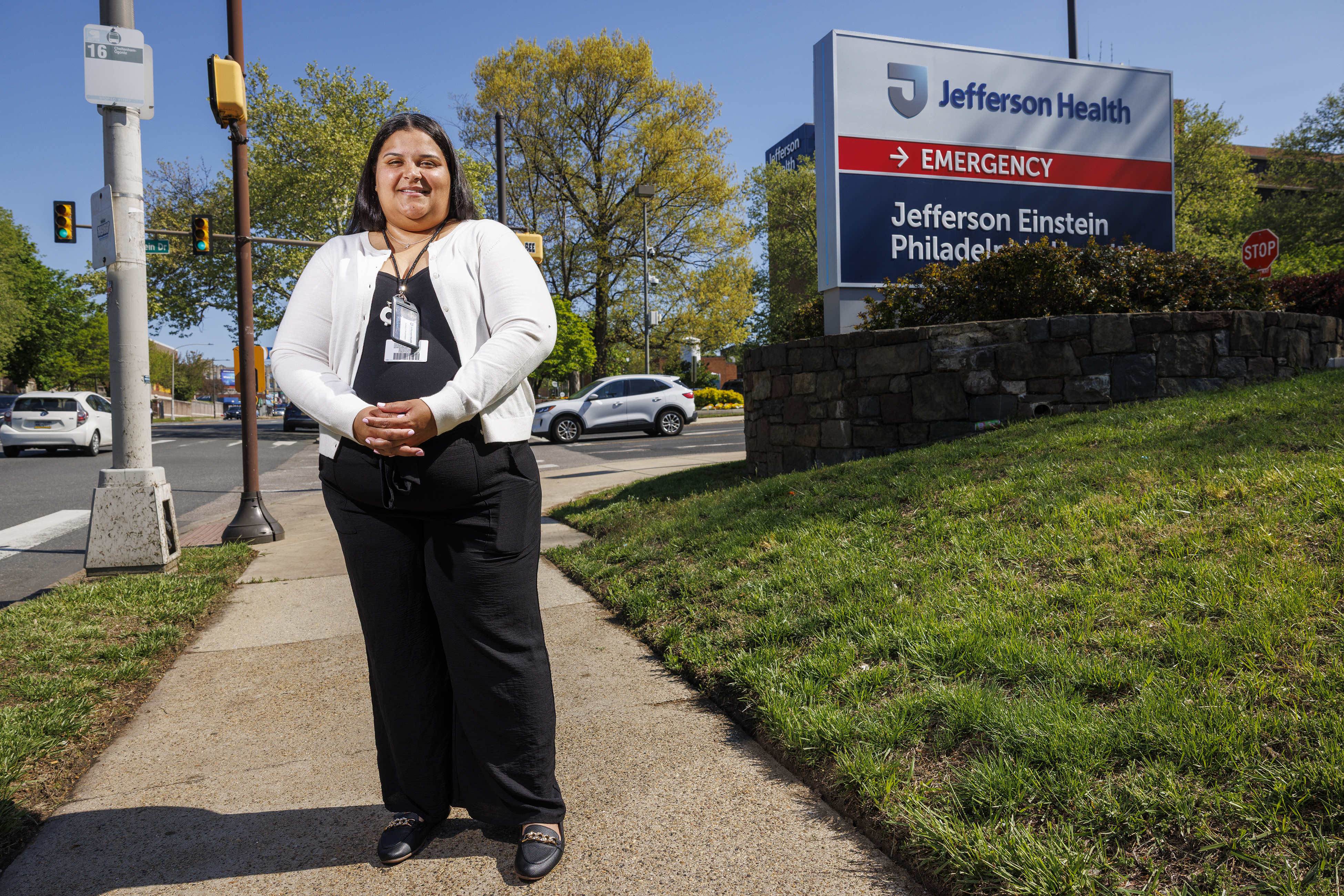
    Ashley Boudreaux, an operations manager at Jefferson Health, would like to run a hospital someday.

    “I would really like to make it to the C-suite — be a CEO,” said Boudreaux, 37, who works at the medical group’s Philadelphia and Montgomery County sites.

    So, without quitting her job, Boudreaux pursued her undergraduate degree in health administration with the University of Phoenix. She graduated in 2023, and now she’s on track to get her master’s in business in November. She’s done all her coursework while working full-time.

    It wasn’t easy, Boudreaux said.

    “You’re just moving constantly,” she said. “When I look back, I’m like, I don’t know how I did it.”

    It helped that Jefferson provided some financial support for Boudreaux’s education.

    More than 40% of employers offer this benefit, according to Alex Alonso, chief knowledge officer at SHRM, a human resources association. That number has waned a bit in recent years, but some large local employers still do so.

    They include Comcast, which offers tuition reimbursement as an employee benefit and works with Drexel University to shape several master’s programs for tech workers. Another is Aramark, which covers up to the full cost of tuition for eligible hourly employees, and tuition assistance for salaried employees. And Philadelphia’s city workers get tuition discounts at more than a dozen local colleges.

    The majority of Philadelphia’s workforce haven’t graduated from college, though tens of thousands of residents have taken college classes without earning a degree.

    For many, completing a four-year degree would still prove beneficial, said Sean Vereen, president and CEO of nonprofit Heights Philadelphia, which connects young people with education and career opportunities.

    “The college degree is not the only way to get to economic success, … [but] there is a connection between your ability to have stronger credentials and your ability to move economically,” Vereen said.
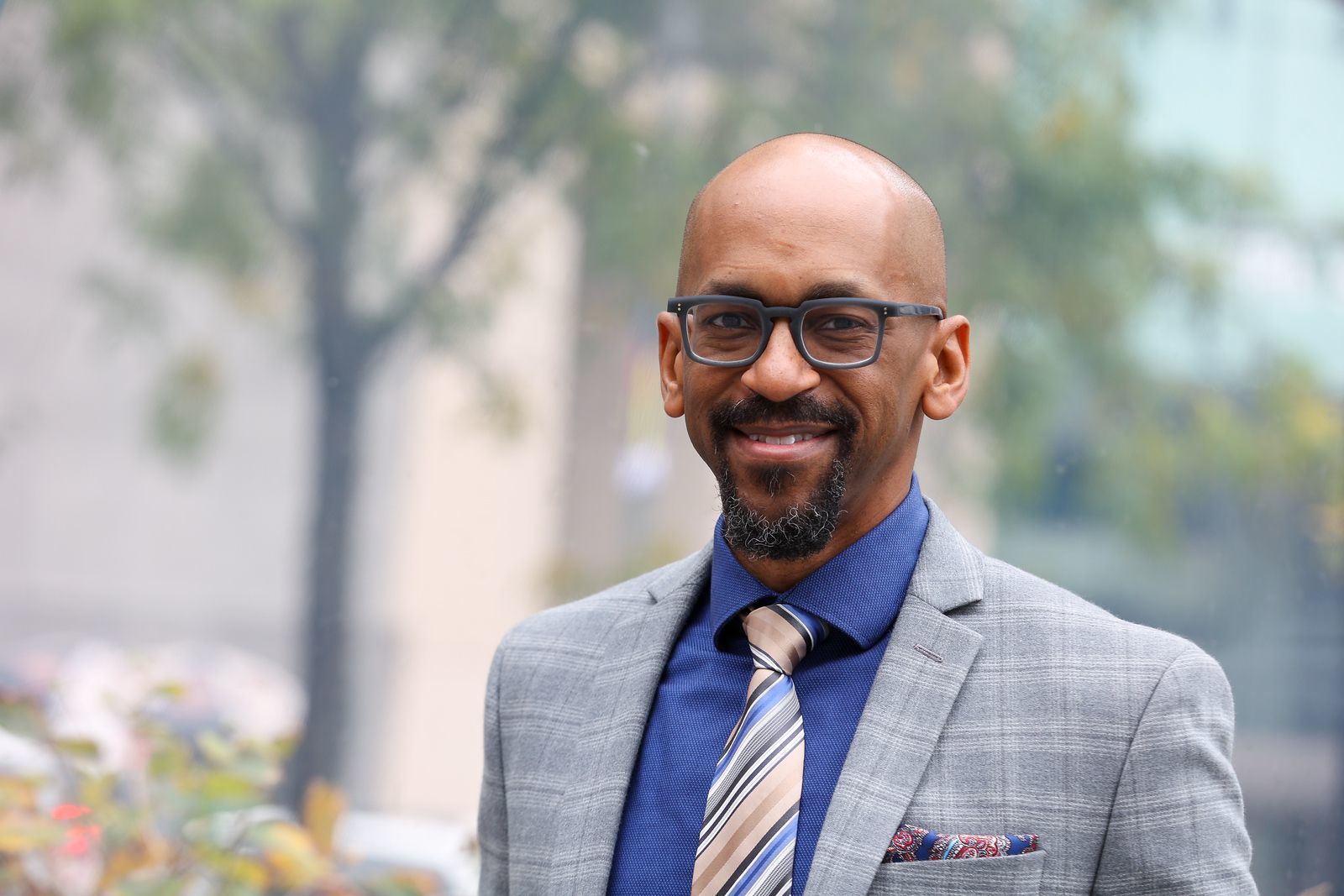
    Sean Vereen of Heights Philadelphia. Paola Nogueras

    Why workplaces offer tuition assistance

    Federal tax incentives have encouraged employers to assist with education costs, said Alonso of SHRM. The benefit also helps companies compete for good hires, he noted.

    Most commonly, Alonso said, employers offer up to $5,250 per employee per year. That’s the maximum they can give toward education costs without the employee paying taxes on it. Workers are often required to show that the education is related to their job or career, so they “can actually bring back what they learn to their workplace,” he said.

    Sometimes getting additional education, including short-term microcredentials, are prerequisite to a promotion, said Phil Brooks, a vice president at nonprofit Graduate Philadelphia, which supports adult students.
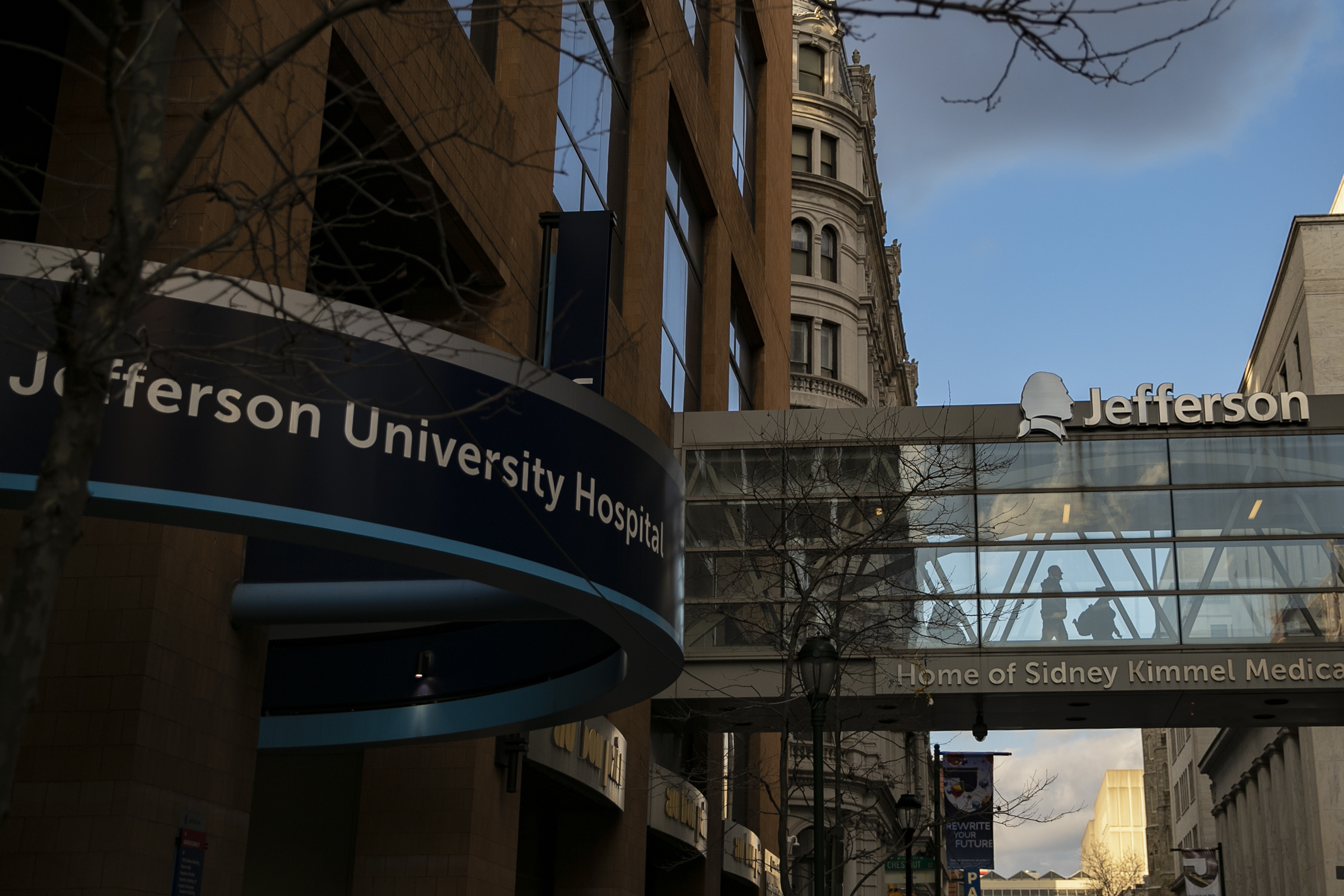
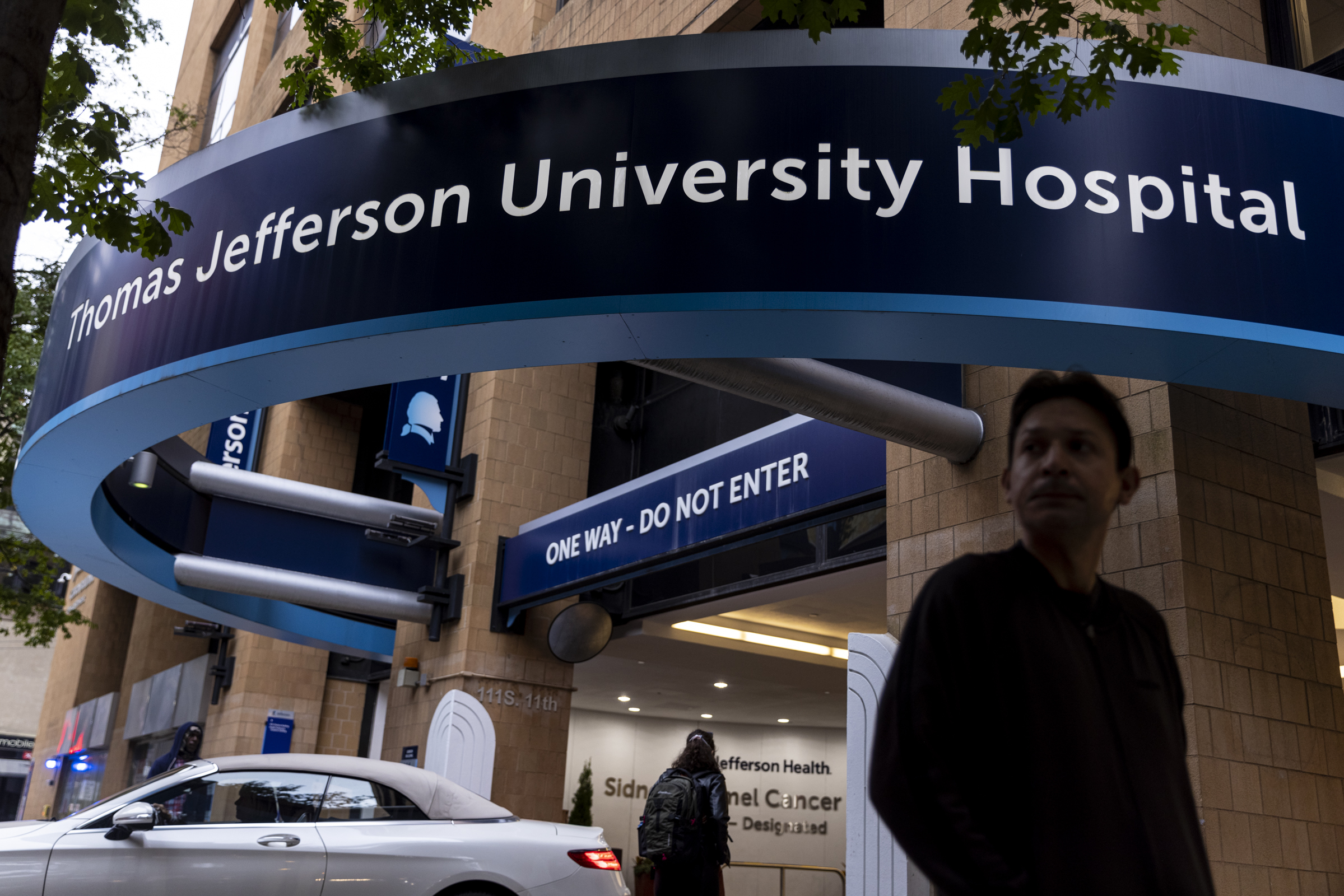
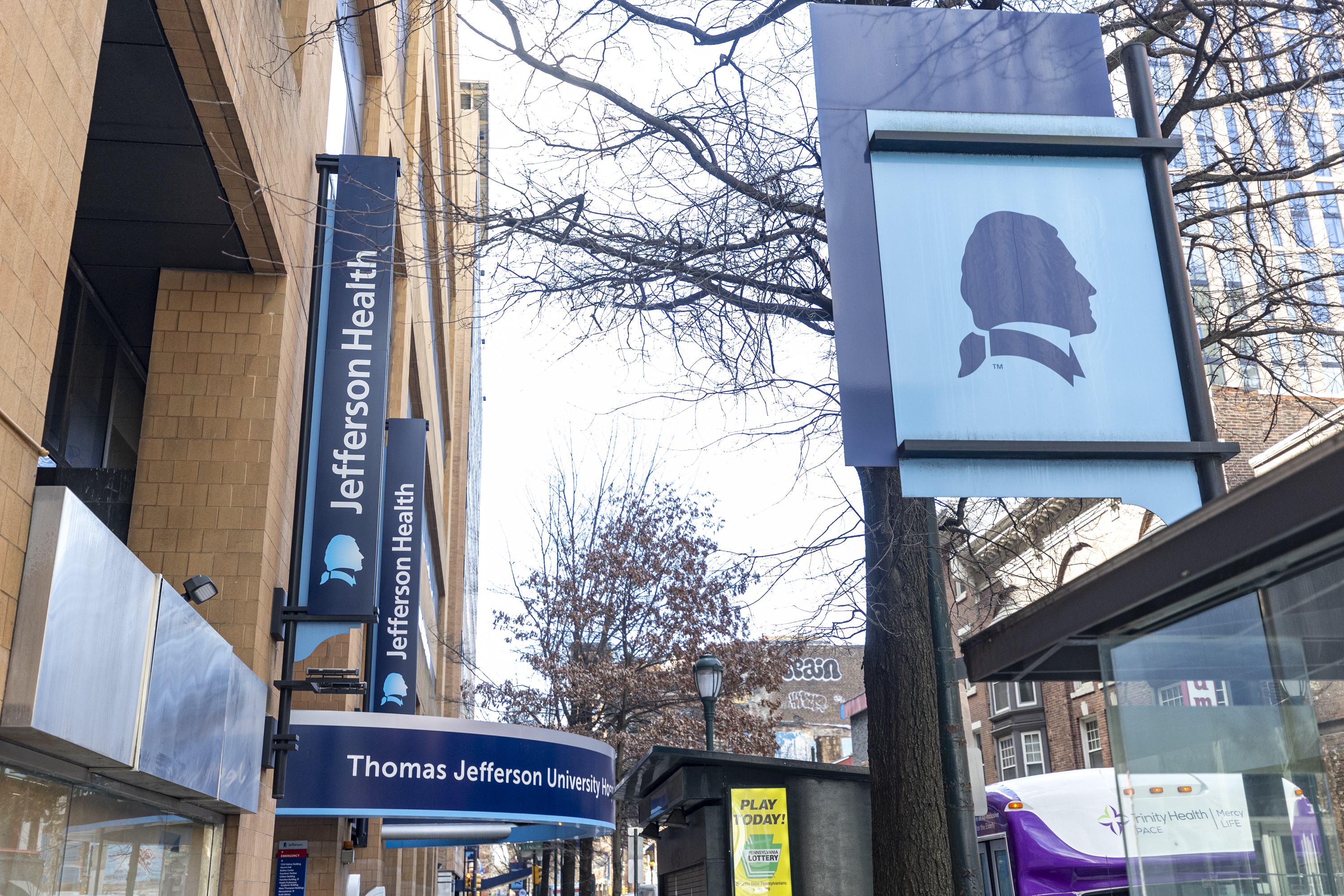
    Thomas Jefferson University Hospital in Center City Philadelphia is shown in this 2020 file photo. Heather Khalifa / Staff Photographer

    Hurdles for worker-students

    Getting a degree while working full-time can mean early mornings, later nights, giving up weekend time, or even using lunch breaks to squeeze in school work.

    Other challenges can include transportation for in-person programs or access to a computer and reliable internet connection, says Brooks. Students who owe money to a school where they were previously enrolled might also be held back from transferring or finishing their degree.

    Graduate Philadelphia sometimes helps students negotiate with schools to decrease that amount owed, “literally removing this barrier as much as we can,” Brooks said.

    Aspiring hospital executive Boudreaux’s advice? Don’t quit.

    “Slow progress is still progress,” she said. “A lot of times, when we start off on a journey, we see the entire staircase, but not realizing that it takes one step at a time to get to the top.”

    Getting the promotion

    When Nicole Henderson, 38, graduated high school, going to college right away wasn’t an option.

    “It just didn’t make sense for our family,” she said. “We just couldn’t afford it.”

    Years later, while working at a trading firm, she started pursuing a bachelor’s in accounting. But she put it on hold after a semester when she learned her employer, who encouraged her to go back to school, wouldn’t cover her tuition.

    Five years ago, while searching for work as an executive assistant, she saw a role open up at the Children’s Hospital of Philadelphia that didn’t require a bachelor’s degree. She got the job and soon felt the urge to continue advancing her career.

    “I’m now at this huge organization with all these opportunities,” Henderson said. “I was like, oh, man, eventually I’m going to have to have this bachelor’s degree.”
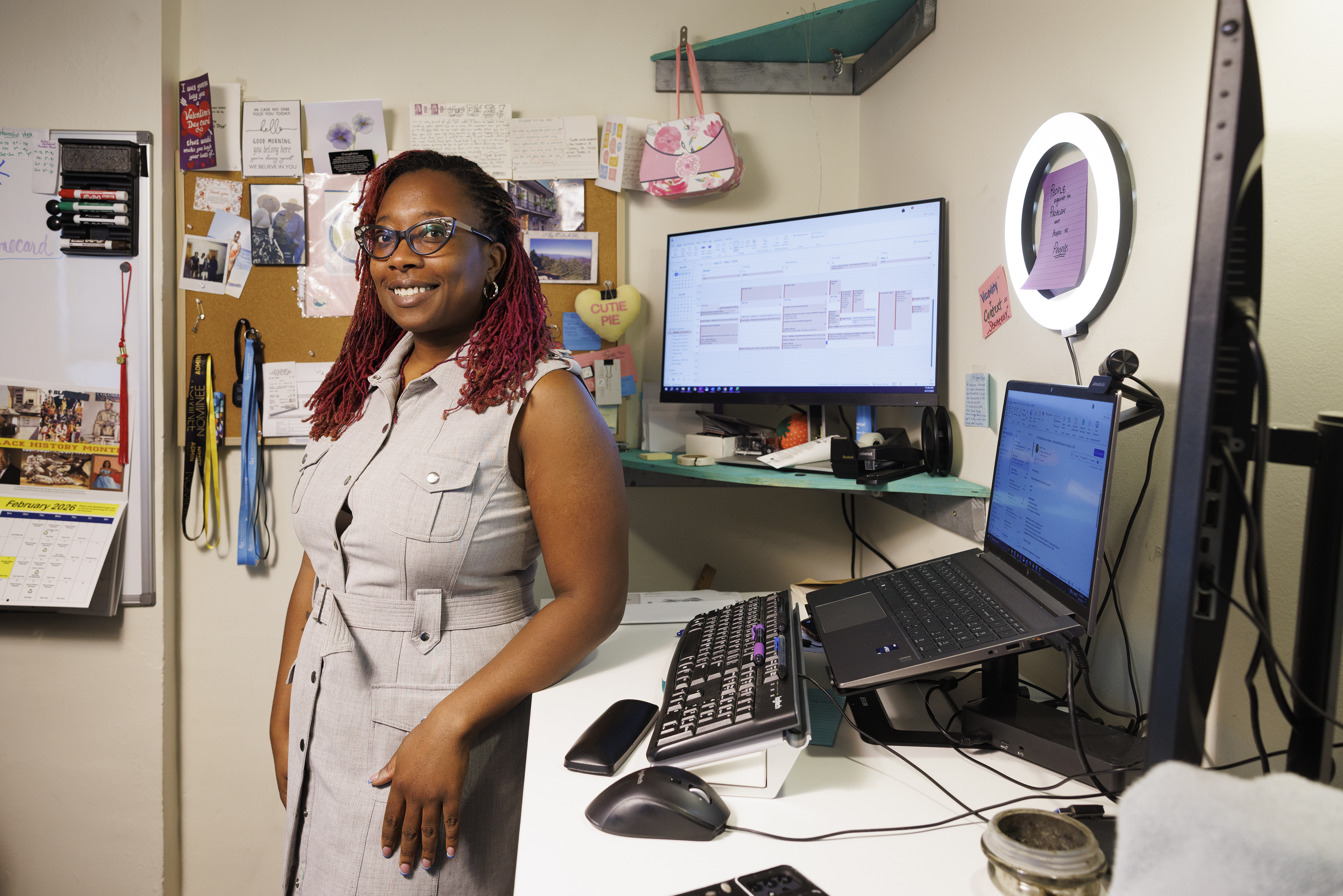
    Nicole Henderson in her home office in Darby. She went back to school while working full-time and recently earned her bachelor’s from Temple.Alejandro A. Alvarez / Staff Photographer

    In 2023, she started working toward that undergraduate degree again. Her colleagues at CHOP were supportive, and she was given flexibility to tune into classes from work sometimes, or work remotely on the days she had a lot of studying to do. CHOP also reimburses a portion of her tuition and has a student loan repayment program. Without that financial support, Henderson says she wouldn’t have pursued the degree.

    She also got a scholarship from the Chamber of Commerce for Greater Philadelphia, which annually gives $5,000 to undergraduate women working at member organizations. Boudreaux, of Jefferson, was also a recipient.

    Juggling work and school can be exhausting, Henderson said. She slept through the day some Saturdays because her “brain was just so overloaded with information.”

    But she got her bachelor’s in business from Temple University in December and walked across the stage at graduation in May.

    Her classes gave her a new awareness of what’s important to bosses and leaders at her organization, she said, and “how to speak their language.”

    She also negotiated a promotion from executive associate to project manager, with a raise.

    Now she doesn’t have to wonder “how am I going to convince people that I’m qualified to do this?” she said. “I kind of already have this degree that says that for me.”
  • Tower Health reported $8.5 million in operating profit for fiscal 2026

    Tower Health reported an $8.5 million operating profit in the year that ended June 30, compared to a $20.6 million loss the year before.

    The fiscal 2026 profit will be Tower’s first in eight years, if the result holds in its audited financial.

    In the Berks County nonprofit’s preliminary financial report to bond investors Friday, Tower management called the result “an important milestone in Tower Health’s ongoing journey toward sustained financial strength.”

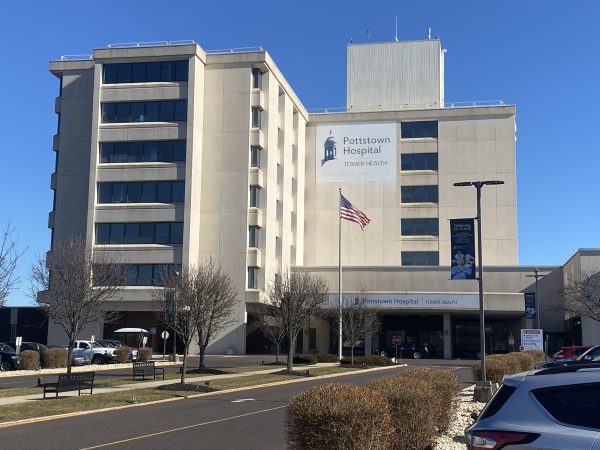
    Recent moves by Tower to become financially stable included creating a clinical alliance with Jefferson Health, with the goal of bringing more advanced care to Tower’s markets, and laying off 160 workers — or 22% of the workforce — at Pottstown Hospital.

    In addition to Pottstown, Tower owns Phoenixville Hospital and Reading Hospital in West Reading, and half of St. Christopher’s Hospital for Children in North Philadelphia in a joint venture with Drexel University.

    Here are more details:

    Revenue: Tower reported a 2% increase in revenue, to $2.07 billion from $2.03 billion. Reading Hospital in West Reading logged an 11% increase in revenue, while the combined revenue of Phoenixville and Pottstown Hospitals fell 8%.

    Patient volumes: Pottstown saw an 11% decrease in hospital admissions, likely because Tower closed the hospital’s intensive care unit at the beginning of the this year. Phoenixville had a small gain of 0.7% in admissions, while Reading was flat. Total surgeries across the system were flat.

    Notable: A year ago, Tower reported a preliminary operating profit of $5.9 million for fiscal 2025, thanks to a gain on the sale of the former Brandywine Hospital. That would have been the system’s first profit in seven years, but it turned into a $20.6 million loss in Tower’s audited financial statements. Auditors from KPMG decided that Tower needed to boost medical malpractice reserves and give up on collecting millions owed by patients.

    In an email to The Inquirer, Tower CEO Michael Stern expressed confidence this year’s audit will uphold the preliminary result, giving Tower its first profitable year since 2017.

  • Jefferson Health reported a $181.5 million operating loss in fiscal 2026

    Jefferson Health reported a $181.5 million operating loss in fiscal 2026

    Thomas Jefferson University and Jefferson Health posted an operating loss of $181.5 million in the year that ended June 30, an improvement over last year’s $208 million loss. In both years, the loss was concentrated in Jefferson’s insurance business.

    The fiscal 2026 results, reported to bondholders Friday, included $112 million in costs for layoffs and other moves designed to put the Philadelphia region’s largest health system on firmer financial ground.

    Jefferson highlighted in its preliminary report to investors that results improved each quarter of fiscal 2026 — from an operating loss of $103.8 million in the first quarter to a $71.1 million operating profit in the fourth quarter.

    “We’ve made significant progress strengthening Jefferson’s financial performance, yet those gains are increasingly threatened by the actions of commercial insurers in Pennsylvania,” Jefferson’s chief financial officer, Michael Harrington, said in an email.

    Jefferson sued Independence Blue Cross last month over policy changes that the health system says amount to back-door price cuts.

    “Despite already paying some of the lowest reimbursement rates in the nation, certain payers are now attempting to unilaterally rewrite or reinterpret existing contract terms to further reduce payments and improve their own margins at the expense of providers and the patients they serve,” he said.

    Separately, Jefferson sued Aetna in April over a policy that reduces payments for hospital stays for Medicare Advantage patients that Aetna decides aren’t sick enough to qualify for full payment.

    Insurers are under pressure from employers to slow healthcare expense growth. Independence said in response to the lawsuit that it acts in the best interest of its customers. Aetna said its policies comply with federal laws and regulations.

    Here are more details on Jefferson’s results:

    Revenue: Jefferson’s revenue reached $17.7 billion, up from $15.8 billion the year before. Fiscal 2025 included just 11 months of Lehigh Valley Health Network results. Jefferson completed that acquisition on Aug. 1, 2024, expanding its reach into Northeastern Pennsylvania and giving the nonprofit more than 30 hospitals.

    Jefferson Health Plans: Jefferson’s insurance arm had a $130.3 million loss in fiscal 2026, an improvement over a $169.9 million loss the year before. The insurance arm had 415,172 members on June 30, up from 366,780 the year before. The plan is diversifying away from Medicaid as it increases enrollment in Medicare Advantage and the Affordable Care Act markets. The percentage of membership in Medicaid fell to 75% this year from 87% last year.

    Notable: The fourth quarter of fiscal 2026 was Jefferson’s first profitable quarter in at least four years, according to Inquirer calculations that exclude investment income. Unlike other local health systems, Jefferson follows accounting rules for higher education, allowing it to include a portion of investment income in revenue.

  • Hundreds of Philly buildings rely on Vicinity’s steam plants. Their workers want better pay and safer facilities.

    Hundreds of Philly buildings rely on Vicinity’s steam plants. Their workers want better pay and safer facilities.

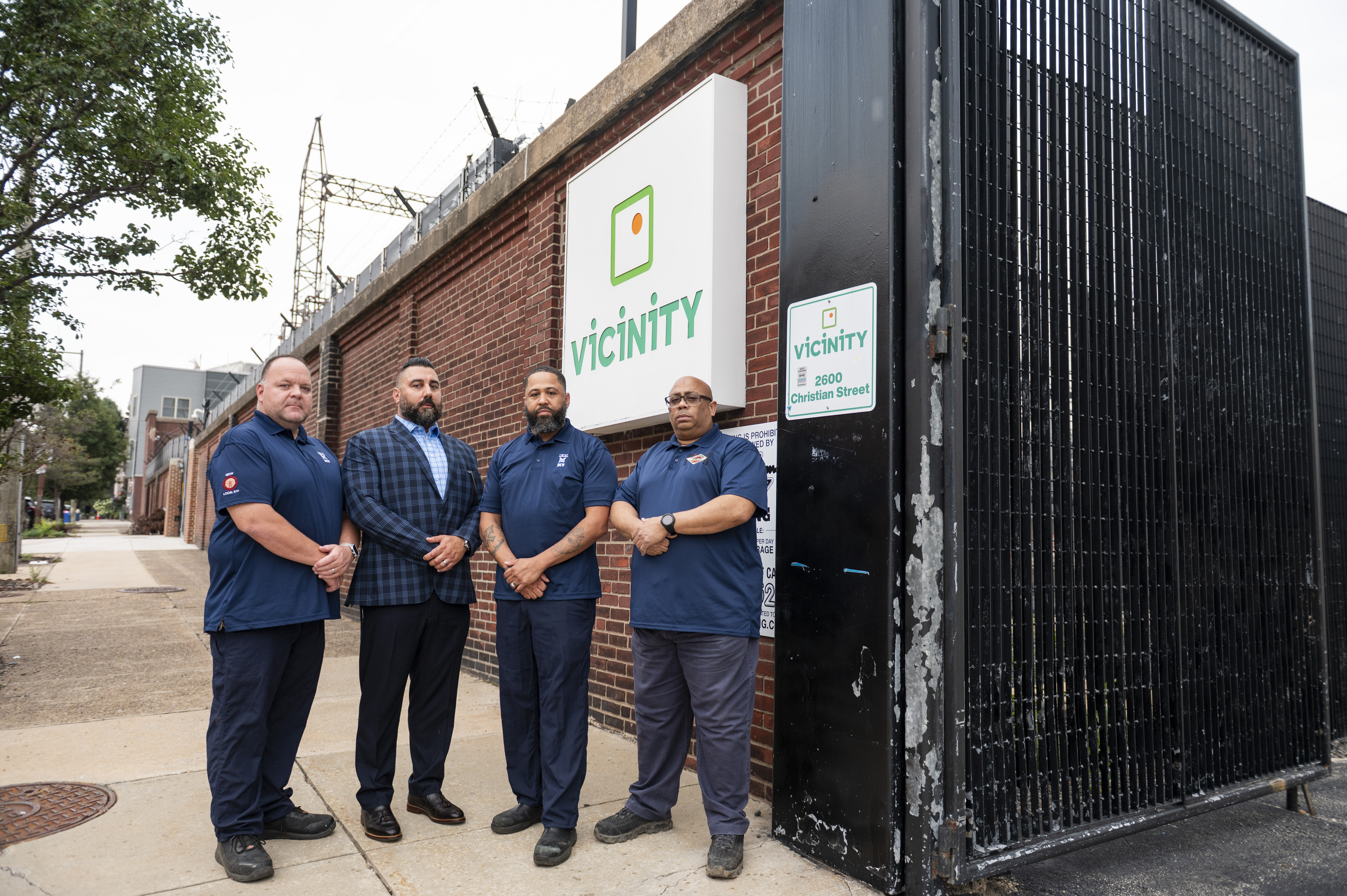
    Thomas White is a control room operator at a Philadelphia plant working with chillers and steam boilers to provide heat and air-conditioning for Jefferson Health and Thomas Jefferson University. When he started his job some 18 years ago, he and many of his coworkers had served in the U.S. Navy.

    That shared experience was an advantage, he says, because they all came with the same training. The Navy used steam-driven ships.

    “You just had to learn where things were because you already knew what they did, you knew how to do it, spoke the language,” he said.

    White and his colleagues work around-the-clock shifts for Vicinity Energy, operating a system that generates steam and electricity to provide customers with heat, air-conditioning, and chilled water. In Philadelphia, Vicinity serves hundreds of buildings, including Two Liberty Place, Thomas Jefferson University Hospital, and the Philadelphia Museum of Art, as well as the University of Pennsylvania, which buys over half the steam Vicinity sells in Philadelphia.

    Since he’s been on the job, White says the Navy-veteran hiring pool has shrunk, as the Navy moved away from steam and toward diesel and gas turbines. Now hires come from refineries shutting down or trash plants, and they need training.

    “There’s just a few of us older guys that are left over to try to pass this institutional knowledge down,” said White, who is a member of IBEW Local 614, along with 56 other Philadelphia employees of Vicinity. They do this training on their own time, White said, so they don’t get paid for it.

    Their union is negotiating a new contract and could go on strike if they can’t reach a deal. They want raises, better short-term disability pay, a safer workplace, and compensation for the time they spend training new hires. Their current agreement expired in March.

    “Vicinity Energy is committed to bargaining in good faith and believe those discussions belong at the bargaining table, not in the media,” a spokesperson for the company said in a statement. “Throughout this process, the safety of our employees, customers, and the communities we serve remains our top priority, and we remain committed to safe, reliable operations.”

    The steam plant workers voted to authorize a strike on Saturday if their union calls for it, with 77% participating in the vote, and 97% voting yes.

    If they do walk off the job, they’d be closely following in the footsteps of IBEW Local 614’s Peco employees, who recently went on strike before reaching a contract deal last month. A strike authorization vote doesn’t guarantee a strike will happen but can be used as leverage in bargaining.

    The union has alleged that a Vicinity supervisor threatened to “discharge” workers who strike, according to an unfair labor practice charge filed with the National Labor Relations Board earlier this month. Vicinity did not comment on the charge.

    The union is still bargaining in good faith, president Larry Anastasi said.

    Steam plants require human operators, so a strike could be very disruptive for steam-powered buildings across the city. Given that, Anastasi said, it’s important “that we do everything in our power” to keep a strike from happening.

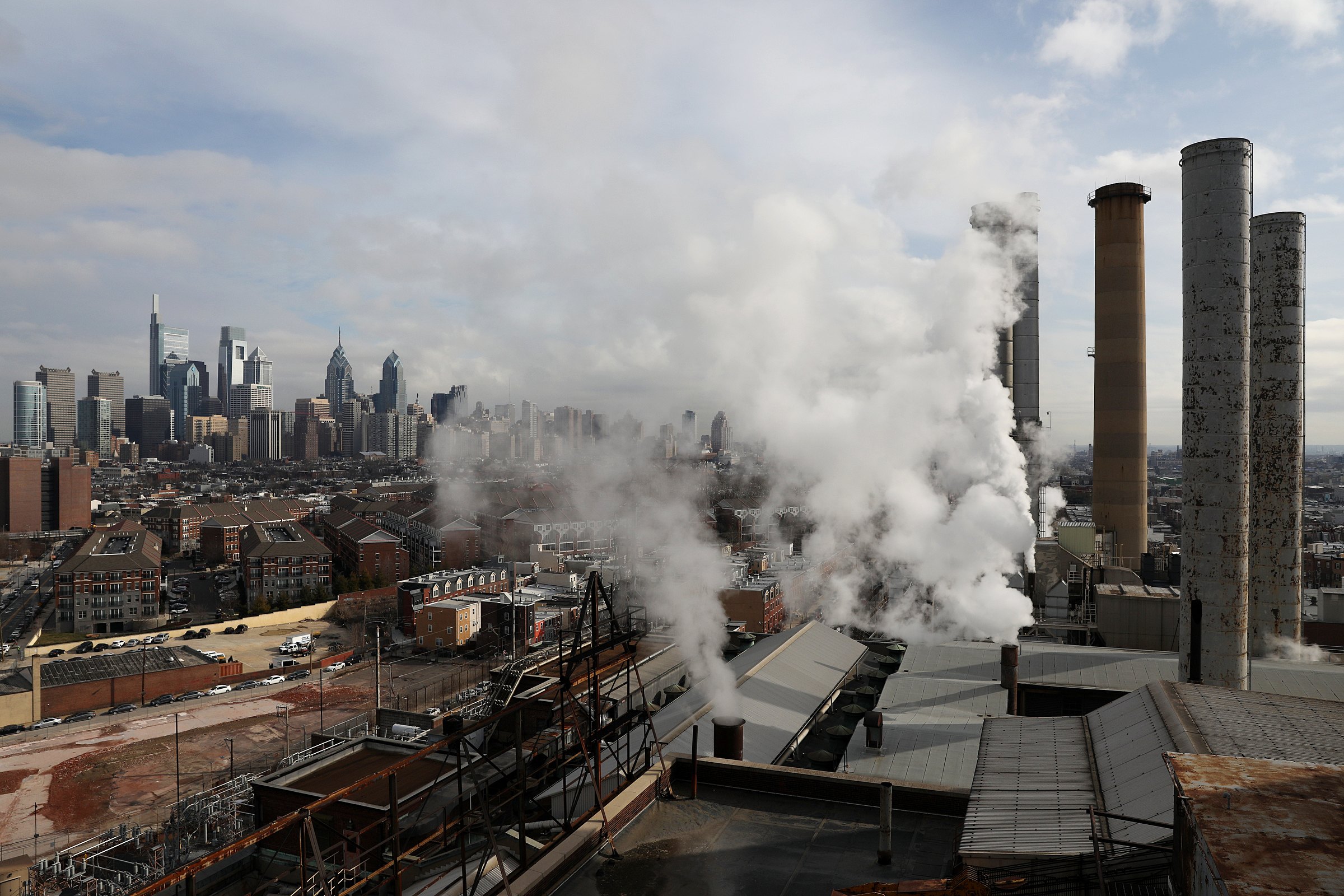
    The Vicinity Energy cogeneration plant is pictured in Philadelphia’s Grays Ferry section in 2020. The plant, originally opened by Philadelphia Electric, produces electricity and steam for heating Center City buildings.Tim Tai / Staff Photographer

    An old system changing hands

    Philadelphia’s steam system was originally built by Peco at the start of the 20th century.

    “Because it’s so old, I think people forgot its value,” Anastasi said.

    Veolia Energy bought the system in 2007. Vicinity’s parent company, private-equity firm Antin Infrastructure Partners, bought it from Veolia in 2019 as part of a larger deal valued at $1.25 billion. At the time, the company committed to $50 million in capital spending over five years in Philadelphia.

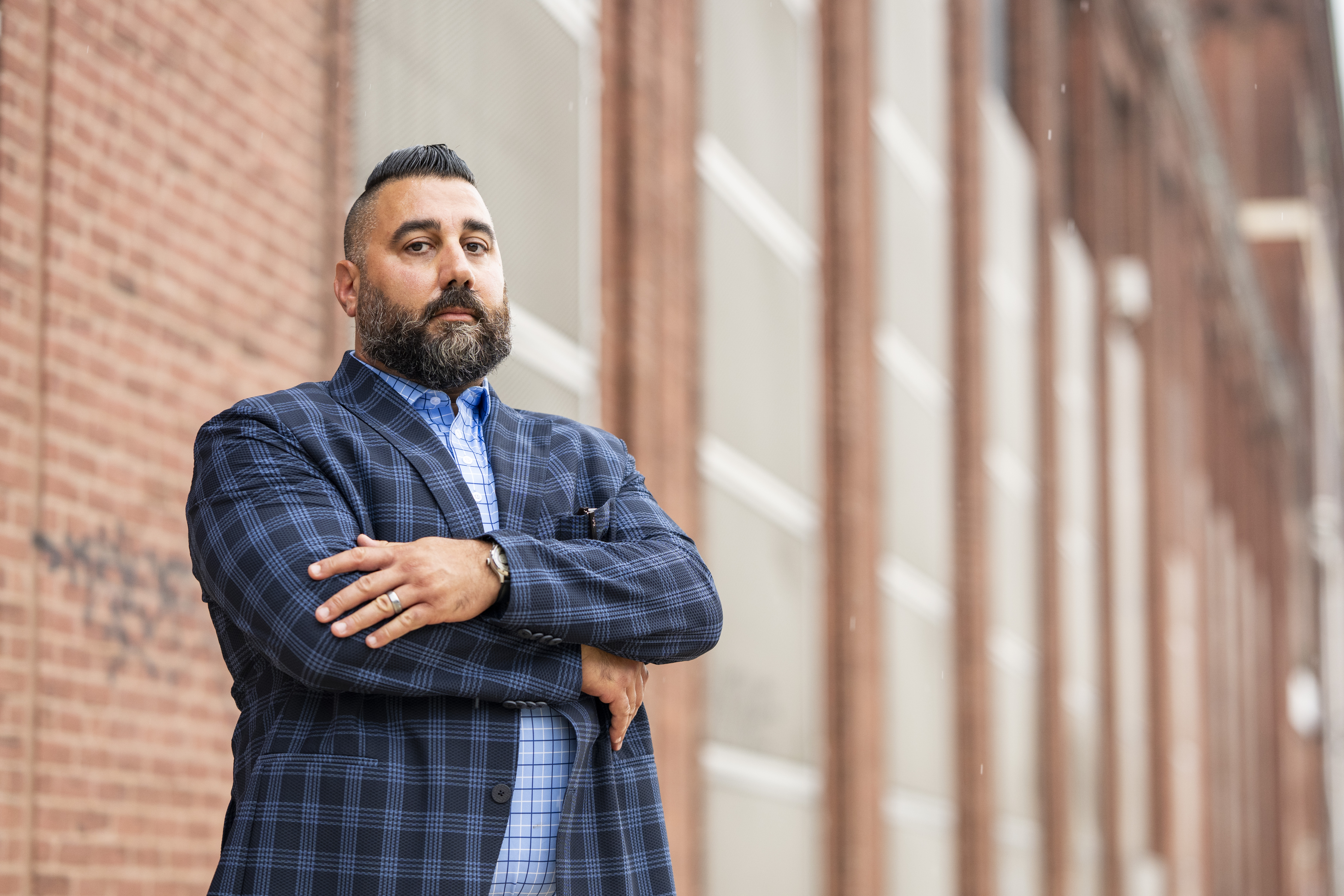
    Larry Anastasi, president of IBEW Local 614. The union leader also represents Peco employees who reached a new contract with the company in July. Allie Ippolito / For The Inquirer

    Boston-based Vicinity manages some 41 miles of underground pipe infrastructure in Philadelphia, according to the company’s website. The business services 400 buildings in Philadelphia, and its main plant is in Grays Ferry, at 2600 Christian St.

    Vicinity’s Philadelphia business brought in over $99 million in revenue last year but reported a net loss of $11 million in 2025 after paying for fuel, operating expenses, and other costs.

    The turbine hall is pictured inside the Vicinity Energy plant in Philadelphia’s Grays Ferry section in 2020. Tim Tai / Staff Photographer

    What do workers want?

    After months of negotiations, it’s hard to keep morale up among workers, said Kenneth Gordy, a union shop steward and control room operator. Gordy said he feels workers are underpaid for the highly skilled and dangerous work they do.

    Operators typically clock in for 12-hour shifts beginning at 6 a.m. or 6 p.m. They get two weekends off per month.

    Operators earn roughly around $50 an hour, said Anastasi. He said “substandard” wages and benefits have led to turnover.

    “We want our wages to reflect the knowledge, the level, the skills, the things that we do. We’re not asking for extraordinary things,” White said.

    Union members also want fully funded short-term disability. They used to be able to get 100% pay during short-term disability years ago, but they now get around 60% during such leave, Anastasi said.

    “Guys are using their bodies in this plant. We’re beating ourselves up,” said Sean Finnegan, an auxiliary operator who maintains equipment.

    The workers also want their employer to make repairs to the plants where they work, citing unsafe conditions such as asbestos, as well as standing water in work areas, Anastasi said. Part of the ceiling was falling down in one area recently, White recalled.

    “A new private equity firm takes over, and none of the repairs get made,” Anastasi said.

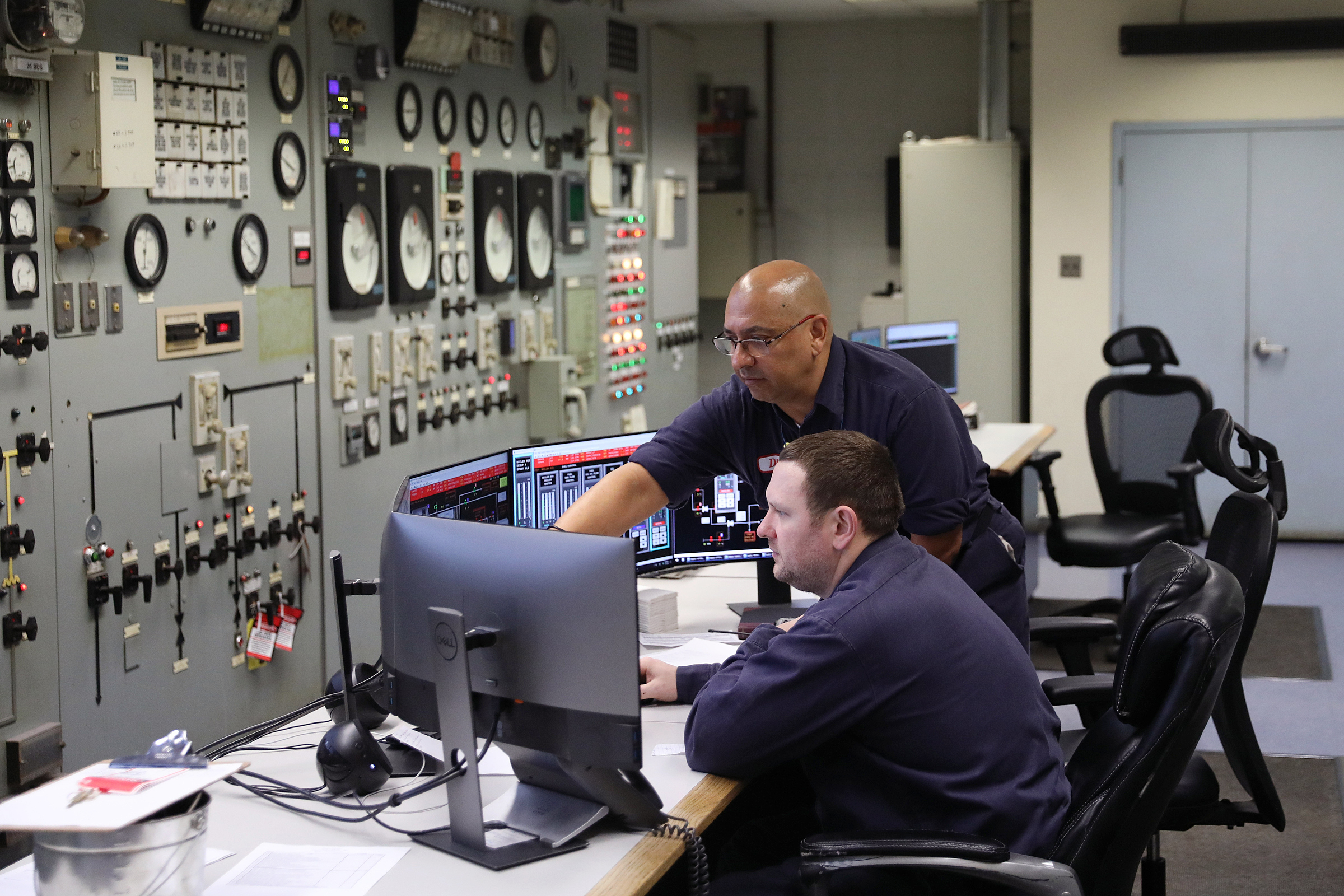
    Control room operators work at the Vicinity Energy cogeneration plant in Philadelphia’s Grays Ferry section in 2020. Tim Tai / Staff Photographer

    Anastasi also wants to improve retirement benefits for the Vicinity workers. He wants their employer to contribute to the union’s annuity program, so workers can get monthly payments upon retirement.

    Anastasi is coming off a retirement win for his union’s Peco members, who clawed back pensions in their recent contract with the energy company. The union heralded the deal as a “historic contract victory.”

    The steam plant workers’ most recent bargaining session was Aug. 3. The next session has yet to be scheduled, the union said Thursday.

  • Eagles practice observations: Tyler Steen vs. Ty Robinson; Darius Cooper keeps impressing; Quinyon Mitchell’s improved hands

    Eagles practice observations: Tyler Steen vs. Ty Robinson; Darius Cooper keeps impressing; Quinyon Mitchell’s improved hands

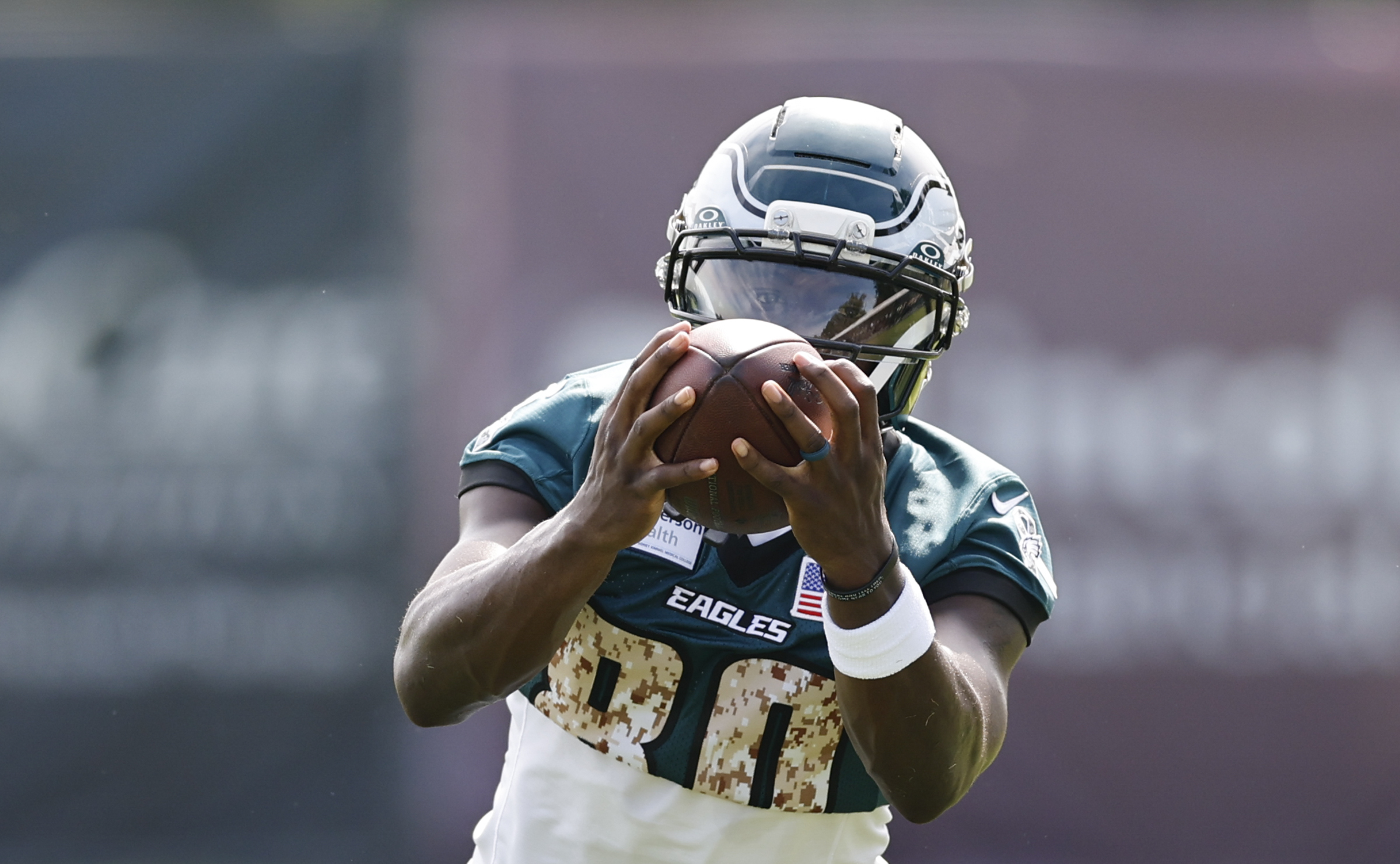
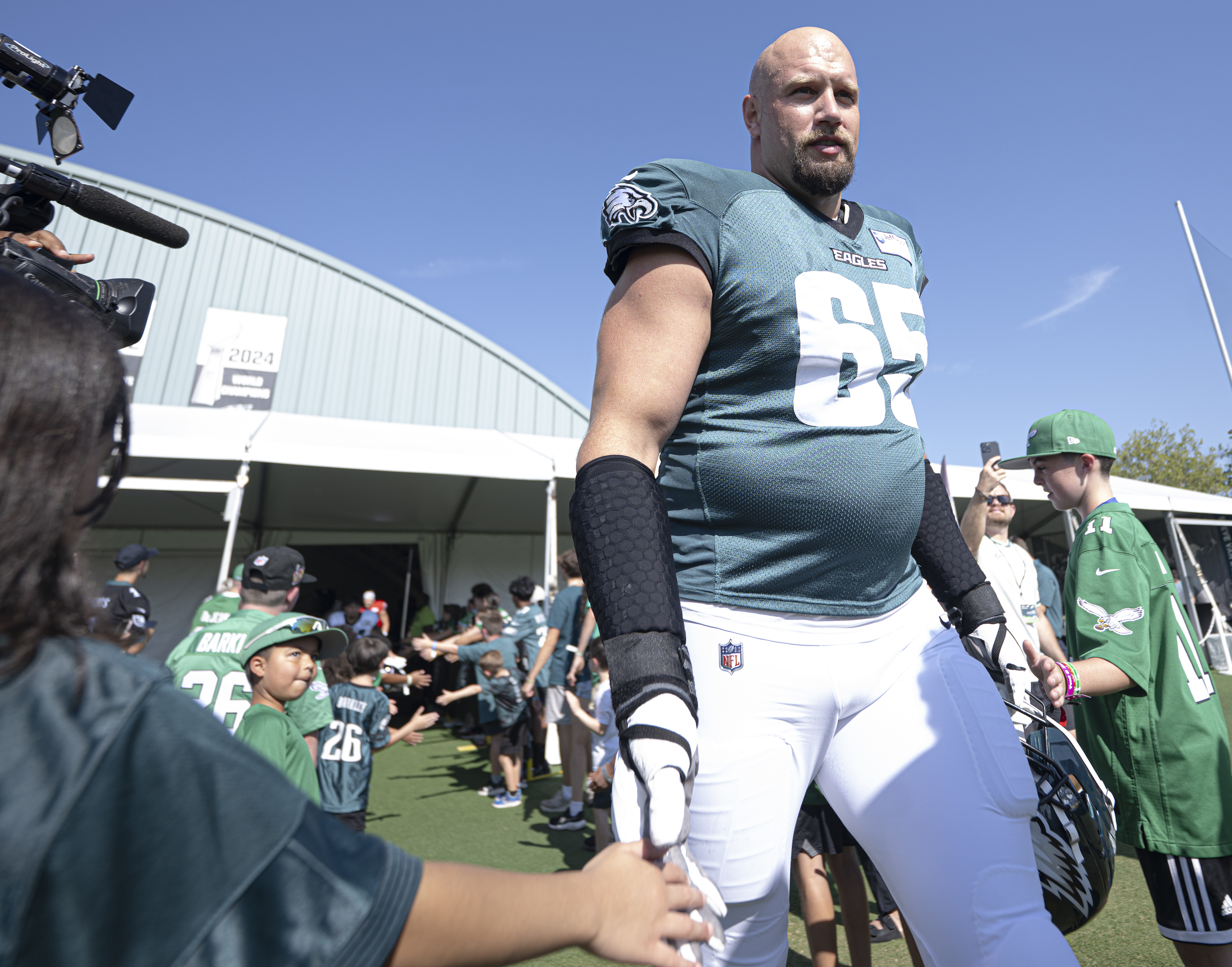
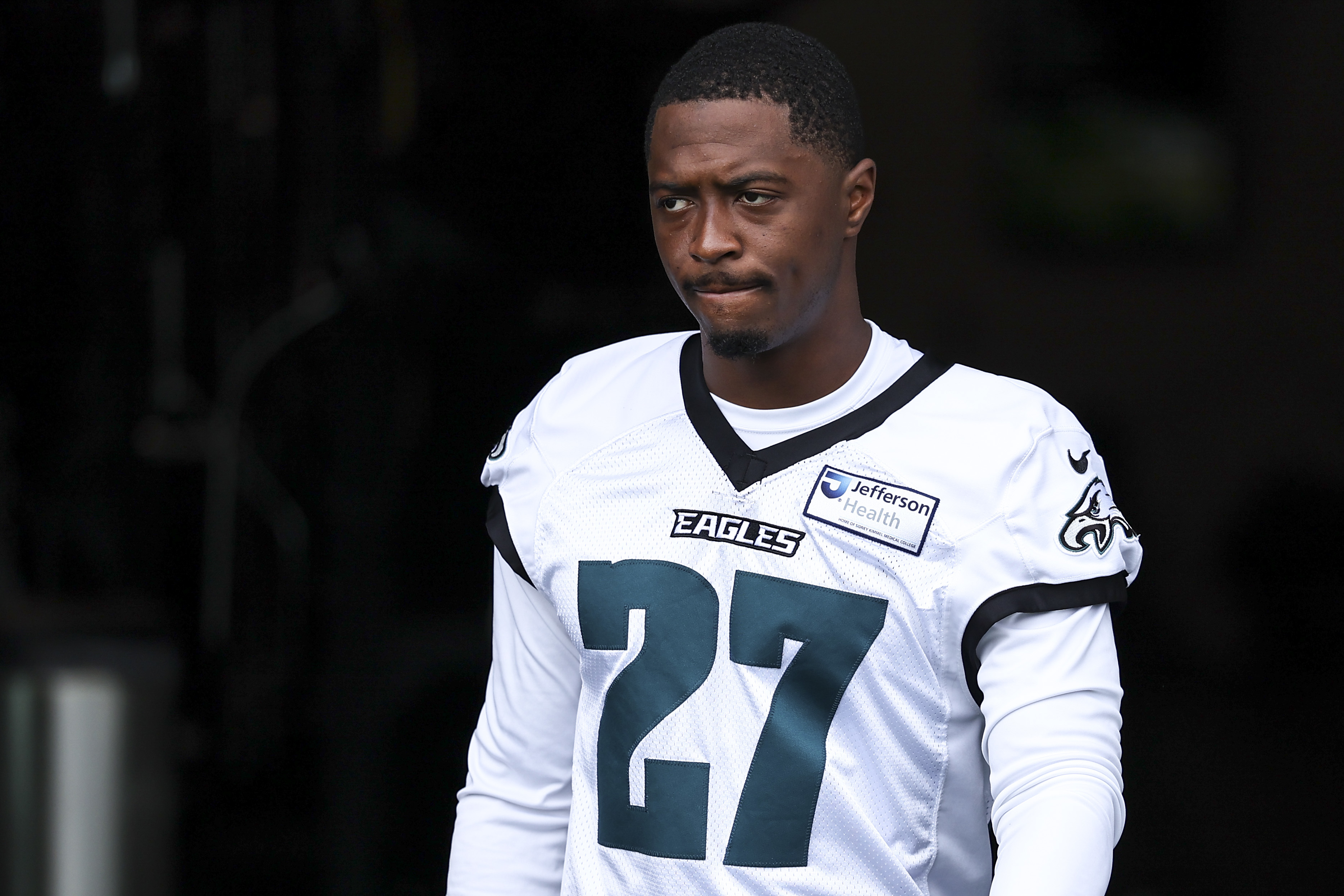
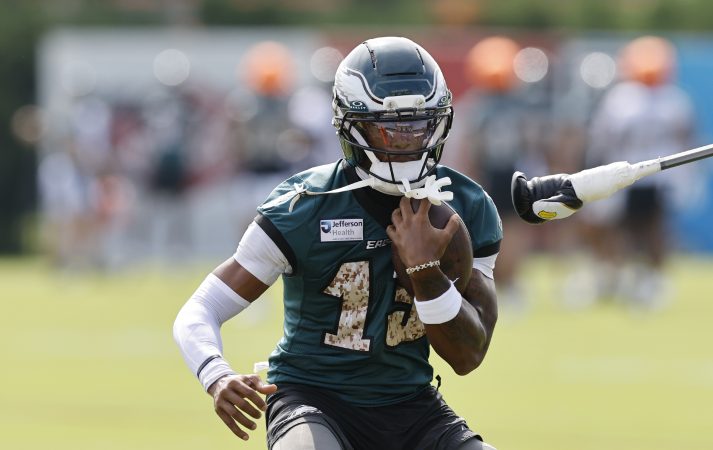
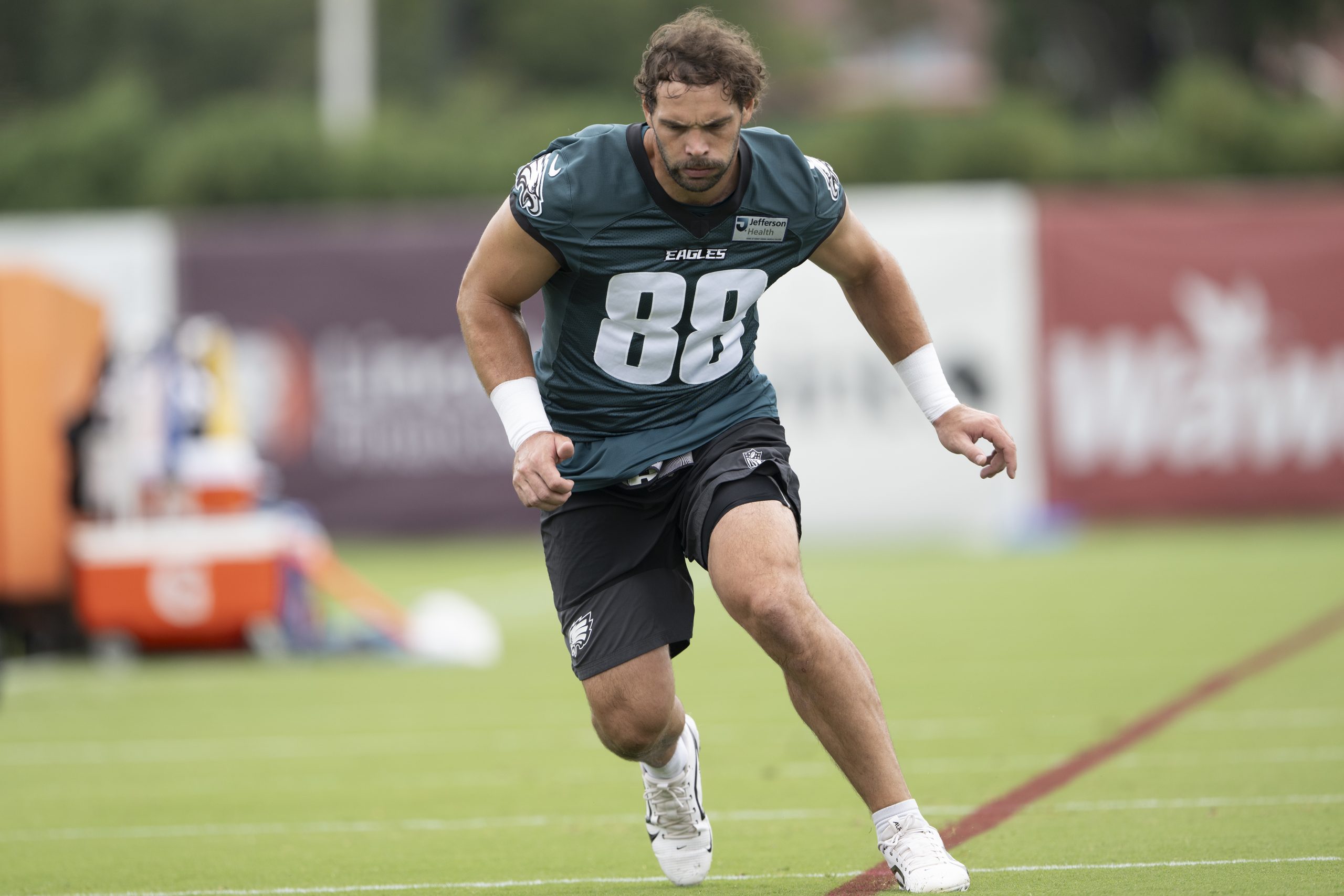
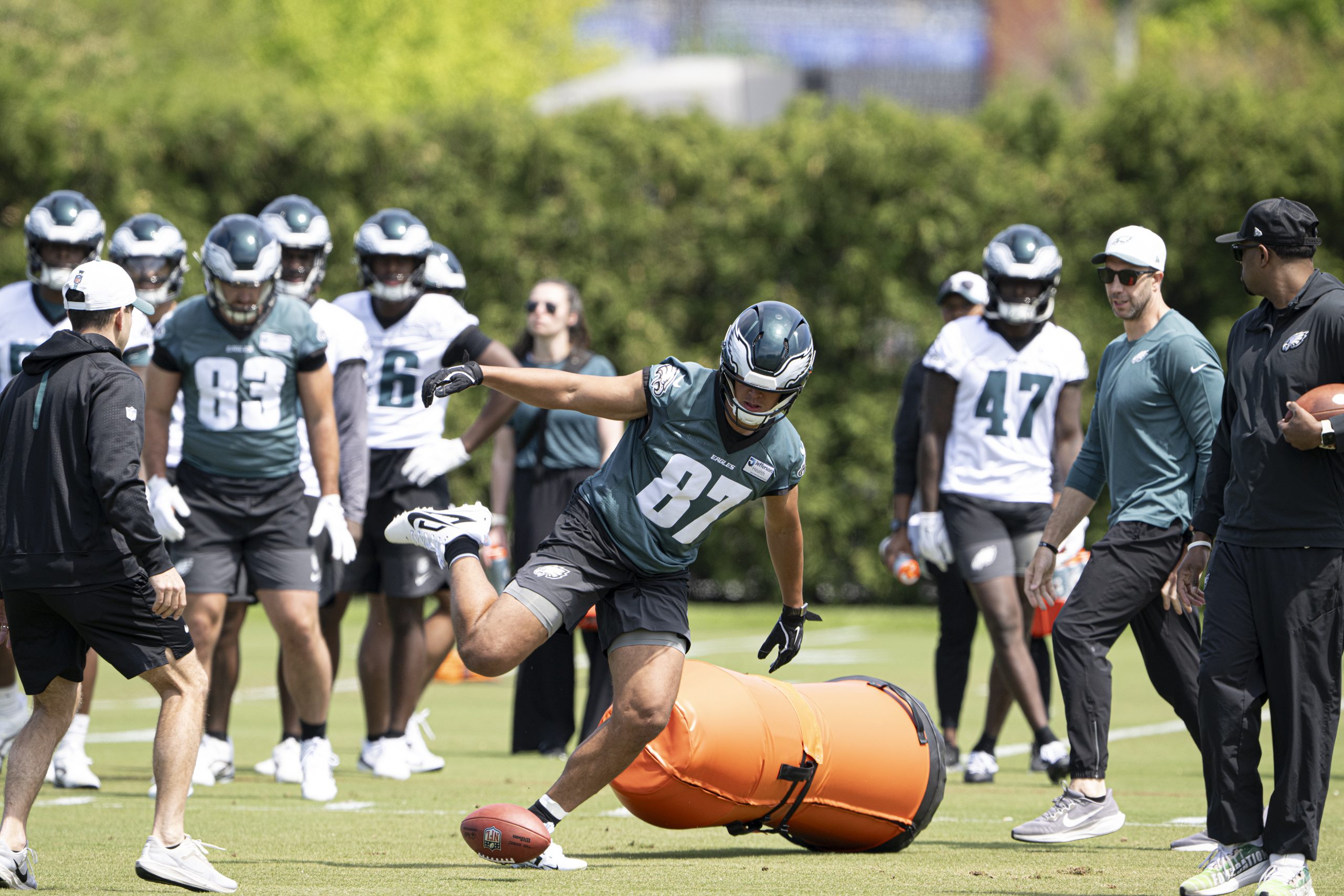
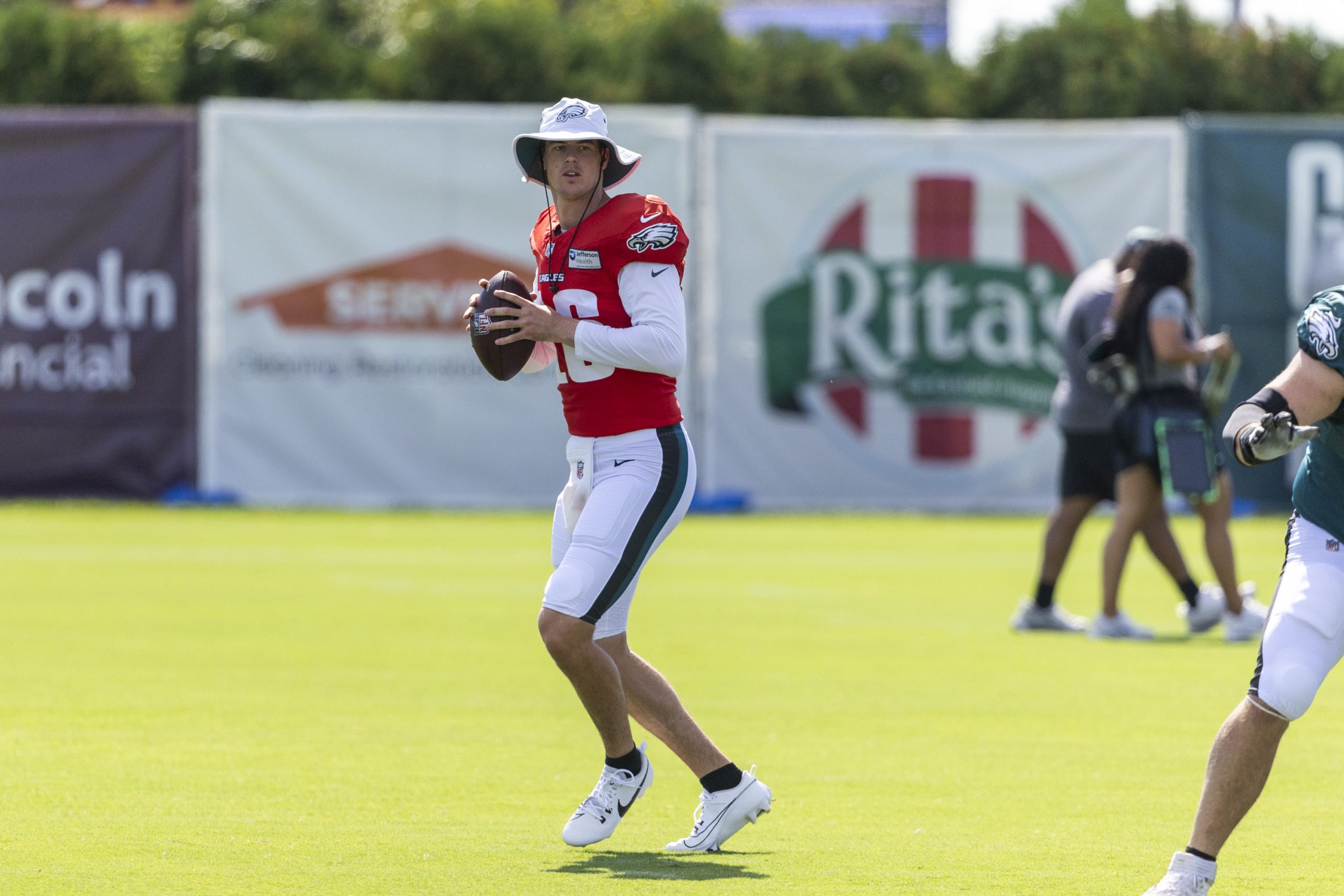
    The Eagles held the ninth practice of their 2026 training camp on Monday at the Jefferson Health Training Complex. Here were my observations from Day 9 (and links to Days 1, 2, 3, 4, 5, 6, 7 and 8):

    Taking attendance

    Wide receiver Johnny Wilson (knee), cornerback Jonathan Jones (shoulder), and running back Dameon Pierce (hamstring) were added to the injury report after recent setbacks. Wilson had stacked solid practices the last few days. Last August, his season ended before it even started when he suffered knee and ankle injuries that required surgery. It’s unclear if he reinjured the same knee. Jones projects as the top reserve outside cornerback. Pierce is competing for a roster spot.

    The following Eagles remained sidelined with injuries: receiver DeVonta Smith (hamstring), receiver Makai Lemon (hamstring), outside linebacker Keyshawn James-Newby (ankle), safety Cole Wisniewski (hamstring), and receiver Danny Gray (concussion). Smith and Lemon have now missed a week of camp. Receiver Britain Covey (hamstring) and linebacker Chance Campbell (groin) were limited.

    The Eagles made several roster moves before practice. They signed outside linebacker Tarron Jackson, defensive tackle David Blay, and running back Ja’Quinden Jackson. They placed running back Elijah Mitchell, who left Saturday’s workout early, on injured reserve. And they waived guard Jaeden Roberts and tight end Dae’Quan Wright.

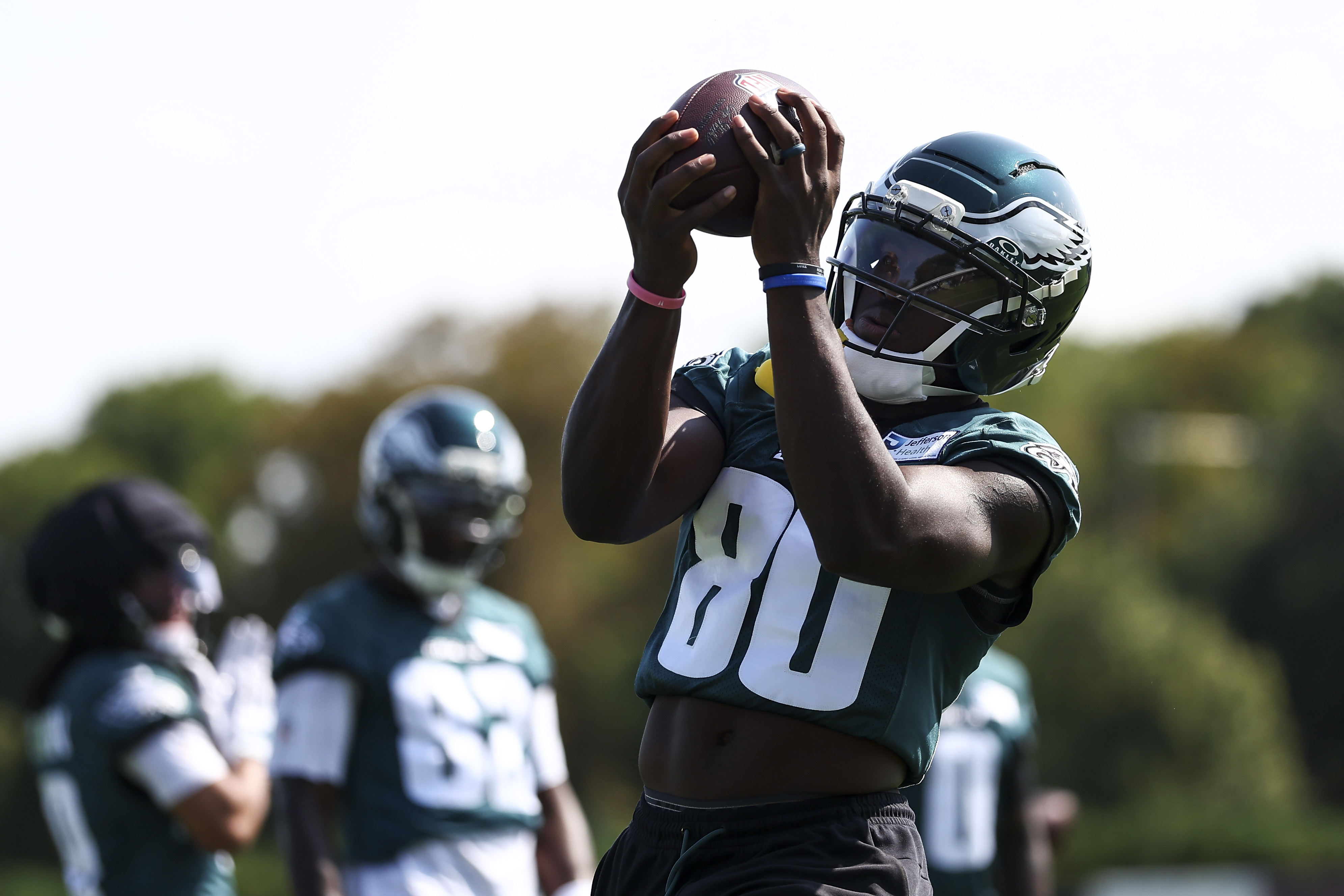
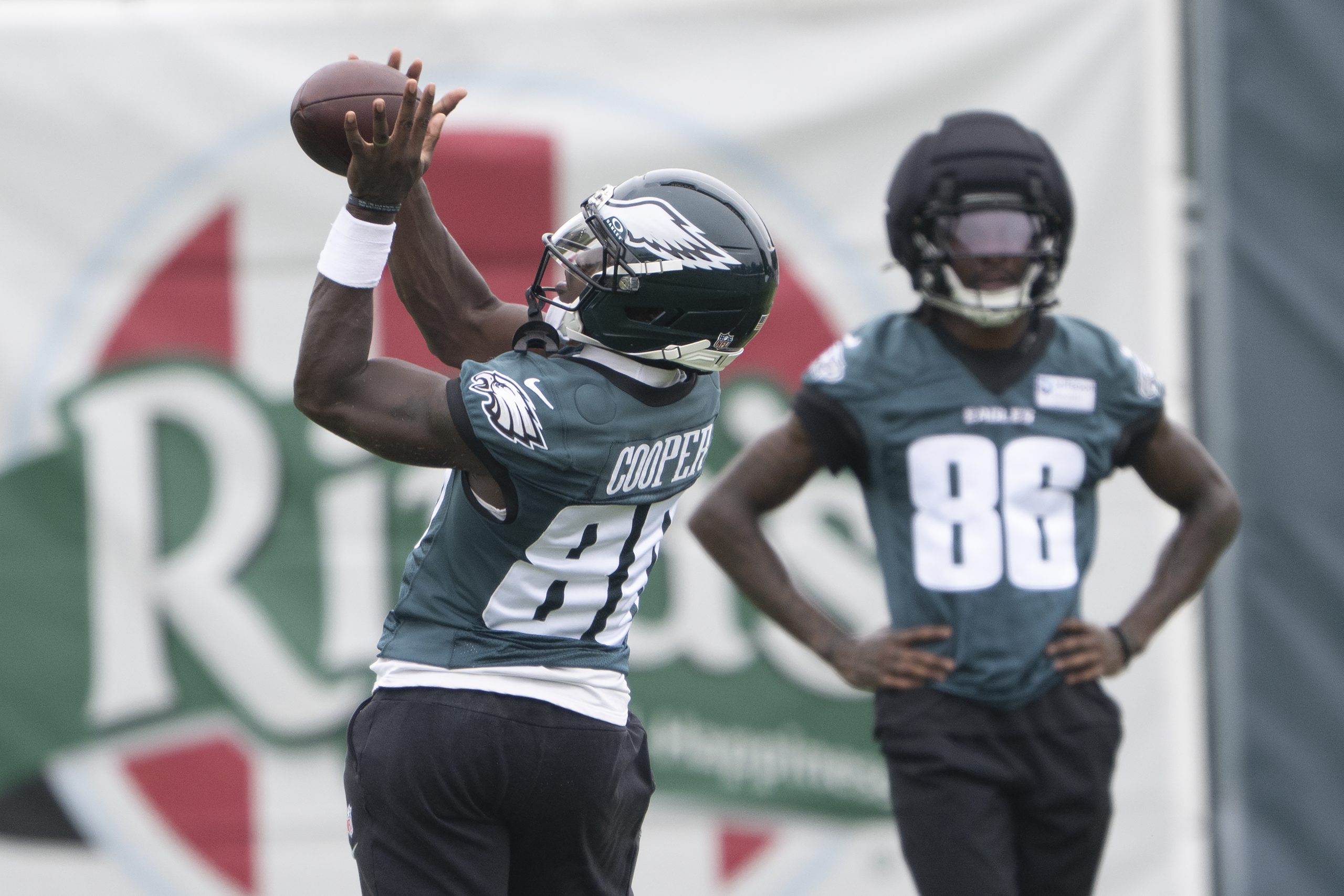
    Darius Cooper is making an early bid for a bigger role. Yong Kim / Staff Photographer

    Super Cooper

    Darius Cooper might have had his best day of camp, which is saying something. The second-year receiver is making an argument that he should be given more than just a roster spot. He’s been getting a lot of repetitions with Smith and Lemon out, and quarterback Jalen Hurts clearly trusts him.

    Their best connection came midway through the workout. Cooper got cornerback Riq Woolen to bite on a double move before Hurts hit him downfield. The receiver used a stutter-step to draw the corner in before beating him over top. Hurts’ throw was a touch underthrown, but the quarterback had to be careful with safety Michael Carter II crashing from over the top. Cooper simply turned back and made the grab in the air.

    Earlier, Cooper shook Woolen on an out route. He was also Hurts’ favorite target during 7-on-7s and plucked a ball thrown slightly behind him with Carter in the vicinity. In an end-of-game situation, he caught a pass and stayed upright after bouncing off linebacker Jeremiah Trotter Jr. The Eagles brought in four new receivers to help replace A.J. Brown — Lemon, Dontayvion Wicks, Hollywood Brown, and Elijah Moore — but a returnee is just as viable a candidate.

    Lane Johnson was immovable in pass protection on Monday. Jose F. Moreno / Staff Photographer

    Quick twitch

    Lane Johnson may be nearing the end of his career, but he doesn’t appear to be slowing down. His get-off is still elite. Nolan Smith Jr. stood little chance of getting past the right tackle each time they faced off. By the time Smith was into his pass-rush move, Johnson was vertically set and virtually impossible to get by.

    Fred Johnson got the nod ahead of rookie Markel Bell when Lane Johnson rested during team drills. They have been rotating and switching sides throughout camp. There was one notable change on the offensive line. Drew Kendall took all the snaps at center with the second unit. Jake Majors has mostly held that role as Kendall cross-trained at guard. Kendall was still Landon Dickerson’s replacement at left guard with the first offense, but he’s back to his normal position with the twos. Majors dropped to third-team center.

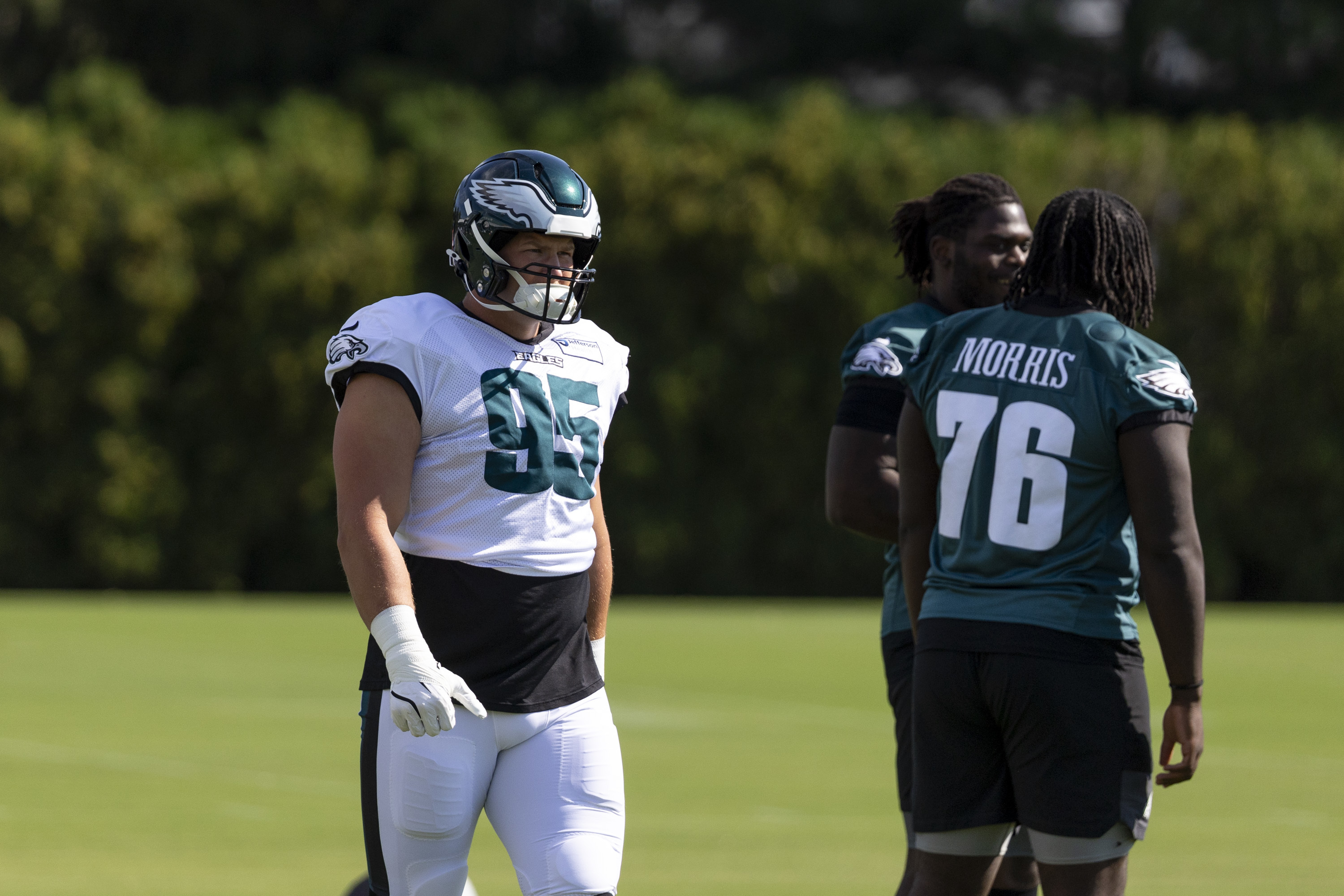
    Ty Robinson (95) turned heads on Monday and not just because of his brawl with Tyler Steen. Tyger Williams / Staff Photographer

    Tale of the tape

    We had what could definitively be labeled the first fight of camp. It came early in the first team drill period, but it had been brewing for days. I had noticed guard Tyler Steen and defensive tackle Ty Robinson mixing it up post-play a few times last week. But they went way beyond the whistle this time.

    I didn’t see who started it, but apparently Robinson took exception to Steen blocking him beyond what he deemed necessary. Robinson somehow ended up at the bottom of a pile with Steen and center Cam Jurgens on top. Several players tried to break the scrum up, but there was little budging as it took some time to peel off players.

    Robinson has been getting occasional snaps with the first defense. But the second-year D-tackle stood out as a pass rusher with the second unit. He slipped through the interior for an early pressure. And later on, he used his patented club-swim move to beat Majors — who was at guard — for a sack. Robinson has been working on his arsenal and got Majors off balance with a bull rush on the next play.

    Quinyon Mitchell logged his second pick of camp on Monday. Monica Herndon / Staff Photographer

    Quinterception

    Quinyon Mitchell notched his second interception of camp. While the first came during 7-on-7s a week ago, this one was in team drills. It came during an end-of-game scenario in which the offense trailed by four points. Hurts had to force the issue, but the turnover came on first down. Brown was the intended receiver, but Mitchell jumped his route and punted the ball after the pick in celebration.

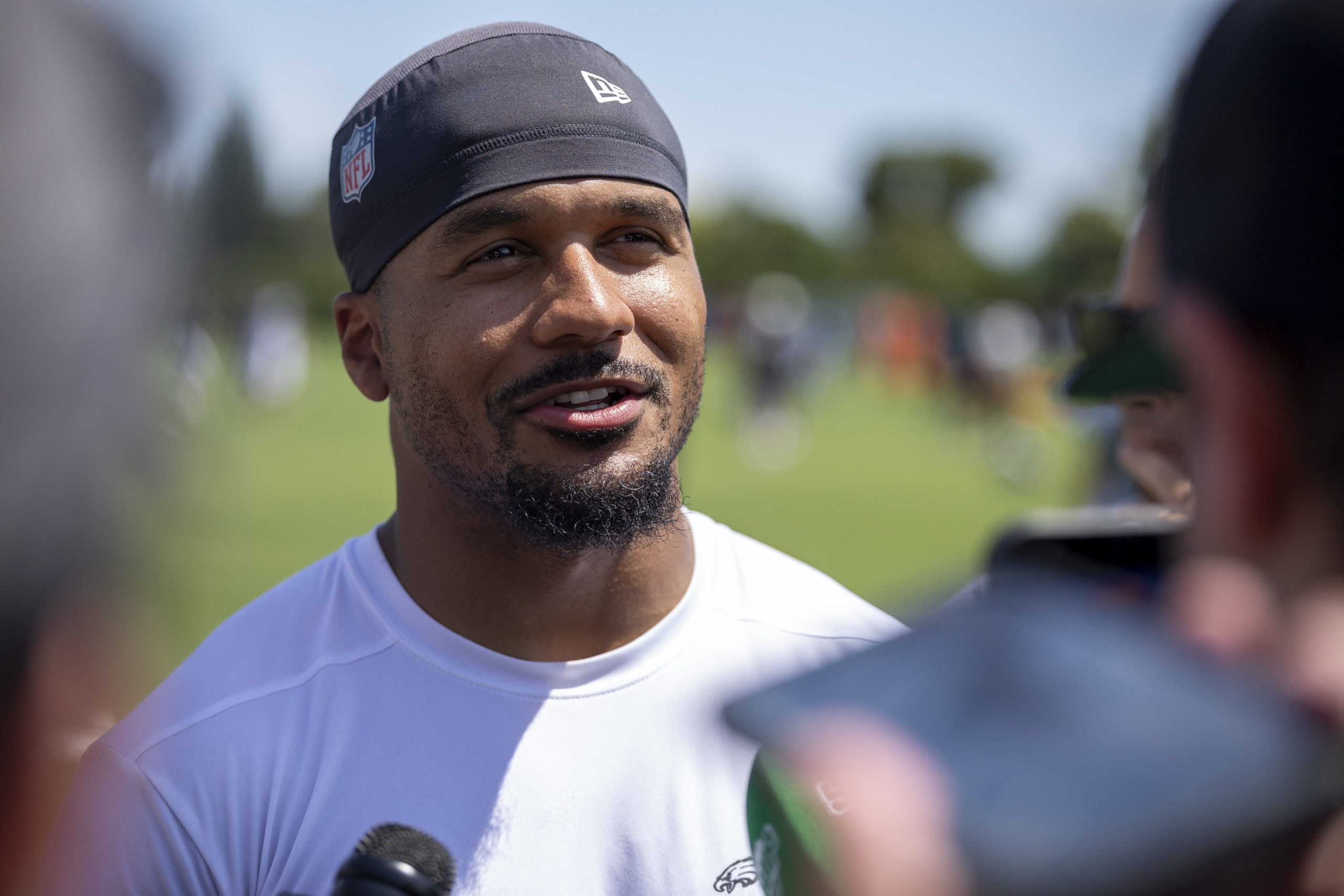
    The third-year corner is still looking for his first career regular-season interception. He has two in the postseason. He’s not a natural ball-catcher, but the additional JUGS work he’s been putting in may be paying off. Mitchell is already an All-Pro, but more interceptions could result in him becoming the highest-paid cornerback in the NFL next offseason.

    To his credit, he doesn’t go hunting for interceptions. Hurts threw one pass up for grabs with tight end Dallas Goerdert in the area, but Mitchell came flying across and batted the ball to the ground.

    Mac-man

    Like Robinson, cornerback Mac McWilliams didn’t play much last season as a rookie. But the lightbulb could be switching on in Year 2. He’s been getting intermittent looks with the first unit and had a pass breakup on a Hurts toss to Wicks during team drills.

    McWilliams’ development could make either Jakorian Bennett or Kelee Ringo expendable, especially if he can play both in the slot and outside. Bennett had a PBU of his own on a Hurts pass to Wicks.

    Ringo has mostly been relegated to the third unit. With Jones out, Tariq Castro-Fields took the initial snaps at outside corner opposite Bennett. Ringo has long been a top gunner on special teams, but he’s been increasingly prone to taking penalties. Still, the Eagles may not have a better option. Sydney Brown was the other gunner last season, but he was traded in the offseason.

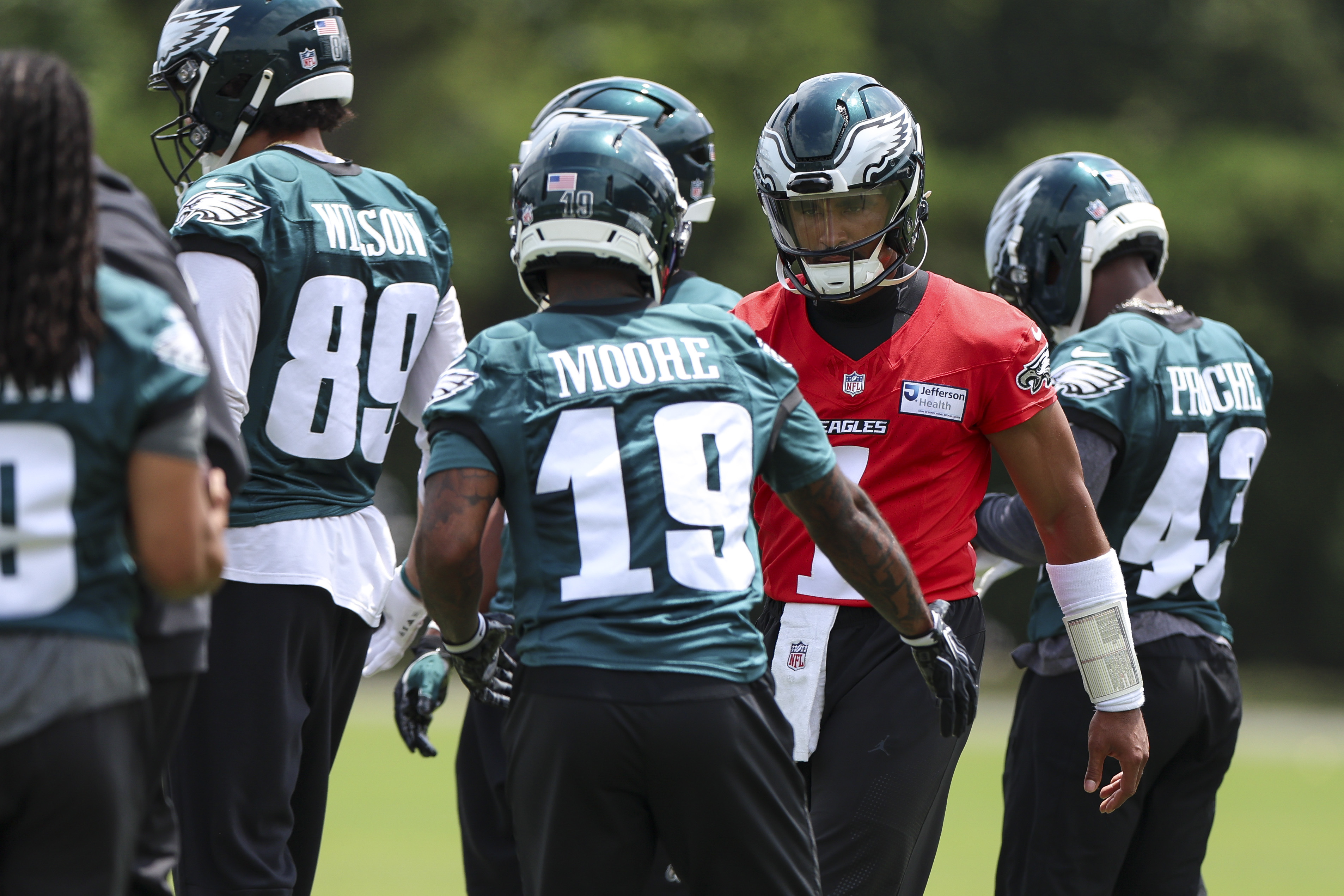
    Elijah Moore (19) and Jalen Hurts have connected during camp.Monica Herndon / Staff Photographer

    Moore not less

    Moore continued to make the most of his reps in the slot with Lemon on ice. Hurts found him alone on a short crossing route during team drills. The receiver motored into the secondary thanks in part to running back Tank Bigsby’s downfield block on Woolen.

    Later on, the offense had one last gasp in another end-of-game situation in which they trailed by eight points. Hurts and Co. advanced into the red zone with two seconds left. With the defense rushing only three, the quarterback bought time and rolled to his right. He threw across his body and Moore elevated over cornerback Cooper DeJean for the touchdown.

    Nolan Smith Jr. argued that Hurts would have been sacked — and profanely expressed his frustration — but there didn’t appear to be a defender who got near the passer. The two-point conversion failed, however, when an open Hollywood Brown slipped before Hurts’ throw arrived.

    Backup plan

    Quarterback Andy Dalton was first up with the second offense in 7-on-7s. It didn’t go well. He missed Moore on his first attempt and Woolen nearly had a pick. He then threw behind an open Cooper and Covey on successive plays. He did hook up with rookie tight end Eli Stowers to end the set.

    Dalton had several completions during team drills, but he overthrew receiver Quez Watkins when he found tons of space on a deep corner. I wondered if Watkins’ route was precise, but Dalton waited for his receiver after the play and judging by his body language seemed to think he should have completed the throw.

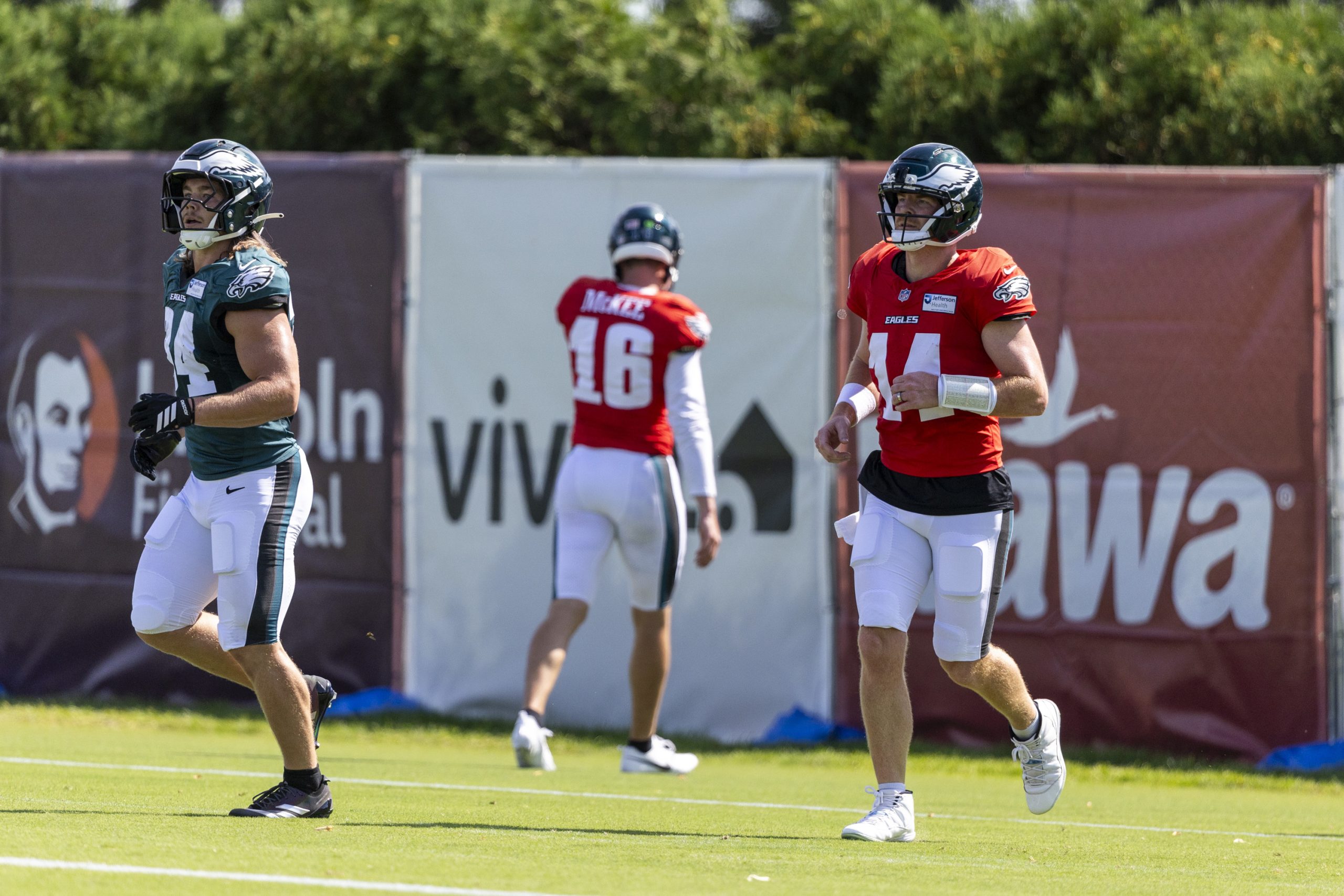
    Tanner McKee was a little sharper. The quarterback short-hopped an early toss to receiver Samori Toure. But he found Watkins at the second level, and later laced a downfield dart to receiver Brandon Hayes. He missed Hayes on the next play, but there was a miscommunication as McKee signaled where he wanted his receiver.

    Landon Dickerson helped ignite a breakout run from Saquon Barkley on Monday. Yong Kim / Staff Photographer

    That and this

    Dickerson can still move with suddenness, as he showed on a pull block that sprung running back Saquon Barkley. Barkley’s athleticism never ceases to amaze. He got knocked to the ground after a run, did a somersault and vaulted to his feet. He could have been an Olympic gymnast.

    Tight end Grant Calcaterra had a couple catches with the first offense. I don’t know if he can make the team with blocking becoming more prominent at his position. But receiving has never been the problem. Linebacker Jihaad Campbell had a tackle for loss.

    Linebacker Smael Mondon got a number of opportunities to blitz. Bigsby shielded him off on one attempt, but Mondon found a few creases to McKee. Shaun Wade played some second-unit dime as the sixth defensive back.

    Extra points

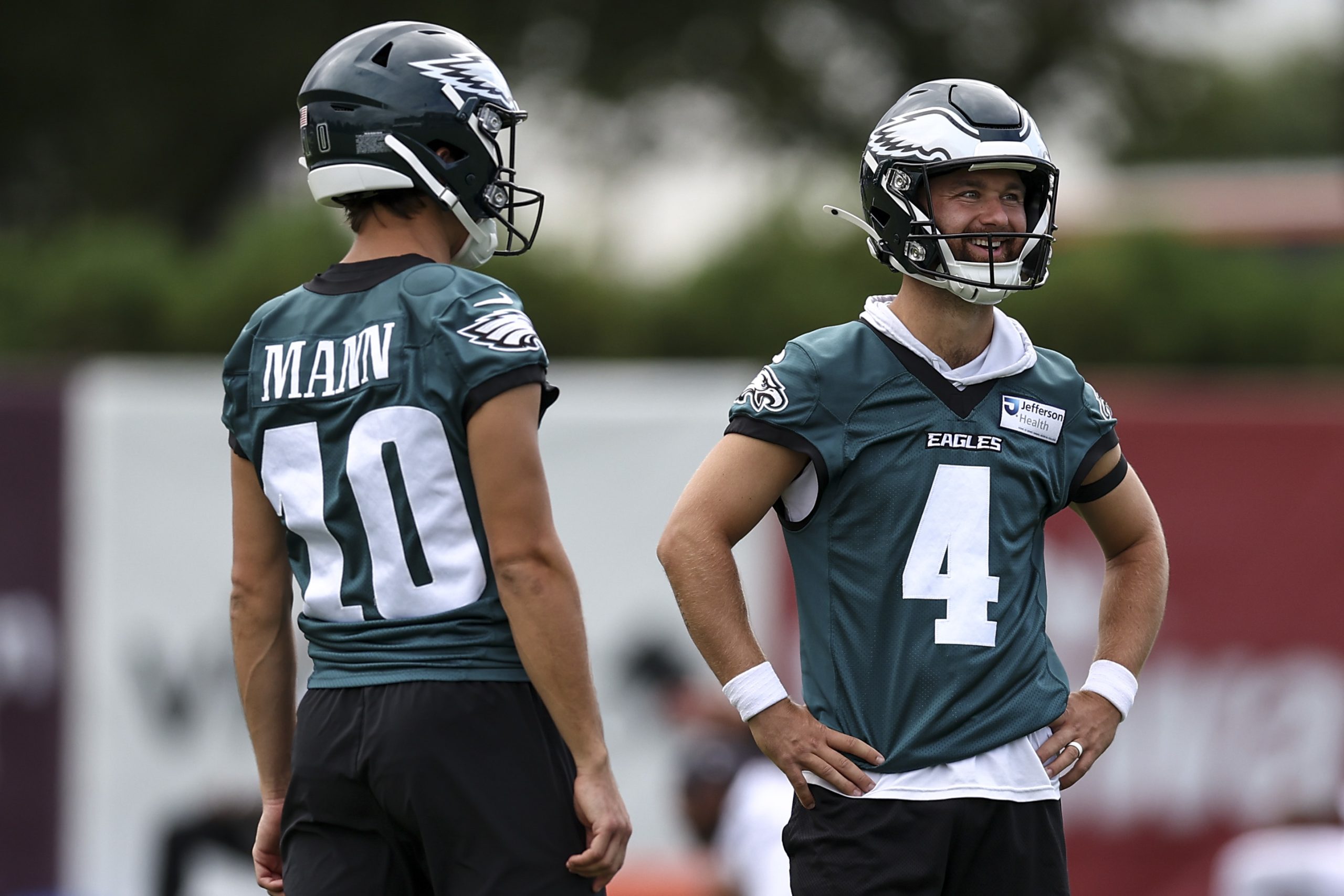
    I’m still not sure if Cole Payton will be the third quarterback. He’s shown more so far than Kyle McCord — another third-day pick — did last camp. But he can be wild. He airmailed a pass over Hayes’ head at one point. But he showed his mobility with a zigzagging scramble during the developmental period. … During punt drills, the returners were in order: Covey, Moore and DeJean. … Long snapper Rocco Underwood’s first snap nearly went over punter Braden Mann’s head, but Mann did well to catch it. Underwood’s next few tries were a little to the right, but he finished strong. He doesn’t have the job locked up by any means. … The Eagles practice on Tuesday and will have a closed walkthrough on Wednesday.

  • Should an insurer or a doctor decide where your care takes place?

    Should an insurer or a doctor decide where your care takes place?

    Every day, physicians, patients, and the families who care for them make hundreds of decisions together about where and how care should be delivered. Those choices reflect what matters most to the patient and family, alongside clinical expertise, patient safety, medical complexity, and access to the resources needed to achieve the best possible outcomes.

    Increasingly, however, these collective judgments are being second-guessed — and often overruled — by large insurance companies through policies that prioritize administrative convenience and cost-shifting over clinical judgment and the needs of the people receiving care.

    At Jefferson, where I am chief physician executive, we believe healthcare decisions should be made by patients, their families, and their care teams — not by insurance company policies that create barriers to treatment.

    Pedestrians walk by the entrance of the Gibbon Building at Thomas Jefferson Hospital in Center City in October 2021.TYGER WILLIAMS / Staff Photographer

    That is why we are speaking out against a growing number of managed care policies, including recent actions by Independence Blue Cross, that delay care, increase administrative burden, and interfere with the ability of physicians and patients to determine together the most appropriate setting for treatment.

    Supporters of these policies describe them as efforts to control healthcare costs, but they have the opposite effect — at the expense of patient access, clinical judgment, and safe care delivery. When insurers insert additional layers of authorization, site-of-care reviews, exception requests, and excessive documentation requirements into the care process, the result is not greater value. It is greater friction.

    For patients and families, that friction can mean postponed procedures, unexpected changes in where care will be received, canceled appointments, additional paperwork, and uncertainty at a moment when many are already carrying the weight of a serious diagnosis.

    Families rearrange work schedules, travel plans, childcare, and other responsibilities around a procedure date — and then learn the date has moved for reasons that have nothing to do with the patient’s medical condition. Too often, patients and families are the last to know that a decision about their care is under review, and they are given little explanation of who made it or why.

    That is not information sharing. It is not participation. And it does not reflect the dignity and respect patients and families are owed as full partners in their own care.

    Too often, Edmund Pribitkin writes, patients and families are the last to know that a decision about their care is under review by insurers.manassanant pamai

    For physicians, nurses, and the rest of a care team, it means spending valuable time on administrative requirements rather than at the bedside, answering the questions patients and families actually need answered.

    The IBX Site of Care policy is one example. Under this new rule — which was implemented in June — certain procedures that have long been performed safely in a hospital outpatient setting must now undergo additional review that goes beyond determining whether the care is medically necessary. Physicians may need to prove why a patient cannot receive care in an alternative setting, submit exception requests, supply additional documentation, and navigate new administrative workflows before treatment can proceed.

    These requirements may sound modest on paper, but their cumulative impact is significant. They create new administrative costs that do not improve the quality of care, require additional staffing and resources, slow scheduling, and increase the likelihood of delays and disruptions for patients and families.

    Particularly concerning is the effect on high-volume services such as colonoscopies and other diagnostic procedures that are essential to prevention and early detection — the very care that keeps families healthy and catches disease when it is most treatable.

    This issue extends far beyond a single insurer or policy. Across the healthcare industry, patients, families, and their care teams are confronting an expanding web of insurer-imposed administrative requirements: prior authorizations, repeated documentation requests, portal submissions, denials, appeals, and site-of-care restrictions. Each requirement consumes time, resources, and attention that could otherwise be devoted to care itself.

    The question policymakers, employers, patients, and families should be asking is a simple one: Are these requirements improving care, or are they simply making care harder to access?

    Patients and families deserve a healthcare system that removes barriers to care rather than creating new ones. They deserve to be told, clearly and promptly, when an insurer’s policy is affecting their care, and to have a real voice in decisions about where and how that care is delivered.

    Physicians deserve the ability to exercise clinical judgment, in partnership with patients and families, without unnecessary interference.

    And health systems should be able to devote their resources to caring for patients rather than navigating ever-changing administrative mandates.

    Jefferson supports accountability, transparency, and responsible stewardship of healthcare dollars. But we will continue to challenge policies that place insurance company bureaucracy between patients, families, and the care they need.

    Healthcare works best when decisions are guided by medical expertise, in partnership with patients and families — not by administrative hurdles that add cost, complexity, and delay without improving outcomes.

    Edmund Pribitkin is chief physician executive and executive vice president at Jefferson Health.

  • Eagles practice observations: Dontayvion Wicks likely WR2; Truth-telling Vic Fangio; Eli Stowers’ education

    Eagles practice observations: Dontayvion Wicks likely WR2; Truth-telling Vic Fangio; Eli Stowers’ education

    The Eagles held the sixth practice of their 2026 training camp on Wednesday at the Jefferson Health Training Complex. Here were my observations from Day 6 (and links to Days 1, 2, 3, 4 and 5):

    Roll call

    Tackle Lane Johnson missed a fourth straight practice for an excused noninjury related reason. He’s expected to return soon, from what I understand. Landon Dickerson took a non-injury-related rest day. The Eagles will be careful with their oft-injured left guard. Dickerson was spotted jogging midway through practice with a sleeve on his left leg.

    Wide receiver Britain Covey was a new addition to the injury list. He left Tuesday’s practice with a hamstring injury. The following remained injured and out: receiver DeVonta Smith (hamstring), receiver Makai Lemon (hamstring), edge Keyshawn James-Newby (ankle) and safety Cole Wisniewski (hamstring).

    Rookie guards Micah Morris (shoulder) and Jaeden Roberts (calf contusion) returned to practice, but were limited.

    Vic Fangio noted that defense has traditionally had the upper hand early in Eagles training camp. Jose F. Moreno / Staff Photographer

    Vic’s secret

    After two straight days in full pads, coach Nick Sirianni dialed the intensity back. Players wore only shells for a 75-minute session — the shortest of camp thus far. Sean Mannion’s offense, overall, executed better after a difficult Tuesday vs. Vic Fangio’s defense.

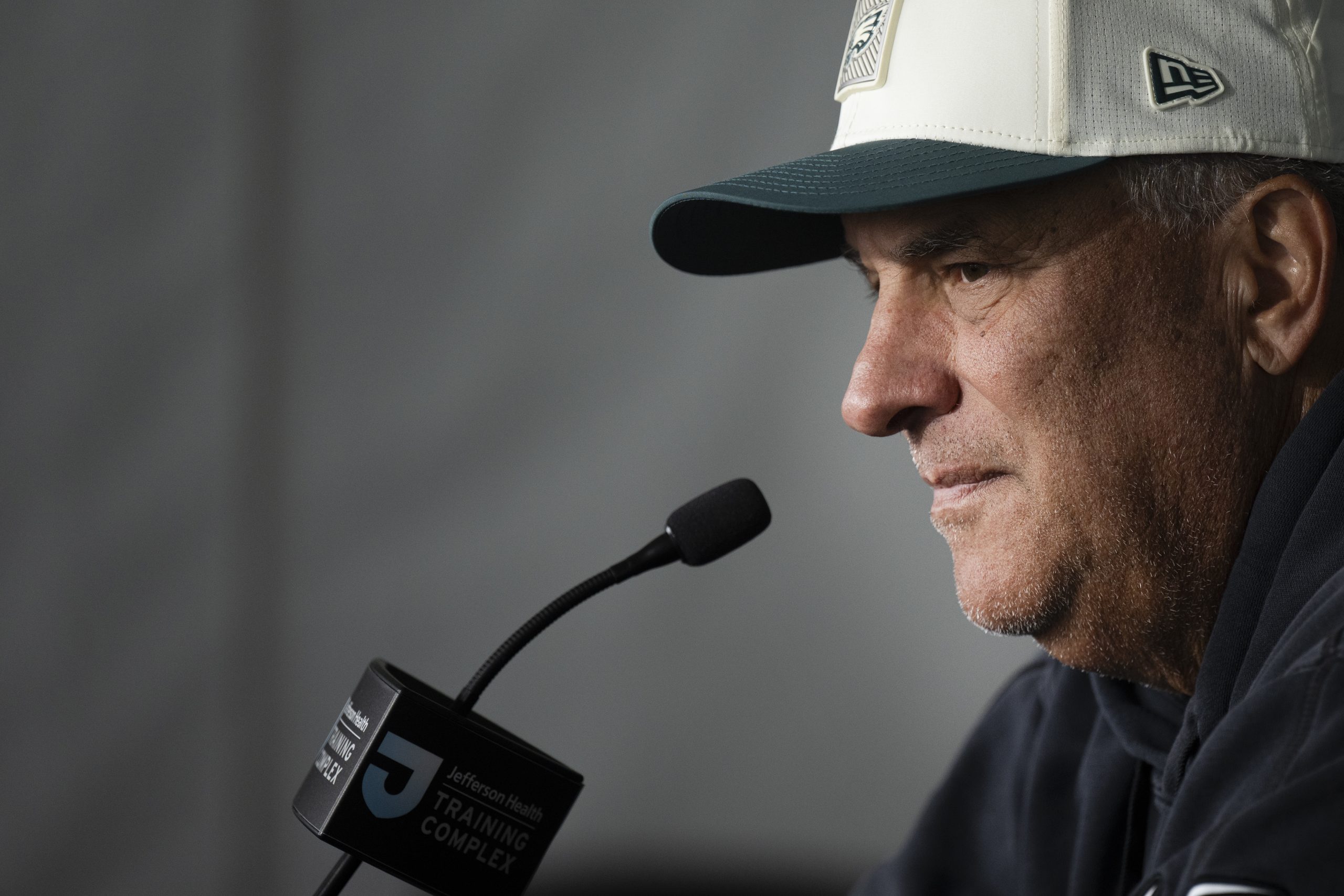
    “I told him, we obviously got the best of yesterday’s practice by a long shot,” Fangio said when asked about Mannion’s play-calling. “But that’s the way it’s been the last two years in training camp. The defense has gotten the best of the offense. So, not to be too concerned.”

    I don’t think Fangio was puffing his chest out or anything. He was just being the truth teller that he can often be. He was also adding context. Defenses are traditionally ahead early in camp, especially when the offense is new. But I’m not so sure about his last comment. I’d be concerned if there were any similarities to last year’s offense.

    Michael Carter II got some run with the first unit on Wednesday. Tyger Williams / Staff Photographer

    Cast and crew

    Mannion’s first unit likely benefitted from four key defensive starters — linebacker Zack Baun, defensive back Cooper DeJean and cornerbacks Quinyon Mitchell and Riq Woolen — being held out of team drills. Jeremiah Trotter Jr., Michael Carter II, Jonathan Jones and Kelee Ringo played in their spots.

    With the offense down three starters, it might have made sense to even the playing field. Rookie Markel Bell and second-year offensive lineman Drew Kendall filled in for Johnson and Dickerson at right tackle and left guard, respectively.

    Receiving race

    It’s been a by-committee approach at receiver, especially with the bona fide No. 1 sidelined. Dontayvion Wicks has thus far made the best case to be Smith’s No. 2. He may have a leg up on the others, having played in the Kyle Shanahan-style scheme Mannion brought with him from Green Bay. But there has also been obvious rapport between quarterback Jalen Hurts and the former Packers receiver. Hurts delivered a 20-yardish strike to Wicks just ahead of arriving safety Andre’ Sam in seven-on-sevens on Wednesday.

    Darius Cooper has looked good early in camp. Jose F. Moreno / Staff Photographer

    If the receiver competition was based on the first week alone, Darius Cooper would have the edge on the other combatants. I said this to someone the other day: “If Lemon was having the camp Cooper was having, every reporter would be hyping the first-round rookie.” The Eagles have to take everything into account, of course. Veterans Hollywood Brown and Elijah Moore have been unspectacular in camp, but also have proven track records, even if both have seen their numbers decline in recent years.
    Cooper should be a lock for the roster, though. I know some have viewed the fifth receiver spot as a toss-up between him and Johnny Wilson. But Cooper has more upside, despite Wilson’s size and Sirianni’s appreciation for his blocking. Cooper didn’t make any splash catches on Wednesday. Hurts dropped a beauty to him in the back corner of the end zone, but the receiver couldn’t stick the landing after he dove for the ball.

    Dallas Goedert and the tight ends were heavily featured on Wednesday. Jose F. Moreno / Staff Photographer

    Tighter ends

    On cue, Dallas Goedert and the tight ends were featured in the passing game a day after I noted that they’ve been relatively quiet in that regard. Hurts went to tight ends on his first two dropbacks in seven-on-sevens. Goedert hauled in the first on a slant, while E.J. Jenkins couldn’t on a similar route from the other side of the formation.

    Goedert caught another pass during the period on a short buttonhook and he was again Hurts’ first target in team drills. The tight end hung on despite linebacker Jihaad Campbell being in close quarters. Campbell later reached out and broke up a pass to receiver Samori Toure.

    With Johnny Mundt often the second blocking tight end in under-center scenarios, Grant Calcaterra has gotten receiving opportunities on third downs. He appeared to short-arm a toss from Hurts with Ringo in the vicinity.

    Stowers hour

    Even Cam Latu has seen more passes thrown his way than rookie tight end Eli Stowers. The Eagles are clearly not rushing their second-round draft pick. He’s low on the depth chart and has mostly run with the third offense. Stowers is a relative newcomer to the position. He switched from quarterback to tight end just three years ago and he wasn’t asked to block a ton at Vanderbilt.

    Eli Stowers’ (87) acclimation to NFL-style blocking technique has been slow. Jose F. Moreno / Staff Photographer

    So he has a lot to digest, beyond just the Xs and Os of a new scheme. Stowers is on the smaller side so learning the proper technique in blocking will be crucial. It could be some time before he’s placed in those circumstances. But he could get on the field on obvious passing downs. I found it interesting that he was split wide in the development period. The ball came his way, but cornerback Tariq Castro-Fields was on his hip and broke up a pass that was thrown slightly behind.

    Running on empty

    There was a fair amount of run game activity. Saquon Barkley didn’t have much room to operate on his carries. Defensive tackle Moro Ojomo knifed past Kendall on one Barkley carry. Outside linebacker Jalyx Hunt set the edge and helped contain the running back on an outside zone run. Nose tackle Jordan Davis easily defeated center Cam Jurgens one-on-one and picked up a tackle for loss.

    Linebacker Jalyx Hunt defended the run well on Wednesday. Jose F. Moreno / Staff Photographer

    I hesitate to mention Jurgens in the negative because he’s otherwise had a strong start to camp. He’s poised to bounce back from last season’s setback. Tank Bigsby had a few touches out of the backfield, as well, but he’s been featured more as a receiver than Barkley. He got Campbell to commit pass interference with a double move in the open field.

    Running back Will Shipley had a shaky start to camp, but I thought he showed up on Day 6, particularly in the run game. He had two strong rushes up the middle when he got skinny through his blocks. He also picked up Trotter’s blitz later on.

    On the bubble

    Michael Carter II got a strong endorsement from Fangio before practice. I’m not sure if he’ll beat out Marcus Epps for the nickel safety spot, but he could have the sixth defensive back role in dime personnel locked down. Speaking of locking down, he ran step for step with receiver Danny Gray on a corner route into the end zone. When he ball sailed out of reach, Carter popped up and gave Gray a double thumbs-down.

    Fangio said not to sleep on linebacker Chance Campbell’s chances of making the 53-man roster. Tackle Cam Williams took Campbell out at the second level on the run play and that was the last I saw the linebacker until he was walking with a trainer to the medical tent. He seemed fine later on, but didn’t return to play.

    Tanner McKee (16) has not looked sharp at times while working in the new offense. Tyger Williams / Staff Photographer

    Quarterbacking up

    Tanner McKee was first up with the second unit offense in seven-on-sevens, but Andy Dalton took more team repetitions. The quarterbacks continue to slug it out for the backup spot. Dalton found Wilson open on a crossing route. He hit Quez Watkins on a short pass and the receiver hit the afterburners when cornerback Ambry Thomas took a bad angle. Defensive tackle Ty Robinson pressured Dalton into a throwaway.

    McKee just hasn’t looked as sharp as he did last camp. He doesn’t have the luxury of working with the same unit as he did a year ago. That’s no excuse, but he has struggled to throw the ball downfield, especially with the third unit. He finally found an open man down the seam, but tight end Stone Smartt dropped the ball like he had hands of brick.

    Extra points

    Hurts had a couple dashes into space on the ground — once when he kept the ball on a run-pass option and another on a scramble when his receivers were tied up in man coverage. … Tempers flared for a second straight day. Linebacker Smael Mondon and tackle John Ojukwu got into a brief altercation, as did tackle Fred Johnson and edge A.J. Epenesa. … Gunslinger Cole Payton tossed another interception when he heaved a pass into a crowded area and the ball deflected to Castro-Fields. … Former Eagles receiver Jeremy Maclin attended camp. He said it was the first time he’s been back at the practice facility since he was a player. … The Eagles have a closed walkthrough on Thursday before returning to practice on Friday.

  • Eagles practice observations: Defense brings the camp fire; O-line woes; DeVonta Smith and who else?

    Eagles practice observations: Defense brings the camp fire; O-line woes; DeVonta Smith and who else?

    The Eagles held the fifth practice of their 2026 training camp on Tuesday at the Jefferson Health Training Complex. Here were my observations from Day 5 (and links to Days 1, 2, 3 and 4):

    Receiving line

    The Eagles were without wide receivers DeVonta Smith and Makai Lemon due to hamstring injuries. Lemon left Monday’s practice early, while Smith appeared to finish the workout. The team doesn’t expect either player to be out for an extended period. Both receivers were present Tuesday, which was a positive sign.

    I wouldn’t be worried about Smith. He might have tweaked something, but the educated guess here is that the Eagles shut him down for the time being. They’ve been careful with him before, just as they were with A.J. Brown last year at camp. Smith is far and away the best receiver on the team and the Eagles can’t afford a needless injury with the drop-off relatively steep.

    Lemon is another story. The rookie needs the reps. It also doesn’t help that he suffered a hamstring strain in the spring. While it’s unclear if he hurt the same one, two soft tissue injuries in the span of six weeks isn’t likely how he wants to start his career. Lemon has been quiet in the early going. He’s yet to make a play that screams “first round draft pick,” but it’s also very early.

    Lane Johnson speaks with reporters during the first day of training camp on July 29. Monica Herndon / Staff Photographer

    Paving the Lane

    Lane Johnson missed a third straight practice for an excused non-injury-related reason. The Eagles have declined to offer more detail on their right tackle’s absence. Johnson’s only other extended absences that didn’t involve injury came in 2014 and 2016 when he was suspended for performance-enhancing drug use and in 2021 when the team granted him a leave to address his mental health.

    The following Eagles remained injured and out: outside linebacker Keyshawn James-Newby (ankle), guard Micah Morris (shoulder), guard Jaeden Roberts (calf contusion) and safety Cole Wisniewski (hamstring). Tackle Cameron Williams (knee contusion) was back to full participation. Receiver Britain Covey walked off the field with trainers late in the workout.

    Sean Mannion (center) did not oversee a sharp day from his offensive unit. Yong Kim / Staff Photographer

    Offensive offense

    It was a tough day for Sean Mannion’s offense after it appeared to make strides in the bubble on a rainy Monday. The Eagles were in full pads for a second straight day and the outside environment and intensity seemed to benefit the defense. It’s long been understood that NFL defenses are typically ahead in the early portion of camp. Coordinator Vic Fangio’s seasoned unit is also facing an offense that is still learning a new system.

    As I’ve written here since the spring, there are going to be growing pains. It’s better to fail now rather than later. It also didn’t help that Smith was out. But I don’t think there was an offensive position group that could be happy about its performance on Tuesday, especially the O-line. Chris Kuper was without Johnson again, and the O-line coach juggled his units some, but there was too much sloppiness up front.

    We also had our first few skirmishes of camp. Guard Tyler Steen and defensive tackle Ty Robinson got into a brief skirmish after several plays of facing each other. Safety Andrew Mukuba and receiver Dontayvion Wicks mixed it up after the former didn’t appreciate the latter’s downfield run blocking. There’s nothing wrong with a little extra fire between teammates, as long as no one gets burnt.

    Landon Dickerson is among the offensive linemen trying to adjust to a new blocking scheme. Yong Kim / Staff Photographer

    Blocking it out

    The new wide-zone run blocking scheme will require an adjustment period for a starting group that had done it a different way under former O-line coach Jeff Stoutland. Johnson and left tackle Jordan Mailata shouldn’t be that affected. They could thrive in any system. Center Cam Jurgens and Steen should, theoretically, benefit because of their athleticism.

    Left guard Landon Dickerson, though, could struggle the most. He’s not as nimble as the others and has had well-documented series of injuries that have put his future in question. Whenever he’s been asked to work to the perimeter on outside zone runs, it’s apparent he just doesn’t have the motor he once did.

    That doesn’t mean he can’t get by or even flourish if healthy. But staying healthy has been an obvious issue, and he admitted earlier this week that he’s had to reconsider how he’s previously played through injury. That could place a greater emphasis on the backup guard spot. Drew Kendall appears to be the leading candidate right now. He took some first-team reps at left guard on Tuesday.

    The Eagles know Kendall can play center. He’s Jurgens’ likely backup. But can he hold up in the interior at 308 pounds? He seemed to hold his ground against defensive tackle Moro Ojomo when he was with the starters. And he did well to pick up a Jeremiah Trotter Jr. blitz later with the second unit. But the tests will keep coming.

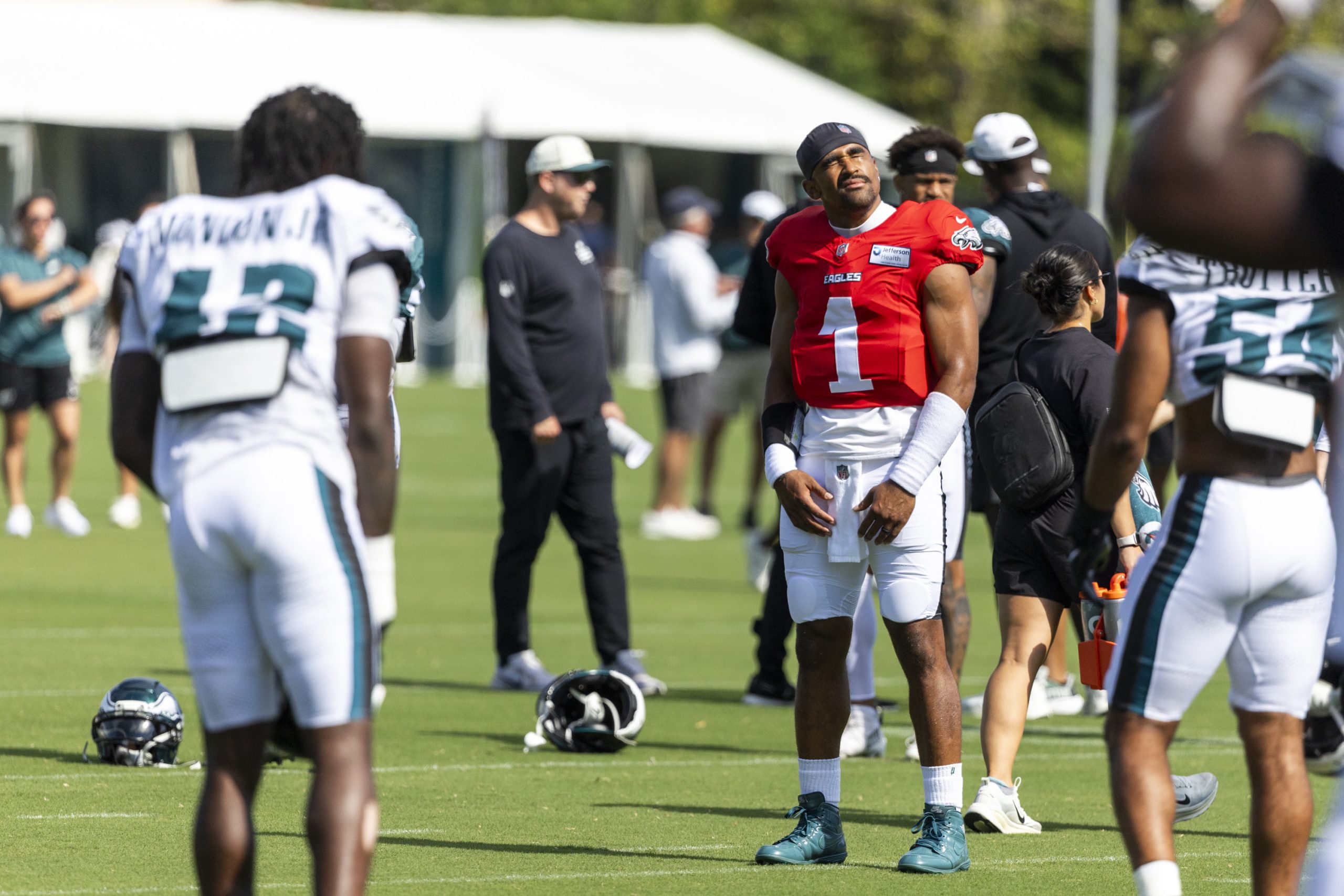
    Jalen Hurts (1) did not have his best day of camp. Tyger Williams / Staff Photographer

    Hurting for certain

    Objectively, Jalen Hurts was sharp on Monday. The opposite could be written a day later. The O-line problems didn’t help, and neither did occasionally poor pass catching. I thought Hurts threw a catchable deep ball to Quez Watkins, but the route wasn’t crisp and the receiver’s dive came up short. Hurts then floated a dime to Will Shipley after he was schemed wide-open on a wheel route. But the running back stone-cold dropped a would-be explosive play.

    Hurts made some head-scratching decisions on throws downfield, though, some of them vs. the second defense. There was a heave to a double-covered Hollywood Brown that safety Michael Carter II intercepted after surviving a collision with the ground and a slight bobble. There was a tight-window toss to Wicks on the next play that cornerback Jakorian Bennett got his hands on.

    Hurts later chucked another one up for grabs to Wicks that was only slightly overthrown past a few pursuing defenders. In the red zone, he hitched off play-action and still threw to a covered Wicks. Mukuba was in Wicks’ pocket, but cornerback Quinyon Mitchell came over and got a hand on the ball.

    There were some good moments, too. Hurts had Brown alone in the end zone after a scissor route concept caught cornerback Jonathan Jones sleeping. Wicks shook cornerback Riq Woolen on an outside release and the ball arrived in time. Hurts had excellent ball placement on a pass to Wicks that required he throw it away from the lurking Mitchell.

    But there just wasn’t much rhythm to the passing offense — not to mention the run game. Hurts, on several occasions, had no one open and had to either eat the ball or throw it away. During one pass play, after he went through his reads and the pocket collapsed, he simply dropped the ball to the ground.

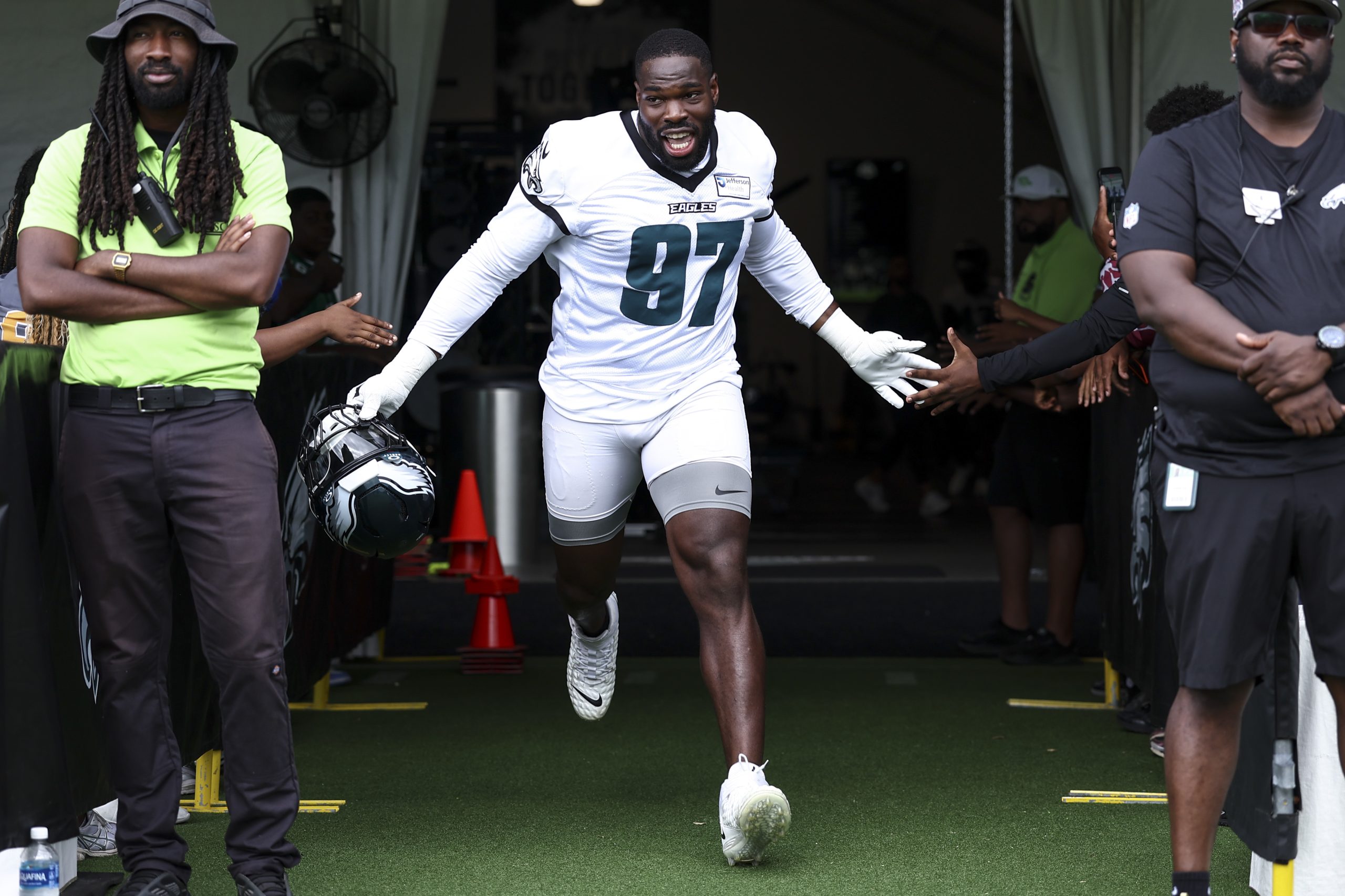
    Moro Ojomo (97) was among those who excelled on defense Tuesday. Monica Herndon / Staff Photographer

    D-light

    The good news is that the defense could be dominant this season, barring significant injuries. Cornerback Cooper DeJean briefly ran off the field after dinging his left hand — a reminder that the game can take anyone — but he appeared fine after getting checked out by trainers.

    Fangio has new faces on his side of the ball, but the biggest upgrade to last season’s very-good-but-not-great defense could be a 100% Jalen Carter. He seems to make a few eye-popping plays every practice. He bested Steen on back-to-back reps. Carter gave him the finger wag after stopping a Saquon Barkley run near the line, and then clubbed him to the helmet on the way to a would-be sack.

    Moro Ojomo was a menace at defensive tackle as well. He jetted past Dickerson and might have caused Barkley to bobble a pitch that resulted in little gain. The Eagles’ depth at D-tackle allows Ojomo to face the second unit at times, and it can be unfair. He made quick work of tackle John Ojukwu and notched a run stop near the line.

    And then there were missed blocks that gifted the front four. Carter was mind-bogglingly granted a free pass to Shipley on one rush. Defensive end Jalyx Hunt notched a unblocked sack when left tackle Fred Johnson appeared to have his eyes in the wrong spot.

    Jihaad Campbell is making his presence felt at linebacker. Monica Herndon / Staff Photographer

    Back off

    The off-ball linebacker group is pretty good, too. Jihaad Campbell still has lots to prove, but his talent is evident. He jacked running back Tank Bigsby onto his back and blew up a Barkley inside zone run near the goal line. Zack Baun lined up on the edge at one point and beat Ojukwu with an outside rush to record a sack. He also broke up a pass to tight end Dallas Goedert.

    Trotter blitzed once and steamrolled Shipley. Smael Mondon had maybe his best practice of camp and made multiple tackles, including a run stop after he shook the pulling to Williams.

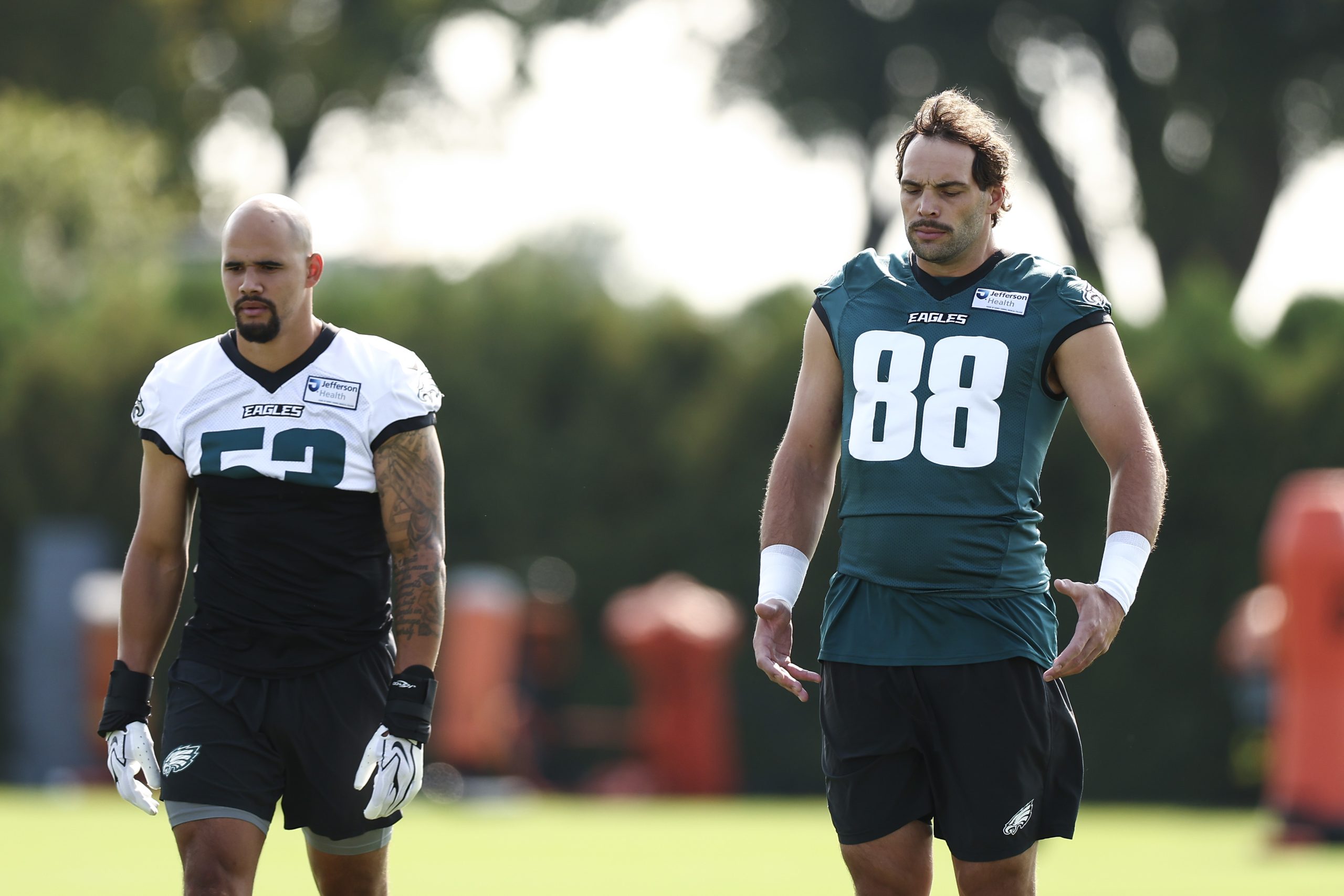
    Dallas Goedert (88) and the tight ends have not been much of a factor in the passing game thus far in camp. Monica Herndon / Staff Photographer

    Tight lies

    I mentioned recently here that the tight ends haven’t been featured as much as the receivers and that trend continued. I recall past years when Goedert would be Hurts’ favorite target, but that has yet to happen. It could certainly change. But tight ends have more blocking responsibilities in the Kyle Shanahan/Sean McVay scheme.

    New guy Johnny Mundt will be key, with more need to block defensive ends at the point of attack. Goedert isn’t the blocker he once was, but he has the wherewithal, even as he enters his ninth season. Cameron Latu may have a roster spot based on his special teams capabilities. He trucked receiver Darius Cooper during kick return drills. But he’s a physical blocker and displayed as much when he wham blocked Hunt out of a run play.

    Neither Tanner McKee (16) nor Andy Dalton (14) got much of a leg up on Tuesday. Tyger Williams / Staff Photographer

    Under center

    In the backup quarterback competition, it was a relative draw in which neither Andy Dalton nor Tanner McKee was very consistent. As with Hurts, they were hardly all to blame for the offensive inefficiency.

    Dalton did find tight end Grant Calcaterra for a nice pickup after a naked bootleg fooled the first unit defense. And Cooper made a splendid one-handed grab on one of Dalton’s red zone throws. But the receiver was unable to get both feet in the back of the end zone. Later on, Cooper ran an in-breaking route when Dalton’s ball went outside to an empty space.

    McKee had a couple hookups with receiver Samori Toure. But like Hurts, he took sacks or simply ate the ball when the clock ran out on a fruitless play.

    Jake Elliott (4) was perfect on Tuesday. Monica Herndon / Staff Photographer

    Extra points

    I’ve written a fair amount about rookie defensive tackle Uar Bernard’s trials and tribulations as he tries to make it in the NFL. But there’s another neophyte from Africa in camp: undrafted edge Joshua Weru. He plays a different position than Bernard, but he’s looked more fluid. He still has a ways to go, but there’s some potential there. He had a pressure during the developmental period. … Jake Elliott was a perfect 6-for-6 during the kicking period. He was good from 33, 38, 42, 44, 50 and 52 yards. He also split the uprights from 44 yards out later during team drills. … The Eagles practice again on Wednesday and have a closed walkthrough on Thursday.

  • Eagles running back Saquon Barkley joins Jefferson Health’s ‘Champions of Care’ campaign

    Eagles running back Saquon Barkley joins Jefferson Health’s ‘Champions of Care’ campaign

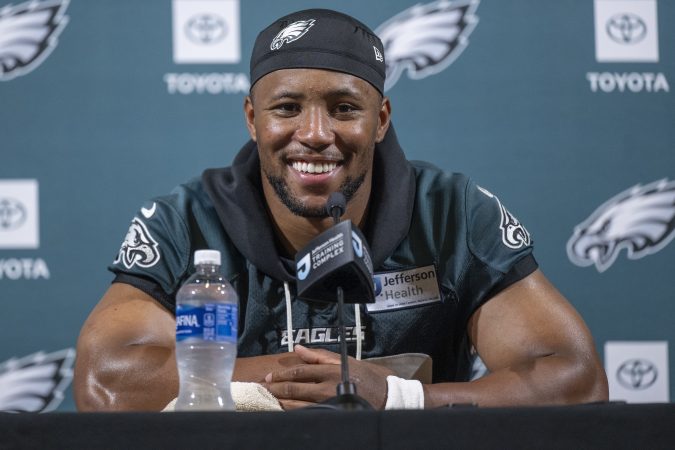
    Saquon Barkley isn’t just a champion on the field. On Wednesday, Jefferson Health announced that he will be the new face of its “Champions of Care” campaign, bringing the running back’s impact out of the stadium and into the community.

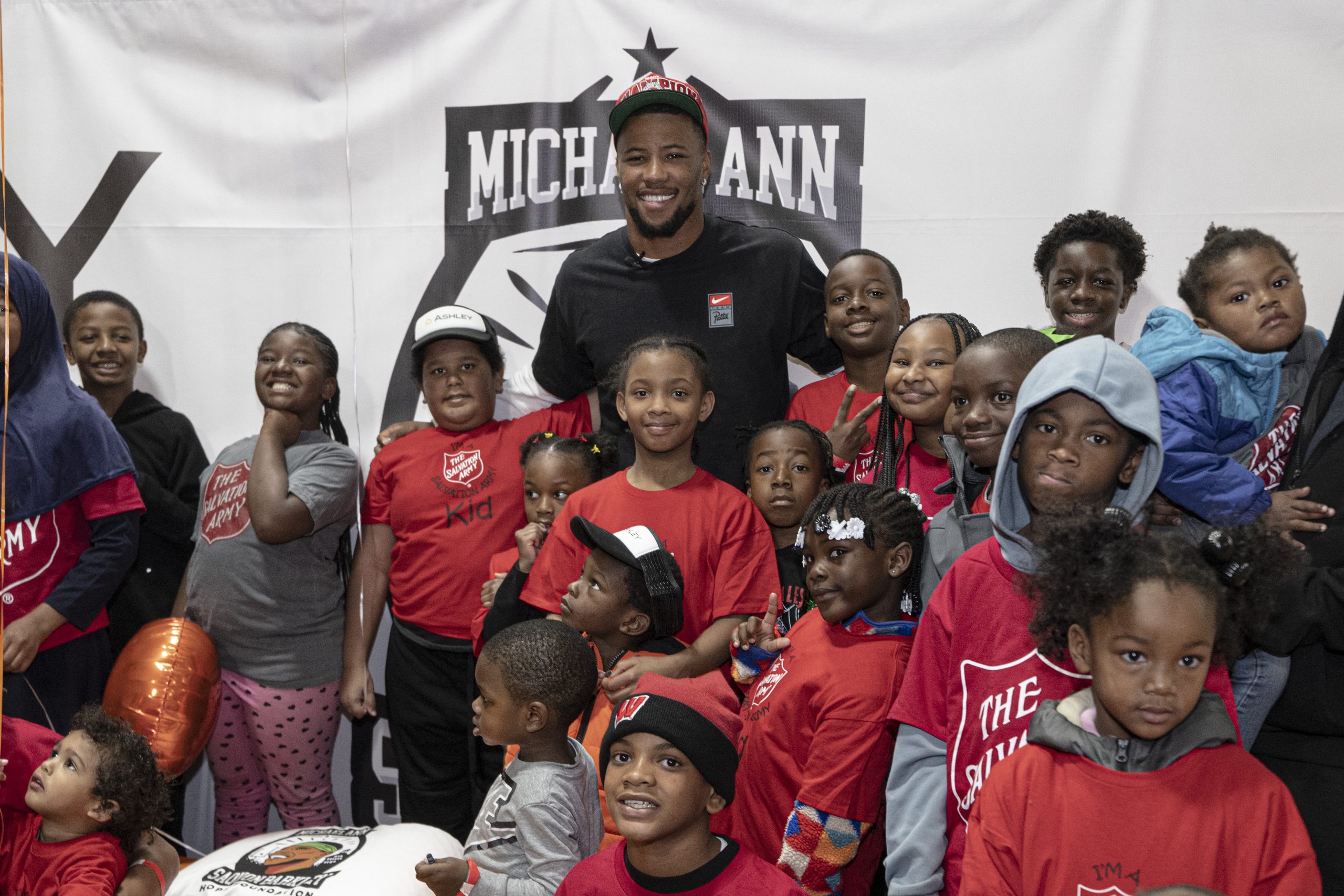
    Barkley has a history of nonprofit work. Jefferson Health is partnering with The Michael Ann & Saquon Barkley Hope Foundation, a nonprofit the Barkley family founded in 2020. (Michael Ann was Saquon’s late grandmother.) Together the organizations plan to support underserved youth in the community through events like a backpack drive, as well as food and holiday gift drives.

    “Saquon Barkley is a leader both on and off the field — someone whose work ethic, humility, and connection to this city inspire people far beyond the stadium. That’s why we’re so proud to welcome him as a Jefferson brand ambassador,” said Nick Ragone, executive vice president and chief marketing officer for Jefferson.

    “Together, we will work to fulfill our mission of improving lives across the Greater Philadelphia and Lehigh Valley regions. Just as sports have the unique power to unite our city, this partnership will help us build a healthier, more connected community.”

    Eagles running back Saquon Barkley during an event for the Michael Ann and Saquon Barkley Hope Foundation in November.Jose F. Moreno / Staff Photographer

    Jefferson Health has been a major partner of the Eagles since 2024. Earlier this year it expanded its multiyear partnership and renamed the Eagles’ training facility in South Philadelphia to the Jefferson Health Training Complex.

    Barkley is not alone in this endeavor. He and Eagles defensive end Brandon Graham plan to make public appearances as ambassadors throughout the Philadelphia and Lehigh Valley areas, potentially including the Jefferson Lehigh Valley Classic golf tournament, running Sept. 28-Oct. 4. The Classic also supports the Eagles Autism Foundation, with the team’s philanthropic efforts serving as a central pillar of its identity, and a motivation for Barkley to join the Champions of Care campaign.

    “While everybody sees what my teammates and I accomplish during games, it’s just as important to have partners off the field that help make a difference for the communities around you,” Barkley said in a statement. “Teaming up with Jefferson as a ‘Champion of Care’ not only aligns with the mission of the Michael Ann and Saquon Barkley Hope Foundation but will make a tangible difference in the lives that we serve. I could not be prouder to join this team.”

  • Tower Health is laying off 160 workers at Pottstown Hospital while expanding emergency department, behavioral health

    Tower Health is laying off 160 workers at Pottstown Hospital while expanding emergency department, behavioral health

    Tower Health is eliminating 160 jobs at Pottstown Hospital as part of an effort to bring staffing at the Montgomery County facility in line with lower patient volumes, the Berks County nonprofit announced Tuesday. The cuts amount to 22% of the workforce at Pottstown.

    In addition to the job reductions — which are more than the 131 positions cut last year at Pottstown — Tower also plans “a multimillion-dollar investment” to expand the emergency department, enhance inpatient and outpatient behavioral health services, and update portions of the hospital, Tower said.

    “These changes are designed to strengthen the hospital’s ability to serve local residents for generations to come by preserving access to the services patients need most, investing in the areas of greatest community need, and ensuring Pottstown Hospital remains a strong, sustainable community hospital for the future,” Tower said in a statement.

    To expand behavioral health, Tower will convert some underused general-purpose hospital beds to inpatient behavioral health beds. The behavioral health total will rise to 52 from 28, an 86% increase. Pottstown has 213 licensed beds.

    Tower did not provide a timeline for the changes but said it plans to hire 38 people to staff the expanded emergency department and behavioral health unit, which will have a separate entrance for the sake of patients’ privacy when they seek mental health services.

    Another change at Pottstown involves the lease of an unspecified amount of space to Community Health & Dental Care, a federal health clinic that was formed in 2008 with funding from Pottstown Area Health and Wellness Foundation.

    Unlike the restructuring Tower announced last fall at Pottstown, which included the closures of the combined intensive care/critical care unit, the Pottstown location of the McGlinn Cancer Institute, and the hospital’s endoscopy center, this round is not eliminating any services, Tower said.

    In the nine months that ended March 31, Pottstown has 5,104 inpatients, down 9.7% from the same period the year before. Most of that decline came in the first three months of this year, after Tower’s service cuts, according to data shared with bondholders.

    After last year’s layoffs, which included about 60 registered nurses represented by Pennsylvania Association of Staff Nurses & Allied Professionals, Pottstown employed about 700 people. Overall, Tower employs more than 10,000.

    The union said it still has 200 Pottstown nurses in its ranks. “We have been in touch with hospital management to better understand the context for and impact of the proposed layoffs and to push hard for solutions that protect both patient care and the dedicated nurses who serve the Pottstown community,” a union spokesperson said.

    Tower’s anchor is Reading Hospital in West Reading, Pa. In additional to Pottstown, it owns Phoenixville Hospital, plus St. Christopher’s Hospital for Children in North Philadelphia in a 50-50 joint venture with Drexel University. Tower previously owned Brandywine, Jennersville, and Chestnut Hill Hospitals.

    It closed Brandywine and Jennersville and sold Chestnut Hill to a group led by Temple University Health System.

    Tower recently announced that Jefferson Health, Nemours Children’s Health, and Temple University Health System are working on forming an alliance to support St. Chris clinically. Last week, Tower said that it had formed a clinical affiliation to expand advanced care in its markets.