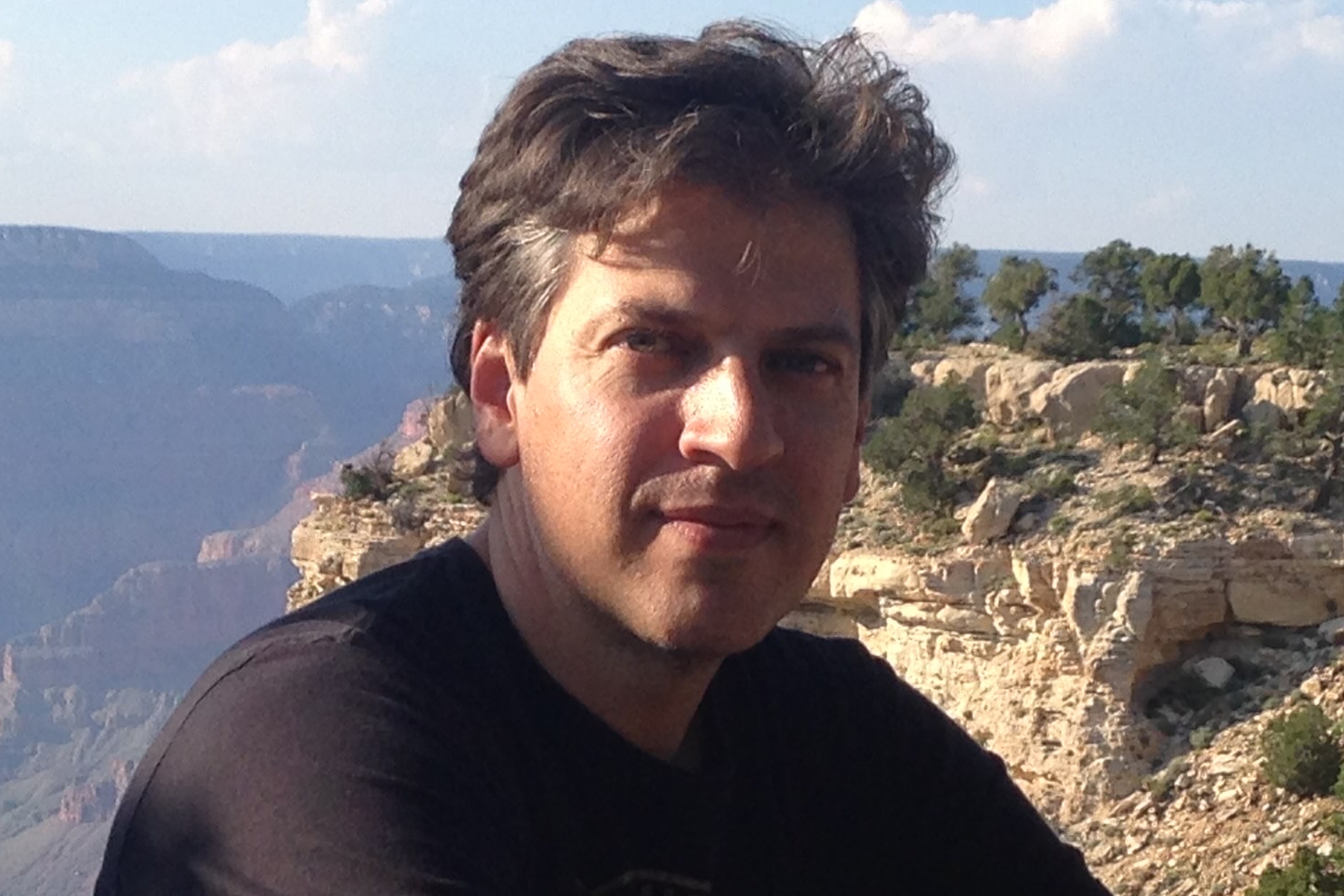
Albert James Mamary, 59, of Wynnewood, attending physician and professor of thoracic medicine and surgery at Temple University, researcher, writer, mentor, artist, outdoorsman, craftsman, and amateur bicycling champion, died Thursday, July 9, of cholangiocarcinoma at Temple University Hospital.
A 1999 graduate of Temple’s Lewis Katz School of Medicine, Dr. Mamary spent his career at Temple and affiliated hospitals. He was an expert in pulmonary disease, transplants, and sleep disorders at the Temple Lung Center, and became program director of the Pulmonary and Critical Care Fellowship at Temple Hospital in 2006.
He earned a master’s degree in anthropology at the College of William and Mary in Virginia and his premedical school credits at the University of Pennsylvania. In a tribute, his family said: “His education in both medicine and anthropology reflected a lifelong belief that caring for a patient required understanding not only the disease but the whole person.”
Over more than three decades at Temple — as a student, resident, fellow, professor, and physician — Dr. Mamary treated thousands of patients, mentored hundreds of students and doctors, lectured in classrooms and at seminars, and wrote more than 60 scientific papers and textbook chapters. He was named a top doctor by Philadelphia Magazine several times and was featured in The Inquirer and on 6abc TV for his lead role in a successful double-lung transplant in 2015.
“It’s been 120 to 145 patients, individual patients that we’ve been able to help every year,” Dr. Mamary told CBS News in 2024. “That’s really the aim here, is to add years of life to patients who otherwise wouldn’t have that opportunity.”
Colleagues called Dr. Mamary a “physician’s physician” and noted his “amazing intelligence and clinical acumen” in tributes. Gerard J. Criner, chair of Temple’s Department of Thoracic Medicine and Surgery, said: “His patients loved him not only for his clinical skills but also for the warmth, compassion, and humanity he brought to every encounter.”
A former patient said online: “He was a calm in the storm of my end stage disease. … The world has lost a hero.”
A former student said: “His kindness, thorough and balanced approach to medicine, and quiet, thoughtful approach to even the most stressful emergencies reminded me of a Jedi master.”
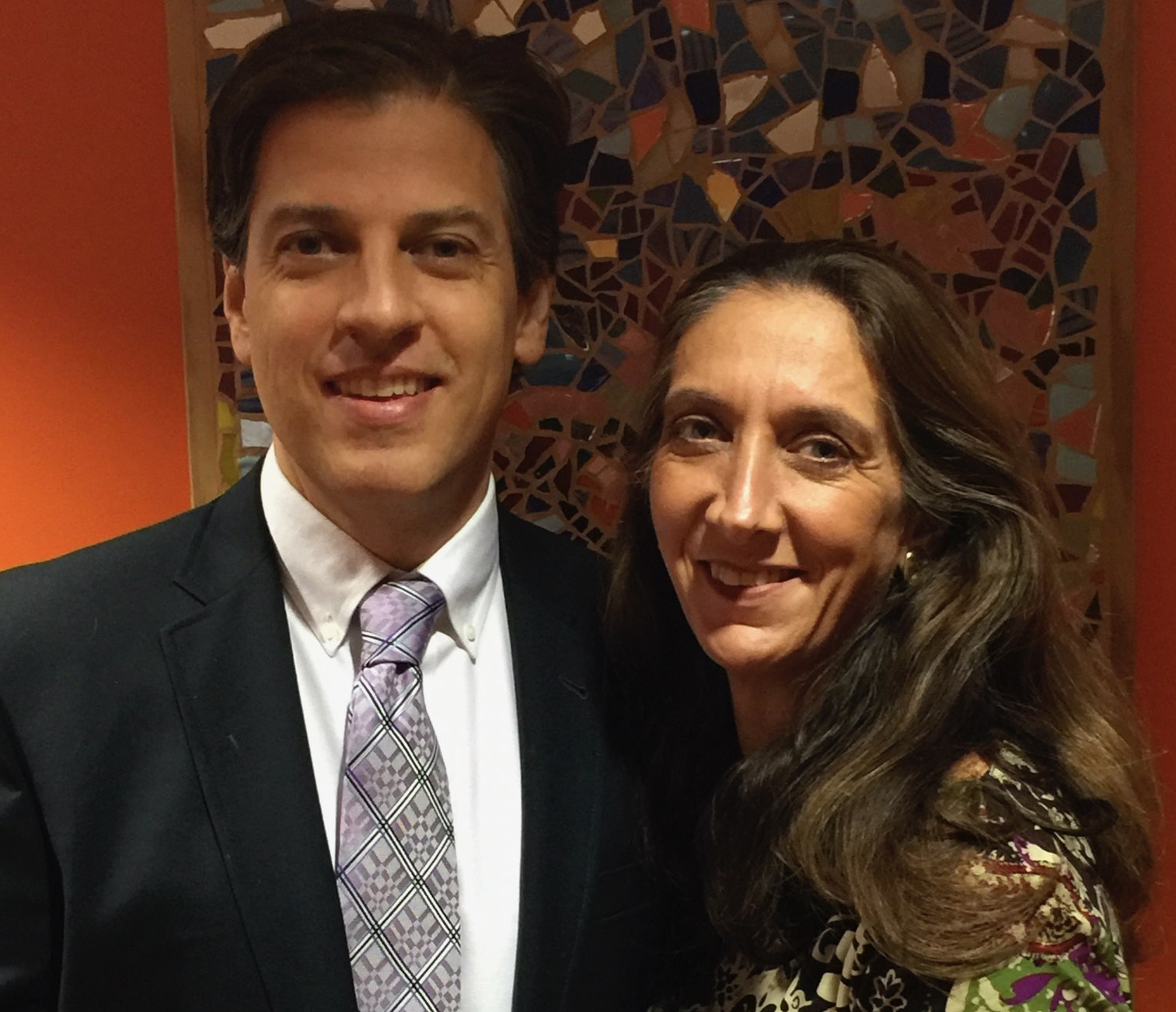
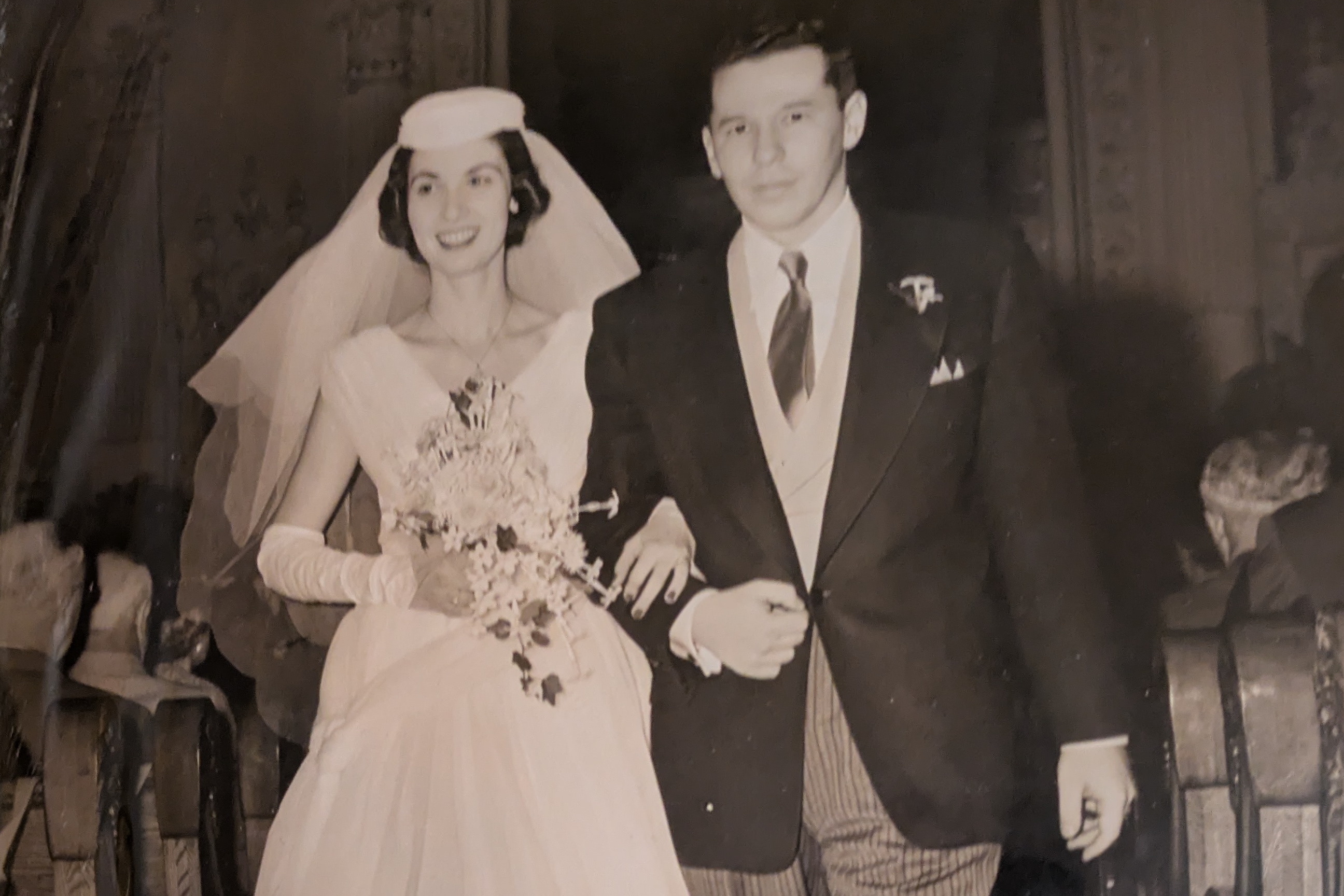
Dr. Mamary and his wife, CeilaSue, married in 1996.Courtesy of the family
Away from the hospital, Dr. Mamary liked to bike, hike, and camp. He built his own 18-foot mahogany canoe, walked the entire 272-mile Long Trail in Vermont, and won masters bicycling championship races.
He also painted and sculpted, and earned a bachelor’s degree in art and psychology at Haverford College. He and his wife, CeliaSue, initiated the Shortridge Memorial Park Arboretum in Wynnewood and earned a 2024 community service award from Narberth and Lower Merion officials.
“James brought wisdom, kindness, curiosity, and genuine joy to every moment,” his wife said.
Albert James Mamary was born June 12, 1967, in Hempstead, N.Y. He grew up in Binghamton, N.Y., became an Eagle Scout, and was a wilderness river guide for the Boy Scouts in Maine during his college years.
Dr. Mamary was an avid bicyclist and won masters championship races. Courtesy of the family
He met CeliaSue Jaffe in class at Haverford, and they married in 1996 and had daughters HannahRose and LilyRuth. They lived in East Falls and Wynnewood, and he rode his bike from home to Penn and then Temple as often as he could.
Dr. Mamary enjoyed traveling, baking, cooking, and gardening. “His specialty is fruits and vegetables, and I grow the flowers,” his wife said.
He followed the Phillies, rescued cats and dogs, and doted on his daughters. Everybody said he was funny and silly.
“He was curious and always learning or doing something new,” his daughter LilyRuth said. “He took joy in simple things.” His daughter HannahRose said: “Even if he wasn’t my dad I would want him as a friend because he was so interesting and so easy to talk to.”
Dr. Mamary was a wilderness river guide for the Boy Scouts in Maine during his college years.Courtesy of the family
Dr. Mamary was diagnosed with cholangiocarcinoma, bile duct cancer, in 2020 and treated by longtime colleagues and friends at Temple, some of whom he had mentored. “It was a profound reflection of the life he lived,” his family said, “that so many of those he had taught ultimately became his caregivers.”
His wife said: “He was a very vibrant and adventurous person but so thoughtful, steady, and reliable. James was incredible.”
Tori Bauver was sitting at home on July 11 when the sky outside of the Wyndon Apartments in Wynnewood began to darken. Bauver watched the clouds roll in, then the rain come, blowing “literally sideways” outside her window. She remembers leaning in to see the darkening landscape and noticing that rain had begun to penetrate her windows. Then the “outside went stark white” and water started pooling on her windowsills.
“I was like, ‘Oh, my God. This is gonna flood. This apartment’s gonna flood,’” she said.
The light fixture above Bauver’s bed filled with water, then poured over the edges. The ceilings began to leak, then one by one, they collapsed. The building’s roof ripped off, and Bauver had a clear, and unsettling, view of the sky from her living room.
Bauver, now a resident of West Chester, where she and her partner moved after breaking the lease on her Wynnewood apartment, had been living in the Wyndon Apartments for two years when the July microburst storm tore through Lower Merion, destroying her home and more than $5,000 of her and her partner’s belongings. She was one of dozens of suburbanresidents who emerged from the storm with damaged property and a devastated home.
As the Philadelphia region sees hotter and more humid summers, flash flooding, extreme precipitation, and life-threateningstorms have become a more common feature of daily life.Weather eventsmarked by downed trees, dangerous flash floods, waterlogged roadways, and eroded bridges are, more and more,forcing suburban residents and cash-strapped local governments to pour millions into repair and resilience projects, all while large swathsof the region’s infrastructure are built to withstand weather patterns of a bygone era, one in which storms like July’s microbursthappened once in a decade, rather than multiple times a summer.
As the region’s weather patterns intensify, officials and climate experts say the municipal mosaic of Philadelphia’s suburbs faces unique challenges when it comes to planning for a future marked by climate change.
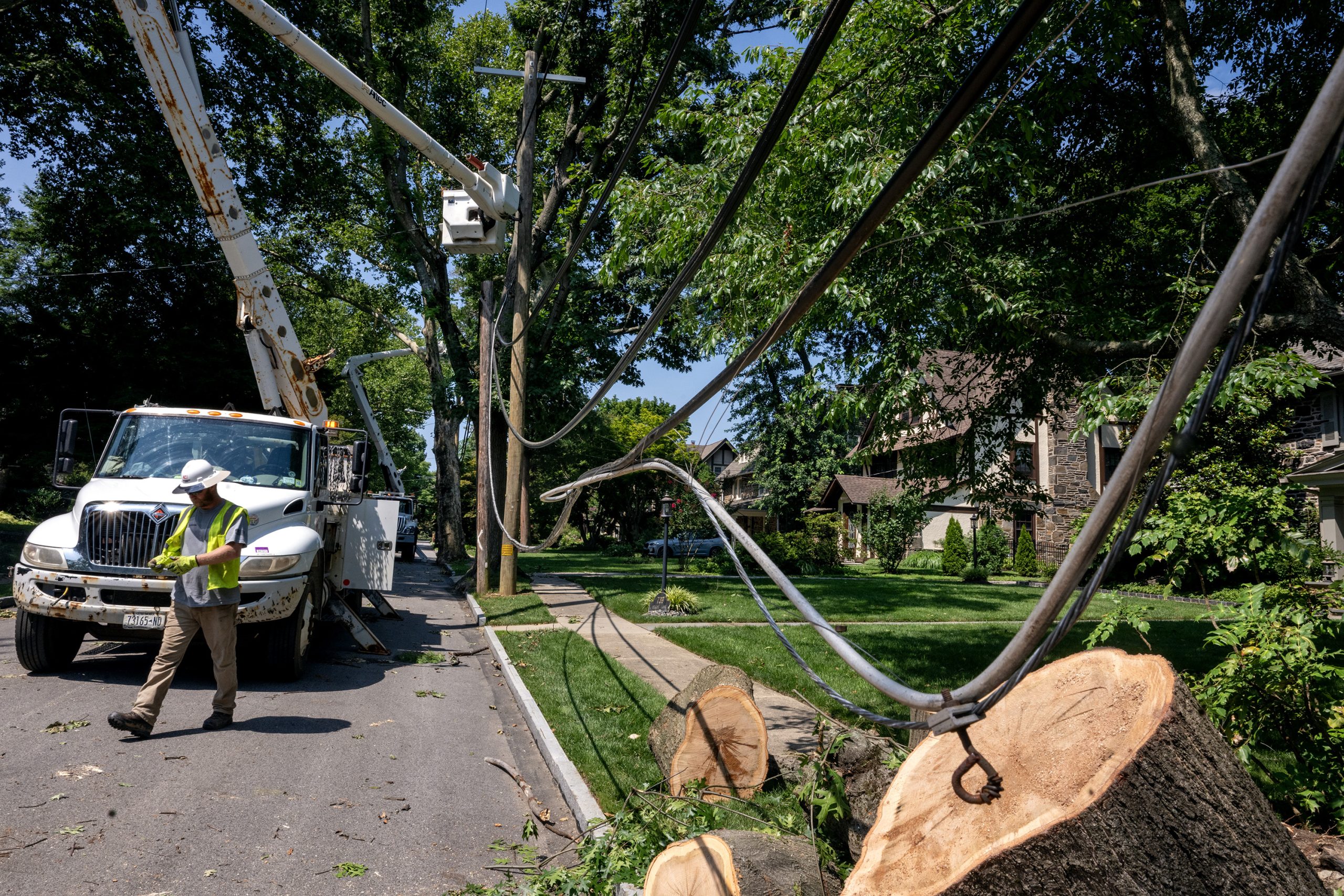
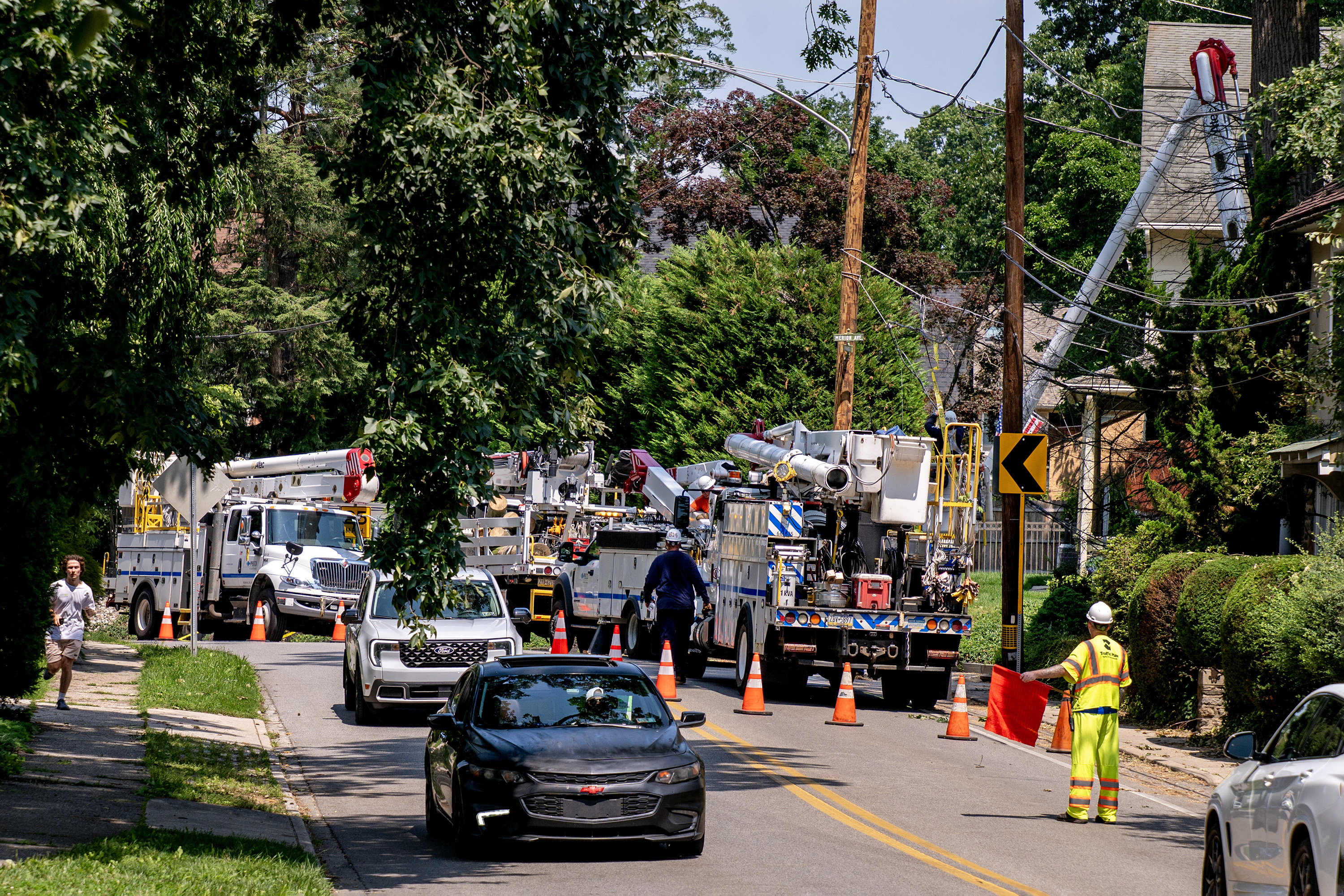
Utility workers restore power in Merion Station on July 13 after a microburst storm ripped through parts of Philadelphia and Montgomery County.
The Philadelphia region’s changing weather
The average July temperature in Philadelphia has risen 4.4 degrees since 1940. In the 1900s, Philadelphia averaged four days per year with temperatures above 95 degrees, according to a 2024 EPA report. This summer, Philly has seen six days with high temperatures above 95 degrees, according to the National Weather Service. By the end of the 21st century, that number could climb to more than 50 days per year.
Hotter weather means more precipitation, and more frequent and intense rain events. For every 1.8 degrees the air temperature increases, the amount of water the atmosphere can hold increases by 7%.
“The infrastructure we have now is not always built to a standard to accommodate the extreme weather we’re seeing now,” said Chris Linn, manager of the Office of Resilience and Environment at the Delaware Valley Regional Planning Commission.
AsRay Courtney, a Lower Merion commissioner and chair of the township’s sustainability committee, said, “We get a 100-year storm every year.”
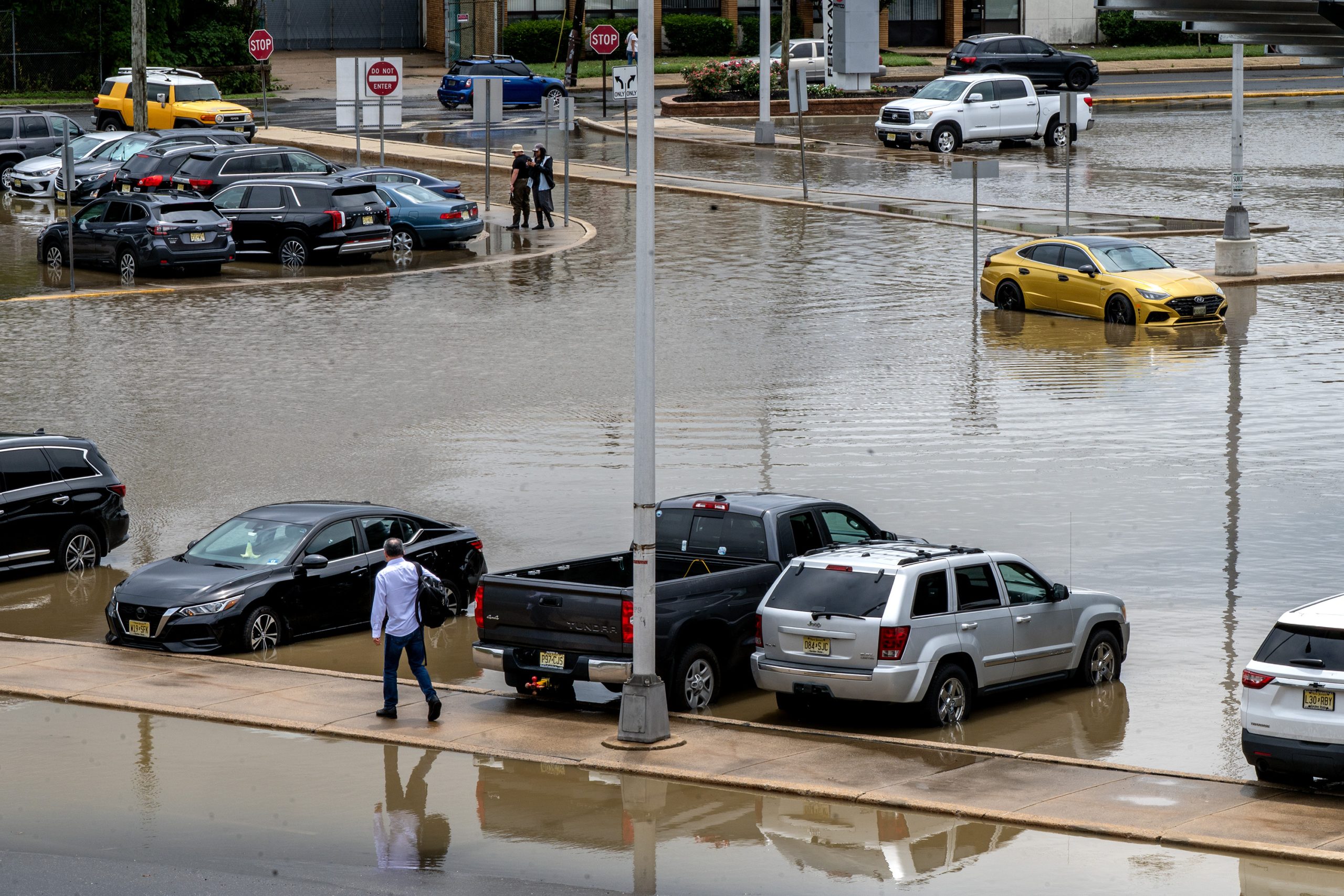
Cars in a flooded parking lot at the Ferry Avenue PATCO station in Camden on July 6. Philadelphia and its suburbs have been hit with numerous flash floods this summer, as an increasingly hot and humid atmosphere gives way to more extreme weather.
Flooding as ‘the biggest and most common hazard’
The impacts of intense storms are multitudinous and cascading, and the topography of Philadelphia’s suburbs can make it particularly difficult to find effectivesolutions.
Linn said flooding is “the biggest and most common hazard that communities face,” and it presents the most “consistent and pervasive” issues for municipal leaders.
Intense precipitation and flash floods, which have been a constant this summer, can disrupt transit, turn roads into rivers, and endanger residents’ lives. High winds and saturated soil frequently bring down trees, damaging homes and cars and knocking out overhead power lines. Disruptions to power can be particularly dangerous when residents are left without fans or air-conditioning during hot summers.
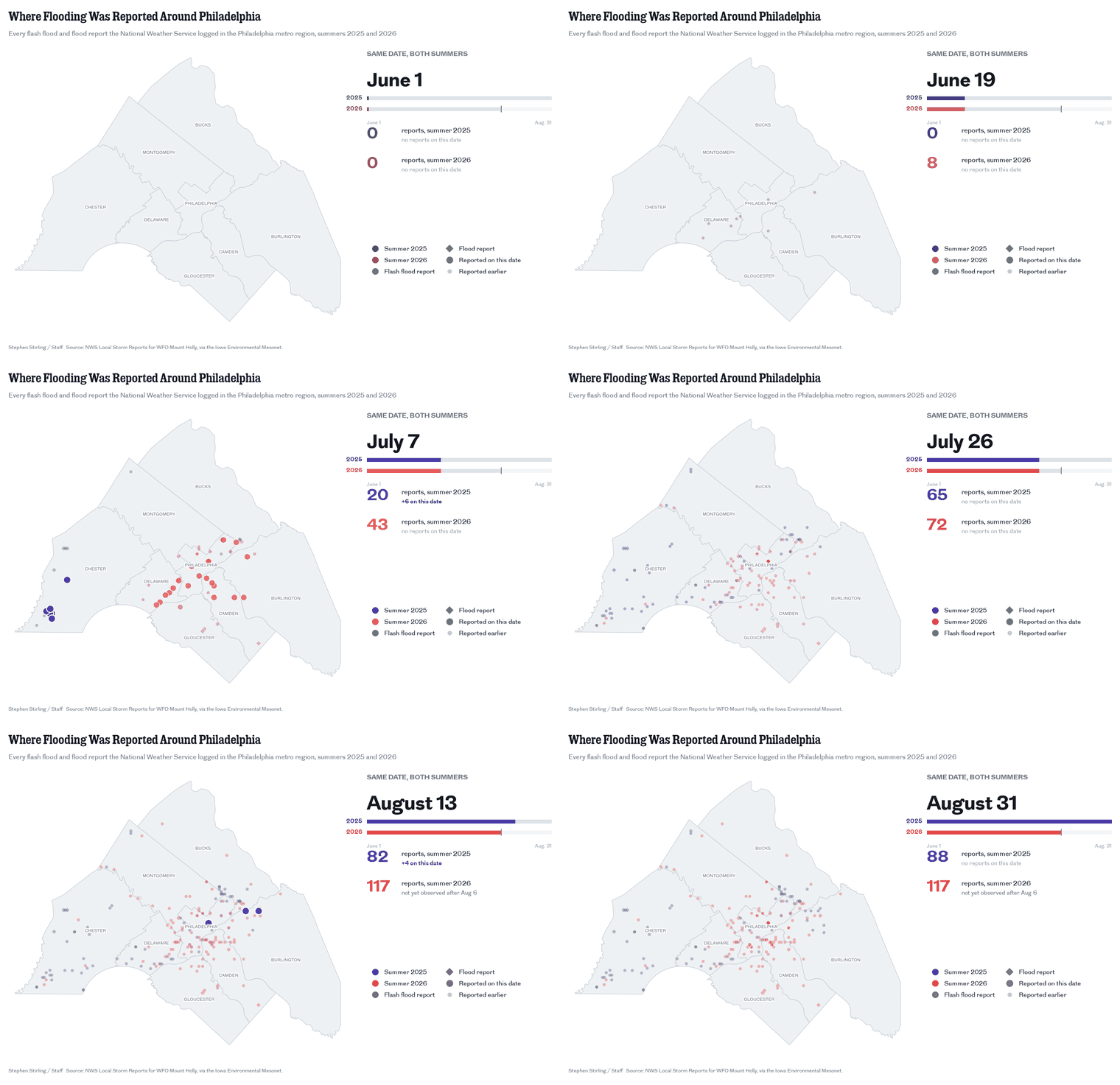
Flooding has been reported more than 200 times in the Philadelphia region over the last two summers.Stephen Stirling
“I see roads flooding consistently, trees coming down, power going out, and then our local government spending resources every time one of these storms happens. It’s overtime costs and tree costs, and then also all the private citizens having to spend costs cleaning up trees and other debris,” Courtney said.
“These unlikely, freak events are really the ones that break us,” said Matthijs Bouw, architect and professor at the University of Pennsylvania’s Stuart Weitzman School of Design.
A key tool for managing extreme weatheris stormwater systems, or the collection of drains, basins, ditches, and pipes that collect rainwater and snowmelt and move it from developed areas into local waterways. Stormwater systems are critical in moving water off impervious, or impenetrable, surfaces, like the parking lots, paved roads, and shopping centers often found in the suburbs.
The more developed a suburb is, the more runoff a storm will produce, increasing flooding risks, said Franco Montalto, professor of civil, architectural, and environmental engineering at Drexel University.
Yet many municipalities are contending with aging stormwater systems that require costly repairs. Lower Merion’s 2018 Comprehensive Stormwater Management Plan listed aging pipes, undersized infrastructure, operational costs, and increasing flooding as challenges for the township. Many of Philadelphia’s suburban communities are composed of buildings that predate a 1978 state law requiring counties and local governments to plan with stormwater management in mind.
Some communities are more vulnerable to climate impacts than others, with density, land cover, wealth, and the state of repair of existing infrastructure as factors. A 2021 climate change vulnerability analysis by Montgomery County found denser, water-proximate communities like Norristown and Pottstown to have some of the highest risk of increased stresses due to climate change. Greener, more rural parts of the county like New Hanover and Marlborough Townships presented lower risks.
The aftermath and clean up of flooding in Camden on July 6. Stormwater systems are a critical tool for local governments to manage flooding. Jessica Griffin / Staff Photographer
How can communities mitigate impacts?
Experts described a range of interventions for managing climate impacts, from constructing rain gardens to rewriting zoning ordinances.
Maintaining a healthy tree canopy and building rain gardens can help rainwater permeate into the ground. Larger infrastructure efforts like stream restoration projects and floodplain maintenance can help stabilize the built environment.
However, Linn said, these interventions “don’t necessarily address more severe or catastrophic flooding in terms of mitigating those impacts.”
Long-term climate resilience, experts said, relies on making land-use and zoning decisions that preserve floodplains and natural drainage patterns and ensure stormwater systems can manage our new, rainy reality.
Montalto is interested communities that have become “safe to flood,” or that have created parks, parking lots, road medians, and other open spaces that trap water during floods, then properly drain it, keeping it away from buildings and roads. A basketball court built below a park, for example, can fill with water during a storm and slowly drain, mitigating runoff (one was recently installed in New York City). Copenhagen’s Cloudburst Management Plan, adopted in 2012 after a major storm, is a blueprint of sorts in Montalto’s mind.
However, bringing “safe to flood” infrastructure to Philly’s suburbs may be a far-out goal.
In the vast suburbs, the collection of boroughs, townships, and county lines makes unified action difficult, and forces officials to think along municipal, not watershed, lines. On the Main Line alone, rainfall and snowmelt drain into a collection of dozens of creeks and streams that do not start or stop where a municipal boundary is drawn, making it difficult to take coordinated and effective action when it comes to flood mitigation along certain waterways.
Finding the funding to repair and replace stormwater infrastructure, too, can be taxing, as local governments stare down costly projects, even with the availability of state and federal grants.Political will factors in, with municipalities differing in their desire and ability to use taxpayer dollars to tackle climate issues.
Philly’s suburbs, like the city, are also often old, dense, and built out, making it hard to retrofit them to be more climate-sensitive.
“So many of our communities are built out and have been built out for a long time, so the vulnerabilities and the challenges are built in to the community,” Linn said.
Utility workers restore power along Wynnewood Avenue in Merion Station on July 13.Tom Gralish / Staff Photographer
Solving ‘complex issues’ in Montgomery County
Despite the challenges, progress is being made, said Montgomery County Commissioner Jamila Winder.
Montgomery County in 2025 led a flood mitigation planning study for the 362-square-mile Perkiomen Creek Watershed, which stretches across Montgomery, Bucks, Berks, and Lehigh Counties. The study identified flood-prone areas, evaluated mitigation tactics, and worked to build a framework for long-term resilience. The county is currently in the process of carrying out a floodplain restoration project along the Wissahickon Creek in Whitemarsh Township. Both projects came to fruition after Hurricane Ida tore through the region, bringing record floods and killing multiple people.
The county has repaired 30 structurally deficient bridges since 2017 and has repaved dozens of miles of road. County workers also removed 200 dangerous trees earlier this year, resulting in a significant drop in emergency phone calls about tree damage, Winder said.
Lower Merion in 2021 hired its first full-time sustainability manager and in 2023 completed its first sustainability plan. Radnor Township has adopted a comprehensive climate plan, and Haverford Township has set out to achieve 100% zero-carbon renewable power by 2035.
The Pennsylvania Department of Environmental Protection in January announced more than $17 million in funding for environmental projects across the state, including stream restoration and stormwater management.
Winder said, “We’re seeing that when we work across federal, state, county, and local leadership, that we can come together to solve some of these complex issues.”
This suburban content is produced with support from the Leslie Miller and Richard Worley Foundation and The Lenfest Institute for Journalism. Editorial content is created independently of the project donors. Gifts to support The Inquirer’s high-impact journalism can be made at inquirer.com/donate. A list of Lenfest Institute donors can be found at lenfestinstitute.org/supporters.
I oppose its current leadership and its policies in Gaza and the West Bank. But I support its right to exist as a Jewish state. And I reject the idea that Zionism is inherently racist or malevolent.
That’s why it’s important for me to hear from people who see Israel differently than I do. I need them to question, provoke, and challenge me. That’s how I learn.
And that’s also why I’m worried about the settlement Haverford College announced last week, pledging to protect Jewish students from antisemitic speech. In a statement, Haverford president Wendy Raymond declared that the college would not tolerate “discrimination, harassment, and bias” against “students who identify as Jewish” or “those who support Zionism.”
So does that mean you won’t be able to say “Zionism is racism” or “Israel is an apartheid state”? The lawyer representing Jewish students who sued the school — and who said she was “very pleased” with the settlement — seemed to think so.
“It’s a new form of antisemitism, saying, ‘Oh, no, I don’t hate Jews, I just hate Zionists,’” she said. “For a Jew to hear that was incredibly painful.”
I’m sure that it was. I’m Jewish, and anti-Zionist rhetoric is hard for me to hear, as well.
But that’s why I should hear it. Zionism is probably the most contested question on our campuses right now. Unless everyone can address it, freely and openly, we’ll never get a good purchase on it.
Wendy Raymond, president of Haverford College, pledged that the college would not tolerate “discrimination, harassment, and bias” against “those who support Zionism.”Jose Luis Magana
Ditto for Columbia, where I went to college 40 years ago. Back then, you could argue about anything. But now Zionism, too, is effectively off the table.
That’s because the university adopted the International Holocaust Remembrance Alliance’s definition of antisemitism. According to the IHRA, “claiming the existence of a State of Israel is a racist endeavor” and “drawing comparisons of contemporary Israel policy to that of the Nazis” are antisemitic.
But a competing standard, the Jerusalem Declaration on Antisemitism, argues that “criticizing or opposing Zionism as a form of nationalism” or offering “evidence-based criticism of Israel as a state” are not, on their face, antisemitic. Haverfordʼs settlement seems to lean entirely on the first definition and ignores the second, which has not been adopted by the college or most other institutions, but was endorsed by Bucknell University’s faculty last year.
Under the IHRA definition, would a student or professor who said Israel was committing genocide in Gaza — like the Nazis did in Europe — face punishment at Columbia? I don’t think Israel’s action in Gaza constitutes genocide, but I know other historians do. And again, I need to hear from them.
In their 2024 lawsuit against Haverford, Jewish students complained that a professor called supporters of Israel “racist genocidaires.” I can understand why they felt “pain and harm” about these kinds of comments, as Raymond acknowledged at the time.
But you can censor anything — literally, anything — on those grounds. During the 2016 presidential campaign, students at Emory University said they were harmed by campus chalk messages backing Donald Trump. “Supporting him, repeating his catchphrases [is] an implicit attack on the Muslim, Latinx, Black, and other communities at Emory and across the country,” protesters declared. “This is not political expression; it is hate speech.”
And in 2021, Harvard biology professor Carole Hooven caused an outcry when she told Fox News that gender could take any number of forms, but sex is binary: male or female. After a colleague denounced Hooven’s “transphobic and hateful” comments on Twitter (now X), she became a campus pariah. Her mental health plummeted, and she resigned.
Like Zionism, the biology of sex is a hugely contested and complicated matter. And we won’t be able to learn more about it if we inhibit discussion of it.
How many people celebrating the new restrictions on anti-Zionist speech at Haverford would be OK with prohibiting claims that sex is binary? Likewise, would any of the critics who pushed out Hooven rest easily if critics of Israel were silenced, too?
We all want to have our own say, of course. But when we feel pained or harmed by someone else’s political expression, we call it hate speech. And we try to blot it out.
To be clear, nobody should be subject to threats of physical violence. Whatever you think of Zionists on campus, you can’t say you’re going to assault or murder them. That’s against the law, and our colleges should be vigilant in enforcing it.
But at Haverford, it would now appear, you can’t say anything negative about Zionism. Period. If you don’t think Israel should exist, you’re an antisemite. And you need to keep your big mouth shut.
I know some people on campus have been “deeply hurt” by anti-Israel rhetoric, as Raymond said in her statement last week. But once that becomes the barometer for what the rest of us can say, we won’t be able to speak — or listen — across our differences. Isn’t that why we gather at universities in the first place: to learn from each other?
Either you believe in free expression for everyone, or you don’t believe in it at all. Period.
Jonathan Zimmerman teaches history and education at the University of Pennsylvania. He is the author of “Schooling Citizens: How Education Can Save Democracy,” which will be published next spring by the American Philosophical Society Press.
Haverford College and a Jewish group suing the school over its handling of antisemitism allegations have reached a settlement, according to federal court documents.
The documents in the U.S. District Court for the Eastern District of Pennsylvania did not include details of the settlement, but a lawyer for the plaintiffs says Haverford President Wendy Raymond’s statement to the college community immediately following the settlement announcement Friday was part of it.
“I want to take this opportunity to publicly acknowledge that those members of our community with a commitment to the state of Israel as the Jewish homeland have been deeply hurt by events that have transpired on our campus since Oct. 7, 2023, and that that constitutes a failure on our part,” wrote Raymond, who leads the 1,470-student highly selective liberal arts college on the Main Line. “We commit ourselves to doing better going forward.”
The lawsuit was filed in May 2024 as tensions mounted on many college campuses, including Haverford, in the wake of the Israel-Gaza war, following Hamas’ 2023 attack on Israel. In their complaint, the plaintiffs, three students and the group Jews at Haverford, alleged that the college discriminated against Jews by tolerating antisemitic speech and failing to adequately support Jewish students, some of whom have been shunned on campus and prohibited from participating in group discussions where the war was discussed.
They are represented by an attorney for The Deborah Project, a public interest think tank that defends the rights of Jewish people facing discrimination in the education system.
Raymond, in her statement, repeatedly stated that students who support Zionism, which she defined as “the right of the Jewish people to self-determination and statehood in the land of Israel,” are welcome at Haverford and will have “equal access” to all educational programs and activities.
“Harassing, excluding, or seeking to silence Jewish community members on the basis of their beliefs, their commitment to Jewish observance, or any other element of their Jewish identity, including Zionism, is anathema to the college’s core principles of trust, concern, and respect,” she wrote, noting that the policy applies to offices, classrooms, and student-led organizations and activities.
She said such behavior is a violation of college policy and that those who engage in it would be subject to disciplinary action, and that no Haverford professor can discriminate against or treat differently students based on their commitment to Judaism, Israel, or Zionism.
Support of Zionism has been a flashpoint in the debate over what constitutes antisemitism, with some arguing it’s wrong to conflate antisemitism with anti-Zionism.
Lori Lowenthal Marcus, an attorney for The Deborah Project, which represents plaintiffs, called the settlement “fantastic.” She said Raymond’s statement was part of the settlement, and Marcus said she would be releasing more details on Saturday.
“Plaintiffs are very pleased that they will be protected and respected on Haverford’s campus,” Marcus said Friday.
Stating that students who support Zionism will be protected was important to plaintiffs, she said.
“It’s a new form of antisemitism, saying, ‘Oh, no, I don’t hate Jews, I just hate Zionists,’” she said. “For a Jew to hear that was incredibly painful and led to students really hiding their identities when no one should be forced in any way to hide their identity, including Jewish students who believe in the right of Israel to exist as a Jewish state.”
When the complaint was initially filed in May 2024, one student, Ally Landau, a women’s basketball player who has since graduated, was named in addition to the group Jews at Haverford. Since then, two others were added with their initials.
In their complaint, plaintiffs said, the college failed to condemn Hamas’ attacks on Israel even though it had issued past statements in support of other minority groups, including Black people following the murder of George Floyd by police.
Among other allegations, the group said that a professor called students who supported Israel “racist genocidaires,” which the college did not challenge, and that the school allowed students to host an event where it was asserted that Israel had intentionally infected Palestinians with the coronavirus.
Haverford at the time declined to comment on the lawsuit.
A federal court in February 2025 dismissed the lawsuit, calling the complaint “sprawling and disorganized,” but the plaintiffs refiled.
In May 2025, Raymond was grilled by a congressional committee investigating colleges’ handling of campus antisemitism allegations. She drew fire for reluctance to answer questions about discipline in such incidents, especially in specific cases.
She also issued a statement at that time, saying that the college “came up short” in dealing with the conflict and said both she and Haverford can do better.
“To Jewish members of our community who felt as if the college was not there for you, I am sorry that my actions and my leadership let you down,” she wrote at the time.
The Haverford chapter of the American Association of University Professors, a group of nine Jewish faculty and staff, and more than 50 Jewish students at Haverford had written letters to the committee or issued statements in support of Haverford.
The faculty and staff group, noting they are diverse with some supporting Israel and others not, said at that time they “do not feel that our college is a hotbed of antisemitism.”
“We are all deeply concerned by how you are weaponizing our pain and anguish for your own purposes …,” the students wrote to the congressional committee. “It is a blatant assault on our Black, Brown, transgender, queer, noncitizen, and Palestinian peers.”
Since the congressional committee hearing, tensions have at times continued to flare. Earlier this year, Haverford vowed to make changes in its event policies after a talk by an Israeli journalist speaking on campus was disrupted, including by a protester who shouted through a bullhorn “Death to IOF,” or Israeli Occupying Forces, a name critics use to refer to Israel Defense Forces, and “Shame.”
In her statement to the campus community Friday, Raymond said it is never acceptable to let disagreements over the policies and actions of government “descend into the realm of discrimination, harassment, or bias.
“All members of the Haverford community who wish to express their considered perspectives must do so respectfully while allowing others to do the same.”
The two sides said in court documents they agreed to settle in order “to avoid the further expense, disruption, and uncertainty of litigation, all without admitting liability.”
Raymond, a molecular biologist who has led the college since July 2019, announced last November that she would step down in June 2027.
Even as a boy in New York, he loved language, literature, and poetry. He earned a bachelor’s degree in English, took graduate classes at the University of Missouri School of Journalism, and could recite lines from Shakespeare, Wordsworth, and Frost on demand.
He was generally calm and reasonable, too, his sons said. “He didn’t get upset easily,” his son Mark said.
His vocabulary was extensive, and he could spell practically any word. So it is no surprise that he spent 50 years, from the early 1950s to his retirement in 2002, as an editor, page designer, and reporter for The Inquirer, the Bulletin, the Morning Call of Allentown, the Pottstown Mercury, the Honolulu Star-Bulletin, and the Evening Tribune in Hornell, N.Y.
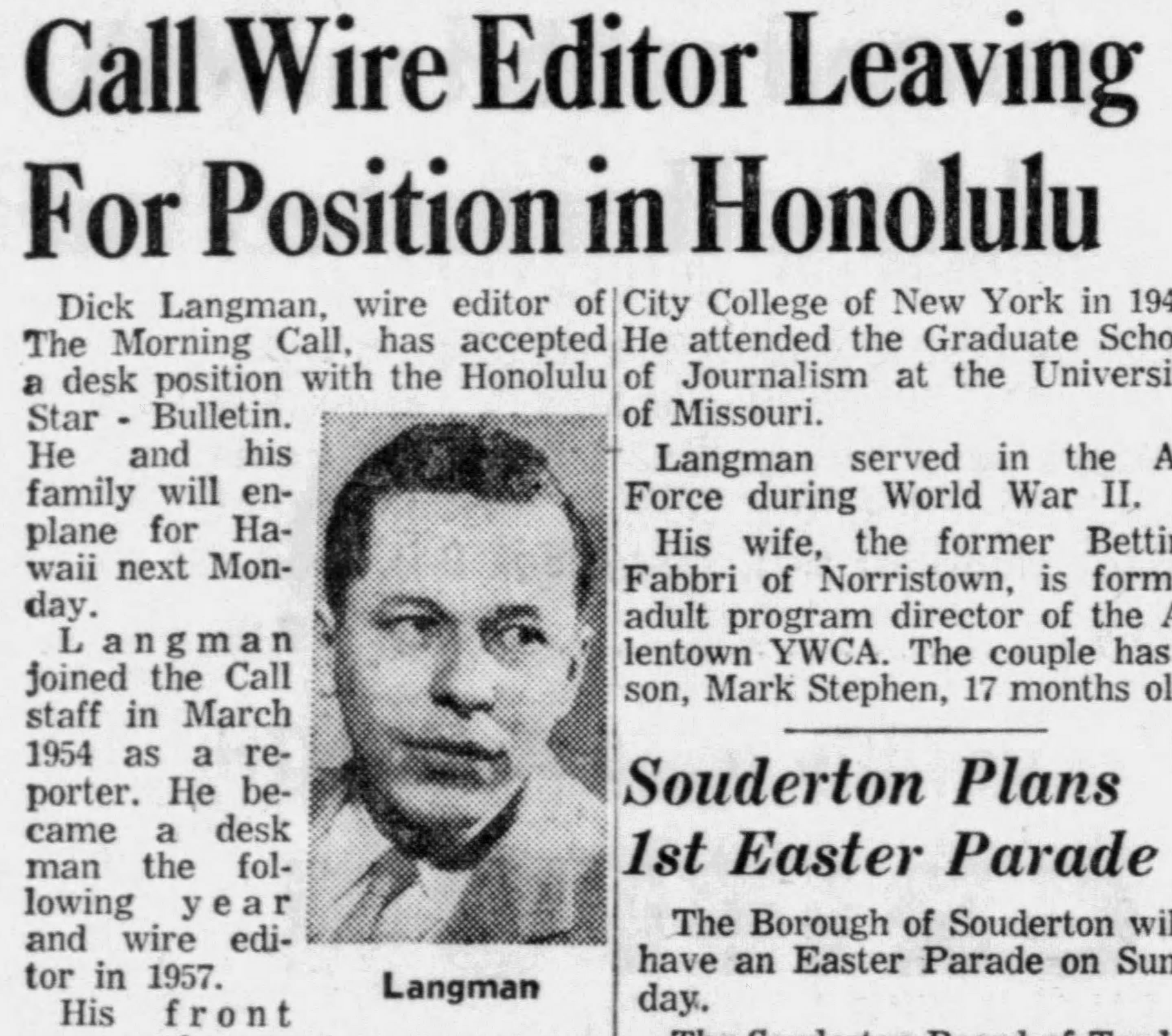
The Morning Call published this story in 1959 when Mr. Langman left to work in Hawaii.Newspapers.com
He joined The Inquirer in 1981 and worked mostly nights for 21 years as a copy editor, assistant news editor, and suburban assigning editor. Former colleagues at The Inquirer called him a “meticulous” editor, “enormously patient,” and “a man of great integrity” in online tributes.
He won an award from the old Pennsylvania Newspaper Publishers Association in 1957 for a front page he designed for the Morning Call and spent 20 years as assistant city editor and news editor at the Bulletin. “I’m glad that I had a chance to work with him,” a former Inquirer copy desk colleague said. “What a pro.” Another said: “I could not have had a better teacher.”
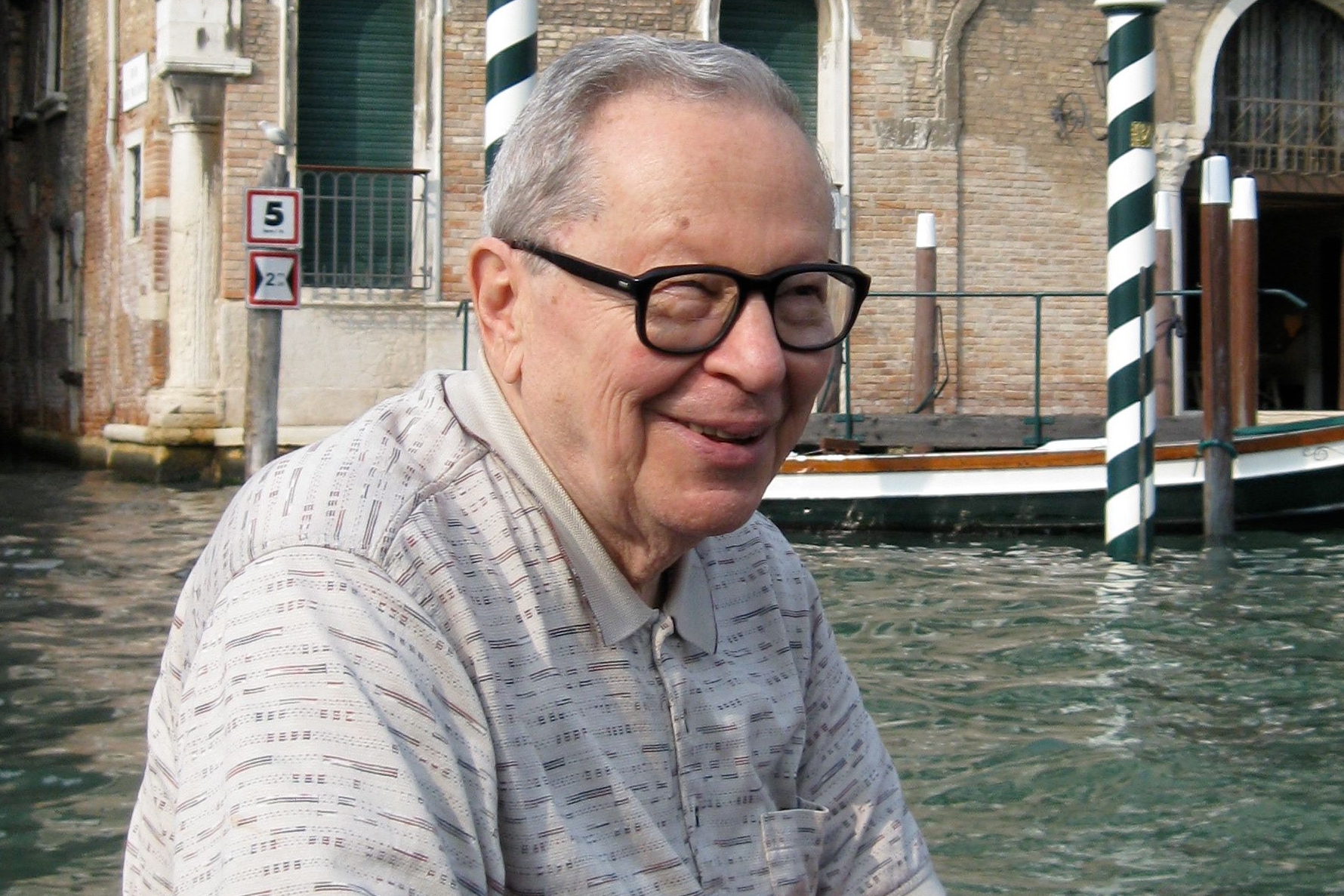
On Saturday, June 13, Dick Langman died of complications from pneumonia at Bryn Mawr Hospital. He was 99.
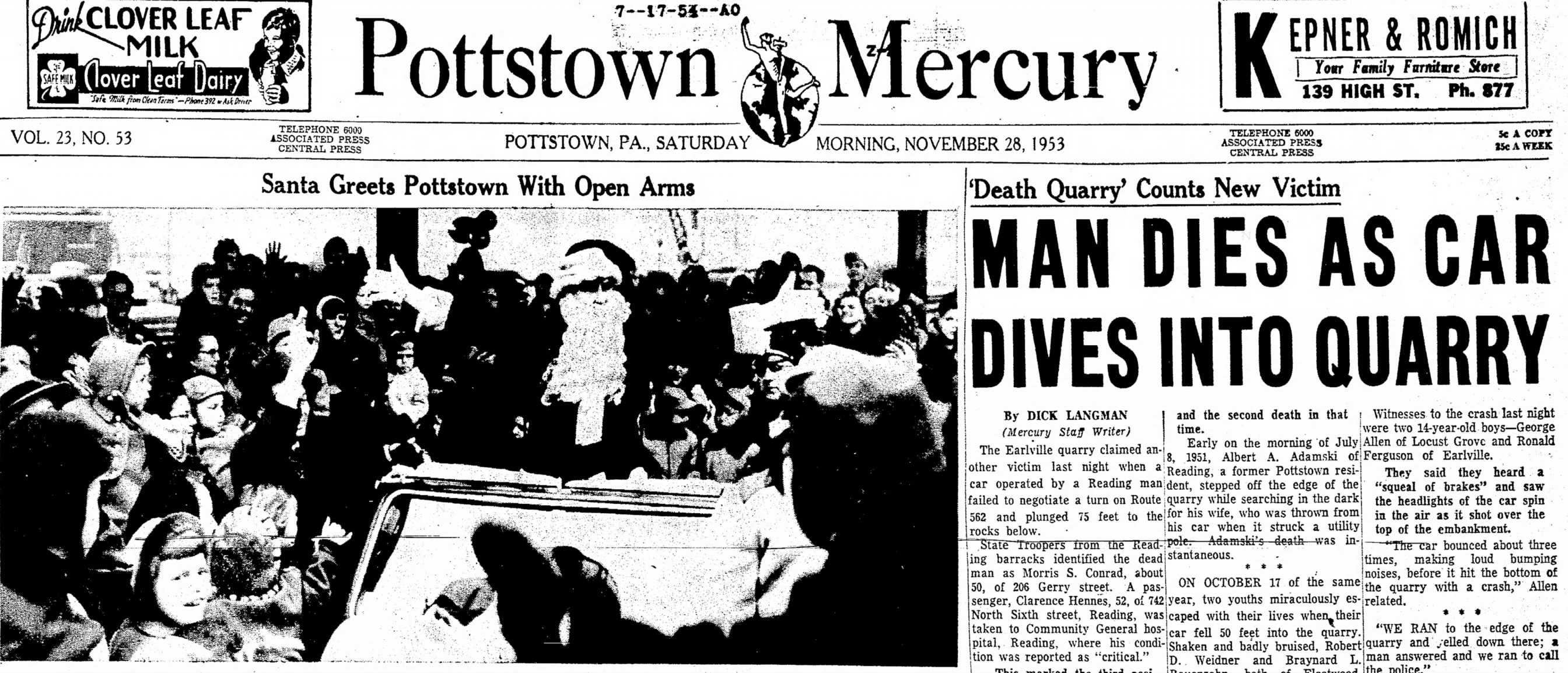
Long before he came to Philadelphia in 1961, Mr. Langman was a seasoned newspaperman. He honed his reporting skills as a writer at the Evening Tribune in New York and the Mercury in Pottstown.
Mr. Langman and his wife, Betty, married in 1954.Courtesy of the family
In January 1954, he opened a Page 1 story for the Mercury with: “From clomping around in wooden shoes in Holland to wearing modern footwear in Bechtelsville is a long way, and Mrs. LaVerne Fronheiser is glad to be home. She’s not too glad, however, because her husband had to stay in Germany, where he’s stationed with the infantry.”
On Page 1 in March 1954, he wrote: “They had need of a chaplain yesterday at borough hall. He could have served well the 50 moaners and groaners whose cars were tagged for parking violations.”
He moved on to the Morning Call and covered high school sports and other news. He left for Honolulu in 1959 and became sports editor at the Star-Bulletin. But he missed the East Coast and returned to work at the Bulletin in Philadelphia in 1961.
“Hawaii is one of the loveliest places in the world,” he told the Morning Call. But his wife, Betty, had roots in Norristown, he said, and they both got homesick.
Mr. Langman wrote this Page 1 story for the Pottstown Mercury in 1953.Newspapers.com
Earlier, after college, Mr. Langman worked briefly for the Associated Press in New York and as a statistician for what is now the Elias Sports Bureau. He enlisted in the Army after high school in 1944, went to active duty in 1945, and served until the end of World War II.
At The Inquirer, a former colleague recalled, Mr. Langman edited a story about a horse that had injured a leg. Naturally, he tried to find out which leg was hurt.
“Dick was a painstaking editor,” his former colleague said on Facebook, “and a master in getting the details right.”
Richard Langman was born Sept. 5, 1926, in New York. He graduated from Stuyvesant High School and earned a bachelor’s degree at City College of New York in 1948.
Mr. Langman enjoyed cooking and shared his favorite recipes with colleagues at The Inquirer.Dick Langman
He met Betty Fabbri, the society editor at the Mercury, and they married in 1954. The Morning Call announced their union in its Breakfast Chatter column by saying: “Best wishes to reporter Dick Langman, who walks the long mile in Norristown Sunday with Bettina.”
He and his wife had sons Mark, Peter, and Andrew, and lived in Allentown, Ardmore, and the Quadrangle retirement community in Haverford. His wife died in 2017.
Mr. Langman and his wife shared wanderlust, and they went to Russia, Austria, Hungary, Europe, and elsewhere. They visited Italy 10 times, France three times, and Cape May as often as possible.
They liked to cook together, too, and he shared his favorite recipes with colleagues at The Inquirer. At the Bulletin, he became part of the “old bulls” lunch group.
He submitted his own prewritten obituary to his funeral director long before it was needed and said: “He enjoyed classical music, poetry, mystery novels, and British mystery and comedy.” He also liked crossword puzzles, fishing, table tennis, classic movies, and duplicate bridge.
He cheered for the New York Yankees baseball team and the Green Bay Packers and Penn State football teams.
“He delighted in jokes and was a real fan of the Marx Brothers,” his son Peter said. “When we were children and a local movie theater would feature a Marx Brothers film for one night, my parents made sure that we went. Fond memories indeed.”
In addition to his sons, Mr. Langman is survived by two grandchildren and other relatives.
Services were held earlier.
Donations in his name may be made to the Lenfest Institute for Journalism, 100 S. Independence Mall West, Suite 600, Philadelphia, Pa. 19106.
Chester Mayor Stefan Roots came up withan idea as he waited to testify Wednesday during a Pennsylvania legislative committee hearing on a proposed gas export terminal.
“I’m introducing a new initiative,” he said, “WMO — we’ve moved on .… This dangerous facility does not belong in a densely populated urban area like Chester. I’m calling on this committee to do the right thing: Protect some of the most vulnerable people in this commonwealth and say no to an LNG terminal in this region.”
Roots spoke in response to a yearslong plan by Penn LNG to build a liquefied natural gas (LNG) export terminal in Chester or nearby in southeastern Pennsylvania along the Delaware River. The terminal would tap in to an existing pipeline to carry gas from the Marcellus and Utica formations to a site on the river. There, it would be compressed into liquid gas for export and capitalize on soaring global demand for LNG after Russian’s invasion of Ukraine.
The hearing, held by the Pennsylvania House Environmental & Natural Resource Protection Committee, was stacked with opponents of the plan, saying it would create pollution and be highly dangerous to surrounding communities. Democratic State Rep. Greg Vitale, the committee chair from Delaware County, said proponents, including Franc James, CEO of Penn LNG, and union leaders were invited but declined.
Penn LNG has not specified a location but has said it plans to develop a new plant to export 1 billion cubic feet per day of gas from the Marcellus Shale to Europe.
At previous hearings held by Republican State Rep. Martina White, chair of the Philadelphia LNG Export Task Force, proponents spoke of the economic change the facility would bring, including jobs.
Vitale said he convened Wednesday’s hearing because he feared the project would “proceed under the radar without sufficient public scrutiny.”
Indeed, the mood Wednesday was strikingly different from past hearings as opponents told legislators an LNG facility would pose serious health, safety, and environmental justice issues.
In 2024, former President Joe Biden put a pause on LNG export approvals in 2024 to further study the issue. This year President Donald Trump has made reviving fossil fuel energy projects a priority.
Reuters reported in June that James, the Penn LNG CEO, had met with officials at the White House over the project.
Penn LNG wants to export 7.2 million tons a year of LNG from a site near Philadelphia to markets in Europe and Asia and is considering several locations other than Chester, such as in Trainer, Marcus Hook, and Eddystone, the news service reported.
What are the issues regarding an LNG facility?
Opponents believe such a facility would pose a major threat if there is an explosion or fire in an area already densely populated with people and polluting industrial sites. They noted that Delaware County’s Crozer-Chester Medical Center and Springfield Hospital were closed this year amid a bankruptcy auction.
If there is a catastrophic explosion, they said, the nearest hospital would be 30 minutes away.
Tracy Carluccio, an advocate with the nonprofit Delaware Riverkeeper Network, said the area is too densely populated for the facility, emphasizing that a major concern is the lack of a sufficient safety buffer, which the federal government advises for LNG terminals.
She noted that similar facilities in the South are situated in areas with thousands of acres of buffer. She said a new site in the area would likely be around 100 acres.
“There is no location within the Delaware River watershed, including the bay all the way down to the ocean, for any LNG facility to be located,” Carluccio said.
Lauren Minsky, a visiting professor of health studies at Haverford College, said an LNG facility would exacerbate existing public health issues in the region.
She said southeastern Delaware County has already been given a grade of “F” for particle pollution and a grade of “D” for ozone levels by the American Lung Association.
She cited 2025 research by Johns Hopkins Universityshowing that high levels of volatile organic compounds have been measured in communities near the fence lines of LNG facilities. She also said there are elevated cancer rates in adults living in the area’s riverfront communities, citing the People’s Cancer Incidence Screening Tool, which calculates average annual cancer incidence rates in Pennsylvania.
“If we value the health of our families, our friends and neighbors, and throughout the commonwealth, we need to build a different future, one in which we can all thrive,” she said.
Already industrialized
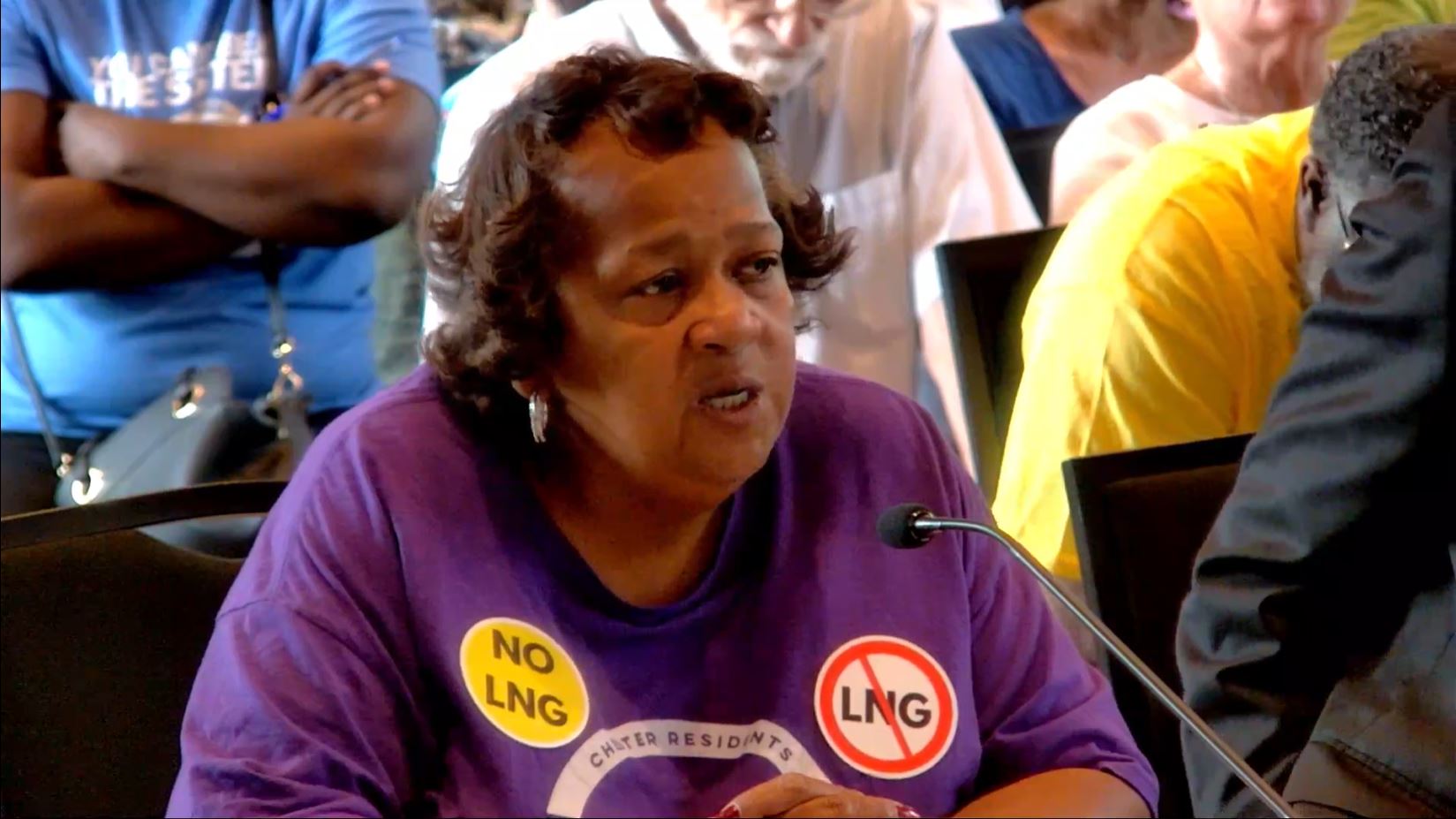
Zulene Mayfield, an activist with Chester Residents Concerned for Quality Living, said older residents she knows have suffered heart conditions and cancers that she links to living in an already heavily industrialized area.
Mayfield is a longtime opponent of the Delaware Valley Resource Recovery Facility owned by Reworld, formerly Covanta. The facility burns trash and converts it to energy.
She said Chester, rimmed by heavy industry, lacks many things other communities take for granted, such as primary-care physicians or entertainment for children.
“We are being told that we have to accept other industries” that no other communities want, Mayfield said.
“I’m sitting here right now trying to contain my rage,” she said. “The jobs are temporary, but death is forever.”