Tag: free-apple

  • Penn president announces he will leave his job next summer

    Penn president announces he will leave his job next summer

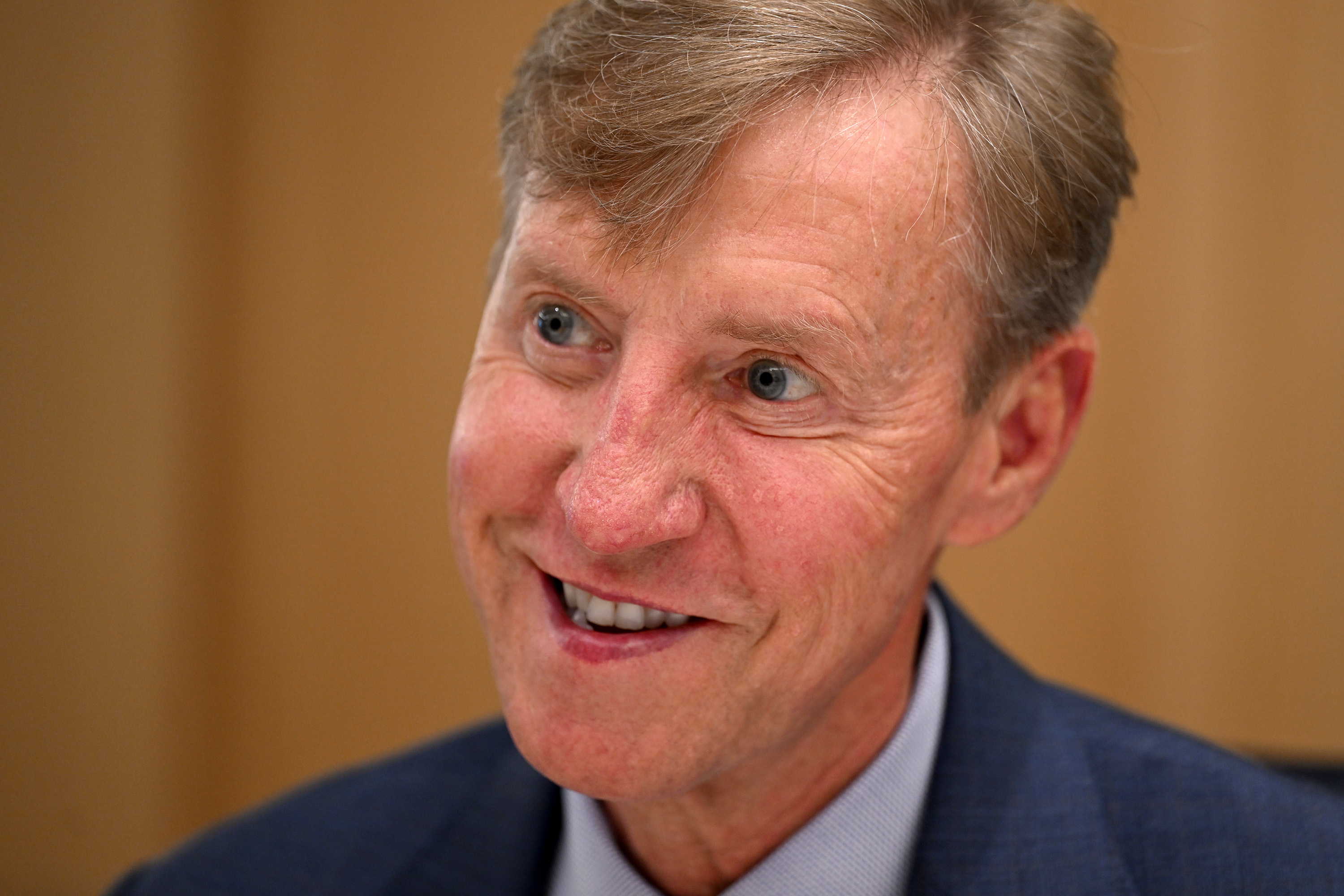
    University of Pennsylvania President J. Larry Jameson will conclude his presidency next June, he announced in an email to the Penn community Friday.

    “Although I greatly enjoyed serving as president, now is the right time for Penn to begin its next chapter under new leadership,” Jameson said in the email. “My goal was to help restore stability during unanticipated leadership transitions, refocus our community on Penn’s mission, and strengthen Penn for the future during a challenging time for higher education.”

    Those goals have been accomplished, he said.

    There was much speculation about whether Jameson — an endocrinologist who previously led Penn’s health system and medical school for more than 12 years — wanted or would be asked to remain in the seat beyond next year’s expiration of his current contract. Many have credited Jameson with steadying the school during a turbulent time, including as the school faced funding threats and increased scrutiny by President Donald Trump’s administration.

    His departure will leave the Ivy League school searching for a new leader during a time of uncertainty under Trump, who has targeted elite universities.

    Board chair Ramanan Raghavendran said he respected Jameson’s decision and the board will begin searching for the school’s next president in the fall.

    Jameson, 71, will have served in the top job at Penn just three-and-a-half years, one of its shorter presidential tenures. But he came into the job by circumstance rather than desire.

    Jameson took over in December 2023 during perhaps one of Penn’s greatest leadership upheavals. Former President Liz Magill had just resigned amid a bipartisan backlash over her testimony involving the school’s response to antisemitism complaints. He first was named interim president and then was elevated to the permanent post in March 2025.

    Jameson earned total compensation of more than $8 million in 2024, the most recent tax year available. That included $5.4 million in “reportable compensation” and more than $2.5 million in other compensation.

    “Dr. Jameson stepped in at a pivotal moment, and what he has accomplished in two-and-a-half years has been simply extraordinary,” Raghavendran said in a statement.

    Neither Raghavedran nor Jameson were available for interviews Friday, the university said.

    In his message, Jameson said “the momentum we have built will continue,” noting his intention to work over the next year on implementing the Penn Forward plan. The plan calls for everything from more transparent and predictable tuition and cost policies and improved student experience to more efficient operations, a focus on keeping Penn at the forefront of best uses of artificial intelligence, and a growing presence in the San Francisco Bay Area — where Wharton already has a campus.

    Penn also has some tough decisions ahead in his final year. During the spring semester, the school proposed new open expression guidelines that some on campus say are too restrictive and would chill free speech. The university is considering the feedback and plans to issue final guidelines next academic year.

    The university also is undergoing belt-tightening in anticipation of potential federal cuts and increased legal and insurance costs. Penn in January asked schools and centers to pare 4% from their budgets for the next fiscal year, on top of a 5% cut last year.

    Penn’s Graduate School of Education laid off several staff members last week as part of those cuts, according to The Daily Pennsylvanian, the student newspaper.

    Many at Penn speak highly of Jameson’s leadership, though some wish he had made a stronger defense against some Trump demands.

    “Even if this were a good time to search for a new president — and it decidedly is not — I cannot imagine Penn finding a more effective leader,“ Eric Feldman, faculty senate tri-chair and a law school professor, said last month. ”His deep knowledge of the medical school is a significant asset amid continuing pressures on federally funded research, and his extensive leadership experience, spanning decades, makes him uniquely well suited to guide the university through what are likely to be several more complex years.”

    During an interview with The Inquirer last month, Jameson explained his decision to resist the Trump administration on some things and negotiate on others.

    “My approach has been not just to complain,” Jameson said during his first interview as Penn’s president with a major media outlet, “but to say, ‘Well, here’s where we’re working together very effectively. Here’s where we’re not necessarily aligned, but let’s discuss how to move forward.’”

    Jameson was at the helm when Penn last summer struck an agreement with the White House over the prior participation of transgender swimmer Lia Thomas on the school’s swim team. The school agreed to adhere to the Trump administration’s definitions of sex, female, male, women, and men in regard to athletics, and send letters of apology to female athletes who felt aggrieved by Thomas’ participation on their team during the 2021-22 season.

    But he also was at the helm when Penn rejected a compact that would have given it preferential treatment for federal funding if it agreed to the Trump administration’s operational demands. The school also is actively fighting a demand by the Equal Employment Opportunity Commission to turn over lists of Jewish people on its campus for its investigation into alleged antisemitism at Penn. The agency sued Penn for not complying with its subpoena and a federal judge sided with the EEOC, but Penn is appealing the decision.

    Jameson said he gained new perspective in the presidential role, which “allowed me to learn each day from the people, ideas and achievements that define this university and its extraordinary breadth. …While my career has been in academic medicine, it has been illuminating to reacquaint myself with other fields, from poetry to political science, from finance to fine arts.”

    He said the university is on a positive trajectory.

    “Penn has tremendous momentum and is exceptionally well positioned for the future,” Jameson wrote.

  • Walmart plans to bring delivery drones to Philly. What that means for Amazon and the same-day delivery wars.

    Walmart is raising the stakes in the high-speed delivery war with Amazon, with part of this latest battle playing out in Philadelphia.

    Wing, the first company to offer commercial drone delivery to homes in the United States, announced this week that it will expand its partnership with Walmart to bring drone service to seven new cities, including the City of Brotherly Love, sometime in 2027.

    A Walmart spokesperson said there was no timeline for when the drones would come online in Philadelphia, nor did the company say which of the city’s five stores would get the service. Even so, Philadelphia’s inclusion in Walmart’s drone program would be the first for the Northeast, part of a plan to bring drone delivery to 270 stores.

    “Expanding into new markets with Wing allows us to provide an innovative delivery option for customers, utilizing our vast store network to make everyday shopping and fulfilling last-minute needs just a little bit easier,” said Greg Cathey, Walmart’s senior vice president of eCommerce fulfillment transformation in the U.S, in a statement.

    The move, according to industry observers, would intensify the competition with Amazon, which has been feverishly working to offer increasingly faster deliveries to consumers through a mix of human couriers and drones. While Amazon has been testing out drone delivery since 2016, the competition lies not in who has the better machines, but in who can deliver goods faster.

    Walmart, which launched its pilot that began in 2021, has used Atlanta and Dallas-Fort Worth as a testing grounds for its drones.

    Just last month, the e-commerce giant launched “Amazon Now,” a 30-minute-or-less (human) delivery service in Philadelphia, also available in Atlanta, Dallas-Fort Worth, and Seattle.

    Early Walmart reports tout an average delivery time of 23 minutes with their drones.

    “I think [the drone expansion] is signaling that Walmart feels that they are ready to reduce the delivery time,” said Subodha Kumar, founding director of the Center for Business Analytics and Disruptive Technologies at Temple University’s Fox School of Business.

    “They are going to put a lot of pressure on Amazon.”

    While Amazon is seen as the gold standard for e-commerce logistics and had a head start experimenting with drones, its under-60-minute delivery through “Prime Air” has been primarily deployed in suburban areas. Part of the challenge for Amazon is that its fulfillment centers are far from customers.

    Walmart has the advantage of being much closer to its customers, said Kumar, calling plans to introduce drones a significant development in the wars for faster deliveries.

    “For Walmart, the drone makes even more sense because drones are limited in their distance and what they can carry,” said Kumar, adding the retailer has the advantage of having its stores much closer to their customers.

    For its part, Walmart has billed the machines as a fast way to get last-minute items. The Wing drones will deliver up to eight miles from a location that offers the service and carry up to 2.1 pounds, according to the company’s website.

    The company has said some of the most popular items for this kind of delivery include medicine, fruit, eggs, ice cream, baby formula, and pet food.

    People can place orders on the Walmart app and their delivery will be lowered on a tether in front of their home, driveway, or backyard. Deliveries will be free for a limited time to Walmart+ members, according to the company website, or $19.99 for nonmembers.

    “Our work with Walmart has shown that drone delivery isn’t just a novelty, it’s a service many customers count on multiple times per week,” said Heather Rivera, Wing’s chief business officer, in a statement.

    The pilot, which Walmart says works with “drone providers” that are experts in their field, made its millionth delivery last month with an average delivery time of 23 minutes going at speeds up to 60 miles an hour.

    Drones are currently carrying out deliveries in select cities in Texas, North Carolina, and Georgia. In addition to Philadelphia, Memphis, New Orleans, Phoenix, Salt Lake City, San Diego, and the San Francisco Bay Area are part of the expansion.

    Kumar said the new technology demonstrates there’s an appetite for faster deliveries on the consumer side and a service with no human interaction.

    In that way, the drones are similar to Uber Eats’ autonomous delivery bots, which were introduced in March to a mixed response. While many appreciate the convenience, others have lamented the sight of cuboids blocking the sidewalks. Lawmakers have already expressed concerns over the technology moving too fast and suggested restrictions. Waymo, the autonomous vehicles, have spurred similar conversations in Philadelphia.

    In its expansion announcement, Wing said both companies plan to work closely with local leaders and community members, sharing information about the machines.

    Kumar said the drones will likely bring a whole new set of public concerns over airspace traffic and safety.

    “It will bring new issues that we don’t know the answers to yet,” he said.

  • City Council votes to ban horse-drawn carriages in Philadelphia

    City Council votes to ban horse-drawn carriages in Philadelphia

    In the middle of mundane City Council procedures on Thursday, cheers erupted inside Council chambers.

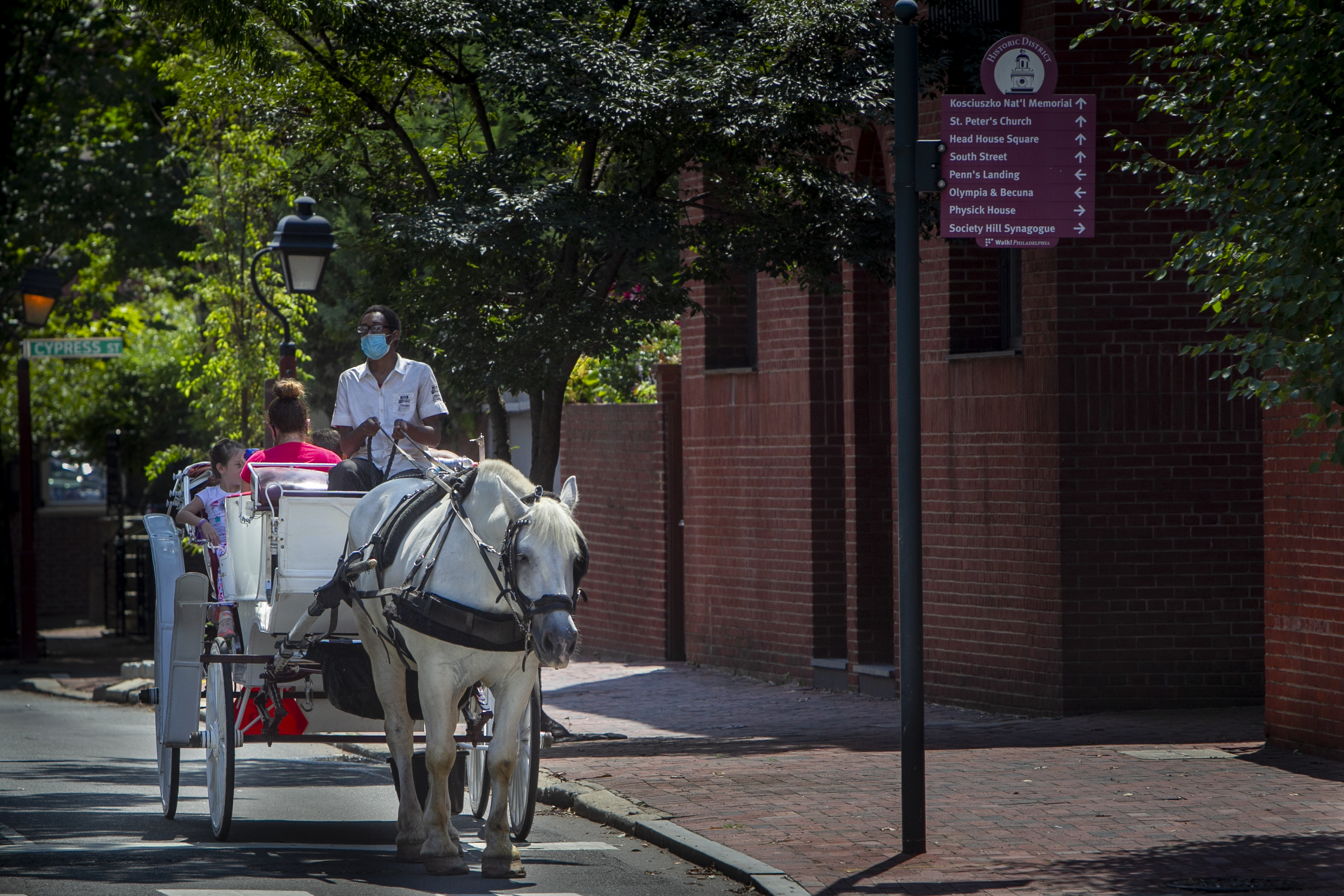
    Supporters were celebrating the passage of a bill that will outlaw horse-drawn carriages in Philadelphia. The ban would take effect after Mayor Cherelle L. Parker signs it into law.

    The city’s last operating horse-carriage business, 76 Carriage Co., ceased operations in 2023, but people have taken noncommercial horse carriages to South Street in recent weeks.

    Councilmember Mark Squilla, who introduced the bill, and animal-welfare advocates have been working to ban the practice for several years. The advocates have argued that horse-drawn carriages are cruel and onerous to the animals, and dangerous for surrounding traffic and pedestrians.

    A horse in New York City died earlier this week while pulling a carriage, and lawmakers have planned to reintroduce legislation that would ban the practice in that city.

    Philadelphia City Council was slated to vote on the bill last week, but that version would have banned only commercial horse-carriage use. Advocates like Janet White, executive director and founder of Carriage Horse Freedom, successfully pushed for the bill to be amended to include a ban for both commercial and noncommercial uses.

    The new proposal allows for some exceptions, which would be regulated and monitored by animal control and the Philadelphia Department of Licenses and Inspections. Violations of the ban could result in fines of $1,000 per day for someone operating a horse carriage.

    Council voted nearly unanimously for the amended bill’s passage in its last session before summer recess, with Councilmember Nicolas O’Rourke casting the lone vote in opposition.

    O’Rourke said his nay vote was “benign,” because he has deep respect and connection with horses since his mother taught him how to ride and care for them. His objection came from concern about how the language of the legislation potentially could make it difficult for movies filming in the city to use horse carriages, he said, and he would like to continue talking about the issue over the summer.

    White said the bill’s passage made her hopeful, and she believes it will help Philadelphia move into a better future for animal welfare.

    “It is a moral and civic milestone — one that reflects who we are today and the humane, forward-looking city we aspire to be,” she said in a statement.

    Staff writer Andrea Padilla contributed to this article.

  • Some Philly teachers say they’re pressured to pass students who rarely come to class or do work

    Some Philly teachers say they’re pressured to pass students who rarely come to class or do work

    Philadelphia School District students receive report cards on Thursday, the last day of the 2025-26 school year.

    But it’s an open secret that in many schools, it is nearly impossible to fail a student, according to interviews with two dozen teachers from schools across the city who say the district is making them give passing grades.

    Many teachers said they passed students who did little or no work, did not understand concepts being taught, or did not show up to class much. Most of the teachers interviewed requested anonymity for fear of reprisal.

    “There’s a bunch of kids in my class that have F’s in reading, and I’m probably going to pass them — I’ll bump it up to a D and call it a day,” one middle-grades teacher at a K-8 school said. “I don’t know of anyone who’s been able to keep anyone back, and we’re just setting kids up for failure.”

    On paper, Philadelphia students can fail courses, or be retained in a grade, so long as they are offered appropriate interventions and supports. Officially, the district, according to its policy, “is committed to excellence in student accomplishments and recognizes the contribution of a district wide promotion policy moving all schools to models of achievement.”

    But many teachers said that they were discouraged or forbidden by their principals from flunking students, or that they have given out failing grades that were overridden. Others said failing students was permitted if justified, but the administrative burden to rationalize failure, even for students who did not show up to school, is onerous or impossible.

    All of the teachers who spoke with The Inquirer said they fear for the long-term implications for students who are passed along without the skills they need to advance — especially in a city where so many students cope with the effects of poverty and trauma and a majority of students do not meet grade-level standards on state testing.

    Monique Braxton, district spokesperson, said the district’s policies “emphasize that student grades are meant to accurately reflect their academic performance and progress toward learning standards. Schools are required to provide and document appropriate interventions and progress monitoring when students encounter academic challenges. The district remains steadfast in its commitment to maintaining high expectations for students while ensuring they receive the necessary support to achieve success.”

    When did it start?

    The K-8 teacher, a veteran of district schools for three decades, said that at the beginning of her career, it was easier to give F’s or retain students who did not meet the learning standards. But, the teacher said, there has been a “subtle shift” since the early 2000s, the era of the federal No Child Left Behind Act.

    “When the pressure was on the schools to show promotions and graduation rates, and the district was so focused on showing data, it’s shifted grading, and now it’s a joke,” the teacher said.

    Philadelphia changed its grading policy in 2017, setting a 50 out of 100 as teachers’ grading floor and making it easier to pass. The minimum score for a D, once a 64, was changed to a 60.

    The rationale for the change, leaders said at the time, was standardizing grading procedures and preventing students from giving up if they perform poorly early in the year. Detractors of the policy shift said at the time they feared it would water down standards.

    The K-8 teacher, and others interviewed, emphasized that most Philadelphia students are bright and capable. But those who do not try because of complicated home lives or other reasons can skate by, they said.

    “We have a kid who’s done no work all year, and we’ve done everything, and they’re just going to push him forward,” the K-8 teacher said.

    The teacher also works in the service industry, and said the effects of passing students who have not earned passing grades is evident in that workplace.

    “We see people who don’t come to work on time, they can’t take orders, they can’t use a computer or figure things out, and this is why,” she said. “They’re not being held to standards for all their years in schools.”

    ‘Is there anything you can do to bump these up?’

    A second teacher said he has failed students who did not earn passing grades, though he has more latitude because he does not teach a major subject. But he absolutely understands why some teachers give 60s that should be F’s: With full course loads, teachers do not have time to document a pattern of contacting guardians, giving extra time for work, breaking down assignments, allowing extra credit, or extending deadlines.

    “Who has time to do that when you have 30 other kids?” the teacher said. “And the system is inherently causing laziness from teachers also, to just shut up, pass them, and you don’t get grief.”

    There is a ripple effect, he said.

    “I feel sorry for the good kids, the kids who struggle, do their work, and get a C. So I give them a B, a low A. They try,” he said.

    The district has posted academic improvement over the last several years. But district students’ academic achievement as measured by state tests remains low, with 33% of students meeting standards in reading and 25% in math.

    “The PSSA scores don’t match the grades kids are getting,” the second teacher said.

    The district’s four-year graduation rate has also risen. In 2024-25, it was up to 84%, from 69% in 2014-15.

    Grade inflation comes at the end of every year, said a third teacher, who works at a district high school.

    “There’s a push right after grades are due,” said the third teacher, who noted that administrators will say, “‘Is there anything you can do to bump these up?’”

    Grades are not changed for every student, but in some cases, administrators will “push [students] along because they want to see them graduate or pass,” the third teacher said. “There’s all this pressure from the district to increase the graduation rate — there are so many layers to it. I know that it happens in a lot of places. It’s not just our school. But this year, it was huge margins and huge numbers.”

    Administrators sometimes change the grades themselves, the third teacher said.

    In one instance, a student’s grade shot up with no explanation, the teacher said. “This student had a 50 yesterday. How did he have an 82 today? This was a student who didn’t turn in any additional work, and missed 63 of 84 classes,” the third teacher said.

    The third teacher said another student who was moved on without doing the work admitted it.

    “Even he was like, ‘Yeah, I didn’t deserve to pass, I don’t know how that happened. But I’m excited to graduate,’” the teacher said.

    The third teacher underscored that while the practice could be making the district’s numbers look better, it is not serving students.

    After graduation and not being held to standards, the teacher said, one former student “lost the first three jobs he had because he didn’t go to them. He had to learn that lesson in a much harder, more adult way, and he could have learned that in high school. I worry that when kids graduate and get into the workforce, it will impact the way they approach the goals they set for themselves and how they try to achieve those goals.”

    ‘The gap was huge’

    A fourth teacher who has worked in multiple types of schools in Philadelphia said the practice is not limited to the district.

    She most recently taught at a city charter and said some of her middle-grades students were at kindergarten reading and math levels.

    “The gap was huge,” the fourth teacher said. “The school’s explanation is that there’s a school-to-prison pipeline, and the older students are, the less likely they are to graduate. But they’re not meeting standards. The gaps are huge. It was very shocking to me how they would just pass the kids. I’m a parent, and I want my kids to be prepared properly.”

    A fifth teacher said that at her school, it is rare for students to be pushed along without doing work.

    “I can’t in good conscience pass anybody who doesn’t show up,” she said. “I think a lot of teachers around me also can do that. But I have also seen that teachers — maybe at a particular building, maybe those who work for a particular administrator — who say, ‘You know what, I’m not going to fight it.’”

    What is definitely not rare, the fifth teacher said, is giving students “a lot of different lifelines, a lot of different ways for them to pass,” whether it’s in-school credit recovery or summer school, “even when their trends of behavior and attendance and performance and engagement in the class suggest that they needed more time with that content.”

    A sixth teacher said his principal permits failure and retention, in rare cases, with significant documentation. There is some pressure to not fail students, but when needed, the teacher has been able to produce adequate paperwork to show failure was the last resort.

    But when deciding whether to pass or push through a student, “I ask myself whether holding them an extra year will make a significant difference,” the teacher said. One of the teacher’s students is bright but unmotivated and rarely completes work.

    “I don’t think that’s going to change with an extra year in the same grade, and therefore, I decided to pass him,” he said.

    Does he worry about the implications for the district writ large?

    “Honestly, I do think about it sometimes, but I’m just not sure there’s a right answer with the current situation,” the sixth teacher said. “I’m no policy expert, but I think for it to make sense on a larger scale we’d need significant cultural shift and policy changes.”

  • The Justice Department is investigating whether Philly police are improperly revoking gun permits

    The Justice Department has opened an investigation into whether the Philadelphia Police Department has been improperly revoking people’s gun permits, officials announced Tuesday — a remarkable development that puts one of the nation’s largest police forces under the scrutiny of federal law enforcement.

    In a letter addressed to Mayor Cherelle L. Parker — which the Justice Department published online — Assistant Attorney General Harmeet K. Dhillon said the investigation “will evaluate the PPD’s policies and practices regarding issuance and revocation of licenses to carry firearms.”

    If prosecutors determine those policies violate the Constitution, Dhillon said, the Justice Department could take the city to court.

    Dhillon emphasized that federal officials “have not reached any conclusions” in their inquiry. And she said prosecutors would seek to speak with city and police officials throughout the course of their probe.

    City spokespeople did not reply to requests for comment Tuesday.

    The announcement came weeks after news reports detailed that police had revoked the gun permits of five members of a Philadelphia-based Black armed citizens group.

    Members of the group, the Panthers, received letters from the city police department’s permitting unit in February, alerting them that their gun permits had been terminated and offering little explanation beyond saying the decision was based on “good cause” as well as “character and reputation.”

    The notifications came shortly after some members got into a verbal altercation with police officers in North Philadelphia. Panthers members were patrolling the neighborhood carrying high-powered firearms at the time, and police said the confrontation “created an unreasonable danger to public safety.”

    Panthers members, including the group’s leader, Paul Birdsong, have appealed the department’s decision and are awaiting hearings on the possibility of restoring their permits later this year.

    Two members have had their permits restored since challenging the decision, according to Birdsong’s attorney, Lyandra Retacco.

    Philadelphia has unique laws surrounding gun permits. In the city, unlike the rest of the state, gun owners are required to have a license to carry a firearm openly, and the police department has broad authority to revoke licenses.

    The Justice Department said it planned to investigate whether the Philadelphia Police Department had become overly reliant on “a vague ‘good cause’ standard” in deciding whether to cancel permits.

    “It is a violation of the Second Amendment for government officials to use vague, personal discretion when determining whether to issue or revoke permits to carry firearms,” the department said.

    Jonathan Goldstein, a nationally recognized Second Amendment lawyer and University of Pennsylvania lecturer, said he considered the DOJ’s aims justified, given what he viewed as the Philadelphia Police Department’s “subjective” and “arbitrary” authority to revoke gun permits and infringe on firearms owners’ rights.

    The government’s enforcement, Goldstein said, was “long since overdue.”

    “It is refreshing to see that the DOJ has finally taken a focus on the Second Amendment seriously,” he said.

    Goldstein, who also serves on the board of the National Rifle Association, said he was not aware of any specific instance in Philadelphia that may have resulted in the DOJ’s scrutiny of the police department. He said there had been numerous cases over the years in which he believed the city’s policies around permitting had violated gun owners’ rights.

    Although the Justice Department’s inquiry is new, the city has faced other challenges in seeking to tighten regulations around firearms.

    Mayors and City Council members for decades have sought to ban assault-style weapons, limit handgun purchases, or prohibit guns at recreation centers, but courts have consistently found such restrictions were unlawful.

    The Pennsylvania Supreme Court in 2024 also ruled unanimously against the city’s attempt to overturn a state provision that prevents the city from enacting its own gun laws.

    That has not stopped city officials from pursuing litigation. Earlier this spring, Parker’s administration sued the firearms manufacturer Glock Inc., accusing the company of using deceptive marketing practices to target young people.

  • What Chris Rabb’s win in Philly could mean for the 2028 Democratic battle to replace John Fetterman

    What Chris Rabb’s win in Philly could mean for the 2028 Democratic battle to replace John Fetterman

    The euphoria at Chris Rabb’s election night party last month hadn’t even started to wane before the democratic socialist and his supporters — dancing and hugging after capturing a rarely open Philadelphia seat in Congress — spoke of setting their sights even higher.

    Taking on the city’s Democratic establishment to defeat a pair of more centrist candidates in the heated 3rd Congressional District race was a momentous win on its own. But the reckoning, they promised, wouldn’t be confined to Philadelphia’s borders.

    “It’s going to change not just our city, but our entire commonwealth,” Rabb said in an interview amid the celebration at a Germantown banquet hall.

    It was a sentiment echoed that night by key figures in Rabb’s coalition — from the head of the Working Families Party to Pittsburgh’s U.S. Rep. Summer Lee, the only other democratic socialist representing a part of Pennsylvania.

    With the 2026 Pennsylvania Democratic primary in the rearview mirror, that conversation has broadly and quickly turned to the next biggest prize in the state: the U.S. Senate seat held by Democrat John Fetterman.

    The senator has not said whether he will run for a second six-year term in 2028. But in an unusual situation for an high-profile elected official, a robust intraparty competition to replace him is expected to start either way in the next year as Fetterman increasingly sides with Republicans and as polls show that his support among Democratic voters has nose-dived.

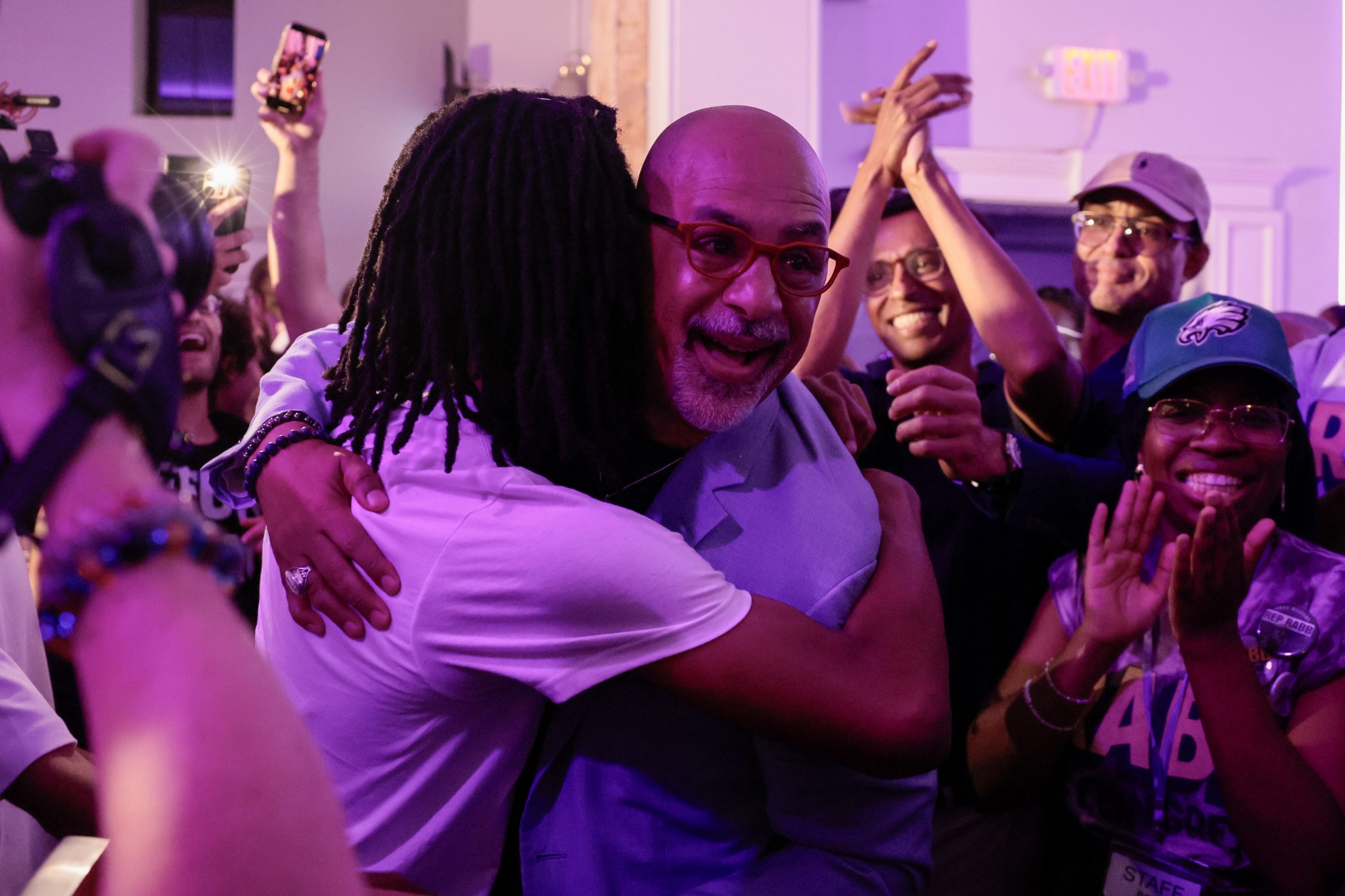
    State Rep. Chris Rabb is hugged by his son, Issa Rabb, during his primary election night event at Victorian Banquet Hall on May 19.Elizabeth Robertson / Staff Photographer

    Some Democrats who watched Rabb emerge from a competitive race, notching one of the left’s biggest wins yet in Pennsylvania, see an opportunity — one that extends the energy and momentum to boost a well-organized, progressive, anti-establishment candidate in the Senate primary.

    Other strategists and activists say that’s a tall task, particularly in a swing state that rarely strays from electing more centrist politicians statewide.

    “Anytime you have success, it breeds enthusiasm, which translates into more volunteers, into more money — everything you need to run a campaign,” said Mike Mikus, a Pittsburgh-based Democratic strategist. “But every election cycle is different. Every campaign’s different. The quality of candidates are different. And anybody who says that any one race signifies a permanent change within a party is mistaken.”

    ‘A huge impact on the political landscape of Pennsylvania’

    In his campaign to succeed U.S. Rep. Dwight Evans, Rabb, a five-term state lawmaker, won 44% of the vote. He was up against State Sen. Sharif Street, who had the backing of the city Democratic apparatus, and physician Ala Stanford, a political newcomer endorsed by Evans.

    Rabb and others have said his success, in part, was the culmination of a decade of progressive organizing that began in the city after U.S. Sen. Bernie Sanders’ 2016 presidential campaign.

    That progressive infrastructure — the coming together of different groups to knock doors, make calls to voters, and unleash a significant independent advertising campaign in a way that rivaled the official Democratic Party organization — is likely the most important way that the left can use the experience of Rabb’s campaign to replicate its success elsewhere, strategists said.

    It’s a template that could have “a huge impact on the political landscape of Pennsylvania,” said Rotimi Adeoye, a Philadelphia-based Democratic strategist who worked in the office of former U.S. Sen. Bob Casey.

    In a district packed with Democratic voters, Rabb’s ability to turn out progressive voters should draw the attention of anyone looking to win the state’s Democratic Senate primary in 2028, Adeoye said.

    “If a Democrat running statewide can learn from some of these organizational groups to build a strong, relational and community-based organizing campaign in Philadelphia and the surrounding suburbs in Montgomery County, Bucks County — they’re going to have a really big chance of winning,” Adeoye said.

    In a sign that those efforts could coalesce around a Senate candidate, one of the groups that helped usher Rabb to victory remains the only major Democratic entity in the state to have publicly started laying the groundwork for a challenge to Fetterman.

    The Working Families Party, which backed Fetterman in the 2022 general election after originally endorsing State Rep. Malcolm Kenyatta in the primary, said in November it would organize an effort to oust him. A “Primary Fetterman” website launched in January is equipped with a “Fetterman sell-out tracker” — highlighting his votes for Trump’s cabinet nominees and opposition to war powers resolutions that would rein in his military strikes, for example — and instructions for donors on how to request a refund from his campaign.

    The website remains the extent of the group’s efforts so far to rally public support and back a new candidate, though its work is expected to pick up after this year’s midterm elections. For now, the party is looking forward to bringing new members who worked to elect Rabb into its fold.

    “Our goal is always to keep building on the work we do each cycle and the success we have each cycle,” said Nick Gavio, the Working Families Party’s Mid-Atlantic communications director.

    One PA, another statewide group in that progressive coalition, has not yet had internal discussions about the Senate race but it supports the Working Families Party’s position as a member of its steering committee, executive director Steve Paul said. He said more than 150 members of One PA mobilized for Rabb by talking to thousands of voters.

    Winning a high-profile congressional race only helps add to that organizational infrastructure, making them “sharper for the next thing,” Paul said.

    “I think it shifts what’s possible, politically — what people can envision,” he said.

    Potential progressive roadblocks

    Mikus said progressives have increasingly surpassed “more establishment Democrats” in their ability to run strong campaigns, including in his area of Western Pennsylvania where candidates like Lee have emerged in the last decade.

    Democratic primary voters are also more progressive than they were 10 years ago, he said. But campaigning on a far-left — or a far-right — platform doesn’t often equate to success on a statewide level in Pennsylvania, a swing state where successful candidates tend to walk a “fine line” that appeals to both swing voters and a message that excites their partisan base, Mikus said.

    “You’ve seen this time after time in presidential elections here in Pennsylvania,” Mikus said. “Hillary Clinton versus Bernie Sanders. Joe Biden versus Bernie Sanders. The vast majority of voters in Pennsylvania will go with the more mainstream Democrat.”

    J.J. Balaban, a Philadelphia-based Democratic strategist and ad maker, said the party runs the risk of “drawing too big of a conclusion” based on a single election — particularly one like Rabb’s where candidates only needed to appeal to Democrats.

    “Democrats really need to think hard about what it will take to win statewide in a purple state, which Pennsylvania clearly is,” Balaban said. “What it will take to win a general election in Pennsylvania is very, very different than what it will take to win in literally the most Democratic congressional district in the country.”

    After recent years of tough losses — including the ousting of Casey by now-U.S. Sen. Dave McCormick, a Republican — Democratic voters will likely have a “tremendous thirst for candidates who have a credible case to make that they can win the general election,” Balaban said.

    Fetterman, whose office did not comment for this story, has insisted that Pennsylvania’s purple state status means he should appeal to both sides of the aisle and not demonize the other side.

    He’s also lamented the direction he sees his party going with candidates like Rabb, particularly around a growing sentiment that Israel has gone too far in its war against Hamas. Fetterman acknowledged last year that his unwavering support of Israel could cost him his Senate seat.

    “Look at the people that are winning the primaries in our party right now, and look at their views on Israel,” Fetterman said at an American Jewish Committee conference in Washington this week.

    On stage with McCormick and the head of the Jewish advocacy organization, Fetterman painted Graham Platner, the expected Democratic nominee for a U.S. Senate seat in Maine, as a “Nazi sympathizer” and connected him to Rabb.

    “People also in our state, too. Rabb, he won, and he ran on being a very, very anti-Israel guy,” Fetterman said. “It’s actually a virtue [in the modern Democratic Party] … It’s heartbreaking for me. And if it isolates me, then so be it.”

    Who might run?

    Of the Democrats widely considered to be eyeing a campaign to replace Fetterman, the public jockeying has so far been limited to criticisms of the incumbent.

    U.S. Rep. Brendan Boyle, a moderate who represents the other half of Philadelphia next to Rabb’s soon-to-be seat, has repeatedly called Fetterman “Trump’s favorite Democrat.”

    Former U.S. Rep. Conor Lamb, a moderate who represented a suburban Pittsburgh district before Fetterman beat him in the 2022 Senate primary, has frequently lambasted him.

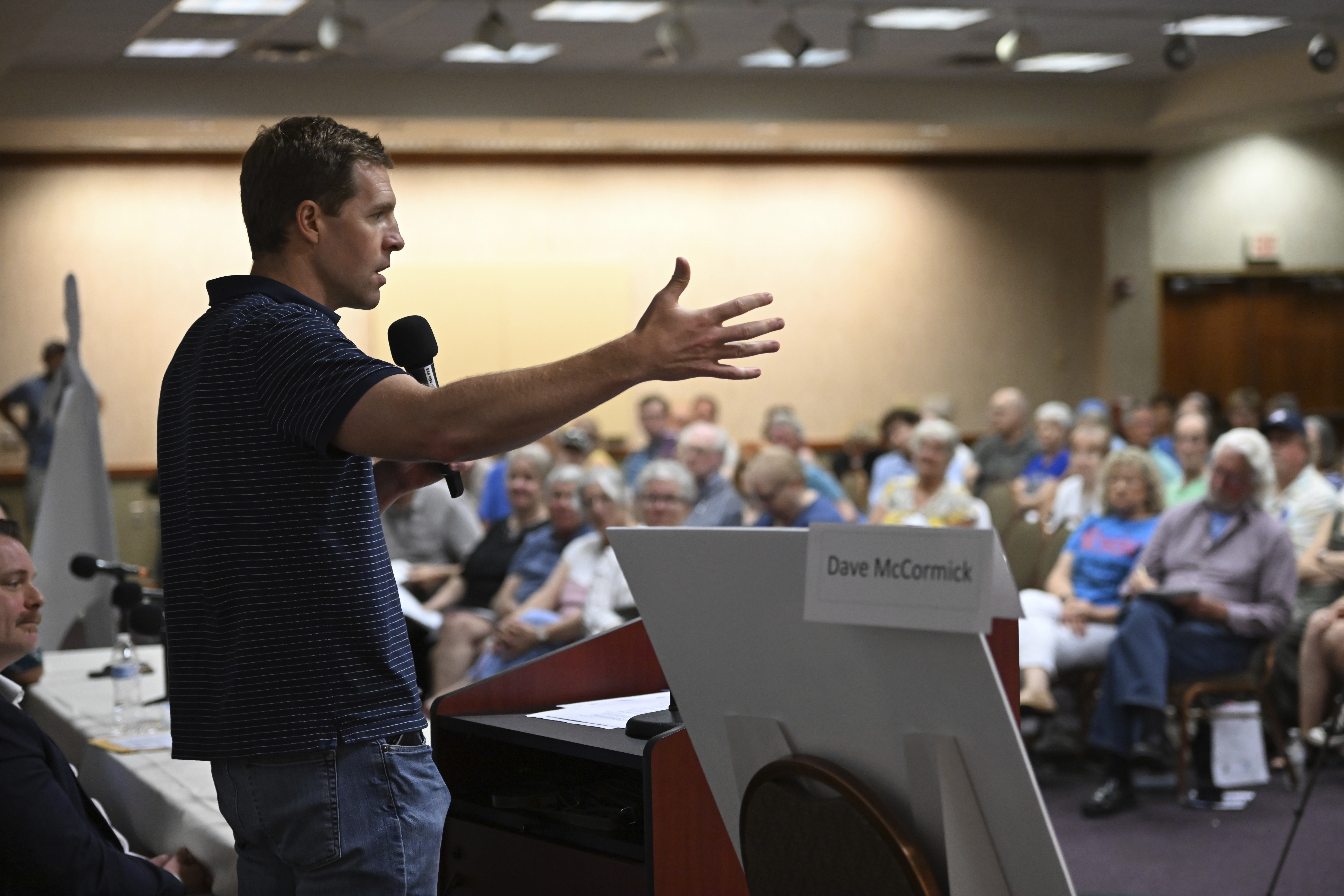
    Conor Lamb speaks to the crowd at a town hall-style event organized by progressive groups at Central Penn College on June 22, 2025, in Enola, Pa. Marc Levy

    And U.S. Rep. Chris Deluzio, who succeeded Lamb and leaned into progressive economic populism, has taken a less direct tack while noting the differences between himself and Fetterman over issues like Trump’s military interventions abroad. Deluzio has occasionally reposted others’ criticisms on social media — including one from Gavio, the Working Families Party spokesperson, last week that called Fetterman’s reversal on eliminating the filibuster “a new low” and “an indescribably massive backtrack from everything he ran on.”

    None of the three have ruled out running.

    Boyle is expected to weigh a Senate campaign vs. staying in the House to take a rare opportunity to lead the powerful budget committee if Democrats win the majority in November. Lamb, who’s remained highly active in Pennsylvania politics, said in an interview that he’s hoping to serve again and would run for office if he feels he “can be of service to the state.” Deluzio, who is also heavily involved in helping Democratic candidates across the state, said he’s focused on his reelection this year and that “we’ll see what 2028 holds.”

    “I am not at all interested in seeing us lose this Senate election, and I certainly have gotten a lot of encouragement to look at 2028,” Deluzio said.

    Progressives have also mentioned Lee, the Rabb ally who’s been a vocal member of the leftist wing on Capitol Hill while taking leadership roles in areas like securing the release of the Jeffrey Epstein files.

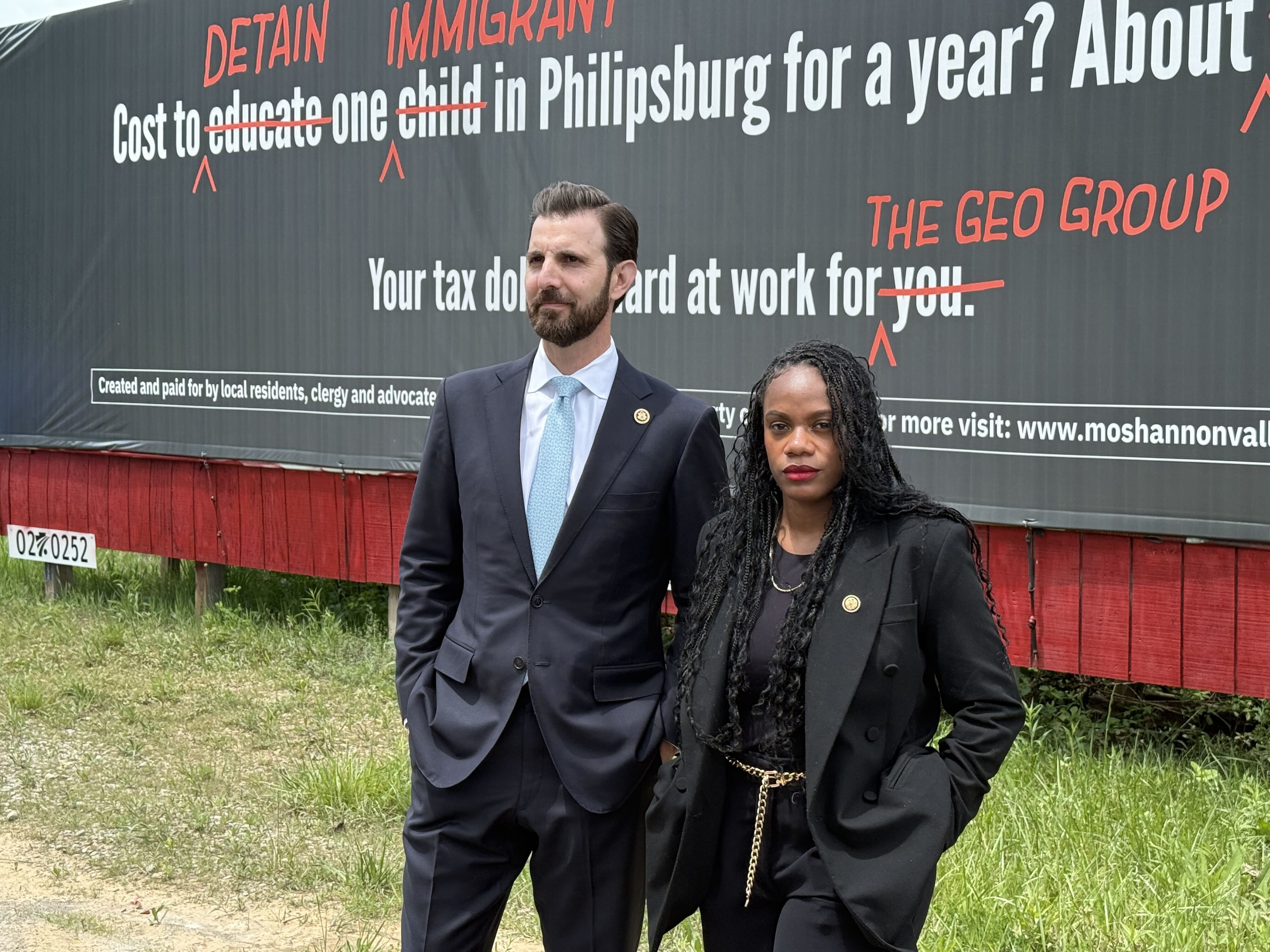
    U.S. Reps. Summer Lee and Chris Deluzio, both Pittsburgh-area Democrats, speak outside the Moshannon Valley Processing Center in Clearfield County on May 28 after getting a tour of the facility, the largest detention center for undocumented immigrants in the Northeast.Sam Janesch / Staff

    With potential candidates still several months away from making their decisions, it’s unclear who might try to take up the progressive mantle if Lee does not run, strategists say.

    The field could also grow considerably. Other potential candidates could jump in, including the three other current Pennsylvania Democrats in Congress or former lawmakers like Susan Wild, who lost a swing congressional district in the Lehigh Valley in 2024. Wild said she’s “not ruling out” a run but she’s more interested in thinking about good female candidates in general since no woman has ever won a Pennsylvania U.S. Senate seat.

    On the prospects of a battle between different factions of the party, Lamb said he believed Democrats had broadly learned a lesson — from Fetterman’s election in 2022, where he ran on being a reliable Democratic vote in the Senate — that was beyond ideological policy tests.

    “Fetterman taught Democrats in Pennsylvania that you have to have a character test. Anybody can run around the state promising you these further left solutions, and that they’re going to be a thumb in the eye of the establishment, and they’re going to channel all your anger and dissatisfaction. And then that person can turn on you on a dime,” Lamb said. “The fact is that we have to evaluate our candidates based on whether they have integrity and they’re going to keep their word and, honestly, whether they have the work ethic to be a senator day in, day out.”

  • Catholicism is growing in Philly and New Jersey. Who’s filling the pews?

    Catholicism is growing in Philly and New Jersey. Who’s filling the pews?

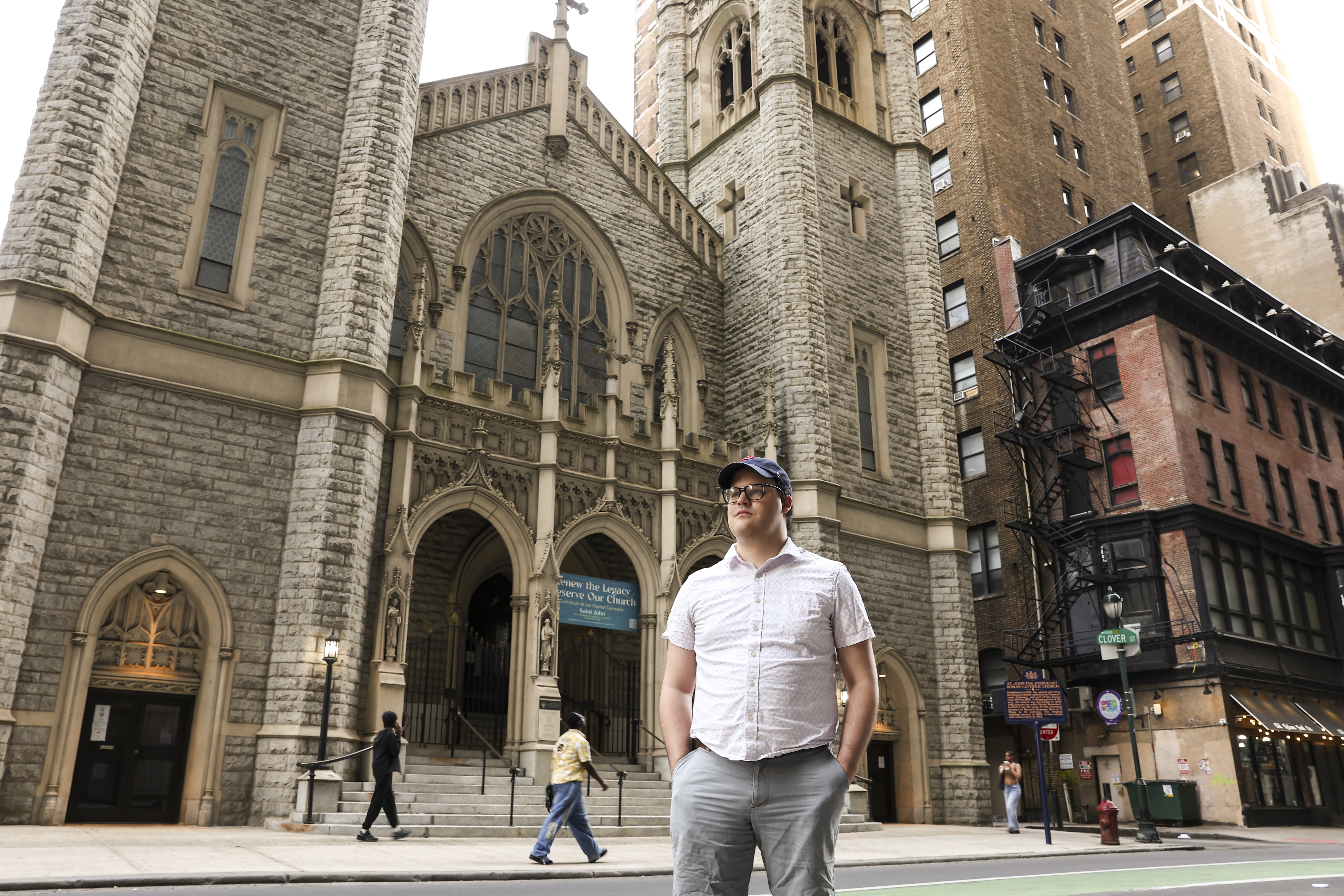
    Church bells rang out from one of Philadelphia’s oldest cathedrals, echoing off downtown parking garages and office buildings, while one of the city’s newer Catholics tried to explain his conversion.

    Daniel Yesilonis, 32, grew up evangelical in the Harrisburg area and converted to Mormonism while studying at Temple University. He said his Mormon mission to Colorado Springs, Colo., was deflating, though, and after he came out as gay during the COVID-19 pandemic, he officially left that church.

    Like millions of Americans, Yesilonis figured he would try his best to be decent, to be spiritual without a label or building attached to it. But he soon felt a sense of loss.

    “It was like something was missing, maybe a sense of community or something,” Yesilonis said outside the church in April.

    Daniel Yesilonis posed for a portrait outside of St. John The Evangelist Church on Wednesday, April 15, 2026 in Philadelphia.Monica Herndon / Staff Photographer

    So, at an Easter vigil Mass in 2024, Yesilonis was among a group of candidates (people who were already baptized) and catechumens (those who were never baptized) who became Catholic and joined St. John the Evangelist on 13th Street.

    Converts like Yesilonis are on the rise at churches all over Philadelphia and New Jersey, diocese officials said, a conversion boom that is being reported globally, including large spikes in Canada and France. In Philly, there have been 1,162 candidates and catechumens this year, which is a 60% increase since 2025 and a 100% increase since 2017.

    Researchers and religious scholars said it was too soon to say much about the recent spike, but noted that a rise would be bucking long-term trends. Earlier this year, the Pew Research Center found that Catholicism has lost more people than it has gained in 24 countries it surveyed, including the United States. A 2025 Pew study found that Christianity’s long-term losses were starting to “level off,” but according to the Archdiocese of Philadelphia, two high schools closed in 2021, and the last time a new Catholic school and parish opened was back in 2010.

    Since 2012, 34 Catholic churches have closed in the archdiocese. So the trend, while noticeable, is still a small change.

    “There would have to be a huge swing, something dramatic would have to happen, for the church to start gaining huge numbers,” said Patricia Tevington, a Pew Research assistant who lives in Philadelphia.

    There is no one reason for the recent increase, diocese officials said.

    In the Philadelphia Archdiocese, the Rev. Gerald Dennis Gill said, many new devotees were baptized as children but did not grow up with Catholicism because their parents or other elders had stopped practicing. He believes they are experiencing a vacuum in their life and are seeking to fill that.

    “Our culture is not offering something objectively good and true and beautiful, but it’s within all of us to seek that out,” he said. “People of all ages are finding the need to have a relationship with the Lord, for meaning and the promise of heaven.”

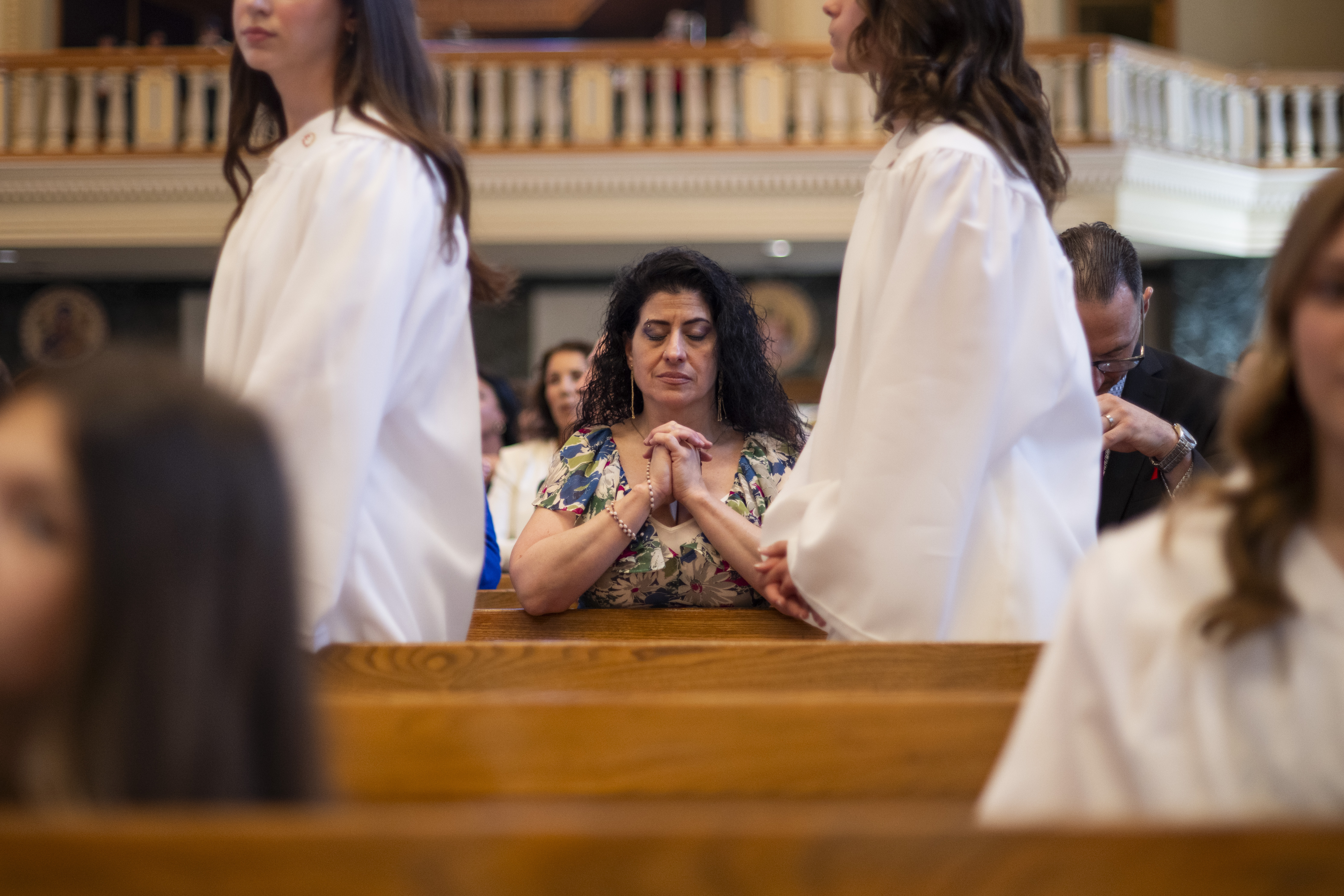
    A confirmation mass is held at St. Monica Roman Catholic Church in Philadelphia on Saturday, April 18, 2026.Joe Lamberti / For The Inquirer

    Across the river in the Camden Diocese, spokesperson Michael Walsh said, the number of catechumens grew from 194 last year to 238 in 2026, a nearly 23% increase.

    Catholics are not knocking on doors the way Yesilonis had to in Colorado, but members of St. Agatha-St. James Parish had an “Ask a Catholic” tent at West Philly’s 68th annual Spruce Hill May Fair in Clark Park on May 9.

    Newer Catholics whom The Inquirer spoke to in recent months (including this reporter’s adult son) cited a slew of different personal reasons for their decision.

    “We’re all looking to God to help us, to save us. For me, it was time,” said Jana Muhammad, a “middle-aged” candidate who received the sacrament of confirmation at St. Monica’s in South Philly earlier this spring. “It’s really a rough, rough time out there right now. There’s no peace right now, and people are really looking for peace, and it’s not there right now. For me, personally, when it gets really rough, I absolutely pray to God.”

    There is, however, a litany of theories being tossed around online and in the media about the increase in Catholicism that are sometimes at odds with one another.

    The trend has been attributed to increasing conservatism in young men. Catholicism has also been offered up as an antidote to the so-called red pill, a “manosphere” belief that society now caters to women. Some say the increase is a Gen Z response to the isolation of the pandemic. Others say that technology burnout is fueling it. There have been stories about the rise of Catholic social media influencers and the popularity of the prayer app Hallow, which has been downloaded 32 million times since it debuted in 2018.

    “People ask why priests always wear black. ’Cause everyday is a funeral for the haters,” the Rev. David Michael Moses, a Catholic “priestfluencer” with 1.1 million followers on Instagram, said in a post.

    Actor Mark Wahlberg, a partner in Hallow, is a proud Catholic, but so is Shia LaBeouf, a recent convert who reportedly yelled, “I’m a Catholic,” while allegedly shouting homophobic slurs in New Orleans earlier this year.

    The middle-ground, welcoming approach taken by the late Pope Francis and his successor, Pope Leo XIV, who has been vocal against President Donald Trump’s war on Iran, has also pulled people closer to Catholicism.

    “Pope Francis inspired my decision,” Yesilonis said.

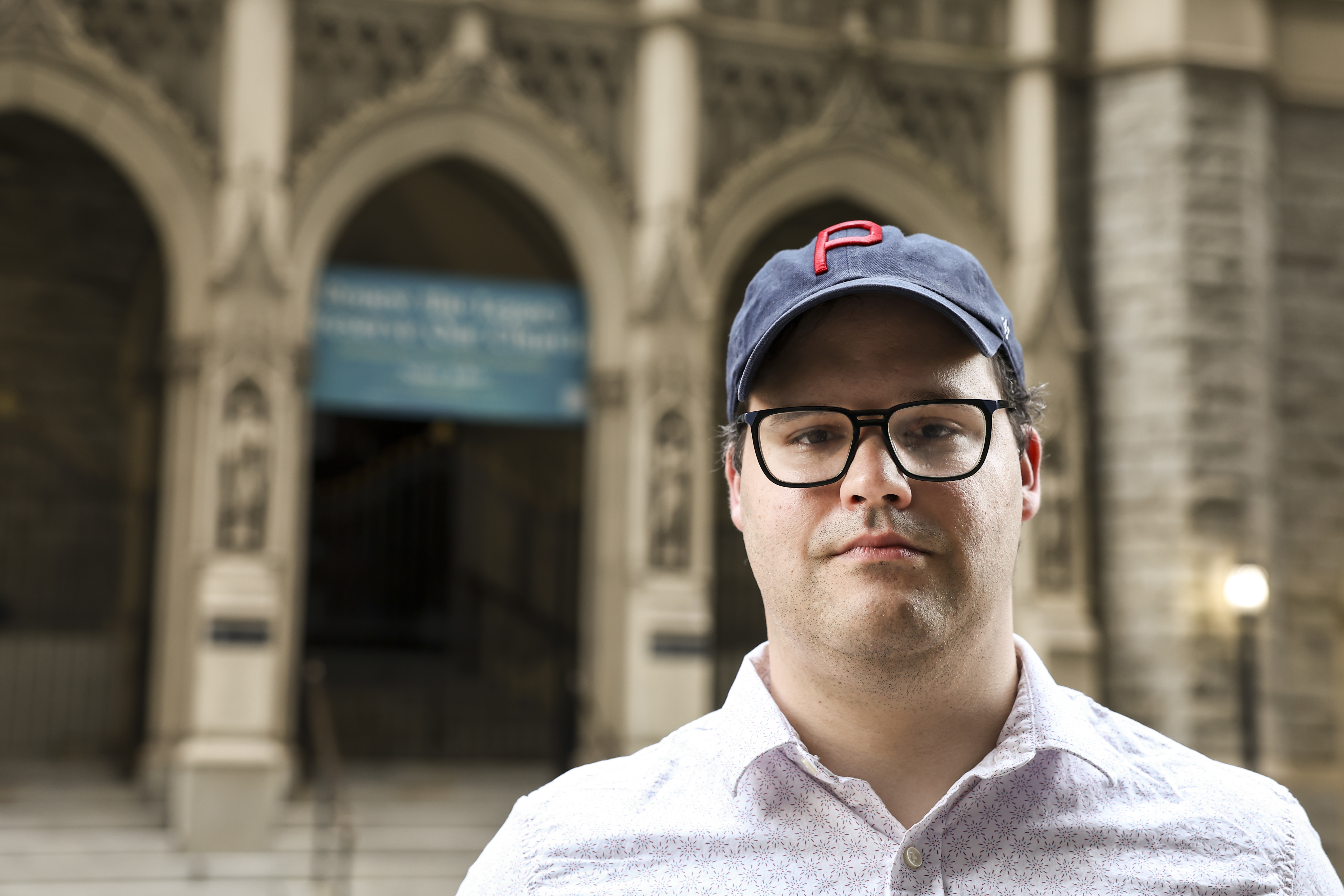
    Daniel Yesilonis posed for a portrait outside of St. John The Evangelist Church on Wednesday, April 15, 2026 in Philadelphia.Monica Herndon / Staff Photographer

    Yesilonis said he knows he could never marry a man in the Catholic Church, but he has found solace among the LGBTQ+ parishioners at St. John the Evangelist.

    “I found a community as much as I found a church,” he said.

    The Rev. Thomas Betz, of St. John’s, said the church “teaches and believes” the same tenet as the wider church, but has been open.

    “St. John, by its very nature, is in the heart of the city and open to different races, and people who think differently, politically,” he said. “Everyone is welcome.”

    Mark Schiavo, 26, waits to be confirmed at St. Monica Roman Catholic Church in Philadelphia on Saturday, April 18, 2026.Joe Lamberti / For The Inquirer

    Down in Cape May, Sara Kelly said she grew up in a family that gave up on formal religion, but still held on to a strong spiritual sense of right and wrong. Her father, Kurt, suffered from head and neck cancer for years, and after he died in 2019, she constantly wondered about the afterlife.

    Kelly and her husband went to some nondenominational churches in Philadelphia, where she lived at the time, but did not find the answers she was looking for. The couple moved to the Shore and struggled with finances.

    One day, while walking on the Delaware Bay beach, she fell to her knees and asked God for help.

    “I’ve never done anything like that before,” she said.

    At the advice of a relative, Kelly began sitting in a Catholic church in 2025, and later downloaded the Hallow app. She bought a rosary, too, and began going back to church multiple times a week, and eventually signed up for Order of Christian Initiation of Adults (OCIA) classes.

    “I know for me, it was really enjoyable to go to a place where the focus is only on love and trying to help others,” she said. “At every Mass, we’re praying for people caught up in war, people in Gaza and Ukraine.”

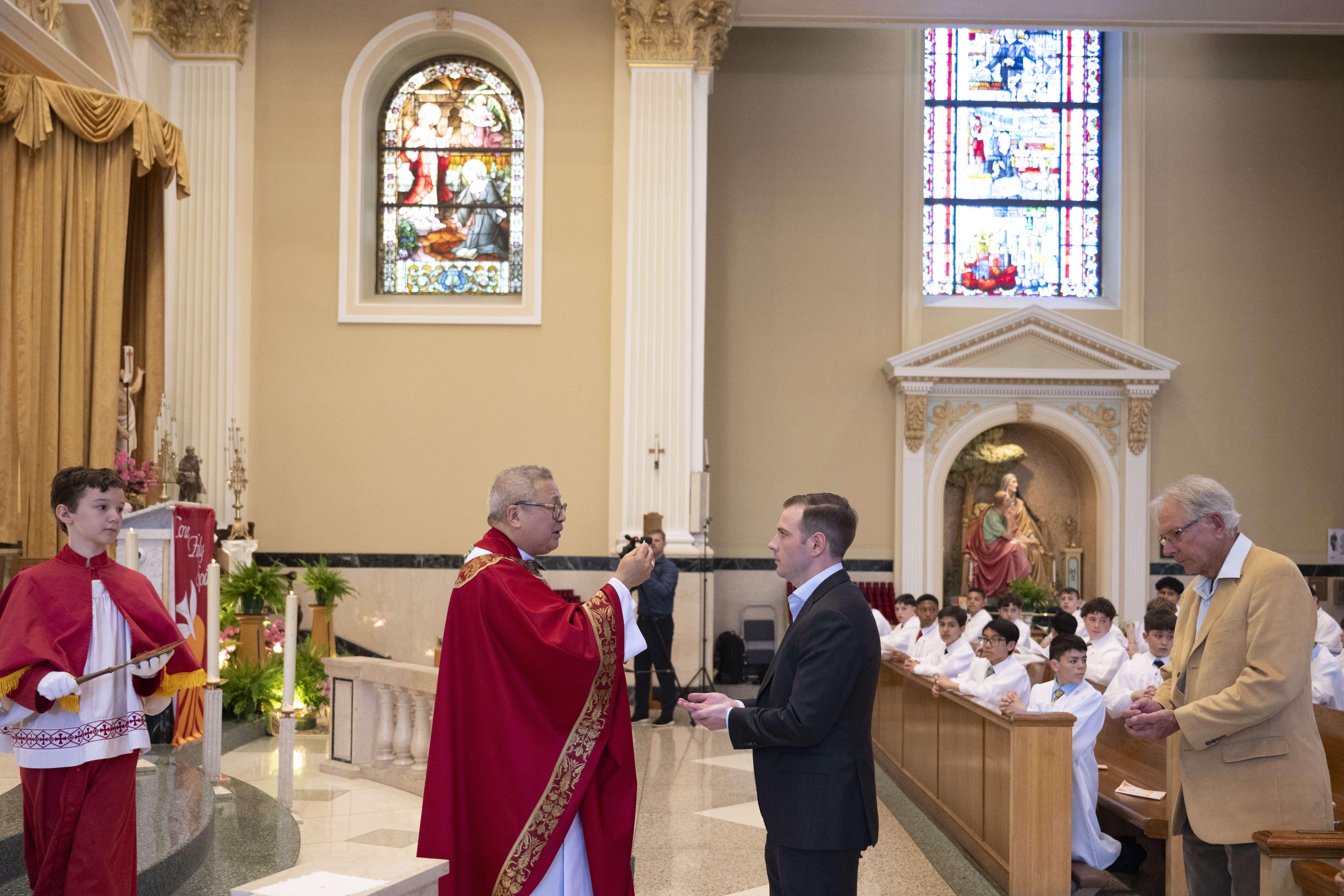
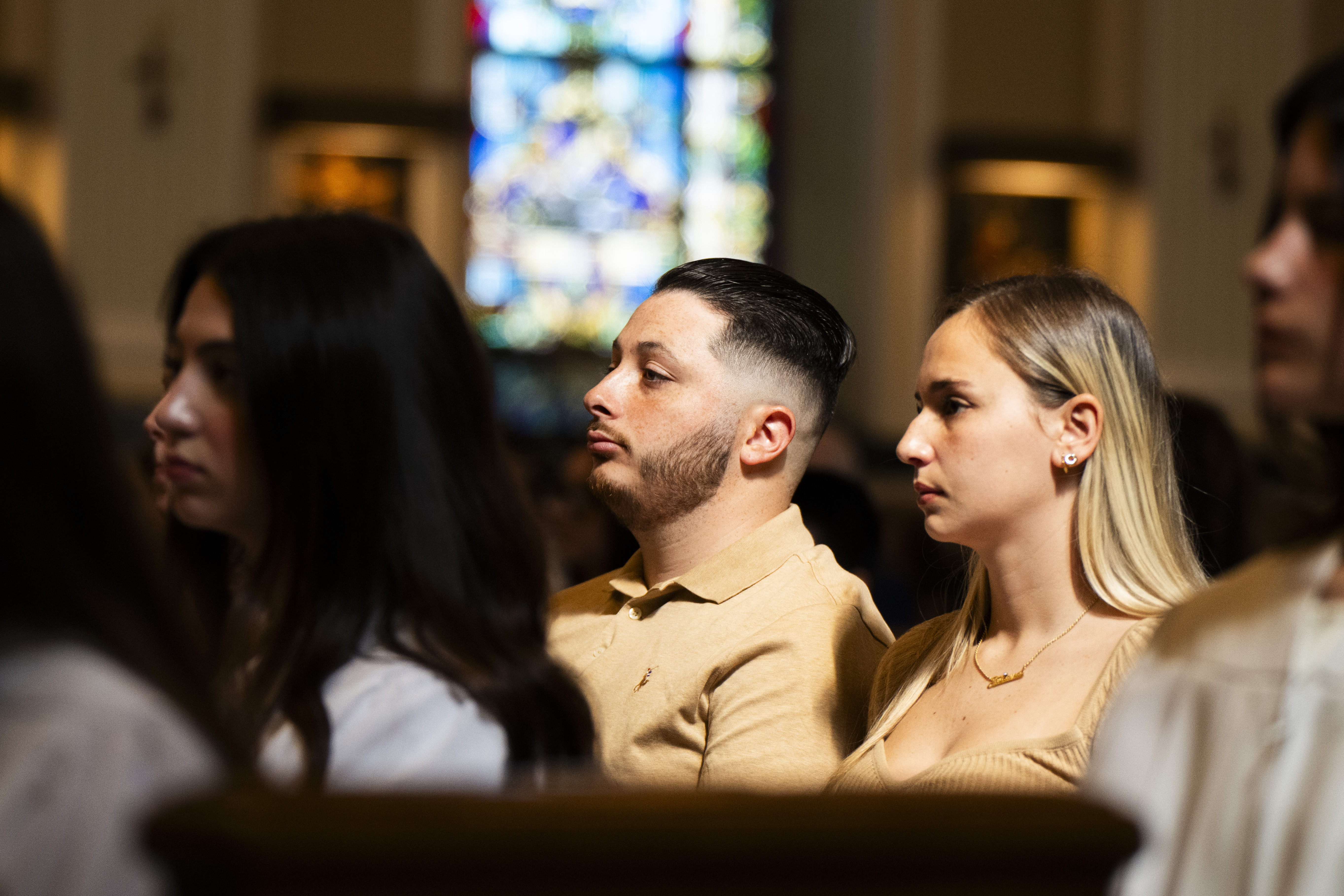
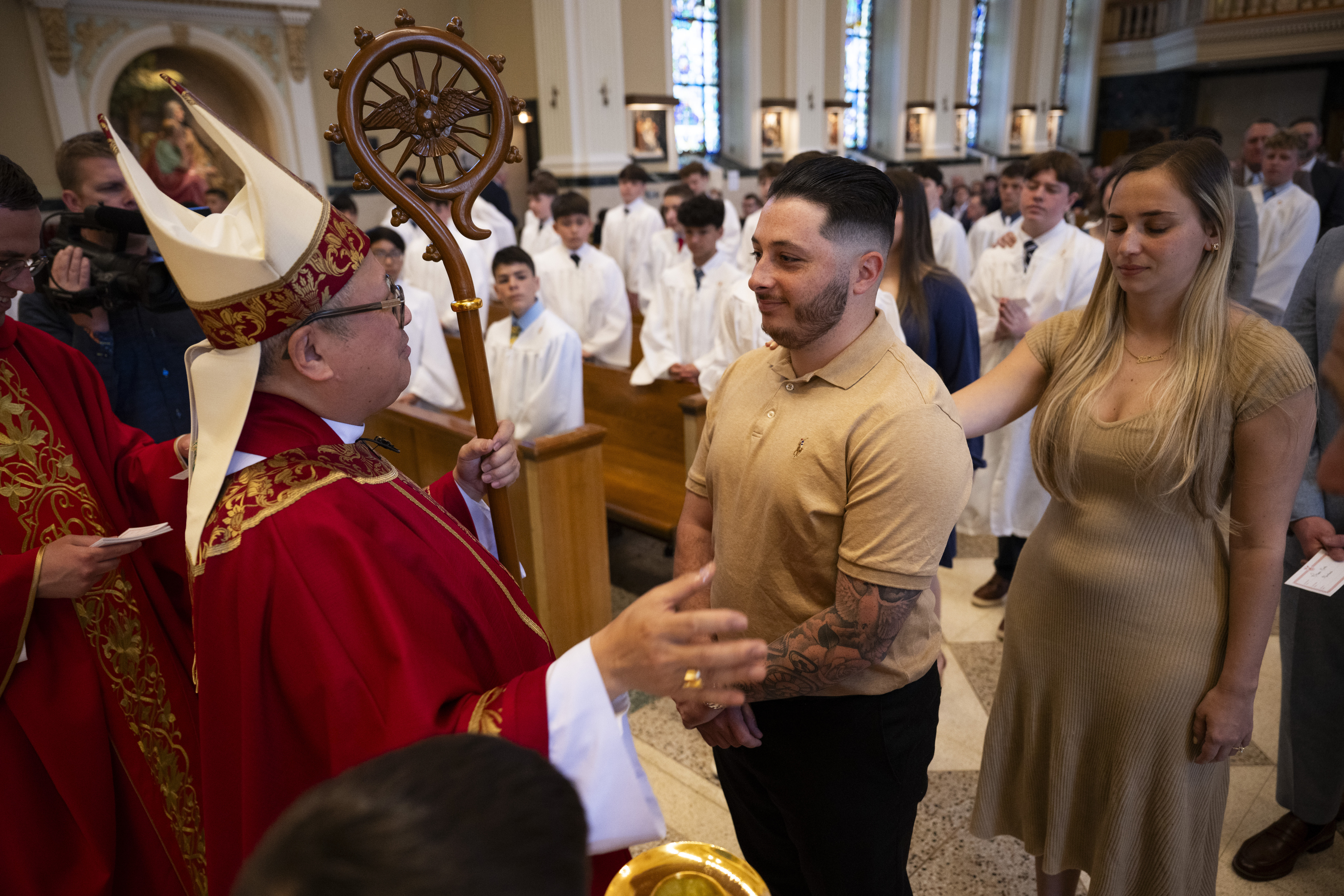
    On a breezy April morning in South Philly, hundreds of people filed into St. Monica’s for the Rite of Confirmation Mass. A few dozen teens in white filled the front pews, but just behind them were a handful of adults, like Jana Muhammad, there to receive their final sacrament and take the name of a saint.

    Muhammad chose Angelica. She was baptized as a child and grew up going to church. She said her stepmother did not want to “force” religion on her and gave her the choice to make up her own mind as an adult.

    “And it was just time,” she said.

    The Rev. Edward Town led the Christian initiation processes there and said the reasons adults come back vary from simple to profound.

    “People want stability in their lives,” he said. “To young people, the world seems very unstable, and there’s a lot of uncertainty. I think our faith gives us a little hope, right?”

    When the Mass was finished, the Rev. Efren V. Esmilla, auxiliary bishop of Philadelphia, extended an invitation to any other seekers sitting in the church.

    “Come find us,” he said. “Our door is always open.”

    Mark Schiavo, 26, is confirmed at St. Monica Roman Catholic Church in Philadelphia on Saturday, April 18, 2026.Joe Lamberti / For The Inquirer