Tag: East Passyunk

  • Center City bar Jose Pistola’s has closed after 19 years

    Center City bar Jose Pistola’s has closed after 19 years

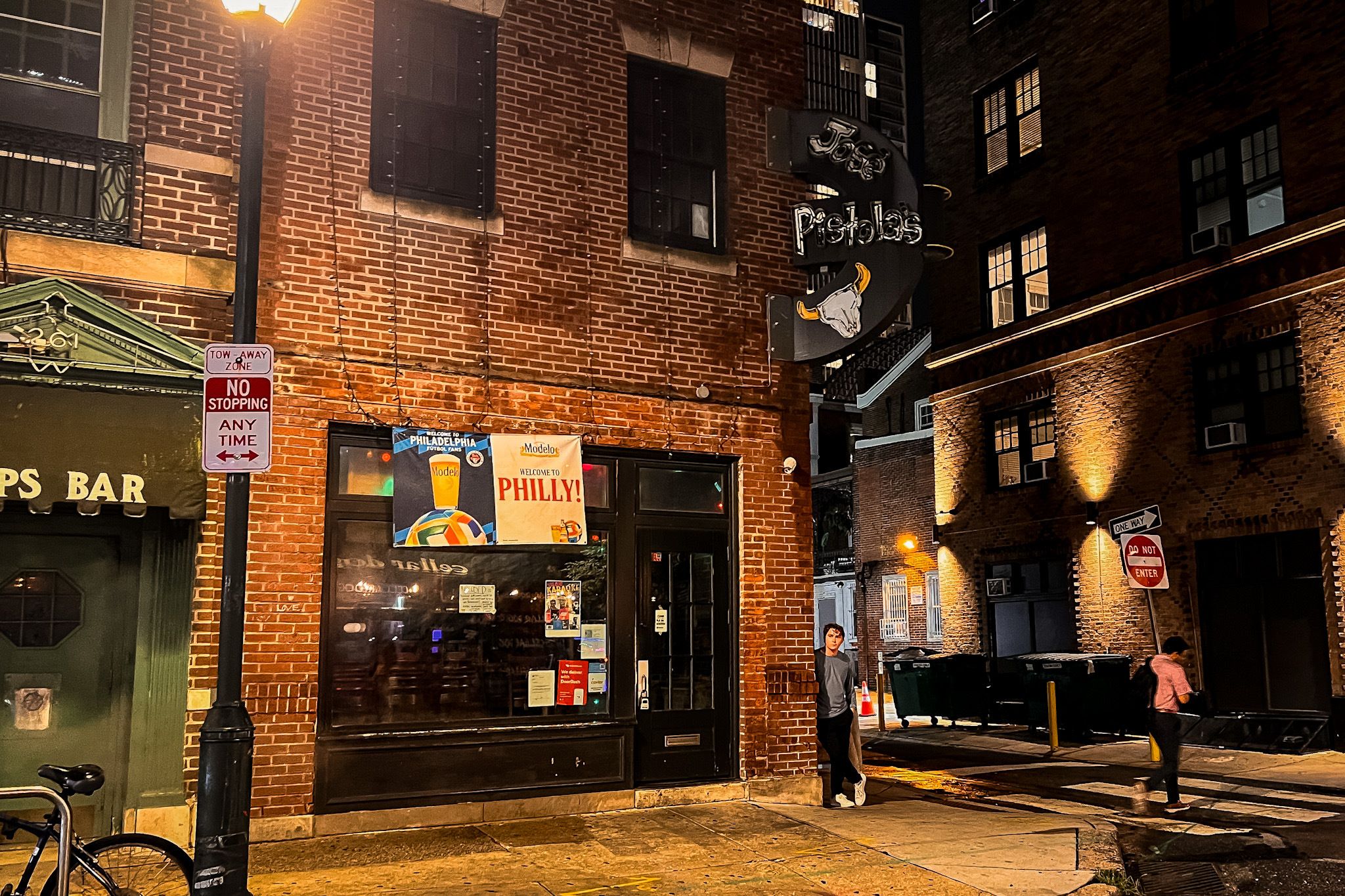
    A distinctive stretch of 15th Street in Center City has lost both of its longtime bars within a year.

    Jose Pistola’s, the Mexican-inspired craft beer bar at 263 S. 15th St., has closed after 19 years, following last August’s closing of its next-door neighbor, McGlinchey’s.

    The closing of Jose Pistola’s came abruptly Tuesday amid a number of factors, including the Philadelphia Gas Works’ cutoff of its gas service. Although co-owner Joe Gunn said the business had made payments and was trying to resolve the issue, he said PGW would not restore service for three more days. . “That was the straw that broke the camel’s back,” Gunn said.
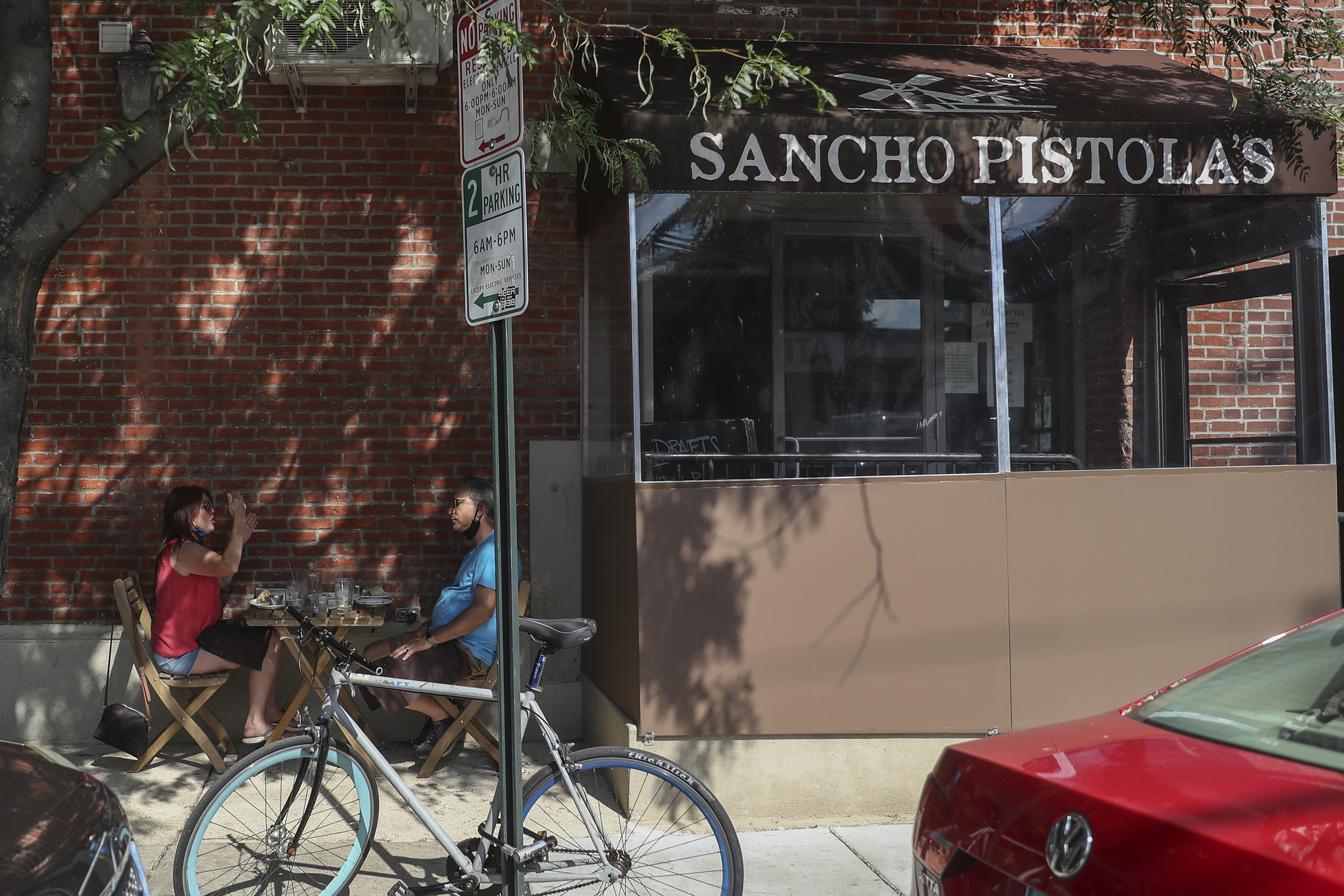
    Sancho Pistola’s in Fishtown, which opened in 2014, is not affected by the Center City closing.Heather Khalifa / Staff Photographer

    The closing does not affect Sancho Pistola’s on Girard Avenue in Fishtown, which opened in 2014, or Pistola’s Del Sur on East Passyunk Avenue in South Philadelphia, which opened in 2017. They are doing well, Gunn said. “They’re in no danger of going anywhere.”

    In 2009, court records show, the City of Philadelphia, which owns PGW, obtained a judgment of nearly $48,000 against Jose Pistola’s. According to a 2025 court docket entry, the judgment was never satisfied. A PGW spokesperson on Friday declined to comment, saying it does not share information about individual accounts.

    Gunn, saying that he did not want to blame PGW, said the interruption forced a decision that he and business partner Casey Parker had already been contemplating.
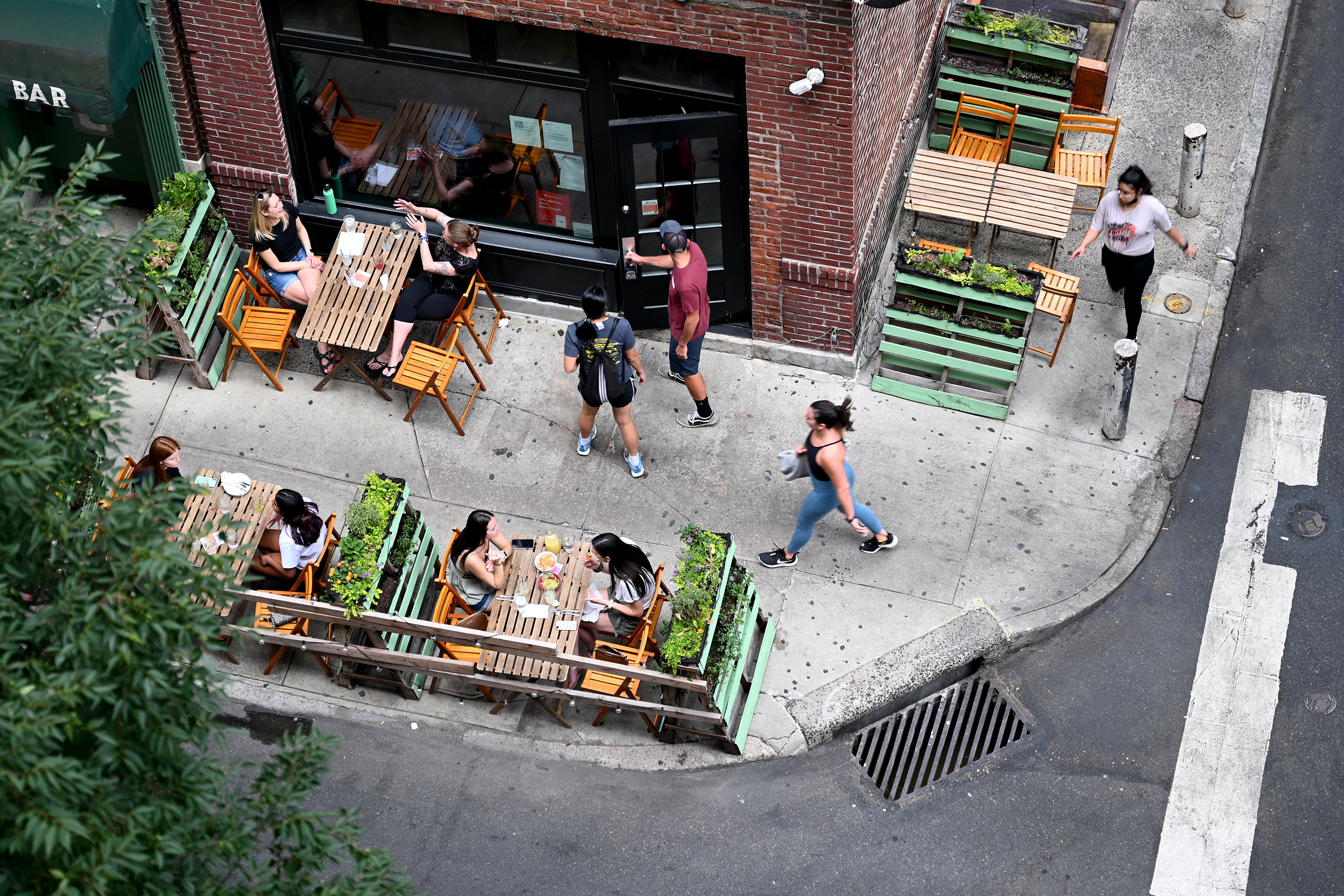
    A view of Jose Pistola’s pandemic-era outdoor seating at 15th and Manning Streets in 2021. Tom Gralish / Staff Photographer

    Gunn said they had about a year remaining on their lease and had been discussing a five-year renewal with their landlord. But with both Gunn and Parker now 51 and their children getting older, he said another long commitment seemed increasingly daunting. “It takes a lot of energy to play that game,” Gunn said.

    The numbers were difficult, too. As other bar and restaurant owners have lamented, higher food and operating costs had squeezed the business, while the late-night trade that once helped sustain bars like Pistola’s has diminished.

    “Frankly, [the bar] just never fully recovered from COVID,” Gunn said. “Coming out of COVID, the world was a different place — the price of goods, the cost of everything, and people don’t go out as much late. These younger generations are too smart to drink their life away.”

    “It’s always been tight, but everything changed,” Gunn said. “And then people just don’t drink as much.”

    About 25 people worked at Jose Pistola’s. Gunn said they had little warning because the owners themselves had not decided to close until the last minute. He said he and Parker are trying to place employees at their other restaurants or with friends in the industry.

    “We’ll absorb what we can, obviously, in the other two places,” Gunn said. “We have a lot of friends in the business, so we’re aggressively trying to help them.”
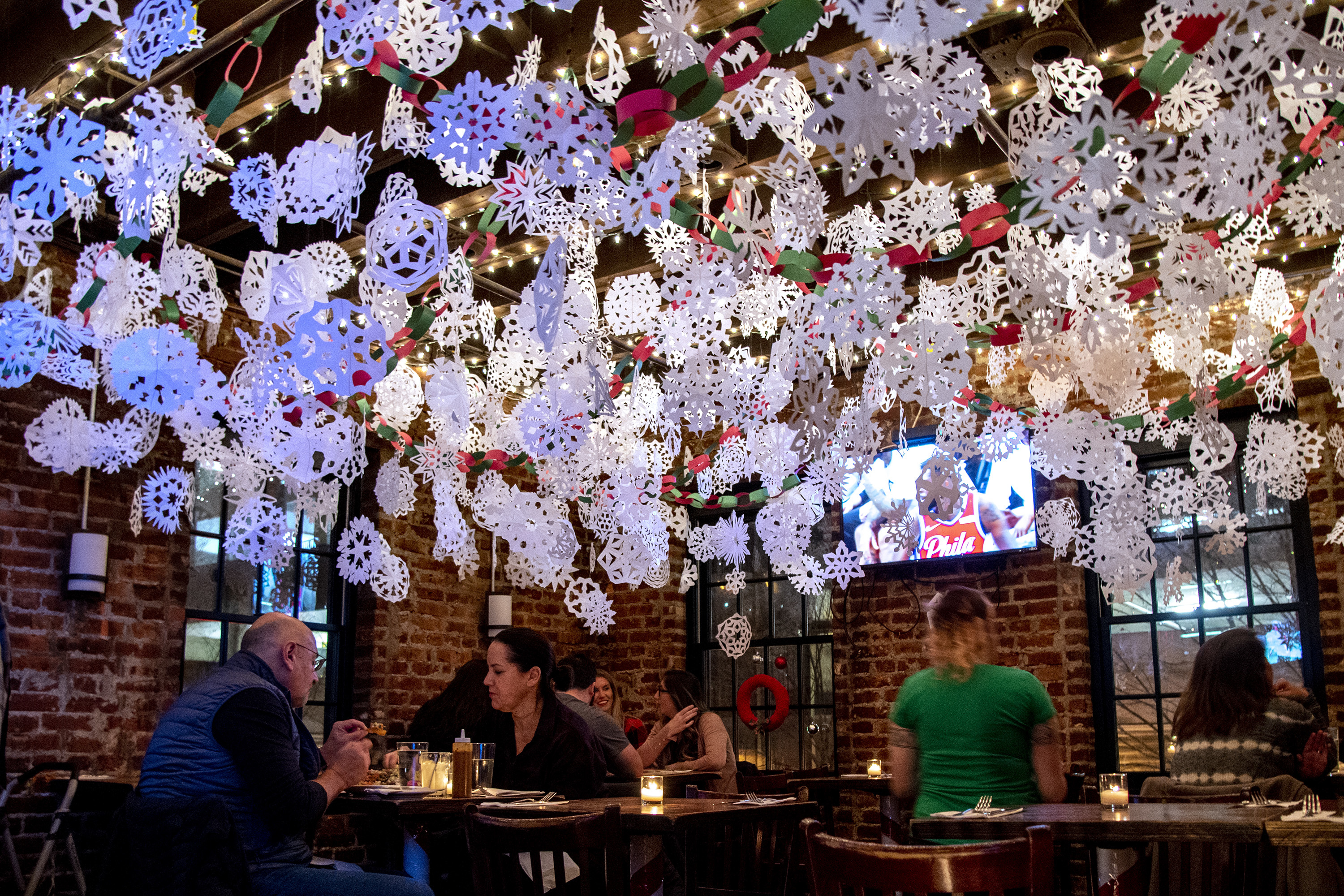
    Jose Pistola’s bar, as decorated in 2019 for its annual Jose Pistola’s Christmas Smackdown Bar Crawl.Tom Gralish / Staff Photographer

    Jose Pistola’s — its name a loosely licensed Spanish rendering of Gunn’s first and last names — opened Aug. 29, 2007, taking over the longtime Copa, Too! space. Gunn and Parker were both veterans of Fergie’s Pub; Gunn had worked there for about seven years before leaving to open Pistola’s, while Parker had moved on by then.

    The bar quickly established itself through its combination of craft beer, Mexican-inspired food, and an irreverent neighborhood-bar atmosphere. It became particularly associated with Philadelphia’s burgeoning craft beer movement and the early years of Philly Beer Week.

    Its food grew more ambitious after Puebla-born chef Adán Trinidad joined the operation and eventually became a partner. Trinidad, whose resumé included El Vez and Alma de Cuba, brought to the menu such dishes as tortilla soup, goat sopes, carnitas-filled steamed buns, and Brussels sprout tacos that caught the attention of Inquirer critic Craig LaBan.

    The partners later expanded the Pistola’s name to Fishtown and East Passyunk. Trinidad died after a fall in October 2021 at age 39.
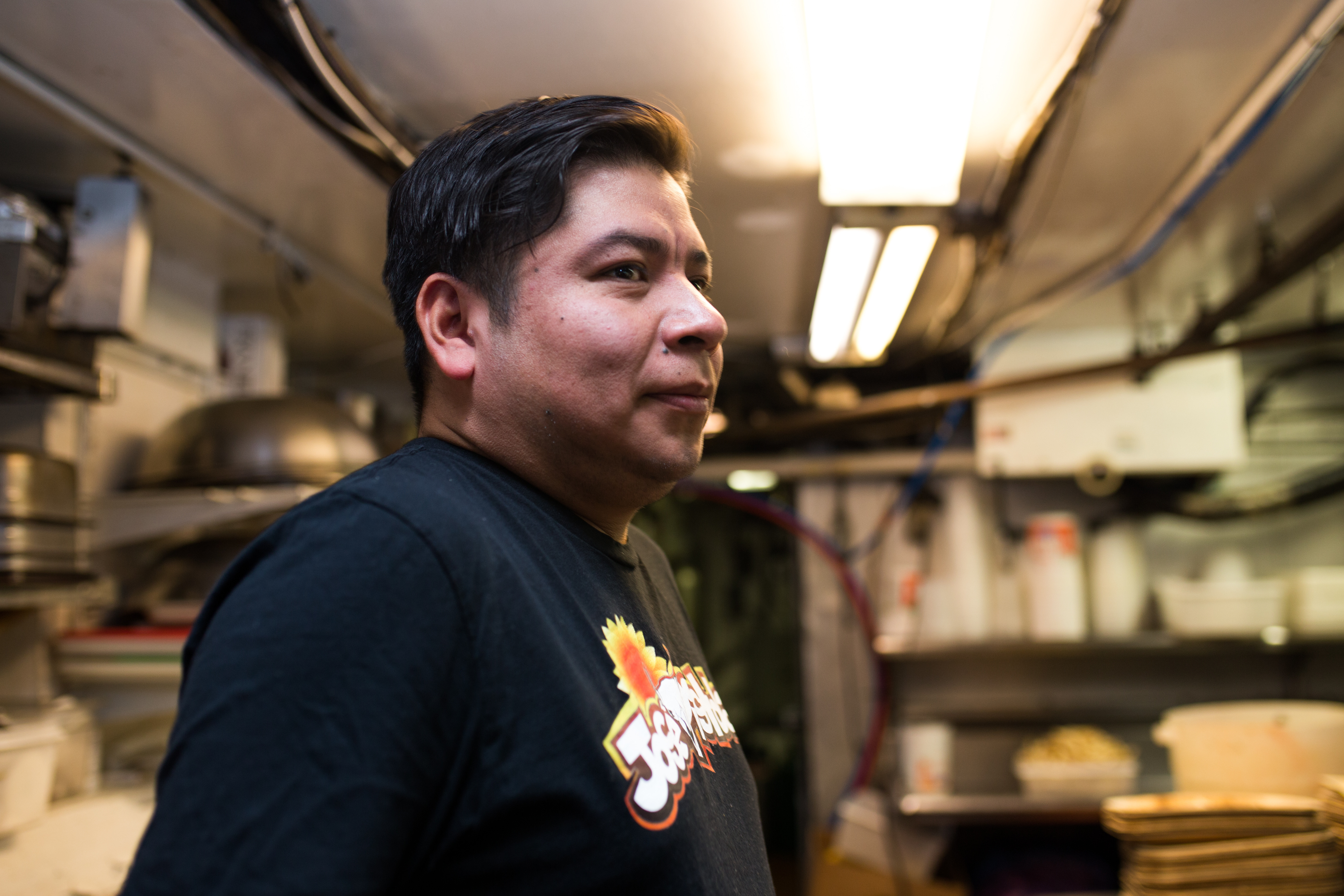
    Adán Trinidad was chef-partner until his death in an accidental fall in 2021.Rachel Delsurdo / Courtesy of Jose Pistola's

    For most of Jose Pistola’s run, its next-door neighbor offered a study in contrasts.

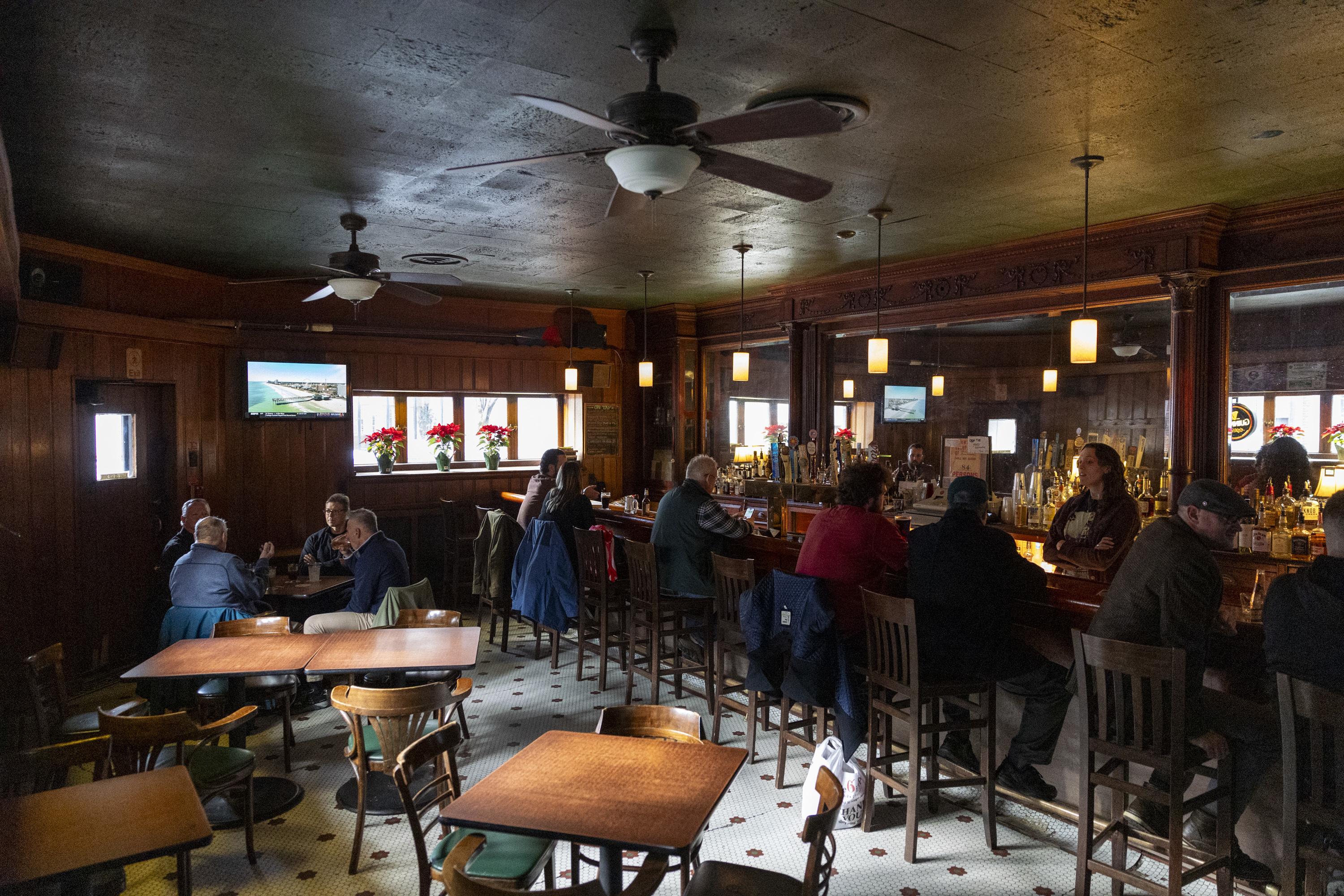
    McGlinchey’s — now on the market — was a cash-only dive bar known for low prices, dim lighting, smoke in the air, and an eclectic clientele. It endured by barely changing, while Jose Pistola’s brought craft beer and more ambitious food to an equally unpretentious neighborhood-bar sensibility.

    The two businesses were nevertheless close.

    “We had a great relationship with them,” Gunn said. “We loved them because of how funny they were. They were just kind of cranky, and they put up with us.”
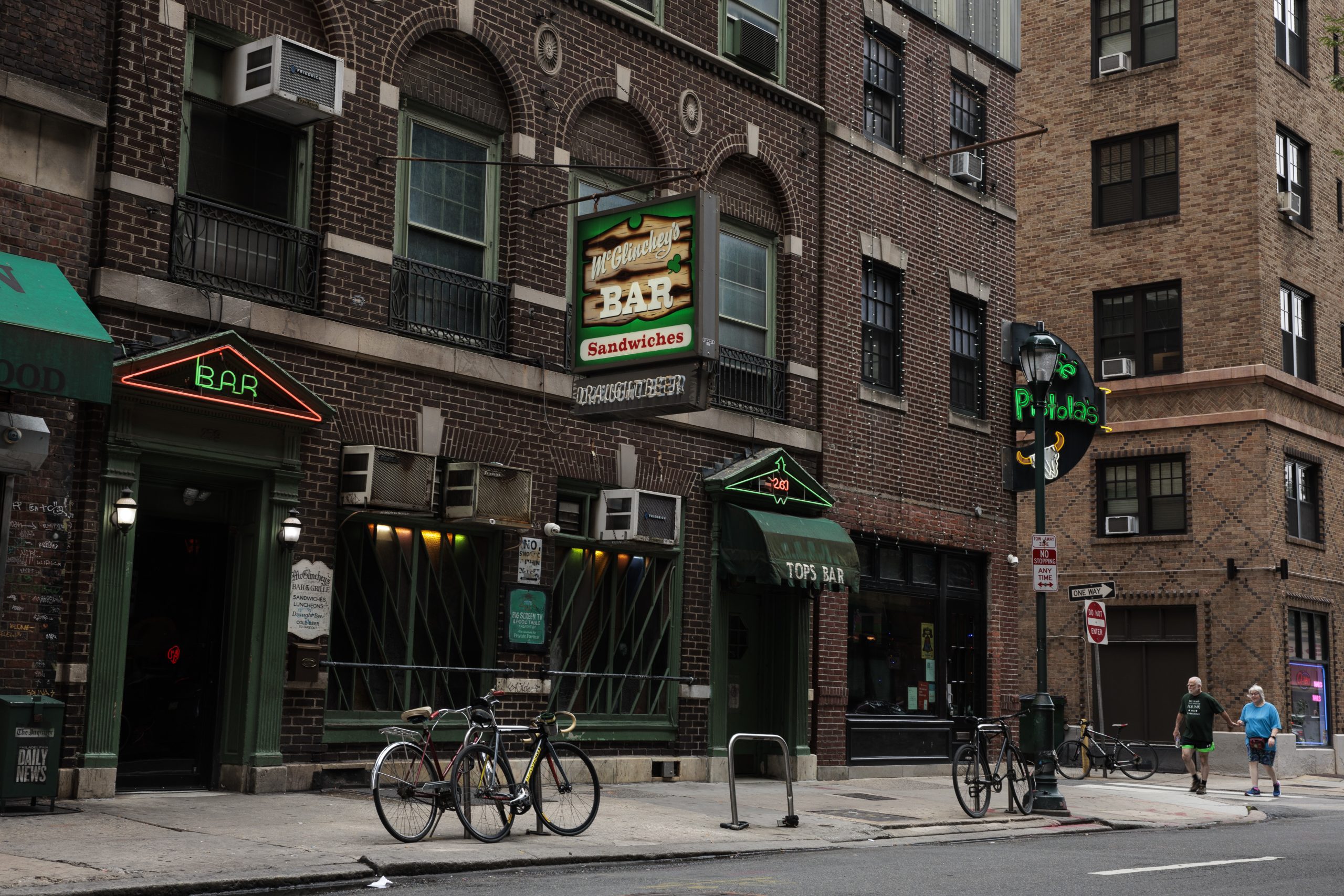
    McGlinchey’s, as seen in August 2025, was next door to Jose Pistola’s.

    Gunn said the McGlinchey’s closure was part of a broader change he has watched on this stretch of 15th Street between Locust and Spruce Streets.

    “The whole corridor used to be more vibrant,” he said. “I think COVID wiped out a lot of those places. It changed everything for us.” The block is also home to Cellar Dog and Garage Rittenhouse.

    As recently as Thursday, Gunn said, he and Parker were “still fighting to figure out a way to [save] it. But it just, I think, ran out of steam.”
  • Two Philly spots make Bon Appétit’s best new restaurants list

    Two Philly spots make Bon Appétit’s best new restaurants list

    Food magazine Bon Appétit released its annual best new restaurants list on Monday, and it includes two Philadelphia restaurants.

    Honeysuckle, Omar Tate and Cybille St.Aude-Tate’s fine-dining restaurant in North Philadelphia, and Sao, Phila and Rachel Lorn’s East Passyunk oyster bar, were among the 19 establishments that made the cut. They joined restaurants in New York City, San Francisco, Chicago, Seattle, Nashville, and Birmingham, Ala., and more.

    The unranked list defines new restaurants as those that opened between March 2025 and March 2026. Scouts visited restaurants in 43 U.S. cities and rated them according to seven criteria: flavor, technique, hospitality, ambiance, cultural significance, innovation, and sense of place.

    To be considered the best, “a restaurant must serve dishes and drinks that are complete in terms of flavor and technique, from the pre-meal cocktails to dessert, like an album with no skips,” wrote Bon Appétit editor-in-chief (and former Inquirer food editor) Jamila Robinson.

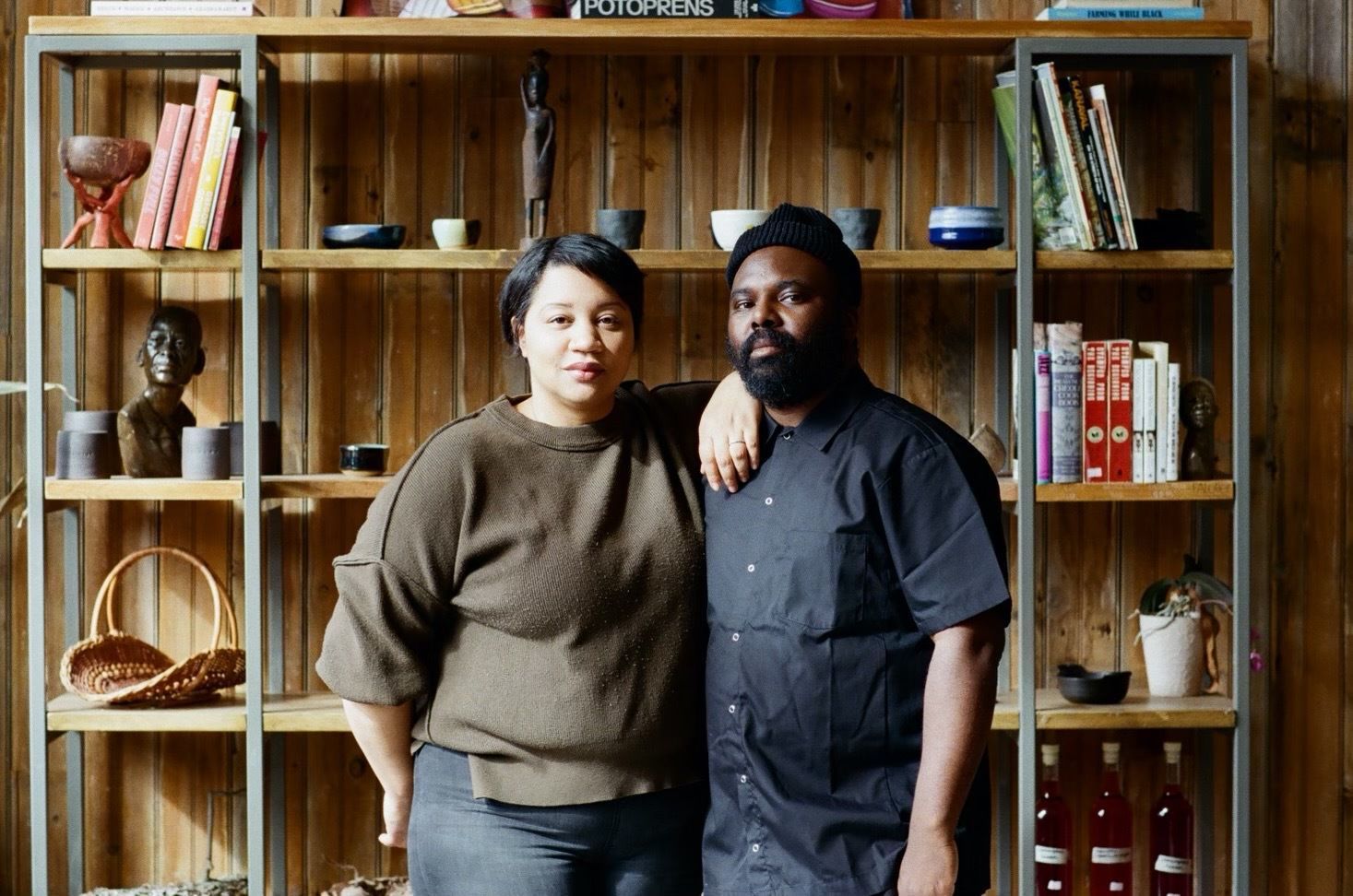
    Partners and chefs Cybille St.Aude-Tate and Omar Tate, who opened Honeysuckle at 611 N. Broad St. in April 2025.Clay Williams

    Tate and St.Aude-Tate opened Honeysuckle at 611 N. Broad St. in April 2025. The restaurant’s five-course tasting menu evolved from the couple’s beloved West Philly café-market, Honeysuckle Provisions, which closed in 2024. The couple uses the menu to weave a dynamic and complex narrative about how the Black diaspora has shaped American food culture.

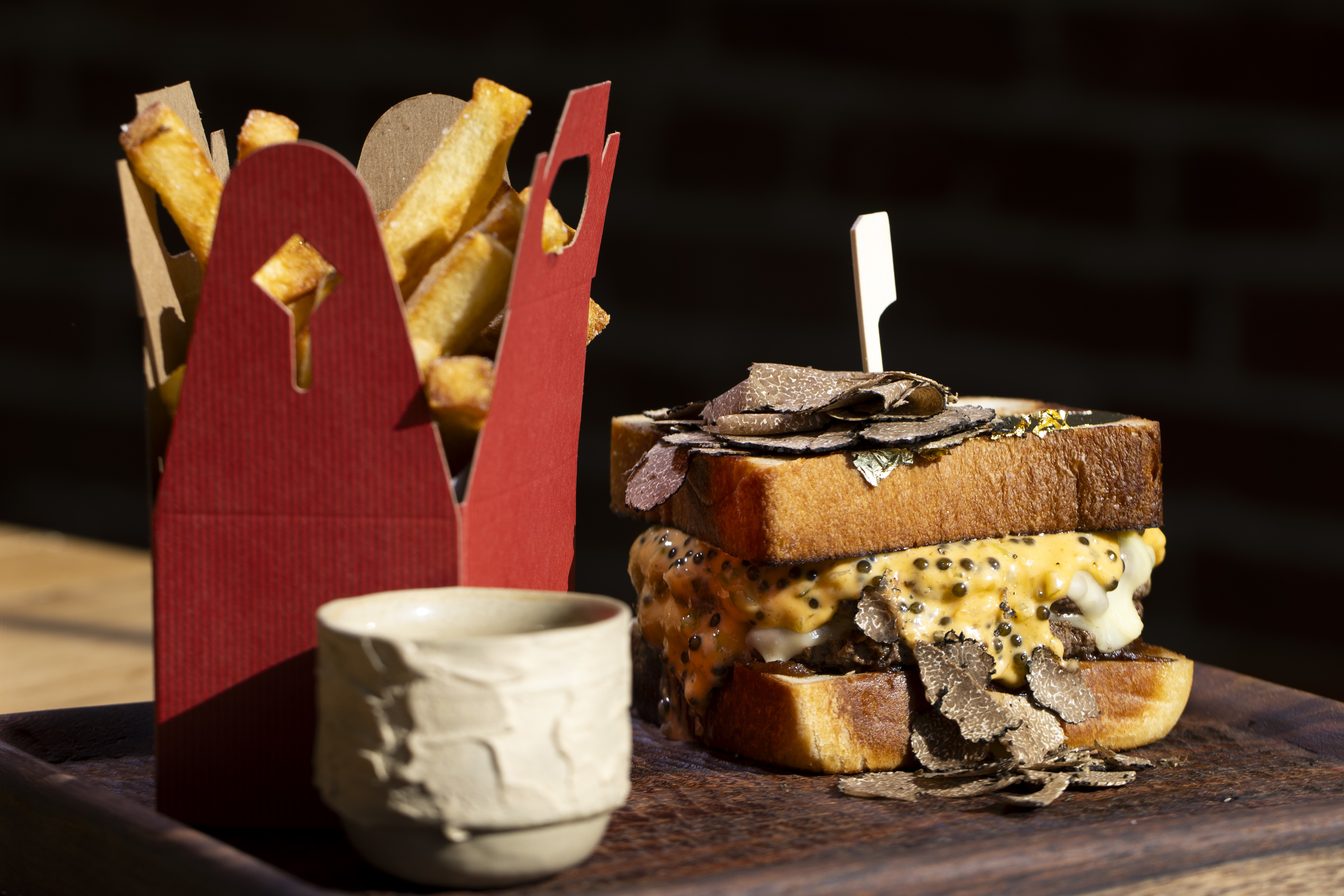
    Inquirer critic Craig LaBan called the new Honeysuckle “joyful [and] irreverent” with a “vibrant” flow of new ideas, from the caviar-topped and gold-flecked McDonald’s Money burger to a a cocktail inspired by Haiti’s national drink of clairin and lime. The restaurant landed a spot on The Inquirer’s 2025 edition of The 76, while Tate and St.Aude-Tate were first-time semifinalists for Best Chef, Mid-Atlantic at the 2026 James Beard Awards. Honeysuckle is also recommended by the Michelin Guide.

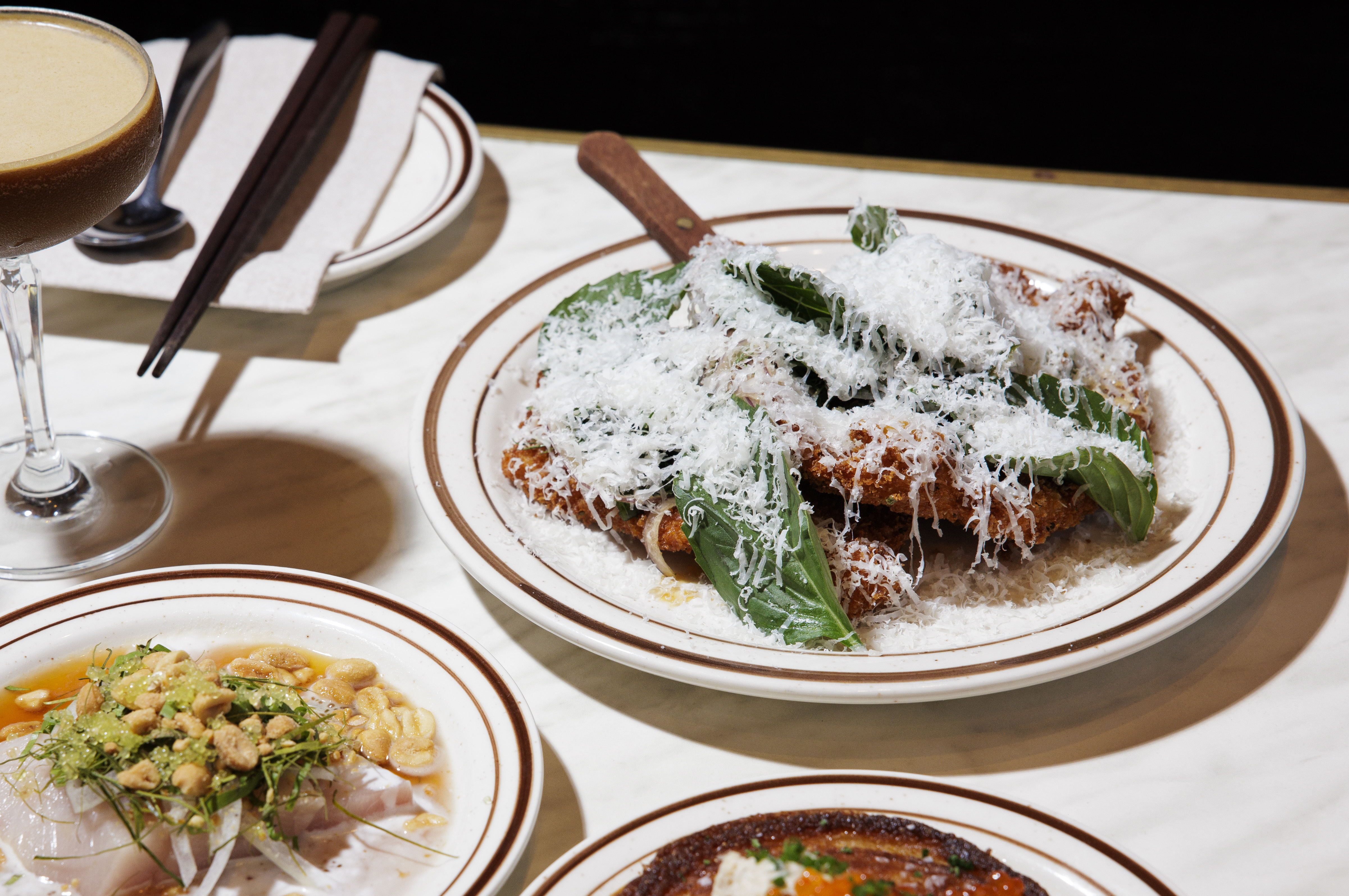
    The Mawn Cutlet at Sao, the East Passyunk Avenue oyster bar from married restaurateurs Phila and Rachel Lorn.Monica Herndon / Staff Photographer

    “Chefs Omar Tate and Cybille St.Aude-Tate deliver a showstopping walk through nostalgia, pop culture, Philadelphia, and Black American history through dishes that spark new reflection and conversation,” Robinson wrote of Honeysuckle.

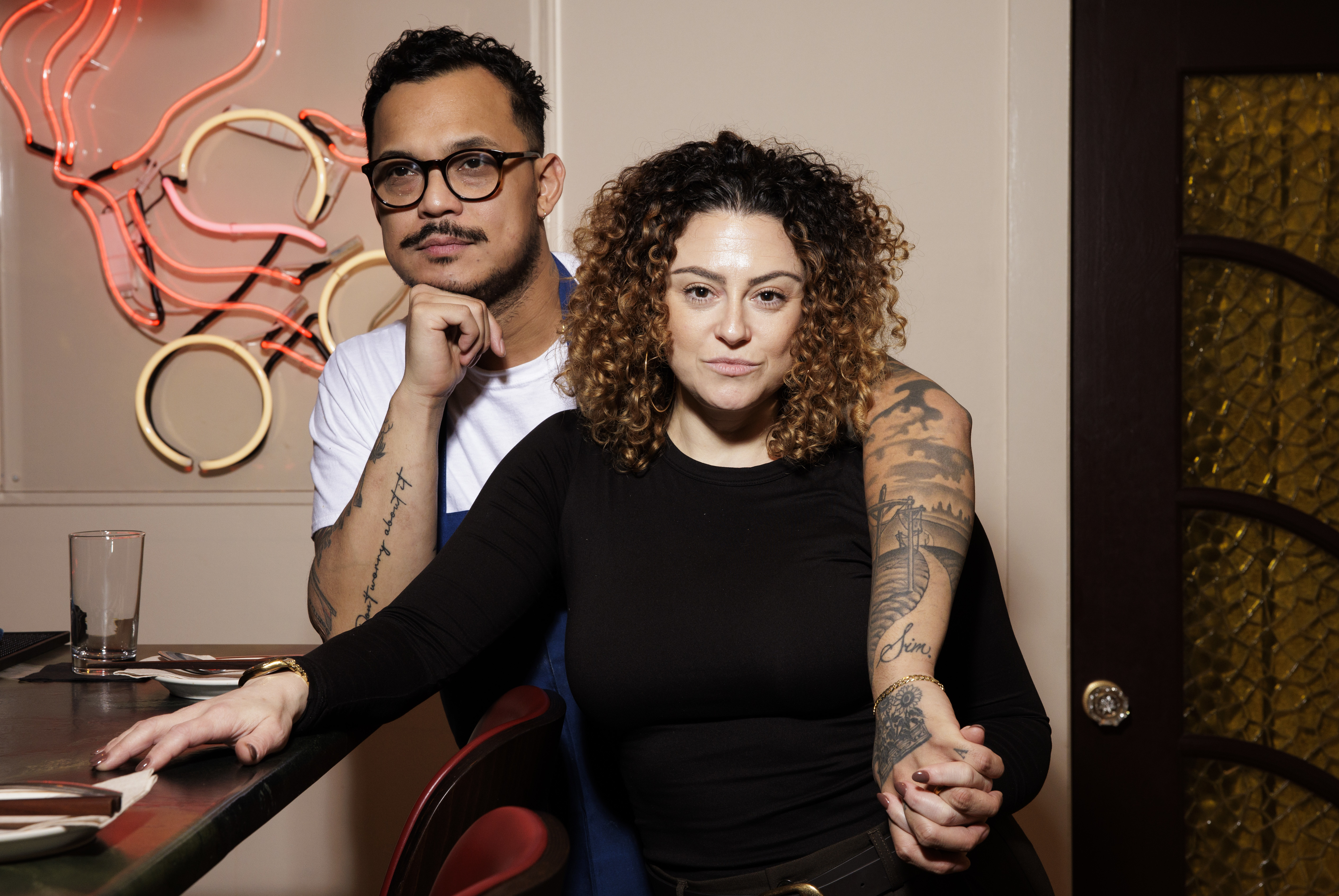
    Chef Phila Lorn and his wife, Rachel, opened Sao at 1710 Passyunk Ave. in September 2025 as a follow-up to their acclaimed Cambodian noodle house, Mawn, where Lorn earned a Beard Award for Emerging Chef in 2025 alongside commendations from Food & Wine, the New York Times, and The Inquirer.

    Phila (left) and Rachel Lorn (right) own Cambodian noodle bar Mawn and oyster bar Sao. Bon Appétit has named Sao one of the country’s best new restaurants of 2026.Monica Herndon / Staff Photographer

    While Mawn is known for being one of the toughest reservations in town, Sao isn’t far behind. The 33-seat oyster bar combines favorites from the noodle bar — like the papaya salad and beef skewers — with dishes that meld Phila’s Cambodian heritage with South Philly’s Italian American ethos, such as the ultra-thin Mawn chicken cutlet coated in a fish sauce caramel and a rendition of crab gravy made with coconut curries.

    Sao serves dishes “that hit like uppercuts,” Bon Appétit food director Chris Morroco wrote. “Enjoy letting your taste buds get knocked around when you least expect it.”

  • Some of Philly’s oldest restaurants are closing or changing hands. What’s going on?

    Some of Philly’s oldest restaurants are closing or changing hands. What’s going on?

    An unusually visible collection of Philadelphia-area restaurant institutions is reaching a turning point at the same time — with some closing for good and others seeking buyers as a generation of longtime owners reaches retirement age.

    At Kelly’s Seafood, the end is definite. The Northeast Philadelphia restaurant will close this month as its owners retire, ending a run spanning three generations of the Kelly family. So will Steve Stein’s Famous Deli, whose history in the Northeast also reaches back nearly 70 years.

    Elsewhere, the outcomes are less certain.

    Cherry Street Tavern has been around for a century at 22nd and Arch Streets.Tyger Williams / Staff Photographer

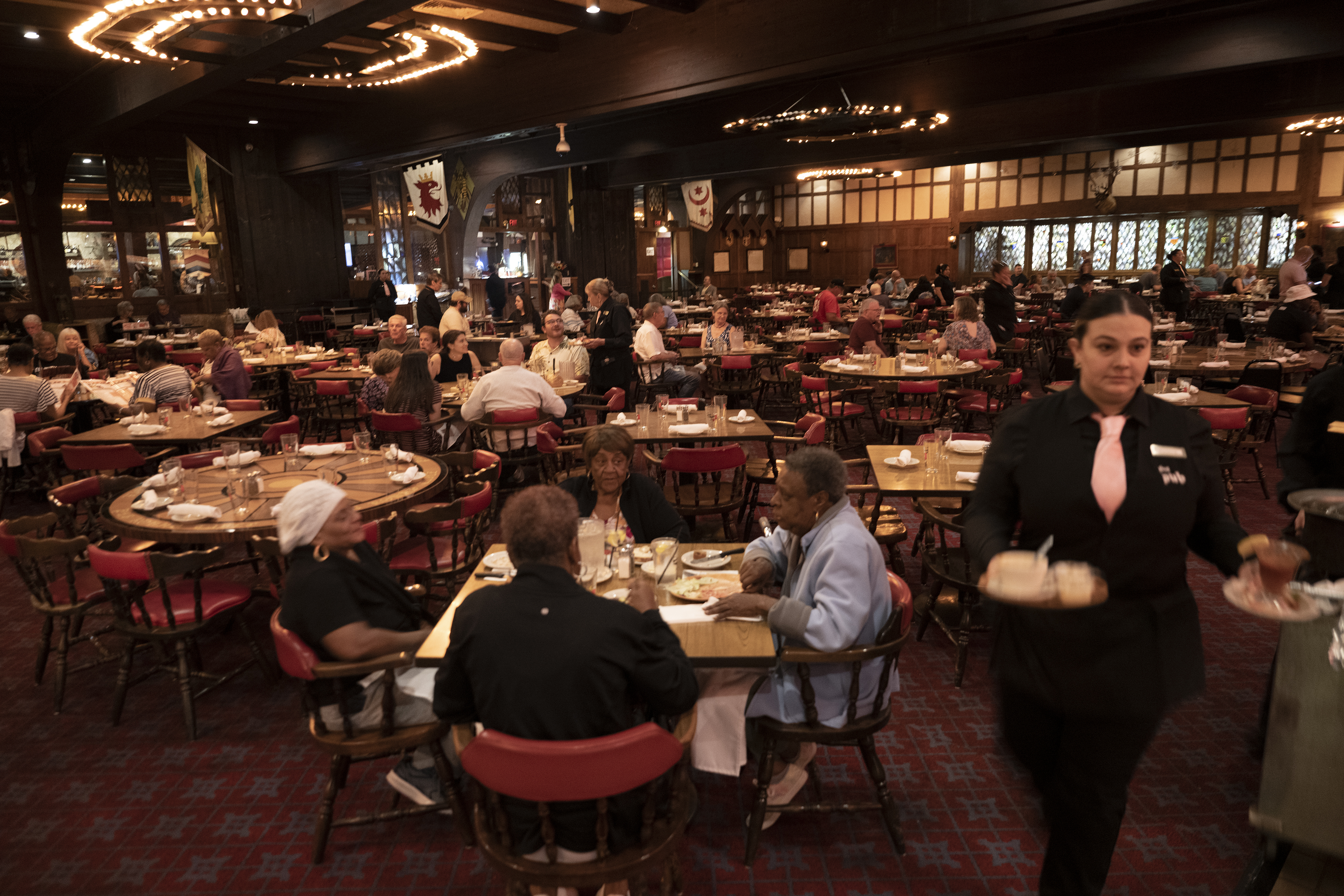
    The Pub, the sprawling Pennsauken steakhouse known for its open hearth, medieval decor, and thousand-plus seats, is on the market. The restaurant, which dates to 1951, is not closing: It is on its customary summer break and is scheduled to reopen Sept. 18.

    The owners of Cherry Street Tavern, the Logan Square bar that has operated for more than a century, are looking for a buyer after 50 years of stewardship by the Loughery family. The buildings that housed Mamma Maria’s, the East Passyunk Italian restaurant that opened in 1992, went up for sale this month. Aldar Bistro in Bala Cynwyd has been sold after 34 years and will give way to an Italian restaurant called Bruzi.

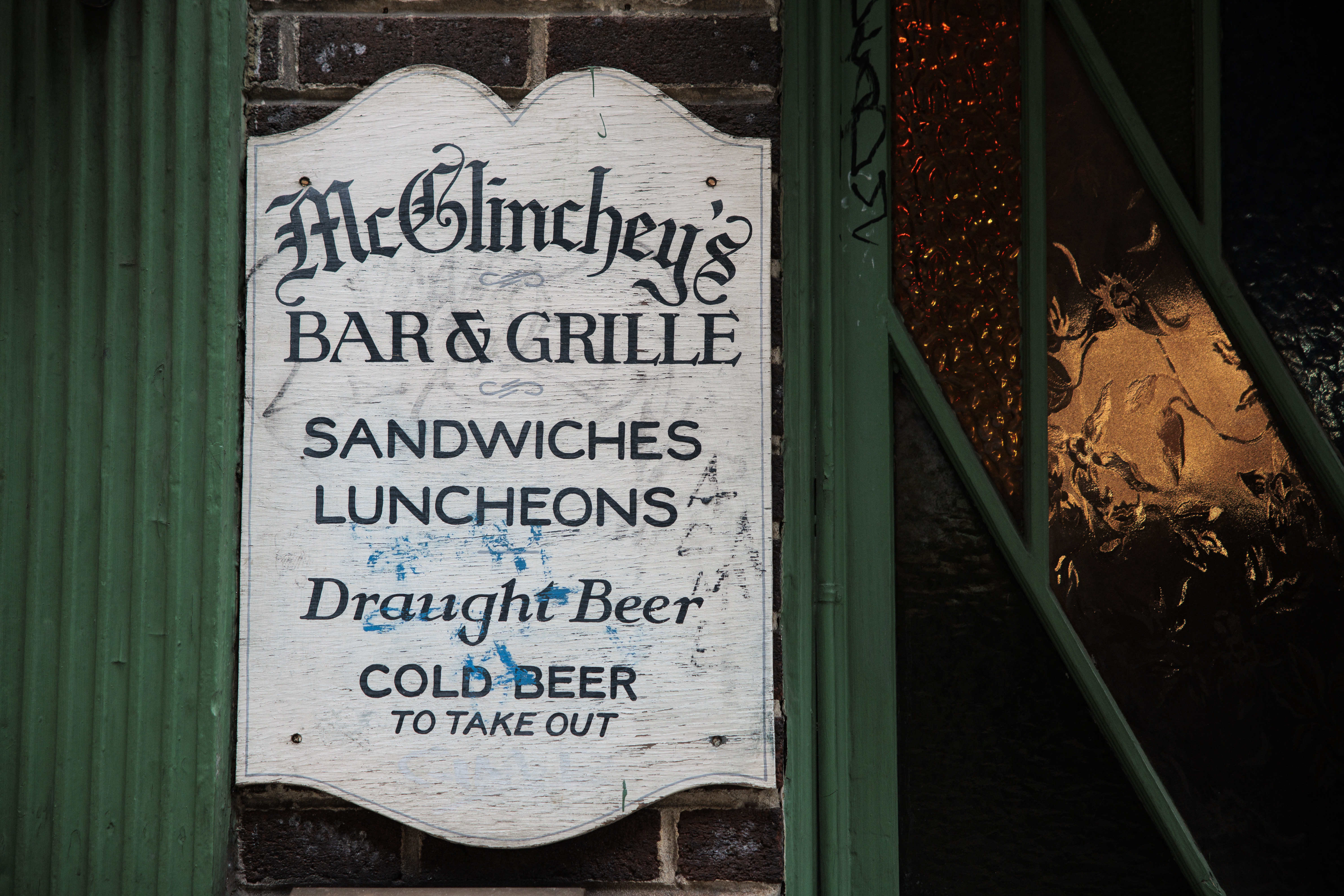
    McGlinchey’s, the Center City dive that closed last year after nearly 90 years, is back on the market after a prospective buyer walked away from a deal for the building.

    McGlinchey’s, at 259 S. 15th St., after its closing in August 2025.Monica Herndon / Staff Photographer

    And the nearly 40-year-old Jake’s & Cooper’s Wine Bar in Manayunk is being marketed for sale as owner Bruce Cooper looks toward retirement.

    Restaurants have always turned over, and the recent activity does not appear to reflect a restaurant market in retreat. The Inquirer counted 86 Philadelphia-area restaurant closings in 2025, while more than 100 new restaurants and bars were on the drawing board for 2026. What distinguishes many of the businesses now closing or being sold is their longevity: They survived for decades, weathering the pandemic and recent increases in food and labor costs, before their owners reached retirement.

    ‘The gray wave’

    People in the restaurant, liquor, and real estate businesses say the turnover is part of a broader generational transition among small businesses as longtime owners reach retirement without children interested in taking over.

    Jim Creed, handling Jake’s listing, calls it the “gray wave.”

    “You’ve got operators who have been in business 40 or 50 years, and they don’t have heirs who want to take over the business,” said Creed, a senior vice president with CBRE.

    His father, also Jim Creed, knows the issue from the other side. He opened Creed’s Seafood & Steaks in King of Prussia in 1982 and, at 78, has no immediate plans to sell. “I go to the restaurant every night,” he said. “It’s actually fun.” But when he does decide to close, he said, his children don’t want to take over.

    For the counterexample, consider McGillin’s Olde Ale House in Center City. Open since 1860, it has survived through generations of owners; the Spaniak family has run it since 1958, with Chris Mullins Jr. now the third generation involved. There are no plans to sell. “It’s part of my DNA, part of our customers’ DNA, part of our staff’s DNA,” Mullins told The Inquirer this year.

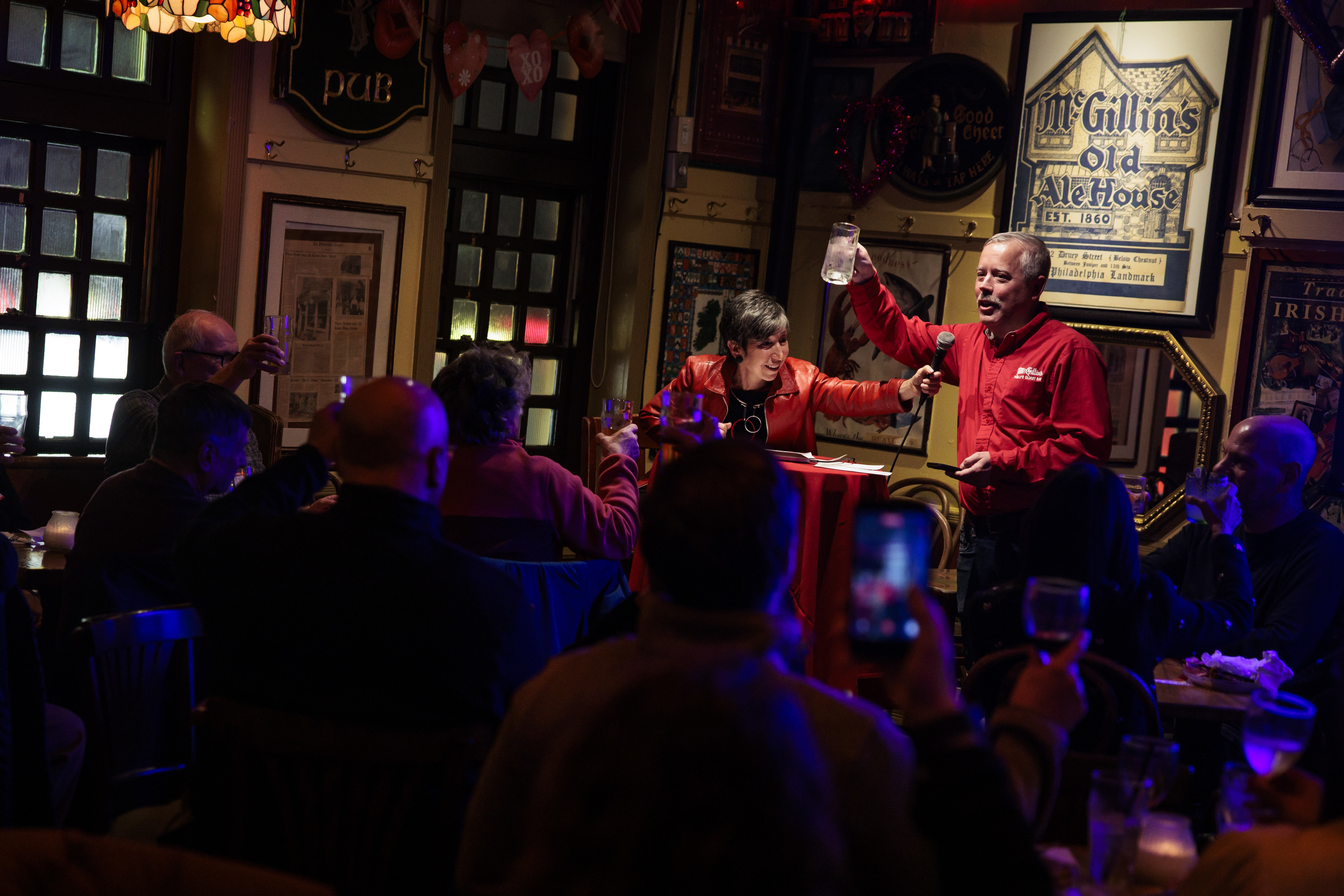
    Irene Levy Baker and Chris Mullins Jr. lead a toast at McGillin’s on Tuesday, Feb. 3, 2026 in Philadelphia. Attendees gathered for a book talk on “Cheers to McGillin’s: Philly’s Oldest Tavern” on Tuesday.Monica Herndon / Staff Photographer

    Ed Taraskus has watched generations of restaurant and bar owners come and go over 50 years of practicing liquor licensing law. He could not say whether the current number of sales and closings constitutes a statistical trend, but said the succession problem is familiar.

    “The parents retire and the children don’t want to get into the business — because it’s a hard business,” he said.

    Taraskus said the hours can be punishing for small family operators. His clients also complain about finding employees willing to work nights and weekends. Drinking habits have changed, he said, and some businesses are still feeling the effects of the pandemic.

    Taraskus knows the succession question personally. His South Philadelphia family owned a small restaurant and tavern, but his father discouraged him from entering the business. When his parents retired in the 1960s, they sold.

    Real estate on the line

    Retirement can present a second question for operators who own their buildings: What, exactly, are they selling?

    A restaurant may have value as a going business, but decades of appreciation can make the underlying real estate a substantial part of an owner’s nest egg. Sometimes the economics favor a different restaurant — or an entirely different use.

    Douglas Green, a principal at commercial real estate brokerage MSC, said the value of restaurant real estate is closely tied to the sales a location can support and, consequently, the rent an operator can afford.

    “The more volume they do, the more rent they can pay,” Green said.

    That means a location can be worth more to another restaurateur if the existing operator is underperforming. And in some cases, Green said, a restaurant may no longer be the property’s most valuable use at all.

    “At some point, perhaps the building becomes obsolete,” Green said. “Perhaps the highest and best use of the real estate is no longer a restaurant.”

    Those possibilities are playing out among the region’s longtime establishments.

    The Pub restaurant near the former Airport Circle in Pennsauken in 2024.Jose F. Moreno / Staff Photographer

    At the Pub, the Gelman family is seeking a buyer for the restaurant and its roughly 6.3 acres on Kaighns Avenue near the former Airport Circle. The family has operated it since Marc Gelman bought it in 2000.

    “I don’t think there’s one thing in general why we’re selling, but it’s time for a new steward — if you will — of the business, or the property,” Marc’s son David Gelman said.

    At Cherry Street Tavern, at 22nd and Arch Streets, the Loughery family hopes to find a buyer who understands what generations of regulars value about the place.

    McGlinchey’s illustrates the other possibility. Its nearly 5,000-square-foot property at 259 S. 15th St. is listed for $2.45 million, including the liquor license, bars, and McGlinchey’s name, as either a turnkey bar and restaurant or a redevelopment opportunity.

    Decisions for buyers

    Creed said longevity itself can tell a prospective buyer something about a restaurant property.

    “Anytime you have operating longevity, that speaks to the real estate,” he said. “When you have a concept that has been in operation for 40 years, clearly the real estate has something to do with that, too.”

    The retirement of one operator does not necessarily mean the end of restaurant use.

    The former Mixto space is set to become the revival of South Philadelphia bar Toll Man Joe’s.Charles Fox / Staff Photographer

    Mixto closed July 12 after nearly 24 years at 1141 Pine St. Within weeks, restaurateur Lori Penrose bought the property and announced plans to revive her former South Philadelphia sports bar, Toll Man Joe’s, there.

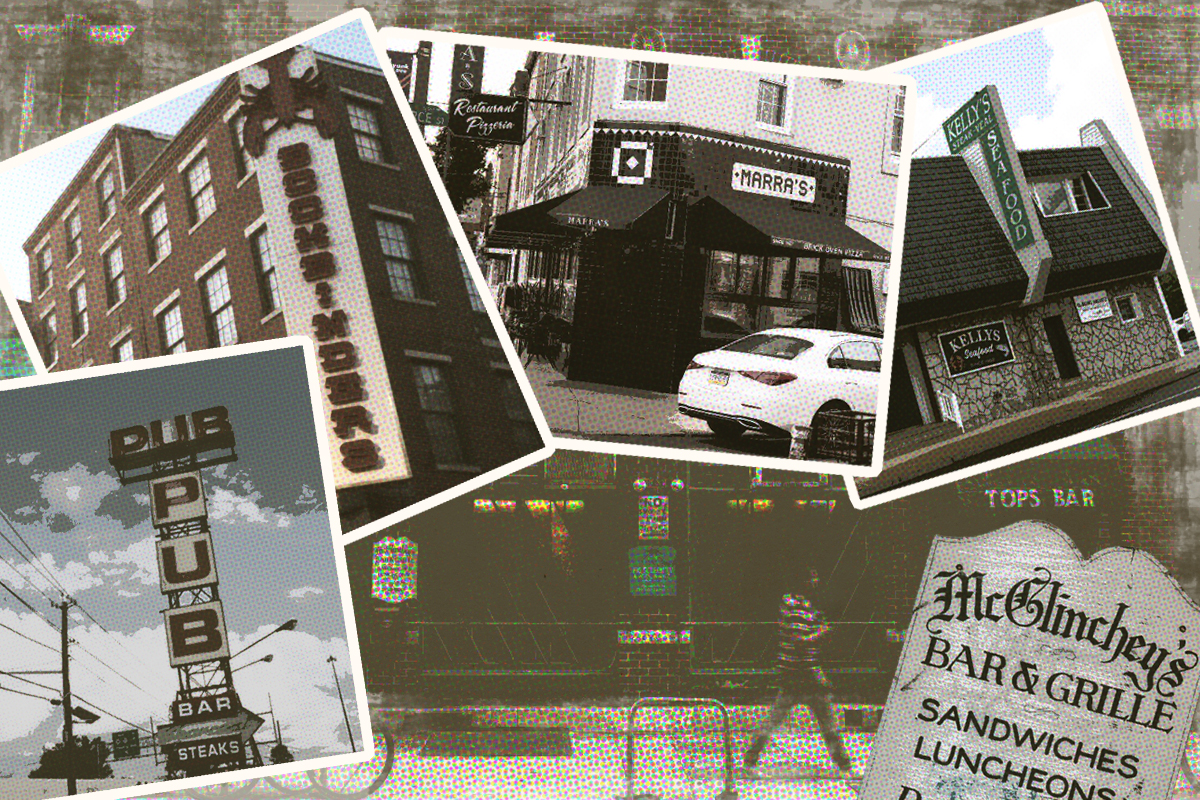
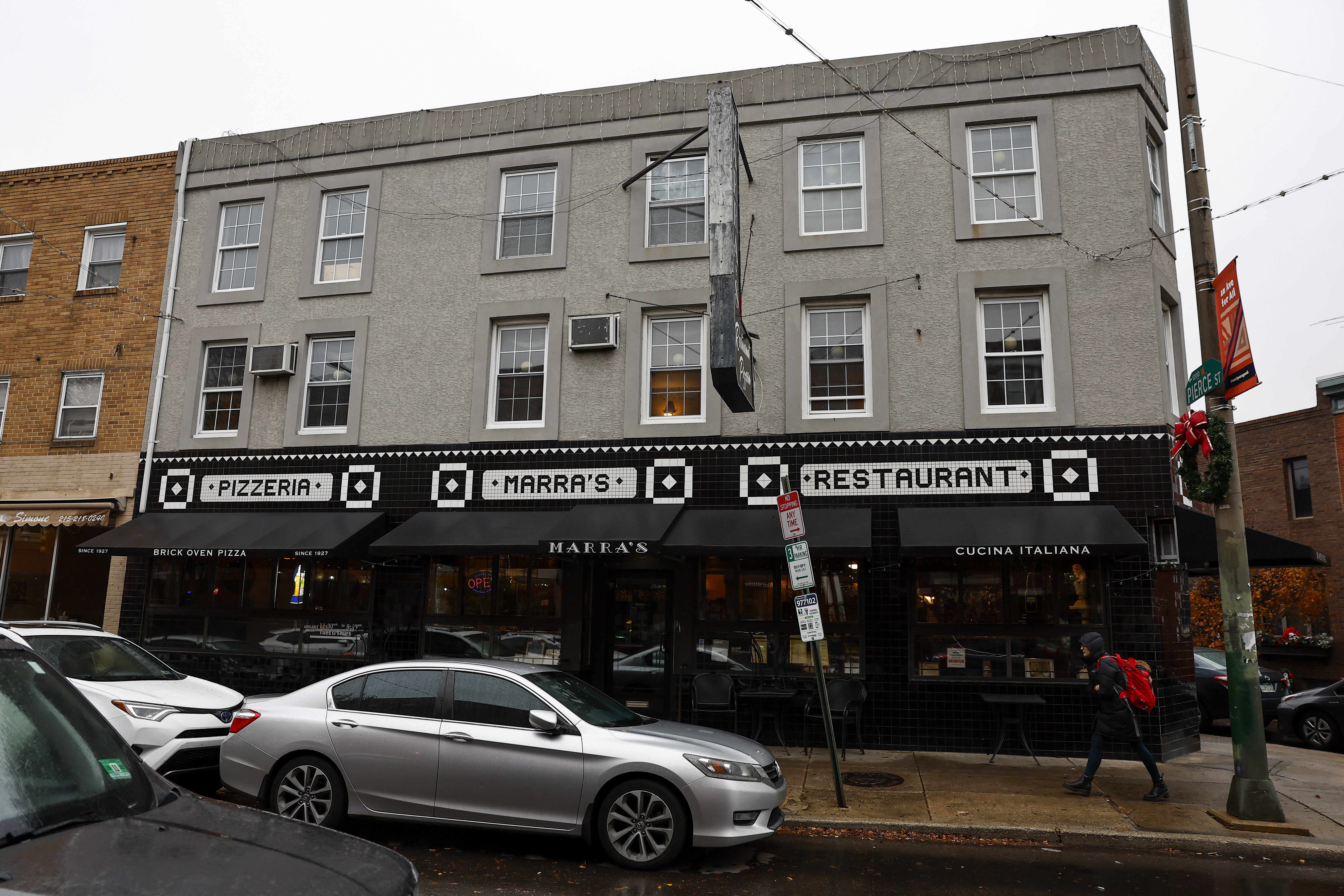
    Emei owner Dan Tsao has pursued that strategy on a larger scale. Over roughly a year, he acquired or leased four landmark restaurant properties: the former John Henry’s Pub in Ardmore, Marra’s on East Passyunk Avenue, the former Irish Pub in Rittenhouse, and the Old Original Bookbinder’s/Olde Bar property in Old City. All four are intended to remain in hospitality use.

    The exterior of Marra’s Restaurant on East Passyunk Avenue is due to become a branch of Dan Tsao’s burgeoning restaurant group. Monica Herndon / Staff Photographer

    “There are pros and cons to both,” Tsao said of taking over an existing restaurant rather than starting with a new space. “But with an existing restaurant space, especially a legacy restaurant, it already has a place in the neighborhood, and a place in the memories and hearts of generations of customers.”

    Such properties may also have much of the expensive infrastructure required to operate a restaurant.

    But for Tsao, the attraction isn’t purely economic.

    “I also like the idea of preserving some of that history,” he said, “while giving the space a new chapter.”

  • Another fixture of East Passyunk’s Italian dining legacy is on the market

    Another fixture of East Passyunk’s Italian dining legacy is on the market

    The tables at Mamma Maria’s have not been pushed aside for dancing in years, but the disco ball still hangs overhead.

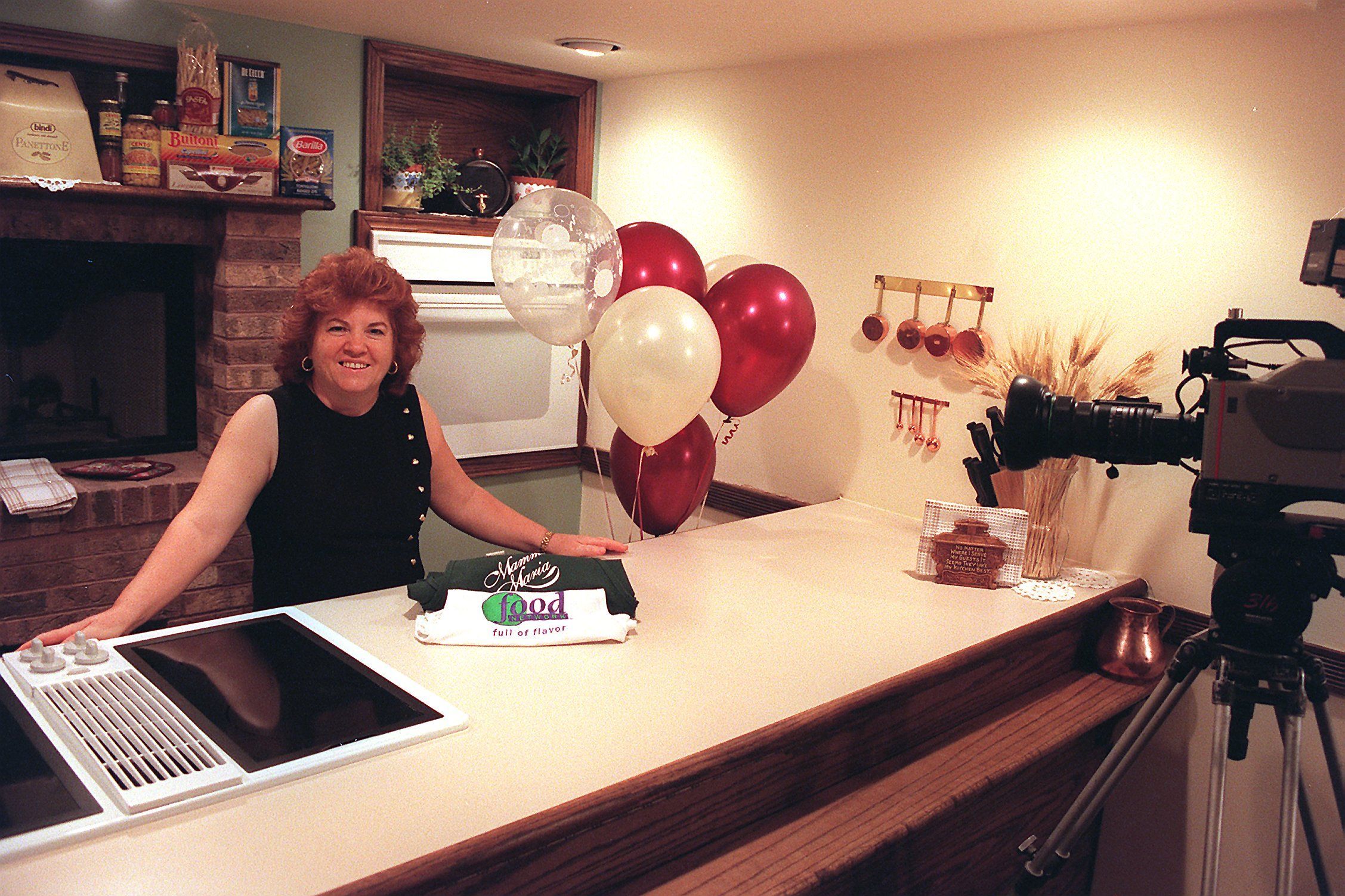
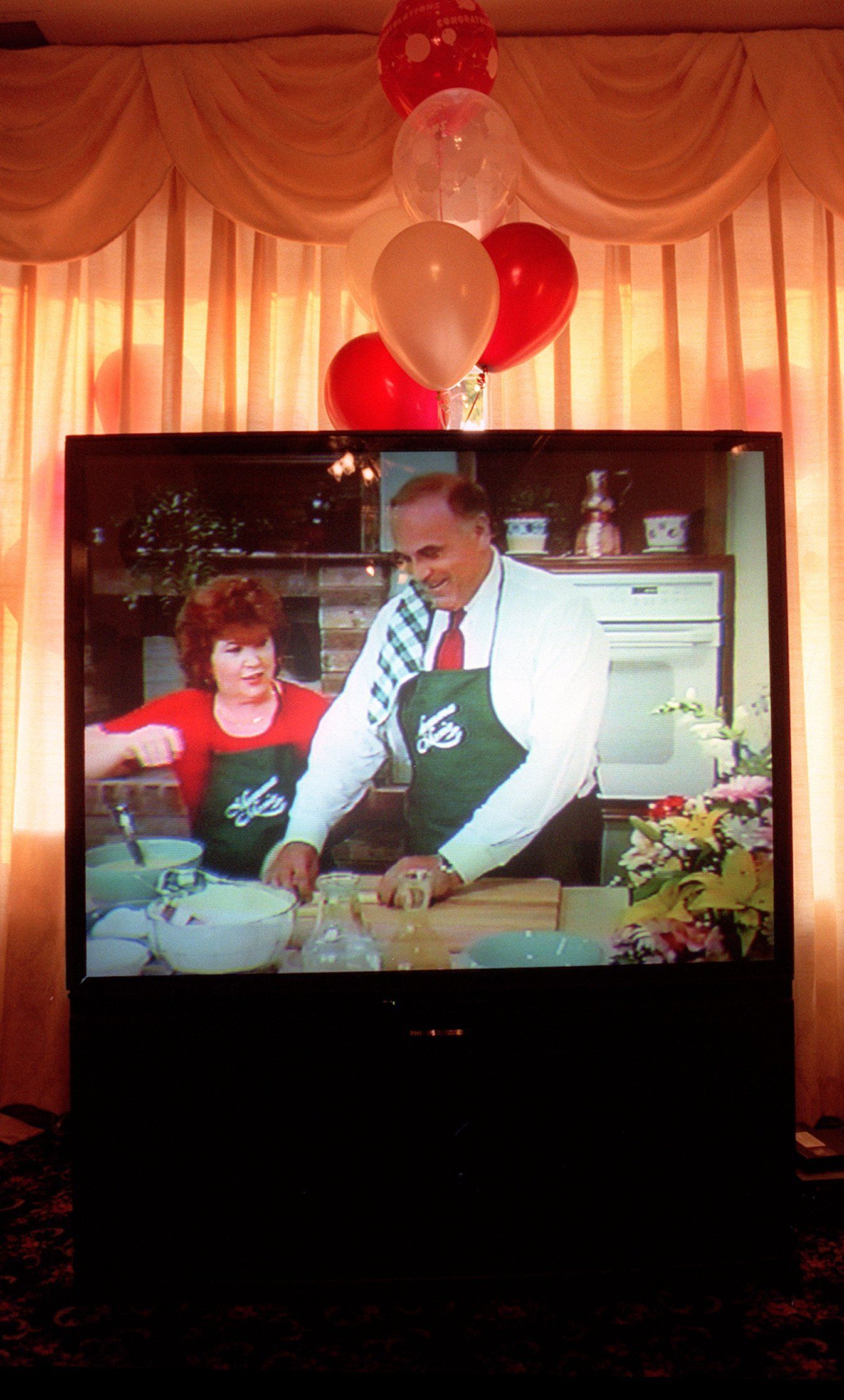
    Still there, too, are the kitchen where Santa Maria “Mamma Maria” Chiavatti turned out feather-light gnocchi, the dining room where waiters carried trays of flaming sambuca, and the upstairs studio where Chiavatti taped a TV cooking show whose first guest in 1999 was Mayor Ed Rendell.

    Santa Maria Chiavatti and family enjoyed a 28-year run at Mamma Maria’s.Tyger Williams / Staff Photographer

    Now the collection of buildings that housed the East Passyunk restaurant for nearly three decades is for sale, marking the end of one of the Avenue’s more colorful links to its ′90s/’00s Italian-restaurant resurgence.

    The former restaurant, closed for six years, is spread across three adjoining buildings on Passyunk Avenue and Jessup Street, all with apartments above. The asking price for 1637 E. Passyunk Ave., which houses one of the dining rooms, and 1632 S. Jessup St., which contains the kitchen, is $1.5 million. The building housing the other dining room, at 1639 E. Passyunk Ave., is offered for $2 million.

    “The kitchen is still set up,” said Albert Perry of Century 21 Advantage Gold, who has the listing with Dave Lombardo. “When we went to the property for the listing appointment, I was sent home with food.”

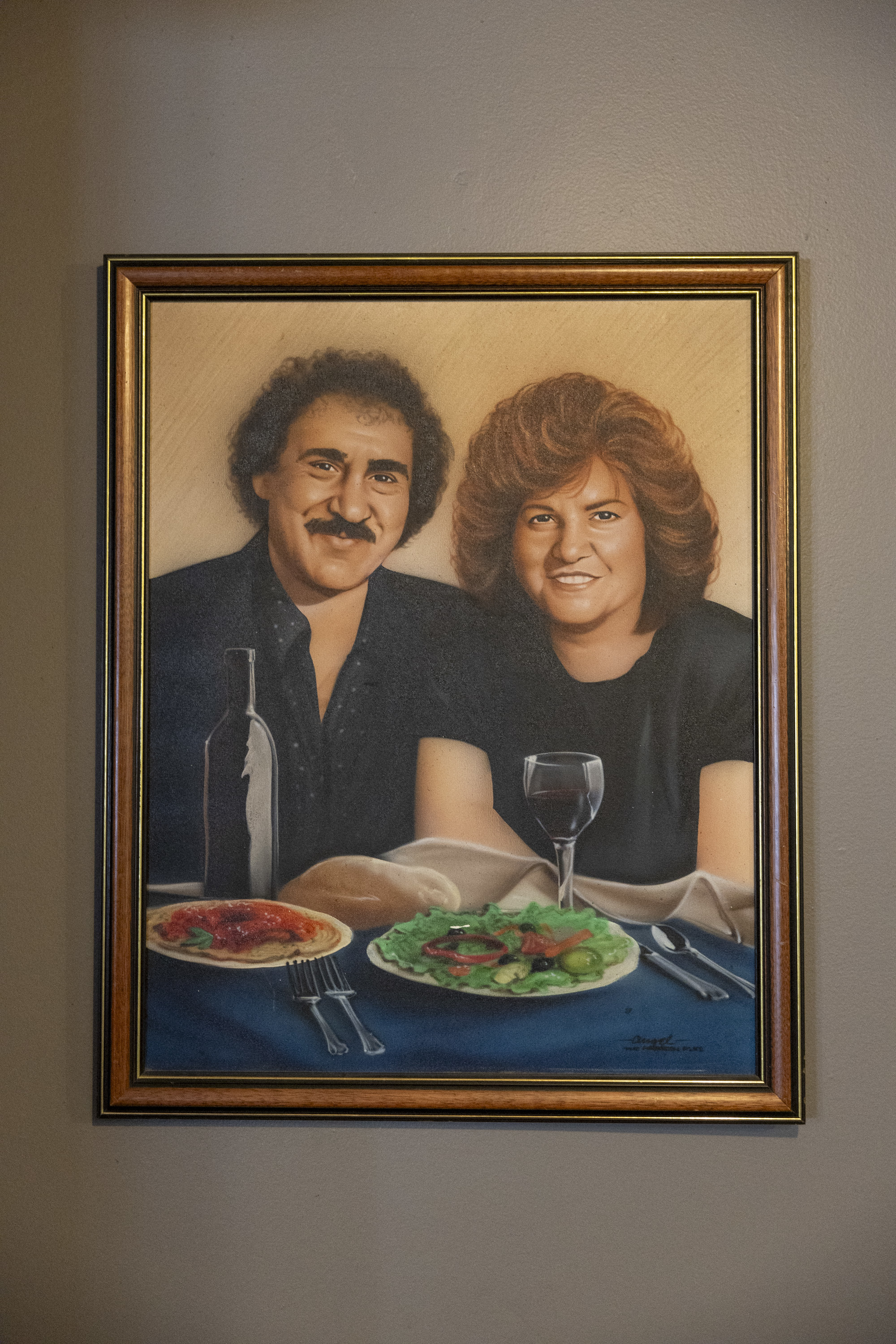
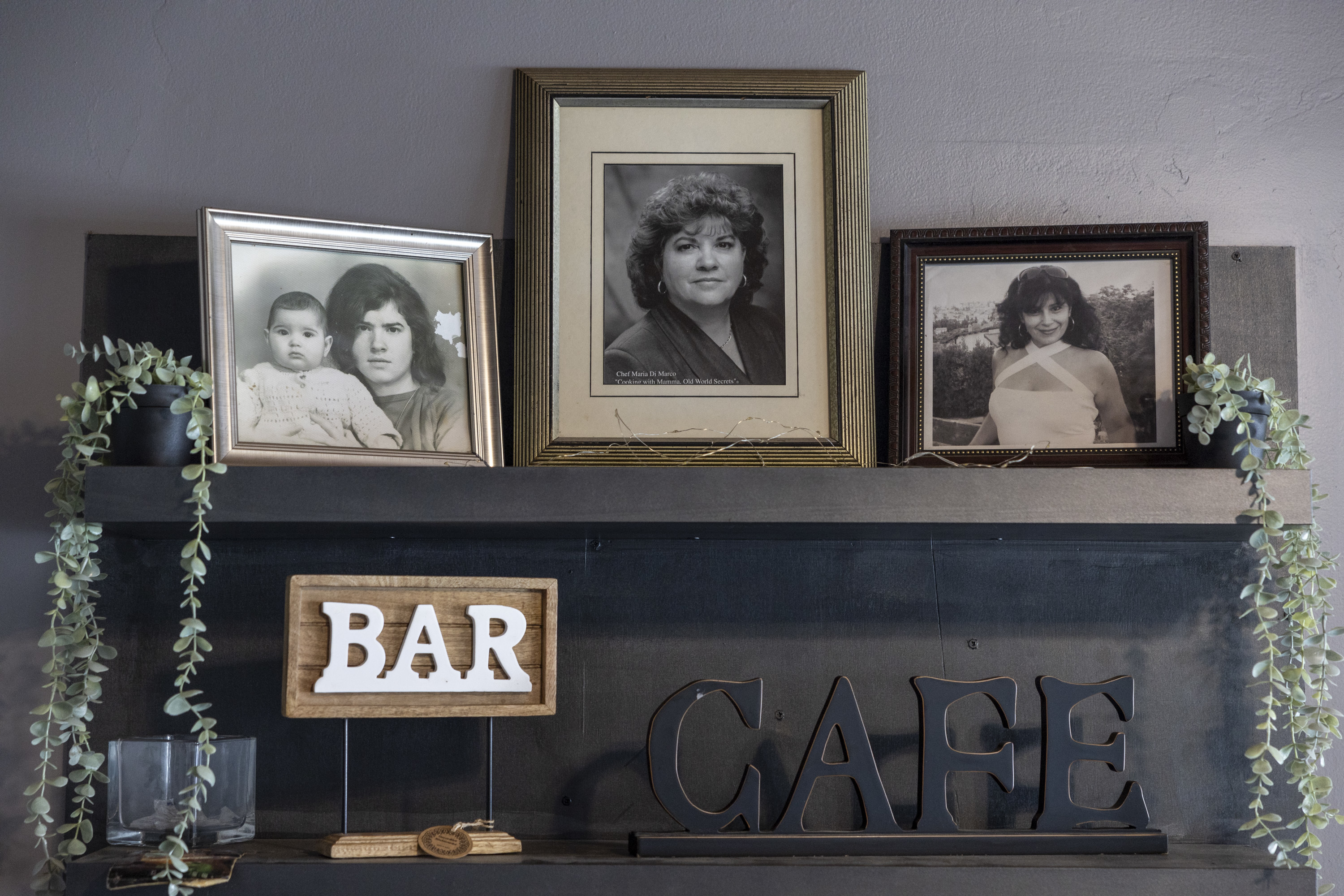
    A portrait of Claudio and “Mamma Maria” Chiavatti hangs in the shuttered restaurant.Tyger Williams / Staff Photographer

    Mamma Maria’s, which opened in 1992 and expanded into the adjoining property the following year, closed in 2020. But the Chiavattis said they couldn’t bring themselves to sell until now.

    “We want to give somebody the chance to have what we had, but with their vision,” said Maria’s daughter Paola Chiavatti. “Our era is ending, and a new era can begin.”

    A ‘vacation’ stop in Philadelphia

    The Chiavattis’ Philadelphia era began almost by accident.

    Maria and her husband, Claudio, came to the United States from Italy in 1992 for what their children believed was a vacation. The couple had already spent years in the restaurant business in Italy and Canada, and the family thought they had retired.

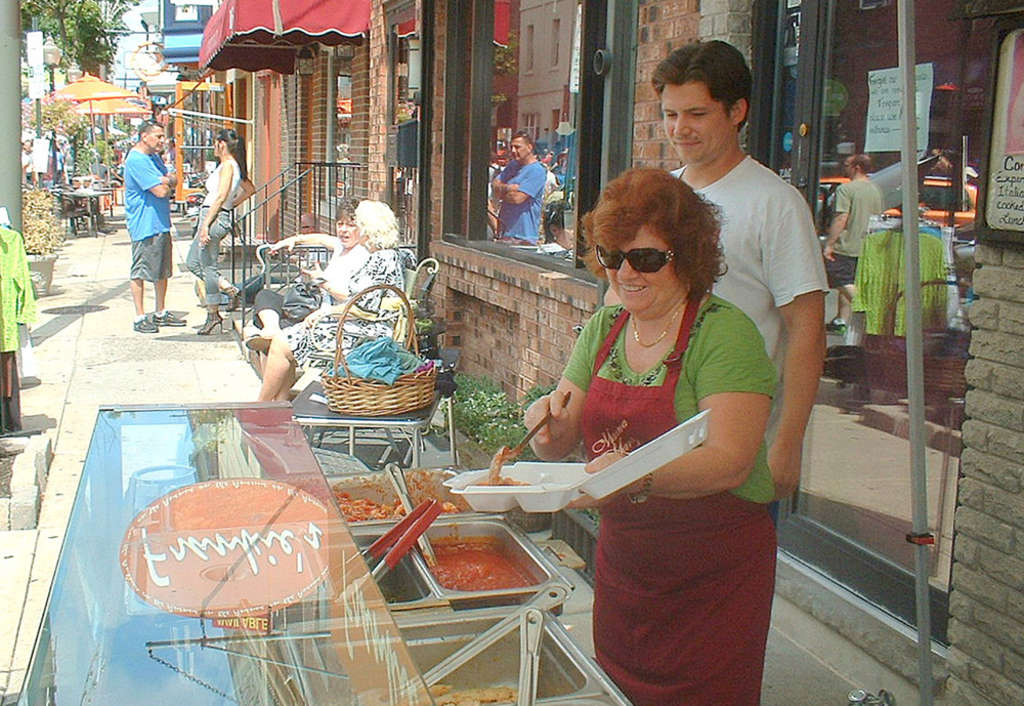
    Maria Chiavatti serving food outside of the East Passyunk Avenue restaurant in 2012. Glamorosi

    Then, while visiting relatives in Philadelphia, Claudio spotted a closed restaurant on East Passyunk Avenue and noticed the municipal parking lot across the street.

    “I said, ‘Yes, but it isn’t your parking lot,’” Maria recalled.

    Claudio’s answer was simple: “But it is there.”

    The couple rented the building and opened Mamma Maria’s. Three months later, Claudio questioned why they were paying rent when they could buy it.

    “That’s exactly what we did,” Maria said. “We bought it and made it beautiful.”

    Photos of Santa Maria Chiavatti and her daughter Paola on the mantel at Mamma Maria’s.Tyger Williams / Staff Photographer

    They built the menu around the food Maria knew from Abruzzo.

    Paola, meanwhile, was still in Italy, working as an interpreter and language teacher. Her sister, Myrna, and brother, Gianni, came to visit their parents. Before long, everyone in the immediate family was in Philadelphia, except Paola.

    That same year, her parents invited her over, ostensibly for a relative’s birthday party. Claudio picked her up at the airport and drove her to East Passyunk Avenue. She walked into the restaurant and saw a banner: “Welcome, Paola, to Mamma Maria’s.”

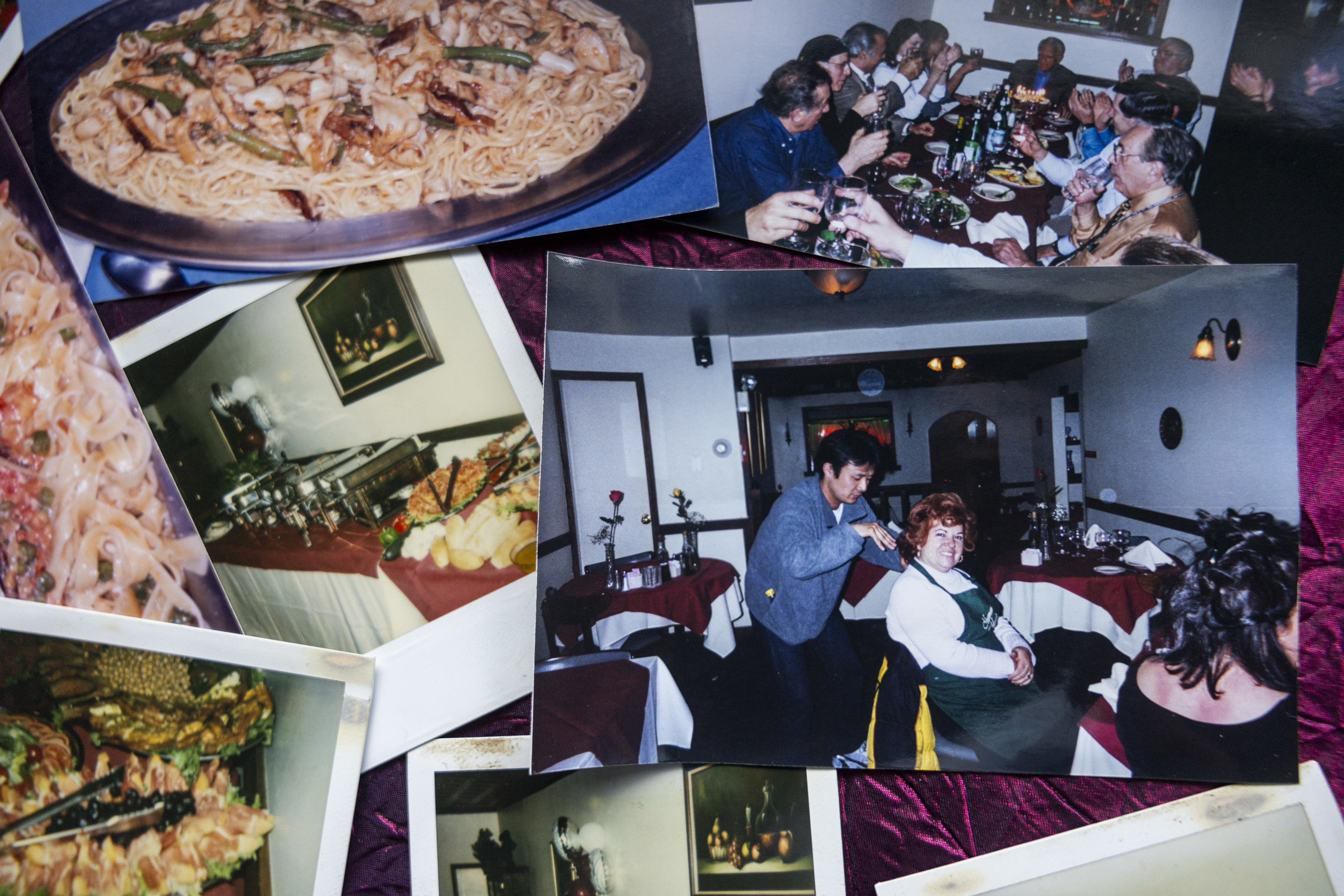
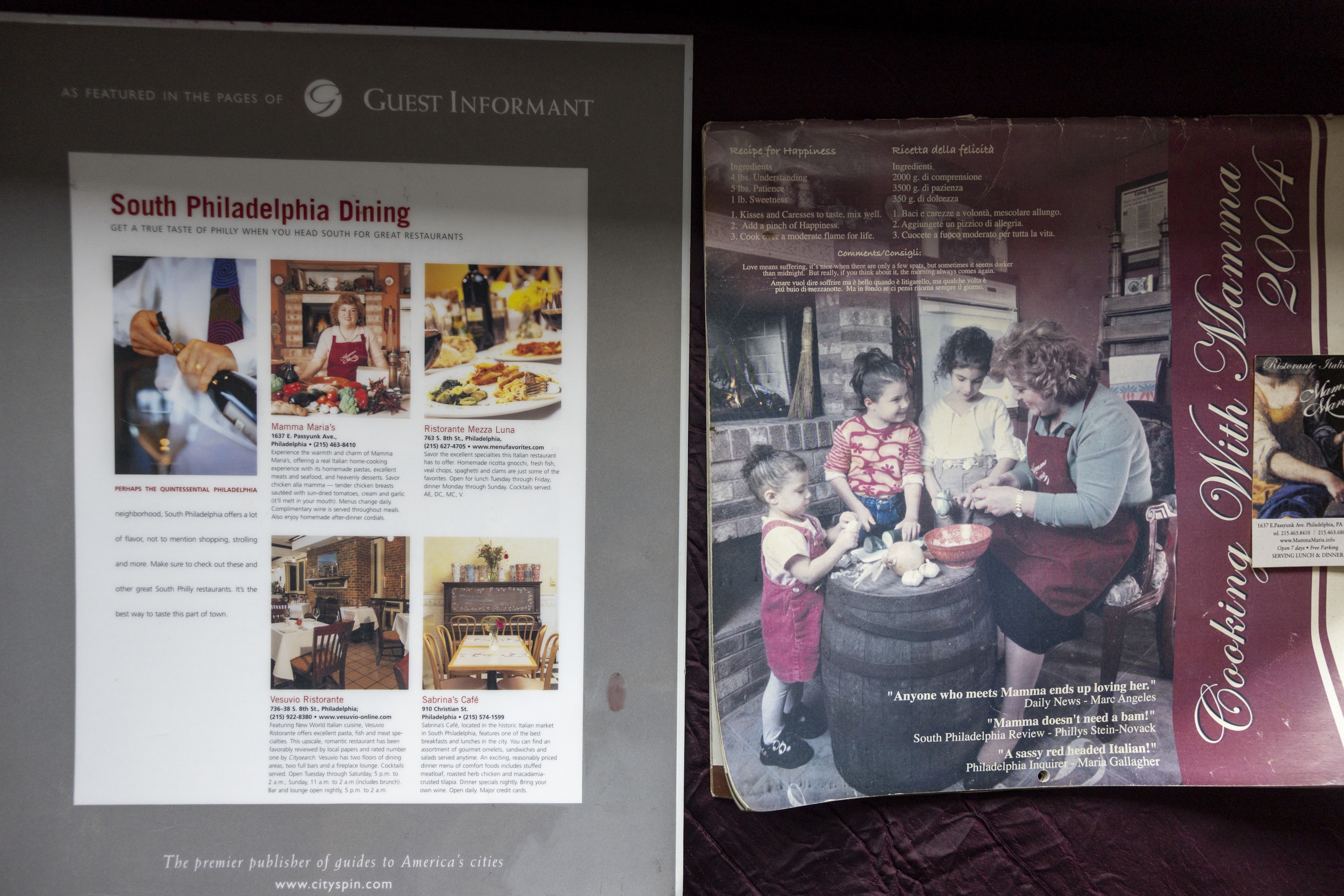
    Mamma Maria’s memorabilia in the restaurant.Tyger Williams / Staff Photographer

    Claudio told her that he and Maria had fallen in love with the neighborhood and the city. The restaurant, he said, would be something for their old age.

    Paola said she understood what was expected of her. Arrivederci, Italy.

    “Thirty-four years later, here I am,” she said.

    The rise of Mamma Maria’s

    Mamma Maria’s was a family operation in the most literal sense. Maria cooked. Claudio hosted, baked, prepped, and made sauces. Paola and Myrna worked the dining room.

    For much of its run, Mamma Maria’s was known for an enormous fixed-price meal: antipasto, soup, multiple pastas, meat and seafood entrees, salad, vegetables, potatoes, and a dessert cart loaded with cakes, cannoli, and other sweets.

    Wine was complimentary. So, at first, was flaming sambuca, served while an accordion player named Mario circulated among the tables.

    “You sat down and you felt like you were having Christmas dinner or New Year’s Eve dinner at your house,” said Lilla Amico-Carlomango, Maria’s oldest granddaughter, who worked at the restaurant with sisters Dalia and Chiara Amico. “The staff, the clients, everybody was so happy to be here that it created one big family.”

    Shortly after it opened, Inquirer food critic Elaine Tait described the cooking as “homey, not haute, cuisine, the likes of which you might find cooked by someone’s talented Italian mom.”

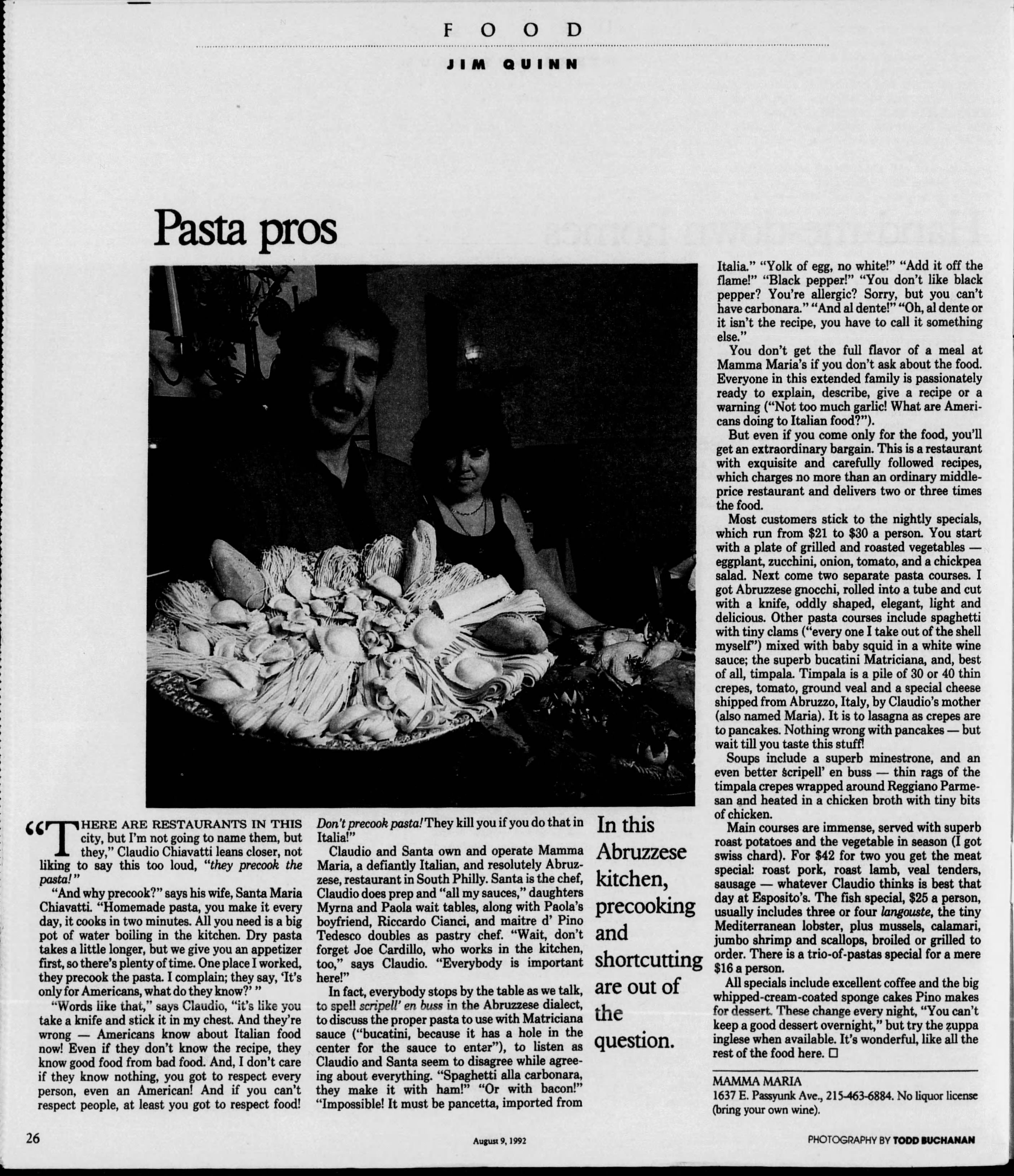
    The column by Jim Quinn in The Inquirer’s Sunday magazine on Aug. 9, 1992, that helped launch Mamma Maria’s.Newspapers.com

    Inquirer columnist Jim Quinn was similarly enthusiastic. Maria didn’t know Quinn from Adam when someone told her there was a man from the newspaper in the dining room. “I said, ‘So what?’” she recalled.

    After he returned three days in a row, she finally approached him.

    “Sir, you really love my place,” she told him.

    In 1997, an electrical fire forced the restaurant to close for eight months.

    “In the restaurant industry, eight months is murder,” Paola said.

    Mamma Maria’s reopened with a fundraiser for the Leukemia Society of America.

    Santa Maria Chiavatti in September 1999 on the set of her food show during its launch party. The show aired throughout the Philadelphia region. Michael S. Wirtz / Staff Photographer

    But one tradition did not return. The blaze was unrelated to the drinks, but Paola had lost her enthusiasm for open flames in the dining room, and the flaming sambuca was 86ed.

    Two years later, Mamma Maria’s expanded to television. In 1999, the family bought a weekly half-hour slot on the Food Network for a self-produced program, Cooking With Mamma, Old World Secrets.

    The show was taped in a studio kitchen above the dining room, with Rendell as Maria’s first guest. Maria used her maiden name, Di Marco, because the family thought it would be easier for viewers to pronounce.

    A video of “Mamma Maria’s” cooking show, featuring Mayor Ed Rendell, was televised during the 1999 launch party at the restaurant.Michael S. Wirtz / Staff Photographer

    Back at the restaurant, the fixed-price format endured. Claudio’s death in 2005 hit the family hard, as did the recession in 2008. In 2010, after 18 years of belt-stretching meals, Mamma Maria’s began allowing à la carte dining Monday through Thursday.

    Life after the restaurant

    Then the pandemic arrived.

    Mamma Maria’s closed in 2020, along with the family’s food-truck operation. By the time restrictions had eased enough for the family to consider reopening, Maria’s health had become the priority.

    Paola faced a choice: return to the all-consuming work of running a restaurant or help care for her mother.

    “Restaurants, we’ve had many in our lives,” she said. “Mother, you only have one.”

    The family hosted private events in the meantime. Now 79 and feeling fine, Maria is preparing to sell the property and, with her family, take Mamma Maria’s into another form.

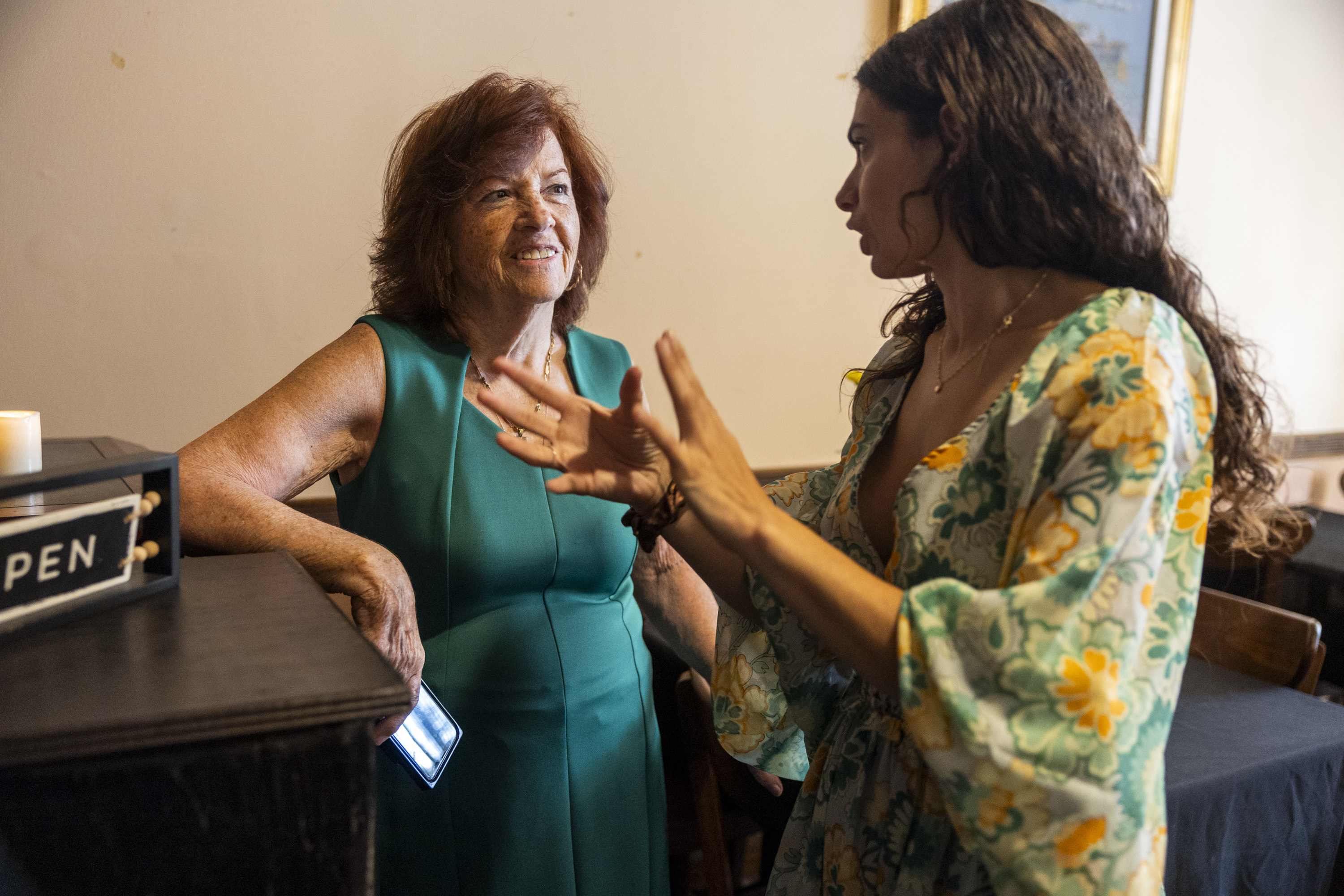
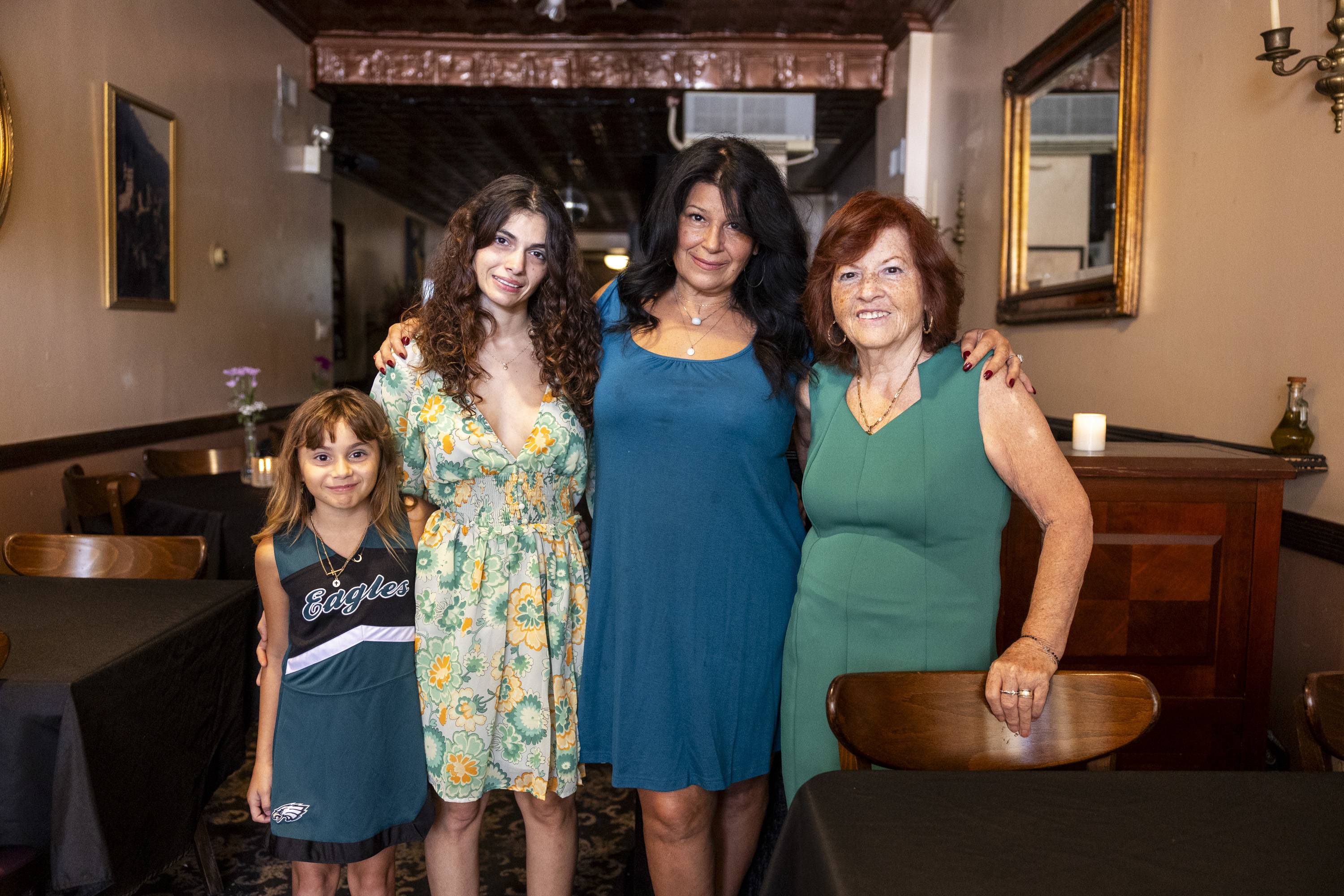
    Santa Maria Chiavatti (right) with three generations (from left): Great-granddaughter Paolina Carlomango, granddaughter Lilla Amico-Carlomango, and daughter Paola Chiavatti in the restaurant on Aug. 5, 2026.Tyger Williams / Staff Photographer

    She has boxes of handwritten recipes, including dishes passed through the family for generations. She is working on an Italian-language cookbook, while Paola and Lilla are helping to translate, organize, and photograph the recipes. They envision a series of cookbooks and possibly a line of pasta, sauces, and Maria’s homemade limoncello.

    That last item would be a particularly natural extension of Mamma Maria’s, Perry said.

    “When you went to Mamma Maria’s, you were drinking limoncello whether you intended to or not — and usually you wanted to.”

    For Maria, selling the buildings means giving up the restaurant, not the work that grew out of it.

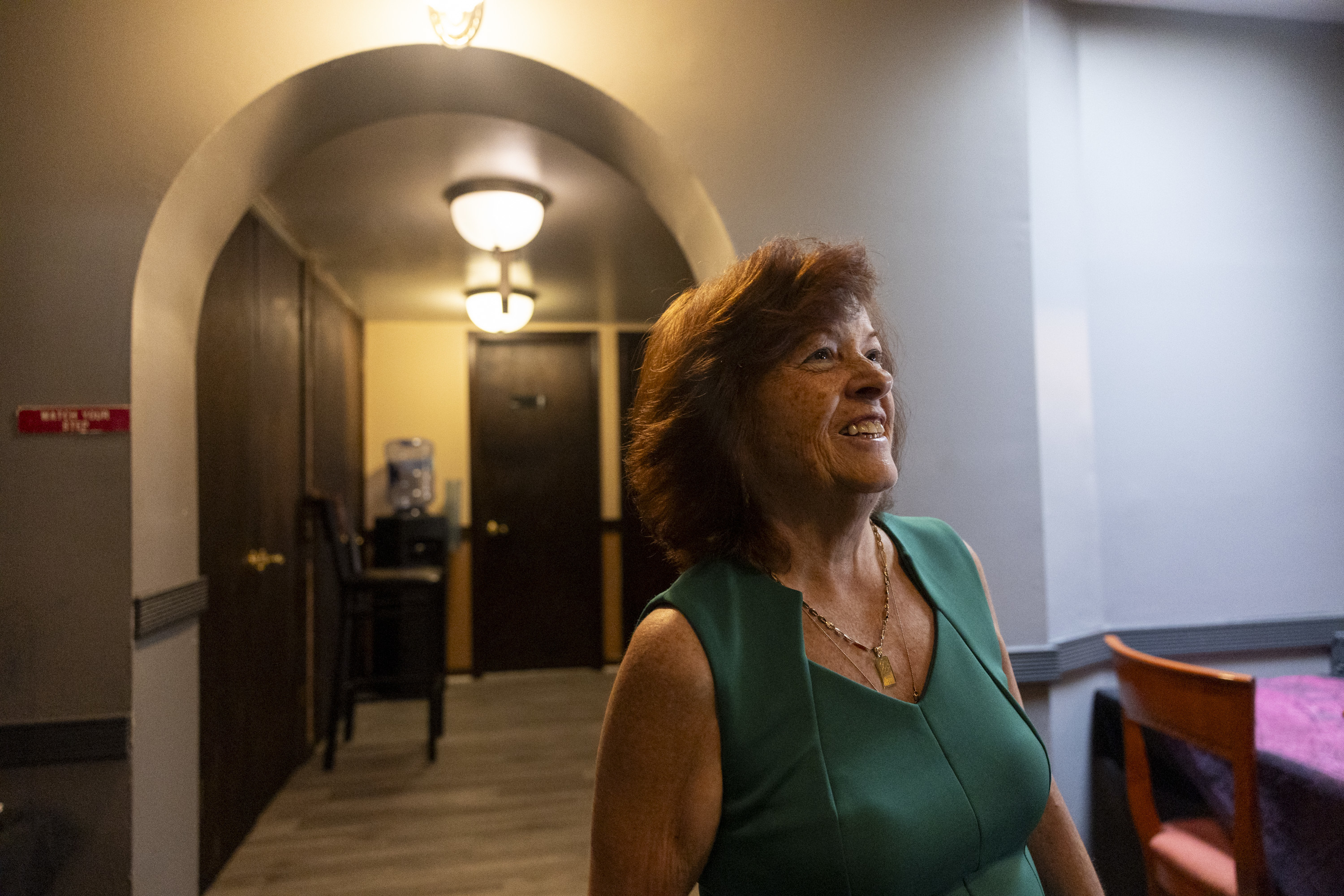
    “Just because the restaurant is finished,” she said, “doesn’t mean I’m finished.”

    “Just because the restaurant is finished doesn’t mean I’m finished,” says Santa Maria “Mamma Maria” Chiavatti.Tyger Williams / Staff Photographer