Philadelphia is one of three finalist cities to host the 2028 Democratic National Convention, the party announced Thursday.
In addition to Philadelphia, the Democratic National Committee said it is also considering Denver and Boston on its narrowed short list of cities to hold the next presidential nominating convention. The announcement means that Atlanta and Chicago, which were on a previous list of five potential host cities, have been eliminated from contention.
Ken Martin, the chair of the Democratic National Committee, said in a statement that the three finalist cities put forward “incredibly strong bids.” He did not say why the party is no longer considering Atlanta or Chicago.
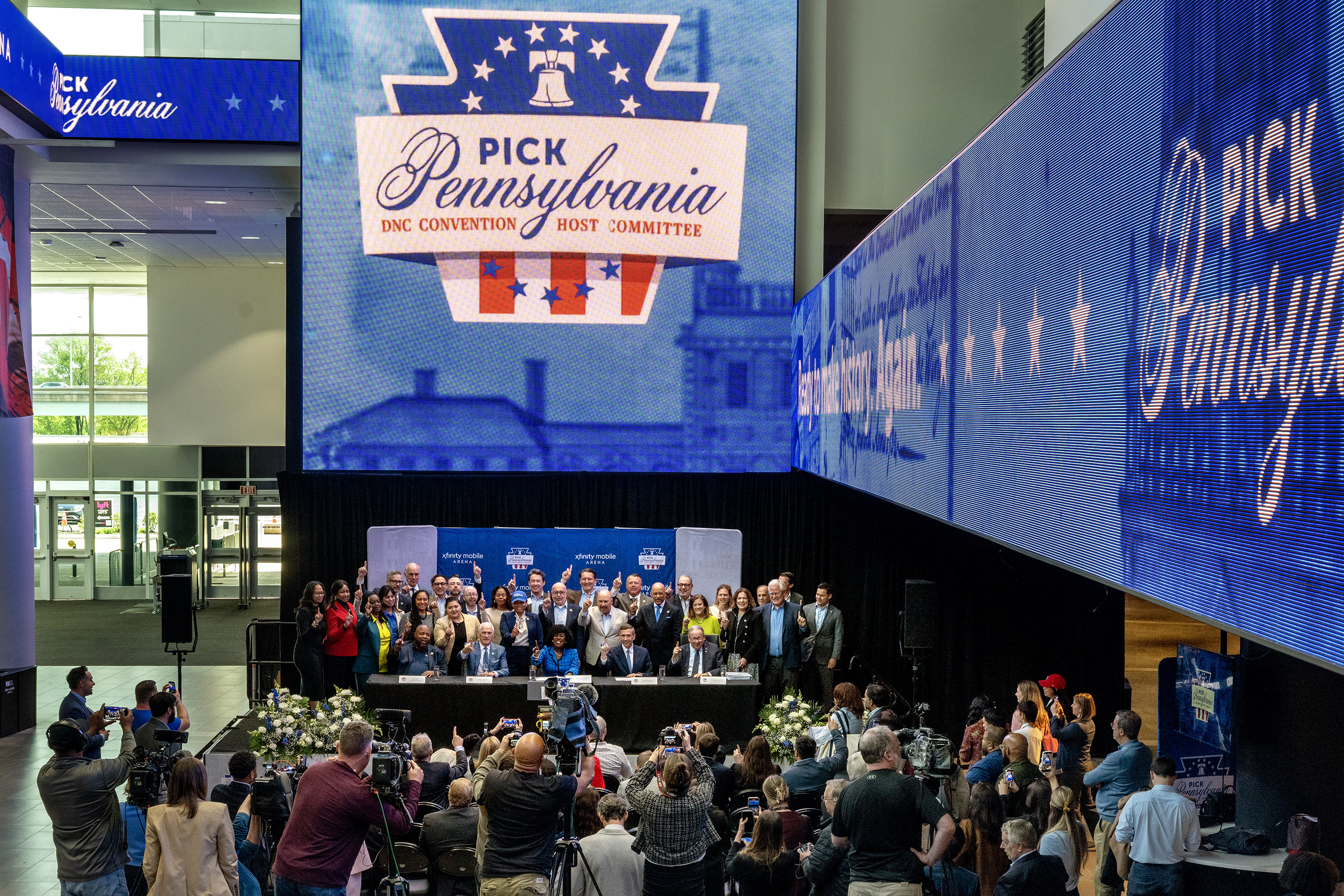
If Philadelphia is picked, the convention would take place from Aug. 7 to 10, 2028, at Xfinity Mobile Arena in the South Philadelphia stadium complex. The Republican Party’s 2028 convention will be held in Houston.
Democrats in 2028 will choose from an array of potential candidates to succeed President Donald Trump. No major candidate has formally launched a campaign, but Pennsylvania Gov. Josh Shapiro is widely considered to be a contender.
The announcement comes as Martin has faced criticism for his leadership of the party, especially as it relates to fundraising. Democrats trail Republicans ahead of this year’s midterm elections when it comes to money in the bank.
Mayor Cherelle L. Parker is joined by city leaders and Democratic National Committee Chair Ken Martin and his team for a “One City” salute group photo Thursday, April 30, 2026, after they toured the Xfinity Mobile Arena facilities as the city makes its bid to host the 2028 Democratic National Convention. Tom Gralish / Staff Photographer
The party’s decision to narrow its 2028 convention short list comes after Martin and other top officials traveled to the five finalist cities in the spring to assess logistical readiness, including arena capacity, technological capabilities, transportation and security infrastructure, and more.
In April, local Democratic officials and some of the city’s biggest boosters wooed Martin over the course of a three-day trip and presented the city as an improved tourist destination since 2016, the last time the party hosted its major convention in the city. That year, Democrats nominated former Secretary of State Hillary Clinton, who lost the general election to Trump.
The events draw thousands of party members and journalists from around the world, putting the host region in the spotlight for several days. Proponents of hosting the convention also argue that it will generate business as visitors eat, shop, and play; the true economic impact of conventions, however, is up for debate.
Mayor Cherelle L. Parker, who has led the city’s effort to bid for the 2028 convention, said in a news release that Philadelphia this year has “proven that we can do big things better than any other city in the country.”
She cited this summer’s litany of big events in the city, including FIFA World Cup games, the MLB All-Star Game and Home Run Derby, and events associated with America’s 250th birthday.
“We are ready to welcome the Democratic Party and the nation back to our city,” she said.
David L. Cohen, the longtime Democratic Party stalwart and president of Pick Pennsylvania, the city’s host committee, said in a statement that Philadelphia’s selection as a finalist “is a testament to the ongoing strength of our bid and our record of success.”
“We have presented an unmatched case,” he said, “built on experience, preparation, strong partnerships, and a proven ability to deliver major national and international events.”
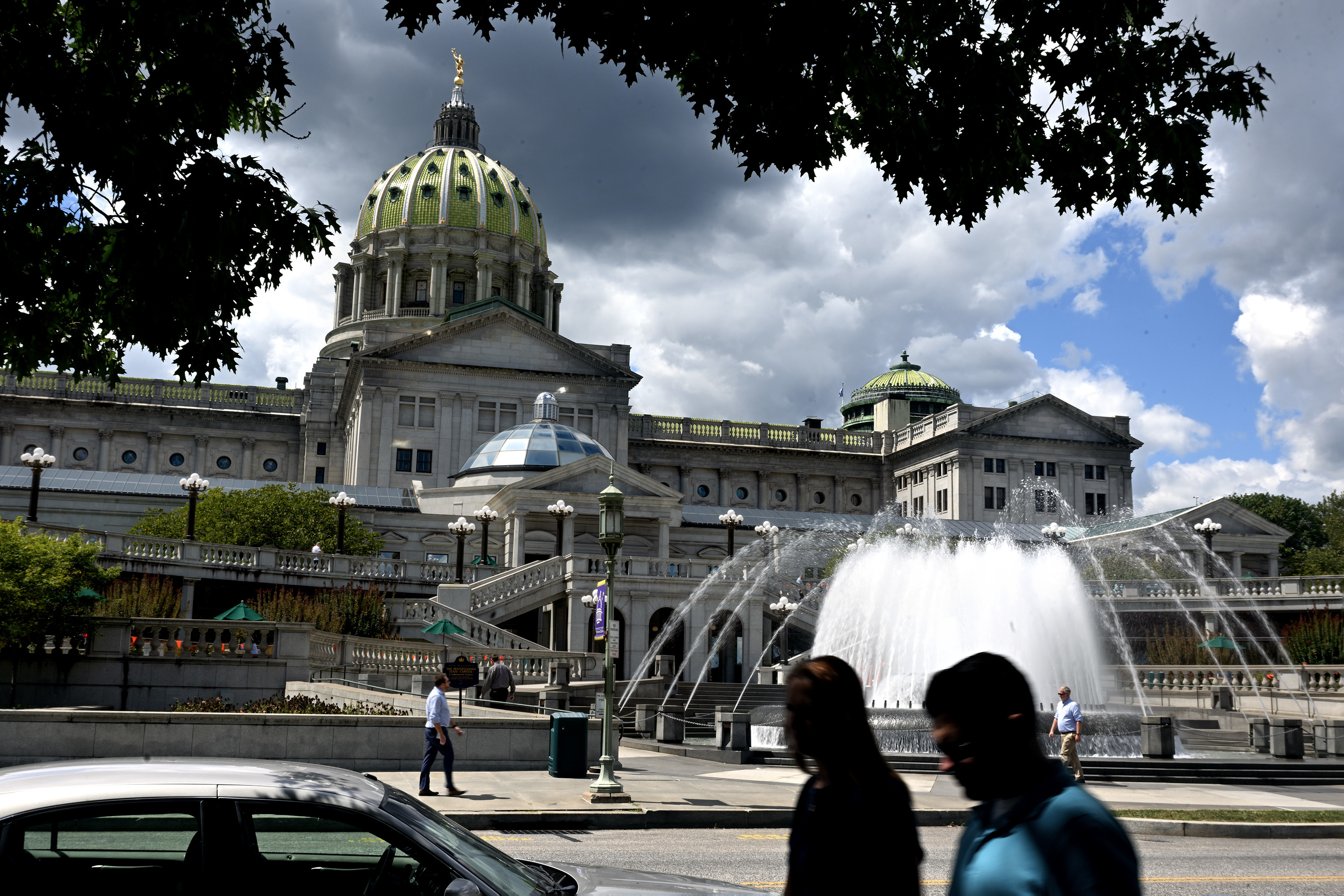
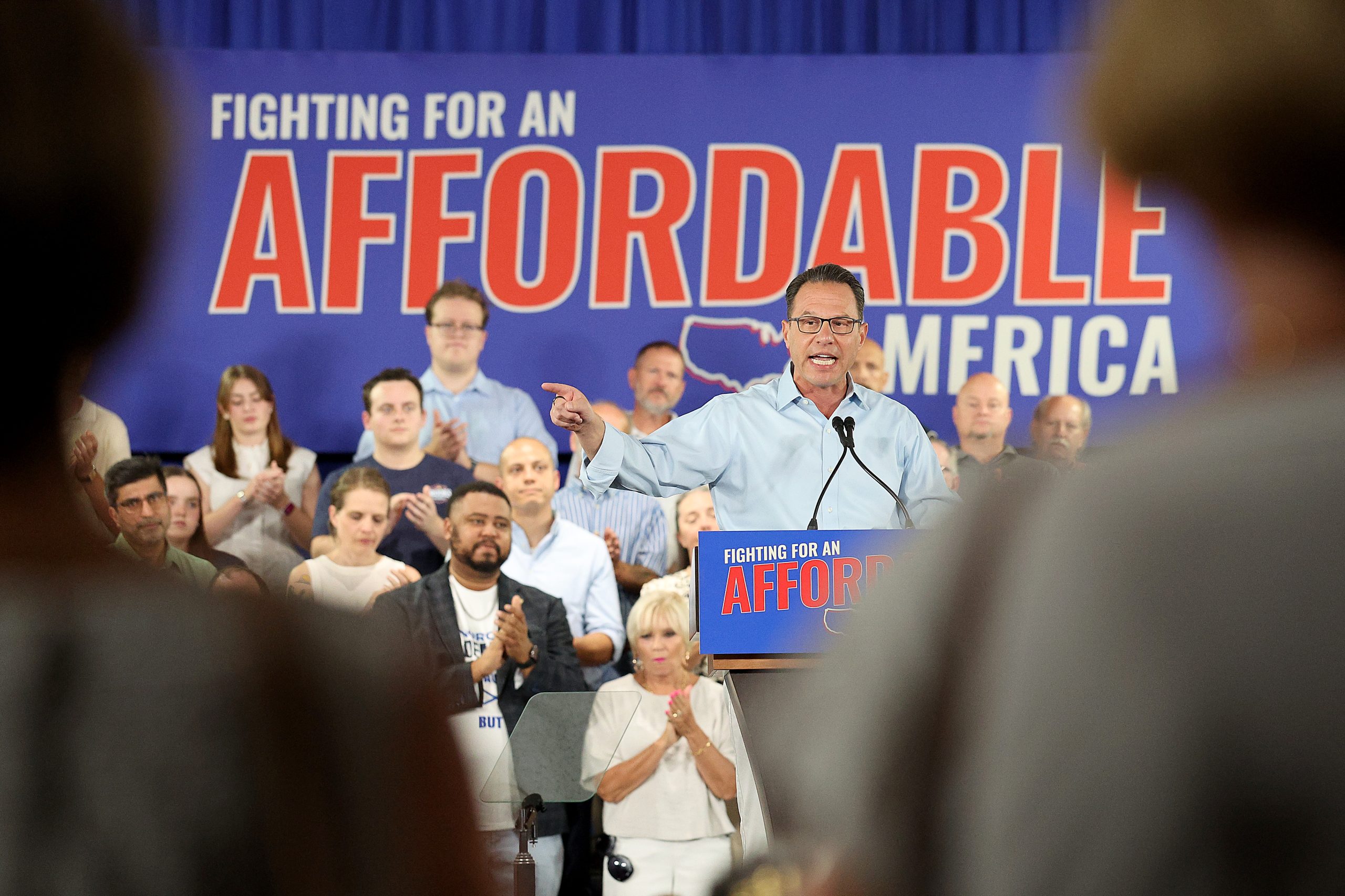
Pennsylvania Democrats, including Gov. Josh Shapiro, are pointing to a stunning upset in a special election for a deep-red state House district as proof that the party has momentum while campaigning this fall for a trifecta in Harrisburg.
Butler CountyDemocrat Brandon Dukes said his apparent victory over Republican Scott Timko, by fewer than 100 votes as of Wednesday afternoon, was thanks to his focus on local issues, such as a major corridor perennially under construction to the frustration of residents.
“We kept it local, we kept it practical, and we kept it common sense,” Dukes said in an interview.
The 12th Pennsylvania House District, just north of Pittsburgh, went for President Donald Trump by more than 18 percentage points just two years ago and had been held by Republicans since 1999.
Dukes’ apparent win attracted national attention Wednesday as both a sign of the backlash to the president’s party heading into November and as a north star for centrist Democrats as they seek a path forward.
“We won that district last night with a middle-of-the-road community leader, who I backed, who won this improbable race,” Shapiro told CBS Mornings, contrasting Dukes with the party’s more left-leaning candidates this cycle.
“What we’re seeing are commonsense folk from the community who, I think, reflect a lot more my values and my approach to governing who are winning and are upsetting Republicans in these deeply Republican districts,” said Shapiro, a moderate Democrat widely expected to run for president in 2028.
Shapiro recorded a robocall urging voters to cast ballots in the race, his campaign confirmed.
Recipe for November
Democrats are aiming to flip four congressional districts in Pennsylvania this fall and win control of the state Senate for the first time in 30 years with Shapiro, a popular governor, at the top of the ticket.
Dukes, who will compete to win the seat again in November in a rematch with Timko, shattered previous Democratic runs in the Butler County district.
“The fact we just flipped this seat tonight is a political earthquake,” U.S. Rep. Brendan Boyle, a Philadelphia Democrat, said on X.
The district had been represented for more than two decades by one of the Pennsylvania House’s most conservative members, former State Rep. Daryl Metcalfe, who retired in 2023 and was known for his anti-LGBTQ+ rhetoric and actions.
State Rep. Malcolm Kenyatta, a Philadelphia Democrat, said that the seat is one the party “should not have had a chance to come within sneezing distance of,” but that Dukes’ performance provides a blueprint that can be replicated throughout the state.
“Winning here means there is not a single safe seat for the GOP,” Kenyatta, a vice chair of the Democratic National Committee, said on X.
The Associated Press had not called the race as of Wednesday evening, but both parties made statements indicating that they expected Dukes’ lead to hold.
Chantell McCurdy, the director of Butler’s election bureau, said the initial count has been completed and there is a five-day period to challenge the results.
James Markley, a spokesperson the Pennsylvania Republican Party, said in a statement that the race needs to be a “wake up call for Republican voters,” and warned against policies from the Democratic Party’s more leftward flank.
While expressing confidence that the party would win the seat back in November, he also lamented the party’s inability to turn out voters this election.
“The General Election will come down to which party does a better job getting their voters to participate in the election using any legal means of casting a ballot. Democrats did a better job of this,”he said.
Pennsylvania Republican House Leader Jesse Topper of Bedford County downplayed the significance of the special election, calling the results “disappointing but unsurprising” because of demographic change in the district, the timing of the vote during the summer,and the unpredictable electorate for such contests.
“There is much more yet to unfold in the final months of the 2026 election cycle and we will continue carrying out vision for positive growth in Pennsylvania through November,” he said.
But Democrats noted that Dukes’ victory in the district would not have been possible if he did not work to win over Republican voters.
“You cannot win a deep-red district like this without getting at least a big chunk of independents and at least some Republicans” who are “rejecting the chaos and high prices of Donald Trump,” said Pennsylvania Democratic chair Eugene DePasquale.
“I think this is a recipe for a big November for the Democratic Party,” he said.
Dukes, a loan administrator, said he listed affordability, infrastructure, and education as the key issues for his campaign.
DePasquale said Dukes’ campaign worked because he “focused on issues that mattered in the district,” such as high prices and cuts to Medicaid andfood assistance under Trump.
But DePasquale dismissed the idea that Democrats should run only certain kinds of candidates to win.
“We need to be a big-tent party, and we need to have candidates that reflect their districts,” he said. “We are embracing candidates that spread the ideological spectrum of the Democratic coalition, and you’re going to see that lead to success this November.”
Statehouse campaigns often do not receive as much money or attention as congressional and statewide races, but Dukes received a boost from several major figures in the party.
He also boasted an endorsement from former Transportation Secretary Pete Buttigieg, another possible Democratic presidential contender, who said Wednesday that Dukes’ win “reflects voters’ readiness for change.”
Rematch ahead
After he is sworn in, Dukes will serve a roughly 2½-month term, following the resignation of former State Rep. Stephenie Scialabba, a Republican.
As an incumbent, he will then face a rematch with Timko in November for a full two-year term.
Dukes said he plans to “stick with what worked best” for his November campaign, which will include maintaining face-to-face contact with voters.
A graduate of the University of Pittsburgh, Dukes lives with his wife and daughter in Cranberry Township and describes himself as an “avid Star Wars fan” on his campaign website.
House Speaker Joanna McClinton, a Philadelphia Democrat, said Dukes’ win builds momentum for the party to make the case to voters about how electing Democrats achieves their goals on issues like codifying abortion protections and raising the minimum wage.
When state lawmakers return to Harrisburg in September, several issues await, including whether to tax and regulate skill games, finding a long-term funding solution to fund mass transit, and the use of cell phones in K-12 schools.
“When he gets started in Harrisburg in September, he’s going to be a part of the larger House Democratic agenda that’s been focused on affordability and on opportunities for all Pennsylvanians,” she said. “Voters were very motivated to make their values and their frustrations known at the ballot box.”
Dukes will provide votes that he can take back to constituents to further his reelection argument.
“It’s important to tell voters what you’re going to do to make their lives easier because that’s what we did, and we spoke about how we were going to do that,” he said. “It resonated pretty well last night.”
What a difference three words can make. For weeks, the American body politic has watched the strange relationship between Donald Trump and his ever-present 35-year-old aide Natalie Harp in a state of puzzled silence. Then, Georgia Democratic Sen. Jon Ossoff spoke at a weekend rally and said that Trump “doesn’t want to do the job” and would rather “build his ballroom and travelwith Natalie on their apparently defenseless flying palace.” The floodgates opened — on social media and sites like the Drudge Report and in angry retorts from the White House that only threw gasoline on the controversy. It goes to show what Democrats can accomplish when they’re not afraid to speak the truth.
An expert raises questions about Freedom Fuel and Venezuelan oil
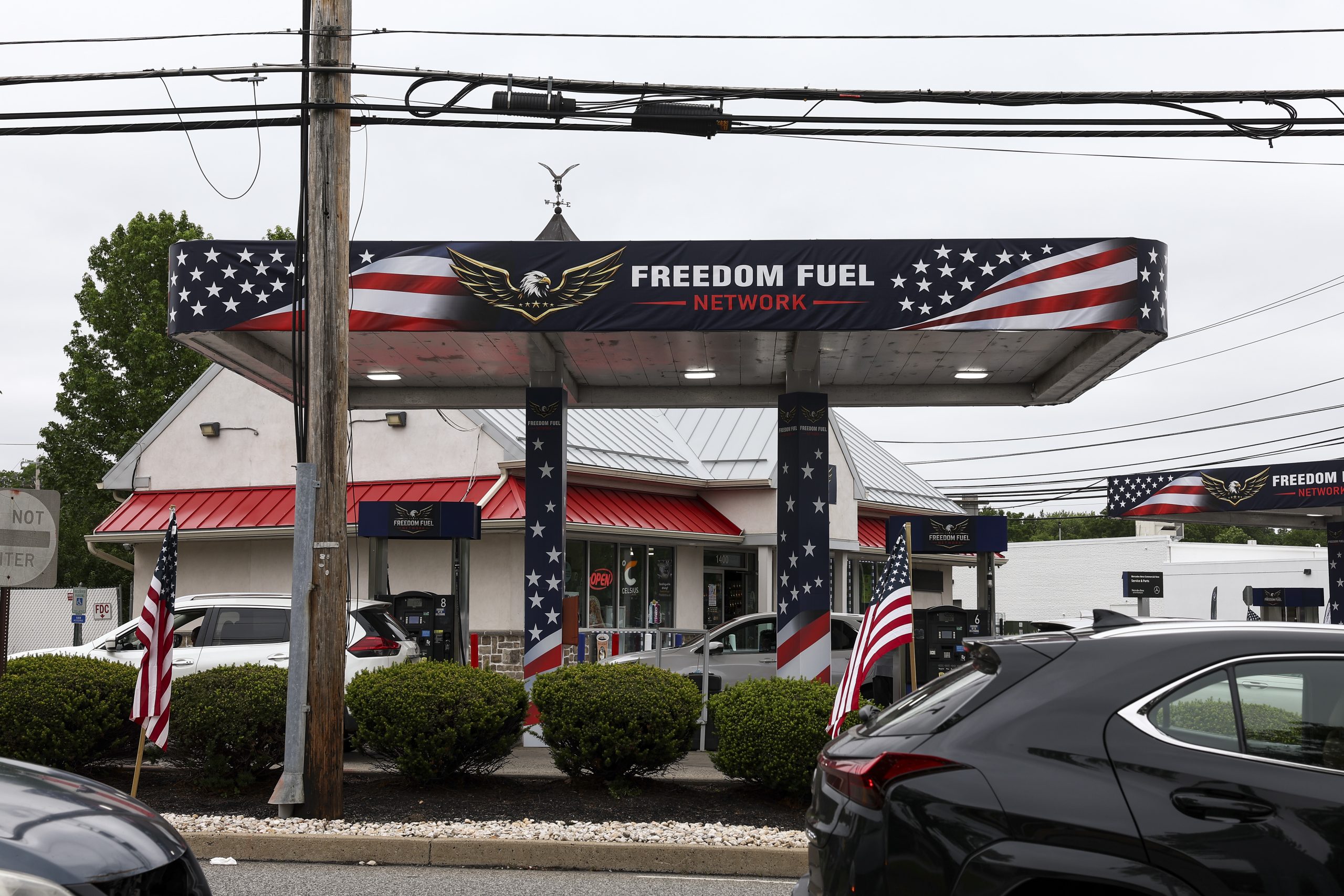
The Freedom Fuel Network gas station at 1400 Dreshertown Rd. in Dresher last month.
For a government that seems to be in your face 24 hours a day, the Trump regime has managed to produce more mysteries than Sir Arthur Conan Doyle. Where’s Melania? Why was the president’s butt sticking way out at his last event? But here in Philadelphia, one Donald Trump-linked mystery has confounded motorists for weeks.
Why is Trump-promoted Freedom Fuel, a web of 29 service stations that popped up out of nowhere this summer, able to continue to sell gas cheaper than its rivals down the street?
The mostly suburban stations in Southeastern Pennsylvania and South Jersey burst onto the scene with prices at $3.47 a gallon — lower than anything since Trump’s disastrous war of choice against Iran launched in late February — and continue to undercut their competitors by about 10-20 cents per gallon. Experts have said that’s not sustainable, unless the stations are somehow getting their gasoline on the cheap.
Now a former high-level State Department official in the Barack Obama administration is trying to connect the dots between the Freedom Fuel conundrum and the ongoing questions about millions of barrels of crude oil Trump has bragged that the United States has taken out of Venezuela.
Jonathan Winer, who recently wrote about Freedom Fuel and Venezuela for the Washington Spectator and discussed his findings on the Court of History podcast, doesn’t connect all the dots, but his research is a reminder of how little the American public knows about the aftermath of the Trump regime’s January assault on Venezuela that captured strongman Nicolás Maduro and installed a friendlier head of state.
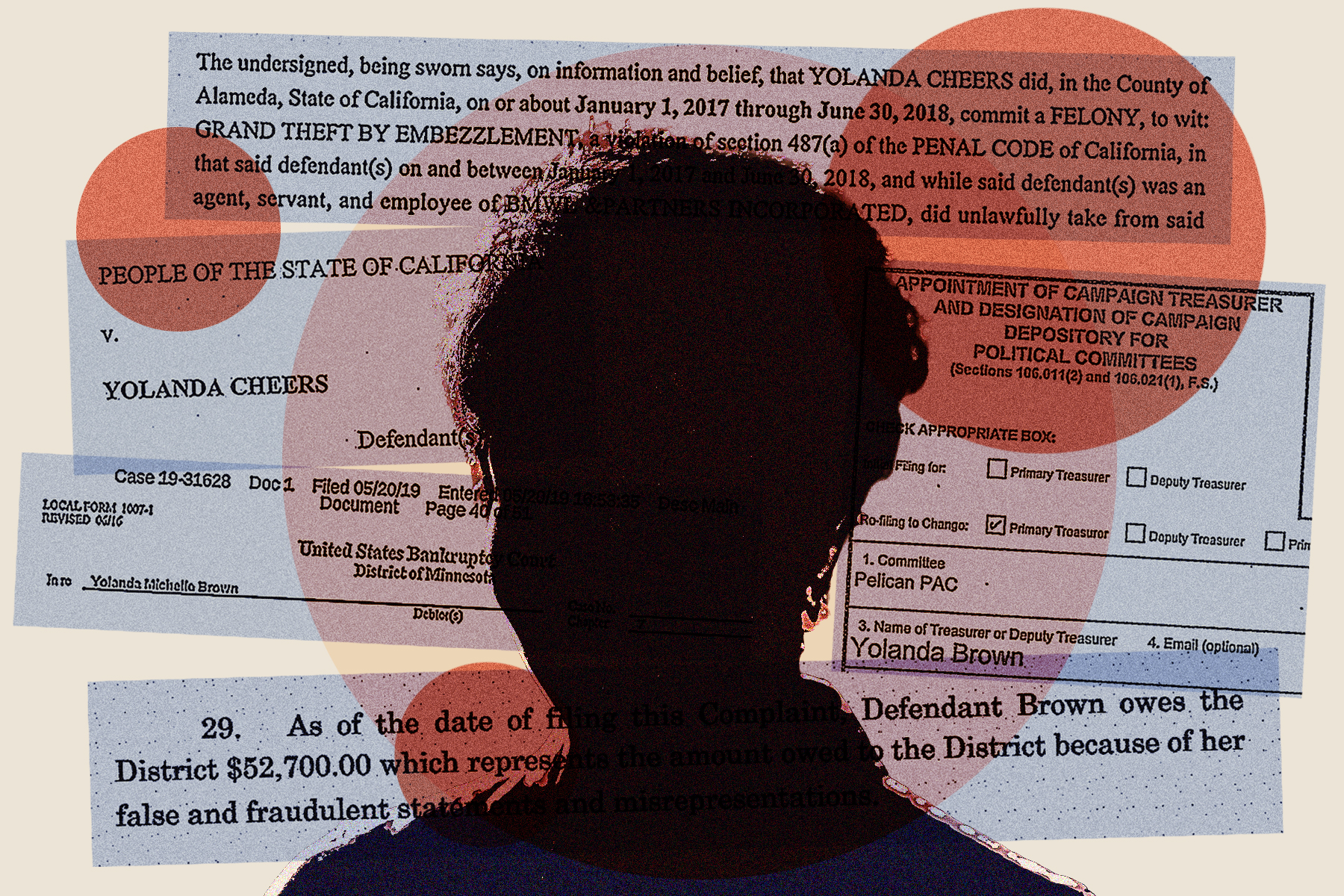
The Inquirer and other outlets have reported extensively on Freedom Fuel stations in Greater Philadelphia, including its ties to pro-Trump Republican ex-mayor of Evesham Township, N.J., Randy Brown, who signed Freedom Fuel’s certificate of formation. Former commodities trader Yoni Gontownik — a major donor to GOP causes and a New Jersey-based pro-Israel political action committee — also signed those papers.
Trump promoted the launch of Freedom Fuel on his Truth Social feed, but the White House has denied direct involvement in the flag-themed gas stations, and so has the companyitself. “Freedom Fuel Network is a privately owned and proudly patriotic company — along with its convenience store operators, haulers, sign companies, and operational partners — that answered President Trump’s call to action to lower prices at the pump,” it proclaims on its website.
Veterans in tracking the complicated oil market remain baffled. “People can’t mysteriously get fuel at a lower price and continue to offer that,” Winer said on the podcast. “You could, of course, do a very short promotion, but you basically can’t [sustain]it.”
It may be a total coincidence, but the giant enigma that is Freedom Fuel and its cheap gasoline surfaced at exactly the same time the president boasted about the cheap oil the United States is supposedly getting from the resource-rich South American nation his troops invaded.
“We’re taking their oil,” Trump proclaimed about Venezuela while in Las Vegas earlier this month. “To the victor belong the spoils.” He added that what America has taken has paid for the brief January war “many, many, many times.” But analysts know next to nothing about what is actually happening to as much as one million barrels of oil that Venezuela produces every day.
Winer pointed to a couple of common bonds between the efforts to market low-cost gasoline here in Philly and White House efforts to control the flow of Venezuelan oil.
The first is the role of Jarrod Agen, executive director of the National Energy Dominance Council inside the White House, who posted two photos of himself giving a thumbs-up at a new Freedom Fuel station in Philadelphia whenit opened on the July 4 weekend. Both Agen and the president himself insisted that the new gas retailer is proof of what the Trump regime is doing to lower prices at the pump.
Winer noted that Agen was also a key member of an American team that traveled to Caracas in April, met with the Trump-backed new president, Delcy Rodríguez, and came home bragging of new commodities deals, including in the oil sector.
The second overlap that Winer points to involves a Texas-based global commodities firm, Mercuria, which announced on May 1 that it had reached a major deal with Venezuela under what it called a “White House-supported initiative.” The announcement featured a photo of atop Mercuria official posing with Agen.
Mercuria told the Washington Post, which has also investigated Freedom Fuel, that it has no involvement with Freedom Fuel. Yet Gontownik, the trader listed as a backer of Freedom Fuel, was also listed as recently as March in campaign finance reports as an executive with Mercuria. But he also insists that he no longer works for the Texas firm — which has been linked to other Trump-regime commodities initiatives. (The ex-Philly journalist Maureen Tkacik, investigations editor at American Prospect, also raises a lot of questions about the role of Mercuria, Gontownik, and the firm Blue Owl Capital, which Trump invested in earlier this year.)
It must be stressed again that all of these connections are circumstantial. At the same time, this much cannot be disputed: The American people have not been given the most basic information about the extent of U.S. involvement in the Venezuelan oil trade, how much money is involved, or where all that money is going at a time when the price of crude oil has skyrocketed.
I could not agree more with Winer’s plea that Congress go after the U.S. Treasury, State, and Energy Departments that are sitting on undisclosed records of U.S.-linked oil transactions — even though realistically that might have to wait until Democrats gain a foothold on Capitol Hill next year. He also called on the media to dig deeper, which is why I wanted to amplify Winer’s early-stage reporting.
Look, we all want to pay less for gas, which is why motorists have been lining up at Freedom Fuel pumps since the stations opened last month. But most of us don’t want to live in a dying empire where a strongman’s tin soldiers steal a sovereign nation’s buried treasure so that favored insiders can profit. We still have no idea what’s been done in Venezuela in our name, and we need to find out.
Yo, do this!
It’s great that people — especially younger people — are returning to brick-and-mortar movie theaters in the long, hot summer of 2026, but the quality of the releases hasn’t really matched the boffo box-office numbers. That may change starting this weekend with the release of Tony, a movie that could have been titled “Becoming Anthony Bourdain.” The film stars Dominic Sessa playing the future chef, author, and beloved TV traveler as a lanky, awkward 19-year-old, spending a summer on Cape Cod and learning to embrace his love for the kitchen — and humanity. I’m really looking forward to this one.
There are two must-read articles out this week from Adam Bonica, a Stanford University professor who specializes in money and politics. The first is his lengthy investigation into dodgy fundraising practices by top Democratic Party committees and leaders, in which endless spam fundraising emails have hit home with susceptible elderly donors, some of whom have drained their life savings. The second is the story behind the story of how both the New York Times and the “Never Trumper” website the Bulwark both chickened out on publishing Bonica’s essential journalism. The cowardice of the elite media in America’s authoritarian moment is beyond disheartening.
Ask me anything
Question: Why aren’t more Democrats supporting and campaigning on the 32hour work week? It seems like a policy that would appeal to working people across the political spectrum. — brown cloud (@milehighdsa.bsky.social) via Bluesky
Answer: Good question. One political leader, Vermont Sen. Bernie Sanders, has aggressively pushed the 32-hour workweek without a reduction in pay, noting that this would pass the productivity gains of the computer era back to the workers who are being more productive. So, yeah, what’s not to like? It’s certainly true that a lot of Democrats, especially centrists, are heavily dependent on campaign contributions from corporate types who don’t like the idea of a shorter workweek. But I think ultimately, Democratic cowardice on these pro-worker issues goes all the way back to the Ronald Reagan era, and a fear that they’ll be branded by the GOP as the party of “free stuff.” But this isn’t free stuff. We’ve earned it.
What you’re saying about …
Last week’s question about how Democrats should view the primary success of leftists such as Michigan Senate hopeful Abdul El-Sayed drew a response that was both robust (despite the summer doldrums) and fairly unanimous. Proposals from the progressive movement like Medicare-for-All and taxing the wealthy, you agreed, are long overdue. Tom Lees noted that the GOP is trying to find the most extreme democratic socialists, but that “the [Rep. Alexandria Ocasio-Cortez] branch which supports ideas similar to European Social Democrats is the group that is getting people excited.” Craig Strimel added that leftist candidates have failed in the past, but “I also believe that we are so far deep in the current fiasco, and so damned close to total collapse of democracy, that we really are in an all-or-nothing situation right now.”
📮 This week’s question: Georgia Democratic Sen. Jon Ossoff has caused something of a political earthquake with his blunt criticisms of Donald Trump, including a reference to his ever-present young aide Natalie Harp. Has Ossoff crossed a line of incivility that’s a bad look for Dems, or are his criticisms a breath of fresh air? Please email me your answer and put the exact phrase “Ossoff comments” in the subject line.
Backstory on Jason Arday, casualty in the ‘war on woke’
Torchbearer Jason Arday carries the Olympic flame on the torch relay leg between Sutton and Merton in London in July 2012.Joe Giddens
There are two kinds of people in this world. There are normal folks who maybe get a slight whiff of news from the TV or when they boot up their computer, and never heard of a man named Jason Arday. Then there are people who (like me) spend far too much of their day on social media, and now know all about the charismatic Cambridge professor — the youngest Black man to reach those heights in the university’s long history — who came under fire for alleged plagiarism and biographical exaggerations.
The allegations apparently simmered from the day of Arday’s 2023 appointment, but boiled over in recent weeks. He acknowledged some citation errors in his 2015 doctoral thesis — mistakes that Liverpool John Moores University called “honest and reasonable” — but the allegations kept coming. They were fueled by a Cambridge colleague and self-proclaimed “race realist” who went on British national TV to lambaste Arday as “not smart” and label him as merely a diversity hire.
The famously not-laid-back British press went wild on the controversy, with literally hundreds of articles about Arday — not just the Fleet Street tabloids, but even the august Times of London, which ran 60 stories. The media frenzy over the young, dreadlocked sociology of education professor didn’t stop when Arday resigned his Cambridge post, saying that “the relentless accusations, speculation and public commentary have taken a profound toll on me and on those I love.” The media frenzy didn’t even stop when Arday was found dead in his home last Friday. He was 41.
Just one day after Arday’s body was found, Julia Hartley-Brewer, a host on a Rupert Murdoch-owned U.K. TV network, told her audience that Arday “was a liar and a fraud who was rightly exposed for what he really was by academics and journalists who were simply doing their job.”
I’m sorry, but as a lifelong journalist, I never realized that hounding a professor who wasn’t perfect but was loved by his students to his early death is part of the job. To the contrary, I think that good journalism might involve noting that scores of white professors and authors who’ve been caught and admitted to plagiarism or similar issues have been allowed to apologize and go on with their careers. And that bad journalism might be implying that Arday’s middling issues are some kind of commentary on any and every academic with darker skin — as opposed to researching the systemic racism that leaves a supposedly enlightened school like Cambridge with 0.4% Black professors, in an England that’s 4.2% Black.
The ghouls who hounded Arday to his death didn’t work in a vacuum. They tapped intoa disgusting narrative that way too many journalists and self-appointed public intellectuals are spreading not just in the U.K. and the rest of Europe, but here in the United States. They think the righteous COVID-19-era outcry against police brutality and a grossly unequal society was some kind of mania they’ve branded “Woke 1.0.” Never mind that the police were never defunded in 2020, not even close. The nattering nabobs of anti-wokeness won’t rest until every college classroom or airplane cockpit is made safe for white privilege.
Let me do my job as an opinion writer and tell you what I think about these mostly aging, mostly white, mostly male pundits who have so little to say about right-wing fascism that’s in power in America and on the rise in Britain and instead desperately cling to their status from the perceived threat of a few Black intellectuals. With key elections approaching on both sides of the pond, they opportunistically saw Arday as their latest chance to stir up white voters and preserve the status quo, even if that means tolerating an authoritarian police state. Now, a once-promising Black professor is a casualty in their glorious “war on woke.” Have they no shame?
What I wrote on this date in 2020
As I noted in this space a couple of weeks ago, there’s so much about the peak year of the COVID-19 pandemic that we’ve successfully tried to forget. That includes much about the consequential yet somehow anemic showdown between Donald Trump and Joe Biden, which included their virtual, prepackaged summer conventions. On this date six years ago, I grumpily covered the Democratic National Convention from my couch in Delco and — stop me if this sounds familiar — complained that the party was ducking progressive issues. “If viewers didn’t notice what the Democrats left out in their tightly scripted telethon so focused on Trump’s coronavirus failings and his paranoid style — such as climate change, gun violence, and the other things that young people across America have been marching for — the history books might.”
I’ve cut back on column writing this month, mainly because I’m working on a long-term investigation that I’m really excited about. In my one piece published this weekend, I took a deeper dive into the stunning reports that winter drone attacks on fishing boats off the coast of Ecuador — with eight sailors missing and presumed dead — were a covert operation by Donald Trump’s CIA. This callous disregard for innocent human life is the latest example of a White House death cult that must be held to account by a new Congress, and eventually by prosecutors.
It’s truly remarkable the extent to which public opposition to the data centers that support artificial intelligence, or AI, has gone from near zero to 60 mph (or maybe 80) in a matter of months — especially here in Pennsylvania. With public unrest over these behemoths around their air and noise pollution and impact on electric bills, as well as growing discomfort with AI itself, becoming a key issue in the fall election, The Inquirer has been all over this story. On Tuesday, veteran business columnist Joseph M. DiStefano looked at how major contractors are hoping that demand for new data centers will get them through an otherwise sluggish economy. That might be a pipe dream if municipalities respond to voters by rejecting these proposals, as happened last week with a massive facility planned for suburban King of Prussia. You’re going to want to read The Inquirer’s in-depth coverage of this debate before you vote in November, which means it’s time to finally subscribe. What have you been waiting for?
By submitting your written, visual, and/or audio contributions, you agree to The Inquirer’s Terms of Use, including the grant of rights in Section 10.
Seated behind his desk in the Oval Office earlier this month, President Donald Trump spoke directly to the camera in front of him. He turned to his right and looked up at the Pennsylvania Republican who, as he had indicated just a few weeks earlier, might very well lose her race for governor this fall.
“I think you can win,” he said this time, extending his hand to Stacy Garrity. It was a change in tune for Trump, who last month at an event in Pennsylvania said Garrity’s opponent, Democratic Gov. Josh Shapiro, was “expected to” and might win.
The president’s confidence in Garrity — and whether his support will extend beyond a handshake and a 17-second video with her at the White House — has become a critical question in the final stretch of the Pennsylvania governor’s race.
Down in the polls and lagging behind Shapiro’s unprecedented fundraising, Garrity has cultivated the president’s support and the potential boost, both financially and in Republican enthusiasm, that could come with it.
It is a risky strategy for a swing-state candidate whose party holds the White House, and particularly as polls show Trump becoming increasingly unpopular. Shapiro and his allies have enthusiastically promoted instances when Garrity, the twice-elected state treasurer, has leaned into Trump’s agenda and brand of politics.
But with less than three months before Election Day, it is not clear to what extent Trump or other key national Republicans will pitch in on her campaign.
State Treasurer and Republican candidate for governor Stacy Garrity holds a rally in Bucks County at the Newtown Sports & Events Center in this 2025 photo. Tom Gralish / Staff Photographer
Trump has not yet stumped in any significant way for Garrity in Pennsylvania, a swing state where he was a near-constant presence during his winning 2024 campaign. And he has not lent his vast political resources — including a Trump-aligned super PAC flush with $400 million — to Garrity or other Republican candidates as his party faces tough campaigns across the country in the midterm elections that will determine control of Congress.
Several gubernatorial races around the country are consideredcompetitive, a reality that also pits Garrity against GOP nominees who polling suggests have better shots of success. The same circumstances have doomed the most recent other Trump-endorsed Pennsylvania Republican nominees for governor — former State Sen. Scott Wagner in 2018 and State Sen. Doug Mastriano in 2022 — who never ended up with national support and lost by double digits.
Campaigns typically heat up after Labor Day, and there is still time for Garrity’s national allies to converge to boost her. But observers say the political reality is also evident.
“The president kind of looks toward two things,” said Samuel Chen, an Allentown-based Republican strategist who is not affiliated with Garrity andwho previously worked for Tom Corbett, Pennsylvania’s most recent GOP governor.
“One is loyalty to him. Garrity has been loyal, but has not necessarily been as vocal as some others have. The other side of it is he likes winners. He wants to endorse people who win,” Chen said. “Everyone in Trump’s orbit knows that Garrity has a very uphill climb.”
Not supporting ‘lost causes’?
The level of involvement from groups like the Republican Governors Association has been a key indicator of whether the party believes its nominee has a chance at winning recent gubernatorial elections in Pennsylvania.
The RGA is made up of GOP governors who collectively support one another’s agendas and campaigns. Democratic governors have a similar alliance.
In 2010 — the last time a Republican won the governor’s mansion in Harrisburg — the group was the largest donor to then-Attorney General Corbett’s gubernatorialcampaign, giving him $6 million starting in August of that year. Four years later and helmed by then-New Jersey Gov. Chris Christie, the RGA was once again Corbett’s biggest donor. It donated more than $5.8 million as Corbett became the first sitting Pennsylvania governor in decades to lose a reelection bid. Christie, preparing to run for president in 2016, stumped with Corbett multiple times.
The picture was starkly different in 2018 and 2022, when Republican voters nominated two candidates closely associated with Trump. Neither Wagner’s campaign against Democratic Gov. Tom Wolf nor Mastriano’s campaign against Shapiro ever became highly competitive — and the RGA and other national groups decided to sit out.
“We’re watching Pennsylvania very closely,” Arizona Gov. Doug Ducey, then the chair of the RGA, said in September 2022. He added that the group would not support “lost causes” or “landslides.”
The RGA would spend nothing in the state that year, even with Mastriano and former Trump lawyer Jenna Ellis pleading for assistance. Shapiro went on to trounce Mastriano by nearly 15 percentage points.
This year, RGA chair and Montana Gov. Greg Gianforte has not publicly weighed in on Garrity’s chances since issuing a brief, generic statement congratulating her after her unchallenged primary in May.
And the competitive landscape Republicans are facing across the country may mean Pennsylvania’s GOP nominee once again gets the short end of the stick. The RGA did not respond to requests for comment.
Even with Pennsylvania’s status as a preeminent swing state that went for Trump two years ago, there are nearly a dozen more competitive gubernatorial races across the country this fall, according to the Cook Political Report, a nonpartisan group that provides election analysis.
Georgia, Iowa, Nevada, Ohio, and Wisconsin — some of which voted overwhelmingly for Trump just two years ago — are all considered toss-ups. Four other states with Democratic governors — Oregon, Arizona, Michigan, and Kansas — are also considered more competitive than Pennsylvania, which is ranked as “solid Democratic,” according to Cook, despite Republicans like Garrity and Trump having won statewide two years ago.
The RGA, according to its most recent filing with the Federal Election Commission, had less than $1.7 million in its RGA Right Direction super PAC after spending about $16 million so far in the current election cycle.
Its recent spending has focused on Iowa, where Democrats are attempting to capture the governor’s office for the first time in two decades, and Kansas, where the RGA launched an ad this month.
“There’s always competition for limited resources,” Charlie Gerow, a longtime Harrisburg-based Republican strategist who also ran for governor in 2022, said of the intraparty competition for donors. “There’s only so much campaign funding to go around as everybody’s trying to get a piece of it.”
In July, Shapiro’s campaign announced he had raised $50 million since January 2025. The next financial filing deadline for statewide candidates is in September, but as of the last reporting cycle, he had outraised Garrity 10-1.
President Donald Trump brings U.S. Rep. Ryan Mackenzie (right) to the stage as he holds an event in Mackenzie’s Lehigh Valley district at Mack Trucks in Macungie Tuesday, June 23, 2026.Tom Gralish / Staff Photographer
But Matthew Beynon, a spokesperson for Garrity’s campaign, said she “does not expect, nor does she need, to go dollar-for-dollar with Josh Shapiro.” Instead, he said, she “just needs the resources to prosecute her case against Josh Shapiro … and she is on pace to be able to do so.”
Garrity looks forward to “continued support” from the RGA, he said.
Other national attention on Pennsylvania
After Mastriano’s disastrous performance in 2022, Republicans coalesced around Garrity — whose 3.5 million votes in 2024 were the most ever for a statewide candidate in Pennsylvania — as their best shot at defeating Shapiro.
But in the year since she received the party’s endorsement, Garrity has barely moved the needle. A Quinnipiac University poll in July found Shapiro leading Garrity 53% to 40% among registered Pennsylvania voters. Trump saw even lower scores: Just 39% of those polled approved of the president’s job performance.
A poll from a Republican-leaning firm promoted by Garrity showed her down, 50% to 43%.
Across Pennsylvania, she has also competed for attention and resources as her party prioritizes other major election battles this fall.
Pennsylvania Gov. Josh Shapiro addresses the audience during a rally for Democratic congressional candidate Bob Brooks at the United Steelworkers Union Hall in Bethlehem, Pa. on Sunday, July 26, 2026.David Maialetti / Staff Photographer
On the other side of the aisle, Pennsylvania’s top elected Republican — U.S. Sen. Dave McCormick — has endorsed Garrity but has not appeared to join in her public campaign efforts so far. A Trump ally and former hedge fund leader, McCormick has raised millions since his election in 2024, and political action committees associated with him have donated to other PACs working to elect Pennsylvania Republicans in Congress.
McCormick has hosted events and campaigned for Garrity, and he “will keep doing everything he can to help her win,” said Mike DeVanney, a spokesperson for the senator.
“He believes she demonstrates the kind of leadership we need and the kind that President Trump and many others have recognized as one that can move our commonwealth forward,” DeVanney said.
Gerow said McCormick undoubtedly could help Garrity down the stretch.
“He’s a prolific fundraiser. He has the connections, and he has the personality to raise large amounts of money. And he can be very, very helpful with the Garrity campaign if he weighs in with full weight,” Gerow said.
Garrity’s campaign said McCormick has been an “incredible supporter,” including with his earlyendorsement and connections to supporters.
Shapiro has also cultivated across-the-aisle relationships with some Pennsylvania Republicans who would be expected to promote Garrity.
In an April interview with Punchbowl News, U.S. Rep. Brian Fitzpatrick, a Bucks County Republican running for reelection in the nationally watched 1st Congressional District, said he thought Shapiro would win his reelection contest and should run for president, adding: “I think Josh is very, very smart.”
And during his 2022 run, Shapiro collected endorsements from other prominent Republicans, including Jim Schultz, a former Trump White House lawyer, and former Republican U.S. Rep. Charlie Dent.
The final stretch
Though the November election is less than three months away, that is still plenty of time in politics. Most ad spending does not start until September, and ground game efforts — door knocking, phone banking, and get-out-the-vote campaigns — get underway in the fall.
Winning Pennsylvania is a priority for Trump in the midterms, and Garrity’s campaign said she is “grateful” for his continued support.
On the state level, James Markley, a spokesperson for the Pennsylvania GOP, said the party is “fully invested” in helping Garrity beat Shapiro. Those efforts include training “thousands” of volunteers and working on education programs around early voting and casting mail-in ballots.
“The more Pennsylvania voters learn about Stacy Garrity, the more they love her,” he said in a statement. “The more Pennsylvania voters learn about Josh Shapiro, they realize he has no record to stand on.”
Gerow said Garrity’s challenge, with limited funds compared with Shapiro, is whether she has enough money to get her message out.
“The major concern for her immediately is to be able to tell her story,” Gerow said. “She doesn’t have the resources to tell that story effectively right now, and she has a great story.”
Buttons for State Treasurer Stacy Garrity and President Trump are left on a table following a VIP reception before a Garrity rally in Bucks County Thursday, Sept. 25, 2025. Tom Gralish / Staff Photographer
Throughout her campaign, Garrity has hammered Shapiro on several issues she said reveal his lack of transparency as a public official. She has held roundtable discussions blasting Shapiro for his early embrace of data centers, a position he has since distanced himself from after calling for new guidelines for their development. Her campaign released a video series online that questions his handling of criminal investigations. And she has repeatedly insisted that Shapiro, who is widely rumored to be running for president in 2028, is “more interested in Pennsylvania Avenue than helping Pennsylvania families.”
Samantha Reposa, a spokesperson for Shapiro’s campaign, disputed Garrity’s framing and emphasized that she has stood in lockstep with Trump on most of his positions.
“Garrity is now running to be nothing more than a rubber stamp for Trump and his agenda that’s hurting Pennsylvania families — and we will continue to hold her accountable,” Reposa said.
Given Garrity’s fundraising deficit, Chen said, he would advise her to focus on meeting individual people in the community, if he were running her campaign.
“Forget the GOP dinners. Start going to fairs. Start going to places that Republicans don’t show up. Start retail politics, and start introducing yourself to the state outside of Donald Trump, outside of modern Republicanism,” he said. “Tell the state what you’ve done for them and what you would do differently [as governor].”
Staff writer Joe Yerardi contributed to this article.
Iemad Saifo, the 65-year-old owner of Zena’s American Mediterranean Cuisine in Collingswood, has been released after spending two weeks in ICE detention at Delaney Hall in Newark, N.J.
Saifo emigrated to the United States from Syria in 2002 on a business visa and later sought asylum after the outbreak of the Syrian civil war. He was detained during a routine ICE check-in July 31.
Saifo is the primary caregiver for his 12-year-old son, who has autism. The elder Saifo also has spasmodic dysphonia, a rare condition that makes it difficult for him to speak, as well as chronic kidney disease.
Dozens of Collingswood-area community members wrote letters and signed a petition urging the court to keep him in South Jersey with his family.
As President Donald Trump pushes his mass deportation agenda, routine check-ins have become increasingly risky for immigrants. Immigration advocates say many of those who have been arrested at ICE check-ins were simply following government protocols.
Last week, New Jersey Attorney General Jennifer Davenport announced her office was investigating Delaney Hall after multiple detainees died there during the last year, raising concerns about the facility’s conditions and medical negligence. The privately operated detention center under contract with ICE has been the scene of fierce protests and political fights between the Trump administration and Democrats since its May 2025 reopening.
U.S. Immigration and Customs Enforcement said in a statement that Iemad Saifo was arrested both because he does not havepermanent status and because of a 2018 case in which he was indicted and found guilty of witness tampering and sentenced to five years’ probation.
“Under President Trump and Secretary Mullin, ICE is targeting the worst of the worst,” a Department of Homeland Security spokesperson wrote. “Nearly 70% of ICE arrests are of illegal aliens charged or convicted of a crime in the U.S.”
One of Saifo’s attorneys, Fiona Powell, credited the 150 notarized letters from community members testifying to his character with helping secure his release.
“This was an outpouring of community support like I’ve never seen before,” she said.
Those letters were authored last weekend during an event that friends, family, and community organizers hosted at his restaurant.
Many in South Jersey know Iemad Saifo from his restaurant, which opened in 2011, and from the nearly 10 years he previously spent working at a local 7-Eleven, said his 27-year-old daughter, Zena Saifo, for whom the restaurant is named.
Zena Saifo said she, her mother, and one of her brothers were granted asylum after the war began. Her father never heard back from the Department of Homeland Security on his asylumapplication, she said,so he later applied for permanent residency through his younger son, who was born in the United States.
“He’s always willing to help people, to give,” Zena Saifo said of her father.“People are really enraged and disgusted by what’s happening and doing everything they can to support him.”
Zena Saifo is still reeling from the day of his detention, she said, when she, her brother, and lawyers arrived at the Mount Laurel ICE office for the check-in around 7:30 a.m. and were made to wait until past noon. The Saifos’lawyer notified Zena her father would be detained. She tearfully pleaded with the ICE officer to let her say goodbye to him but was denied, she said.
“‘Was this the last time I saw my father?’” Zena Saifo recalled wondering in the moment. “It was just really, really devastating.”
In the period since Iemad Saifo’s detention, two of his sons,ages 24 and 26, have taken over the restaurant. His wife has stayed at home and taken care of the youngest. He turned 12 last weekend without his father present.
Zena Saifo said her father’s two requests of her in his absence were to water the family fig tree and to host a big celebration for her brother’s birthday.
On Friday morning, the family was en route to pay the $7,500 bond and pick Iemad Saifo up from Delaney Hall, Powell said.
The 2018 charge was brought up during the bond review, she said, but “in the end the judge was able to see that he’s an older man with a family who needs him and strong community ties and that he deserves to be home with his family.”
Going forward, Iemad Saifo’s legal team will do all it can to secure permanent residency for him. In the interim, Powell said, immigrants are always at risk of detention regardless of their circumstances. The Trump administration has issued 46,000 orders of removal or voluntary deportation since the start of last year in Pennsylvania, New Jersey, and Delaware, more than in the entirety of former President Joe Biden’s term. In New Jersey’s courts, orders of removal or voluntary departure rose 47% just between May and June, from 2,348 to 3,446.
However, to legally detain Iemad Saifo again, the government would need to show something about his situation has changed.
“It could take potentially months or years more in order to get him permanent status here, but we will continue doing everything we can to keep him here,” Powell said.
Gov. Josh Shapiro made a declaration in the early days of his administration: Pennsylvania is open for business.
The move would ultimately include promises to slash bureaucratic red tape, cut permit wait times, and offer a new direct line to Shapiro’s office for major corporations hoping to set up shop in Pennsylvania.
Pennsylvania would “move at the speed of business” and “get stuff done,” the new mottos used by his administration, he said. He’s campaigning for reelection in November on the same catchphrases, and boasting major successes like the 12-day repair of I-95 in 2023 that traditionally would have taken months to reopen as an example of how he can think outside the box to solve problems.
What’s more: He sees delivering for residents — showing them government can actually solve problems — as the future of the nationalDemocratic Party, while it searches for an effective message and messenger heading into the 2028 presidential primary, which he is widely expected to enter.
It was with this same spirit last summer that Shapiro announced the largest single private sector investment in Pennsylvania history: Amazon committed $20 billion in Pennsylvania that included two data center campuses in Luzerne and Bucks Counties. Pennsylvania scored the project because of its promise to fast-track permitting and use tax breaks for the massive developments.
“Pennsylvania’s gonna be better off. I think America’s gonna be better off, because we’re going to win the battle of AI supremacy and it’s going to be done right here in the commonwealth of Pennsylvania,” Shapiro said in an interview on CNBC’s Squawk Box on the day he announced the deal.
Gov. Josh Shapiro announces a $20 billion investment by Amazon in Pennsylvania data centers in Salem Township and Falls Township on June 9, 2025.
But in a year’s time, the politics — and public opinion on both sides of the aisle — have dramatically shifted on data center development. Shapiro’s early welcome of data centers has created an opening for criticism from his gubernatorial opponent and members of his own party.
Yet efforts to cut red tape have proven to be slow and overblown: Only six data centers are actually under construction in Pennsylvania since the announcement, and 10 have received at least one state-level permit approval, according to Shapiro’s office. Still, Shapiro’s popularity is being evaluated by some voters and anti-data center activists on a perception that he moved too quickly and sacrificed the state’s safety in favor of Big Tech.
“I am all about legislators and decision makers getting s— done. This version of it is reckless and it’s irresponsible and it’s not actually serving our people,” said Carrie Santoro, the executive director of progressive advocacy groupPennsylvania Stands Up who has been holding town hall meetings in communities around the state on data centers.
“Governor Shapiro intends to use all the tools available to him to stop the dozens of speculative data center projects that do not meet community needs and Pennsylvania should expect to hear more from him on that in the coming weeks,” said Shapiro’s press secretary, Rosie Lapowsky.
Now Shapiro, who otherwise maintains vast popularity ratings in the state, faces a vulnerability on one of voters’ top priorities as he heads into November, and a particularly sensitive concern among Democrats as he potentially vies for the party’s nomination in two years.
Many states, including Pennsylvania, had already begun welcoming the major projects, and some hyperscale developers plan to spend billions of dollars to build them. Pennsylvania’s General Assembly first approved a sales tax exemption for data center developments in 2021, when Shapiro’s predecessor, Democratic Gov. Tom Wolf, was still in office.
Shapiro, for his part, initially embraced data centers as an economic opportunity for Pennsylvania, bringing union jobs for construction workers to build out the physical infrastructure for the computers running AI software. He also wanted to position Pennsylvania to inherit the most benefit from providing space for AI to operate, leading not only other states but also other countries in the race to advance new technology. He and U.S. Sen. Dave McCormick (R., Pa.) appeared together as early embracers of the technology and the massive buildings needed to power it, speaking together during McCormick’s first AI summit in Pittsburgh last summer.
Sen. Dave McCormick shakes hands with Gov. Josh Shapiro at a panel discussing state investment and infrastructure at the Pennsylvania Energy and Innovation Summit at Carnegie Mellon University in Pittsburgh on July 15, 2025.Kaiden J. Yu / Staff Photographer
But as communities began to push back against the rapid proliferation of data center proposals, in part to protect their water and energy resources, Shapiro adjusted.
Shapiro, like many elected officials, has changed his positions and rhetoric on the unpopular developments. He announced his Governor’s Responsible Infrastructure Standards (GRID) as a way to incentivize developers to follow transparency and environmental requirements in order to receive tax breaks. And when the General Assembly failed to approve his GRID standards or any substantial data center restrictions, Shapiro said he’d act on his own, though it’s still unclear what that will entail.
“You want to build a data center there? You’ve got to bring your own power; you’ve got to pay for your own power. You’ve got to be transparent with the local community — tell them who the hyperscaler is, tell them what’s going to go on there. You’ve got to have a local benefits agreement to help that community. You’ve got to protect the water sources that are used to cool off those facilities,” he said in a June interview with GZERO.
The Democratic governor has been lauded nationally for challenging PJM Interconnection, which is the electric grid operator for Pennsylvania and 12 other states over its efforts to raise prices on ratepayers. He capped the price Pennsylvania consumers could pay through 2029, as residents fear rate hikes due to the data center boom.
But Shapiro’s plan on data centers is too little, too late, Santoro said.
“I saw the GRID proposal as him moving on this issue, and the thing that I am concerned about is he didn’t move enough to keep up with how much voters have moved on this issue,” she said.
Some of those voters would agree. A Quinnipiac University poll of Pennsylvania voters, conducted in early June, found just 24% of those surveyed — and 40% of Democrats — approved of “the way Gov. Josh Shapiro is handling data centers in Pennsylvania.” It’s a stark contrast to Shapiro’s overall approval numbers, in which he’s maintained above 50% approvals — record-high favorability ratings for a first-term Pennsylvania governor.
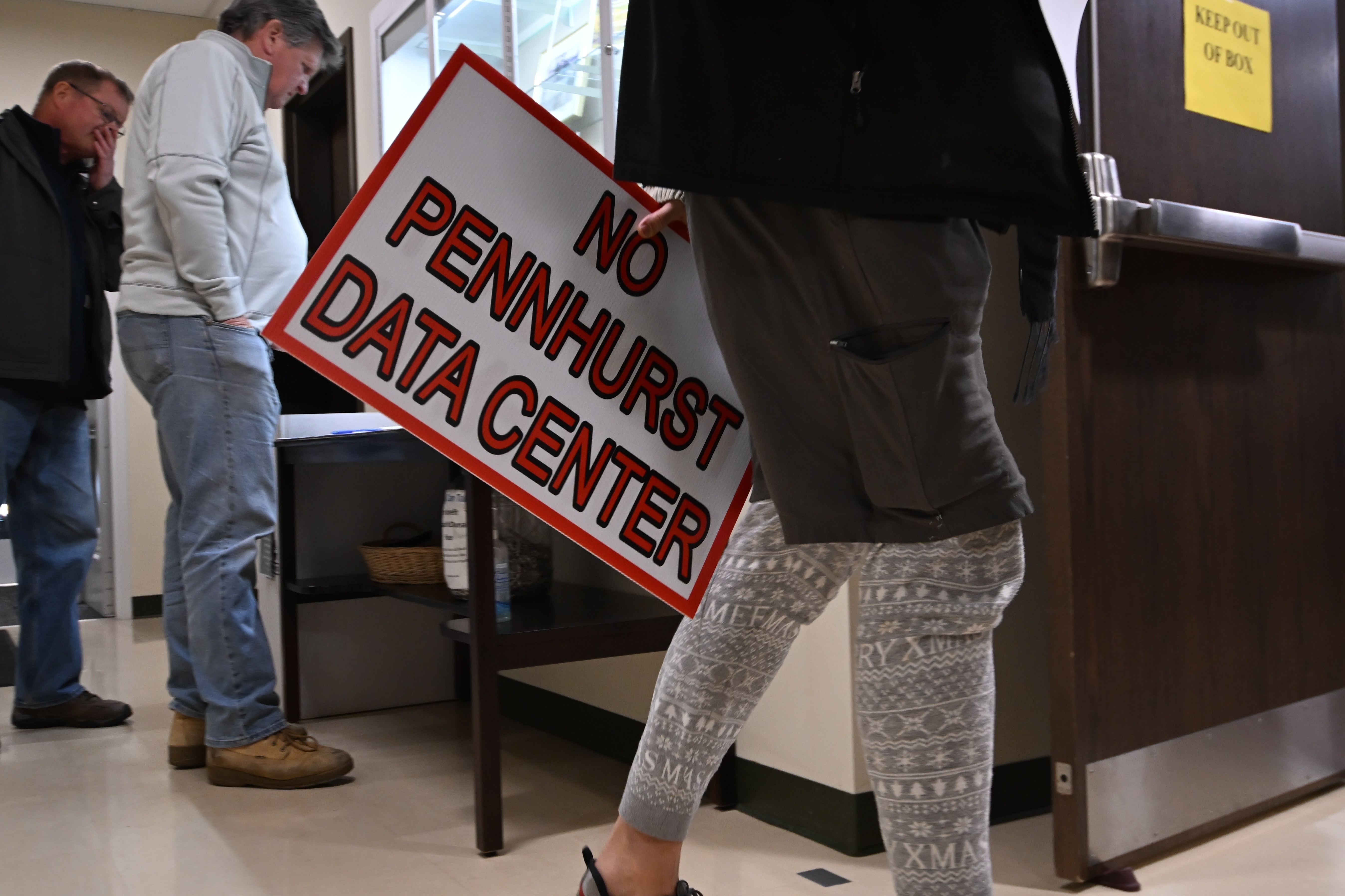
People sign in and head into an East Vincent Township supervisors meeting where an agenda item involved a data center proposal at the former Pennhurst state hospital grounds on Dec. 17, 2025, in Spring City, Pa. Marc Levy
Joanna Tenney, 36, of East Vincent in Chester County, held a sign at a June rally in the state Capitol that read: “Shapiro: Amazon’s bootlicker.” A registered Democrat, she voted for him in 2022, and believes he should be held accountable for supporting data center development in Pennsylvania that led to the fast-tracking of a now-stalled 125-acre data center project near where she lives.
She’s so fed up with Shapiro’s approach to data centers that she said will be writing in the name of her state senator, Sen. Katie Muth (D., Chester), who has been on the front lines of advocating for many state environmental issues, for governor on her November ballot. Tenney said she and a few other anti-data center advocates plan to run a write-in campaign for Muth.
“We’ve elected somebody that we thought was going to make the right choices by us, and we don’t really see that happening,” Tenney said.
Muth, who took office in 2018, said she would not be supporting Shapiro or “any elected official who puts the interests of Big Tech ahead of the health, safety, and future of Pennsylvania communities.”
If Shapiro changes his stance on data centers, she would support him, Muth said. She is the prime sponsor of a bipartisan bill to place a three-year moratorium on hyperscale data center development.
“Get right on the issue, Right your wrongs. If you can’t be on the side of science and people, my support is MIA,” she added.
Emily VanFleet, 26, lives in Archbald in Northeastern Pennsylvania, where six data center projects are underway comprising more than 50 buildings that, when completed, will cover 14% of the town. VanFleet, who is an unaffiliated voter, said she also supported Shapiro in 2022. But because of his public support for speeding up data center development in Pennsylvania, she is “certainly not going to vote for him this upcoming election,” she said. She isn’t sure she’s going to vote at all.
“I want Shapiro to stop being a coward,” VanFleet said in June. “I have emailed him, I have called him, I have reached out to him so many times. I have not heard back, not once. I see his videos all over social media that he has an open-door policy, but I have yet to see it.”
(In May, Shapiro’s administration announced that one of the unpopular Archbald developments, Project Gravity, was removed from a fast-track permitting program for failing to properly engage with the community.)
But negative attitudes toward Shapiro’s position on data centers may be limited statewide and his position is unlikely to dramatically knock down his high popularity or reelection odds: The June Quinnipiac poll found 56% of those surveyed approve of the way he is handling his job as governor overall, and recent polling shows Shapiro ahead 53% to 40% against his Republican challenger, state Treasurer Stacy Garrity.
The data center pitfall
Shapiro’s political opponents — both immediate and prospective — are also seizing on the issue.
Garrity, of Athens in Northeastern Pennsylvania, has also led a statewide listening tour on the topic. In June, she convened one of those sessions in Hatfield with a group of commissioners, zoning planners and emergency responders to talk about how they have been impacted by data centers. She blasted Shapiro for his role in attracting Amazon and said his proposed new requirements amount to a “flip flop.”
“Josh Shapiro has failed on this topic. He was the biggest cheerleader for data center development in Pennsylvania, until he wasn’t,” Garrity said at the June 24 meeting.
Pennsylvania Treasurer Stacy Garrity participates in the podcast “Ruthless” during an event hosted by Americans for Prosperity, Concerned Veterans for America, and the Libre Initiative at the National Constitution Center in Philadelphia on Jan. 29. Elizabeth Robertson / Staff Photographer
Garrity has her own mixed record on data centers.
At the time of the Amazon announcement, Garrity called the investment “great news” that would bring “historic investment” and “create thousands of jobs.” And her current position remains unclear. She has said she opposes a statewide moratorium but wants “a pause” on development instead.
Like Republicans running in districts that supported Trump in 2024 but oppose data centers, she appears to be attempting to find a pro-business and pro-regulation path.
“We want to make sure data centers are an addition to the grid, not a contraction. If there’s infrastructure that needs to be added to the grid, rate payers shouldn’t be paying for it,” she said. “I’m not opposed to data centers, but we have to do them the right way, and we haven’t done it. It’s because of a lack of leadership from the government.”
Garrity’s “long record of supporting completely unregulated data center development makes it clear that she just can’t be trusted,” said Manuel Bonder, a spokesperson for Shapiro’s campaign.
Local government leaders said at Garrity’s campaign roundtable in June that there has been lack of guidance around issues, especially around power demand, water use, infrastructure, environmental impacts, and community compatibility.
Kathie Doyle, a Republican on the Richland Township Board of Supervisors, said confusion around data centers have “set off a firestorm” in her community. Earlier this year, warnings of a supposed proposal for a data center in the Bucks County township circulated on social media, but turned out to be a “business park” with two buildings.
“Our residents don’t understand that we just cannot say no,” she said. Municipalities in Pennsylvania cannot outright ban data center development.
Santoro said Shapiro’s inconsistency is a liability that could sway some voters away from casting their ballot for him.
“Certainly he is giving her an ‘in’ by staying on the wrong side of this,” she said.
And it’s not just Republicans seizing on Shapiro’s position. The early reputation Shapiro earned as a champion of data centers may become a point of attack among other Democratic contenders for the presidency in 2028, too. In a veiled jab at Shapiro in June, Illinois Gov. JB Pritzker, knocked Pennsylvania on a businesspodcast for allowing Constellation Energy to restart Three Mile Island nuclear plant just to power Microsoft’s data centers.
“My guess is that’s going to be a reasonably unpopular thing to have done,” Pritzker said, without noting Shapiro by name on the Prof G Markets podcast.
Vulnerability for down-ballot Democrats
With a $50 million campaign war chest and high approval ratings, Shapiro is widely favored to win reelection this year. But his record on data centers could prove a liability for those he’s hoping to pull along, some advocates, like Santoro, say.
Shapiro has been staking much of his national political clout on his ability to flip four House districts in Pennsylvania for Democratic control of the U.S. House, drawing voters to the polls with his name at the top of the ticket. He’s also aiming to flip Pennsylvania’s Senate into Democratic control for the first time since 1993, giving him a Democratic trifecta in Harrisburg, as the state’s split legislature has blocked many of Democrats’ priorities from becoming law.
Santoro predicted that could be in jeopardy “if he does not change course.”
“Shapiro’s leadership on data centers will be the thing that costs us the first Democratic trifecta in 31 years, and I think that while he will likely win reelection with this wildly unpopular position on data centers, other elected officials and candidates will not,” she said.
Other Democratic candidates aware of data centers’ deep unpopularity are differentiating themselves on the issue, despite remaining otherwise aligned with Shapiro. Scranton Mayor Paige Cognetti, who is running in Pennsylvania’s 8th Congressional District, released a new ad last month putting data center developers on notice.
“Big Tech needs to pay their own way, not hide behind [nondisclosure agreements]. No tax breaks. Don’t raise our electric bills. Don’t poison our water. And hire local union labor,” she said, in the ad spot. “You can’t meet that? Then get out.”
Cognetti’s stance isn’t vastly different from Shapiro’s — both want to end blanket tax breaks — but her rhetoric is much stronger, and she’s putting the issue at the forefront of her campaign.
Democrats insist Republicans, including those running at the state level, don’t have the moral high ground on data centers after failing to pass through several measures that would have enacted stricter controls for their approval.
Sam Silverman, a former congressional aide and founder of Silverman Strategy Group, a strategic communications firm focused on technology and politics, said Shapiro’s approach to data centers — proposing a plan rather than enacting a moratorium — presents a risk that could either pay off and become the model for other states, or fail to fully address all future concerns and is unpopular.
“Shapiro is going out in front by proposing a bargain now. If the standards protect ratepayers, produce visible benefits, and hold bad actors accountable, Pennsylvania could have a model others can follow,” he said. “But because he is putting forward the deal now, he will be judged on whether it delivers.”
Taking a risk involves trust, though. Shapiro can afford to make a big swing at one of the hottest issues in politics because voters put so much faith in him, Silverman said.
“Most politicians do not have the amount of trust and political capital to take a risk, either,” Silverman said.
Whether the governor is triumphant will come down to what standards go into effect and whether bad actors are held accountable, he said, “and whether Pennsylvanians believe those standards are working.”
Do rich guys have to ruin everything? Apparently so. There came a time about 15 years ago when my soccer obsession got to the point where I felt I needed to pick an English Premier League team to root for, in addition to the U.S. national teams and the Union. Long story, but I went with Liverpool, in a city many consider the Philadelphia of the U.K., and it’s been a good ride, including a couple of trophies. On Monday, it was reported Amazon gazillionaire Jeff Bezos is buying 30% of the team. I’m officially out. Go, Leeds!
When did Trump’s ballroom become a national security fortress? We need answers.
Construction continues on a helipad and the White House ballroom on the South Lawn of the White House on Aug. 5.Tierney L. Cross
Donald Trump’s originally stated 2025 scheme to demolish the East Wing of the White House to make way for an oversized ballroom to hold state dinners and whatnot was bad enough: an unneeded, unwanted, gilded, and presumably tacky callback to Louis XVI, a massive monument to a modern let-them-eat-cake regime.
A year later, the project is better describedasan alleged ballroom — another bait-and-switch scam by America’s first grifter president. The fact that the public really doesn’t know how much this project actually costs — estimates have soared from the initial lowball of $300 million to now at least $600 million, but possibly more — or how much of that will be dumped on U.S. taxpayers is just the beginning of the problem.
Nearly 10 months after the president shocked Washington, D.C., and the rest of America by taking a wrecking ball to the history-packed East Wing, Trump has all but stopped talking about a black-tie party venue and instead rebranded the project as essential to national security.
When the D.C. federal appeals court on Friday ordered the White House, which never got congressional approval for either the demolition or the ballroom addition, to halt aboveground construction, Trump took to Truth Social and described the ruling as akin to treason.
“The Military and Secret Service are viewing this horrendous, politically motivated, and unlawful ruling as a National Security threat to our Nation in that the entire Complex is being built for the protection of our Country and, additionally, all future Presidents,” Trump posted, using language that’s probably never previously in human history been used to describe a “ballroom.”
Trump didn’t say in his post anything about crystal chandeliers, or great acoustics, or things you might expect in a world-class ballroom. Instead, he said the facility will have bomb shelters, a state-of-the-art hospital, top-secret military facilities, protective missile-resistant steel, columns, roofs, and beams, drone-proof ceilings and roofs, military-grade venting, and bullet-, ballistic-, and blast-proof glass.
It sounds like somebody is expecting a last tango in Washington.
Trump’s post was alarming — shocking, really — but in case anyone missed the point, or doesn’t know how to read, he also posted some AI-created renderings, which again did not depict waltzing diplomats, but instead showed a rooftop “DronePort” that was packed to thegills with ominous-looking military drones, manned by troops and also with armored vehicles that somehow drove up there. The vibe was Darth Vader’s Death Star, except with “military-grade venting” this time around.
There are two very different ways to look at all of this, and let’s start with the more benign one. Ever since the beginning of his second crack at the presidency, Trump — when he’s not pursuing his main projects of making billions of dollars, punishing his enemies, and staying out of prison — has been obsessed with placing his personalist stamp on Washington. Maybe that’s for his legacy, or maybe he just wants a Mar-a-Lago-by-the-Potomac to comfort his octogenarian mind.
Trump might not be able to crash weddings as he does at his Palm Beach, Fla., estate, but his ballroom idea would be close enough. Although he’s also sought and received donations for the project from the usual suspects of friendly billionaires and favor-seeking corporations, Trump also wants both additional dollars and — more importantly, in light of the appeals court ruling — a stamp of approval from Congress. That’s been a thwarted agenda item for GOP leaders on Capitol Hill for months.
But if Trump can’t sway Congress, he hopes to win over a U.S. Supreme Court where he has appointed three of the nine members. The White House knows that both Congress and the high court tend to fall in line whenever national security is invoked, while there is no constitutional right to foxtrot. So maybe all the military bluster is just political posturing for Trump’s latest real estate development.
But as the project enters its second year, it seems to have morphed into something a lot more disturbing than that. The pictures, descriptions, and accounts of Trump’s game here are sounding a lot more like the impregnable mountain lair of a Bond villain.
This is a man who fomented an attempted coup the first time he was asked to leave 1600 Pennsylvania Avenue, and who saw how South Korea’s corrupt right-wing president was ousted after a massive throng of protesters overwhelmed key government buildings. Wasn’t it Chekhov who said you don’t put drones up on the roof unless you intend to deploy them by the third act? The two most likely scenarios for actually using Trump’s bunker — Civil War II, or World War III — are less than optimal.
This national security bunker isn’t the only thing that’s worrisome as Trump looks to the second half of what’s supposed to be his final term. As noted in this space recently, Trump has also extended the presence of National Guard troops in Washington through Jan. 20, 2029, which coincidentally is the scheduled last day of his term.
Since their arrival last year, the Guard troops — many from units in pro-Trump red states, and costing U.S. taxpayers at least $1.4 billion and possibly more — have often been spotted hanging around, or picking up trash as a kind of busywork. But residents and some advocates like Scott Michelman, legal director of the American Civil Liberties Union of the District of Columbia, are already complaining Trump is “treating [D.C.] like a police state.”
It raises the same questions as the alleged “ballroom.” The president is entitled to state-of-the-art security, and while the public doesn’t need to know all of the operational details, American taxpayers also can’t be expected to fork over hundreds of millions of dollars for these projects without truly knowing what they are for.
Democrats on Capitol Hill need to start demanding answers. On Monday, there was an encouraging report by the New Republic’s Greg Sargent that the opposition party is working to demand communications from the Justice and Interior Departments to explain why several people were wrongly criminally charged with vandalism at the Lincoln Memorial Reflecting Pool when the actual damage was a botched repainting contract.
Congress can, and should, also flex its muscles over this ballroom fiasco — first by denying any public money for the project, and then by launching a similar investigation into the hasty demolition, the political fundraising, and the sketchy purposes for the project. Someone owes America the truth, and it’s not going to come from the current regime without a fight.
Whatever happens, the woman or man who hopefully succeeds Trump and sends those guard troops back to their own private Idaho in January 2029 is also going to have a giant mess in their backyard. But it’s better to have the ruins from a botched, halted construction project than from the Battle of Armageddon.
Yo, do this!
The California journalist Gil Durán has been paying attention to the political craziness coming out of Silicon Valley years before anyone else was, and now comes the big payoff in the form of a book that is not only incredibly timely but has the best title of the year: The Nerd Reich: Silicon Valley Fascism and the War on Democracy. Durán explores the strange beliefs of Elon Musk, Peter Thiel, Marc Andreessen, and their friends, their obsession with building their own private “networked cities,” and their unlikely alliance with Donald Trump. I’ve been waiting on this one for a while.
August is always a great month for books. While Durán drills down on the high-tech enemies of liberty, the great writer Dave Zirin has a new tome about one of democracy’s heroes, the late historian Howard Zinn, his former mentor. Public intellectuals are still arguing about the merits of Zinn’s 1980 masterwork, A People’s History of the United States, but nobody disputes his influence on the national conversation. Zinn rejected American exceptionalism, but also spotlighted everyday heroes like labor leaders or civil rights activists who expanded our freedoms over two centuries. I’m looking forward to reading The People’s Historian: The Outsized Life of Howard Zinn.
Ask me anything
Question: Data centers are the flashpoint but the root problem is the unregulated AI that is sweeping up every keystroke and every written document then repackaging it as if original thought. How do we get a federal government mired in 2020 to begin legislating on AI? — Suzi (@wanderponder.bsky.social) via Bluesky
Answer: Great question, Suzi, and I think we all know the main reason why the body politic — and I’m talking about both Democrats and Republicans — have been so painfully slow to respond to voters’ widespread anxiety not only about noisy, polluting, resource-wasting data centers, but also to artificial intelligence itself. The reason is money. Silicon Valley AI developers have raised an unbelievable $220 million to spend on November’s election, and — while there are some disagreements within Big Tech about policy — most of the cash will go to the politicians least likely to regulatean industry badly in need of it. Cognitive computing is not only stealing our intellectual property, as you noted, but also our jobs, as well as our children’s ability to learn.The good news is that public backlash against AI is so strong that even a quarter-billion dollars may not be able to stop the movement. But it’s way past time to get money out of politics.
What you’re saying about …
I should have guessed that newsletter readers don’t have much more of a clue than Donald Trump about what to do about the giant mess in the Persian Gulf. I did get one thoughtful response from an emailer with a “cbluff” handle (Reminder: Please sign your real name to these responses) who said the Trump regime needs to send skilled negotiators — and be realistic. “I believe the U.S. will have to cede the Strait of Hormuz, allow Iran and Oman to collect protection money, remove sanctions and pay them so we can declare victory and leave,” they wrote. It’s hard to disagree. Once again, the United States has lost a war.
📮 This week’s question: Since the Democratic Senate primary win by Michigan’s Abdul El-Sayed last week, the mainstream media has been obsessed with the question of whether this year’s progressive surge, including candidates (although not El-Sayed) tied to the Democratic Socialists of America, is hurting the Democrats. What do you think? Are leftists bringing needed energy to a moribund party, or are they too out there to defeat the GOP in November? Please email me your answer and put the exact phrase “Democrats and the left” in the subject line.
Backstory on the day Trump left his press corps for dead
Catering trucks are parked at Air Force One on the tarmac as the motorcade carrying President Donald Trump arrives to depart following the NATO summit, at Ankara International Airport in Ankara, Turkey, on July 8.Alex Brandon
It was appalling enough back in late July when we watched a room full of some of America’s highest-profile journalists break bread with Donald Trump at the rescheduled White House Correspondents’ Association dinner in Washington, where the president got up and hurled crude insults at several of the media members. Many of us were disgusted that some of the nation’s most respected journalists would platform a man who has repeatedly called a free press “the enemies of the people.” But the White House press corps was in the dark about an even more disturbing plot twist.
Just 16 days earlier, Trump had left some of those journalists for dead — at least potentially — as human decoys who might be blown from the skies in a feared Iranian plot.
The stunning story came out late Monday night as I was writing this newsletter, with a scoop by the Washington Post, matched shortly, with some additional details, by the New York Times. The articles revealed a modern-day Air Force One kind of thriller that essentially involved a shell game with three different aircraft. It was triggered by what officials deemed was a credible Iranian assassination threat against the president when he traveled to a NATO summit in Ankara, Turkey — just over 700 miles from the border with the U.S. enemy.
This launched a series of events, beginning with a plan to abandon Trump’s new, $400 million gift-from-Qatar iteration of Air Force One for an older version that actually has more advanced defensive capacities. Trump was filmed boarding the replacement Air Force One, followed by the White House press corps and some traveling aides for the departure from Ankara to a U.S. air base in Great Britain. What those passengers could not have imagined was that Trump had somehow been spirited out “via a catering container that had been lifted to the opposite side of the plane,” and switched to a C-32A military plane for the flight to the U.K.
Then they kept the unwitting journalists and aides on the ground for a couple of hours before it was revealed POTUS was safely in Britain and the Iranians had been thwarted and … haha, of course that’s not what really happened. No, the press corps took off as human decoys — the latest sitting ducks in an idiotic war that never should have been launched in the first place. Thankfully, no one was hurt … this time. Journalists wondered why they’d been ordered to keep the airplane’s window blinds closed, which inspired this now ironic exchange between Trump and some journalists when they reunited for the flight from Britain back to the U.S.
Trump lied that he didn’t know of any specific plot against Air Force One, and then added: “I’m No. 1on their list, before you. But if I go, you go. Right?”
Apparently not.
Even as I write this in the middle of the night just hours after the Post and Times scoops, the internet is already flooded with memes depicting Trump crammed into one of those airport serving carts, or pigging out on the adjacent airline food. It’s funny to see that your president isn’t Harrison Ford punching out the terrorists, but, in reality, slinking away in a food truck, leaving other Americans in the line of fire, right?
No, it’s not funny at all. This whole episode is a grand metaphor for a careless president who smashes up things before retreating into his money or whatever keeps him going — not thinking twice about the fate of human beings in a squalid ICE detention camp or an Iranian girls’ school. Or bantering with the gaggle of journalists whom he abandoned after drawing a big target on their backs. The first media question at the next Oval Office event ought to be, “Why did you treat me like cannon fodder?” But I wouldn’t bet on that happening.
What I wrote on this date in 2016
It’s almost funny now, in a dark-comedy kind of way, to look back on the fateful summer of 2016 and remember what it felt like to be stubbornly convinced that something, anything, was bound to happen to stop the obvious insanity of a Donald Trump presidency. It seems so incredibly naive now to read what I believed exactly one decade ago, when I actually thought the success of a diverse and incredibly talented U.S. Olympics team in Brazil would expose the Big Lie of Trump’s racism. I wrote, “The exclamation point is the remarkable women’s gymnastics team led by individual gold medalist Simone Biles — so dominant you will easily forget they also celebrate the kind of diversity that is America’s best feature, not the bug that’s described by the bitter and the disaffected back home.”
The fight for America’s future is waged on many fronts, and I’m trying to keep up. Last week, I wrote about a fascinating political development that’s been largely flying under the radar screen: a movement out west to knock off GOP incumbents by creating one-on-one contests with feisty, populist independents. That means long-shot Democrats need to drop out — which has happened in Nebraska, Idaho, and South Dakota, but not in Montana. It’s both a bold plan to end the Republican majority on Capitol Hill and a sad commentary on the failed Democratic Party brand in the American heartland. This weekend, I wrote about the Trump regime’s latest assault on higher education — denying loans for students who major in fields linked to lower-income jobs — and the increasingly bleak future of a liberal arts education. I wondered why Democrats won’t fight harder to end runaway careerism and preserve college campuses as bastions of critical thinking.
This August feels like the calm before the storm in Philadelphia sports. Some of that is the excitement over the Eagles finally beingback in training camp and looking to regain that Super Bowl mojo as 76ers fans try to process, if that’s the right term, a once-in-a-lifetime offseason rebuilding project. But much of it is angst over the Phillies, who are clinging by their fingernails to a playoff spot despite adding the National League’s batting champ to a lineup that already includes home run king Kyle Schwarber, future Hall of Famer Bryce Harper, and one of baseball’s best pitching rotations. None of that matters when the Phillies don’t have a relief pitcher who can carry a lead past the 7th or 8th inning. The Inquirer’s ace sports columnists like David Murphy and Marcus Hayes have all asked the same question: Can this team be saved? The answers are just over the paywall, and you can leap over it just like Saquon Barkley at the first-down marker; all you need to do is subscribe to The Inquirer.
By submitting your written, visual, and/or audio contributions, you agree to The Inquirer’s Terms of Use, including the grant of rights in Section 10.
The ultracompetitive race to replace Philadelphia City Councilmember Jeffery Young Jr. is officially underway.
With nine months until next year’s primary election, two candidates are already taking steps to challenge the first-term incumbent Council member from North Philly — and more may be to come.
“We’ve spent the last two years meeting with different community organizations, speaking with different ward leaders, and community groups, and just everyday people,” Alexander said in an interview. “This is going to be a people-powered campaign that really is grassroots.”
And on Friday, Curtis Wilkerson, who was the chief of staff to former City Council President Darrell L. Clarke, announced that he’s forming an “advisory committee” to evaluate a prospective run for the seat. The group will host community roundtables and neighborhood listening sessions to collect policy ideas and feedback from residents.
Wilkerson, who campaigned for the seat four years ago but did not make it onto the ballot, said he’ll likely decide whether to launch an official campaign by September.
A third potential candidate, Democratic political operative Kellan White, has been having conversations with party officials and labor leaders about running. White is a former deputy city controller who has managed and advised campaigns, including physician Ala Stanford’s recent unsuccessful run for Congress.
At least two others have said they are considering launching campaigns for Young’s seat: Dustin Dove, the president of the Fairmount Civic Association, and Max Tuttleman, a philanthropist who in 2023 unsuccessfully ran for seat on Council representing the city at-large.
The recent moves by several prospective candidates are the latest sign that the 5th District is likely to be the most crowded Council race this spring, when all 17 members of Council will be up for reelection and are expected to seek another term. The 5th District, which includes parts of Center City, North Philadelphia, and Fishtown, is overwhelmingly Democratic, meaning whoever prevails in the May primary is all but certain to win the seat in the general election.
Fifth District Councilmember Jeffery Young Jr., during the Barber’s Hall community legacy celebration, a daylong celebration of music, history, and community in North Philadelphia on Aug. 1.Yong Kim / Staff Photographer
Young’s campaign did not respond to a request for comment. In an interview last month, he said he intends to run for reelection and sees facing challengers as a normal part of the process.
“People have a right to do what they want in a democracy,” he said. “But I’m focused on myself and what we can do as a leader of the 5th Council District and get the constituents to understand that every decision that we make is to improve their life.”
The freshman lawmaker is seen as Council’s most vulnerable member in the upcoming election, in large part because of how he got into office.
In 2023, several other candidates — including Wilkerson, who was Clarke’s preferred successor — were kicked off the ballot amid a series of legal challenges questioning the validity of their nominating petitions. Young ended up being the only Democrat on the ballot.
Since January 2024 when he was sworn in, Young’s tenure has been tumultuous. He has championed legislation that at times has sought to slow or halt housing construction in parts of the district, drawing the ire of developers. Constituent groups have loudly opposed Young, specifically over his controversial plans for a popular library branch in North Philly.
And he has publicly clashed with Mayor Cherelle L. Parker’s administration, including in 2024, when he took the rare step of introducing legislation to authorize Council to subpoena the mayor.
Jalon Alexander greets supporters and community members as he kicks-off his bid in the 5th Council District seat, at a campaign event in Fairmount on Saturday.Bastiaan Slabbers / For The Inquirer
Young, 40, an attorney by trade, has something of an independent streak. He has at times aligned with different political factions, and he does not fit neatly onto the Democratic ideological spectrum.
Neither do some of his opponents. Alexander, 33, said he has progressive views on workers’ rights and keeping homes affordable, and he has built relationships with some leaders of the city’s progressive political organizations.
But the tenor of Alexander’s campaign is pro-growth. He said he wants to cut the city’s business taxes with the goal of eventually eliminating the business, income, and receipts tax. And he said he’s committed to facilitating more development in the district, including through the city’s Turn the Key program that provides mortgage support to some first-time homeowners.
Alexander has been particularly critical of Young’s use of councilmanic prerogative, the unwritten rule that gives district Council members an extraordinary level of control over land-use decisions and construction projects in their district.
Young has used prerogative to attempt to obstruct projects he opposes, such as the redevelopment of the former Hahnemann University Hospital. He introduced legislation to ban residential housing development in the area, a move he said was to preserve the area’s job-generating capacity, but he did not advance the bill amid opposition from interest groups and Parker’s administration.
Alexander — who was born and raised in Strawberry Mansion and still lives in the neighborhood — said his campaign is targeting Democrats “all over the tent.”
“There’s room for progressives. There’s room for people who are loyal Democrats but feel let down by the establishment,” he said. “We’ve got one goal: We’re fully committed to removing and replacing Jeffery Young.”
WASHINGTON — A new federal proposal to enact protections for communities opposed to the proliferation of data centers has drawn inspiration from both the Philadelphia suburbs and Western Pennsylvania fracking country.
The Data Center Bill of Rights is one of several national efforts to address a growing dissatisfaction with data centers, which have so far faced few restrictions at either the federal or state level in Pennsylvania.
U.S. Rep. Ro Khanna, a California Democrat and Bucks County native considering running for president in 2028, said his home state should be doing more.
He introduced thefederal legislation after a recent tour across Pennsylvania that he said was designed to hear from communities that have lost manufacturing jobs and other economic opportunities.
Data center concerns came up more than any other issue, he said — leading him to incorporate new ideas into the bill healready had in the works, and to call for a pause on data center development in Pennsylvania until further protections and local controls are enacted.
A statewide pause would be more than what Gov. Josh Shapiro — another potential 2028 Democratic contender — has proposed as he seeks to enact data center guidelines. It would also be less than other Democrats, both in Pennsylvania and nationally, who have called for more robust moratoriums. Shapiro’s Republican challenger this year, Treasurer Stacy Garrity, has also called for a pause but not for an extended moratorium.
“I was surprised by the anger about it in Pennsylvania,” Khanna said in an interview after his 15-county tour. “In other states, people are sometimes opposed in local communities, local pockets. But not this widespread anger.”
Khanna, a Council Rock High School graduate who has represented Silicon Valley in Congress since 2017, spoke about the Data Center Bill of Rights during his tour but said afterward that it was “partly inspired” by the concerns he heard in the communities similar to the ones where he grew up.
“As a kid, I used to go to Conshohocken and the King of Prussia Mall. I’m familiar with that area,” Khanna said. “You can’t ride roughshod over what Delaware County wants or when Montgomery County wants.”
The legislation would declare that communities have the right to reject data centers through a “transparent community process” or allow them with specific protections. That includes demanding that data centers don’t lead to higher electricity rates, that they use renewable energy sources and disclose their water consumption, and “pay their fair share of state and local taxes.”
State Rep. Chris Rabb (right) joins U.S. Rep. Ro Khanna (left) Tuesday, July 28, 2026, as he stops on his “Made in PA: New Economic Patriotism Tour” at the City Institute Library on Rittenhouse Square.Tom Gralish / Staff Photographer
One specific provision, Khanna said, was informed by his visit in Washington County with individuals who are paid to host natural gas wells on their properties. It was there that he said he learned of community demands for oil and gas well sites to be at least 2,500 feet from residences. That buffer was a recommendation from a 2020 grand jury report released by Shapiro when he was serving as attorney general and that outlined health and safety issues caused by fracking in the Marcellus Shale region.
The recommendation was not followed, and advocates are continuing to push for extending the buffer from the current distance of 500 feet, according to Inside Climate News.
Khanna’s bill of rights would call for data centers to be built no closer than 2,500 feet from residences, schools, childcare facilities, hospitals or nursing homes. He said the environmental and health hazards for data centers aren’t the same as fracking but they should be kept at a distance from communities that don’t want to live directly next to them.
“At least they were offering royalty checks in the cases of fracking,” Khanna said. “[Data center developers are] not even giving the communities checks. It’s just kind of like, ‘OK, we’re going to build.’ What does the community get out of it? I literally don’t understand it.”
Data center advocates have argued their development is critical in winning an artificial intelligence war with China, and that they will bring construction and some skilled jobs to communities that need them.
Even the staunchest advocates, though, have acknowledged the public blowback.
“I do think that data centers in Pennsylvania have raised legitimate concerns,” U.S. Sen. Dave McCormick (R., Pa.) said during a recent telephone town hall as he continued to promote them in the competition with China and their creation of “thousands of jobs.”
When developers are making their pitch, McCormick said they should come with commitments to protect energy costs and overuse of water, use local labor, invest in the community and pay taxes.
“That should be part of the deal up front,” McCormick said during the telephone town hall in late July. “With all those facts, then the local community can decide whether they want the data center or not. And if they choose not to, that’s their choice.”
Khanna said he’s hoping for bipartisan support as he introduces the bill of rights idea. He’ll also be competing with other proposals — like one from fellow progressives U.S. Rep. Alexandria Ocasio-Cortez (D., N.Y.) and U.S. Sen. Bernie Sanders (I., Vt.) called the AI Data Center Moratorium Act. The bill would enact an immediate federal moratorium on data center construction until other safeguards are passed into law, including some of the ideas Khanna and McCormick have proposed, like around utility costs.
Several Pennsylvania state-level laws have been proposed, though the legislature did not address them during its busy budget season earlier this spring and summer. Lawmakers also left Harrisburg without ending tax breaks aimed at incentivizing data center construction even though the idea had garnered widespread support.
“They shouldn’t be getting these tax breaks to build,” Khanna said. “That’s absurd when you’ve got hyperscalers that are making trillions of dollars.”
The fact that many of those ultra-wealthy corporations are based in his district made the issue a politically dicey situation for him, but also one that the possible presidential hopeful said he was willing to take on.
“We’ve got to pause it in states like Pennsylvania,” Khanna said. “Some of my own constituents aren’t going to like that.”
A Florida-based political consultant who once worked as the campaign treasurer for Philadelphia congressional candidate Chris Rabb was charged Friday with wire fraud after she defrauded more than 20 clients out of about $1 million, according to federal prosecutors.
Yolanda Brown was charged in federal court in Philadelphia with one count of wire fraud, according to documents unsealed Friday. She was charged by information, which typically indicates a person intends to plead guilty.
She did not have an attorney listed in court records, and attempts to reach a lawyer who previously represented her were not immediately successful.
Brown had been under scrutiny for months over allegations from campaigns in several states that she had mismanaged, embezzled, or taken unauthorized withdrawals from accounts meant to support political candidates.
And Rabb accused her earlier this year of making unauthorized withdrawals from his campaign accounts, saying he had fired her and reported the allegations to federal authorities.
State Rep. Chris Rabb greets supporters on Tuesday, July 28, 2026.Tom Gralish / Staff Photographer
While Brown worked on Rabb’s campaign in 2025 and early 2026 — identified in court documents only as “Political Campaign #1″ — prosecutors said she set up new bank accounts on which she could serve as a signatory. She then transferred $19,000 into one of those accounts, they said, and went on to steer about $6,000 into her personal bank account without Rabb’s knowledge.
In April, Rabb’s campaign said it identified about $160,000 that had been routed into the account Brown had set up. But it was not clear Friday how much of that may have been embezzled for Brown’s personal use, and it is also not uncommon for prosecutors to formally charge a more limited scope of wrongdoing if a defendant has agreed to plead guilty.
Still, in charging documents, prosecutors said Brown, who ran Brown Financial & Consulting Services Group and worked primarily with Democrats, committed her fraud against Rabb actions as part an “overall scheme” in which she defrauded about 20 clients out of more than $1 million. Prosecutors did not name the other victims, or offer details on how the other cases unfolded.
Brown has been accused of other wrongdoing in recent years.
Earlier this year, Ken Welch, the mayor of St. Petersburg, Fla., said Brown embezzled more than $200,000 from his campaign committee. Another Florida-based political consultant also accused Brown of wiring $25,000 out of PAC’s bank account.
And in 2024, Brown — who also used different surnames, including her married name, Yolanda Rumph — pleaded no contest to felony embezzlement in California, where prosecutors said she stole from two different companies, including a nonprofit. She was ordered to pay $330,000 in restitution but served no jail time.
An attorney for Brown, Khambrel Davis, told The Inquirer earlier this year that one of Brown’s employees — not Brown — had actually committed the most recent fraud in Philadelphia and Florida.
But the employee had since disappeared, Davis said, and “everyone’s just assuming [Brown] must have done this. They’re kind of putting together this narrative that she’s just this habitual thief.”