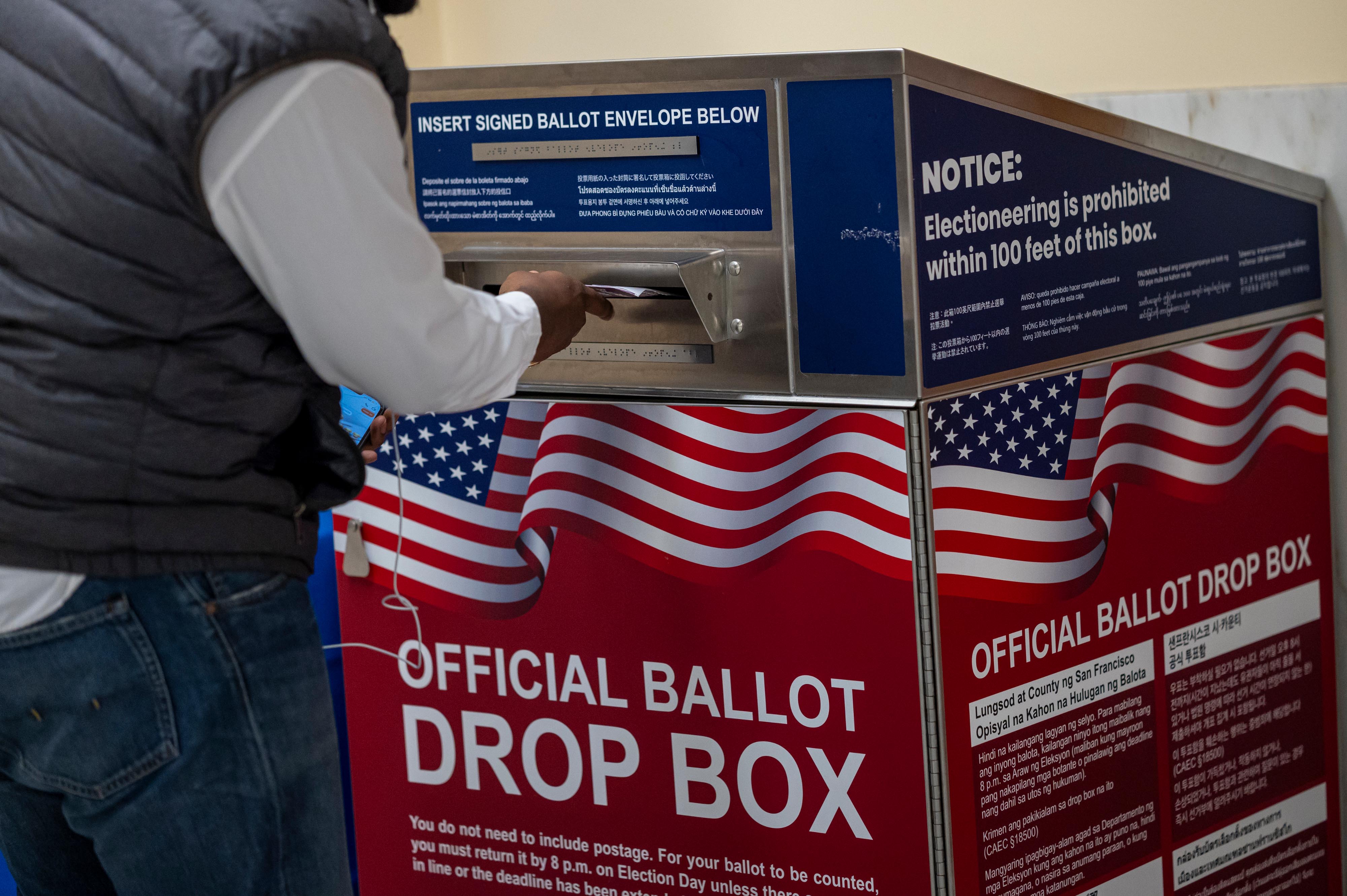
The Constitution clearly gives states, and not the president, the primary authority to administer elections. Congress has secondary authority, but only under emergency conditions. That means the president’s executive order, which directs various federal departments to impose rules on mail-in balloting if it is “feasible” and “lawful,” is more than a cynical attempt to save Republicans from losing congressional seats. His executive order is blatantly unconstitutional.
Yet, in a ruling that seems bizarre on its face, the Supreme Court has decided, with a crucial midterm election just weeks away, that Trump’s executive order does not interfere with the states’ authority “‘to create and enforce a legal code’ for elections.”
That’s nonsense. In my view, and in the opinion of 56 former judges who submitted an amicus brief to the Supreme Court, Trump’s order is all about interference. Changing rules just weeks before mail-in ballots are set to be sent to voters is an exercise in chaos. It is designed to hamper voting in blue states whose cities are filled with African American voters and others who tend to cast ballots for Democrats.
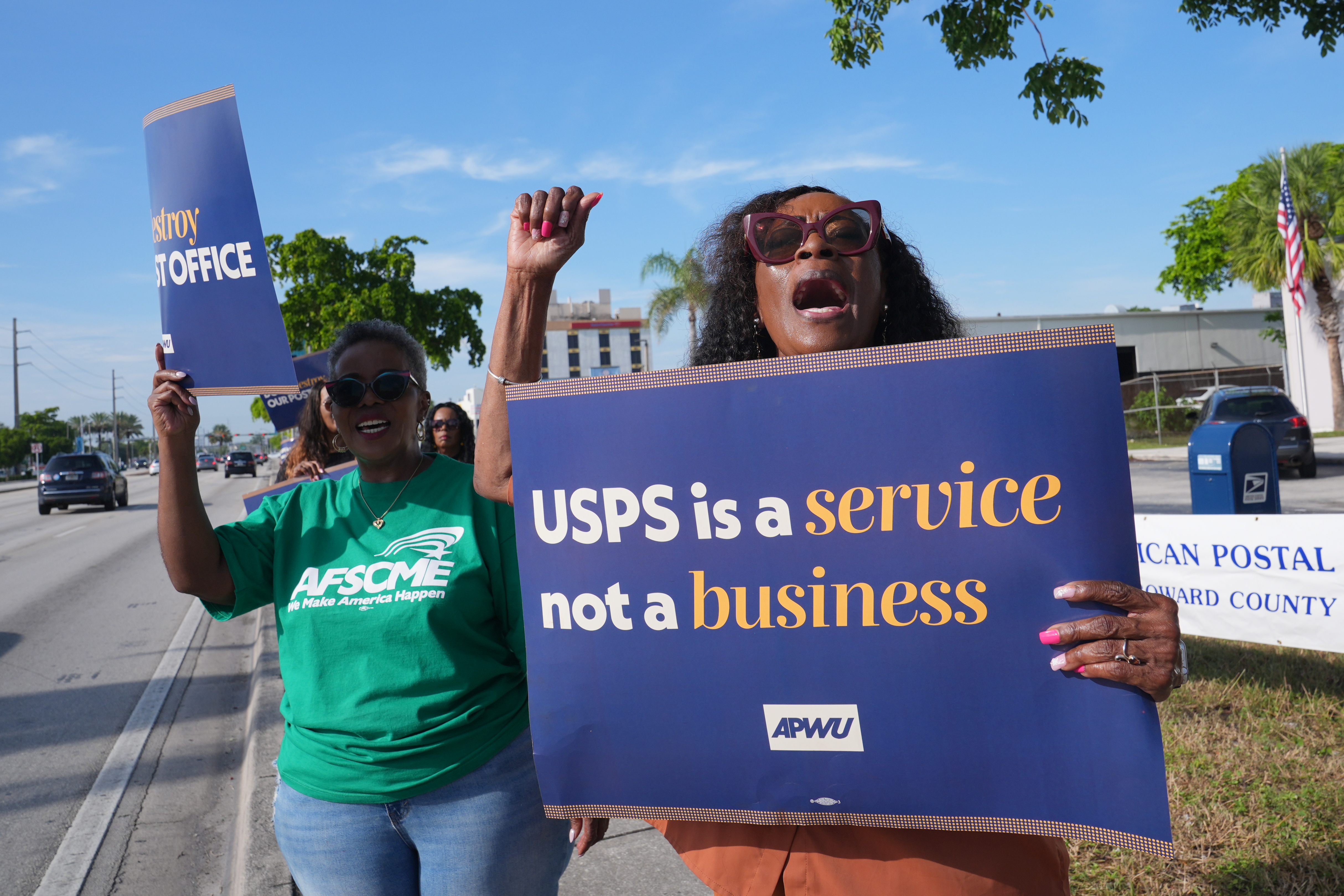
Joy L. Jackson (right) and Ketha Otis demonstrate against proposed changes to the U.S. Postal Service and President Donald Trump’s executive order regarding mail-in ballots in Miami Gardens, Fla., last month.Marta Lavandier
Voter suppression is the apparent goal, and the Supreme Court has played an outsized role in helping the Trump administration to get there. Even now, as the U.S. Department of Justice petitions U.S. District Judge Indira Talwani to reverse her nationwide injunction on Trump’s executive order, the Supreme Court looms in the background, ready to further erode democracy.
Of course, the threat posed by the court is about more than just one ruling. It is about the justices’ pattern of acceding to the whims of a president who seems to view the Constitution as a suggestion, rather than the law.
In 2024, the court shocked legal observers by ruling in Trump v. the United States that presidents have broad immunity from criminal prosecution for official actions they take while in office. And just a week ago, the court allowed construction of the president’s legally dubious $400 million ballroom to continue while lower court appeals play out, knowing the ballroom will likely be near completion by the time the courts catch up.
Still, the Supreme Court, whose 6-3 conservative majority includes three justices Trump nominated to the bench, does not have the last word on his policies. In America, the people have the final say. That’s why this latest gambit to cripple mail-in voting is so dangerous, and it is why the Supreme Court must be held accountable.
The people must sit in judgment of a president who starts a war that results in skyrocketing gas prices and American loss of life. The people must sit in judgment of a president who demolishes half of the White House without congressional approval. The people must sit in judgment of a president who wrecks the economy with illegal tariffs, and the people must sit in judgment of a president whose immigration crackdown costs American citizens their lives.
Polling has already indicated that Trump, whose 33% approval rating represents his all-time low, could drag his party down in the upcoming midterm elections. But as a seasoned politician once told me, the only poll that matters is the one that takes place on Election Day. Trump understands this truth, and he is trying to put his thumb on the scales. That’s to be expected, but he should not have the Supreme Court’s help.
At its best, America’s highest court should be apolitical, driven both by the letter and the spirit of the law. It should serve as a check on the worst instincts of politicians, and as a guardrail against tyranny. This court has failed on all those fronts, and has instead allowed itself to be driven and shaped by conservative ideology. It has fallen so far that it has seemingly been co-opted by those who would stop Americans from exercising their most basic freedom — the vote.
Gov. Josh Shapiro came to the Philadelphia suburbs on Friday morning to announce a new investment in a local police department. But the first question he fielded at a news conference concerned the growing confusion and political intrigue surrounding his administration’s response to two deaths associated with the state’s spiraling measles outbreak.
For the last three days, Shapiro, a Democrat, and Robert F. Kennedy Jr., the Republican heading the federal Department of Health and Human Services, have clashed over what the state has disclosed about the deaths and the consequences of Kennedy’s longtime anti-vaccination activism.
By Friday, Shapiro wanted to bring the focus back to an outbreak that has grown to more than 400 cases so far this year, saying “getting into a back-and-forth with people online who are spewing irresponsible conspiracy theories” does not “serve the public interest.”
But public health and communications experts say that the state’s initial refusal to share more information on the deaths created an environment in which anti-vaccination skeptics could spread their own narrative.
State officials announced the deaths of two unvaccinated Lancaster County residents at a news conference Tuesday, calling the deaths “measles-associated.” Their ages, causes of death, or their medical histories were not disclosed by the governor or his health secretary.
Within hours, other voices started filling the information vacuum. Lancaster County’s coroner told reporters that he had handled just one of the deaths. Coroner Stephen Diamantoni, a Republican elected official who is also a physician, said his office had examined a newborn who had tested positive for measles, but said the baby had not died from measles.
Soon misinformation and innuendo were spreading online out of the seemingly contradictory and limited details being disclosed by state officials, the local coroner’s office, and federal health leaders — all with their own political affiliations at a time when the safety of the measles vaccine increasingly divides Democrats and Republicans.
In response to the coroner’s statements, state health officials said they define a “measles-associated death” as one in which measles was present, even if measles is not identified as the immediate cause of death. Shapiro’s administration confirmed the newborn’s case was one of the two announced deaths, but offered no information on the second death.
President Donald Trump’s health secretary, Kennedy, pounced on the missing details the next day to spread misinformation. He wrote on X that the deaths may have been “fabricated” by the Shapiro administration and said in a television interview that “they cannot find any measles deaths in Lancaster County.”
Shapiro’s administration has called this inaccurate. Still, his administration has not revealed details of its medical review, beyond saying the state Department of Health’s epidemiology team had “thoroughly investigated.”
By late week, the Centers for Disease Control and Prevention, which operates under HHS, posted on X that state health officials were not sharing “information relevant to the outbreak” as it worked “to clarify conflicting information from Pennsylvania officials about whether the two reported deaths were caused by measles.”
State officials, including Shapiro, have repeatedly said the state is cooperating with the CDC.
But Pennsylvania health officials could have shared information on the patients’ ages, causes of deaths, and reasons for being unvaccinated, said Paul Offit, a physician at the Children’s Hospital of Philadelphia who heads the hospital’s Vaccine Education Center and is a vocal critic of Kennedy.
“It created fertile ground for conspiracy theories to thrive,” he said.
In a statement, a Shapiro spokesperson said the governor understands the “desire for as much information as possible to be made public.”
“However, when an individual dies, it is our legal responsibility to protect their right to privacy by maintaining patient confidentiality,” the statement said, noting this is critical to maintaining trust among communities statewide.
In a highly politicized environment in which measles cases are rising — and vaccination rates dropping — public health experts say it’s imperative for health officials to communicate accurately and transparently.
“You have to be transparent, be very clear about what you know, what you don’t know, what you’re trying to find out, and what questions are outstanding,” said Amesh Adalja, an infectious disease physician at the University of Pittsburgh Medical Center and a senior scholar at the Johns Hopkins Center for Health Security.
A lack of information from the state, he said, “created an information vacuum with people very adept at using information vacuums to spread their message.”
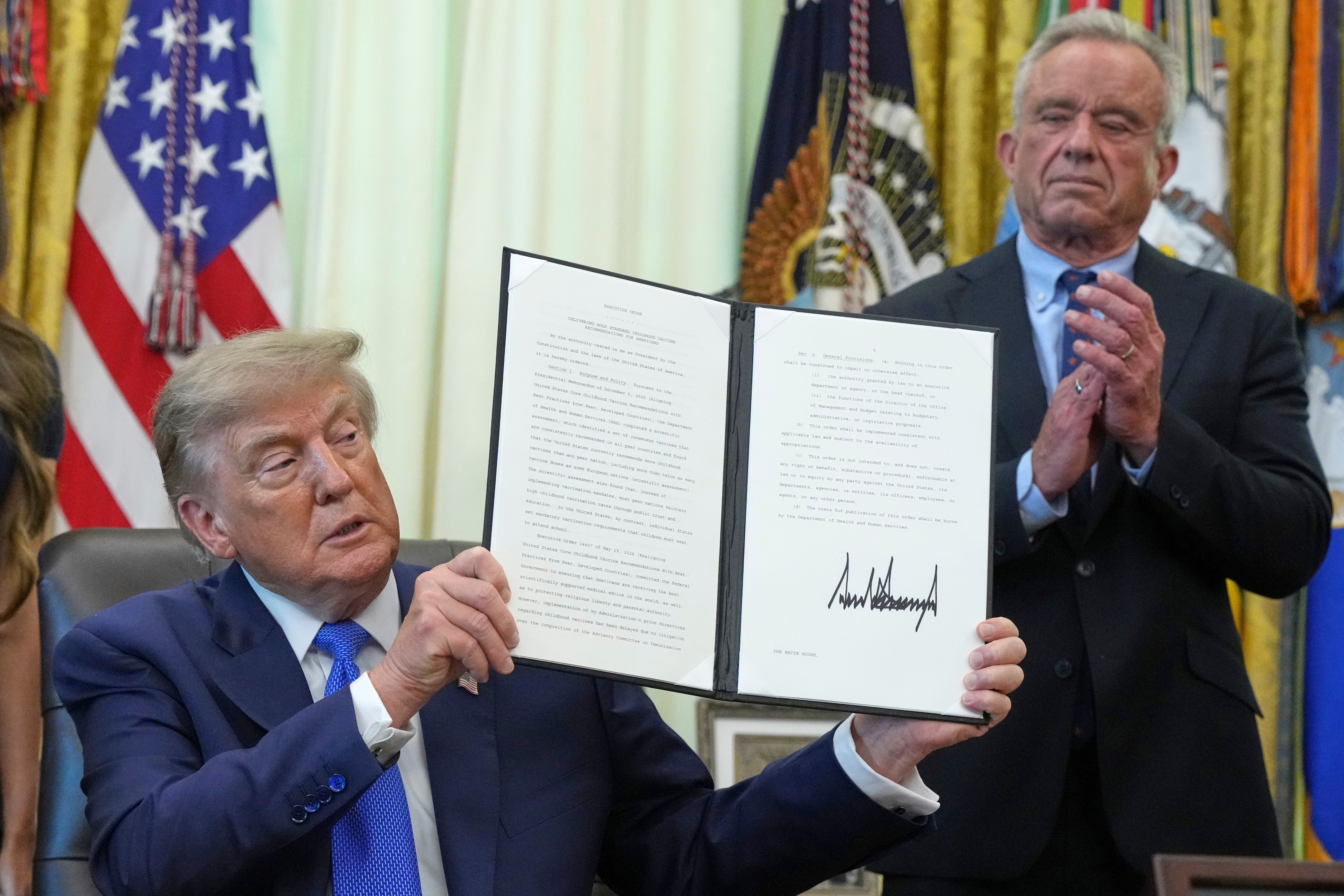
President Donald Trump holds a signed executive order about vaccines as Health and Human Services Secretary Robert F. Kennedy Jr. looks on Aug. 10 in the Oval Office of the White House. Jacquelyn Martin
What’s known about the Lancaster County deaths
Diamantoni said Friday that the baby died shortly after birth at a Lancaster County birthing center on Aug. 14.
Postmortem testing of the baby’s lung tissue showed that the baby had an active measles infection acquired before birth, he said.
He has not talked to the baby’s mother or the midwife who delivered the baby, and has not fully reviewed records from the birthing center where she gave birth, he said in interviews.
He told the Pittsburgh Tribune-Review that measles was listed on the baby’s death certificate, in a section of the certificate that reports other ”conditions contributing to death but not resulting in the underlying cause.”
He told the outlet that measles was included on the death certificate “to offer a broader view of the general health of the child.”
Babies can become infected with measles in utero if the mother is infected with measles and develops a rash within 10 days of giving birth, Offit said.
Diamantoni said a forensic pathologist in his office concluded the baby died of a ruptured spleen and cited trauma to the baby’s torso. He said he was unsure what had caused the trauma, and added that the baby’s spleen did not appear enlarged or infected.
Offit said that measles can cause an enlarged spleen that is then more likely to rupture — including during birth — and that it’s often difficult to tell whether a spleen has become enlarged once it ruptures.
A spleen also doesn’t have to become “massively” enlarged to rupture, he said: Measles can cause the spleen to become fragile, which also heightens the risk of rupture.
In conversations with state health officials, Offit said he learned that the patients who died in Pennsylvania would not have died were they not infected with measles.
He said the coroner should explain why the spleen ruptured, if it was not damaged from measles. Diamantoni said the office is still investigating the cause.
The state has released no additional information on the second death, and Diamantoni said his office was not handling it. He said his chief deputy spoke to the department prior to Shapiro’s news conference Tuesday.
“At no point was the Pennsylvania Department of Health told that this was not a measles-associated death,” a state spokesperson said on Friday. “The Shapiro Administration stands firmly by their comments on Tuesday.”
Public health communications
Pennsylvania’s health department has cited a state law prohibiting public access to death records, saying they cannot release more information on the deaths. Another state law requires the state to keep records of diseases confidential, except when it’s necessary to inform the public of the risk of communicable disease, a department spokesperson said in a statement.
The department “works hard to build and maintain trust in communities all over the Commonwealth — which includes doing everything possible to keep people’s identities confidential,” the statement read.
The department didn’t share information that could be used to “personally identify individuals or their grieving families” because “the circumstances of these individuals’ deaths do not change the Commonwealth’s response: Measles is a serious, highly contagious and preventable disease, and our focus remains on protecting Pennsylvanians, getting people vaccinated, and stopping the spread of this outbreak,” the spokesperson said.
But the state could have been more transparent about how they characterize deaths in a measles outbreak, said Kathleen Hall Jamieson, director emerita of the Annenberg Public Policy Center at the University of Pennsylvania.
People who are not trained in medicine may not understand the term “measles-associated,” for example, or how it differs from a cause of death, and state officials should have taken time at the news conference to explain what they meant by that term.
“You have an obligation to make sure that people don’t mishear on something as fraught as this topic,” she said.
Jamieson added that the political clashes around the deaths could overshadow a crucial point: A highly contagious disease is spreading in an under-vaccinated community, exposing children — including newborns unable to be vaccinated — to a serious illness.
“If we miss that moment, then the public health community has failed,” she said.
The 29-year-old Conshohocken resident recently got laid off from a local, financially struggling real estate company and is now trying to find work in a grueling job market for young workers where many of her applications are getting intercepted by AI bots, instead of a person.
That is a higher percentage than any in other age group in the poll, which found 58% of all Pennsylvania likely voters disapprove of the president.
Though 80% of young voters said they are satisfied with their own life, they overwhelmingly gave Trump low marks on his handling of the economy and other major issues in the United States.
Young people are overwhelmed by rising costs in what they see as an unstable economic and volatile international landscape with ramifications that they will one day have to shoulder.
“It feels like things are going downhill in a way that we don’t know how to recover, and our generation is going to be responsible for picking up the pieces environmentally,” said Harrington, a Democrat. “Also, politically, there are many things that have been done that are going to be hard to take back or that we have to figure out how to undo in the future.”
The poll, which surveyed likely voters in Pennsylvania between Aug. 17 and 21, underscores how deeply unpopular Trump is among the generation that came of age during his foray into politics and could foreshadow where the state’s politics are headed beyond November’s high-stakes midterm races.
“Young people are feeling as though they simply don’t have the same level of opportunity as do older people,” said Don Levy, director of the Siena Research Institute.“They are dissatisfied,” he added, and contending with housing expenses, the prices of goods and services, and how much it costs to get married.
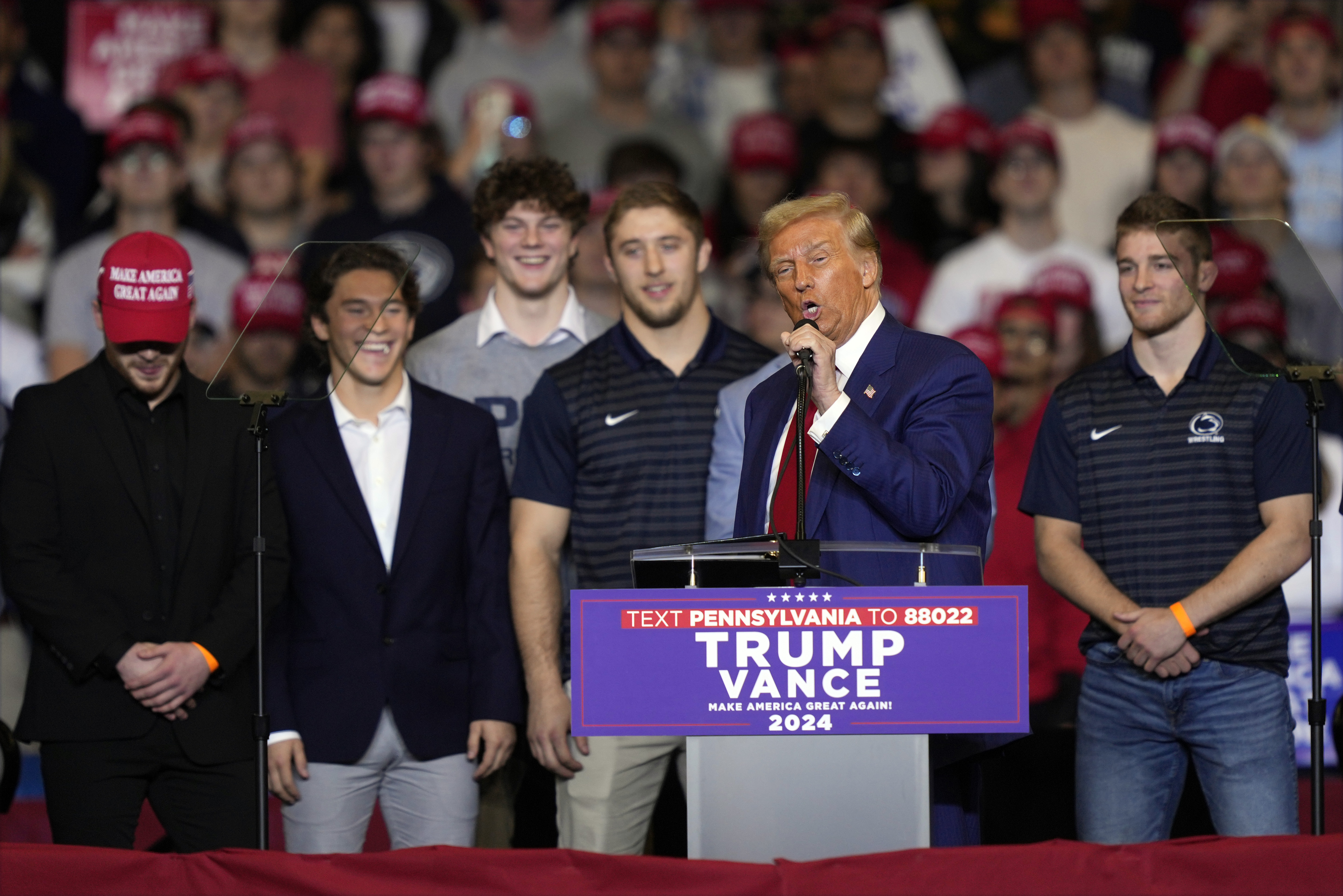
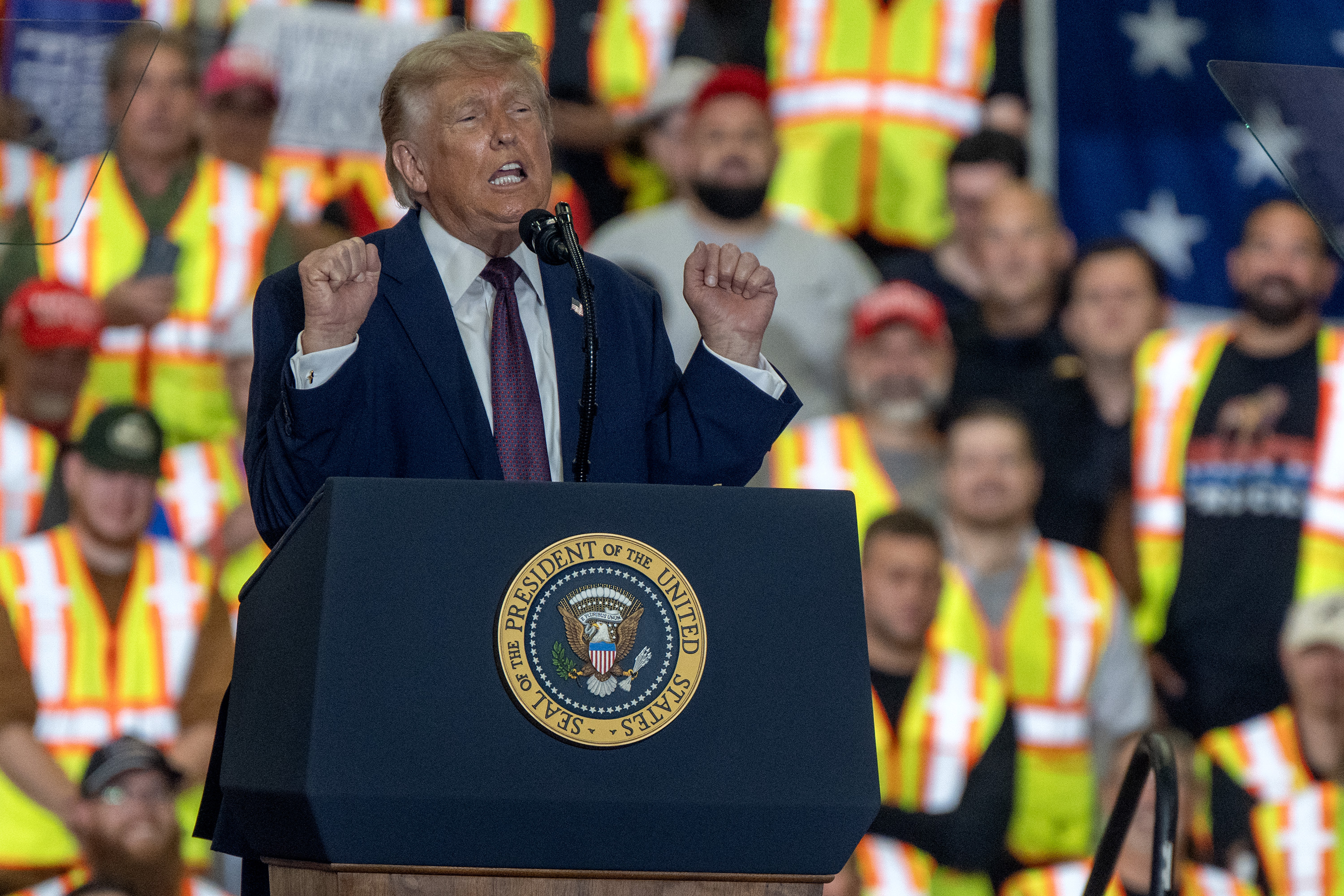
President Donald Trump speaks as members of the Penn State wrestling team listen at a campaign rally at the Bryce Jordan Center in State College in October of 2024. Trump went onto win the state. Matt Rourke
‘The cost of continuing to exist’
Sophie Showers, 19, wants kids, a stable job as a psychologist, and to one day be married.
But now that vision is getting hazier as costs rise, including at the grocery store and at the gas pump, which she needs for her 45-minute commute to school — what the Mechanicsburg resident and first-time voterrefers to as “the cost of continuing to exist.”
Trump, according to the poll, is most underwater with young voters on the cost of living: Only 9% approve and 90% disapprove of his handling of the issue.
That disapproval includes a quarter of voters under 30 who cast ballots for Trump in 2024, including a young voter from the Philadelphia area who asked not to be identified due to his role in his local Republican Party.
He supported Trump in 2024, but he has become disappointed with what he says is Trump’s ignorance of the country’s biggest problems, namely inflation.
“He wants to lower taxes. He wants to cut regulation. I agree with all those things,” he said. “But actually making major changes to people’s pricing, I don’t think he’s taking it that seriously.”
On the economy, 19% of young people approve of Trump’s handling and 81% disapprove, according to the poll.
“The current state of our country is that young people feel as though they have less opportunity economically than their parents or grandparents,” Levy said. “That’s a clear statement on dissatisfaction with the economy.”
(function(){function e(){window.addEventListener(`message`,function(e){if(e.data[`datawrapper-height`]!==void 0){var t=document.querySelectorAll(`iframe`);for(var n in e.data[`datawrapper-height`])for(var r=0,i;i=t[r];r++)if(i.contentWindow===e.source){var a=e.data[`datawrapper-height`][n]+`px`;i.style.height=a}}})}e()})();
“If the cost of living keeps increasing, whether it be due to gas prices … or tariffs increasing the costs of groceries, I don’t want to be in a world where I have to worry about those kinds of things for the family that I want to have or will have, and I personally don’t really see things getting better,” said Showers, an independent voter.
Miles Balfour, a graduate student pursuing a degree in human interaction at Carnegie Mellon University, is feeling similarly pessimistic.
“When it comes to the financial and economic goals that I have for myself — wanting to own a home, wanting to be able to help provide financially for my family — I don’t know, honestly. I wish there was a better sense of confidence or assurance that these things are much more likely to actually happen,” Balfour, 25, said.
According to a survey earlier this year from CIRCLE, a Tufts University program that studies youth civic engagement, many young people ages 18 to 29 are barely making ends meet, and nearly 60% said they struggle to meet their basic financialneeds.
“Young people’s personal situations are also really coloring their view of politics and of what’s happening in the country,” said Alberto Medina, CIRCLE’s communications manager.
Ben Hummer, 28, of Pittsburgh, said though he is new to his career in recruiting, raises have slowed down while expenses like rent have gone up. His auto insurance for his Hyundai skyrocketed to roughly $3,000 a year, and his favorite sneakers — for a race he will be running later this year — have jumped from $120 to about $170.
“My ability to afford my lifestyle comfortably has become more challenged,” Hummer, a Democrat, said.
Young voters grapple with international conflicts
Beyond struggles at home, young voters are also wrestling with questions about the U.S. role in overseas conflicts.
After the deadly Oct. 7, 2023, terror attack against Israel by Hamas, the country launched a military campaign against the insurgent group in Gaza. And with the death toll of Palestinians climbing to more than 70,000 over the last three years, the debate over U.S. support for Israel has become a defining issue for many young people in Pennsylvania and elsewhere.
As encampments and protests in support of Palestinians roiled university campuses ahead of the 2024 election, the issue hung over former President Joe Biden’s reelection campaign before his withdrawal and may have contributed to Vice President Kamala Harris’ loss.
Trump repeatedly vowed during his 2024 campaign to end the war. But fighting has continued, and now only 16% of likely young voters in Pennsylvania approve of Trump’s handling of the conflict, the poll found.
Hummer, the 28-year-old from Pittsburgh, disapproves of the president’s approach and said the U.S. “needs to balance its approach” in the Middle East.
(function(){function e(){window.addEventListener(`message`,function(e){if(e.data[`datawrapper-height`]!==void 0){var t=document.querySelectorAll(`iframe`);for(var n in e.data[`datawrapper-height`])for(var r=0,i;i=t[r];r++)if(i.contentWindow===e.source){var a=e.data[`datawrapper-height`][n]+`px`;i.style.height=a}}})}e()})();
“It doesn’t necessarily have to be pro-Palestinian by any means, but the United States has allies in the region outside of Israel that are being negatively impacted by the conflict, and we often just throw them under the bus,” Hummer said.
Many young people have coupled their anger about the economy with Trump’s decision to join Israel in striking Iranian nuclear facilities and military sites. The Iranian regime retaliated by blocking a key water channel where oil tankers flow, spiking the price of gas throughout the spring.
Among 18- to 29-year-old Pennsylvania voters, only 17% approve of Trump’s handling of the war in Iran, while 82% disapprove (it is also his least popular issue among all likely voters in the state). The war — which the president originally promised would go on for only a few weeks — has now lasted for six months.
“I’m concerned about the United States’ ability to extract itself from the war in Iran without taking some kind of loss — whether it’s loss of influence, loss of life, or loss of financial resources,” and the prospect gets worse the longer the U.S. remains involved, Hummer said.
Young voters are also more critical of Pennsylvania leaders’ positions on Israel than are respondents overall.
Nearly half, 47%, of respondents said Pennsylvania’s third Jewish governor, Josh Shapiro, has been just “about right on support of Israel,” with 14% saying he has been too supportive, despite his vocal opposition to the country’s leader, Prime Minister Benjamin Netanyahu. But among young voters, 40% said he was too supportive.
And more than half, 51%, of young voters said Pennsylvania U.S. Sen. John Fetterman, a frequent defender of Israel who has said he would leave the Democratic Party if anti-Israel sentiment grew too strong, is too supportive of Israel — compared with 30% overall.
‘Willing and ready to vote in 2026’
Young voters are now figuring out what to do next.
Darlene Jimenez, 19, of Philadelphia, said she is grappling with what she can feasibly do as a young person who cares deeply about many issues, including immigration (on which Trump has a 25% approval rating among young voters) and climate change.
“There’s so many times where I find myself thinking like, ‘What am I to do?’” said Jimenez, a Democrat and college student. “Like, I’m 19 and I have so many opinions, and it’s like, what am I supposed to do to actually make a change?”
Medina, communications manager for CIRCLE, said that while there is a sense of hopelessness among young people, “many of them are paying attention, and they say that they’re willing and ready to vote in 2026.”
“Often, precisely because they don’t like the way things are going, and they would like things to change, and they see themselves as having a role in bringing about that change,” Medina said the organization has found in its research.
In Pennsylvania, the youth vote has the potential to make a “decisive impact” on the four key competitive congressional district races this fall — in Bucks County, the Lehigh Valley, the Scranton area, and the Harrisburg region — according to CIRCLE’s 2026 Youth Electoral Significance Index.
(function(){function e(){window.addEventListener(`message`,function(e){if(e.data[`datawrapper-height`]!==void 0){var t=document.querySelectorAll(`iframe`);for(var n in e.data[`datawrapper-height`])for(var r=0,i;i=t[r];r++)if(i.contentWindow===e.source){var a=e.data[`datawrapper-height`][n]+`px`;i.style.height=a}}})}e()})();
But at the same time, young people are still trying to find their political home and historicallyhave been less likely to vote than other age groups, including in 2024, when there was a 54% turnout rate among Pennsylvanians ages 18 to 24 compared with 70% for the overall electorate, according to census data.
Others are a little more sure of where they stand. For instance, young women are the demographic most disapproving of Trump among likely voters in the Inquirer/New York Times/Siena poll. Fourteen percent of young women approve of his job performance, and 83% disapprove.
(function(){function e(){window.addEventListener(`message`,function(e){if(e.data[`datawrapper-height`]!==void 0){var t=document.querySelectorAll(`iframe`);for(var n in e.data[`datawrapper-height`])for(var r=0,i;i=t[r];r++)if(i.contentWindow===e.source){var a=e.data[`datawrapper-height`][n]+`px`;i.style.height=a}}})}e()})();
While a gender gap still exists among young voters, young men — who helped catapult Trump to the White House in 2024 — now disapprove of the president by a nearly 2-1 ratio: 33% approve of his job performance, compared with 64% who disapprove.
Will, a Democrat from Bucks County who works in academia, crossed the aisle to vote for Trump in 2024 because he — “a loyal Joe Biden guy” — vehemently disagreed with how Harris was nominated without a primary after Biden’s withdrawal and also believes Democrats have focused too much on identity politics.
The 27-year-old, who asked to be identified only by his first name because of concerns about workplace retaliation, has mixed feelings about Trump’s handling of the issues and called the Iran war “ridiculous.” But he does not fully regret his vote, citing Trump’s handling of Israel as one reason.
“My impression is that the Democrats have been moving further left to kind of compensate for the fact that MAGA and the tea party moved the Republicans further right, so it kind of leaves people in the middle stranded. … I would prefer the Democrats kind of bring things back to the center,” said Will, who supports Shapiro for governor and would back him for president in 2028.
And Luke Averill, 19, a registered Republican from Delaware County who voted for Harris in 2024, said he thinks he can make the most impact on the direction of the country by voting for moderate candidates in Pennsylvania’s GOP primaries, but he does not see himself as a “diehard for one party in particular.”
But for many young voters, the elected officials they are gravitating toward are indicative of what is most important to them.
Several young respondents to the poll said they findNew York City Mayor Zohran Mamdani’s style of politics and focus on affordability to be refreshing.
“He’s the inspiration for myself and many people in my generation and all around the country,” Balfour, the 25-year-old at Carnegie Mellon, said. Mamdani brings “a sense of hope and optimism” and the ability to see government “make our lives much more meaningful.”
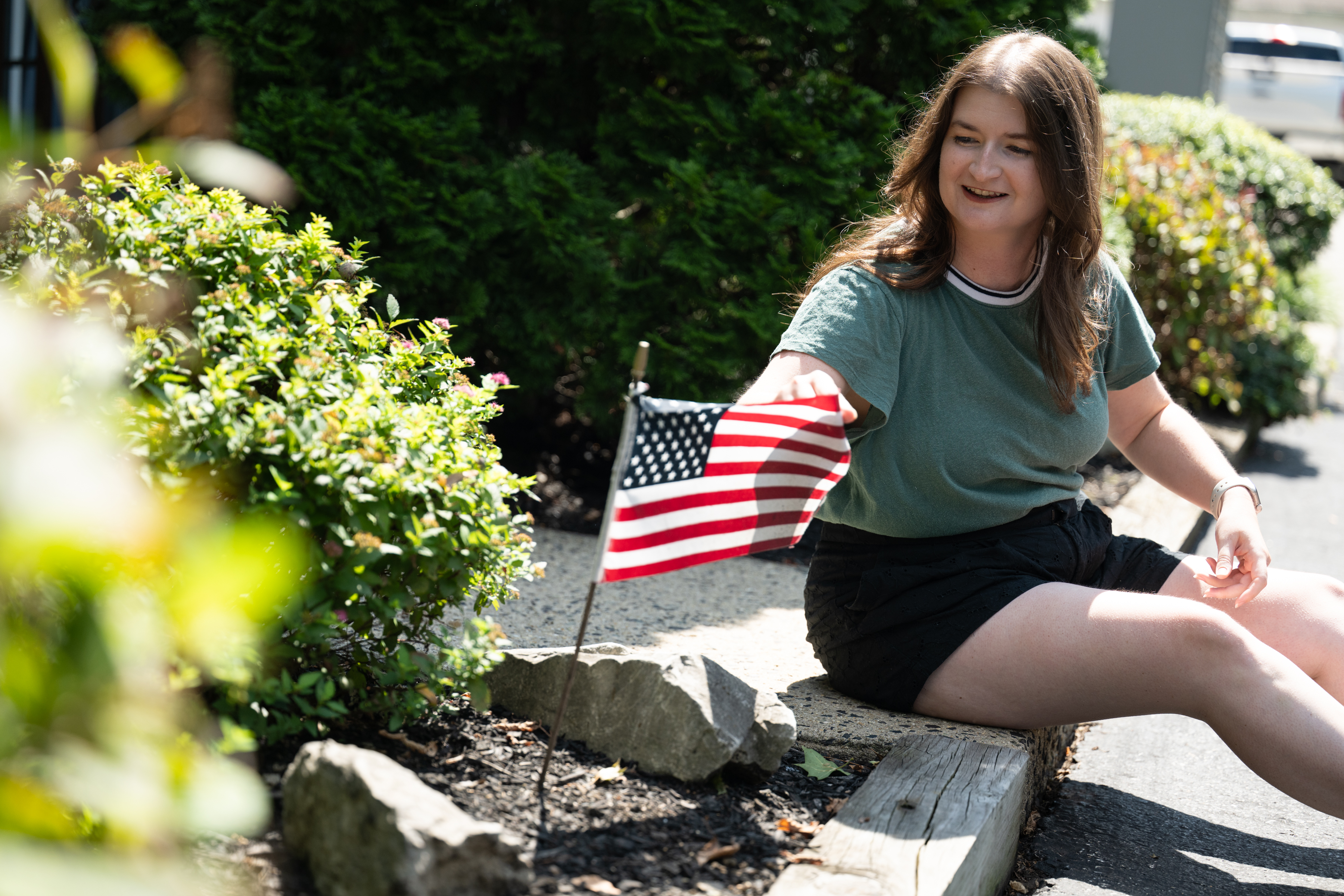
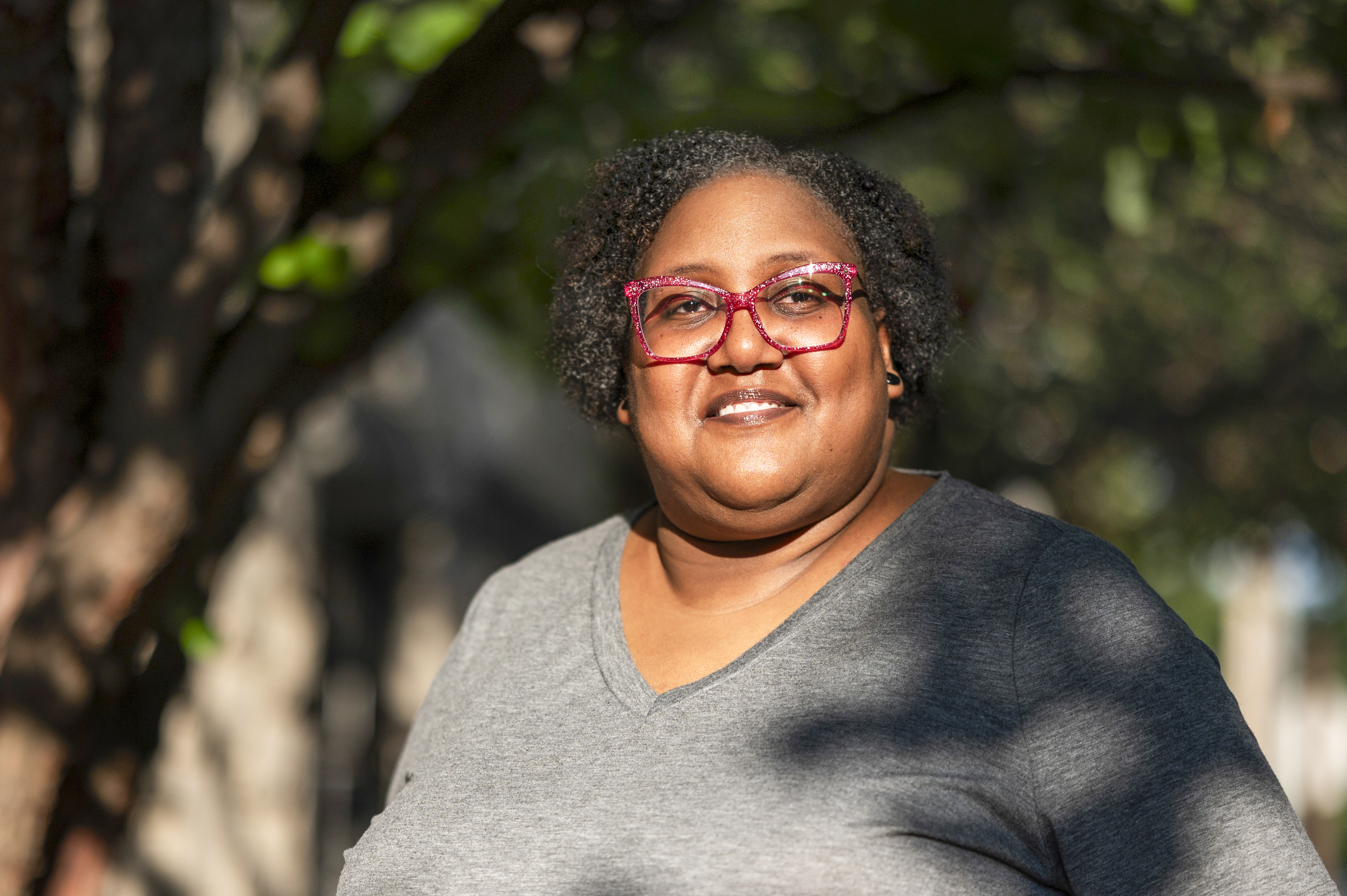
Kelly Harrington, 29, poses for a portrait near her home in Conshohocken, Pa., on Monday, Aug. 24, 2026.Erin Blewett / For The Inquirer
And as for Harrington, the 29-year-old from Conshohocken, she said though she feels “frustrated and sad about the state of the world,” she believes it is important to take those emotions to the ballot box.
“Politics is in every aspect of life,” Harrington said. “It affects you directly in almost every way, and if you get involved, you can make real change.”
I was chatting with a friend recently whom I’ve known for a long time when she used the term woke as if it meant something disgusting.
I was so stunned that I didn’t bother trying to correct her. But I hung up the phone thinking about how the concept has become a political football, with even some Dems kicking it around.
African Americans created this vernacular. It preexisted MAGA’s hijacking of it by decades, dating back to the days of civil rights activist Marcus Garvey, founder of the Universal Negro Improvement Association. It has long been a part of pop culture, showing up in musical performances by everyone from Depression-era blues singer Lead Belly to Erykah Badu in her 2008 song, “Master Teacher.”
I first heard it during the early 1990s. Back then, if someone said, “You’re not woke,” it was considered the ultimate insult, right up there with being an Uncle Tom — or worse. Being woke refers to being alert to racial transgressions. The opposite of woke is to be asleep, and therefore oblivious to systemic racism and injustice.
No matter how President Donald Trump and Secretary of Defense Pete Hegseth attempt to vilify the term, I stand by the notion that being woke is a good thing. As in the exhortation, “Stay woke, brother.”
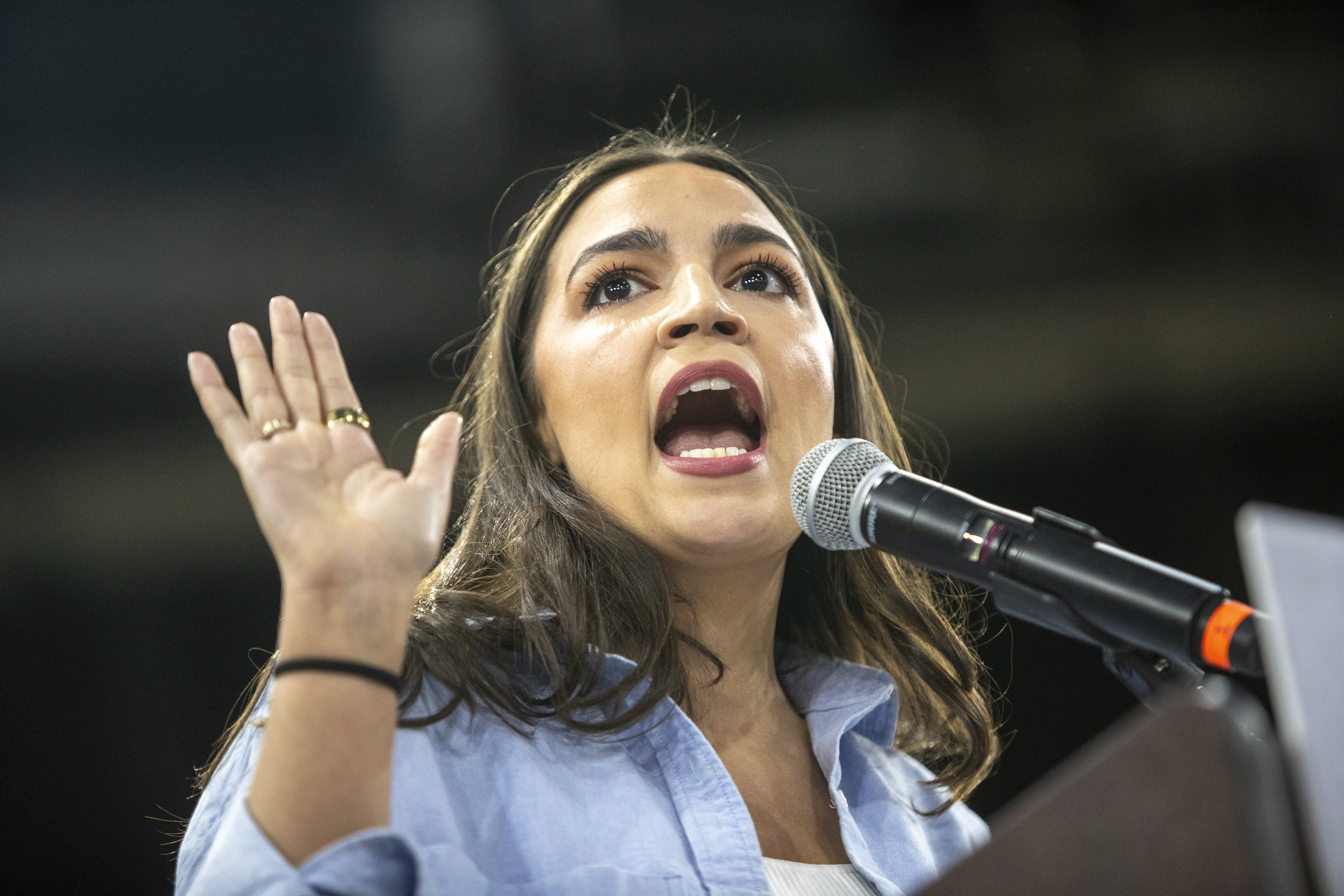
It’s galling to watch politicians bastardize it. U.S. Rep. Alexandria Ocasio-Cortez recently brought it up during an ABC News interview when she said, “I have a local city councilman that has this saying: ‘Woke 1 was crazy.’”
She was talking about Francesca Hong, a progressive candidate running for governor of Wisconsin with a history of making radical statements, and was also quoting New York City council member Chi Ossé, who used the “woke 1” term on social media. I get that Ocasio-Cortez was referring to far-left calls to defund the police — which most Black people never fully supported — among other extremist ideas. But her words still stung.
I have an awful lot of respect for Ocasio-Cortez. I recognize she may be weighing a run for the presidency in 2028 and trying to center herself politically. But this kind of virtue signaling won’t be as beneficial as she hopes if it also alienates African Americans.
M.K. Asante said that “the idea of staying woke became associated with consciousness,” but that the meaning of the term has changed after being co-opted by the mainstream.
For insight, I reached out to M.K. Asante, a professor at Morgan State University whose father is Molefi Kete Asante, a renowned professor of Africology at Temple University. “The idea of staying woke became associated with consciousness,” Asante told me, but added that the term was co-opted around 2020 following the widespread uprisings after the murder of George Floyd by a police officer.
Asante pointed out, “Now it does not have the same meaning in the mainstream.”
He declared an all-out war on diversity, equity, and inclusion efforts in both federal and private sectors, and hasalso taken aim at museums he says are “essentially, the last remaining segment of ‘WOKE.’” Trump also has cut funding from key government programs that support DEI.
Even the military hasn’t been immune. Trump summarily dismissed Air Force Gen. Charles Q. Brown Jr., who was the second Black person to serve as chairman of the Joint Chiefs of Staff, and set about renaming military bases after Confederate generals.
Earlier this year, Pentagon spokesperson Sean Parnell announced on X that officials were targeting Stars and Stripes, an independent newspaper that covers the military, in part to “refocus its content away from woke distractions that syphon morale.” Since then, the paper’s publisher, editor-in-chief, and a reporter have all been terminated, ending 155 years of editorial freedom, as my colleague Will Bunch reported.
Meanwhile, the United States is at war with Iran, Canada, our closest ally, has announced retaliatory tariffs on U.S. products, and American consumers are wondering if the influx of tariff-free foreign beef imports Trump is pushingwill be safe to consume.
Yet, Trump says woke is the enemy.
Despite the president’s best efforts, he can’t stamp the term or its real meaning out.
As Asante pointed out, “You can co-opt a word, but the spirit of what ‘stay woke’ means is alive and well.”
There were two noticeable no-shows as Western leaders gathered Monday to mark the 35th anniversary of Ukraine’s independence — and its five years of resistance to Vladimir Putin’s effort to re-subjugate the country to Russian rule.
There were multiple news reports that President Donald Trump’s clueless peace envoys — son-in-law Jared Kushner and real estate magnate Steve Witkoff — might finally join European allies at anniversary ceremonies.
I say “finally” because neither of these supposed peacemakers has ever deigned to visit Ukraine. Not once. Meantime, Witkoff has visited Moscow eight times, and gushed over Putin as he and Kushner (also a repeat visitor) discussed business deals with Russia.
It is no surprise, then, that Trump’s blinkered envoys postponed their trip, reportedly blaming their absence on intensified Russian missile and drone strikes. Never mind that former Vice President Mike Pence, British Prime Minister Andy Burnham, and other European leaders showed up.
They recognized — as Trump and his envoys still do not — that Ukraine is fighting not just for its own freedom, but for the security of Europe and the United States.
Burnham, who came to Kyiv on his first foreign trip as prime minister, understands the significance of Ukraine’s brave stand against the world’s second-largest army. A Russian military that is heavily aided by the dictators of China, North Korea, and Iran, all eager to undermine America and the democracies of the West.
The U.K. leader rightly compared Ukraine’s resistance against Russian imperialism to Britain’s fight against Nazi Germany in the 1940s, telling Ukrainians, “My nation kept the flame of European freedom alive in the 20th century; you hold that flame in the 21st.”
Burnham is right on the mark.
Ukraine’s President Volodymyr Zelensky hands over the flag of a military unit during the ceremony to mark Ukraine Independence Day in Kyiv, Ukraine, Monday.Efrem Lukatsky
The image of London firefighters bravely battling the blazes caused by the German Blitz, which rained rockets down on civilians in order to break their morale, comes right to mind when watching video of Ukrainian rescue workers pulling women and children out of the rubble of collapsed apartment towers that have been hit with Russian missiles or drones.
Then-Prime Minister Winston Churchill understood that if Britain fell, the Nazis would take over Europe. The Battle of Britain in the summer and fall of 1940, in which incredibly courageous Royal Air Force pilots pushed back the Luftwaffe, forced Adolf Hitler to abandon his planned invasion of England. The courage and spirit of Britons under bombing gave the RAF the time to regroup and attack the Nazis in Europe. It gave President Franklin D. Roosevelt time to act on sending Lend-Lease war supplies to Britain.
Burnham grasps that Putin is a stalking horse for an axis of adversaries – namely China, North Korea and Iran – that backs and finances Russia’s crimes.
Ukraine’s battle of the skies is effectively the first round of World War III. And only one weapon can take down the ballistic missiles Russia is pouring down on Ukraine’s civilian infrastructure: U.S.-made Patriot interceptors.
Yet, Trump has wasted much of America’s Patriot missile stock chasing cheap Iranian drones, and refuses to sell Kyiv a small percentage of what the U.S. retains. And after proposing joint production of Patriots with Ukrainian President Volodymyr Zelensky, the U.S. president immediately backed off.
That is why Burnham announced Monday that the U.K. (along with France) will help Ukraine make its own version of a Anglo/French long-range cruise missile by sharing classified technical information. That will help Ukraine preempt Russian missiles by eliminating the firing sites.
But setting up that production line will take months or years, and Ukraine desperately needs Patriots now.
Ukraine’s President Volodymyr Zelensky (left) hands over the Ukraine state award to European Council President António Costa during a commemorative ceremony in Kyiv, Ukraine, Monday, marking Ukraine’s 35th Independence Day.Efrem Lukatsky
It is hard for many Americans to grasp how important Ukraine’s survival is to our future security. Few U.S. politicians consider Ukraine to be a critical campaign issue. Trump has communicated his disdain for Kyiv to his MAGA followers, and Vice President JD Vance boasts that his proudest moment was helping cut off aid to Ukraine. As for Democrats, they’d rather focus on cost of living and the endless Iran war.
But Gen. Ben Hodges, former commander of U.S. Army Europe, nailed it when he told me recently that what’s been missing from the lack of U.S. attention “is the recognition that it’s in the U.S. interest for Ukraine to be successful.” President Joe Biden was too timid, he noted, and Trump is worse.
America’s enemies are taking full notice.
China is watching and learning from the drone, robot, and electronic warfare being fought in Ukraine, while sharing dual-use weapon parts and technology with Moscow. Every lesson is being fed into the hopper of Xi Jinping’s massive agglomeration of data used for prep to take back Taiwan and dominate South and East Asian neighbors and territorial waters.
North Korea is earning hard currency by sending troops and missiles to aid Russia’s war on Ukraine. In return, it is accessing Russian technology to build up its nuclear arsenal. Iran sends Shahed drones to Russia and learns from Russian upgrades of those drones, which helps Tehran attack U.S. bases and threaten Gulf Arab states in the Middle East.
Meantime, Trump is focused on his White House ballroom, car races, and starting a trade war with Canada, while Kushner and Witkoff chicken out of visiting Kyiv. They have no clue that the fate of the Ukraine war will overshadow everything they now think is important.
Their trips to Moscow are feckless unless they recognize that Putin has no interest in peace. Any “peace process” is dead (irrespective of CIA Director John Radcliffe’s secret visit to Moscow last weekend) until the United States recognizes reality and joins Europeans in squeezing Putin until he fears the war is endangering his survival.
I believe Ukraine will hold out via its tech brilliance and innovation, and its people’s determination not to surrender to the brutal domination of Russia. But the United States will pay a dear price for failing to step up when it could have blocked Putin and his allies — before their war on the West got much, much worse.
Two years ago, every child in the kindergarten class at Eleanor Emlen Elementary in Mount Airy had vaccine protection against measles.
A year later, the school’s kindergarten immunization rate had dropped to just 80%, putting students and the surrounding community at risk of an outbreak of the highly contagious disease.
Emlen is among more than two dozen Philadelphia-area schools that saw double-digit declines in kindergarten immunization rates last school year — in many cases because parents are increasingly refusing vaccines.
The affected schools span a diverse range of communities, from city neighborhoods like Mount Airy to the outlying suburbs. In Chester County, for example, a small private school in Downingtown saw its vaccination rates plunge by 20%.
Even as countywide immunization levels remain relatively high, some 40% of kindergarten classrooms across the region became vulnerable to an outbreak during the 2025-26 school year, up from 33% the year prior, an Inquirer analysis of newly released state data found.
(function(){function e(){window.addEventListener(`message`,function(e){if(e.data[`datawrapper-height`]!==void 0){var t=document.querySelectorAll(`iframe`);for(var n in e.data[`datawrapper-height`])for(var r=0,i;i=t[r];r++)if(i.contentWindow===e.source){var a=e.data[`datawrapper-height`][n]+`px`;i.style.height=a}}})}e()})();
That means that at least 249 schools had vaccination rates below 95%, the level at which scientists say a population must be vaccinated to prevent the spread of measles, one of the most contagious diseases.
Of these, 98 Philadelphia-area schools reported measles vaccination rates below 90%, presenting an even greater risk to students.
A sharp increase in parents opting out of vaccination for religious or philosophical reasons continued to drive down vaccination rates; exemptions in this category rose by 15% in the latest two years for which data are available.
(function(){function e(){window.addEventListener(`message`,function(e){if(e.data[`datawrapper-height`]!==void 0){var t=document.querySelectorAll(`iframe`);for(var n in e.data[`datawrapper-height`])for(var r=0,i;i=t[r];r++)if(i.contentWindow===e.source){var a=e.data[`datawrapper-height`][n]+`px`;i.style.height=a}}})}e()})();
Pennsylvania is among a handful of states that allows parents to opt out of vaccine requirements for philosophical or religious reasons, often by simply signing a form.
The health department published more granular, school-level vaccination data this summer for the first time, after reporting by The Inquirer and the Pittsburgh Post Gazette made this information public for the prior school year, exposing pockets of vulnerability within counties with overall high vaccination.
The new data show the growing public health threat to the region from Pennsylvania’s growing measles outbreak, in which two people in Lancaster County have died, state officials reported Tuesday. They were the state’s first measles-related deaths in three decades.
(function(){function e(){window.addEventListener(`message`,function(e){if(e.data[`datawrapper-height`]!==void 0){var t=document.querySelectorAll(`iframe`);for(var n in e.data[`datawrapper-height`])for(var r=0,i;i=t[r];r++)if(i.contentWindow===e.source){var a=e.data[`datawrapper-height`][n]+`px`;i.style.height=a}}})}e()})();
So far, nearly 400 cases have been diagnosed, with nearly half in Lancaster County. The rapidly spreading outbreak is edging closer to densely populated Philadelphia. Chester County, just west of the city, has reported the second-highest number of cases in the state.
At a news conference on the measles deaths Tuesday, Gov. Josh Shapiro stressed his concern about the rise in Pennsylvania parents opting out of vaccinations over the last 10 years.
“It has dramatically reduced community immunity in different areas of our Commonwealth,” he said. “Today, we see the consequences of a lack of immunization.”
The new school-level data on vaccines, he said, allow “everyone to see their school’s vaccination coverage and make informed decisions.” Lawmakers have also said they hope that having more access to data about their children’s schools will make families more aware of risks within their communities and encourage them to vaccinate their children.
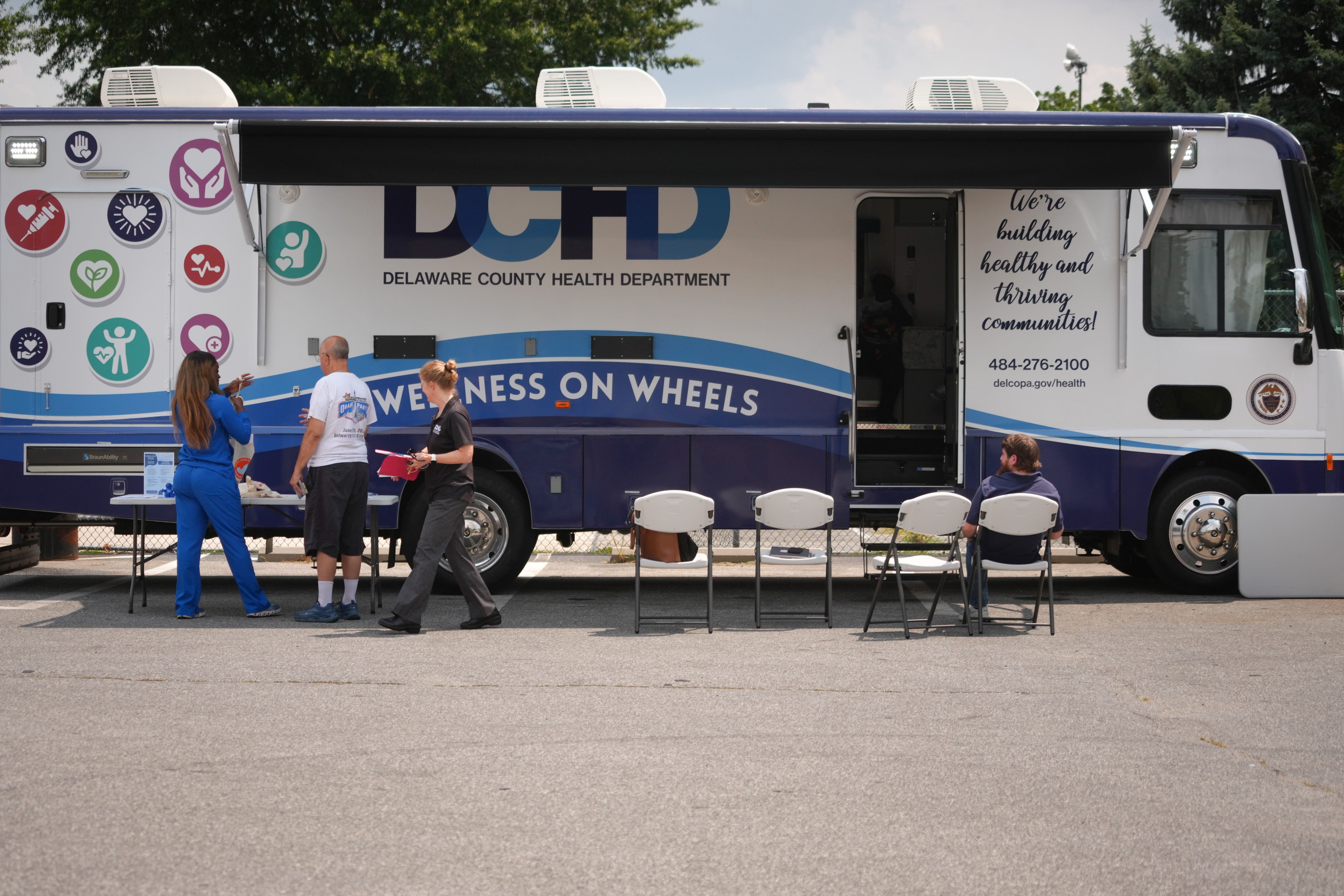
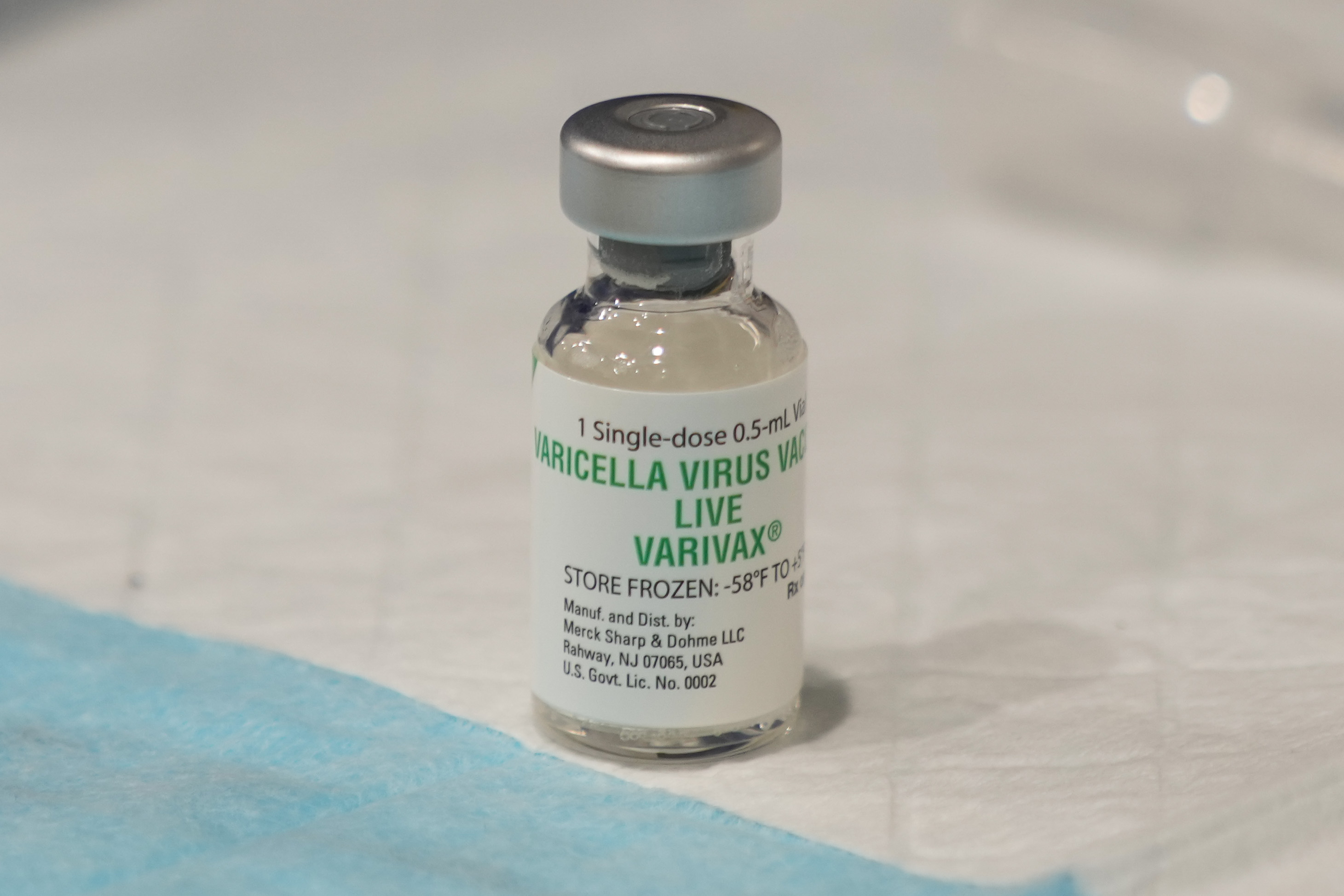
Amid rising measles case counts and declining immunization rates, Delaware County’s health department launched an immunization campaign over the summer to encourage families to vaccinate.Jessica Griffin / Staff Photographer
Emlen, which saw one of the steepest drops in protection, was one of 40 schools in the five-county region that reported 100% measles vaccination rates two years ago, only to drop below the 95% herd immunity threshold last year.
Philadelphia school officials say the changes at Emlen likely reflect increasing hesitancy among parents to immunize their children against measles, mumps, and rubella (MMR) and other diseases. State records show that most unvaccinated kindergarteners at Emlen have philosophical or religious exemptions.
Some fluctuations in kindergarten vaccination rates are typical from year to year, but the rise of anti-vaccine rhetoric in federal leadership appears to be exacerbating fears around vaccination, said Kendra McDow, a pediatrician who serves as the Philadelphia school district’s medical director.
“What we’re seeing is reflective of what I believe are local and national trends,” McDow said. “Families are confused, and they want to do right by their children.”
In the latest federal vaccine maneuver — opposed by the medical establishment, prominent Democrats, and Republican Sen. Bill Cassidy, a physician — President Donald Trump signed an executive order this month asking states to “consider updating” laws to require fewer vaccinations for schoolchildren without any medical justification. He also advocated for splitting the MMR vaccine into three separate shots — even though no separate measles, mumps, or rubella vaccines are licensed in the United States.
The order came after a chaotic year in which Health and Human Services Secretary Robert F. Kennedy fired federal vaccination advisers and pushed to upend the federal vaccine schedule. Kennedy, a longtime anti-vaccine activist, has promoted false concerns that vaccinations can lead to autism.
Families are faced with a barrage of misinformation about vaccines. Jessica Griffin / Staff Photographer
With Pennsylvania now experiencing its largest measles outbreak in three decades, Kevin Ressler, a healthcare nonprofit leader in suburban Philadelphia who was raised in Lancaster County, worries that declining vaccine rates reflect increasing political polarization.
“You don’t have to be a scientist to recognize that’s a problem,” said Ressler, the CEO of Alliance for Health Equity, a Coatesville nonprofit that works to improve access to health services. “A lot of this is rooted in whether we are able to hold trusted relationships.”
Philly-area counties all at risk
Philadelphia and its suburban counties overall remain well protected against measles, state officials say. The declines seen in the latest school year amount to less than 1% of all kindergarteners in each of the five counties in the area, an improvement from the drops that followed the COVID-19 pandemic.
But even small drops can be significant given the contagiousness of measles, which can linger in the air for hours and infect nine in 10 unvaccinated people who come into contact with it.
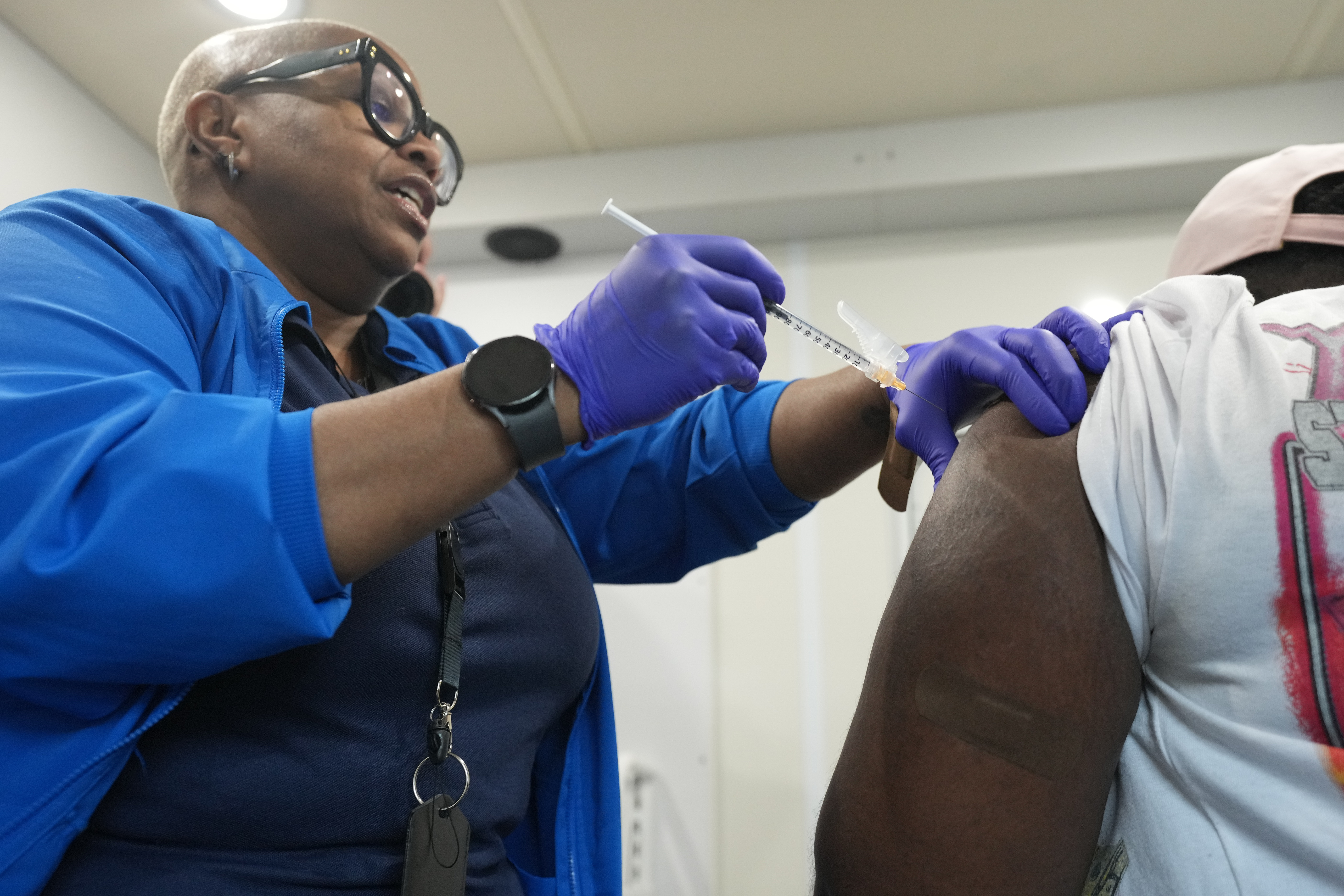
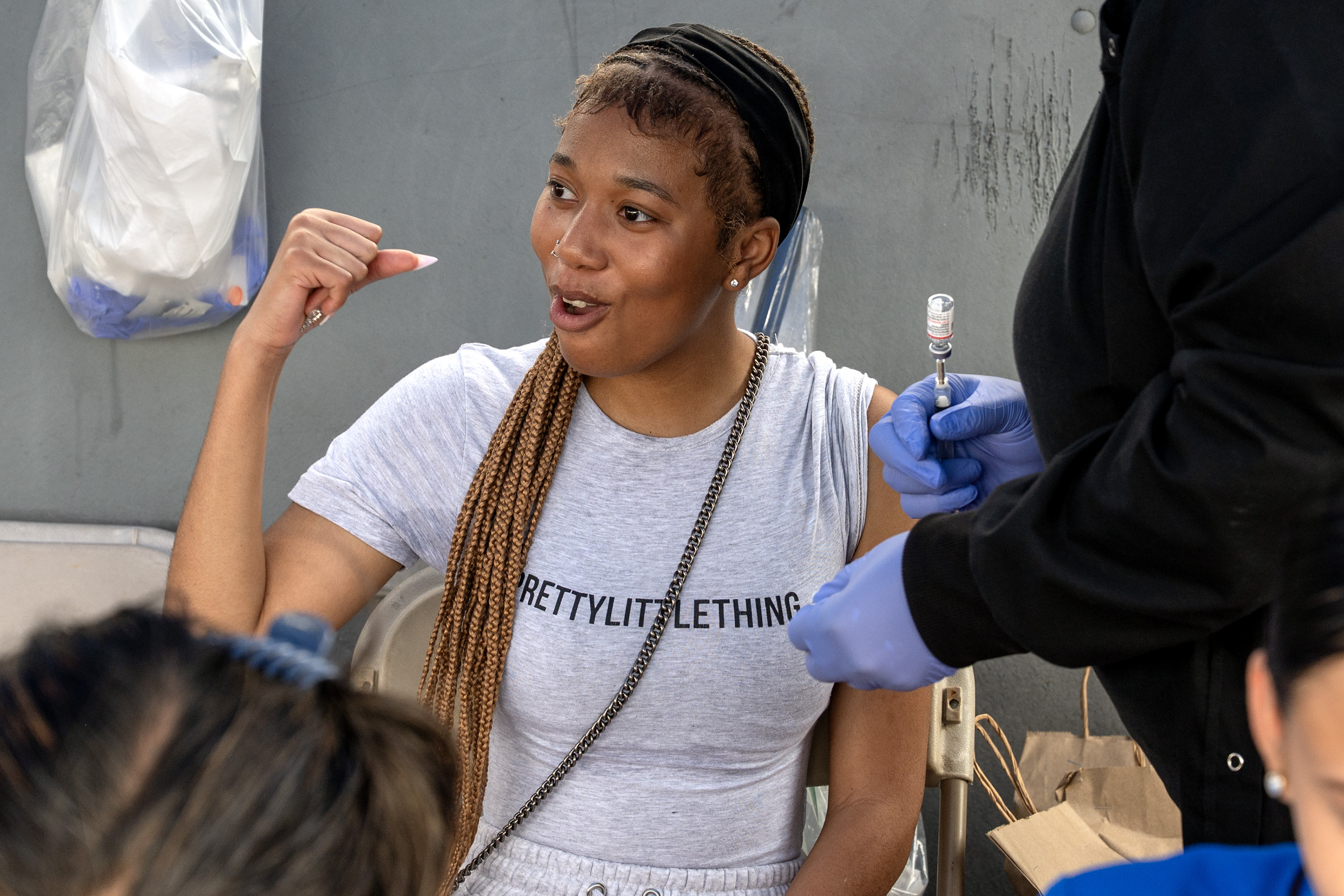
Mia Williams, a registered nurse, vaccinates a client at Delaware County’s mobile clinic in Upper Darby in July. Jessica Griffin / Staff Photographer
“The risk has definitely gone up because of lower vaccination numbers,” said Rene Najera, the director of public health at the College of Physicians of Philadelphia.
Najera says slipping vaccination rates especially endanger vulnerable students and community members beyond the schools, like pregnant women, cancer patients, or babies too young to be vaccinated. Parents of high-risk children should speak with their pediatricians about the risks of attending a school with lower vaccination rates, he said.
Last year marked the first time in more than 10 years that no Philadelphia-area county had reported measles vaccination rates above herd immunity.
Bucks County had the lowest MMR vaccination rate for kindergartners, at 93.7%, down by more than a half a percentage point from the year before.
Montgomery County, the only county in the Philadelphia region with kindergarten vaccination rates at herd immunity two years ago, slipped just below the threshold in 2025, to 94.8% vaccinated.
About 94% of Delaware County and Philadelphia kindergarteners were vaccinated last school year.
In Chester County, the only Philadelphia-area county to report cases in the current outbreak, vaccination rates for kindergartners have held steady at 94.5% for the last two school years. Some schools in the county reported steep drops in MMR coverage ahead of the current outbreak, which has seen 40 cases confirmed since June.
At Windsor Christian Academy in Downingtown, only one in four kindergarteners were vaccinated last year at a school that exceeded the herd immunity threshold the year prior. About 14% of the class had religious exemptions for vaccination. School officials did not return a request for comment.
Caln Elementary School in Thorndale saw measles vaccination rates drop from 100% to 74% in a year. Officials at the school declined to comment. (Caln closed at the end of last school year, and most of its students are transferring to the newly built Doe Run Elementary this year.)
Jeanne Franklin, Chester County’s health director, said she is “moderately” concerned about the current measles outbreak, given that many of the county’s most populous public schools still have high vaccination rates.
The school-level data improve the county’s ability to identify schools with lower vaccination rates.
Chester County health officials talk to school nurses, principals, and other administrators before the start of every school year to remind them of what to do if they identify a case of measles.
Under county policy, a single measles case in a school will mean all unvaccinated students and staff must stay home for 21 days.
This year, conversations that are usually hypothetical have taken on more urgency.
The health department has urged schools to take stock of who within their school is unvaccinated and develop a plan for how they will teach unvaccinated students who are sent home and staff classrooms of absent teachers.
“You don’t own getting them vaccinated,” Franklin said she tells administrators. “But you have to think through these things.”
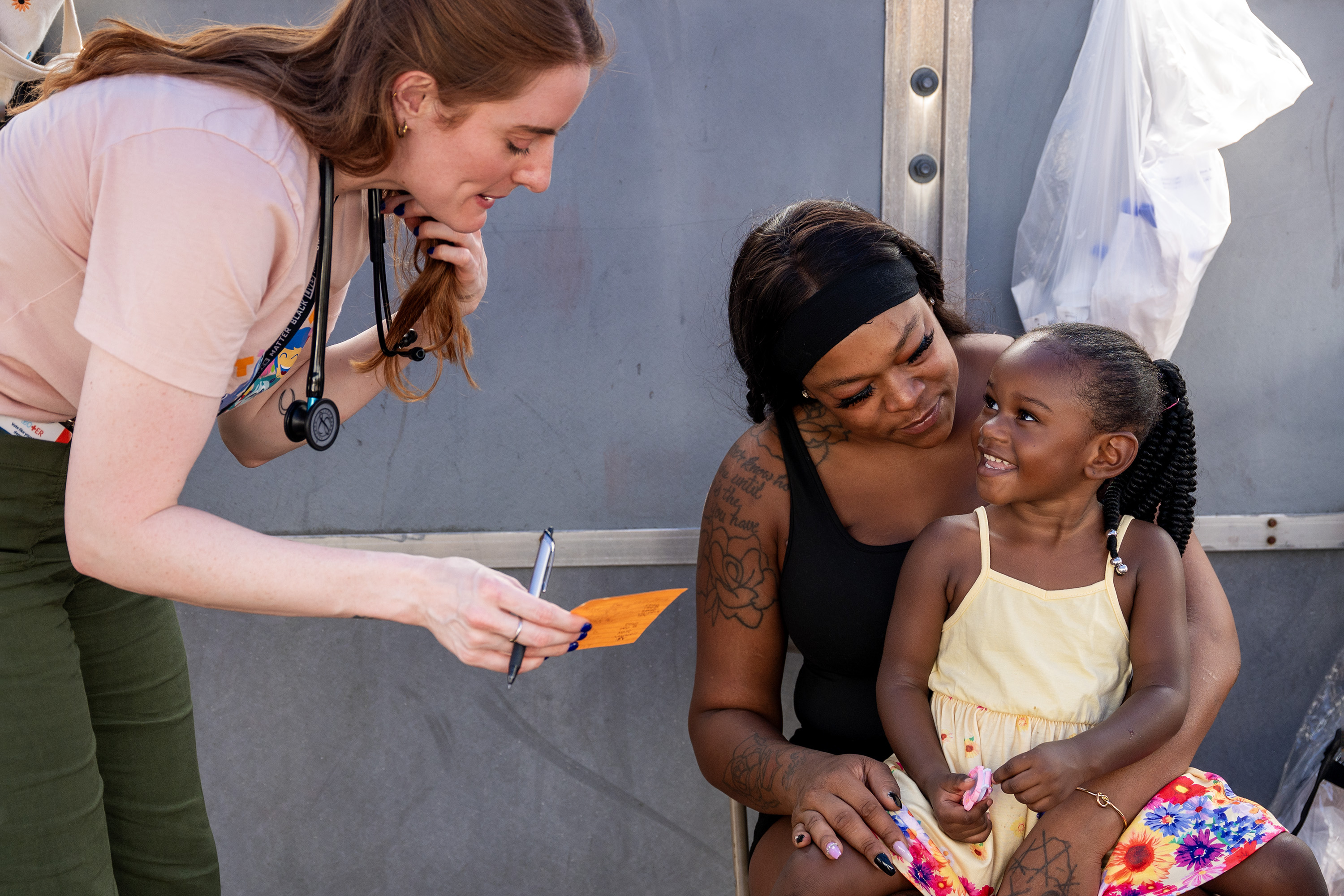
Sisters A’zuri, 3, and A’Sara, 6, wait while their mother, Shania’ Jason, checks in at a vaccination clinic during the School District of Philadelphia’s sixth annual Back-To-School Bus Tour stop this month at Marcus Foster Memorial Stadium. Tom Gralish / Staff Photographer
Philly schools on alert
As the school district’s lead health officer, McDow worries about the threat of measles so close by, but believes concerted efforts in the city have kept vaccination rates “as high as they can be in this current climate.”
She’s also monitoring Philadelphia schools where the state data show declining vaccination coverage. (The publicly available school-level data does not include classes with fewer than 20 students, for privacy reasons, or schools that did not report to the state. About 90% of schools statewide reported data in 2025.)
In some cases, what looks like a decline can be explained by delays in data reporting due to administrative issues or staff absences. School vaccination records are reported to the state during the month of December.
For example, Mantua’s Morton McMichael School reported a 50% drop in MMR vaccination coverage, initially going from nearly nine in 10 kindergarteners vaccinated to just over a third.
But by the end of the 2025-2026 school year, records show 93% of McMichael kindergarteners were fully vaccinated against measles, district officials said, though the state data does not show the improvement.
McDow worries about drops at other schools, from Mount Airy’s Emlen Elementary to North Philadelphia’s James Logan Elementary’s 18.5% decrease in vaccination rates, which are likely related to parents increasingly refusing vaccines.
Pediatrician Amanda Bernard (left) talks with Shania’ Jason and her daughter A’zuri, 3, at a vaccination clinic hosted by the Philadelphia School District this month at Marcus Foster Memorial Stadium.Tom Gralish / Staff Photographer
The school district hosts vaccination clinics over the summer and during the school year, working with the city health department to target families with unvaccinated children and schools with low vaccination rates.
The district also works to ensure vaccination clinics are accessible to working parents, organizing some on weekends or evenings.
“We need to be talking to families and answering questions in transparent ways,” McDow said. “But we also need to be providing the opportunities for vaccination.”
Some families line up for immunizations
On a recent sweltering August afternoon, families lined up at a tent pitched on the football field at Marcus Foster Memorial Stadium in Olney, part of a back-to-school fair sponsored by the Philadelphia School District.
“IMMUNIZATIONS,” read a flag waving in the breeze. Business was brisk all day.
Some families who visited the tent were recent immigrants, getting caught up on vaccinations before their children started at their new schools.
“We’re vaccinated, my husband and I, because our parents vaccinated us. And I’ll do the same for my children,” said Betty Bachene, who moved to Philadelphia from Paris this summer. Speaking in French, she said she’s never been afraid of vaccinating her children, but does fear the diseases vaccines prevent.
Anaiya Burnham, a nurse, said she’d opted against getting COVID or flu shots for her two children, one of whom is entering kindergarten this year. But vaccinating them against measles was never a question.
“I would really be curious to know why anyone would opt out of the MMR, given the research,” she said.
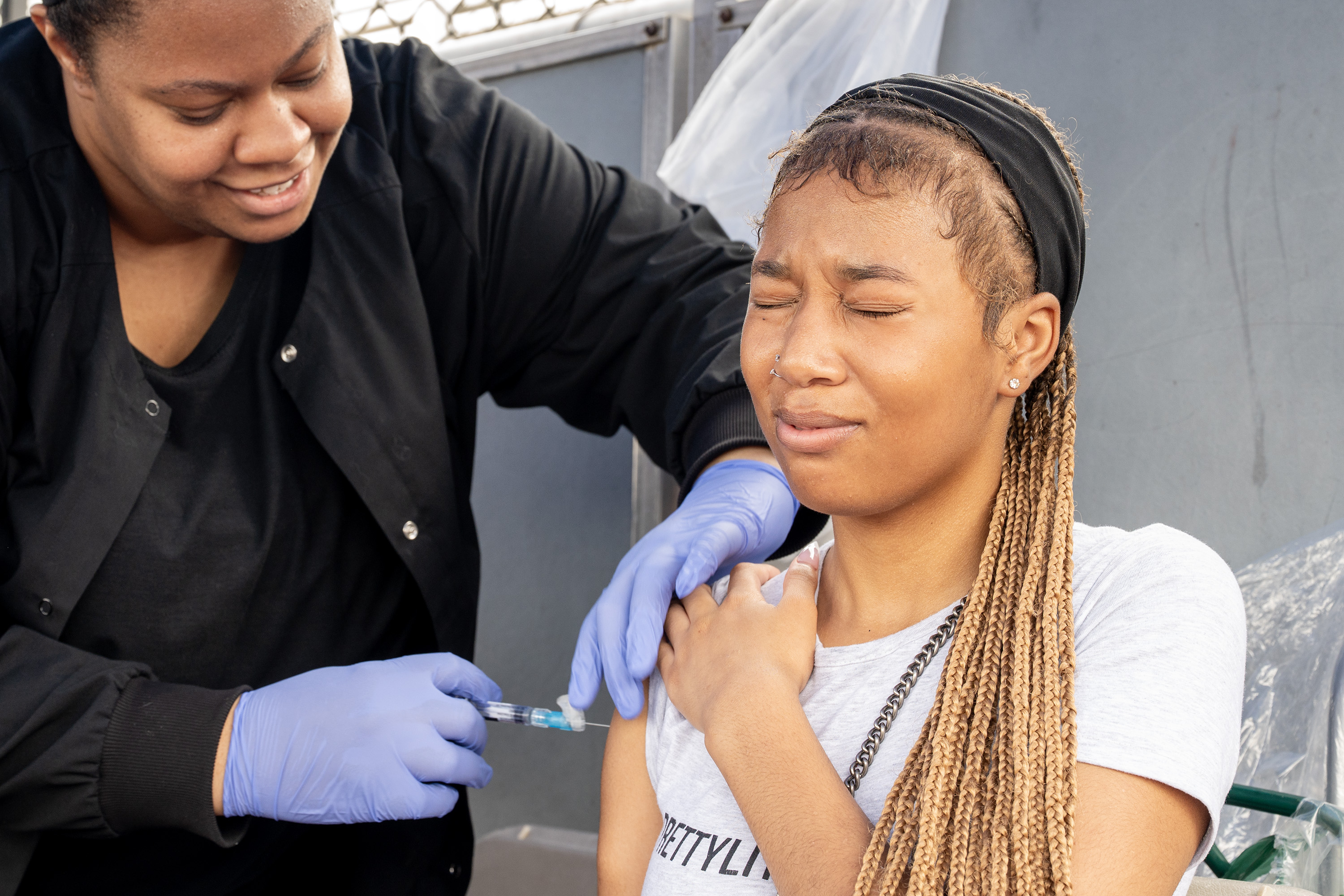
Cianey Brown, 16, reacts and turns to her family after getting an immunization at a Philadelphia school district vaccination clinic this month at Marcus Foster Memorial Stadium. Tom Gralish / Staff Photographer
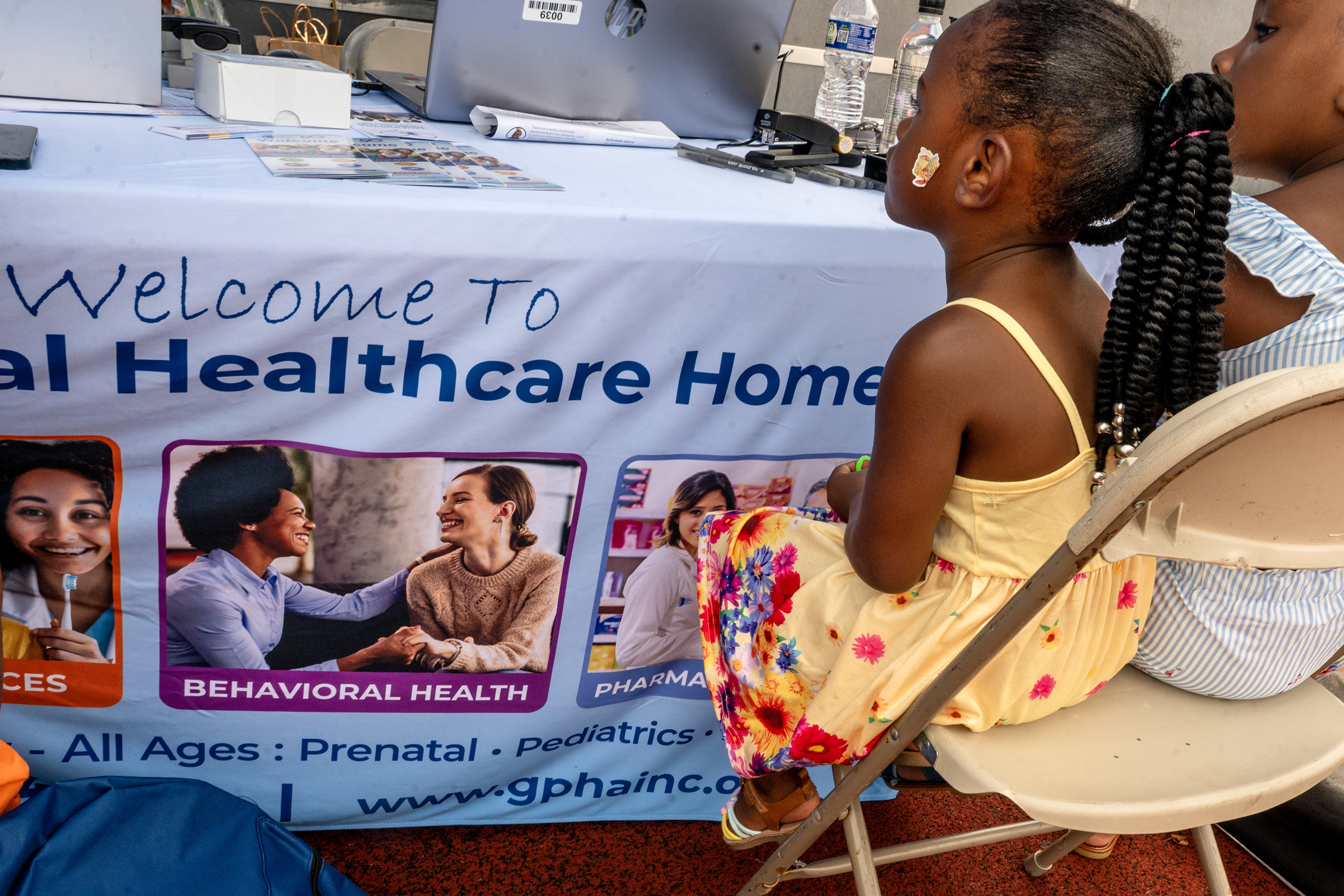
Philadelphia parents face a number of different barriers that keep them from vaccinating children — and not all of them are related to vaccine hesitancy, said Amanda Bernard, a pediatrician with Greater Philadelphia Health Action, the clinic offering vaccinations at the event.
Some lack transportation to get to a health center outside their neighborhood, or don’t speak English well enough to navigate the healthcare system, she noted.
“I think that these sorts of events are really a way that we could combat that,” said Bernard, who has heightened her advocacy around vaccination as Pennsylvania’s measles outbreak has spread.
“There’s almost a desperation in my education. I sometimes feel like I’m almost begging [families] to get it.”
Editor’s note: This story has been updated to correct the name of James Logan Elementary in Philadelphia.
(function(){function e(){window.addEventListener(`message`,function(e){if(e.data[`datawrapper-height`]!==void 0){var t=document.querySelectorAll(`iframe`);for(var n in e.data[`datawrapper-height`])for(var r=0,i;i=t[r];r++)if(i.contentWindow===e.source){var a=e.data[`datawrapper-height`][n]+`px`;i.style.height=a}}})}e()})();
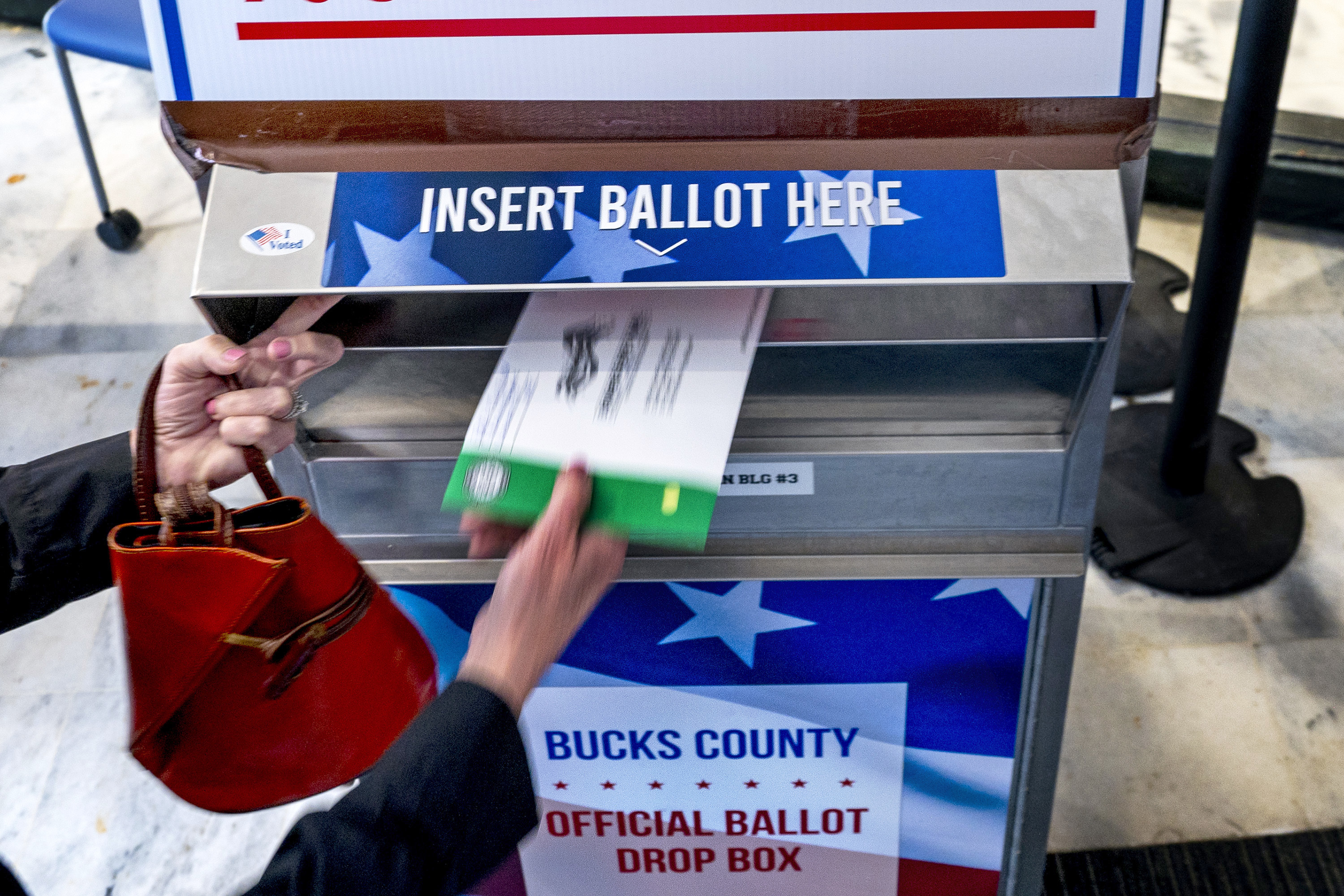
A Supreme Court decision on mail voting has created uncertainty with 70 days until critical midterm elections, but Pennsylvania Democrats are trying to reassurevoters that they will have the option to cast a ballot by mail.
More litigation over this highly watched issue is expected and further rulings could still come even after November, affecting the next presidential election.
“We will continue to fight at every stage — including in the Supreme Court the moment they attempt to implement this — to make sure every eligible Pennsylvanian can cast their ballot by mail, free from federal interference,” said Montgomery County Commissioner Neil Makhija, a Democrat and an attorney who sits on the county’s election board.
The procedural update, issued Monday, does not rule on the underlying legality of President Donald Trump’s March executive orderthat directed the U.S. Postal Service to help decide which voters should receive mail ballots but rather whether lower courts had the authority, at this stage, to block it.
Pennsylvania was among the states suing to block the order.
“Absolutely nothing has changed here in Pennsylvania. You can vote in person on Election Day or you can vote by mail before Nov. 3,” Democratic Gov. Josh Shapiro said Tuesday evening during a visit to the Eagles’ training camp.
“Your vote will be counted. Your vote is safe and secure,” Shapiro said. “No matter how many times the president wants to try and undermine people’s right to vote in this commonwealth, he needs to know that he will be met with a swift rebuke from me.”
Shapiro noted that the election is administered by the state and its counties under the Constitution.
Revival of the debate about the availability and security of mail voting, and the temporary clearance, however, may instill doubt among voters that their ballot will be received and tabulated, Makhija said.
“With just weeks until ballots go out, last-minute federal interference sows chaos for the voters we serve,” he said.
Trump’s efforts to restrict mail voting, part of his long-standing grievance against the system despite repeatedly utilizing the method himself, are still working through the courts, and several experts doubt the proceedings will move fast enough to affect the November elections, whenfour swing districts in Pennsylvania could help determine control of the U.S. House.
“Whatever may ultimately happen in this litigation, I’m pretty skeptical that anything is going to change for this November’s election,” saidBen Geffen, staff attorney at the Public Interest Law Center in Philadelphia, a nonprofit group that monitors election issues.
States across the country will soon begin preparing applications and mailing ballots to voters.
Pennsylvania voters, who can cast a ballot by mail for any reason, must complete an application by Oct. 27, and all ballots must be returned by Nov. 3 at 8 p.m., according to the Pennsylvania Department of State’s website.
“Turning that battleship around in a matter of days is extremely unlikely,” Geffen said.
A spokesperson for the Pennsylvania Department of State said the ruling does not change state law, and voters should be confident that counties will continue to ensure eligible voters can cast their ballot by mail.
“The USPS action is not lawful, and we will continue to challenge that rule to ensure that Pennsylvania voters can have their voice heard — whether they vote in person, on demand, or by mail,” Geoff Morrow, the department spokesperson, said.
Geffen’s advice for those concerned is to start early. Get your mail ballot application in right away, and as soon as you receive your ballot, fill it out and return it. For now, you can still send your ballot through the U.S. mail. But you can also drop it off at your county election board, and many counties offer satellite locations and drop boxes.
If you prefer to vote in person on Election Day, go in the morning, he said.
“You have options for how to vote, and you will get to vote. Nobody’s taking away the election, and just jump on it early,” he said.
After Trump, through his directive, ordered the Postal Service to withhold mail ballots to individuals who are not on an approved list, which he instructed states to develop in order to prevent noncitizens from voting, Shapiro promised to protect Pennsylvanians’ right to vote by mail. In April, he used his power as governor to join other Democratic states in a lawsuit that argued the order violated states’ constitutional power to carry out elections.
The unions representing postal employees also criticized Trump’s push to restrict mail voting as November approaches.
“Any insinuation that voting by mail is not safe and secure is severely misguided. Letter carriers have securely delivered ballots for decades, and there is no evidence that the existing system requires substantial changes,” NALC president Brian L. Renfroe said in the statement.
Gwen Ivey, president of the American Postal Workers Union, Local 89, which represents between 1,300 and 1,400 U.S. clerks in Philadelphia who process mail, maintenance employees, and drivers who transport mail, also warned against inserting the Postal Service into decisions over voting.
“The Postal Service is a public institution that serves the American people,” Ivey said Tuesday. “It should not be placed in a position of determining who is entitled to participate in elections or becoming an instrument for restricting access to the ballot boxes.”
Trump has long railed against mail voting, referring to the ballots as “crooked” in his State of the Union address and suggesting they amount to cheating. But his 2024 victory in Pennsylvania was thanks, in part, to a higher rate of mail voting by Republicans.
The practice is particularly useful for seniors and voters in rural areas — often with strong Republican bases — where voters may live far from their nearest polling location.
“If you want to win, mail it in, that’s our message to our Republican voters,” then-Pennsylvania GOP chairman Lawrence Tabas said two years ago. The Pennsylvania GOP did not respond to a request for comment for this article.
Pennsylvania Republicans have been more supportive of Trump’s SAVE America Act, an election reform proposal stalling in Congress that he insists will make voting more secure, though most election experts say new guidelines in the legislation would make it harder to vote.
You’ve probably noticed that many of your favorite TV news anchors are on vacation right now, because the conventional wisdom is that nothing ever happens in August. That conventional wisdom has been wrong since Aug. 24, 79 A.D., when Mount Vesuvius erupted. The calendar has failed to stop natural disasters like Hurricane Katrina (see item below) or human-made ones like Richard Nixon, who resigned on Aug. 9, 1974. I’m going to tempt fate and take some vacation time next week, including a rare newsletter skip. I’ll see you in two weeks. What could possibly go wrong?
Trump’s autocratic assault on Stars and Stripes isn’t just bad. It’s personal.
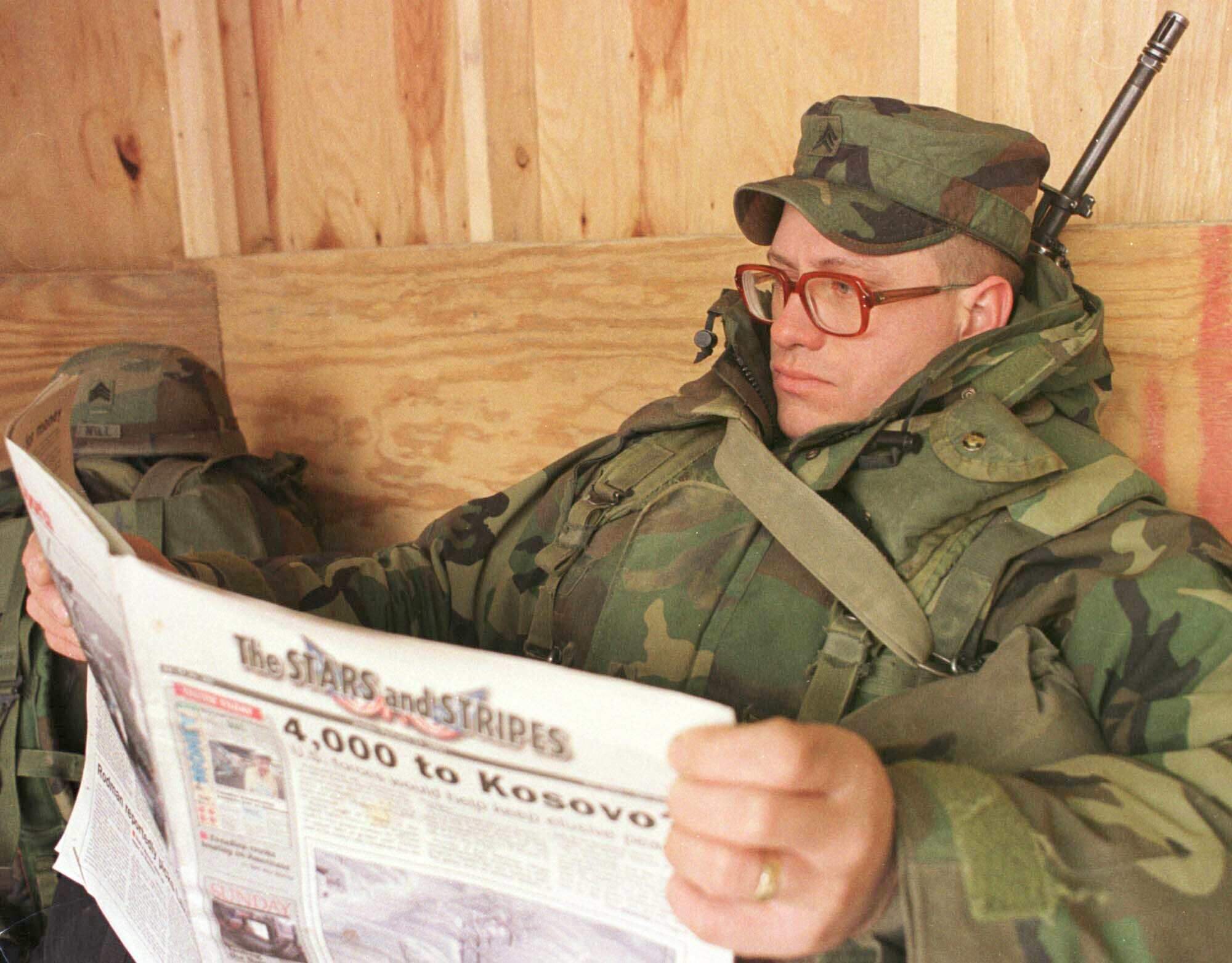
Sgt. John Hubbuch of Versailles, Ky., one of the members of NATO-led peacekeeping forces in Bosnia, reads a copy of the Stars and Stripes in 1999.AMEL EMRIC
Less than two months after the U.S. dropped the most powerful weapon humankind had ever invented — the atomic bomb — on the cities of Hiroshima and Nagasaki, the American military arrived in Japan to implement a very different kind of tool in the U.S. arsenal of democracy.
A free and largely unfettered newspaper.
The first edition of the Stars and Stripes Pacific newspaper was published from downtown Tokyo on Oct. 3, 1945, when the ink on the Japanese surrender that ended World War II was barely dry. This was the start of a decades-long run when print journalism was still the best way to get information that could be entertaining or essential out to hundreds of thousands of U.S. troops who initially occupied Japan and other Pacific outposts, and later would see combat in Korea and Vietnam.
Stars and Stripes Pacific — like virtually everything tied to U.S. imperial might after the war — is part of a complicated legacy that overlapped with American censorship of local and outside media in Japan. Yet, U.S. soldiers managed to get their own information from a publication that celebrated the better angels of the First Amendment back home, with coverage of Tokyo’s war-crimes trial and later from the front lines in Korea.
It was only part of a much grander legacy for Stars and Stripes, which has been the American military’s independent news source tracing all the way back to 1861 and the Slaveholder’s Rebellion.
Famously, when legendary World War II Gen. George Patton threatened to jail editorialcartoonist Bill Mauldin over a cartoon lampooning him, his superior, Gen. Dwight D. Eisenhower, stopped him. “Stars and Stripes is the soldiers’ newspaper,” Ike reportedly said. “We will not interfere.” Mauldin was awarded a Pulitzer Prize for his wartime cartoons. In 2010, Stars and Stripes reporters exposed the Pentagon’s efforts to slant mainstream media coverage of the war in Afghanistan, and won a George Polk Award.
That feisty spirit of Stars and Stripes runs deep in my family’s DNA. My maternal grandfather, Thomas Blender, who’d been a photo editor at the Peoria (Ill.) Journal Star before joining the Army, was sent to Tokyo in those early days to work as a top editor of the Pacific publication. I’ve always regretted, after Grandpa Tom died when I was only 11, that I never got to ask him about those days once I’d been infected with the family journalism bug I’d eventually pass on to my own son.
That must be why it felt like a personal attack last Friday when the Pentagon of Donald Trump and his like-minded “Secretary of War” Pete Hegseth obliterated 155 years of editorial freedom by firing its editor, its publisher — who, seeing the writing on the wall, was about to retire — and its Middle East correspondent. That journalist, Lara Korte, said she was pink-slipped for an interview with CBS News about her reporting on the dreadful conditions for Navy sailors aboard the USS Abraham Lincoln.
The fuse had already been lit back in January when Hegseth’s Pentagon gutted the regulations regarding the government-funded news organization by stripping language that called for “a free flow of news and information to its readership without news management or censorship.” The new rules, which instead said Stars and Stripes’ journalism “must be consistent with good order and discipline of the military,” were seen asan invitation for censorship. Sean Parnell, the formerly embattled Pennsylvania Republican who is now Hegseth’s chief spokesperson, blasted Stars and Stripes for “woke distractions.”
Three months later, Jacqueline Smith, the internal editorial watchdog of Stars and Stripes at the Pentagon, criticized military brass for editorial interference and was promptly fired. But the last straw for the outlet came two weeks ago with its aggressive reporting about problems aboard the Lincoln, which spent nine months mostly at sea with dwindling supplies tied to Trump’s ill-advised war on Iran. Journalist Alison Bath reported that sailors’ families were growing deeply concerned about the mental health of the aircraft carrier’s exhausted crew.
That work epitomized everything that has been good and decent about Stars and Stripes. What the newspaper has shown at its best is that — despite all the contradictions and moral failings of U.S. postwar imperialism — a democratic government can value the press freedom that its armed readers literally died for from Gettysburg to Omaha Beach. That high-minded ideal was a beacon to set us apart from our adversaries in Nazi Germany or Soviet Russia, who never would have permitted the kind of honest coverage Stars and Stripes offered for decades.
Until America found itself with a government with the same philosophy as 1939 Berlin or 1949 Moscow. Just like his boss, Hegseth has shown nothing but contempt for the notion that his “warfighters” might actually serve to protect Americans’ right to the truth about their own government, including the foibles of his Pentagon.
On Monday, it came out that the military’s U.S. Central Command told the Intercept that it maintains “a list of people to disregard,” a.k.a. a blacklist. This is the same U.S. Department of Defense — sorry, Pete, that is still its legal name — that also forced out any journalist who wouldn’t sign their integrity away to work in the press room at the Pentagon.
The firings at Stars and Stripes and the Pentagon’s apparent desire to turn the award-winning newspaper into a Pravda-style propaganda sheet for Hegseth’s testosterone-dosed military feels like a new low on the road toward the utter obliteration of all press freedom.
Since returning to power last year, Trump and his MAGA minions have waged war against journalists they’ve called “the enemy of the people” — and they’ve done so not through some grand Orwellian censorship edict, but through a mix of billionaire carrots and sticks that have inflicted a thousand small cuts. That means rewards for wealthy allies who buy prominent news organizations (think the Ellison family assuming control of CBS and being on the brink of getting CNN) or neuter them (Jeff Bezos at the Washington Post) — but lawsuits, obstacles, or straight-up bullying for everyone else.
Another alarming example of the precarious state of the First Amendment came earlier this month when a lawyer for Trump threatened a $5 billion (with a “b”) lawsuit against a left-leaning think tank, the Center for American Progress (CAP), if it didn’t retract a factual report that the Trump regime’s deployments of National Guard troops to U.S. cities have not lowered crime rates.
The CAP has stood its ground so far, but this reveals the state of play right now. MAGA World has already either bought off or intimidated much of the mainstream media, so now they are hoping they can crush the outliers like Stars and Stripes or CAP, one by one.
The mission my grandfather was dispatched to Tokyo to carry out after World War II was on the fringe of an idea that came to be known as “soft power” — the now-quaint notion that America could form healthy alliances with the rest of the world through good things like vaccinating children or printing uncensored journalism, instead of dropping bombs. Other organizations meant to show people in oppressed lands that press freedom and democracy are things to fight for — like Radio Free Europe — have been forced to grapple with Trump-ordered cutbacks.
The right knows exactly what it is doing — that truth and knowledge are kryptonite for its authoritarian project. Increasingly, they are saying the quiet parts out loud. The great Tennessee journalist Phil Williams recently unearthed a sound bite from a white supremacist confab in Rome in which the conversation turned to America’s growing number of news deserts where journalism has all but perished.
“Local media has been dying all over America, which means that there’s essentially no real way to hold local governments accountable — and they can do whatever they want,” white nationalist Kevin DeAnna told the gathering. “You should be fantasizing about this. This is a good thing.”
No, it’s not. The government’s bludgeoning of Stars and Stripes has truly — to borrow from a storied military campaign of yesteryear — crossed the Rubicon of no return for its all-out blitzkrieg against the truth. All of us, including the laggards of the mainstream media who continue to pretend this war doesn’t exist, need to fight back with everything we have.
I never got to know my Grandpa Tom very well, but I know in my soul that this is what he would have wanted.
Yo, do this!
Meep, meep! If timing is really everything, then the half-animated, half-real feature film Coyote vs. Acme, which hits theaters this week, will be the greatest motion picture of all time. The film is based on a 1990 New Yorker essay that imagines Warner Bros. cartoon icon Wile E. Coyote suing the giant Acme Corp. over years of faulty products that literally blew up in his face and ruined his shot at catching the speedy Road Runner. The fact that real-world corporate baloney delayed for several years the release of this film mocking the excesses of runaway capitalism is an unbelievable irony. I’m really looking forward to seeing it.
Books, despite their apparent looming extinction, remain a great way to track what humankind is thinking about. This summer, the hot topic is anxiety over AI and the unchecked power of Silicon Valley. In addition to the best-selling Nerd Reich, now there’s the great essayist and Harvard historian Jill Lepore with her new tome, The Rise and Fall of the Artificial State, out today. Lepore’s timely work tracks the rise of authoritarianism run not so much by a tinhorn dictator, but by machines, and how humanity can fight back.
Ask me anything
Question: Do PA Dems have a legit chance of freeing us from Joe Pittman’s reign of terror in the state Senate? — Travis (@unraptured.bsky.social) via Bluesky
Answer: Travis, the answer is absolutely yes. Democrats in the Keystone State have managed to chip away at what once seemed like a permanent GOP majority in the upper chamber at the same time that they’ve recaptured the state House. The current Republican Senate edge is just 27-23, meaning Democrats have to flip only three more GOP seats among November’s 25 contests. Every arrow — Trump’s high disapproval, the popularity of Gov. Josh Shapiro at the top of the ticket, and special-election results like last week’s shocking Democratic House victory in a blood-red district in Western Pennsylvania — points toward a blue tsunami. The Democrats have reportedly targeted three suburban swing districts. The big question for 2027 may be whether Shapiro really wants a Harrisburg trifecta pushing him to the left.
What you’re saying about …
OK, last week’s question about Georgia Sen. Jon Ossoff’s pointed comments regarding Donald Trump’s corruption, including an eyebrow-raising mention of ever-present aide Natalie Harp, was kind of a slam dunk for readers of this newsletter. You saw nothing uncivil in the fighting spirit of his remarks, and a surprising number of you echoed back a phrase from my question: “a breath of fresh air.” Wrote Daniel Fleischer: “Jon Ossoff called Trump a ‘crook.’ If anything, that’s a euphemism understating Trump’s criminality.” Added Patricia Eisenberg: “What he said was undeniably true — the President chose this young woman to travel on his escape plane, not one of his cabinet members.”
📮 This week’s question: It seems like the GOP’s got nothing ahead of the midterms beyond its opposition to what it calls “men playing women’s sports.” It’s kind of pathetic, but it does pose a question for Democrats: Do they strongly embrace transgender rights, or is that risking political defeat in today’s culture wars? I have a strong opinion on this, but what do you think? Please email me your answer and put the exact phrase “transgender politics” in the subject line.
Backstory on Indiana’s new, outrageous Katrina
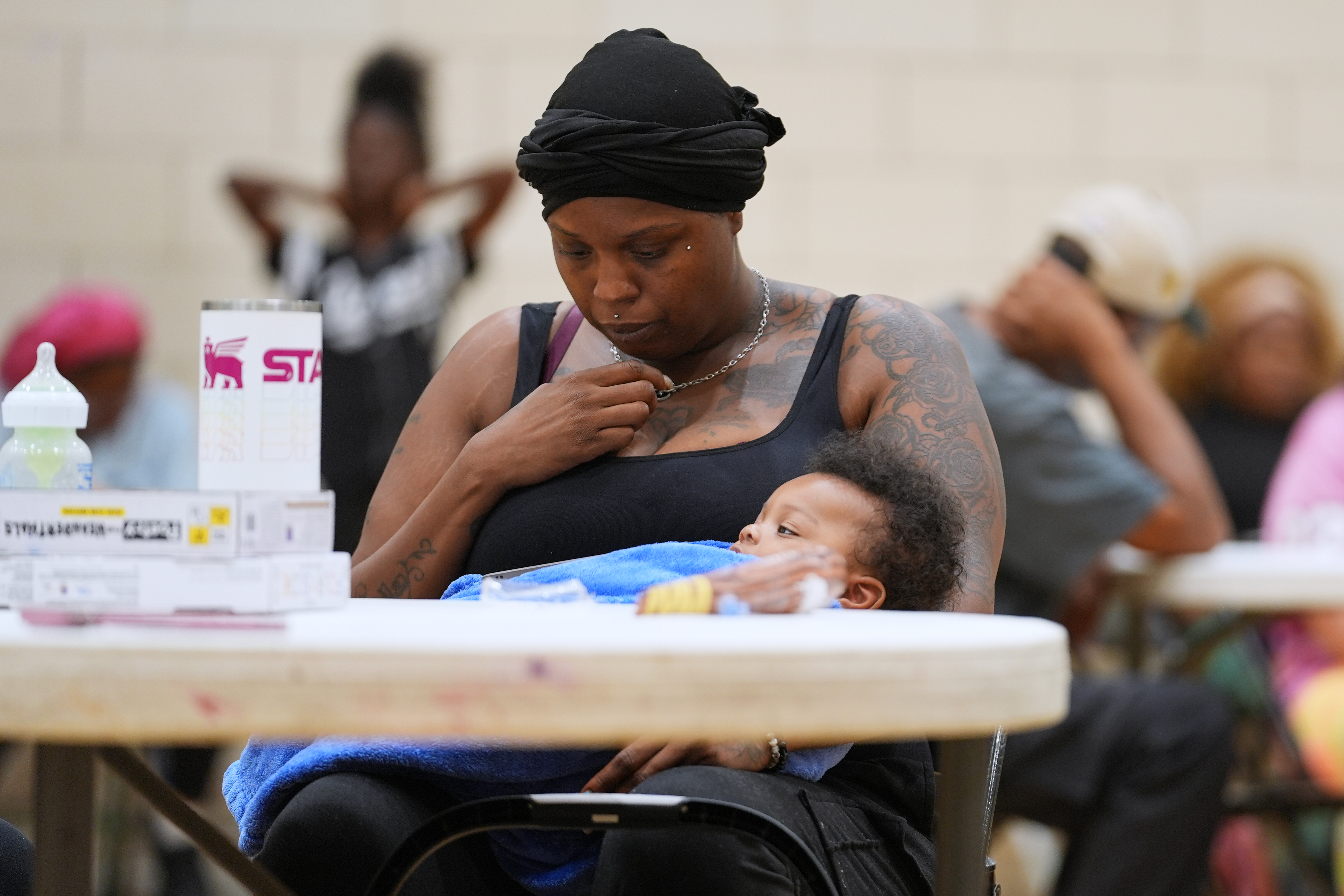
A woman sits inside the City Life Center as she waits for food in Gary, Ind., on Aug. 20, more than a week after a deadly storm passed through the area.Nam Y. Huh
Exactly 21 years ago today, a tropical storm in the Atlantic Ocean rapidly intensified into a hurricane — Hurricane Katrina — and raced across Florida on a path into the Gulf of Mexico, where it became a Category 5 monster. Still, many of us in 2005 briefly thought the Gulf Coast dodged a bullet when Katrina weakened slightly, and its center struck what looked like only a glancing blow on populated New Orleans. Then, one by one, the city’s levees began to break, and the water rose.
The death and destruction in Katrina’s wake was covered around the clock on cable TV, yet it took a couple of days for news anchors to articulate what viewers were seeing with their own eyes. The thousands of people who crowded interstate overpasses or were trapped on roofs were almost all Black, and most were desperately poor.
In These Times wrote the following week that “many Americans were surprised that most of the victims of the New Orleans flood were Black: Their image of the Crescent City had been one of jazz, tasty cuisine and the good-natured excesses of its lively festivals. Where did all those black people come from, they wondered; and where were the white victims?” Katrina triggered some long-overdue conversations about inequality and racism in America, and the inept response from the George W. Bush administration would start his steep decline in public approval. Long before the roughly 1,400 New Orleanians who died in the flooding or chaotic aftermath could be buried, many folks were asking how to prevent this from ever happening again.
It wasn’t a hurricane that struck Gary, Ind., and surrounding communities in the state’s northwest corner exactly two weeks ago on Aug. 11 — just a thunderstorm — but the winds were nearly as intense, snapping trees and downing power lines across the region. Gary’s 67,000 predominantly Black residents hunkered down in the dark nights and blistering hot August days as their refrigerated food went bad, and waited for help. And waited.
While life returned to normal across the rest of the storm-battered Midwest, the massive outage in the region that includes Gary that began with some 375,000 homes lacking electricity dwindled at a snail’s pace. After two weeks, there were still more than 5,000 families without power and struggling with spoiled food and closed schools and workplaces. There is growing anger among residents who say that Indiana’s heavily Republican power structure and Donald Trump’s federal government feel no sense of urgency to rescue a city that is mostly African American.
“This isn’t a problem that started with the storm,” the hip-hop star Freddie Gibbs, who grew up in Gary, told MS Now Monday night. “We are a predominantly Black city that tends to get ignored.” It feels like Katrina redux — an island of utter despair in the world’s wealthiest nation, with a government’s inaction bordering on criminal neglect. But there is one big difference: This festering crisis has been mostly ignored by the national media. The tragedy isn’t just our inability to stop the next Katrina, but our inability to care.
What I wrote on this date in 2022
One of George Orwell’s greatest passages in 1984 concerns Winston Smith’s job of cutting out old newspaper articles and tossing them into “the memory hole” — inconvenient truths meant to be forgotten by civilization. That’s how it feels now reading news stories from those four years in the early 2020s when Donald Trump was out of power, and America took baby steps back toward normalcy that would later get crushed. On Aug. 25, 2022, I wrote about one of these: Joe Biden’s eventually failed plan to wipe out some $300 billion of the nation’s massive student loan debt. I wrote that “this week will be remembered as one giant leap toward an idea that can change everything — the notion that higher education should be a public good, not the privatized rat race that has demoralized our rising generations.”
Look what’s happening out in the streets, got a revolution — and it’s not the one anyone saw coming. Growing public rage against Big Tech — the intrusiveness of artificial intelligence and the noisy, polluting data centers that power it, and increasingly also against omnipresent surveillance cameras — has become the surprise issue of the 2026 midterms. Politicians in both parties are performing backflips to join the bandwagon. Over the weekend, I wrote about how voter anger against Silicon Valley and its billionaires is rapidly reshaping our politics, and what could happen if our broken system fails to deliver radical change.
For the first time in recent memory, August has been living up to its reputation as a slow news month (so far), but on the baseball diamond things have really been heating up as kids are drifting back to school. The Phillies’ just-ended nine-game winning streak has electrified a city that’s been having a pretty good summer in spite of everything. The Inquirer’s oft-cynical sports columnist Marcus Hayes even published a list of five reasons to believe the Phils can go deep into October with a reenergized starting lineup, world-class pitching, and improved defense. A stunning turnaround from long-anticipated rookie pitcher Andrew Painter has also been key to the team’s revival in the National League East. It’s an old-fashioned pennant race, and subscribing to The Inquirer is the best way to keepup.
By submitting your written, visual, and/or audio contributions, you agree to The Inquirer’s Terms of Use, including the grant of rights in Section 10.
More than half of likely voters in Pennsylvania’s forthcoming midterm elections disapprove of President Donald Trump’s job performance, and he is drastically underwater among the state’s electorate on key issues — some of which helped him win a second term in 2024.
Trump, who won the crucial swing state by nearly two percentage points in November 2024, now has an approval rating of 39% and a disapproval rating of 58% among Pennsylvania’s likely voters, according to an Inquirer/New York Times/SienaUniversity poll published Tuesday.
The poll, which was conducted from Aug. 17 to 21 among 760 likely Pennsylvania voters, raises questions about how voters’ perception of the president will affect November’s midterms, when many Pennsylvanians will cast their ballots in four critical swing district races that could determine which party controls the U.S. House.
(function() { var l = function() { new pym.Parent( ‘nyt-trump2__graphic’, ‘https://media.inquirer.com/storage/inquirer/ai2html/nyt-trump2/index.html’); }; if(typeof(pym) === ‘undefined’) { var h = document.getElementsByTagName(‘head’)[0], s = document.createElement(‘script’); s.type = ‘text/javascript’; s.src = ‘https://pym.nprapps.org/pym.v1.min.js’; s.onload = l; h.appendChild(s); } else { l(); } })();
Even among his Pennsylvania supporters who were surveyed, Trump faces some of his lowest approval ratings regarding his handling of the war in Iran and cost-of-living issues, according to the poll, counteracting campaign promises that proved successful in 2024: ending foreign wars and helping people pay their bills.
Once again,the economy will likely be at the front of voters’ minds heading into November — 22% of Pennsylvanians polled said it is their top issue in the governor’s race — and it could also serve as an indicator for the outcome of House races where Republicans will be on the defensive.
“Certainly it’s got to be a drag on their fortunes,” said Don Levy, director of the Siena Research Institute.
(function(){function e(){window.addEventListener(`message`,function(e){if(e.data[`datawrapper-height`]!==void 0){var t=document.querySelectorAll(`iframe`);for(var n in e.data[`datawrapper-height`])for(var r=0,i;i=t[r];r++)if(i.contentWindow===e.source){var a=e.data[`datawrapper-height`][n]+`px`;i.style.height=a}}})}e()})();</script
Trump losing ground on issues that propelled him to White House
The new polling on Trump’s management of top concerns facing the United States — particularly the economy and the cost of living — shows how the issues that helped propel him to the White House in 2024 are now souring his approval among Pennsylvanians, including some who previously voted for him.
Among likely voters in the Keystone State, 39% approve and 61% disapprove of Trump’s handling of the economy. On his handling of the cost of living, 33% said they approve and 66% disapprove.
The data come as voters continue to grapple with rising costs, including unusually high gas prices, and grocery prices that have been increasing for nearly six years. Trump’s tariffs, one of the defining policies of his first year back in office, also raised prices for consumers and businesses.
Now, a quarter of Pennsylvanians who voted for the president in 2024 say they disapprove of how he is handling of the cost of living.
Michael Patterson, 60, of Bucks County, is one of them.
Though Patterson said Trump’s term has been“great” overall, he was expecting more from the president on the economy and costs.
“The prices are still too high, interest rates are still too high,” Patterson said. “We still haven’t seen anything from that promise yet.”
(function(){function e(){window.addEventListener(`message`,function(e){if(e.data[`datawrapper-height`]!==void 0){var t=document.querySelectorAll(`iframe`);for(var n in e.data[`datawrapper-height`])for(var r=0,i;i=t[r];r++)if(i.contentWindow===e.source){var a=e.data[`datawrapper-height`][n]+`px`;i.style.height=a}}})}e()})();
Trump’s messaging on the economy in 2024 was part of why he won Pennsylvania with more votes than any other statewide GOP candidate in history. Pennsylvania voters cited Trump’s promises to bring costs down as a top reason that they voted for him and overlooked Democrats’ warnings about what his election could mean for democracy.
Trump is also hurting on other issues that helped boost him to the presidency, including his promise to end wars. Thirty-two percent of likely voters in Pennsylvania approve of Trump’s handling of the war in Iran and 66% disapprove — including 30% of Trump voters.
Kay Skripac, who voted for Trump in 2024, said thatthough she supports the president on almost every other issue, “I just don’t think that we should have invaded or bombed Iran. I was very surprised, because I didn’t vote for that.”
The 72-year-oldindependent votersaid, despite thinking Trump has done strong work on the economy (she says her retirement portfolio doubled from 2016 to 2026), she is feeling the war’s impact at the gas pump.
“I want everything to just be normal and stay the same, because everything was fine,” said Skripac, who lives in Crawford County. “We weren’t involved in any wars. You didn’t have to worry about any friends or loved ones potentially getting killed. I don’t like that at all.”
Trump’s handling of the Israeli-Palestinian conflict also received low marks from voters, with 62% disapproval, compared with 36% approval.
Republican Sandra Faust, 40, approves of Trump’s handling of that conflict. But her support does not extend to the war in Iran, which Trump launched in coordination with Israel.
Faust, who voted for Trump two years ago, said she strongly disapproves of the war due to rising gas prices and believes it conflicts with the president’s promise to end wars. The Pittsburgh resident, who has a family member in military training to become a jet refueler, said she wishes the conflict in Iran would end.
“Them dragging it on is not only harming us, locally with gas and, you know, pricing and stuff like that, but it’s putting our military in harm’s way, and I’m not happy about that,” she said.
Faust added that she opposes the war because of her belief in the “America First” ideology. That perspective also makes her supportive of Trump’s immigration agenda, she said.
The president is lagging in Pennsylvanians’ support of his immigration policies — which have included mass deportations and enhanced border security — but the disapproval is not as stark. Among likely voters, 44% approve of his handling of immigration and 55% disapprove.
“We are not responsible for taking care of the world’s problems,” Faust said.
What does Trump’s approval rating mean for November in Pa.?
So what does this mean for the midterms?
Time will tell.
But 51% of Pennsylvania’s likely voters who were polled indicated they would be more likely to vote for a Democrat in their congressional district, and 44% said they would support a Republican. More than half, 53%, say they would want to see a flip of control in the House, putting Democrats in charge, while 44% say they would want to see the GOP maintain control.
The polling for the GOP in November is not as bleak as Trump’s numbers, butitshows where voters’ heads are a little more than two months away from the midterms, when Pennsylvanians will weigh in on four competitive swing district congressional races.
(function(){function e(){window.addEventListener(`message`,function(e){if(e.data[`datawrapper-height`]!==void 0){var t=document.querySelectorAll(`iframe`);for(var n in e.data[`datawrapper-height`])for(var r=0,i;i=t[r];r++)if(i.contentWindow===e.source){var a=e.data[`datawrapper-height`][n]+`px`;i.style.height=a}}})}e()})();
Both parties are targeting GOP-held seats in Bucks County’s 1st Congressional District, the Lehigh Valley’s 7th Congressional District, the Scranton area’s 8th Congressional District, and the Harrisburg area’s 10th Congressional District.
Democrats are hoping that a message focused on affordability and tying opponents to Trump will usher in wins this fall. For instance, Democrat Bob Harvie in the heated 1st Congressional District race published a new campaign platform recently that focuses mainly on addressing economic issues.
“The task of Republicans running in various congressional districts, or for the governor of the state, is going to be to somehow separate themselves from the perception that Pennsylvanians have about the job that the head of their party is doing on the economy,” said Levy, the Siena polling director.
But for Democrats, connecting Harvie’s opponent, longtime Republican U.S. Rep. Brian Fitzpatrick, to Trump could be a harder sell. The Bucks County lawmaker consistently outperforms his party and has survived one blue wave after another.
The poll’s findings signal that both parties may also have to think about their branding to the public — 50% of respondents said the Democratic Party is too far to the left and 47% said Republican Party is too far to the right.
Republicans will also have to consider Trump’s unpopularity, especially with women.Sixty-two percent of female likely voters in Pennsylvania disapprove of Trump’s policies, while 34% approve. The president is also strugglingwith men — a key base for him in 2024: 51% of men disapprove of Trump’s policies, compared with 46% who approve.
(function(){function e(){window.addEventListener(`message`,function(e){if(e.data[`datawrapper-height`]!==void 0){var t=document.querySelectorAll(`iframe`);for(var n in e.data[`datawrapper-height`])for(var r=0,i;i=t[r];r++)if(i.contentWindow===e.source){var a=e.data[`datawrapper-height`][n]+`px`;i.style.height=a}}})}e()})();
Democrat Vincent Russo, 78, of Lackawanna County, where Republican U.S. Rep. Rob Bresnahan faces a challenge from Democrat Paige Cognetti in the 8th District, said he will be voting straight blue on his ballot in November and thinks opposition to Trump’s policies will motivate his party to get out to the polls.
“I think the people are starting to see he does nothing but lie,” Russo said.
Staff writers Michelle Baruchman and Gillian McGoldrick contributed to this article.
With a little more than two months until Election Day, Democratic Gov. Josh Shapiro has a double-digit lead over his Republican challenger, Stacy Garrity, among likely Pennsylvania voters in the race to lead the critical swing state — an election that could also serve as an audition for the 2028 presidential primary.
Shapiro holds a 16-percentage-point lead over Garrity, the state treasurer, according to a new poll of 760 likely voters conducted from Aug. 17 through 21 by The Inquirer, the New York Times, and Siena University.
The numbers could foreshadow another commanding victory for Shapiro, as he hopes his popularity trickles into other down-ballot races, including four congressional districts that national Democrats think they can flip. Shapiro is also trying to flip the state Senate for the first time in 30 years and deliver a Democratic trifecta in the statehouse.
(function() { var l = function() { new pym.Parent( ‘nyt-shapiro2__graphic’, ‘https://media.inquirer.com/storage/inquirer/ai2html/nyt-shapiro2/index.html’); }; if(typeof(pym) === ‘undefined’) { var h = document.getElementsByTagName(‘head’)[0], s = document.createElement(‘script’); s.type = ‘text/javascript’; s.src = ‘https://pym.nprapps.org/pym.v1.min.js’; s.onload = l; h.appendChild(s); } else { l(); } })();
A majority of Pennsylvania voters — 60% — have a favorable opinion of the governor, compared with Garrity, who is viewed favorably by just 37% in the state.
Shapiro’s popularity also eclipses that of President Donald Trump, according to the poll. Sixty percent of likely Pennsylvania voters approve of the job Shapiro is doing as governor, while 39% approve of Trump, who won the state two years ago.
Lora Peluso, 63, a Democrat and retired catering director from Pittsburgh, said Shapiro has been a shield in Pennsylvania against some of Trump’s most harmful policies affecting low-income and older people.
“I think [Shapiro] is trustworthy,” said Peluso, who participated in the poll. “His policies are things that actually benefit people, the average working person, seniors.”
Garrity still unknown by some Republicans
Pennsylvania Republicans this year had hoped to avoid another walloping by Shapiro, who has won three times statewide, with fears that a weak gubernatorial candidate could negatively affect the rest of the Republican ticket. So the state GOP took the unprecedented move of endorsing Garrity in September 2025 — approximately 14 months before the election — to try to raise her profile.
Despite securing Trump’s endorsement, Garrity has struggled to raise money, attract support from national Republicans, or compete with Shapiro’s $13 million in ad buys so far this cycle. Her campaign has spent $679,000 on ad buys thus far, according to media-tracking firm AdImpact, as it seeks to introduce the candidate to voters.
Now, with 70 days until the election, a quarter of likely Republican voters still did not know Garrity or know enough about her to form an opinion of her, according to the poll.
Meanwhile, Shapiro maintains favorable opinions among 27% of Trump’s 2024 supporters, and 35% of registered Republicans approve of the job he is doing as governor, the poll found.
(function(){function e(){window.addEventListener(`message`,function(e){if(e.data[`datawrapper-height`]!==void 0){var t=document.querySelectorAll(`iframe`);for(var n in e.data[`datawrapper-height`])for(var r=0,i;i=t[r];r++)if(i.contentWindow===e.source){var a=e.data[`datawrapper-height`][n]+`px`;i.style.height=a}}})}e()})();
Michael Patterson, a Republican from Trumbauersville, Bucks County, who supported Trump in 2024, said he plans to support Shapiro in November because he likes the job the governor is doing and because he does not know much about Garrity besides what he has seen on social media.
“Honestly, I don’t know much about her,” Patterson, 60, said. “I guess I don’t see advertisements on the TV. Other than Facebook, I really don’t see her. The stuff I see on Facebook is just typical partisan stuff.”
Shapiro, on the other hand, appears more moderate and independentfrom his party in Patterson’s eyes.
“He’s kinda doing his own thing. I have a lot of respect for that. He’s not playing partisan games,”Patterson said, contrasting Shapiro with Democrats in California and New York.
Michael Patterson, a Bucks County Republican voter pictured in his Trumbauersville home, plans to vote for Democratic Gov. Josh Shapiro over Republican nominee Stacy Garrity. William Thomas Cain / For The Inquirer
This attitude shows up among other Republicans, too, said Don Levy, the director of the Siena Research Institute.
“Shapiro is seen as sufficiently middle of the road,” Levy said. “He’s got 35% of Republicans approving of the job that he’s doing as governor. That’s a really impressive number in today’s world.”
Other Republicans like Steven Keenan, 70, of Ridley Township, are all in for Garrity, citing her military experience and support for Trump.
“[Shapiro’s] a big phony. He’s a politician,” Keenan said. “She is, too, but she’s been through the wars. I think she’s earned her place. I think we should give a woman a chance.”
A majority of Pennsylvania voters trust Shapiro over Garrity to handle top issues facing the state, including the economy, cost-of-living increases, the Trump administration, immigration, and doing what is best for ordinary Pennsylvanians.
Tina Hoffert, 68, of Lenhartsville, Berks County, said she has not heard much about Garrity, but plans to vote for her in November because she is unsatisfied with Shapiro’s leadership.
“He’s forever bashing Trump,” Hoffert, a Republican, said. “I’m sorry, I don’t care whether you like him or not, he’s our president. You work with him. You don’t fight him. And if there’s things you don’t like that he’s doing, then you go in there and you have discussions.”
Shapiro’s presidential prospects
If Shapiro is reelected in a landslide victory this November, it becomes even more likely that he jumps into the 2028 presidential race as the governor of a key swing state with19electoral votes.
Among those surveyed who said they plan to vote in the Democratic primary in two years, 86% said they would be likely to support him — though the poll did not compare him with other potential primary candidates.
Other prospective candidates include former Vice President Kamala Harris, Govs. Gavin Newsom of California and JB Pritzker of Illinois, U.S. Sens. Mark Kelly of Arizona and Jon Ossoff of Georgia, and U.S. Rep. Alexandria Ocasio-Cortez of New York.
(function(){function e(){window.addEventListener(`message`,function(e){if(e.data[`datawrapper-height`]!==void 0){var t=document.querySelectorAll(`iframe`);for(var n in e.data[`datawrapper-height`])for(var r=0,i;i=t[r];r++)if(i.contentWindow===e.source){var a=e.data[`datawrapper-height`][n]+`px`;i.style.height=a}}})}e()})();
Shapiro has brushed off questions about his ambitions and told a reporter Saturday, in response to whether he would commit to serving a four-year term in office, that “the only thing that I’m focused on — and the only thing anybody should be focused on — is winning in November and being a check on this president’s chaos, cruelty, and corruption.”
Most voters in the poll — 58% — said that if Shapiro decidesto run for president, doing so either would not distract from his role as governor or would not keep him from being effective at governing.
“I mean, it would be a distraction, of course, but I think he’s a professional and a hard worker, and he would figure it out. It seems like he hires good people, too,” said Peter Hewitt, 62, of Devon, a Democrat who supports Shapiro’s reelection bid.
(function() { var l = function() { new pym.Parent( ‘nyt-trump2__graphic’, ‘https://media.inquirer.com/storage/inquirer/ai2html/nyt-trump2/index.html’); }; if(typeof(pym) === ‘undefined’) { var h = document.getElementsByTagName(‘head’)[0], s = document.createElement(‘script’); s.type = ‘text/javascript’; s.src = ‘https://pym.nprapps.org/pym.v1.min.js’; s.onload = l; h.appendChild(s); } else { l(); } })();
Shapiro’s potential candidacy has largely centered on his electability, especially his ability to win the top office in the nation’s premier swing state. He has pitched himself as a Democratic governor more interested in working with Republicans to make meaningful improvements to the state than in picking partisan fights, and voters agree: 58% of respondents said he is neither too far to the left nor to the right.
“He’s done a good job of just being more of a moderate, middle-of-the-road Democrat,” said Andrew Perez, a 58-year-old self-described independent voter in Pittsburgh. He said he appreciated Shapiro’s focus on improving roads and highways and not “just blindly disagreeing” with Trump.
“I think we need a strong presidential candidate who will try to unite the country instead of just keeping it being divisive, so I think that I’d be pretty likely to vote for him [for president],”said Perez, a physician.
Montiese McKenzie, 46, of West Philadelphia, said she is supporting Shapiro for a second term, but is not quite yet sold on a presidential run. She said she has not seen him rise to the level of “fighter” she thinks the Democratic Party needs, and believes as of now, she would be more likely to support someone else in the Democratic primary.
“You see people like Jon Ossoff and JB Pritzker, and they’re not putting up with it. They don’t make it pretty anymore,” McKenzie said. “If I saw some of that in Shapiro, I might be more likely to support him as a presidential candidate. Until then, I’m not sure he has the gumption.”
Shapiro has signed on to dozens of lawsuits against Trump’s administration on a host of issues, from tariffs to gender-affirming care.
But to win the party’s nomination, Shapiro would have to defeat more progressive candidates and make the case for his more centrist approach.
Montiese McKenzie, 48, poses for a portrait near her home in West Philadelphia on Monday, Aug. 24, 2026. McKenzie is a supporter of Gov. Josh Shapiro’s reelection, but is hesitant to back his potential presidential run in 2028.Allie Ippolito / For The Inquirer
Nearly half, 47%, of respondents said he has been just “about right on support of Israel,” with 14% saying he has been too supportive and 19% saying he has been not supportive enough.
Should Shapiro launch a presidential campaign, Hewitt wants to see him “come out on the right side.”
Hewitt, who emphasized his support for Jewish people in his community, said he considers the Israeli government’s actions toward Palestinian people in Gaza to be genocidal. More than 73,000 Palestinian people have been killed in Gaza since the war began nearly three years ago, and multiple international institutions have said Israel’s actions violate human rights.
“I don’t think it’s really that big of a deal for governors per se. He’s not going to vote on national policy as the governor of Pennsylvania,” Hewitt said. But he added: “He does have a voice, and if he’s thinking about a next step beyond Pennsylvania, then he will have to come out in regard to that issue.”