Delaware County’s tourism agency wants to reward you for eating ice cream this summer. Really.
Visit Delco, Delaware County’s tourism promotion agency, launched the Delco Ice Cream Trail Pass in May, a 16-stop mobile “passport” that encourages participants to try out local ice cream and water ice shops, collecting points along the way that can be redeemed for prizes. The Ice Cream Trail takes participants across Delaware County, from Just Homemade Ice Cream in Aston up to the Vanilla Bean in Wayne, and back around to CJ’s Waterice & Ice Cream in Collingdale. It was borne out of a desire to get Delco residents into their communities, and local economies, through a treat that cuts across all age groups, neighborhoods, and walks of life.
“We just wanted to create a fun and accessible experience for the summer that encourages people to explore Delco,” said Amy Bohr, Visit Delco’s marketing director.
Participants on the trail, which runs from Memorial Day through Labor Day, can sign up online and save the “passport” on their phones before visiting theice cream shops, earning points at each location. Points can be applied toward rewards, including a baseball hat-shaped bowl, an ice cream scoop, or a bucket hat. Prizes can be collected at the Visit Delco office in Rose Tree Park.
So far, 1,500 people have signed up for the pass, and 450 have “checked in” at one or more ice cream shops, according to Visit Delco.
Visit Delco’s goal is largely to encourage nonresidents to visit, and spend money, in the suburban county. The agency helps connect visitors with places to stay, restaurants to patronize, and attractions to see, like the Delaware County Symphony or the Media Theatre. The agency also provides grants to local municipalities and organizations to help boost tourism and spur economic activity.
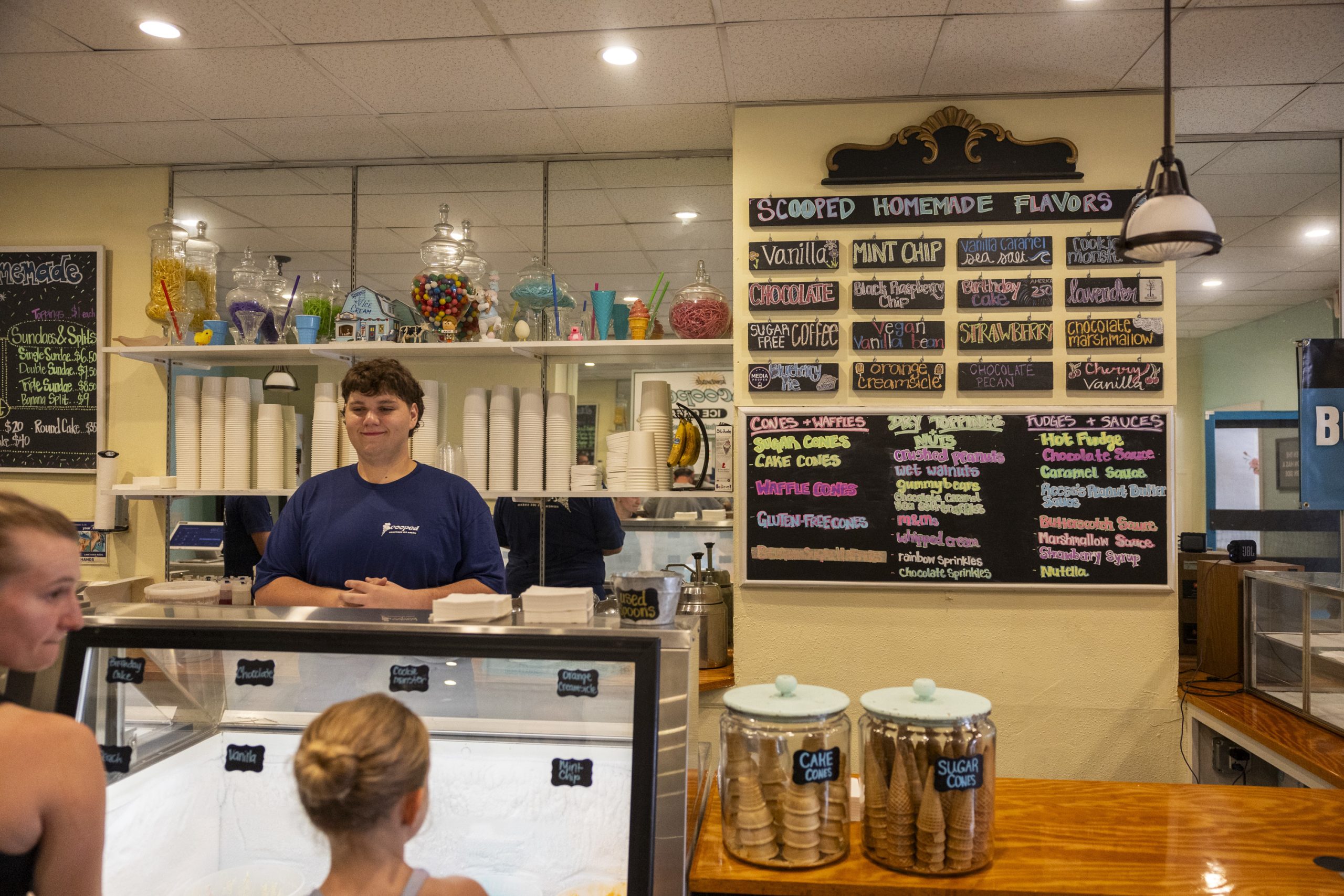
Michael Mooney, 19, of Ridley Park, helps customers at Scooped Ice Cream in Media. Tyger Williams / Staff Photographer
However getting locals out into Delaware County is also key for the agency, and for the economic health of the county’s many municipalities, Bohr said. The Ice Cream Trail, along with Trails and Tails, another “passport” program for dog-friendly trails and parks, are formulas to help encourage locals to visit a part of the county they might otherwise skip.
“When residents visit a new ice cream shop, or explore a town or a Main Street where that shop’s located, they spend a day in the community, perhaps they haven’t done it in a long time, and everyone benefits,” Bohr said.
Locals are Delco’s “best ambassadors,” she said, often recommending favorite spots to family and friends and coming back again to shop or dine.
Kyle Lefkof, owner of Scooped Ice Cream in Media and Chester Springs, said regulars and newcomers alike have stopped by to check a box on the Ice Cream Trail and enjoy a sweet treat.
“I think this is bringing in new business and giving the existing customers something fun to do,” he said.
Scooped opened in Chester Springs in 2009 and Media in 2017. Lefkof took over the business from his aunt and uncle in 2023, and has been running it since. Scooped serves “super premium, gourmet ice cream” with 14% butterfat and “top-shelf ingredients,” Lefkof said.
Ice cream is often “the highlight of people’s days,” he said. “It’s really nice to be a part of that.”
This suburban content is produced with support from the Leslie Miller and Richard Worley Foundation and The Lenfest Institute for Journalism. Editorial content is created independently of the project donors. Gifts to support The Inquirer’s high-impact journalism can be made at inquirer.com/donate. A list of Lenfest Institute donors can be found at lenfestinstitute.org/supporters.
Wilbert Rosado-Ruiz’s fate was placed Wednesday in the hands of a Delaware County judge, who, in the coming week, will determine whether the shooting he committed where he worked, killing two people and wounding three others, was justified or an act of murder.
At the close of his bench trial on charges of murder, attempted murder, and related crimes for the May 2024 shooting, Rosado-Ruiz, 63, testified that he felt his life was in danger and acted in self-defense. A group of his coworkers at Delaware County Linen had ganged up on him, he said, cornering him in the industrial laundry facility and threatening to kill him and his family.
“I’m a person who would never try to hurt anyone,” he said. “Anyone who is inoffensive to me, anyone who would not try to hurt me, I would not try to hurt.
“Now, if someone does try to make a move on my life, yes, I am someone who is armed, and I would defend myself.”
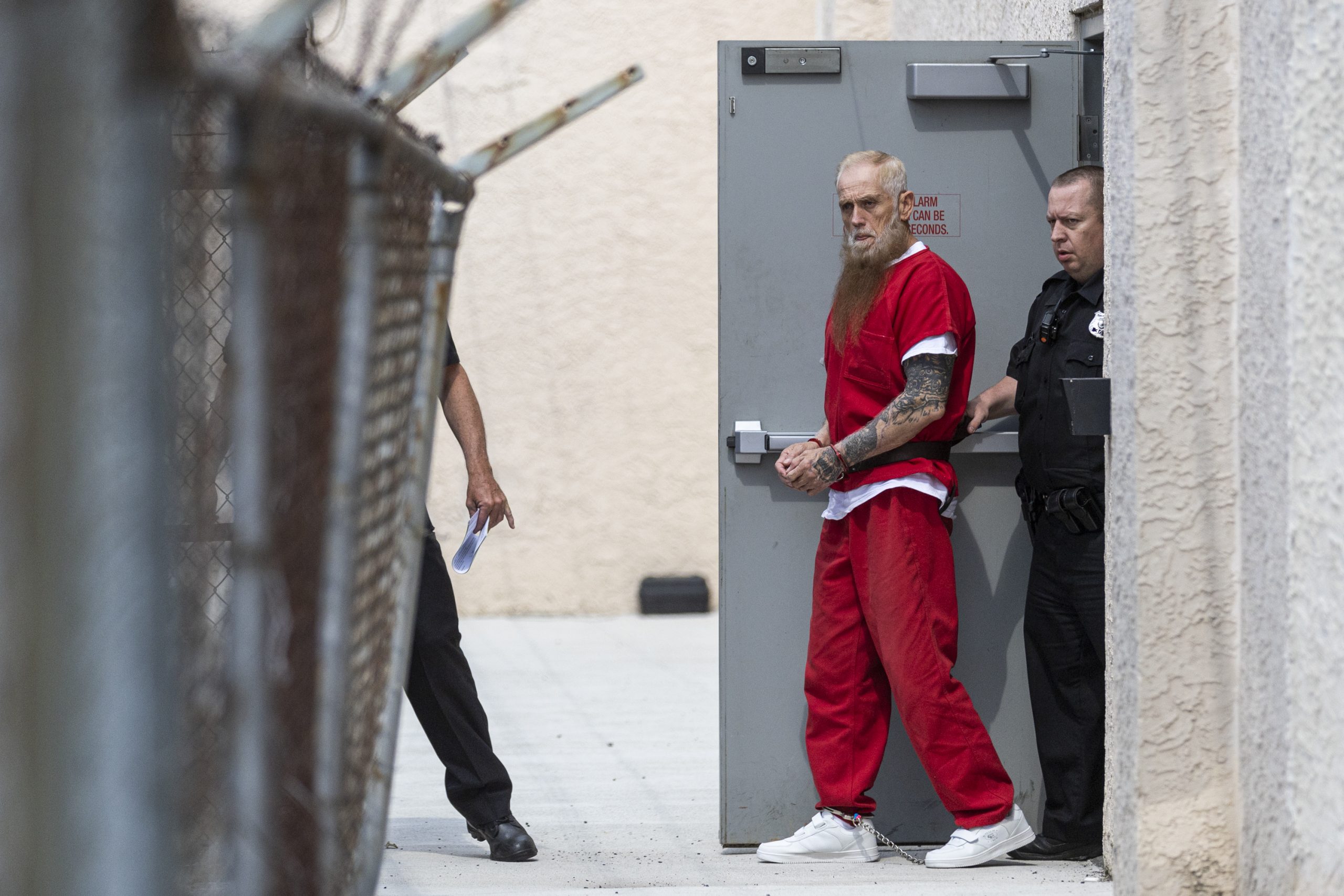
Wilbert Rosado Ruiz, seen here in June 2024, told a judge that his coworkers had threatened to kill him, and that he shot at them in self-defense.Tyger Williams / Staff Photographer
Rosado-Ruiz’s attorney, Kevin O’Neill, urged Judge Kevin Kelly to acquit his client of all charges, saying he had reacted to what he believed to be credible threats to his life and the lives of his loved ones.
Assistant District Attorney Sophia Polites balked at that explanation during her closing arguments Wednesday. None of the victims were armed, and surveillance footage from the Chester business showed them running for their lives as Rosado-Ruiz chased them from room to room.
Rosado-Ruiz, she said, shot at his fleeing coworkers because he wanted to, not because he needed to. He believed, she said, they had disrespected him.
“This was not a decision made out of fear. This was about his ego,” Polites said. “One by one, the people he perceived to have disrespected him, they became his targets.”
Brothers Leovanny Peña Peña, 30, and Giguenson Peña Peña, 26, were killed by Rosado-Ruiz after he clocked in for his early-morning shift.
Testimony during the trial showed that Rosado-Ruiz had gotten into an altercation with another coworker, Nilamarie Valdivieso, while on a video call with his wife and daughter. Valdivieso testified that she approached Rosado-Ruiz to ask him why he was angry, and he responded explosively, screaming that he was “tired of all these people,” before pulling out his 9mm handgun and shooting Valdivieso in the shoulder.
But Rosado-Ruiz offered a different version of that initial encounter. He testified that Valdivieso had hurled insults at him before threatening to cut his head off.
The Peña Peña brothers, as well as other coworkers, joined Valdivieso, Rosado-Ruiz said, and formed a crowd to block him from leaving the room. He said he saw that the two brothers were carrying knives, and moved toward him in a threatening manner.
That is when, he said, he opened fire.
“I waited, and I really thought nothing would happen,” he said. “I didn’t want to hurt anyone.”
Rosado-Ruiz remained on the video call with his family throughout the initial encounter and eventual shooting, but his wife and daughter testified that they could not see or hear the shooting as it took place.
But Polites, the prosecutor, said evidence in the case, including surveillance footage of the encounter, showed that the people around Rosado-Ruiz scattered at the sight of his gun.
After shooting Valdivieso, he shot Leovanny Peña Peña three times before chasing the other people who fled. Rosado-Ruiz caught up with Giguenson Peña Peña after he had exited the building, and shot him as he ran away from him, according to prosecutors.
None of the victims were armed, despite what Rosado-Ruiz said he saw, Polites said.
Judge Kelly said he will deliver his verdict on July 22.
It was the first weekend of summer break. Abigail Gillon, an honor student, had just finished sixth grade. She was free.
“My last text to her was at 2:14” on June 14 last year, said Abby’s mom, Lori Kralle.
An hour later, Kralle received a call from an emergency room nurse about her 12-year-old daughter.
Abby had been riding an electric scooter with her best friend, Isabelle, in Aston Township. The girls were sharing the scooter when they drove off the curb and fell into the street. They were struck by an oncoming car at 2:22 p.m. Emergency responders found them holding each other in fetal position, Kralle said. Abigail died two days later. Her friend was severely injured.
“It didn’t just tear away and take away Abigail’s life, it took apart everybody’s life, her friends and family,” Kralle said.
Lori Kralle with her daughter, Abby Gillon.Lori Kralle
Last year, more traffic crashes causing injury and death in Philadelphia involved electric bikes and scooters than manual ones, according to Pennsylvania Department of Transportation data. The finding highlights a new reality in which e-bikes and e-scooters present a major safety problem, the state confirmed.
The high numbers of injuries and deaths point to the need for legal clarity, statewide safety regulations, and new infrastructure to protect users of e-bikes, e-scooters, and bicycle riders from cars and trucks, traffic safety advocates contend.
(function(){function e(){window.addEventListener(`message`,function(e){if(e.data[`datawrapper-height`]!==void 0){var t=document.querySelectorAll(`iframe`);for(var n in e.data[`datawrapper-height`])for(var r=0,i;i=t[r];r++)if(i.contentWindow===e.source){var a=e.data[`datawrapper-height`][n]+`px`;i.style.height=a}}})}e()})();
“There’s a lot of technology out there and there is no real enforcement and regulation,” said Nicole Brunet, president of PA Safe Roads PAC. “It’s causing devices to be on the road that are unsafe.”
In 2025, e-bikes and e-scooters were involved in 197 crashes on city streets, excluding interstates — a 40% increase over 2024. Four riders were killed and 193 were injured in those collisions, PennDot figures show.
Meanwhile, 193 reported crashes involved standard bikes, more numerous in the city than their electric cousins, as well as traditional foot-propelled scooters, the state figures indicate.
E-bikes and scooters are poorly defined in Pennsylvania law. The ambiguity makes it hard for governments to identify problems; PennDot did not analyze separate crash data for the electric devices until 2024, for instance, due in part to uneven reporting.
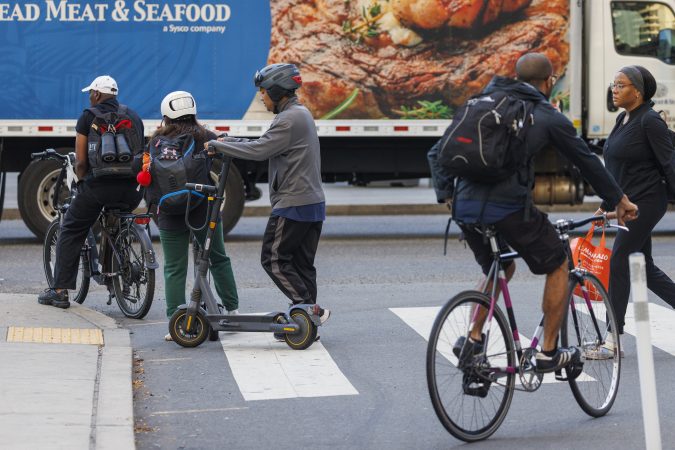
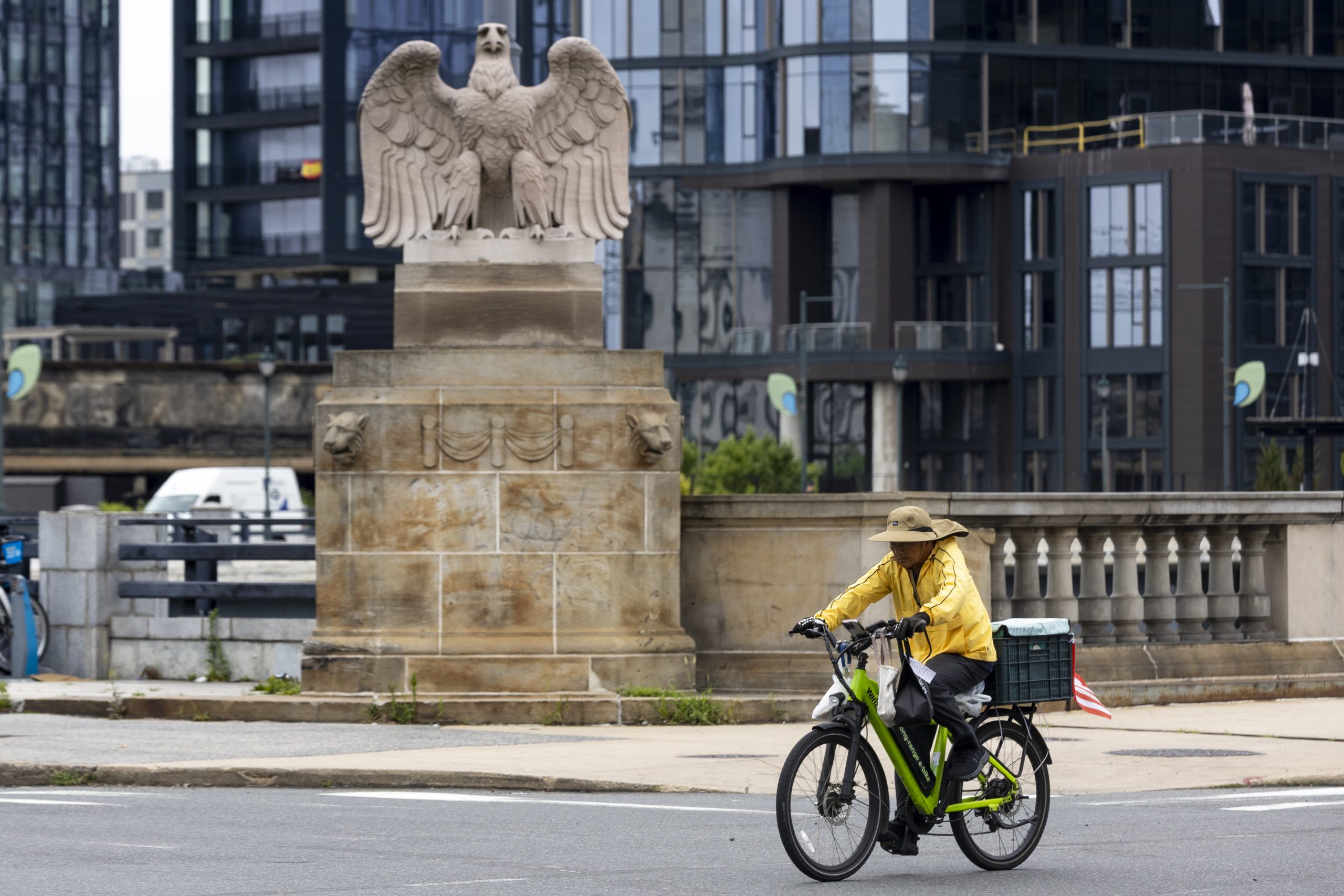
A delivery driver riding an e-bike drives past an intersection on Walnut Street in West Philadelphia on Tuesday, July 7, 2026.Aidan T. Gallo / Staff Photographer
State law authorizes the use of low-speed electric bikes — those that weigh less than 100 pounds, have engines that generate no more than 750 watts, and travel below 20 mph — on public roadways. E-scooters are not street legal in Pennsylvania.
This narrow definition, however, does notdifferentiate among the many new types of electric bikes or e-scooters for sale, which can reach speeds of 60 mph or even 100 mph.
(function() { var l = function() { new pym.Parent( ‘crash-types3__graphic’, ‘https://media.inquirer.com/storage/inquirer/ai2html/crash-types3/index.html’); }; if(typeof(pym) === ‘undefined’) { var h = document.getElementsByTagName(‘head’)[0], s = document.createElement(‘script’); s.type = ‘text/javascript’; s.src = ‘https://pym.nprapps.org/pym.v1.min.js’; s.onload = l; h.appendChild(s); } else { l(); } })();
Two states, two speeds
Governmental response has been uneven, with neighboring states moving in opposite directions and local jurisdictions sometimes banning e-bikes and e-scooters or enacting bespoke rules.
“What we’re seeing right now is sort of a wild, wild west,” said State Sen. Tim Kearney, a Delaware County Democrat.
Kearney wrote and introduced “Abby’s Law” — SB 1008 — in September last year.
The bill says no person under 16 could operate a privately owned “low-speed electric scooter” on public roads; a helmet would be required until age 18. The bill would set a uniform 20 mph speed limit and prohibit tandem riding on e-scooters.
Local police would issue summonses for those and other traffic violations by riders. Municipalities could increase penalties for second and third violations, as long as the fine is no more than $250.
(function() { var l = function() { new pym.Parent( ‘crash-types3__graphic’, ‘https://media.inquirer.com/storage/inquirer/ai2html/crash-types3/index.html’); }; if(typeof(pym) === ‘undefined’) { var h = document.getElementsByTagName(‘head’)[0], s = document.createElement(‘script’); s.type = ‘text/javascript’; s.src = ‘https://pym.nprapps.org/pym.v1.min.js’; s.onload = l; h.appendChild(s); } else { l(); } })();
In New Jersey, former Gov. Phil Murphy, a Democrat, signed the most restrictive electric cycling law in the nation on his last day in officeearlier this year. The law, which takes effect later this month,requires all e-bike users to obtain a license and register their devices with the New Jersey Motor Vehicle Commission, even if they do not go over 20 mph.
Models that can travel between 21 and 28 mph or have a throttle are classified as “motorized bicycles” and must also have liability insurance. The lower-powered e-bikes provide “pedal assist,” which cuts off at 20 mph.
Enforcement could be tricky, especiallyat the Shore. The MVC says out-of-state visitors can ride legally, but language in the law appears to grant the exemption just to people who have registered devices in their home states. That is not an option in Pennsylvania.
The MVC is now taking reservations for appointments; officials have acknowledged the deadline might need to be extended.
E-scooters with a top speed of 19 mph are legal.
In Pennsylvania, more than a year after Abby Gillon’s death, Kearney’s bill has not had a public hearing or a vote in the Senate.
“We need to get people to acknowledge what’s actually happening on the road, and then stop sticking our heads in the sand about the various bureaucratic reasons not to move forward with it,” Kearney said.
Wide use, thin information
Government officials face challenges identifying and classifying the many varieties of electricbikes and scooters — also known as micromobility vehicles — transportation activists and state officials said. That makes information, including about crashes, hard to come by.
PennDot, for instance, began counting electric bikes and scooters separately from pedal cycles, unmotorized scooters, and pedestrians for its annual tally of crashes only in 2024.
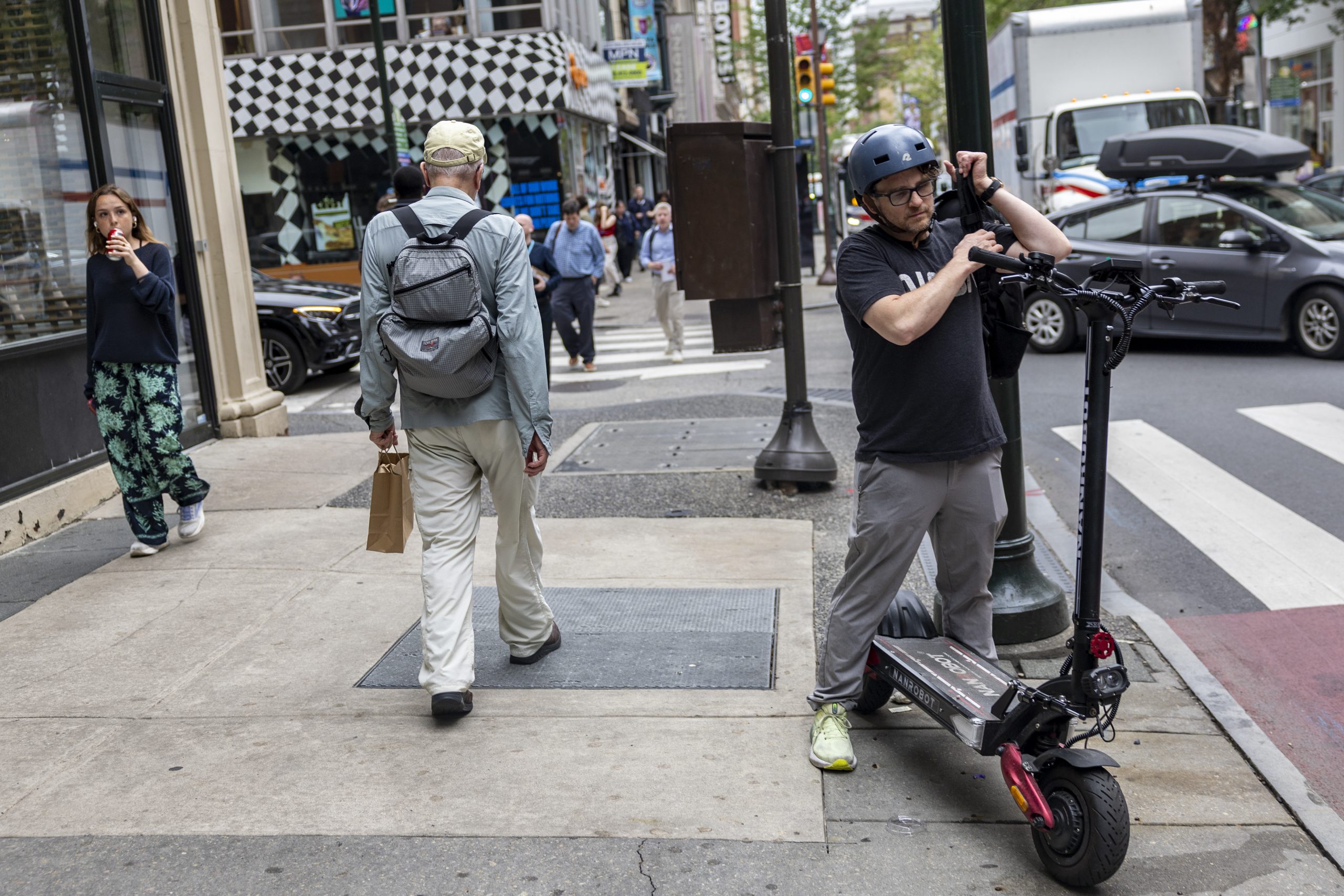
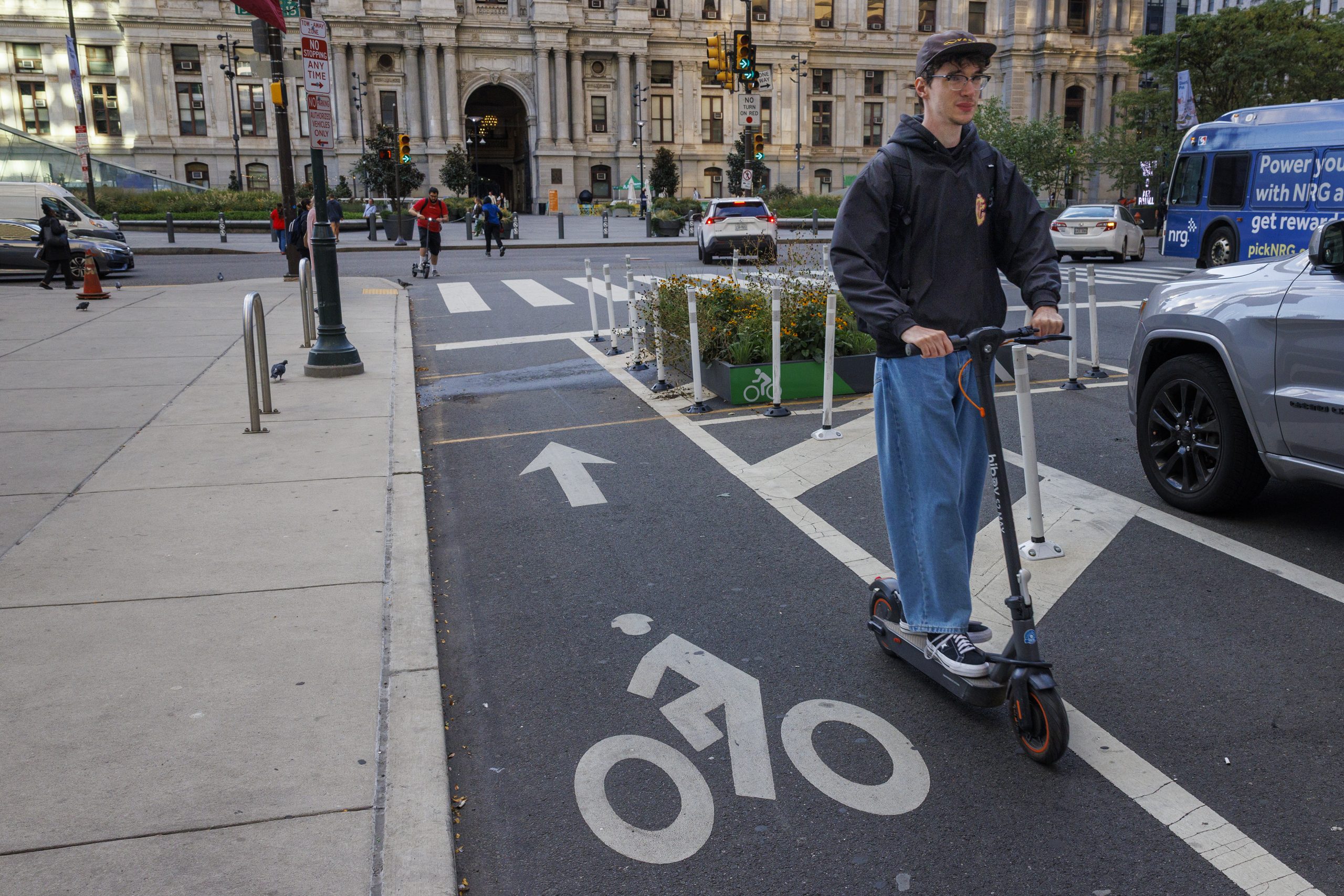
A man gets ready to leave on his electric shooter in Center City.Aidan T. Gallo / Staff Photographer
After a vehicular crash, law enforcement is required to report to PennDot details of crashes that involve injuries, fatalities, or significant damage to vehicles.
Regarding the data prior to 2024, Robert A. Ranieri, crash-analysis manager at PennDot, said via email: “I don’t find that fully reliable since we didn’t look at all the narratives and the police may not have reported them properly at the time.”
While his office works to verify the data, “not all reports are touched by my staff,” Ranieri said.
Similarly, the crash data on electric bikes likely include vehicles known as e-motos, which look like pedal bikes but go faster than 20 mph, said John Boyle, research director at the Bicycle Coalition of Greater Philadelphia.
In general, e-motos being lumped in with e-bikes is causing a lot of issues as communities and states try to regulate the higher-speed micromobility devices, Brunet said.
E-scooter law is ‘basically ignored’
The recently released PennDot data include at least 92 crashes in Philly involving e-scooters, which are technically illegal to ride on public streets in Pennsylvania.
Last year, there were four reported fatalities involving e-scooters, though they made up only 14% of micromobility devices, according to the Bicycle Coalition’s 2025 bike count data.
Standard bikes, in comparison, resulted in the same number, a total of four deaths, last year.
“Some of the e-scooters have a top speed of 60 mph, which is crazy fast,” Boyle said, but “the law is basically ignored.”
There is a gray market of electric scooters and bikes available for purchase, transportation experts told The Inquirer.
“You can purchase electric bikes or scooters for $800 on Amazon and they have 1,000 to 2,000 watts,” Boyle said.
The bikes are sometimes marketed as “Class 2,” meaning their motor tops out at 20 mph, but with a few basic adjustments can easily go faster, Boyle said.
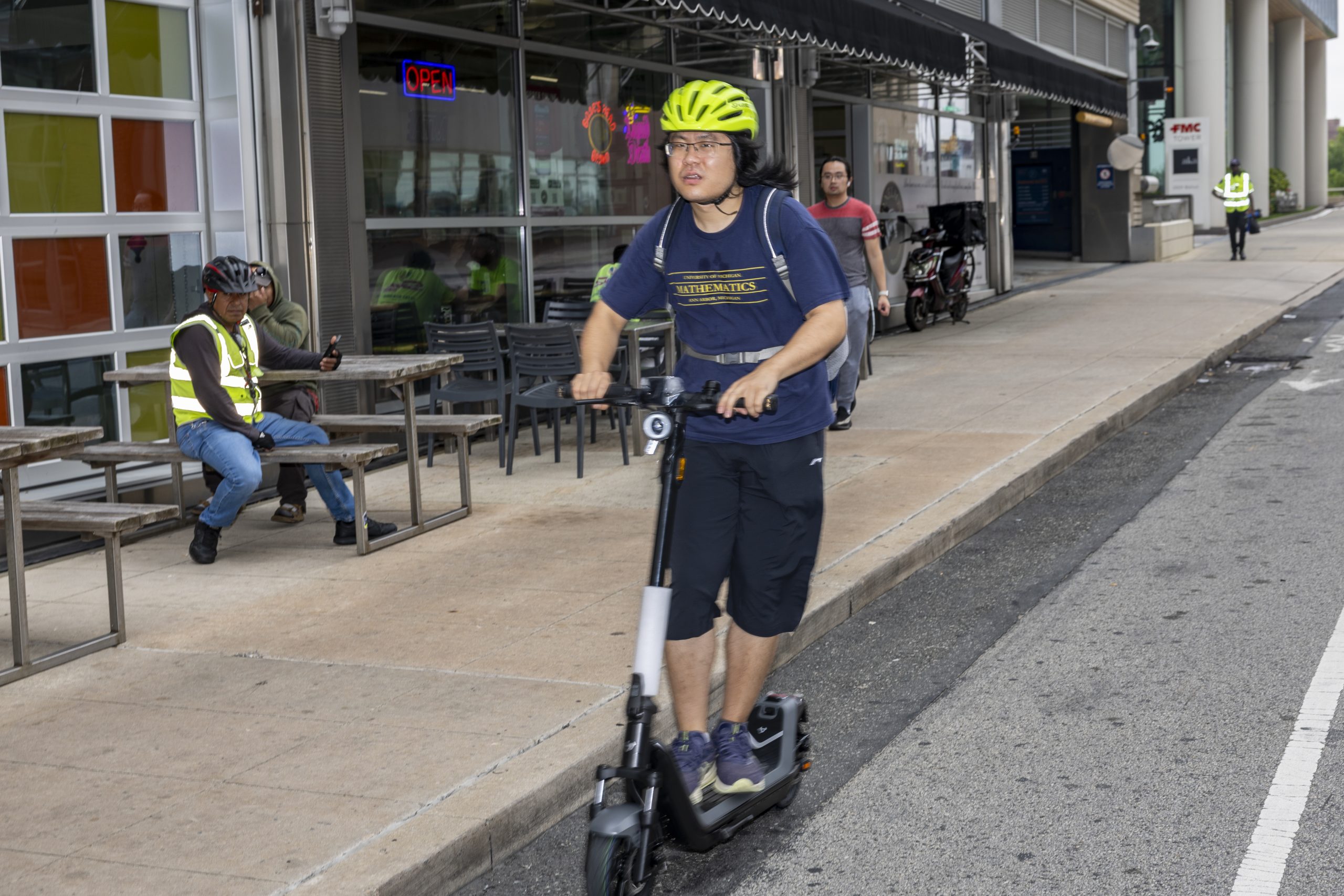
A man rides an electric scooter down a bike lane near Drexel University’s campus.Aidan T. Gallo / Staff Photographer
Motorcycles, unlike e-motos, have quality standards and regulations. When it comes to selling a motorcycle in Pennsylvania, dealerships are required to handle legal requirements, title transfers, and state registrations.
Reiningin the manufacturers and dealers of electric bikes, motos, and scooters is an important step, Boyle said, but the state first needs to better define in the law what electric bikes and scooters are.
Brunet, president of PA Safe Roads PAC, said her organization supports the Safe System approach to transportation safety, which involves education, enforcement, and infrastructure.
“Philly just needs to keep building better bike infrastructure. … There is definitely a lot to do to make roads safer so that the people choosing these devices get home safe,” Brunet said.
Several bills to regulate e-scooters have been proposed in the state legislature, but none have been passed.
Special legislation gave Pittsburgh the right to test a shared e-scooter rental program in partnership with Spin, a private company, from 2021 to 2023, when the trial expired.
Kinkead called it a success, noting her north Pittsburgh district has steep hills and limited transit links.
“What I saw … was not college kids goofing around, it was people who were trying to get around the North Side with grocery bags,” Kinkead said at a recent public hearing on the bill.
The city had 230,000 unique e-scooter users during the test, said Ryan Seiferet, who managed the program for the Pittsburgh Department of Mobility and Infrastructure.
A survey of about 1,000 participants showed 44% of e-scooter riders used them to get to work and one-third to travel between transit stops and home. Regular users tended to have low incomes.
While rules are needed in the state, especially for privately owned scooters, “We want to make sure we aren’t penalizing or disincentivizing a valuable micromobility travel option” for people, said Jessie Amadio, an organizer for Philly Bike Action.
The electric scooter program was relatively safe, with one reported injury per 17,000 rides, according to a DOMI report.
Electric scooters going against directed traffic flow at Market Street at 15th in Center City.Alejandro A. Alvarez / Staff Photographer
News site Next Pittsburgh found, however, that a handful of the injuries were serious and, in some cases, life-threatening. Spin planned to deploy scooters with larger tires for stability, the site reported.
Kinkead said shared e-scooters can be tightly controlled in agreements between a city and an e-scooter firm; in Pittsburgh, the scooters could not exceed 15 mph, enforced by software. E-scooters stopped working if the rider strayed into a town that did not allow them.
Philadelphia, however, is opting out. Mayor Cherelle L. Parker’s administration asked that the city not be included in the shared e-scooter bill, said State Rep. Ed Neilson, a Democrat who represents a Northeast district and chairs the House Transportation Committee.
“Because of the historic nature of the city and the millions of people that come every year, we just don’t want to block or impede that,” Neilson told colleagues in the hearing.
Most agree that the state needs to take some sort of legislative action soon.
“Getting as far as we have gotten [with Abby’s Law] on the Senate’s desk and to still not have anything signed or put into order is very frustrating,” Lori Kralle said.
“What does it take? For another mother to get that phone call?” she added. “I don’t wish that on anybody.”
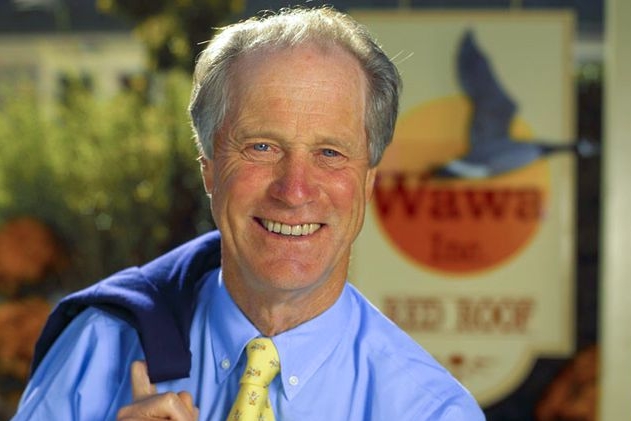
Richard D. Wood Jr., 88, of Wawa, Delaware County, chair emeritus and former chief executive officer and president of Wawa Inc., Convenience Store News Hall of Famer, lawyer, trustee, mentor, veteran, and philanthropist, died Friday, July 10, of age-associated decline at his home.
Born in Philadelphia, Mr. Wood earned a law degree at what is now the University of Pennsylvania’s Carey Law School in 1964 and joined his family’s nascent Wawa food market company in 1970 as its first general counsel. His great-grandfather founded the Wawa dairy in 1902, and his father’s cousin opened the first Wawa food market in 1964.
By 1977, Mr. Woodhad ascended to president of the company, and its innovations, including 24-7 hours of operation and custom-made hoagies, made it the region’s dominant convenience store. He became CEO in 1980 and chair in 1982, and was named chair emeritus in 2020.
In 2020, Inquirer business writer Joseph N. DiStefano said Mr. Wood “presided over the board during the period of Wawa’s rapid growth from a regional cokes-smokes-milk-and-hoagies chain to a convenience store and gas outlet with more than $12 billion in annual sales and 850 stores from New Jersey to Florida.”
For more than 40 years, Mr. Wood supervised Wawa’s multistate expansion, addition of gas pumps, expanded inventory, rigorous employee training, and popular employee stock ownership plan. During his tenure, the company grew to more than 36,000 associates and was one of the largest privately held companies in the country.
Through it all, Mr. Wood was affable and curious, friends and family said. He wanted to know everybody’s name and what they thought, and he enjoyed touring the stores and chatting up associates and customers, especially on Christmas Day. He told colleagues he wanted to “create an environment where each of us believes that we can make a difference.”
“Dick Wood was our true lead goose who was the guiding heart and soul of the company,” Chris Gheysens, Wawa’s chairman and CEO, said in a tribute. “He is the reason why Wawa is the company we are today and why we enjoy so much share of heart from our customers and dedication from our associates.”
Mr. Wood hired students and women to work in the stores, and offered flexible schedules to accommodate their availability. He oversaw Wawa’s $200 million of donations to community nonprofits and its college tuition reimbursement plan for associates.
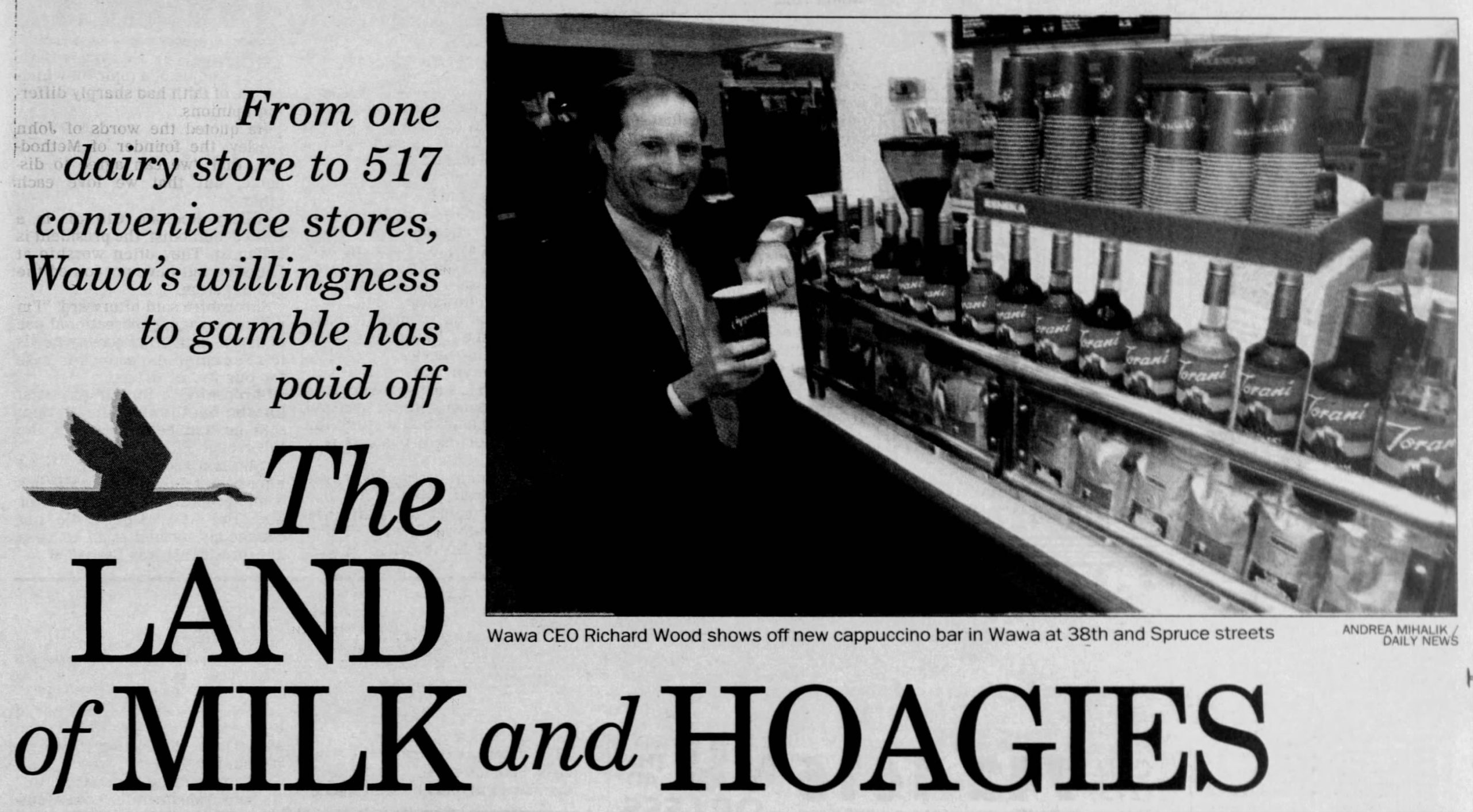
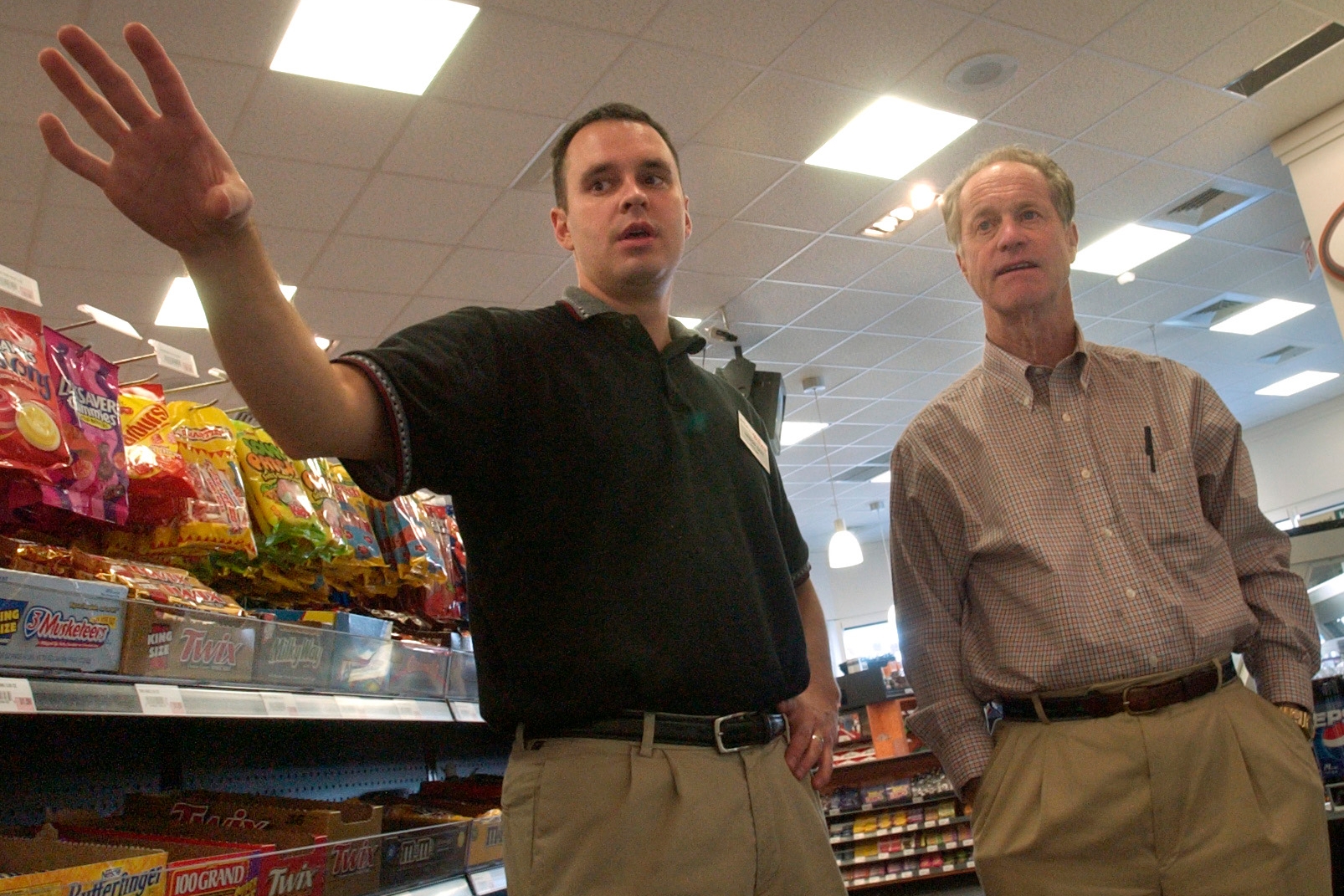
This photo of Mr. Wood and a story about Wawa appeared in the Daily News in 1994. Newspapers.com
In 2021, to mark his 50th anniversary at the company, Wawa established the Dick Wood College Scholarship Fund for associates. He told Inc. magazine in 2018: “Values and culture mean more in this company than being smart.”
Colleagues called him “humble, gracious, curious, and kind” and “a beloved treasure to the company” in tributes. His life-size bronze statue greets visitors at Wawa’s corporate headquarters.
“He made people feel important,” said Barbara Ennis, his longtime assistant, ”because to him, they were.”
Mr. Wood was onetime chair of the executive committee of the National Association of Convenience Stores and on boards at Children’s Hospital of Philadelphia, Riddle Memorial Hospital, Philadelphia National Bank, Bok Tower Gardens in Florida, and other organizations. He appeared oftenin The Inquirer and Daily News, spoke on panels and at conferences about corporate leadership, and was inducted into the Convenience Store News Hall of Fame in 1996.
Mr. Wood (left) worked closely with fellow CHOP trustee N. Scott Adzick.Children's Hospital of Philadelphia
He served on the Chester Heights Borough Council in the early 1980s and was named 1996 businessman of the year by the Great Valley Regional Chamber of Commerce. Before Wawa, Mr. Wood was a public defender in Philadelphia and a lawyer at Montgomery McCracken.
“People loved to follow him,” said his son, Richard D. Wood III. “He was larger than life,” said his daughter, Lisa Wright.
Sometimes, his family said, Mr. Wood walked the halls of the hospital, sharing Wawa coffee and conversation with patients and families. CHOP honored him at its 2019 Carousel Ball. Madeline Bell, CEO at CHOP, said: “I will truly miss his warmth, wisdom, and generous spirit.”
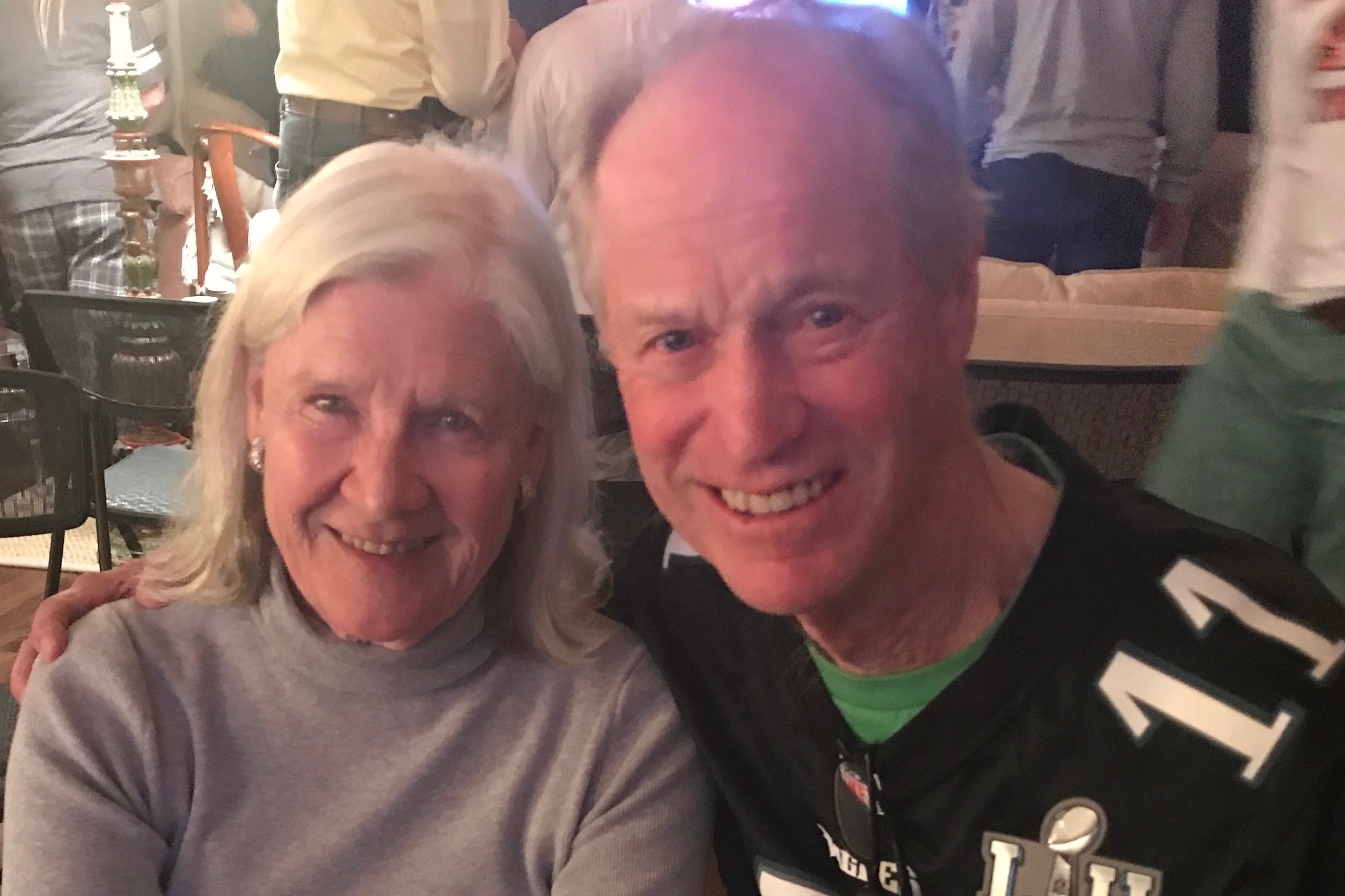
Mr. Wood and his wife, Jeanette, married in 1964.Courtesy of the family
Howard Stoeckel, former Wawa vice chair, CEO, and president, said in a tribute: “He had a special mix of heart, compassion, empathy, and humility that made him a true believer and practitioner of servant leadership.”
Richard Davis Wood Jr. was born March 4, 1938. He graduated from St. Paul’s School in Concord, N.H., earned a bachelor’s degree in business at the University of Virginia, and served for a year in the Marine Corps and later in the Marine Corps Reserve.
He met Jeannette Andrews when he was visiting New York with friends, and they married in 1964. They lived in Philadelphia and Wawa, and had a daughter, Lisa, and a son, Richard III. His wife died in 2025.
Mr. Wood was an avid golfer, and he belonged to the Gulph Mills and Pine Valley Golf Clubs, and the Mountain Lake Club in Florida. He played tennis and bridge, and was a longtime season ticket holder for the Eagles and Flyers.
Mr. Wood (right) enjoyed meeting and talking with Wawa associates and customers. Jonathan Wilson / Staff Photographer
He and his wife traveled, hosted family holiday parties, and spent memorable winters in Lake Wales, Fla. He drove his favorite Honda Accord for years and followed Virginia college football and basketball closely.
He championed conservation, education, and health. “He treated every single person the same,” his daughter said. His son said: “Humility defined him.”
It’s possible that nobody knows the stretch of Brandywine River that meanders through the heart of Wilmington better than Missy Morrissey.
Since her sister Susan’s battered body was discovered there nearly seven years ago, the West Chester native regularly returns to its banks, mulling a question:
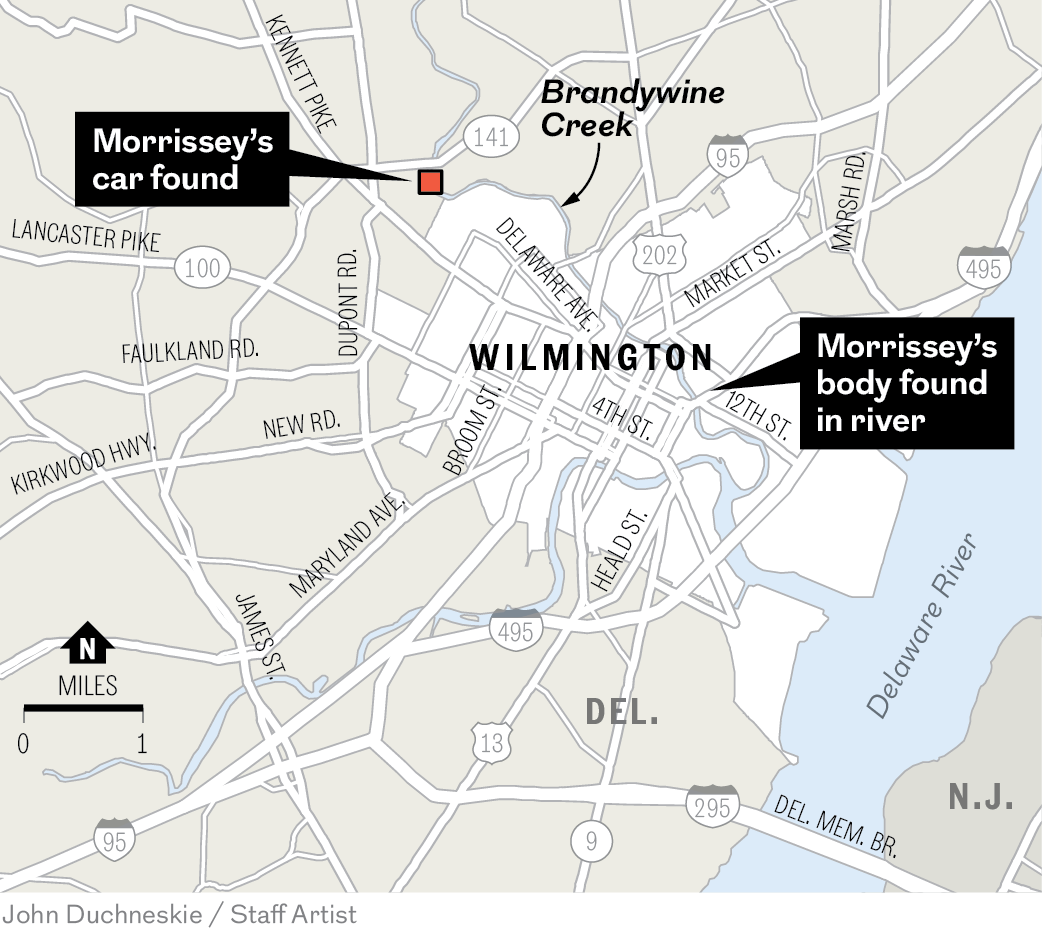
How exactly did the 50-year-old Delaware County schoolteacher arrive in the shallows more than three miles downriver from where her car was found abandoned early on a July morning in 2019 in what authorities said was a homicide?
And how, she wonders, has the crime gone unsolved for all these years?
Susan Morrissey, who had been sipping wine and texting with friends into the early morning hours, left her Wilmington home just after 3 a.m. for reasons unknown, authorities said, and turned up dead in the river hours later.
Surveillance cameras captured Morrissey’s black Honda Civic as it left her home and headed to the gates of a nearby office building, where it was parked haphazardly and left unlocked with her cell phone and purse inside.
It was not until about four hours later that a construction worker discovered Morrissey’s body floating in the water miles away near the Northeast Boulevard bridge. She had died from blunt force trauma and drowning, the medical examiner found.
A photo of Susan Morrissey.Missy Morrissey
Investigators can’t say for sure how Morrissey’s body made it to the opposite side of town, though they believe she was alive when she entered the river and that she did not do so near where her car was parked.
“A friend refers to it as ‘the magic carpet ride,’” Missy Morrissey said of the distance between her sister’s car and where her body was discovered. “We just can’t figure anything out.”
It’s a puzzle that brings Missy Morrissey, the oldest of four siblings, back to the Brandywine each year, where she lays a bouquet of roses to honor her sister’s memory.
But this year, as yet another anniversary of Morrissey’s July 23 death nears, her family has begun to wonder whether after years of efforts to uncover the truth, her killer may never be found.
“On the first anniversary in 2020, I couldn’t have imagined that we would be sitting here in 2026 talking about this,” said Meg Morrissey Heinicke, the second-youngest of Susan’s siblings. “I would say time doesn’t heal all wounds. It is just as painful this year as the first year, the second year, the third year.”
Homicide detectives with the Delaware State Police say the investigation continues, but they have no suspects or motive, and there are no new developments in a crime that has divided the Wilmington and Chester County communities and drawn attention from true-crime podcasts and amateur sleuths across the country.
Missy Morrissey appreciates that people have taken an interest in her sister’s death long after it faded from the headlines.
Still, she and her family just want the crime solved.
A sister with flair
Susan Morrissey did just about everything with flair, her siblings said.
She grew up around West Chester and Wilmington and attended the city’s prestigious Tatnall School before heading to Georgetown University and later to San Francisco State, where she earned a master’s degree and began her career as an educator at a public school in a low-income Bay Area neighborhood.
Morrissey volunteered often, her siblings said, working with young people at a juvenile detention facility and devoting hours to an animal rescue, where she combed frigid Northern California beaches for stranded sea lions.
She was the first to read up on far-flung conflicts and the world’s injustices, and she loved sitting with a book on the beach in Stone Harbor.
It was she who recommended Noam Chomsky tomes and George Carlin stand-up specials to her less-enlightened siblings, they said. Everything from her CD collection to her handwriting oozed taste and personality.
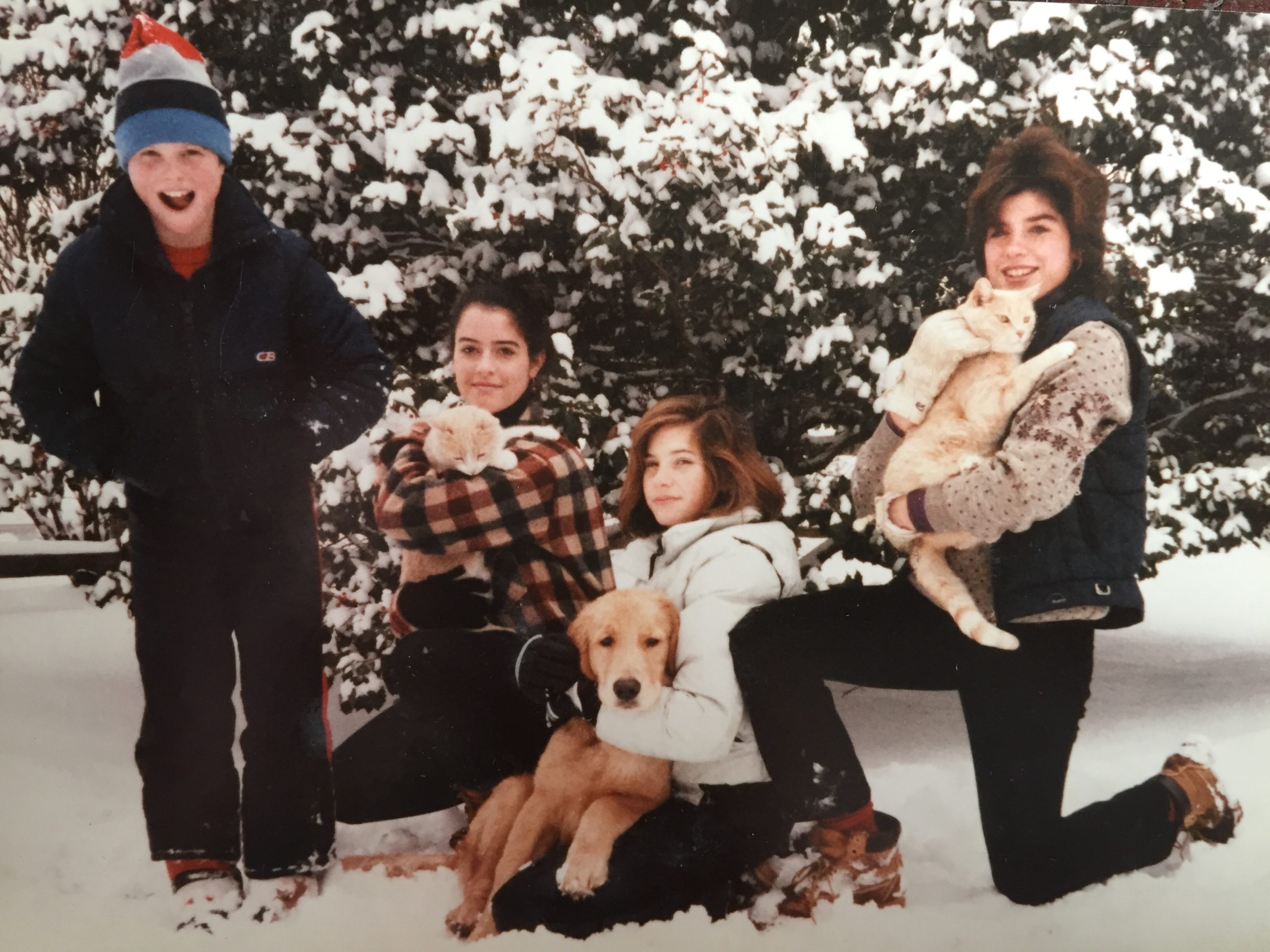
The Morrissey siblings (from left: John, Meg, Missy, Susan).Missy Morrissey
“I don’t know how many people feel this way, but I kind of felt like the coolest person in the world happened to be in my family,” said John Morrissey Jr., the youngest of the siblings.
Morrissey eventually returned east and, after a disappointing stint of online dating in her 40s, reconnected with a former schoolmate, Ben Ledyard, an investment consultant and a regular on the Wilmington social scene.
The two soon wed, and each weekday morning, Morrissey drove to Pennsylvania to teach English at Academy Park High School in Sharon Hill, Delaware County, where she worked for 13 years until her death on July 23, 2019.
Her brother now lives in Virginia but regularly returns home to the Brandywine Valley, where visits have begun to trouble him.
With each crossing of a bridge, each riverside drive, he said, a reminder of his sister’s killing lurks beneath the river’s surface.
“Susan liked true crime,” he said, “especially local crime.”
The mystery of her death, he said, is “exactly the kind of case that Susan would have been interested in.”
A body in the water
Even after all these years, Missy Morrissey still has the texts saved to her phone.
It was 12:29 a.m., she said, and the sisters casually exchanged messages while Susan Morrissey relaxed with a glass of wine on the back porch of her Riverview Avenue home.
She was a night owl, her sister said, and often stayed up late chatting with family or friends, especially during her summer break from school. Morrissey, she said, had been looking forward to attending a Rolling Stones concert with her husband at Lincoln Financial Field the next evening.
Phone records showed that Morrissey texted with friends and updated her storefront on Poshmark, an e-commerce site for secondhand fashion, until 2:45 a.m.
Then at 3:02 a.m., a nearby security camera captured Morrissey’s car leaving her driveway, according to Delaware State Police. It traveled around a mile through Wilmington to Walker’s Mill, a historic riverside property that had been converted into offices.
In the dark of night, however, detectives who later reviewed the footage could not determine who drove the vehicle to Walker’s Mill or see who left the car after it was parked.
Map of Wilmington, Del., showing locations in the death of Susan Morrissey, whose death seven years ago remains unsolved.John Duchneskie
What happened in the nearly five hours between the car’s arrival at Walker’s Mill and the discovery of Morrissey’s body downriver remains a mystery. Investigators say they have not determined why Morrissey would have entered the water that morning.
“She got her injuries close in time to when she died, and she died close in time to when her body was found” at 7:39 a.m., said Detective Daniel Grassi of the Delaware State Police.
He believes she may have entered the river anywhere from the Brandywine Zoo to the 16th Street Bridge, more than two miles downriver from her vehicle.
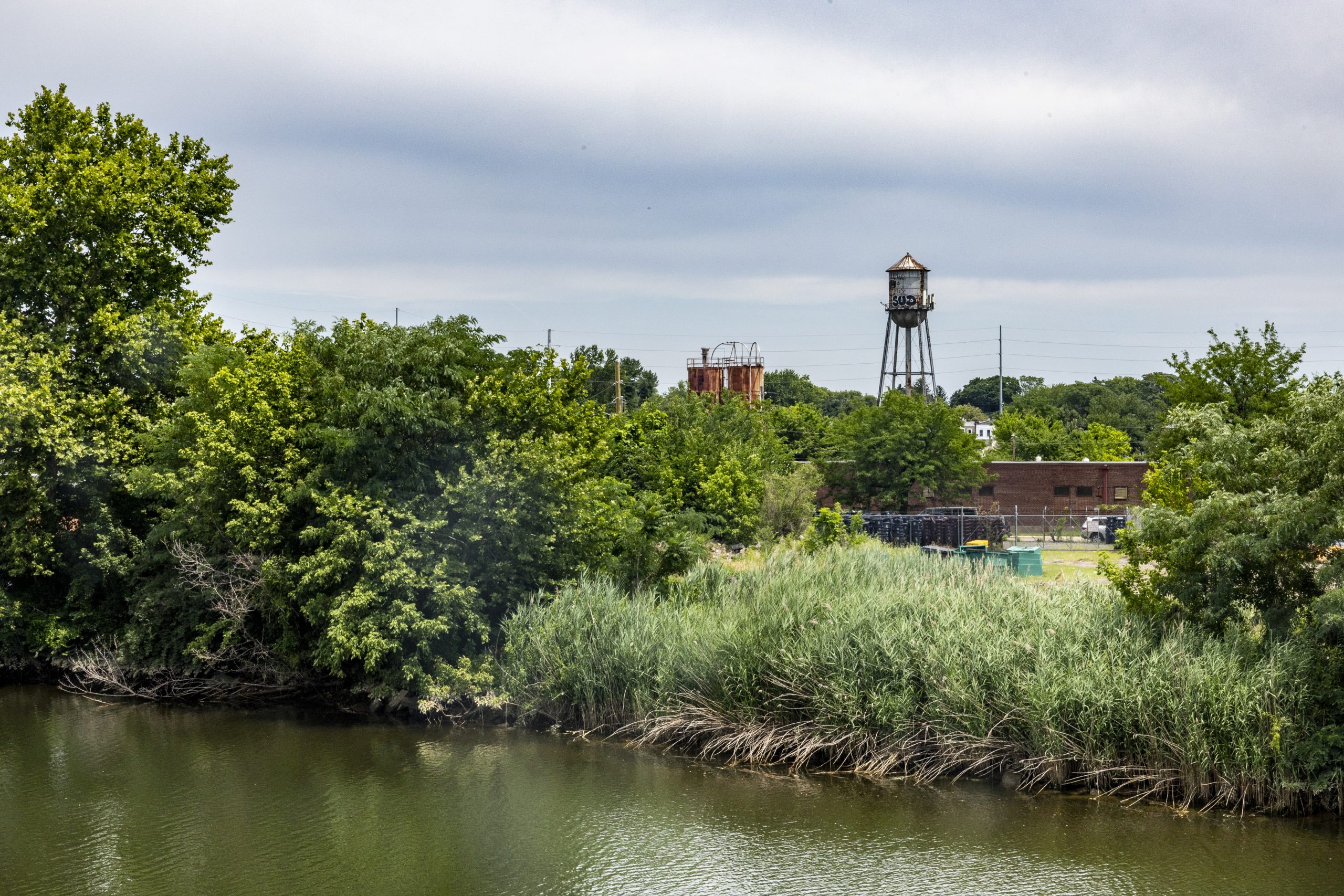
A water tower is seen from the top of the Northeast Boulevard Bridge in Wilmington, Del., on Friday, June 26, 2026. Susan Morrissey, a schoolteacher in Delaware County, was killed in Wilmington, Del., seven years ago this summer. Her body was found in the Brandywine River near the Northeast Boulevard Bridge.Aidan T. Gallo / Staff Photographer
Using data from Morrissey’s Fitbit device, investigators have pieced together the barest of timelines from that morning.
The tracker did not record Morrissey’s GPS location, so investigators cannot trace her movements, but they know she walked about a mile within an hour of her vehicle arriving at Walker’s Mill.
And at 7 a.m., the device stopped recording her heartbeat.
“I don’t know why she left the house at 3 a.m., and I don’t know what she was doing between 3 and 7,” Grassi said. “That four-and-a-half hour gap is a major issue with the investigation.”
What happened to Susan?
At her West Chester home, Missy Morrissey, 58, keeps hundreds of pages of notes and documents related to her sister’s case, making her something of an in-house historian of the family’s tragedy.
Since 2019, she has studied the river’s edge between Walker’s Mill and the Northeast Boulevard Bridge, poring over maps, interviewing store owners and strangers, and posting flyers seeking information about the killing near where Susan Morrissey may have been.
It is not only the lack of a suspect that vexes her. Police have not detailed the cause or extent of Morrissey’s injuries, beyond saying that they were traumatic.
Morrissey had been home alone that evening while her husband attended a screening of a documentary about the jam band Phish along with a friend. When he came home, Ledyard told investigators, he and Morrissey sharedhalf a bottle of wine before he took a sleep aid and went to bed around 11 p.m.
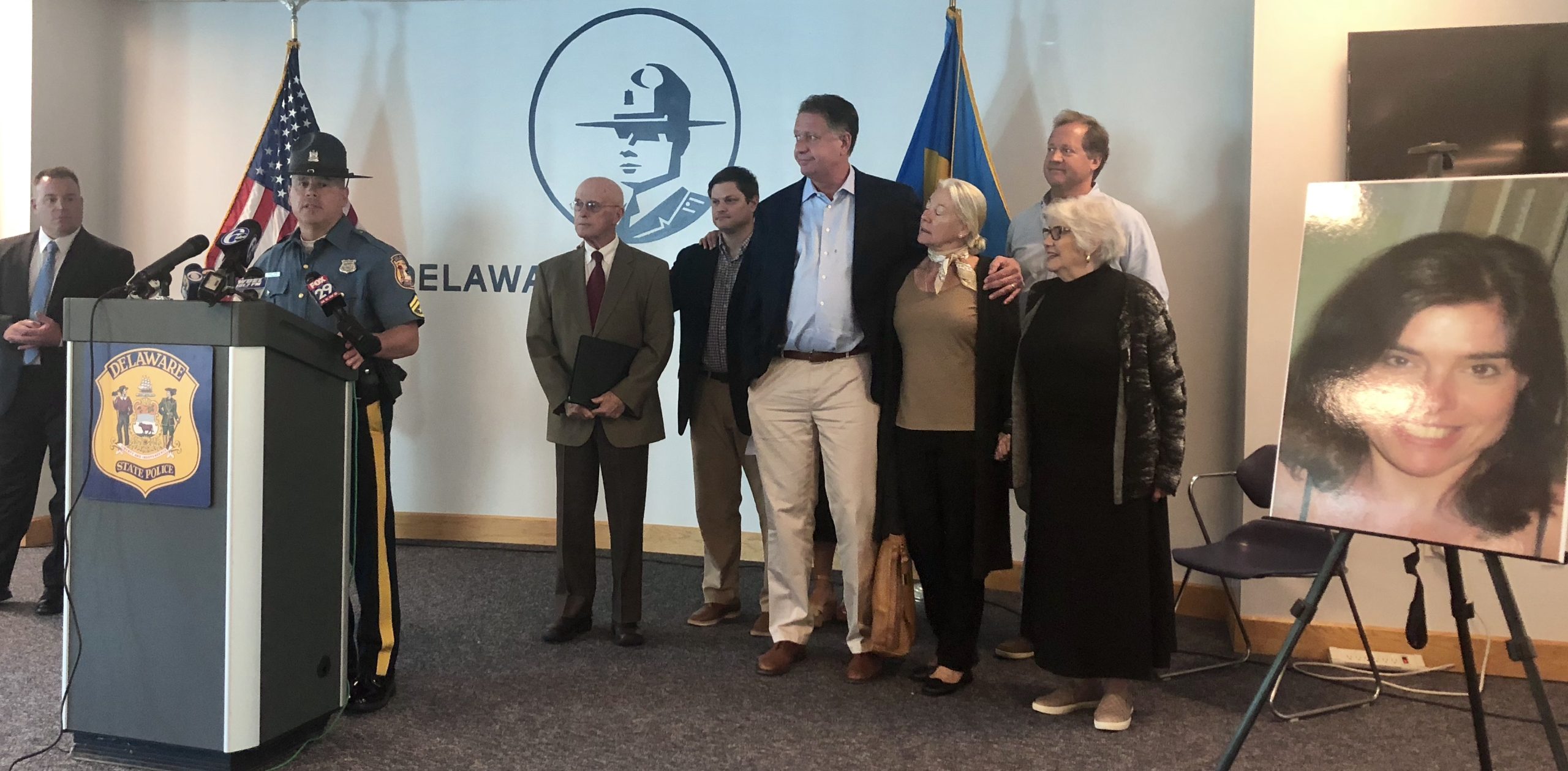
Delaware State Police Master Cpl. Michael Austin speaks in 2019 to brief reporters about updates in the death of Susan Morrissey Ledyard. With him were her brother, John (second to left), and husband, Ben (third from left).Katie Park/Staff
He said he had no idea what happened to his wife — a woman he told reporters was “the love of my life, my best friend” — until police came to the house around 9:30 the next morning to tell him she was dead.
Ledyard could not be reached for comment.
Two years after Morrissey’s death, Ledyard remarried, and in 2023 he was charged with assault for attacking his wife with a marble figurine and smashing her head into the floor after she asked him to turn down loud music on New Year’s Day.
He pleaded guilty to second-degree assault and was sentenced to two years in prison.
The charges brought fresh attention to the Morrissey case and fueled internet speculation that he could have harmed his former wife.
But police say he is not a suspect in the homicide and has cooperated fully with law enforcement.
‘A hope you desperately cling to’
Morrissey’s parents, Serena and John, died last year at 89 and 91 — without learning what happened to their daughter and without seeing anyone brought to justice for the crime.
John Morrissey’s death from advanced dementia came just two days after the anniversary of his daughter’s death.
“It’s been a tough year for our family,” said Meg Morrissey Heinicke, who lives in San Francisco. “This year’s anniversary feels particularly sad and painful.”
Yet there remains “a hope that you desperately cling to” that the case will be solved, she said.
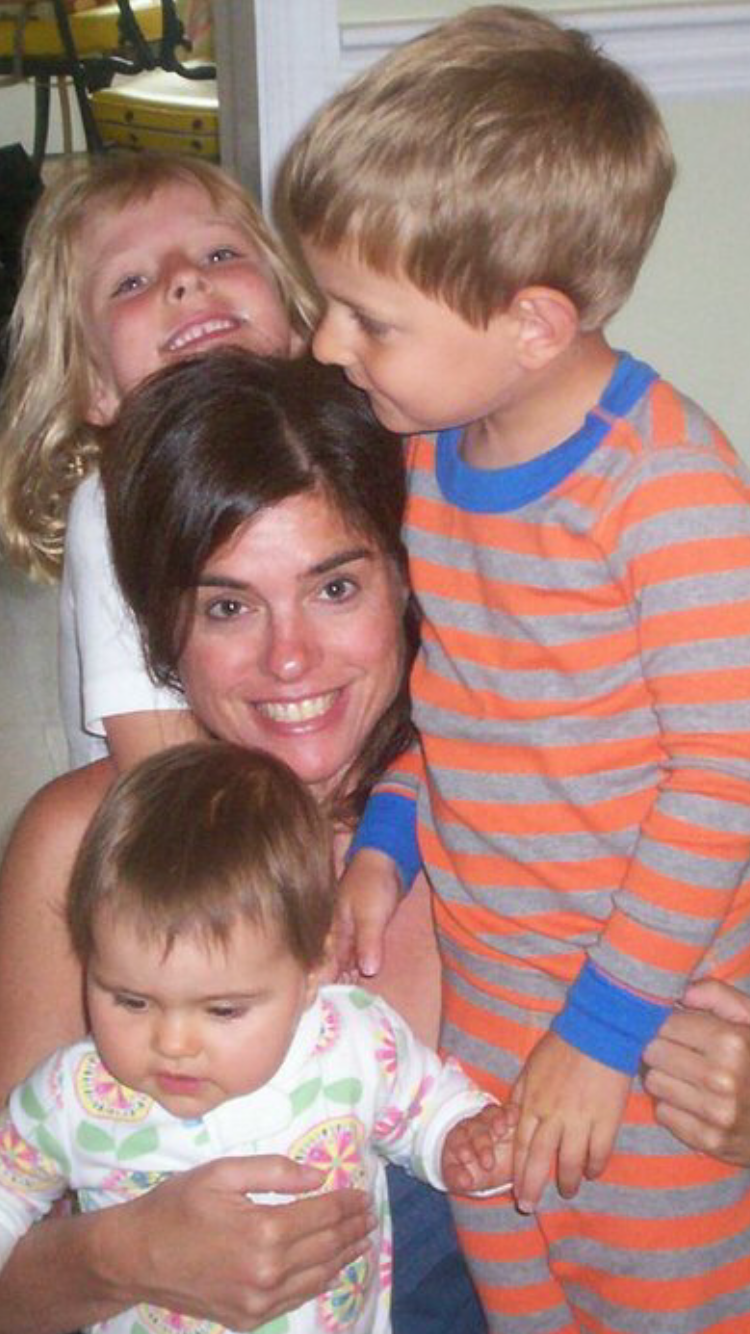
Susan Morrissey with her nieces and nephew. Missy Morrissey
In honor of their sister, the siblings started the Susan Morrissey Foundation, which awards an annual scholarship to an Academy Park student for excellence in English, a small way of keeping her memory and love of the written word alive.
In their quest for answers, the family has promised a $50,000 reward for information leading to an arrest.
“I just want us to have some answers,” Missy Morrissey said of the family’s ongoing grief. “I don’t think that any of us can really process, or go on, without knowing.”
Anyone with information about the case is encouraged to call detectives with the Delaware State Police at 302-365-8441 or email daniel.grassi@delaware.gov.
After giving birth to her first child, Jennifer O’Mara sought therapy forpostpartum depression.
But when O’Mara left her Delaware County home to visit her in-laws in North Carolina, her counselor had to cancel a virtual session because she wasn’t licensed to practice outside of Pennsylvania.
“My therapist had always asked me if I was in Pennsylvania before a session started, and there was actually a time where I was not, and we couldn’t meet, and I didn’t understand why,” O’Mara said. “I was confused.”
Unbeknownst to the new mother, Pennsylvania counselors need a separate license for each state they practice in.
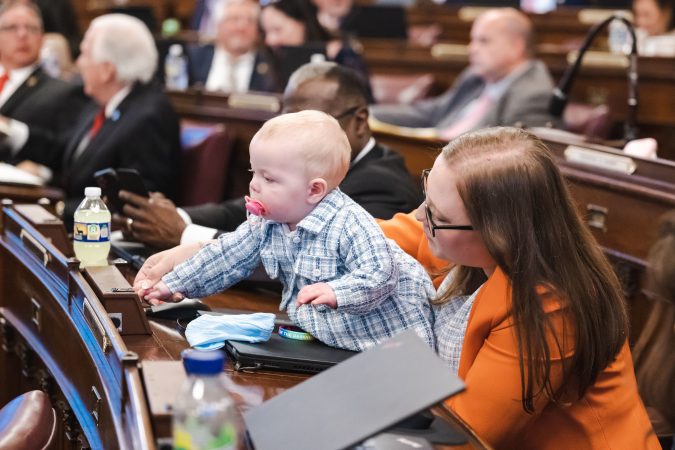
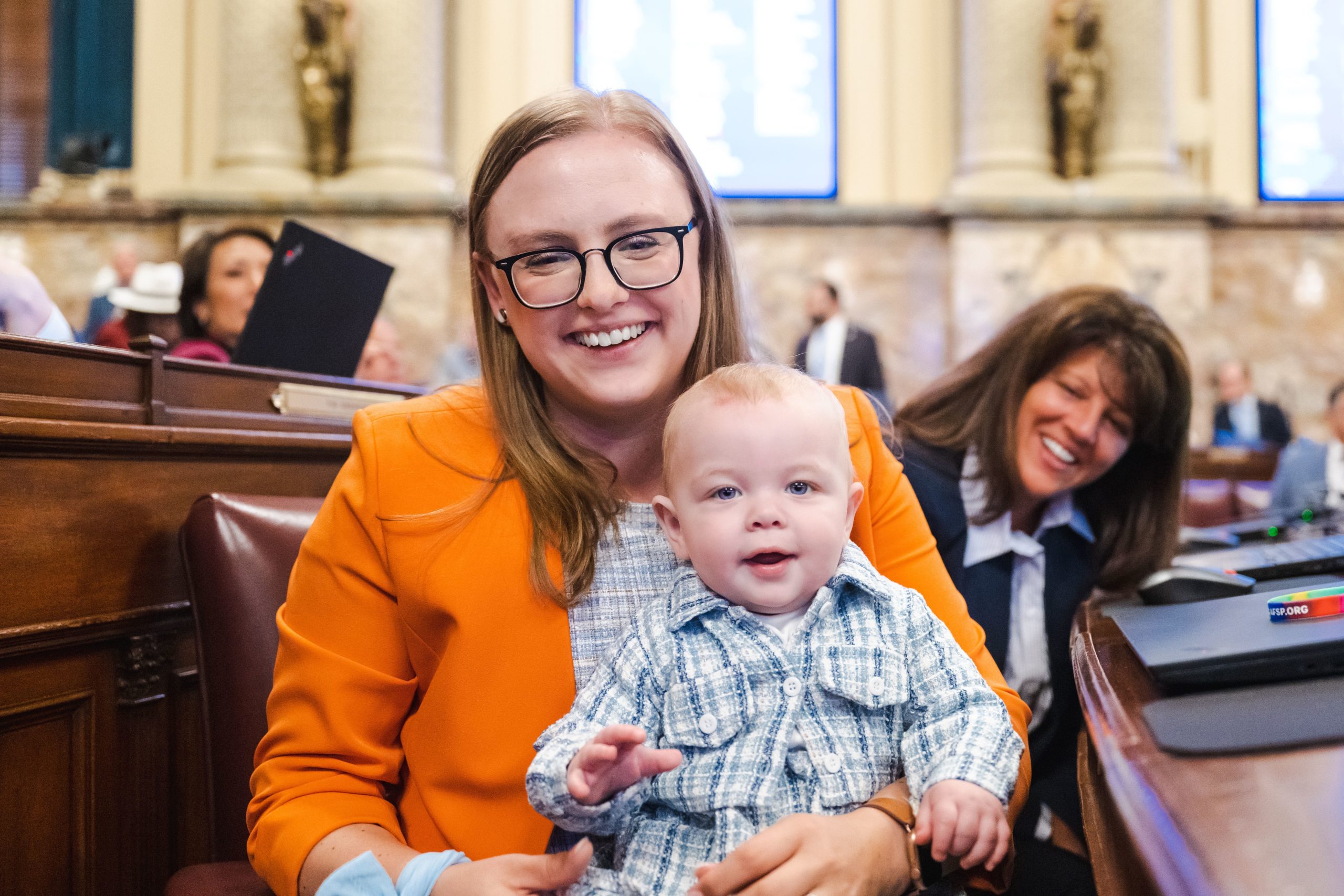
O’Mara, a Democrat elected as a state representative in 2018 and a co-chair of the legislature’s Mental Health Caucus, said she’s been working to change that regulation since that canceled therapy session.
Four years later, O’Mara’s efforts are about to pay off under a bill expected to soon go to Gov. Josh Shapiro for his signature.
The legislation would make Pennsylvania the 40th state to join the Interstate Counseling Compact. It enables counselors who are licensed in Pennsylvania to practice in any state that is part of compact.
Pennsylvania will join already participatingstates, including Delaware, New Jersey, Maryland, Ohio, and yes, North Carolina.
The bill only applies to licensed professional counselors, or LPCs. Pennsylvania separately participates in multistate healthcare compacts for psychologists, doctors, nurses, and physical therapists to provide inpatient care or telemedicine across state lines.
State Rep. Jennifer O’Mara (D., Delaware County) with her daughter, Katherine, now 4, in 2023. O’Mara helped usher the Interstate Counseling Compact bill through the Pennsylvania House in late June. The bill would allow licensed professional counselors (LPCs) to practice across state lines. Courtesy of Jennifer O'Mara
Shapiro plans to sign it
O’Mara helped advance the bill in the House. The Senate had passed it in July 2025 by a 45-5 vote. The House approved it last week by an 188-to-14 vote.
It now goes back to the Senate for a perfunctory, final signature by that chamber’s president before heading to Shapiro’s desk, according to a spokesperson for Sen. Lisa Boscola (D., Lehigh and Northampton), the bill’s prime Senate sponsor.
O’Mara and leaders of the Pennsylvania Counseling Association (PCA), which has about 700 members statewide, said they expect Shapiro to sign the bill into law once it gets to his desk. A spokesperson for Shapiro confirmed on Tuesday that he plans to sign it.
The bill aims to benefit recent high school graduates who want to keep the same therapist but plan to attend college out of state; active duty military members who are deployed outside Pennsylvania; and residents who physically work in New Jersey or Delaware and opt to do sessions during their lunch break, according to O’Mara.
“This feels like a small bill that will make a big difference,” O’Mara said.
Addressing a shortage of counselors
Post-pandemic, the demand for mental health services has increased, and providers have struggled to keep up. The nation is expected to have a shortage of more than 40,000 counselors by 2030, and roughly 62% of Pennsylvania communities lack adequate mental health services, according to the PCA.
The legislation is designed to ease that burden, said Nicole Palman, a counselor at the Main Line Counseling and Wellness Center in Haverford.
“We’ll be able to continue to see clients when they move to New Jersey or when they move to Delaware without having to end care that may have been going on for years,” saidPalman, a PCA member who advocated for the bill.
It’s not always easy to find a new counselor, she noted.
“A lot of people get discouraged,” Palman said. “The process is worse than dating to find a therapist you align with.”
Editor’s note: This story has been updated to clarify that psychologists are included in Pennsylvania’s multistate compacts for health professionals.
Inquirer staff writer Gillian McGoldrick contributed to this article.
The intrusion into Delaware County’s network systems in late June — disrupting services for county residents — was part of “sophisticated cybercriminal attack.”
Several attempts for unauthorized access were blocked by county infrastructure, but hackers were able to gain “limited access to the County’s network and to access data maintained within the network,” the county government said in a news release Friday.
The county says it shut down its networks after the June 26 attack to safeguard county data, systems, and other sensitive information, but officials are still investigating the extent of the breach in tandem with cybersecurity experts.
The county’s internal networks are now up and running, and Delco said it is working to reinstate external-facing county services in the coming days.
“It is unfortunate that this attack has impacted services to residents, and we appreciate their patience and understanding,” the county said Friday. “We must ensure the safety of our network and data before full restoration of services.”
The incident marks the second time in roughly six years where the county’s systems have been breached. In November 2020, Delaware County was hit by a ransomware attack via a phishing email. Hackers stole sensitive information and the county ended up having to pay $25,000 to resolve the issue.
Delaware County says since that 2020 incident that “substantial protections” have been put in place.
“Those protections proved valuable in this instance, as numerous attempts to establish a larger intrusion into County systems were repeatedly blocked, greatly limiting the extent of the interference,” the county said.
Record jet fuel costs — including a 5 cents-a-gallon boost due to a leak and fire at Delta Air Lines’ Monroe Energy plant in Trainer, Delaware County — have been passed along on to airline customers, and Delta has still been able to boost profits, chief executive Ed Bastian told investors at its quarterly investor call Friday.
At Trainer, “we’re back up to about 75%” of full capacity, but production will remain slow through the third quarter, boosting costs another 5 to 7 cents a gallon, Bastian said.
Delta’s fuel costs averaged $3.93 a gallon — the highest ever, the company says — in the three months ending June 30. That’s up from $2.25 a gallon a year earlier.
World fuel costs spiked after the U.S. and Israel attacked Iran in February, and Iran retaliated against U.S.-allied Arab oil suppliers and shippers, reducing exports from producers from several large oil-producing nations through the Strait of Hormuz.
Despite higher revenues and products, Delta shares fell 2% in morning trading to around $87 and closed at $87.39. The stock hit an all-time high of $95 June 30 before Iran and the Trump administration agreed to a truce, which has since been suspended amid new attacks.
Delta, which is based in Atlanta, burned 1.12 billion gallons of fuel in the past quarter, up from 1.11 billion a year earlier. The Monroe Energy facility in Trainer produces more than 8 million gallons of jet fuel and other products a day when operating at peak capacity.
Despite the Trainer slowdown and the Iran conflict’s effect on global tanker traffic, Delta expects its fuel prices have peaked and will fall to around $3.15 a gallon by September, Bastian told investors.
Delta bought the Trainer refinery from ConocoPhillips in 2012 to make the company less vulnerable to sometimes-volatile jet fuel costs.
The complex, which employs 500 United Steelworkers members and managers and hundreds of union tradespeople, is configured to maximize jet fuel for Delta’s East Coast operations and trades other products — gasoline, diesel fuel, heating oil — for jet fuel in other markets.
Delta employs 100,000 worldwide, and Bastian says it continues to hire as it sells new services. Delta sold more “premium” services to passengers than main-cabin service in the second quarter, a reversal from its historical pattern.
“We are still in the early stages” of further segmenting travel into new premium travel classes, Bastian told investors.
Corporate-business travel continues to rise, and customers have been willing to pay higher prices. Delta ticket revenues jumped 13% compared to last year, while passenger-miles were only up 1%.
Transatlantic and domestic U.S. travel has risen, while U.S.-Mexico travel is down over previous years, Delta officials told investors.
International traffic will grow faster than U.S. travel as Delta continues to add new airports, especially in East and Southeast Asia and the Middle East, Bastian predicted. The company will have to cut costs in the U.S. and Europe. Delta’s shift to new Boeing 787s that are built for more premium travelers and more cargo will help.
A big challenge, he added, is finding enough airplanes to meet the demand.
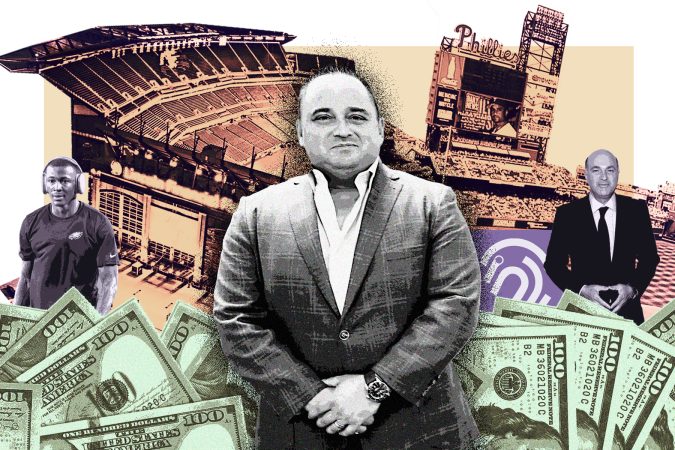
Nothing about T.J. Colaiezzi screamed “tech CEO.” He was a former gym manager from Delaware County who had dropped out of college and could not write code. But with $27 million in venture capital in the bank, his AI-powered start-up took a risky marketing gamble in the South Philly stadium complex that announced his big ambitions.
Over three seasons, with the Phillies slugging their way to a World Series, the Eagles racing to another Super Bowl, and a Sixer winning MVP, hometown crowds looked up at scoreboards with ads for his little-known company, LifeBrand. And as Colaiezzi wooed investors from the VIP suites, he sold an underdog story fit for the Philly fanbase and the broader cultural moment.
LifeBrand, he said, was a safeguard for the cancel culture era, with software that could scour years of social media in seconds and flag compromising posts. Users could purge past mistakes with a click and potential employers could avoid making a hire that might later prove embarrassing. Colaiezzi secured support from sports icons like Phillies legend Jimmy Rollins, as well as current and former Eagles.
“Catch all your cringeworthy social media posts with LifeBrand,” Eagles wide receiver DeVonta Smith said in a LifeBrand commercial that showed a photo of a “#wasted” tailgater posted carelessly online.
Now Colaiezzi, 45, is facing accusations of fraud that no artificial intelligence tool can erase.
Hundreds of pages of court documents and internal company records reviewed by The Inquirer, as well as interviews with a dozen people involved with LifeBrand, tell the story of how a fledgling CEO won over deep-pocketed athletes and business owners, and then — following a series of admitted missteps and alleged misspending — was forced to sell the tech company once valued at $137 million for next to nothing.
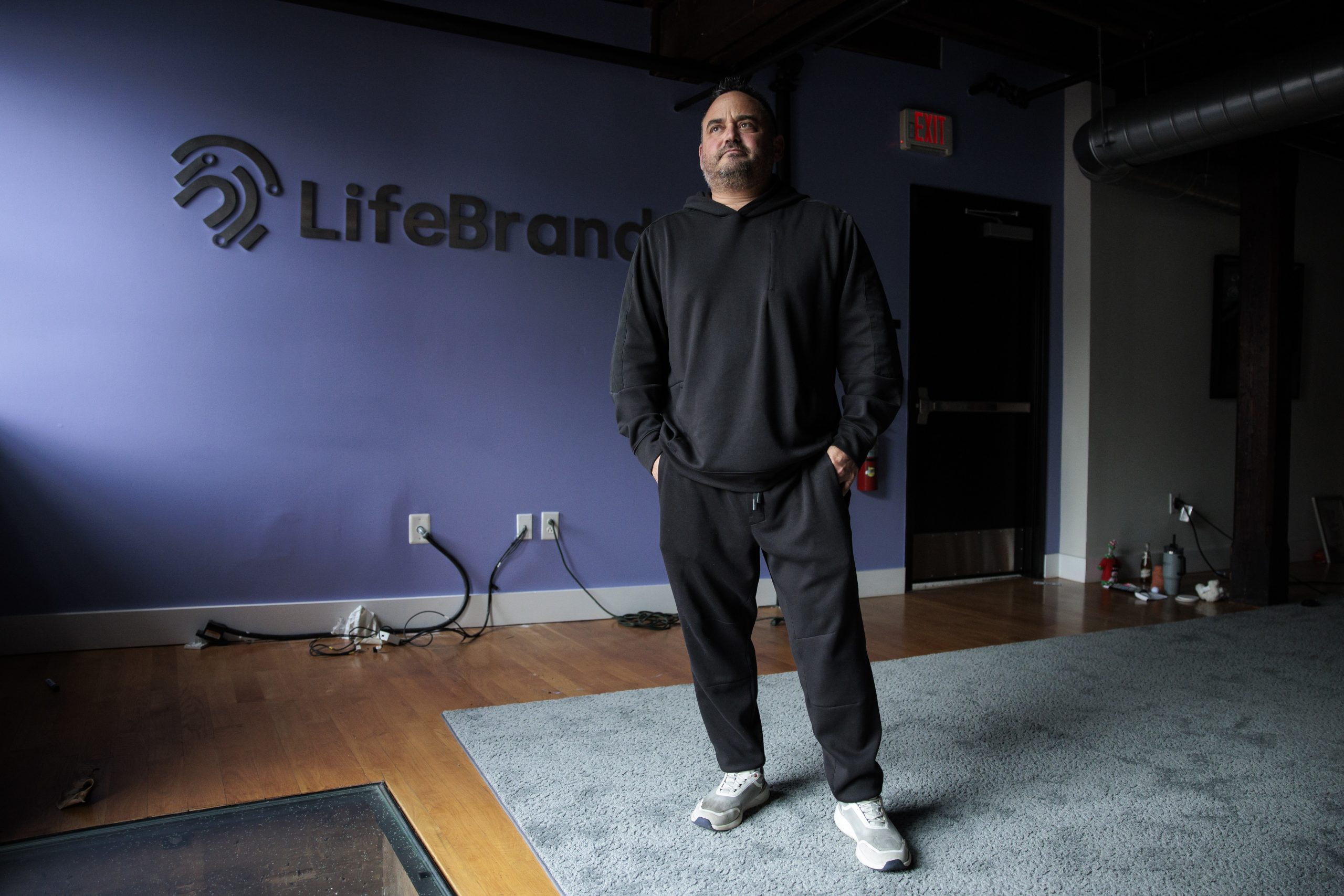
T.J. Colaiezzi posed for a portrait in the LifeBrand offices on Wednesday, May 27, 2026, in West Chester, Pa.Monica Herndon / Staff Photographer
In two lawsuits, including one filed last month in Delaware Chancery Court, investors say Colaiezzi squandered their money on a stadium-sized marketing blitz, hired unqualified friends at inflated salaries, and pocketed $6 million to finance a lavish lifestyle, including a $4.8 million home in Ocean City, N.J., and a powerboat. Both lawsuits allege that a prominent regional bank and an enthusiastic securities broker helped facilitate Colaiezzi’s deception.
Federal regulators are showing interest in the case, with the U.S. Securities and Exchange Commission (SEC) questioning at least one LifeBrand investor in March, according to correspondence reviewed by The Inquirer. An SEC spokesperson declined to comment.
Meanwhile, the Eagles, Phillies, and Sixers claim LifeBrand owes them a combined $6.2 million in unpaid marketing bills, court records show. And some LifeBrand employees are still owed paychecks from before the company’s collapse.
To the financiers who sued him, LifeBrand amounted to a “Ponzi-like” endeavor focused more on attracting capital than generating revenue. To Colaiezzi, it was a genuine effort that came up short.
In multiple interviews with The Inquirer — granted, he said, against the advice of his attorney — Colaiezzi characterized the lawsuits as fallout from former partners who are jockeying for the last scraps of his assets. Those same investors, he said, did not object to his marketing campaign or salary decisions until the company went under.
Colaiezzi acknowledged making mistakes but denied that any of them amounted to fraud.
“I was always the first to admit I was not a tech executive,” he said. “I ran health clubs for a living. And I thought I was surrounding myself with the right people.”
His $6 million stock cash-out was one of those admitted mistakes. But he maintained it was a lawful transaction that took place three years before LifeBrand failed and was never concealed from investors.
The first investor lawsuit, filed in 2024, reached a settlement in March. Attorneys for the plaintiffs — among them former Eagles Brent Celek and Todd Herremans — declined to comment, citing a confidentiality agreement.
Meanwhile, a chorus of other backers who saw their capital vanish but have not taken Colaiezzi to court say that the CEO lured them with hollow promises and misled them about LifeBrand’s prospects long after the company began to collapse.
“I will never go as far as saying this should be on American Greed,” said investor John Cerasani, referring to the CNBC docuseries about white-collar criminals. “He’s not a con man. But it was 100% reckless behavior with other people’s money.”
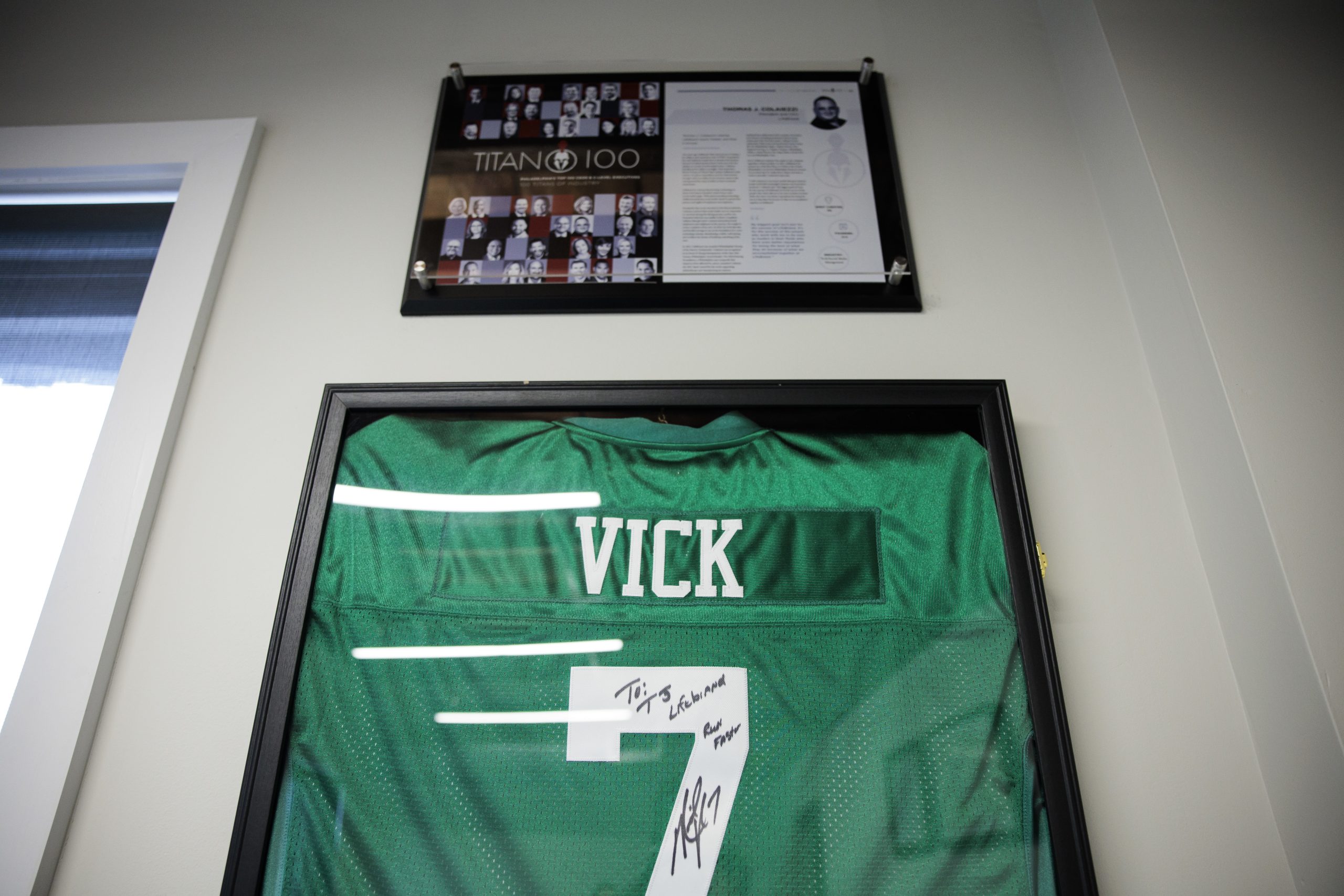
An autographed Michael Vick jersey in the LifeBrand offices on Wednesday, May 27, 2026, in West Chester, Pa.Monica Herndon / Staff Photographer
From gym manager to tech CEO
The son of an IRS official and a homemaker, Colaiezzi went to Springfield High School, where he played lacrosse and built replicas of Victorian furniture. He became a volunteer firefighter, tried to open a deli, and dropped out of Pennsylvania State University before settling in the fitness industry.
He started cleaning gyms and ascended to regional manager, overseeing LA Fitness and Crunch Fitness locations. It was there, fielding complaints about things that personal trainers and other employees had posted online, that he got the idea for LifeBrand.
Colaiezzi saw a market full of people getting fired over old Facebook posts and pro athletes apologizing for the flippant tweets they made as teens. Companies wanted ways to vet prospective employees. The need for protection was urgent — a firewall against the damaging effects of a careless post lingering somewhere in the internet’s bottomless memory. Even the dating scene, riven by partisan politics, could benefit from an online cleanup.
After raising seed money from family and friends, Colaiezzi hired a Prague-based development company to build the software that made LifeBrand a reality.
His big break came in 2020, when he won a virtual pitch competition hosted by Kevin O’Leary from the hit show Shark Tank, who called Colaiezzi a “strong entrepreneur with every question answered.” The start-up won just $10,000 but earned something better than a cash prize: credibility.
Colaiezzi leveraged the pitch competition win into a Series A investor drive, securing over $27 million by the end of 2021, surpassing expectations.
He once told an interviewer that he wouldn’t sleep until he sold the company or until every investor was paid back. One financier, Nick Guiffre, a retired CEO of a manufacturing company, said he saw “the eye of the tiger” in Colaiezzi — a man who could make good on his word.
After losing more than half a million dollars in LifeBrand, Guiffre, who is not pursuing litigation, said he wished he had done more diligence.
“I don’t want to say I could afford to lose money,” he said, “but some people who put money in early on, it was their 401(k)s. It was their future.”
Colaiezzi filled out the top ranks of his company by hiring people he knew. LifeBrand’s earliest board members consisted of Colaiezzi, his brother, a doctor, and an early venture capital investor. His chief operating officer came from the fitness industry.
He maintains that they were qualified. But, like him, no one had real tech experience.
“I think I was too loyal to people who were with me from the beginning,” Colaiezzi said. “I should have operated it more like a competitive sports team, and not like a family.”
LifeBrand President and CEO T.J. Colaiezzi is shown at his corporate office on Monday, Sept. 13, 2021, in West Chester, Pa. Bradley C Bower / For The Inquirer Bradley C Bower / For The Inquirer
The shadow broker
Anthony Falco wanted everyone to know how excited he was about LifeBrand. Maybe too excited, his attorney would later concede in court.
“Dude, this LifeBrand thing is going to [be] f— HUGE,” he texted an investor in 2021. “Signed the Phillies yesterday! Big investors involved. You will thank your little Italian buddy for this someday very soon.”
Falco was a financial adviser and securities broker who worked at Central Pennsylvania-based Mid Penn Bank and Wayne-based Alden Investment Group. But he had a side job consulting for LifeBrand that involved hyping up its prospects to investors, according to the two lawsuits.
Gregarious and well-connected, he was Colaiezzi’s liaison to a world of high net-worth investors and sports influencers. Falco invited him to celebrity golf outings, introduced him to Mid Penn Bank’s CEO, and helped bring on big names like ex-Eagles Celek and Herremans.
“We were banking at TD Bank at one point, and then [Falco] invited me golfing with the CEO of Mid Penn Bank,” Colaiezzi said. “And, you know, why wouldn’t you want to bank with a smaller bank where you got the CEO’s phone number?”
To Colaiezzi, sports were LifeBrand’s ticket to fame.
Between 2021 and 2023, LifeBrand paid millions to the Eagles, Phillies, and Sixers in a deal that included naming rights for a gate at Lincoln Financial Field and access to the Eagles Tunnel Club, a 1,400-square-foot lounge where VIPs could rub shoulders with the home team’s players as they hit the field.
Investors contend both Falco and Colaiezzi deceptively cast these deals as investor partnerships, rather than paid campaigns. According to the lawsuit initiated by the group that included Celek and Herremans, Falco received over a million shares of LifeBrand stock for inducing investors to the company through exaggerated claims, despite telling one that he was not allowed to accept comped shares.
While working out of LifeBrand’s offices, he texted investors that LifeBrand was going to be “a billion dollar company,” hyping up talks with the NFL and Jay-Z’s Roc Nation. In another text, Falco said LifeBrand was projected to make $58 million in revenue in 2022. But he also cautioned the investor that “nothing is real UNTIL we see that it is real!!”
LifeBrand’s revenue at the end of that year: $496,005.
In a motion to dismiss the 2024 lawsuit, Falco’s attorney Sean Bellew wrote that his client was at most guilty of being “overly enthusiastic” about LifeBrand and denied misleading anyone.
Both Mid Penn and Alden, which investors in that case accused of failing to supervise Falco, denied wrongdoing. Mid Penn argued in court that it had no formal relationship with the investors and that Falco’s work for LifeBrand was an outside matter. The bank declined to comment, citing pending litigation.
Alden argued much of Falco’s work at LifeBrand occurred prior to his joining the firm, which never formally advised any of the investors. Alden nonetheless paid $500,000 in March through its insurance policy to settle the 2024 lawsuit, according to Falco’s FINRA broker check page. The firm did not respond to a request for comment.
As for the new lawsuit, Bellew told The Inquirer that Falco never met the plaintiffs who renewed the allegations against him. Falco, he said, was “a victim” of Colaiezzi’s characterizations about the company — same as the other investors.
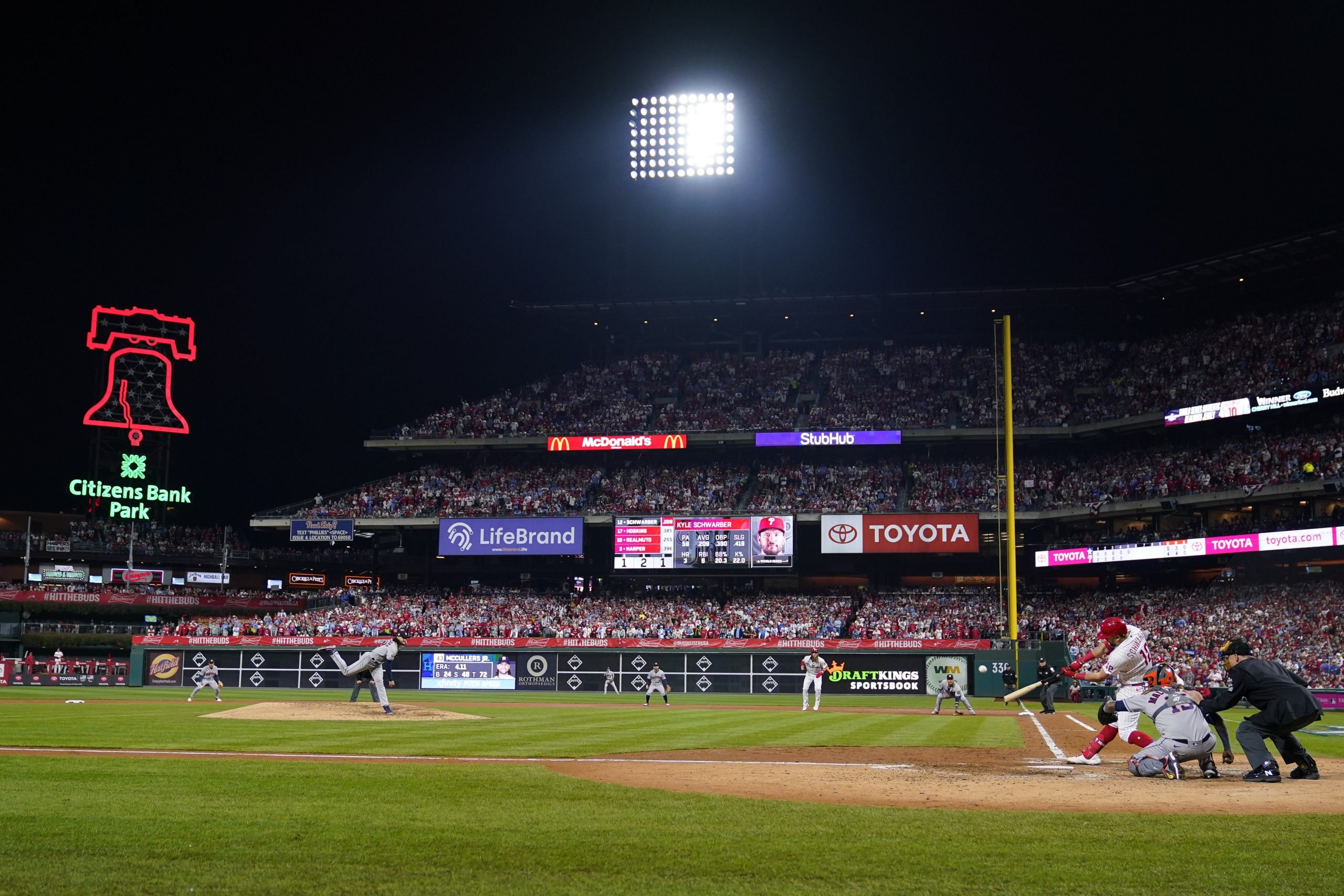
LifeBrand ads could be seen in the outfield of Citizens Bank Park during the Phillies 2022 World Series run. Matt Slocum
The Hail Mary marketing plan
For a self-made CEO from Delco, seeing his company’s name lit up across three stadiums was glorious. It was also a gamble for a young, unprofitable company. Last year, for example, the Tunnel Club naming rights were acquired by Janney Montgomery Scott, a wealth management and investment advisory firm with more than 100 offices and $1 billion in yearly sales.
Colaiezzi said he told investors about a third of the start-up capital would go toward marketing and said the stadium blitz had their support at the time. He produced text messages from investors who later sued him, which showed them asking for access to VIP seats and praising the buzzy brand campaign.
“There’s not a single email, text, or phone call with any adviser or board member saying ‘you shouldn’t be spending money on this,’” Colaiezzi said. “Everyone was in line until we ran out of money.”
Between 2021 and 2023, records show, LifeBrand spent over $16 million on advertising and marketing contracts — more than half its venture-capital haul.
Colaiezzi said the marketing helped introduce customers to LifeBrand, which scanned millions and deleted tens of thousands of social media posts over those years. He said his sales team used the stadiums to pursue multimillion-dollar contracts with major institutions and companies.
Some investors told The Inquirer they always had doubts about the marketing. Cerasani, a venture capitalist and gambling influencer, had been wooed as a potential investor with sideline tickets and access to the Tunnel Club, with its open bar with premium liquors, and a buffet with shrimp cocktail and prime rib.
Every time Cerasani visited, he said, it looked like a private party for LifeBrand executives and Colaiezzi’s close friends, who treated him like “a king.” Rarely did he see prospective clients.
Colaiezzi denied that characterization. But the gap between the marketing spend and the revenue it produced was impossible to ignore. By 2023, the company was losing over $800,000 a month, according to internal financial records reviewed by The Inquirer.
Sales reps would take clients to games and work them for months to close a modest $12,000 sale, Colaiezzi acknowledged. The big institutional contracts were not coming through.
Yet he kept sending optimistic signals to investors.
In an August 2023 email obtained by The Inquirer, Colaiezzi announced that he had just closed a “transformative deal” with a Denver-based education nonprofit — a three-year, $63 million contract that would use LifeBrand’s data to help students at underserved schools.
It is not clear how the client, which has no online presence and no publicly available nonprofit filings, was equipped for a deal of that size. The revenue never materialized, and one investor alleged in court that the deal was fiction.
Colaiezzi said the eight-figure contract was real. He assigned two full-time employees and flew out to meet with leaders, but the nonprofit backed down before the bills were due. If anything, Colaiezzi said, “we got scammed by them.”
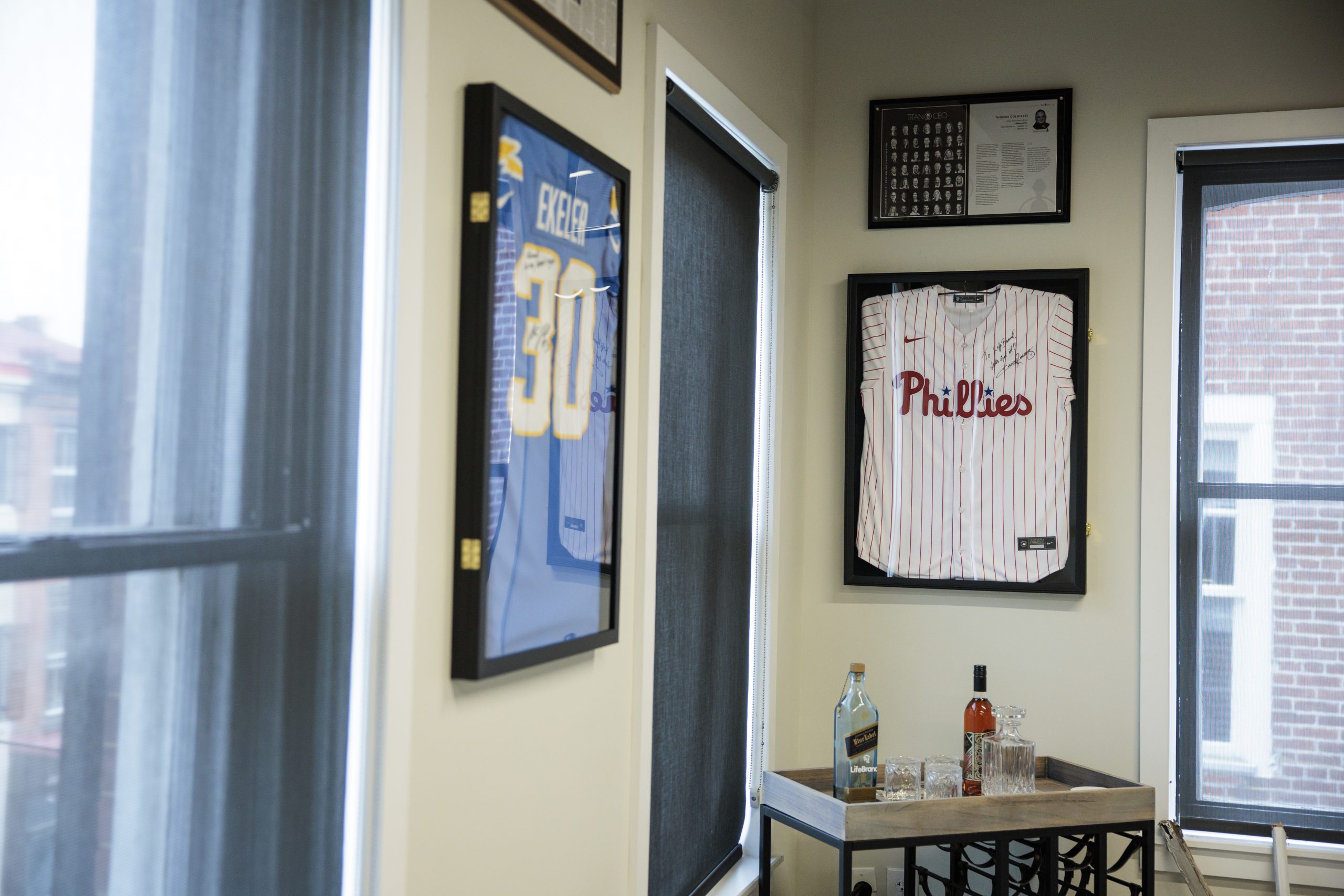
Autographed jerseys on the wall in the LifeBrand offices on Wednesday, May 27, 2026, in West Chester, Pa.Monica Herndon / Staff Photographer
Bedlam in the bank
In May 2024, a group of anxious investors gathered on a video call to discuss the millions they’d sunk into LifeBrand.
The company was on the brink of collapse. The money was gone. And all that the investors had to show for their backing were memories from the Eagles VIP suite.
As they raised concerns on the call, one investor shared that Colaiezzi had paid himself a $6.17 million stock redemption at a time when the company had little revenue, according to four people who attended the meeting. Outrage erupted.
“It was very obvious that things were going off the rails,” said Dan Ellison, a business owner who had invested in the start-up with his wife. “But no one knew that [Colaiezzi] took $6 million.”
According to Colaiezzi, the 2021 stock redemption was done at the urging of shareholders at the time to dilute his control in the company, and was documented on capitalization tables shared with subsequent investors.
He said he put $3 million back into the start-up to keep it afloat as he pursued a Series B fundraising round that would generate an additional $50 million — money that could finally turn LifeBrand profitable. That never happened.
Simon Wong, an engineer who worked at LifeBrand for a year until he was laid off in May 2024, recalled a workplace without the start-up grind culture. Most employees left each day at 4 p.m., and at 2 p.m. on Fridays, he said. Wong said he believed in the product and saw Colaiezzi as a leader who cared and said “the right things” about his mission.
By May, Wong said, software subscriptions stopped getting paid and paychecks were late — then they stopped entirely.
Colaiezzi agreed to fire himself as CEO, along with his other longtime executives. Then the rest of the board quit, leaving only Colaiezzi to run the company. He begged investors for patience while working with an outside firm to stave off bankruptcy. He laid off the entire staff and then tried to bring some of them back for a slimmed-down version of LifeBrand.
“It kind of felt like we were getting strung along,” said Wong, who said he is still owed pay from most of his final month working at the start-up.
LifeBrand — which Colaiezzi valued at $137 million in 2021 — was sold in August 2024 for $75,000 to Sentiment AI, an acquisition company formed by AI consultancy Global Fusion. Colaiezzi was initially kept on as an adviser, but the future of the company would be in the hands of more seasoned tech leaders. He said most investors agreed to convert their shares into the new venture in exchange for a promise not to sue.
Another group of investors took him to court. And the company’s turnaround effort stalled almost immediately, which Colaiezzi blamed on the litigation.
“It hit a point where people wanted to kind of run or protect themselves,” Colaiezzi said.
T.J. Colaiezzi posed for a portrait in the LifeBrand offices on Wednesday, May 27, 2026, in West Chester, Pa.Monica Herndon / Staff Photographer
‘It’s like I lost my baby’
One day last month, inside the restored 19th-century workshop in West Chester where LifeBrand operated for years, Colaiezzi walked solemnly past whiteboards crowded with years-old strategy notes. Framed Eagles, Sixers, and Phillies jerseys still hung on the wall.
He said in an interview that he feels “a weird obligation” to come to the office every day, while it is still his.
The building, which Colaiezzi purchased for $2.7 million with other investors and leased back to LifeBrand, is under foreclosure. Now he sat alone at a folding table among packed boxes in what used to be a conference room.
“It’s like I lost my baby, you know?” he said. “There was so much great potential.”
Moving on involves finalizing the lawsuits and paying off debt. Lenders and investors have placed liens on Colaiezzi’s Jersey Shore home. Asked if he got in over his head, Colaiezzi said, “Yeah, probably.”
But he is making plans to erase the LifeBrand failure and replace it with a success story.
His next venture, he said, is “a family-first social network” powered by AI.
Parents will be able to upload family histories, recipes, and advice for their children. The idea, he explained, is that children living in a harsh world should be able to get answers to sensitive questions from their own families rather than a remote server.
“The AI will basically learn how Grandpop would answer a question,” he said, “not how ChatGPT would.”
The pitch has already secured $50,000 from investors.
Staff writers Joseph DiStefano, Samantha Melamed, and Abraham Gutman contributed to this article.
A familiar legend at Delaware County’s Darby Free Library goes as follows.
It was an October day in 1947 when a woman walked into the library and returned a book. The woman had found the library book while going through her late grandfather’s possessions, she said, and she was returning it on his behalf. What was remarkable was that the book had been taken out of the library in the mid-1800s, more than 100 years earlier. It was overdue by a century.
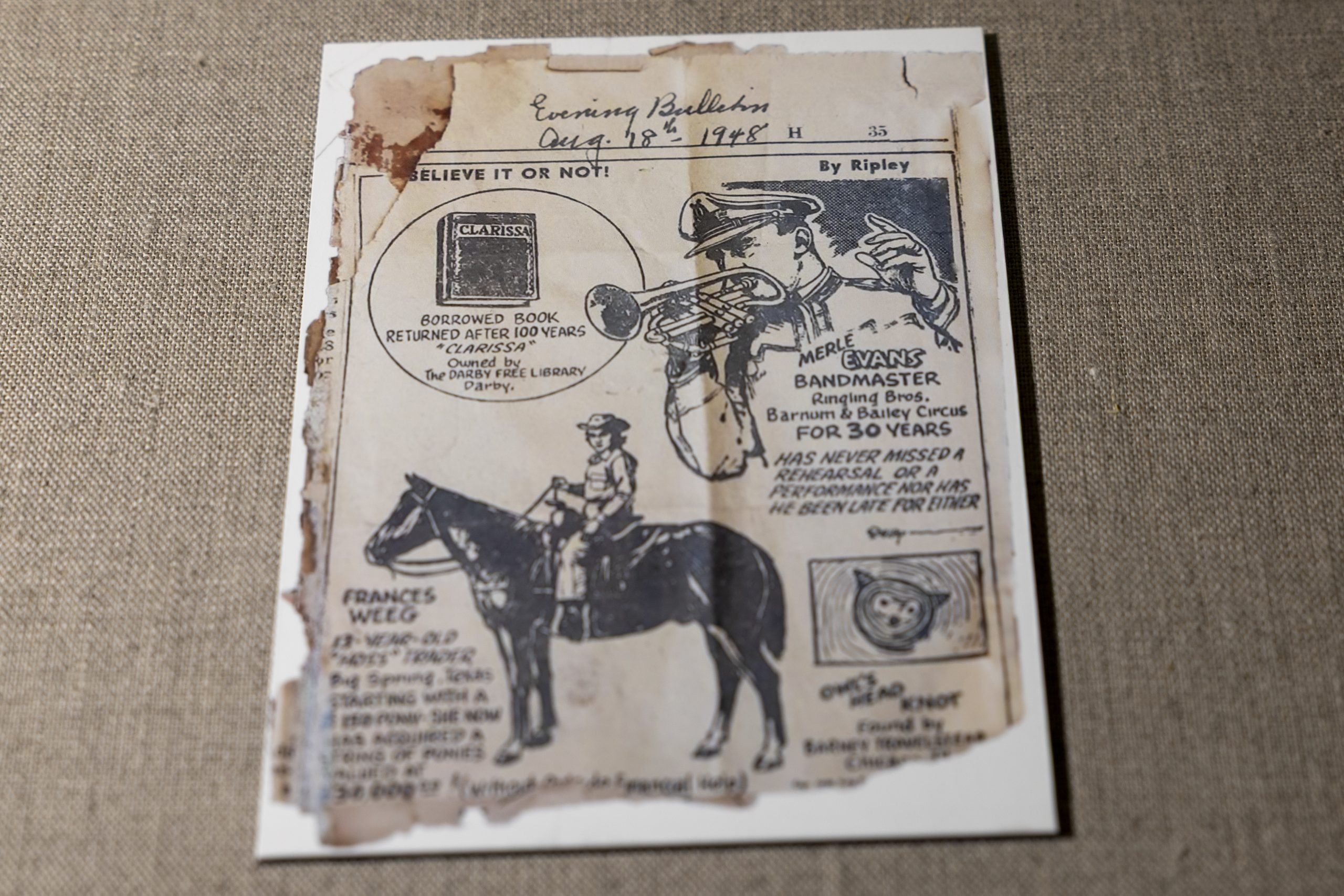
The local paper purportedly caught wind of the story, and on Aug. 18, 1948, the tale was featured in the Ripley’s Believe It or Not! panel and syndicated in over 750 newspapers around the world.
“BORROWED BOOK RETURNED AFTER 100 YEARS,” the Ripley‘s panel declared.
The “Ripley’s Believe It or Not” clipping about the century-overdue volume of “Clarissa” inside the Darby Free Library. Aidan T. Gallo / Staff Photographer
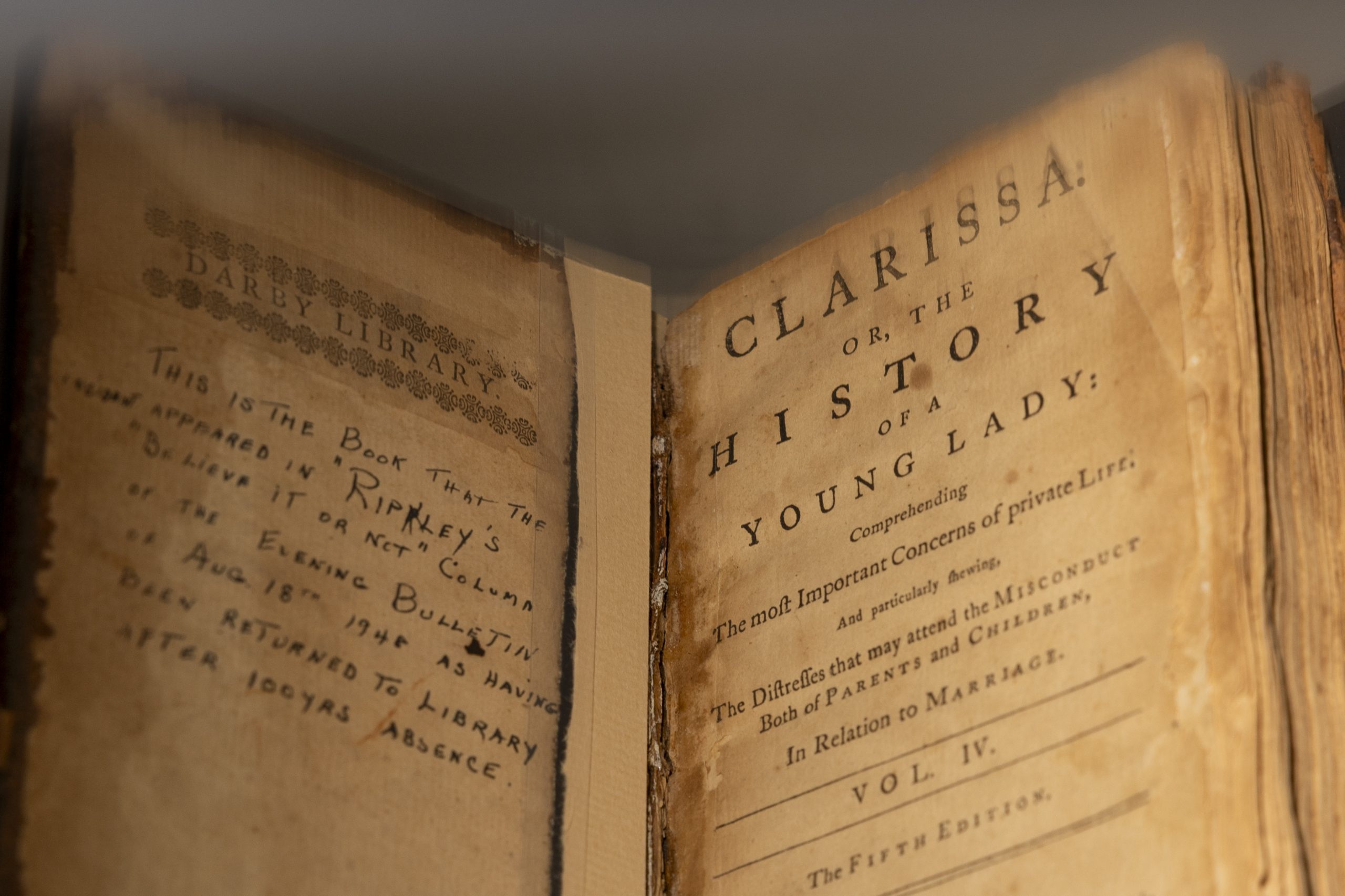
The famed book wasvolume four of Clarissa, a 1748 novel by Samuel Richardson that follows the trials and tribulations of Clarissa Harlowe, a young woman who flees home with a charming but untrustworthy man, Robert Lovelace. The book, considered controversial by many at the time,is written largely in the form of letters between Clarissa and Robert Lovelaceandis thought to bean early great psychological novel, exploring the characters’ inner lives and the complex themes of gender, power, and freedom. Clarissa spans seven to eight volumes and has a word count of nearly one million.
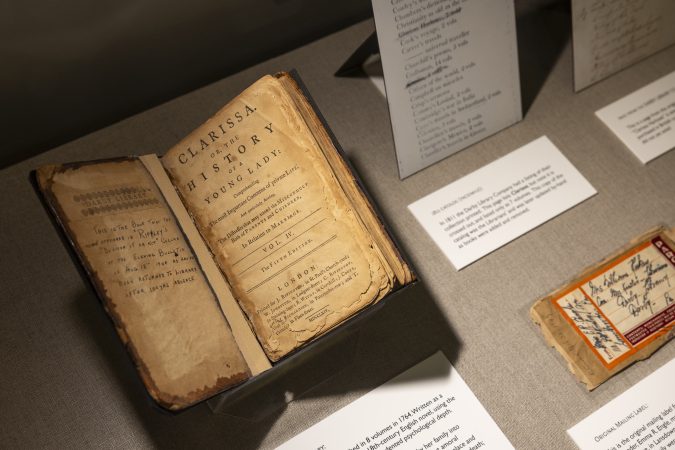
The Darby FreeLibrary’s Emily Finigan was sorting through the library’s collection a few years ago when she came across the famed overdue copy of Clarissa. Finigan found the book inside of a small box adorned with a mailing label. Attached to the mailing label was the Ripley’s clip, and inside the book was an inscription: “This is the book that the incident appeared in ‘Ripley’s Believe It or Not’ column of the Evening Bulletin of Aug. 18th, 1948 as having been returned to library after 100 yrs absence.”
Finigan wears a lot of hats at the library, including fundraising, volunteer work, and, with her husband, managing the library building’s restoration.
Finding Clarissa piqued her interest, and she began to wonder if she could use archival research to uncover the identity of the borrower who first checked out the 100-year overdue book.
Yet a quest to identify the original borrower of volume four of Clarissa sent Finigan down a rabbit hole that left her with more questions than answers: Was Clarissa really a century-old overdue book? And, if not, what really happened to the library’s copy of the 1700s novel?
The “Clarissa” copy inside the Darby Free Library.Aidan T. Gallo / Staff Photographer
The Darby FreeLibrary was founded in March 1743 by a group of Quaker farmers and merchants looking to organize their village’s first cultural institution. The group, made up of 29 townsmen, threw together money to purchase 45 original books, many of which are on display in the library today.
In 1826, the library offered up borrowing rights to anyone who could pay three pounds. In 1898, it became a public library. Nearly a century later, in 1984, the Darby Free Library was adopted into the Delaware County Libraries system.
According to records, the Darby Free Library acquired alleight volumes of Clarissa in 1769for 2 pounds, 6 shillings, and 2 pence.
By 1811, a catalog of the library’s collection only counted seven of eight volumes, a sign that one may have already gonemissing, or had beenborrowed by a reader.
Though the legend of the 100-year overdue volume of Clarissa involved a woman walking into the library to return the book, the copy, Finigan noted, had seemingly been mailed to the library, not returned by a mysterious visitor. So who mailed the package?
The original shipping label identified the sender as Emma Engle, a local librarian who mailed the book from her sister Josephine’s home in Landsdowne. Emma and Josephine’s parents and grandparents weren’t local to the area, according to archival research, making it unlikely that Emma Engle had returned her own grandfather’s book, as the legend went.
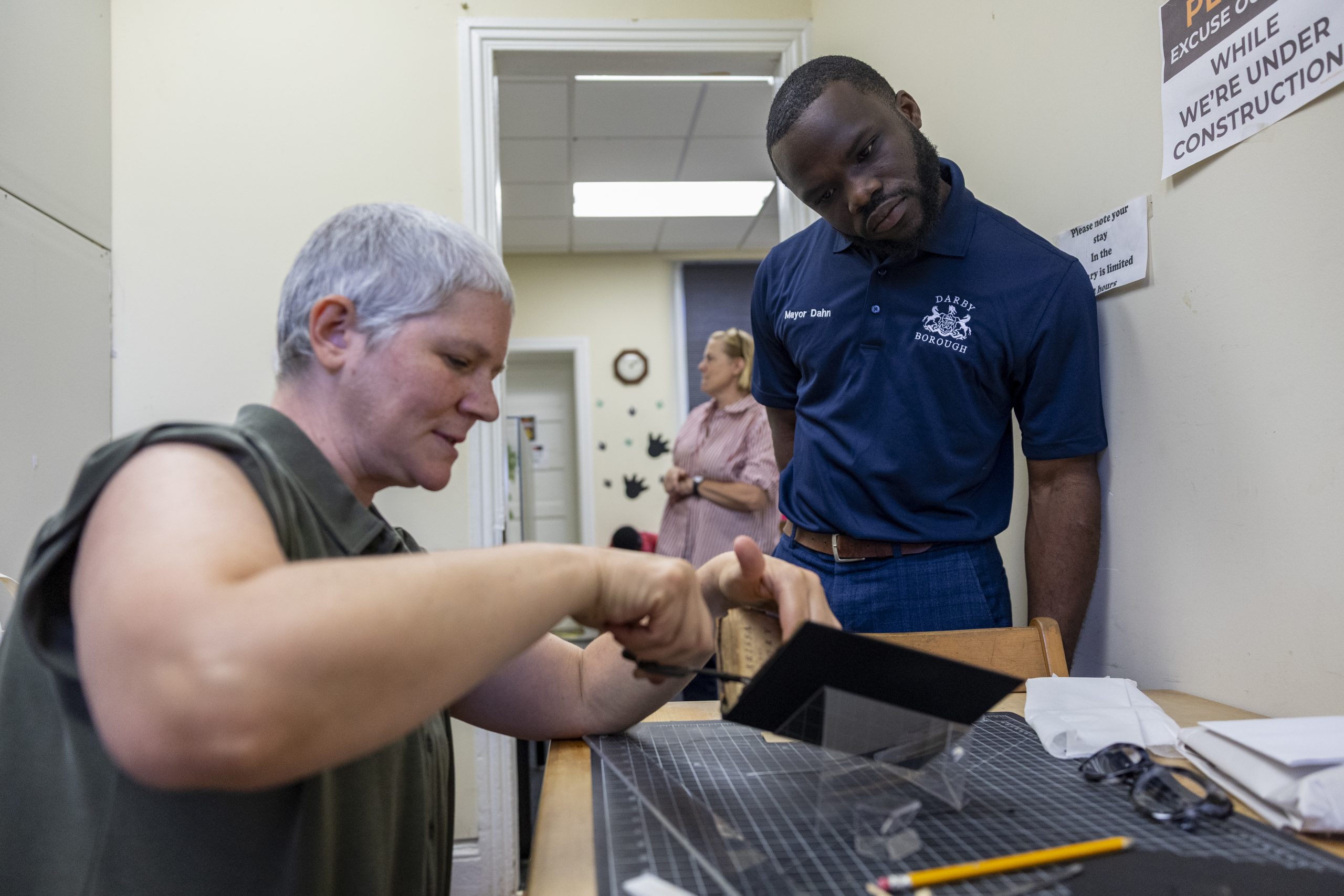
Darby Mayor Joar Dahn looks on while Liz McDermott, a conservation technician, handles a centuries-old copy of “Clarissa” at the Darby Free Library.Aidan T. Gallo / Staff Photographer
Josephine Engle, however, was married to a man named Isaac Rhoads, a member of the Darby Quaker Meeting, which was affiliated with the library. Isaac’s mother, Mary Hibberd Rhoads, was listed as a library member, and his grandfather, Samuel Rhoads, would have been alive around the time Clarissa was taken out of the library.
So was Engle mailing backa long-lost book once taken out, and never returned, by her brother-in-law’s grandfather? That’s one possibility, Finigan said.
Another possibility? The Darby Free Library may have sold off Clarissa in an attempt to clear its shelves of controversial material, and one volume made its way back to the library through Engle.
In 1826, the same year the library opened borrowing rights to the community, it appointed a committee to make a list of books that it “may be expedient … to dispose of.” When they met again the following year, a number of titles had made the chopping block, includingthe seven accounted-for volumes of Clarissa.
Why would the Darby Free Library want to sell Clarissa, among other books? Finigan has a few ideas. In the eighteenth and nineteen centuries, some saw novels as frivolous, distracting, and tempting readers toward vanity. Somenovels with more sinister or self-interested characters may have been viewed as at-odds with the values of honesty and sincerity held by Darby’s Quaker residents, Finigan said.
The Darby Free Library in Delaware County, founded in 1743, is currently undergoing renovations. Aidan T. Gallo / Staff Photographer
So, was the missing volume of Clarissa actually removed from the library in the early 1800s for objectionable content? That would be one explanationas to why seven, not eight, volumes were listed for sale in 1827.
Was volume four actuallysold with the rest of the collection in 1827 before eventually making it back to the library through Emma Engle? Could the list of seven, andnot eight, volumes have been an incorrect count?
Or could it havetruly beenan overdue book, taken out by a relative of Emma Engle’s and returned over 100 years later?
Finigan says the mystery remains, and may never be revealed. But curious minds can view the famed “century overdue” copy of Clarissa at the Darby Free Library from July 10 through Aug. 1 during normal library hours.
“Treasures from the Darby Library: THE 100-YEAR OVERDUE BOOK”
This suburban content is produced with support from the Leslie Miller and Richard Worley Foundation and The Lenfest Institute for Journalism. Editorial content is created independently of the project donors. Gifts to support The Inquirer’s high-impact journalism can be made at inquirer.com/donate. A list of Lenfest Institute donors can be found at lenfestinstitute.org/supporters.