All six former members of Westtown Township’s historical commission — who were fired last month amid disagreements with local officials over historic preservation — have formed their own independent society.
Known as the Westtown-Brandywine Historical Society, the group’s mission is to protect local buildings and history, similar to what they did before. “I feel like we’ve continued without missing a beat,” one member said, adding she was crushed when they were dismissed.
In just a few short weeks, the group has already planned several events, including historical tours of Oakbourne Mansion and Park and a discussion about the Darlington Inn. They believe the inn should be preserved, and their stance is why they think they were let go.
SEPTA is rolling out the first phase of its bus network overhaul Sunday, impacting 30 routes, including along the Lancaster Avenue corridor. Here’s what to know.
Oxford’s borough council voted Monday to disband its police department and join the Southern Chester County Regional Police Department and Commission amid budgetary constraints. The change will go into effect next year. The borough will hold a town hall with the regional department’s police chief tomorrow.
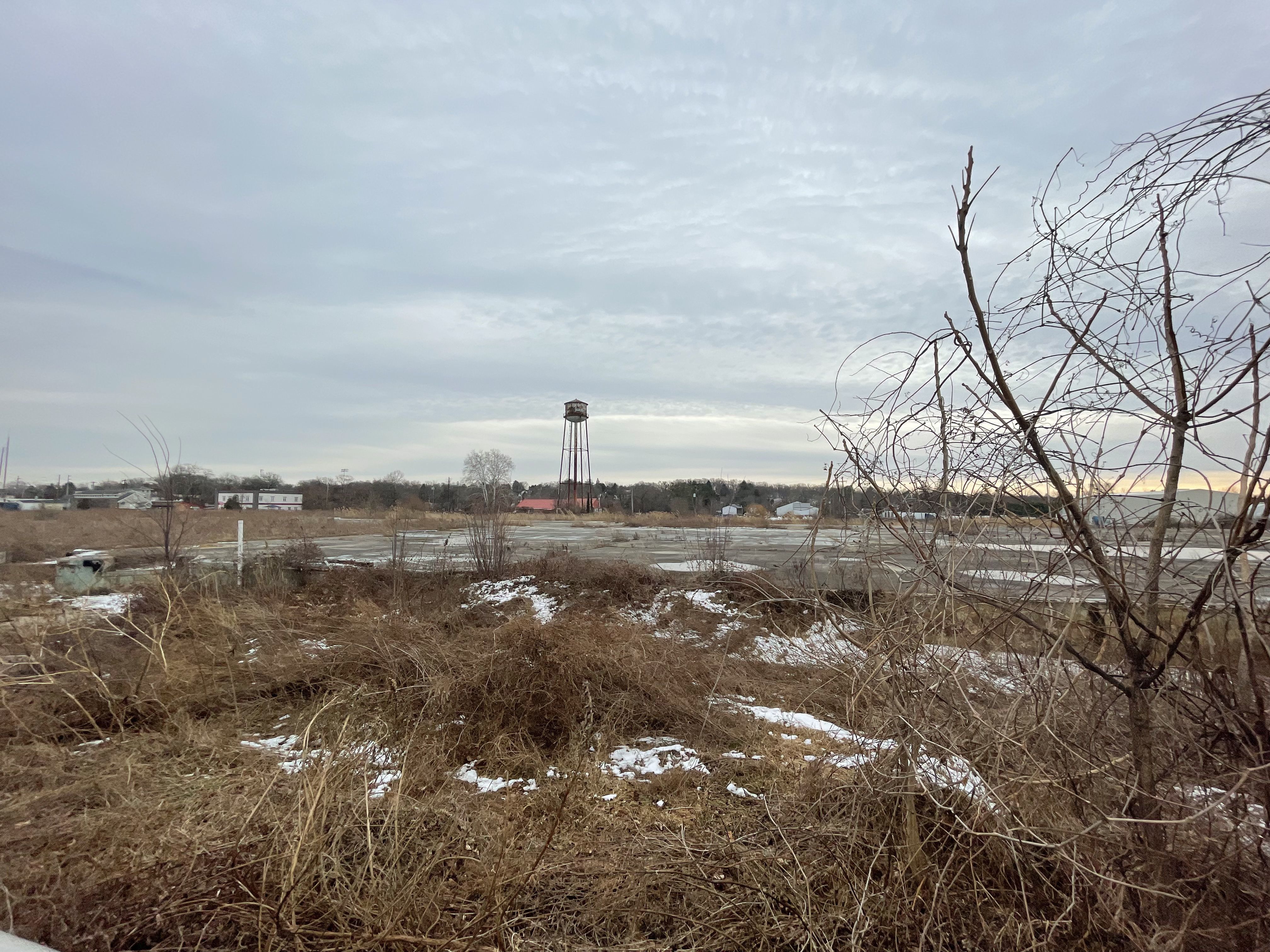
Kennett Square’s council moved future development at the defunct National Vulcanized Fiber site one step closer to reality this week despite pushback, agreeing to advertise an ordinance that would allow for housing and businesses at the contaminated 22-acre former industrial property.
With limited housing inventory and a growing population, Kennett Square has decided to cap how many short-term rentals are allowed within the borough. Current units will be grandfathered in.
For the past month or so, the West Brandywine Police Department has been investigating drone sightings in Wallace Township, where one has been spotted repeatedly flying over homes and roads for several hours at night. Inquirer columnist and area resident Sabrina Vourvoulias offers her take.
Longtime Phoenixville borough manager E. Jean Krack is planning to retire this coming spring after 18 years in the role. Council is working on plans to hire his successor.
Willistown Township is hosting a meeting tomorrow at 7 p.m. at General Wayne Elementary School to discuss the potential settlement agreement for Rock Hill Farm. A judge recently overturned a township ruling denying the property could be developed into luxury homes.
West Brandywine Township is holding a conditional use hearing Tuesday at 7 p.m. for Imaging Associates’ and Toll Brothers’ proposed age-restricted community at 500 Hibernia Rd.
🏒 Flyers Community Caravan: Gritty is heading to Exton as part of a multi-stop tour that also includes the team’s in-arena host and Flyers alums. ⏰ Wednesday, Aug. 19, 5:30-7:30 p.m. 💵 Free 📍 Miller Park, Exton
🍻 Summer Pop-Up Biergarten: Locust Lane Craft Brewery and Turk’s Head Wines will be pouring drinks, while food trucks Philly Hots! and Cousins Maine Lobster will dish up food. ⏰ Thursday, Aug. 20, 5-8 p.m. 💵 $10 in advance, $15 at the door 📍 Historic Sugartown, Malvern
🎸 Tell Me Lies: The Fleetwood Mac tribute group will perform some of the band’s most iconic hits. ⏰ Friday, Aug. 21 and Saturday, Aug. 22, 7:30 p.m. 💵 $51-$61 📍 Uptown! Knauer Performing Arts Center, West Chester
📚 Philadelphia Book Crawl: Several Chesco bookshops — Forage Books in Kennett Square, Wellington Square Bookshop in Exton, and Reads & Company in Phoenixville — are participating in the region-wide event. ⏰ Saturday, Aug. 22, times vary 💵 Pay as you go 📍 Locations vary
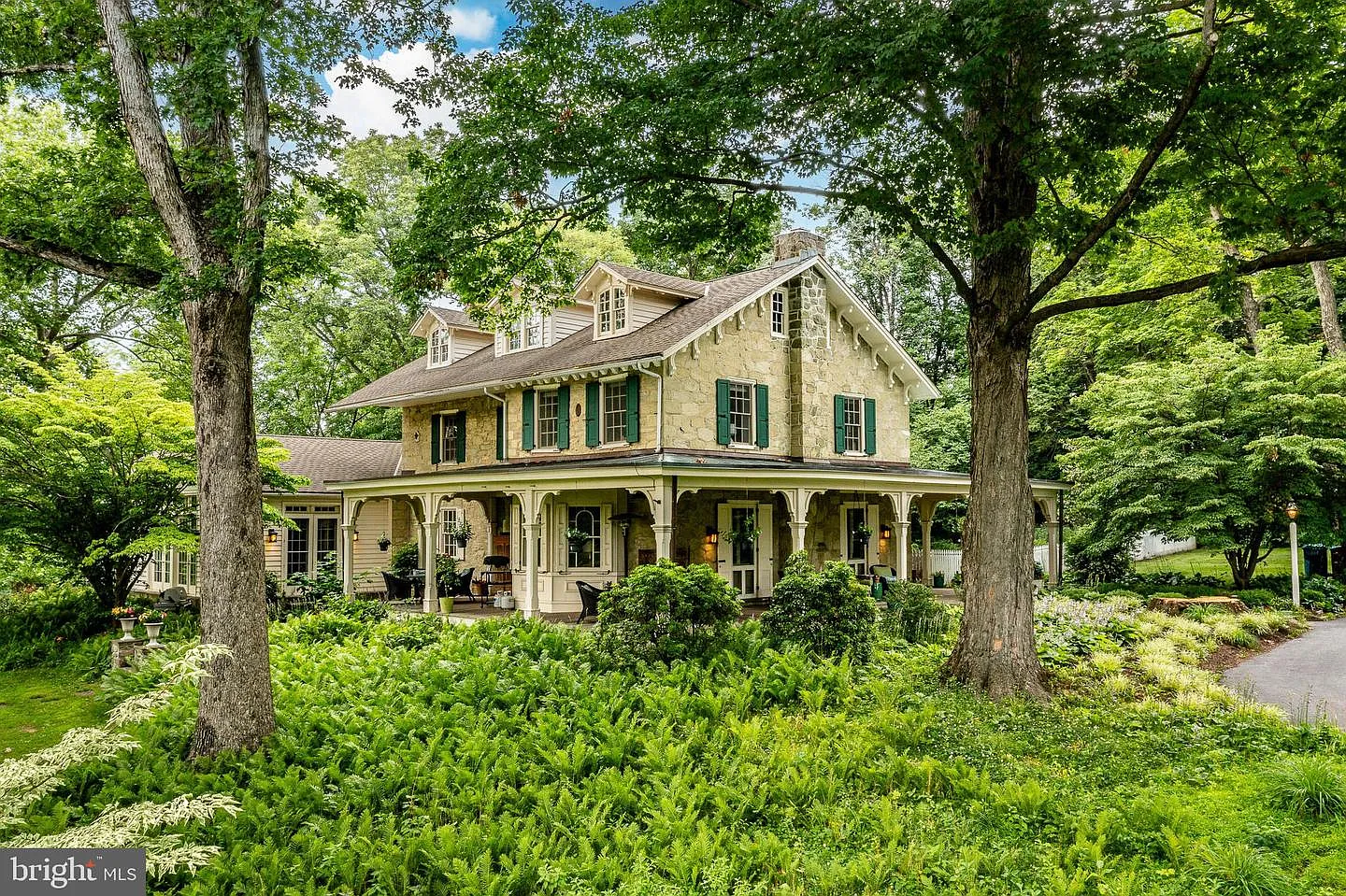
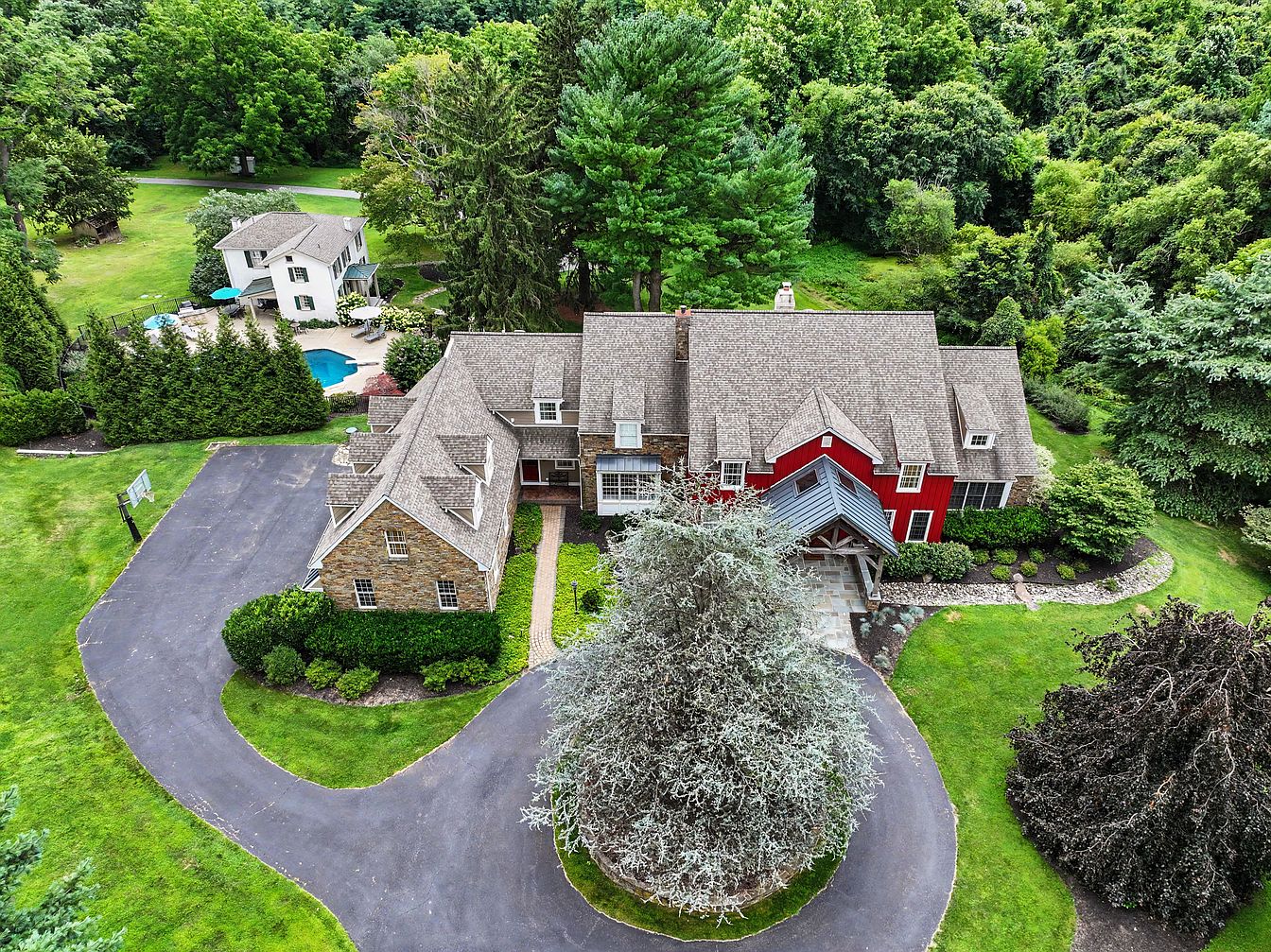
The home sits on six acres.Virtual Vista | Courtesy of Holly Gross Group
Built in the 1800s, this stone West Chester estate — known as Fernbank Farm, and already under contract — features a number of original architectural details. Among its most unique is a former ice house that’s been converted into a two-story wine cellar that can hold 1,500 bottles and also has a tasting room. Other features in the six-bedroom home include a library and sunroom, in addition to outdoor living spaces such as covered wraparound porches, gardens, and a heated pool.
By submitting your written, visual, and/or audio contributions, you agree to The Inquirer’s Terms of Use, including the grant of rights in Section 10.
This suburban content is produced with support from the Leslie Miller and Richard Worley Foundation and The Lenfest Institute for Journalism. Editorial content is created independently of the project donors. Gifts to support The Inquirer’s high-impact journalism can be made at inquirer.com/donate. A list of Lenfest Institute donors can be found at lenfestinstitute.org/supporters.
In an effort to “drastically” cut down on short-term rentals like Airbnbs, Kennett Square council passed an ordinance Monday capping the number of active units and restricting where they’re able to pop up.
Council voted unanimously to update its ordinance, allowing for a maximum of 20 short-term rentals, and prohibiting single-family homes from turning into short-term rentals as their primary use.
The decision comes after the borough has seen soaring population growth in recent years — an increase of 16% since 2020 — but as housing has become increasingly limited.
Residents had decried several homes getting snapped up, only to be turned into full-time short-term rentals. The borough’s planning commission took up the issue again this year, after a first foray in 2025 didn’t go far enough, officials said previously.
Under the new short-term rental ordinance, the existing units — roughly 22 — will be grandfathered in. But if people sell, move, or don’t maintain rental registration, that status is gone. Future rentals will only be allowed in accessory units — like garages, or guest houses — and the number of available units won’t be able to exceed 20. The property must be owner-occupied during the rental period. Pre-existing short-term rentals will lose their grandfathering status if they don’t maintain rental registration.
“The net effect of this is to actually drastically reduce the potential number of short-term rentals,” council president Bob Norris said. “But it actually reduces the possibility and the probability of having more and more, especially in single-family homes, which we heard loud and clear was a major issue.”
Meanwhile, cost is going up. In 2024, the median sales price hit $525,000 — the highest in the county’s history. That year, 331 homes sold for under $250,000, a decrease from 462 units in 2023, according to the commission. In 2025, 315 homes were sold in that range, making up just 5.3% of all sales.
Kennett Square officials have viewed cutting down on the short-term rentals as one way to address housing availability.
Kennett Square isn’t the only one to grapple with balancing meeting the needs of tourism with the desires of residents. West Chester similarly capped its short-term rentals at 20, and contained them to its town center. It sent cease-and-desist letters to those that weren’t in that radius, officials said previously. But in Phoenixville, short-term rentals have been meeting a need not otherwise addressed by the borough’s singular boutique hotel.
This suburban content is produced with support from the Leslie Miller and Richard Worley Foundation and The Lenfest Institute for Journalism. Editorial content is created independently of the project donors. Gifts to support The Inquirer’s high-impact journalism can be made at inquirer.com/donate. A list of Lenfest Institute donors can be found at lenfestinstitute.org/supporters.
Oxford’s century-old police department will be disbanded, with the borough joining several other municipalities under the service of a regional law enforcement agency next year, the borough council decided during a meeting that grew contentious Monday.
The council voted 5-2 to join the Southern Chester County Regional Police Department and Commission and approved a memorandum of understanding for the services, effective Jan. 1.
The borough has struggled for years to keep its police force from cutting too deeply into the municipality’s budget. Though Oxford’s financial health has been stronger in recent years than had been forecast, maintaining the department without increasing taxes was becoming untenable, officials said previously.
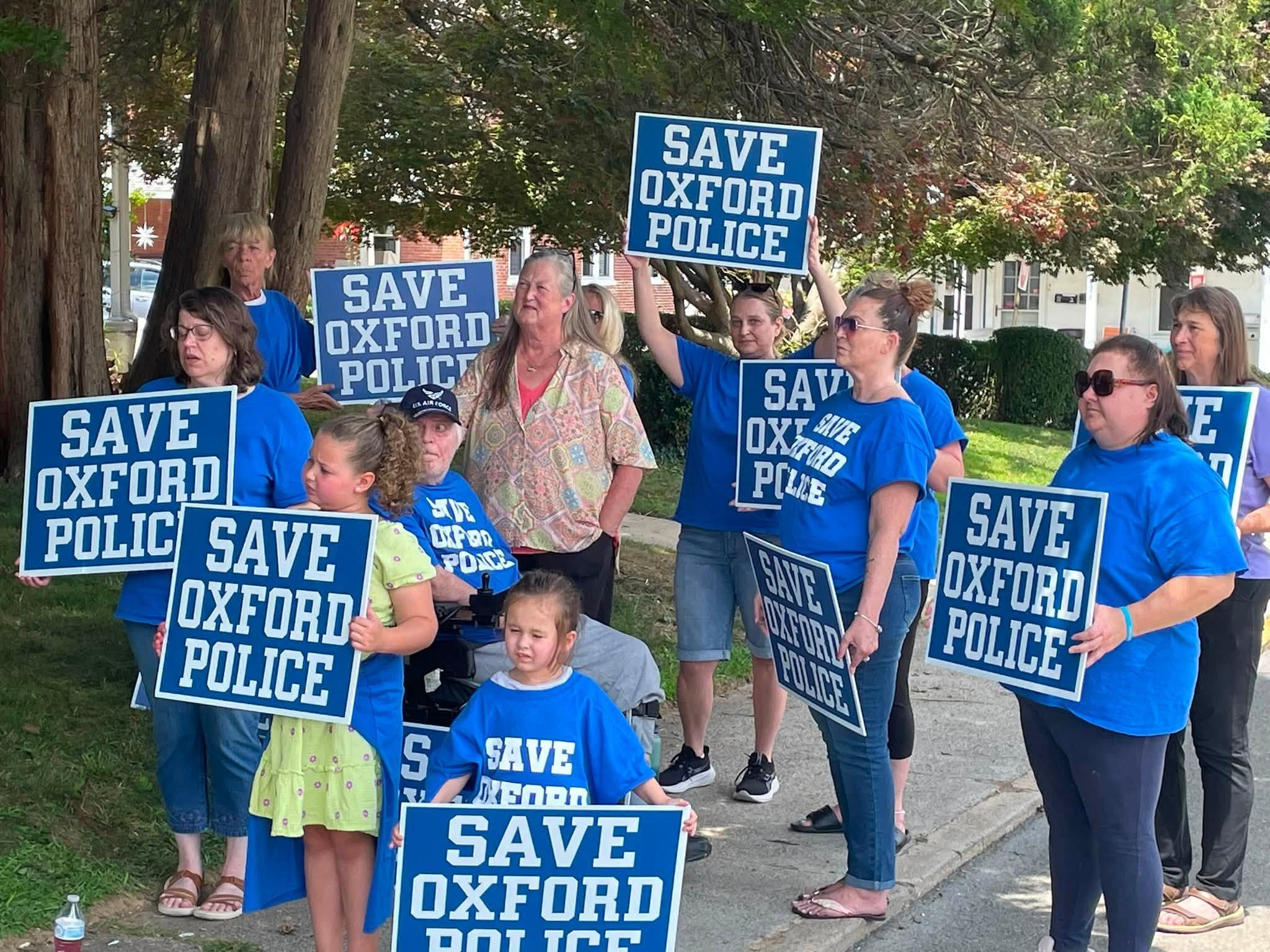
But the choice to cut the department has stoked fears from residents, who have designed T-shirts and lawn signs, held protests, started petitions and social media pages, and turned up at meetings to oppose the effort.
On Monday, residents called on the council to retain the department or delay the vote. The meeting grew contentious. As people shouted from the audience, the council requested that disrupters be escorted out several times through the 1½-hour meeting. As council members weighed their vote, attendees shouted for them to “resign now.”
With the vote, Oxford will now join nearby municipalities New Garden, West Grove, and Avondale for service through the regional department.
The regional department, formed in 2017, employs 21 full-time officers, who patrol and investigate, in addition to providing services like traffic safety, public outreach, and evidence management. The borough will have a seat at the table in the governance of the department.
The memorandum stipulates that the department will add 12 new officers to serve Oxford, with a substation where officers will begin and end their shifts, according to borough officials. Two officers will be on patrol 24-7, as they currently are. Borough leaders hope to see the entirety of their 11-officer force accept positions in the regional department.
Still, residents have worried over the loss of their homegrown force, with concerns about sluggish response times or increased crime due to the regionalization.
“What I pray to God does not happen is that I have to get a call because we didn’t have a local police department to protect our residents,” said resident Henry “Ted” Ruffenach, a funeral director. “I don’t want to get that call. If it does happen, this will be on every one of your resumes.”
Bob McCarron, president of the Chester County Fraternal Order of Police, urged the council to consider whether giving up local control was worth regionalization.
“It truly is a decision that, once you make it, you won’t be able to come back from,” he said.
An attempt to table the decision — raised by council member Amanda Birdwell, who argued she had not talked to enough residents about their stance on regionalization — did not receive enough votes. She ultimately voted against regionalization, joined by council member Raul Juarez-Lara.
“Even though people are being disrespectful and rude, we were still elected to represent them, and I feel like another reason I asked to table is because while I know we all want this to be over with, we can’t make a decision because we’re mad that people aren’t being nice to us,” she said. “That’s irresponsible.”
But others felt it was the only sustainable way forward.
“I truly believe that the only way to maintain policing in the Borough of Oxford … going forward, for my children, is regional,” council member Michael Brandt said. “We will not have a police force in less than several years at the rate things are going. I’m sorry none of you can listen to us and understand that.”
The borough will hold a town hall with the regional department’s police chief, Joe Greenwalt, on Thursday.
This suburban content is produced with support from the Leslie Miller and Richard Worley Foundation and The Lenfest Institute for Journalism. Editorial content is created independently of the project donors. Gifts to support The Inquirer’s high-impact journalism can be made at inquirer.com/donate. A list of Lenfest Institute donors can be found at lenfestinstitute.org/supporters.
Ambitions to turn a former industrial site in Kennett Square into a residential development inched closer to reality Monday — but residents still have concerns about the land’s safety after decades of contamination.
Council voted 5-2 to advertise a change that would allow for housing and business development at the former National Vulcanized Fiber site, a long-vacant 22-acre industrial plant that ultimately contaminated the land with polychlorinated biphenyls (PCBs).
But a revised ordinance received enough positive votes this week to be posted publicly ahead of a hearing on changing the zoning. It is an early step to possibly develop one of the last untouched pieces of Kennett Square into a mix of townhomes, apartments, and single-family attached dwellings. Under the ordinance, 15% of the units must qualify as affordable housing — with compliance restrictions, financial guarantees, and penalties if the developer does not comply — coming at a time when growth has soared in the borough but housing has become harder to come by.
That vision, however, has been staunchly opposed by some residents, who argue that the site is unsafe for housing and have raised concerns repeatedly about contamination cleanup and whether construction could harm the health of the surrounding neighborhoods. Federal and state agencies still need to OK the cleanup before construction could begin.
“It’s pretty clear repeatedly that the community … doesn’t want this big development to come in there,” resident Holly Peters said. “I guess what I don’t understand, and I would like an answer to, is why this continues to move forward. Like, what is the urgency to push this ordinance through? I mean, why don’t we just wait?”
How did we get here?
The site has been the subject of ongoing cleanup for roughly 40 years. NVF folded in 2007, and the property was acquired by developer Rockhopper LLC two years later, with the ambitions of turning it into housing. Officials have said that there had not been a great deal of other interest in redevelopment.
In April, the borough planning commission had recommended an ordinance amendment that would have allowed for a mixture of affordable and market-rate residential development on the site. The ordinance set parameters around multifamily use, density standards, and affordable housing stock.
In recent months, NVF has once more become a topic at council meetings, with the planning commission seeking guidance on how to move forward after the stalled recommendation.
A straw poll in June showed that a majority of the board — which consists mostly of new members — favored redevelopment of the site as residential or mixed commercial use.
In July, council members asked the planning commission to consider adding mixed-use development in the amended ordinance, which would allow retail, restaurants without drive-throughs, business offices, medical clinics, day spas and salons, and personal services.
That got a tepid reception from Austin Coleman, a representative from the developer, in July, who told the council “we do feel strongly that it’s a residential site, and it’s a great opportunity to provide affordable housing, as well as attainable housing.”
Ultimately, the planning commission included the commercial element in the revised ordinance. Allowing for such development does not mandate that it happen, however.
Borough officials have seen this as an opportunity to add affordable housing stock for residents, in an increasingly expensive county and municipality. Kennett Square has seen an explosion of growth recently, with its population rising 16% in the last five years. But with it has come a squeeze, as people are getting increasingly priced out of what limited housing is available.
What comes next?
These are still early days. The borough will now advertise adding housing and business use alongside the industrial designation. It will then go to county leadership; after that review, it returns to the council for a public hearing. If the proposed ordinance is later approved, with the additional uses for the site, it would eventually open the door for the developer to submit an application to redevelop the parcel into housing. The process could take 18 to 36 months, officials have said.
But before the developer could think of breaking ground, the cleanup efforts on the site must pass muster from the U.S. Environmental Protection Agency and the Pennsylvania Department of Environmental Protection.
Residents have long held concerns that the land is unsuitable for housing, and have worried that the cleanup has not gone far enough.
“I think you’re signing a death certificate for people. Unless you get the EPA to come in and strongly suggest that the property’s OK to build on, nothing should be touched,” resident Mark Thompson said.
Council member Michael Bertrando, who has said he would like to keep the site industrial, cast one of the dissenting votes, alongside council member Juan Tafolla.
“Not one resident who got up at that microphone has said that they are for this project,” Bertrando said. “I mean, yes, this is an advertisement, but why are we doing this before we have any proof that the site is cleaned, it’s remediated, and the EPA hasn’t given us their report yet?”
But for other council members, allowing for development of the long-languishing site would ensure it was actually cleaned up.
“I’m not looking to build something that’s going to create more problems or have issues or people getting sick,” council member Amy Reigel said. “I do want that property to be developed because it’s dirty. Like if we don’t clean it up, if we don’t keep moving forward, it’s going to stay there because we don’t own the property.”
This suburban content is produced with support from the Leslie Miller and Richard Worley Foundation and The Lenfest Institute for Journalism. Editorial content is created independently of the project donors. Gifts to support The Inquirer’s high-impact journalism can be made at inquirer.com/donate. A list of Lenfest Institute donors can be found at lenfestinstitute.org/supporters.
Philadelphia-area patients say they are often being left in the dark about side effects that could result from new medications given during hospitalizations, even though hospitals are required to explain the potential risks.
One in three patients at Philadelphia-area hospitals claimed that staff did not consistently explain possible side effects of medication, according to a leading patient satisfaction survey conducted annually by the Centers for Medicare and Medicaid Services.
To gauge the patient experience, the Hospital Consumer Assessment of Healthcare Providers and Systems (HCAHPS) survey asks questions about the hospital environment and how staff treated them during their stay. These quality indicators are less tangible thanclosely watched rates of infections or falls but still can offer meaningful insight into hospital culture and help administrators identify gaps in care.
The regional hospitals where large portions of patientssurveyed reported not being told about medication side effects included three operated by the Virtua health system in New Jersey. About 40% of patients at Our Lady of Lourdes, Mount Holly, and Willingboro said staff had “never” or only “sometimes” explained side effects.
“These survey results reinforce that it is not enough for patients to receive clear information most of the time,” Jen Khelil, executive vice president and chief clinical officer at Virtua, said in a statement.
(function(){function e(){window.addEventListener(`message`,function(e){if(e.data[`datawrapper-height`]!==void 0){var t=document.querySelectorAll(`iframe`);for(var n in e.data[`datawrapper-height`])for(var r=0,i;i=t[r];r++)if(i.contentWindow===e.source){var a=e.data[`datawrapper-height`][n]+`px`;i.style.height=a}}})}e()})();
“Our goal is for every patient to feel fully informed about new medications, including their potential side effects, every time,” Khelil said.
Medication safety
The most recent HCAHPS report, released in June, includes responses from about 2.3 millionpatients across the country, including nearly 32,000 from Philadelphia-area hospitals, between July 2024 and June 2025.
The survey covers topics such as noise levels, room cleanliness, staff friendliness, and whether they would overall recommend the hospital.
Among the questions: Before giving you any new medicine, how often did hospital staff tell you what the medicine was for?
Patients can answer “never,” “sometimes,” “usually,” or “always.” The survey results published by CMS combine “never” and “sometimes” answers.
These multiple-choice answers are subjective. But generally speaking, doctors and nurses should strive to always explain side effects, said Jeffrey Millstein, an internist and regional medical director for Penn Primary Care who regularly writes about the doctor-patient relationship as an Inquirer contributor.
Patients who do not fully understand potential side effects may disregard a dangerous complication as “normal.” Alternatively, a common, harmless side effect could be alarming to a patient who wasn’t educated about what to expect when taking a new medication, he said.
“They need to know the real red flags, and to not discontinue their medicine for the wrong reason,” he said.
In busy medical settings, staff may focus on other aspects of medication adherence, such as explaining what the medication does, instructions for when and how to take it, and whether it will negatively mix with a patient’s other medications. Side effects may be mentioned last, quickly, or by telling patients to refer to a manufacturer’s pamphlet with warnings.
“That’s really useless,” Millstein said. “It doesn’t put anything in context.”
Doctors and nurses should open a conversation about side effects by asking patients what they know about a drug, or what concerns they have, which can allow staff to dispel inaccurate information, he said.
Philadelphia-area hospitals respond
Across the Philadelphia region, three Penn Medicine hospitals scored the highest marks for explaining medication side effects.
More than half of survey respondents who stayed at Chester County Hospital, Penn Presbyterian Medical Center, and Hospital of the University of Pennsylvania said staff “always” explained side effects. About a quarter of respondents said they had received such information “sometimes” or “never” during their stay at the Penn hospitals.
(function(){function e(){window.addEventListener(`message`,function(e){if(e.data[`datawrapper-height`]!==void 0){var t=document.querySelectorAll(`iframe`);for(var n in e.data[`datawrapper-height`])for(var r=0,i;i=t[r];r++)if(i.contentWindow===e.source){var a=e.data[`datawrapper-height`][n]+`px`;i.style.height=a}}})}e()})();
Lower Bucks Hospital and Roxborough Memorial Hospital — both owned by California-based Prime Healthcare Foundation — received the region’s lowest marks for explaining side effects.
Forty-five percent of survey respondents said Lower Bucks staff had “never” or only “sometimes” explained side effects, while 34% said they had “always” received such information during their stay.
Michelle Aliprantis, a spokesperson for Prime, said the 2024-2025 data in the CMS survey does not reflect more recent efforts at the hospitals to improve bedside medication education and postdischarge follow-up. The health system has also expanded pharmacy consultation to ensure patients understand medications.
“We are always focused on continued improvement,” Aliprantis said in a statement.
Virtua’s chief medical officer said the health system closely monitors results from the CMS survey, which includes responses from about 2,000 patients across the New Jersey hospital system.
Administrators review feedback from a total of some 300,000 consumers a year from satisfaction surveys, Google ratings, and other ratings systems.
Virtua has been working to improve consistency and patient communication.
“We remain committed to listening, learning, and improving so that every patient receives clear, compassionate, and consistent communication,” she said.
(function(){function e(){window.addEventListener(`message`,function(e){if(e.data[`datawrapper-height`]!==void 0){var t=document.querySelectorAll(`iframe`);for(var n in e.data[`datawrapper-height`])for(var r=0,i;i=t[r];r++)if(i.contentWindow===e.source){var a=e.data[`datawrapper-height`][n]+`px`;i.style.height=a}}})}e()})();
Cristina Hartley watched her teenage son go from refusing to say more than two lines on stage to taking on the lead role in two performances, thanks to the confidence he built through theater production nonprofit Arts and Athletics Club.
Now, Hartley, who serves on the organization’s board, is worried about what the future holds for the all-ages theater group. The nonprofit, formally founded in 2019 after starting as a high school senior project, was based for roughly four years in the Exton Square Mall, and lost its space when the mall closed its doors in June. The group has struggled to find a new home and will be forced to take a hiatus until a new location is secured.
“The arts are always the first program to be cut out of schools, and there’s always a lack of budget to have that in schools or to expand these programs in schools, and we want everybody to have access to anything art-related, whether that’s drawing or trying to sing or trying to perform,” said Hartley, who has been involved with the nonprofit for six years.
“We know that there’s a space out there. There’s a landlord out there willing to work with a small nonprofit. We just haven’t found it yet,” she said.
The Arts and Athletics Club’s interior at the Exton mall. Finding a space for it to hold its productions and activities has been a challenge, leaders say.Photo courtesy of Arts and Athletics Club
For years, the mall declined from traditional retail, with only a handful of stores left when it shuttered after five decades. It was Chester County’s only enclosed mall.
But even as the mall’s staples dwindled, other organizations — nonprofits, a robotics club, a fencing center, and more — occupied the space, drawing what business leaders said was significant foot traffic.
In June, those still left at the mall received notice that they would have to be out by the end of the month. For nonprofits like the Arts and Athletics Club without robust budgets to quickly relocate, the abrupt end put them in a bind.
The Arts and Athletics Club was in the midst of two productions when its leaders learned they would have to vacate, said Chris Hutelmyer, executive director. They took June to move their things out, depositing belongings in people’s garages, and started the real estate hunt in July.
The two performances, Oh Happy Day and Twisted Tales, went on, albeit under changed circumstances, with one held in a park. After holding a summer bash Saturday, the organization will be on hiatus until it finds a space, Hutelmyer said.
The mall had been perfect for the group. An old Aéropostale served as its mini black box theater for four years. The former clothing store had no windows, which worked well for staging 10 productions each year, and it was accessible with ample parking. There were bathrooms, dressing rooms, and storage space. And it was a central location for its all-ages community, accessible from Malvern to Downingtown to Coatesville.
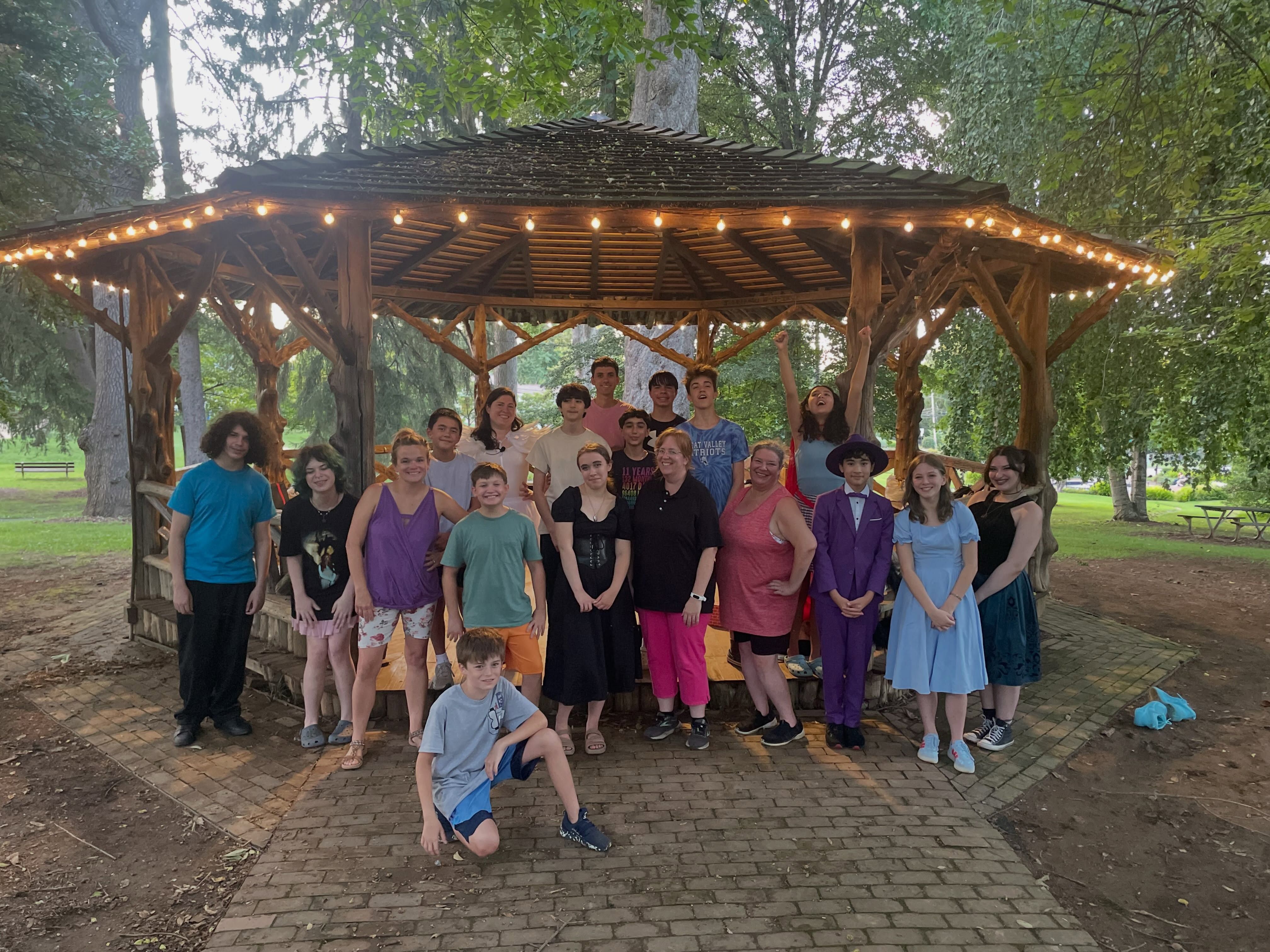
The cast of “Twisted Tales” poses for a photo. Arts and Athletics Club, primarily a theater production nonprofit, has struggled to find a new facility since the Exton mall’s closure in June. Its last production was held in a park, and it hasn’t been able to run a show since.Photo courtesy of Arts and Athletics Club
Trying to find a comparable space for the Arts and Athletics Club within East and West Whiteland Townships has proved difficult. But its leaders said they want to stay in the area, continuing to provide programming for participants from ages 7 to 70. The mall was the organization’s first permanent location, after performing in parks, libraries, and other community spaces.
The theater group, which offers its programming for free or little cost, has a limited budget for renting or altering a space to fit its needs. Another challenge has been finding an available location that is the right size: about 1,800 to 3,000 square feet of open space.
Group leaders have looked at retail locations, warehouses, and churches, and investigated partnering with community centers.
“We’ve been striking out pretty much everywhere that we’ve been looking,” Hutelmyer said. “It’s just been hard to find a direct match for what we need.”
It was a similar scramble for the Wardrobe, a nonprofit thrift store that accepts and sells secondhand clothing and also provides free clothes to those in need, after having to abruptly move out of the Exton mall.
Racing to find a new space to avoid laying off any employees, executive director Sherri Cole enlisted a real estate agent, she said, but struggled to find something affordable that also hit the right marks.
“Everything had to go out of the mall; it’s not like we could be like, ‘OK, we’ll go dark and we’ll move things when we find a new location,’” Cole said.
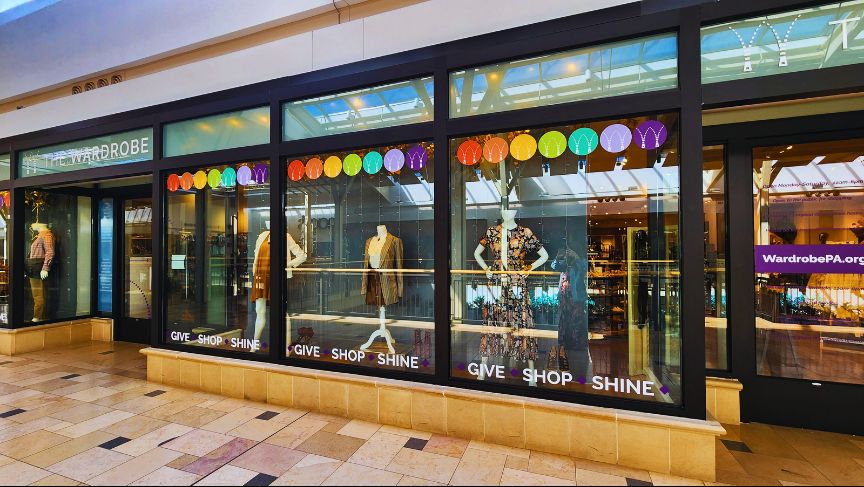
The old exterior of the Wardrobe, a clothing store that accepts donations and gives clothes to those in need for free, in Exton mall. The business will open its new location in Malvern in the fall.Photo Courtesy of The Wardrobe
By early July, the Wardrobe secured a pop-up location in the Plymouth Meeting Mall.
And this month, the nonprofit found a new, permanent home in the Lincoln Court Shopping Center in Malvern, about a 10-minute drive from the old Exton location. Cole anticipates the store will open by October.
The interior of The Wardrobe’s former Exton mall location. The nonprofit, which has called the mall home for the last few years, struggled to find a new location in Chester County after the mall shuttered in June.Photo Courtesy of The Wardrobe
Still, for both the Wardrobe and the Arts and Activities Club, it was hard to lose the Exton mall.
Out of the Wardrobe’s five locations in the Philadelphia region, the Exton mall location was its second-largest site for foot traffic and retail sales last year, Cole said.
It proved that people would still show up to a “dead” or “dying” mall if there was something they needed, Cole said. And it was meeting a need.
“There need to be spaces in the suburbs where everyone feels welcome, and often, the class divide in the suburbs is really stark,” she said. “It’s great that we’re able to find something that is still within the Exton, Malvern neighborhood where we can be providing these services, because even within the suburbs, poverty is really often overlooked.”
For Hutelmyer, still searching for somewhere for the Arts and Athletics Club to land, it was sad to see a community space like the mall go.
Housing a constellation of community organizations, the mall “wasn’t what people really expected it to be,” Hutelmyer said.
“But as it transformed into the community space, at least while we were there, it was still serving a lot of good, and I think that not being there is a big loss for the community,” he said.
This suburban content is produced with support from the Leslie Miller and Richard Worley Foundation and The Lenfest Institute for Journalism. Editorial content is created independently of the project donors. Gifts to support The Inquirer’s high-impact journalism can be made at inquirer.com/donate. A list of Lenfest Institute donors can be found at lenfestinstitute.org/supporters.
I didn’t have Peeping Tom drones on my bingo card for 2026.
But then, on July 14, the West Brandywine Police Department let residents of Wallace Township in Chester County know, via Facebook, that for a month or so, they’d been investigating (and had witnessed) a drone flying over homes along several roads in my neighborhood at night, between 8 and 11 p.m.
“It has been reported that this drone may be photographing properties, including inside the homes,” stated the police department’s Facebook page. “Those residents that live in that area are being urged to be mindful of this aircraft, and to be diligent, especially if you have skylights on the roof. These drones can be equipped with high resolution cameras and have extreme zoom capabilities.”
Huh. Creepy.
Since we don’t have young children whose images, captured without our consent, might find their way onto the more sinister reaches of the web, and since our house isn’t full of luxury goods to be cased, I didn’t worry much.
Maybe if the drone operator chanced to peep through our windows, he’d take pity seeing the proliferation of dust bunnies and proactively book us a deep-cleaning service appointment?
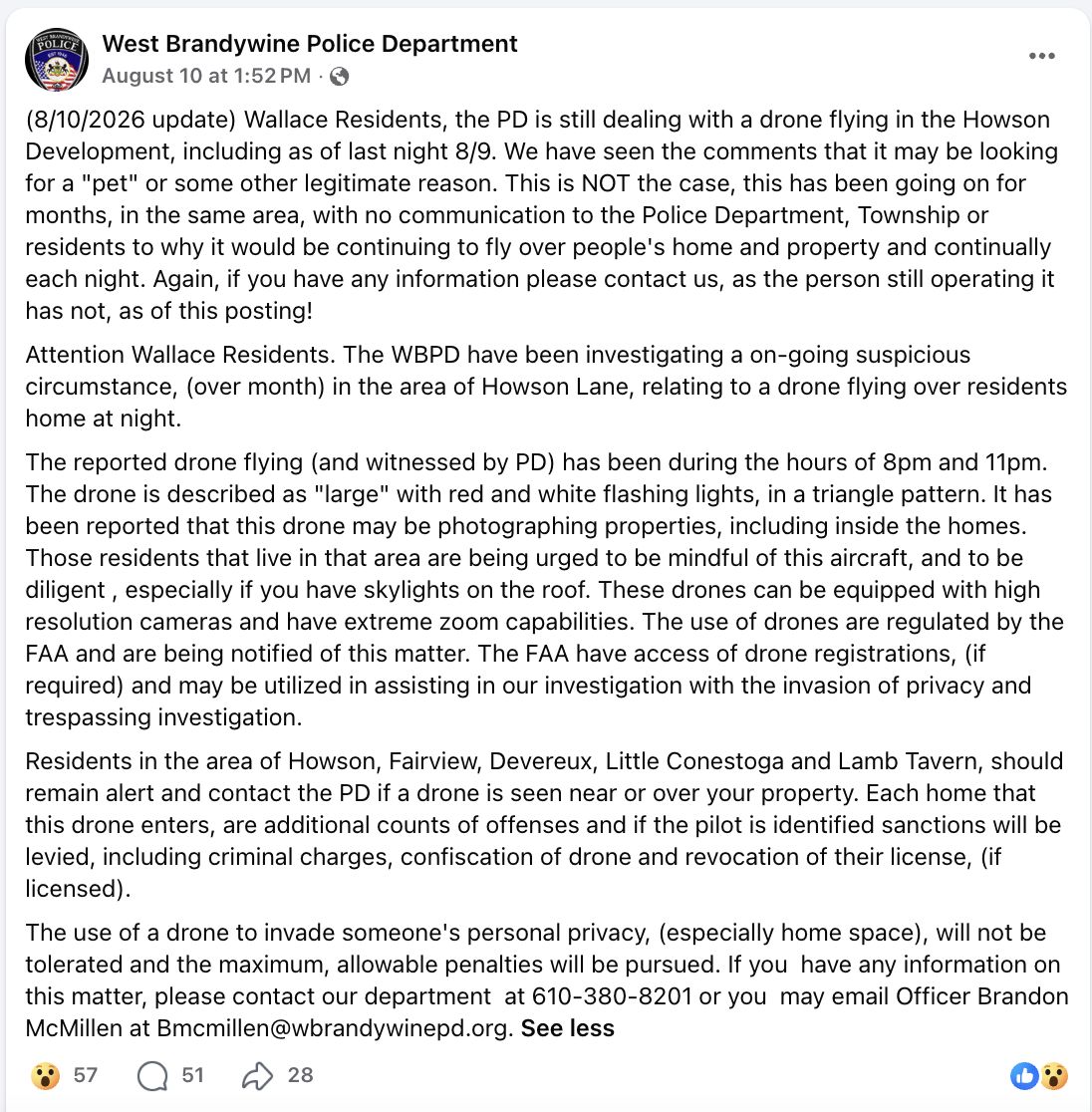
But the West Brandywine Police Department’s Aug. 10 update upped the ante: “We have seen the comments that [the drone] may be looking for a ‘pet’ or some other legitimate reason. This is NOT the case.”
Screen capture of the West Brandywine Police Department’s Facebook post on Aug. 10 updating residents of Wallace Township on the continued drone sightings.Screen capture
It is particularly disconcerting because Pennsylvania regulations stipulate that for nighttime flying the drones “need to remain within line-of-sight of the remote pilot on the ground.” Even if you aren’t unnerved at the idea of someone deploying a little electromechanical spy to look into your windows at night (when the lights inside make people and things clearly visible in a way they wouldn’t be during the day), the idea that the person doing so is on your property — or close enough to keep the drone in sight — should be.
I can easily imagine folks who already feel vulnerable — the elderly, women living alone, or people who have experienced domestic partner abuse or who have filed for protection orders — being terrified by that prospect.
The thing is — despite the West Brandywine Police Department’s gratifyingly proactive approach to residents’ privacy concerns — it is the Federal Aviation Administration that’s in charge. The state reports that some 11,000 people have an FAA remote pilot rating, and if this peeping drone is flown by a registered pilot, there may be little anyone can do.
Responses to West Brandywine PD’s Facebook posts about this have been predictably mixed in this libertarian-leaning corner of the county. Outrage and worry about surveillance and invasion of privacy, of course, but also lots of drone-flying enthusiasts who chafe at any talk of curtailing their ability to pilot their unmanned craft wherever and whenever — property owners be damned.
Also, since there are a lot of hunters in this neck of the woods, there are a good number of comments about shooting the drone down if it is sighted. I hasten to add that — as tempting as it might be to shoot the flying snoop right between its blinking red lights — drones are considered aircraft, and it is a federal felony to damage or disable them — punishable with a fine of $250,000 and up to 20 years imprisonment.
If you think none of this should matter to you because, hey, you don’t live in Wallace Township and no drone has been haunting your nights, think again. Aerial surveillance by drones is widespread, and largely unregulated. According to the Electronic Privacy Information Center, there are “no clear rules protecting individual privacy against drone surveillance. Despite the fact that drone surveillance implicates significant First Amendment and Fourth Amendment interests and common law privacy rights, the law around conducting aerial surveillance very much remains in a gray area.”
Regardless of what happens at the federal level, I hope that what has been unfolding in Wallace Township prompts Pennsylvania legislators to reconsider Act 78’s limits on local regulation of unmanned aircraft in order to better protect residents from unwarranted and nuisance drone surveillance.
Meantime, the West Brandywine Police Department wants residents to contact them if they see the drone on their property.
“Each home that this drone enters, are additional counts of offenses and if the pilot is identified sanctions will be levied, including criminal charges, confiscation of drone and revocation of their license, (if licensed),” the police department wrote in its latest Facebook post. “The use of a drone to invade someone’s personal privacy, (especially home space), will not be tolerated and the maximum, allowable penalties will be pursued.”
And maybe, just maybe, the fines accrued cumulatively will be enough to make drone operators think twice before unleashing their propeller-driven ghouls to hang around our windows in the middle of the night.
Residents protest against the disbanding of Oxford borough’s police department. Photo courtesy of Danny Graham
Residents in Oxford are concerned about the future of emergency response times and municipal protections in the 5,800-person borough if council moves ahead with disbanding its police department in favor of joining a regional agency.
That’s a decision council will make at an Aug. 17 meeting as it grapples with rising costs to maintain a century-old police force.
For some residents, the decision feels personal. “This is a small town. These guys, all 11 of them, mean something to us. We buy them coffee. We buy them donuts. They are part of our extended family. This matters to us, and how they’re being treated matters to us,” one said.
Traffic signal and safety improvements are expected in six Chester County municipalities thanks to recently awarded state funds. The largest is a nearly $640,000 grant for Tredyffrin Township to make improvements along Lancaster Avenue.
The region will see two celestial events — a partial solar eclipse today and the Perseid’s meteor shower, which will peak tonight — and there are several great viewing spots nearby, including Valley Forge National Historical Park and French Creek State Park. Here’s what to know.
Honey Brook Townshiphas named Nancy Freenock its next township manager and secretary. An attorney by trade, Freenock previously served as the city manager for Warren and borough manager for Clarion, both in Western Pennsylvania.
East Vincent Township is hosting a special planning commission meeting tomorrow at 6:30 p.m. at the municipal complex and on Zoom to consider AQ Dev, LLC’s conditional use application to build 53 single-family homes at 446 Stony Run Rd.
West Vincent Township’s board of supervisors is slated to consider Toll Brother’s proposal to build 46 homes near South Chester Springs and Conestoga Roads at its meeting on Monday.
The third season of Tires, which was created by comedian Shane Gillis and is set and was partly filmed in West Chester, drops on Netflix tomorrow.
Spooky season may still be a couple of months away, but Spirit Halloween has already opened at a former Rite Aid on Paoli Pike in West Chester. It’ll be joined this month by one at the former Tuesday Morning space in Downingtown.
A new coworking space, iThrive Coworking, recently opened at 10 Leopard Rd. in Paoli.
🍽️ On our Plate
Sweltering summer heat and humidity have you clamoring for a cool treat? Revisit our guide to the region’s ice cream shops, including the ever-popular La Michoacana in Kennett Square.
🎳 Things to Do
🎙️ Sound of Summer Free Concert Series: The final show of the season features a performance by Kennett Square’s own rock band The Holy Smokers. ⏰ Wednesday, Aug. 12, 6:30-8:30 p.m. 💵 Free 📍 Anson B. Nixon Park, Kennett Square
🎸 80’s Revolution: The band will transport attendees back a few decades, playing some of the most iconic tunes from the 1980s (leg warmers optional). ⏰ Friday, Aug. 14, 7:30 p.m. 💵 $23-$28 📍 Uptown! Knauer Performing Arts Center
🖼️ Look Around Music and Arts Festival: Hear live music, browse works of art, see skating demonstrations, and grab a bite to eat at this festival. ⏰ Saturday, Aug. 15, noon 💵 $25 in advance, $30 at the door 📍 The Elks Lodge, West Chester
🎶 Eagleview Summer Concert Series: Old 97’s frontman Rhett Miller headlines the next show. Local trio The MAKs will also perform. ⏰ Tuesday, Aug. 18, 7-9 p.m. 💵 Free 📍 Eagleview Town Center, Exton
The property includes a sprawling residence, a guest house, and a pool.Next Door Photos | Courtesy of Pat McGowan/The Collective.Real Estate
This Kennett Square property features not one but two homes, both situated on a large lot. The main six-bedroom home is a renovated and expanded mid-19th-century barn, complete with old beams, a stone fireplace, and an expansive walk-out lower level with a kitchenette. The second home, a restored 1800s farmhouse with two bedrooms, spans nearly 1,500 square feet and has its own driveway. Both overlook a pool and hot tub.
By submitting your written, visual, and/or audio contributions, you agree to The Inquirer’s Terms of Use, including the grant of rights in Section 10.
This suburban content is produced with support from the Leslie Miller and Richard Worley Foundation and The Lenfest Institute for Journalism. Editorial content is created independently of the project donors. Gifts to support The Inquirer’s high-impact journalism can be made at inquirer.com/donate. A list of Lenfest Institute donors can be found at lenfestinstitute.org/supporters.
Gov. Josh Shapiro made a declaration in the early days of his administration: Pennsylvania is open for business.
The move would ultimately include promises to slash bureaucratic red tape, cut permit wait times, and offer a new direct line to Shapiro’s office for major corporations hoping to set up shop in Pennsylvania.
Pennsylvania would “move at the speed of business” and “get stuff done,” the new mottos used by his administration, he said. He’s campaigning for reelection in November on the same catchphrases, and boasting major successes like the 12-day repair of I-95 in 2023 that traditionally would have taken months to reopen as an example of how he can think outside the box to solve problems.
What’s more: He sees delivering for residents — showing them government can actually solve problems — as the future of the nationalDemocratic Party, while it searches for an effective message and messenger heading into the 2028 presidential primary, which he is widely expected to enter.
It was with this same spirit last summer that Shapiro announced the largest single private sector investment in Pennsylvania history: Amazon committed $20 billion in Pennsylvania that included two data center campuses in Luzerne and Bucks Counties. Pennsylvania scored the project because of its promise to fast-track permitting and use tax breaks for the massive developments.
“Pennsylvania’s gonna be better off. I think America’s gonna be better off, because we’re going to win the battle of AI supremacy and it’s going to be done right here in the commonwealth of Pennsylvania,” Shapiro said in an interview on CNBC’s Squawk Box on the day he announced the deal.
Gov. Josh Shapiro announces a $20 billion investment by Amazon in Pennsylvania data centers in Salem Township and Falls Township on June 9, 2025.
But in a year’s time, the politics — and public opinion on both sides of the aisle — have dramatically shifted on data center development. Shapiro’s early welcome of data centers has created an opening for criticism from his gubernatorial opponent and members of his own party.
Yet efforts to cut red tape have proven to be slow and overblown: Only six data centers are actually under construction in Pennsylvania since the announcement, and 10 have received at least one state-level permit approval, according to Shapiro’s office. Still, Shapiro’s popularity is being evaluated by some voters and anti-data center activists on a perception that he moved too quickly and sacrificed the state’s safety in favor of Big Tech.
“I am all about legislators and decision makers getting s— done. This version of it is reckless and it’s irresponsible and it’s not actually serving our people,” said Carrie Santoro, the executive director of progressive advocacy groupPennsylvania Stands Up who has been holding town hall meetings in communities around the state on data centers.
“Governor Shapiro intends to use all the tools available to him to stop the dozens of speculative data center projects that do not meet community needs and Pennsylvania should expect to hear more from him on that in the coming weeks,” said Shapiro’s press secretary, Rosie Lapowsky.
Now Shapiro, who otherwise maintains vast popularity ratings in the state, faces a vulnerability on one of voters’ top priorities as he heads into November, and a particularly sensitive concern among Democrats as he potentially vies for the party’s nomination in two years.
Many states, including Pennsylvania, had already begun welcoming the major projects, and some hyperscale developers plan to spend billions of dollars to build them. Pennsylvania’s General Assembly first approved a sales tax exemption for data center developments in 2021, when Shapiro’s predecessor, Democratic Gov. Tom Wolf, was still in office.
Shapiro, for his part, initially embraced data centers as an economic opportunity for Pennsylvania, bringing union jobs for construction workers to build out the physical infrastructure for the computers running AI software. He also wanted to position Pennsylvania to inherit the most benefit from providing space for AI to operate, leading not only other states but also other countries in the race to advance new technology. He and U.S. Sen. Dave McCormick (R., Pa.) appeared together as early embracers of the technology and the massive buildings needed to power it, speaking together during McCormick’s first AI summit in Pittsburgh last summer.
Sen. Dave McCormick shakes hands with Gov. Josh Shapiro at a panel discussing state investment and infrastructure at the Pennsylvania Energy and Innovation Summit at Carnegie Mellon University in Pittsburgh on July 15, 2025.Kaiden J. Yu / Staff Photographer
But as communities began to push back against the rapid proliferation of data center proposals, in part to protect their water and energy resources, Shapiro adjusted.
Shapiro, like many elected officials, has changed his positions and rhetoric on the unpopular developments. He announced his Governor’s Responsible Infrastructure Standards (GRID) as a way to incentivize developers to follow transparency and environmental requirements in order to receive tax breaks. And when the General Assembly failed to approve his GRID standards or any substantial data center restrictions, Shapiro said he’d act on his own, though it’s still unclear what that will entail.
“You want to build a data center there? You’ve got to bring your own power; you’ve got to pay for your own power. You’ve got to be transparent with the local community — tell them who the hyperscaler is, tell them what’s going to go on there. You’ve got to have a local benefits agreement to help that community. You’ve got to protect the water sources that are used to cool off those facilities,” he said in a June interview with GZERO.
The Democratic governor has been lauded nationally for challenging PJM Interconnection, which is the electric grid operator for Pennsylvania and 12 other states over its efforts to raise prices on ratepayers. He capped the price Pennsylvania consumers could pay through 2029, as residents fear rate hikes due to the data center boom.
But Shapiro’s plan on data centers is too little, too late, Santoro said.
“I saw the GRID proposal as him moving on this issue, and the thing that I am concerned about is he didn’t move enough to keep up with how much voters have moved on this issue,” she said.
Some of those voters would agree. A Quinnipiac University poll of Pennsylvania voters, conducted in early June, found just 24% of those surveyed — and 40% of Democrats — approved of “the way Gov. Josh Shapiro is handling data centers in Pennsylvania.” It’s a stark contrast to Shapiro’s overall approval numbers, in which he’s maintained above 50% approvals — record-high favorability ratings for a first-term Pennsylvania governor.
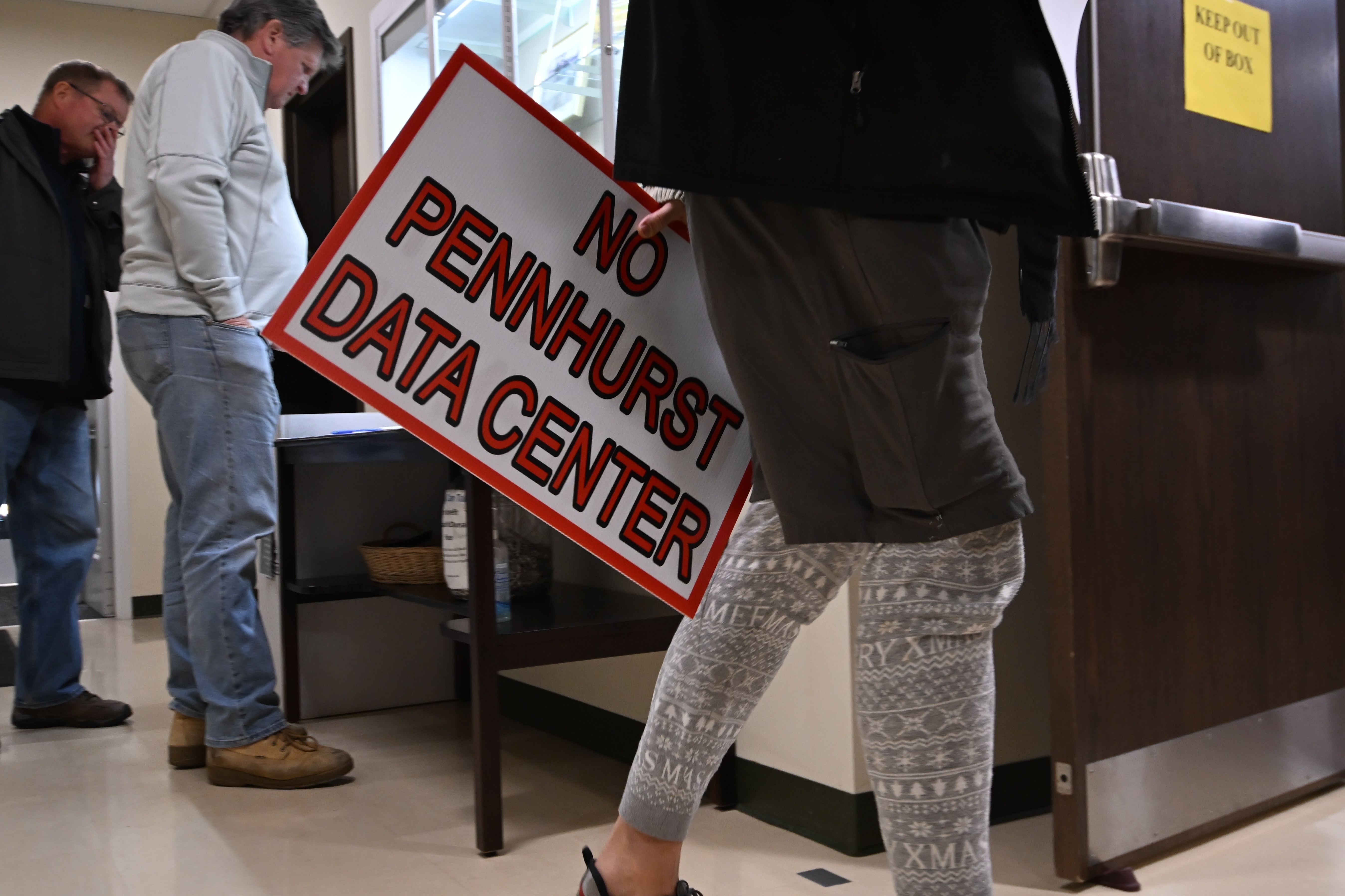
People sign in and head into an East Vincent Township supervisors meeting where an agenda item involved a data center proposal at the former Pennhurst state hospital grounds on Dec. 17, 2025, in Spring City, Pa. Marc Levy
Joanna Tenney, 36, of East Vincent in Chester County, held a sign at a June rally in the state Capitol that read: “Shapiro: Amazon’s bootlicker.” A registered Democrat, she voted for him in 2022, and believes he should be held accountable for supporting data center development in Pennsylvania that led to the fast-tracking of a now-stalled 125-acre data center project near where she lives.
She’s so fed up with Shapiro’s approach to data centers that she said will be writing in the name of her state senator, Sen. Katie Muth (D., Chester), who has been on the front lines of advocating for many state environmental issues, for governor on her November ballot. Tenney said she and a few other anti-data center advocates plan to run a write-in campaign for Muth.
“We’ve elected somebody that we thought was going to make the right choices by us, and we don’t really see that happening,” Tenney said.
Muth, who took office in 2018, said she would not be supporting Shapiro or “any elected official who puts the interests of Big Tech ahead of the health, safety, and future of Pennsylvania communities.”
If Shapiro changes his stance on data centers, she would support him, Muth said. She is the prime sponsor of a bipartisan bill to place a three-year moratorium on hyperscale data center development.
“Get right on the issue, Right your wrongs. If you can’t be on the side of science and people, my support is MIA,” she added.
Emily VanFleet, 26, lives in Archbald in Northeastern Pennsylvania, where six data center projects are underway comprising more than 50 buildings that, when completed, will cover 14% of the town. VanFleet, who is an unaffiliated voter, said she also supported Shapiro in 2022. But because of his public support for speeding up data center development in Pennsylvania, she is “certainly not going to vote for him this upcoming election,” she said. She isn’t sure she’s going to vote at all.
“I want Shapiro to stop being a coward,” VanFleet said in June. “I have emailed him, I have called him, I have reached out to him so many times. I have not heard back, not once. I see his videos all over social media that he has an open-door policy, but I have yet to see it.”
(In May, Shapiro’s administration announced that one of the unpopular Archbald developments, Project Gravity, was removed from a fast-track permitting program for failing to properly engage with the community.)
But negative attitudes toward Shapiro’s position on data centers may be limited statewide and his position is unlikely to dramatically knock down his high popularity or reelection odds: The June Quinnipiac poll found 56% of those surveyed approve of the way he is handling his job as governor overall, and recent polling shows Shapiro ahead 53% to 40% against his Republican challenger, state Treasurer Stacy Garrity.
The data center pitfall
Shapiro’s political opponents — both immediate and prospective — are also seizing on the issue.
Garrity, of Athens in Northeastern Pennsylvania, has also led a statewide listening tour on the topic. In June, she convened one of those sessions in Hatfield with a group of commissioners, zoning planners and emergency responders to talk about how they have been impacted by data centers. She blasted Shapiro for his role in attracting Amazon and said his proposed new requirements amount to a “flip flop.”
“Josh Shapiro has failed on this topic. He was the biggest cheerleader for data center development in Pennsylvania, until he wasn’t,” Garrity said at the June 24 meeting.
Pennsylvania Treasurer Stacy Garrity participates in the podcast “Ruthless” during an event hosted by Americans for Prosperity, Concerned Veterans for America, and the Libre Initiative at the National Constitution Center in Philadelphia on Jan. 29. Elizabeth Robertson / Staff Photographer
Garrity has her own mixed record on data centers.
At the time of the Amazon announcement, Garrity called the investment “great news” that would bring “historic investment” and “create thousands of jobs.” And her current position remains unclear. She has said she opposes a statewide moratorium but wants “a pause” on development instead.
Like Republicans running in districts that supported Trump in 2024 but oppose data centers, she appears to be attempting to find a pro-business and pro-regulation path.
“We want to make sure data centers are an addition to the grid, not a contraction. If there’s infrastructure that needs to be added to the grid, rate payers shouldn’t be paying for it,” she said. “I’m not opposed to data centers, but we have to do them the right way, and we haven’t done it. It’s because of a lack of leadership from the government.”
Garrity’s “long record of supporting completely unregulated data center development makes it clear that she just can’t be trusted,” said Manuel Bonder, a spokesperson for Shapiro’s campaign.
Local government leaders said at Garrity’s campaign roundtable in June that there has been lack of guidance around issues, especially around power demand, water use, infrastructure, environmental impacts, and community compatibility.
Kathie Doyle, a Republican on the Richland Township Board of Supervisors, said confusion around data centers have “set off a firestorm” in her community. Earlier this year, warnings of a supposed proposal for a data center in the Bucks County township circulated on social media, but turned out to be a “business park” with two buildings.
“Our residents don’t understand that we just cannot say no,” she said. Municipalities in Pennsylvania cannot outright ban data center development.
Santoro said Shapiro’s inconsistency is a liability that could sway some voters away from casting their ballot for him.
“Certainly he is giving her an ‘in’ by staying on the wrong side of this,” she said.
And it’s not just Republicans seizing on Shapiro’s position. The early reputation Shapiro earned as a champion of data centers may become a point of attack among other Democratic contenders for the presidency in 2028, too. In a veiled jab at Shapiro in June, Illinois Gov. JB Pritzker, knocked Pennsylvania on a businesspodcast for allowing Constellation Energy to restart Three Mile Island nuclear plant just to power Microsoft’s data centers.
“My guess is that’s going to be a reasonably unpopular thing to have done,” Pritzker said, without noting Shapiro by name on the Prof G Markets podcast.
Vulnerability for down-ballot Democrats
With a $50 million campaign war chest and high approval ratings, Shapiro is widely favored to win reelection this year. But his record on data centers could prove a liability for those he’s hoping to pull along, some advocates, like Santoro, say.
Shapiro has been staking much of his national political clout on his ability to flip four House districts in Pennsylvania for Democratic control of the U.S. House, drawing voters to the polls with his name at the top of the ticket. He’s also aiming to flip Pennsylvania’s Senate into Democratic control for the first time since 1993, giving him a Democratic trifecta in Harrisburg, as the state’s split legislature has blocked many of Democrats’ priorities from becoming law.
Santoro predicted that could be in jeopardy “if he does not change course.”
“Shapiro’s leadership on data centers will be the thing that costs us the first Democratic trifecta in 31 years, and I think that while he will likely win reelection with this wildly unpopular position on data centers, other elected officials and candidates will not,” she said.
Other Democratic candidates aware of data centers’ deep unpopularity are differentiating themselves on the issue, despite remaining otherwise aligned with Shapiro. Scranton Mayor Paige Cognetti, who is running in Pennsylvania’s 8th Congressional District, released a new ad last month putting data center developers on notice.
“Big Tech needs to pay their own way, not hide behind [nondisclosure agreements]. No tax breaks. Don’t raise our electric bills. Don’t poison our water. And hire local union labor,” she said, in the ad spot. “You can’t meet that? Then get out.”
Cognetti’s stance isn’t vastly different from Shapiro’s — both want to end blanket tax breaks — but her rhetoric is much stronger, and she’s putting the issue at the forefront of her campaign.
Democrats insist Republicans, including those running at the state level, don’t have the moral high ground on data centers after failing to pass through several measures that would have enacted stricter controls for their approval.
Sam Silverman, a former congressional aide and founder of Silverman Strategy Group, a strategic communications firm focused on technology and politics, said Shapiro’s approach to data centers — proposing a plan rather than enacting a moratorium — presents a risk that could either pay off and become the model for other states, or fail to fully address all future concerns and is unpopular.
“Shapiro is going out in front by proposing a bargain now. If the standards protect ratepayers, produce visible benefits, and hold bad actors accountable, Pennsylvania could have a model others can follow,” he said. “But because he is putting forward the deal now, he will be judged on whether it delivers.”
Taking a risk involves trust, though. Shapiro can afford to make a big swing at one of the hottest issues in politics because voters put so much faith in him, Silverman said.
“Most politicians do not have the amount of trust and political capital to take a risk, either,” Silverman said.
Whether the governor is triumphant will come down to what standards go into effect and whether bad actors are held accountable, he said, “and whether Pennsylvanians believe those standards are working.”
Chester County authorities believe that the shooting death of a woman in East Goshen Township on Friday was a suicide and that a 9-year-old girl also was wounded by gunfire.
“The child who was shot continues to recover from her injuries. As we announced on Friday, this was an isolated incident and there was no threat to the general public,” the Chester County District Attorney’s Office said in a statement Monday.
Police were dispatched just before 11 a.m. to the Summit House condominium complex on West Chester Pike for a reported shooting. Inside the unit, the officers found the woman, described only as in her 40s, dead from a single gunshot wound.
The girl was treated at the scene by paramedics and was alert and able to speak, said Chief David Leahy of the Westtown-East Goshen Police Department.
Police found a gun not far from the woman’s body.
An earlier version of this article incorrectly reported that the Chester County District Attorney’s Office said the girl was struck by the same bullet that killed the woman.