UFC 330, which is set for Aug. 15 at Xfinity Mobile Arena, will be the company’s first major championship event held in the city in 15 years. With its return, plenty of Philly fighters are already eyeing the card for the opportunity to fight in front of their hometown crowd, including 33-year-old Kyle Daukaus.
“It would be amazing to be on that card,” Daukaus, a Father Judge graduate, said. “Growing up 25 minutes from the stadiums, going to all of them when I was a kid — it was really amazing to kind of grow up here and be a fan of these sports. But to go out there and perform in front of fans at that stadium would be amazing.”
Before he can cross that off his bucket list, Daukaus has one obstacle in his way: former Penn State wrestler — and three-time NCAA champion — Bo Nickal. Daukaus will face Nickal Sunday in a middleweight bout at UFC Freedom 250, on the South Lawn of the White House on President Donald Trump’s 80th birthday.
Being included on the much smaller card — this weekend’s event will feature seven bouts, compared with about a dozen on a normal card — was an honor for Daukaus.
“Obviously fighters want to be on the card because of the spectacle that it is, and how amazing it is and how crazy it is,” Daukaus said. “I knew that they were only going to have like six to eight fights on the card, and I really didn’t think I would have been one of them. Finding out that I was one of them shows that they have belief in me to go out there and have the performance that can get more eyes on the sport.”
Daukaus (17-4) was originally scheduled to fight Vicente Luque at UFC 327 in April. But a day after signing the contract, he got the call to fight against Nickal (8-1) at the White House event. The card also includes a pair of title bouts and names like Ilia Topuria, Justin Gaethje, Alex Pereira, Sean O’Malley, Michael Chandler, and Derrick Lewis.
Daukaus, who co-owns The Forge MMA gym on Academy Road in the Northeast with his brother and former UFC fighter Chris, is currently riding a two-fight win streak. Daukaus was released by UFC in 2022. Since his return, he’s picked up a pair of first-round wins, knocking out Michel Pereira and beating Gerald Meerschaert by submission.
The Philly native was 4-4 in his first UFC stint. Following his release, he fought in Atlantic City-based Cage Fury Fighting Championships, where he won four consecutive matches before re-signing with UFC in April 2025.
So, what’s different this time around? “Dad strength” — and a new perspective.
“I have two kids now, so dad strength is something that has been brought to me,” Daukaus said. “But just my maturity levels. I feel like ever since I had my first son, I’ve been more mature with myself.
“I’ve realized there’s a lot more to this game than me. I’m doing this for them as opposed to just me. So I feel like that is a little bit extra motivation. These last two fights have been something. I’ve had good performances and it showed that I can kind of take on any challenge they put against me.”
His next challenge comes with an elite pedigree on the mats and is fresh off a head-kick knockout win over Rodolfo Vieira. Heading into the matchup, Daukaus is cautious of Nickal’s wrestling ability, but believes his own jujitsu skills can hold up on the ground.
“I’m not afraid,” Daukaus said. “Obviously, if it was a straight wrestling match, I would be screwed. He’s a good wrestler, but with jujitsu and everything like that, there’s a lot of things that I can [use to] counter. But I’m not solely focused on being defensive against him. I have to be offensive to make sure he worries about me.”
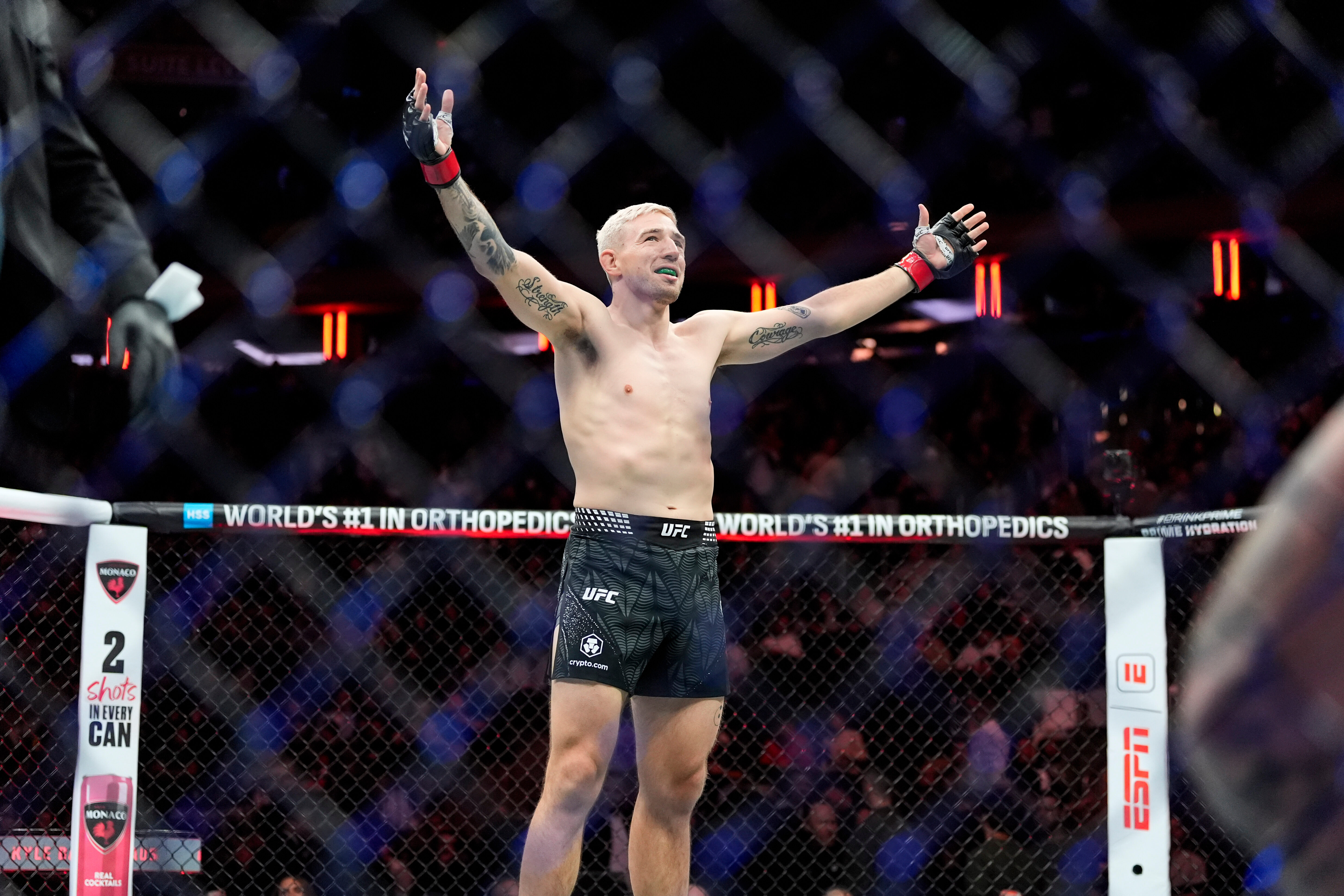
Kyle Daukaus will face Bo Nickal at UFC Freedom 250 on the South Lawn of the White House.Yuki Iwamura / AP
What can fans can expect from his White House performance? Daukaus thinks it’ll be his best yet.
“I feel like I need these opponents that kind of push me to get me up early to make sure that I’m training where I can train,” he said. “I’m going to go out there and put on the best performance that I possibly can to make sure the fans are excited.
“And obviously, being at the White House, we can’t have any of these lazy performances. We got to go out there and make sure we can showcase some skills and get the fans’ eyes on the event.”
If he does that — and doesn’t suffer any major cuts or bruises along the way — Daukaus will begin to turn his attention toward a possible UFC 330 fight.
“I would be a liar to say that it wasn’t in the back of my mind,” Daukaus said. “I know it’s about nine weeks after [Sunday’s fight]. So I can take that week off as long as there’s no injuries or anything like that and then get back right back into camp.
“Would it be a lot on myself? Yes, it would be a lot going back to camp like that. But it would be something super special.”
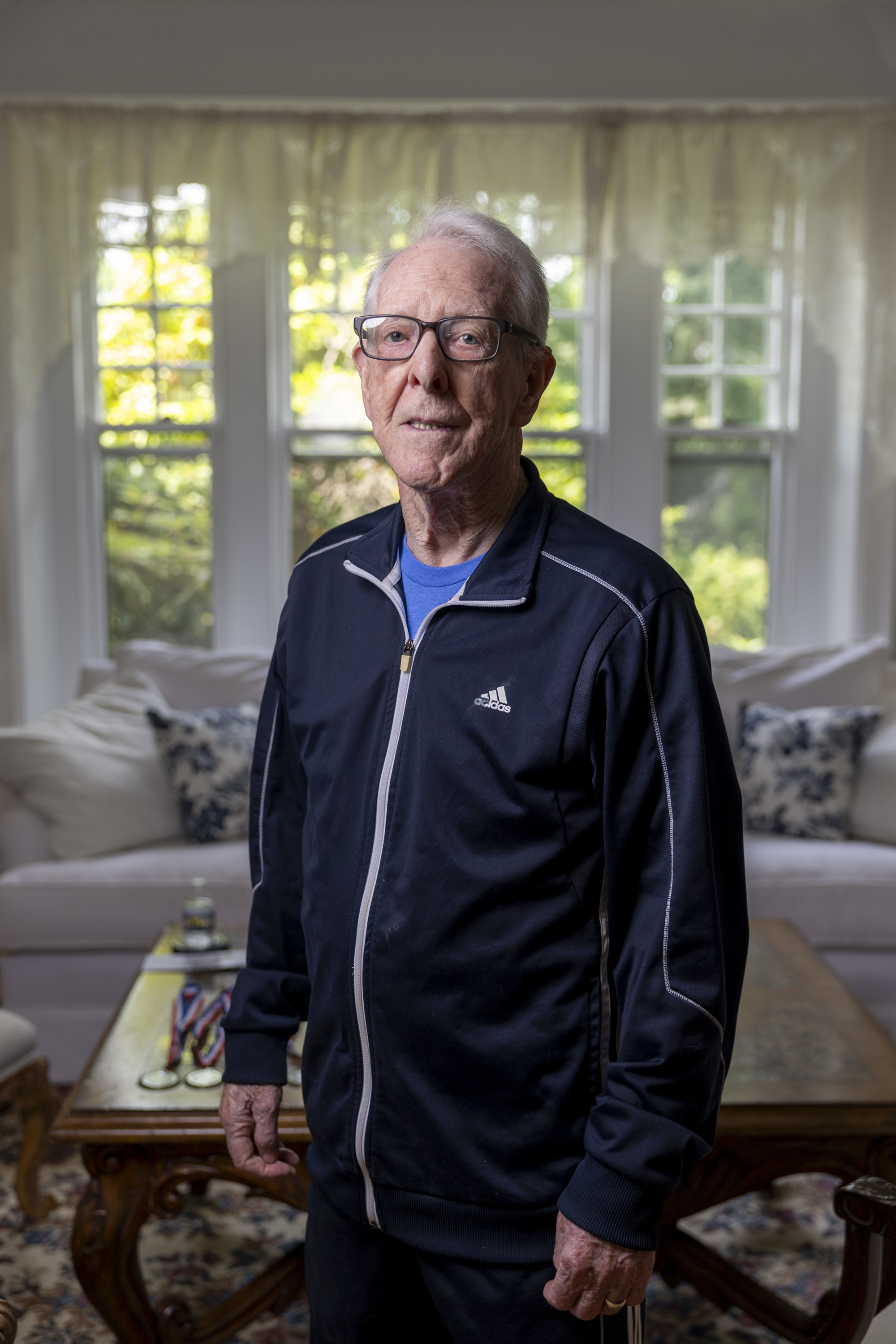
People in John Durning’s circle have come to know him as “Superman,” which makes sense, given his growing collection of gold medals.
At 90 years old, the Irish immigrant and Havertown resident competed in the 36th annual Delaware County Senior Games on Thursday. He competed in several events, including a 100-, 200-, and 400-meter run, a softball and football throw, and, Durning’s favorite, the long jump.
Last year, as the sole 89-year-old in the 85-89 age division, Durning still had some competition. He may be one of the few in the 90-plus age category this year, but Durning doesn’t mind if he wins gold by default.
“This week brings the total to 230 medals,” Durning said before Thursday’s Games. “I have nine more silvers than I do gold, so I’m trying to beat that.”
He came away with 10 golds and one silver, winning each of his track and field events as well as singles and doubles bowling, miniature golf, and shuffleboard over the course of the Games, which ran from June 1-12. His silver came in team bowling.
Durning began competing in the games when he was a spry 56-year-old after hearing about them from a friend. The games are meant to keep folks active as they age and retire. Spending his retirement on the couch, however, was never a concern for Durning’s friends and family.
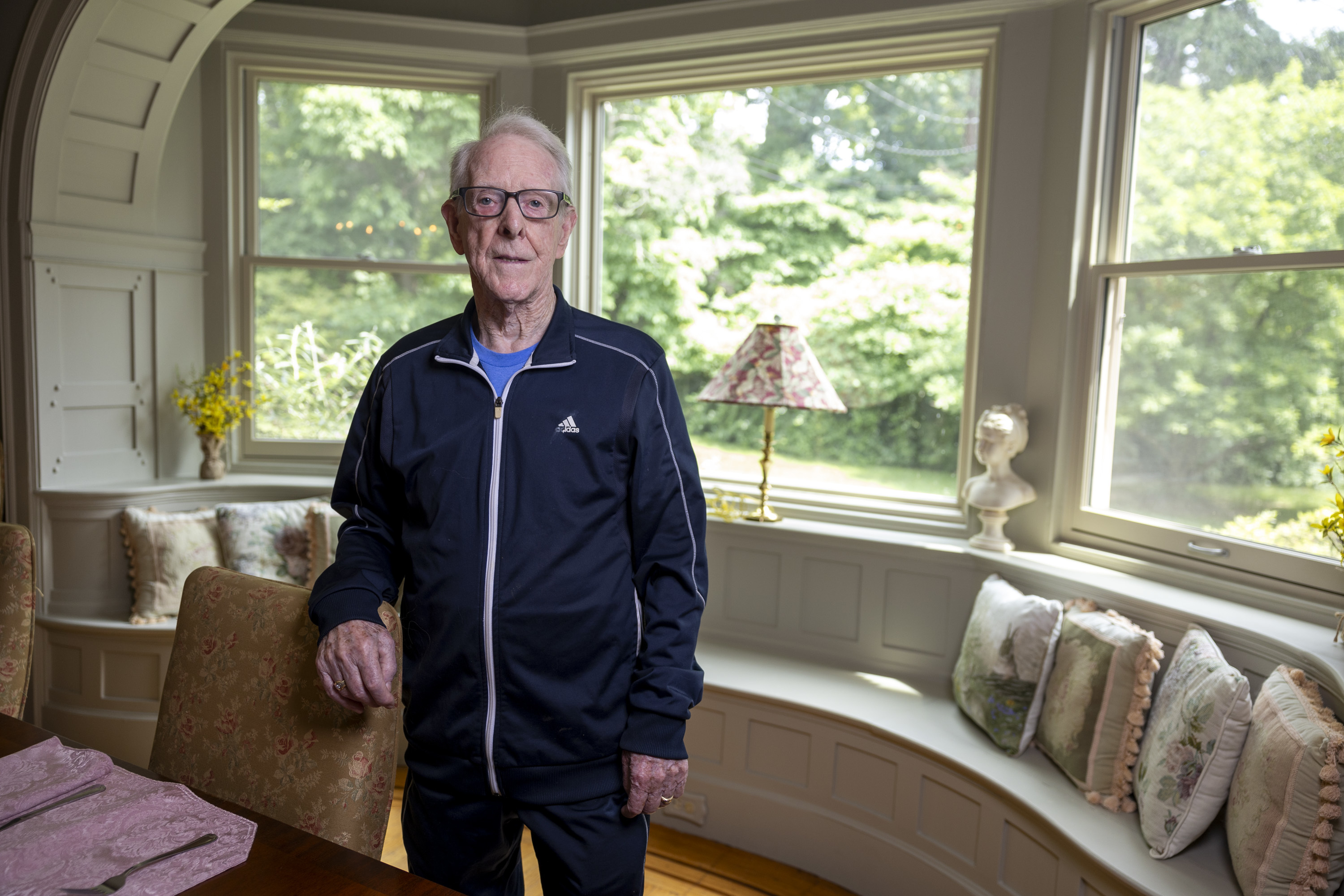
John Durning added to his medal collection at the Delaware County Senior Games.Tyger Williams / Staff Photographer
Changing plans
Durning was born in 1935, the second-youngest of 10 children, and raised on a farm in Donegal, Ireland. He learned to play Gaelic football with his five older brothers at an early age. Needing to find a job, he immigrated to the United States at 21, where an aunt and cousins lived.
“I came through New York City on April 17, 1957, and I saw the lit-up Statue of Liberty,” Durning said. “It was beautiful.”
He planned to stay for only three years. The plan was to work and save up to open a sporting goods store back in Ireland. However, after 16 months in the United States, he was drafted into the U.S. Army, where he went on to become a paratrooper with the 101st Airborne.
The Army saw his athletic potential, and he was recruited to compete on the U.S. Army soccer and track teams. He competed against other military branches and colleges while he was based at Fort Lee in Virginia.
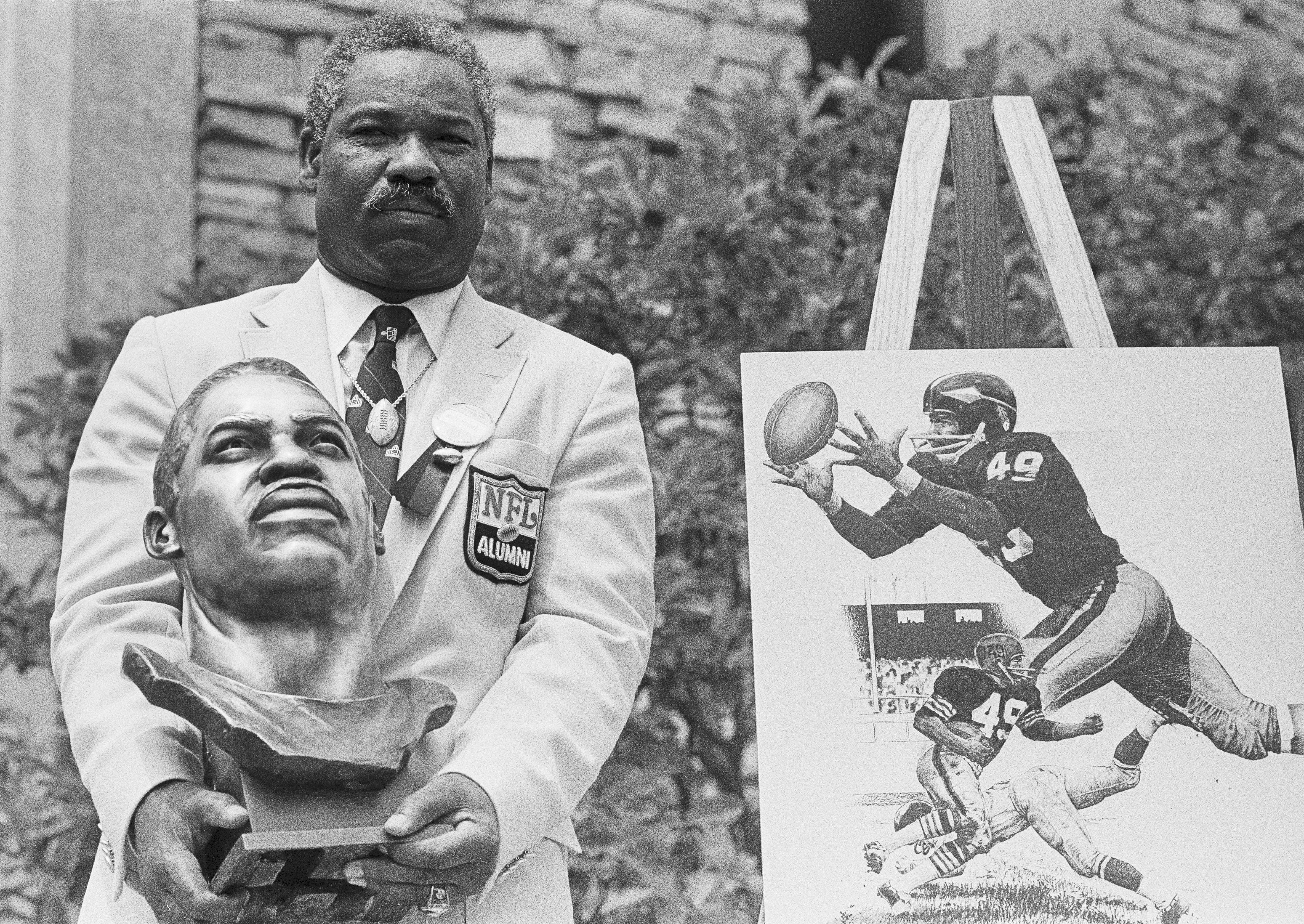
“I’ve rubbed shoulders with some great athletes when I was in the Army,” Durning said. “Like Bobby Mitchell, who was a wide receiver for the Cleveland Browns.”
John Durning says he crossed paths with Bobby Mitchell, a Hall of Fame halfback and wide receiver, during his time in the Army.Gus Chan
Unlike many of his teammates, John had no thoughts of going pro after he left the military in the early 1960s. Besides, he soon had a family to support.
He met the love of his life, Helen, at a dance, and they married in 1962 and had the first of their four sons a year later. Durning worked night shifts at Acme Baking Co. and coached his sons’ soccer and track teams in the afternoons.
“He has always had a sense of humor about our sports,” said Brian Durning, the second-oldest of the Durning sons. “I remember he would take us to the Haverford High School track on the weekends to practice baton handoffs and understand what we were doing better, and help us ahead of time not make a mistake.”
Over the years, Durning coached a multitude of sports for local teams, including soccer and track at Malvern Prep, Waldron Mercy Academy, and the Haverford School. The number of kids he has coached is innumerable.
“I have people here and there who tell me, ‘You were my coach,’” he said. “They are teaching their own kids now and ask me to come and watch … coach them on coaching.”
A large part of Durning’s legacy is the founding of two soccer clubs. The first, when he was only 17, was the St. Michael’s GAA Club in Donegal. He played on the team and served as treasurer and secretary in the club’s early years. The club recently honored Durning for his 90th birthday by placing a bench engraved with his name outside the clubhouse.
In 1974, he helped found what became Haverford Soccer Club, where he remained involved for years, helping the organization grow from just 68 boys to more than 2,000 players and coaches.
Durning retired from coaching at age 75 after the Haverford School won the 2011 Pennsylvania Independent Schools Athletic Association state championship.
“After that, I knew it was time to step away,” he said.
Staying active
Between the annual Senior Games, Durning stays on his feet. Heavily involved in the Donegal association of Philadelphia and the local Irish Center, he is an athlete in many ways — including dance.
“At the Irish Center, he’s known as the best waltzer in the Irish community,” said Pari Livermore, Durning’s best friend. “He’s like dancing with air. He can still dance with about 15 to 20 girls. No one can move like him anymore. That’s why they call him Superman.”
Durning and Livermore make it a habit to dance as much as they can.
“We met at an Irish dance,” Livermore said. “We sat down next to each other, and I asked, ‘Would you like a drink?’ He said, ‘No, I don’t drink’ … so that’s one reason why I think he is so healthy and so active.”
Added Durning: “At one point I was a bartender, and I’ve still never had a drop. I sold cigarettes in my father’s shop, and not once did I ever smoke.”
John Durning makes it a point to stay active in retirement.Tyger Williams / Staff Photographer
The Irishman adds to his regimen by stretching every morning and walking around the neighborhood most evenings. Even Durning, though, has had his hardships.
“I’ve had three back surgeries and two hip replacements,” he said. “And I’m still running and doing the long jump. A lot of people have back surgeries, knee replacements, and all, but they never continued with physical therapy exercises, which is key. It just takes 20 minutes a day.”
Durning has encouraged others to continue staying active. Once a coach, always a coach, he now helps friends with their Senior Games performances. Despite being an accomplished athlete, his community remembers him for more than his medals.
“If you were to go around his friends and say, ‘Can you describe John with one word?’” Livermore said, “they would all probably say he is a gentleman, not an athlete. They would say he is a gentleman.”
Durning plans to stay active and “compete until I am physically unable to,” but not without warning.
“You know, I’ve been told to slow down,” Durning said. “‘You could get a heart attack and drop dead on the track,’ they say, and I just said, ‘Well, we have the long jump pit and the shovels out. You can just throw me in and do it dirt cheap.’”
Durning has a plan for his medals when the time inevitably arrives. It’s somewhat of a tradition, he explained, to hand out the silver, gold, and bronze awards one received in the Senior Games at their funeral. Durning will have more than 230 medals to share — a physical reminder of the zest he has for life.
“I say you’ll never, ever be too old,” he said. “If you want something, as long as you’re healthy enough to do it, you should be doing it.”
BUFFALO — In the second installment of our interview with Danny Brière at the NHL’s scouting combine, we talked with the Flyers general manager about the upcoming draft, his fourth with the team, and who has impressed him in the organization the most.
This interview has been edited and condensed for clarity.It was conducted on June 3, before it was revealed that Dylan Larkin wanted a trade out of Detroit.
Q: Does how the year went, especially because of the postseason, change your strategy or impact your outlook at the draft?
A: It does not, no. It’s a different animal. We know that what happened was great — the stretch, and then the playoffs were awesome. Expectations are going to grow; we’re aware of that, but we want to try to be careful with the expectations, too. A lot of time it’s not a straight line up. We see it individually with the players, and we see it with teams as well. There’s going to be ups and downs along the way. So we’re trying to be careful with managing the expectations going forward. It’s not going to change our approach. We still feel that we’re in a growth stage of our rebuild, and we don’t want to deviate from that too much, unless it really makes too much sense.
Q: It is a slightly different setup for you this year compared to your previous drafts. By picking at No. 21, does that change your mindset?
It doesn’t change the mindset, as far as the approach, where we’re still looking to pick the best player, especially at the higher-end level. You want to make sure that you have someone who can be a difference-maker, not just a filler, hopefully; never have a guarantee, but that’s the goal. But, yeah, obviously we have to dig in a little bit more on more players, because the range or the amount of players changes a little bit. When you’re picking [at] six, usually you know who’s going one and two, and even when we were at 13, it’s a small group of players who are going to be there. At 21, it can start to go sideways usually after pick 10 or 11; it can go in many different directions, so we have to be prepared that way and try to know more players this year.
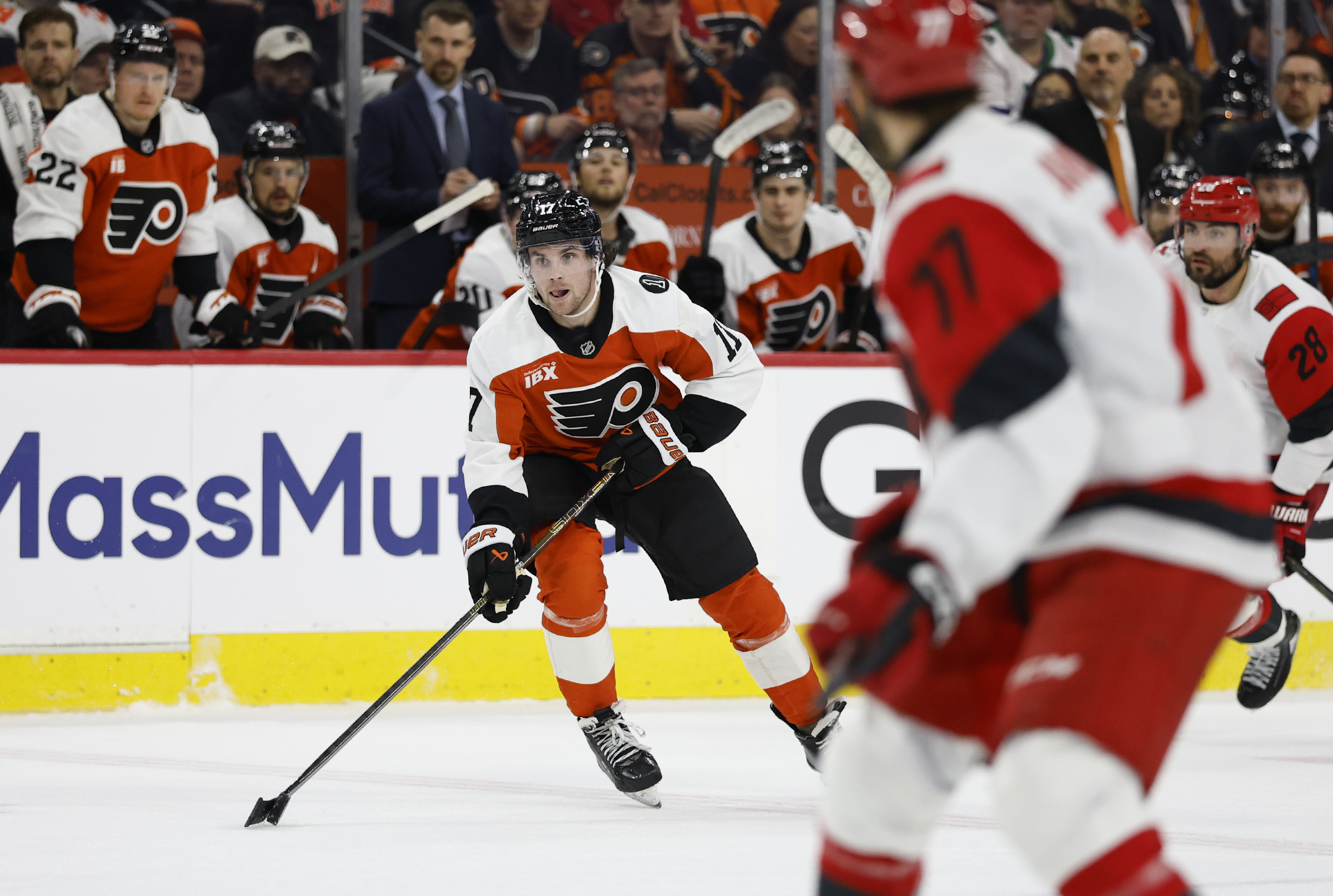
Matthew Gard is one of several center prospects in the Flyers system. He is heading back to the Western Hockey League next season.Alejandro A. Alvarez / Staff Photographer
Q: Since assistant general manager Brent Flahr was hired, the Flyers have drafted nine centers — eight of those since you became GM. Is there still a need to draft a center?
A: Absolutely. You can never have enough centers, and it’s a lot easier to move a center to the wing than the other way around. When I talk to other GMs, nine out of 10 GMs are looking for centers. It’s a position that is tough to fill, and part of it is because when a player is usually not able to make it down the middle or doesn’t fulfill what they’re looking for down the middle, they move them to the wing. So wingers are a lot easier to find. Every team is looking for centers, so that’s not a problem to have a surplus of centers. We have one in Cole Knuble who played a lot of the center position, and then last year played mostly on the wing. Well, we know that he can play both, and he played both in Lehigh Valley. So it’s a nice luxury to have too many centers.
Before I arrived, there were some centers who didn’t hit, like Nolan Patrick, German Rubtsov, and Jay O’Brien. So there have been a few that they just didn’t pan out. I think the organization was trying to draft centers, the players didn’t pan out or didn’t develop the way the organization expected, and that’s why all of a sudden we came up and we didn’t have very many centers.
So hopefully now the players that are in place will keep developing. We believe in Jett Luchanko. We believe in Jack Nesbitt, the way he’s developed. Jack Berglund has really stepped up. We think Heikki Ruohonen is trending in the right direction, and hopefully the guys we signed, Riley Thompson and Knuble, at the end of the year could really help us there. Matthew Gard is also in there. So it’s a nice luxury to have, and if we have the chance to jump on a center, we won’t hesitate to get.
Q: It feels like it’s either defensemen or centers in this draft.
A: It seems to be a lot, but you look at last year, there were all these centers. There was one winger in the top 10, I think; who drafted the winger? We did — which we don’t regret, by the way. Porter Martone has been amazing. But we went with what we felt was the best player on the board, not considering the position at that time. So it’s going to be the same approach. But, yeah, there seem to be a lot of defensemen and centers in this draft.
Q: Is there any update on the first-round pick from Toronto, acquired in the Scott Laughton trade, in regards to which year?
A: No, I haven’t heard from the NHL on that yet.
Q: Hunter McDonald is a restricted free agent. Where do things stand in his contract negotiations? Where do you see him projecting long-term, and is he ready for the NHL?
A: Hunter took a big step last year in his development, and that’s why he played that game late in the season. I think our coaching staff was really impressed on how he took a step forward this year. He put in the work and really elevated his game, earned that NHL game at the end, and he was around the team when we played in the playoffs as well.
Really exciting to see him have growth to his development. It’s a big summer for him, but we’re excited about him. A big, physical defenseman like that is not easy to find, and we hope he’s going to be one of those guys, eventually. But he’s going to have to beat someone at some point to earn those minutes.
Flyers defenseman Hunter McDonald is one of several players expected to push for an NHL job come September.Yong Kim / Staff Photographer
Q: Do you foresee Emil Andrae, also an RFA, having long-term success in Philadelphia?
A: What we love about Emil is his compete level. I was really impressed with him after training camp when we sent him down to go work on his game — he wasn’t happy about it — but he went down and didn’t pout and decided to show everybody that he didn’t belong in the American [Hockey] League anymore. So that part is what you love about him. He’s going to compete; he’s going to give you everything he has. But, again, now you’ve got to beat someone in the top six to play on a regular basis. That’s not easy to do. We do have some good defensemen, and that’s going to be the same challenge for him moving forward.
When you’re at that stature, and I lived it myself, you almost have to be perfect, and that’s the tough part. We’re asking a lot out of him for him to be able to be in the lineup, and I think he’s getting better at it. Making fewer big mistakes, he has gotten better, but that’s the reality that he’s dealing with, and he knows that, and he’s good with it, and he’s really working hard on his game to become a very, very efficient and effective defender.
Q: Do you like that there might be all this internal competition now?
A: Absolutely. I think it’s great. I think it’s great that we have an internal rivalry to beat each other out for minutes. That’s the great part too, with our veterans. They understand, they respect it, because they did it at one point, they beat someone out. So I think our guys realize, and that’s great, that it also pushes our veterans to stay on top of their game and keep getting better.
Q: Is there anyone in the system who impressed you?
A: Ty Murchison had a great [year], and that’s why he got some games early, before his injury; that was an impressive year. I think Oliver Bonk, after dealing with some injuries early in the season, built up his game and got better as the season went on. David Jiříček will be a very interesting one because he had a really good, strong finish to the season in Lehigh Valley. So that’s just been in the [AHL]. Up front, you saw Porter Martone, Alex Bump, and Denver Barkey; they earned it. Nothing was given for free; they earned their minutes, they earned playing more and more because they were competitive, they were ready to go. So that’s really exciting.
Q: Who is the player who needs to take the biggest step next year?
A: I can’t really pinpoint one. I think we expect that from every player. There are expectations. It’s not just hoping if you want to make it. And that’s a little bit of the tough part with our guys — we do have a lot of players and a lot of good, young players, so you have to earn your way. You have to push yourself, and you have to be willing to commit to a regimen to get ready for next season that is probably out of your comfort zone. That’s just the reality. You want to be an NHL player, you’re going to have to do that.
Flyers forward Jett Luchanko skated in four regular-season games and one playoff game this season.Yong Kim / Staff Photographer
Q: Jett Luchanko had a little bit of an up-and-down year. Where do you see him fitting in as his career progresses? And what do you need to see from him next season?
A: We’re excited to see him turn [fully] pro. I think that’s great. For Jett, it’s been tough, and he’s been on so many teams. Just last year alone, from Flyers to Guelph [of the Ontario Hockey League] to Brantford to World Juniors, back to Brantford, to the Flyers. There’s been bouncing around, and that’s two years in a row that he’s kind of done that. Stability will probably be a good thing for him.
We expect a big summer out of him, and he’s got to get ready. The big thing with Jett is, he has an elite skill in skating that is almost unmatched from anyone in the organization, other than maybe Owen Tippett. So that’s always going to have a lot of value for anybody to have a player like that. Now it’s our job to try to help him and round out his game to make it in the NHL. But what I would expect, I would say, is probably for him to play a year in Lehigh Valley.
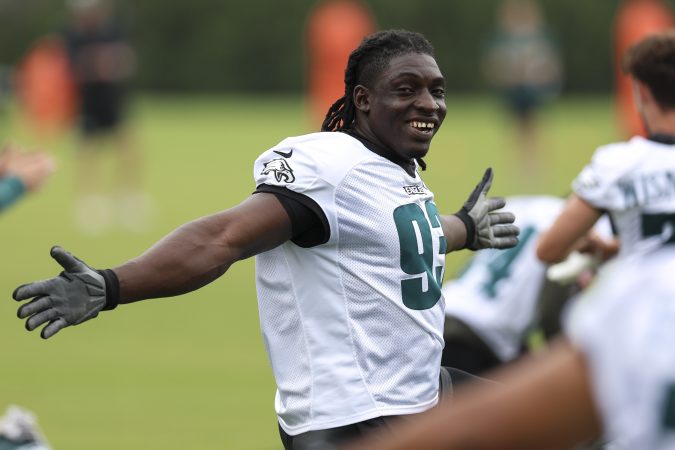
Uar Bernard has been in Philadelphia — a world away from his small village in Nigeria — for nearly seven weeks now. He visits restaurants, goes sightseeing, and even took in a Sixers playoff game.
But nothing compares to his favorite spot:
The Eagles’ practice facility.
“I hardly go out,” Bernard said after Day 2 of Eagles mandatory minicamp on Wednesday at the Jefferson Health Training Complex. “I just focus on my playbook and my teammates, so coming into the building is fun for me and I love it here. I want to grow every day, so I keep my focus in the building and keep the main thing the main thing.”
On the rare occasions he does go out, Eagles fans typically flock to the novice defensive tackle who, up until last month’s rookie minicamp, had never participated in a football practice. The towering 6-foot-4, 306-pounder became an instant fan favorite when the Birds drafted him in the seventh round in April. His impressive physical traits and status as a player from the international pathway program — from which the Eagles have greatly benefited with tackle Jordan Mailata — make fans bullish about his potential.
So, how is he adjusting to life in the NFL? Off the field, Bernard said it’s a “home run” to be in such a passionate football city.
“The fact that I can’t even go out without taking pictures with the fans outside, it’s amazing,” Bernard said with a smile. “Being here is like a dream come true to me because I’ve never experienced that before. I just came into the town from Nigeria and it’s amazing.”
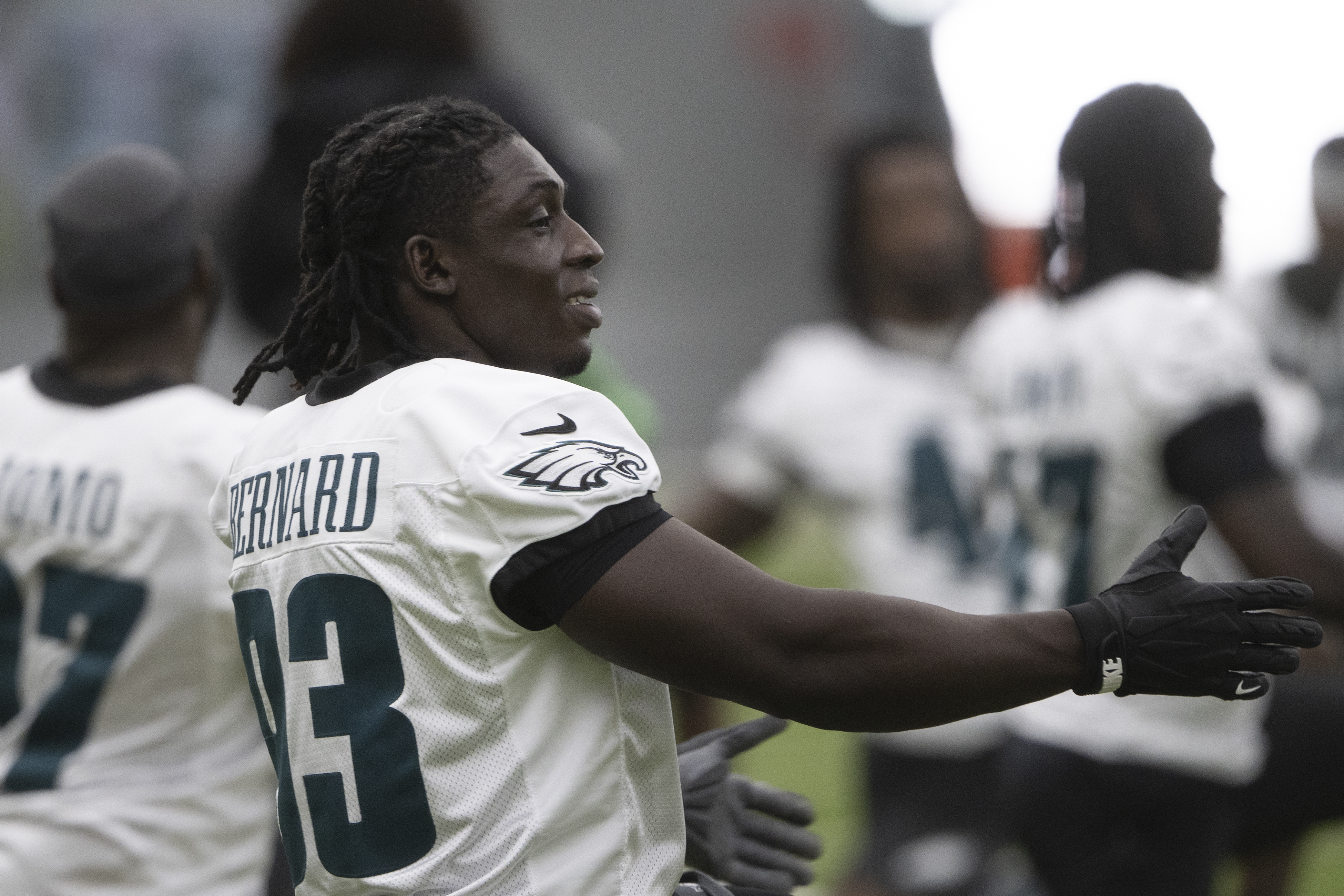
Uar Bernard says so far that his NFL transition “is going smoothly.”Jose F. Moreno / Staff Photographer
As for life on the field, Bernard called it a “learning process” — which makes sense given he went from not playing football to the NFL.
“It’s good,” Bernard said. “I don’t see anything hard if you keep working out. If you have passion for what you do, you’re going to progress every day. So, I believe that the process is going smoothly.”
His teammates and coaches agree. Speaking with reporters last week, Mailata — who had a relationship with Bernard before the draft thanks to their IPP ties — called him a “freak of nature.”
“He’s just freakishly strong, freakishly fast,” Mailata said. “And I can’t even compare him to me just because he’s just again, not of this world just by like metrics and numbers-wise. … Once he puts it all together, I think it’s a wrap.”
Defensive line coach Clint Hurtt, who nudged general manager Howie Roseman to draft Bernard, has been “like a father” to Bernard. Like Mailata, Hurtt believes that, if the team is patient enough with him, he can become a force in the league.
“I’m not putting my stamp on everybody,” Hurtt said last week. “If you don’t have a great work ethic, if I don’t believe in your character and who you are as a person, I’m not putting my family’s well-being in anybody’s hands.
“But when I saw the kid’s work ethic and character, he’s an unbelievable human being. I know as people get a chance to spend some time with him, he’s a great kid. So I felt good about doing that.“
The ‘Nova Knicks, all heart and grit and chilling composure, completed the greatest comeback in NBA Finals history, erasing a 29-point second-quarter deficit to take a one-point lead on a floater by — who else — indomitable point guard Brunson with 1 minute, 22 seconds left to play. With 1.2 seconds remaining, trailing by one, OG Anunoby tipped in Brunson’s missed three-pointer.
It was Brunson’s 36th point. It was Anunoby’s 33rd.
It was a 107-106 win over the Spurs, forever enshrined as the NBA’s biggest chokers. The Knicks know all about that.
However, they now stand 48 minutes away from ending a 53-year drought. Only one NBA team has blown a 3-1 lead in the Finals, and those 2016 Golden State Warriors faced prime Kyrie Irving and LeBron James in his prodigal return to Cleveland.
This was a momentum win. A historic win. A fairy tale win that carved the hearts out of a team with far better players but with far less backbone.
It was a last-second, never-say-die win in the Mecca of basketball, Madison Square Garden, accomplished in front of stars ranging from Jerry Seinfeld to Jay-Z to Taylor Swift to Timothée Chalamet.
A win delivered by divine intervention, perhaps; after all, a nun blessed the Garden with holy water after the Game 3 loss, and Villanova is a Catholic university, after all.
OK, it might not have been miraculous, or even sacral, but it’s probably the best win in the history of the franchise. The kind of win that 19,812 attended but 1.9 million will claim to have witnessed in the flesh.
It was that epic.
It was the sort of statement game that gets a number retired, hung from the rafters in the Garden alongside Walt Frazier and Bill Bradley and Patrick Ewing and Willis Reed. A number like the No. 11 that Brunson wears. He carried the Knicks all season, all playoffs, and all night.
He was drafted 33rd in 2018 having won two NCAA titles at Villanova, both with Knicks teammate Mikal Bridges, one with Knicks teammate Josh Hart. Asked recently what the NBA teams missed that draft, Brunson replied:
“Everything.” He looked down. “Humph.”
Bridges was largely absent Wednesday, and Hart actually missed a dunk and failed to box out on a play that gave the Spurs their last lead, but that’s hoop. They just hoop.
All three have overachieved, but no one has overachieved in the NBA like Brunson in decades.
Maybe ever.
He’s 6-foot-1-ish. He can’t jump. He’s not super fast.
But he is everything that New York loves about itself, and everything Villanova was in the Jay Wright era.
The Coach was there, by the way. Brunson, towel over his shoulders, found him on the court after the game. They hugged.
As they were in Finneran Pavilion and what’s now called Xfinity Mobile Arena and all those NCAA tourney sites, the ‘Nova Knicks were indefatigable. Relentless. Resilient.
The opposite of San Antonio.
The Spurs were probably the most talented team in the NBA this season, and for 24 minutes, the played like it. They also are the second-youngest team in NBA Finals history, and, for the final 24 minutes of Game 4, they played like it.
What was the game like? It was like the Patriots, nine years ago, in Super Bowl LI, when Tom Brady erased a 25-point deficit. That’s the only thing that comes close.
Jalen Brunson.
Tom Brady.
Seriously.
If Brady had done it in Foxborough, Mass., in front of a home crowd that hadn’t won a title since Richard Nixon was president.
Just before his game-winning putback, Anunoby blocked a layup that, with 11 seconds to play and a one-point lead, De’Aaron Fox inexplicably and inexcusably took, so he will get more shone today. Fine. Let him have his moment.
This is Brunson’s team. These are the ‘Nova Knicks.
The ‘Nova Knicks lead the best-of-seven series, 3-1.
It feels like 5-1.
“One word that captures that all is just ‘believe,’” Brunson told ESPN afterward. “Just believing in each other. Believing in the process.”
It felt impossible early, especially considering the officiating in the series, and the signature play so far, which, of course, involved Brunson.
The play happened in the first quarter of Game 3 on Monday, which the Knicks lost by four points, and it was seismic at the time and it is seismic today. It was a no-call on Victor Wembanyama that the NBA reviewed to determine if it was flagrant. It was not.
Had the foul been deemed a Flagrant 2, it would have been Wembanyama’s second of the playoffs. Flagrant 2 fouls carry two flagrant points. Four total flagrant points carry an automatic one-game suspension.
The NBA simply could not have that. Wemby’s just too important.
Why does that matter now, several days later?
Because in Game 4 on Wednesday, Wembanyama was assessed a Flagrant 1 when he cracked Karl-Anthony Towns in the jaw with an elbow.
That gave him three flagrant points. Which means had the foul Monday been deemed a Flagrant 1, Wembanyama would have been disqualified for Game 5 on Saturday.
Again: He’s too important.
Towns? Not so much.
Within the first 62 seconds on Wednesday, KAT, who carried the Knicks in Games 1 and 2, was on the bench with two questionable fouls. Less than two minutes later, the Knicks trailed, 12-2.
It changed the complexion of the game, the series … everything.
The series is pulling crazy ratings thanks in part to the Big Apple’s Big Three, but Brunson, Hart, and Bridges operate on a thin margin for error. To beat a team like the Spurs, who won nine more regular-season games than the Knicks, they need Towns on the court and on his game.
He picked up his third foul less than five minutes into the second quarter, another phantom infraction considering the physicality of these Finals.
The Wemby Show, the NBA’s most wholesome narrative since Steph Curry, continues, even though he missed two late throws.
Wembanyama finished third in MVP voting in his just his third season. An elegant Frenchman of Congolese descent with the comportment and habits of a Renaissance man — he plays competitive chess and sketches in the park — Wembanyama is the NBA’s best vehicle for basketball globalization since Joel Embiid. That one hasn’t really worked out.
At the time of Wemby-Gate, the Knicks led the series, 2-0. A bit later, at halftime of Game 3, the Knicks led the game by seven.
And then … the Spurs were awarded 16 more free throws than were the Knicks in the second half of Game 3. Afterward, when asked about the altercation, Brunson replied, “Whatever you saw is what you saw.”
The refs saw nothing in real time. The NBA saw a catastrophe if Wembanyama missed Game 4. He’d scored 32 in Game 3, and even with all that free-throw help, the Spurs still barely won.
He missed two free throws late Wednesday. Karma.
Then, that horrid first half for the home team. If it seemed like everything was going against the Knicks, well, it was.
The first shots of the Revolutionary War were fired in April of 1775 during the Battles of Lexington and Concord. And the colonists were victorious.
The Second Continental Congress convened at Independence Hall the following month to ignite the pioneers’ fighting spirit and in June, they authorized the formation of the Continental Army, the first branch of the American military.
“The Continental Army was established to wage war against Great Britain and to fight for the rights and liberties of Americans who still considered themselves a part of the British Empire,” explained Matthew Skic, director of collections and exhibitions at the Museum of the American Revolution.
Artist Sean Bryant’s No. 1 design reflects discipline, service, and commitment, honoring the Army’s foundational role in the nation’s history and its enduring presence as a symbol of strength and perseverance.Sean Bryant and Colibrà Workshop
“George Washington was appointed commander-in-chief. Nobody knows at this point the war [was] going to last eight years,” Skic said.
The Philadelphia Historic District will honor the creation of the U.S. Army this Saturday at the Museum of the American Revolution. This weekend’s fete is the latest “Firstival,” a yearlong series of weekly day parties celebrating American events, places, and things with Philadelphia roots.
The Revolutionary War escalated quickly, Skic said, and by early 1776, the Founding Fathers were debating sovereignty. In July, the colonists declared their independence. Three months later, Congress issued an official order renaming our young country from the United Colonies to the United States.
“Now, the Continental Army isn’t fighting to restore the rights and liberties of British Americans,” Skic said. “It is now fighting to secure the independence of a new nation.”
The Continental Army was originally made up of troops from New York, New Hampshire, and Rhode Island. Pennsylvania, Maryland, and Delaware men quickly joined the fray, marching north and strengthening the Army’s force.
Some soldiers from Pennsylvania had previously served in the volunteer militia, the Philadelphia Associators, founded by Ben Franklin in 1747 to defend the city against foreign invasion. The seasoned vets would go on to become leaders in the Continental Army.
The Redcoats tried to capture Philadelphia in 1776, but Pennsylvania army men, led by Washington, held them off.
The next year, Pennsylvania troops fiercely defended Philadelphia during the Battle of Brandywine in Chadds Ford but lost. The British occupied Philadelphia for nine months, through June of 1778, when they evacuated and reassigned troops to New York. Earlier that year, France formed an alliance with the United States and the British military decided to use its resources to protect New York.
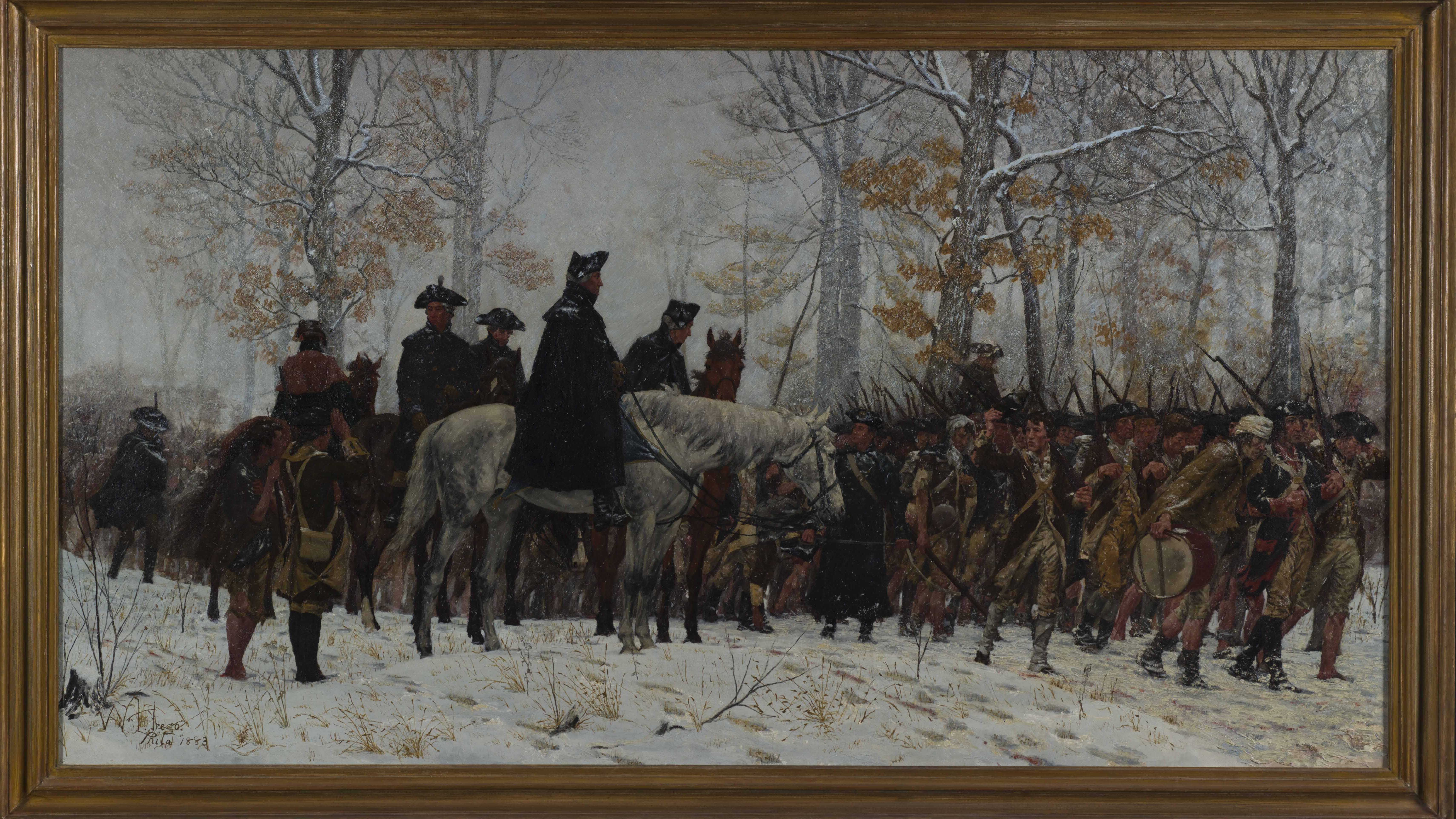
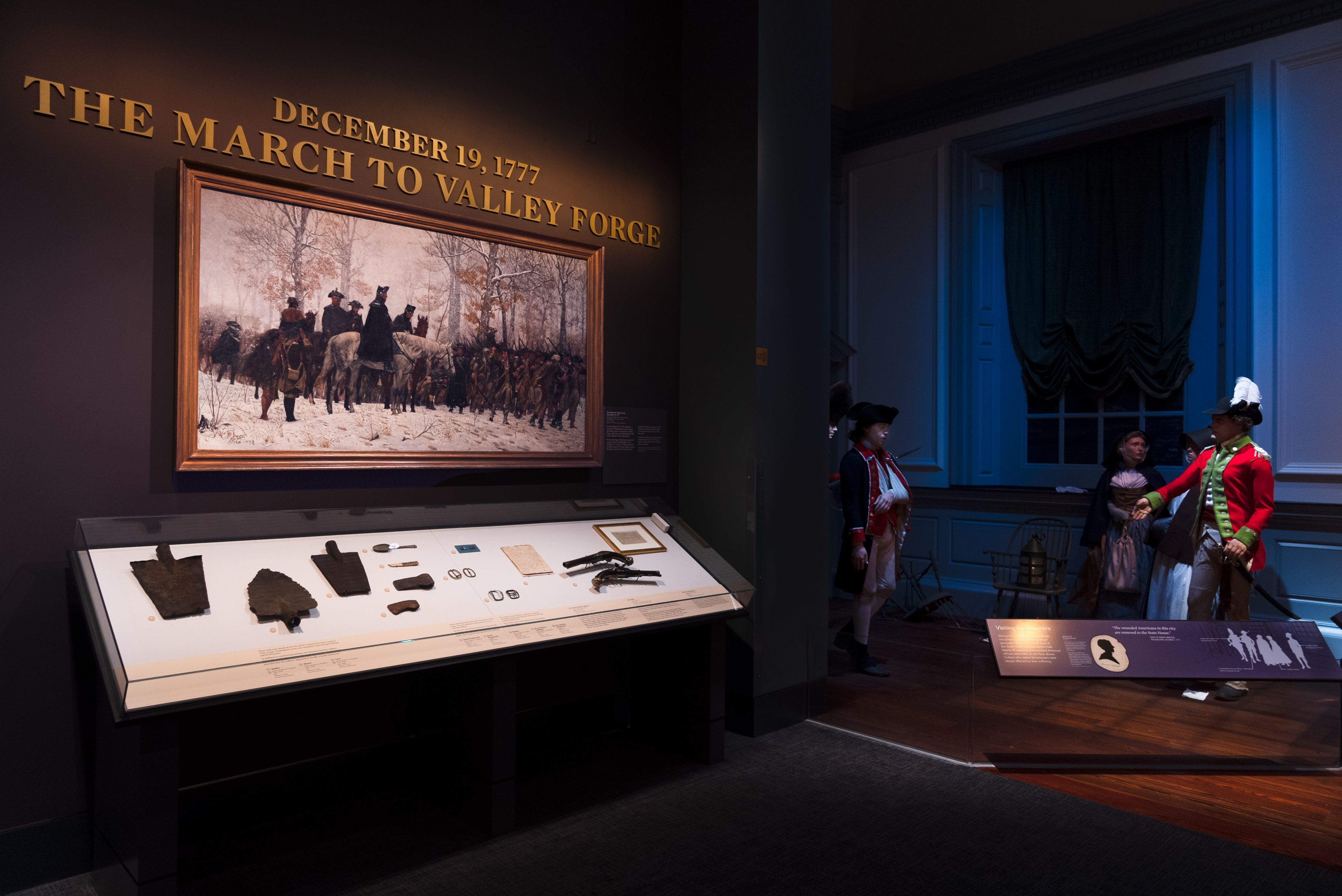
“The March to Valley Forge” December 19, 1777. The oil on canvas work was painted by William Brooke Thomas Trego in Philadelphia in 1883. It is conserved with funds provided by the Society of the Descendants of Washington’s Army at Valley Forge.Museum of the American Revolution
“The British leave Philadelphia and they don’t come back,” Skic explained. “The Continental Congress moves back in [to Independence Hall] and Philly becomes the capital of the revolution again.”
In the winter of 1778, the Continental Army retreated to Valley Forge and under the command of Prussian military officer Baron von Steuben, the Continental Army became a lean, mean fighting machine.
Realizing that the Union’s alliance with France, combined with its improved military prowess, would likely mean they would lose the war, Britain began to retreat. On Sept. 3, 1783, officials signed the Treaty of Paris, formally recognizing the United States as an independent sovereign nation.
The American Army fought valiantly during the Revolution, Skic said. Still, it’s important to note the conflict just didn’t impact America, a lesson our military would apply to subsequent wars.
The American Army was strong, Skic said. “But the global element of the war had an important impact on securing the independence of the United States,” he said.
This week’s Firstival is Saturday, June 13, 11 a.m.-1 p.m. at the Museum of the American Revolution, 101 S. Third St.
After a tragic and unprecedented spike in officer deaths, Philadelphia’s police union made an emotional plea for help: Its charitable organization was running low on funds and struggling to give fallen officers the respectful burials they deserved.
City officials stepped up, agreeing in 2014 to significantly boost how much they would pay to cover funeral expenses. Since then, for each officer who died in the line of duty, the city has contributed up to $75,000 in tax dollars, up from $15,000.
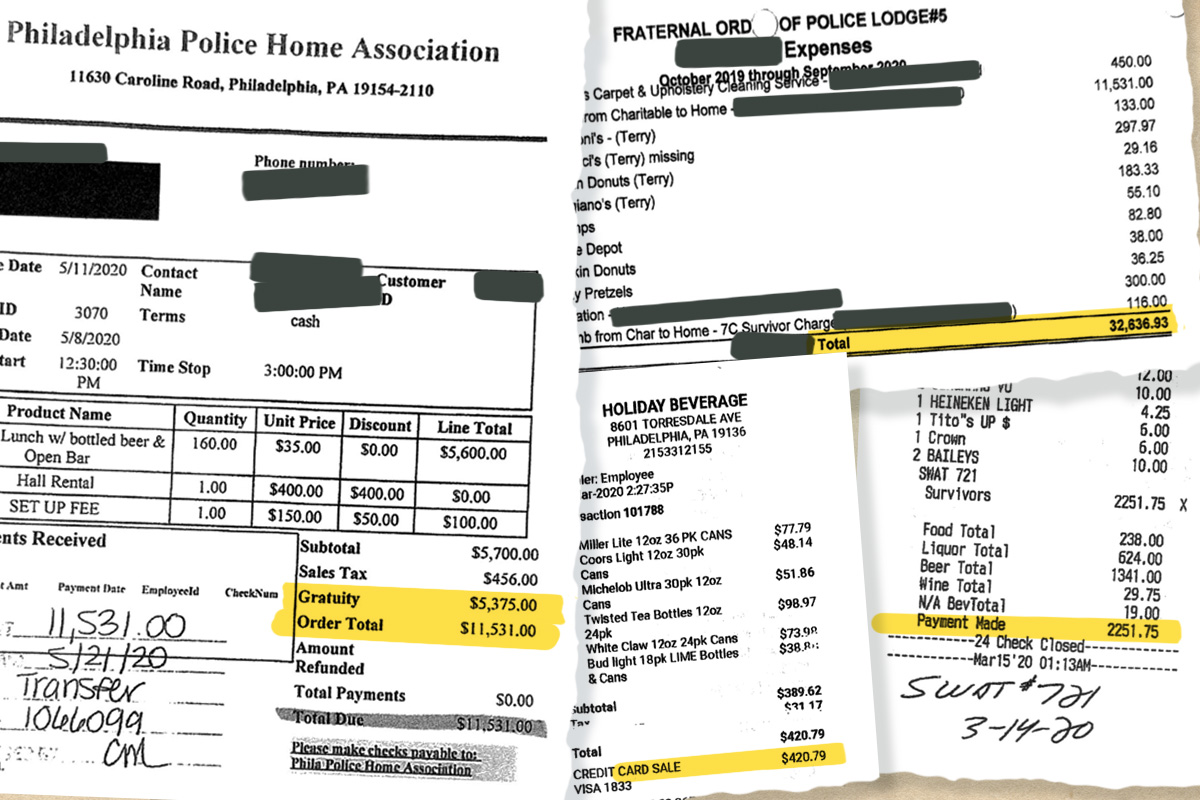
But an Inquirer investigation found that the Fraternal Order of Police Lodge 5 has billed the city for an array of expenses that are far outside the scope of funeral home and cemetery costs. The union has asked to be reimbursed tens of thousands of dollars for bar and restaurant tabs, alcohol, catering costs, car repairs, carpet and upholstery cleaning, socks and underwear, garbage bags, and paper towels.
The FOP has submitted receipts from businesses such as Target, Home Depot, Walmart, Acme, 7-Eleven, and CVS that include no explanation for why they qualify as funeral expenses.
The union has also forwarded monthly statements of corporate credit cards held by various members of the FOP leadership team, circling bill totals mostly for restaurants, bars, and beer stores. Other reimbursement requests lack any receipt or itemized breakdown, or are simply requests for cash, making it practically impossible to judge their merits at face value.
Records show the FOP has billed the city for food and alcohol for at least eight events at its own bar, 7C Lounge, located within the union’s 50,000-square-foot headquarters in Northeast Philadelphia.
One of the 7C events resulted in a $5,700 bill, plus an additional $5,375 for a “gratuity.”
And in one handwritten memo, an FOP official asked the city to reimburse the union $3,500 in cash for a survivor’s family, with no explanation except that it was “per John McNesby,” then the FOP’s president.
Current FOP president Roosevelt Poplar and McNesby, who served as the union’s president for 16 years before stepping down in 2023, did not respond to requests for comment.
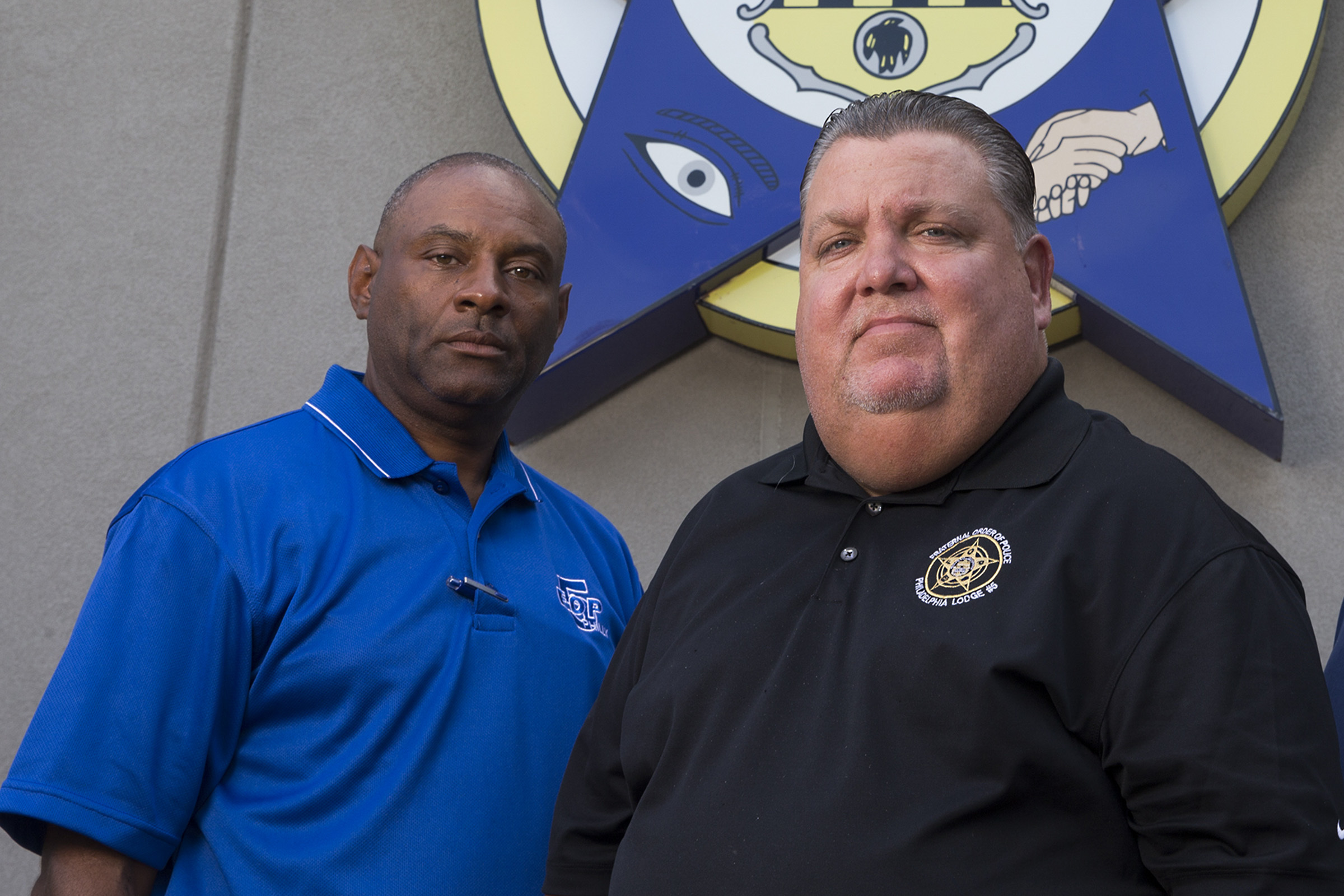
FOP Lodge 5 President Roosevelt Poplar, left, in a portrait next to John McNesby, right, who at the time led the union on Sept. 4, 2019.Charles Fox / Staff Photographer
The city’s $75,000 contributions for officer funeral expenses, which have not been previously reported, prompt new questions about the FOP’s Survivors’ Fund, the union’s charitable organization that raises money to pay for funerals and support the families of officers who were killed or seriously injured in the line of duty.
A 2025 Inquirer investigation found that the FOP reported spending hundreds of thousands of dollars on “funerals and special events” in years when no officers died in the line of duty, and that its expenditures and cash donations had been loosely documented and were difficult to track.
The Inquirer sought further insight by examining more than 1,000 pages of invoices, bills, emails, and other documents obtained in Right-to-Know requests for public records concerning 17 police line-of-duty deaths since 2014. Eight of the deaths were attributed to COVID-19.
The FOP publicly criticized The Inquirer for requesting the records.
The city’s risk management team is primarily responsible for deciding which costs the city should reimburse. A third-party administrator, with expertise in workers’ compensation laws, offers guidance.
Emails, memos, and copies of checks show the city has covered the bulk of the FOP’s requests, although in almost every case, the city’s documents do not indicate which specific reimbursement requests were approved. An FOP request for $1,870 to cover two bar tabs and pipes and drums after a dinner is the only explicit denial in the records.
Mayor Cherelle L. Parker and Sharolyn Murphy, the city’s risk manager, declined to be interviewed.
The Inquirer sent Murphy and Parker’s office a list of the FOP’s expenses that did not appear to be directly related to funeral costs. In an email response, Murphy said that the city did not reimburse the FOP for the 7C event with the $5,375 gratuity and that the city does not reimburse for alcohol. She did not include explanations for the other expenses.
Barry Scott, who headed risk management for 21 years before retiring in 2024, said the city would deny beer runs and State Store bills, but would approve restaurant bills if they appeared to be tied to a funeral.
“Frequently the bills were not specific enough that it was difficult to discern whether or not there was alcohol involved,” he said. “We tried to make the best decision that we could with regard to how we approached the particular bill and the funeral-relatedness of the expense. Where we did not feel we had sufficient justification or documentation in order to make a determination, we would not pay the bill.”
Barry Scott, the city’s risk manager for 21 years until retiring in 2024, in his office in November 2021.Tyger Williams / Staff Photographer
Scott acknowledged that once the city increased its maximum contribution, the FOP started asking for more and more expenses to be reimbursed.
“It’s hard to know exactly what happened and why we saw such a precipitous increase in invoices from the FOP,” he said. “But the sharp increase to $75,000 did leave an opportunity for it to be abused.”
Separate from the city’s contribution, the FOP’s Survivors’ Fund raises money by hosting benefits, often at the 7C Lounge, in which it charges around $45 a person in cash at the door for food, soda, and beer. Most attendees donate money, participate in raffles or auctions, or buy memorial T-shirts.
McNesby has previously described himself as the “Santa Claus” of the Survivors’ Fund, which exists not just to pay for funerals but also for when “families request help with their houses, or issues with their cars,” he told The Inquirer in 2023.
Meanwhile, the FOP’s arrangement with the city does not appear to be widely understood, and rank-and-file cops may assume that the Survivors’ Fund takes care of funerals and assorted costs for families of officers killed in the line of duty.
The Inquirer interviewed a dozen active and retired police officers about the city’s financial contribution in the wake of an officer’s death, and all said they did not know the city was paying as much as $75,000. Half said they believed the city covers some of the funeral costs, while the FOP pays for luncheons and bar tabs. The other six said they had no idea the city contributed anything.
“It was always my understanding that the FOP, through its Survivors’ Fund, paid for any and all funeral expenses for an officer killed in the line of duty,” said a retired veteran with more than 30 years on the job, who was granted anonymity in order to speak openly.
“The fact that the fund deals in cash and is untraceable is extremely disturbing,” the retired officer added. “There is no accounting of any kind as to how these funds are distributed.”
‘Public money requires public eyes’
The FOP’s contract with the city calls for the union to be reimbursed for “reasonable and necessary funeral expenses.”
There is no clarification on what would qualify under either standard, and it does not explain how reimbursement requests will be processed. The records the city provided seem to reflect a haphazard system in which the FOP submits incomplete expenses to the Philadelphia Office of Risk Management and then follows up by email several times to ask when payment could be expected.
Murphy wrote that although there is not a list of allowed expenses, the city typically will not cover luxury caskets, large floral arrangements, catering or reception costs, and travel expenses for family members.
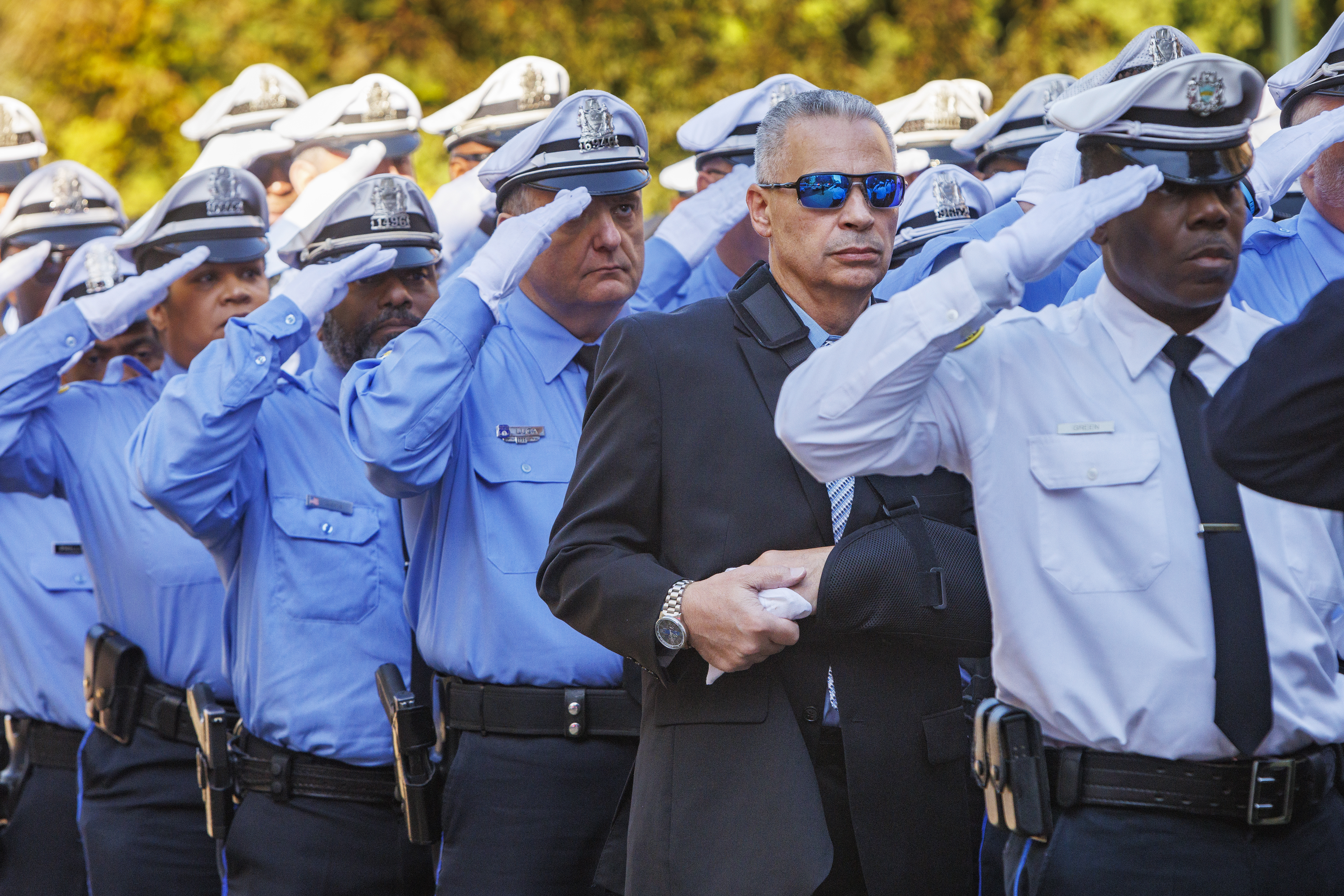
Officer Raul Ortiz, in suit, was with Officer Richard Mendez when Mendez was fatally shot at Philadelphia International Airport while attempting to stop a car theft. Ortiz was shot in the arm. The funeral for Mendez was held on October 24, 2023.Alejandro A. Alvarez / Staff Photographer
Experts say both the FOP and the city should have clear policies for which expenses are considered funeral-related, what documentation is required, and who should have authority to approve reimbursements.
“Public money requires public eyes,” said Andrew McGinley, vice president of policy for the Committee of Seventy, a civic leadership organization that works to promote effective and ethical government. “We want the union to be able to support families who are grieving and provide whatever support they can in this horrible, tragic circumstance. But that doesn’t mean we shouldn’t also make sure that the public money spent is accountable and appropriate.”
McGinley suggested the city’s controller’s office or City Council require proper recordkeeping. “As stewards of public dollars, we have to be able to ensure that the money is being spent for things that it’s allocated for, and right now it doesn’t sound like we’re able to track it.”
Joseph H. Thompson, a former federal prosecutor who served as acting U.S. attorney for the district of Minnesota until 2025, said tax dollars require transparency and extra scrutiny, particularly when public confidence is strained.
“Those entrusted with public resources, especially in law enforcement, must remain above not only impropriety, but even the appearance of it,” he said.
The money that the FOP receives from the city is not required to be itemized — or even mentioned — in federal tax filings, making it even more difficult to reconcile the money moving in and out of the Survivors’ Fund.
For example, Police Officers Richard Mendez and Jaime Roman were shot to death in 2023 and 2024, respectively. The city paid for both funerals, totaling nearly $76,000. The FOP submitted to the city additional expenses of more than $20,000, including a catering bill and two bar tabs, one of which was at 7C Lounge.
But in federal tax documents that cover that time frame, both FOP Lodge 5 and its Survivors’ Fund reported spending a total of $745,000 for funerals, memorials and events, or help for survivors.
In 2024, 10 years after the city bumped its funeral expense contribution for the police to $75,000, the union representing Philadelphia firefighters reached a similar agreement. (There are no reimbursement requests from firefighters because none have died in the line of duty since. But roughly the same number of police officers and firefighters have lost their lives in the line of duty over the last decade.)
Unlike the FOP, the International Association of Fire Fighters, Local 22, does not act as a go-between to handle the city’s money. The Philadelphia Fire Department, not the union, sends the funeral home and cemetery bills to the city’s risk management office, which then reimburses the vendors directly.
The union has previously contributed $5,000 of its own funds to the family of a deceased firefighter to help cover the costs of a memorial reception and meal, according to Tommy McKiernan, Local 22’s first vice president.
Going forward, he said, he would submit that bill to the city so the family did not have to pay out of pocket.
“Our intent is to keep the cost to the family as minimal as possible,” McKiernan said.
Unanswered questions
On March 13, 2020, members of the Philadelphia Police Department’s SWAT team climbed a flight of stairs to the second floor of a stash house crammed with guns and drugs on Bridge Street in Frankford to serve a murder warrant.
A gang member fired a semiautomatic assault rifle 16 times through a bedroom door, striking Cpl. James O’Connor IV in the neck and arm.
O’Connor, a 23-year veteran and married father of two, was declared dead at the hospital not long after at the age of 46. It was a tragedy that was amplified due to his family’s multigenerational roots in law enforcement: His father was a police officer, his son is a current officer, and his cousin was a homicide detective. O’Connor was posthumously promoted to sergeant and awarded the department’s Medal of Honor, a Purple Heart, and the Medal of Valor.
Because of the COVID pandemic, his funeral was delayed for eight weeks, and a limited number of people were permitted inside Our Lady of Calvary Church for the memorial. Most mourners had to sit on opposite ends of the pews, and all had to wear masks.
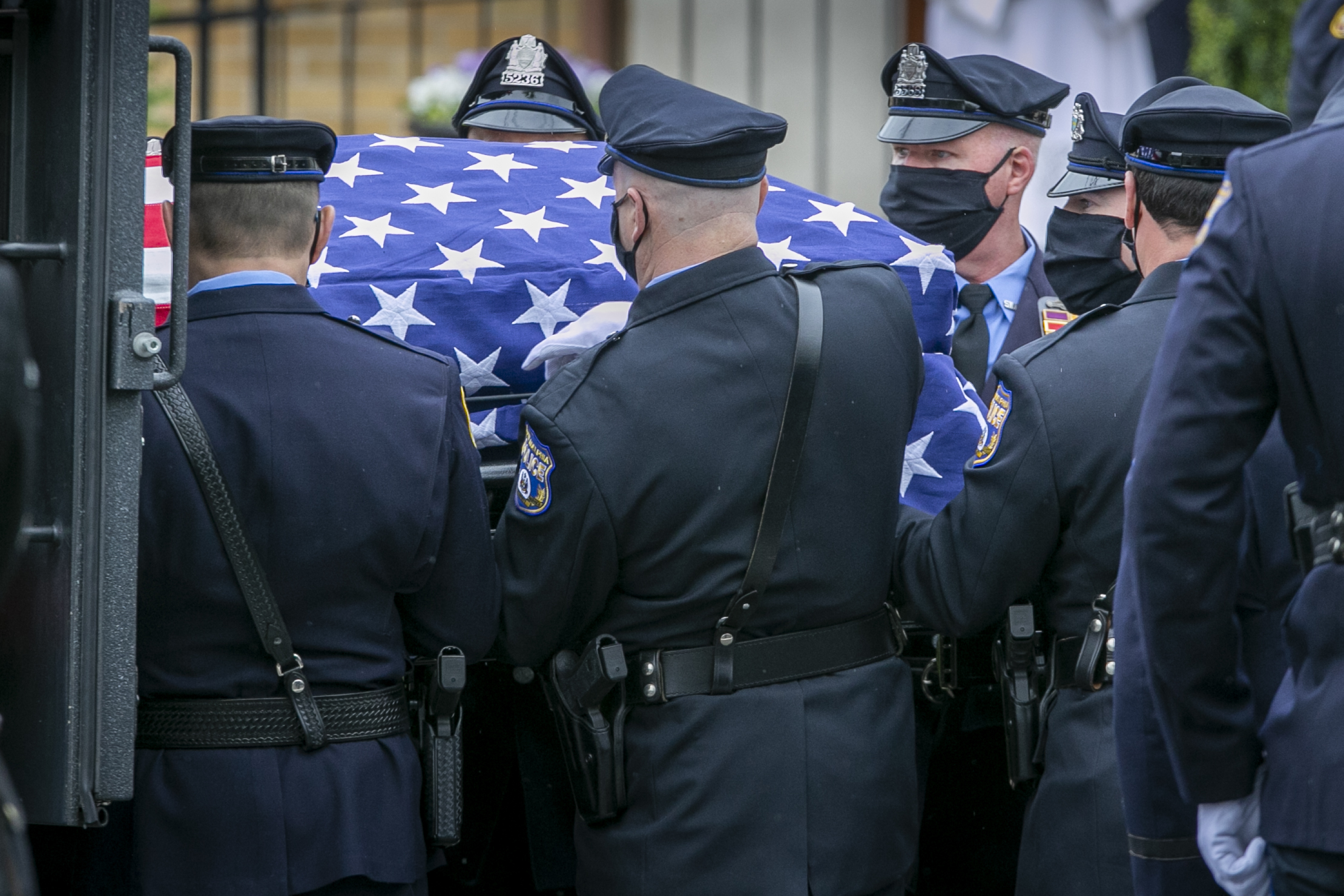
Pallbearers place the body of Cpl. James O’Connor IV in the back of an armored vehicle named after him. The funeral for O’Connor, who was killed in March 2020, was held at Our Lady of Calvary Church in Philadelphia on May 8, 2020. ALEJANDRO A. ALVAREZ / Staff PhotographerAlejandro A. Alvarez / Staff Photographer
“The city has not, and the city will not, forget Cpl. James O’Connor,” then-Mayor Jim Kenney said at the funeral ceremony. “We won’t forget the sacrifices he made, or the sacrifices your family has made.”
The city reimbursed the FOP $30,075 to cover O’Connor’s funeral home and cemetery costs.
But additional requests for money kept coming in, totaling 108 pages.
The city had imposed restrictions on restaurants and bars, limiting them to takeout and delivery service to prevent the spread of COVID. After the funeral, the FOP held a 2½-hour lunch for O’Connor at its own bar.
The FOP billed the city for $5,700 worth of bottled beer, an open bar, and food for 160 people at the 7C Lounge, then added a 94% gratuity, for a total bill of more than $11,500.
The one-page reimbursement document for the luncheon does not include an itemized receipt and describes the terms of the lunch as “cash.” At the bottom of the page is a typed request: “Please make checks payable to: Phila Police Home Association,” the charitable organization that manages the 7C Lounge.
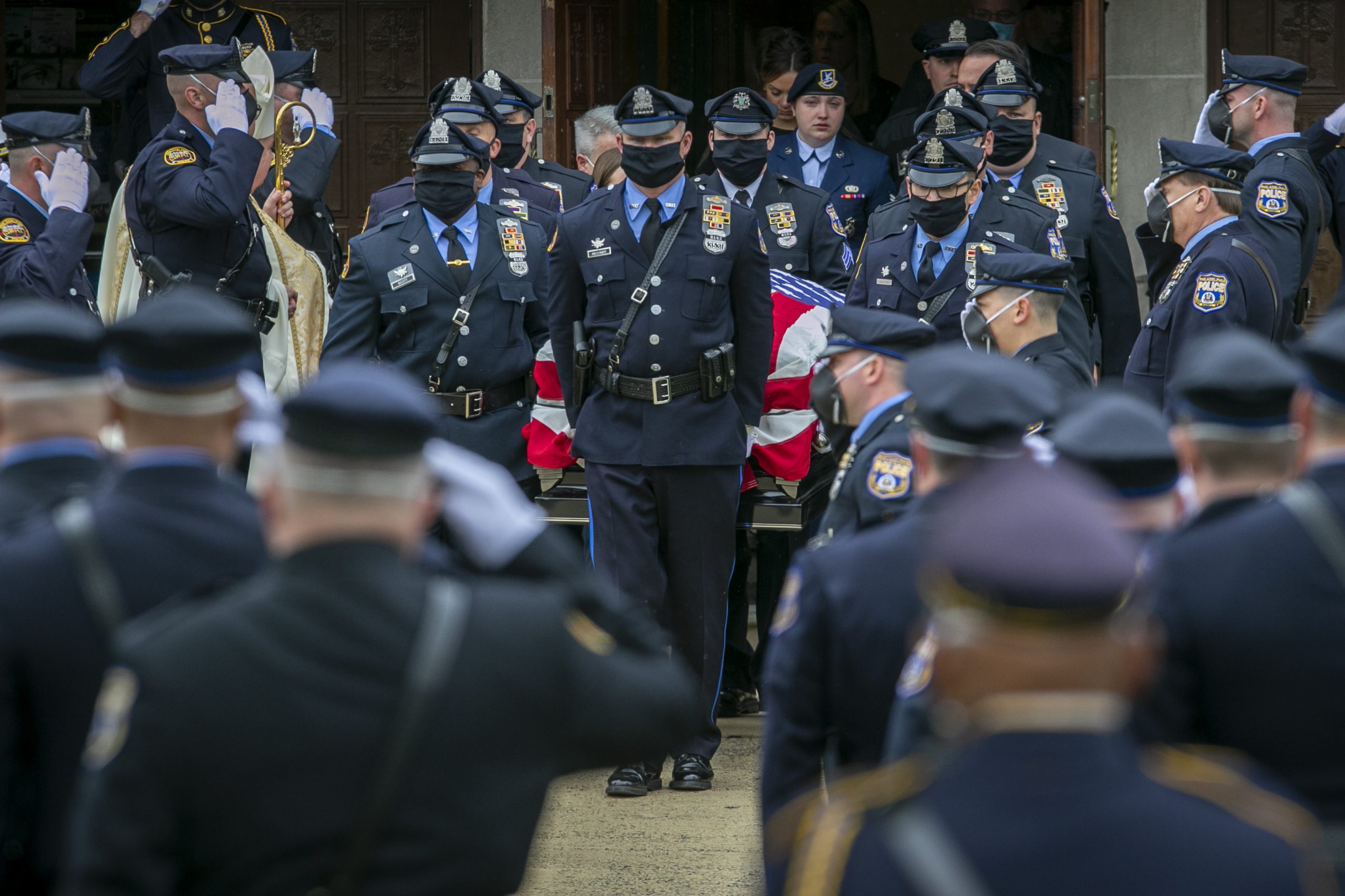
The body of slain Philly Police Cpl. James O’Connor IV leaves Our Lady of Calvary Church in Philadelphia on May 8, 2020. Cpl. O’Connor was killed in the line of duty. ALEJANDRO A. ALVAREZ / Staff PhotographerAlejandro A. Alvarez / Staff Photographer
Although the records do not indicate it, Murphy said the city did not reimburse the FOP for the O’Connor luncheon.
Additional reimbursement requests included more than $1,600 at beer distributors, $450 for carpet and upholstery cleaning, and a $2,375 invoice from Dunphy Ford to make repairs on a F150 truck.
The records also include a handwritten note on FOP pension chairman Michael Shellenberger’s stationary that requests “$3,500 in cash given to Mrs. O’Connor per [then FOP president] John McNesby.” The records include no further explanation.
In July 2020, an FOP treasurer sent then-Deputy Mayor Richard Lazer a $32,600 reimbursement request for “expenses associated with services provided and caring for the O’Connor family during their mourning.” The amount was separate from the previous bill for funeral costs.
The city approved $20,256 of that amount and sent a check to the FOP’s Survivors’ Fund. The documents do not indicate which specific expenses the city approved and denied.
One tragedy after another
Beginning in 2006, Philadelphia police suffered through a brutal three-year stretch.
Seven officers were killed in the line of duty, more than in any other law enforcement agency in the country during that 33-month span. Five were shot to death. The other two were struck and killed by other drivers while in their patrol cars.
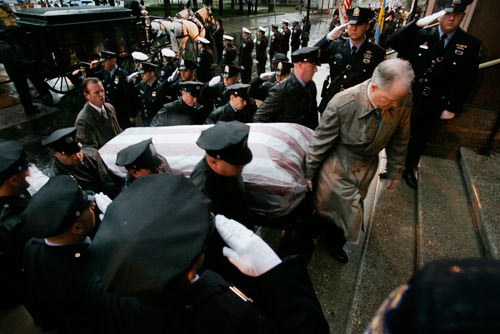
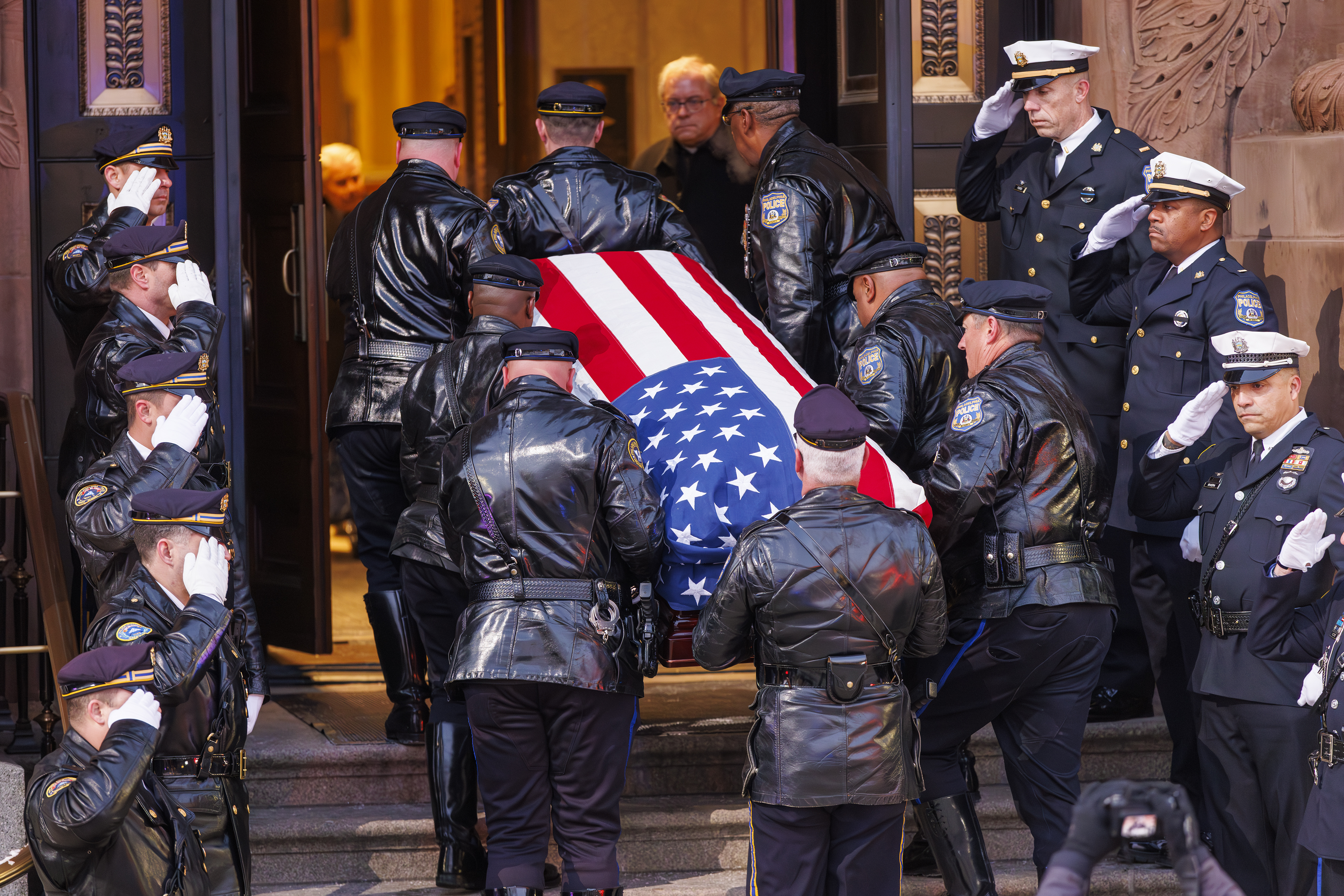
The tragic ritual of honoring fallen officers became too familiar. Hundreds of police officers in dress blues and glossy black shoes, their white-gloved hands raised in salute as the flag-draped coffin is hoisted into the church. Motorcades of blue- and red-flashing squad cars and motorcycles escorted the funeral procession to the cemetery.
At the grave site, Taps is played on a bugle and then “Amazing Grace” on bagpipes. The flag on the coffin is neatly folded and given to the widow. And a police radio calls out the officer’s name and badge number for the last time, acknowledging a job well done.
The body of Sgt. Stephen Liczbinski, who was killed in the line of duty, is carried into the Cathedral Basilica of Saints Peter and Paul in Philadelphia on May 9, 2008. Alejandro A. Alvarez / Staff Photographer
The city paid for all seven funerals, totaling almost $200,000, exceeding the $15,000 limit for each at the time, according to city records.
But by 2008, McNesby and other FOP leaders said the Survivors’ Fund was seriously depleted. FOP vice president John McGrody told The Inquirer that the fund may be called on to spend up to $50,000 for each burial, meals for the bereaved, and school expenses for the fallen officer’s children. These expenses can occur even in years when no officer has died.
The spate of fatalities paved the way for the city to honor the FOP’s request for help during contract negotiations. A three-member panel — one person appointed by the city, one by the union, and the other from the American Arbitration Association — agreed to contribute more taxpayer money toward the cost of burying fallen officers, beginning in 2014.
“At that point it was much easier to go into excess just because there was so much money potentially on the table,” Scott said. “But at some point when we reach the $75,000 number, I think we are beyond what is absolutely directly related to the funeral of the officers.”
If Scott and his staffers had questions, their point person at the FOP was Terry Reid, a member of the union’s executive board and its disability coordinator.
Records show she sent the majority of the emails and requests for reimbursement to the city, as well as American Express charges for food establishments ranging from Dunkin’ Donuts to Maggiano’s. A nearly $300 reimbursement request for the restaurant Santucci’s that Reid sent in 2020 includes the notation “missing,” presumably indicating there was no receipt.
In July 2023, McNesby fired Reid when the family of a late police officer alleged that she had borrowed at least $20,000 from the officer’s widow and then ignored the woman’s requests to be repaid.
Reid did not respond to requests for comment.
City officials balk
In most cases, the records are unclear as to which specific items the city denied. A few, however, spell them out.
The FOP sent the city a list of expenses after the death of Mendez, who was a 22-year veteran when he was killed in 2023 while interrupting a car theft at Philadelphia International Airport.
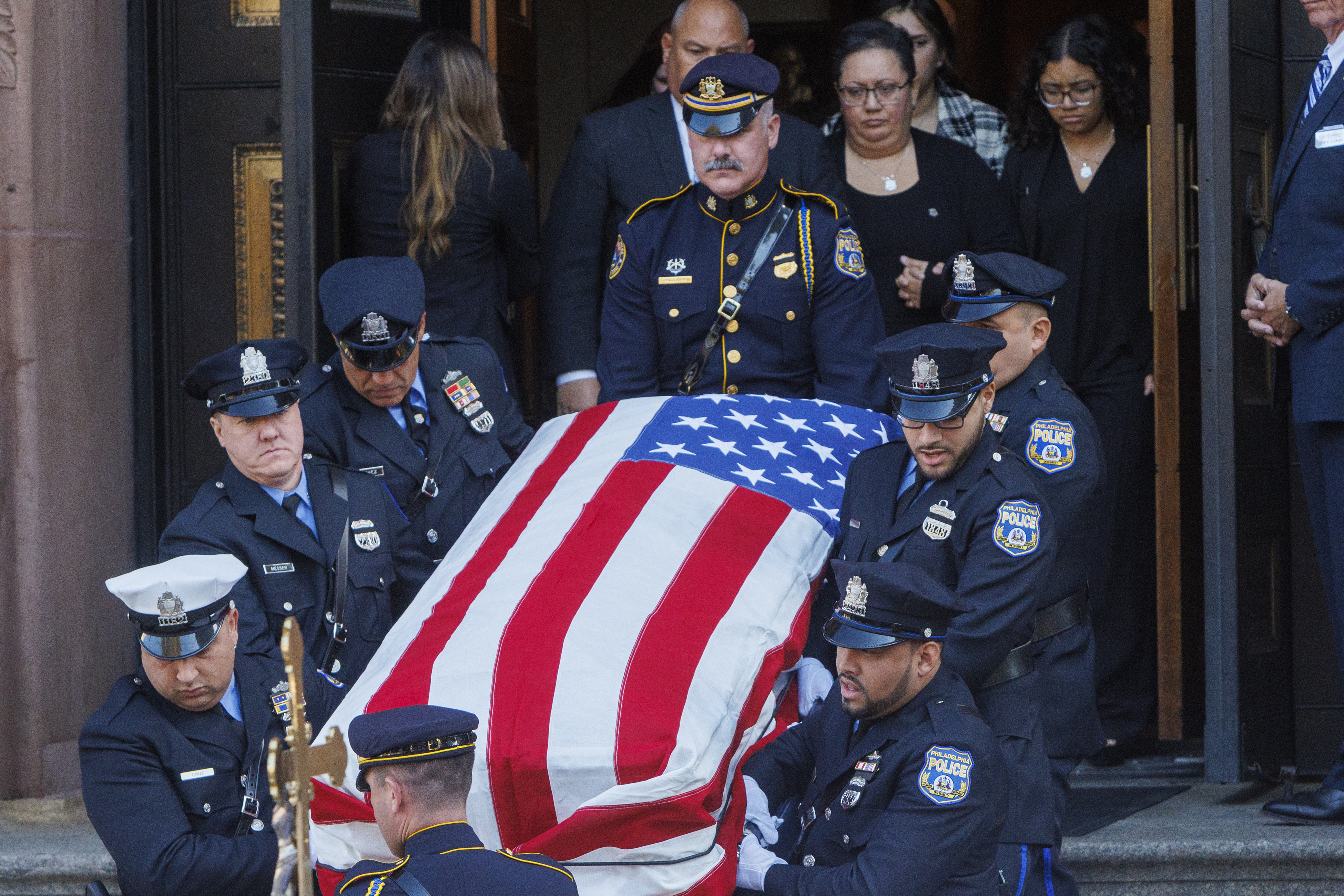
Pallbearers carry the body of Officer Richard Mendez out of the Cathedral Basilica of Saints Peter and Paul on Tuesday, October 24, 2023. Mendez was shot and killed at the Philadelphia Airport.Alejandro A. Alvarez / Staff Photographer
The reimbursement requests were not for the funeral home, which was covered in a separate invoice for $33,576.
The list included payment for two 60-passenger buses, food, catering, ceremonial pipes and drums, two bar tabs, and the cost to detail three cars. The total amount was nearly $21,000.
This time, city officials balked.
In an October 2024 email, Raashida Fleetwood, Philadelphia’s risk management counsel and employee disability manager, wrote to PMA Management Corp, a third-party company the city paid to help manage claims for workers injured or killed, explaining what the city declined.
“Here is the updated expense sheet,” she wrote. “We are not paying for Bar Tab- $667.00, Pipes and Drums after dinner- $839.44 or Bar Tab- $363.60.”
PMA issued a check on behalf of the city to the FOP’s Survivors’ Fund for $18,651, about $1,900 less than what the FOP had requested.
The COVID pandemic created an additional complication in that it required city officials to determine whether an officer who died of COVID had gotten sick while at work. That would make it a line-of-duty death and entitle the officer’s family to additional benefits.
Risk management officials determined that in a single year, six officers who succumbed to the virus had contracted it on the job, including Officer Vladimir Nikolaev Maleev, 39, who died Aug. 6, 2021.
A native of Karlovo, Bulgaria, Maleev had come to America at the age of 19, and his parents and extended family wanted his remains flown home. The FOP asked the city to pay the $7,115 bill for the international flight. The city agreed.
When Officer Tab T. Ali — a former Marine and a 25-year veteran of the department — died in November 2020 from COVID complications, his aunt paid $7,056 to the funeral home. The city reimbursed her.
The FOP subsequently forwarded an additional invoice totaling $6,708 for Ali’s headstone and foundation. Emails between city risk management officials and PMA questioned whether this should be covered.
“Have we paid up to $75k already,” the city’s employee disability manager wrote. “If not, you can process for payment.”
“Not even close. We only paid $7056.00. We get the additional payment processed. Grand total increases to $13,764.00,” a PMA regional claims supervisor replied.
The most recent Philadelphia police officer to die in the line of duty was Highway Patrol Officer Andy Chan, 55, a married father of three. He died in December, almost seven years after he was struck while riding his motorcycle in Northeast Philadelphia.
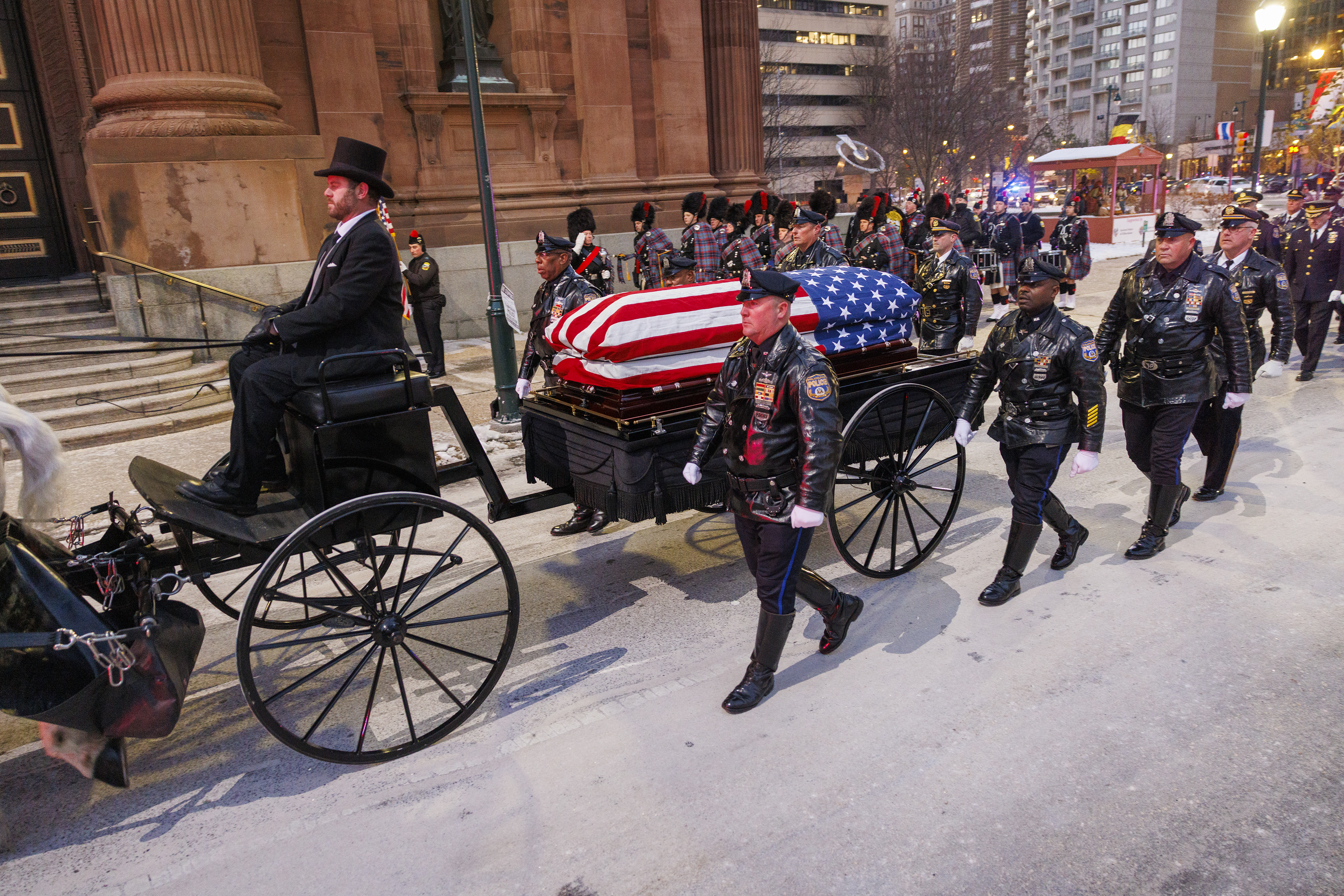
On Dec. 16, a horse-drawn carriage took Chan’s body in a cherrywood coffin draped in an American flag to the Cathedral Basilica of SS. Peter and Paul in Philadelphia. Officers towed Chan’s motorcycle, still bearing his name, in the procession.
The funeral caisson for Philadelphia Highway Patrol Officer Andy Chan arriving at the Cathedral Basilica Saints Peter and Paul on December 16, 2025. Chan died six years after a driver struck his patrol motorcycle. Alejandro A. Alvarez / Staff Photographer
On that frigid, windy Tuesday, hundreds of police officers joined city leaders to memorialize the man who had wanted to be a cop since childhood.
By the time of Chan’s death, The Inquirer had already filed Right-to-Know requests with the city asking for records of city payments or reimbursements to FOP Lodge 5 for all funeral-related expenses for officers killed in the line of duty. FOP leadership publicly criticized the records request on social media, contending that The Inquirer was seeking “private financial information” to “put a price tag on our heroes.”
The body of Philadelphia Highway Patrol Officer Andy Chan arriving at the Cathedral Basilica Saints Peter and Paul on December 16, 2025.Alejandro A. Alvarez / Staff Photographer
The reimbursement requests for Chan’s funeral show the FOP was unusually restrained.
The city received two documents, this time from the Philadelphia Police Department instead of the FOP: a bill for the funeral home and one for the carriage service. The total was $48,983.
The FOP did not submit any invoice, bill, or credit card statement for items unrelated to a funeral.
The Pennsylvania Senate is in the process of working through the commonwealth’s annual budget. This could be a shining moment for some Republican senators if they were to recognize the imperative to increase Pennsylvania’s minimum hourly wage based on the challenges of affordability and the shame of being one of the neglectful states in America that still expects its most vulnerable residents and families to somehow continue to survive on $7.25 an hour.
House Bill 2189 passed the state House of Representatives this past March and is now in the Senate Labor and Industry Committee. The bill would increase the minimum wage to $11 per hour, effective Jan. 1, 2027. The minimum wage would then increase to $13 per hour in 2028 and $15 per hour in 2029, followed by annual cost-of-living adjustments.
Additionally, the bill would give counties the option to implement a $15-per-hour wage sooner and set the minimum wage for tipped employees at 60% of the statewide minimum wage.
Pennsylvania raised its minimum wage in 2009, when the federal minimum wage increased to $7.25 per hour. In the 17 years since, neighboring states have raised their wages while inflation has increased by more than 50%. Pennsylvania has woefully remained at $7.25.
Passage of HB 2189 would allow defenseless families to eat, remain housed and clothed, and restore the faith of countless members of this commonwealth that those who can affect change will actually do so.
State Sen. Devlin Robinson, Senate Majority Leader Joe Pittman, and Senate President Pro Tempore Kim Ward need to be challenged and pressured to pass this measure so vital to Pennsylvania residents.
Currently, it would take more than one hour of work to afford a gallon of white milk and a dozen eggs — maybe these legislators need to go to a supermarket to see how far $7.25 an hour will take any mother of two.
Please call and/or email State Sens. Robinson, Pittman, and Ward and advocate for yourself, your neighbors, or maybe just be the voice of those who can’t even afford to make those calls.
Increasing Pennsylvania’s minimum wage is shamefully overdue.
Yes, students have made gains — and hardworking teachers, parents, and students deserve credit. But Philadelphia students remain 2.46 grade levels behind the pre-pandemic national average. Only 33% are proficient in reading, and just 25% in math.
That’s not a success story. It is a crisis.
If a hospital healed only a quarter of its patients, few would celebrate, because other hospitals healed even fewer. We would demand answers and better options immediately. Yet, in education, we too often accept failure as progress because the comparison group is somehow even worse.
The real question is not whether Philadelphia is improving faster than other urban districts. It’s why so many children still cannot read or do math at grade level — despite record-level funding, federal pandemic relief dollars, and decades of reform promises.
Wealthy families don’t wait for broken systems to fix themselves. They find schools that work. Why would we deny poor kids in Philadelphia that same power? They deserve resources that will help them find better schools, such as tax-credit scholarships, educational savings accounts, and local tuition programs.
Families need more options, not more excuses.
Rachel Langan,senior education policy analyst, Commonwealth Foundation
Join the conversation: Send letters to letters@inquirer.com. Limit length to 150 words and include home address and day and evening phone number. Letters run in The Inquirer six days a week on the editorial pages and online.
How long does caffeine stay in my system? If I drink an afternoon cup or two, will it mess with my sleep?
Java lovers, you may be in for a brewed awakening.
A 2023 randomized trial published in the New England Journal of Medicine found that people who drank one or more cups of coffee each day lost on average 36 minutes of sleep compared with those who didn’t over a two-week period.
There’s a catch though: People who were assigned to drinking coffee were also more active, taking an average of 1,000 more steps — the equivalent of walking about half a mile — per day than those randomized to the no-coffee group. The researchers speculated that perhaps the boost in activity is part of why coffee has consistently been shown to have many health benefits, including maybe even for longevity.
That trade-off between energy and sleep is something many of us coffee drinkers know intimately. Miscalculate, and you can end up “tired and wired”— a miserable state of mind I was in too often during medical training, living cup to cup.
Here’s the good news: You don’t need to quit. But you may need to move up your last cup to much earlier in the day than you think. Rather than the vague advice we’ve all heard to avoid coffee “close to bedtime,” researchers now have a more specific number. A 2023 meta-analysis of 24 studies on the effect of a standard cup of coffee (about 100 milligrams of caffeine) found that for the best night’s sleep, you need to finish drinking coffee at least nine hours or so before you sleep.
So if you’re in bed by 10 p.m., your last cup should be by 1 p.m.
Oof.
My guess is that’s earlier than a lot of us have been operating. (I’m looking especially at you, my four-cups-and-counting-per-day friends). Otherwise, the study found, coffee could reduce total sleep time by 45 minutes and increase how long it takes to fall asleep — or the sleep onset latency — by around nine minutes. (And for context, sleep onset latency of less than 30 minutes is the goal.)
Why some people can drink coffee in the evening
Avoiding coffee nine hours before bedtime is a solid, general guideline, but as with anything in medicine, each of us responds a bit differently. Older studies looking at the half-life of caffeine in our systems found that it varies from two to 10 hours, depending on the individual.
Some of the variation is written in your DNA. Scientists have identified several genes involved in how quickly we metabolize caffeine and how caffeine activates our brain’s reward system. The CYP1A2 gene controls how quickly your liver processes caffeine, while the ADORA2A gene encodes an adenosine receptor in the brain, which regulates how sensitive you are to coffee’s stimulating effects. Variants in the ADORA2A gene are associated with why some people feel anxious after coffee (*raises hand*) — and why some people experience more insomnia than others after the same cup.
So that friend who’s sipping their after-dinner espresso at 9 p.m. and still sleeps beautifully? Thank (or envy) their genes.
You may assume that regular coffee drinking could build a tolerance, eventually overcoming the sleep effects. However, the data supporting this in humans is surprisingly scarce — despite being popularly believed.
How much coffee is too much coffee?
The U.S. Food and Drug Administration advises adults to consume no more than 400 milligrams of caffeine per day, and not all cups are created equal. For instance, a medium iced latte from Dunkin’ has about 166 milligrams of caffeine and a grande Nitro Cold Brew from Starbucks has about 280 milligrams of caffeine. A typical Keurig pod contains 75 to 150 milligrams per eight-ounce cup.
A randomized controlled trial in adult men found that, on average, a 100-milligram dose of caffeine consumed four hours before bedtime had little impact on sleep whereas a 400-milligram dose consumed 12 hours before bedtime had an impact. So if you crave an afternoon cup, switch to a less potent option to minimize the chances you’ll get the receipts at bedtime.
What I want my patients to know
Coffee is one of those wonderful rarities that science keeps finding reasons to love. Because it’s such a regular part of our daily lives, making some tweaks to how and when we drink it can have an outsize impact on our health in the long term. It may not just be sleep that benefits from morning coffee drinking: In one study, people who restricted their coffee drinking to the morning hours seemed to have a mortality benefit compared with those who drank throughout the day. A disrupted circadian rhythm, which plays an important role in inflammation and your immune system, is thought to be at least one possible contributor.
Trisha Pasricha is a physician and journalist who writes the Washington Post’s Ask a Doctor column. She is an instructor in medicine at Harvard Medical School and author of “You’ve Been Pooping All Wrong.”
ARIES (March 21-April 19). The project you have on deck will bring out the best in you, requiring you to be organized, forward-thinking and resourceful. You’ll have fun with it too, as long as you pace yourself well.
TAURUS (April 20-May 20). You’ll create change the easy way. You’ll focus less on “stopping” and more on “replacing.” Instead of wrestling an old pattern to the ground every hour, you move to a different environment and engage with different people and challenges.
GEMINI (May 21-June 21). Move forward with great enthusiasm and the bold assumption that your wishes will be granted. The reason for this? Because the sheer energy of your excitement could be enough to charge the situation in your favor. So why not?
CANCER (June 22-July 22). You’re operating at a level that’s taken years to get to and managing quite a workload. Remember there was a time you wouldn’t have been able to do even a fraction of this. Give yourself credit for how far you’ve come.
LEO (July 23-Aug. 22). An exchange will extend far beyond vocabulary. People reveal themselves through timing, pauses, tone, omissions, repetition and word choice. You get the hidden layers of expression. You’ll key into motives, fears, desires and the emotional realities unfolding around you.
VIRGO (Aug. 23-Sept. 22). Emotional intelligence changes the atmosphere of a room. One thoughtful response can interrupt conflict, reduce defensiveness and make space for honesty. You consistently create a pleasant tone in interactions to mutual benefit.
LIBRA (Sept. 23-Oct. 23). Things have not wrapped up neatly, and that’s OK. Life’s story is unfolding in a messy and nonlinear way. And though you may feel disorganized or unpredictable, it’s a time to lean into that chaos because resisting will only deplete you.
SCORPIO (Oct. 24-Nov. 21). While every feeling is information, not every feeling deserves immediate action. To notice emotional reactions without becoming controlled by them takes skill. Today you’ll pause to make room for discernment, restraint, compassion and good choices.
SAGITTARIUS (Nov. 22-Dec. 21). You have wondered at times if true love is even real, and that is because love transcends comprehension. Today love is flattered by your quaint, and useless, analysis. Today love defies rational explanation. Today love continues to confound.
CAPRICORN (Dec. 22-Jan. 19). Different generations will find common ground in the more universal truths. You’re also very open to learning about the nuances of style, topics of relevance and various worldviews that others are living inside. This makes it easier to relate to people of various ages.
AQUARIUS (Jan. 20-Feb. 18). You don’t always need more motivation. Sometimes you need fewer obstacles between yourself and action. That’s why everything you put into preparing your workspace will matter today. Small improvements in organization create big gains in productivity.
PISCES (Feb. 19-March 20). Things are often funny because they are true. Today, a well-timed observation will interrupt the tension. Laughter creates breathing room. In fact, laughter is, by definition, physical proof of that breathing room exists.
TODAY’S BIRTHDAY (June 11). It’s your Year of Weight Bearing Victory when lifting builds physical muscles, problem-solving builds intelligence, and necessity builds creativity. You conjure fuel from pure imagination. You constantly and specifically envision the dream, and life serves it up. More highlights: Things that come to you indirectly include love, power and the funding for one of your wilder projects. Scorpio and Capricorn adore you. Your lucky numbers are: 10, 1, 14, 33 and 21.