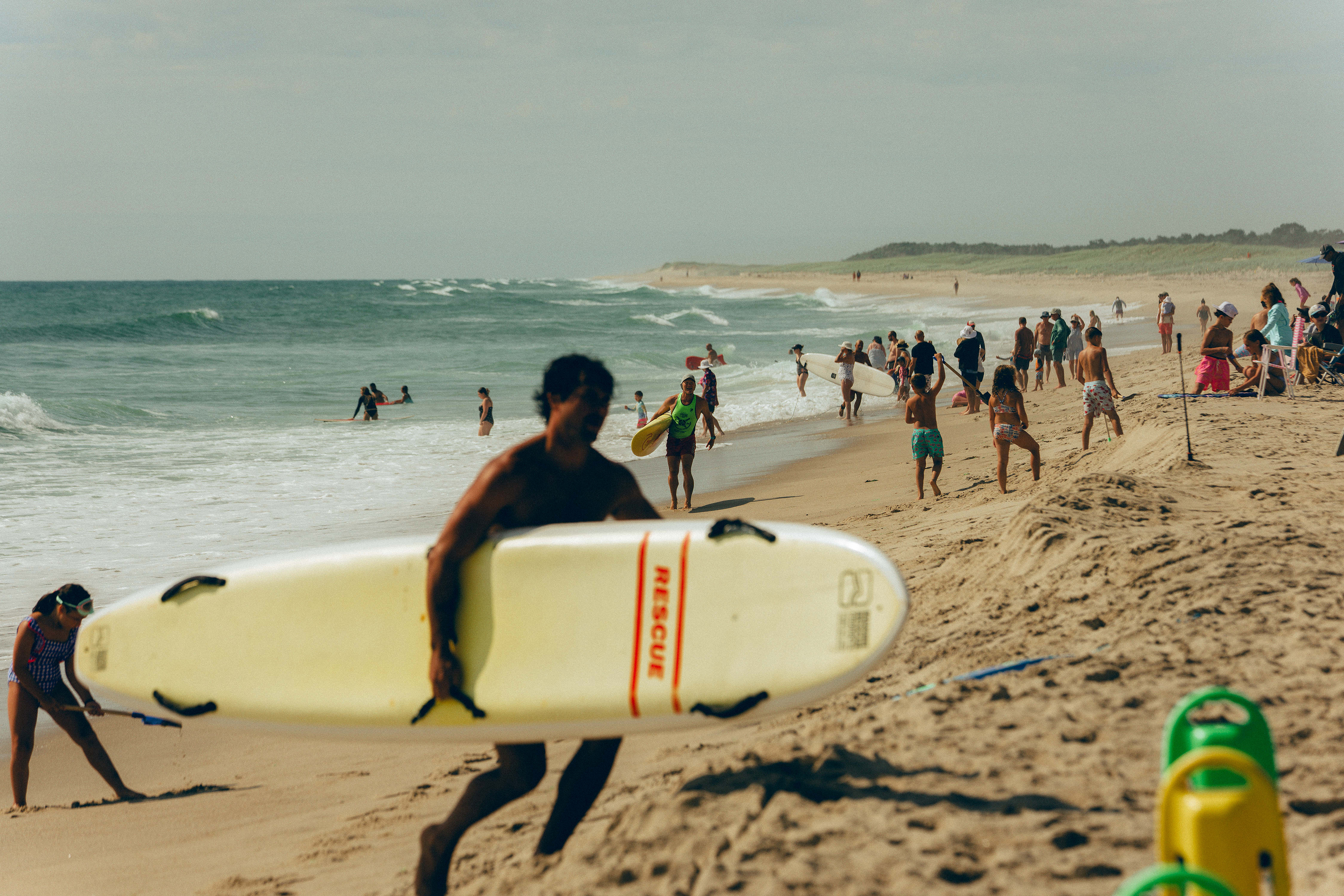
On a cloudless afternoon in July, Nicole Sweeney was on a charter boat off the southeastern corner of Massachusetts’ Cape Cod, cruising through blue-green water as smooth as sea glass. Conditions were perfect for a dunk in the ocean, but swimming was resoundingly off the table.
That’s because if all went to plan, Sweeney would soon come face to face — or at least face to fin — with a great white shark.
“When I was a kid, sharks were not something we ever thought much about,” said Sweeney, 55, who has visited Cape Cod every summer since she was born. “Now you can’t go anywhere on the Cape without finding a coaster or a keychain or a mug with a shark fin on it.”
The onslaught of great white merch is more than mere leftovers from last summer’s 50th anniversary of Jaws.
Over the last several years, a resurgent seal population has turned Cape Cod into one of the world’s top seasonal hot spots for great white sharks. In summer and autumn, the stretch of ocean from the northern tip of the Outer Cape down past Chatham, on the Cape’s elbow, is now the best place on Earth to see great whites swimming — and hunting — close to shore.
Back on land, the specter of sharks is inescapable. Beyond the shark-bite ball caps and the “Respect the Locals” shark bumper stickers, ominous shark flags and menacing warning signs, along with “Stop the Bleed” kits, have become summer fixtures on the Outer Cape’s beaches.
Even so, the seasonal shark surges have seemingly done little to dampen overall enthusiasm for Cape Cod, where the median single-home sale price nearly doubled from 2019 to 2025 and hotel prices can top $2,000 a night during high season.
The sharks have, however, changed people’s behavior. Demand for swimming pools has spiked. Beachgoers now keep a close eye on the shark-tracking app Sharktivity. And shark-spotting tours regularly operate within striking distance of some of the Cape’s most popular beaches.
Greg Skomal, a marine biologist with the Massachusetts Division of Marine Fisheries and New England’s leading authority on white sharks (as scientists typically call great whites), has seen the shift in beachgoers’ habits from his shark-tagging trips up and down the coastline.
“We observe it from the research vessel,” Skomal said. “We don’t see the same number of people in the water at great distances from shorelines.”
From a conservation perspective, the sharks’ return to these waters is a success story, the result of the Marine Mammal Protection Act of 1972, which rescued the region’s gray seal population from the brink of extinction. (A 2017 study estimated Cape Cod’s gray seal count to be between 30,000 and 50,000, up from about 2,000 in 1994.)
The sharks soon followed, leading to increasingly frequent beach closures and, inevitably, run-ins with humans. In 2012, a bodysurfer was bitten by a white shark off a Truro beach. He survived, as did a swimmer who was bitten at a neighboring beach in 2018. But a month later, a 26-year-old boogie boarder was killed by a white shark at Newcomb Hollow Beach, in the town of Wellfleet — the first fatal shark attack in Massachusetts waters since 1936. Two years later, a white shark killed a swimmer off the coast of Maine.
Yet in recent years, Cape Cod’s tourist economy has grown to nearly $2.8 billion (up from nearly $2 billion in 2019 per the Cape Cod Chamber of Commerce), even as the U.S. National Park Service has recorded a drop in recreational visits to the Cape Cod National Seashore, a 40-mile stretch of coastline that includes six beaches frequented by white sharks.
Although the sharks may have pushed some beachgoers away, one thing is certain: They’re also luring people in.
Ten years ago, the world capital of white shark tourism was that other Cape at the bottom end of the Atlantic: Cape Town, South Africa, whose resident great white population had long supported an enormous cage-diving industry. But those sharks have since disappeared, possibly driven away by commercial overfishing or perhaps shark-liver-hungry orcas, the subject of an unsettled scientific debate. Guadalupe Island in Mexico, another white shark hot spot, had its shark tourism and cage-diving operations shut down in 2023 by the Mexican government, which cited practices in the industry that were putting sharks and humans at risk.
At the same time, Cape Cod’s star began to rise as a white shark ecotourism destination, specifically the town of Chatham, where shark seekers can choose from a growing number of private shark charters — generally costing north of $2,000 — that employ spotter planes to locate the animals, which passengers can then observe from the boat. (Cage diving, which typically involves chumming the water to attract sharks, is illegal in Massachusetts, though at least one Cape Cod outfitter runs shark cage-diving tours offshore in federal waters.)
And while you can still cage-dive with great whites off the remote Neptune Islands in South Australia and off the southern edge of New Zealand, those experiences require all-day or even multiday tours. Only on Cape Cod can you spend a morning observing white sharks in the wild and be back on the beach by lunchtime.
“The fact that we can go out and see them in a 2½-hour charter is incredibly unique,” said Hannah Leary, ecotourism coordinator for the Atlantic White Shark Conservancy, a research and education nonprofit in Chatham that operates the Sharktivity app. “We can just come out of the inlet and they’re all right there.”
Its “open boat” shark charters, which offer “a shared adventure with Cape Cod’s apex predator,” run several times a week and regularly sell out (at a slightly more accessible $530 per person, with up to six people sharing a boat). Lately, Leary said, she has noticed an uptick in international guests and travelers who’ve come to Cape Cod specifically to see great whites.
At Cape Cod’s surf shops, though, the sharks are old news.
On a recent Sunday morning, Pump House Surf Shop in Eastham, which sells $20 miniature lifeguard-spec shark flags and last month shared a winking social media post about sharks, was packed with shoppers. Across the street at the equally crowded Nauset Surf Shop, the oldest surf shop on the Cape, longtime owner Phil Clark said shark-deterrent products started flying off his shelves after 2018, but they’re not selling much anymore.
“Everybody is kind of used to it,” Clark said of the sharks’ presence. “They’re buying surfboards. The kids are taking surf lessons.” Indeed, Sugar Surf, an all-female surf school, is still holding classes at Marconi Beach in Wellfleet, where a white shark took a bite out of a stand-up paddleboard in 2017.
“It’s not the same business it was 30 years ago, but there’s still tons of business,” said Clark, who noted that boogie boards and skimboards have become his bestsellers. “People are still here, and they’re having fun and enjoying themselves.”
For Suzy Blake, co-head lifeguard of Wellfleet’s beaches, the shark risk is “part of our lives now as lifeguards and residents of the Outer Cape.” She and her team are now armed with an arsenal of shark-specific equipment and protocols, including tourniquets and “Stop the Bleed” training, as well as a direct linkup to real-time shark detector buoys, which send push alerts to the lifeguards when tagged sharks are in the area.
Later that afternoon, at Newcomb Hollow Beach, Lisa DonDiego sat on a beach blanket with a friend a few yards away from the lifeguard stand, looking out at the ocean.
“I understand the fear,” said DonDiego, 37, up from Philadelphia for her family’s annual summer pilgrimage to the Outer Cape. “And at the end of the day, I recognize that the ocean belongs to them. But I still want to come to Cape Cod.”
She said she consulted the town of Wellfleet’s shark updates and the Sharktivity app, which logs crowdsourced shark sighting data and any buoy pings by tagged sharks, to help make an informed decision about getting into the water. Quitting the Cape’s beaches altogether, though, is out of the question. “Basically nothing could keep us off the beach,” she said.
The next morning, the sun was shining, and Paul Bordé, a local real estate agent, was out for a joyride out of Chatham Harbor on his Boston Whaler, keeping his eyes peeled for “one of the big boys.”
“Sharks have changed behaviors and conversations more than they’ve changed demand,” Bordé said. A noticeable trend has been an increasing appetite for swimming pools; one Cape Cod pool builder even advertises “shark free swimming” on its trucks.
That said, nothing has shaped the Cape’s real estate market in recent years as much as the pandemic. And while the COVID-19-era buying frenzy has cooled a bit, Cape Cod is still a seller’s market. Even the swimming pool surge is part of a broader pandemic-era trend toward creating “backyard oases,” Bordé said, adding that heated pools in particular were allowing families to extend the outdoor season by several months.
As for the sharks, Bordé called them “magnificent,” though he said the closest he came to a sighting that morning was a tagged white shark named Tarly pinging a nearby detector buoy.
On the charter boat, Sweeney had better luck. Less than half an hour into her shark tour, she found herself tearing up. Five decades after watching her first Jacques Cousteau film with her father, kick-starting her enduring fascination with great whites, Sweeney was gazing down through clear, shallow water at a 10-to-12-foot male white shark.
This time, there was no need for a bigger boat.
“Just to be in that small boat, looking over the sides at this massive, powerful, beautiful animal,” she said. “It was awe-inspiring.”
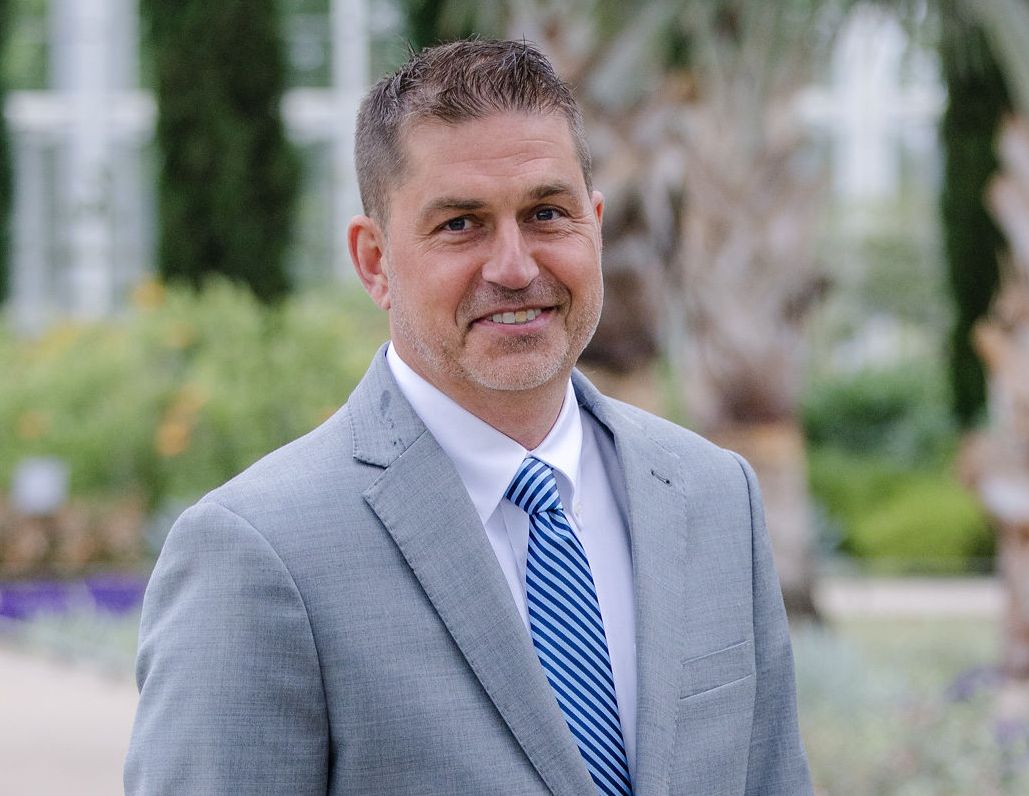
When he started as an intern 27 years ago,Mike Grigalonis never expected to become CEO at the Chester County Economic Development Council. But now he’s taken the top job, leading an organization that propels business growth in the county.
Since then, he’s seen the council grow from a six-person operation to one that boasts more than 40 employees, with teams dedicated to building out the workforce, supporting agriculture, and directing hundreds of millions of dollars to projects in the county. Grigalonis succeeds his longtime boss, Gary Smith, who stepped down July 1.
As the council has grown, so too has Chester County, which remains the richest of Pennsylvania’s 67 counties.
“I’m excited and grateful and humbled for this opportunity,” said Grigalonis, 53, who lives in Upper Uwchlan Township. “I don’t take it for granted, and I’m really excited about what’s to come.”
The Inquirer talked with Grigalonis about the current economic landscape of the county.
This conversation has been edited for clarity and brevity.
What’s changed most since you started in 1998?
In some ways there has been a lot of change, but in some ways there haven’t. I think about open space preservation, for example. … I think what this county, over generations of leaders, has done an amazing job of is balancing, making sure that we continue to have that open space, which is a big part of our culture, a big part of I think what makes us attractive and successful, but still having development and job creation and innovation and all those things happening at the same time.
How do you balance preserving the culture of Chester County while fulfilling the council’s mission?
Very carefully. … I always start by saying up front that I totally support open space preservation. I completely acknowledge the value that it’s brought to the county.
Do I feel that sometimes we sometimes lean maybe a little too heavily with the open space? Maybe. The planning commission does what they call a non-residential construction report. They look at institutional, they look at industrial, and they look at commercial. And in 2025, which is the most recent data, that was down pretty dramatically, the lowest it’s been in like 10 or 11 years. Is that a trend? Is it an aberration? It’s too early to tell.
And why is that? There’s lots of reasons — construction costs are high, borrowing rates are high. There are tariffs that maybe were at play. There’s lots of reasons, but do people sometimes shy away from doing projects in Chester County? I don’t know that.
I want to make sure that we strike the balance again.
What do you see as the future for farming in Chester County?
I think the future remains bright. I think we, as an organization, are highly committed to supporting ag[riculture]. … It’s a really strong ag team that’s grown over the last couple years. We have something called AgConnect, which is an awesome partnership with the county, and I’m seeing a lot of a lot more awareness and visibility.
We’ll see how that, longer term, translates to some of the economic metrics, but I think that awareness, engagement, visibility with the ag community is stronger because of the efforts of AgConnect and others.
What do you see as the future of suburban office development in the county?
I don’t know the answer. I wish I did. What I do see is obviously everybody’s aware of it. Developers are thinking smart about it. … Obviously, King of Prussia has the main street, adjacent to the mall. … In Philadelphia, this is a huge thing where they’re converting office buildings to residential. There hasn’t been a ton of that out here, but there’s been a few of those that have happened. … You’re probably going to see some more destination mixed-use creative amenities, maybe some conversion to residential, and then a refresh of office space.
What’s the future of Coatesville?
I think, obviously, there’s been some starts and stops, and there’s been some successes and some things that haven’t worked. But I think there’s some great people in that community. There’s a lot of people that are dedicated to making sure that redevelopment happens there. I think there are signs. The train station obviously has made tremendous progress. There’s a new energy around The Flats. There’s some things that are going to happen on Lancaster Ave[nue] that are on the verge. Ash Park was just completed, so there’s a lot of things happening there. I just don’t want it to be forgotten.
We’re seeing some proposed redevelopment of Superfund or brownfield sites. Do you see this as a viable way of reusing this land?
We’ve always been super supportive of that. … I think that will absolutely continue, and it should always be a top priority, because that enables us to strike that balance to take already developed sites and buildings and kind of repurpose them. That should be a huge part of our strategy moving forward.
Do you think the proposed data centers will actually be built here?
There are concerns that need to be addressed. I do think that data centers aren’t all evil. I think there are some positives that can come out of it. There’s construction jobs and there’s tax ratables. … We’ve always competed as a county, as a region, really as a nation, on innovation. So I think data centers, we’re going to have to figure out: How do we construct them the right way? It should not be the Wild West. It needs to be very thoughtful and very careful.
What’s the future of QVC and its campus in West Chester?
QVC is an incredible success story. So, no matter what happens, we’ll always be super proud and grateful that QVC was born in Chester County. … I don’t know how to forecast the future[as the company emerges from bankruptcy]. … We certainly want to be supportive. We certainly hope they succeed.
Many aspects of retirement planning are the subject of hot debate, even among experts. Here are three tricky decisions that confront people planning retirement today.
How much to withdraw each year in retirement
It’s impossible to say at the outset of retirement what the “right” withdrawal rate is. You don’t know what the major asset classes will return or how high (or low) inflation will run during your retirement. Nor do you know how long you’ll live.
But you have to use something, and this is where the disagreements come in. A 4% starting withdrawal rate, with annual inflation adjustments to that initial dollar amount thereafter, is often cited as a “safe” withdrawal system for new retirees. Research we conducted at the end of 2021 suggested that a 3.3% withdrawal rate was a safe starting point for new retirees with balanced portfolios over a 30-year horizon. When we revisited the research in late 2022, our safe starting withdrawal percentage was 3.8%. By late 2023, that number had popped up to the classic 4%, thanks to rising fixed-income yields and moderating inflation. At the end of 2024, it was 3.7%, and 3.9% at the end of 2025. Further complicating matters is that retirees don’t spend the same amount, adjusted for inflation, year after year.
There’s a comforting consensus in a few key areas.
Whether to buy long-term-care insurance
According to a 2019 study, about half of people turning 65 will need some type of paid long-term care. But paying for it can be financially devastating. What’s up for debate is whether and how to protect yourself.
That’s why purchasing pure long-term-care insurance is by no means a no-brainer. Hybrid products offer a long-term-care rider bolted onto a life insurance policy or annuity, but they’re complicated and often purchased with a lump sum.
Take a hard look at your retirement portfolio to decide whether your assets are sufficient to self-fund, you’re likely to qualify for Medicaid, or you fall somewhere in between. From there, you can create a long-term-care action plan.
Whether to buy an annuity
Academic researchers have long championed simple income annuities for retirement, arguing they provide longevity risk protection and a higher payout than would be available from fixed-rate investment products like bond funds. Annuities have been getting even more attention as payouts tend to get better during a period of rising interest rates.
But annuity types vary widely, from single-premium immediate annuities to more complicated products that provide equity exposure, guaranteed minimum living benefits, and death benefits.
Research has demonstrated that the peace of mind that accompanies the purchase of a basic annuity is greater than would be associated with holding the same amount in investment assets. Yet the annuity products that retirement researchers generally like best — the plain-vanilla immediate and deferred-income annuities — have struggled in the sales department. Investors may be reluctant to part with the capital to purchase them, and advisers may not have a strong motive to recommend them.
While there’s no consensus on whether annuities are a must-have or which types to buy, there’s little doubt that the lifetime income they offer is in short supply. That’s especially true given that only about a fourth of baby boomers retiring today have pensions, and that number trends down for the generations behind them.
The starting point when thinking about lifetime income isn’t an annuity. It’s Social Security, which is basically an annuity backed by the U.S. government. Only after maximizing lifetime income through Social Security should an annuity come into play.
This article was provided to the Associated Press by Morningstar. For more retirement content, go to morningstar.com/retirement.
Philadelphia City Councilmember Jeffery Young Jr. intends to move forward with a limited, approximately $2 million renovation plan for the Cecil B. Moore Library in North Philadelphia, according to the city and library staff.
Young’s renovation plan for the building at 2320 Cecil B. Moore Ave. includes a new accessible elevator and restrooms, and improvements to the building’s HVAC, plumbing, fire-alarm system, lighting, and signage, according to city spokesperson Sharon Gallagher. Construction is expected to last roughly six months, she said.
The library building, first opened in 1962, will be closed during construction, and it is unclear whether the city and the Free Library of Philadelphia will operate a satellite branch for Cecil B. Moore during that time frame. The city is working with the Department of Parks and Recreation to temporarily relocate some of the library’s resources and programming to the nearby MLK Recreation Center at 2101 Cecil B. Moore Ave., Gallagher said.
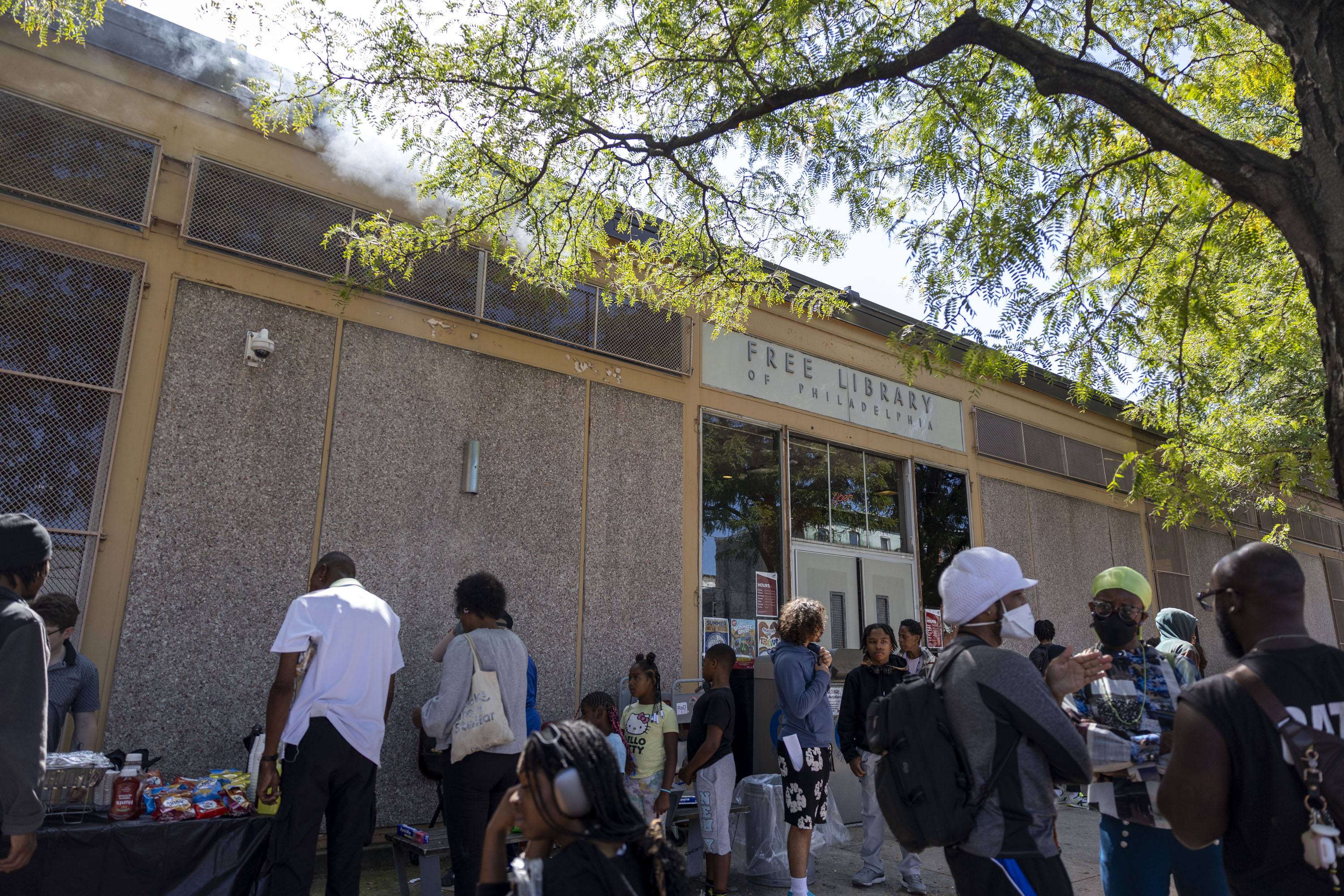
“These are important. They’re also very basic,” said Kate Goodman, a Cecil B. Moore Library worker, at a community meeting and cookout at the library on Saturday afternoon to discuss the renovations. Goodman is a union member of the American Federation of State, County and Municipal Employees District Council 47.
Tess Galen of Strawberry Mansion writes on a sign to bring awareness to the funding and renovations for the Cecil B. Moore Library on Saturday, Aug. 29, 2026, in Philadelphia.Tyger Williams / Staff Photographer
It is unclear when exactly construction will begin. Library staff were informed earlier this month by the city’s capital programs office that construction would begin in September, but Young’s spokesperson, Yumeno Young, said the project would be pushed back to allow for additional preparation and community engagement. He declined to give a precise timeline for construction to begin.
Halted renovation history
Young’s plan leaves about $8 million on the table, since roughly $10 million has been raised and allocated toward the renovation project over the last several years. A modest $1 million in renovations were originally scheduled to begin in October 2024 through the city’s Rebuild initiative, but community members and lawmakers fought to secure a total of roughly $5.3 million for the project.
Rebuild developed a comprehensive renovation plan for the library, which community members and staff still support. It includes much of Young’s limited plan, as well as a new teen space, a private study room, new flooring, exterior upgrades, additional computers, and more upgrades.
After Young came into office in 2024, replacing outgoing Council President Darrell L. Clarke, he secured an additional $5 million from the city’s 2025 capital budget and delayed the project. Young used the city’s longstanding custom of councilmanic prerogative, where Council members have near-unilateral control over which projects in their district go forward, to put his stamp on the plans.
Over the last few years, Young has pushed for several development proposals at the site and has resisted investing in the current space. Those alternative proposals have included demolishing the current building and constructing a new building with both a library and affordable housing on top, or moving the library to a new building at 19th Street and Cecil B. Moore Avenue and converting the existing building into another public space.
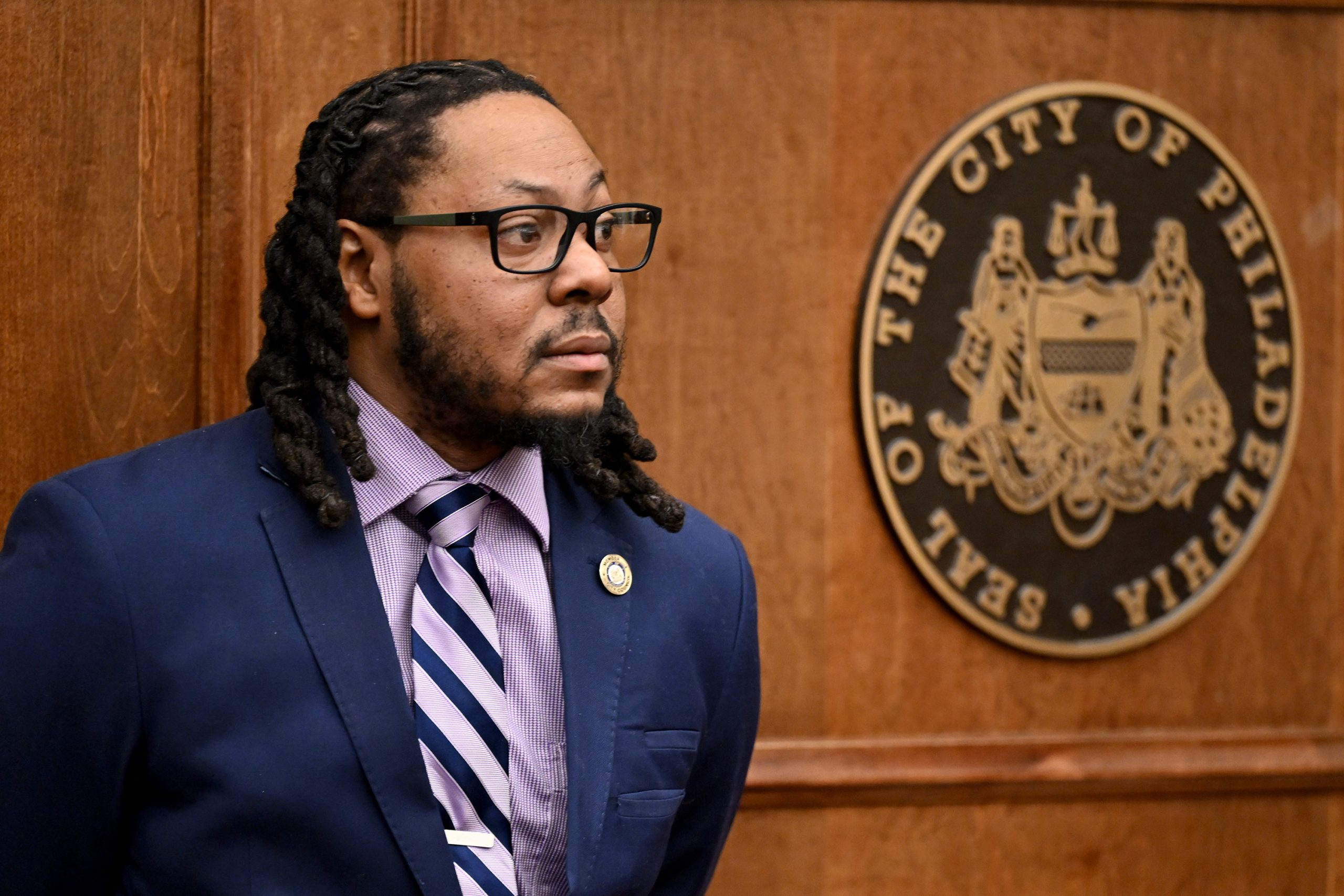
Councilmember Jeffery Young, Jr. in chambers as City Council meets Dec. 11, 2025.
Young and the city declined to comment on what will happen with the other roughly $8 million that has previously been raised for the library renovation project, or why the Council member has opted for this plan despite significant community pushback. Young will host a community meeting sometime in September to provide more details on his plans, his spokesperson said.
Should construction begin soon, that timeline would set the library to reopen before May, when Young faces a likely contentious reelection. The Democratic primary is expected to feature several challengers for Young’s 5th District seat. He is considered the most vulnerable Council member. When Young first ran for office in 2023, he was unopposed in the primary election.
“Neither the Council member’s work on this project, nor our office’s efforts to advance it, are being driven by his reelection,” said Yumeno Young.
The library’s fate will play a significant role in the upcoming election for all candidates, not just Young. Joel Northam, a local resident and organizer with the Philadelphia Party for Socialism and Liberation, said he and other organizers will push the candidates to meet the community’s demands for a fully funded library renovation, or risk losing support.
“If you want that seat in District 5, you have to pledge to release the full $10 million to renovate,” he said.
The ‘soul’ of the community
At Saturday’s community meeting, library patrons spoke about how meaningful the library was to them, and how frustrated they were with how Young has presided over the renovation project. Goodman said the library has had a 70% increase in patrons since June 2025, despite the renovation delays.
Jayden Jackson, 18, loves to flip through comic books and manga at the library, especially ones about Sonic the Hedgehog. He started volunteering at the library a few months ago, because he also loves the community and atmosphere at the branch.
Volunteer Jayden Jackson, 18, of Sharswood, speaks at a community meeting about the importance of the Cecil B. Moore Library on Saturday.Tyger Williams / Staff Photographer
Jackson said the recent developments had provided a good opportunity to keep pushing for the library to receive all of the help it deserves, not just a limited renovation.
“It’s like a light in the middle of the neighborhood,” he said.
Karris Cantrell, 45, said Young’s handling of the library has been so frustrating it has made her want to cry sometimes. She wishes he understood “that he’s not God, that he just can’t do whatever the hell he wants” with the building, she said.
She and her three children have all been regular visitors over the years, and she said the place is as instrumental as a person’s daily coffee and as comforting as a child’s blanket. Cantrell believes the library deserves a full renovation immediately, so it can continue serving patrons in the neighborhood like her family.
“This library is not just a building and it’s not just books. It’s a soul,” she said.
If you’ve shopped for a home in the Philadelphia region lately, you’ve met the villain of this story.
Before the Iran war began in late February, the 30-year fixed mortgage rate was dipping below 6%. Now, it is nearly 7%. On a $320,000 mortgage, approximately what it takes to buy the typical area home, that adds about $210 to the monthly payment, or more than $2,500 a year. That’s not for a bigger house, but the same house.
Behind the mortgage rate stands the bond market. The 10-year Treasury yield, which sets the tone for mortgage rates, is near 4.75%, up more than three-quarters of a percentage point since before the war. The bond market is being asked to swallow a tsunami of new government debt, a Federal Reserve gone mum, and a war with no clear end. And it is choking.
The Iran war has severely disrupted global oil supplies, pushing inflation to near 4% — double the Federal Reserve’s target — and flipping expectations for the Fed from cutting interest rates to raising them. That accounts for a bit more than half the run-up in rates. The good news is that bond investors’ expectations for future inflation have settled back near the Fed’s target. Investors still believe the Fed will do its job.
However, new Fed Chair Kevin Warsh has long believed central bankers talk too much. Forward guidance on rates is gone, and communication is sparse, so investors are left guessing at what the Fed will do next — and they charge for guessing. That extra charge is called the term premium. Think of it as a nervousness fee for lending money over a long period. For a decade, it was pinned near zero. No longer.
But what worries the bond market the most is the nation’s runaway debt. This year’s budget deficit will be more than $2 trillion, equal to more than 6% of GDP. It’s a stunning figure. And the government has been spilling red ink like this since the pandemic hit in 2020.
Meanwhile, there are fewer buyers of the government’s debt. Foreign investors, who held about half our debt a decade ago, now hold closer to a third. The nation’s banks have become more circumspect bondholders after suffering big losses on their holdings when the Fed jacked up interest rates coming out of the pandemic. Highly leveraged hedge funds — fast money, but also the quickest out the door when trouble hits — filled the void.
The Trump administration is trying hard to hold rates down. The Treasury doubled its bond buybacks, but this amounts to billions of dollars, a rounding error compared with the $32 trillion of debt outstanding. It facilitated Japan’s recent effort to rescue the weak yen, so our largest foreign creditor wouldn’t dump Treasurys and push rates higher. And it requires Fannie Mae and Freddie Mac to buy mortgage-backed securities to help pull down mortgage rates.
Each move worked for a day or two, then quickly faded. More telling is the jump in gold and bitcoin prices and the lower value of the U.S. dollar. These are telltale signs that global investors are unsure about the safe-haven status of Treasury bonds. That is, during difficult times, money flows here because investors know they will get their money back on time. A Treasury bond is still the safest place on the planet to put your money, but it’s just a little less safe.
The Treasury’s moves also risk what economists call fiscal dominance, a situation in which a government is so deep in debt that its borrowing needs pressure the central bank to keep interest rates artificially low to make the government’s debt easier to finance. We aren’t there, but we appear headed that way. The Treasury is increasingly doing what looks like the Fed’s job, and history is clear on how that ends: higher inflation and, eventually, higher — not lower — interest rates. The same problem this is meant to solve.
It does not have to end that way. The most likely future is that the 10-year yield falls back this fall, and mortgage rates ease back toward 6%. Of course, this happens only if oil flows reliably through the Strait of Hormuz again, so inflation recedes, and Warsh gives investors some sense of how the Fed will set interest rates.
But that’s a lot of ifs, and lawmakers are unlikely to address the nation’s disconcerting fiscal situation until the bond market forces them to. That could be in next year’s fight over increasing the Treasury debt limit, or early next decade, when the Social Security and Medicare trust funds run dry. The risk of a serious sell-off in the bond market that pushes the 10-year yield toward 6% and mortgage rates toward 8% is real: I would put the odds at about 1-in-5 over the coming year.
A war, a Fed gone mum, yawning deficits — none of these is an act of nature. They are choices. Here’s hoping we start making better choices before the bond market chooses for us.
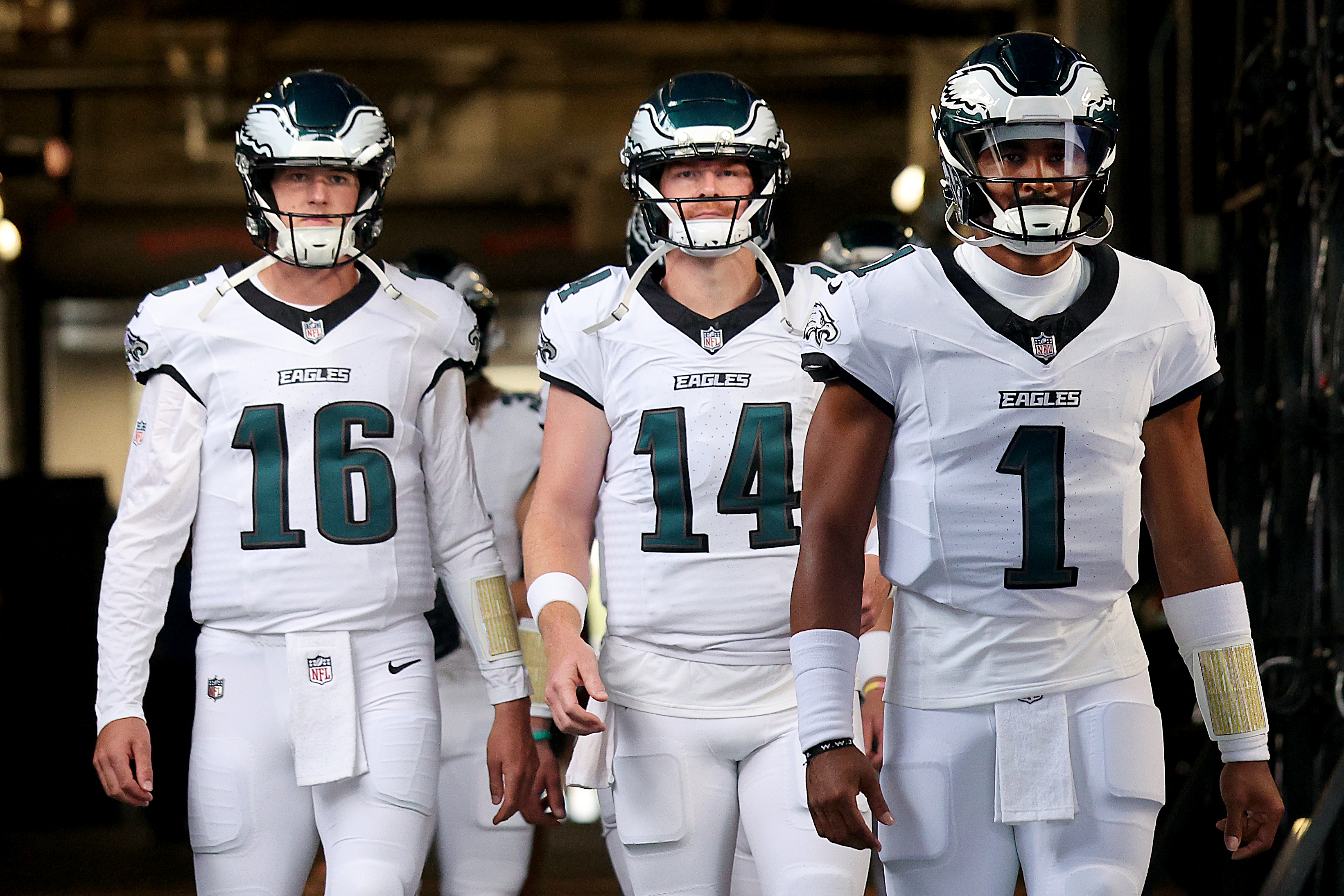
(From left) Andy Dalton, Cole Payton and Tanner McKee all made the Eagles’ roster.Yong Kim / Staff Photographer
The Eagles, for now, have punted on their backup quarterback decision.
Howie Roseman didn’t move either Andy Dalton or Tanner McKee before the 6 p.m. roster deadline Sunday night, and the Eagles went the unconventional route of keeping four quarterbacks on the initial 53-man roster.
They aren’t the only team. The Pittsburgh Steelers, Minnesota Vikings, and Atlanta Falcons also kept four quarterbacks on their rosters.
Neither Dalton nor McKee grabbed the backup job by the horns during training camp. McKee struggled in Friday’s preseason finale while Dalton looked better than his two previous performances.
Still, Roseman was unable to find a trade partner – assuming he tried – before the roster deadline Sunday night.
The Eagles don’t open the season for two more weeks, so Roseman has time to sort out the roster situation at quarterback. Roseman and Nick Sirianni will meet with reporters Monday (at a time to be determined).
Keeping four quarterbacks also means the Eagles were unwilling to waive rookie fifth-round pick Cole Payton, who led only four drives during preseason games as the Eagles mostly gave reps to the quarterbacks competing to back up Jalen Hurts. Payton would have had to clear waivers. He was turnover-prone throughout camp, but the Eagles decided to commit to developing him, at least for now.
They waived sixth-round pick Kyle McCord last year after a shaky training camp. McCord was on the practice squad last season before signing with Green Bay. The Mount Laurel native had a solid preseason with the Packers and was traded Sunday to Miami for a 2028 sixth-round pick.
Eagles waive both ‘foreign exchange students.’ They can only protect one.
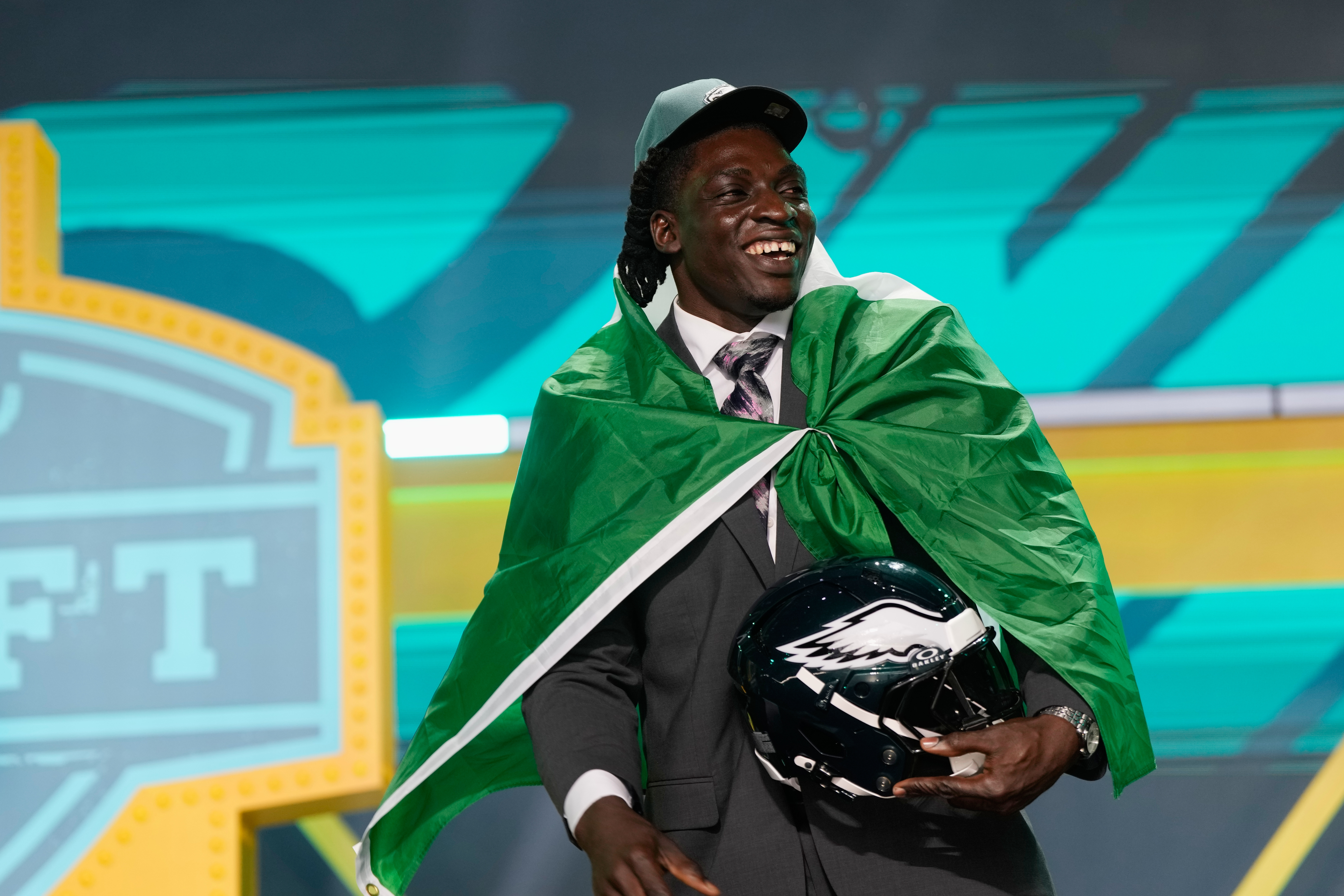
Joshua Weru and Uar Bernard (not pictured) were long shots to make the team.Tyger Williams / Staff Photographer
Vic Fangio wasn’t wrong when he warned time after time that Uar Bernard and Joshua Weru – the two first-time football players that joined the Eagles this offseason – have “a long way to go.”
The Eagles used a seventh-round pick on Bernard, a defensive tackle from Nigeria with off-the-charts athleticism. They signed Weru, a Kenyan rugby convert, as an undrafted free agent. Neither had played a padded football game before the Eagles and Ravens met in the first preseason game earlier this month, and getting on the field in a real NFL game is a whole different beast.
But the Eagles’ decision to waive both players ahead of the 6 p.m. roster deadline Sunday means they’ll only be able to protect one of them, and they may not even get to develop either of them if another NFL team decides to claim them off waivers and put them on their 53-man roster.
That result is unlikely. Again, as Fangio says, his “exchange students” are a long way away from being ready to play in NFL games. But assuming both of them clear waivers, the Eagles will only be able to designate one of them as an IPP player, and the other would be free to sign to another team’s active roster at any point during the season.
That’s obviously a risk Howie Roseman was willing to take.
While Bernard was the more talked about prospect after the Eagles used a draft pick on him, it was Weru, an edge rusher, who flashed more during camp and in the preseason contests. If one of the two was going to get cut, Bernard seemed like the more likely candidate given the possibility the Eagles could use Weru on special teams.
Instead, the Eagles kept five edge rushers on the roster: Jonathan Greenard; Jalyx Hunt; Nolan Smith; Arnold Ebiketie; and A.J. Epenesa.
In leaving Bernard off the roster, the Eagles also kept just five interior linemen: Jalen Carter; Jordan Davis; Moro Ojomo; Byron Young; and Ty Robinson.
Aaron Donald and the Los Angeles Rams will face the Eagles in Week 4.DAVID MAIALETTI / Staff Photographer
Aaron Donald is unretiring to return to the Los Angeles Rams, where he’ll play alongside reigning Defensive Player of the Year Myles Garrett.
Donald, a three-time NFL Defensive Player of the Year, signed a one-year deal that could end up being worth $30 million, according to ESPN’s Adam Schefter and NFL Network’s Ian Rapoport.
The Eagles host the Rams at the Link in Week 4, but Mike Florio of Pro Football Talk thinks its possible Donald might delay his return to the field until Week 5:
The specific timing of Aaron Donald's return opens the door to the possibility of the Rams placing him on reserve/PUP (or reserve/NFI) and giving him 4 more weeks to keep getting ready — and reducing his total workload to no more than 13 regular-season games.
The #Titans are waiving QB Will Levis, source says. Tennessee had been open to trading Levis for some time, and in the end, both sides move on. pic.twitter.com/PTZo1l8zi5
Dolphins reportedly trade for ex-Eagles quarterback
Former Eagles quarterback Kyle McCord appears to be headed to Miami.Yong Kim / Staff Photographer
The Miami Dolphins, according to ESPN, are acquiring Green Bay Packers quarterback Kyle McCord for a 2028 sixth-round pick.
That probably eliminates Miami from the list of teams the Eagles could get a draft asset for in exchange for Andy Dalton or Tanner McKee.
McCord, a Mount Laurel native, was a sixth-round pick by the Eagles last year but did not make the team out of camp. He spent the season on the practice squad before signing with the Packers.
McCord performed well in the preseason. He completed 22 of 35 pass attempts Friday night for 226 yards and four touchdowns. McCord will be the only other quarterback on Miami’s roster besides Malik Willis, meaning the soon-to-be-24-year-old could be in line to be the primary backup.
The Dolphins may still need another quarterback, though. They traded Quinn Ewers on Saturday and reportedly waived both Cam Miller and Mark Gronkowski on Sunday. It’s hard to imagine they’d part with more draft capital for another quarterback, though.
In Miami, McCord reunites with former Eagles offensive coordinator Kevin Patullo, who is Miami’s pass game coordinator.
Carson Steele and the mirage of preseason football games
Carson Steele runs for a touchdown during the Eagles final preseason game. Monica Herndon / Staff Photographer
No Eagles skill position player touched the ball more during the team’s three preseason games than Carson Steele. After getting only one carry in the first game, Steele had 18 touches in the second contest and 16 Friday night.
The 23-year-old running back, signed in free agency after spending some time with Kansas City over the last two seasons, Steele was the best offensive player on the Eagles in losses to New England and Cincinnati. He had just 33 yards on 12 carries vs. the Patriots, but he turned six catches into 84 yards and made two highlight-reel hurdles, including one that helped him reach the end zone.
Then he rushed eight times for 24 yards Friday and caught eight passes for 52 yards and another touchdown as Tanner McKee and Andy Dalton spent most of their shifts checking the ball down when they dropped back to pass.
Steele, who was waived Saturday, was one of the few bright spots on an offense that mostly struggled throughout the exhibitions, and it was fair to wonder if 6-foot, 228-pound back could push for a roster spot — especially given his potential to play fullback.
But that’s the problem with the preseason: Eagles fans only get to see such a small part of what’s going on, and what Howie Roseman, Nick Sirianni, and the rest of the team’s decision makers are watching when they’re whittling down the roster to 53 players.
The Eagles practiced 17 times in training camp and played just three games. The exhibition games, then, make up 15% of what the Eagles are evaluating.
So, while standing out in two of the three games — 10% of the evaluation period — isn’t unimportant, it’s too small of a sample.
That’s not to say Steele was bad in practice. He was fine. But the Eagles didn’t really have room for him with Saquon Barkley, Tank Bigsby, and Will Shipley in front of him on the depth chart. There are other roster needs, and they don’t seem to have the luxury of keeping a fourth running back on the roster.
But he can play fullback!
So can Cameron Latu, who could be on his way to a roster spot at tight end and is a solid special teamer.
The Eagles probably won’t mind Steele clearing waivers and finding his way onto their practice squad, though.
The Dolphins need a backup quarterback after trading Quinn Ewers and waiving Cam Miller (not pictured)Lynne Sladky
The Miami Dolphins are in the market for a quarterback after they traded Quinn Ewers to Jacksonville on Saturday and waived Cam Miller Sunday morning.
Howie Roseman has probably scrolled his way to Jon-Eric Sullivan in his contacts list.
The Eagles likely are trying to trade either Andy Dalton or Tanner McKee, and the Dolphins are one of a few teams in need of some quarterback help.
But here’s another angle to consider: Are the Eagles one of the teams in need of quarterback help?
Neither one of their backup quarterback options shined in camp, and McKee on Friday night looked sort of lost while Dalton performed better than he had in previous preseason contests.
Still, it’s possible the Eagles could fetch a late-round pick for either player. Dalton’s body of work and his ability to mentor a younger quarterback – in Miami’s case, Malik Willis – could be more valuable.
The Eagles could find themselves in an awkward position later on Sunday if they’re unable to move a quarterback or don’t trade for one themselves. Would they keep both Dalton and McKee on the initial roster? Would that mean keeping four quarterbacks? Would that mean waiving fifth-round pick Cole Payton and exposing him to waivers?
Jalen Hurts (right) walks to the field with Tanner McKee (left) and Andy Dalton (center) behind him.David Maialetti / Staff Photographer
The winner of the No. 2 job is still unclear. Can both lose?
Tanner McKee and Andy Dalton have been that uninspiring. The preseason finale offered more questionable quarterback play. There have been only glimmers.
McKee got his first start of this preseason after Dalton started the first two games. He played the entire first half. It was a brutal watch. McKee completed 12 of 22 passes, but for only 55 yards. He underthrew and overthrew receivers, looked timid in the pocket, and ultimately became a check-down artist.
McKee didn’t exactly have the best players around him. There were several drops, one that resulted in his lone interception. But receivers were also schemed open. Britain Covey got separation off a nifty double move for a would-be touchdown, but McKee completely overshot him.
Dalton took over in the second half. Like McKee last week vs. the New England Patriots, he outplayed his competition in relief. He completed 12 of 19 passes for 104 yards and a touchdown — and with a few lesser players at certain spots.
Dalton had some shaky moments, too. And when given the opportunity to engineer a go-ahead, fourth-quarter drive, he and the offense couldn’t get the job done.
RookieCole Payton came in late in the fourth quarter. He continued to hold the ball too long when he dropped. His passing wasn’t much better. In Payton’s defense, he hasn’t practiced much the last few weeks. The Eagles will take a long view with the fifth-round draft pick.
Payton must really want to play, though. He was in on the cover unit for the Eagles’ first punt.
Dalton’s play this summer hasn’t earned him the No. 2 job. McKee has been only marginally better, but has shown improvement. The best man doesn’t always win. But the educated guess here is that Roseman will trade Dalton to a backup-needy team — of which there are many. He may need to keep all four quarterbacks past Sunday’s deadline to get what he wants in return, however.
Payton has displayed more than last year’s rookie project — Kyle McCord — and probably wouldn’t pass through waivers if the Eagles consider stowing him on the practice squad.
Roads along the race route will remain shut down after the race and some SEPTA buses will be diverted. Here’s a rundown.
Inquirer sports reporter Ariel Simpson attempted to climb the imposing Manayunk Wall. Here’s how she did.
// Timestamp 08/30/26 4:52pm
After 10 years, a glorious return to Philly
// Pinned
// Timestamp 08/30/26 4:40pm
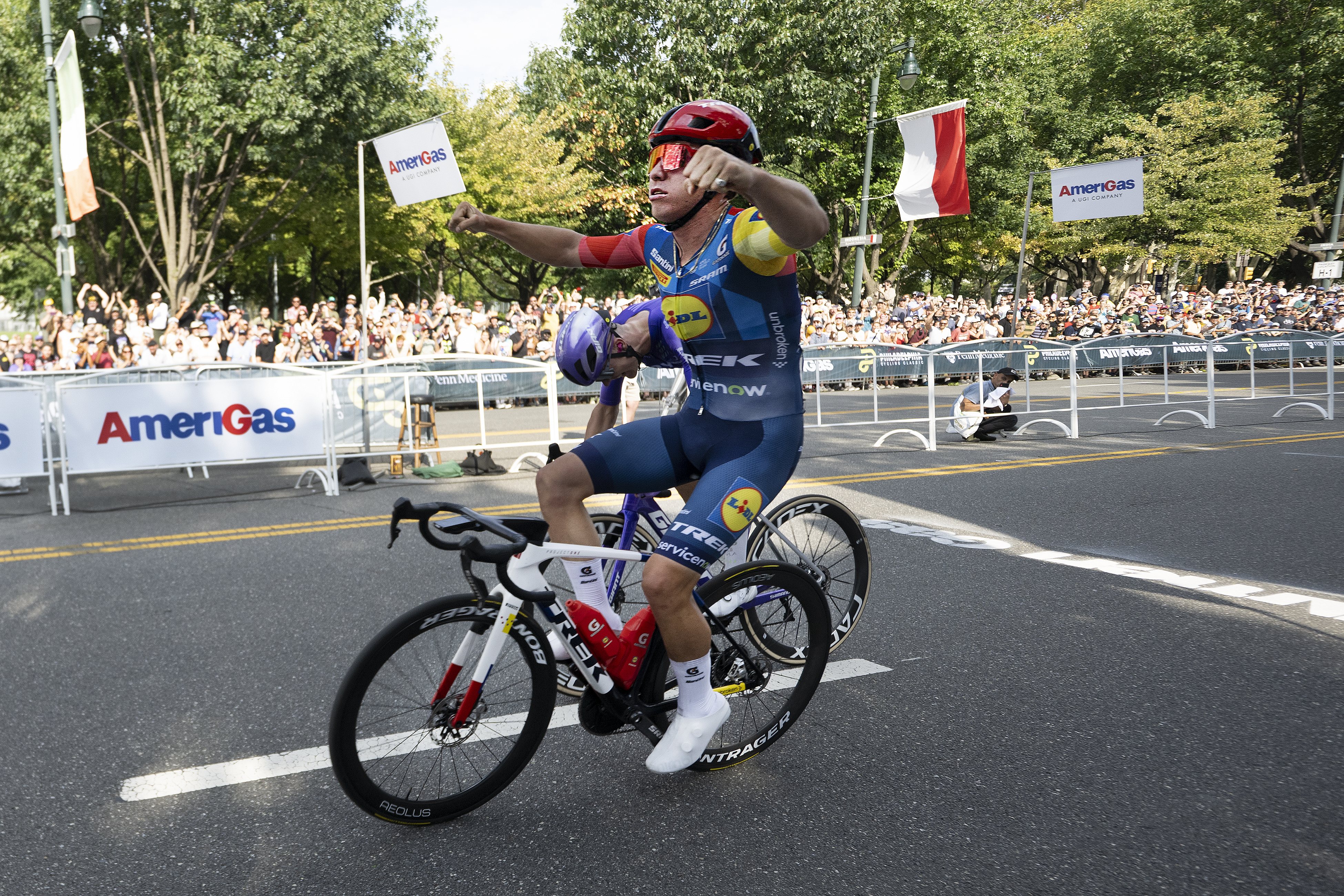
Tim Torn Teutenberg wins men’s race at Philly Cycling Classic
Tim Torn Teutenberg raises his arms as he crosses the finish line to win the men’s race Sunday. Jose F. Moreno / Staff Photographer
German cyclist Tim Torn Teutenberg cross the finish line first to win the men’s race at the first Philadelphia Cycling Classic in 10 years.
“It was a super good atmosphere today,” Teutenberg told 6abc following his victory, comparing it to the prestigious Tour of Flanders in Belgium.
Teutenberg finished the 120-mile race in just under four hours and 21 minutes. American cyclist Riley Sheehan finished fourth, coming in about 22 seconds behind the leaders.
Rain falls in Manayunk during the Philadelphia Cycling Classic Sunday, Aug. 30, 2026.Michelle Myers
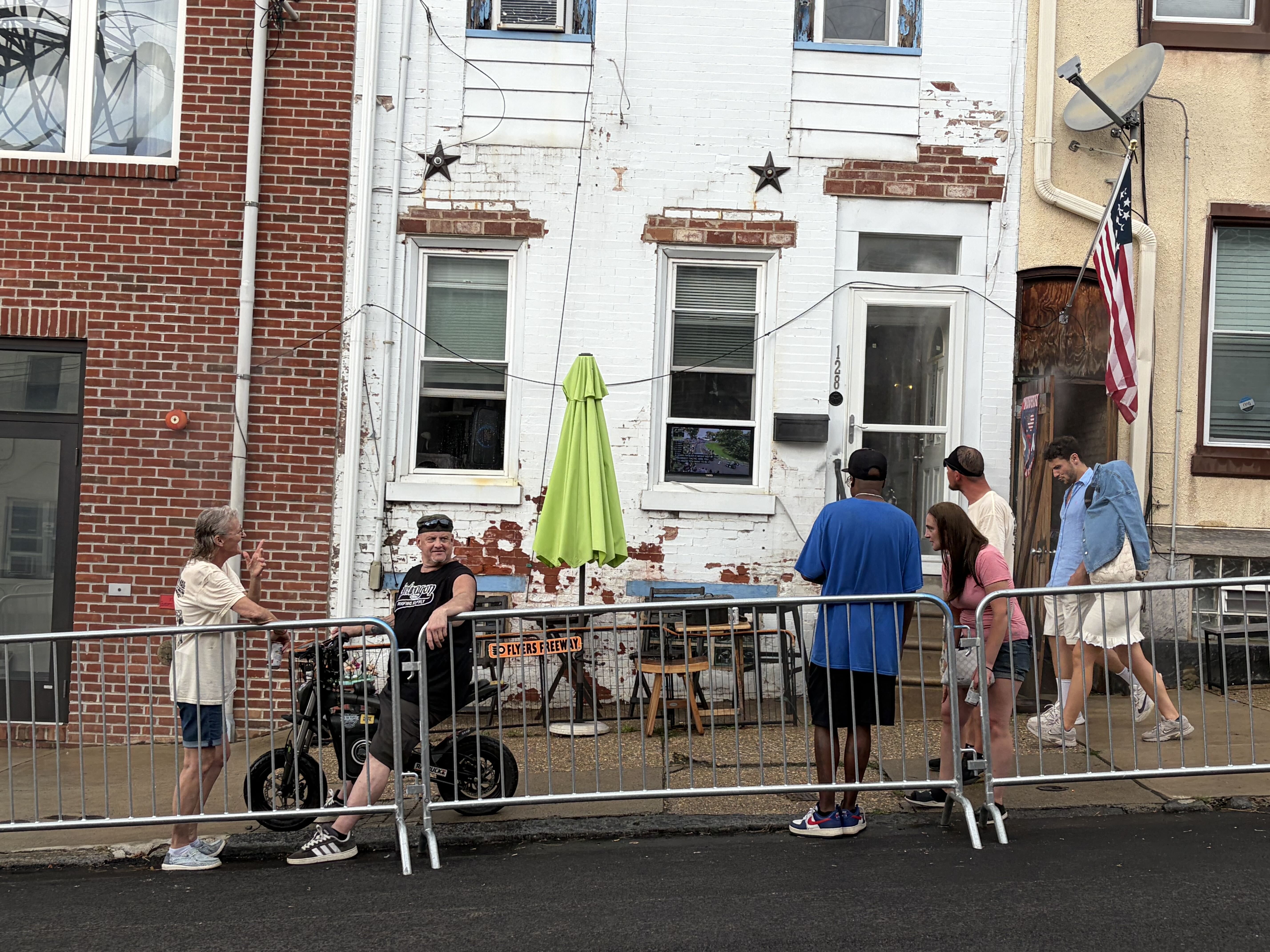
Rain began to empty Levering Street Monday afternoon, but many fans remained to watch the Cycling Classic, some following the race closely on their screens.
He grew tired of race crowds. Now he’s thrilled the Cycling Classic is back.
Thomas Gartside watches the Cycling Classic in Manayunk.Michelle My
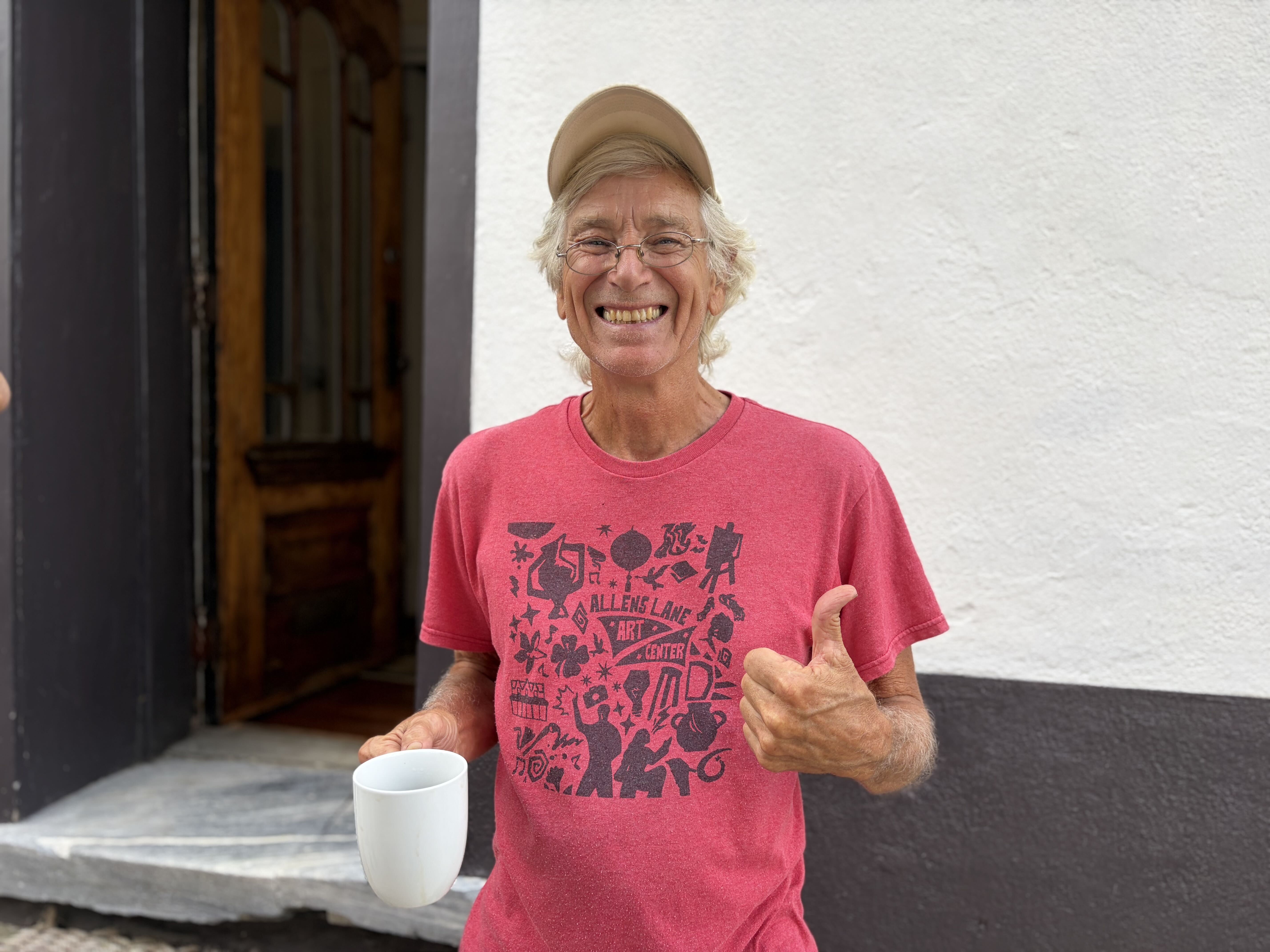
Thomas Gartside, 77, remembers feeling a bit tired of the crowds coming to his Manayunk block on race day. The decade-long hiatus changed his perspective.
“I remember the first race, it was amazing: No one was here and they had a helicopter,” said Gartside, who moved by the Manayunk Wall a year before the inaugural 1985 race.
Over the years, he said, the race expanded and his block got more crowded. By 2016, he didn’t come outside to witness the spectacle, unaware the cyclists’ return would be an uphill battle.
On Sunday, seeing the street packed with hundreds of cheerful people brought joy back to Gartside, who decided to hold his own small gathering with bagels and coffee.
“I got a little tired of it, but this is reinvigorating,” Gartside said staring at the crowd standing shoulder to shoulder outside his door. “Look at all the energy and all the neighbors.”
Kim Stoveld, a Philly native, on her unusual path to Cycling Classic
Kim Stoveld didn’t start cycling until her late 30s.Courtesy / Automatic Racing Team
Kim Stoveld, a Philadelphia native, took an unconventional route to appear in the Cycling Classic.
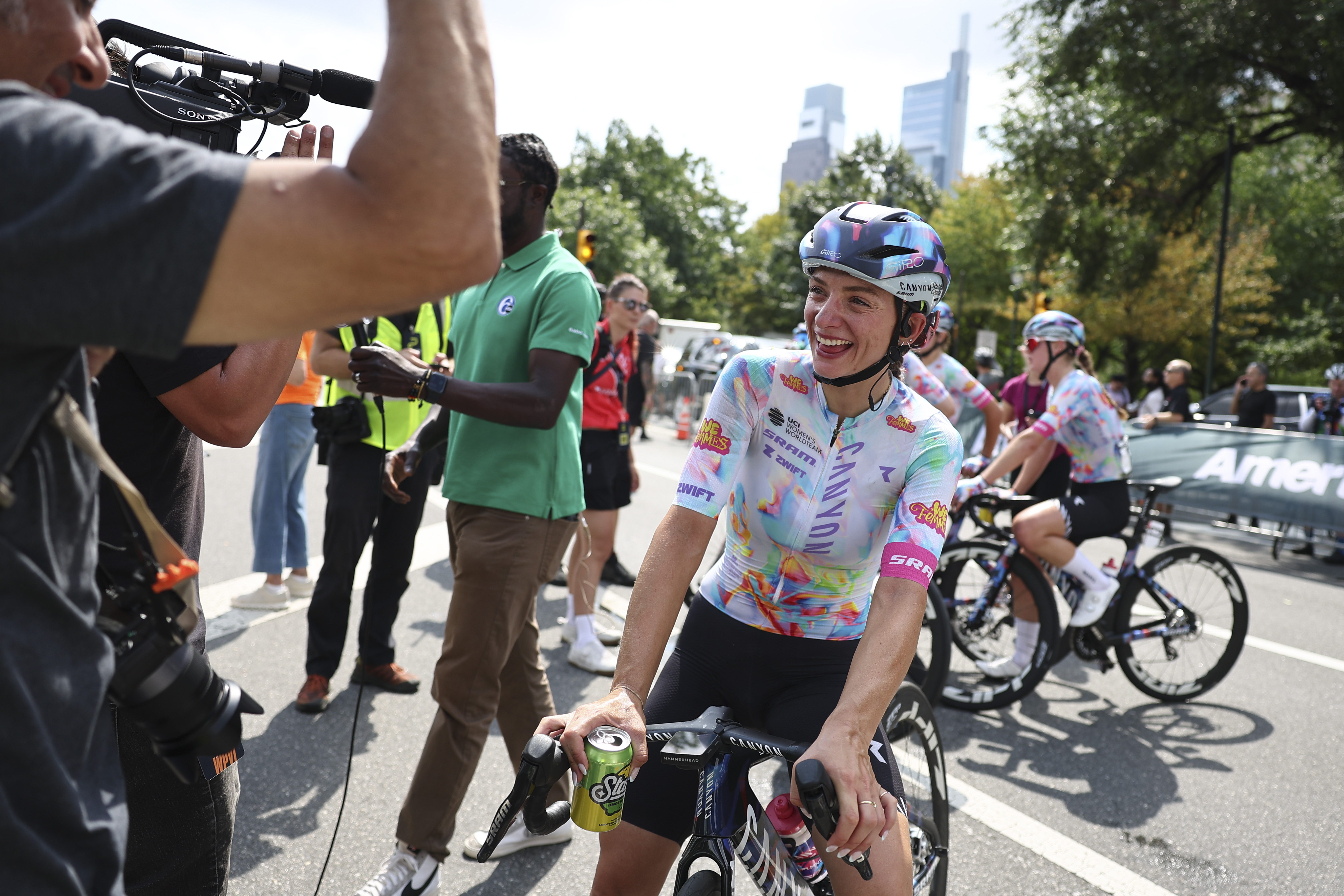
The former University at Buffalo swimmer did not pick up competitive cycling until the onset of the COVID-19 pandemic. Six years later, she placed 71st in her hometown race with a time of 2:37:59.
“I watched this race in 2013, 2014, ’15, and ’16 when it was still going on, and I was just getting into cycling,” Stoveld said. “And then to be on the other side of it, 10 years later, is just like a dream come true. Just absolutely amazing.”
Stoveld looked to break away from the main pack of cyclists in the final stretch, but failed to will herself to the front.
“I am a breakaway rider,” Stoveld said. “My best bet is to win in a small break, and unfortunately, being caught by world tour teams was probably inevitable. But that was my shot, and I was happy to shoot it.”
One section of the race Stoveld had a leg-up in over some of her competition was Manayunk’s “The Wall” — which sees riders climb 210 feet at a steep incline. Stoveld hosts a “group ride” every Tuesday, noting that “those poor suckers” who sign up for her ride take on the Wall with her every week.
One reporter asked Stoveld what her advice would be to young women looking to take up cycling.
“If I can do this good in my late 30s, picking it up at 30, you as an 8-year-old getting into sports will dominate,” Stoveld said. “Please keep riding your bike”
There’s no shortage of cheers and warm welcomes at the Manayunk Wall. It’s not just the first to arrive who feel the crowd’s support – those coming behind get even more:
At the Manayunk Wall, the first riders aren’t the only ones to feel the support: pic.twitter.com/i2b4fGS4EQ
‘It’s inspiring me to put more effort into cycling’
Spectators cheer a group of women riders along Main Street in Manayunk.David Maialetti / Staff Photographer
Rita’s water ice in one hand and a cowbell in the other, Jim Lamond let the clank of the bell ring out as racers rode past on Ben Franklin Parkway on their third lap.
Lamond, 57, came to the race with his daughter, Katie Coulter, 28, who is just starting to get into cycling and triathlon and wanted to witness the sport on this scale in person.
“During the triathlon, cycling is the one discipline that I struggle with the most,” Coulter said. “So seeing the ladies and the professionals do this, it’s inspiring me to put more effort into cycling, and seeing how effortless they do it, it’s really inspiring for me.”
For the few seconds the cyclists are riding past, Lamond and Coulter are fixed on the course, but in the downtime between laps, the Fan Fest on the parkway has plenty to pass the time.
Food trucks line the streets, including the Rita’s Water Ice truck where Lamont got his. There are also tents with fan activations and giveaways, merchandise and cycling apparel for sale, a DJ, and a screen displaying all the action.
“Here at the Fan Fest, you have all different vendors between the equipment for the riding and things like that, the helmets, the bikes, keeps them interactive with the kids,” Lamond said. “They have a Fan Fest for the kids as well, and you get to experience the atmosphere of being outside.”
— Mia Messina
// Timestamp 08/30/26 10:46am
‘It’s like a mini Tour de France’
Alice Antonelli, an avid cyclist and financial consultant, is among those watching Sunday’s race.Michelle Myers
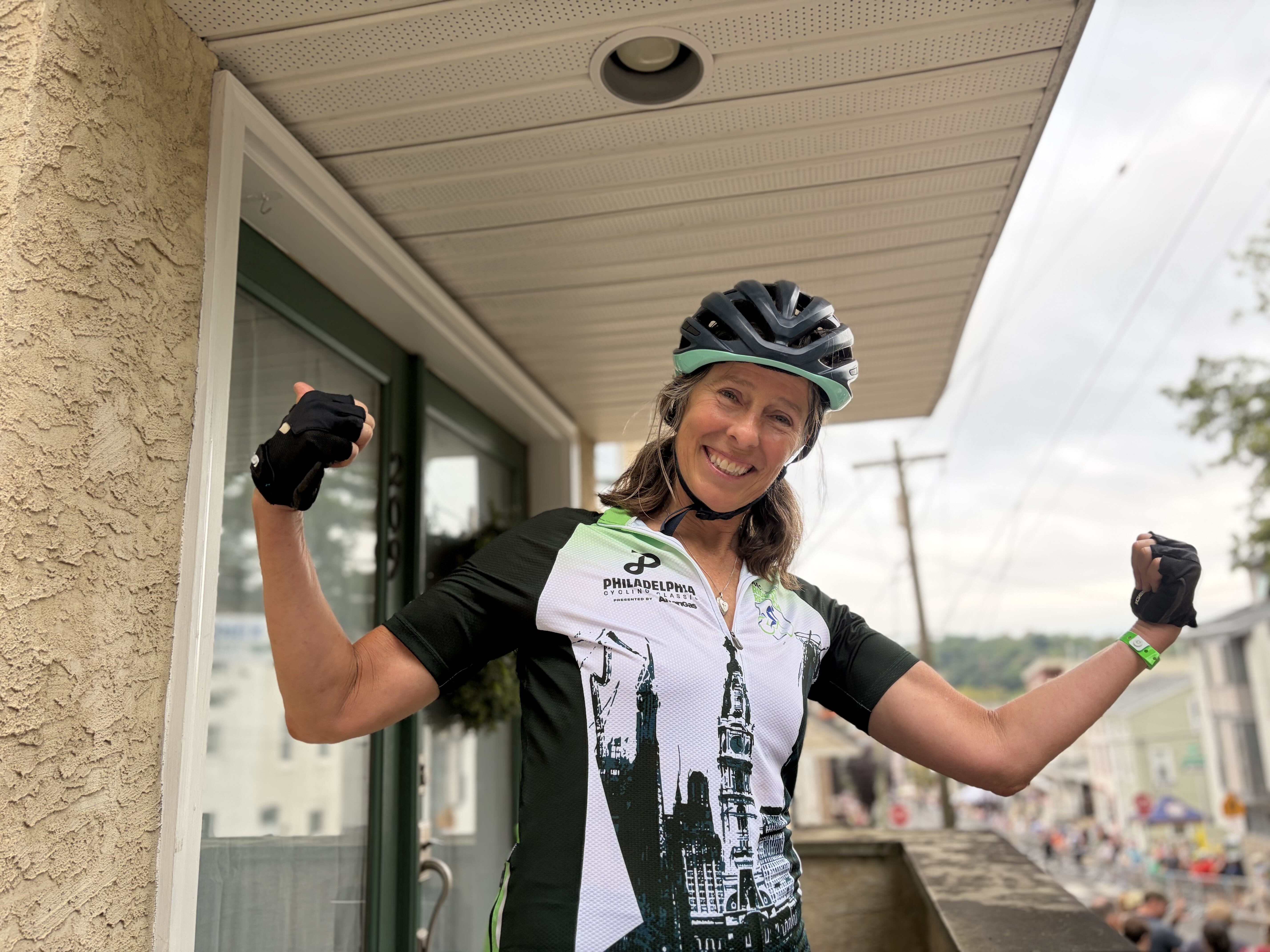
Alice Antonelli, 65, woke up at 4:30 a.m. on Sunday unable to contain her excitement for the return of the Philadelphia Cycling Classic.
“I wasn’t able to come before. I had kids and a lot going on,” Antonelli said. “I’m so thrilled it’s back. It’s like a mini Tour de France.”
In a new era of her life, the avid cyclist and financial consultant was among the 400 registered for the Charity Ride for AACR, the American Association for Cancer Research. She completed her race in under an hour, she said, and came back to the Manayunk Wall to cheer for the women’s race participants.
“Having done the course, it’s actually not bad, but the Wall separates the women from the girls. I am a girl,” Antonelli said.
Standing on the porch of a neighboring house, Antonelli couldn’t contain her enthusiasm at seeing cyclists more skilled than her go up the same hill she conquered.
“Not to say that my heart is pounding, but I’m anticipating for them; I am living vicariously through them,” Antonelli said, bringing her hand to her chest.
As the motorcycles announced the arrival of the cyclists, Antonelli couldn’t help but jump up and down in celebration, bringing her fingers to her mouth and whistling for the riders.
“I’m planning to come back next year, please keep bringing it back,” Antonelli said.
‘I’m just happy right now’: Father and son take in Cycling Classic
John Dempsey and his 11-year-old son, Orion, woke up at 5 a.m. to make the trip to Philadelphia from their home along the Jersey Shore.
John Dempsey wanted to show his son “something different other than the usual running or car events.”
“Even though we’re from New Jersey, we love the city of Philadelphia,” John Dempsey said. “My wife’s run the marathon here. I’ve run the half marathon here, and we’ve come here for Made in America Festival. Always nice to come back to Philly.”
Added Orion: “It’s very cool. It’s fun to be here, and I’m just happy right now.”
The two are rooting for women’s cyclists Kristen Faulkner and Laini Bones. Faulkner is two-time Olympic gold medalist while Bones won over the Dempseys through her social media content. Bones has found an online audience by attempting to beat male cyclists’ records.
“She’s viral on Instagram for taking men’s segments with Strava and talking a lot of trash to them lightheartedly and going out and beating their time,” John Dempsey said.
Teen spectators inspired by cyclists climbing Manayunk Wall
Spectators line Levering Street as the women’s race makes their way up The Wall in Manayunk.David Maialetti / Staff Photographer
Eyes glued to a cell phone, siblings Tess and Fitz Dolan counted down the seconds it took women cyclists to arrive at the Manayunk Wall, closely following their trip on the livestream.
The mountain biker teens’ ages were in the single digits when the race went away, and they never had a chance to see it in person. Now, they don’t plan on losing sight of the cyclists as they wait for their arrival at Tower and Levering Srreets.
“It’s so cool to see them do this because we are used to these roads and we bike there,” said 16-year-old Tess Dolan. “The women are putting in a lot of work and they are just rocking it.”
Her older brother, Fitz, was equally in awe of the bikers’ performances. The 18-year-old has biked up the Manayunk Wall just once and considers it to be a challenge for any cyclist.
“It was fun, but very hard because it’s so long and really stiff,” Fitz said. “They made it look so effortless and I can vouch it’s not as easy as it looked.”
Seeing the women’s strength and the cheering spectators inspired Tess to put the Manayunk Wall on her bucket list.
“It’s important for us to see them. It gives us inspiration to go outside and get on the bike,” Tess said, praising the work of the organizers and cyclists. “Thank you for bringing it back and putting in the work, because I’m sure it wasn’t easy.”
Mayor Parker says the Cycling Classic is bringing ‘the stadium to the streets’
Spectators cheer as the women’s race makes their first pass at The Wall in Manayunk.David Maialetti / Staff Photographer
Mayor Cherelle L. Parker is looking to “keep pushing” for the city to host “even more grander events.” In the meantime, she is enjoying the spotlight sports have shined on Philadelphia this summer.
“Philadelphia is a tough city,” Parker said. “When you hear people describe our grit, our resilience, our stick-to-itiveness, our fight… battling the underdog notion – it’s a real thing. But sometimes we forget how amazing we are, and when we look at 2026 and all that we have accomplished through FIFA, the MLB [All-Star Game], the Cycling Classic, all of the amazing events that were here, We are a world-class global city and prepared to receive guests from around the world.”
Parker also noted the event is a “very equitable opportunity” for all Philadelphians because it is free to watch. Unlike some of the other events Philadelphia held this summer, the Cycling Classic “brought the stadium to the streets.”
“We got a chance to drive through in Roxborough and Andorra and Manayunk, and even if you didn’t get a chance to see it, right now, you will see families have set up barbecues. They’re doing cookouts and parties at their houses. You also can tell that people have made sure their their lawns are well manicured, it’s a big thing.”
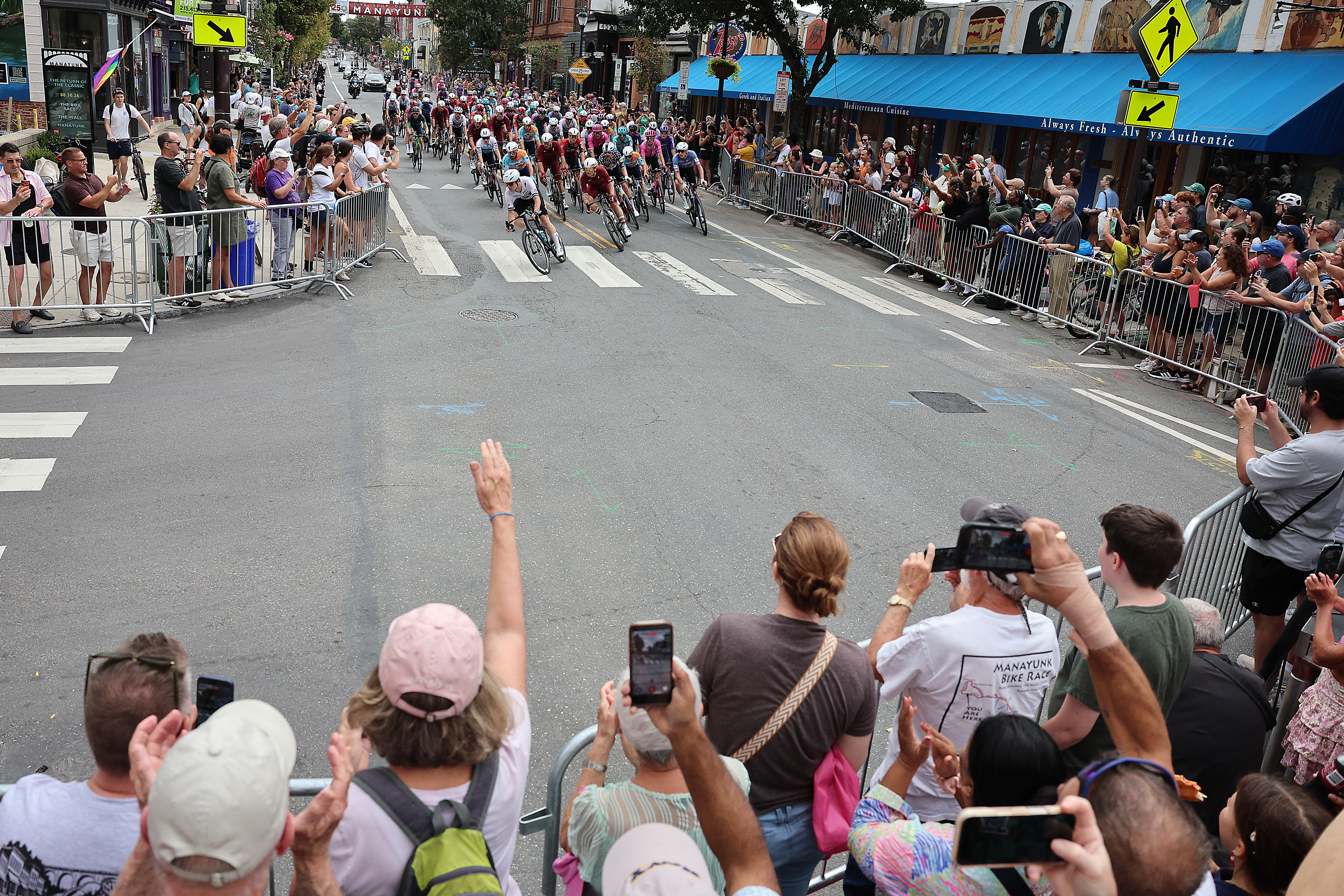
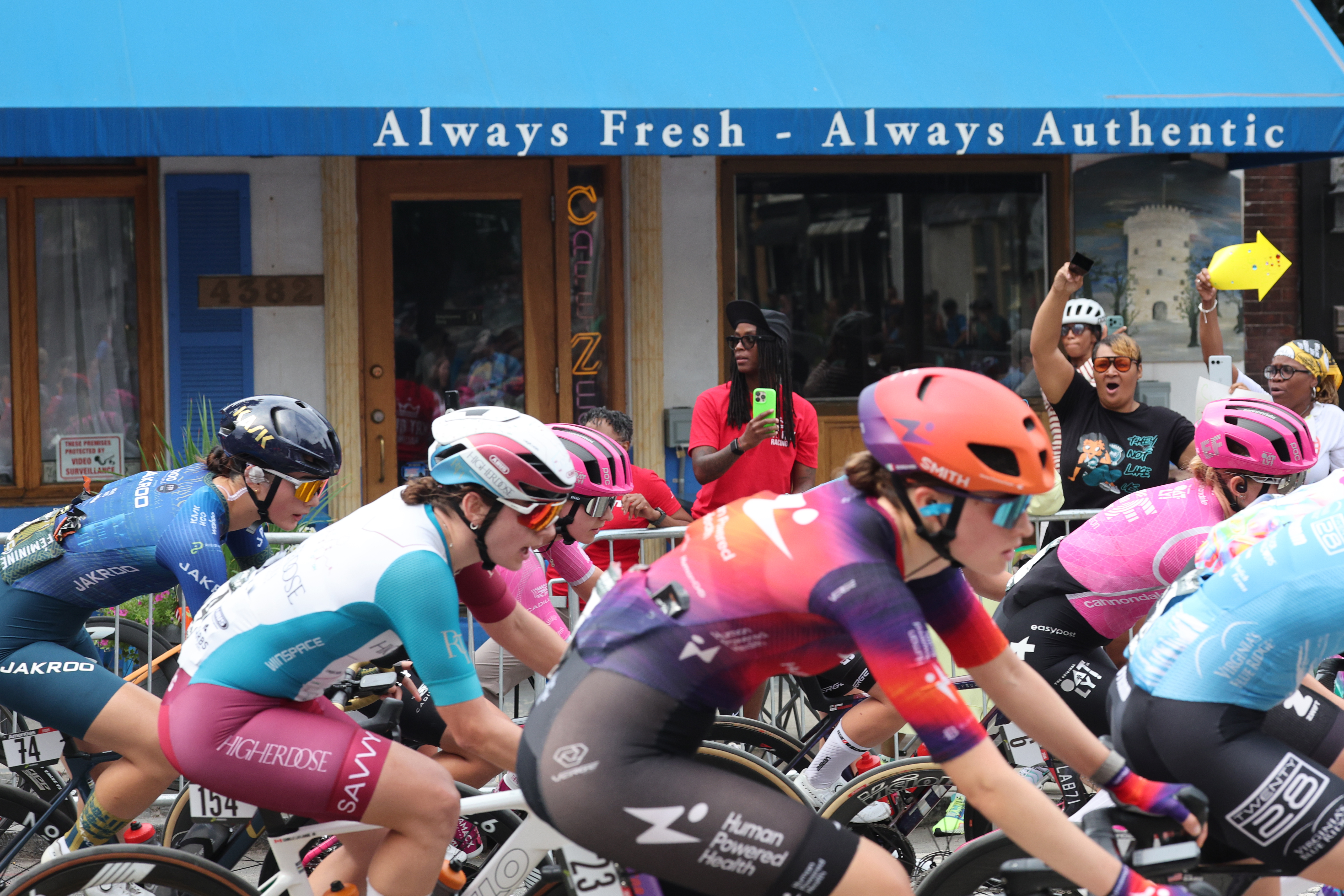
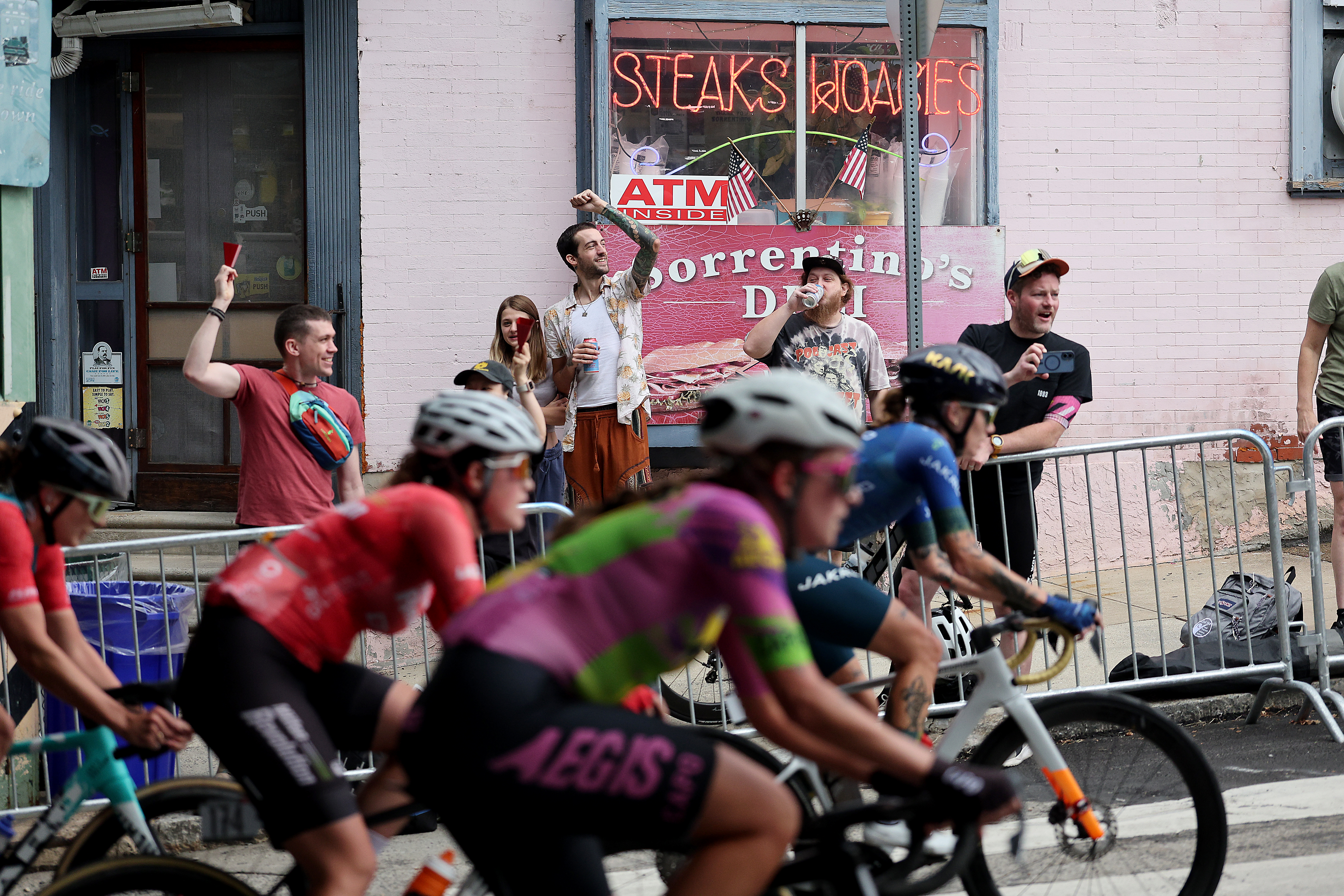
The Philadelphia Cycling Classic is underway. As a group of women speedily cycled by Main Street, dozens of people came out of their Manayunk homes to await them with cheers and praise.
Whistles began to blow, alerting spectators to their impending arrival. “They are coming,” some started yelling as a small fleet of police in motorcycles drove by.
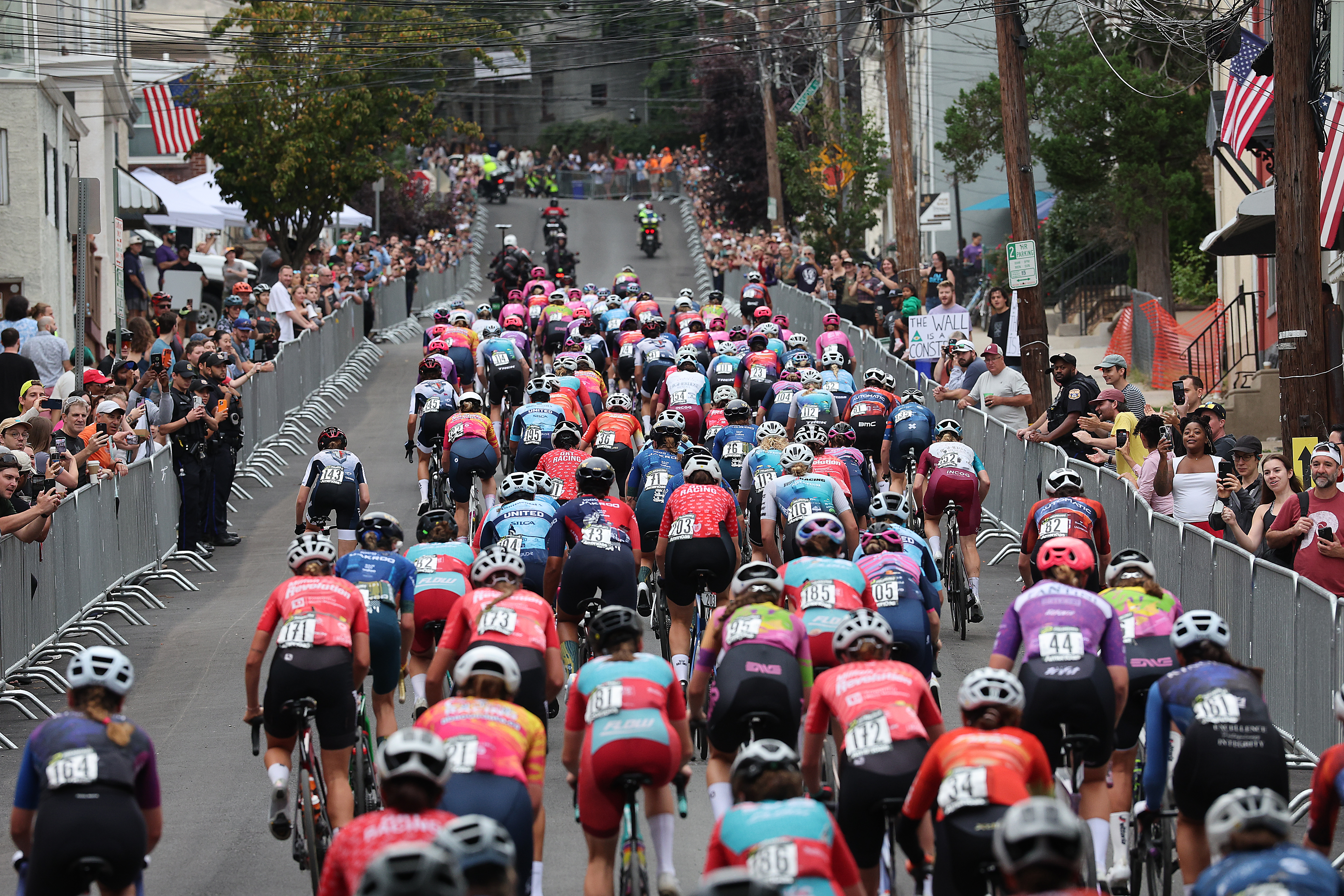
Ringing bells, the eager crowd leaned harder on the barricade, cheering and clapping, before the cyclist speedily rode hill up, with such force the 8% to 9% incline looked effortless.
In less than 40 seconds the women were up the hill and gone from the view of their supporters, but the cheering spirit did not stop.
Shouts of: ”That’s crazy,” and “they are amazing” could be heard among the crowd as they disappeared into the next section.
Celebrating her birthday watching the return of the Philly Cycling Classic
Taking deep breaths, Ashley and Dylan O’Neill walked up Lyceum Street looking for the best spot to see cyclists ride the Manayunk Wall.
The walk was stiff and the air felt slightly humid, but after waiting a decade to experience their first Philadelphia Cycling Classic, Ashley felt like this was the best way to spend her 41st birthday.
“My stepdad wouldn’t stop talking about it: The people gathered together, and the happiness, but for years there was no race,” she said.
“We were bummed out because it’s such a unique thing for a city to do, that to have the city lose something like this is a huge loss for the entire community,” Dylan added.
As soon as the Trenton couple learned the race was coming back, they booked an Airbnb and bought train tickets to Philly.
“We are excited to see the women race and then the men race, especially Quinn Simmons, but we are definitely leaving the cycling to them, because even walking up is hard enough,” Ashley said.
As folks began to gather along the street, the O’Neills plan to return every year to see the race and watch it from different spots.
“We hope they keep doing it, because it’s such a unique thing and Philly is the perfect place to do it,” Dylan said.
For the first time in 10 years, the Philadelphia Cycling Classic is officially underway.
The 62-mile women’s race began shortly after 8:30 a.m. on the Ben Franklin Parkway. The cyclists will complete four laps before the men’s race begins at noon.
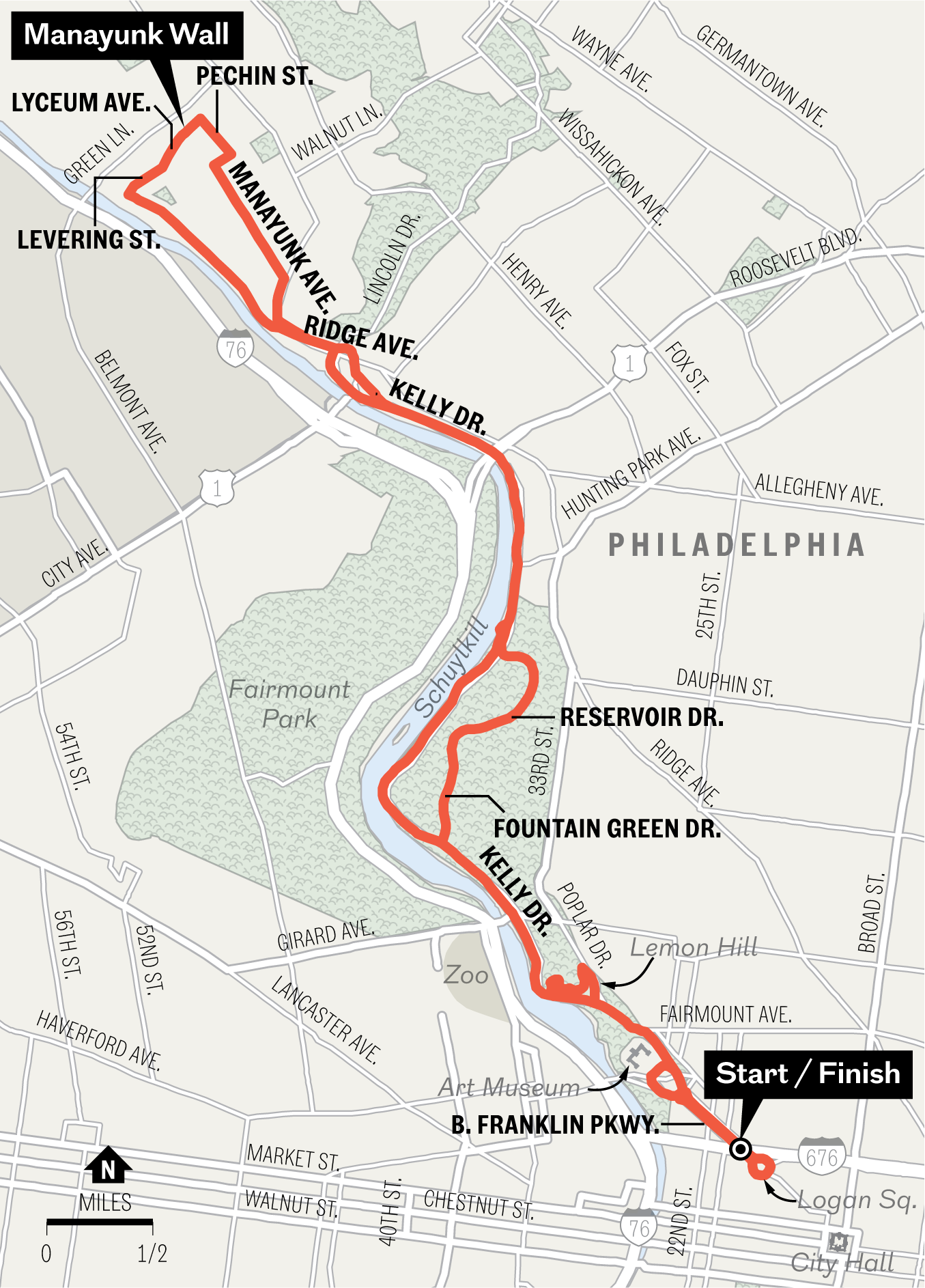
The course is a 14.4-mile circuit that will start and finish on the Benjamin Franklin Parkway. The women’s race will total 65 miles, while the men’s race will be 122 miles.
The original course ran up the Ben Franklin Parkway to Kelly Drive, passing through East Falls, Roxborough, and Manayunk, which was home to the most famous part of the course, the Manayunk Wall.
This year’s race will return to that original course, and will take participants past Strawberry Mansion, Lemon Hill, Boathouse Row — and, of course, up the Wall.
The Wall is a steep incline hill, reaching up to a 17% grade over a stretch of about a half mile, mostly on Levering Street in Manayunk. It is considered one of the race’s most iconic components, and has been part of the race since 1985, when Jerry Casale and David Chauner first mapped out the course
— Mia Messina
// Timestamp 08/30/26 7:18am
The best places to watch the Philly Cycling Classic
The women’s race will start at 8:35 a.m. with the men’s race to follow at noon.
For fans interested in attending, access to the race will be free, meaning anyone can line up along the course to watch.
Traditionally, large parties take place along the tight streets of Manayunk, turning the race into a festival of sorts. But for those not located in the Manayunk area, the event’s official Fan Fest will be held by the Iroquois Sculpture near the Philadelphia Museum of Art from 10 a.m. to 5 p.m. on Saturday and 8 a.m. to 5 p.m. on Sunday. Entry is free and will include vendors, live entertainment, a stream of the race, activities for kids, and a beer garden.
— Mia Messina
// Timestamp 08/30/26 7:12am
Road closures in Center City Sunday
Matti Breschel raises his arms after winning the Philadelphia International Championship Liberty Classic along the Benjamin Franklin Parkway in 2008.
The Philadelphia Cycling Classic is back after a decade-long hiatus, bringing loads of cycling fans, events, and road closures along with it.
Plan ahead if you need to drive near the 14.4-mile path for the main women’s and men’s races, beginning at 8:30 a.m. and noon, respectively, and the morning charity ride, which begins at 6:30 a.m.
The following road closures will take effect from 3 a.m. until 10 p.m. on Sunday.
Near the Benjamin Franklin Parkway:
Benjamin Franklin Parkway from 17th Street to Eakins Oval (all lanes)
Spring Garden Street between Pennsylvania Avenue and 31st Street
All roads from Arch to Spring Garden Streets, 18th to 22nd Streets (access maintained for residents)
All roads from Arch Street to Fairmount Avenue, 22nd to Corinthian Streets (access maintained for residents)
23rd Street between Pennsylvania Avenue and Eakins Oval
22nd Street between Winter Street and Pennsylvania Avenue
21st Street between Winter Street and Pennsylvania Avenue
20th Street between Arch Street and Pennsylvania Avenue
19th Street between Callowhill and Cherry Streets
16th, 17th, and 18th Streets between Arch and Spring Garden Streets, if public safety conditions warrant
1600 and 1700 blocks of the Benjamin Franklin Parkway, if public safety conditions warrant
Fairmount Park:
Kelly Drive (all lanes)
Waterworks Drive
Reservoir Drive
Lemon Hill
Sedgley Drive between Girard Avenue and Kelly Drive
Poplar Drive between Girard Avenue and Kelly Drive
MLK Drive from Falls Bridge to Eakins Oval
Manayunk and Roxborough:
Ridge Avenue between Kelly Drive and Hermit Street
Main Street between Ridge Avenue and Green Lane
Levering Street between Main and Tower Streets
Cresson Street between Levering and Cotton Streets
Lyceum Avenue between Tower and Mitchell Streets
Pechin Street between Green Lane and Roxborough Avenue
Roxborough Avenue between Mitchell and Terrace Streets
Manayunk Avenue between Roxborough Avenue and Osborn Street
Rector Street between Terrace and Pechin Streets
Pensdale Street between Terrace and Lauriston Streets
Kingsley Street between Manayunk Avenue and Lauriston Street
Salaignac Street between Manayunk Avenue and Lauriston Street
Terrace Street between Dawson Street and Ridge Avenue
Vassar Street from Ridge Avenue to Cresson Street
Mitchell Street from Connaroe to Martin Streets
Additional streets: unit blocks of Shurs Lane, Jamestown Street, Pensdale Street, Roxborough Avenue, Grape Street, Levering Street, Gay Street, Carson Street, Rector Street, Cotton Street, and Connaroe Street, and the 300 block of Burnside Street
SEPTA detours
The following SEPTA bus routes will be detoured through Kelly Drive, Manayunk, and Roxborough beginning at 4 a.m. Sunday: 7, 9, 27, 32, 33, 38, 43, 48, 49, 52, 60, 61, 65, 82, 124/125, K.
For information on specific route changes, visit www.septa.org.
Josh Greene is a rising left-wing social media star with his own podcast, nearly 800,000 followers, and access to politicians like Sen. Bernie Sanders of Vermont and Mayor Zohran Mamdani of New York.
He has used that platform to support dozens of progressive candidates in the midterm elections, ranging from low-profile, down-ballot contests to some of the nation’s marquee Democratic primaries. In camera-facing videos, Greene informs his followers of his preferences, calling some candidates “the most viable” and, in other cases, declaring that “this is the candidate for you.”
He does not always tell his viewers that he is being compensated for his support.
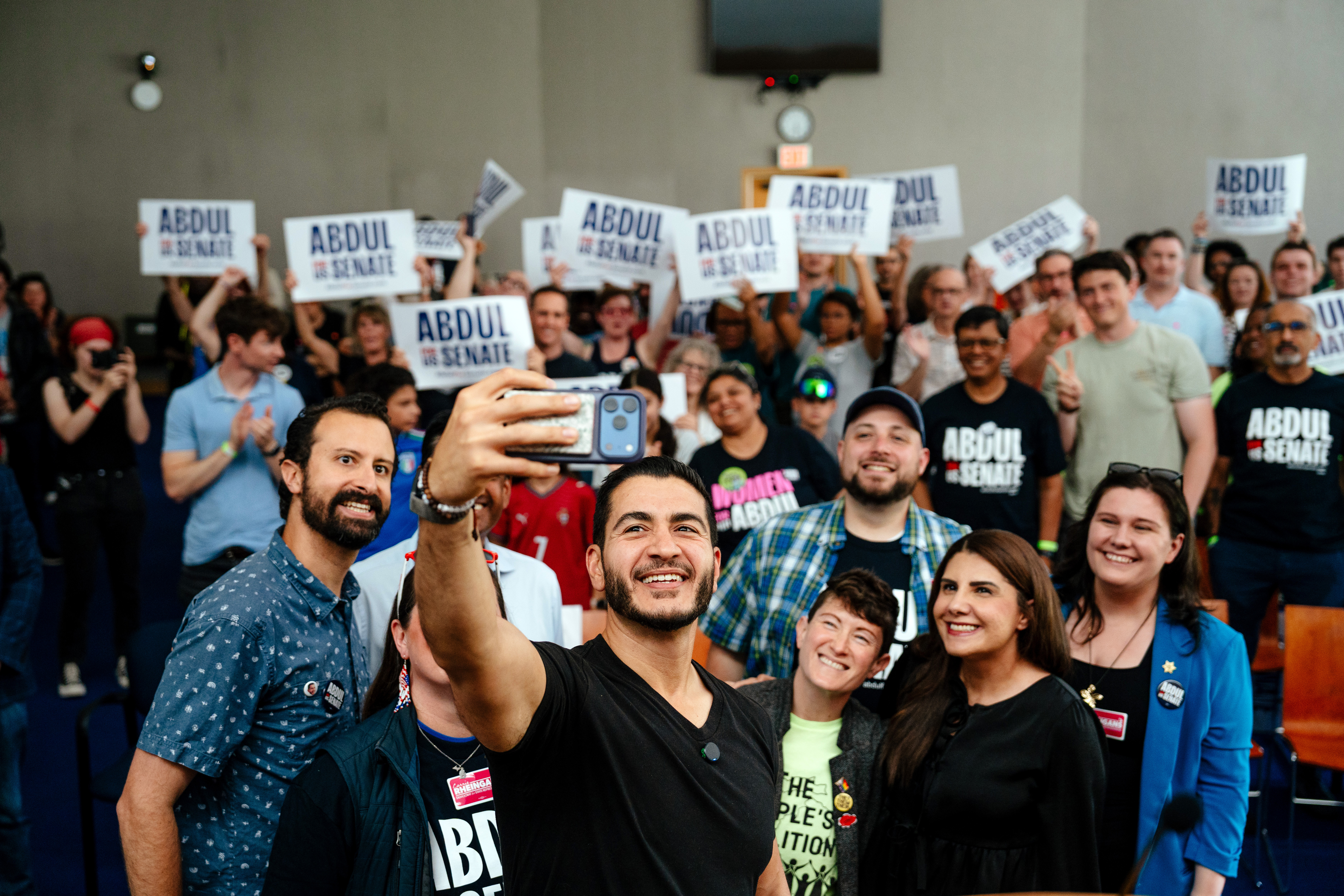
But records show that Greene, 26, has received money from at least seven politicians, or outside groups supporting them, in the current campaign cycle, including several congressional candidates in New York and a super political action committee linked to Abdul El-Sayed, the Senate nominee in Michigan. Tom Steyer, a former candidate for governor in California, paid him $21,500.
Abdul El-Sayed, the Democratic candidate for U.S. Senate in Michigan, who is trying to bring his party together after a divisive primary, at a June 28 campaign event in Ann Arbor, Mich.NICK HAGEN
Greene, who lives in Southern California and is best known by his handle @joshtheprogressive, is among a growing number of influencers who, at a moment when campaigns are increasingly willing to pay for online attention, appear willing to put their mouth where the money is.
As more people spend time scrolling on their phones, campaigns view these shows of support from influencers as a vital way to reach voters. They are also significantly less expensive than traditional advertising.
But unlike campaign mailers, billboards, and television spots, these messages fall into a legal gray area.
There are no federal regulations requiring disclosure of payments for political support on social media, and only a few states have such rules. That allows influencers, in most instances, to endorse candidates for a fee without ever disclosing those payments in their posts. Creators say some campaigns have even asked them to actively conceal the fact that they’re being compensated, making it impossible to know what’s genuine support — and what is pay-for-play.
In most cases, the only way a viewer would know an influencer is being paid would be to search a candidate’s campaign finance reports, as the New York Times did to discover the payments. Even then, such compensation is regularly obscured by funneling the payments through middlemen.
“It’s completely out of control,” said Suzanne Lambert, a progressive influencer and comedian with more than 1.3 million followers between TikTok and Instagram. She said that while she happily promotes candidates she likes, she has “never taken a cent” in exchange for an endorsement and worries that the practice distorts the democratic process. “People don’t know what’s real anymore,” she said.
Greene defended the idea of influencers getting paid for their work and noted that he accepts money only from candidates and campaigns that he would support anyway. “I turn down offers every single day because I’m not going to take money from anyplace if I don’t agree with it,” he said. (In the case of the Steyer campaign, Greene said he was initially critical but came to see him as the most viable candidate.)
Still, he suggested there was a need for straightforward and consistent rules on disclosure. “If anything, we do need more clear transparency laws so that creators like myself aren’t confused,” he said.
Coordinated networks
The phenomenon is bipartisan.
In June, Rep. Barry Moore of Alabama filed a complaint with the Federal Election Commission, alleging that at least eight social media accounts were being paid to attack his military record during the Republican primary. In April, a newspaper in Kentucky revealed what appeared to be a coordinated network of influencers boosting Nate Morris — at the time running in a Republican Senate primary — even though none acknowledged being paid for their efforts. Ken Paxton, the attorney general of Texas and the Republican nominee for Senate, benefited from a paid campaign on the social platform X when he was facing impeachment in the state several years ago.
But the question of paid influence has gained particular attention in recent months thanks to aggressive efforts by a handful of Democratic candidates to secure support from well-known influencers.
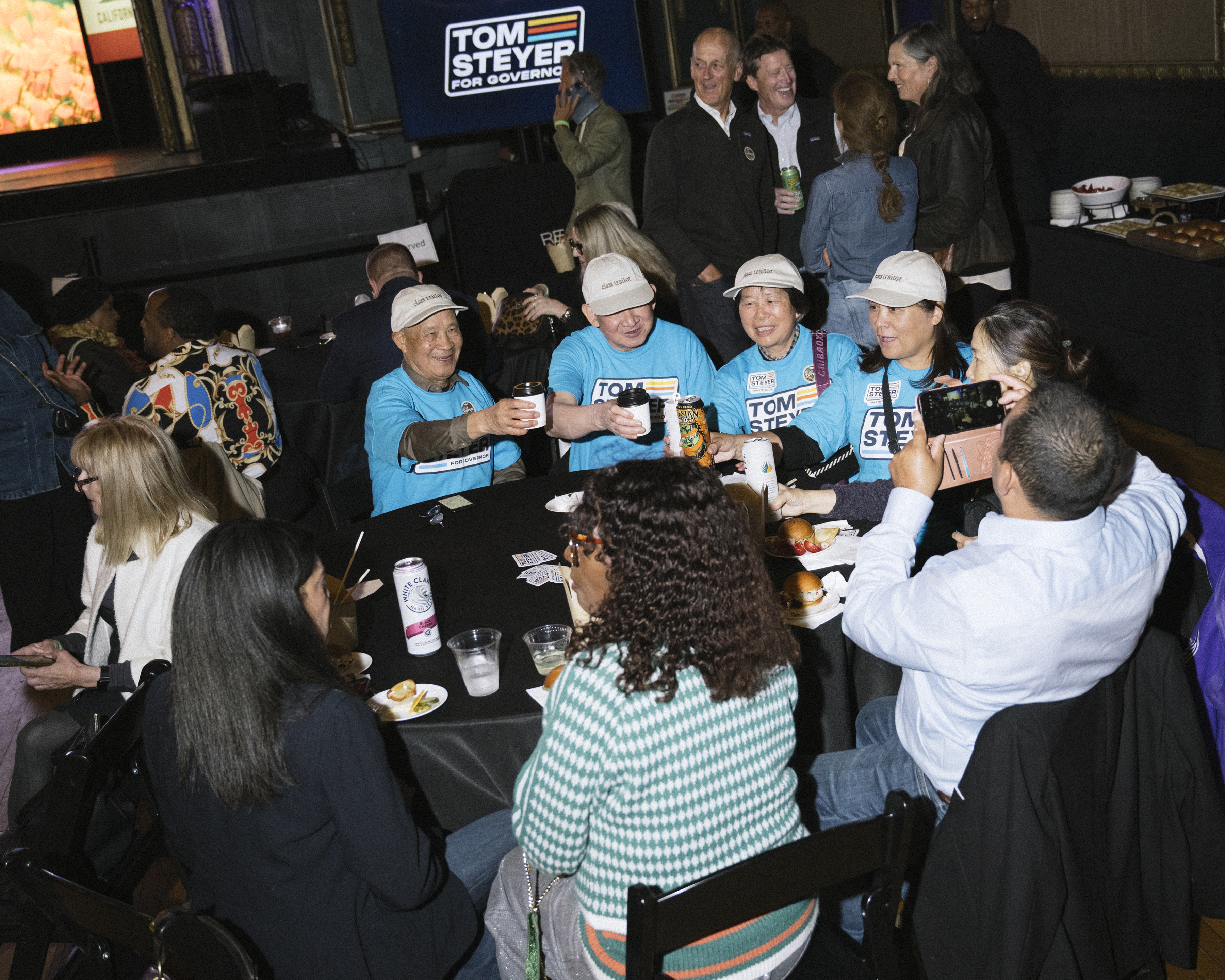
During California’s hard-fought primary this spring, Steyer’s campaign paid 17 influencers at least $5,000 apiece, including one, Carlos Eduardo Espina, who has over 14 million followers on TikTok and received a total of $400,000, campaign finance filings show.
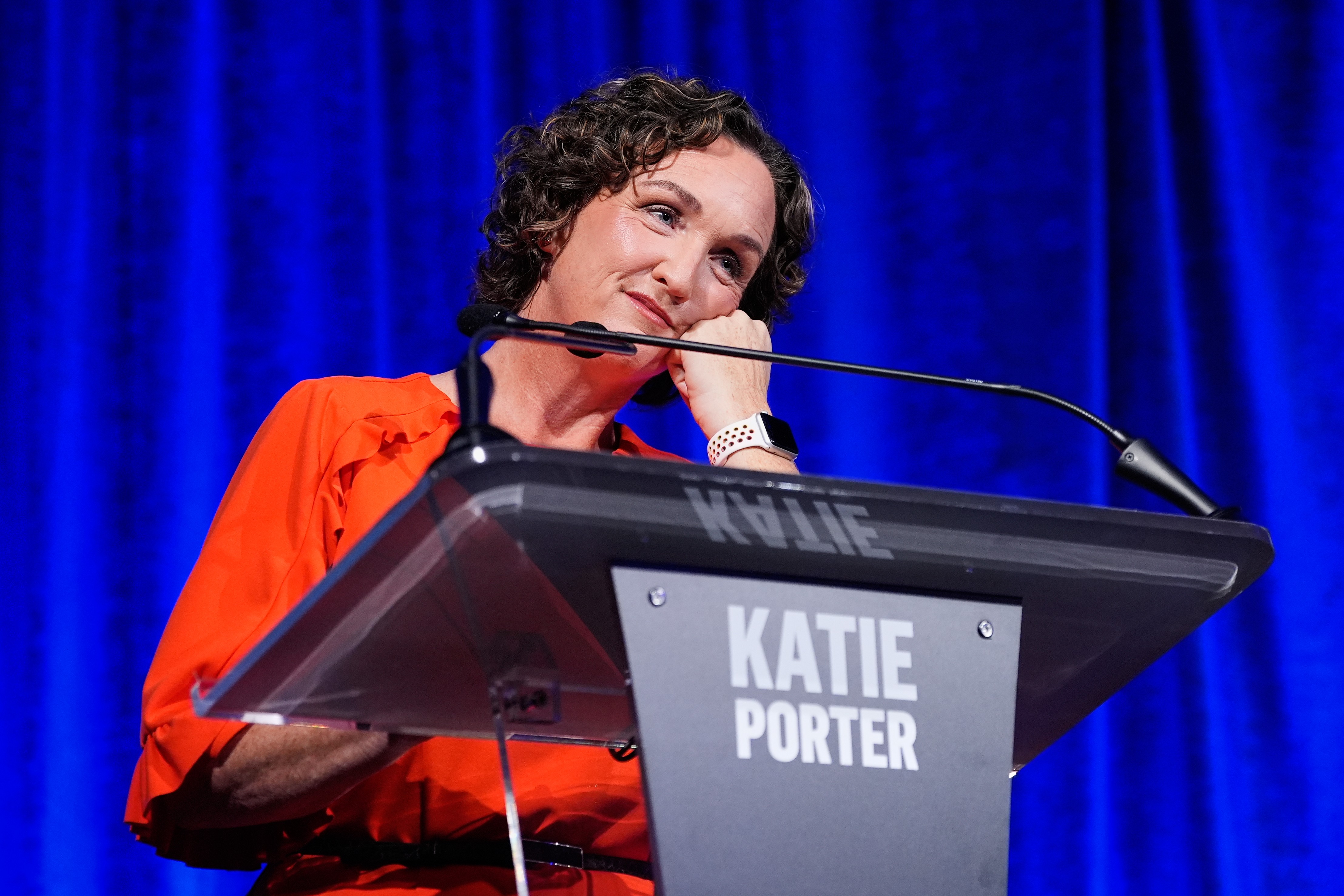
Katie Porter was one of several candidates to deploy paid influencers during the California gubernatorial primary in 2026.Godofredo A. Vásquez
Former Rep. Katie Porter, who also ran unsuccessfully for California governor, paid 12 influencers a total of $139,500. One of them, a lifestyle creator named Avery Cyrus with 9.5 million followers on TikTok, received $25,000 for what appeared to be a single post claiming “Katie Porter’s thing works.”
Cyrus’ post was deleted after the Times inquired about it. She did not respond to a request for comment made through the social media agency that represents her, UnderCurrent Media, but the firm’s CEO, Eric Bogard, said in an email that it “was not asked to oversee disclosure compliance, nor were we provided instructions concerning any required disclosures.”
Under California law, paid political posts on social media must be disclosed. A Times review found three posts supporting Porter on TikTok from influencers who were paid by her campaign that did not include any disclosures. In seven other instances, the disclosures could be found only after clicking through to a hidden section of TikTok for comments flagged “as potentially offensive or disturbing.”
Sander Jennings, an influencer based in Florida who was paid $22,000, said “the Porter campaign and I agreed to disclose the payment” in TikTok’s comments section in order to get around the site’s practice of removing paid political posts. He said he did not know why the disclosures ended up in the hidden section of the comments.
TikTok’s terms of service bar all paid political advertising, including “creators being compensated for making branded political content.” In an email, Porter said that “nothing was paid for and posted without review and coordination and compliance with all law.”
Other political efforts have employed a different strategy, contracting private firms that pay little-known content creators smaller sums to put out a large volume of posts. Those companies, known as user-generated content platforms, or UGCs, operate on the principle that carpet-bombing the internet with hundreds of nearly identical posts is more likely to generate viral content than paying one large influencer the same amount of money to make a single post.
This spring, a woman posted dozens of videos promoting Steyer in the California primary. Weeks later, she appeared in videos from a different account complaining about the cost of living “here in Michigan” and encouraging people to vote for Rep. Haley Stevens, El-Sayed’s primary opponent in the Senate race. Then she pivoted to a third account talking about affordability in Wisconsin.
Corporate records show that the woman, Paige Dunmeyer, actually lives in Kansas City, Mo., and is registered to work with a UGC company called SideShift. It’s not clear how much she was paid for her Michigan and Wisconsin videos, but she has earned more than $30,000 on SideShift for a variety of political and commercial campaigns, according to company records reviewed by the Times. Filings from Steyer’s campaign showed she received $1,320 for her efforts in that race. Dunmeyer did not respond to requests for comment.
A Times analysis found that at least 87 people registered to work with SideShift had made posts backing Steyer or Stevens, or participated in a third campaign to post video clips on TikTok supporting Rep. James Talarico, the Democratic Senate nominee from Texas. Most of the posts by those creators included no acknowledgment that money changed hands.
In a statement, SideShift said that it advised creators to follow applicable disclosure requirements, and called for more explicit laws governing how paid content is disclosed on social media.
“SideShift believes anyone can be a creator and that creators should get paid fairly for work they choose to do,” the company said.
In June, Kendall Boyle, a TikToker in Michigan with over 21,000 followers, was contacted by a social media marketing agency called Activate HQ offering her a paid opportunity to post videos about “how rising costs are affecting Michigan residents in real life.”
When she asked who was footing the bill, she was told it was Majority Forward, a dark money group linked to the Senate Majority PAC, a Democratic super PAC, email correspondence reviewed by the Times shows. Boyle said she was turned off by warnings in those emails from Activate HQ that “disclosure is not required and the paid partnership label will not be included in any posts” and also that Majority Forward “will not be mentioned” in her content.
“It was one of those things where something isn’t fitting right,” Boyle said.
In a statement, Majority Forward said the language in the email “explains disclosure requirements necessary under FEC rules, which were fully followed.”
Little regulation
Just four states have laws or regulations requiring influencers to disclose paid political messaging, but they apply only to state and local races, not federal contests. Although regulations for social media have been proposed multiple times to the FEC, it has never taken action. The Federal Trade Commission, which requires disclosure of paid commercial content on social media, makes an exception for political messaging.
Rep. Mark Takano (D., Calif.) introduced a bill in June that would require anyone paid by a candidate or political committee to clearly disclose that fact in the same way that traditional campaign materials are required to note such payments.
In an interview, Takano said he was inspired to draft the legislation after online sleuths revealed that numerous influencers had been making paid endorsements in the California governor’s race without proper disclosure, as required in that state.
“It’s unfair when an influencer is allowed to be silent or not transparent about money they’re taking from a candidate, making it seem like what they’re saying is authentic and not influenced by money,” he said.
Takano acknowledges that there are some potential loopholes in the bill. For instance: Campaigns often obscure payments to influencers by hiding them under layers of vendors and subvendors.
Porter, for example, hired Activate HQ for “influencer marketing services,” and it in turn paid 13 creators to bolster her campaign for governor. One of them, a political influencer in Los Angeles named Dash Dobrofsky, who also posted in support of Stevens in Michigan, received $15,500 from Porter’s campaign. Dobrofsky did not respond to a request for comment.
Steyer’s campaign, for its part, hired multiple digital strategy firms to manage social media, including one called Group Project, which hired a Los Angeles company, Gutsy Media, which paid Greene through UnderCurrent, which represents him.
Those payment chains are visible because California is one of a handful of states that require campaigns to report payments to subvendors. There is no such obligation for campaigns for federal office. “Every dollar spent by this campaign is publicly disclosed and available for anyone to see,” the Steyer campaign said in a statement.
‘Social media consulting’
State Rep. Chris Rabb at a July 28 event with U.S. Rep. Ro Khanna.Tom Gralish / Staff Photographer
Occasionally, campaigns or independent expenditure groups will reveal direct payments to influencers, such as the super PAC Freedom PA, which supported socialist candidate Chris Rabb’s successful bid to win a Pennsylvania House primary in May. It has disclosed payments to nearly 50 influencers for “social media consulting,” among them Greene, who received $750 and posted a video celebrating the candidate’s victory.
Other committees listing payments to Greene in federal filings employed less illuminating descriptions. Chuck Park, who unsuccessfully ran for Congress in New York’s Queens borough this year, listed a $300 disbursement to Greene as “staff salary.” Greene posted at least five videos promoting Park, none of which state that he had received payment.
Park, in an interview, said that Greene was in fact not employed by the campaign, but said that “our campaign absolutely leaned into new media” and that he spent time with Greene in Queens filming a series of videos.
Greene disclosed being paid on three of his posts about Steyer and told the Times that those videos were the only ones that he was specifically contracted by the Steyer campaign to produce. He said he didn’t receive compensation for prior posts about the candidate.
Greene has also supported Sen. Ed Markey (D., Mass.) in a competitive primary against Rep. Seth Moulton, and last month, he posted a video accusing Moulton of “posturing to be someone they really aren’t.” He posted a second video this month critiquing Moulton, this time for taking corporate political money.
Neither video includes disclosures, and FEC filings don’t show any payments to Greene related to Markey’s reelection bid. But a spokesperson for Commonwealth Together, a super PAC that is supporting Markey, said it had paid Greene $3,500 for “digital communications consulting” through his agency, UnderCurrent.
Greene, in a text message, acknowledged the payment to support Markey, saying he took it “because I believe he is by far the more progressive candidate in the race.”
The murkiness has left some in the political world uneasy. Last month Rynn Reed, the founder of Creator Congress, an organizing hub for influencers interested in politics, introduced a code of conduct for the group that would require creators to make clear when they’re paid, whether required by law or not.
“With no standards,” Reed said, “there’s going to be a race to the bottom.”
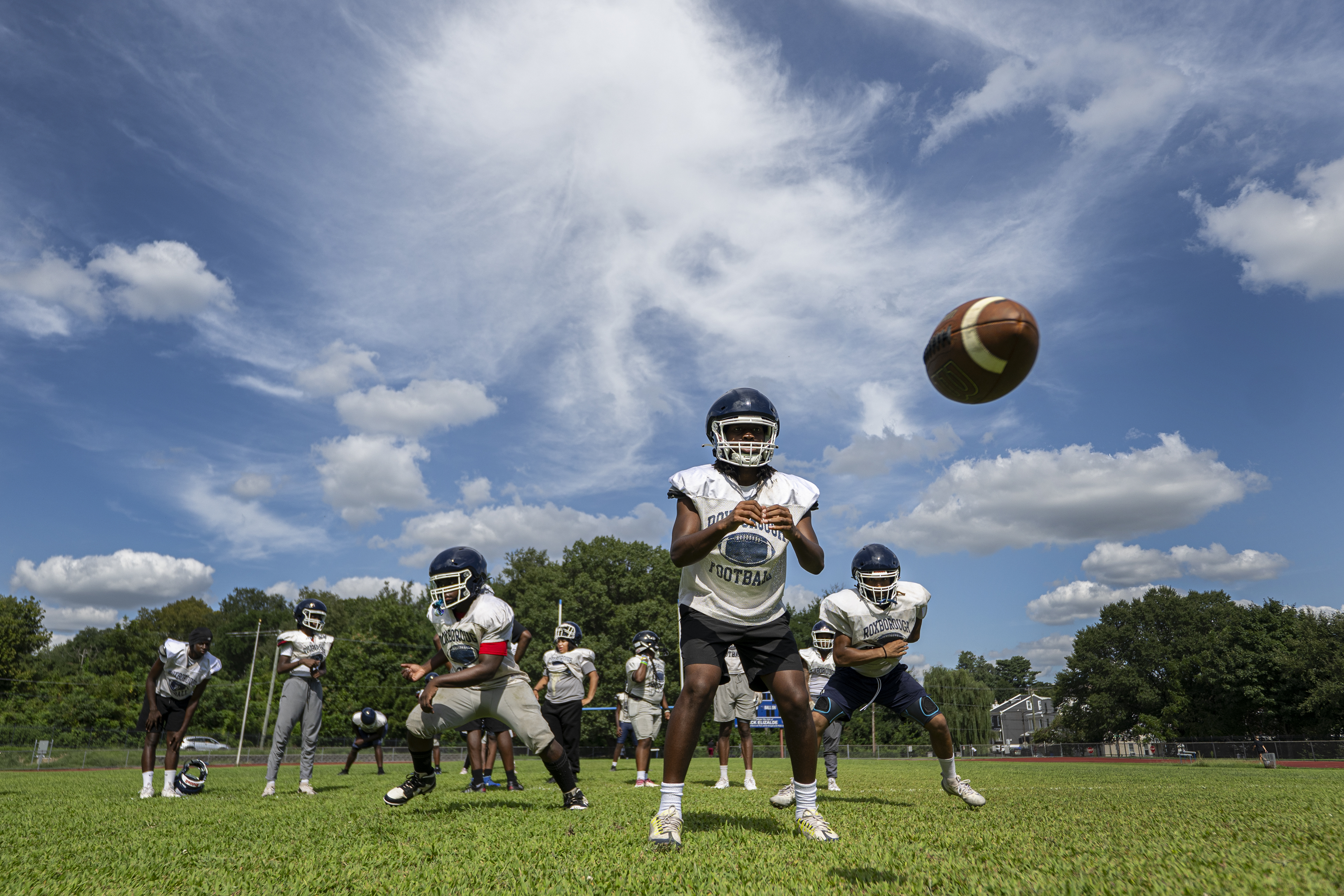
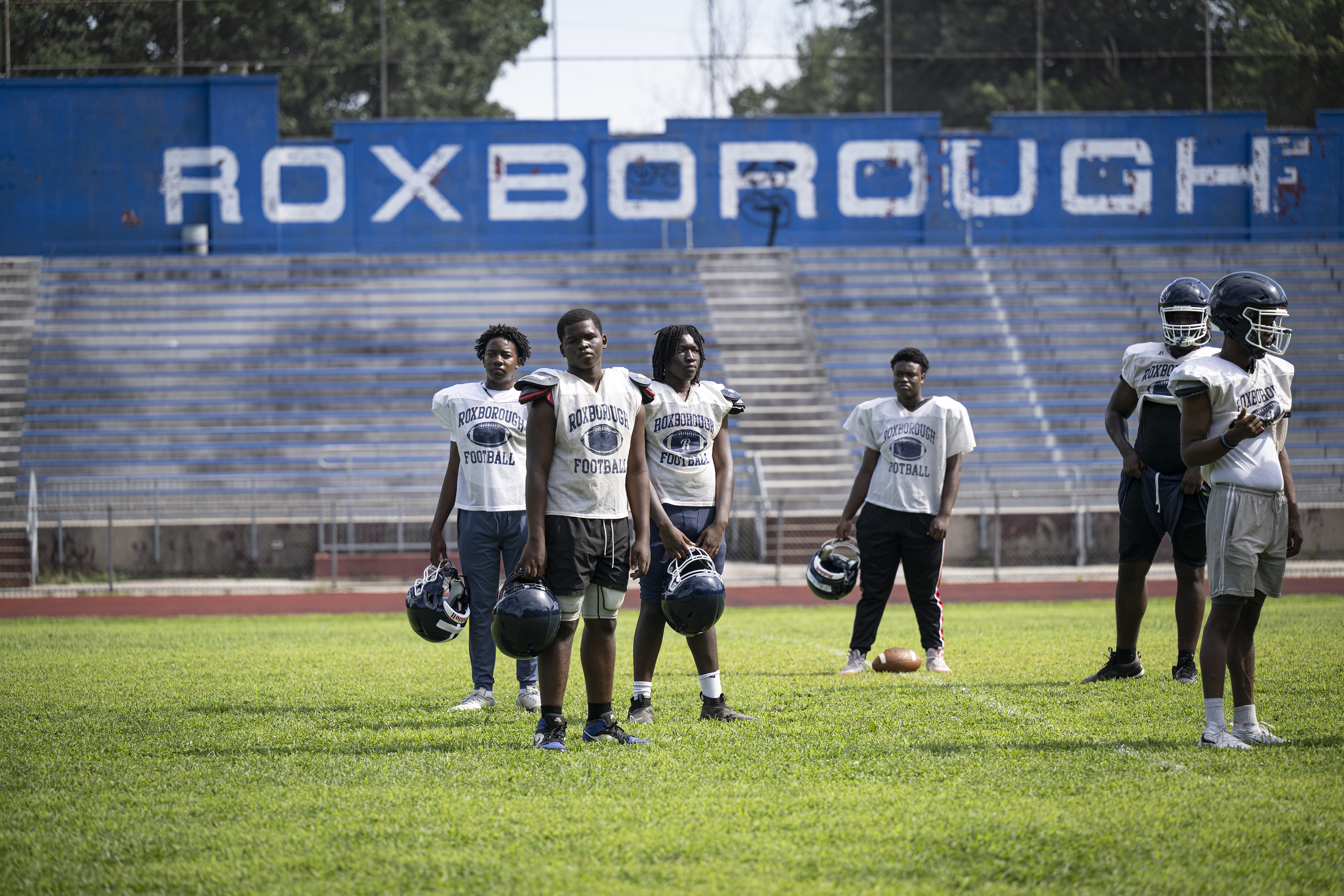
School is back in session, and a fresh high school football season is underway, so foot traffic has picked up on the sidewalk on Pechin Street that separates the locker room at Roxborough High School from its dusty, weathered, 87-year-old football stadium.
At least twice a day, down a short hill along that stretch of sidewalk to practice or a game and back up, players and coaches pass a well-tended bronze memorial for Nick Elizalde, the 14-year-old freshman who had only started playing football at Roxborough four years ago.
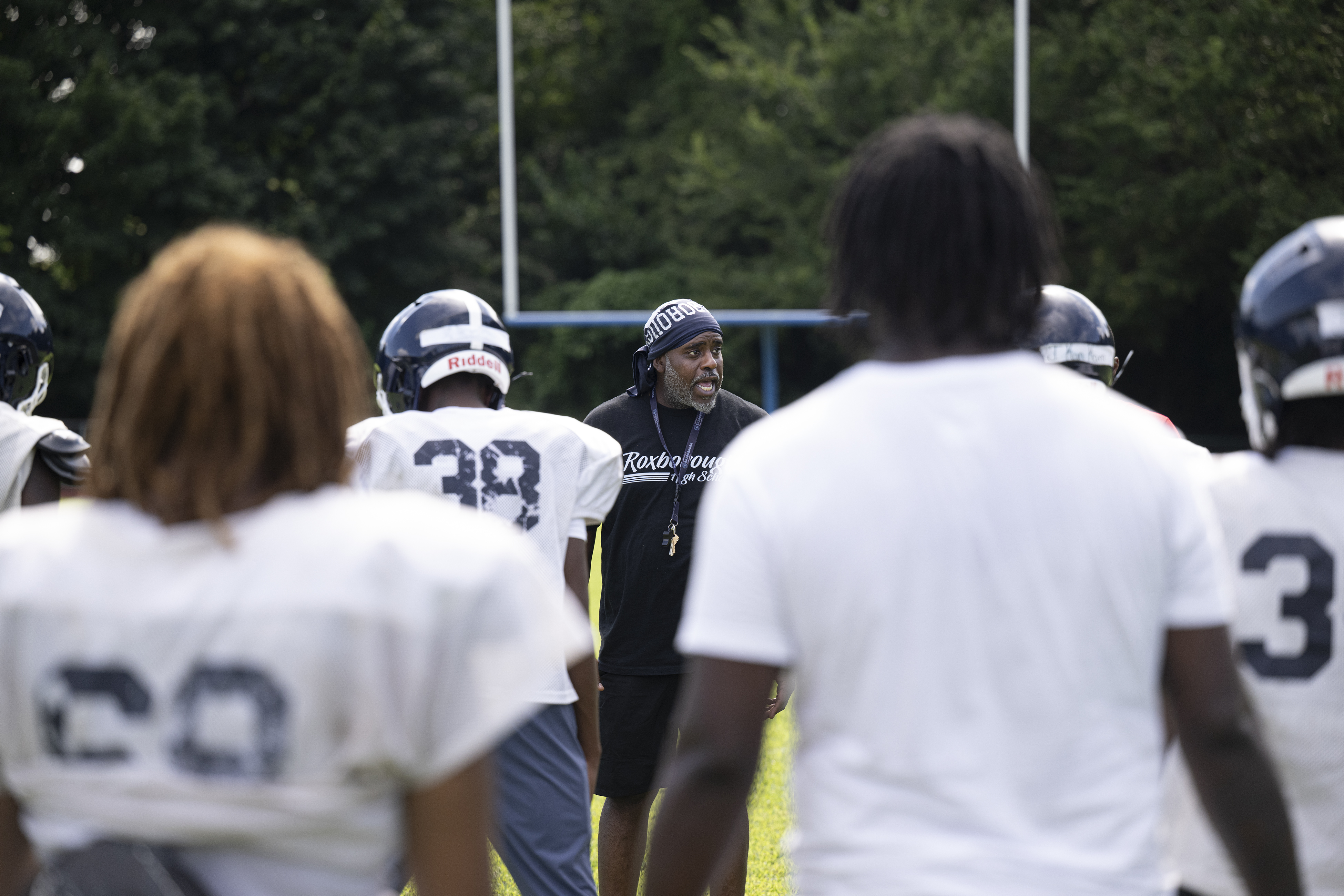
“Quiet kid, wasn’t very outspoken. But he was starting to open up and become more social,” Marc Skinner, the 47-year-old head football coach at Roxborough, told me before practice last week. “Then we ran into that tragedy.”
Yes. That tragedy. The memorial is roughly at the spot where Nick was gunned down when five shooters fired more than 60 bullets toward a group of football players following an afternoon scrimmage on Sept. 27, 2022. Skinner, then an assistant coach, was there.
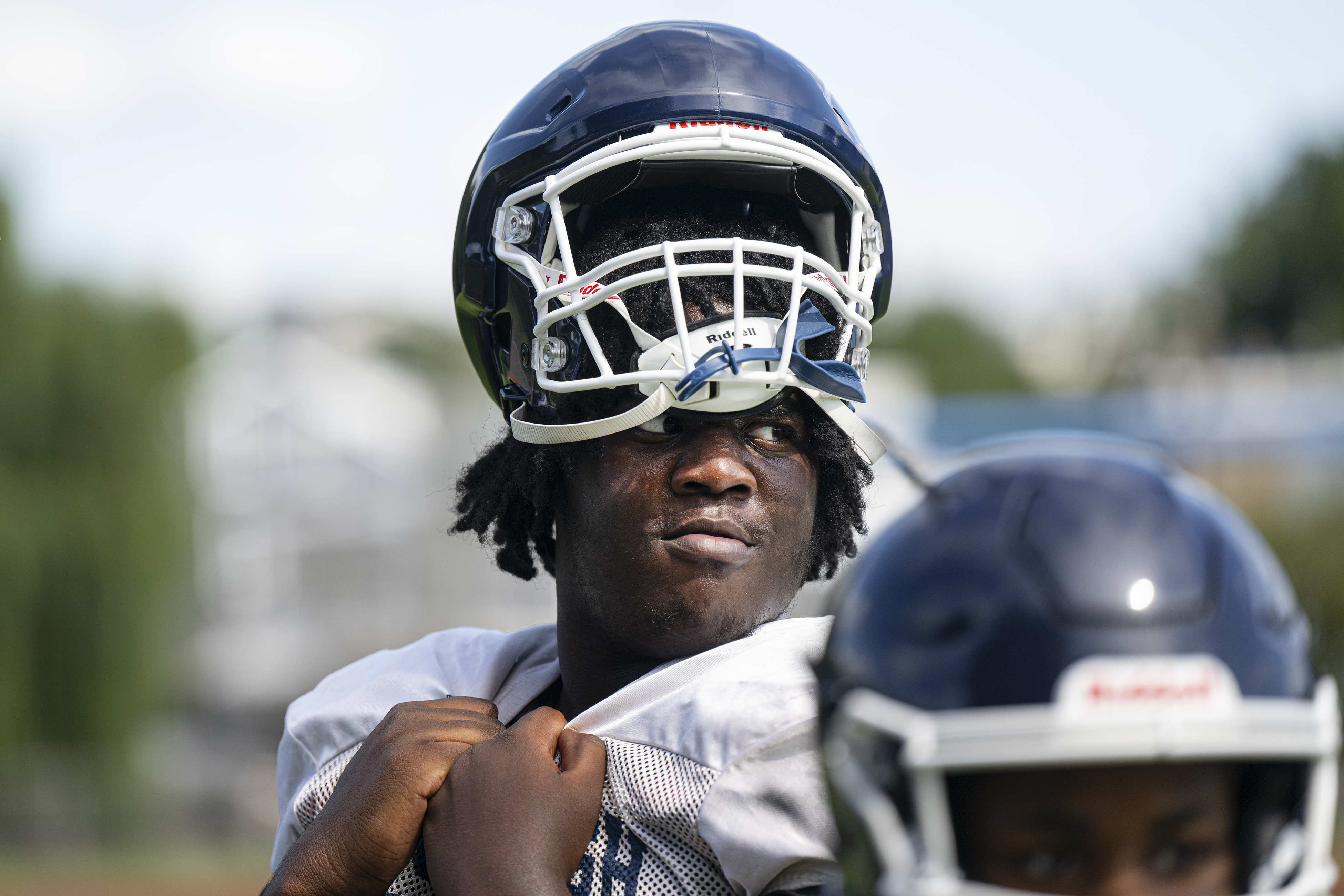
But none of the 35 or so members of the current Roxborough football team were there because they all were in junior high school. Two captains, senior defensive end Zaid McDonald and senior quarterback Javon Jones, said they certainly know about Nick even though they never got a chance to meet him.
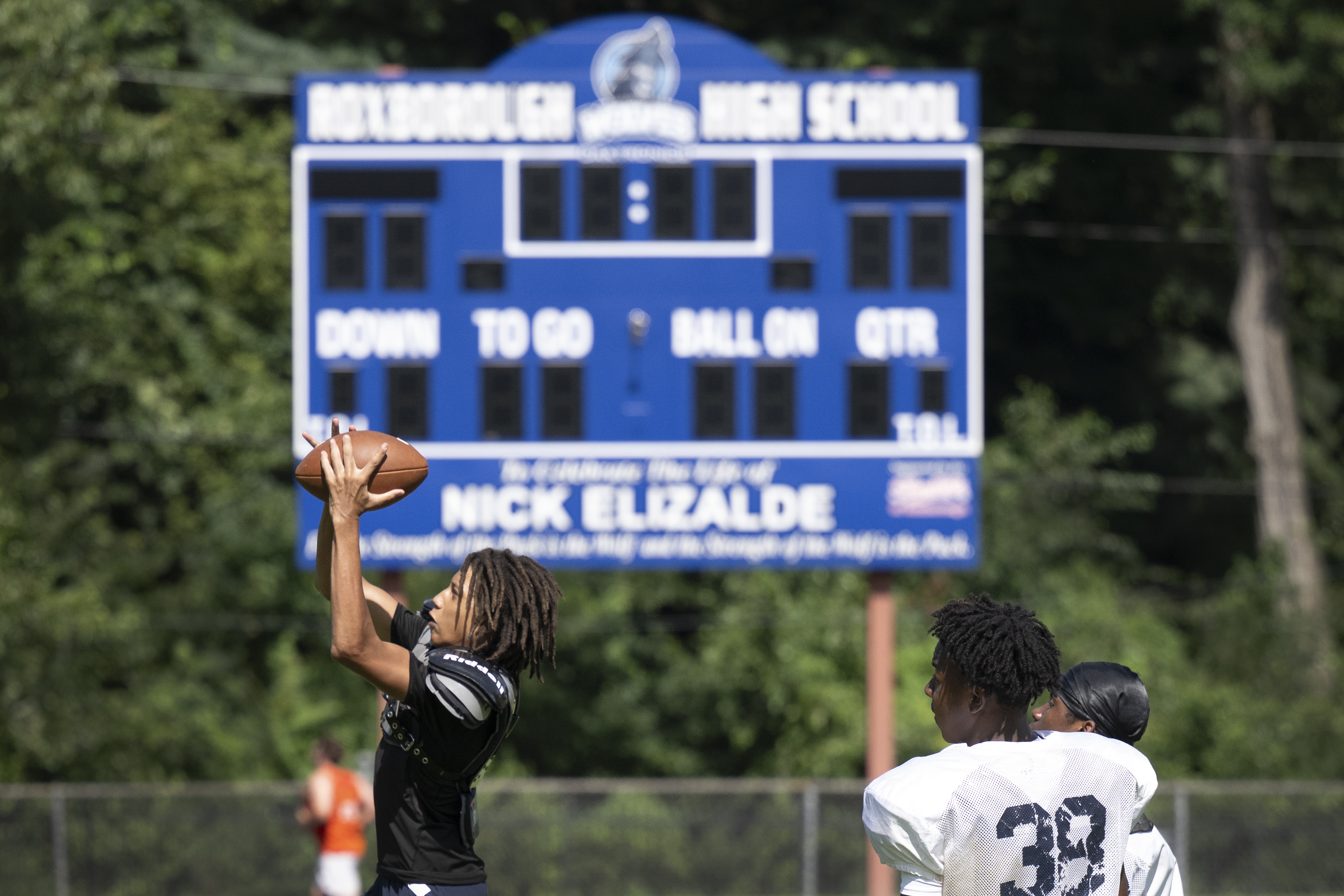
There is a new mural with a large “62” — Nick’s jersey number — at the back of the school, and a new scoreboard at the field celebrating Nick. Skinner said he was planning to put No. 62 stickers on the players’ navy-blue helmets before Friday’s season opener.
Roxborough High School football players gather for on-field drills during an after-school practice Aug. 21 at Nick Elizalde Stadium.Jose F. Moreno / Staff Photographer
But make no mistake: The Roxborough Wolves are excited about their chances this season. Last year’s team won four of its 11 games, and the first winning season in seven years feels within reach. As Jones said of the 2025 season, “I feel like we got better as the season went on.”
McDonald would add, smiling, “Playing for Roxborough — oh, you really got to work, because not everyone is on the same level.”
Of 571 high school football teams in Pennsylvania, Roxborough ranked 514th entering the season, according to the MaxPreps ratings website. But the Wolves, like the 570 other teams, will start each game this fall with a 0-0 score and a fighting chance.
And I, for one, hope to be at as many Roxborough games as I can. I live a 20-minute walk from the stadium, and as someone who both played and then wrote about high school football way back in the day, the competition is as spirited and ferocious here as anywhere. Really.
It is just that the backdrop is a little different. Games tend to be played Friday after school. Admission is free. Seats in the 2,100-seat grandstand, with a fence still separating Roxborough fans from visiting fans, are easy to find, because 100 people, tops, might show up. There is a dance team on occasion, but there are no lights, no refreshment stand, no press box, no programs, and no marching bands. The patchy grass gridiron is lined only every 10 yards.
Roxborough football coach Marc Skinner leads his team during practice on Aug. 21. Of the Wolves’ 4-7 record last year, one player said, “I feel like we got better as the season went on.”Jose F. Moreno / Staff Photographer
How some things have changed. The Academies at Roxborough High School, the full name of the stately, 102-year-old institution on Ridge Avenue in Northwest Philadelphia, has an enrollment of only about 600 students, less than one-third the school’s size in 1972.
The stadium, built for $300,000 by the Works Project Administration, opened on Oct. 7, 1939, for a 14-0 Roxborough victory over Olney. About 3,000 showed up, The Inquirer reported. It was Roxborough’s first game in the Philadelphia Public League.
The very next year, a full-out riot broke out after players from Roxborough tangled with players from Simon Gratz during a 33-0 Roxborough victory, with many fans joining in. Three Philly cops were needed to help the two flustered head coaches break up the melee.
Roxborough won Public League titles in 1957 and 1963, but it had become an also-ran in recent years. A Thanksgiving Day game against Roman Catholic ended in 2018 because Roxborough had not won since 1991, and lost each of the last 14 games by three touchdowns.
Skinner, who became the head coach in 2023, said turnout for football slipped during the pandemic and after the shooting, with a few potential opponents telling him they’d rather not play at Roxborough. The besieged 2022 team won its only game 11 days before the shooting.
Each of the 35 or so members of the current Roxborough football team was in junior high school when Nick Elizalde was fatally shot four years ago following a scrimmage at the school.Jose F. Moreno / Staff Photographer
“We have kids from different walks of life, and we’re bringing them together to do something they thought they could never do,” Skinner said.
A year after the shooting, the school changed its nickname from Indians to Wolves. The wolf was Nick Elizalde’s “spirit animal”: For the strength of the pack is the wolf, and the strength of the wolf is the pack, reads an inscription under his name on the new scoreboard.
Kristin Williams Smalley, the principal at Roxborough, told me two years ago that the school had been considering a new nickname, and she said: “The mascot was not necessarily named to honor him. It just happened that all of the stars aligned, and the wolf was selected.”
But the name change helped to reset, or refocus, the football program, Skinner said. Because of suspensions and academic ineligibility, Roxborough had only 17 players for a game last year against Olney. But the Wolves stuck together, played hard, and lost by only 22-7.
“Upon further reflection, the wolf is the perfect mascot to represent the Academies at Roxborough High School,” Williams Smalley said. “Wolves are complex, highly intelligent animals who are caring, playful, and above all devoted to family. That is who we are!”
Roxborough football player Domenick Washington, a defensive tackle, looks on during practice on Aug. 21.Jose F. Moreno / Staff Photographer
He and his small staff will do the best with who shows up. These Wolves have worked hard, and together, during the offseason, he said, but there are still a few students each year who only decide to join the football team after school starts. Skinner brings them on. Nick was a student at Saul High School, but because it doesn’t have any athletic teams, he played for Roxborough.
The players on this team were too young to be around, but the coaches and many former players did know him, and could recall that awful afternoon in 2022. It needs to be remembered, but as Skinner says, “We just try not to dwell on it.”
So, click-clacking on their cleats, the players trudge up and down that hill on Pechin Street, past the site of the shooting. Four other teenagers were wounded on that awful day, and six people were arrested in connection with the shooting. The memorial to Nick serves as a reminder that the impact of gun violence is not so far away.
Nick Elizalde, 14, waiting for the bus before his first day of ninth grade at Walter B. Saul High School in August 2022. Because Saul doesn’t have its own athletic teams, Nick played for Roxborough. Meredith Elizalde
“We’re trying to keep our eyes open in the hope that our children are not involved in anything bad,” said Skinner, who is a member of the “climate staff” that keeps order at the school.
Students come from all over the city: Zaid McDonald is from Germantown, and Javon Jones is from North Philadelphia. Each would love to go on to play college football, but the opportunity would come at a small school if it did, and Jones said he would go to trade school if it did not.
But football is there for at least the next three months. A winning season and the playoffs are possible, just as they are for any of the state’s other 570 teams. And that is all any high schooler can ask for. Go see for yourself some Friday afternoon. Watch kids play football with joy.
Dave Caldwell lives in Manayunk and covered sports for The Inquirer from 1986 to 1995.
When Ryan Leithead’s son Cayden died at just 7 days old in 2022, he channeled his grief into making something. Alongside West Pikeland Township officials, Leithead worked for weeks, mostly in freezing rain, to build what became Cayden’s Corner, a sandpit play area at Pine Creek Park’s playground.
A dedication sign, with a photo of Cayden’s little hand encircled by his parents’, notes that the hope is “that this sandbox sheds some light on his memory and brings joy to many children for years to come.”
It offered a glimmer of light amid a tragic, unexpected loss. Leithead’s oldest son, 6, and daughter, 2, play there often. “It’s kind of like they’re playing with their brother because they’re there,” he said.
But now, just a few years later, Leithead, 37, worries the memorial will be swept up in proposed playground renovations, which are the subject of several grants and public fundraising efforts to update the decades-old equipment and make the site more accessible. Final plans haven’t been released yet, but officials say it could involve relocating the sandpit and replacing the memorial.
For Leithead, it feels like losing Cayden again.
“It was built by those who loved Cayden. It kind of goes into that term of ‘grief in action,’” he said. “I spent the first year after he died kind of focusing on this — right, wrong, or indifferent, that’s how I grieved. So it’s a memorial built by his father.”
The elected board of supervisors will vote on the proposal and plans “when they are available,” said Joan Blatcher, township manager. Completion of the full renovation is anticipated for mid-2027, she said.
“The intention behind Cayden’s Corner was to provide a memorial for Cayden Leithead. If the sandpit is relocated, it will continue to be called Cayden’s Corner,” she wrote in an email. “The benches and a dedication explaining the reason for the name have always been part of the plan for the new playground.”
After his son Cayden died at just seven days old in 2022, Ryan Leithead worked with West Pikeland Township to build a sandpit in honor of Cayden’s memory. Under proposed renovations of the playground, officials are considering relocating the sandpit and removing the existing dedication sign.Photo courtesy of Ryan Leithead
Leithead isn’t against renovating the playground. When he helped bring the sandbox to life, seeing the whole playground renovated was something he hoped for. His work with the project is also how Leithead became involved with the township’s parks and recreation committee. But he struggles with the idea of relocating or altering the memorial they built in the early days of that grief.
“The analogy my wife used was: Say you have a wedding ring that was a family heirloom for generations, and you lost it, and your husband turns around and says, ‘Well, I’ll just buy a new one, it’ll be bigger and better,’” he said. “It’s not the same, right? You lose the meaning behind that heirloom.”
At a meeting on Aug. 17, vice chair of the supervisors Noreen Vigilante said that the sandpit was within the “fall zone” of the swing set, according to a recording shared with The Inquirer. A preliminary design, which the township hasn’t released, would relocate the sandbox and make it bigger. A recording of the public meeting is not available online.
She also mentioned removing the existing sign dedicating the corner, saying that the playground designers felt it was “depressing.” Signage would still be there, later saying they could “negotiate” the sign, but not the sandpit’s placement.
In an email, Vigilante said that in early meetings “it was requested that the playground not be moved.” Leaving the sandpit where it is “severely limits the opportunities for a safe and accessible design.”
The sign, she said, is a “trigger for others who have also lost children or have family members who have lost children.”
“The sign is so large and centrally located that it cannot be avoided if it makes one uncomfortable. An alternative is to have a smaller sign with the same text by the tot lot/sand play area of the playground so that those who may also be grieving do not have to look at the sign when they are attempting to enjoy a playground with other children,” she wrote. “A playground should provide the opportunity for adult-child enjoyment.”
During the meeting last week, officials said they hadn’t heard of any complaints about the signwhen the Leitheads asked. Separately, Leithead said the purpose of the sign was “to honor Cayden’s life and to show how a community came together to support a grieving family.”
Other supervisors disagreed with the playground designers’ assessment.
“I don’t care what the playground people think,” supervisor Harold Hallman III said at the meeting. “It’s a park of West Pikeland playground. It’s a part of West Pikeland. It should stay there.”
An early supporter of the memorial plaque and sandpit, Vigilante wrote in an email that she continues “to support the sandpit and a memorial plaque in the playground.”
“However, I feel very strongly that in my role as a township supervisor, I have an obligation to represent all of the residents/children of the township and that all children of all abilities should have safe access to a playground,” she added in an email.
A Facebook page, Preserve Cayden’s Corner, has collected just shy of 100 members, asking fellow residents to push back on the proposed relocation.
The board will meet next on Tuesday, Sept. 8.
Blatcher, the township manager, said that officials have “had multiple conversations with the family” and said it will share the plans with the family when they’re available. Leithead said he hadn’t heard about the possible relocation officially from the township; he approached them at August’s meeting after hearing about the possibility through someone else.
Blatcher wrote that Vigilante championed the proposed renovation, helping secure a second grant for $230,000 and has been “instrumental” in raising more than $65,000 in private donations to cover what the grants don’t.
“The updating of the playground is for the benefit of all West Pikeland Township’s residents and will make the playground ADA accessible and allow more children to access the full play area, including the sandpit,” she said.
Leithead said he just wants the ability to weigh in on the design, saying it wouldn’t be hard to modify the existing sandpit to be ADA accessible, or to relocate the swing set to keep the sandbox out of the fall area.
“We would have never built this three years ago if they said there is even a 1% chance that, ‘Oh, when we redo the playground, we’re going to have to move it,’” he said.
This suburban content is produced with support from the Leslie Miller and Richard Worley Foundation and The Lenfest Institute for Journalism. Editorial content is created independently of the project donors. Gifts to support The Inquirer’s high-impact journalism can be made at inquirer.com/donate. A list of Lenfest Institute donors can be found at lenfestinstitute.org/supporters.