Blog

  • Minnesota school faces threats after Trump posts clip of Somali kindergartners

    Minnesota school faces threats after Trump posts clip of Somali kindergartners

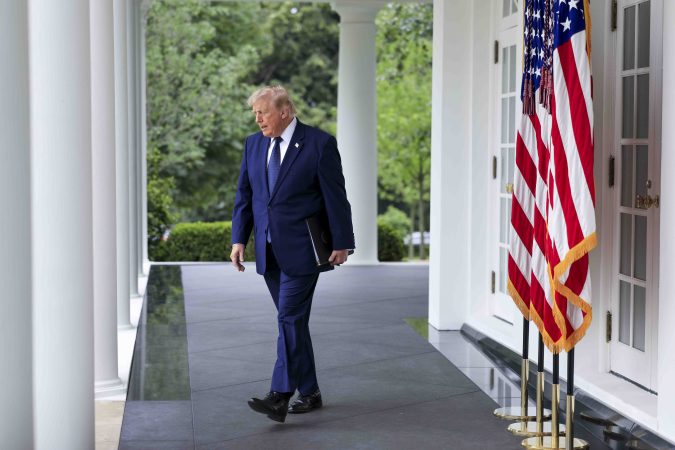
    Hateful emails and phone calls targeted a Minnesota school serving Somali families after President Donald Trump shared a video of its kindergartners on Truth Social this week, an episode that many Somali Americans see as an escalation of a sustained campaign of political and rhetorical attacks during Trump’s second term, community leaders said.

    On Wednesday, Trump reposted a video from a kindergarten graduation ceremony at Gateway STEM Academy, a K-8 charter school in St. Paul. In the clip, children wearing blue graduation gowns, including girls wearing hijabs beneath their mortarboards, sing in Somali as they celebrate the end of the school year.

    Trump amplified another user’s caption: “Every girl is in a hijab … in kindergarten.”

    The faces of the young children were clearly visible in the video shared with Trump’s 12.9 million followers. Members of the Somali community said that exposure could open the door to attacks on some of the community’s most vulnerable members. The replies to Trump’s post quickly filled with anti-Muslim invective, including one user who called the children “future terrorists.”

    For many Minnesotans of Somali descent, the post was the latest salvo in a monthslong campaign in which Trump has repeatedly singled them out while his administration has mounted an aggressive immigration and law enforcement operation in the Twin Cities.

    “The first term of Donald Trump was a cakewalk compared to this,” said Suleiman Adan, deputy executive director of the Council on American-Islamic Relations’ Minnesota chapter. “In the first term, you saw attacks on equality, belonging, and justice. In the second term, it’s an attack on basic human dignity. Right now, the crosshairs are on the Somali community.”

    Adan said he and other advocates had been in contact with officials at the school, who told them they have been contending with hateful emails, phone calls, and social media posts.

    Reached Friday, the White House did not directly address questions about the president’s decision to share the video, the harassment the school says followed, or concerns about posting identifiable children to millions of followers.

    “President Trump is right,” White House spokesperson Abigail Jackson said. “Aliens who come to our country, complain about how much they hate America, fail to contribute to our economy, rip off Americans, and refuse to assimilate into our society should not be here.”

    The ceremony featured in Trump’s post took place on the last day of school for the rising first-graders, who have not been back to the building since, Adan said.

    The school is mulling safety measures for when classes restart. The incident has also increased concern around Saturday schools that teach Somali language and culture.

    Gateway STEM Academy’s parent handbook describes the school as a STEM-focused charter that seeks to “embrace” students’ cultural backgrounds and encourages family participation in cultural celebrations, while emphasizing academic rigor, attendance, and discipline. It also offers Arabic among its electives alongside science, technology, and math programming.

    The video featured in the social media post began as a recording of an ordinary school celebration before ricocheting through the online right. The song, in Somali, is benign: it speaks of the pride of being a student, the joy of reaching a milestone, and hopes for continued success, said Malika Dahir, the executive director of Reviving the Islamic Sisterhood for Empowerment.

    Members of the Somali community routinely stream milestone moments for friends and relatives who live in other countries or states, Dahir added.

    “There isn’t a graduation or a wedding that isn’t livestreamed,” she said. “We share these online, because family members are all over the world. It’s a way to share momentous occasions. To feel like now these moments might be weaponized, there’s just a sense of loss, like our joy has been stolen.”

    The video was circulated by End Wokeness, an influential conservative social media account, with a caption drawing attention to the girls’ hijabs. Trump reposted the clip, first without explanation and later with the account’s caption attached.

    The post was consistent with Trump’s frequent use of Truth Social to share racially charged, often inflammatory, imagery. Earlier this year, his account posted a video depicting Barack and Michelle Obama as apes, which was deleted after bipartisan condemnation. He later shared a doctored image of the Obamas beside a graffiti-covered Air Force One bearing “BLM” and Arabic writing.

    Minnesota is home to roughly 80,000 people of Somali descent, the largest Somali community in the United States. Trump has repeatedly singled out Somali immigrants during his second term, seizing on a series of sprawling fraud investigations involving state and federal social-service programs. Many of those charged are Somali or Somali American.

    The largest fraud allegation centered on a nonprofit whose operators and affiliates were accused of diverting about $250 million from a federally funded child-nutrition program. Federal prosecutors have also brought separate cases involving programs intended to provide housing assistance to vulnerable adults and therapy for children with autism. Prosecutors say defendants used some of the money to buy cars, real estate, and other personal luxuries.

    Trump has used the scandals to justify large-scale federal intervention in Minnesota, dispatching thousands of immigration officers to the Twin Cities in an operation that extended well beyond the people accused of fraud. The deployment prompted weeks of protests and confrontations between agents and residents.

    During the operation, federal officers fatally shot Renée Good and Alex Pretti, both 37-year-old U.S. citizens, in separate encounters that were captured on video and became flash points in the national debate over Trump’s immigration crackdown.

    The administration subsequently changed leadership of the operation and began drawing down the federal presence. In February, border czar Tom Homan announced that 700 officers would leave Minnesota, although he attributed the withdrawal to increased cooperation from state and local authorities rather than directly to the shootings.

  • Trump and Iran’s supreme leader trade threats as mediators try to save their crumbling deal

    Trump and Iran’s supreme leader trade threats as mediators try to save their crumbling deal

    DUBAI, United Arab Emirates — U.S. and Iranian leaders traded threats on Saturday as the interim deal to end the war buckled under crossfire in the Middle East and efforts continued to keep talks going.

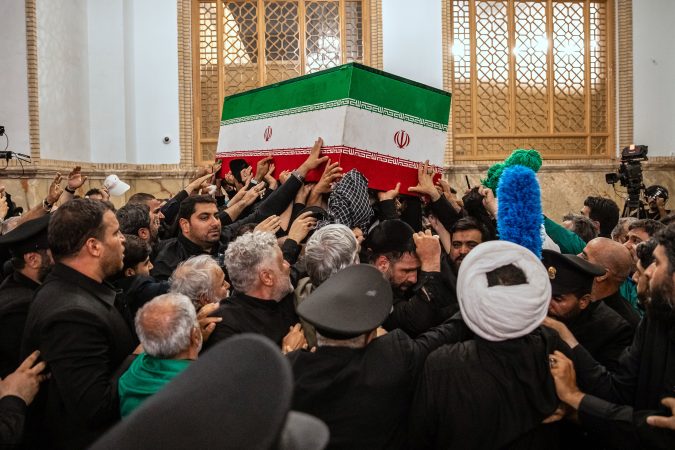
    President Donald Trump overnight made threats on social media of further missile attacks against Iran, after the funeral of Supreme Leader Ayatollah Ali Khamenei saw open calls for the U.S. leader’s killing. Senior U.S. officials demanded that Iran make a public statement saying the Strait of Hormuz is open and ships won’t be attacked.

    Later, Iranian Supreme Leader Mojtaba Khamenei vowed that Iranians would continue to avenge his father’s death. Such revenge “is the will of our nation and must certainly be carried out,” he said in remarks carried by state television. He still has not been seen publicly since the war began on Feb. 28 with strikes that killed his father.

    Tehran has insisted that the strait remain under its control and that it be allowed to charge ships moving through it, a stance it took after the war began.

    The exchange of threats followed days of U.S. airstrikes targeting Iran, sparked by Iran’s attacks on three ships in the strait, and Iranian retaliatory fire targeting Arab nations in the region.

    Trump has declared the ceasefire over but said the U.S. would continue negotiations. Iranian Foreign Minister Abbas Araghchi on Saturday traveled to Oman, located on the other side of the strait, for more talks, a day after Qatari mediators met with officials in Tehran.

    Trump says he responded to threats to kill him

    A thousand “missiles are Locked and Loaded and aimed at the Islamic Republic of Iran, with thousands more to immediately follow, should the Iranian Government act on its threat,” Trump wrote on his website.

    He said he was responding to threats “to assassinate, or attempt to assassinate” him. During Khamenei’s funeral, mourners held posters or banners calling for Trump to be killed along with Israeli Prime Minister Benjamin Netanyahu. Iran buried Khamenei, 86, this week.

    Trump added that the U.S. military would “completely decimate and destroy all areas of Iran — PRAISE BE TO ALLAH!”

    Trump has repeatedly invoked the name of God in Arabic, and threatened to destroy Iran’s very civilization. The Council on American-Islamic Relations, an advocacy group, has criticized Trump’s “deranged mocking of Islam.”

    Iran accuses Washington of violating the interim deal

    Iran’s foreign minister accused the U.S. of violating the interim deal by ending waivers allowing Iran to sell crude oil on the open market in U.S. dollars. Washington ended them in response to the attacks on ships in the strait.

    “Reality check: There can only be mutual compliance,” Araghchi wrote on X.

    He was scheduled to meet with his counterpart in Oman. Turkish Foreign Minister Hakan Fidan told his country’s state broadcaster, TRT, that he believed “a solution can be reached” this weekend between Iran and Oman.

    The U.S. urges mariners to travel through the strait on a southern route, through Oman’s territorial waters. Iran has said the strait must be under its sole control and that vessels should begin paying fees to Tehran. The world for decades has considered it an international waterway.

    About a fifth of all traded oil and natural gas passed through it before the war began. Iran’s grip on the strait during the war led to a global energy crisis, though oil prices have sharply dropped since wartime highs of $120 a barrel.

    Tehran’s diplomat at the United Nations said on Friday that any activity in the strait, including its opening or demining operations, “rests exclusively with Iran.”

    U.S. officials accuse hard-liners of trying to sabotage deal

    U.S. officials, speaking on condition of anonymity about the current situation with Iran, said the resumption of strikes this week came after what they described as a rogue faction of Iranian hard-liners tried to sabotage the ceasefire.

    However, Iran has insisted its theocracy is unified under the new supreme leader.

    After the U.S. wrapped up its latest strikes on Thursday, more attacks reportedly hit Iran, raising questions about who else may be targeting the Islamic Republic.

    Israel didn’t claim them, meaning the Gulf Arab states may have launched them, likely as a means to deter Iran from attacking them again. Iran on Thursday retaliated for U.S. strikes by targeting Bahrain, Jordan, Kuwait, and Qatar.

    The strikes in Iran over two days killed at least 17 people and wounded 115 others, Iranian Health Ministry spokesperson Hossein Kermanpour said.

    U.S. says nuclear deal will require Iran to turn over enriched uranium

    The U.S. officials told journalists the U.S. would never reach a nuclear deal with Iran if it does not first stop its attacks on ships in the strait.

    They also said any deal on Iran’s nuclear program would require Tehran to turn over its stockpile of highly enriched uranium. That’s something Iran has repeatedly refused.

    If the U.S. doesn’t reach a deal with Iran to turn over the material, it has military options to ensure that it remains buried underground forever, the officials said. They did not detail them.

    The uranium, enriched to near weapons-grade levels, is believed to be at nuclear sites the U.S. bombed in 2025. Iran long has insisted its nuclear program is peaceful, though the International Atomic Energy Agency has said the Islamic Republic is the world’s only country to enrich uranium so highly without a weapons program.

  • Times journalists subpoenaed as Trump escalates pressure on media

    Times journalists subpoenaed as Trump escalates pressure on media

    The Trump administration issued subpoenas Friday to several journalists for the New York Times, after the news outlet reported this week on security concerns involving President Donald Trump’s new Qatari-donated Air Force One.

    The subpoenas — which seek to force the reporters to testify before a federal grand jury in New York on Wednesday — were an extraordinary escalation in Trump’s efforts to threaten and intimidate independent news organizations.

    In some cases, the subpoenas were delivered by federal agents who showed up at reporters’ homes.

    The Times denounced the administration’s actions.

    “The appearance of federal law enforcement agents on the doorstep of news reporters should shock the conscience of any American who believes in the Constitution and the press freedom it protects,” David McCraw, the Times’ top newsroom lawyer, said in a statement Friday evening.

    “Our journalists report the facts and advance the American public’s right to know how their government is operating and their taxpayer dollars are being used,” McCraw wrote. “This brazen act should be seen as nothing more than an attempt to prevent the public from knowing what is happening in their country by intimidating journalists from doing their jobs.”

    The subpoenas contain few specifics, asking only that the journalists testify “in regard to an alleged violation of federal criminal law.” They were issued by Jay Clayton, the U.S. attorney in Manhattan. Clayton, who leads one of the country’s most prominent law enforcement offices, was recently nominated by Trump to serve as director of national intelligence.

    Representatives for the White House and the U.S. attorney in Manhattan did not immediately respond to inquiries Friday evening.

    The Times journalists who received subpoenas included Julian E. Barnes, Eric Lipton, Tyler Pager, and Eric Schmitt, who reported Wednesday that Trump had departed Turkey on the old Air Force One as a security precaution at the urging of the Secret Service. On Thursday, the Times reported that the new Air Force One, a Qatari-donated Boeing 747-8, lacked some of the advanced security features of the older aircraft, including anti-missile capabilities. Both articles cited sources who spoke on the condition of anonymity to discuss sensitive security issues.

    Before the Wednesday article was published, a senior official at the FBI contacted the Times to ask that the article be held, calling it an issue of national security, according to a person familiar with the conversation. The FBI official spoke with a reporter and a senior editor in the Times’ Washington bureau; the official declined to explain the security issue when asked. (A spokesperson for the Times, Charlie Stadtlander, confirmed the account.)

    Trump has long been a harsh critic of the news media. But in his second term in office, he has moved aggressively to use the immense powers of the federal government in his efforts to attack the press.

    Earlier this year, the Justice Department sought to compel testimony from journalists at the Wall Street Journal and the Washington Post. The Justice Department withdrew the subpoenas after both news organizations fought back in sealed filings.

    Both Democratic and Republican administrations have initiated leak investigations into the disclosure of classified information. But subpoenas aimed at journalists are not common, and First Amendment advocates say they can chill the work of news gathering.

    In January, FBI agents took the rare step of searching the home of a Washington Post reporter, Hannah Natanson, as part of an investigation into a government contractor’s handling of classified material. The agents seized phones, laptops, and a smartwatch after executing a search warrant. Natanson had spent months speaking with government employees while reporting on the Trump administration’s efforts to shrink the federal workforce.

    The Times is a party to several lawsuits involving Trump and his administration.

    The president sued the Times last year, accusing it of defaming him, disparaging his reputation, and seeking to undermine his 2024 candidacy.

    In December, the Times sued the Defense Department after it imposed restrictions on reporters who cover the military. The company sued again after the agency reduced reporters’ physical access to the Pentagon.

    In May, the Equal Employment Opportunity Commission sued the Times, accusing it of employment discrimination. On Friday, the Times filed a counterclaim, saying the lawsuit was an act of retaliation for its coverage of the Trump presidency and a violation of its First Amendment rights.

    This article originally appeared in the New York Times.

  • Trump denies this Congress what could be its last major bill-signing ceremony

    Trump denies this Congress what could be its last major bill-signing ceremony

    Invitations were sent. American flags lined the back of the red stage set in Statuary Hall. Bright spotlights lit the signing table donned with the presidential seal.

    President Donald Trump so abruptly canceled what might have been the last major presidential signing ceremony of this Congress that it caught lawmakers, top aides and housing industry officials all completely by surprise.

    Trump said he would not sign the bipartisan 21st Century Road to Housing Act, but it went into law anyway on Friday without his signature.

    The axed signing ceremony delivered Trump’s punishment of lawmakers for failing to pass his bill to limit voting rights ahead of the midterms, even though the housing bill represents the most significant housing legislation since the aftermath of the financial crisis.

    Trump doubled down on his decision not to sign the bill in a Truth Social post Friday morning.

    “I will not sign the Housing Bill, which has been fully approved by Congress and sent to the White House, in PROTEST over the fact that the United States Senate is not capable of passing THE SAVE AMERICA ACT,” Trump wrote. “THE SAVE AMERICA ACT’S non-passage is CRAZY, and a serious threat to any politician who votes against it!”

    Trump’s decision to ax the signing ceremony, and his comments referring to the bill as a “yawn,” represent a missed opportunity for lawmakers and the president to demonstrate to Americans that they are addressing their affordability concerns, some congressional watchers say.

    “This is the exact kind of bill they want to point to and say Republicans are working on issues that their voters care about, and Democrats would want the same,” said Julian Zelizer, a history and public affairs professor at Princeton University. “That’s not the signal that the administration is sending.”

    One housing leader who received an invite to the ceremony from House Speaker Mike Johnson’s office said they were on the way to the event in their Lyft when they received a text with a screenshot of Trump’s post that read: “Today’s Housing News Conference and Signing is hereby cancelled until such time as we pass the desperately needed SAVE AMERICA ACT.”

    The housing leader, who spoke on the condition of anonymity, said they then received an email from the speaker’s office shortly after. The housing leader’s first reaction: “incredibly disappointed, but not shocked.”

    One business lobbyist who was set to attend the signing ceremony was standing on the Capitol steps, when another attendee told them to check their email, as the event was canceled. Seconds later they received a message with a screenshot of Trump’s Truth Social post.

    “When I found out the reason why, it was disappointing, but it wasn’t shocking,” said the lobbyist, who spoke on the condition of anonymity. “With the president in the White House, things can happen on a dime.”

    Trump’s last-minute decision to cancel the signing ceremony represents a broader pattern of the president suddenly reversing course on policies previously deemed a priority, including a canceled public signing ceremony in May for an executive order to create a system to vet powerful new AI models before they are released publicly. Trump ultimately signed a revised version of the order weeks later.

    Lawmakers were equally blindsided by Trump’s decision on the housing bill. Especially considering that Senate Republicans had already expressed they lacked enough support to pass the Save America Act, which would impose stricter election rules.

    House GOP leadership was in the middle of a news conference when Trump canceled the ceremony on social media. House Financial Services Committee Chairman French Hill (R., Ark.) had just discussed his work with Senate Banking Committee Chairman Tim Scott (R., S.C.) to get the bill through both chambers.

    When Johnson opened the floor for questions, a reporter notified him of Trump’s social media post. When asked if Trump would sign the bill at a later date, Johnson said, “It’s my estimation he’ll do it within that 10-day window.”

    A president has 10 days, excluding Sundays, to either veto or sign a bill after they receive it from Congress. If the president does not act within the window, the bill automatically becomes law if Congress is in session. So Congress is poised to notch a concrete legislative achievement to tout on an issue widely expected to loom large in the midterm elections.

    Johnson sent the bill to Trump on Monday, June 29, which meant the 10-day window closed at the end of Friday at midnight.

    While many housing advocates have said the bill does not go far enough to address the nation’s housing shortage, they argue it is an important first step.

    The bill, which received overwhelming bipartisan support in Congress, would bar institutional investors from buying more than 350 single-family homes, expand federal grant programs to give cities money for building new homes and eliminate an outdated federal construction rule to make manufacturing mobile homes cheaper, among other measures.

    Zelizer said Trump’s negative comments about the bill could make it more difficult for some lawmakers, particularly vulnerable Republicans, to sell that idea to voters.

    The business lobbyist who was planning to attend the signing ceremony said the cancellation and Trump’s comments hurt the positive momentum around the bipartisan success in passing the bill, but they don’t see that having much sway on Americans’ minds on the matter.

  • Allentown’s gift to golf, Rich Lerner, and the book that reveals his ribald side, with Tiger, Phil, and Jack

    Allentown’s gift to golf, Rich Lerner, and the book that reveals his ribald side, with Tiger, Phil, and Jack

    The most pleasant surprise of the recent memoir from the most elegant studio host in sports is, deliciously, all of the boobs and balls and cussing.

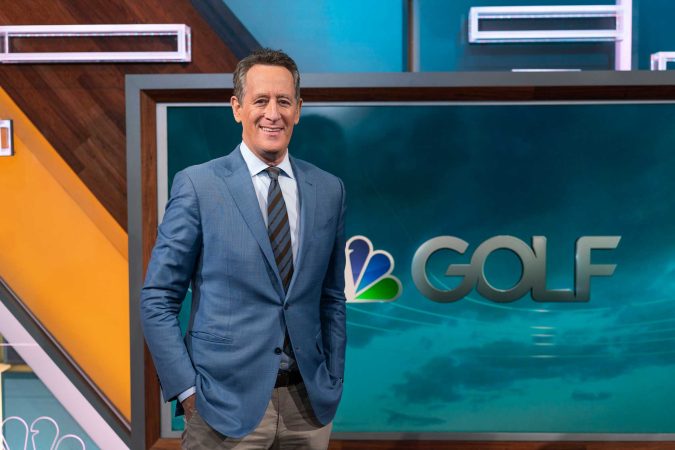
    “Did you find it too racy?” Rich Lerner asks, bemused but earnest, as if the aristocracy at the exclusive, tennis-whites Philadelphia Cricket Club might look sideways at him during the party that is to follow. He uncrosses his legs, adjusts the perfect collar of his white shirt tucked just inside his slim, tailored blue blazer, and grins like a little boy proud of his mischief.

    No. I found it authentic. Him naked in a Scottish bathtub, him learning the ways of the world from the profane teaching pro at his dad’s pitch-and-putt in Dorneyville, Pa., him wisecracking with Tiger Woods in much, much happier times.

    Still, why push the envelope with “Aren’t you that Golf Guy?”? Why risk the 30-year reputation of the man who, as the voice of diplomacy and reason on The Golf Channel, has steered the game through the perilous waters of Tiger and LIV and Phil?

    “Because that was my experience, and I wanted to be authentic,” Lerner said. “This was not going to be ‘polished Rich’ at the desk. This was going to be Richie in the newsroom, Richie in the compound, Richie with his friends, Richie growing up — schticky, schticky Dicky.”

    Lerner has served in various roles at the Golf Channel, most recognizably in marathon sessions of Golf Central: Live From at golf’s biggest tournaments. On that set, analysts dissect each day’s topics with the finesse of a chainsaw, while Lerner more steadily guides them through the wilderness with nudges of stiletto wit.

    Lerner generously addresses Phil and LIV and, of course, Tiger, Tiger, Tiger. At 65 and still brimming with energy, he’d set out to write a Tiger book but there was so much more to his three decades on the set and his six decades in the game.

    Besides, who needs another Tiger book when you can write a book about the greatest broadcaster to come out of the Lehigh Valley? Perhaps — with apologies to Ernie Johnson, who babysits Shaq and Charles — the best sports studio host on television?

    That’s what Lerner ignores in the book, subtitled “Doglegs and Detours from a Life in the Game.” He affects complete avoidance of his colossal presence in the bigger picture of the game. His typical and innate humility serves only to amplify his significance. Jim Nantz and Mike Tirico deliver the live action with trademarked flair that may or may not be contrived, but neither has to act as referee to the two most brilliant and relevant analysts in sports, former pro golfers Brandel Chamblee and Paul McGinley.

    It’s hard to put down but easy to set aside and pick up again. It’s great for the beach, the bathroom, or the briefcase, if you travel for work. When it’s light, it’s as light as cotton candy, and he radiates the joy of the game both in the book and in the flesh.

    It isn’t all light; ever less so these days, it seems. The stickier subjects affect Lerner far differently. In speaking with The Inquirer at Cricket in the moments before the event, Lerner delighted in culinary discussions concerning Yocco’s hot dogs (IYKYK) or Dalessandro’s cheesesteaks, one of which he was gnawing, standing up, when I walked into the ballroom.

    Temple grad and Allentown native Rich Lerner (left) with The Golf Channel analyst Brandel Chamblee. NBC Sports

    But when the talk turned to Tiger, who just went through rehab again, and Phil, whose spiraling disgraces have attained a level of surreality, Lerner became subdued, like a man whose gifted children have lost their way.

    “I think it’s sad,” he said.

    He looked sad.

    He seems especially troubled about Mickelson’s issues and choices, clearly because Lerner, who adored Arnold Palmer (Golf Channel’s co-creator), knows the game needed its next Arnie, and, just as clearly, the next Arnie was Phil. But then came LIV, and now there are allegations of sexual misconduct, and it appears that Mickelson’s window is closed.

    “When he should have been embraced — he should have been the Ryder Cup captain, probably twice. You can just keep going,” Lerner said. “He would have had that Arnold Palmer ambassadorship — show up at a major when you’re 65 and hold court, reminisce about the shot you hit off the pine straw in 2010 — that was his.

    “America’s a forgiving country. You never say never, but at this point, he seems adrift.”

    Lerner offered that piece of poignancy off the cuff Monday night. He writes it even better in the book, especially in the chapter, “Impossible to F— Up.” Spoiler: Phil F—’s it up.

    Lerner is golf’s chief negotiator. He is a conciliator at his core. He loves the game as much for its inherent morality as for its incredible, rewarding difficulty. The difficulty remains even as the morality leeches away.

    This turmoil, for him, is torture.

    He grew up in the game, twice a champion at old Berkleigh Country Club out in Kutztown, a real-life Danny Noonan, 6-foot-4 and lean and complete with the thick, unruly hair. He began college at Lehigh, recalibrated to Temple, became a local TV legend young — well, I’ll let him tell that story. He’s so good at it; his video essays on The Golf Channel are masterpieces of depth and nuance, and his autobiographical descriptions of the people who made and make him are just as good.

    You’ll meet grateful firefighters and graceless pro-am hacks and a couple who fostered at least 80 children, which was my favorite part of the book.

    You’ll learn he loves basketball — Big 5 legend Fran Dunphy attended, as did celebrated Sports Illustrated hoops writer Jack McCallum — and, though he was on Broad Street in 1983 when Doc and Moses brought it home, Shaquille O’Neal and Penny Hardaway stole his heart when he moved to Orlando, where The Golf Channel began. Now he and it are both in Connecticut, where he never misses an Eagles game and catches the Phillies whenever he can.

    The book also talks about the lure of alcohol on the course and in the booth, and, between that and the boobs and balls and the cussing, you might think it’s not a worthy review for a man so austere.

    It is.

  • Alex Reese wears No. 65 to honor his late mother, including in the Pacers’ Summer League game vs. his old team

    Alex Reese wears No. 65 to honor his late mother, including in the Pacers’ Summer League game vs. his old team

    LAS VEGAS — When the 76ers face the Indiana Pacers in Saturday’s Summer League matchup, they will see a familiar face in Alex Reese.

    With his unconventional — and meaningful — jersey number.

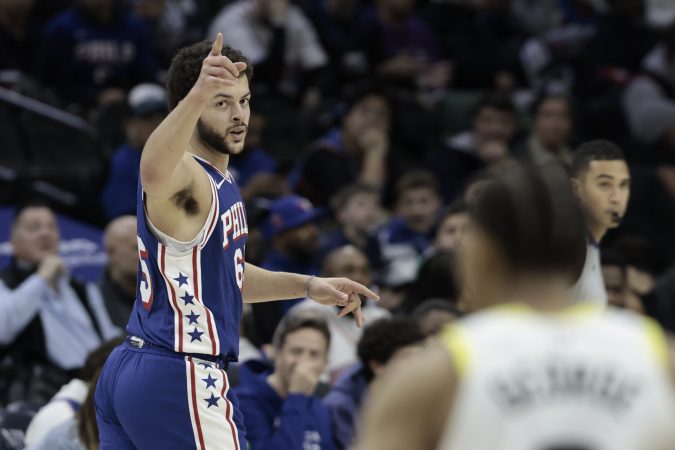
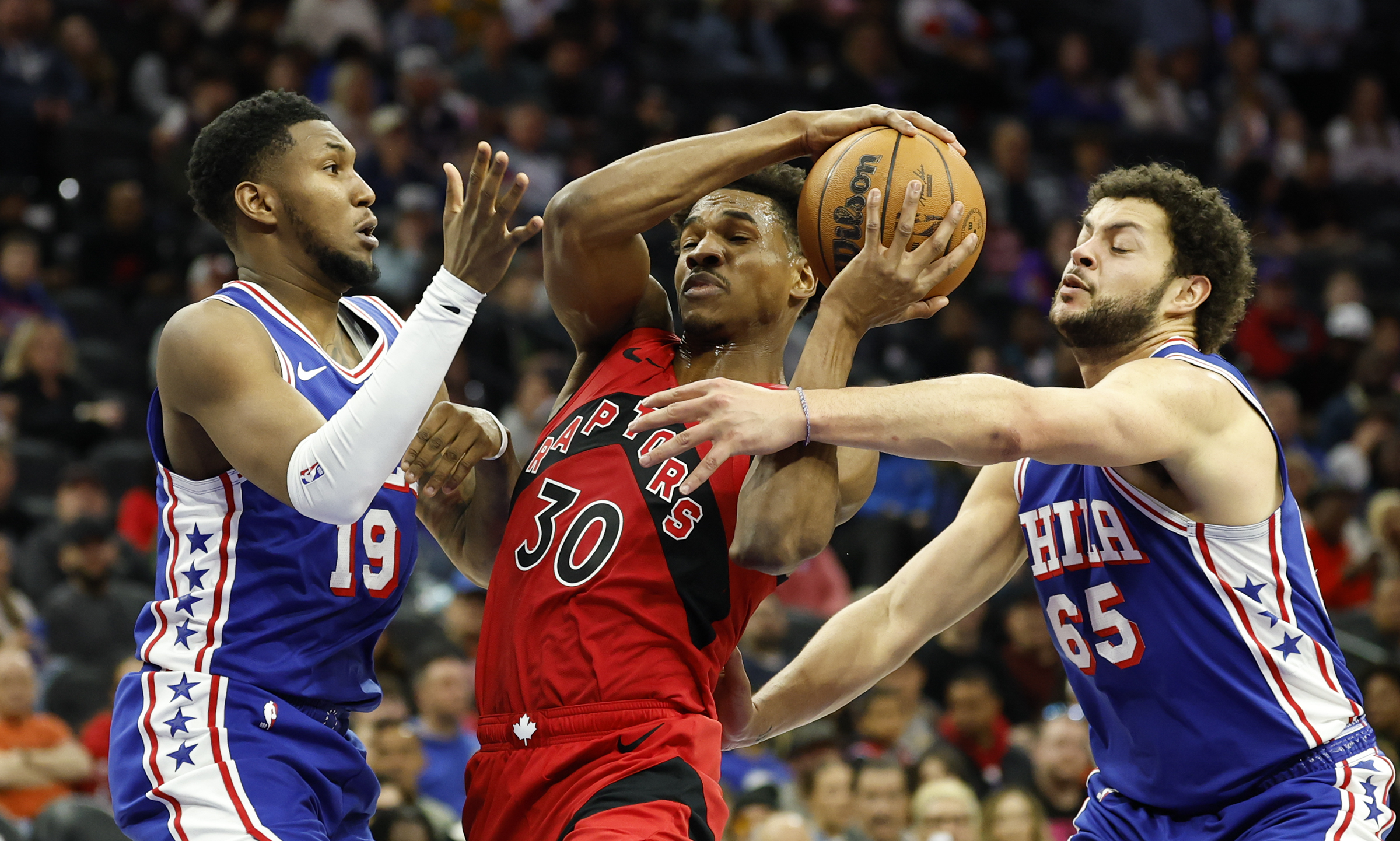
    Reese, a power forward who played in 14 games for the Sixers on a two-way contract during the 2024-25 season, is again wearing No. 65 with the Pacers’ Summer League team. Those digits are more often associated with football offensive linemen than NBA players. But last July, Reese shared with The Inquirer and Philly Voice that he chose the number because it aligns with the birth year of his mother, Rebakah, and continues to honor her after she died in 2024 from early-onset Alzheimer’s disease.

    “It just helps me think of her when I’m playing,” Reese said then from the Sixers’ practice facility, days before the team waived him before this story could run during Las Vegas Summer League. “It makes it easy for me to look down and see why I’m doing what I’m doing.”

    Reese did not always have a specific jersey number that he coveted. But while scanning the limited options upon joining the Rip City Remix, the G League affiliate of the Portland Trail Blazers, 65 instantly caught his eye. He felt the connection between it and his mother while she fought the debilitating cognitive disease. Rebakah died with two games remaining in that first season he wore it.

    “Now I have a reason to keep it,” he said.

    Alex Reese (right) was briefly with the Sixers’ Summer League team before being waived before game’s started last year.Yong Kim / Staff Photographer

    Reese described his mom as “super sweet” and said she “loved everybody.” She drove him to baseball practices and games across the Southeast from their home near Birmingham, Ala., then to the gym or playground courts for workouts once basketball became his sport of choice.

    Reese became a star at Pelham High School in Pelham, Ala. and signed with the University of Alabama in 2017. Rebakah was diagnosed just before the start of the COVID-19 pandemic, while Alex was rehabbing after hip surgery during a “really tough” summer. She still made the short trip to Tuscaloosa for college games — and, more importantly, his 2021 graduation.

    “That was a big day for us,” Reese said.

    After he went undrafted, Reese took a year off from basketball to return home to spend time with Mom and his support system, including brothers Nate and Zach, Brian, his father, and extended family and friends. He worked jobs such as laying sod, moving furniture, and bartending.

    “I needed it,” Reese said. “I didn’t know if I was going to make the push to try to play professionally. Once I took the year off, got my mindset a little bit better, and got back into it after I worked a couple jobs that I don’t want to work anymore.”

    He went overseas to play in Luxembourg, then found opportunity in the G League. He wore No. 15 in his NBA debut with the Oklahoma City Thunder, scoring two points in less than two minutes in October 2024. After returning to the Remix, he signed a two-way contract with the Sixers in February 2025 and remained with the team for the rest of the season.

    Alex Reese (right) averaged 5.3 points in 14 games with the Sixers in 2024-25.Yong Kim / Staff Photographer

    By the time Reese chose No. 65, Rebakah was past the point that she could understand what the gesture meant. He has seen the perplexed comments from fans over the years about his choice, assuring that they “[don’t] bother me at all.” He has shared his reason for the number with a handful of Portland teammates, and with Sixers teammates such as Justin Edwards.

    He honored her in 14 NBA games with the Sixers. And 65 remains his number of choice, including in Saturday’s Summer League matchup.

    Because it is not unconventional to him. It means everything.

    “I obviously wish she was here to see it,” Reese said, “and see where I’ve made it now.”

  • The official commemorative artist of the MLB All-Star Game is a big fan of Philly food and culture

    The official commemorative artist of the MLB All-Star Game is a big fan of Philly food and culture

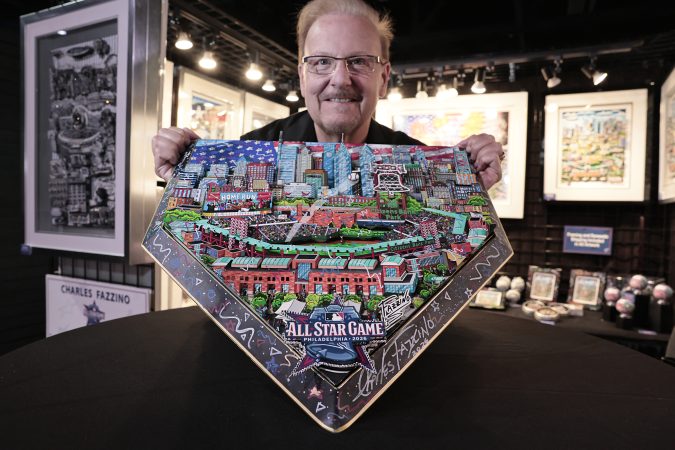
    Artist Charles Fazzino’s work jumps out at you. And it sparkles.

    Renowned for capturing colorful cityscapes and big sporting events, Fazzino has for decades handcrafted three-dimensional pop-out art to mark major occasions from the Grammys to the Olympics — and, in recent years, the annual MLB All-Star Game.

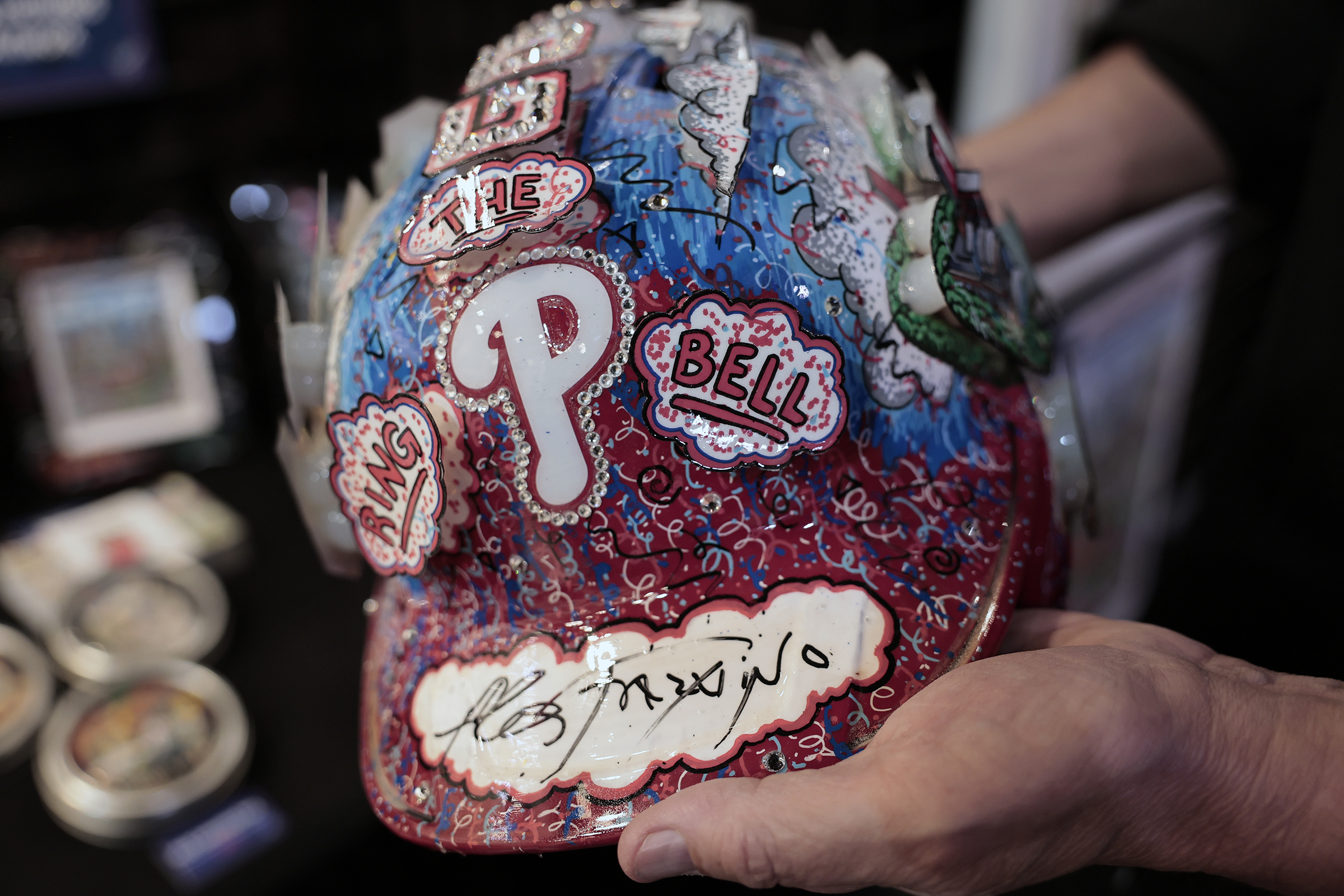
    With the game in Philadelphia this year, Fazzino is in town as the official commemorative artist and he is bringing along the MLB All-Star Game portrait and some of his bedazzled baseballs, bats, and helmets to the MLB All-Star Village at the Pennsylvania Convention Center.

    The MLB All-Star Game portrait spotlights the city of Philadelphia, featuring the skyline, Benjamin Franklin Bridge, SEPTA buses, and, of course, Citizens Bank Park.

    Artist Charles Fazzino displays his hand painted baseballs available at his booth at the Capital One All-Star Village, Philadelphia Convention Center, on Thursday, July 9, 2026.Elizabeth Robertson / Staff Photographer

    The portrait is one of his signature 3D pop-out pieces. Fazzino started making these pieces in the 1990s inspired by pop-up books. First, he prints drawings on a special cardboard-like material called museum board, made of cotton rags, and proceeds to cut out each person, landmark, and building with an X-ACTO knife. Then he meticulously arranges the figures using gobs of glue to create the three-dimensional artwork; the glue is not just an adhesive but a layering tool as well.

    Finally, he applies Swarovski crystals and acrylic paint to make the canvas glitter.

    His work has been collected by a wide range of fans from Presidents George Bush and Bill Clinton, to celebrities including Julia Roberts, Michael Jordan, and Reggie Jackson. To keep up with the demand, Fazzino runs a studio in New Rochelle, N.Y., with a staff of 60 who help with the painstaking process of cutting and gluing.

    Artist Charles Fazzino created the official 2026 All-Star Game poster. His original 3D art that the poster is based on hangs at right. Fazzino was readying his booth at the Capital One All-Star Village at the Philadelphia Convention Center on Thursday, July 9, 2026.Elizabeth Robertson / Staff Photographer

    “The artwork is different because everything still is printed by hand, made by hand, cut out by hand, glued, assembled, and constructed all by hand,” said Fazzino, who found a passion for art thanks to his artist parents. “That’s what I think differentiates me from other artists, and why the pieces are so unique.”

    Fazzino has been making artwork depicting Philadelphia for years, earning a substantial following in the region as local galleries have sold his work over the past 30 years.

    Artist Charles Fazzino displays a custom-made batting helmet that will be available at his booth at the Capital One All-Star Village at the Philadelphia Convention Center on Thursday, July 9, 2026.Elizabeth Robertson / Staff Photographer

    “I’ve been going [to Philly] so many years, so I include the Mummers Parade or the Art Museum, Rocky sculpture, all the cool hotels, and the food culture,” he said.

    In addition to the All-Star art, he made a piece commemorating the Semiquincentennial, featuring major landmarks from all 50 states.

    Fazzino’s original 3D art costs between $3,000-$7,000 with framing, depending on the size, but he also sells posters at lower price points, in addition to a variety of baseball-related art.

    At his booth at the Convention Center, visitors can see his Phillies-themed decorative baseballs as well as the ceremonial home plate that will be used in the first pitch at the All-Star Game on Tuesday.

  • Take me out to the gift shop: How the All-Star Game has become a major-league merchandising machine

    Take me out to the gift shop: How the All-Star Game has become a major-league merchandising machine

    The All-Star Game returns to Philadelphia in coming days with more than baseball.

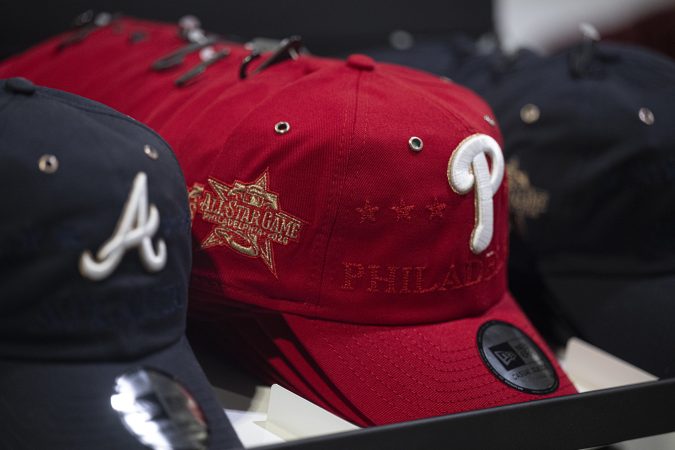
    It arrives with two sprawling shopping destinations, hundreds of exclusive products, and a merchandising operation at both the Convention Center and Citizens Bank Park. Fanatics, the sports-commerce giant, will anchor All-Star Village with a flagship store, while Aramark has transformed the two-level Phillies New Era Team Store at the ballpark into a showcase of All-Star-exclusive merchandise.

    Like the FIFA World Cup, Super Bowl, Formula One races, and the recent PGA Classic at Aronimink Golf Club in Newtown Square, Major League Baseball treats its marquee events as multiday fan festivals. The result: The Midsummer Classic has become as much a retail event as a baseball event.

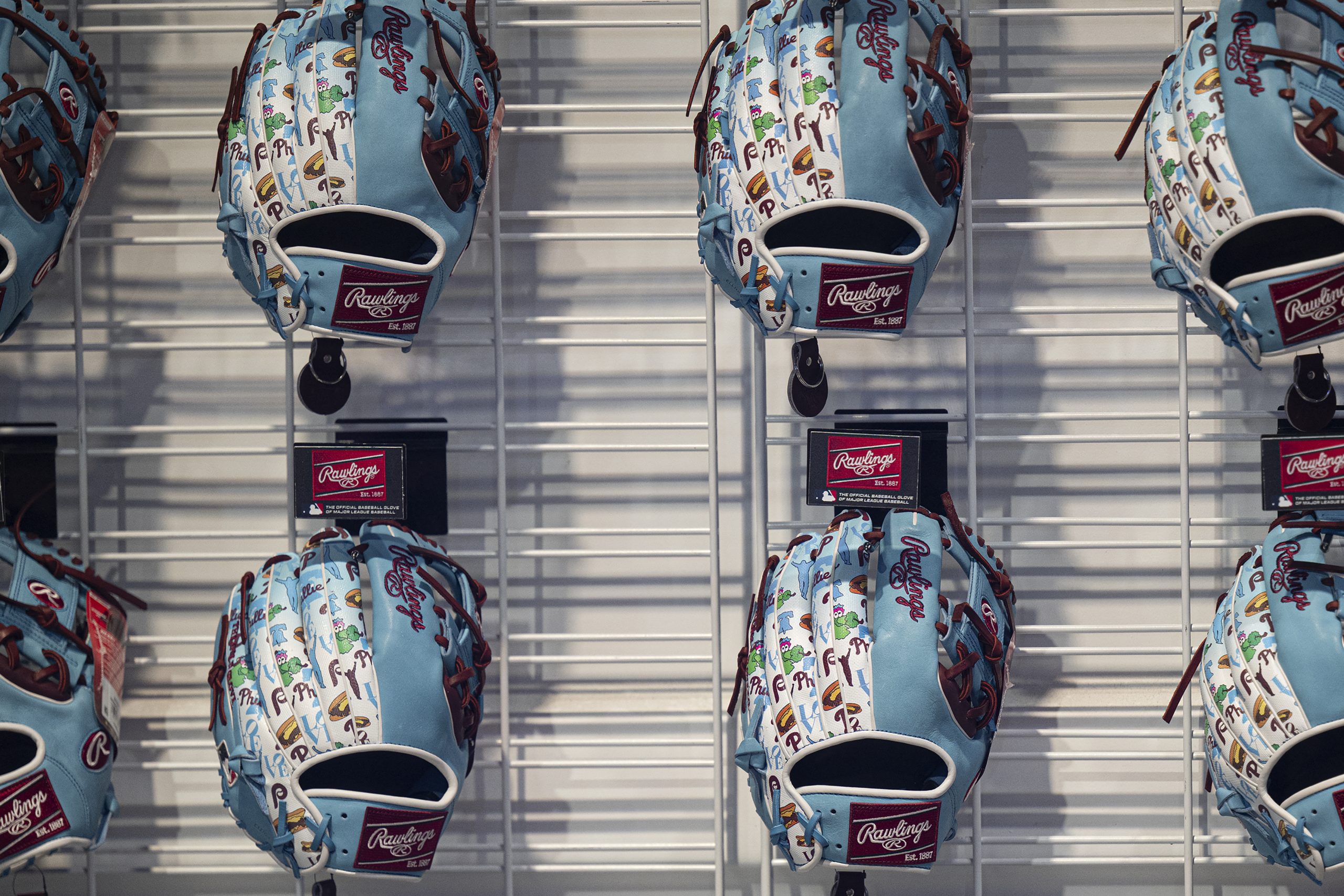
    All-Star-theme baseball gloves on display at All-Star Village inside the Convention Center.Jose F. Moreno / Staff Photographer

    “Commercially, it ranks in our top three events,” said Jamie Leece, a senior vice president with MLB. “From a business perspective, I’d say it’s our most important because we’re bringing every team together in one place.”

    Unlike the postseason, where only a handful of teams remain, the All-Star Game draws fans from all 30 teams. MLB expects more than 80,000 people to visit All-Star Village over the four days.

    “We have passionate fans who travel to multiple All-Star Games, and we also have people attending for the first time,” Leece said. “We want to make sure they have an incredible experience and can find merchandise that reflects their fandom.”

    A temporary retail city

    The biggest attraction inside All-Star Village may also be its biggest business.

    The merchandise at All-Star Village inside the Convention Center includes posters and original art.Jose F. Moreno / Staff Photographer

    Fanatics, led by Philadelphia-area entrepreneur Michael Rubin, will operate a 16,000-square-foot flagship store at the Convention Center — its largest All-Star retail footprint since Los Angeles hosted the game in 2022. The company says the store, open to ticket holders, will carry more than 400 product styles from Nike, New Era, Mitchell & Ness, Homage, WinCraft, ’47 Brand, and Fanatics.

    The assignment is fitting for a company with deep local roots. Fanatics traces its modern growth to Rubin’s King of Prussia-based GSI Commerce, which acquired the business in 2011. After eBay purchased GSI, Rubin bought Fanatics back and transformed it into one of the world’s largest sports-commerce companies.

    Today, analysts say the privately held company expects about $13 billion in revenue this year and employs more than 22,000 people worldwide. In addition to operating licensed merchandise for the major professional leagues, it owns Topps, the baseball-card maker, and has expanded into collectibles, sports betting, live events, and media.

    A Phillies throwback jersey on sale at All-Star Village inside the Convention Center.Jose F. Moreno / Staff Photographer

    Under a long-term partnership with MLB and Nike, Fanatics manufactures and distributes much of Major League Baseball’s licensed fan apparel, making the All-Star Village store the public face of a merchandising operation that extends far beyond All-Star Week in Philadelphia. Most of the merchandise in the store was conceived, approved, manufactured, and shipped months before fans ever walked through the Convention Center doors.

    This year’s assortment leans heavily into Philadelphia.

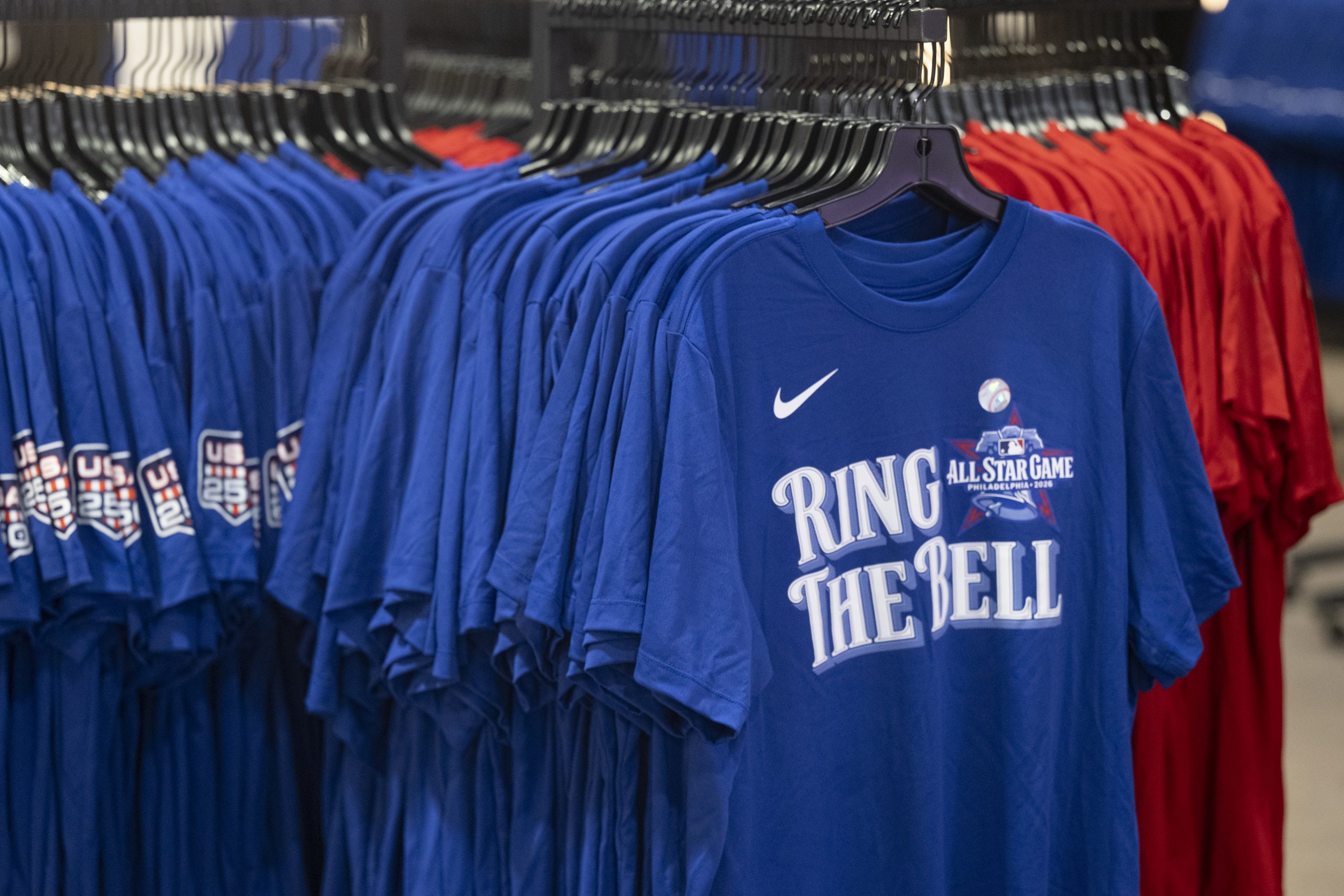
    Shirts available at the All-Star Village at the Convention Center.Michael Klein / Staff

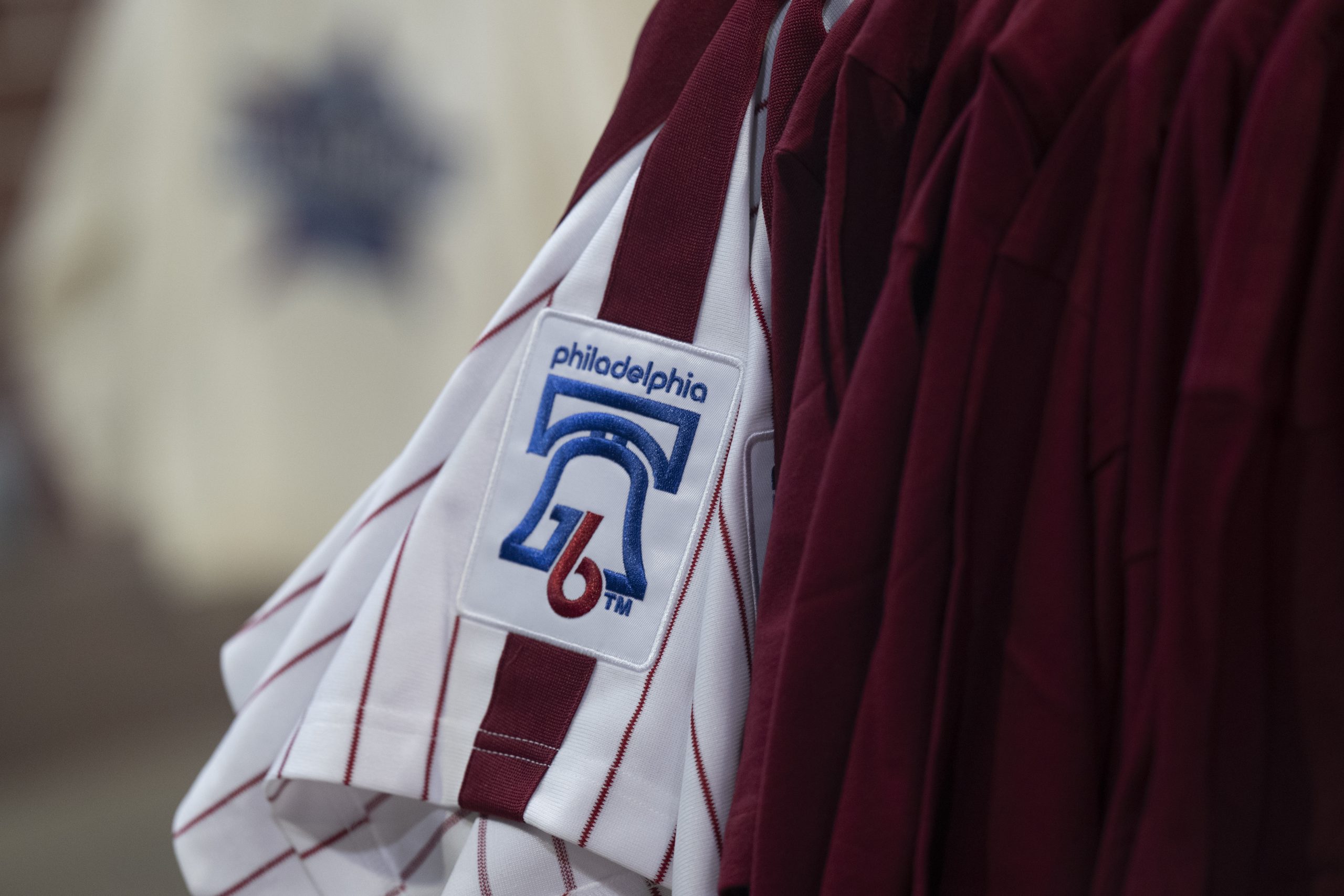
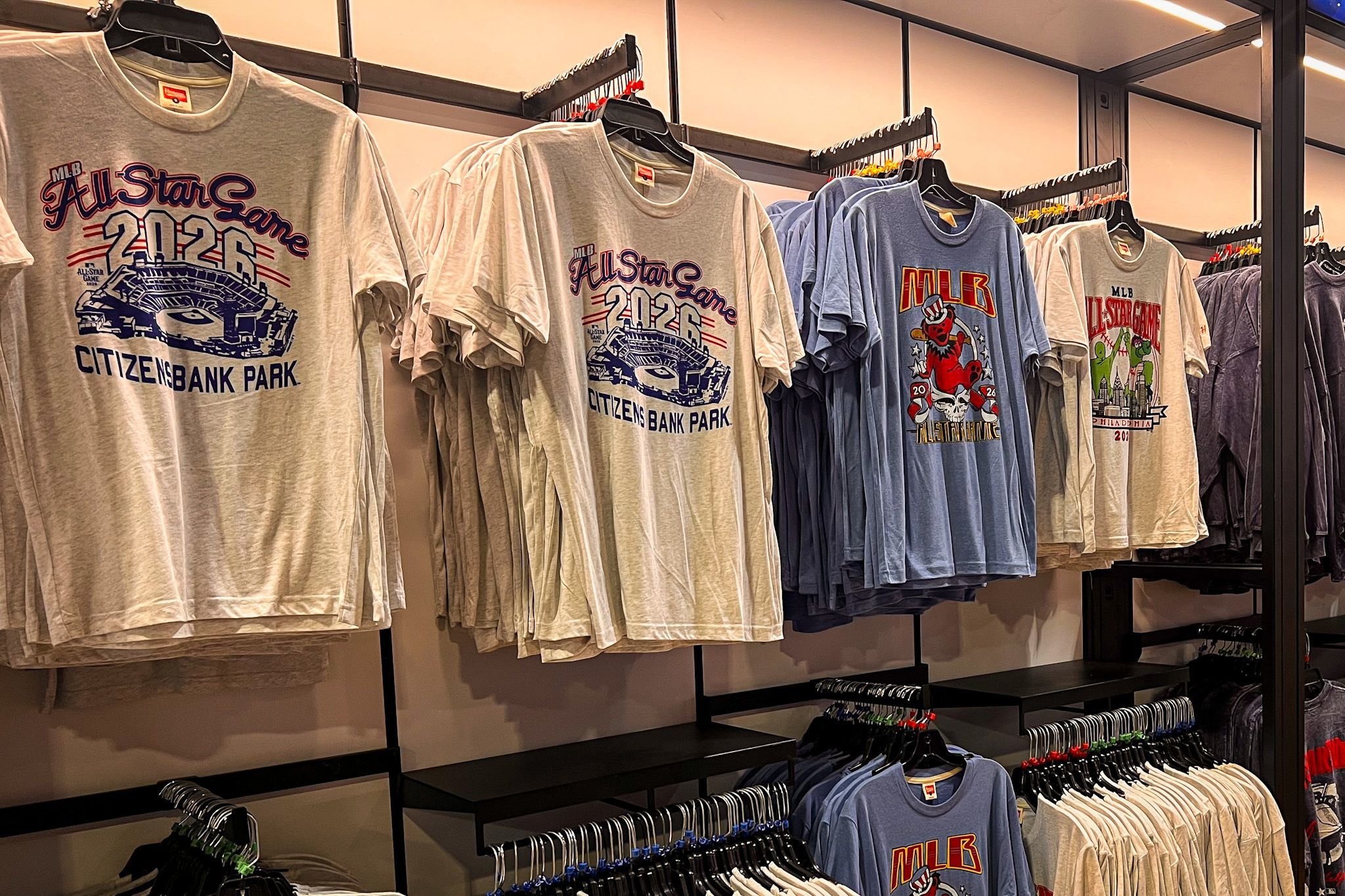
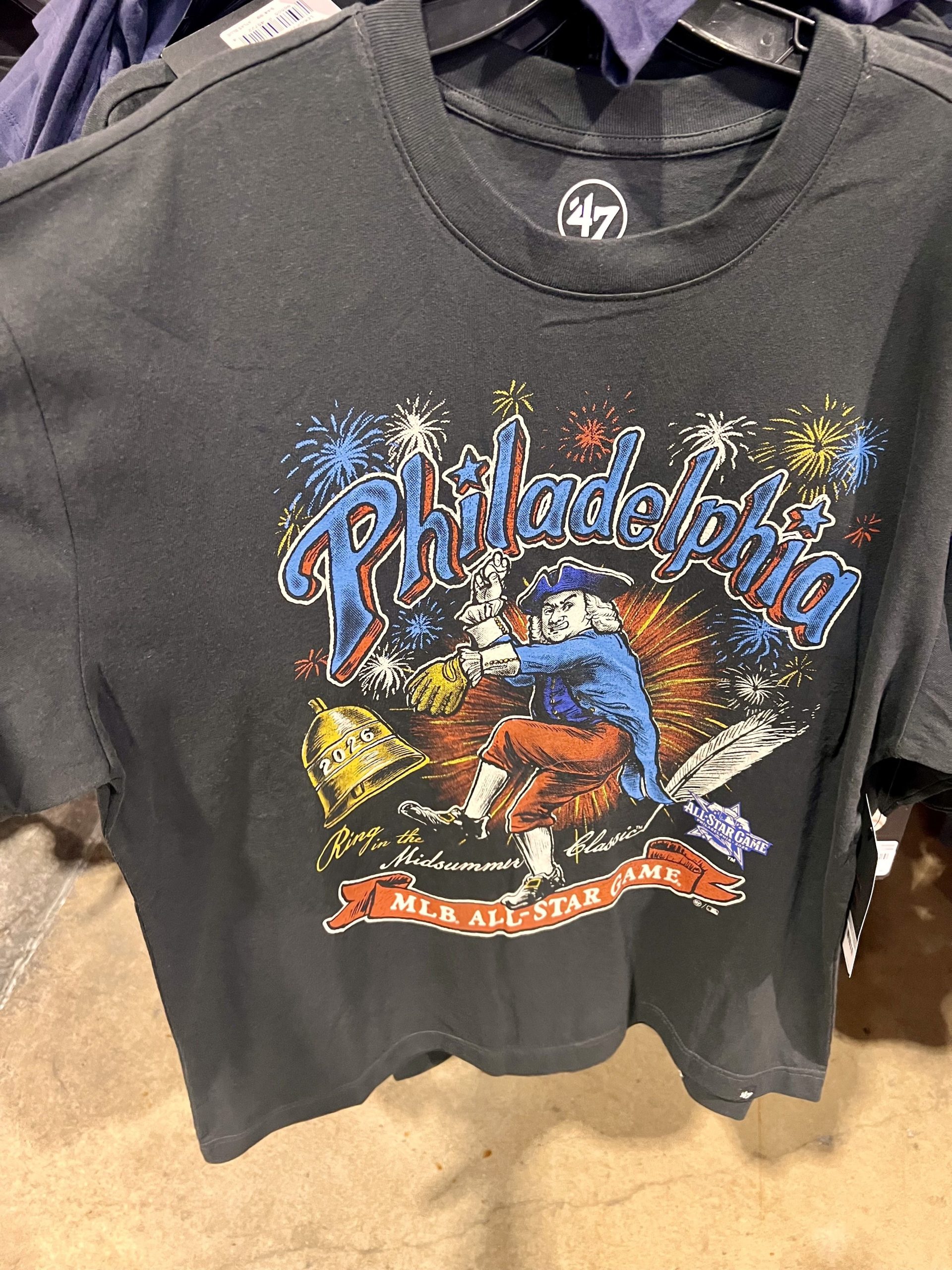
    The company said host-city merchandise, particularly jerseys and hats, has become an increasingly important part of every All-Star collection. Philadelphia-themed offerings include Homage’s Grateful Dead-inspired Patriot T-shirt and “Always Sunny in Philly” shirt, ’47 Brand’s “Hit That Jawn” and cheesesteak-themed designs, and Sportiqe’s Elton John-inspired “Philadelphia Freedom” T-shirt.

    Home-field advantage

    If Fanatics anchors the Convention Center, Aramark — the Phillies’ concessionaire — is treating Citizens Bank Park as a shopping destination in its own right. Its two-story shop is open daily to the public except for Sunday.

    After the July 2 home game against the Pirates, Aramark workers cleared the store of all regular Phillies merchandise and began loading in All-Star items. The store was expanded in the offseason to about 7,500 square feet.

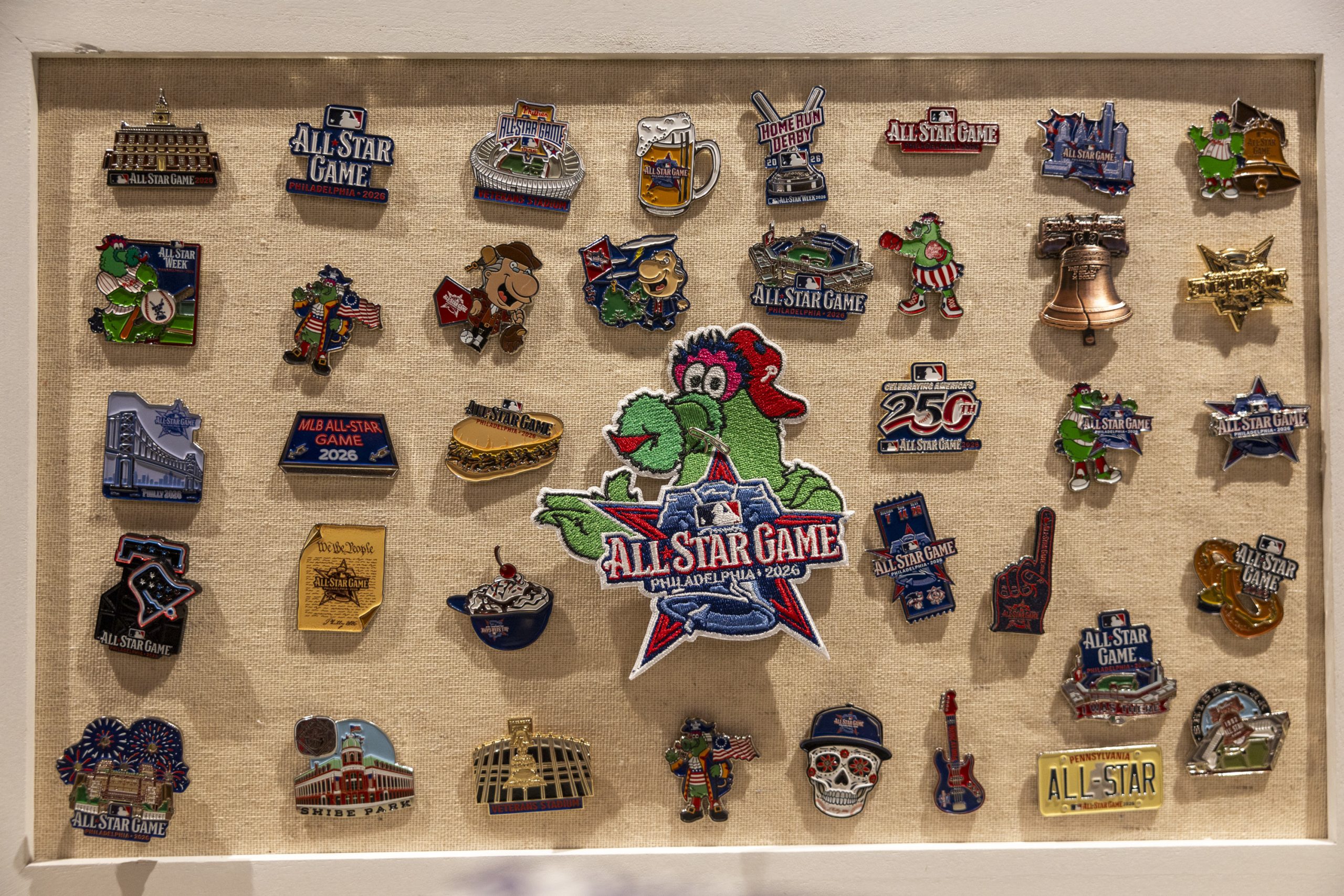
    Some of the 84 All-Star pins designed by Aramark that are for sale at Citizens Bank Park. Tyger Williams / Staff Photographer

    Francis Winkey, Aramark’s senior merchandise manager at the ballpark, said the store has about 400 All-Star items, about 75% of them exclusive. Winkey, a pin collector himself, commissioned 84 pins, including one representing each major-league team.

    Behind the displays is a manufacturing process that begins more than a year before the first pitch. MLB develops the event’s logos and branding, then works with dozens of licensed manufacturers specializing in a wide range of products — caps, jerseys, drinkware, collectibles, and other souvenirs. Companies submit designs for league approval before production begins, often months in advance, at factories overseas.

    The biggest complication is that no one knows who will make the All-Star teams until shortly before the game. Most merchandise, therefore, celebrates the event or the host city rather than individual players. When player-specific products are planned, manufacturers often build in flexibility so they can be finished after the rosters are announced.

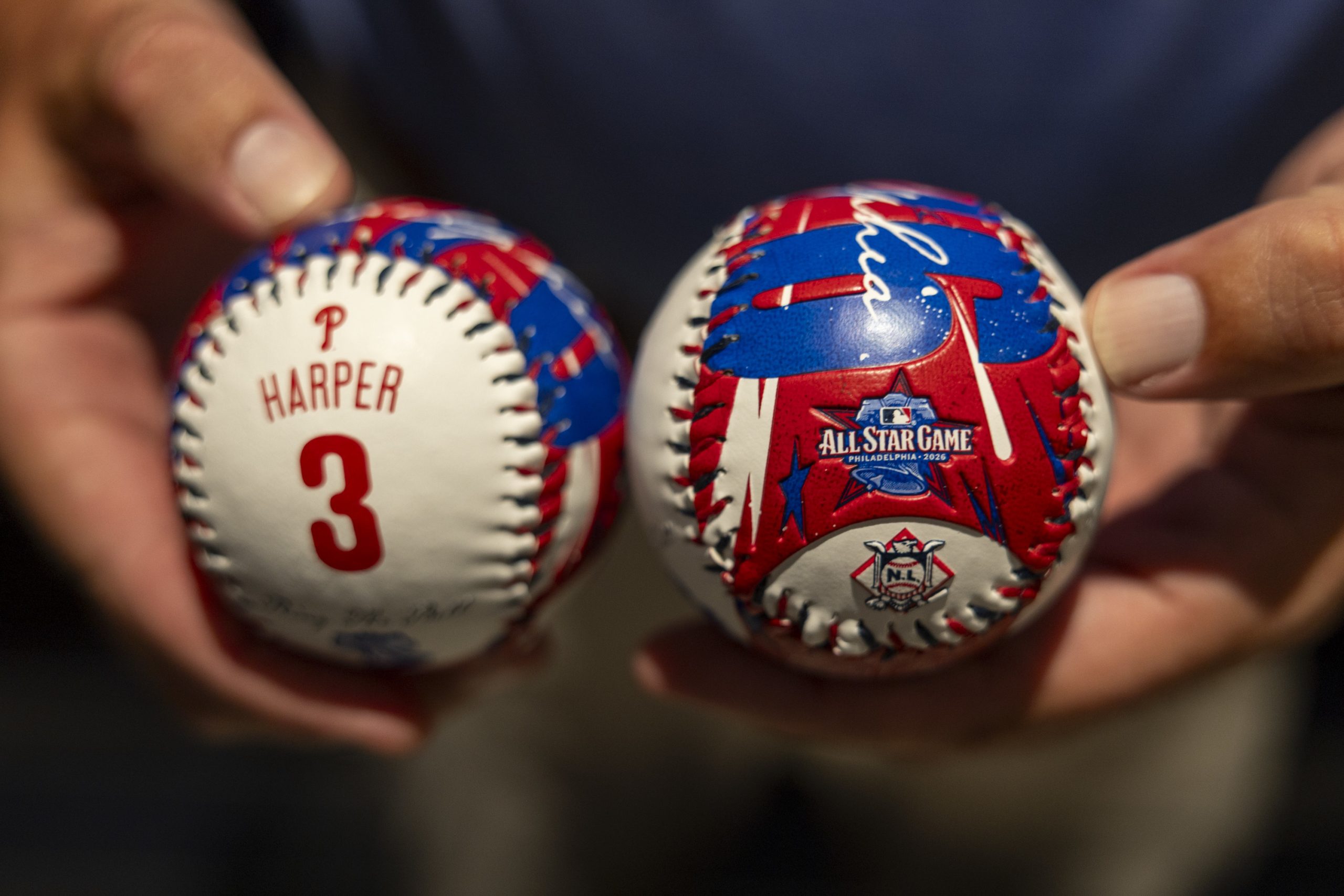
    At Citizens Bank Park, Aramark’s Francis Winkey holds souvenir baseballs that were stamped with Bryce Harper’s name after he was named to the All-Star Game roster.Tyger Williams / Staff Photographer

    Take the commemorative baseballs that Winkey dreamed up. Last fall, he ordered Rawlings baseballs featuring bold All-Star graphics that intentionally had one blank panel.

    Once the rosters were announced, Winkey had a domestic factory finish the baseballs. “When I knew Shohei Ohtani made the team, I could put Ohtani’s name on it,” Winkey said. “It’s a combination of long-term planning and a short-term reaction.”

    The store carries six player editions, including Ohtani and Phillies sluggers Bryce Harper and Kyle Schwarber, for $17 a throw.

    Bigger every year

    MLB executives say the retail operation has grown alongside the event itself.

    “Whenever we’ve expanded the retail space, we’ve seen the business grow,” said Leece, of MLB. “It’s always a balancing act because All-Star Village is a celebration of baseball, not just a shopping destination. We want activations, interactive experiences, and things for fans to do beyond buying merchandise.”

    The assortment has expanded, too. “We have more licensees creating more unique items,” Leece said. “International fandom has grown significantly, so we now have fans traveling from all over the world. As the audience has expanded, so has the variety of merchandise. One category that’s really emerged over the last several years is oversized chains and necklaces. They’re a good example of a product category that really came out of nowhere.”

    A commemorative shirt from Fanatics affiliate ’47 available at the All-Star Village at the Convention Center.Michael Klein / Staff

    Philadelphia’s role as host city during the nation’s 250th anniversary celebration also shaped the collection. “It always starts with the identity of the host city,” Leece said. “Philadelphia’s history aligns naturally with the Phillies’ identity.”

    Across the ballpark, All-Star Village, and MLB’s online stores, about 600 products will be available during the week.

    One operational change won’t be visible on the sales floor.

    “We’ll have the largest on-site retail staff we’ve ever had, both at All-Star Village and the ballpark,” Leece said. “We want fans to spend less time waiting in line and more time enjoying everything else the event has to offer.”

    In addition to those stores, Fanatics brand Mitchell & Ness is selling All-Star merchandise at its new store at 1513 Walnut St.

    Retail analysts say the All-Star Game occupies a unique niche in the licensed sports business.

    Commemorative T-shirts on display at All-Star Village.Jose F. Moreno / Staff Photographer

    “The All-Star Game is really about on-site souvenirs,” said Matt Powell, founder of the sports retail consultancy Spurwink River. “People are there and want something to commemorate the experience because it’s essentially a one-off event.”

    Neil Saunders, managing director of GlobalData, said demand tends to split between wearable keepsakes and collectibles.

    “One is simple products like T-shirts or caps linked to the Phillies or the All-Star Game,” Saunders said. “The other is collectible items that can be more expensive. The real fans or those who love collecting are enthusiastic about these.”

    The All-Star retail boom reflects the growth of licensed sports merchandise into a multibillion-dollar global business. One industry estimate valued the market at $38 billion in 2025, with North America accounting for more than half of sales. Apparel remains the largest category, helping explain why jerseys, caps, and other wearable souvenirs dominate event retail.

    Unlike merchandise driven by blockbuster trades or new uniforms, Powell said, All-Star merchandise derives much of its value from the event itself.

    Fans aren’t simply buying apparel. They’re buying proof they were there.

    Yet for all the focus on merchandise, Leece said the larger goal is creating memories.

    “I hope they slow down,” he said. “I hope they walk in, look around, and appreciate that they’re somewhere special. This is baseball’s World’s Fair. It only happens once a year, and for Philadelphia it only comes around every couple of decades.”

  • Chester County has radically reduced chronic homelessness. This Coatesville resident, and her family, have been on the front lines for decades.

    Chester County has radically reduced chronic homelessness. This Coatesville resident, and her family, have been on the front lines for decades.

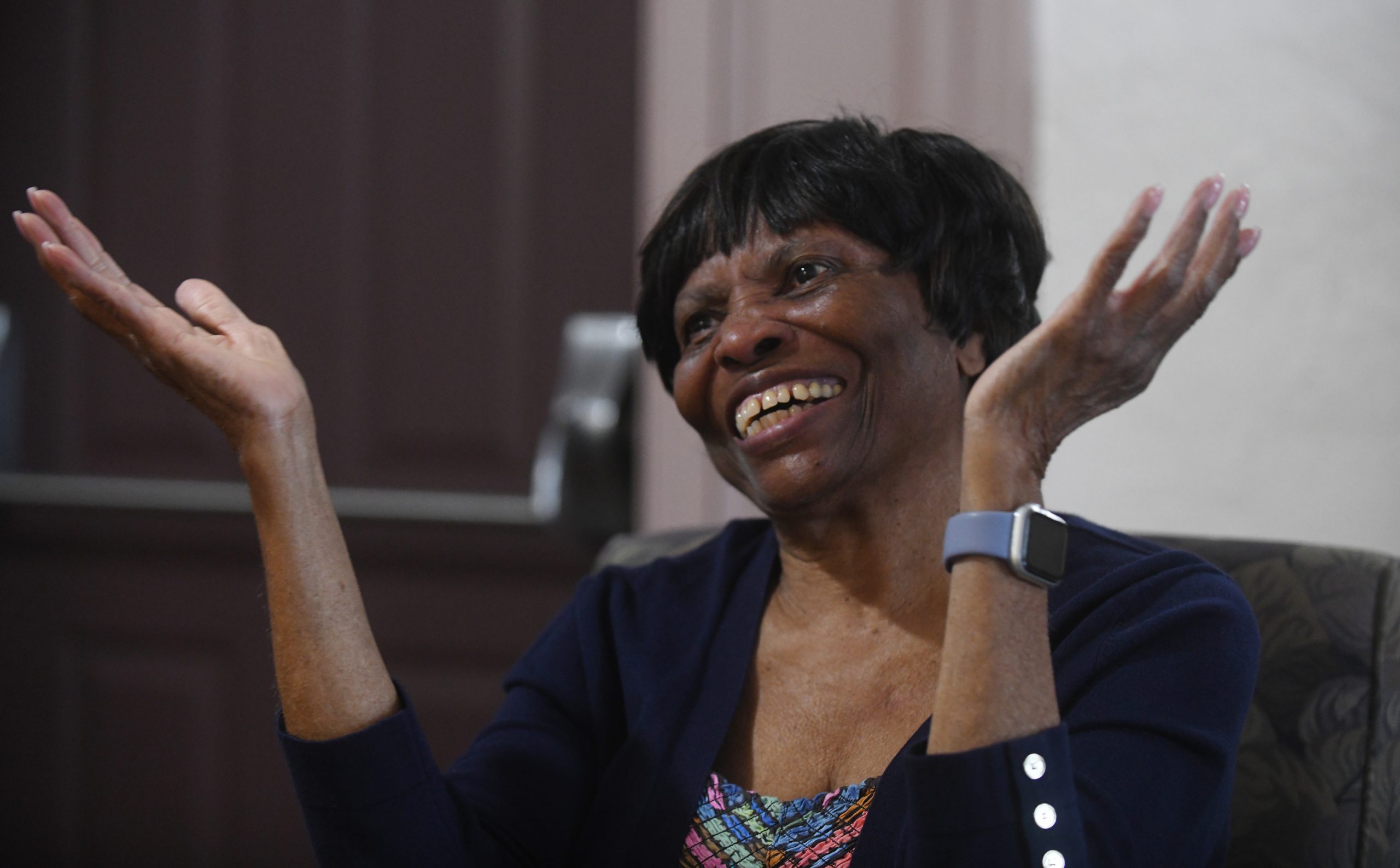
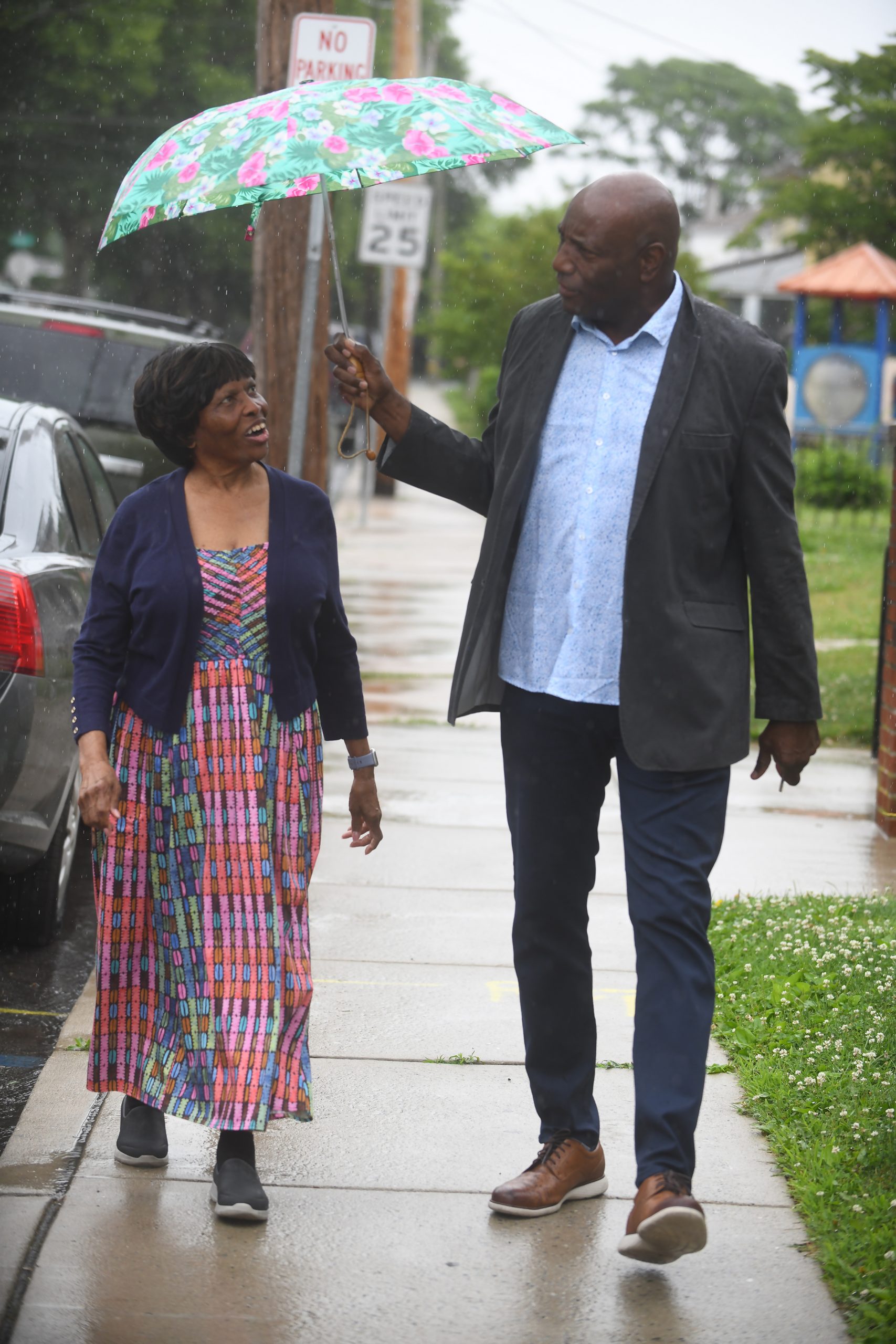
    Minnie McNeil and her family still think about a challenge issued by her pastor more than 40 years ago: What could their city benefit from, and how could they address it?

    The answer then, and now, was homelessness.

    In the decades since, McNeil, 85, and three generations of her family have devotedly worked to support unhoused men in Coatesville. Their work, alongside countywide cross-sector collaboration, culminated in Chester County in June announcing it had reached “functional zero” for chronic homelessness.

    Though it’s a milestone for the county, it doesn’t mean their work has stopped. They’ve evolved.

    Using federal grant dollars, the W.C. Atkinson Memorial Community Service Center, founded by McNeil and her late husband more than 30 years ago, recently acquired its eighth transitional home in Coatesville, which it will remodel to offer affordable and supportive housing to shelter residents. And the shelter plans to expand its scope — helping catch young adults aging out of foster care before they become unhoused, a story they’ve heard over decades of helping thousands of men.

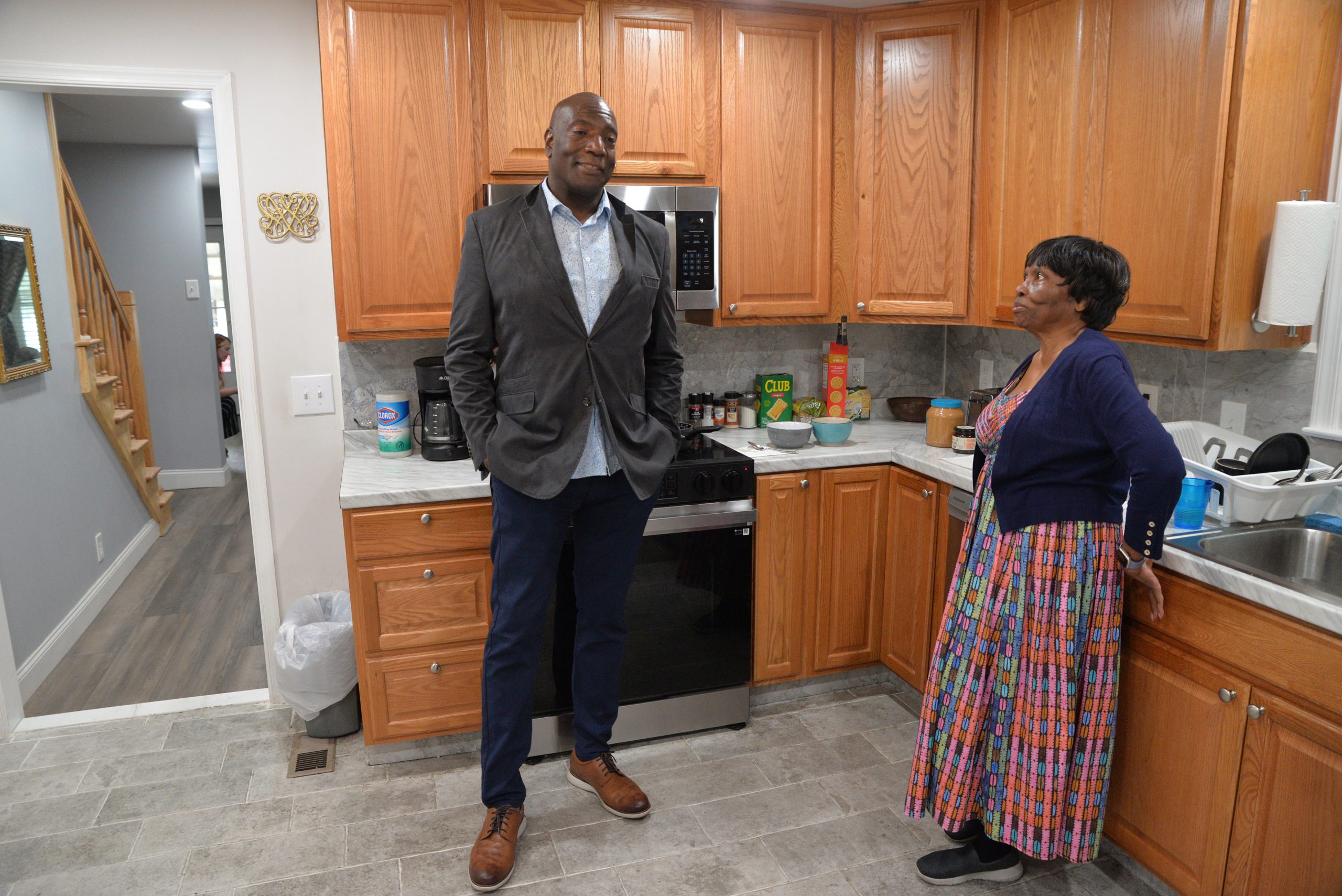
    And separately, Minnie’s son Andrew McNeil, 58, and grandson, Derrick McNeil, 27, have begun an effort to remodel homes in the city, selling them below market to help revitalize Coatesville and support first-time home buyers at a time when housing prices in the county are soaring.

    “The dollars of the ’70s and ’80s, the jobs that were available, [and] the housing stock available during that time is not, in our view, as easily accessible, and so the needs, in our view, are greater as a result,” McNeil said.

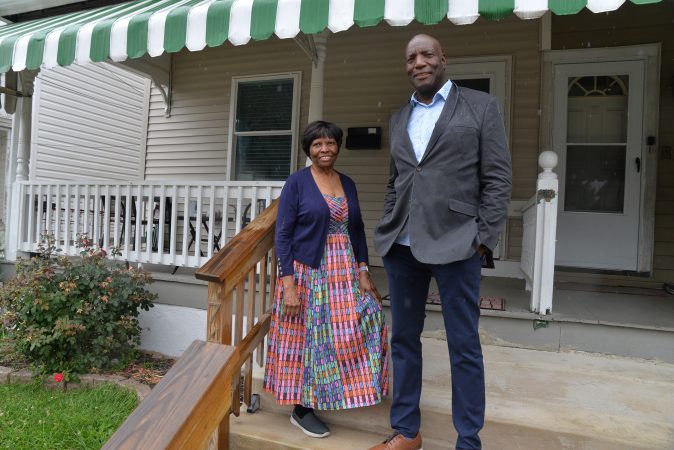
    Minnie McNeil and the McNeil family have helped the homeless in Coatesville since the early 1980s.Bob Williams / For The Inquirer

    It started with the shelter

    In Minnie’s estimate, the need for support services still exists. The county in June announced it had reached “functional zero” for chronic homelessness, meaning that long-lasting or recurring homelessness had been reduced to “a rare, manageable level,” the county said in a news release last month.

    It was an example of cross-sector collaboration, officials said.

    Minnie and her late husband, Andrew McNeil Sr., have been a part of that diverse ecosystem since they founded and opened the W.C. Atkinson Memorial Community Service Center at the former Atkinson hospital in 1992. It has always been intrinsically linked to their eldest son, Andrew; it opened on his birthday that year — Jan. 7.

    There are few people willing to do what McNeil and her family have done, and fewer who do it so exceptionally, County Commissioner Chairman Josh Maxwell said. He has watched her shelter take on just about every possible man — those whom others would have turned away, he said.

    Maxwell knows her magnetism personally: On the biggest day of his political career, his election as chairman, McNeil asked him to stop by a house they were renovating to help. Maxwell was in the attic alongside contractors, ripping out insulation and tearing down walls.

    “I don’t think anyone else can do what she does,” he said. “I think those people wouldn’t be helped. I think we’d have dozens, if not hundreds, of more homeless people in the county if she wasn’t the one taking them in.”

    For Minnie, her children were a guiding light: Could they sleep here? Eat the food? It has kept humanity at the heart, she said.

    “Housing is not just a roof over your head, but we’d like to create homes where people live healthy and happy and their very best lives, they reach their full potential,” she said. “A place that, yes, has some outside influence and support, but builds within that home a nucleus where [there’s] love and compassion.”

    Michael Weber, 55, called the McNeils a “blessing.” He came to the Atkinson after living in a hotel room, unable to find permanent housing. He happily took up odd jobs at the shelter to support it. He thinks that’s why the McNeils asked if he would want to move into one of the support housing sites, where he could pay below-market rent.

    “I didn’t even know it could be this good,” he said.

    Andrew and his two brothers were helping hands as children, working shifts at the shelter overnight and preparing meals. Though he never anticipated he’d return to it, Andrew began to learn the ropes from his father when he came back to the county after 12 years in Maryland. (“I never saw that coming,” his mother noted.)

    Minnie McNeil and her son Andrew McNeil walk down East Chestnut Street in Coatesville.Bob Williams / For The Inquirer

    And those lessons didn’t stop at the shelter doors. Derrick, his son, has volunteered at the shelter and found it inspiring. Then Derrick caught the real estate bug, something Andrew knew plenty about.

    Their shared interest is a new chapter that felt like an extension of what Atkinson had been doing, Andrew said.

    “When they move out of the shelter, into the housing, what happens is they have a sense of pride because we’re not putting them into just anything,” he said. “I think that that matters [for] what we’re doing for families as well what we’re also doing with the men.”

    He had watched men move from the shelter into the supportive housing, and saw the sense of pride at the homes they were living in. They wanted to bring that feeling more broadly.

    Affordability in Chester County

    Andrew and Derrick purchased their first project house together in May 2025 for $190,000 as Chester County has seen a diminishing housing stock and rising costs. The county saw some of the highest population growth in Pennsylvania between 2020 and 2024, but the housing market wasn’t keeping pace. Fewer single-family detached homes were built in 2024 than in the last several years, according to the county’s planning commission, and fewer new units were being constructed this decade compared with last.

    In 2024, the median sales price hit $525,000 — the highest in the county’s history. That year, only 331 homes sold for under $250,000, a decrease of 5.9% from 462 units in 2023.

    In Coatesville, like the Atkinson shelter had done with seven transitional houses, Andrew and Derrick took their first project house down to the studs. For 10 months, they remodeled it to a high standard, Andrew said. It went from a three-bedroom, one-bath to a four-bedroom, three-full-bath home. The house sold to a family about a year after they first purchased it, for $290,000 — under an appraiser’s valuation of $330,000, Andrew said.

    “It was a nice experience, just knowing that the end goal was to provide housing and provide opportunities for someone that was maybe purchasing their first property, just trying to provide the best product and the best opportunity for someone at a pretty decent price for what they’re getting,” Derrick said.

    Andrew McNeil and his mom, Minnie McNeil, in the kitchen area of the house they rehabilitated on Merchant Street in Coatesville. Bob Williams / For The Inquirer

    That care and thoroughness was a lesson both Andrew and Derrick learned from Andrew Sr., as the shelter had taken homes with “no lipstick” and modernized them.

    “One of my father’s sayings was always ‘We get brick and mortar money once,’ so we have to put the quality into the house, because it’s up to us to maintain it after that,” Andrew said. “So we don’t cut any corners when it comes to rehabbing these houses, and so my son and I adopt that same principle when we remodel houses for the community.”

    After the success of their inaugural endeavor, Derrick said they’re looking toward future opportunities like this one, or other options — like lease-to-purchase.

    When Andrew reflects on the legacy of the shelter — opened in a historic property that was owned by Whittier C. Atkinson, the first Black physician to open a practice in Coatesville — he thinks of them continuing Atkinson’s holistic approach to medicine in the 1920s, how he would take gifts from the garden as payment for his work. It’s that essence they’re trying to continue, he said.

    “I’m still taking lessons from my parents,” he said. “It’s always mission first; I observed that at a young age, and their mission, we’re continuing that … by trying to stay ahead of the curve. What’s the latest need in our community, and how can we address it in our focus?”

    This suburban content is produced with support from the Leslie Miller and Richard Worley Foundation and The Lenfest Institute for Journalism. Editorial content is created independently of the project donors. Gifts to support The Inquirer’s high-impact journalism can be made at inquirer.com/donate. A list of Lenfest Institute donors can be found at lenfestinstitute.org/supporters.

  • Access to therapy is about to get easier for Pennsylvania residents who travel out of state

    Access to therapy is about to get easier for Pennsylvania residents who travel out of state

    After giving birth to her first child, Jennifer O’Mara sought therapy for postpartum depression.

    But when O’Mara left her Delaware County home to visit her in-laws in North Carolina, her counselor had to cancel a virtual session because she wasn’t licensed to practice outside of Pennsylvania.

    “My therapist had always asked me if I was in Pennsylvania before a session started, and there was actually a time where I was not, and we couldn’t meet, and I didn’t understand why,” O’Mara said. “I was confused.”

    Unbeknownst to the new mother, Pennsylvania counselors need a separate license for each state they practice in.

    O’Mara, a Democrat elected as a state representative in 2018 and a co-chair of the legislature’s Mental Health Caucus, said she’s been working to change that regulation since that canceled therapy session.

    Four years later, O’Mara’s efforts are about to pay off under a bill expected to soon go to Gov. Josh Shapiro for his signature.

    The legislation would make Pennsylvania the 40th state to join the Interstate Counseling Compact. It enables counselors who are licensed in Pennsylvania to practice in any state that is part of compact.

    Pennsylvania will join already participating states, including Delaware, New Jersey, Maryland, Ohio, and yes, North Carolina.

    The bill only applies to licensed professional counselors, or LPCs. Pennsylvania separately participates in multistate healthcare compacts for psychologists, doctors, nurses, and physical therapists to provide inpatient care or telemedicine across state lines.

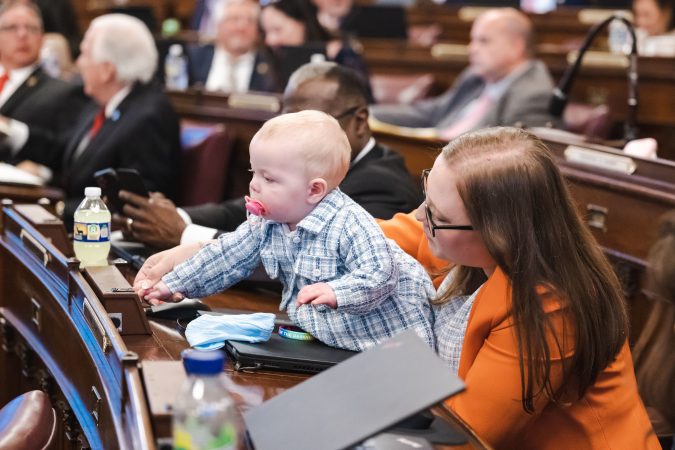
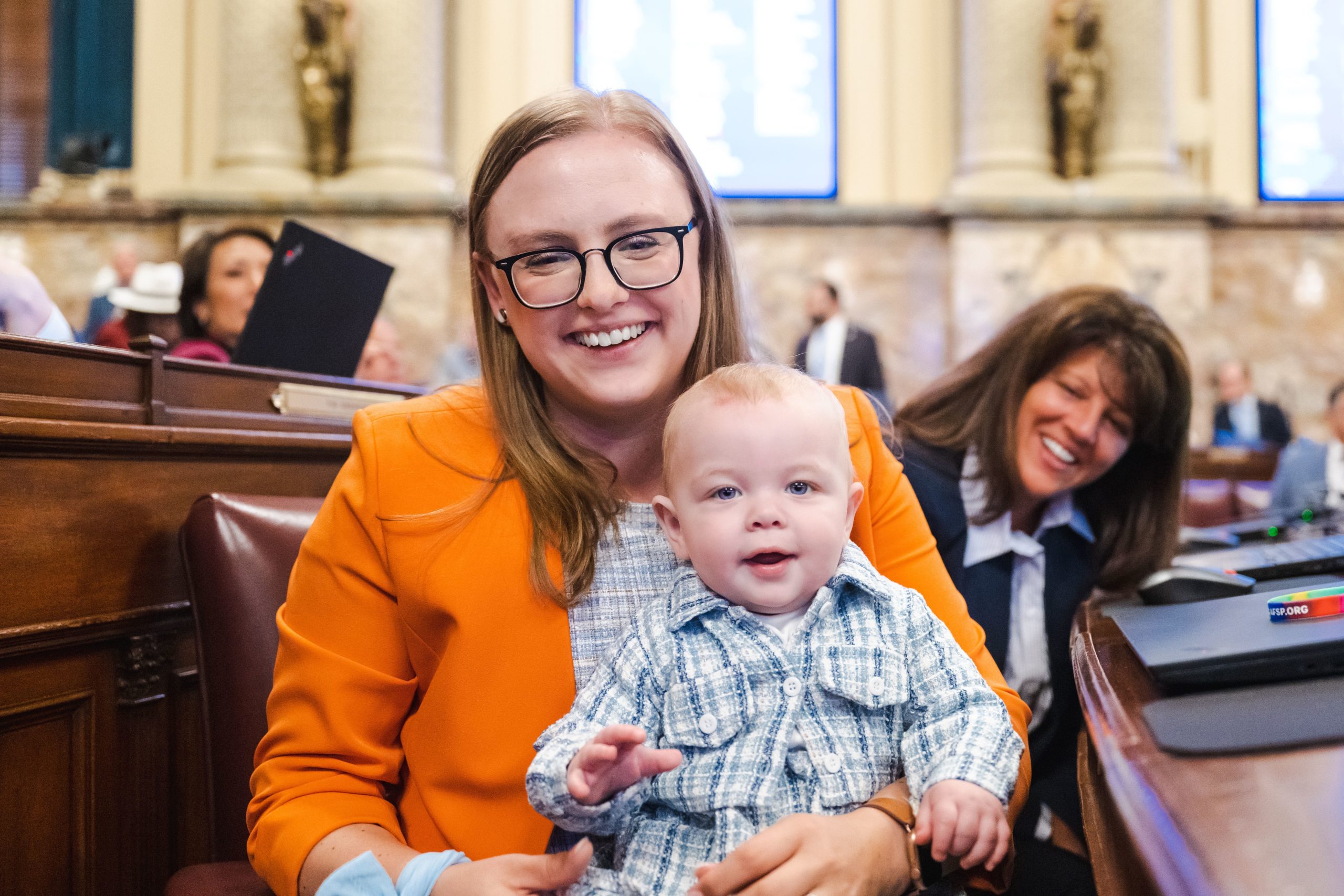
    State Rep. Jennifer O’Mara (D., Delaware County) with her daughter, Katherine, now 4, in 2023. O’Mara helped usher the Interstate Counseling Compact bill through the Pennsylvania House in late June. The bill would allow licensed professional counselors (LPCs) to practice across state lines. Courtesy of Jennifer O'Mara

    Shapiro plans to sign it

    O’Mara helped advance the bill in the House. The Senate had passed it in July 2025 by a 45-5 vote. The House approved it last week by an 188-to-14 vote.

    It now goes back to the Senate for a perfunctory, final signature by that chamber’s president before heading to Shapiro’s desk, according to a spokesperson for Sen. Lisa Boscola (D., Lehigh and Northampton), the bill’s prime Senate sponsor.

    O’Mara and leaders of the Pennsylvania Counseling Association (PCA), which has about 700 members statewide, said they expect Shapiro to sign the bill into law once it gets to his desk. A spokesperson for Shapiro confirmed on Tuesday that he plans to sign it.

    The bill aims to benefit recent high school graduates who want to keep the same therapist but plan to attend college out of state; active duty military members who are deployed outside Pennsylvania; and residents who physically work in New Jersey or Delaware and opt to do sessions during their lunch break, according to O’Mara.

    “This feels like a small bill that will make a big difference,” O’Mara said.

    Addressing a shortage of counselors

    Post-pandemic, the demand for mental health services has increased, and providers have struggled to keep up. The nation is expected to have a shortage of more than 40,000 counselors by 2030, and roughly 62% of Pennsylvania communities lack adequate mental health services, according to the PCA.

    The legislation is designed to ease that burden, said Nicole Palman, a counselor at the Main Line Counseling and Wellness Center in Haverford.

    “We’ll be able to continue to see clients when they move to New Jersey or when they move to Delaware without having to end care that may have been going on for years,” said Palman, a PCA member who advocated for the bill.

    It’s not always easy to find a new counselor, she noted.

    “A lot of people get discouraged,” Palman said. “The process is worse than dating to find a therapist you align with.”

    Editor’s note: This story has been updated to clarify that psychologists are included in Pennsylvania’s multistate compacts for health professionals.

    Inquirer staff writer Gillian McGoldrick contributed to this article.