Blog

  • Veterans and Democrats intensify fight against Trump’s planned arch

    Veterans and Democrats intensify fight against Trump’s planned arch

    Veterans and Democrats are escalating efforts to prevent construction on President Donald Trump’s planned arch as the anticipated start of site work approaches, arguing the project is illegal and would diminish the experience of visiting nearby Arlington National Cemetery.

    VoteVets, a political organization aligned with Democratic veterans, on Tuesday launched a new messaging campaign to mobilize more veterans against the planned 250-foot-tall arch.

    In a 2½-minute video, which was first shared with the Washington Post, speakers call attention to the Trump administration’s stated plan to spend 20 hours per day building the arch over several years, which they note could conflict with military burials. The arch also would feature an observation deck for tourists to gaze at the city — and look out at the cemetery.

    “We don’t need tourists overlooking funerals. I’m just appalled,” Karen Meredith, a Gold Star mother whose son is buried at Arlington, said in the video.

    Home of the Brave, a political advocacy group whose leaders and advisers include prominent Trump critics such as commentator Bill Kristol and former Biden administration official Susan Rice, is also supporting the campaign. In an interview, people involved in the effort said they would start with social media posts this week and could expand to paid promotion.

    Meanwhile, Rep. Chellie Pingree (D., Maine) on Tuesday urged House Speaker Mike Johnson (R., La.) to sue and halt construction before it begins. Johnson and other Republican leaders have shown no interest to date in blocking Trump’s construction projects.

    “Congress has neither appropriated funding nor granted authority for this project under the Commemorative Works Act. The Administration is building it anyway, betting this body will do nothing to stop it,” wrote Pingree, the top Democrat on a House subcommittee that oversees funding for the Interior department. “I am asking you to take all necessary steps to file suit immediately, while there is still ground left to save.”

    Trump officials, emboldened by a Supreme Court ruling last week that allowed construction of the president’s ballroom to proceed, signaled Thursday that site work on the arch would begin this month.

    The court’s decision, which found preservationists seeking to stop Trump’s planned ballroom likely lacked standing, has become part of the administration’s construction strategy. Justice Department lawyers cited the ballroom ruling in asking a federal judge to dismiss a legal challenge brought by three military veterans and a historic preservationist, who are seeking to halt the triumphal arch.

    The high court’s ruling also sent advocacy groups scrambling to reconsider how to oppose the president’s construction projects. Some say they are reassessing whether they need to have other individuals or organizations join their challenges.

    Several legal experts pushed back on the Trump administration’s efforts to invoke the Supreme Court’s ballroom ruling to dismiss the arch and other projects.

    “The Justice Department would like to turn the ballroom decision into a universal immunity card for presidential construction projects,” said Greg Werkheiser, a co-founder of Cultural Heritage Partners, a law firm that has advised preservation organizations. “But the Supreme Court decided one standing question involving one plaintiff, one project, one factual record.”

    Trump has spoken for nearly a year about his plans to build a triumphal arch that will honor the nation’s 250th anniversary, vowing that it will be the largest triumphal arch in the world — about 86 feet taller than France’s famed Arc de Triomphe. The administration plans to erect it on federal parkland in Memorial Circle, a traffic roundabout near Arlington National Cemetery and just inside the city’s boundaries.

    Interior Secretary Doug Burgum said last week that construction would soon begin.

    “We are pleased to announce that after a very long wait (over 125 years!), we are preparing to start, over the next two-week period, the excavation work necessary for the Great Triumphal Arch and Military Observation Deck,” Burgum wrote on X.

    While Burgum’s announcement catalyzed a wave of new legal filings, Trump officials have argued that it is too soon for a federal judge to decide whether the project can be halted because Trump and other officials’ statements are not binding and the project has not been formally approved. The National Capital Planning Commission, a federal review panel that reviews the administration’s construction projects, has issued preliminary approval for the arch but has yet to award final approval.

    Trump officials also said last week that the work they plan to do soon at the arch site is for informational purposes.

    “This activity is not construction, or demolition in preparation for construction, of an arch,” Justice Department lawyers wrote in a court filing Friday.

    U.S. District Judge Tanya S. Chutkan ordered that the administration provide her with 48 hours’ notice “before engaging in any activity on Memorial Circle” other than on-site information gathering.

    Preservationists have stressed that an arch does not belong in the solemn corridor between the Lincoln Memorial and Arlington National Cemetery.

    Charles Birnbaum, the founder of the Cultural Landscape Foundation, a Washington-based advocacy organization, invoked 1916 comments by Frederick Law Olmsted Jr., a landscape architect who helped design Washington.

    Olmsted said that “to build a monumental feature such as an arch would be a ‘slap in the face’ to the Lincoln Memorial,” Birnbaum said in the VoteVets video.

    Paul Eaton, a retired major general and VoteVets adviser, told the Post that he has heard from Republican veterans who are also opposed to a new structure towering over the cemetery. He called for veterans to submit comments to their lawmakers and to the National Capital Planning Commission.

    “There’s nothing partisan about what we’re doing right now. It has everything to do with how the United States honors its dead,” said Eaton, whose father’s remains are interred at the cemetery. “That’s why we are so focused on this particular vanity project on the part of Mr. Trump.”
  • Philly developers are planning a $1.5M campaign to protect City Council from progressive challengers

    Philly developers are planning a $1.5M campaign to protect City Council from progressive challengers

    Philadelphia real estate developers see the writing on the wall.

    As progressives have toppled centrist Democrats in nationally watched races, some local development interests are wary that the same trend could reshape Philadelphia City Council this spring, when every member is up for reelection. They see a growing progressive faction as a threat to business.

    Enter the incumbent protection plan.

    Nearly a dozen local developers are already pouring hundreds of thousands of dollars into Philly For Growth, a group that in the past two Council election cycles spent millions on advertising campaigns to back business-friendly Democrats, according to a source familiar with the planning.

    Philly For Growth is an independent expenditure group, also known as a super PAC. It can raise and spend unlimited amounts of money to influence an election, but there are rules barring super PACs from most forms of coordination with the candidates they support.

    In 2023, the group was the biggest special interest group involved in that year’s Council races, and it provided a substantial boost to its chosen candidates by outspending individual campaigns.

    Ahead of the May primary election, Philly For Growth plans to spend $1.5 million to support pro-business Democrats, most of whom are sitting Council members, according to the source, who spoke on the condition of anonymity because they were not authorized to discuss the plans. The group will not fund negative advertising about Council’s four incumbent progressives, the source added.

    Councilmember Kendra Brooks, of the progressive Working Families Party, speaks during a rally outside of the School District of Philadelphia headquarters in May. At left is Councilmember Rue Landau and at right is Councilmember Jamie Gauthier. All three are members of Council’s progressive faction.Monica Herndon / Staff Photographer

    The idea is to keep progressives from growing their power on Council instead of spending money to knock off the leftists who are already there. There are currently four reliably progressive votes out of the total 17 on Council, but some members may be more likely to vote with that faction as Democratic voters nationally revolt against incumbents.

    That’s a different strategy than in 2023, when Philly For Growth backed a slate of five candidates — two incumbents and three challengers. Both incumbents won, but all three challengers lost.

    Philly For Growth has previously been affiliated with the Building Industry Association of Philadelphia, an advocacy group for development interests. Mo Rushdy, the BIA’s former president who leads the organization’s political activity, declined to comment.

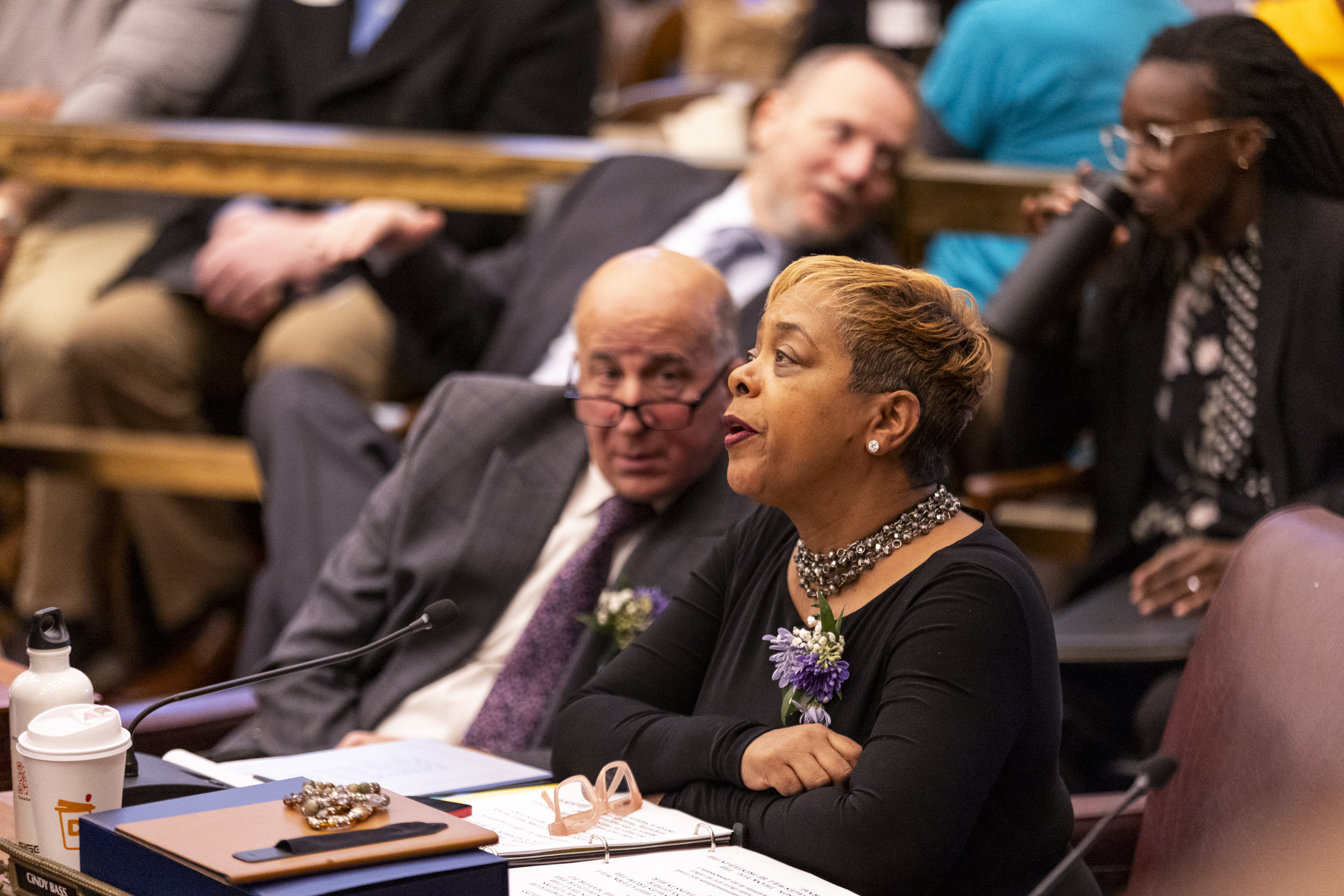
    The source said that Philly For Growth will fund advertising to support Council members Mark Squilla, whose 1st District includes parts of South Philly, Center City, and Fishtown; Cindy Bass, whose 8th District is based in North and Northwest Philadelphia; and Quetcy Lozada, whose 7th District includes much of North Philadelphia and Kensington.

    All three are seen as more centrist members and have said they intend to run for reelection. No challenger has officially launched a campaign against any of them, but candidates who are aligned with the city’s left-leaning political organizations are expected to emerge as the primary — still eight months away — draws nearer.

    The super PAC is making one exception when it comes to supporting incumbent district Council members, the source said. In the 5th District, currently represented by Councilmember Jeffrey Young Jr., the group will support a to-be-decided challenger.

    Councilmember Jeffery Young Jr. speaks to other members of Council during a 2025 session.Tom Gralish / Staff Photographer

    At least five people have said they are interested in running for the North Philly-based 5th District seat, and Young has drawn opposition from development interests for pushing proposals that would slow or halt some projects in his district.

    Young said in a statement that building “sensible, affordable housing” is one of his top priorities and that he has supported city programs like Turn the Key, which provides mortgage support to first-time homebuyers.

    “People are free to back those who share their values. These are my values,” Young said. “I am leaving it to the residents of the 5th to determine whose values best reflect them.”

    The super PAC will also fund advertising backing four incumbent members who represent the city at-large: Isaiah Thomas, Katherine Gilmore Richardson, Jim Harrity, and Nina Ahmad. That group doesn’t include progressive at-large Councilmember Rue Landau, but Philly For Growth doesn’t plan to oppose her, the source said.

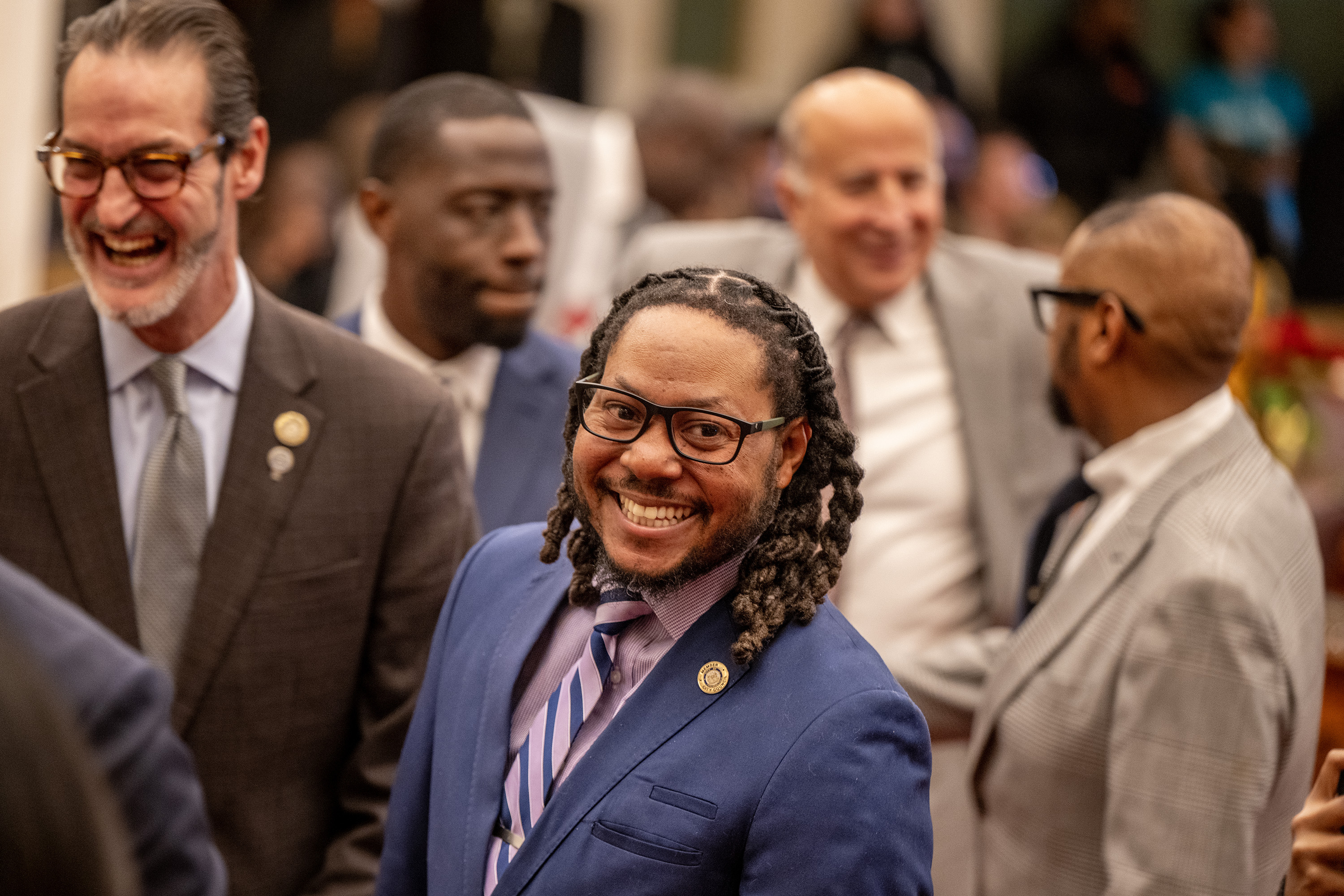
    Council President Kenyatta Johnson laughs inside the caucus inside City Hall on June 11.Aidan T. Gallo / Staff Photographer

    A spokesperson for Landau’s campaign arm said in a statement that the Council member “stands by her accomplishments for working people, small businesses and vulnerable communities in Philadelphia and looks forward to voters having the opportunity to make up their own minds next year.”

    It’s unclear just how competitive the at-large race will be, and candidates have until the spring to decide — nomination paperwork is typically due in March. Seven of Council’s members represent the entire city at-large, and two of those seats are effectively reserved for members of minority parties under the city’s Home Rule Charter.

    That has traditionally meant that five seats are held by Democrats, given the party’s massive voter registration advantage in the city. In recent years, Republicans and the progressive Working Families Party have battled for the remaining two seats during the fall general election, and the WFP currently holds both.

    Mayor Cherelle L. Parker, who is also up for reelection, and Council President Kenyatta Johnson, who insiders do not expect will see a serious challenger, will likely be on Philly For Growth’s slate, too, the source said.

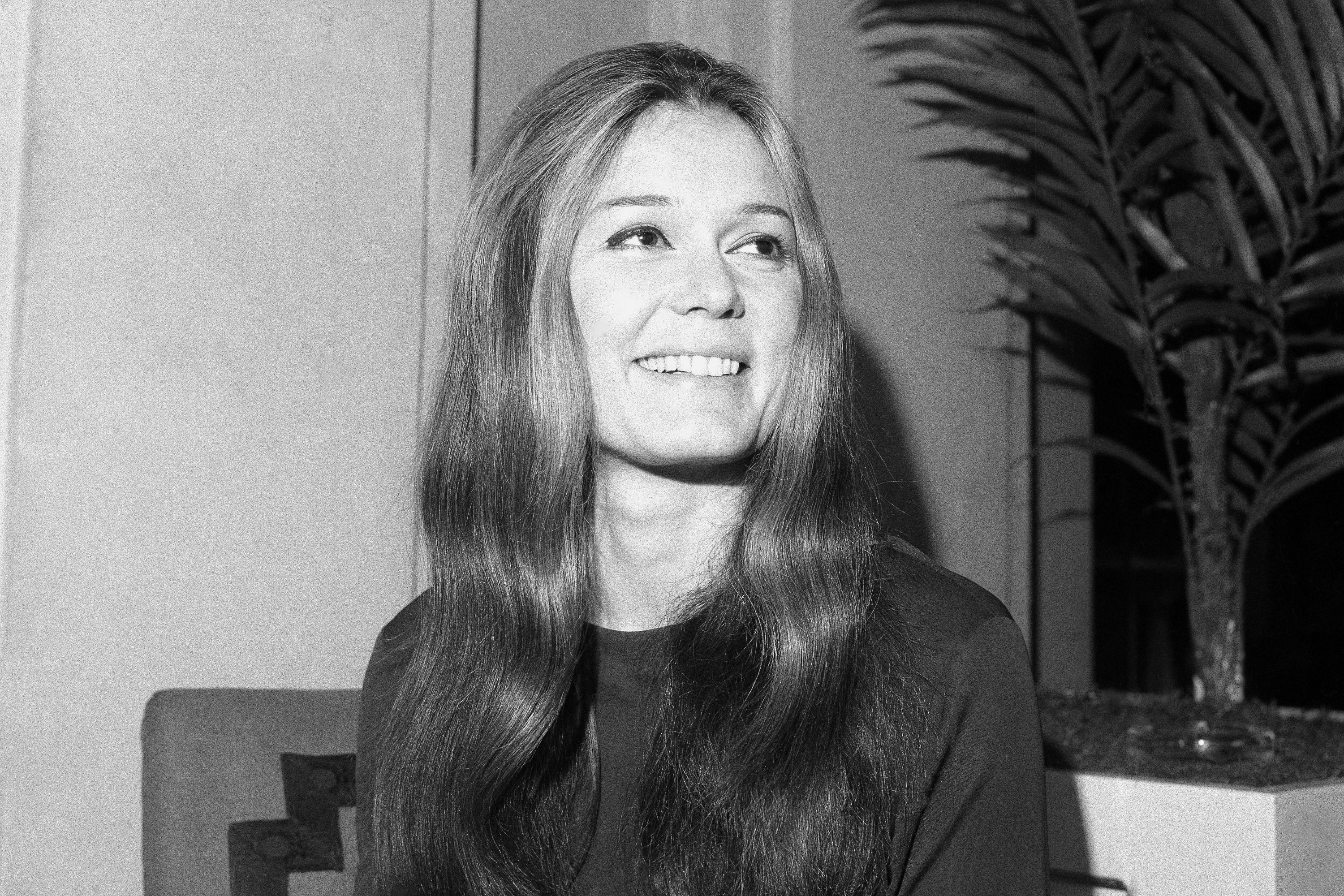
  • Gloria Steinem told us where her feminism came from

    Gloria Steinem told us where her feminism came from

    Gloria Steinem spent 18 months in India in 1957 and 1958 that set the trajectory for the rest of her life. She credited those pivotal months with teaching her to listen, to organize from the ground up, and to understand “radical” as going to the root of a problem rather than to its extreme. In 2007, she told two Indian interviewers, “If you want people to listen, you have to listen to them. I believe I learned that in India.”

    Her connection to India began long before she got there. Her mother and paternal grandmother were Theosophists, or followers of a spiritual movement that borrowed from Hindu and Buddhist thought and treated India as the home of ancient wisdom. While a student at Smith College in the 1950s, Steinem studied with Vera Micheles Dean, a foreign policy scholar who wrote about India and was publicly accused of communist sympathies in 1954. During her junior year in Geneva in 1954-1955, she wrote a research paper on why the Communist Party of India had never become the country’s dominant party.

    Then she got engaged, and she did not want to be. “Marriage meant the end of life to me,” she said years later. The Chester Bowles Asian Fellowship in India in 1956, the year she graduated from Smith, saved her from the marriage.

    Smith students had spent years raising money to send graduating seniors to India as unofficial goodwill ambassadors to a country that had declared itself nonaligned in the Cold War. Chester Bowles, the former U.S. ambassador to India, gave a lecture and waived his fee; the money it raised went into two $1,000 scholarships the students named after him, each less than half what they estimated a fellow would need to live on. They sent two students anyway. Steinem was one.

    She landed in Bombay in February 1957 expecting one country and finding another. A tall, turbaned man stooped into the plane and turned toward her. “I rose, sure that he was going to begin a speech of ‘Welcome to India, mystic heart of Asia, land of ancient cultures.’ He namasthed politely before me” — greeted her with palms pressed together — “took out a shiny red insecticide bomb, and said, ‘Stand still while I spray you.’” India, she wrote in her fellowship reports, “shatters Western romantic illusions with little ceremony.”

    She was initially tasked with explaining American culture and excellence to Indian students. However, at Miranda House, a women’s college at Delhi University, her classmates ended up asking her to explain American politics instead. In one class, she reported, “we were asked the difference between the U.S. interference in Guatemala and the Soviet action in Hungary” — the CIA-backed coup of 1954 and the Soviet crushing of the Hungarian uprising in 1956. It “nearly shocked us into silence,” she wrote.

    After the semester, when she could have gone home like most of the students around her, she chose to stay. She went first to the Himalayan foothills, to a study camp run by followers of M. N. Roy, an Indian former communist who had broken with Moscow. That is where she absorbed the idea that “radical” means going to the root of a problem, not to its extreme.

    In the fall of 1957 she traveled south, to the ashram of Vinoba Bhave, a disciple of Gandhi who walked from village to village asking landowners to give land to the landless — and she found it nearly empty. Caste riots had broken out in Ramnad, a rural district in what was then Madras State, after the murder of a Dalit leader. The government had sealed the district and barred reporters. Teams from the ashram had walked around the roadblocks anyway.

    She joined a team because it was short a woman. For a week they walked between villages. At night people came out and sat around a kerosene lamp in circles of six or twenty or fifty and told what had happened to them — burnings, murders, rapes. The teams listened. Steinem later called it “the ancient and modern magic of groups in which anyone may speak in turn, everyone must listen, and consensus is more important than time.”

    She had no word for it at the time, but a decade later American feminists called it consciousness-raising, as they sat together and discussed their experiences in their everyday lives as women — soon coming to the conclusion that the challenges they faced were largely attributable to systemic inequalities.

    Made By History sponsors. FOR USE ON MADE BY HISTORY STORIES ONLY.Inquirer Staff

    Fifteen years after Ramnad, the first issue of Ms., the feminist magazine Steinem famously founded, had an eight-armed goddess on the cover holding a typewriter, a steering wheel, a frying pan. Steinem said the image “had come out of my Indian past.” The masthead listed everyone alphabetically. The editors met in a room she called “comfortable and shoe-less,” and set their own salaries around a table in a Chinese restaurant, with the highest capped at three times the lowest.

    She showed up in India with every assumption a white American in the 1950s could have, then spent sixty years being corrected and saying so out loud. When she went back to India in the late 1970s, she met Kamaladevi Chattopadhyay, who had led Gandhi’s national women’s organization, and told her: “Well, of course, my dears. We taught him everything he knew.” Steinem repeated that story and others from her time in India for decades.

    Here was a young woman whose assumptions were challenged, and who still wrote down her honest reflections. Steinem kept doing that her whole life — approaching new ideas, learning from her mistakes, adapting. For fifty years she acknowledged the global influences that shaped her, especially at home, in a country that mostly ignored them.

    Rashida Shafiq is a historian of American foreign relations and women’s history. Her book manuscript, “The Method and the Machinery: Gloria Steinem, India, and the Cold War Making of American Feminism,” is in the works.

    Made by History takes readers beyond the headlines with articles written and edited by professional historians. Opinions expressed do not necessarily reflect the views of The Inquirer.

  • Gov. Mikie Sherrill breaks her silence on reported investigation into Lt. Gov. Dale Caldwell

    Gov. Mikie Sherrill breaks her silence on reported investigation into Lt. Gov. Dale Caldwell

    New Jersey Gov. Mikie Sherrill broke her silence Tuesday on a reported investigation into Lt. Gov. Dale Caldwell, but the governor offered little information on the matter and did not mention her No. 2 by name.

    “Public service is an honor. And I have spent a lifetime of service in the Navy, as a prosecutor, in Congress, and now as Governor,” Sherrill, a first-term Democrat, said in a statement Tuesday afternoon. “I know that jobs of public trust impact the lives of everyday people and I deeply respect the oaths and responsibilities of these positions.

    “Because of this respect, I demand that everyone in my administration hold themselves to the highest standards and put their obligations to public service first.”

    Her statement comes four days after the New Jersey Globe reported that Caldwell is under internal investigation for allegations of inappropriate behavior with women and possible ethics violations, including an offer of state jobs.

    Sean Higgins, a spokesperson for Sherrill, said Friday the administration could not “confirm or deny potential personnel matters.”

    New Jersey GOP chair Christine Giordano Hanlon this weekend criticized the administration’s framing of the situation as “an effort to shield the information from the public” and called on Caldwell to resign.

    “The governor and lieutenant governor should not be considered ‘personnel’ — they are the highest level elected officials in the state and must be held to the highest standard of accountability and transparency,” Hanlon said.

    Sherrill’s Tuesday statement did not mention any specific investigation or individuals.

    “I take my responsibility to treat any reports of inappropriate behavior or misconduct extremely seriously, and any credible report must be fully examined and addressed. If the evidence warrants, I will take appropriate action quickly,” Sherrill said.

    The investigation had already begun when Caldwell worked as acting governor while Sherrill was out of state last week, the New Jersey Globe reported. BINJE.com reported that the investigation has been underway for months.

    Christopher Porrino, who served as attorney general under former Republican Gov. Chris Christie, is conducting the investigation into Caldwell, the Globe reported.

    Sherrill noted in her statement that anyone with a complaint “will receive a fair and thorough review” and be safe from retaliation.

    “Let me be clear,” she said, “I do not back down from tough fights or tough conversations, and I will always put the interests of New Jerseyans first.”

    Assembly member Katie Brennan (D., Hudson) released a statement Tuesday calling the allegations serious.

    “Anyone who uses the power of public office to mistreat the people around them has no business holding it,” she said. “Governor Sherrill moved quickly here, and I’m glad she did, but survivors shouldn’t have to hope that the people in charge will do the right thing.”

    Brennan was a campaign volunteer for former Democratic Gov. Phil Murphy’s 2017 primary election campaign who said after Murphy took office that she had been sexually assaulted by a senior campaign adviser.

    Prosecutors declined to file criminal charges. But Brennan’s decision to publicize the alleged assault and the administration’s failure to investigate her claims led to changes in state law on how victims are treated by law enforcement. She said in her statement Tuesday that she will push for bills to protect sexual assault survivors.

    Caldwell has yet to publicly address the matter, and his office declined to comment Tuesday.

    Sherrill chose Caldwell to be her lieutenant governor after her primary win last summer. Caldwell, who was the first Black president of Centenary University, is a pastor in the United Methodist Church. He has experience working in state government, starting nonprofits, leading charter schools, and serving on the New Brunswick school board.

    Sherrill praised him as a “voice for the voiceless” who has followed in his parents’ footsteps when she announced him as her running mate last year. His mother was a teacher and his father, the Rev. Gilbert Caldwell, was a civil rights activist who protested alongside the Rev. Dr. Martin Luther King Jr.

    Staff writer Susan Livio contributed to this article.

  • Hundreds rally to protest the planned closure of the Academy of Natural Sciences museum

    Hundreds rally to protest the planned closure of the Academy of Natural Sciences museum

    Sandy McNeal came to the Academy of Natural Sciences of Drexel University on a mission that belied the beauty of a September morning that was as splendid as it gets in Philadelphia: She was aiming to prevent a “funeral.”

    McNeal, 69, and several hundred other protesters, chanting “Hey Drex! Save T-Rex,” gathered at the landmark building on Logan Square to demand that Drexel, the academy board, the state — somebody — find a way to prevent the closure of the museum, scheduled for Sept. 30.

    They came armed with signs reading “Save Our Saurs” and “Drexel Destroys Dinos?”

    Staff look down as people come out to rally, speak out, and support the Academy of Natural Sciences of Drexel University on Tuesday, Sept. 8, 2026, in Philadelphia, Pa.Tyger Williams / Staff Photographer

    Protest organizer Sarah McAnulty told the decidedly intergenerational crowd, made up of children and a whole lot of former children, that the academy, whose roots date to January 1812 — when Charles Darwin had not yet turned 3 — “brought an understanding of the vast array of Earth’s life to Philadelphia.”

    The museum “must remain open to the public,” she declared.

    “Philadelphia should be ashamed,” said McNeal, who lives in Delaware County and whose daughter is a marine biologist. For her, the museum’s closing would be akin to a “funeral.”

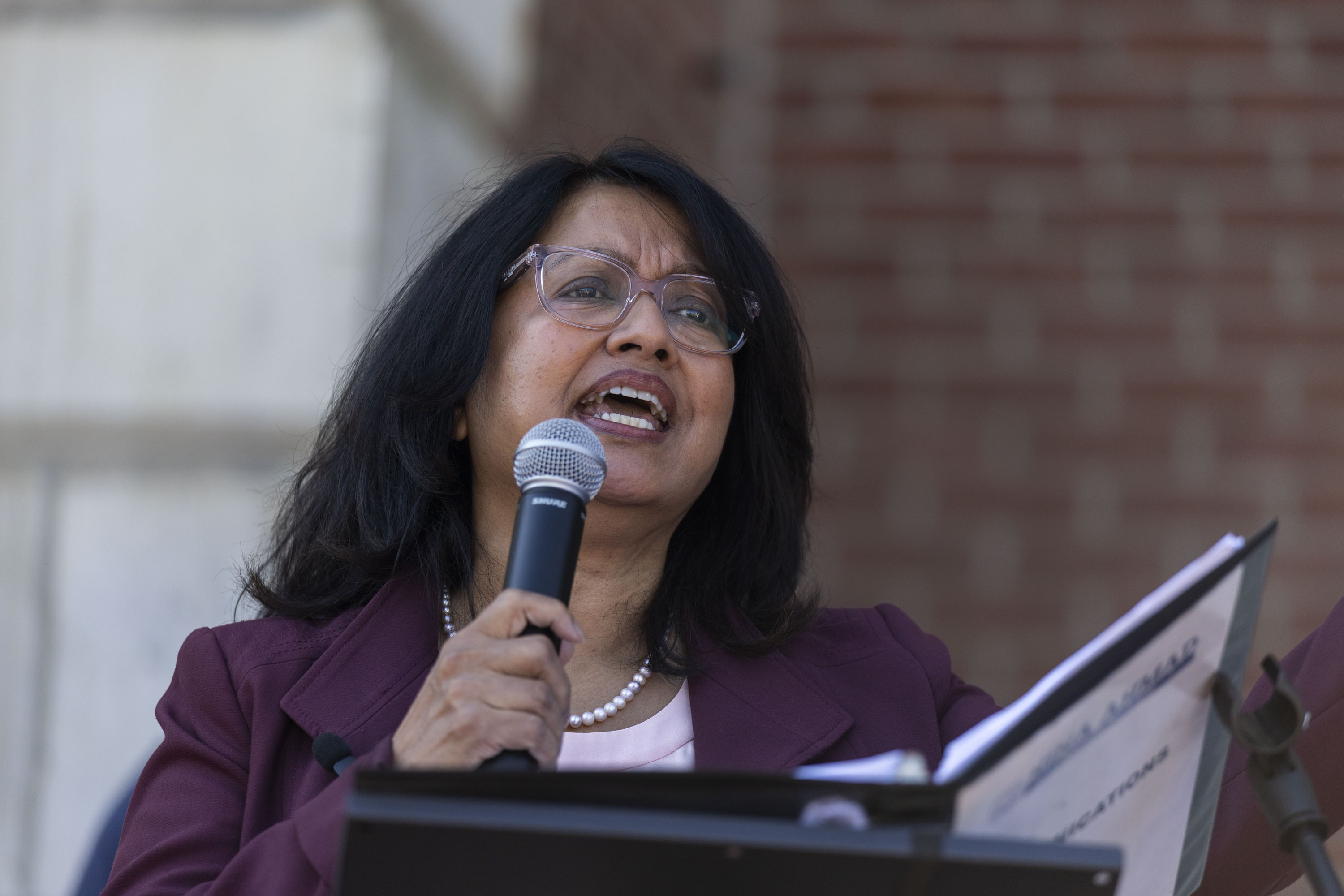
    As for the city government’s possible role, Councilmember Nina Ahmad said she and her colleagues were as surprised as everyone else by the announced closing.

    City Council member Nina Ahmad, speaks in front of folks rallying outside the Academy of Natural Sciences of Drexel University on Tuesday, Sept. 8, 2026, in Philadelphia, Pa.Tyger Williams / Staff Photographer

    “Why haven’t we heard about it? Why haven’t they come to us? We are the legislative body,” she told the crowd. Drexel and museum officials have said a dramatic drop in visitors since the COVID-19 pandemic and Drexel’s budget issues drove the closure decision.

    They have said that the collections would be maintained and the academy’s research would continue at a different location, but that the public museum, housed in a commodious building that opened in 1876 during the city’s centennial celebration, would be closed and eventually sold.

    The phrase “Academy of Natural Sciences” first appeared in the March 1812 minutes of a group of Philadelphia naturalists who had begun meeting two months earlier at the home of druggist John Speakman at Second and Market Streets, according to a 1909 history. It was a year more well-known for wars and the likes of Napoleon and Andrew Jackson, but founder Speakman found like-minded citizens in the Quaker City.

    The academy, whose participants included William Bartram, son of legendary botanist John Bartram, would grow into one of the nation’s most significant research centers, and the museum would become a popular public attraction, known for its dinosaur exhibits and dioramas, a vehicle for awing adults and piquing the interest of children in natural history.

    Ryan Sumner-lee, 10, poses for a photo holding a sign she made of her experiences here at the Academy of Natural Sciences of Drexel University on Tuesday, Sept. 8, 2026, in Philadelphia, Pa.Tyger Williams / Staff Photographer

    Having bunked a few hours of school, 10-year-old Ryan Sumner-lee was among those who made it to the protest Tuesday.

    “It’s the place that taught me I want to be a rock scientist, a paleontologist,” the fifth grader said. Aware of the closing plans, she begged her mother to take her to the demonstration.

    “She wanted to come,” said her mother, Tammy Sumner. “I am just the driver. She gives me hope” for future generations.

    Ross Bradley, 36, who brought his 6-year-old and 2-year-old to the protest, said he could not imagine a situation in which kids would not get to learn about science in their own city.

    “I have a lot of anxiety about the climate and raising young kids in an uncertain future,” Bradley said. “Having this place, where they can get invested about the future, it’s vital for them to not just feel hopeless about the planet.”

    Braxton Huminski, 3, is wearing a costume to show his support for the Academy of Natural Sciences of Drexel University on Tuesday, Sept. 8, 2026, in Philadelphia, Pa.Tyger Williams / Staff Photographer

    Daryl Stoner, 67, a retired physician from Chestnut Hill, said she brought her children to the museum once a week when they were in elementary school. The closure means an “invaluable resource” will soon be lost.

    “If we’re trying to get our kids active and off their phones, what’s better than bringing them down, walking them through the halls, and showing them things that have been there for eons.

    “We can’t afford to lose it for future generations,” Stoner said. “It’s horrendous that our city would lose this.”

  • Eagles legend Brandon Graham announces he’s done playing football — again

    Eagles legend Brandon Graham announces he’s done playing football — again

    This time, there was no tearful goodbye, no reading from a script 16 seasons in the making.

    Brandon Graham’s second public goodbye to football came on a stage at a Jefferson Health “Breakfast with the Birds” event Tuesday morning.

    “I’m officially done,” Graham, 38, told the crowd. “Y’all are hearing it from me first. But let me tell you this, they are in great hands. Jordan Davis, I’m telling you, he is a guy that’s going to get the defense going. On offense, I can’t wait for Jalen [Hurts] to prove them haters wrong as always and get us back to the promised land.”

    Graham’s first retirement from the game came in March of 2025. After coming back from injury early to play in the Eagles’ Super Bowl victory, the franchise leader in games played decided to end his playing career after 15 seasons with the team that drafted him in the first round out of Michigan in 2010.

    But Graham’s initial retirement lasted just seven months. The Eagles, needing defensive depth, signed Graham for the rest of the 2025 season after Week 7. He played a limited role on the defensive front, but made important contributions after changing positions and taking on a role as an interior lineman while the Eagles dealt with the absence of Jalen Carter.

    Graham, who stripped Tom Brady late in the team’s first-ever Super Bowl victory, registered two sacks in a shutout victory over Las Vegas in Week 15. He finished his final regular season with three sacks and eight total tackles in nine games.

    He remained open to the possibility of coming back for a 17th season, but said at a recent PHLY Sports event that his return needed to be before the season, not joining a season in progress like in 2025.

    Brandon Graham’s strip-sack of Tom Brady during Super Bowl LII lifted the Eagles to their first title. David Maialetti

    The Eagles retooled their edge rushing corps in the offseason, most notably by trading for Jonathan Greenard and signing him to an extension worth nearly $100 million. They have an ascending young player in Jalyx Hunt and another, Nolan Smith Jr., who is entering his fourth NFL season. Howie Roseman also added some veteran depth in Arnold Ebiketie and A.J. Epenesa.

    “Communication between BG, the Eagles, and me has always been consistent,” Roseman said in July. “BG was the first draft pick I ever made as GM. Those conversations, obviously between us and every player, we’re going to keep between us and the player. I want to be consistent with whoever that is that we do that. But obviously you’re talking about one of the greatest Eagles players and an unbelievable person. Last year, his ability to come back in and help us was huge for our football team. But again, those conversations we’ll keep private.”

    Graham ends his NFL career as the franchise’s all-time leader in games played with 215. He played in another 13 postseason games. His 5½ playoff sacks add to a career regular season total of 79½.

    “I’m going to still be around,” Graham said at the event Tuesday. “I’m still around. I’m still giving wisdom, helping the guys.

    “It’s an adjustment for me, but it’s a great adjustment because it’s all about my kids and my family, trying to make sure I’m there for that. Just spreading the love everywhere.”

  • As Social Security fund runs dry, some Republicans say it’s time to raise taxes

    As Social Security fund runs dry, some Republicans say it’s time to raise taxes

    For decades, Washington has replayed the same fight over taming the soaring national debt: Democrats cite a need for more taxes. Republicans refuse. And anyone who suggests cutting the biggest source of spending — federal retirement benefits — gets attacked.

    But a coming crisis in Social Security appears to be pushing at least a few Republicans off the GOP’s long-standing pledge never to raise taxes.

    This summer, Sen. Bernie Moreno (R., Ohio) joined Sen. Elizabeth Warren (D., Mass.) in proposing to raise the payroll tax cap so people with higher incomes pay more into the program. Now the idea is emerging as an acceptable fix among other GOP lawmakers, including Rep. Tom Cole (Oklahoma), the influential chairperson of the House Appropriations Committee.

    “We’ve got too many people who say, ‘Well, we have to stay within the current income level or stay at the current tax rate,’” Cole said in an interview. “I’m willing to look at the tax rate. I am willing to raise the amount of income through tax.”

    The rare GOP concessions on taxes come as lawmakers begin to confront a Social Security shortfall so large and so imminent that the party’s traditional demand for curtailing benefits is unlikely to suffice. In just six years, millions of Social Security recipients will absorb a 22% cut in benefits unless lawmakers provide an immediate infusion of nearly $500 billion.

    “Twenty or thirty years ago,” when the shortfall was far in the future, “you could come up with a straight-faced solution” that solved the problem entirely by cutting future benefits, said Charles Blahous, a senior research strategist at George Mason University’s Mercatus Center who served from 2010 to 2015 as the Republican public trustee for Social Security.

    Now the problem is so big and urgent, Blahous said, “I don’t think you can look at it with a straight face and not do all of the above.”

    Grover Norquist, founder of Americans for Tax Reform and the longtime enforcer of Republican anti-tax orthodoxy, dismissed the crack in party discipline, arguing that Republicans should stick to demanding spending cuts. Otherwise, he said, they risk infuriating voters already angry about the high cost of living.

    “When Republicans say no to tax increases, they win. When they say yes to tax increases, they lose,” Norquist said. “They don’t get spending cuts — at all. And, they get smeared in the next election.”

    But Cole, at least, said he thinks the political blowback from Social Security benefit cuts would be far worse than a comprehensive solution that includes raising taxes.

    “I love Grover. But … you’ve got to deal with Social Security,” Cole said. “And believe me, you’ll have a lot bigger problem if it goes bankrupt than you’ll have keeping it whole, because people will feel cheated.”

    Created during the Great Depression, Social Security provides monthly cash benefits to more than 70 million Americans. It is the single largest program in the $7.4 trillion federal budget, paying out $1.7 trillion this year, according to the nonpartisan Congressional Budget Office. (Medicare is a close second at $1.3 trillion.)

    The program is funded by a payroll tax on wages up to a “cap” of $184,500 a year, with workers and employers each paying 6.2%. Workers who pay into the system can receive monthly checks as early as age 62, though the full retirement age is 67.

    For years, annual tax collections exceeded the cost of benefits, allowing the program to amass a surplus known as the Social Security trust fund. As the baby boom generation retired, however, the math flipped: Social Security now pays out far more than it collects and is draining the trust fund to make up the difference.

    The trust fund is projected to run dry in 2032. At that point, Social Security would have to rely solely on incoming tax collections — meaning monthly checks would shrink by $440 on average unless Congress acts, according to the Bipartisan Policy Center, a Washington think tank.

    Closing the shortfall would require $459 billion in cuts or fresh revenue in 2033 alone, according to the BPC — and the sum would grow larger every year.

    That relentless math persuaded Moreno, a former car dealership owner who rode into office with President Donald Trump’s endorsement in 2024, to break ranks with his party on tax hikes. In his proposal with Warren, Moreno calls for eliminating the payroll tax cap so highly compensated workers pay the tax on their entire income.

    “Why should a middle-class nurse pay a larger share of her paycheck than a wealthy corporate lawyer?” Moreno and Warren wrote in an op-ed for the New York Times, noting that one recent poll found that 62% of Republicans support lifting the cap. “This is doubly unfair in an economy in which top earners’ wages, over time, have pulled far ahead of those of the average worker.”

    Moreno declined an interview request. His spokesperson Reagan McCarthy said in an email: “Sen. Moreno promised Ohioans he would fight for them in DC and make sure they get the benefits they were promised and that’s exactly why he’s leading this effort.”

    Removing the cap without increasing benefits for high-earning workers would close more than half the program’s shortfall, according to the Committee for a Responsible Federal Budget, a nonpartisan group focused on deficit reduction. Blahous and others have cautioned against that approach, saying it would sever the connection between contributions and benefits that makes Social Security different from — and more popular than — other social welfare programs.

    Uncapping the payroll tax alone would push the top marginal federal tax rate over 50%, according to the Manhattan Institute, a conservative think tank.

    Some Democrats would go further. Sen. Sheldon Whitehouse (D., R.I.) argues not only for lifting the payroll cap but also for taxing the investment income of wealthy households and closing a loophole that lets business owners shrink their personal tax bills.

    That proposal, which would fall entirely on the backs of the wealthy, would raise enough cash to fully fund Social Security for at least 75 years, according to a 2023 estimate by the program’s chief actuary.

    The historic link between contributions and benefits makes changing Social Security politically perilous. That’s why many in Congress want negotiations to be outsourced to a bipartisan commission or advisory board.

    Cole has introduced one of several proposals to form such a panel. He argues that more tax revenue, including from raising the payroll tax cap, “ought to certainly be on the table” alongside adjustments that would reduce future spending, such as raising the retirement age.

    A third GOP lawmaker, Rep. Lloyd K. Smucker of Pennsylvania, has also said he sees more tax revenue as part of a Social Security fix. “You’ll probably have to do something on the payroll half of the money being paid into the system,” Smucker told Roll Call last week.

    Smucker said lawmakers should also consider means testing, so benefits are reduced for the wealthy while low-income retirees are protected. Smucker’s office did not respond to requests for comment.

    Though raising taxes is unpopular among Republicans, it has long been part of bipartisan plans to solve the Social Security puzzle. In 1983, President Ronald Reagan, a Republican, and House Speaker Tip O’Neill, a Democrat, saved the program from its last bout with insolvency, agreeing to a mix of solutions that included increasing payroll taxes and gradually raising the retirement age.

    In 2005, Sen. Lindsey Graham (R., S.C.) argued for raising the payroll cap and trimming benefits. Weeks later, President George W. Bush said he was open to a “variety of options,” though his plan to curtail future benefits for all but low-income retirees and divert some tax dollars to new private retirement accounts was dismissed by Congress.

    And in 2010, several Republicans on a commission formed by President Barack Obama voted in favor of a debt-reduction plan that included raising the payroll cap, raising the retirement age to 69 and trimming benefits for wealthy retirees. The plan offered by the so-called Bowles-Simpson commission never received a vote in Congress.

    Sen. Mike Crapo (R., Idaho) was among the commission’s yes votes. Crapo now serves as chairperson of the powerful Senate Finance Committee, which has jurisdiction over both taxes and Social Security.

    At a committee hearing last month, Crapo said the Bowles-Simpson plan “has informed subsequent Social Security solvency discussions.” His office did not respond to questions about his current position on tax hikes.

    Another hallmark of Social Security reform has been deep involvement by the White House. Cole said he has urged Trump to take on the hard work of fixing the program, calling it a potential “crowning achievement.” Since Trump is not running for office again, he could “do it with no political risk,” Cole said, adding, “I think he’ll get enormous political credit for it.”

    But while Trump has warned Republicans not to cut “a single penny from Medicare or Social Security,” he has not said how he would raise the vast sums needed to bolster the programs’ deteriorating finances.

    White House spokesperson Liz Huston did not respond to questions about fixing the program, saying via email only that “there will be zero reductions to Social Security payments” under Trump’s leadership.

  • Rittenhouse’s contemporary Vietnamese restaurant is finally here

    Rittenhouse’s contemporary Vietnamese restaurant is finally here

    After 20 years of cooking other people’s food around the region, Carolyn Nguyen is finally telling her own story.

    Carolyn’s Modern Vietnamese opens Wednesday at 2015 Walnut St. with a menu that draws from Nguyen’s personal history: the Vietnamese and Louisiana foods Nguyen grew up eating, the French techniques she learned in culinary school and restaurant kitchens, and the freewheeling combinations that defined her food trucks and Revolution Taco, the fast-casual restaurant she co-owned in the space for a decade.

    Chef Carolyn Nguyen adds butter to a pan while cooking curry duck potato gnocchi.Aidan T. Gallo / Staff Photographer

    Bánh canh, a thick Vietnamese noodle soup, is presented as a seafood boil with poached shrimp, mussels, fried potatoes, and scallions. Thịt kho tàu, a Vietnamese braised pork dish, becomes slow-cooked grits topped with pork belly, a soft egg, and pickled vegetables. Hoi An chicken comes with ginger dirty rice, braised collards, and herb remoulade.

    Other large plates include lemongrass smoked beef short rib with fish sauce-caramel jus, warm potato salad, and cabbage slaw; corn and crab congee with crispy shallots, and herbs; and a salt-and-pepper cornmeal-crusted whole fish with ginger sauce.

    Carolyn Nguyen sprinkles Chinese chives onto her potato gnocchi.Aidan T. Gallo / Staff Photographer

    Curry duck potato gnocchi with Thai basil pesto carries a memory from Nguyen’s time at Old City’s Fork, where she worked for chef Terence Feury. At midday, she said, they would stop and make gnocchi together.

    The small plates ($12 to $22) include tofu hummus, mushroom and leek dumplings, polenta-daikon fries, dry aged beef in betal leaves, chicken liver mousse, and tasso-crab spring rolls.

    Pandan bread pudding dessert at Carolyn’s Modern Vietnamese.Aidan T. Gallo / Staff Photographer

    Large plates are priced from $24 to $46, plus a market-price whole fish. Desserts include coconut rice pudding with bananas Foster sauce and pandan bread pudding with coconut sauce.

    “It’s both coming home to the food that I grew up with and then the food that I’ve cooked and learned how to cook,” she said. “It’s food that I love.”

    Nguyen was born and raised in Amelia, in Louisiana’s St. Mary Parish. Her parents, Paul and Mai Nguyen, were born in Vietnam but met in the United States. Her father arrived in the late 1960s and later helped Vietnamese refugees settling around New Orleans. He met Nguyen’s mother while driving her to appointments. The family moved to South Carolina when Carolyn was 16.

    Lotus root salad with watermelon, corn, heirloom tomatoes, and Thai basil as served at a preview for Carolyn’s Modern Vietnamese.Kiki Aranita / Staff

    “I always knew I wanted to pursue cooking,” she said. “Unfortunately, in South Carolina, there wasn’t really any fine-dining environment.” When her sister moved to Philadelphia to go to dental school around 2005, Nguyen moved north with her and enrolled in the culinary school at the Art Institute of Philadelphia. The goal was working in New York, “but I fell in love with Philadelphia because of the food environment,” she said.

    Her first restaurant job was as a cook at Susanna Foo on Walnut Street. Besides Fork, she later worked at such restaurants as Nectar in Berwyn (also with Feury), Maia in Villanova, and Russet in Center City. At Peachtree & Ward catering, she met her initial business partner, Michael Sultan.

    Chef Carolyn Nguyen in her dining room at Carolyn’s Modern Vietnamese.Aidan T. Gallo / Staff Photographer

    In 2012, Nguyen and Sultan entered the food-truck business with Street Food Philly. Taco Mondo followed, and in January 2016, Nguyen, Sultan, and Alan Krawitz opened Revolution Taco, whose taco fillings included pork belly, duck, beef tongue, Korean fried chicken, smoked mushrooms, and curried cauliflower.

    The other partners moved on, but Nguyen still owns the Revolution location at the Comcast Center’s concourse. Eight months ago, she closed the Walnut Street location but kept the lease, figuring that converting its counter-service format into a full-service experience would be “easy-peasy – maybe a month.”

    Instead, the concept and design evolved as Nguyen worked through permitting and paperwork, much of which she handled herself. Carolyn’s has 28 seats at tables and along a banquette, plus five at a counter.

    The dining room is spare and contemporary, with cream-colored walls, butcher-block-style tables, black upholstered chairs, and a deep-green banquette. An arched brass-framed mirror and two narrow pieces of preserved-moss botanical art soften the black track lighting.

    Carolyn’s Modern Vietnamese, 2015 Walnut St., replaces Revolution Taco.Gab Bonghi

    Pale-green cloth napkins, metal chopsticks, and wooden rests carry the palette to the tables. The Louisiana connection extends to the soundtrack, with ragtime- and blues-inflected New Orleans jazz by early figures such as King Oliver and Buddy Bolden.

    Nguyen wanted the room to feel relaxed and unhurried. Green “represents growth and new beginnings for me,” she said.

    The bar will emphasize locally produced wines and spirits. Two cocktails are inspired by Nguyen’s parents: a tropical Mama Mai Tai for her mother and the Ông Xuyên (Mr. Xuyen) for her father, an avid gardener who grows dozens of plant varieties and keeps chickens at the family home.

    Her father once returned from a shrimping trip with fish bones and used them to make fish sauce in a barrel. Nguyen plans to put a small amount of house-made fish sauce in his namesake cocktail for a savory undertone.

    Carolyn’s Modern Vietnamese, 2015 Walnut St.Aidan T. Gallo / Staff Photographer

    Carolyn’s will start with dinner Wednesday to Saturday. Nguyen eventually hopes to add Tuesday dinner and a more casual lunch or brunch, potentially with more traditional Vietnamese dishes.

    Carolyn’s Modern Vietnamese, 2015 Walnut St., instagram.com/carolynsvietnamese. Hours: 5 to 9 p.m. Wednesday and Thursday, 5 to 10 p.m. Friday and Saturday. Reservations via OpenTable.

  • Charles views the Bayeux Tapestry, this time as king

    Charles views the Bayeux Tapestry, this time as king

    LONDON — The last time King Charles III of Britain saw the Bayeux Tapestry, in September 1987, he had to travel to its home in northern France. Accompanied by Diana, Princess of Wales, the then prince marveled at the over 900-year-old embroidery depicting William the Conqueror’s invasion of England in 1066, and he impressed local residents with a brief speech in French about its impact.

    On Sept. 2, almost 40 years later, Charles got to view the tapestry in notably different circumstances — now as king, just like the tapestry’s main characters, and this time without having to leave his home soil. Instead, he went to the British Museum in London, accompanied by Queen Camilla, to witness the tapestry’s return to Britain for the first time since it was made.

    The tapestry is not just a historic artifact, but a personal reminder of “what I like to think of as the French side of my family’s history,” Charles joked during an eight-minute speech at the museum. He also spoke of his joy at seeing the 220-foot-long embroidery in London, where it is the focus of a blockbuster exhibition that opened on Thursday.

    “The tapestry’s story is one of ambition and uncertainty, of oaths and journeys, of ships, councils, kings, comets, and consequences,” Charles said, calling it “70 meters of memory and artistry.”

    The British Museum hopes that attendance for the show, which runs through July 11, will rival the 1.6 million visitors who flocked to its “Treasures of Tutankhamen” exhibition in 1972.

    Before the speeches, British Museum curators had walked Charles along the tapestry and pointed out key scenes, including one showing the coronation of Harold Godwinson, England’s last Anglo-Saxon monarch, and another depicting Godwinson’s death at the Battle of Hastings. In that scene, the dying monarch clasps an arrow that has thwacked his eye.

    Although the tapestry shows a time of conflict between France and England, the recent event was a sedate affair, bringing together President Emmanuel Macron of France and Prime Minister Andy Burnham of Britain and their wives, alongside Charles and Camilla.

    The tapestry recounts a conflict, Charles said during his speech, “yet here it is today, nearly 1,000 years later, as a precious symbol of trust at a time when trust seems sadly to be in short supply between nations.”

    Macron also spoke at the museum, saying how the Norman invasion depicted in the tapestry “was just the start” of events that have entwined Britain and France, including “marriages, alliances, inheritances, and successions” as well as shared cultural artifacts.

    The tapestry’s reappearance in Britain was a long time coming. Embroidered in the 11th century, most likely in Canterbury, England, it was later moved to Bayeux, France, where it eventually was listed in a 1476 inventory of the town’s cathedral.

    Over the past 70 years, British officials have repeatedly tried to borrow the artwork — including for the coronation of Elizabeth II, Charles’ mother — but French art experts insisted that it was too fragile to travel.

    That situation changed in 2018, when Macron announced that France had agreed to lend the tapestry to Britain as a gesture of friendship between the two nations. The loan has been able to go ahead thanks to techniques developed by conservation experts to ensure that the tapestry could travel to London.

    Last year, Macron said in a speech at the British Museum that Charles had been a key figure behind the scenes encouraging the project.

    Charles has long been a supporter of arts and culture, and as a prince, he often discussed his love of traditional art and architecture in interviews. In 2004, he co-founded an academy for traditional arts, whose short courses include training in weaving and embroidery. And his foundation, in collaboration with Chanel, runs specialist embroidery courses aimed at students who want to work in high-end ateliers.

    The royal has also added stitches to several artworks inspired by the tapestry. In 2000, he sewed the final stitch for the New World Tapestry, an attempt to depict British colonialism in the Americas that has since been accused of perpetuating racist stereotypes.

    In 2012, on a visit to Alderney, one of the Channel Islands, Charles contributed a few stitches to a work of embroidery that aims to continue the Bayeux Tapestry’s story beyond its current end point depicting William the Conqueror’s successful invasion of England.

    Kate Russell, a founder of that tapestry project, said in an interview that during his visit Charles urged people to go and see the original tapestry in Bayeux. She also said it was obvious why he would love the tapestry given the story it relays: “You can’t be a member of the English royal family and not have a sense of the ties to those events.”

    Toward the end of Charles’ speech, the king switched to French and pointed out that the tapestry’s final scenes were missing. (They were likely worn away over time.)

    “It falls to each generation to add its own stitch to the fabric of our shared history,” Charles said, “from this evening and into many generations to come.”

    This article originally appeared in the New York Times.

  • Villanova’s Brynn McCurry to miss 2026-27 season after surgery to repair torn ACL and meniscus

    Villanova’s Brynn McCurry to miss 2026-27 season after surgery to repair torn ACL and meniscus

    Villanova senior forward Brynn McCurry announced Tuesday on social media that she underwent surgery to repair a torn right ACL and meniscus on Sept. 1. She will miss the 2026-27 season.

    “I’m walking into this next season of healing with a heart full of peace because this game has given me so much more than it took,” McCurry wrote in an Instagram post. “Basketball has always been such a meaningful part of my story, but it was never the entirety of it.”

    Losing McCurry is a major blow to Villanova. While the injury occurred in April and allowed coach Denise Dillon time to fill McCurry’s spot, it will be difficult to fill her workload.

    McCurry, a 6-foot-1 forward, was coming off a career-best campaign in which she started 29 of 33 games and was the team’s second-leading scorer with 10.7 points per game. She also won the Big East’s Most Improved Player award.

    Projected as one of four returning starters for Villanova, McCurry’s season-long absence will test Villanova’s depth at forward. The Wildcats have solid pieces in their frontcourt, headlined by 6-3 Quinnipiac transfer Anna Foley, and returning starters Jasmine Bascoe, Kelsey Joens, and Kennedy Henry.

    Dillon also will have to find a combination to fill McCurry’s minutes. She averaged 26.5 minutes last season, third most on the team behind Henry and Bascoe.

    McCurry suffered two prior knee injuries — she tore her left ACL and meniscus during her senior year of high school and tore her right ACL and meniscus before her sophomore season at Villanova. She then tore the UCL in her right arm before the start of her junior year and underwent Tommy John surgery this past April, two days after her third knee injury.

    The Wildcats open their season on Nov. 1 in Rome as a part of the Eternal City Tip-Off. They’ll face Notre Dame in their first meeting in eight years.