Blog

  • LIV Golf files for bankruptcy protection in New Jersey as it tries to survive in a smaller version

    LIV Golf files for bankruptcy protection in New Jersey as it tries to survive in a smaller version

    LIV Golf filed for Chapter 11 bankruptcy protection Tuesday in New Jersey with more than $500 million in debt, part of its goal to revive the league without Saudi funding.

    The move was widely expected after the Public Investment Fund of Saudi Arabia abruptly ended its financial support after the final event of the 2026 season. LIV said it has agreed to a restructuring plan with BC Partners as the primary source of its capital.

    “This process gives us the structure and time to pursue a landmark transaction and begin the next chapter of LIV Golf,” CEO Scott O’Neil said in a news release.

    O’Neil has said “LIV Golf 2.0” would feature players as majority owners in a reduced schedule. In a letter to LIV Golf fans, O’Neil said the new look would expand the size of the field from 57 to 75 players and introduce a 54-hole cut for the first time.

    In a letter to LIV Golf fans, CEO Scott O’Neil said the new look would expand the size of the field from 57 to 75 players and introduce a 54-hole cut for the first time.Matthew Harris

    He said the team concept would be built around nationalities and that LIV would continue to tap some of its more successful markets in Australia, South Africa and Asia.

    Still, the new version would be a shell of what LIV had been when it launched in June 2022 — enormous signing bonuses to lure away top names from the PGA Tour, and excessive spending that topped more than $5 billion before PIF said in April it was pulling the plug.

    Still to be determined is the future of the biggest stars still with LIV, most notably Jon Rahm and Bryson DeChambeau. Rahm is playing the Irish Open this week and told BBC Northern Ireland: “I still have a contract with LIV 1.0 that I’m more than willing to fulfill. Like I said, time will tell.”

    Rahm, DeChambeau, Dustin Johnson and Cameron Smith were the leading four creditors listed in the filing.

    LIV listed between $100 million and $500 million in estimated assets, and $500 million and $1 billion in liabilities.

  • U.S. says it has destroyed 5 Iranian oil tankers after missile attacks on Navy warship

    U.S. says it has destroyed 5 Iranian oil tankers after missile attacks on Navy warship

    WASHINGTON — Iran has launched missiles toward U.S. targets in Jordan, Iranian state-run media said, following the latest American strikes.

    It’s the latest tit-for-tat retaliation after the U.S. military said it destroyed five Iranian crude oil tankers following two attacks on a U.S. warship by Iran’s Revolutionary Guard over the past two days.

    U.S. Central Command, when asked about the strikes on the Jordanian airbase, said it had no information to offer.

    The Iranian tankers destroyed in the attack were the Kivik, Charminar, Horizon 1, and the Riesco in the Gulf of Oman, Central Command said. The U.S. military also destroyed the vessel Derya, which was located near Kharg Island in the Strait of Hormuz.

    Central Command said the crews of the five vessels were told to abandoned ship before the attacks.

    The strikes come just three days after U.S. forces destroyed three Iranian oil tankers after Iran’s Revolutionary Guards tried to attack a U.S. aircraft carrier and destroyer.

    Iranian state television also reported the U.S. strikes, saying U.S. forces attacked at least three Iranian oil tankers near the southern port of Jask and near Kharg Island in the Persian Gulf. It said the crews were evacuated.

    Secretary of State Marco Rubio said the U.S. will not allow Iran’s attacks to go unanswered.

    “Iran continues to try to hit U.S. naval ships. And for every time they do that or try to do that, they’re going to lose tankers. And I think you’ll see that again today,” Rubio told reporters Tuesday when asked about the latest attacks in Iran while on a trip to Colombia.

    Danny Citrinowicz, an Iran expert at Israel’s Institute for National Security Studies, warned that such back-and-forth strikes can only risk more retaliation and further impact to the global economy.

    “There is no kinetic solution to the Strait of Hormuz problem,” he said on social media. “Every attempt to impose one only brings Washington and Tehran closer to an escalation that may become increasingly difficult to control.”

    An Iranian state TV reporter in Jask said an Iranian tanker was struck near the coast of Yekbeni, while another explosion was heard in the area whose source and location were not immediately clear.

    State TV later reported that the U.S. military attacked a second tanker near waters off Jask. It said the crews of both vessels were being evacuated by lifeboat toward the Jask coast.

    Separately, state television reported that another Iranian tanker was attacked in Kharg Island anchorage area. It said the crew was safely evacuated shortly after the strike.

    Iran’s Revolutionary Guard Navy on Tuesday warned crews of oil tankers near ports in Kuwait and Bahrain to immediately leave their vessels, saying the ships could be targeted in retaliation for U.S. attacks on Iranian tankers. It accused Kuwait and Bahrain of hosting U.S. forces and assisting in the attacks.

    On Saturday, the U.S. military said it had struck three Iranian oil tankers after Navy warships were targeted with ballistic missiles, warning that it would, “if necessary, destroy Iran’s limited and exposed oil fleet.” Iran later said it planned to announce a new “exclusion zone” near the Strait of Hormuz aimed at vessels intending to transit.

    The latest strikes are part of a dual economic and military approach by President Donald Trump as he struggles to bring an end to a more than six-month-old war with Tehran.

    The Trump administration on Tuesday also imposed sanctions on additional elements of Iran’s aviation industry, targeting more than two dozen commercial and private airlines as well as foreign cargo service providers in its new push to isolate Tehran from its remaining trading partners.

    Both the U.S. and Iran are seeking to exert control over the Strait of Hormuz, where about one-fifth of the world’s oil passed before the war began. Rising energy prices are posing political problems for Trump and his Republican Party ahead of the November midterm elections. A barrel of international standard Brent crude briefly climbed as high as $99.46 on Tuesday.

    A U.S. blockade of Iranian ports has squeezed the country’s economy by limiting its oil exports, while the American military has been helping a limited number of ships transit on a route through the Strait of Hormuz off Oman. Tehran wants ships to follow a route that it chooses through the strait, which was considered an international waterway before the war.

  • America should move beyond the two-party system

    America should move beyond the two-party system

    It may be hard to remember in today’s polarized political climate, but there used to be a time when members of Congress — and even Democratic and Republican presidents — would work across the aisle to approve important pieces of legislation.

    And there was no way around it.

    Until Newt Gingrich came up with his Contract with America in 1994, Republicans had been the minority in the House for 40 consecutive years, making partnering with Democrats unavoidable. Gingrich, then the House minority whip, elevated local races to the national stage, crushing the former conservative Democratic stronghold in the South and flipping it for Republicans. The new GOP platform also moved the focus away from compromise to a more confrontational approach.

    This brutalization of partisan politics has reached a new nadir under President Donald Trump. His hateful rhetoric and frequent attacks on Democrats have made it nearly impossible for members of both parties to constructively work together.

    Meanwhile, with the midterm elections around the corner, the parties themselves seem to be fracturing.

    For the GOP, Trump’s own MAGA candidates are having to deal with increasing competition from traditional Republicans after the president’s laundry list of failures — a war of choice in Iran, soaring gas prices, and a rising cost of living — continues to grow.

    Add to this the Silicon Valley billionaire crowd and the MAHA movement that was brought in by former Democrats Robert F. Kennedy Jr. and Tulsi Gabbard, and you get a party disagreeing on basic ideals. For Democrats, the Democratic Socialists of America are trying to radically change the societal landscape and are pulling the party to the left more than many pragmatic centrists would like.

    Former House Speaker Newt Gingrich stands as he waits for an audience with Pope Francis in 2020. Gingrich swept away four decades of Democratic House rule with the “Contract with America” in 1994.

    With many voters tired of political division that gets nothing accomplished, yet strongly divided themselves over what issues they value most, the U.S. should consider whether the big tent politics of the past are still relevant, or whether it’s time to move beyond a two-party system.

    In Europe, countries like France and Great Britain have already undergone this shift.

    In Germany, where I’m from, there was a strict three-party system after World War II, with the Liberals often serving as power brokers between Conservatives and Social Democrats. In 1983, the Greens made it into the federal parliament, or Bundestag, paving the way for the first real left-wing coalition between Social Democrats and Greens in 1998.

    Through the coalition, the Greens were able to negotiate a gradual end to nuclear power. The party also introduced incentives for investments into renewable energy as well as an ecological tax on fossil fuels — along with taking the first step toward marriage equality for gay couples.

    After German reunification, the successor of East Germany’s state party united with a separatist movement of the Social Democrats, forming another strong contender left of the established spectrum that put heavy societal pressure on the introduction of a minimum wage, rent freezes in metropolitan areas, and a renewed focus on subsidized and public housing.

    Most recently, the Alternative für Deutschland, or AfD, keeps shaking up the system with its MAGA-influenced right-wing approach, being especially successful in the German east and being on track of having its first prime minister at the state level this fall. Even without a majority, the AfD’s growing electoral gains have already led to stricter border security and asylum policies by the other parties.

    Alice Weidel (right), group leader of the Alternative für Deutschland, and Tino Chrupalla, chairman of the AfD, attend the AfD party convention at the Erfurt Exhibition Centre in Erfurt, Germany, in July.Katharina Kausche

    There are currently five major parties represented in the Bundestag, while many smaller parties are involved in local governments across the country. Those are a lot of options for a country just short of 85 million people.

    Meanwhile, in the U.S., there are 350 million people coming from all walks of life and facing a host of local issues that often get lost in the push for nationalized politics. Having multiple parties would give voters more choices and solve problems more effectively while weakening polarization.

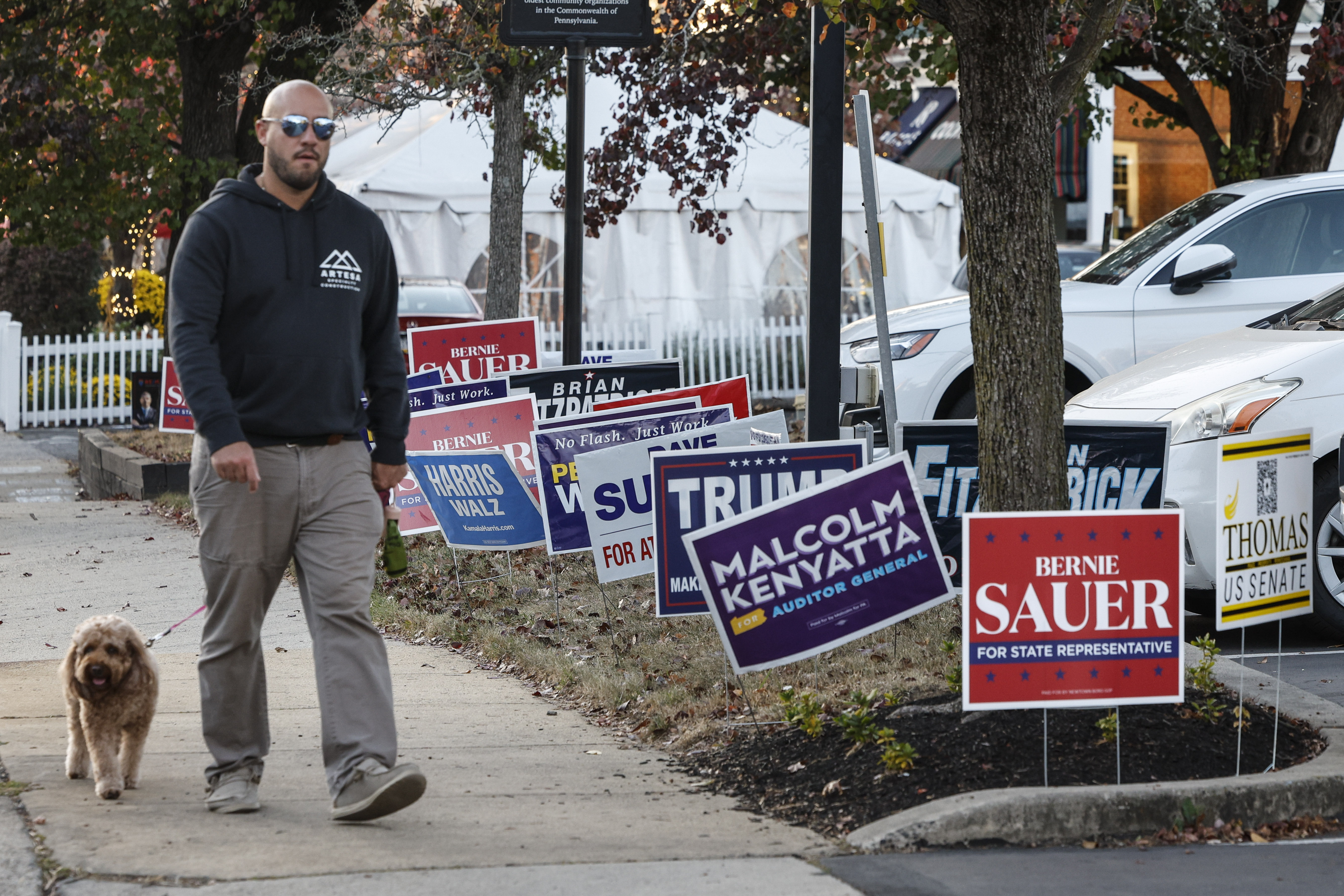
    For example, here in Pennsylvania, environmentalists and proponents of Big Tech could compromise over data center regulations that protect communities while still making way for artificial intelligence development. Progressive Democrats and union-backed Republicans like Brian Fitzpatrick and moderate Rob Bresnahan could work out solutions for the structural changes of the former coal and steel regions of the state.

    Of course, having more than two parties wouldn’t magically solve all problems, but it could broaden democratic competition and debate, give minorities more of a voice, and even help the GOP and the Democrats come together.

    Yes, there would be fewer people under their respective tents, but the major parties would be able to focus on their own raison d’être again, since it’s impossible to stand for something when you’re trying to stand for everything.

    The United States is a huge country with impressive diversity — it’s time to have a party system that reflects this.

    Wim Orth is a journalist with WELT in Berlin and an Arthur F. Burns fellow at The Inquirer.

  • Abington is trying to break its 2028 contract with Flock amid data concerns, police chief says

    Abington is trying to break its 2028 contract with Flock amid data concerns, police chief says

    Abington Township is trying to exit its Flock Safety agreement early for breach of contract over data leaks, Police Chief Patrick Molloy said at a recent meeting, as officials implement a new surveillance system and draft new policies for the replacement system.

    The township board of commissioners approved a contract for Axon cameras at its regular meeting on Aug. 27 that would replace the Flock system, which police say helped solve crimes but were rife with unexpected data security issues.

    The Flock cameras, known as automated license plate readers, or ALPRs, can collect not only plate numbers but also details about vehicles and driving habits. Police can search the footage to track a specific car across time and jurisdictions, which Abington officials say helps to solve missing persons, theft, and other cases.

    The Flock contracts are currently under review at the township solicitor’s office, Molloy said Tuesday. Abington still has a Flock camera turned on in the township, Molloy said, because it is in use for an active investigation.

    Abington is trying to exit its contract with Flock early

    Now the township is exploring ways to exit its remaining Flock contract early, officials said at the meeting. The three-year agreement, which costs $10,500 annually, would otherwise end in 2028.

    A second contract with Flock that cost $9,225 per year for two years expired last month.

    The township’s solicitors did not return requests for comment on the plans.

    Lt. Joe Blei previously indicated that the department’s Flock data were shared in ways Abington police had not expected. While Abington thought the township would retain sole discretion over its data, search logs from Abington police were released via public records requests to a police department in Illinois.

    Flock’s current terms allow customers to cancel if the company “defaults in performance of any material provision of the Agreement” and does not solve the issue within 30 days.

    The new system the township approved last month from Axon keeps data in a server that only the township has access to, officials said at the meeting, and prevents external agencies from duplicating Abington’s data.

    Abington police can access the server via evidence.com, the same website police use to access body-camera footage, officers said.

    Axon logs are also audited by external bodies, and the results of those audits will be made available to the commissioners for review, police said.

    Abington is implementing new policies for surveillance cameras

    The police department is implementing new policies of its own for the automated license plate reader systems, including scheduled audits of officer searches and a 30-day retention period for data that are not part of a criminal investigation.

    The 30-day period is longer than the new default period of seven days that Flock recently adopted, and the 48 hours recommended by the ACLU.

    But Molloy said that his department needs the extra time in order to make sure officers can gather all of the relevant data once a criminal investigation is opened.

    Abington accesses the data only for criminal investigations, and would allow external agencies, such as the federal government, to access Abington’s data only for crimes and not for civil offenses such as immigration violations, officials have said.

    Molloy said after August’s commissioners meeting that the policy also applies to fusion centers like the Delaware Valley Intelligence Center.

    The center, which shares information and intelligence among local police, federal agencies, and private companies, has a broad law enforcement remit, including monitoring social media for what it views as potential domestic terror threats, such as anti-data center sentiment.

    Police at the meeting reiterated that ALPR systems are useful in solving crimes. Abington used the Flock cameras to help solve a string of robberies that officials said involved a theft ring using Wi-Fi jammers and hidden cameras to burglarize 13 homes in Pennsylvania, Molloy said.

    “It’s probably one of the most effective tools that I’ve seen in my whole 30-year career,” Molloy said.

    This suburban content is produced with support from the Leslie Miller and Richard Worley Foundation and The Lenfest Institute for Journalism. Editorial content is created independently of the project donors. Gifts to support The Inquirer’s high-impact journalism can be made at inquirer.com/donate. A list of Lenfest Institute donors can be found at lenfestinstitute.org/supporters.

  • Sixers sign Dillon Jones to bolster training camp roster, potentially compete for two-way spot

    Sixers sign Dillon Jones to bolster training camp roster, potentially compete for two-way spot

    As training camp nears, the 76ers have added to their list of training camp invitees, with the latest coming in Dillon Jones.

    Jones will join the Sixers on an exhibit 10 contract, a source said. That contract will allow him to come to camp and compete for one of the remaining two-way roster spots the Sixers have open.

    The Oklahoma City Thunder took Jones, 24, with the 26th pick of the 2024 draft, and he spent his first season in Oklahoma City. A 6-foot-5 forward, he averaged 10.2 minutes and 2.5 points in 54 games. He also appeared in 10 games that postseason as the Thunder won the championship.

    Last summer, the Thunder traded him to the Wizards, who waived him before the start of the season. Jones ended up signing a two-way contract with the New York Knicks in January and appeared in seven games with the franchise.

    Jones will likely be in the mix for a two-way contract with the Sixers, who have Rayan Rupert and Caleb Love as two of their allotted three two-way deals. A two-way contract doesn’t count toward a team’s total on the salary cap but players on two-way deals can’t participate in the playoffs.

    Jones joins other training camp invitees the Sixers announced last week that included Jameer Nelson Jr., the son of Sixers general manager Jameer Nelson, Saint Thomas and veteran center Tacko Fall.

    Jones played in college for four years at Weber State, where he averaged 20.9 points in his senior year.

  • New grand jury subpoenas being sent in investigation targeting Trump-Russia probe, sources say

    New grand jury subpoenas being sent in investigation targeting Trump-Russia probe, sources say

    WASHINGTON — The Justice Department is demanding testimony before a Florida grand jury in an investigation aiming to establish an intelligence community conspiracy against President Donald Trump, according to multiple people familiar with the matter.

    New subpoenas being issued to former government officials represent an escalation in the yearlong investigation as the Justice Department pursues a loosely defined theory that members of the intelligence community who scrutinized Trump over the last decade, including over Russian interference in the 2016 election, conspired against him and violated his rights.

    Investigators in recent days contacted some defense lawyers for witnesses advising them of forthcoming grand jury subpoenas. It was not clear how many as of Tuesday had received a subpoena or were still waiting to receive one, and the identities of the witnesses receiving subpoenas were also not immediately clear. The people who confirmed the subpoenas spoke on condition of anonymity to discuss a secretive grand jury investigation.

    Investigation has focused on the Trump-Russia probe

    The contours of the conspiracy investigation aren’t fully known, but agents and prosecutors over the last several months have focused intensely on one of Trump’s chief grievances: the U.S. government response to Russian interference in 2016 and an intelligence community assessment that Moscow meddled on Trump’s behalf at the direction of Russian President Vladimir Putin.

    Trump, who spent much of his first term shadowed by an investigation into whether his campaign colluded with Russia to sway the outcome of the election, has for years lashed out at the intelligence community finding and cast it as a “deep state” conspiracy to undermine the legitimacy of his win.

    Investigators searching for potential crimes in connection with the intelligence community response have conducted numerous voluntary interviews, but the subpoenas prepared for witnesses in recent days represent an apparent effort to lock down sworn testimony before a grand jury.

    It remains unclear whether anyone will be charged or for what offense, though lawyers for former CIA Director John Brennan have said they have been informed that he is a target as investigators examine whether he falsely testified to Congress — something he and his attorneys have consistently denied. The Justice Department last spring subpoenaed witnesses before a Washington grand jury as part of an investigation into Brennan, but swiftly withdrew the subpoenas in favor of voluntary interviews.

    The investigation is being run out of Florida, with the Justice Department in April bringing back into government service a top prosecutor from the Reagan administration, Joe diGenova, to serve as a counselor to the attorney general and help lead a team of agents and prosecutors.

    DiGenova, who had previously asked then-Attorney General Pam Bondi to appoint him to the job and has openly and repeatedly claimed Trump was the victim of an intelligence community conspiracy, declined to comment Tuesday when reached by the Associated Press.

    In an indication of the wide-ranging nature of the investigation, the AP reported last month that diGenova’s team has sought interviews with law enforcement officials involved in the 2022 FBI search of Trump’s Mar-a-Lago property in Palm Beach, Fla. The search recovered a trove of classified documents that formed the basis of a since-abandoned Justice Department prosecution of Trump, who has long decried the FBI operation as an invasion of his privacy.

    Concerns from defense lawyers about a ‘favored’ judge

    Investigators have set up shop in Fort Pierce, Fla., the home court of U.S. District Judge Aileen Cannon, the Trump-appointed jurist who repeatedly appeared skeptical of the classified documents case against him and ultimately dismissed it after concluding that the prosecutor who filed the charges was illegally appointed.

    Lawyers for Brennan last year asked the chief judge of the federal court in Florida to prevent the investigation from being steered to Cannon, whom they described as a “favored” Trump judge. They have since sued the Trump administration, demanding a court order requiring prosecutors to preserve records from the investigation so that Brennan could challenge any eventual prosecution of him as vindictive and selective.

    Trump came to office in 2017 under scrutiny from the intelligence and law enforcement community about whether his successful campaign had conspired with Russia, which stole politically damaging Democratic emails and orchestrated their release through WikiLeaks as part of a wide-ranging interference scheme.

    A Justice Department special counsel, Robert Mueller, investigated but found insufficient evidence to prove a criminal conspiracy between Russia and the Trump campaign, though his team of investigators did find that Russia interfered in sweeping fashion in the election and that the campaign eagerly hoped to benefit from Moscow’s help.

    Subsequent investigations by an inspector general and Justice Department prosecutors identified numerous errors and omissions by agents who conducted the Russia probe but found no evidence of criminal wrongdoing by senior law enforcement officials nor proof of an anti-Trump conspiracy like what prosecutors are now hoping to prove.

    Deeply frustrated by those outcomes, Trump has amplified his demands for retribution, which his Justice Department has heeded. Last year, Bondi directed prosecutors to put evidence before a grand jury following the release of documents aimed at calling into question the legitimacy of the Trump-Russia inquiry.

  • With control of Congress on the line, Pa. Republicans head to Trump’s midterm convention in Dallas

    With control of Congress on the line, Pa. Republicans head to Trump’s midterm convention in Dallas

    Key figures in Pennsylvania Republican politics — including the state’s top elected federal GOP official and several lawmakers in the middle of heated reelection campaigns — will participate in their party’s first-of-its-kind midterm convention this week in Dallas.

    The gathering, spurred and heavily promoted by President Donald Trump, arrives as Republicans look to defend their control of Congress this fall amid difficult circumstances. Trump’s approval ratings, including on key issues such as the economy and the war in Iran, have sunk, including in Pennsylvania.

    And Democratic challengers, some of whom have outraised their Republican opponents, have waged aggressive campaigns.

    After Trump successfully won the White House and ushered in a wave of downballot Republican wins just two years ago, the convention — described as “Trump-a-palooza” by Republican National Committee chairman Joe Gruters — is aimed at energizing the base at a critical time.

    Pennsylvanians, representing a swing state that has been key to Trump’s success in the past, will play a role.

    U.S. Sen. Dave McCormick (R., Pa.) and a pair of House lawmakers in competitive districts — U.S. Reps. Ryan Mackenzie (R., Lehigh) and Rob Bresnahan (R., Luzerne) — are among the more than 100 scheduled speakers over two days, starting Wednesday.

    Their speaking slots were among the first to be announced. Underscoring the Keystone State’s role in keeping the House Republican majority, only the host state of Texas had more representatives on the initial list of elected officials scheduled to address the crowd.

    The Pennsylvania Republican Party, meanwhile, has orchestrated a “full slate” of 55 delegates and alternate delegates.

    “The Republican Party of Pennsylvania is excited and honored to be a part of the first ever RNC Midterm Convention in Dallas,” spokesperson James Markley said in a statement. “It will be a tremendous opportunity to hear from everyday Americans about how this administration has changed their lives for the better.”

    The state party had not provided the names of the delegates as of Tuesday, though the list is expected to include party activists and other elected officials. State party leaders had encouraged Pennsylvanians to attend the gathering.

    Democrats, who see the president’s lagging approval ratings as a key to their success in the midterms, were quick to blast Pennsylvania Republicans for attending. Their response includes plans to send a small group of House Democrats, including U.S. Rep. Madeleine Dean (D., Montgomery), to Dallas to push back against the GOP messaging.

    “While swing seat House Republicans try to hide from their record of raising costs on working families, gutting Medicaid to fund tax breaks for billionaire donors and supporting a reckless war of choice in Iran, House Democrats will be present to hold them accountable,” House Minority Leader Hakeem Jeffries, the New York Democrat in line to become House speaker if his party wins the majority, said in a statement.

    Fitzpatrick skips as other Pa. Republicans take center stage

    Four of Pennsylvania’s 10 Republican-held U.S. House seats are considered key battlegrounds as the GOP looks to maintain its four-seat advantage nationwide.

    Of those, only U.S. Rep. Brian Fitzpatrick (R., Bucks) has distanced himself from parts of Trump’s agenda and is not planning on attending the convention.

    Mackenzie and Bresnahan, on the other hand, will be among the featured speakers, and U.S. Rep. Scott Perry (R., York) will attend.

    Perry, a close Trump ally, has routinely won reelection in a Harrisburg-based district but is running this year against Democrat Janelle Stelson, a former local television anchor who nearly defeated him two years ago.

    Freshmen Mackenzie and Bresnahan were elected to Congress in 2024 after they each defeated incumbent Democrats by less than 2 percentage points. Local, state, and national Democrats have rallied behind their challengers — union leader and retired firefighter Bob Brooks in the Lehigh Valley, and Scranton Mayor Paige Cognetti in the district that covers the northeast corner of the state.

    Bresnahan campaign spokesperson Samantha Bullock said the lawmaker was “excited to bring NEPA to the national stage because these are the people driving his work in Washington.”

    Mackenzie, in a statement that referenced his work to bring federal funds to his district and support areas like local healthcare and tax relief, said he was “looking forward to talking to the people of the Lehigh Valley, the Poconos, and the entire nation about these accomplishments, and how we can build on them in the years ahead.”

    Brooks said Mackenzie was “flying to Dallas to kiss the ring of Donald Trump and his party bosses.”

    “This is exactly why people are fed up with a broken Washington that isn’t working for working people,” Brooks said in a statement.

    Mackenzie’s campaign has similarly criticized Brooks for campaigning with national Democrats — calling an event Brooks had with Jeffries in July a sign that “establishment backers” were trying to “bail him out.”

    The convention will feature six hours of programming each night.

    Topics that speakers will highlight include the elements of Trump’s signature One Big Beautiful Bill Act, which Republicans have rebranded as the Working Families Tax Cuts Act.

    Supporters have applauded the law’s extension of Trump’s 2017 tax cuts and its litany of other features, such as investment accounts for children. Democrats and other critics have pointed to the law’s cuts to Supplemental Nutrition Assistance Program (SNAP) and Medicaid spending, among other measures.

    The convention speakers will also touch on the president’s enhanced border control measures and his push for election changes such as universal voter ID, according to an outline of the agenda.

    A “candidate showcase” that will highlight “key candidates in target districts” and contrast them with their “extreme” opponents is set for Wednesday night. And an “opposition contrast” to “[deliver] the night’s sharpest partisan case against the extreme liberal Democrats” is slated for Thursday night, according to the agenda.

    Besides Trump, the members of his administration scheduled to speak include Vice President JD Vance, U.S. Attorney General Todd Blanche, Centers for Medicare and Medicaid Services Administrator Mehmet Oz, and Health and Human Services Secretary Robert F. Kennedy Jr., who has engaged in a war of words with Pennsylvania Gov. Josh Shapiro over the state’s measles outbreak.

    National Republicans have described the convention as a way to energize voters in a tough election year.

    Two years after winning Pennsylvania for the second time in 2024, Trump had an approval rating of 39% and a disapproval rating of 58% among likely voters in the state last month, according to an Inquirer/New York Times/Siena University poll.

    The poll found that 51% of likely voters said they were more likely to vote for a Democrat for Congress and 53% said they would want to see the House flip to Democratic control, though the poll did not ask about specific congressional races.


  • Honoring 9/11 heroes, Trump repeats disputed account of his role in recovery

    Honoring 9/11 heroes, Trump repeats disputed account of his role in recovery

    At an event where he awarded the Medal of Freedom posthumously to a man who died saving multiple people on Sept. 11, 2001, President Donald Trump returned to a disputed account of his own role in ground zero recovery efforts.

    Trump gave the nation’s highest civilian honor on Tuesday to the family of Welles Crowther, a 24-year-old equities trader and volunteer firefighter who saved an estimated 18 people before dying in the World Trade Center’s South Tower. Crowther has become known as “the man in the red bandanna” because of the cloth he tied around his nose and mouth to protect against heavy smoke while helping people out of the burning building.

    “The man in the red bandanna has become more famous than me,” Trump said during the speech on the Ellipse, where a steel beam recovered from the World Trade Center was on display. “I don’t like it.”

    Before recounting Crowther’s heroic acts, Trump claimed that he took “a big group of people” working on his building to ground zero to help in the aftermath of the attacks, re-upping widely disputed claims that he played a role in the response. Trump did not specify how soon after the attacks they went to ground zero. Richard Alles, a retired New York City Fire Department battalion chief, told PolitiFact in 2019 that he had “no knowledge” of Trump being at the site and said that there would be a record if Trump had sent a crew of 100 workers.

    There are videos of Trump in a suit in the neighborhood near ground zero days after the attacks, but not at the site of the disaster.

    Trump War Room, an X account for Trump’s political operation, posted a video recorded on Sept. 13, 2001, that showed Trump claiming that “has about 100 men working down here” and “was just down at Ground Zero.” The White House did not respond when asked for records that corroborate Trump had workers involved in the recovery.

    Trump on Tuesday also claimed that two firefighters carried him away when it appeared the U.S. Steel Building, now known as One Liberty Plaza, could also collapse. The president did not specify when, exactly, this incident occurred, and the White House did not respond to a request for the date.

    “We thought it was coming down on top of us,” Trump said. “And two firemen, big strong guys. … They grabbed me under the arms.”

    Trump told a version of the story about being evacuated by firefighters on the campaign trail in 2016. At the time, he said that it was a couple of days after the other buildings collapsed and said that the building was “not so far from us,” suggesting he was not inside the building.

    Trump’s exaggerations and fabrications related to the terrorist attacks have generated controversy for years. In 2015, he falsely claimed during a rally that “thousands and thousands of people were cheering as that building was coming down.” He claimed the celebrations occurred in Jersey City, which he said has “large Arab populations.” He doubled down on the claim even when told police said such celebrations never occurred. In 2016, Trump claimed that he “helped a little bit” with clearing the rubble after the attacks, which has not been corroborated by first responders or media coverage.

    Tuesday’s event was organized by the Tunnel to Towers Foundation, which assists the families of Sept. 11 first responders and has transported the steel beam from the World Trade Center to landmarks around the country, including the Space Center in Houston, Mount Rushmore in South Dakota, and MLB games.

    First responders and the families of those who died responding to the attacks entered the event Tuesday on a blue carpet flanked by red, white, and blue flowers and portraits of the firefighters, police officers, and medical professionals who died responding to the attacks. Several cabinet officials attended, including Commerce Secretary Howard Lutnick. On Sept. 11, Lutnick was the chairperson of Cantor Fitzgerald, which lost 658 of its employees in the attacks, including his younger brother, Gary. Lutnick was taking his son to his first day of kindergarten when the terrorists struck.

    Trump is expected to commemorate the 25th anniversary of the 9/11 attacks on Friday at the Pentagon before flying to Ireland for a tournament at Trump International Golf Links Ireland. All of the living former U.S. presidents are expected to attend a memorial at ground zero in New York, which the White House has said Vice President JD Vance will attend. Trump did not respond when reporters asked why he could not go to both the Pentagon and ground zero.

    In Washington on Tuesday, Trump presented the Medal of Freedom to Crowther’s mother, Alison Crowther, and his sister, Paige Crowther Charbonneau. Alison Crowther said she sees how young people continue to be inspired by her son as she travels to schools to speak about his legacy.

    “Twenty-five years after September 11th, his life continues to remind us of something very simple,” she said. “In moments when others need us, each of us has the power to keep courage, compassion, and service. That’s the real meaning of the red bandanna: To be courageous, to find the good, and to be the good.”

  • The new Herr’s mac ‘n cheese-flavored curls are not safe around me

    The new Herr’s mac ‘n cheese-flavored curls are not safe around me

    When the new Herr’s four cheese mac ‘n cheese curls first landed on my doorstep, I was skeptical. The last round of snacks Herr’s sent me found few fans in The Inquirer’s newsroom and left a range of Philly chefs scratching their heads. Would I be subjecting my colleagues once more to snacks that were more or less just fine?

    The answer was no. Because I did not share. The package was sent to me right before Labor Day weekend, which gave me too many days alone with the cheese curls for there to be any left to bring to the office.

    To my colleagues, I am sorry.

    These snacks have achieved what no other puffed cheese curl (including those peddled by a famous cheetah) has. They are incredibly cheesy, with lingering umami, thanks to the MSG in the ingredient list. They taste exceptionally rich, with a delightful bit of funk from actual blue cheese, noted in the nutrition facts label, but not in the snack’s branding.

    While mac ‘n cheese may not be the first inspiration that comes to mind, I get where Herr’s going. There’s a curious meltiness that comes from the curls’ blend of creamy and sharp cheeses: Parmesan, mozzarella, cheddar, and Romano.

    The new Herr’s mac ‘n cheese curls are long rather than curly. Consuming them with chopsticks will prevent your fingers from turning orange.Kiki Aranita / staff /

    Texturally, they are similar to Cheetos puffs, but shape-wise, they are more elongated, with actually very little curl.

    They launched last week and are a permanent addition to Herr’s lineup of snacks. Herr’s first debuted their original cheese curls in 1976 and has introduced a few other flavored cheese curls in the last 50 years, including Old Bay-seasoned cheese curls and Stubb’s Sticky Sweet Bar-B-Q cheese curls.

    The curls come in a range of sizes, from a .875-ounce concession bag, to a family-size 7.5-ounces bag. You will want to buy more than one if you have anything like the same need for cheese that I do.

    The delivery of Herr’s mac ‘n cheese curls.Kiki Aranita / staff /

    I have already given myself a stomachache and possibly permanently stained my fingers orange. I regret nothing.

  • Americans’ satisfaction with schools is at a low point, new Gallup poll shows

    Americans’ satisfaction with schools is at a low point, new Gallup poll shows

    Americans’ satisfaction with the quality of K-12 education in the country has hit a low point, driven by a growing political divide and concerns that schools are not preparing children for college and future jobs.

    Just 32% of American adults say they are “completely” or “somewhat” satisfied with the U.S. school system, according to an August poll published Tuesday by Gallup and the Walton Family Foundation and shared exclusively with the Associated Press. That’s an 11-point drop over the past two years and the lowest since Gallup began polling on the subject 27 years ago.

    At the same time, dissatisfaction has increased to a high of 67%.

    Experts on education and school policy say the findings are deeply concerning but not surprising.

    Democrats are driving the recent slide, with their satisfaction dropping about 19 points since President Donald Trump’s second term began in 2025. Independents’ satisfaction appears to be down as well, about 10 points from 2024, while Republicans’ satisfaction has also fallen slightly, about 6 points.

    The Trump administration has contributed to the erosion in public confidence by depicting schools as political battlegrounds, raising concerns about what teachers should be allowed to say in the classroom, and moving to abolish diversity programs and dismantle the Education Department, said Jack Schneider, director of the Center for Education Policy at the University of Massachusetts Amherst.

    “It’s terrifying. We’re on the precipice of the dissolution of the public education system as we have known it,” Schneider said. Democrats, he said, are also particularly concerned by Trump’s signature school choice program that will use taxpayer-supported scholarships to pay for kids’ private school tuition.

    National test scores have fallen since the pandemic

    But politics alone does not explain the dissatisfaction. Gallup polling shows public confidence in schools generally has declined since the COVID-19 pandemic closed classrooms, exacerbating academic declines, mental health issues, and other problems.

    Headlines have consistently told a story of a national drop in test scores, especially in reading, which sends a message that schools have struggled to rebound since COVID lows.

    “We’ve had a drumbeat of bad news about test scores and other social trends that could be driving this,” said Sarah Reckhow, a political-science professor at Michigan State University who specializes in public policy. “There’s a ton of debate, discussion, and noise about technology and AI in education,” she said. And recently, kids’ screentime at school has dominated education headlines locally and nationally.

    However, parents have a different view about their own children’s education. About two-thirds of parents with school-age children say they are satisfied with their child’s education, which is also a low point in the trend — parents haven’t had a similarly discontented view since 2013 — but double the 32% satisfaction with U.S. education among adults overall.

    That reflects a steady trend of parents feeling more confident about their own schools than the narrative they hear from elected officials and headlines about the national picture.

    “When people weigh in about the nation’s schools, what they are commenting on are 98,999 schools that they haven’t set foot in,” Schneider said.

    A separate survey, also conducted in August by Gallup and Walton, asked Americans how well they thought schools were preparing kids for the future. Only about 2 in 10 said schools are doing a “good” or “excellent” job teaching critical thinking or preparing students for the current workforce. Schools’ highest marks were for preparing students to adapt to new technologies, with 44% giving schools a high ranking in this area.

    Gallup senior education researcher Zach Hrynowski says the findings highlight a frustration with institutions more broadly.

    “People have a general negative vibe about everything in the country right now,” Hrynowski said. “People are frustrated, and don’t think any institution is working particularly well.”