A township’s decision to deny the development of luxury homes on the rolling 246-acre Rock Hill Farm was reversed by a Chester County judge last week, which could pave the way for construction of more than a dozen houses.
In his order on July 15, Court of Common Pleas Judge Anthony Verwey ruled that Willistown Township’s board of supervisors had erred by denying in 2024 developer Rock Hill Farm Acquisition LLC’s preliminary plan, due to the “clear and unambiguous language of the zoning ordinance.”
But until then, the developer has the green light to submit final plans.
Willistown and nearby residents, who came together to form the campaign “Save Rock Hill Farm,“ had hoped that the property could remain as open meadows, woods, and waterways and eventually become publicly accessible open space. It’s something a number of communities have championed in Chester County — and have won, in a number of cases — seeking to preserve open space and fend off dense development.
In their appeal challenging the supervisors’ vote, the developer argued that the township had “erred and abused its discretion by denying its application” because it did not meet the township’s requirements for an open space conservation (OSC) district overlay, which requires that, in areas zoned for residential use, a portion of the tract is held as common open space, according to the Chester County planning commission.
But the proposed development was located in the township’s rural district, according to the opinion.
The township had countered that the overlay was applicable to the rural district because it is also a residential district.
Verwey ultimately agreed with the developer’s argument, finding that “residential district is not a designated zoning within the township.”
“Taking an appeal would just compound the damages that they’ve cost the owner of the property by insisting on applying the OSC district to lands in the RU district,” said Marc Kaplin, an attorney for the developer, when reached for comment Monday.
Verwey wrote in his opinion that the zoning ordinance makes the open space conservation overlay “applicable to a zoning district that does not exist, does not appear on the Map, and it was an error” for the township to deny the application for failure to comply with the overlay’s requirements.
Residents behind the Save Rock Hill Farm campaign sounded the alarm Monday after the township’s statement came out, rallying the Facebook page’s more than 770 followers to “reach out to our supervisors and ask them to FILE AN APPEAL!”
In a statement late Monday, the group said it remained “steadfast in our commitment to pursuing every available opportunity to preserve open space and protect Rock Hill Farm, an invaluable community resource and home to the pristine headwaters of Crum Creek.”
“We are deeply grateful for the continued support and engagement of our community throughout this process,” the statement continued. “We also thank Willistown Township for exploring all available legal options, including an appeal, in support of these important preservation efforts.”
This suburban content is produced with support from the Leslie Miller and Richard Worley Foundation and The Lenfest Institute for Journalism. Editorial content is created independently of the project donors. Gifts to support The Inquirer’s high-impact journalism can be made at inquirer.com/donate. A list of Lenfest Institute donors can be found at lenfestinstitute.org/supporters.
Delaware reported on Monday the state’s first case of measles in more than 10 years.
The case was identified in an unvaccinated man in Kent County in central Delaware, health officials said in a news release.
Officials said they were conducting contact tracing to determine whether anyone else had been exposed to the highly contagious disease, which can linger in the air for up to two hours and infect up to 90% of unvaccinated people who come into contact with it.
They encouraged Delawareans to ensure they are vaccinated against measles. People who have received two doses of the measles, mumps, and rubella (MMR)vaccine are considered protected from the virus, as well as those born before 1957, or who have a lab test confirming they are immune to measles.
People who do not know their vaccination status can check with their primary care doctor or visit the DelVAX Public Portal to check their vaccination records. Vaccines are typically available at primary care providers, pharmacies, and public health clinics, though health officials encouraged residents to call ahead to ensure a provider has the vaccine.
People with measles symptoms — a fever, cough, runny nose, or pink eye, followed by a rash — should call their primary care doctor. Those with severe symptoms should visit an emergency room; in serious cases, the virus can cause pneumonia, brain inflammation, and death. Patients should call providers before visiting to let them know they were exposed to measles.
Cases spread in Pennsylvania
The positive test comes as Pennsylvania grapples with its biggest measles outbreak in 30years, with 102 people sickened and 20 hospitalized since April.
On Monday, health officials reported that cases had spread to two new counties, with one case each confirmed in Indiana and Snyder Counties.
Indiana County is in Western Pennsylvania. Snyder County, in central Pennsylvania, borders Northumberland County, where six cases had already been reported.
It was unclear whether those cases were connected. The bulk of cases have been detected in Lancaster County, where 61 people have contracted measles since April.
In the Philadelphia region, six cases have been reported in Chester County.
There was a 12-second moment in Game 4 of the Flyers’ first-round series against the Pittsburgh Penguins that perfectly encapsulated who Jamie Drysdale, the hockey player, has become.
In the offensive zone, he got the puck from his good buddy Trevor Zegras at the top of the right circle and snapped a shot on goal. Penguins goalie Artūrs Šilovs made the save, and the puck popped out to Erik Karlsson, who put it down on the ice before springing Rickard Rakell.
Drysdale, using his footwork and quick steps, was able to get back and keep the Penguins veteran forward to the outside before taking him out behind the net. He killed the play and allowed his partner, Cam York, to get the puck.
This is who Drysdale is now.
Although he entered the NHL as an offensive defenseman, he is now strong on both sides of the puck — creating offense, as seen by his career high in goals (eight) and tying his previous best in points (32), and building his defensive game. According to Natural Stat Trick, the Flyers had a 50.5% goal share with Drysdale on the ice.
That is why the Flyers locked up the 24-year-old blueliner with a four-year, $26 million extension on Friday. His $6.5 million average annual value is the highest among the defensemen.
“Philly’s a place that I love to play, and there’s no secret there,” he said on a Zoom call Monday. “I’ll continuously say it. I’m happy with four years [and] would want to continue that after the fact, obviously, and just really excited to show what I can do and keep it going.”
Part of the surge is from his growing confidence. The other part is the work he puts in during the dog days of summer.
Jamie Drysdale’s work with Dawn Braid has helped him improve his skating. Yong Kim / Staff Photographer
Still learning to skate
Skating has always been Drysdale’s best tool. He has relied on it since he was a tyke in Toronto, and continues to do so thanks to the work he puts in. At 7 or 8 years old, he started taking figure skating classes to help his edge work, and then once hockey got serious, around 12 or 13, he started working with a skating coach.
For the last few years, including this summer, he’s headed home and gotten in touch with Dawn Braid, a renowned coach who has consulted with several NHL teams. She was the first woman in NHL history to coach full-time when she joined the Arizona Coyotes in 2016, and currently works for the New York Rangers.
“I always thought, at least in my head, I thought I was a pretty good skater. And then, the first time I worked with Dawn, it was a lot of corrections,” Drysdale told The Inquirer in May. “It makes you feel not so good as a skater and realize that there’s a lot to work on.”
Despite it all, he loves working on his skating, calling it his favorite thing to do in the summer.
“Because when I feel good on my feet, I think that’s when I feel just best on the ice as a whole,” he said. “So, especially to start the summer and to end the summer, I try to get as many sessions as I can to, obviously, set myself up in a good spot for the summer and then set myself up in a good spot for the season.”
It starts standardly, getting his feet wet again and his technique back after being off the ice for a short time; this season was the first time Drysdale made the postseason in his NHL career. As the summer days roll on, the drills progress — he said it’s frustrating because Braid will demo her drills with ease, when the drills are anything but easy — and they become more tailored to what he specifically wants to work on.
Cam York (left) has noted the improvement in Jamie Drysdale’s skating, and his confidence. Yong Kim / Staff Photographer
For Drysdale, the focus is on being able to cut back or explode out, or cut back with speed. He works on being evasive at the blue line, skating with forwards coming at him, retrievals — “a lot of retrieval stuff we do in terms of footwork, on how to use deception with your feet, things like that” — and transitions.
It has paid off, as seen by that play on Rakell.
“He’s not the biggest guy, maybe, like physically, but he uses his feet to defend,” York said of Drysdale in April. “I think you look across the league, there’s a lot of smaller defensemen who use their feet, and obviously he’s a great skater and can keep up with anybody. So he uses that to his advantage, for sure.
“But I think just confidence for him. He’s starting to figure out what works best for him. And he knows that when his feet are moving like that [in general], he’s effective.”
There’s a good chance that Drysdale will be working on his play with the puck, too. He said at his end-of-season availability that he wanted to work on his puck play, hanging on to pucks, making more plays in the offensive zone, and his shot. He mentioned on Monday that some of his focus is on getting the power play out of the NHL’s basement, specifically with his shot.
“Been pretty continuously working on my shot over the last year and throughout this summer,” he said Monday. “Something that I’m going to come in confident with and use as a weapon, and kind of take it from there.”
Those are offensive elements. But there is no denying that his defensive game has, no pun intended, taken the biggest stride. Across his 24 games in his first season with the Anaheim Ducks, Drysdale had a plus-minus of minus-12. The following year, he played 81 games and was minus-26, and in his first 24 games with the Flyers after being acquired in the Cutter Gauthier trade, he was minus-18.
But that is all behind him. What’s more promising was what he did this past year, going from minus-32 in 2024-25 to minus-3 this past season. It’s not in the positives yet, but it feels like that’s the next step.
“I wouldn’t say it’s too much technical-wise,” he said when asked if he did anything differently with his skating to become stronger defensively in April.
“I think it’s more so just being super comfortable with it, knowing that it’s a strong suit and using it. Like fully believing that it’s my best way to defend because I think I trust my gaps. I can trust my feet to get back. … Yeah, so I think that’s kind of the main thing, is just being more confident in what I can do with my feet.”
From strength to strength
The work Drysdale is doing isn’t just on the ice. He’s also doing it in the gym. Drysdale has worked with Bryan Marshall, program director and founder of Milo Athletics based in Ontario, and a high-performance coach who has worked with several NHL teams, since he was 14 or 15 years old.
He thinks Marshall knows him better than himself when it comes to his work in the gym. And Marshall has seen the blueliner’s growth and development in his on-ice game come from the work he has done off the ice, calling it “inevitable.”
“I think Jamie always had the talent. He always had those natural abilities in his skating. But, at the next level, the real separator is, how efficiently can you repeat that,” Marshall told The Inquirer in April.
“What I’ve noticed over the years is, he has one successful month after another in the summer, and then one successful summer after another,” he added, “and the next thing you know, he’s developed so much more strength and so much more power, and he’s now got the capacity, I think, to sort of really showcase his talents, right, because the rigors of an NHL season are pretty grueling.”
Jamie Drysdale is attempting to build strength that can help the Flyers in various ways, including on their beleaguered power play. Yong Kim / Staff Photographer
According to Drysdale, the schedule is rigorous, with Mondays and Wednesdays being power days, Tuesdays and Thursdays for strength, and Friday for conditioning. He focuses on power, aerobic capacity on the bike or VersaClimber, ladder work, hip mobility with bands, and explosiveness, like with box jumps. Working with bands and box jumps are his two favorites.
And all the work is done focusing on single-leg work with a priority in preparing Drysdale’s body to receive force.
This summer, he’s also working on his first few steps. Marshall puts his athletes — he also trains former Flyers forward Scott Laughton, now with the Los Angeles Kings — through a comprehensive power assessment via force plates and other pieces of technology. It helps him understand how a player produces power, including force and velocity, and for Drysdale, he saw that as he got stronger, he got faster.
“He’s obviously playing with confidence, and he’s got those reserves — that’s what I like to call it — he’s got a strength reserve, he’s got a power reserve, he’s got a conditioning reserve, an aerobic reserve right now, where he can push it on a play, and maybe there is a turnover, but he’s fine,” Marshall said when the play against Rakell was mentioned.
“He’s not spent; he’s not running on empty, and he can come back and do his thing. And I think his body is allowing him to play with that confidence that he’s obviously shown this year.”
Confidence has become a big word for Drysdale this past year.
In the Elite Prospects 2020 NHL draft guide, Drysdale’s scouting report called him a “brilliant skater” but someone who “doesn’t seem to know he is by far the best skater on the ice.”
It feels like he knows that now.
“The biggest step, I think, was just confidence level,” he said in May. “That might not be like an actual hockey thing, but I think just coming to the rink and believing that I was a good player and could make an impact, that was probably the biggest kind of shift for me. And I guess that kind of carries all over the ice. …
“I think there’s a lot of things that I want to work on, and I think I can bring a lot more to the table as well in certain areas. So I think overall, pretty happy with it, but I think, yeah, a lot of work will be done.”
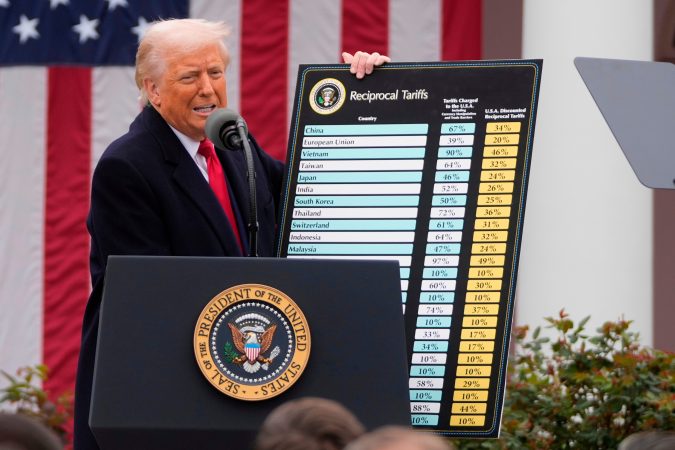
WASHINGTON — President Donald Trump on Monday imposed 50% tariffs on most Canadian goods, declaring that Canada has unfairly discriminated against American autos, alcohol and dairy products.
The move could unleash a new wave of economic chaos, with risks of higher inflation and further fraying of relations between two nations that had been closely woven together before Trump’s return to the White House. The administration official previewing the action said that Canada was one of the only nations other than China that retaliated against Trump’s previous tariffs and must be held accountable.
The official insisted on anonymity on a call with reporters to preview the president’s actions and said that Trump signed three proclamations to launch the tariffs under Section 338 of the 1930 Trade Act. Several Democratic lawmakers last year proposed repealing the section because they said Trump could use it to destabilize the economy.
The new 50% tariffs would exclude energy products, potash, fish, and critical minerals, but they would include goods that had previously been protected from import taxes by the United States-Mexico-Canada Agreement, or USMCA. That 2020 trade pact was not renewed by the U.S., triggering a new set of negotiations that could run until 2036.
The White House said in a fact sheet that the tariffs would go into effect in 30 days, meaning there is time for negotiations as Trump has not always followed through on his announced tax hikes on imports.
Still, the tariffs could escalate into a wider trade war as Canada seeks to defend its economy.
The Canadian federal government did not immediately comment on the tariff, but Ontario Premier Doug Ford saw a possible showdown ahead.
“If these tariffs proceed, Canada should respond tariff for tariff, dollar for dollar,” Ford posted on social media.
Candace Laing, CEO of the Canadian Chamber of Commerce, said the Trump administration’s moves were “regrettable” but the two countries need to use the 30-day window before the tariffs start “to make meaningful progress in advancing formal talks.”
Chris Swonger, CEO of the Distilled Spirits Council of the United States, also called for a deal: “We encourage policymakers on both sides of the border to pursue a negotiated solution that restores market access for U.S. spirits and avoids further harm to the U.S. hospitality sector.”
But the use of a Great Depression-era law to impose the tariffs broadens some of the risks, as those tariffs could be applied to other U.S. trading partners, not just Canada, and inject “massive uncertainty” into the global economy, said Scott Lincicome, vice president of general economics at the Cato Institute, a libertarian think tank.
“We crossed the Rubicon,” Lincicome said. “The invocation of 338 is the nuclear option for Trump tariffs.”
Tariffs are also a political challenge for Trump
The new tariffs carry serious political and economic risks for Trump ahead of the November midterm elections for control of Congress. His “Liberation Day” tariffs last year in April provoked a financial market meltdown over concerns about inflation and a recession, prompting him to walk back the rates for a period of negotiation.
The Supreme Court ruled this February that Trump had lacked the legal authority to impose the tariffs by declaring an economic emergency, causing the administration to find alternative ways to raise import taxes based on a series of legal authorities.
Tariffs are taxes on imports, which companies can then pass along to consumers in the form of higher prices. The president maintains that the costs created by tariffs will cause manufacturing to relocate to the U.S., though there is little evidence of that in the economic data.
“These new taxes will raise prices on American families and likely lead to retaliation against the very industries Trump purportedly wants to protect,” said Rep. Suzan DelBene (D., Wash.), who is chair of the Democratic Congressional Campaign Committee.
The latest import taxes could worsen Trump’s weak ratings on the economy. He promised voters when running for the presidency that he would bring prices down, but the annual inflation rate has risen since he became president because the tariffs and the war in Iran are pushing up oil prices.
Trump has repeatedly targeted Canada on trade issues
The Trump administration official said the president had also requested that his aides look into additional tariffs on Canada because its wildfires hurt air quality in the U.S. He had publicly threatened to do so in social media posts.
At the World Cup final on Sunday, Trump watched the game with Canadian Prime Minister Mark Carney, who has openly challenged the U.S. president and has sought to expand Canada’s trade relations with other nations. The Trump administration official said their time together at the game was not a working visit to discuss trade and tariffs.
Trump claims in the proclamations that Canada discriminates against American autos, alcohol, and cheese relative to other nations, but his argument rests in large part on retaliatory actions taken by Canada after the U.S. president imposed tariffs on Canada under the pretext that it should do more to stop fentanyl smuggling.
Trump noted in his autos proclamation that Canada maintained, starting in April 2025, a 25% tariff on the imports of U.S. motor vehicles that did not qualify for preferential treatment under the USMCA.
The White House said that, regarding alcohol, all but two Canadian provinces and territories halted the purchase and retailing of American alcoholic beverages beginning last year, which was also a response to Trump’s tariffs and taunts of making Canada the 51st state.
But Trump has long objected to Canada’s treatment of U.S. cheese, saying in his proclamation that Canada discriminates against the U.S. compared to Europe on dairy products.
Trump has had a frosty relationship with Carney, a former central banker, who pledged to stand up for Canada during his election campaign last year.
At the World Economic Forum in Davos, Switzerland, in January, Carney called out Trump — without naming him — by saying that the “most powerful” countries are using the economy to coerce less powerful nations.
Trump responded at the time by saying: “Canada lives because of the United States.”
WASHINGTON — President Donald Trump’s administration sought phone records of several New York Times journalists and even those of some of their relatives, according to a motion unsealed Monday — an unusually aggressive attempt to unmask the confidential sources of reporters who wrote about Trump’s Qatari-gifted Air Force One jet.
The efforts by the Republican president’s administration to compel the identity of sources in the form of additional subpoenas come at a time when the executive branch’s relationship with the press is increasingly contentious. The efforts, described in a letter-motion filed by the Times over the weekend, were more expansive than previously known, the newspaper noted. They also covered a time frame that exceeded the news articles in question.
“Two of the subpoenas seek records beginning on January 1, 2026, long before the events that are purportedly the basis for the Department’s investigation,” lawyers for the Times wrote in the letter. “That time frame strongly suggests that the Department is using this investigation not to focus on any purported concerns arising from the July 8 and 9 articles, but instead to forage for information about the Journalists’ source relationships more broadly.”
Government has said reporters aren’t the target
The phone records subpoenas come on top of grand jury subpoenas that were served July 10 on three journalists, seeking testimony about the identify of their sources. The Times has separately challenged those grand jury subpoenas, and a judge is scheduled to hear arguments on Thursday.
Lawyers for the newspaper noted that some of the phone records subpoenas were issued on the same day as the grand jury ones, an additional one was issued the following day, and another was issued on July 16 — after the Times had already moved to quash the grand jury subpoenas.
The Times said the phone records subpoenas should be spiked, arguing that each instance demonstrated “bad faith” by the government. The lawyers argued that the Justice Department ignored its own guidelines by not giving the journalists advance notice that records were being sought and had issued subpoenas “without first conducting any serious investigation.”
The newspaper’s lawyers said the additional subpoenas call “into question the accuracy” of testimony given last week by Jay Clayton, the U.S. attorney in Manhattan, where the grand jury subpoenas were issued. At his confirmation hearing to be the Trump administration’s director of national intelligence, Clayton said that “we followed the protocols” and that the government took “the least intrusive possible” steps.
The Justice Department has justified the grand jury subpoenas by saying that “reporters are not the targets, those leaking classified information are.” Asked about the phone records subpoenas, the department said Monday: “Any subpoena issued by the Department of Justice is done so in full compliance with federal law and internal Department policy.”
The additional subpoenas included a request for phone records of one reporter’s mother and two of the journalists’ spouses. The motion noted that the mother in question is a mental health professional with confidential client relationships and that one of the two spouses is the general counsel of a law firm.
“The disclosure of additional subpoenas for confidential newsgathering information of the Journalists is deeply concerning, revealing yet another instance of the alarming pattern of conduct detailed in the Motion to Quash,” the news organization’s lawyers wrote.
“These actions demonstrate abuse of the grand jury process, continued bad faith attacks on the Journalists, violations of the Department’s own internal regulations, and disregard for the law in this Circuit intended to protect critical First Amendment interests,” the motion stated.
It’s part of an ongoing legal challenge
The Times revealed the government’s actions as part of an ongoing legal challenge to quash subpoenas that the Justice Department served on three journalists who reported on security concerns involving the jet.
The original subpoenas, delivered to reporters at their homes, marked a dramatic escalation of the Trump administration’s crackdown on media leaks that free press advocates swiftly condemned as a government effort to intimidate news organizations. It followed an FBI search earlier this year of a Washington Post reporter’s home and the seizure of her electronic devices.
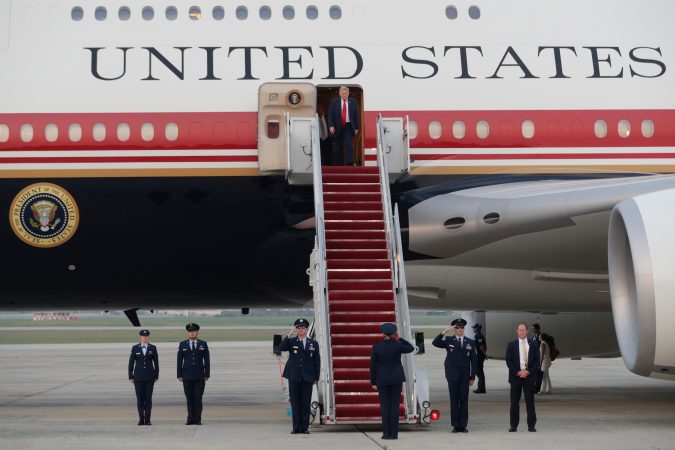
The new jet in question, a present from Qatar that Trump’s administration spent $400 million to retrofit and upgrade, recently entered service. But Trump used an older model Air Force One jet to leave a NATO summit in Turkey earlier this month.
The Times, citing anonymous sources, reported that the switch had come at the urging of the Secret Service and that the newer plane lacked some of the advanced security features of the older Air Force One aircraft, including antimissile capabilities. On social media, Trump denied security concerns.
He said Monday the Qatar jet would be taken out of service for about a month to be “maxed out” with unspecified additions.
Trump’s administration has clashed with the press, from newspapers to TV networks to the Voice of America, on multiple fronts since he returned to office last year. The methods include lawsuits, administrative actions, and public threats.
The First Amendment of the U.S. Constitution guarantees the press’ ability to operate free of governmental restrictions.
How the United States’ first “White House” became a flash point in the 21st century
Judge Cynthia M. Rufe pauses under in the entrance to the reconstructed "ghost" structure with partial walls and windows officially titled, “Freedom and Slavery in the Making of a New Nation” as she visits the open-air President’s House installation in Independence National Historical Park on Feb. 2.Tom Gralish / Staff Photographer
The United States’ first “White House” was lost to history more than once. But after it was rediscovered by an amateur historian in 2002, there was an effort to ensure that this time the site would be remembered.
In the years since, the President’s House has been a source of controversy at every stage of its development. The site at the doorstep of the Liberty Bell serves as a painful reminder to the flaws of the nation’s Founding Fathers, and George Washington’s own culpability in slavery.
story continues after advertisement
President Donald Trump’s administration in January abruptly dismantled the exhibit memorializing the nine people Washington kept in bondage at his Philadelphia home, deeming its displays to “inappropriately disparage Americans living or past.”
A monthslong court battle ensued leading to the partial restoration of the site, pause of the work, and the involvement of multiple courts — all taking place leading up to the nation’s Semiquincentennial, and culminating in the installation of a new exhibit under the cast of darkness less than two weeks after the 250th celebration.
Robert Morris, a financier whose company participated in the slave trade, offered the site to Washington as the nation’s first executive mansion. The first president moved to the house in 1790 and resided there until the end of his time in office in 1797.
After Washington, John Adams lived at the house until Washington, D.C., became the nation’s capital in 1800.
1804 to 1951
The site demolished, twice
The house was used for commercial purposes, including a hotel, until it was largely demolished in 1832.
The President’s House location in Independence National Historical Park.
The entire block on Sixth and Market Streets was razed in 1951 to create Independence Mall, demolishing portions of the walls that remained intact and burying the foundation of the President’s House underground. The location of the house was forgotten to history.
2002
Discovering the site, protest immediately starts
Independent historian Ed Lawler uncovered the true location of the residence — adjacent to the new Liberty Bell Center. Other historians and The Inquirer’s reporting at the time highlighted the history of slavery at the site. Protests, led by the Avenging the Ancestors Coalition, immediately began encouraging the National Park Service, under then-President George W. Bush, to memorialize the nine people Washington enslaved at his Philadelphia home. The government was, at first, strongly hesitant to do so.
story continues after advertisement
2007 to 2010
Excavation and construction
Guests and dignitaries gather in Independence National Historical Park at the President’s House Site before the start of a ceremonial ground-breaking on March 21, 2007.Tom Gralish / Staff Photographer
On Dec. 15, 2010, the President’s House officially opened. Former Philadelphia Mayor Michael Nutter, under whom the project was finished, highlighted the importance of the site and its role in highlighting the contradictory experiences of liberty and slavery during the founding of the United States. After the ceremony, the site became Independence National Historical Park’s responsibility.
Municipal Judge Charles Hayden, Michael Coard, Independence National Historic Park Superintendent Cynthia MacLeod, and Mayor Michael Nutter at the dedication of the President's House.Clem Murray / Staff Photographer
2015
Philadelphia hands the site to Park Service
The President’s House was in a state of disrepair, marked by intermittently blank and soundless video screens, leaking glass, and fogged up windows. The city, which owned the exhibit, transferred the site to the hands of the National Park Service, as Philadelphia and the federal government agreed during the site’s development.
.
March 2025
Trump signs executive order
Trump signed the “restoring truth and sanity to American politics” executive order that instructed the Department of Interior to flag displays in national parks and historical sites that “inappropriately disparage Americans past or living” ahead of the country’s 250th celebration.
July 2025
Park Service flags President’s House
More than a dozen exhibits throughout Independence National Historical Park — all referencing slavery — were flagged for a Trump administration content review. The President’s House had the most exhibits flagged, though some panels were thought to be spared from the content review. Local stakeholders began ramping up advocacy efforts aimed at protecting the President’s House.
September 2025
Plans for changes
Reports emerged that the Trump administration intended to alter the President’s House. The Department of Interior said at the time that “Interpretive materials that focus solely on challenging aspects of U.S. history, without acknowledging broader context or national progress, may unintentionally provide an incomplete understanding rather than enrich it.”
Jan. 22, 2026
NPS dismantles exhibit; Philadelphia sues
After months of scrutinization and anxiety over the fate of the President’s House, the Trump administration dismantled the entire exhibit. Workers took wrenches and crowbars to the site and loaded the removed panels into the back of a white pickup truck, leaving behind swaths of faded brick.
Workers remove displays from the President’s House Site in Independence National Historical Park.Tom Gralish / Staff Photographer
Shortly after the removal, the City of Philadelphia filed a lawsuit against the Interior Department, the National Park Service, and its leaders. Advocacy efforts continued and Independence Park employees were given talking points on how to address visitors’ questions about the President’s House.
Jan. 31, 2026
Trump and Philly clash in court
Attorneys for Mayor Cherelle L. Parker’s administration argued in federal court in Philadelphia that the removal of the exhibit was unlawful. The city found a receptive audience in U.S. District Judge Cynthia M. Rufe, who called the Justice Department’s argument that the federal government can unilaterally change history “dangerous” and “horrifying to listen to.”
Feb. 16, 2026
Injunction
Rufe ordered the Trump administration to immediately restore the exhibit. In a blistering opinion, published on Presidents Day, which celebrates George Washington’s birthday, the George W**.** Bush-appointed judge compared the actions of the Trump administration to the Ministry of Truth from George Orwell’s novel warning of authoritarianism, 1984.
“Each person who visits the President’s House and does not learn of the realities of founding-era slavery receives a false account of this country’s history.”
U.S. District Judge Cynthia M. Rufe
Feb. 20, 2026
Restoration starts, and quickly stops
Rufe, who ordered the restoration of the site “forthwith,” gave the federal government a hard deadline to restore the site after no work to reinstall the exhibit had taken place. National Park Service staff returned some panels to the walls, but as the deadline neared the federal government appealed and won an administrative stay that paused the restoration. The site’s wall remained half bare for months.
Workers reinstall the displays at the President’s House in Independence National Historical Park.Tom Gralish / Staff Photographer
April 2026
Proposed new exhibit
The National Park Service published 11 digital renderings of new panels proposed at the President’s House. The new exhibit would provide a broad timeline of U.S. history that included slavery, but would be less focused on George Washington’s role and frame the Founding Father’s enslavement of nine individuals at his Philadelphia home during the first presidency in a more sympathetic light. Only two of the 11 newly proposed panels at the time referenced those enslaved at the site, drawing criticism from historians.
Panel for Ona Judge at the President’s House in Independence National Historical Park.Tom Gralish / Staff Photographer
Born into slavery in Mount Vernon, Washington’s Virginia estate, Judge was kept in bondage as Martha Washington’s personal assistant and seamstress. She escaped from the President’s House on May 21, 1796, and made her way to New Hampshire with the help of Philadelphia’s free Black community. Despite Washington’s growing support of emancipation in private communications throughout his life, the first commander-in-chief made multiple attempts to recapture Judge. She was never caught and outlived her enslavers.
June 2, 2026
Trump and Philly clash in court, again
A three-judge panel of the U.S. Court of Appeals for the Third Circuit heard arguments on the Justice Department’s appeal. The judges pushed the city’s attorney to point to language in the cooperative agreement that said Philadelphia maintained rights over the site after the transfer of ownership to the federal government. But the city came short and was left pointing to statements by National Park Service officials that emphasized the collaborative effort to develop the site.
The Justice Department attorney representing the Trump administration told the judges that if the city wanted to maintain control over the exhibit, it “should have bargained for that.”
The half-bare walls of the President's House.Tom Gralish / Staff Photographer
June 18, 2026
Third Circuit sides with Trump
The Third Circuit delivered a blow to the city, ruling that Philadelphia had no rights over the site or its displays. The unanimous decision, signed by judges appointed by George W. Bush, Barack Obama, and Donald Trump, also dismissed all but one claim from the city’s initial lawsuit. The judges further found the Trump administration’s proposed panels “acknowledge the evil of slavery, including its injustices and hypocrisies, and, by telling the story of the nine slaves that Washington kept in the President’s House, remind us of their essential humanity.” The site was in limbo as the order out of Boston conflicted with the Third Circuit ruling.
“The duty to ‘maintain’ is better understood as a general management obligation that accompanies ownership, not a promise that the exhibits will forever remain in place regardless of the owner’s wishes.”
U.S. Park Police Officer Patrick O’Hanlon reads the new panels alongside visitors at the site of the President’s House in Philadelphia.Aidan T. Gallo / Staff Photographer
A handyman who worked in homes across southeastern Pennsylvania raped and sexually assaulted children and unconscious women, and produced a vast collection of photographs and videos documenting his crimes, Chester County prosecutors said Monday.
David Vincent Rosa, 54, faces more than 300 charges, including rape of a child, aggravated indecent assault of a child, and hundreds of counts tied to creating and disseminating child pornography, according to the affidavit of probable cause for his arrest.
Rosa, a transient handyman and housepainter whose last known address was in Chester County, used his work to gain entry into homes and prey on the people inside them, investigators said.
He recorded the attacks, they said, amassing a digital trail of evidence that spans a period of several years.
“It is one of the most terrifying sexual assault cases that we have come across in some time,” Chester County District Attorney Christopher de Barrena-Sarobe said in a news conference Monday.
Chester County District Attorney Christopher de Barrena-Sarobe holds a news conference on Monday to announce charges against David Vincent Rosa.Steven M. Falk / For The Inquirer
The charges stem largely from two videos investigators discovered on a phone they said belongs to Rosa. In one, a man investigators identified as Rosa filmed himself touching a young girl. A second clip, also of Rosa, they said, depicts the rape of a child.
But the case has widened beyond those recordings: Stored on Rosa’s devices and in his accounts, de Barrena-Sarobe said, investigators also found videos of him sexually assaulting additional children and women.
The women “appear to be unconscious” in the videos, de Barrena-Sarobe said, and “they may not know that they have been victimized.”
The children in the videos appear to be younger than 10 years old, he said. De Barrena-Sarobe declined to say exactly how many victims appear in the recordings, saying only that they showed “multiple” women and children. The videos and images are dated from 2017 to 2024, he said.
Investigators traced recent logins to a Comcast account in West Whiteland Township, where records indicated Rosa lived, according to the affidavit. They also identified Rosa as the man seen in multiple images, the document said.
Chester County and West Whitefield Township authorities began investigating Rosa in March, after receiving three dozen cybertips that child sexual abuse materials had been uploaded to Google accounts. The tips — reported by Google and routed through a regional Internet Crimes Against Children task force — involved six email accounts containing hundreds of images and videos depicting the sexual abuse of girls as young as 2, investigators said.
In April, authorities searched Rosa’s home, where they found a cell phone with a video matching the materials reported in the cybertips, according to the affidavit.
Rosa was arrested April 2 and charged with 100 counts of child pornography, court records show.
He has been held in Chester County Prison since then, unable to post bail, de Barrena-Sarobe said.
Prosecutors filed hundreds of additional charges last week, after investigators extracted files from Rosa’s phone and interviewed witnesses who identified one of the children.
More than 1,000 still images captured from the videos were recovered from Rosa’s phone, investigators said, and records provided by Google showed the videos were shared more than 50 times on the company’s chat app.
Investigators also said in the affidavit that they recognized Rosa’s voice in both videos after speaking with him during his arrest and in a recorded interview.
Detectives identified the first child victim in early June, after interviewing a woman who identified Rosa and the child from still images, according to the affidavit. The woman told investigators that Rosa had stayed for about a week at a Wind Gap home where she and the child lived in 2022. He was doing painting work at the house, she said.
She described two incidents that had alarmed the household: Rosa was once discovered in a basement crawl space with the child, she told investigators, and another time, the girl was found in bed with him under a blanket. It was unclear whether anyone had reported either incident to authorities at the time.
That account matches the pattern investigators now fear extends further. Rosa lived throughout the region and has previous arrests in Philadelphia, Allentown, Malvern, and Saylorsburg, de Barrena-Sarobe said.
Investigators are asking anyone who hired him — or knows someone who did — over the last 10 years to come forward.
David Vincent Rosa is pictured in photos shared by Chester County prosecutors on Monday.Steven M. Falk / For The Inquirer
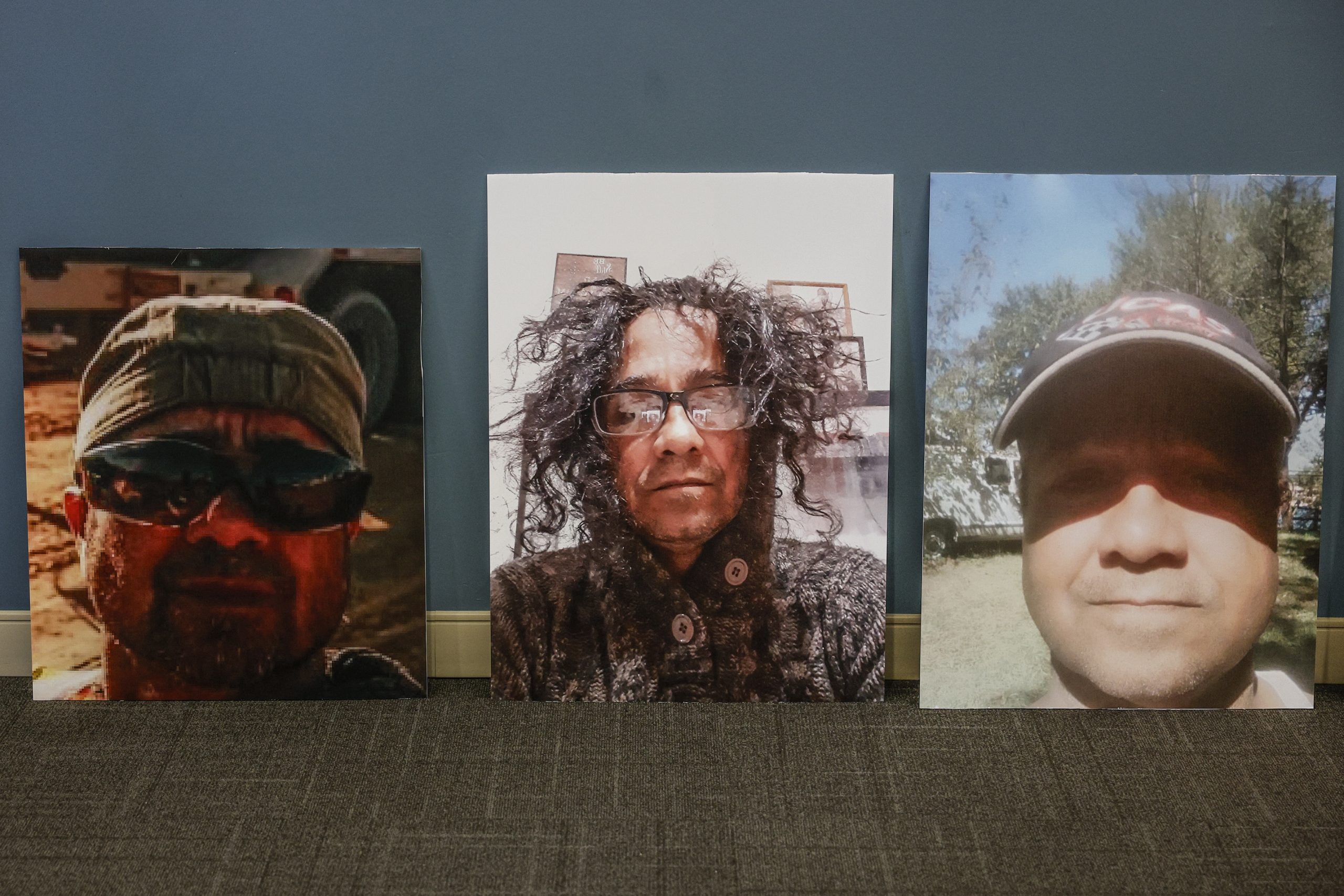
Prosecutors released a series of photographs showing Rosa’s changing appearance over the years, along with an image of a room they are trying to locate: what appears to be an unfinished basement with a bed covered in rust-colored bed linens, where investigators say some of Rosa’s crimes were committed.
Authorities described Rosa as 5-foot-4 and weighing about 150 pounds.
Although de Barrena-Sarobe said Rosa is presumed innocent until proven otherwise, he added that “we strongly feel like this was a predator that was out in our region creating and destroying lives.”
Rosa’s attorney did not return a phone call Monday afternoon.
Anyone with information is asked to contact the Chester County Detectives at 610-344-6866.
Pennsylvania and New Jersey are among the 27 states seeing recalls of shredded lettuce products sourced to Taylor Farms, the produce company at the center of a food safety investigation into an outbreak of “explosive” diarrhea caused by the parasite Cyclospora cayetanensis.
Federal officials announced over the weekend that a sample of lettuce taken from a Taylor Farms shipment at the U.S.’s southern border with Mexico tested positive for Cyclospora.
The test involved lettuce that wasn’t affected by the California-based produce company’s recall.
The results turned out to be a false positive. As of Sunday, federal officials said, they had not found a positive test for Cyclospora in a produce sample.
Officials notified the public because it was “actionable public health information,” acting Deputy Commissioner for Food Donald Prater said in a press call Monday.
Thousands of people have been sickened in a cyclosporiasis outbreak, with cases reported across Indiana, Kentucky, Michigan, Ohio, and West Virginia.
Investigators at the Centers for Disease Control and Prevention found more than 1,600 people in those states became ill after they ate iceberg lettuce from Taco Bell, which sourced lettuce from Taylor Farms.
Taylor Farms did not immediately return a request for comment.
Cases in Pa. and N.J.
Cases of cyclosporiasis have been reported in 34 states, including Pennsylvania, though case counts here were low as of last week, affecting 28 people since the beginning of the year, including 14 in Southeastern Pennsylvania.
New Jersey health officials said the state had recorded 46 cases between May 1 and July 16. Cases typically rise in the late spring and summer months, and this year’s are in line with a typical year’s case count.
It’s unclear whether anyone in Pennsylvania or New Jersey was sickened after eating Taylor Farms products. The CDC said it was also investigating outbreaks and other cases that are not connected to the Michigan outbreak.
They should wash items and surfaces that might have touched the lettuce with hot, soapy water, and avoid recalled lettuce at Taco Bell or other restaurants. Customers should ask restaurants about the source of their lettuce before ordering it.
Cyclosporiasis is caused by a single-celled parasite that spreads through fecal material. It can infect a person’s gut after they consume food or water contaminated by feces. Common symptoms include watery diarrhea, a loss of appetite, cramping, nausea, and fatigue.
COLUMBIA, S.C. — Sen. Darline Graham said Monday she’s running for a full term filling her late brother Lindsey Graham’s Senate seat.
“I’ve made a decision,” Darline Graham told Fox News Channel host Sean Hannity, according to a clip released of an interview set to air later Monday. “I’m in.”
The entrance of Darline Graham — sworn in last week to fulfill the remaining months of her late brother’s term, which expires in January — into the Republican scramble to select a new Senate nominee further complicates an already rushed process following Lindsey Graham ‘s death earlier this month.
A weeklong filing period opens Tuesday for the special Republican primary, which will be Aug. 11. On Friday, President Donald Trump said that Darline Graham had his “Complete and Total Endorsement” to seek the nomination, adding, “RUN, DARLINE, RUN!”
Last week, Gov. Henry McMaster appointed Darline Graham to serve the remainder of her brother’s term, which ends in January. In his announcement, McMaster made no reference to Darline Graham as a placeholder or symbolic appointment, although a person familiar with McMaster’s thinking but unauthorized to speak publicly said the governor, in selecting Darline Graham, had never contemplated that she would run for the seat herself.
Before the emergence of Darline Graham — and their Oval Office meeting after she was sworn in — Trump had previously suggested he could back a potential candidacy from Rep. Russell Fry, who said Monday he would officially enter the special primary.
Several other noteworthy politicians, including Rep. Ralph Norman, have already gotten in, and others like Lt. Gov. Pamela Evette have been eyeing a run. Rep. Nancy Mace announced Monday she would not enter the contest.
Darline Graham told Hannity said she had been “praying a lot” about how to navigate her new role.
“It is a tremendous amount of pressure,” she said.
“I know I’m a hard worker. I learned that from Lindsey,” Darline Graham said. “I feel like I can do it. I feel an inner peace about it. Will it be difficult? Yes.”
Funeral services for Lindsey Graham are scheduled to be held next week in Washington and South Carolina. A preliminary report from the medical examiner said he suffered a tear in his aorta.
The millions in Lindsey Graham’s campaign account aren’t funds that Darline Graham could directly access in a run of her own, according to Bradley A. Smith, a former chairperson of the Federal Election Commission.
Under federal rules, Lindsey Graham’s campaign would be limited to transferring just $2,000 to a potential Darline Graham candidacy. However, Smith said, there is no limit on how much it could transfer to the National Republican Senatorial Committee, which could — thanks to a Supreme Court decision last month — “spend an unlimited amount in coordination with Darline’s campaign.”
Delaware County detectives are investigating a racist, threatening voicemail left for county Sheriff Siddiq Kamara, officials said Monday.
The caller, whom police are working to identify, used a racial slur to refer to Kamara, who is Black, and called for “death to Islam.” Kamara is a Muslim whose family came to Delaware County from their native Liberia.
The caller also told Kamara he was going to hunt, attack, and torture him when Kamara least expects it, according to a recording of the voicemail that was reviewed by The Inquirer.
“I will find you. I know where you are,” the male caller said. “You are an amateur.”
Kamara, in a statement, said despite the caller’s attempts to intimidate him, the incident has strengthened his resolve.
“Let me be clear: There is a fundamental difference between criticism and criminal conduct. Public officials should expect scrutiny, disagreement, and accountability — that is part of our democracy,” he said. “But threats of violence, intimidation, and hate cross the line and will be treated accordingly.”
Kamara, 31, was elected sheriff in November. He is the youngest person in county history to hold the position.
A career police officer, Kamara said he was motivated to run for office after a personal tragedy: His cousin, Fanta Bility, was struck and killed by a stray bullet fired by Sharon Hill police officers in 2021.
In a statement Monday, the Delaware County Council said it “unequivocally condemns these threats in the strongest possible terms” and stands with Kamara.
Members of the Philadelphia chapter of the Council on American-Islamic Relations called the incident “the latest example of the growing climate of intolerance that seeks to intimidate public servants based on their race, religion, or national origin.
“No public official should be subjected to racist intimidation for simply serving their community,” Ahmet Tekelioglu, executive director of CAIR-Philadelphia, said. “Attacks like these are not only directed at one individual They are intended to send a message of fear to entire minority groups — particularly the Black, immigrant, and American Muslim communities.”