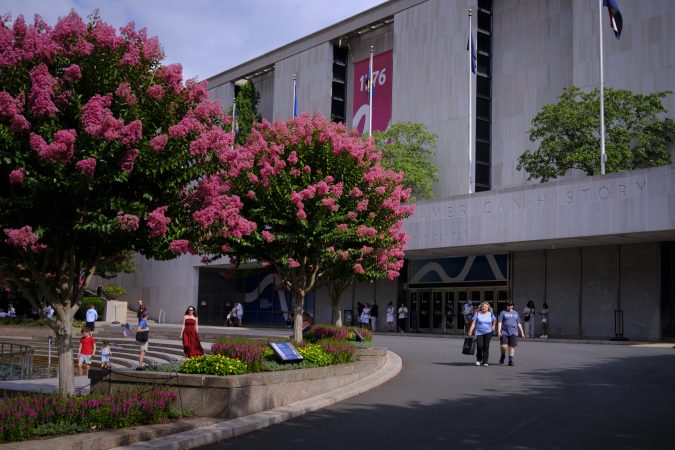
President Donald Trump on Friday ordered the installation of signs outside the Smithsonian’s National Museum of American History that warn people that the museum does not accurately reflect American history while pointing them to material that does — a dramatic escalation in his campaign to wrest control of how the nation’s story is told.
The executive order, signed at the end of a week of contentious congressional hearings on the museum, directs Interior Secretary Doug Burgum to erect temporary signage along the National Park Service-controlled sidewalks and walkways the public uses to reach the museum. The signs would inform visitors of the White House’s criticisms, tell them the museum’s exhibits “should be renovated,” and direct them elsewhere “to locations and resources for accurate information regarding America’s history.”
The move marks a new front in a 16-month pressure campaign against the Smithsonian Institution that has included museum content reviews, funding threats, and a successful effort to push out a museum director. Now the White House is moving to plant a competing government narrative on the ground outside one of the country’s most visited museums — an approach historians say has no precedent.
Trump grounded the order in the White House Domestic Policy Council’s July 4 report, “Saving America’s Story,” which he said “demonstrates that the Smithsonian leadership does not present American history as a shared national inheritance to be taught and celebrated, but instead views American history as a ‘prime tool’ to advance ideas of social justice and the radical transformation of our society.”
A companion White House statement went further, accusing the Smithsonian and its history museum of veering “toward extreme political activism, rooted in Marxism, to divide, dispirit, and discourage Americans.” It said that “in the last decade, Americans have witnessed a concerted effort to rewrite American history and force our Nation to adopt a factually baseless ideology aimed at discrediting American heroes and diminishing American achievement.”
Trump also accused the museum of failing to appropriately honor the 56 signers of the Declaration of Independence during the country’s 250th anniversary year, and directed Burgum to install temporary exhibits or signage on Park Service land that “corrects inaccurate information presented in the Museum.”
The Smithsonian declined to comment. Its leaders have said the White House’s report mischaracterizes the museum, and that they are committed to accuracy and nonpartisan scholarship.
The order drew swift condemnation from Democrats who oversee the institution. Rep. Melanie Stansbury (D., N.M.), ranking member of the House Administration Committee, called it “one of the dumbest and most bizarre Executive Orders we have ever read.”
“This EO is a clear political overreach, driven by an ideological agenda to rewrite American history,” Stansbury wrote on X. “Our Smithsonian institutions do not belong to the President, but to the American people and so does our nation’s history.”
Sarah Weicksel, executive director of the American Historical Association, said the plan to station government material outside the museum was “an absolute affront to the professionals who work in that building” and likened the signage to issuing a trigger warning to visitors before they encounter exhibits such as the Star-Spangled Banner.
“There’s no precedent for this,” Weicksel said. She noted that the Smithsonian has weathered exhibit controversies before — most famously over its presentation of the Enola Gay and the bombing of Japan — but said the executive branch had never before sought “to present a completely alternative narrative” to the one told inside the national museum.
The report and order rested on “a very narrow and very circumscribed definition of patriotism,” Weicksel added, one at odds with the founding generation the administration invokes. The nation’s founders, she said, understood that “one’s love of nation is tied to recognizing where it has gone wrong, where it can do better.”
Her deepest worry, she said, was that the campaign would erode public trust in an institution that teachers and researchers have relied on for more than 150 years.
“The White House is essentially telling the American public not to trust the Smithsonian Institution,” she said.
Conservatives who have long pressed for change at the Smithsonian welcomed the order, though some hoped it would go further. Mike Gonzalez, a senior fellow at the Heritage Foundation who testified at both congressional hearings this week, said the provisions he valued most were those naming administration officials, including Domestic Policy Council chief Vince Haley, and directing them to use “any and all available authorities” to force corrections.
“If they can use this EO to clean house and get rid of the leadership, then that would be great,” Gonzalez said, adding that he thought installing the signs “is a clever thing.”
When asked if he had consulted with the White House on the report or the executive order, Gonzalez said any such conversations would be “private.”
The order is the latest chapter in a fight that has escalated steadily since Trump’s March 2025 executive order demanding “improper ideology” be removed from the Smithsonian. Since then, the White House has launched reviews of the content of several Smithsonian museums, criticized specific exhibits and wall texts, and threatened to withhold funds already approved to the institution if it fell short.
As a public-private institution, the sprawling museum and research complex is historically independent, with a federal budget appropriated by Congress. But those funds are disbursed by the White House’s budget office, and the administration has said all spending must align with the president’s orders.
The White House report’s footnotes signal the pressure will continue, promising a “future update” on the Smithsonian’s approach to diversity, equity, and inclusion.
Good morning! It looks like the start of a beautiful weekend.
It’s also a beautiful time to be a Sixers fan, since LeBron James announced he would be bringing his talents to South Broad Street. It’s an exclamation point to what has been a transformational summer for the team.
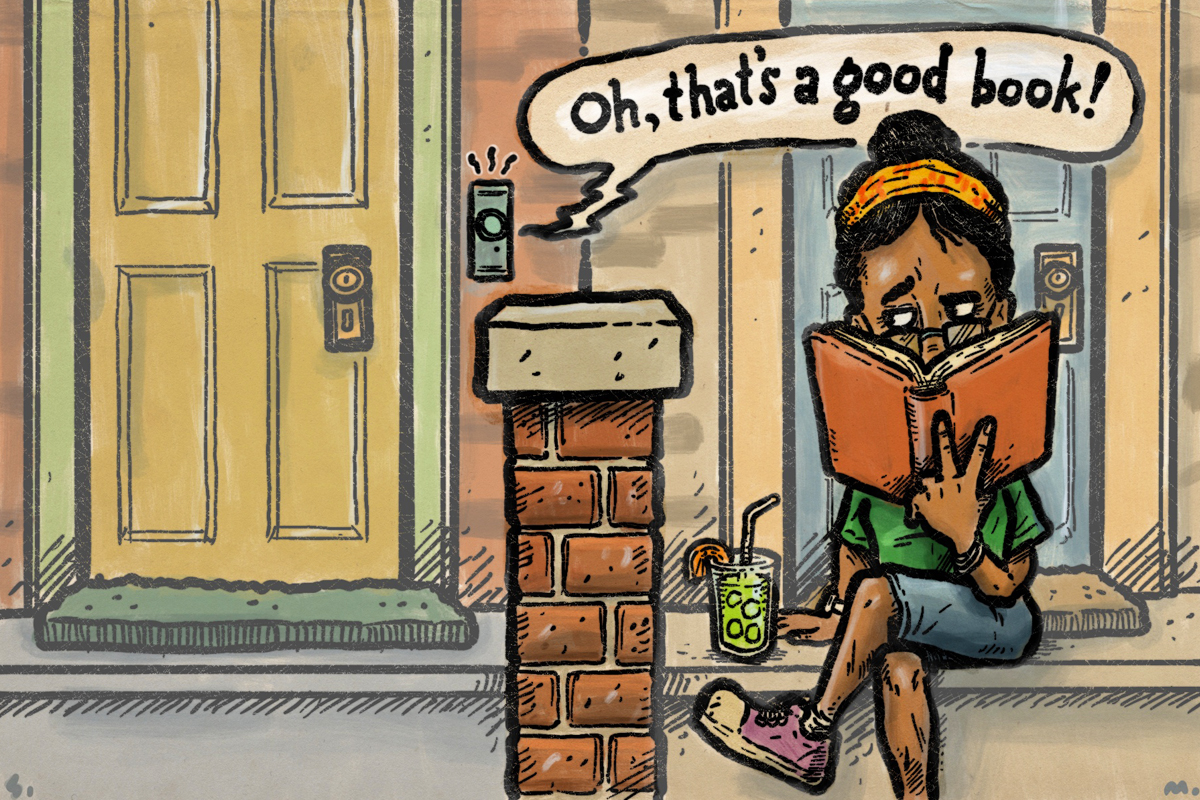
Also, a reader asked us what to do about a neighbor’s doorbell camera that shows both of their porches.
The 76ers signing LeBron James is an exclamation point on the Sixers’ transformational summer.
It is gargantuan. For the NBA. And for Philly.
Now LeBron is a Sixer. So is Jaylen Brown. And Tyrese Maxey and Joel Embiid and VJ Edgecombe, for that matter. And it all brings together arguably the most improbable-yet-transformative offseason in franchise history under new president of basketball operations Mike Gansey.
In case you missed the basics, James, a legendary player and one of the most famous humans on planet Earth, will join the team on a two-year, $8 million contract.
This week’s question is: My neighbor installed a camera doorbell that can see my entire porch. We do have packages taken occasionally, so I get the desire to have one, but I don’t want to be constantly filmed when I’m on my steps. Our houses are so narrow that I don’t know if it would be possible for him to have one of those doorbells without filming my steps. How do I approach this with him?
To help, Inquirer reporters Mike Newall and Earl Hopkins talked about the neighborhood, the dimensions of the porch, and whether the camera can be repositioned. They agreed it’s worth having a conversation with the neighbor.
“At worst, there will be clarity from both sides,” Hopkins wrote.
Worth noting regardless of outcome, Newall wrote, “if you live in the city, you’re on tape.”
In this week’s Shackamaxon, Inquirer columnist Daniel Pearson unpacks a case going extremely slowly through the system about making bike lanes safer two years after a physician specializing in children’s cancer was killed riding her bicycle in Rittenhouse Square.
“The blame for the holdup does not lie with City Hall,” Pearson writes. “Instead, it has been the courts that have stymied the proposal.”
Read on for Pearson’s take, along with his perspectives on restrictions in a historic district vs. residents’ wishes to design their own homes, a series of housing projects in North Philadelphia, and the battle over the President’s House.
📍 Find the location
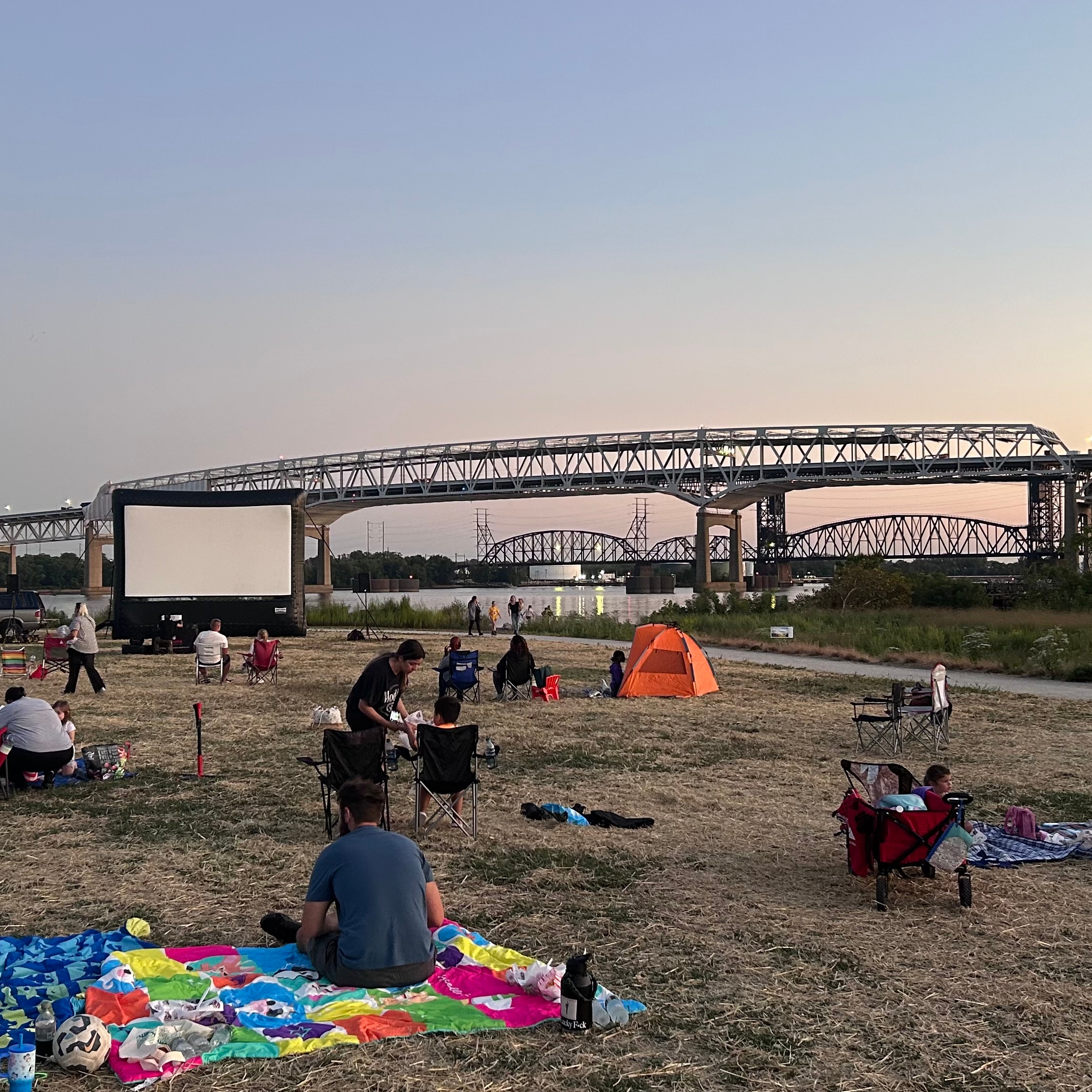
These moviegoers set up blankets for an outdoor screening in September.Kerry Hyland
Think you know where to find this movie location? Our weekly game puts your knowledge of Philly’s streets and places to the test. Check your answer.
🧩 Unscramble the anagram
Hint: This family-owned store is moving to the Main Line after decades in Center City.
Cheers to Alexander Englert, who correctly guessed Friday’s answer: HEIRLOOM TOMATO. Middle Child’s BLT season has arrived. This is how they prepare for the frenzy.
We were there
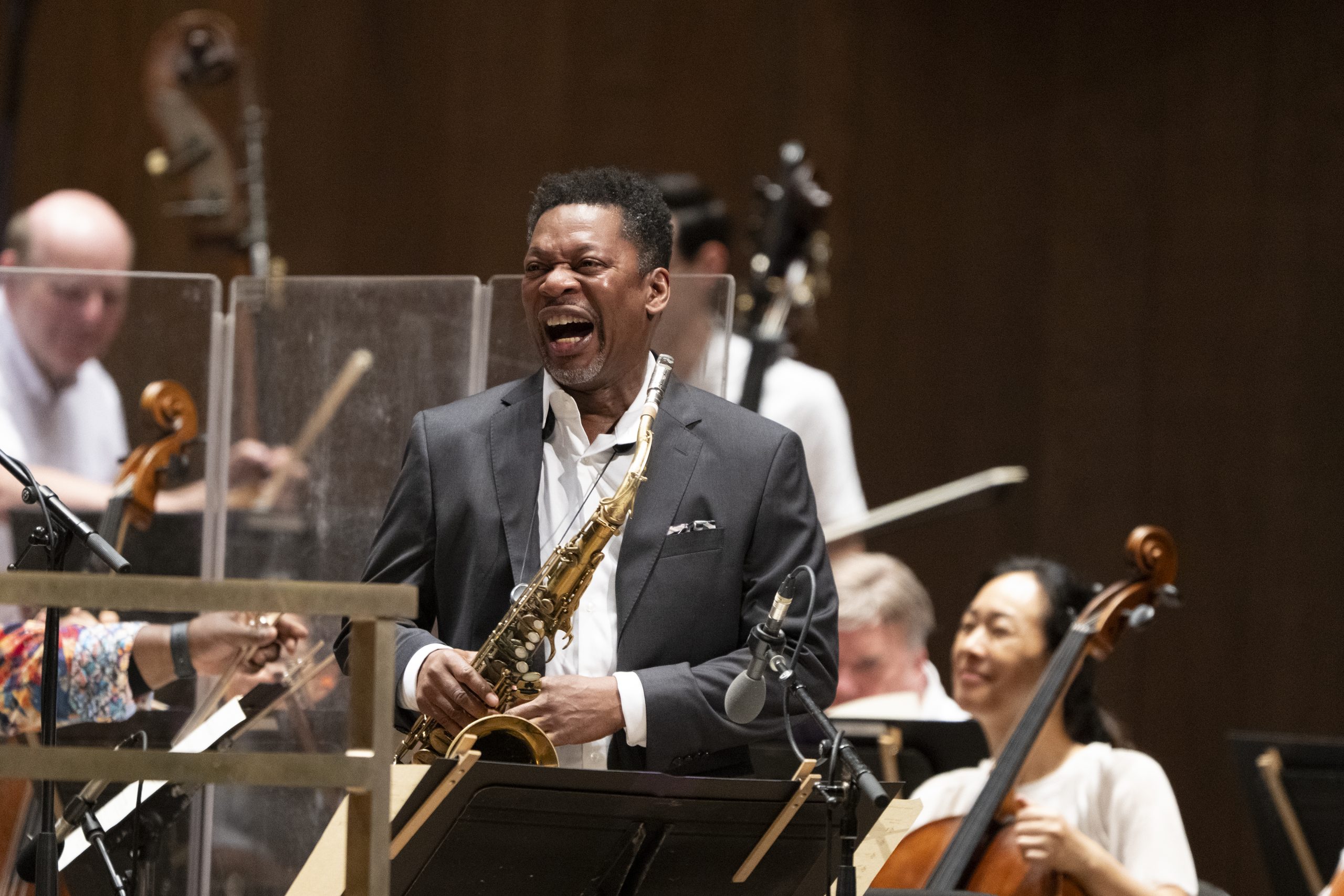
John Coltrane wasn’t born in Philadelphia, but we can claim him as the city where his musical identity was forged. His son, Ravi, performed Wednesday night in the Philadelphia Orchestra’s “Coltrane 100: Legacy″ concert at the Highmark Mann Center. Photographer Jose F. Moreno was there to capture the moment.
There was one especially pleasant weekend back in June, as summer was officially arriving and Philly was in the middle of hosting three Group Stage matches for the World Cup. It was breezy with sunshine and low humidity and temperatures in the mid-80s; nothing like two weekends later as America turned 250 and temperatures hit 101 degrees or higher for three days in a row, the first time that happened in over 150 years of record keeping.
Between covering some news that weekend, I walked around Center City just soaking up the street scene. It wasn’t just the wonderful weather, but an international vibe that was welcoming and friendly. I watched visitors speaking multiple languages rolling suitcases in and out of hotels and ride share cars, and saw sidewalk cafes overflowing with different colored jerseys and scarves.
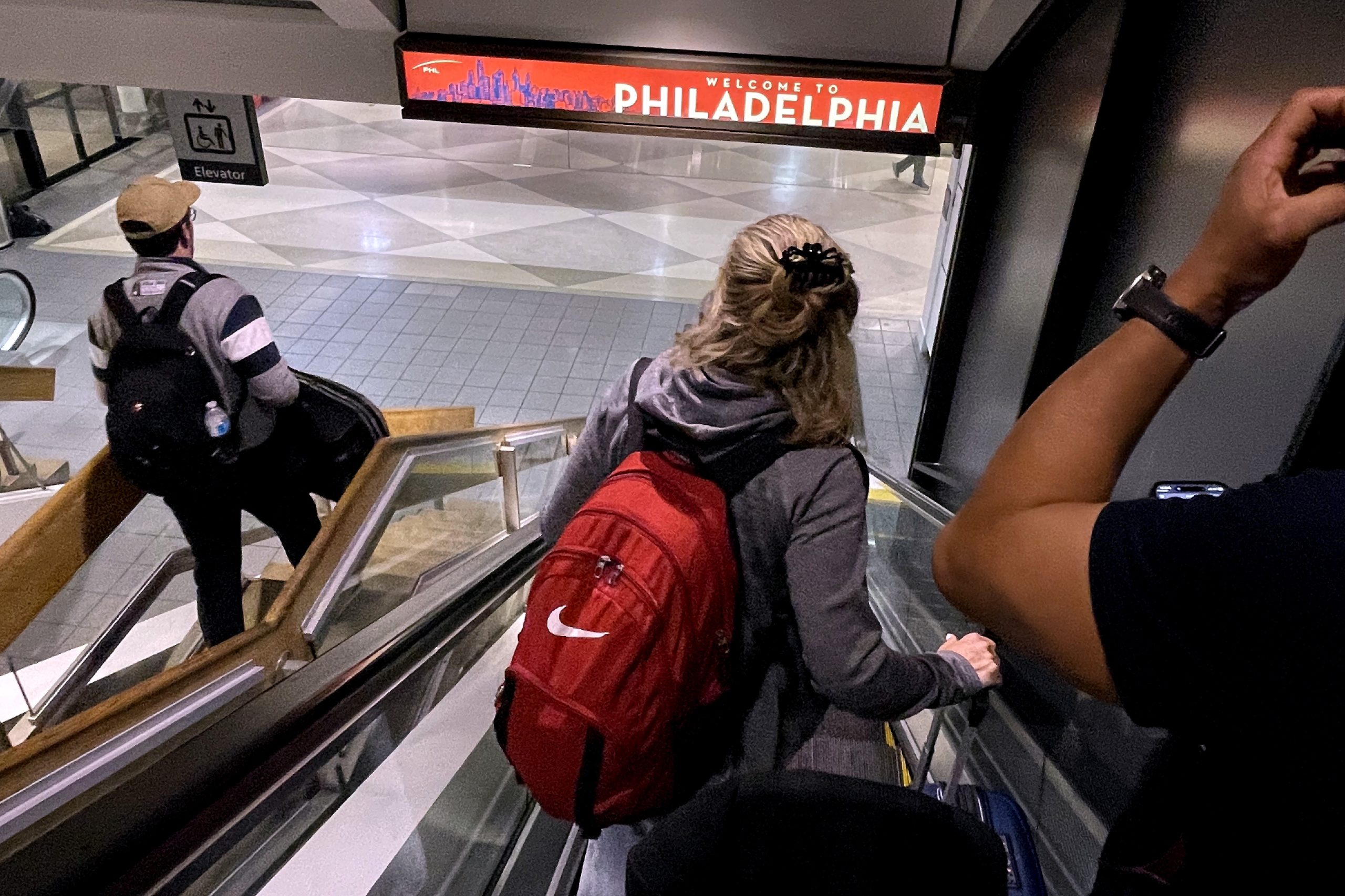
Philadephia International Airport arrivals June 21, 2026.Tom Gralish / Staff Photographer
It reminded me of the energy I feel almost every time I walk around the city, going back to my first night here and the weeks spent in my early days at the newspaper with unhoused men.
We’ve long known we have one of the most walkable downtowns in the country, but USA Today told everyone else again this summer, naming Philadelphia number one — for the fourth year in a row. Center City is compact and easy to explore on foot, with many stores, restaurants, museums, attractions, and parks all within a short walk.
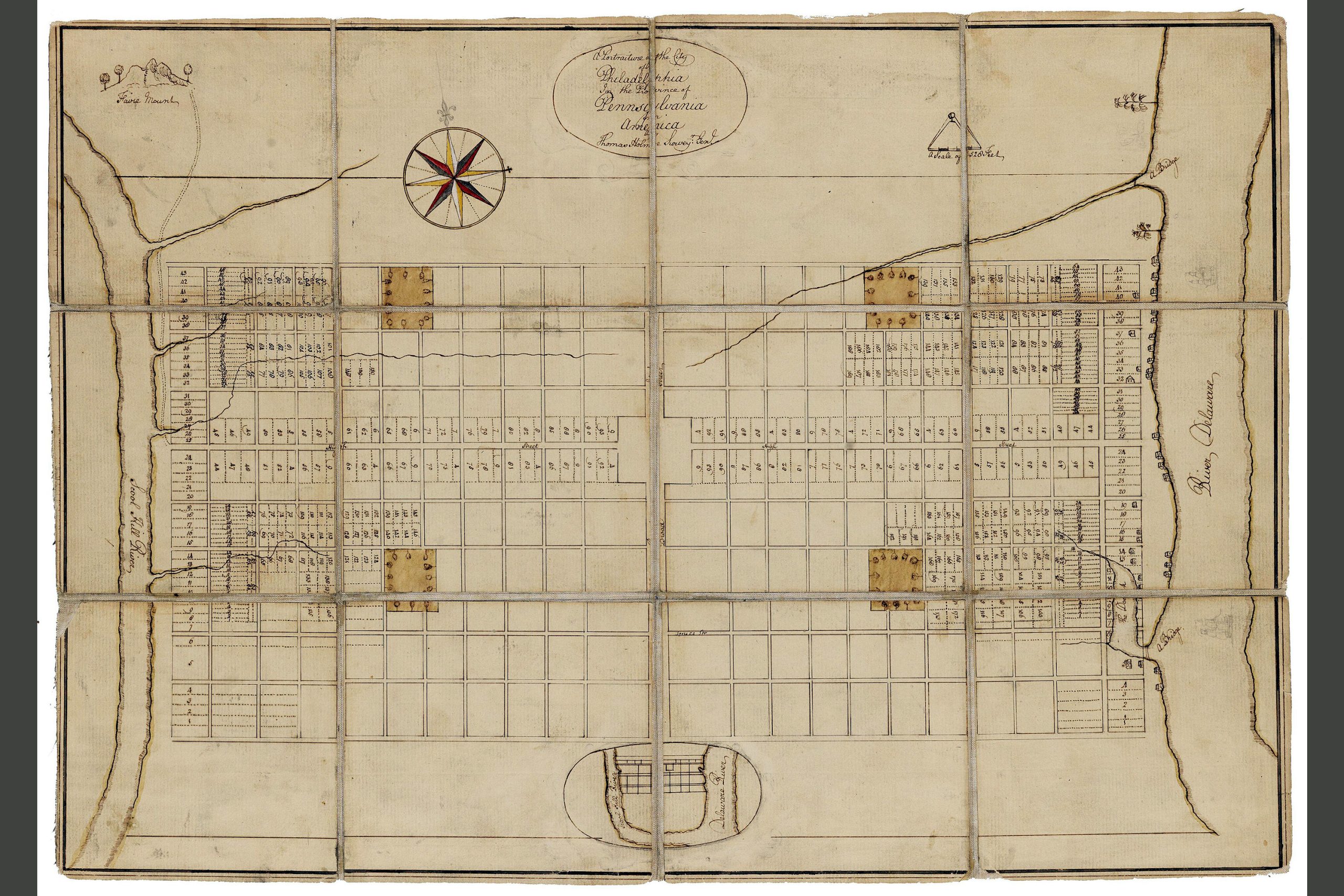
“A Portraiture of the City of Philadelphia, In the province of Pennsylvania in America” by Thomas Holme. In 1682, William Penn appointed Holme surveyor-general of Pennsylvania and charged him with the task of laying out the “greene country towne” that Penn envisioned. This map, printed in London, was used for both reference and promotional purposes to show the unique layout of Penn’s emerging city.Historical Society of Pennsylvania
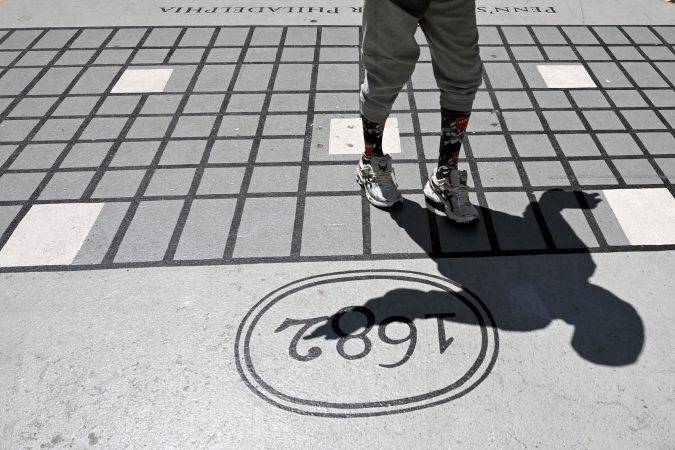
Credit William Penn’s 1682 street plan that created small rectangular blocks with straight, predictable streets. I was thinking about that as I looked down at the grid on the ground in the courtyard of City Hall, when Lyn-el “The Torch” Wright paused right in front of me: “take a picture of my sneaks.” That’s his shadow above.
I did, and asked if they were special, wondering if they had something to do with Adidas, the official World Cup sponsor and match ball provider. No, not really, he said, but then educated me on what the kids today were wearing: Asics and Saucony. And Salomon.
So, being a history nerd, I had to enlighten him on the design he was standing on. Titled “Compass Rose,” it was commissioned by Edmund Bacon in 1994 as a gift to the city to mark Penn’s 350th birthday. It was painted by David Salama and Pat Sprott and updated by Mural Arts Philadelphia in 2004, 2015 and 2022. It marks the exact center of the middle of Penn’s five squares (Franklin, Logan, Rittenhouse, and Washington being the others).
I didn’t actually say all of that (unlike similar “TED Talks” my grandson is subjected to), but our conversation is the other thing I like most about walking around Philadelphia. Meeting and talking to people.
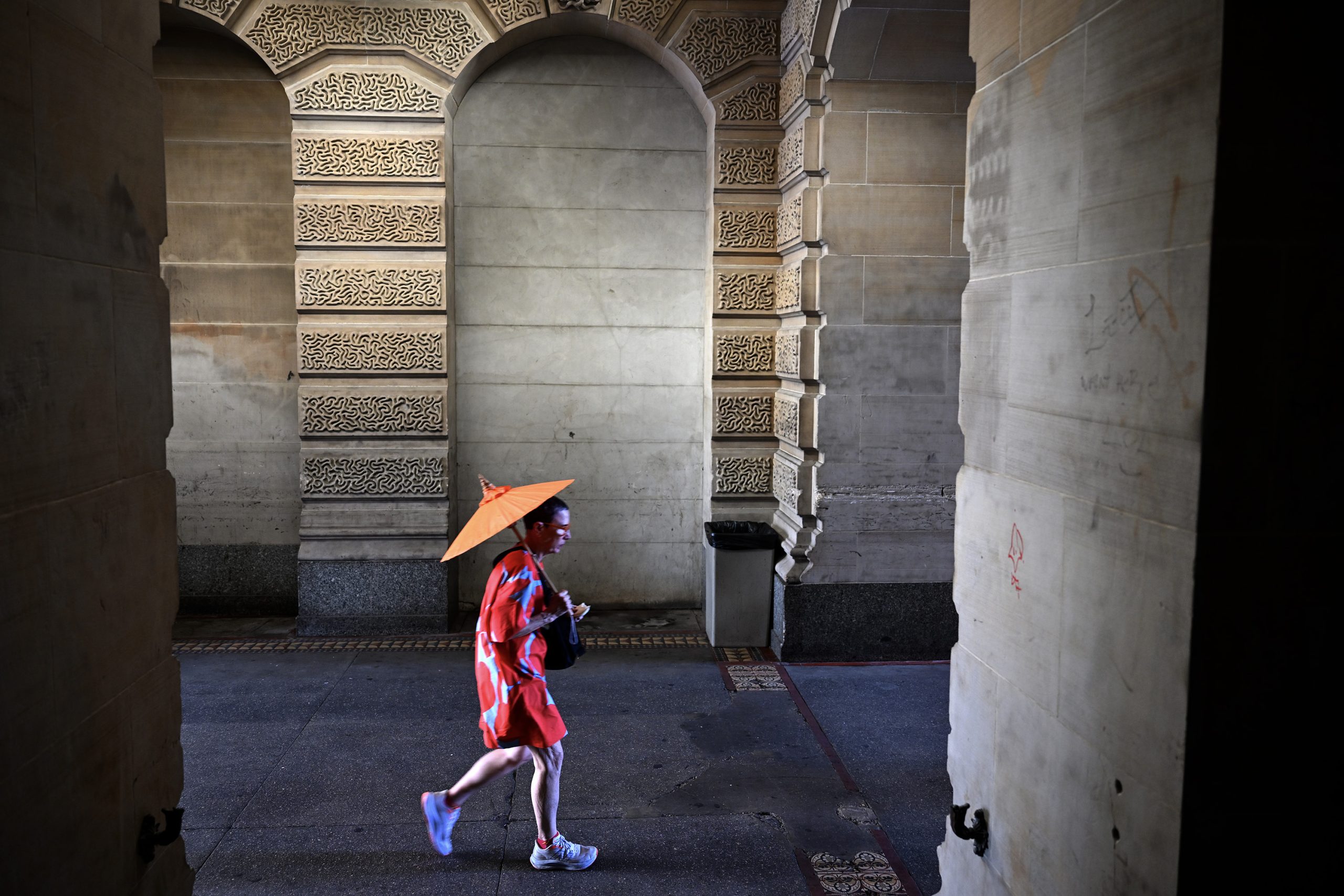
Passing through the south portal of City Hall on Monday, July 20, 2026. She said the umbrella was a recent purchase. “Anything to keep cool in the heat.”Tom Gralish / Staff Photographer
The day was a remarkable one in Center City, similar to the summer solstice back in June. And it was coming off the week of heavy rains, microbursts, and then, the Canadian and Great Lakes wildfire smoke that moved into the region.
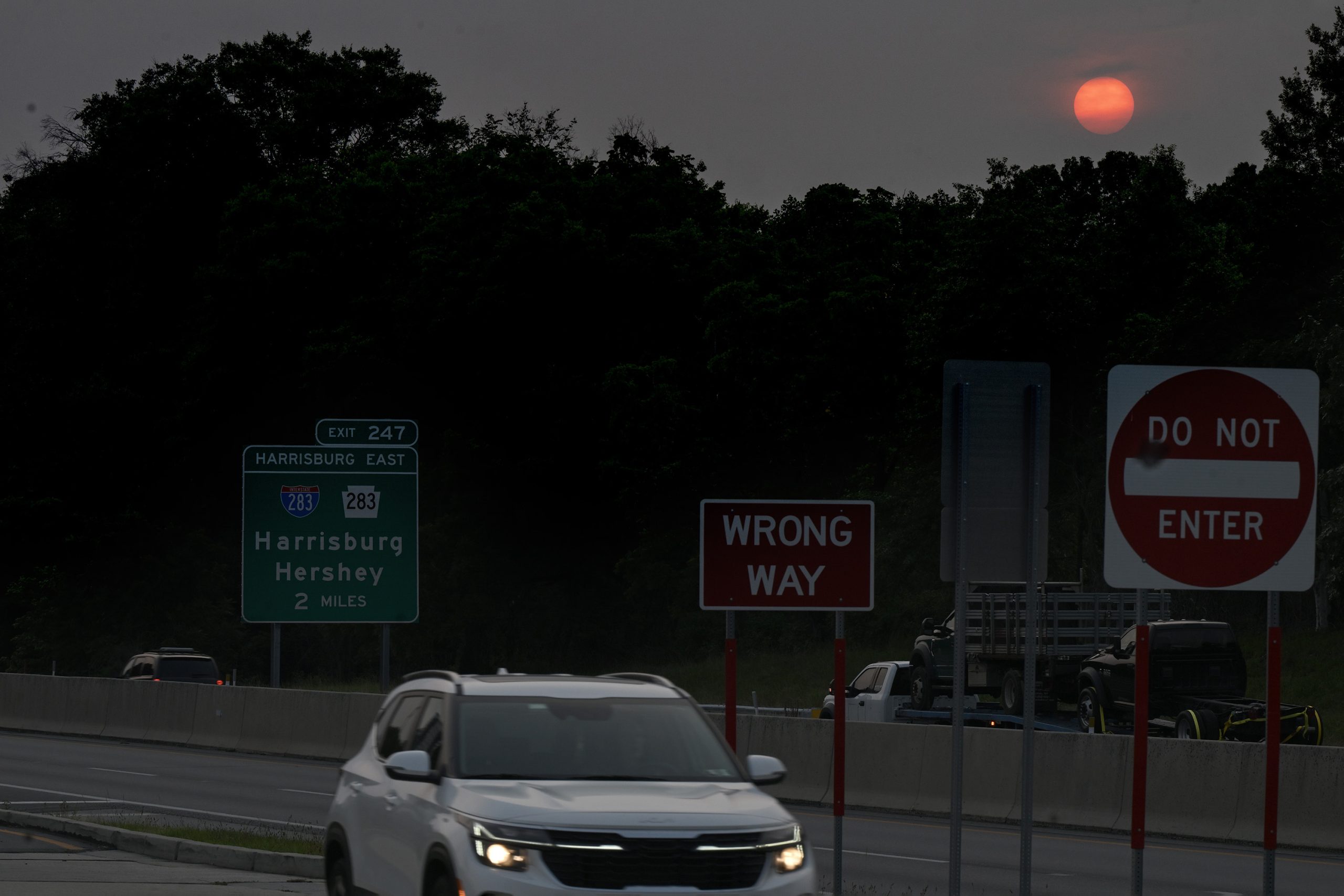
The sun sets in a hazy sky over the Pennsylvania Turnpike Wednesday, July 15, 2026.Tom Gralish / Staff Photographer
When the skies finally cleared last Sunday, I joined hundreds of outdoor enthusiasts taking advantage the improved air quality and photographed along the Schuylkill River Trail.
I scouted angles to get as many people — and a variety of runners and walkers — in the same frame. But, perhaps because I covered a memorial for Barbara Friedes, a 30-year-old CHOP doctor who was killed on her bike by a drunk driver in July 2024, my attention drifted toward the bicycles.
When I saw a patch of backlit trees I knew if I panned with my camera and a slow shutter speed the highlights would turn into nice blurs — while the biker would be (somewhat) sharp and in focus.
One of the advantages of digital photography is that you can get immediate feedback and adjust your camera settings for the effect you desire. I wanted to get a colorfully outfitted biker, and by the time the “right” one passed in from of me, I was set (1/20th second at f/22, with an ISO of 640 on my Nikon Z8 with a 24-70mm lens).
Finally, here’s one more “nice day” photo I made after talking with “The Torch.”
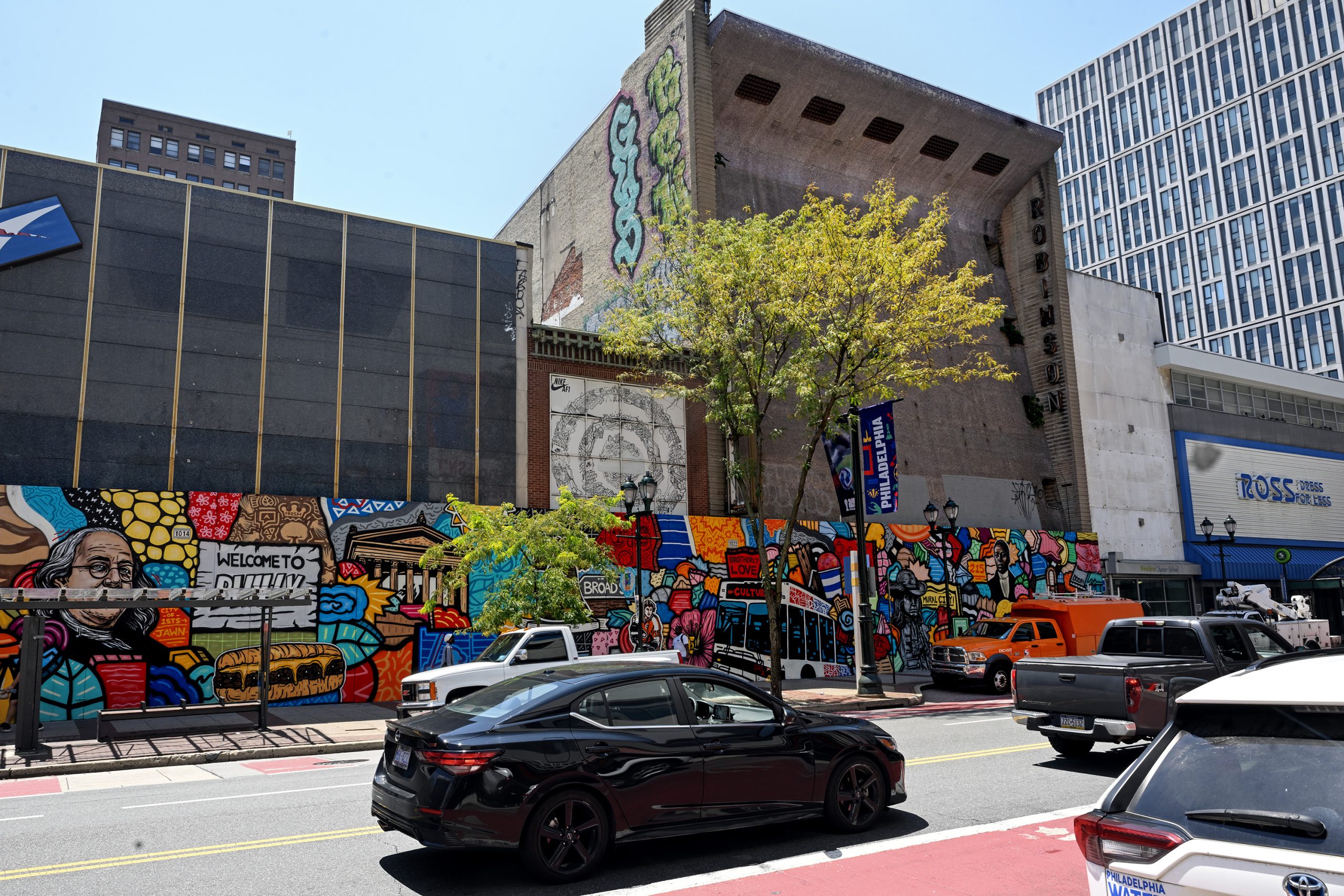
I spent a good part of the winter and early spring of 2024 along an eight block stretch of Market East while the city was dreaming and debating its potential driven by later-scraped plan by the Sixers to build a $1.55 billion downtown arena.
It was a tattered corridor, especially the south side of the 1000 block that was mostly boarded up storefronts. The city started trying to freshen it up before our summer of celebrations.
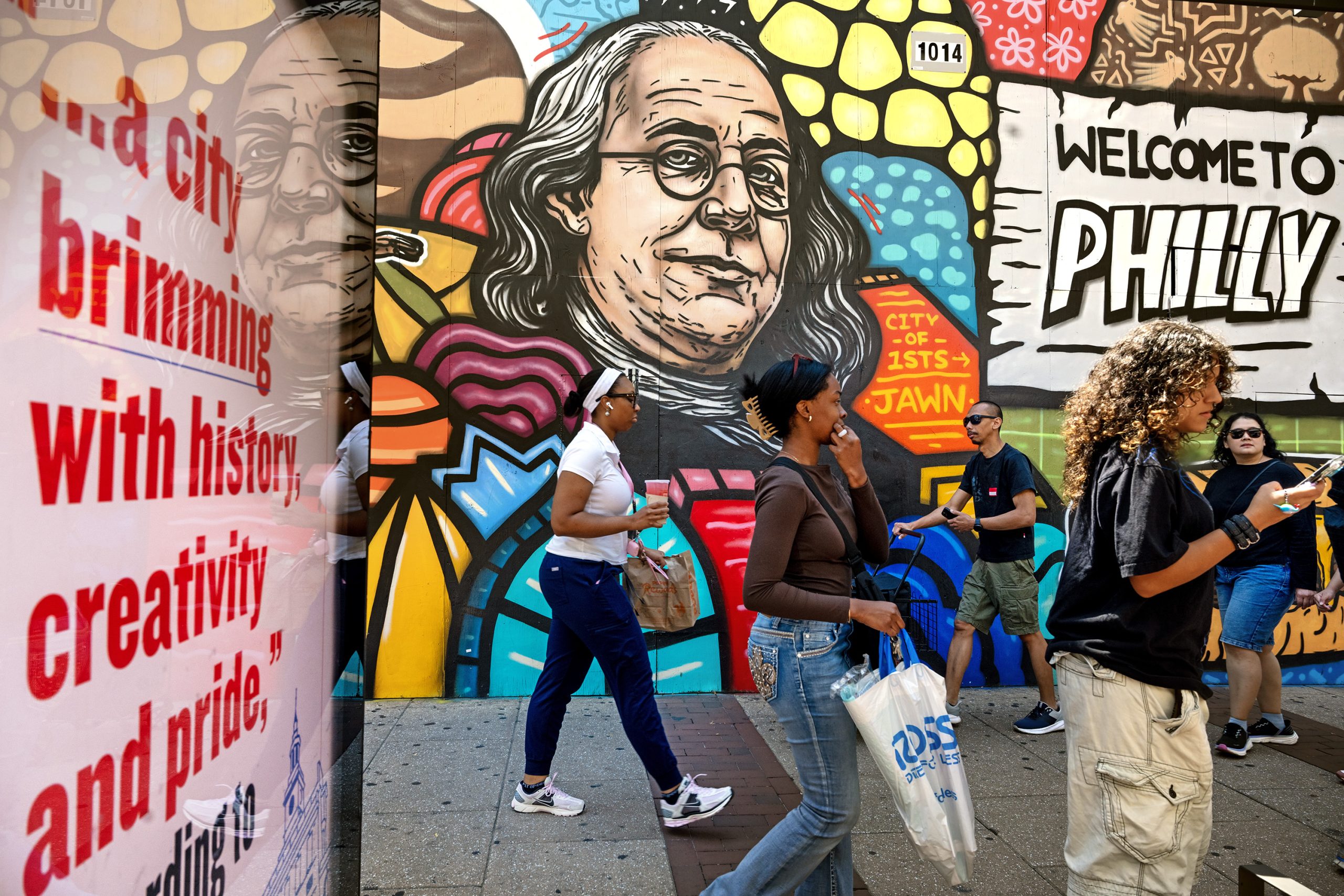
Walking there on Monday I admired the 150-foot mural “Welcome to Philly” artist Alloyius McIlwaine was commissioned to paint there before the big summer. I didn’t want to merely record his month-old work, but as I stepped into a bus shelter to get out of the flow of pedestrian traffic, I was immediately stuck by Ben’s reflection in the shelter’s glass — and the words of an unrelated advertisement.
I didn’t want a photo that called too much attention to a single fellow walker, so I waited patiently for that magic moment when my frame was filled with a half-dozen people.
Since 1998 a black-and-white photo has appeared every Monday in staff photographer Tom Gralish’s “Scene Through the Lens” photo column in the print editions of The Inquirer’s local news section. Here are the most recent, in color:
Did you know islands dwell on the Delaware and Schuylkill? We’ll show you a photo taken on a Philly-area island, you drop a pin where you think it was taken. Closer to the location results in a better score. Good luck!
Round #43
Question 1
Where is this historic house?
Loading…
ClickTap on map to guess the location in the photo
ClickTap again to change your guess and hit submit when you're happy
You will be scored at the end. The closer to the location the better the score
Don Nigroni / Spotlight PA
Pretty good/Not bad/Way off! Your guess was from the location.Spot on! Your guess was exactly at the location. Here's also where a random selection of Inquirer readers guessed.
Fort Mifflin, an American Revolutionary War historic site, is located on Mud Island along the Delaware. Situated in the shadow of Philadelphia International Airport, the surrounding wetlands were drained in the 19th century, connecting the island to the western bank of the river.
Quiz continues after ad
Question 2
Where is this mural?
Loading…
Jose F. Moreno / Staff Photographer
Pretty good/Not bad/Way off! Your guess was from the location.Spot on! Your guess was exactly at the location. Here's also where a random selection of Inquirer readers guessed.
Viewed from the Manayunk towpath, this mural is located on Venice Island, one of the city's lowest-lying areas. A narrow wedge of land spanning nearly 70 acres and approximately 1.7 miles in length, the island lies between the Schuylkill and the Manayunk Canal.
Quiz continues after ad
Question 3
Where is this trail?
Loading…
Jose F. Moreno / Staff Photographer
Pretty good/Not bad/Way off! Your guess was from the location.Spot on! Your guess was exactly at the location. Here's also where a random selection of Inquirer readers guessed.
The Fairmount Water Works Trail and Boardwalk is a short section of the Schuylkill River Trail that extends onto an island behind Lloyd Hall. According to Billy Penn, the island is unofficially known as the Isle of Jean, named by Philadelphia resident Jean Knight.
Your Score
ARank
🏝️ Amazing work. Isle be impressed.
BRank
⛵Good stuff. That was smooth sailing.
CRank
🚣♀️ C is a passing grade, but you meandered a little.
DRank
🤿 D isn’t great, it’s low-lying territory.
FRank
🌊 We don’t want to say you failed, but you disappeared beneath the tide.
You beat % of other Inquirer readers.
We’ll be back next Saturday for another round of Citywide Quest.
Before you start pointing out that he’s 41, remember who we’re talking about. This is arguably the greatest basketball player of his generation — one of the few athletes whose name alone can change the mood of an entire city. There will be plenty of time to debate how much he has left in the tank.
But now isn’t the time.
Now is the time for imagining LeBron in a Sixers jersey. It’s for checking the schedule, texting your friends in all caps and wondering how quickly the team store can stock No. 23.
Will this end with a championship? Nobody knows. But sports are supposed to be fun, and this is fun.
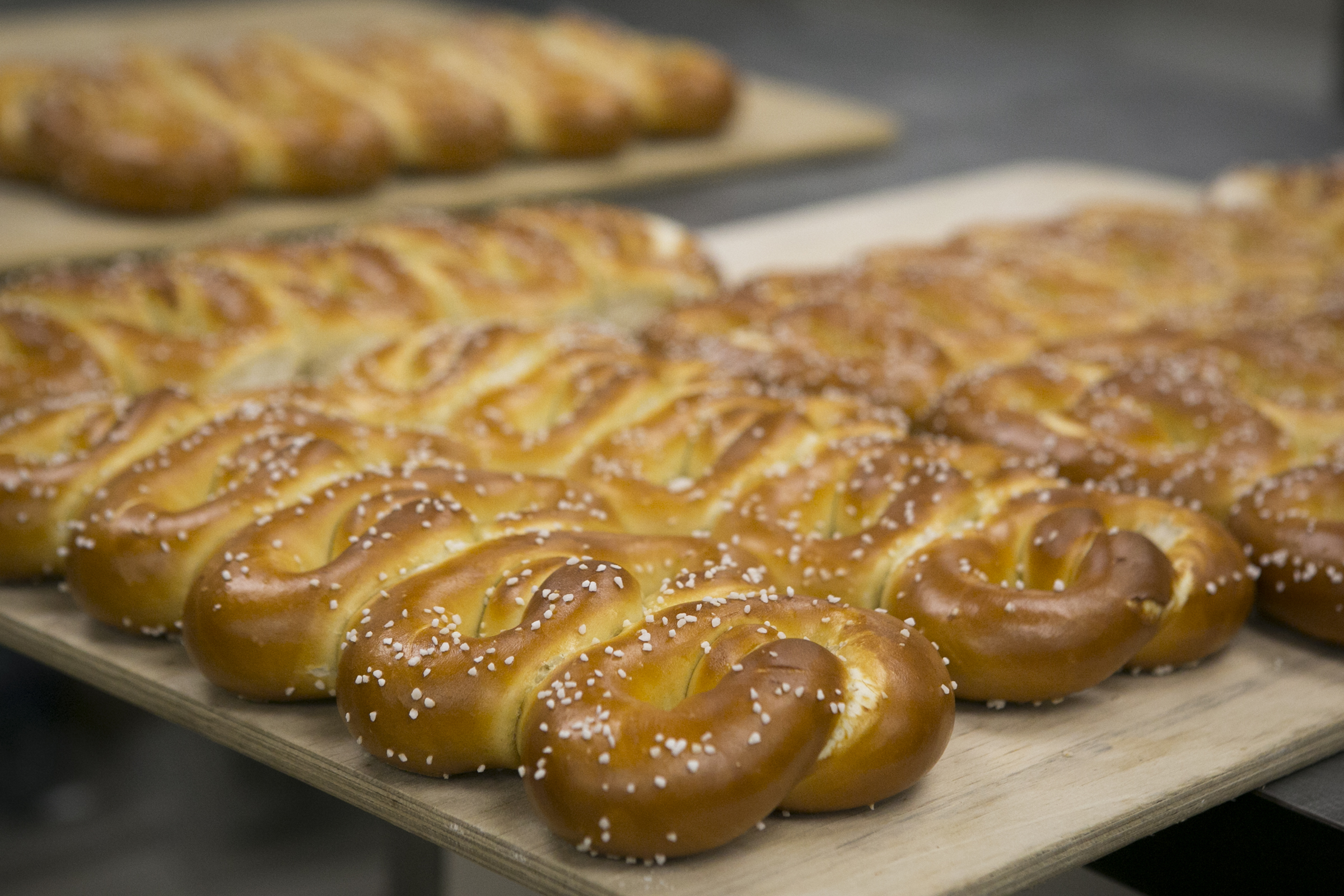
Freshly baked “penny pretzels” cool in the test kitchen at Philly Pretzel Factory headquarters in Bensalem, Pa., on the morning of Thursday, August 9, 2018.MAGGIE LOESCH / Staff Photographer
Keep your protein out of my pretzel: C
There are plenty of places to squeeze in an extra 20 grams of protein. A Philadelphia soft pretzel shouldn’t be one of them.
Sure, the business logic is there. But some foods don’t need to become “functional.” They already have a purpose.
A Philly soft pretzel isn’t just a snack. It’s breakfast after a youth soccer game, lunch when you’re running late. It’s something you grab at a Wawa, a corner store, or outside the stadium without giving a second thought. It’s warm, salty, a little messy, and unapologetically carb-heavy.
We’ve spent years turning ice cream into protein shakes, cookies into protein bars, and cereal into a dietary supplement. Now we’re coming for the pretzel? Somewhere, Gritty is shaking his fuzzy orange head.
If you want more protein, eat some chicken. Leave the pretzel alone.
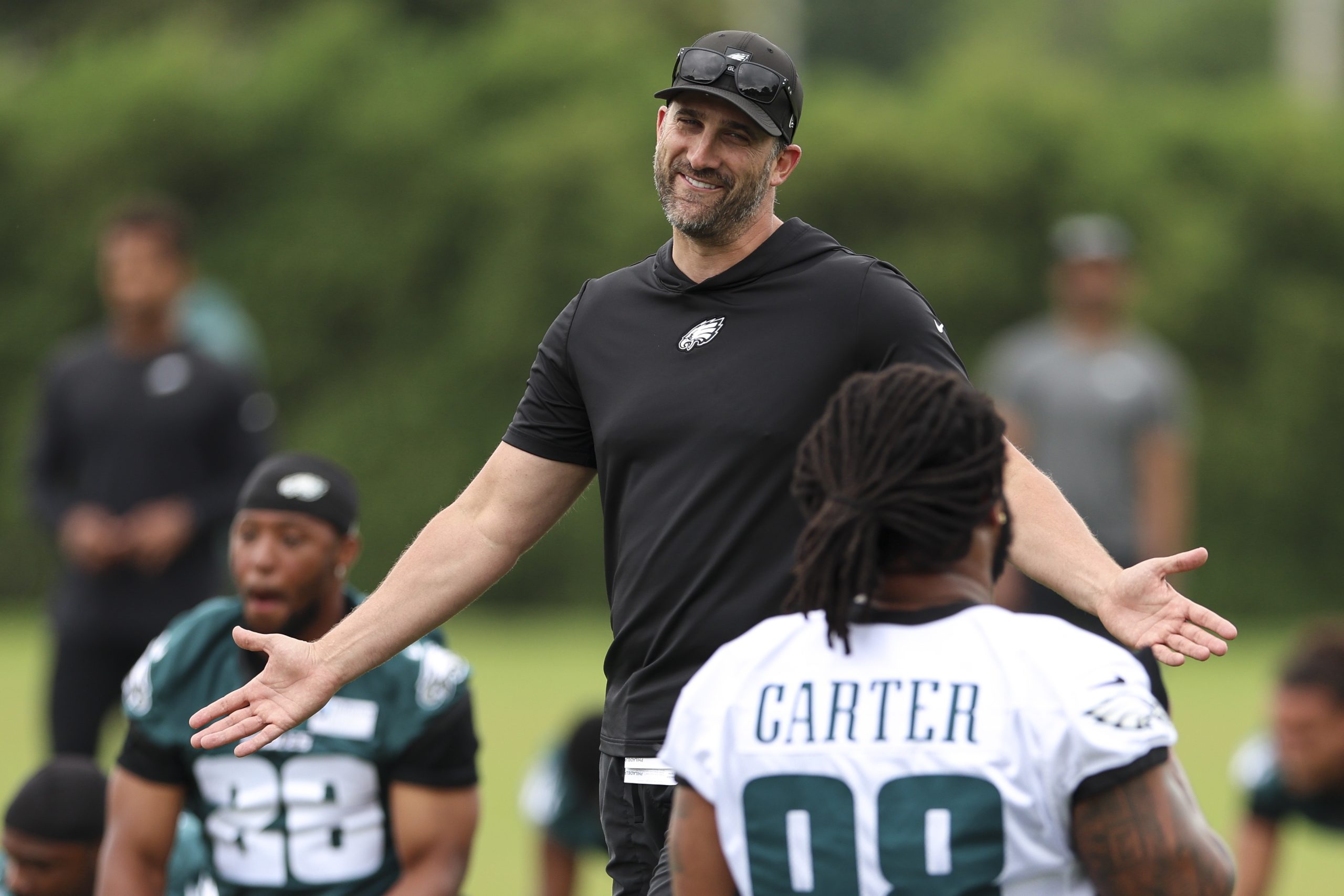
Philadelphia Eagles head coach Nick Sirianni laughs with defensive tackle Jalen Carter during mandatory mini-camp at the Jefferson Health Training Complex on Wednesday, June 10, 2026, in Philadelphia.Monica Herndon / Staff Photographer
Nick Sirianni’s AI pep talks: D
The robots aren’t taking over the Eagles playbook just yet. Instead, Nick Sirianni says he’s been using ChatGPT to find inspirational sports stories to share with his players, according to The Athletic.
Somewhere, decades of coaches who relied on Remember the Titans, grainy YouTube highlight reels, and laminated printouts with motivational quotes are shaking their heads.
Apparently even locker room speeches have entered the AI era.
It’s objectively funny to imagine Sirianni sitting at his computer typing, “Give me a great relentless effort true sports story,” before walking into a room full of NFL players.
Then again, maybe this is just what coaching looks like in 2026. At least he’s using ChatGPT to inspire the team — not to draw up game plays.
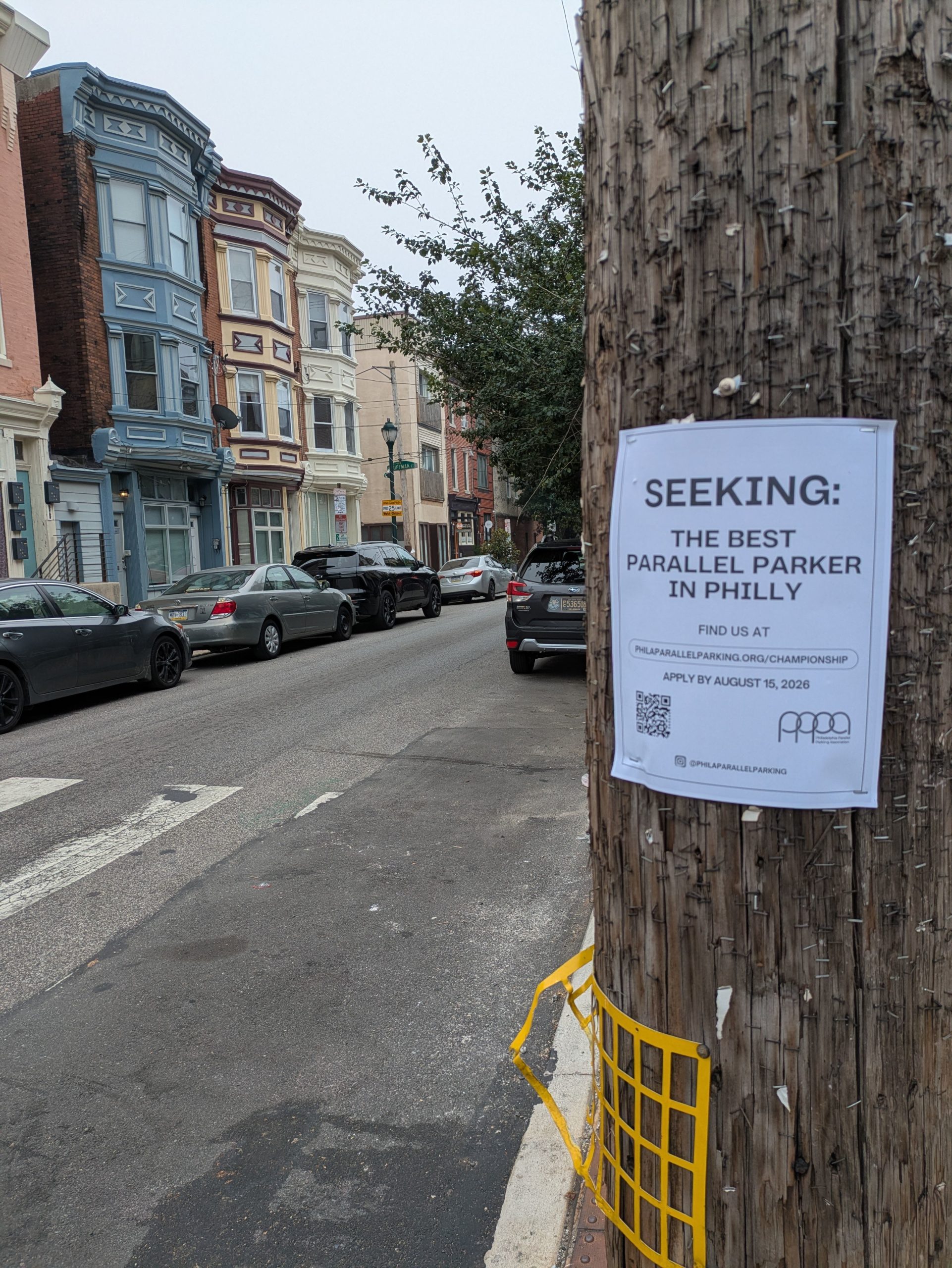
A sign advertising the 2026 Philadelphia Parallel Parking Association Championship is affixed to a pole across from some fine examples of parallel parking in the city.Courtesy of Adam Wodka
Competitive parallel parking: A
There are two types of Philadelphians. Those who dread parallel parking, and those who quietly believe they’re among the best to ever do it.
This is a city where successfully squeezing into a parking spot the size of a shoebox earns applause from strangers, where people take it personally when someone leaves three feet between bumpers, and where every South Philly resident has at least one story about fitting into a space they probably shouldn’t have.
The organizers somehow made it even more Philly by including an “under duress” category, complete with a savesies chair, an angry neighbor yelling that the spot is reserved for their granddaughter, honking traffic, and other distractions. That’s less a competition than an average Tuesday.
The winner gets $76… just enough to cover your next parking ticket, and the most Philadelphia prize imaginable.
The worst part? Players from the Nationals, Yankees, and even the Dodgers got it right. Come on, Bryce. You’ve spent years playing in the birthplace of American democracy. We weren’t expecting a dissertation on the Continental Congress, we just wanted 1776. Heck, the basketball team that plays across the parking lot isn’t called the 75ers.
Then again, if the price of 40 home runs is occasionally forgetting what year America declared independence, that’s probably a trade Phillies fans are willing to make.
$1,500 in Philly rent: B
Nobody is going to look at 591 square feet and say, “Wow, what a palace.” That’s about what $1,500 a month gets you in Philadelphia, according to a new RentCafe study. It’s smaller than the national average and not even enough for a typical one-bedroom apartment.
But perspective matters.
In Manhattan, the same $1,500 gets you about 210 square feet — roughly enough room for a bed, a mini fridge and an existential crisis (a dorm room, essentially). In Boston, it won’t even cover a studio.
So suddenly, Philly’s 591 square feet starts looking… respectable.
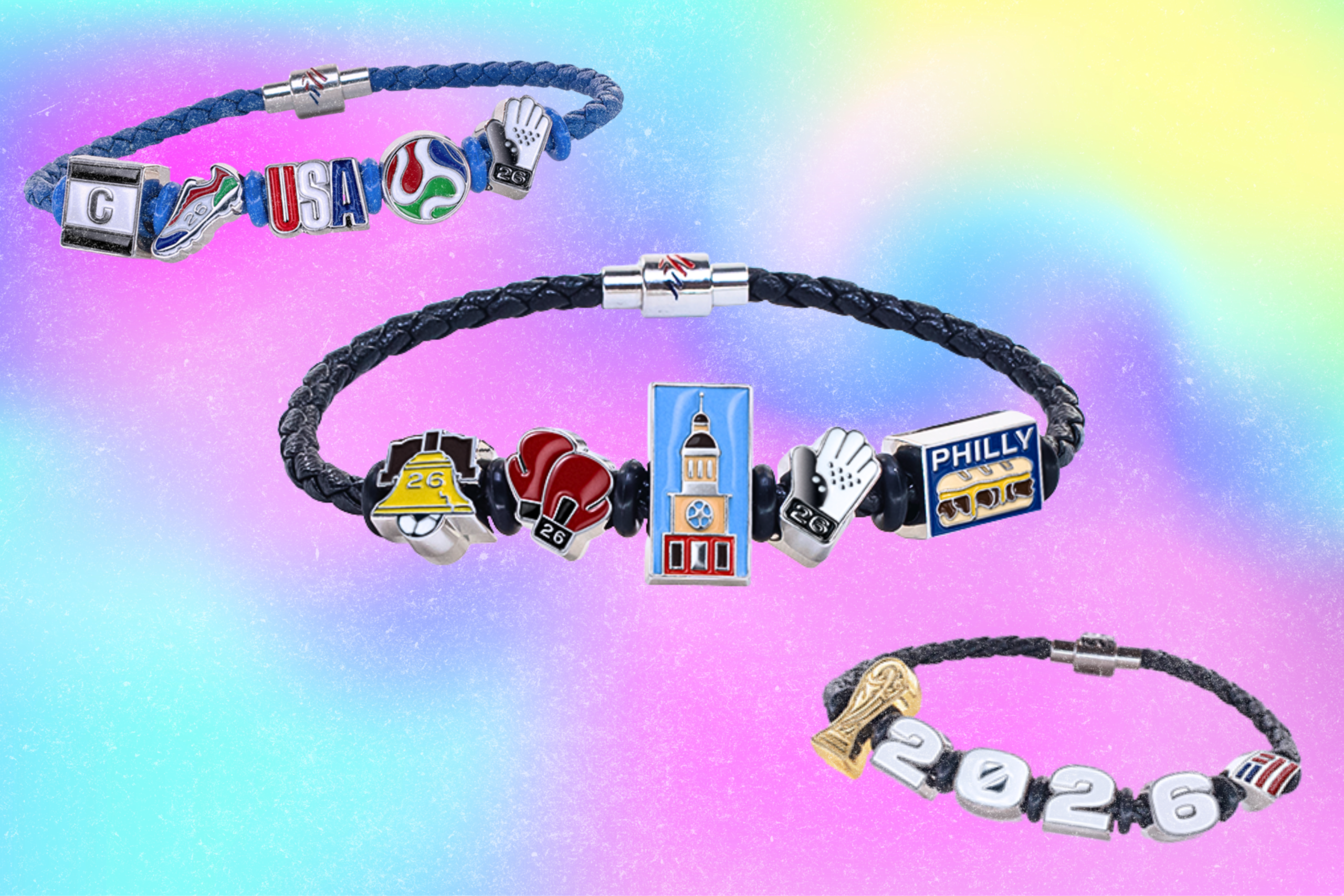
A free charm bracelet available at FIFA Fan Festivals nationwide, including Philadelphia’s in Lemon Hill, had fans waiting hours in line to get one. Bank of America is behind the coveted Fan Bands, drawing hours-long lines.Emily Bloch / Staff illustration / Bank of America
Nothing stays free for long: A-
The World Cup ended, everyone went home, and right on schedule, the internet got to work.
Remember those free Bank of America charm bracelets that had people waiting in line for hours at Lemon Hill?
Honestly, you almost have to respect the hustle. If someone is willing to pay $150 because they didn’t want to stand in a four-hour line for a tiny cheesesteak charm, that’s capitalism doing what capitalism does.
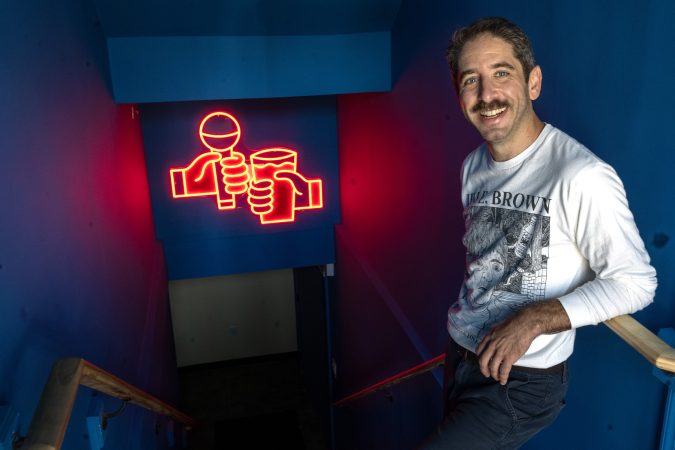
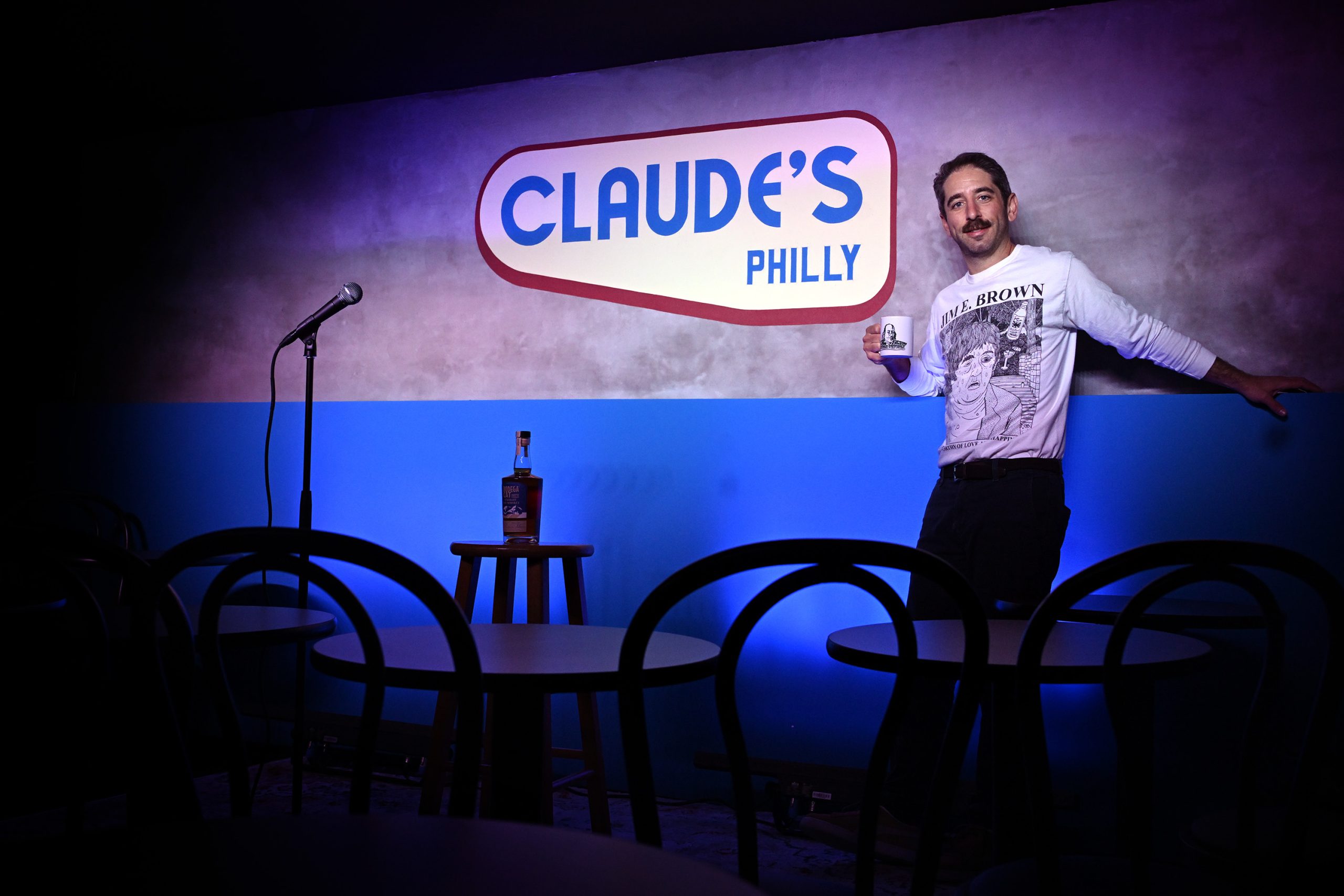
Benditt, 43, has spent years of producing comedy shows behind the scenes. He hopes the South Philly venue, at 1123 S. Broad St., will become a premier destination for emerging acts to build their names, and for touring comics to engage with a wider range of fans.
“We’re kind of like the ‘Adult Swim’ brand of comedy,” Benditt said.
Owner Reid Benditt is onstage at Claude’s Comedy Club on South Broad Street on Wednesday, July 1, 2026.Tom Gralish / Staff Photographer
Many rising stand-ups, he said, are reduced to backrooms at Philly dive bars and restaurants, where the crowd is more interested in clearing their plates and drink tabs than they are in comedy. Few, if any, venues are dedicated to rising comics on a nightly basis, Benditt said, which forces early-career comics to test their skills in larger entertainment markets before they’re ready.
“Philly is a really underserved city as far as the number of [comedy] clubs,” he said. “I think it’s saying something when we only have a handful of clubs, and we have all this great talent around.”
The clubs are even fewer in South Philly, where Benditt said Claude’s comes in.
Just under South Broad Street’s United Check Cashing marquee stands Claude’s doors. Visitors are immediately transported to a dimly-lit, subterranean space that’s reminiscent of legendary clubs like New York City’s Comedy Cellar. There are low ceilings, intimate lighting, and an audience that’s fully invested in local comedy.
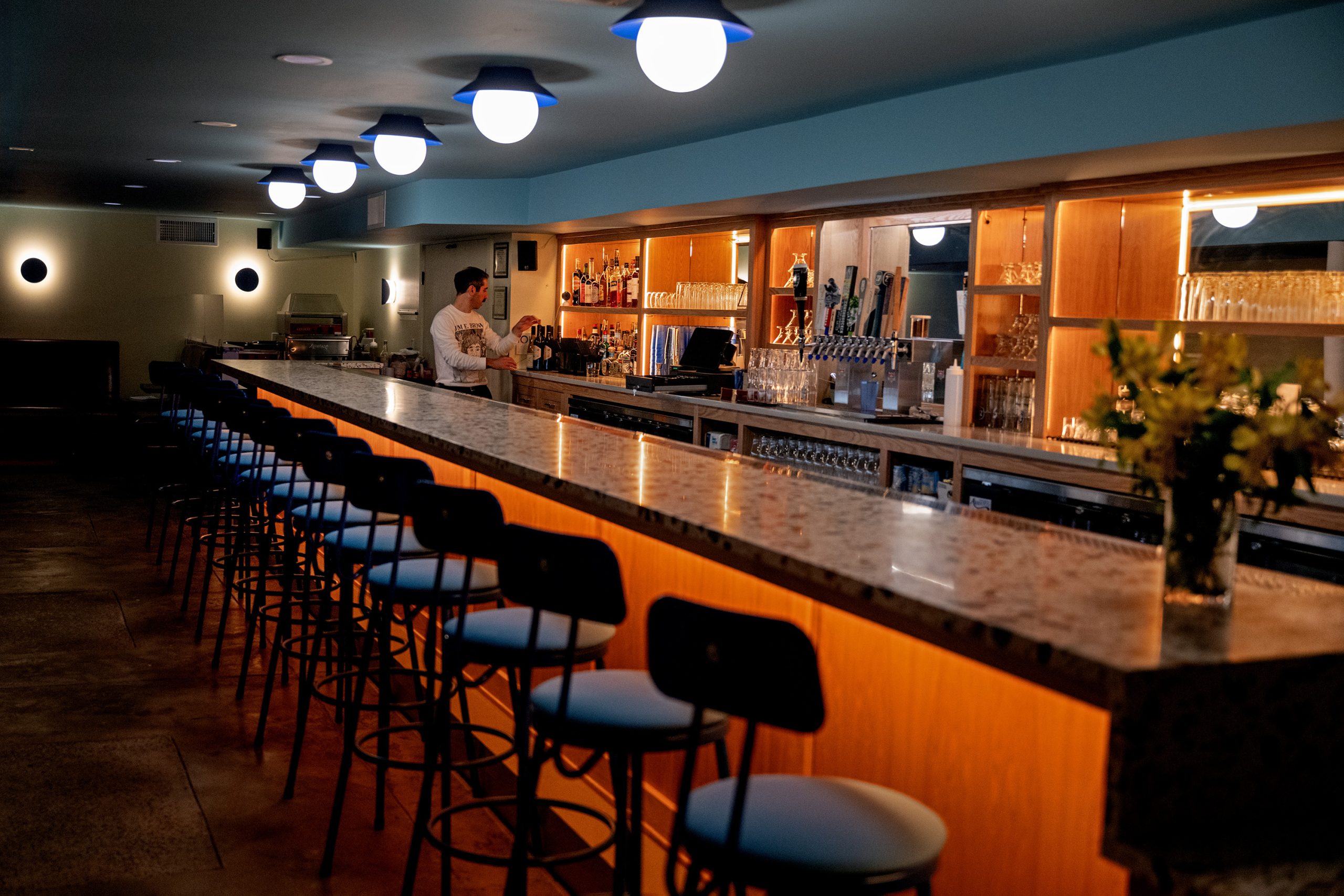
Down the steps is a full-scale bar, fashioned with lush seating, and a drink menu filled with spirits and nonalcoholic options. The food menu offers small bites like specialty hot dogs, grilled cheese sandwiches, dill pickle plates, and Tastykake flights garnished with small puddles of whipped cream.
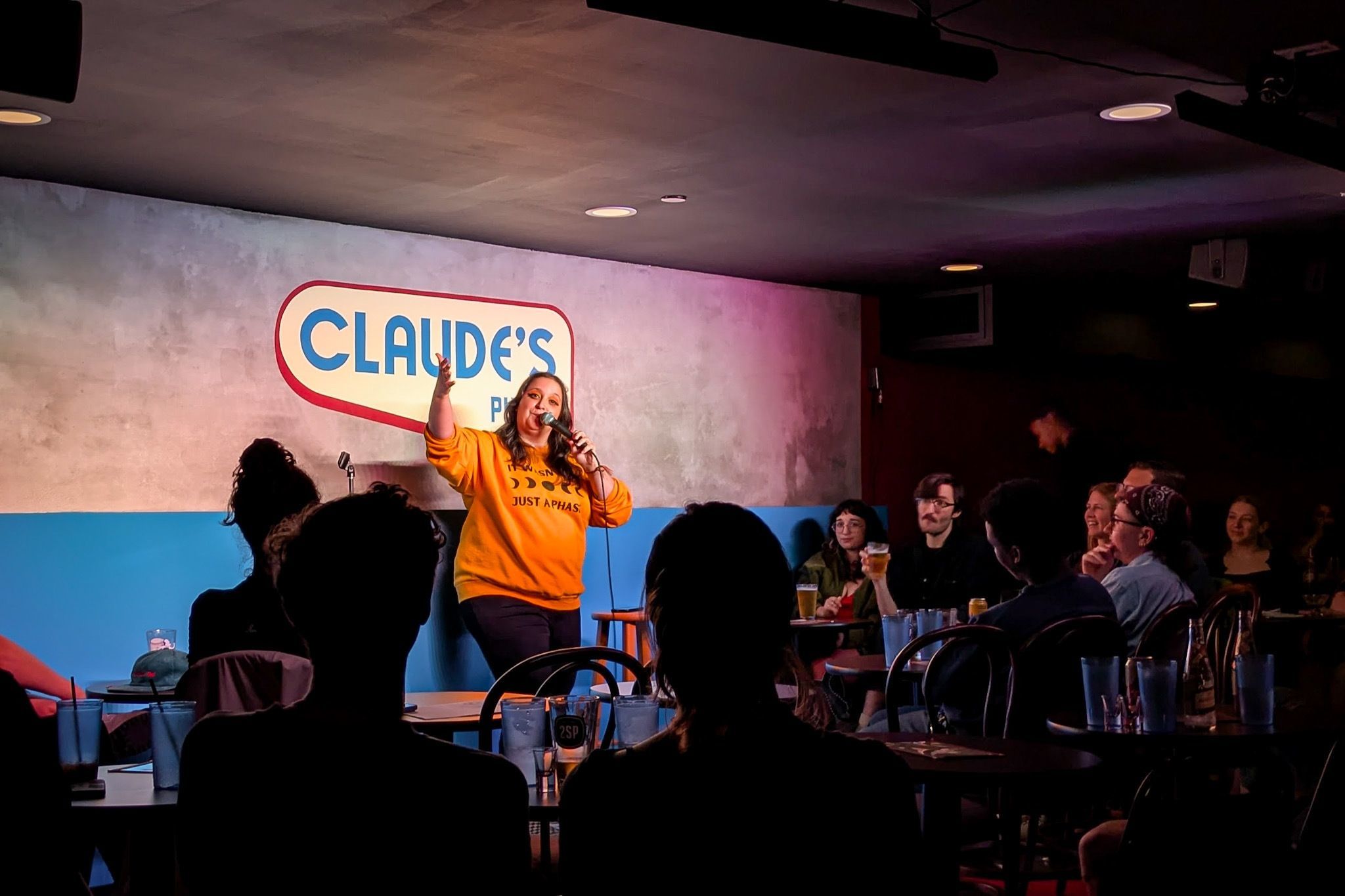
To the right of the bar are the doors to Claude’s 100-person show space. Cushioned sheets rest on its perimeter, while small table sets are positioned toward the illuminated stage, with the Claude’s logo serving as the backdrop.
It’s where rising comics can bring their mangled notebooks on stage to test new material, and where touring acts can drop in to perform outside of the city’s long-running venues.
The bar at Claude’s Comedy Club on South Broad Street on Wednesday, July 1, 2026.Tom Gralish / Staff Photographer
In less than a month, the club has drawn the kind of talent and crowd Benditt envisioned two years ago when he decided to transform the former thrift store into a comedy hub.
Comics like Carmen Lynch, KC Shornima, and Lukas McCrary have headlined at Claude’s, their signatures gracing the club’s green room walls. Other comedians have participated in open mic nights, pun comedy showcases, and other themed events. Benditt also plans to establish programming for Philly’s robust clown community.
While he’s spent the majority of his career as an event coordinator at Union Transfer and Electric Factory, Benditt has been a part of Philly’s comedy scene for more than a decade.
After taking an improv class in 2013, he began performing stand-up with the collective Laughs on Philly. In 2019, he helped organize the Whiz City Comedy Festival, a two-day, three-venue event on South Street. But he knew, even then, being a performer wasn’t in the cards.
“Performing was never my thing,” Benditt said. “I’ve done stand-up enough times to know which side of the microphone I belong on, and which side I want to be on.”
He discussed the idea of opening a comedy club among friends, but it wasn’t until late 2020 that his plans were set in motion. He took a small-business class at Temple University and began searching for potential venues.
Benditt looked at spaces in Passyunk and West Passyunk before signing the lease to the lower-level venue in November 2024. He chose the South Broad Street location because of the absence of live comedy venues in the area.
“When you look at the map where the comedy clubs are in the city, it’s easy to see where there’s a void,” he said.
He didn’t reveal the cost of construction but said he poured his life savings into transforming the “raw” cement stage and barren walls into a formidable entertainment destination.
“It was enough, where I had to put my house on the line as an insurance policy,” he said. “I’m going all in.”
Comedian Meg Goetz entertains at a preview at Claude’s Comedy Club & Bar, 1123 S. Broad St.Reid Benditt
Originally, Benditt anticipated an October 2025 opening, but he didn’t account for the mountain of permits required by the Department of Licenses and Inspections. But after securing the final permit needed to operate as a comedy club and sit-in restaurant in June, Benditt’s dream was finally fulfilled.
For the name, Benditt wanted something catchy with a more personal touch.
“Something that gets out of the way and gives performers a spotlight.”
His mother’s name is Claudia, his family affectionally calls her “Claude.” And like his “selfless” mother, who routinely puts others before herself, Benditt is determined to showcase local and national comics, even with his livelihood on the line.
Claude’s Comedy Club & Bar, 1123 S. Broad St. Cellar, Philadelphia. Open everyday 4 p.m. to midnight. instagram.com/claudescomedy
Following my first visit to Boston two years ago, I penned a column (against my better judgment) bemoaning what a surprisingly good time I had there (against my will).
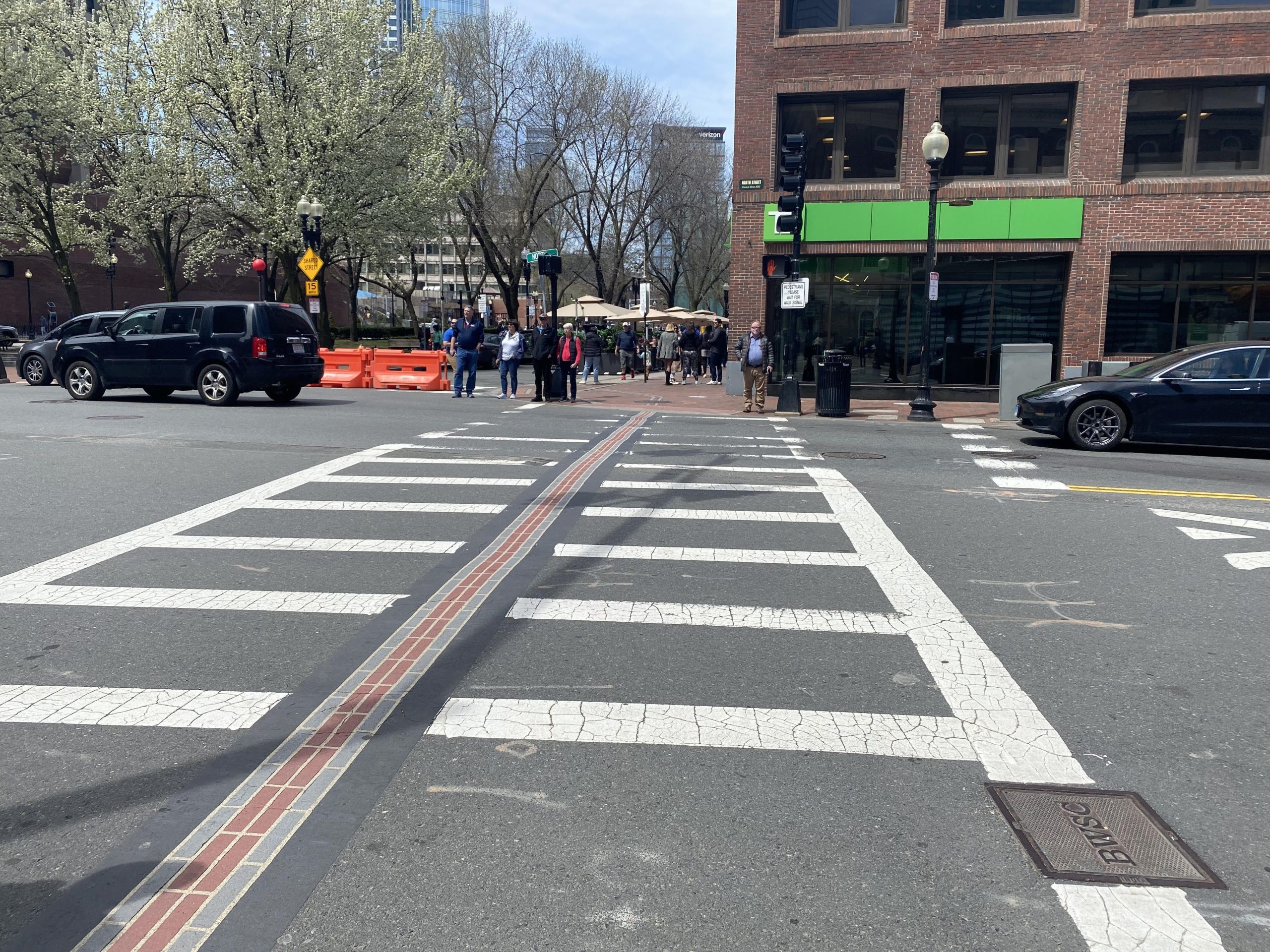
I was particularly taken with the city’s Freedom Trail, a 2.5-mile walking path embedded in Boston’s sidewalks that leads to 16 historic sites. Far from being half-baked, I had to admit this Beantown tourist attraction was “annoyingly great.”
Look at the Freedom Trail being all cute running through this Boston Street. Gawd! STEPHANIE FARR / Staff
Why didn’t we have anything like this in Philly, I wondered, and could we get our own version in time for the nation’s 250th anniversary?
I was flooded with emails in response from readers who not only agreed with me, but offered route suggestions and names for a potential Philly path. I also received a cryptic message from someone at Visit Philadelphia who said they had some things up their sleeves.
That was more than two years ago and I’d all but given up hope. Then I received an email this month from Jenea Robinson, vice president of communications for Visit Philadelphia.
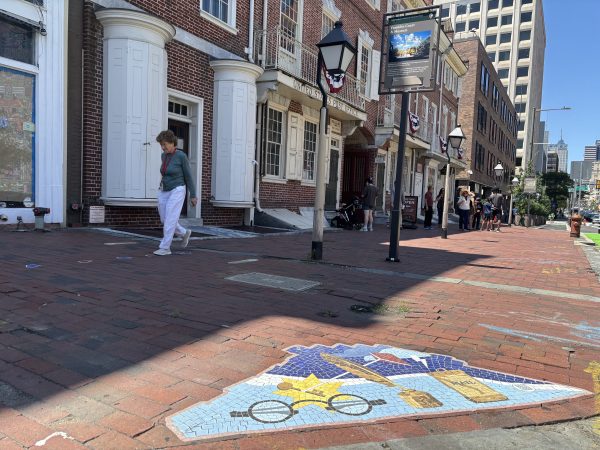
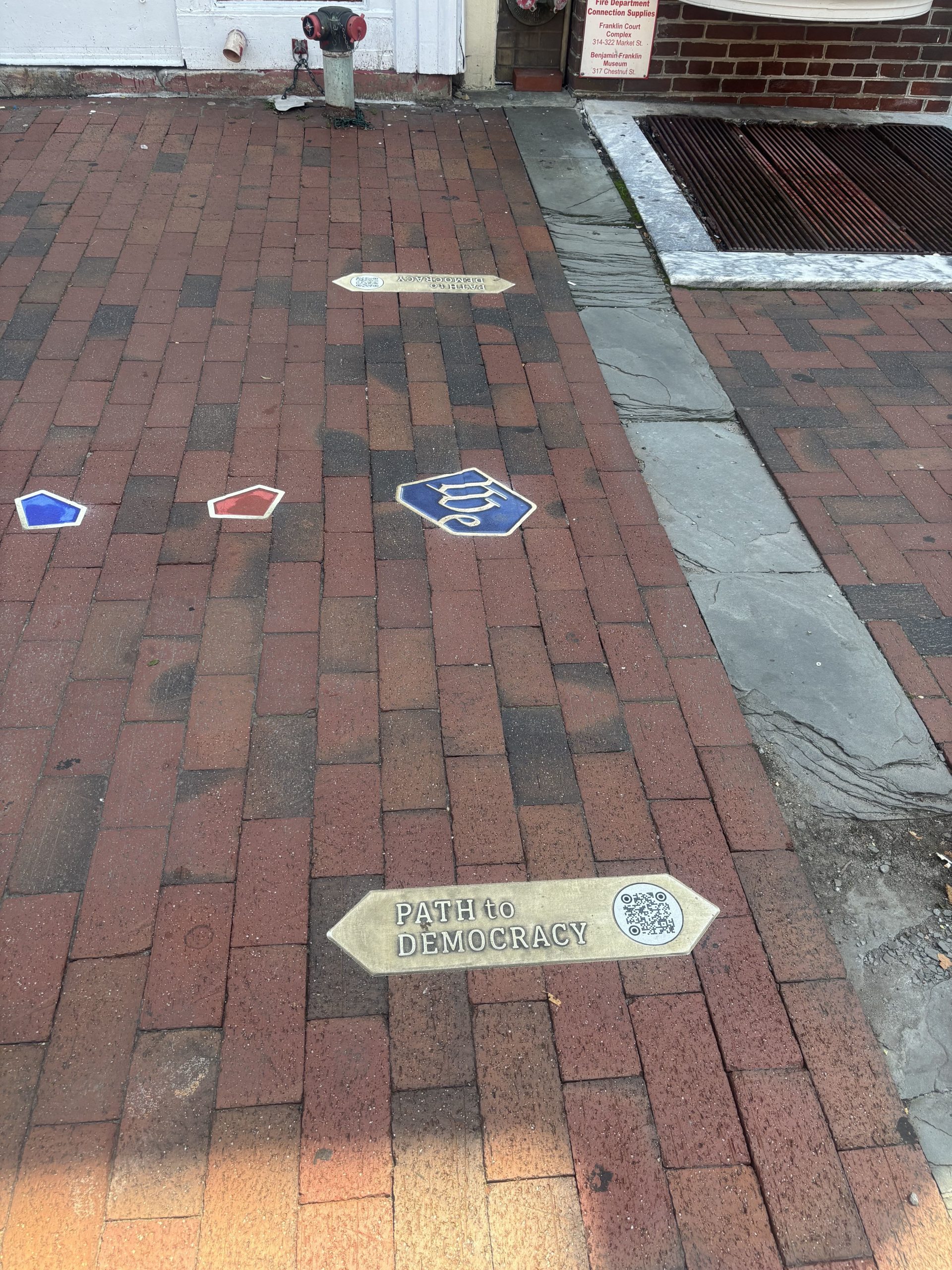
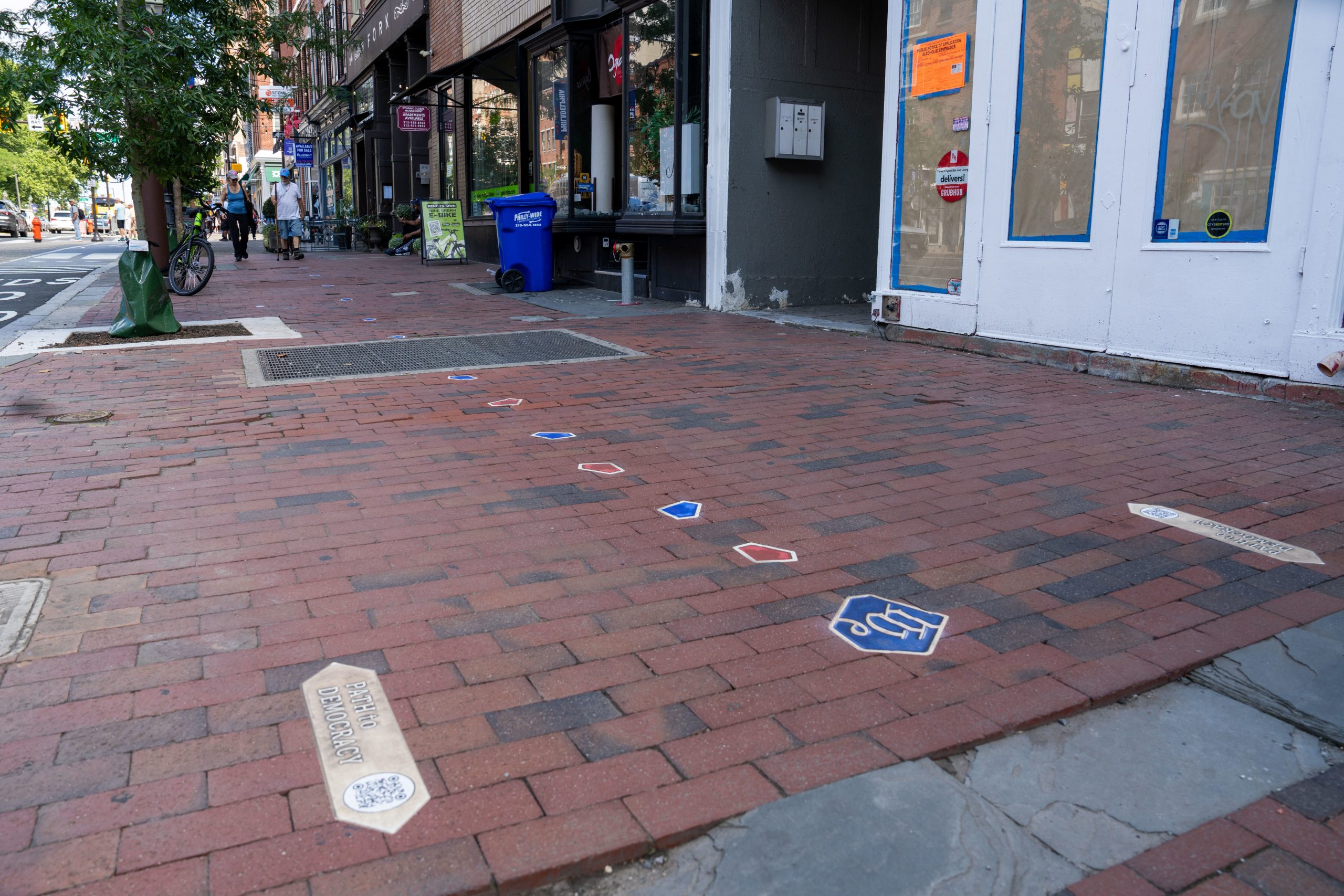
Vinyl decals resembling ceramic tiles and a brass plaque mark the public pilot version of the Path to Democracy.Stephanie Farr / Staff
“Because you wrote that delightfully, ‘annoyingly accurate’ story about Boston’s Freedom Trail a few years ago, I wanted to make sure you got the first look at Philadelphia’s answer to it: Path to Democracy,” she wrote.
Could it be true? Are we actually getting our own historic trail and did someone really call my work “annoyingly accurate?!?” Be still my craggy, Philly heart!
‘A legacy project’
Still in its early phases, there are currently only six stops on the Path to Democracy as it undergoes public beta testing through Labor Day. The full path, which is slated for next summer, will have 21 stops and is based on a self-guided tour Visit Philly has had on its website for years, said Kyle Stein, senior marketing project manager for Visit Philly.
“This is something we wanted to introduce to people this year and have it be a legacy project for years to come,” he said.
(function(){function e(){window.addEventListener(`message`,function(e){if(e.data[`datawrapper-height`]!==void 0){var t=document.querySelectorAll(`iframe`);for(var n in e.data[`datawrapper-height`])for(var r=0,i;i=t[r];r++)if(i.contentWindow===e.source){var a=e.data[`datawrapper-height`][n]+`px`;i.style.height=a}}})}e()})();
In its final iteration, the Path to Democracy will be marked by colorful ceramic tiles, brass directional plaques, and large tile mosaics embedded in the sidewalks that will pay “homage to all of the art across Philadelphia” and particularly, to that of Isaiah Zagar, Stein said.
“Whatever look and feel we went with had to be authentic to Philadelphia,” he said.
For now, Visit Philly is using sturdy, eye-catching vinyl decals that resemble tiles and mosaics to mark the path and stops along it. Zagar’s studio wasn’t consulted on the project, but Stein said Visit Philly would love to work with them going forward.
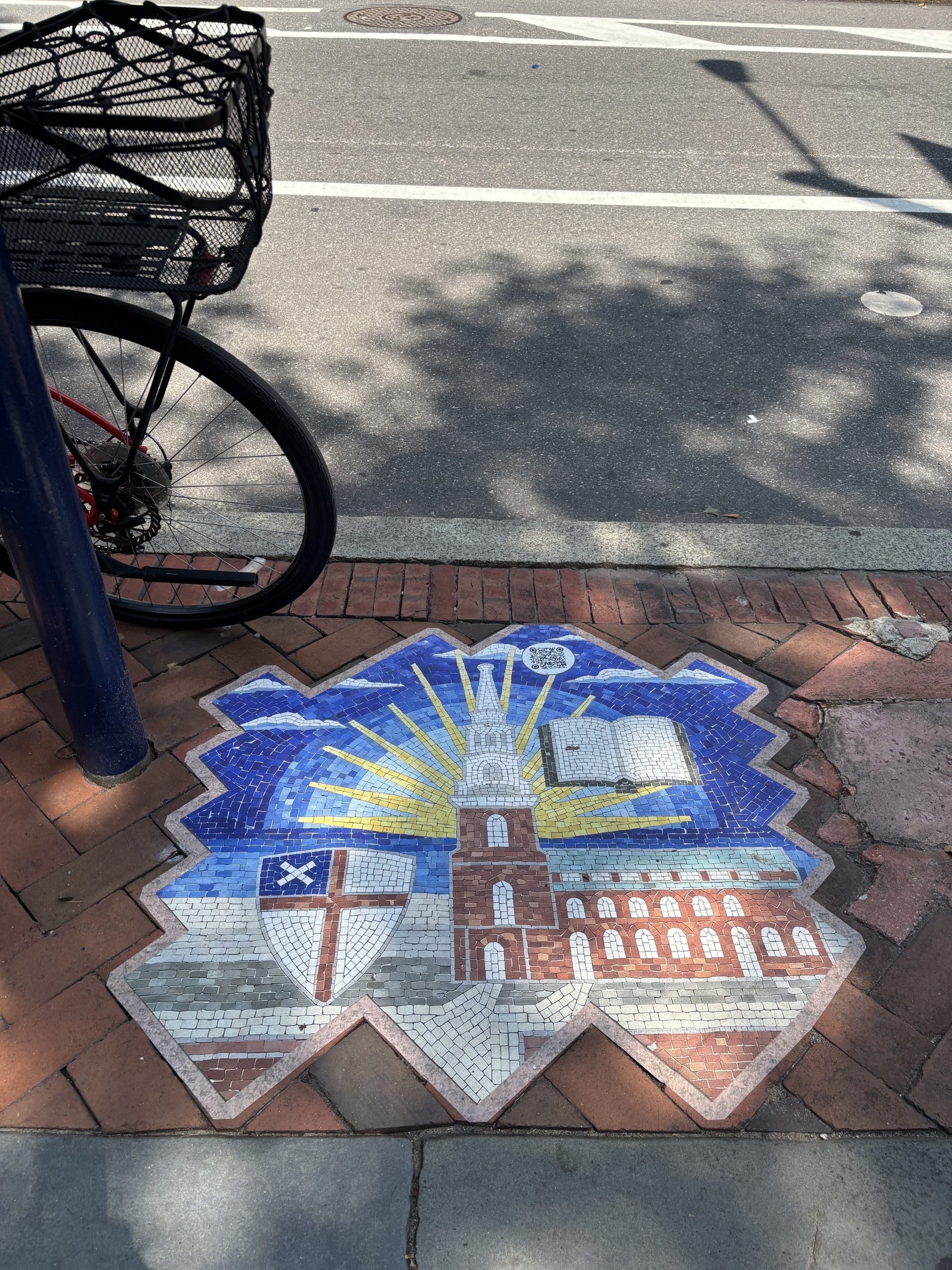
The vinyl mosaic decal at Christ Church along the Path to Democracy.Stephanie Farr / Staff
The Path to Democracy will not only be unique from Boston’s trail in look but in substance as well. The Freedom Trail traces Revolutionary War history, but Philly’s path will highlight sites and people that have shaped American democracy over the years.
“It’s not just something that happened in 1776,” Stein said. “Democracy is something that is an evolving thing.”
I knew there was only one way to suss out this path and that was to walk it myself. Plus, Stein said feedback from locals is essential during beta testing, and who doesn’t love being essential and opinionated in Philly?
Choose-your-own adventure
I snagged a parking space on Race Street near Second last week, knowing that the sites are all within a four-block radius from Front to Fourth and from Market to Arch Streets.
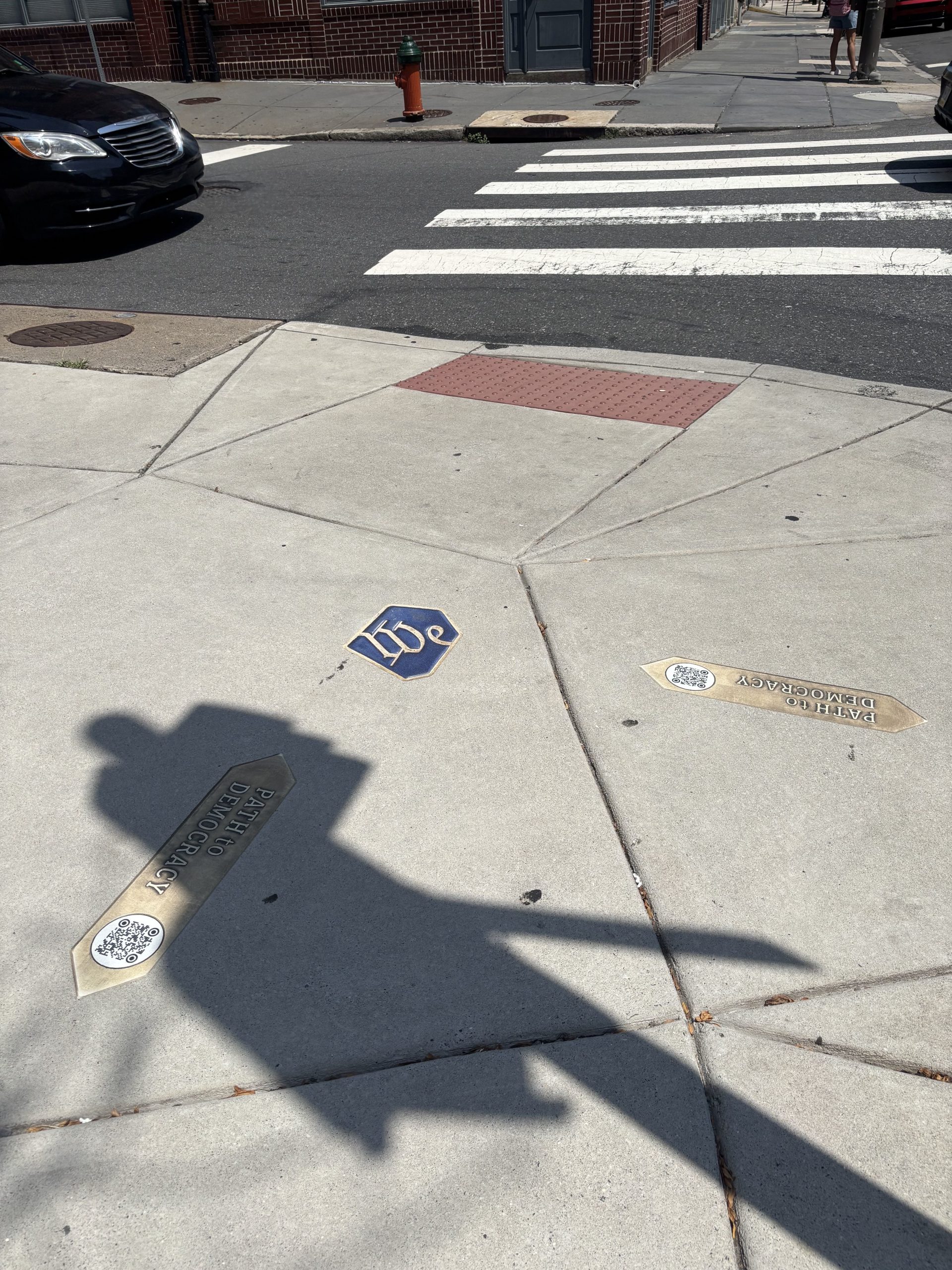
My first stop wasn’t planned. I just kept my eyes on the ground until something caught them, which happened at the corner of Second and Arch Streets. I spotted a blue vinyl tile that said “We” (written in the script of the Declaration of Independence) and two vinyl directional decals that said “Path to Democracy” with QR codes that led to an accompanying website. One pointed up Arch Street to Third and the other pointed down Second Street to Market.
Vinyl brass-colored decals at Third and Arch Streets in Old City denote that the Path to Democracy can be taken in one of two directions here. In the center is a “We” tile that is found on multiple spots along the path as well.Stephanie Farr / Staff
I decided I’d follow the arrow pointing right up Arch Street. As I walked, I spotted gem-shaped blue-and-red vinyl decals that were peppered like breadcrumbs down the sidewalk and led me straight to the Betsy Ross House.
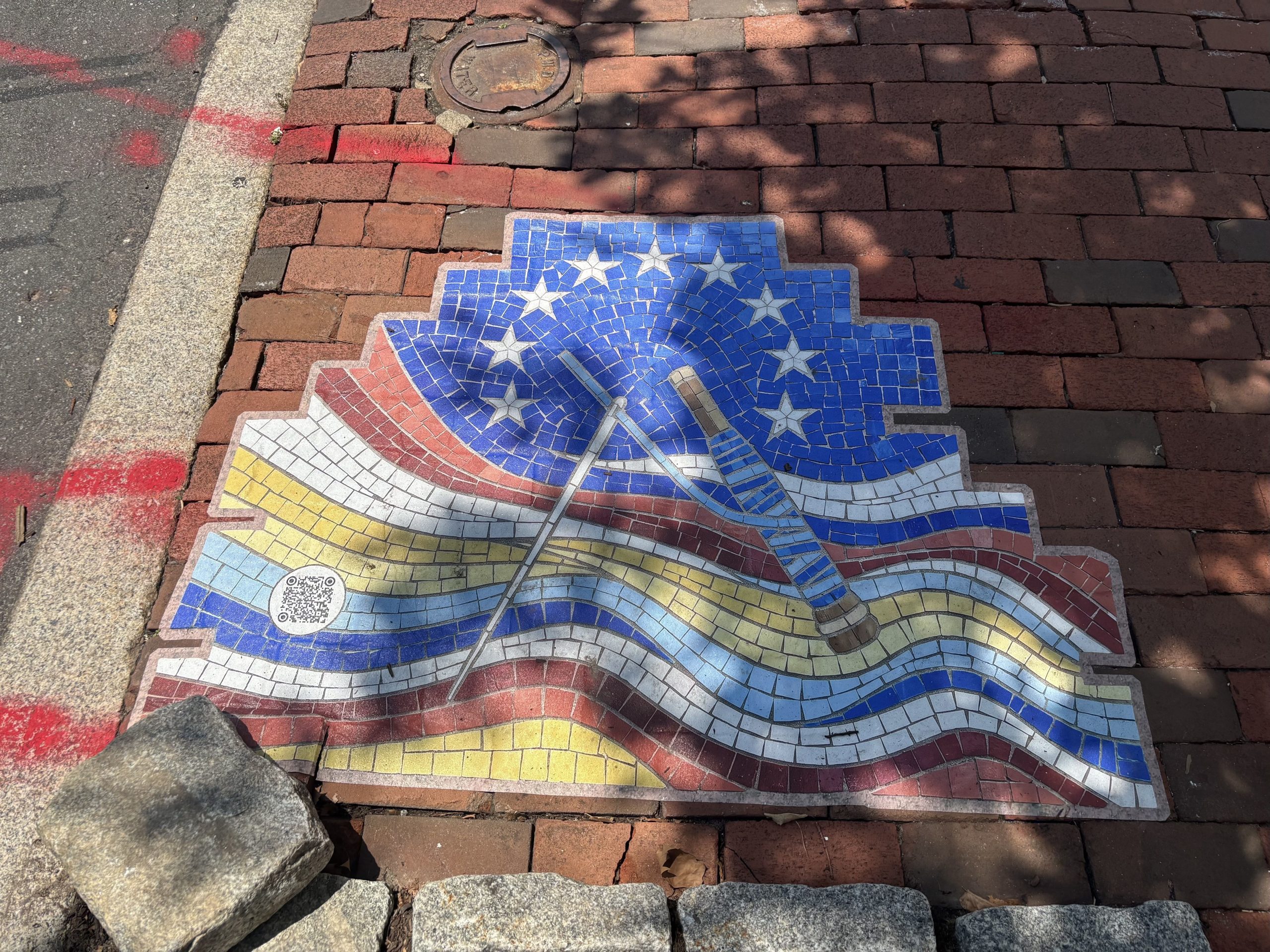
On the sidewalk outside of the site, I spotted a lovely vinyl mosaic of a needle and thread superimposed upon a multicolored flag. A QR code on it took me to a mobile-friendly webpage about Ross. I listened to a 51-second audio clip about her life and read about the mosaic before me. Also provided on the page was the Betsy Ross House’s address, operating hours, and other useful visitor information.
The vinyl mosaic decal outside of the Betsy Ross House along the Path to Democracy.Stephanie Farr / Staff
At the bottom of the site was a nifty little guide showing me that I was currently a four-minute walk away from Christ Church in one direction and a two-minute walk away from the Arch Street Meeting House in the other.
“All right, this is pretty cool,” I whispered.
Confusing corners
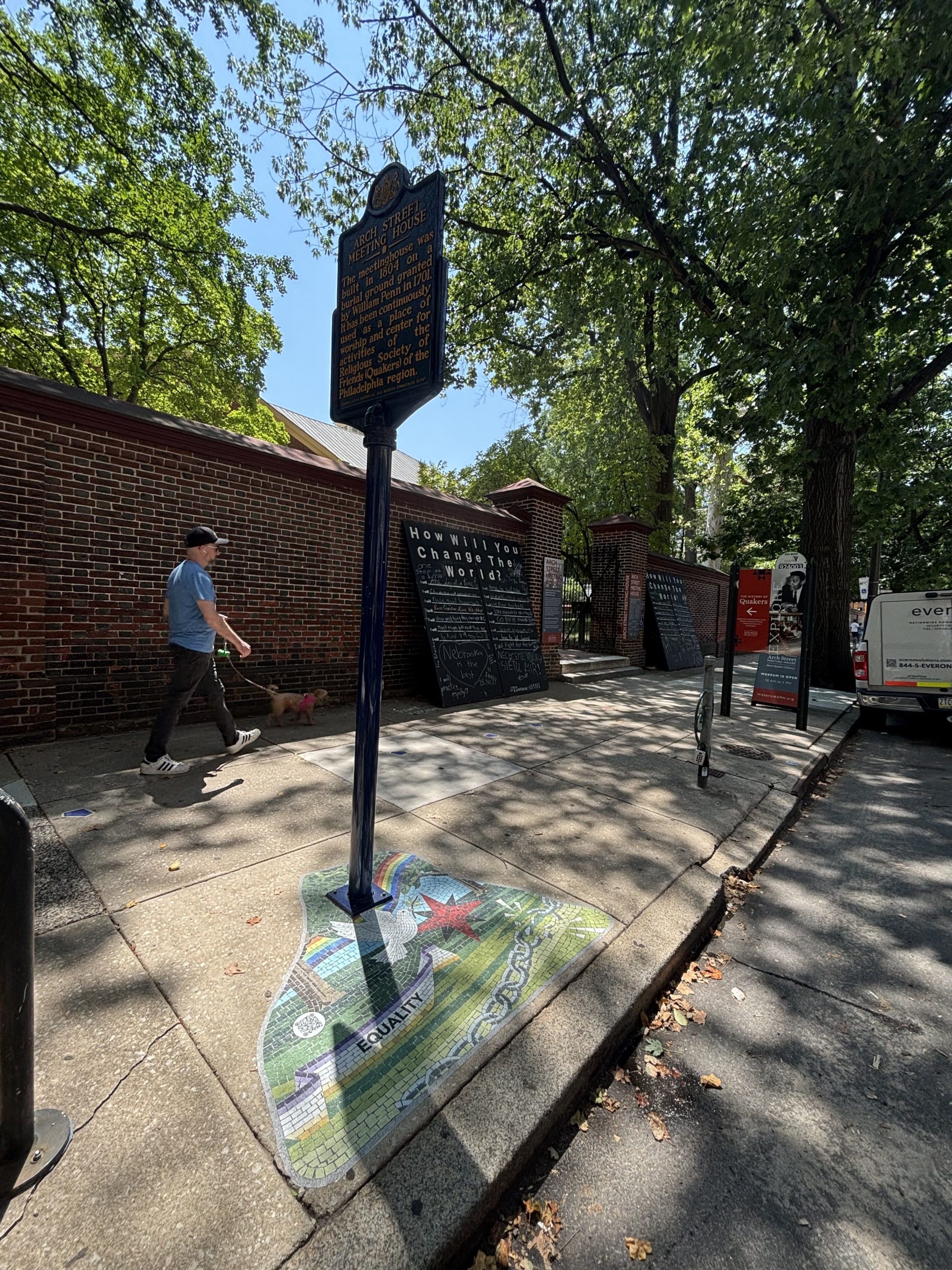
I chose to follow the blue-and-red vinyl decals to the Arch Street Meeting House where a vibrant vinyl mosaic of a dove and the word equality was plastered on the sidewalk. The QR code led to a page about the meetinghouse and to an audio clip about how “Religious radicals founded Philly.”
When I was done, I discovered I’d reached the end of the path, much to my chagrin. I didn’t realize it wasn’t a continuous loop and I had to retrace my steps back past the Betsy Ross House to the next site, Christ Church.
From there, the vinyl decals led me to the southwest corner of Second and Market Streets, where a directional decal with arrows on both ends pointed me toward Front Street on my left and also to Third Street on my right.
“Well this is confusing,” I thought.
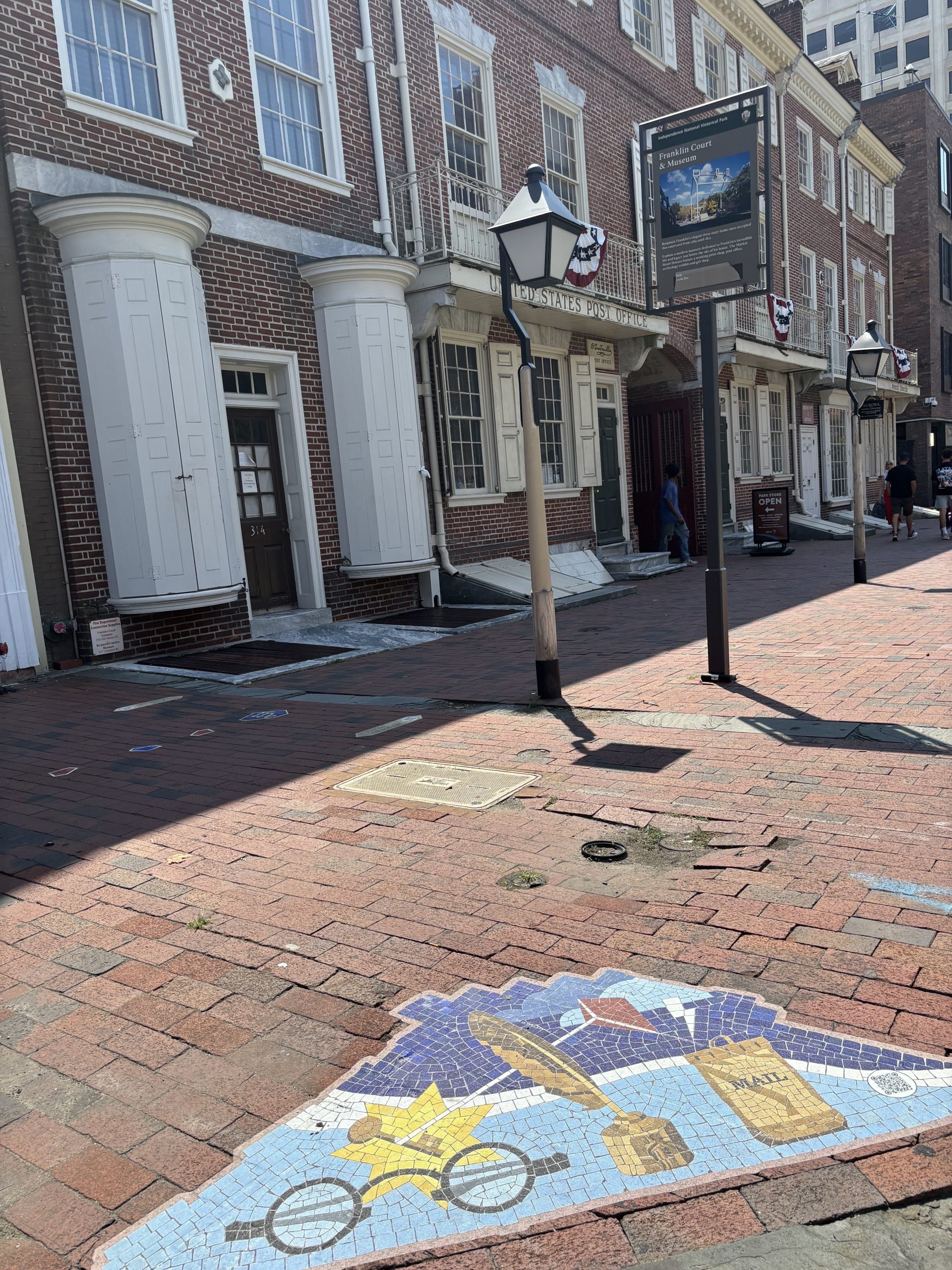
I decided to follow the path up Market Street past Third Street to Franklin Court, where I spotted a large vinyl mosaic decal of a key, kite, quill pen, and spectacles.
The Path to Democracy leads to just outside Franklin Court, where this vinyl mosaic decal located.Stephanie Farr / Staff
I headed inside Franklin Court and walked around. I always forget how many privies there are in there (the place had more johns than the Second Continental Congress!).
Franklin Court marked another terminus of the path, so I turned around and headed back down Market Street to Front to check out the other direction of the trail I’d forgone.
Lesser-known sites
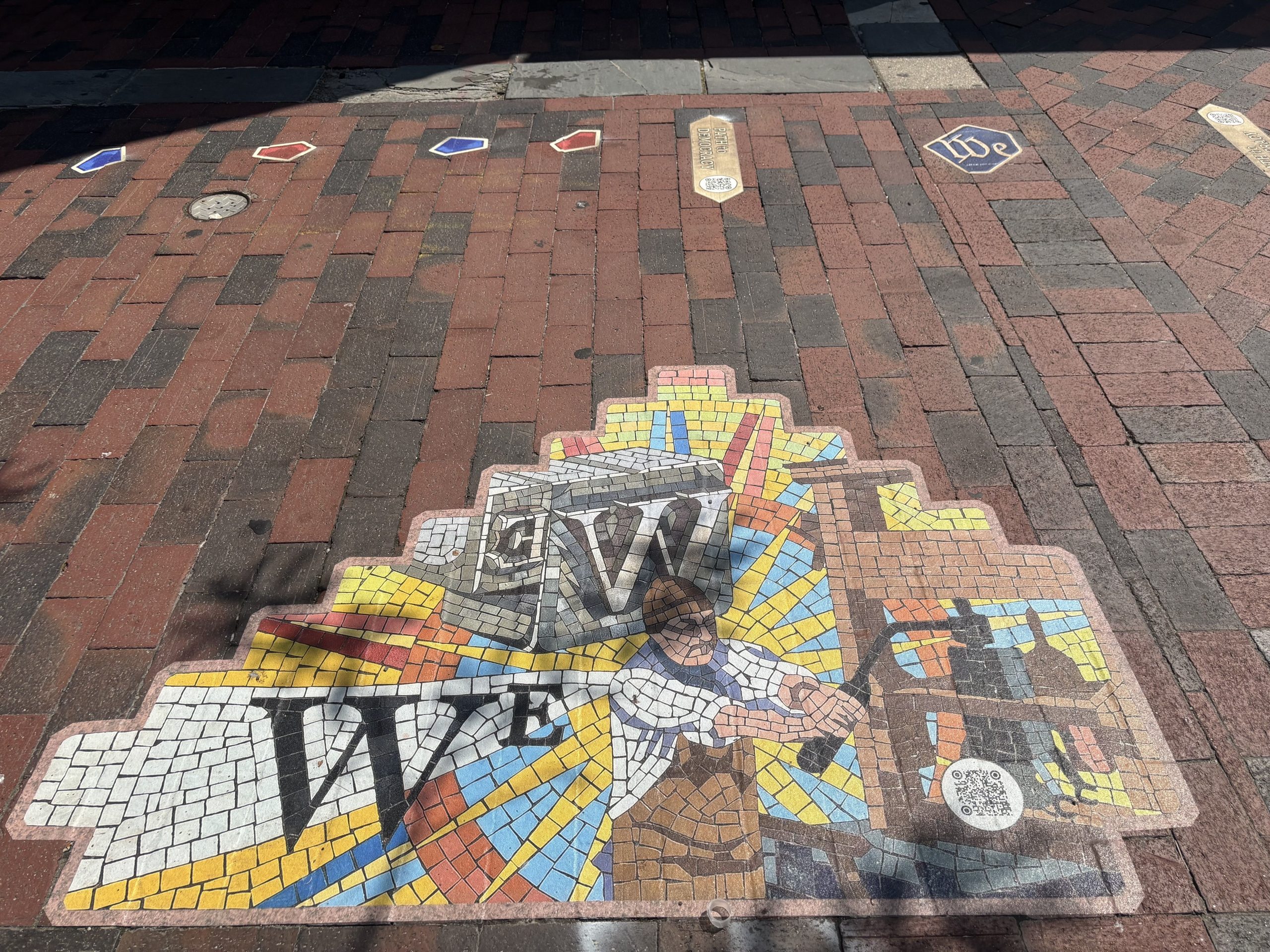
On the southeast side of Second Street as it crosses Market, I found a large mosaic decal of a man operating a printing press. Scanning the QR code, the website told me this was once “Printers’ Row,” where many important documents — including the first copies of the Declaration of Independence — were made.
Unlike the other sites along the path, there was nothing already at this one to indicate it was of any importance, aside from an easy-to-miss plaque embedded in a crumbling wall of a vacant building nearby.
A vinyl mosaic decal marks the site of Printer’s Row on Market Street near Second along the Path to Democracy.Stephanie Farr / Staff
I appreciated this more-obscure site being highlighted on the path. Stein said its inclusion in the beta test was very intentional.
“Not every historic site in Philly is one people can enter. We wanted a tried-and-true one, like the Betsy Ross House, and lesser-known ones, like Printers’ Row,” he said.
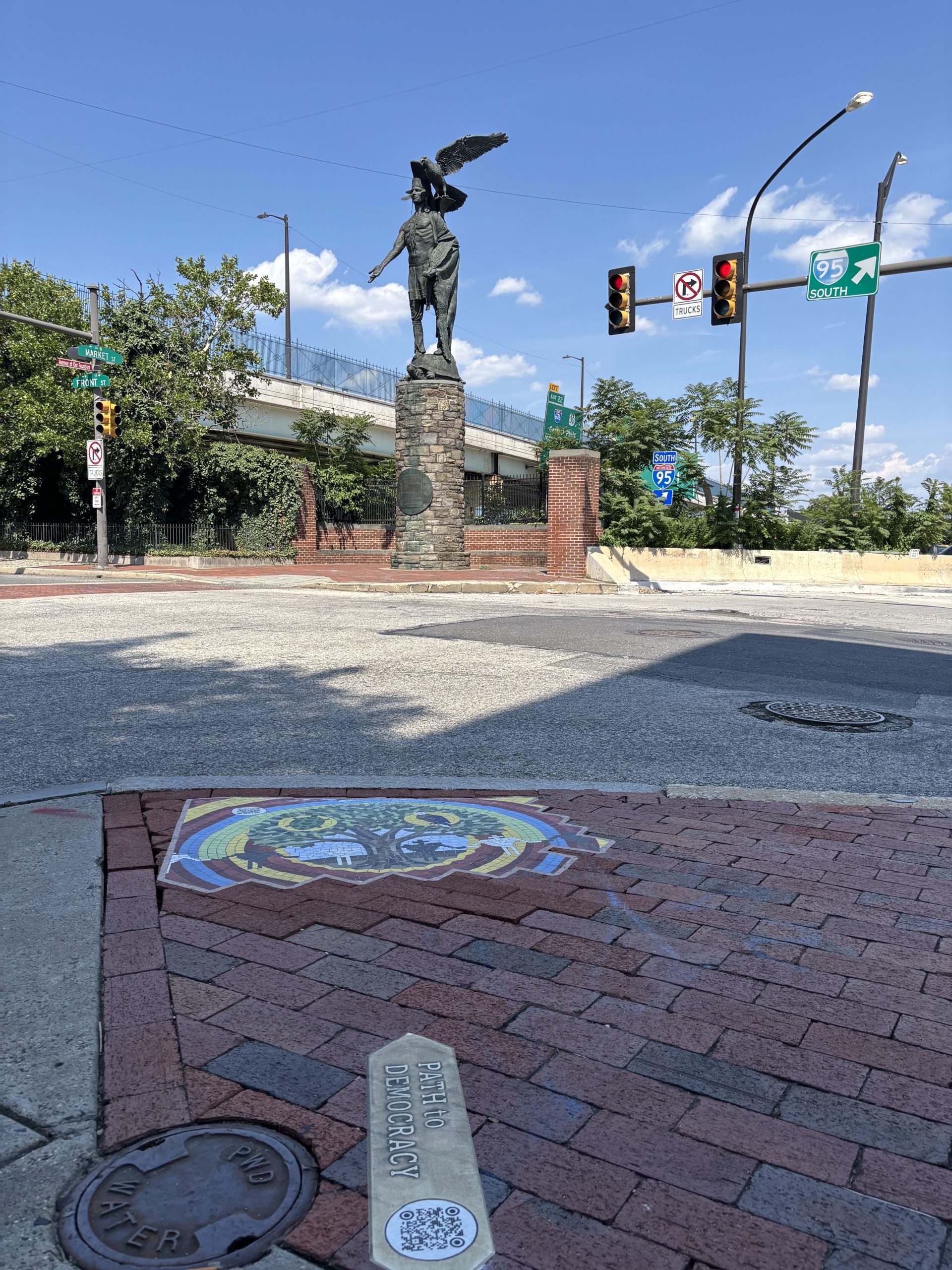
Following the decals, I reached my final stop at the corner of Front and Market Streets. There, a vinyl mosaic decal of a tree, animals, and human figures was situated on the sidewalk catty-corner to the Chief Tamanend statue at the I-95 on-ramp.
As I listened to the accompanying audio via the QR code, I found myself staring at the statue.
The Path to Democracy highlights the “Chief Tamanend” statue at Front and Market Streets in Old City.Stephanie Farr / Staff
Then, I did something I’ve never done before — I crossed the street and approached it. I stood below Chief Tamanend’s feet, I looked up at him and the eagle on his shoulder, I marveled at the details of his clothing, I read the accompanying bronze plaque.
And I couldn’t believe that it took me this long and this path to do so.
A worthy pursuit
I spent about two hours walking the path, but I backtracked often and took my time. You could feasibly do it in 30-60 minutes.
After my walk, I filled out the pilot program survey via the QR code.
“I want more sites and would love for it to be a circular path you could start at any place and keep going around until you get back where you started, like a Phlash bus loop,” I wrote.
Vinyl decals mark the Path to Democracy on the 300 block of Market Street in Old City during the beta testing phase of the project.Courtesy of Visit Philadelphia
Stein said the goal is to have the path be multidirectional.
“I think in the future we’re considering the best way to actually connect the sites,“ Stein said. ”Printers’ Row and Chief Tamanend was an opportunity to test out a spur. That will be something we may come up against in the future, some sites may not fall within a perfect pathway.”
While I didn’t see anyone else following the path as I was exploring it, Visit Philly’s Robinson told me about 50 people a day have been scanning the QR codes.
Though there are still some kinks to work out, the Path to Democracy shows a lot of promise. Like democracy itself, we don’t know where it will lead, but it’s a worthy pursuit — and one that requires our participation to succeed.
So before Labor Day, go try it out and provide feedback. You could help shape a path in Philly that may be walked for generations to come.
“We just want Philadelphians to be proud of this and be aware of it,” Stein said. “I think that this path is another way for us as Philadelphians to celebrate how great this city and these sites are.”
The Path to Democracy leads to the Arch Street Meeting House, where a vinyl mosaic decal wraps around the site’s historical marker.Stephanie Farr / Staff
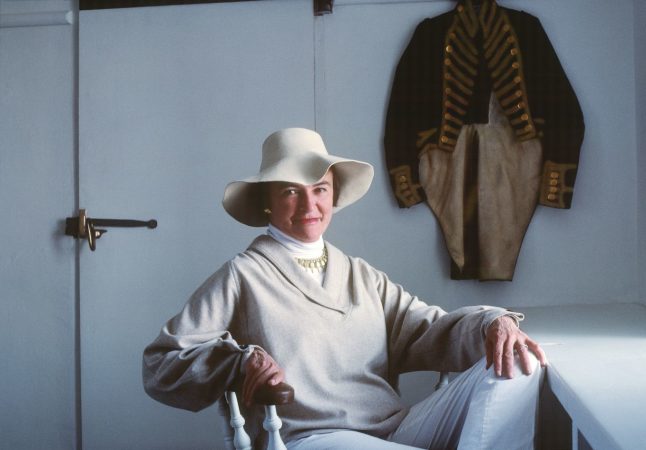
There’s plenty of and about Betsy Wyeth’s potent aesthetic in “By Design: The Worlds of Betsy James Wyeth,” currently on view at the Brandywine Museum of Art. In her adaptive reuse of early American buildings in Maine and the Brandywine — in everything she touched, really — Wyeth’s design sense is specific and immediately recognizable: a cool, austere echo of Shaker and other American vernacular styles.
The show’s star is Brinton’s Mill, the Chadds Ford complex of 18th-century (and later) structures that, with Betsy’s extensive renovations, became the distinctive place where she and her husband, the artist Andrew Wyeth, lived and worked. The shrine is now open to visitors for the first time.
But to take the full measure of Betsy Wyeth, you will want to read the show catalog of the same name (Rizzoli Electa, $65). Here, in a series of essays and reminiscences, Wyeth emerges as a shrewd businesswoman and impresaria — mastermind of a “generally understood, unified Andrew Wyeth brand,” as Wyeth curator and administrator William L. Coleman puts it in the opening essay.
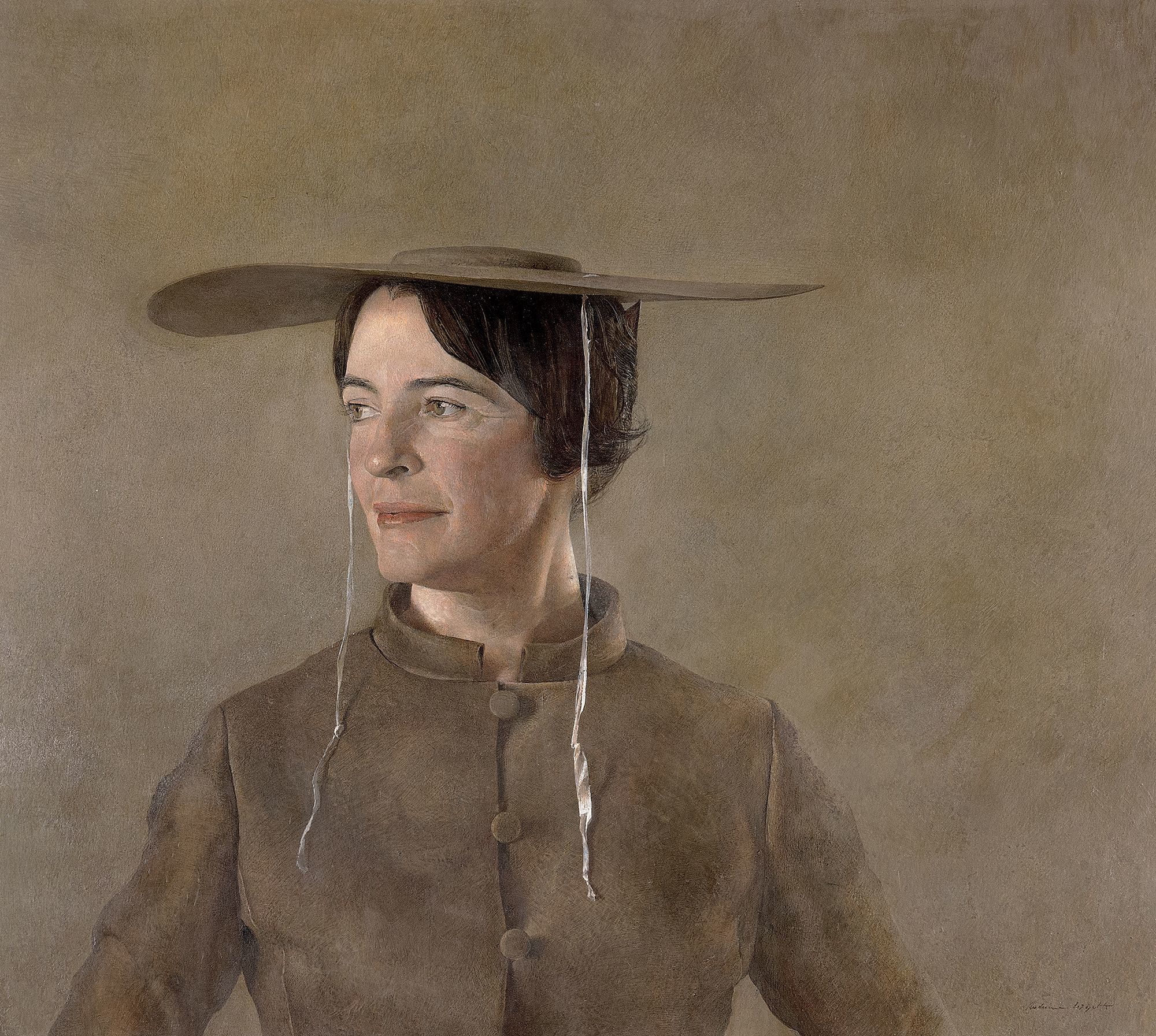
As you’d expect, the book is filled with illustrations: Andrew Wyeth paintings, striking photos of the craggy Brandywine and Maine landscapes, and structures that make up the familial Wyeth visual language, as well as images of Betsy, always formidable.
Perhaps the sharpest image, though, comes in written form, from author David Michaelis on the partnership between Betsy and Andrew.
We already knew that she handled just about everything that needed doing in order to free her husband to paint. But what Michaelis beautifully details is how deeply involved she was in the art itself — giving titles to his work and exerting influence over the color, composition, and subject matter.
In many ways, Betsy spent her life creating the aesthetic for which Andrew is known.
She urged him to simplify, to take things out of paintings he wanted to include.
“You’re going to ruin it,” he would protest.
Then, Michaelis wrote, he would go off and do exactly as she said.
“By Design: The Worlds of Betsy James Wyeth” is on view at the Brandywine Museum of Art, 1 Hoffman’s Mill Road in Chadds Ford, through Jan. 10. Related exhibitions are running at the Farnsworth Art Museum in Rockland, Maine, through Dec. 31; and at Colby College Museum of Art in Waterville, Maine, through Nov. 2. brandywine.org/museum
— Peter Dobrin
A portal to Black girlhood in a Library Company artifact
Nearly every Friday night when I was a child, my mother washed my hair, conditioned it, sectioned it into four parts, and let it dry overnight.
The next morning, we’d take our places next to the kitchen stove and turn the channel to Soul Train on our small black-and-white TV. Mommy oiled my scalp again then, with a fiery iron comb that had the tiniest teeth, she straightened each section of my hair; making my tresses sizzle. Sometimes the comb would kiss my ear. When she was done, I had shiny shoulder-length hair with a flip on the bottom.
I don’t remember when she first told me about Sarah Breedlove, also known as Madam C.J. Walker. But by the time I was 10, I knew, without a shadow of a doubt, that because of her, Black women everywhere knew how to press hair. Her haircare business made her the first Black woman millionaire during the early 1900s at the dawn of the Harlem Renaissance.
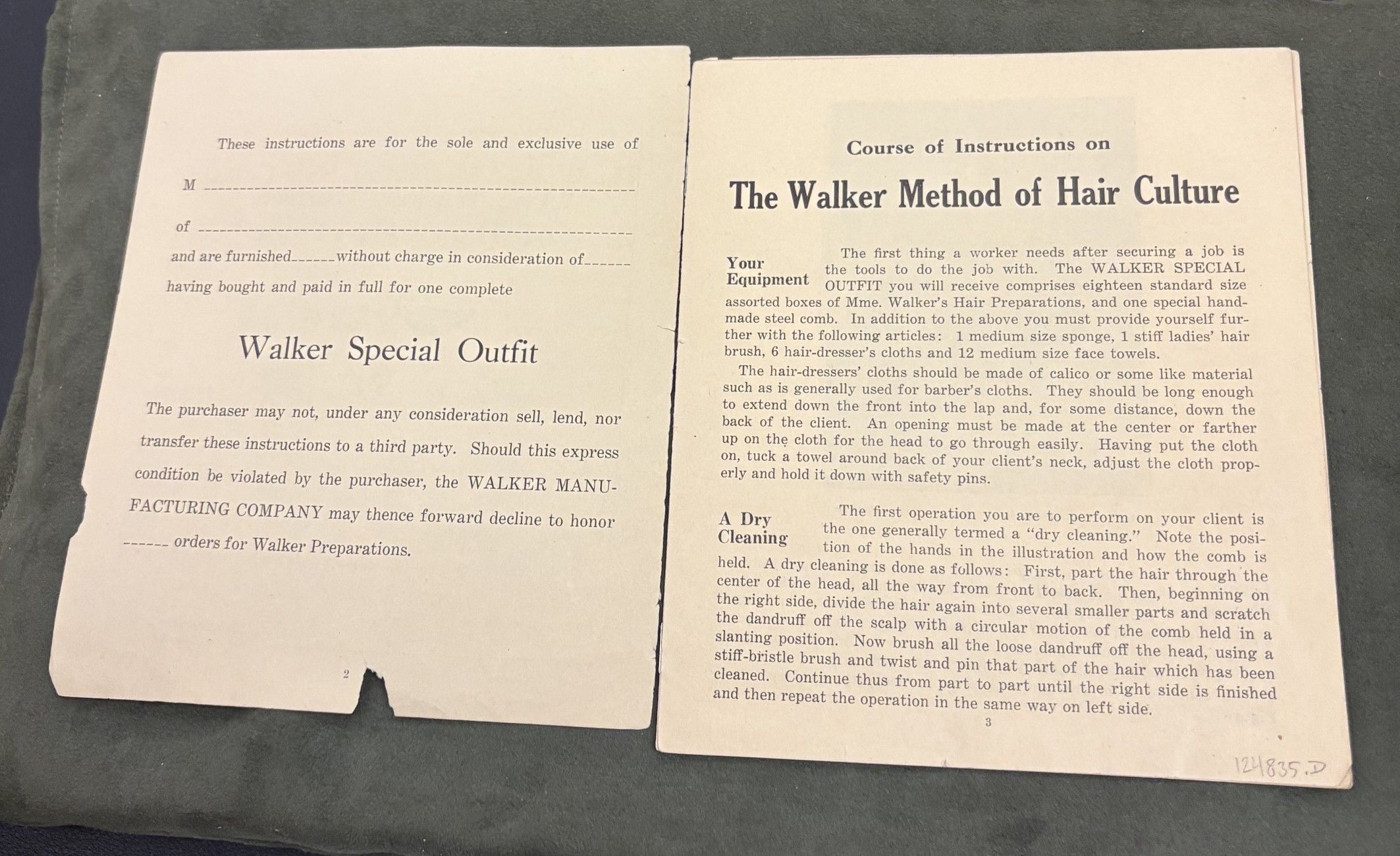
The first page of this early 1900s pamphlet explaining Madam CJ Walker’s Walker Method to salon owners.The Library Company of Philadelphia
Walker trained hundreds, possibly thousands, of Black women on how to use the hot comb in a technique she called the Walker Method. Black salons practicing the method became staples in Black neighborhoods and raised many Black women entrepreneurs.
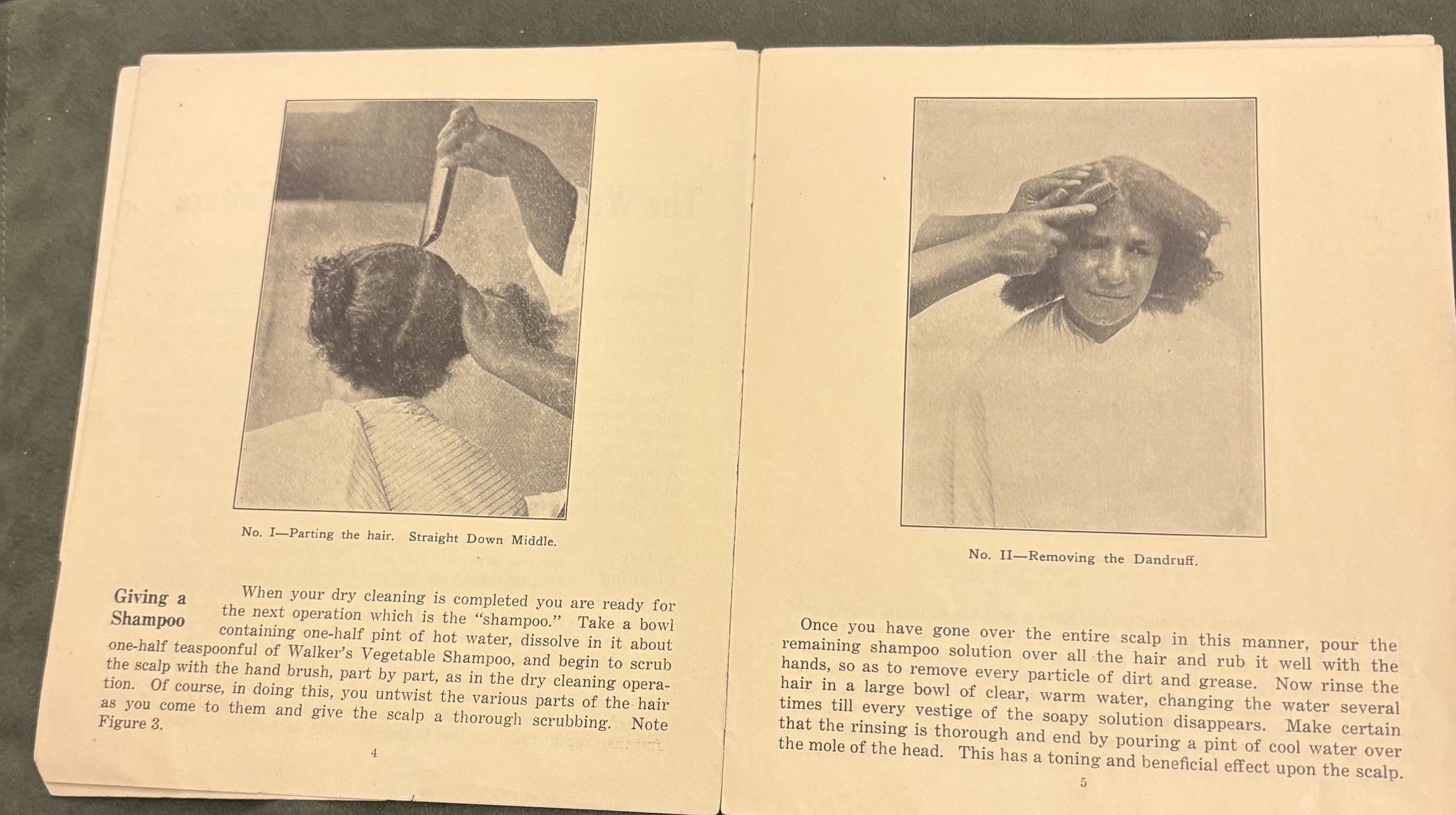
The Library Company of Philadelphia recently purchased one of the original pamphlets describing the Walker Method, step-by-step, and what was included in the Walker Special Outfit, the all-inclusive entrepreneurial kit. That included a stiff hair brush, face towels, Walker’s specially formulated conditioning concoction, a smock — that Walker refers to as a hairdresser’s cloth — and, of course, a handmade steel comb.
After a thorough shampoo and conditioning, the hairdressing is applied and each section of the hair is methodically straightened.
Just reading these instructions brought me back to my girlhood, before chemical relaxers, weaves, and extensions became the norm.
Step-by-step instructions of how to do Madam CJ Walker’s Walker Method to salon owners. The pamphlet was given to Black salon owners in the early 1900s.The Library Company of Philadelphia
Wynn Eakins, the Library Company of Philadelphia’s African Americana subject specialist, acquired the pamphlet earlier this year, paying a few thousand dollars for it.
Like her, I believe it was worth every penny.
Getting my hair pressed every week wasn’t just my introduction to a beauty regimen, it was how I bonded with my mother and other Black women.
Funny thing is, I took for granted that Black women always knew how to do press hair. For better or worse, this skill is in our DNA. The Walker Method pamphlet reminded me of a time when pressing hair was new technology and it’s a reminder that every American experience has a history that’s worth saving and remembering.
The Library Company of Philadelphia is located at 1314 Locust St., librarycompany.org
— Elizabeth Wellington
A Bicentennial logo makes a nostalgic comeback during the Semiquincentennial
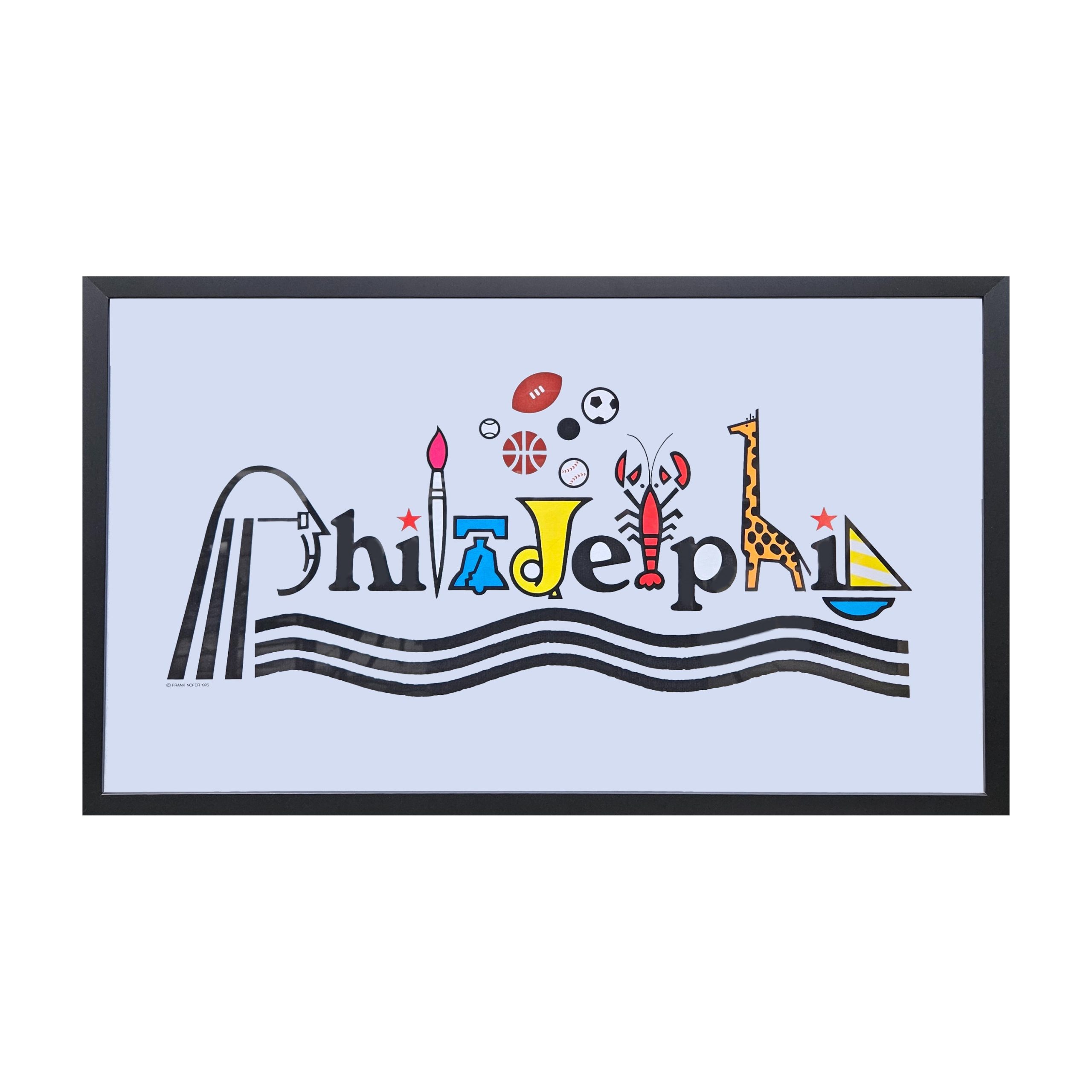
A vintage print of the logo that was sold by Sales by Helen in 2023.Courtesy of Sales by Helen
How much has Philly changed from the Bicentennial to the Semiquincentennial? Not much, by the looks of the 1976 Bicentennial logo.
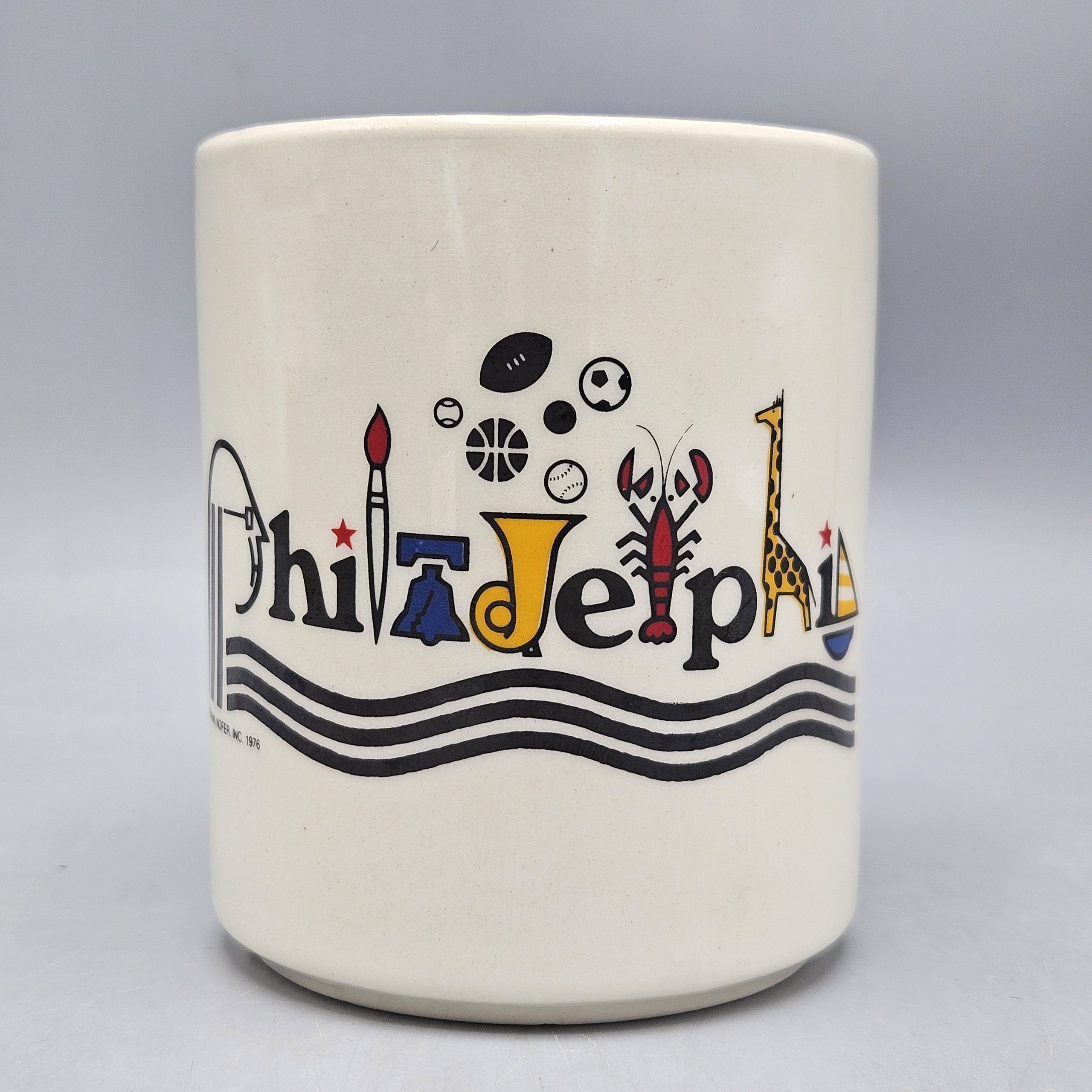
Created by Philadelphia graphic designer and watercolor painter Frank Nofer, the logo features several iconic symbols of Philadelphia standing in for the letters in the city’s name. After copyrighting, Nofer’s logo was printed on seemingly infinite pieces of merchandise, from T-shirts to mugs to ashtrays.
There are historic references, like Benjamin Franklin and the Liberty Bell. The logo also features a paintbrush and tuba to represent the city’s arts scene, sports balls for our athletic passion, a giraffe for the zoo, and a sailboat for the rivers on either side of Philly.
There is one outdated reference: a lobster as the second “l,” a reference to the now-closed seafood restaurant Bookbinder’s. The Old City spot, which shut down in 2009, was world famous for its oysters and lobster. Though it may not be relevant to 2026 Philadelphia, that little lobster is sure to spark nostalgia for anyone who lived in the area before the 2010s.
Frank Nofer’s “Philadelphia” logo featured on a mug, one of many pieces of merchandise.Courtesy of Sales by Helen
Now, 50 years later, merchandise featuring the logo is no longer sold anew. But vintage pieces have been popping up on eBay (which is where I saw it). Per the comments on a Facebook post from someone who purchased a Nofer “Philadelphia” T-shirt on eBay, several people have held onto their merchandise, praising the design.
The logo feels timeless, while also maintaining the funky nature of the 1970s. If you have a piece from 50 years ago, I say hold onto it — whether to admire it, or to make a pretty penny from it online.
— Morgan Ritter
Ben Vaughn. His new song with Deer Tick is “Imitation Wood Grain.” Vaughn’s just-announced album “Magnetic East: The Deer Tick Sessions” is due on Yep Roc Records in October.Shana Cassidy
A vintage Ben Vaughn brings back the romance of “the South Jersey pines”
Now, Vaughn is getting the elder statesman treatment himself. Back in 2019, Providence, R.I., rock band Deer Tick did a cover version of Vaughn’s 1990 song “Too Sensitive for This World,” featuring John Hiatt whistling in the background.
The band’s fandom has resulted in a friendship and playing shows together, and now a forthcoming Ben Vaughn album called Magnetic East: The Deer Tick Sessionsdue out Oct. 30 on Yep Roc Records.
This week, “Imitation Wood Grain,” the first track from the album was released.
“Inspired by a visit to the thrift store, it’s probably [the] most nostalgic song I’ve ever written,” Vaughn wrote in a Facebook post. It’s also vintage Vaughn; a clever, well-crafted ironic-yet-not-ironic song that meshes with Deer Tick’s own bemused sensibility (and features Vanessa Carlton on backing vocals).
Kitschy details in the lyrics — the sight of an old clock radio or a fake wood-paneled hotel hallway — do the Proustian job of bringing back memories of the romance of cruising through “the South Jersey pines” in the good old days, “when you were mine.”
Anybody who doubts the existential significance of the news that broke late Friday morning only needed to walk through Center City as the world broke for lunch. It was the darnedest of things, borderline ridiculous, enough to make you cringe in real time at the thought of writing it down. You could keep a steady pace and never escape the news, for every few strides there was another person telling someone else at a volume everybody else could hear, receptionists and tradesmen and medical technicians and folks waiting for buses to parts unknown, flashing phone screens like lottery tickets and yelling “Yo” into microphones and, in at least one case, wandering alone looking up toward the sky with a smile so zen you could have sworn you were one of the ones getting left behind.
It was a startling thing to witness. A revelation, even. Amid the direct and inescapable blast of modern day America’s technological firehose, there are still stories so universally relevant as to draw a chorus from chaos and fragmentation.
It was also a reminder. A reminder that, however ardent his skeptics and critics, however loud their sighs, however long their rolls of eyes, LeBron James long ago escaped the containment of both basketball court and court of public opinion. He is a cultural singularity, to an extent that few athletes before him have ever been.
That might be a helpful thing for the sighers and eye-rollers to keep in mind. Even if LeBron is not your GOAT, or even your ideal of what a great athlete should be, it has little bearing on the significance of his deciding to cast his final lot with the Sixers. He is unquestionably on the shortest of short lists for the best to have ever done something, and even if he isn’t the best still doing it, he is good enough to have had a standing offer from virtually every contending team in the NBA. Sure, there are teams, and fans of teams, who could argue that the spectacle might conflict with the mission. But, then, these are the Sixers. The spectacle is James choosing to join them. The reputational risk is disproportionately his to bear.
LeBron James has won titles recently, and the Sixers have not been close. Mark J. Terrill
It would be silly and self-disqualifying to ignore the magnitude of such a decision. Miami, Cleveland, Golden State, Denver — all have won titles. Those who have done it without him might be justified in thinking about legacies, whether that of the organization or that of the incumbent superstar. The Sixers have no legacy. Less than a month ago, they had very little hope of being relevant for the next three years. There aren’t many worst-case outcomes for them.
Isn’t that the genesis of the reaction? Its universality? Its … audibility? On a basketball level, on a competitive level, one has no choice but to at least pay some reconsiderations to one’s prior assumptions about both player and team.
The only thing the Sixers had going for them was the basketball level. Whether James proves to be a difference-maker is almost secondary to the fact that he thinks he can be. Nobody has ever done what he is attempting to do, on practically every different level. Win a title with a fourth team. Win a title at the age of 42. Win a title alongside Joel Embiid.
Nobody has ever done those things. Yet, few have done anything that James has already done at every juncture of his career. He already holds the record for most minutes played at both age 40 and age 41. The 1,989 he logged last season were nearly 300 more than Kareem Abdul-Jabbar in 1988-89. That doesn’t include the postseason, when James averaged 38 minutes and 23.2 points per game to lead the Lakers to a first-round upset of the Rockets without co-star Luka Dončić.
James isn’t the player he once was, obviously. He may not even be the player that the current consensus holds him to be. His .594 true shooting percentage — a measure of collective offensive efficiency from the field and foul line — was slightly better than league average in 2025-26. His 30.8 points per 100 possessions average was his lowest since his rookie season and nearly four points lower than any season since. He does not rebound or force his way to the foul line the way he once did.
But all of that only lowers James to the level of all of the other players throughout his career who weren’t anything close to the players he was in his prime. The difference is that those players were also in their primes. James is 41. If you erased everybody’s age from the stats, you’d easily zero in on him as a player who would be a massive value on a playoff roster at $4 million per year. That’s before you factor in the sum of his game: not only the ability to carry an offense for stretches as a primary scorer and spend the interim as an elite connector, but also the true ballplayer aspects of the game that escape quantification. It isn’t a fluke that the Lakers were a better defensive team in both the regular season and postseason when James was on the floor. It isn’t a coincidence that they rebounded better and committed fewer turnovers in the postseason.
For all of James’ physical advantages, for all of the legitimate debates one can have when weighting those advantages in the Greatest of All Time argument, anybody who has watched James play should be able to appreciate the feel that he has for the game of basketball. He is the rare superstar who is also a glue guy, as evidenced by the varied rosters with which he has won championships.
My neighbor installed a camera doorbell that can see my entire porch. We do have packages taken occasionally, so I get the desire to have one, but I don’t want to be constantly filmed when I’m on my steps. Our houses are so narrow that I don’t know if it would be possible for him to have one of those doorbells without filming my steps. How do I approach this with him?
Mike Newall
OK, BackThatCameraUp, given the presence of one of Philly’s premiere music writers in this chat, we should begin with a musical exercise.
Play “What’s He Building” by Tom Waits, a song about a possibly creepy neighbor and suburban paranoia. If that song sounds even remotely like your neighbor, then we have a different conversation.
If not, I think we got some questions, like let’s talk porch dimensions here.
Earl Hopkins
Haha you hit it right on the head, Mike! Ask if the camera can be adjusted so you’re not being surveilled.
Plus, that will stop triggering so many false alarms to his phone or devices.
Mike Newall
Yeah, I think there are a few questions and realities here.
The porch: Are we talking South Philly top step or the great vastness of a northwest porch. Are you resting in the sun on this porch? Or throwing groovy bacchanals?
Also, if you live in the city, you’re on tape my friend.
Earl Hopkins
That’s true. If you’re in South Philly, there’s not much that can be done. I understand the discomfort of being surveilled by your neighbor, but it’s not like the camera is pointed in your living room. That’s a part of rowhouse living you have to accept. It doesn’t hurt to ask though.
Mike Newall
You got a right not to be surveilled like a common criminal (or an adult person who very likely enjoys picking your nose in privacy on your top step because who doesn’t?) and your neighbor has a right to feel protected.
The answer to so many of the questions are: have a conversation.
But, Earl, you’re a younger and cooler dude than me. What happens if the conversation fails?
Earl Hopkins
If conversations fail, it’s simple: A war of doorbell cameras will break out, forcing each of them to point one at one another — like cowboys’ revolvers in the Old West.
Mike Newall
Yeah and the upside is you’ll have access to all those cute front porch videos, like when a raccoon sniffs your mail slot (does that only happen in East Passyunk?).
Earl Hopkins
But seriously: I can’t imagine the conversation will veer too far left. More likely than not, the neighbor will adjust his camera, or try to make some kind of concession. At worst, there will be clarity from both sides.
Have you had a similar dispute Mike? You’re a South Philly resident, through and through. How did you handle it?
Mike Newall
No, I haven’t. My neighbors are all pretty tight knit. We do right by each other and look out. And I have definitely never ever picked my nose on the top step. Doesn’t happen.
Earl Hopkins
Let’s pull the tape and see for ourselves. For journalism purposes, of course.