Blog

  • Aaron Nola keeps turning back the clock with dominant outing in Phillies’ shutout win over Mets

    Aaron Nola keeps turning back the clock with dominant outing in Phillies’ shutout win over Mets

    NEW YORK — Aaron Nola once stood on the mound here and struck out 10 consecutive batters, tying a major-league record set by a Hall of Famer with a 10-foot tall statue outside the main gate of this ballpark.

    Just in case anyone forgot who Nola is.

    It was a long time ago — June 25, 2021, to be exact — when Nola shared a feat with Tom Seaver. Nola is 33 now, with as much mileage on his iron right arm as any pitcher in the sport. And until this week, he wasn’t as essential to the entire Phillies’ operation.

    But with nine games to go, a playoff spot within reach, and star lefty Jesús Luzardo shut down by an inflamed shoulder, the spotlight is back on the Phillies’ longest-tenured player.

    What a time, then, for Nola to turn back the clock.

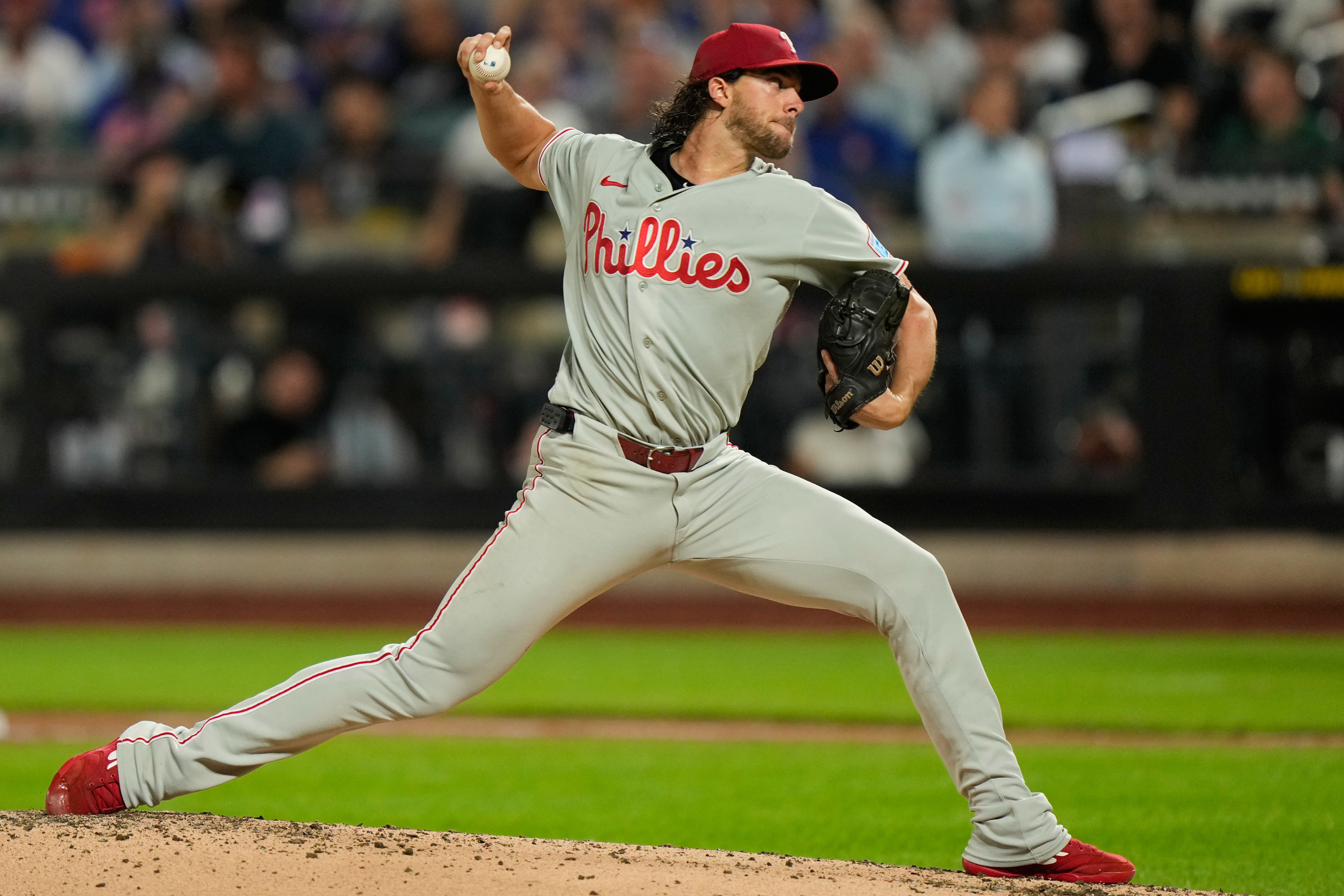
    That’s clearly what’s happening, the latest gem coming Thursday night when Nola faced the minimum 15 batters through five innings, didn’t yield a hit until the sixth, and threw 81 pitches over seven innings — a model of efficiency and effectiveness — in a 3-0 victory over the Mets.

    You could’ve sworn it was 2022 all over again.

    “It feels good,” Nola said, understated as ever.

    But here’s the thing: It wasn’t a one-off. Quietly, as is his nature, Nola has pitched like this for six weeks, beginning with a hard-luck 1-0 loss July 28 in Miami. In his last 10 starts, he has a 2.10 ERA in 60 innings.

    Aaron Nola on the Phillies' World Series chances: 'We definitely have the team to do it'
    Video: Aaron Nola on the Phillies’ World Series chances: ‘We definitely have the team to do it’

    These are the Phillies, though, so it couldn’t be all good. Jonathan Bowlan, who has emerged as the primary setup reliever, took over from Nola and left in the eighth inning with what the Phillies termed “tightness” in his right groin.

    “No pop, nothing like that,” said Bowlan, who missed two weeks in April with a strained right groin. “All I can do is treatment, and re-evaluate and go from there. We’ll just have to see what tomorrow brings.”

    The bullpen is already missing Brad Keller, sidelined in July by season-ending elbow surgery. Orion Kerkering has been slowed by turf toe. Rookie Alex McFarlane is already playing a big role. Without Bowlan, lefty Tim Mayza and others would have to take up the mantle.

    “We’ll find out more tomorrow,” interim manager Don Mattingly said after the Phillies pulled into a tie with the idle Cubs for the top National League wild card and lowered their playoff-clinching magic number to five. “I don’t want to be coldhearted, but you’d have to move on and find a way to fill that spot, which is not necessarily easy to do. But that means other guys got to step up. That’s all.”

    Just like Nola.

    Nola is nothing less than one of the best homegrown pitchers in franchise history. On the Phillies’ all-time lists, he ranks second in strikeouts (2,045), fifth in wins (116), and seventh in innings (1,884).

    Someday, he’ll get a plaque on the Wall of Fame in Ashburn Alley.

    But through June, Nola had a 6.04 ERA — after an injury-plagued 2025 in which he finished with a career-worst 6.01 mark. Never one to overpower hitters with velocity, his command must be precise. And nothing has gotten easier for him, not with the advent of the pitch clock, the automated ball-strike system, a limit on the number of pickoff moves, and just the passage of time.

    It was fair to wonder if Nola, signed through 2030 at $24.57 million per year, was cooked.
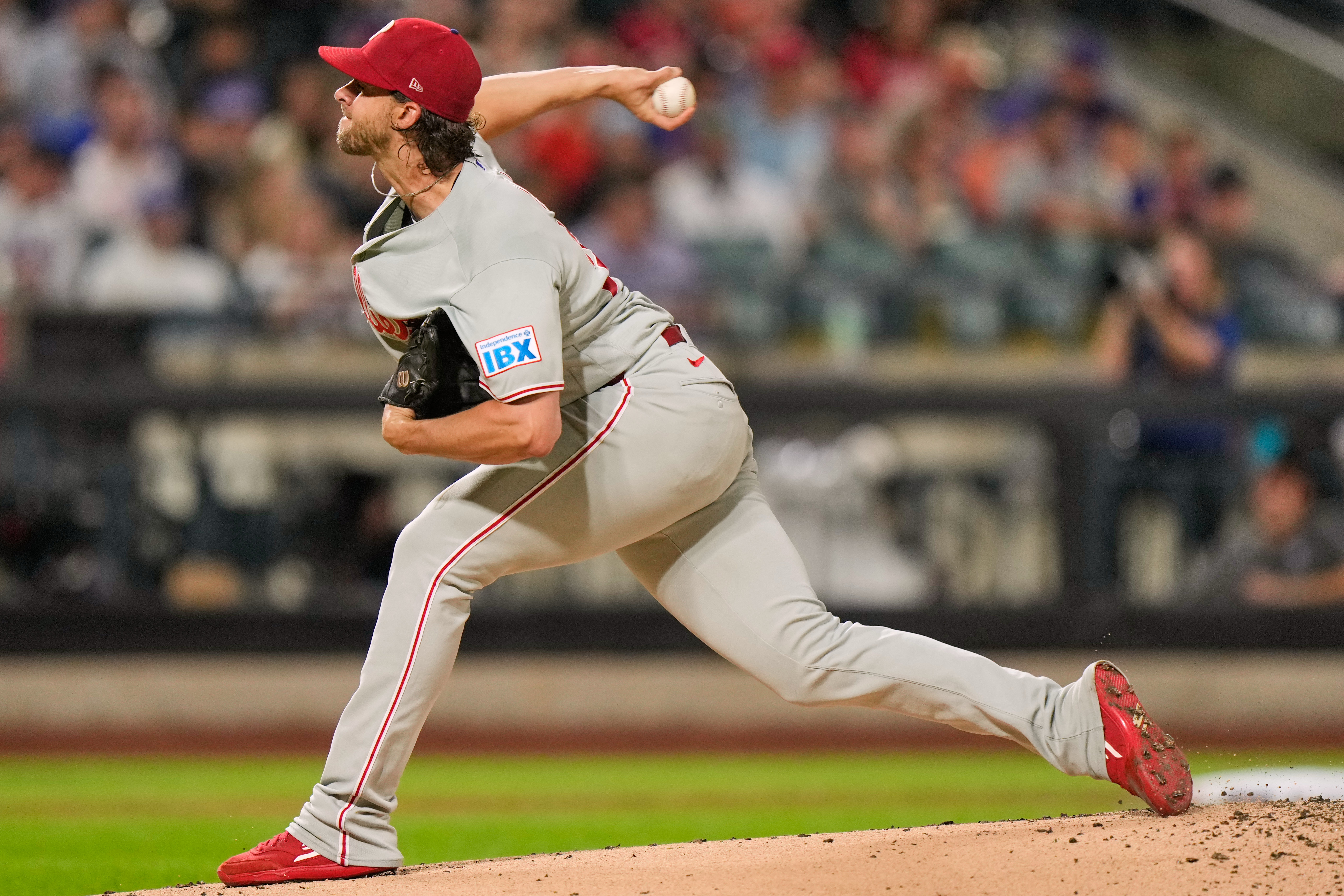
    Aaron Nola has a 2.10 ERA in his last 10 starts.Seth Wenig

    “Not for me,” Mattingly said. “Honestly, guys that locate like that and work and are healthy, you know what they’ve been in the past. And guys just don’t quit trying to get better and reinventing themselves, in a sense. As you get older, you have to do it.”

    Indeed, after a decade of spinning his curveball, burying his sinker, and pounding the strike zone, Nola changed his pattern. In particular, he threw more changeups, even to right-handed hitters.

    “I think it’s just mixing well and throwing all the pitches for strikes and just trying to keep everything sharp and the delivery sharp,” Nola said. “Try not to be too perfect with my pitches.”

    Against the Mets, Nola relied on his signature curveball. He threw 47 pitches through five innings and sat through a long delay in the top of the sixth when Mets first baseman Jared Young got carted off the field on a stretcher in a scary scene after colliding with pitcher Nolan McLean and taking a knee to the head.

    (Young had feeling in his extremities, according to the Mets, but was taken to the hospital, where a CT scan was negative.)

    Nola allowed a one-out walk in the sixth on a 10-pitch duel with Brett Baty before finally giving up a hit, a solid single to left field by Nick Morabito. He got through the seventh and might have come back for the eighth, too.

    “But just checking with him, he seemed hesitant to me,” Mattingly said. “He felt like he didn’t have the same fastball. He was kind of running out of gas.”


    NL wild-card standings

    window.addEventListener(“message”,function(a){if(void 0!==a.data[“datawrapper-height”]){var e=document.querySelectorAll(“iframe”);for(var t in a.data[“datawrapper-height”])for(var r,i=0;r=e[i];i++)if(r.contentWindow===a.source){var d=a.data[“datawrapper-height”][t]+”px”;r.style.height=d}}});


    And given the uncertainty with Luzardo, Mattingly isn’t about to take chances with Nola — or any other starter.

    “We really hope [Luzardo] can come back healthy — and quick,” Nola said. “We really need him.”

    Meanwhile, there’s Nola, with his 3.88 ERA in 11 career postseason starts, tied for 14th-most among active pitchers.

    “Noles is huge,” Mattingly said. “It was tough there early for him, but he just hung in there, kept working, and next thing you know, you’re seeing this. And with Zeus, not knowing what’s going on as this thing gets down to the wire, how Noles factors in could be huge.”

  • A woman has been charged with murder in a Kingsessing fire that killed a man and injured 4 others

    The Philadelphia district attorney’s office has charged a woman with murder and other crimes for her alleged involvement in a fire in February in the city’s Kingsessing neighborhood.

    Chardae Sapp, 34, was charged with murder, attempted murder, aggravated assault, arson, causing or risking a catastrophe, and two misdemeanors, District Attorney Larry Krasner’s office said Friday.

    The charges date back to a fire at a house on the 5400 block of Regent Street on Feb. 4 around 1:40 a.m., prosecutors said. Four people were taken to the hospital for treatment. Twenty-six-year-old Raymond Bell, found unresponsive in a bedroom, died as a result of the blaze.

    Fire marshals determined that the fire was deliberately set and began in a second-floor bedroom “when an open flame was applied to available combustibles consisting of bedding and mattress materials,” the District Attorney’s office said.

    “This is a terrible tragedy that should have never happened and could have been even deadlier if the fire had spread faster,” Krasner said in a statement, thanking first responders for their roles in the investigation. “Our office looks forward to pursuing a fair and just outcome in this case and continuing to support the co-survivors.”

  • MIT report warns AI is causing ‘cognitive surrender.’ Universities are in a bind.

    MIT report warns AI is causing ‘cognitive surrender.’ Universities are in a bind.

    The worries that artificial intelligence is degrading education have been building for months. Students are using it for everything, including cheating, and a recent report out of the Massachusetts Institute of Technology said it is triggering “cognitive surrender.”

    Many university leaders are embracing AI with enthusiasm anyway.

    As AI leaders warn about the dangers of their own technology, the dissonance between the optimism of university leaders and the fears of many students and professors may increase. Professors and students are often in a bind about what they should do: Use more AI to stay relevant, or dial back to preserve learning and thinking?

    While some politicians and AI leaders are warning about possible doomsday scenarios for humanity as AI models advance, many campus leaders are focused on the existential threat the technology poses to universities.

    The committee at MIT studying AI use released a number of alarming findings, including that the technology has caused “major shifts in campus culture,” isolating students who are skipping office hours and ditching communal studying. Getting answers from a bot can create “the illusion of learning” for students who reach for AI “at the first hint of struggle,” the MIT committee wrote in its August report.

    At the same time, “the potential of these technologies to augment work across campus is immense,” the committee wrote.

    The MIT report crystallized some of the thinking in higher education about AI, but top administrators have been embroiled in debates for several years. Administrators have often been the most eager to champion AI efforts, while many faculty and students remain more skeptical.

    “I think you have to lean in, but you have to do so in a way that’s thoughtful and ethical and asks the right questions,” said Wendy Hensel, the president of the University of Hawaii, where she presented an AI strategy to regents in July. “The right answer to AI is not just ‘no.’ It can’t be. It has to be approached with curiosity and understanding of the implications.”

    The hodgepodge of policies universities have created to respond to AI often reflect the confusion about how to proceed — with some clear do’s and don’ts, but often a lot of wiggle room for faculty and students to figure it out on their own.

    Experts warn that AI harms learning

    For a motivated student, an AI chatbot can function as a sort of tutor. Chatbots can break down the steps in a math problem, surface unexpected sources for research papers, and offer feedback on writing.

    Still, a growing body of research suggests that AI use can also harm learning.

    A recent study of 26,000 Chinese secondary-school students found that AI adoption led to an 18% increase in homework scores, but a 20% decline in scores on secure exams. The implication was that rushing through homework with help from chatbots degraded the deeper learning needed to perform well when the technology was not available.

    One 2025 study out of MIT found that people who used chatbots as writing assistants struggled to remember what they had written only minutes after finishing their essay. “You basically didn’t engage any of the memory networks that would actually help you remember,” said Nataliya Kos’myna, an MIT researcher who worked on the study.

    Other research has shown that people who have greater trust in AI and rely on it more are more likely to have lower cognitive engagement.

    But AI can be hard to avoid. Chatbots are embedded within the Google Classroom suite, which is nearly ubiquitous in schools, and within many online learning systems used by universities.

    Some tools block outright cheating or plagiarism and allow professors to toggle specific AI capabilities on and off. But the most popular chatbots among students will instantly complete entire assignments, including research papers, on a student’s behalf.

    Many universities are embracing AI anyway

    Sian Leah Beilock, the president of Dartmouth College, has argued that preparing graduates to use AI is an existential requirement of institutions of higher education.

    “In a world that promises to be defined by AI, universities that fail to produce graduates who can use it productively will consign themselves to irrelevance,” she wrote recently.

    Harvard University President Alan Garber said in public remarks this month that AI-backed research is on the cusp of a boom that may drive the pace of knowledge faster than at any other time in human history. Garber has said that researchers in many fields are now unlikely to be at the leading edge of their disciplines without AI.

    Ohio State is integrating AI into every major, with the expectation that every student will be fluent in their field of study by graduation. The university has directed every department and major — from business and engineering, to English and veterinary medicine — to train students on how to use AI in their respective fields, and when not to.

    “What is OK to off-load to AI, and what is not?” Ohio State University President Ravi V. Bellamkonda said in an interview in July. “The answer to that depends on the field and depends on your stage of learning.”

    Elizabeth Kiss, the president of Union College, said universities have to educate students on both the thoughtful use of AI and on the things AI doesn’t do, such as “lead teams, push the boundaries of knowledge.”

    Still, some schools are creating boundaries

    The University of Chicago has banned AI in certain required social sciences courses, while the university’s law school banned phones, tablets, and laptops in first-year classrooms. The university is one of a handful that recently adopted new academic integrity rules.

    The law school at the University of California, Berkeley, adopted a policy forbidding the use of AI “to conceptualize, outline, draft, revise, and edit” work submitted for credit.

    Cornell University has created a disciplinary process meant to correct AI cheating while avoiding black marks on students’ records. Now, students accused of minor misuse will be allowed to accept responsibility and complete a workshop and some reflective work.

    Steve Jackson, the vice provost for academic innovation, said the program would not be used for plainly egregious misconduct. “This is a chance to sanction something, catch it, not let it go unnoted or to let it pass,” he added.

    Like many institutions, Harvard does not have a central set of AI rules. David Deming, dean of Harvard College, wrote in a note to students arriving for the fall semester that he favors more AI where “it can deepen learning,” but that the school was also looking to AI-proof some assignments.

    That would mean more in-class tests, Deming said, and fewer take-home assignments, where the temptation to cheat is powerful. He said he intends to produce a set of guidelines for AI use at the college by the end of the academic year.

    For younger students, some school districts are proceeding cautiously. This month, the nation’s largest school district, in New York City, vastly limited student AI use in grades K-8, while the second-largest district, in Los Angeles, essentially banned student use of chatbots at every grade level.

    Policing ai use is hit or miss

    Students are often navigating this landscape without clear guidance from their colleges.

    Most institutions leave it up to individual instructors — who may have little experience with AI — to set rules on how the technology is used in each class.

    It may seem clear that submitting chatbot-generated text is cheating, while using a chatbot to revise one’s own writing is allowed. But the line between those two capabilities is thin, and much AI use lies in an ethical gray zone.

    Many educators “don’t even know where to start,” said Annie Chechitelli, chief product officer at TurnItIn, a company that makes software that can detect plagiarism and track and guide AI use. “What is OK? What’s not OK?”

    Many instructors have already moved to on-paper assignments in the classroom, or locked-down computer browsers that limit AI misuse. Others report success in using AI detection software, which has recently improved in its ability to flag chatbot-written text while avoiding false positives.

    Some see AI as a crucial partner for thinking and writing and put few limits on how students use the technology. Others subscribe to the notion of “AI literacy,” assigning students to use chatbots to produce an essay or poem, for example, and then critique and try to improve the output.

    In Australia, the University of Sydney has adopted the “two-lane approach,” seen as a global model. Across disciplines, students must complete some assessments in person, under secure conditions meant to restrict AI. But other assignments must use AI, to help familiarize students with the technology that is reshaping the economy.

    “It’s almost like sex ed,” said Anita Sarma, a professor of computer science at Oregon State who has studied the impact of AI on student cognition. “They will do it anyway,” she said. “How do we teach them responsible use?”

    This article originally appeared in the New York Times.

  • Villanova is still searching for its identity. Mark Ferrante believes the pieces are coming together.

    Villanova is still searching for its identity. Mark Ferrante believes the pieces are coming together.

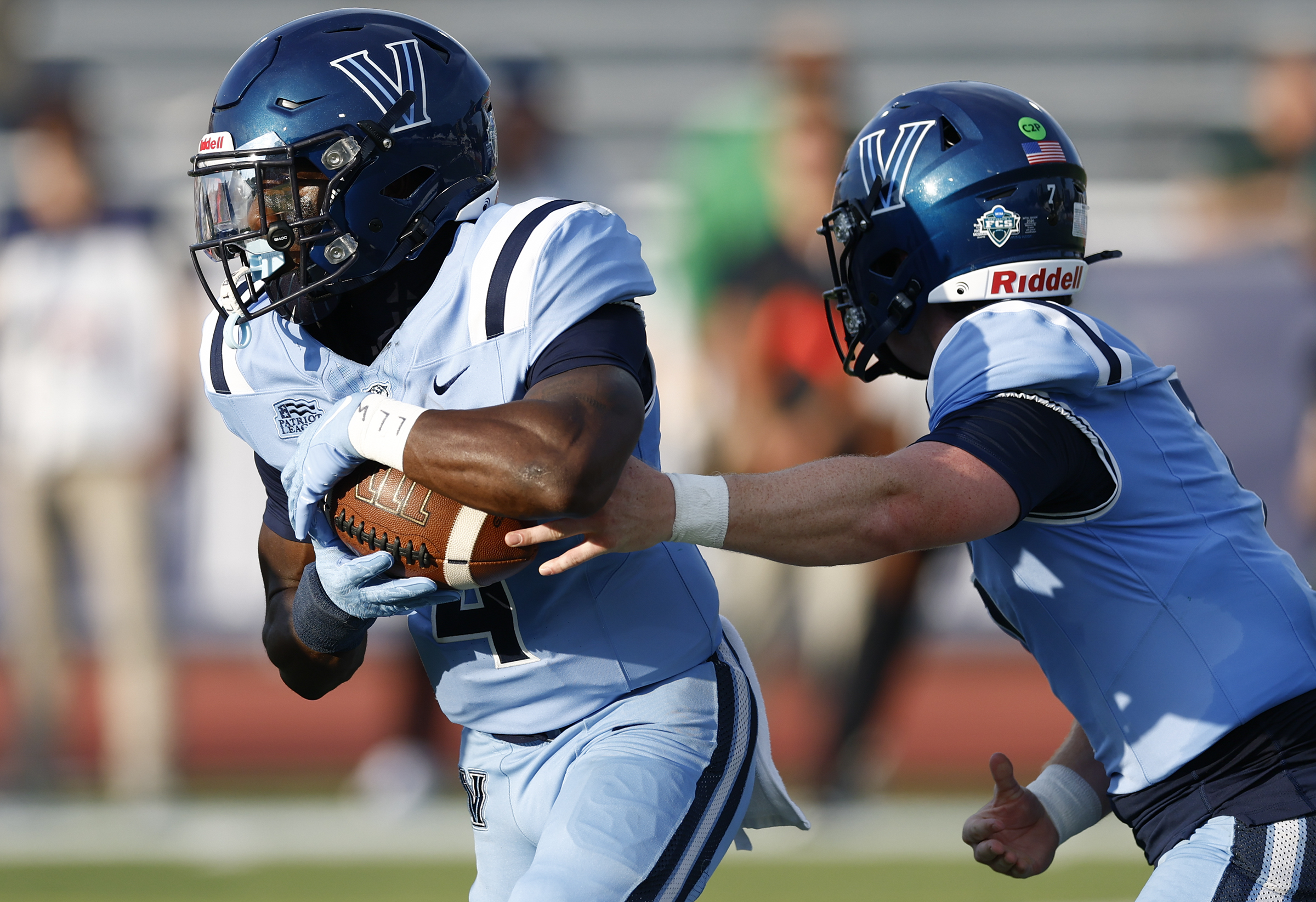
    Villanova is off to a similar start as last season following a blowout loss to No. 23 Louisville.

    But compared to last year, when Penn State trounced Villanova, 52-6, coach Mark Ferrante expressed some positives to build on entering Saturday’s matchup at Long Island University (noon, NEC Front Row).

    “This year, we seemed to be more competitive in the front end of the game,” Ferrante said of Villanova’s 59-13 loss to the Cardinals. “I think that will pay dividends down the road. I think our guys have gained confidence knowing that we could drive the ball down the field on our opening drive and put points on the board against a team like Louisville.

    “You just got to do it more consistently, and you got to do it for four quarters so that’s really the learning curve.”

    For Ferrante, that starts with his team’s approach and execution in practice.

    After turnovers and penalties plagued the Wildcats in their season-opening loss to William & Mary, Ferrante turned his focus to reducing the “mental penalties” in practice. They have since allowed 12 penalties and committed one turnover across their last two games.

    “If there’s going to be penalties, you want them to be aggressive ones during the play, not the pre- or post-snap penalties,” Ferrante said. “Those are some things we emphasize in practice and we have improved in that area. We’d like to create a few more turnovers in our favor, so we can steal a possession or two during the course of the game.”

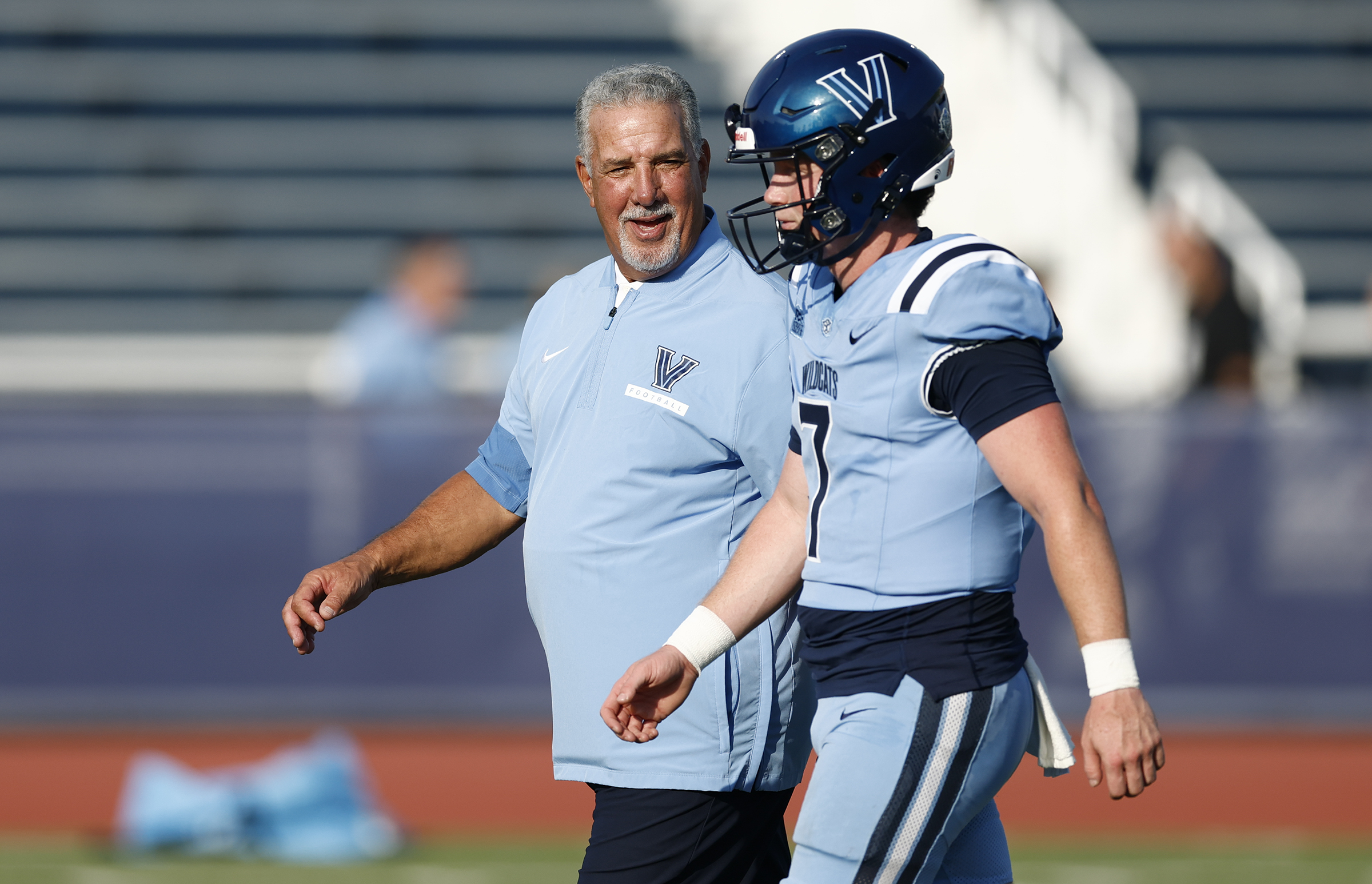
    Villanova coach Mark Ferrante talks with quarterback Pat McQuaide on Aug. 28.Yong Kim / Staff Photographer

    As the turnovers and penalties have lessened, Villanova’s offense has improved. Graduate quarterback Pat McQuaide and rushing duo of juniors Ja’briel Mace and Isaiah Ragland “keep getting better each and every week,” Ferrante said.

    “No matter how many guys you got coming back from a previous year or how many you lost, it’s never going to be the same. Each team has to find its own identity, I think this team is still searching for it a little bit.”

    He noted that around this time last season is when his team started to click. He feels confident about the direction this year’s Wildcats are heading and believes they are getting to a similar place.

    “We were already in preseason practice when McQuaide joined us, so he missed the first couple [of] days, there was a little catch up there, but I’m sure it’s got to affect your mental psyche a little bit,” Ferrante said. “But now that he’s been here, and August camp into the first three games, now we need to see the continual and steady progress.”

    Beyond the offense, Ferrante has been satisfied with special teams. Dominic LeBlanc has been perfect on field goals and PATs since transferring into the program this offseason, while sophomore Luke Myers has been impressive since taking over punting duties.

    “He’s been doing a really nice job, he gets the ball out quick,” Ferrante said. “He averaged 44 yards a punt against Louisville, the unfortunate part is he had too many opportunities to go out against Louisville. We like to keep him off the field a little more than we did, but he did a great job.”

    Heading into LIU, Ferrante emphasized that his defense needs to have patience and discipline.

    “Don’t let the stuff around you get your eyes caught somewhere else, and all of a sudden, you’re not where you need to be,” Ferrante said. “I think this week especially, you can say it every week, but this week especially, how they maneuver the pieces that they have on the field around, we have to have really good discipline with our eyes and then just do your [job], play your assignment to the best of your ability.”

  • Where to watch Eagles games in Philly, from sports bars to giant screens

    Where to watch Eagles games in Philly, from sports bars to giant screens

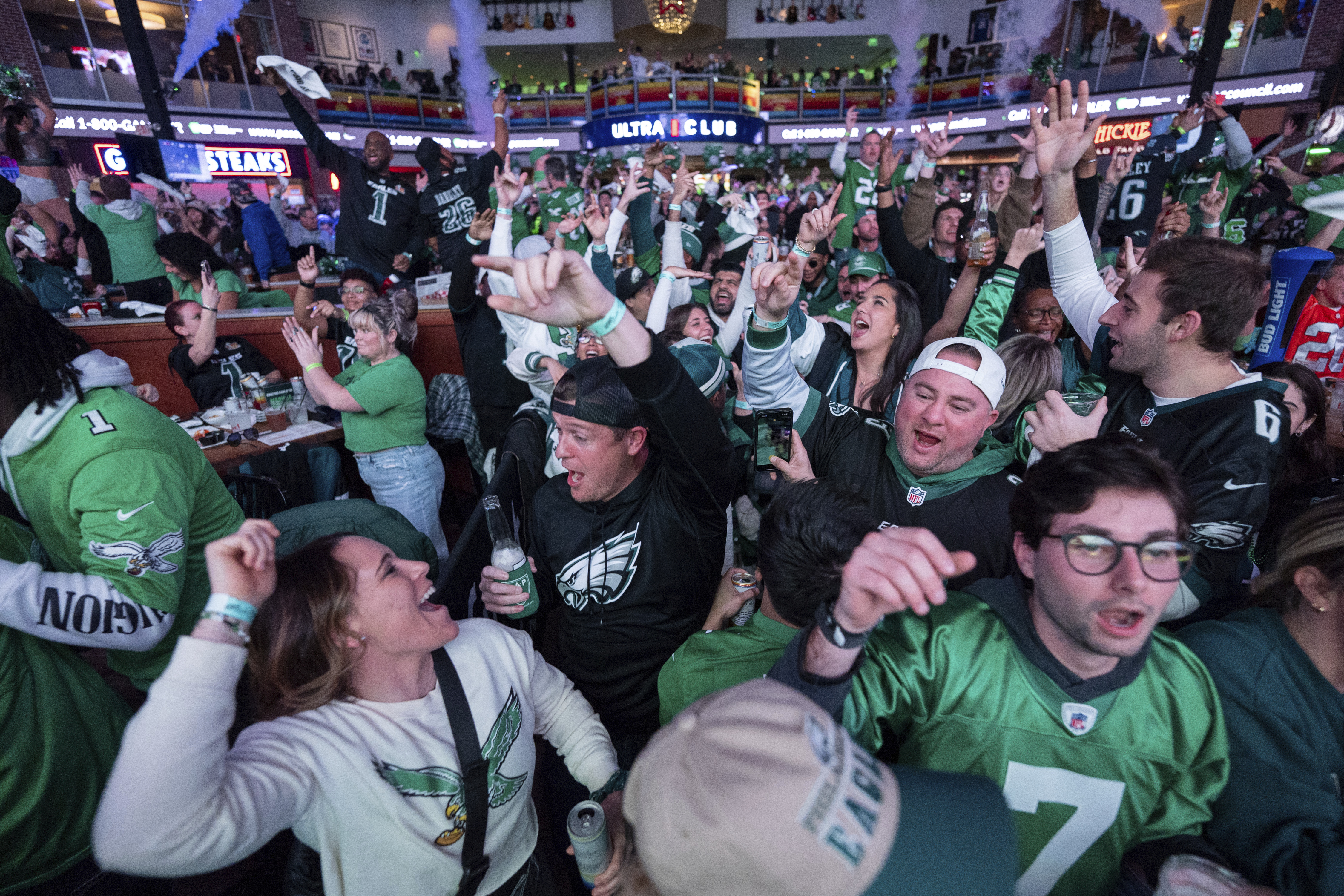
    Football and the Eagles are back, and every week fans will be packed into tailgates, living rooms, and watering holes to watch the Birds’ potential path back to the Super Bowl.

    Philly has hundreds of spots to catch a game, from breweries with wall-size projectors to restaurants streaming the broadcast over the bar. Here are some of the top picks — big venues, sports bars, breweries, and restaurants — to help you plan your game day.

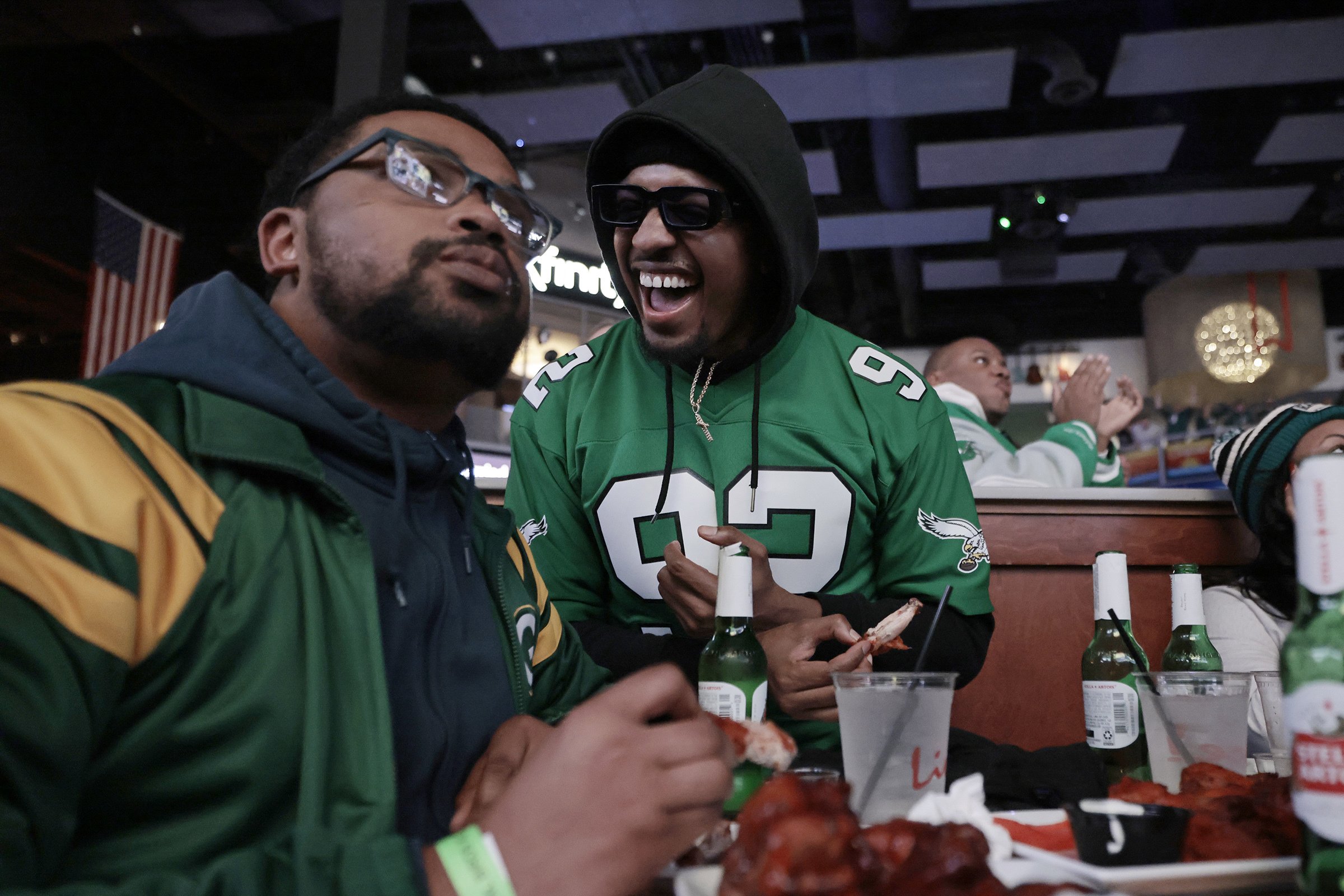
    Eagles fan Justin Ghee (right) gets in the face of his friend Packers fan Ronald Roberts when the Eagles sacked the Packers quarterback in the first half of the Eagles vs. Packers NFL playoff game. The friends were viewing the game at XFINITY Live! Philadelphia on Sunday, January 12, 2025. Both men are formerly from Philly, attended Howard University and now live in Washington, D.C.Elizabeth Robertson / Staff Photographer

    Big venues, bigger screens

    Live! Casino

    Right next to the South Philadelphia sports complex is the fairly new Live! Casino and Hotel, with at least two venues located within the casino to watch the games. Take your pick between the 52-foot screen at Sports & Social, or Luk Fu, the casino’s pan-Asian restaurant with game-day specials.

    📍900 Packer Ave., Philadelphia, Pa. 19148, 📞 833-472-5483, 🌐 philadelphia.livecasinohotel.com

    Stateside Live! (formerly Xfinity Live!)

    So close to the Linc that you can hear the stadium roar from the patio, Stateside Live! (formerly Xfinity Live!) has a 58-foot screen and dozens of TVs in its bars.

    📍1100 Pattison Ave., Philadelphia, Pa. 19148, 📞 215-372-7000, 🌐 xfinitylive.com

    Rivers Casino

    Watch the Eagles play on a massive HD video wall at BetRivers Sportsbook inside Rivers Casino in Fishtown. Game-day beer specials and giveaways will be available, plus each game brings a chance for fans to win tickets to a forthcoming Eagles game.

    📍1001 N. Delaware Ave., Philadelphia, Pa. 19125, 📞 877-477-3715, 🌐 riverscasino.com

    Craft Hall

    Craft Hall is a massive beer hall, with family- and pet-friendly fixtures, equipped with two projector screens and several TVs lining the walls playing every Eagles game. Enjoy $5 draft beers and $15 beer pitchers with under-$20 food specials, including wings and pizza.

    📍901 N. Delaware Ave., Philadelphia, Pa. 19123, 📞 267-297-2072, 🌐 crafthallphilly.com

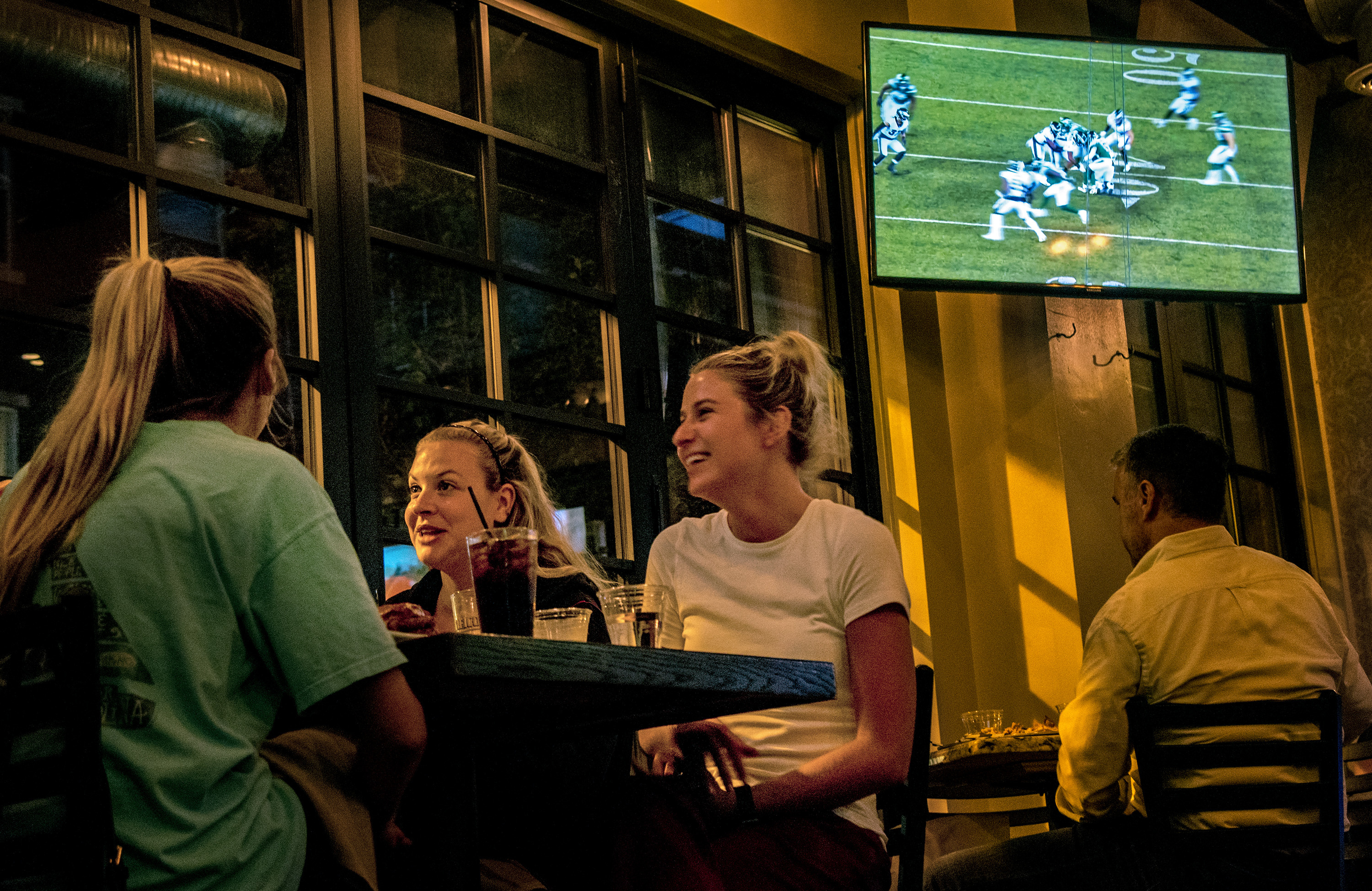
    Classmates from the Philadelphia area attending East Carolina University in North Carolina meet at Founding Fathers on South Street to watch the Eagles. Tom Gralish / Staff Photographer

    Sports bars and breweries

    Cavanaugh’s Headhouse & Rittenhouse

    Cavanaugh’s sports bars are some of the best venues to be at on game day, with locations in Rittenhouse and Headhouse Square off South Street. The Rittenhouse location will offer Bud Light in $5 cans and in $22 bottle buckets. Headhouse will have $4 draft Michelob Ultras and $20 buckets of Bud Light.

    📍421 S. Second St., Philadelphia, Pa. 19147 / 1921 Sansom St., Philadelphia, Pa. 19103, 📞 215-928-9307 / 215-665-9500, 🌐 cavsheadhouse.com / cavsrittenhouse.com

    Founding Fathers

    South Street’s premier sports bar with TV-lined walls, an extensive bar-food menu, and a draft beer list that offers popular craft beers and local talent.

    📍1612 South St., Philadelphia, Pa. 19146, 📞 267-519-0253, 🌐 foundingfathersbar.com

    Dock Street Brewery

    Philadelphia’s oldest craft brewery invites you to their Washington Avenue brewery and bar every game day to watch on their wall-size projectors alongside food and drink specials.

    📍2118 Washington Ave., Philadelphia, Pa. 19146, 📞 215-337-3103, 🌐 dockstreetbeer.com

    Evil Genius Beer Co.

    This Fishtown taproom will treat you to Evil Genius’ celebrated classics and latest craft brews while watching the game on a 16-foot screen. Game-day specials include $42 beer towers and $45 Stateside buckets.

    📍1727 N. Front St., Philadelphia, Pa. 19122, 📞 215-425-6820, 🌐 evilgeniusbeer.com

    Lucy’s Bar

    This Rittenhouse sports bar has a 16-foot screen and game-day deals, including a $40 appetizer platter stacked with wings, cheese curds, onion rings, and pretzels. Drinks include a $6 citywide (dubbed the “buddy system”) and $10 to $12 cocktails.

    📍1720 Chestnut St., Philadelphia, Pa. 19103, 🌐 lucysphiladelphia.com

    Yards Brewing

    Philadelphia’s largest brewery is delivering specials every game day at its Spring Garden Street taproom, including $6 Trash Talks, an IPA made especially for the Eagles season.

    📍500 Spring Garden St., Philadelphia, Pa. 19123, 📞 215-525-0175, 🌐 yardsbrewing.com

    Libertee Grounds

    A block away from the Girard Avenue BSL station is an Asian-fusion sports bar with a curated craft beer list, several TVs playing the Eagles on game day, and a slew of specials: $1 Jell-O shots, $20 beer pitchers, $10 wings, and more.

    📍1600 W. Girard Ave., Philadelphia, Pa. 19130, 📞 267-324-3487, 🌐 liberteegrounds.com

    The Bayou Bar & Grill

    Manayunk’s Bayou Bar & Grill has been playing every Eagles game for decades. Enjoy its festive atmosphere, and a weekly Eagles merchandise giveaway all season long.

    📍4245 Main St., #1602, Philadelphia, Pa. 19127, 📞 215-482-2560, 🌐 bayoubargrill.shop

    Independence Beer Garden

    A Center City open-air beer garden with every Eagles game projected onto a big screen along the wall, accompanied by domestic beers on tap, cocktails, and classic pub grub.

    📍100 S. Independence Mall West, Philadelphia, Pa. 19106, 📞 215-922-7100, 🌐 phlbeergarden.com

    Bar-Ly

    Chinatown’s premier sports bar, Bar-Ly carries a whopping 60 beers on tap with TVs and large screens lining the walls. It gets busy on game day, so call ahead to reserve a table.

    📍101 N. 11th St., Philadelphia, Pa. 19107, 📞 215-922-2688, 🌐 bar-ly.com

    The Rook

    Every Eagles game day at the Rook in Manayunk, fans can watch the game while taking advantage of the $12 domestic beer pitchers and a $12 “Philly Special” pulled pork sandwich, with broccoli rabe, roasted long hots, and provolone.

    📍4001 Cresson St., Philadelphia, Pa. 19127, 📞 267-323-2906, 🌐 therookmanayunk.com

    Restaurants

    Jaffa Bar

    Jaffa Bar will be playing every Eagles game on the bar’s TVs and offering a bevy of game-day specials: $12 black lime pepper wings with herbed labneh; $2 raw bar items (oysters, New Jersey top neck clams, and shrimp cocktail), and $6 french fries with tehina ketchup. Plus, $9 specialty cocktails.

    📍1625 N. Howard St., Philadelphia, Pa. 19122, 📞 267-857-9944, 🌐 jaffabarphilly.com

    Positano Coast

    Aldo Lamberti’s Positano Coast in Old City will offer a rotating menu of specials, with games playing across the bar’s TVs.

    📍212 Walnut St., 2nd Floor, Philadelphia, Pa. 19106, 📞 215-238-0499, 🌐 positanocoast.net

    Patchwork

    Patchwork, nestled inside Rittenhouse’s Hyatt Centric, will play the Eagles games all season long, offering $10 citywide, $11 Super Lyte (Blue Chill), and $13 seasoned crinkle-cut fries.

    📍1620 Chancellor St., Philadelphia, Pa. 19103, 📞 215-985-1234, 🌐 patchworkphilly.com

    Taqueria Amor

    Head to Taqueria Amor on Manayunk’s Main Street for every Eagles game to watch with sound on and $3 off beer pitchers.

    📍4410 Main St., Philadelphia, Pa. 19127, 📞 267-331-5874, 🌐 taqueriaamor.com

  • Why Democrats are starting to feel bullish about a midterm wave

    Why Democrats are starting to feel bullish about a midterm wave

    Democrats’ wary optimism about the midterms gave way to growing confidence this week.

    The party has seen strong post-Labor Day polls in key battlegrounds — and even in traditionally red areas. Recent escalations in the war in Iran, including an attack on a major pipeline in Saudi Arabia, mean the rising gas prices bedeviling Republicans will not be going down anytime soon. Republicans have not been able to bring prices under control more generally. And President Donald Trump’s unpopularity is at near-record levels.

    Considering all this, Democrats now think conditions are right for the party to retake control of the House and possibly the Senate later this year.

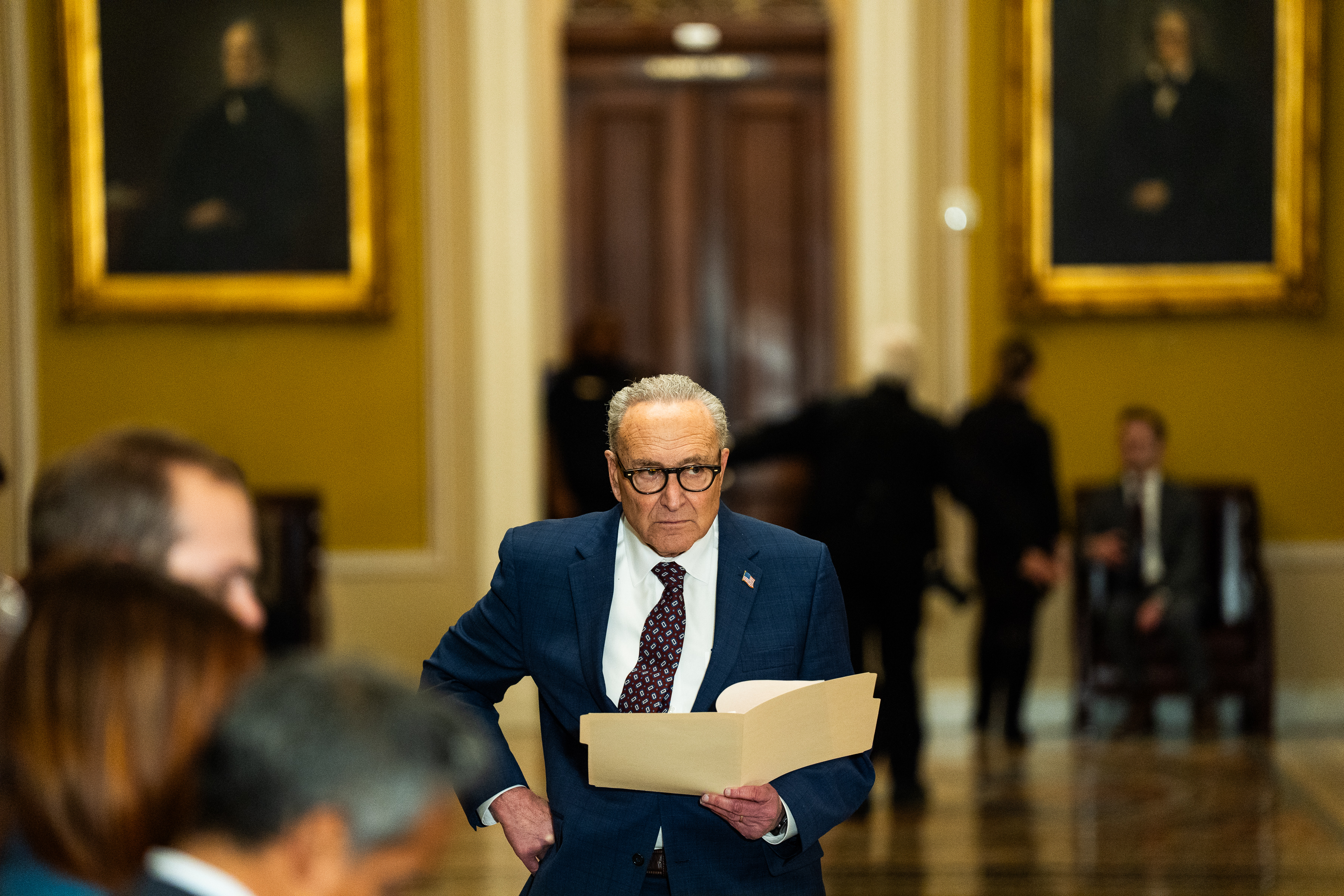
    “If the election were held today, we would win the majority,” Senate Minority Leader Chuck Schumer (New York) said in an interview with The Washington Post.

    Schumer said he felt “considerably more bullish” about Democrats’ chances of retaking the Senate than he did a few months ago. He described the environment as uncannily similar to 2006, when discontent with the war in Iraq helped Democrats recapture the Senate and the House.

    House Minority Whip Katherine Clark (D-Massachusetts) said Democrats’ recent momentum is driven by their focus on the economy, with voters believing that the party understands the financial pain they’ve felt in the years since Republicans swept into unified control.

    “That is what is driving these polls,” Clark told The Post on Thursday.

    Still, Democratic fears remain.

    Democrats need at least four more seats to take the Senate majority and would have to win at least two in states Trump carried by double-digit margins in 2024. Republicans are seeking to blunt any Democratic gains by flipping Democratic-held open seats in Michigan and New Hampshire, where polls show competitive races. The nonpartisan Cook Political Report shifted its rating of the Senate contest in New Hampshire from “Lean Democrat” to “Toss Up” this week.

    Republicans focused on keeping control of the House argue that they have a more favorable map, partly because a GOP redistricting effort has limited the number of battleground districts, and partly because they believe that Democratic primary voters nominated weak candidates in a handful of key races.

    Then there is the incoming flood of GOP money.

    Republicans are set to spend nearly $140 million more on ads than Democrats are in the nine most competitive races in the final weeks of the campaign, according to ad tracking firm AdImpact. The disparity is especially yawning in the Senate contest in Texas, where Republicans have reserved $39.6 million in ads and Democrats have reserved just $5.1 million.

    On the House side, the National Republican Congressional Committee plans to run coordinated ads in 39 districts, with more than $24 million in ads reserved.

    The Democratic Congressional Campaign Committee has plans for coordinated ads in 14 districts.

    “The Republican campaign engines are firing on all cylinders, and we are burying House Democrats in battleground districts across the country,” said Mike Marinella, spokesperson for House Republicans’ campaign arm. “Republicans have the historic fundraising advantage, a more favorable map, stronger candidates, and the firepower to defy history and grow our House majority.”

    Schumer acknowledged Republicans’ financial advantage but said it would not stop Democrats from retaking the Senate.

    “We don’t need as much money as them given the political climate, given the terrain,” he said. “All we need is enough to stay in the ballpark and be able to answer them.”

    Republicans have begun to openly acknowledge electoral concerns in recent weeks, particularly with polls showing that Democrats are far more eager to vote than Republicans are.

    Sen. John Kennedy (R-Louisiana) told reporters Thursday that he was going to Kansas, Nebraska and Iowa to raise money for GOP Senate candidates.

    “If you told me six months ago I was going to be having to spend my time in those three states, I wouldn’t have believed you. Those ought to be fat guy layups for us,” he said, though he predicted Republicans would hold those seats.

    “The far left, they’re angry,” Sen. Ted Cruz (R-Texas) said this week on the “Pod Force One” podcast, describing this as a “challenging environment” for his party. “They hate President Trump with a burning passion. And they’re going to crawl over broken glass to vote.”

    Senate Majority Leader John Thune (R-South Dakota) acknowledged Wednesday that Republicans are facing “headwinds” but said the Senate races that will decide control of the chamber remain competitive.

    “It’s not a great environment for us,” Thune said. “But we’ve got really quality candidates in all the competitive races, and the polling that we’re seeing in those races shows that these races are tight.”

    Republicans have been debating how to increase enthusiasm beyond spending more money. Some, largely those closely tied to the president and his political operation, argue that the path to victory is to re-create the electorate Trump built in 2024. Other Republicans — primarily those in battleground districts where private and public polls show that voters are deeply upset with the president — believe the way to win is to distance themselves from the administration and its policies, a difficult task following a decade of Trump remaking the party in his own image.

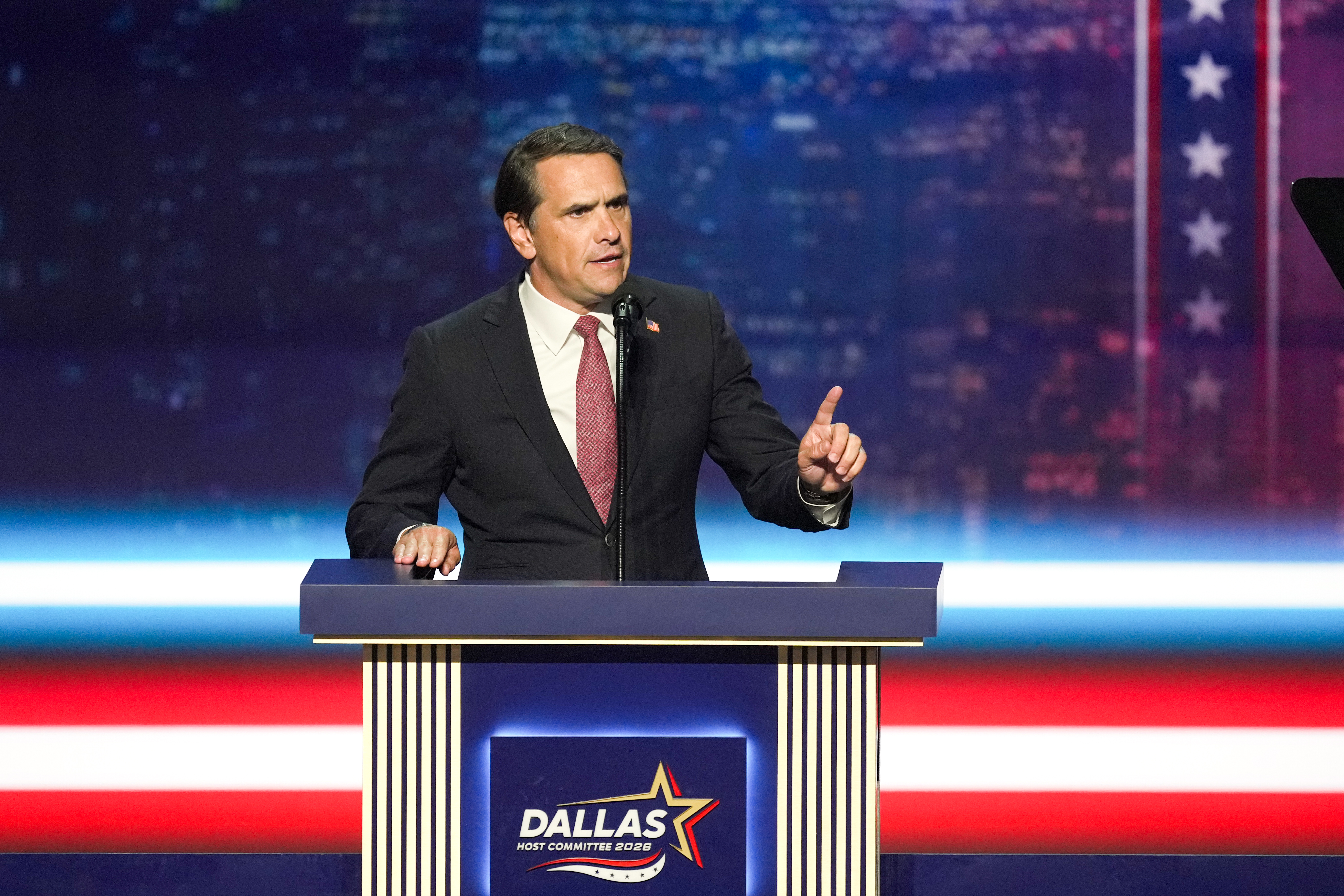
    “I’m asking you to pretend that I’m on the ballot,” Trump said during one of two speeches he gave at the Republicans’ midterm convention in Dallas recently. “Just one more time.”

    Trump has made it difficult for many candidates, especially those in tight races, to embrace this tactic. In large part, that’s because he has repeatedly dismissed the issue that voters say is their main stressor: prices. His trade war has raised prices on goods across the country. And gas prices, which have shot up because of the president’s war against Iran, are nearing $4.50 per gallon on average.

    However, speaking at a campaign rally Wednesday in North Carolina, a state he has won in three straight presidential elections, Trump said high fuel prices were “a very inexpensive price to pay for what we have done” in Iran.

    A Republican operative working on House races, speaking on the condition of anonymity to be candid, responded to Trump’s comments with an animated image of actor Bryan Cranston screaming, “F—!”

    The president has promised to get out the vote for Republican candidates, including those in trouble deep in Trump country. Some have taken him up on his offer, but not every candidate wants him around, and administration officials’ visits to red states have been seen as warning signs for Republicans.

    Vice President JD Vance traveled to Kansas this week to stump for Republican Sen. Roger Marshall, who is in a tighter-than-expected race against Democrat Adam Hamilton. Trump and Vance won Kansas by 16 percentage points in 2024.

    Vance is also set to campaign in Iowa on Friday. But the state’s Republican Senate nominee, Rep. Ashley Hinson, will not appear next to the vice president. A Hinson spokesperson cited previously scheduled events, but the absence comes as the candidate seeks to tout her bipartisan record in a state Trump won by 13 percentage points in 2024. Hinson is locked in a tight race against Democratic state Rep. Josh Turek.

    And in South Florida, an area Trump dominated in 2024, Republican Rep. María Elvira Salazar openly broke with the president Thursday.

    “Mr. President, some of your immigration enforcement efforts have gone too far,” Salazar says directly to the camera in a new campaign ad. “The same Hispanics who helped you get to the White House in 2024 feel betrayed today.”

    Democrats say they began to see a change during what was supposed to be Republicans’ hallmark 2026 event: the party’s unorthodox midterm convention. The gathering was billed as a way for the GOP to showcase its front-line candidates, but instead it featured Trump defending his record and pledging to give each American adult a $5,000 check if Republicans hold Congress this year, a proposal many Democrats saw as a sign of desperation.

    “We’re not measuring the drapes, but the ground has shifted,” said Xochitl Hinojosa, a longtime Democratic operative and top spokesperson at the Democratic National Committee after the 2016 election.

    Some Democratic operatives running campaigns said they had been waiting to see whether Republicans would coalesce around a clear affordability message during the Texas event. But when it became obvious that the event would be a Trump-centric celebration that offered no direct case for why Republicans deserved unified control for two more years, their confidence grew.

    “Turns out breaking all your campaign promises and doing everything possible to make life more expensive for everyone is bad politics,” said Viet Shelton, spokesperson for House Democrats’ campaign arm. “Shocker.”

    The last time Democrats experienced a wave election was in 2018, when the party swept into control of the House two years after Trump’s first presidential win.

    Meredith Kelly, a Democratic operative who was the top spokesperson at House Democrats’ campaign arm at the time, said that there are plenty of similarities between that year and this one — primarily around Trump’s unpopularity — but that the biggest difference is how Republicans’ worries are coming from voters who helped them win in 2024, such as rural voters and Black and Latino men.

    “Their coalition’s floor is falling out from underneath them,” said Kelly.

    The prospect of a wave election has Democratic candidates in districts once thought entirely unreachable for the party feeling like they may have a shot to do the unexpected in November.

    Eileen Laubacher, a retired Navy veteran running against GOP Rep. Lauren Boebert in a district that spans eastern Colorado, knows that her odds of winning have always been long. Trump won the district less than two years ago by 18 percentage points. But powered almost entirely by anger at Washington and voters’ fears about their personal finances, Laubacher thinks she has an opportunity to take down her outspoken Republican opponent.

    “People vote frequently about their pocketbooks and their wallets, but I think the situation is growing ever more fraught for people,” said Laubacher. “Every aspect of their life has become more expensive, and they do not feel that the government is doing anything about any of it.”

    Jarrell Dillard contributed to this report.

  • Postal Service chief says work stopped on computer system key to Trump effort to limit mail voting

    Postal Service chief says work stopped on computer system key to Trump effort to limit mail voting

    WASHINGTON — The top official at the U.S. Postal Service said Thursday that the agency has stopped work on developing a controversial computer system that was central to President Donald Trump’s effort to limit mail voting after the Supreme Court rejected his executive order this week.

    “There’s an injunction so we’re not doing anything,” postmaster general David Steiner told The Associated Press in an interview.

    Steiner, a onetime chief executive of Waste Management, has spent most of the past year atop the postal service navigating political and financial challenges. He’s pressing Congress for changes that would help him resolve what he has called a “liquidity crisis.”

    And Trump’s efforts to largely eradicate mail voting turned the postal service into an unlikely arbiter of who is eligible to vote just months before this year’s critical midterm elections, a role Steiner seemingly had little interest in playing. Unlike Trump, who was sharply critical of the Supreme Court decision and ridiculed some of the justices, Steiner offered no assessment of the court’s action.

    Steiner also declined to take a position on Trump’s policy, presenting himself as the leader of an “independent agency of the executive branch” whose influence over the president’s order was limited to operational concerns.

    “I don’t get to decide what rules that are put on us that I decide to accept or not accept,” he said. “I looked at it more from the execution side.”

    The postal service has asserted its independence in the past, including during a 2019 standoff when the first Trump administration sought to pressure the agency as the president was in a dispute with Amazon. Steiner said he wouldn’t get into the “nuance” of that.

    But the pressure has grown so intense at points that it’s fueled talk of whether Steiner might resign, a notion he denied.

    “There’s no truth to that,” he said. “I think I know the motivation behind it. I think it’s somebody that would like to see me out of a job.”

    Inserting the Postal Service into elections

    The executive order Trump signed in March directed several federal agencies to develop state citizenship lists. Those lists would have been delivered to an online portal at the Postal Service, which would have been allowed to send mail ballots only to voters who were cleared through the process. Steiner said he knew about the order about a month before it was unveiled but said his focus was largely on implementation, not the policy’s merits.

    A whistleblower report released earlier this month by Sen. Richard Blumenthal, D-Conn., argued the system was hastily built and riddled with errors.

    Steiner said he read “portions” of the whistleblower report and acknowledged the obstacles associated with building such a massive platform quickly. Still, he said he had confidence in colleagues working on the project and had planned to unveil it around Sept. 15.

    “There’s absolutely no doubt that we worked fast,” he said. “My personal opinion is it was a monumental task and I’m very proud of our IT department for being able to do it that fast.”

    In addition to the voter list, Trump’s order would have required states to adopt a uniform envelope style that included barcodes, something states said would have been arduous so close to the election.

    Following the Supreme Court’s ruling, a memo sent to all postal service employees Wednesday and obtained by the AP said the agency will “not be enforcing any of these new rules in the 2026 federal election.”

    “First and foremost, for Election Mail it is business as usual,” according to the memo. “We continue to follow established protocols, and we remain entirely focused on our core mission: delivering the mail safely and securely for voters and election officials across the country.”

    Though the Supreme Court rejected Trump’s executive order for this year’s election, Justice Brett Kavanaugh indicated he might rule in favor of the administration if the issue comes back before the court at a later time.

    Steiner encourages voters to cast ballots early

    Steiner said the postal service would still encourage the use of envelopes and barcodes in future elections, which it has long recommended. He said such changes wouldn’t be required but those who don’t comply may have to pay more.

    “If you use the barcode in the envelope, we’ll charge you a lower price,” he said. “If you don’t, we’re going to charge you a higher price because it’s harder for us to process.”

    While the postal service isn’t moving forward on Trump’s order, there are still concerns about postmark delays that could have an impact on this year’s elections. The number of ballots rejected for late postmarks has soared in the vote-by-mail states of Washington and Oregon, according to recently released data highlighting concerns about recent changes in postal service operations.

    Steiner said there were no plans to alter those operations and encouraged voters who use mail to get their ballots in early.

    “We say seven days,” he said. “Everything is solved if people vote early.”

  • Blanche’s partisan activity before midterms dismantles another principle

    Blanche’s partisan activity before midterms dismantles another principle

    WASHINGTON — Attorney General Todd Blanche has repeatedly participated in campaign events and spoken in partisan terms about the coming midterm elections since his confirmation last month, despite criticism that he violated a long-standing Justice Department principle of steering clear of electoral politics.

    This week, he waded again into those waters — twice.

    Since August, Blanche has come under fire for making campaign-tinged public appearances and comments. Last month, at a rally-style event on Long Island, he praised Bruce Blakeman, the Republican candidate for governor of New York. Last week, Blanche delivered remarks at the Republican Party’s midterm convention.

    On Tuesday, he stood at the White House podium and disparaged Democratic lawmakers while invoking the coming election, dismissing their concerns about artificial intelligence as “nothing but an effort to influence the midterms.”

    And Wednesday, Blanche spoke at a campaign rally for Michael Whatley, the Republican Senate candidate in North Carolina. Echoing his convention speech, he portrayed crime rates, which continued a long-term downward trend to reach new lows in 2025, as “President Trump and Vice President Vance delivering on a promise.”

    Worries about the Justice Department abandoning its long-held commitment to appear apolitical in order to maintain institutional credibility may seem beside the point. Since January 2025, dozens of judges have viewed its representations with suspicion, eroding the traditional bonds of trust, known as the “presumption of regularity,” that the courts typically grant the department.

    The second Trump administration has also unabashedly destroyed the post-Watergate norm of Justice Department independence from the White House in investigative decisions. Early on, Blanche’s predecessor, Pam Bondi, declared, “We are so proud to work at the directive of Donald Trump.” Last September, after Trump publicly demanded that she charge several perceived adversaries, the department pushed through short-lived indictments of two of them.

    Still, Blanche is dismantling another post-Watergate principle: that Justice Department leaders stay away from partisan politicking.

    Joseph Tirrell, the Justice Department’s senior ethics official until the Trump administration dismissed him in July 2025, this week criticized Blanche’s participation in the Republican convention. He called the attorney general’s comments at the White House briefing “borderline” unethical, and his participation in the North Carolina rally “terrible.”

    “In my former role, I would have advised the attorney general not to go to the White House and not to make comments about members of Congress within 45 days of an election,” Tirrell said. Referring to a law restricting partisan political activity by government employees, he added, “I’d say, ‘That rally sounds like a Hatch Act violation to me, and I’d advise you not to do it.’ I would want to scare that person straight.”

    Stephen Gillers, a New York University law professor who specializes in legal ethics, said Blanche’s political statements and activities were protected by the First Amendment and did not violate professional conduct rule, even if they were ill-advised.

    “Any attempt to discipline him will fail,” Gillers said. “That’s unfortunate. He has the ability to do what he’s doing, and he’s chosen to do it.”

    The Justice Department did not respond to a request for comment.

    When the group Public Citizen filed a Hatch Act complaint about Blanche’s comments praising Blakeman, the Justice Department told Government Executive in a statement that it was “baseless” and “a politically motivated complaint designed to weaponize the Hatch Act against the attorney general for his support of law enforcement.”

    And in response to criticism last week by Democrats on the House Judiciary Committee over Blanche’s convention appearance, the department shot back on social media, “Todd Blanche’s appearance this evening in his personal capacity is legal (and has been approved by ethics).”

    Legal questions center on the Hatch Act, which is ambiguous and difficult to enforce when an administration does not want to strictly adhere to it. The law and related regulations allow some political appointees, while off duty, to attend partisan events, like fundraisers and campaign rallies. Some law enforcement officials are restricted from any partisan activity, but the attorney general is not listed among them, and it is disputed whether that part of the legal limits applies to them.

    Even for those who can engage in political activity in a personal capacity, the traditional test is not just whether such officials say they are doing so, but whether people would reasonably perceive them as acting in their government roles.

    Cynthia Shaw, who ran the Justice Department’s ethics office throughout Trump’s first term, said the notion that high-ranking officials could simply say they are acting in a personal capacity to get around that threshold was a misunderstanding.

    “The bigger the job you get, the less personal capacity you have, because when you speak, people are going to see you in your official capacity and representing the agency that you are head of,” she said.

    Federal law enforcement needs to not just be fair, she added, but to be seen as fair for the long-term good of the department and society.

    For that reason, the Justice Department had long held itself to a higher standard than the Hatch Act and its ambiguities. For decades, its ethics policies went beyond the statute in pushing officials to avoid events like political fundraisers and campaign rallies.

    In 2022, Attorney General Merrick Garland flatly banned political appointees from participating in partisan activities — even in their personal capacities, and even if their family members were the candidates.

    But in March of this year, Bondi rescinded that policy, freeing political appointees to attend such events in their personal capacities subject only to the lower standards of the Hatch Act.

    That weakening of ethics rules is one reason the department’s claim that Blanche’s appearance at the Republican Party convention was “approved by ethics” merits scrutiny. Another is that the administration has changed who makes ethics recommendations.

    After firing Tirrell, the administration left his position vacant for nearly a year before appointing Kristina Spencer, a former aide to Vice President JD Vance who had no prior department experience.

    The office of the deputy attorney general can also overrule the ethics office’s recommendations. For decades, the decision-maker was a career official, but the Trump administration moved that authority to political appointees.

    The principle that the Justice Department should strive to appear apolitical took root after Watergate. President Richard Nixon’s first attorney general, John Mitchell — who later went to prison for his role in the scandal — was so deeply partisan that he resigned to run Nixon’s 1972 reelection campaign.

    The attorney general immediately after established the modern norm of not acting as a political operative while in office: Edward Levi, a University of Chicago legal scholar.

    Maintaining a nonpartisan image has proved difficult, partly because of the department’s power and an increasingly polarized political atmosphere. Under both parties, one attorney general after another has been accused by political opponents of politicizing the Justice Department.

    In 2013, Attorney General Eric H. Holder Jr. called himself President Barack Obama’s “wingman,” clashing with the principle of Justice Department independence. Asked last week about Blanche’s speech at the Republican convention, Holder said, “It’s unprecedented, and it’s disgraceful. Attorneys general don’t talk about political things. He shouldn’t be there.”

    Holder, while serving as attorney general, never spoke at the Democratic convention or at campaign rallies. Nor did Republican attorneys general frequently accused by Democrats of politicizing the department, including Attorney General William Barr during Trump’s first term.

    Gillers said that shifting standards for the conduct of attorneys general would harm the rule of law, especially if Blanche’s successors followed his example.

    “This is new,” he said. “The changing image of what an attorney general should be seen to do, and how officials high in the Justice Department should behave, will not be good. We just don’t know yet how bad it will be.”

    This article originally appeared in The New York Times.

  • 🍂 Best spots to peep leaves | Outdoorsy Newsletter

    🍂 Best spots to peep leaves | Outdoorsy Newsletter

    Autumn is knocking!

    This liminal space between summer and fall always feels like it has a little bit of everything for us. I’m enjoying the cooler conditions that have begun to blanket evenings in the region.

    Word to the wise, though: Mosquitoes are still lurking, so don’t forget bug spray. Sincerely, an itchy person who got carried away by the nicer weather and deeply regrets not applying repellent.

    Here’s what we’re up to today:

    ⛅ Your weekend weather outlook: Friday and Saturday should be mostly sunny, while Sunday may see showers.

    — Paola Pérez (outdoorsy@inquirer.com)

    If someone forwarded you this email, sign up for free here.

    Make your leaf-peeping plans

    Brandywine Conservancy & Museum of Art.Courtesy of Brandywine Conservancy & Museum of Art

    If the rest of September’s weather cooperates, we’re due for a vibrant foliage display this season. Peak viewing times are expected throughout October.

    In Philadelphia and beyond, there are several great vantage points from which you can get a good glimpse of the transforming leaves, including:

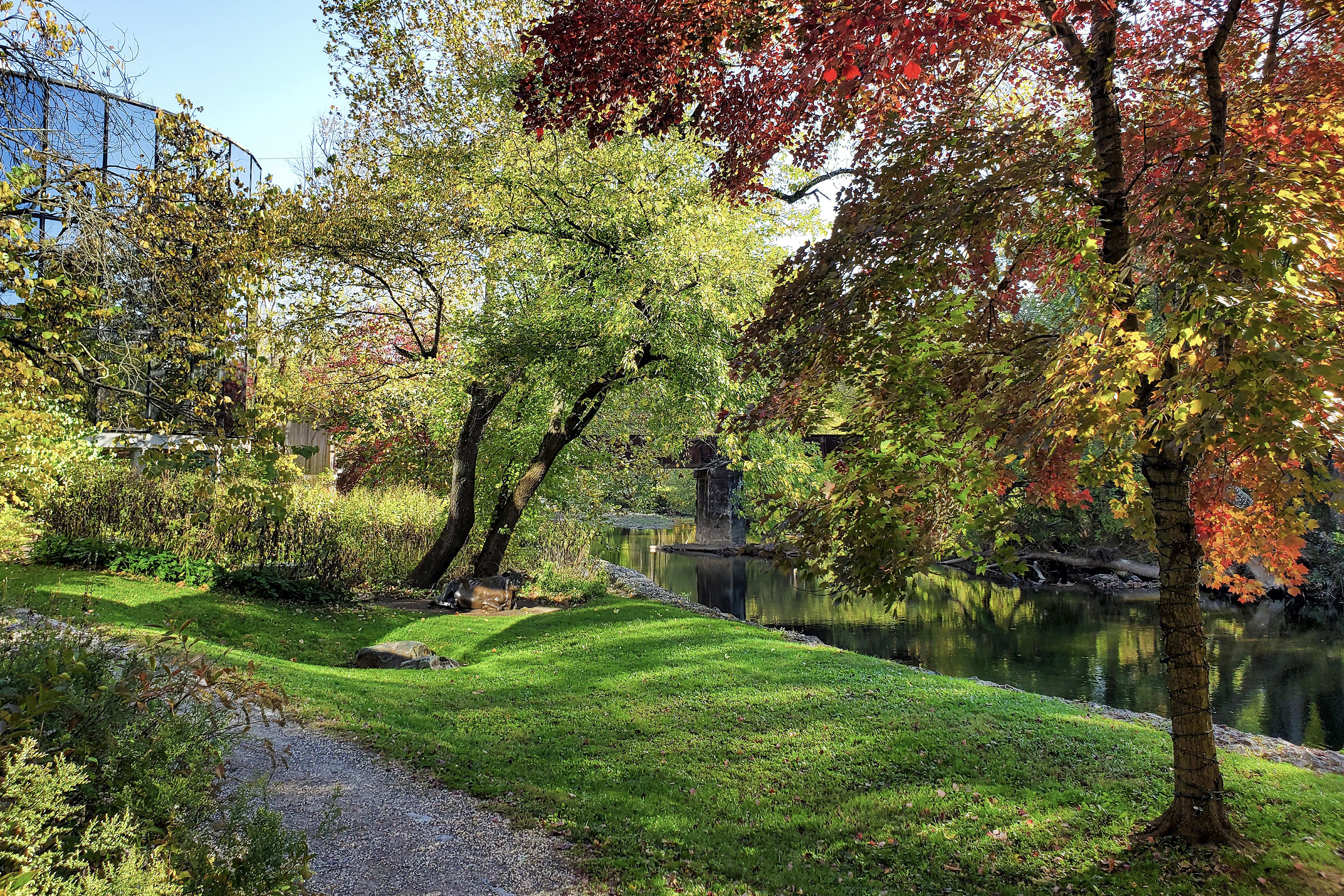
    West Fairmount Park. Don’t miss the views around the Skew Arch Bridge, and be sure to visit the Trolley Trail.

    Delaware Canal State Park. You can stroll, kayak, or canoe along the 58-mile towpath from sunrise to dusk to determine which way you best enjoy the fall scenery.

    See all of our favorite spots for leaf peeping around the region, ordered closest to farthest away from Philly.

    News worth knowing

    • This year’s El Niño has contributed to a historically quiet Atlantic hurricane season.
    • A Philly Parks and Rec leader said she approved renovations to FDR Park’s Ashburn Field without required state permitting because she wanted renovations to be complete by the MLB All-Star Game last July. The missing permit was designed to address erosion control and stormwater release at the site.
    • Supervisors in Willistown tabled a decision on a settlement that would limit the development of Rock Hill Farm. Officials are looking for more certainty in the preservation of the land.
    • Much of the Wetlands Institute site in Stone Harbor, N.J., sits in low marsh and has become increasingly at risk due to flooding. This week, nonprofit staff will pack up and move to a temporary headquarters.
    • The Trump administration has blocked more than 130 projects in national parks across the country worth at least $25 million without providing a reason, according to internal documents reviewed by the Washington Post.

    🌳 Your outdoorsy experience

    Yoo-hoo, is this thing on? I want to hear from you, dear reader. Whether you’re hitting your go-to trail or trying kayaking for the first time, this is your time to shine. What are you doing out in the wild?

    Write me an email to tell me about your unforgettable memories adventures or favorite moments outdoors. Pictures, if you have them, are more than welcome. You might see your adventures featured here.

    The perfect pick-me-up

    🎤 Let me pass the mic to my colleague Beatrice Forman with an adorable dispatch.

    Dolly is an Aries. She likes pink accessories, the feeling of freshly brushed hair, and morning coffee with friends. She also has to be the center of attention.

    No, Dolly is not a teenaged girl. She’s a three month-old Hereford calf with a job: To snuggle up with as many guests as possible at Rose Bridge Farm, a Montgomery County animal sanctuary.

    Rose Bridge Farm sits on almost 13 acres of land at 1314 Limekiln Pike in Dresher, once part of an estate owned by William Penn in the mid-1700s. When steward Kristen Sutch took over the property in 2013, she transformed it into a sanctuary for farm animals rescued from livestock auctions, dairy farms, and breeders. — Beatrice Forman

    Keep reading to learn more about the sanctuary and its cuddly animals.

    Paola’s picks

    🔎 An activity: Mix archaeology and history at Newlin Grist Mill’s annual Fall Festival with fun for all ages (Saturday, free).

    ♻️ A proud moment: Reading Terminal Market attracts attention for its food-waste-prevention efforts.

    🌕 A celestial treat: Philly’s most unique mooncakes.

    🍒 A song: “Return to Cherry” by Part Time: “Wishful thoughts of another chance, to make things right again.”

    🦉 A good read: Tom Pluck’s latest, “Owl Be Seeing You.”

    A fungal view

    Colleen Farnsworth of Ardmore and her son Ambrose Farnsworth, 4, touch the mushrooms in the mushroom exhibition.Elizabeth Robertson / Staff Photographer

    🍄‍🟫 Last weekend, Kennett Square’s 41st Mushroom Festival celebrated the family farms that have cultivated the crop for generations.

    👋🏽 I’ll catch you next time.

    By submitting your written, visual, and/or audio contributions, you agree to The Inquirer’s Terms of Use, including the grant of rights in Section 10.

  • Warren Buffett steps down as Berkshire Hathaway chairman

    Warren Buffett steps down as Berkshire Hathaway chairman

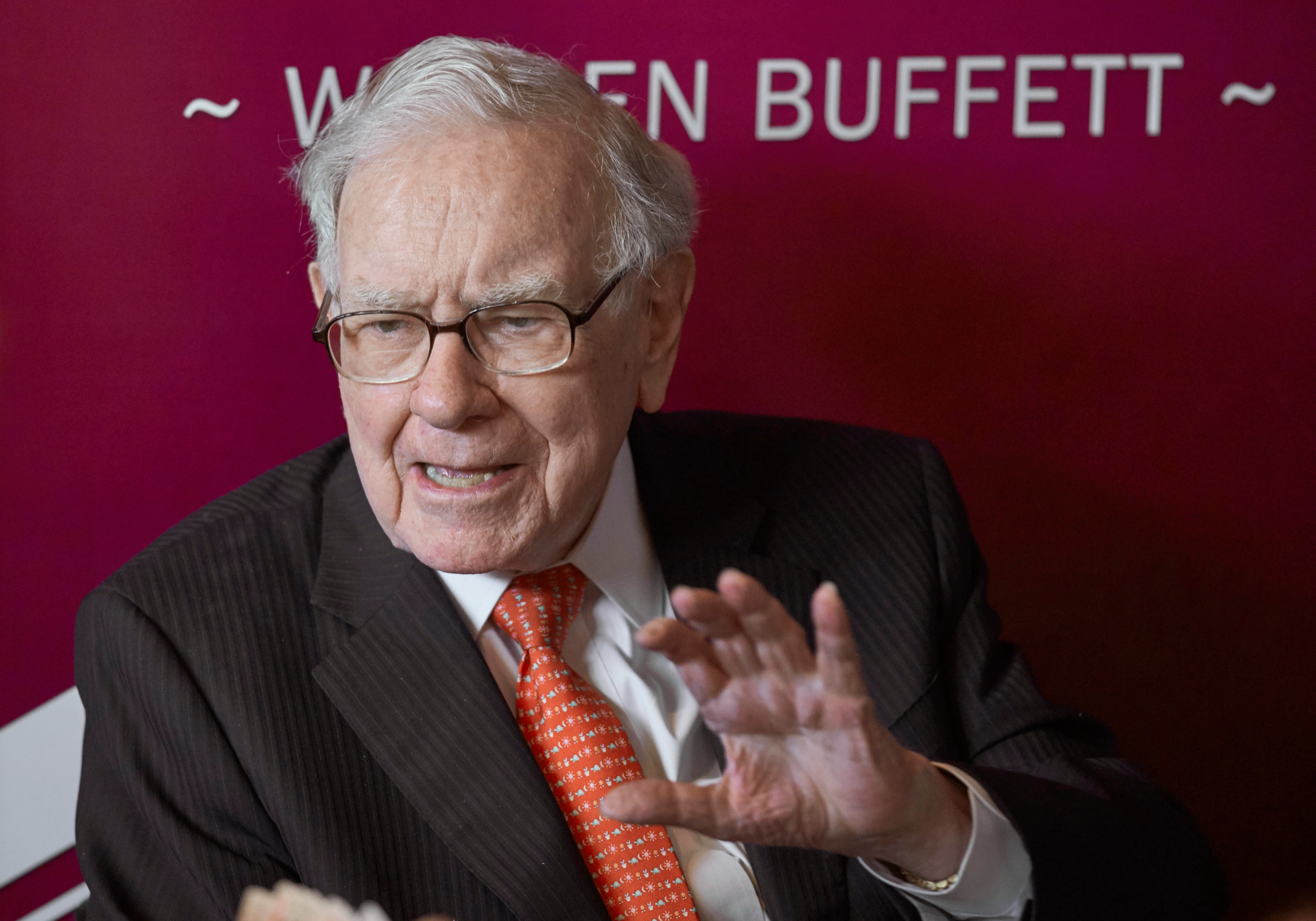
    OMAHA, Neb. — Warren Buffett is stepping down as chairman of Berkshire Hathaway in the next step of the transition at the top of the $1 trillion conglomerate he led for more than six decades.

    Buffett, 96, will become chairman emeritus and will take on his new role immediately, the company said Friday. His son Howard will become Berkshire Hathaway’s new chairman, part of a long-planned succession. Howard Buffett has been on the Berkshire Hathaway board since 1993.

    Warren Buffett, known by a legion of financial market followers as the Oracle of Omaha, will remain a director. He had been Berkshire Hathaway’s chairman since 1970, but he took control of the struggling New England textile company in 1965.

    Greg Abel took over for Buffett as the CEO of the conglomerate at the start of this year though Buffett continued to come into the office each day to look for new investments and deals and offer Abel any advice. It’s not clear whether Buffett will change his routine at all now.

    “I have served Berkshire since 1965,” Buffett said in a letter to shareholders. “Sixty-plus years in, I still have the best job in the world. That is not something many people my age can say, and I have never felt better about what comes next.”

    Investor Adam Mead, who wrote The Complete Financial History of Berkshire Hathaway, said Buffett seems to trying to lessen the impact on Berkshire when he eventually dies by taking this step now. Berkshire’s announcement didn’t reveal any health issues for Buffett, but Mead said “He’s now 96, so even a cold could be a health scare.”

    Greg Abel will continue as CEO with Howard Buffett becoming chairman

    Buffett said that he is confident with Abel and his son Howard leading Berkshire Hathaway.

    “Greg runs the company; Howard will guard its culture and values — both worth more than anything on our balance sheet,” he said. “Think of Howard as a policy the shareholders own and hope never to claim against.”

    Abel started managing all of Berkshire’s non-insurance businesses in 2018 when he was elevated to vice chairman, so he knows the various companies well, including BNSF railroad, the utilities and manufacturing operations, as well as name brands like Dairy Queen and See’s Candy. But CFRA Research analyst Cathy Seifert said investors still have questions about how well Abel will be able to deploy Berkshire’s massive $365 billion cash pile.

    “There was a premium awarded Berkshire stock because of their financial strengths and because of this famed investor who was allocating capital. I think it’s naive to assume that this is business as usual. It’s not,” Seifert said. “What this does is amplify some of the execution risk in the strategy and the significance of the transition.”

    The next orderly step in Warren Buffett’s succession plan

    Michael Withers, professor of management at the University of Notre Dame’s Mendoza College of Business, said Buffett took a deliberate approach to Berkshire Hathaway’s succession plans and has carried out the transition step by step.

    “Buffett seems to have understood that succeeding him wasn’t just about finding another extraordinary leader,” he said. “It was about building a structure that could preserve what makes Berkshire different long after he has stepped away. The test moving forward will be whether Abel and Howard can honor that legacy while still giving Berkshire room to adapt to a market that looks very different from the one Buffett mastered.”

    Buffett’s fortune has been amassed through Berkshire Hathaway stock. Buffett built the company into an investing conglomerate and an icon of Wall Street by buying insurance companies and reinvesting the money from premiums in stocks and other companies. In 2024, Berkshire Hathaway became the first non-tech companies valued at more than $1 trillion.

    Buffett, a longtime philanthropist, has given away roughly $66 billion worth of stock since 2006 with the bulk of that going to his friend Bill Gates’ foundation. But this summer he announced that his three children will now take over all of the charitable decisions and distribute the rest of his fortune by the end of 2035.

    Buffett’s take on finance has created its own gravitational pull. When Berkshire Hathaway reveals the stocks that the company has acquired or sold in public disclosures, it can shake markets.

    During his time as CEO of Berkshire Hathaway, the company nearly doubled the returns of the S&P 500, with a 19.9% compounded annual growth rate compared with the index’s 10.4% gain.

    “Warren’s impact on Berkshire and its owners is without parallel in the history of American business,” Abel said in a prepared statement. “The culture Warren built and the values he championed will remain at the heart of Berkshire, and Howard will be their guardian.”

    Shares of Berkshire Hathaway edged up 0.1% on Friday.