
Blog

  • Energy Department will spend $2 billion to squeeze more electricity from the aging power grid

    Energy Department will spend $2 billion to squeeze more electricity from the aging power grid

    ALLENTOWN — The Energy Department said Thursday that it will spend almost $2 billion to try to squeeze more electricity out of the nation’s aging and stressed power grid, as President Donald Trump’s administration steps up efforts to avoid blackouts amid skyrocketing energy demand spurred by artificial intelligence.

    The money will go toward 31 projects across 26 states that are expected to produce more than 23 gigawatts of additional electricity capacity — enough to power 16 million homes. The projects will use new technologies such as sensors to measure real-time weather conditions to ensure safe transmission or direct power away from congested paths, the department said.

    The upgrades could improve power reliability and lower electricity costs for about 100 million Americans, officials said.

    “This is a quick way to lower electricity prices and increase reliability: using fibers that are already in the transmission lines to analyze what’s the temperature out, what’s the wind out, how can we use this transmission line to distribute more power, but safely and only in the right conditions,” Energy Secretary Chris Wright said in a news conference promoting the grants Thursday at a PPL Corp. facility in Allentown.

    The eastern Pennsylvania electric utility says two data centers in its territory came online this year and six more are under construction, with enough other data centers in the advanced planning stages that its peak electric demand could quintuple by 2032.

    PPL said it is receiving $71.5 million to modernize an existing high-voltage transmission line across roughly 30 miles in northern Pennsylvania.

    The announcement comes amid warnings that AI’s voracious demand for power is threatening to overwhelm U.S. power supplies, as massive new data centers come online faster than new power plants can be built. It also comes as electricity bills rise faster than inflation in many parts of the U.S., blamed in some areas on demand from data centers.

    The snowballing opposition to data centers in communities across the country has thrown a wrench into the plans of the world’s richest companies and transformed the midterm election landscape.

    Trump continues to stick up for data centers, even as politicians from both major political parties criticize them and many communities try to block them.

    In the meantime, Congress and some states are trying to push utilities to use new technology to make grids more efficient, lessening the need to build new power plants.

    Julia Selker, the executive director of the WATT Coalition, a trade association for grid-enhancing technologies, said both the projects and the scale of the investment are significant. Utilities in the U.S. are lagging places like Europe in adopting the technologies, despite federal investment in the past to develop and test them.

    Wright said that work on the projects should begin right away and that he hoped some efficiencies are in place before this winter to tamp down price spikes when extreme weather sends demand skyrocketing.

    He said he didn’t know whether the projects would have gotten done without federal funding. Many, he said, had been under consideration before the grants were offered, but the grant recipients hadn’t “quite pulled the trigger” on them.

    Projects being announced Thursday will involve component enhancements on more than 1,500 miles of transmission lines and technological enhancements across nearly 21,000 miles, the department said.

    Projects were prioritized based on those that can be put into operation quickly, officials said. Money for the grants comes from the bipartisan infrastructure law enacted by Congress under then-President Joe Biden, a Democrat. The government’s $1.9 billion in funding will be matched by $3.35 billion in cost-share funding from the recipients, the Energy Department said.

    Recipients include utilities, cooperatives and four state agencies. The state agencies — in Colorado, Indiana, Ohio, and Oklahoma — were the biggest recipients, collectively drawing at a total of $810 million, with the Colorado and Oklahoma projects promising improvements to the wider regional grid.

    Trump has vowed to “unleash” the nation’s energy sector in his second term, aiming to drive up record-setting domestic oil and gas production, strip away pollution restrictions on power plants and keep expensive coal-fired power plants operating past their retirement dates.

    The administration also has pledged nearly $4 billion to buy back offshore wind leases as Trump seeks to discourage the expansion of wind energy in favor of fossil fuels.

    His administration has pushed to help tech giants build and connect data centers to power plants and high-voltage power lines and convert Cold War-era uranium enrichment plants into data center and power plant complexes.
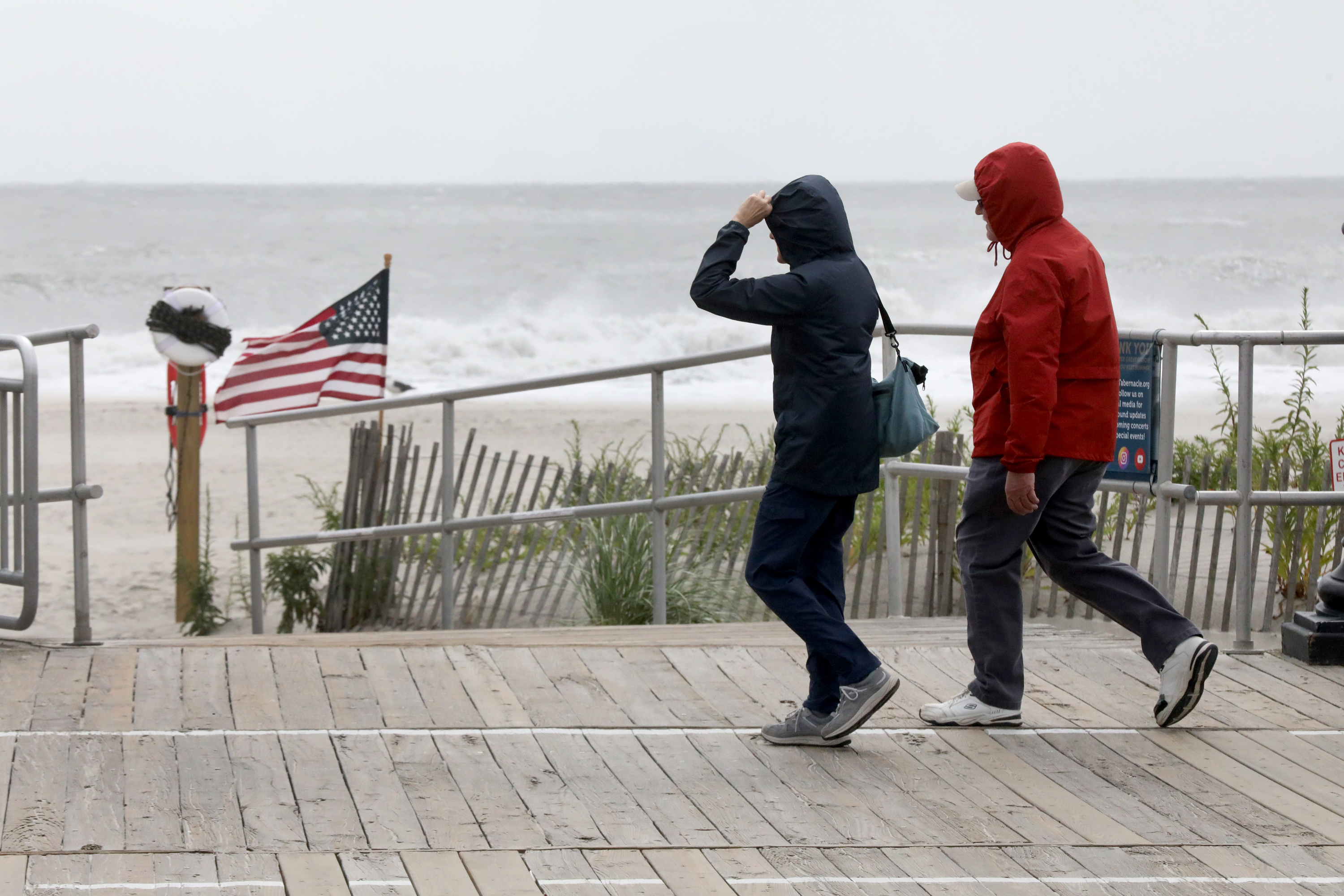

  • Nor’easter is likely to cause significant flooding at the Shore, and winds may gust to 60 mph

    Nor’easter is likely to cause significant flooding at the Shore, and winds may gust to 60 mph

    With moderate flooding already has been reported at the Jersey Shore, along with wind gusts to 50 mph, the beach towns were left to wonder Friday what may happen when the extraordinary early-season nor’easter gets closer.

    And forecasters were warning that the storm almost certainly would overstay its welcome.

    “It could be slow to pull out,” said Lee Robertson, a lead meteorologist at the National Weather Service in Mount Holly. “We really may not be out of the woods until Monday.”

    In a major shift, strong winds and signifcant rains were expected during the weekend all the way to Philadelphia, where winds could gust to 45 mph.

    Updated computer-model runs were favoring a storm track closer to the coast than previously anticipated, said Bill Deger, senior meteorologist at AccuWeather Inc., which would increase both the flooding and the wind potential. Beaches already have endured a long-duration assault of onshore winds, he added.

    “Our beach is going to suffer,” Atlantic City Mayor Marty Small Sr. said at a Thursday afternoon briefing. “We’re going to see a lot of beach erosion.”

    The more westward track also would increase the potential for weekend rainfall throughout the region during a time typically busy with hayrides, corn mazes, and other autumn activities, Deger said. “Mother Nature looks like it isn’t going to cooperate very much,” he said.

    He said the nor’easter could even become a “bomb cyclone,” a term for an especially intense storm.

    Potentially road-closing moderate flooding was forecast Friday into Saturday for the Jersey Shore. If the storm tracks further west, some places could see “major flooding,” said the weather service’s Robertson.

    A flood warning was in effect for the Jersey Shore towns until 2 a.m. Saturday, and flood advisories along the Delaware River until 4 a.m. Friday.

    Chances were excellent both would be extended. The storm, which was gaining strength off the Southeast coast Thursday afternoon, could take its good old time as it travels northward, which would increase the duration of flooding and the strongest winds.

    In addition, a high-wind watch was in effect at the Shore from 6 p.m. Friday into Saturday afternoon, with gusts that could reach 60 mph.

    Expected timing of the storm impacts

    Very much subject to change, the government’s National Ocean Service predicted oceanfront high tides at Atlantic City at or near moderate flood levels at 7 p.m. Friday and at 8 a.m. and 8 p.m. Saturday.

    Warning that what was anticipated was more than “nuisance flooding,” Small said the critical periods in Atlantic City would be a few hours before and after the high tides.

    In the back bay areas that are a chronic source of flooding in Ocean City, tides are forecast to hit moderate levels at 8 p.m. Friday and 8 a.m. Monday.

    At moderate levels, some roads become impassable, and building damage is possible, the weather service said.

    In Philly, minor flooding was forecast along the Delaware River for at least five consecutive high-tide cycles, which occur roughly every 12 hours, starting at 1 a.m. Friday.

    In Atlantic City, Small said he expected the streets to fill with up to a foot of water.

    Scott Adams, the city’s emergency chief, said the duration of the winds and waves were prime concerns. “It’s not a one-two punch,” he said.

    Just how much rain the storm would generate in the region was uncertain. The rains likely would reach the Shore late Friday and the immediate Philly area sometime Saturday afternoon, Deger said.

    The winds were likely to peak Friday afternoon into the evening; however, that would depend on the career of the storm.

    The beaches should get a break Saturday as the winds become more northerly than onshore, Deger said, which would at least slow the erosion, but the strong winds likely would continue.

    Isn’t this early for a nor’easter?

    Coastal storms of this magnitude typically occur later in the fall and winter, as colder air from the north country interacts with the warm waters of the Gulf Stream. Storms form on frontal boundaries of warm and cold air.

    In this case, a major player is an area of higher pressure, or heavier air, centered over eastern Canada that has been exporting cold air southward. That has kept temperatures several degrees below normal in Philly this week.

    It is working in tandem with the storm, providing the necessary cold air to contrast with the warm waters. In addition, winds circulate clockwise around centers of low pressure, so it also was generating winds from the northeast, which is why they are called nor’easters.

    Meanwhile, the intensifying storm also was generating winds from the northeast; winds circulate counterclockwise around centers of cyclones.

    The high may be as impressive as the storm, said Steve Decker, atmospheric science professor at Rutgers University. In data dating to 1979, it might be the strongest high over Quebec on record.

    He noted that while a nor’easter did develop in mid-September last year, “it was quite weak.” All indications are that this one won’t be.

    Incidentally, this was to be the last weekend of open swimming in Atlantic City, but if you were hoping to take a dip, better wait until Memorial Day.

    Small announced the beach would be closed, and all the equipment has been moved out of harm’s way.

    Besides, the water might be a little rough.

  • A Delco man was convicted of first-degree murder in the stabbing death of an Upper Darby teen

    It took a Delaware County jury about 30 minutes Thursday to convict a Clifton Heights man of first-degree murder in a random, unprovoked stabbing that killed a 15-year-old boy as he was walking home.

    Marson Weh, 39, was also convicted of possession of an instrument of crime in the April 2023 death of Michael Garr, a sophomore at Upper Darby High School.

    Weh will be sentenced in November to life in prison for stabbing Gar 11 times, including once in the throat, according to District Attorney Tanner Rouse.

    The two were strangers, Rouse said, and had “no earthly connection.” The DA said Weh offered no motive for the stabbing.

    Michael Garr was killed in April 2023 as he walked to his home in Upper Darby.Handout

    A passerby, Ian Coughlan, tried to help Garr, but his injuries were too severe, and he died of cardiac arrest before medics could arrive.

    The prosecutor said the case would make the “worst episode of Dateline,” one without any twists and leaves no room for alternate theories or interpretation.

    No one else was near Garr that night, he said, as Weh was seen “hunting, stalking” the teenager for more than a mile.

    When Weh was arrested, he was still wearing parts of his “kill suit,” nondescript clothing that included thermal underwear stained with Garr’s blood, Rouse said. And he was still carrying the murder weapon, a folding knife that matched the dimensions of Garr’s fatal wounds and still had his dried blood caked in its handle.

    “See this for what it is,” Rouse said. “Because when you only consider the blood on his pants, the blood on his knife, that alone proves he is guilty. There is no other explanation, no reasonable doubt.”

    After the killing, investigators quickly identified Weh through surveillance footage, which recorded him following Garr for more than a mile. Gradually, prosecutors said, he closed the distance between them, and attacked Garr as they approached Brunswick Avenue near Bridge Street in Drexel Hill.

    Weh’s attorney, Ian McCurdy, conceded in his closing arguments that it would “strain credulity” to say there wasn’t evidence to prove that Weh killed Garr.

    Still, he urged jurors to consider that prosecutors had failed to explain his intent in doing so.

    “As horrible as this situation is, the death of a young man killed way too early his life, this boils down to did the Commonwealth prove the case beyond a reasonable doubt,” he said

    McCurdy supported his contention by citing a two-minute window of time where neither Garr nor Weh were recorded on surveillance video.

    “The point is we just don’t know what happened in that small bit of time,” he said. “And that’s why I suggest to you the Commonwealth hasn’t proven that Marson Weh killed Michael Garr with malice.”

    In responding to McCurdy’s theory of the case, Rouse, the district attorney, did not mince words: The evidence that Weh intentionally killed Garr, a crime that constitutes first-degree murder, he said, is overwhelming.

    Beyond that, he said, Weh confessed to killing Garr during an interview with detectives. And he showed what Rouse described as a consciousness of guilt by soaking the hoodie and he gloves he wore on the night of the attack in ammonia — detectives found the items in that condition when they searched his home days later.

    Rouse urged the jurors to convict Weh of first-degree murder, likening doing so to parents protecting their children from the evils of the world.

    “There is simply no getting around the evidence,” he said. “You cannot stab someone in the throat and not mean it.

    “That kid had no chance.”

  • Cubs clinch second straight playoffs trip by beating Marlins as Crow-Armstrong joins 40-40 club

    Cubs clinch second straight playoffs trip by beating Marlins as Crow-Armstrong joins 40-40 club

    CHICAGO — Pete Crow-Armstrong joined the 40-40 club by stealing his 40th base to go along with his major league-leading 45 home runs, and the Chicago Cubs clinched their second straight postseason berth a 2-1 victory over the Miami Marlins on Thursday.

    Seiya Suzuki homered for the Cubs (88-71), who assured themselves of one of the NL’s three wild-card berths.

    Chicago also was a wild card last year, when the Cubs beat San Diego in the first round and lost to Milwaukee in a Division Series. The Cubs will be making consecutive postseason appearances for the first time since four straight from 2015-18, which in 2016 included their first championship since 1908.

    The Cubs clinched their berth shortly after the White Sox earned their postseason trip with a 9-1 win at Kansas City.

    Miami (78-81) was assured its third straight non-winning season.

    A favorite to win the NL MVP award, Crow-Armstrong became the seventh 40-40 player, joining a group that includes Los Angeles Dodgers star Shohei Ohtani and Atlanta Braves outfielder Ronald Acuña Jr. Jose Canseco was the first with the 1988 Oakland Athletics.

    Crow-Armstrong hit his 45th homer during Sunday’s 9-1 win at Cincinnati, extending his career high. The 24-year-old drew a leadoff walk from former Phillie Tyler Phillips in the first inning and swiped second base on the next pitch to Suzuki for his 40th steal in 47 attempts. Fans chanted “MVP” as the Wrigley Field videoboard proclaimed the feat.

    Ohtani was the previous player with a 40-40 season, hitting 54 homers and stealing 59 bases for the 2024 Dodgers. Acuña hit 41 homers and swiped 73 bases for Atlanta in 2023. Alfonso Soriano (2006 with Washington), Alex Rodriguez (1998 with Seattle) and Barry Bonds (1996 with San Francisco) are the other 40-40 players.

    Matthew Boyd (10-5) allowed one run, five hits and two walks over seven innings, and Ryan Zeferjahn pitched a perfect ninth for his seventh save to finish a five-hitter.

    Ian Happ tripled off Jack Ralston (0-2) to start the sixth and came home three pitches later on Nico Hoerner’s single, breaking a 1-1 tie.

    Miami’s Jakob Marsee had an RBI single in the third and Suzuki hit his 26th homer in the fifth, a drive off Jack Ralston.

  • Union alum Auston Trusty embraces being a USMNT role model for Cavan Sullivan and Neil Pierre

    Union alum Auston Trusty embraces being a USMNT role model for Cavan Sullivan and Neil Pierre

    FAYETTEVILLE, Ga. — When Auston Trusty turned pro with the Union a decade ago, the club’s youth academy was just starting to find its footing.

    Now everyone knows about it, and the waves of players it has produced for the club and the U.S. national team. Trusty knows better than most, as the Media native is on the academy’s board.

    But the scale of how far things have come in less than a decade has hit especially hard this week. The 28-year-old is sharing the field with the newest Union youngsters to break through: Cavan Sullivan, Neil Pierre, and Frankie Westfield.

    “Yeah, it’s crazy. I still think of myself as the young kid from Philadelphia, but now these guys are,” Trusty told The Inquirer on Thursday in an interview at U.S. Soccer’s national training center, before the team headed to Orlando to prepare for Saturday’s game against Peru (4:30 p.m., TNT, Telemundo 62).

    Cavan Sullivan (second from left) on the ball in front of Auston Trusty during a drill at Thursday’s practice.Jonathan Tannenwald

    “The way they look at me, they all know my history,” he said. “They all know where I came from, how I came from it, and I’ve been that person they’ve been trying to aspire to be. I’m really appreciative, I’m really grateful, and it’s a blessing that I’m able to be that person for them.”

    It feels long ago, at least in soccer terms, that Trusty turned down a scholarship offer to the University of North Carolina in the summer of 2016. He signed with the Union just days before he’d have headed to Chapel Hill. Back then, such a move was seen as unusual.

    “College, at the time, was probably the smarter move to other people,” he recalled. “To me, signing pro, I was taking a risk for myself. So it kind of opened that pathway for all these kids to come after me, and it’s pretty cool.”

    A year after Trusty’s move, Mark McKenzie left Wake Forest following his freshman season, and Brenden Aaronson backed out of a verbal commitment to Indiana.

    Auston Trusty (left) and Mark McKenzie together during their playing days with the Union.

    The tide had turned, and there was no going back. By the time Frankie Westfield turned pro in 2024 instead of going to Penn State, no one batted an eye.

    On Thursday, Trusty and Westfield had lunch together after teaming up in one of the morning’s training drills.

    “From what I’ve known from him, and from what I’ve heard, he’s a great player [with a] great mindset,” Trusty said. “Him, along with the other players from [the] Union, it’s really cool to see how far they’ve come, together and individually, and also their mindsets. … It’s their first time, so maybe they’d be hesitant, but they have great mindsets, and that’s what I really want to see.”

    It was obvious to ask about Pierre, a fellow centerback with so much potential. Trusty hadn’t talked with him much yet as of Thursday, mainly due to travel delays coming over from his club home at Celtic in Glasgow, Scotland. But Trusty has seen highlights, including of Pierre’s four goals for the Union this year, and is happy to have another Union centerback with the national team.

    Neil Pierre (third from right) is always easy to spot in a crowd thanks to his 6-foot-6 frame.Jonathan Tannenwald

    “He seems [like] a really good guy, seems good as a person, as a player, seems like he has a lot of talent,” Trusty said. “Obviously, his physical attributes — he’s really tall, and I think a lot of times people can focus on physical attributes. I’m really excited to see how he is on the ball, how he is as a player.”

    And of course, there’s Sullivan. Trusty has known the 16-year-old and his family for a while, so he hasn’t just seen the player through Union games.

    “He’s a humble kid, and he’s a grinder,” Trusty said. “He has that Philadelphia Union mindset where you know you don’t take it for granted, you go out there and grind, and you make the most of it. But he’s a humble kid, and he comes from a good family as well.”

    It will strike some people that Trusty focused on Sullivan’s humility. To outsiders, the talk is of cockiness and a hype train. But Trusty knows the difference between that and the right kind of confidence.

    Cavan Sullivan (right) cracking a smile at the start of Thursday’s practice.Jonathan Tannenwald

    “You see him off the pitch, see how he approaches a game, how he starts a game, how he approaches his transactions with teammates and coaches, and the game itself with his own play,” he said. “But during it, if someone’s going to do stepovers, someone’s scoring goals, and they’re celebrating, or if they show confidence on the pitch, that is exactly what you want to see. I don’t want an attacker, or any player, on the pitch that’s not confident.”

    Given that, he concluded: “So if someone’s feeling themselves, someone’s confident in their ability and backs themselves, all power to him.”

    Now the time has come for Sullivan and the other newcomers to make their first marks at a new level.

    “It’s for the more veteran, more established players to lead the young guys, and guys who could possibly get their first caps, to make sure they know what this team’s about,” Trusty said. “When you wear this crest, you’re not just representing yourself. You’re representing your teammates, your coaches, but everyone that’s ever believed in you, and an entire nation that’s behind you. So it really means a lot.”

  • More than 160,000 pounds of meat bearing false USDA inspection labels recalled

    More than 160,000 pounds of meat bearing false USDA inspection labels recalled

    NEW YORK — More than 83 tons of meat are being recalled across the U.S. because the products were not properly inspected by federal authorities and were shipped out with falsified inspection stickers, the Department of Agriculture said.

    Star Meat Delivery Inc., based in Lucama, N.C., is recalling more than 167,000 pounds of raw pork, beef, and goat nationwide. The USDA said that number could grow as it continues its investigation.

    Food produced without inspection may contain undeclared allergens, harmful bacteria, or other contaminants, the agency said Tuesday in announcing the recall. So far, there have been no confirmed reports of illnesses or injuries from the meats, according to the USDA.

    The meat in question was produced “on various dates” before Sept. 22 and has USDA inspection stickers falsely bearing an establishment number — EST. 1363 — that the agency said “does not have a federal grant of inspection.” However, some packages people purchased may not bear that labeling because retail stores may have applied their own stickers with pricing and safe handling instructions, the agency warned.

    The products were shipped to Georgia distributor A&D Foods to send to retail and restaurant locations nationwide.

    The USDA said the products should be considered misbranded and unsafe to eat and be discarded or returned to the place of purchase.

    The agency said the problem was discovered during the USDA’s Food Safety and Inspection Service’s routine checks. It’s not clear whether anyone has been arrested or criminally charged.

    Star Meat Delivery, in a statement posted on its Facebook page Thursday, pushed back at the notion that the inspection stamps on its products were somehow falsified. It said the establishment number in question was “legitimately reserved” as part of the USDA application process while it seeks approval to process and package meat for the Georgia distributor.

    That approval process is still underway, Star Meat said, although the meat involved was sourced from a USDA-inspected supplier.

    “No other products sold by Star Meat Delivery were mislabeled, and no other products sold by Star Meat Delivery are part of the recall that has been issued,” the company said. “We are cooperating fully with the appropriate authorities to finalize the application and are following the recall procedures that have been put into place.”

    The USDA didn’t immediately respond to Star Meat’s statement.

    Recalls triggered by forged inspection stamps are relatively rare, according to Keith Schneider, a food safety professor at the University of Florida in Gainesville.

    “This is someone taking a shortcut,” he said. “Systems are in place to catch these sorts of things and it appears the system worked as intended. You can’t skip inspections.”

    Last year, some 32,000 pounds of meat, including chorizo, pork chops and ribs, produced by Sabrositos Hondurenos, of New Jersey, were recalled after the USDA determined they had fake inspection stickers.

  • Israel’s Netanyahu, at U.N., calls accusations of genocide in Gaza ‘the biggest lie of the century’

    Israel’s Netanyahu, at U.N., calls accusations of genocide in Gaza ‘the biggest lie of the century’

    Allegations of Israeli genocide in Gaza are not only false but “the biggest lie of the century,” Prime Minister Benjamin Netanyahu told world leaders Thursday in a defiant speech that asserted his nation’s right to wage war against Iran — and was not heard by scores of delegates who trooped out before he started speaking.

    Netanyahu, his voice rising in emphasis, said attacking Iran “was one of the easiest decisions I’ve ever had to make” and denounced as “moral cowards” a mass of delegates who walked out of the U.N. General Assembly when he took the podium to speak.

    “In defending itself, Israel is also also defending many of the countries whose delegates just left this hall,” Netanyahu said. “In fact, I want you to know that many of their leaders even thank us privately for taking out Iran’s nukes.”

    When Netanyahu walked to the rostrum, a mix of cheers, boos and mass walkouts erupted. Scores of delegates marched out and a majority of visible seats sat empty afterward. “Order in the hall, please,” General Assembly President Khalilur Rahman said repeatedly.

    “If there are any other moral cowards who have not yet left the hall, please do so now,” Netanyahu said.

    His remarks — which at times sounded like a stump speech as Israel gears up for elections — came after a week filled with speeches by world leaders accusing Israel of genocide and war crimes in Gaza.’’

    Palestinians had called for a mass walkout

    The Palestinian Mission to the U.N. said in a message to many of the 193 U.N. member nations to bring as many staff as possible to the assembly hall and “collectively walk out of the assembly” once the Israeli prime minister is announced.

    “This will send a clear message to Netanyahu and his government that no one is willing to aid, abet, or be complicit in its genocide and war crimes and illegal occupation, which all peace-loving states and peoples demand must come to an end,” the message said.

    Israel rejects allegations that it committed genocide and war crimes and is illegally occupying Palestinian territory. All Israeli settlements are illegal under international law, but the Israeli government insists they are legal.

    Netanyahu, who is prone to using visual aids during his General Assembly speeches, at one point held up a pager while reminding the audience of Sept. 17, 2024, when Israel remotely detonated thousands of pagers that had been distributed to the Iran-backed Hezbollah militant group in Lebanon. The pager attack wounded more than 3,000 people and killed 12, including two children.

    He reminded the assembly of the scale of the Oct. 7, 2023, attack in which Hamas militants killed about 1,200 people. “This is equal to 40,000 innocent Americans slaughtered in less than 24 hours,” he said, or 16 times the death count on the 9/11 attacks that left nearly 3,000 people dead in New York.

    Netanyahu thanked U.S. President Donald Trump for taking decisive action against Iran, and he insisted Israel would prevail: “We will continue to win because we have no other choice.”

    Netanyahu followed the Palestinian president’s remote speech

    Palestinian President Mahmoud Abbas also addressed the U.N. General Assembly earlier Thursday, delivering prerecorded remarks from his office in Ramallah after the United States denied him and other top Palestinian officials visas to attend the gathering for the second year in a row.

    The 90-year-old leader’s popularity at home and relevance abroad have both waned. But in his remarks, Abbas made clear he did not intend to quietly accept being sidelined.

    “We will not leave our homeland. We will not accept displacement. And we will not allow anyone to decide our future on our behalf,” Abbas said.

    Though world leaders have repeatedly invoked the plight of Palestinians in speeches throughout the week, Abbas urged the international community to take more tangible action against Israel.

    “How long will some countries continue to remain silent about Israel, or continue supplying it with weapons that it uses against our people? The world has witnessed the enormous cost in the Gaza Strip and the West Bank,” Abbas said. “What, then, is the international community waiting for before it acts to protect the Palestinian people?”

    Netanyahu is in the city of a mayor who wants him arrested

    In past years, Netanyahu has used his General Assembly speech to both denounce the United Nations as biased and make Israel’s case to world leaders. His address — scheduled for prime time in Israel — is the cornerstone of an abbreviated trip to the United States unfolding under the shadow of New York City Mayor Zohran Mamdani calling him a “war criminal” and pushing for his arrest.

    Mamdani has acknowledged that New York does not have the authority to execute an International Criminal Court warrant but urged federal authorities to do so.

    Israel has grown increasingly isolated throughout the war in Gaza. The war began on Oct. 7, 2023, when Hamas-led militants attacked Israel, killing around 1,200 people and kidnapping 251. At least 73,922 Palestinians have been killed in Israel’s subsequent offensive, according to the Gaza Health Ministry, part of the Hamas-run government whose numbers are generally considered reliable by the international community.

    A ceasefire agreed to by Israel and Hamas last October halted the heaviest of the fighting and led to the release of the remaining hostages yet further steps have since stalled. Israel maintains control of most of Gaza and continues to carry out airstrikes on Palestinians near military-held zones. Hamas not disarmed or relinquished power and there has been no progress toward reconstruction in the mostly destroyed territory.

    Netanyahu has said no Palestinian state will be established while he is Israel’s leader and has argued that the Palestinian Authority is not a partner for peace.

    Netanyahu dismissed incidents of Israeli settler violence against Palestinians in the West Bank as a “handful of young juvenile delinquents” throwing stones, chopping down olive trees and lighting fires.

    “I can’t stand that. I won’t stand for vigilantism,” the prime minister said before accusing foreign leaders and the international press of distorting the scale of violence in the West Bank.

    Netanyahu’s government is dominated by settlers and their allies, including the Cabinet minister who oversees the police. There have been few arrests of settlers involved in attacks on Palestinians.

    Israel captured the West Bank and east Jerusalem in the 1967 war, and the Palestinians want both as part of their future state. The Palestinians and much of the international community view the settlements as illegal and as an obstacle to creating a viable, contiguous Palestinian state.

  • Penn welcomes a top 10 opponent for home opener, but it’s not shying from the spotlight

    Penn welcomes a top 10 opponent for home opener, but it’s not shying from the spotlight

    The Ivy League was the last college football league to kick off its season, so Penn will play its second game against a team that has already played, and won, four.

    Penn welcomes Lehigh to Franklin Field on Saturday (1 p.m., ESPN+) for its first home game under new leadership in coach Rick Santos and freshman starting quarterback Miles Teodecki.

    “It is what it is,” Santos said of the Ivy League’s scheduling. “We don’t have as much access to the student-athletes in the summer. So you can look at it like it’s a competitive disadvantage, but for us, we always want to look at it [as], ‘What can we control?’”

    Senior defensive back and team captain Josh Narcisse also didn’t think the later start gave Penn a disadvantage.

    “Obviously, they have a few more weeks of film that we can watch on them, so if you want to talk about advantages, that’s one,” he said. “Then, obviously, we’re coming in probably a little bit healthier than they are. [They are] probably a little more banged up after four weeks.”

    Beginning next season, the Ivy League announced that it will start earlier, however. Week 1 will be Sept. 11, 2027, and there will be a bye week in October.

    “I think that’s pretty big for us as a program,” senior tight end Dante Barone said, “but … it doesn’t really change our mentality.”

    The mentality, according to Narcisse and Barone, is “to be great.”

    “To be a great team, you have to play great teams,” Barone said.

    Penn football coach Rick Santos is in his first year with the program.Penn Athletics

    Lehigh (4-0) currently is ranked sixth in the FCS and won back-to-back Patriot League championships in 2024 and 2025. The Mountain Hawks also have a new head coach, Richard Nagy, the team’s former defensive coordinator.

    “They are one of the best teams in the country in all three phases, extremely well-coached,” Santos said.
“I know Coach Nagy very well from battling against him. … So tough-nose[d] team, really well coached. They play hard.”

    Santos also mentioned Lehigh running back Luke Yoder, the 2025 Patriot League Offensive Player of the Year, who’s already rushed for 569 yards (142.3 per game), good for second in the FCS.

    “[Yoder] never gets tackled by the first guy,” he said, “So we need to wrap up. We need to rally the football. Stopping the run has to be our No. 1 priority this week.”

    Hayden Johnson, Lehigh’s starting quarterback, was injured against William & Mary on Sept. 12 and has not returned to action.

    “It will be interesting to see if their starting quarterback plays or not. I think both of those guys, though, their signal-callers are elite with their legs, and they can really run,” Santos said.

    “With [Lehigh] running the ball as much as they do, they like to control the clock, so that’s going to be something for us is to sustain drives. … We got to make this a four-quarter game.”

    While Santos was “very, very encouraged” with Teodecki and the offense in last week’s 20-7 win over Bucknell, he also sees things to tighten up this weekend. The Quakers outgained the Bison, 367-124, and Teodecki threw for 197 yards on 18-of-34 passing with two touchdowns and an interception. He also was Penn’s leading rusher with 87 yards and another touchdown.

    “We’ll clean up some things mechanically in the passing game. …
We need to finish better in the red zone, and that starts with myself and our offensive staff in terms of play calling, putting the guys in better situations,” he said.

    For Narcisse and Barone, it will be their last home opener.

    “This is what we look forward to all season,” Narcisse said. “This is why you come out here in the winter when it’s 6 a.m. and nobody sees you working. You’re rolling around the snow. This is why you do that, right? For opportunities like this to shine when the lights are the brightest.”

  • Penn endowment increases 27.4%, or more than $6 billion. It’s the largest dollar jump in the university’s history.

    Penn endowment increases 27.4%, or more than $6 billion. It’s the largest dollar jump in the university’s history.

    The University of Pennsylvania’s endowment jumped 27.4% or $6.3 billion in the year ending June 30, 2026, university officials said Thursday.

    The university’s endowment, which supports financial aid, research, teaching, patient care, and other projects, increased from $24.8 billion in 2025 to $31.1 billion, said Mark Dingfield, Penn’s executive vice president.

    “The major story here was our exceptional endowment performance,” Dingfield told members of the university budget and finance committee Thursday, “… which leads to significant growth in our total net assets.”

    It’s the largest one-year dollar jump in the university’s history and compares to 12.2% or $2.5 billion in 2025. The largest percentage increase in the endowment was 50% in 1983, followed by 41.1% or $5.6 billion in 2021, a university spokesperson said.

    Dingfield noted that much of the endowment is restricted for specific uses, and that some of the gains will be absorbed by an increase in the federal excise tax on Penn’s endowment earnings. The tax rate increased on July 1 from 1% to 4%.

    “So even though the endowment performance is exceptional and we’re celebrating, some of that will need to be going to paying off that tax liability under the new tax policy,” he said.

    The endowment’s performance capped an overall strong fiscal year for the university, Dingfield said. That follows an earlier period of fiscal uncertainty. The university in January made another round of budget cuts in response to President Donald Trump’s administration’s actions that threatened future federal funding and revenues, and because of rising legal and insurance expenses.

    Penn’s schools and centers were directed to cut 4% from certain expenses and keep in place financial cutbacks instituted the prior year, including a staff hiring freeze and freezes on midyear adjustments in staff salaries.

    But the financial report on Thursday was bright.

    “The bottom line here is that we ended the year with really strong, both balance sheet and operating performance, which does give us some flexibility heading into FY27,” Dingfield said at the meeting.

    Yet, he said, “we are very much still focused on managing the risks that exist in our current environment.”

  • Senate rejects resolution to halt the Iran war as gas prices upend midterms

    Senate rejects resolution to halt the Iran war as gas prices upend midterms

    WASHINGTON — Despite rising political anxiety over the Iran war, senators on Thursday narrowly rejected a war powers resolution seeking to halt President Donald Trump‘s military action, which has been largely blamed for the spike in gas prices and become a flashpoint in the midterm election.

    The Senate tally, 49-50, coming days after Trump’s bombastic address to the United Nations in which he threatened to “annihilate” Iran, was likely the last chance for lawmakers to go on record about the war ahead of November. More Republicans are peeling away from the president as the war drags on and as they campaign for control of Congress. The Senate outcome fell short, with four GOP senators joining most Democrats in favor of the resolution.

    “They have been carrying water for this ridiculous and illegal war for months and months and months and not listening to their constituents,” said Sen. Tim Kaine (D, Va.), who pushed the war powers resolution forward.

    About half of rural American voters believe the economy is worse off now than when Trump returned to office, according to a new survey from The Associated Press in partnership with KFF. The costs of groceries, gas, and healthcare rank as top pain points for the rural voters.

    “We’ve got to break the cycle,” said Sen. Thom Tillis (R, N.C.), who joined in voting yes.

    Republican Sens. Susan Collins of Maine, Lisa Murkowski of Alaska, and Rand Paul of Kentucky also voted for the resolution to end the war, as they have in many previous tallies. Sen. John Fetterman (D., Pa.) voted against.

    This was the 14th time the Senate has considered a war powers resolution, since Trump launched the conflict on Feb. 28.

    War powers resolutions are largely political statements, without the full force of law, but stand among the sharper tools the House and Senate have to express disapproval of the White House, short of halting funds for Trump’s military actions. As resolutions, they do not go to the president’s desk for his signature.

    As gas prices climb, Republicans start to question the war

    Republicans in control of Congress have shied away from directly confronting Trump over the war, now stretching past the seven-month mark. But their unrest is surfacing as stubbornly high gas prices leave voters in a cash crunch back home.

    Diesel costs, in particular, have almost doubled, topping $6 a gallon, according to AAA.

    Just returning from a swing through Iowa, Kansas, and Nebraska stumping for GOP candidates who are suddenly at risk in their elections, Sen. John Kennedy of Louisiana called on Trump to hold a prime-time address to the nation to explain the Iran war strategy and the end game.

    “People are confused about the war and upset about the cost of living,” he said.

    But he and others were not yet ready to vote against the war.

    “My own view is that the focus right now needs to be on attacking the cost-of-living issues,” said Sen. Josh Hawley (R, Mo.) who opposes the war powers resolution and believes the president is acting within his authority to conduct the military action.

    House Democratic Leader Hakeem Jeffries scoffed at the handful of Republicans now trying to distance themselves from what he called Trump’s failed economy. “Now all of a sudden they’re waking up,” he said.

    Democrats keep pushing war powers votes in Congress

    Earlier this month, the House for a third time approved a war powers resolution, this time with seven Republicans joining the Democrats, including two from battleground Iowa, Rep. Zach Nunn and Rep. Mariannette Miller Meeks, where affordability issues among rural voters are dominating the campaigns.

    Senators, though, have rarely been able to confront Trump by passing a war powers resolution.

    In June, the Senate approved a war powers resolution after four GOP senators joined Democrats, but Republicans abruptly reversed course the next day after Trump berated them during a private lunch over the outcome.

    At the time, Sen. Bill Cassidy of Louisiana, stood up to defend his vote only to end up in a shouting match with Trump. He later switched to oppose the war powers resolution after receiving a personal briefing from the White House.

    Thursday’s vote was on a resolution that had passed the House in July with GOP support. Rep. Pramila Jayapal, D-Wash., who authored the House resolution, said the Senate outcome was “a slap in the face to the millions of American people who want this war to end.”

    Other options to halt the Iran war

    As the war drags on, costing $43.5 billion so far, Congress is also seeking other ways to force Trump to rethink his military strategy in Iran.

    Rep. Thomas Massie, the renegade Republican from Kentucky, pushed forward articles of impeachment against Secretary of Defense Pete Hegseth before the GOP leadership abruptly adjourned the House and sent lawmakers home to campaign for the election, avoiding any potential vote on the matter.

    Lawmakers also have the power of the purse to curtail military spending, something Republicans have been reluctant to do but Democrats are sure to tackle if they win power in the midterm election. The White House’s request for an additional $87.6 billion funding package for the war and other needs has idled in Congress.

    First created in the aftermath of the Vietnam War as a way to hold a president accountable for military actions, the war powers act has long posed a test of the balance of power between the executive and legislative branches of government.

    While the Constitution says only Congress can declare war, the president as commander-in-chief is also able to engage the military. The war powers act seeks to provide clarity by requiring the president, within 60 days of any such action, to seek approval — or risk disapproval — from Congress.