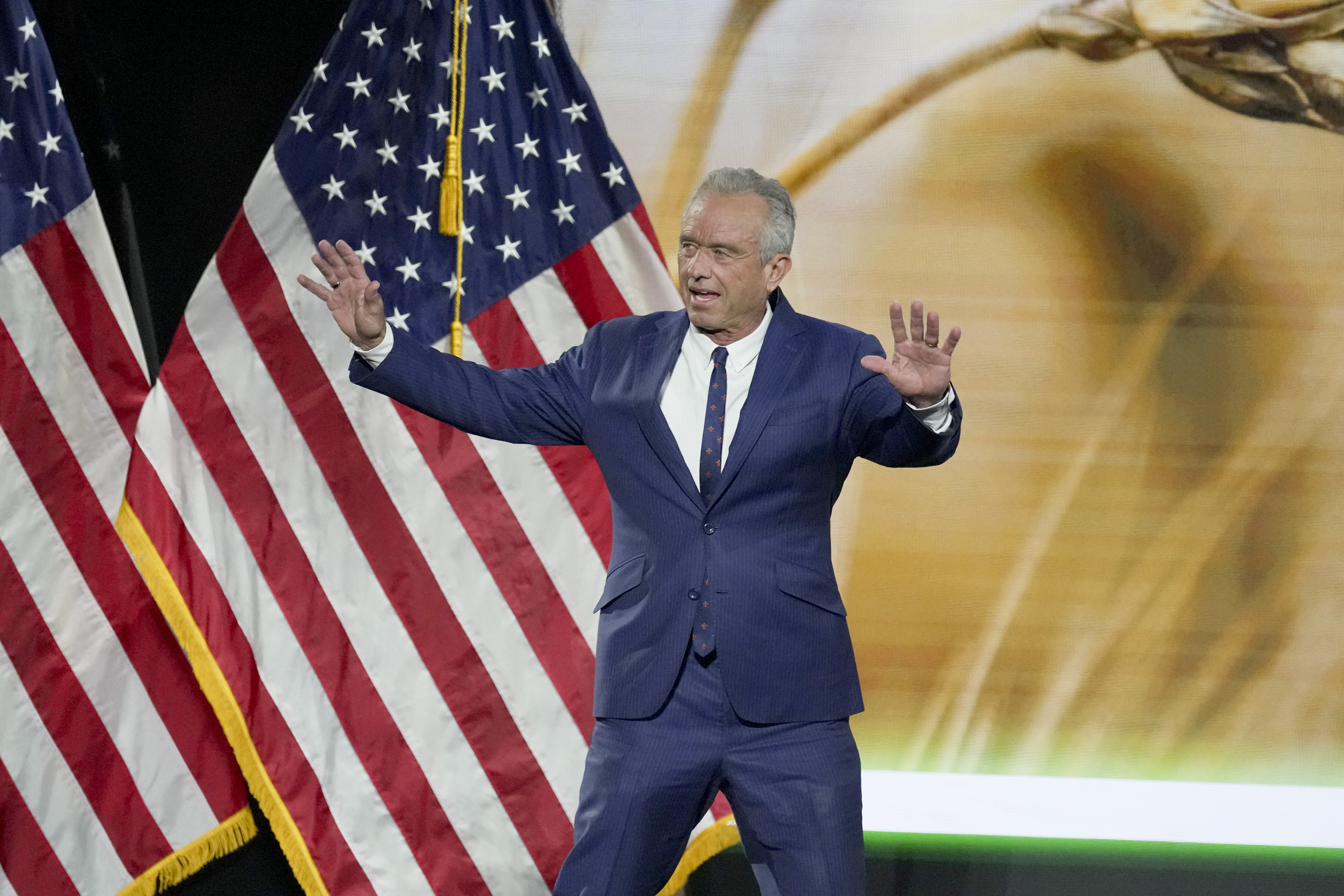
A large majority of likely Pennsylvania voters dislike Health and Human Services Secretary Robert F. Kennedy Jr., according to a poll conducted in the wake of his clash with Gov. Josh Shapiro over the state’s measles outbreak.
The poll, released Thursday, found that 61% of respondents have an unfavorable view of Kennedy, while only 33% said they hold a favorable one of him.
Kennedy,who has a history of anti-vaccine activism, has been embroiled in a heated debate with Shapiro, the state’s popular governor, over measles-associated deaths in Pennsylvania.
“The poll shows that people see RFK Jr. for what he is: the single worst person to be HHS secretary during a massive measles epidemic,” said Paul Offit, director of the Vaccine Education Center at Children’s Hospital of Philadelphiaand a longtime critic of Kennedy.
(function(){function e(){window.addEventListener(`message`,function(e){if(e.data[`datawrapper-height`]!==void 0){var t=document.querySelectorAll(`iframe`);for(var n in e.data[`datawrapper-height`])for(var r=0,i;i=t[r];r++)if(i.contentWindow===e.source){var a=e.data[`datawrapper-height`][n]+`px`;i.style.height=a}}})}e()})();
State health officials have been responding to a measles outbreak of more than 800 cases, as of Wednesday, that included four deaths, two of them infants.
The survey of likely voters was conducted between Sept. 15 and 21, a period that overlaps the war of words between the Democratic governor and Trump’s health secretary.
“This serious situation continues to be made worse by RFK Jr. playing games with public health and safety,” Shapiro said on X last week. “It’s long past time for [Kennedy] to stop stoking vaccine skepticism and misinformation and compromising the serious mission of the nation’s public health agencies.”
For his part, Kennedy, in a post on X last month, accused Shapiro of choosing “to politicize this outbreak instead of implementing a unified public health response.” He also contended in that post that he has promoted vaccination as the “most effective way to prevent measles infection.”
But Kennedy has explicitly stated that vaccines cause autism, Offitnoted, and late last year, Kennedy orderedthe CDC to change its website to say its long established position that vaccines don’t cause autism is not an evidence-based claim.
Kennedy has also said that the measles vaccine was never fully tested and that it wanes over time, both of which have been disputed by medical authorities with decades of evidence backing its safety and efficacy.
Lesa Yeager, a 63-year-old independent voter from State College who participated in the survey, said she was concerned about the spread of measles in Central Pennsylvania, and she wished Kennedy would “encourage people to the get the vaccines.”
She wasn’t familiar with his back-and-forth with the governor, but said her frustration with Kennedy is longstanding.
“I have a kid with special needs, and [Kennedy]is going on about how the vaccines cause autism, and everybody knows that’s not true,” she said. “He has spread such misinformation, and he’s wackadoodle.”
For weeks, the CDC did not publicly list Pennsylvania’s measles-associated deaths, reportedly at Kennedy’s order, a charge his agency denied. “It looks as though RFK is ignoring measles deaths here,” Offit said.
On Wednesday, the CDC acknowledged that a measles-associated death had occurred in 2026, without saying where it happened. The CDC said the number is “subject to change.” Pennsylvania is the only state where a measles death has been widely reported.
In a statement, Emily Hilliard, HHS press secretary, declined to address the poll, but said that the public’s trust in vaccines was eroded significantly during the pandemic, caused by “mismanagement, overreach, misinformation, and mandates.”
“Attributing the measles resurgence to the Trump administration fundamentally misrepresents when and why the resurgence began,” Hilliard said, adding that Kennedy has “been clear that vaccination remains the most effective way to prevent measles.”
Kennedy and Shapiro have repeatedly battled over vaccine policy during the Trump administration. Shapiro joined a lawsuit earlier this year over federal changes to the childhood vaccine schedule.
Trump last month signed an executive order that saidthe MMR vaccine — a combination vaccine that protects against measles, mumps and rubella — “should be administered in three separate single-disease shots” during three separate doctor’s visits. Immunologists have disparaged the idea, saying there’s no medical reason to do so.
Shapiro has said Pennsylvania won’t alter immunization guidelines in response to Trump’s order.
(function(){function e(){window.addEventListener(`message`,function(e){if(e.data[`datawrapper-height`]!==void 0){var t=document.querySelectorAll(`iframe`);for(var n in e.data[`datawrapper-height`])for(var r=0,i;i=t[r];r++)if(i.contentWindow===e.source){var a=e.data[`datawrapper-height`][n]+`px`;i.style.height=a}}})}e()})();
The poll found that 53% of likely voters trust Shapiro to do a better job on vaccine policy than his Republican opponent Stacy Garrity, a Trump-backed candidate who participated in Kennedy’s “Make American Healthy Again” event in Harrisburg earlier this year.
Staff writers Michelle Baruchman and Gillian McGoldrick contributed to this article.
Denise Fitzsimmons knew that removing the fast-growing lump above her eyebrow in 2024 didn’t eliminate the possibility that her melanoma could return.
But a clinical trial at Penn Medicine offered the 63-year-old grandmother from Birdsboro, Pa.,hope of a more enduring remission. It tested a novel vaccine, based on Penn’s groundbreaking mRNA research, that trains the patient’s immune system to find and kill cancer cells.
That technology has become the first mRNA cancer vaccine to succeed in a late-stage clinical trial, according to preliminary findings released last month by Merck and Moderna, the pharmaceutical giants developing it.
The vaccine extended the time a patient survived without their cancer returning or spreading, according to the companies, which announced Monday that they will share the full trialresults next month at the 2026 European Society for Medical Oncology meeting in Spain.
The drugmakers merely said that the results were positive. Without knowing the exact numbers involved, or how long the benefit lasted, it’s stillunknown if the results will prove clinically meaningful for patients. The companies also have not announced a commercial price tag for the therapy, called intismeran autogene, though similar immunotherapies can cost hundreds of thousands of dollars.
The trial could mark a turning point for mRNA technology, which has proven useful against infectious diseases but hadn’t had the same success in cancer.
Melanomas typically contain thousands of genetic mutations due to sun damage, making them an ideal target for the approach, which teaches the immune system to respond tounique markers on cancer cells.
“It’s a very big step forward after many negative studies in the last few years,” said Ravi Amaravadi, the lead investigator of the Penn trial site, one of more than 100 around the globe.
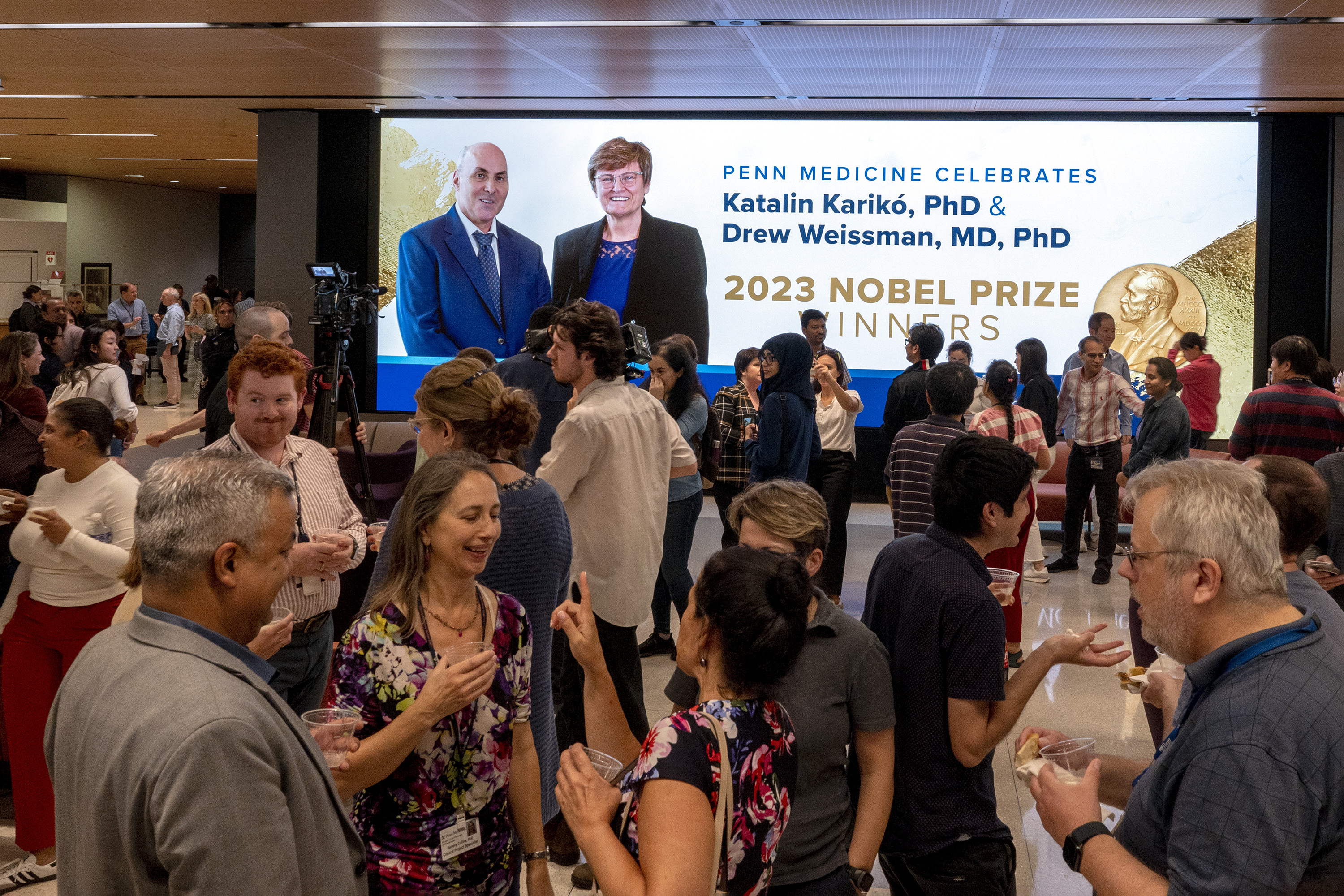
mRNA vaccines gained widespread attention in 2020 when used to develop the first immunizations for COVID-19. These shots used the mRNA platform developed by Nobel Prize winners Katalin Karikó and Drew Weissman, a University of Pennsylvania professor. Since then, mRNA vaccines for RSV and the flu have gained approval.
“This was kind of the wake-up call that RNA vaccines in cancer have an enormous future,” said Weissman, who was not involved in the trial and has no financialstake in Merck or Moderna.
Katalin Karikó and Drew Weissman were named winners of the 2023 Nobel Prize in Physiology or Medicine. The messenger RNA pioneers worked years to unlock an understanding of how to modify mRNA to make it an effective therapeutic – enabling a platform used to rapidly develop lifesaving vaccines amid the global COVID-19 pandemic.Tom Gralish / Staff Photographer
How the vaccine works
Melanoma is a serious type of skin cancer that develops when melanocytes — the cells that give skin its color — grow out of control.
This trial tested the vaccine in patients whose melanomas had already been removed through surgery. The goal was to destroy any remaining cancer cells and prevent the disease from returning or spreading to other parts of the body.
“It’s the deadliest form of skin cancer because it can metastasize,” Amaravadi said.
Detail of a person with a malignant melanoma, which is a malignant skin tumor that involves the skin cells that produce pigment. (American Cancer Society/Getty Images/TNS)Getty Images / MCT
Scientists personalized the vaccine for each patient by analyzing their tumor samples for unique genetic mutations. That enabled them to design mRNA — a molecule that carries genetic instructions — that would encode bits of protein that look like the tumor.
When the immune system encounters those proteins, it learns to recognize the cancer and attack it.
It’s similar to vaccines for the flu or COVID-19, which train the body to identify and fight off specific viruses.
If the immune system is trained in this way, it could produce a long-lasting memory against the cancer, Amaravadi said.
“We are now able to train the immune system to look for the tumor, arguably for the first time, in the most effective way,” Amaravadi said, referring to the mRNA platform.
That mRNA was loaded into a nanoparticle (which acted like a delivery truck hauling cargo) and injected into the arm as a shot.
Two-thirds of the 1,137 participants were randomly chosen to receive the vaccine in combination with Keytruda, a standard-of-care immunotherapy, while the remaining third received Keytruda alone.
The trial
Ravi Amaravadi led the trial site at Penn.Courtesy of Penn Medicine
Trial participants who received the vaccine had fewer metastases compared to patients who got the immunotherapy alone, Amaravadi said.
However, the company has only announced that the results were positive. Without knowing the data, it is hard to say whether the results are also clinically meaningful, Amaravadi said.
“We are hopeful we’re going to see the same absolute benefit when we see the data published,” he said.
Amaravadi also wants to see whether there were any unexpected side effects that patients should consider before taking the therapy.
Another data point of interest:How many patients agreed to receive the treatment but ultimately couldn’t receive it. In some cases, patients’ tumor samples were too small, didn’t contain enough usable genetic material, or were of too poor quality to actually make the treatment.
If this were a consistent problem, the technology used to analyze tumors’ genetic makeup would need to improve.
“It’s still a little bit of a bottleneck for some patients to get access to the treatment,” he said.
Denise Fitzsimmons of Birdsboro, Pa., is one of the participants at Penn’s trial site.Courtesy of Denise Fitzsimmons
Fitzsimmons, a grandmother living in the small Berks County town of Birdsboro, participated through Penn’s site. She doesn’t know whether she received the treatment or a placebo (that information is kept secret from both patients and researchers to avoid bias.)
But she recalls feeling flulike symptoms the day after each shot — including body aches and sweats — making her speculate that she may have received the vaccine. COVID-19 mRNA shots oftenprompt similar reactions.
Fitzsimmons has been cancer-free for the last two years.
“My fifth granddaughter is on her way,” she said. “So I have a lot to live for.”
The future of mRNA
RNA offers a few key advantages as a treatment.
Its effects are transient and controllable. The material lasts only a couple of days in the body before it degrades and disappears.
It’s also relatively easy to make.
“We made billions of doses of the COVID vaccine within a year. No other vaccine or therapeutic can be expanded that quickly,” Weissman said.
He believes RNA vaccines could benefit people with genetic mutations that put them at higher risk of cancer, such as BRCA carriers.
If people receive the vaccine before their tumors form, it could kill off any early cancer cells that arise.
“That way you prevent the cancer from ever forming, instead of trying to treat it after it’s already there,” Weissman said.
Conversely, he doesn’t think RNA vaccines would work well in someone whose advanced cancer cannot be removed. The immune system has a hard time killing large tumors, he explained.
This trial tested the vaccine as a follow-up to surgery, targeting leftover tumor cells.
Other ongoing trials aretesting mRNA vaccines in pancreatic, breast, colon, lung, prostate, and other cancer types.
Outside of cancer, clinical trials are testing mRNA vaccines for herpes viruses, malaria, tuberculosis, Zika, chikungunya, and norovirus. Scientists are also exploring whether mRNA technology could be used to treat allergic and autoimmune diseases.
Joe Mihalich loves coffee. Dunkin’, specifically. For years, it has been part of his morning routine: picking up a large decaf, hot, with cream, en route to a basketball arena.
Employees at his home Dunkin’, in Mt. Airy, call him by name (“Mr. Joe”). One server, in Flourtown, gave him a black beanie hat with the company’s logo stitched in, as a modest token of appreciation.
Mihalich would usually order ahead on the app, but sometimes, he’d go to the counter, and stick around for refills. He’d often do this before heading to the gym at Hofstra, where he once worked as a head coach.
It was a simple task that gave him joy. Until it wasn’t.
On Aug. 15,2020, the former La Salle point guard was standing in his Long Island driveway, when he suffered a hemorrhagic stroke in his brain.
He underwent an emergency craniectomy; a surgery in which part of the skull is removed to relieve pressure. He came home in a wheelchair, wearing a helmet, unable to say anything but “yes” or “no.”
Mihalich was 64 years old and leading a Hofstra team that had won back-to-back CAA titles. He was on pace for 600 career wins, with likely a decade of basketball ahead. In an instant, that trajectory ceased. How can you coach if you can’t talk? If your right hand is no longer able to draw up plays?
Joe Mihalich was robbed of his voice while coaching at Hofstra… if only temporarily. Nick Wass
Every routine, big and small, was disrupted. Instead of going to practice, Mihalich went to speech, physical, and occupational therapy. Those daily trips to Dunkin’ became infrequent; he couldn’t drive himself, or dictate what he wanted to drink.
Compounding this was the fact that the stroke didn’t affect his cognition. Mihalich was as sharp as he was before. He could still draw up schemes in his mind. He still preferred zone defense over man, and a four-out, one-in offense over three-out, two-in.
He just couldn’t say it. Doctors expressed skepticism that the coach would ever walk or talk at length again. The likelihood of him returning to even a modicum of independence was slim.
But Mihalich decided to throw himself into the challenge, as if he were preparing for a big game. He started working with a speech language pathologist twice a week.
He took his physical therapy seriously, so much so that he was able to go from a wheelchair to a walker, and from a walker to unassisted walking in just over a month.
He gradually began to visit his old haunts. The coach can still remember the day he went back to Dunkin’. It was 2021, in the Garden City location on 7th Street.
Joe Mihalich cries as he recalls his wife and family’s support for his recovery, in a conversation with The Inquirer last month. Isaiah Vazquez / For The Inquirer
Mihalich walked up to the counter with trepidation. What if the attendant couldn’t understand him? What if he was holding up a line? To prepare, he memorized five words that deep down, he knew by heart: “Large decaf, hot, with cream.”
“I had to repeat it twice,” Mihalich said, “but it was OK.”
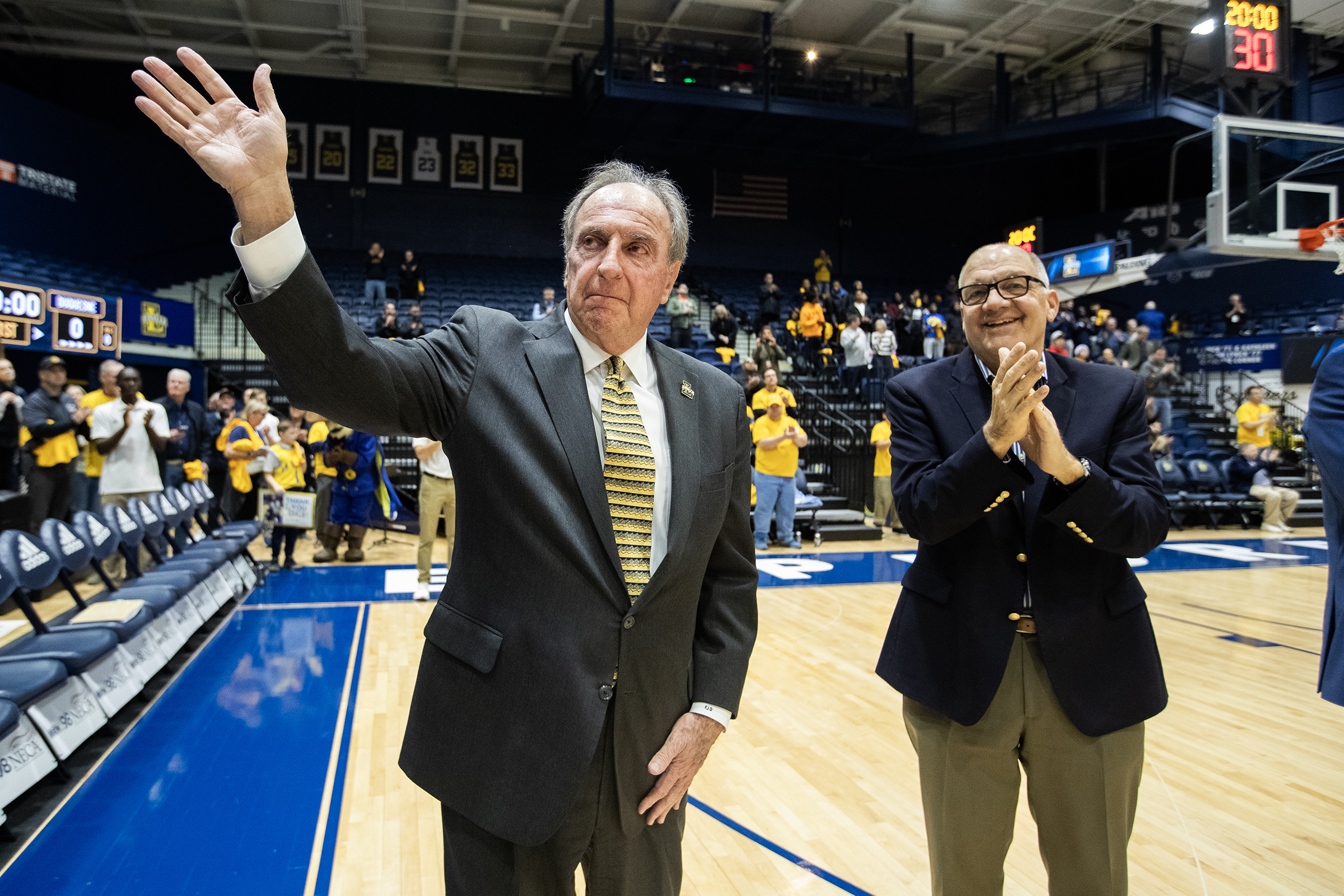
In 2021, after taking a medical leave, he returned to Hofstra as a special adviser to the athletic director so the basketball program could transition to Mihalich’s assistant, ex-Sixer Speedy Claxton.
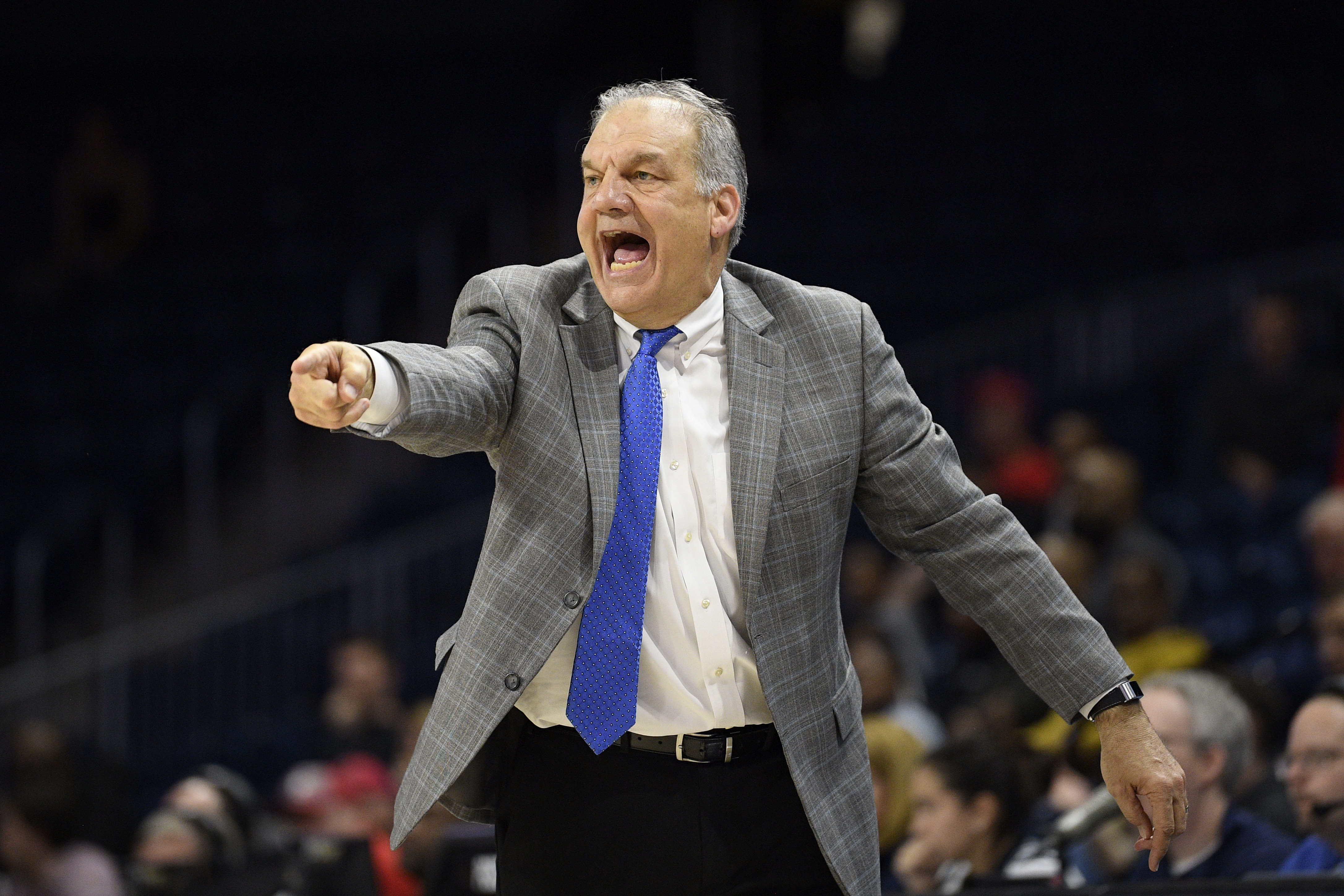
In 2022, La Salle offered Fran Dunphy its head coaching job. He said he wouldn’t take it without Mihalich, a lifelong friend and former Explorers player with whom Dunphy had worked when both were assistant coaches in the 1980s.
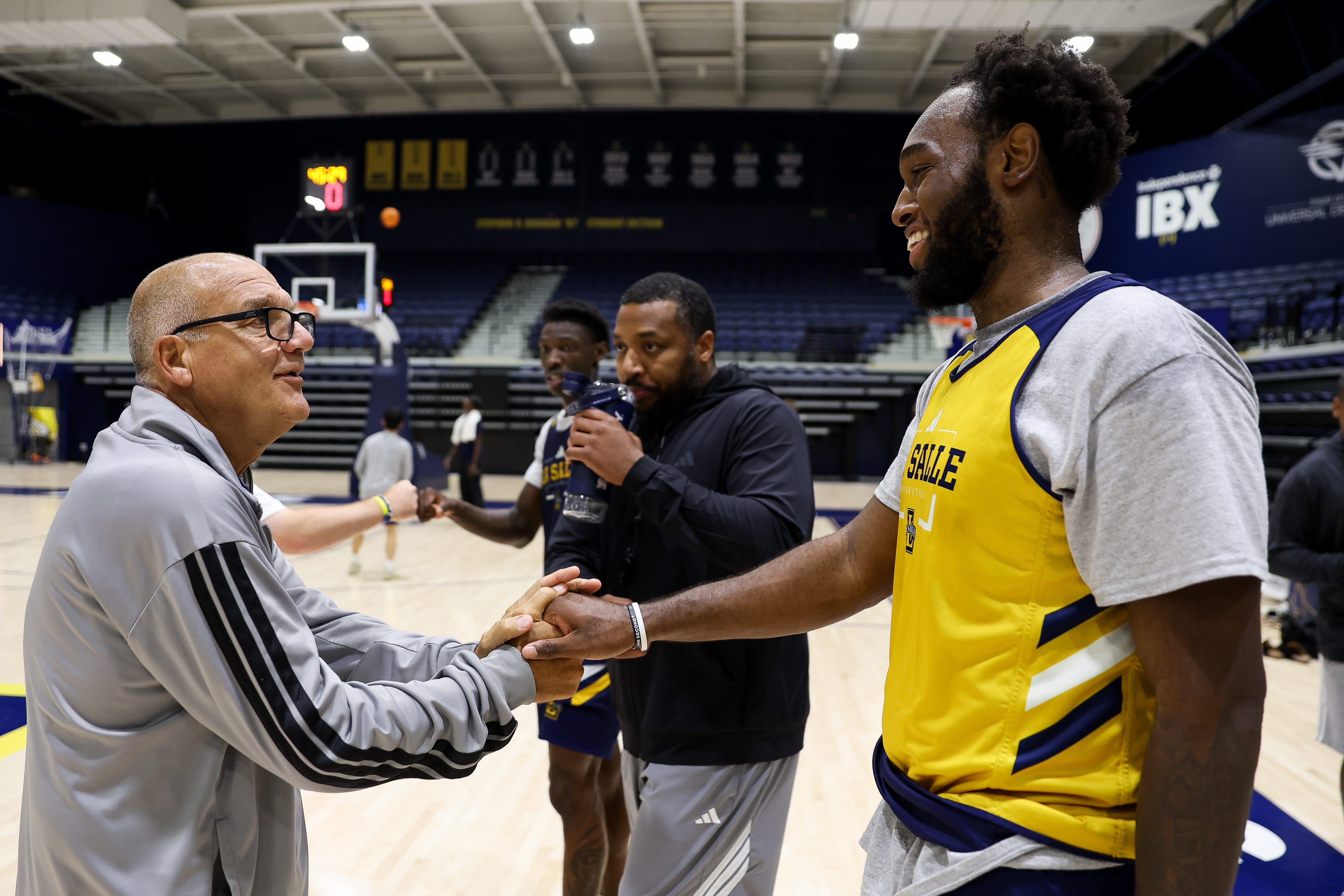
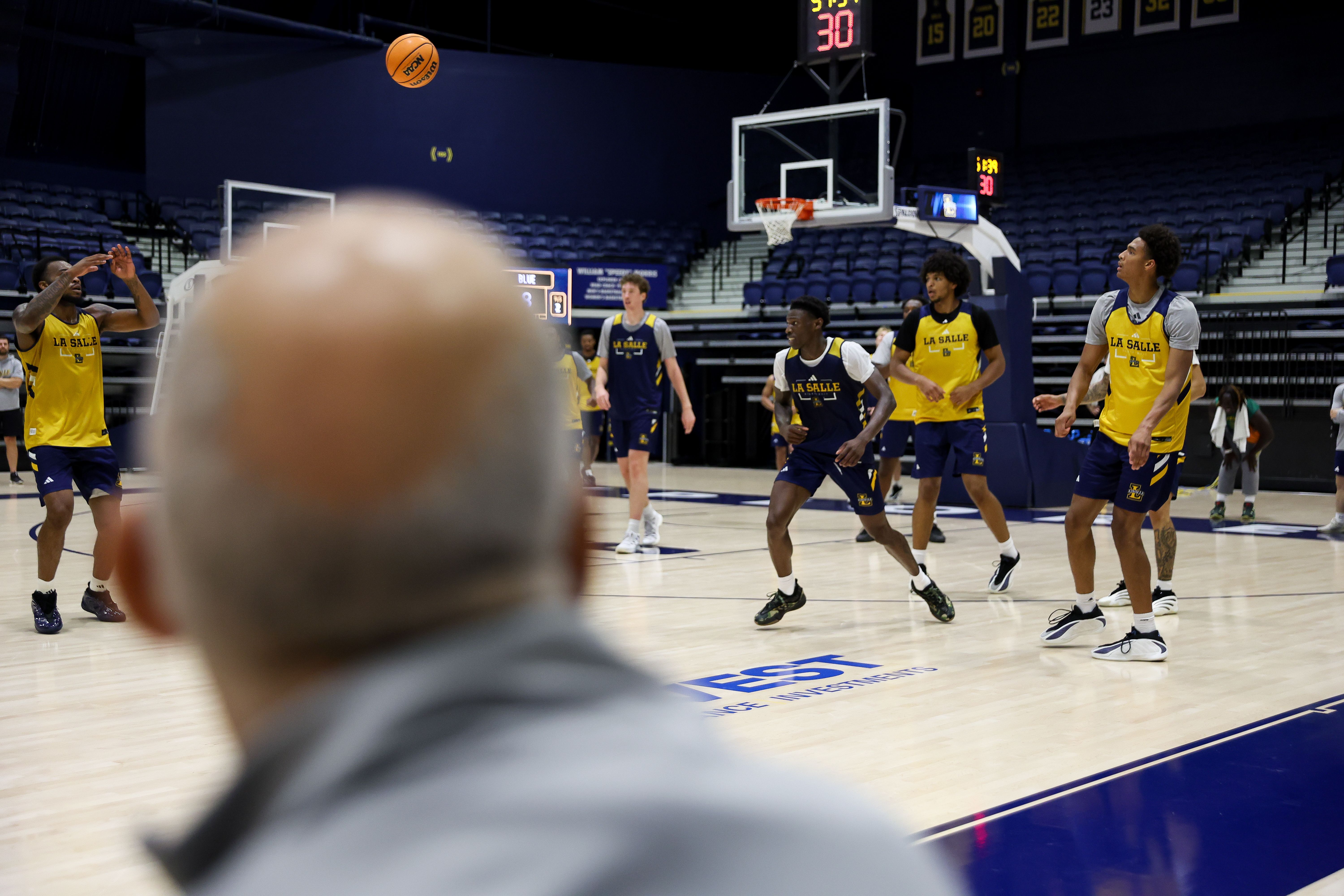
Mihalich has been with the university since Dunphy brought him aboard. He’s at all of La Salle’s home games and practices, doesn’t skip a coaches’ meeting, and is always unafraid to share his thoughts.
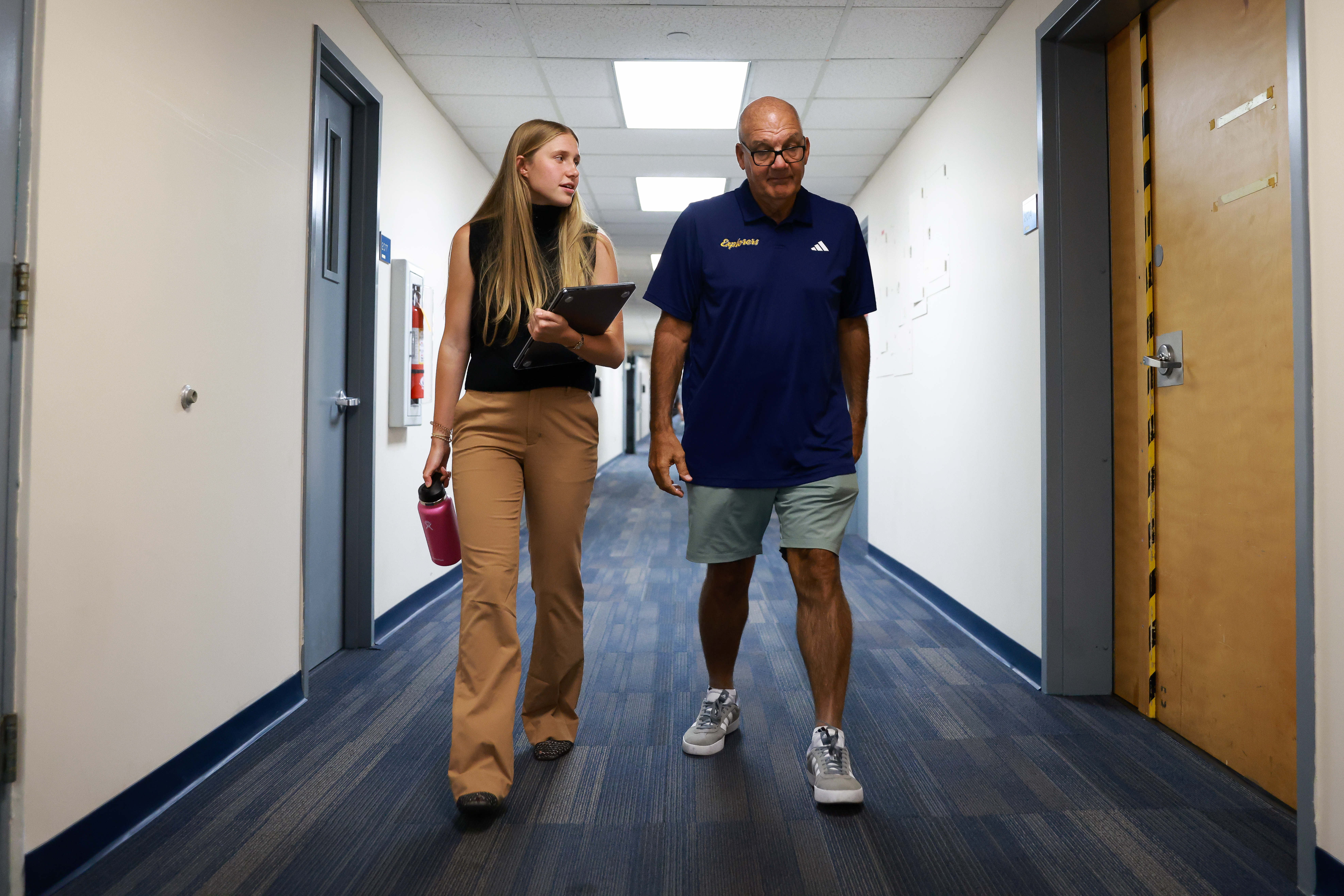
After his day is done, typically around 6 p.m., Mihalich heads to theschool’s speech therapy clinic. Those who’ve worked with him say the progress he’s made is rare, given the severity of his brain injury.
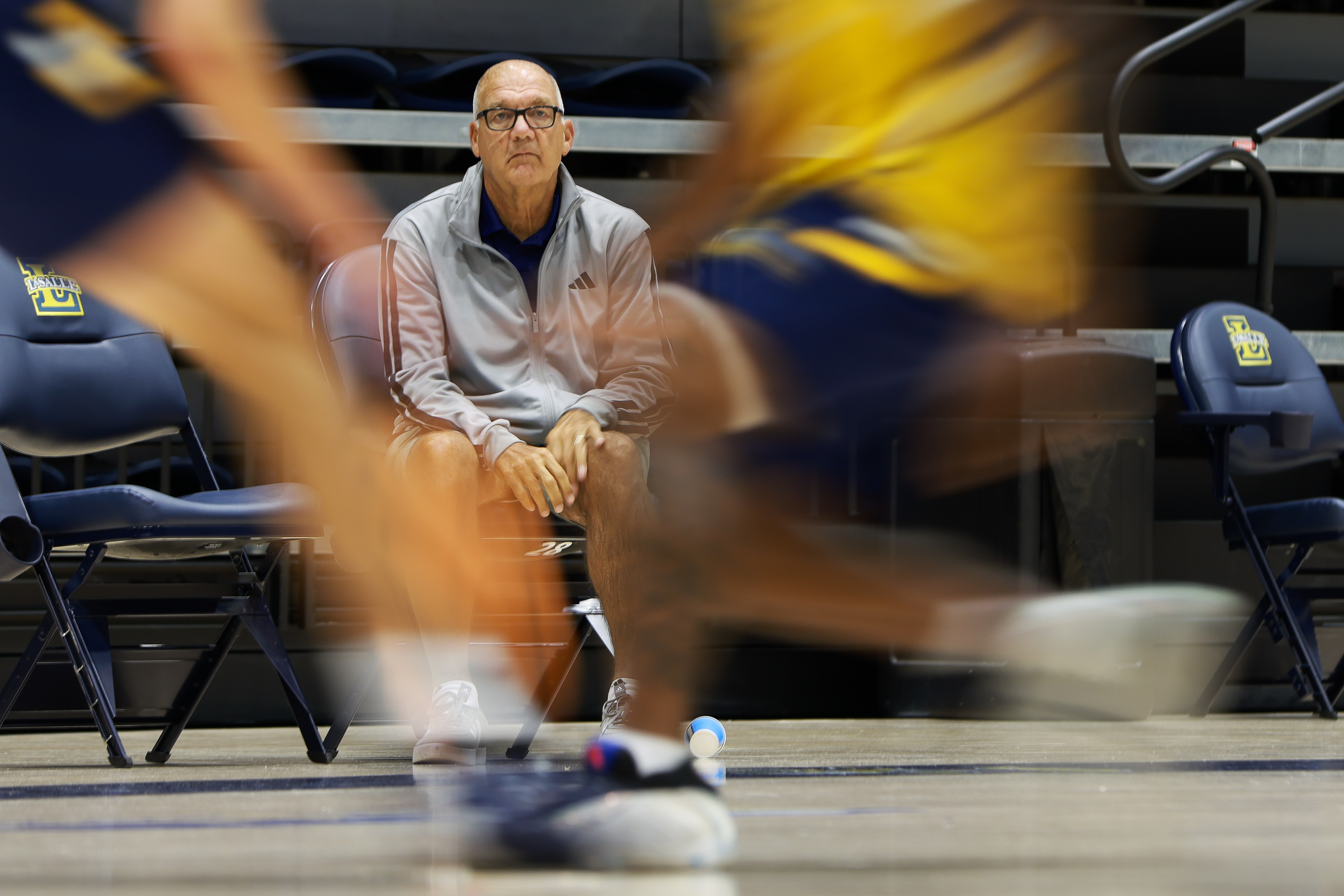
Joe Mihalich looks on from the bench during a La Salle practice earlier this month. Isaiah Vazquez / For The Inquirer
And he’s not finished yet.
“It’s kind of like, ‘You can’t do this?’“ Mihalich said. ”Well, watch me. Watch me.”
Born to be an Explorer
Mihalich was introduced to 20th and Olney at 2 weeks old. His father had gotten a job as a philosophy professor, moving the family from Washington, D.C., to Philadelphia.
They lived on Chew Street in Mt. Airy, a short drive from La Salle. As a child, Mihalich spent most of his time on campus. This remained true until he graduated from the university in 1978.
Fourof his six siblings were students at La Salle; so was Mary, who would become Joe’s wife, and worked as a water girl for the men’s basketball team.
Before Mihalich joined that team, he followed it religiously. The La Salle College High School student regularly attended games at the Palestra. His favorite player was Dunphy, a fellow point guard who made smart decisions and played steady defense.
Mihalich joined the Explorers in 1974 as a walk-on, receiving a basketball scholarship the following semester. After graduating, he took a coaching job at DeMatha Catholic High School in Maryland, where he served under future Hall of Famer Morgan Wootten.
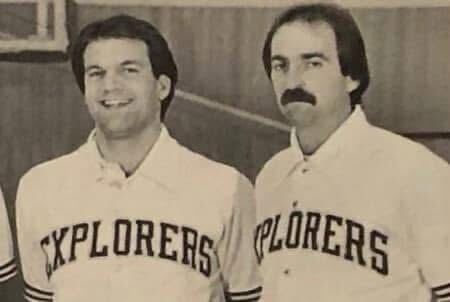
Joe Mihalich (left) and Fran Dunphy were La Salle alums who bonded as members of the Explorers’ coaching staff.provided by La Salle University
In 1981, Mihalich was hired as an assistant for Lefty Ervin at La Salle. Dunphy joined him in 1985, and both men stayed on when Speedy Morris became head coach in 1986.
Together, the two young assistants worked 10- to 12-hour days out of the second floor of Hayman Hall, watching film and meeting with recruits.
They embarked on long road trips to evaluate high school players in Pittsburgh, where the Five-Star Basketball Camp was held. This gave them ample time to get to know the Pennsylvania Turnpike and each other.
Over those 300-plus mile drives, Dunphy and Mihalich mused about someday leading a Division I men’s basketball program.
“I wonder what it’s like,” Dunphy said. “I wonder what kind of pressure the head coach is under, that we’re not seeing. We had great faith in both Lefty and Speedy, when we were together.
“But also knowing that if we ever got that opportunity, we might do it our own way.”
They eventually earned their chance, hundreds of miles apart. Dunphy was named head coach at Penn in 1989, and Mihalich was hired by Niagara University in 1998.
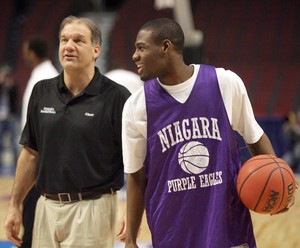
Joe Mihalich (with guard Tyrone Lewis, a product of Truman High in Bucks County) imported an exciting brand of offense when he arrived at Niagara.
The Mt. Airy native immersed himself in the community, going so far as to become a diehard Buffalo Bills fan. He developed a quick-paced, efficient offense, which frequently ranked among the top 75 in the country in offensive rating, according to KenPom.
But even from Western New York, Mihalich never lost touch with his roots. He’d recruit primarily from where he was born (D.C.) and where he was raised (Philadelphia), often targeting kids who were overlooked by the Big 5.
At Niagara, they flourished.
“He would develop them like crazy, from their freshman year to their senior year,” Mihalich’s former assistant Colin Curtin said. “And they would look like totally different players.”
Curtin, a former student manager for Morris at St. Joe’s Prep, has worked with Mihalich for 17 years. When the head coach left Niagara for Hofstra in 2013, he brought Curtin with him, as an assistant.
Mihalich became the second-winningest coach in the school’s history with a record of 154-102. His greatest season there was his last.
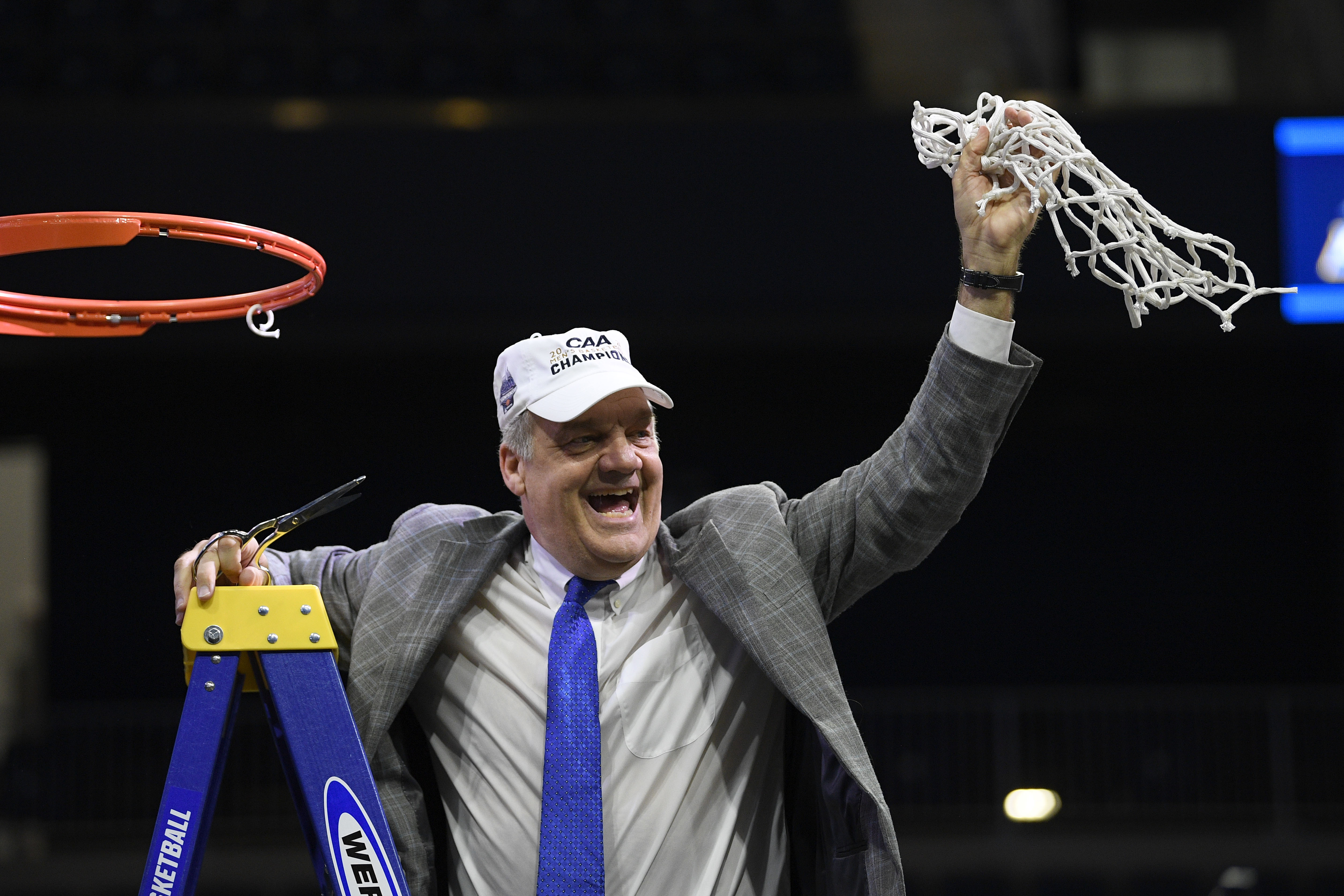
In 2020, Mihalich led Hofstra to its first NCAA Tournament berth since 2001. After winning the CAA title, he climbed high atop a ladderwith a pair of scissors, making the final cut of the net.
Hofstra coach Joe Mihalich holds up the net after cutting it down following the team’s win over Northeastern in the 2020 CAA final. Days later, the world shut down because of the COVID-19 pandemic and the Pride would miss out on a chance to compete in the NCAA tournament. Nick Wass
But Hofstra never got its moment. Two days later, the tournament was canceled due to the pandemic. Five months after that, Mihalich was at home when he got a call from Mary, who was traveling to Ocean City.
He tried to speak but wasn’t able to. The line went dead. She called Curtin, who found the coach standing in his driveway.
He asked if Mihalich was alright.
“I said, ‘Shake your head, yes or no,’” Curtin recalled. “And he shook his head no.”
An unexpected homecoming
While his team embarked on remote summer workouts, Mihalich was placed on a medical leave. He connected with a local speech language pathologist, Alison Durkin, and began to meet with her in the fall.
The coach had been diagnosed with both aphasia, a language disorder, and apraxia, a motor speech disorder. He also lost some mobility on his right side, which prevented him from writing with his right hand.
Alison Durkin (left) with Joe Mihalich and his wife, Mary.Courtesy of Alison Durkin
Mihalich had spent the last four decades amid a symphony of sneakers and basketballs and whistles. In environments that were exciting and fast-paced and energetic.
Now, life was quiet and slow, in the most literal sense. He and Durkin started their sessions with simple, binary questions. Then, they’d count numbers, recite days of the week, and months of the year.
When Mihalich did speak, he was encouraged to over-enunciate. Buffalo Bills became “Bu-fa-lo Bills.” Niagara Falls became “Ni-ag-a-ra Falls.”
They had some initial discussions about a return to his previous role at Hofstra, but decided that was not an option.
“Not only was the job itself linguistically demanding, because you’re producing language on a stage,” Durkin said. “You’re yelling at people. You have seconds to speak. I mean — very demanding.
“And then on top of that, there’s really no reasonable accommodations that could be implemented to make that feasible. So it was definitely not an easy thing.”
Mihalich wasn’t involved in the day-to-day in his AD advisory role, and didn’t interact with players and staff; a choice he’d made himself, to ensure he wouldn’t overstep.
Joe Mihalich goes through a speech therapy session with La Salle student and speech-language pathologist Ella Verello earlier this month. Isaiah Vazquez / For The Inquirer
The coach described those years as “horrible.” He sorely missed the rhythms of his previous life. But he and Durkin kept working, unaware of whether he’d ever grace a court again.
The speech language pathologist introduced basketball terminology to keep her pupil engaged. Instead of reciting “three-pointer” or “rebound,” Durkin would have Mihalich describe exactly what those activities were.
“He knows what boxing out is,” she said, “but could he produce the language to explain it to someone who did not know? That’s a hard task.”
The exercise inadvertently set him up for an opportunity to come. In April 2022, Dunphy called Mihalich to ask if he’d be his assistant at La Salle.
Mihalich was limited in what he could say. But one word came through.
“‘Wow,’” Dunphy recalled. “And he repeated it dozens of times.”
Mihalich returned to campus that summer, with an iPad in hand, to jot down thoughts during practice. Dunphy’s staff quickly learned that they wouldn’t need to actually talk to communicate.
Joe Mihalich (right) was by Fran Dunphy’s side when Dunphy coached his 1,000th game in 2025. Charles Fox / Staff Photographer
One of the assistant coach’s first suggestions was to implement a continuity offense, with players starting in the same spots, and flowing to different set plays.
Mihalich couldn’t vocalize this. So, he picked up a marker with his less dominant, left hand, and started scribbling on the white board in the men’s basketball office, using a language any coach could understand: Xs and Os, dotted and zigzagged lines.
Then he directed his cohorts to the gym, to demonstrate.
“And he goes, ‘Come on, upstairs! Upstairs!’” recalled former La Salle assistant coach Mike Doyle. “‘Alright, let me put my basketball shoes on.’”
If there was one aspect of the sport Mihalich emphasized less, it was defense. His teams at Hofstra and Niagara were known to run and gun. The former head coach didn’t want players expending too much of their energy by guarding an opponent.
Dunphy was much more defensive-minded. So, every now and then, Mihalich would yell “Zone!”
“And then, as soon as we’d go zone, somebody would make a three-point shot, immediately,” Dunphy said, “and I’d say, ‘All right, that’s it. That’s enough.’”
Joe Mihalich’s work on his speech continued at La Salle, where speech-language pathologist Ella Verello (left) is among the team assisting the coach’s therapy. Isaiah Vazquez / For The Inquirer
Not long after Mihalich joined the Explorers’ staff, Wendy Silverman, who ran Hofstra’s speech-language hearing clinic, reached out to La Salle on the coach’s behalf.
Mihalich began to take weekly sessions with graduate students at La Salle’s clinic, while working with Durkin remotely, on Zoom. The strategies he learned — speaking slowly, over-enunciating — he’d then bring to the court.
By the end of the 2022-23 season, staff and players could hear a marked difference.
Christine Cahill, the school’s director of academic support for student-athletes, sat next to Mihalich during practice.
“And I told him, it went from like 0 to 70%,” she said, “that first year.”
‘A reason to live’
When Dunphy retired in February 2025, Mihalich was unsure of what he would do next. He initially told Curtin that he wanted to get out of coaching.
But after Darris Nichols was hired at La Salle, his calculus changed. Mihalich had worked with Nichols’ brother, Shane, at Niagara and Hofstra. Curtin would be joining the Explorers’ staff, too.
Joe Mihalich had a connection to coach Darris Nichols and was kept on when Nichols was forming his La Salle staff in 2025. Isaiah Vazquez / For The Inquirer
So, Mihalich decided to give it another go, and Nichols was more than receptive. He saw the former head coach not just as a connector between generations, but someone he could learn from.
“Coming into a new program, he’s helped me navigate it,” Nichols said. “It’s great to have him around.”
Mihalich became an active participant in scouting and recruiting meetings. Just as he had with Dunphy, he started recommending offensive strategies (and of course, more zone).
His speech has progressed to the point where he can now work one-on-one with players. Last year, Mihalich developed a bond with junior guard Rob Dockery, who led La Salle in points, rebounds, and steals.
Dockery’s weakness was his jump shot. His mechanics weren’t consistent, mainly because he wasn’t practicing it enough. Throughout the offseason, the former head coach would routinely text him, reminding the guard to get back in the gym.
“Repeating that same shot, over and over again,” Dockery said. “That’s what he told me. Stick to the same shot.”
Mihalich is still going to speech therapy every week, both at La Salle and with Durkin, and the sessions can be laborious. There are moments when he needs to repeat himself one, or two, or even three times to get his point across.
“But I am here,” he said. And his life is starting to look like it once did. The former head coach wakes up every morning, and drives to the Mt. Airy Dunkin’, where he’s greeted as “Mr. Joe.”
Joe Mihalich has reconnected with basketball and remained a presence at his alma mater for the past four years. Isaiah Vazquez / For The Inquirer
He picks up his coffee — large decaf, hot, with cream — and brings it to the arena, leaving behind a trail of Styrofoam cups.
And for two hours, he sits and watches from his chair, as basketball chaos unfolds around him. A lesser man might see a career cut tragically short. But Mihalich sees something entirely different.
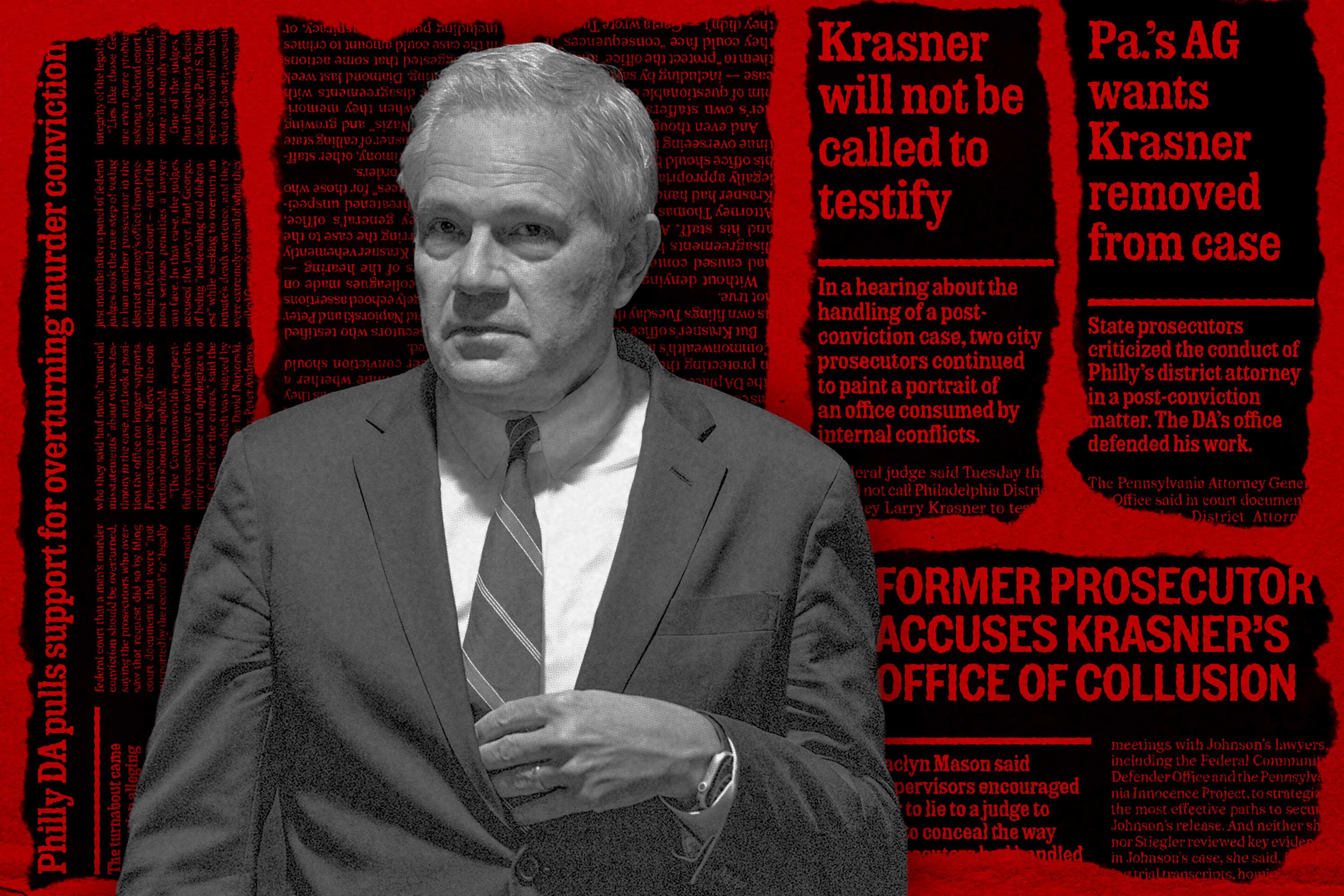
Philadelphia District Attorney Larry Krasner’s office has been roiled by controversy in recent months after a federal judge said Krasner and one of his supervisors may have committed crimes while overseeing a post-conviction case.
It could be months — or longer — before it’s clear if federal prosecutors agree that Krasner should face charges including conspiracy and obstruction of justice.
story continues after advertisement
But the events that led to that striking conclusion from U.S. District Judge Paul S. Diamond were laid out in testimony that unfolded in his courtroom this summer, as well as in a 40-page memorandum he filed in the case in September.
Krasner has disputed Diamond’s findings, and said he plans to file an appeal of the judge’s ruling, which also barred Krasner and one of his supervisors, Matthew Stiegler, from participating in the underlying case.
Here’s a recap of how the situation evolved from a routine legal matter into a contentious saga that could lead to consequences for the city’s top prosecutor.
In 2009, Dennis Johnson was convicted of second-degree murder after a jury found that he fatally shot Kenyatta Smith two years earlier during a robbery outside a North Philadelphia convenience store.
The case was largely built on the testimony of eyewitnesses, whose credibility Johnson sought to dispute at trial. Even after being sentenced to life in prison, Johnson maintained he did not commit the crime.
He filed several unsuccessful appeals in Pennsylvania courts. Then, in 2015, he filed a petition seeking to overturn his conviction in federal court. The case landed in front of Diamond.
story continues after advertisement
2022
The case is assigned to Jaclyn Mason
Prosecutors opposed Johnson’s petition for years. But in 2022, they changed course when it was assigned to a new assistant district attorney: Jaclyn Mason.
Mason had only joined Krasner’s office a few months earlier, and Johnson’s case was her first in her new role in the federal litigation unit. Although she had extensive experience as a lawyer — working primarily on patent and trademark cases — she’d never before worked as a criminal litigator, and she said she received almost no training in the DA’s office before being asked to handle cases.
Her boss was Stiegler, who had a controversial history working for Krasner. Over the course of a few years, he’d joined and left the office twice. And in one of those stints, nearly everyone under his supervision requested a transfer. One prosecutor later told Diamond that Stiegler did “not have the best reputation” among his colleagues.
When it came time to decide how to handle Johnson’s petition, Mason said, Stiegler had already made up his mind. Although he’d done nothing to independently review Johnson’s claims, Mason said, Stiegler had conferred with Johnson’s attorneys — including the Pennsylvania Innocence Project and federal defenders — and decided his conviction should be reversed.
“Matt told me: ‘If it’s good enough for the Innocence Project, it’s good enough for me,’” Mason said later. “The decision to concede had been made, and then I was his pawn.”
Mason also acknowledged that she reviewed almost nothing before submitting and signing off on her brief recommending Johnson’s conviction be thrown out. But at that point, she said, she believed she had to follow her boss’ orders.
“I didn’t know anything enough to push back,” she later testified. “I’d been at the office for four months — I’d never done this kind of work before.”
Once Mason did actually draft the brief, she said, Stiegler offered edits, and all of them made it into the final document. Another supervisor, Nancy Winkelman, the onetime head of the Law Division, also made suggestions that were included in the final brief, Mason said.
Mason’s name, however, was the only one that ended up on the document.
May 2026
Discovery of errors
A federal magistrate, Judge Lynne A. Sitarski, eventually agreed that Johnson’s conviction should be overturned, based in part on the findings in Mason’s brief.
But Sitarski’s decision was not binding — the final call would fall to Diamond. And in May, rather than accepting Mason’s conclusions, he decided to schedule an evidentiary hearing to hear testimony and weigh the pieces of evidence before issuing a ruling.
As the hearing approached, Mason reached out to a group of supervisors in the law division to prepare: Katherine Ernst, Steven Wildberger, David Napiorski, and Peter Andrews. And Ernst said when she reviewed Mason’s brief, she discovered it contained “significant errors” — issues that, in her view, contradicted the notion that Johnson’s conviction should be overturned.
Asking a judge to do so — and admitting a document was filled with mistakes — is a significant step for a lawyer to take.
But Ernst said the office had no choice: Lawyers are duty-bound to be honest with courts, and there was no ethical way to proceed with a document containing such errors.
The supervisors first decided to break the news to Mason. And in a meeting, they said, they asked her to sign on to the withdrawal with them.
But Mason declined. She told the supervisors the situation was Stiegler’s fault — and that his downfall was “a long time coming.” The supervisors later said she didn’t offer more specifics, and that at that point, none of them knew the extent of Stiegler’s role in the brief’s preparation.
Mason, however, felt the supervisors were setting her up to take the fall. She decided to resign, and said in her resignation letter that Stiegler had “used me to further his personal agenda” — and that he should be forced to “submit and swear in an affidavit that he erred and that he was responsible for what was filed in this case.”
She said she was prepared to stay until the end of June to wrap up any outstanding obligations, but that Krasner’s chief of staff, Jennifer Lin, told her that wouldn’t be necessary. Mason’s email was cut off, she said, and her badge granting her access to the office was disabled.
story continues after advertisement
Early June 2026
Mason resigns, and Stiegler tries to assign blame to her
After Mason resigned, her former supervisors began drafting the motion to withdraw her brief.
Stiegler, meanwhile, took on a different assignment: Seeking to blame Mason for the errors.
According to Ernst, in the days after Mason quit, Stiegler told colleagues she must have “purposefully inserted false facts” into her brief, and that it was “100% her fault and 0% his fault.”
And he came up with a plan to try to support that narrative, proposing that her colleagues review all of her work to find other cases with errors, so that the office could file a brief with Diamond casting Mason as “an ADA who went rogue, basically.”
The supervisors said no. Beyond viewing the proposal as inappropriate, Ernst said, she also pointed out to Stiegler that it would not help his reputation to show the court that one of his employees made consistent mistakes.
But Stiegler persisted — and even proposed the idea to Krasner.
And during a meeting on June 5, during which the supervisors were seeking Krasner’s approval on the motion to withdraw Mason’s brief, the DA repeated Stiegler’s proposal, describing it as “a really good idea.”
The supervisors again said no. Wildberger told Diamond he found the notion “tremendously inappropriate.”
Diamond, in his September memorandum, said it was more serious than that.
“In urging that others lie to me,” he wrote, “Stiegler might be liable for obstruction of justice.”
He also said Stiegler’s testimony about the episode contained enough omissions and “falsehoods” that it “may well amount to perjury.”
And he said Krasner’s attempt to work with Stiegler and urge others to present a false narrative to Diamond “might amount to criminal conspiracy.”
In the same June 5 meeting, meanwhile, Krasner did approve the supervisors’ motion to withdraw Mason’s brief, which they filed that afternoon.
But another dispute emerged — one that would linger well beyond that meeting.
Late June 2026
A potential conflict of interest
In Ernst’s view, the internal turmoil over the case — particularly the attempts to assign blame about what happened — had compromised the office’s ability to handle Johnson’s petition appropriately.
The internal discussions had become consumed by the office’s inner-workings, Ernst said, and not the merits of Johnson’s appeal, creating, in her view, a conflict of interest.
As a result, Ernst said, she told Krasner the case should be referred to the state attorney general’s office, the typical process if the DA’s Office has a conflict.
But Krasner disagreed.
In the supervisors’ telling, Krasner was consistently and sometimes angrily opposed to sending the case to state prosecutors. During meetings over the next several weeks, the supervisors said, Krasner repeatedly expressed disdain for the people who worked there, describing them as “Nazis” and saying he “hated” them.
The views are not new; Krasner, during his first week in office in 2018, fired 31 prosecutors, some of whom went on to join the attorney general’s office. And in 2019, Krasner said some people in his office had jokingly come to describe the AG’s Office as “Paraguay,” a South American country where Nazis took refuge after World War II.
Beyond the war criminal reference, however, the supervisors said Krasner expressed other reasons for opposing the referral.
One was that he wanted his staff to “protect the office,” the supervisors said. And according to Ernst, Krasner said: “We need somebody in the room so that [we] can control the proceedings.”
Ernst said she pushed back, telling Krasner: “A person can’t both protect the office and competently handle this case.”
But Krasner was insistent, they said. And he told them he was consulting with legal ethics experts — whom he did not name — to ensure there was no issue with keeping the case in-house.
Over the next several weeks, the supervisors said, they began putting their thoughts in writing. That practice led to additional disputes on June 24.
That day, according to Napiorski, he emailed Krasner a draft memorandum outlining the various issues the supervisors believed created a conflict. Napiorski said he emailed it to Krasner’s personal and work e-mail addresses because Krasner rarely responds to messages from his government account.
Two hours later, the supervisors said, an email response came from Lin, Krasner’s chief of staff. But the message opened by saying that Krasner had written it, and that he took issue with many of the assertions in the group’s memo.
In a meeting that afternoon, the supervisors said, Krasner also said he was angry that the supervisors had sent the memo by email because doing so created a record that could be discoverable in potential litigation.
The next day, Napiorski said, he spoke with his own ethics expert, who agreed that the case should be referred to another office. As a result, he said, he and Wildberger brought Krasner another new piece of writing: A draft of a letter that would refer the case to state prosecutors.
Krasner was “apoplectic,” Wildberger said. And he went on to threaten “consequences” for anyone who told Diamond about the conflict discussions — a reference that both Wildberger and Napiorski took to mean losing their jobs.
The two men called Ernst, who said the threat made it clear: They needed to recuse themselves from the case.
Ernst and Wildberger filed a memo before Diamond withdrawing their appearances that day. Napiorski and Andrews followed suit a day later.
Diamond, meanwhile, said in his September memo that Krasner’s threat to fire people who were seeking to tell the truth in court “could amount to obstruction of justice.”
July 2026
Examining attorney conduct
On July 17, Diamond held an evidentiary hearing in the case — which he decided to limit to issues concerning attorney conduct, rather than the merits of Johnson’s petition. He said he would address that later.
Mason took the stand first, describing what she viewed as an attempt to scapegoat her on Stiegler’s behalf. She also accused the law division supervisors of urging her to lie to Diamond — something the supervisors would later deny.
Stiegler also testified, saying he believed Mason had — and should have — conducted a full investigation into Johnson’s claims before filing her brief.
Behind the scenes, meanwhile, turmoil was continuing in the office.
On July 20, Wildberger stepped down from his supervisory role in the law division, later saying he did so because he had “lost faith in the administration of the Philadelphia District Attorney’s Office.”
And after Mason accused the supervisors of wrongdoing from the stand, Ernst and Wildberger filed a more detailed memo with Diamond about why they had stepped off the case, including by saying that Krasner had asked them to “protect the office” and potentially violate their ethical oaths.
Three days later, Krasner responded with a filing of his own, saying Ernst and Wildberger’s assertions were both unauthorized and “ill-informed.”
And although he did not — and has not — denied saying he wanted to “protect the office,” he said in a later filing that he “plainly did not appreciate [his subordinates’] repeated, unsolicited, and wavering advice” to refer the case to state prosecutors, and that their recommendation was “inexpert and legally unsupported.”
He also said he’d hired an expert who agreed with him — Bruce Green, a professor at Fordham Law School — and later attached a memo written by Green to one of his filings. Diamond would go on to call Green’s memo “a disorganized mess and largely useless.”
In addition, Krasner said, as a measure of extreme caution and to ward off any suggestion of a potential conflict, he hired an outside attorney to handle the case on his office’s behalf: Jean Peters-Baker, a longtime prosecutor from Missouri who previously led the prosecutor’s office in the county that includes Kansas City.
Diamond later disqualified her, saying that because Krasner had been hampered by the conflict issues months before he reached out to Peters-Baker, his decision to bring her aboard was invalid.
story continues after advertisement
September 2026
‘Often contradictory, evasive, or outright dishonest.’
All of the law division supervisors went on to testify before Diamond, and he said in his Sept. 16 memorandum that he found their testimony, as well as Mason’s, “compelling and corroborated by contemporaneous documents.”
Although Mason had accused her supervisors of encouraging her to lie in court, Diamond found that they hadn’t done so, saying they’d sought to truthfully tell him about the issues in her brief, and that her “understandable dismay caused her to misunderstand” their intentions.
The judge took a dimmer view of Stiegler, calling his testimony “often contradictory, evasive, or outright dishonest.”
And although Diamond did not call Krasner to testify about the saga, he nonetheless criticized the DA in his memorandum for not taking the stand, saying Krasner “chose” not to testify, and noting he didn’t submit an affidavit to offer his version of events.
Diamond’s decision to alert federal prosecutors about the case, and say they should investigate potential crimes by Krasner and Stiegler, was practically unheard of, legal experts said. The U.S. Attorney’s Office has declined to comment, and any investigation it might pursue would likely take months.
Johnson’s petition, meanwhile, remains in limbo. Diamond said the district attorney’s office could continue to litigate it — but with Krasner, Stiegler, and the law divisions’ supervisors removed from the case, it was not clear who might do so.
The Eagles are headed to Chicago, and Birds fans are expected to follow.
If you are flying into Midway (or O’Hare if you’re unlucky) for the game, here’s everything you need to know about the Windy City:
Where do I find fellow Birds fans?
You are bound to bump into some fellow Eagles fans this weekend by coincidence.
However, you also can plan to see them at one of the many events held by Eagles fan groups. The Green Legion, which hosted events last weekend in Nashville, is now coming to the Windy City. On Sunday, the group is holding a pep rally at Hopsmith Tavern from 7-10 p.m. The pep rally will feature an open bar and light food. Before kickoff on Monday, the group is hosting a tailgate at Fatpour McCormick: Ultimate Chicago Sports Bar at 2:30 p.m. Tickets are limited for both events and can be found on the Green Legion’s website.
Philly Sports Trips is also hosting two meetups. From 4-7 p.m. on Sunday, Birds fans can enjoy an open bar and a live DJ at Rebel & Rye restaurant. Former Eagles Hollis Thomas, Todd Herremans, Tra Thomas, and Clay Harbor are slated to attend. On Monday, the group is holding a tailgate at 1914 S. Wabash Ave. — a short walk from Soldier Field. Tickets can be purchased on Philly Sports Trips’ website.
There are several Philly-themed bars and restaurants in Chicago. A fan-favorite of the Inquirer staff is Philly’s Best — a cheesesteak spot which one sports editor frequented after graduating from college. Philly’s Best is open until 1 a.m. on Monday, so you can get a cheesesteak to celebrate the Birds’ win (or to indulge in your sorrows).
If you are looking for a bar, The Reveler in Roscoe Village is a popular gathering spot for Birds fans living in Chicago. The bar hosts Eagles watch parties every weekend and even plays the team’s fight song after each score. Of course, they also have a cheesesteak on the menu.
Where can I see the whole city?
If you’re scared of heights, skip this part.
Consider checking out CloudBar — Chicago’s highest bar. CloudBar is located on the 94th floor of the 360 Chicago Observation Deck. The building, which was previously named the John Hancock Center, is located in Chicago’s Magnificent Mile district.
Unlike Philadelphia’s swanky SkyHigh bar on the 60th floor of the Four Seasons Hotel, CloudBar is not high end. The bar has no dress code, so feel free to wear that old Zach Ertz jersey you dug out of the closet. Tickets for CloudBar can be purchased on their website.
If you want to venture into enemy territory before or after the game, consider The Staley.
The bar is owned and operated by former Bears defensive end Israel Idonije and is within walking distance of Soldier Field. Like it does every week, the bar is hosting a watch party before and during Monday night’s game.
Another member of The Inquirer’s staff suggests to have a pint at Black Barrel Tavern located in the West Loop neighborhood. At either spot, just be prepared for some comments on your choice of kelly Green attire. Also, get ready to hear lots about “Da Bears.”
What are the classic tourist spots?
Everyone loves the idea of not being a tourist. Sometimes, it’s OK to be one. Here are the top tourist spots in Chicago:
It wouldn’t be a visit to Chicago if you did not visit Millennium Park and take a selfie with “The Bean.” The statue, which actually is called Cloud Gate, was finished in 2006 and quickly became one of the landmarks synonymous with the city.
If you have some spare time hopping from bar to bar with fellow Birds fans, take a scenic stroll down the Chicago Riverwalk. The path spans multiple neighborhoods and even offers kayak rentals. The architecture boat tours are really cool, too.
Like Ferris Bueller, have an afternoon at The Art Institute of Chicago. The museum currently has an exhibition on the art of Mary Cassatt. The painter, who lived from 1844 to 1926, actually received her formal training in Philadelphia. Maybe she’d be a Birds fan, too.
Unfortunately, the Cubs are in Boston this weekend, but still check out Wrigleyville. The neighborhood surrounding the famed ballpark boasts famous bars and restaurants like Murphy’s Bleachers, Sluggers, and The Cubby Bear.
The basement on Almond Street didn’t have much, but it had one of those old couches that every basement needs.
“The one that you know is comfy just by looking at it,” Quinn Sullivan said.
The Bridesburg basement, half of which was unfinished, became a clubhouse for the four Sullivan brothers. The miniature soccer net was all Quinn, Declan, Ronan, and Cavan needed to fill an afternoon. Cavan, the youngest of the four, did whatever he could to keep up as he played in a diaper and learned to volley a ball with both feet when he was just 18 months.
It was impossible to know that the seeds of Cavan’s career — perhaps the most promising in the history of American soccer — were being planted on Almond Street where Brendan and Heike Sullivan never told their sons that there was “no ball in the house.”
The boys caromed soccer balls off the living room radiator, played football in the kitchen, broke light bulbs in the basement, and got into some scraps. The parents were just letting their boys play, their mom said.
But there was something different about the toddler who knew how to catch a football.
“Like you throw it at him and he has his hands up,” Brendan said. “He’s not catching with his chest. He’s catching it with his hands. He caught a baseball with his glove. So you know but you don’t know the extent to how different it is.”
The soccer world soon saw what the Sullivans saw in their basement.
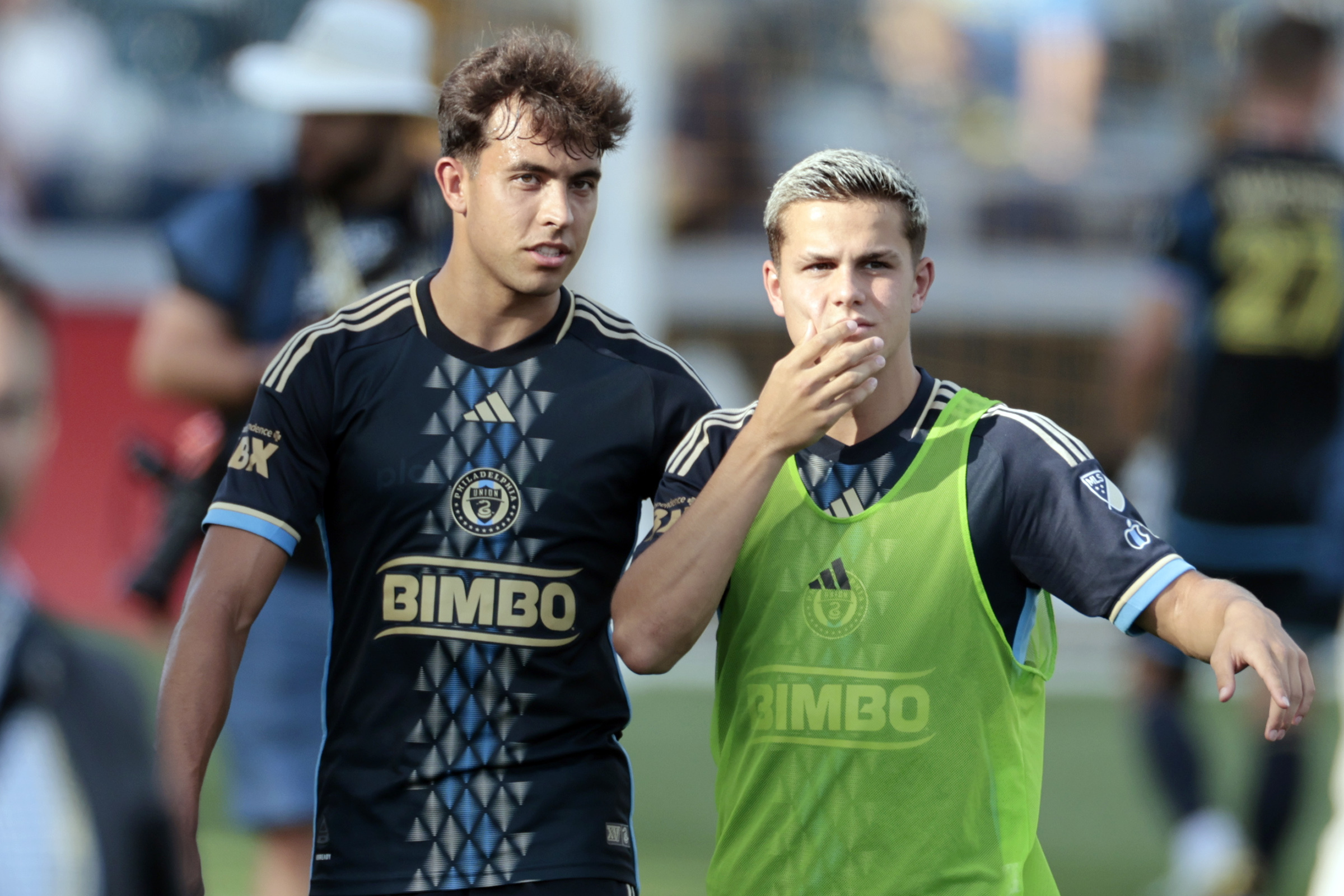
Cavan was deemed a prodigy when he was 6 years old and European powers scouted him before he was a teen. He signed his Philadelphia Union contract when he was 14, giving him the chance to play professionally alongside Quinn. He has an agreement to join England’s Manchester City next year when he turns 18, and is training this week for the first time with the senior U.S. men’s national team.
Even more? He’s a safe bet to play for the U.S. in the 2028 Olympics and then the 2030 FIFA World Cup.
The kid from Bridesburg could be the future of American soccer. It started on Almond Street.
“My dad would be in the net and we would just shoot on him all day, whenever we got the chance,” Cavan said of that old basement. “You fall in love with the game in moments like that.”
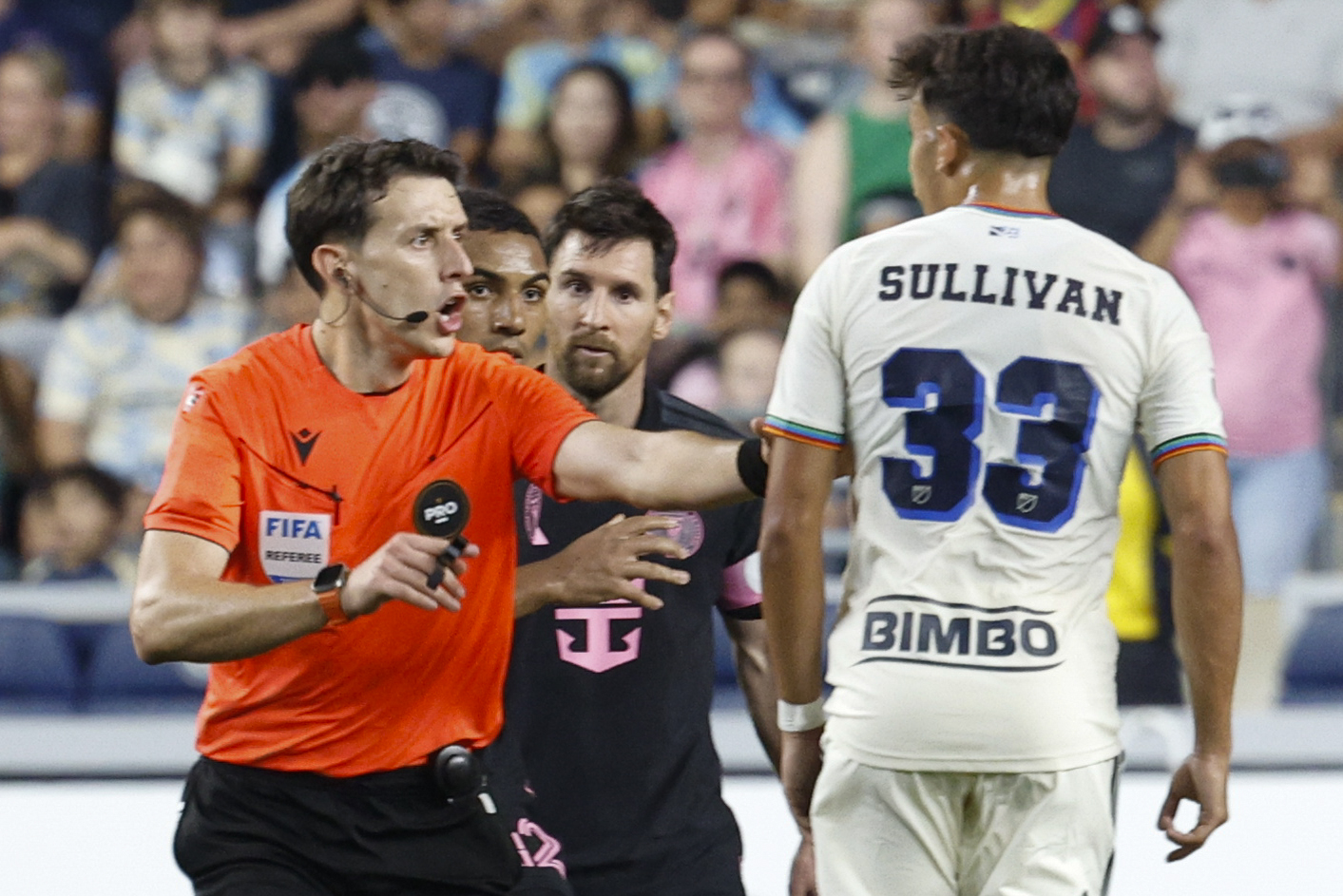
The Union’s Quinn Sullivan has words with Miami’s Lionel Messi during their match on Aug. 19 at Subaru Park.Steven M. Falk / For The Inquirer
No fear
It happened so fast that the Sullivans couldn’t really tell what happened from their seats at Subaru Park. Did Cavan get punched? Did Quinn just go nose-to-nose with Lionel Messi?
Then they watched the replay of the fracas between the Union and Inter Miami, a skirmish that felt like the ones the parents — who met as college soccer players at Penn — used to break up in the backyard.
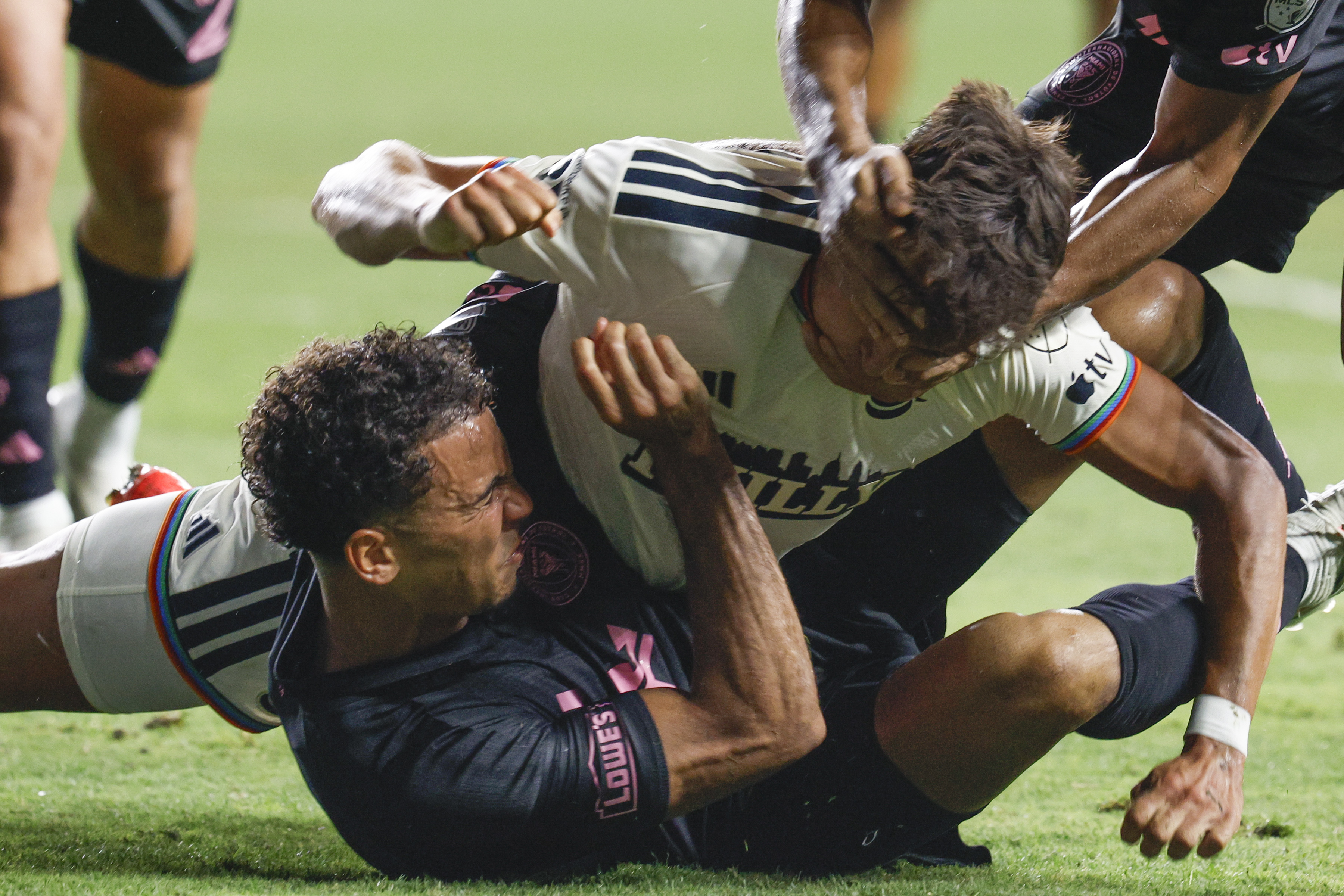
A Miami player tried to step over a fallen Quinn — “You got the wrong guy, buddy,” his dad said — before Quinn hooked his leg and took him to the ground like a UFC fighter.
A swarm of Miami players gathered around Quinn as Cavan sprinted across the field like his brother’s tag-team partner. Quinn used to spend hours on his computer cutting up Cavan’s game tapes and posting the highlights to YouTube. That was support, Quinn said. So of course the little brother had his back last month.
“It’s like ‘You better go in,’” said 18-year-old Ronan, who plays at St. Joe’s with his twin brother, Declan. “He would’ve gotten s— if he didn’t. It’s a lot about where we came from. That’s Northeast Philly right there.”
Cavan squared up against a 25-year-old foe who tried to throw a punch at the 16-year-old boy. Both players were sent off and Messi then slapped Sullivan in the head, appearing to reprimand him for taking down the Miami player. Quinn Sullivan, who grew up idolizing Messi, charged his hero and pushed his face against his.
“I was raised in Philly and you don’t take disrespect,” Quinn, 22, said. “It might sound corny to some people or cliche, but I didn’t like him touching my face and I’m not going to be the guy who falls down. I had to make sure he knew that I didn’t think it was cool.”
The Union’s Quinn Sullivan wrestles with Miami’s Ian Fray on Aug. 19 at Subaru Park.Steven M. Falk / For The Inquirer
It was Cavan’s footwork, speed, and skill that drew the world’s attention. But it is his fearlessness — the mentality that allowed a 16-year-old to run last month toward the fire — that sets him apart.
“There’s a little bit of a flair, a confidence, an arrogance,” said Taylor Twellman, the former U.S. player who now broadcasts MLS games on Apple TV. “But there’s also a real urgency to win, to compete. For a 16-year-old kid, I can see that there’s a little bit of a dog in him. You know what I mean?”
And it’s all about where he’s from. His grandfather, Larry, grew up in Kensington and played at North Catholic. His dad grew up in Juniata Park and played at St. Joe’s Prep. His uncle John Albright played at Frankford and his cousin Chris Albright went from Northeast Philly to the World Cup. Those guys were as tough as the cinders they often played on and they passed that grit down like an heirloom.
For generations, soccer was the sport in the Northeast Philly neighborhoods. And there was only one way to play.
Cavan always played two years ahead of his age group, which teamed him with the twins and allowed his parents to be at just two games every weekend instead of three. He held his own, just like he did in the basement.
Eventually, they figured, his age would catch up to him. It never happened, which is what allowed YSC Academy — the school connected to the Union Youth Academy — to see if Cavan could skip two grades and start seventh grade with his brothers. He handled that, too.
“We never really thought of him as younger,” Declan, 18, said. “I feel like because he was always in our circle, hanging with our friends, he was always like our age in our head. He’s mature for his age and part of that is because he was always around kids who were older than him.”
The Union’s Cavan (left) and Quinn Sullivan celebrate Quinn’s goal on Sept. 9 at Subaru Park.Elizabeth Robertson / Staff Photographer
Brendan coached Cavan’s first team at Lighthouse, which the son described as a group of “aggressive and eager kids” who just went out and played. They didn’t have private training but Cavan had a dad who was committed to teaching them the things he learned from his dad.
Brendan drilled his sons in Ocean City, often turning two-hour sessions into four-hour slogs while Heike waited to go to the beach. They played games their dad invented like “Gauntlet” and “Thirty Seconds of Hell” and debate what was worse: the burning of your quad muscles or the ringing in your ears from the fiery coach.
Cavan Sullivan, front, with his brothers Declan, Quinn, and Ronan and their father Brendan at Newt’s Field in Fishtown.Heike Sullivan
They practiced more on the beach and the boys remember being the last ones to leave travel tournaments while their dad gave instruction long after the final whistle. He was intense, but the boys learned to love it. Quinn said his dad always told his sons he loved them, even when they fell short. He taught his sons to play hard.
And that’s why the brothers from Almond Street weren’t afraid of Messi and Co.
“I love that Quinn didn’t back down in the face of Messi, a guy he has tremendous respect for,” Brendan said. “But you’re still just a dude on the field, same as me. We laced our boots up the same way today. I’m not backing down.
“The old saying goes, ‘If you’re looking for a fight from someone from Philadelphia, you’re more than likely going to get it.’ That’s how we’re raised here. You don’t back down. Stand your ground.”
The spotlight on Cavan Sullivan has become in recent months as bright as his bleach blonde hair.Yong Kim / Staff Photographer
Bleached super star
Cavan left Sunday for Atlanta, where he’s training for the first time with the U.S. team and beginning a journey that could make him the star of the next World Cup. He’ll likely earn his first national team appearance before returning to the Union.
But before he boarded his flight, Cavan needed to get his hair right. So his mom, who used to bleach her husband’s hair in the 1990s when he played pro soccer in New York, got to work.
“I looked like a Duracell battery,” Brendan said as his old hair was more copper than blonde. “Cavan gets the extra love.”
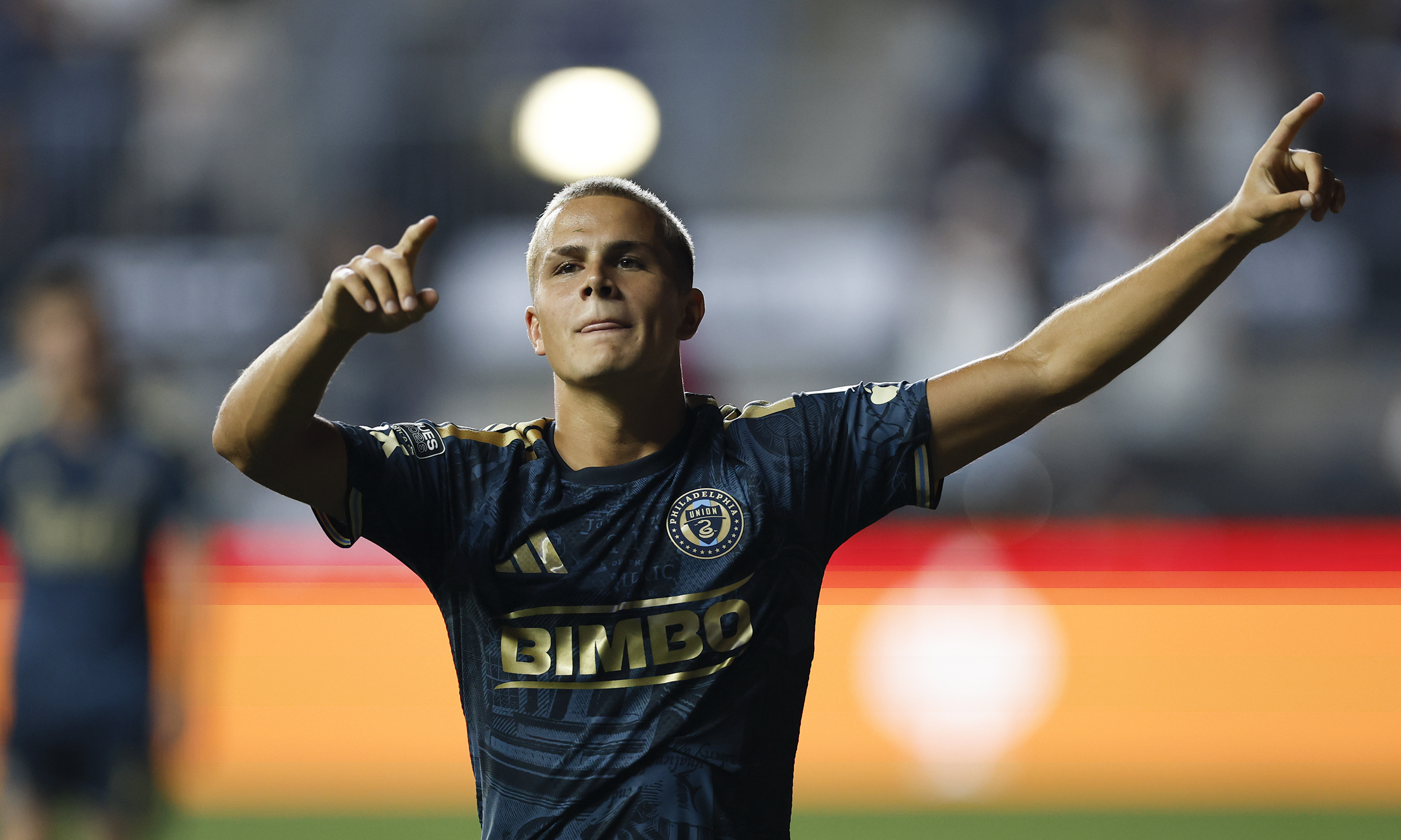
Cavan looks the part of a star with his bleached hair, eyebrow slit, and gold chains. He breezes through interviews like he beats defenders as no question seems to trip him up. He’s been in modeling campaigns for non-soccer brands, was photographed this summer by Annie Leibovitz, and has more than 400,000 followers on Instagram.
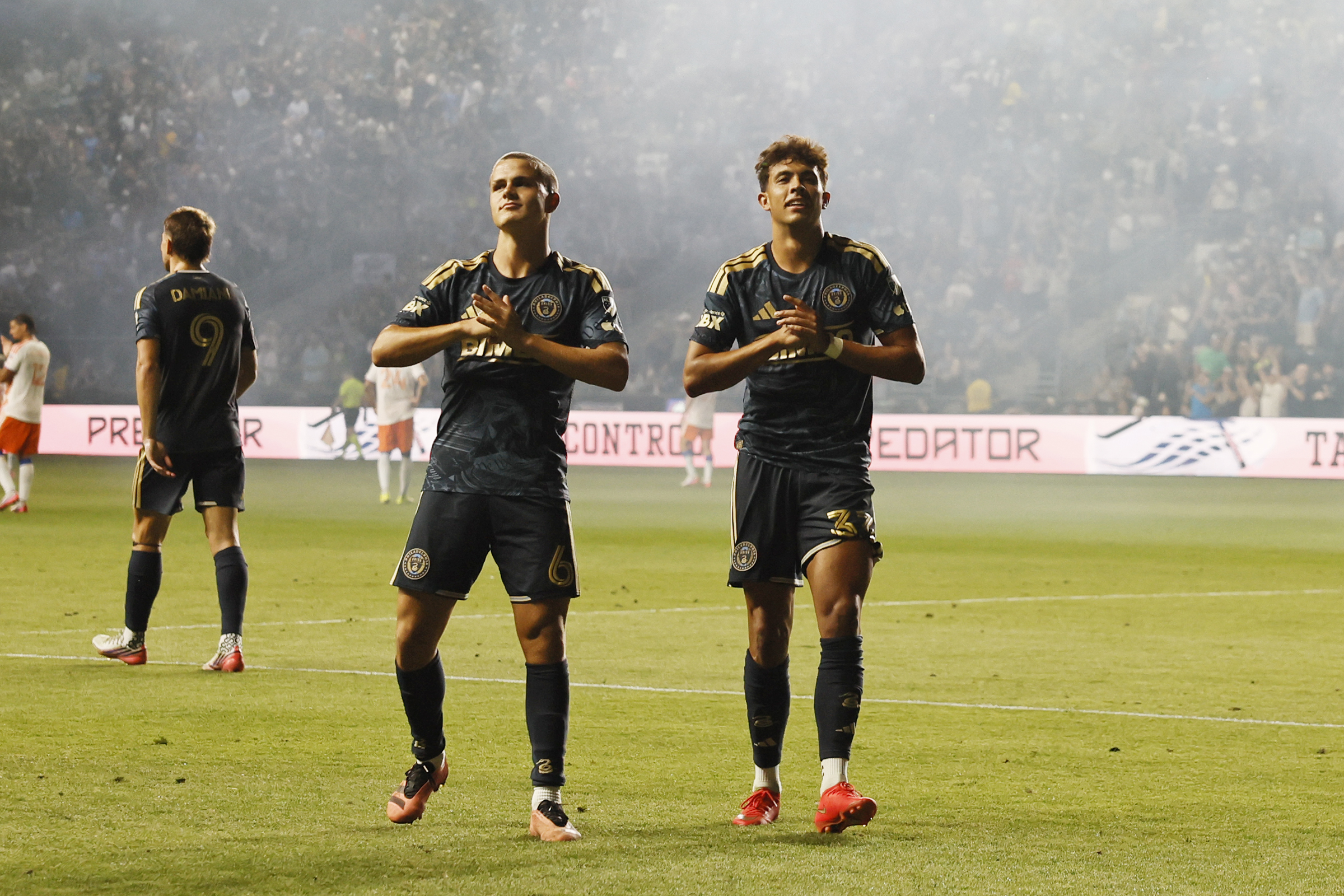
He plays the game like a showman and often tops goals with choreographed celebrations like the time he threw chalk in the air as an homage to LeBron James.
“That’s him,” said Union teammate Frankie Westfield, who grew up in Morrell Park and is with Cavan with the U.S. team. “That’s how he performs. Even in the locker room and in training, he’s dancing around. I don’t want to say he doesn’t care because he cares so much, but I think just playing loose and free makes him what he is. He brings a whole new vibe.”
Cavan has the makings to be more than just a soccer star.
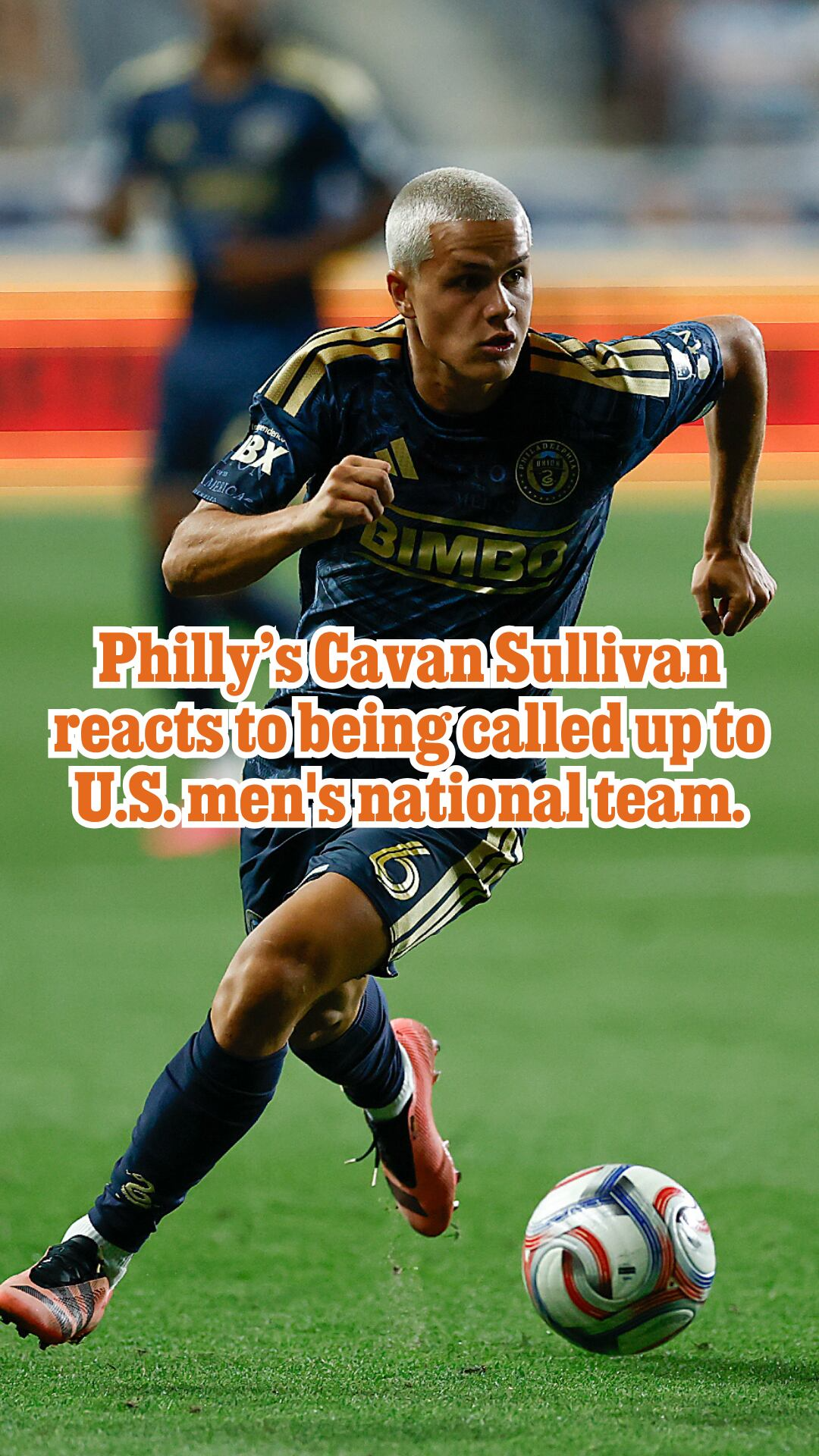
Video: Philly’s Cavan Sullivan reacts to being called up to U.S. men’s national team.
The spotlight on Cavan has become in recent months as bright as his hair. But the kid seems comfortable in it, managing the attention with ease despite being just 16.
“I think I just understand that I haven’t really done anything yet,” he said. “There hasn’t been anything major that I’ve done. I’m still trying to prove myself and make my mark on the city and on the club. I always want more. I always want to be the best. When you focus on it that way, it’s natural to just avoid all the other stuff.”
Quinn remembers driving Cavan home from their Union practice and how the younger brother would be breaking down footage from the session and sending clips to his dad for feedback. He’s always thinking about the game.
He doesn’t count his social media likes or chase clout and even remarked to his brother how he couldn’t get his latest ridiculous goal — a beautiful backheeled tip — off his timeline.
Quinn and Cavan Sullivan pose for a photo after a Union victory over New York City FC last season.Elizabeth Robertson / Staff Photographer
“I was like ‘Dude, you have to hit the not interested button,’” Quinn said. “But he deals with it well. It comes with the game. It comes with being the type of player he is.”
Perhaps Cavan’s ability to shrug at attention goes to how his parents treated him and his brothers. They talked to their kids about the games on the way home and then treated them like kids when they walked in the front door.
Cavan could be playing next year in Europe, but he still has chores at home. And the Sullivans never posted — “I did a couple times,” Heike admitted — about their children on social media.
“Why would you?” Brendan said. “There’s no need to talk about how you won a tournament or had a hat trick. You don’t brag about anything. This is his normal. It’s not normal to us, but he looks at it as his normal. So it’s weird for him if this is his normal. But then again, we don’t talk a whole lot about it. We never gave him media practice. He just knows, ‘Don’t sound like a jerk.’”
Cavan never played the game for attention or accolades. He became a child star, but he wasn’t groomed for it. His parents declined interviews over the years and other media projects.
The Sullivans knew they had a phenom, but they didn’t publicize him, not even on Facebook. They treated him like a kid, his mom said, because he was a kid. It was that simple.
“This wasn’t something we were seeking out,” Heike said. “And maybe that attitude prepared him to not make a big deal out of it.”
Older brother Quinn (left) has Cavan Sullivan’s back on and off the pitch.Elizabeth Robertson / Staff Photographer
Shaped by Philly
The Sullivans left Almond Street in 2018 for Norristown and the allure of a driveway, a backyard, and extra bedrooms. There’s not much to complain about. But they still miss things about the old neighborhood.
There was a corner store where a dollar was enough to score a handful of candy. Brendan can still taste the polish kielbasa and his sons remember the fear they felt as a 4-year-old walking alone around the corner to their grandparents and the pride of making it there safely. There was Wiffle ball and basketball with the neighbors, riding bikes through the cemetery, and playing for hours on the sidewalk.
Philadelphia’s soccer scene was born in neighborhoods like Bridesburg, where European immigrants brought the game decades ago when they came to work in factories along the Delaware River. Rowhouses — just like the one on Almond Street — produced pioneers like Walter Bahr and Benny McLaughlin. The Northeast is where Chris Albright and Bobby Convey, teammates on the 2006 U.S. World Cup squad, grew up. The cinder fields was where Don D’Ambra and Dave MacWilliams made their mark.
The same neighborhood that shaped Sullivan is what powered Philadelphia soccer for generations. He’s only 16 years old and he soon could be the face of a sport. But he was not an overnight sensation. Cavan’s emergence was generations in the making. Just the ones who came before him, he’s a kid from the neighborhood.
The Sullivans left Bridesburg years ago. The basement now belongs to someone else. But the memories? They’ll always belong to the four brothers.
“Northeast Philly sort of shaped me in a way,” Cavan said. “It was just a great place to be.”
It’s too early to jump to conclusions, and history offers a good example of what happens when one does. But it’s hard to look at the trajectory of Cavan Sullivan and not wonder if America’s next hope at a World Cup is going to hail from a basement in Bridesburg.
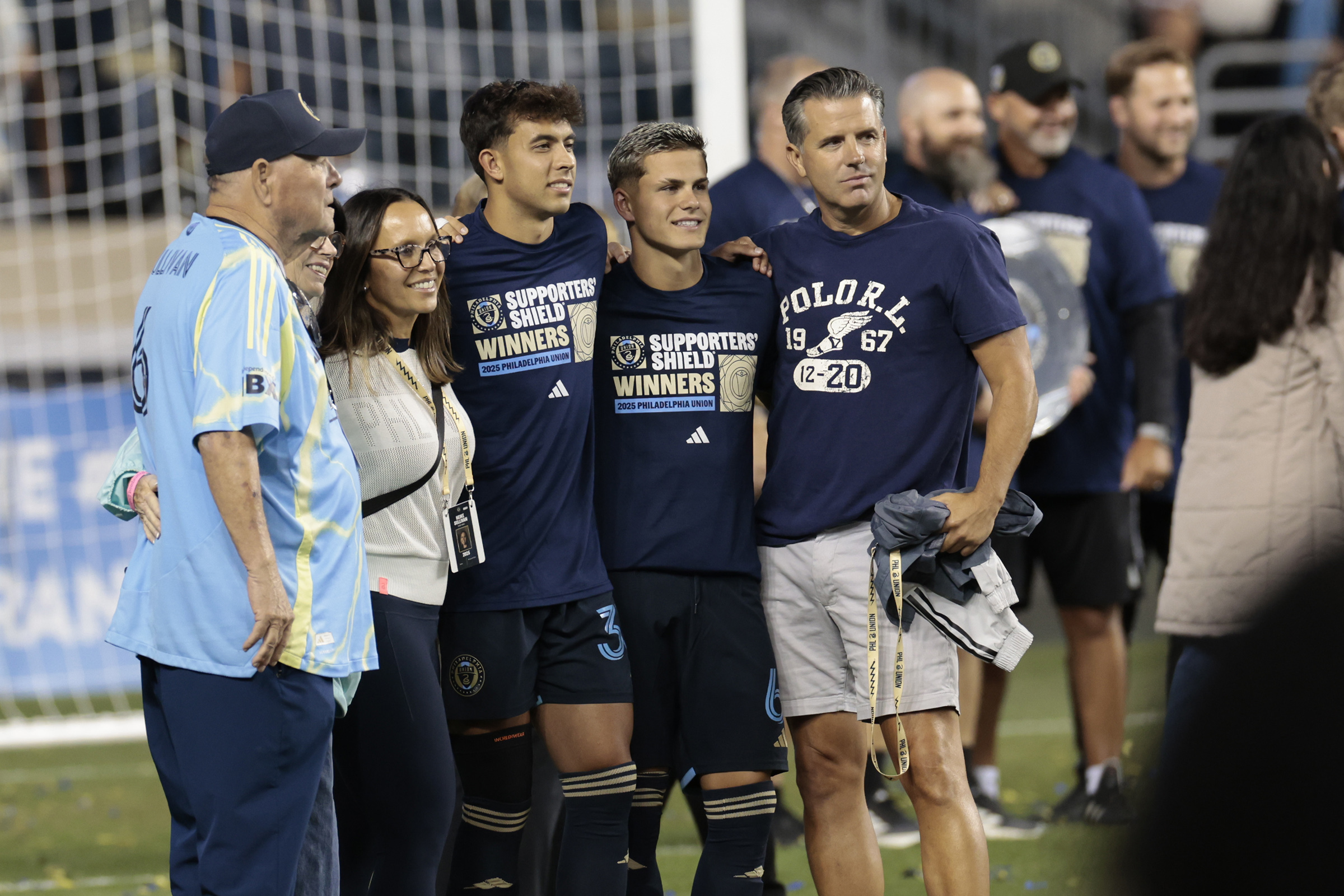
It’s been well-documented that the Sullivans are Philly soccer royalty, with a family footprint that spans decades in the sport right here at home. Cavan, his older brother Quinn, and his twin brothers Declan and Ronan are the latest in a family that lives and breathes the sport and has found immense success, fortune, and fame as a result.
We’re looking at clouds on this Friday as we keep an eye out for a nor’easter. Perhaps today is the calm before the storm, with highs expected to reach the mid-70s.
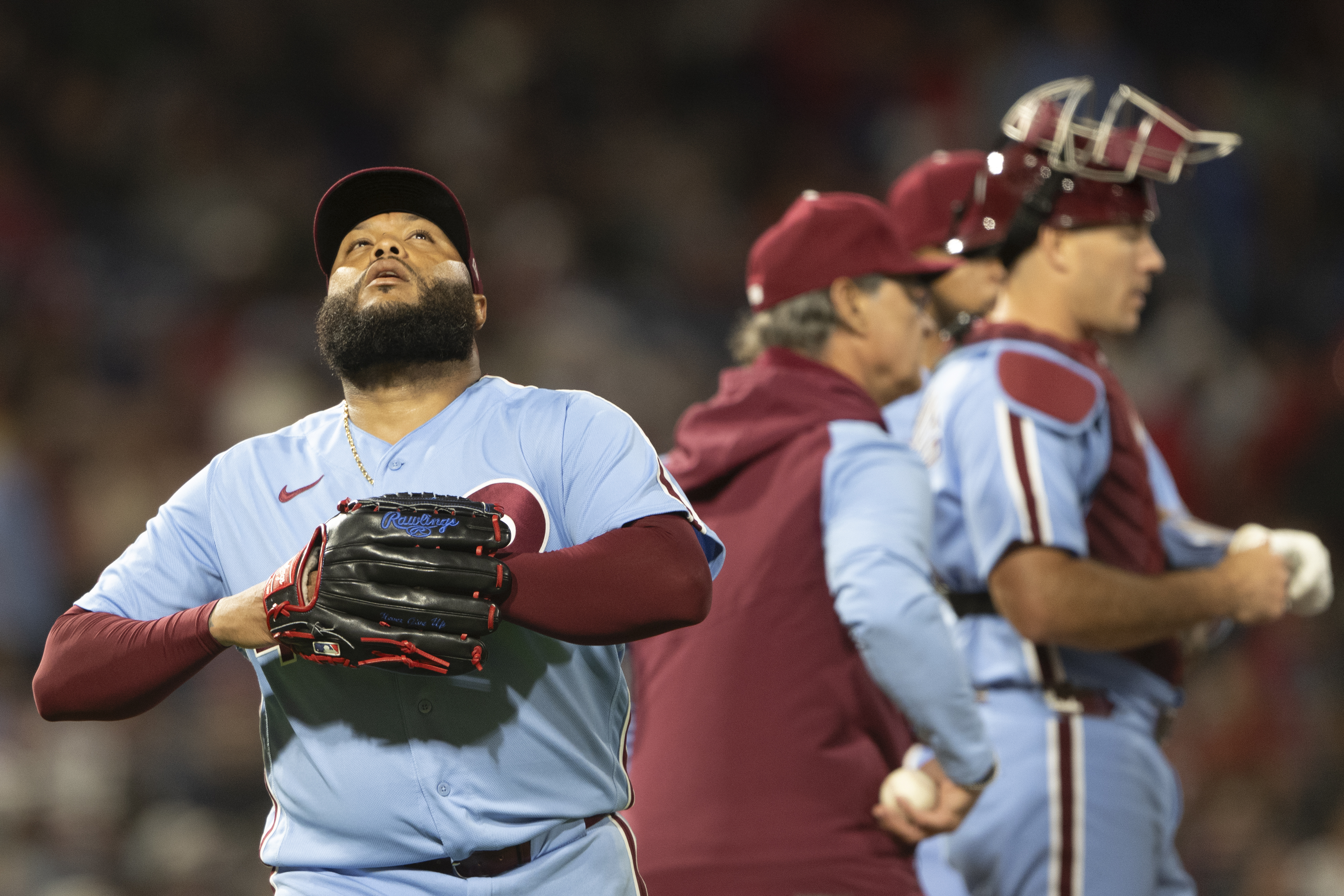
Phillies reliever José Alvarado leaves the mound after giving up three runs in the eighth inning on Thursday.Jose F. Moreno / Staff Photographer
For the second straight night, the Phillies had an opportunity to close in on a playoff spot.
And for the second straight night, the Phillies laid an egg.
A stagnant offense and yet another late bullpen collapse doomed them in a 5-1 loss to the Brewers on Thursday night. Milwaukee secured its 100th win of the season, setting a franchise record at the expense of the Phillies. The magic number remains at 2 going into the late game Thursday night between the Dodgers and Padres.
The Phillies will enter their final series of the regular season against the American League-leading Tampa Bay Rays without having officially secured a playoff spot.
The Phillies did get some good news on Thursday. Jesús Luzardo felt good after throwing a bullpen session and said “chances are good” he’ll be ready for the playoffs.
Next: The Phillies open their final series of the regular season at 6:40 tonight against Tampa Bay (NBCSP). Cristopher Sánchez (18-6, 2.93 ERA) will start against Rays right-hander Freddy Peralta (9-11, 4.56).
Zach Ertz is back with the Eagles after a journey that took him away from the team in 2021.Monica Herndon / Staff Photographer
One would think that Zach Ertz returning to the Eagles would stoke a lot of emotions. Excitement. Joy. Relief. But nervous?
“I don’t know if I’ve ever been more nervous for a walkthrough than today,” Ertz said after his first practice back with the Eagles, who signed him to their practice squad earlier this week. “Obviously the past nine-and-a-half months have been tough. A lot of emotions going through today, a lot of prayers going through today, just to try to center myself.”
After 181 career regular-season NFL games and another 11 in the playoffs, the 35-year-old is playing what looks to be his final chapter in the place that gave him his start. Here’s why, to him, it means so much more than football.
Flyers goalie Joseph Woll says he’ll be ready if called upon in the season opener.Jose F. Moreno / Staff Photographer
After an up-and-down season from Sam Ersson, the Flyers made it a priority to upgrade the backup goaltender position behind Dan Vladař.
That decision could soon pay dividends after Vladař left the team’s second preseason game on Tuesday with an upper-body injury. While the Czech netminder thankfully looks to have avoided a major injury, it highlights why the Flyers were so keen to add a proven commodity Woll.
Could Woll even start opening night?
“I think I’ve proven that I can do that in my career. So my goal from the start with this team has been to help them however I can, whatever situation that means, so [it] doesn’t really change my process or my day-to-day or my mindset with whatever happens,” Woll said Wednesday.
Quinn Sullivan and the Union will play for a hometown crowd in Chester when the team takes on Orlando City on Saturday.Elizabeth Robertson / Staff Photographer
It’s shaping up to be a soccer-filled weekend full of players from the Philly region. Let’s start with the Union, who will face Orlando City on Saturday (7 p.m., Apple TV) without five of its customary starters, two of which have been the heart of the team’s defense. Here’s why interim manager Ryan Richter isn’t worried, as a chance at a franchise record hangs in the balance.
Also, our daily dispatch from the U.S. men’s national team camp checks in with Media’s Auston Trusty, who talks not just about his place on the roster ahead of a Saturday match against Peru (4:30 p.m., TNT), but that of the three Philly-area players like him on the team’s 28-man roster.
On this date
Sept. 25, 1960: How about this for a weird statistic? Today, 66 years ago, the Phillies ended a streak of 16 straight losses in games played on a Sunday after beating the Reds, 7-1.
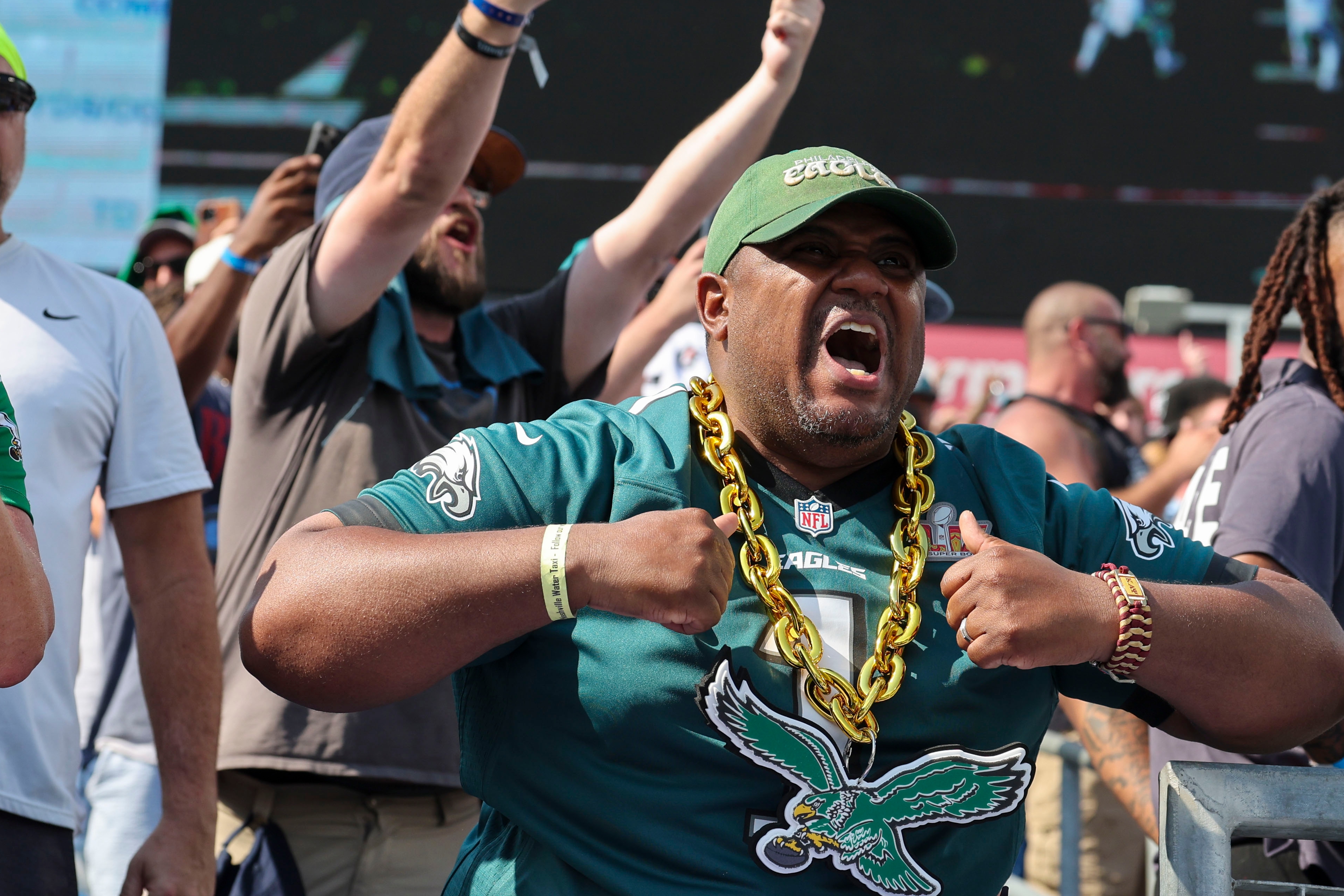
Eagles fans react to the team taking the lead and winning Sunday’s game in Nashville.David Maialetti / Staff Photographer
Our team of photographers captured the Phillies’ playoff chase, as well as a slew of other dazzling sports moments from the week in our latest edition of The Big Picture. Enjoy.
🧩 Unscramble the anagram
TADICA NALLEOG
Which former morning shock jock announced their return to the airwaves to talk almost exclusively about the Eagles? Think you know? Take a guess and click here to see if you’re correct.
What you’re saying about tailgating
We asked: What’s your favorite tailgate memory?
One of the best aspects of an Eagles tailgate is the smell of that amazing food floating across the Lincoln Financial Field Parking lot. Before every Eagles game, without fail — it’s time for a cheesesteak. While most Philadelphians will use any excuse to have that delectable assortment of meat and cheese on a fresh roll from one of the city’s top spots, known internationally, passing through your taste buds on the way down the digestive track — you simply can’t beat one before the game begins. — Michael L.
For me, it’s the random guys in the parking lots selling Eagles gear on the low. I’m a sucker, and as much as I try not to buy, there’s always a hat, a T-shirt, or something they come by the tailgate with, and I end up having to buy. I don’t care where it comes from; I just care that it’s cool, and it’s usually cheap. Long live the hustle, and GO BIRDS! — Geoff B.
We compiled today’s newsletter using reporting from Matt Breen, Scott Lauber, Lochlahn March, Jeff Neiburg, Olivia Reiner, Hannah Chang, Jeff McLane, Jackie Spiegel, Rob Tornoe, Mia Messina, Kerith Gabriel, Jonathan Tannenwald, and The Inquirer’s photography staff.
By submitting your written, visual, and/or audio contributions, you agree to The Inquirer’s Terms of Use, including the grant of rights in Section 10.
That’s your weekend. Enjoy what’s slated to be a packed sports weekend. We’ll be back to unpack all with you bright and early on Monday. — Kerith
Jordan Mailata wasn’t exactly bashful when he shared his instant analysis of Drew Kendall’s first meaningful start at center, even as the second-year player stood within earshot of him in the Tennessee Titans visitors’ locker room.
Kendall, the Eagles’ 2025 fifth-round pick out of Boston College, took over Cam Jurgens’ typical starting spot at center, while Jurgens slid over to left guard in place of the injured Landon Dickerson last Sunday.
The Titans turned up the temperature of the game — and not only in a literal sense, with the turf reaching 157 degrees Fahrenheit, according to the Fox broadcast. The Eagles offensive line was also tasked with containing a Titans defensive front headlined by All-Pro defensive tackle Jeffery Simmons.
Kendall didn’t show any nerves, according to Mailata.
“He’s got f—ing ice in his veins,” Mailata said after the game.
Mailata then turned in Kendall’s direction and doubled down.
“Yes, you do, son,” Mailata continued. “Yes, you do. He’s cool as a cucumber out there, making sure that we’re all on the same page. That’s what you need. I think we won this game because of just his operation, the way he was very cool, calm, and collected.”
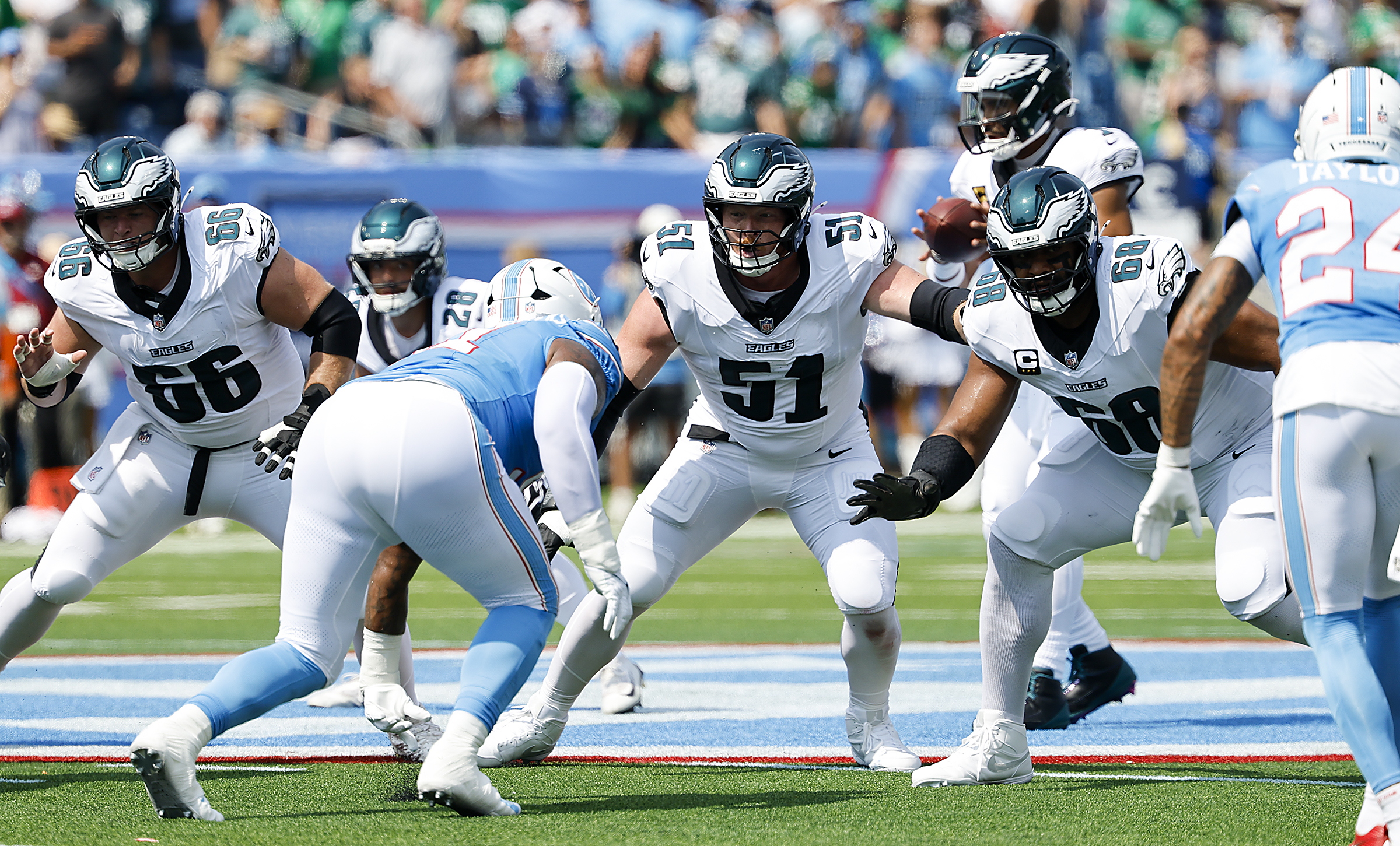
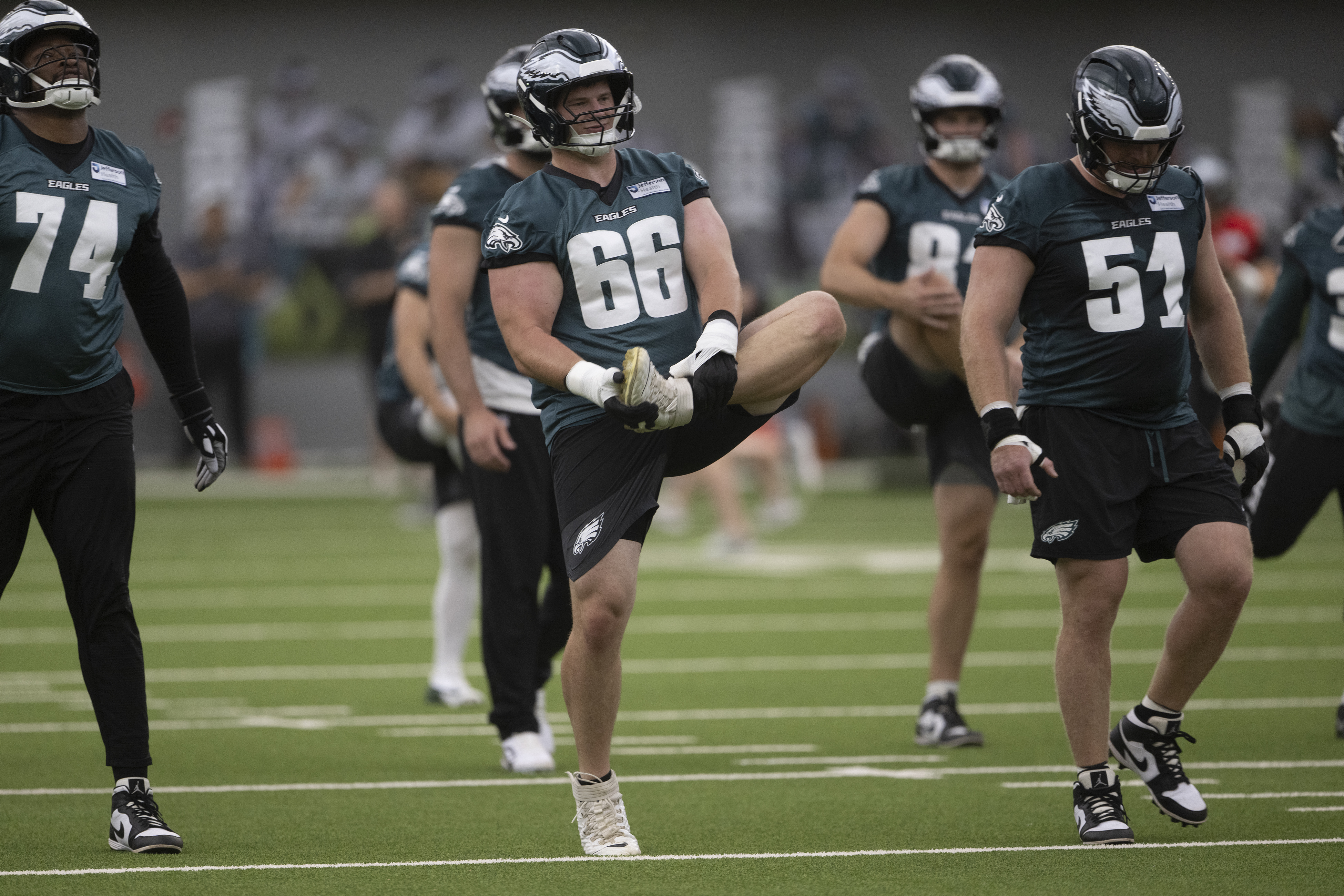
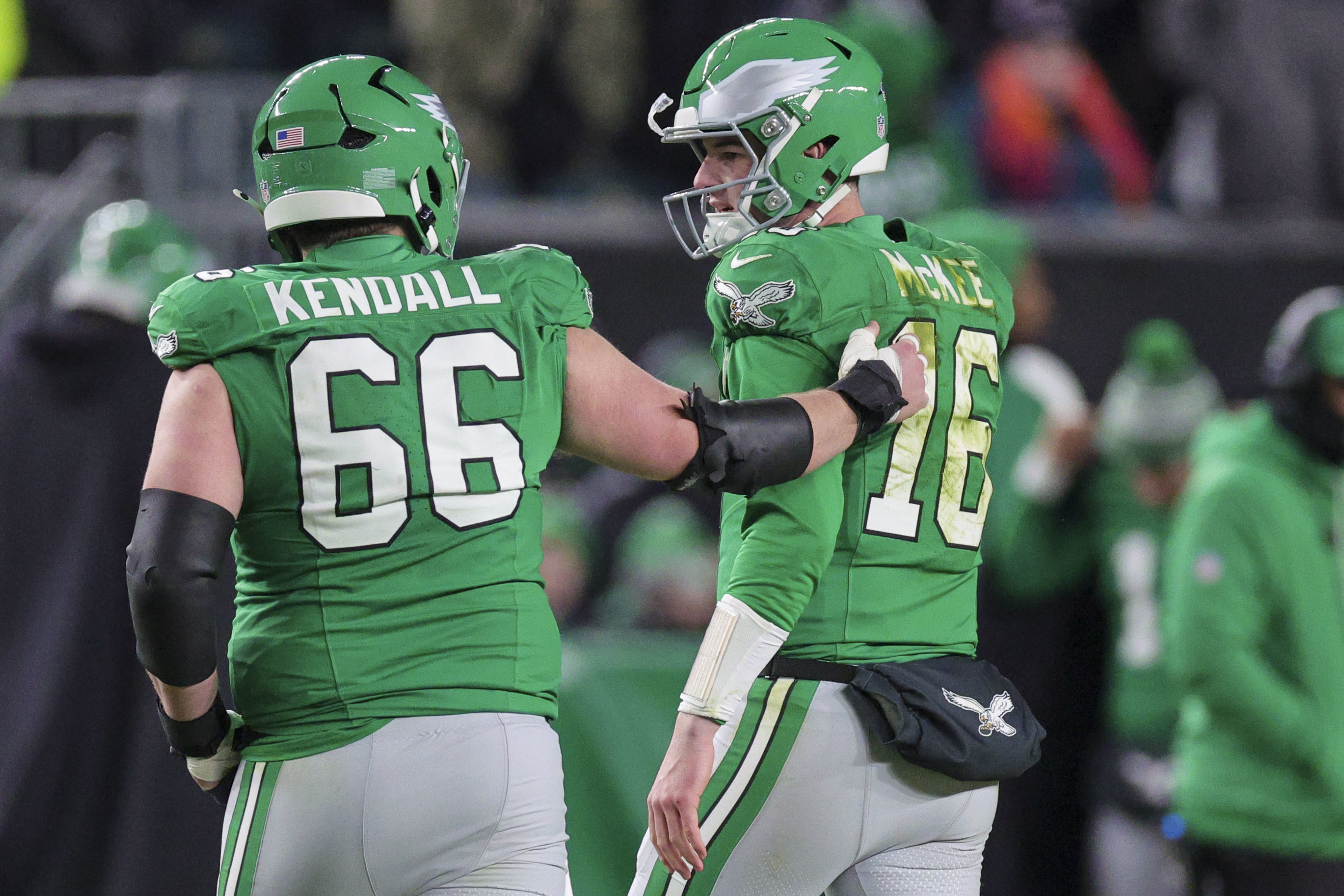
Eagles center Drew Kendall (66), guard Cam Jurgens (51) and Jordan Mailata (68) had their struggles in run blocking but helped fuel a thrilling 24-20 win in Tennessee. Yong Kim / Staff Photographer
Confidence begets confidence. Earlier in the week, Kendall noted that his confidence in his own play — one of the biggest self-identified differences in his mindset between his rookie and second seasons with the Eagles — stems from his teammates’ demonstration of belief in him.
Kendall could have more opportunities to affirm those votes of confidence, as Dickerson must miss at least the next three games while on injured reserve with a knee injury. Offensive coordinator Sean Mannion would not confirm that the Eagles will go with the same offensive line configuration against the Chicago Bears on Monday night, but Mailata emphasized the importance postgame of continuity among the group.
Regardless, Kendall met the moment on Sunday, with room to grow going forward. His solid start was no surprise to his former coaches at Boston College, who long believed he had the ability and the makeup to carve out a role on an NFL offensive line.
“He had the traits,” said Matt Applebaum, Kendall’s offensive line coach of three seasons at Boston College. “Just the competitiveness, the desire to do things the right way and be a great player. He just has all those traits. I thought very early in the process, in recruiting, my vision for him was that he could be a pro center.”
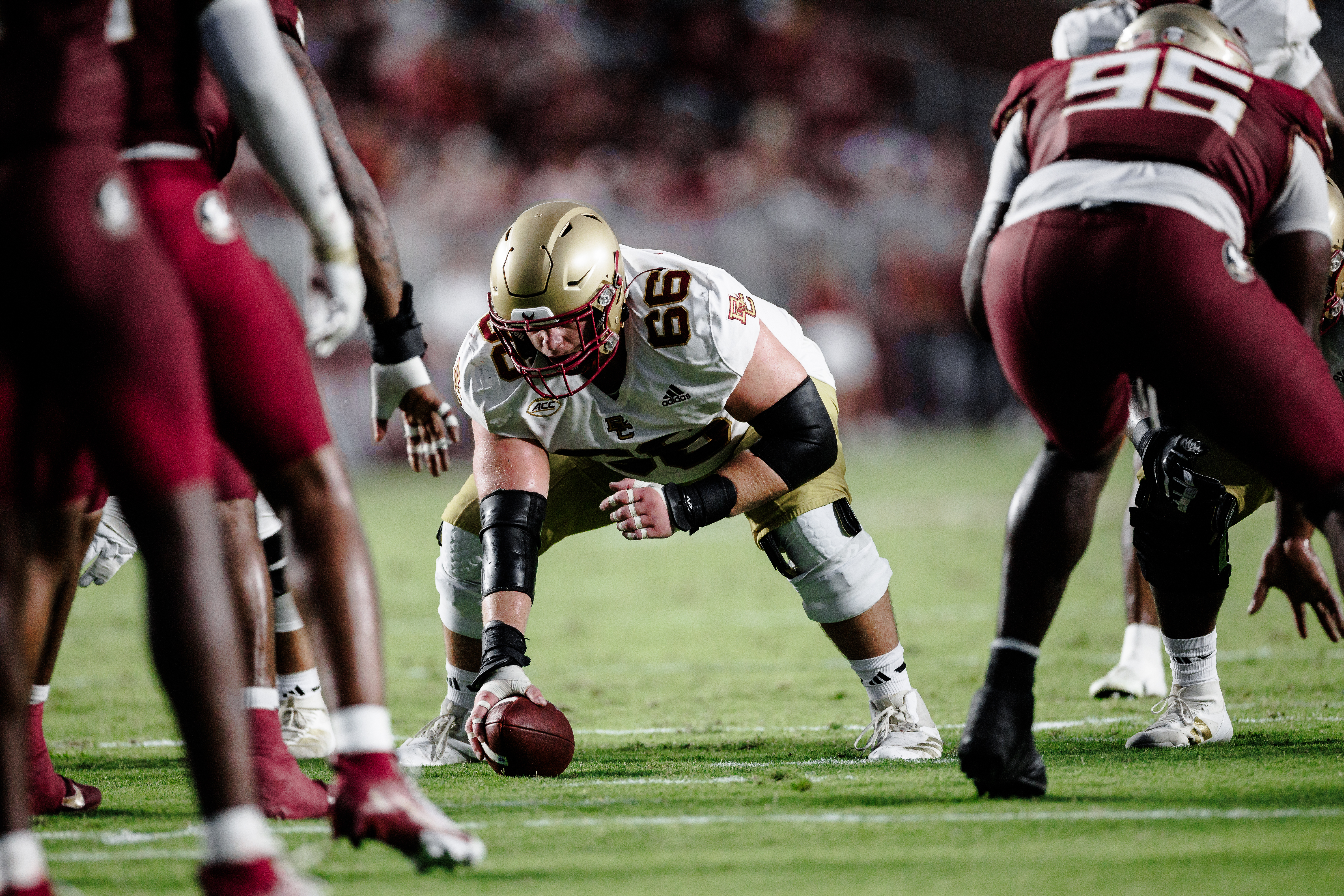
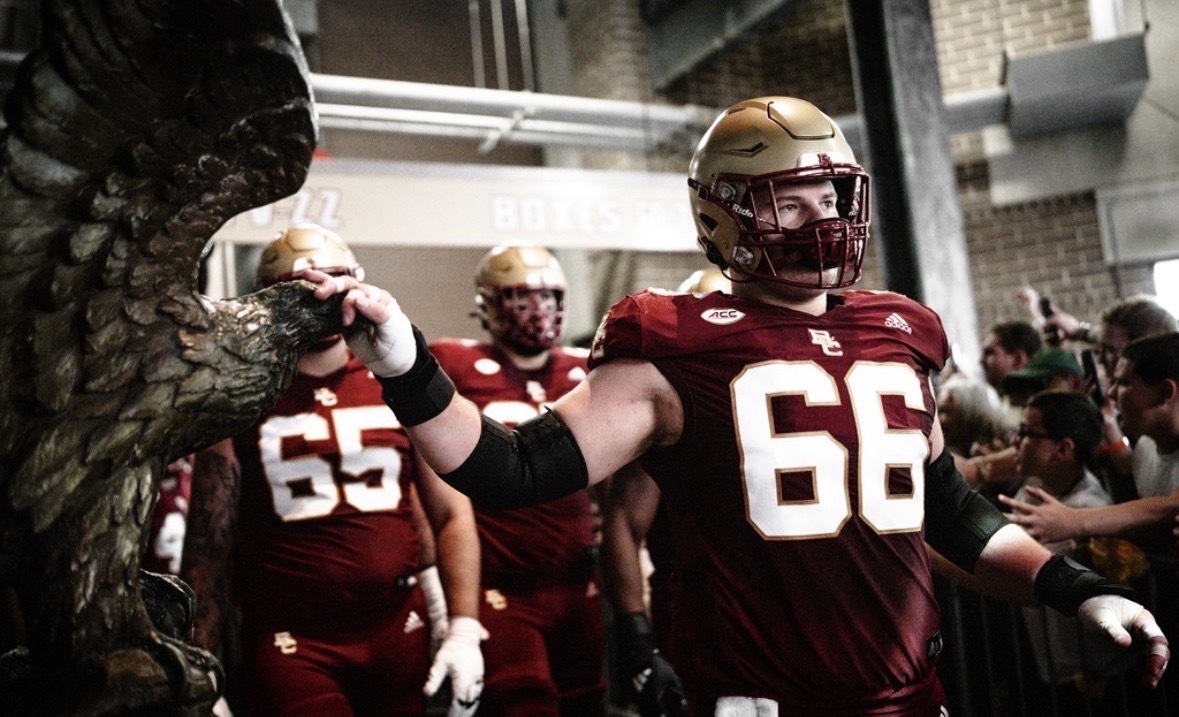
Drew Kendall (66) parlayed his performance at Boston College into a third-day selection in the NFL draft.Boston College athletics
A ‘pro center’ in college
Bill O’Brien assumed the head coaching role at Boston College in 2024, his 32nd season coaching at either the collegiate or pro levels.
When O’Brien arrived in Chestnut Hill, Mass., Kendall was entering his third season as the starting center in his redshirt junior season. According to O’Brien, who served as the Houston Texans head coach from 2014-20, Kendall reminded him of the centers he had encountered in the NFL.
“He was kind of like having a pro center in the college program,” O’Brien said. “That’s basically what Drew was. He knew exactly what we wanted to do, how we wanted to do it, and he was great at it.”
The signs of his potential were there early on, long before he started a game at BC. Applebaum, now the Miami Dolphins assistant offensive line coach, recruited Kendall out of high school in 2020. At the time, Kendall was a four-star recruit out of the Noble and Greenough School in Dedham, Mass., and the No. 1 recruit in the state.
Applebaum understood why. The young offensive lineman possessed a maturity atypical of most 18-year-olds, which lent itself to his makeup as a center. He had a strong foundation, too, given that his father, Pete, was a first-round pick in the 1996 draft out of Boston College by the Seattle Seahawks and played at guard and center in the NFL for 13 seasons.
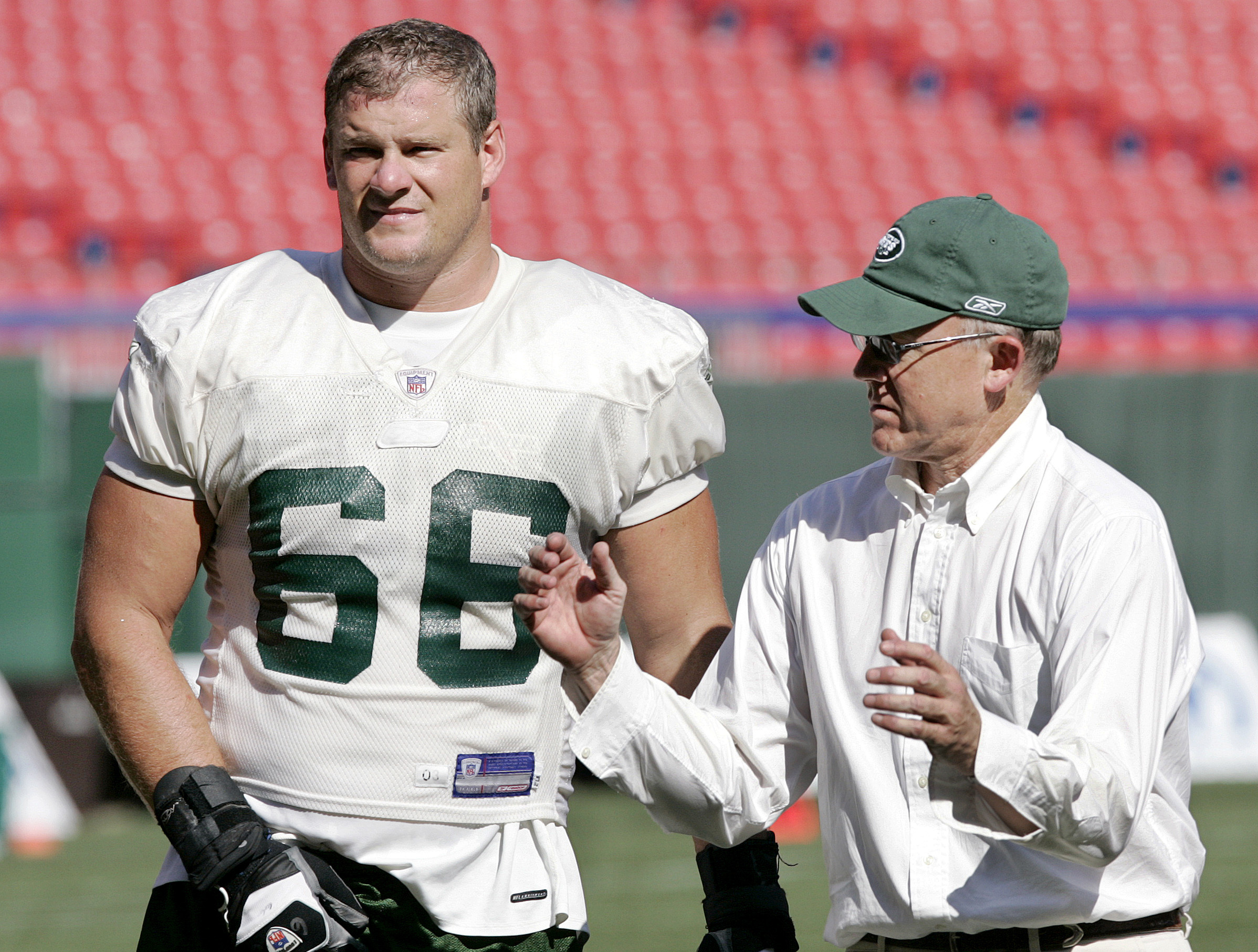
Pete Kendall (66, with Jets owner Woody Johnson) helped pass on offensive line acumen to his son, Drew.MEL EVANS
Then, there were the physical traits. Applebaum called the then-6-foot-4, 285-pound Kendall a “natural athlete,” as he played on both sides of the line in high school and even lettered in lacrosse.
“He was just one of those guys that was good at things and athletic and smart,” Applebaum said. “So the only thing he was going to have to do when he got to school was just get bigger and stronger throughout his career, which he did in college.”
Alec Lindstrom, who was the starting center for BC when Kendall arrived, was struck by his athleticism at his first summer workout. As Kendall went through positional drills, Lindstrom could tell that he wasn’t like most 18-year-old newcomers.
“You could kind of tell he was a step ahead, and you knew he was going to be a good player based on his quickness, his body control, and things like that,” Lindstrom said.
But Kendall would have to wait to display that athleticism on the gridiron on game days. He took a redshirt year in 2021 as Lindstrom, an eventual Rimington Trophy finalist and undrafted free agent in the NFL, commanded the starting center role in his redshirt senior season.
Kendall had the right attitude about taking the season to learn and grow behind Lindstrom, Applebaum said.
“Drew, right from the jump knew, ‘OK, this is set up for me to learn from somebody that’s been there, done that, knows what it’s supposed to look like,’ and he really took that very seriously and really pushed the envelope in terms of being ready to play if he needed to,” Applebaum said. “So he developed very quickly that way.”
Drew Kendall (66) won the respect of two coaching staffs while starring at Boston College.Boston College athletics
Kendall spurred that development, especially as he continued to grow comfortable with the pre-snap responsibilities on the center, by asking questions of his fellow offensive linemen and coaches. Lindstrom recalled Kendall asking him questions about what he was seeing from the defense in practice, after games, and in the meeting room while watching film.
That attitude toward learning was just as important as his intelligence and ability to process information quickly, according to Lindstrom.
“To play center you have to be smart, but you also have to be quick-thinking,” Lindstrom said. “You break the huddle, you get up to the line, you have two seconds to identify everything, so you have to be kind of quick on your feet and smart. And I think Drew, he has that to begin with, but also when you put his attitude and his wanting to learn together, I think it’s a good combination.”
Kendall would go on to put those traits together as a three-year starter in the ACC for the Eagles. He had to learn three different offenses throughout his college career, and Applebaum said he picked them up “excellently” thanks to his processing ability.
He could make all of the pre-snap identifications and adjustments with ease. While quarterbacks and centers typically share the burden of those pre-snap responsibilities on most teams, Applebaum said the team predominantly leaned on Kendall in that area.
“I would say we put probably more on his plate than a lot of other college centers would have to handle, because he was capable of handling it,” Applebaum said.
Drew Kendall’s decision to depart BC after his redshirt junior season was a blow to the program, but one the coaching staff understood. Steve Reed
His athleticism also fit well in Boston College’s offense, which incorporated a variety of run schemes, including outside zone, pin-and-pull runs. Kendall was often one of the pullers, O’Brien said, as he harnessed his initial quickness and lateral agility by kicking out defenders on the edge.
Kendall could handle the rigors of executing each play, all while ensuring everyone on the line was on the same page. But what ultimately made him a pro at the college level was his consistency, according to O’Brien.
“He was there every single day,” O’Brien said. “Did his job in every game. I wanted him to come back, and obviously he made the right decision [declaring for the draft], because he’s doing great.
“But we really missed him last year. We did not have a great year, and I think not having him was a big part of that.”
Emerging from another redshirt season
When the Eagles drafted Kendall last season, he didn’t have a clear path to a starting job with Jurgens — and even Brett Toth — ahead of him on the depth chart at center. In a way, history was repeating itself for Kendall, who didn’t start his first season at BC.
Kendall already understood how to take advantage of a redshirt season. But the challenges that awaited him at the NFL level were different.
“The type of guys you’re blocking week-in and week-out at practice, and then obviously on Sundays, much bigger, much stronger,” O’Brien said. “Maybe there were some guys that he blocked in college that were that size and that strength and had that power and explosion. But it’s every guy in the NFL.”
Drew Kendall (66) was forced to adjust to the rigors of the NFL as a rookie in 2025.Jose F. Moreno / Staff Photographer
Kendall said during training camp that he made it a priority to “reshape” his body, with a focus on adding muscle. He estimated during the summer that he was hovering between 300 and 305 pounds, and he’s now listed on the Eagles roster at 308.
He noted that prioritizing sleep, and not eating too close to bedtime, helped him with muscle growth. Kendall said he wasn’t “killing myself in the weight room” as he has in years past. He combined his focus on sleep, nutrition, and hydration with a consistent offseason workout plan, which included training sessions with Lindstrom, Bears left tackle Ozzy Trapilo, and other former Boston College offensive linemen.
Lindstrom said the group, led by former New England Patriots offensive line coach Dante Scarnecchia, would work out five days a week for two hours a day. They would also incorporate boxing into their regimen once or twice a week.
“You can learn how to throw your hands, even if you’re in different positions, weird positions,” Kendall said. “And hand speed was probably the biggest, but it’s also really good cardio.”
Jordan Davis could feel the strength behind Kendall’s hands this offseason. Kendall took what he learned playing behind the veterans of the Eagles offensive line last season and combined that with improved power, Davis said.
“He’s surprisingly savvy for a young player, very savvy,” Davis said. “He has strong hands, great grip. All those combined, all the best O-linemen have those traits. So when he started learning that, he started learning the savviness from the players that he’s playing with, like Lane [Johnson], Landon, Cam. All those guys have experience, it kind of adds into that.”
Even though he wasn’t playing last season, Kendall said he still prepared as if he was the starter, a directive that former offensive line coach Jeff Stoutland emphasized. He cross-trained at both guard and center. Kendall attributed his growth behind the scenes to the Eagles’ development staff for curating a specific plan to keep him on track.
Drew Kendall (66) received his first career NFL start in Week 18 of last season against the Washington Commanders.David Maialetti / Staff Photographer
Kendall’s experience learning a variety of prostyle offenses at Boston College helped him make the leap with the Eagles, he said. His understanding of a variety of schemes has allowed him to pick up Mannion’s offense quickly, as he can draw connections between plays in the Eagles’ new scheme to plays in past Boston College offenses. Similarly, Mannion’s offense also requires its linemen to possess great athleticism in order to execute the wide-zone blocking schemes at the foundation of the run- and play-action pass game.
He is also leaning on the leadership experience he cultivated in college. Jurgens lauded Kendall’s communication skills, especially when passing off defensive line games and stunts, as evidence of his improved confidence this season.
Willie Lampkin, Kendall’s contemporary among the Eagles interior offensive linemen, said the players listen to Kendall because they respect him.
“We respect Drew because he comes to work every single day,” Lampkin said “He’s always doing the right thing, and I feel like that just comes with respect. He does the right thing, and people look at him as a leader.”
Kendall appreciates his teammates’ confidence in him as the team leans on him in the absence of Dickerson. The second-year center called their support “awesome” — but their belief alone isn’t enough for him to feel comfortable in his newfound role.
“Everyone in this locker room, they’re all great guys, and they all support one another,” Kendall said. “The biggest thing that we all care about is winning. And then after that, it’s about, OK, how do we get rid of the bad stuff that might keep us from winning the next game?
“So you’re always happy after a win, but you always got to be your hardest critic.”
DEAR ABBY: I have a mother-in-law of 30 years I distance myself from. I do this in order to maintain my sanity. She seems incapable of carrying on a normal conversation and responds to any comment or question by talking about herself, even though it usually has nothing to do with what was said. What bothers me most is when she’s around our adult children. She won’t ask them any questions, isn’t interested in how they are or what they are up to, and doesn’t say anything loving or kind. Instead, she drones on about other people in her life who have nothing to do with us. We constantly say we don’t know that person, but she continues talking about them. I have tried for many years to redirect conversations, to no avail. She has been this way for as long as I have known her. Do you think it’s possible to get through to a person like this, to make her understand how a normal conversation should go? Do you think it’s terrible for her grandchildren not to want to be around her? I don’t encourage them to spend much time with her because they end up feeling annoyed and disappointed. That, however, does not sit well with their father. Any thoughts would be appreciated.
— FRUSTRATED DAUGHTER-IN-LAW
DEAR FRUSTRATED: Your mother-in-law appears to be solely centered upon herself. If, after 30 years, you haven’t been able to get through to her that her lack of interest in her grandchildren has isolated her from them, you and your husband must recognize that she isn’t going to change. There is no quick fix for this. After three decades of this treatment, your children will never want to be in their grandmother’s presence any more than they are required to be, whether it sits well with their father or not.
** ** **
DEAR ABBY: My sister and I have an OK relationship. When we were younger, we always fought, but that’s what siblings do. When my father died, I learned about it not from a phone call, but on social media. To say I was hurt and angry is an understatement. How can I get past this? I told my sister how hurt I was when it happened, but I can’t seem to move on. Now my mother is not doing well, and I’m afraid this will happen again since I have been named executor of her will and a trustee of any assets to be received by my older sister. What are your thoughts on how to get past this and potentially handle any future dealings?
— YOUNG EXECUTOR
DEAR YOUNG EXECUTOR: I’m sorry to learn your mother is unwell. Executorship is a big responsibility. As you navigate the next steps, try to set the tone with humility. Instead of dwelling on the past, fulfill your duties objectively and with diligence. If the estate is large and your sister is unhappy with the terms of the will, consult a probate lawyer to keep matters from getting personal.
ARIES (March 21-April 19). The moneymaker is waiting at the intersection of what others need and what you love to do. You’ll spot it while helping someone for free and realizing you just solved a problem they have already paid other people to solve badly.
TAURUS (April 20-May 20). You have something to share that should come across as good news to most, although there are those who will take it as very bad news, if only because it’s not happening to them.
GEMINI (May 21-June 21). Emotions point today. When anger keeps returning, look for the line that got crossed. When jealousy sticks around, ask what you wish you had. Before making any changes, check whether irritation comes from a real problem or a rough day.
CANCER (June 22-July 22). Perhaps the most important moment of any relationship is the very first one. Because choosing who to get involved with is choosing your future. You can’t tell where things will go with someone, but you can get a sense of how much fun you’ll have.
LEO (July 23-Aug. 22). You could get by without much preparation. That’s what most people do. The drive to do more is not always about showing off; sometimes it’s good manners. Your prep is discreet, unshowy and very effective.
VIRGO (Aug. 23-Sept. 22). You make ‘em laugh. You don’t bring jokes. You don’t do prat falls or wear a funny nose. You’ve never slipped on a banana peel in your life. You say the truth and say it fast. Suddenly everyone is connected.
LIBRA (Sept. 23-Oct. 23). Maybe you don’t consider yourself to be oriented toward tradition, but you’re also not out to reinvent the wheel. You’ll notice there’s something worth stealing from the old ways, then you’ll modernize it.
SCORPIO (Oct. 24-Nov. 21). For love to have a chance of blossoming into something lasting, it helps for people to feel safe enough to relax and show their actual selves. But relaxation isn’t a requirement. Today, there’s something interesting growing in a kind of nervy uncertainty.
SAGITTARIUS (Nov. 22-Dec. 21). Though generally propelled by a strong sense of duty and loyalty, your own pleasurable interests will take precedence today. As Orson Welles said: “Ask not what you can do for your country. Ask what’s for lunch.”
CAPRICORN (Dec. 22-Jan. 19). You’ll get busy front-loading the work. The thinking, research and setup take a lot more time than people think. The part people see will happen fast. Today’s organization makes tomorrow’s work go off without a hitch
AQUARIUS (Jan. 20-Feb. 18). You keep stopping yourself from saying something because you know this person. They could get mad, take their business elsewhere, make it a whole thing, leave or even sue. That’s quite a risk. What could speaking up change for you?
PISCES (Feb. 19-March 20). There’s a time to think critically and a time to just get in there and do it. Losing self-consciousness isn’t so easy for you now, which is why it will help to bring that utterly guileless friend along.
TODAY’SBIRTHDAY (Sept. 25). There’s a satisfying reversal in this Year of the Second Look. What was overlooked, written off or underestimated will get a practically cinematic level of recognition. This could pertain to old dreams, pursuits, projects or past relationships. More highlights: Family peace. A dozen small deals that give you the buying power for bigger investments. You’ll follow an attraction through a labyrinth and prize. Pisces and Scorpio adore you. Your lucky numbers are: 10, 17, 9, 45 and 27.