Blog

  • 150 employees expected to lose jobs as company closes Oaks distribution center

    150 employees expected to lose jobs as company closes Oaks distribution center

    Wholesale supply distributor Essendant plans to lay off 150 workers in the Phoenixville area and close its location there, as it looks for a way to avoid liquidating the whole company.

    The distribution center at 125 Green Tree Rd. in Upper Providence Township, which the company referred to as the Oaks facility, is expected to shutter around Oct. 3, said Marcela Sztainberg, who leads human resources at Essendant.

    The Illinois-based company has been operating out of the 558,704-square-foot Phoenixville facility for roughly 20 years, said Sztainberg. Its current lease expires in 2031.

    Essendant several years ago merged with private-equity owned Staples. The deal was announced in 2018 as an acquisition by Staples, and the Federal Trade Commission scrutinized the combination over concerns that the deal would harm competition in the office supply industry. The companies ultimately agreed to limit Staples’ access to Essendant’s customer information.

    Workers at the Phoenixville site earn $46,718 annually on average, Sztainberg said. The company does not plan to offer them positions at other company locations.

    Sztainberg did not provide a reason for the closure. But the company has been going through several changes recently.

    Industry reports note that Essendant has been shifting away from office supplies to focus the business on other products, including janitorial items and technology. Late last year the company also announced a partnership with transportation and logistics management company Hub Group, as part of its new delivery model.

    Late last year, the company issued layoff notices for facilities in Florida, Texas, North Carolina, and Ohio, the Houston Business Journal reported.

    In a layoff notice filed this week with the Pennsylvania Department of Labor and Industry, Sztainberg wrote that Essendant was looking to sell off some of its assets.

    “The company has been exploring various strategic alternatives, including potential sale transactions involving certain of the company’s assets and operations, and securing additional capital to avoid liquidation of the company,” the notice reads. “At this time, the company does not know if these efforts will succeed.”

    Essendant’s website indicates that it carries brands such as Clorox, Rubbermaid, and Colgate-Palmolive. It distributes items including batteries, calculators, printing supplies, hand sanitizer, soap, and trash bags.

    Originally called Utility Supply Co., the company was incorporated in 1922. It opened its first retail store in 1937 and by 1978 functioned as a wholesale supplier of office products, according to the business’ website. It was renamed Essendant in 2015.

    The company went public in 1981 and in 2017 reported $5 billion in net sales. It became a private company following the Staples merger.

  • Eagles practice observations: Dontayvion Wicks likely WR2; Truth-telling Vic Fangio; Eli Stowers’ education

    Eagles practice observations: Dontayvion Wicks likely WR2; Truth-telling Vic Fangio; Eli Stowers’ education

    The Eagles held the sixth practice of their 2026 training camp on Wednesday at the Jefferson Health Training Complex. Here were my observations from Day 6 (and links to Days 1, 2, 3, 4 and 5):

    Roll call

    Tackle Lane Johnson missed a fourth straight practice for an excused noninjury related reason. He’s expected to return soon, from what I understand. Landon Dickerson took a non-injury-related rest day. The Eagles will be careful with their oft-injured left guard. Dickerson was spotted jogging midway through practice with a sleeve on his left leg.

    Wide receiver Britain Covey was a new addition to the injury list. He left Tuesday’s practice with a hamstring injury. The following remained injured and out: receiver DeVonta Smith (hamstring), receiver Makai Lemon (hamstring), edge Keyshawn James-Newby (ankle) and safety Cole Wisniewski (hamstring).

    Rookie guards Micah Morris (shoulder) and Jaeden Roberts (calf contusion) returned to practice, but were limited.

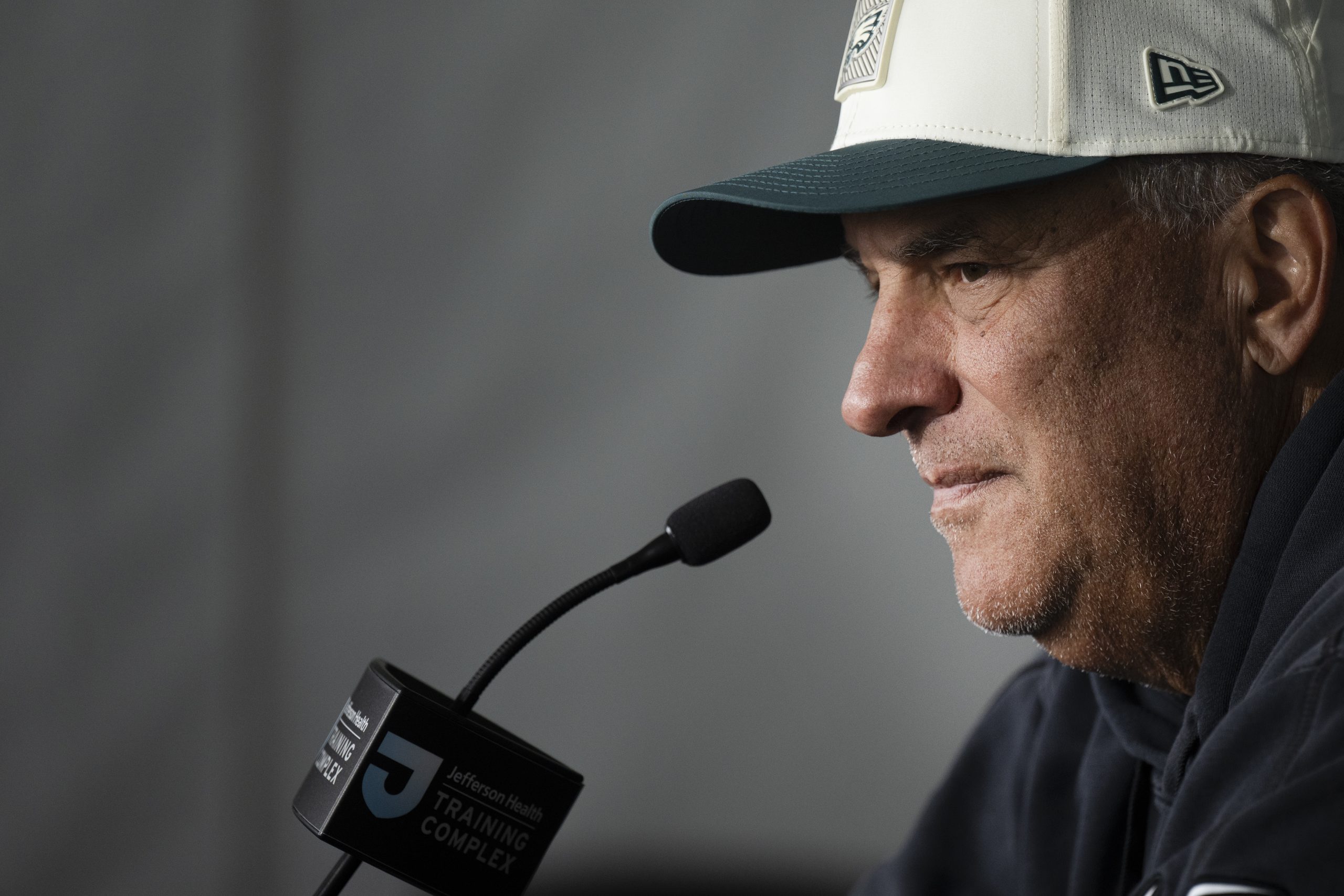
    Vic Fangio noted that defense has traditionally had the upper hand early in Eagles training camp. Jose F. Moreno / Staff Photographer

    Vic’s secret

    After two straight days in full pads, coach Nick Sirianni dialed the intensity back. Players wore only shells for a 75-minute session — the shortest of camp thus far. Sean Mannion’s offense, overall, executed better after a difficult Tuesday vs. Vic Fangio’s defense.

    “I told him, we obviously got the best of yesterday’s practice by a long shot,” Fangio said when asked about Mannion’s play-calling. “But that’s the way it’s been the last two years in training camp. The defense has gotten the best of the offense. So, not to be too concerned.”

    I don’t think Fangio was puffing his chest out or anything. He was just being the truth teller that he can often be. He was also adding context. Defenses are traditionally ahead early in camp, especially when the offense is new. But I’m not so sure about his last comment. I’d be concerned if there were any similarities to last year’s offense.

    Michael Carter II got some run with the first unit on Wednesday. Tyger Williams / Staff Photographer

    Cast and crew

    Mannion’s first unit likely benefitted from four key defensive starters — linebacker Zack Baun, defensive back Cooper DeJean and cornerbacks Quinyon Mitchell and Riq Woolen — being held out of team drills. Jeremiah Trotter Jr., Michael Carter II, Jonathan Jones and Kelee Ringo played in their spots.

    With the offense down three starters, it might have made sense to even the playing field. Rookie Markel Bell and second-year offensive lineman Drew Kendall filled in for Johnson and Dickerson at right tackle and left guard, respectively.

    Receiving race

    It’s been a by-committee approach at receiver, especially with the bona fide No. 1 sidelined. Dontayvion Wicks has thus far made the best case to be Smith’s No. 2. He may have a leg up on the others, having played in the Kyle Shanahan-style scheme Mannion brought with him from Green Bay. But there has also been obvious rapport between quarterback Jalen Hurts and the former Packers receiver. Hurts delivered a 20-yardish strike to Wicks just ahead of arriving safety Andre’ Sam in seven-on-sevens on Wednesday.

    Darius Cooper has looked good early in camp. Jose F. Moreno / Staff Photographer

    If the receiver competition was based on the first week alone, Darius Cooper would have the edge on the other combatants. I said this to someone the other day: “If Lemon was having the camp Cooper was having, every reporter would be hyping the first-round rookie.” The Eagles have to take everything into account, of course. Veterans Hollywood Brown and Elijah Moore have been unspectacular in camp, but also have proven track records, even if both have seen their numbers decline in recent years.

    Cooper should be a lock for the roster, though. I know some have viewed the fifth receiver spot as a toss-up between him and Johnny Wilson. But Cooper has more upside, despite Wilson’s size and Sirianni’s appreciation for his blocking. Cooper didn’t make any splash catches on Wednesday. Hurts dropped a beauty to him in the back corner of the end zone, but the receiver couldn’t stick the landing after he dove for the ball.

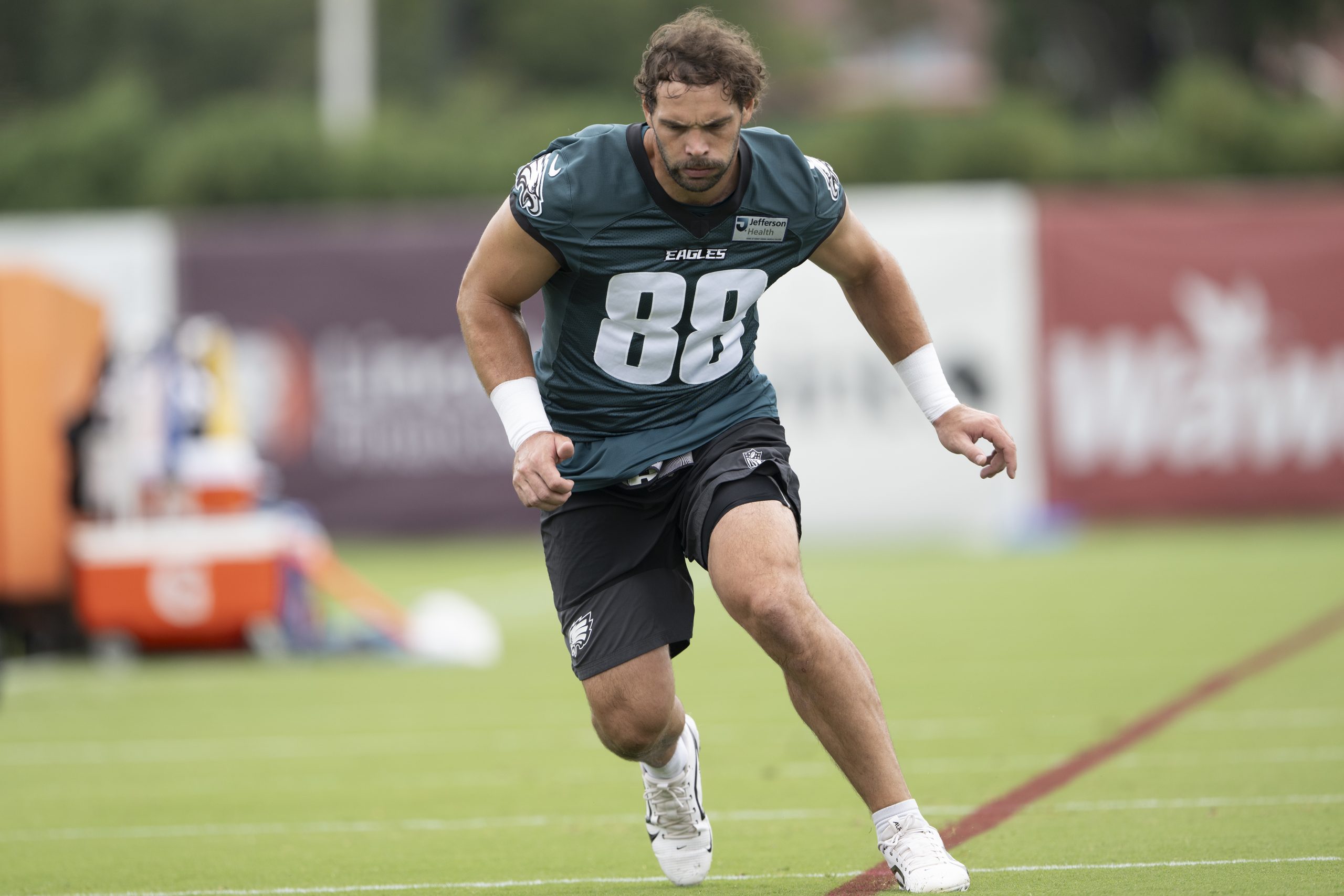
    Dallas Goedert and the tight ends were heavily featured on Wednesday. Jose F. Moreno / Staff Photographer

    Tighter ends

    On cue, Dallas Goedert and the tight ends were featured in the passing game a day after I noted that they’ve been relatively quiet in that regard. Hurts went to tight ends on his first two dropbacks in seven-on-sevens. Goedert hauled in the first on a slant, while E.J. Jenkins couldn’t on a similar route from the other side of the formation.

    Goedert caught another pass during the period on a short buttonhook and he was again Hurts’ first target in team drills. The tight end hung on despite linebacker Jihaad Campbell being in close quarters. Campbell later reached out and broke up a pass to receiver Samori Toure.

    With Johnny Mundt often the second blocking tight end in under-center scenarios, Grant Calcaterra has gotten receiving opportunities on third downs. He appeared to short-arm a toss from Hurts with Ringo in the vicinity.

    Stowers hour

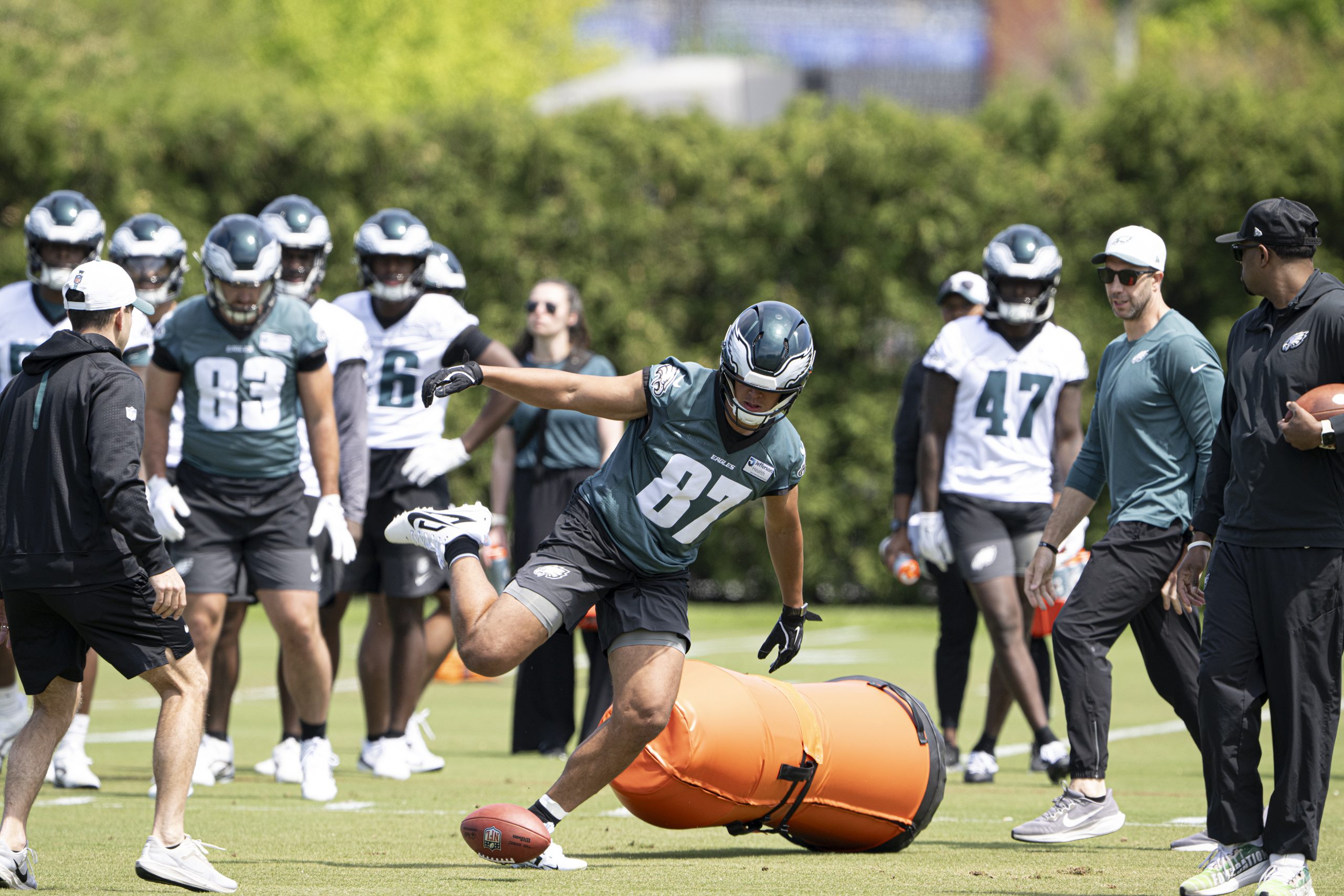
    Even Cam Latu has seen more passes thrown his way than rookie tight end Eli Stowers. The Eagles are clearly not rushing their second-round draft pick. He’s low on the depth chart and has mostly run with the third offense. Stowers is a relative newcomer to the position. He switched from quarterback to tight end just three years ago and he wasn’t asked to block a ton at Vanderbilt.

    Eli Stowers’ (87) acclimation to NFL-style blocking technique has been slow. Jose F. Moreno / Staff Photographer

    So he has a lot to digest, beyond just the Xs and Os of a new scheme. Stowers is on the smaller side so learning the proper technique in blocking will be crucial. It could be some time before he’s placed in those circumstances. But he could get on the field on obvious passing downs. I found it interesting that he was split wide in the development period. The ball came his way, but cornerback Tariq Castro-Fields was on his hip and broke up a pass that was thrown slightly behind.

    Running on empty

    There was a fair amount of run game activity. Saquon Barkley didn’t have much room to operate on his carries. Defensive tackle Moro Ojomo knifed past Kendall on one Barkley carry. Outside linebacker Jalyx Hunt set the edge and helped contain the running back on an outside zone run. Nose tackle Jordan Davis easily defeated center Cam Jurgens one-on-one and picked up a tackle for loss.

    Linebacker Jalyx Hunt defended the run well on Wednesday. Jose F. Moreno / Staff Photographer

    I hesitate to mention Jurgens in the negative because he’s otherwise had a strong start to camp. He’s poised to bounce back from last season’s setback. Tank Bigsby had a few touches out of the backfield, as well, but he’s been featured more as a receiver than Barkley. He got Campbell to commit pass interference with a double move in the open field.

    Running back Will Shipley had a shaky start to camp, but I thought he showed up on Day 6, particularly in the run game. He had two strong rushes up the middle when he got skinny through his blocks. He also picked up Trotter’s blitz later on.

    On the bubble

    Michael Carter II got a strong endorsement from Fangio before practice. I’m not sure if he’ll beat out Marcus Epps for the nickel safety spot, but he could have the sixth defensive back role in dime personnel locked down. Speaking of locking down, he ran step for step with receiver Danny Gray on a corner route into the end zone. When he ball sailed out of reach, Carter popped up and gave Gray a double thumbs-down.

    Fangio said not to sleep on linebacker Chance Campbell’s chances of making the 53-man roster. Tackle Cam Williams took Campbell out at the second level on the run play and that was the last I saw the linebacker until he was walking with a trainer to the medical tent. He seemed fine later on, but didn’t return to play.

    Tanner McKee (16) has not looked sharp at times while working in the new offense. Tyger Williams / Staff Photographer

    Quarterbacking up

    Tanner McKee was first up with the second unit offense in seven-on-sevens, but Andy Dalton took more team repetitions. The quarterbacks continue to slug it out for the backup spot. Dalton found Wilson open on a crossing route. He hit Quez Watkins on a short pass and the receiver hit the afterburners when cornerback Ambry Thomas took a bad angle. Defensive tackle Ty Robinson pressured Dalton into a throwaway.

    McKee just hasn’t looked as sharp as he did last camp. He doesn’t have the luxury of working with the same unit as he did a year ago. That’s no excuse, but he has struggled to throw the ball downfield, especially with the third unit. He finally found an open man down the seam, but tight end Stone Smartt dropped the ball like he had hands of brick.

    Extra points

    Hurts had a couple dashes into space on the ground — once when he kept the ball on a run-pass option and another on a scramble when his receivers were tied up in man coverage. … Tempers flared for a second straight day. Linebacker Smael Mondon and tackle John Ojukwu got into a brief altercation, as did tackle Fred Johnson and edge A.J. Epenesa. … Gunslinger Cole Payton tossed another interception when he heaved a pass into a crowded area and the ball deflected to Castro-Fields. … Former Eagles receiver Jeremy Maclin attended camp. He said it was the first time he’s been back at the practice facility since he was a player. … The Eagles have a closed walkthrough on Thursday before returning to practice on Friday.

  • After another round of flooding, a heat advisory is in effect Thursday

    After another round of flooding, a heat advisory is in effect Thursday

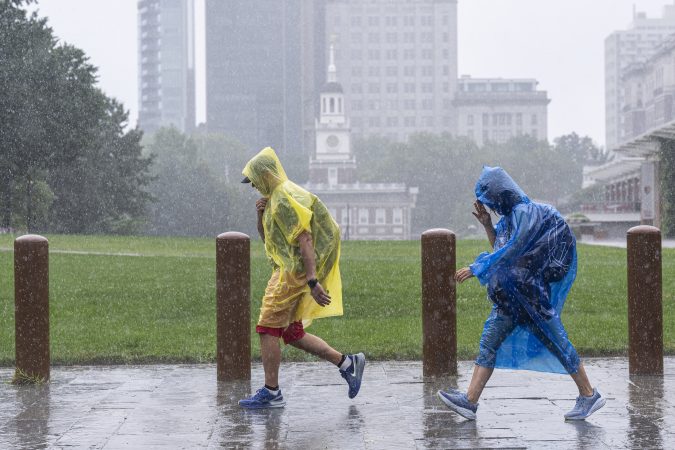
    Yet more rinse-and-repeat flood warnings were posted for Philadelphia and portions of adjacent counties Wednesday as more downpours oozed through the region.

    And don’t be surprised if more pop up later in the week, as the atmosphere will remain thickened with so much skin-clinging water vapor that “it’s not going to take much” to turn on the faucets, said Michael Silva, a meteorologist at the National Weather Service in Mount Holly.

    One indicator of the atmospheric saturation: The weather service has posted a heat advisory for Thursday as heat indexes could rise to 100 or better — even though temperatures won’t get much past 90. That is all about the humidity in what could be the start of a more muggy wave, as opposed to a traditional heat wave.

    The moisture in the air on Wednesday was such that the rain, which began around lunchtime, ended up being more ferocious than expected.

    “Before work, I was about to go out twice for walks,” Silva said. “Then I looked at the radar.”

    The heavy rains were wrung out along a narrow corridor cutting through the city, and they generated widespread traffic disruptions during the afternoon.

    The weather service said that 1.23 inches of rain had been measured at Philadelphia International Airport, just between noon and 1 p.m. More than 2 inches fell upon parts of Bucks County.

    Road flooding was widespread in Philly, Bucks County, and South Jersey.

    Among the highways affected were the Schuylkill Expressway in the Point Breeze area; I-95 in Eastwick, at the Platt Bridge, and in the Croydon, Bucks County, area, where the warning was extended until 6:15 p.m.; and Route 130 in Burlington County.

    (function(){function e(){window.addEventListener(`message`,function(e){if(e.data[`datawrapper-height`]!==void 0){var t=document.querySelectorAll(`iframe`);for(var n in e.data[`datawrapper-height`])for(var r=0,i;i=t[r];r++)if(i.contentWindow===e.source){var a=e.data[`datawrapper-height`][n]+`px`;i.style.height=a}}})}e()})();

    The rains were getting juice from a rich pulse of moisture from the South, said Mike Gorse, a meteorologist at the weather service’s Mount Holly office.

    What’s more, these types of threats may be a “repeated thing” later in the week, he added, echoing Silva’s comment, with showers in the forecast again for Thursday night and Friday as the region is stuck in another sultry air mass.

    The recent rains represent quite a reversal of fortune for the region and the entire state of New Jersey.

    After 16 consecutive months of below-normal precipitation in Philly, officially close to 10 inches of rain has been measured since July 1, and recent rains have set off rashes of flood warnings, including on Sunday.

    July’s total, 7.03 inches, was 2.65 inches above normal.

    Still, water levels along the Schuylkill in Norristown and the Delaware River at Trenton have remained relatively low, the result of all that antecedent dryness.

    However, flashier creeks, such as the Neshaminy, in Bucks County, are prone to slosh over in downpours, said Sarah Johnson, the weather service’s warning coordination meteorologist in Mount Holly.

    While Chester County and all of New Jersey remain under drought warnings, the recent turn to wetness may have some staying power, she said.

    According to the weather service’s Middle Atlantic River Forecast Center, which relies on networks of observations in each county, rainfall in all 21 counties in New Jersey has been well above normal in the 60-day period that ended on Tuesday.

    On the Pennsylvania side, rainfall was at or above normal in Philly and its neighboring counties — including Chester County, where the 9.17-inch total was 113% of normal.

    The federal Climate Prediction Center’s longer-term outlooks see chances favoring above-normal precipitation from next Tuesday through Aug. 19.

    Just hold the downpours.

  • Months-long Camden County bridge closure postponed until further notice

    Right as work was set to begin on the Collings Avenue Bridge, Camden County announced Wednesday that the $2.5 million repair project is postponed until further notice.

    The steel bridge over Newton Creek at the border of Gloucester and Camden cities will remain fully operational until a new project start date is determined, the county announced Wednesday.

    The county is still waiting on some New Jersey Department of Transportation permits that have yet to be issued, a county spokesperson said.

    A new start date for the project will be announced at a later time.

    The bridge was previously scheduled to close for about three months starting on Tuesday for the repair project. Traffic headed towards the bridge was to be diverted to I-676 via Broadway and Morgan Boulevard.

    The project includes replacing the concrete deck, sidewalks, and parapet, as well as refurbishing support beams and bearings.

    “These improvements to the Collings Avenue Bridge are essential to keeping our infrastructure safe and reliable,” Camden County Commissioner Al Dyer, liaison to the Department of Public Works, previously said in a statement. “We want to thank our residents for their patience during the next few months and recommend that they give themselves extra time in their commute while detours are in place.”

  • N.J. Gov. Mikie Sherrill doubles down: ‘The best cheesesteaks actually aren’t in Philly.’

    N.J. Gov. Mikie Sherrill doubles down: ‘The best cheesesteaks actually aren’t in Philly.’

    New Jersey Gov. Mikie Sherrill dissed Philadelphia cheesesteaks earlier this summer, and she just doubled down.

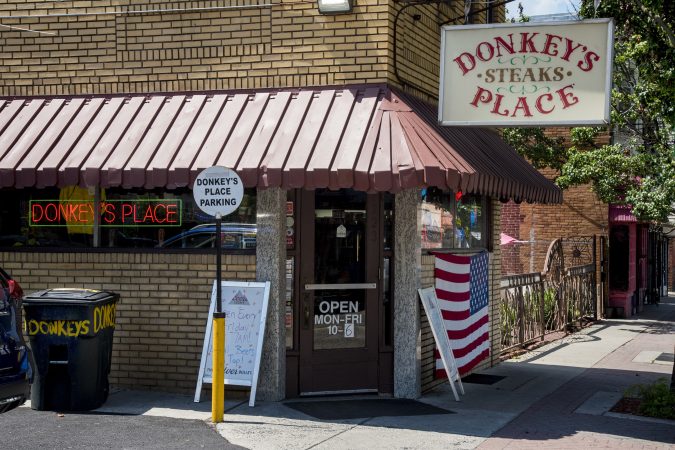
    “The best cheesesteaks actually aren’t in Philly,” she declares in a video posted to her social media Wednesday afternoon centered on a recent visit to Donkey’s Place in Camden. “They’re right here in Jersey, and we’re about to go have one.”

    In the video, Sherrill leans against the bar next to a customer drinking a beer and sporting a Phillies cap. The first-term Democrat notes with a grin that a “real-life” Philadelphian is “here in Jersey, getting a cheesesteak!”

    She noted in the post that a friend of hers from California had mentioned the cheesesteak place to her — showing that the acclaimed Haddon Avenue spot, founded in 1943, is known across the country. She said she “never doubted that New Jersey has the best cheesesteaks,” but had to visit Donkey’s to “confirm” for herself.

    Anthony Bourdain felt similarly.

    In 2015, Bourdain, who grew up in North Jersey, opined on an episode of his Parts Unknown show that finding the best cheesesteak in “the center of the cheesesteak universe” may require crossing the Benjamin Franklin Bridge. The restaurant proudly displays his quote on its website: “The best cheesesteak in the area might well come from New Jersey.”

    During her visit to Donkey’s, Sherrill got in on the cheesesteak action with owner Rob Lucas Jr., whose father, Bob Lucas, previously owned the restaurant. The younger Lucas’ grandfather, Olympic boxer Leon “Donkey” Lucas, was the founder.

    Equipped with plastic gloves and a griddle spatula for each hand, the governor assists Lucas by shaking loads of seasoning on a pile of onions.

    “Take three pieces of cheese, put it right on top of that,” he directs her in the video.

    Sherrill noted she loves onions, in contrast to the three orders of “no onions” ahead of her.

    Donkey’s steaks are endowed with white American cheese and come with fried onions on a poppy-seed kaiser roll.

    “Guys, the verdict’s in, and you probably know I’ve been going to Army-Navy in Philly for years,” Sherrill, a former Navy helicopter pilot, proudly says, sitting with her creation. “I’ve had a million cheesesteaks. There is no better cheesesteak than here at Donkey’s.”

    The historic Army-Navy football game was first played in Philadelphia in 1899 and it has been hosted in the City of Brotherly Love more times than any other city. The last time it was in Philly was in 2022, and it will be hosted by New Jersey, in East Rutherford, this year before returning to Pennsylvania’s largest city in 2027.

    Sherrill visited Donkey’s in late June the same day she visited Camden’s World Cup fan fest at Wiggins Waterfront Park just days before the deadline for her first New Jersey budget. During that appearance, local officials praised the governor for showing up for South Jersey.

    During a speech on the fan fest stage, Sherrill boasted that as visitors flood to the region for the World Cup, “the best cheesesteaks are not across the river, they’re right here at Donkey’s.”

  • Albert Gury, popular painter and award-winning professor of art education, has died at 74

    Albert Gury, popular painter and award-winning professor of art education, has died at 74

    Albert Gury, 74, of Philadelphia, lifelong painter, former chair of the painting department at the Pennsylvania Academy of the Fine Arts, award-winning lecturer at the old University of the Arts and other institutions, author, mentor, community advocate, and cat rescuer, died Thursday, June 25, after a long illness at the Hospital of the University of Pennsylvania.

    Born in Peoria, Ill., Professor Gury came to Philadelphia in the early 1970s after a professor at St. Louis University advised him to enroll at the Pennsylvania Academy of the Fine Arts. He did, and he never left.

    He earned a four-year certificate in painting at PAFA in 1976 and, starting in 1980, taught painting, drawing, figure drawing, anatomy, art history, and art education at PAFA. He was chair of the painting department from 2000 to 2022 and creator of several innovative art education programs.

    He painted portraits of young gun violence victims for PAFA’s Lost Dreams on Canvas exhibit and founded and directed the academy’s popular after-school free art program for high school students in 1994. In 2026, he earned a community recognition award from the Philadelphia School District.

    “This is a way for us to reach out to the community and really try to do something beneficial,” Professor Gury told The Inquirer in 2005. “We train them as if they are college freshmen, not high school kids. It raises the bar on the quality of their work.”

    Professor Gury also lectured for decades at University of the Arts, the Fleisher Art Memorial, the Barnes Foundation, and elsewhere. He instructed students at Jefferson Medical College on anatomy, consulted for the city’s mural arts program, and ran art seminars and painting workshops regionally and in Scotland and Croatia.

    He earned a master teacher’s award from University of the Arts and a master’s degree in fine arts at the University of Delaware in 1992. Former students called him “unfailingly caring, and supportive, and smart,” and “very generous in sharing his wealth of knowledge” in online tributes. One said: “What a great example to us all.”

    In a tribute, PAFA officials said: “We remember Al not only for what he taught but for how he taught: with patience, conviction, humor, discipline, and an open heart.”

    Professor Gury (center) draws and explains the nature of the human form to students at Jefferson Medical College in 2007.

    In the studio, Professor Gury painted colorful figures, landscapes, still life, and portraits. His portrait Alice of Dunk’s Ferry hangs in historic Christ Church in Old City, and he showed at the Philadelphia Museum of Art, the F.A.N. Gallery on Arch Street, the National Academy of Design in New York, the U.S. Capitol in Washington, and elsewhere.

    He especially enjoyed painting abstract landscapes, he said in a 2014 video, because “they are pure.” He told the Daily News in 2000: “I like to paint the things I love. I like the intimacy of small paintings. I move the paint around and put together elements in nature even if they don’t exist that way. I like to imagine things rather than just paint what is in front of me. Sometimes it becomes a little surreal.”

    In 2000, critic Anne R. Fabbri said in the Daily News that many of Professor Gury’s paintings are “united by his layered brushwork, tonal depths, and the creative act that transforms color, line, and composition into a life-enhancing work of art.” He was honored by the Philadelphia Sketch Club in 2017.

    Professor Gury wrote three textbooks: Alla Prima: A Contemporary Guide to Traditional Direct Painting in 2009, Color for Painters: A Guide to Traditions and Practice in 2010, and Foundations of Drawing: A Practical Guide to Art History, Tools, Techniques, and Styles in 2017. He also contributed articles about painting and art to magazines and museum publications around the world, and was a contributing editor for the international journal Per Contra.

    In his neighborhood, Professor Gury advocated for better housing and fostered rescue cats in his home. He volunteered at the Philadelphia Animal Welfare Society and was named its 2015 volunteer of the year. The group renamed its kitten maternity ward after him.

    “We are searching for words to express just how extraordinary Al was, what a profound difference he made, and how much we loved and appreciated him,” colleagues at PAWS said in a tribute. “We hope he knew what an immense impact he made, and how much better and more beautiful the world is because of him.”

    Albert Francis Gury was born Oct. 23, 1951. A family friend introduced him to painting when he was young, and he spent many days roaming the galleries at the Art Institute of Chicago while his father worked downtown.

    He earned a bachelor’s degree in fine arts at St. Louis University in 1973 and won scholarships, grants, and honors as both a student and a professor at PAFA. He collected quilts and rare books on art.

    Professor Gury loved animals, especially cats.Philadelphia Animal Welfare Society

    In 2018, his apartment building on Chestnut Street burned down in an early-morning fire. Several of his cats and parakeets perished, and much of his artwork was lost. “The whole thing is just tragic,” he told The Inquirer then.

    Friends called him “a classic caregiver” and a “protector of the underdog.” Longtime friend and colleague Reza Ghanad said: “If you were feeling down, he would pick you up.”

    Friend and colleague Morgan Hobbs said: “He noticed students who could have gone unnoticed without him. He had a special gift for that.”

    Professor Gury is survived by several relatives.

    His ashes are interred at Christ Church Burial Ground. A celebration of his life is to be held later.

    Donations in his name may be made to the Philadelphia Animal Welfare Society, 100 N. Second St., Philadelphia, Pa. 19106.

    Much of Professor Gury’s work features color and shape. Al Gury
  • A bridge replacement’s new repair timeline prompts concerns over increased traffic in Downingtown and other delays

    A bridge replacement’s new repair timeline prompts concerns over increased traffic in Downingtown and other delays

    A bridge replacement near Downingtown will stretch into next year, prompting a call to Gov. Josh Shapiro’s administration about the extended closure’s impact on traffic flow through the borough and the sequencing of other projects — including another bridge replacement.

    Replacing the nearly 60-year-old, three-span bridge that carries Boot Road over Amtrak in East Caln Township will now wrap up in early 2027, rather than in fall 2026 as initially projected.

    The elongated timeline is, in part, thanks to a change in the foundation design. After the original bridge was demolished, the Pennsylvania Department of Transportation found a different type of rock from what was anticipated, which required a new design, said Helen Reinbrecht, community relations coordinator for the department.

    The department expedited a redesign, which was completed in June. Construction is anticipated to be a bit slow into early August, as PennDot awaits proprietary materials, Reinbrecht said.

    In Downingtown, the delay will have ripple effects — prompting Mayor Erica Deuso to call on state leadership to approach this project with the “same urgency, accountability, and focus here” as when Gov. Josh Shapiro’s office quickly reopened I-95 in Northeast Philadelphia after a tanker crashed and a section of the bridge collapsed in 2023, and with the early completion of another bridge in Pittsburgh in July.

    Deuso said in a news release Tuesday that the public was prepared for a one-year closure of the Boot Road bridge, but that the extended timeline is “a serious failure with real consequences for everyone forced through Downingtown each day.”

    “Our roads, intersections, emergency routes, business district, and residents are paying the price,” she said.

    She requested a review of whether additional crews, work shifts, equipment, and engineering support could make up for the lost time, and asked for help addressing traffic signal adjustments, detour enforcement, pavement and bridge condition monitoring, emergency-response planning, “and assistance with extraordinary local public safety and infrastructure costs.”

    Following Deuso’s letter, PennDot press secretary Alexis Campbell said that the department “understands how vital the Boot Road Bridge is to the community and is expeditiously working to reopen the bridge as soon as possible.”

    “The Department expedited the new design of the bridge and is working with the contractor to accelerate construction by adding additional crews and working through the winter so long as the weather permits,” she said.

    The delayed bridge replacement has trickled down into the sequencing of other Downingtown projects, including the rehabilitation of the borough’s Lancaster Avenue bridge, which crosses the east branch of Brandywine Creek, due to its poor condition.

    That will not get underway until the detours from Boot Road and another effort — relocating the Downingtown train station half a mile to the east, where the Keystone Corridor crosses U.S. Route 322 — are completed, borough officials said. Deuso was concerned the Boot Road delays would also hamper the train station relocation.

    The Boot Road bridge replacement is a $13.3 million project that replaces the 193-foot three-span bridge with a 105-foot single-span structure. It carried roughly 12,000 vehicles a day before its closure, officials said.

    The full closure of the road, between Quarry Road and Southwind Lane, began in late September 2025. Motorists are being detoured to U.S. Route 322, Business U.S. Route 30, and Quarry Road. That is expected to continue until the work is fully completed next spring.

    The bridge was structurally deficient, Reinbrecht said.

    “I know it can be frustrating and time-consuming to have to use the detours. But this really will be safer and more efficient when the construction is completed,” she said.

    This suburban content is produced with support from the Leslie Miller and Richard Worley Foundation and The Lenfest Institute for Journalism. Editorial content is created independently of the project donors. Gifts to support The Inquirer’s high-impact journalism can be made at inquirer.com/donate. A list of Lenfest Institute donors can be found at lenfestinstitute.org/supporters.

  • 3rd person charged in West Philly shooting that killed 2, wounded 3 others

    3rd person charged in West Philly shooting that killed 2, wounded 3 others

    A third person has been charged in a March shooting that killed two men and wounded three others in West Philadelphia, court records show.

    Nysir Mahoney, 24, was charged with murder, attempted murder, and other offenses in the March 30 shooting at 60th and Delancey Streets, records show.

    Mahoney was being held without bail at Curran-Fromhold Correctional Facility. A court-appointed attorney listed for Mahoney declined to comment on the case.

    Two other men, Andre Bowie, 22, and Marquis Andrews, 23, also have been charged in the case.

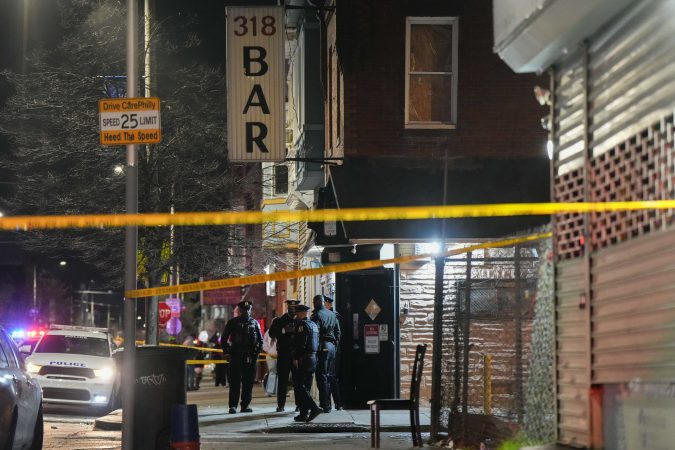
    Police said several assailants drove in a Mercedes to 60th and Delancey Streets on the night of March 30 and opened fire on a group of people standing outside a corner bar, wounding three and killing Paul “PJ” Cobb and Naasir Boyd, both 24.

    More than a dozen shots were fired from three 9mm handguns, police said. Police later found the Mercedes on fire on the 1200 block of Cumberland Street.

    Police investigators believe the March 30 shooting was motivated by a feud and led to a retaliatory shooting that inadvertently killed 20-year-old Imani Ringgold, who was walking with a slice of pizza and talking to her grandmother on the phone when she was shot on Market Street near 60th in April.

    She was an innocent bystander and had no connection to the feud, police said.

  • FAA is investigating why a plane was allowed to take off as President Trump’s helicopter approached

    FAA is investigating why a plane was allowed to take off as President Trump’s helicopter approached

    WASHINGTON — The Federal Aviation Administration is investigating why a plane was allowed to take off as President Donald Trump’s helicopter was approaching Reagan National Airport Tuesday afternoon in what appears to be a violation of safety procedures put in place after last year’s midair collision near that busy Washington, D.C., airport.

    The incident occurred as Marine One left the White House for Andrews Air Force Base with the president aboard for the first leg of a West Coast trip. A commercial jet took off at the same time. The FAA decided after 67 people died on Jan. 29, 2025, when an airliner collided with an Army Black Hawk helicopter that all takeoffs and landings at Reagan would be halted anytime a helicopter passes by the airport.

    The airplane that took off Tuesday was climbing above Marine One as the helicopter approached, so the two aircraft were not on a collision course.

    The FAA said in a statement that the preliminary investigation showed “there was a momentary loss of separation after which the aircraft continued to move away from one another.”

    “The air traffic controller was in contact with both the commercial pilot and Marine One pilot during the loss of separation,” the FAA said.

    The White House emphasized that President Trump was not in danger during the incident.

    “Marine One flights are piloted by some of the best aviators in the world, and at no point was the President in harm’s way,” said White House spokesperson Kush Desai.

    And the Marine Corps defended the actions of their helicopter pilots.

    “There were no ‘close calls’ with the routine Marine One movement,” Tuesday, said Marine Corps spokesperson Capt. Jacob Sugg in an email. “Washington National Tower did not delay the helicopter crew, ask them to hold, or otherwise alter their flight profile. To the contrary, the ATC team approved the requested route and provided timely and appropriate traffic information.”

    The Wall Street Journal first reported the incident.

    The airspace near the White House and Reagan is heavily congested with military and commercial aircraft.

    Poor communication between the military and the civilian air traffic controllers at Reagan has been an issue in the past. It came out last spring after one of the hearings on the midair collision that a hotline connecting the Pentagon to the tower at Reagan hadn’t been working for more than three years, and the FAA hadn’t even realized it.

    The Federal Aviation Administration took steps to ensure that helicopters and airplanes would no longer share the same airspace around Reagan National Airport shortly after the investigation into last year’s midair collision began. The rules also prohibit air traffic controllers from relying on visual separation and require all military aircraft to broadcast their locations.

    The main group of family members of the victims of last year’s crash questioned why the government hasn’t done more to prevent collisions in the crowded airspace around Reagan in a post on X Wednesday morning. The family members have been urging Congress to reach a compromise and pass the package of aviation safety reforms that the NTSB recommended after the midair collision.

    The NTSB said Wednesday morning that it is still gathering information about Tuesday’s incident involving Marine One and hasn’t yet decided whether to investigate.

  • TPS for Haitians officially ends, putting thousands out of work and in limbo

    TPS for Haitians officially ends, putting thousands out of work and in limbo

    A federal judge on Wednesday took the final step in allowing the Trump administration to terminate temporary protected status for 350,000 Haitians, meaning many are likely to lose their jobs and be at risk of deportation back to a country the United States says remains dangerous.

    U.S. District Judge Ana C. Reyes of the District of Columbia had enjoined the administration in February from ending TPS for Haitians, and a federal appeals court had refused to lift the ban. Reyes reversed her decision after the U.S. Supreme Court ruled 6-3 in June that federal law bars judicial review of TPS determinations.

    The high court’s ruling means TPS “is no longer in effect,” Reyes wrote in her new order Wednesday. However, the judge said she would allow attorneys to continue seeking discovery and litigating their underlying claims that the Trump administration terminated TPS because of their clients’ race.

    The Supreme Court’s ruling left open a narrow path for TPS holders to challenge the loss of their status on constitutional grounds. An attorney representing the immigrants involved in the Supreme Court case said the team is considering filing a new lawsuit.

    Immigration experts said that even before Reyes’s amended ruling, companies had begun large-scale layoffs of Haitian TPS holders, who now face the possibility of detention and deportation. Another federal judge in New York is expected to soon allow the Trump administration to formally end TPS for an estimated 6,000 Syrians to comply with the Supreme Court.

    About 200,000 Haitians with TPS hold jobs, with large concentrations of workers in healthcare, food service, warehousing, retail, and long-term caregiving, according to an analysis of government data by the immigration advocacy group FWD.us. Business owners have been preparing for weeks by raising sign-on bonuses, cutting shifts and making inroads at community colleges and high schools to hire new staff, industry leaders said.

    In Philadelphia, Haitians and their allies plan to march through Center City on Thursday, to demand that the federal government provide some form of relief.

    The end of TPS threatens to exert dramatic impact on the city’s 11,000-strong Haitian community, including deportations to a homeland in chaos — beset by natural disasters, governmental collapse, and gang violence that has displaced more than a million people.

    Some local Haitians have become desperate to see if they can gain legal status in this country, such as asylum, or find somewhere else in the world to go that’s safe.

    In Philadelphia and elsewhere, many TPS-holders work in critical jobs and industries — the people who build homes, keep restaurants running, fix plumbing and wiring, and, particularly in the case of Haitians, care for the ill and elderly.

    “If you access our healthcare system in any way, shape, or form, particularly elderly care or senior care, you’re going to feel it,” Anuj Gupta, president and CEO of the Welcoming Center in Philadelphia, told The Inquirer.

    Industries and employers here will be hit as the Trump administration moves to end TPS for a series of countries through the fall.

    The Economy League of Greater Philadelphia, a regional policy and research organization, examined four countries where designations are ending or at risk ― El Salvador, Ukraine, Syria, and Haiti.

    It estimated that in the local area, between 4,100 and 6,100 workers from those countries depend on TPS. In the city, those TPS workers bring home $36 million to $76 million in annual salaries and pay $1.5 million to $3 million in wage tax.

    The local sectors predicted to be most affected by job losses are construction, building cleaning and landscaping, trucking and warehousing, manufacturing, restaurants, and retail.

    In Ohio, the Department of Homeland Security has recently begun summoning Haitian immigrants to check-in appointments and requiring them to wear ankle monitors, in what appears to be a new enforcement effort after the Supreme Court’s decision.

    In Springfield, Ohio, which has more than 10,000 Haitians, residents awoke Wednesday to group messages relaying worry and a sense of dread. Though Reyes’ order was expected, the reality of its implications is only starting to feel real, community members said.

    Haitian parents of U.S. citizens are now asking for help with power-of-attorney forms to ensure their children will be cared for if they are detained or deported. Some Americans have been preparing their own children in case they have to say goodbye to Haitian friends.

    Not all Haitians are immediately vulnerable to arrest, said Katie Kersh, senior attorney with Advocates for Basic Legal Equality, a legal nonprofit, because some have pending immigration cases. But the possibility of immediate detention at mandatory check-ins with U.S. Immigration and Customs Enforcement this week is now greater, she said.

    “The way this group has been specifically targeted is symbolic of the administration’s efforts to criminalize immigrants of color,” Kersh said. “In targeting people who had TPS, they are targeting people who followed the law.”

    The termination is expected to weigh most heavily on certain major metropolises, such as Miami and Boston, as well particular midsize cities, such as Columbus, Ohio, and Allentown, Pa. Those local economies will see a reduction in consumer spending and tax revenue, experts say.

    DHS has called TPS a “de fact amnesty program” and said Congress never intended for it to offer permanent protections for foreigners.

    Most TPS holders have lived in the U.S. for years, some for more than a decade. The Obama administration first granted TPS to Haitians in 2010, after a major earthquake destabilized the country, and to Syrians in 2012, amid a violent civil war in their country.

    The prospect of migrants being sent back home is particularly worrisome, experts said, because those countries remain dangerous and politically unstable. The U.S. State Department maintains a “do not travel” warning for U.S. citizens to both countries, citing the threat of kidnappings, violent crime, and terrorism.

    The Haitian Legal Defense and Education Fund, in a court filing last week, asked Reyes to implement a 90-day ban on the federal government from deporting Haitians who lose TPS status, citing systematic violence in Haiti that “demonstrates a pattern of crimes against humanity.” The judge did not grant that request.

    “This is an embarrassment for the United States of America,” Sen. Chris Murphy (D., Conn.) said in a conference call with reporters Monday. “There is no safe place to return for TPS holders from places like Haiti and Yemen and Venezuela and Syria. In fact, in those places I just mentioned, the situation is not stabilizing, getting better, it is getting worse.”

    Some Haitian TPS holders may have other pending immigration claims, including applications for asylum, that allow them to remain in the U.S. Others will be left without any legal status, putting them at risk of being detained, whether through a targeted ICE operation or a traffic stop that leads to questions about their status in the U.S.

    Immigration attorney Ira Kurzban, who helped represent the Haitians in the Supreme Court case, said he is bracing for a rush of arrests by the Trump administration. But he is urging his Haitian clients to continue pursuing applications for asylum or another form of legal status, even if they are detained. The alternative, he said, is returning to a country where they could be harmed or killed.

    “I tell my clients to fight, fight, and fight,” Kurzban said. “Nobody is telling a client to make up anything, but if there is a claim, I think the worst thing they can do is just give up.”

    The high court’s decision, which was issued along ideological lines, is expected to eventually affect all of the estimated 1.7 million people from 17 countries who had been granted TPS. President Donald Trump’s administration has sought to eliminate the humanitarian protections for people from 13 of the 17 countries in the TPS program, though litigation in lower courts had slowed the government’s effort.

    TPS is reserved for people from designated countries that are in the midst of armed conflict, natural disaster, or other crises. The protections allow immigrants in the U.S. to work legally for up to 18 months and seek to renew their status after that. Applicants are required to pay fees and pass a background check and cannot have serious criminal records.

    Many Haitians and business owners have been making plans to prepare for the sudden loss of thousands of workers. Nursing home leaders warned they would have fewer beds to offer if health aides were forced to leave the country. Business owners started calculating how many days they could continue to employ TPS holders. Immigrants began making plans to sell or rent their homes and secure bank accounts.

    It is up to employers to verify who has a valid work authorization, and some companies do so only once a year. So how quickly someone might lose their job will vary.

    A plurality of Americans oppose ending TPS and deporting those who have been protected by it, according to a Washington Post-Ipsos poll conducted last month. The poll found 44% oppose terminating the program, compared with 32% who support doing so.

    Trump has long signaled that he wants to deport many of the immigrants previously protected through TPS. He falsely claimed during his presidential campaign that Haitian residents in Springfield, Ohio, were killing and eating their neighbors’ pets — and said that immigrants were “poisoning the blood” of the country.

    After the Supreme Court ruling in June, Stephen Miller, White House deputy chief of staff and the architect of much of Trump’s immigration policy, said that he expected people who lose TPS status to be deported.

    Those who lose TPS can seek asylum if they apply within what the law calls a “reasonable period” of time after losing their status, which is evaluated at the discretion of the immigration judge.

    The Trump administration recently announced a new rule that could make it more difficult for asylum seekers to remain in the country. The provision allows asylum officers to send applicants directly into deportation proceedings in immigration court without granting them an interview to determine whether they are eligible for protection and permission to stay permanently.

    U.S. Citizenship and Immigration Services, which announced the new rule, said it aims to wipe out 31% of an asylum application backlog totaling 1.4 million cases.

    The Trump administration already has deported some former TPS holders after revoking their status, including Venezuelans, said Emi MacLean, a senior staff attorney at the ACLU of Northern California. Her organization represents Haitian and Venezuelan TPS holders in a separate legal case that remains active as the ACLU and its partners seek to amend their complaint to be in line with the Supreme Court’s ruling.

    MacLean said that the large number of Haitians who stand to lose TPS could have deep impacts in some labor industries, including healthcare, where many of them worked.

    “It will be a huge loss to many people and communities,” she said.

    Staff writer Jeff Gammage contributed to this article.