Blog

  • VA loan helped two 23-year-olds buy a home in Germantown | How I Bought This House

    VA loan helped two 23-year-olds buy a home in Germantown | How I Bought This House

    The buyers: Mia Spolansky, 23, U.S. Air Force active duty military personnel, and Annabel Harp, 23, daycare worker and early childcare assistant

    The house: A 784-square-foot home in Germantown with two bedrooms and one bathroom built in 1950.

    The price: Listed for $250,000, sold for $265,000.

    The agent: Christine Mantwill with REMAX

    The ask: Mia Spolansky, originally from Willow Grove, and her partner, Annabel Harp, originally from Hagerstown, Md., were ready to move out of their one-bedroom rental apartment in Mount Airy and buy their first home. They both liked the area’s access to nature for running and biking in Wissahickon Valley Park, plus a location that allowed for easy commuting to their jobs. They didn’t want to stray too far.
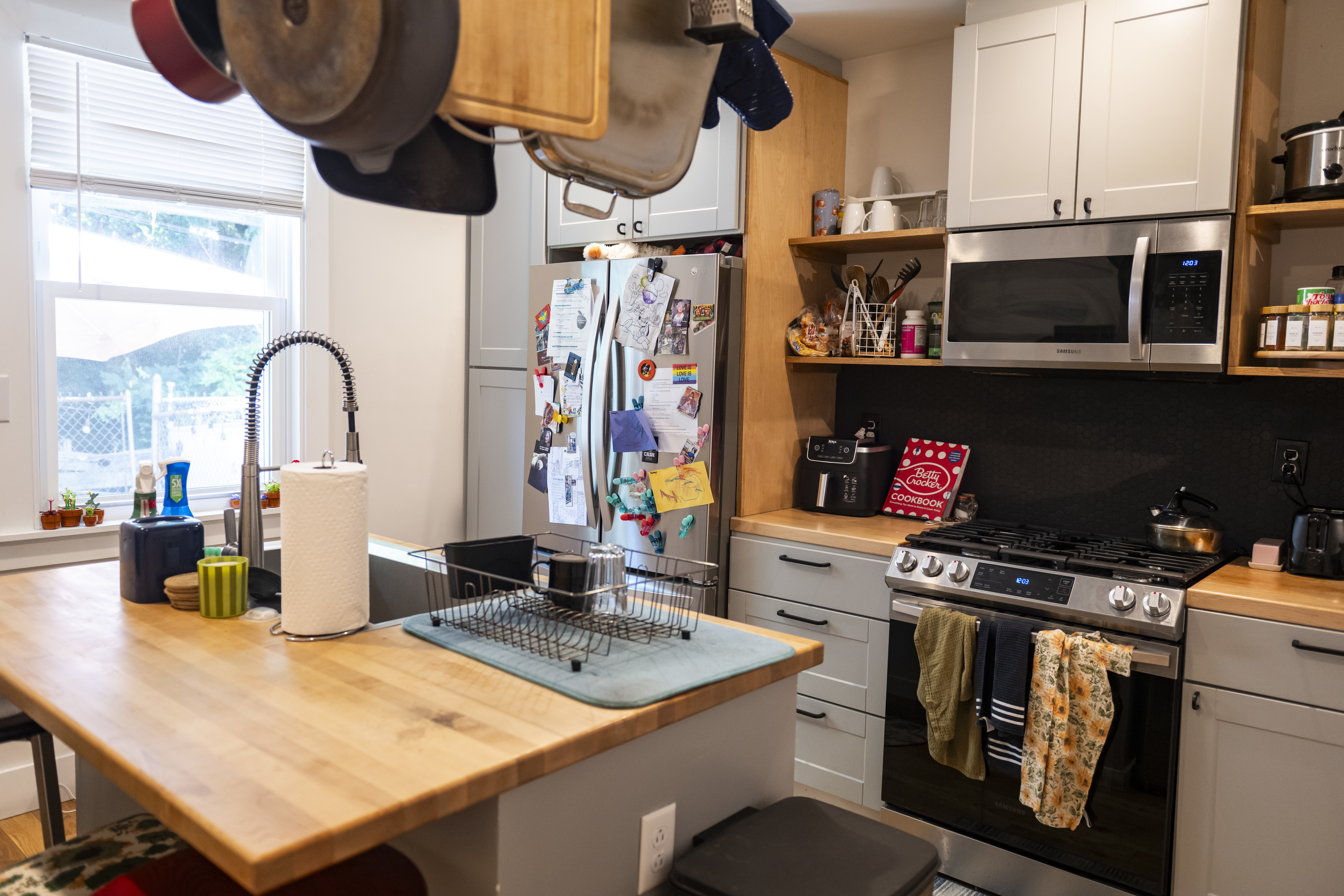
    The kitchen in Mia Spolansky and Annabel Harp’s home in Germantown.Allie Ippolito / For The Inquirer

    “We were looking to buy in Mount Airy,” Spolansky said. “Those prices were out of our range, so we decided on Germantown.” They started their search in November.

    The search: Harp and Spolansky began touring homes in East Germantown with their real estate agent. They wanted to be efficient with their space, so they narrowed the search to smaller homes. They were seeking a rowhouse for both the neighborly feel and value.

    “A lot of detached homes were out of our price range,” Spolansky said.

    They also wanted an older home “with some character” but with modern amenities. They toured six houses and all of them felt too large or had issues. Their agent helped Spolansky access the multiple listings sites used by real estate professionals so she could browse, and one house caught her eye.

    The appeal: With their agent’s help, Harp and Spolansky went to see the house that day. It was a two-bedroom with a front patio and backyard, which was not yet on the market.

    When they visited, they were delighted that “the neighbors actually came up and introduced themselves,” Spolansky said, “We were like, whoa, this is an actual community.”

    The empty lot next to their home, which the pair uses to garden, growing peppers and cucumbers.Allie Ippolito / For The Inquirer

    The house was an older style with new appliances — exactly what they were looking for — and the owners had renovated both the bathroom and kitchen and installed central air and heat in 2021. “It was nicer than I grew up with,” Spolansky said. The couple put an offer in right away.

    The deal: Harp and Spolansky made an offer on a Thursday. The sellers had an open house scheduled for the following Saturday. The sellers said they would accept the offer and cancel the open house if the couple agreed to go $15,000 over asking to beat the potential offers they might get from the open house.

    Harp and Spolansky agreed and closed in mid-April.

    The money: They purchased the home for $265,000 after negotiation. They used a VA Home Loan of $270,000 and put 0% down. The mortgage interest rate is 5.625%. They received a $5,500 seller credit for some repairs needed. The closing costs were $1,780. The monthly payment is $1,834 with escrow, interest, and principal.

    The move: They moved in late May, with a two-month buffer period until the lease on the apartment ended.

    They used a moving company to ease the process, which helped, because the home had small doors and tight corners.

    The inspector had found some rotten floor joists in the basement, but after move-in, the couple realized there was water getting in as well. They brought in a masonry company to waterproof the wall and added a chimney liner when their carbon monoxide detector started going off. They also had some electrical and AC issues.
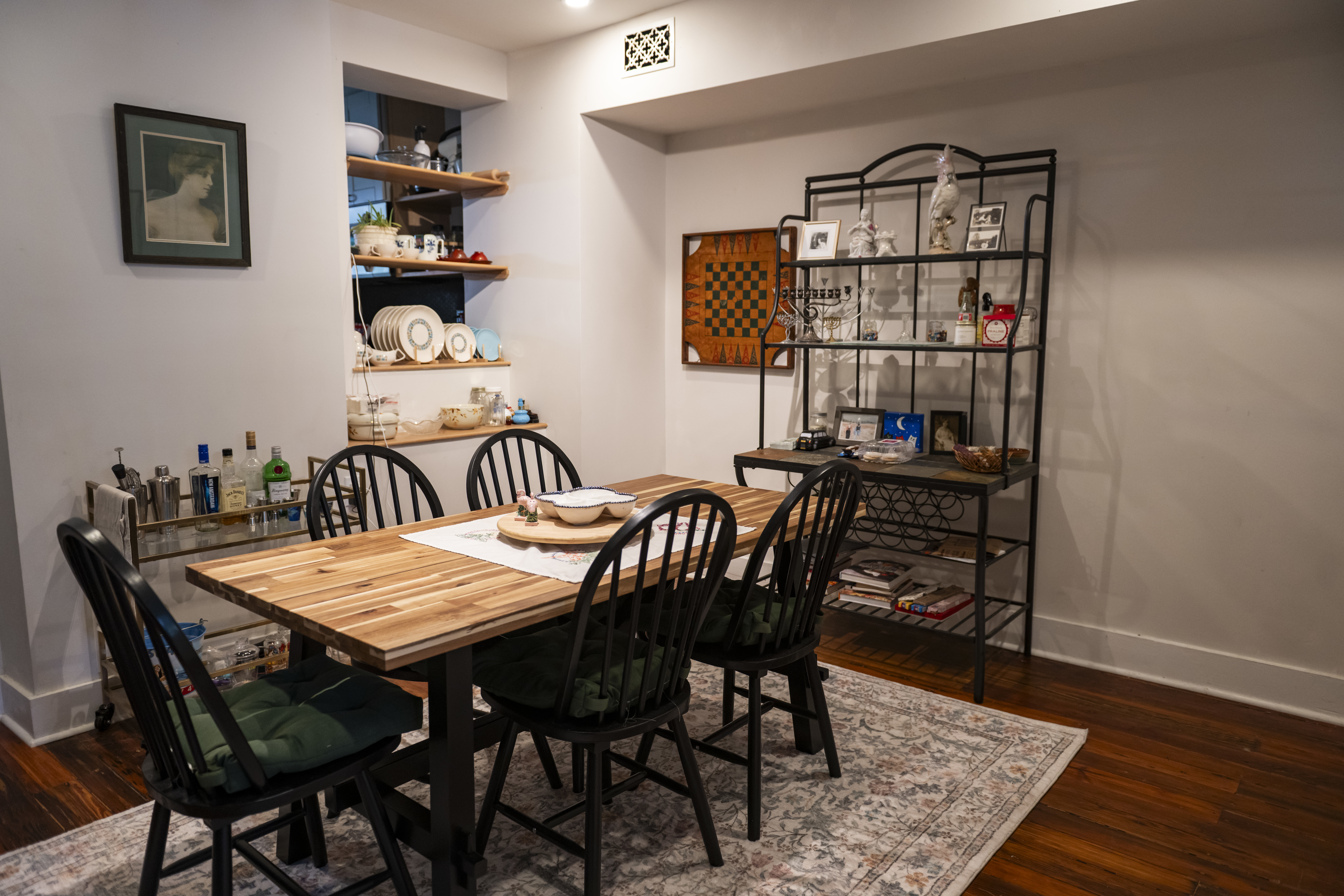
    The dining room in Mia Spolansky and Annabel Harp’s home.Allie Ippolito / For The Inquirer

    “I’ve only ever lived in rentals,” Spolansky said. “My family doesn’t have experience with upkeeping a house. I think having a buddy or known contractor come on the inspection would’ve been helpful, especially for negotiations because I didn’t know how much it costs to put in a chimney liner.”

    However, the pair remain satisfied with their choice and their ability to manage repairs themselves, rather than rely on a landlord.

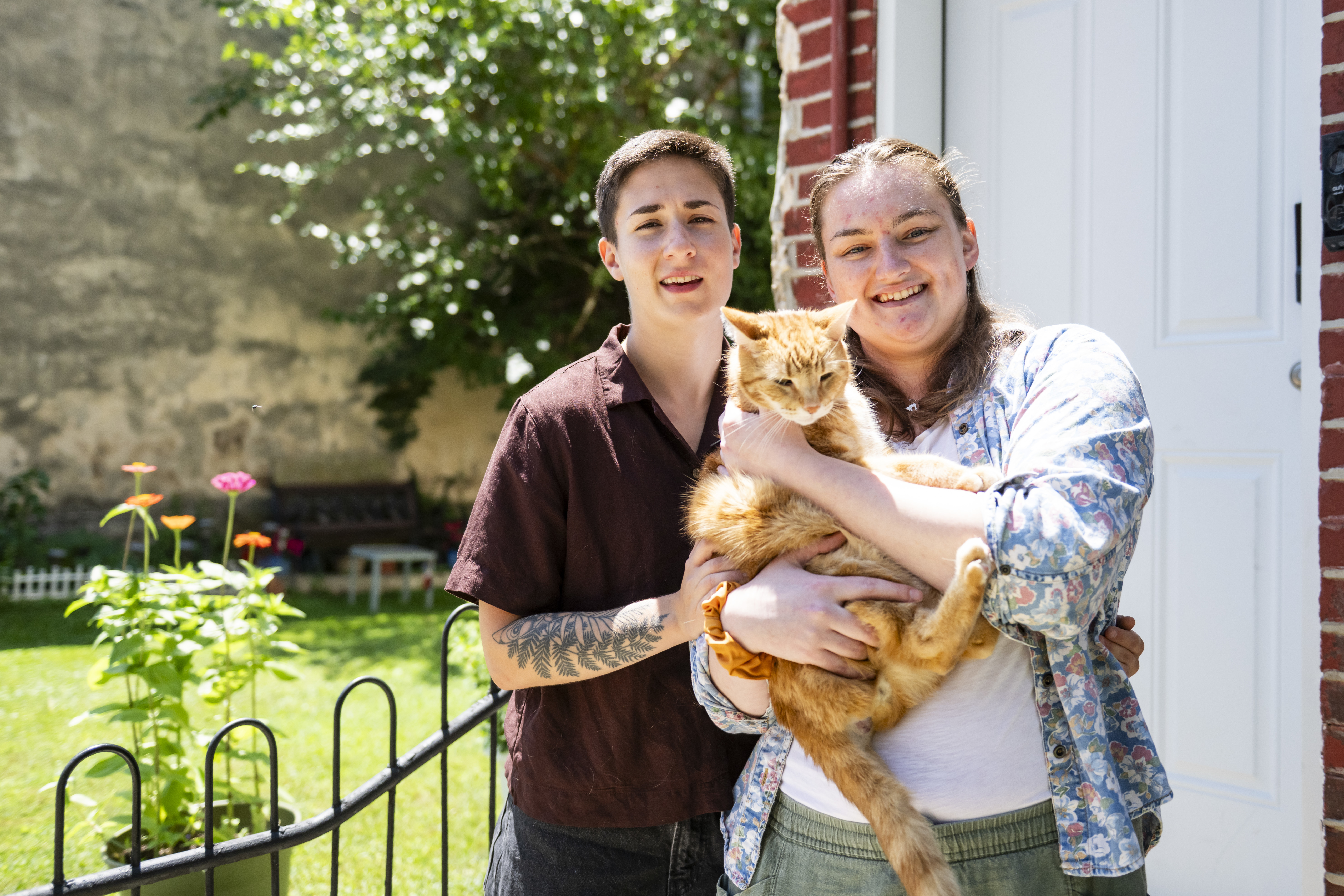
    Life after close: The couple and their cat, Morty, have adjusted well. After living in a one-bedroom, they love the space, including their backyard and front porch, especially in the summer for barbecuing and being outside. The Wissahickon is a five-minute bike ride away. The rowhouse is exposed on one side to an empty lot, which the pair uses to garden, growing peppers and cucumbers they got from their neighbors. They especially love the community.

    “We go to parties, clean up the block, do community events,” Spolansky said. “I never had that before. Knowing our neighbors has been the biggest plus. Having good neighbors, you can’t replace that.”

    Did you recently buy a home in the Philadelphia area or South Jersey? Share the story of how you did it. Email Inquirer real estate reporters at properties@inquirer.com.


  • The best thing Mike Klein ate this week: Chicken roulade at Academy Grill

    The best thing Mike Klein ate this week: Chicken roulade at Academy Grill

    White-tablecloth restaurants in Eastern Montgomery County are few and far between nowadays, which makes the recent arrival of Academy Grill in Fort Washington something of a throwback.

    Tucked off Bethlehem Pike near Germantown Academy, the restaurant took over the building that for years housed Cantina Feliz. (Last year, the Mexican restaurant left Fort Washington for Ambler, 10 minutes away.) The sleek Academy Grill is taking a decidedly different approach: polished, contemporary American cooking with chef Jeffrey Power in the kitchen.

    Power is no stranger to the area. He was the longtime chef at Dettera, the ambitious Ambler restaurant that closed earlier this year, and before that worked at Blackfish in Conshohocken and Le Bec-Fin downtown. Though Power is turning out steaks and seafood at Academy Grill, one other dish connects those chapters of his career.

    Power’s chicken roulade — once a staple at Dettera — traces its roots back more than 20 years to Le Bec-Fin, though the technique has evolved. Power completely debones a whole chicken, removes the legs and thighs, and wraps the breast in its skin around a chicken mousseline studded with sun-dried tomatoes, oregano, basil, parsley, and scallions.

    At Le Bec-Fin, the roulade was rolled, tied in the old-school fashion, then pan-seared. Power now forms it into a cylinder using cellophane and cooks it sous vide, setting the proteins and helping the roulade hold its shape. It is then deep-fried to evenly crisp the skin around juicy chicken and herb-flecked mousseline.

    The dish is unabashedly rich, but its accompaniments have changed with its surroundings. At Dettera, Power plated it with English peas, smoked fingerling potatoes, and cremini mushrooms. At Academy Grill, pillowy potato gnocchi and earthy truffle crema add to its lushness. Cauliflower brings sweetness, while fava beans provide a fresh counterpoint — green, slightly nutty, and mildly bitter.

    In that sense, the roulade is both a new Academy Grill dish and a snapshot of Power’s career: a Le Bec-Fin idea refined at Dettera and carried into his latest kitchen.

    Academy Grill, 424 S. Bethlehem Pike, Fort Washington, 610-424-5000, academygrill.com.

  • Aramark forged a partnership with Penn Medicine for more affordable employee health benefits

    Aramark and the University of Pennsylvania Health System launched a partnership this year to offer the food service giant’s Philadelphia-area employees healthcare in a test of a new model for reducing costs.

    Aramark employees who choose the benefit option, called the Penn Medicine Premier Plan, face no deductibles and lower copays when they and their dependents use Penn doctors and facilities.

    The move by Aramark into what is called direct contracting comes as employers are contending with years of surging healthcare costs. It’s an example of experimentation designed to slow spending growth in spending and perhaps improve quality, experts said.

    “We certainly would like to save money on the model, but its primary focus is to make benefits more affordable” by getting lower prices than it would get by going through an insurer, said James Startare, Aramark’s vice president for benefits.

    The model is called direct contracting because Aramark negotiated prices and other terms of the contract directly with Penn, instead of relying on an insurer to negotiate prices.

    It’s Penn’s first such contract and the first large-scale direct contract in the Philadelphia region. Aramark talked with other systems in the area, but Penn emerged as the partner willing to enter into the experimental contract. Penn described the deal as a multiyear contract ultimately expected to roll over from year to year.

    Aramark didn’t provide details on savings, but its goal was to negotiate prices that are lower than those it would pay though a benefits administrator, such as Aetna.

    By eliminating deductibles that function as a barrier to care, the plan is expected to encourage primary care visits. This could reduce long-term costs by catching patients’ health problems early.

    For health systems like Penn, such contracts offer a chance to increase market share, streamline payments, and hone their ability to manage the health of a population.

    The Penn Medicine Premier Plan features no deductibles and lower copays when Aramark employees and their dependents use Penn doctors and facilities. Harold Brubaker / Staff

    Aramark’s move into direct contracting

    Penn is Aramark’s third major direct contracting partner.

    Employers, even those like Aramark that are self-insured, typically rely on an insurer’s negotiated prices.

    With the new direct contract, an Aetna administrative unit still processes the claims for Aramark, and patients who go outside Penn for care use the Aetna network.

    Aramark launched its first such contract in 2024 in Dallas and expanded to Chicago last year, each time getting a strong employee enrollment, though it took two years in Chicago, Startare said.

    In the Philadelphia region, 35% of eligible employees (those who work 30-plus hours a week on average) have chosen the Penn plan, which took effect Jan. 1, Startare said. That amounts to 800 employees.

    Coincidentally, the health contract started at the same time as Aramark’s contract to manage food and other services at Penn Medicine facilities, but the two deals were not linked.

    Employees who were moving to Aramark with the food services contract were worried about losing their Penn benefits, said Megan Lieberman, a patient services manager at Chester County Hospital who was among those who became an Aramark employee.

    But the Penn Premier Plan was very similar to what they were used to. “It was definitely a huge relief to know that we got to hang on to those benefits,” Lieberman said.

    A separate contract covers pediatric services at Children’s Hospital of Philadelphia for Aramark employees and their families.

    Next year, Aramark plans to take direct contracting into central New Jersey, but did not name the system it’s using there.

    What’s in it for Penn

    The Aramark contract is an opportunity to focus on “chronic disease management, preventive care, cancer screenings, things like that” for a specific group of 1,400 patients who are motivated to stay within the Penn system, said Mark Angelo, Penn’s chief medical officer for population health.

    A key goal is to reduce the deductibles, copays, and prior authorizations that can slow access to preventive care. The model is designed to take care of people before they end up in high-cost places like the emergency department or hospital, Angelo said.

    Keeping more patients within Penn is expected to result in savings because of better care coordination and fewer repeated tests, Angelo said. Penn Premier plan members can seek care outside of Penn, but it will cost them more out-of-pocket.

    As it is, the typical Penn patient also uses other health systems for some services, said Roy Schwartz, Penn’s vice president for payer strategy.

    “Sometimes it’s the right choice, sometimes it can fragment their care,” Schwartz said. “There should be savings just simply coming from having integrated, coordinated care at a place like Penn.”

    Penn does not yet have much of its own data on Aramark employees, but indications from Aramark are that the plan’s members were using more Penn services in the first six months, Schwartz said. “It was not just patients who were using Penn anyway for pretty much everything.”

    Penn and Aramark officials plan to meet regularly to review results and consider modifications. “We’re hoping this works out well for everybody because we’d love to do some more of these,” Schwartz said.

    Momentum behind direct contracting

    Employers nationally have long contracted directly with doctors and health systems for specific procedures, like joint replacements, cancer care, and heart surgery. For years, they’ve also paid directly for primary care through on-site clinics.

    Aramark’s move to an all-encompassing healthcare plan with a single provider fits into a newer trend gaining momentum nationally. Investors have created platforms like Cost Plus Wellness, Mishe Health, Nomi, and Transcarent to help health systems implement direct contracts.

    Northwell Health, a major health system in New York and Connecticut, started a for-profit subsidiary called Northwell Direct and now has more than 70 contracts that cover more than 300,000 people.

    Northwell Direct’s biggest contract covers 100,000 building service workers in the New York area and their dependents. It took effect this year and is expected to save 20% in the first year.

    Big savings to start are not guaranteed.

    “They may not go into it with a lower cost, but they’re going to go into it with better access, better quality for their employees, and what they’re finding is eventually those lower costs will come,” said Jenny Goins, chief of staff at the National Alliance of Healthcare Purchaser Coalitions.

    The Washington nonprofit is putting together a direct contracting advisory council to help more employers to do what Aramark is doing, Goins said.

    The model is not expected to replace traditional coverage anytime soon in the Philadelphia region.

    “It is not for everyone, and it does take effort and coordination on the part of the employer,” said Tom Belmont, CEO of the Greater Philadelphia Business Coalition on Health. “Also, some health systems are ready for the discussion, while others are not.”

  • Gen X and millennials are set to inherit trillions. If they’re already rich.

    Gen X and millennials are set to inherit trillions. If they’re already rich.

    Baby boomers are set to pass trillions of dollars on to their heirs in the next two decades, but the huge transfer of riches will mostly benefit Gen X and millennial heirs who are already wealthy.

    An analysis from Visa Business & Economic Insights finds that boomers, born between 1946 to 1964, will pass on $36 trillion in wealth to their younger heirs over the next 20 years.

    Nearly three-quarters of households receiving an inheritance will be in the top echelon of wealth in the country when they receive the money, Visa estimates. Gen X and millennials were born between 1965 and 1996.

    Often called the Great Wealth Transfer, the inheritances are expected to be the largest passage of generational wealth in history, given the massive size of the baby boomer population and their wealth.

    Baby boomers are sitting on about $93 trillion worth of assets, according to Visa’s analysis. Only about 8.6% of that, or roughly $8 trillion, is expected to be spent into the economy, after it is inherited.

    “Eight trillion dollars is nothing to sneeze at,” Visa chief economist Wayne Best said. But that spending number has been whittled down quite a bit from the starting wealth.

    Visa calculated that about $36 trillion would be passed from boomers to their heirs, after subtracting liabilities such as mortgages, as well as retirement spending and taxes. That works out to about $515,000 per inheriting household, but the inheritances will be uneven.

    The richest boomers have the most to give away. Visa found that those in the 90th to the 99th percentile of boomers held some $44 trillion in wealth. Meanwhile, the bottom 90% of boomer households hold just $16 trillion in wealth.

    Since most inheritances are coming from wealthy boomers, their heirs are more likely to be wealthy as well. Lower-wealth boomers will need to use more of their savings to pay for housing, healthcare, and other needs, while wealthier households can save more to pass on.

    The bulk of that money will flow to people who are worth far more than the average. And that means much of it will be saved or invested, rather than spent.

    “Wealthier Americans are going to be putting that money into the stock market or real estate,” said Jeremy Ney, a professor at Columbia University’s business school and writer of the “American Inequality” newsletter. “It doesn’t buy groceries or cars, it just changes your accountant’s week.”

    It could also widen gaps between lower-wealth and higher-wealth Americans, Ney said, which have already been accelerating.

    The $8 trillion in spending is still expected to boost the economy — Visa estimates it will bump annual consumer spending growth over the next 20 years from 2% to 2.1%. Much of that money will be spent on housing, or buying new cars, as well as on travel and retail.

    One reason that the transferred wealth will flow to the already wealthy might be because people are living longer, and therefore passing their money down to heirs who are already in their 50s or 60s, noted Jonathan Parker, a professor of financial economics and co-director of the MIT Sloan Consumer Finance Initiative. Those heirs have had more time to accumulate wealth than they would have if they had inherited in their 20s or 30s.

    “There are tax incentive reasons to wait until you pass away to pass along those bequests,” he said.

    Still, some people in older generations have already started passing along their wealth, wanting to see its effects while they’re alive. Visa found that more boomers are soaking up the benefits of their wealth, including by taking their grandchildren on vacation without their parents and by helping heirs with down payments on homes.

    Visa’s analysis to get to the $36 trillion removed the wealth held by the top 1% richest of boomers, because their money is likely to go to charitable foundations and other private pursuits and doesn’t represent typical spending.

    “They don’t really spend like the rest of us,” Best said.

  • Another fixture of East Passyunk’s Italian dining legacy is on the market

    Another fixture of East Passyunk’s Italian dining legacy is on the market

    The tables at Mamma Maria’s have not been pushed aside for dancing in years, but the disco ball still hangs overhead.

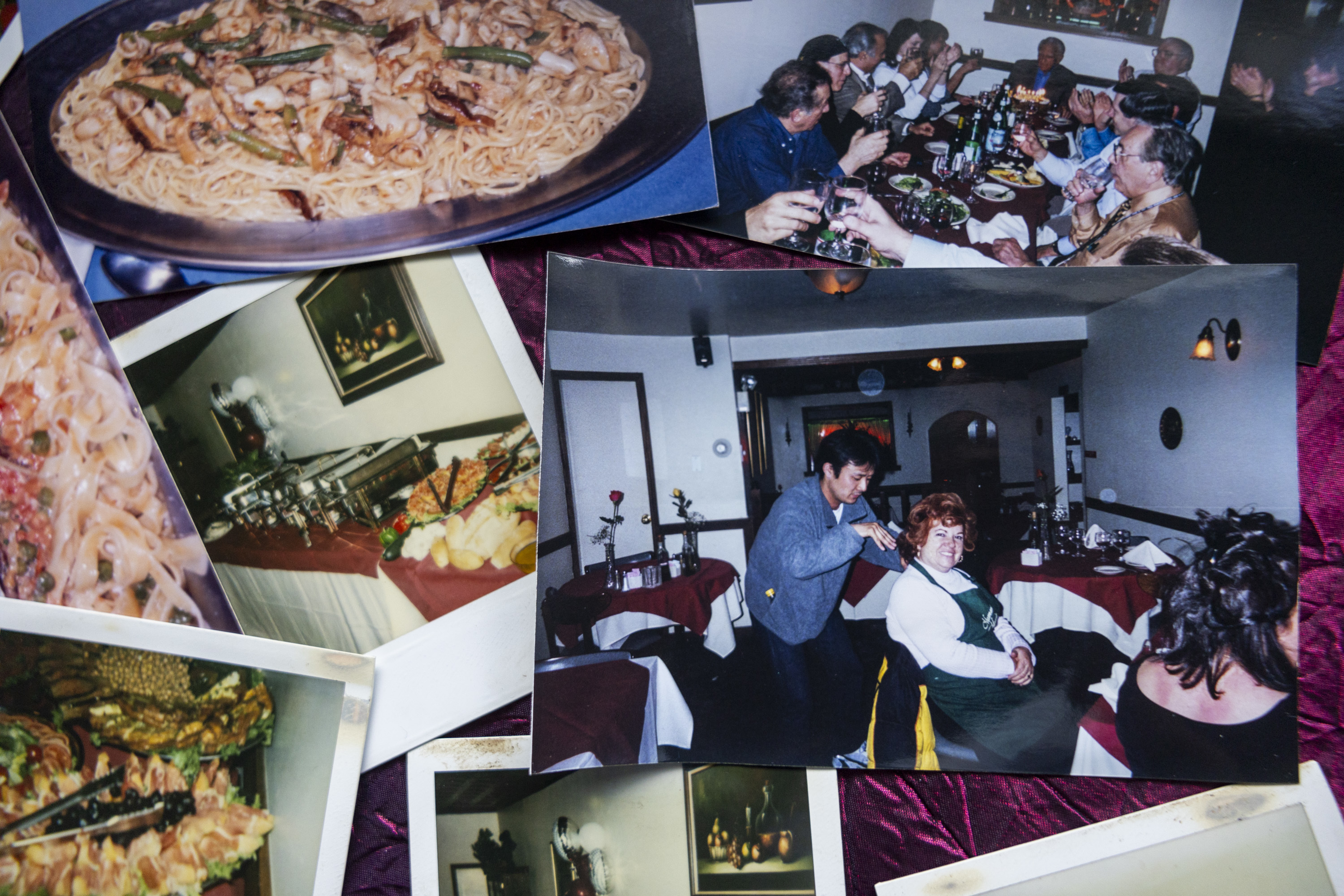
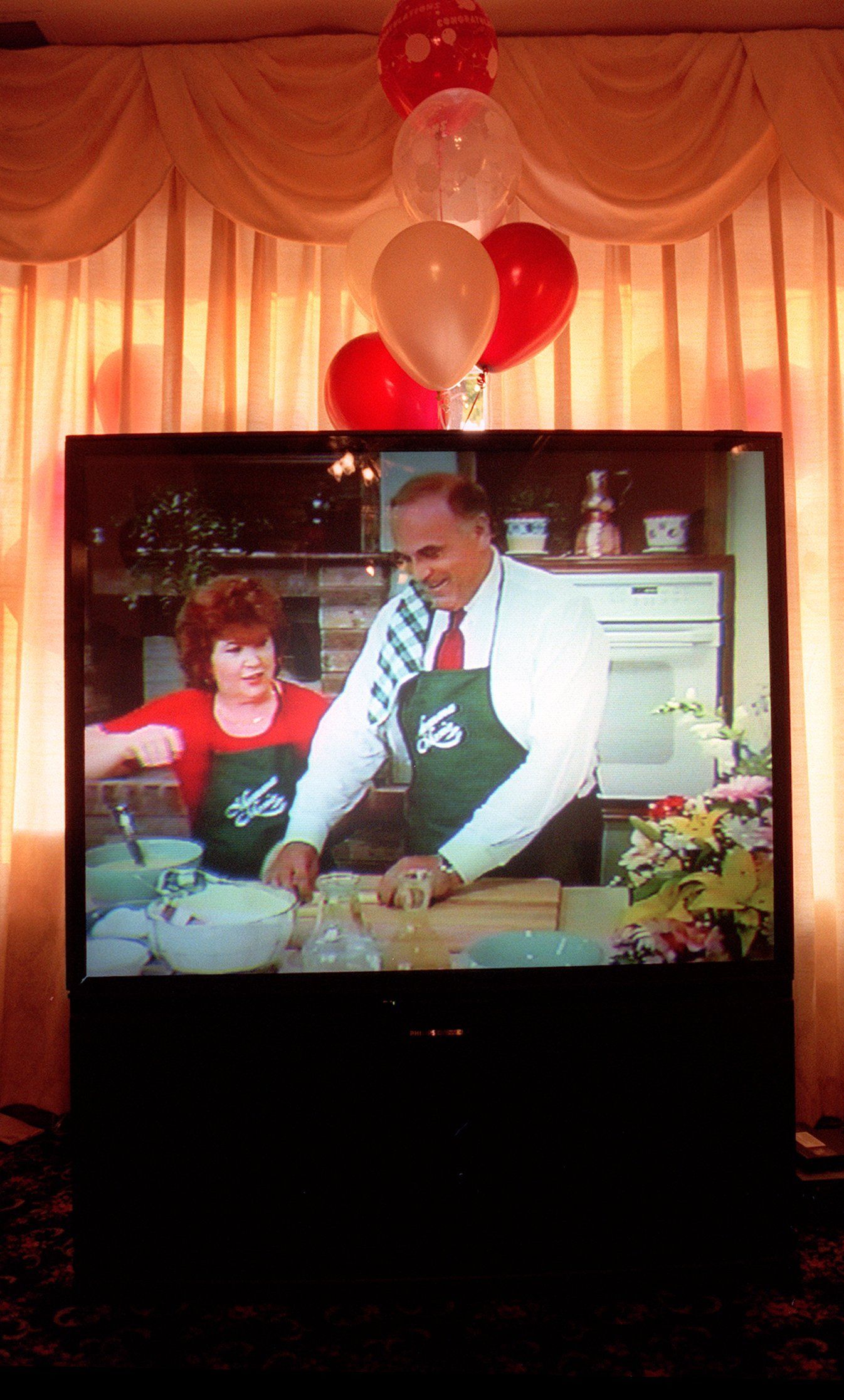
    Still there, too, are the kitchen where Santa Maria “Mamma Maria” Chiavatti turned out feather-light gnocchi, the dining room where waiters carried trays of flaming sambuca, and the upstairs studio where Chiavatti taped a TV cooking show whose first guest in 1999 was Mayor Ed Rendell.

    Santa Maria Chiavatti and family enjoyed a 28-year run at Mamma Maria’s.Tyger Williams / Staff Photographer

    Now the collection of buildings that housed the East Passyunk restaurant for nearly three decades is for sale, marking the end of one of the Avenue’s more colorful links to its ′90s/’00s Italian-restaurant resurgence.

    The former restaurant, closed for six years, is spread across three adjoining buildings on Passyunk Avenue and Jessup Street, all with apartments above. The asking price for 1637 E. Passyunk Ave., which houses one of the dining rooms, and 1632 S. Jessup St., which contains the kitchen, is $1.5 million. The building housing the other dining room, at 1639 E. Passyunk Ave., is offered for $2 million.

    “The kitchen is still set up,” said Albert Perry of Century 21 Advantage Gold, who has the listing with Dave Lombardo. “When we went to the property for the listing appointment, I was sent home with food.”

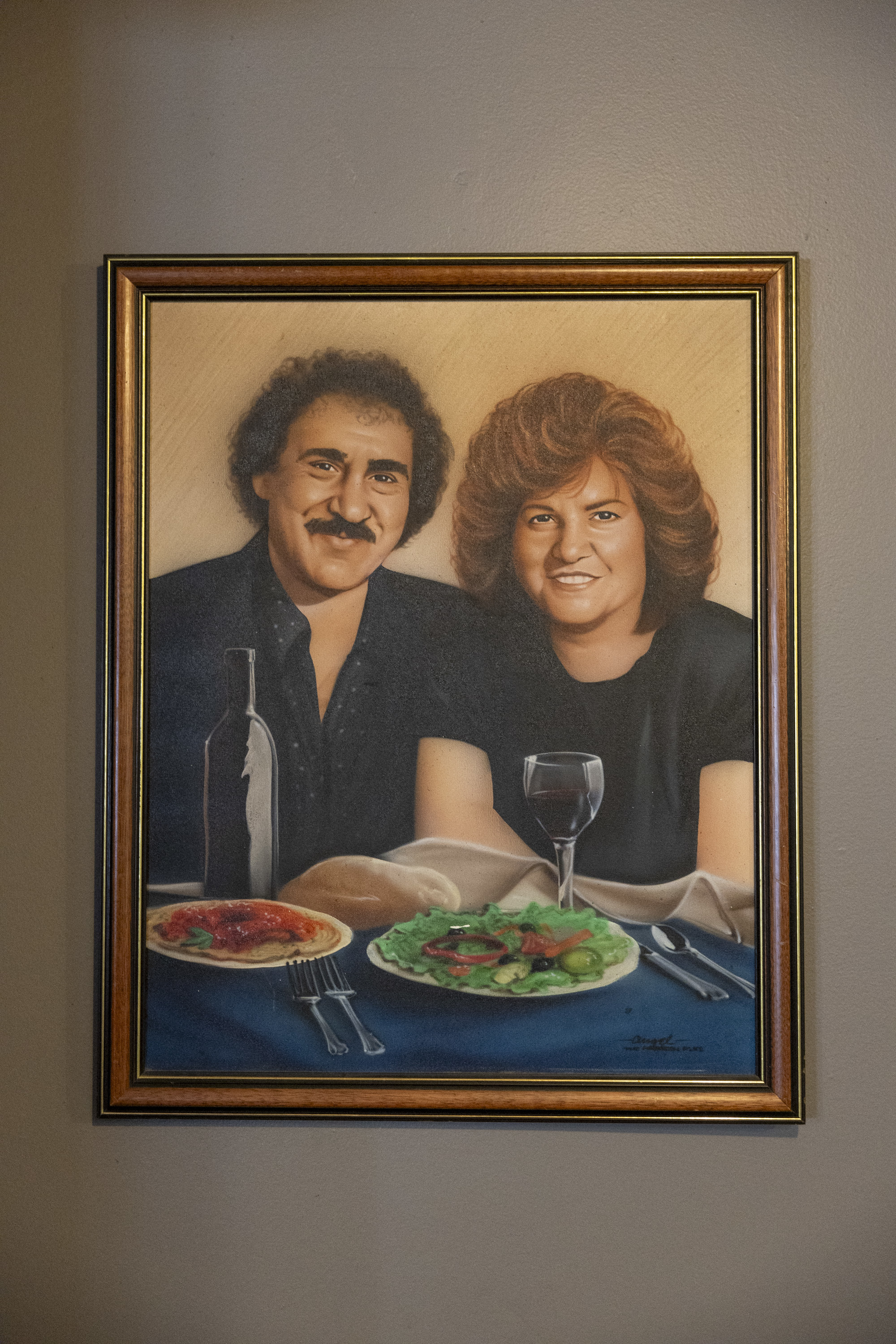
    A portrait of Claudio and “Mamma Maria” Chiavatti hangs in the shuttered restaurant.Tyger Williams / Staff Photographer

    Mamma Maria’s, which opened in 1992 and expanded into the adjoining property the following year, closed in 2020. But the Chiavattis said they couldn’t bring themselves to sell until now.

    “We want to give somebody the chance to have what we had, but with their vision,” said Maria’s daughter Paola Chiavatti. “Our era is ending, and a new era can begin.”

    A ‘vacation’ stop in Philadelphia

    The Chiavattis’ Philadelphia era began almost by accident.

    Maria and her husband, Claudio, came to the United States from Italy in 1992 for what their children believed was a vacation. The couple had already spent years in the restaurant business in Italy and Canada, and the family thought they had retired.

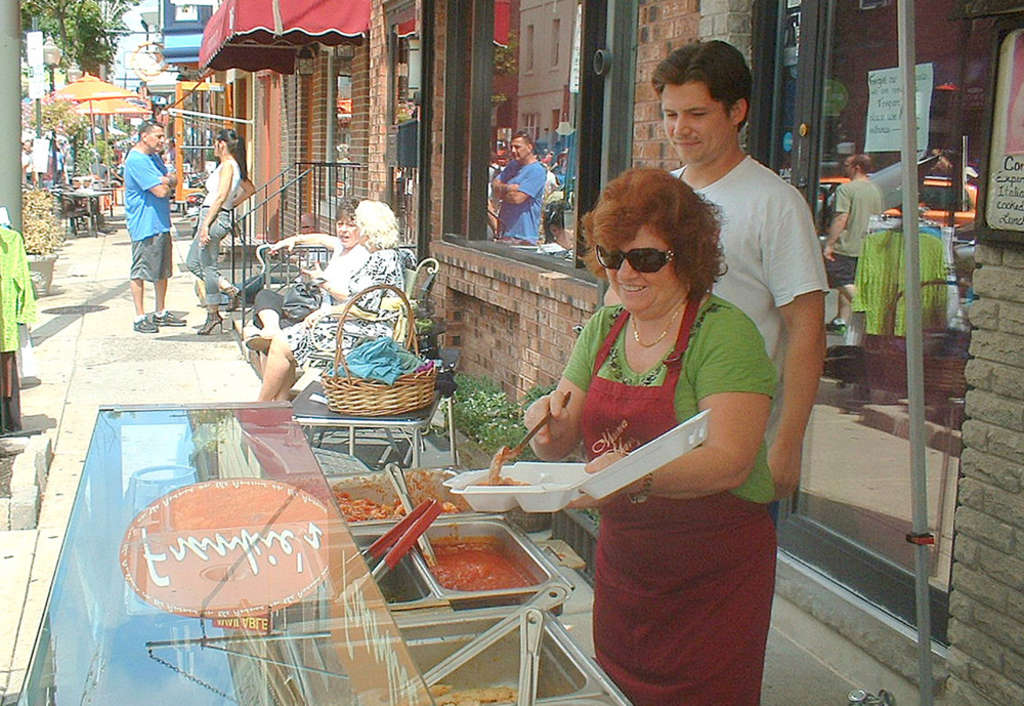
    Maria Chiavatti serving food outside of the East Passyunk Avenue restaurant in 2012. Glamorosi

    Then, while visiting relatives in Philadelphia, Claudio spotted a closed restaurant on East Passyunk Avenue and noticed the municipal parking lot across the street.

    “I said, ‘Yes, but it isn’t your parking lot,’” Maria recalled.

    Claudio’s answer was simple: “But it is there.”

    The couple rented the building and opened Mamma Maria’s. Three months later, Claudio questioned why they were paying rent when they could buy it.

    “That’s exactly what we did,” Maria said. “We bought it and made it beautiful.”

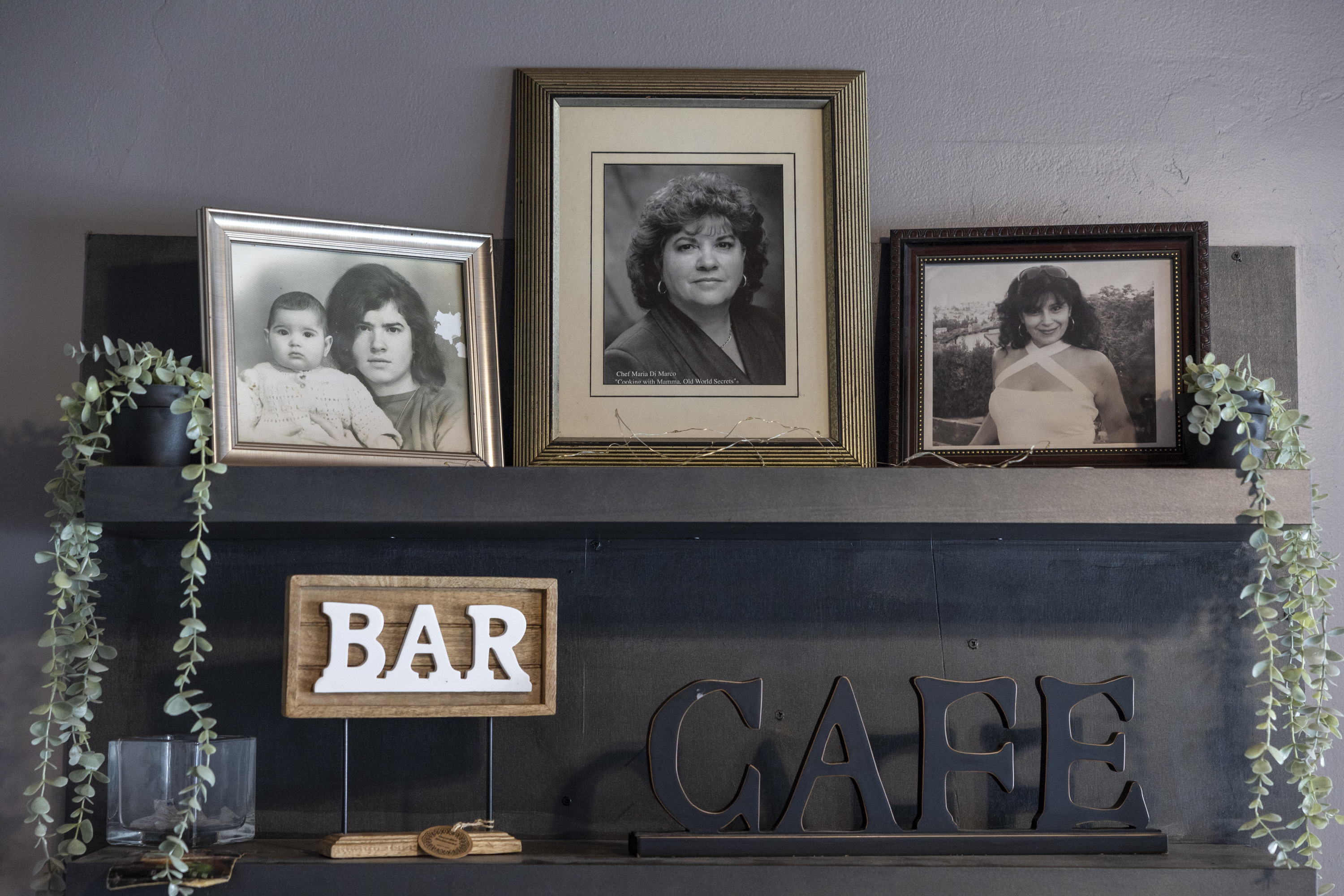
    Photos of Santa Maria Chiavatti and her daughter Paola on the mantel at Mamma Maria’s.Tyger Williams / Staff Photographer

    They built the menu around the food Maria knew from Abruzzo.

    Paola, meanwhile, was still in Italy, working as an interpreter and language teacher. Her sister, Myrna, and brother, Gianni, came to visit their parents. Before long, everyone in the immediate family was in Philadelphia, except Paola.

    That same year, her parents invited her over, ostensibly for a relative’s birthday party. Claudio picked her up at the airport and drove her to East Passyunk Avenue. She walked into the restaurant and saw a banner: “Welcome, Paola, to Mamma Maria’s.”

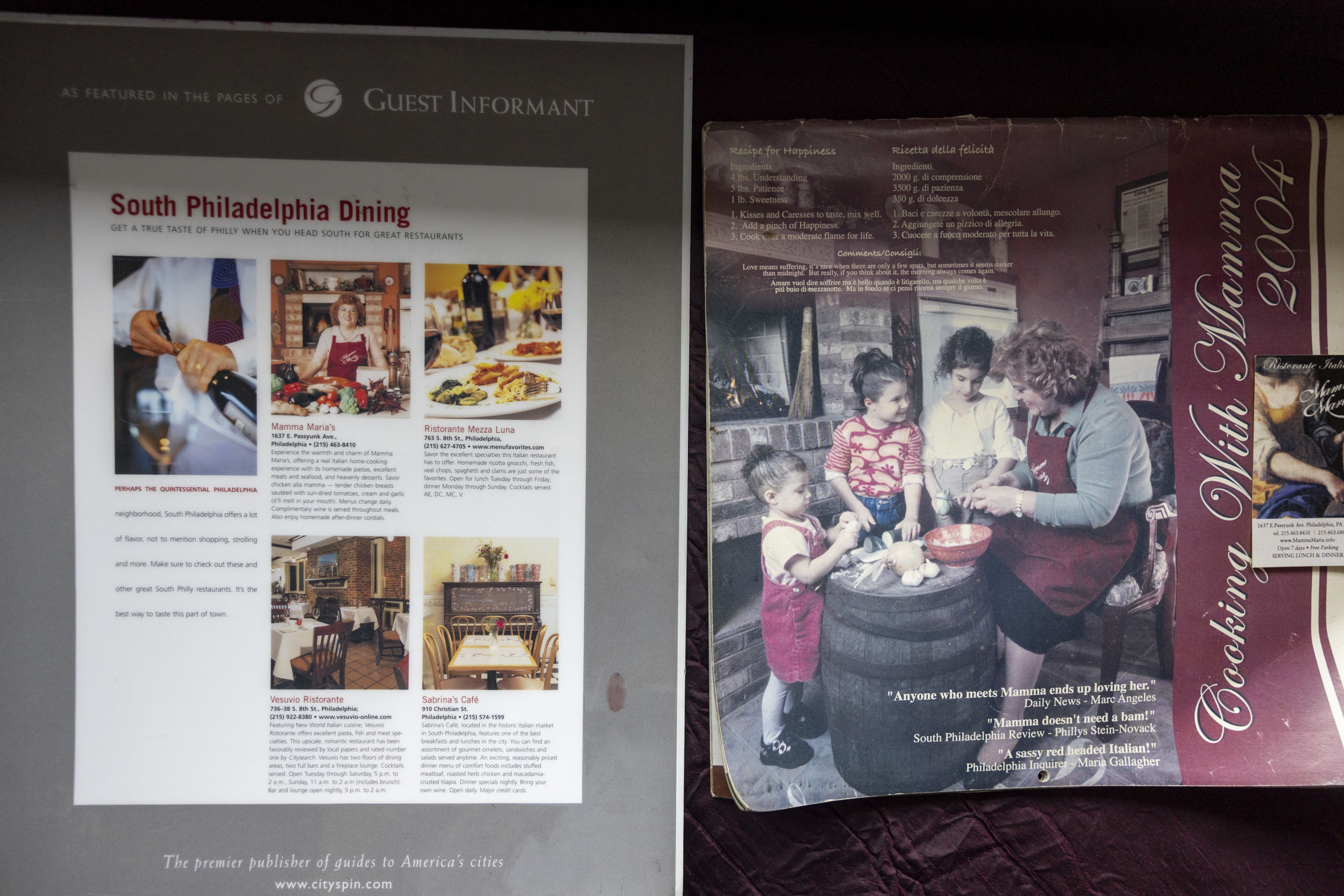
    Mamma Maria’s memorabilia in the restaurant.Tyger Williams / Staff Photographer

    Claudio told her that he and Maria had fallen in love with the neighborhood and the city. The restaurant, he said, would be something for their old age.

    Paola said she understood what was expected of her. Arrivederci, Italy.

    “Thirty-four years later, here I am,” she said.

    The rise of Mamma Maria’s

    Mamma Maria’s was a family operation in the most literal sense. Maria cooked. Claudio hosted, baked, prepped, and made sauces. Paola and Myrna worked the dining room.

    For much of its run, Mamma Maria’s was known for an enormous fixed-price meal: antipasto, soup, multiple pastas, meat and seafood entrees, salad, vegetables, potatoes, and a dessert cart loaded with cakes, cannoli, and other sweets.

    Wine was complimentary. So, at first, was flaming sambuca, served while an accordion player named Mario circulated among the tables.

    “You sat down and you felt like you were having Christmas dinner or New Year’s Eve dinner at your house,” said Lilla Amico-Carlomango, Maria’s oldest granddaughter, who worked at the restaurant with sisters Dalia and Chiara Amico. “The staff, the clients, everybody was so happy to be here that it created one big family.”

    Shortly after it opened, Inquirer food critic Elaine Tait described the cooking as “homey, not haute, cuisine, the likes of which you might find cooked by someone’s talented Italian mom.”

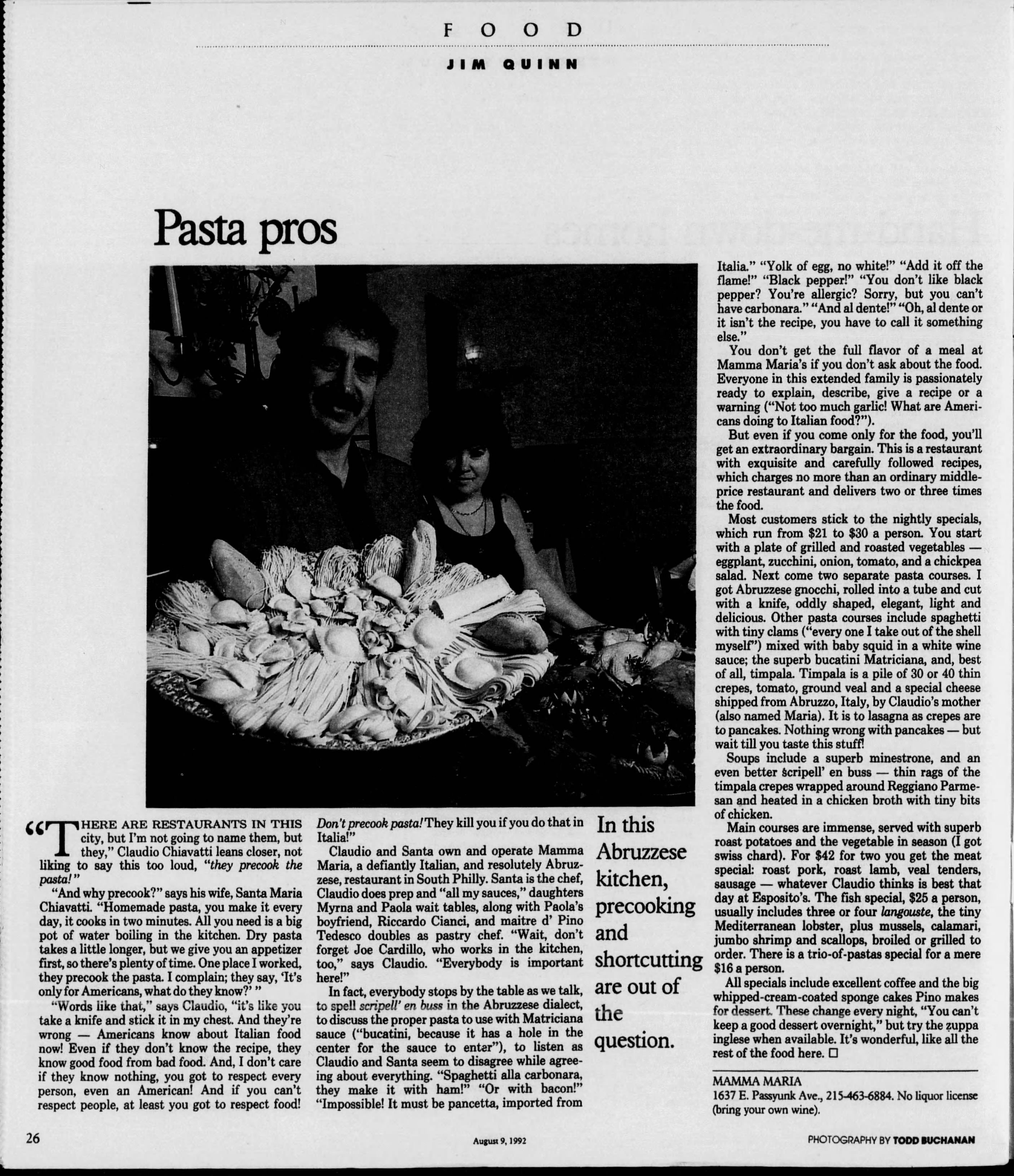
    The column by Jim Quinn in The Inquirer’s Sunday magazine on Aug. 9, 1992, that helped launch Mamma Maria’s.Newspapers.com

    Inquirer columnist Jim Quinn was similarly enthusiastic. Maria didn’t know Quinn from Adam when someone told her there was a man from the newspaper in the dining room. “I said, ‘So what?’” she recalled.

    After he returned three days in a row, she finally approached him.

    “Sir, you really love my place,” she told him.

    In 1997, an electrical fire forced the restaurant to close for eight months.

    “In the restaurant industry, eight months is murder,” Paola said.

    Mamma Maria’s reopened with a fundraiser for the Leukemia Society of America.

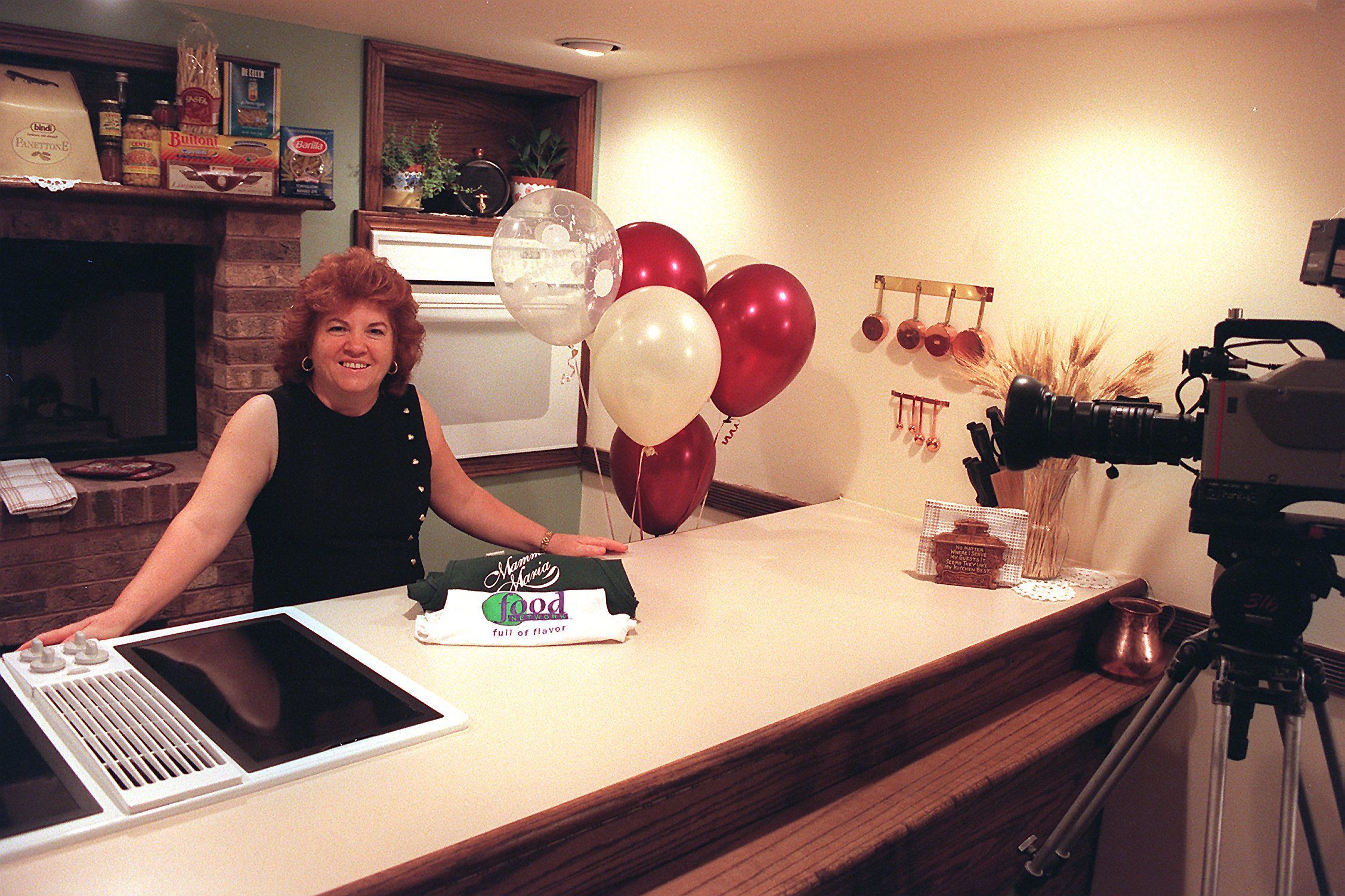
    Santa Maria Chiavatti in September 1999 on the set of her food show during its launch party. The show aired throughout the Philadelphia region. Michael S. Wirtz / Staff Photographer

    But one tradition did not return. The blaze was unrelated to the drinks, but Paola had lost her enthusiasm for open flames in the dining room, and the flaming sambuca was 86ed.

    Two years later, Mamma Maria’s expanded to television. In 1999, the family bought a weekly half-hour slot on the Food Network for a self-produced program, Cooking With Mamma, Old World Secrets.

    The show was taped in a studio kitchen above the dining room, with Rendell as Maria’s first guest. Maria used her maiden name, Di Marco, because the family thought it would be easier for viewers to pronounce.

    A video of “Mamma Maria’s” cooking show, featuring Mayor Ed Rendell, was televised during the 1999 launch party at the restaurant.Michael S. Wirtz / Staff Photographer

    Back at the restaurant, the fixed-price format endured. Claudio’s death in 2005 hit the family hard, as did the recession in 2008. In 2010, after 18 years of belt-stretching meals, Mamma Maria’s began allowing à la carte dining Monday through Thursday.

    Life after the restaurant

    Then the pandemic arrived.

    Mamma Maria’s closed in 2020, along with the family’s food-truck operation. By the time restrictions had eased enough for the family to consider reopening, Maria’s health had become the priority.

    Paola faced a choice: return to the all-consuming work of running a restaurant or help care for her mother.

    “Restaurants, we’ve had many in our lives,” she said. “Mother, you only have one.”

    The family hosted private events in the meantime. Now 79 and feeling fine, Maria is preparing to sell the property and, with her family, take Mamma Maria’s into another form.

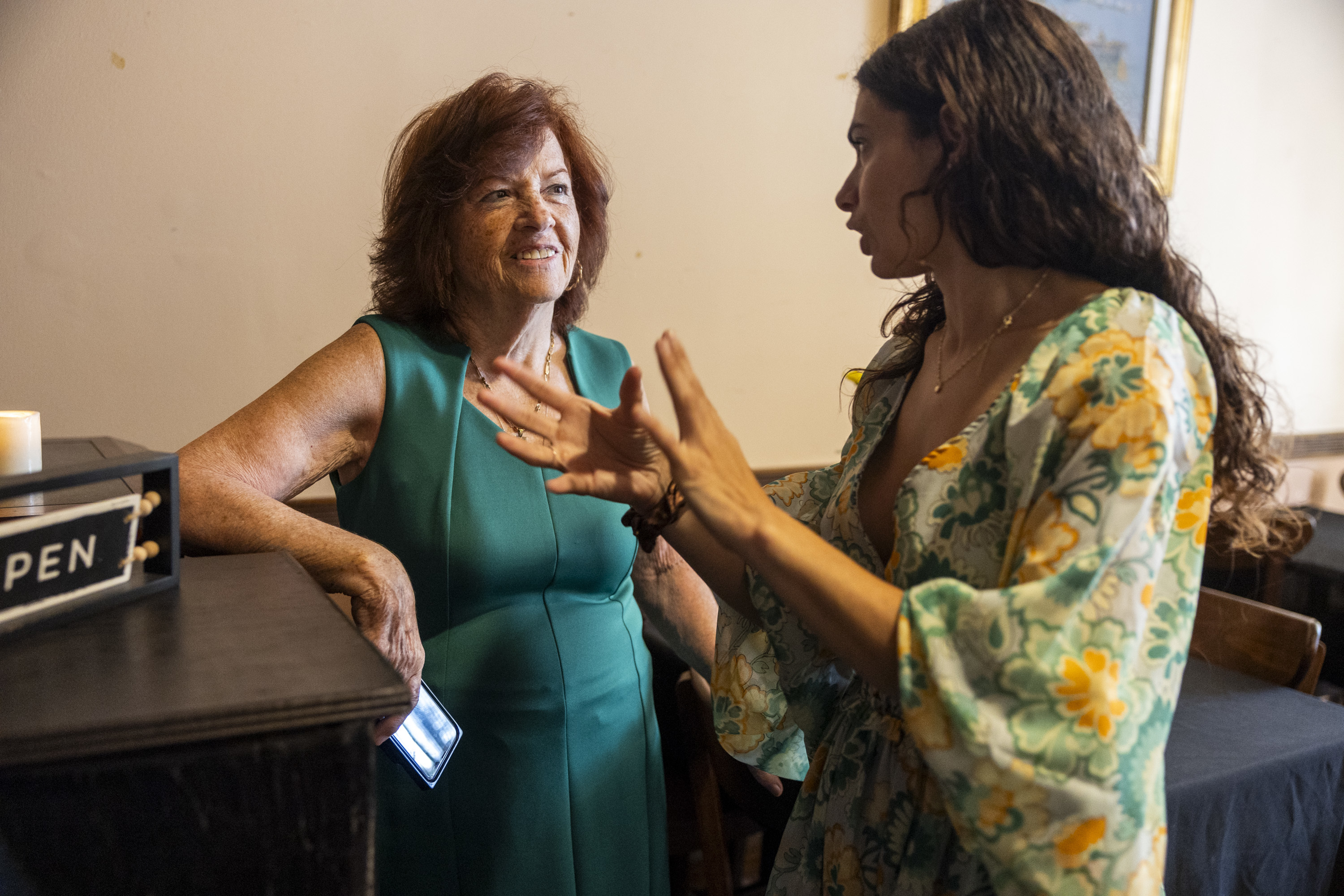
    Santa Maria Chiavatti (right) with three generations (from left): Great-granddaughter Paolina Carlomango, granddaughter Lilla Amico-Carlomango, and daughter Paola Chiavatti in the restaurant on Aug. 5, 2026.Tyger Williams / Staff Photographer

    She has boxes of handwritten recipes, including dishes passed through the family for generations. She is working on an Italian-language cookbook, while Paola and Lilla are helping to translate, organize, and photograph the recipes. They envision a series of cookbooks and possibly a line of pasta, sauces, and Maria’s homemade limoncello.

    That last item would be a particularly natural extension of Mamma Maria’s, Perry said.

    “When you went to Mamma Maria’s, you were drinking limoncello whether you intended to or not — and usually you wanted to.”

    For Maria, selling the buildings means giving up the restaurant, not the work that grew out of it.

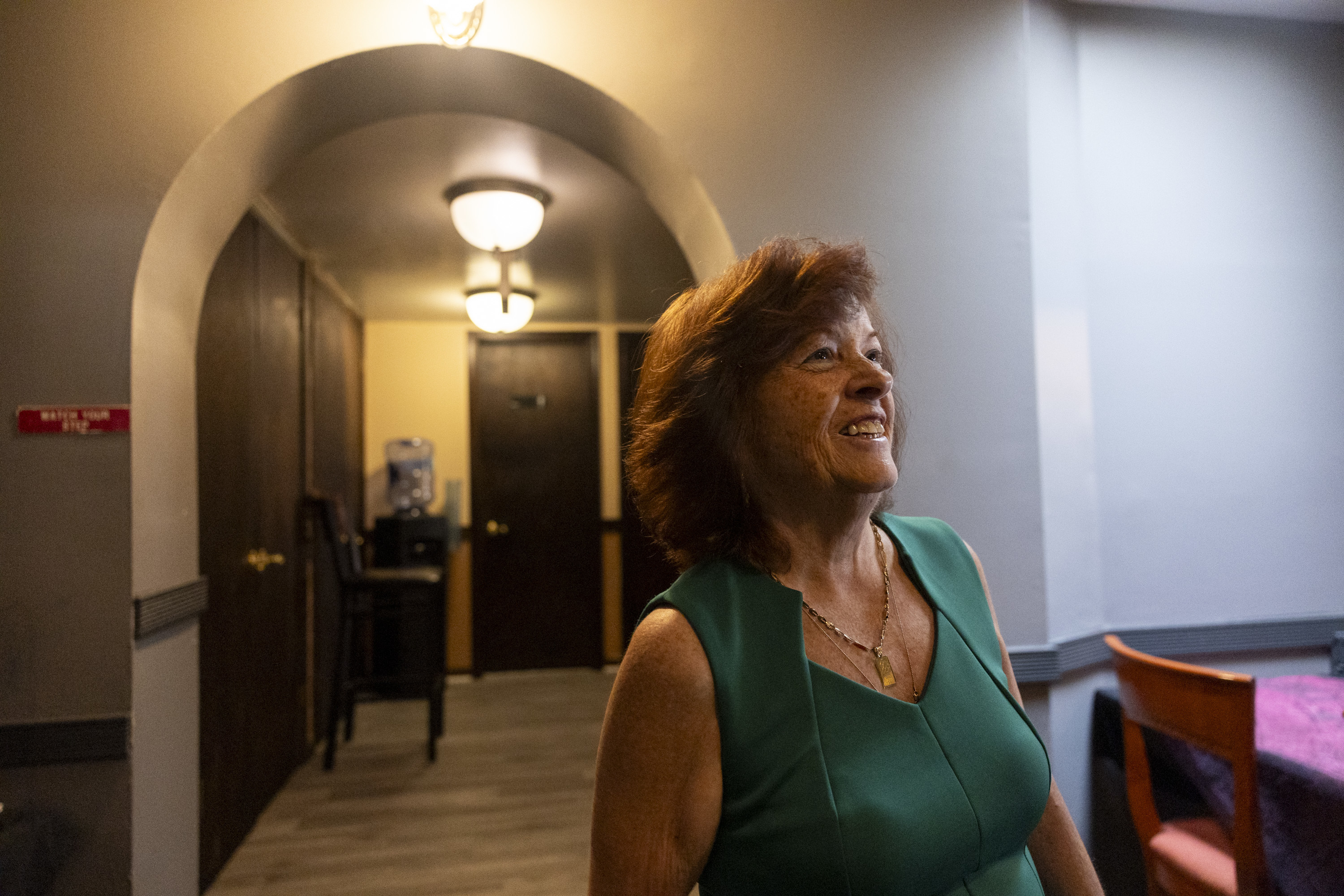
    “Just because the restaurant is finished,” she said, “doesn’t mean I’m finished.”

    “Just because the restaurant is finished doesn’t mean I’m finished,” says Santa Maria “Mamma Maria” Chiavatti.Tyger Williams / Staff Photographer
  • ‘The Mondrian House,’ Jon Batiste, and a Disney throwback for millennials are some of the best art you can enjoy this week

    ‘The Mondrian House,’ Jon Batiste, and a Disney throwback for millennials are some of the best art you can enjoy this week

    Lady Alma’s newest Philly anthem

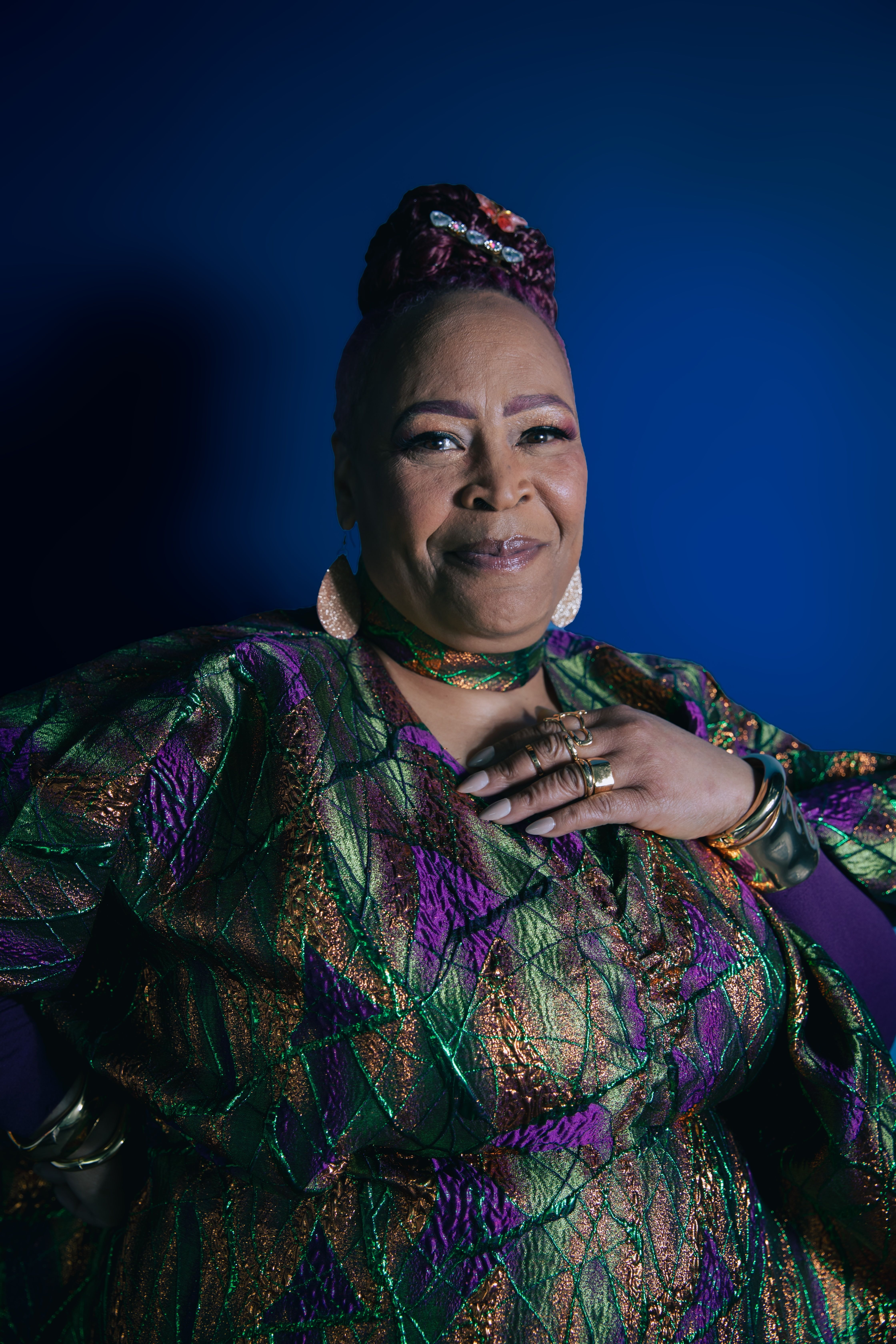
    The career of Philly house music singer Alma Hornton — who performs as Lady Alma — stretches back to the 1990s, when she was a featured vocalist at the now “Back 2 Basics” nights at Silk City Lounge and gave voice to projects like King Britt’s soulful “Sylk 130″ and British electronic duo 4Hero.

    Hornton had put music aside in the 2010s until a video of a fan dancing to her song “Let It Fall” went viral on Facebook, reviving a career that has gained momentum since, including her 2023 duet with the Eagles’ Jordan Mailata on “Merry Christmas, Baby.”

    Lady Alma’s “Liberty” is part of the “Philly Anthems” project by WXPN-FM (88.5) with Pew Center support.Paige Walter

    Now, she is a natural fit for the ongoing “Philly Anthems” project, an initiative of WXPN-FM (88.5) with support from the Pew Center for Arts & Heritage. Her song “Liberty” is the fourth to be heard from the project, which also includes “Better Times” by Eric Bazilian, “America the Beautiful” by the War on Drugs’ multi-instrumentalist Eliza Hardy Jones, and “Freedom” by XPN 24 Hour Song Challenge winners the Flying Vees.

    The “Philly Anthems” concept is to give Philadelphia artists “the opportunity to reflect on themes in the Declaration of Independence that resonate today through original music,” according to XPN station manager Roger LaMay.

    Hornton does just that in a pulsating dance track that’s a collaboration with esteemed old-school hip-hop producer Marley Marl and 88 Fingerz. “Need some answers for the madness” she sings over a house music groove that aims to find catharsis on the dance floor, “Seeing hope through the sadness.”

    In a statement, Hornton describes “Liberty” as “a song that offers an honest perspective on what the world needs right now. The song carries a sense of joy. Embrace the message and find light in the darkness. Celebrate unity, love and the belief that one day we will truly have liberty and justice for all.”

    The coming weeks will bring new “Philly Anthems” by Christian McBride and Devon Gilfillian, plus up-and-coming acts Grace Gardner, Black Buttafly, the Bul Bey, J.R. Everhart, Sug Daniels, and Moustapha Noumbissi. A 12-song album will be released timed to Record Store Day in April 2027.

    — Dan DeLuca

    An arty house in Queen Village

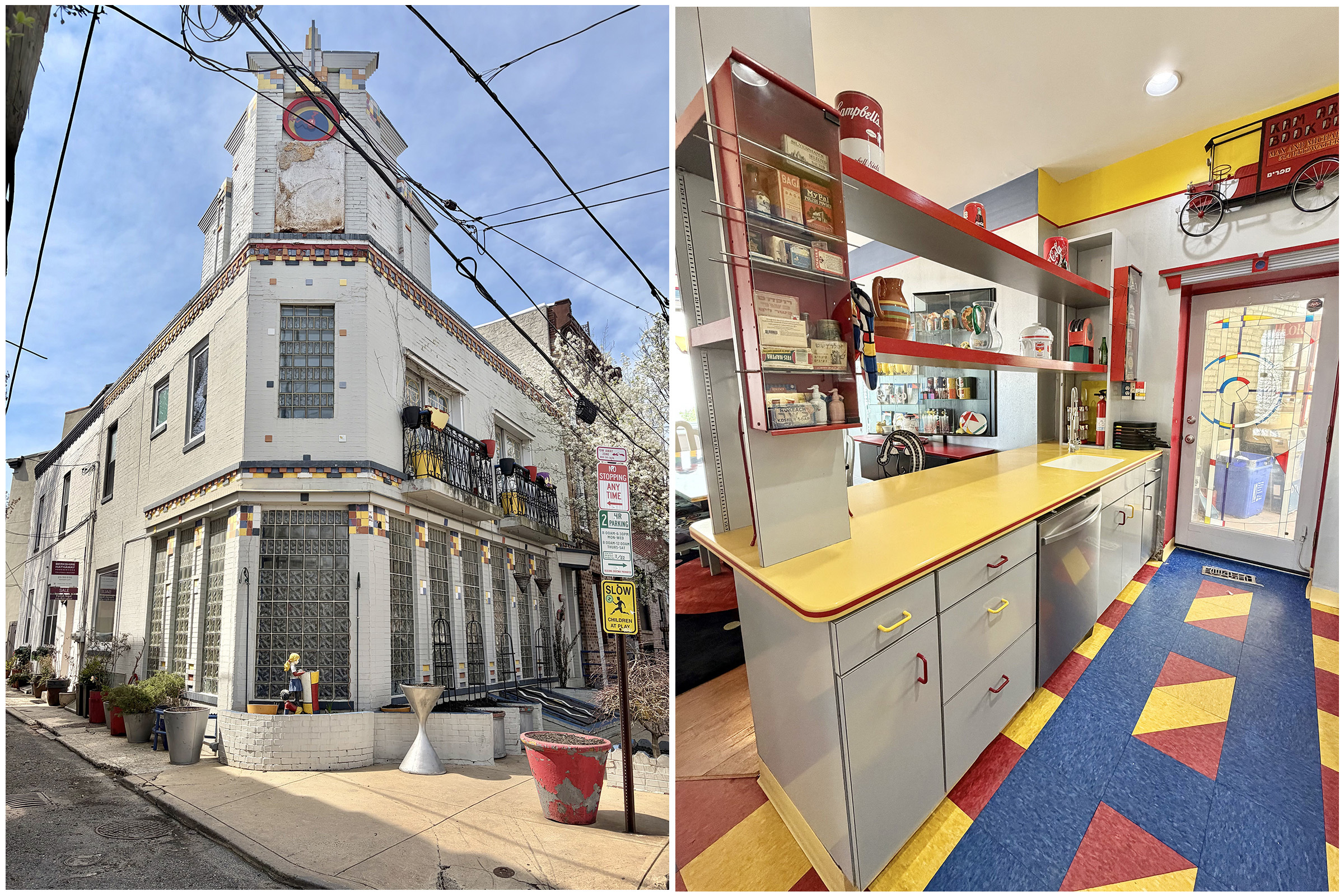
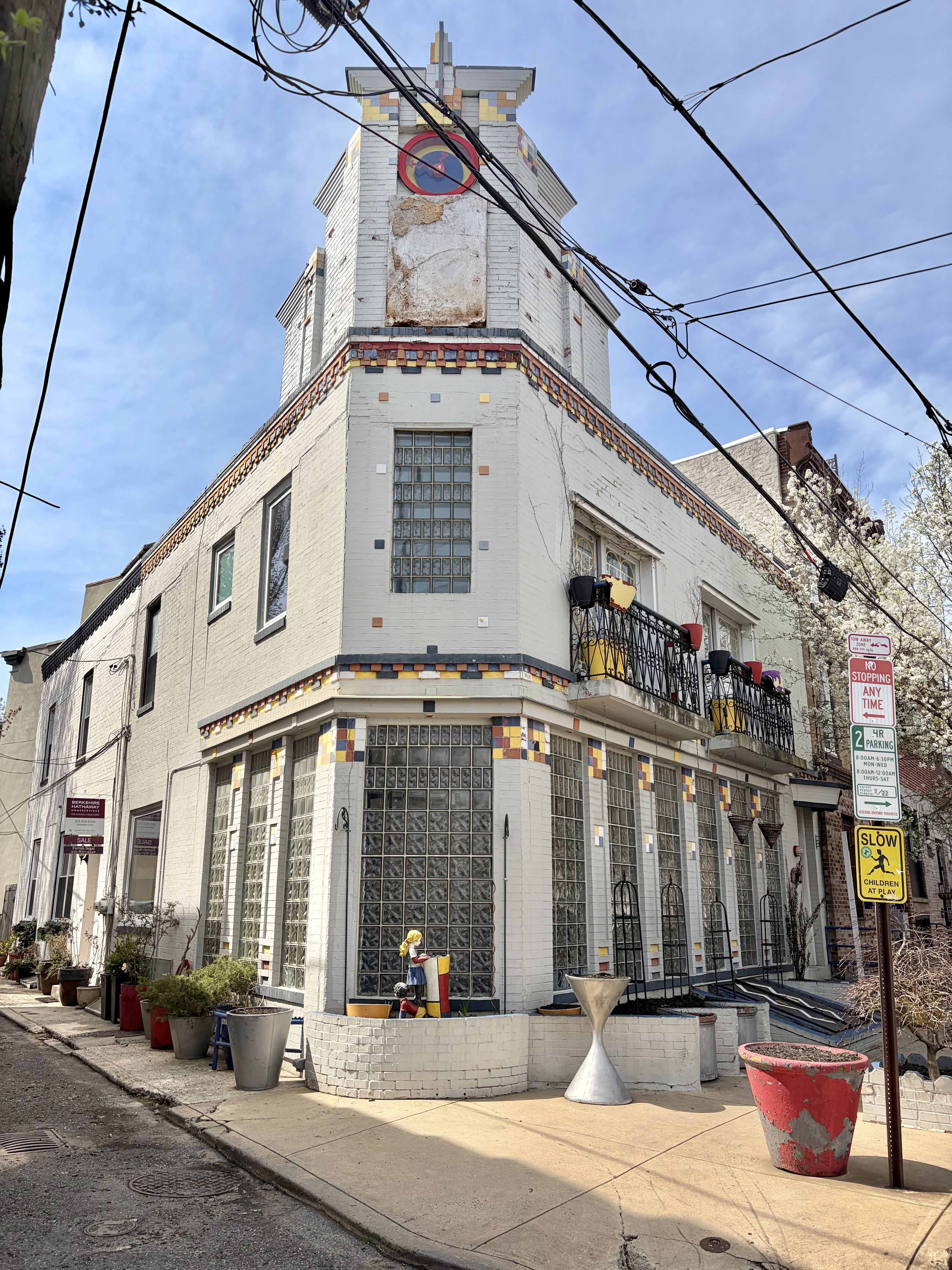
    A quirky home at 514 Fitzwater St. in Queen Village.Farrah Segal

    There’s a storied house in Queen Village that holds many names: Lego House, Clock-Tower House, Art Deco House, Mondrian (after Dutch painter Piet Mondrian) House. In a city full of architectural gems, it’s one of my favorites.

    The marvelous corner building is dotted with color, featuring a cornice of red, yellow, and blue bricks — evoking Mondrian’s signature style — and a clock on the roof. A small statue of a little girl with yellow hair and a blue skirt is hidden among the lush flowers growing in containers in front of the house. The home dates back more than 100 years and once served as a deli before an architect in the 1980s transformed it into this visual landmark.

    As striking as the home is on the outside, there’s now a rare chance for curious Philadelphians to get a peek inside, where the artistry continues with boldly colored staircases and decor. The house was sold earlier this summer and the doors are now open for an antique sale this weekend where you can explore the legendary home and find possible treasures within.

    The antique sale runs through Aug. 16, 10 a.m. to 7 p.m. 514 Fitzwater St., Phila.

    — Rosa Cartagena

    Jon Batiste performing at the Met Philly, Oct. 30, 2025.Elizabeth Robertson / Staff Photographer

    Jon Batiste’s ‘Black Mozart’ is a balm for the current times

    Alas, we didn’t get Jon Batiste in person this week. The pianist, bandleader, and TV personality no doubt disappointed many when, citing “personal circumstances,” he canceled Friday night’s scheduled appearance at the Highmark Mann Center.

    He “truly can’t wait to come back and perform for you soon,” Batiste assured fans in a message posted on the Highmark Mann website.

    But Friday did bring us Jon Batiste all the same, via the release of Black Mozart. The new recording finds the musician at the keyboard alone in a jazzy, gospel-y, contemplative (though still energetic) mood. Using Mozart tunes as the departure point, he develops the material liberally — harmonically, rhythmically, sliding back and forth across the centuries and genres, and doing so in a natural, fluid way.

    With 10 tracks totaling 35 minutes, Black Mozart’s source material is a Mozart piano sonata, a piano concerto, the Symphony No. 40, and other works. Batiste, who has two degrees from the Juilliard School, is at his best when he gets creative with the 18th-century composer.

    Gospel Andante uses the slow movement of Mozart’s Piano Concerto No. 21 in C Major, K. 467 as a framework. But it’s when the power of gospel asserts itself — where the genre line really blurs — that the music lifts off into another emotional dimension.

    There is nothing revolutionary about Black Mozart. Performers and composers have blended classical with jazz and other genres for decades. Batiste himself covered similar ground with his 2024 release, Beethoven Blues. But if Beethoven was a generally dramatic and soulful impetus, the quieter moments of Mozart transformed by Batiste are the appeal here. These are the easygoing pleasures that might be the counterprogramming you need in the current atmosphere.

    “Black Mozart” is available across all music platforms.

    — Peter Dobrin

    A road trip featuring Goofy and Max

    Odyssey this, Spider-Man: Brand New Day, that.

    What about the cinematic brilliance that is Disney’s 1995 classic, A Goofy Movie?

    The Philadelphia Film Society and Another Corner — a South Street novelty shop devoted to books, photography, coffee, and other specialties — are screening the movie next week for one night only.

    It’s part of the Film Society’s series on road trips and Another Corner’s hobby of the month focusing on “movie loving.” Shop owner Lee Frank will say a few words at the beginning and there will be zines and other film buff collectibles on hand.

    The movie, which is 31 years old (sorry millennials, I know that hurts!), focuses on Goofy and his son, Max, reconnecting as they head to a concert. They’re on their way to see the iconic fictional band, Powerline, featuring a “Michael Jackson-styled canine,” as described in the Miami Herald’s original review.

    The Herald review praised the film, adding that “this fast-paced movie has enough colorful characters and rollicking gags to keep the tykes from getting bored.”

    “A Goofy Movie” plays Aug. 20 at the Philadelphia Film Society Center, 1412 Chestnut St. Tickets are $16 and available on the Film Society’s website.

    — Emily Bloch

  • Horoscopes: Saturday, Aug. 15, 2026

    ARIES (March 21-April 19). The cosmic instruction today is a rather simple one: Look up, look around, look beyond. This chapter isn’t meant to be lived in your own head. Reach out, accept invitations, ask questions and spend time where people gather.

    TAURUS (April 20-May 20). Generosity has curious economics. The more freely it’s practiced, the less scarce it feels. You can’t tell how the tally will work out, but it really will. A giving spirit doesn’t empty the cupboard. Somehow it keeps finding another loaf of bread.

    GEMINI (May 21-June 21). Some people create excitement by turning small problems into major productions. Give them a wide berth. Your favorite company will be curious people with projects, plans and places they’d rather be than the middle of someone else’s argument.

    CANCER (June 22-July 22). You try a little harder around certain people — the ones you admire, the ones who admire you and the ones who have an expectation you feel obligated to meet. Seek this company to inspire your best work.

    LEO (July 23-Aug. 22). It’s as though you discover a magical place, hidden behind ordinary walls, where remarkable things flourish. Maybe it’s a mindset, a vision or a realm of reality with more of what your soul needs. This is where you belong, and you’ll get there.

    VIRGO (Aug. 23-Sept. 22). You won’t dismiss someone’s conclusion, even if it’s obviously wrong, annoyingly slanted or just plain silly. Often, it’s not the idea that matters so much as how a person came to it. Your curiosity will take you down that road.

    LIBRA (Sept. 23-Oct. 23). Support, disagreements, shared history, history you wish was never shared or never happened… these are all part of close relationships. Ponder and pontificate if you must, but you could save yourself some time by simply chalking it up to: That’s love!

    SCORPIO (Oct. 24-Nov. 21). You are part of the mechanics that spin the world. The small tasks and roles you take on unthinkingly — those contribute to the spin. You, doing nothing… that contributes, too. There’s no getting around making the world go round.

    SAGITTARIUS (Nov. 22-Dec. 21). Anyone who gets on your nerves will be in fine form today. If you can’t get away, put on headphones or their metaphorical equivalent and drown out the noise with beautiful music.

    CAPRICORN (Dec. 22-Jan. 19). Reinforcements aren’t coming today, but that’s good news. The more you practice helping yourself, the stronger your skills get. Set yourself free. If you have to steal that freedom, you’ll only be taking back what always belonged to you.

    AQUARIUS (Jan. 20-Feb. 18). You’re terrific at sniffing out trouble. You can meet someone and sense whether they’re likely to complicate your life. You can walk into a room and get a quick read on the social weather. That instinct serves you well today.

    PISCES (Feb. 19-March 20). The ancient warrior Sun Tzu said, “When we are near we must make the enemy believe we are far away; when we are far away we must make the enemy believe we are near.” But when the enemy is within? Befriend it.

    TODAY’S BIRTHDAY (Aug. 15). It’s your year of Standing Ovations when your work is extraordinary and you’re not the only one who knows it! Because of this, places, people and possibilities that once seemed far away become part of everyday life. More highlights: You move instinctually. You’ll buy tickets before they sell out, invest before everyone catches on and ask for what you want before you (or they) have a chance to overthink it. Aries and Libra adore you. Your lucky numbers are: 2, 33, 15, 20 and 9.

  • Dear Abby | Wife doesn’t want to be around husband’s grandchildren

    DEAR ABBY: I’ve been with my husband, “Ted,” for nearly 15 years, married for 11. He has two children, 38 and 33, and I have one who is 32. When we started dating, none of our children planned to have children of their own. I made it clear from the start that I have no desire to be a grandma. I’m a teacher and work with kids all day, every day, and that is enough for me. He said he felt the same way.

    His children now each have two children, while mine has stuck by her decision not to have any. I still have no desire to fill the grandma role. Ted’s kids are starting to make remarks about the fact I am not around much, and Ted recently told me this is causing a divide between us.

    I tried to explain that I haven’t changed; he has. We have a blast together and enjoy traveling and hanging out with friends, but our couple time is slowly fading away. I’m tired of being the bad guy because I prefer to spend my personal time with adults.

    Should I figure out how to be a single older lady, agree to live separate lives in the same house, or conform and be miserable, babysitting and spending all my free time doing what I absolutely do not want to do? I want my husband back, not the grandpa.

    — DON’T CALL ME GRANDMA

    DEAR DON’T CALL ME GRANDMA: You can’t expect your husband to turn his back on his grandchildren. If the shoe were on the other foot and your daughter had made you a grandmother, there’s a good chance you’d feel exactly as he does now.

    Because you and Ted still love each other, divorce doesn’t seem like a good solution. Would the two of you consider separating and returning to more of a dating relationship for a few years until Ted’s grandkids no longer need a babysitter? That way, you can continue to have fun with him while avoiding the grandma role.

    ** ** **

    DEAR ABBY: My husband’s distant cousin, whom we haven’t seen in more than 20 years, recently contacted us to say she wants to come for a visit. We have never really cared for her and do not want her to stay with us. Is there a polite way to tell her we are not open for her visit?

    — KEEPING TO OURSELVES IN FLORIDA

    DEAR KEEPING: The polite way to tell this distant cousin you do not want her as a houseguest would be to respond that you are unable to host her and suggest some nice hotels in the

    ** ** **

    DEAR ABBY: If a woman asks a man to go on a first date, how should the check be paid?

    — SADIE IN IOWA

    DEAR SADIE: The person who offers the invitation is expected to pay for the meal unless there is a prior arrangement to handle it differently. This applies in all relationships, not just romantic ones, but close friends usually have a standing agreement to request separate checks.

  • 2 men wounded in separate North Philly shootings

    2 men wounded in separate North Philly shootings

    Two men were wounded in separate North Philadelphia shootings Friday night, police said.

    Around 8:15 p.m., an unidentified man was shot multiple times in the area of 21st and Gratz Streets. He was transported by police to Temple University Hospital, where he was listed in critical condition.

    Less than 20 minutes later, a 23-year-old man was shot in the area of 25th and Elkhart Streets, said Inspector D.F. Pace.

    The man was transported by private vehicle to Temple, where he was listed in stable condition.

  • Philadelphia man found guilty in string of groping incidents around Rittenhouse Square

    Philadelphia man found guilty in string of groping incidents around Rittenhouse Square

    A judge on Friday found a man guilty of assaulting seven women in separate incidents last year near Rittenhouse Square, in a string of attacks prosecutors called “remarkably similar” that left the women shocked and scared.

    Dynel Walker, 38, was found guilty of more than a dozen crimes tied to the incidents, spanning from indecent assault to forcible compulsion, harassment, simple assault, and related offenses, Common Pleas Court Judge Nicholas Kamau decided following a two-day trial.

    Kamau also acquitted Walker of more than a dozen charges, including unlawful restraint, harassment, and simple assault, among others, finding that prosecutors had not presented sufficient evidence to support them.

    Prosecutors said Walker targeted women who were alone and walking in the early-morning hours in the Rittenhouse Square area, approaching them on the street before groping them, exposing himself, or masturbating in their presence. In several of the incidents last July and August, Walker followed the women before confronting them. Once, he pushed a woman to the ground when she fought back, prosecutors said.

    In one incident, prosecutors said, Walker approached a woman walking her dog near 19th and Spruce Streets and groped her, then fled.

    In another incident, Walker made eye contact with a woman in the 1600 block of Pine Street, then masturbated on the sidewalk while he watched her, prosecutors said.

    Walker knocked one woman down as she fought him off, leaving her with minor scrapes on her arms and one leg, prosecutors said.

    At least three of the assaults were captured on surveillance video, which showed clear images of Walker wearing a distinctive black hooded sweatshirt with a chicken on its front, said Assistant District Attorney Megan Odonnell.

    Philadelphia detectives began searching for Walker after screenshots from the surveillance videos were shared with local media and led to an anonymous tip identifying Walker. Detectives later found images on Walker’s cell phone showing him wearing the same hooded sweatshirt as the assailant, prosecutors said. All seven women eventually linked Walker to their assaults through photo arrays.

    The women’s identification of Walker became a point of contention for his defense attorney, Ryan Ivins, who argued that the women picked Walker only after images had been widely disseminated by the media, including The Inquirer.

    Even then, Ivins said, about half of the women were not completely certain that Walker was the man who had accosted them.

    One told police she was 60% sure, Ivins said, while another gave Walker a seven out of 10 chance of being her attacker. That, Ivins argued, “casts significant doubt” on the reliability of the women’s identification of Walker and whether the photo arrays were tainted by the media coverage.

    Before rendering his verdict, Kamau also had the opportunity to watch Walker’s initial interview with detectives, in which he acknowledged the images shown in the news were, in fact, of him.

    In the video of the interview, Walker also told detectives that he was homeless and often slept in the area of Rittenhouse Square because “I felt safe in that area.” Because of that, Walker said, he was not surprised that surveillance cameras had captured him nearby.

    But Walker denied committing the assaults, telling detectives: “I don’t have any involvement in that. … I wouldn’t get any enjoyment from that.”

    Walker is slated to be sentenced by Kamau in November.