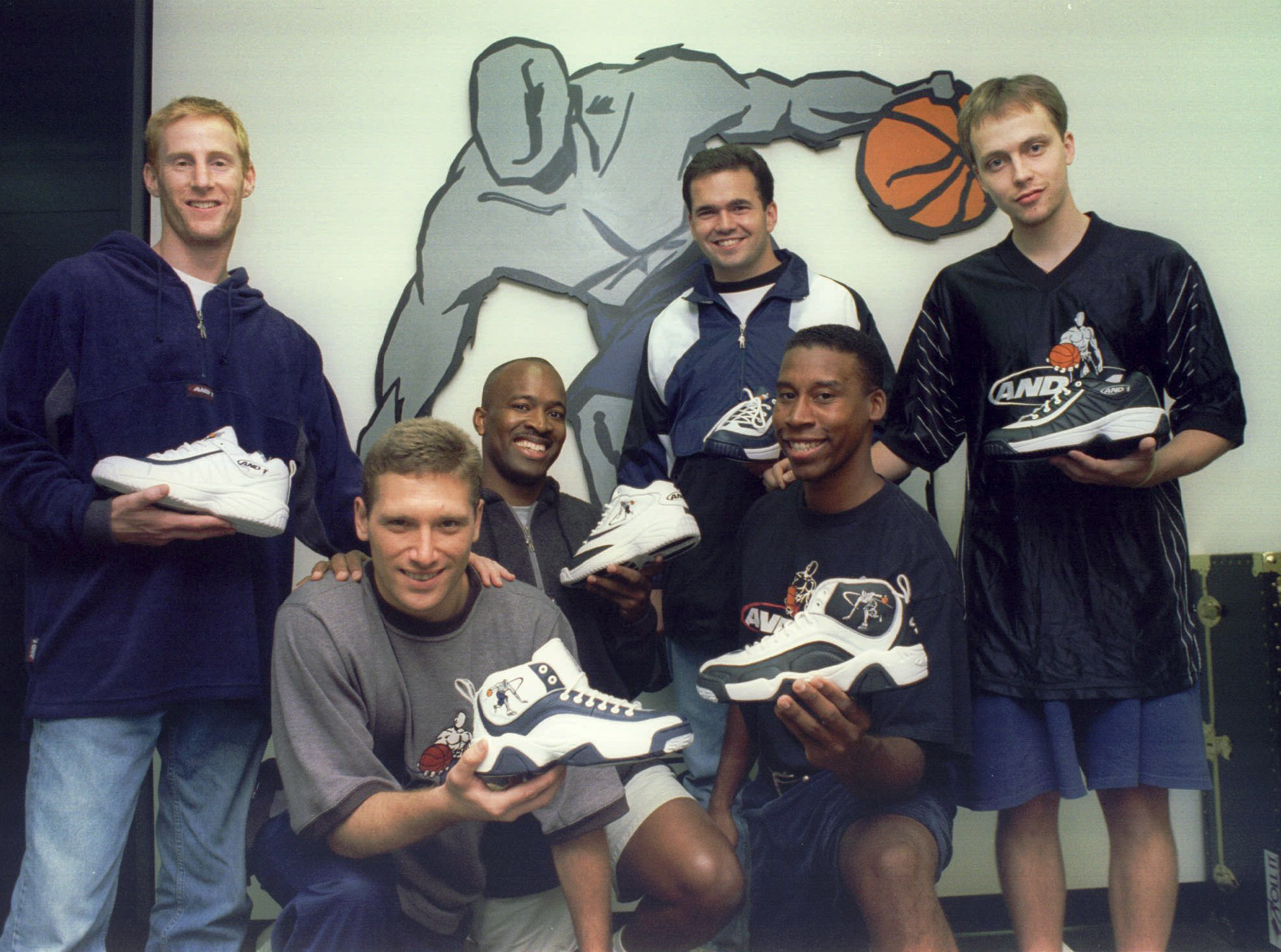
In the summer of 1993, Tom Austin, a Wharton grad, was in the process of creating a start-up with a fellow Penn alum, Seth Berger, and a friend, Jay Coen Gilbert.
The company was going named “AND1,” and Austin wanted to take edgy slogans — the kind you’d hear in a local pickup basketball game — and print them on T-shirts. Six months later, the T-shirts became a cultural phenomenon.
AND1 sold $1.6 million worth of apparel in its first year. Then came AND1’s mixtapes, which were video compilations of street ball moves, but because the first mixtape was shot at Rucker Park in Harlem, the company became known with New York basketball.
Though, at its core, AND1 was a Philadelphia brand.
Alex Coffey gives us a deep dive into how AND1 came to be, and even after the company was sold, its roots remain very much intact.
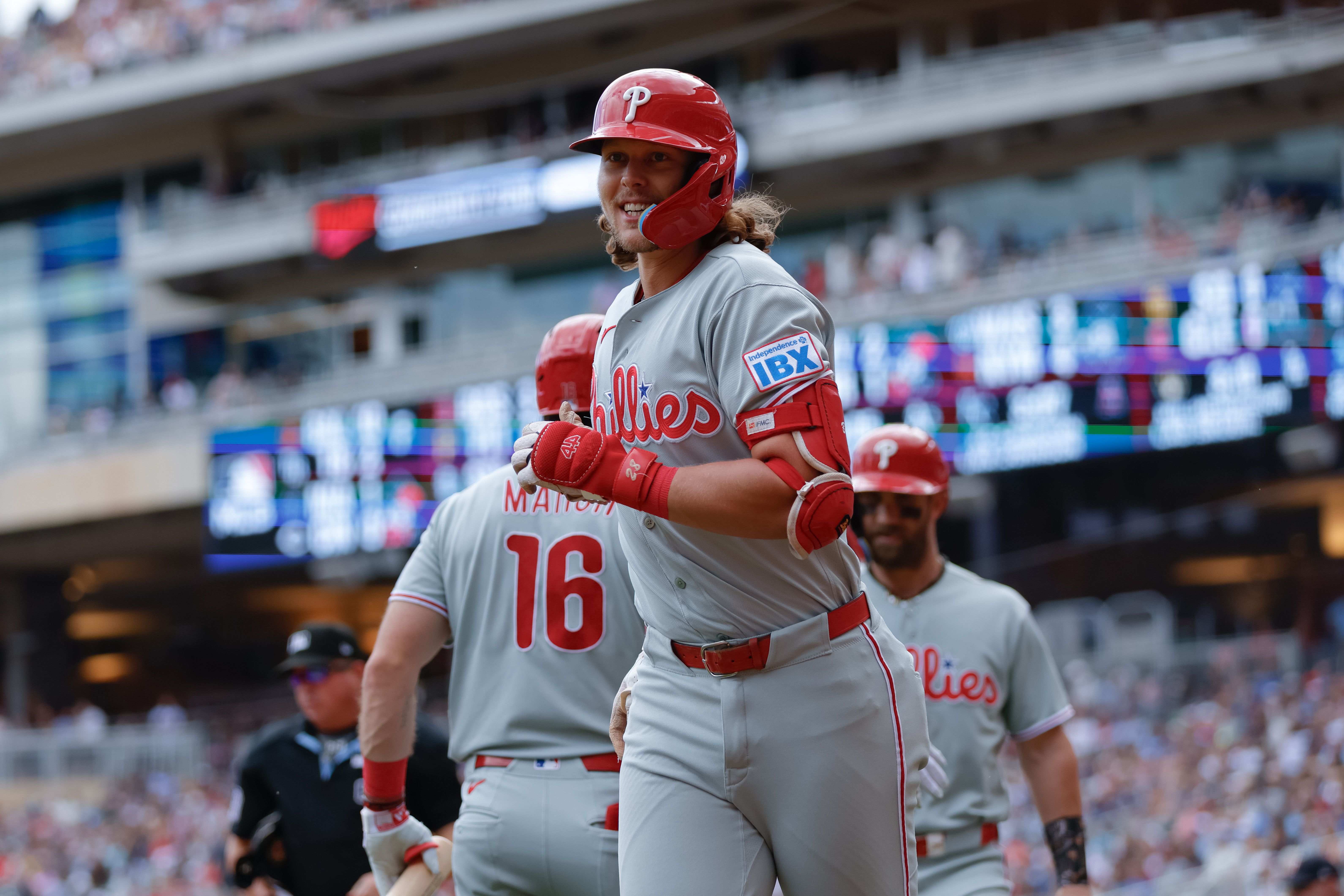
Alec Bohm, celebrates after hitting a three-run home run during the sixth inning against the Twins on Sunday.Bailey Hillesheim
Things were looking bleak, then a funny thing happened on Sunday. The Phillies rallied from an early five-run deficit to pull ahead in the eighth inning of a 7-5 victory to complete a three-game, two-state sweep of the Twins.
It marked the second-largest comeback of the season for the Phillies. They have now inched ahead of the Diamondbacks and back into sole possession of a wild card spot.
And the infield did some shuffling on Sunday with Trea Turner out for the game. But Don Mattingly confirmed that their star shortstop avoided an injury after fouling a pitch off his leg. He could’ve started Sunday, but the interim manager didn’t want to push it.
What we’re…
👊 Reminiscing: The highlight moments from UFC 330 taking over Xfinity Mobile Arena — did you see who lost their teeth?
👏 Celebrating: Before the Women’s Lacrosse League championship, Tina Sloan Green was honored for her legacy in the sport.
🏌️ Reading: On a rainy Sunday, Jack Whaley, a 22-year-old rising senior at Florida State, won the U.S. Amateur Golf Championship.
🏀 Learning: Dawn Staley doesn’t want to coach in the WNBA, she wants ownership. Philly has yet to extend the offer.
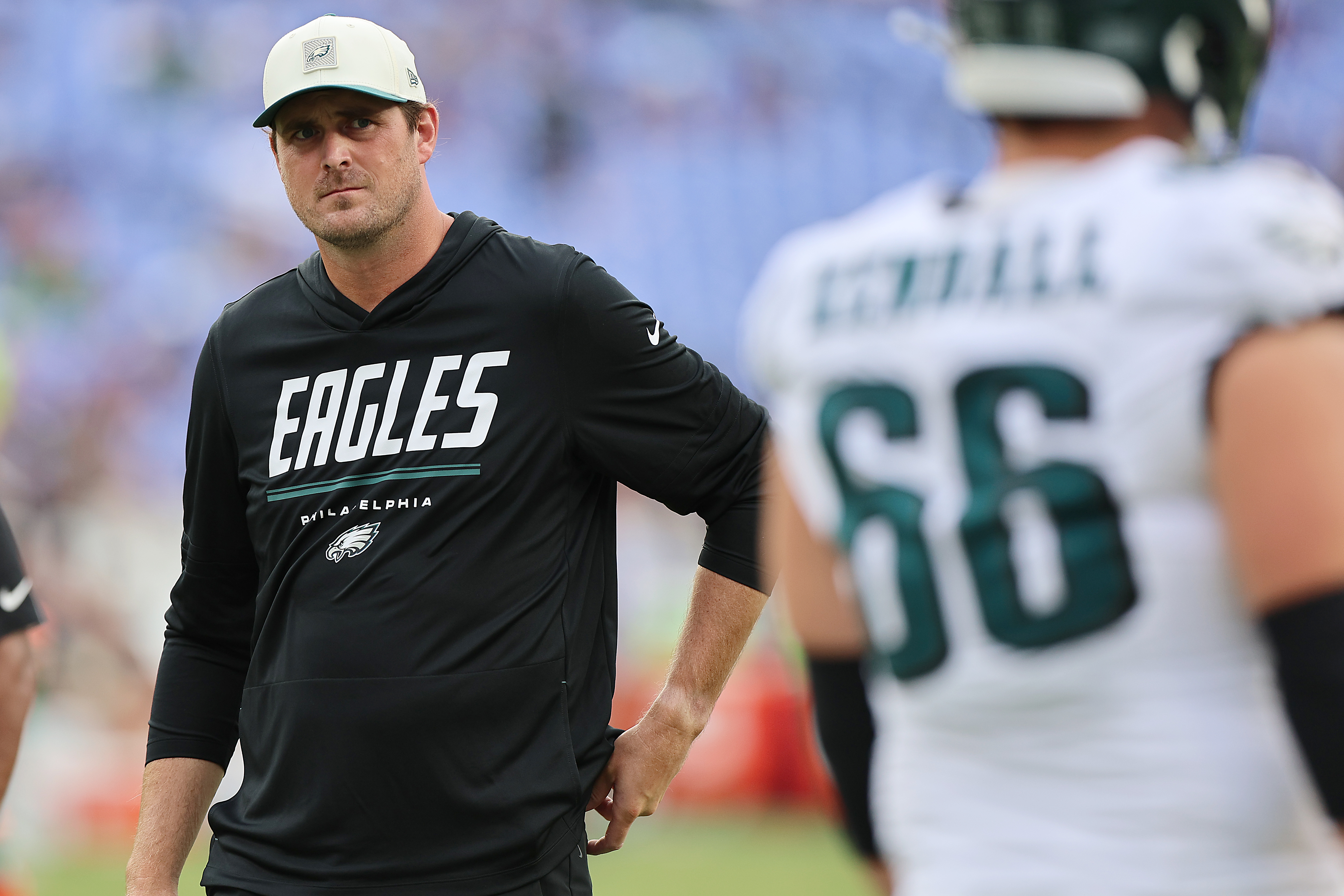
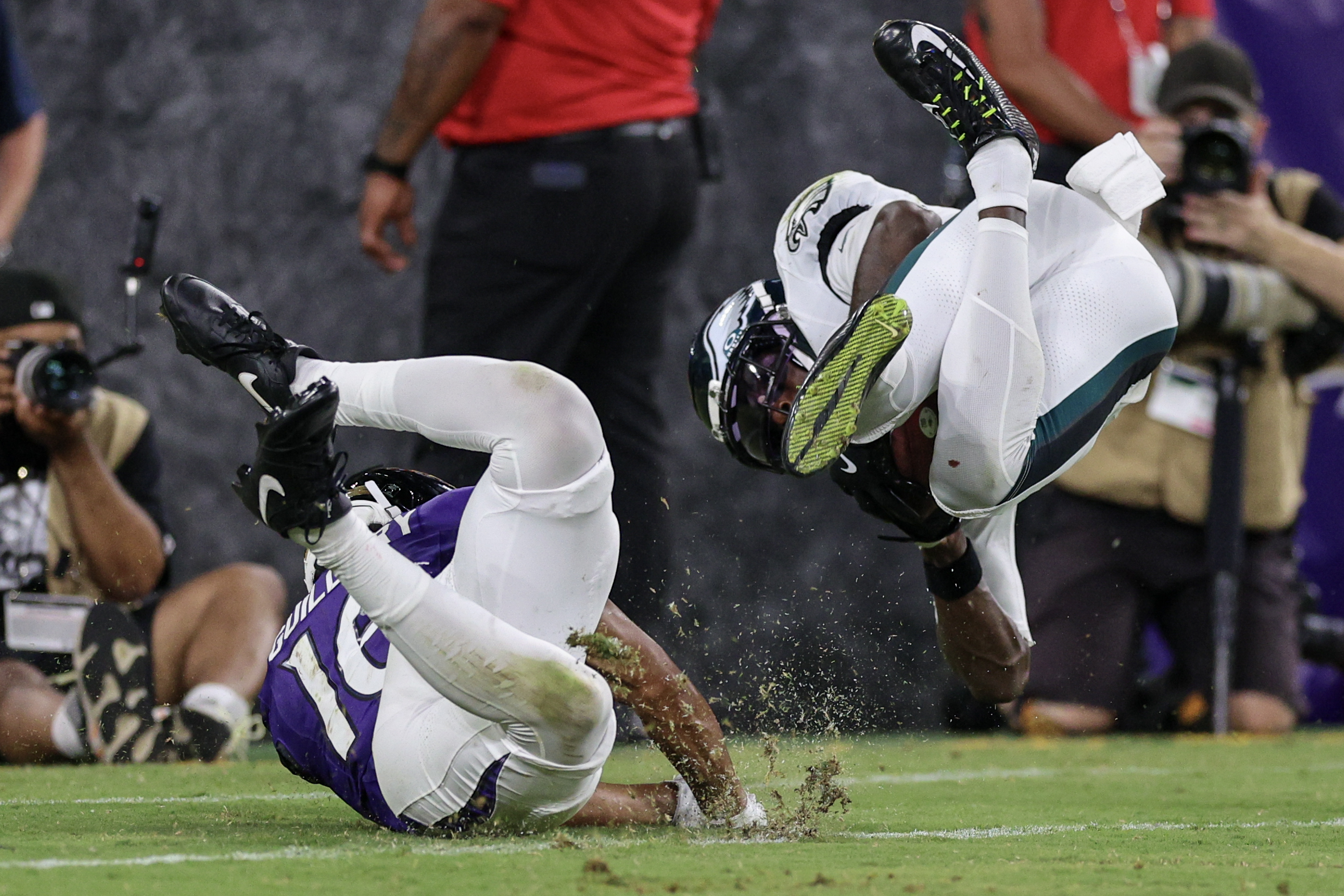
The Eagles played backups across the board on offense, and Sean Mannion’s scheme intentionally featured vanilla looks.David Maialetti / Staff Photographer
The Eagles’ 24-7 loss to the Ravens on Saturday night didn’t reveal much, especially their new offensive scheme.
It was difficult to identify Sean Mannion’s version of the Kyle Shanahan-Sean McVay system, let alone any functioning NFL offense, but Jeff McLane writes, that’s not surprising … or all that concerning as of now.
In other news, Joshua Weru and Uar Bernard suited up for their first football game at any level. Neither player lit up the stat sheet, but they certainly showed glimpses of potential.
And while there wasn’t a whole lot to take away from the Eagles’ first preseason game, it was enough to stir some movement in our latest 53-man roster projection.
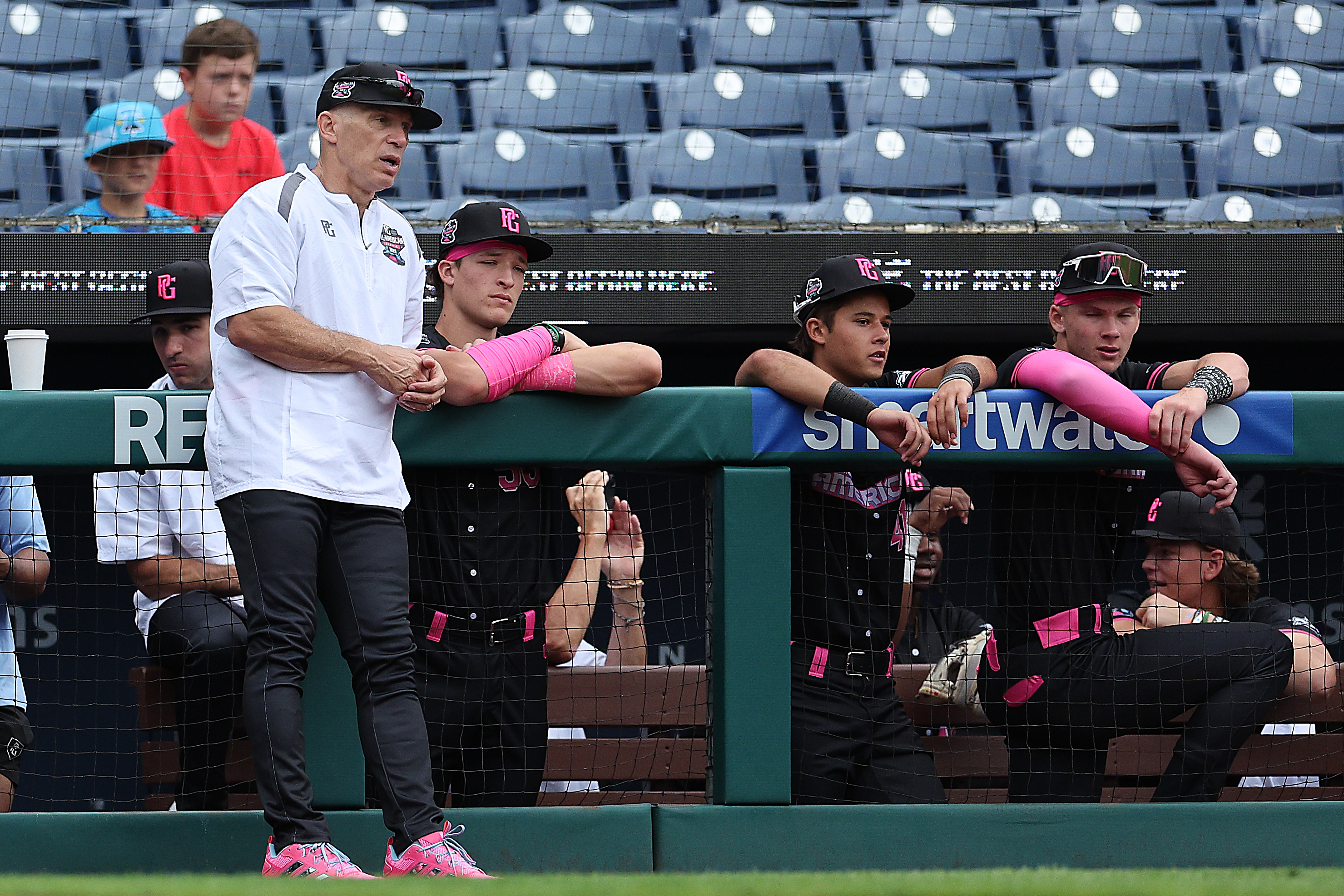
Joe Girardi manages the West team in the All-American Classic on Sunday.David Maialetti / Staff Photographer
The Perfect Game All-American Classic brought together 60 of the top high school baseball players in the country and former major leaguers at Citizens Bank Park on Sunday.
Former Phillies manager Joe Girardi and former Phillies center fielder Shane Victorino coached Team West and East, respectively. With several other coaches involved in the event, Victorino said it’s a testament to the “Phillie way.”
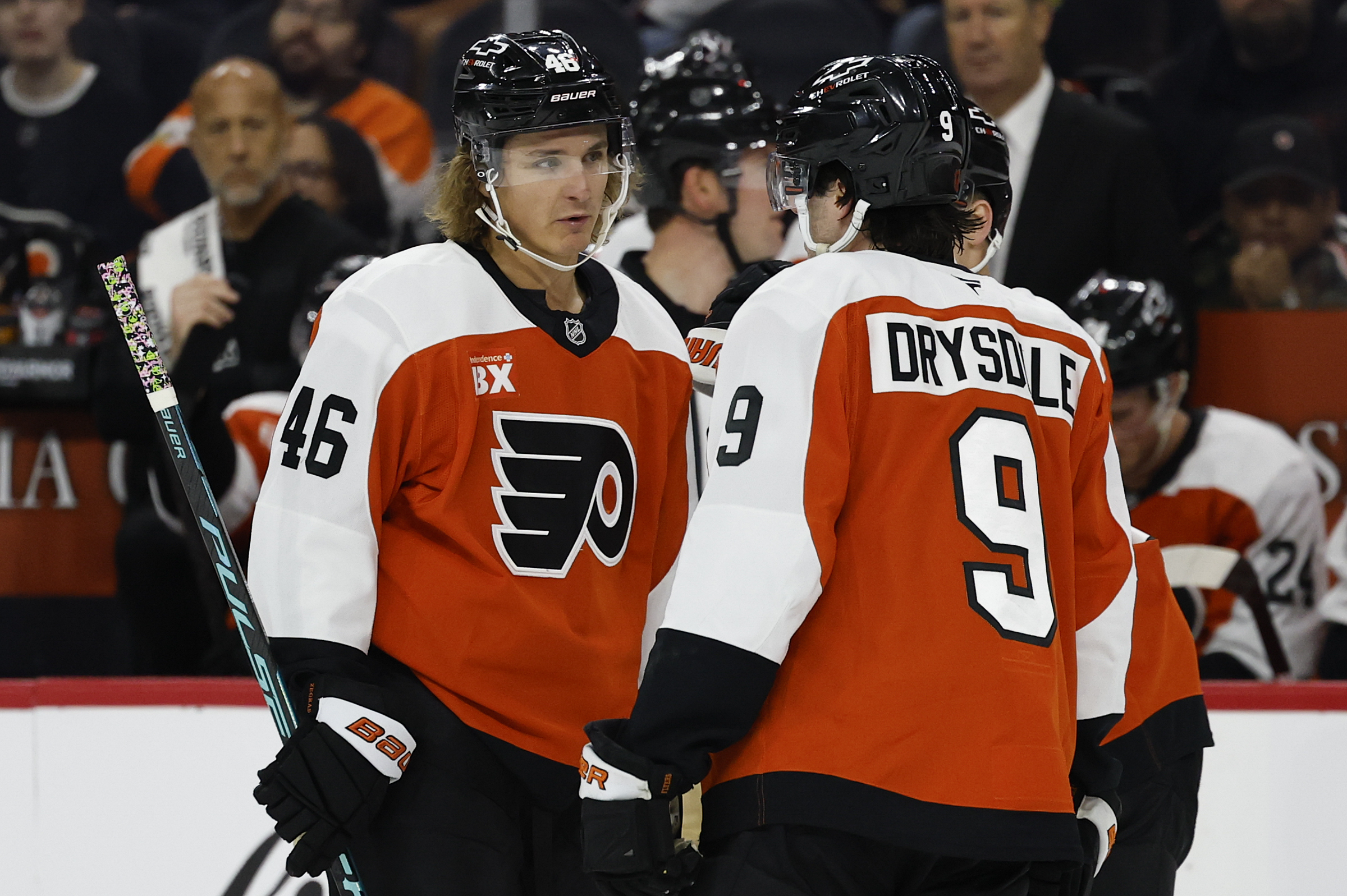
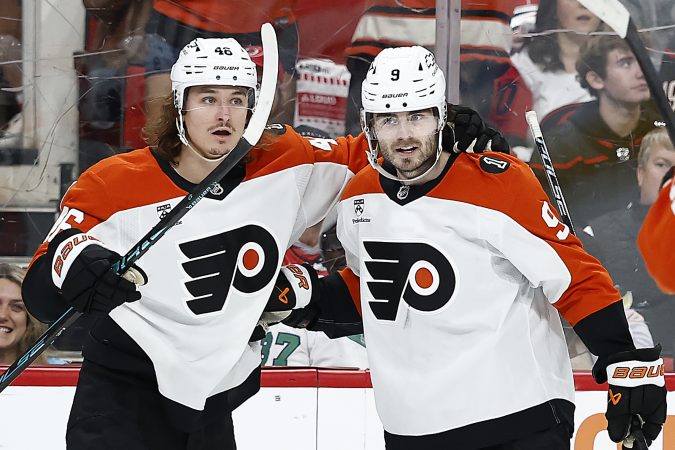
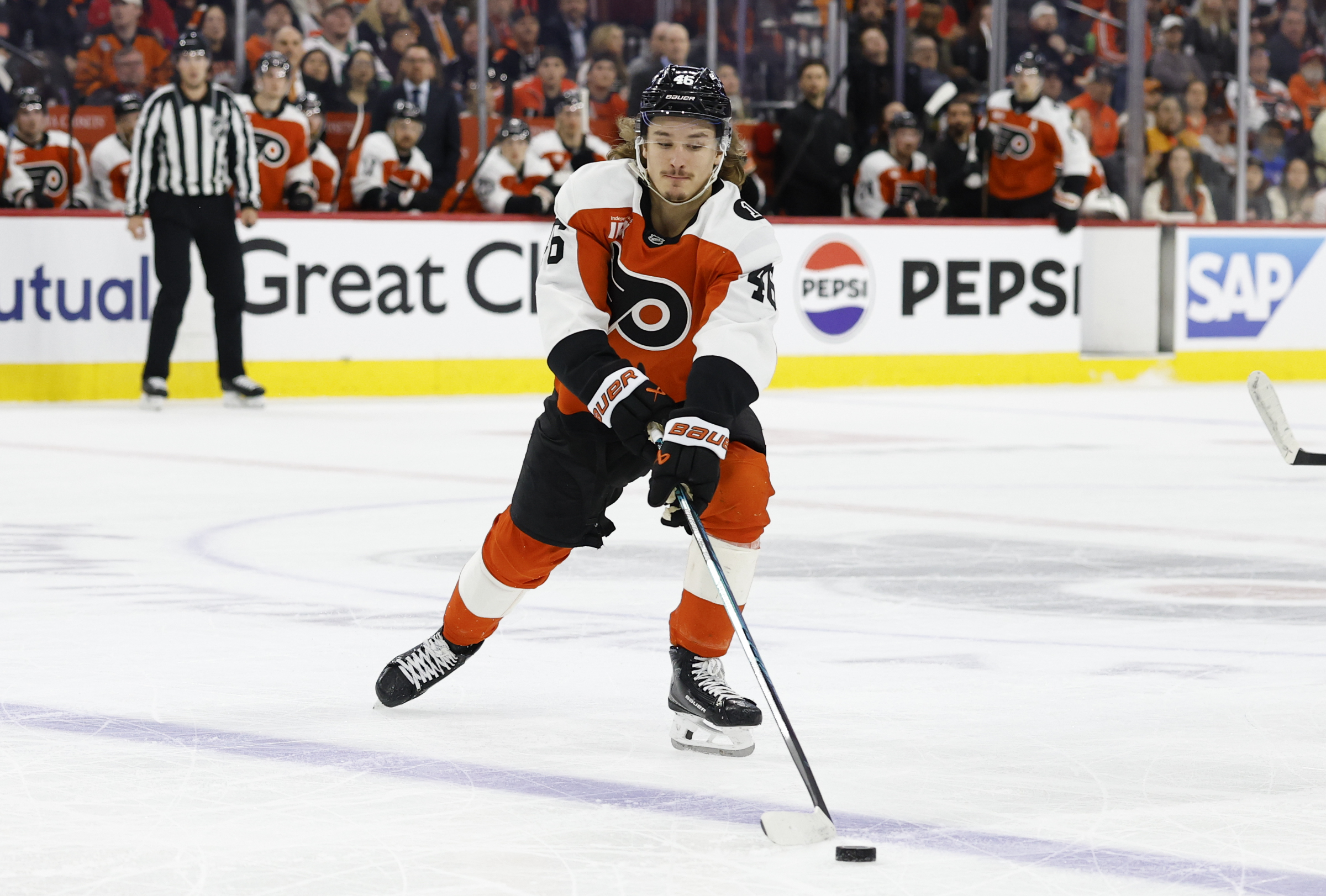
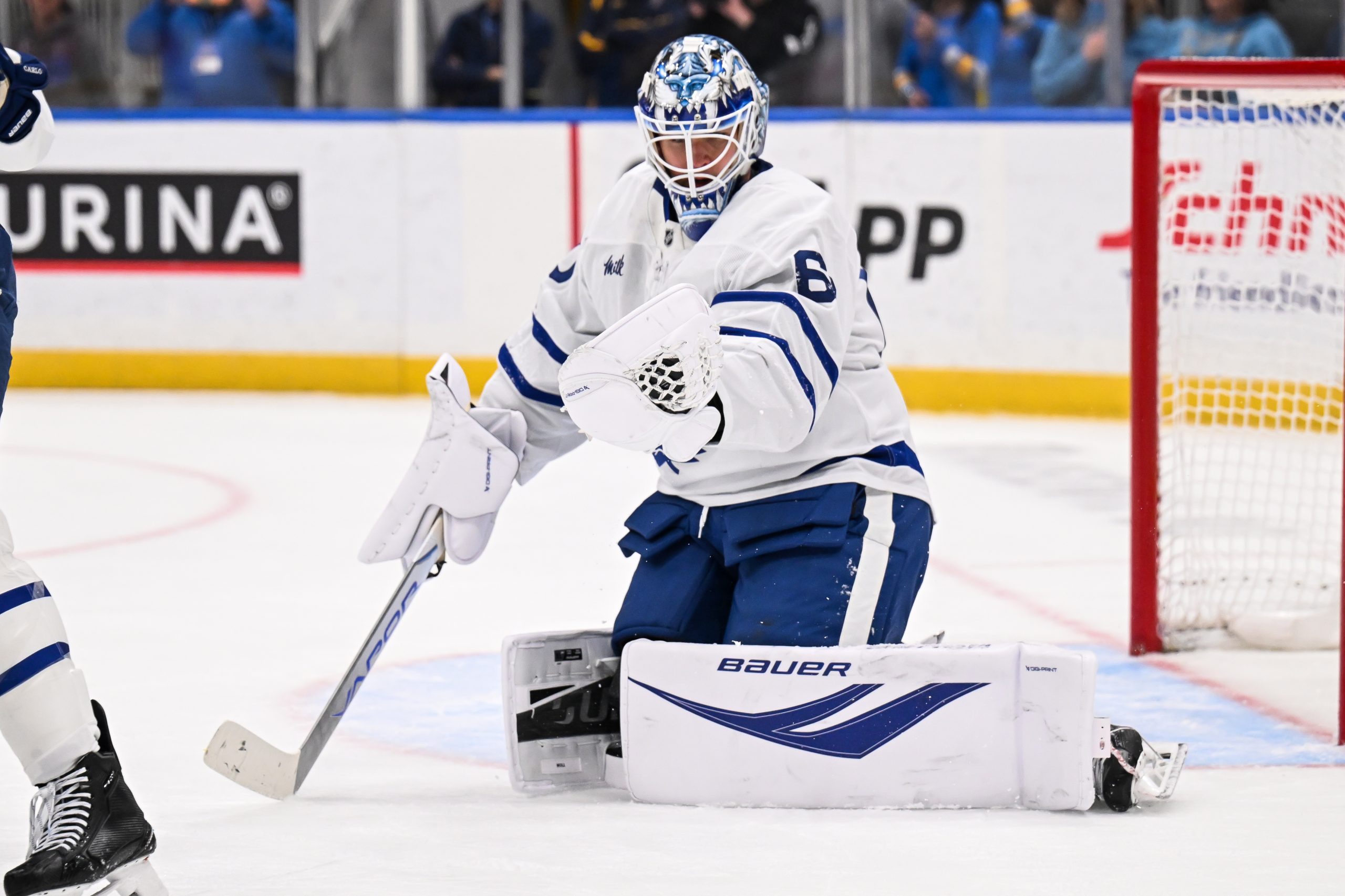
Were the Jamie Drysdale and Trevor Zegras contract extensions enough to give the Flyers passing offseason grades?Yong Kim / Staff Photographer
It looked as if the Flyers were making the biggest splash of the NHL offseason by offer-sheeting Leo Carlsson, but ultimately, Carlsson is still an Anaheim Duck — and the Flyers still don’t have a young center on the roster.
With training camp a month away, how do we assess the Flyers’ actual offseason moves? Here’s what those in the national media are saying about the 2026-27 version of the team.
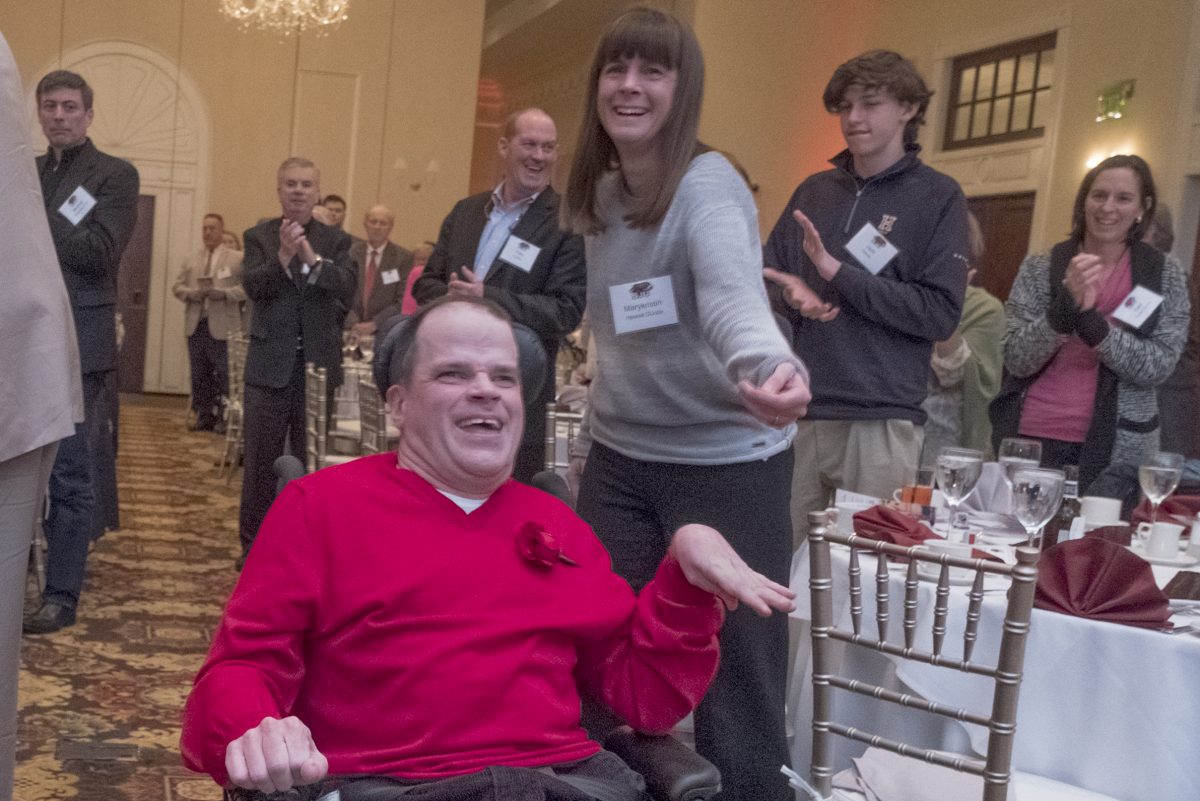
Chris DiJulia’s funeral drew around 600 attendees.Ed Hille / For the Inquirer
More than 600 people crowded into St. Denis Catholic Church in Haverford last Wednesday for an 80-minute celebration of 56 years of life well-lived.
Chris DiJulia was a fixture at St. Joe’s basketball games. He had cerebral palsy and spent his life in a wheelchair. On July 27, he died of natural causes related to his condition. DiJulia was inspirational to all who knew him, and last Wednesday, he was the king of Philadelphia basketball, writes Marcus Hayes.
We compiled today’s newsletter using reporting from Marcus Hayes, Alex Coffey, Scott Lauber, Jeff Neiburg, Jeff McLane, Olivia Reiner, Ryan Novozinsky, Ariel Simpson, Gabriela Carroll, Mia Messina, Lauren Jones, and Conor Smith.
By submitting your written, visual, and/or audio contributions, you agree to The Inquirer’s Terms of Use, including the grant of rights in Section 10.
Happy Monday! Thanks for getting your morning started with me. We’ll be back in your inbox tomorrow. — Bella
For the first time since training camp kicked off late last month, the Eagles got some work against a real opponent Saturday, when they traveled down to Baltimore for what ended up being a 24-7 preseason defeat to the Ravens.
What was learned? Not a whole lot, really. The Eagles, as expected, rested almost all of their projected starters. They ran a pretty bland offense and didn’t peel back the curtain to what the new scheme under Sean Mannion might fully look like.
More will be revealed this week, when the Eagles head north for two joint practices against the New England Patriots on Wednesday and Thursday before preseason game No. 2 on Saturday.
Still, Saturday’s action combined with some recent practice observations were enough to stir some movement in our latest 53-man roster projection. (Here are links to our previous iterations from a month before training camp started, and two weeks ago.)
Quarterbacks (3): Jalen Hurts, Andy Dalton, Cole Payton
Traded: Tanner McKee
Status quo here. Dalton got the start on Saturday, which seemed to reveal that the Eagles consider him QB2 over McKee for now, even despite Nick Sirianni again saying after the game that nothing has been decided. Neither quarterback looked very good, though the play-calling and scheme were pretty vanilla and they were playing behind backup linemen and throwing to backup receivers. The end goal here hasn’t changed. The Eagles likely will be looking for a trade partner for a quarterback-needy team between now and roster cut-down day, which is Aug. 30. We’ll leave McKee as the one who eventually is traded, though it could be Dalton.
Running backs (3): Saquon Barkley, Tank Bigsby, Will Shipley
Cut: Dameon Pierce, Carson Steele, Ja’Quinden Jackson
Same three here from our previous two projections. Pierce popped a little in the early days of camp but has been dealing with a hamstring injury. Shipley had a few solid runs on Saturday, a little bright spot in what was a lousy night for the offense.
Wide receivers (5): DeVonta Smith, Dontayvion Wicks, Makai Lemon, Darius Cooper, Hollywood Brown
Cut: Elijah Moore, Johnny Wilson, Danny Gray, Britain Covey, Quez Watkins, Erik Ezukanma, Samori Toure
Our first position group with some movement. We’re keeping five players instead of six this time because needs for spots at two positions on defense came up (more on those later). The order of the top five players also has changed. Cooper has moved into the “lock” category with the three guys listed ahead of him, while Brown’s struggles in camp make it fair to wonder if the Eagles would consider cutting him and dealing with the cost of releasing a player who signed a $5 million guaranteed deal. That seems hard to fathom for now. Moore has played well enough to warrant giving him a roster spot, but one could argue keeping Brown and Moore is a bit redundant.
Tight ends (4): Dallas Goedert, Johnny Mundt, Eli Stowers, Cameron Latu
Cut: Grant Calcaterra, Stone Smartt, E.J. Jenkins
Another unchanged position group. Goedert and Mundt will be on the field often, while Stowers, a rookie second-round pick, might need some more seasoning. Latu’s status as a blocker and special teamer should have him on the right side of the cuts.
Offensive line (10): Jordan Mailata, Landon Dickerson, Cam Jurgens, Tyler Steen, Lane Johnson, Fred Johnson, Markel Bell, Drew Kendall, Willie Lampkin, Micah Morris
Cut: Myles Hinton, Michael Jordan, John Ojukwu, Jake Majors, Cameron Williams, Hollin Pierce
Two new names make the cut with the final two spots in this group. The first eight players listed are locks. Lampkin has come on strong over the last week or so and was a bright spot Saturday. Lampkin and Morris, a sixth-round pick, are in the field over Jordan and Hinton for now. The No. 9 and No. 10 spots certainly are still up for grabs. It’s also possible the Eagles keep only nine on the initial 53 and try to get some guys through to the practice squad. Kendall and Lampkin can play both center and guard.
Defensive tackles (6): Jalen Carter, Jordan Davis, Moro Ojomo, Byron Young, Ty Robinson, Uar Bernard
Cut: Gabe Hall, Zion Wilson, David Blay
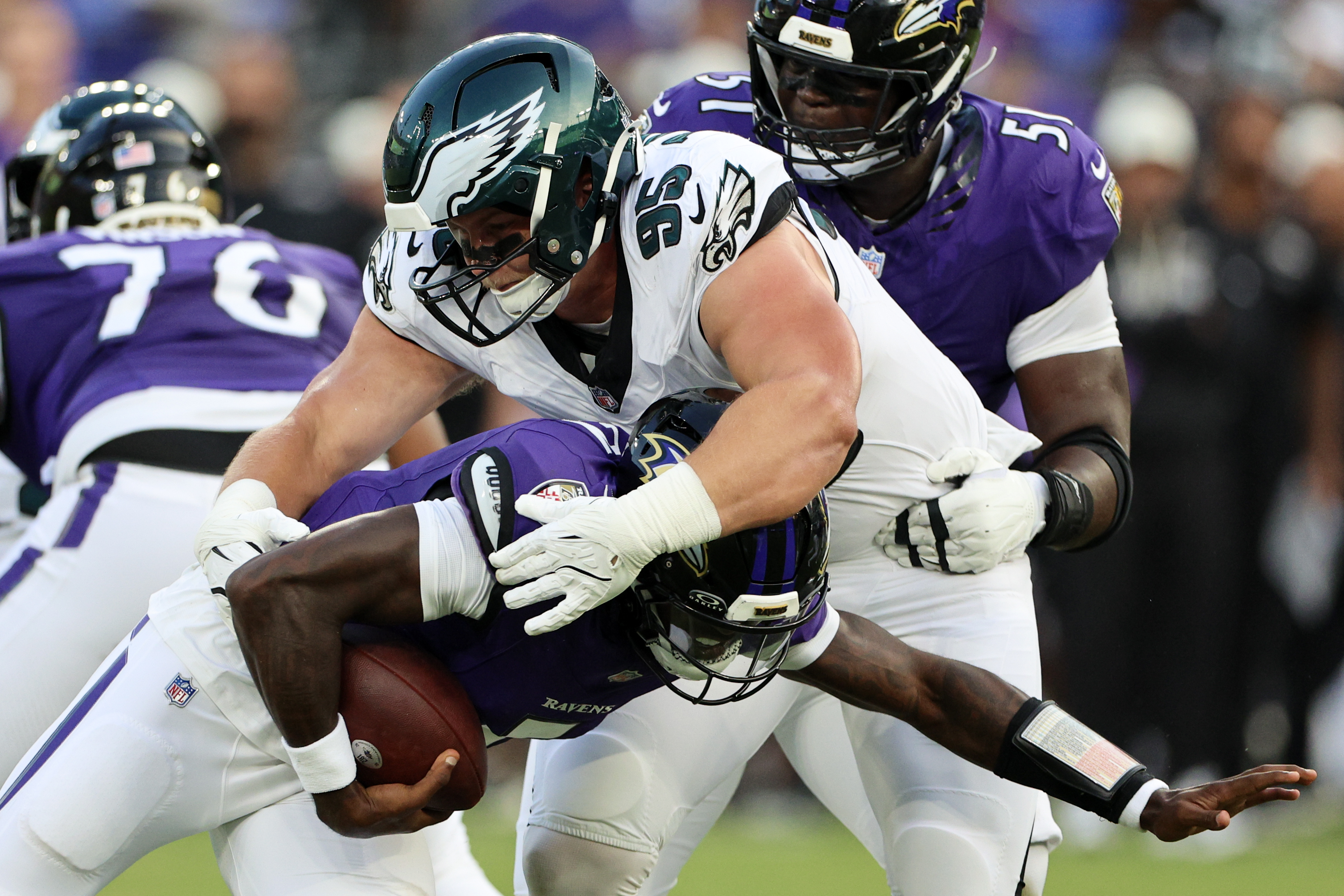
We left Robinson off of our initial iterations of this exercise, but he had his best week of camp and had a sack Saturday (though he did have some mishaps, too). Bernard remains the wild card. For now, we’ll guess the Eagles decide it’s too risky to expose him to waivers and keep him on the roster after camp breaks. Robinson offers some insurance at a position where the Eagles are rostering a player who likely won’t play.
Ty Robinson sacks Ravens quarterback Tyler Huntley during the first quarter of a preseason game.David Maialetti / Staff Photographer
Edge rushers (6): Jonathan Greenard, Jalyx Hunt, Nolan Smith, Arnold Ebiketie, A.J. Epenesa, Joshua Weru
Cut: Tarron Jackson, Keyshawn James-Newby, Jose Ramirez
This may be considered an overreaction. Weru, an International Pathway Player like Bernard, played his first-ever padded football game Saturday and had a quarterback hit. Sure, he was unblocked off the edge, but you saw the athleticism the Eagles loved when they signed the former rugby player from Kenya. Weru has a lot of developing to do, but he has clocked a 4.45-second 40-yard dash, a 41 1/2-inch vertical leap, and a broad jump of 11-2. If he flashes in more preseason action, will another team claim him if the Eagles waive him?
Much has been made about Bernard. The Eagles drafted him in the seventh round and signed Weru as an undrafted free agent. But they might have two players worth protecting come Aug. 30. We’ll see. Ahead of Weru, those five spots should be considered locks. Barring injury, don’t expect much movement here. It’s the top five guys, and then maybe Weru.
Cut: Chance Campbell, Deontae Lawson, Brandon George
There’s some buzz around Chance Campbell. Vic Fangio seems to like him. The 2022 sixth-round pick came off injury and was a well-liked member of the practice squad last year. He’s also having a good camp. But unless the Eagles want to cut Mondon, their own fifth-round draft pick from last season, it seems superfluous to keep five off-ball linebackers just for the heck of it. Mondon seems to be developing and is a solid special teamer. Trotter, meanwhile, probably starts on some NFL teams. There doesn’t seem to be a need to keep five players here.
We are going one fewer here than last time for a few reasons. Needs along the defensive line forced the hand a little, and there’s also some positional versatility in the defensive backfield that makes it unnecessary to roster six corners if there are other positions worth stretching. Michael Carter II, who is in a competition to start at safety, can be the backup nickel. DeJean will play safety in base. Jones, who is out right now with a shoulder injury, and McWilliams offer inside-out abilities. Ringo is the roster casualty here. He had a nice interception on Saturday, but also got beat for a touchdown.
Kelee Ringo intercepts a pass in the end zone to stop a Ravens drive late during a preseason game.David Maialetti / Staff Photographer
Safeties (4): Drew Mukuba, Marcus Epps, Michael Carter II, J.T. Gray
Cut: Cole Wisniewski, Andre’ Sam, Max Pulley, Kapena Gushiken
This position is getting pretty interesting. Wisniewski, a seventh-round pick, has been sidelined by a hamstring injury, and it’s hard to give him a roster spot right now. The new UDFAs, Gushiken and Pulley, have had their moments. Sam has been around the building on the practice squad for a few years. But we’ll give the fourth spot to Gray for now. The 30-year-old is an elite special teamer.
Special teams (3): Jake Elliott (kicker), Braden Mann (punter), Rocco Underwood (long snapper)
These are the only three specialists on the roster. Underwood has had a few snapping issues so far in camp, but the Eagles haven’t brought anyone else in. They could cut him on Aug. 30 and then find another snapper before Week 1.
The Flyers made the biggest splash of the NHL offseason by offer-sheeting Leo Carlsson with a then-record average annual value.
The league is already feeling the ripple effects of that tactic, as young stars like the Sharks’ Macklin Celebrini and Blackhawks’ Connor Bedard have new contract structures that reflect how the Flyers reset the market for top centers.
But ultimately, Carlsson is still an Anaheim Duck. The Flyers are insulated from the impact of their own move, because they still don’t have a young center on the roster.
So, how to assess the Flyers’ actual offseason moves? Here’s a roundup of what national media thought about the changes to the Flyers’ roster this summer:
The Carlsson deal that wasn’t helped the Flyers lock up Trevor Zegras. Yong Kim / Staff Photographer
“Brière did some tidy business to keep franchise pillars like Jamie Drysdale, Trevor Zegras, Tyson Foerster, and Dan Vladař on fair extensions, and was smart to shore up the crease with the acquisition of Joseph Woll to back up Vladař. And while we should not overlook the acquisition of Noel Acciari to solidify the middle-six, the lack of new faces to fortify this burgeoning roster makes this summer feel a little lacklustre relative to expectations.”
Elliotte Friedman recorded his offseason recap episode of 32 Thoughts before Anaheim decided to match the offer sheet. He questioned which moves the Flyers might make if it ultimately didn’t work out, but ultimately, the biggest piece the Flyers are missing is a true star.
“They’ve been building, they’ve been adding some good players, but they were like, we need a star. We need a difference maker. … They aren’t drafting high enough to get that player.”
“They definitely get an A for effort as it relates to the Leo Carlsson offer sheet… In the end, however, it just did not work out as Anaheim matched it. Beyond that, it’s just been a lot of new contracts and re-signings for players already on the roster.”
National media liked the Joseph Woll upgrade. Connor Hamilton
Despite the Flyers making mostly minor additions in free agency, The Athletic’s data model rated it as the eighth-best NHL offseason, adding value in the bottom-six and in net.
“On the one hand, the Flyers’ goaltending situation received a major boost going from Samuel Ersson, one of the league’s worst goalies, to Joseph Woll, who has shown flashes of excellence when available. On the other hand, anything gained by that move was immediately lost going from [Emil] Andrae to Simon Benoit, one of the league’s worst defensemen.
“The Flyers’ biggest net gain comes from the improvement in their fourth line going from Garnet Hathaway to Noel Acciari. The latter showed some serious defensive chops, even while accounting for his lesser role. He helps give Philadelphia one of the league’s deepest bottom sixes.”
The Athletic’s NHL insider, Chris Johnston, said on his podcast that he sees the Flyers in a similar space to where the Montreal Canadiens have found themselves in the past. The Flyers have plenty of cap space, but the type of players they need to make a big leap aren’t easily acquired, and it might take another season or more to land the player they’re looking for.
“The Flyers are going to have to stay in the same marketplace and keep biding their time,” Johnston said. “Maybe there’s another offer-sheet situation, maybe there’ll be a trade possibility, but it’s going to be a challenge.”
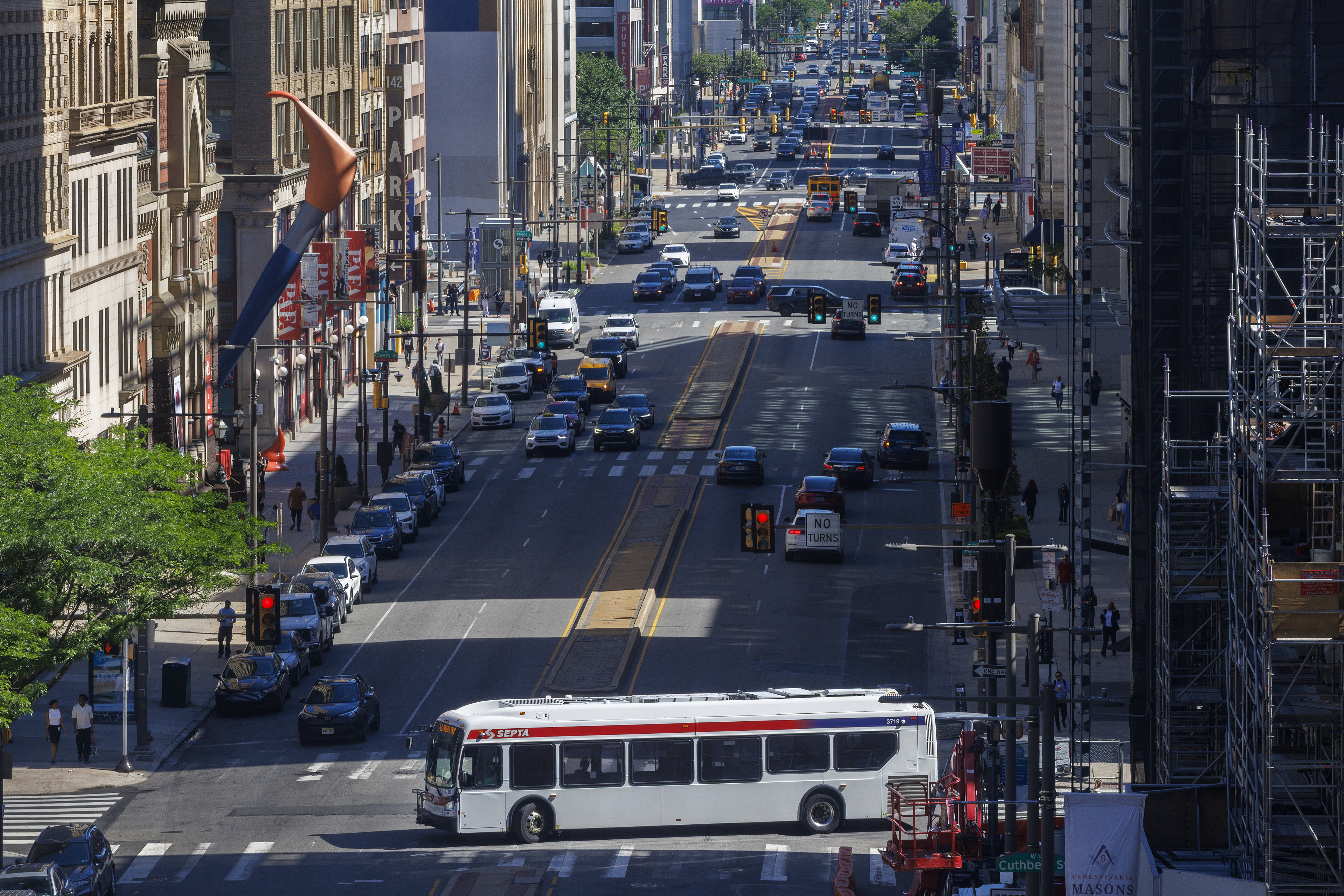
The first phase of SEPTA’s bus network overhaul begins Aug. 23, and Brandon Miller is mobilizing hundreds of employees for a final push to meet face-to-face with riders in the days leading up to the changes and during the first week after they take effect.
“It’s a blitz,” said Miller, manager of planning programs at SEPTA, describing discussions at “pop-ups” as an effective way to help people navigate the new network.
Unlike some transit agencies, SEPTA has not done a comprehensive redesign of its bus network in its 58-year history. The agency has publicly pushed to do so since 2021, but change was delayed by opposition, political wrangling, and, later, a two-year fiscal crisis.
Originally the “Bus Revolution” was supposed to happen all at once, but SEPTA ultimately decided to phase in changes to routes.
“I think there’s more willingness to accept the fact that … we need to make the bus network a little bit more efficient,” Nemiroff said. “We need to make the system more attractive for people.”
Some routes with low ridership or that duplicate nearby service will be eliminated. Others will be extended or run more frequently, and two new routes will be added.
What routes will change?
New and expanded routes: Route 72, a new crosstown bus running along Cheltenham Avenue, and the new Route 76 bus from Columbus Commons to Rising Sun and Olney. Route 45 will be extended to provide service to the Navy Yard, and Route 79 will be extended from South Philadelphia into University City.
Eliminated routes: 35, 47M, 62, 78, 80, 89, and 106.
Riders can call SEPTA customer service at 215-580-7800 or email specific questions to planning@septa.org.
I want to talk to someone in person.
Beginning Monday, street teams will conduct “pop-up” visits at key transit hubs at various times between 6 a.m. and 8 p.m.
Next week, visits will include South Broad Street and Snyder Avenue, Cedarbrook Plaza, Hunting Park Station for changes to Route 53, Spring Garden Station, and Willow Grove Mall.
Staff are also attending community events.
When will changes happen?
The majority of changes will take effect Sunday, Aug. 23, followed by the Route 105 extension and elimination of Route 106 on Monday, Aug. 24.
Phase 3 changes are planned to begin in June 2027.
Phase 4 changes are planned to begin in Fall 2027. Many details are still being worked out.
Why redesign the bus network?
SEPTA launched its bus redesign efforts in earnest after ridership declined 13% from 2013 to 2019, a drop attributed to slow speeds, reliability problems, and competition from ridesharing companies. And that was before the COVID-19 pandemic.
Bus ridership rebounded faster than it did on other transit services, but SEPTA’s thinking is that simplifying the network will make it easier to use, with more frequent service on fewer or shorter routes.
Will bus stops be changed?
Stops will disappear during the first phase on routes that are eliminated, but there will be no wholesale changes yet.
Having more stops per mile provides access to more people, but closely spaced stops can also slow buses and make them less reliable.
Early plans for Philadelphia’s bus network redesign aimed to “rebalance” stops by spacing them farther apart to improve speed. But the idea has been unpopular.
SEPTA may revisit the issue later.
More questions about the New Bus Network?
Email transportation reporter Thomas Fitzgerald at tfitzgerald@inquirer.com.
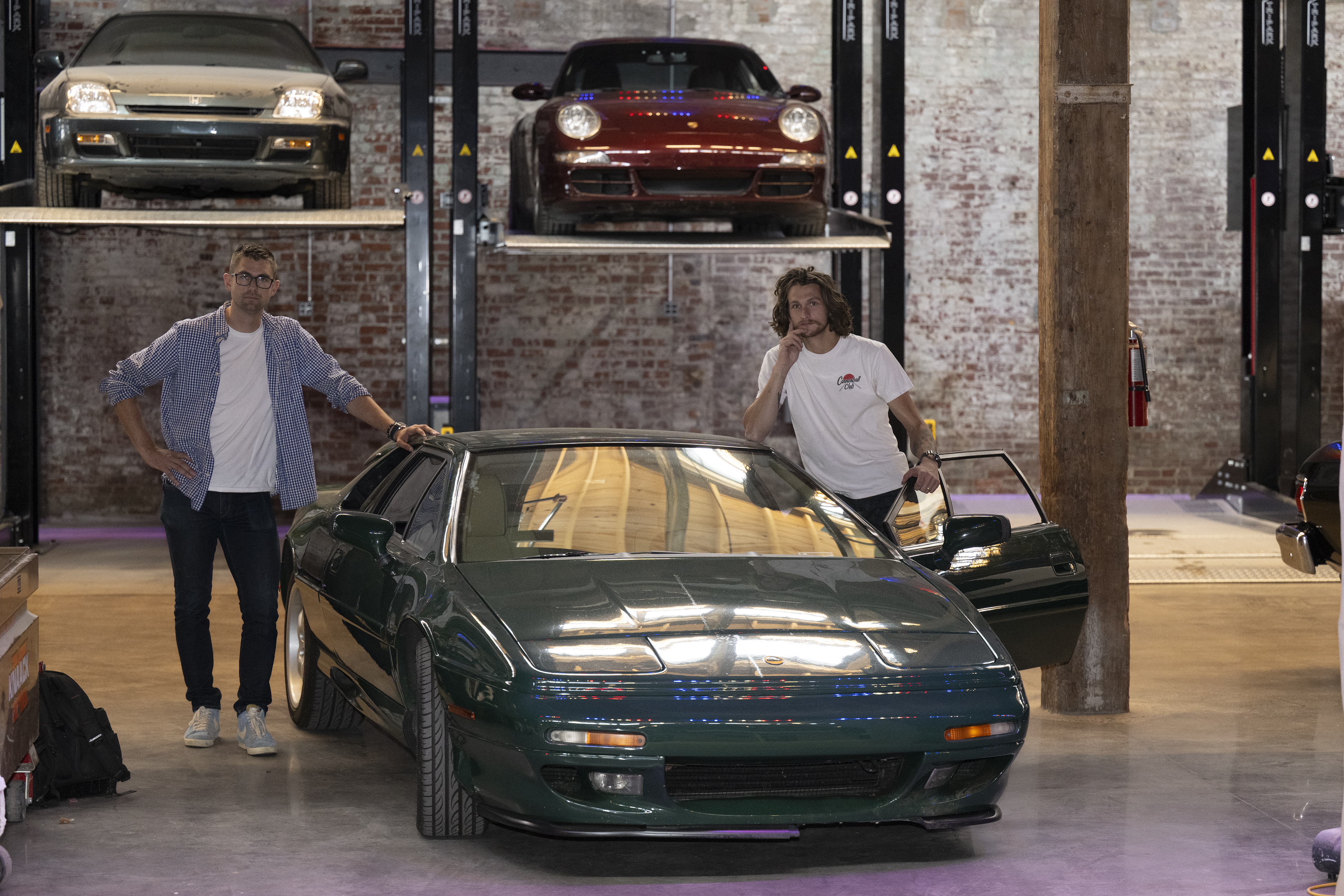
Old cars are breathing new life into an empty Fishtown factory.
But saying vehicles will be stored there is like saying Fairmount Park has a lot of trees — technically correct but missing the point.
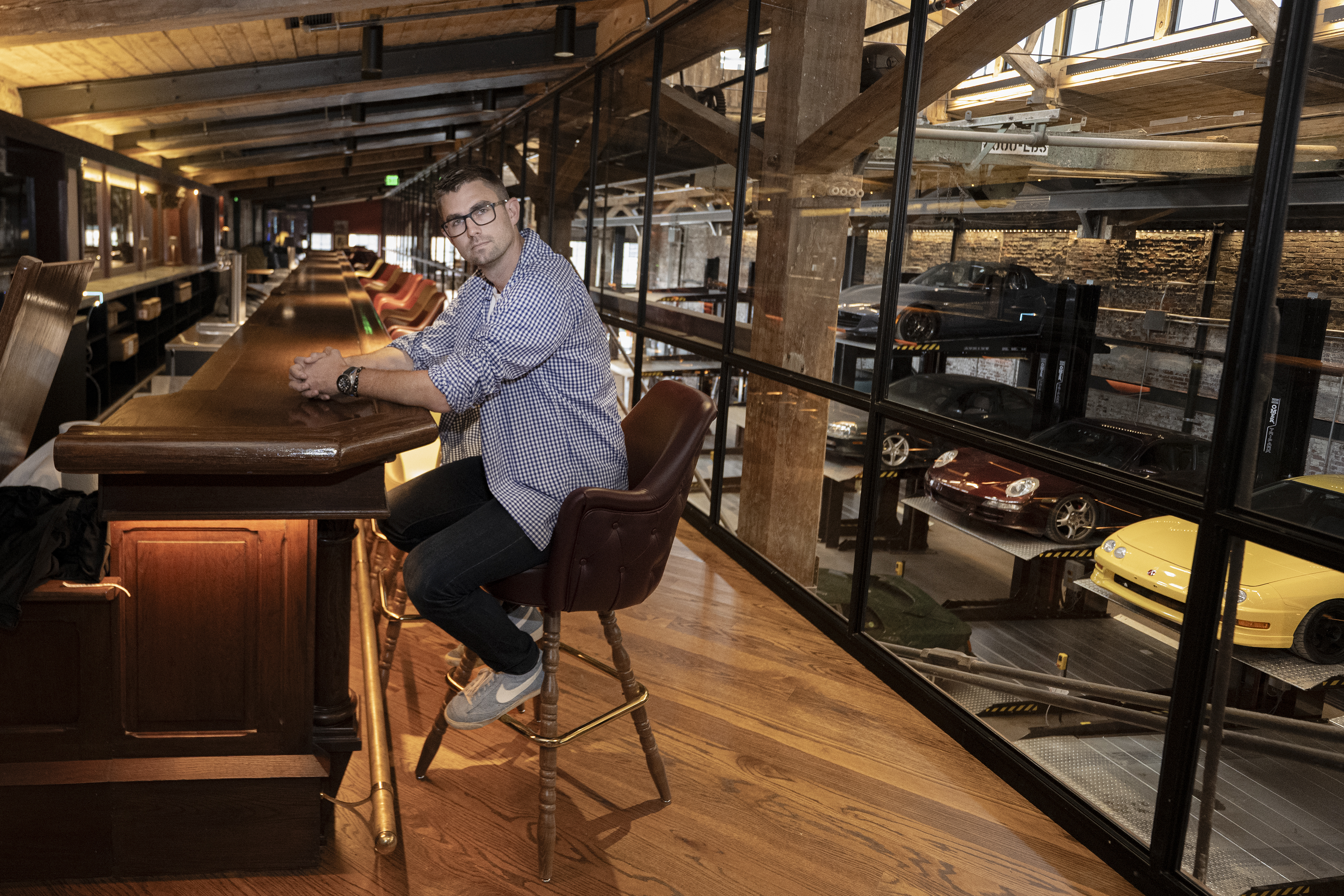
Passersby on Frankford Avenue, between Delaware and Girard Avenues, will see inside what was a long-derelict factory revealing a café that’s open to the public, and further inside, through the glass walls, multiple levels of unusual vehicles.
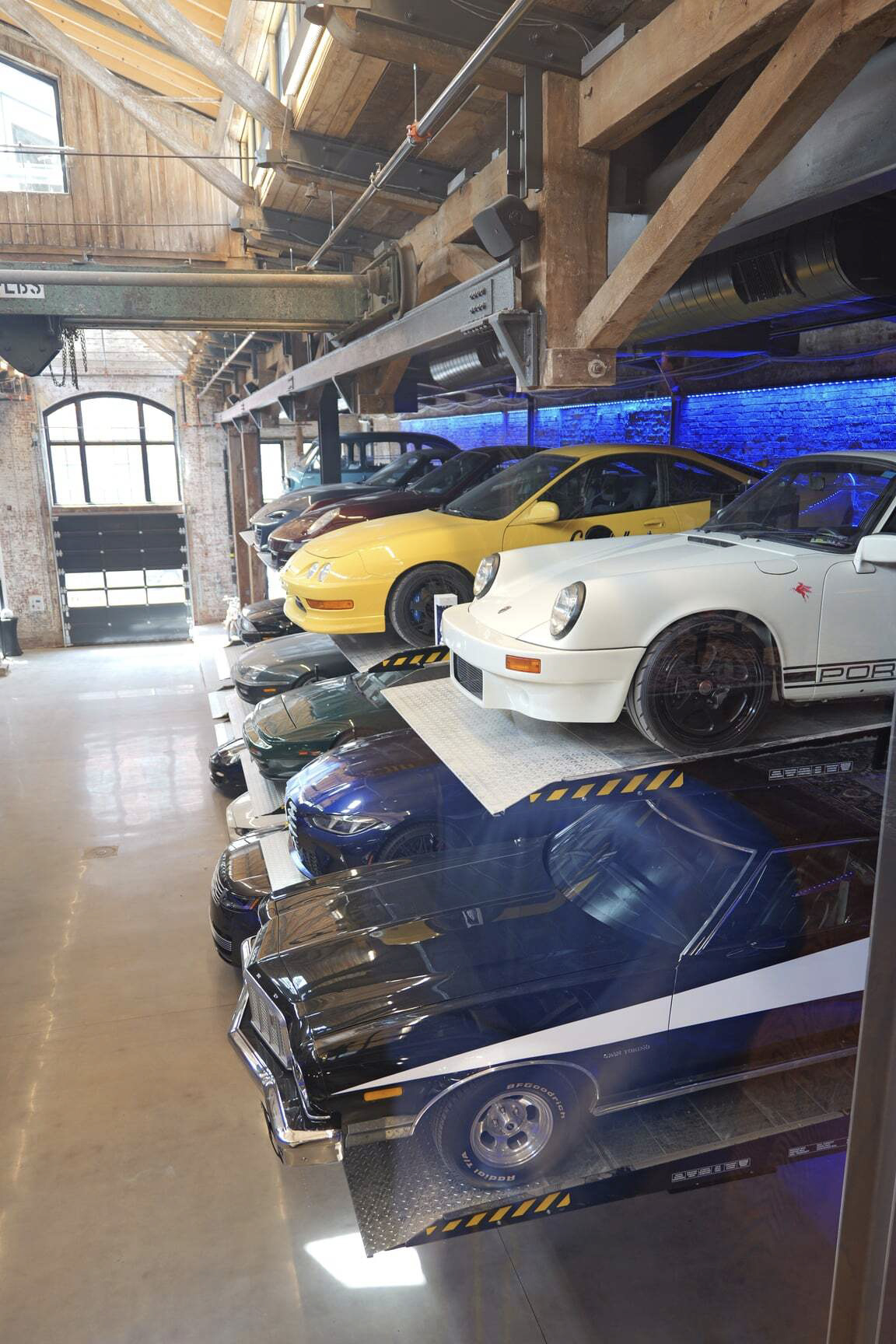
A black 1976 Ford Gran Torino owned by Tim Bryan of Fishtown sitting beneath a white Porsche 911 underneath the soaring architecture of the old factory at the Cannonball Club in Fishtown. The vehicles were set in place during a special event prior to opening. SITHA PUTH
The backdrop of the new Cannonball Club will comprise a rotating crop of cars; such rare specimens as a Citroen XM or Lotus Esprit will join more well-known offerings like a 1976 Ford Gran Torino. Beyond that glass wall, members can enjoy a multilevel workspace, café, and bar. Memberships are available for car owners and car lovers alike.
It’s the brainchild of Chris Allen, 32, who runs a similar operation in Huntingdon Valley, though that’s less a daily hangout and more a car-storage facility that also hosts special events. The Fishtown club is set to open for business Sept. 10, and the public-facing café opened last week.
In Fishtown,“I wanted people to be able to walk by off the street and see the wall of crazy cars,” Allen said as he walked through the unfinished facility in late May, amid the clang of metal and screech of power tools.
Envisioning a ‘car museum’
The architecture alone can certainly draw some eyeballs. The 15,000-square-foot facility began as the Morse Elevator Works in the late 1800s. The building more recently housed antique shops, a lighting store, and a bicycle shop.
The 75 vehicles that will fill the space will be hoisted on elevators and stacked around the building, underneath the rebuilt and refinished clerestory and exposed trusses rising far overhead.
“I don’t want this to be a high-density parking garage,” Allen said. “This is more like a car museum.”
And a club. The public cafe serves coffee and pastries, and the bar serves drinks and pub food. The facility’s website says it will be open 8 a.m. to 10 p.m. every day.
It’s not for car enthusiasts who want the freedom of hopping in their vehicles on short notice. Members need to schedule pickup and drop-off when staff are there to operate the vehicle elevators.
Allen thinks that will work fine for collectors from the neighborhood and beyond, noting the club’s proximity to I-95.
“Any collector car owner wants to get the hell out of the city immediately once they get it,” he said.
Owner Chris Allen sits at the 50-foot-long bar overlooking the vehicles on display inside the Cannonball Club, set to open in September.Jose F. Moreno / Staff Photographer
What Fishtown neighbors think
It appeals to Tim Bryan, who’s lived in Fishtown for the past six years.
Bryan will store his 1976 Ford Gran Torino — “think Starsky & Hutch, but black,” he said — at the facility. It currently is stored miles away from him at Allen’s Huntingdon Valley unit.
Bryan attended the Fishtown Neighbors Association meeting when Cannonball was still somewhere between a plan and a dream. There, residents had a chance to voice support or concerns and vote to support or oppose the zoning variance Cannonball needed to open as an entertainment center. Neighborhood support was strong, Bryan said, and only a handful of people voiced concerns, which he saw as misplaced.
“I thought they sort of thought this was going to be Lamborghinis and Porsches and elite cars and all that kind of stuff, but my Gran Torino is not a luxury car,” Bryan said.
Bryan was also pleased to see the building put to use; it’s been empty since he moved to the area six years ago.
Fishtown Neighbors Association presidentJohn Scott said the group doesn’t usually get too involved in individual projects; they’re more about addressing more general concerns, like pedestrian safety, parking, and other issues.
But Scott said the association took the opportunity during the zoning board variance meeting to make one unusual request: using the facility as a polling place. Finding appropriate, accessible locations for voterscan be difficult in a city of old buildings.
“They said absolutely, they would love to, so it sounds like they’re going to be good neighbors,” Scott said.
Even beyond Election Day, Scott sees the facility as a bonus.
“It’s different and for that alone we’re really looking forward to seeing it,” Scott said.
Scott, for example, says he loves old cars but doesn’t really want the hassle as a city dweller. Someone in his position can join for $250 a month. Members who want to store cars there pay an extra $550 a month.
‘Next level’ for car clubs
Cannonball owner Allen is a racer and a car collector himself. In early July, his team won in its class at the Historic Sportscar Racing NASCAR Classic to Le Mans Classic Circuit in France. He bought the Huntingdon Valley building just as the pandemic started as a placeto store his own vehicles, plus those of family and friends, and then grew from there. He has a team of four working with him on the project and a small group of investors.
He wants to welcome an involved membership.
“I don’t want some guy to come in here and just forget about it and not actually interact with the club. In my mind, it’s a waste of one of our spots,” Allen said.
Allen shopped around restaurants for food service but decided it would be easier to run the kitchen in-house. He plans to serve pub food and beer, wine, and cocktails.
A 52-foot bar on the second floor overlooks the main floor and an exposed-brick wall of cars rising in four levels. Rather than the car paraphernalia and gas pumps typical of this kind of project, Cannonball’s decor is something Allen calls colorful and “maximalist,” with Oriental rugs, plenty of seating options winding around the cars, big leather couches, and orange-velvet wingback chairs.
“I probably would have advised him not to spend as much money as he spent in renovating and building out this space,”said business consultant Robert Mau of Richmond, Va., who knows Allen from the endurance racing circuit, but isn’t involved in the new Fishtown business.
“What he’s doing in Fishtown takes [the car club scene] to the next level,” Mau said. “So now it’s like, ‘Let’s have a lifestyle or a culture of cars where people hang out — and, oh, if they store their car here, well, that’s great.’”
Other than the sibling facility inHuntingdon Valley, two clubs in the Philly suburbs offer a similar experience.
At CarVault Main Line in Berwyn, members must sponsor new applicants, and the setting is more storage building than historical loft. It advertises a self-serve bar and a place to watch the latest race.
Pottstown’s Red Horse Motoring Club touts its historic location in a 1922 Chrysler and Dodge dealership, with a members club and the option to rent the venue.
But nothing seems to exactly match what’s happening in Fishtown.
Club member and New Jersey resident Mike Kovac will park his 1989 Alfa Romeo Milano Verde at the facility. He was among the first 10 people to sign up. The Alfa is shaped like a 1980s Saab with a distinctly Italian front end, and it’s one of just 75 in the world, Kovac said.
Kovac knows not everyone is a car person, and that’s what he thinks will make the club work. He describes the challenge of gathering his car friends and non-car friends together.
“Now with Cannonball launching,” he said, “we have a place where it’s welcoming for both non-car people and car people, and you have that awesome backdrop of classic cars and exotic machinery.”
Seated behind his desk in the Oval Office earlier this month, President Donald Trump spoke directly to the camera in front of him. He turned to his right and looked up at the Pennsylvania Republican who, as he had indicated just a few weeks earlier, might very well lose her race for governor this fall.
“I think you can win,” he said this time, extending his hand to Stacy Garrity. It was a change in tune for Trump, who last month at an event in Pennsylvania said Garrity’s opponent, Democratic Gov. Josh Shapiro, was “expected to” and might win.
The president’s confidence in Garrity — and whether his support will extend beyond a handshake and a 17-second video with her at the White House — has become a critical question in the final stretch of the Pennsylvania governor’s race.
Down in the polls and lagging behind Shapiro’s unprecedented fundraising, Garrity has cultivated the president’s support and the potential boost, both financially and in Republican enthusiasm, that could come with it.
It is a risky strategy for a swing-state candidate whose party holds the White House, and particularly as polls show Trump becoming increasingly unpopular. Shapiro and his allies have enthusiastically promoted instances when Garrity, the twice-elected state treasurer, has leaned into Trump’s agenda and brand of politics.
But with less than three months before Election Day, it is not clear to what extent Trump or other key national Republicans will pitch in on her campaign.
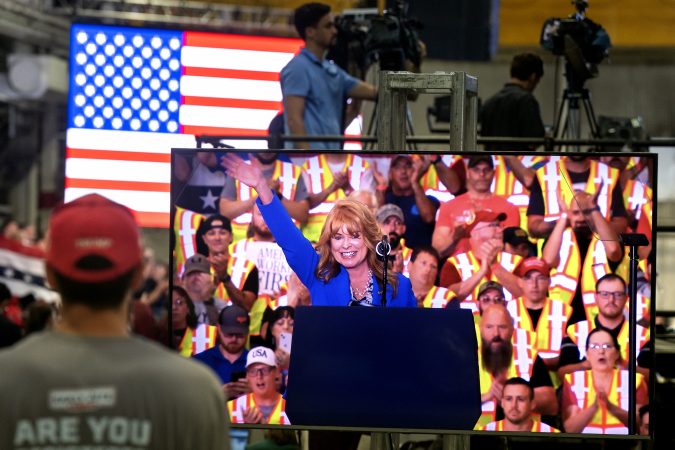
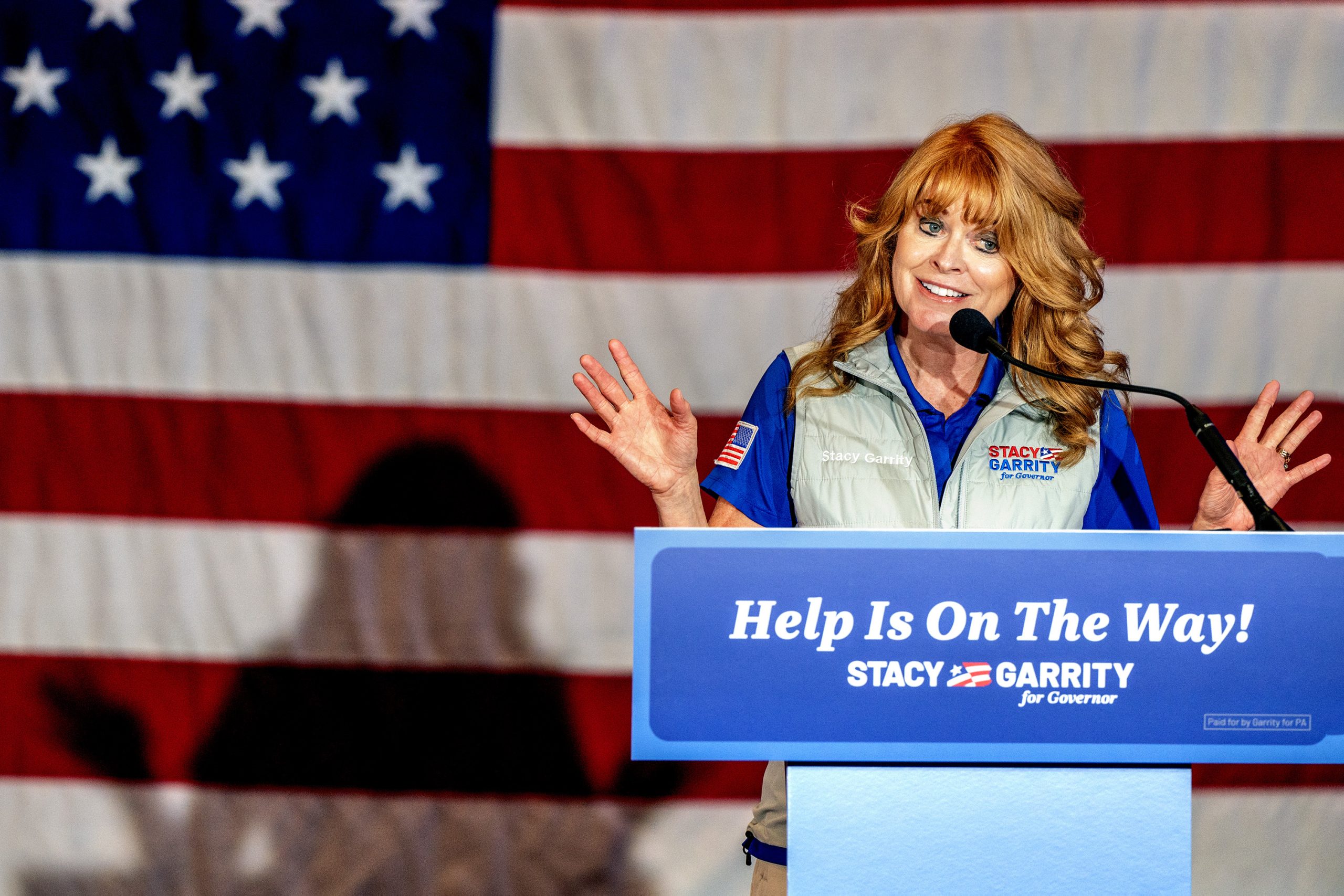
State Treasurer and Republican candidate for governor Stacy Garrity holds a rally in Bucks County at the Newtown Sports & Events Center in this 2025 photo. Tom Gralish / Staff Photographer
Trump has not yet stumped in any significant way for Garrity in Pennsylvania, a swing state where he was a near-constant presence during his winning 2024 campaign. And he has not lent his vast political resources — including a Trump-aligned super PAC flush with $400 million — to Garrity or other Republican candidates as his party faces tough campaigns across the country in the midterm elections that will determine control of Congress.
Several gubernatorial races around the country are consideredcompetitive, a reality that also pits Garrity against GOP nominees who polling suggests have better shots of success. The same circumstances have doomed the most recent other Trump-endorsed Pennsylvania Republican nominees for governor — former State Sen. Scott Wagner in 2018 and State Sen. Doug Mastriano in 2022 — who never ended up with national support and lost by double digits.
Campaigns typically heat up after Labor Day, and there is still time for Garrity’s national allies to converge to boost her. But observers say the political reality is also evident.
“The president kind of looks toward two things,” said Samuel Chen, an Allentown-based Republican strategist who is not affiliated with Garrity andwho previously worked for Tom Corbett, Pennsylvania’s most recent GOP governor.
“One is loyalty to him. Garrity has been loyal, but has not necessarily been as vocal as some others have. The other side of it is he likes winners. He wants to endorse people who win,” Chen said. “Everyone in Trump’s orbit knows that Garrity has a very uphill climb.”
Not supporting ‘lost causes’?
The level of involvement from groups like the Republican Governors Association has been a key indicator of whether the party believes its nominee has a chance at winning recent gubernatorial elections in Pennsylvania.
The RGA is made up of GOP governors who collectively support one another’s agendas and campaigns. Democratic governors have a similar alliance.
In 2010 — the last time a Republican won the governor’s mansion in Harrisburg — the group was the largest donor to then-Attorney General Corbett’s gubernatorialcampaign, giving him $6 million starting in August of that year. Four years later and helmed by then-New Jersey Gov. Chris Christie, the RGA was once again Corbett’s biggest donor. It donated more than $5.8 million as Corbett became the first sitting Pennsylvania governor in decades to lose a reelection bid. Christie, preparing to run for president in 2016, stumped with Corbett multiple times.
The picture was starkly different in 2018 and 2022, when Republican voters nominated two candidates closely associated with Trump. Neither Wagner’s campaign against Democratic Gov. Tom Wolf nor Mastriano’s campaign against Shapiro ever became highly competitive — and the RGA and other national groups decided to sit out.
“We’re watching Pennsylvania very closely,” Arizona Gov. Doug Ducey, then the chair of the RGA, said in September 2022. He added that the group would not support “lost causes” or “landslides.”
The RGA would spend nothing in the state that year, even with Mastriano and former Trump lawyer Jenna Ellis pleading for assistance. Shapiro went on to trounce Mastriano by nearly 15 percentage points.
This year, RGA chair and Montana Gov. Greg Gianforte has not publicly weighed in on Garrity’s chances since issuing a brief, generic statement congratulating her after her unchallenged primary in May.
And the competitive landscape Republicans are facing across the country may mean Pennsylvania’s GOP nominee once again gets the short end of the stick. The RGA did not respond to requests for comment.
Even with Pennsylvania’s status as a preeminent swing state that went for Trump two years ago, there are nearly a dozen more competitive gubernatorial races across the country this fall, according to the Cook Political Report, a nonpartisan group that provides election analysis.
Georgia, Iowa, Nevada, Ohio, and Wisconsin — some of which voted overwhelmingly for Trump just two years ago — are all considered toss-ups. Four other states with Democratic governors — Oregon, Arizona, Michigan, and Kansas — are also considered more competitive than Pennsylvania, which is ranked as “solid Democratic,” according to Cook, despite Republicans like Garrity and Trump having won statewide two years ago.
The RGA, according to its most recent filing with the Federal Election Commission, had less than $1.7 million in its RGA Right Direction super PAC after spending about $16 million so far in the current election cycle.
Its recent spending has focused on Iowa, where Democrats are attempting to capture the governor’s office for the first time in two decades, and Kansas, where the RGA launched an ad this month.
“There’s always competition for limited resources,” Charlie Gerow, a longtime Harrisburg-based Republican strategist who also ran for governor in 2022, said of the intraparty competition for donors. “There’s only so much campaign funding to go around as everybody’s trying to get a piece of it.”
In July, Shapiro’s campaign announced he had raised $50 million since January 2025. The next financial filing deadline for statewide candidates is in September, but as of the last reporting cycle, he had outraised Garrity 10-1.
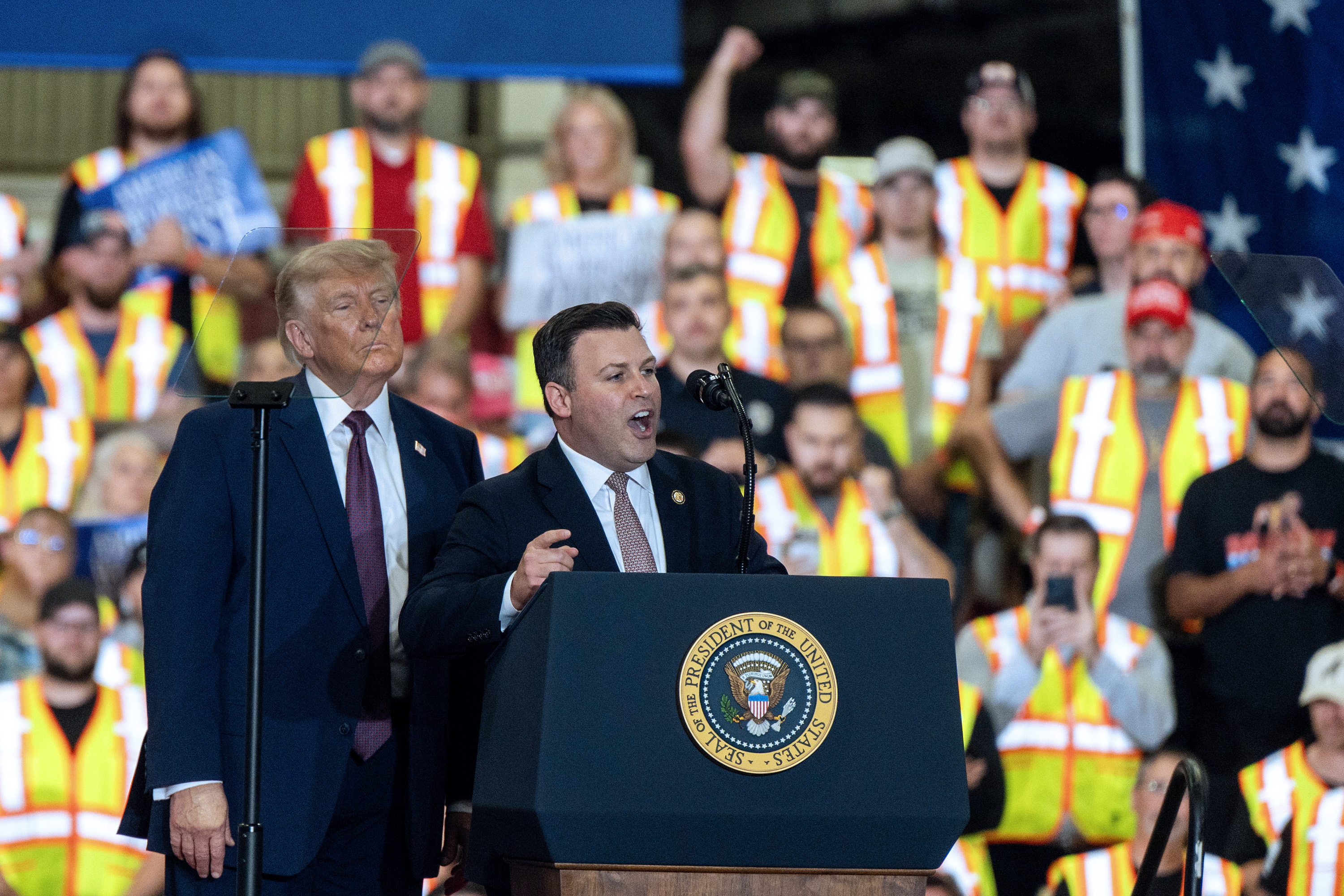
President Donald Trump brings U.S. Rep. Ryan Mackenzie (right) to the stage as he holds an event in Mackenzie’s Lehigh Valley district at Mack Trucks in Macungie Tuesday, June 23, 2026.Tom Gralish / Staff Photographer
But Matthew Beynon, a spokesperson for Garrity’s campaign, said she “does not expect, nor does she need, to go dollar-for-dollar with Josh Shapiro.” Instead, he said, she “just needs the resources to prosecute her case against Josh Shapiro … and she is on pace to be able to do so.”
Garrity looks forward to “continued support” from the RGA, he said.
Other national attention on Pennsylvania
After Mastriano’s disastrous performance in 2022, Republicans coalesced around Garrity — whose 3.5 million votes in 2024 were the most ever for a statewide candidate in Pennsylvania — as their best shot at defeating Shapiro.
But in the year since she received the party’s endorsement, Garrity has barely moved the needle. A Quinnipiac University poll in July found Shapiro leading Garrity 53% to 40% among registered Pennsylvania voters. Trump saw even lower scores: Just 39% of those polled approved of the president’s job performance.
A poll from a Republican-leaning firm promoted by Garrity showed her down, 50% to 43%.
Across Pennsylvania, she has also competed for attention and resources as her party prioritizes other major election battles this fall.
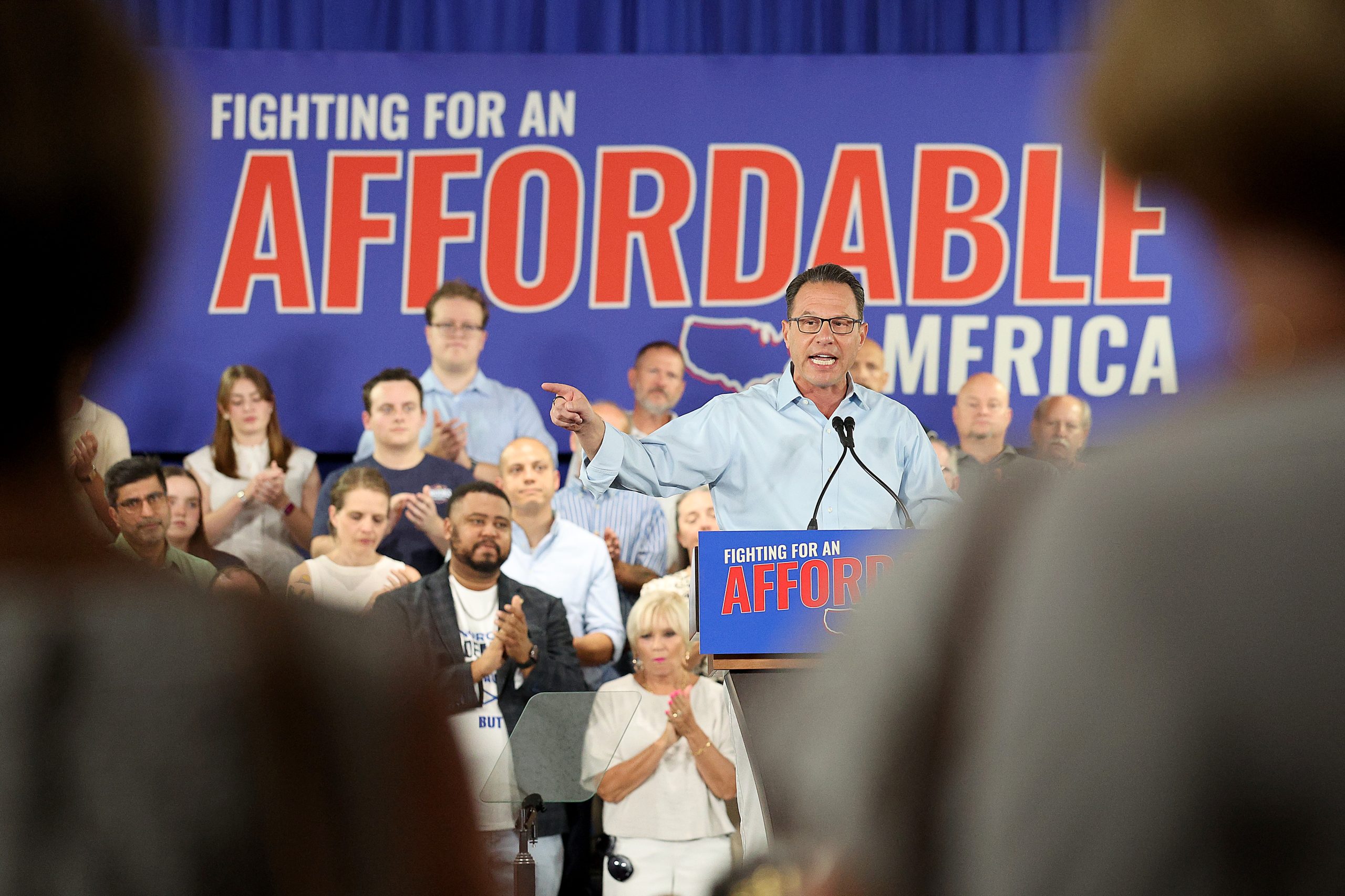
Pennsylvania Gov. Josh Shapiro addresses the audience during a rally for Democratic congressional candidate Bob Brooks at the United Steelworkers Union Hall in Bethlehem, Pa. on Sunday, July 26, 2026.David Maialetti / Staff Photographer
On the other side of the aisle, Pennsylvania’s top elected Republican — U.S. Sen. Dave McCormick — has endorsed Garrity but has not appeared to join in her public campaign efforts so far. A Trump ally and former hedge fund leader, McCormick has raised millions since his election in 2024, and political action committees associated with him have donated to other PACs working to elect Pennsylvania Republicans in Congress.
McCormick has hosted events and campaigned for Garrity, and he “will keep doing everything he can to help her win,” said Mike DeVanney, a spokesperson for the senator.
“He believes she demonstrates the kind of leadership we need and the kind that President Trump and many others have recognized as one that can move our commonwealth forward,” DeVanney said.
Gerow said McCormick undoubtedly could help Garrity down the stretch.
“He’s a prolific fundraiser. He has the connections, and he has the personality to raise large amounts of money. And he can be very, very helpful with the Garrity campaign if he weighs in with full weight,” Gerow said.
Garrity’s campaign said McCormick has been an “incredible supporter,” including with his earlyendorsement and connections to supporters.
Shapiro has also cultivated across-the-aisle relationships with some Pennsylvania Republicans who would be expected to promote Garrity.
In an April interview with Punchbowl News, U.S. Rep. Brian Fitzpatrick, a Bucks County Republican running for reelection in the nationally watched 1st Congressional District, said he thought Shapiro would win his reelection contest and should run for president, adding: “I think Josh is very, very smart.”
And during his 2022 run, Shapiro collected endorsements from other prominent Republicans, including Jim Schultz, a former Trump White House lawyer, and former Republican U.S. Rep. Charlie Dent.
The final stretch
Though the November election is less than three months away, that is still plenty of time in politics. Most ad spending does not start until September, and ground game efforts — door knocking, phone banking, and get-out-the-vote campaigns — get underway in the fall.
Winning Pennsylvania is a priority for Trump in the midterms, and Garrity’s campaign said she is “grateful” for his continued support.
On the state level, James Markley, a spokesperson for the Pennsylvania GOP, said the party is “fully invested” in helping Garrity beat Shapiro. Those efforts include training “thousands” of volunteers and working on education programs around early voting and casting mail-in ballots.
“The more Pennsylvania voters learn about Stacy Garrity, the more they love her,” he said in a statement. “The more Pennsylvania voters learn about Josh Shapiro, they realize he has no record to stand on.”
Gerow said Garrity’s challenge, with limited funds compared with Shapiro, is whether she has enough money to get her message out.
“The major concern for her immediately is to be able to tell her story,” Gerow said. “She doesn’t have the resources to tell that story effectively right now, and she has a great story.”
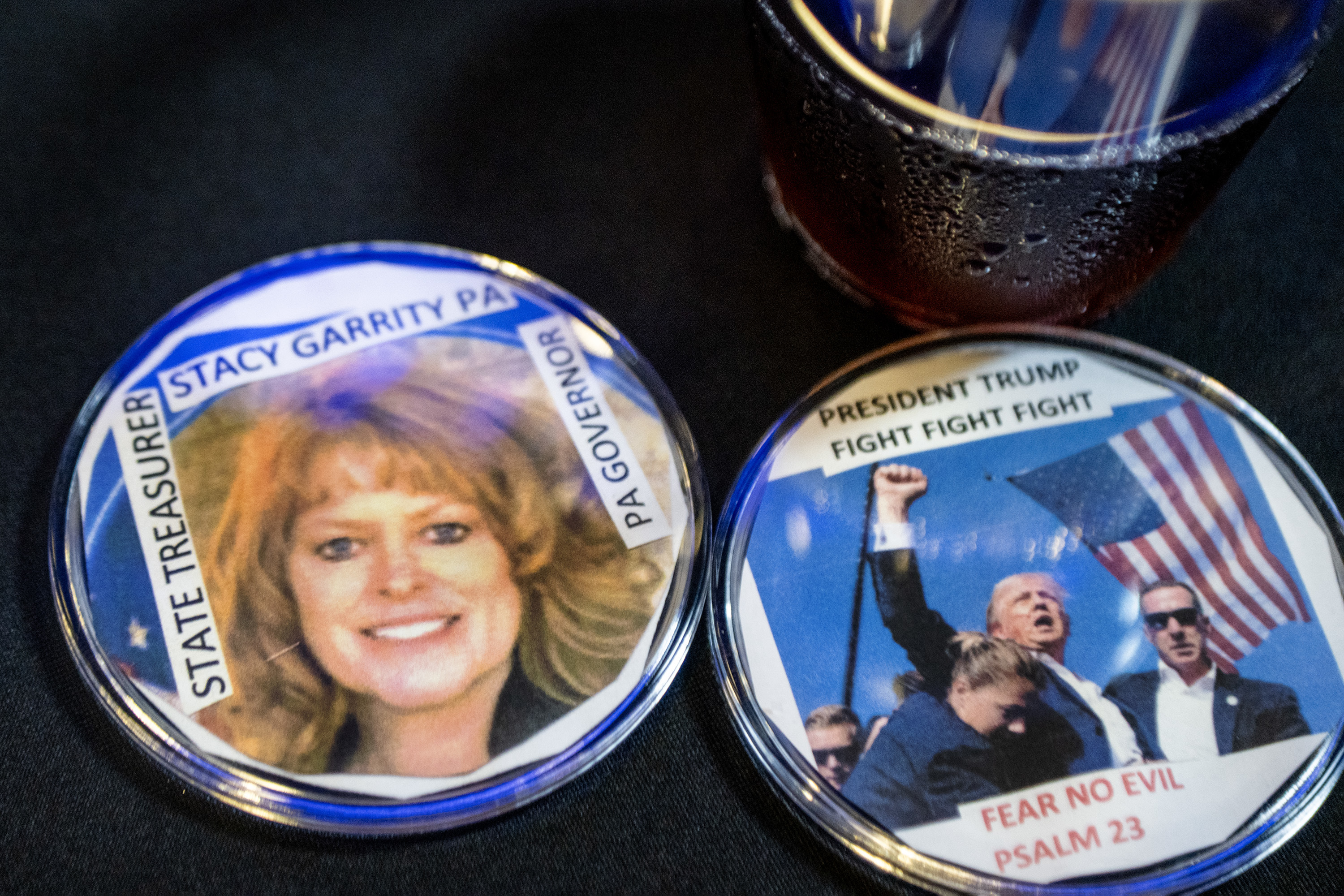
Buttons for State Treasurer Stacy Garrity and President Trump are left on a table following a VIP reception before a Garrity rally in Bucks County Thursday, Sept. 25, 2025. Tom Gralish / Staff Photographer
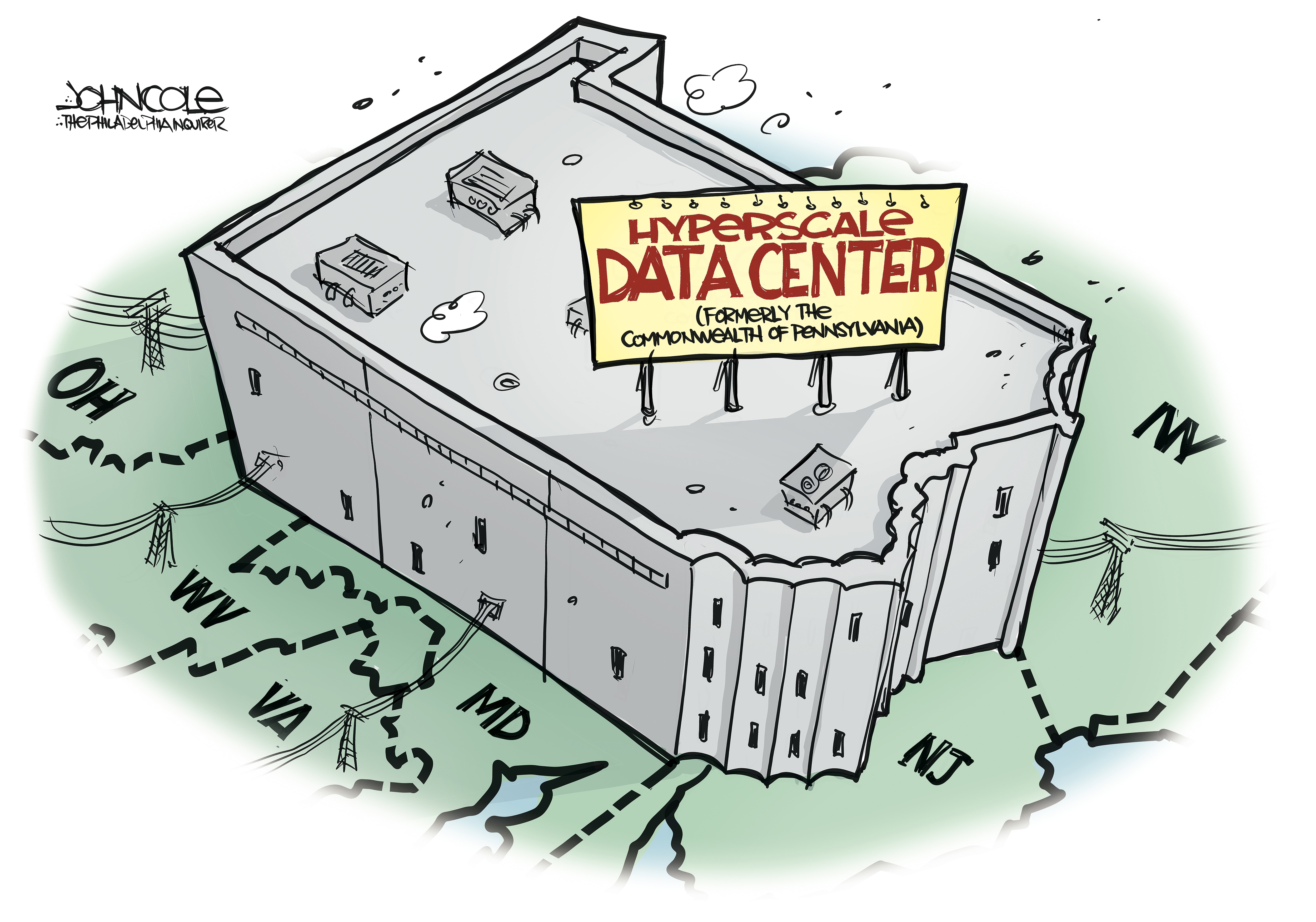
Throughout her campaign, Garrity has hammered Shapiro on several issues she said reveal his lack of transparency as a public official. She has held roundtable discussions blasting Shapiro for his early embrace of data centers, a position he has since distanced himself from after calling for new guidelines for their development. Her campaign released a video series online that questions his handling of criminal investigations. And she has repeatedly insisted that Shapiro, who is widely rumored to be running for president in 2028, is “more interested in Pennsylvania Avenue than helping Pennsylvania families.”
Samantha Reposa, a spokesperson for Shapiro’s campaign, disputed Garrity’s framing and emphasized that she has stood in lockstep with Trump on most of his positions.
“Garrity is now running to be nothing more than a rubber stamp for Trump and his agenda that’s hurting Pennsylvania families — and we will continue to hold her accountable,” Reposa said.
Given Garrity’s fundraising deficit, Chen said, he would advise her to focus on meeting individual people in the community, if he were running her campaign.
“Forget the GOP dinners. Start going to fairs. Start going to places that Republicans don’t show up. Start retail politics, and start introducing yourself to the state outside of Donald Trump, outside of modern Republicanism,” he said. “Tell the state what you’ve done for them and what you would do differently [as governor].”
Staff writer Joe Yerardi contributed to this article.
When Tom Austin lived in Philadelphia, he liked to go on long walks. Sometimes for three or four hours. The Wharton grad would roam to Center City, to Boathouse Row. It helped him clear his head, and sometimes generate new ideas.
One morning in the summer of 1993, while strolling down Spruce Street, he had a good one. Or rather, five good ones. He, a fellow Penn alum, Seth Berger, and a friend, Jay Coen Gilbert, were in the process of creating a start-up.
Their first concept, a coupon book for basketball gear and equipment, had failed. The $50,000 they’d raised was rapidly dwindling. So, the group decided to pivot.
Instead of selling coupons, they’d sell T-shirts. The company would be named “AND1,” a nod to streetball slang. Now, they needed something to put on said T-shirts, an edgy slogan that would resonate with hoopers of all ages.
As Austin continued to walk, and think, and walk, and think, it came to him. They’d use trash-talk; the kind you’d hear in a local pickup game. He started coming up with boastful taglines, carefully crafting each quip in his head.
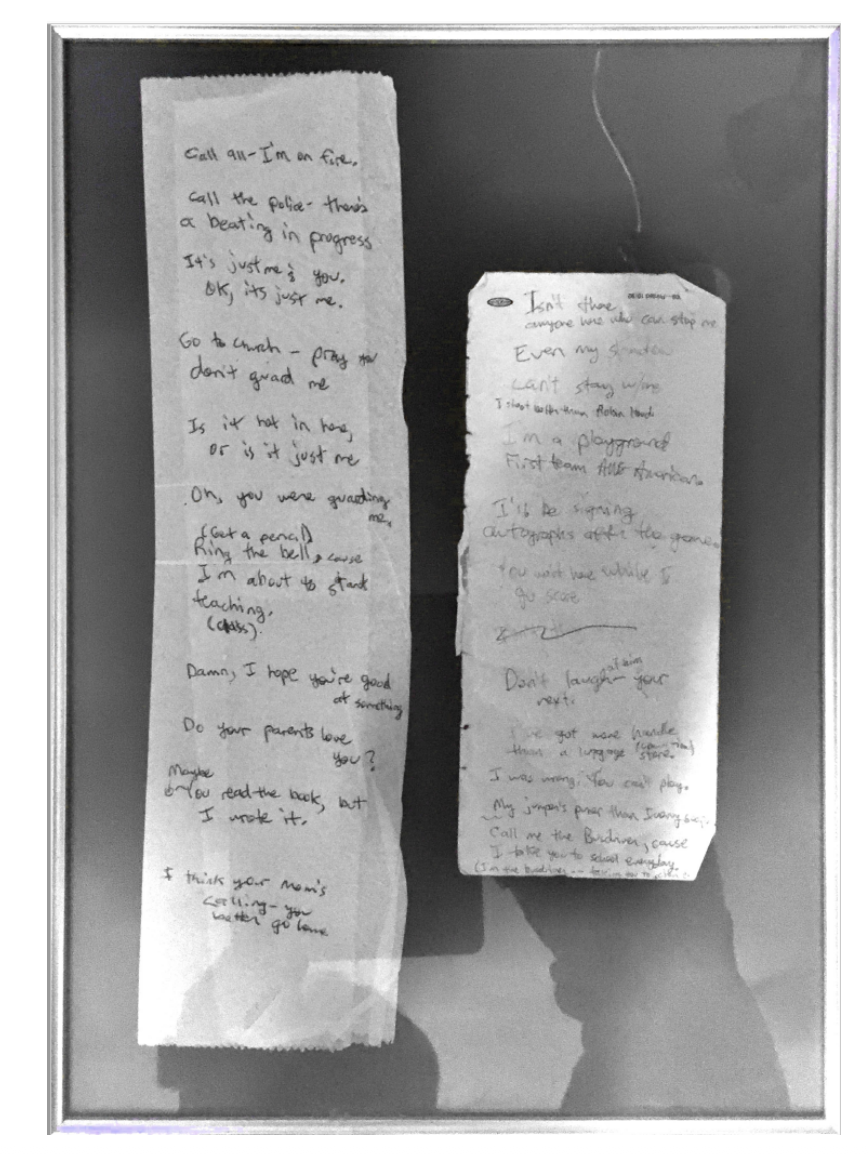
Call 911 — I’m on fire.
Call the police — there’s a beating in progress.
It’s just you and me. OK, it’s just me.
Go to church — pray you don’t guard me.
It is hot in here, or is it just me?
More insults started to spill out, and in a moment of panic, Austin realized he needed to write them down. He was living frugally, and didn’t have a notepad at home. He didn’t have a car to drive to an office supply store, either.
So the 21-year-old walked into Wawa and stole a roll of toilet paper.
“I’m not proud of that, but that’s how it happened,” Austin said. “I didn’t have anything to write on.”
He added: “I hope the statute of limitations on that is over.”
Without access to writing paper, Tom Austin improvised.provided by Tom Austin
Six months later, Austin’s phrases were printed on T-shirts sold at Foot Locker, coupled with a logo of a faceless basketball player. What started as a small order turned into a financial boon.
AND1 sold $1.6 million worth of T-shirts in its first year. More retailers came calling, and before long, the company was expanding to shorts, sneakers, and more.
It became a cultural phenomenon. NBA players would get AND1’s faceless man tattooed onto their arm. Latrell Sprewell, Vince Carter, and Kevin Garnett wore their shoes.
AND1’s mixtapes — video compilations of street ball moves — and the subsequent AND1 mixtape tour, made celebrities out of everyday people. Most were known only by their nicknames: “The Professor,” “Hot Sauce,” “The Bone Collector.” One of them, “Skip To My Lou,” had a long NBA career.
Because the first mixtape was shot at Rucker Park in Harlem, the company became synonymous with New York basketball. But at its core, AND1 was a Philadelphia brand.
And while it is not the powerhouse it once was, that brand’s legacy still has plenty of cachet.
“There was something about the Philly identity,” Austin said. “It was always the underdog. We were always that underdog story, taking on Nike and Adidas. They’re the Rocky villains, man.”
The AND1 slogans were kind of mean.provided by Tom Austin
Philadelphia roots
Austin transferred from Holy Cross to Penn in 1990, a lanky sophomore from rural Massachusetts. He was far from home and had trouble meeting people at first.
The teenager decided to branch out in the only way he knew how: by finding a pickup basketball game.
He discovered a nearby spot on campus, Gimbel Gym, which was open to the public. Inside were courts full of players who likely wouldn’t have otherwise met. There were law school students, business school students, janitors, locals from the neighborhood.
Gimbel’s mainstay was a man known only as “Moose,” who loomed at 250 pounds. Austin didn’t have that kind of size — an “eighth grade-level body with a 20-inch vertical,” he said — but he was skilled.
Before long, the New England native was hooping in Gimbel seven nights a week. And he quickly established himself as a “Moose”-caliber gym rat.
Austin could shoot. And this was not just the consensus among pickup players. Penn’s men’s basketball team would go to Gimbel every so often to practice.
They noticed “Tommy Gun.”
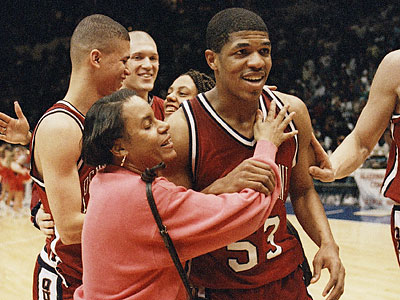
Jerome Allen (53) started at Penn in the 90’s but has vivid memories of the future AND1 entrepreneurs balling on campus.
“He could play,” said former Penn standout player and head coach Jerome Allen, now an assistant with the Detroit Pistons. “Just flat-out, in that setting. Whether it was him snatching the rebound and pushing it in transition, or him catching it on the wing and driving a closeout, or him in an iso.
“If you took him for granted, you would get embarrassed. Easily.”
This was how Austin met his friend and future business partner Seth Berger. After the Massachusetts native graduated in 1993, he began to interview with investment banks, but found it wasn’t a fit. Berger had heard through mutual friends at Gimbel that Austin had a 3.95 GPA.
Berger shared a business plan he’d been formulating. The idea was for a coupon booklet that could be used to get discounts on basketball gear. Austin came on board along with Coen Gilbert, a Stanford graduate.
He moved into a house at 40th and Sansom with six other guys, most of them Penn basketball players, renting a room for $100 a month.
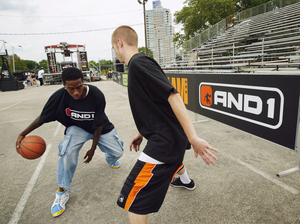
AND1’s adoption of grassroots and playground basketball iconography was an essential part of the brand’s appeal. ALEJANDRO A. ALVAREZ/Daily News
The coupon idea didn’t attract the brands or customers necessary to succeed. But the trash-talking T-shirts became a lifeline; a product that was relatively inexpensive to make, quick to turn around, and easy to sell.
And their Philadelphia community came together to make it happen. The entrepreneurs turned to Joe and Dom, two men who worked out of an old Italian neighborhood, to lay out their T-shirts.
Joe and Dom introduced them to Stephen Sistilli, a local comic book designer who created the faceless man. The bulk of the trash talk ideas came from Austin. But to market-test his work, he’d give Moore and his teammates sheets of paper with 20-30 phrases.
They were told to circle their favorite ones.
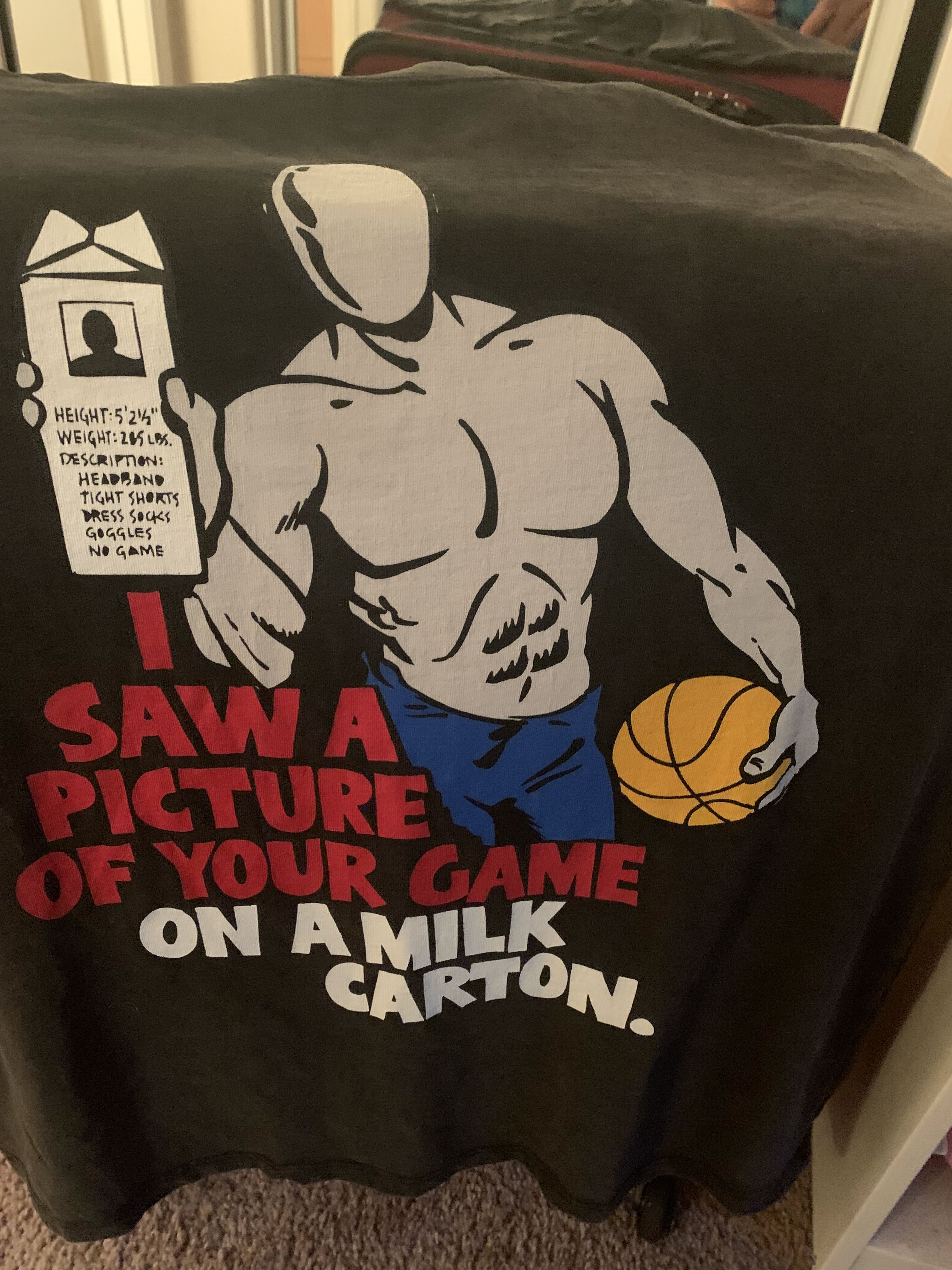
“I remember this one that was like… ‘Your game’s on the back of a milk carton, it’s missing,’“ Moore said. ”I remember that one.”
Added former Penn forward Scott Kegler: “There was something about your game and your girlfriend. ‘Your game’s uglier than your girlfriend,’ or something like that. Really in-your-face and offensive, but also very funny.”
Weeks later, those phrases would be seen on T-shirts, which were stored at a warehouse in Camden. They were printed in Delaware County at a company called AMPRO, which extended a line of credit to the founders in their early days.
“The only reason we could make those shirts is because AMPRO said, ‘Hey, if you bring us a high-quality order, we’ll make the shirts for you,’” Austin said. “When we made shorts, I was driving out to Lancaster, into Mennonite country, driving by these one-horse buggies, to go pick up our short orders.
“We were getting our embroidered stuff done in this Italian shop in an Italian neighborhood. And all the women called me ‘hon’ and had these long fingernails. All these parts of the city came alive to help us. You know?”
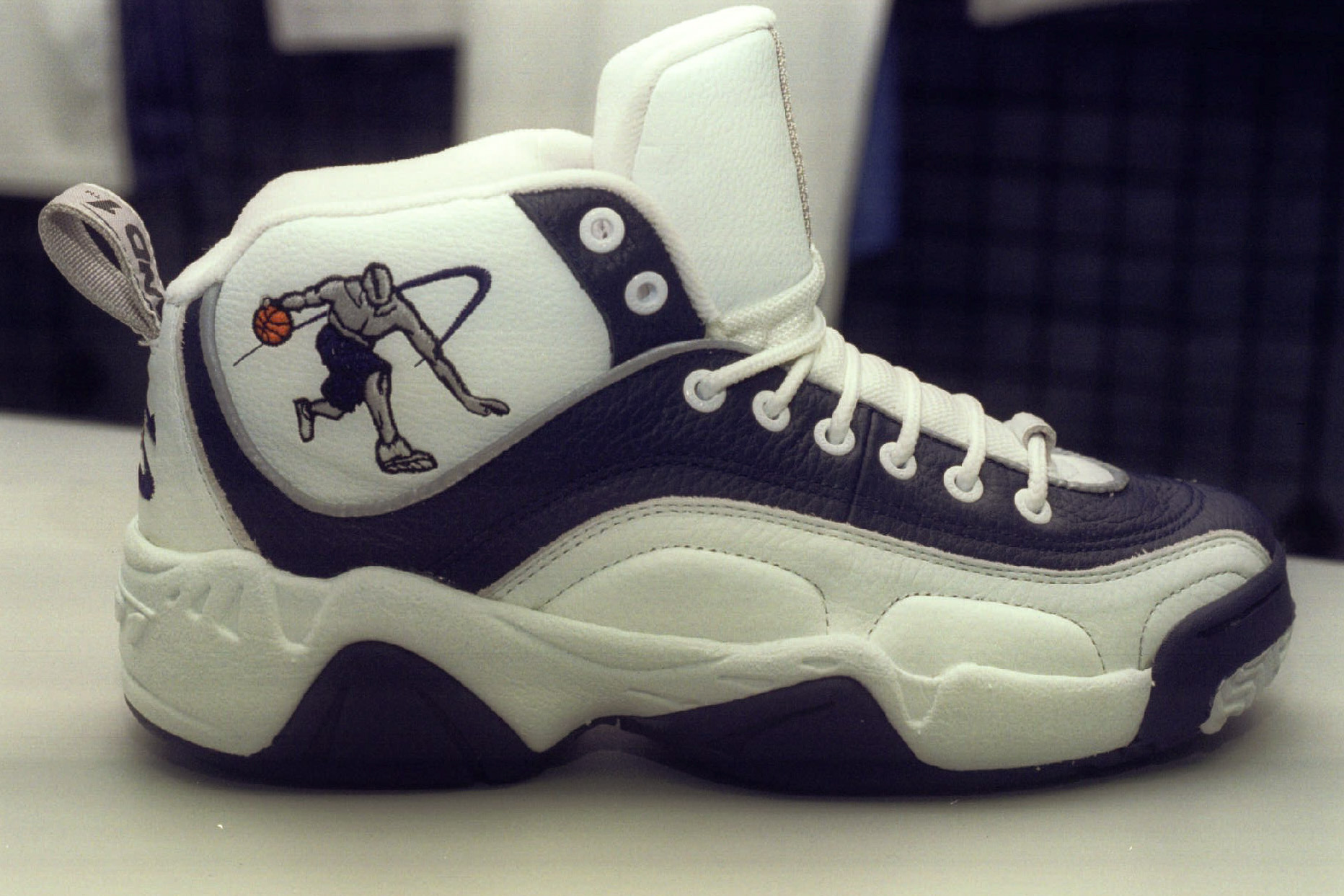
One of the shoes manufactured by AND1. Their logo includes a “faceless, raceless” player.Joan Fairman-Kanes / Inquirer Archives
Bringing streetball to the suburbs
In its earliest days, AND1 was operating out of Berger’s apartment in Philadelphia. But as the company grew, it moved to the Main Line.
Their first location was in Ardmore, back when the company onlyhadsix employees. Then, in the mid 1990s, AND1 relocated to Rosemont to fit about 20 more people, many of them local college graduates.
Justin Cupps was one of those graduates. He was another product of Wharton who had connected with AND1 through one its athletes, NBA guard Darrell Armstrong.
Cupps didn’t know anything about retail, but he did know business and basketball, and those were important qualifications.
He says today it was the best job he ever had. AND1’s employees worked hard and played hard in the most literal sense. They’d hold afternoon pickup games at Haverford College three or four times a week. Trash talk wasn’t just permitted, but encouraged.
On Monday mornings, employees would filter into Berger’s office and sit on his couches, armed with their most insulting one-liners.
“There weren’t a lot of PowerPoints,” Cupps said. “There were no big board tables. It was sit around and talk hoops and try to come up with what we think were going to be the most entertaining or creative sayings to put on T-shirts.”
Those that didn’t make the cut were discarded into a cabinet, a graveyard for barbs deemed too soft. As the staff swelled to 150-200 employees, the company moved to Paoli, but never lost its street ball culture.
Graffiti lined the building’s walls. It housed a pro-sized basketball court inside, complete with a full-service locker room. Cubicles were separated by wire mesh, to simulate a playground court’s chain-link fence. Employees wore shorts and sneakers, with the exception of AND1’s corporate lawyer, who went shoeless.
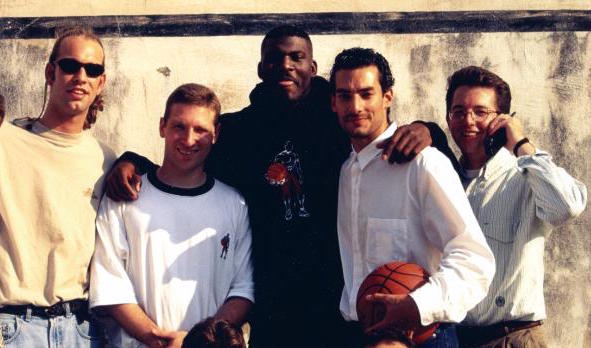
NBA star Larry Johnson (center) was an early adopter of AND1’s wares while Seth Berger (second from left), Marc Brownstein (holding basketball) and the company’s creative team tried to grow the company.provided by Marc Brownstein
After going nearly broke, the company was now competing with multi-billion dollar brands by selling high quality goods for a lower price, all targeted toward a specific demographic (basketball players aged 14-25).
By 1999, AND1 was drawing over $70,000,000 in annual revenue. But the mixtapes elevated them into an entirely different category; from selling clothes to steering the cultural zeitgeist.
AND1’s mixtapes would be sold in over 100 countries. Its stars would tour all over the United States; ESPN turned the phenomenon into a reality TV show, Streetball: The AND1 Mixtape Tour, which debuted in 2002.
Still, the company had even greater aspirations; to own an NBA team, to create entertainment properties, to overthrow their multi-sport competitors. But that dream was never realized.
In January of 2002, Austin left AND1. He estimates that he’d worked 360 days a year for six years, five months of which was spent living in Asia, where he learned the manufacturing and export pieces of the shoe trade. He was getting sick, couldn’t sleep, and was completely burned out.
Once Austin departed, AND1’s footwear department had to be restructured. Larger competitors like Nike threw their ample resources behind street ball designs, and the newer company struggled to compete.
Many of the retailers AND1 worked with — Foot Locker, Foot Action, Champs — consolidated, giving the company fewer sources of income.
Annual revenues began to drop, from $175,000,000 in 2002 to $130,000,000 in 2003. They increased again, to $160,000,000 in 2004, and AND1 was sold to a California-based footwear company, American Sporting Goods, in 2005.
Like Austin, Berger and Coen Gilbert were ready for a new chapter. Berger had young children at home, and wanted to spend more time with them; Coen Gilbert was looking to get into social entrepreneurship. Both left after the company was sold.
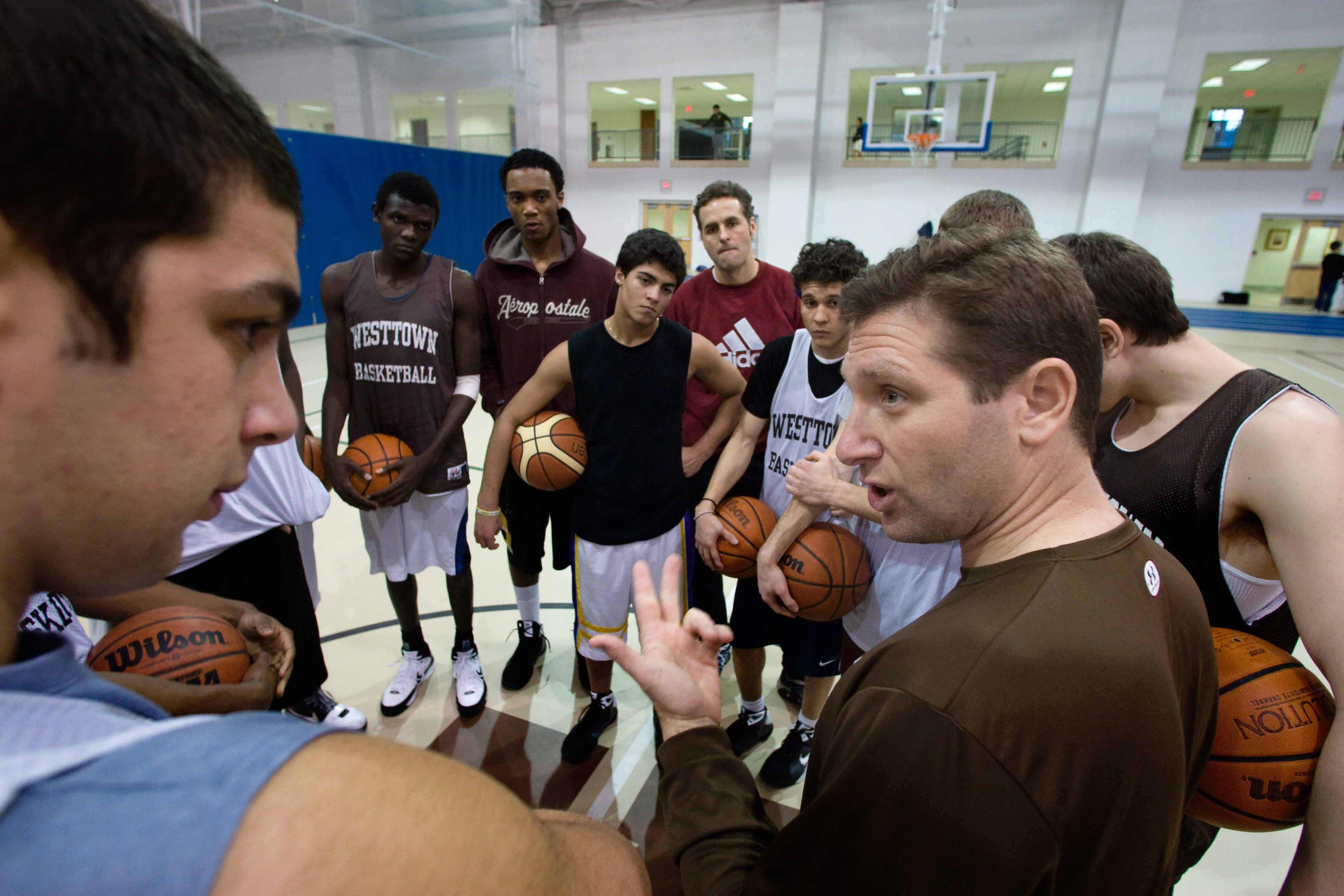
Seth Berger moved on from AND1 to turn the Westtown School boys basketball team into a local powerhouse. David M Warren / Staff Photographer
AND1 became more corporate under its new leadership, and saw its customer base erode. The former start-up was acquired by another entity in 2011, Brown Shoe Company, which sold it a few months later to Galaxy International.
But AND1’s roots remain very much intact. “The Professor” and “The Bone Collector” from the Mixtape Tour continue to share basketball highlights on social media. Many of the Main Line employees are still in touch through a private Facebook group.
You can still find the T-shirts, the sneakers, the mixtapes. And Austin, who now works for a talent assessment company,still has that stolen sheet of toilet paper, scribbled with hypermasculine insults.
Coen Gilbert had it framed for him a few years back; a reminder that before AND1 became AND1, it was just an ambitious idea, spearheaded by three Philadelphia-based entrepreneurs, hustling their way to the top.
The plan to split the measles, mumps, and rubella vaccines into three separate shots is being sold as another option for parents. It isn’t one, not for years, maybe not ever. No single-antigen measles, mumps, or rubella vaccine is licensed in the United States. Merck stopped making the old separate versions in 2008, concluding that three shots offered no medical benefit over one and simply meant more needles and more missed appointments. Rebuilding them means new clinical trials, new manufacturing lines, and years of FDA review; Merck’s own estimate runs past a decade, and no ethics board will approve testing that withholds a proven vaccine from children for a placebo. As Paul Offit of Children’s Hospital of Philadelphia put it, splitting the shot would “just make it more expensive and less likely to be used.” This arrives as the country is logging its worst measles year in three decades, with outbreaks in more than 30 states. Parents deserve confidence in the vaccine that already works, not a hollow promise about one that doesn’t exist yet.
Bruce Grant, Philadelphia
Memorial usurped
The Kennedy Center board apparently voted to defy a federal court order instructing it not to add the current president’s name to the official name, the John F. Kennedy Center for the Performing Arts. The board is not a formal part of the current administration, but its trustees are mostly loyalists appointed by the president, and even include ex officio members of his cabinet.
Despite being ordered to remove President Donald Trump’s name from the Kennedy Center signage in a previous ruling, the board would have you believe the new inscription adding “Restored and Renovated By President Donald J. Trump” to the facade of the building somehow does not run afoul of the letter and spirit of the court’s instructions.
This obsession to memorialize the current president is more than just a metaphor for presidential power. It runs counter to specific congressional statutory intent to have the Kennedy Center be a living memorial to the late John F. Kennedy and him alone. President Kennedy asked Americans in his inaugural address in 1961 to “Ask not what your country can do for you — ask what you can do for your country.” The board has flipped the meaning of Kennedy’s plea to “ask what can you do for Trump.” This pressure campaign should be stopped in its tracks.
Anthony Arnaud, Laguna Niguel, Calif.
Rules matter
As the war in Iran continues, we recognize this destructive, illegal war rests on false pretexts.
Meanwhile, Defense Secretary Pete Hegseth and others want to push aside multilateral systems, believing power concentrated under one leader works better — no pesky variables to consider. But “multilateral system” is simply a fancy term for what we built in the United Nations. Alongside partners who value prosperity and rules-based order, we created systems that reduce war, instability, hunger, and the conflicts that drive migration and humanitarian crises. The ratified international laws aren’t just words on paper — they are a foundation that works for us all.
International courts are part of that system. When leaders delegitimize them, it may seem advantageous, but there’s always another bully.
Security is only built collaboratively. Our current path — breaking agreements, threatening to commit war crimes in violation of the Geneva Conventions, demeaning international courts — leads away from health, happiness, and prosperity, not toward them.
Tina Shelton, Women’s International League for Peace and Freedom, Morrisville
Close the chapter
Once again Trudy Rubin nails it in her recent column about West Bank violence by Israeli settlers. When I read, “Far-right extremists are even encouraging Jewish-Arab violence atop the Temple Mount,” which also houses Islam’s Al-Aqsa Mosque, I flashed back to the Second Intifada when Ariel Sharon took a purposely provocative stroll on the Temple Mount on Sept. 28, 2000, just before Rosh Hashanah and less than two weeks before Yom Kippur, upsetting the clear understanding obtained between Israel and the Palestinians. It ignited exactly what the Israeli extremist right hoped for — a violent Palestinian reaction that inflamed the nascent Second Intifada.
I was then a pulpit rabbi in Manhattan. Less than two weeks later, I began my Yom Kippur eve sermon: “Our tradition says that God desires not sacrifices, but rather a broken heart. I speak tonight, Kol Nidre, 5761 [2000] with a broken heart, and I suspect that many of your hearts are breaking as well, as once more we see dreams of peace, always so fragile, shattered by violence and hatred.”
In that same sermon, I stated: “Those who believe in violence and feed on hatred and distrust are prevailing. Make no mistake: The issue is not properly framed as Israeli vs. Palestinian or Jew vs. Arab/Muslim. The issue ought to be framed as those who wage violence vs. those who wage peace … If peace is to have a chance, then Palestinians and Israelis alike will have to reframe their conflict once and for all. Those who wage peace must unite and expose the unholy alliance of those who wage violence and hatred. It must be understood, finally, that Hamas and Hezbollah are followers of Baruch Goldstein [extremist Israeli mass murderer of Palestinians engaged in worship] and Yigal Amir [Israeli extremist assassin of Prime Minister Yitzhak Rabin], and that Goldstein and Amir are members of Hamas and Hezbollah.”
And so we come to our day. On Oct. 7, 2023, the parents of Israeli peace activist Maoz Inon were slaughtered by Palestinian followers of Hamas in the most violent day Jews have endured since the Holocaust. In their book, The Future is Peace: A Shared Journey Across the Holy Land, which Inon wrote with his partner in peace, the Palestinian Muslim Aziz Abu Sarah, Maoz writes, “As far as I was concerned, the Israeli government and Hamas were two sides of the same coin; both were accountable for the deaths of my parents.” It is the same tragic story, and it is time for it to end.
It is time. It is time for the wagers of peace to unite in solidarity and opposition to the wagers of war. It is time. It is past time.
Rabbi Avi Winokur,rabbi emeritus, Society Hill Synagogue, Philadelphia
This system is not sustainable. We see cutbacks to benefits happening already.
Austerity for (almost) everyone is coming unless voters elect politicians who fight like hell to make the rich pay more taxes, like they did before Ronald Reagan lowered the max rate from 78% to 38%.
Joe Mikuliak, Philadelphia
Join the conversation: Send letters to letters@inquirer.com. Limit length to 150 words and include home address and day and evening phone number. Letters run in The Inquirer six days a week on the editorial pages and online.
DEAR ABBY: My youngest son is getting married this spring, and they have decided they want a child-free wedding reception. We have three grandchildren, ages 3 to 7. The wedding is where my son and his fiancée live, so we are all traveling. They have asked all three kids to be in the wedding party as flower girls and the ring bearer, but afterward there is a sit-down meal, reception and dance to which the kids are not invited. The parents are expected to find or bring babysitters.
Our grandchildren are extremely important to my husband and me, and we are devastated they have been excluded. We see them as part of the immediate family and have asked that they be included, but the bride and groom have declined our requests. They have also banned babies of any age, nursing or not, yet their dog is part of the wedding party.
I was at the bride’s wedding shower this past weekend, along with my two other daughters-in-law, and I tried to feel enthusiastic about their upcoming wedding, but it is difficult. I have shed a few tears over this and have become resentful of both of them. Do you have any advice?
— WEDDING WOES IN CANADA
DEAR WEDDING WOES: I’m sorry the wedding reception isn’t going to be the joyous family moment you were hoping for. If you and your husband were to renew your vows, I’m sure the festivities would be much different. However, this day is for the bride and groom. They are planning the celebration they want, and that includes a reception they’ve deemed inappropriate for kids. Show your love and respect for them by leaving your expectations — and your grandchildren — at the hotel.
** ** **
DEAR ABBY: An acquaintance of mine has posted pictures of his newly built mansion, from breaking ground to digging the huge pool to the house itself. I admit I’m jealous. But isn’t this rude of him? All our friends are middle to upper class. I find it terribly insensitive. Am I wrong?
— FLIPPING MAD IN TEXAS
DEAR FLIPPING MAD: I’m sorry your ego is bruised from looking at the photos your friend posted of creating his new home, but what he did isn’t rude. Perhaps if you start counting the blessings you have in your own life, you can combat the green-eyed monster you have been feeding. I wish you luck because there is nothing constructive about envy.
** ** **
DEAR ABBY: Should I tell my two older grandchildren that my husband and I are divorcing? Although the divorce is in its early stages, our home is expected to be sold a year and a half from now. My daughter and grandchildren reside in that home. I’d like to know if this would be too early to let them know. Please give me your opinion.
— MAKING A CHANGE IN FLORIDA
DEAR MAKING A CHANGE: Your daughter should be told (if she doesn’t already know) because she will need time to find another home for herself and her children. When to share the news of the divorce with her children should be her decision. A year and a half is plenty of time for everyone to prepare for the changes that are coming. I hope that the divorce will be amicable.