Attorneys for the former Olympian who had been accused of damaging the Lincoln Memorial Reflecting Pool have called for inspectors general to investigate alleged misconduct by the Interior and Justice departments in the handling of the since-dismissed case.
In a letter Tuesday to the watchdog offices of the two departments, David Hearn’s attorneys said a joint investigation is needed after the departments allegedly rushed to complete a renovation of the pool despite warnings of installation failures, charged Hearn based on incomplete and false information, and publicly shamed him despite having information showing another cause for the damage.
The letter — signed by six attorneys representing Hearn, including Michael Bromwich, a former Justice Department inspector general — asked the government to gather facts as to what happened in the case, which they described as a “nightmare” for their client.
“Anything less than a full and fair review would be a betrayal of your mission and perpetuate the outrageous mistreatment of Mr. Hearn,” the attorneys wrote.
The letter comes days after a judge agreed to a request from Hearn’s defense to dismiss his case with prejudice, meaning the charge can’t be brought back, a rare move the judge said aimed to protect Hearn from a “meritless, politically driven prosecution in the future.”
The Justice Department has said prosecutors acted “in good faith” in bringing the charge against Hearn based on the information they had at the time from the Interior Department.
In a court filing to dismiss the case, prosecutors wrote that the Interior Department later provided additional evidence that suggested the damage to the Reflecting Pool was from a “botched” installation.
Interior Secretary Doug Burgum maintained that “vandals” were responsible for damage to the pool immediately after the charges were dismissed. He also wrote on social media that the department provided “expert and eyewitness testimony” to the U.S. attorney’s office, as well as “every piece of evidence they asked for in the requested time line detailing each area of damage at the pool.”
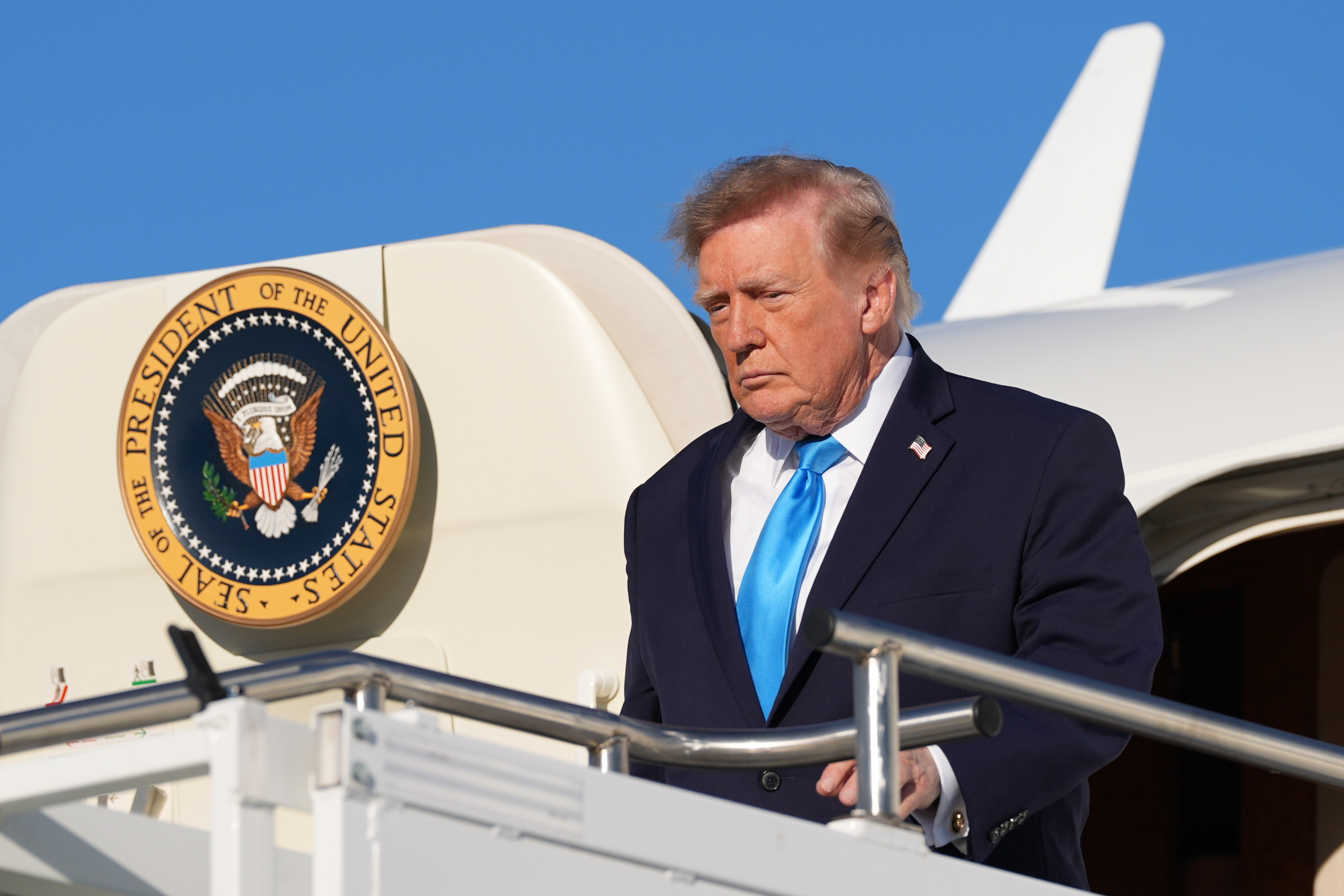
President Donald Trump announced plans earlier this year to renovate the Reflecting Pool as part of work ahead of the country’s 250th anniversary celebrations. The Interior Department awarded a no-bid contract to Atlantic Industrial Coatings for the project.
By June, problems at the site arose, as algae bloomed and the pool’s new “American flag blue” coating peeled.
On June 19, Hearn, 67, went on a bike ride and stopped at the Reflecting Pool. He said he reached into the basin to feel the water temperature and touched a partially detached piece of coating.
He said he released the coating when a National Park Service employee asked him to and “left the pool in the same condition as he found it,” according to the new letter from his attorneys.
In the letter sent Tuesday, his attorneys said the government’s charging documents show that National Guard members stopped and detained Hearn before bringing him to U.S. Park Police. They said body-camera footage showed a Guard member telling Hearn “he was not free to leave when he asked.”
His attorneys claim Hearn was not read his rights, nor allowed a telephone call or provided any details of the charges against him, until he was released later that night with two misdemeanor citations.
Less than two weeks later, on July 2, a grand jury indicted Hearn on a charge of felony destruction of property valued at $1,000 or more. He pleaded not guilty.
On July 31, U.S. Attorney Jeanine Pirro filed to dismiss the charge citing, in part, an email from a National Park Service engineer that suggested the pool was peeling days before Hearn visited.
In the Tuesday letter seeking “coordinated, independent investigations,” Hearn’s attorneys — who also include Steven Levin, Jason Weinstein, Mary Dohrmann, Norm Eisen, and Joshua Kolb — said they want Interior’s inspector general to investigate the department’s no-bid selection process of the contractor and why Burgum and other officials accused Hearn of vandalism if there had been documented concerns about the installation, among other alleged failures.
Hearn’s attorneys allege the contractor for the Reflecting Pool renovations was “unqualified and inexperienced.” In a memo justifying the contract, the Interior Department found Atlantic Industrial Coatings, the primary contractor, had the required technical expertise and could finish the work within the allotted time.
As the renovation progressed, the National Park Service documented blistering, Hearn’s attorneys said. An engineer working for the agency found areas “vulnerable to peeling” in the days immediately after the pool was refilled with water, the attorneys said, but the pool was still reopened.
“NPS was warned of the risks, and it nevertheless proceeded,” Hearn’s attorneys said. “Together these decisions reflect a failure that was not merely foreseeable but expressly foreseen — and completely ignored.”
Hearn’s attorneys said there was “a mountain of evidence” that the pool was failing from faulty installation, yet the U.S. attorney’s office “misled” the court about when it learned of such defects “in order to cover up its own misconduct and incompetence.”
For example, they said, Pirro’s office had received a damage assessment from the National Park Service showing the liner had been failing before it presented its case to a grand jury.
The U.S. attorney’s office said in court filings that it was unaware of or in possession of “any of the extensive documentation of installation issues” collected by the Interior Department at the time the indictment was returned.
In addition to examining when Pirro’s office knew of problems with the lining, Hearn’s attorneys want the Justice Department watchdog to investigate whether the U.S. attorney violated policy through statements she made at a news conference announcing his indictment and allegations that she improperly pressed a defense expert to discuss his work during a July visit to the Reflecting Pool.
The government’s motion to dismiss the case mentions Pirro visiting the site at the same time as the defense expert but does not mention the interaction.
The attorneys also said in the letter that the government’s key witness, a National Park Service employee, falsely claimed that they took a photo of the liner just before Hearn touched it. But they say evidence shows the photo was taken by someone else about two hours before Hearn was at the pool.
The U.S. attorney’s office “blindly parroted” the witness’s account without “taking the minimal investigative steps necessary to determine who took this photo,” Hearn’s attorneys said in the letter.
His attorneys further allege prosecutors did not produce crucial evidence, including the metadata for the photos that led to the charge, the identities of Hearn’s accusers, or the contents of his phone.
Attorneys said the administration did, however, distribute surveillance footage to Fox News and on officials’ social media accounts that it claimed showed vandalism at the pool.
The effort was intended to “reinforce” a narrative, the attorneys said. But prosecutors have since dismissed vandalism cases against Hearn and three others.
“Dropping the case is not justice or accountability,” Bromwich, one of Hearn’s attorneys, said in a message to the Washington Post. “The IGs have the power and the authority to discover the details of what happened, who was responsible, and who should be held accountable.”
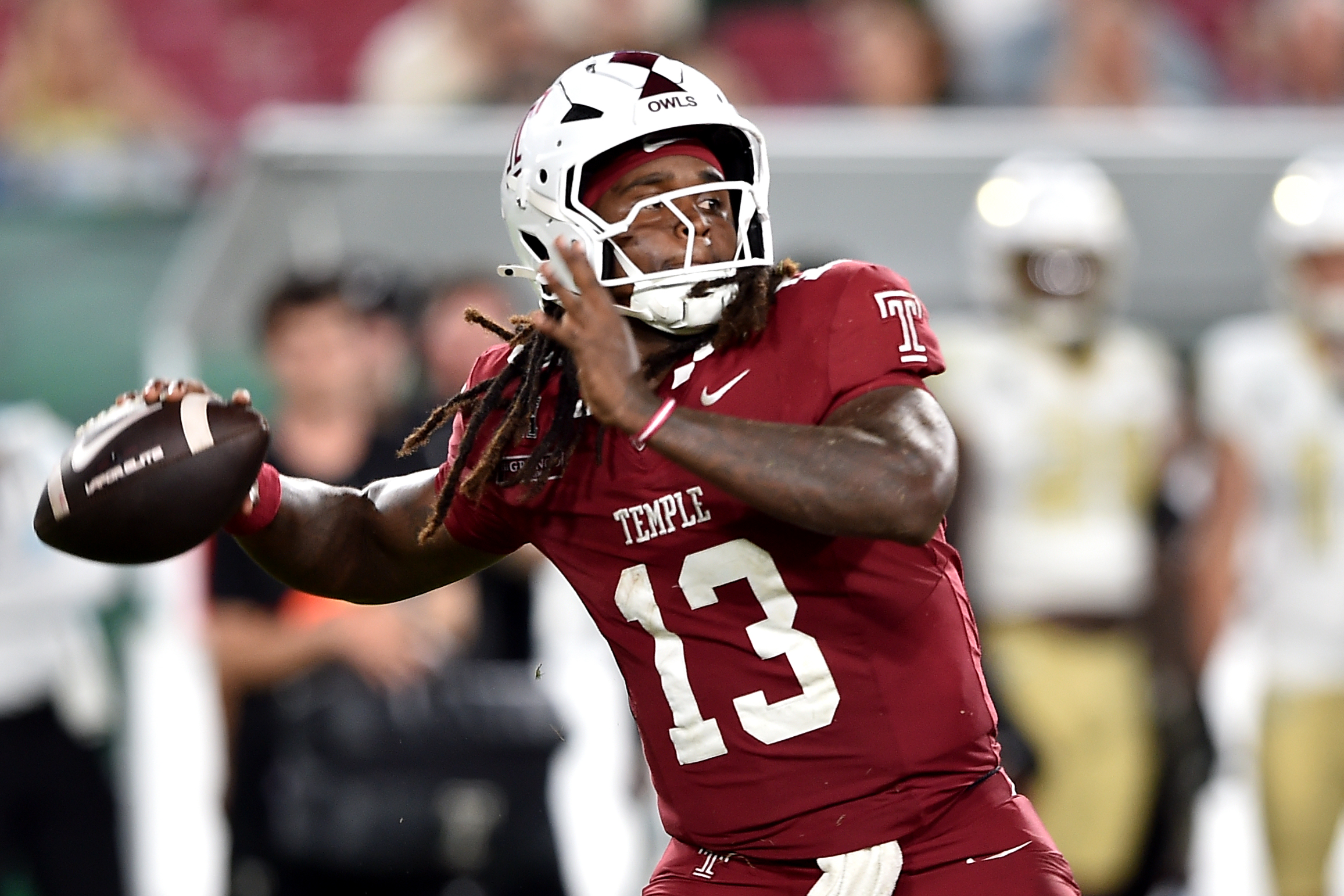
Ajani Sheppard added something new to his routine after taking over as Temple’s starting quarterback.
Each week, he mentally walks himself through the Owls’ game plan, visualizing the defense and making sure he knows where to go with the football.
“I’ll go through the game for about an hour and just walk through each play, each call, and make sure I’m right every single time,” Sheppard said Monday.
The extra preparation is part of Sheppard’s adjustment to a role he spent years waiting for. After two seasons at Rutgers and one at Washington State, the redshirt junior has started Temple’s last two games in place of the injured Jaxon Smolik.
“Personally, I would say my eyes,” Sheppard said of his biggest improvement. “I feel like my eyes have gotten better from Game 1 to now.”
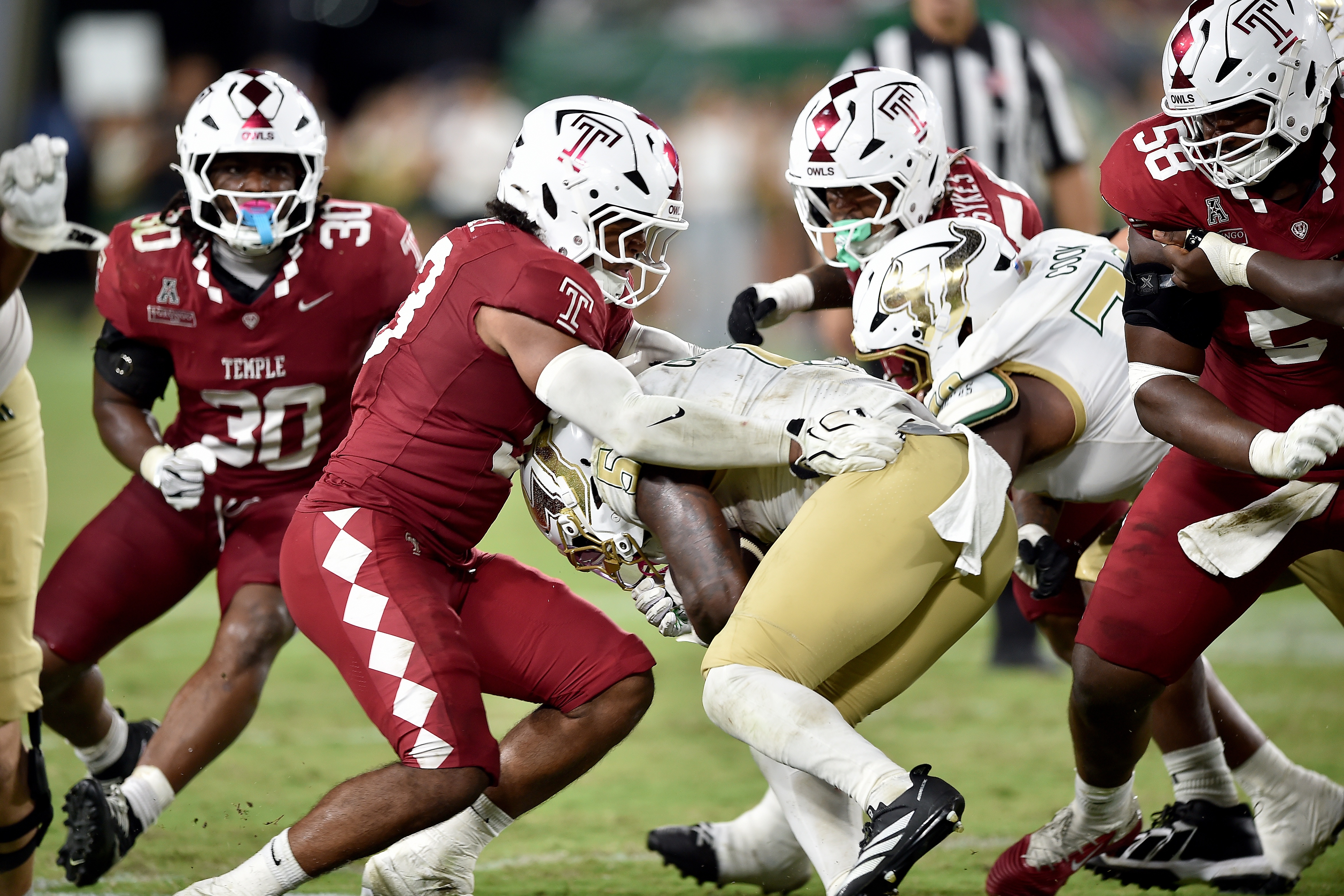
Temple Curly Ordonez (second from left) stops South Florida’s D.J. Crowther in his tracks on Saturday. Ordonez and the Owls beat the Bulls to snap a three-game losing streak.Kelly Sheehan
Moving on from the mistake
Before Sheppard scored the winning touchdown, he fumbled near the goal line late in the third quarter.
“Part of you wants to hang onto it and think, ‘Damn, I can’t make that mistake,’” Sheppard said. “But my teammates are looking at me and trying to make sure I’m good. … I’ve got a job to do. I just have to move on to the next play.”
His teammates helped him do that.
“If I remember correctly, literally everybody on the team came up to me and was like, ‘We got you. You’re going to be all right,’” Sheppard said.
Temple coach K.C. Keeler noticed the response, too. Sheppard later led Temple on the game-winning 96-yard touchdown drive, finishing it himself with the 34-yard run.
“Those are moments you have to live through to grow from,” Keeler said. “He lived through that moment, and I think he grew from that moment.”
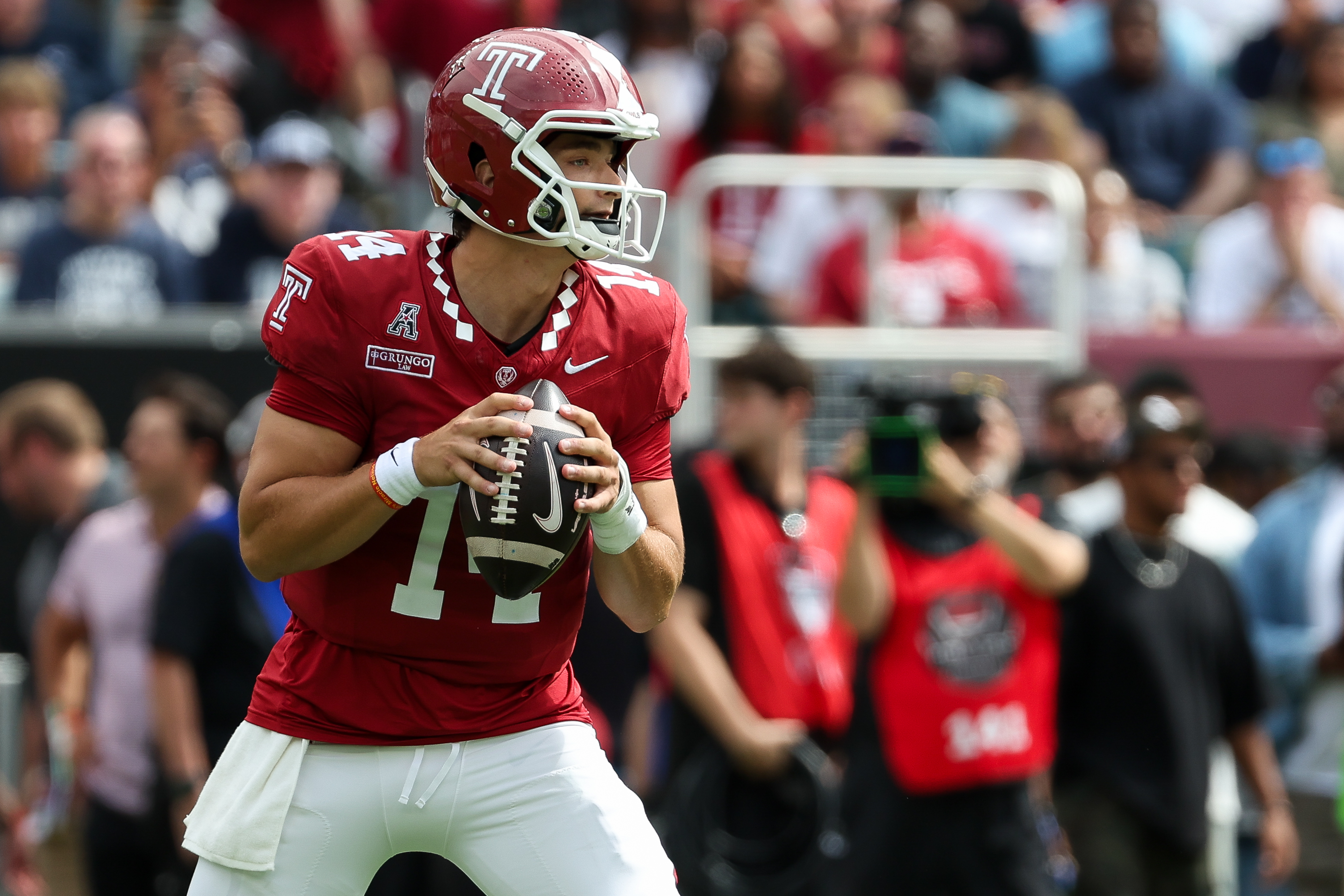
Sheppard’s emergence has come while Smolik works back from the foot injury he suffered against Toledo on Sept. 19.
Smolik dressed against South Florida, but Keeler said Temple considered him an emergency option. Keeler said Smolik is about 98% when moving straight ahead, and rolling out remains the larger concern.
“He looked pretty good today,” Keeler said. “I thought he moved around really well.”
Temple Owls quarterback Jaxon Smolik (14) was injured against Toledo.Isaiah Vazquez / For The Inquirer
Keeler said he has not decided whether Smolik could be used in a situational package. For now, Temple is waiting until he is completely healthy.
“I don’t know that he necessarily becomes a package guy,” Keeler said. “I think we’re just waiting until we can say, ‘He’s 100%.’”
Keeler added that the competition has not hurt the relationship between the quarterbacks.
“They battle against each other, and I think they’ve made each other better,” he said.
Another challenge ahead
Sheppard still sees plenty to improve as Temple prepares to host Connecticut.
He pointed to tight end Peter Clarke, who caught one pass for 23 yards against South Florida. He said he missed an opportunity to find Clarke while scrambling in the red zone.
“I definitely put that on me,” Sheppard said. “I have to do a better job of getting him the ball.”
Sheppard said the same applies to JoJo Bermudez, whom Temple has moved around the formation to create touches. Bermudez had three catches for 18 yards on Saturday.
“My biggest thing throughout this week and the next couple of weeks is just getting those guys the football,” Sheppard said. “I have to find a way.”
“I just have to continue getting these experiences,” he added. “It’s only going to get better and better.”
I guess this is the reason they call autumn “the fall.” Here in Greater Philadelphia, the mornings are crisper, the nights are longer, and the sportsfans are apoplectic, to the extent we can even rouse ourselves from bed. It’s a bad week for the good guyswhen a 7-0 opening-night loss for the Flyers didn’t make the list of worst things that happened — not when the Phillies crashed and burned while the Eagles are failing to launch. Cavan Sullivan, our city turns its lonely eyes to you.
Why Nixon still stands in the way of Trump’s dictator dreams
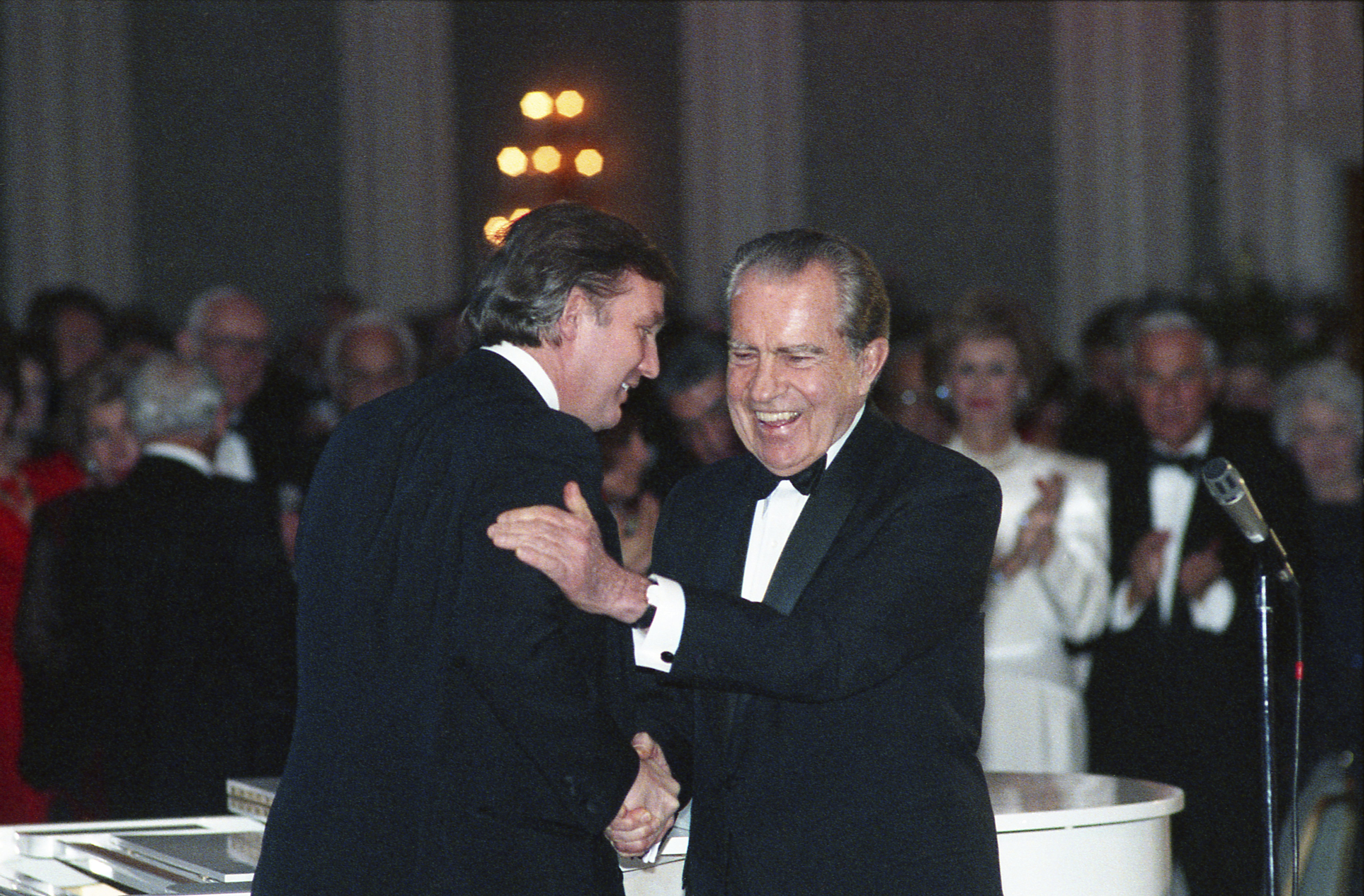
In this photo from March 1989, Donald Trump (left) shakes hands with former President Richard Nixon at a tribute gala to Nellie Connally at the Westin Galleria ballroom in Houston.Richard Carson
Although he later pretended it was not so when it came up in his first GOP primary debates, Donald Trump was never a fan of his party’s golden idol, Ronald Reagan. Most famously, the Manhattan developer at the peak of his 1980s fame surge lashed out at the Gipper as weak on defense policy, adding that late in Reagan’s second term, “people are beginning to question whether there’s anything beneath that smile.”
No, Trump always liked bad boys. No wonder the ex-president he had a crush on back then was Richard Nixon.
“You are a great man, and I have had and always will have the utmost respect and admiration for you,” Trump wrote the 37th president in 1993, nearly two decades after Nixon became the only president to resign, leaving the White House in the disgrace of the Watergate scandal. “I am proud to know you.”
The former president and the future felon had been exchanging letters for more than a decade by that point, as they shared their resentment over perceived media persecution. Nixon died in 1994, but after Trump’s first impeachment trial in 2020, he said in an interview that “I think of Nixon more than anybody else.”
All that said, one has to think it was a little more than merely a mutual admiration thing when the bizarre news broke last week that — more than a half century after the Watergate prosecutions scored 41 criminal convictions and a grand jury named Nixon as a coconspirator in the cover-up — the U.S. Department of Justice is weighing reopening the case. Their theory: Tricky Dick and all the president’s men got a raw deal.
The Wall Street Journal reported that Trump’s DOJ is in the early stages of a probe into the early 1970s special prosecutor’s office that investigated Watergate, presumably in an effort to prove that its judicial assault on Nixon and his underlings was an overreach, perhaps with the goal of a written condemnation.
There are a couple of very different ways to look at this. The MAGA era in American politics has produced more than its share of out-there people with at least slightly kooky causes who are able to capture the ear of a Trump regime that is populated by fellow conspiracy theorists.
In this case, the out-there gentleman is Geoff Shepard, a lesser-known aide to Nixon who now bills himself as a revisionist historian with a theory that the so-called deep state — lifers in the CIA and FBI, corrupt judges, the liberal news media, etc., etc. — conspired against his former boss. Shepard has crafted a two-hour presentation called “Watergate as Lawfare” — meaning Nixon’s “enemies” (and he had so many that he kept a list!) twisted the law to accomplish what they failed to achieve at the ballot box in the 1968 and 1972 elections.
Of course, the Trump regime is willing not only to forget the basic facts of Watergate, but laugh them off. Most famously, Vice President JD Vance told an audience back in June that the scandal that provoked Nixon’s resignation would be “like a 12-hour news story” today, adding, “The idea that it would have taken down a presidency is crazy.”
Which is exactly what this renewed interest in Watergate is all about. They seek a new American reality in which the notion that a presidency can become a criminal enterprise, and — more importantly — that there could be consequences for doing that is, well, “crazy.” That a POTUS cannot fail, but he can only be failed by the permanent “deep state.”
What’s crazy is that, as terrible as Nixon was — and make no mistake, Nixon was terrible — there is no comparison between his cut-and-dried high crimes and misdemeanors and the far worse ones committed by Trump. For example, it was a mini-scandal that Nixon increased his net worth during his first term … by $700,000. Trump increased his net worth in just one year, 2025, by an estimated $2.2 billion. Nixon has an enemies list, but Trump has sought — and occasionally received — invented felony indictments against his political rivals.
The Justice Department scheme to reopen Watergate might not be the most nefarious thing that’s taking place right now, but it is part of a much bigger mosaic of actions that all aim to show Trump can govern with total impunity — that he is untouchable.
This road to perdition started even before Trump’s second inauguration, when the U.S. Supreme Court in 2024 granted a president sweeping immunity for “official acts” — in essence, confirming Nixon’s famous interview comment to David Frost that “when the president does it, that means it is not illegal.”
Since returning to office nearly 21 months ago, Trump has been road testing his newly granted imperial powers. In the waters off South America, drone strikes on fishing boats ordered by Trump’s Pentagon have murdered at least 238 people, without any due process, in attacks that independent experts have labeled a war crime. That’s just one of thenumerous examples of the Trump White House testing the outer limits of defying Congress, or the courts, or the rule of law.
Yet, just as important to the president’s agenda is the implied notion that there is a straight line from 1973 to today, in the existence of an unelected “deep state” that wields the real power in America, or at least until Trump arrived to smash its hegemony.
This is why the Trump regime’s obsession with Nixon and Watergate is more than just a trivial matter. On one hand, Nixon’s full pardon from Gerald Ford unfortunately muddied the waters about whether or not the president is above the law. On the other hand, the overall message from Watergate was that most of the nation’s big institutions — Congress, the courts, the newsmedia — have a role in preserving democracy when the White House is breaking bad.
The reality that the system still worked when Nixon boarded that helicopter in August 1974 is the history the Trump regime wants to toss down the memory hole. Indeed, they are working on all cylinders to control the past so Trump can control the future.
Watergate remains an increasingly faint beacon of hope that America is not a dictatorship, and that a rogue president can be sanctioned for wrongdoing. That’s why Vance ridicules Watergate. That’s why Trump wants to erase it. Because the criminality that’s likely to comeafter Republicans go down in flames in November’s midterm election will probably make Watergate look like candy-store shoplifting.
Honestly, we should all reinvestigate Watergate — as the road map for 90% of what we need to do when our president is a crook. Then we should cover the remaining 10% of that ground and make it perfectly clear that Nixon was wrong about one more thing: that when a president does it, and when it’s against the law, that means it is illegal.
Yo, do this!
Autumn is peak season for foliage, for sports (well, quantity if not quality), for movies, and for books. It’s been hard to keep up with all the excellent tomes coming out — including the new one by Astra Taylor (who has appeared in this space as a fierce critic of the student-debt crisis) and the acclaimed left-wing author Naomi Klein, End Times Fascism: And the Fight for the Living World. The two made a riveting appearance on one of my favorite podcasts, Know Your Enemy, to discuss how the political right wing and Silicon Valley billionaires have found common cause in a frightening, apocalyptic vision of the future. But their book also promises hope and potential solutions, so I look forward to reading it after I whittle down the current pile.
We all need hope in these troubled times, which is why my new North Star is Cavan Sullivan, the straight-outta-Northeast Philly soccer phenom who just turned 17 about 10 days ago and has fans of the world’s greatest sport dreaming he can a) finally deliver an MLS Cup to the beleaguered Philadelphia Union before he leaves us in roughly a year for England’s (now scandal-plagued) Manchester City and b) help the U.S. men’s squad compete for the 2030 World Cup, when he’ll still be too young to legally drink at age 20. Check out his highlight reel goals for the Union and the USMNT, and then catch him twice this week: Tuesday night for the Americans against our archrival Canada (8 p.m., TNT) and then back with the Union here in Chester on Saturday night against Real Salt Lake (7:30, Apple TV).
Answer: That’s a more general question than I usually answer, but it’s clearly what’s on everybody’s mind. Of course, there are two layers here. On the voting that wraps up Nov. 3, the Democrats seem to be consolidating their gains, with taking the Senate along with the House (which is a slam dunk) looking increasingly likely. In a normal year, I’d expect a GOP recovery in the home stretch, especially with all their billionaire cash. But this is not a normal year, or a normal president. The bigger layer of uncertainty is what happens after Nov. 3 when Donald Trump doesn’t like the results. Some shocking attempt to reverse the outcome — in Congress, or the courts, or the streets — is a given. Are we ready for this level of dictatorial tomfoolery?
What you’re saying about …
I need to remember more often that it’s the simplest questions that bring the most impassioned responses. A lot of you wanted to weigh in on a proposal from Major League Baseball that initially drew interest from the Trump regime: building a new Field of Dreams to stage an MLB game in a national park, such as scenic Grand Teton. And the outrage — echoing the framing of my question, that it would be “a crime against Mother Nature” — was pretty much unanimous. “It’s maddening,” Rosann McGinley wrote. “What the Trump regime is doing to our parks is bad enough without MLB adding insult to injury.” Stephen LoRusso speculated that “Trump will insist if they name the [ballpark] after him, and erect a statue of him, he will approve it.” But you know who else realized this was a dumb idea? MLB. It dropped the plan after all the bad publicity.
📮 This week’s question: Thinking (still) about Cavan Sullivan made me wonder: What from the cultural world — like a TV series or a favorite musician — is getting you through these otherwise troubled times? Please email me your answer and put the exact phrase “Cultural escape” in the subject line.
Backstory on what’s so bad about Texas Senate ads during an Eagles game
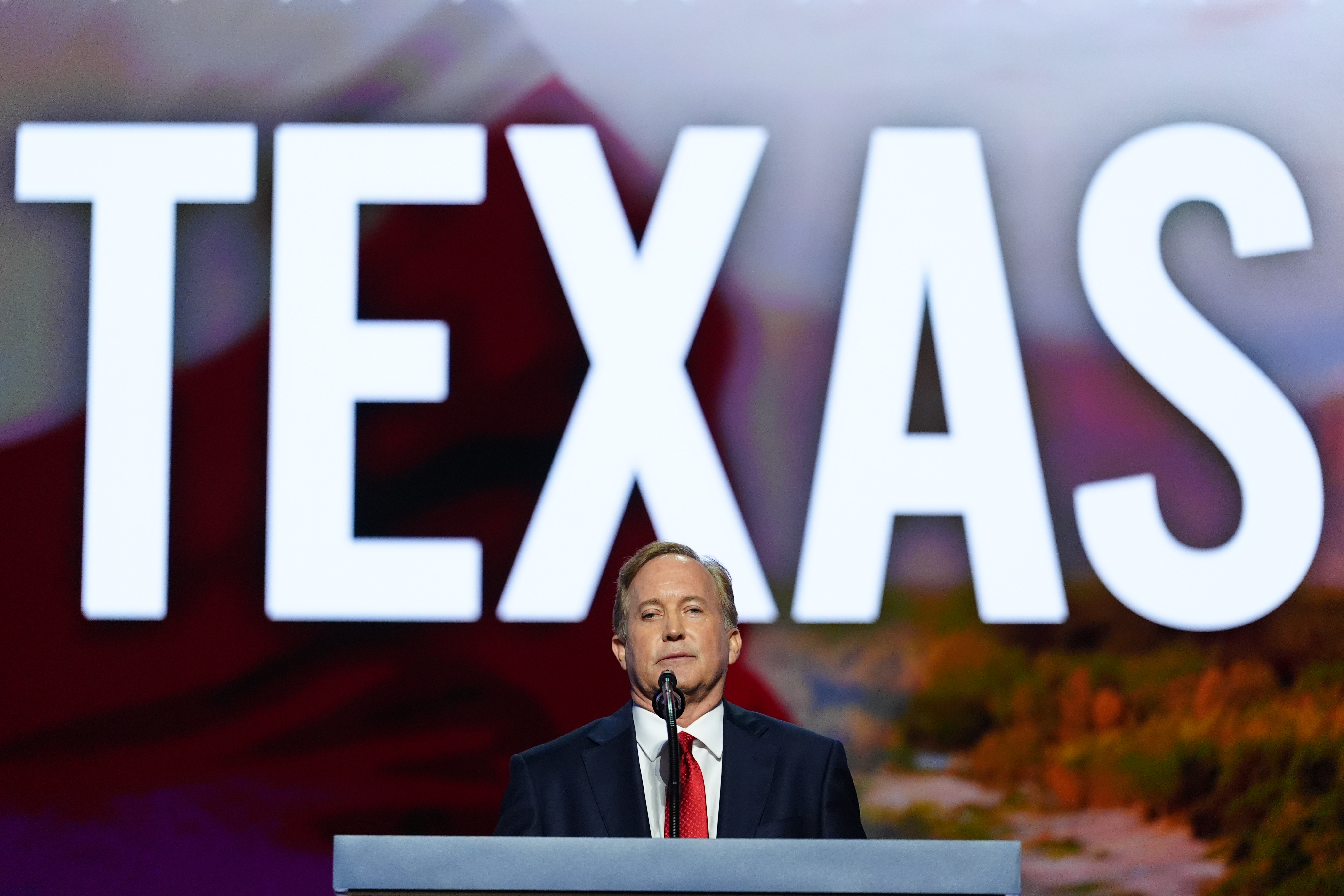
Republican U.S. Senate candidate Texas Attorney General Ken Paxton speaks at the Republican convention in September in Dallas. Julia Demaree Nikhinson
If you’re one of the folks who tortured themselves for three hours by watching the Eagles’ excruciating loss to the Los Angeles Rams, you witnessed many head-scratching things. But while head coach Nick Sirianni’s decision to go for it on fourth-and-goal from the two-yard line instead of taking three much-needed points on a field goal was baffling, it made more sense than something else on your TV screen: the several expensive ads that aired for the Texas GOP U.S. Senate candidate Ken Paxton, in a game that was played some 1,662 miles northeast of the Austin city limits.
Football fans hoping for three hours of escape from the existential dread of modern America not only got a lousy game, from the Philly perspective, but had to watch a vicious smear job falsely claiming that Paxton’s opponent, Democratic Texas State Sen. James Talarico, had supported using taxpayer dollars for gender-assignment surgeries. That was followed by a second commercial supporting the current Texas attorney general’s Senate bid, in which Paxton’s soon-to-be ex-wife, who happens to also be a Texas state senator, urged voters to ignore the stench of scandal and vote a straight Republican ticket.
The ads appeared not just during the Fox telecast of the Eagles-Rams matchup, but on NFL games from coast to coast — the first time I can remember in a lifetime of obsessing over politics that I witnessed ads for a statewide race on a national telecast. The weirdest part? The ads appeared at the same time Texas’ two NFL teams, the Dallas Cowboys and the Houston Texans, were playing each other, so how many registered Texas voters were even watching the out-of-town games?
The appearance of the ads prompted several outlets, including The Inquirer, to write news articles noting that many fans were not just annoyed but angered by the spots, and speculating why they ran at all. Some noted the quirks of political advertising may have made it cheaper to buy a national spot than the high local ad rates in Dallas, Houston, or Austin. Or maybe the target audience was potential small donors, as campaigns like Paxton’s increasingly bombard Joe Sixpack with emails, seeking $5 donations from folks jacked up about national politics. But does that make sense? Spending a fortune on ads in Philly to raise money so you can buy ads in Texas? Why not just advertise in the Lone Star State with the first batch of cash?
No, I think the real answer is the alarming state of money and power in America right now. Those Paxton ads were funded by billionaires who want everyday voters to know they have money to burn on foolish political ad placement, because they will spend anything and everything to retain control of Capitol Hill.
Specifically, the pro-Paxton, anti-Talarico ads were paid for by a political action committee called the Texas PAC, which is currently pumping a whopping $131 million into the neck-and-neck Senate race. The actual source of those dollars comes through a separate PAC supported by the GOP Senate leadership committee, creating a series of nesting dolls to obscure who the actual donors are. That opaqueness is a feature of American campaign finance, not a bug.
Reporters have found that the Top 10 billionaire donors have so far donated a stunning $734 million toward the November election, with more to come, and that 16 of the Top 20 donors are supporting Republicans. Among the filthy rich supporting the GOP Senate candidates, including Paxton, are Silicon Valley’s Marc Andreessen ($115.3 million), the richest Pennsylvanian, Jeff Yass ($93.8 million), casino heiress Miriam Adelson ($67.6 million), and many more.
The oligarchy’s financing of Texas ads from Seattle to Jacksonville, Fla., is a raw power play, pure and simple. They are projecting an air of omnipotence — total domination of the U.S. body politic. In a moment when all the things voters actually care about — affording groceries or the rent, and staying out of dumb wars and our immigrant neighbors’ backyard — are going badly for the billionaires’ preferred Republican Party, the ads are a show of dominance. But will it work in November? In a democracy, it should be better to have the people on your side than the money.
What I wrote on this date in 2020
Every so often, it pops into my mind that Pennsylvania used to have a U.S. senator named Pat Toomey, and I think: Wow, that was weird. The pangs of regret I felt for not writing more columns about everything that was wrong about the conservative Republican ex-Wall Streeter before his 2016 reelection exploded into a series of pieces over the next few years, including multiple columns about the large protests outside his Philly office called Tuesdays with Toomey. When the senator shocked the political world six years ago by announcing he would not run for a third term, I hailed the demonstrators. “Protests, marches, calling your representative, writing letters to the editor, sending postcards and knocking on doors — all of it matters, in ways that are sometimes clear but often intangible.” I wrote. “What Tuesdays with Toomey has done is your living proof.”
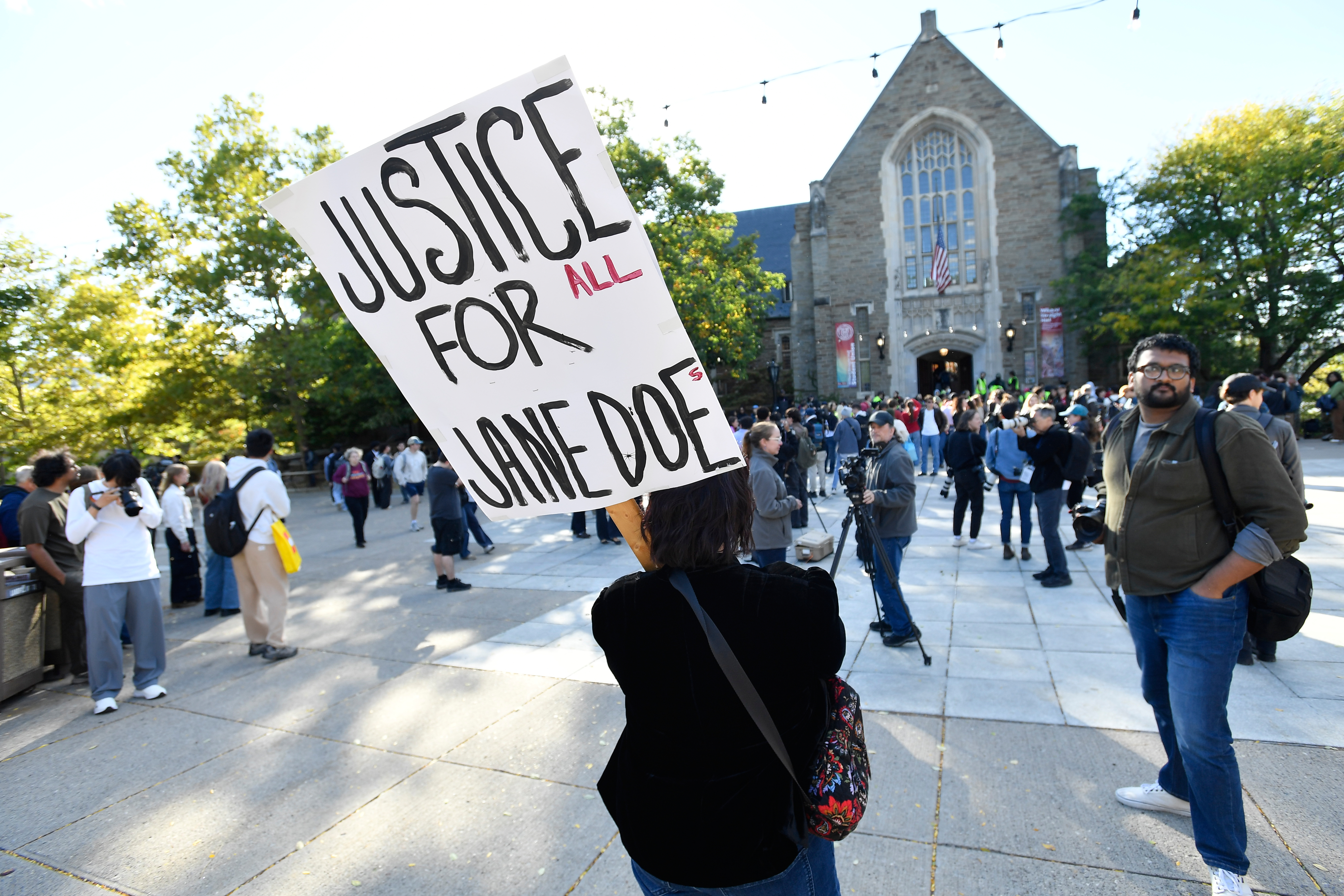
Only one column this week as I continue to toil on a major project, coming in a few days. In that column, I took a step back to look at the shocking Cornell University gang-rape allegations from a wider lens. With campus sex crimes depressingly common, why did this case break through? I argued that the roots are found in rage over elite impunity, in a world where a man with multiple misconduct allegations can get elected president, or get a second chance as an NFL quarterback. People see the same instinct to protect the privileged in the minimal punishments for Ivy League boys, and they are furious.
Those of you who read this newsletter from out of town have probably come to learn that here in Philly, we hang a lot of our identity — as well as our mental health — on our sports teams. Now we’re discovering that — on top of the bottomless pit of losses — there’s another downside to our city’s sports mania: a propensity for gambling addiction. I told you recently about the amazing scoop by my friend and Inquirer colleague David Gambacorta, who revealed that FanDuel solicited a paid Cameo video from Phillies superstar Bryce Harper that it used to buck up an addicted local gambler while he accumulated $1.5 million in debt. That piece triggered a congressional hearing and more revelations, but it also hinted at a much bigger problem. This weekend, Gambacorta and William Bender (yay, Daily News alums!) did a deep dive into Pennsylvania’s bet-addiction crisis, backed by some stunning stats. The Keystone State is now the largest online gambling market in the United States, and the whopping $3.46 billion in revenue here is up 27% year over year. The article looked at the shattered lives behind the numbers, and this saga is only beginning. This is in-depth reporting you can’t read anywhere else, and it only happens with your support. Please consider subscribing to The Inquirer.
By submitting your written, visual, and/or audio contributions, you agree to The Inquirer’s Terms of Use, including the grant of rights in Section 10.
WASHINGTON — The U.S. military said it attacked a boat suspected of being used to smuggle drugs in the Caribbean Sea on Sunday, killing four people, as the Trump administration continues its yearlong campaign against alleged traffickers in Latin America.
The latest attack brings the number of people who have been killed in boat strikes by the U.S. military to at least 235 in 70 strikes since President Donald Trump’s administration began targeting those it calls “narcoterrorists” in September 2025. As with most of the military’s statements on strikes in the eastern Pacific Ocean and Caribbean Sea, U.S. Southern Command said it targeted the alleged drug traffickers along known smuggling routes.
The military did not provide evidence that the vessel was ferrying drugs. A video posted on X showed what appeared to be an explosion destroying a moving boat, which the military said was a go-fast vessel.
The Trump administration is pursuing deals with allied nations to extend its offensive to land across multiple Latin American countries. Defense Secretary Pete Hegseth said during a visit to Panama in August that Colombia, Guatemala, and Honduras had agreed to allow the U.S. to carry out joint military operations against criminal groups on their soil. Guatemala denied reaching such a deal. Ecuador launched similar missions with the U.S. in March.
Trump, a Republican, has said the U.S. is in “armed conflict” with cartels in Latin America and has justified the attacks as a necessary escalation to stem the flow of drugs into the United States and fatal overdoses claiming American lives. But his administration has offered little evidence to support its claims of killing smugglers.
The Flyers are fresh off a 98-point season and an appearance in the second round of the playoffs, but ESPN apparently isn’t impressed.
The network released its list predicting the top 100 NHL players for the 2026-27 season on Tuesday, and only one Flyer made the cut — and barely at that — as Trevor Zegras checked in at No. 99. The list was compiled using ratings sent in by ESPN broadcasters, analysts, reporters, and editors predicting how good players will be this season as compared with their peers.
The Tampa Bay Lightning, Dallas Stars, and Montreal Canadiens led the way with six players each, while the Calgary Flames, Seattle Kraken, and Vancouver Canucks were the only teams not to be represented.
Zegras’ inclusion comes after a huge bounceback season for the former viral sensation. The 25-year-old rediscovered his love for the game and posted career highs in goals (26) and points (67) in his first season in Philly following a trade from Anaheim. Zegras, who was a restricted free agent, then signed a four-year, $36.5 million contract extension in July.
While Zegras made the cut, goalie Dan Vladař, defenseman Travis Sanheim, and winger Travis Konecny notably did not. Vladař, who finished sixth in Vezina Trophy voting last season for the league’s best goaltender, was not one of the eight goalies to make the cut, despite ranking third among goalies with 40 games played in goals-against average (2.42) and eighth in save percentage (.906) a year ago.
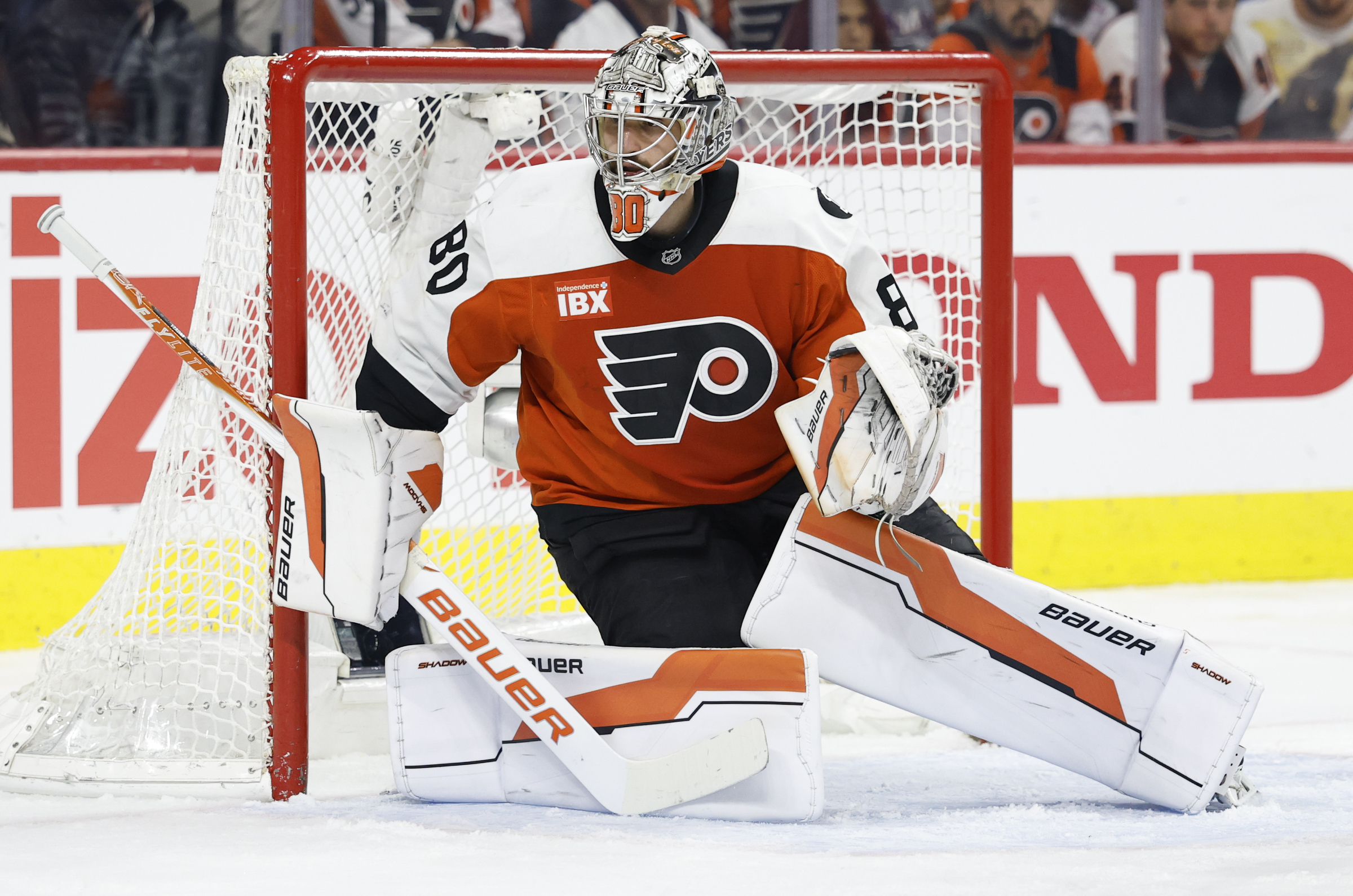
Flyers goaltender Dan Vladař finished sixth last season in Vezina Trophy voting.
Sanheim, the team’s top defenseman and a regular for Canada at the Olympics, and Konecny, the team’s top scorer in six of the past seven seasons, were also players who could have deserved inclusion. But while these might seem like snubs, maybe ESPN was on to something given the Flyers’ winless start.
In terms of the top 10, Connor McDavid, Nathan MacKinnon, and Nikita Kucherov went 1,2,3, as expected, while 20-year-old sensation Macklin Celebrini checked in at No. 4 following his 115-point sophomore campaign. They were followed in order by Cale Makar, Leon Draisaitl, Zach Werenski, David Pastrňák, Quinn Hughes, and Kirill Kaprizov.
Some other notable ranks included Auston Matthews (No. 11), Matthew Schaefer (16), Sidney Crosby (23), Leo Carlsson (36), Connor Bedard (43), Cutter Gauthier (65), Dylan Larkin (69), Alex Ovechkin (78), and Evgeni Malkin (100).
Following the Eagles’ 24-20 home loss to the Los Angeles Rams, multiple videos showing Rams assistant coaches taunting Eagles fans went viral on social media.
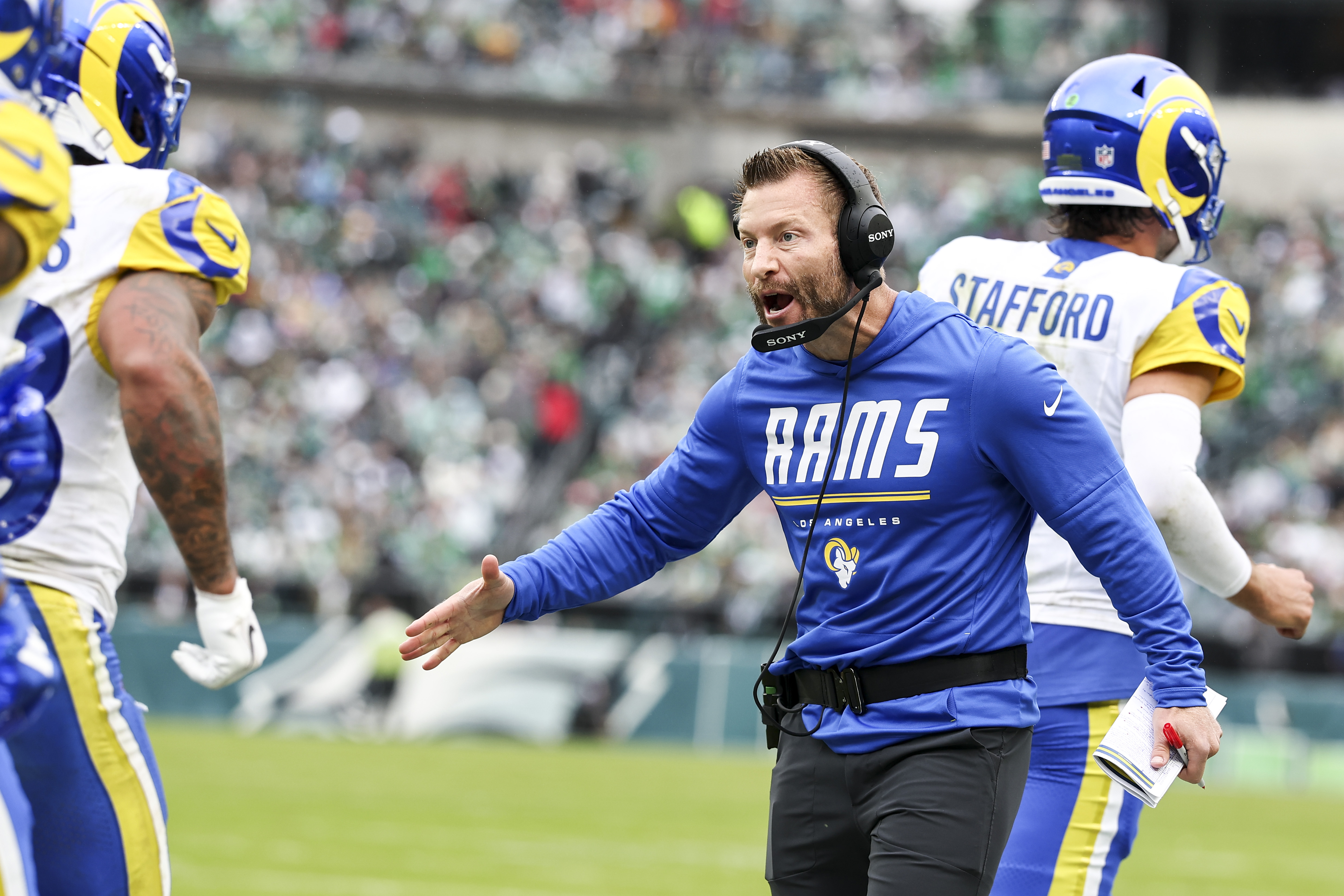
The videos, posted by @RBPhillyTake on X, show Rams coaches banging on the glass barrier of the coaching box and making obscene gestures directed at fans below. One video appears to show fans throwing a cup and a water bottle at the box. Rams coach Sean McVay acknowledged his staff’s behavior on Monday, promising “we’ll be better.”
“Those fans are really into it”
— Sean McVay addressed the viral video of a Rams coach giving angry Eagles fans the finger from their box
“We'll be better. Those fans are really into it, but I know that we want to make sure that we're representing [with] class” pic.twitter.com/XMLumPNCRC
“We’ll learn from that,” McVay said. “We’ll be better. Those fans are really into it, but I know that we want to make sure that we’re representing the class and just the calm steadiness that we want to have while also being emotionally into it.”
The viral moment came following Rams running back Kyren Williams’ go-ahead touchdown with 1 minute, 10 seconds left in the fourth quarter. The Rams battled back from a 10-point halftime deficit and scored 14 unanswered points in the fourth. The Eagles were held scoreless after the break and went 0-for-12 on third down on Sunday.
McVay also acknowledged that his staff had an internal conversation about Sunday’s incident, noting that “we did talk about it, and that won’t be an issue moving forward.”
The Eagles (2-2) will travel to London to take on the Jacksonville Jaguars (3-1) on Sunday (9:30 a.m., NFL Network).
President Donald Trump has approved the execution by firing squad of Army Maj. Nidal Malik Hasan for the 2009 shooting rampage at Fort Hood, Texas.
The U.S. military has not carried out the death penalty since 1961. The Army secretary will decide a time and place for the execution, Pentagon spokesperson Sean Parnell wrote in a post on X.
“Judgement day for Hasan has finally come,” Parnell wrote.
Hasan, an Army psychiatrist, walked into a medical building where soldiers were getting medical checkups, shouted “Allahu akbar” — Arabic for “God is great!” — and opened fire with a laser-sighted handgun. Thirteen people were killed and more than 30 injured.
He said it was an effort to stop them from going to Afghanistan and killing his fellow Muslims and made almost no effort to defend himself at trial. He told jurors that evidence would show he was the shooter and described himself as a soldier who had “switched sides.”
Trump’s approval triggers a series of procedural steps toward carrying out the execution, but Hasan could put them on hold — potentially for years — with a habeas corpus appeal in the civilian federal court system, according to an article published in May in the magazine Army Lawyer.
Death sentences are extremely rare in the military justice system, and executions even rarer. Four men, including Hasan, are currently on the military’s death row at Fort Leavenworth, Kan. President George W. Bush approved the execution of Army Spc. Ronald Gray in 2008, but it was put on hold by a judge and he remains at Leavenworth.
The last man executed in the military system was Pvt. John Bennett, hanged in 1961 for raping an 11-year-old girl.
We’ve heard all of these demands over the past few weeks, after a former Cornell University student sued the university and seven men who allegedly gang-raped her at a fraternity house in 2024. I’m in full agreement with the calls for change. Sexual assault is rampant on American campuses, and we need much better systems for preventing and prosecuting it.
But here’s one thing you probably haven’t heard: If we want to reduce sexual assault at our colleges, we’ll also have to bring down student drinking.
There, I said it. So did eight of 10 college students responding to a 2015 Washington Post-Kaiser Family Foundation survey, who agreed that consuming less alcohol would be “an effective way to prevent sexual assault.”
And research since then has shown that half of campus sexual assaults involve alcohol use by the victim, the perpetrator, or both.
Alcohol can increase aggression and decrease inhibition. It makes it harder to interpret social cues. And it makes victims less capable of giving sexual consent and resisting sex they don’t want.
But if you look at most campus websites about sexual assault prevention, alcohol is barely mentioned. And on the sites about drug and alcohol abuse, there isn’t much discussion of sexual violence.
That’s because we don’t want to blame the victims. If we caution students about the link between drink and sexual assault, the argument goes, we’ll teach them that drinkers are responsible if they get assaulted.
So let me be absolutely clear: They’re not. In every sexual assault, the sole responsibility lies with the perpetrator. Period, full stop.
But we shouldn’t let that fact blind us to another one: that if one or more partners are drunk, they’re more likely to do something the other one doesn’t want. That’s not victim-blaming. It’s common sense.
And alcohol runs through the Cornell story like a bloody river.
At least one of the men accused in the assault had been drinking, and the victim had, too. Investigators said the fraternity member who acknowledged drinking said he had “a pretty solid recollection” of the evening because — in his view — he hadn’t drunk very much. He had consumed six beverages: three beers and three vodka and Hawaiian Punch mixed drinks.
That tells you more than any set of binge-drinking statistics about the culture of alcohol on our campuses. If six drinks seems like a small amount, we have a big problem.
At the University of Pennsylvania, where I teach, administrators have crafted a comprehensive policy regarding the use of alcohol. Yet students chat knowingly — and, often, humorously — about “getting MERTed.” That’s Penn-speak for being so blackout drunk that someone calls the Medical Emergency Response Team to assist you.
There’s nothing funny about it. Over 1,500 college students die each year from alcohol-related injuries or alcohol poisoning, which took the life of Penn State freshman Timothy Piazza at a fraternity hazing in 2017. About one in five women at college experience sexual assault, which too often is fueled by — yes — excessive drinking.
But in New York and 18 other states, so-called voluntary intoxication laws say that a person can only be considered incapacitated — and, therefore, unable to consent to sex — if they could not communicate or if they were given alcohol or drugs against their will. Neither condition applied to the Cornell victim, the local district attorney has said, so he declined to press charges in her case.
The episode has spawned widespread calls to revise New York’s law so prosecutors could enter sexual assault charges when a victim was under the influence of alcohol or drugs and an assailant should “reasonably” have known that. That’s what the law says in at least two dozen other states, including California and Virginia. (Under Pennsylvania law, a victim is considered incapacitated only if they were administered alcohol or drugs without their knowledge.)
I hope New York follows their lead and changes its sexual assault measure, so it becomes easier to hold assailants accountable. And if state Attorney General Letitia James — appointed last week as a special prosecutor in the Cornell case — finds sufficient evidence that the accused men engaged in sexual assault, I hope she seeks the highest possible sentence for them.
But no matter what happens at Cornell, we already know what will happen on college campuses next weekend. Thousands of students will get drunk, impairing their judgment and self-control. And with that, the chances that sexual assaults may occur vastly increase.
So let’s get real, once and for all. Every college should put up signs across campus, declaring a simple fact: More Drinking Means More Sexual Assault. Every university president should work that into their convocation speech. Every professor should share it with their students. Shout it from the hills and valleys. Do whatever it takes to get the point across.
Again, that doesn’t mean we should blame victims or exonerate perpetrators. But if we shrink from telling the truth about alcohol and sexual violence, we will all share the blame for whatever comes next.
Jonathan Zimmerman teaches history and education at the University of Pennsylvania. His next book, “Schooling Citizens: How Education Can Save Our Democracy,” will be published in the spring by the American Philosophical Society Press.
A day after President Donald Trump said his super political action committee would pay for television ads promoting him that had been funded by taxpayers, White House officials said the group did not plan to reimburse the government for the more than $10 million it had already spent on the ads.
Trump announced on Monday evening that he was planning to have his super PAC, MAGA Inc., pay for the ads, which had drawn backlash from members of both parties. The White House officials later said that his promise would only apply “moving forward.”
Then, on Tuesday, a new taxpayer-funded ad — bragging about the U.S. success in taking out Venezuela’s former leader Nicolás Maduro — began airing on television. The new ad features Trump, Secretary of State Marco Rubio, and Defense Secretary Pete Hegseth.
Officials in both parties have criticized the ads, which are being aired amid a heated midterm campaign. And some have said they could violate federal laws for using taxpayer funds for “publicity or propaganda purposes.” One of the ads included footage that had originally appeared in a 2024 Trump campaign video.
Facing backlash for the use of public funds for the promotional ads, Trump appeared to retreat Monday, posting a message on Truth Social while en route to a rally in Nebraska. He wrote, “I have decided to do the Patriotic Ads, among others, and pay for them myself, and with money I raised for MAGA, Inc.”
A White House spokesperson said Tuesday that “the president’s Truth was not referring to reimbursement.”
When Trump posted the message, more than $10 million of such ads had run, according to AdImpact, the ad-tracking service.
When Trump was asked Tuesday if he would reimburse the government for the ads, he demurred and defended them as “promotion for the country” and said “we’ll decide.”
As of midday Tuesday, nearly $11.5 million has run, including a small sum for the new 60-second ad about the Venezuela operation. So far about $17,000 had been spent on the new ad, which began airing in the early hours of the day.
Most of the funds so far — $7.2 million — have paid for an ad that reused material from his 2024 campaign that casts Trump’s detractors as “villains.”
The ads are running nationally on cable and network television and are paid for through a $20 million contract that uses funds from the Department of Homeland Security. Trump personally instructed his budget director to use taxpayer money for TV ads.
Senate Minority Leader Chuck Schumer called for an investigation into the payments for the ads. “It’s not enough to simply have his super PAC slush fund foot the bill — an illegal action itself,” he said in a statement. “Trump must return this money to the American people and there must be a full investigation into this gross waste and abuse of taxpayer dollars.”
The White House did not respond to questions about whether the administration was canceling any or all of the remaining money planned on the ads. The White House also did not answer questions about whether Trump planned to have his super PAC pay for ads that have run after his post Monday.
But the declaration from the president is a rare reversal in a second administration in which Trump has governed by gut instinct and a refusal to accept norms or most limits on executive power. The ads drew criticism from Democrats and some Republicans as an inappropriate use of taxpayer dollars; the spots tend to glorify the president rather than focus on any specific policy item.
As of now, the majority of ads that MAGA Inc. appears to be funding has been run through two newly created super PACs linked to it, with different names.
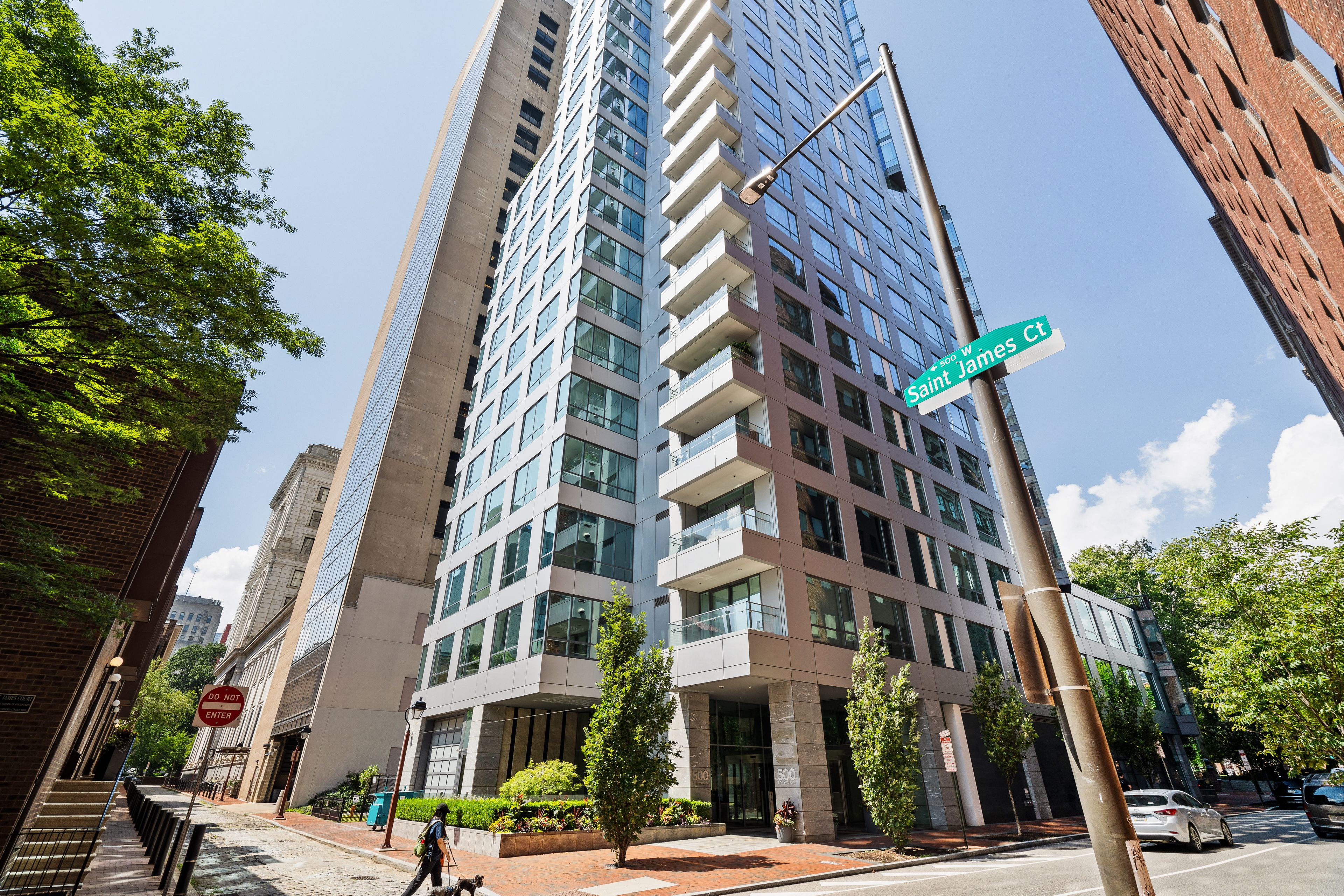
One of Philadelphia’s most expensive condos is on the market for $16,995,000 in the luxury residential tower 500 Walnut.
A private elevator opens into the 6,200-square-foot condo, which spans the entire 11th floor and has one of the largest footprints among Philadelphia condos, said listing agent Mike Fabrizio of Mike Fabrizio Luxury Real Estate with RE/MAX Access.
500 Walnut is a 26-story condo building across from Independence Hall. It has only one or two units per floor. Fabrizio called the property one of “the more private buildings and boutique-style condos” in the city.
A condo is for sale for almost $17 million in the 500 Walnut luxury residential tower.Donkin Media
The owner of the condo for sale combined two units that were empty shells and built a custom space that was completed last year. The seller intended to live in the condo but put it on the market a month ago after plans changed, Fabrizio said.
The home has six bedrooms and 6½ bathrooms. It comes with five parking spaces and three storage lockers. It has two offices, a theater, and two gas fireplaces, including one in the primary suite.
The condo features a hidden room with a built-in humidification system that could serve as a cigar lounge, wine or whiskey tasting room, or a space for collectors’ items.
The kitchen has two oversized islands.Donkin Media
The kitchen includes two oversized islands, two ovens, and two Sub-Zero refrigerators. There’s a breakfast area and a walk-in pantry.
The formal dining area has a bar and a temperature-controlled wine display wall.
The condo includes wide-plank wood flooring, integrated lighting, custom wood and glass doors, and Italian porcelain tile.
The formal dining area has a bar and a temperature-controlled wine display wall.Donkin Media
Bathrooms have digital shower controls. And smart toilets have heated seats, lids that open automatically, and bowls that clean themselves.
The primary suite includes a custom king bed, a bar with a refrigerator, and two dressing rooms. The suite’s marble bathroom features a steam shower, a soaking tub that gets its water from the ceiling, and two separate toilets.
The primary bathroom includes a soaking tub and a steam shower.Donkin Media
The home has two balconies. One off the main living area and kitchen looks out to Independence Hall and the Ben Franklin Bridge. The balcony off the primary suite offers sunset views and looks out to the Walt Whitman Bridge and South Philadelphia.
The home’s floor-to-ceiling windows also show off the views.
The primary suite includes a bar, a gas fireplace, and a balcony.Donkin Media
The condo can be purchased fully furnished, which includes custom window treatments, high-end Italian furnishings, and designer lighting.
A full property tax abatement runs through 2028.
Community amenities at 500 Walnut include a 50-foot lap pool, a fitness center and spa, a 4,000-square-foot open-air terrace that overlooks Independence Hall, and a boardroom with a catering kitchen.