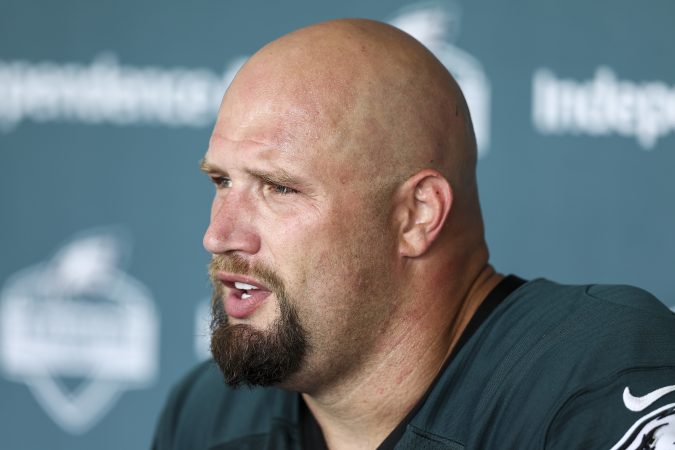
LONDON — Five days after announcing his retirement, Lane Johnson remains on the Eagles roster. Johnson, who announced his retirement on Tuesday, two days after he was a late scratch for the team’s Week 4 game, may remain there for the foreseeable future, possibly for the remainder of the 2026 season.
There would be salary cap ramifications to placing Johnson on the reserve/retired list now. If the Eagles wait until after June 1, they would be able to spread his remaining cap hit over the next two seasons.
According to Over the Cap, if the Eagles officially retire Johnson after June 1, he would count $16.6 million in dead money in 2027 and $26.276 million in 2028.
Keeping Johnson on the 53-man roster also allows for the unlikely scenario where he decides to come out of retirement this season.
The Eagles’ game against the Jaguars on Sunday was their first with the 14-year right tackle no longer with the team. Markel Bell got the start in his place along the new-look offensive line in front of Jalen Hurts as they navigate multiple injuries and the trade of Cam Jurgens.
Only two of their Week 1 starters on the offensive line — left tackle Jordan Mailata and right guard Tyler Steen — were in uniform on Sunday. Drew Kendall, who had been filling in for Jurgens at center after Jurgens slid over to replace injured Landon Dickerson at left guard, was also inactive with a knee injury.
In addition to the linemen, the Eagles were without Saquon Barkley (hamstring), DeVonta Smith (hamstring), Tank Bigsby (core muscle), and Hollywood Brown (ankle) as their offense deals with a list of absences.
ATLANTIC CITY — Will New Yorkers on Wall Street be hopping on a high-speed ferry next summer for some beach and casino time in Atlantic City?
Promoters of the proposed Intercoastal Motorcar & Yacht Club, a $4 billion luxury development in Bader Field, say there’s interest for such a service from Seastreak Ferries.
Seastreak currently runs ferries between New York City and Atlantic Highlands, a Shore destination in Monmouth County.
The proposed A.C. trip would take 2 1/2 hours and cost $145 round trip, said Tommy Carr, a partner in Deem Development. The ferry would come into the Farley State Marina near the Golden Nugget casino.
Deem has an agreement with the city of Atlantic City to build its ambitious “car-centric” development on the city’s old municipal air field on Albany Avenue. Under the agreement, the city would sell the site for $100 million. Deem would contribute $15 million to a community center. Carr says the company has secured the financing it needs.
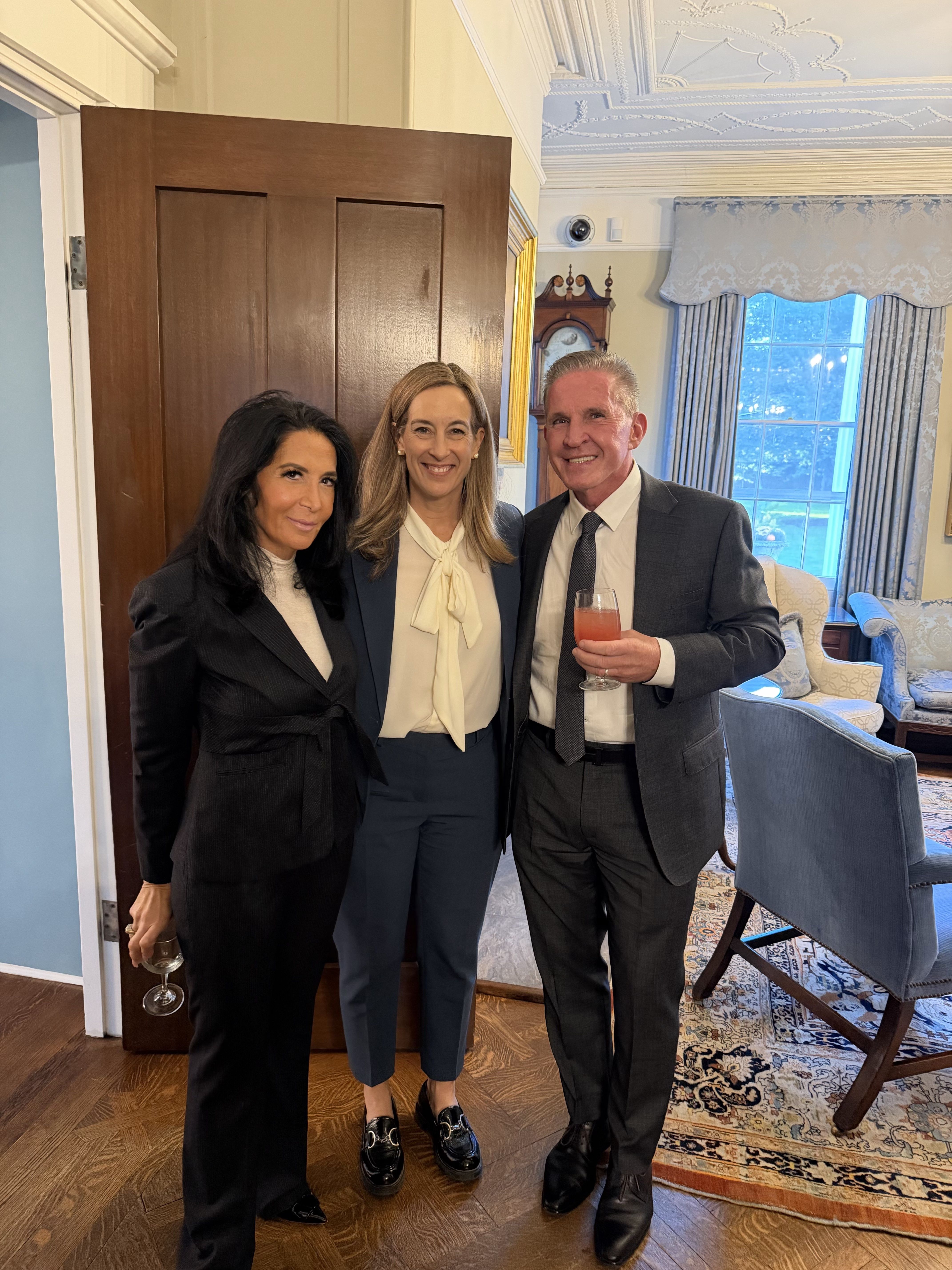
“We’re trying to help develop Atlantic City,” said Carr, who has convened several meetings with stakeholders to drum up interest, and talked it up with N.J. Gov. Mikie Sherrill at a recent gathering at the governor’s residence, Drumthwacket. “We need tourists. We need families to start coming down and buying properties.”
Atlantic City public relations executive Phyllis Lacca and Tommy Carr, a partner in the planned Bader Field development, with N.J. Gov. Mikie Sherrill on Oct. 5 at the governor’s residence, Drumthwacket.Coutesy Tommy Carr
Sherrill recently told the Press of Atlantic City that Bader Field was a “huge opportunity,” but that she still had questions about the proposal.
Atlantic City has recently seen renewed interest from developers of higher-end residential homes, including the Kushner Co., Brian Zoubek, and K. Hovnanian. As real estate prices along the Jersey Shore skyrocket, A.C. is increasingly being seen as one of the last places along the Jersey Shore with affordable oceanfront property.
What could a high-speed ferry ride look like?
At Seastreak, owner James Barker said in an interview that the company had two 600-person ferries, the Courageous and the Commodore, that could make the ocean voyage. Should it be successful, there are higher-speed ferries that could cut the trip to two hours.
Barker cautioned that the company was still in the exploratory phase.
“It’s a feasibility question,” Barker said. “Do we have boats that will be available in peak season? We’re excited about the opportunity. We’re still trying to understand what the Atlantic City opportunity looks like. The Commodore and the Courageous, those are our workhorses, some of the best commuter boats in the country.”
Based in Atlantic Highlands, N.J., Seastreak also operates ferries from New York City to Martha’s Vineyard and then on to Nantucket.
Should the company bring those boats on an Atlantic City run, Barker said, the travelers would find a lot to like.
“Those boats are comfortable,” he said. “There’s Wi-Fi and a bar. They can do their last Zoom call of the day, and no one has to know they’re on a boat.”
In peak season, he said, Seastreak is running 19 round trips between Atlantic Highlands and New York City.
Carr said another company, Connecticut-based Tradewind Aviation, is looking at expanding charter air service to Atlantic City. The company operates a fleet of 40 small jets out of smaller regional airports like Teterboro.
Atlantic City’s International Airport has been wanting for business since Spirit Airlines shut down in May. Currently, two commercial airlines, Breeze and Allegiant, operate limited flights to destinations in Florida and Myrtle Beach.
As for the Bader Field development, a “motor-centric” project long in the planning stages, both Carr and A.C. Mayor Marty Small Sr. said approvals from the state Department of Environmental Protection are all that stands in the way of a ground breaking.
The project promises a “holistic, sustainable, redevelopment” of Bader Field with a renewable energy microgrid and a 2.44-mile members-only driving circuit designed for members to race their luxury cars recreationally. (It is not being built as a Formula One race venue.)
The developers say they will transform the old air field’s runways into public bike paths and a boardwalk, with access for water recreation, and to build a car museum and other retail.
The 1,237 residences will range from market-rate townhouses to multimillion-dollar luxury waterfront condos with terraces.
Carr says the project has already drawn interest from athletes, celebrities, and even a Middle Eastern prince, all with luxury-car collections.
While the ferry service could come as soon as Memorial Day weekend, the Intercoastal project is at least five years from completion, Carr said.
Carr thinks Atlantic City’s luxury moment has come, despite headwinds from casinos in New York City that some believe might lead to the closure of some casinos.
A developer in Asbury Park, Carr says he’s seen the transformation of that city and Long Branch.
“In five years, you’re not even going to know Atlantic City,” he said. “I have seen it with Long Branch. I have seen it with Asbury Park. People are investing in Atlantic City.”
When Lansdale native Nyla Sanders received an email about Gwynedd Mercy University’s new loan repayment program, she says her heart “lit up.”
The university’s Nursing Scholars Network program offered nursing students employment after graduation at a participating health system — and their employer would repay$25,000 to $65,000 of their educational loans.
A sophomore at the time, Sanders bookmarked the email when it landed last year, intent on applying once she became eligible in her senior year.
“Wow, there’s something that can help me tackle a large sum of my loans once I graduate,” she said.
Gwynedd Mercy’s repayment program, launched in late 2024, represents one of many efforts by Philadelphia-area nursing schools to address the nursing shortage in recent years.
La Salle University, Thomas Jefferson University, and the University of Pennsylvania are among the other institutions with initiatives that range from accelerated degree tracks to educational programs for middle and high schoolers.
Two years ago, Pennsylvania was projected to have the worst nursing shortage in the country by 2026, according to a report by the consulting firm Mercer. Its aging workforce, retirement trends, issues with retention and turnover, and burnout had fueled widespread concern.
“I think we’re on a good course,” said Tom Foley, president of the Association of Independent Colleges and Universities of Pennsylvania, regarding the shortage. “The work will continue because the need will continue.”
For Sanders, Gwynedd Mercy offered a financially viable pipeline to attaining her dream of becoming a nurse. She had started college at Drexel University and transferredafter her freshman year, realizing she could not afford the tuition. Full price is currently $63,078 at Drexel, compared to $41,980 at Gwynedd Mercy.
Now a senior in the bachelor’s of nursing program, she applies for a scholarship every week. Though still anxious over her loans, Gwynedd Mercy’s repayment program gives her added confidence that she can stay on the path.
“Our intention has always [been] trying to address the barriers and help to improve the workforce pipeline,” said Jane Tang, dean of nursing at Gwynedd Mercy.
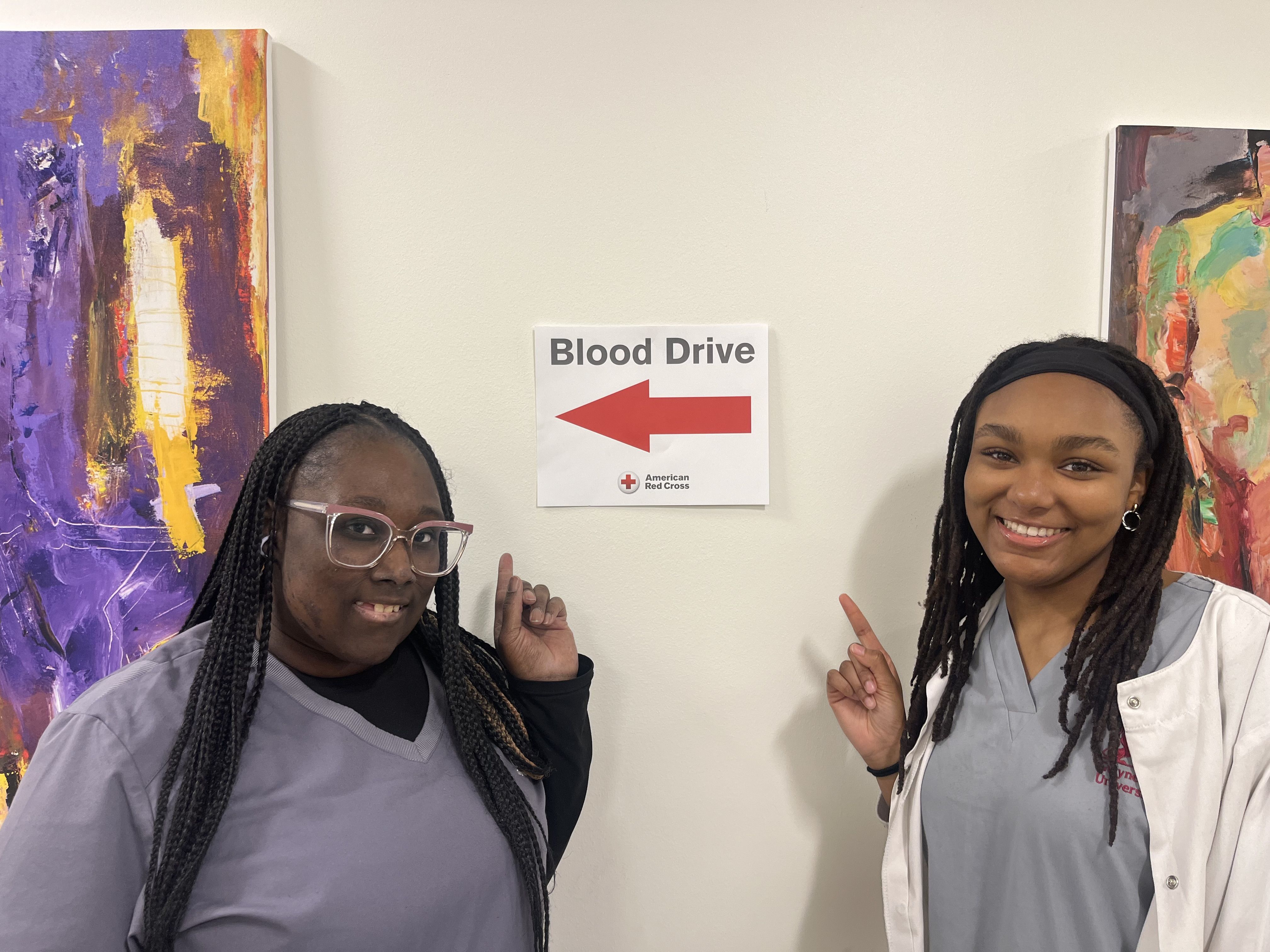
Nyla Sanders (right) is now a senior nursing student at Gwynedd Mercy University.Courtesy of Gwynedd Mercy University
A jump-start
Students in Southeastern Pennsylvania can get a jump-start on a nursing career path as early as third grade.
Jefferson partners with the Southeastern Pennsylvania Area Black Nurses Association to run the Mini Nurse Academy. Started in 2023, the program aims to improve health literacy, build interest in nursing, and diversify the profession.
“The shortage is not just about increasing the number of new hires,” said Marie Ann Marino, dean of Jefferson’s College of Nursing. “It’s about attracting people into the profession.”
The program, hosted by the Southeastern Pennsylvania Area Black Nurses Association, aims to introduce more Black and brown children to nursing.Heather Khalifa / Staff Photographer
In partnership with La Salle University, the program provides high schoolers with early exposure and mentorship. Students who go on to study nursing at La Salle also receive a guaranteed scholarship and part-time employment at HUP during college.
“The students are providing direct patient care as early as their freshman year, which is pretty unlike, I think, any other nursing student,” said Diana Rodenbaugh, nursing professional development specialist for the program.
The program aims to help Philadelphia students who may lack the financial or social supports needed to enroll in a nursing program, said Gabrielle Mariotti, who manages the program. It’s sponsored by the Howley Foundation, an Ohio-based nonprofit that supports educational opportunities to create social and economic mobility.
Goals include building a workforce that better represents the community they serve. The majority of participants are from historically underrepresented groups.
“People who are ill and hospitalized really want to be taken care of by people who look like them,” said Beth Ann Swan, dean of La Salle’s school of nursing and health sciences.
The program currently counts 43 nursing students at La Salle, with the first cohort set to graduate next May. In time, the effort could recruit a nursing workforce that is “connected and engaged with the people that they’ll be taking care of,” Swan said.
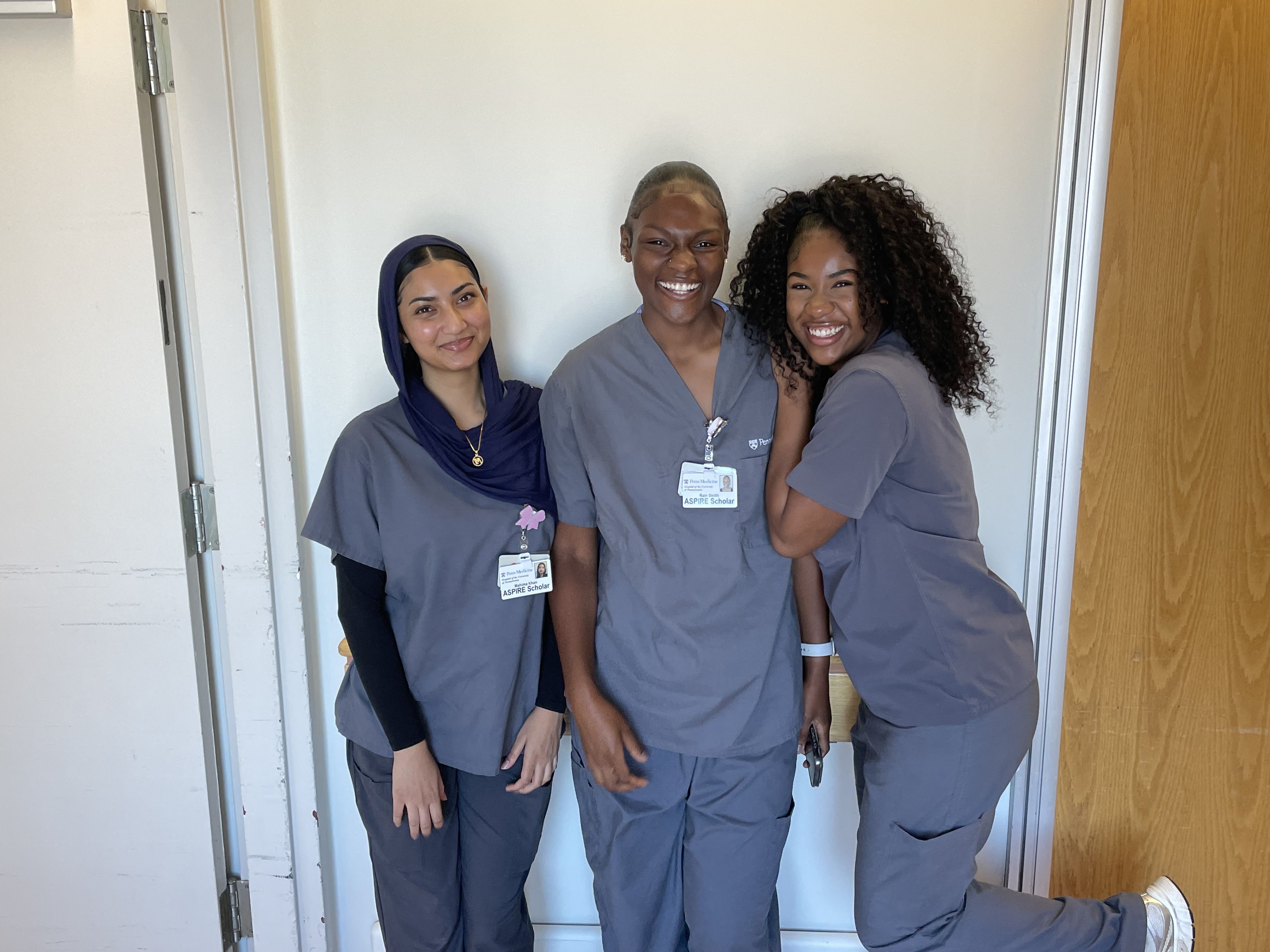
Mahima Khan, Rain Smith, and Taylor Sigler (from left to right) are students in the Howley ASPIRE Nurse Scholars Program.Courtesy of La Salle University
Accelerated paths
New accelerated pathways allow students to become nurses faster than the traditional four-year route.
Gwynedd Mercy offers a master’s-level nursing degree in as few as 20 months. Another part-time option, the weekend BSN program, can be completed in three years.
These target career-changers who already have a bachelor’s degree in a different field “to make nursing education more accessible to people at different stages of their lives and careers,” Tang said.
The accelerated master’s program started with 13 students in 2022 and has since grown to 59. Gwynedd Mercy has since added a second yearly admissions cycle to accommodate the popularity of the program.
Drexel University, Temple University, and Jefferson are among the other area schools that also offer accelerated pathways.
Nursing students at Gwynedd Mercy UniversityCourtesy of Gwynedd Mercy University
Emeritus nursing
At Jefferson Health, nurses considering retirement have the option of transitioning into a lower commitment role with fewer hours as so-called emeritus nurses.
Jefferson started the Nurse Emeritus program in November 2022 after the pandemic spurredmany nurses to retire early or leave its hospitals totake travel assignments.
This program helps retain nurses nearing retirement, while bridging the gap in experience as earlier career nurses join the workforce, said Kate FitzPatrick, executive vice president and chief nurse executive officer at Jefferson Health.
About 40% of the roughly 14,000 nurses employed at Jefferson’s nearly 33 hospitals from South Jersey to Scranton have less than three years of experience.
“These really experienced nurses can dedicate time and experience to support our new and upcoming leaders,” she said.
The program’s 24 emeritus nurses work an average of six to 10 hours every two-week pay period.
Some are focused on supporting direct care: helping with admissions and discharges, teaching patients, and mentoring nurses at the bedside. Others serve as nurse educators in clinics, or mentor frontline nurse managers.
The majority retired from Jefferson, though a few come from other health systems.
“They were not fully ready to step completely away, yet they were at a point where they knew they didn’t want to continue in a full-time capacity,” FitzPatrick said.
Among those who can’t wait for PennDot to withdraw its arsenal of drilling equipment and to finish repairing a troublesome patch of a bustling stretch of Route 202 in King of Prussia, Musa Jaffa might top the list.
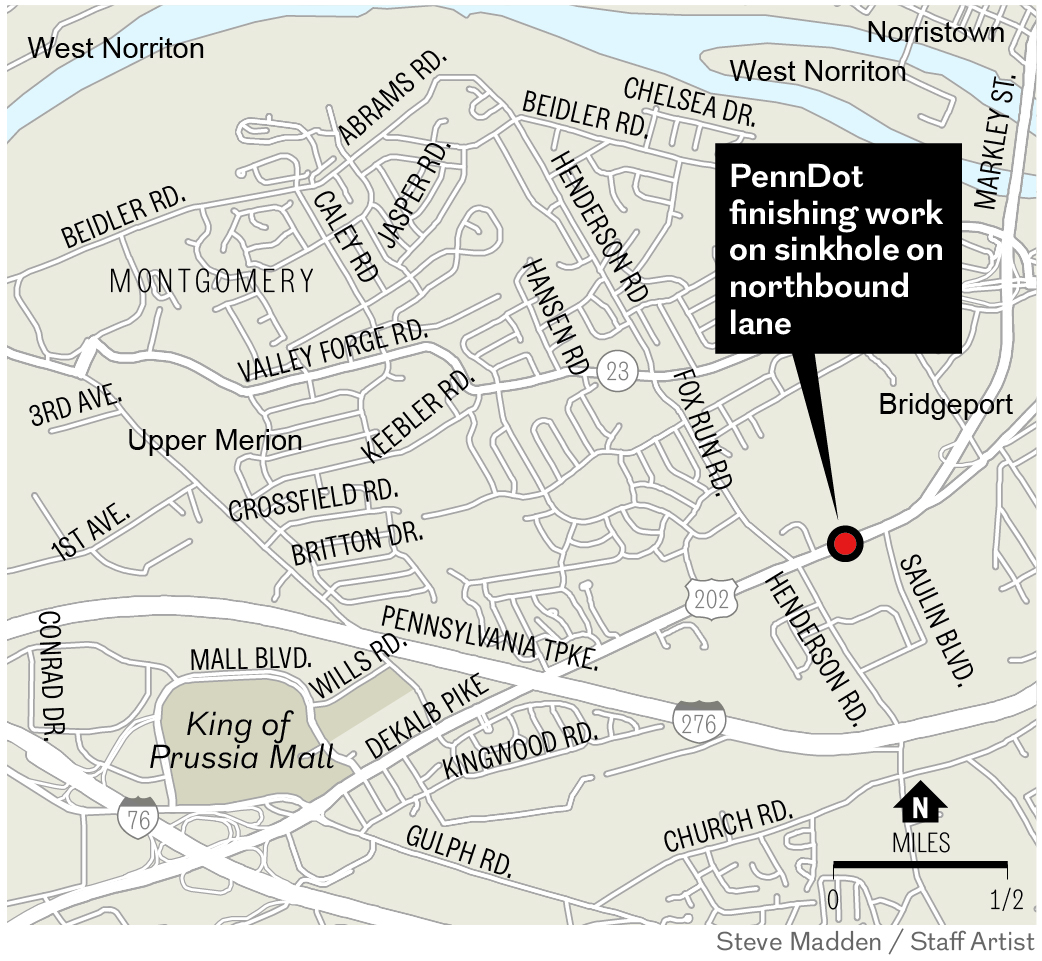
Jaffa is manager of the Joe’s Kwik Marts and gas station fronting the southbound lanes of 202 between Henderson Road and Saulin Boulevard that have been closed while PennDot attempts to repair a sinkhole under a 120,000-square-foot surface.
To say the least, he said, business is “slow.” He estimates daily revenues have plummeted from $16,000, to about $2,000. Andthe traffic complications of the two-yearproject have had immeasurable impacts on area businesses.
“Everyone knows someone who is affected by it,” said Pattie Malone, director of Marian’s Attic, a nonprofit thrift store, on the other side of the highway.
PennDot says the $22.4 million federally funded project, which involves burrowing down more than 100 feet to apply grout, should be finished by “late fall,” as in the astronomical fall. It might not be done until mid-December, an agency spokesperson said Wednesday. Route 202, or DeKalb Pike, is a critical access road for the King of Prussia Mall and scores of other businesses.
Upper Merion Township is a commercial and commuting nexus that has experienced a remarkable economic prosperity, in large measure due to its King of Prussia core. Township population has jumped 25% since 2010. Since then the aggregate market value of real estate has more than doubled, to $8.6 billion, according to state tax data. That’s No. 2 among all the towns in Philadelphia’s neighboring Pennsylvania counties — up from No. 9 in 2010.
The Joe’s Kwik Marts on Route 202 is routinely empty on a day last week. That has been the standard since the southbound lanes have been closed.Jessica Griffin / Staff Photographer
What is a ‘sinkhole’?
Upper Merion happens to be in the heart of a narrow geological corridor of limestone bedrock, a “karst” formation, that extends from central Chester County across southern Montgomery County.
(The limestone alleyway bypasses Philadelphia, whose numerous sinkholes have been the result of a variety of causes.)
An ancient sea once covered the area now occupied by the likes of the mall and Joe’s Kwik Marts. About 500 million years ago, explained Geoff Hickman, Upper Merion’s public works director, shells and other sediment settled on the sea floor and over time mutated into the limestone and dolomite underlying the area today.
Rain and groundwater can dissolve the limestone and create hollow pockets below the surface. That can cause the ground to collapse, creating sinkholes, a common experience in Upper Merion.
The source of the underground water isn’t always clear, as is the case with the 202 sinkhole.
King of Prussia is a king of sinkholes
It’s hard to get there from here: The construction has presented challenges to those seeking access to the businesses along the closed Route 202 southbound lanes.Jessica Griffin / Staff Photographer
About half the land in Upper Merion is situated in “high probability” zones for sinkholes, Hickman said, and the township has a lengthy history of incidents.
In 1961, The Inquirer carried a report of “land cave-ins” in Lower and Upper Merion, “where large areas of residential property have dropped as much as 15 feet.”
A decade later, PennDot altered the route of 202 after “a series of collapses,” Hickman said. A sinkhole as wide as 75 feet opened on 202 near Mall Boulevard in 2011.
When the mall was undergoing an expansion, “the ground collapsed 35 times” between 2014 and 2016, he said.
The most problematic sinkholes are those that occur in clusters, he said. “They show that the geology and drainage conditions in those areas continue to produce sinkholes.”
The ones currently under repair, he said, “are among the most significant in township history.”
What PennDot is doing on 202 in King of Prussia
Map of PennDot sinkhole project in Upper MerionSteve Madden
The repairs are a bit more complicated than a spackling operation.
PennDot says crews are drilling hundreds of holes, some of them through solid rock and deeper than 100 feet, and injecting pressurized grout into the subsurface.
The grout “stabilizes the ground mass beneath the roadway,” PennDot says, adding that it is a laborious and time-consuming process. It can take a minute to drill through a foot of rock.
All this effort should “help stabilize the ground beneath the pavement,” the agency said, and that will be followed by the installation of drainage piping and reconstructing the surface.
“We expect that this fix will be permanent,” the PennDot spokesperson said.
The geological future of King of Prussia, and the Philly region
Sinkholes will continue happening, but neither King of Prussia nor anyplace else around here is in danger of becoming subterranean, said Franklin Institute scientist Derrick Pitts, a geologist. Those involved in permitting are well aware of geological hazards.
“The geology of this entire region has been extensively mapped in excruciating detail for maybe a century,“ Pitts said. “They know where the trouble spots are.”
The resolution of the 202 trouble spot can’t come too soon for Jaffa and other merchants.
The road is closed for only about 0.2 miles, but getting around it requires navigating a detour of nearly a mile through often-heavy traffic.
Malone said the traffic nuisances have discouraged some people from dropping off donated items to her thrift store, operated as charity benefiting Laurel House, an anti-domestic violence advocacy group.
Her assistant manager, Lisa Cristinzio, said the construction project has become a safety hazard for some people exiting the mall where their shop is located. Numerous crashes have occurred, she said.
“It’s a mess,” she said.
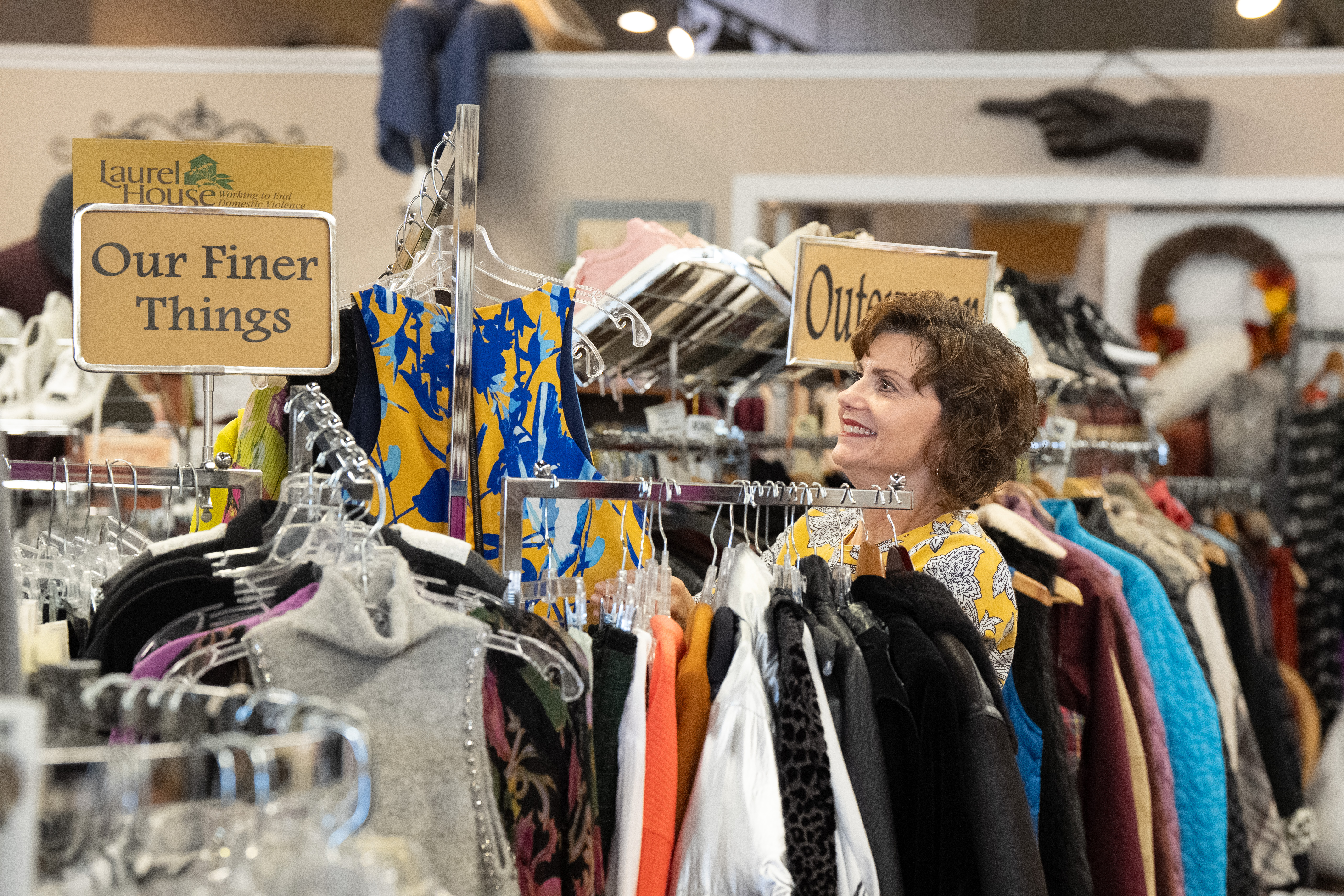
Assistant manager Lisa Cristinzio, at work at Marian’s Attic, a nonprofit thrift store on the northbound side of 202. Store manager Pattie Malone believes business would have been a lot better without the lane closures.Jessica Griffin / Staff Photographer
Through it all, business have remained opened. On the closed southbound side of 202, makeshift lanes have provided access to the businesses that include a Japanese restaurant and an auto-service center.
But Malone is convinced the construction and traffic signage have been a customer repellent for the entire area.
“We’re doing all right,” Malone said. But, “I cannot even imagine what we would be doing if that road was open.”
Two years ago, Pennsylvania was on track to have the worst nursing shortage in the country by 2026.
Fueling the concern: The field’s aging workforce, retirement trends, issues with retention and turnover, and burnout.
New programs step in to help: Gwynedd Mercy University offers loan repayment programs to facilitate students’ financial costs, as well as accelerated degree tracks to transition them into jobs faster. Drexel, Temple, and Jefferson also offer quicker pathways.
Notable quote: “Our intention has always [been] trying to address the barriers and help to improve the workforce pipeline,” said Jane Tang, dean of nursing at Gwynedd Mercy.
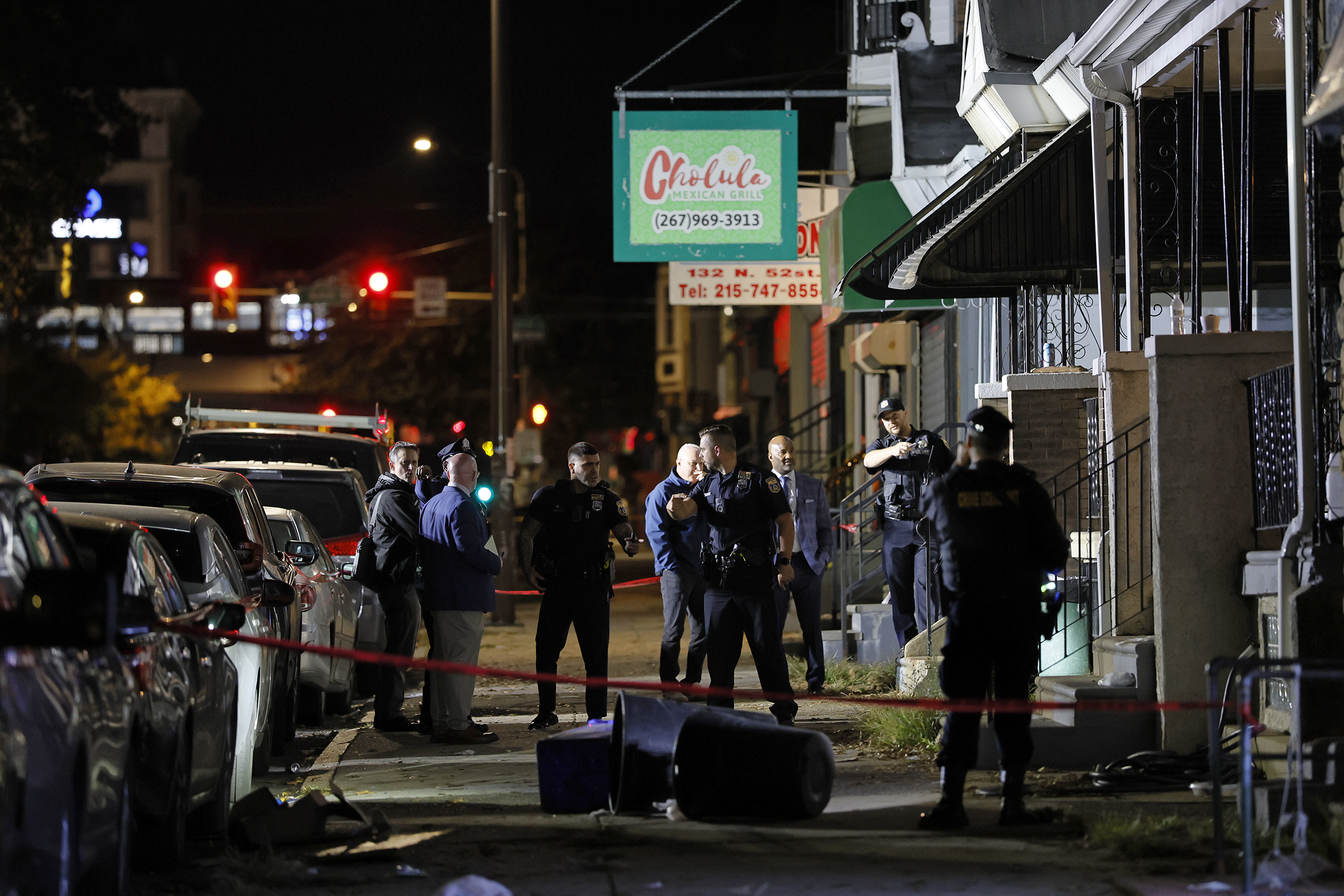
A Philadelphia police officer was killed and another was critically wounded in a shooting early Saturday morning in West Philadelphia.
Shane Seiber, 40, died at Penn Presbyterian Medical Center. “He fought valiantly, but he lost his life today,” Police Commissioner Kevin Bethel said of the 10-year veteran.
The second officer remained in the hospital at the time of publication.
Authorities said a man ambushed the officers with a shotgun outside of his home. The suspect was identified as Eric Lewis, an employee with the Philadelphia Water Department. He was taken into custody.
Philadelphia District Attorney Larry Krasner said Lewis shot at nine other officers. Krasner called the shooting a “brutal, senseless, horrific killing.”
Another deadly encounter: On Friday morning, officers shot and killed a man armed with a gun on the Ben Franklin Parkway. Bethel said the incident is being investigated as potential suicide by cop.
What you should know today
The White House is demanding “full transparency” and “immediate remediation” after Anthropic disclosed that one of its AI models submitted false information to Philadelphia police and to the State Department’s visa application system.
A woman was sentenced to decades in prison for the fatal shooting of SEPTA bus driver Bernard N. Gribbin in 2023.
A Philadelphia-based group of self-described “pedophile hunters” are accused of luring their online targets to parking lots, then attacking and blackmailing them for money.
More Philly-area classrooms are seeing lower measles vaccination rates. The Inquirer analyzed the most recent data to pinpoint places where children are most vulnerable.
An investigation by NJ.com found that Washington Township used opioid settlement funds, meant for drug education programming, on SUVs and Flock surveillance cameras.
Sen. John Fetterman has had just six public appearances in Philly, mostly in 2023, and former staffers say he’s shown a private animosity toward the city. As he weighs his future in the Senate, how he spends his time has come under more scrutiny.
Cheers to Shivani Johri, who correctly guessed Saturday’s answer: Barack Obama. The former U.S. president endorsed Gov. Josh Shapiro for reelection, commending the incumbent Democratic Pennsylvania governor for standing up to President Donald Trump and GOP leaders during his first term.
Photo of the day
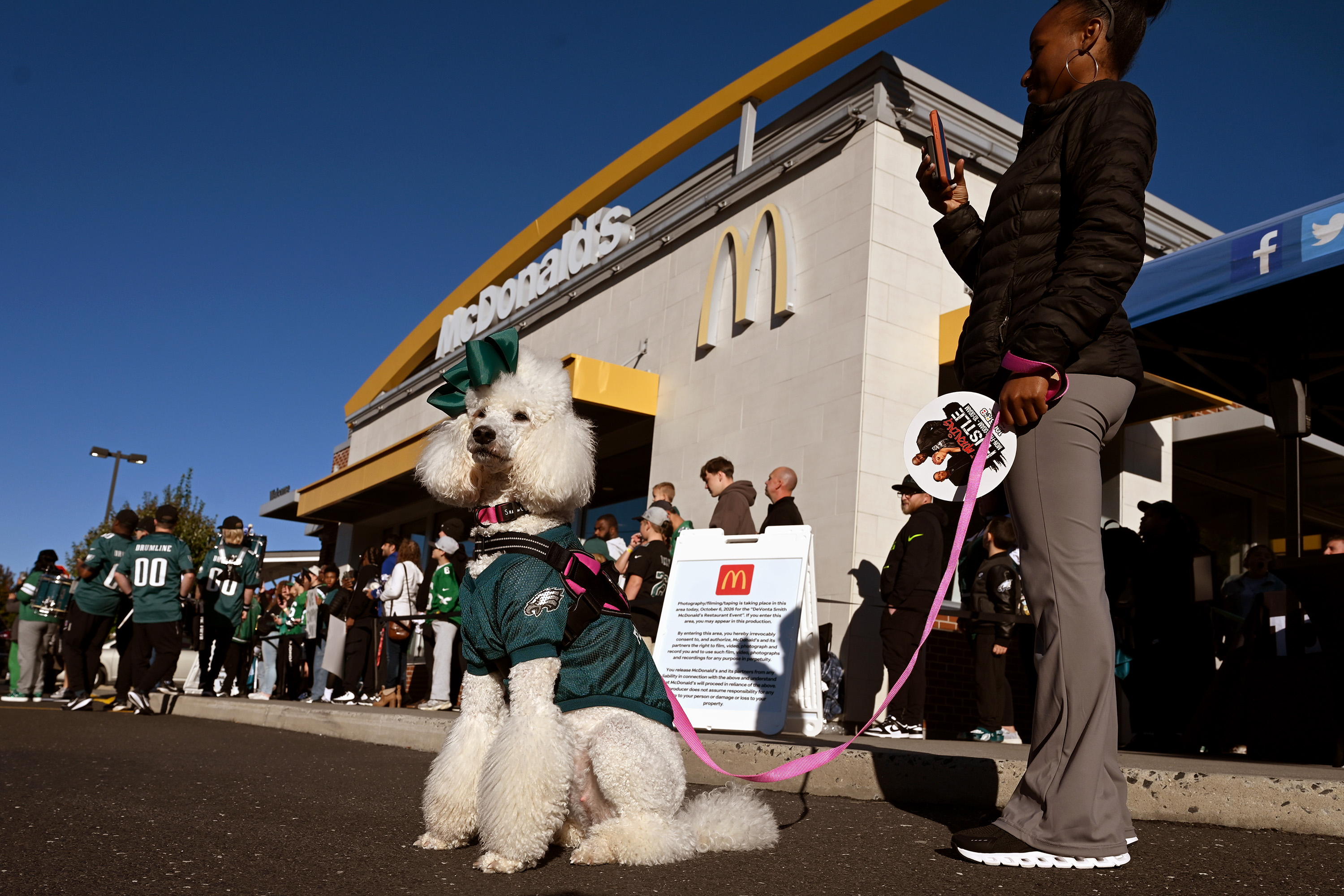
Among some of the best Philly sports moments our photographers captured this week: Jemai Gibson of Camden with her standard poodle, Jem, outside a McDonald’s in Cherry Hill with a crowd waiting to meet Eagles star wide receiver DeVonta Smith. He greeted and posed for photos with fans picking up free coffee and breakfast inside.Tom Gralish / Staff Photographer
🎶 Today’s song goes like this: “You are the light in the painting / That my eye is drawn to first.” It feels like the perfect day to curl up and listen to Angel, the new record by Narberth-raised singer-songwriter Lizzy McAlpine.
One more musical thing: Rock and roll legend Chuck Berry would have turned 100 this month. A daylong symposium celebrated his ability to bring everyone together through his music, despite living in a time marked by deep division.
👋🏽 I know today’s news may have been a lot to take in. I want to thank you, as always, for starting your day with us. Take care, and may the Birds prevail across the pond.
By submitting your written, visual, and/or audio contributions, you agree to The Inquirer’s Terms of Use, including the grant of rights in Section 10.
After a football assault scandal that has weighed heavily on the community, Cheltenham High School leaders hope to bring excitement and pride back to the student body with a different homecoming celebration.
This year’s festivities will center on a boys’ soccer game in the school’s new football stadium, with traditions both old and new. Cheltenham will face Academy Park on Oct. 16 at 7 p.m., with the homecoming court recognized at halftime. While the boys’ game will be the main homecoming event, the school will also celebrate its girls’ varsity soccer and volleyball teams, which will each play earlier that evening.
“Homecoming is not intended to belong to one sport,” Athletic Director Sam Sheridan wrote in an email. “It belongs to Cheltenham High School and the broader Cheltenham community.”
Homecoming last year came weeks before the football season was canceled after a player reported an assault by teammates in the locker room. Four former coaches are set to stand trial for child endangerment and conspiracy after text messages shown in court suggested they tried to hide the incident. Six players were charged.
The school year began a few weeks ago with fallout from the assault scandal still unfolding. Some kids were nervous, parent teacher association President Stephanie Curry said. But parents have worked to lift the mood — holding a community march the weekend before school started, and forming a welcome tunnel outside the doors on the first day.
Student council started planning homecoming in the spring, when students learned that Cheltenham’s football program would also be canceled this year as the district awaits investigative findings and looks to address any systemic problems the incident and its aftermath have exposed.
“We had a very unfortunate year last year,” Student Council President Safia Pendleton said. “Everybody was disappointed in each other and ourselves as a district.”
Cheltenham students turn the page
Those most affected by the canceled football season, students said, included teams who perform at football games. Canceling the season meant hours of lost time for cheerleaders, musicians, and the color guard.
Pendleton is also a captain on the varsity cheerleading squad, which faced a canceled senior night alongside the football team last year.
“The most fun game of the year, we had to [forfeit],” Pendleton said. “We had a very good season going.”
“Not having a football team kind of sucks,” said Freddy Torres, a varsity soccer team captain, who added that he’s looking forward to playing at homecoming.
Student council got pushback from some students on the soccer plan, Pendleton said, but she still expects a large turnout.
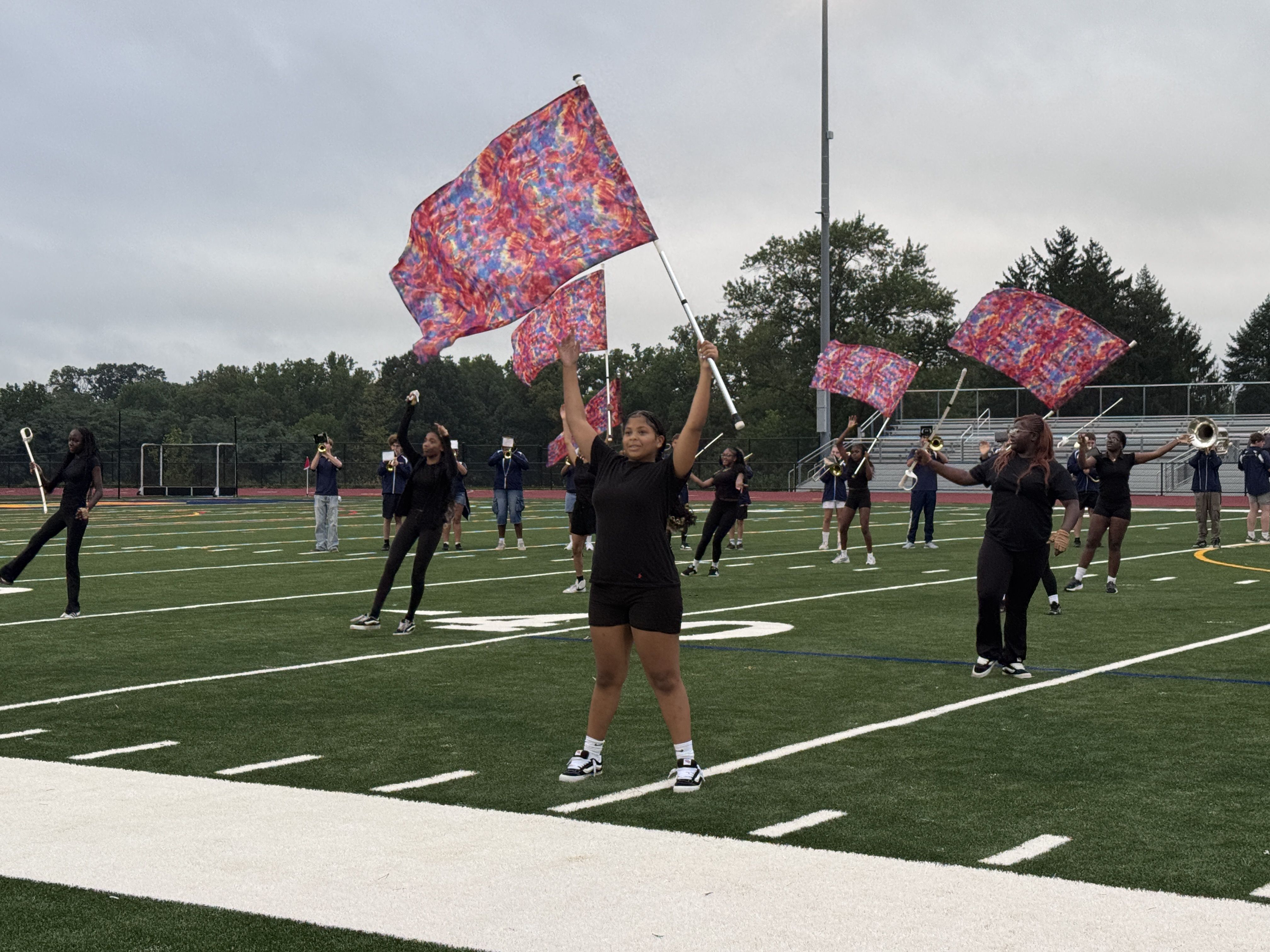
Other homecoming mainstays will remain at Cheltenham, including cheerleaders, pep band, drumline, and color guard. The school is also adding what leaders say could become a new tradition: a staff versus students flag football game before the soccer match.
Cheltenham isn’t alone in swapping cleats for boots this year: Jenkintown built homecoming around the coed varsity soccer team’s Oct. 3 game after it canceled the rest of its football season over low participation.
New stadium for Cheltenham
Cheltenham debuted its $13.4 million stadium this summer. As news of the assaults broke last year, some residents questioned whether the two-year project was worth it, without a football team to play on the turf.
But school board directors and staff have emphasized that it is used for other sports, too, including soccer, field hockey, and track.
“Our old grass fields were rugged,” said Jackson Scott, a soccer team captain. “We’ve had a lot more fans [in the stadium] and it’s a lot more fun.”
Though Cheltenham teams have played on the new stadium field since August, the school will hold an official ribbon-cutting in the afternoon before other homecoming festivities.
“The atmosphere is definitely different, but everyone is trying to make it the best it can be,” Pendleton said. “No matter what comes our way, Cheltenham will still be great.”
This suburban content is produced with support from the Leslie Miller and Richard Worley Foundation and The Lenfest Institute for Journalism. Editorial content is created independently of the project donors. Gifts to support The Inquirer’s high-impact journalism can be made at inquirer.com/donate. A list of Lenfest Institute donors can be found at lenfestinstitute.org/supporters.
Chef Liz Grothe was just starting to toy with the idea of breaking out of corporate America and getting behind the line when she walked into a tattoo shop.
“I thought, ‘If I get a tattoo on my hand, where it can’t be covered for interviews, I can start to force myself out of the safety of my office-job career,” she said. “And I can make the leap into becoming a cook-slash-bad boy.”
Grothe, now the chef-owner of Scampi in Queen Village, left her job as a food-safety specialist at Tyson Foods about five years ago. She soon after got a shrimp tattoo on her wrist. “This was big for me,” she recalled.
Today, neck-deep into her passion project, Grothe has added more tattoos to her collection. A fish on her hand is prominently in sight when she rolls out pasta. Going down her arm, there are frogs working with seafood as a cheeky self-portrait: one is wrestling a catfish, and the other is carrying an octopus to be butchered.
Chef Liz Grothe makes trofie pasta by hand at Scampi on Thursday, April 23, 2026 in Philadelphia.Monica Herndon / Staff Photographer
She recently went full-tilt, getting a chest piece with two symmetrical shrimp (a nod to a famous Sailor Jerry tattoo piece featuring matching swallows) as an ode to Scampi: the place, the ingredient, and “the experience of it all.”
Whether it’s a thoughtful tribute piece, a spur-of-the-moment filler, or something to cover an old burn mark from early kitchen days, tattoos historically go hand in hand with the food and hospitality industry — and they often come with fun stories.
“Tattoos are forever, but so is whimsy,” said Michelle Fecanin, a barista at La Colombe in Rittenhouse. “Some have heavy meanings, some are artistic masterpieces, and some are just because I wanted a Mountain Dew can on the back of my arm! Is that a crime?!”
We spoke with over a dozen industry pros nationwide about their favorite pieces and the memories behind them. Here are some of their stories.
Interviews have been edited for length and clarity.
I have a few on my legs that I hid from my parents for years. When my mom saw them, she threatened to scrape them off with a cheese grater (very Italian of her). When I was finishing up culinary school and somehow had extra cash, I got a few tattoos of Leonetto Cappiello posters on my arm with small illustrations that are in The Silver Spoon [an influential Italian cookbook] as gap fillers. I used and still use that book as a reference 20 years later. I got them over the course of a year at No Ka Oi Tiki Tattoo [near Fourth and South Streets]by Jackie Brown. She was the first person to ask if I was going to marry my wife! I have a tattoo for my wife of a Chicago-style hot dog. I don’t really like them, but my wife is from there. [I got it from] an old line cook, Amanda,whowas doing apprentice tattoos there while Royal Tavern was finishing up Dog Days. I wanted to support her journey, and she crushed it.
Michelle Fecanin
Barista at La Colombe Rittenhouse (Philadelphia, PA.)
I have a seemingly meaningless cup of coffee on the back of my arm. Let me paint the scene: I went to school, I got the degree, and found out it was all a scam. Entry-level office job for $15/hour or find the real meaning of it all. Being a barista sounded cool, and for the same hourly pay plus tips? It was a no-brainer. I started working at La Colombe. Being on my feet all day, learning the ins and outs of coffee, talking to hundreds of new, interesting people every day — it has its pros and cons for sure, but I fell in love. A year in, I really committed to it by getting a tattoo of La Colombe’s signature in-house mug, the Deruta cappuccino cup. Being a barista for the last four-plus years has changed my life in so many ways, and I’m so grateful. Shannon Keeley and Electric Artistry Tattoo [in Williamstown, N.J.] helped me bring the piece to life.
I was living in Santa Cruz, Calif., bartending at Surf City Billiards and Tattoo when my buddy Chris came in. I had just gotten back from a skate trip to Baltimore and drank my weight in Natty Bohs [shorthand for the city’s signature beer, National Bohemian]. He was hammered at my bar and started saying how I need a Boh tattoo, and I said, “On my el-boh!” Somehow, he woke up the next day at a decent time and texted me: “We doing this tattoo or what?” My wife, Jane Harbour, is also an amazing tattoo artist and works out of Eastern Pass Tattoo Co. [onEast Passyunk Avenue]. Tattoos are a huge part of our life and love story.
Tiffany Schleigh
Traveling food stylist (New York City, Pittsburgh, Philadelphia, Cleveland, and Chicago)
I think I’m up to 42 tattoos and they’re nearly all food. I wanted tattoos my whole life, and finally during the COVID-19 pandemic, I got a croissant tattoo that started out as a bet. The rest of my arm felt so empty; I ended up just giving a giant list of foods I love to the tattoo artist, and he filled my arm! We had mutual friends who got married down the block from his tattoo shop. I made their wedding cake, got to the venue, set up the cake, went to his shop, got tattooed for hours, and then we both changed and went to the wedding.
Chef-owner Jesse Ito at work at Royal Sushi & Izakaya on May 31, 2024.Charles Fox / Staff Photographer
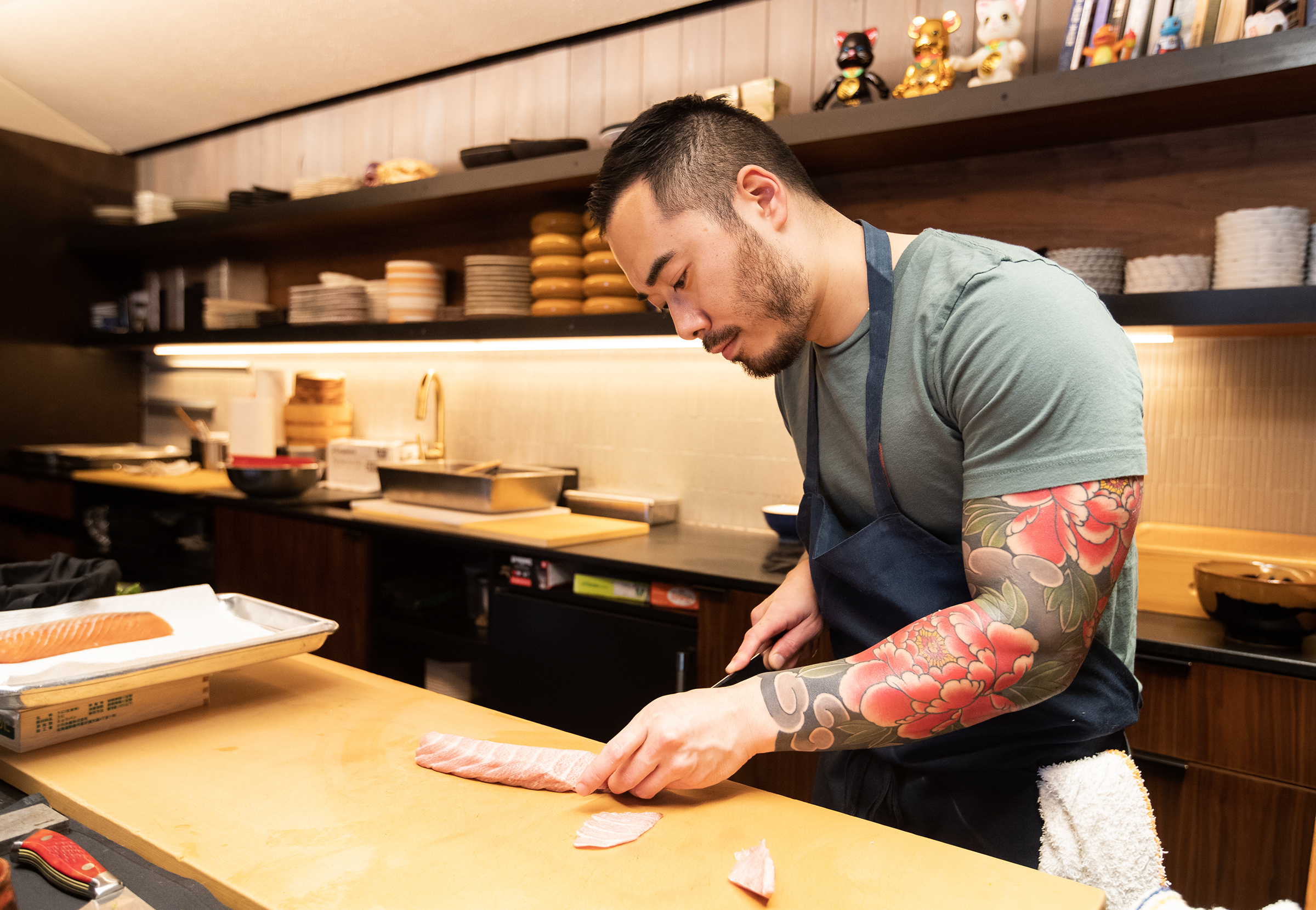
My arm sleeves were done in London by Rodrigo Souto Bueno, who’s known for his Japanese-style freehand peonies. I went whenever I could get a few days off. My first session was Thanksgiving 2024. All in all, it took two and a half years, six trips, and 50 hours in the chair. My chest and stomach piece is a dragon done by a famous artist in L.A. I got it the morning after North America’s 50 Best ceremony in Las Vegas by the famous artist, Oozy. I left Vegas super-early and did a three-day, 20-hour blitz to get the piece done.
Francois Castro
Chef and co-owner of Chancho King (Jacksonville, Fla.)
Thirteen years ago, I was living in New York and thought a quick job at a restaurant would help pay the bills. Now, it’s my career, and I’m still falling in love with it. I have “YES, CHEF” on my thigh and an oyster in the ditch of my right knee. Oysters give so much: a treat, filtration, protected waters. Plus, every chef has shucked bags and bags of oysters. I can’t help but think of this labor of love.
My tattoo is of three cows on the inside of my right bicep. It’s industry-specific because I’m the marketing manager for a meat company, and before that, I was a whole-animal butcher. This tattoo was by Anna Outkin out of Philly, who already had a [pre-drawn] cow flash design. I asked her to do a custom version that was a recognizable steer, which eventually becomes beef — like the cows I work with — instead of a dairy cow. It’s a reminder of my roots in whole-animal butchery and my lifelong love of cows, plus it’s super-cute.
Casey Rebecca Nunes
Culinary Director at Sandy’s Muffalettas (San Francisco, Calif.)
I started getting tattoos when I was 18 and honestly, I can’t get enough of them. At least fourteen of mine are food-related. I have a logo of my friend’s restaurant, Lucky Danger, in D.C. that I’ve never been to. We knew eachother for five days and met at a chef event in Houston. The chefs wanted to get matching tatts — as we’re known to do — and the logo for Lucky Danger is kinda cute [it’s a cheeky character wearing a bear costume] so I said ‘why not?!’ He couldn’t believe I did it. Now I get free orange chicken for life — if I can make it across the country.
I have a pretty good amount of tattoos. One arm is based on food themes, including the Muppets’ Swedish Chef cooking Kermit the Frog with an apple in his mouth and everything. It took seven hours. I also have Remy from Ratatouille holding a hunk of cheese on the inside of my forearm. My most recent addition is a Wu-Tang waffle. And next up in the next few months is going to be a cartoon-style sandwich like the ones from the old Tom and Jerry cartoons. My opposite arm is a full Japanese sleeve. Pretty much all of my pieces were done to cover up old burn scars from the early days on the line.
I got my Fernet tattoo in 2020 when the brand partnered with Irwin’s and Forever Valentine. I was a host at Irwin’s at the time, and it was my first industry gig. I was probably only six months in and still learning about classic cocktails — I had yet to hear about little miss Fernet. Staff was allowed to get a free tattoo, and I didn’t think twice. I picked the eagle and globe design (Fernet’s logo) and officially became a living ad for a brand I’d never heard of. It wasn’t until my shift was over and I headed to the bar for my shift drink that I got to taste what all the hype was about. The whole ordeal was hilarious to my coworkers. Long story short: I tasted it and loved it. I realized I was pretty much branded with stolen valor, but went on to probably ingest a million ounces of the stuff. Today, I don’t drink anymore — but the tattoo still gets compliments, and I remain good friends with my coworkers who also got tattoos that day. A good lesson learned is do always get the free tattoo. I wouldn’t change it for the world, and I’d do it again.
With the election approaching rapidly, I am reminded of Ronald Reagan’s famous line in his debate with Jimmy Carter: “Are you better off now than you were four years ago?”
The electorate answered by voting overwhelmingly NO.
Today, pollsters are asking a similar question: “Are you better off now than when Donald Trump became president again?”
If the economic and political surveys are any indication, the answer is, once again, NO.
There are many reasons why.
But first, a short story: Twenty years ago, at the annual meeting of the National Association for Business Economics, I received the organization’s Outlook Award as the top economic forecaster.
On the way out of the meeting, future Fed Chair Janet Yellen turned to me and said: “So you’re the economist who keeps writing ‘as long as you don’t eat, drive a vehicle, or heat or cool your home, inflation is not a problem. For the rest of us, it is.’”
I was.
When the average person looks at their living expenses and what is happening to affordability, they consider all their costs. They don’t exclude volatile food and energy prices, assuming those will come down in the future.
I was poking fun at the Fed when I made the comment about food and energy not being important. The Fed uses the price index excluding food and energy because it better forecasts future inflation.
But politicians who dismiss basic living expenses do so at their own peril. That’s point one.
The second point to remember is that the rate of inflation reflects how fast prices are rising, not the level of prices.
When inflation decelerates, prices don’t fall, they just go up more slowly. Many politicians don’t appear to comprehend that, but it is the key to household affordability concerns.
How much has sentiment declined? In January 2025, the start of the second Trump administration, the index stood at 71.7. It is now 48.1, after a huge 33% decline.
The outlook is dire. Michigan’s Consumer Expectations Index is also at its second lowest level on record and is down by one-third, while its Business Expectations Index is approaching historic lows.
Consider energy expenses. In the past year gasoline prices increased roughly 30%. The average price of gasoline in May was the second highest on record, topped only in June 2022.
Those huge gas station signs trumpeting the incredibly high prices drives home the reality every day.
The coming winter could wreak havoc on household budgets as home-heating oil costs have surged by more than 50%. And while nationally, electricity prices have risen moderately, they are up by double-digit percentages in the Mid-Atlantic region.
High and rising food costs feed the discontent
When you look at some of the price data for food, it becomes clear why people are so ticked off.
There were large price increases in some basic products, such as ground beef (7.2%) and seafood (6.5%), but they were somewhat balanced out by declines in the price of eggs (-23%) and chicken (-2.3%).
Critically, though food inflation decelerated, the price of most products, which were already high, rose further. That is what the average shopper sees.
Households couldn’t escape high food prices by eating out. Restaurant costs were up by 3.4% on top of several years of even greater increases.
With transportation, diesel fuel, and fertilizer costs soaring, the pressure on farmers and ultimately food prices is not easing.
Interest rates and housing costs added to household woes
Housing expenses jumped as well, increasing 3% over the year. Rent is up 2.7%.
Rising interest rates are affecting credit card and auto loan rates as well, further draining consumers wallets.
And if you wanted to get away from it all, airline fares are up nearly 25%, powered in no small way by a doubling of jet fuel prices.
Prices continue to rise, and what consumers thought were high prices before are only getting higher.
Unfortunately, while wages rose solidly, they are not keeping up with prices, meaning household purchasing power is now declining.
The affordability crisis is no hoax.
AI is restraining the labor market
If the inflation concerns were not enough, there is now what is being called AI Anxiety.
Rapid advances in artificial intelligence have raised questions about not just employment but even the survival of humanity. That is adding existential angst to voters’ day-to-day worries.
The softening job market is supporting those fears. Payroll growth this year has been anemic.
To put it in perspective, during the pre-COVID period of the first Trump administration, job gains averaged a moderate 185,000 per month. In 2025, it was 183,000. But this year it is only 65,000.
AI has made businesses uncertain about how many workers to hire. Especially for those who lose their jobs, want to change jobs, are new workforce entrants or recent graduates, opportunities are few.
If all that was not enough, we haven’t even talked about tariffs, soaring healthcare expenses, wars, political chaos, immigration clashes, and culture battles.
If you still wonder why people are worried, uncertain, and angry, remember the immortal words of James Carville: “It’s the economy, stupid.”
WASHINGTON — Six days after I-95 collapsed in Northeast Philadelphia, U.S. Sen. John Fetterman grabbed a lectern emblazoned with the presidential seal and began what would be his last public remarks in Philadelphia for the next three years.
With President Joe Biden on his right and Gov. Josh Shapiro on his left, Fetterman spent two minutes praising the president while largely ignoring the governor leading the response. It was a pleasure to be there, he said publicly while among his peers. Privately, he never wanted to be there at all.
“He didn’t want to go,” recalled a former Fetterman staffer who was involved in getting him to appear at the site of one of the largest calamities in Philadelphia in recent years. “The fight leading up to that was, ‘I don’t want to be in the same room with Josh.’”
Shapiro and Fetterman have long had a cold relationship, something the senator would later devote an entire chapter to, called “The Shapiro Affair,” in his 2025 memoir.
But his initial refusal to attend an event with the governor just a few months into his term in 2023 was indicative of what many in his orbit would later recognize as a larger trend — one of Fetterman actively trying to avoid the routine elements of his job as a senator.
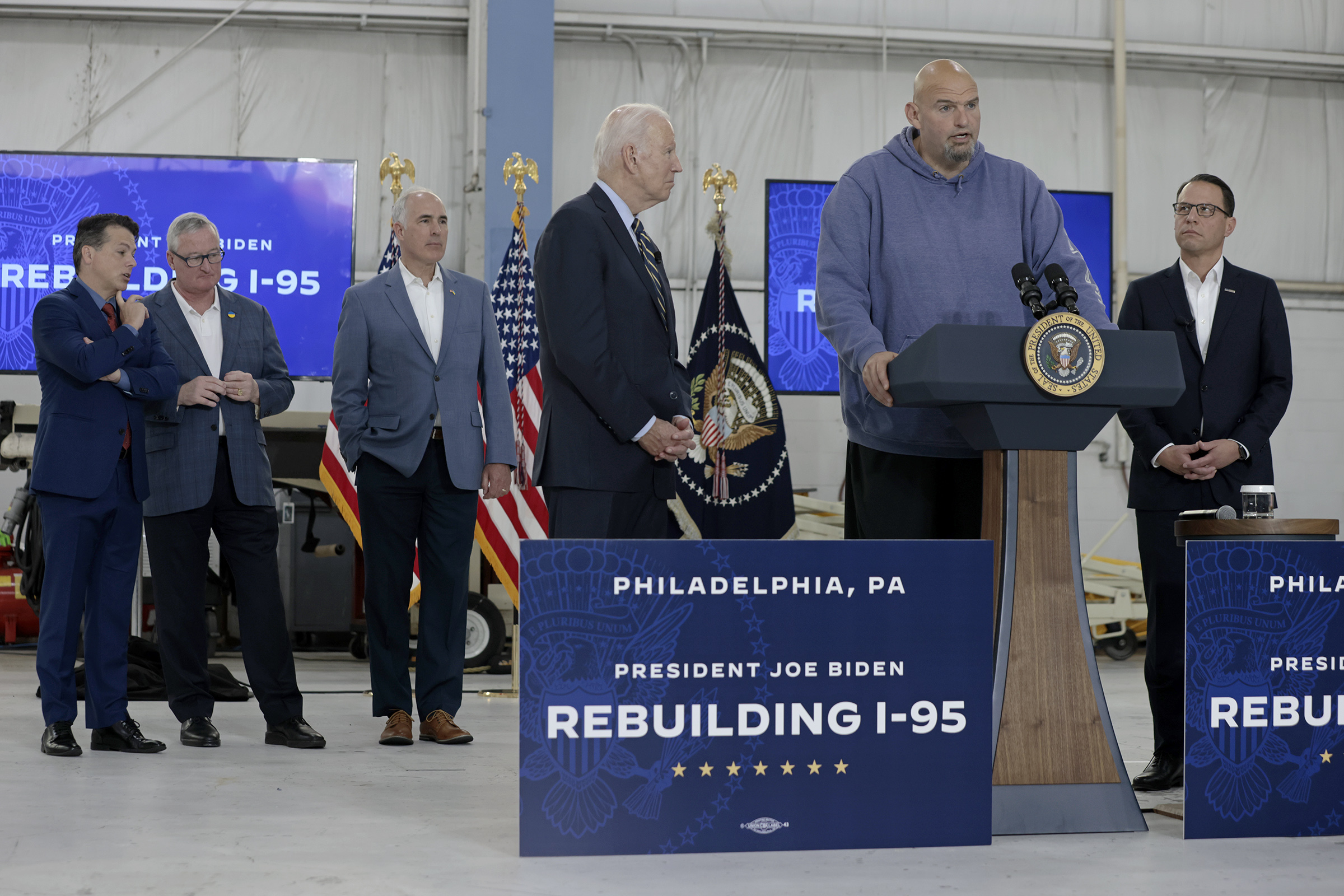
Sen. John Fetterman (D., Pa.) speaks at an event touting the rebuilding of I-95 in 2023. Gov. Josh Shapiro, who has had tension with Fetterman, is to his right. From left: U.S. Rep. Brendan Boyle, then-Mayor Jim Kenney, then-Sen. Bob Casey, and then-President Joe Biden.Elizabeth Robertson / Staff Photographer
An analysis of Fetterman’s record and public appearances by The Inquirer shows he has accomplished little legislatively while also doing less — in bills introduced, public appearances made, and committee hearings attended — as time has gone on. He has attended just 16% of his own committee meetings in the last two years and had only 31 public appearances or publicized meetings in his home state in nearly four years, The Inquirer found. He has also voted increasingly with Republicans ahead of a 2026 election that could make him a key swing vote if Democrats regain a narrow Senate majority.
Fetterman, whose office did not respond to requests for comment for this article, has dismissed past accusations that he is an absentee senator as “smears.” But as he floats the possibility of running for another six-year term after the midterm elections next month — as he did at an out-of-state event in late September — his record in office is likely to come under greater scrutiny.
Interviews with more than a half dozen former Fetterman staffers with close knowledge of his day-to-day activities, meanwhile, describe a senator who is almost entirely disengaged from the work.
Repeatedly and consistently, they describe Fetterman — who is paid a $174,000 salary and received $517,500 in book advances for his memoir, according to financial disclosures — as a “lazy” lawmaker who declines to meet with constituents or colleagues and is dismissive of criticism. He sometimes leaves Washington in the middle of session weeks. And asking him to do “the bare minimum of being a senator” often involves “begging” him to take meetings, one former staffer said, sharing a sentiment echoed by several others.
“It was like arguing with a toddler every day,” the former staffer said, adding that it felt like “arguing with him nonstop to pretty much get out of bed in the morning and tie his shoes.”
As he has avoided public appearances, the Western Pennsylvania resident has shown a private disregard for Philadelphia in particular, according to several former staffers.
One former staffer said they were disturbed when Fetterman once described Center City as “a f— war zone” when the staffer said they had recently visited. Another pointed out that while Fetterman publicly praises the city’s mayor, “he’s met with [Israeli Prime Minister Benjamin] Netanyahu more than he’s met with Mayor [Cherelle] Parker.”
“He never said a nice thing about Philly besides getting a roast pork sandwich,” a third staffer said, referring to Fetterman’s taste for Tommy DiNic’s sandwiches at Reading Terminal Market.
Publicly, Fetterman has not heaped praise on the city. He has issued statements about federal funding awards and has said he is “constantly impressed by [Parker’s] willingness to confront the hard issues.” During a Senate Homeland Security Committee meeting in 2025 about security measures for major sporting events, he gave two emphatic thumbs-up when reading from a prepared statement about how the city was set to host the 2026 MLB All-Star Game.
Still, he has had just six public appearances in Philadelphia — four of which were within the initial months of his term in 2023, according to The Inquirer’s review. That includes a Martin Luther King Jr. Day event at Girard College and a news conference with Biden (in which he flew on Air Force One with the president from Washington to Philly) during his first few weeks in office. He attended a Black mayors’ conference in May 2023 and the I-95 news conference the following month.
He visited Philadelphia Housing Authority leaders and toured the site of apublic housing redevelopment project in West Philadelphia in August 2025 after helping secure a $21.4 million federal grant, according to PHA. And just outside the city in Upper Darby, he joined a 2024 news conference touting $317 million in funding for SEPTA, though he has otherwise foregone the typical political move of taking credit for funding with publicized in-person events.
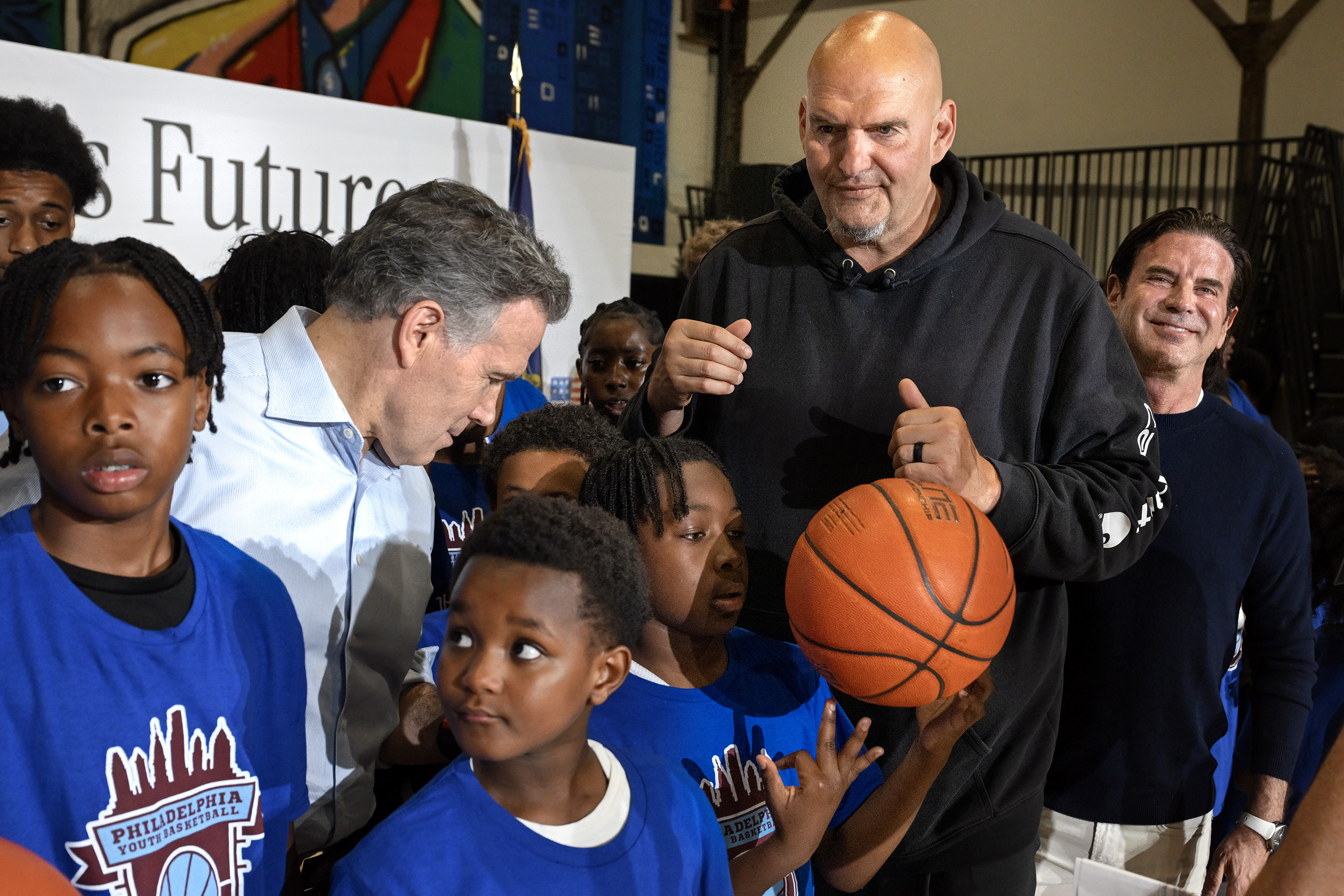
His only other public event in Philadelphia was in June of this year, when he joined Republican U.S. Sen. Dave McCormick at a youth basketball camp to promote the new President Donald Trump-branded savings accounts for kids. When McCormick was asked by a reporter after the event about his close relationship and multiple meetings with Parker, a Democrat, Fetterman quickly jumped in.
“I think she’s great,” Fetterman said. “I hoped to have seen her today.”
U.S. Sens. Dave McCormick (left) and John Fetterman are joined by kids attending a summer basketball day camp at the Alan Horwitz “Sixth Man” Center Monday, June 29, 2026. The bipartisan pair was promoting a new Trump-branded savings account program for kids. Tom Gralish / Staff Photographer
From a ‘golden era’ to rare public appearances
Fetterman’s full schedule of events and meetings is not public. But The Inquirer’s review of government calendars and records, media reports, event agendas, and Fetterman’s own social media since 2023 show he has spent his time in office far differently from typical senators — including McCormick, who has become his closest ally in the chamber.
Over just 11 days during the recent August recess, McCormick’s office said, he traveled 2,000 miles and made 32 stops across Pennsylvania.
It was more than Fetterman’s in-state public appearances in nearly four years.
Fetterman was once known for barnstorming Pennsylvania’s 67 counties and drawing enthusiastic crowds.
And for at least a few months in 2023, he showed signs of keeping up at least a semblance of the pace. The Black mayors’ conference in Philadelphia in May. Pittsburgh’s Pride celebration in June. An August recess in which he and two staffers drove from Pittsburgh to Scranton, stopping at Pennsylvania State University’s Ag Progress Days and ending at another mayors’ conference.
He showed up on picket lines at least seven times that fall, including a few in Michigan and Ohio during the United Auto Workers strike. He rallied voters in Iowa in what a former staffer said Fetterman thought would be a “funny” way to create speculation that he would run for president someday.
“This was the golden era,” a former staffer said, echoing others who described Fetterman as more motivated to show up as he had said he would during his campaign a year earlier. “He was beloved for a minute there.”
Former staffers say the dividing line was the aftermath of the Oct. 7, 2023, attack in Israel. The resulting war by Israel against Hamas in Gaza has killed tens of thousands of civilians and has faced increasing public opposition from Democrats, who once had been part of Fetterman’s base and now oppose Israel’s tactics.
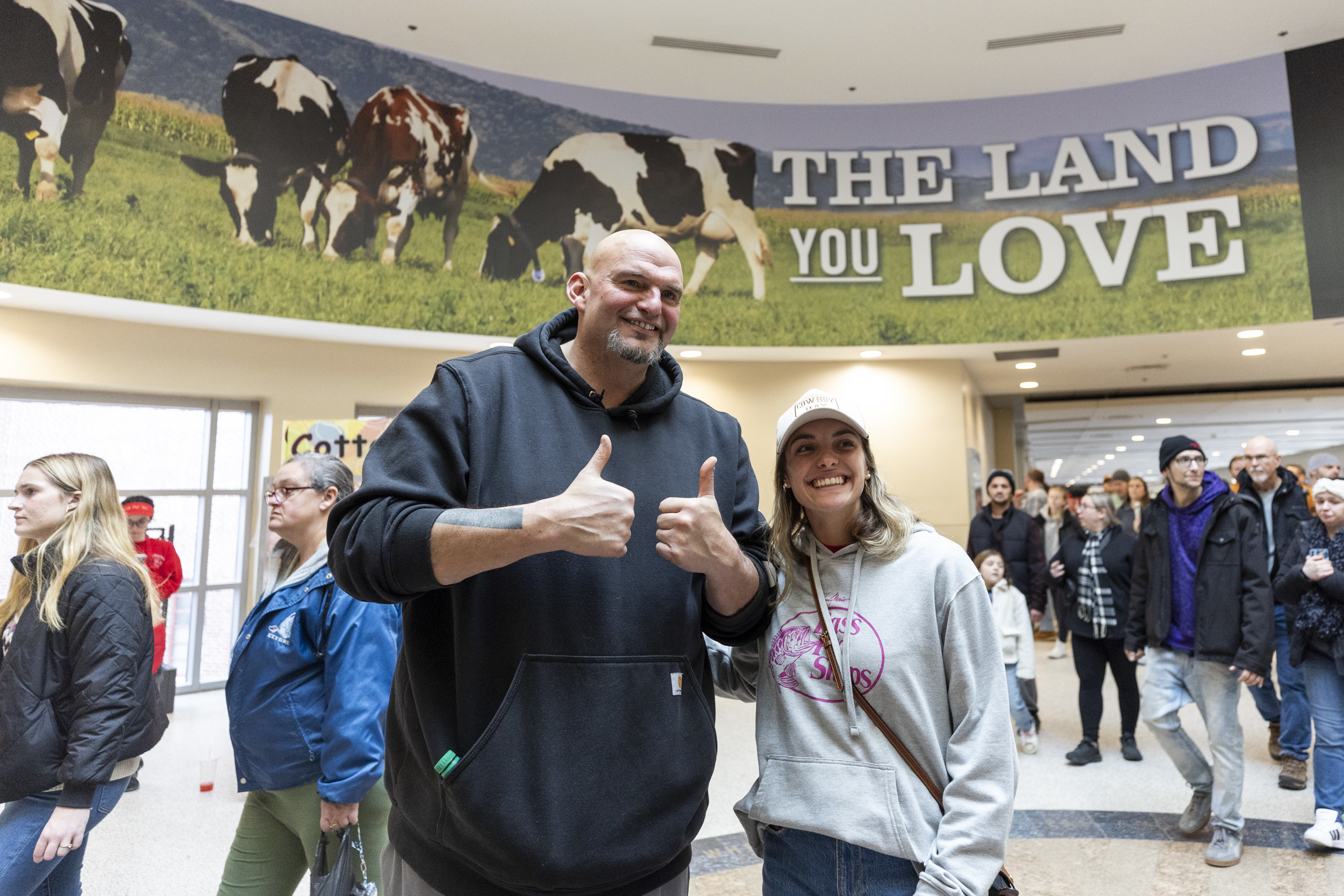
Marissa Clayton, 24, of Ocean County, N.J., takes a photo with U.S. Sen. John Fetterman on his way out a luncheon with the Penn Ag Democrats at the Pennsylvania Farm Show in Harrisburg, Pa., on Saturday Jan. 4, 2025.Tyger Williams / Staff Photographer
Fetterman has repeatedly said he is “always going to stand with Israel.” In an August appearance on Jon Stewart’s podcast in which the host challenged him on the topic, he said the killing of civilians was “terrible” and “collateral” damage but “not a genocide,” as some have suggested. In that interview and previously, he has also acknowledged that he has lost previous supporters who disagree with him.
“I know this has cost me support from a significant part of my base, and I’m well aware that it may cost me my seat,” Fetterman wrote in his memoir, Unfettered. “I’m completely at peace with that.”
While Fetterman also wrote in the book that his “support for Israel is not new,” one former staffer said that the senator had not frequently talked about U.S. support for Israel before Oct. 7 and that it was a “political calculation” on his part to become a voice for the country as loudly and ubiquitously as he had for other causes in his past. That unyielding position amid growing public opposition led to Fetterman being concerned about protests at his events.
“Into the winter and into the spring, it totally shifted,” a former staffer said. “It was impossible to get him to do much of anything.”
His 24 public events in and outside Pennsylvania in 2023 dropped to seven in 2024, 10 in 2025, and eight in the first nine months of 2026, according to The Inquirer’s tally. After Oct. 7, he has dedicated most of his time in the public eye to speaking engagements held outside the state he represents. He has also traveled to Israel twice and met with Netanyahu at least four times abroad and in Washington.
Phil Glover, national vice president for the American Federation of Government Employees district that covers Pennsylvania, said he has not seen Fetterman at any labor-related events in years despite union support being an essential part of his political rise.
He has also been unable to meet with the senator. Before U.S. Sen. Bob Casey (D., Pa.) left office two years ago, Glover said, 30 to 40 federal workers from Pennsylvania would travel to Washington annually to meet with him. They tried the same with Fetterman as the Department of Government Efficiency was beginning to slash the federal workforce and claw back union rights. But the union was told about 20 minutes beforehand that Fetterman could not attend, Glover said.
On Thursday, Fetterman posted an AFGE statement on social media to celebrate a court order that reinstated federal prison workers’ union protections terminated by the Trump administration. Glover, who worked at the Bureau of Prisons for 25 years, said he was not aware of Fetterman working on the issue at all.
“Losing the contract for the Bureau of Prisons was traumatic,” Glover said. “We thought he ought to be doing everything he can legislatively to reinstate our contract, and that didn’t seem to happen.”
Like his public events, Fetterman’s meeting schedule is not public record. Still, he has posted images of himself with constituents and advocacy groups in his Capitol office 52 times since he entered the Senate. Some posts have come in bursts after other stories about Fetterman’s light schedule — including just last month, when the Wall Street Journal highlighted a time when Fetterman avoided meeting with paralyzed veterans and other groups.
(function() { var l = function() { new pym.Parent( ‘fetterman-numbers__graphic’, ‘https://media.inquirer.com/storage/inquirer/ai2html/fetterman-numbers/index.html’); }; if(typeof(pym) === ‘undefined’) { var h = document.getElementsByTagName(‘head’)[0], s = document.createElement(‘script’); s.type = ‘text/javascript’; s.src = ‘https://pym.nprapps.org/pym.v1.min.js’; s.onload = l; h.appendChild(s); } else { l(); } })();
On his first full day back in Washington after the story, Fetterman’s office posted a photo of a meeting for the first time in seven months — a group of veterans with the VFW National Legislative Committee.
Rich Cassey Jr., the group’s legislative chairman for Pennsylvania, said it was the first time he’d had the chance to sit with Fetterman in person but that his staff had always been accommodating during his twice-annual visits to Washington. During this visit, Fetterman was “gracious” and engaged as the discussion touched on bills to help connect veterans with benefits and improve their medical care, Cassey said.
“It was refreshing to speak to someone who genuinely had questions and concerns,” Cassey said, adding that Fetterman interrupted him at one point to express his concern about veteran suicide. “That doesn’t happen a lot when I’m down there.”
Fetterman dismissed the recent Wall Street Journal story in a statement to CNN as “lies, half-truths, innuendos, smears, and anonymous.” After similar reports in 2025, he told the New York Times that voting in the Senate and committee meetings were “performative” and that his public struggles with mental health were being “weaponized” against him.
His health has been a major question since his 2022 stroke and 2023 hospitalization for depression. Staffers have previously questioned whether Fetterman is seeking proper treatment, a claim that he has also rejected.
But he has also said he needs to improve. In his memoir, he wrote that he left the hospital in 2023 to find the job had three core responsibilities — “keeping up with politics in your home state,” fundraising, and “the business of legislation and being in Washington when the Senate is in session.”
“I have to do better on all three,” he wrote.
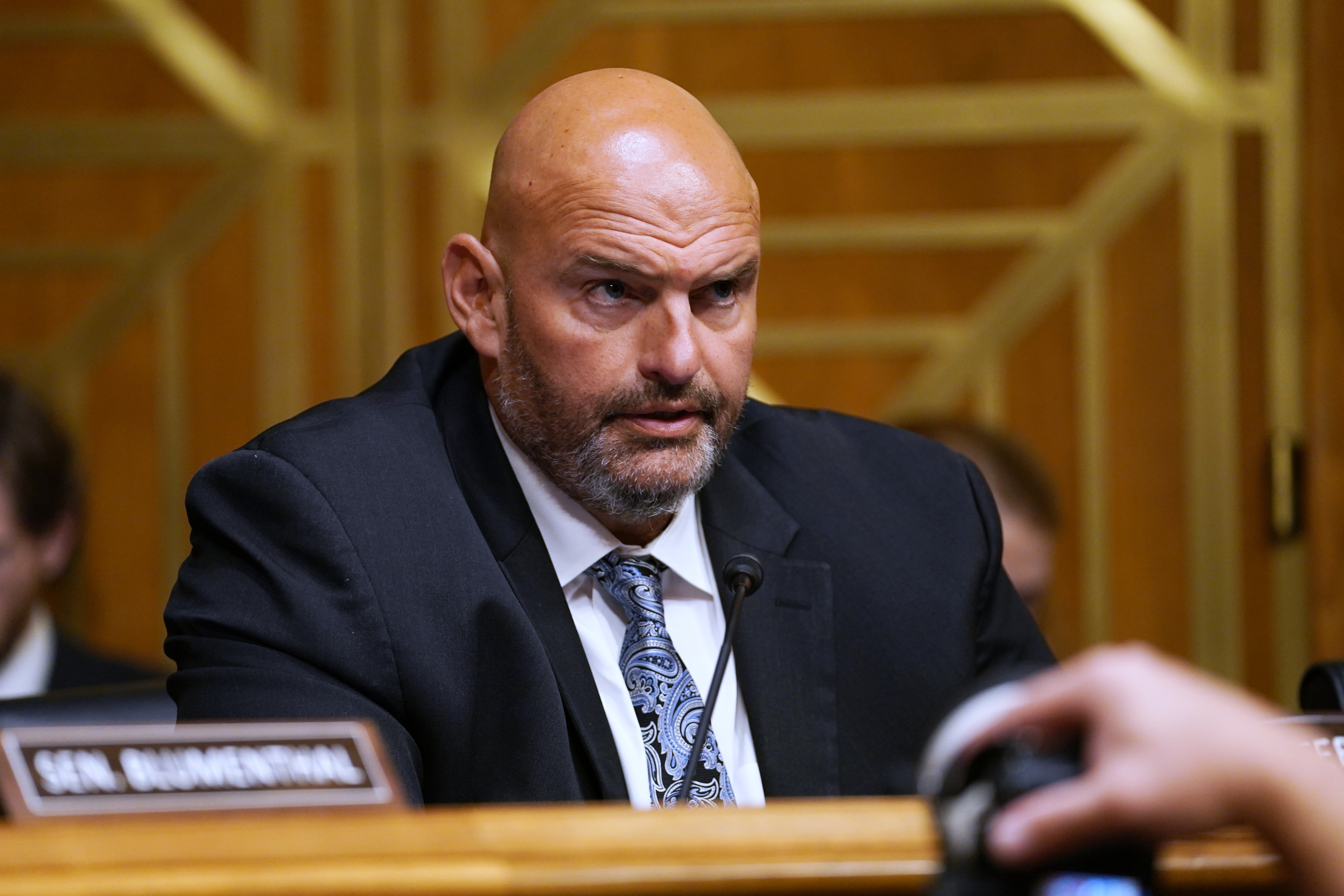
Sen. John Fetterman (D., Pa.) speaks as Anthony Fauci appears before the Senate Homeland Security and Governmental Affairs Committee at the U.S. Capitol, July 29, 2026, in Washington.Allison Robbert
What is Fetterman doing instead?
While Fetterman’s staff of more than four dozen — including those in regional offices across Pennsylvania — has stayed active with constituent services, securing federal funding for the state, and trying to craft a legislative agenda, Fetterman largely holes up in his Capitol office, lying on the couch and scrolling Apple News, several former staffers said.
“Every day was a battle that by the end of the day you were physically and emotionally battered just by getting John to do any part of his job,” a former staffer said, describing the work as “soul-crushing.”
One former staffer who recently spent several months in the office and whose role in normal circumstances would have them regularly interact with the senator said they did not interview with, meet with, or even speak to Fetterman a single time.
“The staff is just like beat down, drained, stressed, because of him,” that former staffer said. “He’s never there, and he’s never supporting you.”
Fetterman has never regularly met with Democratic House members from Pennsylvania. Socializing outside the Capitol — during fundraisers, dinners, even the congressional baseball game — has not been of interest, former staffers say.
The senator has not only avoided the extracurricular activities in Washington, but has often left town completely in the middle of session weeks. Fetterman has departed Capitol Hill immediately after voting and headed to his parents’ house in York before returning to the capital the next morning, according to four former staffers.
Former staffers say Fetterman’s driver either will take him the entire 100-mile trip or will bring him somewhere outside Washington and he will drive the rest of the way himself.
“He’ll be like, ‘Why would I give up an opportunity to have dinner with my family?’” a former staffer said. The staffer added that Fetterman won’t stay with his parents but will rent a nearby hotel room, paid for by his campaign.
Fetterman’s campaign disclosures show he has spent $8,900 for hotel stays in York since the start of his term. The campaign spent a total of $168,700 on lodging and almost $430,000 on travel in that time. An additional $172,700 was spent on four vehicles “for campaign purposes” — three in 2024 alone, according to disclosures.
Some of the car purchases are dated around the time of a 2024 car crash in Maryland that sent Fetterman and his wife, Gisele, along with a 62-year-old woman in another vehicle, to the hospital. A police report noted that Fetterman was “at fault” and traveling “well over the posted speed limit” before hitting the other vehicle. The damage done to both vehicles was “disabling,” according to the police report.
Three former aides said they later heard Fetterman say the reason the crash occurred was because he fell asleep at the wheel. Fetterman’s office did not respond to a specific question about that claim, and he has not commented publicly on the crash.
Under Federal Election Commission guidelines, federal officeholders are permitted to use campaign funds for travel and lodging expenses directly related to the individual’s official responsibilities in office or their campaign. They are not permitted for personal travel. Vehicle purchases are also permitted if the personal use of the vehicle is “insignificant in relation to the overall vehicle use.”
Fetterman’s office did not respond to questions about whether he used his campaign to pay for hotels near his parents’ home for personal visits, or if he purchased vehicles primarily for personal use.
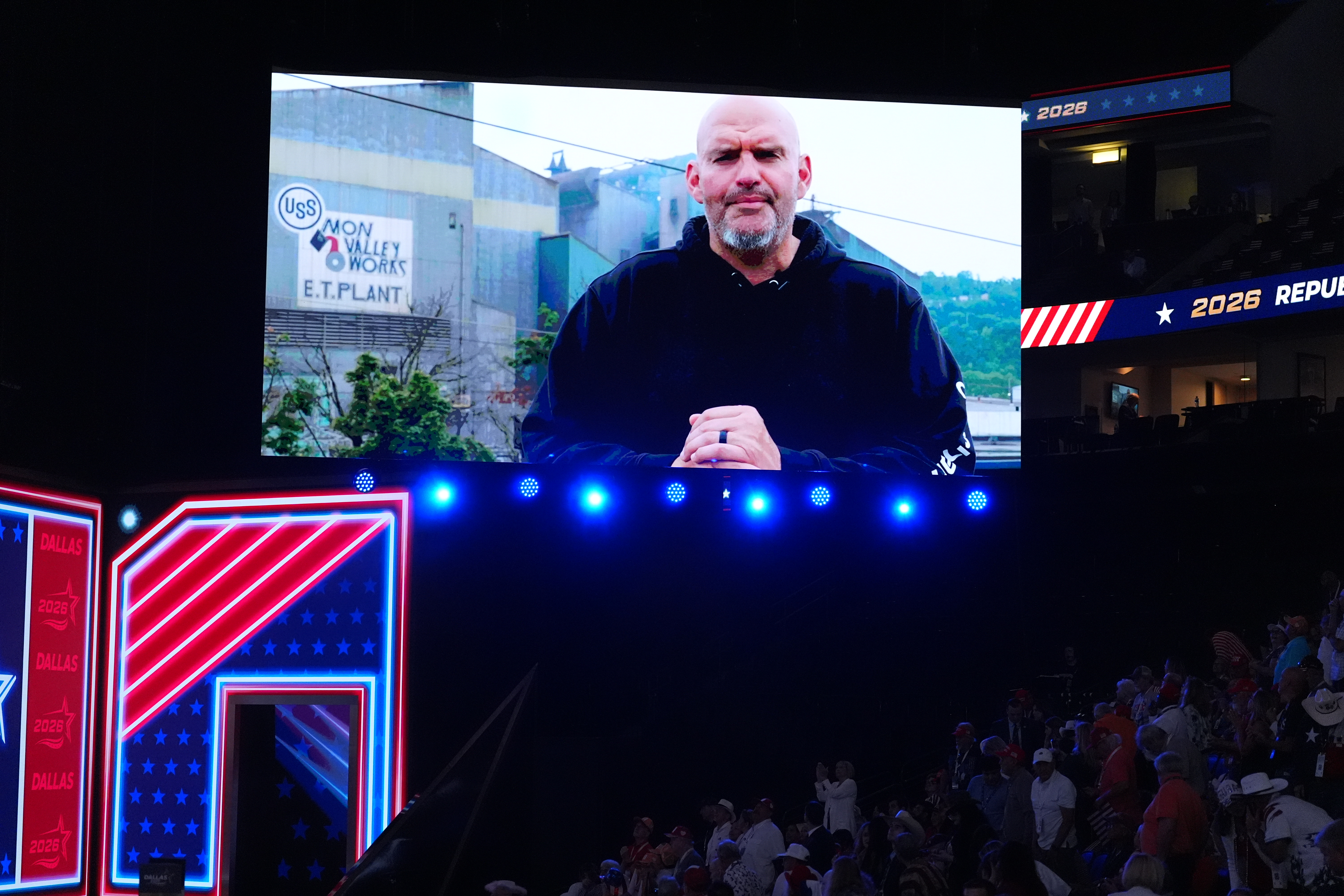
Meanwhile, Fetterman is still fundraising with an eye toward running again after the midterms, he said during an onstage interview at the Texas Tribune Festival in Austin last month. Political observers have debated whether he will switch parties or become an independent. And while he has rejected those rumors, his campaign has collected donations from major GOP donors since last year, and new campaign solicitations have specifically targeted GOP voters as his poll numbers among Democrats have plummeted, including after his video introducing McCormick and complimenting Trump at the Republican midterm convention in September.
A video featuring Sen. John Fetterman (D., Pa.) plays at the Republican convention Wednesday, Sept. 9, 2026, in Dallas.Alex Brandon
Former staffers say Fetterman, early in his term, would talk about potentially running for president in 2028. In the summer of 2025, he even gathered a close group of staffers at a hotel near the Capitol to float the idea of him being a vice presidential nominee, according to a former staffer present for the conversation.
Now, they say, they don’t know exactly what he will do after November.
“The people of Pennsylvania elected somebody who they thought really wanted to fight for them,” a former staffer said. “People are relying on you to do that job. It’s irresponsible, and it’s unfair to the people of Pennsylvania to not do it.”
Throughout her career in online auctions and resale marketplaces, Leslie Jacoby Hack, 36, of Wyndmoor, has been in love with a question: “Why sell something once?”
“It is one of those core values that kind of takes me day-to-day through my work,” she said.
Hack works for eBay’s toy department. Before that, she worked for Philadelphia-based Urban Outfitters, focusing on the company’s Reclectic brand, which sells secondhand clothing.
Now, Hack is using her career insight to address a problem all parents face: children outgrowing clothing.
“After having my first baby, I was blown away by how quickly kids grow out of their clothes,” she said.
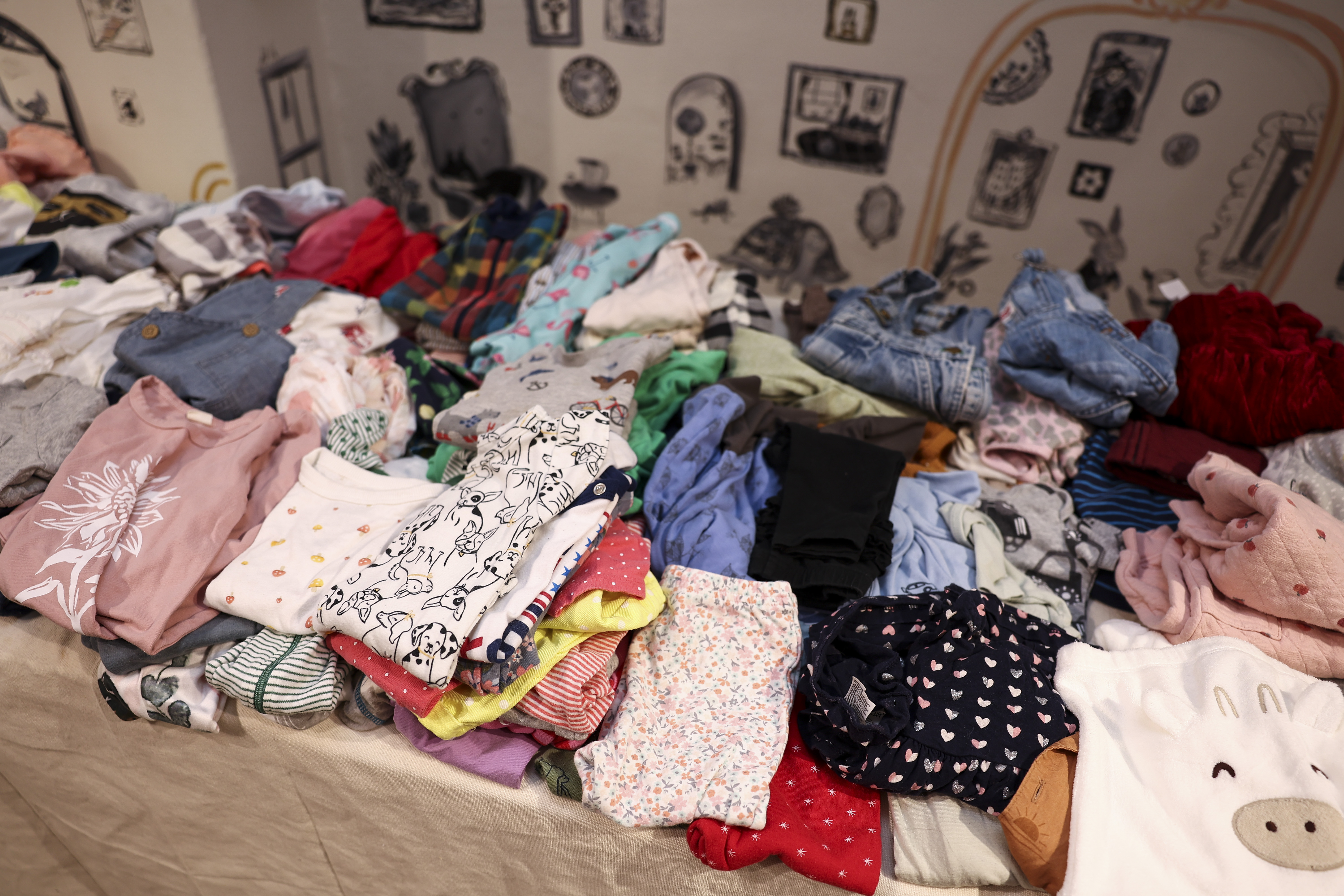
The company aims to solve a common problem parents face when trying to get rid of children’s clothing: It takes time and effort to find the right place for each item amid brick-and-mortar consignment shops, resale platforms, community giveaway groups, and in-person donation sites.
Mosey’s solution to eliminate the overwhelming decision process? A $25 bag. Customers buy it to fill with clothing their children no longer wear, then they mail it to Mosey, which lists the items online for sale.
In return, customers get at least $30 in online store credit to purchase secondhand items sent by other parents. Customers that send in premium brands or items such as outerwear and fleeces can get up to $50 in credit per bag.
Hack declined to share financial figures, noting the business is in early stages and “very much bootstrapped through friends and family.”
The business has two part-time employees, and no physical space yet, but the goal is to have a warehouse in Philadelphia by next year.
Since launching, Mosey has received hundreds of clothing items, Hack said.
“Parents all over, both in the U.S. and globally, share the same issue,” she said. “Where do I put these things … that my kids only wore once?”
Trash bags full of clothes
On a recent Sunday in September, a steady stream of people stopped intoLittle Wares in Chestnut Hill for a children’s clothing swap hosted by Mosey.
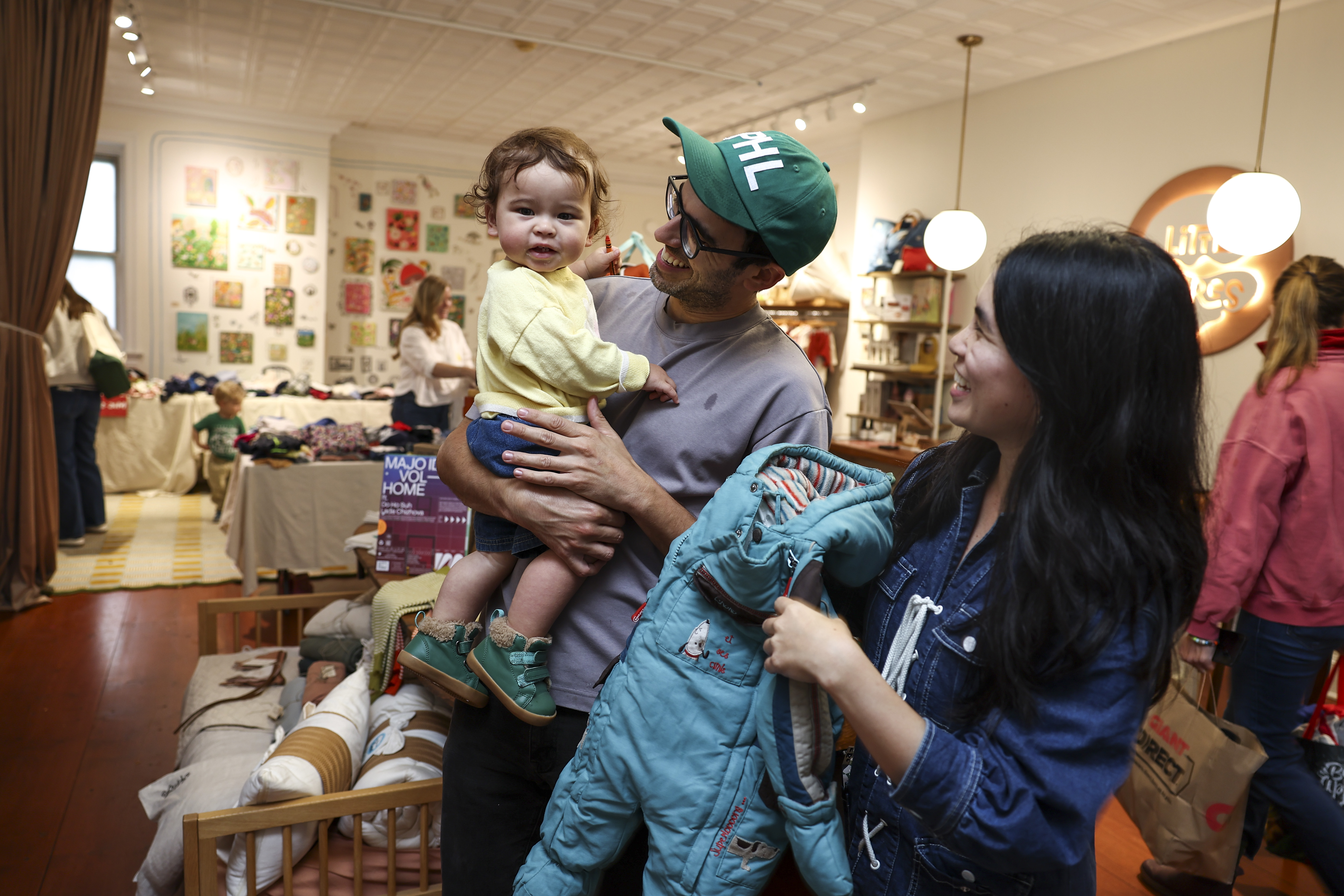
Sandra Hwang, 34, from Wissahickon, showed up with clothes her 15-month-old son had recently outgrown. She sifted through tables full of clothing organized into piles by age, and found a few gems: a vintage snowsuit from Canadian brand Deux par Deux, some pieces from Hanna Andersson, and a denim overall from OshKosh B’gosh.
Hwang said roughly 95% of her own wardrobe is secondhand. She usually takes her son’s used apparel to Nesting House, a children’s consignment shop in West Mount Airy, but the store is selective, she’s found, preferring not to sell certain brands or more worn items.
That leaves her “driving around with this clothing, trying to find the outlet for it that will increase the lifespan as long as possible,” she said.
She might hand it off to friends or family, but that still takes time and effort.
“We have ourselves gotten huge contractor-grade trash bags of clothing in our neighborhood that [are] just being passed around,” she said. “People have kids, and then they go through tons and tons of clothing. It’s very overwhelming to go through this process.”
While Mosey aims to be an online marketplace with no brick-and-mortar store, connecting with potential customers like Hwang in person is important. It helps “drive word-of-mouth interest,” Hack said. She hopes to make clothing swaps and other events a regular part of the business.
Martín Vilariño (center) holds Índi Vilariño as Sandra Hwang (right) shows off the snowsuit she found during a children’s clothing swap hosted by Mosey.Monica Herndon / Staff Photographer
Store credit up front
Platforms abound for those looking to sell their clothing online, including Poshmark, Depop, Vinted, and ThredUp.
Mosey’s business model is not entirely new, but it stands out because of its focus on kids, says Chris Baeza, associate program director of the fashion industry and merchandising program at Drexel University. Mosey’s guaranteed store credit encourages givers to become buyers, she says, and differs from consignment platforms that only pay once an item sells.
On a recent day in September, items for sale online included a Mini Boden button-down shirt with printed colorful sharks for $20, red Baby Gap shorts for $9, and a Hanna Andersson skirt with fruit designs for $16. The company also sells a selection of new items.
Mosey asks customers to launder the clothing before sending it in. But if something needs “a little bit of love, we will try to take that extra step to make sure it’s clean,” says cofounder Hack. Shoes, bibs, and a few other categories of children’s goods are not accepted.
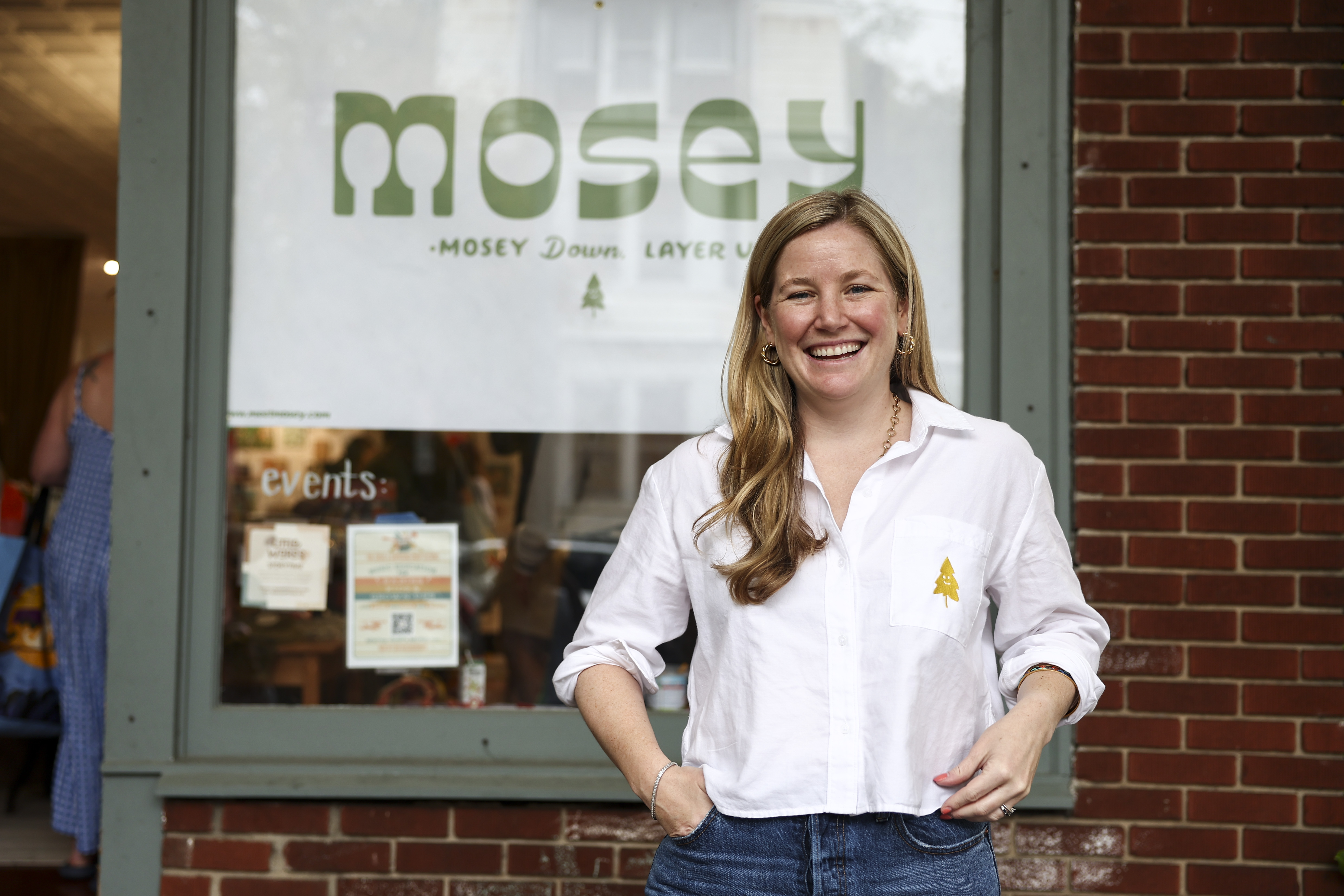
Mosey cofounder Leslie Hack says in-person events are important to the company, which aims to operate entirely online as an e-commerce platform. It helps “drive word-of-mouth interest,” Hack said.Monica Herndon / Staff Photographer
Erica Lyon, 39, who lives outside Boston, ordered her first Mosey bag in July. As of late September she had sent in four bags of outgrown clothing from her daughters, ages 5 and 1.
Between the price of the bag, the credits she received, and buying four new-to-her items, she recalls spending roughly $20.
“I’m sending in nice stuff that at one point I did spend a substantial amount of money on, but otherwise there would have been zero return,” Lyon said. She learned about the company because she used to work with Hack, years agoat online art marketplace Artsy.
Before discovering Mosey, Lyon said, it felt overwhelming to sift through her children’s clothing to find things that could be donated or given to a friend.
Lyon is excited for more secondhand clothing to be available on Mosey. In the early days, she would pester Hack, saying, “I’m ready to buy stuff. She’s already noticed an increase in inventory since then, she said.
Tables full of clothing on display during a children’s clothing swap hosted by Mosey at Little Wares on Sept. 20 in Philadelphia. Monica Herndon / Staff Photographer
Selling more than used clothing
The secondhand industry is already booming.
Online consignment storeThredUp estimates the secondhand apparel market will reach $78.8 billion by 2030 in the U.S. and that the online resale market will to continue to grow in the coming years.
Hack said she believes there’s “a lot more willingness to participate in secondhand, for kids specifically” than there once was.
Mosey launched in July as a way to help parents declutter their homes of children’s clothing. Monica Herndon / Staff Photographer
Consumers want to know what happens to their clothing after they get rid of it, says Baeza of Drexel.
“One thing people are getting really keen about is transparency and authenticity, and really understanding where things are going,” she said.
Mosey could have access to a generation that’s already used to buying secondhand too, says Baeza. More Gen Zers, known for their affinity for thrifting, will soon become parents.
Mosey could face challenges as they get more clothing if it leads to a bottleneck of items that need to be photographed for the website, says Baeza.
Meeting customers’ quality and inventory expectations can be a challenge for secondhand sellers, because they can’t control what people send in, said Sheri Lambert a marketing professor at Temple University.
The goal, Lambert said: “make resell feel as easy and dependable as buying new.”
“Mosey is selling more than used clothing. They win … if they’re stressing more than that,” says Lambert. “They’re selling convenience, financial value, and a simplified shopping experience.”