Blog

  • India’s Cockroach protest movement leaders freed from detention, vow to continue demonstrations

    India’s Cockroach protest movement leaders freed from detention, vow to continue demonstrations

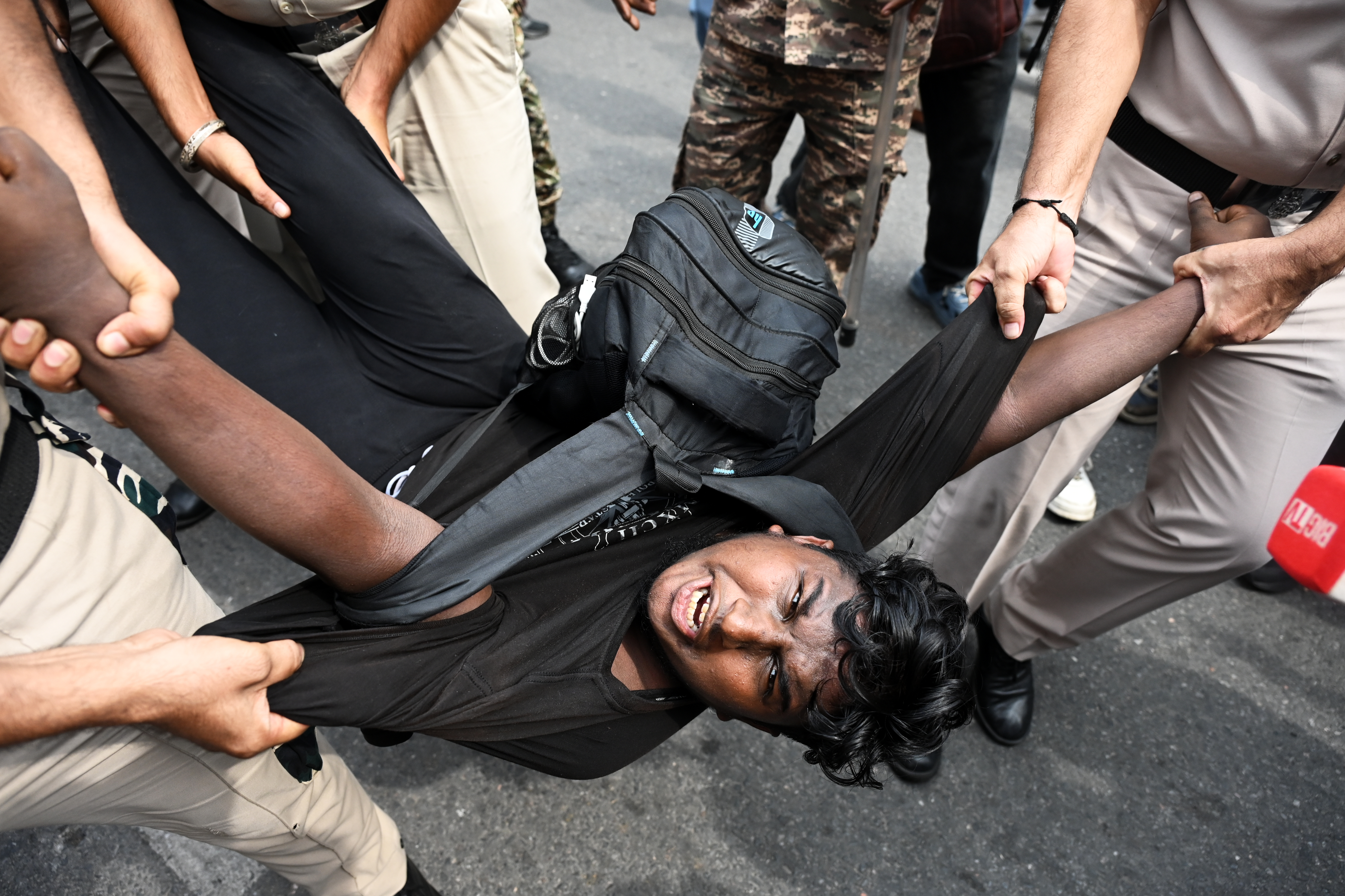
    NEW DELHI — Leaders of a popular Indian youth movement vowed to continue protests Sunday after being released from detention, a day after police cracked down on demonstrations against a controversial revision of voter lists. The movement is demanding the resignation of the country’s election chief.

    The protests were triggered after authorities removed more than 130 million voters from the list since last year. Critics say the move is politically motivated. Prime Minister Narendra Modi’s ruling Bharatiya Janata Party and the Election Commission deny manipulation allegations.

    The Cockroach Janata Party’s three leaders — Abhijeet Dipke, Saurav Das, and Ashutosh Ranka — were freed on condition that they commit “no breach of peace for one year,” Ratna Singh, the movement’s legal director, said in a social media post. It was unclear what the condition meant or whether it would restrict their participation in protests.

    Police boarded the leaders’ flight from Mumbai after it landed in New Delhi on Saturday and took them into custody as they prepared to lead a demonstration in New Delhi.

    After his release, Dipke called Modi “an embarrassment to India.”

    “Never has this country seen a bigger coward and bully,” he wrote on X.

    Das, a spokesperson for the movement, urged supporters to take to the streets. “A situation has been created where the state is at war with its own citizens,” he told reporters Sunday.

    Following Saturday’s protests, authorities launched a sweeping security crackdown in the capital, detaining more than 2,000 protesters, including several opposition lawmakers. Train services to the capital were canceled, metro stations closed, and mobile internet suspended in parts of the city.

    Most of those detained were released late Saturday, police said.

    Small groups of protesters returned to the Indian capital on Sunday, staging marches across the city. The police quickly broke up most of the demonstrations, detaining some protesters again.

    Protesters are demanding the resignation of Gyanesh Kumar, the chief election commissioner. Modi’s party has said the voter revision is needed to eliminate duplicate and ineligible entries.

    The Cockroach movement began as an online satirical campaign this summer after India’s chief justice compared unemployed young people to parasites. Many young Indians embraced the remark, adopting the cockroach as a symbol of resilience.

    Protests led by the group forced the resignation of Modi’s education minister in July, a rare setback for the prime minister, who has been in power for more than 12 years.

  • Trump’s Medicaid cuts strip refugees and other legal immigrants of their health coverage

    Trump’s Medicaid cuts strip refugees and other legal immigrants of their health coverage

    New restrictions have stripped Medicaid coverage from certain legal immigrants, including refugees and victims of human trafficking, as part of broader federal changes to the health insurance program that are expected to force millions off their coverage.

    The change effective Oct. 1 cut from Medicaid what is estimated to be hundreds of thousands of people who legally immigrated to the United States, many of whom work and pay taxes, in the latest Trump administration policy to target foreigners.

    The move is part of sweeping changes to Medicaid under President Donald Trump’s 2025 tax cut and policy law, with many set to take effect early next year. The Medicaid changes are projected to result in 7.5 million fewer people with health insurance, according to the Congressional Budget Office’s 2025 estimate.

    Advocates say that without Medicaid, people will not be able to afford private insurance and will either delay care or end up in emergency rooms, adding pressure to a strained health system. For immigrants, the cuts could be felt more acutely, compounding the effects of other administration efforts to restrict their access to public assistance as part of a broader immigration crackdown.

    “This is about telling every immigrant in the United States that they are not welcome here and that they should leave,” said Ben D’Avanzo, a senior strategist at the National Immigration Law Center, which has pursued litigation against the Republican administration over its immigration agenda.

    Refugees, asylum seekers, and victims of human trafficking and domestic violence are among those who have lost coverage. Green-card holders were not impacted.

    Lauren Bis, a White House spokesperson, said in a statement that “immigrants must be able to support themselves without taking from overburdened benefits programs paid for by hard-working American taxpayers.”

    D’Avanzo said many people who have lost coverage will likely only realize it when they need medical care. But for some, the change has been felt immediately.

    Dwindling supplies of lifesaving medication

    In Tucson, Ariz., María Chacon has been caring for her son Jesus for almost five years since a car accident at 17 left him unable to breathe on his own. He requires a ventilator, a feeding tube, and daily medication, and must be turned once every two hours to stop sores from forming. Chacon said he sometimes opens his eyes.

    The family is originally from Mexico and entered the U.S. on a T visa, offered to victims of human trafficking, in 2018.

    Chacon said Medicaid has helped cover almost $25,000 per month of care for her son, which includes a small stipend for her and her husband as compensation for being long-term caregivers. She said doctors have explained that even if they both worked 24 hours a day, they would not be able to cover the cost of his care.

    “Since that day I haven’t been able to sleep. We haven’t been able to eat or anything. We’re wondering what we’re going to do?” Chacon said.

    Jesus takes medication that Chacon estimates costs $7,000 a month. The supply runs out in mid-October. Without coverage, she does not know how her son is going to survive.

    Chacon found out just days before the cuts that she was losing care. She called the state’s Medicaid offices to appeal. Although she is in the process of obtaining a green card, Medicaid coverage would only kick in five years after she is approved.

    Steven Camarota, research director for the Center for Immigration Studies, a right-leaning think tank that seeks less immigration, said the administration “is trying to nibble around the edges” with the Oct. 1 cuts, finding piecemeal ways to curb immigration into the U.S.

    Camarota believes the government should screen legal immigrants for income potential and education, reducing the number who might rely on public benefits once they cross the border.

    “You need immigrants who are unlikely to need welfare,” he said, or those with high educational attainment.

    The administration recently revived a federal rule that could deny green cards to immigrants who use public benefits that could include food stamps, Medicaid, housing vouchers, and others.

    Chacon believes the cuts to Medicaid coverage are part of the administration’s clampdown on immigrants. She said her son is in no condition to travel.

    “I know that’s what he’s doing, but, as my son is, I couldn’t go to Mexico,” Chacon said.

    Millions more will be dropped from Medicaid

    Medicaid, jointly funded by states and the federal government, has become a political focal point during Trump’s second term. The president has pushed to root out what he describes as fraud in the program. In July, the administration deferred over $1 billion in Medicaid payments to California and Minnesota, claiming there was suspected fraud; critics argued the move targeted Democratic-led states.

    As more people are cut from Medicaid, the federal government is predicted to reduce program spending by $911 billion, according to healthcare research nonprofit KFF.

    In Arizona, officials said 29,000 legal immigrants were cut from Medicaid rolls on Oct. 1. In Florida, estimates are closer to 177,000. Overall, more than 281,000 immigrants from nine states and the District of Columbia are estimated to lose Medicaid coverage, according to KFF.

    As more states implement various restrictions to coverage, 7.5 million people are expected to lose coverage by 2034, according to analysis by the Congressional Budget Office.

    Without coverage, people will turn to emergency rooms for care. When people delay seeing a doctor, conditions can worsen and become even more expensive to treat.

    “At the end of the day, it does raise the cost for the states because once you get these people in for something that could have been prevented, they could not go to the doctor because they were uninsured; they most likely will end up at a hospital in an emergency room,” said Carmen Feliciano, the vice president of policy and advocacy at UnidosUS, a Latino civil rights organization.

    UnidosUS partners with community organizations to help provide medical care, but Feliciano said they already are overwhelmed and would not be able to support the number of people who are going to lose medical coverage in the coming months.

    “We are not going to have the capacity to serve all the people who need it,” Feliciano said.

  • America’s elected officials are living in fear

    America’s elected officials are living in fear

    In January, a caller began leaving threats in the voicemail inboxes of members of Congress: “I want to see their throat cut from ear to ear.”

    Another caller left a blunt threat for a U.S. senator: “I’m going to murder you, and I’m going to start with your children.”

    A state attorney general received this three-word missive: “Bang, bang, bang.”

    Serving in public office in the United States is dangerous. From state and local government to Congress, an unending river of violent threats is washing through the mailboxes, offices, voicemail, and texts of those who govern the nation. Thousands of public servants are living, working, and, in the final weeks of election season, campaigning in a state of fear.

    And it’s getting worse, officeholders said in dozens of interviews.

    An investigation by the New York Times examining hundreds of records obtained through Freedom of Information Act requests, court documents, and law enforcement logs has found that, over a two-year period from 2024 to August of this year, thousands of violent threats inundated the lives of elected officials in unprecedented ways.

    Some threats were vague; some were frighteningly specific. They promised torture, stabbing, rape, and murder. They aimed at Republicans and Democrats alike, and at a range of officeholders from county clerks to U.S. senators. They targeted spouses, parents, siblings, and children.

    At least 44 governors, as well as their staff members and families, have been subjected to violent threats over the past two years, the Times’ investigation found. That’s also true of at least 70 of the nation’s 100 senators, and at least 185 members of the House of Representatives — nearly half the body. More than half of the country’s secretaries of state, most of whom serve as their states’ chief election officers, have received threats of violence.

    Actual violence also spiked during that period: assassination attempts against President Donald Trump, the killing of Charlie Kirk, the assassination of a legislative leader and her husband in Minnesota, the firebombing of Gov. Josh Shapiro’s home in Pennsylvania. For many elected officials, the escalation is a grim testament to the toxicity of violent rhetoric and how it can shake the country’s democratic institutions.

    The threats have also reshaped private lives. Dozens of officials have fortified their homes, installed cameras, and hired private security guards, often at their own expense. They’ve changed their daily routines, moved their children to new schools, grocery-shopped only at certain times and places. They’ve scrubbed the internet to remove personal information about themselves and their loved ones.

    Some of them have altered what they say in public and, in rare cases, how they govern. Some, including members of Congress, have quit. Both parties have struggled to recruit candidates, especially women.

    And policing violent threats against officials is a difficult task. The Times’ review of federal court data from the past two years found only 53 cases in which individuals were charged with threatening public officials, excluding the president.

    Vague state and federal laws and free speech protections can make prosecution challenging. Anonymous letters and screen names can be hard to track. The sheer volume of threats can make hunting down those responsible virtually impossible.

    This new normal can also be measured in dollars spent. In the 2017-18 election cycle, candidates for federal office spent roughly $6 million on security-related items, according to campaign finance records. In the current midterm cycle, candidates had already spent at least $25 million by Aug. 1, with the final general election sprint still to come. That excludes what many officials are spending from their own pockets.

    Overall, the threats tallied by the Times are likely undercounts; state laws and communication policies bar many offices from disclosing security issues. Many members of Congress said privately that it was hard to imagine any remaining offices on Capitol Hill that have not experienced a violent threat this decade.

    The rhetoric is abetted by the anonymity of the internet, a polarized political landscape, and the entrenched public opinion that politicians are not improving American lives. Those receiving threats include divisive figures who have juiced the increasingly belligerent tone of political rhetoric, as well as others who avoid inflammatory talk but are targeted for their policies, ideology, or party affiliation.

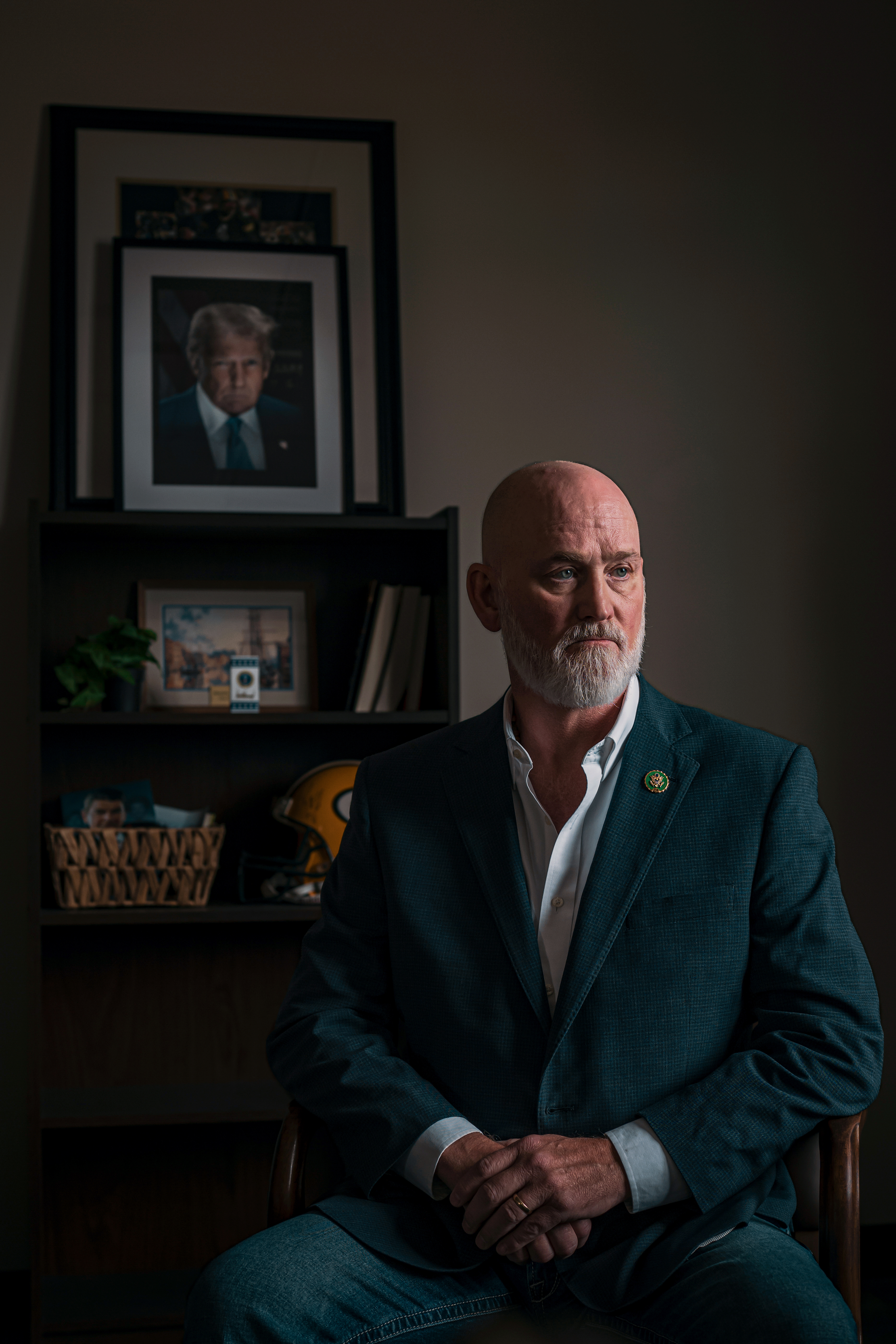
    Rep. Derrick Van Orden (R., Wis.), who is seeking reelection next month, attended the “Stop the Steal” rally on Jan. 6, 2021, in support of Trump’s false claim that he had won the 2020 election. Van Orden was outside the U.S. Capitol that day when a mob attacked it, though he has denied entering the building. He was elected to Congress in 2022.

    That’s when the threats began.

    “I was a Navy SEAL for over 22 years,” Van Orden said in an interview with the Times. “I hunted terrorists around the world a lot and was very successful at that. Never had a single threat to my family. Ever.”

    Now, Van Orden travels with armed security personnel. His family, he said, is “protected 24 hours a day.”

    ‘What are the risks and what is the reward?’

    For much of her political career, Marjorie Taylor Greene, a former Republican House member from Georgia, injected herself into the most pitched political battles. Her liberal foes said she courted controversy to raise her profile. But her rapid rise also came at a cost.

    What started out as a flood of threats primarily from the left evolved into menace from the right, too, after Greene’s break with Trump last fall.

    Greene’s dispute with the president centered largely on Jeffrey Epstein, the sexual predator who eventually killed himself in jail. Like many on the far right, Greene had agitated for the release of government files pertaining to Epstein. Then she began agitating directly against the president she had once fawned over, when his government refused to do so.

    Her disillusionment expanded after Trump took the country to war against Iran. She believed his tariff policies and curtailment of health subsidies were hurting her constituents in rural northwest Georgia, she said, and flouting his promise to put “America First.”

    Her breaking point came after the president called her a “traitor.” Of the torrent of threats that followed, one stood out. It was aimed at her son.

    “That’s the one that bothers me on a visceral level,” she said.

    Greene reached out to Trump, hoping for compassion from a president she had stood by for years. She forwarded copies of the threats to him, hoping that seeing the threats against her family would be enough to tone down the attacks.

    She got a five-word reply from the president: “Your fault, you deserve it.”

    Weeks later, Greene announced her retirement from Congress.

    “I looked at what are the risks and what is the reward,” she said. “And for me, it was, I’m not going to be treated that way, and I’m not going to have my children’s lives threatened.”

    A White House spokesperson, Davis Ingle, did not deny the contents of Trump’s text, but he said Trump condemned political violence.

    “Having survived multiple assassination attempts — and having seen his dear friend Charlie be assassinated last year — no one understands the dangers of political violence more than President Trump,” he said, referring to Kirk.

    Women are often more aggressively targeted than men, and harder to recruit, said Greta Neubauer, the Democratic minority leader in the Wisconsin state Assembly. Mothers are more apt to avoid the risk to themselves and their families, she said.

    If potential recruits don’t bring up fears of violence on their own, Neubauer does. “There is an amount of risk that you and your family are going to need to accept if you choose to do this,” she regularly says to potential candidates. “And we want to make sure that you are fully aware of that in advance.”

    Minnesota Gov. Tim Walz, a Democrat, nearly walked away, too.

    He was inundated with violent threats after Kamala Harris, then the vice president, selected him as her running mate in 2024. But it was the assassination of two close friends, former Minnesota House Speaker Melissa Hortman and her husband, Mark, in June 2025, that led Walz to question his resolve to keep going.

    The tragedy also altered Walz’s daily life. His security team was on increased alert. He felt helpless to protect state lawmakers who felt exposed and unsafe after losing one of their own.

    “We’re a part-time legislature,” Walz said. “These folks go back home and teach school, run their business. They’re dentists. They’re nurses. They do all those things. How do you follow them in the nine months they’re not here?”

    When families are targets

    A former CIA analyst and Defense Department official, Sen. Elissa Slotkin (D., Mich.) had been trained to deal with a variety of “threat environments.”

    Her family had not. So when political foes started targeting her parents, including an ailing father, Slotkin couldn’t shield them from a toll they had not invited.

    Last November, Slotkin joined five others in a video telling U.S. soldiers that they did not have to follow unlawful orders.

    The message infuriated Trump, who described it as “seditious behavior from traitors” and “punishable by death.” Conservatives labeled the lawmakers the “seditious six.” The threats poured in — especially to Slotkin, the one who had posted the video on social media platform X.

    The Capitol Police assigned round-the-clock shifts to protect her. What they couldn’t prevent: her parents’ home being swatted in the middle of the night. Her father, 81 at the time, was dying of cancer when someone called local police with a false report that a man was killing his wife at the couple’s address.

    The senator’s brothers put security details in front of their homes. Staff members temporarily moved out of theirs. Her father died just a few weeks after police came to his door.

    “I signed up for this, but my family and my staff did not,” Slotkin said.

    Threats to family and staff feel more chilling, several officials said, and the effects are often more disruptive.

    “My daughter just sent me one yesterday,” Walz told the Times, “where somebody said, ‘Wait what I’ve got in store for you — and then a picture in front of the house.”

    Van Orden moved his family because of violent threats. “I know exactly what these people are trying to do,” he said. “To make me leave the public square through threatening my family, because they know threatening me has no effect at all because of my background.”

    Many officials cite a desire to improve their country for their children and grandchildren as motivation for seeking office. The deluge of threats has done the reverse, pushing the civic-minded out of the public square to shield their loved ones from an increasingly toxic world.

    Carly Koppes, a Republican county election official in Colorado, saw a new kind of violent threat after her pregnancy became public: messages targeting both her and her unborn child.

    The challenge of staying safe

    Rodric Bray, the Republican leader of the Indiana Senate, drew critics, but rarely threats, after he became a well-known power broker in Indianapolis — until his chamber bucked Trump’s push to eliminate the state’s two remaining Democratic congressional districts.

    Amid headline after headline about the intraparty disagreement, threats of violence overwhelmed the staid political atmosphere of the Indiana Statehouse. Bray became the main target.

    Bomb threats were called into his office. Death threats, too. “They were very short,” he said. “Just saying, ‘I’m going to come down there and kill you.’” Same with messages about his house. “Just, ‘There’s going to be a bomb mailed to your house,’ or ‘There’s been a bomb placed at your house.’”

    Bray said he forced himself into a stressful state of high alert. He changed his daily routine. He talked with his family about staying “extra vigilant” around the house and away from home. Friends kept watch. Once, law enforcement noticed something suspicious on his patio, alarming neighbors and keeping family away until it was cleared.

    Koppes said she, too, changed her hours and took different routes to work after learning that some threats against her had come from a man living directly across from her office. “Good day War Criminal,” one of them read. “You traitor guilty of treason and sedition; oath breaking piece of trash loser, you should get gang raped.”

    Shenna Bellows, the Democratic secretary of state in Maine, and her husband moved out of their home after law enforcement told her it wasn’t safe to stay. Bellows, Maine’s chief election officer, had been receiving threats at least since 2020, when Trump and his allies convinced thousands of his supporters, without evidence, that the election that year had been rigged.

    Bellows was swatted in 2023, a day after she removed Trump from the state’s presidential primary ballot under the U.S. Constitution’s insurrection clause. She later reversed herself after a court ruled against a similar measure in Colorado, but the threats kept coming.

    In January, someone posted her cell phone number and other personal information online. Menacing voicemail and text messages poured in. Her social media was inundated. “Shenna bellows I’m coming for you,” one person wrote, adding profanity. “Beheaded soon.”

    Gina Hinojosa, a Democratic member of the Texas House of Representatives, was out of state when an activist posted a picture of her home online. She urged her family to move in with relatives.

    “It was a feeling of being hunted,” she said.

    Now the Democratic candidate for governor in Texas, Hinojosa has installed new fencing and other barriers at home “so that we’re just not as easily accessible, we’re not as easily seen.”

    Officials are also buying guns. Jennifer Johnson, a county judge in rural Florida, recently purchased one and enrolled in a firearms course after an animated video of her being murdered circulated online.

    Security equipment has become a huge expenditure for officeholders. Much of it has come on Capitol Hill, where, in the wake of the Jan. 6 riot, threats of violence spiked dramatically.

    J. Thomas Manger took over as chief of the Capitol Police in 2021. He more than doubled his roster of investigators. Offices were fortified and modernized. Furniture was scrutinized and rearranged. District offices across the country got security assessments.

    The House’s sergeant-at-arms, who oversees security in that chamber and helps govern the Capitol Police, spent more than $28 million in 2025, the second most in recent history, according to congressional records.

    Among the expenditures: $1.8 million on an alert system, and more than $200,000 on a gunshot detection system.

    By the time Manger retired in May 2025, the volume of threats had gotten worse, he said.

    One reason is the difficulty of mounting prosecutions, which reduces the deterrent effect, he said. Fewer than 10% of the cases Manger’s team investigated in 2021 led to criminal charges, he said.

    Some of that is due to mitigating circumstances such as a lack of a criminal record or mental health struggles. Some of it results from the use of diversion programs such as counseling.

    Making a threat is also a tricky crime to prosecute. Explicit death threats against members of Congress are illegal, but some stop short of that line and are ruled menacing, not explicit.

    “One member got a photograph, an actual physical photograph, mailed to them, and it was a photograph of their, I think it was an 8-year-old child walking a dog in their neighborhood,” Manger said. “All it said on it was ‘cute dog.’”

    Some officeholders don’t control government purse strings. State lawmakers, election officials, council members, and school board officials are often left to fend for themselves.

    Hinojosa said that almost every fortification she had undertaken had come at personal expense.

    Threats have remade how candidates run for office. Outdoor events are increasingly rare. Sweeping event spaces is a regular part of campaign advance work. Metal detectors and frisks are common. Many candidates have a security official in their inner circle.

    Such measures have made candidates feel isolated, yet the public has taken notice.

    For some, at a certain point, it all becomes too much.

    Greene recalled that her feud with the president came shortly after the assassination of Kirk. That made the subsequent deluge of threats more personal and more frightening.

    “I said, you know what? This is just not worth it for me personally,” she said. “I’m a very happy person without being in Congress. Much happier actually. And probably a lot safer.”

    This article originally appeared in the New York Times.
  • Eagles grades vs. Jaguars: Jalen Hurts, defensive line give Birds a chance before a late collapse

    Eagles grades vs. Jaguars: Jalen Hurts, defensive line give Birds a chance before a late collapse

    Instant grades on the Eagles’ performance in their 19-17 loss to the Jacksonville Jaguars:

    Quarterback: B

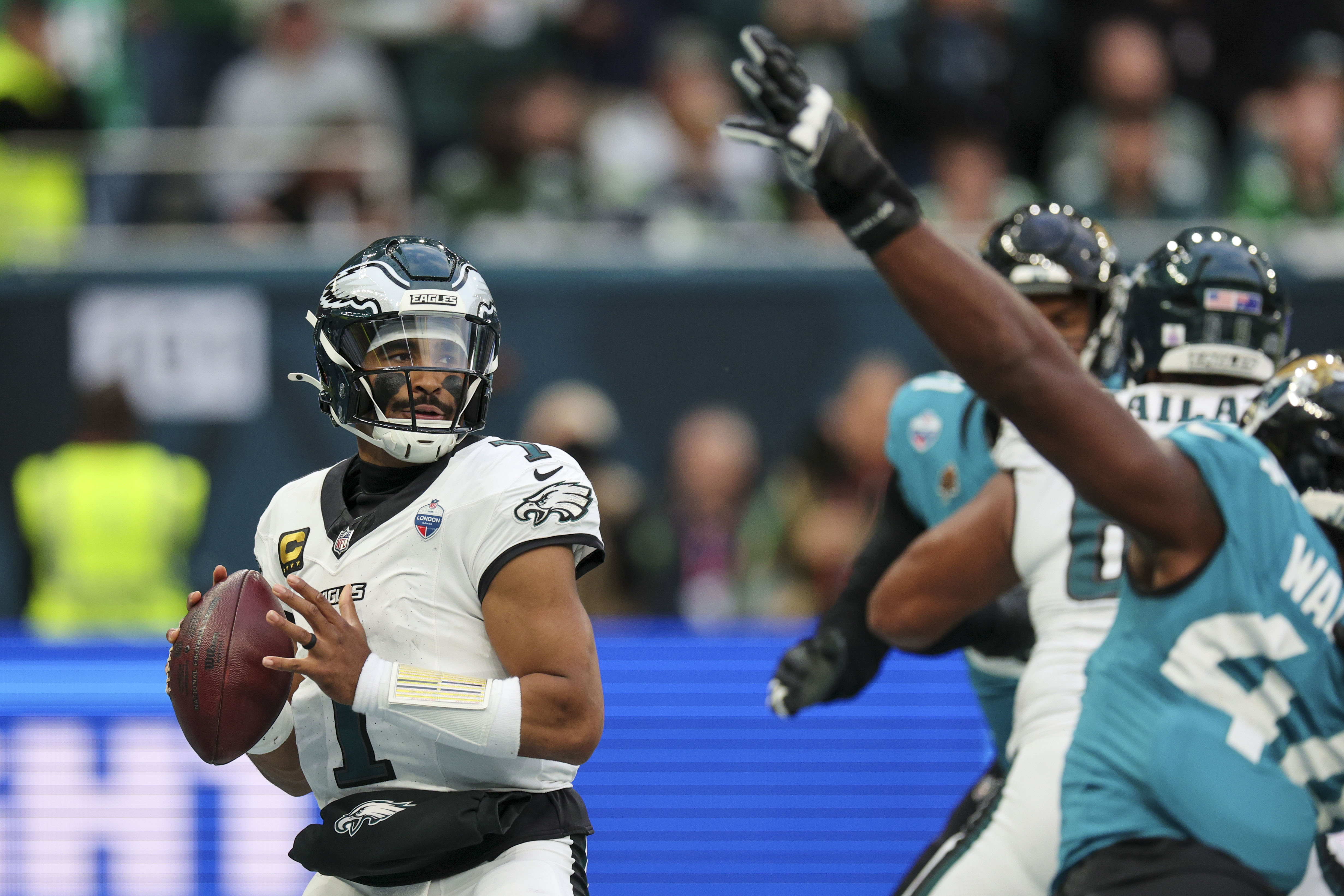
    Jalen Hurts showed gumption despite all the injury issues the Eagles had on offense. He should have had another comeback, game-winning drive, but misfortune occurred on the ensuing kickoff with 8 seconds left. Hurts completed 21 of 40 passes for 220 yards and a touchdown. He again avoided a turnover.

    Hurts had some shaky moments, though. He took a third down delay-of-game penalty in the third quarter and then just missed hooking up with a wide-open Dontayvion Wicks on a busted coverage after the Jaguars zero blitzed the quarterback.

    In the second quarter, Hurts tossed a dime to Darius Cooper on third-and-10 and his receiver did the rest on a 62-yard touchdown reception. He had a nice 11-yard gain off a play-action pass and beat the blitz on two long third downs later on the Eagles’ first touchdown-scoring drive.

    Tanner McKee was the backup quarterback for the second straight week and likely moving forward after Andy Dalton was released on Friday. The Eagles went without an emergency third quarterback. Rookie Cole Payton was therefore active for his first NFL game as a non-quarterback. He played on special teams as the “up” back during punts.

    Running back: D

    It was another tough day on the ground. Will Shipley got his first NFL start with Saquon Barkley (hamstring) and Tank Bigsby (on injured reserve after core muscle surgery) sidelined. Dameon Pierce and Carson Steele were signed off the practice squad as a result of the injuries and backed up Shipley.

    Shipley ran 2 yards into the end zone for his first career regular-season rushing touchdown. He ran for only 6 yards on five carries, though, before leaving with a foot injury in the second quarter.

    Pierce ran for 6 and 5 yards on his first two carries. He had a bad exchange with Hurts that resulted in a 5-yard loss in the second quarter. Pierce maybe should have cut upfield on a third-quarter run that was stretched for no gain. He ran hard, but rushed for only 14 yards on 11 carries.

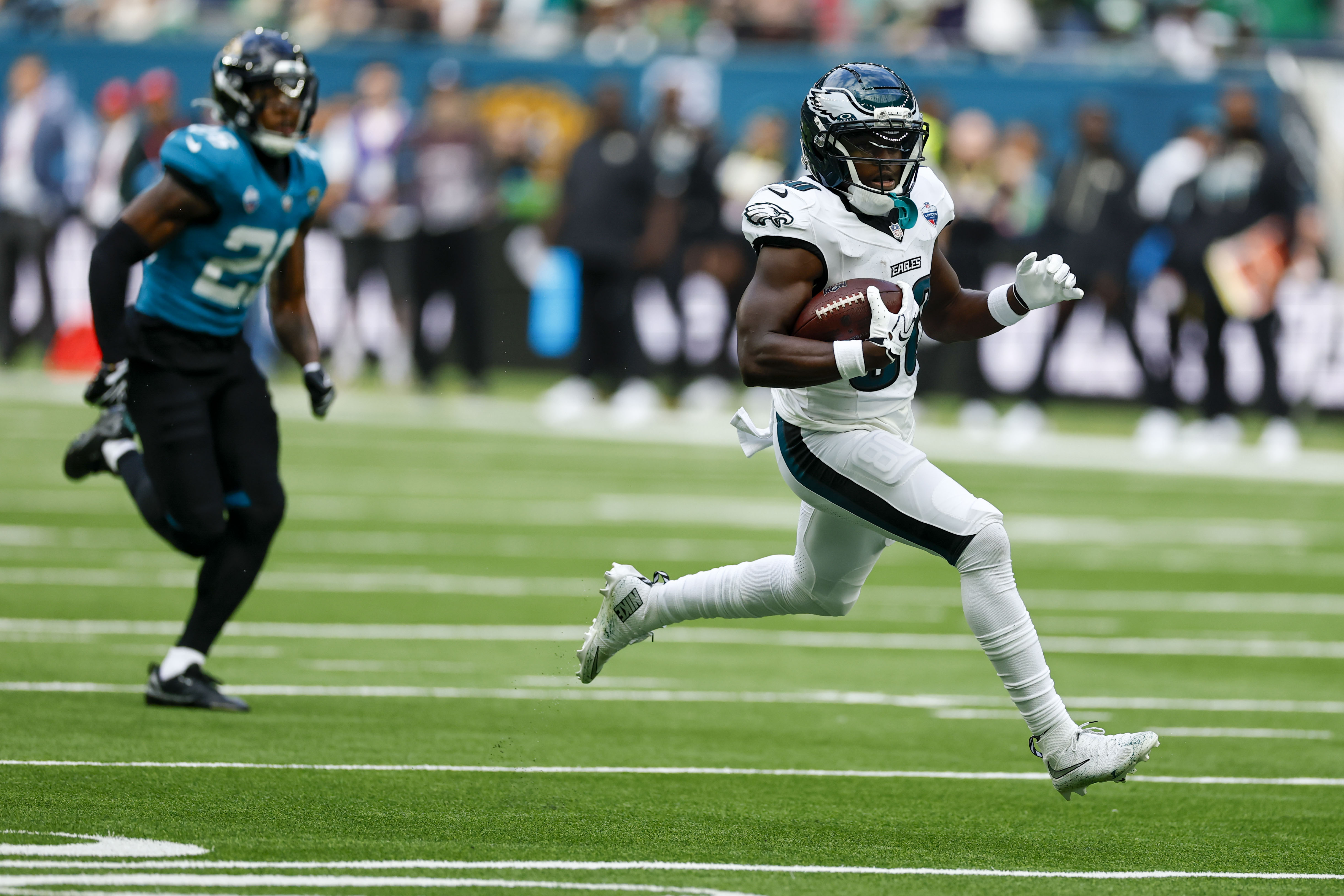
    Philadelphia Eagles wide receiver Darius Cooper caught a 62-yard touchdown on Sunday, his fourth of the season.Yong Kim / Staff Photographer

    Receiver / Tight end: B-

    Dontayvion Wicks delivered in high-leverage situations again with two third-down conversion catches and another when he drew a pass interference penalty that set up the Eagles’ first score. Wicks managed to get both feet inbounds on a 19-yard pass in the third quarter. But could he have laid out for that Hurts heave in the fourth quarter? Makai Lemon had a nice snag over the middle on an 11-yard catch in the first quarter. Lemon couldn’t pull in a fourth-and-3 throw in the third quarter, but he converted on third-and-10 on the next drive on an 18-yard catch-and-run. He also had a good lead block on a screen pass to Shipley in the first drive.

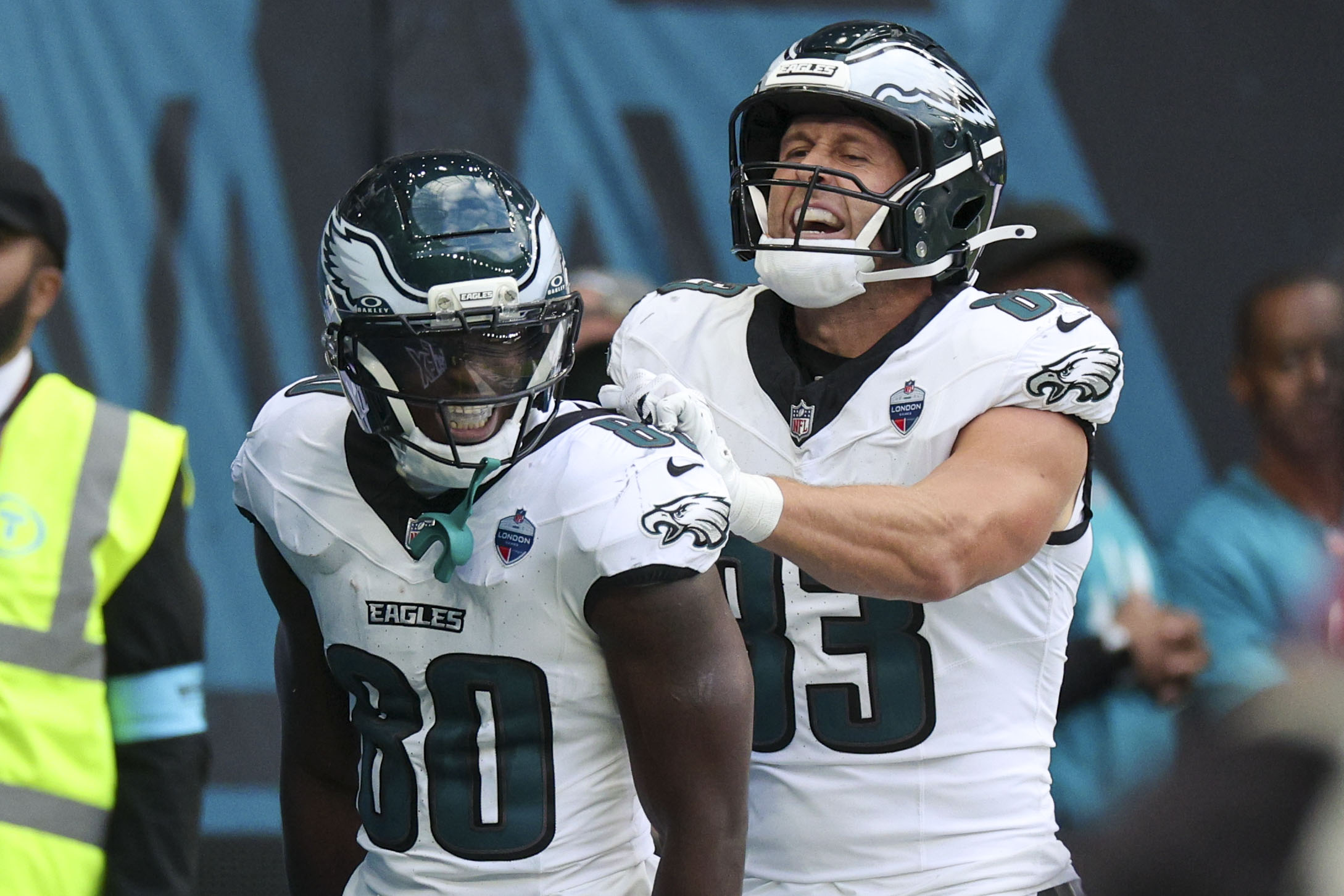
    Darius Cooper toasted his man on third-and-10 and then cut inside the post safety on the 61-yard touchdown. It was his third touchdown catch in two games. He saw only one more target. Cooper committed pass interference with an illegal block in the fourth quarter. Receiver DeVonta Smith missed his second straight game with a hamstring injury.

    Tight end Dallas Goedert was back in action after missing two games due to a MCL knee sprain. He had a huge 17-yard grab over the middle on what was almost the Eagles’ game-winning drive and led the Eagles with six catches for 38 yards. Zach Ertz had zero catches on two targets. Johnny Mundt blocked fine, but struggled at the point of attack on a stretch run in the third quarter.

    Offensive line: C

    It was a game of “who’s not” on the offensive line after a remarkable week that included right tackle Lane Johnson’s retirement and center/guard Cam Jurgens getting traded to the Ravens. The unit was already down left guard Landon Dickerson (knee) and then they lost another starter when center Drew Kendall suffered a knee sprain in the Rams game last week.

    Left tackle Jordan Mailata and right guard Tyler Steen were the only Week 1 starters left. Rookie Markel Bell was in Johnson’s spot for the second straight game, Willie Lampkin was promoted to left guard for his first career start, and Jake Majors was signed off the practice squad to fill in for Kendall.

    Despite all the shuffling, the unit performed admirably. It just wasn’t enough. The O-line still had issues opening holes in the run game and allowed too much pressure at times. It was better vs. the blitz. Lampkin had a crucial lead block on Shipley’s 2-yard touchdown run. Bell had some impressive snaps in pass protection.

    Majors struggled to sustain his block when Shipley was dropped at the line in the second quarter. He also rolled a shotgun snap to Hurts that forced a throwaway on third down in the third quarter, then had another bad snap — this one nearly over Hurts’ head — late in the game.

    Steen injured his shoulder but eventually returned after visiting the locker room. Fred Johnson was his temporary replacement.

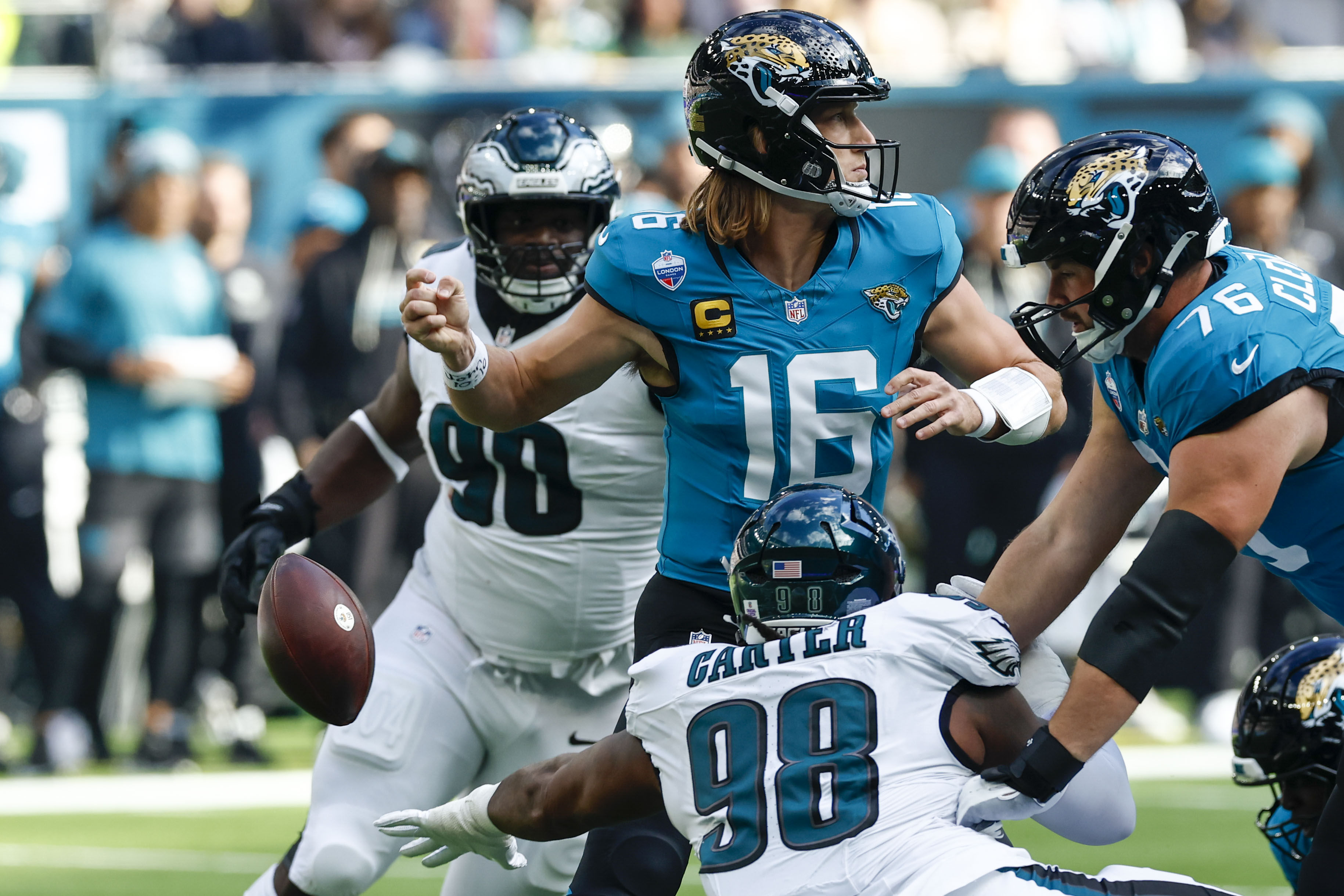
    Eagles defensive tackle Jalen Carter knocks the ball from Jacksonville Jaguars quarterback Trevor Lawrence’s hand as he looks to throw.Yong Kim / Staff Photographer

    Defensive line: A-

    The pass rush, led by Jalen Carter, finally delivered on its potential. The defensive tackle more than earned his paycheck, especially in a dominating first half. He wore a smaller soft cast on his injured right wrist than he had previously.

    Carter got off to a strong start. He drew a holding penalty and strip-sacked quarterback Trevor Lawrence on the Jaguars’ first possession. He recorded another strip-sack a few drives later with a strong outside pass rush. Carter was impressive against the run, too, and had a tackle for loss in the second quarter. Moro Ojomo also got push up the middle.

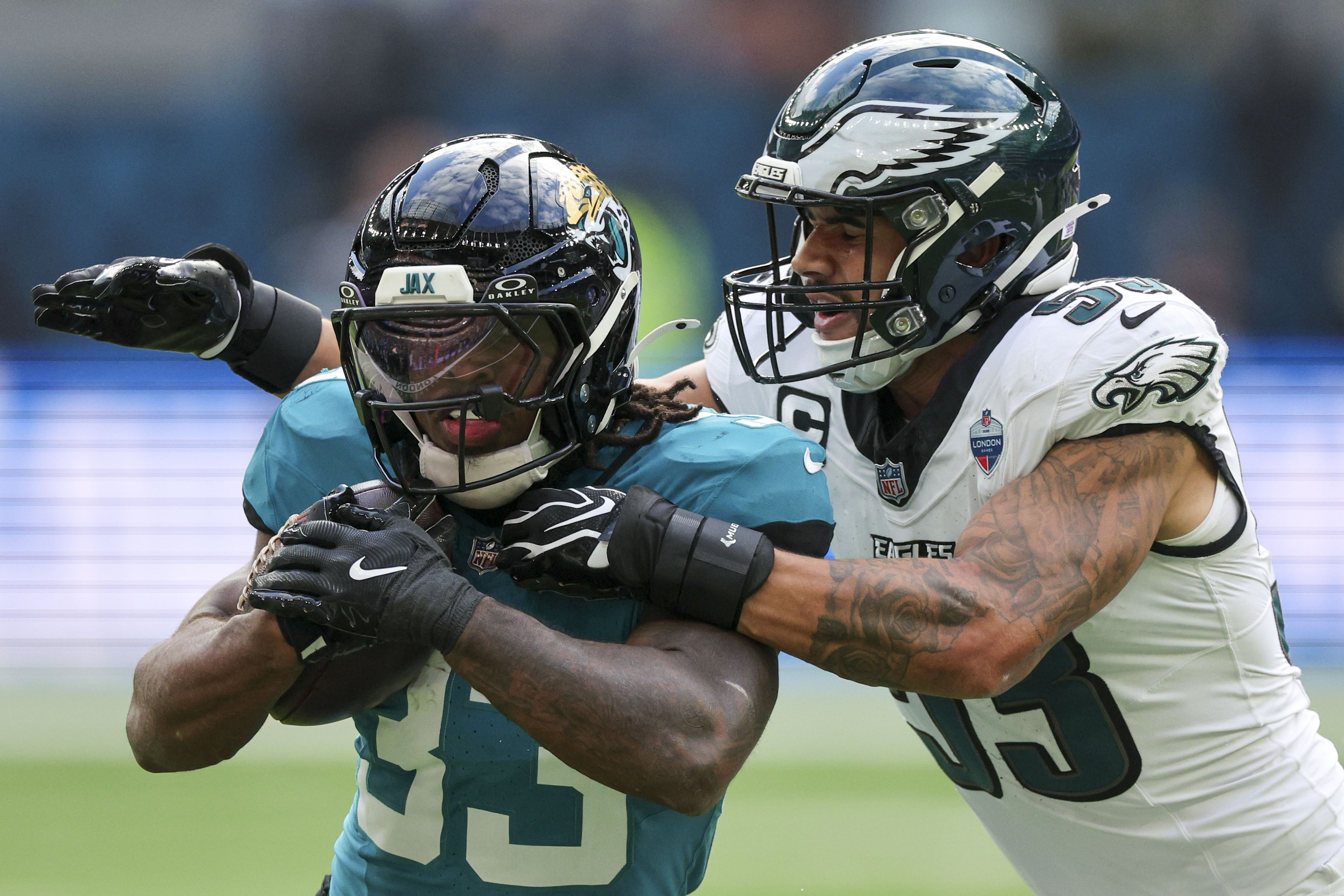
    Jordan Davis led a run defense that held Jaguars running backs to just 3.1 yards a carry. He drew a holding penalty on a run play in the third quarter.

    Jalyx Hunt and Nolan Smith Jr. got pressure from the edges, although neither recorded a sack. Hunt batted down a pass in the second quarter. However, he injured his knee and ankle on the last play of the first half and didn’t return. Smith had a third down neutral zone infraction in the third quarter. Backup edges A.J. Epenesa and Arnold Ebiketie flashed in relief. Epenesa batted a third-down pass late in the game, while Ebiketie was able to blow up a stretch run in the third quarter.

    Outside linebacker Jonathan Greenard had a questionable status despite not practicing all of last week. He tested out his injured ankle before the game, but was inactive for the third of his first five games as an Eagle.

    Eagles linebacker Zack Baun led the team in tackles on Sunday.David Maialetti / Staff Photographer

    Linebacker: B+

    Zack Baun was a menace to the Jaguars, leading the Eagles in tackles. He made a fourth-down stop in the backfield of Tuten on a sweep just before the half. Baun read his keys and made a stop in the flat on a short pass in the third quarter. He forced Lawerence into a throwaway on a fourth-quarter blitz. Jihaad Campbell delivered a nice pop on Lawrence in the second quarter, but couldn’t bring down Tuten on a fourth quarter 13-yard run up the middle.

    Cornerback: B

    Lawrence might have thrown for over 300 yards and tossed a go-ahead touchdown late, but the Eagles secondary didn’t play poorly. Quinyon Mitchell was excellent. He broke up a pass in the end zone just before the half. He made a diving interception in the third quarter for his first career regular-season pick. Mitchell hurt himself on the play, but returned.

    Riq Woolen had tight coverage throughout the day, including on Parker Washington’s dazzling 27-yard touchdown. It was just that kind of day. Cooper DeJean was good against the run with a couple tackles for loss, but not so good in coverage. DeJean got beat on a third-quarter third down and failed to bring down receiver Josh Cameron, who picked up 32 yards.

    Safety: C+

    Andrew Mukuba’s overaggressiveness was the primary reason Parker Washington took a short pass off a play-action bootleg and went 51 yards for the game’s first touchdown. But not a single other Eagles defender laid a hand on the receiver as he weaved his way through the secondary.

    Michael Carter II took all the nickel personnel snaps for a second straight week with Marcus Epps (groin) out. He got dragged past the first down marker by Tuten on fourth-and-2 just before halftime. Carter left after the play with an abdomen injury and was replaced by Kenny Moore. Earlier, Moore took his first snaps with the Eagles as the sixth defensive back in dime personnel.

    Philadelphia Eagles linebacker Jeremiah Trotter Jr. was ejected just 13 seconds into Sunday’s game.Yong Kim / Staff Photographer

    Special teams: D

    Do your one job. After four-plus games of impressive play, the special teams fell apart by allowing a 53-yard kick return after the Eagles went up, 17-16, with eight seconds left. It was unclear initially who might have blown his assignment, but the first kickoff might have been a harbinger for the end. The game got off to a riveting start when it appeared as if a short Jake Elliott kickoff was returned for a 90-yard touchdown. Offsetting penalties nullified the play, but Jeremiah Trotter Jr. and the Jaguars’ Bryan Thomas Jr. got into a fight at midfield that had players from both benches run onto the field. Only Trotter and Thomas were ejected, however.

    Britain Covey, fittingly, had a good start in the country that gave him his first name. He went 18 yards on his first punt return and 42 yards on his first kick return. Punter Braden Mann was solid, per usual, and averaged 46.3 net yards on six punts. Elliott made both his extra points and was so close to being the hero with a go-ahead 48-yard field goal.

    Coaching: C

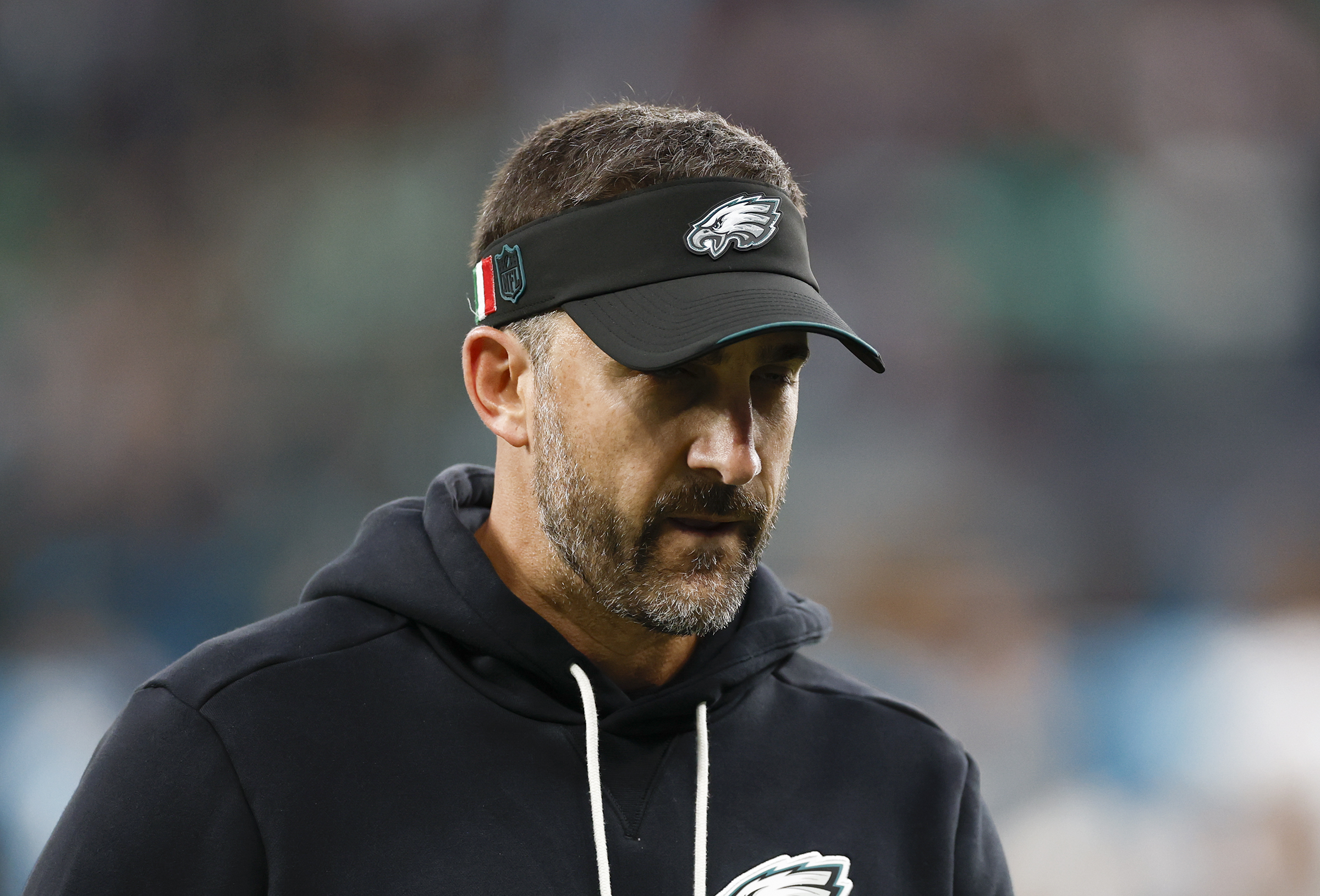
    Coach Nick Sirianni had his team prepared and playing hard till the final whistle despite being severely undermanned. While Liam Coen’s team made mistake after mistake and he made one dumb game-management decision after another, Sirianni and his team were the opposite — until the fateful end. The coach is responsible for all facets, including coordinator Michael Clay’s special teams, but it was a gut-punching way to lose.

    Early in the game, he passed up a 55-yard field goal and went for it on fourth-and-1. Sirianni likely felt he had to be aggressive considering the Eagles’ personnel deficiencies, but it backfired on him. The Eagles ran an inside zone read play from the shotgun — rather than the old standby Tush Push — and Shipley was denied. The Jaguars scored a touchdown two plays later.

    Sirianni did have some dubious decisions late, however, by allowing there to be 8 seconds left on the clock after Elliott’s field goal and not having him kick off into the end zone.

    Sean Mannion has to be graded on a curve with so many key players injured and out. But the first-time offensive coordinator had another questionable play-calling performance coming out of halftime. He probably should have abandoned the run earlier when he realized the Jaguars weren’t going to let the Eagles run the ball.

    But Mannion, ultimately, came through with the game on the line and directed Hurts on what was nearly the game-winning drive. He was notably aggressive in the first half and didn’t settle for a field goal in the second quarter on third-and-17, dialing up a deep post route that forced Jaguars cornerback Travis Hunter tocommit pass interference on Wicks.

    Defensive coordinator Vic Fangio’s unit had almost nothing to be ashamed of. It kept the Eagles in the game despite being on the field far more than the offense. Fangio out-witted Coen for long stretches. He got two huge goal-line stops from his defense.

  • Nick Sirianni: ‘I cost us that game’ after coaching blunders waste a defensive gem in London

    Nick Sirianni: ‘I cost us that game’ after coaching blunders waste a defensive gem in London

    LONDON — The fans showed up. Jalen Carter showed up: two sacks, three tackles for loss.

    The offense? The head coach? The discipline? No-shows, all.

    “What hurts is that you know the guys fought so hard, and then I don’t make the decision that, you know, that I should make at the end of the game,” head coach Nick Sirianni said. “I cost us, that way, that game.”

    True. And false.

    For the third consecutive week the Eagles lost mainly because their offense failed to score a touchdown in the second half. They managed a last-minute, 48-yard field goal to take a one-point lead, but busted kickoff coverage gave that lead right back: a 57-yard, last-second field goal for a 19-17 loss.

    The Eagles could have prevented that runback by kicking the ball out of the end zone.

    They could have left less time on the clock after their field goal; they left 8 seconds. Brutal.

    This lands at the coaches’ feet.

    Sirianni knows it, with linebacker Zack Baun saying afterward, “He told us this was on him. He talks about accountability, so it was cool to see him take accountability.”

    “Yeah, it hurts because, in the sense of the guys fought their [butts] off, and you know had a chance to win the game, and then for me to not make the right decision in that, you feel like you let everyone down,” Sirianni said. “It’s just like you would feel if you missed a free throw at the end of the game.”

    The coverage unit was without Jeremiah Trotter Jr., a special-teams ace who was ejected for fighting during the opening kickoff.

    Discipline, folks.

    It never should have come to that.

    Scoring any points at all seemed a tall task Sunday against a ferocious Jaguars defense. The Eagles are five games into installing a scheme largely foreign to the legacy players on the roster. Further, 60% of their offensive line, their No. 1 receiver and their top two running backs did not play.

    Still, that offense managed 14 points and led by a touchdown at halftime. And then, déjà vu.

    “It’s inexcusable,” quarterback Jalen Hurts said.

    Sirianni was hired in 2021 as the Eagles’ head coach because Jeffrey Lurie and Howie Roseman believed his offensive acumen was sufficient. Two Super Bowl appearances and one Super Bowl title later, incredibly, there is little proof they were right.

    Why? Because after Sirianni lost the offensive coordinators from his Super Bowl staffs, the offenses regressed. Last year it regressed so badly that Lurie and Roseman courted offensive coordinators who would mimic the more complex schemes of Sean McVay and Kyle Shanahan.

    Sean Mannion’s offense stalled after halftime again. Yong Kim / Staff Photographer

    They hired Sean Mannion.

    Things have not gone well.

    “We got to figure out our second-half offense because we’re putting together some nice first-half offense and have a lot of opportunities to put the game away, and we haven’t been able to do that,” Sirianni said.

    If only Nick and Sean had produced like their fans.

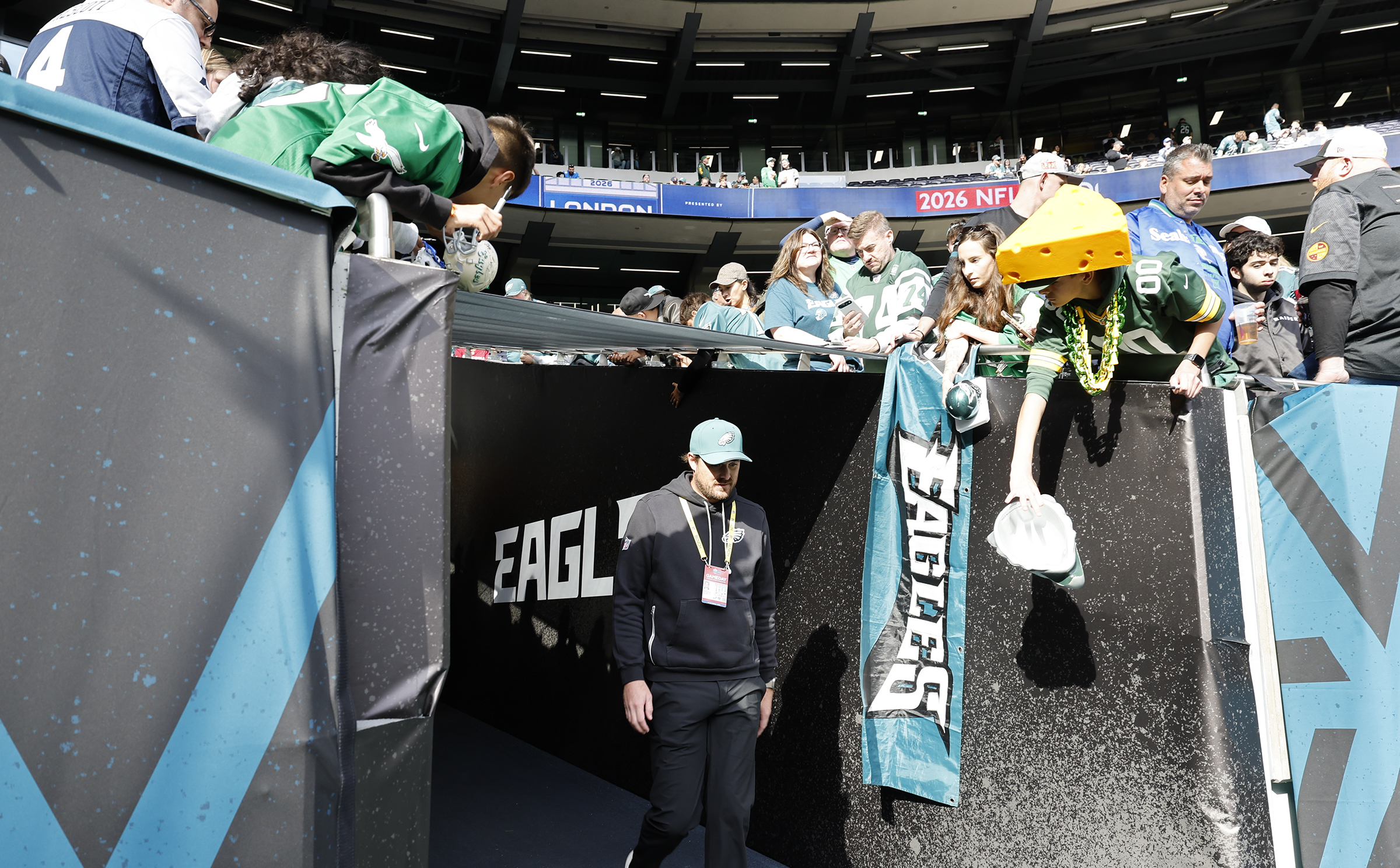
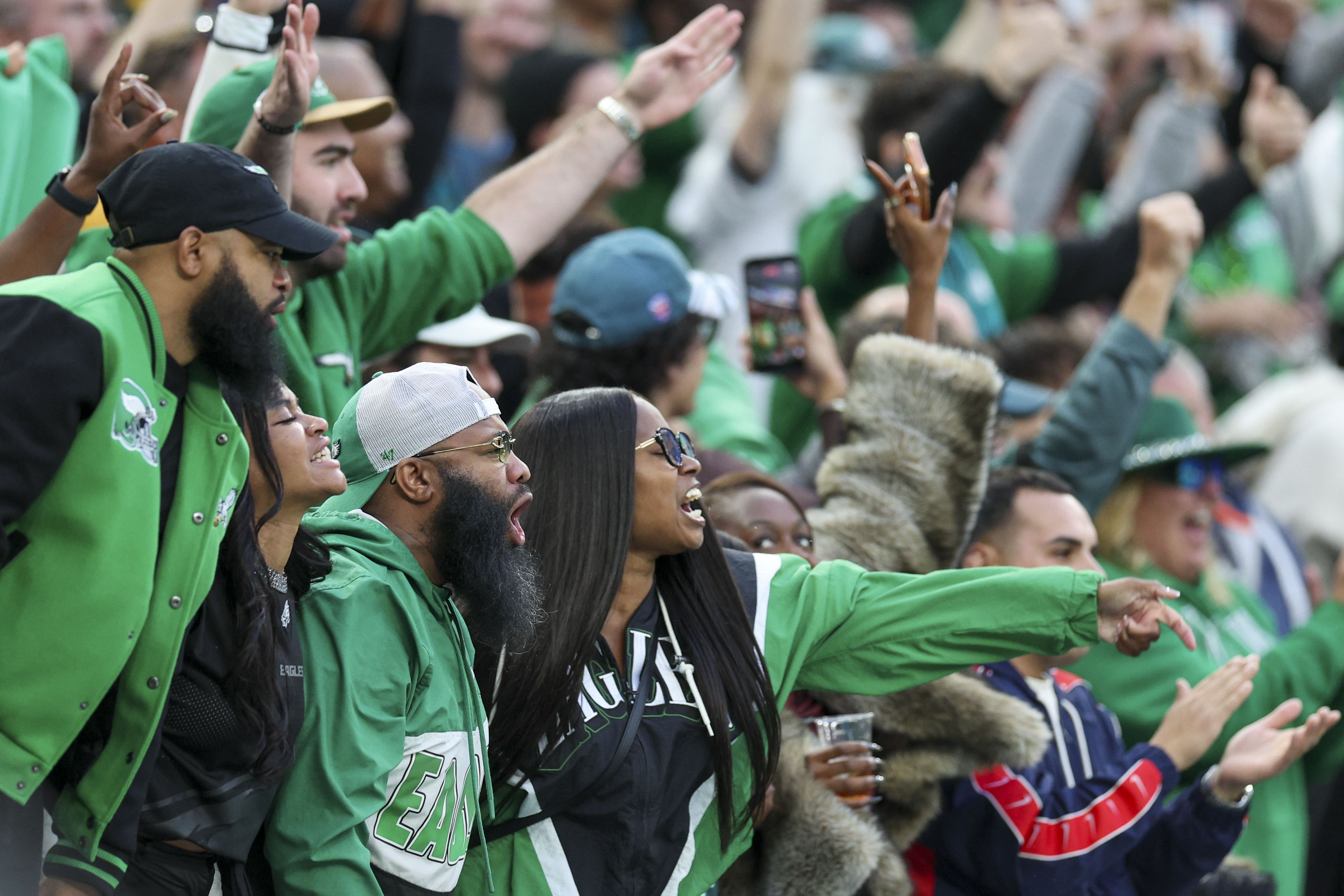
    A record 61,322 fans watched the host Jacksonville Jaguars play the Philadelphia Eagles. At least 61,321 of them were Eagles fans.

    Bird brains took over Tottenham Hotspur Stadium on a cool London afternoon that was a wet Sunday morning back in Philadelphia, where nothing short of a miracle would have delivered a victory to a rag-tag ensemble of football players dressed in Eagles uniforms but with the pedigrees of plumbers, butchers, and small-engine repairmen.

    Eagles fans came out in full force in the U.K. David Maialetti / Staff Photographer

    “I was appreciative of all the Eagles fans that traveled because it was loud,” Sirianni said. “You could see that [the Jaguars] had some issues, you know, handling some of that noise in that game.”

    With the fans in full throat — they caused three delay-of-game penalties — the Jags took six points off the board with two failed fourth-down tries from point-blank field-goal range before they finally converted a fourth down, this time for a touchdown, with 3:20 to play. It was a perfect throw from Trevor Lawrence, and an amazing, one-handed catch by Parker Washington, his sixth catch, second TD, and 124th yard.

    To be fair, the better team with the best chance won.

    Between the jet lag, the five-hour time zone difference, the 9:30 a.m. body-clock start, and the eight players absent due to either transaction or impairment, the Eagles, on a two-game losing streak, never had a chance. They started a left guard who, at 5-foot-11, is the shortest offensive lineman to weigh 290 pounds in NFL history. It looked like a 5-year-old Division III football program had begun to boost enrollment at a small liberal arts school, and, as eight-point underdogs, bookmakers thought so, too.

    It seemed generous.

    The Eagles played without top right tackle Lane Johnson, who retired, and replacement left guard Cam Jurgens, who was traded; running backs Saquon Barkley and Tank Bigsby, replacement center Drew Kendall, left guard Landon Dickerson, safety Marcus Epps, and edge rusher Jonathan Greenard, who were injured; and defensive end Jalyx Hunt and replacement running back Will Shipley, who also were injured before 90 seconds had elapsed in the third quarter.

    Jalen Carter (98) was disrupting against the Jaguars, but it wasn’t enough. Yong Kim / Staff Photographer

    Carter had been hurt, too. He’d fractured his right wrist in Game 1. For the next three games he wore a bulky cast that did not allow him to grip, and he was virtually invisible. He lost the cast and nearly won the game.

    “It’s hard enough to play this game with two hands,” defensive coordinator Vic Fangio said last week. “When you have a cast on one, it’s going to have a negative effect at some point.”

    He strip-sacked Lawrence on the fourth play from scrimmage, which helped force a punt. He strip-sacked Lawrence midway through the second quarter, which again helped force a punt. He tackled running back Bhayshul Tuten twice for losses on the same drive late in the second quarter, though Cooper DeJean got credit for the second TFL. His penetration on third-and-4 from the 4 set up fourth-and-2. He made the initial hit that stopped Chris Rodriguez Jr. on first-and-goal.

    Carter was the best of a fine bunch.

    Baun returned from a concussion and collected 11 tackles. DeJean had 10 tackles. Cornerback Quinyon Mitchell finally got his first regular-season interception in 37 starts, though, as his critics might note, he still hasn’t picked a ball off during the regular season in the United States.

    It was not quite enough.

    Not Sunday.

    Not with Sirianni at the helm.

  • Jason Kelce attempts to remain neutral, Philly fans shine in London, and more from the Eagles-Jaguars broadcast

    Jason Kelce attempts to remain neutral, Philly fans shine in London, and more from the Eagles-Jaguars broadcast

    Bad things come in threes, and the Eagles were handed their third straight loss in a 19-17 defeat to the Jaguars in London, thanks to a game-winning field goal by Jacksonville’s Cam Little as time expired.

    If the 9:30 a.m. kickoff was too early, the penalties made the game unwatchable, or you were one of the many fans who made the trip across the pond for the game, here’s what you missed on an Eagles-Jags broadcast …

    Tip of the cap

    There’s a chance you were still fixing a spot of tea when the game started, thinking you wouldn’t miss much on the opening kick. You thought wrong.

    Jaguars rookie wide receiver Josh Cameron returned Jake Elliott’s kick for a 90-yard touchdown that was called back for a flag on the play. More accurately, it was called back for multiple flags and a couple of hats on the play.

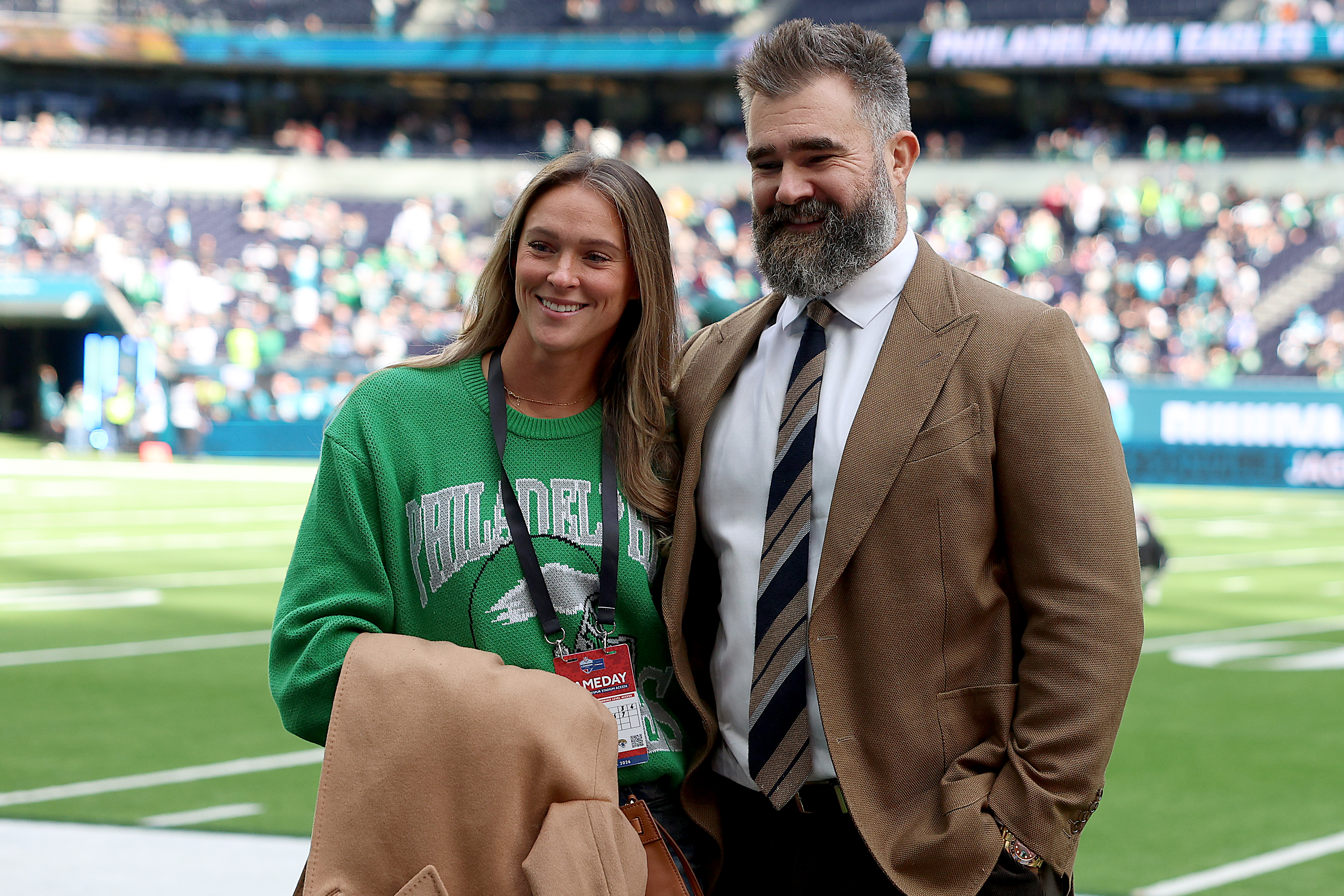
    Once referees throw their flags, they’ll often throw their hats to signify additional penalties, as Jason Kelce and Kurt Warner explained. Kelce and Warner served as analysts for the game alongside Dave Pasch on play-by-play and Molly McGrath as the sideline reporter.

    “This might look like a takeout menu” Kelce said about the list of penalties indicated by the flags and caps.

    Jeremiah Trotter Jr. and Bryan Thomas Jr. get ejected during a wild opening kickoff of Eagles-Jags in London. Unfortunately, we don't get much of a helpful replay to show what happened.

    [image or embed]

    — Awful Announcing (@awfulannouncing.bsky.social) October 11, 2026 at 9:57 AM

    Ultimately, an illegal formation called on the Eagles was offset by a holding on the Jaguars. Additionally, after the play, Jaguars defensive lineman Bryan Thomas Jr. and Eagles linebacker Jeremiah Trotter Jr. were both disqualified 13 seconds into the game for an altercation at midfield during the play.

    And the losses kept coming for both teams. The Jaguars lost long snapper Ross Matiscik, cornerback Montaric Brown, and offensive lineman Anton Harrison to injuries.

    For the Eagles, running back Will Shipley, defensive back Michael Carter II, outside linebacker Jalyx Hunt, and right guard Tyler Steen all joined the already crowded list of injured Eagles, with only Steen eventually returning to the game.

    God Save the King (of Philly)

    In his first Eagles game in the booth, Kelce received mixed reviews on social media for his role as an analyst, but most, especially from Philly fans, leaned positive.

    Kelce, for the most part, kept his promise to remain neutral, calling out Dontayvion Wicks for over-exaggerating to get a call and talking about the Eagles offense’s issues with timing, while also giving props to the Jaguars, including DaVon Hamilton for stepping up as an emergency long-snapper role.

    As a former long snapper in high school, Kelce brought insight into why the role isn’t an easy one to take over on a moment’s notice, a motif the broadcast crew returned to throughout the game. He also provided insight on why the Eagles weren’t opting for the Tush Push on fourth-and-1, with Hurts dealing with a calf injury, and an already thin offensive line.

    Still, Kelce had a few moments where he let the mask slip and showed his true colors: midnight green and white. When Hurts fumbled on a hand-off, Kelce could be heard letting out an emphatic “oh my gosh” to remind viewers where his true allegiance lies. Surely Jaguars fans really appreciated that one.

    But it wouldn’t be a Kelce broadcast without a bit of off-field fun. The longtime Eagles center discussed getting the opportunity to try rugby while in England.

    The 54th-Man

    The chaos from the start of the game wasn’t limited to the opening kickoff — it continued for the duration of the 60 minutes of play, down to the last second in what Kelce called “a wild game.”

    Sunday morning’s game saw 19 penalties enforced, including 13 against the Jags for 100 yards.

    The swarm of Eagles fans that flocked to London for the game were effectively responsible for two of those penalties: a pair of delay of game calls to help hold the Jaguars scoreless on a drive that once saw them with a first-and-goal from the one.

    The Jaguars would get their revenge. After kicking the game-winning, 57-yard field goal in that end zone, kicker Cam Little and the Jaguars returned to the area to then taunt the Eagles fans right back.

    “And what a way to lose for the Eagles,” Pasch said after the kick. “Their third straight defeat.”

  • Justice Department is investigating TV networks over Trump pool coverage

    Justice Department is investigating TV networks over Trump pool coverage

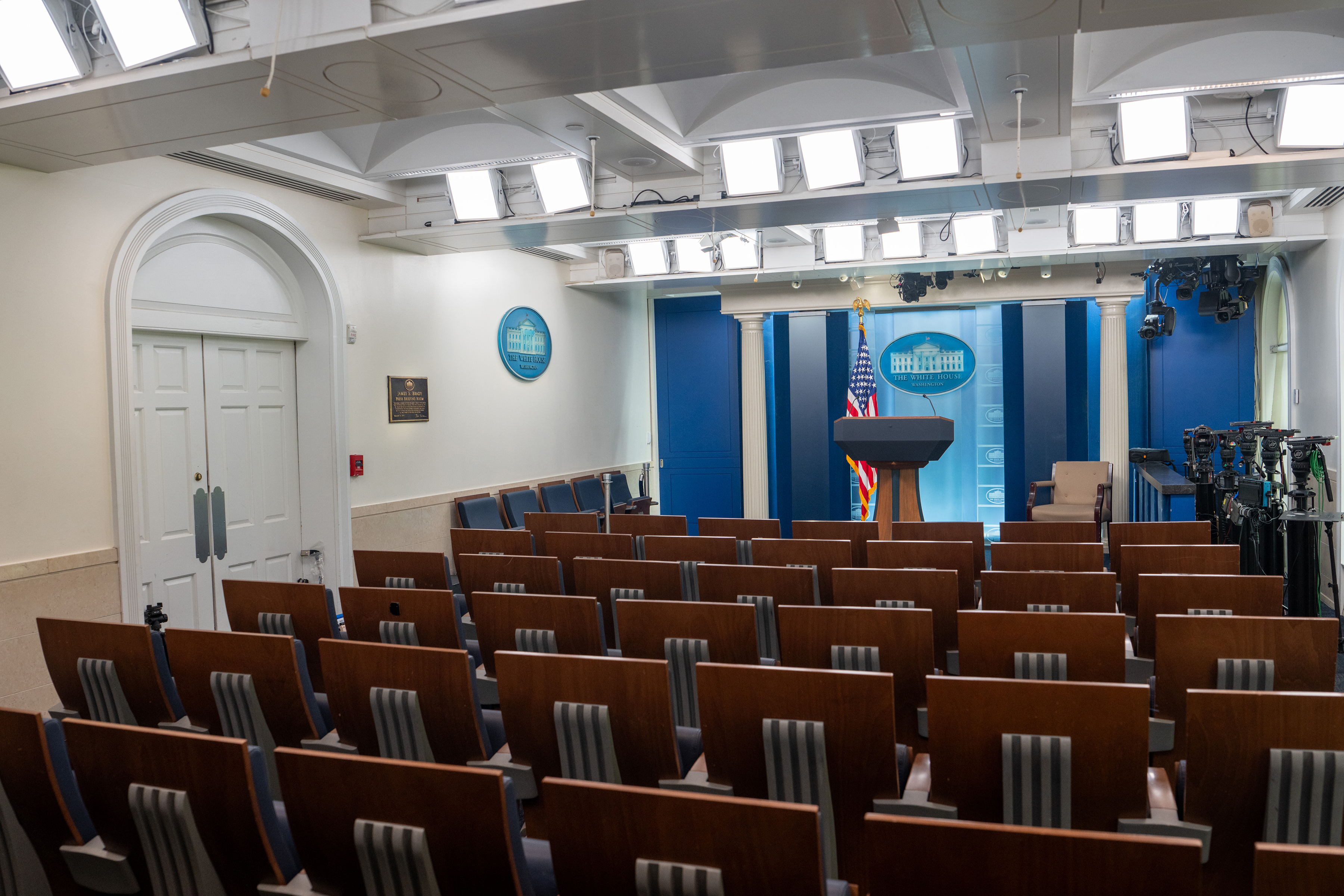
    The Justice Department is investigating whether the major television networks — ABC, CBS, CNN, NBC, and Fox News — violated federal antitrust laws when the group briefly suspended their pooled coverage of President Donald Trump, according to six people with knowledge of the department’s action.

    Officials from the Justice Department contacted networks Friday and demanded communications and materials related to the White House TV pool, the people said. The pool is a long-standing system where the networks share the responsibility of providing footage of the president and distributing it to other news outlets.

    Last month, the networks collectively suspended their pool footage of Trump for several days after the president banned CNN journalists from the White House grounds, which prevented CNN from participating in the pool.

    The inquiry by the Justice Department is a profound escalation of the Trump administration’s ongoing battles with the White House press corps. It also follows a pattern of the Trump administration using the levers of government against its perceived foes in the media. The Justice Department has subpoenaed reporters from the New York Times and seized a laptop from a Washington Post journalist.

    A Justice Department spokesperson, Emily Covington, said in a statement Saturday: “Members of the television press pool have proudly boycotted covering White House events. Group boycotts among commercial competitors can violate the Sherman Act,” a core antitrust law.

    “The Antitrust Division is simply investigating to determine whether these news organizations have violated the antitrust laws,” Covington added.

    The White House did not immediately respond to an inquiry Saturday, and representatives for the five networks did not immediately comment.

    The latest skirmish was set off when Trump, lamenting what he described as “purposely negative stories,” barred CNN, Politico, and MS NOW from the White House on Sept. 18.

    The three news organizations sued, calling the president’s action a violation of their First Amendment rights; the administration argued that access to the White House was a “privilege.” A federal judge issued a temporary block on the ban, which is set to expire Tuesday.

    This article originally appeared in the New York Times.

  • Pentagon raises official toll of troops who died during war with Iran to 21

    Pentagon raises official toll of troops who died during war with Iran to 21

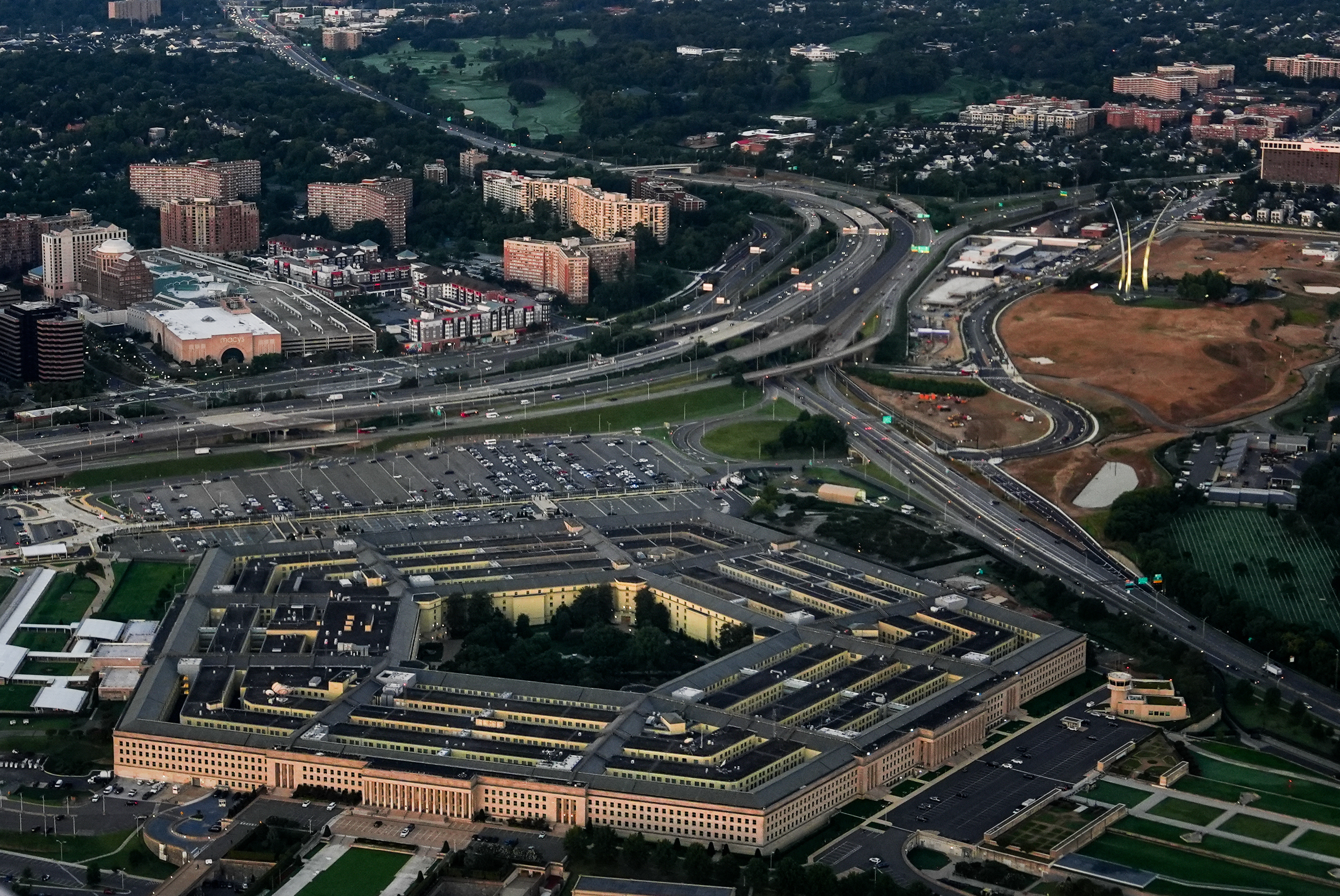
    The Pentagon acknowledged late Friday that the number of troops who have died in the Middle East during its operations against Iran is higher than previously reported, and updated the official count to include two more noncombat deaths.

    The Washington Post exclusively reported last month, based on information from six U.S. officials, that the numbers of service members lost was greater than what the Pentagon was reporting in its official, public database, known as the Defense Casualty Analysis System, or DCAS.

    Defense Secretary Pete Hegseth at the time called that reporting “a complete lie” in a social media post. However, late Friday, the Pentagon raised the figure publicly reported in DCAS to include additional deaths.

    As of Friday, the total troop deaths the administration is connecting to operations against Iran and officially reporting in DCAS stands at 21.

    That figure includes two additional noncombat deaths: Maj. Sorffly Davius, 46, an Army National Guard member who died in Kuwait on March 6, and an unidentified Navy suicide that occurred in September, according to a U.S. official, who spoke on the condition of anonymity to provide additional context on the troop deaths.

    In addition, 865 service members have been wounded, according to updated data in DCAS.

    The military also acknowledged one additional soldier’s training accident death that it said was not tied to ongoing operations against Iran.

    Sgt. Devin A. Seibel, 26, died during a training accident in Iraq in May. His death is now recorded in DCAS under Operation Inherent Resolve, the military’s decade-long named operation against the Islamic State. That service member’s death brings the total number of troops who have died in the Middle East since Feb. 28, the date that operations against Iran began, to 22.

    On Friday, two of the top Democratic members of the House Armed Services Committee said they were glad the Pentagon had made a “public correction” to the overall losses in the war.

    “There is no excuse for a mistake of this magnitude,” the committee’s top Democrat, Rep. Adam Smith (Wash.) and Rep. Chrissy Houlahan (Pa.), the top Democrat on the military personnel subcommittee, said in a statement, calling the fact that Congress had to get involved to have the Pentagon correct its numbers “an embarrassment” for the military.

    In a statement to the Post, the Pentagon did not acknowledge the changed numbers but instead said it is making further revisions to how DCAS reports casualties, including a new category of “pending adjudication” as it works through casualty reporting. The new adjudication category was first reported by Defense Scoop.

    The Pentagon “continues to maintain a steadfast commitment to the transparent, accurate accounting of all Service member casualties,” it said in a statement.

    It has been difficult for the public and lawmakers overseeing the Pentagon to get a clear picture of how many troops have been injured or killed during the conflict in part because the Trump administration changed mid-conflict the way it was publicly accounting for troop deaths, something critics have charged is a way for President Donald Trump to hide the true cost to military personnel.

    In previous conflicts those injuries or deaths — whether caused by hostile action or nonhostile causes, such as accidents or suicides — have been captured by named conflict in DCAS.

    In part, what has confounded DCAS data in this conflict is that earlier this year Trump declared that Operation Epic Fury had ended, even though the U.S. and Iran were still exchanging fire. In response the Pentagon created a new category of injured and killed that was not tied to Epic Fury, saying instead those numbers would be tallied under overseas contingency operations.

  • Depleted Eagles stunned in London, fall in 19-17 thriller to Jaguars on 57-yard Cam Little field goal

    Depleted Eagles stunned in London, fall in 19-17 thriller to Jaguars on 57-yard Cam Little field goal

    LONDON — Once again, the Eagles were down their top two offensive weapons in Saquon Barkley and DeVonta Smith. The offensive line featured yet another reconfigured starting combination.

    And once again, the Eagles were in a position to win but they couldn’t put the game away.

    The Eagles took a one-point lead over the Jacksonville Jaguars at Tottenham Hotspur Stadium on a Jake Elliott 48-yard field goal with just eight seconds remaining in the game.

    But the Jaguars’ Ameer Abdullah ripped off a 53-yard kickoff return to the Eagles’ 39, leaving one second remaining. Jaguars kicker Cam Little nailed a 57-yard field goal to win it, 19-17.

    After the game, Eagles coach Nick Sirianni put the blame on himself for not instructing Elliott to kick the ball out of bounds on the kickoff.

    “I didn’t make the right decision, and I lost us that game,” Sirianni said. “And that’s what I said to our guys. And what hurts there is that the guys fought so hard and then I don’t make the decision that I should make at the end of the game and I cost us that game and I put that fully on me.”

    Here’s our instant analysis from the Eagles’ third straight loss:

    Darius Cooper’s (left) strong season continued with a touchdown on Sunday. David Maialetti / Staff Photographer

    Tale of two halves, again

    The Eagles led at halftime, 14-7, thanks to touchdowns from Will Shipley and Darius Cooper. Shipley’s touchdown, the first of his career, came on a 2-yard rush, capping off a 13-play, 50-yard drive.

    Cooper scored on the following possession, turning a 22-yard pass from Jalen Hurts into a 62-yard catch-and-run touchdown.

    By halftime, the Eagles were 4-for-6 on third down, with all four conversions coming on third-and-long. Dontayvion Wicks contributed two of those third-down catches on Shipley’s touchdown drive. Wicks also drew a defensive pass interference call against Travis Hunter on third-and-17 to keep the drive alive.

    But the Eagles’ offensive struggles in the second half continued against the Jaguars, following a similar trajectory as their loss to the Los Angeles Rams. Despite having the first possession coming out of halftime, the Eagles gained 59 yards in the third quarter on three series, never making it past the Jaguars’ 43.

    Granted, the Eagles offensive line featured two players making their NFL debuts — Willie Lampkin at left guard and Jake Majors at center — and another making his second start in Markell Bell at right tackle. Running back Will Shipley (foot) was injured in the second quarter, forcing Dameon Pierce, who wasn’t on the Eagles active roster until this week, into action.

    On the drive that sputtered at the 43, the Eagles failed to convert on fourth-and-3. Hurts threw an incomplete pass for Lemon, marking the second failed fourth-down attempt of the game (the Eagles also failed to convert fourth-and-1 from the Jacksonville 37 on a handoff to Shipley on their opening drive).

    Hurts later missed a wide-open Wicks down the left sideline on third-and-13 from the Eagles’ 41, the ball sailing incomplete just beyond the receiver.

    Their woes continued early in the fourth quarter. The Eagles incurred back-to-back penalties, a false start from Jordan Mailata and an offensive pass interference from Cooper, backing them up to their own 3-yard line. They eventually failed to convert on third-and-10, bringing Braden Mann on to punt for a third time in the second half.

    “We’ve got to keep at it,” Hurts said after the game of the Eagles’ second-half scoring woes. “Got to keep getting up and keep finding out ways that we can improve. In the end, that’s not the standard, and it’s inexcusable. So we’ve got a lot of opportunity to grow.

    The Jaguars went up, 16-14, on an acrobatic one-handed touchdown grab late in the fourth quarter by Parker Washington, beating tight coverage by Riq Woolen. The teams subsequently traded punts, and the Eagles got the ball back at their own 38 with over a minute and a half remaining in the game.

    A Bell false-start penalty on the second play of the drive backed them up, but Wicks, Dallas Goedert, and Lemon made catches to put the Eagles into field goal range for Elliott. Ultimately, Elliott’s field goal wasn’t enough.

    The Eagles again had trouble generating consistent offense. Yong Kim / Staff Photographer

    Defense makes plays, but not enough

    Earlier in the week, Vic Fangio noted that Jalen Carter’s lingering wrist injury seemed to affect him in the Week 4 loss to the Los Angeles Rams.

    Carter didn’t seem affected much by the injury a week later.

    While he was still sporting a cast on his wrist, Carter had his most disruptive game of the season, strip-sacking Jaguars quarterback Trevor Lawrence twice. The Eagles did not recover either fumble. Carter’s first strip-sack came on the Jaguars’ opening drive on first-and-20 from their own 28-yard line after a holding call against left guard Emmanuel Pregnon.

    His play backed the Jaguars up another 15 yards, and then they took a delay of game to back them up another 5. Jacksonville ultimately punted, gaining just 7 net yards on their opening drive.

    Jalen Carter had a disruptive day against Jaguars quarterback Jalen Carter. Yong Kim / Staff Photographer

    Carter struck again in the second quarter on second-and-11 from the Jaguars’ 34. Lawrence recovered the loose football for a loss of 10 yards, eventually bringing up another punt when he couldn’t connect with running back LeQuint Allen on third down. At that point, the Jaguars were 0-for-3 on third down.

    Carter wasn’t the only Eagles defender who made big plays. The whole group stepped up late in the second quarter as the Jaguars attempted to tie the game.

    On their last possession of the first half, the Jaguars drove 68 yards to the Eagles’ 1-yard line. However, on four tries, they couldn’t find a way into the end zone. Zack Baun had the play of the series on fourth-and-goal, stuffing Jaguars running back Bayshul Tuten for a loss of 6 yards on an outside run.

    Late in the third quarter on third-and-7 from the Jaguars’ 46, Nolan Smith and Arnold Ebiketie pressured Lawrence, who stepped up in the pocket and launched a deep pass intended for wide receiver Brian Thomas Jr.

    But the pass was short, allowing Quinyon Mitchell to swoop in and intercept the pass. The play marked the first regular-season interception of Mitchell’s career (he has four interceptions in the playoffs).

    The Jaguars still capitalized on the defense’s handful of mistakes. Washington made his presence felt after making just one catch for 7 yards last week. He had two touchdown receptions — once in the first quarter on a play-action bootleg for 51 yards to put the Jaguars up, 7-0, and again late in the fourth quarter on the 27-yarder against Woolen.

    Drew Mukuba took ownership after the game for not getting out to the flat in time to make the tackle on Washington on the first touchdown. Woolen acknowledged he could have played the second touchdown better, but he also said that Washington made a great play.

    “It [stinks] to have a person score a touchdown on you, but at the same time, you just got to go and keep playing and make plays for your team,” Woolen said.

    Late in the fourth quarter, the defense forced a three-and-out, giving the Eagles offense an opportunity to win it with just over a minute and a half remaining in regulation.

    Jalyx Hunt was helped off after an injury to end the first half. Yong Kim / Staff Photographer

    Injury report

    The Eagles’ injury issues worsened against the Jaguars.

    Shipley exited during the second quarter with a foot injury and was eventually ruled out.

    Shortly before the end of the first half, Michael Carter II dropped out with an abdomen injury. He was ruled out.

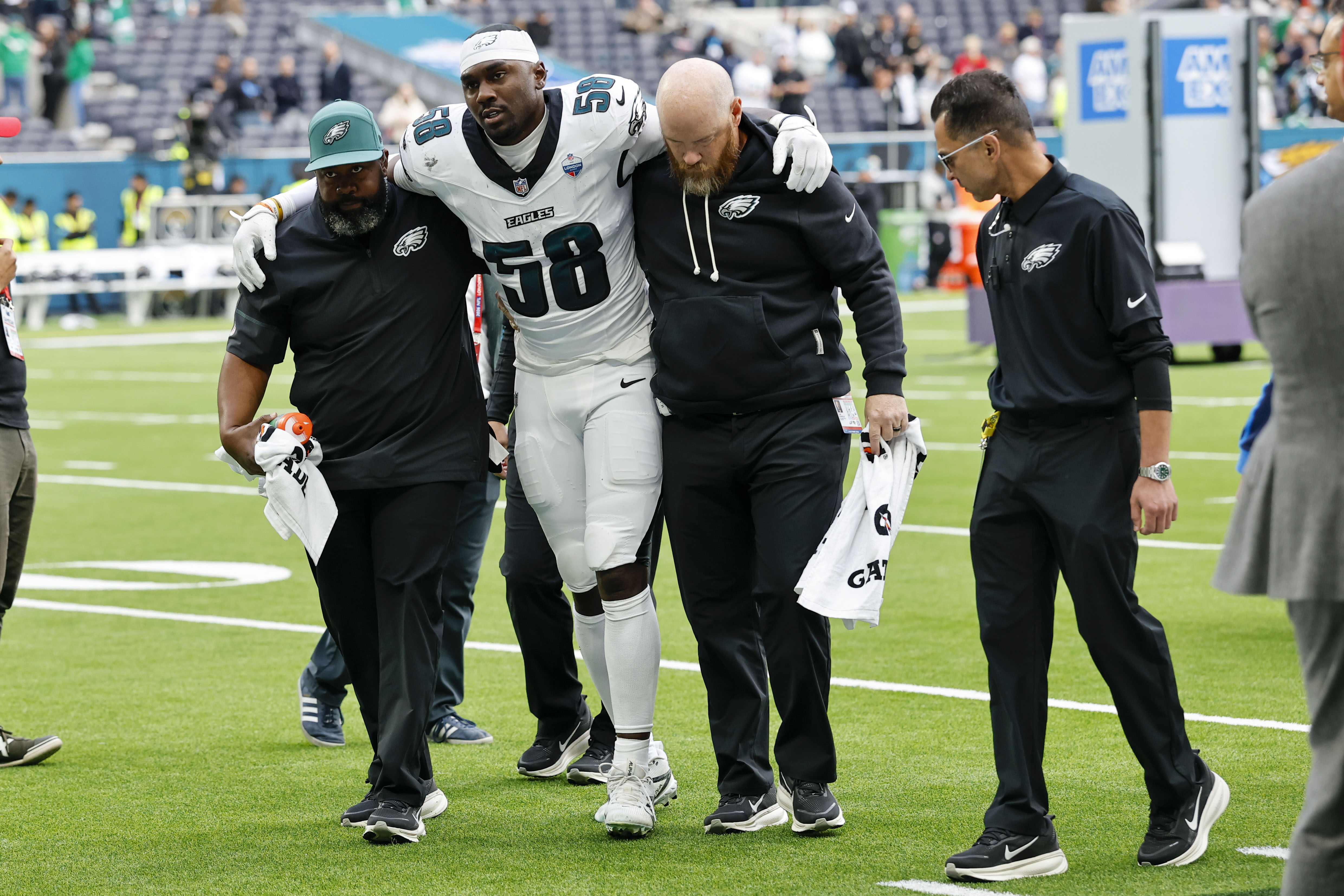
    After Baun’s fourth-down stop to end the first half, Jalyx Hunt went down with knee and ankle injuries. He walked off the field with the help of trainers and was later ruled out.

    Tyler Steen came off the field in pain and went straight to the medical tent after the Eagles went three-and-out on their first drive of the second half. Steen missed a series with a shoulder injury, and Fred Johnson took over at right guard, but Steen later returned to action.

    Jeremiah Trotter Jr. was ejected from the game after getting into a scrum on the opening kickoff with Jaguars defensive end Bryan Thomas Jr., who was also disqualified. Baun said after the game that Fangio’s initial plan was to have Trotter rotate with Jihaad Campbell at inside linebacker, but that was scrapped following the disqualification.

  • Some Republicans reject Trump’s move to import diesel fuel from Russia

    Some Republicans reject Trump’s move to import diesel fuel from Russia

    President Donald Trump’s announcement of a deal with President Vladimir Putin of Russia to import Russian diesel has drawn criticism from some Republicans running in the most competitive midterm races, as the party grasps for ways to contain soaring energy prices.

    The president announced the arrangement, which undercuts U.S. sanctions on Moscow, under pressure to rein in the surging price of diesel. The product’s cost has climbed because of the war with Iran, which has clogged a vital oil-shipping corridor, and high energy prices have become a severe campaign liability for Republican candidates in the midterms.

    But the campaigns of two Republicans running in pivotal Senate races — former Rep. Mike Rogers of Michigan and Sen. Dan Sullivan of Alaska — expressed disapproval of the deal with Russia. And other Republicans running in competitive Senate and House races had little to say about the agreement, which Trump trumpeted Friday on social media as a “very big and important” deal, claiming it would swiftly bring down energy costs.

    “It’s a grave error by the president,” said Rep. Don Bacon, a Nebraska Republican from a battleground district who is not running for reelection. “People realize that the sanctions on Russia are appropriate when Russia’s invading a country and bombing cities at night.”

    Bacon predicted the deal would have little effect on soaring diesel prices but would offer a victory for one of America’s adversaries. And the congressman said that the agreement would not help Republican candidates. “It looks desperate,” he said.

    The White House did not immediately respond to a request for comment. The deal received some Republican praise. Rep. Anna Paulina Luna, a Florida Republican running in a competitive race, wrote on social media that it would “massively benefit the American people.”

    The United States introduced sanctions on energy exports from Russia after the country started its full-scale invasion of Ukraine in 2022. Trump’s deal, and his declaration Saturday that Ukraine should “get a new president,” escalated U.S. tensions with Kyiv. The issue of U.S. support for the country has for years divided Republicans; the two Republican Senate candidates who questioned the deal have long been supporters of Ukraine.

    Some Midwestern Republicans have called for a pause on diesel exports to try to lower costs for American consumers, a notion that Trump has ruled out.

    Energy experts say the deal is not likely to have a major impact on the cost of diesel, which has spiked to around $6.28 a gallon, according to the AAA motor club, up from $3.67 a year ago. Andrew Lipow, president of Lipow Oil Associates, an energy consulting firm in Houston, said the deal would introduce a “very small” amount of diesel into the market “compared to U.S. demand.”

    In Michigan, Rogers, who has recently sought distance from Trump by calling for the president to end both the Iran war and his tariff fight with Canada, told reporters on Friday that he supported an agricultural rebate for diesel, but not the president’s approach.

    Rogers, long a foreign policy hawk, cited concern about offering Putin a victory. “You just don’t want to give that guy an inch,” he said.

    The Associated Press reported that a bipartisan group of six senators on Sunday called for Trump’s administration to “immediately reverse course” on the diesel purchase.

    Four Republican senators and two Democratic senators signed onto the statement released Sunday protesting the deal. They said the administration failed to consult with Congress or submit any explanation to justify its decision as required by statute.

    “The United States should not provide Putin with a financial lifeline while Russia continues to kill Ukrainian civilians. The Administration must immediately reverse course,” they wrote.

    The Republican senators who signed onto the statement are Sens. Susan Collins of Maine, Lisa Murkowski of Alaska, Thom Tillis of North Carolina, and John Curtis of Utah. The Democratic senators are Sens. Jeanne Shaheen of New Hampshire and Richard Blumenthal of Connecticut.

    Tillis, in an interview that aired Sunday on NBC’s Meet the Press, said there’s a legitimate case for saying the president is not following the law if the administration goes through with its diesel purchase plan.

    “We were very clear that Russia is the aggressor. Russia is the one who can end this war by backing out of territory that they occupied,” Tillis said.

    Democrats pounced on the deal. Sen. Chuck Schumer of New York, the Democratic minority leader, wrote on social media that the president had made a “deal with the devil to try to help his flailing political fortunes.”

    Rep. Chris Pappas, the Democratic nominee in the competitive Senate race in New Hampshire, said in a statement that the agreement was a “slap in the face to Ukraine and our allies overseas.” The campaign of his Republican opponent, former Sen. John E. Sununu, did not immediately respond to a request for comment.

    The high cost of diesel poses a particular risk for Republicans running in states whose farming-heavy economies are powered by diesel, such as Nebraska, Iowa, and Kansas.

    Rogers, Sullivan, and Hinson have all called for the United States to pause diesel exports. Last month, Trump proposed banning or limiting U.S. diesel exports, worrying European countries. But recently, he said, “We are not going to be doing the export ban.”

    This article originally appeared in the New York Times.