Blog

  • Meta reaches $17 billion settlement with states in landmark trial over teen social media addiction

    Meta reaches $17 billion settlement with states in landmark trial over teen social media addiction

    Meta agreed Wednesday to pay up to $18 billion and add stronger child-safety measures to its Facebook and Instagram platforms as part of a landmark legal settlement that ended a trial over teen social media addiction and settled claims filed by nearly every state.

    The settlement resolved a pivotal case years in the making that sought to hold the tech giant accountable for the role its platforms played in undermining children’s mental health. The effort targeted features designed to hook young people’s attention.

    The agreement “institutes real change, real transparency, real protections for children and teens across the country,” California Attorney General Rob Bonta said.

    If approved by the court, the deal will stop an avalanche of litigation by states against Meta, although the company still faces lawsuits from individuals and school districts throughout the U.S. For the states, the settlement delivers money for mental-health programs for kids, including after-school or summer activities and digital literacy counselors.

    Pennsylvania is expected to receive at least $516 million and up to $729 million, while New Jersey is expected to receive at least $525 million and up to $752 million, according to statements from each state’s attorney general.

    “We can’t simply tell parents to do better while allowing technology companies to design platforms that are engineered to addict children,” Pennsylvania Attorney General Dave Sunday said during a news conference Wednesday. “Parents deserve better. Children deserve better, and today shows that Big Tech can do better — some just chose not to. Today is the first step in forcing Big Tech to do better.”

    Earlier this week, Sunday announced a lawsuit against Snap Inc., owner of Snapchat, and earlier this month he announced a lawsuit against TikTok over similar child protection issues.

    “As a parent, protecting your kids is always your North Star,” New Jersey Attorney General Jennifer Davenport said in a statement. “This agreement achieves critical protections for our children today.”

    Neither attorney general commented on how the settlement funds would be used.

    Advocates cheered the new protections, including default time limits and the disabling of features such as “like” counts.

    But “we cannot truly protect all children and teens until these protections are required on every platform and are permanent — that’s something only Congress can do,” said Sacha Haworth, executive director of The Tech Oversight Project.

    The settlement will be paid out over 10 years. California will get the largest sum of at least $1.5 billion, but several other states will still collect hundreds of millions of dollars each over the decade.

    The settlement “will put an end to these dangerous practices and deliver meaningful relief that will protect children from online harm,” Virginia Attorney General Jay Jones said.

    Meta urges rivals to adopt similar safety measures

    Meta said in a blog post that it was “building on our longstanding efforts to empower parents and support teens.”

    “Ensuring teens have a safe and productive experience on our platforms is an absolute imperative for Meta,” the company said. “We want to get this right for parents and teens, and that’s why we partnered with state attorneys general to set a new industry standard.”

    The company urged competitors TikTok and YouTube to adopt similar safety measures.

    The $18 billion settlement is a fraction of Meta’s 2025 revenue of $201 billion. Meta shares were up about 1.5% by midday Wednesday, hours after the deal was announced.

    The agreement cuts short an ongoing court case involving California, Colorado, Kentucky and New Jersey, which were among 29 states that sued Meta in 2023. The federal trial kicked off last week in Oakland, California, where Meta CEO Mark Zuckerberg had been among the witnesses expected to take the stand.

    The lawsuit accused Meta of contributing to the youth mental health crisis by deliberately designing features that addict children to its platforms and hiding them from the public. The case also argued that Meta violated federal laws by routinely collecting data on children under 13 without their parents’ consent.

    The cases in other states had been expected to go to trial later, but are now resolved. The settlement covers 48 states, as well as Washington, D.C., and some U.S. territories. The only two states to be excluded are New Mexico, which went to trial in its case against Meta and won earlier this year, and Florida, where the attorney general said the settlement was not tough enough on Meta.

    Florida Attorney General James Uthmeier wrote on X that the “payouts are peanuts compared to the profound harms Meta’s profit-driven addictive features inflicted on kids.” He wrote in a separate post that his team “will hold them accountable in Florida.”

    New features to include time limits and curbs on push notifications

    Under the proposed settlement, Meta agreed to adopt a series of safety features, including two-hour daily time limits that can only be disabled with a parent’s permission and pauses for children using Instagram and Facebook.

    The company will eliminate push notifications during weekday school hours and bring in “robust” age-assurance measures and “age-appropriate” content controls to prevent bullying and harmful material about eating disorders and self-harm.

    There will be stronger and more user-friendly parental controls and limits on social comparison features such as “like” counts.

    An independent auditor will assess how Meta is implementing the safety features and how effective they are.

    The company said 30% of the settlement amount — about $5.3 billion — will be released to states only if rivals YouTube and TikTok meet two conditions: implementing similar safety features, including a one-hour daily time limit, a nighttime block and age-assurance measures; and paying the same amount, split between the two companies.

    Neither YouTube owner Google nor TikTok responded immediately to requests for comments.

    Meta officials declined to comment on whether they had conversations with their competitors about those conditions, but said they intentionally designed the agreement with the states to incentivize the rest of the industry to follow suit.

    Some of the safety measures Meta will implement, like disabling cosmetic surgery and extreme makeup filters, made sense regardless of whether competing platforms do the same, Meta said. Others, like its overnight block, will function better if they are established across the board, the company said.

    If industry peers sign on to the agreement, Meta will implement stronger defaults for teens’ daily time limit and the length of time for its “night mode.”

    Investigation was led by bipartisan coalition

    The federal lawsuit was the result of an investigation led by a bipartisan coalition of attorneys general from California, Florida, Kentucky, Massachusetts, Nebraska, New Jersey, Tennessee, and Vermont. It followed newspaper reports, first by The Wall Street Journal in 2021, that found the company knew about the harm Instagram can cause teenagers — especially teen girls — when it comes to mental health and body image issues.

    Meta has since added a host of safety features to Instagram, including separate accounts for teenagers with stronger protections around messaging and privacy, along with content restrictions.

    But child-safety advocates and experts, along with some former Meta employees, have long contended that the features are little more than window dressing.

    Victoria Hinks, mother of Alexandra “Owl” Hinks, who died by suicide at age 16, said she was satisfied with the terms of the settlement “as long as they enforce it properly.”

    “It felt like today finally something was done,” she said Wednesday outside the Oakland courthouse where the trial was held. “I feel like justice is possible.”

    Staff writer Dana Munro contributed to this report

  • Nemours Children’s Health to open Glen Mills urgent care Sept. 16

    Nemours Children’s Health to open Glen Mills urgent care Sept. 16

    Nemours Children’s Health is opening a new pediatric urgent care center in Glen Mills next month.

    The urgent care center, located at Nemours’ health facility at 101 Applied Bank Blvd. Suite 11 in Glen Mills will open daily beginning Sept. 16.

    The facility is intended for patients with medical needs that do not require treatment in an emergency department, such as upper respiratory illnesses, rashes, abdominal pain, pink eye, sports injuries, burns and bites.

    Nemours’ Glen Mills urgent care will offer basic laboratory and X-ray services.

  • Dolly Parton had the voice, and concerns, of an earth angel

    Dolly Parton had the voice, and concerns, of an earth angel

    Usually when we say someone has the voice of an angel, we mean that they don’t quite sound human — that they have an airy, clarion, pristine falsetto hovering far above mortal concerns. Dolly Parton, who died Tuesday at age 80, had the voice of an earth angel. She knew all about the dirt and the muck and the ugliness, the shame of poverty, the chill of sorrow, the burning throb of a jealous heart. That meant she also knew precisely how best to soothe those pains in song, composing her own homemade balms for whatever ailed.

    Her voice was angelic not because it possessed some kind of divine perfection or unattainable beauty, but because it seemed to be personally invested in the well-being of anyone and everyone who listened to it, illuminated from within with an almost otherworldly benevolence. How many singers in the history of popular music have told us some variation of “everything’s gonna be all right / it’s gonna be OK”? When Dolly did it, though, as on her soaring 1977 single “Light of a Clear Blue Morning,” the sentiment somehow transcended cliche. Dolly made you believe.

    To speak of her in the past tense still feels wrong. Dolly Parton was an American icon who seemed taller than death itself, a Paul Bunyan in a beehive wig and rhinestone stilettos. That stature came in part because she wrote her legend over and over, wittily but with a savvy control over her own image, in the so-called Dollyisms that she peppered throughout interviews, stage banter and public appearances.

    And so we know from her own lips that her parents were so poor that they paid the doctor who delivered her in cornmeal, and that their one-room cabin in the Great Smoky Mountains had “running water, if you were willing to run and get it.” We know, too, that if she had it her way she would have lived well past 80. Once, when she was asked how she’d like to be remembered in 100 years, Parton quipped, “I want ’em to say, ‘God, don’t she look good for her age!’”

    The most enduring parts of Parton’s legend were the ones she captured in song. Some of her most beloved compositions elevate key scenes from her life into modern-day folk tales, animated in vivid, almost cinematic detail. “Coat of Many Colors,” from 1971, recalls a time in her youth when her mother stitched rags together to make a coat that the other schoolchildren mocked: “I couldn’t understand it,” the adult Parton sings, still aching, “for I felt I was rich.” The beautiful redheaded bank teller who flirted with her husband lives on in infamy in “Jolene,” a lyric and vocal performance that combine to create one of popular music’s most wrenching (and oft-covered) confessions of neediness and insecurity.

    Parton forever dramatized her decision to go solo in “I Will Always Love You,” a tenderhearted goodbye to her boss and former duet partner Porter Wagoner that kick-started a country-to-pop crossover. That unapologetic ambition to become something more than the so-called “girl singer” on Wagoner’s television show paved the way for women of subsequent generations (Reba, Shania and Taylor, to name just a trio) to follow in her path. The song also gave Parton an opportunity to flex her savvy as an entrepreneur: She refused to sell half of its publishing rights to one of her idols, Elvis Presley, when he wanted to cover it. “Everybody’s going to use you if they can,” Parton reflected decades later. “These are my songs — they’re like my children.”

    The ’80s — a decade she kicked off in grand fashion with the working woman’s anthem “9 to 5” — brought Parton some of her greatest mainstream success, but the climate of the times also conspired to reduce her to a punchline and a caricature: The self-made country-pop queen who had pulled herself up by her bra straps. She played along, as an act of self-preservation, but it is a consolation to know that she lived long enough for her reputation as a songwriter to rise considerably in the 21st century. The work of her Dollywood Foundation, and especially her Imagination Library’s focus on child literacy, also cemented her status as a dedicated philanthropist.

    In the third act of her impossibly long career, Parton became a creature who by all other accounts had gone extinct: a celebrity just about everybody likes. The volume and variety of tributes pouring in after her death attest to that — it is difficult to imagine another person who inspires kind words from both President Donald Trump and Parton’s “9 to 5” co-star Jane Fonda. But the universal goodwill Parton engenders also makes her death sting more sharply, because we mourn the loss of something even greater than one of the most beloved singer-songwriters of our lifetimes. We also mourn the concepts she embodied with grace right until the very end: compassion, good-humored joy, a genuine wish for the well-being of her neighbors. All that and a bone-deep belief that everything’s gonna be all right, gonna be OK.

    This article originally appeared in The New York Times.

  • A Havertown couple’s Ocean City beach cottage was decades in the making

    A Havertown couple’s Ocean City beach cottage was decades in the making

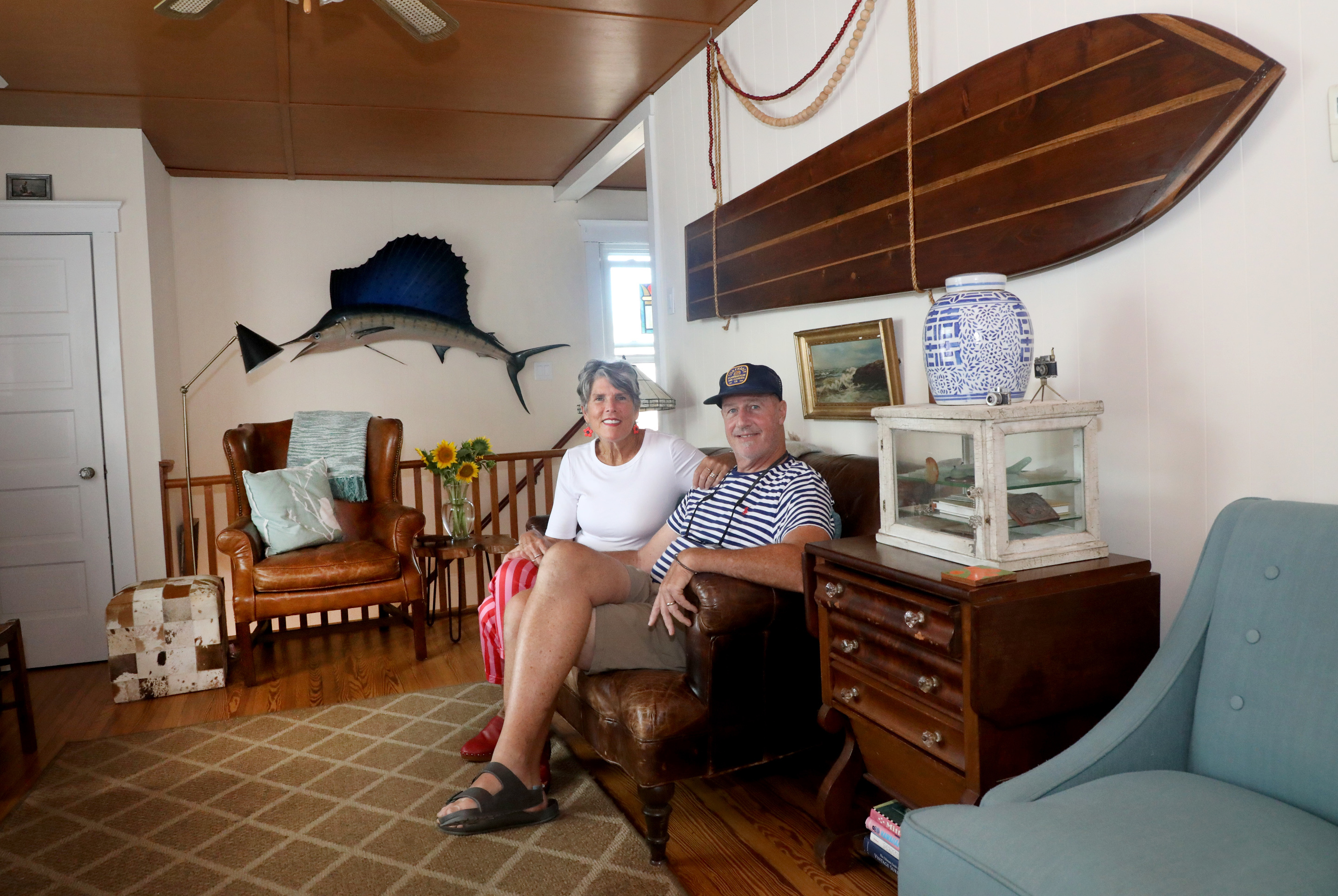
    Tucked away on an alley in the north end of Ocean City, Steve and Regina Pannepacker’s three-bedroom, one-bathroom cottage is their perfect peaceful haven.

    The cozy home is filled with a dozen or so surfboards for Steve’s passion and shelves packed with books for Regina’s passion. Then there are the bowls and bowls of sea glass, which they both love collecting.

    Shortly after the pair married in 1986, Steve contacted several Ocean City Realtors, asking them to be on the lookout for a detached garage space they could convert into a small cottage. Finally, in 2015, one of them called.

    “He said I found your name in my Rolodex,” recalled Regina, a registered nurse. “I hadn’t heard that word in a really long time.”

    They loved the home’s location, the bright light that pours in from windows in all directions and the neighbors who ultimately became friends.

    Surfboards abound in the secondary bedroom.Vernon Ogrodnek / For The Inquirer
    The primary bedroom is small, decorated with light colors.Vernon Ogrodnek / For The Inquirer

    Built in the early 1900s, the home was originally a three-car garage for the main house that sits in front of it. It was later converted to include a two-bedroom property above the garage. It is believed the front property was owned and lived in by a seafaring ship’s captain, Steve said.

    Around 2013, the main house and garage were divided into separate properties.

    The Pannepackers converted the garage space into three distinct rooms — a guest bedroom, a storage area with a washer and dryer, and a space for Steve’s workbench that also houses surfboards and bicycles.

    Steve Pannepacker is an avid collector of surfboards, like this Plastic Fantastic board. He keeps them in the garage.Vernon Ogrodnek / For The Inquirer

    With their five children, three grandchildren plus two more on the way, and lots of siblings, nieces, and nephews, the home is usually bustling with activity. Regina has eight brothers and sisters, and Steve has one sibling. The couple also invite friends and family to use the cottage when their jobs keep them at home in Havertown.

    Steve, who works in television and film as an art director and prop coordinator, did most of the decorating. His deep love for Hawaii, where he and Regina made a pilgrimage in 2008, was a huge influence on the home’s decor.

    “It’s a combination of Ralph Lauren and a Hawaiian style,” Steve said. “Ralph Lauren’s look included leather, which inspired the leather chairs, and that is also an older Hawaiian look.”

    The kitchen is small but workable for the couple, who like to cook. They eat at the drop table in the living room that has an extendable leaf. Closed, it’s large enough for Steve and Regina, but it can accommodate six when open. When a larger crowd is visiting, they set up a table in the front yard or alley.

    A wall of oceanscapes, some professionally done, some reproductions, and some by family members.Vernon Ogrodnek / For The Inquirer
    Below the oceanscapes is an old Bulletin newspaper bench, a nod to Regina’s family association delivering the now defunct Philadelphia paper.Vernon Ogrodnek / For The Inquirer

    The living room is also where they relax and entertain. When it’s just the two of them, they are often reading — Steve in his comfortable brown leather chair and Regina curled up on the nearby couch. When guests visit, the room is where they talk and laugh and share each other’s company.

    “This is our everything room,” Regina said. “We don’t have a TV or Wi-Fi so there’s lots of conversation.”

    Surfboards are a part of the decor in almost every room. The wooden board that hangs over the living room sofa was made by local surf historian Bill Simon about 30 years ago and is a reproduction of a 1930s surfboard by Pacific System Homes.

    A collection of old photos, postcards, and memorabilia in the living room.Vernon Ogrodnek / For The Inquirer
    A collection of Hawaiian memorabilia in the living room.Vernon Ogrodnek / For The Inquirer

    Hidden behind other houses off a main road, the home’s orange front and garage doors help friends and pizza delivery drivers find them.

    An avid surfer since high school, Steve spent summers working and surfing in Ocean City while Regina grew up day-tripping to the beach town with her family. It was an important part of both their childhoods.

    A painting by the couple’s daughter is hung in the home’s compact kitchen.Vernon Ogrodnek / For The Inquirer

    “My parents spent two summers as the house parents for the waitresses at the Flanders,” recalled Regina. “Having had nine kids of their own, they got the job pretty easily. Our family’s love for the beach is deep-rooted.”

    Regina’s parents’ love of sea glass trickled down to Regina and Steve. Most days, the couple take walks and usually find a sea glass treasure.

    The beach town is woven into the fabric of their lives. They spend time at both the beach and the bay, and often head to the Second Street pier to take in the sunset.

    “This home is a retreat where we decompress,” Regina said. “You come over that bridge and smell the air, and something comes over you.”

    Is your house a Haven? Nominate your home by email (and send some digital photographs) at properties@inquirer.com.

  • Trea Turner has a pregame chat with Hall of Famer Ichiro Suzuki to ‘pick his brain’

    Trea Turner has a pregame chat with Hall of Famer Ichiro Suzuki to ‘pick his brain’

    SEATTLE — Two years ago, when the Phillies last played here, Trea Turner heard that Ichiro Suzuki was at the games but never got to meet him.

    Turner wasn’t going to miss another chance.

    Before Tuesday night’s game, a 4-1 Phillies loss, Turner chatted with Suzuki, the Mariners legend and Hall of Fame hitting machine with 3,089 major-league knocks after coming over from Japan and a statue outside the home-plate entrance to T-Mobile Park.

    And Turner came armed with specific questions.

    “How do you hit the ball the other way?”

    “What are your thoughts, your approaches in certain situations?”

    “If you’re doing this wrong, what would you do?”

    “Just all sorts of stuff,” Turner said. “It was just great being able to pick his brain. I really enjoyed it.”

    Coincidentally, Turner’s chat with one of the most gifted hitters on two continents came at a time when he’s hitless in 13 at-bats, part of a 4-for-25 tailspin entering Wednesday’s series finale.

    Mariners legend Ichiro Suzuki was inducted into the National Baseball Hall of Fame last year.Seth Wenig

    The root of the problem: “I’ve been trying to hit the ball the other way [to right field] and stopflying open.” After working with hitting coach Kevin Long, Turner said he made an adjustment Tuesday night that, despite going 0-for-4 again, represented “progress.”

    And no, Don Mattingly isn’t considering moving Turner down in the order. Doing so would project “panic,” the interim manager said.

    “You’ve just got to hang in with guys over the course of a season,” Mattingly said. “And if there’s a point where it’s like, OK, this has got to go, then you get there. … I think we all know that Trea’s going to come out of this. And when he does, it’ll be hot.”

    Turner went 0-for-4 Tuesday night but lined out in his final at-bat.

    “I didn’t get the results I wanted,” Turner said. “But I feel like today was good.”

    Especially considering how it started.

    Turner grew up in South Florida as a fan of Derek Jeter and Ken Griffey Jr. He didn’t watch Ichiro as often — “Maybe it’s more of like a West Coast-East Coast type deal,” he said — but noted that he’s been told there are similarities in their hitting styles.

    “In the sense that he didn’t walk a lot, he wanted to hit, he hit the ball all over the field, could hit it out of the park sometimes,” Turner said. “So, talking with him about his mindset and what he physically does, a lot of it kind of applied to me in my game. It was kind of nice just hearing him, trying to ask him as many questions as possible.

    “Growing up watching him, I maybe probably didn’t appreciate him as much as I should have as a kid. I loved Griffey and Jeter. But his career is incredible. I knew he was a really good player, but I wish I got a chance to watch him a little bit more.”

    Turner isn’t the only Phillies player to meet Ichiro this week. Rookie center fielder Justin Crawford was introduced to him Monday by his cousin, Mariners infielder J.P. Crawford.

    Bryce Harper has reached base in 28 consecutive games, a career-best streak.Matt Krohn

    Extra bases

    Bryce Harper went 2-for-4 Tuesday and extended his career-long on-base streak to 28 games, tying the Cubs’ Pete Crow-Armstrong for the fourth-longest in the majors this season. … J.P. Crawford returned to the Mariners’ lineup after missing 18 games with an inflamed left wrist. The Phillies’ first-round pick in 2013 was traded to Seattle after the 2018 season for infielder Jean Segura. … Jesús Luzardo (11-5, 3.35 ERA) is scheduled to start the matinee series finale Wednesday against Mariners righty Bryan Woo (9-8, 4.10).

  • The US and Canada could pull back from an all-out trade war. It’s not clear that they will

    The US and Canada could pull back from an all-out trade war. It’s not clear that they will

    WASHINGTON — The U.S. and Canada have ramped up their trade war, hitting each other with steep new tit-for-tat tariffs. Despite the bravado coming from both sides of the border, though, analysts suspect the longtime allies will eventually strike a deal to end a conflict neither really wants.

    The prospects for compromise looked bleak Tuesday, with Canadian Prime Minister Mark Carney reacting to new 50% U.S. tariffs on certain Canadian goods by responding in kind on about $20 billion worth of American imports, including steel, dairy products, appliances and farm equipment.

    “You’re at war when you get attacked. We got attacked,” Carney, who came to power last year on the promise that he’d stand up to U.S. President Donald Trump, said over the weekend.

    Doug Ford, Ontario’s populist premier, told The Associated Press on Monday that he was ready to escalate even further by cutting off his province’s shipments of electricity and critical minerals to the United States.

    Soon after, Trump declared his intention to hammer the Canadian auto industry with another set of import taxes if the Canadians don’t “fall in line.”

    With the breakdown threatening to harm one of the world’s largest trading relationships and clouding efforts to renew the United States-Mexico-Canada Agreement that Trump negotiated during his first term, experts cautioned that there’s still time to pull back from the brink of an even bigger trade war.

    They’ve done it before. “If there is political will, there is an off ramp,” said former U.S. trade negotiator Wendy Cutler.

    ‘It’s not real until somebody walks away’

    U.S.-Canada trade talks typically get testy, said Christopher Sands, who heads the Center for U.S.-Canada Studies at Johns Hopkins University.

    The two neighbors have a long history of sparring over things like Canada’s protected dairy market and subsidized softwood lumber exports.

    “We’ve gone through this with Canadians before,” Sands said. “It’s almost like it’s not real until somebody walks away from the table. … I’m not panicked.”

    There are reasons to think something can be salvaged from the rubble of bilateral trade talks that collapsed Friday.

    First, the U.S. tariffs that Trump imposed Saturday cover just $20 billion worth — around 5% — of Canada’s exports to the United States and are unlikely to do much lasting economic damage. Oxford Economics reckons the trade conflict would reduce Canadian economic growth only slightly next year — from a previously forecast 1.6% to 1.4%. On Monday, U.S. Trade Representative Jamieson Greer even tried to downplay the trade rift as a “tempest in a teapot.”

    Moreover, Carney’s retaliatory tariffs wouldn’t take effect until Sept. 8. “That gives us this week. It gives us next week,” Sands said. “Time to take a breather and talk about how to avert” an all-out trade war.

    Despite Trump’s tough talk on Truth Social, his punitive auto tariffs wouldn’t kick in until Jan. 1 — well after the Nov. 3 midterm elections in which the president’s Republican Party is hoping to keep full control of Congress despite voter frustration with the high cost of living.

    So there’s at least enough time for the countries to find a stopgap solution.

    Cutler, now senior vice president at the Asia Society Policy Institute, suggested that the U.S. could tap an emissary that both countries trust to get talks back on track; she recalled that Trump’s son-in-law Jared Kushner helped negotiate the USMCA eight years ago.

    Canada would likely balk at a one-sided deal

    Cutler also noted that Trump suspended his global tariffs for months last year to allow U.S. trading partners to negotiate with him. Many did, including the European Union and Japan, and ended up agreeing to lopsided trade agreements to dodge the worst of Trump’s tariffs.

    Canadians, though, are in no mood for a Trump-friendly trade deal.

    The American president has enraged the Canadian public with inflammatory talk of making their country the 51st U.S. state. And on Tuesday, instead of trying to lower the temperature, he declared that he was considering changing the name of Lake Ontario to Lake America. He has also repeatedly hit Canada with tariffs and threats of them, including when he suggested he might punish Canada for wildfires that were blackening U.S. skies.

    “Fighting with Washington is hugely popular in Canada right now,” said Scott Lincicome of the Cato Institute, a Washington-based free-trade think tank. “Guys like Doug Ford — like him, love him or hate him — understand this is a political winner for them.”

    The latest U.S.-Canada conflagration flared up last month when Trump said he planned to hit Canada with 50% tariffs. He complained that Canada had been unfairly restricting U.S. exports of dairy, alcoholic beverages and autos. Trump set a deadline of Aug. 19 — last Wednesday — for the two countries to reach a deal and head off the tariffs.

    Because the Supreme Court struck down his biggest tariffs in February, the president turned this time to an obscure provision of a Depression-era trade law that gives him the power to impose tariffs of up to 50% on imports from countries that have discriminated against U.S. businesses. No investigation is required, nor is there any limit on how long the tariffs can last. But no president has ever imposed such tariffs before, so they are untested in court.

    ‘No choice’ but to walk away

    Last week, negotiators appeared to be close to resolving their differences. Less than two hours before levies were set to take effect, Trump announced a three-day reprieve, posting on social media that “Canada and the U.S.A., subject to the finalization of documents, have a DEAL!” Greer, the U.S. trade representative, later told CNBC that the United States had offered to cut in half existing 50% tariffs on Canadian steel and aluminum, and to sharply reduce levies on Canadian auto and softwood lumber imports.

    But it all fell apart Friday and the Canadians walked away, with Carney saying the Americans had sought “to destroy our major industries, including autos, steel and aluminum. … That was one of the main reasons we said no. It was a bad deal.” Carney also said that Washington viewed protections for French and Canadian culture — considered fundamental rights in Canada — as irritants to trade.

    Ford said he understood that late in the talks, Washington demanded veto power over trade deals Canada pursued with other countries, which would have violated Canadian sovereignty.

    Despite the differences, Cato’s Lincicome said, “both sides understand the economic consequences of some sort of a full-blown trade war.”

    The two countries last year did $880 billion worth of trade, according to the U.S. Commerce Department. Canada sends 72% of its exports to the United States. And U.S. communities along the border depend on Canadian electricity. American farmers need Canadian potash fertilizer. And U.S. refineries in the Midwest rely on imports from Alberta’s oil sands deposits.

    Then there’s U.S. politics. “Voters hate tariffs,” Lincicome said. “They associate them with higher cost of living, and (Trump has) got to be hearing from political folks that if he wants any chance of salvaging the midterms he can’t start a trade war with Canada.

    “My guess — and it’s only a guess — is that cooler heads do prevail somewhere in the next few weeks.”

  • How to avoid a Social Security cut? Lawmakers are floating ideas for what to do

    How to avoid a Social Security cut? Lawmakers are floating ideas for what to do

    WASHINGTON — With the few months they have left as senators, Democrat Dick Durbin and Republican Bill Cassidy have embarked on a mission to save tens of millions of Social Security beneficiaries from a projected 22% cut in their benefits, starting in just six years.

    It is one of the most perilous political efforts that a member of Congress can undertake, so it is telling that the push is being led by two lawmakers who have little to lose at this stage of their careers.

    “We’ve been at this six years, eight years. It’s incredible how long I’ve been at it,” Cassidy said. “But Durbin came up to me and he goes, ’Bill, I’m leaving the Senate soon. We need to take a ride at it.’”

    Their idea to extend Social Security’s solvency is one of a few that have been formally offered this Congress. None has gained much traction, but it is a start as more lawmakers weigh in on a problem that will likely confront the group of senators elected this fall as well as the next president. Pressure for action is sure to grow as 2032 draws closer.

    Senate bill seeks 50 years of Social Security solvency

    The measure that Durbin, D-Ill., and Cassidy, R-La., are pushing would not dictate an outcome, but instead set up a process for Congress to take action. It calls for the bipartisan Social Security Advisory Board to collect public input and submit draft legislation to Congress that would keep the program’s retirement trust fund solvent for at least 50 years.

    The resulting bill would then be introduced by the majority leaders of the Senate and House. If they do not want to go along, any member could sponsor the bill. It would then be referred to the two committees with jurisdiction over Social Security — the Senate Finance Committee and the House Ways and Means Committee.

    Both committees would have the chance to debate the bill and amend it if they wish. If not, the original bill drafted by the advisory board would be placed on the Senate and House calendars for consideration. Lawmakers could offer substitute proposals, with final votes after 100 hours of debate. Passage would require a three-fifths vote in the 100-member Senate and a simple majority in the 435-member House.

    Even though the bill does not prescribe a solution for replenishing Social Security, sponsors have struggled to win support. Cassidy voiced exasperation in a recent floor speech.

    “For some people, the time to do Social is never,” Cassidy said. “Don’t disturb Congress. They don’t want to take a tough vote. Even if that vote only sets up a process.”

    AARP has come out against the bill, saying that the effort amounts to “fast-tracking” Social Security changes through a process that limits what type of amendments are offered and sets arbitrary procedural deadlines.

    A different bill proposes an investment fund for older adults

    Separately, Cassidy has a proposal with Sen. Tim Kaine, D-Va., that calls for the creation of a $1.5 trillion fund that would be invested in stocks and other higher-risk assets over 75 years.

    The seed money would be financed by the Treasury Department through additional borrowing. At the end of the 75 years, the fund’s assets would be used to repay the Treasury for the seed money as well as the borrowing that would occur over those years to keep Social Security payments going out — now projected at about $26.6 trillion.

    Cassidy projects such an investment fund would earn enough to cover about two-thirds of that $26.6 trillion in borrowing, meaning other actions such as raising payroll taxes or cutting benefits would still be required to completely close the gap. But those tax increases or benefit cuts would be smaller than otherwise necessary without the investment fund.

    “The advantage of the ‘Save Our Seniors Fund’ is that it lessens your political battle,” Cassidy said.

    Debt watchdogs are worried.

    The Committee for a Responsible Federal Budget said “this is a dangerous, debt-funded gamble that would come with huge risks and costs.”

    Some propose lifting the payroll tax cap

    Sens. Elizabeth Warren, D-Mass., and Bernie Moreno, R-Ohio, do not agree on much, but they have joined forces in calling for lifting the cap on the Social Security payroll tax.

    Currently, the payroll tax that funds Social Security applies to a maximum of $184,500 in income. That means most people pay Social Security taxes on all of their income, but the wealthier do not.

    “Why should a middle-class nurse pay a larger share of her paycheck than a wealthy corporate lawyer?” the two senators wrote in The New York Times.

    But while the two promised forthcoming legislation on the matter, they have not filed it yet. Some conservative groups have forcefully pushed back on the idea, saying the tax increase would lead to lower wages and fewer jobs at businesses seeking to offset the additional tax burden.

    Eliminating the cap would generate more than $3.2 trillion for the trust fund over the course of a decade, according to the Peter G. Peterson Foundation, a nonpartisan debt watchdog.

    Others have called for lifting the cap, but only above a certain income threshold. For example, a bill from Sen. Sheldon Whitehouse, D-R.I., and Rep. Brendan Boyle, D-Pa., would apply the payroll tax to income above $400,000. The bill would require those making more than $400,000 to contribute more to Medicare.

    Others are calling for lifting the cap and increasing benefits

    Progressives in the House and Senate have sponsored a bill that would lift the payroll tax cap to cover all earnings above $250,000, including capital gains and dividends, and increase the tax that high earners must pay on investment gains.

    The bill would boost payments to Social Security beneficiaries by roughly $2,400 a year and increase the annual cost-of-living adjustment. The effort is being led by Sen. Bernie Sanders, a Vermont independent, and Rep. Val Hoyle, D-Ore. The House version has 39 cosponsors, all Democrats.

    In a recent letter to colleagues, Sanders said expanding benefits and requiring the wealthiest in the United States to pay the same percentage of their income into Social Security as tens of millions of working people is “how we extend Social Security’s solvency for generations to come. That is how the Democratic Party begins to regain the trust of the American people.”

  • Trump administration sends Saudi nuclear deal to Congress for review

    Trump administration sends Saudi nuclear deal to Congress for review

    WASHINGTON — The Trump administration has submitted to Congress a nuclear cooperation agreement with Saudi Arabia that could allow the kingdom to enrich its own fuel for nuclear reactors, according to two officials with firsthand knowledge of the transmission of the agreement.

    The accord, announced by the White House last month, would deepen ties between the United States and Saudi Arabia at a moment when the war with Iran has strained the relationship between the two countries. The 30-year agreement would give U.S. companies a central role in developing Saudi Arabia’s civilian nuclear infrastructure while largely shutting out foreign competitors.

    The submission formally begins a congressional review process required under Section 123 of the Atomic Energy Act, which gives such nuclear cooperation accords their shorthand name, “123 agreements.” Unlike treaties, they do not require approval by two-thirds of the Senate. Instead, the Senate Foreign Relations Committee and House Foreign Affairs Committee review the agreement during a period totaling 90 days that Congress is in continuous session. Unless Congress passes a joint resolution rejecting the agreement during that period, the accord can take effect without an affirmative vote by either chamber.

    The transmission of the agreement to Congress was reported earlier by The Wall Street Journal.

    The prospect that Saudi Arabia could enrich uranium — the technology at the center of the conflict with Iran — has drawn sharp opposition from some Democratic lawmakers and revived long-standing concerns about nuclear proliferation in the region.

    “This deal is the starting gun for a Middle East nuclear arms race,” Sens. Edward J. Markey of Massachusetts and Jeff Merkley of Oregon, along with Reps. John Garamendi of California and Donald S. Beyer Jr. of Virginia, wrote in an essay last month. The four Democrats contended that the agreement should require Saudi Arabia to forgo the production of weapons-grade uranium and accept the International Atomic Energy Agency’s most stringent inspection standards.

    “Congress must reject it,” they wrote.

    The lawmakers also said that President Donald Trump’s launching a war with Iran over the country’s nuclear ambitions while negotiating a nuclear agreement with Saudi Arabia was a fundamental contradiction to U.S. nuclear policy in the region. “That contradiction doesn’t make America stronger,” they wrote. “It makes American policy impossible to take seriously.”

    Energy Secretary Chris Wright and Prince Abdulaziz bin Salman, the Saudi energy minister, signed the agreement last month as part of a broader package of cooperation on civilian nuclear power. The two officials also signed what the administration described as a bilateral agreement on nuclear safeguards.

    This article originally appeared in The New York Times.

  • Graham, and Trump, triumph: Six takeaways from South Carolina’s Senate runoff

    Graham, and Trump, triumph: Six takeaways from South Carolina’s Senate runoff

    ROCK HILL, S.C. — Sen. Darline Graham won the Republican Senate nomination in South Carolina on Tuesday, relying on the strength of President Donald Trump’s political capital to overcome her inexperience as a first-time candidate for public office.

    Graham defeated Rep. Ralph Norman, a five-term member of Congress, in deeply red South Carolina after Trump did more to support her than he has for any other Republican candidate this year — out of apparent affection for her late brother, Lindsey Graham, who died last month.

    Her win showed the president’s continued ability to move Republican primary voters, especially when he goes all in on a race. His chosen candidates won a series of key primaries in the spring, but a few of his picks have more recently lost, putting the power of his endorsement in question. That he could lift Graham, who is poised to win a six-year Senate term after being virtually unknown six weeks ago, may have settled that question, for now.

    Trump’s pick also prevailed in Oklahoma’s Republican primary for governor, where Mike Mazzei, a former state lawmaker, defeated Gentner Drummond, the state’s attorney general. Mazzei was ahead by less than half of a percentage point when The Associated Press called the race.

    Here are six takeaways from Tuesday night’s primaries:

    Trump’s support faced a big test in South Carolina. He aced it.

    Trump won South Carolina by more than 18 percentage points in 2024. But twice in the past six months, candidates he endorsed have fallen in the state.

    Graham looked like she could become one of only a handful of Trump-backed Senate candidates to lose their primaries nationwide since 2017. She initially struggled to introduce herself to voters in the extraordinarily short campaign and flubbed a debate answer about national security.

    But on the campaign trail, she said, voters asked her about kitchen-table issues, not national security. And she wrapped her candidacy around her support for Trump and his for her. She will now face Dr. Annie Andrews, a pediatrician and the Democratic nominee, in the November general election, where Graham will be heavily favored.

    Trump-backed candidate prevailed in a tough fight in Oklahoma

    Mazzei, the president’s pick to succeed Oklahoma’s term-limited governor, Kevin Stitt, won the Republican nomination after a neck-and-neck race against Drummond, a former Air Force pilot who is in his first term as attorney general.

    Trump not only endorsed Mazzei but also went out of his way to attack Drummond during the campaign.

    “Everybody I know dislikes him,” Trump told supporters in a telephone rally for Mazzei on Monday.

    A key issue in the race was a $4 billion aluminum smelter project that has been a priority of Trump’s. Mazzei initially opposed it and then reversed his position. Drummond campaigned against it.

    Where Trump goes, his voters vote

    Trump rallied for Graham last Friday in Myrtle Beach, an area where the candidate who came in third place in the primary, Rep. Russell Fry, performed best. On Tuesday, Graham trounced Norman in Horry County, home to Myrtle Beach.

    Graham also did well across the eastern part of South Carolina, including in Charleston County, which had been a base of support for another rival, Mark Sanford, in the primary.

    When Trump’s allies send texts, his voters vote

    Trump’s super political action committee, MAGA Inc., spent more than $800,000 on the special primary runoff, nearly a third of the organization’s total spending in this election cycle. And South Carolina Republicans had the evidence on their cellphones: They said they received repeated text messages, including Tuesday, urging them to cast ballots for Graham.

    Republicans nationwide have fretted about MAGA Inc. not spending as quickly as some in the party would like to help vulnerable Republicans. The organization’s investment in South Carolina may not stop the grumbling, given the ongoing battle for control of Congress and the fact that the Senate seat was expected to stay in Republican hands regardless of who won the nomination. But it will allow MAGA Inc. to say that when it does enter a race, it does so decisively.

    Winning South Carolina’s most conservative region was not enough for Ralph Norman

    Norman performed best in the Upstate region of northwest South Carolina, which includes Greenville and Spartanburg and surrounds his congressional district. The area is rich in Republican voters who lifted him into second place in the crowded primary two weeks ago.

    But the rest of South Carolina went for Graham, leaving Norman without the broader support needed to win a two-way runoff. His supporters pinned much of their hopes Tuesday on Greenville County. But they were not enough.

    Norman told supporters in Rock Hill on Tuesday night that he “couldn’t have done anything different,” but he did lament that Trump took sides in the race.

    “He has that right,” he said, as his supporters booed. “He has that prerogative.”

    Lindsey Graham’s legacy didn’t sink his sister

    Graham, who was running for reelection when he died, won his Republican Senate primary in June with 56% of the vote. That was a low ceiling for a four-term incumbent, and one he reached only after he and his allies spent more than $18 million on the race. He had long struggled with some Republican voters who were skeptical of his past support for immigration reform and for Trump’s rivals in the 2016 presidential primary.

    When Darline Graham entered the race to succeed him, her ceiling was even lower: She was a first-time candidate known to voters only as the sister of a senator they had complicated feelings about. And many Republican voters said they disliked the perception of nepotism.

    Graham said she knew she had to earn voters’ support. She tried to break with her brother, saying she was more focused on domestic policy and would take a harder line on immigration.

    “I continue to miss Lindsey every day, and there is still a big hole in my heart,” she told supporters in Columbia, South Carolina, on Tuesday night. “But I know he’s looking down right now very proud of everyone in this room.”

    Time to brush up on foreign policy.

    This article originally appeared in The New York Times.

  • The hot dog days of summer | Let’s Eat

    The hot dog days of summer | Let’s Eat

    Let us be frank: We ate a lot of hot dogs for this guide.

    Also in this edition:

    • The hot dog is the sandwich of the summer … right? Jenn Ladd meditates on the hot dog’s classification.
    • Dîner en Home: The first-ever cancellation of Philadelphia’s Dîner en Blanc last week made participants get creative indoors.
    • Bagel boom or bubble? Since the beginning of 2025, nearly a dozen bagel shops have opened or announced plans to open in the Philly area. Who’s hungry?

    — Mike Klein and Kiki Aranita

    If someone forwarded you this email, sign up for free here.

    Follow our hot dog trail

    Expand your horizons beyond beef franks with mustard: We scoured the city for the best dogs, whether served on a traditional buns or topped with bonito flakes and carrot salad. Check out our map of Philly’s tastiest hot dogs.

    Is a hot dog a sandwich?

    The enduring question poses a fun, philosophical exercise. Jenn surveys Philly’s leading glizzy authorities on the great hot dog-sandwich debate.

    Bagel boom, or bubble?

    As a bevy of bagel shops — some locally launched, others private equity-backed — makes plan in the region, Mike talked to the experts about an obvious question: How many bagels can Philadelphia eat?

    Dîner en home

    Thousands of would-be Dîner en Blanc participants did not get to haul their tables, chairs, and picnics to a secret location this year as it literally rained on their parade. They made the most of things, dining en blanc at homes, restaurants, and even a cigar bar.

    Grad Hospital’s treat boom was a long time coming

    For years, Graduate Hospital residents had to dip into Rittenhouse or head south for treats, but a new wave of neighborhood businesses are selling everything from loaded baked potatoes and ice cream to matcha lattes and mousse cakes.

    👩‍🍳 Graduate Hospital’s first restaurant week runs through Sunday, with participating restaurants offering three-course prix-fixe menus for $30 or $45 while continuing to serve regular menus. The lineup includes Banshee, L’Anima, Say She Ate, Chick’s, Château Rouge, La Sera Italiana, Old Towne & Sanna’s, Saigon Grace Cafe, and Sidecar Bar & Grille. Details/menus are here.

    The best thing Beatrice ate last week

    Beatrice Forman, a breakfast sandwich connoisseur, gets the warm and fuzzies from Chibanos’ Chino, which uses a Dodo Bakery bo lo bao as its bun. “It’s funny how a single sandwich can take me to so many places,” she wrote of its fluffy eggs, Swiss cheese, and char siu-style sausage patty.

    Sandwiches out, tacos in

    Cantina La Martina is set to return to Kensington and debut in Brewerytown next month as it doubles down on its relationship with Human Robot Brewery, which is parting ways with sandwich maker N.A. Poe. The vendor shakeup, Beatrice reports, was precipitated in part by some untoward social media posts.

    Scoops

    Ms. Tootsie’s former building at 1312 South St., shuttered since the 2021 death of restaurateur KeVen Parker, will become the home of Nippy’s on South. Nikia Peterson, a nurse who frequented the swank soul-food destination, has bought the building and is installing what she said will be a polished spot offering an eclectic menu, with seafood towers, steaks, Asian and Caribbean dishes, and a full bar emphasizing happy hour and weekend brunch. “Nippy” was her late grandmother; a late-September opening is planned.

    Mezzanine 1909 and the Slider Co. are moving toward spring openings at 2043 Frankford Ave., now that longstanding zoning issues have been settled. Will Johnson, partnered with Anesha Garrett, tells me that they envision a quick-service burger shop on the first floor, and — accessible through a “secret” door — a speakeasy-style, 40-seat cocktail bar upstairs serving nine small plates and nine cocktails with “intentional” service. It also will be a hub for their catering. Slider & Co. had two popups nearby last summer.

    Briefly noted

    Testa Rossa, the casual Italian-American concept from Fearless Restaurants, closed Sunday after 20 months in the Shoppes at Brinton Lake on Baltimore Pike in Glen Mills. “It never really resonated with the neighborhood,” said Fearless owner Marty Grims, adding that the company has offered Testa Rossa employees jobs at its other restaurants, including the White Dog Cafes and Rosalie. Fearless’ next project, a Southern Italian restaurant called Martini & Roz, is due to open in late fall at 523 W. Lancaster Ave. in Wayne.

    ❓Pop quiz

    Which two restaurants made it onto Bon Appétit’s best new restaurants list?

    A) Honeysuckle and Sao

    B) Mr. Edison and Tesiny

    C) Emilia and Manong

    D) Wine Dive and Lucky Duck

    Find out if you know the answer.

    📮 Have a question about food in Philly? Email your questions to Mike at mklein@inquirer.com for a chance to be featured in my newsletter.

    By submitting your written, visual, and/or audio contributions, you agree to The Inquirer’s Terms of Use, including the grant of rights in Section 10.