Blog

  • How California is using AI and cameras to stop wildfires

    How California is using AI and cameras to stop wildfires

    Perched at the front line of California’s fight against wildfires is a 41-year-old named Colby Nicholson and three other roaming MacGyvers in “Alert California” work shirts.

    On this warm June morning, they were on a cliff 1,500 feet above the vineyards and small towns of Napa Valley. Several major fires had ripped through this area in the past decade.

    Nicholson and the others peered past the toes of their boots. They pointed toward a winding, dead-end road connecting houses and steep driveways in a scrubby, miles-long chasm called Soda Canyon.

    That was the blind spot that local fire officials wanted to see.

    “Let’s put it here,” Nicholson said.

    By day’s end, there was a 12-foot tripod holding two cameras inside protective globes, powered by solar panels and battery packs. The cameras were connected by satellite Wi-Fi and joined a growing network of nearly 1,300 remote, unblinking eyes on the most fire-prone landscapes of California.

    These are the fire spotters of today — remote, high-tech cameras attached to communication towers, old lookouts or purpose-built tripods on high vantage points. Alert California’s viewpoints have become a vital tool for firefighters and a ubiquitous presence in emergency coverage. Nicholson and his crew are the ones who put cameras in place and keep them running, so that everyone else can see.

    Wide-view surveillance cameras, from highway traffic cams to ski-area webcams, are not new; Alert California’s origins go back 25 years. But now, injected with the latest technology and placed in the most remote locations, these systems are increasingly the clearest eyes on today’s worsening disasters.

    Since 2023, artificial intelligence has instantly scoured Alert California camera footage, spotting wildfires before a 911 call is received in most cases. Officials then use the camera feeds to monitor the fires, coordinating teams at the scene. Real-time views are available to anyone on the Alert California website, and screen grabs and time-lapse footage help fuel fire incident pages and popular apps such as Watch Duty.

    “This system has changed the world of response,” J.C. Greenberg, deputy chief of Napa County Fire Department, said as he watched the Soda Canyon installation. “We have instant visibility and instant information that we need to make response decisions.”

    Some fires grow quickly out of control no matter how soon they are spotted. That was evident in some of the state’s biggest fires, like the Eaton and Palisades fires of 2025, fueled by exceedingly dry terrain and high winds. Alert California cameras on rooftops in Los Angeles captured the Palisades blaze, but that wasn’t enough to prevent the tragedy.

    But for those whose careers and lives depend on what the cameras display on screens across the state, Nicholson’s crew delivers the view from the other end of the lens — the dirty job of providing high-tech, real-time, open-source wildfire surveillance from places humans rarely venture.

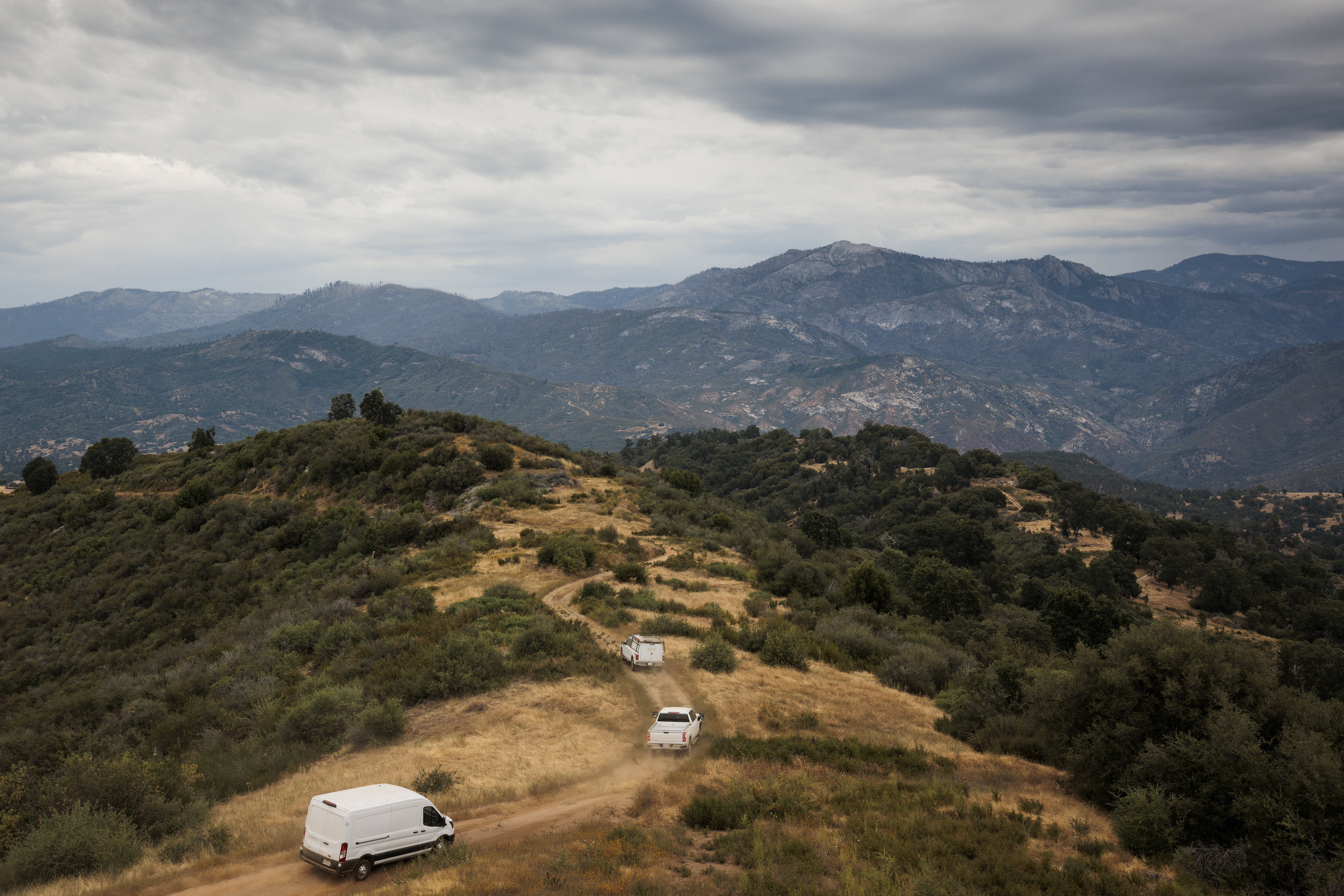
    They drive tens of thousands of miles around the state each year in a Ford F-150 pickup and a van. They install and maintain camera systems on public and private land, in places like rock ledges, 300-foot mobile phone towers, water towers, and rooftops.

    “Most trips end up with someone bleeding,” Nicholson said. He shrugged and smiled, his usual disposition.

    Nicholson has been doing this for 12 years. His role as senior engineering supervisor is to set up all the information technology components of the systems in the field while maintaining a contagious can-do vibe for his crew.

    These days it includes John Connolly, a talkative 30-year-old ex-Marine who does most of the tallest tower climbs; Jim Conley, a burly 63-year-old who surfs, rides motocross bikes, and acts like a construction foreman; and Kai Erwin, 30, the quiet, self-described “gofer” of the group.

    Their boss, Neal Driscoll, is principal investigator at Alert California and a University of California, San Diego, professor. He has a woolly mustache and looks a bit like actor Nick Offerman in Parks and Recreation.

    “I hire for attitude,” Driscoll said. “I want people who don’t give up, who exploit other people’s strengths and not their weaknesses, and who like a cold beer at the end of the day.”

    Spotting a fire in its infancy

    Alert California is based at UC San Diego and the field team works out of a nondescript building within steps of the Pacific Ocean. Nicholson pointed to the beach where he surfs.

    “That’s why I love this job,” he said. “Not only do I get to travel and help people, but I have an office here.”

    He and Connolly stood in a storage room lined with Costco-style shelves filled with equipment — surveillance cameras, solar panels, satellite dishes, 80-pound batteries, and modems, plus wiring and cables, nuts and bolts, wrenches and clamps, sledges and shovels, and anything else that might prove useful in attaching heavy equipment to structures in the wild.

    Summer is especially busy. The crew may install cameras at a dozen sites during a two-week trip, come home to repack, then do it again. Along the way, they repair cameras that have gone dark because of dead batteries, rodent-chewed cables, lightning strikes, last winter’s blizzards, or the latest wildfire.

    Some of the most captivating footage comes when fire engulfs the cameras. Other popular images show nesting California condors.

    The network of remote sensors that eventually grew into Alert California began in 2001 to detect and communicate seismic activity around San Diego. When the 2003 Cedar fire near San Diego burned more than 250,000 acres and killed 15 people, it was clear cameras would be useful. A local utility asked to have more than two dozen installed.

    State officials, utilities, and fire departments were convinced that investing in more cameras was a smart move, and linking them into one open-source, nonprofit system made the most sense. Alert California’s budget can approach $14 million per year, Driscoll said, funded mostly by Cal Fire, the state’s firefighting agency, and large utility companies.

    Fire officials cite examples of little-known fires that were snuffed out quickly thanks to early detection.

    “The greatest success stories are the fires you’ve never heard about,” said Falko Kuester, co-director of Alert California and an engineering professor at UC San Diego.

    Spotting a blaze in its infancy allows officials in command centers to determine whether the smoke is truly a wildfire, and not from a rancher burning debris or fog rolling through a valley. They can decide how many firefighters to send, whether to strike by air or let the fire burn while being monitored.

    Driscoll pointed to October 2017, when fires in Napa and Sonoma counties were the most destructive in state history at the time — since overtaken by several other fires — and killed dozens of people. Two years later, new cameras in parts of the same region helped lead to quick detection and remote management of the huge Kincade fire. There was less destruction and no fatalities.

    Driscoll wants to grow the network to 1,800 cameras and fill gaps in coverage. Local and regional fire officials have worrisome spots, like Soda Canyon. More and more, people request cameras on their property.

    Each installation involves two cameras, in case one of them fails. They have different strengths — to see long distances, to capture crisp images at night, to see through thick smoke.

    One camera is set up to spin 360 degrees every two minutes, capturing six frames per rotation. The other can be controlled remotely by fire officials who want to aim in certain directions or zoom in tight on specific spots.

    Artificial intelligence, introduced to the system in 2023, is a growing part of surveillance. Driscoll said this summer that 51% of California wildfires are first spotted through AI and the ratio is growing quickly.

    “We are the science of risk reduction,” Driscoll said. “I love that phrase.”

    A well-rehearsed choreography

    The field team woke up at a Holiday Inn in Visalia. It had installed cameras that week on a mountaintop fire station, on a cellular tower, and on an old lookout at nearly 7,000 feet.

    Lightning and high winds are persistent worries on installation days. Simply reaching the site can be the scariest part. There are stories of trucks stuck on precarious dirt roads and tires hanging off cliff edges. Long hikes to the sites are not an option. The heavy equipment can’t be carried far.

    On this day, the road to the worksite got higher, narrower, windier, and dustier before ending atop Shadequarter Mountain. The four-story tower, sheathed in peeling sheet metal, was built in 1964 and abandoned in the late 1980s because of budget cuts.

    It stood 4,000 feet above Visalia and California’s vast Central Valley. There were mountains in every other direction. The view was pocked with black splotches and burned-out trees, where the 2015 Rough fire, the 2021 KNP Complex fire, and the 2024 Coffee Pot fire combined to burn about 250,000 acres.

    If only the system had been in place back then, maybe the response might have been different. Faster.

    In a sunny spot at Shadequarter, the crew, with the silent choreography of a blue-collar dance troupe, built the tripod — a retrofitted, off-the-shelf deer stand — and anchored the legs with 60-pound bags of Quikrete. Digging holes can violate regulations regarding historic and Indigenous locations.

    They attached an array of solar panels. They bolted on a large metal cabinet to house electronics, including two 80-pound lithium batteries. A Starlink satellite receiver was fixed atop the apparatus.

    A fire official mentioned that a rancher sometimes ran cattle atop Shadequarter. The crew discussed whether cows would use the setup as a scratching post.

    “I don’t think they’ll tip it over, but they might break a solar panel,” Nicholson said. “Cows are heavy.”

    It was decided: Local officials would build a short chain-link fence the next day.

    The crew ran wires through the cow-proof conduit about 30 feet to the tower. Connolly scaled the outside to string wiring to the top. Others, climbing interior stairs splotched in rodent feces, attached each camera to its own pole in front of now-broken windows.

    Back on the ground, Nicholson sat at the tripod, holding a laptop. He could see the view from the cameras. He could move them, zoom them, spin them — just as remote fire officials would be able to do. He spotted smudges on the cameras and sent someone to clean them.

    With a series of commands and passwords, the cameras were connected to the system. Suddenly, anyone in the world could see the view from the top of the fire tower.

    The field team snaked downhill in a cloud of dust. Nicholson and the others didn’t know where they were headed because the schedule was in flux. They didn’t have a hotel for the night and they didn’t have dinner plans.

    But they could use a cold beer.

    This article originally appeared in the New York Times.
  • There would be no U.S. Navy without Philadelphia

    There would be no U.S. Navy without Philadelphia

    It was the summer of 1775 and Rhode Island’s delegates were concerned.

    The colonists had been at war with Britain for four months and the battles were heating up. Bounded by the Narragansett Bay, an inlet of the Atlantic Ocean, Rhode Island was particularly vulnerable to a surprise British ambush by sea.

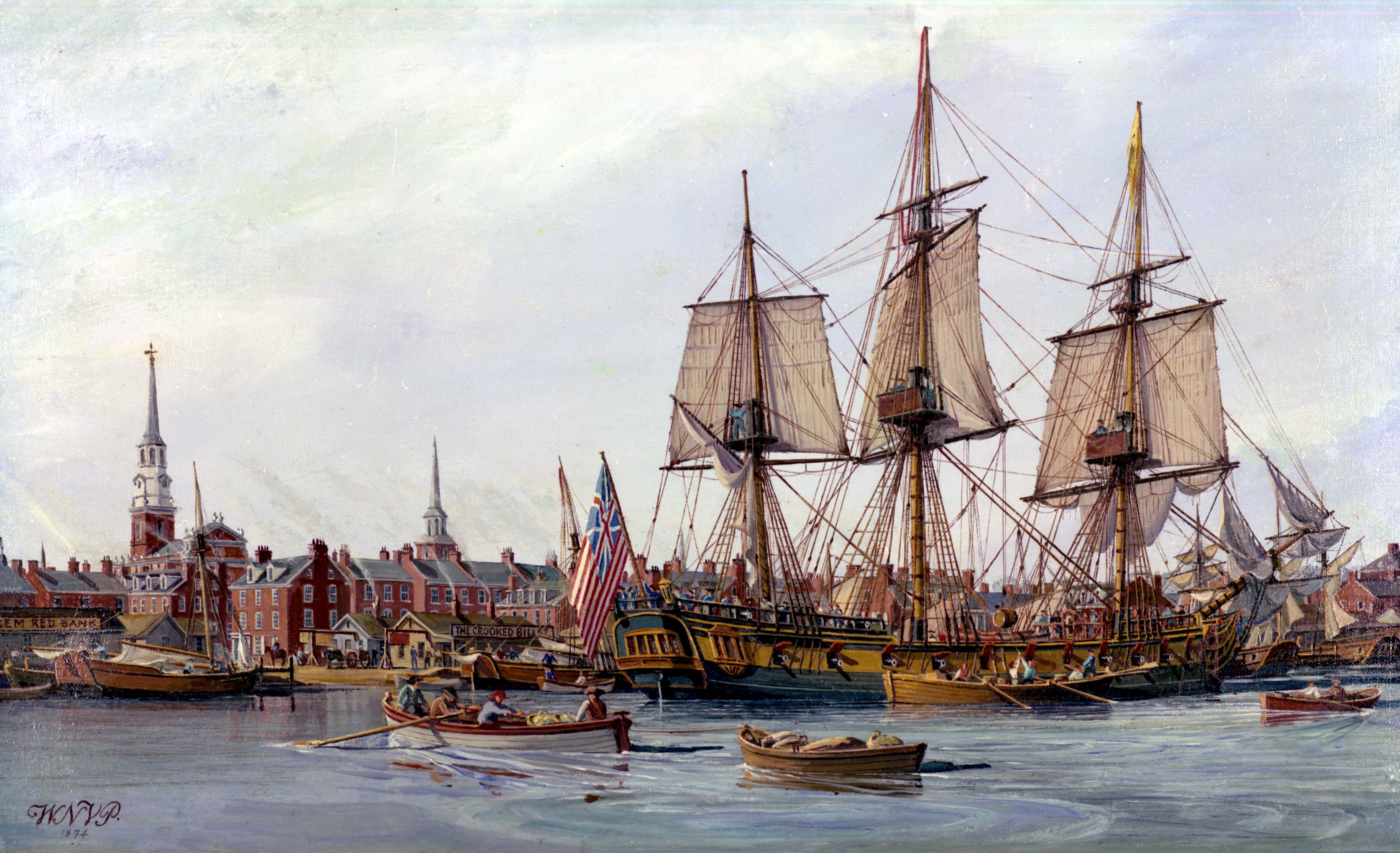
    The New World’s tiniest colony knew they needed the firepower of fellow colonies to hold off the world’s largest navy in a sea battle. So in August, Rhode Island sent delegates to the Second Continental Congress in Philadelphia’s Independence Hall to request a “fleet of sufficient force for the protection of these colonies [to] be established.”

    This design honors the founding of the United States Navy and Marine Corps in 1775 with images of colonial Philadelphia Quakers Joshua Humphreys and Samuel Nichols. Both were integral to both military branches’ founding.Sean Bryant and Colibrí Workshop

    On Oct. 13, Congress voted to grant Connecticut and Rhode Island merchant vessels to patrol the North in a search-and-destroy mission for British ships. The Congress also voted in favor of supplying General George Washington with an armed schooner and sloop to seize British supplies.

    With the authorization of the military to protect its interests on water, the Second Continental Congress created the U.S. Navy.

    The U.S. Navy’s beginning will be remembered Saturday at the Arch Street Meeting House Firstival, part of the Philadelphia Historic District’s yearlong weekly celebration honoring important American institutions that trace their beginnings to Philadelphia.

    “The creation of an American naval force was a key strategy to winning the war,” said Sean Connolly, executive director of the Arch Street Meeting House Preservation Trust. “It also proved to other European nations like the French, the Dutch, and the Spanish that we were to be taken seriously, that we were just like other world powers.”

    Guarding the seas was just one part of the colonists’ military strategy. When the ships arrived at their destination they needed to employ guerrilla fighters and marines to match up to the might of the British Royal Marines.

    The Continental Congress established two battalions of the Continental Marines on Nov. 10. Later that month, on Nov. 28, Massachusetts delegate John Hancock appointed Philadelphia Quaker Samuel Nicholas as the Marines’ first commissioned officer.

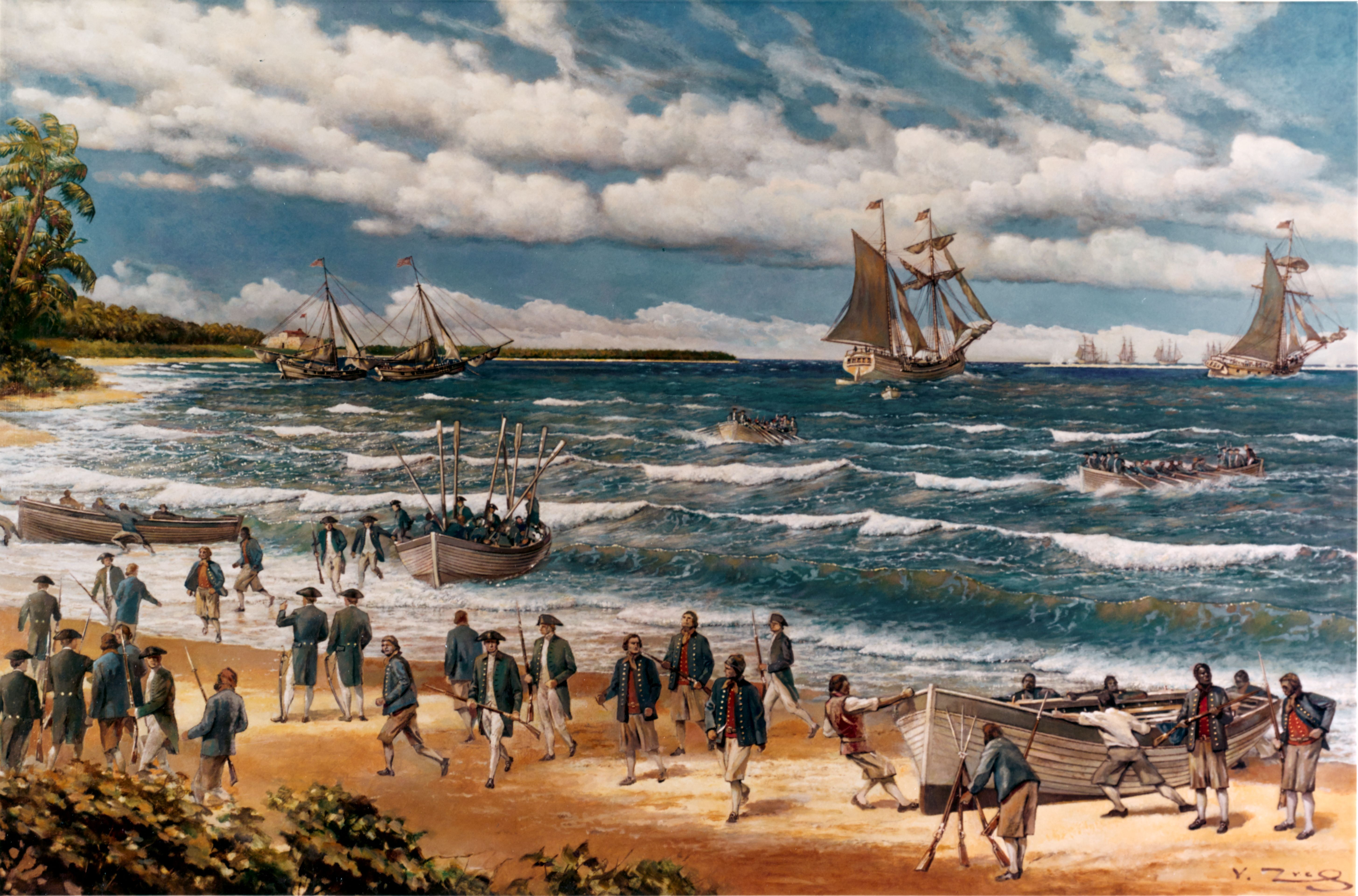
    In March of 1776, Nicholas took a ship outfitted by another Philadelphia Quaker, Joshua Humphreys, to New Providence, the capital of the British-controlled Bahamas, where he commanded the United States to raid a British ship and steal its weapons and gunpowder.

    Oil painting on canvas by V. Zveg, 1973, depicting Continental Sailors and Marines landing on New Providence Island, Bahamas, on March 3, 1776. Their initial objective, Fort Montagu, is in the left distance. Close off shore are the small vessels used to transport the landing force to the vicinity of the beach. They are (from left to right): two captured sloops, schooner Wasp and sloop Providence. The other ships of the American squadron are visible in the distance. The operation was commanded by Commodore Esek Hopkins.U.S. Navy Art Collection, Washington, D.C. U.S. Naval History and Heritage Command Photograph.

    It was a strategic mission, Connolly said, to capture and destroy ships used to fight the colonists on American soil.

    “It was a way of weakening the British forces by diverting their attention from America to their colonies in the Caribbean,” Connolly said. “We needed ammunition. So we decided to raid their forts of gunpowder and cannons and take it back to America. We were very successful, capturing 88 cannons, 15 mortars, and a huge amount of gunpowder.”

    Most importantly, the Americans would no longer be underestimated. This show of military power, Connelly said, is why France joined the colonists.

    After the Treaty of Versailles was signed in 1783, Congress disbanded the Colonial Navy and Marines. The Continental Army was a mere shell of itself.

    “The Founding Fathers didn’t think we need a permanent military force anymore,” Connolly said. “They believed an armed militia could potentially be used against the government.”

    But the need for defense proved necessary.

    In August 1789, Washington (who was now president) created the U.S. Department of War, appointing Henry Knox as its first secretary. On Sept. 29, 1789, Washington reestablished the U.S. Army under the Constitution.

    During his second term as president on March 27, 1794, Congress created the Navy as we know it today to protect American ships from pirates on the Mediterranean Sea. Humphreys was called on to build the first six U.S. Navy frigates.

    U.S. Navy sailors listen as President Donald Trump speaks during an event at Tradepoint Atlantic on Sparrows Point in Maryland, on Tuesday, Oct. 6, 2026. (Kenny Holston/The New York Times)KENNY HOLSTON

    One of the ships Humphreys designed, the USS Constitution, is still in active service as a training vessel for the Navy, Connolly said.

    On July 11, 1798, President John Adams signed the act establishing and organizing the U.S. Marine Corps as a part of the Department of the Navy.

    “The Quakers were pacifists, yes,” Connolly said. “But we cannot forget their military contributions to helping America become America.”

    This week’s Firstival is Saturday, Oct. 17, from 11 a.m. to 1 p.m., at the Arch Street Meeting House, 320 Arch St.

    Each week, The Inquirer is highlighting a “first” from the Philadelphia Historic District’s 52 Weeks of Firsts. A “52 Weeks of Firsts” podcast, produced by All That’s Good Productions, drops every Tuesday.

  • Letters to the Editor | Oct. 15, 2026

    Letters to the Editor | Oct. 15, 2026

    This is it?

    It is incredible that Superintendent Tony B. Watlington Sr. claims “to be following the rules,” adding 720 students back to the school district’s enrollment list. After all the stories by Inquirer education reporter Kristin A. Graham about the issues around attendance in the Philadelphia School District, this is what the superintendent comes up with?

    Karel Kilimnik, Philadelphia

    Fiscal stability

    No one wants to see Chester emerge from receivership more than I do. But after decades of financial distress, success cannot be measured by how quickly state oversight ends. It must be measured by whether Chester can govern itself sustainably afterward.

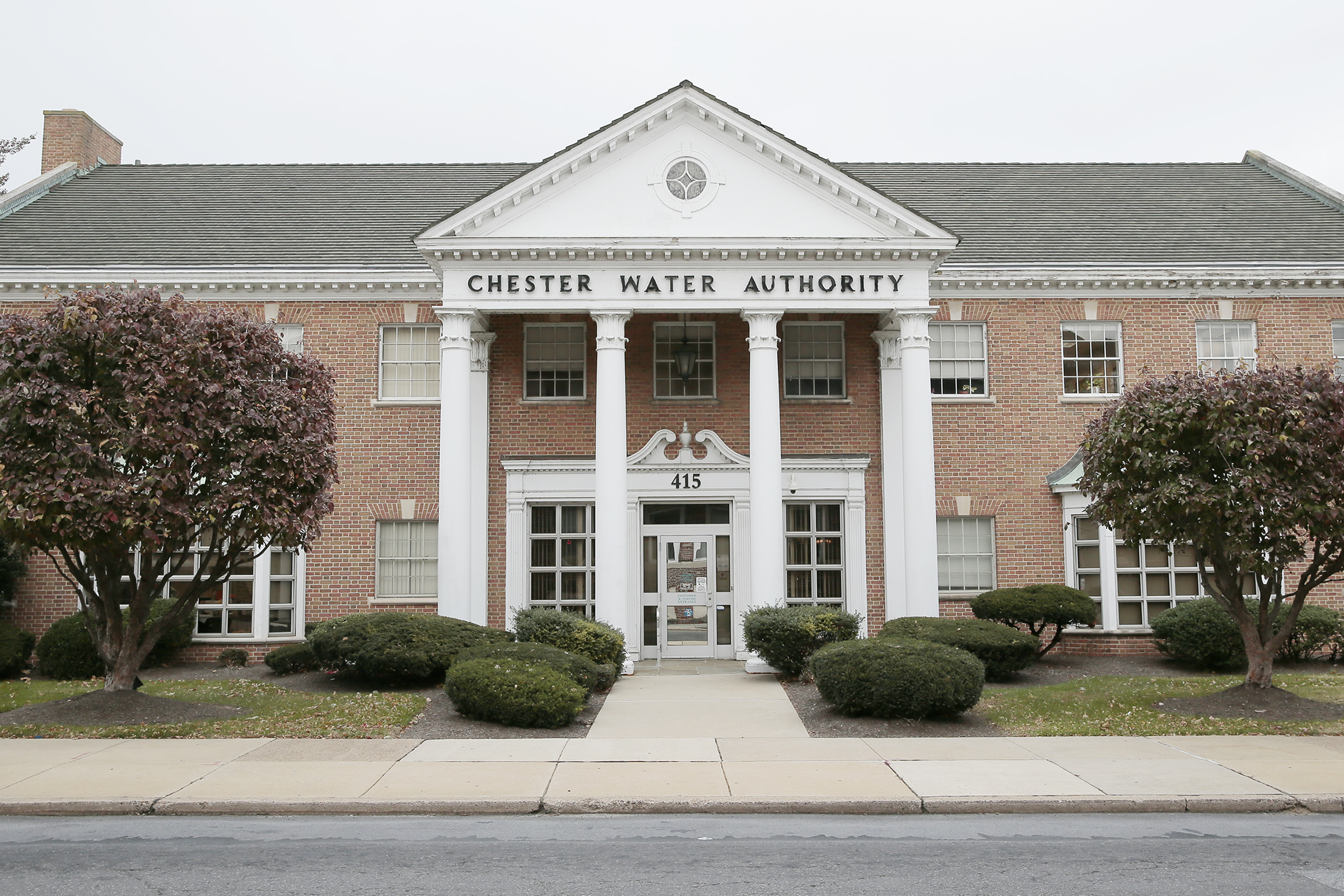
    That is the distinction missing from the recent letter from Chester Water Authority Chair Noel Brandon — who is not a resident of the city of Chester. Since 2020, the city has made meaningful progress toward financial stability and stronger governance. Among its most significant accomplishments are adopting a new ethics policy and transparency practices to restore residents’ faith in government. The city also appointed professional department heads, rescued insolvent pension funds, invested in new fire trucks and essential equipment, and advanced long-standing financial audits — improvements to city operations that lay the foundation for a stronger government.

    There is still work to be done. Chester’s challenges developed over decades and cannot be resolved by setting an arbitrary end date. As the receiver for the city, my responsibility is not to deliver the fastest possible exit from receivership, but to ensure Chester achieves a lasting recovery.

    Chester residents deserve a financially stable, transparent, and accountable government that can serve them for generations to come. That is what we are working toward, and what will ultimately make the end of receivership a success.

    Vijay Kapoor, receiver for the city of Chester

    Citywide infestation

    I was pleased to see that City Council recently passed an emergency resolution urging city departments to treat a reported rat infestation in the Mayfair neighborhood as a public health and quality-of-life emergency. The only problem is that this public health crisis is not unique to Mayfair. I live in a West Philadelphia neighborhood that has experienced a recent explosion in the local rat population because of excavation work by various city agencies over the last several years, ongoing problems with abandoned food-related businesses on Baltimore Avenue, improperly secured trash and illegal dumping, and private properties falling into disrepair. It’s gotten noticeably worse in the past few months. You can’t go out at night without seeing multiple rats, and a dead rat turns up on our block at least once a week. I imagine if this is happening in the Northeast and West parts of the city, it’s probably happening in lots of other neighborhoods, too. The city did an amazing job cleaning up high-profile areas where big events occurred this summer. I’d love to see that kind of coordinated energy applied to addressing the rat problem citywide — it threatens the health and quality of life of the residents who live here all year round.

    Irene Lin, Philadelphia

    Join the conversation: Send letters to letters@inquirer.com. Limit length to 150 words and include home address and day and evening phone number. Letters run in The Inquirer six days a week on the editorial pages and online.

  • Horoscopes: Thursday, Oct. 15, 2026

    Horoscopes: Thursday, Oct. 15, 2026

    ARIES (March 21-April 19). The first movement comes through friends, groups or your future plans. You extend an invitation or propose a project. Your actions demonstrate to others that the next chapter has begun.

    TAURUS (April 20-May 20). Career and public life get the first green light. You have an ambitious move on your mind, and it’s almost time. You know what you want, but you may not know quite how to go about it yet. Keep researching.

    GEMINI (May 21-June 21). Make the first move out of your usual territory. It starts once you enroll, book, inquire, submit, visit or introduce yourself. Pretend you’re playing a numbers game — a quantity of output will eventually get the result.

    CANCER (June 22-July 22). A financial or emotional entanglement frees up. The first honest transaction can change the terms of everything afterward. But you don’t have to go in with the hard truth. Build trust first.

    LEO (July 23-Aug. 22). You’re the one who will change a relationship. Think about where you feel the friction and what you could really do without. You don’t need to know exactly how the other person will respond before showing them what kind of relationship you want.

    VIRGO (Aug. 23-Sept. 22). Daily life has intricate machinery, and you’ll change out a part. It’s the schedule that makes the most difference. Doing something a little earlier or less often over the course of a week fixes a recurring nuisance.

    LIBRA (Sept. 23-Oct. 23). Enthusiasm is a risk, and you’ll take it! You’ll be lucky when you show your work, flirt, play, perform, invite someone out or pursue the thing that delights you. It just feels right to express yourself, and you’ll have fans.

    SCORPIO (Oct. 24-Nov. 21). Home or family life has been undergoing a transformation. Make one move that represents the future you want there. Work from the outside in. When people have their own spaces that support their needs, harmony hums through the place.

    SAGITTARIUS (Nov. 22-Dec. 21). Say it first. You have the message that matters — the one that points out what’s been unfair or explains why things can’t keep going on in the same way. You don’t have to finish the conversation today, just get the subject on the table.

    CAPRICORN (Dec. 22-Jan. 19). Money, possessions and self-worth are Pluto’s territory for you now. You’re right to expect more from your resources. Raise a price, open the account, make an offer or stop paying for something that’s no longer as useful.

    AQUARIUS (Jan. 20-Feb. 18). Pluto turns direct in your sign, so yours is the most personal first move. Change something about how you present yourself, behave or make choices. Other people may need time to catch up so don’t wait for their response. Keep going.

    PISCES (Feb. 19-March 20). Your first happens where nobody can see it, and that’s perfect. It’s how you know you’re doing what’s good for you. You’ll touch on the sacredness of your individuality and the power of your singularity.

    TODAY’S BIRTHDAY (Oct. 15). In your Year of Vivid Color, it’s out with the banal and in with the beautiful as the world comes alive with invigorating brightness. Exciting environments invite action, and you’ll love the strength you gain by moving through them in the way that feels natural. More highlights: a powerful reunion, financial stress relieved, a new understanding that makes relationships sing. Scorpio and Cancer adore you. Your lucky numbers are: 11, 4, 32, 15 and 49.

  • Dear Abby | Father appalled as daughter leads on classmate

    Dear Abby | Father appalled as daughter leads on classmate

    DEAR ABBY: My wife and I are the proud parents of a popular, beautiful, charming and usually well-meaning 16-year-old girl. However, some of her recent behavior is causing serious concern.

    “Lindsey” is part of her class’ “in” crowd. Still, she’s engaging and friendly to everyone, which is a value my wife and I have worked to instill in her. One boy, “Henry,” is sweet on her. In short, Henry is not exactly in her social circle. He’s quiet, but he gets excellent grades and is considerate and respectful.

    Lindsey has been giving Henry the impression that she is romantically interested even though she isn’t. As a result, he’s helped her with many school projects, among other favors. She often has him over to maintain the charade. I’ve gotten to know Henry, and I genuinely like him. He’s a good kid, and I’m disgusted at Lindsey’s behavior.

    I tried to talk to Lindsey about it, and she said she’s “just using what God gave her” to better her life. She seems to think that if Henry is happy being around her, she’s not doing anything wrong. I feel I should talk to Henry about this, or at least his parents. What do you think? I love my daughter, but I don’t want her taking advantage of (and possibly destroying) this young man’s heart!

    — DOUBTING DAD

    DEAR DAD: Henry may be happy now, but you and Lindsey both know he’ll be crushed when the truth comes out. This must end immediately. Inform Lindsey that if she doesn’t come clean and sincerely apologize to Henry, there will be consequences. Be prepared to follow through in whatever way you would normally discipline a self-centered, misbehaving child.

    ** ** **

    DEAR ABBY: I’ve had a college friend for more than 45 years. We’ve had some issues over the years. Because I have a bit of a temper, she has said numerous times that I belong in a mental institution. We had another disagreement several months ago and have ceased all communication. She spoke to me in the tone of voice you would use to talk to a 2-year-old.

    I’m now having some medical issues she and her husband are not aware of. We are not young anymore. My dilemma is this: If she or her husband passes, do I go to the funeral? I now use a walker, and if their church’s chair lift is broken, I would be unable to attend the service anyway. I live quite a distance away.

    — ESTRANGED FRIEND IN NEW HAMPSHIRE

    DEAR FRIEND: Nowhere did you indicate that this friend is having health issues. In light of your long friendship, she should be made aware that you are unwell. Tell her you would not want your long friendship to end as things stand.

    Funerals are intended as a support for the living. If you would like to attend when the inevitable does occur, contact the person who will conduct the service and ask if the funeral home or house of worship is ADA accessible. There’s no need to stay home due to what might go wrong.

  • Bruno Damiani shines again as the Union extends unbeaten streak to 14 with a 3-1 win at Chicago

    Bruno Damiani shines again as the Union extends unbeaten streak to 14 with a 3-1 win at Chicago

    The Union extended their record unbeaten streak to 14 games, including eight wins in a row now, with a 3-1 triumph over the Chicago Fire on Wednesday at Soldier Field.

    It was a come-from-behind win, with Chicago opening the scoring late in the first half. But a red card to former Union centerback Jack Elliott soon after that was the turning point.

    Interim Union manager Ryan Richter picked a first-choice starting lineup with one exception: Defensive midfielder Danley Jean Jacques didn’t travel because of a foot injury that was announced late Tuesday. Richter said after the game that Jean Jacques suffered it in Saturday’s win over Real Salt Lake, but the team thought he’d be able to play.

    Once he couldn’t, Jesús Bueno stepped in.

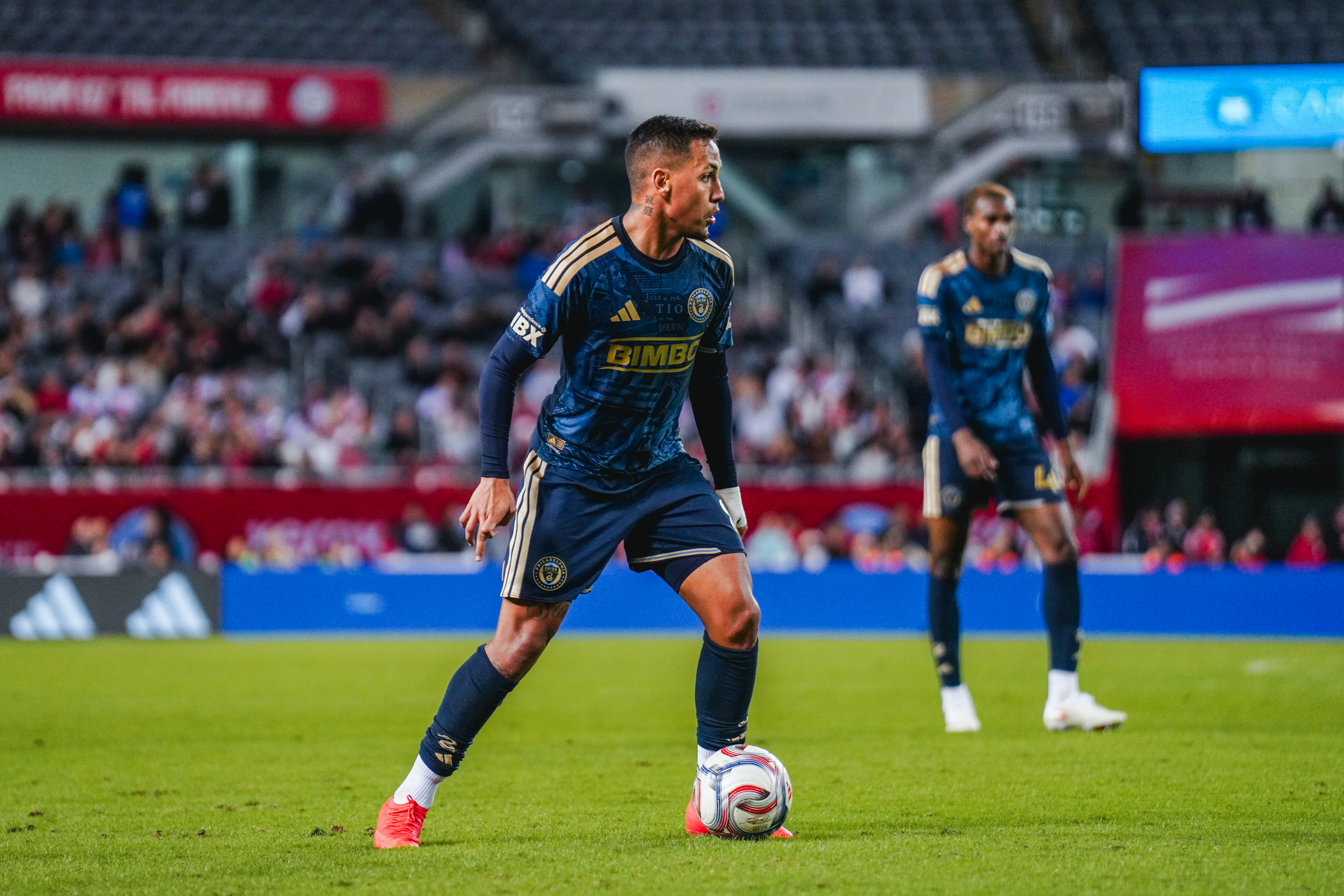
    Jesús Bueno made just his fourth start in the 14 games since the World Cup break.Philadelphia Union

    The first half was pretty quiet until Chicago’s goal in the 44th minute. It came from a well-worked team play that caught multiple Union players out of position.

    Cavan Sullivan was first when Noah Allen ran behind him to receive Jonathan Bamba’s pass from the left wing. Neil Pierre was second, watching the ball instead of Maren Haile-Selassie’s run into the middle of the box. Nathan Harriel was third, as Haile-Selassie stepped in front of him easily and aimed a nifty flick past Andre Blake.

    Just seconds after play resumed, Elliott was sent off for his second yellow card of the night. The first came in the 41st for shoving Bruno Damiani from behind, and the second would have been pass interference on the Bears: a grab of Milan Iloski from behind as he tried to break away.

    Chicago accounted for Elliott’s departure by subbing out Bamba for centerback Andreas Hanche-Olsen at halftime. But that didn’t stop the Union from equalizing in the 49th.

    After Chicago goalkeeper Chris Brady denied Iloski from close range, the Union recycled the rebound and it came to Frankie Westfield on the right. He crossed low, Damiani made a terrific backheel pass in the box, and Iloski stuck the ball in from the doorstep.

    It was his 19th goal of the year in all competitions, tying him for the third-highest total in a year in team history. Tai Baribo scored 19 last year, and Dániel Gazdag did the same in 2024. Gazdag also has the top two totals, 22 in 2023 and 24 in 2022.

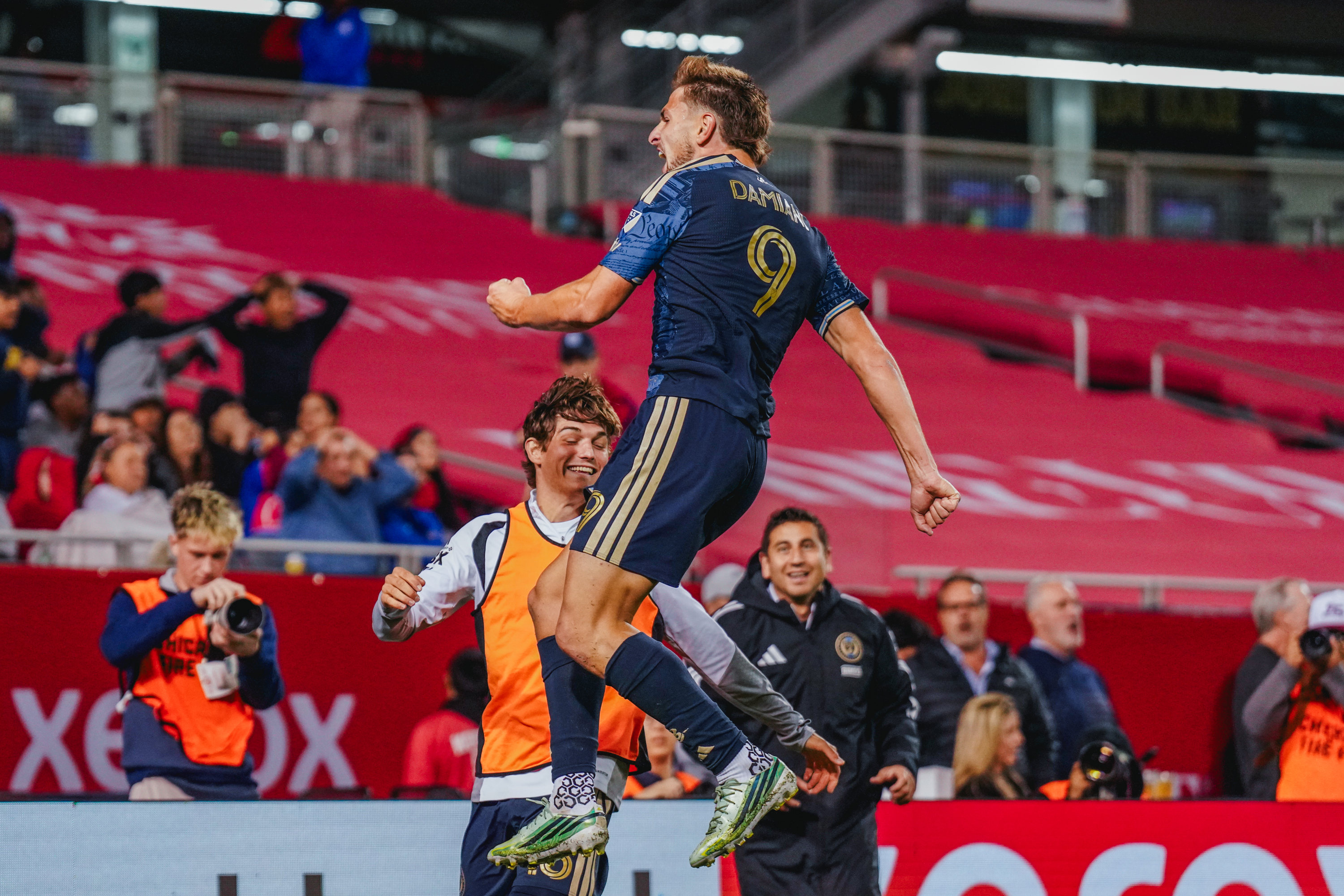
    Five minutes later, the Union took the lead with a terrific team play. Westfield hit a cross-field pass to his fellow northeast Philadelphia native Sullivan, who jumped to head the ball to Iloski. His first-touch pass played the ball forward, and Sullivan continued his run to meet it. He crossed low, and Damiani flicked it superbly to the far post.

    That was Damiani’s 14th goal of the year, and his seventh in the last six games. It was also Sullivan’s 12th assist of the year, and six of them have come since the World Cup.

    A moment later, Richter made his first sub of the night, sending in Indiana Vassilev for Bueno when the latter ran out of gas.

    Damiani’s 15th goal came in the 67th, a pure finish by a striker with confidence.

    It started with Chicago’s Mauricio Pineda all but giving the ball to Jovan Lukić near midfield. He fed Damiani, who started running. Shockingly, four Fire players let Damiani charge 25 yards untouched before he shot from just outside the 18-yard box and beat Brady low.

    Chicago manager Gregg Berhalter seemed to wave the white flag after that with a triple-substitution. In the 80th, Richter put his team in soccer’s equivalent of a victory formation: He sent in Ben Bender and Ezekiel Alladoh for Sullivan and Damiani in the 80th.

    That also let the attackers rest a little with the next game coming quickly, Saturday against Charlotte FC at Subaru Park (2:30 p.m., Apple TV). But there was still time for the Fire to force Blake into two strong saves in the final minutes.

    Japhet Sery Larsen and Malik Jakupović were the last substitutes, replacing Quinn Sullivan and Iloski in the 92nd.

    The Union (13-10-6, 45 points) finished the night in sixth place in the Eastern Conference. But they’re just one point back of Charlotte, just three points behind fourth-place Chicago (14-9-6, 48 points), and four behind third-place New England.

    window.addEventListener(“message”,function(a){if(void 0!==a.data[“datawrapper-height”]){var e=document.querySelectorAll(“iframe”);for(var t in a.data[“datawrapper-height”])for(var r,i=0;r=e[i];i++)if(r.contentWindow===a.source){var d=a.data[“datawrapper-height”][t]+”px”;r.style.height=d}}});

  • A student at Temple University reported being raped on Saturday

    A student at Temple University reported being raped on Saturday

    A student at Temple University reported being raped Saturday at a privately operated residential complex at the North Philadelphia campus.

    The student on Tuesday reported the alleged crime to the university, according to a crime log that is made publicly available by Temple.

    The rape allegedly happened on Saturday around 2:30 a.m. at University Village on North 10th Street between Cecil B. Moore and West Montgomery Avenues.

    The crime log on Wednesday said the case was “referred to the student code of conduct,” whereas most of entries of reports of crimes say “investigation is ongoing” by Temple or Philadelphia police, or an “arrest was made.”

    Temple officials did not say publicly why the case was being investigated for violations of the student code of conduct instead of as a criminal allegation.

    In a statement released Wednesday night, Temple president John Fry said he could not comment on the specifics of the case, but he wanted to provide some clarification.

    “Students who are reporting a sexual assault make the decision on whether they wish to pursue criminal charges,” Fry said.

    “If they want to file a police report, we work to help them navigate that process, connecting them directly to a victim advocate who supports them during this difficult time. That commitment is unwavering and consistent. Whether they choose to pursue criminal charges six days or six months after an incident, we are there to serve as a trusted partner. No matter what the student decides to do, we also offer university resources and support through a variety of on campus resources,” Fry said.

    “This investigation is currently being handled through Temple’s Student Conduct Code, which allows the university to hold students accountable under university policy,” Fry said.

    “While the university’s conduct process is independent of law enforcement, it does not diminish the seriousness of the allegations or our responsibility to respond,” Fry said.

    The president said a university safety alert was not needed in this case.

    “When an incident is reported to the university, we review the available information and assess whether a TUAlert is needed. While an alert was not issued in this case, that does not mean we take the report any less seriously. We are committed to transparency, and this incident was included on the university’s publicly available crime log. We are thoroughly investigating the matter and responding appropriately,” the president said.

    In light of the outrage that has erupted over a 2024 rape allegation at Cornell University in New York, Fry reiterated that the university has convened a Sexual Assault Advisory Group that includes students, faculty, and staff.

    The advisory group will review “our current practices and make detailed recommendations to university administration. Work on this group is already underway, and they will be charged with a review of the full scope of the university’s policies, practices, communications and coordination with the Philadelphia Police Department on cases of sexual assault.”

  • Police ID man killed by officers on the Parkway

    Police ID man killed by officers on the Parkway

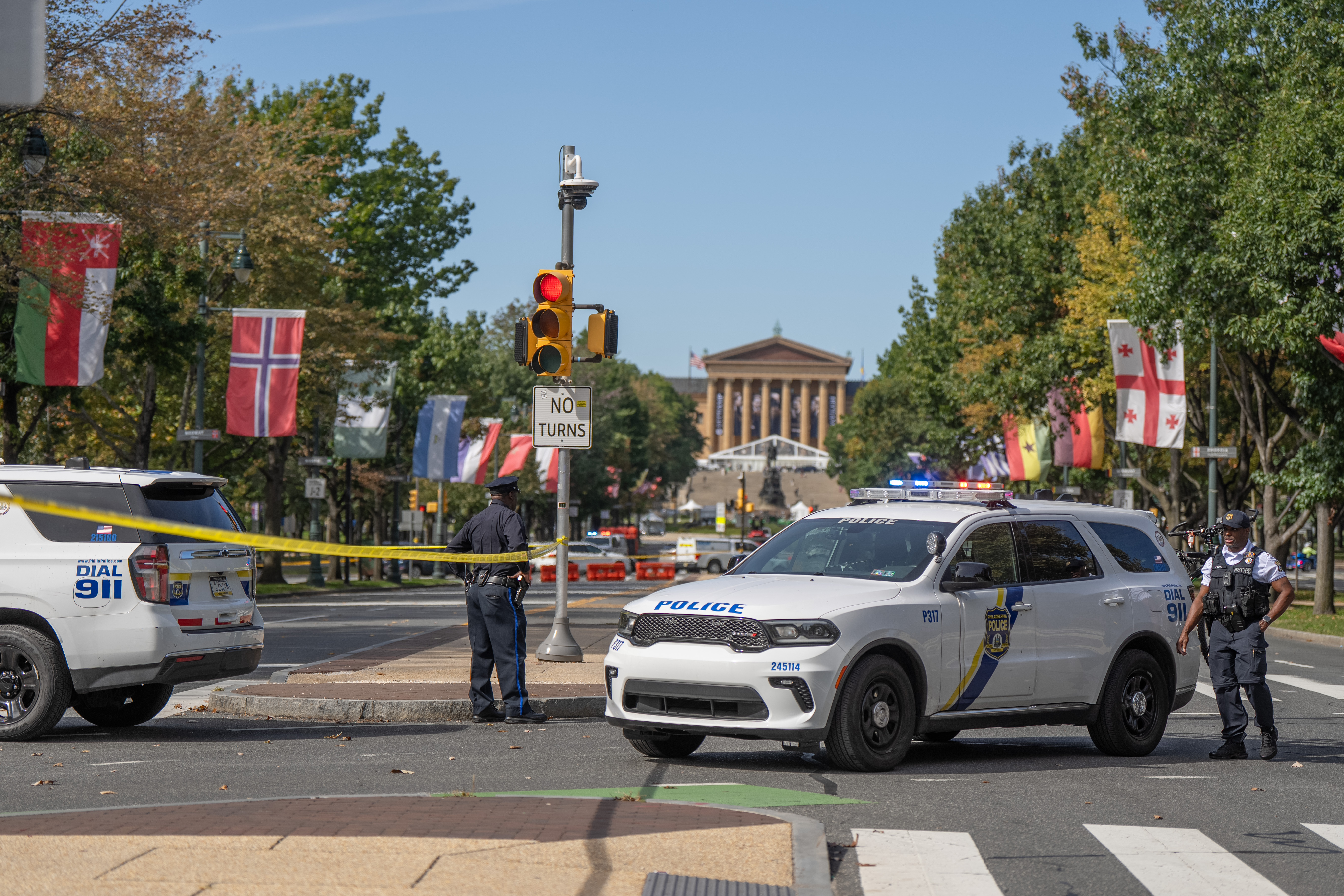
    Philadelphia police identified the 60-year-old armed man who was fatally shot on Friday morning by two officers on the Benjamin Franklin Parkway.

    Police responded around 11 a.m. to the area of 21st Street and the Parkway, where William Austin reportedly was waving a revolver around. At some point, 38-year-old Officer Eric Lee and a SEPTA Transit Police officer were at the scene when Austin allegedly fired the gun. He was shot by both officers.

    The Philadelphia Police Department named Lee, a 13-year veteran on the force assigned to the department’s counterterrorism unit. The department did not release the SEPTA officer’s name.

    A spokesperson for SEPTA could not be reached for comment Wednesday night.

    Police had attempted to talk to Austin through a loudspeaker, Police Commissioner Kevin Bethel said Friday.

    “The individual is just continually pointing the weapon, waving the weapon, and waving the weapon multiple times, pointing it at the officers. The officers all backed away and tried to take as much cover as possible,” Bethel said.

    The department said on Wednesday that officers had established a containment area and requested SWAT personnel.

    “A Philadelphia police officer who is a trained negotiator used a marked police vehicle’s loudspeaker to communicate with the male in an attempt to resolve the incident peacefully. During those efforts, the male repeatedly pointed the firearm toward himself and responding officers,” the department said.

    “After several minutes, the male placed the firearm on the ground but retrieved it approximately one minute later. The male subsequently discharged the firearm toward the ground and then raised and pointed it toward responding officers,” the department said.

    Lee and the SEPTA officer each fired one round from their police-issued long guns, the department said. Police took Austin to Thomas Jefferson University Hospital, where he was pronounced dead.

    Neither officer was hurt.

    Police at the scene recovered a .357-caliber revolver containing three fired cartridge casings and three live rounds, the department said.

    The officers have been reassigned to administrative duty pending internal investigations and a review by the district attorney’s office.

  • Sources: Phillies fire veteran coaches Kevin Long and Bobby Dickerson

    Sources: Phillies fire veteran coaches Kevin Long and Bobby Dickerson

    As Don Mattingly takes charge as the Phillies’ full-time manager, the team has fired two veteran coaches.

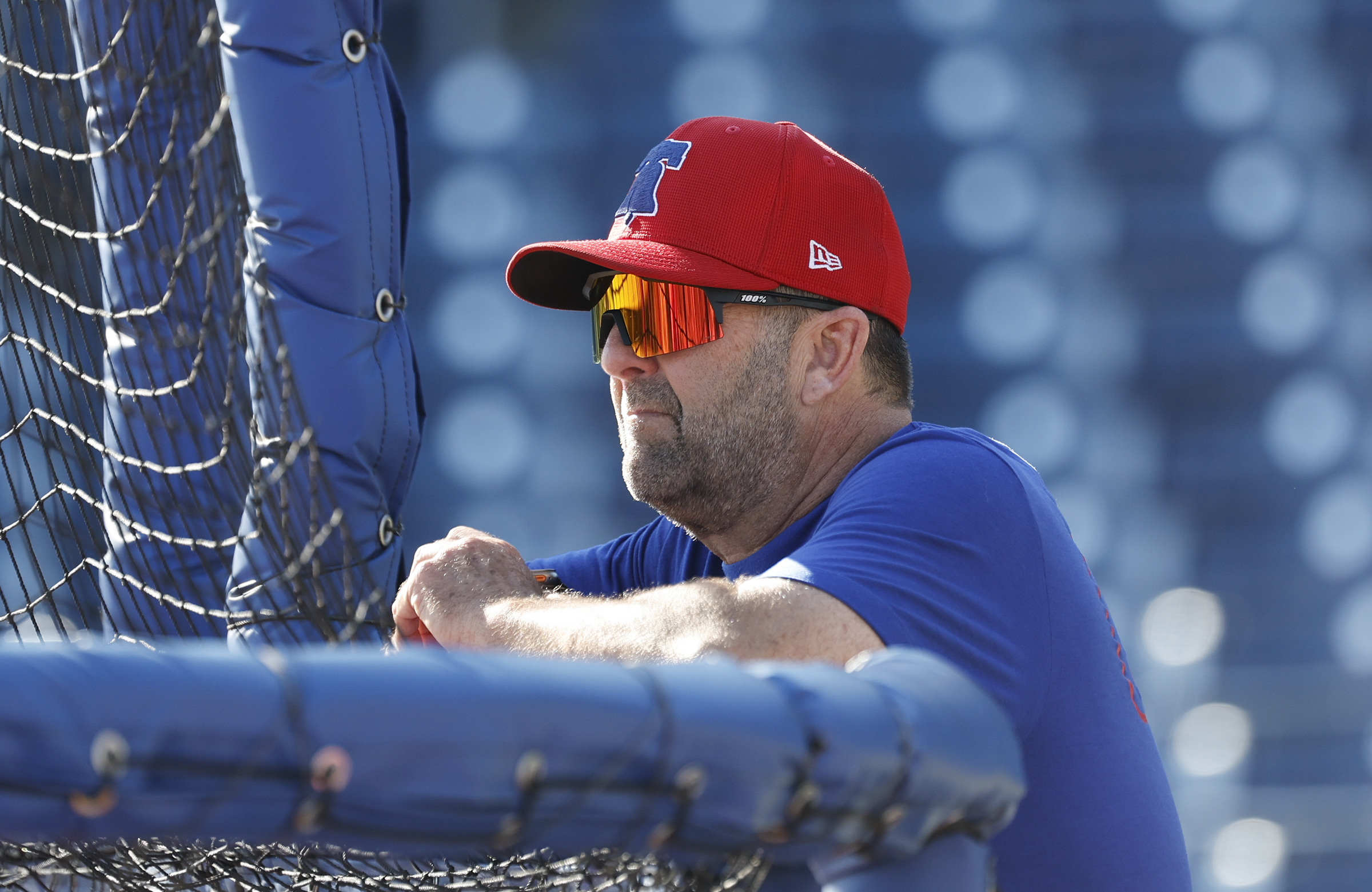
    Hitting coach Kevin Long and infield instructor Bobby Dickerson were told they’re being let go, major league sources said Wednesday night, confirming an NBC Sports Philadelphia report. The Phillies are expected to announce the changes as part of a news conference Thursday in Citizens Bank Park.

    Long, 59, and Dickerson, 61, were hired before the 2022 season to work for then-manager Joe Girardi and remained on the staff after Rob Thomson replaced Girardi in May 2022 and Mattingly replaced Thomson on an interim basis in late April.

    Both coaches are highly regarded within the sport and could land jobs with other teams, even though only the Mariners and Astros are hiring new managers. Long was especially close with several prominent Phillies, notably Kyle Schwarber, Trea Turner, and Bryce Harper, and signed a three-year contract extension last offseason.

    Yet after years of prioritizing continuity among players and staff, the changes may be reflective of a shift in organizational philosophies on hitting and defense, areas that underwent a sharp downturn this season.

    The Phillies scored three runs or less in 72 games, including the postseason. They were 19th in the majors in runs, 22nd in OPS, and 23rd in on-base percentage. And they were 28th in on-base percentage from the right side of the plate. Turner, in particular, had the worst season of his career.

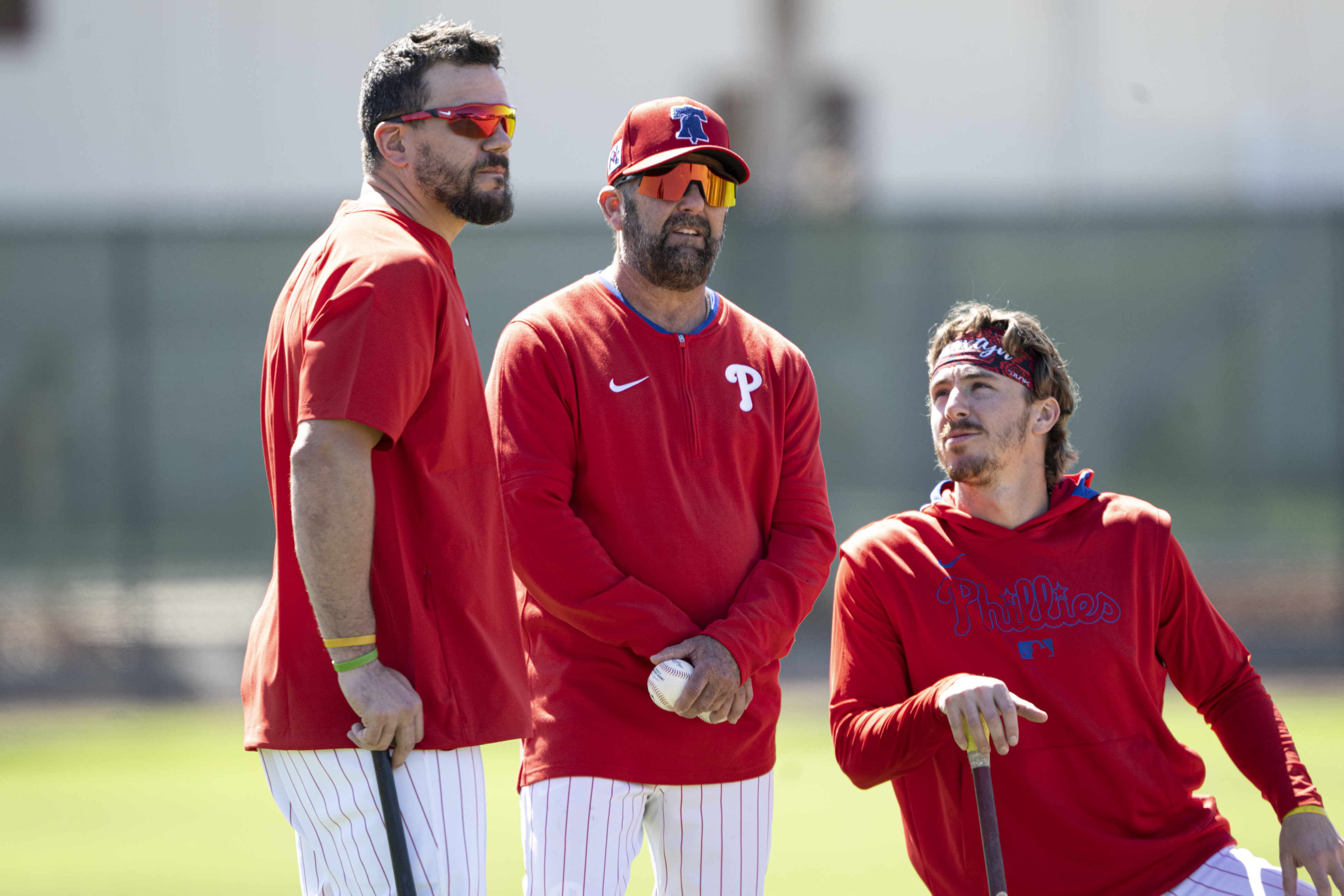
    Phillies hitting coach Kevin Long (center) was popular among several players, including Kyle Schwarber (left) and Bryson Stott (right).Jose F. Moreno / Staff Photographer

    In the previous four years, with mostly the same personnel, the Phillies ranked no worse than eighth in runs per game or OPS.

    Given the likelihood that the lineup will continue to revolve around Harper, Schwarber, and Turner, it appears the organization believes a new voice in the batting cage might help. Mattingly, a .307 hitter in a borderline Hall of Fame career, figures to have input in hiring the next hitting coach.

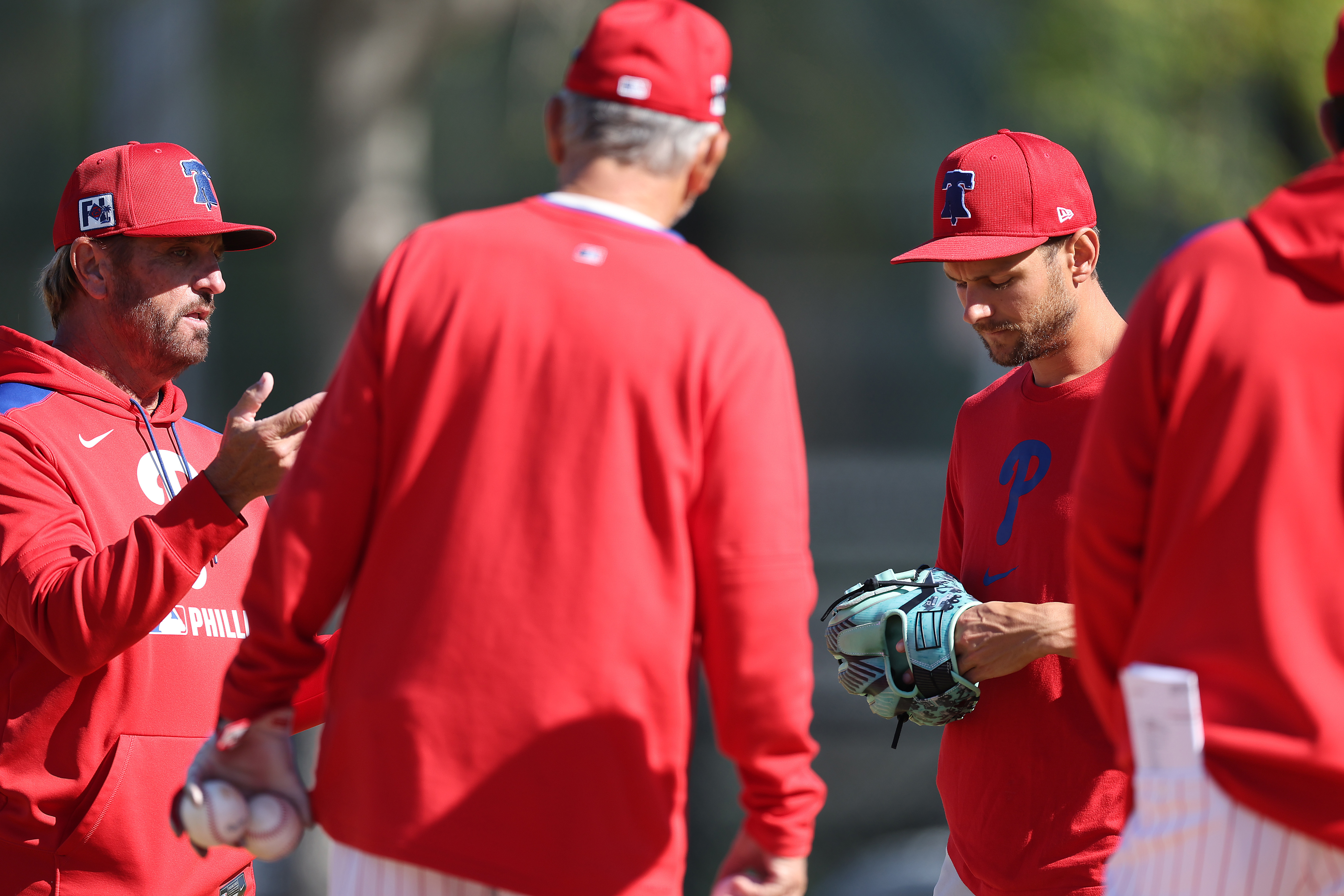
    Shortstop Trea Turner (right), working with infield coach Bobby Dickerson during spring training in 2025, regressed defensively in 2026.David Maialetti / Staff Photographer

    Dickerson was hailed for his work over the years with Alec Bohm, who became a serviceable defender at third base. He also oversaw Harper’s on-the-fly transition to first base in 2023 while recovering from Tommy John elbow surgery.

    But Turner regressed badly at shortstop after the best defensive season of his career last year, prompting discussion about a potential position change. And the Phillies’ infielders rated poorly according to many metrics. As a group, they were 44 runs below average based on defensive runs saved, worst in the majors.

    The Phillies are believed to be seeking a more data-based approach to infield defense, according to major league sources, which might have led to Dickerson’s departure.

  • Brandon Graham watched the Eagles offense adapt to Nick Foles in 2017. He wonders if it’s adapting to Jalen Hurts now.

    Brandon Graham watched the Eagles offense adapt to Nick Foles in 2017. He wonders if it’s adapting to Jalen Hurts now.

    Brandon Graham may have been a star defensive end for over a decade, but he’s no stranger to offering his take on the Eagles’ offense. And on the most recent episode of his podcast, Brandon Graham Unblocked, he’s got more thoughts.

    Graham, who spent 16 seasons with the Eagles and was part of both Super Bowl-winning teams, recalled how former coach Doug Pederson adjusted his offense after Carson Wentz suffered a season-ending knee injury in 2017.

    “When we won the Super Bowl, right? Carson Wentz go down. Nick Foles go up,” Graham said. “I want to give Doug some credit on this because [he] wiped out everything and was like, ‘Hey, what you want to run? What you like?’”

    Pederson adjusted the playbook for Foles’ preferences and the personnel available, Graham said, which helped the Eagles navigate the postseason and ultimately defeat the New England Patriots in Super Bowl LII.

    Graham suggested Hurts hasn’t always received that same consideration.

    “I just don’t [think] Jalen always gets that, man,” Graham said. “People don’t know that.”

    He added that coaches must understand their personnel rather than expecting every player to fit into a predetermined system.

    “I think that’s where I feel they are hurting Jalen a little bit,” Graham said.

    The comments come as Philadelphia’s offense continues to struggle under first-year offensive coordinator Sean Mannion. The Eagles (2-3) have lost three consecutive games, most recently falling to the Jacksonville Jaguars, 19-17, on Sunday in London.

    Against Jacksonville, the Eagles managed just 22 rushing yards on 18 attempts, continuing a difficult start for an offense struggling with consistency.

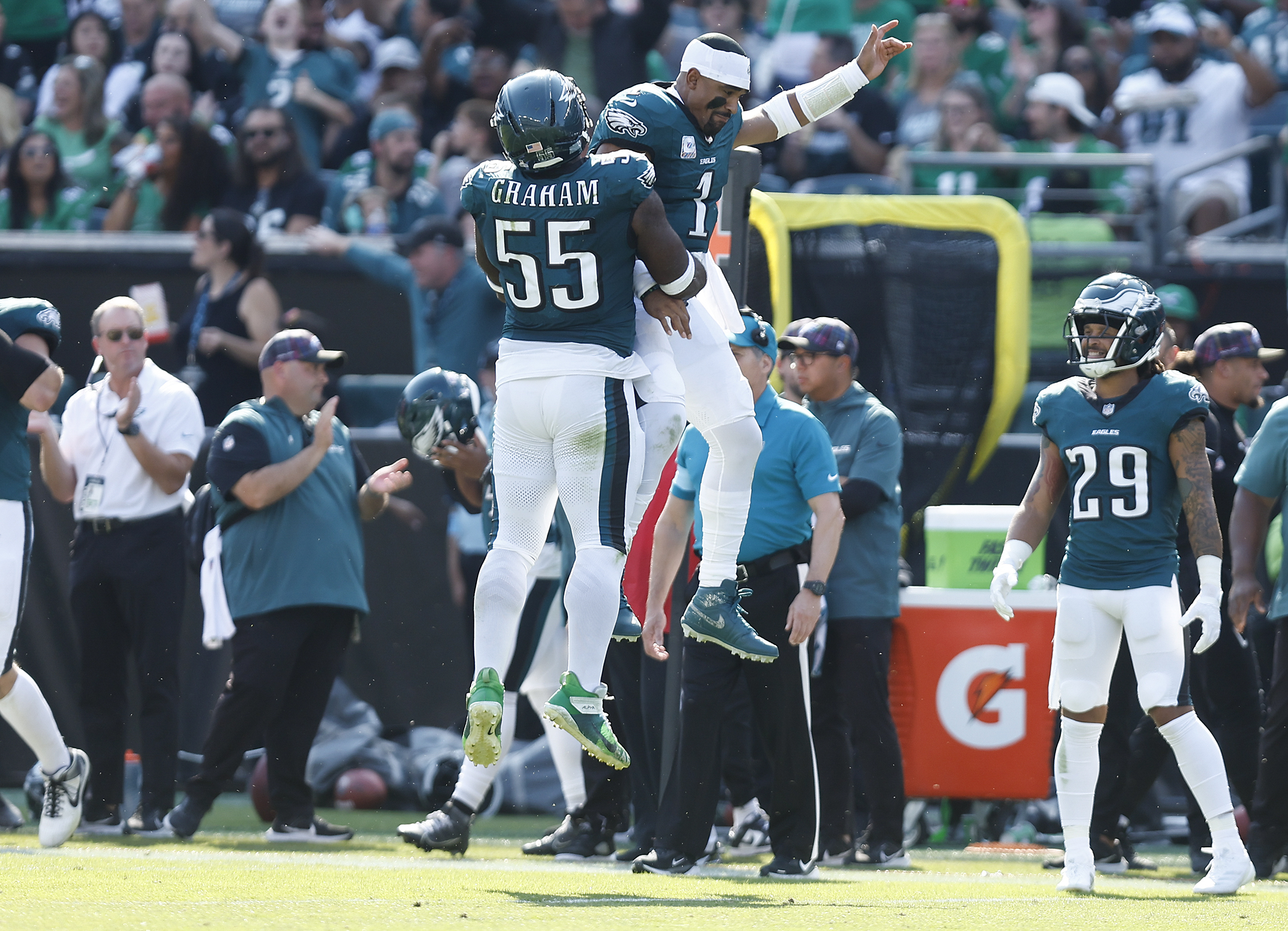
    Brandon Graham and Jalen Hurts played six seasons together in Philly.Monica Herndon / Staff Photographer

    Graham’s criticism followed a discussion with his guest, Michael Vick, the former Eagles quarterback who’s now the head coach at Norfolk State, about how he would construct an offense around Hurts.

    “Whatever he liked,” Vick answered when asked what kind of offense he would run.

    Vick described Hurts as a smart, tough quarterback who understands defenses, protects the football, and holds his teammates accountable. He said he would prioritize putting the right players around Hurts before designing a system that accentuates their abilities.

    “Then I build a system around them,” Vick said.

    Graham agreed, emphasizing that Philadelphia’s coaches should be willing to adapt rather than insist on a system regardless of the available personnel.

    The former defensive end also defended Hurts’ professionalism, suggesting that the quarterback has continued to handle the situation without publicly criticizing the offense.

    “He can only be a professional for so long, but somebody got to be able to say it,” Graham said.

    Vick, meanwhile, expressed confidence in the Eagles’ long-term direction despite their early-season struggles. He defended both Hurts and coach Nick Sirianni, urging fans not to lose patience with the partnership.

    “You got a good leader and a great coach,” Vick said. “Let this combination ride out, baby.”

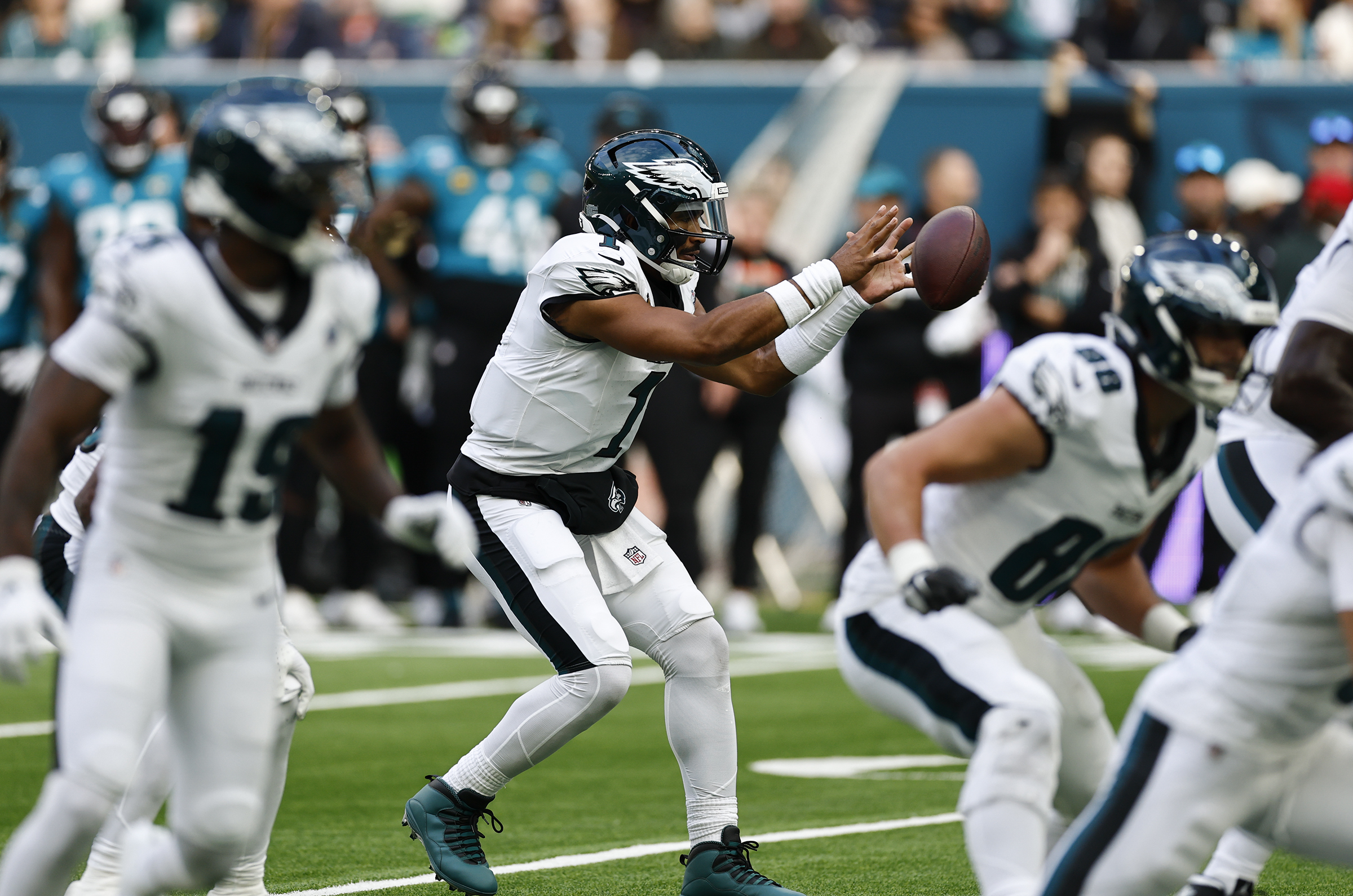
    Eagles quarterback Jalen Hurts catches the snapped football against the Jacksonville Jaguars on Sunday, Oct. 11, 2026 in London.Yong Kim / Staff Photographer

    Graham was more critical of Philadelphia’s recent decision-making, particularly the late-game management in London. Earlier in the podcast, he questioned the Eagles’ failure to drain more clock before Jake Elliott’s go-ahead field goal and the ensuing kickoff that set up Jacksonville’s game-winning kick.

    “Nick and them didn’t manage it as well as they should have,” Graham said.

    Still, Graham expressed confidence in the team’s ability to recover, stressing accountability and the importance of keeping negativity out of the locker room.

    The Eagles will have an opportunity to end their three-game losing streak Sunday when they host the Carolina Panthers at Lincoln Financial Field (1 p.m., CBS Philadelphia).