ANAHEIM, Calif. — Alex McFarlane hadn’t planned on leaving his hometown in the U.S. Virgin Islands for high school. But the baseball fields were gone.
They were decimated in September 2017 when Hurricane Irma made landfall, and it was followed two weeks later by Hurricane Maria. Both Category 5 storms caused widespread, catastrophic damage to the Caribbean islands, including McFarlane’s home of St. Thomas.
The only hospital on the island was severely damaged. Trees were uprooted. Roads were obstructed. Buildings became rubble. It took months for power to be fully restored.
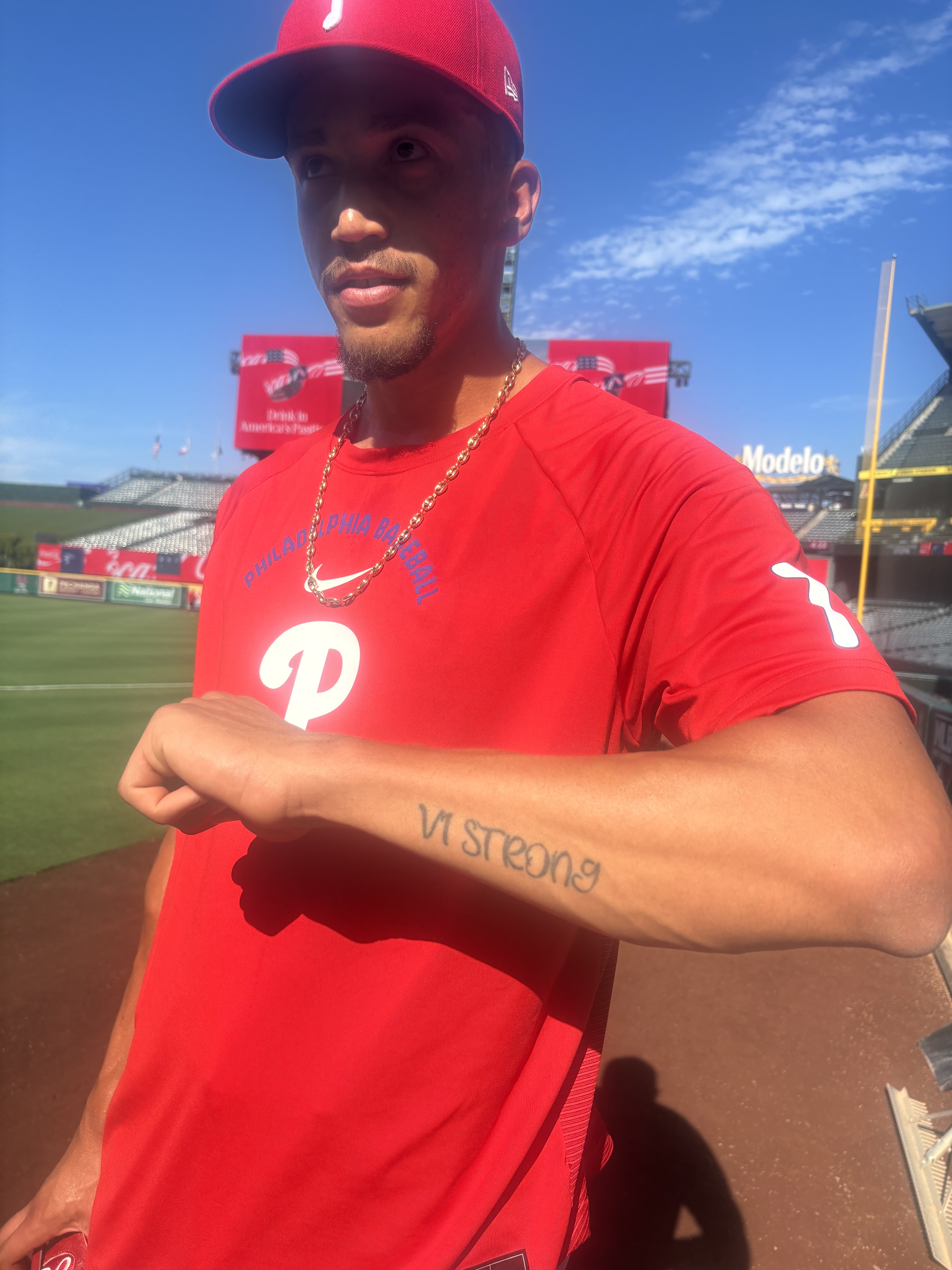
After witnessing how his community rebuilt after the devastation, the Phillies right-handed reliever had “VI STRONG” tattooed on his left arm. Last month, when he became the 16th player from the Virgin Islands to make his major league debut, McFarlane had a reminder from home with him.
“It’s just a testament to our community. We’ve got a strong community,” said McFarlane, 25. “Stick together, and rebuild everything together. I always carry that mentality throughout, when I play.”
Phillies reliever Alex McFarlane has a “VI Strong” tattoo on his left arm in honor of the U.S. Virgin Islands, where he grew up.Lochlahn March
The hurricanes cost McFarlane an entire year of baseball. He was 16 years old when they hit, and he stayed in St. Thomas at first to make sure his family was OK. But to continue his career after that, he had no choice but to leave the island.
It was not easy. McFarlane spent his senior year at Habersham Central High School in north Georgia. It was a culture shock, and not just because of the new environment and new school. It was also McFarlane’s first time playing organized high school baseball.
“It’s very similar to the Dominican Republic, as in who we play and stuff,” McFarlane said of youth baseball in St. Thomas. “We don’t have high school ball, but we’ll do interisland play.”
As a kid, McFarlane sometimes had to take multiple flights hopping between small islands to get to baseball tournaments. They would play against teams from places like Puerto Rico, the Dominican Republic, the Bahamas, and the ABC Islands of Aruba, Bonaire, and Curaçao. One year, his team nearly qualified to represent the Caribbean in the Little League World Series but fell short in the championship game.
Once he arrived in Georgia, McFarlane said the coaching staff at Habersham helped him adjust quickly. From there, he was recruited to play college baseball at Miami, from where he was drafted by the Phillies in the fourth round in 2022.
Now, he’s representing St. Thomas on the biggest baseball stage.
“I just try to set the best example as I can, just go out there and work as hard as you can each day,” McFarlane said. “Stay consistent with your routines, and just go out there and do your best every time. No reason not to give your best. So that’s just what I carry with me.”
St. Thomas has a population of 42,261, as of the 2020 U.S. census. That’s smaller than the 42,901 capacity of Citizens Bank Park. It’s a tight-knit community that is proud of its own.
McFarlane pointed to Aliyah Boston, a star for the WNBA’s Indiana Fever, and Basketball Hall of Famer Tim Duncan as Virgin Islander athletes whose footsteps he is following. There also happens to be another Virgin Islander in the Angels farm system, who McFarlane hopes will join him in the majors soon. Najer Victor, who also is from St. Thomas, currently pitches for Los Angeles’ triple A affiliate.
But McFarlane also has been making his mark on the Phillies. Since his debut on July 22 — when he secured his first major league out against Shohei Ohtani — he has impressed interim manager Don Mattingly, who said he can see McFarlane in higher-leverage spots.
“He’s throwing the ball good,” Mattingly said. “… Depending on their lineup and how they’re set up and everything else, there’s going to be times that he’s going to be in leverage.”
On Friday night against the Angels, McFarlane struck out Mike Trout on three pitches, all fastballs that clocked triple digits. With a scoreless eighth inning, McFarlane lowered his ERA to 1.08 in eight appearances.
“It’s been great,” McFarlane said. “I got all the support in the world. A lot of guys I played ball with, I’m still in contact with to this day.”
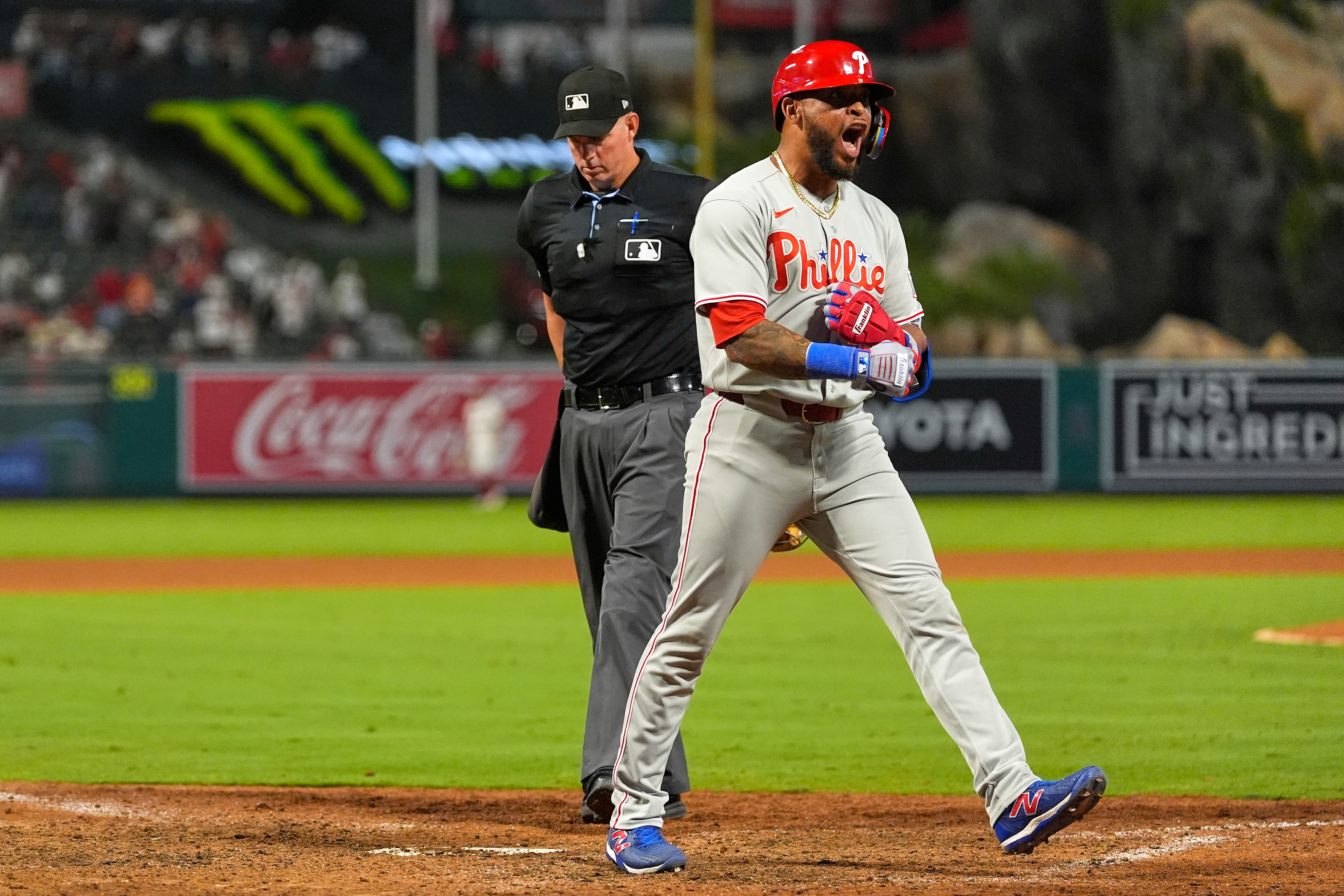
Edmundo Sosa celebrates after his pinch-hit grand slam won it for the Phillies in the ninth inning Friday.Mark J. Terrill
McFarlane keeps a gaiter with the Virgin Islands flag on it hanging in his major league locker, another reminder from home. He doesn’t take the position he’s in lightly. McFarlane grew up far from any major league team and as a child inherited a Red Sox fandom from his mother.
But he’s aware that each time he walks out to a major league mound, he might be converting kids watching from the Virgin Islands into Phillies fans. With every pitch, he is representing them.
“I take pride in that,” McFarlane said. “I take pride in taking the field, knowing exactly where I’m from, and where I got to, from the Virgin Islands.”
Justin Smith was grasping for the gun that his pregnantgirlfriend had pressed to her temple, he told a Philadelphia jury last week, when the weapon accidentally went off, firing 12 shots in a matter of seconds — 11 of them into her head.
Smith, 28, took the stand at his trial on murder and related charges in the death of Dianna Brice, 21,in Southwest Philadelphia and said the shooting was an accident.
But a jury rejected Smith’s account and convicted him of first- and third-degree murder on Friday in the 2021 death of Brice and her unborn child. Smithwas also convicted of abuse of a corpse, arson, and related crimes after he admitted to committing those acts to cover up the killing.
Common Pleas Court Judge Anthony Kyriakakis sentenced him to life in prison without the possibility of parole.
During closing arguments, Assistant District Attorney Lauren Crump cast doubt on Smith’s explanation of how his girlfriend died, saying it was impossible for that many shots to have fired into a concentrated area if the gun accidentally went off during a struggle over the weapon, as he suggested.
She pointed to other problems with Smith’s defense, urging jurors to reject his contention that the Glock handgun modified with a semiautomatic “switch” was Brice’s, not his.
And she dismissed Smith’s argument that he covered up the crime and fled Pennsylvania after the killing because he was scared, bidding jurors to recall his swift actions — setting his car on fire and disposing of Brice’s body in trash bags — before heading to Florida in an attempt to reach Cuba.
“That is not panic,” Crump said. “That is premeditation.”
Brice, 21, of Upper Darby, was 14 weeks pregnant with Smith’s child when she died on March 30, 2021, Lindsay Simon, chief medical examiner for the Philadelphia Medical Examiner’s Office, testified during the trial.
Prosecutors said she was last seen with Smith that day driving from a Delaware County laundromat to Philadelphia, where the couple got into a volatile argument after Brice learned she had tested positive for herpes and accused her boyfriend of giving her the sexually transmitted infection.
It was the last time Brice was seen alive.
Police discovered her body seven days later in a wooded area near 58th Street and Eastwick Avenue in Southwest Philadelphia, covered in black trash bags and wrapped in a tan blanket.
She had been shot in the head 11 times at close range and struck once in her right shoulder. Simon, the medical examiner, said the shots would have almost certainly killed Brice instantaneously.
Philadelphia police quickly identified Smith as a suspect: Cell phone records from the day Brice died showed her phone traveling the same path as Smith’s phone — until 1:38 p.m., when the phone’s trail went dark, said Anthony Vega, a former Philadelphia police detective who testified at the trial as a cell site expert.
Police also found Smith’s dark gray Ford Fusion, burned to a blackened shell, near 59th Street and Florence Avenue, about a mile from where Brice’s body was discovered.
Investigators traced the vehicle to Brice’s makeshift grave site, and to where it was found burned, using video footage from street surveillance cameras, Philadelphia Detective Thorsten Lucke testified.
But the cameras did more than capture the Fusion’s path: It also showed Smith and an accomplice, Tylydia Garnett, wearing gloves and loading what appeared to be a large object into the back of a Hyundai, which police traced to the same locations and to a gas station where its driver purchased a canister of fuel used to set the Fusion ablaze, prosecutors said.
While detectives soon suspected Smith was involved, he was not arrested until 2025, when Atlanta police took him into custody after he gave an officer a fake name during a routine traffic stop and fled.
Meanwhile, Philadelphia police arrested his accomplice, Garnett, in April 2021. She pleaded guilty to arson, abuse of a corpse, and related crimes, and was sentenced to 11½ to 23 months.
Last week, Garnett, 27, told jurors at Smith’s murder trial that he had confessed to her that he shot Brice.
She testified that she had helped him flee to Florida before he moved to Georgia, though Smith’s attorney, Samuel Stretton, suggested the woman had inflated details of her story to earn a more lenient sentence.
When Smith testified, he told jurors Brice’s death was a tragic, shocking accident.
During their argument in the car, he said, the exchange escalated as he drove. He denied cheating on her, he said, but Brice became agitated and held a gun to his head before turning the weapon on herself.
“I tried to hurry up and pull it from her,” he testified. Instead, he said, “it went off, and she died.”
In fear for what might happen to him, Smith said, he hatched a plot to dispose of her body and burn the car with the gun still inside it. The gun was never found, prosecutors said.
“Why didn’t you come to your senses and call for help?” Stretton, his attorney, asked.
“I just felt like this wasn’t going to go my way,” Smith said.
Following the jury’s verdict, Brice’s family, who had lined three rows of the courtroom during the three-day trial, expressed relief for the guilty verdict.
Seemingly everything that could have gone wrong for Villanova in the final minutes of its season opener did Friday night against William & Mary.
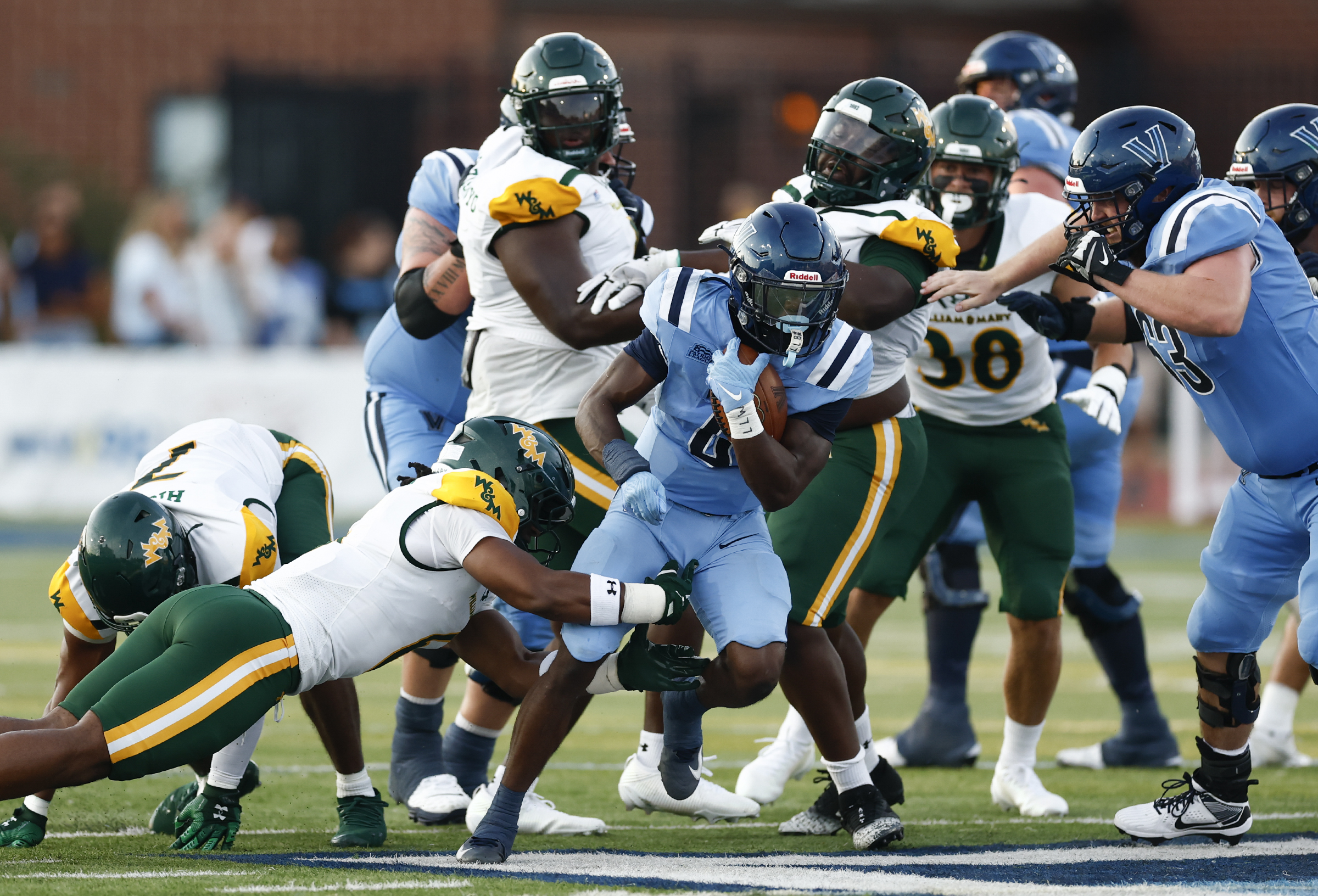
With less than a minute to play, the Wildcats led by 10 points and were staring down a win in their season opener, but a series of late-game mistakes paved the way for a collapse in the final seconds.
The result was a messy 35-32 conference loss to begin Villanova’s inaugural Patriot League season after the Tribe’s Max Lipinski hit a game-winning 45-yard field goal as time expired.
William and Mary was down double digits to No. 7 Villanova with under a minute left to play.
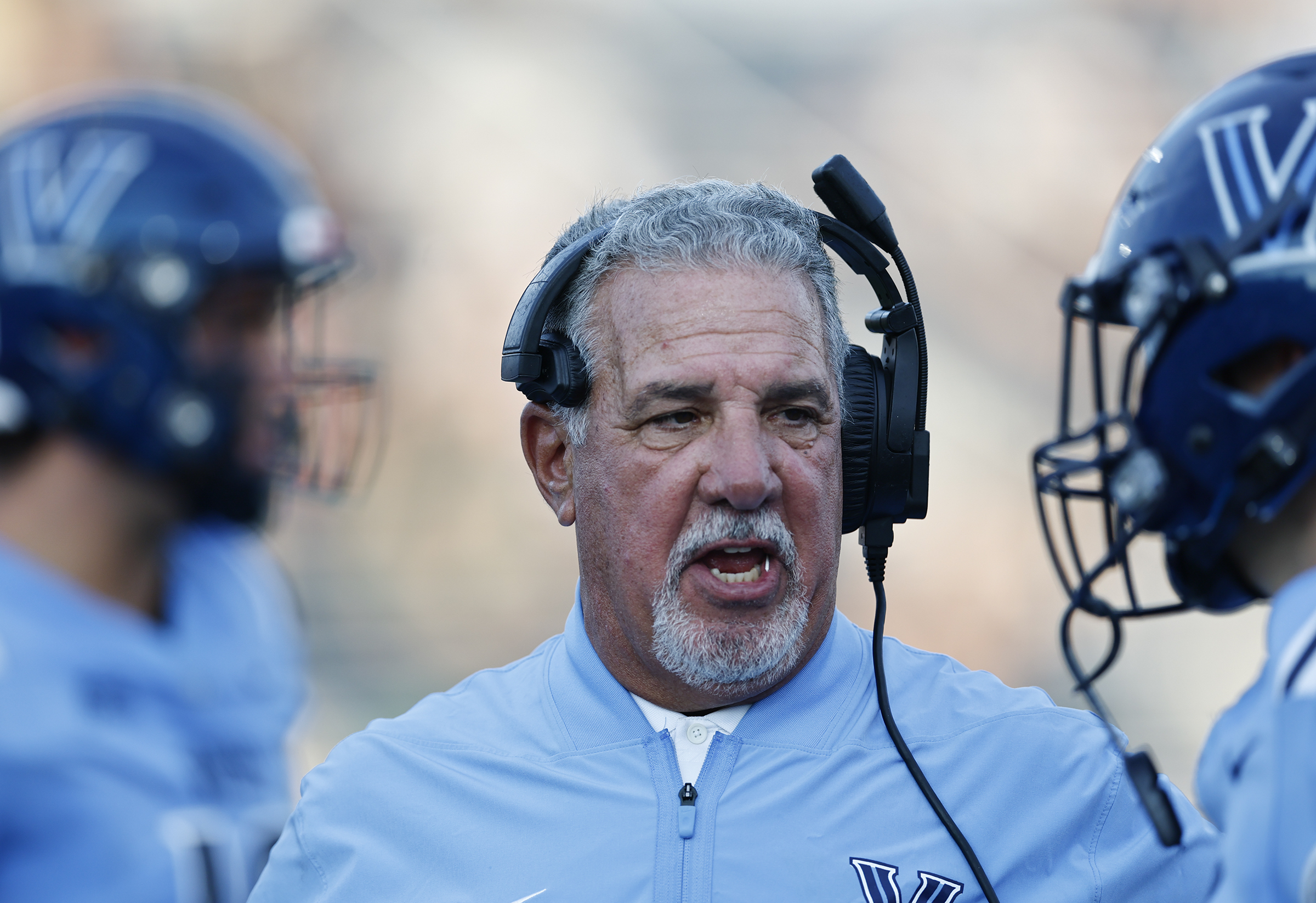
“We made a lot more mistakes than they did,” Villanova coach Mark Ferrante said. “Turnovers, penalties. Never comes down to one play, but unfortunately, it came down to one play. And [William & Mary] played a cleaner game than we did, so they deserve the victory.”
Self-inflicted wounds
The Wildcats were plagued by penalties and mistakes against the Tribe.
“We gave them free yardage,” Ferrante said. “We set ourselves backward a few times. And then turnovers. I don’t care who you’re playing, if you lose the turnover battle four to one, you’re probably going to lose the game, especially when you have a team that’s the caliber of William & Mary.”
The Wildcats racked up 15 penalties for 107 yards, while William & Mary was penalized just three times for 22 yards.
“No matter what you do, no matter how good your scout team performs during the week, they never are able to execute the opponent’s schemes as fast as the opponent is able to execute their schemes,” Ferrante said. “So we do the best we can in our preparation. And I don’t know, they had three big plays over the top. Eliminate those three big plays, it’s probably a whole different ballgame. But, again, it doesn’t come down to just those three big plays.”
Ferrante also noted that his coaching decisions changed the outcome of the game.
“Maybe I should have gone for the field goal instead of the first down when we were down two. Maybe we got to recover an onside kick. So it’s a lot of things that build into it. We’ll grow off of this, that’s for sure. But there’s going to be a lot of correctables.”
Villanova ranked 108th in the FCS last season in penalty yards.
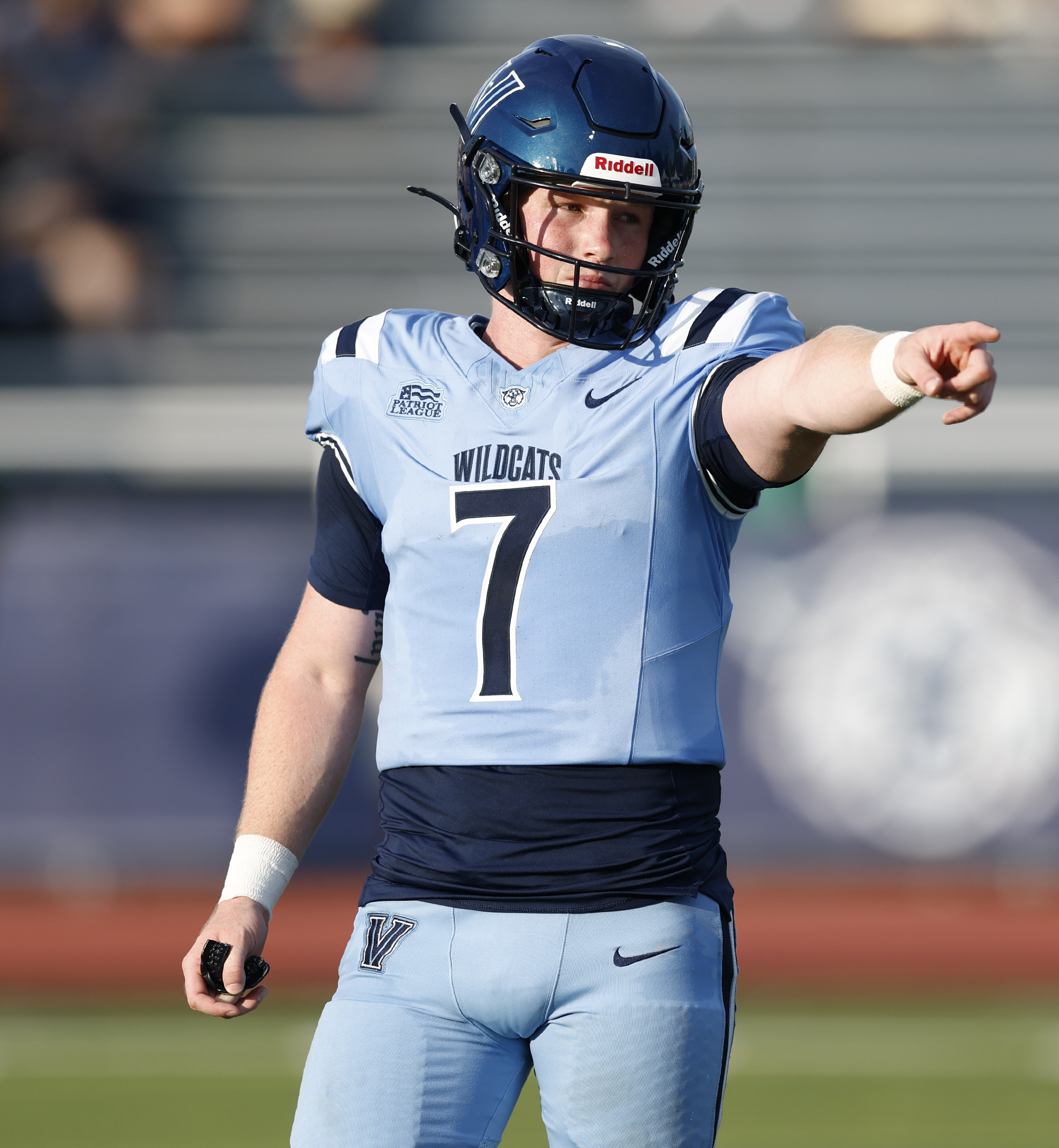
In addition to the penalties and four turnovers, Villanova failed to recover a crucial onside kick that would have iced the game. After William & Mary tied the game following the onside kick, Villanova quarterback Pat McQuaide was picked off with 9 seconds left to set up the Tribe’s walk-off field goal.
Villanova coach Mark Ferrante said “there’s going to be a lot of correctables” after Friday’s loss.Yong Kim / Staff Photographer
McQuaide eligible
After a summer-long battle over his eligibility, McQuaide started for Villanova.
Hours before kickoff, a Cuyahoga County (Ohio) Common Pleas Court judge granted a preliminary injunction that named the Patriot League as a defendant, clearing McQuaide to be eligible for league contests.
“Yeah, we found out [Friday],” Ferrante said when asked about the court decision. “And once we found out, there really was no hesitation. I mean, if it was 6 o’clock and a 6:03 kickoff, he probably would have rolled out there. If it was two hours before, if it was yesterday, yeah. The plan was, get the other guys reps. But if it happens, we’ll roll Pat out there. And he’s had a lot of practice under his belt.”
The injunction came weeks after the Patriot League informed Villanova that it was deeming McQuaide ineligible for conference games.
Villanova quarterback Pat McQuaide was allowed to play after being granted an injunction by an Ohio judge just hours before kickoff.Yong Kim / Staff Photographer
McQuaide led Villanova to an FCS semifinal playoff appearance last season and threw for 3,123 yards and 25 touchdowns.
On Friday, McQuaide threw for 270 yards and one touchdown, and had three interceptions. McQuaide threw just four interceptions all season in 2025.
Up next
Villanova will prepare for back-to-back road games, beginning with a Patriot League contest against Bucknell on Sept. 5 (6 p.m., ESPN+). The Wildcats then will travel to Kentucky for an FBS matchup against Louisville on Sept. 11.
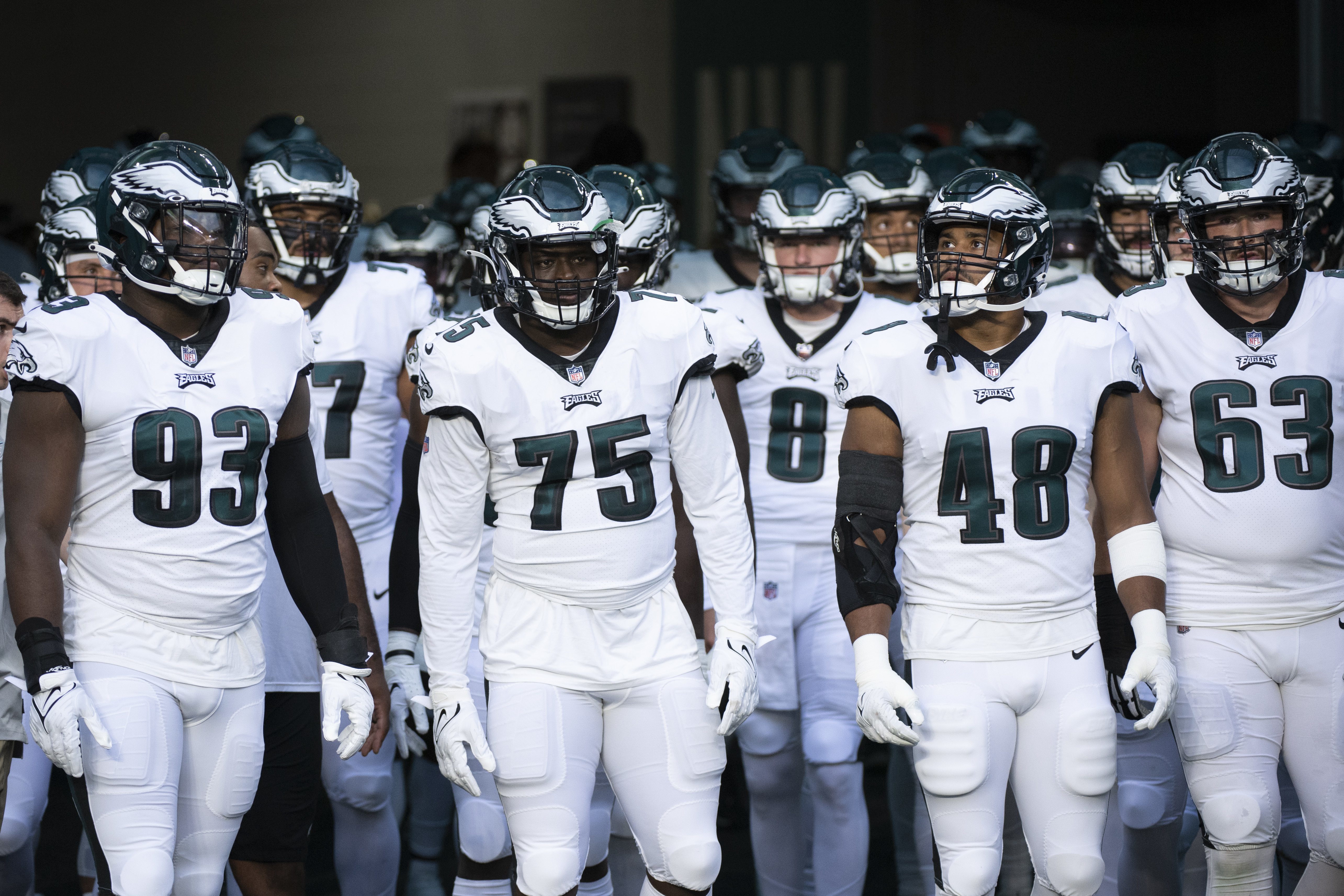
Tarron Jackson (No. 75), seen here with the team ahead of a 2022 preseason game. Doug Murray / AP
The Eagles are waiting edge rusher Tarron Jackson, according to a source.
Jackson was drafted in the 6th round by the Eagles in the 2021 draft. He was in his third stint with the Birds after being signed by the team on Aug. 10.
Samori Toure was one of several WRs fighting for a roster spot. Yong Kim / Staff Photographer
The Eagles made their first post-preseason cut.
The team is waiving wide receiver Samori Toure, NFL Network reported Saturday afternoon. The 28-year-old signed with the Birds on the first day of free agency in June.
The Eagles are likely to keep five or six wide receivers. DeVonta Smith, Makai Lemon, Dontayvion Wicks, Hollywood Brown and Darius Cooper are likely locks, while Elijah Moore, Britain Covey, Quez Watkins, Danny Gray, Erik Ezukanma and Tahj Washington duke it out for the sixth spot.
Giants trade for Ravens DT C.J. Okoye: NFL Network
Another John Harbaugh reunion: The #Giants are trading for DT C.J. Okoye, per me and @RapSheet, sending a 2028 7th-rounder to the #Ravens for the former International Player Pathway participant.
Okoye, who recovered a fumble for Baltimore last night, heads to East Rutherford. pic.twitter.com/r3A3kQpCo3
Final Eagles 53-man roster prediction features four QBs
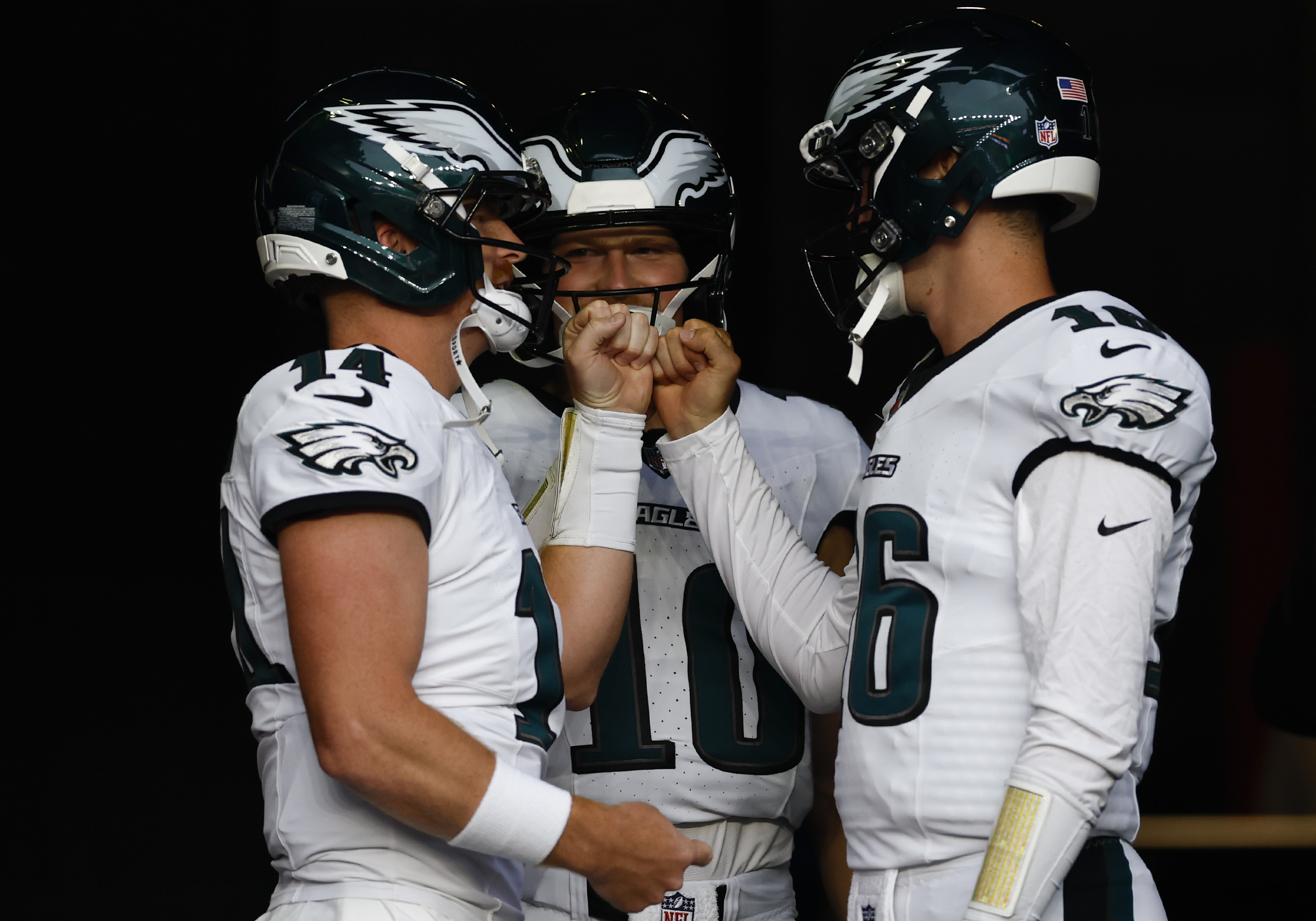
Eagles quarterback’s (from left to right) Andy Dalton, Cole Payton and Tanner McKee.Yong Kim / Staff Photographer
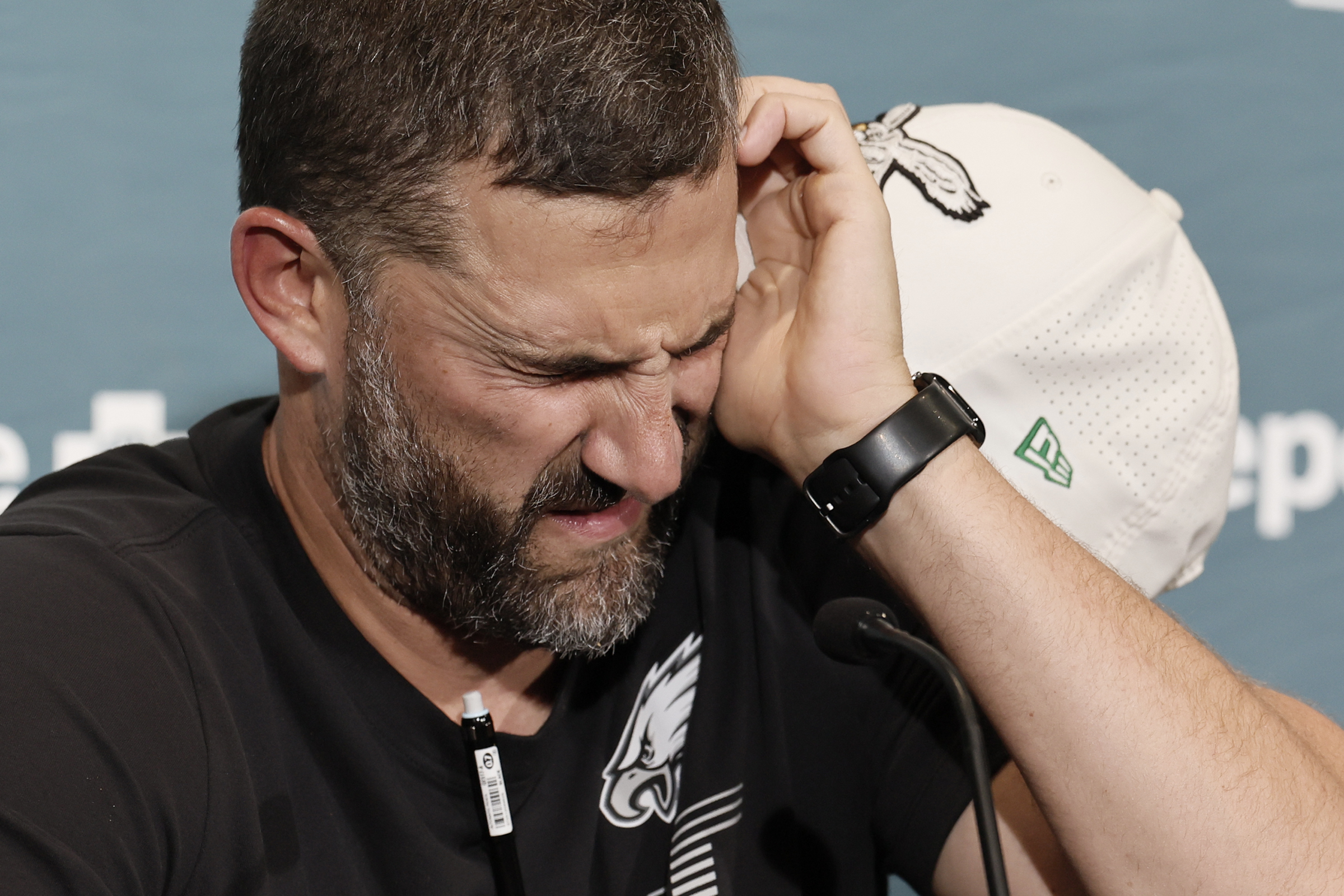
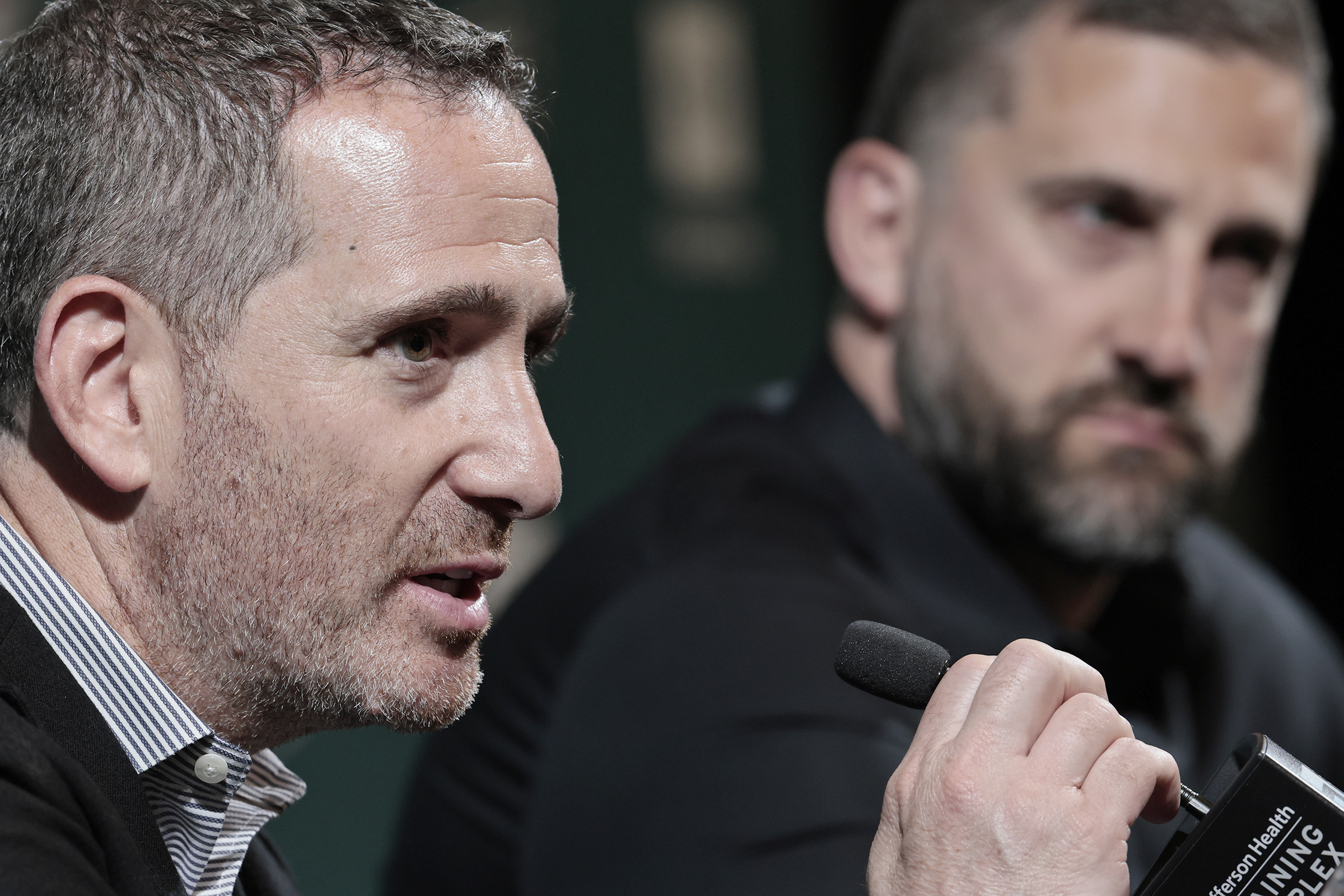
Training camp is officially over, and Howie Roseman is on the clock.
The Eagles have to submit their initial 53-man roster by 6 p.m. Sunday, and there are key decisions to make at multiple positions, including the quarterback spot.
Projecting the 53-man roster has its twists and turns throughout a training camp. The Inquirer’s Jeff McLane revealed his one and only roster prediction earlier on Friday before the team’s 30-13 loss to the Cincinnati Bengals in the final preseason game.
But Friday night’s defeat provided some more data when it comes to decision making, both for Roseman and in this roster view. So, let’s get to our final projection of the 2026 training camp:
Quarterbacks (4): Jalen Hurts, Andy Dalton, Tanner McKee, Cole Payton
Well, this is quite a departure from every projection from this training camp. But if you watched Friday night, and saw the other two games, can you really imagine another NFL general manager parting with draft capital to acquire one of Hurts’ backups?
Dalton probably has more trade value at this time of year given his body of work. But trading him means the Eagles would be committing to McKee as the primary backup, and while that was fine last year, backing up Hurts with McKee and Payton seems a bit risky for a team that fancies itself a Super Bowl contender.
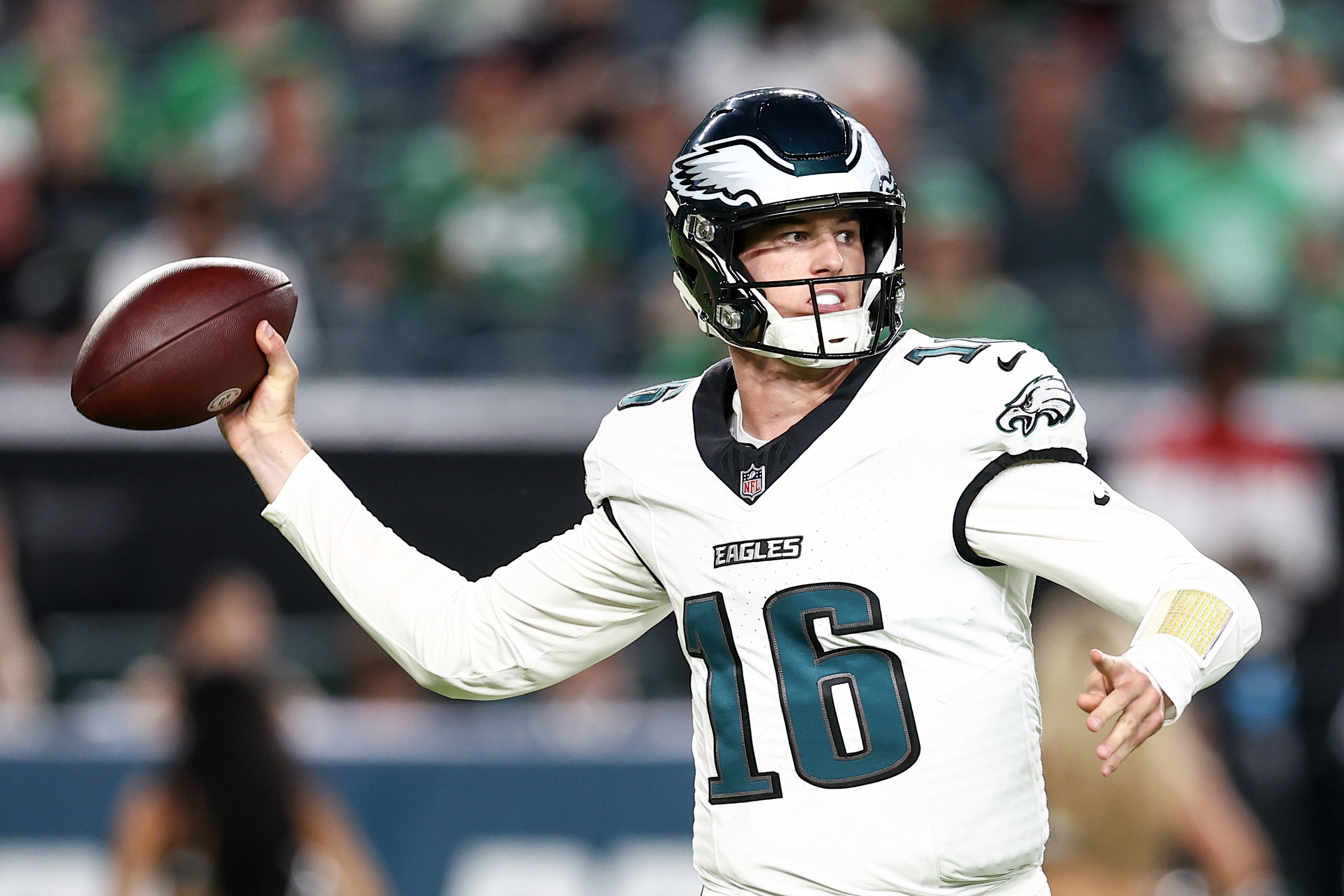
McKee was dreadful Friday night, though the necessary caveats need to be applied: he was playing with backups, and the only first-teamer who joined him on the field, Makai Lemon, was playing NFL football for the first time. But he was playing against backups, too. He finished the game 12-for-22 for 55 yards and an interception (that hit Lemon in the hands). A year ago, McKee dominated the Bengals in the first preseason contest of the season and cemented himself as the bona fide backup.
Keeping four quarterbacks would be a bit unusual, but it also gives Roseman some time to figure out what to do next. The first game is still two weeks away, and a lot can change on his roster and the other 31 between now and then.
The easy answer might be to cut Payton. The fifth-round pick has been turnover-prone during camp, but the Eagles may not want to expose him to waivers and ensure they’re the team that gets to develop him.
All of this uncertainty begs the question: Is the Week 1 backup quarterback even on the team’s roster right now?
Since 2021, when the NFL reduced the number of games from four down to three, 32 teams have gone winless during the preseason. Of those, 15 – about 47% – went on to make the playoffs.
That includes the Los Angeles Rams, who didn’t win a single preseason game in 2021 yet still managed to win Super Bowl LVI. The Kansas City Chiefs also advanced to the Super Bowl after their winless preseason in 2024, though they were blown out by the Eagles.
During that span, the Eagles have had winless preseasons twice, and in both years – 2021 and 2023 – the Birds secured a playoff spot. Though the less we remember about the final two months of 2023, the better.
All eyes are Howie Roseman ahead of NFL roster deadline
Eagles GM Howie Roseman might still have some outside moves to make before Sunday’s headline.Elizabeth Robertson / Staff Photographer
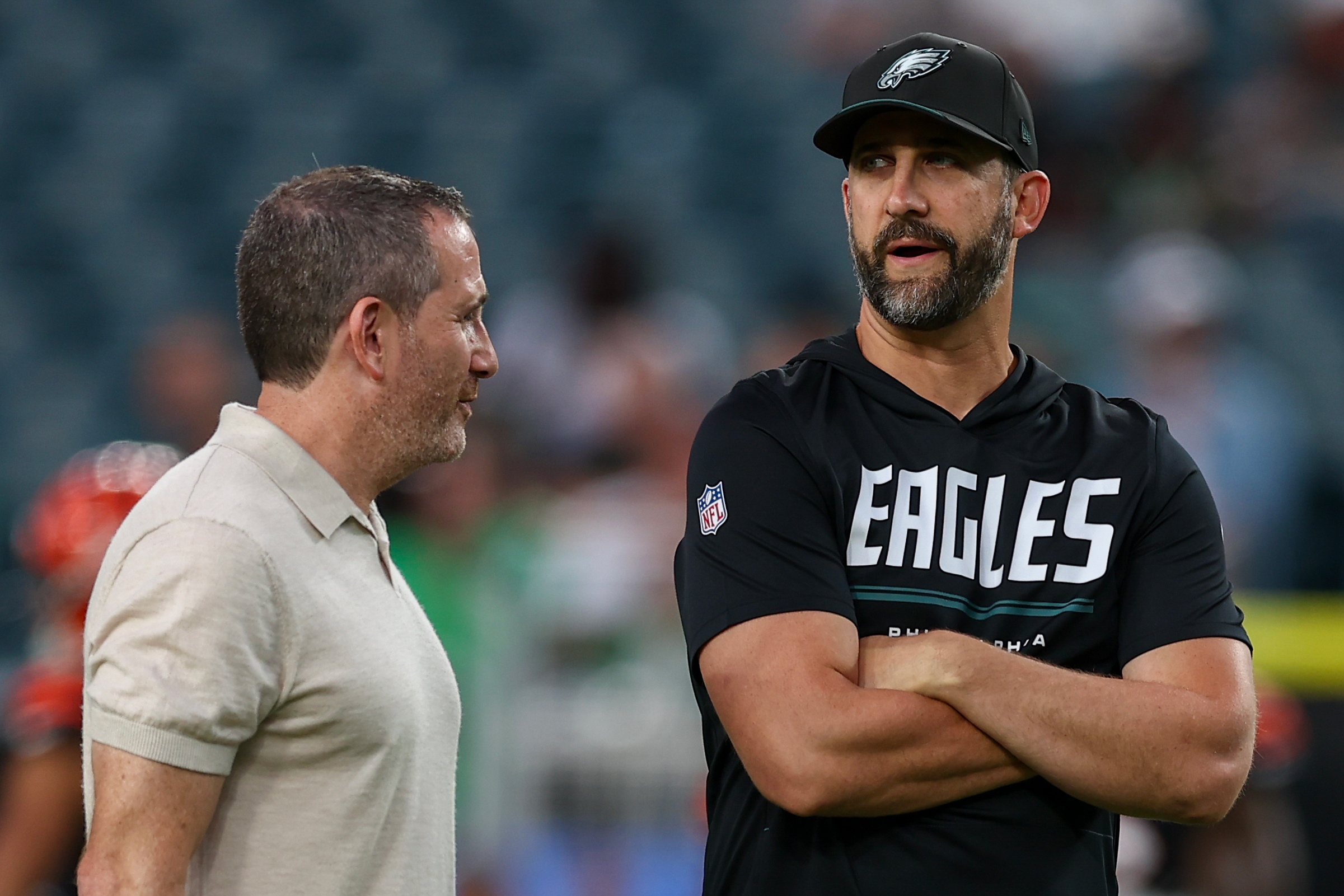
Howie Roseman has all the pieces laid out in front of him as he whittles the Eagles’ 91-man roster down to 53 players ahead of Sunday’s 6 p.m. deadline.
Most of the team is in place, but it isn’t like some piece of furniture from IKEA with specific parts. Roseman will build his makeshift roster by balancing the Eagles’ immediate needs with the long term, while also factoring in injury variables, the salary cap, and other potential moves.
The general manager is scanning the rest of the NFL for upgrades at positions that are in question. He’s yet to make any trades since camp started, but no one likes to wheel and deal as much as Roseman. C.J. Gardner-Johnson and Jahan Dotson are just two of the players Roseman acquired in and around this time.
Wide receiver, tight end, and safety are among potential areas that could be addressed.
The 16-man practice squad will also afford the Eagles a landing spot for vested veterans, players they will taxi up on game days, or prospects they hope to develop. So while only 53 will make the initial cut, Roseman considers his roster a 69-man outfit (70 if they have an international prospect).
It is an ever-evolving list that will likely change ahead of the season opener vs. the Commanders on Sept. 13. But for one fleeting moment there will be those who make it, and those who don’t. Here’s one beat reporter’s predictions:
What we learned about the backup QB battle from Friday’s preseason game
Tanner McKee appeared to take a step back Friday night.Monica Herndon / Staff Photographer
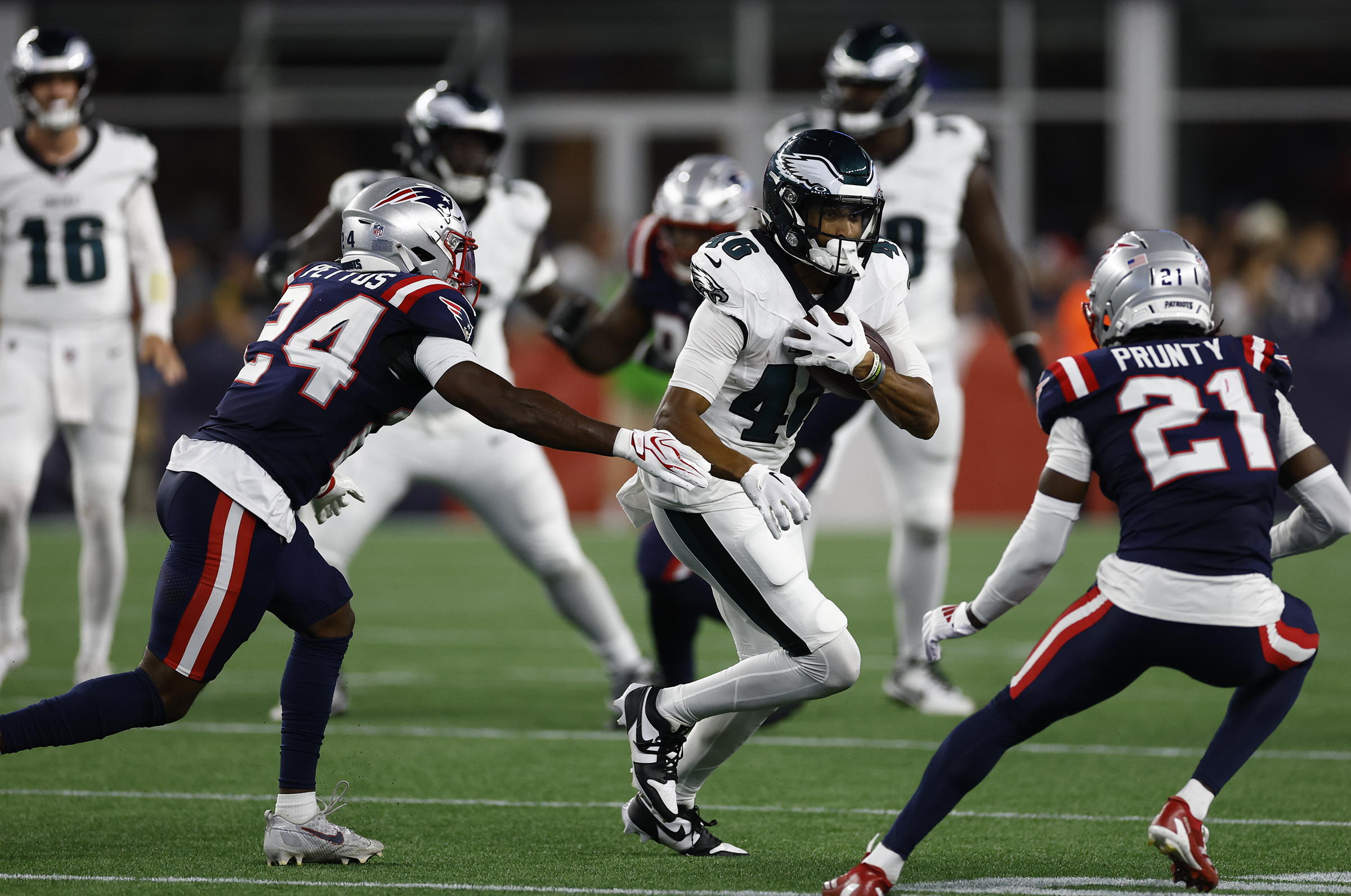
After displaying signs of progress in the second preseason game against the New England Patriots, Tanner McKee took a step back on Friday.
He started and played the entire first half. In 32 plays, McKee went 12-for-22 for 55 yards and an interception, good for a 41.1 passer rating. He was sacked twice.
The 2023 sixth-rounder out of Stanford struggled to push the ball downfield. Most of his yardage came on short gains, namely check downs to the running backs. Running back Carson Steele was McKee’s most popular target in the first half, as he amassed five receptions on five targets for 32 yards. Steele had one long 17-yard catch-and-run gain, but he averaged 3.75 yards per reception on his other four.
The sacks that McKee took highlighted his inability to escape the pocket. Former Eagles defensive end Antwaun Powell-Ryland split a sack with Bengals defensive end Isaiah Foskey on the Eagles’ opening drive, collapsing on McKee from either side as he lingered too long in the pocket and eventually attempted to flee.
Right before the end of the first half, McKee took another sack from Foskey, who beat left tackle John Ojukwu. Again, McKee failed to get the ball out quickly, but this sack was less egregious than the first one.
McKee was nearly strip-sacked in the second quarter by Powell-Ryland after right tackle Cameron Williams gave up the pressure, but the play was eventually ruled an incomplete pass.
Andy Dalton wasn’t any better
Dalton, the former Bengals quarterback of nine years (2011-19), took over at the start of the second half. He wasn’t any more impressive than McKee was to start.
Dalton was handed favorable field position after Eagles receiver Jordan Mims, who signed with the team on Monday, forced a fumble on Bengals kick returner Tahj Brooks and Andre Sam came up with the recovery at the Bengals’ 43-yard line.
The 38-year-old quarterback didn’t do much with it. After a Steele five-yard run, Dalton threw two straight incomplete passes to Steele and Britain Covey. The Eagles settled for a 56-yard Jake Elliott field goal, trailing 9-6.
But Dalton heated up on his second possession. He led an 11-play, 76-yard scoring drive, highlighted by a 26-yard play-action strike over the middle for Danny Gray that put the Eagles in the red zone. Steele continued his impressive preseason showing, as his five-yard touchdown reception made it 16-13, Bengals.
His ensuing two drives were less inspiring. Both accumulated just 20 net yards apiece, and the latter resulted in a turnover on downs after Dalton failed to convert on fourth-and-1 from the Eagles’ 40.
Dalton went 12-for-19 for 104 yards and a touchdown (95.1 quarterback rating) on 26 plays. Statistically, it was his best single-game performance of the preseason. But was it QB2 material?
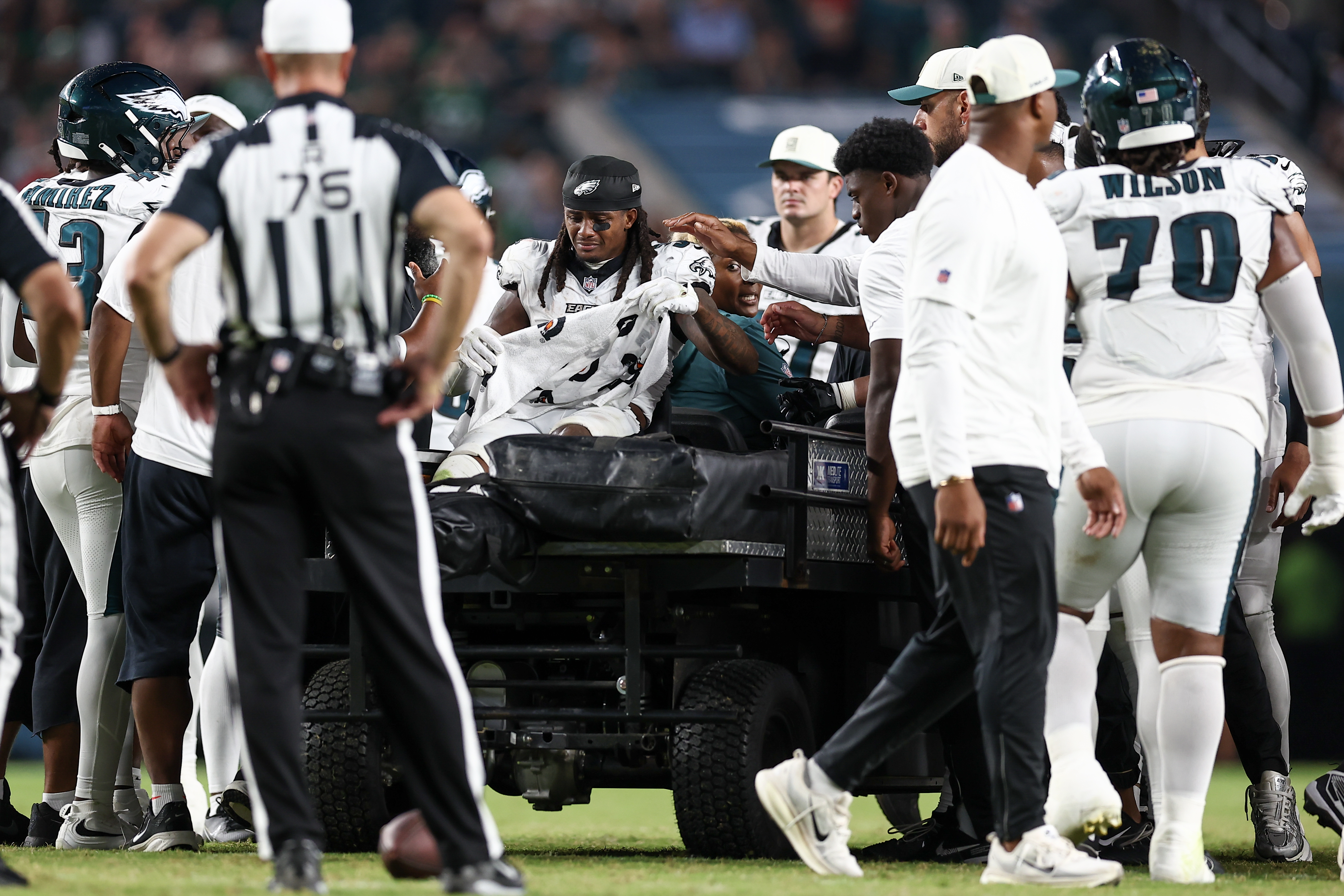
Eagles roster hopeful Andre Sam carted off the field
Safety Andre Sam is taken off of the field in the injury cart during Friday’s preseason game.Monica Herndon / Staff Photographer
Safety Andre Sam went down late in the third quarter after attempting to make a tackle. He did not put any pressure on his left leg as he was lifted off the field and carted indoors.
Sam, a 2024 undrafted free agent out of LSU, had a strong outing prior to his injury. He recorded a pass breakup, a forced fumble, two fumble recoveries (one on defense, another on special teams), and three tackles.
In two weeks, Jalen Hurts will finally take the field for the Eagles.Monica Herndon / Staff Photographer
Next up after roster cuts? Actual football games.
The Eagles 2026 season kicks off at home on Sunday, Sept. 13, against the Washington Commanders on Fox. Calling the game will be childhood Eagles fan Kevin Burkhardt and Tom Brady, who is entering his third season as Fox’s top analyst.
A University of Pennsylvania biotechspinout recently launched its first clinical trial of an experimental cancer treatment for hard-to-treat solid tumors.
Its approach builds upon groundbreaking work harnessing the body’s immune system to fight cancer.
Based in Philadelphia and San Francisco, the company, Dispatch Bio, launched a year ago with CAR-T pioneer and Penn researcher Carl June as a scientific co-founder and $216 million in funding from private investors.
The company aims to succeed where CAR-T, an immunotherapy that genetically modifies a patient’s immune cells to recognize and attack cancer, has struggled.
Although CAR-T has revolutionized the treatment of blood cancers, scientists have yet to replicate that success in solid tumors. By painting a target on tumors and revving up the immune system, Dispatch believes its platform could.
It dosed its first patient earlier this month.
“With one approach, we are addressing the two main challenges that we have faced over the last decade or so,” said Mauro Avanzi, the chief medical officer of Dispatch.
Success is not guaranteed.Most exploratory scientific efforts do not advance to the point where they are found safe and effective in humans. Even if the results are promising, it could take years before a potential new treatment becomes widely available.
Dispatch’s first clinical trial focuses on advanced gastrointestinal cancers, including cancers of the stomach, esophagus, and colon. The company also announced a clinical trial earlier this year in China that has not yet started dosing patients.
If the treatment turns out to be safe and effective, Dispatch hopes to expand to other solid tumor types with significant unmet need.
“As many patients as we can deliver that for, we will keep striving to do,” said Lex Johnson, Dispatch’s co-founder and chief platform officer.
‘A Trojan horse’
Solid cancers are notoriously difficult to treat with immunotherapy for two main reasons: they’re hard to target, and they’re good at suppressing the immune system.
To attack a cancer cell, you need to be able to find it. Sometimes cancer cells have more unique identifiable elements on the outside, but other times they don’t. Imagine trying to identify someone when all you know is that they’re wearing jeans.
Many of the proteins found on solid cancer cells are also present in healthy tissue, making them potentially risky targets.
Solid tumors are also good at building an environment around them that blocks and suppresses the immune system. Think of it like a protective shield.
“They prevent your immune system from recognizing and clearing aberrant cells,” Johnson said, referring to cancer cells.
Dispatch Bio’s signature treatment — called the Flare platform — is designed to overcome both of these challenges by tagging cancer cells with a unique target and boosting the immune system.
The strategy revolves around a virus that, when injected intravenously, will traverse the body in search of tumor cells. Once the virus finds its target, it’ll take up residence inside the cell and tag it with a target protein called “the Flare.”
“You can create that Flare protein to be something that is not present on healthy tissue throughout the body,” Johnson said.
In colon cancer, for example, they would use a protein that is not present on any healthy colon cell, to avoid toxicity.
At the same time, the Flare platform secretes chemical signals to re-engineer and reset the environment around the tumor. This enables the immune system to better attack the tumor.
“It is a Trojan horse,” Avanzi said, describing the virus.
When a tagged cancer cell is destroyed, it goes on to release thousands more viral particles carrying the Flare. That chain reaction helps spread the therapy’s effect across multiple sites.
In animal studies, the platform has been able to completely clear out tumors without off-target effects or toxicity.
But results in animals are often difficult to replicate in people, andthe ongoing clinical trial is the first time the platform is being used in humans.
The trial
Mauro Avanzi is the chief medical officer of Dispatch Bio.Courtesy of Dispatch Bio
If the virus successfully paints cancer cells with the target, CAR-T cells can then find and clear them. (CAR-T therapy uses what’s called a chimeric antigen receptor, a protein that recognizes a cell as cancer based on what’s on the outside of the cell.)
The first phase of the trial involves escalating the dose of the virus alongside a standard dose of an approved CAR-T therapy to figure out the ideal regimen.
Once Dispatch determines the safest dose of the virus, they’ll move into the dose expansion phase, where they test that dose in a bigger group of patients.
“We are really trying to optimize the virus,” Avanzi said.
There is no expected timeline yet for the trial.
Dispatch is actively enrolling patients at City of Hope in California and the University of Cincinnati, and is in the process of activating four or five additional sites. They plan to open a site in Philadelphia, too.
The Constitution clearly gives states, and not the president, the primary authority to administer elections. Congress has secondary authority, but only under emergency conditions. That means the president’s executive order, which directs various federal departments to impose rules on mail-in balloting if it is “feasible” and “lawful,” is more than a cynical attempt to save Republicans from losing congressional seats. His executive order is blatantly unconstitutional.
Yet, in a ruling that seems bizarre on its face, the Supreme Court has decided, with a crucial midterm election just weeks away, that Trump’s executive order does not interfere with the states’ authority “‘to create and enforce a legal code’ for elections.”
That’s nonsense. In my view, and in the opinion of 56 former judges who submitted an amicus brief to the Supreme Court, Trump’s order is all about interference. Changing rules just weeks before mail-in ballots are set to be sent to voters is an exercise in chaos. It is designed to hamper voting in blue states whose cities are filled with African American voters and others who tend to cast ballots for Democrats.
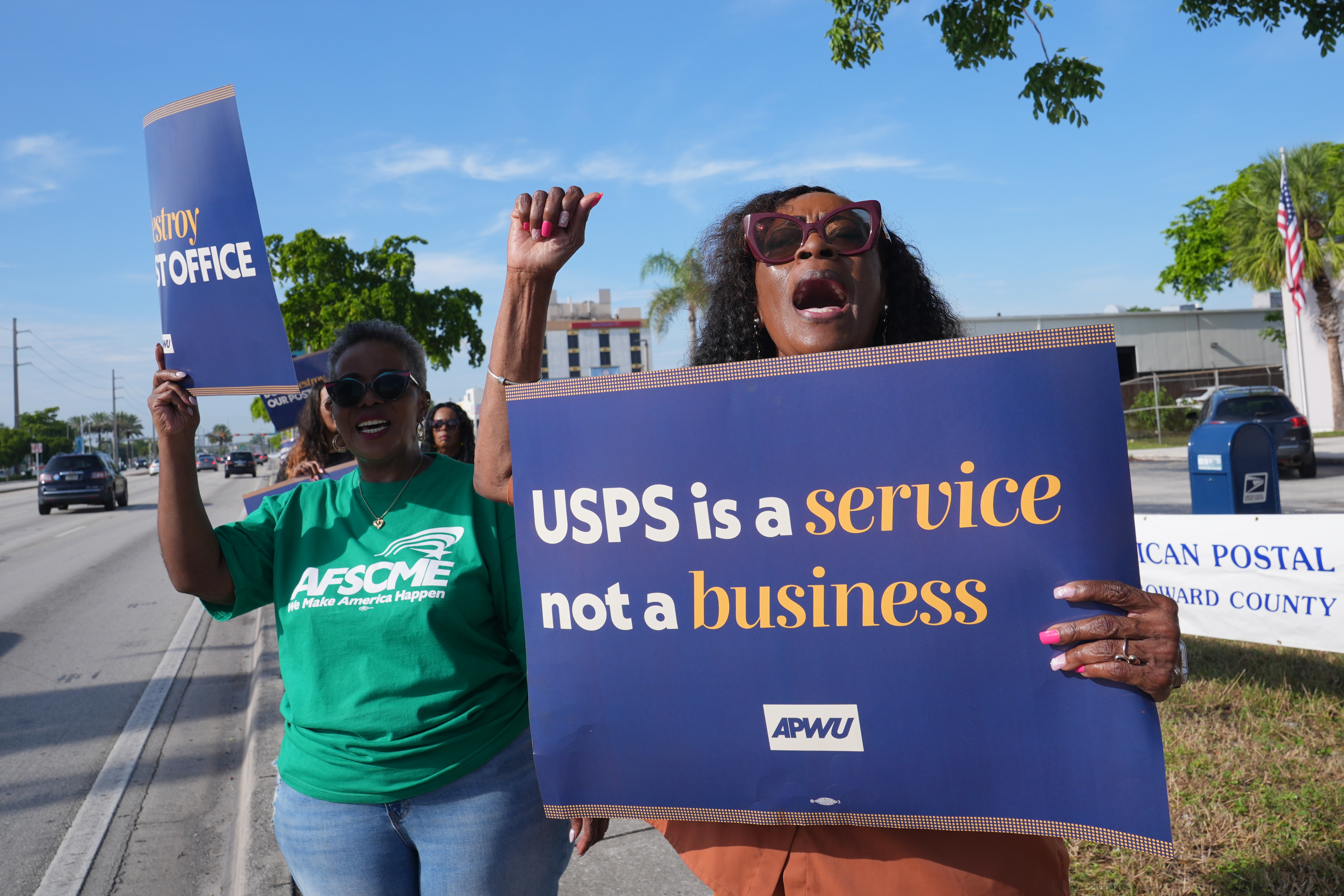
Joy L. Jackson (right) and Ketha Otis demonstrate against proposed changes to the U.S. Postal Service and President Donald Trump’s executive order regarding mail-in ballots in Miami Gardens, Fla., last month.Marta Lavandier
Voter suppression is the apparent goal, and the Supreme Court has played an outsized role in helping the Trump administration to get there. Even now, as the U.S. Department of Justice petitions U.S. District Judge Indira Talwani to reverse her nationwide injunction on Trump’s executive order, the Supreme Court looms in the background, ready to further erode democracy.
Of course, the threat posed by the court is about more than just one ruling. It is about the justices’ pattern of acceding to the whims of a president who seems to view the Constitution as a suggestion, rather than the law.
In 2024, the court shocked legal observers by ruling in Trump v. the United States that presidents have broad immunity from criminal prosecution for official actions they take while in office. And just a week ago, the court allowed construction of the president’s legally dubious $400 million ballroom to continue while lower court appeals play out, knowing the ballroom will likely be near completion by the time the courts catch up.
Still, the Supreme Court, whose 6-3 conservative majority includes three justices Trump nominated to the bench, does not have the last word on his policies. In America, the people have the final say. That’s why this latest gambit to cripple mail-in voting is so dangerous, and it is why the Supreme Court must be held accountable.
The people must sit in judgment of a president who starts a war that results in skyrocketing gas prices and American loss of life. The people must sit in judgment of a president who demolishes half of the White House without congressional approval. The people must sit in judgment of a president who wrecks the economy with illegal tariffs, and the people must sit in judgment of a president whose immigration crackdown costs American citizens their lives.
Polling has already indicated that Trump, whose 33% approval rating represents his all-time low, could drag his party down in the upcoming midterm elections. But as a seasoned politician once told me, the only poll that matters is the one that takes place on Election Day. Trump understands this truth, and he is trying to put his thumb on the scales. That’s to be expected, but he should not have the Supreme Court’s help.
At its best, America’s highest court should be apolitical, driven both by the letter and the spirit of the law. It should serve as a check on the worst instincts of politicians, and as a guardrail against tyranny. This court has failed on all those fronts, and has instead allowed itself to be driven and shaped by conservative ideology. It has fallen so far that it has seemingly been co-opted by those who would stop Americans from exercising their most basic freedom — the vote.
A federal appeals court in Philadelphia ruled that a policy mandating detention without a hearing for nearly all undocumented immigrants is unlawful. It has immediate local impact.
Police are investigating a fatal hit-and-run in Olney that took place minutes after an officer left the victim lying in a bike lane.
Sources told The Inquirer that Philadelphia police have recovered video that they believe shows the late pornographer Raymond “R.C.” Horsch killing a woman on camera. At least five missing women are now linked to the property where Horsch lived for decades with his son, Eugene.
A Delaware psychiatrist who testified in the nationally watched murder trial of Lindsay Clancy in Massachusetts resigned his position with Nemours Children’s Health.
Illegal dumpers repeatedly haul tires into Fairmount Park with U-Haul trucks, frustrating park-goers and the city as it engages in whack-a-mole.
Controversial apartments slated for the site of Manayunk’s PHS beer garden have been delayed.Neighborhood backlash against the project has been intense.
Jose Pistola’s Center City location abruptly closed this week. It’s the second longtime bar to close on the strip in a year.
New Jersey Gov. Mikie Sherrill signed legislation to permanently allow the sale and delivery of to-go alcoholic beverages.
This week’s question is: My neighbor has started decorating for Halloween. There are six skeletons in the yard, jack-o-lanterns hanging around the whole front of the house, fake tombstones that have punny names (I.P. Freely), and I know a lot more is coming. Halloween is more than two months away and it’s still 90 degrees outside. Is it too early for this or am I being a Grumpy Gus?
Inquirer columnists Stephanie Farr and Elizabeth Wellington joined forces for this one, touching on everything from First Amendment rights to the philosophical motivation behind putting up decorations in the first place.
Farr, who is already looking forward to Christmas, said she has a neighbor with a 12-foot skeleton up year-round, and wondered if living right next door would make her feel compelled to say something. Wellington, who can relate to feeling annoyed by the autumn-rushers, suggests a simple solution: acceptance. “I think we McGrinches have to grin and bear it,” she said, suggesting self-care tactics to deal with it.
“While it is good to see someone holding the sheriff accountable for once, a temporary babysitter is only a partial solution,” Pearson writes. “The office should be abolished.”
Cheers to Rosemary Farley, who correctly guessed Friday’s answer: Center City. Crews for the HBO crime drama Task were spotted filming in the neighborhood on Tuesday, and have been shooting around the region all summer.
With the highly anticipated revival of the Philadelphia Cycling Classic this weekend, we asked a former pro (Carlos Rogers) and a complete novice (sports reporter Ariel Simpson) to make an attempt at the most iconic ascent in American cycling.
🧀 We love superlatives. Someone is on the hunt for the best cheesesteak egg rolls in Philly. Another is claiming the finest bathroom, which appears to be at 12 Steps Down. My favorite comment: “this is a dark souls toilet but i mean that as a compliment.”
🚴 Like many others, John Carpenter and Julia Heberle of Roxborough are thrilled that the Cycling Classic is returning this year. They’ve been fans of the race since they moved to the area in 1988, and plan to do all they can to make this year feel like a party.
👋🏽 Have a good one. I’ll catch up with you again tomorrow.
By submitting your written, visual, and/or audio contributions, you agree to The Inquirer’s Terms of Use, including the grant of rights in Section 10.
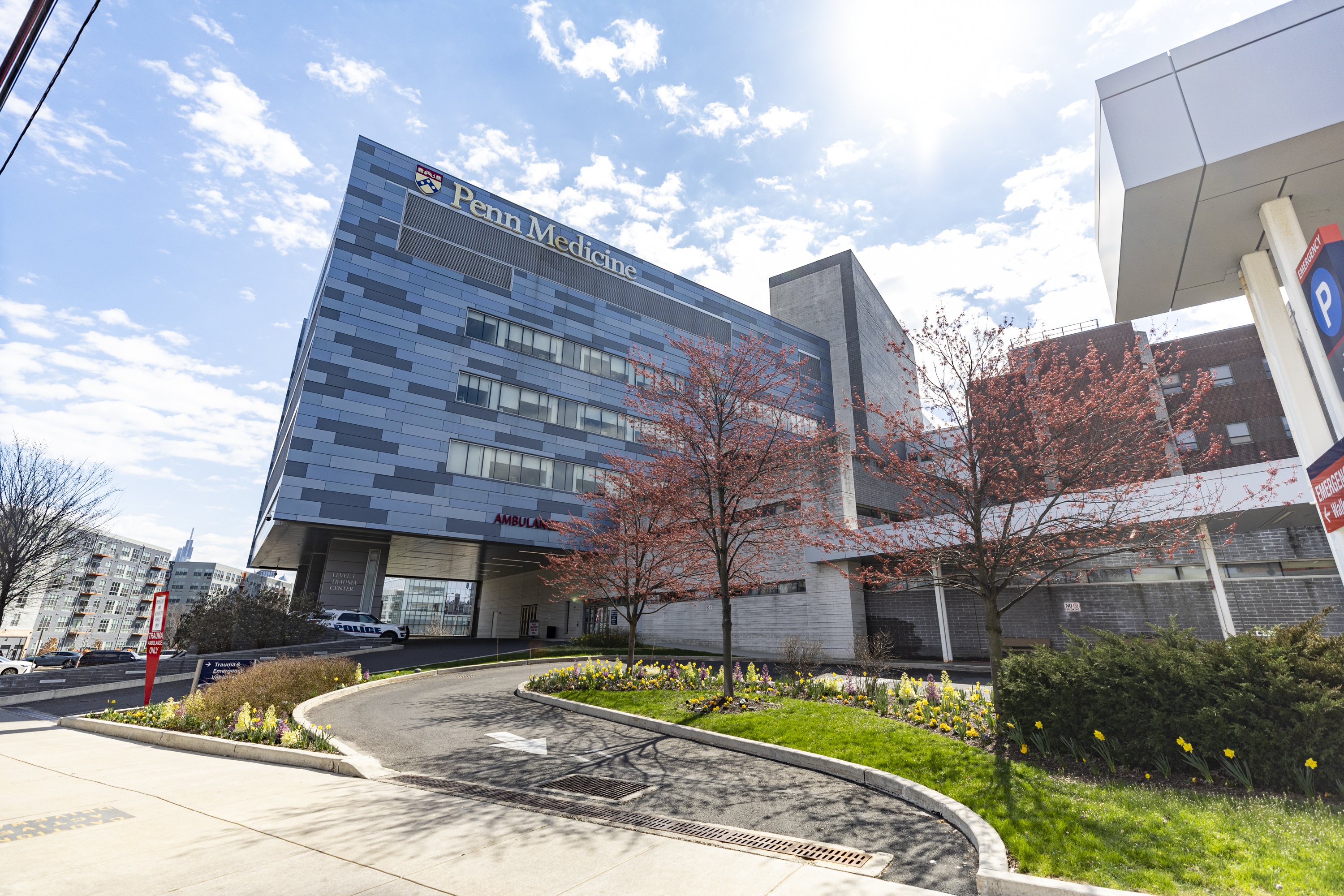
The University of Pennsylvania Health System had $337 million in operating profit in fiscal 2026, up from $247 million the year before, the Philadelphia nonprofit reported to bond investors Friday.
“We saw good growth in several of our clinical programs that helped us to generate the operating performance,” Julia Puchtler, the health system’s chief financial officer, said in an interview.
That’s money “we’re going to be able to reinvest in the academic missions and in our clinical programs and our workforce,” she said.
Here are more details:
Revenue: Penn’s total revenue rose 13.7%, to $13.6 billion from $12 billion the year before. Revenue from patient care accounted for $11.4 billion of the total in fiscal 2026, according to Penn’s report to bondholders.
Outpatient cancer care and outpatient surgeries by urologists and ear, nose, and throat doctors stood out as areas of growth, Puchtler said. On the inpatient side, neurosciences and transplants had notable increases, she said.
Expenses: For the first time since 2021, the average length of time a patient spent in the hospital fell below 6 days. Longer stays have higher expenses, even though hospitals generally don’t get paid more for them.
The average in fiscal 2026 was 5.93 days, from 6.14 days the year before. That looks like a small decline, but it adds up when spread over the health system’s more than 161,000 admissions in the year. The reduction helped Penn reduce expenses relative to revenue. It also freed capacity for more patients, Puchtler said.
In employee benefits, Penn had an additional $20 million in expenses because it aligned retirement plans across the system, Puchtler said.
Notable: Penn refinanced about $300 million in debt last month at a lower interest rate. That means the health system will save $28 million in interest payments over the next 9 or 10 years, Puchtler said.
The typical homeowner in New Jersey has one of the highest levels of housing wealth in the country, according to a study by LendingTree, an online loan marketplace.
The state was one of the top five where homeowners reported having the most home equity in the first quarter of the year, according to an analysis of more than 965,000 anonymized inquiries for home equity loans and home equity lines of credit submitted through LendingTree.
Home equity shoppers in New Jersey reported having a median of about $295,000 in equity, meaning half had more and half had less. The Garden State tied with Washington state in the rankings, but New Jersey had a slightly higher share of homeowners with at least $200,000 in equity — almost three in four shoppers.
Home equity, also referred to as housing wealth, is the difference between how much a property is worth and how much the owner owes on their mortgage. Equity increases when home values rise and/or owners pay down their mortgage. It’s money that belongs to the owner, but it’s not the same as having cash, noted Matt Schulz, LendingTree’s chief consumer finance analyst.
“Accessing [equity] generally means selling the home or borrowing against it, and borrowing comes with costs and risks,” Schulz said in a statement. Equity fluctuates with the market. Before borrowing against a home, owners should verify how much equity they have and how much the loan will ultimately cost. And they shouldn’t borrow more than they need, he said.
Property owners take out loans and lines of credit against a home’s equity to do things like consolidate debt, pay for school, and repair or renovate the home.
How equity compares
Home equity shoppers in Hawaii reported having the most housing wealth — a median of about $425,000, according to the LendingTree analysis. More than 80% of these homeowners had at least $200,000 in home equity.
California came in at second for median housing wealth — about $350,000.
(function(){function e(){window.addEventListener(`message`,function(e){if(e.data[`datawrapper-height`]!==void 0){var t=document.querySelectorAll(`iframe`);for(var n in e.data[`datawrapper-height`])for(var r=0,i;i=t[r];r++)if(i.contentWindow===e.source){var a=e.data[`datawrapper-height`][n]+`px`;i.style.height=a}}})}e()})();
Pennsylvania ranked 34th. Home equity shoppers on LendingTree’s platform reported having a median of $180,000.
Of the 50 states, West Virginia and Iowa were tied for last place. Home equity shoppers in these states reported having a median of about $130,000 in equity.
Differences among states “are a reminder that the home equity story can look very different depending on where you live,” Schulz said.
“For some homeowners, their house can provide a huge financial cushion,” he said. “For others, there may be far less wiggle room.”
But in total, U.S. homeowners “are sitting on an extraordinary amount of housing wealth,” Schulz said.
Across the country, households had $34.9 trillion in home equity as of the first quarter of 2026 — $48.7 trillion in real estate assets and $13.8 trillion in mortgage debt, according to LendingTree’s analysis of Federal Reserve data.
Dorothy Boggess starts every day the same way: with exercises in her kitchen.
She plugs in an old boom box and hits play on the “Cha Cha Slide.” Then she stands with a hand on the counter, swinging one leg and then the other back and forth. When DJ Casper asks how low she can go, she bends her knees and sinks her hips and shimmies, laughing. On her shelf is a mug that says “109 and fabulous.”
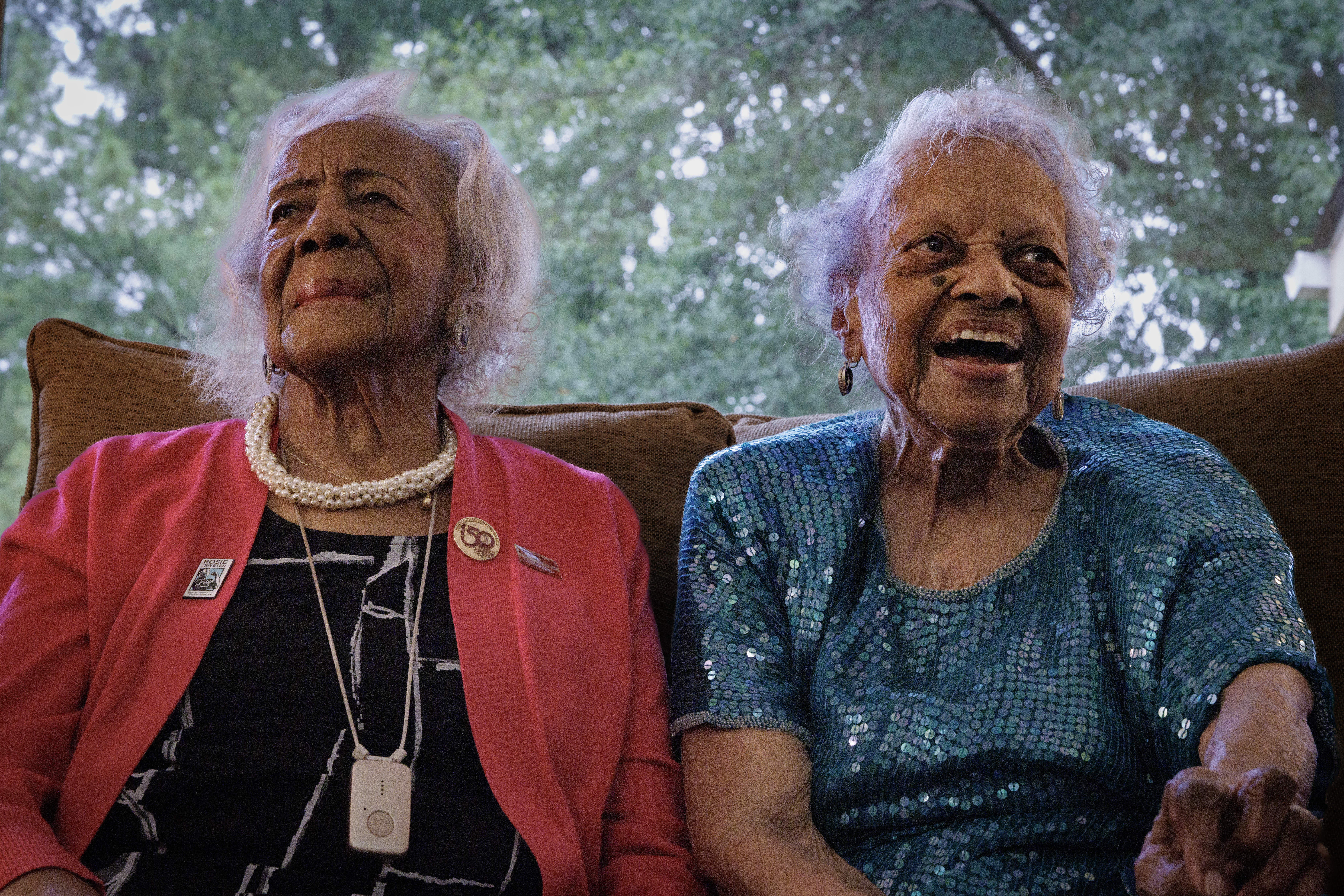
Reaching this age puts Boggess in an exclusive club. Just 0.03% of Americans live into their 100s. But Boggess is lucky enough that one of them is her friend of more than eight decades, Velma Long.
Long celebrated her 109th birthday this month by inviting Boggess to church with her. (Long went to Boggess’s church for her 109th birthday, in May.) Both wore sensible shoes on their birthdays this year, but Long’s daughter noted that her mom was dancing in heels on her 100th birthday.
Called to serve
In the early 1940s, Boggess was in Atlanta studying social work when she decided to come to Washington to join the war effort.
Both Boggess and Long were “Rosie the Riveters” — women who joined the workforce during World War II to help fill the factory lines, shipyards, and offices vacated by the young men sent overseas.
“It was very exciting,” Boggess said. “I didn’t know anyone at all in Washington, D.C.” She took the train up, and a friend of a friend picked her up from Union Station, bringing her along on an errand in Baltimore before taking her home.
“That was really exciting — to go to a whole other state. Of course, now we know Baltimore is nowhere. But to me, that was a really big deal,” Boggess said, laughing.
Both Boggess and Long went to work as clerk typists for the government — Long for the Navy and Boggess for what was then called the War Department, earning a salary of $1,440 annually. They met their husbands through work, and their respective romances started with lunch dates.
“We used to walk over to the Interior Department at lunchtime because it was not segregated,” Boggess said. “The food was better.”
It was soon after that Boggess and Long met each other and became fast friends. Their husbands were cousins and were very close, so nearly every date was a double date.
“My husband loved her husband,” Boggess said. “We spent a lot of time together and traveled everywhere.”
Boggess and her husband were very involved in the civil rights movement, and her home is full of mementos from that era. At the time, she didn’t realize she was helping make history.
“I was just having fun,” Boggess said.
In the late 1990s, The Washington Post ran a story about women known as “The War Girls” for their role in World War II, but the piece referred only to white women. Boggess wrote a letter to the editor correcting the record, and it ran in the paper the following month.
Friendship and humor
For more than 80 years now, Boggess and Long have lived near each other in and around D.C. When they were younger, they went to exercise classes together and threw parties for the kids’ birthdays in Boggess’s backyard. It’s harder to get together as often now, but they check in by phone almost every day.
“We’ve both lost so many close friends,” Boggess said. “It’s amazing that we’re still functioning.”
They exercise and eat well, but when asked about the secret to their longevity, they say it’s being social. And while they’ve made many friends through church and their kids and grandkids (Long has a great-great-granddaughter, age 4), there’s something different about a friend who has known you since you were 23.
“They’ve been friends for years,” said Kenneth Boggess, Boggess’s son. “They are close, and they can relate to one another.”
Dorothy Boggess still makes Long laugh like no one else. But they stay engaged with the world outside, too.
“I go out with my daughter a lot,” Long said. “She always insists that I come along. I say, ‘I’m really too old.’ She says, ‘No, you’re not. People love to see you — to see a person that’s your age.’”
“All my friends say she’s their mom, too, now,” said Long’s daughter, Phyllis Valentine, 78.
Both Long and Boggess have been involved with their churches, neighborhoods, social clubs, and sororities. They stay as active as possible, and Boggess learned to swim later in life, at age 69, which she said is her proudest accomplishment.
“All I can say is I’m very proud of her,” Kenneth Boggess said of his mom. “I’m proud of the people who have supported her.”
Both Dorothy Boggess and Long have traveled extensively since retiring from careers in social work in the 1970s: Boggess has a list of the countries she’s visited on the wall in her basement, in alphabetical order, from Argentina to Turkey. Places Long loved the most were Bermuda, Montreal, and Hawaii.
“She loves to fly,” Valentine said of her mom. Valentine brought Long to Texas last year for a celebration at Long’s college marking the school’s 150th anniversary. “As we were descending into Austin, she was looking out the window just like a little kid. And I asked her, I said, ‘What are you thinking about?’ She said, ‘I just never thought I’d get to come back.’”