Blog

  • In the wake of alleged hazing incidents, Cheltenham parents and officials marched to support students before school starts

    In the wake of alleged hazing incidents, Cheltenham parents and officials marched to support students before school starts

    After a football hazing scandal led to criminal charges for coaches and players, about 35 Cheltenham School District parents, students, and school board members marched across town Saturday morning to show their support for students.

    The purpose of the march, just days before school starts, was to show students that the community cares about what they are going through, and is calling on the school board to make needed changes, organizers said. Marchers also said it is important to portray the district in a positive light.

    “We need to come together as a community, address needed changes, and also push back against some of the false information out there,” said Ikysha Dearry, president of the Cheltenham African American Alliance.

    Dearry said the school has faced a barrage of negative attention online from opportunists who want to bring issues like race and the region’s changing demographics into the discussion. “That can have an impact, not just on how our district is viewed, but on how our students are viewed,” she said.

    School board director Caroline Watts was one of the first to arrive in the parking lot behind the Cheltenham School District building Saturday morning. She wore athletic shoes for the nearly two-mile walk to the high school. Watts said the message of the march was a “delicate balancing act.”

    ”We’re addressing what happened, making sure it doesn’t happen again, and we’re starting the school year,” Watts said.
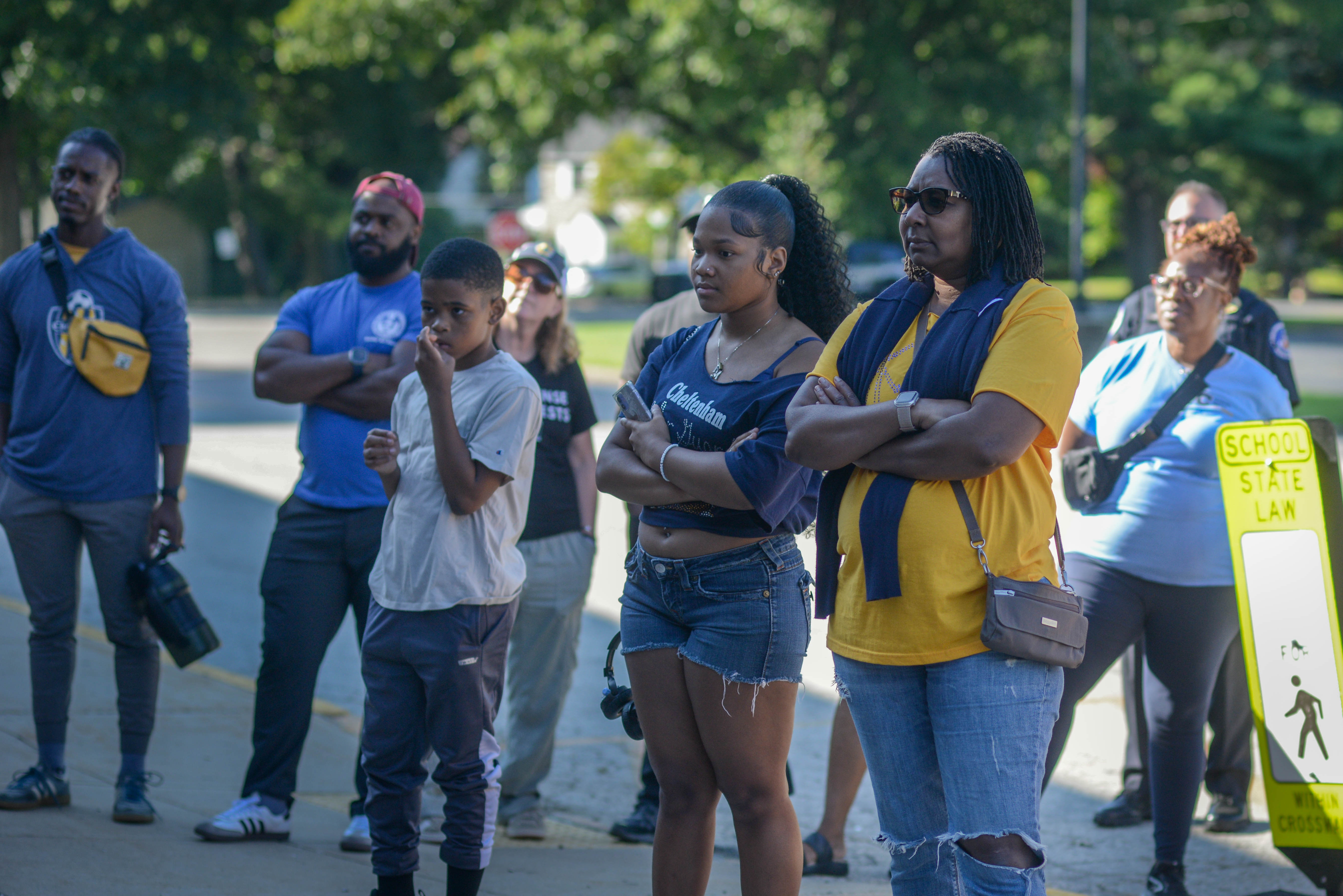
    Participants listens as Ikysha Dearry, president of Cheltenham African American Alliance (not shown), addresses the crowd after a community march was held as residents are banding together before the new school year begins to advocate for students, Saturday, Aug. 29, 2026, on Ashbourne Road near the Cheltenham School District Administration Building in Elkins Park. Dr. Brian Scriven resigned as superintendent of the Cheltenham School District in the aftermath of Cheltenham High School football coaches and players being charged with assault in a locker-room hazing incident. Dr. Chris McGinley recently took over as interim superintendent.William Thomas Cain / For The Inquirer

    Montgomery County prosecutors in July charged four football coaches and six players in connection with two 2025 assaults in a Cheltenham High School locker room that led to the cancellation of last year’s football season. During the assaults, prosecutors said, a 15-year-old was beaten by teammates who poked a broomstick toward his buttocks.

    “It’s horrific, what happened,” board vice president Jenny Lowman said before the march. “To think that it happened more than once, it’s also horrifying. Those coaches were responsible for these children. And two of the coaches were parents of students on the football team.”

    According to prosecutors, the coaches urged the player not to tell his parents. And according to a grand jury report, high school employees downplayed a complaint from the player’s mother and took then-head coach Terence Tolbert at his word that he had not instructed the boy not to tell his mom.

    The report faulted the district’s handling of the situation from the start, saying employees had included Tolbert in their investigation and failed to discover there were two assaults. Employees were also confused about their duties to report child abuse, and at least five football coaches did not have clearances related to mandatory-reporter training, according to the report.

    A community march was held as residents are banding together before the new school year begins to advocate for students Saturday, Aug. 29, 2026, on Ashbourne Road near the Cheltenham School District Administration Building in Elkins Park. Dr. Brian Scriven resigned as superintendent of the Cheltenham School District in the aftermath of Cheltenham High School football coaches and players being charged with assault in a locker-room hazing incident. Dr. Chris McGinley recently took over as interim superintendent.William Thomas Cain / For The Inquirer

    Cheltenham parent Aubria Nance said the alleged assaults have “absolutely shaken” the students. Nance, a board member of the Cheltenham African American Alliance, said students need to know their concerns are being taken seriously.

    “We want the board and the interim superintendent to know that we are advocating for the safety of our students,” Nance said.

    Cheltenham parent Kisha Rodwell-Green said the type of hazing she believes to have happened is called “broomsticking.” Searching online, she said, she learned that many other schools had dealt with this.

    Rodwell-Green wants the board to approve funding to work with an advocacy group called Stop Hazing. She said the athletic department needs to build a “culture of trust,” one where athletes feel comfortable speaking up if something does not seem right.

    “We know we have a lot to correct in our community, and we are starting to see that work being done,” said Rodwell-Green, who also serves as president of a parent-teacher organization called United Parents Group.

    Jackson Scott, a student at the high school, speaks to a reporter after a community march was held as residents are banding together before the new school year begins to advocate for students Saturday, Aug. 29, 2026, on Ashbourne Road near the Cheltenham School District Administration Building in Elkins Park. Dr. Brian Scriven resigned as superintendent of the Cheltenham School District in the aftermath of Cheltenham High School football coaches and players being charged with assault in a locker-room hazing incident. Dr. Chris McGinley recently took over as interim superintendent.William Thomas Cain / For The Inquirer

    Still, she said, the issues Cheltenham High faces are not unique to the school, and media attention from the hazing incidents has cast an unfair light on a good school.

    “Comments on Facebook got very nasty,” Rodwell-Green said. “There’s a microscope on Cheltenham, and we want to take that microscope off.”

    For some community members, the criminal charges added fuel to complaints that the district has not been taking safety seriously enough. Parents of football players said they had urged the district not to hire Tolbert, citing concerns he let bullying go unchecked during his one-year stint as Abington’s head football coach.

    At Cheltenham Elementary School, parents said they have been battling with the district after repeated assaults by students against peers and teachers, and pointed to the football charges as proof of a systemic problem in the district.

    The district, which in May canceled the forthcoming football season, has responded to the charges by commissioning an outside investigation and hiring a new superintendent. Chris McGinley, a veteran educator who had served as Cheltenham’s superintendent two decades ago, was approved by the board on Aug. 18 to lead the district under a one-year contract. He replaces Brian Scriven, who resigned last month.

    The changes also have forced high school students to grapple with the fallout.

    Cheltenham senior Jackson Scott, 17, had mixed feelings. Scott, a soccer player, said it was unfair that his friends on the football team had their seasons canceled. Steps must be taken to stop such incidents from happening again, he said, but he also wondered if some of the details of the hazing incidents had been exaggerated.

    Senior Isabella Pero, 17, said she was disgusted that other students said nothing despite knowing about the hazing.

    Pero said she was shocked to learn that Tolbert, who taught one of her classes and seemed like a nice person, was involved. The same goes for the students involved in the alleged assaults, she said. She struggled to square her impression of the students with the violence.

    “In my opinion, in the moment, you’re so hopped up in wanting to win a game, and have a good season, that you make those tainted, not good decisions,” Pero said.

    Parent Michelle Gregorio said she hopes athletic director Sam Sheridan will help the district move forward. “And we don’t want to sweep under the rug what happened, but we want to let students know we’re addressing it.”

  • With shoppers wary of illness, farmers destroy millions of heads of lettuce

    With shoppers wary of illness, farmers destroy millions of heads of lettuce

    SALINAS, Calif. — At a Church Brothers Farms production facility, where conveyor belts rumble with giant heaps of chopped romaine and red cabbage, the company has slashed workers’ hours and laid off employees this summer. Some assembly lines in the plant in San Juan Bautista, Calif., near the agricultural heartland of the Salinas Valley, weren’t operating at all this past week.

    Fresh produce sales fell nationwide after a major outbreak of cyclosporiasis, an illness that causes severe diarrhea. More than 17,000 people have been sickened so far, and two have died, according to federal health officials.

    The largest cluster of cases was linked to iceberg lettuce grown in Mexico, and greens from the Salinas Valley haven’t been implicated by federal officials. Yet demand for the valley’s lettuce has plummeted all the same, said Raymond Gonzales, vice president of processing plant operations at Church Brothers.

    “Even though all this product is from the U.S.,” Gonzales said, waving a gloved hand at pale green leaves churning through cold water, “the consumer just sees it as lettuce.”

    Like many American farmers, Church Brothers made a tough decision in recent weeks to abandon healthy crops. If there isn’t a market for the produce, it often makes more financial sense to use the greens to re-fertilize the land than to shell out for the labor costs for harvesting.

    Jeff Church, the company’s chief operating officer, said Church Brothers had lost hundreds of thousands of dollars in discarded greens. He estimated that the company had returned an extra 3.9 million heads of lettuce to the soil over the past six weeks as demand dropped.

    “We just couldn’t use it,” said Church, 54.

    The amount of romaine and iceberg lettuce produced for sale this summer in the United States has been the lowest in a quarter century, according to shipping data from the U.S. Department of Agriculture. And wholesale prices for lettuce remain at break-even costs, even though so little is available for sale, the data show.

    Nowhere has the economic impact been felt more than in the Salinas Valley, an agricultural region about 100 miles south of San Francisco that marketers have long called the Salad Bowl of the World.

    The area is perhaps best known nationally for the John Steinbeck novels set here, such as Of Mice and Men and East of Eden. But the Salinas Valley has also been prized for generations for its temperate weather and fertile soil, which allow it to grow strawberries, broccoli, and, in the summer, 70% of the nation’s lettuce.

    So produce scares are nothing new. It took years for spinach sales to recover after a deadly E. coli outbreak in 2006. But questions about the origins of the largest-ever U.S. outbreak of cyclospora, a parasite in human feces, seems to have made customers particularly cautious, avoiding berries and several types of fresh vegetables that were never linked to the outbreak.

    The Centers for Disease Control and Prevention has confirmed only one source — iceberg grown in Mexico by produce behemoth Taylor Farms. But health officials say they’re investigating at least six other clusters for which sources have not yet been publicly identified.

    “I even had one reporter tell me they were not going to have a Caesar salad,” said Norm Groot, executive director of the Monterey County Farm Bureau, who pointed out that romaine lettuce, the kind typically used in a Caesar, had never been connected to the parasite.

    At Church Brothers, a large, family-owned business that has been growing produce in the Salinas Valley since 1999, lettuce sales began to drop in July, around the time the CDC announced a link between cyclospora and Taco Bell lettuce. It didn’t help that Taylor Farms, whose Mexican-grown lettuce was implicated, is based in Salinas, linking the outbreak to the valley in customers’ minds.

    Sales have begun to pick up as the outbreak starts to subside, Church said. Yet he is now struggling to determine how much to plant in the coming months.

    Church, wearing a vest in the Salinas morning fog this past week, contemplated the math as he watched workers harvesting iceberg lettuce strip off outer leaves with knives before wrapping the heads in plastic to sell to Walmart.

    If local farmers plant too little, fearing more losses, there will be a lettuce shortage in the winter. But if Church plants a typical amount, he could be forced again to do what farmers call discing, in which they dispatch a tractor with steel blades, or discs, to chop up healthy produce and plow it back into the soil.

    Daniel Sumner, an agricultural economics professor at the University of California, Davis, said it was unclear how long customers would avoid leafy greens, given how fast information travels on social media and a larger lack of trust in institutions.

    Just this past week, farmers were upset about a meme of the scariest Halloween costume: Taylor Farms shredded iceberg lettuce. The Washington Post published an opinion column arguing that Americans should permanently stop eating lettuce.

    “It’s a really tough moment,” said Dave Puglia, president and CEO of Western Growers, an agricultural trade association representing produce farmers in California and other Western states. “There’s a lot of very good, fresh produce that’s being plowed back into the ground.”

    Puglia said the drop in sales linked to this outbreak — close to 30% — had been higher than for other recent disease outbreaks.

    And while America has a very safe food supply system, there are risks inherent to lettuce, he said, since it’s largely grown outside and is eaten raw. Leafy greens are among the leading sources of foodborne illness in the United States.

    In Salinas, a city of 159,000 residents where Main Street is lined with brick buildings featuring art deco entryways, hand-painted tomatoes and heads of lettuce grace the public trash cans. Looming as one of the tallest buildings in downtown, across from the National Steinbeck Center, is the headquarters of Taylor Farms, a major employer.

    The mayor of Salinas, Dennis Donohue, said he was keeping an eye on local economic indicators, such as sales tax revenue, to see how the produce sales slump could ultimately affect the city’s finances. But ups and downs are the nature of the agriculture business, said Donohue, who previously ran a small specialty vegetable company.

    “Things tend to bounce back,” he said.

    As far as eating lettuce, even customers in Salinas remain wary.

    Melanie Waltrip, who co-owns Smalley’s Roundup Restaurant, a 50-year-old steakhouse with deep red booths, said her servers were still fielding questions about the safety of consuming their green salads, typically served as a side with ribs or pork chops.

    But Jeff Birkemeier, 46, who co-owns Amapola Kitchen in downtown Salinas, said his most popular menu item, a Chinese chicken salad made with romaine, remains a bestseller. He said that employees of Taylor Farms, who work across the street from his cafe, often stop by for lunch.

    “My customers in general are people that have grown up in this type of agricultural hotbed for their whole lives, and they just kind of take it all in stride,” he said.

    This article originally appeared in the New York Times.

  • Ontario premier answers Trump’s ‘Lake America’ with giant ‘Lake Ontario’ sign

    Ontario premier answers Trump’s ‘Lake America’ with giant ‘Lake Ontario’ sign

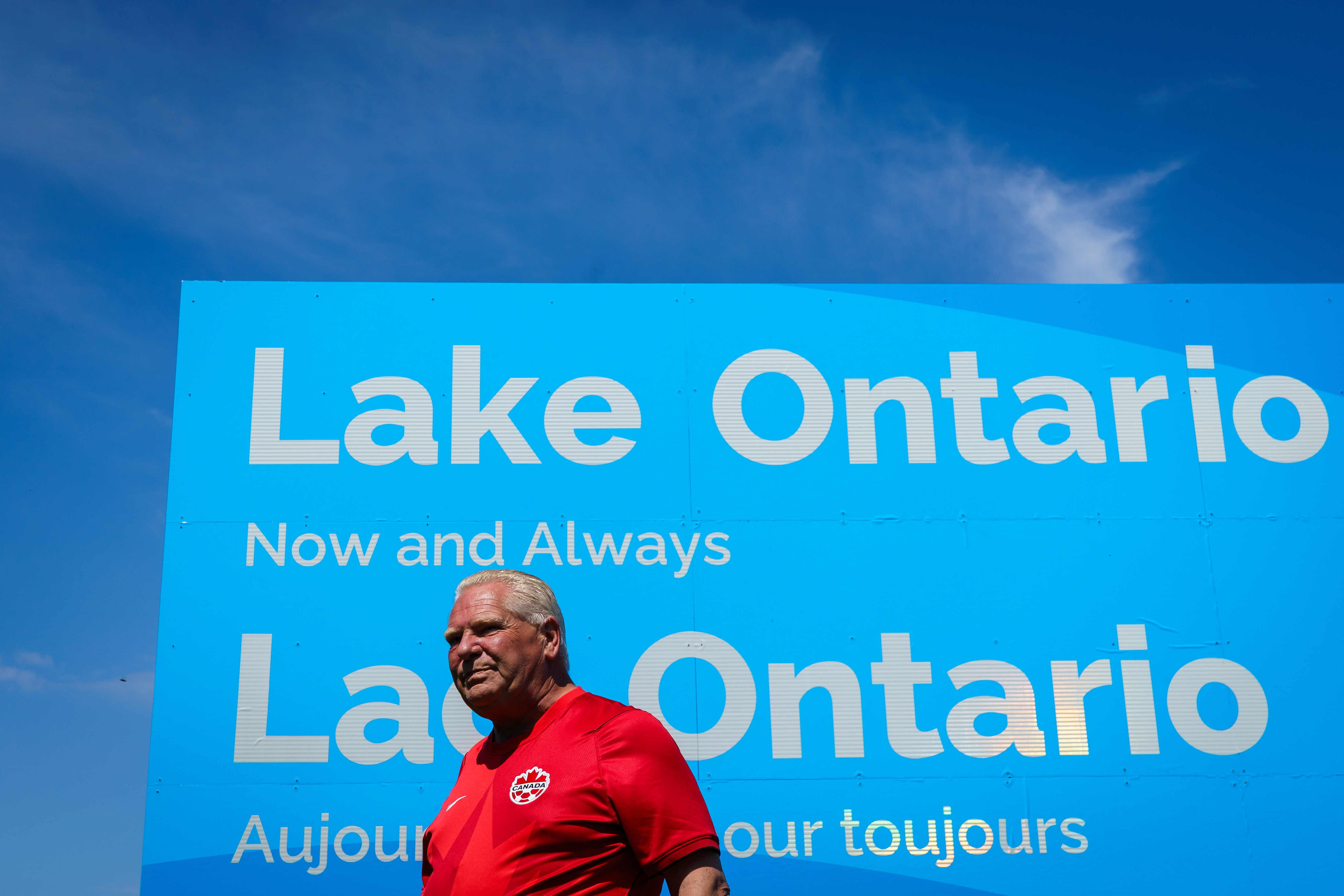
    TORONTO — Ontario Premier Doug Ford answered President Donald Trump’s “Lake America” decree Saturday with a billboard-sized message on the Canadian shoreline: “Lake Ontario. Now and Always.”

    Wearing a Team Canada soccer jersey, Ford unveiled the sign near Grimsby, Ontario, and posed for photographs. The 24-by-12-foot sign stands on 6-foot legs, putting its top about 18 feet above the ground — roughly two stories high. The message is repeated in French.

    It was the latest show of defiance after Trump signed an executive order directing U.S. federal agencies to call Lake Ontario “Lake America.” After months of tariffs, threats to make Canada the 51st U.S. state, and personal attacks on its leaders, the move has been met in Canada largely with ridicule.

    Ford said Trump was trying to rename the lake because Ontario and Canada were “standing up for ourselves” and argued the name would outlast the president.

    “Long after President Trump is gone, it will still be called Lake Ontario,” Ford said in a video posted on social media.

    Manitoba Premier Wab Kinew compared Trump to an aging rock band trying to revive an old hit.

    “You know when a rock band is really over the hill and you see them like in a casino playing some song from like 50 years ago. I think that’s the part of Donald Trump’s presidency we’re at now, Like he thought they had a real hit, a real golden oldie, with the Gulf of Mexico,” Kinew said, referring to Trump’s executive order renaming the Gulf of Mexico the Gulf of America. “And he’s trying to bring back that, and he’s trying to play the hits for his base. But I think everybody here thinks it’s a little sad and it’s not his best work.”

    The mockery was not limited to politicians. Canadian historian Robert Bothwell was even more scathing.

    “The greatest country on earth takes this moron seriously?” Bothwell said.

    But Bothwell said the dispute was more serious than the jokes, arguing Trump’s broader aim was “to subordinate Canada and at best make it a colony, at worst absorb it into the United States.”

    Nelson Wiseman, professor emeritus at the University of Toronto, said Trump “would like Canada to act like a vassal state, but it refuses to do so. That irritates him.”

    The dispute comes as relations between the longtime allies worsen over trade. Negotiations collapsed last week, both governments accused the other of making late demands, and Canada announced retaliatory tariffs set to take effect next month.

    Trump’s order also came amid an escalating war of words with Ford. In an interview with the Associated Press earlier this week, Ford said Ronald Reagan would be “throwing up” over Trump’s tariff policies and “disgusted with President Trump.”

    Trump fired back by dismissing Ford’s comments as “bluster,” calling him Prime Minister Mark Carney’s “flunky” and mocking him as the “less charismatic, intelligent, and overall unimpressive brother” of the late Toronto Mayor Rob Ford.

    Trump continued promoting the new name Saturday, reposting a meme showing Canada geese with Trump-like blond hair firing rifles as they “protected” Lake America.

    Trump has repeatedly used maps to make political points. A “Gulf of America” map was displayed for a time beside the Resolute Desk in the Oval Office, and Trump has posted images depicting Canada as part of the United States or as the 51st state.

    The name Lake Ontario comes from the Huron Indigenous people’s word “oniatarí:io,” which means “lake of shining waters.” The Canadian province of Ontario, founded in 1867, took its name from the lake.

    Wendat Nation Grand Chief Pierre Picard, whose people historically lived from the St. Lawrence Valley to the Great Lakes and whose language gave Lake Ontario its name, called Trump’s move an attempt to erase Indigenous history.

    “I want to tell him that it is unacceptable for us, as a nation, to have a president who can eradicate our history, our culture, and our identity,” Picard said.

    Canadian Prime Minister Mark Carney rejected the move, noting the lake’s Indigenous roots and that the name predates both Canadian Confederation and the U.S. Declaration of Independence. Trump cannot require Canada to adopt the new name.

  • This educator just gave away his 5 millionth book — and will give away thousands to Philly and N.J. teachers this year

    This educator just gave away his 5 millionth book — and will give away thousands to Philly and N.J. teachers this year

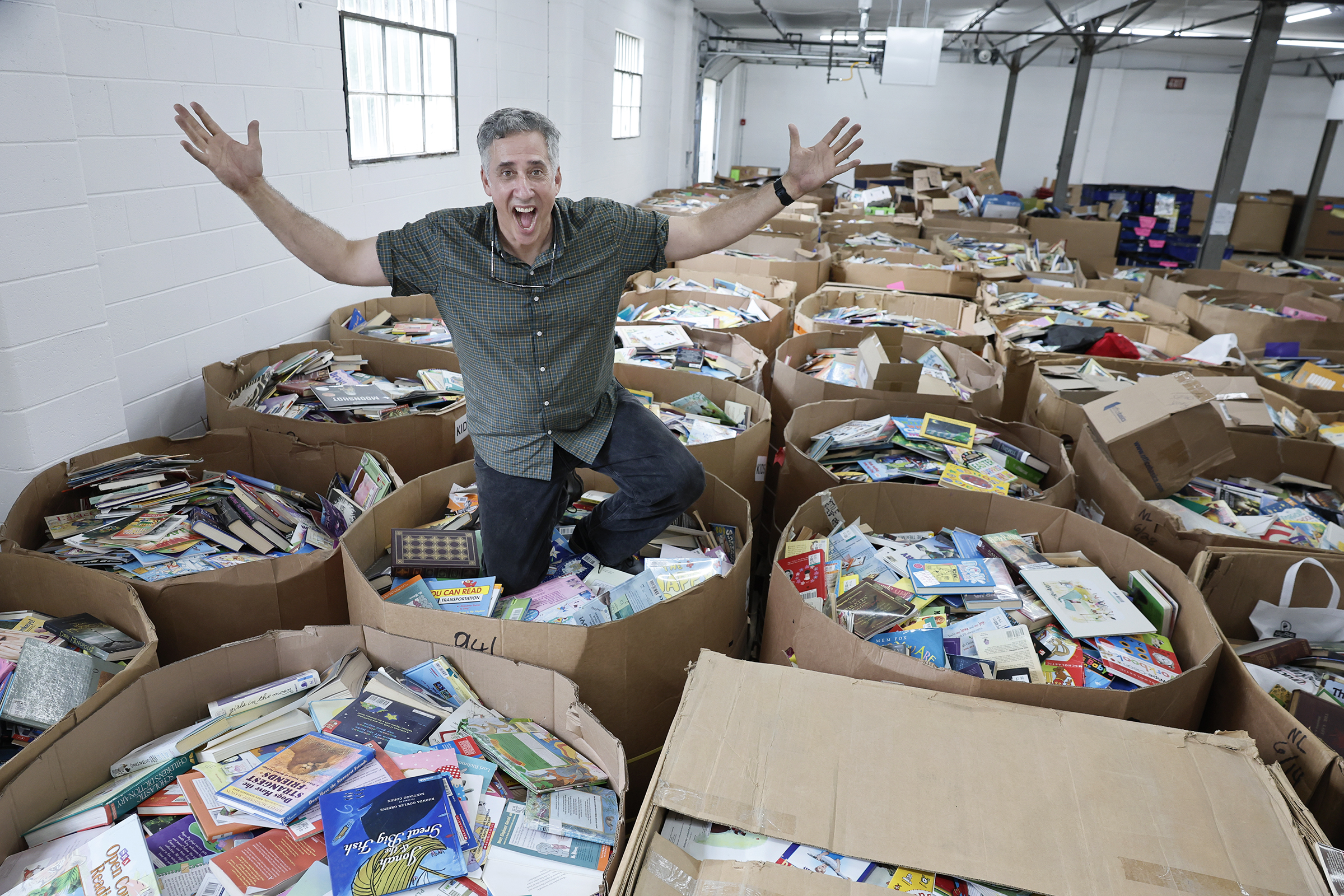
    Inside a cavernous warehouse just off I-295 in Cherry Hill, Larry Abrams spread his arms, gesturing to the sea of industrial-size cardboard boxes that surrounded him.

    “We’re sitting on a rocket ship,” said Abrams, a third-generation teacher.

    Abrams’ rocket ship is composed of books: thousands and thousands of them — picture books and out-of-date science textbooks, cookbooks and battered novels. He sees them as a way to change kids’ life trajectories.

    The BookSmiles van and a staffer’s car parked outside of BookSmiles new warehouse in Cherry Hill.Elizabeth Robertson / Staff Photographer

    To date, BookSmiles, the nonprofit Abrams started out of his garage in 2017, has distributed five million books. It just outgrew its third location, expanding into a 14,000-square-foot space in Cherry Hill that is formally opening next week.

    Book banks are not a new idea. But Abrams believes he’s got the secret sauce.

    “We’re the only book bank in America that does this — we actively trade pallets of grown-up books for pallets of upcycled gently used children’s books,” Abrams said. “Never before has there been a low-cost way to get so many beautiful, upcycled books into the homes and hands of kids who need them the most.”

    ‘It’s simply about lack of book access’

    Abrams served in the Navy — he was stationed on an aircraft carrier during the Persian Gulf War — and managed a copy shop. Then he settled into a career as an English teacher, working first in Moorestown, then in Lindenwold.

    “I thought, ‘Why do most of the Lindenwold kids in my ninth-grade class read at a third- or fourth-grade reading level?’” Abrams said. “It’s simply about lack of book access. It’s not fair that some kids grow up with no access to books, and other kids have everything.”

    Abrams thought long and hard about how to change that equation. What if he redistributed books from wealthy and middle-class communities to the places that didn’t have them?

    BookSmiles founder Larry Abrams works in the loading dock area of BookSmiles’ new Cherry Hill warehouse on Friday, Aug. 28, 2026.Elizabeth Robertson / Staff Photographer

    He put out a social media call for children’s books, and got thousands.

    There is no market for reselling used children’s books online, Abrams found — you can’t sell them and make any kind of money. So the BookSmiles concept developed.

    Now, people from all over New Jersey and Pennsylvania donate books — any kind of books, from old encyclopedias to nearly new novel series. The BookSmiles team (at first, just Abrams himself; now, it’s 11 people and a growing corps of volunteers) sorts through every single book.

    The organization gets books in myriad ways: from folks dropping off what they salvage after cleaning out a bookshelf to donations of entire estates of books. BookSmiles accepts library discards and scrap paper, too.

    Adult books, old textbooks, and kids’ books that are not in excellent condition are sold, not for cash, but for gently used children’s books that are distributed directly to teachers, daycares, and other nonprofits that get them in kids’ hands.

    ‘There’s a low-cost way to raise test scores’

    BookSmiles grew so significantly that Abrams retired from teaching and now works full-time as executive director.

    But his educator hat is always on. Research shows that access to books, and books in children’s homes, is a powerful determinant of kids’ educational outcomes and economic success.

    “This comes from a place of me being a teacher, and seeing there’s a low-cost way to raise test scores,” said Abrams, dipping his hand into a cardboard box and fishing out an old dictionary that will end up being recycled for paper.

    BookSmiles founder Larry Abrams among boxes of childrens books ready for young readers in BookSmiles new Cherry Hill warehouse on Friday, August 28, 2026.Elizabeth Robertson / Staff Photographer

    The largest share of BookSmiles’ books moves out through its “Teacher Take” program. Teachers pay a nominal fee — BookSmiles asks for $35 annually — and can then take hundreds of books multiple times a year, either for classroom libraries or for distribution.

    BookSmiles also sponsors “Fair Book Fairs,” where schools get enough books for every child to take home at least three volumes at no cost.

    Schools that serve predominantly students from economically disadvantaged backgrounds are asked to kick in just $200 to get a Fair Book Fair. Others pay a little more.

    In 2025, BookSmiles gave away half a million books to teachers and kids in Philadelphia schools. Another 500,000 went to New Jersey teachers and schools, and the remainder, about 250,000, were sent overseas.

    With libraries often on the chopping block in low-wealth school systems — Philadelphia had fewer than five people working as full-time, certified school librarians last school year — classroom libraries are key, and teachers often need resources to build them.

    “We can hook them up,” Abrams said. “I can’t give them school supplies, but I can give them books.”

    Book joy

    Abrams still gets struck by moments of “book joy” when he looks at the Teacher Take room, or the massive room of books waiting to be sorted or moved out.

    “It’s almost like walking into Willy Wonka’s world, but it’s not candy, it’s books,” he said. “Sometimes, you can’t tell the difference between what Barnes & Noble is selling and what we’re giving away.”

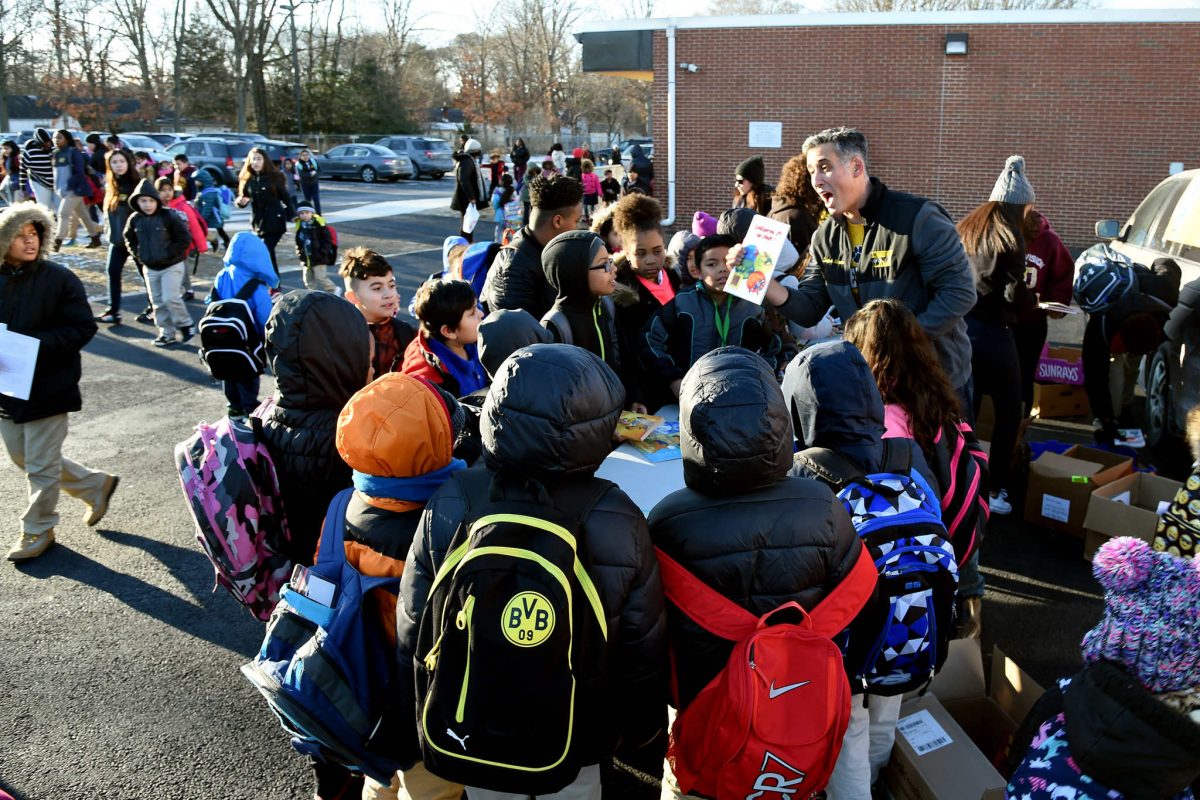
    Larry Abrams shows BookSmiles books to Lindenwold Elementary School students in the nonprofit’s early days. This file photo is from 2018.TOM GRALISH / Staff Photographer

    BookSmiles’ new space, across the street from the PATCO Woodcrest station, just off I-295, is a level up for the organization. It will allow BookSmiles to move from distributing 1.3 million books per year to five million books per year, and can accommodate more volunteers.

    Abrams, like many, is thinking of Dolly Parton a lot these days.

    The music icon and humanitarian, who died Tuesday, was an inspiration for BookSmiles and a mentor to him, though he never met her.

    Parton began her Imagination Library, a program that sends free books directly to children’s homes, as a tribute to her father, who never learned to read.

    “I don’t know if I’ll ever get to 300 million books,” Abrams said. “But we know that if books are in the home, children will be more successful academically. We know that access to books changes equations.”

    BookSmiles, 100 Melrose Ave., Cherry Hill, N.J., accepts book donations and volunteers. Its Teacher Take program resumes soon.

  • This Appalachian memoir author is running as a Democratic contrast to JD Vance

    This Appalachian memoir author is running as a Democratic contrast to JD Vance

    CLIFTON FORGE, Va. — Veterans flock to a law office in this old railroad town for help wrestling with the feds over healthcare. Across the mountains in Waynesboro, families who can’t afford groceries spend hours waiting outside the food pantry. Up in Monterey, the town economic development director works for free because budgets are thin.

    Beth Macy writes it all down, still chasing stories across Appalachia after 40 years as a newspaper reporter and author of books including Dopesick, an exposé about Big Pharma’s contributions to the opioid crisis that became an Emmy-winning Hulu miniseries.

    After the memoir Hillbilly Elegy catapulted JD Vance to prominence as an authentic child of the Rust Belt and Appalachia, Macy is leaning on her own roots and her writing about the region to jump into politics. But her long-shot bid for a House seat as a Democrat in a bright red Virginia district positions her as a kind of anti-Vance.

    In an essay in the New York Times shortly before Vance was elected vice president, Macy faulted him for fearmongering about immigrants and turning his back on the public institutions that helped him escape poverty.

    “I’m coming at it from the perspective of an old-school mountain Democrat,” Macy said in a recent interview. “Let’s make it safe, let’s protect working people.”

    The two writers hail from Ohio hometowns only 60 miles apart: Middletown for Vance and Urbana for Macy. Both are the product of dysfunctional families and economic hardship. But Vance went on to the Ivy League and venture capital, urging the downtrodden to take personal responsibility for their prospects in life.

    Macy, 62, published her own life story last year in Paper Girl, which examines the same terrain as Hillbilly Elegy but comes to very different conclusions.

    Macy, who put down roots in Appalachia and spent decades writing about the region’s struggles for Virginia’s Roanoke Times newspaper, believes Vance blames poor people for their own plight. She sees outside forces working against the region going back generations, including the opioid makers who falsely claimed that their drugs were not addictive, and government policies driving the offshoring of manufacturing jobs.

    Campaigning with pad and pen in hand, Macy says she aims to “connect pain to policy,” and she criticizes both major parties for a system that fails those in need. The message was warmly received on a recent campaign swing, and many voters were thrilled to meet Macy, who made sure the Dopesick show was filmed partly in the district.

    But after years of division stoked by culture wars, folks who came out to see Macy the celebrity are not sold on casting a ballot for someone with a D after her name.

    “Exactly the issue she has to overcome here — and I’m not sure how — is that an awful lot of people vote by just the R or the D, as simple as that,” said Robin Sullenberger, who spent two decades as a supervisor in Highland County and stopped by a recent Macy campaign appearance in Monterey. The supervisor jobs are nonpartisan, but Highland County — Virginia’s least populous county — has picked a Republican for president in every election since Alf Landon in 1936.

    Macy is running against Republican incumbent Ben Cline in Virginia’s bright-red 6th District, a New Jersey-sized stretch of mountains and valleys that stretches from Winchester in the north to Roanoke in the south.

    The nonpartisan election handicapper Cook Political Report rates the district as “Solid Republican.” Cline, seeking his fifth term, beat his 2024 Democratic challenger by 28 percentage points and outperformed Donald Trump, who won by 24 points.

    “I know that her liberal positions on the issues appeal to some sections of the Democrat base, but to compare her to JD is to suggest that her message may sell here,” Cline said in an interview. “It’s not selling here in the Shenandoah Valley, in the Roanoke Valley. There are common-sense conservative values here.”

    Macy is navigating a tricky path within her party. She repudiates the recent rise of democratic socialists and also blames establishment lions such as President Bill Clinton for the NAFTA trade deal that she says wrecked the region’s economy.

    She depicts her campaign as focused on practical solutions: addressing the “immigration disaster” through humane treatment and clear paths to citizenship; providing affordable healthcare through Medicare-for-all; aiding farmers by ending tariffs; taxing billionaires.

    Macy has raised more money than Cline as of July 15, at $1.7 million compared with his $1.4 million, according to analysis by the nonpartisan campaign finance site Virginia Public Access Project. Almost all of her donations have come from individuals, while Cline has received more than $400,000 from GOP political action committees, according to VPAP.

    Macy didn’t get involved in politics until last year, when friends in Roanoke — the blue-leaning city in Southwest Virginia where she lives with her husband — convinced her she had the name recognition to challenge Cline.

    At the time, Macy was fine-tuning the manuscript of Paper Girl, which is part memoir and part hard-eyed examination of what’s become of her hometown. Macy grew up poor with an alcoholic father and a mother who took any job to provide for the family. Community support helped them get by, and federal Pell grants enabled Macy to go to college and pursue a career in journalism.

    Returning to Urbana, Macy wrote about finding a town hollowed out by poverty and drug addiction. The sense of community, she says, has been replaced by a divisive strain of Christian nationalism and MAGA-fueled anger toward anyone seen as an outsider. A place once proud of its heritage helping enslaved African Americans seek freedom on the Underground Railroad is now peppered with Confederate flags.

    A central figure in the book is a transgender young man struggling to get by in the community. Macy is deeply sympathetic to LGBTQ+ people because one of her two grown children is in a same-sex marriage and the other is nonbinary.

    An editor pushed her to end the book with a strong statement about political solutions. “Basically, elect better people to office, people who will do the most good for the most people,” Macy said. “I didn’t think it would be me.”

    Campaigning still feels odd to a journalist who spent years striving to be nonpartisan. She habitually takes notes, asking everyone she meets for their phone number and the spelling of their name. If she fills up a notebook, she’ll bum another from anyone nearby.

    Macy says stories are the heart of her campaign: her own family member who died young after refusing two organ transplants because the donors had received the coronavirus vaccine. The farmer who can’t afford diesel fuel for his tractor because of the war in Iran. The sheriff who can’t get emergency calls because his mountainous county has only one cell tower.

    And, everywhere, the families who have lost loved ones to painkillers that were promoted as safe.

    “I don’t care if you’re Republican or Democrat or moderate. We’re people. We’re Americans,” Macy told a group of Democrats at a fundraiser outside Harrisonburg — like other college towns, a blue island in the district. Her message was simultaneously that President Donald Trump’s policies are making problems worse and that people can fix them by overcoming political divisions.

    “We’re not going to win this thing,” she said, “without meeting people in the middle.” She claimed incremental success, but for offbeat reasons. One business owner told Macy he’d vote for her because he didn’t like the way Trump disrespected Rob Reiner after his tragic death, she said; another Republican was going to switch after seeing Trump post an image of himself as Jesus that appeared to be AI-generated.

    “I’ll take it,” Macy said.

    In Clifton Forge, where the exteriors were shot for Dopesick several years ago and where actor Michael Keaton was seen in local restaurants, the economy has struggled for decades since the Chesapeake & Ohio Railroad shifted jobs elsewhere.

    Kristen McConnell sees desperation every day in her law practice focusing on veteran healthcare and disability issues. Solving problems is harder, she said, because of politics.

    “Everybody wants healthcare, everybody wants childcare, everybody wants a livable wage,” McConnell said, but if a Democrat talks about those subjects, it is viewed as socialism.

    “People don’t understand that these things they use every day are the things that they’re railing against,” she said.

    On a sizzling Friday at the end of July, Macy greeted people at a monthly downtown festival, as booths along the closed-off streets sold baked goods, homemade jewelry, hot dogs, and barbecue.

    John and Charlotte Waugh from nearby Covington set up folding chairs with a good view of the Bart Chucker Band, a local favorite alt-country group. John Waugh, 65, retired from a manufacturing job, is a big fan of Trump. Charlotte, 64, a retired educator, is not.

    John has read some of Macy’s work, he said, and thinks she’s right on the money in diagnosing the region’s problems. But while his wife plans to vote for her, he will not.

    “It’s more not just her — it’s the whole Democratic Party,” he said, saying that Democrats want boys to play girls’ sports. “I got granddaughters.”

    Up the street at her consignment shop, Jennifer Oeltjen, 75, stayed open late to take advantage of the happy festival crowd. She was thrilled when Dopesick was filming there. The crew bought clothes from her for costumes, she said, and she remembers watching a night shoot when black-clad production assistants scurried around like ninjas.

    A longtime Republican, Oeltjen worries that people nowadays expect too much help from the government. While she does not approve of the way Trump talks, she said the Democrats she sees on Fox News spend too much time battling him. She also cannot square pro-transgender policies with her religion.

    Oeltjen has read Macy’s work and watched her speak to local groups. “She’s a good person,” Oeltjen said. “If I were going to vote for a Democrat, it would be Beth.”

    But that’s not likely, she said, even though she knows very little about Cline. She intends to vote Republican this fall.

  • Far-right British provocateur Milo Yiannopoulos has been deported after his immigration arrest in US

    Far-right British provocateur Milo Yiannopoulos has been deported after his immigration arrest in US

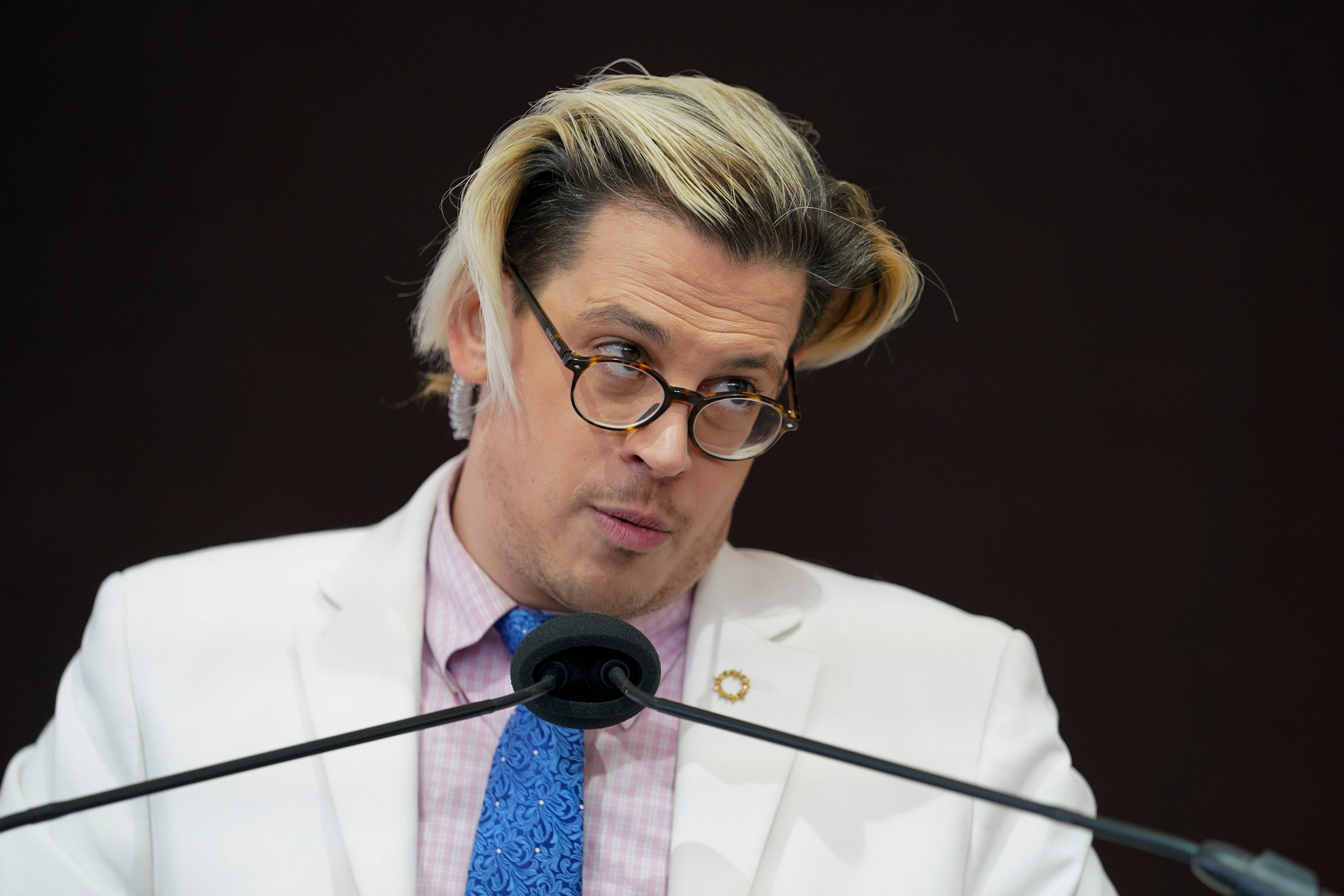
    British far-right commentator Milo Yiannopoulos has been deported back to the United Kingdom after his arrest by American immigration authorities, U.S. officials said Saturday.

    The U.S. Department of Homeland Security said Yiannopoulos was returned to his home country on Friday after being accused of overstaying after entering the U.S. legally in May 2019. An immigration judge had issued a final order of removal on July 22 after he failed to show up for an immigration hearing, a Homeland Security spokesperson said.

    Yiannopoulos was arrested Thursday at Louis Armstrong New Orleans International Airport in Louisiana and detained by Immigration and Customs Enforcement.

    “He chose to overstay his welcome in violation of our nation’s laws,” a Homeland Security spokesperson said in a statement.

    Yiannopoulos and his representatives did not respond to requests for comment. He has not posted on his X social media account since Thursday.

    Yiannopoulos is a well-known champion of conservative causes and has frequently taken provocative public positions criticizing feminism, Islam, and immigrants. He has been especially supportive of President Donald Trump’s immigration crackdown.

    “Zero immigration for the next 20 years. No ifs, no buts,” Yiannopoulos wrote on X last year.

    The British national has most recently worked for the rapper Ye, formerly known as Kanye West, who performed in New Orleans on Friday evening.

    Yiannopoulos rose to fame in the early 2010s as an incendiary writer for the conservative website Breitbart News. He resigned from the company in 2017 after a video of him endorsing pedophilia resurfaced online. He later apologized for the remarks and said he himself was a victim of sexual assault as a minor.

    Yiannopoulos’ arrest on Thursday comes amid a nationwide uptick in detentions as part of Trump’s immigration crackdown.

    Far-right conservative activist Laura Loomer swiftly took to social media to applaud Yiannopoulos’ arrest after years of public feuding between the two personalities.

    “I was the first person to report on the fact that Milo was in the U.S. illegally where he incited violence against President Trump and worked for Marjorie Traitor Greene,” Loomer wrote on X.

    Controversy around Yiannopoulos ballooned in 2017 when he carried out what he called his “Troll Academy Tour” across college campuses nationwide. Fights broke out when some students protested Yiannopoulos’ appearances and accused him of hate speech, while others celebrated him as a champion of free speech. Around that time, Buzzfeed reported on Yiannopoulos’ cozy relationships with self-proclaimed white nationalists.

    In recent years, Yiannopoulos continued to work in the orbit of conservative activism. In 2022, he was an intern for former U.S. Rep. Marjorie Taylor Greene, according to the Washington Post. He subsequently ran the short-lived 2024 presidential campaign for Ye.

    Most recently, Yiannopoulos has worked as a spokesperson for Ye, who has been beset by controversy of his own following antisemitic comments that the rapper has since apologized for. The Washington Post reported Saturday that two sold-out Ye concerts in St. Petersburg, Russia, were canceled in part because of his history of such remarks.

  • Trump cannot deport students for criticizing Israel, judge rules

    Trump cannot deport students for criticizing Israel, judge rules

    SAN JOSE, Calif. — Citing the importance of the First Amendment, a federal judge in California says the U.S. government is unconstitutionally silencing critics of Israel’s war in Gaza and others as part of the Trump administration ‘s quest to deport noncitizens who it says disrupted college campuses while expressing their views.

    Judge Noël Wise, in a ruling Friday, delivered a victory for the student newspaper at Stanford University, which has said some international students were afraid to speak out because of the deportation threat.

    The decision largely piggybacks on findings from nearly a year ago by a U.S. district judge in Boston, who ruled that the Trump administration violated the Constitution when it targeted people who are not citizens for deportation solely for supporting Palestinians and criticizing Israel.

    Wise wrote that the freedoms of speech and the press are “foundational to America’s enduring democracy.” The judge cited free-speech and vagueness flaws that violate the First Amendment and Fifth Amendment as she struck down portions of the provisions that the federal government follows regarding deportations.

    Wise cited retaliation in March 2025 by U.S. immigration authorities against people who engaged in speech supporting the Palestinians and against Israel’s actions — which a growing number of experts, including those commissioned by a U.N. body, have said amount to genocide. The judge also cited retaliation against people who were critical of Charlie Kirk after the Turning Point USA co-founder was assassinated last September.

    “Tomorrow, or perhaps even today, targets may include anyone in the United States who exercises their freedom of speech to simply express opinions the government does not like,” the judge in San Jose said.

    “This downward spiral is antithetical to our Constitution that recognizes our right to speak freely,” she added. “Here you can simultaneously hate the content of a person’s speech and love the country that cherishes the freedom to allow it. Zealous protection of our Constitutional right to free speech is a provocative demonstration of our country’s powerful lack of fear.”

    The Justice Department did not respond Saturday to a message seeking comment on the decision.

    Conor Fitzpatrick, an attorney with the Foundation for Individual Rights and Expression, which brought the lawsuit, praised the ruling.

    “In America, free speech doesn’t just belong to the people who say things the government agrees with,” Fitzpatrick said in a release.

  • The Delaware psychiatrist who testified in the Lindsay Clancy case has resigned from Nemours, the health system said

    The Delaware psychiatrist who testified in the Lindsay Clancy case has resigned from Nemours, the health system said

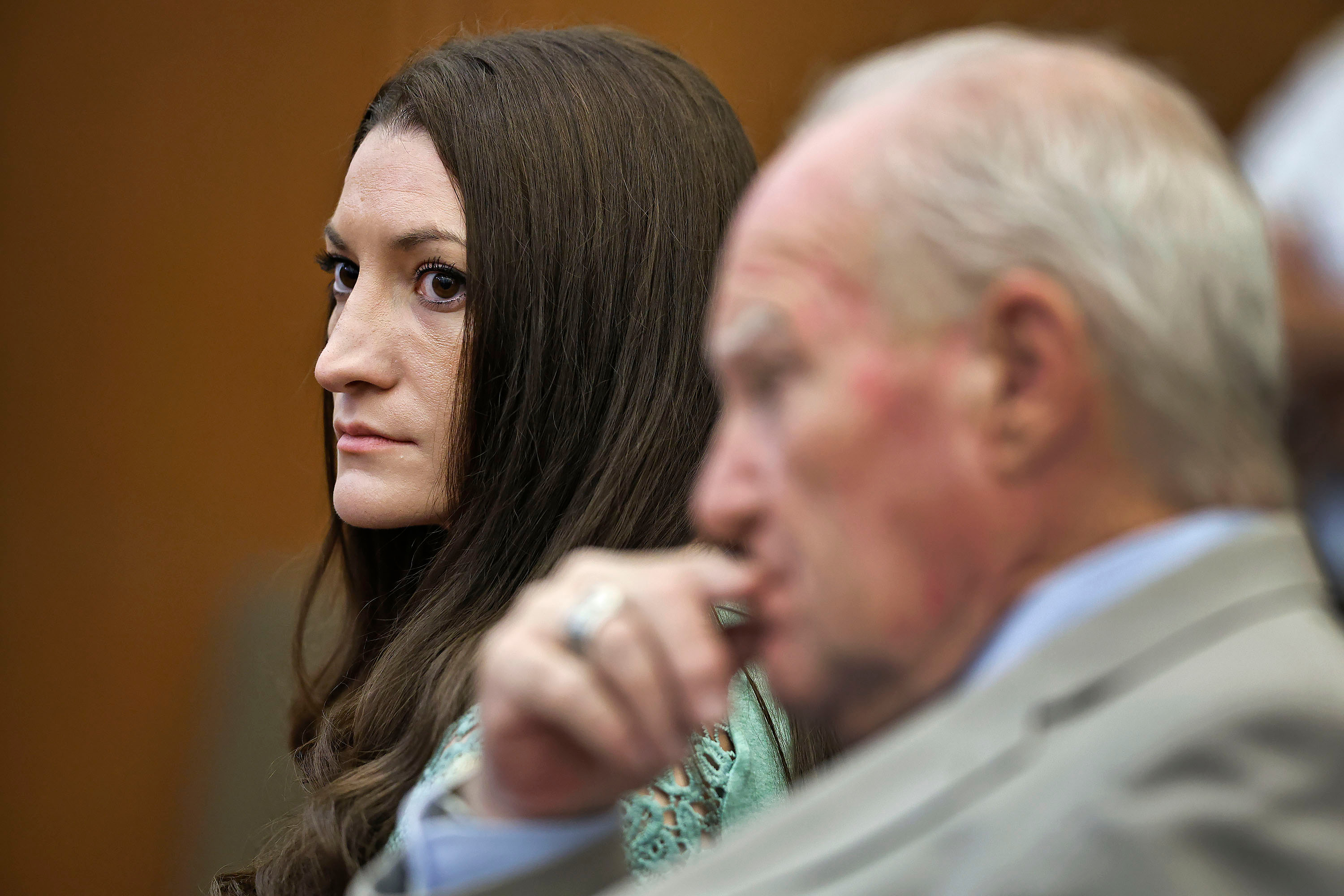
    A psychiatrist with Nemours Children’s Health in Delaware resigned his position after he began testifying in the nationally watched murder trial of Lindsay Clancy in Massachusetts, the health system said in a statement Friday.

    Avram Mack testified on Friday, Aug. 21, and Monday, Aug. 24, as a prosecution rebuttal witness in the case against Clancy, 36, whose lawyers have argued was experiencing postpartum psychosis when she killed her three young children in 2023.

    “Dr. Avram Mack is no longer employed by Nemours Children’s Health, he resigned on Monday, August 24th,” Shelley Meadowcroft, a Nemours spokesperson, said in an email.

    Meadowcroft declined to comment further on “confidential personnel matters.”

    Mack could not be reached for comment Friday.

    CT Insider, which is covering the trial, reported that Mack’s resumé submitted during the trial listed him as a psychiatrist at Nemours Children’s Health since 2023.

    Mack testified that he interviewed Clancy before the trial and did not notice any episodes that he would diagnose as bipolar, the Connecticut-based news site reported.

    Mack also testified that Clancy having some odd thoughts, including fear that someone would take her children, was normal, CT Insider reported.

    Kevin Reddington, Clancy’s defense attorney, reportedly sparred with Mack over the doctor’s experience working with adults, the definition of “postpartum,” and technical questions related to postpartum depression and psychosis.

  • ‘Immense’ devastation as Nepal continues search for 2,400 missing in floods

    ‘Immense’ devastation as Nepal continues search for 2,400 missing in floods

    KATHMANDU, Nepal — Entire towns wiped out. Roads, bridges, and communication lines washed away. In just a matter of moments, tens of thousands of people were left devastated and disoriented as catastrophic floodwaters tore through the tranquil Himalayan valley.

    Four days later, as the rescue efforts in Nepal and neighboring Tibet continued Saturday, the staggering scale of the flood’s devastation was coming into focus.

    The official count of missing people jumped to more than 2,400, more than double the figure from a day before. The death toll rose to at least 675 and was expected to keep climbing. Morgues in several of the towns downstream from the deluge have been overwhelmed by the number of bodies, with officials forced to improvise makeshift arrangements.

    “In living memory, we haven’t seen a mountain hazard event like this,” Kamal Kishore, the United Nations’ top official for disaster risk reduction, said Friday. “The impact on lives, livelihoods, buildings, infrastructure, bridges, hydroelectric projects, power generation is really immense.”

    The recovery will be daunting.

    Nepal is one of the poorest countries in the world. Its economy, long stagnated, is heavily reliant on the tourism industry and the remittances its workers send from abroad.

    The catastrophe comes amid a shortfall in global humanitarian funding, as some of the largest traditional donors, particularly the United States under President Donald Trump, have pulled back from international aid in recent years.

    The United States, for example, has announced that it will contribute $500,000 to the rescue effort — a fraction of what it had promised in the days immediately after a devastating earthquake hit Nepal in 2015. Sri Lanka, still emerging from its own economic crash, has pledged $1 million.

    The limited pledges so far do not bode well for funding the reconstruction effort, said Pradeep Gyawali, a former foreign minister.

    “The contrast with the 2015 earthquake is staggering, when Nepal struggled even to manage the huge volume of relief materials that arrived from around the world. Assistance came almost immediately, and on a much larger scale,” he said. “This time, however, the response has been much weaker.”

    The small Himalayan nation also remains highly susceptible to climate change. Scientists have long warned about potential flooding from the lakes that melting glaciers have formed in the mountains. Even in normal years, smaller floods related to monsoon rains cause mudslides and block roads, straining the country’s vulnerable infrastructure.

    The threat of fresh flooding hangs heavy over the rescue and relief efforts.

    China reported Friday that a barrier lake, created when the landslide that started Wednesday’s deluge blocked the river system, had begun overflowing in Tibet, near where the floods originated. Nepali authorities issued repeated alerts downstream, and police officers hurried through nearby towns with megaphones, asking people to move to higher ground. China’s state broadcaster, CCTV, later reported that the risk of a breach at the barrier lake had “gradually decreased,” though the threat of another flood remained.

    Much of the rescue effort on the Nepali side of the border appeared focused on several hydropower plants that were swept away by the torrent of water and debris. Army rescue teams rushed to recover workers from the muddy tunnels in dramatic scenes.

    In a sign of how uncertain the situation remained, hundreds of workers from those plants had not been counted among the initial missing tally, Nepali officials said in explaining the sudden jump in the number of missing.

    The threat of flooding temporarily paused the rescue efforts in Tibet on Friday. But on Saturday, Chinese rescue workers resumed their search efforts, looking for survivors near the Gyirong border crossing between Nepal and Tibet, CCTV reported. The footage showed firefighters combing the leveled site, tapping on the ground with shovels and shouting, “Is anyone there?”

    The government in Nepal, which swept to power this year on the back of Gen Z protests, is trying to assert control and restore order in the face of the overwhelming tragedy.

    Balendra Shah, the 36-year-old prime minister, has not addressed the nation but has been seen visiting the sites of destruction and leading meetings to coordinate the country’s response.

    His government has deployed more than 30,000 security forces for rescue and recovery efforts. Possibly drawing on lessons from the response to a previous natural disaster in the country, which was criticized as chaotic and disorganized, authorities this past week initially declined foreign rescue teams.

    But by the end of Friday, news media in Nepal reported that the government was easing that restriction.

    On Saturday, Shisir Khanal, Nepal’s foreign minister, said the country was seeking support for tunnel rescues, with an Indian team already in the country and two teams from China also coming. He said the government also required outside help with forensic capabilities, and teams that can help identify bodies with DNA sampling.

    More than 7,000 people had been rescued by late Saturday, many of them pulled out of flooded villages in helicopters before being sent to hospitals and relief camps, where they have been given meals and medical help.

    Soon, the focus will have to shift to rebuilding. But for those who survived the surging waters — losing loved ones, livelihoods, and homes — a path to recovery may seem distant. It is unclear whether many survivors will be able to return home or if they will need to resettle elsewhere.

    The damage has also been particularly heavy at the site of hydropower projects built along the Bhotekoshi and other rivers downstream. Tens of miles of roads and more than 40 bridges have been destroyed.

    Initial government estimates in Nepal have put the cost of physical damage at more than $1.3 billion, and the country’s finance minister has predicted that recovery efforts could run into “a few billions.”

    This article originally appeared in the New York Times.

  • 37 killed near Kyiv as Russian drone blitz exposes air defense gap

    37 killed near Kyiv as Russian drone blitz exposes air defense gap

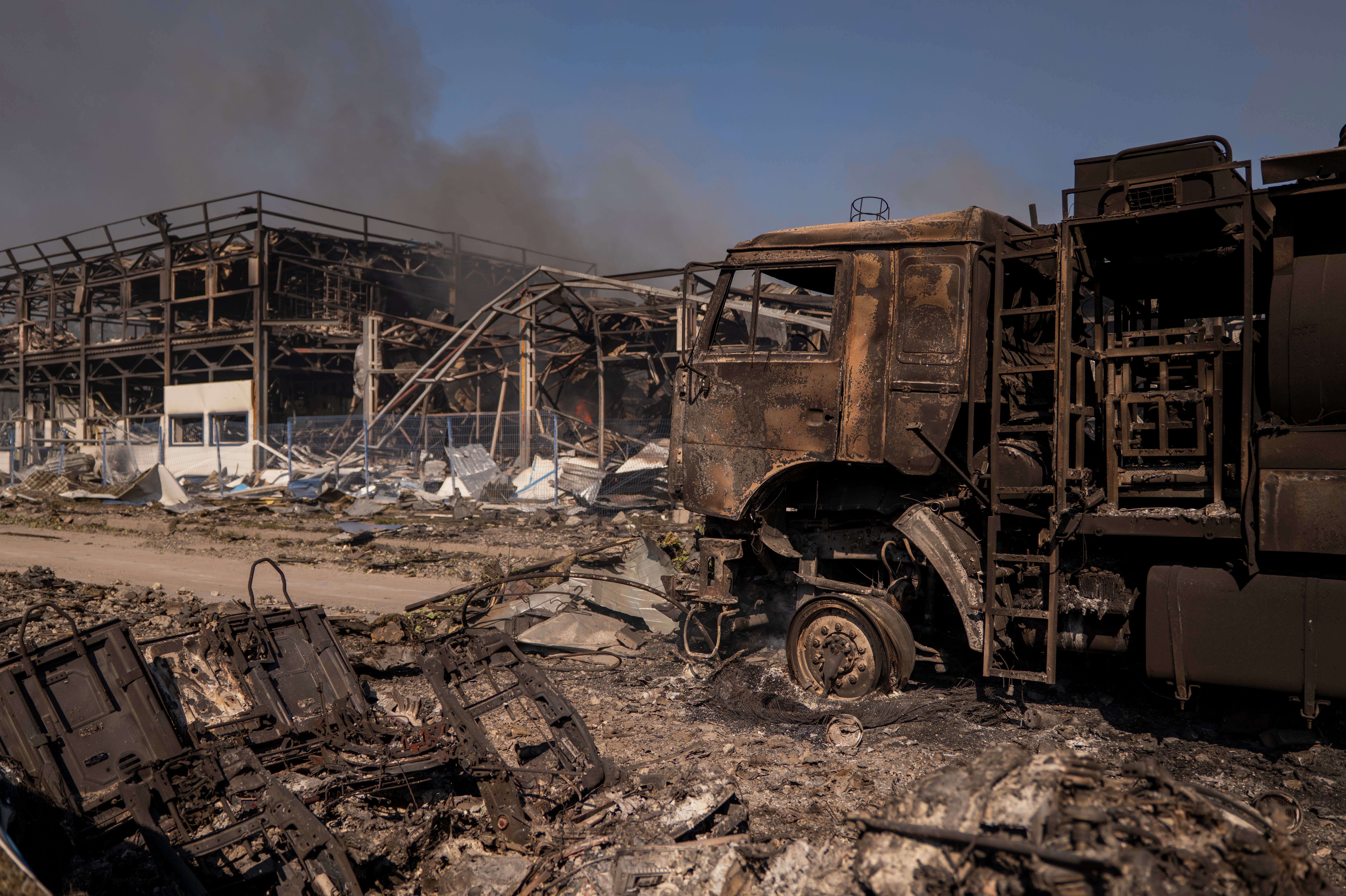
    KYIV, Ukraine — For several terrifying days, air raid sirens have wailed nonstop in Kyiv, Ukraine’s capital, as waves upon waves of armed Russian drones surged into the city, straining its limited air defenses and exhausting a population worn down by years of war.

    This latest stage of Russia’s air campaign has targeted warehouses and shopping centers, and on Saturday, the Ukrainian authorities said that a strike on a facility just outside Kyiv had killed at least 37 people.

    The strike, which took place late Friday, caused huge secondary explosions that engulfed an entire suburban area in plumes of smoke. The Ukrainian authorities did not say what the facility was, but their comments suggested it was a warehouse with ammunition.

    President Volodymyr Zelensky of Ukraine said on Saturday that a criminal investigation was already underway into the management of the warehouse, which is near private homes and a facility for older adults and people with disabilities. The capital region will observe a day of mourning on Sunday, officials said.

    An ammunition depot in another area outside Kyiv was destroyed last month, killing several people and prompting a separate investigation into the decision to store dangerous arms in civilian areas.

    “Making the same mistakes for the fifth year of the full-scale invasion is criminal negligence,” Serhii Koretskyi, Ukraine’s prime minister, said on Saturday. “And all those responsible, without exception, must face severe punishment so that such situations do not happen again.”

    Ukraine is struggling to counter the onslaught of Russian drones, many of which are powered by jet engines that allow them to fly at nearly 400 mph.

    The latest drone campaign has coincided with Ukraine’s dire shortage of Patriot interceptor missiles, the only weapon the country has that can shoot down ballistic missiles.

    Russia has seized on that gap in Ukraine’s arsenal this summer. Civilians are bracing for the possibility that waves of Russian drones are intended to wear down air defense units before an even larger ballistic attack in the coming days.

    In the past, Russia often launched daytime waves of reconnaissance drones before combined drone and missile attacks overnight. But the droves of armed drones that now swarm the capital daily suggest that Russia is using a new tactic to spread fear and anxiety.

    Most shops and restaurants remain open in Kyiv, but the constant attacks have caused major traffic jams and delays on the metro system. They could also significantly complicate plans for students to return to school on Tuesday.

    This article originally appeared in the New York Times.