Blog

  • Smithsonian’s secretary to resign as Trump tries to rule the institution

    Smithsonian’s secretary to resign as Trump tries to rule the institution

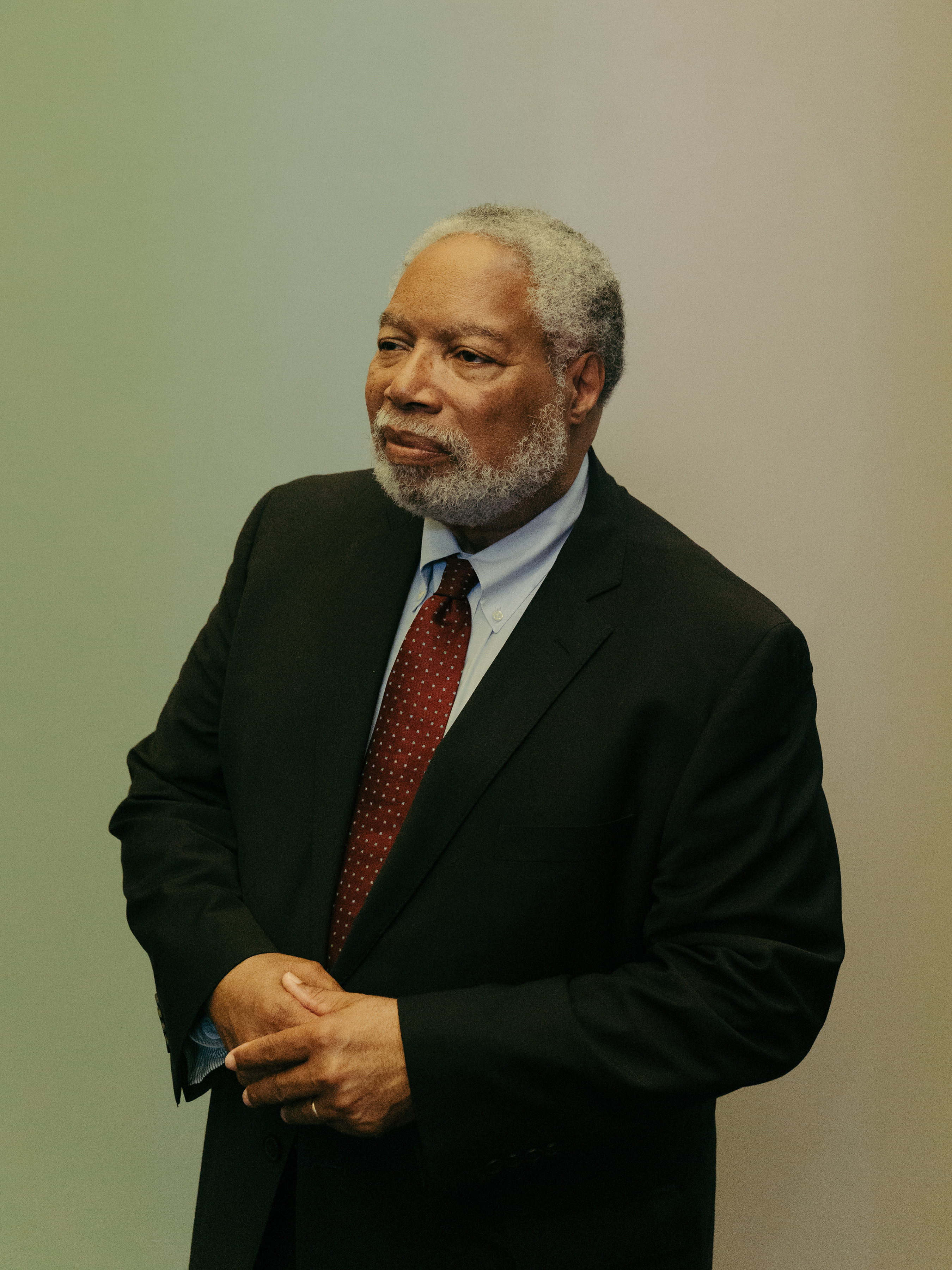
    After a seven-year run marked most recently by attacks from the Trump administration, Lonnie Bunch III announced Tuesday that he was stepping down as secretary of the Smithsonian.

    The White House has escalated its criticism of how the Smithsonian presents American history and values, prompting concern from some about what they see as an assault on the institution’s autonomy and commendation from others for reining in an organization they view as overtaken by liberal bias.

    In an interview, Bunch, 73, said it was not the pressure that had led to his departure.

    “It was really just saying, now’s the time,” he said.

    “I’m a fighter,” he added.

    At the same time, he acknowledged the strain of the role.

    “I have to be honest, it has been stressful,” he said. “And at a certain point, I’d like to wake up in the morning and not look at my cell phone.”

    In a statement, Chief Justice John Roberts, who serves as the Smithsonian’s chancellor, said that Bunch had “pursued excellence in the telling of our nation’s story” and that the Smithsonian had “benefited greatly from his wisdom, vision and leadership.” The Smithsonian said Bunch was expected to depart at the end of the year.

    For more than a year, Bunch has tried to balance diplomacy and openness to criticism with a determination to resist a White House push to present what President Donald Trump calls “patriotic” history. Some admire how Bunch has managed to quietly hold the line against the White House. Others believe the Smithsonian has shown too much deference to Trump and even engaged in self-censorship.

    Last year, painter Amy Sherald withdrew her blockbuster show at the National Portrait Gallery over a disagreement about how the museum would display her portrait of a transgender Statue of Liberty.

    But Bunch said he had no regrets. “My goal has been to win, not to make me feel good,” he said. “To win — to protect the Smithsonian — there were times I would fight, make clear what the red lines were. And there were other times I let things go.”

    Bunch, a widely respected historian who previously oversaw the creation of the National Museum of African American History and Culture, said his next chapter would most likely include teaching or a fellowship.

    Created by Congress as a trust in 1846, the Smithsonian has long been viewed as independent of the executive branch. Its governing Board of Regents must now appoint a new leader in the face of withering attacks from the administration.

    The 17-person panel, led by Roberts, includes six members of Congress, split along party lines; nine private citizens; and Vice President JD Vance. The terms of three citizen members have recently expired, and the names of replacement nominees have not made it to Congress, an unusual holding pattern that appears to be evidence of the shadow war over control of the Smithsonian.

    In the short term, Bunch seemed to have sufficient board support to stay on. But he has indicated that he is weary of the fray and ready for some form of retirement.

    “When you’re Black in America, you’ve got to figure out how to get through, right?” he told the New York Times in May. “You’ve got to figure out how to build allies, when to stand firm, when to bang the table. So in some ways, all of that prepared me for this moment.”

    “But do I wish I was in it?” he continued, referring to scrutiny by the Trump administration. “Of course not. Good Lord, I wish that I was doing my goodbye tour.”

    Over nearly 40 years in various roles at the Smithsonian, Bunch developed a reputation as a soft-spoken diplomat adept at raising money and dealing with public officials. As the institution’s first Black secretary, he has at times been a forceful voice on issues of race, particularly after the 2017 white nationalist rally in Charlottesville, Va., and in the wake of George Floyd’s murder in Minneapolis in 2020.

    Trump did not pay much attention to Washington’s cultural organizations in his first term but has made them a focus of his second, including through his efforts to govern, close, and renovate the John F. Kennedy Center for the Performing Arts. The Smithsonian has been forced to respond to White House demands or risk potential cuts to its $1 billion budget, which is largely funded by the federal government.

    Last month, in a letter to the board, Doug Burgum, the interior secretary, and Vince Haley, a senior White House adviser, made the stakes clear.

    “The Smithsonian enjoys support from executive departments and agencies,” the letter said. “Those executive departments and agencies cannot in good conscience continue to support the Smithsonian under current leadership.”

    The president’s attempt to overhaul the Smithsonian began last year with an executive order that accused the institution of promoting “narratives that portray American and Western values as inherently harmful and oppressive” and called for an end to spending on exhibitions or programs that “degrade shared American values, divide Americans based on race or promote programs or ideologies inconsistent with federal law.”

    After the White House demanded that the Smithsonian turn over information about the content of its exhibitions, Bunch reasserted the institution’s independence while saying that materials had been submitted in an effort to be “transparent.”

    The board adopted a resolution that called for its 21 museums to review their content for partisanship or bias. But the administration began its own review of exhibitions, wall text, and social media to assess “tone, historical framing and alignment with American ideals.”

    Trump has been unrelenting in his criticism, posting on social media that “the Smithsonian is OUT OF CONTROL, where everything discussed is how horrible our Country is, how bad Slavery was, and how unaccomplished the downtrodden have been — Nothing about Success, nothing about Brightness, nothing about the Future. We are not going to allow this to happen.”

    The president also announced online that he was dismissing the director of the National Portrait Gallery, Kim Sajet, calling her “a highly partisan person, and a strong supporter of DEI.” (The Smithsonian insisted it controlled personnel matters, but Sajet resigned, citing the institution’s best interests.)

    The White House pressure reached a new pitch this year with a July 4 report about the National Museum of American History that accused its director of “radical activist ideology” and the museum of undermining “faith in American institutions.”

    Many historians expressed serious concern about the report, but some conservatives applauded it, joining Trump in arguing that exhibits had become overly focused on race, identity, and injustice.

    “Hardworking Americans don’t want their taxpayer dollars dedicated to Marxist indoctrination,” Sen. Mike Lee (R., Utah) wrote on social media.

    After the report, Anthea Hartig, the museum’s director, came under fire at two congressional hearings. Then Trump ordered warning signs and exhibits installed to convey his view that the museum did not accurately reflect American history. The signs have yet to materialize.

    Bunch said it had been difficult to have his colleagues attacked by the administration. “I have always tried to protect people,” he said. “So I’ve always said, ‘Let the most of the weight fall on me. They don’t deserve it.’ We’re in a time when people are being hurt.”

    His priority has been “How do I always make sure that we put the Smithsonian in the strongest position?” Bunch said. “That we articulate what we believe in, the importance of nonpartisanship and scholarship?”

    When Bunch became the leader of the African American museum in 2005, that institution remained a distant dream.

    He worked with Congress to fund it and attracted big-name donors including Oprah Winfrey. He appointed Republicans such as Laura Bush and Colin Powell to the board and won support by arguing that the museum should recognize the horrors of slavery and the struggle for civil rights while celebrating historical Black achievements. Bunch said the museum needed to tell “the quintessential American story” of progress.

    It opened to great fanfare in 2016 and was the Smithsonian’s fourth-most-popular destination last year, with 1.6 million visitors. Bunch ascended to the Smithsonian’s top job in 2019.

    In the spring, Bunch said he was proud of what the Smithsonian had achieved under his leadership despite the barrage of Trump attacks. “Nothing can take that away,” he said. “So I’m trying to make sure I don’t let this moment steal my joy.”

    This week, he spoke of how important it was for the Smithsonian to continue to explore the country’s past in all its complexity. “Americans are an amazingly brave people, who have accomplished so much,” he said. “They’ve got to be brave enough to face their own history.”

    “To me, that is essential,” he continued. “And I will stand against wind and tide to prevent history from being erased, softened, and made palatable. That’s wrong.”

    This article originally appeared in the New York Times.

  • More than 200 Jefferson Health nurses to vote on unionizing

    More than 200 Jefferson Health nurses to vote on unionizing

    Nurses at three Jefferson Health facilities want to unionize under the Pennsylvania Association of Staff Nurses and Allied Professionals, saying their effort addresses safety and quality-of-care concerns.

    Nurses at Jefferson Bucks Hospital filed paperwork with the National Labor Relations Board for an election to form a new union chapter at the hospital that, if approved, would represent 170 staff members.

    In a separate filing, nurses at Jefferson Health — Center One, a primary care and outpatient facility in Northeast Philadelphia, and Willowcrest, a skilled nursing center at Jefferson Einstein Philadelphia Hospital, are seeking membership in the existing nurses’ union at Jefferson Einstein Philadelphia. If approved, the move would add 43 nurses from Center One and Willowcrest to Einstein Nurses United.

    The organization efforts would bring more than 200 Jefferson Health nurses into union chapters affiliated with PASNAP.

    At a news conference outside Jefferson Bucks Hospital in Langhorne Tuesday, nurses said they wanted to organize because hospital administrators have not heeded their concerns that understaffing, heavy workloads, and insufficient resources could harm patients and lead to staff burnout.

    “Jefferson Bucks nurses are being asked every day to do more with less and less, and it’s getting harder and harder to feel like our concerns are actually being heard,” Ashley Bupp, an emergency room nurse at Jefferson Bucks Hospital, said in a statement.

    Jefferson Health accused PASNAP, which represents some 11,000 nurses and other healthcare professionals across Pennsylvania, of “promoting a narrative that serves its organizing efforts and ultimately, its own bottom line.”

    “PASNAP has once again relied on a predictable campaign of misleading claims and public attacks designed to generate headlines rather than constructive solutions,” the nonprofit health system said in a statement. “Jefferson remains focused on supporting our nurses, caring for our patients, and meeting the healthcare needs of the communities we serve.”

    Kiersten McCalmant, a nurse at Jefferson Bucks Hospital, said she and her colleagues were inspired to organize by the nurses at Jefferson Einstein Philadelphia Hospital.

    Einstein Nurses United, which represents nearly 1,200 nurses, signed a new contract earlier this year that gave nurses raises, strengthened staffing, and included protections against forced shift rotations.

    “We saw what a great contract they had already, and the fact that they were able to stand together and win improvements, and protect what they already had,” McCalmant said in a statement. “We thought, if nurses at Einstein can bargain with Jefferson and be successful, why can’t we?”

  • Lindsay Clancy’s attorney makes public plea for Trump pardon

    Lindsay Clancy’s attorney makes public plea for Trump pardon

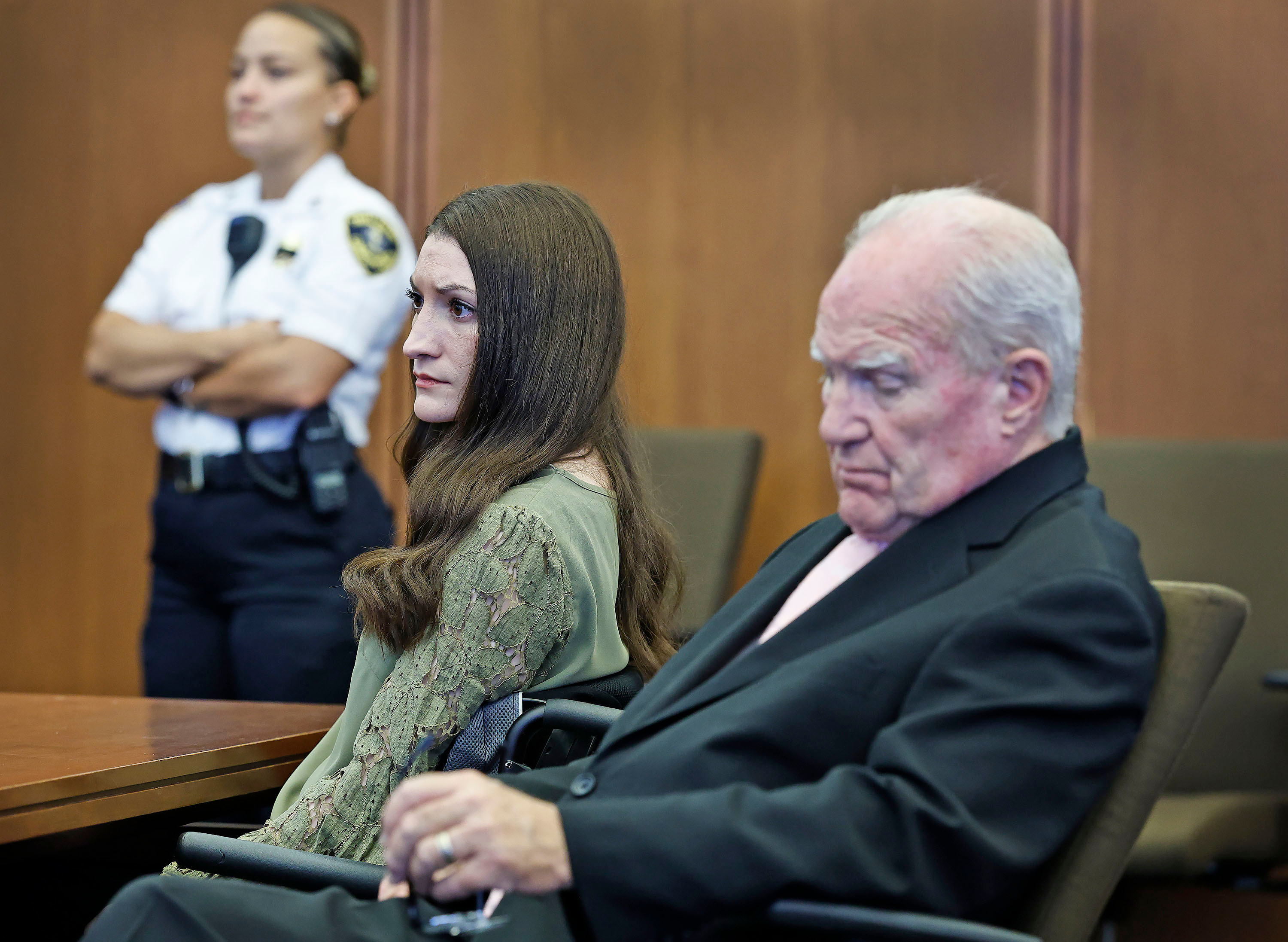
    An attorney for Lindsay Clancy, the 36-year-old Massachusetts mother who admitted to killing her three children, said he hopes President Donald Trump would consider a pardon for his client after the high-profile murder case ended in a mistrial last week.

    “Mr. President, I would hope that you would consider this young lady, the type of person she is, what she’s been through, and consider a pardon,” Kevin Reddington said Tuesday on Good Morning America.

    The president cannot pardon state-level crimes, and Clancy’s case is being tried in state, not federal, court.

    Governors can grant clemency for state crimes; under pressure from Trump, Colorado Gov. Jared Polis (D) in May reduced the state prison sentence of former county clerk and election conspiracy theorist Tina Peters, who was convicted for a scheme to copy her county’s election computer system.

    Asked about the trial and pardon request, the White House referred the Washington Post to Trump’s comments on Friday in which he described the case as a “horrible tragedy.”

    “It’s a terrible situation. Look, she did a horrible, horrible, thing. Can’t be worse,” he said. “But you’ll find out what the price to pay is. There’ll be a price. It’s going to be mental institution or jail or something.”

    Reddington also said he hoped he would “be able to work something out that would be acceptable to both sides,” after a mistrial was declared on Friday. Prosecutors have not said whether they will seek another trial.

    Clancy’s case captured the public’s attention and became a cultural touch point, putting postpartum mental health issues in the spotlight. She had said she killed her three children by strangling them at home in 2023, and the jury was asked to decide whether she should be held legally responsible for her actions. Reddington had argued that she was suffering from postpartum psychosis at the time, which prosecutors disputed.

    The jury was dismissed after failing to reach a unanimous decision after deliberations hit nearly 40 hours following a trial that stretched more than six weeks.

  • Travel chaos at U.K. airports as over 600 flights canceled due to air traffic control issue

    Travel chaos at U.K. airports as over 600 flights canceled due to air traffic control issue

    LONDON — More than 600 flights were canceled on Tuesday due to a technical issue in Britain’s air traffic control system that caused disruptions at major airports across the U.K., the flight monitoring website Flightradar24 reported.

    Britain’s National Air Traffic Services said a problem had been identified in its flight processing system and engineers were urgently working on the issue, which affected flights across the U.K.

    In an update, it said it had “implemented a fix and our flight system is starting to recover.”

    At least 625 flights to and from U.K. airports, including London Heathrow, were canceled, affecting services operated by multiple airlines, including British Airways, EasyJet, KLM, and Lufthansa, according to Flightradar24.

    Some passengers took to social media to complain about being stuck on the tarmac for hours, before their flights were eventually canceled. Many expressed frustration about a lack of communication from airlines.

    The affected airports included Stansted and City in London, as well as those in Manchester, Birmingham, Gatwick, and Scotland. They warned passengers to check the status of their flight with their airline.

    Budget airline EasyJet said some of its flights were “unable to operate” and that the system failure caused “delays to flights across Europe.”

    Heathrow’s website showed that many short-haul flights departing for European destinations had been canceled or delayed.

    It was not immediately clear what caused the technical problem.

  • Veterans and Democrats intensify fight against Trump’s planned arch

    Veterans and Democrats intensify fight against Trump’s planned arch

    Veterans and Democrats are escalating efforts to prevent construction on President Donald Trump’s planned arch as the anticipated start of site work approaches, arguing the project is illegal and would diminish the experience of visiting nearby Arlington National Cemetery.

    VoteVets, a political organization aligned with Democratic veterans, on Tuesday launched a new messaging campaign to mobilize more veterans against the planned 250-foot-tall arch.

    In a 2½-minute video, which was first shared with the Washington Post, speakers call attention to the Trump administration’s stated plan to spend 20 hours per day building the arch over several years, which they note could conflict with military burials. The arch also would feature an observation deck for tourists to gaze at the city — and look out at the cemetery.

    “We don’t need tourists overlooking funerals. I’m just appalled,” Karen Meredith, a Gold Star mother whose son is buried at Arlington, said in the video.

    Home of the Brave, a political advocacy group whose leaders and advisers include prominent Trump critics such as commentator Bill Kristol and former Biden administration official Susan Rice, is also supporting the campaign. In an interview, people involved in the effort said they would start with social media posts this week and could expand to paid promotion.

    Meanwhile, Rep. Chellie Pingree (D., Maine) on Tuesday urged House Speaker Mike Johnson (R., La.) to sue and halt construction before it begins. Johnson and other Republican leaders have shown no interest to date in blocking Trump’s construction projects.

    “Congress has neither appropriated funding nor granted authority for this project under the Commemorative Works Act. The Administration is building it anyway, betting this body will do nothing to stop it,” wrote Pingree, the top Democrat on a House subcommittee that oversees funding for the Interior department. “I am asking you to take all necessary steps to file suit immediately, while there is still ground left to save.”

    Trump officials, emboldened by a Supreme Court ruling last week that allowed construction of the president’s ballroom to proceed, signaled Thursday that site work on the arch would begin this month.

    The court’s decision, which found preservationists seeking to stop Trump’s planned ballroom likely lacked standing, has become part of the administration’s construction strategy. Justice Department lawyers cited the ballroom ruling in asking a federal judge to dismiss a legal challenge brought by three military veterans and a historic preservationist, who are seeking to halt the triumphal arch.

    The high court’s ruling also sent advocacy groups scrambling to reconsider how to oppose the president’s construction projects. Some say they are reassessing whether they need to have other individuals or organizations join their challenges.

    Several legal experts pushed back on the Trump administration’s efforts to invoke the Supreme Court’s ballroom ruling to dismiss the arch and other projects.

    “The Justice Department would like to turn the ballroom decision into a universal immunity card for presidential construction projects,” said Greg Werkheiser, a co-founder of Cultural Heritage Partners, a law firm that has advised preservation organizations. “But the Supreme Court decided one standing question involving one plaintiff, one project, one factual record.”

    Trump has spoken for nearly a year about his plans to build a triumphal arch that will honor the nation’s 250th anniversary, vowing that it will be the largest triumphal arch in the world — about 86 feet taller than France’s famed Arc de Triomphe. The administration plans to erect it on federal parkland in Memorial Circle, a traffic roundabout near Arlington National Cemetery and just inside the city’s boundaries.

    Interior Secretary Doug Burgum said last week that construction would soon begin.

    “We are pleased to announce that after a very long wait (over 125 years!), we are preparing to start, over the next two-week period, the excavation work necessary for the Great Triumphal Arch and Military Observation Deck,” Burgum wrote on X.

    While Burgum’s announcement catalyzed a wave of new legal filings, Trump officials have argued that it is too soon for a federal judge to decide whether the project can be halted because Trump and other officials’ statements are not binding and the project has not been formally approved. The National Capital Planning Commission, a federal review panel that reviews the administration’s construction projects, has issued preliminary approval for the arch but has yet to award final approval.

    Trump officials also said last week that the work they plan to do soon at the arch site is for informational purposes.

    “This activity is not construction, or demolition in preparation for construction, of an arch,” Justice Department lawyers wrote in a court filing Friday.

    U.S. District Judge Tanya S. Chutkan ordered that the administration provide her with 48 hours’ notice “before engaging in any activity on Memorial Circle” other than on-site information gathering.

    Preservationists have stressed that an arch does not belong in the solemn corridor between the Lincoln Memorial and Arlington National Cemetery.

    Charles Birnbaum, the founder of the Cultural Landscape Foundation, a Washington-based advocacy organization, invoked 1916 comments by Frederick Law Olmsted Jr., a landscape architect who helped design Washington.

    Olmsted said that “to build a monumental feature such as an arch would be a ‘slap in the face’ to the Lincoln Memorial,” Birnbaum said in the VoteVets video.

    Paul Eaton, a retired major general and VoteVets adviser, told the Post that he has heard from Republican veterans who are also opposed to a new structure towering over the cemetery. He called for veterans to submit comments to their lawmakers and to the National Capital Planning Commission.

    “There’s nothing partisan about what we’re doing right now. It has everything to do with how the United States honors its dead,” said Eaton, whose father’s remains are interred at the cemetery. “That’s why we are so focused on this particular vanity project on the part of Mr. Trump.”

  • Philly developers are planning a $1.5M campaign to protect City Council from progressive challengers

    Philly developers are planning a $1.5M campaign to protect City Council from progressive challengers

    Philadelphia real estate developers see the writing on the wall.

    As progressives have toppled centrist Democrats in nationally watched races, some local development interests are wary that the same trend could reshape Philadelphia City Council this spring, when every member is up for reelection. They see a growing progressive faction as a threat to business.

    Enter the incumbent protection plan.

    Nearly a dozen local developers are already pouring hundreds of thousands of dollars into Philly For Growth, a group that in the past two Council election cycles spent millions on advertising campaigns to back business-friendly Democrats, according to a source familiar with the planning.

    Philly For Growth is an independent expenditure group, also known as a super PAC. It can raise and spend unlimited amounts of money to influence an election, but there are rules barring super PACs from most forms of coordination with the candidates they support.

    In 2023, the group was the biggest special interest group involved in that year’s Council races, and it provided a substantial boost to its chosen candidates by outspending individual campaigns.

    Ahead of the May primary election, Philly For Growth plans to spend $1.5 million to support pro-business Democrats, most of whom are sitting Council members, according to the source, who spoke on the condition of anonymity because they were not authorized to discuss the plans. The group will not fund negative advertising about Council’s four incumbent progressives, the source added.

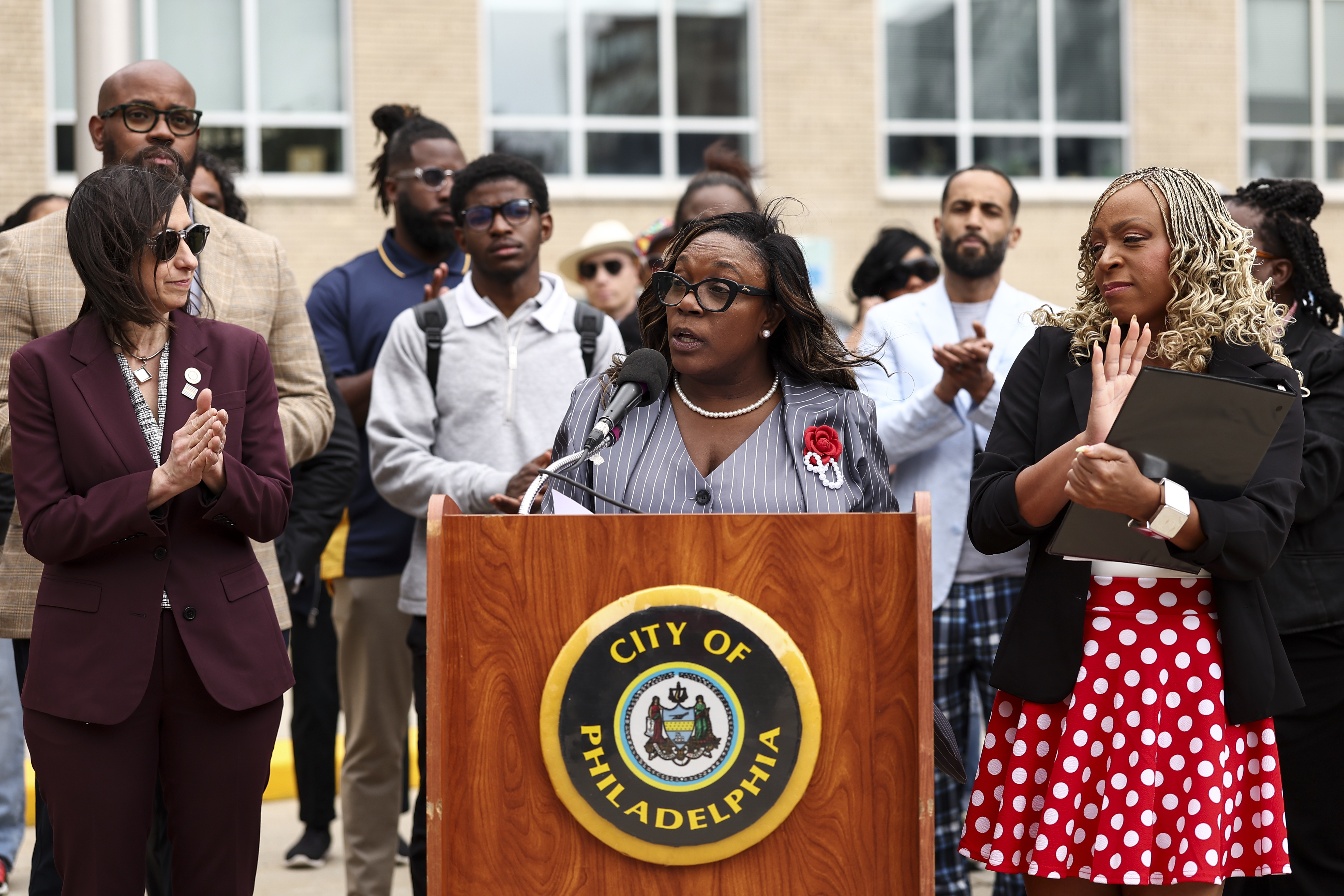
    Councilmember Kendra Brooks, of the progressive Working Families Party, speaks during a rally outside of the School District of Philadelphia headquarters in May. At left is Councilmember Rue Landau and at right is Councilmember Jamie Gauthier. All three are members of Council’s progressive faction.Monica Herndon / Staff Photographer

    The idea is to keep progressives from growing their power on Council instead of spending money to knock off the leftists who are already there. There are currently four reliably progressive votes out of the total 17 on Council, but some members may be more likely to vote with that faction as Democratic voters nationally revolt against incumbents.

    That’s a different strategy than in 2023, when Philly For Growth backed a slate of five candidates — two incumbents and three challengers. Both incumbents won, but all three challengers lost.

    Philly For Growth has previously been affiliated with the Building Industry Association of Philadelphia, an advocacy group for development interests. Mo Rushdy, the BIA’s former president who leads the organization’s political activity, declined to comment.

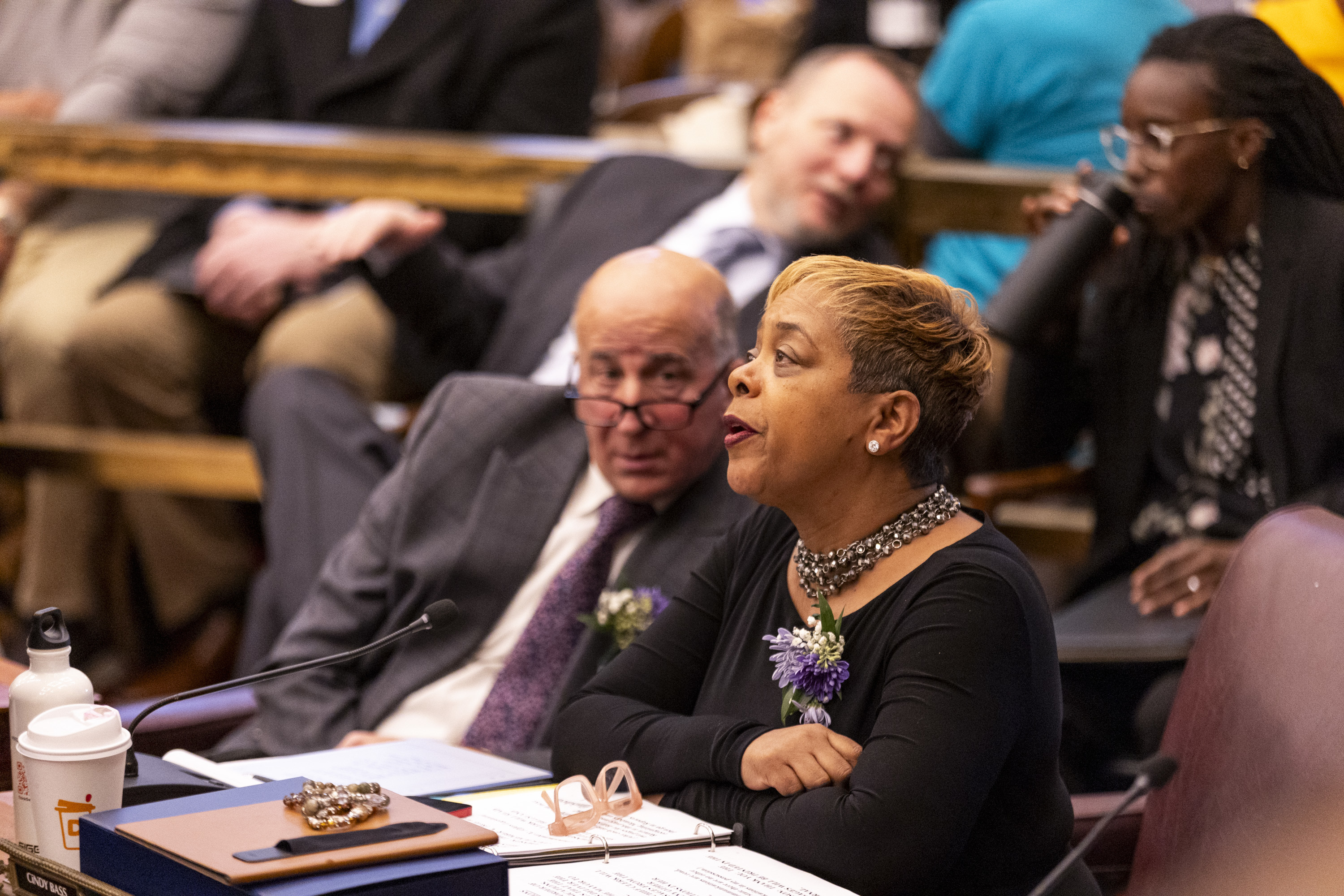
    The source said that Philly For Growth will fund advertising to support Council members Mark Squilla, whose 1st District includes parts of South Philly, Center City, and Fishtown; Cindy Bass, whose 8th District is based in North and Northwest Philadelphia; and Quetcy Lozada, whose 7th District includes much of North Philadelphia and Kensington.

    All three are seen as more centrist members and have said they intend to run for reelection. No challenger has officially launched a campaign against any of them, but candidates who are aligned with the city’s left-leaning political organizations are expected to emerge as the primary — still eight months away — draws nearer.

    The super PAC is making one exception when it comes to supporting incumbent district Council members, the source said. In the 5th District, currently represented by Councilmember Jeffrey Young Jr., the group will support a to-be-decided challenger.

    Councilmember Jeffery Young Jr. speaks to other members of Council during a 2025 session.Tom Gralish / Staff Photographer

    At least five people have said they are interested in running for the North Philly-based 5th District seat, and Young has drawn opposition from development interests for pushing proposals that would slow or halt some projects in his district.

    Young said in a statement that building “sensible, affordable housing” is one of his top priorities and that he has supported city programs like Turn the Key, which provides mortgage support to first-time homebuyers.

    “People are free to back those who share their values. These are my values,” Young said. “I am leaving it to the residents of the 5th to determine whose values best reflect them.”

    The super PAC will also fund advertising backing four incumbent members who represent the city at-large: Isaiah Thomas, Katherine Gilmore Richardson, Jim Harrity, and Nina Ahmad. That group doesn’t include progressive at-large Councilmember Rue Landau, but Philly For Growth doesn’t plan to oppose her, the source said.

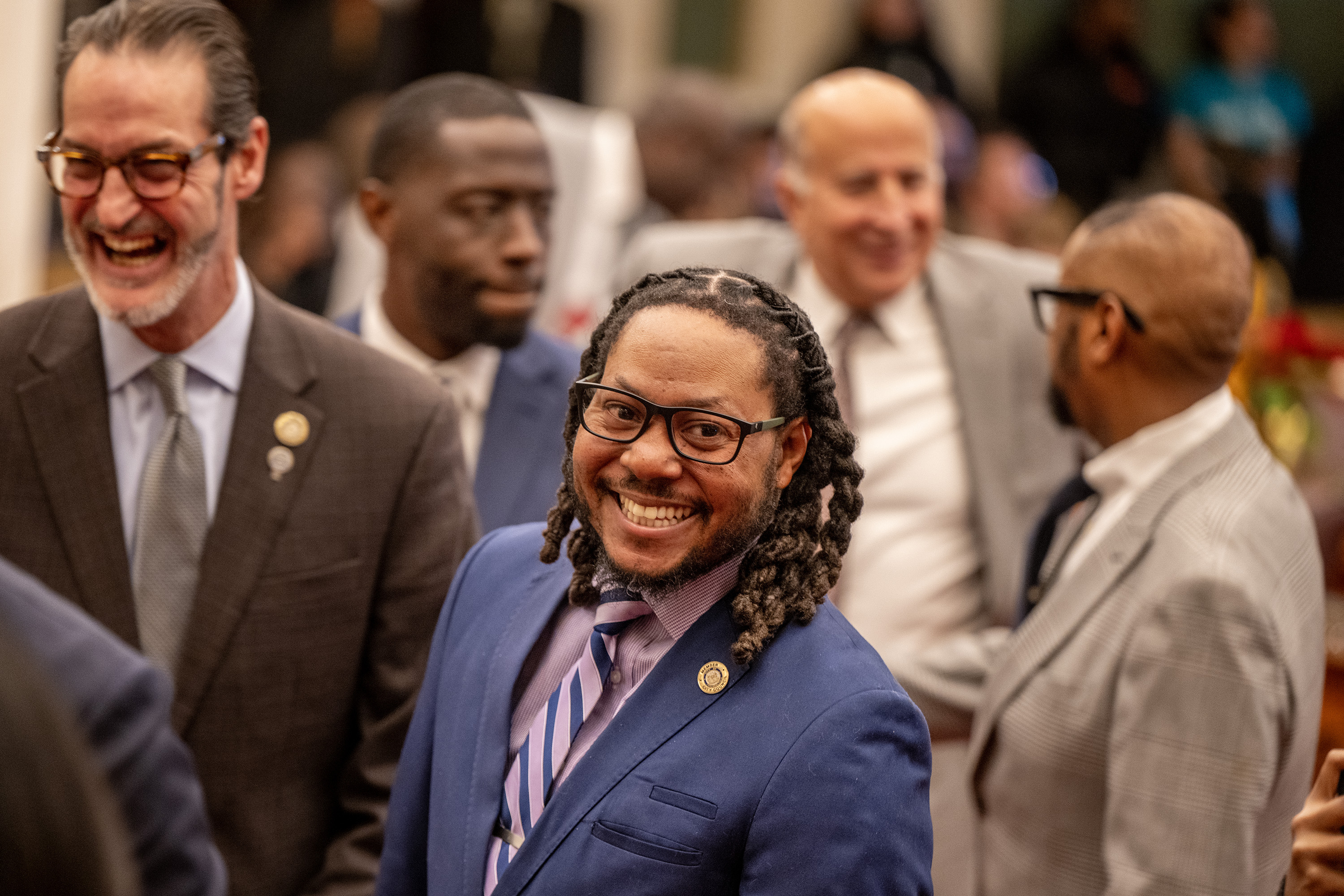
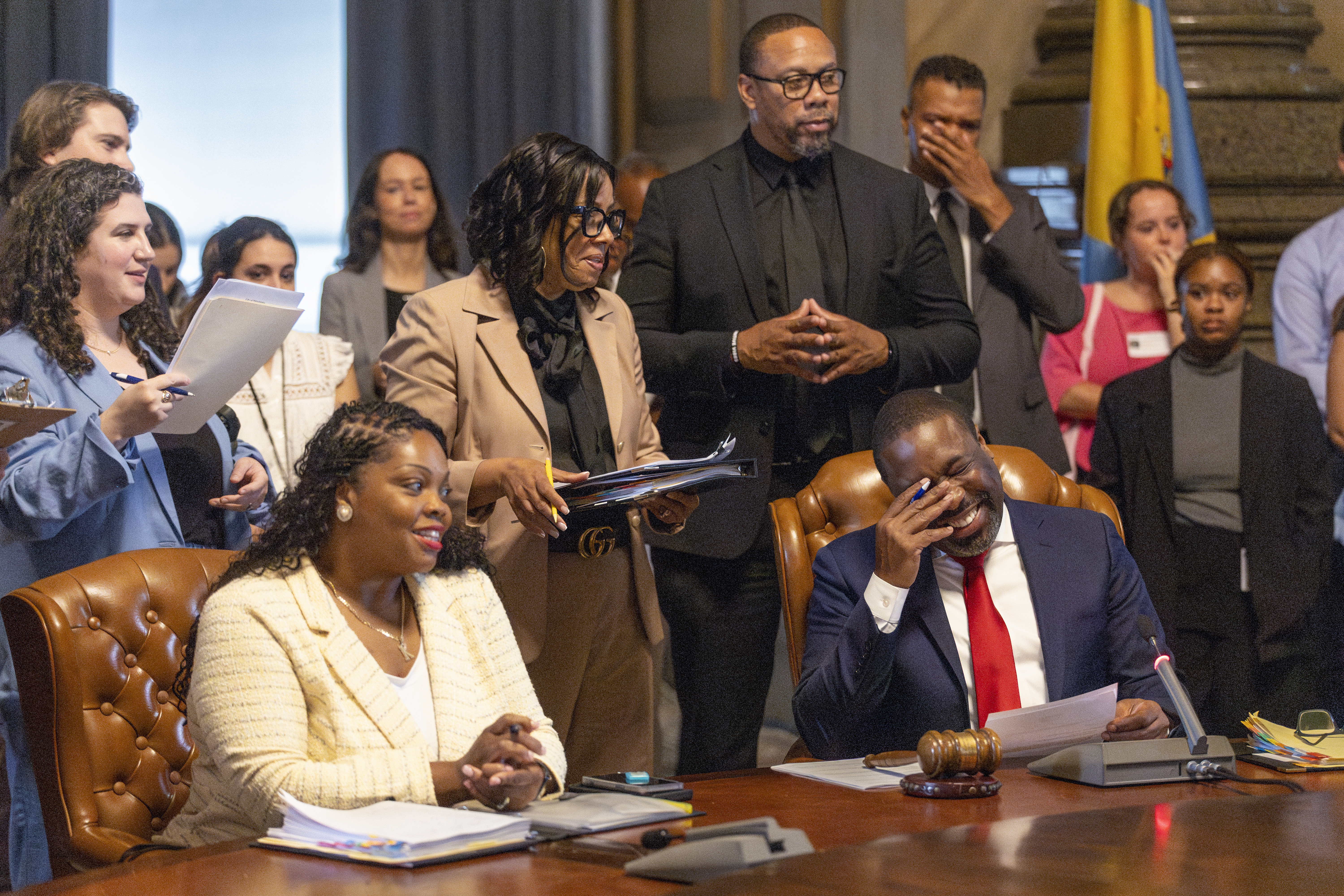
    Council President Kenyatta Johnson laughs inside the caucus inside City Hall on June 11.Aidan T. Gallo / Staff Photographer

    A spokesperson for Landau’s campaign arm said in a statement that the Council member “stands by her accomplishments for working people, small businesses and vulnerable communities in Philadelphia and looks forward to voters having the opportunity to make up their own minds next year.”

    It’s unclear just how competitive the at-large race will be, and candidates have until the spring to decide — nomination paperwork is typically due in March. Seven of Council’s members represent the entire city at-large, and two of those seats are effectively reserved for members of minority parties under the city’s Home Rule Charter.

    That has traditionally meant that five seats are held by Democrats, given the party’s massive voter registration advantage in the city. In recent years, Republicans and the progressive Working Families Party have battled for the remaining two seats during the fall general election, and the WFP currently holds both.

    Mayor Cherelle L. Parker, who is also up for reelection, and Council President Kenyatta Johnson, who insiders do not expect will see a serious challenger, will likely be on Philly For Growth’s slate, too, the source said.

  • Gloria Steinem told us where her feminism came from

    Gloria Steinem told us where her feminism came from

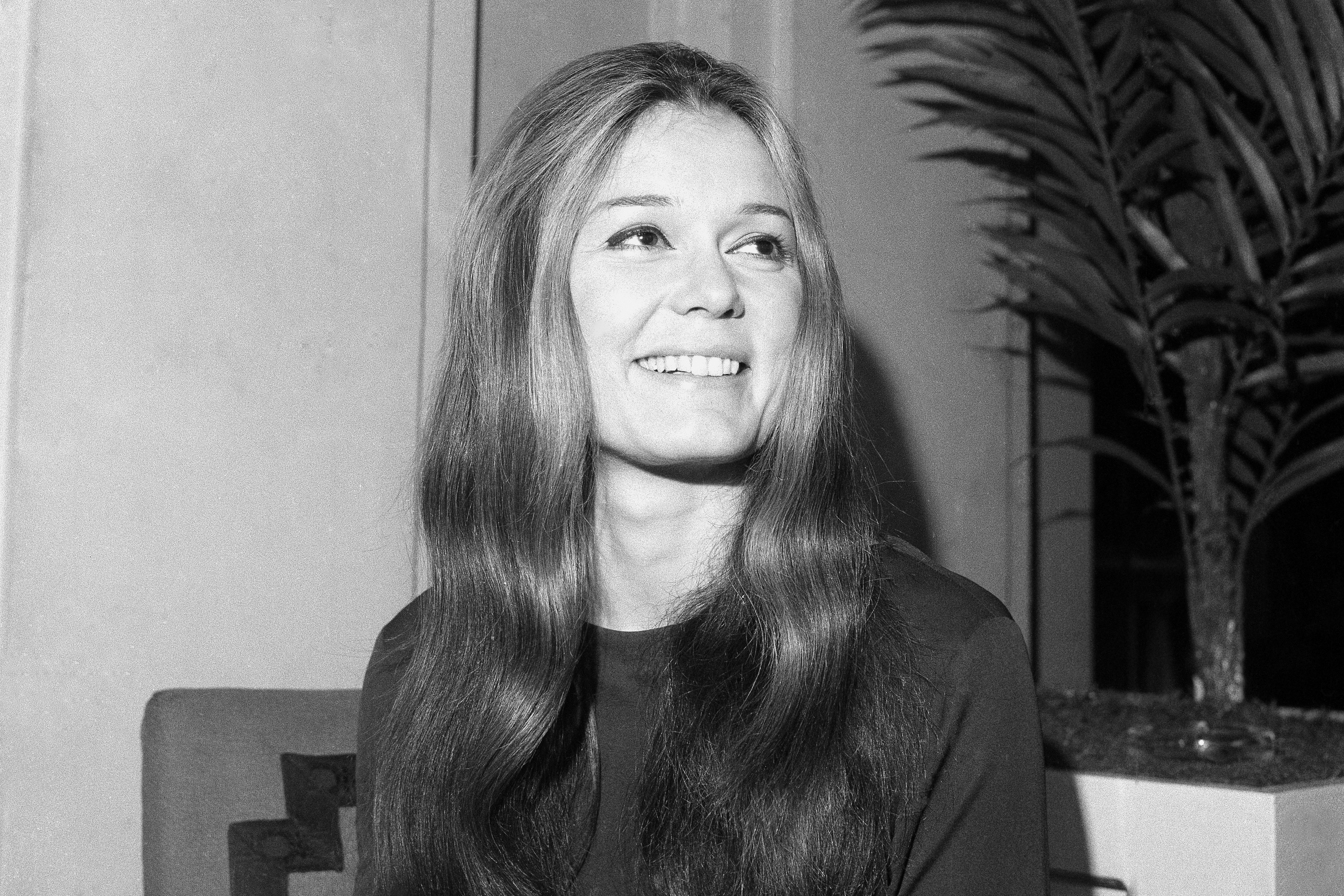
    Gloria Steinem spent 18 months in India in 1957 and 1958 that set the trajectory for the rest of her life. She credited those pivotal months with teaching her to listen, to organize from the ground up, and to understand “radical” as going to the root of a problem rather than to its extreme. In 2007, she told two Indian interviewers, “If you want people to listen, you have to listen to them. I believe I learned that in India.”

    Her connection to India began long before she got there. Her mother and paternal grandmother were Theosophists, or followers of a spiritual movement that borrowed from Hindu and Buddhist thought and treated India as the home of ancient wisdom. While a student at Smith College in the 1950s, Steinem studied with Vera Micheles Dean, a foreign policy scholar who wrote about India and was publicly accused of communist sympathies in 1954. During her junior year in Geneva in 1954-1955, she wrote a research paper on why the Communist Party of India had never become the country’s dominant party.

    Then she got engaged, and she did not want to be. “Marriage meant the end of life to me,” she said years later. The Chester Bowles Asian Fellowship in India in 1956, the year she graduated from Smith, saved her from the marriage.

    Smith students had spent years raising money to send graduating seniors to India as unofficial goodwill ambassadors to a country that had declared itself nonaligned in the Cold War. Chester Bowles, the former U.S. ambassador to India, gave a lecture and waived his fee; the money it raised went into two $1,000 scholarships the students named after him, each less than half what they estimated a fellow would need to live on. They sent two students anyway. Steinem was one.

    She landed in Bombay in February 1957 expecting one country and finding another. A tall, turbaned man stooped into the plane and turned toward her. “I rose, sure that he was going to begin a speech of ‘Welcome to India, mystic heart of Asia, land of ancient cultures.’ He namasthed politely before me” — greeted her with palms pressed together — “took out a shiny red insecticide bomb, and said, ‘Stand still while I spray you.’” India, she wrote in her fellowship reports, “shatters Western romantic illusions with little ceremony.”

    She was initially tasked with explaining American culture and excellence to Indian students. However, at Miranda House, a women’s college at Delhi University, her classmates ended up asking her to explain American politics instead. In one class, she reported, “we were asked the difference between the U.S. interference in Guatemala and the Soviet action in Hungary” — the CIA-backed coup of 1954 and the Soviet crushing of the Hungarian uprising in 1956. It “nearly shocked us into silence,” she wrote.

    After the semester, when she could have gone home like most of the students around her, she chose to stay. She went first to the Himalayan foothills, to a study camp run by followers of M. N. Roy, an Indian former communist who had broken with Moscow. That is where she absorbed the idea that “radical” means going to the root of a problem, not to its extreme.

    In the fall of 1957 she traveled south, to the ashram of Vinoba Bhave, a disciple of Gandhi who walked from village to village asking landowners to give land to the landless — and she found it nearly empty. Caste riots had broken out in Ramnad, a rural district in what was then Madras State, after the murder of a Dalit leader. The government had sealed the district and barred reporters. Teams from the ashram had walked around the roadblocks anyway.

    She joined a team because it was short a woman. For a week they walked between villages. At night people came out and sat around a kerosene lamp in circles of six or twenty or fifty and told what had happened to them — burnings, murders, rapes. The teams listened. Steinem later called it “the ancient and modern magic of groups in which anyone may speak in turn, everyone must listen, and consensus is more important than time.”

    She had no word for it at the time, but a decade later American feminists called it consciousness-raising, as they sat together and discussed their experiences in their everyday lives as women — soon coming to the conclusion that the challenges they faced were largely attributable to systemic inequalities.

    Made By History sponsors. FOR USE ON MADE BY HISTORY STORIES ONLY.Inquirer Staff

    Fifteen years after Ramnad, the first issue of Ms., the feminist magazine Steinem famously founded, had an eight-armed goddess on the cover holding a typewriter, a steering wheel, a frying pan. Steinem said the image “had come out of my Indian past.” The masthead listed everyone alphabetically. The editors met in a room she called “comfortable and shoe-less,” and set their own salaries around a table in a Chinese restaurant, with the highest capped at three times the lowest.

    She showed up in India with every assumption a white American in the 1950s could have, then spent sixty years being corrected and saying so out loud. When she went back to India in the late 1970s, she met Kamaladevi Chattopadhyay, who had led Gandhi’s national women’s organization, and told her: “Well, of course, my dears. We taught him everything he knew.” Steinem repeated that story and others from her time in India for decades.

    Here was a young woman whose assumptions were challenged, and who still wrote down her honest reflections. Steinem kept doing that her whole life — approaching new ideas, learning from her mistakes, adapting. For fifty years she acknowledged the global influences that shaped her, especially at home, in a country that mostly ignored them.

    Rashida Shafiq is a historian of American foreign relations and women’s history. Her book manuscript, “The Method and the Machinery: Gloria Steinem, India, and the Cold War Making of American Feminism,” is in the works.

    Made by History takes readers beyond the headlines with articles written and edited by professional historians. Opinions expressed do not necessarily reflect the views of The Inquirer.

  • Gov. Mikie Sherrill breaks her silence on reported investigation into Lt. Gov. Dale Caldwell

    Gov. Mikie Sherrill breaks her silence on reported investigation into Lt. Gov. Dale Caldwell

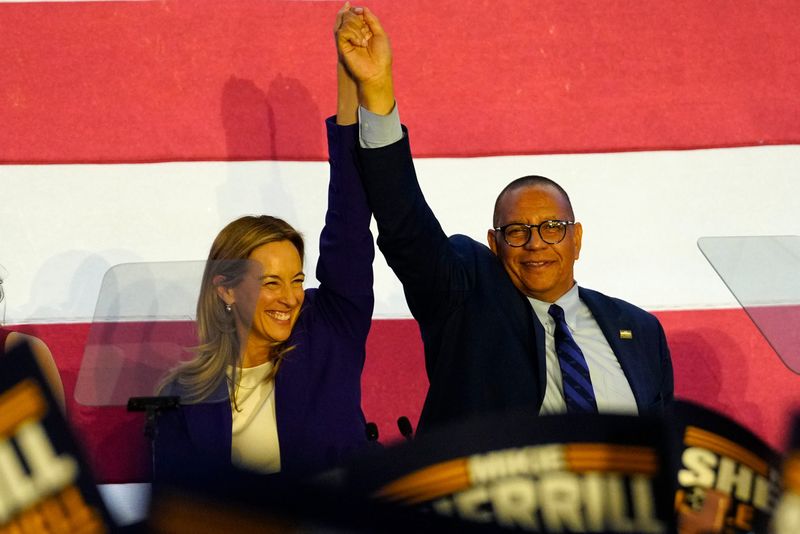
    New Jersey Gov. Mikie Sherrill broke her silence Tuesday on a reported investigation into Lt. Gov. Dale Caldwell, but the governor offered little information on the matter and did not mention her No. 2 by name.

    “Public service is an honor. And I have spent a lifetime of service in the Navy, as a prosecutor, in Congress, and now as Governor,” Sherrill, a first-term Democrat, said in a statement Tuesday afternoon. “I know that jobs of public trust impact the lives of everyday people and I deeply respect the oaths and responsibilities of these positions.

    “Because of this respect, I demand that everyone in my administration hold themselves to the highest standards and put their obligations to public service first.”

    Her statement comes four days after the New Jersey Globe reported that Caldwell is under internal investigation for allegations of inappropriate behavior with women and possible ethics violations, including an offer of state jobs.

    Sean Higgins, a spokesperson for Sherrill, said Friday the administration could not “confirm or deny potential personnel matters.”

    New Jersey GOP chair Christine Giordano Hanlon this weekend criticized the administration’s framing of the situation as “an effort to shield the information from the public” and called on Caldwell to resign.

    “The governor and lieutenant governor should not be considered ‘personnel’ — they are the highest level elected officials in the state and must be held to the highest standard of accountability and transparency,” Hanlon said.

    Sherrill’s Tuesday statement did not mention any specific investigation or individuals.

    “I take my responsibility to treat any reports of inappropriate behavior or misconduct extremely seriously, and any credible report must be fully examined and addressed. If the evidence warrants, I will take appropriate action quickly,” Sherrill said.

    The investigation had already begun when Caldwell worked as acting governor while Sherrill was out of state last week, the New Jersey Globe reported. BINJE.com reported that the investigation has been underway for months.

    Christopher Porrino, who served as attorney general under former Republican Gov. Chris Christie, is conducting the investigation into Caldwell, the Globe reported.

    Sherrill noted in her statement that anyone with a complaint “will receive a fair and thorough review” and be safe from retaliation.

    “Let me be clear,” she said, “I do not back down from tough fights or tough conversations, and I will always put the interests of New Jerseyans first.”

    Assembly member Katie Brennan (D., Hudson) released a statement Tuesday calling the allegations serious.

    “Anyone who uses the power of public office to mistreat the people around them has no business holding it,” she said. “Governor Sherrill moved quickly here, and I’m glad she did, but survivors shouldn’t have to hope that the people in charge will do the right thing.”

    Brennan was a campaign volunteer for former Democratic Gov. Phil Murphy’s 2017 primary election campaign who said after Murphy took office that she had been sexually assaulted by a senior campaign adviser.

    Prosecutors declined to file criminal charges. But Brennan’s decision to publicize the alleged assault and the administration’s failure to investigate her claims led to changes in state law on how victims are treated by law enforcement. She said in her statement Tuesday that she will push for bills to protect sexual assault survivors.

    Caldwell has yet to publicly address the matter, and his office declined to comment Tuesday.

    Sherrill chose Caldwell to be her lieutenant governor after her primary win last summer. Caldwell, who was the first Black president of Centenary University, is a pastor in the United Methodist Church. He has experience working in state government, starting nonprofits, leading charter schools, and serving on the New Brunswick school board.

    Sherrill praised him as a “voice for the voiceless” who has followed in his parents’ footsteps when she announced him as her running mate last year. His mother was a teacher and his father, the Rev. Gilbert Caldwell, was a civil rights activist who protested alongside the Rev. Dr. Martin Luther King Jr.

    Staff writer Susan Livio contributed to this article.

  • Hundreds rally to protest the planned closure of the Academy of Natural Sciences museum

    Hundreds rally to protest the planned closure of the Academy of Natural Sciences museum

    Sandy McNeal came to the Academy of Natural Sciences of Drexel University on a mission that belied the beauty of a September morning that was as splendid as it gets in Philadelphia: She was aiming to prevent a “funeral.”

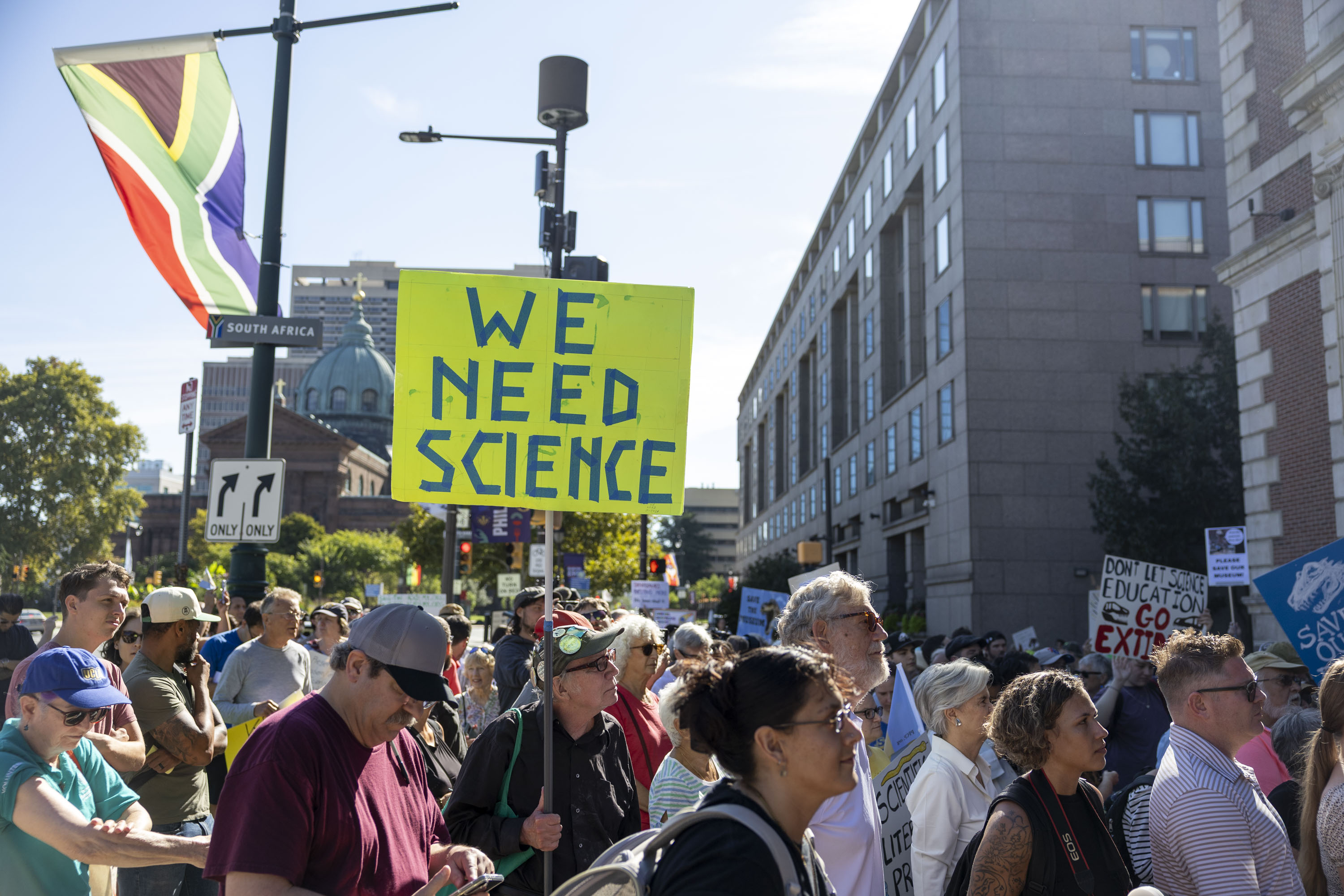
    McNeal, 69, and several hundred other protesters, chanting “Hey Drex! Save T-Rex,” gathered at the landmark building on Logan Square to demand that Drexel, the academy board, the state — somebody — find a way to prevent the closure of the museum, scheduled for Sept. 30.

    They came armed with signs reading “Save Our Saurs” and “Drexel Destroys Dinos?”

    Staff look down as people come out to rally, speak out, and support the Academy of Natural Sciences of Drexel University on Tuesday, Sept. 8, 2026, in Philadelphia, Pa.Tyger Williams / Staff Photographer

    Protest organizer Sarah McAnulty told the decidedly intergenerational crowd, made up of children and a whole lot of former children, that the academy, whose roots date to January 1812 — when Charles Darwin had not yet turned 3 — “brought an understanding of the vast array of Earth’s life to Philadelphia.”

    The museum “must remain open to the public,” she declared.

    “Philadelphia should be ashamed,” said McNeal, who lives in Delaware County and whose daughter is a marine biologist. For her, the museum’s closing would be akin to a “funeral.”

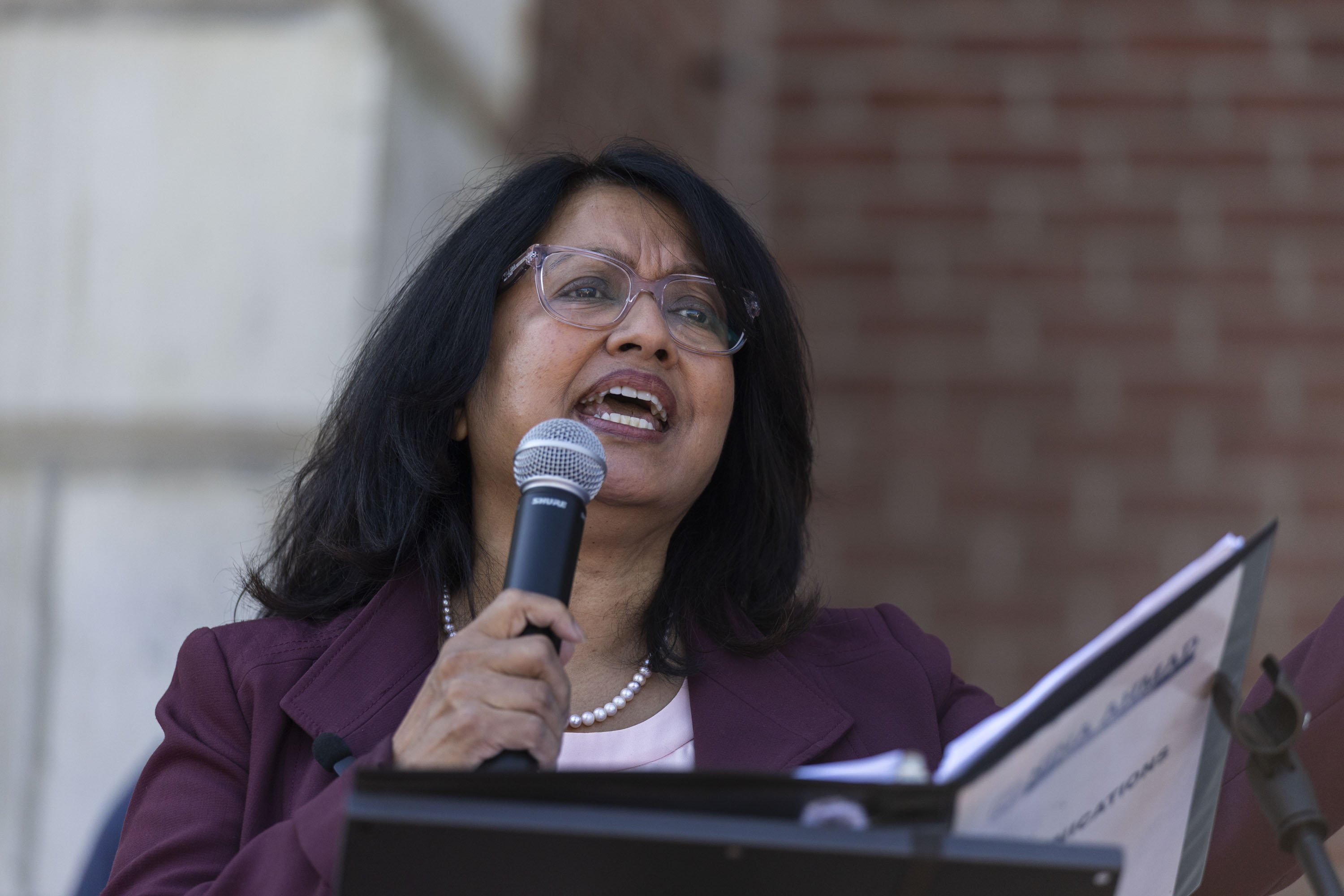
    As for the city government’s possible role, Councilmember Nina Ahmad said she and her colleagues were as surprised as everyone else by the announced closing.

    City Council member Nina Ahmad, speaks in front of folks rallying outside the Academy of Natural Sciences of Drexel University on Tuesday, Sept. 8, 2026, in Philadelphia, Pa.Tyger Williams / Staff Photographer

    “Why haven’t we heard about it? Why haven’t they come to us? We are the legislative body,” she told the crowd. Drexel and museum officials have said a dramatic drop in visitors since the COVID-19 pandemic and Drexel’s budget issues drove the closure decision.

    They have said that the collections would be maintained and the academy’s research would continue at a different location, but that the public museum, housed in a commodious building that opened in 1876 during the city’s centennial celebration, would be closed and eventually sold.

    The phrase “Academy of Natural Sciences” first appeared in the March 1812 minutes of a group of Philadelphia naturalists who had begun meeting two months earlier at the home of druggist John Speakman at Second and Market Streets, according to a 1909 history. It was a year more well-known for wars and the likes of Napoleon and Andrew Jackson, but founder Speakman found like-minded citizens in the Quaker City.

    The academy, whose participants included William Bartram, son of legendary botanist John Bartram, would grow into one of the nation’s most significant research centers, and the museum would become a popular public attraction, known for its dinosaur exhibits and dioramas, a vehicle for awing adults and piquing the interest of children in natural history.

    Ryan Sumner-lee, 10, poses for a photo holding a sign she made of her experiences here at the Academy of Natural Sciences of Drexel University on Tuesday, Sept. 8, 2026, in Philadelphia, Pa.Tyger Williams / Staff Photographer

    Having bunked a few hours of school, 10-year-old Ryan Sumner-lee was among those who made it to the protest Tuesday.

    “It’s the place that taught me I want to be a rock scientist, a paleontologist,” the fifth grader said. Aware of the closing plans, she begged her mother to take her to the demonstration.

    “She wanted to come,” said her mother, Tammy Sumner. “I am just the driver. She gives me hope” for future generations.

    Ross Bradley, 36, who brought his 6-year-old and 2-year-old to the protest, said he could not imagine a situation in which kids would not get to learn about science in their own city.

    “I have a lot of anxiety about the climate and raising young kids in an uncertain future,” Bradley said. “Having this place, where they can get invested about the future, it’s vital for them to not just feel hopeless about the planet.”

    Braxton Huminski, 3, is wearing a costume to show his support for the Academy of Natural Sciences of Drexel University on Tuesday, Sept. 8, 2026, in Philadelphia, Pa.Tyger Williams / Staff Photographer

    Daryl Stoner, 67, a retired physician from Chestnut Hill, said she brought her children to the museum once a week when they were in elementary school. The closure means an “invaluable resource” will soon be lost.

    “If we’re trying to get our kids active and off their phones, what’s better than bringing them down, walking them through the halls, and showing them things that have been there for eons.

    “We can’t afford to lose it for future generations,” Stoner said. “It’s horrendous that our city would lose this.”

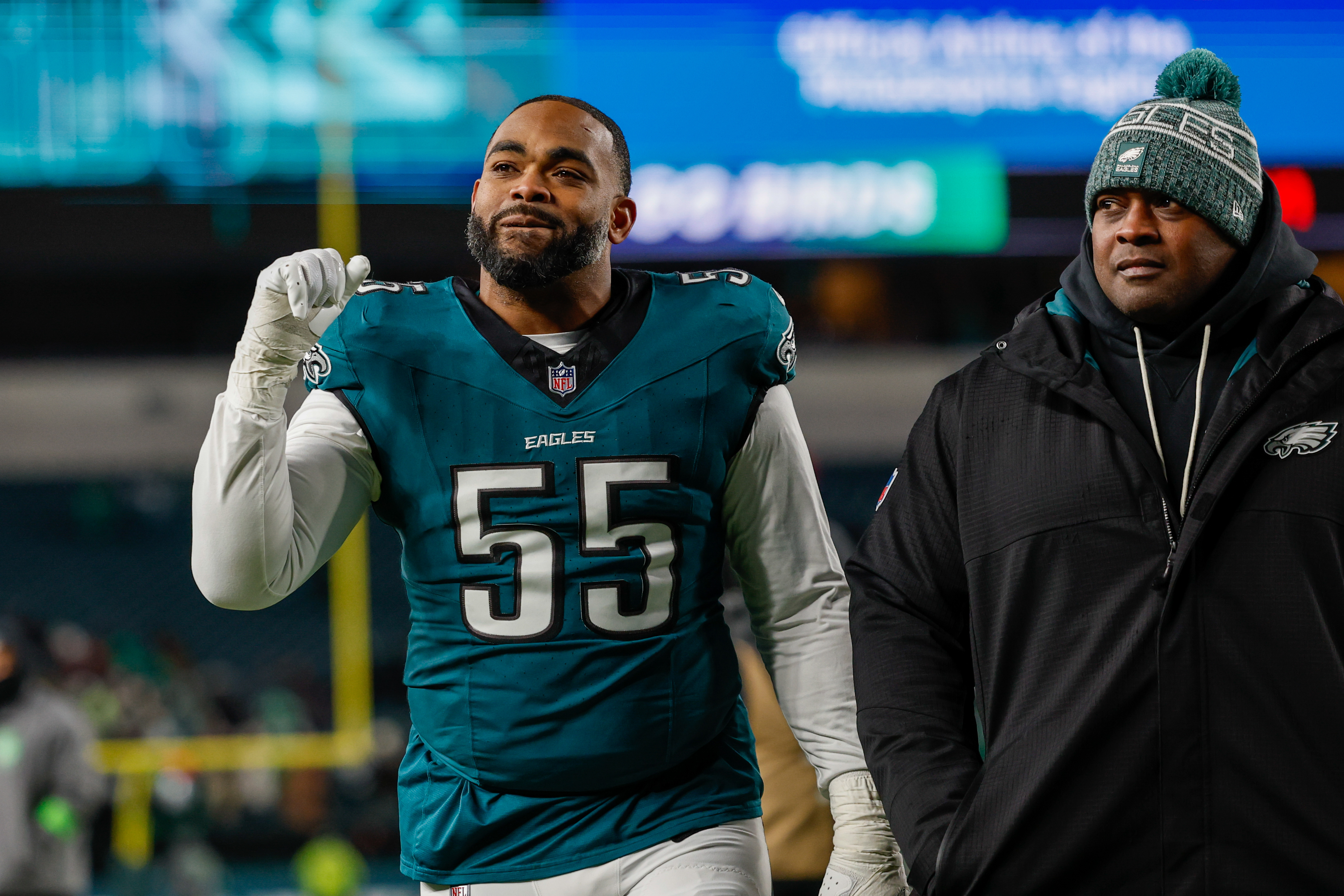
  • Eagles legend Brandon Graham announces he’s done playing football — again

    Eagles legend Brandon Graham announces he’s done playing football — again

    This time, there was no tearful goodbye, no reading from a script 16 seasons in the making.

    Brandon Graham’s second public goodbye to football came on a stage at a Jefferson Health “Breakfast with the Birds” event Tuesday morning.

    “I’m officially done,” Graham, 38, told the crowd. “Y’all are hearing it from me first. But let me tell you this, they are in great hands. Jordan Davis, I’m telling you, he is a guy that’s going to get the defense going. On offense, I can’t wait for Jalen [Hurts] to prove them haters wrong as always and get us back to the promised land.”

    Graham’s first retirement from the game came in March of 2025. After coming back from injury early to play in the Eagles’ Super Bowl victory, the franchise leader in games played decided to end his playing career after 15 seasons with the team that drafted him in the first round out of Michigan in 2010.

    But Graham’s initial retirement lasted just seven months. The Eagles, needing defensive depth, signed Graham for the rest of the 2025 season after Week 7. He played a limited role on the defensive front, but made important contributions after changing positions and taking on a role as an interior lineman while the Eagles dealt with the absence of Jalen Carter.

    Graham, who stripped Tom Brady late in the team’s first-ever Super Bowl victory, registered two sacks in a shutout victory over Las Vegas in Week 15. He finished his final regular season with three sacks and eight total tackles in nine games.

    He remained open to the possibility of coming back for a 17th season, but said at a recent PHLY Sports event that his return needed to be before the season, not joining a season in progress like in 2025.

    Brandon Graham’s strip-sack of Tom Brady during Super Bowl LII lifted the Eagles to their first title. David Maialetti

    The Eagles retooled their edge rushing corps in the offseason, most notably by trading for Jonathan Greenard and signing him to an extension worth nearly $100 million. They have an ascending young player in Jalyx Hunt and another, Nolan Smith Jr., who is entering his fourth NFL season. Howie Roseman also added some veteran depth in Arnold Ebiketie and A.J. Epenesa.

    “Communication between BG, the Eagles, and me has always been consistent,” Roseman said in July. “BG was the first draft pick I ever made as GM. Those conversations, obviously between us and every player, we’re going to keep between us and the player. I want to be consistent with whoever that is that we do that. But obviously you’re talking about one of the greatest Eagles players and an unbelievable person. Last year, his ability to come back in and help us was huge for our football team. But again, those conversations we’ll keep private.”

    Graham ends his NFL career as the franchise’s all-time leader in games played with 215. He played in another 13 postseason games. His 5½ playoff sacks add to a career regular season total of 79½.

    “I’m going to still be around,” Graham said at the event Tuesday. “I’m still around. I’m still giving wisdom, helping the guys.

    “It’s an adjustment for me, but it’s a great adjustment because it’s all about my kids and my family, trying to make sure I’m there for that. Just spreading the love everywhere.”