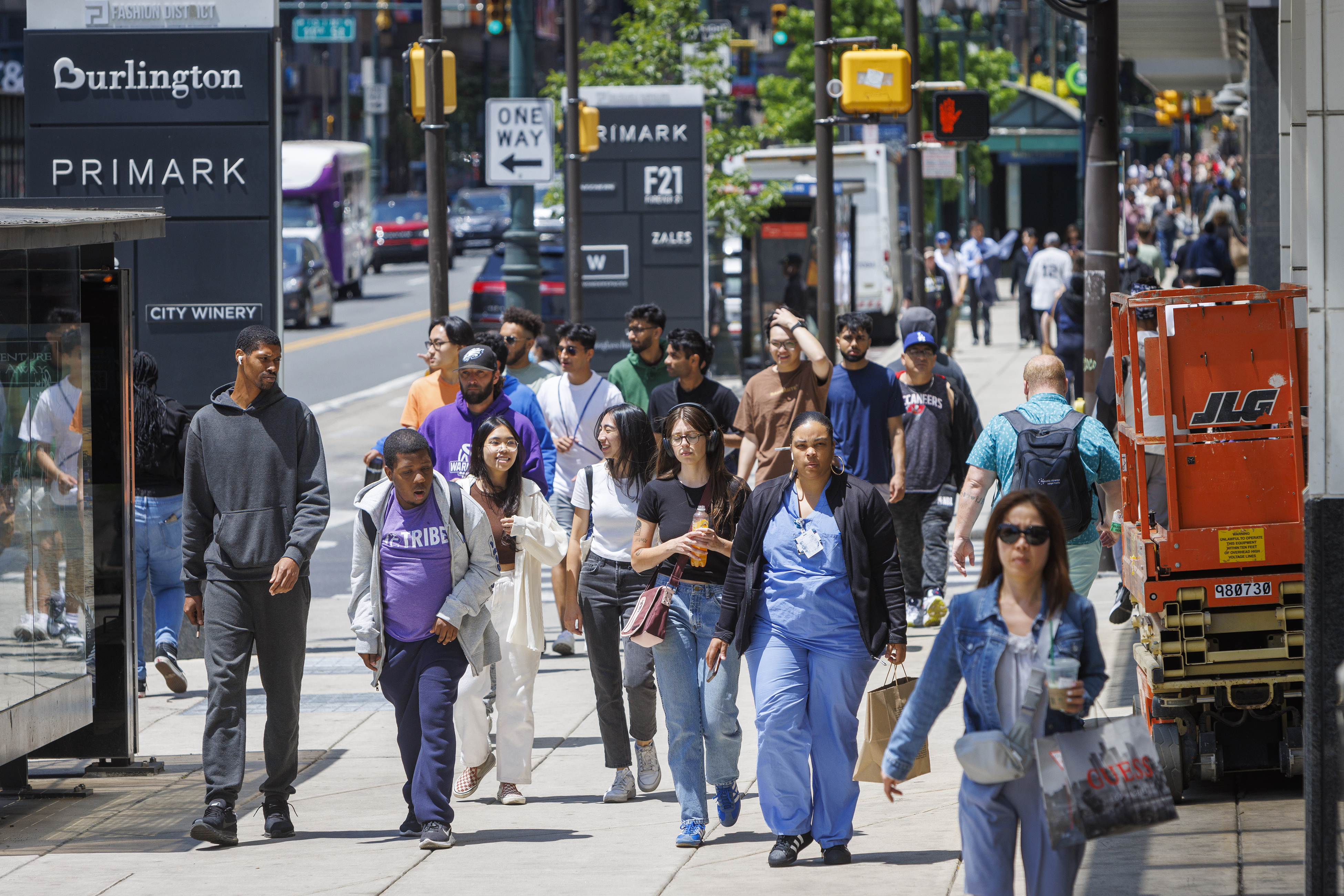
Philadelphia has added tens of thousands of degree-holding residents to its talent pool in the last decade — and mid-career workers are leading that growth. But the expanding educated talent pool isn’t growing Philadelphia’s office sector, a new report indicates.
Philadelphia gained over 41,000 residents aged 35 to 44 years old between 2014 and 2024 with at least a bachelor’s degree, according to a new report from the Center City District, a business advocacy group. In that age group, Philadelphia ranks first for growth amid the 25 largest U.S. counties, the report indicates.
This new insight “challenges the outdated notion that Philadelphia is a great place to be young, but somewhere you eventually have to leave to establish a career or family,” said Jennifer Kebea, president at Campus Philly, which works to retain graduates in the Philadelphia region. “We are increasingly a place where people see a future for themselves.”
The report looked at the number of Philadelphia County residents who had at least a bachelor’s degree between 2014 and 2024, the latest year available from the U.S. Census Bureau American Community Survey five-year estimates.
Degree holders aged 25 to 44 years old grew 62% in Philadelphia in the past decade, landing the county second among the 25 largest counties nationwide, behind Austin.
The talent pool of 18- to 24-year-olds with a degree grew 11% over a decade. Those aged 35 to 44 who have at least a bachelor’s degree grew nearly 87%, according to the report.
The fact that recent graduates aren’t the main drivers of the talent pool growth with college degrees echoes a report released earlier this year by the Pew Charitable Trusts. In it, researchers highlighted how some Gen Zers in Philadelphia feel like jobs in the medical sector abound, but they need to look beyond the city for jobs in tech, finance, and the arts.
Still, more of these young people are staying in Philadelphia compared to decades ago, says Kebea. In the last 20 years, her organization has mapped how Philadelphia has gone from retaining one in four graduates to over 50% of them.
“We’ve been intentionally working to attract, engage, and retain college students and graduates, and this research just reinforces that we’ve made real progress,” said Kebea. “Our higher education institutions are just extraordinary economic assets, and the region has become increasingly successful at converting that talent pipeline into residents who choose to build their lives here.”
Between 2014 and 2024, the number of degree-holding 18- to 24-year-olds grew 11% in Philadelphia, according to the new report from the Center City District. Elizabeth Robertson / Staff Photographer
No office-sector job growth
As Philadelphia has added degree-holding workers to the region, office jobs haven’t kept pace, the report highlights.
Philadelphia had nearly 119,000 office sector workers in 2025 — roughly the same amount as in 2019. Those jobs include positions in industries such as finance, information, real estate, and professional services.
The report points to healthcare and social assistance being the main drivers of job growth in Philadelphia, adding some 33,540 jobs since 2019.
“With talent booming, there needs to be more jobs,” said Clint Randall, vice president of economic development at the Center City District, who sees room for growth for local office jobs.
“I don’t think that people recognize just how good a job Philadelphia has done attracting highly educated younger people,” he said. “One of the reasons there’s maybe not great awareness of that is you would expect there to be more of a response from the job market in terms of companies wanting to locate here, grow here, establish some kind of presence here.”
Some offices in Center City are converting into residential units, which Randall says is “actually a fine idea” given “a lot of antiquated and essentially unusable office space in Philadelphia.”
“The buildings that are getting taken offline for conversions, even in a booming office economy, they would not be strong contenders for new tenants looking to have a presence in Center City,” he said.
The city doesn’t have a lot of “really high quality office space,” Randall said, so if office sector jobs see growth in the future, new office space will need to be built.
“If we are successful in attracting more office jobs, we would find ourselves with a different problem, which is a great problem to have,” he said.
The Food and Drug Administration rarely inspects the foreign facilities exporting the vast majority of fresh produce to the United States, a Washington Post investigation has found, creating a major blind spot when it comes to U.S. food safety.
Americans are eating more imported fruits and vegetables, with Mexico supplying most of this fresh produce, including the iceberg lettuce that U.S. regulators this summer linked to the nation’s largest known cyclosporiasis outbreak. Yet since 2009 the FDA has inspected only about 2% of the facilities in Mexico that ship produce to the United States, according to a Post analysis of the agency’s inspections and imports data.
The Post combined FDA fresh-produce imports and inspections data for the first time to analyze all major fresh-produce facilities in other countries that account for 90% of the fruit and vegetable shipments to the United States. Overall, only 7.6% of the facilities have been inspected by the agency since 2009, the earliest full year such data is available. Other reports have identified the low overall number of foreign food inspections by the FDA but have not focused specifically on produce.
Though food in the United States is generally considered some of the safest in the world, the lack of foreign inspections raises the risk that federal regulators are not catching issues that could cause a foodborne outbreak, according to a dozen former FDA officials, food safety experts, consumer advocates, and farming groups.
Because produce is often eaten raw, it is particularly vulnerable to bacterial and parasitic contamination from sources like machinery or the water supply. While inspections are just one part of the government’s oversight system, experts say they are an essential tool to help prevent outbreaks of foodborne illnesses, which the Centers for Disease Control and Prevention has estimated sicken roughly 48 million Americans per year.
Other countries conduct their own investigations, and the FDA and Mexico say they collaborate to prevent and respond to foodborne outbreaks. Major food trade groups say that the industry works hard to prevent contamination and that Americans should have confidence that imported products are held to the same safety expectations as those grown here.
Yet some pathogens are more common in other countries, and boosting FDA inspections would help ensure that producers are adhering to U.S. regulations, food safety experts say.
“We don’t have a robust system in place to go verify that these foreign producers are following the rules,” said Sarah Sorscher, who directs regulatory affairs for the nonprofit Center for Science in the Public Interest, “and that’s a big concern for anybody who eats food in America.”
Donald Prater, the FDA’s acting deputy commissioner for food, said in an interview that the “number of inspections doesn’t exactly tell the whole story.”
“Inspections are not a good proxy for our overall oversight activities,” he said. Prater pointed to other measures such as testing produce at the border, inspecting hundreds of produce importers’ records each year that focus on adherence to U.S. rules, and using artificial intelligence to improve how inspections and investigations are done.
Yet only a sliver of the food flowing into the country gets physically inspected at the border, exposing gaps in the system. Food safety experts have raised questions about other ways companies say they are complying with U.S. regulations, such as third-party audits.
This comes as the share of imported produce in Americans’ diet has skyrocketed amid rising U.S. labor costs and greater demand for year-round produce. About two decades ago, roughly 17% of fresh vegetables and 46% of fruit came from other countries. In recent years, 34% of fresh vegetables and 59% of fresh fruit were imported.
President Donald Trump and Elon Musk’s Department of Governmental Efficiency cut FDA employees who schedule foreign food inspections. (Tom Brenner/For The Washington Post)Tom Brenner
Though foreign food inspection numbers were already low, they dipped even further in early 2025. Elon Musk’s Department of Government Efficiency cut FDA coordinators who arranged investigators’ foreign travel, though some were later rehired, according to three people familiar with the matter who spoke on the condition of anonymity to share internal information.
In 2011, President Barack Obama signed legislation aimed at transforming the nation’s food safety system, including requiring importers to verify that foreign suppliers meet U.S. safety standards. The law also sought to dramatically ramp up foreign food inspections over the course of several years to conduct 19,200 annually, but the agency has consistently fallen short.
Last year, the agency completed 1,024 foreign food inspections, according to The Post’s analysis, representing just 5% of its target set by Congress.
Long-term issues have hindered the FDA’s ability to boost inspections, according to former officials, food safety experts, and consumer advocates, as the agency struggles with a lack of funding, chronic understaffing, and difficulty recruiting and retaining investigators for these highly technical roles. Each foreign inspection costs, on average, $38,700 and can involve traveling to areas the State Department has deemed a security risk, further complicating matters.
“FDA is not funded appropriately to have enough investigators to go out and do their job,” said Eric Pittman, a 23-year veteran of the agency who left in February 2025.
Prater acknowledged the agency’s limited resources, saying it’s “trying to use the tools the most effectively that we can” by targeting the highest-risk areas and foods, such as produce in Mexico.
‘A watershed moment’
A Taylor Farms processing plant in Doctor Mora, Guanajuato, Mexico. The facility blamed for the 2026 cyclospora outbreak in the U.S. was last inspected by the FDA seven years ago. (Fred Ramos/The New York Times)FRED RAMOS
This summer, a wave of Americans began falling ill with what headlines and social media accounts described as “explosive diarrhea.”
The culprit? The microscopic parasite cyclospora.
Federal officials linked the largest outbreak to iceberg lettuce from Taylor Farms de Mexico, which sickened 12,883 people in 21 states, hospitalized at least 570, and was associated with two deaths in Michigan.
The FDA had last inspected the company’s Mexico operations seven years ago.
During this year’s outbreak investigation, the FDA found the parasite in a wastewater tank and a drainage ditch, but the agency couldn’t determine how the contamination occurred. The company recently said it would “indefinitely suspend” the harvesting of iceberg lettuce from central Mexico for sale during the cyclospora season, which runs from May 1 through Aug. 31. It also committed to participating in a public-private task force on produce safety, among other measures.
In another outbreak this summer, the FDA did not send a team to the grower that the agency identified as the “likely source” of an outbreak of salmonella bacteria in jalapeño peppers that sickened nearly 500 people. The grower was located in a region of Mexico known for its drug cartel. Food safety experts have said it can be difficult for the agency to travel to areas that are security risks. The FDA said it visited a common Mexican distributor, and no jalapeños were available to test at the time.
Brian Ronholm, the director of food policy at Consumer Reports, a nonprofit organization that promotes product safety, called the outbreaks this summer “a watershed moment.”
“Everyone knows that produce safety is a weak spot, and over the years, there’s been a lot of discussion about how we can get to a better place on it,” he said, “but they typically break down.”
The FDA recently released a new plan aimed at preventing future cyclosporiasis outbreaks, which Ronholm said was a “subtle admission” of the need to overhaul investigation protocols. The effort includes increasing surveillance of products historically associated with cyclospora, enhancing lab capacity in Mexico to process samples, and convening expert panels to improve growing and processing practices.
The International Fresh Produce Association — which represents growers, packers, shippers, distributors, retailers, and others in the fresh produce supply chain — said food is held to the same “strong, consistent and science-based standard” regardless of origin.
“Consumers should have an expectation for that standard and to have that confidence knowing that they can go into a supermarket or a retail establishment or a retail food service and know that they’re going to be able to get that same nutritious food 365 days a year,” said Eric Stevens, a vice president at IFPA.
Yet, polling shows Americans’ declining confidence in the safety of food on grocery store shelves.
It’s the industry’s responsibility to produce safe food, Prater said. “We have another responsibility that’s also very important in terms of being able to make sure that they’re following the regulations.”
The United States has agreements with Canada, Australia, and New Zealand, in which the countries recognize that they operate comparable food safety programs. (The Post’s analysis of produce inspection rates excluded those three countries.)
Mexico and the United States have a different arrangement: a partnership aimed at ensuring the safety of food traded across the border and improving data-sharing during outbreaks.
Senasica and Cofepris, the agencies in Mexico charged with overseeing food safety, did not directly respond to The Post’s questions related to the processes and timing of routine inspections and more. The agencies pointed to past news releases in which officials touted their collaboration with the FDA to ensure the safety of produce. The Mexican government has said there is no clear evidence that this year’s outbreaks in lettuce and jalapeño peppers originated in Mexico, despite U.S. officials’ linking the products to foodborne pathogens.
Mexico is far and away the top exporter of produce to the United States, followed by Peru, Canada, and Chile. In the past two decades, the total value of all fruits and vegetables imported from Mexico has jumped more than fourfold to $16.7 billion last year, according to imports data from the U.S. Department of Agriculture. Some of the most commonly recalled foods have included lettuce and cabbages, berries, peppers, and fresh herbs. Those suppliers are also rarely inspected by the FDA.
Will anything change?
Pittman, the former FDA inspector, who now works for a consulting firm and serves as an adjunct professor at Temple University, said the “huge undertaking” of foreign inspections involves doing careful planning, securing visas, and communicating with another country’s government. Investigators spend two to five days on-site, analyzing everything from the growers’ irrigation methods to the sanitation of a processing facility.
“It’s an enormous challenge and undertaking, in all fairness,” said Frank Yiannas, who served as the FDA’s deputy commissioner for food policy and response during President Donald Trump’s first term as well as in the Biden administration. “Can you imagine saying, ‘We want you to screen and provide oversight of all the food in a global supply chain and ensure it’s safe’?”
There isn’t one clear road map for ensuring safer produce as this year’s outbreaks have sparked informal conversations among food safety advocates, FDA officials, and major trade groups. Ideas include deploying more staff to test produce at the border, beefing up third-party audits, and investing in research on how to best prevent outbreaks.
But there’s generally one area of agreement: The FDA needs more money from Congress if it’s going to make strides in overseeing the produce Americans eat. The agency is seeking $9 million to increase inspections abroad, as well as the ability to collect fees from foreign food facilities that could provide an additional $71 million, Prater said.
Yet, the political environment is tricky. Democrats are pushing back against some Republican efforts to boost military spending while cutting domestic programs.
Lawmakers have passed a stopgap spending bill to fund the government through Dec. 11, and the outcome of the November midterm elections could affect funding negotiations on Capitol Hill.
In a statement, a spokeswoman for Senate Appropriations Committee Chair Susan Collins (R-Maine), who is locked in a tight reelection race, said the recent foodborne outbreaks were “troubling,” adding that the panel is “working closely with the FDA to identify their needs for the upcoming fiscal year.”
Rep. Rosa DeLauro (Connecticut), the top Democrat on the House Appropriations panel, was sickened by salmonella when she was 2 years old. She said ensuring that the food Americans eat doesn’t land them in the hospital is one of her “highest priorities.”
As cyclosporiasis cases ballooned over the summer, Bill Marler, a prominent food safety lawyer who filed lawsuits in the wake of this year’s outbreak, initially believed there would soon be a congressional uproar, with lawmakers convening hearings to ask tough questions.
“This is like a Jack-in-the-Box-level event,” he said, referring to an outbreak of E. coli in undercooked hamburgers that killed four children in the early 1990s.
But outside of congressional letters to federal agencies and Taylor Farms, “it’s been pretty silent,” Marler said. “It is sort of bizarrely shocking.”
Diana Baptista contributed to this report.
Methodology
The Post analyzed inspections data from January 2009 through September 2026 and imports data from January through September 2026 to calculate the FDA’s foreign food inspection rates for specific categories of food, individual products and exporting countries. Canada, Australia and New Zealand were omitted from inspection rate analyses because of the FDA’s reliance on those countries’ inspections as part of safety agreements. Major suppliers were identified as those that collectively provided 90 percent of all imports of produce or of specific products. Total foreign food inspections calculations end in June 2026 as the FDA finalizes inspections data up to 90 days following an inspection.
Walter Koenig, a mainstay of the Star Trek franchise as Pavel Chekov, the Russian navigator aboard the USS Enterprise, died Sunday at his home in the North Hollywood neighborhood of Los Angeles. He was 90.
The death was confirmed by his agent, Zachery McGinnis.
Ensign Pavel Chekov — who arrived at the beginning of the show’s second season, in the fall of 1967 — was conceived as a solution to a demographic problem. Gene Roddenberry, the creator of Star Trek, had been told that young viewers considered the show’s leads, William Shatner (Captain Kirk) and Leonard Nimoy (Mr. Spock), who were both 35 when the series began, practically middle-aged.
So Chekov was positioned as a younger type — Mr. Koenig was 30 when he was cast — complete with a mop-top haircut that the producers hoped would remind adolescent girls of Davy Jones of the Monkees, the popular TV-generated rock band.
His character also represented a future beyond the Cold War’s balance of atomic terror, one in which a Russian officer could be serving under a captain from Iowa as a unified humanity explores the stars.
Mr. Koenig, whose parents were Russian Jewish immigrants from Lithuania, was born in Chicago; his onscreen accent was theatrical. Over the show’s remaining two seasons on network television, before Star Trek ascended into a multimedia pop-culture phenomenon, Chekov appeared in 36 episodes, most often just doing his job and making practical pronouncements like “Warp speed 2, Captain.”
His favorite episode, Mr. Koenig said, was “Spectre of the Gun” (1968), in which the Enterprise crew were forced by aliens to participate in a Wild West gunfight. In that episode, Chekov took a bullet to the chest from Wyatt Earp (as it turned out, it was all an illusion) and enjoyed lavish physical affection from a saloon hostess.
Mr. Koenig was irreverently honest about the technological shortcomings of Star Trek. Before being cast, he said, he had never watched a full episode because, while channel surfing, he had noticed that in an outdoor scene the rocks looked like Styrofoam. Asked by one interviewer about the show’s special effects, he shook his head and said, “The triggers didn’t even pop.”
Of the Star Trek movies in which he appeared, released between 1979 and 1994, he considered Star Trek IV: The Voyage Home (1986) “the best film we did,” he told Yahoo Entertainment in 2016. A time-travel story centered on recovering whales from the 20th century to save Earth from certain doom some 300 years later, it represented, Mr. Koenig said, Roddenberry’s vision of telling “sociopolitical stories that spoke to what was happening in the world at the time.”
In that film, Chekov was interrogated by FBI agents who were curious about his Russian accent and his phaser, and he confused San Franciscans by asking where the “nuclear wessels” were kept.
Walter Marvin Koenig was born Sept. 14, 1936, in Chicago, the son of Isadore and Sarah (Strauss) Koenig. (The family name was changed from Königsberg when his father immigrated to the United States.) His mother had worked at a millinery shop in England on her family’s way to the United States. His father worked as, among other things, a musician, a nightclub owner, and, just before World War II, a traveling translator for RCA Victor.
The family moved to New York, and Walter grew up in the Inwood section of Manhattan. He attended Grinnell College in Iowa as a pre-med student (he was considering psychiatry as a career) before transferring to UCLA, where he earned a bachelor’s degree in psychology. But he was “really at sea as to what to do with my life,” he recalled in a 2013 Archive of American Television interview. “I was a leaf in the wind.”
Having played lead roles in high school and college stage productions, he decided to take an acting class. The teacher saw talent and encouraged him to give an acting career a try.
After two years at the Neighborhood Playhouse in New York, Mr. Koenig made his television debut on Day in Court, a daytime series. He also had small-screen roles on Mr. Novak, The Alfred Hitchcock Hour, and, luckily for him, The Lieutenant, a drama series created by Roddenberry, who remembered him three years later when he was casting his new space series.
When the Star Trek years were over, science fiction called again. In 12 episodes of Babylon 5 in the 1990s, Mr. Koenig played Alfred Bester, a manipulative, telepathic 23rd century cop. In 2020, he appeared in Unbelievable!!!!!, a Star Trek parody starring Snoop Dogg and featuring many other actors from the various series.
An early marriage to actor Anjanette Comer ended in divorce. In 1965, he married Judy Levitt, also an actor, who appeared in three Star Trek films. She died in 2022. Mr. Koenig is survived by their daughter, Danielle Koenig, and a grandson.
Mr. Koenig said that in the early 1970s he “hit rock bottom” financially after the original Star Trek series went off the air. In response to his money troubles, he began writing scripts to help pay the bills, and sold several pilots, he recalled in a 1994 interview with a documentary filmmaker. He wrote an episode of Star Trek: The Animated Series, and had several other credits in the ’70s and ’80s.
He was modest about the relative importance of his most famous character and generous in his evaluation of the fans, who came to be known as Trekkies. They were not just computer people or college students, he pointed out in the Archive of American Television interview.
“It was people who had a sense of humanity and a sense of justice and a sort of political bent,” Mr. Koenig said. “People who had imagination — and people who loved monsters.”
The money will pay for 840 refrigerated-trailer electrical plugs, as well as 24 racks on which to stack the trailers, at the Penn Terminals port in Eddystone, Delaware County. It will also pay for electrical system and road upgrades.
The Eddystone project “will expand the refrigerated cargo capacity” at Penn Terminals, and strengthen the state’s cumulative port infrastructure, Sen. Dave McCormick (R., Pa.) said in a statement Tuesday hailing the grant.
Sen. John Fetterman, (D., Pa.) added that the project, with federal funds routed through the Redevelopment Authority for the County of Delaware on Penn Terminal’s behalf, will boost global trade for Pennsylvania.
The senators noted that the port handles both imports and exports.
In a June letter to U.S. Transportation Secretary Sean Duffy, McCormick had urged federal approval for the federal Port Infrastructure Development Program grant to Penn Terminals.
The refrigerated-trailer plugs and stacks “will support increased efficient access,” allowing Penn Terminals to concentrate cooled cargoes at a central location, and make moving the refrigerated trailers faster, safer, and more dependable, McCormick added.
Like the state-backed Philadelphia, Wilmington, and South Jersey ports, Penn Terminals handles containerized freight and steel, among other shipping cargoes, along with refrigerated containers.
PhilaPort, and ports in Camden and Wilmington, employ members of several locals of the International Longshoremen’s Association. But Penn Terminals’ workers are members of International Brotherhood of Boilermakers Lodge 802, which also represented workers at the former Sun Shipbuilding on the site.
Penn Terminals and the other area ports “surely are competitive,” said Leo Holt, whose family business, Holt Logistics, operates port terminals in South Philadelphia, Gloucester City, and Paulsboro.
MINNEAPOLIS — The family of Alex Pretti, the Minneapolis nurse fatally shot by immigration agents in January, accused the federal government Tuesday of keeping them in the dark about the investigation into their son’s killing.
Steven Schleicher, a lawyer representing Pretti’s parents, Michael and Susan, said the Justice Department’s refusal to share basic information with the family amounted to a violation of the federal Crime Victims’ Rights Act.
“It is impossible to convey how the government’s refusal to engage in transparent communication with the Pretti family has compounded their heartbreak,” Schleicher wrote in a letter he sent to Attorney General Todd Blanche in July.
Schleicher provided a copy of the letter, which was first reported by CNN, on Tuesday morning before a news conference in Minneapolis during which Pretti’s parents were expected to speak about the case.
Federal officials have yet to disclose information as basic as the identity of the agents who fired at least 10 bullets into Pretti’s back the morning of Jan. 24, Schleicher said. The Department of Homeland Security has not retracted a statement issued shortly after the shooting in which it claimed Pretti had intended to “do maximum damage and massacre law enforcement,” he noted.
“The government’s steadfast protection of the identities of Alex’s killers is particularly cruel given the apparent campaign to publicly disparage Alex after his death by falsely accusing him of domestic terrorism,” the letter said.
Hoang Bui, a spokesperson for the U.S. attorney’s office in Minnesota, did not immediately respond to a request for comment.
Pretti’s parents have made few public appearances since their son’s death. They have given two emotional interviews detailing their grief and telling Pretti’s story: an avid cyclist and intensive-care nurse who joined protests against the Trump administration’s immigration crackdown in Minnesota.
Beyond that, the family has largely maintained its privacy as the federal government — as well as state and local investigators — pursue parallel investigations into the deaths of Pretti and Renee Good, whom immigration agents gunned down Jan. 7.
Their killings within 2½ weeks of each other touched off a nationwide outcry and ultimately forced President Donald Trump to withdraw hundreds of immigration agents from Minnesota.
But the investigations into the killings of Pretti, 37, and Good, 37, have produced little visible action. Officials in Minnesota have blamed the federal government for obstructing access to the scene of Pretti’s shooting, and have said federal officials dragged their feet for months by refusing to cooperate with local authorities or share evidence.
In March, Minnesota’s attorney general and the local prosecutor’s office sued the Department of Justice, accusing federal officials of refusing to share key evidence about Pretti’s case and two other shootings by immigration agents in Minneapolis in January.
Then in July, Mary Moriarty, the top prosecutor in Hennepin County, which includes Minneapolis, said the federal government had begun to share evidence into the killings of Pretti and Good. It was a breakthrough that would enable her office to decide whether the federal agents should be charged with state crimes.
Moriarity has already filed state assault charges against an Immigration and Customs Enforcement officer accused of shooting and wounding a Venezuelan man at the height of the administration’s immigration crackdown.
But this month, Moriarty said that the cooperation in all three cases had been “short-lived,” and that the federal government was continuing to withhold evidence.
Prominent in that evidence is the statement that one of the agents who shot Pretti provided to federal investigators after the killing. Her office has statements from other federal officers at the scene.
Moriarty said federal officials had handed over hard drives that contained body-camera footage and officer statements.
She also said she had repeatedly asked the U.S. attorney for Minnesota, Daniel Rosen, for an explanation, and to restart the sharing of information. She said she received neither answers nor cooperation from the federal prosecutor, who was nominated by Trump in 2025.
“He did not provide a reason why the sharing stopped, and stated he needed more time to navigate the situation,” Moriarty said in a legal filing.
Pretti was killed after he intervened to help a protester who was shoved to the ground by a federal agent on a snowy Minneapolis street at about 9 a.m. in January. Several immigration agents grabbed Pretti and wrestled him to ground, pepper spraying him and other protesters.
Video of the killing shows a federal agent found a pistol that Pretti had been legally licensed to carry, and then disarmed him moments before one immigration agent, then another, fired 10 shots at Pretti in the span of five seconds.
Pretti’s parents, who live in Colorado, have called his death a murder and said they are desperate for answers and accountability.
After years of declining membership, Congregation Adath Jeshurun is leaving Melrose Park and merging with Temple Sinai in Dresher, where more young Jewish families live.
The blended Conservative congregation of about 500 households will practice at Temple Sinai’s current site on Limekiln Pike, and will be known as Adath Jeshurun-Temple Sinai, according to an announcement Monday from both synagogues. Adath Jeshurun’s building is for sale.
Each congregation voted Sunday to approve the merger, which will go forward pending review from state and county officials. Clergy and staff from each synagogue will keep their jobs, and the unified synagogue will look for ways to grow.
More Jewish kids live in Buxmont area
For Adath Jeshurun, the merger means leaving a longtime Jewish hub in the Philadelphia region.
Created in 1858, Adath Jeshurun is among the founding synagogues of the formal Conservative movement in the United States and has practiced for over 60 years at the synagogue in Cheltenham Township. Beth Sholom, the leaky Conservative synagogue designed by Frank Lloyd Wright, is a mile away; both are part of the Old York Road Kehillah, which serves thousands of residents. Prominent Jewish leaders, from Gov. Josh Shapiro to Israeli Prime Minister Benjamin Netanyahu, have called the area home.
The only synagogue designed by Frank Lloyd Wright, Beth Sholom sits across from the Cheltenham Township administrative buildings in Elkins Park, pictured here on Sept. 5, 2019.TOM GRALISH / Staff Photographer
Beth Sholom, which merged with Temple Sholom in Northeast Philadelphia in 2004, said in 2024 that membership is growing.
Buxmont Kehillah, where Temple Sinai is located, covers a much larger geographical area, and nearly four times more Jewish people live there than in the Old York Road community, according to census data shared in a 2020 report for the Jewish Federation of Greater Philadelphia. Old York Road had just 200 kids under age 5 in 2019, while Buxmont had more than 2,000.
“With the number of young families in the Dresher area, we believe the opportunity for growth is here,” Temple Sinai president Amy Kalenscher wrote in the news release.
Adath Jeshurun has also seen its congregation shrink overall, from 650 families in 2014 to fewer than 400 a decade later. The synagogue merged with the smaller Melrose B’nai Israel Emanu-El in 2024.
The unification will allow Adath Jeshurun-Temple Sinai to create a fund aimed at attracting new members, Adath Jeshurun president Denise Portner said, and figuring out what younger members want.
“The generation of today is looking for something different than we or our parents did,” Portner said, and are more likely to pay for services, like preschool or summer camp, than dues.
While Adath Jeshurun had a set membership rate, Temple Sinai runs on a pay-what-you-wish model with a suggested donation, Portner said, which is the approach the merged congregation will take.
Uncertain future for Melrose Park Jewish hub
The merger came as other Jewish institutions depart the Mandell Education Campus next door.
The campus’ owner, the Jewish Federation of Greater Philadelphia, told The Inquirer in July that the land was not currently for sale but has said it hopes to sell off some real estate and end landlord-tenant relationships. The federation did not respond to a request for comment on Tuesday.
Gratz College left the complex for a Jenkintown rental last year, and opened a new Bala Cynwyd campus this year. Ramah Day Camp — which ran in the summers at Perelman Jewish Day School on the Mandell campus — closed permanently this year over low enrollment and financial strain.
The future of Perelman’s Melrose site is also uncertain. The school plans to merge with Jack M. Barrack Hebrew Academy by 2027. Leaders said earlier this year that they plan to keep all existing campuses open, but also said they have long looked to leave the Melrose Park location. Perelman Jewish Day School did not immediately return a request for comment.
In some ways, Portner said, the merger is part of a long tradition for Adath Jeshurun.
“Our synagogue has moved several times since 1858, and that’s because the Jewish community has relocated,” Portner told The Inquirer. “We want to go where the community is.”
Clarification: This story has been updated to note the difference in geographic radius between the Buxmont and Old York Road kehillahs.
This suburban content is produced with support from the Leslie Miller and Richard Worley Foundation and The Lenfest Institute for Journalism. Editorial content is created independently of the project donors. Gifts to support The Inquirer’s high-impact journalism can be made at inquirer.com/donate. A list of Lenfest Institute donors can be found at lenfestinstitute.org/supporters.
CAMAS, Wash. — Under heavy security, a transgender girl stretched for a high school race as supporters of a new anti-trans ballot measure chanted “enough is enough,” and others in rainbow garb cheered her on.
In an election cycle where Republicans have leaned heavily into anti-transgender advertising, deep blue Washington state has become ground zero in the debate over transgender rights.
Two ballot initiatives, heavily funded by a conservative private equity mogul, would ban participation of trans athletes in girls’ school sports and bolster parents’ access to curriculum and confidential mental health and medical records at school.
Similar questions are on the ballot in four other states — Colorado, Nebraska, Arizona, and Missouri — making this the first general election where such a wide pool of voters, almost 20 million, will be asked to weigh in directly on issues affecting transgender youth.
Polls show that a majority of Americans oppose transgender athletes competing in girls’ sports — with a Gallup poll last year finding that 69% of U.S. adults continue to think transgender athletes should be allowed to play only on teams that match their birth sex.
More than two dozen Republican-led states have adopted bans on female transgender athletes, which were upheld by the Supreme Court in June.
LGBTQ advocates say conservative groups have turned to ballot questions in blue states after failing to persuade Democratic-controlled legislatures to pass similar laws.
“They’re trying to do an end run around legislators that voters elected,” said Vivian Topping, the senior director for advocacy at the Equality Federation, a national advocacy group that supports a network of state-based LGBTQ rights groups.
Washington’s ballot question 638 is particularly troubling to opponents because they say it would require all girls participating in sports to undergo a genital exam to verify their biological sex. Supporters brush this off as a routine physical exam while detractors say it would be far more intrusive and discourage many girls from participating in sports.
“I am concerned we are villainizing transgender children, creating a bogeyman out of them when there are far greater issues we should face to keep our children safe,” said Kelsey Gellner, a pediatric nurse and board member of the state’s nurses association, which opposes the measure. “It’s a small minority who just want to belong.”
Supporters of the sports-related ballot initiative say transgender athletes have an unfair physical advantage when they compete on girls’ teams. And they also say it’s unfair that young people who oppose allowing trans athletes to compete have been accused of bigotry.
At a pro-638 rally before the district championship track meet on Wednesday, Frances Staudt, a senior at an Oregon high school about two hours away, told the crowd she was vilified and accused of harassment when she spoke out about a transgender player at a basketball game her sophomore year.
“This has never been about hate,” Staudt said. “It’s about fairness, it’s about privacy and making sure the next generation of girls don’t have to fight the battles we’re fighting today.”
After the protest, attendees walked to the course to watch the meet. Guards lined the route and teams gathered behind a cordon along the course littered with fall leaves.
For the varsity girls race, elite runners from four high schools lined up at the starting line. The transgender runner shook out leg muscles and ignored the protesters on the sidelines. The runner has been a focus of controversy since switching from the boys team to the girls’ team midseason; on Oct. 13, about a dozen girls walked off the course rather than compete against her.
A spokesperson for the family of the runner said at the meet they were not interested in being interviewed.
The starting gun sounded, and the runners were off.
“Let’s go girls,” called out Claudia Opri, a parent and former professional distance runner. “And shame on the boy.”
Brian Heywood, 59, a Trump inaugural donor and wealthy investor from the Seattle suburbs, is chief backer of Washington state’s anti-trans efforts, spending $2.2 million of his own money as of this month on the two initiatives as well as a third, a repeal of the state’s “millionaire tax.”
Heywood has pushed conservative ballot initiatives in the blue state since he founded his political action committee, Let’s Go Washington, in 2022, spending more than $11 million of his own money on a range of issues with mixed success.
Let’s Go Washington has raised a total of $12 million for the three initiatives on this year’s ballot, while the opposition group, No Hate in Washington State, has raised $4.5 million, records show.
Supporters of the initiative requiring parents to know about medical treatments at school say parents deserve to know what’s going on with their child, particularly one who might be struggling with gender issues. Opponents worry it will have a negative effect on LGBTQ youth and survivors of abuse who might feel safer confiding in a teacher or a counselor than a parent.
Heywood said at the rally he was inspired to take on transgender participation in sports after hearing the stories of Staudt and other female athletes.
“The girls have all been told, ‘If you say anything, you’re a bigot,’” he said in an interview. “They were making excuses for it, saying it’s OK because they didn’t want to get canceled.”
He ended up hiring paid signature gatherers for more than half of the 308,911 signatures required to get the initiative on the ballot.
“I’m not buying anything,” he said. “I’m getting people out there who can put it in front of people who can sign it or not sign it. That’s all I’m doing.”
A smaller grass roots movement supported by evangelical churches is behind two anti-trans ballot questions in blue-state Colorado, one which prohibits sex reassignment surgeries for minors and another that also limits sports participation to biological sex identified at birth.
Led by President Donald Trump, Republicans have embraced the anti-trans message with fervor this campaign season, spending at least $196 million on ads highlighting transgender issues in competitive races, according to a Washington Post analysis of data from the ad tracking firm AdImpact. Democrats spent far less, about $14 million, on ads about transgender issues, and candidates who did run ads appeared to be distancing themselves from their party.
Conservatives are moving forward with court challenges in the remaining states that allow transgender participation in sports. A female high school wrestler from Washington state filed an emergency petition to the Supreme Court on the matter this month.
“I can definitely see how it’s unfair,” Holly Burns, 16, one of the runners who joined the walk-off on Oct. 13, said about competing against a transgender runner. “We shouldn’t have to deal with this, honestly, we’re all just still kids. We should be able to run and have fun and hang out with our girls.”
There is no official tally of how many transgender athletes compete in sports in Washington state, which has allowed students to compete on teams matching the gender with which they identify since 2007. The state’s interscholastic sports association estimates the number is about 10 out of 101,000 female athletes.
Verónica Garcia, a transgender runner from Spokane, won the 400-meter dash at the state championships in 2024 and 2025, becoming a major flash point in the debate over transgender athletes.
This year the prospect of a ballot question that could mandate a genital exam for teens has caused the most uproar — although it is a matter of debate.
Sports physicals are usually conducted while the athlete is in street clothes, where doctors do a routine check of lung capacity and bone structure.
The ballot initiative requires verification of an athlete’s sex by a healthcare provider based on “reproductive anatomy, genetic makeup, or normal endogenously produced testosterone levels.”
Gellner said that the measure’s wording — and the potential that a physical inspection of anatomy might be required — makes it the most restrictive, and potentially invasive, in the country.
Heywood dismisses that idea.
“There’s nowhere in the bill that says they have to get unclothed,” he said. “That’s a ridiculous interpretation of what this is.”
At the district finals, Karen Wood, 56, a local small-business owner, said she was inspired to come out after reading coverage that called the female runners who walked off the field “brave,” when she felt the reverse was true.
“It’s the trans athlete who decided to be who they are, they’re the brave one,” Wood said.
Her older children had run cross-country at Camas, she said, and there have always been inequities between athletes. Some have bodies that develop faster than others, some have parents that pay for elite coaches.
“At this stage, it doesn’t really matter,” she said. She said she was disappointed in the Oct. 13 protesters, who could have chosen to embrace the runner as she transitioned, but instead walked off the field and refused to participate.
At the championship meet last week, the trans runner eventually placed second, helping her team win the district trophy.
The enormous Italian-made wood-burning pizza oven is still there. But don’t expect pizza on the menu at Corte Oven & Bar, a contemporary Italian spot which opened Oct. 27 at 1175 Ludlow St., between Iron Hill Brewery and Mi Vida in East Market.
Corte has taken over the former Mulherin’s Pizzeria with a menu built around house-made pastas, roasted meats, and vegetables — but not a single pizza.
That might seem an odd choice for a restaurant whose owners also operate Corio, the Italian restaurant and pizzeria in University City.
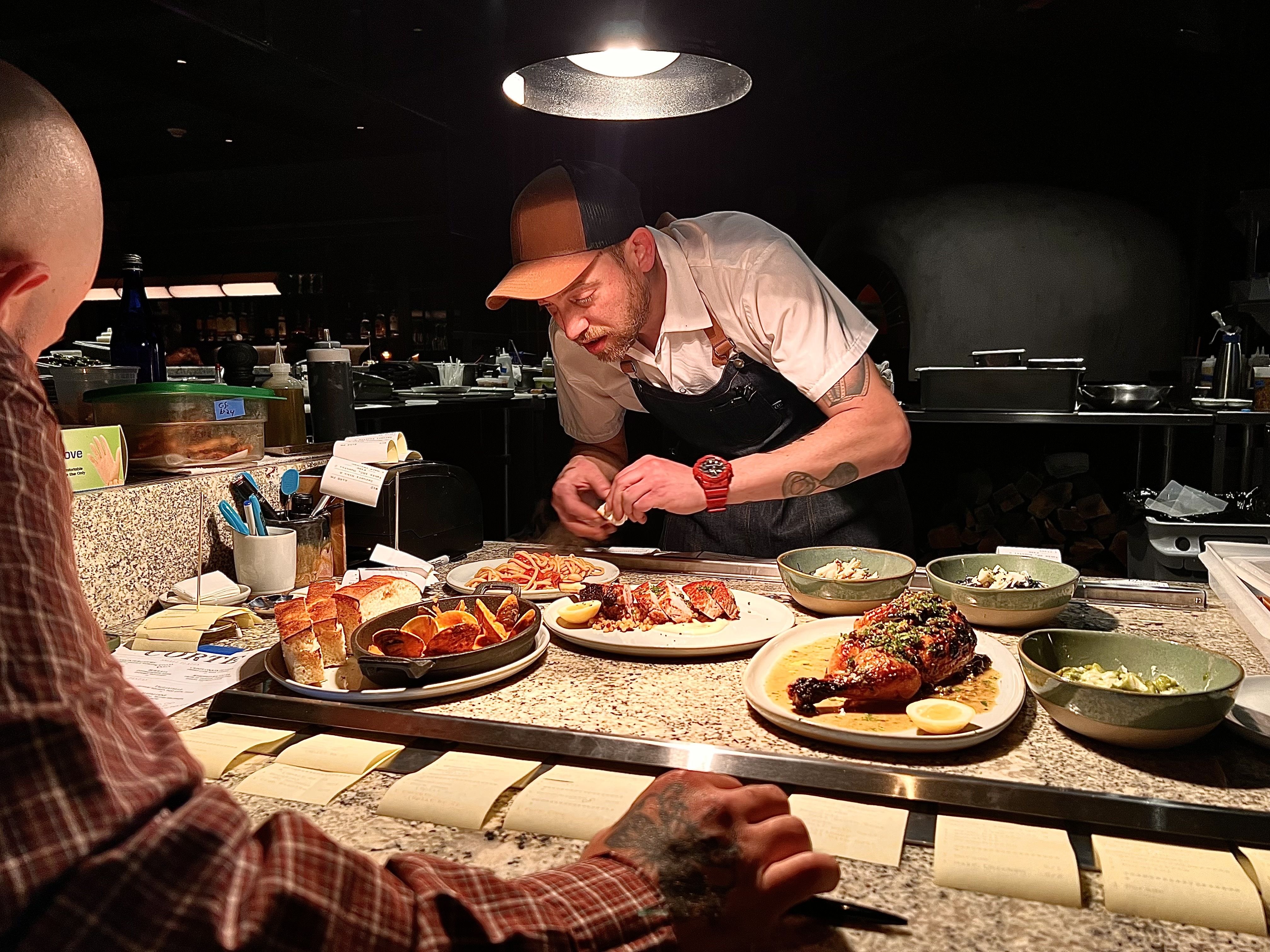
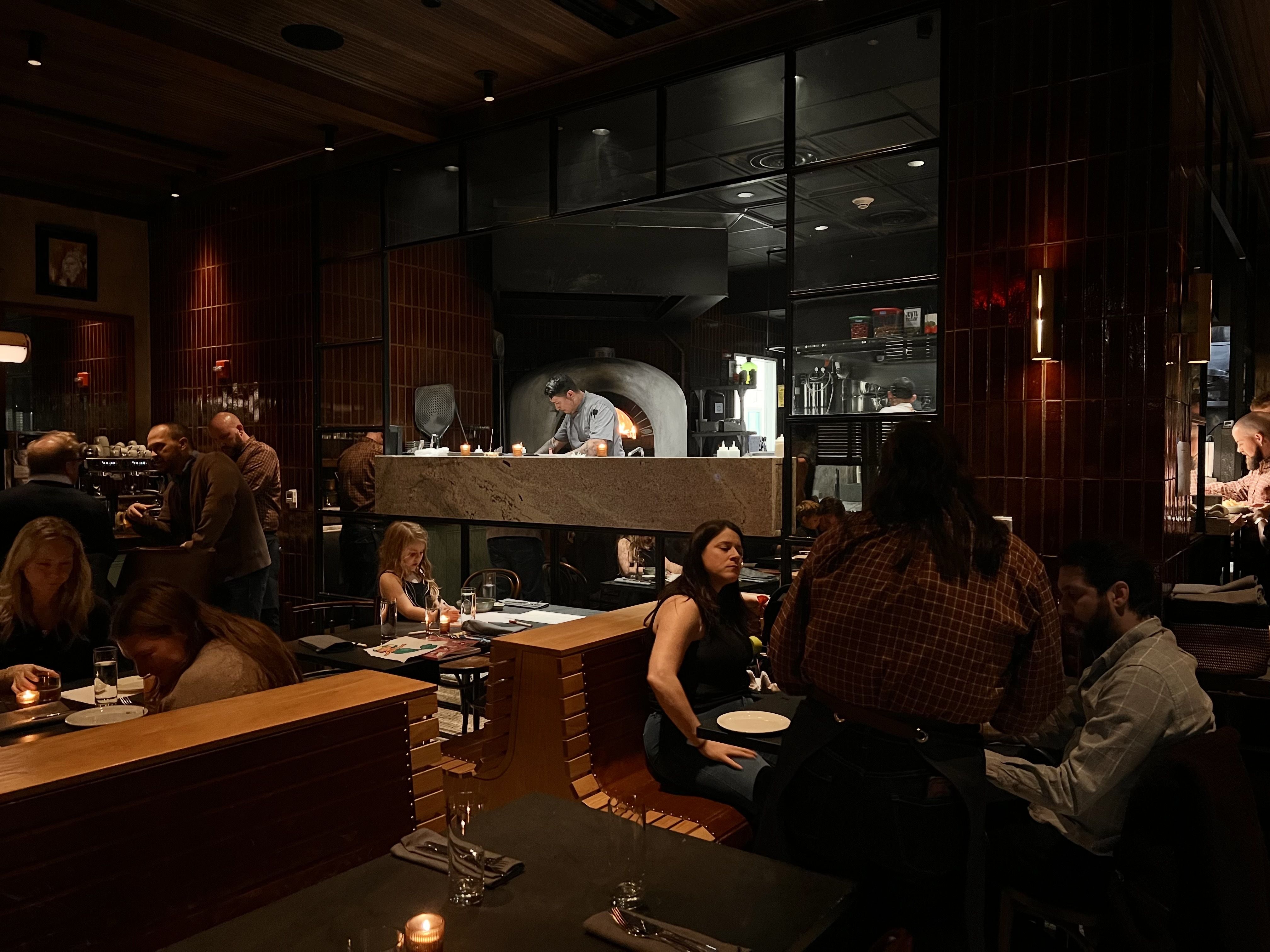
The bar at Corte, 1175 Ludlow St.Bondfire MediaDining room and bar at Corte, 1175 Ludlow St., on Oct. 26, 2026.Michael Klein / StaffDining room at Corte, 1175 Ludlow St., on Oct. 26, 2026.Michael Klein / StaffThe all-weather patio at Corte, 1175 Ludlow St.Bondfire MediaChef David Feola at Corte, 1175 Ludlow St., on Oct. 26, 2026.Michael Klein / StaffChef David Feola at Corte, 1175 Ludlow St., on Oct. 26, 2026.Michael Klein / StaffBar at Corte, 1175 Ludlow St., on Oct. 26, 2026.Michael Klein / StaffDining room at Corte, 1175 Ludlow St., on Oct. 26, 2026.Michael Klein / StaffChef David Feola at Corte, 1175 Ludlow St., on Oct. 26, 2026.Michael Klein / Staff
But Ryan Mulholland, a partner with chef David Feola and James Smith, said the opportunity to do something different was precisely the attraction.
“We already scratched that itch at Corio,” Mulholland said. “We just envisioned something else for the neighborhood.”
“We have a lot of experience working with wood ovens, and David has a lot of experience working with live fire and solid-fuel cooking,” Mulholland said. “We thought, why don’t we do something different with it?”
The centerpiece remains the Mugnaini oven, a roaring backdrop in the elevated open kitchen, which Feola is using to roast proteins and vegetables while expanding the pasta program that the partners established at Corio.
Chef David Feola at Corte, 1175 Ludlow St., on Oct. 26.Michael Klein / Staff
There are six pastas ($14–$23), including rigatoni with crispy chicken skin and black olive caramel, and Maryland crab risotto with squid ink. Clams in purgatory and crispy halloumi are among the small plates ($12–$21), while vegetables ($13–$15) range from kale salad to blistered leeks with vichyssoise purée (inspired by the dish at New York City’s Via Carota).
One favorite from a preview dinner was the roasted chicken capperi ($33), a whole-chicken version of chicken piccata, with lemon, capers, and anchovy. The oven also turns out sea bream ($31), pork chop ($37), and a 32-ounce rib-eye ($119).
Feola’s new mafaldine ($17) combines the ruffled, ribbonlike pasta with broccoli-stem ragù, crispy fennel sausage roasted in the wood oven, and broccoli rabe.
A chicory salad ($15) with creamy Parmesan vinaigrette and arancini is a variation on a more substantial salad served at Corio. Sandwiches — celery root Milanese, tuna confit, crispy pork — hover around $17.
Dining room at Corte, 1175 Ludlow St., on Oct. 26, 2026.Michael Klein / Staff
Beverage manager Chris Gueye — who, like all of Corte’s partners, is a veteran of Vernick Food & Drink — has created an acqua pazza-inspired cocktail with tomato water, chili, fennel, saffron, and a caperberry garnish. The cocktail program mixes originals with lesser-known classics. One featured drink is the Corpse Reviver No. 1, a combination of Calvados, brandy, and sweet vermouth that Mulholland discovered in a 1948 printing of Trader Vic’s Bartender’s Guide found in his grandmother’s liquor cabinet.
The plan is to feature a different cocktail every week or two, drawn from a collection of eight or nine books, including The Savoy Cocktail Book.
Corte, 1175 Ludlow St., occupies the former Mulherin’s Pizzeria in East Market.Michael Klein / Staff
Corte retains most of the dark-wood, earth-toned interior that Stokes Architecture & Design installed for Mulherin’s. Mulholland replaced the backless barstools and rearranged the dining room.
The enclosed outdoor dining area has roll-up walls for warmer weather and overhead heaters intended to extend its season.
Corte is open for dinner daily. Lunch, featuring the same menu, is expected to begin in early November, with a limited selection of brunch dishes to follow.
Corte, 1175 Ludlow St., 267-928-4500, cortephilly.com. Hours:4 to 9 p.m. weekdays, until 10 p.m. on weekends
WASHINGTON — The Supreme Court refused Tuesday to immediately block an immigration-related agreement between the Justice Department and the state of Texas affecting the rules for deportation proceedings that opponents have described as “egregious collusion” between the Republican-led state and the Trump administration.
Three cities and an immigrant advocacy group had asked the justices to halt the deal and clear a path to reinstate a Biden administration policy that had given immigration judges discretion to postpone deportation proceedings in certain cases.
The cities — Baltimore; New Haven, Conn.; and Columbus, Ohio — have significant immigrant communities and back the Biden-era policy, saying it was an important procedure that has existed in some form for decades and has implications for hundreds of thousands of cases.
The Supreme Court’s one-sentence order did not include any reasoning, which is often the case when the justices respond to emergency requests. There were no noted dissents.
At issue was the rule known as “administrative closure,” which gives immigration judges discretion to suspend deportation proceedings in some situations, such as when an individual is seeking humanitarian protections or other legal status to remain in the country. The cities told the court that the administrative closure process was intended to “promote efficiency or protect due process rights.”
Between 2013 and 2017, the number of removal cases closed using the rule increased from nearly 172,000 to more than 268,000, according to the Trump administration.
During the first Trump administration, the attorney general found that immigration judges lacked the authority “to indefinitely suspend immigration proceedings through administrative closure.” In 2024, the Justice Department issued a new rule that once again gave immigration judges the discretion to halt some deportation proceedings.
As part of President Donald Trump’s mass-deportation agenda, the administration has overhauled immigration courts and pressured judges to deport more people. Unlike the independent federal judiciary, immigration courts are part of the Justice Department.
In April 2025, the acting director of the Executive Office for Immigration Review, the unit at the Justice Department that runs the immigration courts, issued a memo saying it “could not — and will not — defend” the 2024 rule reinstating the administrative closure process. But the office said immigration judges should continue to follow it “unless they have a legal basis for not doing so.”
Ken Paxton, the Republican attorney general in Texas and an ally of Trump, sued the federal government in June over the 2024 rule, which he argued operated as de facto amnesty because it allowed immigration judges to delay deportation proceedings, in some cases for years. The continued presence of immigrants lacking permanent legal status, the state said, caused “fiscal, public safety, and sovereign harms.”
The two sides were ideologically aligned but formally on opposite sides in a lawsuit. On the same day the lawsuit was filed, the two sides told a judge they had agreed to settle it, ending the matter with a binding agreement removing the immigration judges’ discretion. America First Legal, a group co-founded by Stephen Miller, a senior White House adviser and the architect of much of Trump’s immigration policy, has helped represent Texas.
The lawsuit was filed in Wichita Falls, Texas, a go-to destination for the Justice Department. At the time, Judge Reed O’Connor, who was nominated by President George W. Bush, heard every case brought in that division.
O’Connor quickly signed off on the settlement with a brief order and later ruled that the cities and advocates did not have legal grounds, known as standing, to sue. The 5th U.S. Circuit Court of Appeals refused to block the agreement, and opponents then asked the Supreme Court to intervene.
In court filings, city officials and Centro Legal, which provides legal services to immigrants, said the proposed agreement was an abuse of the court system because the federal government and the state of Texas were on the same side. The move, they said, allowed the administration to undo an agency action without going through the proper process.
Paxton’s office told the justices in a filing that there had been a live, legitimate controversy between the state and the administration because the rule was still in effect when Texas sued.
The cities said they would be harmed by the settlement in part because of the potential loss of tax revenue from residents who might be deported and because crime victims living in the country illegally might be discouraged from cooperating with law enforcement in the face of reopened deportation hearings.
In response, D. John Sauer, the solicitor general, said the challengers did not have legal grounds to intervene because they were not regulated by the rule, which applies to immigrants in removal proceedings and not to the cities. He pushed back on the assertion that the deal struck with Texas would be immune from a legal challenge. Undocumented immigrations, he said, could potentially bring lawsuits targeting the elimination of the rule.
Defenseman Cam York will be the latest to return to the lineup, as he will slot back in on Tuesday against the visiting Columbus Blue Jackets (7 p.m., NBCSP). York last played Oct. 8 against the Ottawa Senators and has missed eight games with an upper-body injury.
The Californian struggled mightily to start the season, suggesting the injury may have lingered for a while. According to Natural Stat Trick, in the five games York played, he had the worst Corsi for percentage among the regulars at five-on-five and was on the ice for seven goals against.
“Rather [have] him play out of it, being healthy, to be honest with you,” coach Rick Tocchet said of the early struggles. “It wasn’t just him, it was a few guys that, I think, you want to play to get out of the struggles instead of being injured and stewing about it. So, listen, hopefully, he took the break, obviously, to get healthy, but also to analyze the game.”
So what is the message to York in his first game back? “I would say stay consistent,” Tocchet said. “I think that’s the hardest thing is when you come back, the game might be a little faster at the start, but I think if you stay consistent, and I know we use the word a lot, simplify, I think it gets you in the game quicker.”
With York returning, where does he slot in? Fellow blueliner Rasmus Ristolainen was officially placed on injured reserve on Tuesday, retroactive to Oct. 24, and is out for two weeks. He came back for one game on Saturday, and although Tocchet suggested his return would help limit 21-year-old blueliner Oliver Bonk’s minutes so he was not playing 20 a night, the rookie mostly remained on the top pair with Travis Sanheim.
Ristolainen played on the third pairing, which is potentially where York could find himself on Tuesday. At morning skate, Tocchet suggested not tweaking the top four of Bonk and Sanheim and Nick Seeler and Jamie Drysdale.
York typically skates with Drysdale, but if he is on the bottom pair, he’ll play with rookie blueliner Hunter McDonald, who Tocchet said has done “a pretty good job” and has shown that “it’s hard to take him out.”
Breaking camp as an NHLer for the first time this season, things looked up for Alex Bump. But after three games of getting shuffled around in the lineup and another in the press box as a scratch, he found himself back in Lehigh Valley of the American Hockey League.
Bump did not pout or complain. Instead, he went to work and notched seven goals and eight points in five games and was named the AHL’s player of the week on Oct. 18.
“I think that’s really important,” Bump said on Tuesday about going down with a good frame of mind. “I think if you go down there being disappointed about it or mad about it, you’re going to get the wrong results. So I think just going into it with the right mindset is really important because the mental game is the biggest battle, I think.”
Bump was recalled on Oct. 19 and has played in three games, starting on a kid line with Cole Knuble and Denver Barkey before lining up the last two games with veterans Sean Couturier and Tyson Foerster.
Flyers left wing Alex Bump has proven he can be a prolific scorer at the AHL level. He believes he’s close to breaking out with the Flyers.Yong Kim / Staff Photographer
According to Natural Stat Trick, the line has played almost 19 minutes together at five-on-five, and while they’ve allowed more shot attempts (14-17) and scoring chances (6-12), they have had twice as many high-danger chances and have not allowed a goal.
“They’re both two great players. Obviously Foery can score, I have a little scoring touch as well, and Coots has been around a long time; he’s a great player,” Bump said. “Just trying to learn from both of them … from Coots especially. But yeah, we’re finding that chemistry; I think that’s what matters most is kind of just finding that chemistry with a line and just you just take off with it.”
For Bump individually, his game is an offensive one. Against the Anaheim Ducks on Saturday, he led all Flyers forwards with five individual shot attempts and tied Jacob Gaucher for the most high-danger chances created (two) despite playing under 12 minutes at five-on-five.
Across his six games, the Minnesotan has yet to be on the ice for a five-on-five goal against and is one of just three Flyers who have played in at least six games without a negative plus-minus; Nick Seeler is plus-1, and Denver Barkey is even. He is tied for the fourth-most individual high-danger chances created (six) and has the third-best high-danger chances for percentage (46.43%) among players who have skated in at least six games.
Part of his uptick in his all-around game is the rise in his puck possession and wall play. With a total of 23 games, including 17 from last season, and six playoff games, the rookie is feeling more and more comfortable at the NHL level.
“That’s just getting more reps, I think, is what’s helping, but that’s one of my better things in my game is puck possession and holding onto the puck,” said Bump, who is also getting power-play time on the second unit. “So just I need to find that more and more throughout, and I’m getting there, but I think I still have more to give.”
Never Emil-ing it
It’s been a weird few months for Emil Andrae.
First, the defenseman was a bit surprised when he got traded to the Toronto Maple Leafs in June, in a deal that saw Simon Benoit and Joseph Woll come to Philly. But he was even more shocked when he was part of a six-player swap headlined by Kirill Marchenko and Matthew Knies that saw him go to the Columbus Blue Jackets right before the season started.
“I was there for two exhibition games and three good weeks with that group … and to be a part of the Toronto Maple Leafs, just a lot of fun and I was excited to be there,” Andrae told The Inquirer on Tuesday.
“And then the trade happened, and once I found out it was Columbus, I was pretty happy. I thought it was a good chance for me to come to a team where they needed some D-men.”
Andrae has played in five of the Blue Jackets’ first nine games, registering two assists and a plus-3 rating while averaging more than 10 minutes a night.
Although he will not play on Tuesday against the Flyers, Andrae noted it was a little weird being back at Xfinity Mobile Arena. Selected in the second round of the 2020 NHL draft by Philly, Andrae first came to North America at the end of the 2022-23 season.
The Swede made his NHL debut in October of 2023, spending the next three seasons splitting time between the Phantoms and the Flyers. At 5-foot-9, he struggled to find a solid footing in Philly despite showing he is a mobile, puck-moving defenseman with aggresiveness and offensive upside.
“I’m still a pretty small guy. Some coaches think it’s important. Obviously, I think it’s more important to know what you do with the puck and being in the right spot at the right time, and use your … your hockey mind. I think that’s the most important thing you have on the ice,” Andrae said.
“I feel like I provided a lot of good hockey. Obviously, you have ups and downs through the whole year, and you can’t always be at your A game. But I think my B game was good enough to solidify myself in this league, and I know I’m good enough to play here. And coming to Columbus, we had a lot of injuries, and now there’s guys coming back too, and I feel like all these five games I played pretty solid.”
Last season, Andrae was sent down before the team broke camp but was quickly recalled and made his debut Oct. 13. He never went back.
“Probably last year,” he said when asked about his favorite memory in Philly. “My goal was to be up all year, and that’s what I pretty much did, and I brought a lot to that team, and I think I had a lot of fun last year. Being last in the league and having that 3.8%, making the playoffs, and then getting into the playoffs and being a part of that team was strong, and being a part of that journey was a lot of fun.”
Emil Andrae spent parts of three seasons with the Flyers before being traded this June.Yong Kim / Staff Photographer
Now he has to rebuild trust with a new coaching staff, led by long-time NHL bench boss Rick Bowness.
“Hopefully from here on, [I] just can build my game and keep getting better because I know what I’m worth … and once that opportunity comes, and when you get the opportunity, I know what I’m good for, and I’m going to provide that.”
Breakaways
Goalie Dan Vladař (2-3-1, .900 save percentage) will start for the Flyers. … Forward Jacob Gaucher was recalled from Lehigh Valley on Tuesday.