New Jersey farmers whose fruit crops were damaged or destroyed by an unexpected four-day freeze last spring could apply for grants to help them recover their losses under new legislation that would earmark $60 million in state funding for such relief.
The late-April cold snap zapped peach, apple, pear, cherry, and other early-blooming trees, as well as shrub, vine, and ground crops like blueberries, strawberries, and grapes at farms both statewide and throughout the eastern U.S. from Virginia to Michigan. Many growers lost 30% or more of their fruit crops, with some reporting total losses. Officials estimated damages in New Jersey would top $300 million.
Assemblywoman Dawn Fantasia (R., Sussex) applauded the state and federal response, with both Gov. Mikie Sherrill (D) and the U.S. Department of Agriculture making statewide disaster declarations that cleared the way for farmers to apply for emergency loans and other relief assistance.
But in the weeks afterward, farmers called for direct financial aid, with many saying the freeze was the most catastrophic of their lifetimes. So Fantasia recently introduced a bill that would allocate $60 million for grants impacted farmers could apply for, with priority given to those hardest hit. The bill would require the state agriculture secretary to report within a year how the money was spent and advise if more aid is needed.
Seven Republicans signed on to co-sponsor the bill. Sen. Parker Space (R., Sussex), who’s also a farmer by trade, will sponsor the bill in the upper chamber, Fantasia said.
Fantasia said $60 million in aid for farmers is far from the controversial budget add-ons that annually bloat the state budget and make GOP legislators howl in protest.
This year, state budget appropriations critics deride as “pork” included $500,000 for pickleball courts and millions for other “really beautiful things that are absolutely wants and not needs,” Fantasia said. Farm relief “is not a want. It’s a need,” she added.
Farming has a sprawling footprint in New Jersey, she said. Almost 10,000 farms generated nearly $1.5 billion in sales in 2022, federal data shows. They employ about 25,000 farmworkers, the bill says.
“We can sure as hell take $60 million from the general fund and give it to an industry that spans the entire state and brings in over a billion dollars to the state of New Jersey,” Fantasia said. “We’re talking about people’s livelihoods and ability to keep jobs and stay in their homes.”
April’s freeze came as farmers already were struggling with rising labor, fertilizer, and fuel costs. Some smaller farms rely on a single season for their annual income, prompting industry observers to predict the freeze would force some growers to cut staff, sell off acreage, or quit farming altogether.
For those reasons, Fantasia expects legislators from both sides of the aisle will support the bill.
“There’s no question here: Severe losses happened. No product to sell. Devastating to the economy. Devastating to the jobs in New Jersey. I think it’s a no-brainer,” she said.
Hunterdon County farmer John Melick lost much of his peach, apple, cherry, plum, and pear crops to the April freeze.
Crop insurance has helped him recover, he said. But he welcomes any assistance the state wants to offer the fruit-growing industry, noting it would be most beneficial for smaller farmers, those without diversified crops, and the few who couldn’t afford or thought they didn’t need crop insurance.
“It’s not going to put me out of business if I don’t get it, but I won’t turn it away either,” Melick said of state aid.
He’d be more excited for Trenton’s intervention if legislators could control the weather, he joked, because the recent rainy stretch has kept customers away.
“I’m hoping for sunny weekends for October, so that the 30% crop that I do have I can sell to pick-your-own customers,” Melick said. “When it rains every Saturday and Sunday, they’re not coming out.”
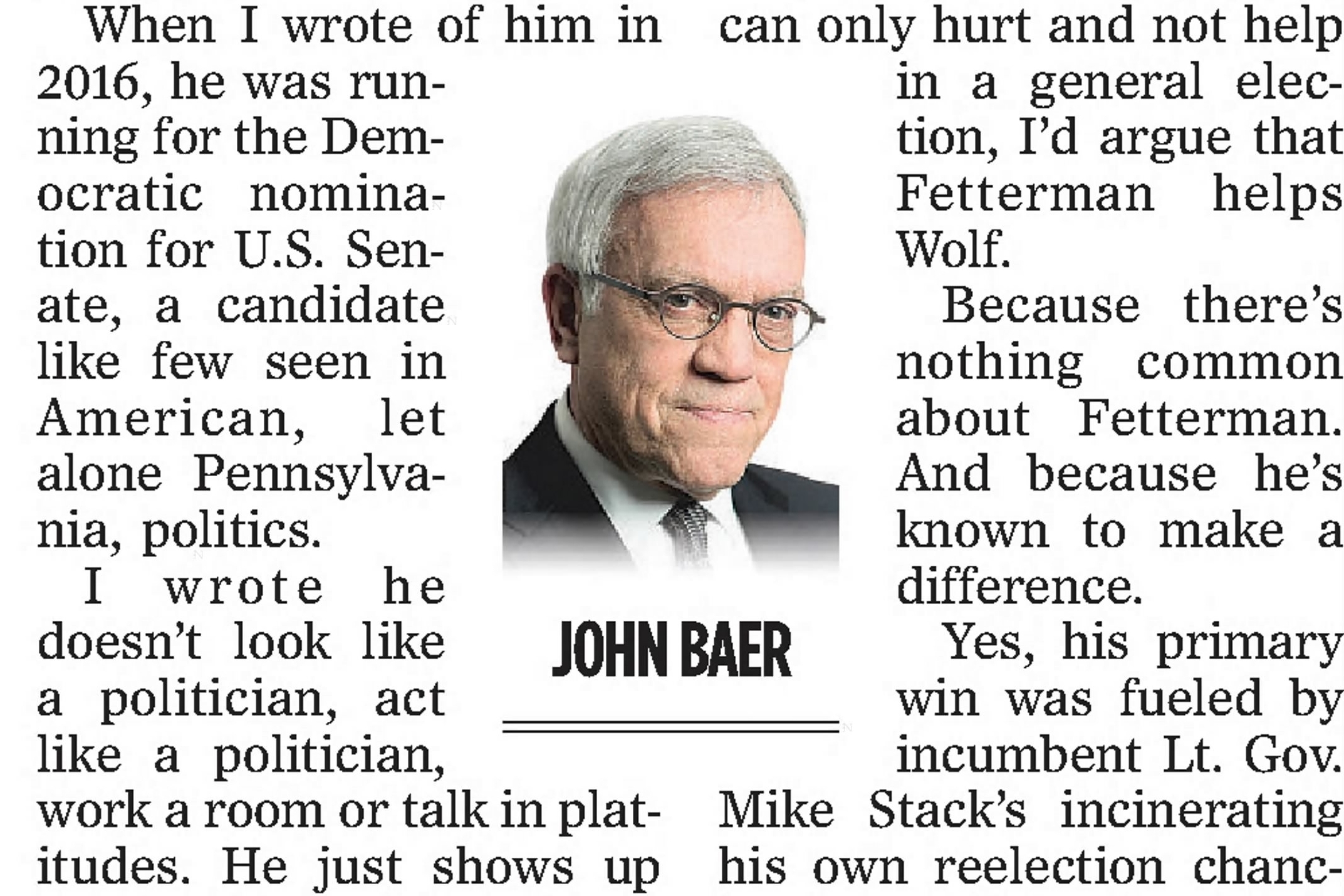
John Baer was the son of a Harrisburg newspaperman. He literally grew up in the Pennsylvania state Capitol. And he never left.
His father, John H. Baer, was a political reporter for what is now the Patriot-News in Harrisburg, and Mr. Baer spent many Sunday afternoons hanging around the old Capitol press room while his father worked on stories. Decades later, in 1972, Mr. Baer joined the Evening News in Harrisburg as a reporter and went on to work for nearly 50 years in that same press room.
“I’m probably unique in Pennsylvania politics and journalism,” Mr. Baer said in a 2020 oral history interview for Pennsylvania State University. “I dare say there probably aren’t any who can say they worked in the same state capitol newsroom that their father did.”
In 1987, the Daily News hired Mr. Baer to cover state politics in Harrisburg. He became a political columnist for the newspaper in 2000, and his plainspoken, no-holds-barred stories later appeared in The Inquirer as well. Before he left the papers in 2019, he covered hundreds of political campaigns, conventions, and elections, and wrote about thousands of local, state, and national politicians.
Mr. Baer’s column on politics appeared in The Inquirer and Daily News from 2000 to 2019. Newspapers.com
“He was the most feared reporter in my eight years in Harrisburg,” former Gov. Ed Rendell said. “He did his work. He did his digging. He really cared about the issues.”
On Thursday, Sept. 24, Mr. Baer died of cancer at his home in New Cumberland, Pa. He was 79.
For 32 years, Mr. Baer was a hard-hitting, award-winning political reporter and columnist for The Inquirer and Daily News. He was also a columnist for PennLive and the Patriot-News, onetime public TV producer and show host, former press secretary, author, teacher, and mentor.
Many of those Mr. Baer covered in Harrisburg, Philadelphia, and Washington praised his “deep integrity” and “fierce independence,” and called him a “keen observer of Pennsylvania politics” and “a heavyweight in Pennsylvania political reporting” in online tributes. State Rep. Ben Waxman called Mr. Baer a “legendary Capitol journalist.” U.S. Rep. Dwight Evans said he was “authentic and a one-of-a-kind journalist.”
Mr. Baer told Penn State he wanted to “let people see the inside of the game in Harrisburg.” His Inquirer.com online profile reads: “John Baer has written about politics and government since 1987. Neither subject ever fails to provide him with stories of policies and politicians walking on or skirting by paths to perdition.”
In addition to covering nine Pennsylvania governors, the impeachment trial of President Bill Clinton, and the ascensions of Presidents Barack Obama and Donald Trump, Mr. Baer wrote about the execution of serial killer Gary Heidnik, the pleas for more research funding by a cancer victim, and the battle of a state policeman’s widow to receive her husband’s pension benefits.
He said some of his favorite columns were the mea culpa pieces he wrote at the end of each year that highlighted things he got wrong. “I truly just had a ball at the Daily News,” he told Penn State. “I just loved it. … I’ve always said I had no adult supervision, and it was wonderful.”
Mr. Baer joined PennLive in 2019, and his last column was published in July. “The depth and breadth of his knowledge was beyond compare,” said Amy Worden, his editor at PennLive.
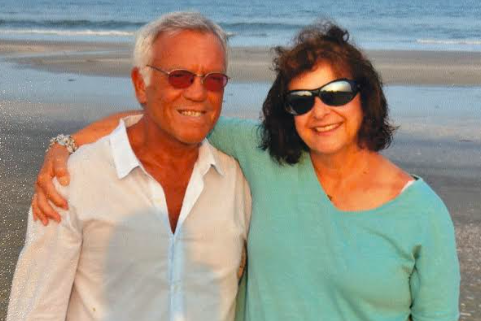
Mr. Baer and his wife, Rosemary, married in 1969.Courtesy of the family
Before the Daily News, Mr. Baer spent 14 years in total as a reporter for the Patriot-News, an award-winning public TV producer and show host for WITF in Harrisburg, and a press secretary during Lt. Gov. Bill Scranton’s unsuccessful run for governor in 1986.
He wrote freelance stories for Philadelphia Magazine and national publications. He was a frequent guest on political TV and radio shows and moderated several statewide candidate debates.
A lifelong foodie, he also reviewed Harrisburg-area restaurants for a magazine under the pseudonym “the Phantom Diner.” His book, On the Front Lines of Pennsylvania Politics,was published in 2012.
“He was so good at writing strong opinions with depth,” Paul Vigna, a retired Daily News editor, said.
Mr. Baer earned awards for his journalism and was inducted into the Pennsylvania News Media Hall of Fame in 2024. He was cofounder of the Pennsylvania Press Club and onetime president of the Pennsylvania Legislative Correspondents Association.
In tributes, colleagues praised his “sharp wit” and called him a “journalism giant,” “terrific writer,” and “mentor to many of us.” The internship program at the Pennsylvania Legislative Correspondents Association is named in his honor.
“He was an All-Star, a Hall of Famer,” Vigna said. Rendell said: “He didn’t take any BS.”
John Baer was born June 25, 1947, in Harrisburg. He graduated from Bishop McDevitt High School in 1965 and earned a bachelor’s degree in English at Mount St. Mary’s University in Maryland and a master’s degree in education later from Temple University.
He coached basketball and football teams while teaching English for three years at Trinity High School in Harrisburg after college. He married Rosemary Ruggieri in 1969, and they had sons Johnny and James.
Mr. Baer and his wife hosted many memorable Christmas parties and enjoyed road trips to Georgetown University basketball games, New York Mets baseball games, and their sons’ many sporting events. He played racquetball and tennis, and ran a marathon at 50.
He was a longtime member of St. Theresa Catholic Church in New Cumberland. “He liked interesting people and had lifelong friendships,” his family said in a tribute. “He loved his friends.”
On Facebook, colleague Diana Robinson said: “Here’s to you, John Baer. You’ll always be The Most Interesting Man in Harrisburg.”
In addition to his wife and sons, Mr. Baer is survived by three grandchildren and other relatives.
Services were held earlier.
Donations in his name may be made to Vickie’s Angel Foundation, 511 Bridge St., Box 174, New Cumberland, Pa. 17070.
A 13-year-old boy was charged with murder and related crimes after fatally shooting a 16-year-old boy in a Norristown home, authorities said Thursday.
The shooting happened the morning of Sept. 22 at a residence on the 700 block of Arch Street, where prosecutors said Daniel Hawkins-Boyce fatally shot the victim, William Boyd.
Hawkins-Boyce came into possession of a Ruger .380 handgun a week before the shooting, according to the affidavit of probable cause for his arrest. It was not clear how he did so. He told police he “found” it, the document said.
Hawkins-Boyce and Boyd were hanging out in the home’s basement and had recently smoked marijuana when he accidentally discharged the firearm, striking Boyd in the face, the affidavit said.
Hawkins-Boyce called 911, and detectives arrived to find him on the front porch with his mother, where he told them he was responsible for the shooting.
Hawkins-Boyce did not live at the home where the shooting occurred, authorities said. He told investigators that he’d taken the gun to meet Boyd, and that he’d checked to make sure it wasn’t loaded.
In the basement, he told police, he left the gun unattended when he went to the use the bathroom for 10 or 15 minutes.
When he returned, he said, he noticed the gun was in a different position than where he left it.
Hawkins-Boyce told police he began scrolling the social media app TikTok and tapping the gun’s trigger with his index finger, and the gun went off.
After the shooting, he ran home and awakened his mother to tell her what happened, the affidavit said.
Montgomery County District Attorney Kevin Steele said in a statement Thursday that evidence showed the teen had “recklessly fired the firearm at the victim.”
The firearm was reported stolen in Philadelphia in June, according to the affidavit.
Steele said Hawkins-Boyce was charged as an adult in accordance with state law, but he said the case would likely move to juvenile court after a review from a judge.
The teen was arraigned on Sept. 30 and is being held at the Montgomery County Juvenile Detention Center on a $200,000 bail.
He is expected to appear in court for a preliminary hearing on Oct. 14.
U.S. Immigration and Customs Enforcement officers have been ordered not to engage in high-speed car chases and to make vehicle stops only if they have completed specific training, under new internal guidance issued after several drivers were shot in encounters with ICE.
A memo sent to officers in ICE’s Enforcement and Removal Operations division and obtained by The Associated Press warned they are not authorized to chase vehicles that fail to pull over under any circumstances. Instead, officers should take down the vehicles’ information for further investigation, according to the memo signed by ICE’s executive associate director Marcos D. Charles and dated Wednesday.
The new guidance comes after ICE-initiated vehicle stops have repeatedly escalated when drivers have refused to cooperate or tried to flee. ICE agents have fired their guns during more than a dozen such encounters since last year, killing at least four people and wounding several others.
President Donald Trump’s administration has faced internal tension over how to handle traffic stops, which are seen as particularly high-risk encounters.
After fatal shootings of drivers in Maine and Texas in July, ICE officers were directed to temporarily pause most vehicle stops. But the next day, Trump went on social media to direct the agency to continue traffic stops, calling them “one of ICE’s most important and effective Crime Fighting tools.”
ICE has faced intense pressure from the White House to deport more people who are in the country illegally, and its arrests have reached record numbers. At the same time, the agency’s rapid hiring spree last year resulted in some poorly vetted and trained officers hitting the streets.
ICE and the Department of Homeland Security had no immediate comment on the policy guidance.
The new memo outlines steps intended to improve the safety of vehicle stops for ICE officers, drivers they are targeting, their passengers, and the public.
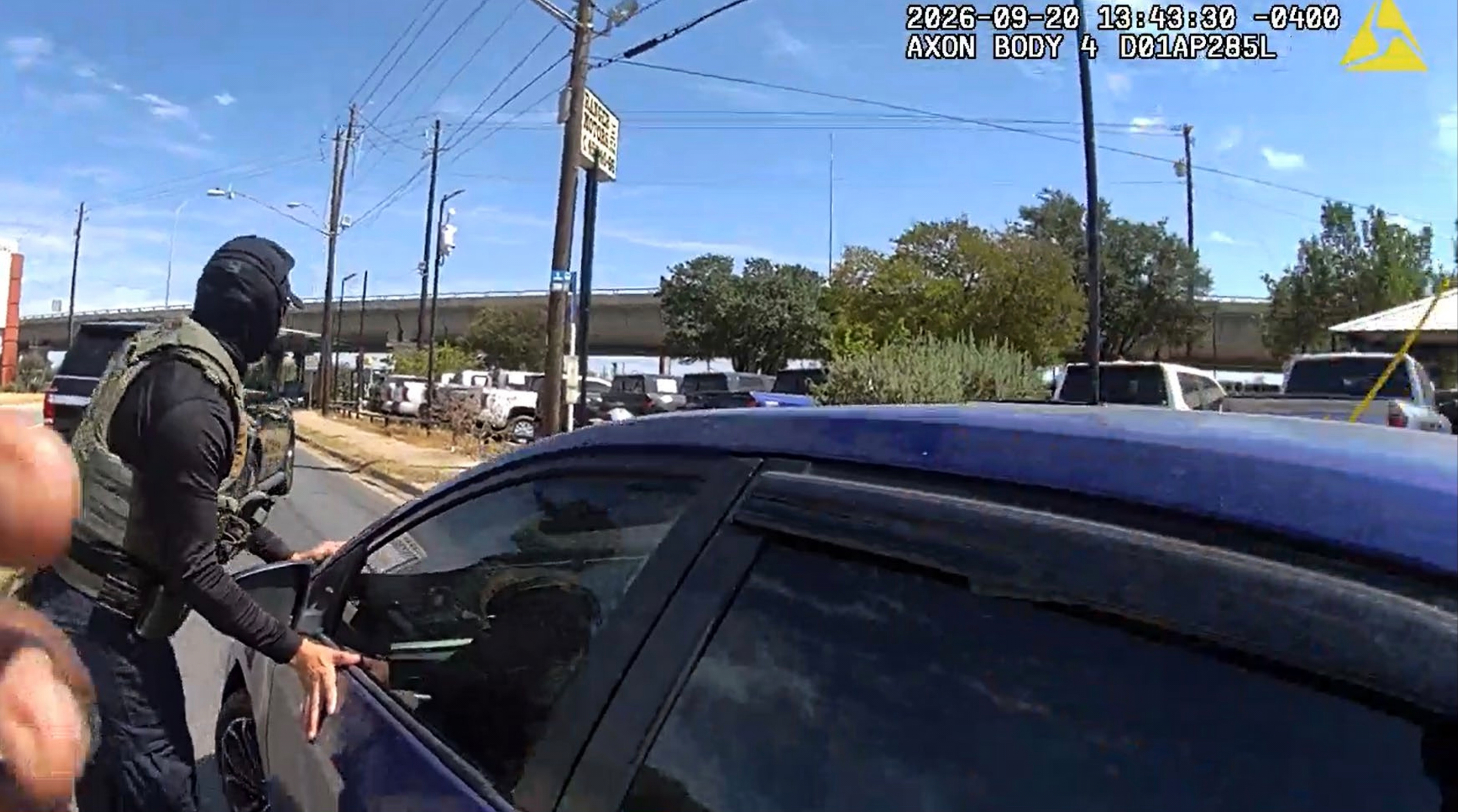
The memo told ICE’s field office directors that they must ensure vehicles used for traffic stops have lights and sirens that let the public know they are law enforcement vehicles when activated. All officers on the scenes of vehicle stops must wear and activate their body cameras, under the guidance.
In addition, only officers who have completed one of five specific agency training courses can conduct vehicle stops. Officers who have not completed the training courses can only participate in vehicle stops “in a support capacity” as passengers and cannot be the drivers of any of the vehicles involved.
The guidance says ICE officers can continue to use a controversial technique known as pinning, which is defined as “using a vehicle or physical barrier to trap or stop a car,” but only if they have received special training. Similarly, only trained officers can use spike strips that deflate tires to prevent drivers from fleeing.
The memo came the day that courtroom testimony highlighted ways in which two ICE officers involved in a vehicle stop, pursuit, and shooting that wounded a delivery driver in Austin last month would not have complied with the new guidance.
During a bond hearing for Wilber Rafael Garces Perez, testimony showed that the officer who shot him wasn’t wearing a body-worn camera. The ICE officer who did have a camera was driving in a separate car and turned it off during the pursuit.
Prosecutors presented surveillance video that showed an ICE agent chasing Garces Perez at high speeds through residential streets after he fled an initial traffic stop.
Garces Perez faces federal assault charges after investigators say he struck an ICE officer with his driver’s side mirror. That officer then shot into Perez’s vehicle, lodging a bullet in his back, officials say.
Attorneys for Garces Perez have called the charges against him “retaliation” and have argued that the camera footage was inconclusive because it didn’t fully capture the moment when he allegedly tried to flee.
Former New Jersey Lt. Gov. Dale Caldwell, who resigned last week after investigators found that he had made inappropriate and sexually charged comments to women and violated ethics rules, is now being investigated by his church, according to an email from a bishop reviewed by The Inquirer.
Cynthia Moore-Koikoi, the bishop of the Eastern Pennsylvania and Greater New Jersey Episcopal Area, sent a brief email to colleagues on Sept. 25, just hours after Gov. Mikie Sherrill announced Caldwell’s resignation that day.
“I write to inform you that I have received a complaint concerning Rev. Dale Caldwell, Lt. Governor of New Jersey and licensed pastor. The complaint is being processed according to the policies and procedures of the United Methodist Church,” the bishop’s email said.
In an email to the Inquirer Thursday night, Moore-Koikoi elaborated, saying she had suspended Caldwell from his pastoral duties until the investigation was done.
“Because we hold clergy to a high standard, we take the allegations made in the report seriously,” Moore-Koikoi’s statement said. “Following the publication of the report about the former Lt. Governor, I received a complaint based on the concerns raised in the report. In order to protect the well-being of Rev. Caldwell, the congregation, and all those involved, Rev. Caldwell has been placed on suspension while the complaint is processed.”
A spokesperson for the bishop clarified that the complaint “is based on what was already under investigation.”
In her email to members, Moore-Koikoi asked that they pray for him “and all those impacted by this process,” the email said. Moore-Koikoi included a Bible verse, 1 Corinthians 4:5a: “Therefore judge nothing before the appointed time; wait until the Lord comes.”
In an interview earlier Thursday, Caldwell said he was not facing any new allegations of impropriety. He said the Eastern Pennsylvania and Greater New Jersey Episcopal Area was simply “investigating the investigation, based on the same information.”
“It’s a piling on, and it’s crazy,” said Caldwell, the senior pastor at Covenant United Methodist Church in Plainfield.
At the time, he said no one has asked him to step aside. Caldwell could not immediately be reached for comment on the bishop’s statement saying she had suspended him.
Caldwell and his attorney have vociferously denied the former lieutenant governor and secretary of state did anything wrong and have criticized the findings of the four-month investigation by former Attorney General Christopher Porrino, who served under Gov. Chris Christie.
Caldwell, 66, left his job as president of Centenary University to run with Sherrill last year. The investigation found that Caldwell hit on a female staffer’s friend, and that when she turned him down, he told the staffer that ambitious women like them needed a man in a position to help them “but you young women are looking for young sperm.”
Caldwell denied making the comments, “but we did not find his denial credible,” Porrino’s report said. The state trooper accompanying Caldwell that day told investigators he never heard Caldwell make that statement.
Caldwell said Thursday he could not understand why they “disregarded” the testimony of the trooper, ”who was two feet away.”
The report said Caldwell also repeatedly brought personal guests to ticketed events without clearing it with the ethics officer and without paying for the extra tickets. The practice continued even after warnings, attending an ethics training, and being told about the investigation.
In releasing the report, Sherrill said it “lays out a pattern and practice of long-term concerning behavior.”
His attorney said when Caldwell “learned that reimbursement was appropriate in one particular situation, he reimbursed $175 for the event.”
Caldwell said he resigned “for the good of the state of New Jersey” because the matter distracted from the Sherrill administration’s important work.
When asked to comment, a Sherrill spokesperson referred to the governor’s earlier comments defending the thoroughness of Porrino’s investigation.
Caldwell and his attorney have said they are weighing their legal options. When asked what he might do, he said he could “sue for harassment.” He lamented “there was something wrong with the American system of justice” because it would take an enormous amount of money to prove he did nothing wrong.
“I can leave with my head up. I have a 22-year-old daughter and she was seeing all these people attack her dad,” Caldwell said. “I have a good life and opportunities. The number of supporters are many more than the detractors.”
Staff writer Aliya Schneider contributed to this article.
This story has been updated to reflect Caldwell’s suspension from his pastoral duties.
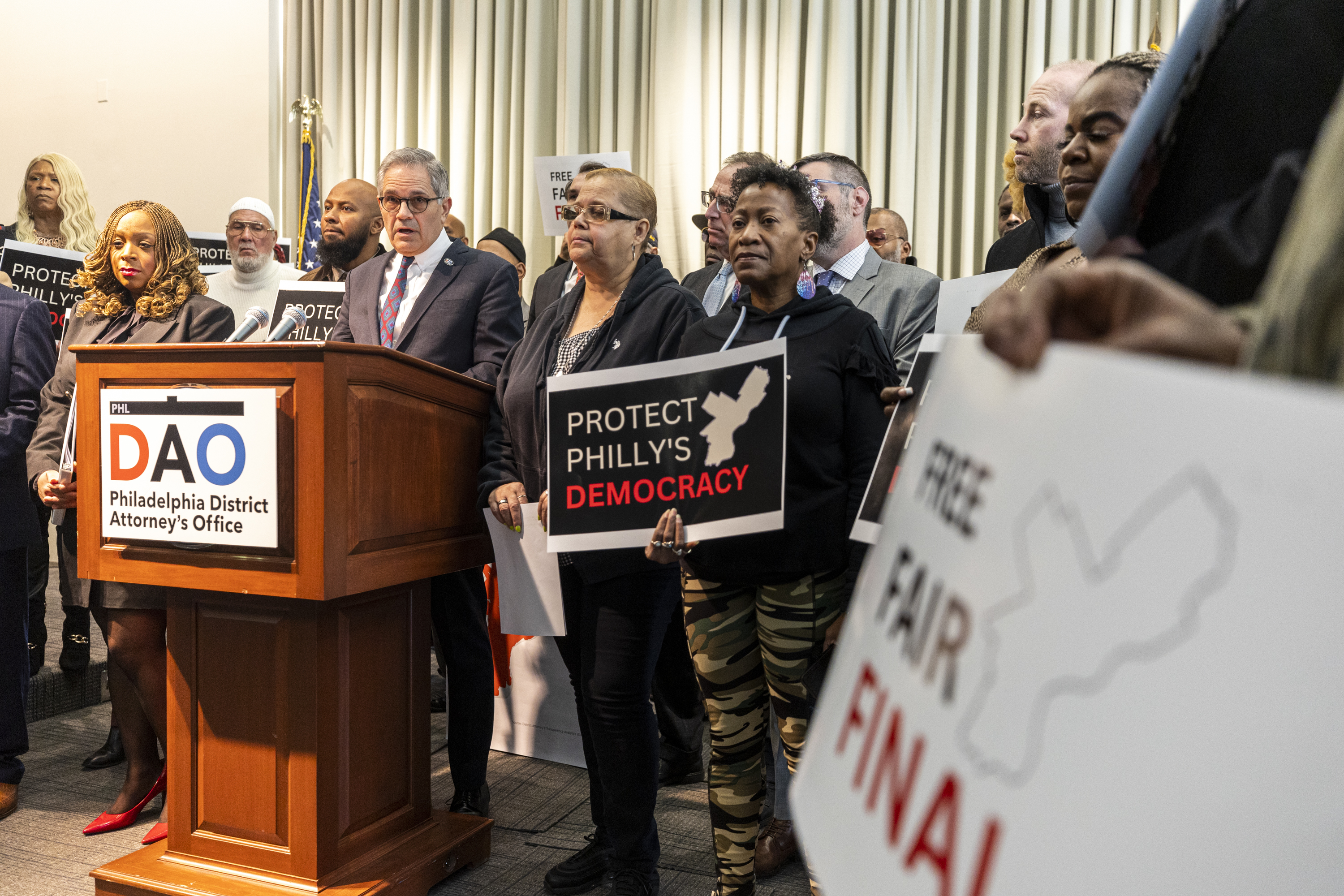
All seven justices rejected District Attorney Larry Krasner’s argument that the law unconstitutionally strips the authority of an elected district attorney by granting jurisdictions to crime “within” SEPTA to a special prosecutor appointed by the Pennsylvania attorney general. But they did not unanimously agree on the reason.
The special prosecutor can investigate crimes in all counties in which SEPTA operates, but can take over cases unilaterally only in Philadelphia.
Chief Justice Debra Todd wrote in the majority opinion that the part of the special prosecutor law specific to Philadelphia serves a “legitimate state interest: promoting public safety through the protection of SEPTA employees and riders by supporting the prosecution of crimes within SEPTA, and specifically, SEPTA-related crimes in Philadelphia.”
The law responds to “public safety concerns regarding increased SEPTA-related crime in Philadelphia, and the belief that such crimes were not being sufficiently prosecuted,” Todd wrote.
State Attorney General Dave Sunday, who is authorized to appoint the special prosecutor, said the law “has paid great dividends in holding violent offenders accountable” for crimes on SEPTA.
“Our mass transit prosecutor will continue to prosecute criminals who have killed and assaulted other individuals, perpetrated acts of gun violence, and stolen SEPTA property,” Sunday said in a statement.
A spokesperson for the district attorney’s office did not return a request for comment.
The special prosecutor’s office has become more active in the last year after a slow start. The office initially hired a sole attorney and did not prosecute a case until 2025, two years after its creation. The office has since taken on a portfolio of around two dozen cases, a spokesperson for the attorney general said. Serious crime on SEPTA has trended downward, according to the agency, falling around 20% in mid-2026 compared with the same period the previous year.
Earlier this year, the special prosecutor,Michael Untermeyer, took on an assault case involving a woman accused of pepper-spraying and punching a conservative influencer during a viral confrontation on a SEPTA bus. And a representative for Sunday’soffice said the prosecutor was preparing for a homicide trial in November, and the office was recently referred a case involving an assault on a SEPTA bus driver.
The ruling is the latest in which the Supreme Court has shown willingness to take away from Krasner functions that county prosecutors traditionally havehad sole discretion over. The justices in June found that Philadelphia prosecutors had engaged in a pattern of misleading judges when seeking to overturn murder convictions, and instructed judges to notify the state attorney general’s office so it can review cases when Krasner’s office makes such requests going forward.
But the ruling on the SEPTA special prosecutor might be short-lived.
Krasner’s lawsuit called the law an “unconstitutional, radical, and unprecedented measure” amounting to a “shocking usurpation of power.”
In June, Commonwealth Court issued a 4-3 decision against Krasner, finding the law constitutional. In the majority opinion, Judge Anne E. Covey said the act “does not clearly, palpably, and plainly violate the Pennsylvania Constitution.”
In a Thursday concurring opinion, Justice David Wecht emphasized the ways the special prosecutor law was tailored to Krasner specifically.
The law disqualifies anyone who worked at the Philadelphia district attorney’s office as of roughly the beginning of Krasner’s tenure from serving as special prosecutor, the justice noted. And the measure was set to expire a year after Krasner’s second term ended (he has since won a third, which began in January).
The special prosecutor law is “tailored to hamstring Philadelphia’s thrice-elected and sitting District Attorney’s customary prerogatives relative to crime within the jurisdiction that office serves,” Wecht wrote.
“But none of that matters,” he said, because since 1951 the Pennsylvania Constitution has allowed for laws ”regulating the affairs of the City of Philadelphia.”
Over five days in August, Pennsylvania health officials called the Lancaster County Coroner’s Office at least three times and sent an email asking to discuss the death of an infant who had tested positive for measles.
They did not connect with coroner Stephen Diamantoni before Gov. Josh Shapiro came to the county to announce at an Aug. 25 news conference that two unvaccinated Lancaster residents had died in a growing measles outbreak, the state’s first measles-associated deaths in 35 years.
Soon after, the county coroner — an elected Republican who has presided over the office for nearly two decades — was telling reporters the state had not talked to him directly, raising questions about the state’s communications.
His comments, coupled with his position that he did not believe one of the two infants affected had died from measles, kicked off a viral exchange of misinformation cited by anti-vaccine activists — and spiraling up to federal health leaders — to discredit the dangers of Pennsylvania’s growing measles outbreak.
Now emails from the coroner’s office, obtained by The Inquirer through an open-records request, show that state officials made significant outreach to Diamantoni, far beyond his prior statements acknowledging only that his deputy spoke with state officials shortly before the news conference.
In fact, doctors from the state health department had tried to contact his office about the case for days, with increasing urgency. At one point, a doctor told one of Diamantoni’s staffers that they were ready “24/7” to speak with someone from the office.
Yet two weeks after the announcement, he continued to emphasize the state’s lacking communication in an in-person interview with The Inquirer. “I have not received any information directly from the state [health] department,” he said on Sept. 9.
By then, his statements had enabled President Donald Trump’s health secretary, Robert F. Kennedy Jr., to question whether the deaths reported in Pennsylvania were real.
The Centers for Disease Control and Prevention for weeks omitted the first two deaths and those subsequently reported by the state in its national reporting, marking an extraordinary departure from public health norms. As of Thursday, the agency had updated its tally to recognize two deaths nationally this year, while Pennsylvania has reported five measles-related deaths.
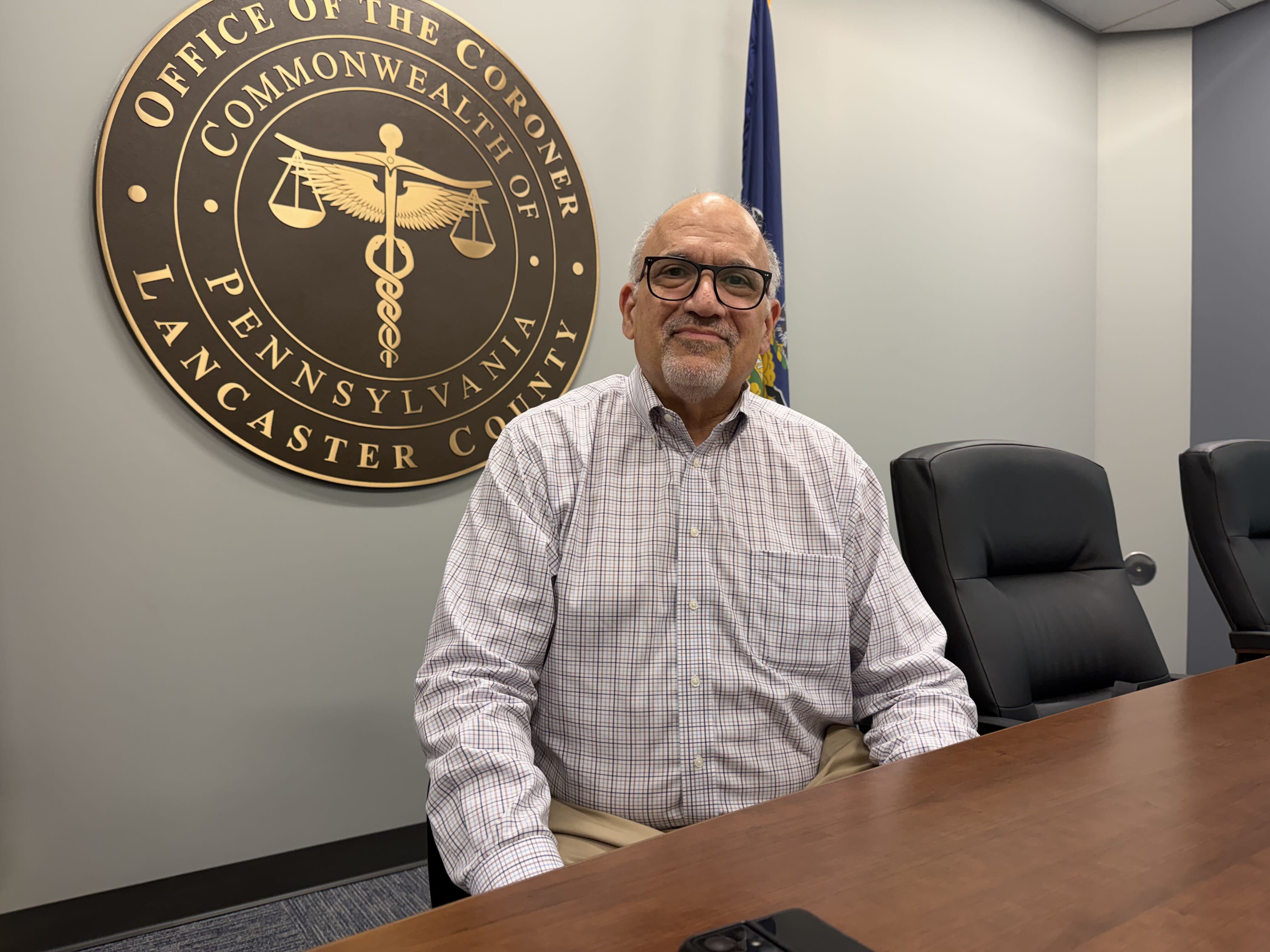
Lancaster County coroner Stephen Diamantoni poses for a photo in his office in September.Gillian McGoldrick
Asked to comment on the records, Diamantoni said he was not aware of the state’s outreach ahead of Shapiro’s announcement.
He said state officials should have been more explicit in the calls they made to his office staffers, who sent him and his deputy emails relaying messages. The communications did not make it clear that they needed to speak to him about a measles-associated death, Diamantoni said, adding that he is easy to reach.
“It didn’t sound like there was urgency. It didn’t sound like anyone indicated that there was a measles death that we want to talk to the coroner about,” he said.
Public officers like Diamantoni have an obligation to ensure staff can get timely messages to him, especially in a public health emergency like a measles outbreak, said Kathleen Hall Jamieson, director emerita of the Annenberg Public Policy Center at the University of Pennsylvania. Likewise, she noted, state officials must ensure communications with the public are transparent and easy to understand.
State officials did not immediately say how they define a “measles-associated death” and have provided few details on the deaths themselves, leaving county coroners to fill in the blanks.
Public health experts have noted that the politically charged back-and-forth and competing narratives around the deaths risks confusing the public at a time when clarity is crucial — amid the largest measles outbreak in the country, with state officials reporting nearly 1,000 cases and five measles-associated deaths.
(function(){function e(){window.addEventListener(`message`,function(e){if(e.data[`datawrapper-height`]!==void 0){var t=document.querySelectorAll(`iframe`);for(var n in e.data[`datawrapper-height`])for(var r=0,i;i=t[r];r++)if(i.contentWindow===e.source){var a=e.data[`datawrapper-height`][n]+`px`;i.style.height=a}}})}e()})();
The contradictory communications from the state and the local coroner’s office around the initial Lancaster deaths set the stage for Kennedy to attack Shapiro in an X post, claiming the Democratic governor may have “fabricated” two of the deaths in Pennsylvania.
Shapiro has sharply criticized Kennedy, a longtime anti-vaccination advocate, for spreading misinformation about vaccine safety and Pennsylvania’s outbreak, now the largest in the nation this year, with the most deaths reported by any state since 1992.
Asked for comment on communications with Diamantoni, state officials provided a statement by email saying Pennsylvania law bars them from providing further information on the initial measles-associated deaths.
The health department’s epidemiology team “thoroughly investigates and verifies” measles-associated deaths to ensure that they meet the state’s definition, and does not announce deaths until they have finished an investigation, health department press secretary Neil Ruhland said in an email.
He said state law does not require the department to report deaths to a coroner’s office; rather, coroners and “other certifiers” report deaths to the state health department.
“PA DOH has followed this explicit process for all measles-associated deaths in Pennsylvania,” Ruhland wrote.
‘No one looks good’
News outlets began calling Diamantoni as soon as the first measles-related deaths were reported in Lancaster, where he is a family medicine doctor and former Lancaster City Council president. First elected to the coroner’s office in 2007, he said he views his duties as apolitical and describes himself as a strong advocate for vaccination.
He told media outlets he had been surprised by the state’s announcement, as his office had not identified any deaths from measles.
The office had investigated the death of an infant who tested positive for the disease, but Diamantoni has maintained that the child had died from a lacerated spleen, not the highly contagious illness.
Diamantoni told The Inquirer repeatedly that state health officials had never spoken personally with him about the death of an infant later identified as Ivan Miller, who was hours old when he died on Aug. 14.
He said that state health officials had only reached out hours before their news conference, and that his deputy, Eric Bieber, had spoken to them.
(function(){function e(){window.addEventListener(`message`,function(e){if(e.data[`datawrapper-height`]!==void 0){var t=document.querySelectorAll(`iframe`);for(var n in e.data[`datawrapper-height`])for(var r=0,i;i=t[r];r++)if(i.contentWindow===e.source){var a=e.data[`datawrapper-height`][n]+`px`;i.style.height=a}}})}e()})();
Internal office records reveal that five days before the news conference, a staffer in the coroner’s office e-mailed Diamantoni, saying that an infectious-disease doctor with the state health department was looking to speak to “one of you” about “the positive measles case with the infant we just had.”
The state health department followed up on its initial Aug. 20 call with subsequent emails and calls on Aug. 21, a Friday, and Aug. 24, the following Monday, records show.
One doctor included his state-issued cell phone number in an email to a coroner’s office staffer and Bieber and emphasized that he was available “24/7” to discuss the case.
When Bieber spoke to representatives from the state health department on Aug. 25, the office did not realize that the state was about to announce two measles-associated deaths, according to Diamantoni.
Diamantoni added that since he did not believe Ivan Miller’s death was caused by measles, he had not been expecting any outreach from the state.
“I don’t think it would have brought a red flag to me. It just looked like a request we usually receive from different individuals, different agencies, requesting cause and manner information,” Diamantoni said.
Yet it is the responsibility of public officials to establish communication procedures at their offices, especially when a contagious disease is spreading and the public needs clear information, according to Penn’s Jamieson.
In public offices, she said, “you shouldn’t be seeing a situation in which the person doesn’t get the information, or is able to say, ‘I didn’t get it.’”
State officials could have communicated more clearly in announcing the deaths as well, she said, noting that they did not immediately define “measles-associated death” in an initial news release.
Jamieson said it is important for health officials to explain “what we know, what we don’t know, and how we’re finding out what we don’t know” in terms the public can understand.
“Anytime the public is listening to voices that are supposed to be speaking with authority, and the public, instead of hearing a clear message, is confused, you have a problem,” she said. “No one looks good.”
Measles-associated deaths in Pennsylvania
State officials have repeatedly cited state privacy laws in response to criticism of their communications, saying they cannot provide detail about how they investigated the measles-associated deaths.
The state defines a measles-associated death as one that occurs within 30 days of symptom onset in a person with clinical evidence of infection and a positive laboratory test for measles, and who did not die of another unrelated cause, like a car crash.
Officials have provided little information beyond the fact that none of the five people who have died were vaccinated, and their county of residence.
Local coroners like Diamantoni have offered more details.
For example, in early September, Jefferson County’s coroner, also an elected Republican, confirmed the death of a 40-year-old woman from measles. He disclosed that the woman also had severe respiratory conditions, including chronic obstructive pulmonary disease, that made her vulnerable to serious complications from a respiratory illness like measles.
Later in the same week, the Mifflin County coroner, another Republican, confirmed that an unvaccinated 18-year-old had died from a rare neurological complication of measles.
Diamantoni has shared that Ivan Miller, who died at a birthing center in Lancaster County, tested positive for a measles infection acquired before birth. His family, who is Amish, told the Atlantic that his mother had a severe case of measles and gave birth early.
Although Diamantoni did not consider measles to have caused the death, he said, measles was included on the boy’s death certificate in a section that lists “significant conditions contributing to death but not resulting in the underlying cause.”
Physicians have noted that measles can weaken the spleen, putting it at risk of rupture. Diamantoni cited a lacerated spleen as the primary cause of death.
The second death, another Amish infant, was not initially reported to Diamantoni; Lancaster’s Clinic for Special Children, which treats Amish children with genetic conditions, had treated the baby until her death.
Diamantoni’s office investigated the death about a week after the state’s news conference; he later told reporters that the baby was 6 weeks old and had Amish lethal microcephaly, a fatal genetic condition that makes respiratory illnesses particularly risky. Diamantoni said measles caused the baby’s death.
On Wednesday, state health officials announced a fifth death, a Lancaster County resident who tested positive for measles and died. Diamantoni told The Inquirer that he had not handled that death, but that state health officials had informed him about it. He said they provided no further information.
State officials did not say whether the person, who was unvaccinated, died in Lancaster County.
Diamantoni told an Inquirer reporter in early September that he was proud that his office was one of the first in the country to be certified by the International Association of Coroners and Medical Examiners.
“People may not always agree with our findings, but they’re well investigated and well thought out,” he said.
Staff writer Gillian McGoldrick contributed to this article.
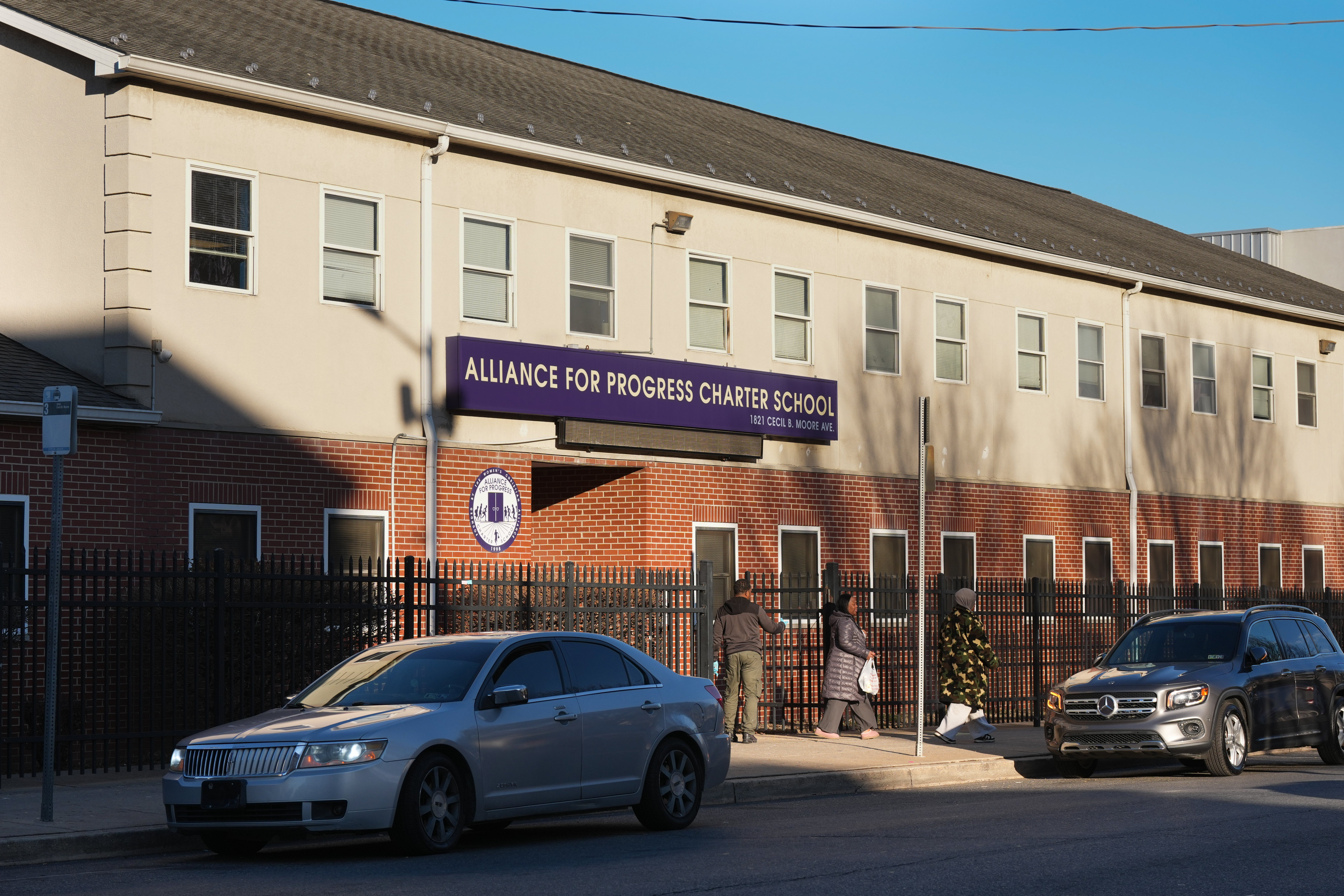
Alliance for Progress Charter School, a North Philadelphia charter roiled by turmoil, has a new leader.
Emmanuel George is now interim chief executive officer, the school’s board of directors chair said in an “important leadership update” recently sent to families. He replaces Stacey Scott, who served as Alliance’s CEO for several years.
George hails from New York City,where he spent 16 years as an educator and administrator in the charter sector. He describes himself as a consultant and school turnaround specialist.
It was not clear whether Scott was fired or voluntarily left. Larry Griffin, the board chair, did not address the circumstances surrounding Scott’s departure in his letter; he did say that Scott “will work with Mr. George to ensure a smooth and orderly transition.”
Alliance for Progress’ charter is up for renewal by the Philadelphia school board this school year.
Alliance, on Cecil B. Moore Avenue, has churned through staff in recent years. Paraprofessionals without college degrees or educational licenses are providing instruction, according to multiple people inside the school. Alliance also kept students on its rolls who did not attend, leading to state payments for children it did not educate, according to people inside the school.
Scott had been working remotely after an Aug. 25 incident in which she stormed into a meeting at the schooland began cursing at Eric Langston, the new principal.
George began his job on Sept. 26. It’s not clear exactly when Scott left her CEO role.
“You can’t trust this snake! Motherf—!” Scott allegedly said when she interrupted Langston’s meeting, according to people with firsthand knowledge. She then walked out of the room, shouting “F— this school,” and left the building.
Langston, who started working at Alliance this summer, had sent an August email to the board outlining concerns about the school, and Scott’s leadership in particular.
Langston spelled out issues around “Scott’s leadership and decision-making, including questions about whether decisions are consistently being made in the best interest of the school,” according to the email, which was obtained by The Inquirer.
Langston said his concerns “have reached a level that gives me significant pause regarding leadership practices, organizational culture, transparency, and the long-term health of Alliance.”
Griffin, in a statementThursday, said, “Alliance continues our review of matters identified by” the Inquirer story. “Given that, we still have no comment at this time.”
Continued worries
An Alliance staff member said the year is still concerningly chaotic.
On one recent day, a lockdown was called around lunchtime because a student could not be located, said the staffer, who asked to remain anonymous for fear of reprisal.
Ten minutes into the lockdown, it was discovered that the student didn’t actually attend Alliance.
“You aren’t aware that you may be missing a student until noon, and someone didn’t even know that student wasn’t in their class,” the staffer said.
“The staff are all great, but we’re all in the same mode of frustration, where we don’t know what’s going on. There’s a lack of communication from higher up. We’re frustrated and worried for the kids.”
Administration seems most focused on the school’s charter renewal, the staffer said.
The staffer said some Alliance students, especially the older ones at the600-studentK-8 school, have picked up on the problems.
“The kids know there’s such a turnover rate, and they can push teachers out. And there’s no consequences for them. They understand the dysfunction, they see teachers leaving all the time. They see their test scores — they’re aware that they’re really behind in reading. Not one grade, the entire school.”
Griffin, in his letter to families, said he knew transitions brought questions, and vowed the board would “remain actively engaged in supporting Mr. George, our faculty and staff and the school community. Our responsibility is to provide the leadership, oversight and stability Alliance needs to continue moving forward.”
The school’s direction must remain clear, Griffin wrote.
“Alliance for Progress exists to create opportunity for our students and help every child learn, grow and succeed,” Griffin said. “That means keeping students at the center of our decisions, supporting the people who serve them every day and strengthening the systems and practices that allow our school to deliver on its mission.”
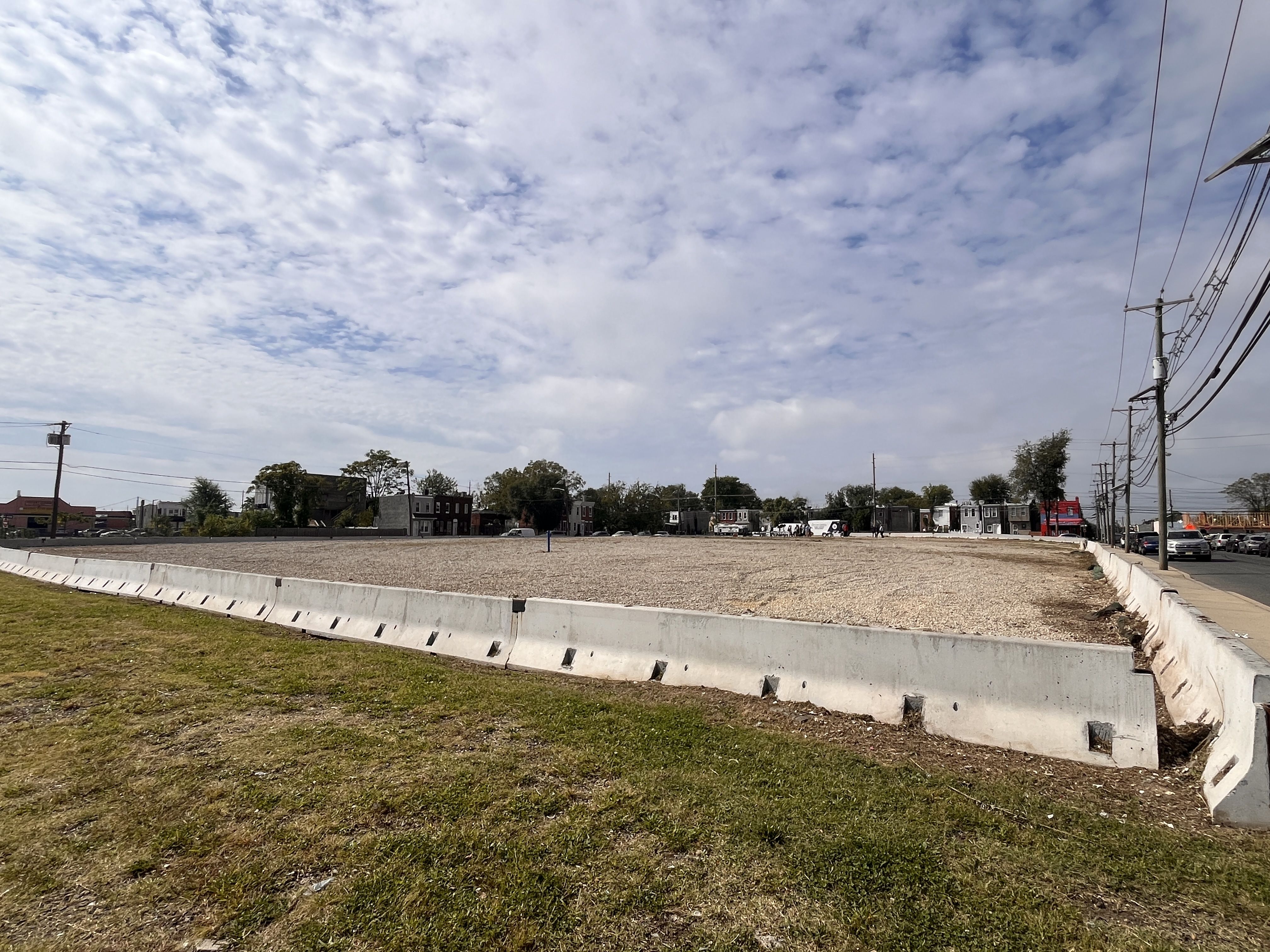
A 45-foot-high pile of illegally dumped construction fill that once marred Camden’s Bergen Square neighborhood was removed several years ago.
But contamination still lurks beneath, including lead, arsenic, and PFAS — known as “forever chemicals.”
Now, the U.S. Environmental Protection Agency has awarded a $2.5 million grant toexcavate and clean up the 1.6-acre site by scooping out and disposing of a four-foot-deep layer of ground, now leveled with crushed stone.
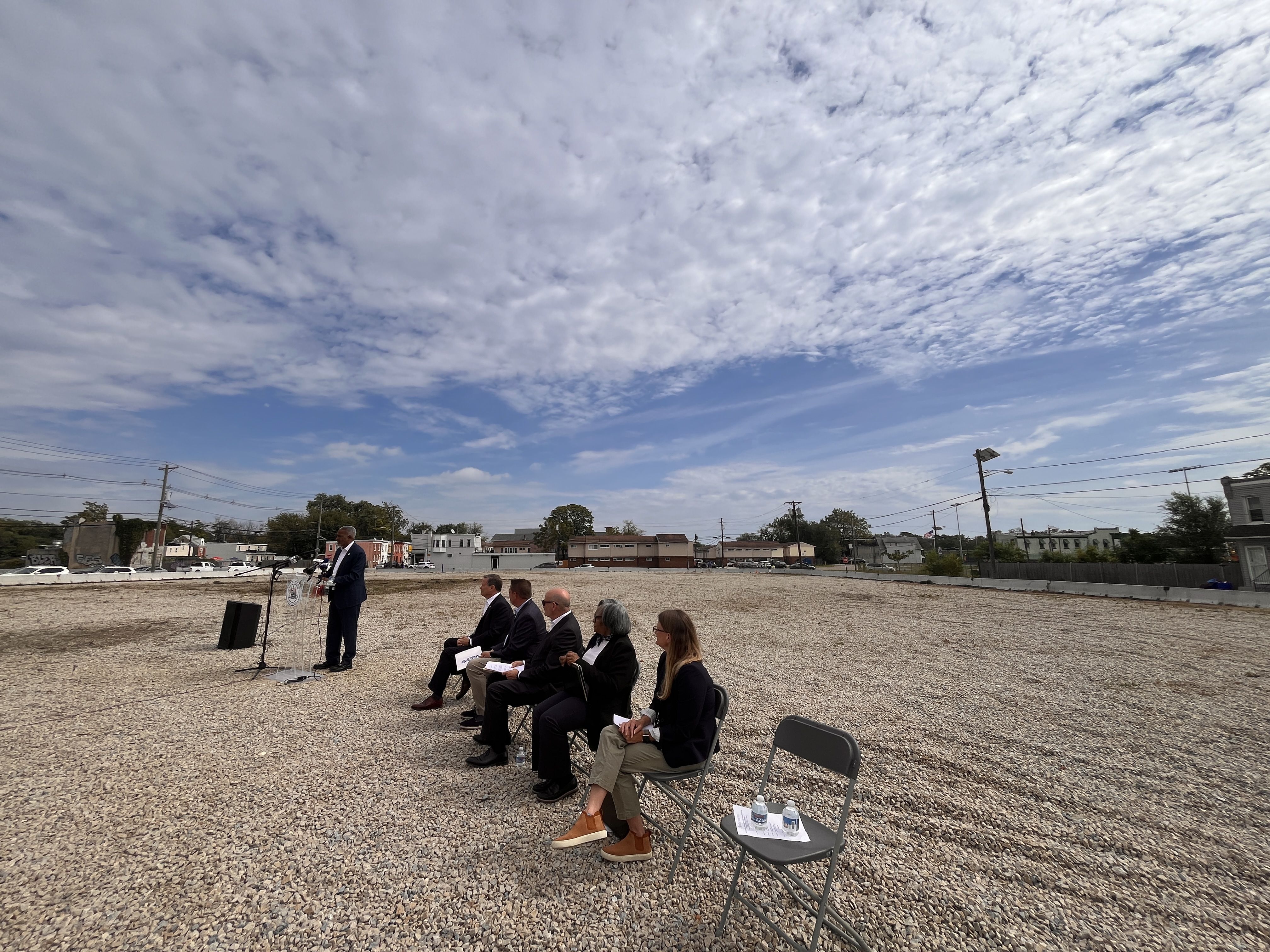
The grant was announced Thursday at a news conference with regional EPA administrator Michael Martucci, Camden Mayor Victor Carstarphen, U.S. Rep. Donald Norcross (D., N.J.), and other officials.
“It’s a brownfield grant,” Martucci said, noting the money would be used to assess the site and clean it so it can be used for a productive purpose.
“There’s underground contamination,” he said. “To return the site to beneficial reuse, we need to complete the environmental cleanup.”
Martucci said the money would be awarded after Camden finds a developer for the site and submits plans for itsnew use.
The site of a former tower of dirt at 7th and Chestnut Streets in Camden, N.J. is now covered in crushed stone.Frank Kummer
Hope for a neighborhood
Carstarphen said the cleanup brings more hope to the blighted neighborhood.
“This is a great day for our community,” Carstarphen said. “It’s been a long, long journey.”
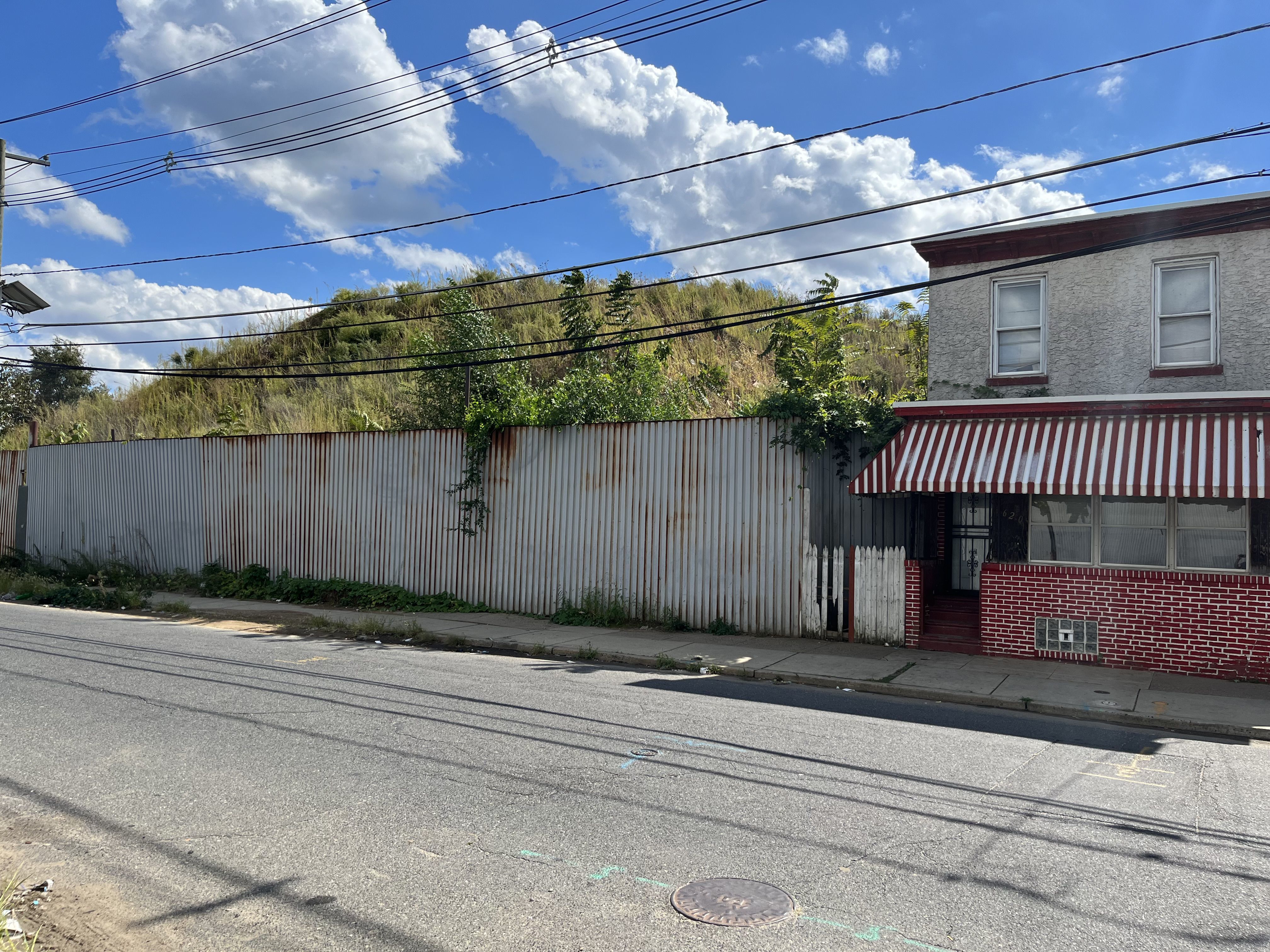
The pile, the result of years of dumping construction fill and other material at the site, grew so big that it loomed over a lone home on the 600 block of Chestnut Street.
Covered with weeds, it towered above an intersection with debris, including tires and broken concrete. Some of the waste spilled onto city property.
The pile was removed by the city in 2024. In all, crews removed 4,000 tons of solid waste, 100 tons of tires, and 15 drums.
Camden Mayor Victor Carstarphen speaks during a press conference about the cleanup of the site on Chestnut Street. Next to the mayor, from left, are U.S. Rep. Donald Norcross, U.S. Environmental Protection Agency regional administrator Michael Martucci, Camden County Commissioner Jeffrey Nash, Camden Redevelopment Agency executive director Olivette Simpson, and BRS Inc. engineer Jennifer Taylor.Frank Kummer
Long a blight on Bergen Square
The New Jersey Department of Environmental Protection sued one former owner and longtime operator of the site, S. Yaffa & Sons Inc.
The 2021 suit alleged the company “unlawfully imported and stockpiled solid waste on their Camden property, including contaminated fill material, construction and demolition debris, and waste tires,” and resisted taking action after receiving numerous violation notices and an order to stop. The company sold the property in 2019, according to the suit.
The suit also noted that Camden, with a “significant low-income and minority population,” has “been disproportionately exposed to high-polluting facilities.”
The city shut down the site in April 2021 as an illegal dump.
It entered into an agreement with multiple agencies in July 2022 to authorize action to take the land through foreclosure. In September 2022, officials seized the land, then owned by a contractor. Some of the land was on both sides of the street.
Officials began removing the pile in 2023 and finished in June 2024, leaving a large open space that immediately changed the character of the neighborhood.
File: When the dirt pile still stood next to a home on Chestnut Streets in Camden. Frank Kummer
Next steps
Olivett Simpson, executive director of the Camden Redevelopment Agency, said an estimated 11,800 tons of soil will be removed and the site will then be covered with clean soil.
Camden is currently assessing what kind of redevelopment will work on the site, which is zoned forindustrial and commercial buildings. Simpson said the city has already held meetings to engage the community on the site’s future, which will likely include retail and housing.
Jennifer Taylor, an engineer with BRS Inc., a brownfield consulting firm, is working with the city to evaluate redevelopment opportunities and expects a plan to be adopted by the end of the year.
The ground underneath must be made suitable for people to use the property, Taylor said.
“We want the momentum of this site not to go away,” Taylor said.
Anew home was being built less than a block from the site as she spoke, something officials said would have been unlikely had the pile still stood.
A proposal for a two-story school for 160 students that Bancroft NeuroHealth plans on its Mount Laurel campus goes before the township planning board next week.
The nonprofit, based in Cherry Hill, would serve children ages 3 to 11 with autism and developmental disabilities in the building, according to documents with the application for preliminary and final major site plan approval.
A public hearing on Bancroft’s proposal is scheduled for the remote-only board meeting on Thursday, Oct. 8 at 6 p.m. via Zoom.
The 55,205-square-foot school at 311 Walton Ave. on Bancroft School’s Welsh Campus would have 188 staff members.
The school is scheduled to open in 2028 on former agricultural land that now is a lawn on the southeast part of the campus, according to the application.
Bancroft’s overall 80-acre Mount Laurel campus was approved by the planning board in 2016. A possible future expansion on the southwest part of the property is mentioned in the documents, but details were not provided.
Arsenic was found in soil on the proposed building site, but a report for Bancroft by Dewberry Engineers Inc., of Parsippany, states it is naturally occurring and not associated with historical agricultural activities or a discharge.
Dewberry reported it found no potentially contaminated areas of concern that required additional investigation.
70and73.com is a hyperlocal news site focused on South Jersey, including the communities of Cherry Hill, Evesham, Mount Laurel, Voorhees, Medford, Medford Lakes, and Moorestown.